
20 Best Inner Forearm Tattoo Ideas for Men (September 2026)
The inner forearm is one of the best all-round placements for a man getting a tattoo. The skin there is flat, thick through the middle and mostly out of the sun, so bold line work and colour both sit well and hold up. A short sleeve or a long shirt covers it when you need it to, and the surface is forgiving enough for anything from a small compass to a full arm piece.
Below are 20 inner forearm tattoo ideas for men, grouped by style so you can see which direction fits you. Each one comes with the honest notes: where it sits best, roughly how big it should be, how sore the session gets, and what tends to blur first.
If you are planning ahead rather than booking this week, that is the right way round. Most of the mistakes people make on this placement happen in the ten minutes of planning, not in the years afterwards.
Quick Guide: 20 Inner Forearm Tattoo Ideas at a Glance
| Idea | Style | Best placement | Size (inches / cm) | Pain |
|---|---|---|---|---|
| Dagger and rose | Traditional | Mid-forearm | 5-7 in / 13-18 cm | Medium |
| Coiling snake in solid black | Blackwork | Wrist to mid-forearm | 8-10 in / 20-25 cm | Medium-high |
| Panther head | Neo-traditional | Mid-forearm, angled | 6-8 in / 15-20 cm | Medium-high |
| Koi and wave | Japanese irezumi | Full inner forearm | 14-18 in / 36-46 cm | Medium |
| Biomechanical bracer | Biomechanical | Wrist to elbow | 9-12 in / 23-30 cm | Medium-high |
| Compass rose | Geometric fine line | Mid-forearm | 4-6 in / 10-15 cm | Low |
| Wolf portrait | Black-and-grey realism | Mid-forearm | 7-9 in / 18-23 cm | Medium |
| Falcon eye | Micro-realism | Inner wrist to mid-forearm | 2.5-3.5 in / 6-9 cm | Low-medium |
| Name in Old English lettering | Script / typography | Mid-forearm | 4-6 in / 10-15 cm | Low-medium |
| One-line quote | Fine-line script | Inner wrist | 3-5 in / 8-13 cm | Low |
| Home coordinates | Minimal line | Inner wrist | 2-3 in / 5-8 cm | Low |
| Moon phase arc | Celestial, blackwork | Full inner forearm | 12-15 in / 30-38 cm | Medium |
| Thistle and rose stem | Botanical fine line | Mid-forearm, following the ulna | 5-7 in / 13-18 cm | Low-medium |
| Hourglass in laurel | Neo-traditional | Mid-forearm | 4-5 in / 10-13 cm | Medium |
| Norse compass symbol | Blackwork symbol | Mid-forearm | 3.5-5 in / 9-13 cm | Low-medium |
| Cross over mountains | Faith / fine line | Mid to upper forearm | 4-6 in / 10-15 cm | Low-medium |
| Arabic calligraphy band | Calligraphy | Wrist to mid-forearm | 5-8 in / 13-20 cm | Low-medium |
| Polynesian-style geometric | Tribal | Full inner forearm | 12-16 in / 30-40 cm | Medium-high |
| Skull and chess knight | Traditional still life | Mid-forearm | 5-6 in / 13-15 cm | Medium |
| Patchwork icon grid | Small illustrative | Scattered, wrist to elbow | 1.5-2.5 in each / 4-6 cm | Low-medium |
Bold Blackwork and Traditional Inner Forearm Tattoos for Men
1. Traditional Dagger and Rose for a Classic Inner Forearm Tattoo
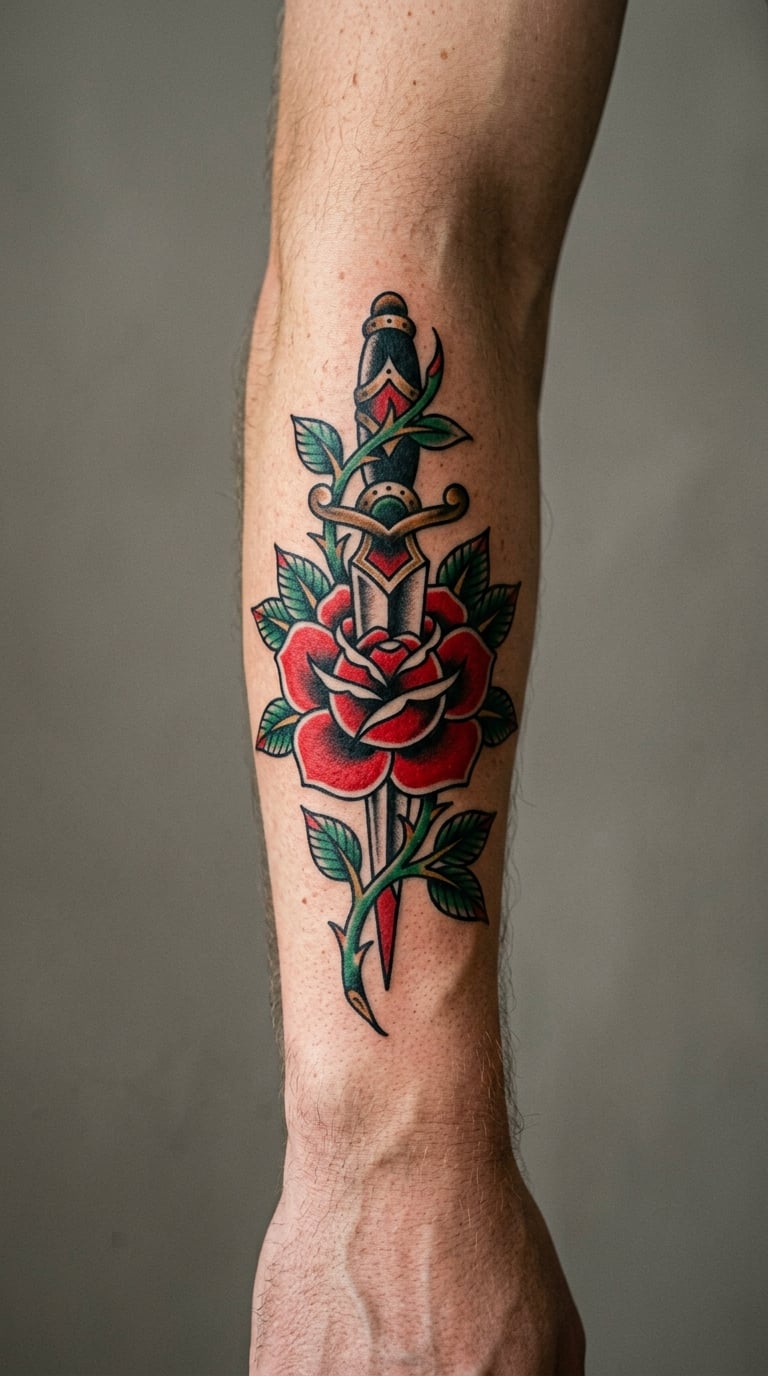
A dagger running lengthwise with a rose at the centre, heavy black outlines, red petals and nothing else. It has been on inner forearms since the 1950s and still works because the shapes are simple.
Men pick it for balance, or for something older than they are. The dagger reads as resolve, the rose as the softer counterweight.
Placement: mid-forearm, point toward the wrist. Size: 5-7 inches / 13-18 cm long. Style: traditional, bold line work, flat colour.
Pain: medium, worst where the outline crosses the forearm bone. The thin stem lines under the rose soften first over a decade, so ask for a heavier line weight than feels comfortable on day one.
Make it yours: put a real date under the rose, or a set of coordinates for somewhere that matters to you.
2. Coiling Snake in Solid Black for Inner Forearm Ink
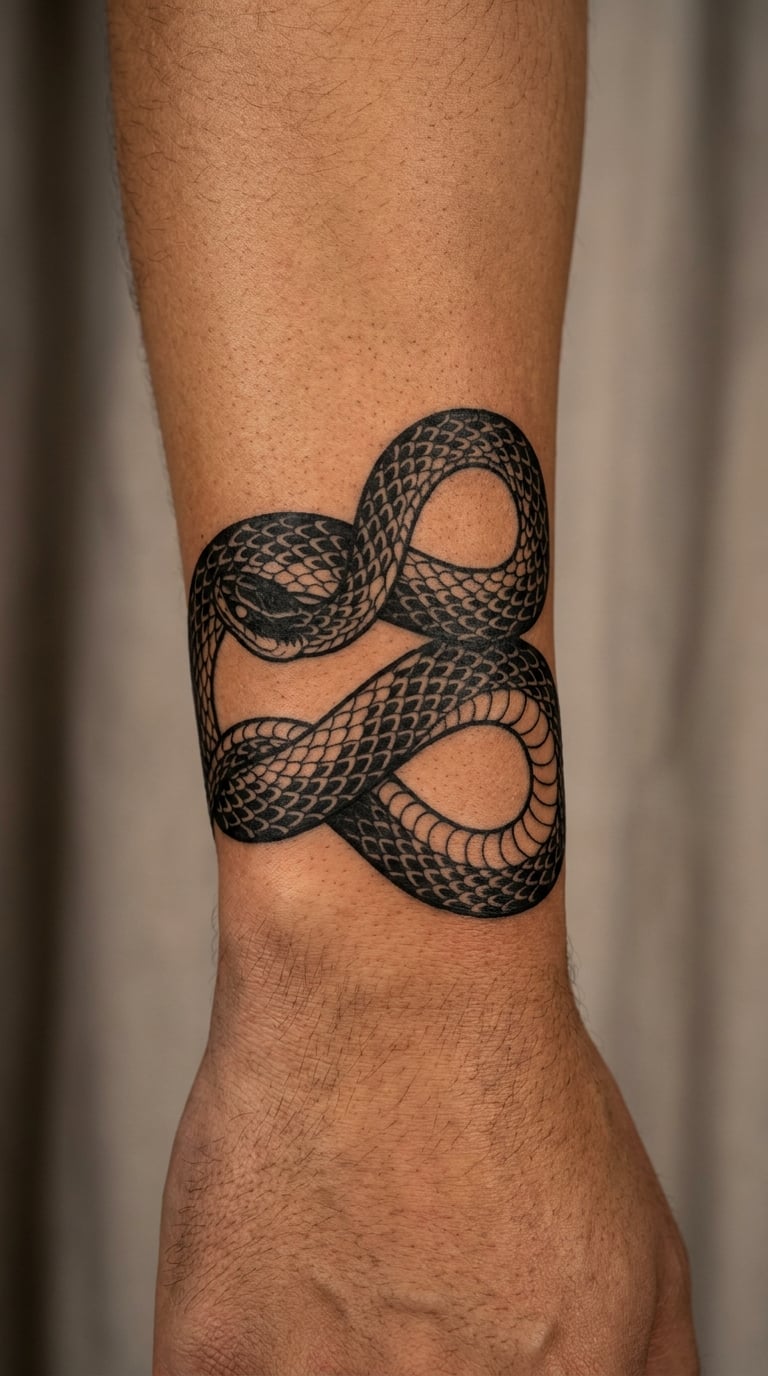
The snake is one flat, even block of ink with the scales cut out as white space, so the machine goes over the same patch several times. The inner forearm takes that well because it is flat enough to hold a large unbroken area of black.
Snake tattoos cycle between renewal, danger and plain intimidation. Men pick this one when they want something that looks heavier than it is.
Placement: wrist to mid-forearm, following the taper. Size: 8-10 inches / 20-25 cm. Style: blackwork, negative space, no colour.
Pain: medium-high. Packing solid black over bone is the part everyone remembers, and lifters get a rough first hour; the second usually settles. Honest ageing note: solid black fades evenly rather than falling apart, which is why it is on this list.
Make it yours: break the coil once and run a single scale pattern up toward the elbow as a hint of a later sleeve.
3. Neo-Traditional Panther Head on a Diagonal Inner Forearm Line
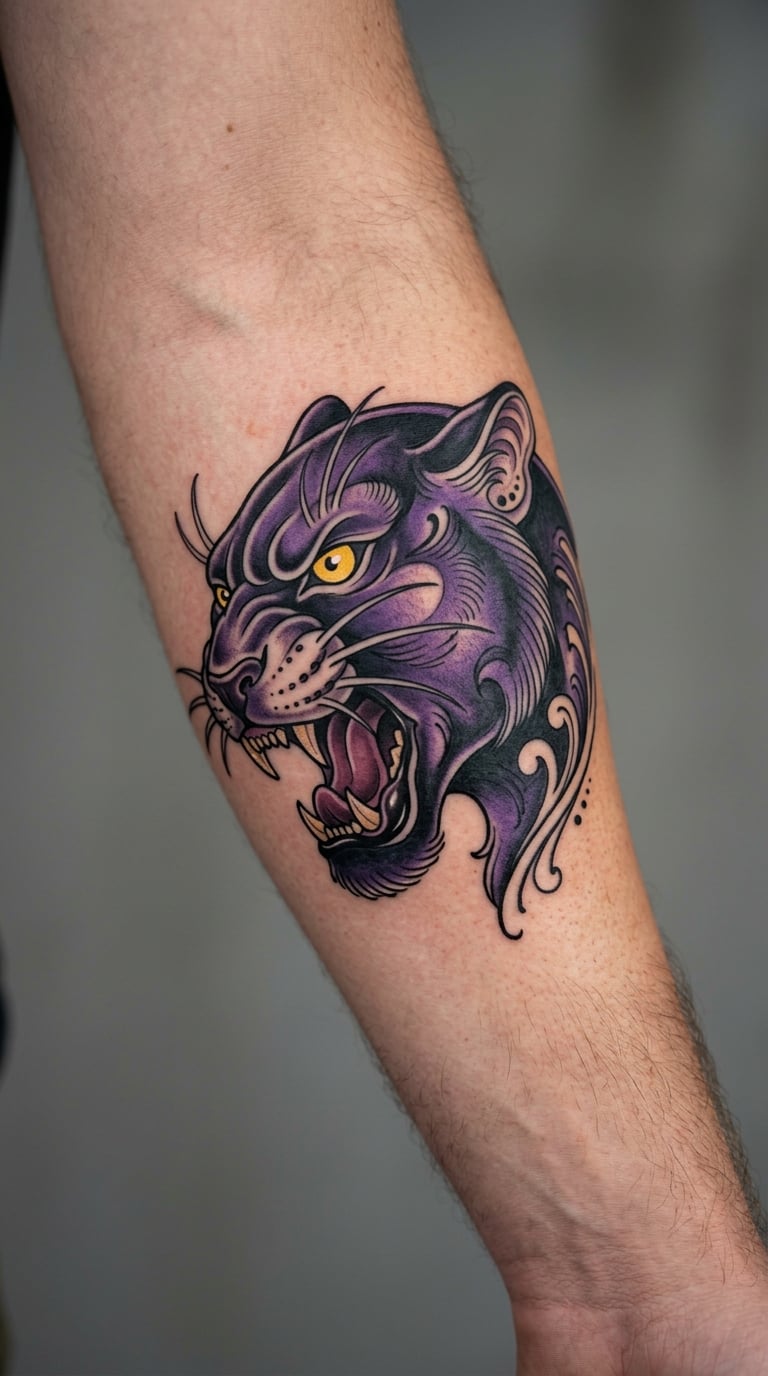
A head in profile with a lit cheek, a shaded jaw and an eye that reads as a bead of colour rather than a flat dot. Placed on a diagonal it follows the arm instead of sitting square on it.
It is a confident design with no message attached, which is exactly why so many men choose it. Not every tattoo has to carry a meaning, and art can be the whole reason.
Placement: mid-forearm, head angled toward the elbow. Size: 6-8 inches / 15-20 cm. Style: neo-traditional, saturated colour, strong black outline.
Pain: medium-high through the saturated shading. Ageing note: the small eye highlight disappears first, so ask the artist to keep it slightly larger than the reference photo suggests.
Make it yours: match the eye colour to something already in your collection, or run a thin line of dots from the jaw to the wrist.
4. Japanese Irezumi Koi Rising Through a Wave
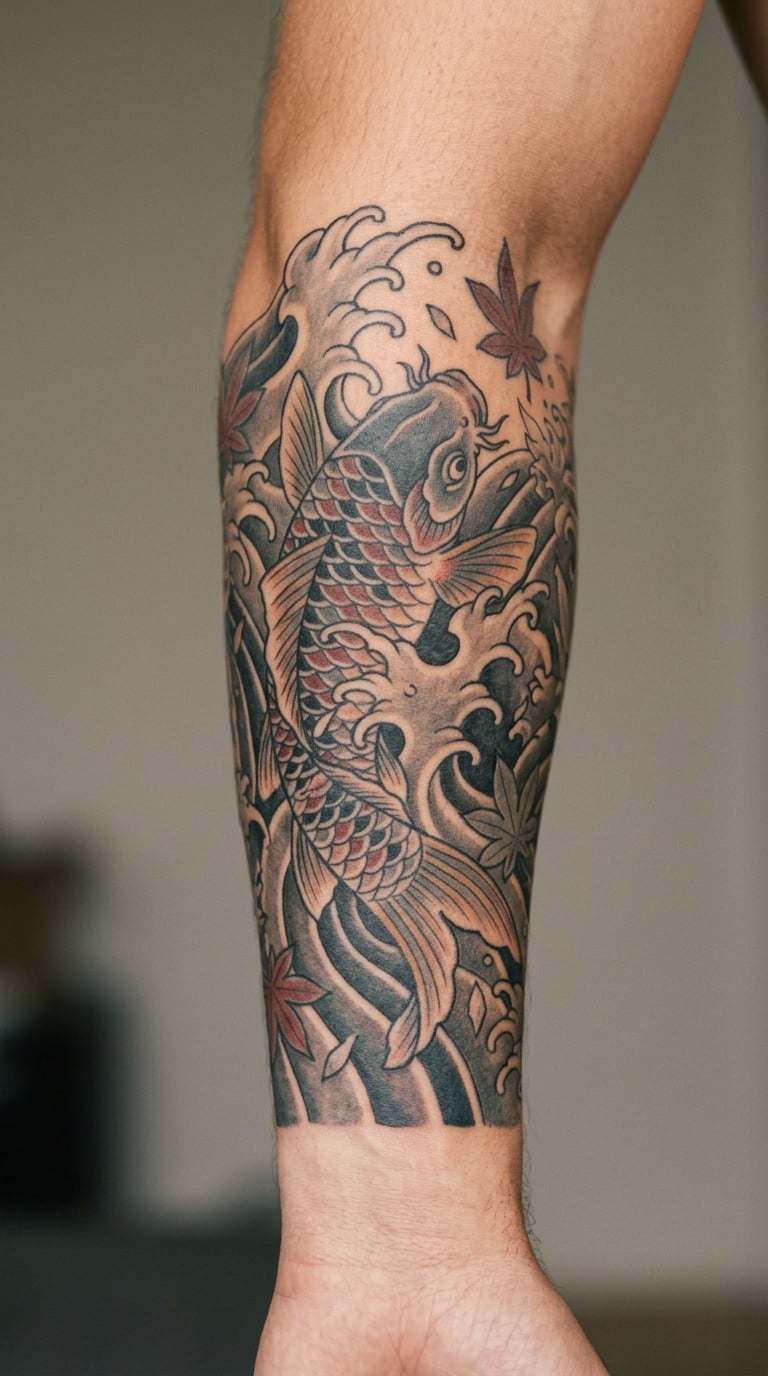
Real irezumi sits close to the skin in muted greys, black and one or two soft reds, with the background filled in so nothing floats. The wave curling at the bottom and the koi angled upward give the arm a direction to read along.
Japanese carp stand for perseverance and good fortune, and the style carries its own rules about placement and flow that a decent artist follows without being asked.
Placement: full inner forearm, wrist to elbow, no bare gaps. Size: 14-18 inches / 36-46 cm. Style: Japanese, grey wash, soft red accents, background fill.
Pain: medium, but it is a long sitting and the discomfort is spread thin. Leave room in the day afterwards. Ageing note: irezumi greys are layered deliberately and stay remarkably even, one of the better outcomes on this placement.
Make it yours: add a name in small kanji along the wave line, placed so the characters read right way up with your arm down.
Precision and Detail: Geometric and Realistic Inner Forearm Tattoos
5. Biomechanical Bracer for a Full-Length Inner Forearm Piece
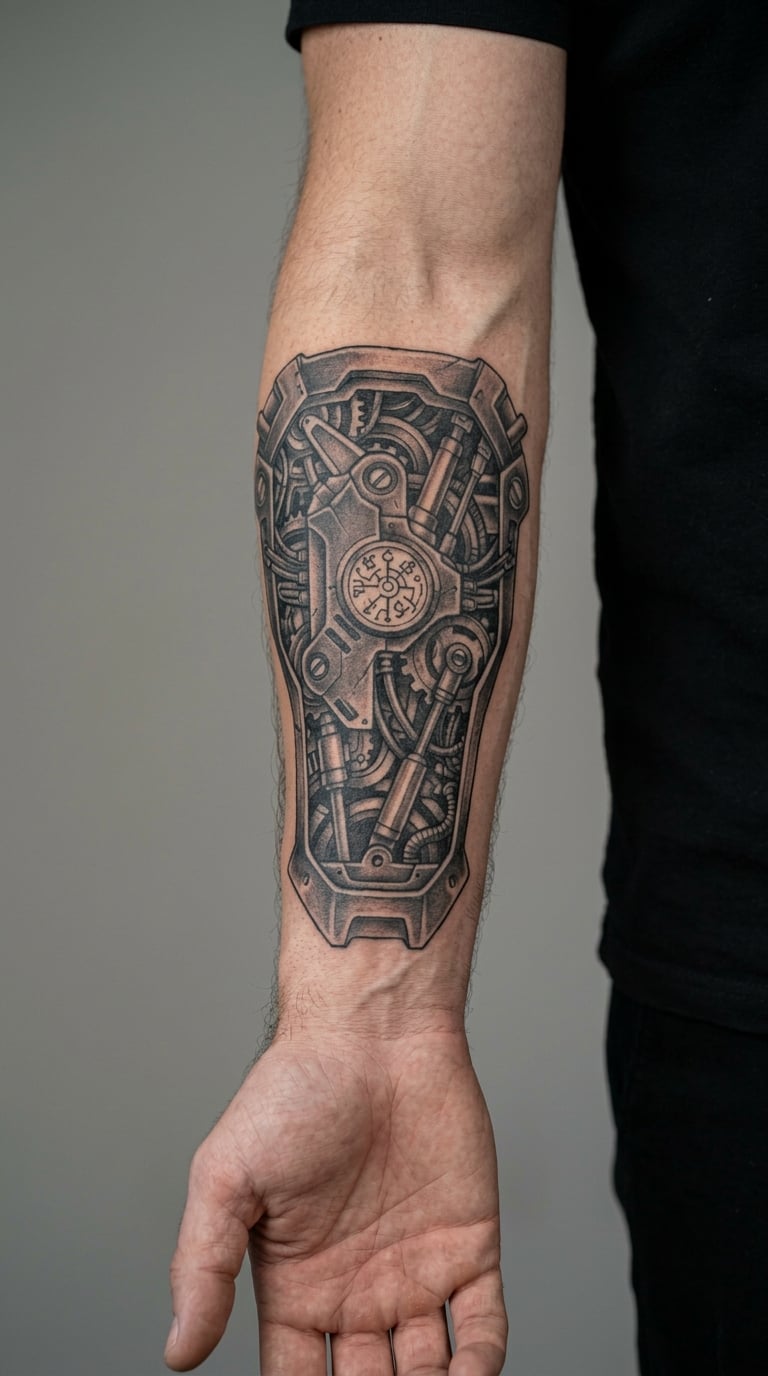
Segmented plates, cable bundles, hex nuts, a socket where a bone would be. In black and grey it looks like something the arm is uncovering rather than something painted on it.
It suits this placement unusually well because the forearm already reads as an engineered structure. Nobody has to be told what they are looking at.
Placement: wrist to elbow, wrapping slightly so the far edge disappears from view. Size: 9-12 inches / 23-30 cm. Style: biomechanical, blackwork with grey shading.
Pain: medium-high where shading sits over the ulna. Ageing note: tiny etched detail and 1mm hairlines blur first, so ask for fewer, chunkier mechanical parts if you want it to read in fifteen years.
Make it yours: put a real serial number or date into one panel and let one exposed component reach up toward the elbow.
6. Fine-Line Geometric Compass Rose for a Subtle Inner Forearm Tattoo
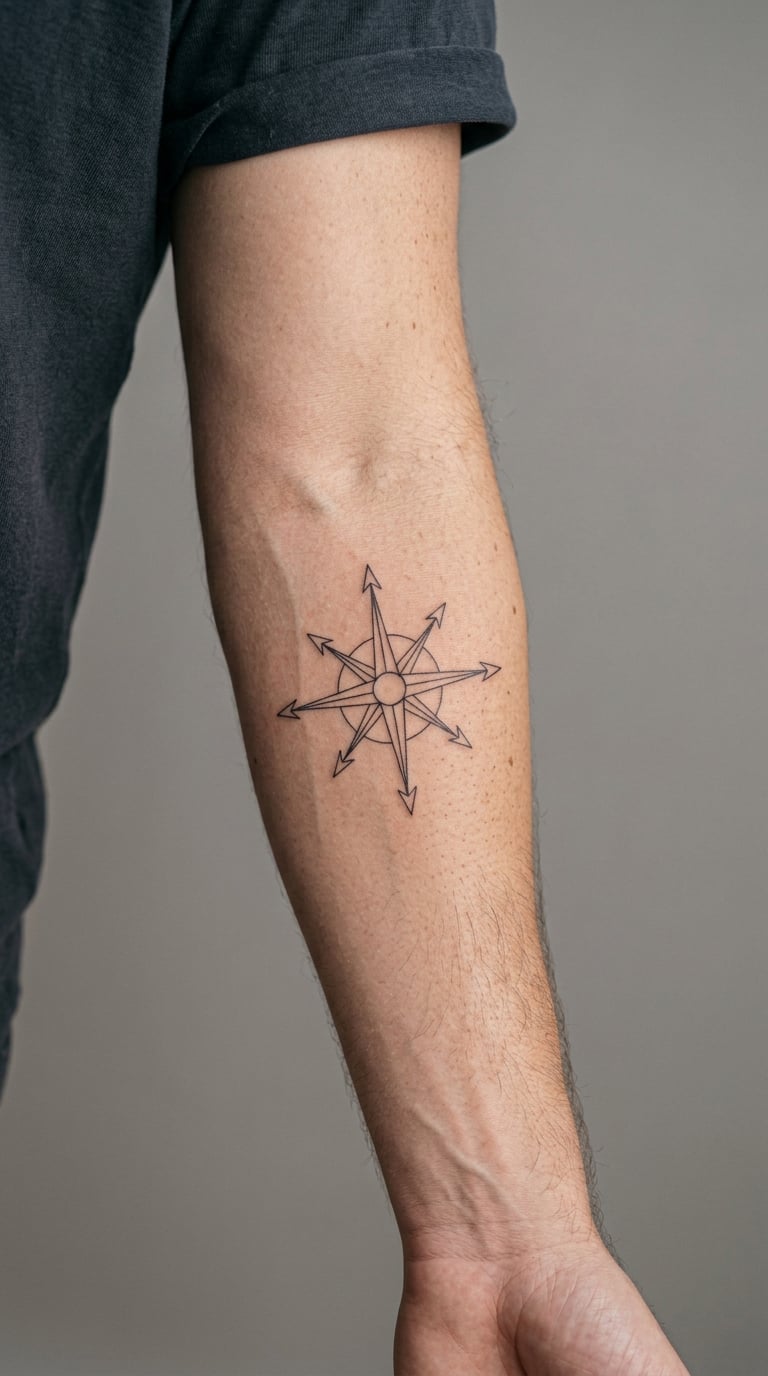
One hairline circle, eight points, four marked north. A few millimetres of ink and about an hour, which makes it the easiest inner forearm tattoo to change your mind about later.
Compasses point toward home and toward a direction, and men read it as a quiet reminder. It also sits under a shirt cuff, which makes it a good first piece in an office.
Placement: mid-forearm, centred on the flat of the arm. Size: 4-6 inches / 10-15 cm, or 2-3 inches / 5-8 cm for a wrist version. Style: geometric fine line, single weight, no fill.
Pain: low. One pass, one line, out. Ageing note: this is the design on the list that fades fastest. Hairline work on softer inner skin loses definition, so sunscreen and gloves matter more here than anywhere else.
Make it yours: engrave the coordinates of somewhere you have never been yet, rather than where you already are.
7. Black-and-Grey Wolf Portrait on the Mid-Forearm
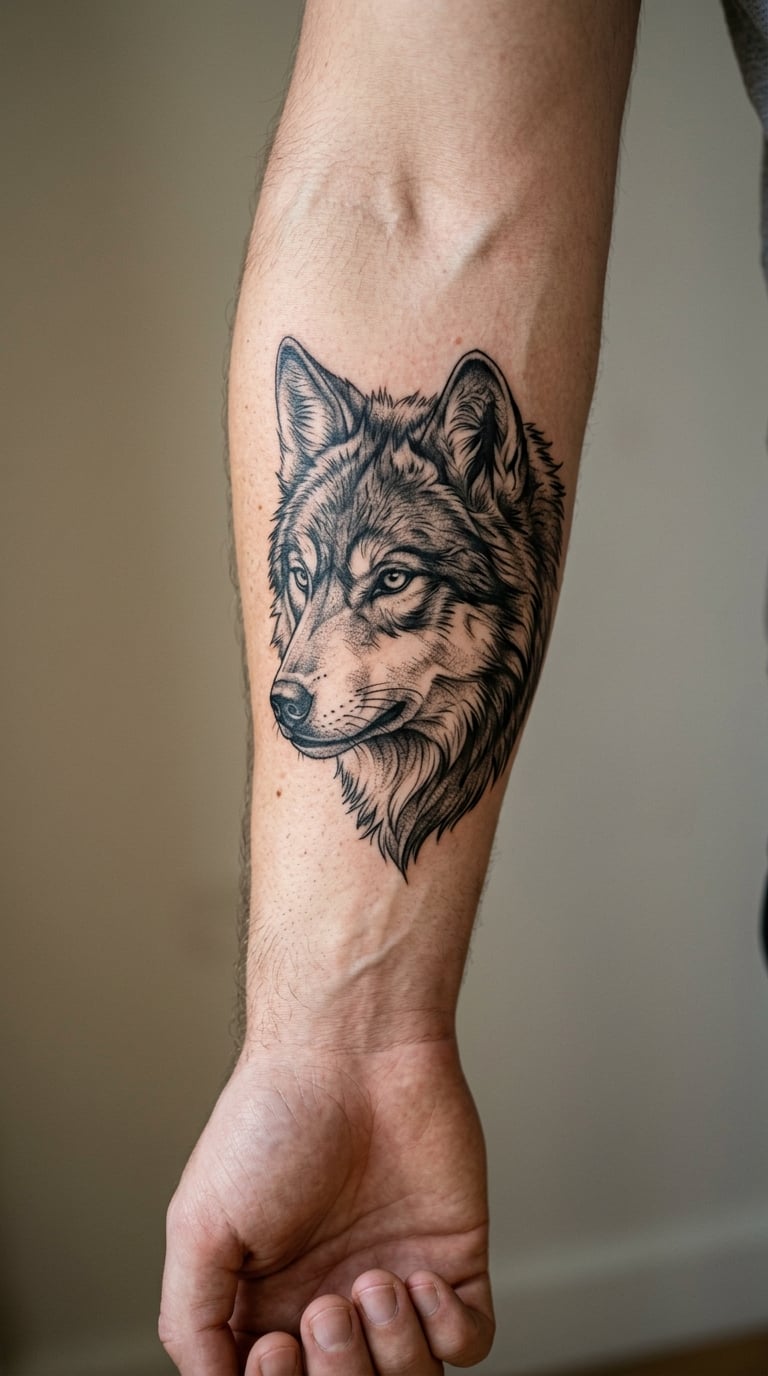
Realistic fur means the coat is built from thousands of tiny tapered marks rather than solid black, with grey washes underneath for depth. It rewards a good portfolio more than a good concept.
The wolf is loyalty, family and pack instinct, but men also simply like wolves. There is a version of this design that is a memorial to a dog and a version that is just a nice animal.
Placement: mid-forearm, muzzle pointing along the arm rather than across it so the piece reads as a long shape. Size: 7-9 inches / 18-23 cm. Style: black-and-grey realism, soft grey wash.
Pain: medium. A portrait is a four to six hour sitting and the second half gets noticeably more uncomfortable. Ageing note: fine fur texture on the lower forearm softens, and the eyes and muzzle outline are what survive a decade.
Make it yours: turn the eyes toward a place or person rather than left, and consider a whisper of colour in the iris only.
8. Micro-Realism Falcon Eye for a Small Inner Forearm Tattoo
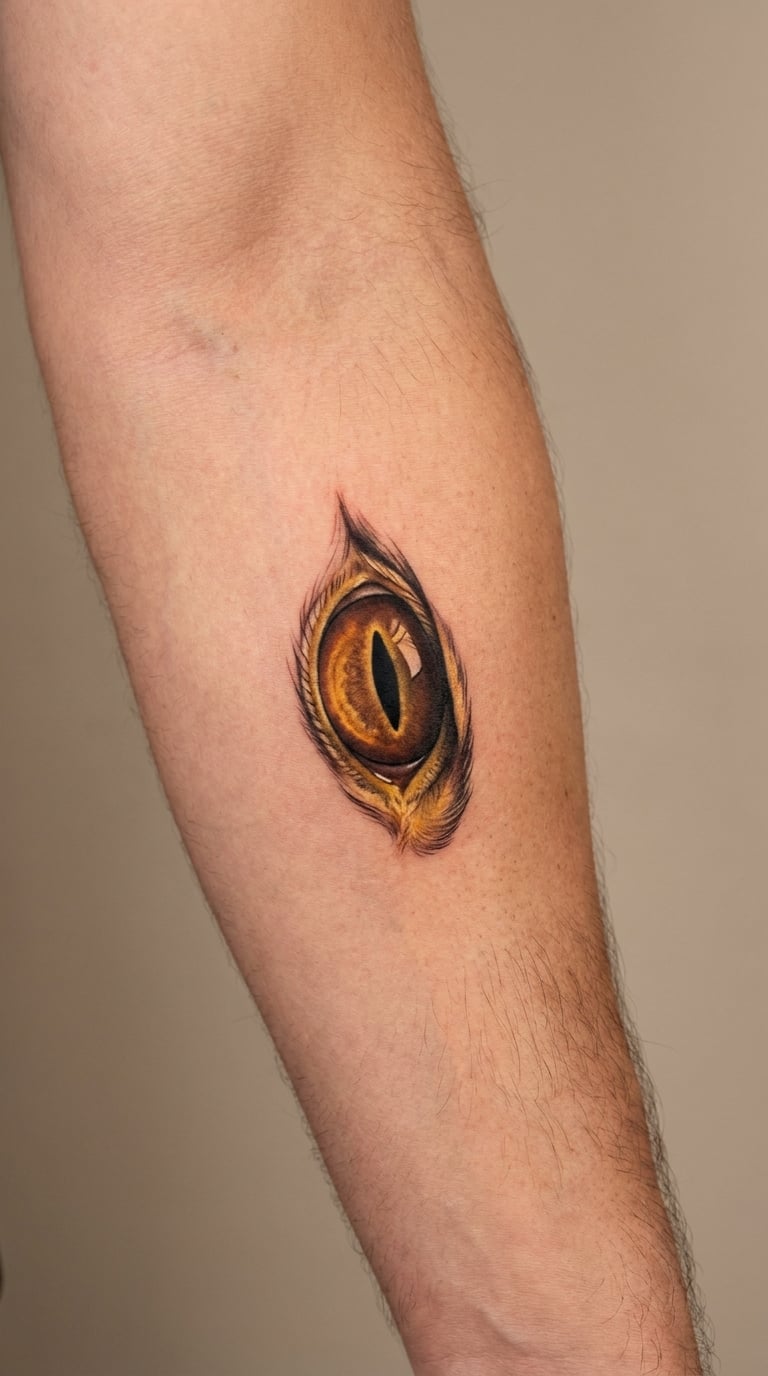
One eye the size of a large coin, done in a few dozen marks. There is no real outline; the shape comes from the edge of the lid and the tone of the iris, which is what makes it look like part of the skin.
Sharp sight, focus, protection. Men usually pick it for how small it is, because a piece you can hide entirely changes how bold you can be with the content.
Placement: inner wrist to mid-forearm, tilted so the eye is not quite level with the arm. Size: 2.5-3.5 inches / 6-9 cm. Style: micro-realism, no outline, restrained colour.
Pain: low to medium, and over quickly. Ageing note: micro-realism is the least forgiving style here, because soft skin, constant wrist movement and sun exposure all work on the same tiny details. Ask for simplified iris texture rather than photorealistic layering, and expect a touch-up.
Make it yours: use a real eye reference from a bird you have actually seen, photographed yourself, rather than a stock image.
Script, Typography and Coordinates
9. A Name in Old English Lettering Along the Inner Forearm
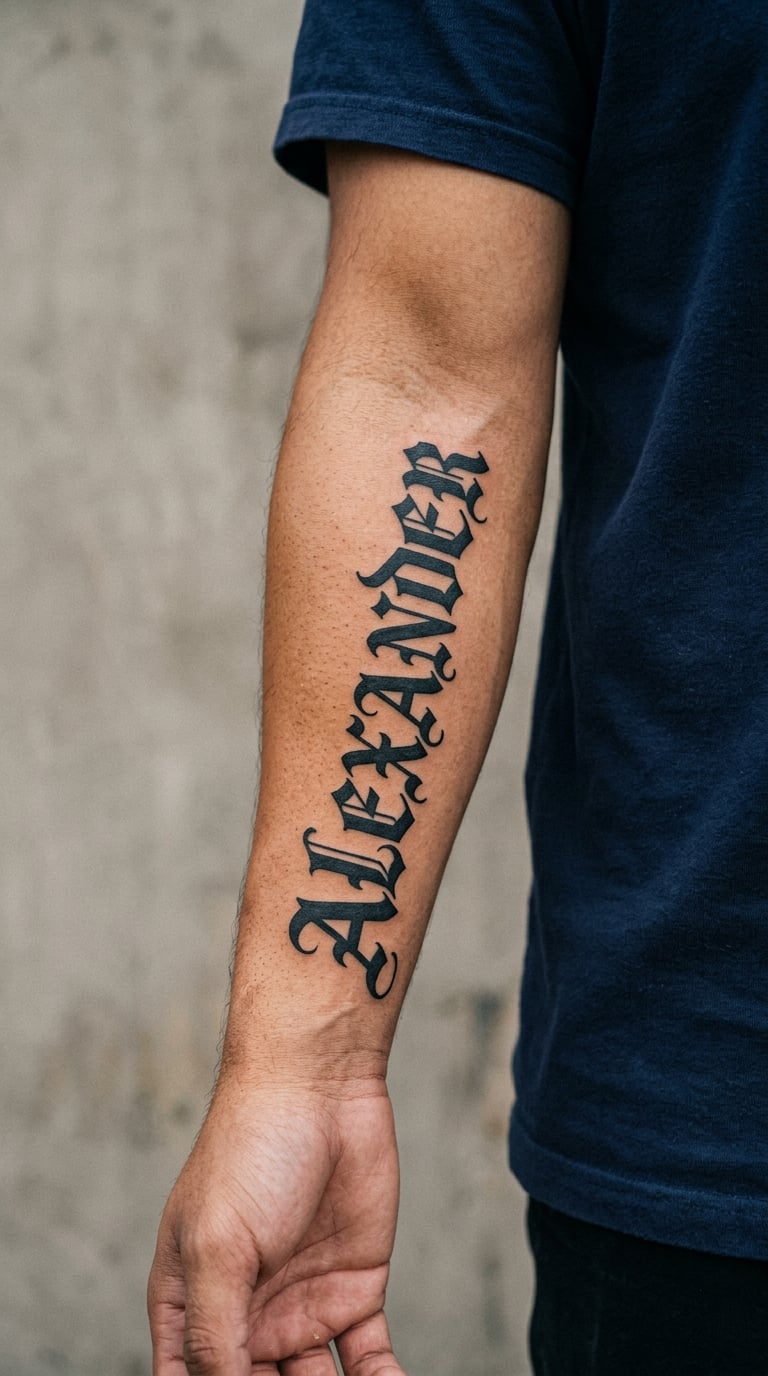
Old English is the dense blackletter style with the angular breaks and heavy vertical strokes. A first name, a surname or a surname and a date will fit the length of the inner forearm in a single line with room to spare.
Names are the oldest tattoo there is. Some men are tattooing a child’s name, some their own, and some the name of a grandmother or a grandmother’s kitchen.
Placement: mid-forearm, running lengthwise. Size: 4-6 inches / 10-15 cm. Style: blackletter typography, solid black, no shading.
Pain: low to medium. Lettering is lots of short straight strokes rather than long shading passes, which keeps it bearable. Ageing note: blackletter holds its weight well, but the thin finishing serifs soften within a few years, so ask for the sharpest version the artist is comfortable with.
Make it yours: have the first letter drop below the line of the rest, so the name has a natural anchor instead of a flat baseline.
10. A One-Line Quote in Fine Handwritten Script
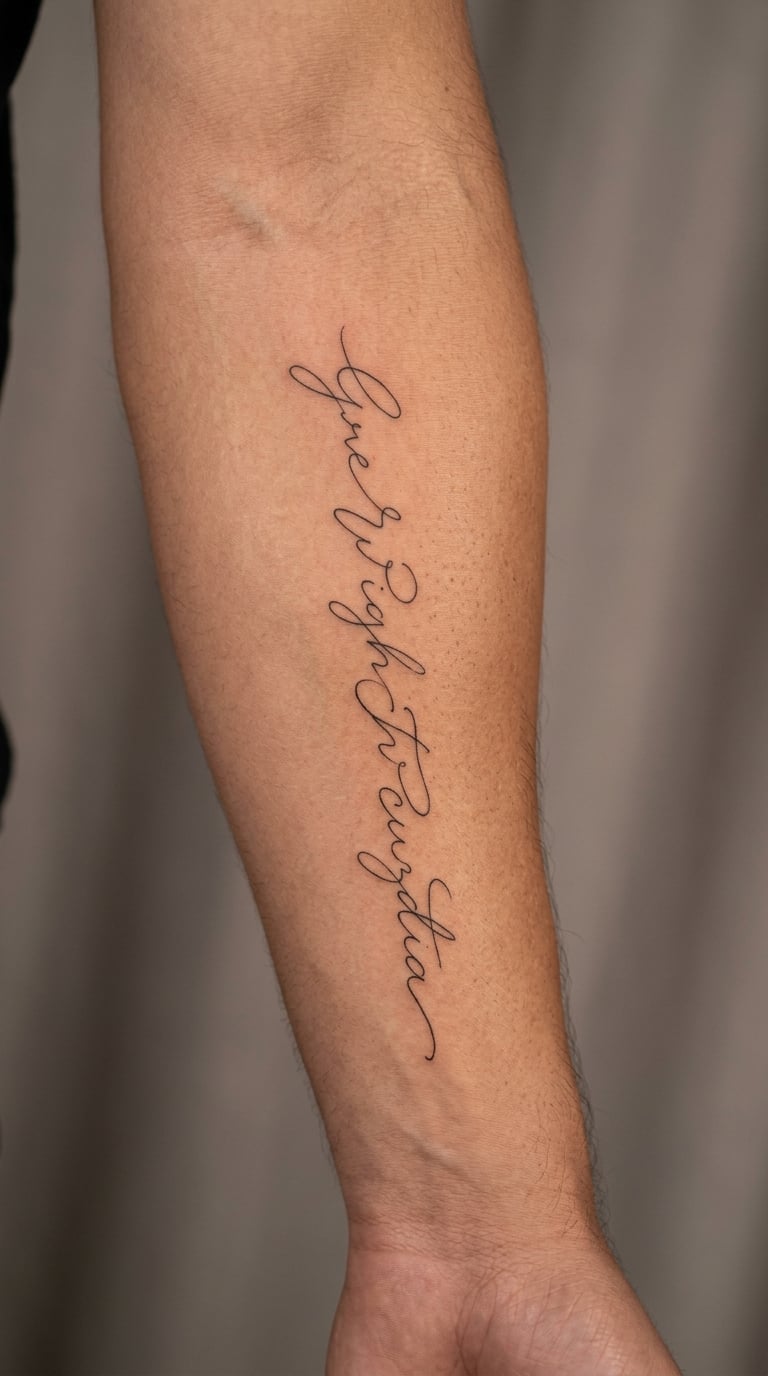
Handwritten script means the artist draws the words the way a specific hand writes them, usually from a reference photo, and spacing varies word to word. Even letters in a straight line look like a font, not a hand.
Common choices are a line from a speech, something a parent said, or a sentence the wearer says to themselves. You will read it every time you see your arm, which is the appeal and the risk.
Placement: inner wrist to mid-forearm. Size: 3-5 inches / 8-13 cm. Style: fine-line script, single needle weight, no fill.
Pain: low. Ageing note: the honest warning. Script here blurs faster than almost anything else on the list, because the skin is soft, the wrist moves constantly and it sits near the wrist bone. Keep the words short and let the artist thicken the line slightly.
Make it yours: bring a photograph of your own handwriting and add one small symbol at the end that only you would read.
11. Coordinates and a Tiny Map of Home
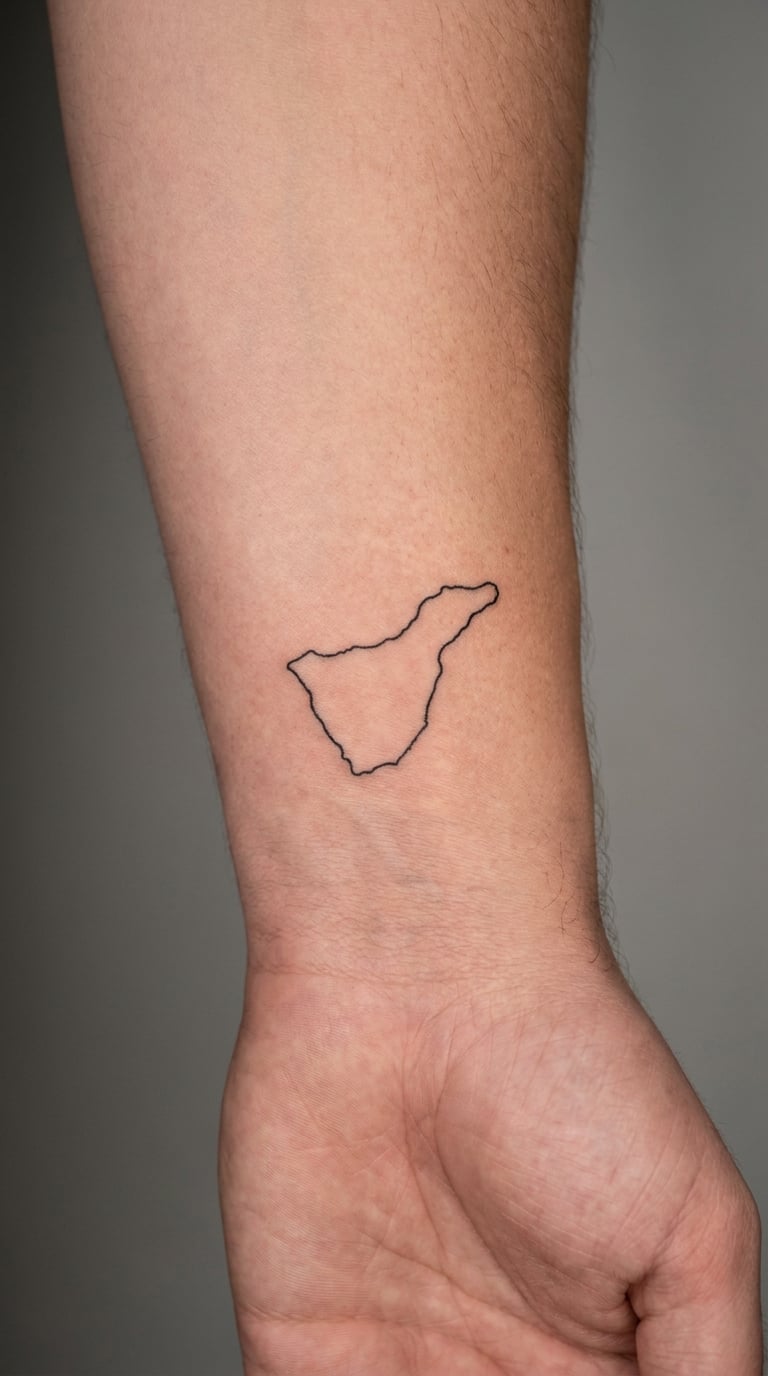
Numbers, a set of coordinates, or a small map outline of the place someone is from. There is almost no drawing in it, so the numbers and their spacing do all the work.
Men choose this when the place matters more than the picture. It is also the easiest of all 20 to keep secret, since it reads as a smudge of digits to anyone who does not know.
Placement: inner wrist, just above the wrist bone. Size: 2-3 inches / 5-8 cm. Style: minimal fine line, black only.
Pain: low, over in under an hour. Ageing note: numbers are unforgiving, because any blur changes a digit into a different digit. Keep them at least a quarter inch tall and have the values written down twice before the stencil goes on.
Make it yours: use coordinates of somewhere you are going rather than where you are from, and have the map outline underneath as the only hint.
Nature, Symbolism and Meaning
12. Moon Phase Arc Across the Full Inner Forearm
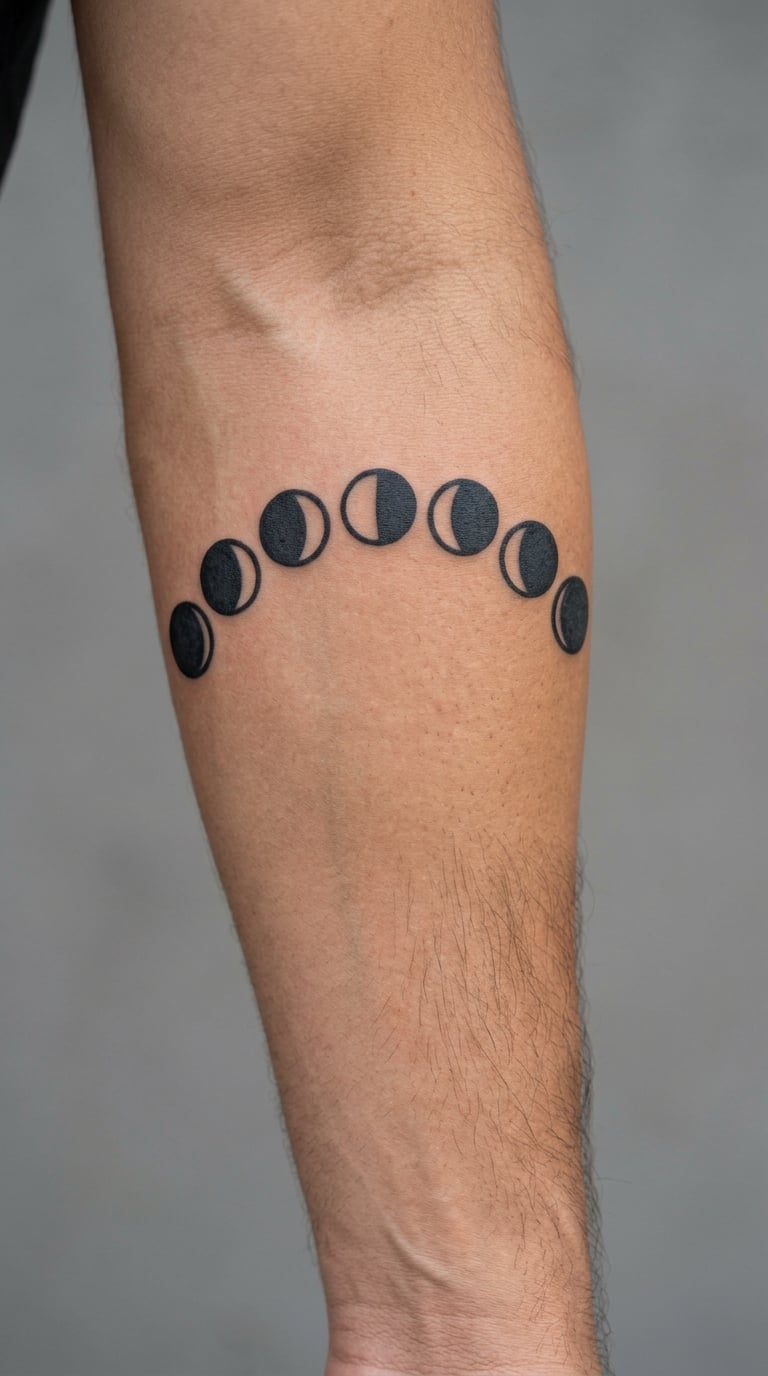
Each moon is a circle in solid black with a crescent carved out in white, and the whole sequence runs along the arm like a timeline. Symmetrical, simple, and it uses the length of the canvas properly.
Moon phase tattoos are usually for a specific month or year that mattered. Men often mark the year a child was born, a year of recovery, or the span of a relationship.
Placement: full inner forearm, wrist to elbow, in one even line. Size: 12-15 inches / 30-38 cm long. Style: blackwork, solid shapes with negative-space crescents.
Pain: medium, spread across a longer session. Ageing note: this holds up unusually well, because solid black shapes with hard edges do not depend on fine detail to stay legible. The inner arm being shaded is a genuine advantage here.
Make it yours: label the first and last moon only, with two dates, and leave every other phase blank so the sequence stays clean.
13. Thistle and Rose Stem Following the Forearm Bone
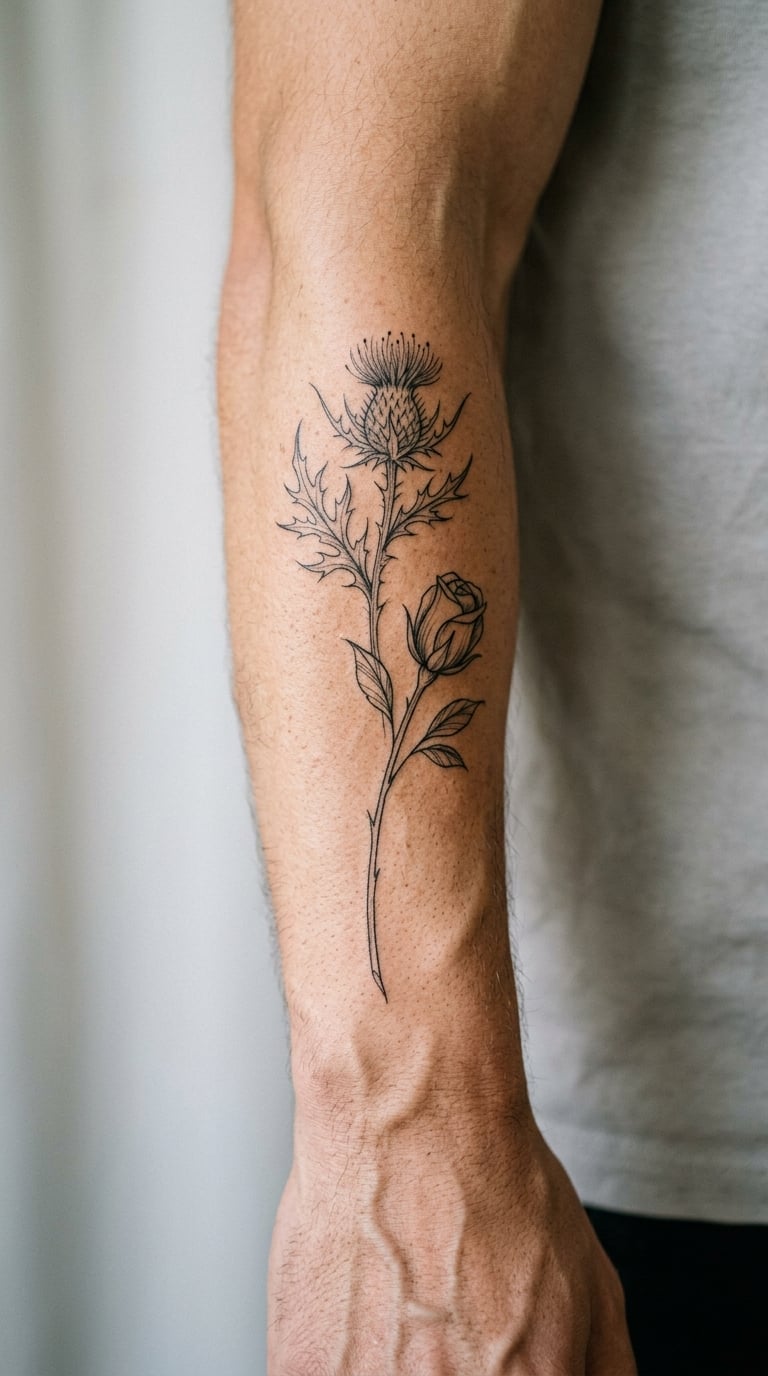
A vertical stem tracking the ulna is the easiest way to make a botanical piece look designed for this arm rather than dropped onto it. Thistle head near the mid-forearm, rose bud lower, leaves spaced so the eye travels along the arm.
Thistles mean resilience and defence, roses mean love or beauty, and the pairing says something difficult without spelling it out.
Placement: mid-forearm, stem parallel to the forearm bone. Size: 5-7 inches / 13-18 cm. Style: botanical fine line, single-needle outline, optional colour accent.
Pain: low to medium. Ageing note: fine outline work fades at the edges, and the spiky thistle head shows it first because the silhouette is all small points. A bolder head and a lighter stem is the more interesting drawing anyway.
Make it yours: add a thistle burr to the underside of the wrist as a small second piece, or work a real thorn scratch into the stem line.
14. Hourglass Wrapped in a Laurel Wreath
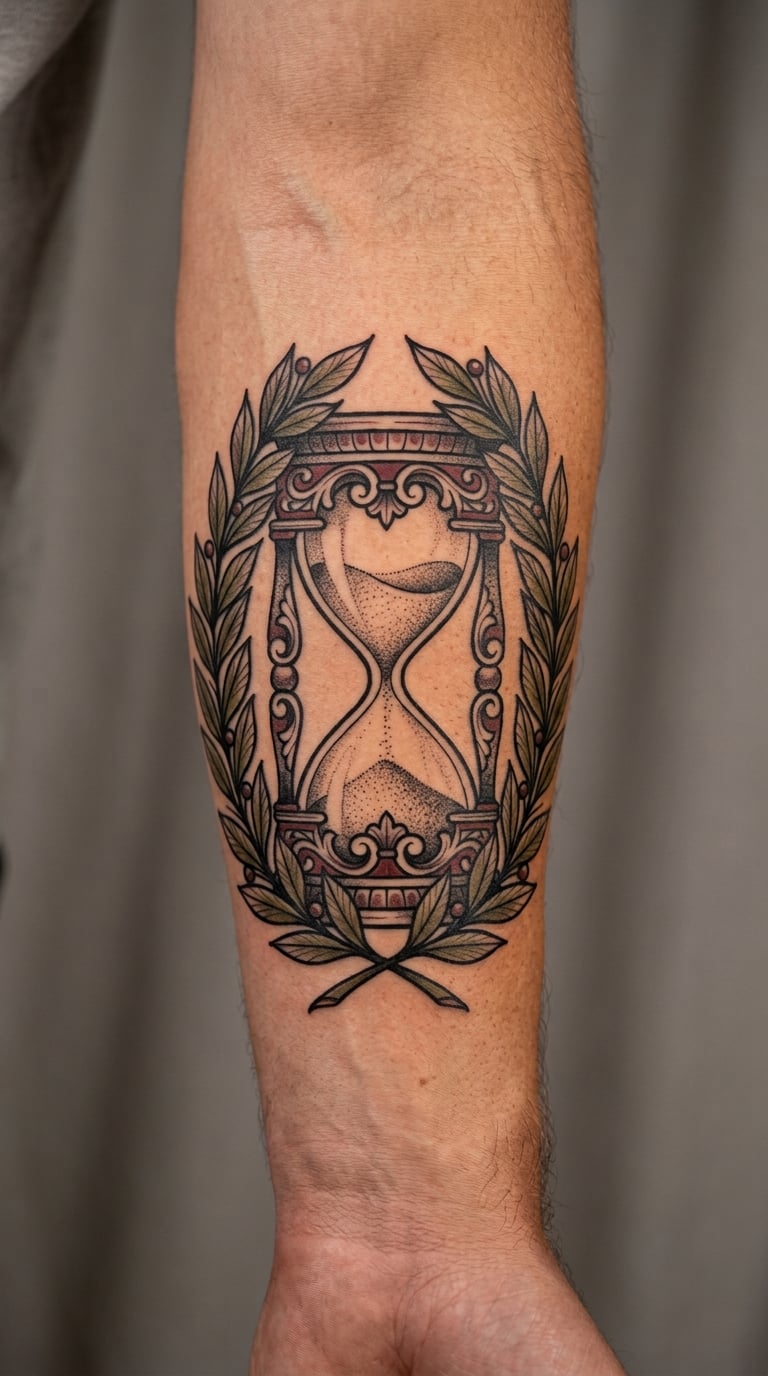
An hourglass inside a laurel: the sand for the time you have, the leaves for what you have done with it. An old emblem, drawn as often in Victorian book plates as in tattoo flash, that comes across without being heavy.
Men choose it around a birthday, a diagnosis that is behind them, or the closing of a chapter. A memorial design without a grave in it.
Placement: mid-forearm, upright when the arm hangs. Size: 4-5 inches / 10-13 cm. Style: neo-traditional, black line, flat red and green fill.
Pain: medium. Ageing note: laurel leaves are small repeated shapes and merge into a soft green mass first. Ask for fewer, larger leaves rather than a dense wreath.
Make it yours: run a single laurel stem down the forearm from the wreath, so the leaves trail toward the wrist and can carry a date later.
Mythology, Faith and Heritage
15. Norse Compass Symbol in Clean Blackwork
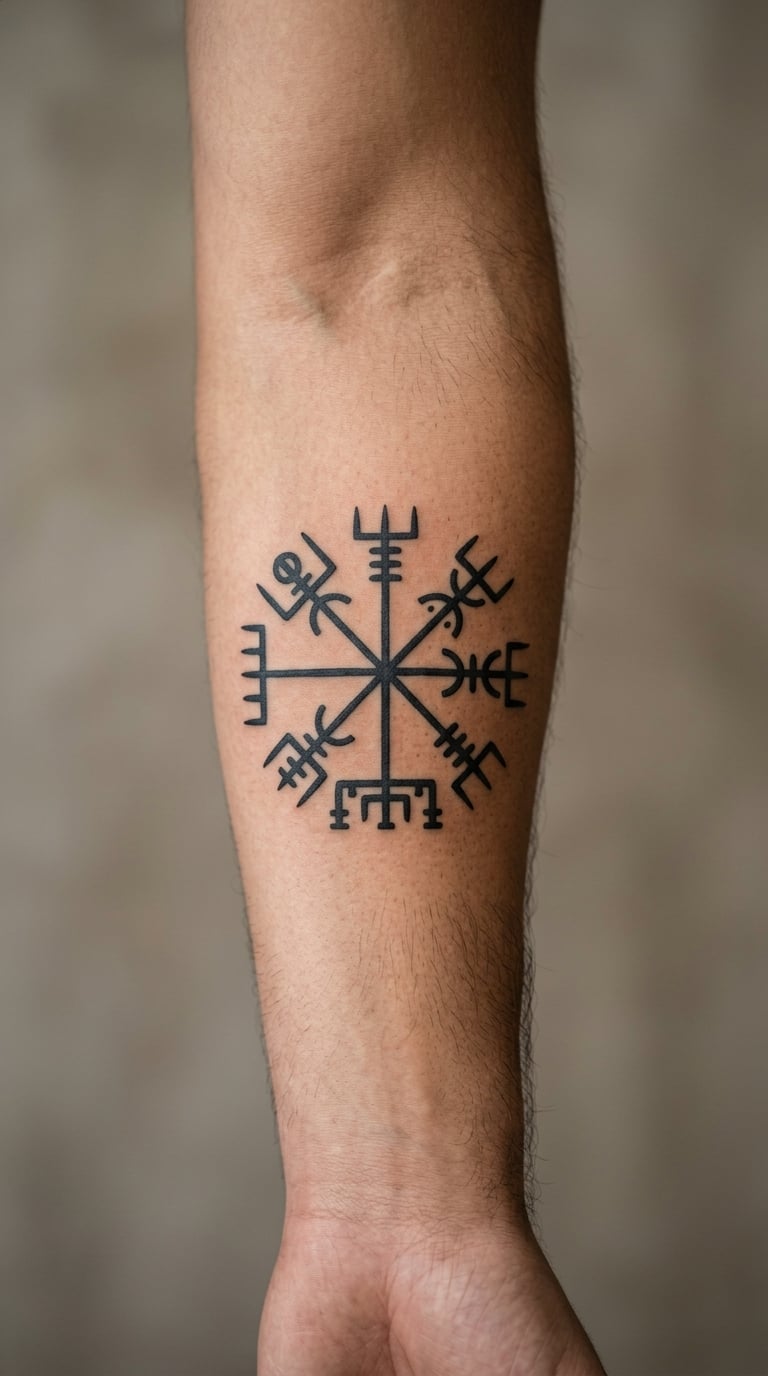
Interlocking arrow strokes radiating from a centre point, all the same weight, forming a symmetrical eight-point mark. A protection and guidance symbol from the Norse material that needs no shading and no colour to be legible.
Men read it as guidance through bad weather, literally or otherwise. The meaning is not fixed in Norse sources, and honest artists say so rather than selling you a translation.
Placement: mid-forearm, centred. Size: 3.5-5 inches / 9-13 cm. Style: blackwork, uniform line weight, no fill.
Pain: low to medium and it finishes quickly. Ageing note: the arrowheads are small hard corners, and corners are what soften. Have the artist work the outer ring slightly heavier than feels necessary.
Make it yours: have the strokes extend past the outer ring as four short marks pointing up, down and both ways, and put a date inside the centre circle.
16. Simple Cross Over a Mountain Line
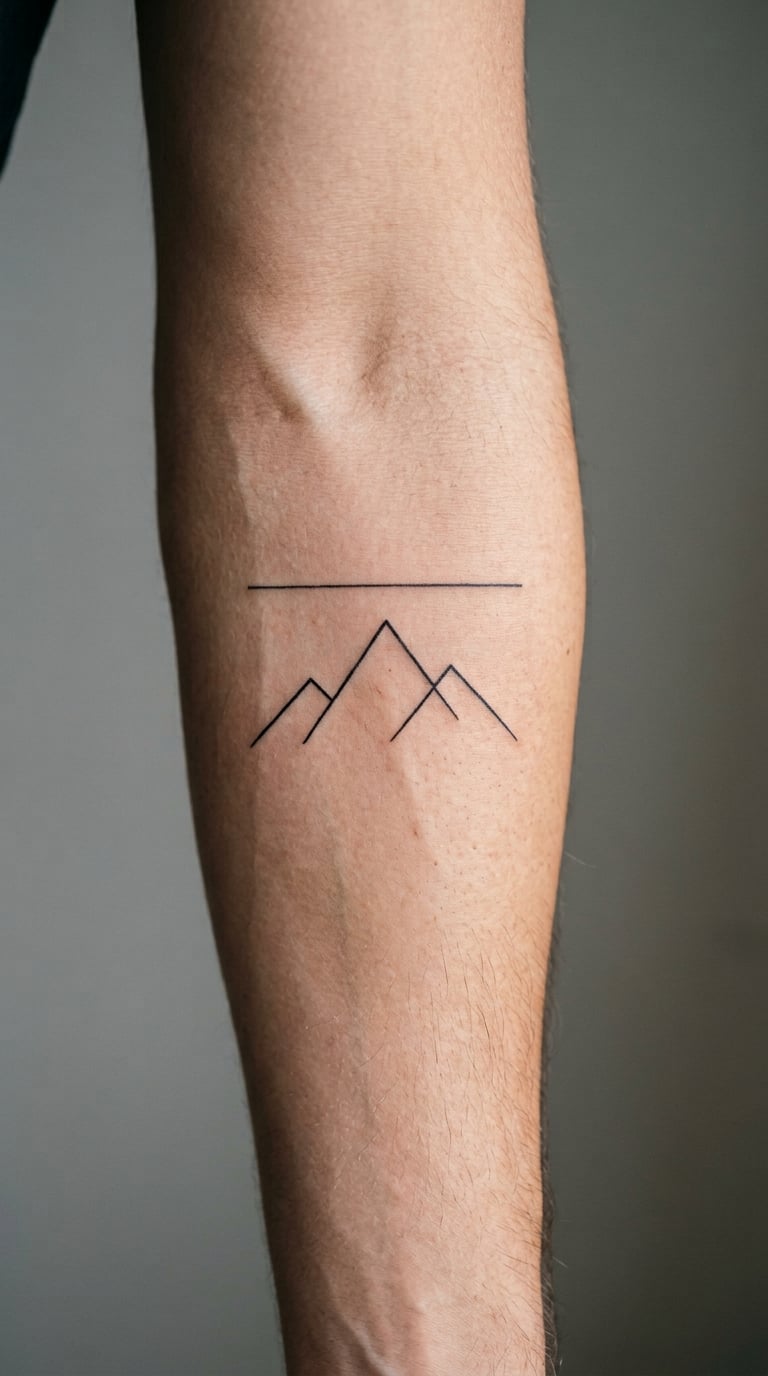
A plain line-work cross above three or four mountain peaks with a horizon line under them. The most requested design category on the inner forearm after names, and the simplest version ages best.
For some men the faith is the point. For others it marks a place, a climb, or a person who was steady. Both are fine reasons.
Placement: mid to upper inner forearm, cross upright. Size: 4-6 inches / 10-15 cm. Style: minimal fine line, black only.
Pain: low to medium. Ageing note: mountains drawn with soft shading fade into a grey blur faster than the cross above them, so ask for outlines and a couple of flat grey planes rather than a rendered range.
Make it yours: use the silhouette of a specific ridgeline you have actually stood on rather than a generic mountain range.
Cultural and Heritage Motifs
17. Arabic Calligraphy Band with a Translated Meaning
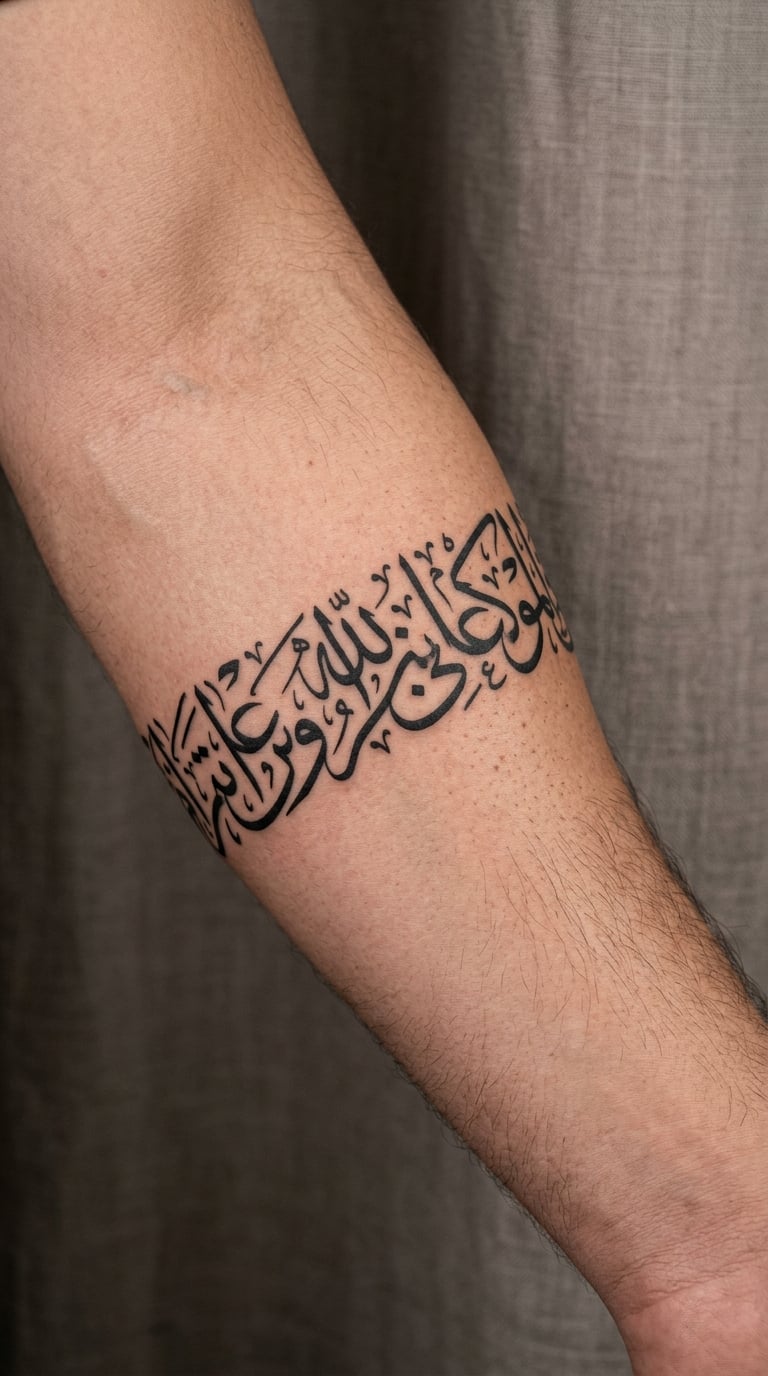
A flowing script band following the length of the arm, done by an artist who can actually read what they are drawing. That last part is not a detail. Calligraphy copied from a print, with the letterforms or the reading order wrong, is common and most people cannot tell at the time.
Ask to see the phrase, its translation and who it is meaningful to before you commit. Once that is confirmed the design is genuinely lovely, the letters flowing like water around the arm.
Placement: wrist to mid-forearm, band lengthwise. Size: 5-8 inches / 13-20 cm. Style: calligraphy, thuluth or naskh hand, black ink, no fill.
Pain: low to medium. Ageing note: script in any language behaves the same way here, so keep the phrase short and the strokes confident.
Make it yours: have the band broken by a single small element in the gap, such as a date in numerals, so the eye has a place to land.
18. Polynesian-Style Geometric Band for a Committed Inner Forearm
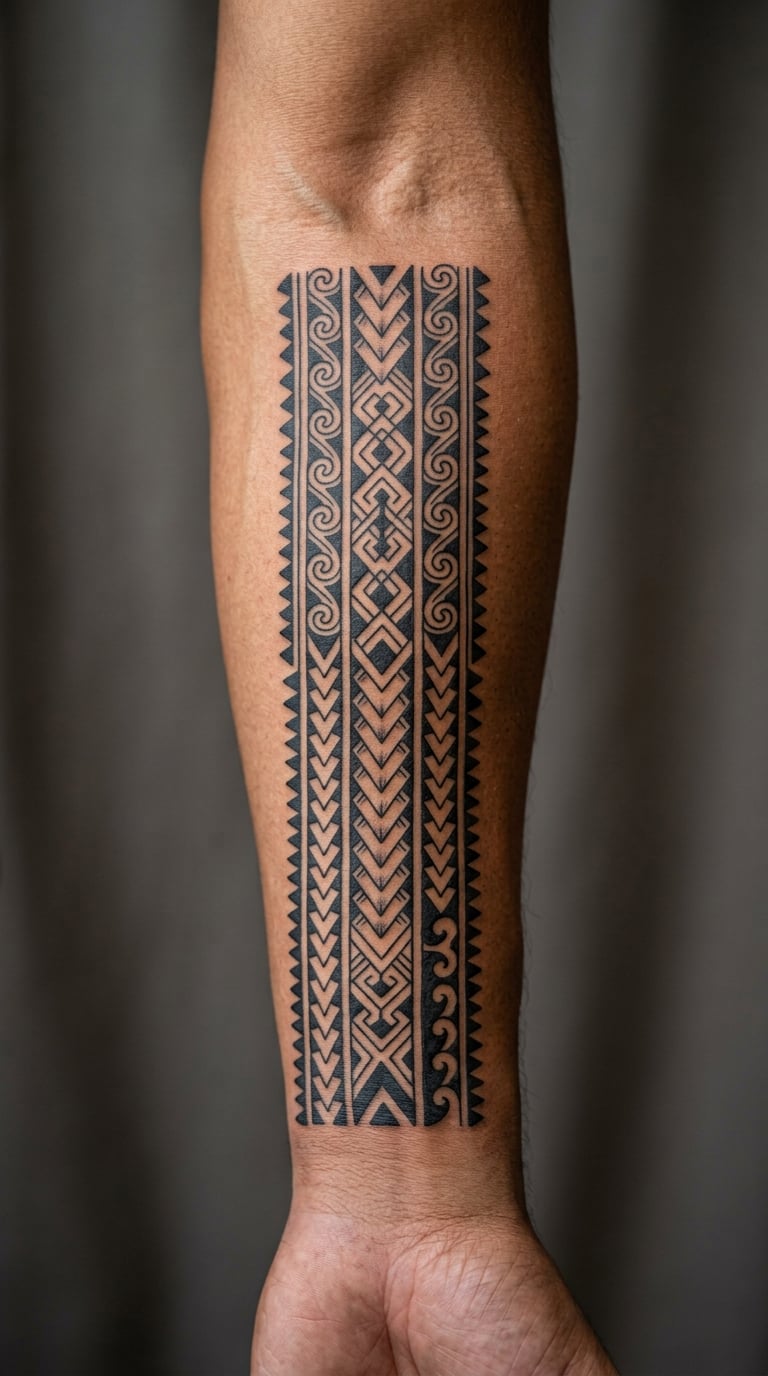
Repeating triangles, spirals and tapered bands packed edge to edge, following the body’s lines. Done well it is one of the most powerful things you can put on this placement, because there is no empty skin anywhere.
This is the one on the list where meaning matters most, and where the etiquette note is worth reading twice. These designs are not decoration. They carry family and ancestral meaning for the people they come from, and borrowing one can land badly both on the people from that culture and on the wearer.
My own read, for what it is worth: if a motif means nothing to you and you cannot say who it belongs to, choose a design that is honest about being a design. Plenty of the 20 above ask nothing of you.
Placement: full inner forearm, wrist to elbow. Size: 12-16 inches / 30-40 cm. Style: tribal, bold black, repeating motif, no shading.
Pain: medium-high, since it is mostly solid black across a long stretch of bone. Ageing note: heavy black is the most durable thing on this placement. It fades evenly rather than falling apart.
Make it yours: before anything else, ask a practitioner of the culture where the motifs come from what is appropriate to wear. Then have the pattern built to your own arm’s measurements rather than stretched from a flat drawing.
Small, Patchwork and Sleeve-Ready
19. Skull and Chess Knight in Traditional Still Life
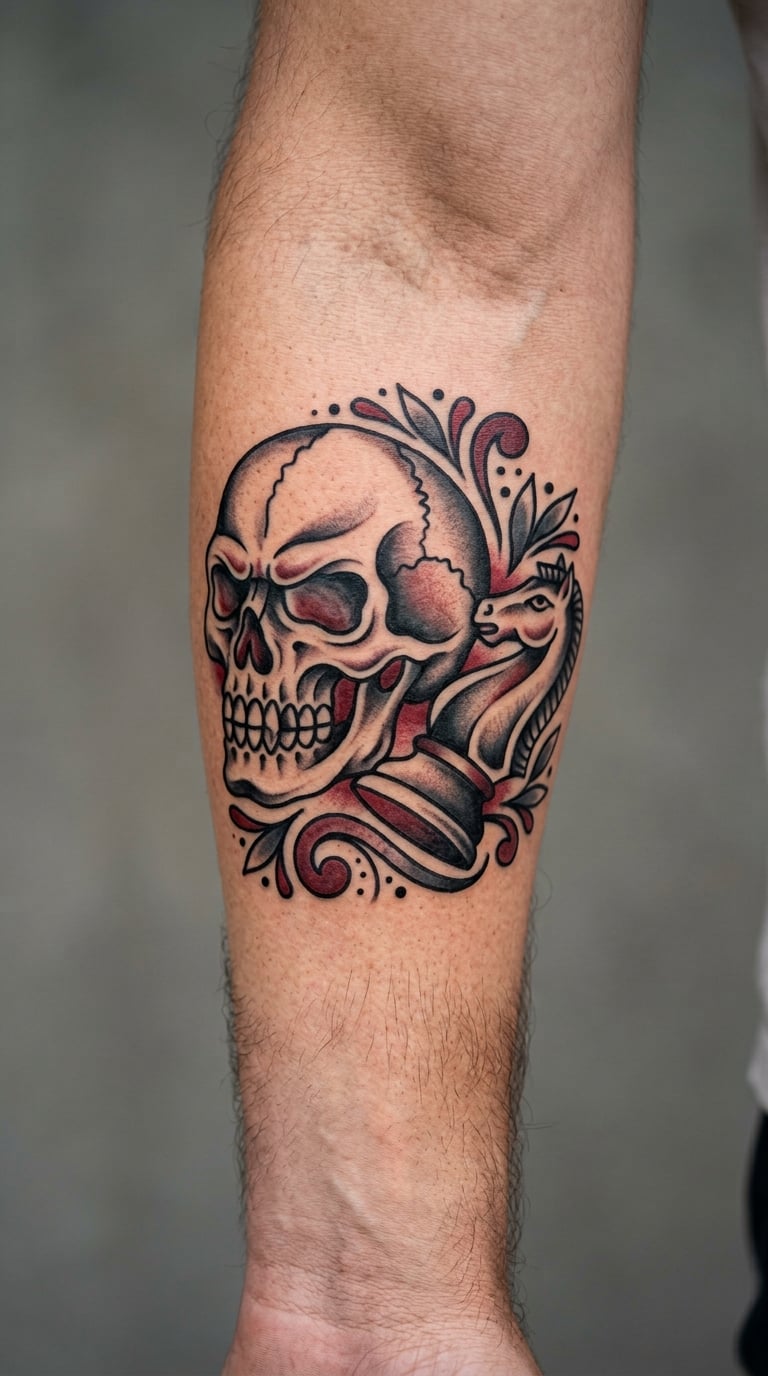
Two objects, one hard form and one carved one, with a drop shadow behind them. Traditional still lifes are built from bold black shapes and two or three flat colours, which suits the flat inner forearm.
Memento mori, strategy, playing the long game. A little on the nose, which is why it has survived a century of tattooing.
Placement: mid-forearm, skull toward the elbow. Size: 5-6 inches / 13-15 cm. Style: traditional, heavy black outline, red and grey wash.
Pain: medium. Ageing note: the knight’s mane and the skull’s teeth are the details that go soft, so ask for wider gaps between the teeth and a simplified mane.
Make it yours: have the knight be a specific piece from your own set, worn down, and put the shadow under both objects running in one clean line.
20. Small Patchwork Icons Placed Wrist to Elbow
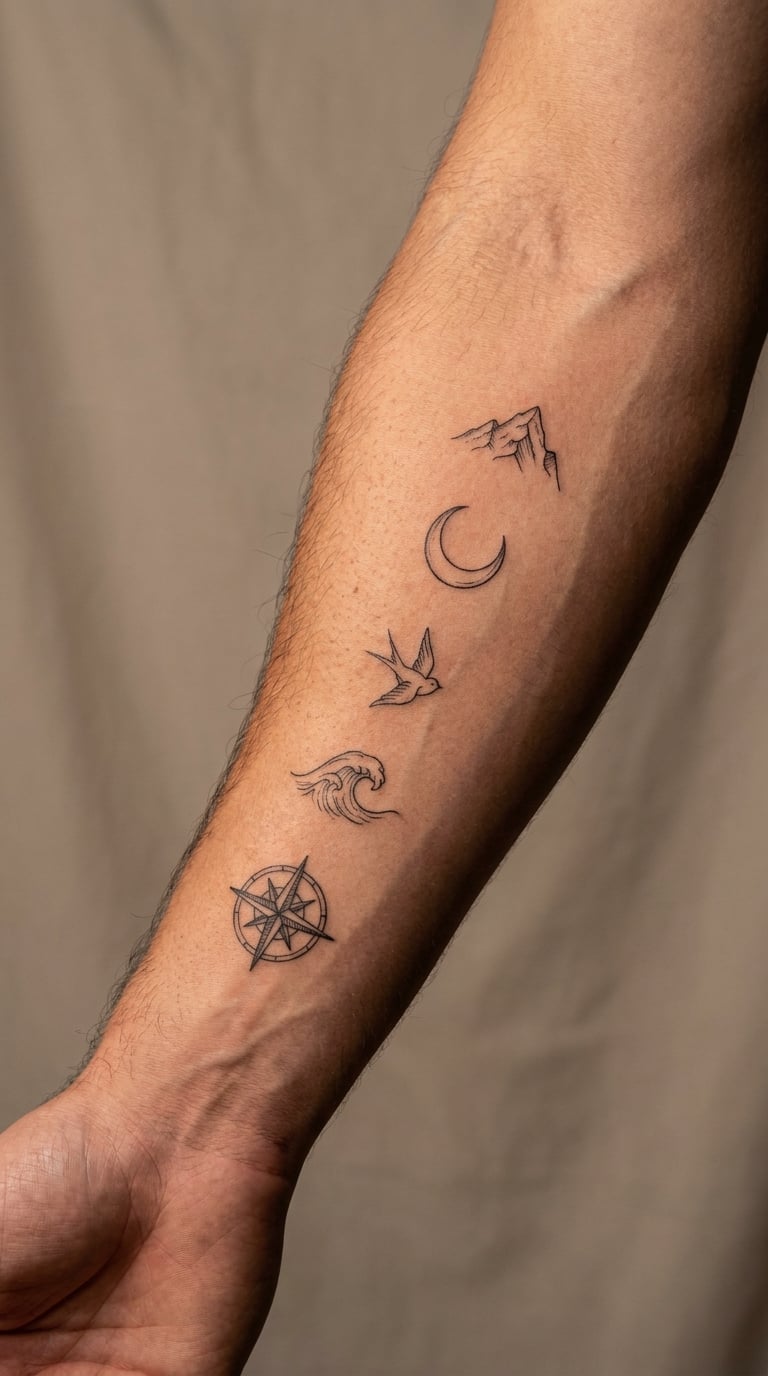
Five or six small icons, each two inches or so, spaced along the inner forearm with deliberate gaps. Nothing is huge and nothing is fiddly, and the design grows a piece at a time across a couple of years.
This is the option that keeps the most doors open. Each icon is its own small subject and can be added without a plan, and the gaps can be filled or left as negative space. If you are undecided about ever going further, this is the low-regret version of the placement.
Placement: scattered wrist to elbow, none crossing the elbow crease. Size: 1.5-2.5 inches / 4-6 cm each, with 2-3 inches / 5-8 cm of skin between them. Style: small illustrative, one consistent line weight.
Pain: low to medium, in short easy sittings rather than one long one. Ageing note: the risk is inconsistent line weight between sittings, which shows after a few years. Show your artist the healed pieces before adding the next icon.
Make it yours: let each icon come from a different year of your life, and keep one of them in the same spot every time so there is a fixed point in the arrangement.
Which Way Should an Inner Forearm Tattoo Face?
Point the top of the design toward your elbow. The convention almost every artist works to is that the tattoo should read right side up when your arm hangs at your side, not when you flex it or hold it out in front of you. A portrait or a face is drawn upright to the relaxed arm, with the top of the head at the elbow end and the chin toward the wrist.
The reason is simple. Almost all the time your arm is down, and with the arms down all you see is the back of your design. Flex your arm and the inner surface rotates under the skin, so a face drawn for the relaxed position appears to tip forward and foreshorten.
There is a real counterargument. Some men prefer the design to face inward, toward the body, so that when they look down at the arm the artwork is oriented to them rather than to a stranger. Artists will stencil it either way if you ask. What they will not do is pretend both choices are equal when you are not sure, so decide before the stencil goes on rather than after.
One practical note: ask to see the stencil on your own arm in a mirror before the artist starts. Two minutes there saves a piece you have to live with for decades.
How Big Should an Inner Forearm Tattoo Be?
Big enough that the widest part of the design is at least a third of the width of the arm at that point, and long enough to use the direction of the forearm rather than sit on it. There is no rule about inches that works for everyone, but there are three sizes people actually choose between.
- Small, wrist to mid-forearm. Two to five inches. A wrist-level piece reads as a detail, hides under a cuff, and is the easiest to change later. The trap is going too small: a two-inch design on a long forearm looks like an afterthought.
- Mid-forearm. Five to nine inches, the most common choice. It anchors the middle of the arm, works as a standalone piece, and still leaves room above and below.
- Full inner forearm. Twelve inches or more, wrist to elbow. It looks the best of the three when the design is built to the taper, and it is the hardest to reverse.
Two things people wish they had known. First, if you might ever sleeve, leave a two to four centimetre bare gap below the elbow, which lets a future piece sit above the old work instead of forcing you to cover it. Plenty of people plan a quarter sleeve with exactly that gap, and it is the standard reason for it.
Second, forearm tattoos generally look best in a sleeve shape with the arm held in a particular position, which is how they are photographed and which is not how you will live. Judge the stencil with your arm down and your hand relaxed, and ask the artist to test the drawing on the real taper of your arm, not on a flat sheet.
How Painful Is the Inner Forearm?
The inner forearm is one of the more forgiving spots on the body, mostly because it is less bony than the ribs or the spine and the skin is thicker through the middle. Pain here is more of a constant scratchy burn than sharp stabs, and the two spots that hurt are the elbow crease and the wrist, where skin is thin over bone. Size and line weight matter more than location.
| Zone | What it feels like | Rating out of 10 | Best for |
|---|---|---|---|
| Inner elbow crease (elbow ditch) | The most sensitive point on this canvas. Skin stretches and creases every time you move. | 7-8 | Keeping designs out of it, or accepting it for a sleeve |
| Mid-forearm | Mushy, well-cushioned, the easiest part of the arm to tattoo. | 3-4 | Detailed work, portraits, lettering |
| Inner wrist and wrist bone | Thin skin directly over bone, and you will watch the whole thing happen. | 5-6 | Small pieces, script, fine detail |
Solid black packing is the real amplifier. A blackwork snake takes far more passes than a line-work compass, and it is the passes that add up rather than the spot.
Inner Forearm vs Outer Forearm: Which Is Better?
| Factor | Inner forearm | Outer forearm |
|---|---|---|
| Visibility | Seen when you gesture, turn a handle or reach out; mostly hidden otherwise | Always on display, and larger in silhouette |
| Concealment | Hides under a long sleeve, a jacket or a watch band | Only a long sleeve covers it |
| Skin and comfort | Softer skin, cushioned mid-arm, sensitive at the crease and wrist | Thicker skin, flatter, but harder over the elbow |
| Sun exposure | Shaded most of the time, so colour and fine line fade more slowly | Exposed, so colour fades faster and needs more care |
| Best for | Script, fine line, small meaningful pieces, concealable work | Bold colour, big composition, display pieces |
| Sleeve role | Anchor for a quarter or half sleeve | The main event for a full sleeve |
Ink genuinely behaves differently on the two surfaces. Sleeve wearers tend to report needing more layers on the forearm and hand than on the upper arm and shoulder, and a noticeable difference in skin quality between inner and outer. So if you are planning a matching pair, expect them to settle differently.
How Inner Forearm Tattoos Age
Inner forearm tattoos hold up well for one simple reason: most of the day, they are in shadow. UV exposure is the main thing that degrades ink, and this placement gets far less of it than the outer arm. A colour piece on the inner forearm will fade more slowly than the same piece on the outer arm, and a small piece under a shirt cuff will barely fade at all.
What does fade is fine detail. Hairline script, micro-realism texture, tiny geometry and 1mm line work all soften over time, faster on the softer inner skin and faster near the wrist where movement is constant. Ask for a slightly heavier line weight than the reference image and you will still be able to read the piece in fifteen years.
Skin texture changes too. The forearm moves and stretches, hair comes and goes, and weight changes reshape the surface. A piece drawn for a nineteen-year-old’s arm will sit differently on the same arm twenty years later, and that is not the artist’s fault.
Worth noting for anyone choosing an artist: healed photos at twelve and fourteen months tell you far more than portfolio shots from last week. Ask to see healed work, and ask specifically for work on inner forearms.
How to Choose the Right Inner Forearm Tattoo
A few questions worth answering before you pick a design.
- Is this a standalone piece or a sleeve anchor? If there is any chance of a sleeve later, pick a style you could repeat and leave the gap below the elbow.
- Does the design need to be read by other people? Names, dates and quotes are for you. Symbols, animals and landscapes are for everyone else. Decide which you want before the stencil.
- How small can you go before it looks lost? On a long forearm, aim for a design at least a third the width of the arm at that point.
- How much detail do you want to still see in ten years? If the answer is all of it, choose a bolder, simpler design than the one in your phone.
- Does the motif belong to someone? Cultural and faith designs carry meaning for the people they come from. If you cannot say what yours means to you, pick something that does not pretend otherwise.
- Can you cover it at work? A long sleeve handles it most days. Ask your employer before the first session, not after.
One more thing nobody mentions: nobody can judge a placement from a photo. Every forearm tattoo online is a flat, head-on shot with the arm positioned to make it look best. Before you commit, put the design on your own arm, in a mirror, in whatever light you will be in, and see it from the angle you actually live at.
Cost and Session Time
Tattoo pricing is usually an hourly rate plus a shop minimum. Most artists would rather be asked for a realistic number than have someone assume a low budget means a rushed job. What determines the number is the same on every placement: the size of the design, the detail in it, and how many sittings it takes.
| Piece | Typical size | Detail level | Sessions | Rough hours |
|---|---|---|---|---|
| Single small piece | 2-4 in / 5-10 cm | Simple line work, one or two colours | 1 | 1-2 |
| Single detailed piece | 4-8 in / 10-20 cm | Shading, portrait or solid black | 1 | 3-6 |
| Large piece or quarter sleeve | 8-14 in / 20-36 cm | Full background fill and wrap | 1-3 | 10-20+ |
| Full inner forearm | 14-20 in / 36-50 cm | Continuous composition, irezumi or tribal | 2-5 | 15-30+ |
Rates vary enormously by city, shop and artist reputation, and a solid black piece always costs more per square inch than line work because of the extra passes. The hours in the table are the more useful number to plan around, because a full inner forearm piece built over several sittings is a commitment of days rather than one sitting.
Get the estimate for the whole piece, not the first sitting, and ask what happens if it needs a second. Then book the first one and see how you feel afterwards.
Aftercare Basics for the Inner Forearm
Follow your artist’s aftercare instructions first, because they know what they did. In general, the routine is straightforward, and this placement is easy to look after.
- Keep it clean for the first few days with unscented soap and clean water, and pat rather than scrub.
- Leave the film alone. Many people pick it off in the first two days, and that is the single most avoidable mistake on this list.
- Loose clothing for a week, because a tight sleeve pressing on a fresh inner forearm is the main irritant people report. The skin rubs against itself when the arm bends.
- No swimming, no hot tubs and no saunas until it has sealed, which is usually around two weeks.
- No heavy barbell or dumbbell work for the first two weeks, and take the first session back at half the weight. A bent arm is exactly the movement that stretches the fresh line work.
- Once healed, moisturise daily. The inner forearm dries out more than most people expect, and a healthy surface keeps the line crisp for years.
On the gym question specifically, because it comes up constantly: plenty of people train through it, with sensible adjustments. Wash the tattoo before and after, wear long sleeves for a few days, and make sure the ink is not pressed against the machine. Others stop for two weeks and have no issues either. Follow your artist’s advice above all, and err towards waiting if you are new to tattooing.
Sunscreen matters after healing too. The inner arm is shaded, which is an advantage, but the inner wrist gets sun on a car or a bike ride, and that is where colour fades first.
Frequently Asked Questions
Is an inner forearm tattoo painful?
It is one of the more forgiving spots on the body. The mid-forearm is cushioned and thick, which rates around 3 or 4 out of 10. The elbow crease is the worst part at roughly 7 or 8, and the wrist sits around 5 or 6 because the skin is thin over bone. Solid black and heavy shading add more passes, so style matters more than location.
Is the inner forearm a good first tattoo?
Yes, for most men. The pain is manageable, you can see the whole thing in a mirror while it heals, and a shirt sleeve covers it whenever you need. Many first-timers choose it. The two cautions are that the arm bends constantly, so healed line work matters, and that it is a very visible surface to practise placement on. Start with a design that is simple enough to go right first time.
Which way should an inner forearm tattoo face?
Toward the elbow. The design should read right side up when your arm hangs at your side, with the top of the image at the elbow end. When you flex, the inner surface rotates under the skin and a design drawn for the flexed position tips forward and foreshortens. Some men prefer it to face inward toward the body instead, which is a legitimate choice, but decide before the stencil goes on.
Do inner forearm tattoos last?
Better than most, because the area stays in shadow for most of the day and gets far less UV exposure than the outer arm. Colour fades more slowly here. What does fade is fine detail, so hairline script, micro-realism texture and tiny geometry soften first, and the inner wrist ages quicker than the mid-forearm because it moves constantly. Slightly heavier line work and daily moisturising both help.
How big should an inner forearm tattoo be?
Make the widest part at least a third of the arm’s width at that point. Small means 2 to 5 inches, which is easy to hide and easy to change later. Mid-forearm means 5 to 9 inches and is the most common standalone size. A full inner forearm is 12 inches or more and looks the best when the design is built to the arm’s taper. If you might sleeve later, leave a 2 to 4 centimetre gap below the elbow.
Can I lift weights after an inner forearm tattoo?
Wait about two weeks before heavy work, then start back at roughly half your usual weight. Bending the arm is the movement that stretches fresh line work, and a sleeve rubbing the inner forearm is the common irritant. Keep the tattoo from pressing against the machine, wash before and after training, and wear long sleeves for the first few days. Your artist’s aftercare instructions override all of this.
Conclusion: Where to Start With Your Inner Forearm Tattoo
If this is your first tattoo, look at number 6, the fine-line compass, or number 20, the patchwork icons. Both are simple, both sit well on this placement, and neither boxes you into a style you have to live with for the rest of your life.
If you already have ink and you are thinking bigger, start at the sleeve question before the design question. Decide whether the inner forearm is a finished piece or the first piece of something larger, and let your artist draw to the real taper of your arm. Bring two or three reference images, a sentence about what the design means to you, and the answer to the orientation question above. That is enough for a good consultation.