
20 Paintbrush Tattoo Ideas: Best Artistic Designs 2026
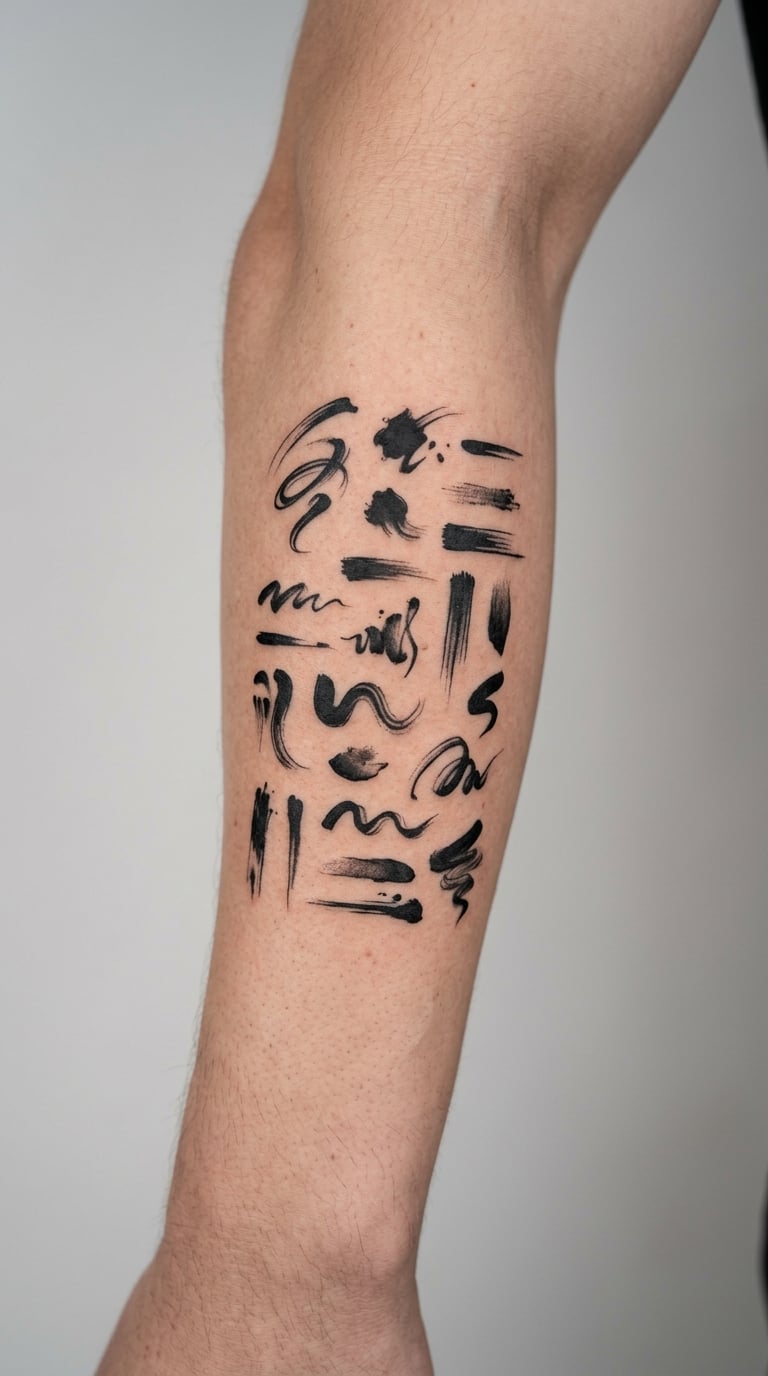
Paintbrush tattoos fall into two families, and the mix of both is what makes the theme work. Some designs show the tool itself: a brush, a palette, a splatter running off the bristles. Others use brushwork as a technique, so the tattoo is painted rather than drawn, with soft pigment edges, dry-brush texture and color that fades into bare skin. A paintbrush tattoo is any of those: a literal art-supply motif, a single loaded brushstroke, or a whole design painted in that style.
Below are 20 paintbrush tattoo ideas grouped by style, placement and scale, so you can see which one actually fits the spot you have in mind. Every entry covers what the design looks like, where it sits best, a realistic size in inches, the pain to expect and one way to make it personal. If you are planning a first piece, start with the smaller options and ask the artist to show healed work from the last two years, not fresh photos from last week.
20 Paintbrush Tattoo Ideas: Quick Guide
| Idea | Style | Best placement | Size | Pain |
|---|---|---|---|---|
| 1. Fine-Line Floral Bouquet | Fine line | Inner forearm | 2-4 in | Medium |
| 2. Brushstroke Mountain Range | Blackwork dry brush | Outer forearm | 3-5 in | Medium |
| 3. Watercolor Butterfly | Watercolor | Upper back | 3-5 in | Medium |
| 4. Realistic Brushstroke Rose | Micro-realism | Inner arm | 2-3 in | Medium |
| 5. Abstract Color Splash | Abstract | Forearm | 2-4 in | Low |
| 6. Fine-Line Liner Portrait | Fine-line portrait | Wrist | 1.5-2.5 in | Medium |
| 7. Brushstroke Wolf | Blackwork | Forearm | 3-5 in | Medium |
| 8. Minimalist Brush Heart | Minimalist | Inner wrist | 0.5-1 in | Low |
| 9. Paintbrush Koi | Traditional | Calf | 3-5 in | Medium |
| 10. Dotwork Hummingbird | Dotwork plus brush | Shoulder blade | 2.5-4 in | Low |
| 11. Micro-Realistic Bird | Micro-realism | Behind the ear | 1.5-2.5 in | Low |
| 12. Geometric Hexagon | Geometric | Forearm | 1.5-3 in | Low |
| 13. Botanical Branch | Loose botanical | Side of forearm | 2.5-4 in | Medium |
| 14. Red Ink Arrow | Illustrative | Inner arm | 2-3 in | Medium |
| 15. Blue Brushstroke Wave | Illustrative | Lower leg | 3-5 in | Low |
| 16. Traditional Sun | Traditional | Shoulder | 2.5-4 in | Medium |
| 17. Fine-Line Swan | Fine line | Ankle | 2-3.5 in | Medium |
| 18. Blackwork Dragonfly | Blackwork | Upper back | 2.5-4 in | Low |
| 19. Watercolor Map Marker | Watercolor | Inner arm | 1.5-3 in | Medium |
| 20. Full-Color Portrait Splash | Illustrative realism | Upper arm | 4-6 in | High |
How to Read the Paintbrush Tattoo Ideas Table
These are starting points, not fixed rules. Style, placement, size and pain in this table describe the version most tattooers would sketch first, and your artist will shift the composition to fit your anatomy, ink preference and tattooing style. A design listed at three inches on paper may need four to hold the same visual weight on a rib or a shoulder. Sizes are finished-healed dimensions, and the pain ratings assume the placement listed rather than the design itself.
1. Fine-Line Paintbrush Floral Bouquet
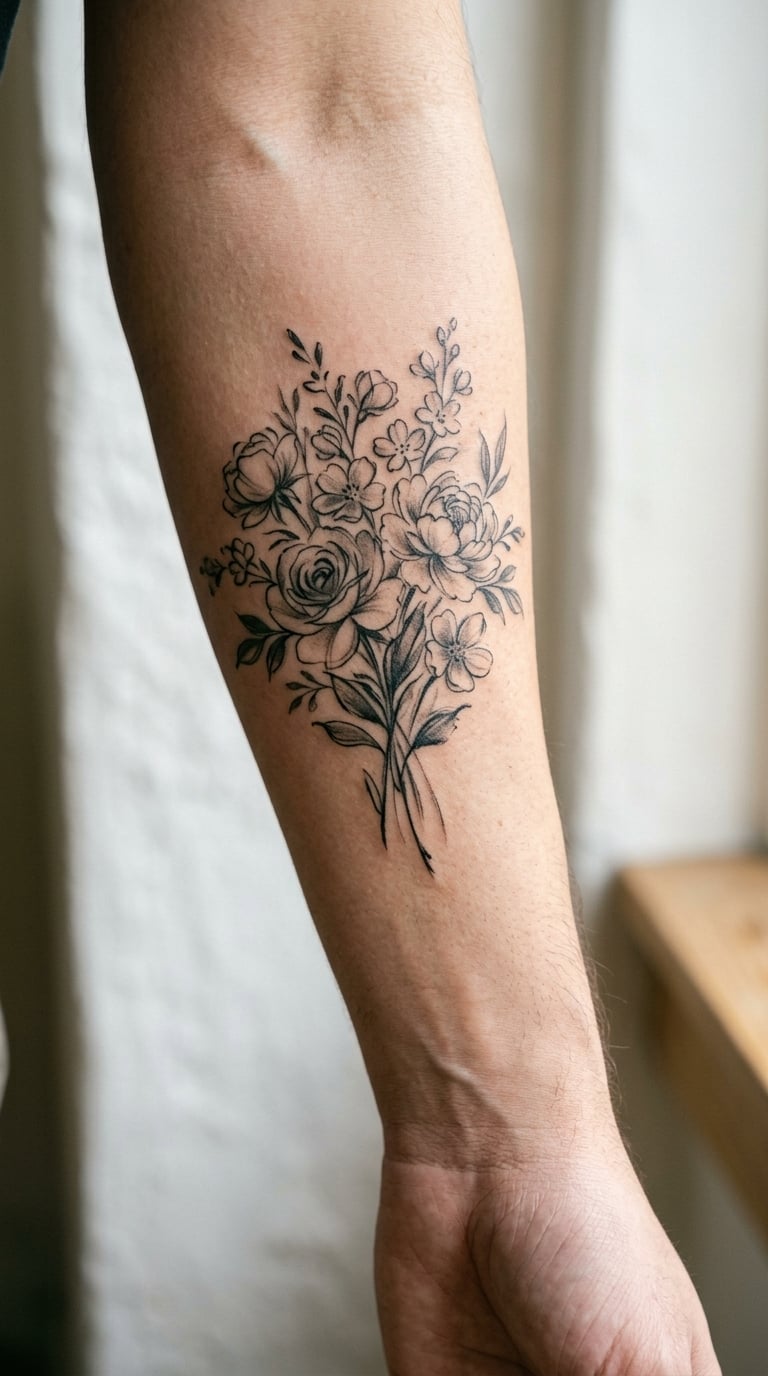
This is a loose bouquet of three to five blooms, drawn with single-needle lines that break and taper the way a real brush runs out of paint. The petals stay recognizable, but the shading is minimal: a few grey strokes that follow the petal direction instead of smooth blended grey. Stems cross once or twice and trail off unfinished, which is the detail that sells the brush look.
People usually choose it because it is decorative without announcing a fixed meaning, and because the small scale means a visible forearm piece without a sleeve commitment.
Placement: inner forearm, wrist crease to elbow, or along the collarbone. Size: 2-4 in (5-10 cm). Style: fine line with light brush texture. Pain: medium on the inner forearm, and fine lines on hands and fingers blur fastest, so keep the detail off the knuckles. Make it yours: use flowers from a specific garden or wedding bouquet, or add one muted olive-grey leaf to break the monochrome.
2. Black Brushstroke Mountain Range
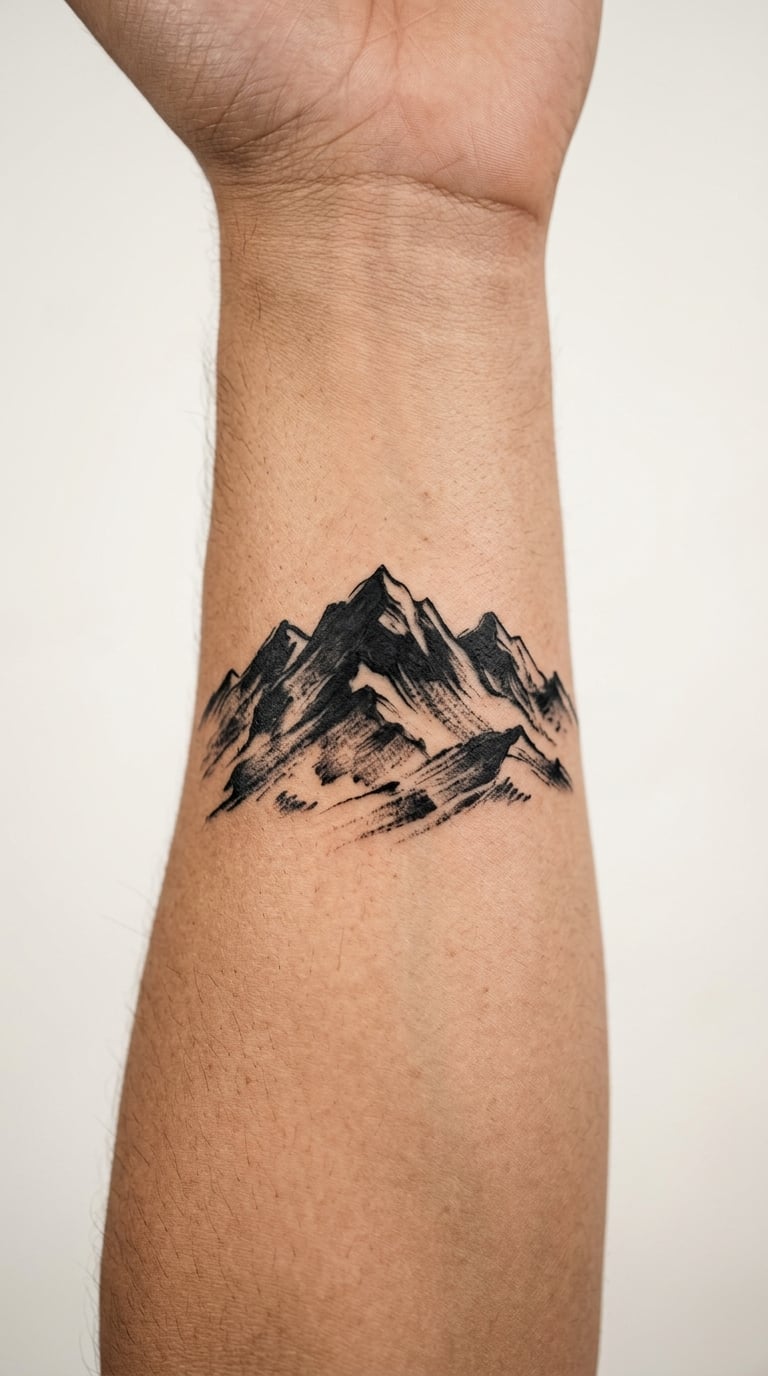
A horizontal ridge line built from two or three overlapping strokes: one dense and opaque for the shadow side, one dry-brushed and broken for the lit side, and a scatter of tiny black specks for trees or scree. There is no outline and no background wash, so the negative space does most of the work. Broad areas are packed solid while the edges stay ragged.
The reading is open rather than fixed. Most people are drawing a place that matters to them, and the horizontal band shape happens to suit limbs.
Placement: outer forearm, calf, ribs or across the upper back. Size: 3-5 in (8-13 cm) wide. Style: blackwork with dry-brush texture. Pain: medium, and the solid packing passes take longer than they look like they should. Make it yours: name the actual peaks or the trail you walked, and have the lowest ridge fade out so the piece reads as a horizon rather than a wall.
3. Watercolor Paintbrush Butterfly
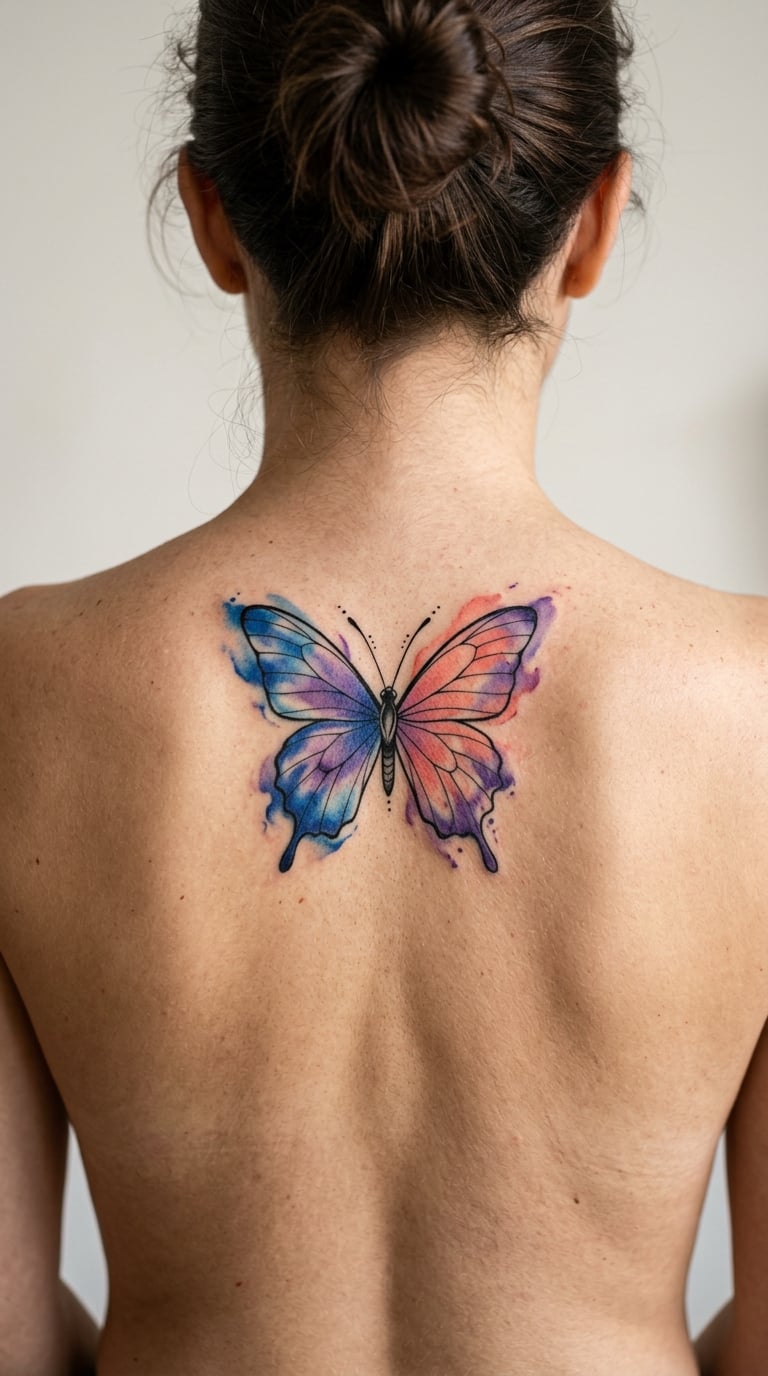
Wings built from translucent washes in blue, violet and coral, layered light over light with no black outline at all. The pigment thins toward the wing edges until it dissolves into skin, and a few hard dots of color sit inside the wash to give the body and antennae definition. The result looks like a wet brush was dragged across the back and a butterfly happened.
Butterflies carry the usual transformation reading, so people often layer personal meaning onto the painterly side of it, which is a softer, less obvious signal than a solid butterfly.
Placement: upper back between the shoulder blades, ribs, or the outer thigh. Size: 3-5 in (8-13 cm). Style: watercolor. Pain: medium, and wash work needs repeated passes so expect a longer sitting than the outline stage suggests. Make it yours: pick two colors from a real place or a person, and ask for the color to fade out on one side so the butterfly appears mid-flight.
4. Realistic Brushstroke Rose
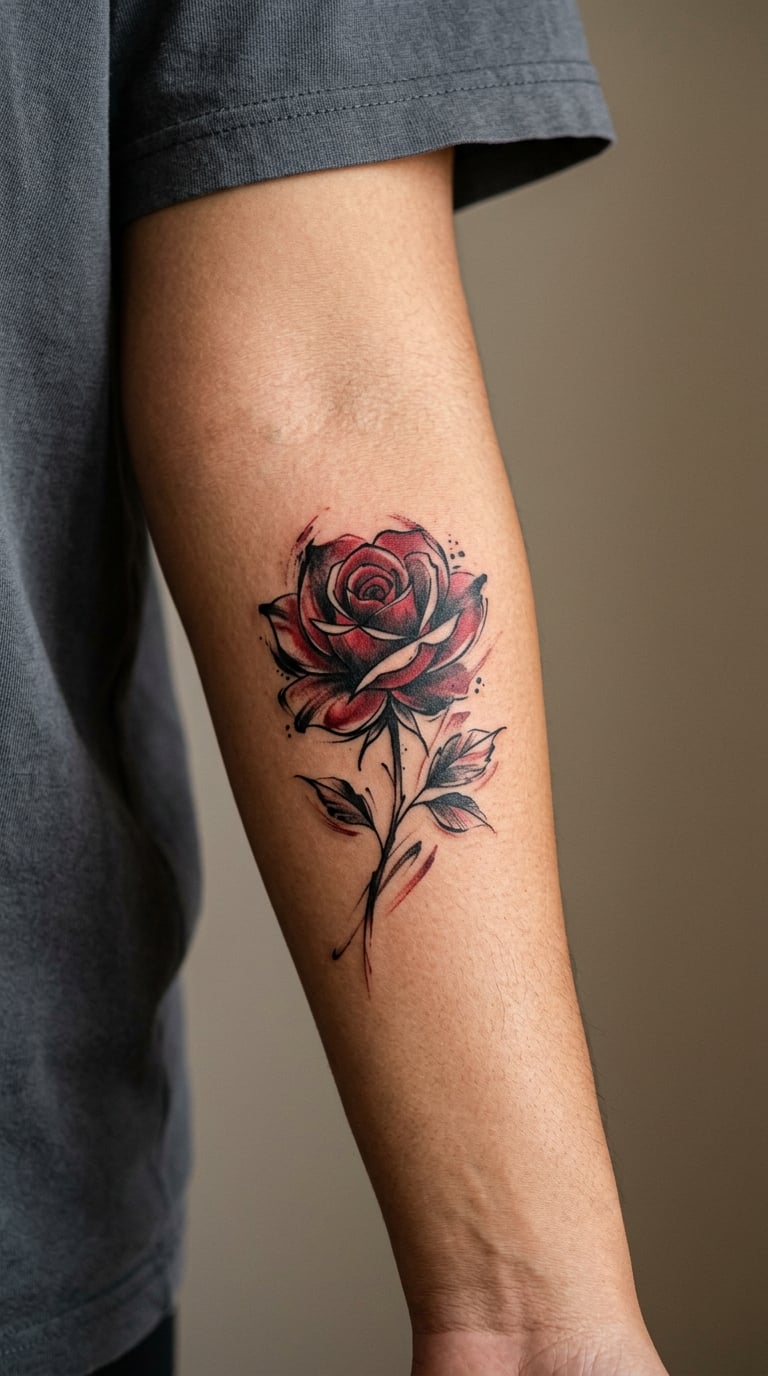
One rose where the petals are shaded with real tonal depth but the outer edges dissolve into loose, confident marks. The centre is packed tight and dark, the outer petals thin out into dry-brush texture, and a stem with two leaves drops below. A painterly realism approach rather than a soft, blobby rose tattoo, which is what separates it.
It is the safest of the painterly designs for a first colored piece, because a single flower gives the artist one contained shape to practise gradients on instead of a whole scene.
Placement: inner arm, wrist, or the back of the hand. Size: 2-3 in (5-8 cm) tall. Style: micro-realism with brushwork. Pain: medium, higher on the wrist and the inside of the elbow. Make it yours: add a hidden date in the negative space between petals, or use the red of a specific flower rather than a standard tattoo red.
5. Abstract Color-Splash Paintbrush
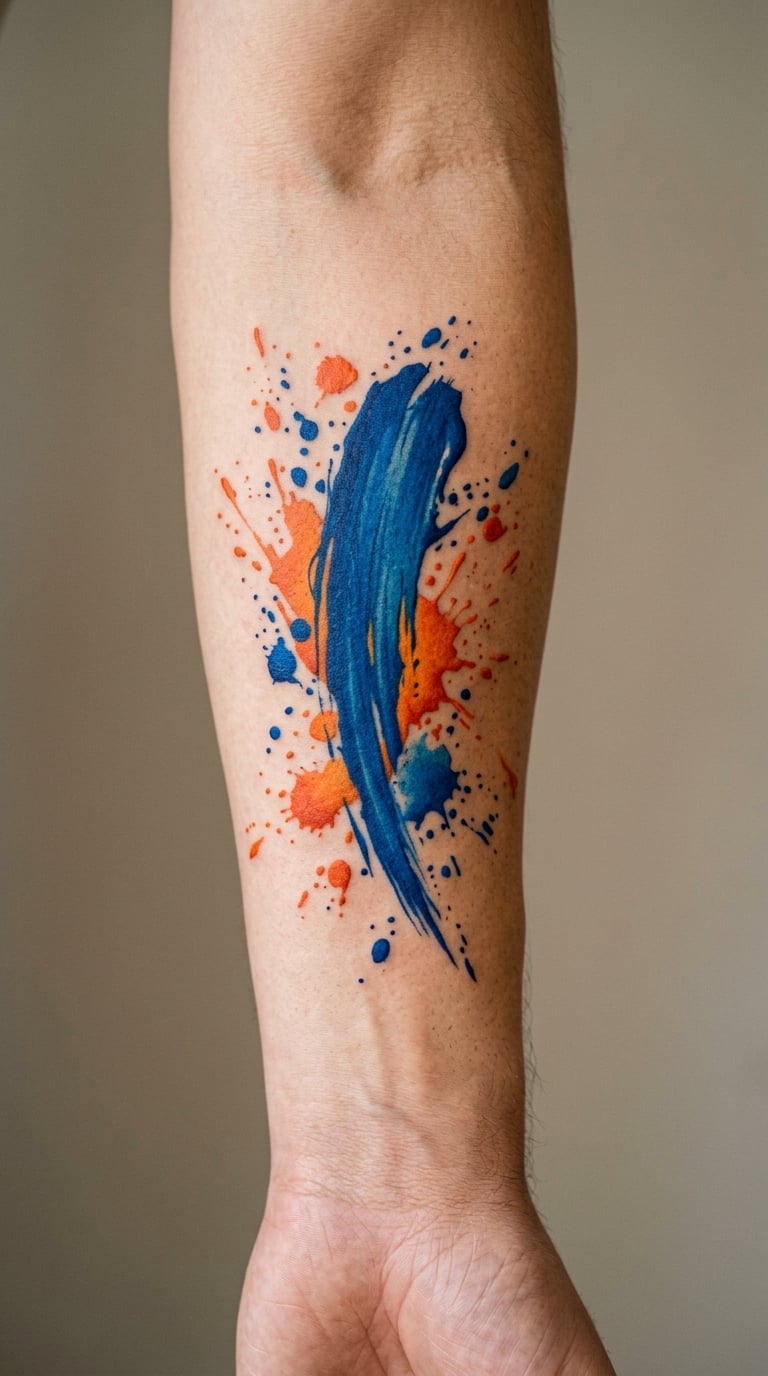
No subject at all: one confident loaded brushstroke in cobalt blue, a second shorter orange stroke crossing it, and a scatter of small droplets around the impact point. The strokes taper where the brush lifted and pool slightly where it was pressed down. It reads as contemporary and graphic, and it is the least demanding design in this list to tattoo.
People tend to choose it when they want color and energy but no image they have to explain, and it sits comfortably beside other work without competing with it.
Placement: forearm, shoulder, or anywhere with a flat enough stretch. Size: 2-4 in (5-10 cm). Style: abstract color splash. Pain: low, since it is a small area of flat color. Make it yours: match the two colors to something you own, or keep the droplets and add a single thin line of text running under the stroke.
6. Fine-Line Paintbrush Liner Portrait
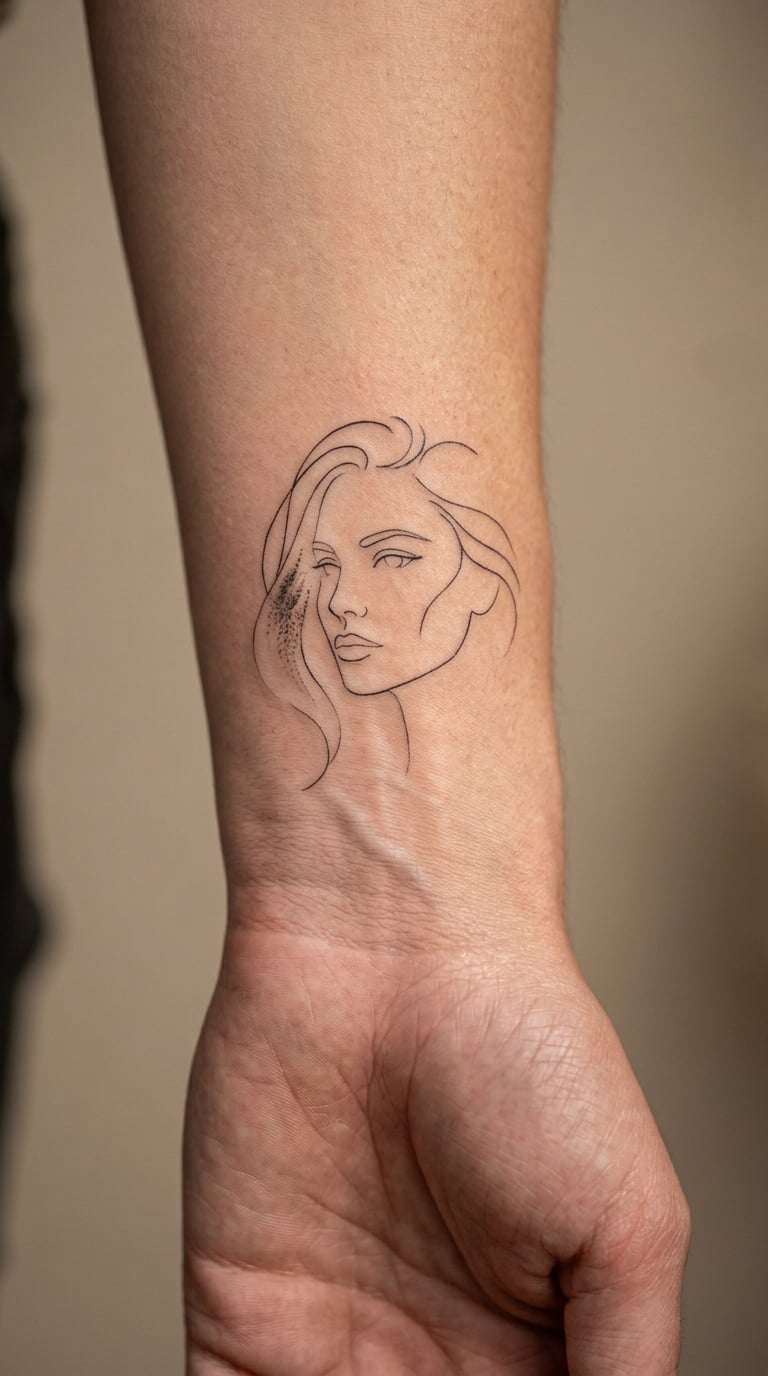
A face drawn with a single-needle line, the kind of continuous economical line an artist can hold for two inches without a tremor. The jaw, nose and lip are suggested rather than fully rendered, and one dry-brush patch behind the cheek or under the chin supplies the painterly note. A lined portrait of someone specific, drawn like a sketch rather than a photograph.
It is nearly always a chosen person, sometimes paired with dates or initials on a neighboring line.
Placement: inner wrist, behind the ear, or the rib area. Size: 1.5-2.5 in (4-6 cm). Style: fine-line portrait. Pain: medium, and the inner wrist and ribs are both sensitive zones. Make it yours: bring two photos from different angles, and favour likeness over detail, since the tiniest facial features will soften within a few years. Agree on the likeness on paper before the stencil goes on.
7. Blackwork Brushstroke Wolf
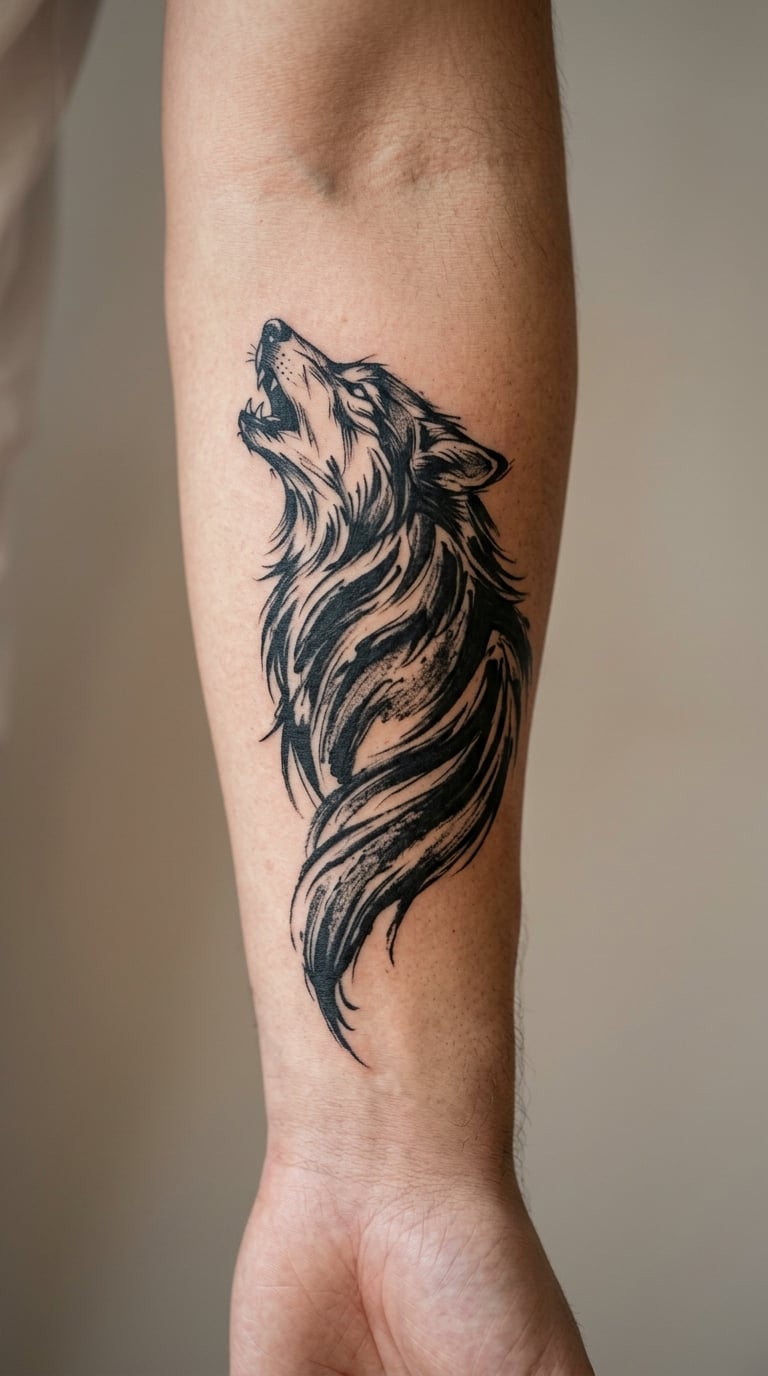
A wolf profile built entirely from strokes rather than contour lines: a solid opaque jaw, a dry-brushed neck that breaks into white, and ears suggested by two sharp tapered marks. The animal is caught mid-stride, which gives the ragged texture a reason to exist. No outline, no background, no color. It reads as movement even in a small size.
It is one of the more requested designs for a first or second piece, usually for someone who wants an animal that looks designed rather than realistic.
Placement: outer forearm, calf, or the side of the ribs. Size: 3-5 in (8-13 cm). Style: blackwork. Pain: medium, and the ribs cost considerably more than the forearm. Make it yours: pick a wolf from a specific pack or a rescue you follow, and ask for the dry brush to be heavier on the back than the face so the eyes stay the sharpest point.
8. Minimalist Paintbrush Heart
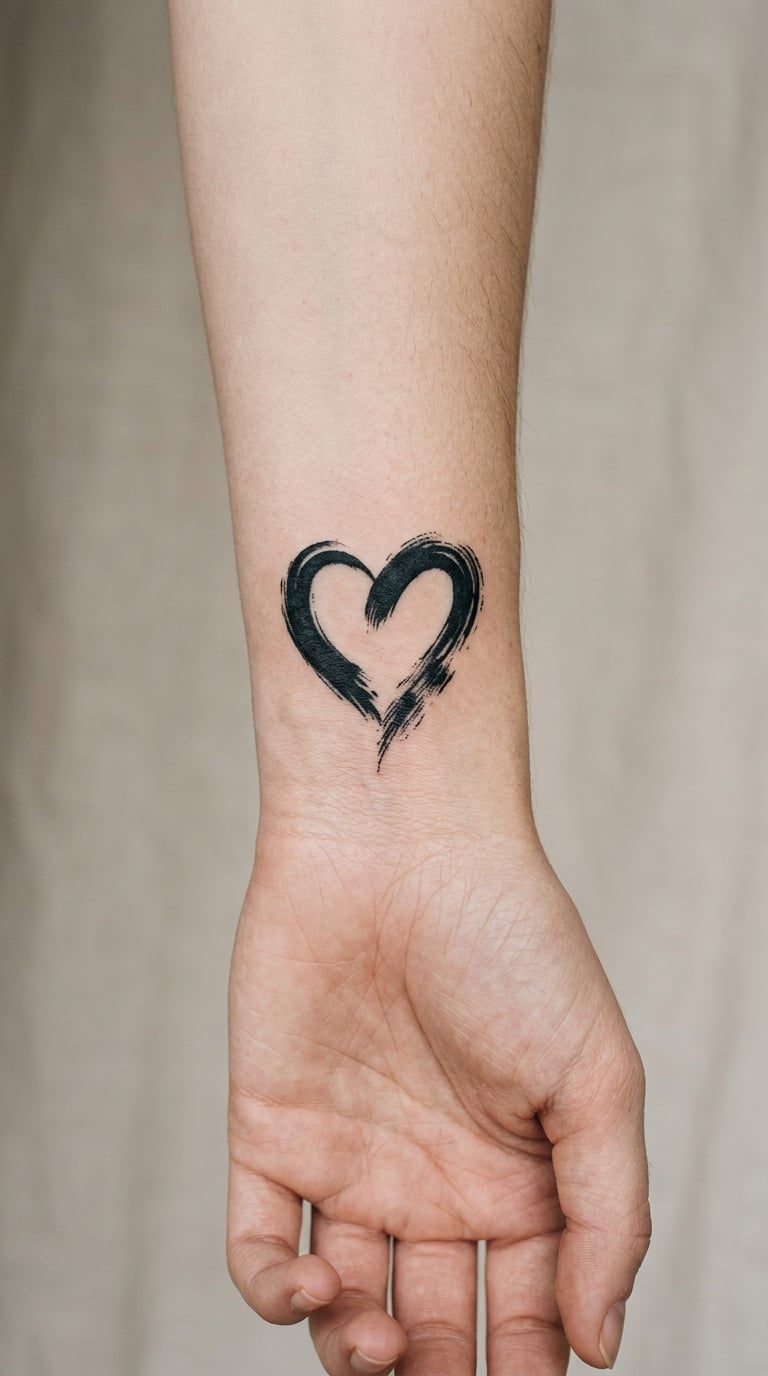
One curved stroke that dips into a heart shape and stops, with visible bristle tracks running through it and uneven edges where the brush skipped. No outline, no fill, no second color. Slightly lopsided on purpose, because a clean geometric heart would be a different tattoo entirely.
Small and unsentimental, it works for a first tattoo because there is no detail that can go wrong and the whole thing takes a few minutes.
Placement: inner wrist, behind the ear, or the collarbone. Size: 0.5-1 in (1.5-2.5 cm). Style: minimalist black brushwork. Pain: low. Make it yours: angle the stroke slightly so it reads as a brushmark rather than a symbol, and pair it with a matching tiny stroke on the opposite wrist if you want symmetry later.
9. Traditional-Style Paintbrush Koi
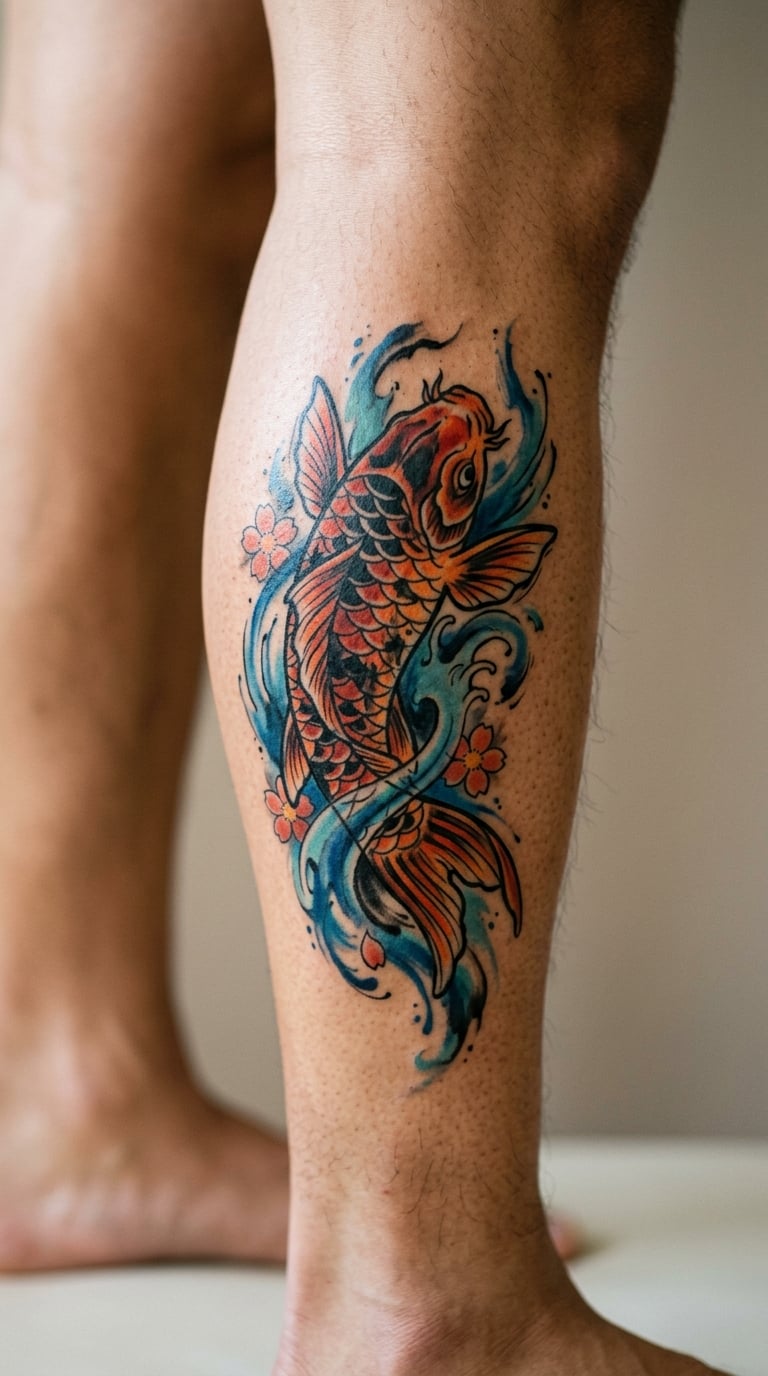
A koi built in the traditional way, with a bold black outline, an orange and red body and defined scales, then loosened at the fins and the water around it. The water lines are the painterly part: loose blue-grey marks that bleed and break off instead of following the fish. A traditional fish with a brushstroke environment.
Koi usually stand for persistence or a specific personal chapter, and the water marks let the piece carry a name, a place or a date without another symbol.
Placement: calf, thigh, or the upper arm. Size: 3-5 in (8-13 cm). Style: traditional with painterly water. Pain: medium on the calf and thigh, high on the ribs. Make it yours: have the water marks spell out a place name in loose script, or use your own birth month colors for the scales.
10. Dotwork and Brushstroke Hummingbird
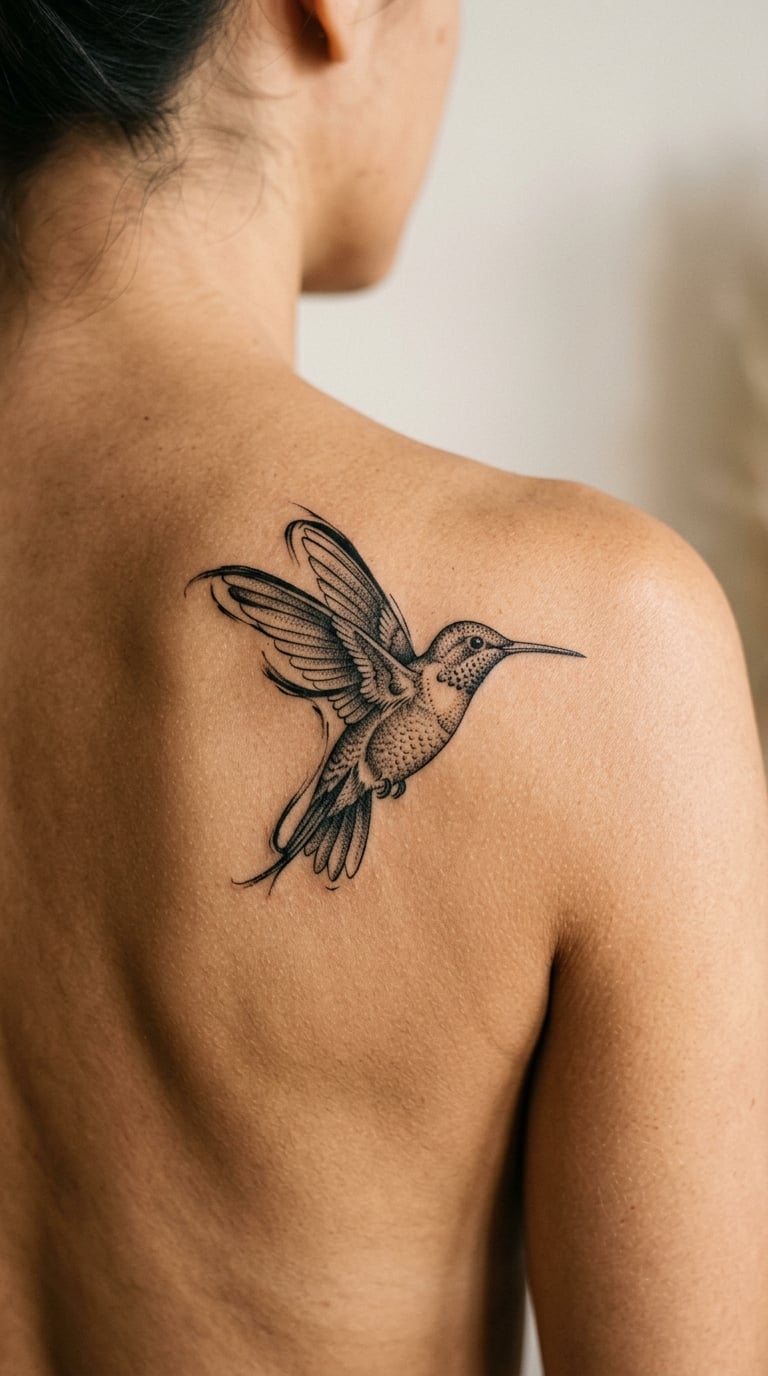
A hummingbird drawn tightly in dotwork: the body is stippled shading, the eye is a single dark dot, the feathers are layered rows of fine marks. The wings break away from that discipline into two loose energetic black strokes, blurred and dry at the edges. The contrast between the careful body and the fast wings is the whole design.
Hummingbirds get chosen for energy and smallness, and pairing dotwork with a brush keeps it from reading as a generic bird.
Placement: shoulder blade, upper arm, or the back of the neck. Size: 2.5-4 in (6-10 cm). Style: dotwork with brushwork. Pain: low, and the shoulder blade is a comfortable spot even for a long sitting. Make it yours: point the beak toward a real feeder or a specific flower from your garden, and ask for the wing strokes to fade out at one end.
11. Micro-Realistic Brushstroke Bird
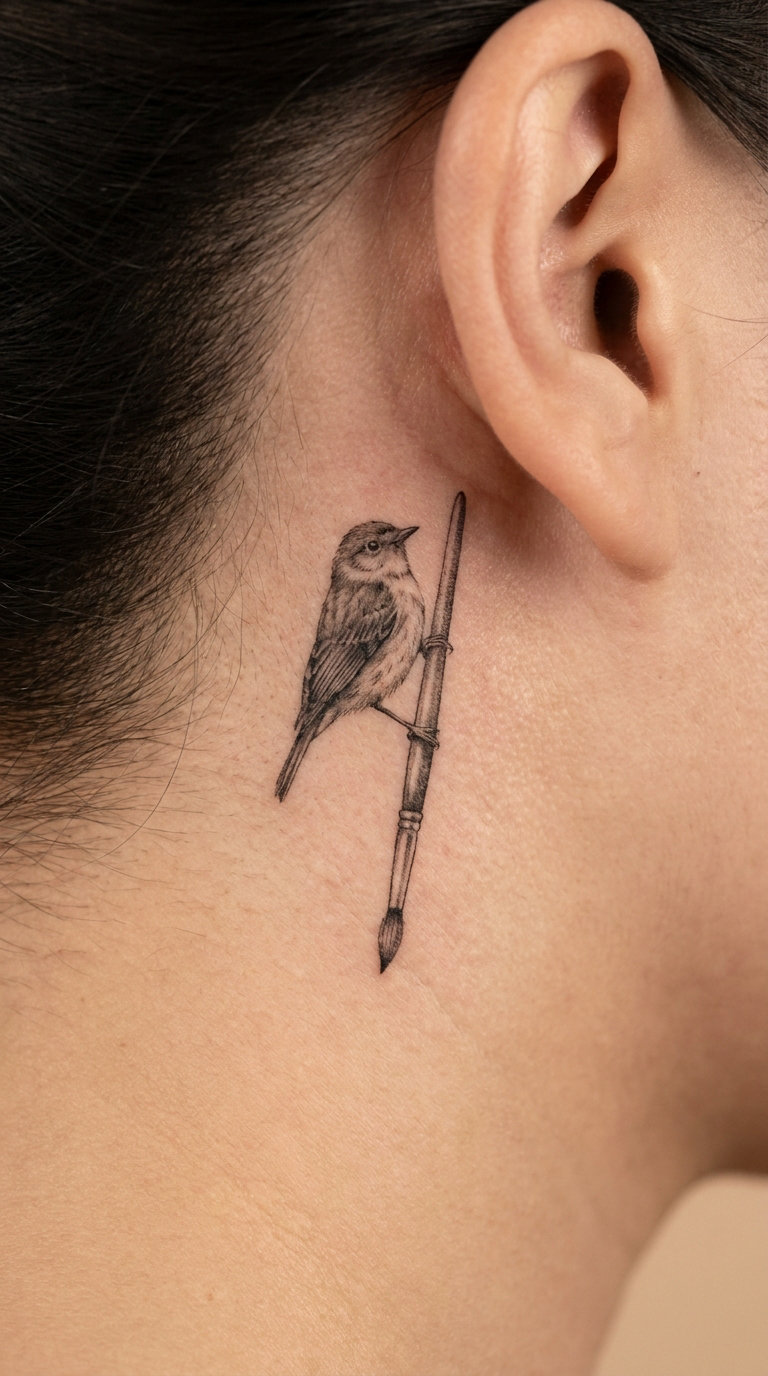
A small bird in flight, built from short directional marks that follow the feather direction, with soft grey shading under the wing and no outline. At two inches the whole thing is impressionistic, which is what lets it stay sharp. The brush influence shows in the ragged, broken marks at the wingtip rather than in any hard edge.
It suits a collector who wants something that looks like a real bird and not a symbol, but has no room for a large piece. Behind the ear it also stays mostly hidden at work.
Placement: behind the ear, nape of the neck, inner wrist, or the ankle. Size: 1.5-2.5 in (4-6 cm). Style: micro-realism. Pain: low, and behind the ear is a quick spot because the area is small. Make it yours: name the species you actually want, since at this size a swallow and a sparrow look identical without it, and add a second bird later as a matching piece.
12. Geometric Paintbrush Hexagon
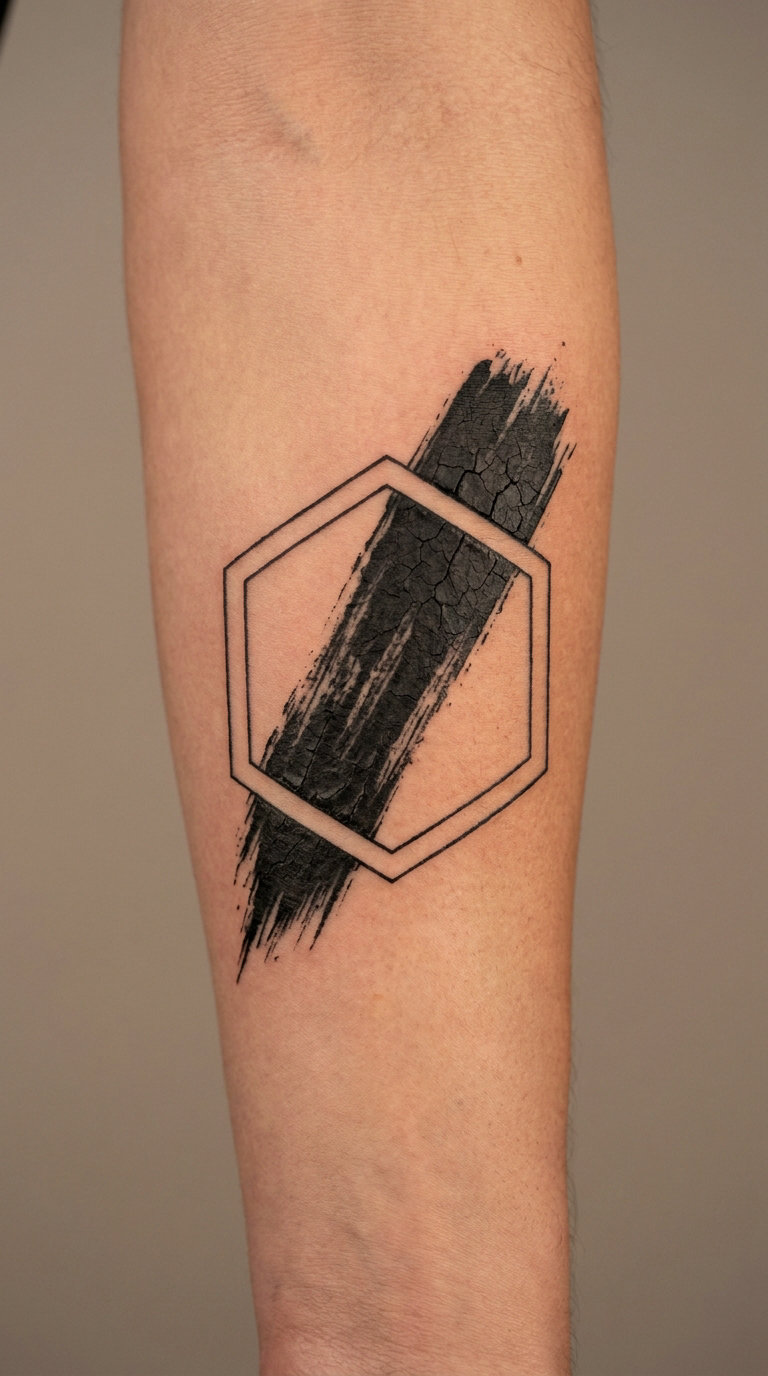
A precise hexagon drawn with measured straight lines, then a single rough black brushstroke dragged straight through the middle of it, breaking the outline where it crosses. The tension is the design: machine-clean geometry against a mark that clearly came off a brush. One or two small drips run from the lower edge of the stroke.
It gives structure lovers a piece that still has movement in it, and the geometry means it sits calmly next to a sleeve.
Placement: forearm, upper arm, or the chest. Size: 1.5-3 in (4-8 cm). Style: geometric with blackwork. Pain: low to medium. Make it yours: repeat the hexagon along a forearm as a line of linked shapes with one brushstroke across the whole run, and vary the stroke angle on each one so it is not obviously repeated.
13. Loose Botanical Paintbrush Branch
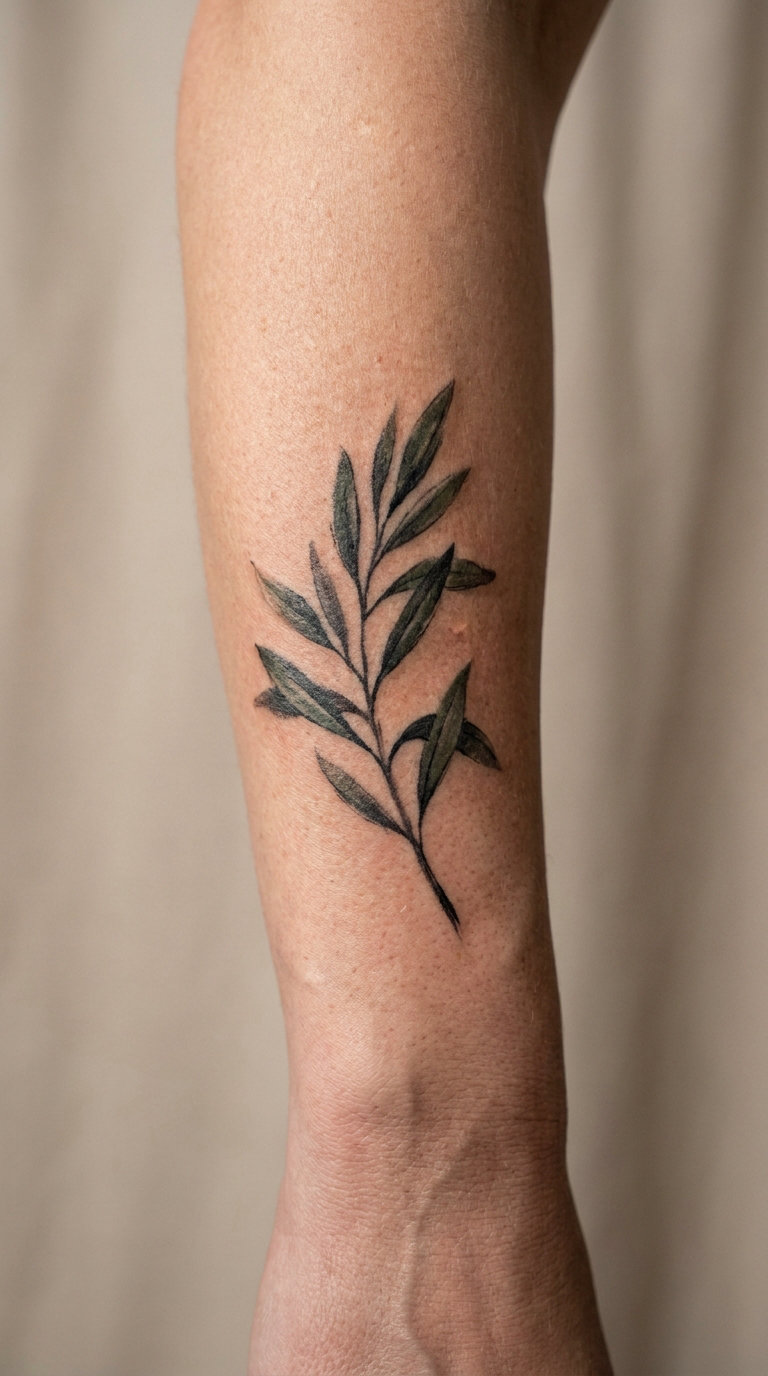
A single branch with leaves in black and a muted olive, painted rather than outlined. Each leaf is two or three brush marks, some dense and some dry, and the ink density varies along the branch so it looks like one continuous loaded stroke. A few leaves are left half-finished at the tip.
It reads as growth and a connection to nature without any fixed symbolism attached, which is why it suits people who want a plant piece without a message attached to it.
Placement: side of the forearm, calf, ribs, or the collarbone. Size: 2.5-4 in (6-10 cm). Style: loose botanical. Pain: medium, and the ribs and side of the forearm are more sensitive than the outer arm. Make it yours: draw the branch from a real plant, olive or sage included, and add a new leaf each time you get one added rather than filling the gaps.
14. Red Ink Paintbrush Arrow
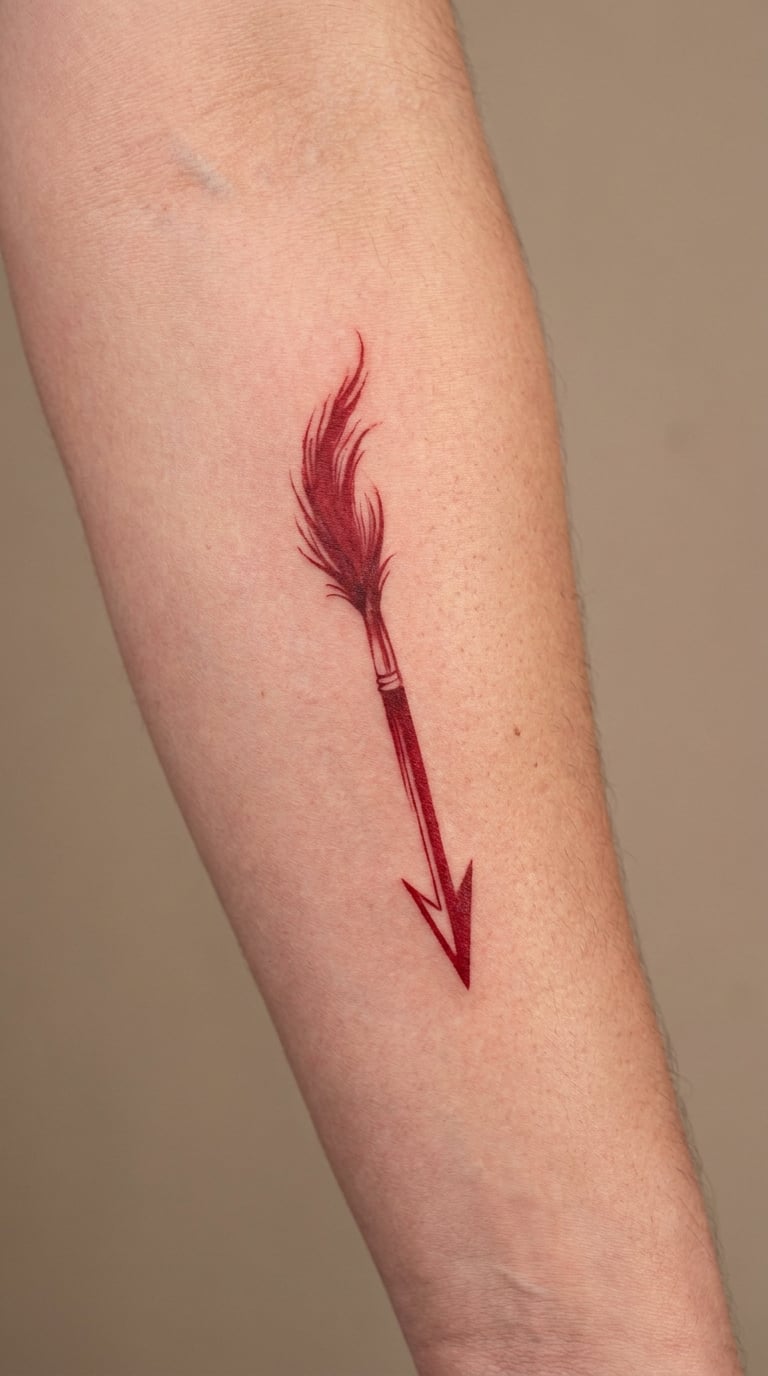
An arrow built from one red stroke that starts thick and rough, where the brush was pressed down, and tapers to a clean point where it lifted. The shaft is a single line, the fletching is three short tapered marks, and the ink thins toward the head. Mostly one color, with a black outline only where the red goes too pale to read.
The direction gives it momentum, and a small arrow works as a matching or filler piece between larger work.
Placement: inner arm, ankle, or along the rib line. Size: 2-3 in (5-8 cm). Style: illustrative single-color brushwork. Pain: medium, and the inner arm is more sensitive than the outer. Make it yours: set the direction toward a place you have been or a place you are going, and add a small companion arrow pointing the other way once you have space for it.
15. Blue Brushstroke Wave
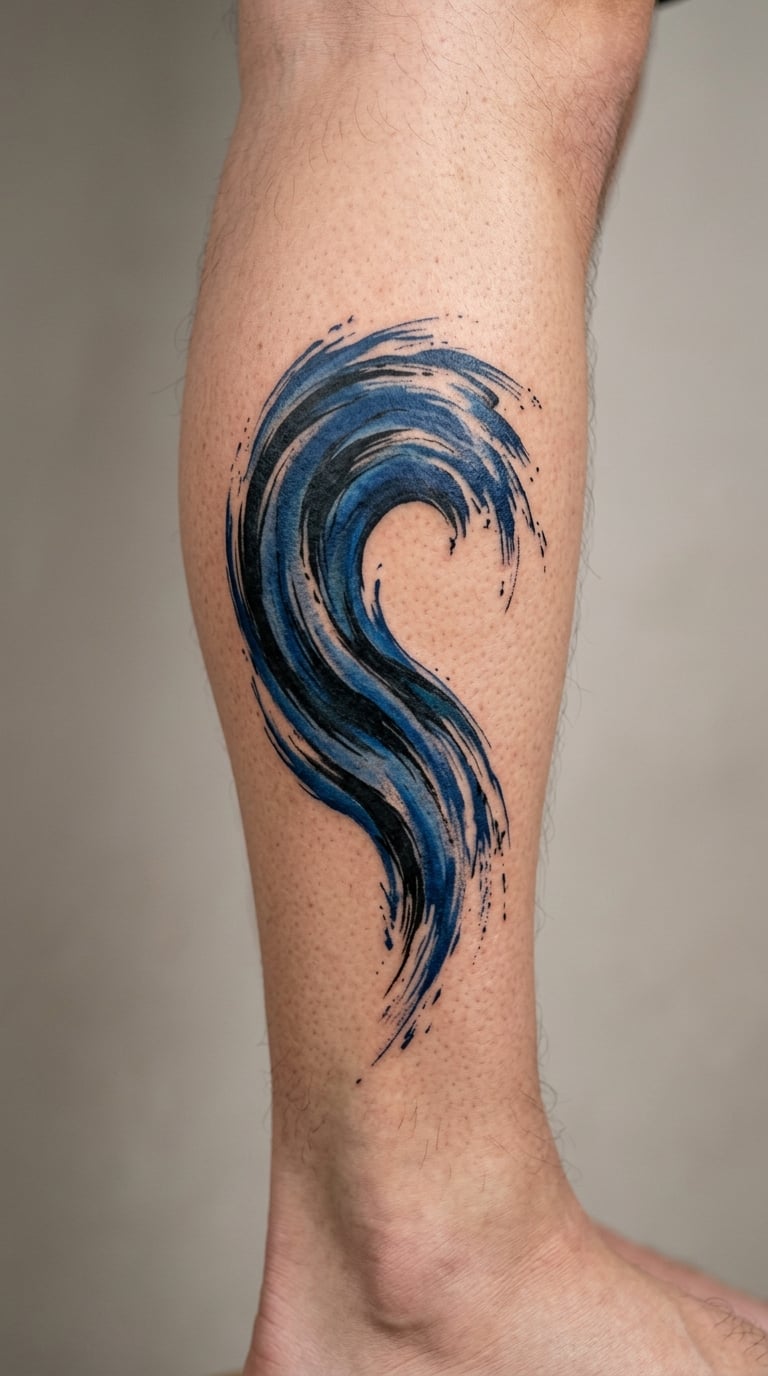
One broad wave, layered in two or three blues with a black line under the crest, and dry-brush edges where the color breaks into white. Negative space does the foam: a few unpainted gaps left inside the crest instead of drawing bubbles. The stroke thins as it runs down, so the whole thing tapers off by the end.
Waves are usually a favorite for anyone who surfs, swims or just likes cold color, and the taper lets it follow the curve of a leg or an arm naturally.
Placement: lower leg, calf, forearm, or ribs. Size: 3-5 in (8-13 cm). Style: illustrative brushwork. Pain: low on the leg, high on the ribs. Make it yours: match the blues to a specific ocean, and either mirror it on the other leg or continue the stroke into a full wraparound band.
16. Traditional Paintbrush Sun
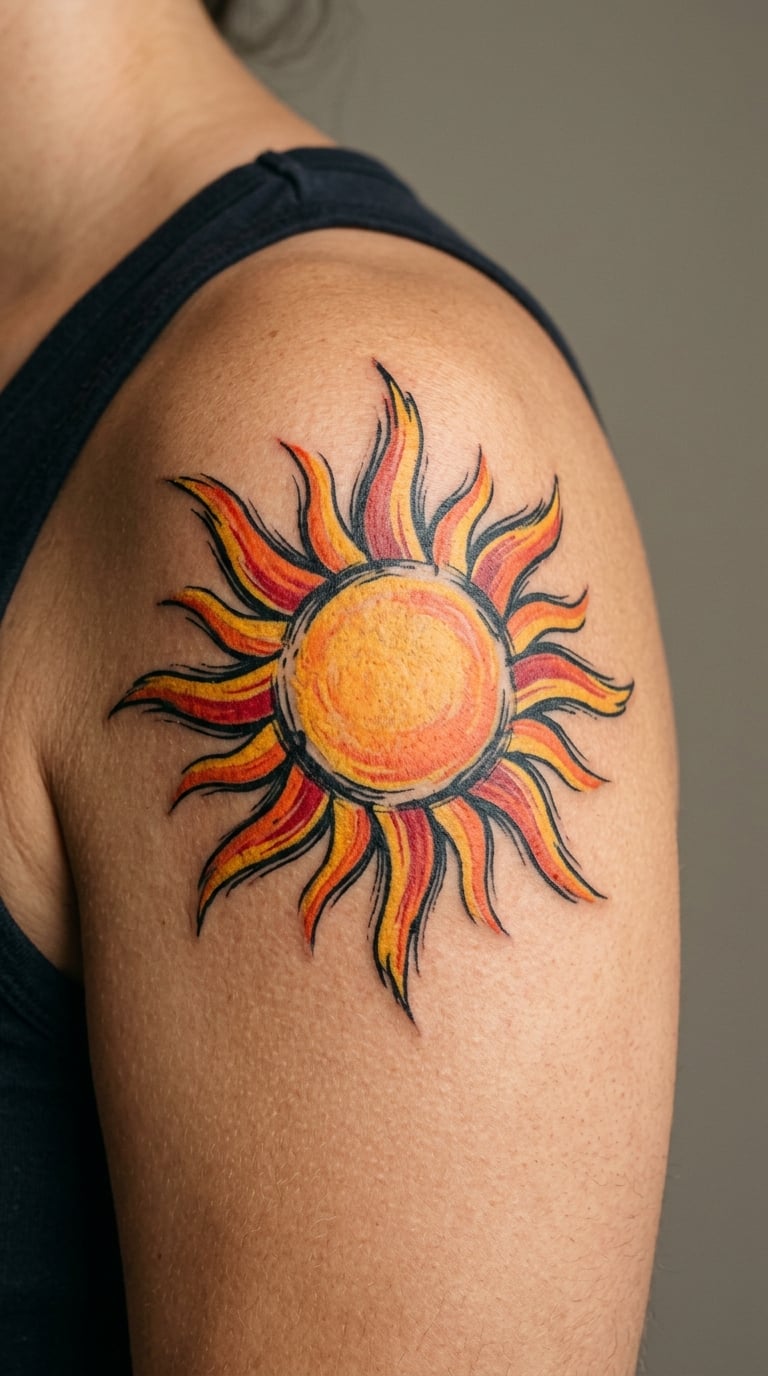
A sun with a packed warm centre in yellow and orange, and rays that vary in length and weight, some solid and some dry-brushed to a rough edge. A red band circles the core. It is a traditional subject painted with a brush rather than a compass, so no two rays match and the outline is soft where the pigment thinned.
Warm, optimistic and readable from a distance, which makes it a good choice for a first larger piece on a shoulder or upper arm.
Placement: shoulder, upper arm, or chest. Size: 2.5-4 in (6-10 cm). Style: traditional with painterly rays. Pain: medium, and the outer shoulder and upper arm are among the easier large areas. Make it yours: add a location and year on the lower arc in thin black script, or vary the ray lengths to echo a specific sun reference image.
17. Fine-Line Paintbrush Swan
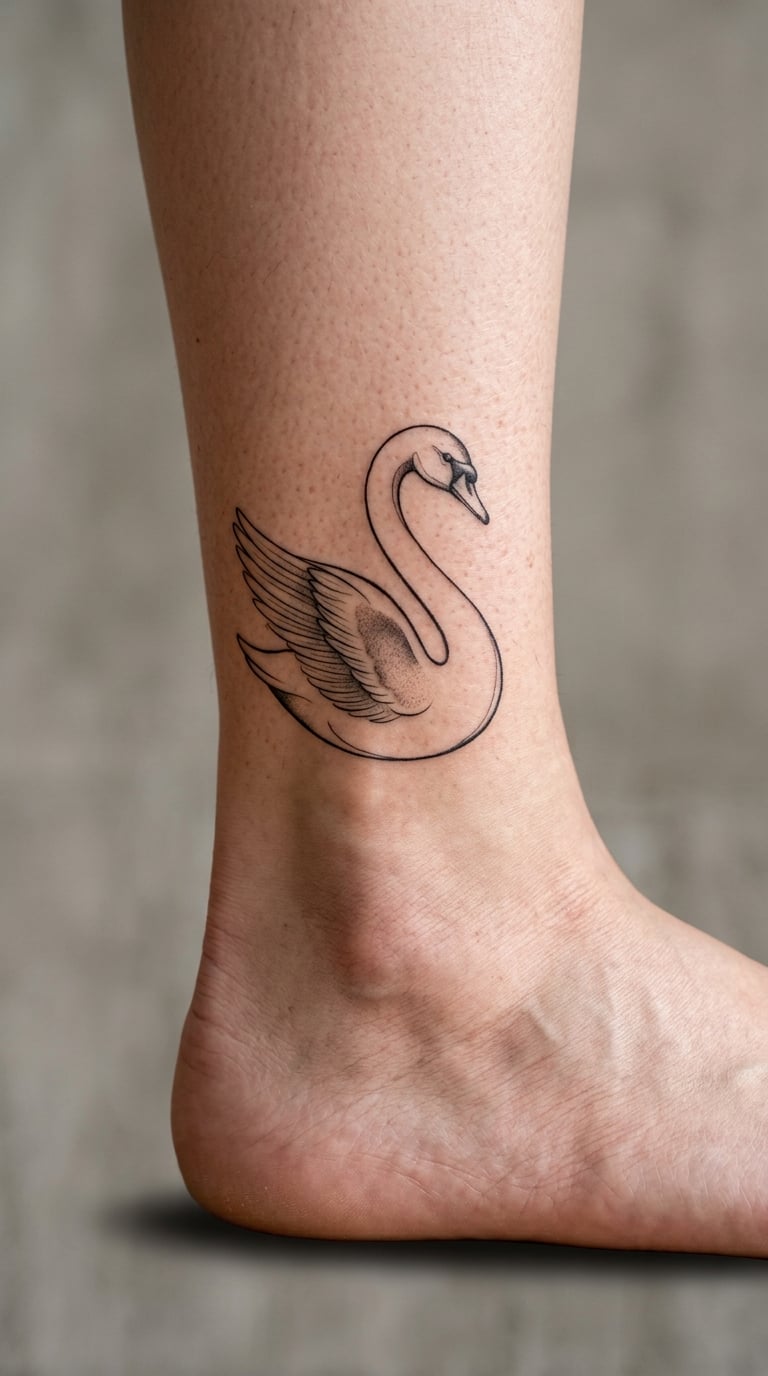
A swan built from thin, controlled contour lines, with one soft black brush accent filling the wing and a dry-brush mark under the body suggesting a reflection. The neck curves in a single long line that thins as it goes, which is the hardest part of the drawing and the reason the piece works.
Swans come with their own associations, mostly around loyalty and grace, and plenty of people choose them for the curve of the neck on the body rather than the meaning.
Placement: ankle, calf, wrist, or the back of the shoulder. Size: 2-3.5 in (5-9 cm). Style: fine line with a brush accent. Pain: medium, and the ankle bone is a sensitive spot. Make it yours: pair it with a smaller cygnet on the opposite ankle, or add a single blue wash behind the wing so the accent color appears only once.
18. Blackwork Paintbrush Dragonfly
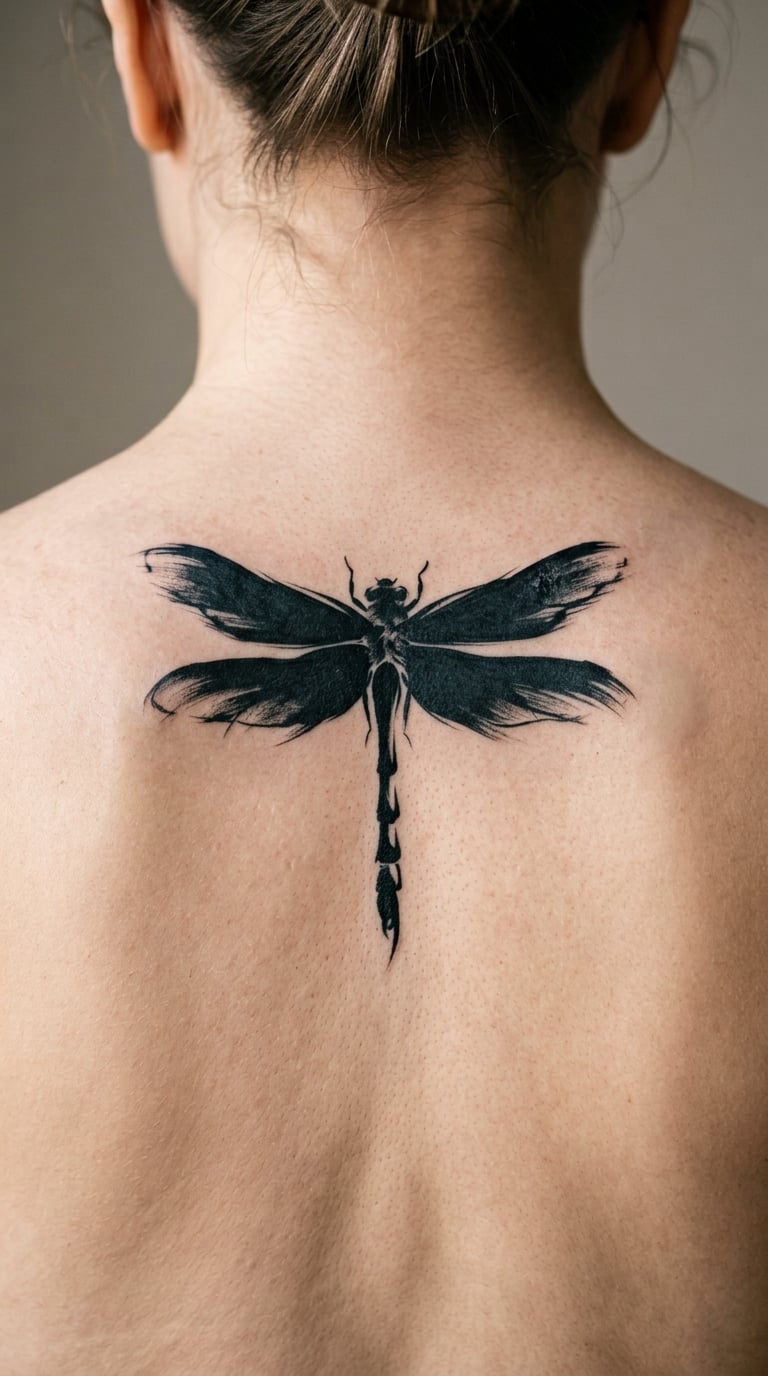
A dragonfly with four broad black wings, the upper pair packed opaque and the lower pair done in dry brush so the veins show through the gaps. The body is a single tapered line with two small opaque segments. No color at all, and the wing edges stay broken rather than being cleaned up.
It balances something delicate in the subject with something heavy in the execution, and the monochrome version costs less and holds up better than a colored one.
Placement: upper back, shoulder blade, or the outer arm. Size: 2.5-4 in (6-10 cm). Style: blackwork. Pain: low, and the upper back is one of the larger flat areas with more room to work. Make it yours: angle it along the spine or the shoulder line instead of straight across, and add a second smaller dragonfly later to make a pair.
19. Watercolor Paintbrush Map Marker
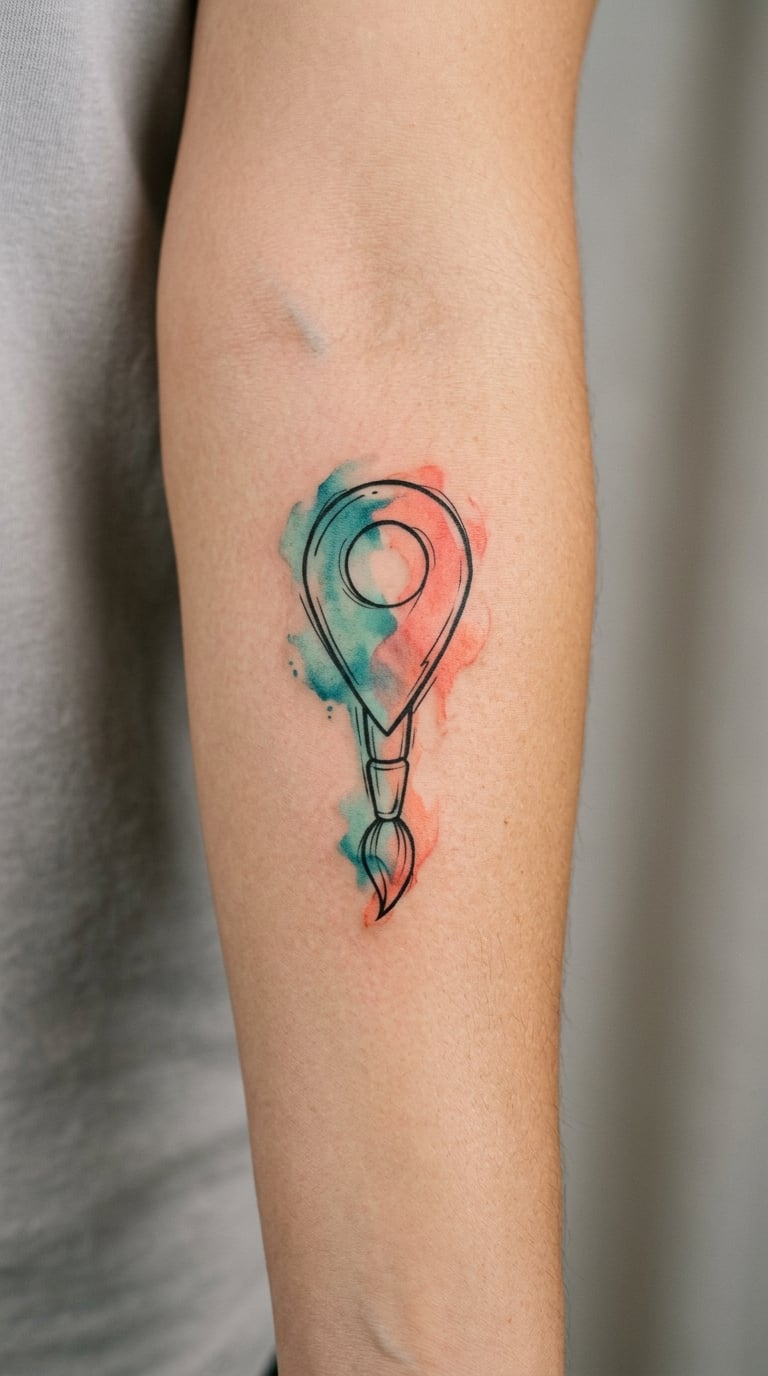
A location pin or a small folded map, outlined in a loose line and filled with translucent teal and coral washes that bleed past the edges. A few small dots mark a route, and the whole thing fades out at the bottom rather than stopping at a hard border. The pin is recognizable but clearly painted, not vectored.
It is nearly always a place: where someone was born, met their partner, or keep going back to. The washes also make it easy to change the color if the meaning changes.
Placement: inner arm, calf, or the foot. Size: 1.5-3 in (4-8 cm). Style: watercolor. Pain: medium, and the inner arm and the arch of the foot are both sensitive. Make it yours: name the actual coordinates or the name of the place, and choose the palette from a photograph of that spot taken in the season you keep thinking about.
20. Full-Color Paintbrush Portrait Splash
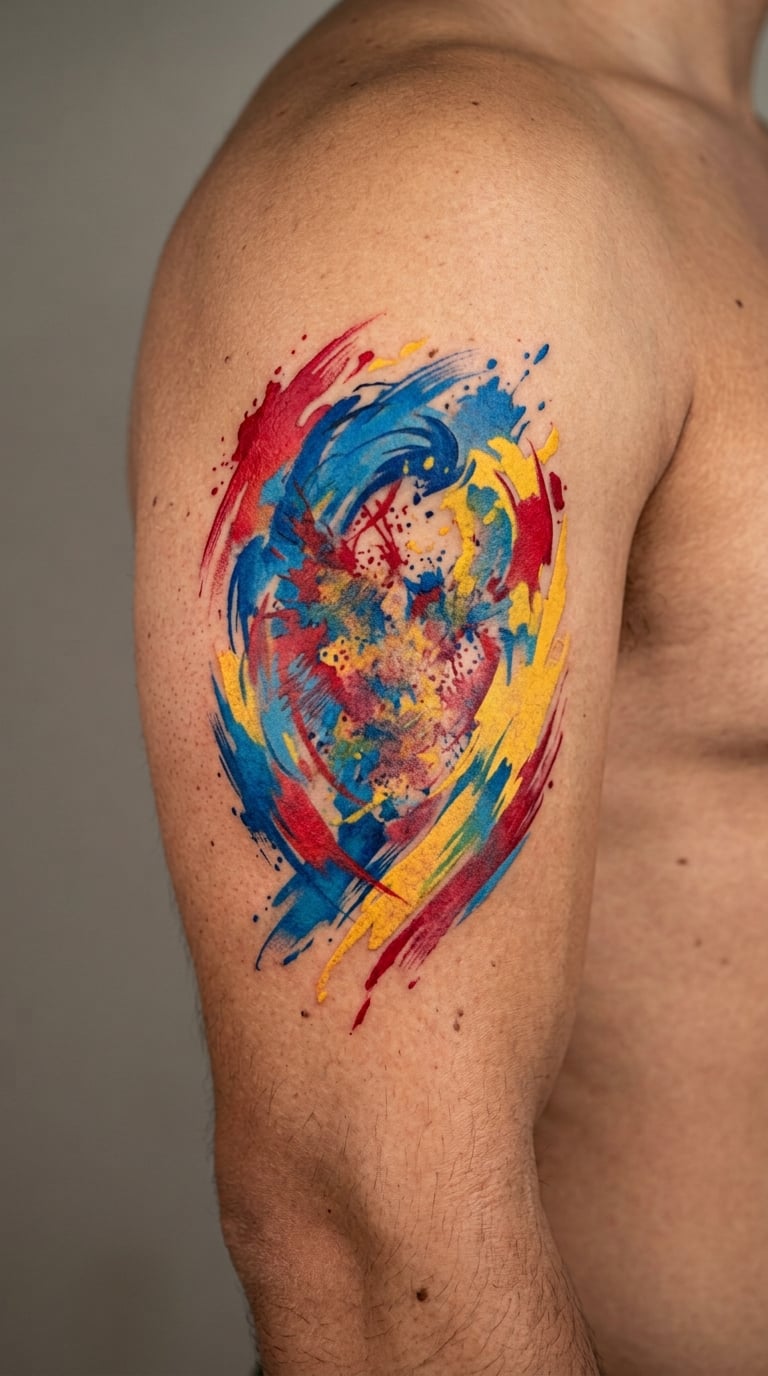
A larger piece, and the one on this list that takes real commitment. A face simplified into a few confident shapes sits in the centre, surrounded by controlled splashes of blue, yellow and red that read as deliberate rather than messy. The color is packed where the splash hits skin and thins at the edges, and the portrait itself stays loose enough that the brushwork and the face belong together.
It suits someone who paints, draws or photographs, because the technique is part of the subject. It is not a beginner piece, mostly because of the size and the number of color passes.
Placement: upper arm, thigh, ribs, or the upper back. Size: 4-6 in (10-15 cm). Style: illustrative realism. Pain: high over the ribs, medium on the upper arm or thigh, and plan for a long sitting with breaks. Make it yours: keep the palette to three colors so it can be extended into a sleeve later, and ask to see a healed example of that exact palette from the artist first.
How to Choose the Right Design
Most people pick a design they love and then find out the spot is wrong for it. Work through these five checks in order, and you will save yourself a redesign.
- Style first. Fine line and minimalist pieces look best small and high-contrast on skin that shows them clearly. Blackwork and dry brush tolerate more size because the texture carries the design. Watercolor and full color need the most space for the bleeds to read.
- Size to the space, not the reference. A design that reads clearly at four inches on a phone screen often needs six inches on a rib. Ask the artist to print your reference at the size you are considering and hold it against the placement.
- Placement decides how much the color fades. The upper arm, ribs and inner thigh sit under clothing most of the day and hold pigment better. Forearms, lower legs and hands see sun and movement constantly, so color and fine detail will soften sooner.
- Match detail to the area. Micro-detail needs a flat, uncurved surface. Wrists, ankles and the inside of the elbow bend, and that bend distorts thin lines and dots within a year or two.
- Decide how realistic the brushwork should look. Graphic and abstract strokes are forgiving and cheap to fix later. Painterly realism and portraiture are not: an uneven edge in a brush texture is the style, while an uneven edge in a face is a problem.
Cost and Session Time
There is no fixed price for a paintbrush tattoo, and any article that gives you one is guessing about your artist, your city and your skin. What you can plan is the shape of the cost. Most studios charge by the hour, with a shop minimum that covers the first part of the session, so a small piece costs about the minimum regardless of how long it takes to design.
| Piece | Typical size | Time in the chair | What drives the cost |
|---|---|---|---|
| Minimalist or single fine-line stroke | 0.5-1.5 in | Under an hour | Shop minimum only |
| Small fine line, bird or heart | 1.5-3 in | 1-2 hours | Artist rate and detail |
| Medium blackwork or botanical | 2.5-4 in | 2-3 hours | Large areas take more passes |
| Watercolor or color splash | 2.5-4 in | 2-4 hours | Gradients need repeated passes |
| Full-color portrait splash | 4-6 in | 4-6 hours, often split | Time, color count, session length |
Ask for the hourly rate, the shop minimum and the estimated number of sessions before you book, and ask what the artist charges if it runs over. Painterly work costs more than linework for a straight reason: a gradient that looks like one pass on paper is many passes on skin. Getting a realistic estimate up front is better than a cheap quote that turns into a second appointment.
Aftercare Basics
- Follow your artist’s aftercare instructions first. They know what they did on your skin and how long the ink stays sensitive.
- Wash gently with lukewarm water and a mild unscented soap, then pat dry with something clean rather than rubbing.
- Protect fresh work from direct sun, and keep new or loose clothing away from it while it settles.
- Do not pick or scratch flaking skin. Let it come away on its own, even when it is tempting.
- Keep the area clean and dry for the first few days, and change any bandage or covering your artist asked you to change.
- Once healed, treat exposed color like you would treat any print: sunscreen on the area, and expect a touch-up conversation within the first year.
Frequently Asked Questions
What does a brush stroke tattoo symbolize?
A brush stroke tattoo usually stands for creativity, self-expression and the mark someone leaves behind. Because the stroke is finished and imperfect rather than polished, it often reads as a record of a process rather than a fixed message. Wearers tend to describe it as showing that the imperfect parts count. What it means to you depends on the design and where you put it, not on the stroke itself.
Do watercolor paintbrush tattoos fade faster than black linework?
Yes, generally. Watercolor and bleed-style tattoos rely on soft gradients and light pigment rather than dense black lines, and UV exposure, skin tone and sun exposure all affect them more. The inner forearm, ribs and upper arm hold color better because they stay covered. Plan on a touch-up within a year or two and keep sunscreen on the area once healed.
Where should a paintbrush tattoo be placed?
The upper arm, ribs and upper back are the easiest places to keep color crisp because they stay covered and barely move. Forearms, wrists and lower legs look great but take more sun and flexing, so fine detail and color soften faster there. Wrist and ankle designs should stay simple, since those areas bend constantly. Match the placement to how much of the brushwork you want visible in three years, not in three weeks.
How much does a paintbrush tattoo cost?
Most studios charge hourly with a shop minimum, so a small piece costs roughly the minimum and a larger one scales with time. Expect the cost to rise with color count, since each gradient needs repeated passes, and with custom work compared to a flash design. Ask for the hourly rate, the shop minimum and the estimated session count before booking, then ask what happens if the piece runs over time.
Can any tattoo artist do painterly or watercolor work?
Not comfortably. Painterly work and bleed styles need a specific hand with shading and color control, and plenty of generalist artists would rather refer you on than attempt one. Look for healed examples, not fresh photos, and check that the artist has done the specific style you want rather than just linework and blackwork. A short consultation before booking will tell you quickly whether they are the right fit.
What is the hardest style of tattooing?
Painterly realism and watercolor are usually considered the hardest, because they depend on smooth gradients and soft edges with no black outline to hide mistakes. Color realism and large-scale portraiture are close behind for the same reason. One session rarely finishes them, and the work only shows what it will become once healed. Pick an artist who specialises in that style rather than the nearest available appointment.
Conclusion
If this is your first tattoo, the fine-line floral bouquet is the most forgiving place to start: small, black, low risk of fading and quick to heal. The minimalist brush heart works too, and takes minutes. If you already collect work and you paint or draw, the full-color portrait splash is the one worth saving up for. Between those two ends, choose on placement and scale first, then let the style follow. If you are planning a larger black piece, our guide to black sleeve tattoo ideas covers how brushwork holds up at scale.