
20 Firefly Tattoo Ideas: Best Glowing Designs 2026
Firefly tattoo ideas run from a single fine-line insect behind the ear to a hand-sized black-and-grey piece built for a sleeve. A firefly tattoo represents light, hope, and the idea that your own glow still shows up in the dark, which is why the same tiny beetle means something different to every person wearing it.
What makes a good firefly design work on skin is simple: a readable silhouette, an abdomen that reads as light, and enough contrast against whatever sits around it. Break any one of those and the bug turns into a smudge, which is the single most common complaint I hear from people whose first attempt went wrong.
Most readers planning a firefly tattoo book 30 to 45 days ahead, so if you are sketching ideas for a trip, a birthday, or simply a quiet week where you finally make the appointment, this list gives you 20 distinct directions to bring to a consultation. Pick the two or three that feel like you, and save them somewhere you can find again on the day.
20 Firefly Tattoo Ideas: Quick Guide
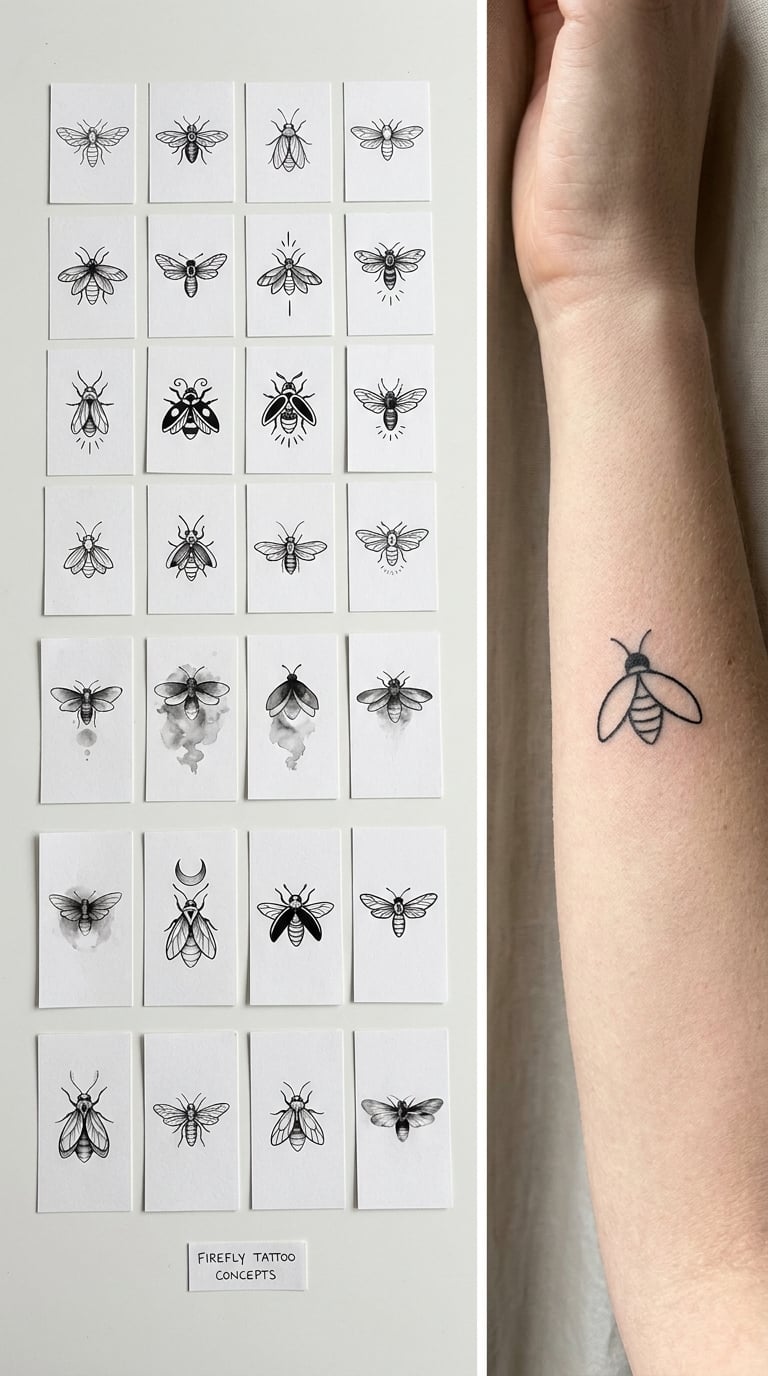
Here is the whole list on one page, in the same order as the sections below. Style and placement are the two decisions that matter most, so use this table to rule designs in and out before you start saving references.
| Idea | Style | Best placement | Size | Pain |
|---|---|---|---|---|
| 1. Fine-line behind the ear | Fine line | Behind the ear | 1 to 1.5 in (2.5 to 4 cm) | Low |
| 2. Minimalist inner wrist | Minimalist line | Inner wrist | Under 1.5 in (4 cm) | Medium |
| 3. Realistic inner forearm | Micro realism | Inner forearm | 2 to 3 in (5 to 7.5 cm) | Medium |
| 4. Blackwork shoulder | Blackwork | Upper shoulder | 2.5 to 4 in (6 to 10 cm) | Medium |
| 5. Watercolor collarbone | Watercolor | Collarbone | 2 to 3 in (5 to 7.5 cm) | Medium |
| 6. Traditional lantern-fly | Traditional | Upper arm | 2 to 3 in (5 to 7.5 cm) | Medium |
| 7. Dotwork cluster | Dotwork | Wrist or finger | 1 to 1.5 in cluster | Low to medium |
| 8. Glowing back of hand | Fine line with colour | Back of the hand | 1.5 to 2 in (4 to 5 cm) | Medium |
| 9. Firefly and wildflower | Fine line botanical | Inner arm | 2 to 3 in (5 to 7.5 cm) | Medium |
| 10. Neon ankle | Neon illustrative | Outer ankle | 1.5 to 2 in (4 to 5 cm) | Medium |
| 11. Black-and-grey spine | Black and grey | Upper spine | 2 to 3 in (5 to 7.5 cm) | High |
| 12. Two fireflies, inner arm | Fine line | Inner arm | 1.5 to 2 in each | Medium |
| 13. Celestial upper back | Fine line illustrative | Upper back | 3 to 4 in composition | Medium |
| 14. Botanical thigh | Botanical line | Outer thigh | 3 to 4 in (7.5 to 10 cm) | Low to medium |
| 15. Vintage calf | Vintage ornamental | Outer calf | 1.5 to 2.5 in (4 to 6 cm) | Low to medium |
| 16. Minimal finger firefly | Micro minimalist | Side of finger | 0.5 to 0.75 in | Medium |
| 17. Realistic firefly on the rib | Fine realism | Rib | 2.5 to 3.5 in (6 to 9 cm) | High |
| 18. Sternum dotwork | Symmetrical dotwork | Sternum | 1.5 to 2 in (4 to 5 cm) | High |
| 19. Traditional firefly and moon | Traditional | Upper arm | 3 to 4 in (7.5 to 10 cm) | Medium |
| 20. Large sleeve element | Black and grey realism | Outer upper arm | 4 to 6 in (10 to 15 cm) | Medium |
1. Fine-Line Firefly Behind the Ear
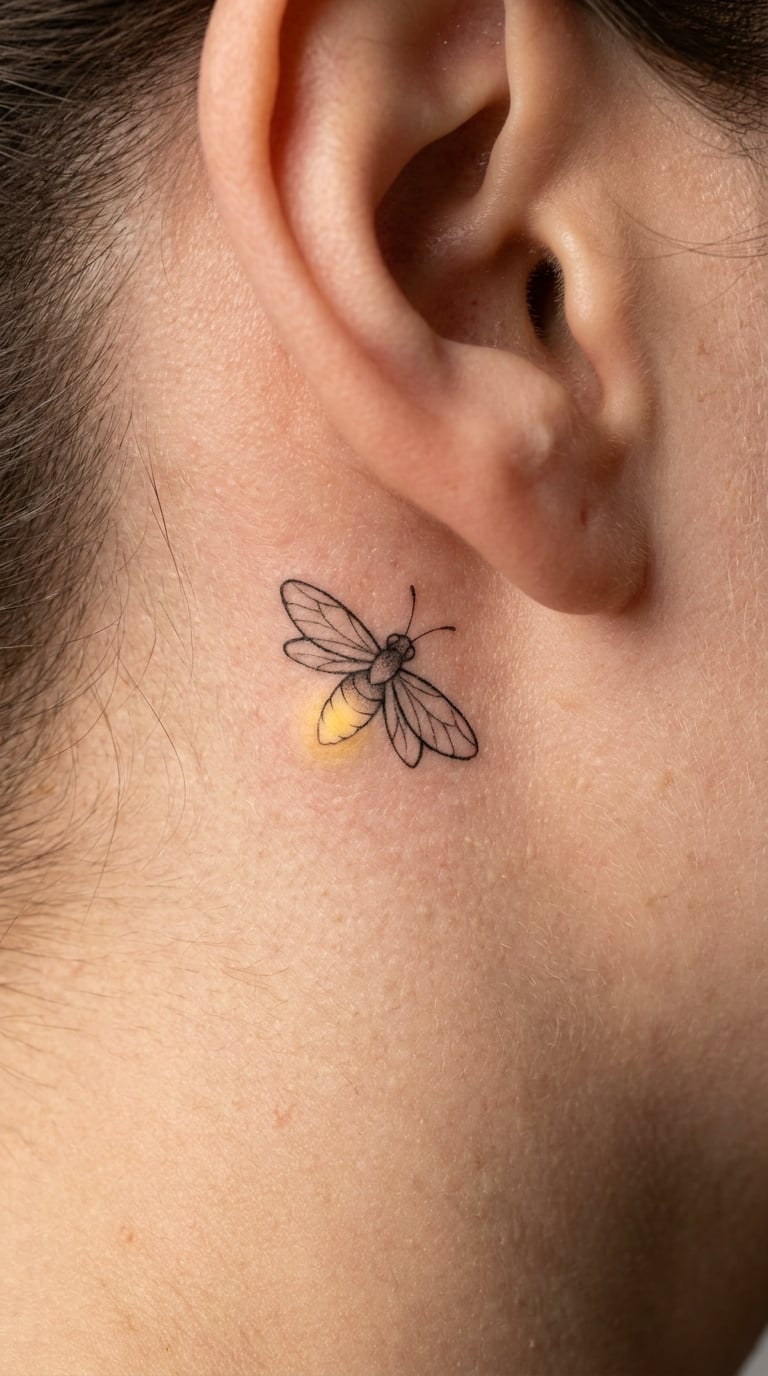
This firefly tattoo idea is one continuous fine line for the body and wings, with a soft yellow wash filling the abdomen so it reads as lit from inside. The wings stay as two open strokes rather than closed shapes, which keeps the whole thing readable at a fraction of an inch tall.
It works as a discreet first tattoo because the line weight stays thick enough to hold, and behind the ear hides it completely at the office or on a bad hair day. People usually choose it for the summers they spent catching them, not for a grand symbolic reason.
Placement: Behind the ear, along the hairline, or just under the earlobe · Size: 1 to 1.5 in (2.5 to 4 cm) tall · Style: Fine line with one soft colour accent · Pain: Low to medium, mostly a scratchy feeling against thin skin. Skin behind the ear shows sun damage fastest, so expect the yellow to fade years before the line does · Make it yours: Add a tiny second firefly drifting down the neck, roughly half the size.
2. Minimalist Firefly on the Wrist
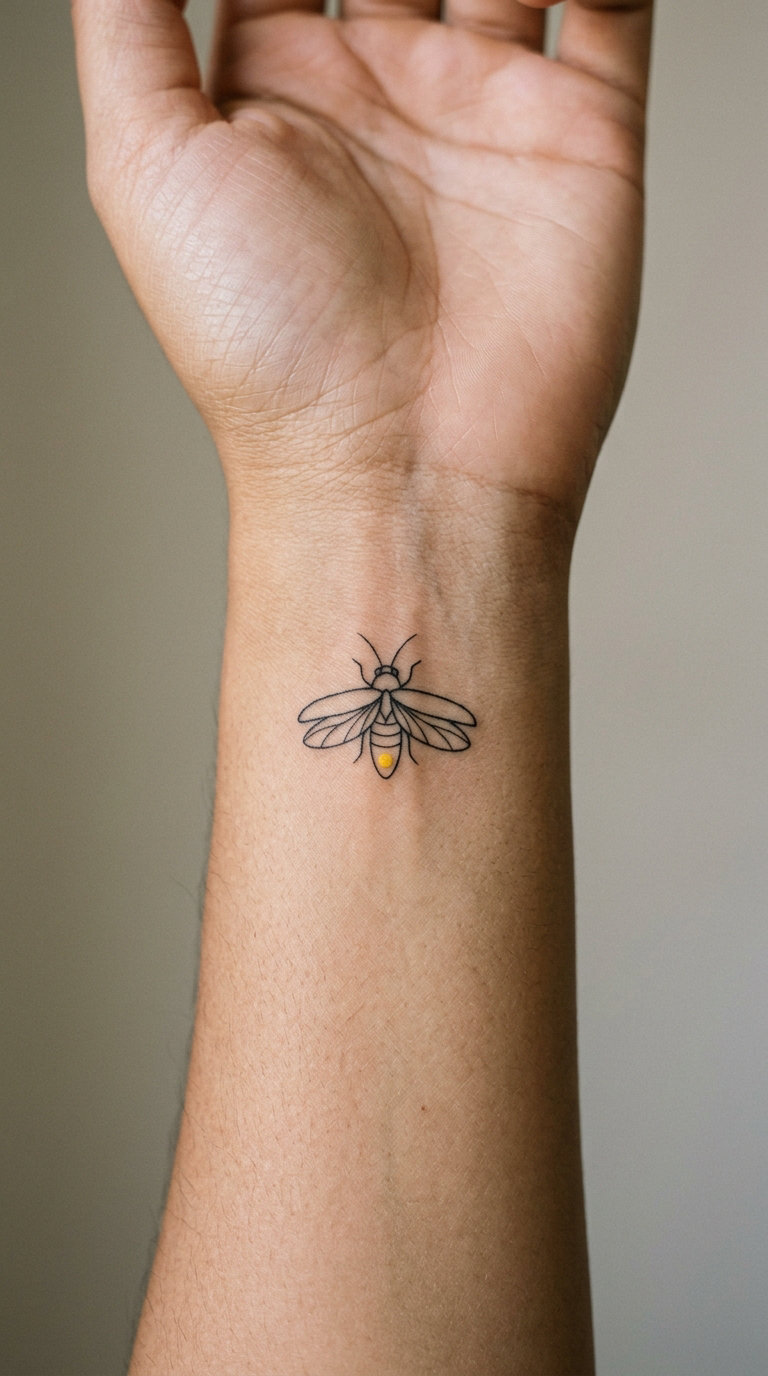
A minimalist firefly tattoo is the cleanest option on this list: a black outline body, two short wing strokes, and a single yellow dot sitting where the light comes from. Everything else stays empty, and that empty space is the design.
This is the one most first-timers pick, and it holds up because there is very little to lose. It suits anyone who wants a tattoo that reads as considered rather than decorated, and it layers under a watch band or a bracelet without fighting anything.
Placement: Inner wrist above the crease, or the outer wrist near the thumb · Size: Under 1.5 in (4 cm) · Style: Minimalist line with a single colour dot · Pain: Medium. Wrist line work feels sharper than the size suggests, and wrist ink softens and fades faster than almost anywhere else on the body · Make it yours: Choose the dot colour deliberately. Amber reads warmer, a green-yellow reads closer to a real lightning bug.
3. Realistic Firefly on the Forearm
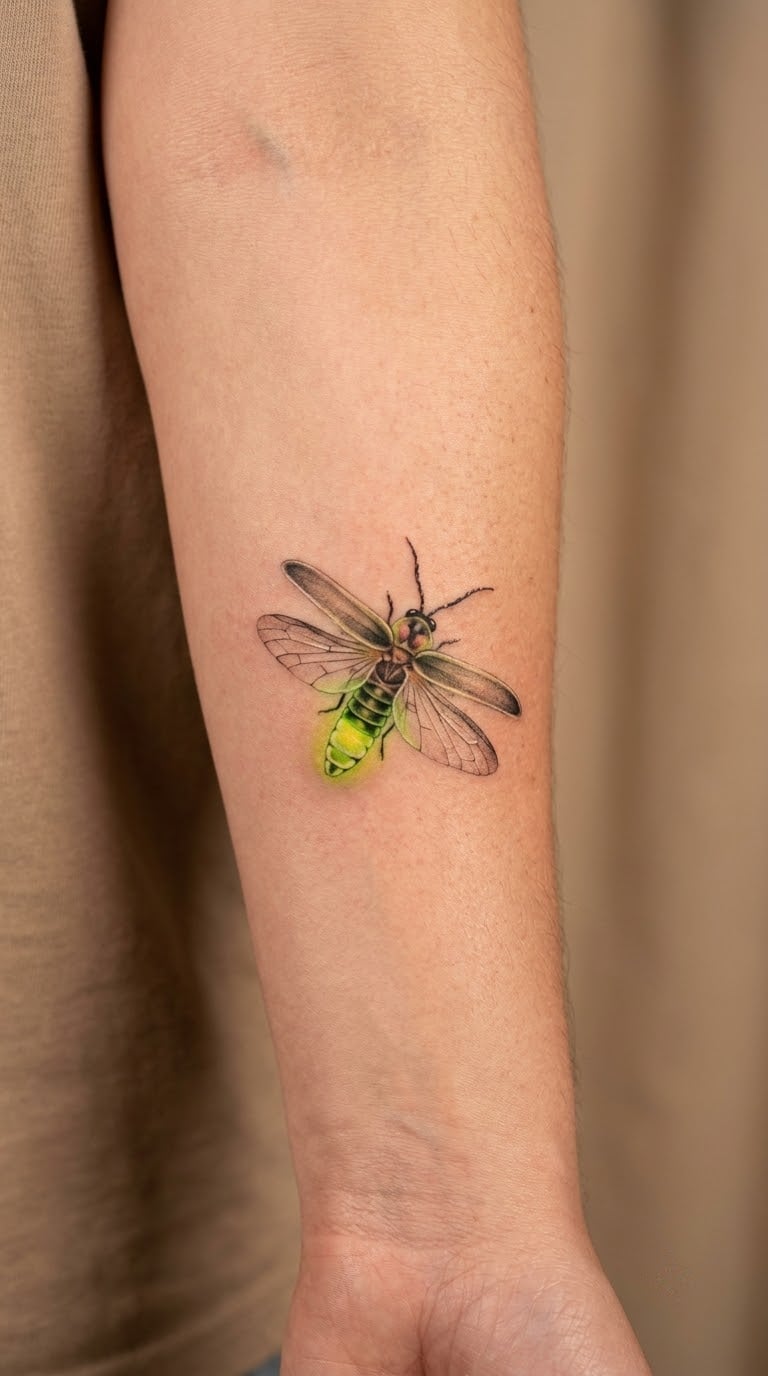
A realistic firefly tattoo is built from translucent wings, where you can almost see light through the membrane, and a segmented body shaded dark right up to the glowing abdomen. The whole effect depends on soft gradient work rather than outlines, so ask for an artist who does fine-detail realism regularly.
People choose this version when they want the insect to be the thing itself rather than a symbol standing in for it. The forearm is forgiving because there is flat space to work with and enough room to let the wings spread without bending around bone.
Placement: Inner forearm, outer forearm, or below the elbow on the upper arm · Size: 2 to 3 in (5 to 7.5 cm) · Style: Micro realism · Pain: Medium, and it takes longer because fine shading needs repeated passes · Ageing note: Realistic glow is the first thing to go. The light abdomen greys down within a few years, so plan on a colour refresh rather than expecting it to stay luminous forever · Make it yours: Angle the body along the forearm’s line so the wings follow the arm rather than fighting it.
4. Blackwork Firefly on the Shoulder
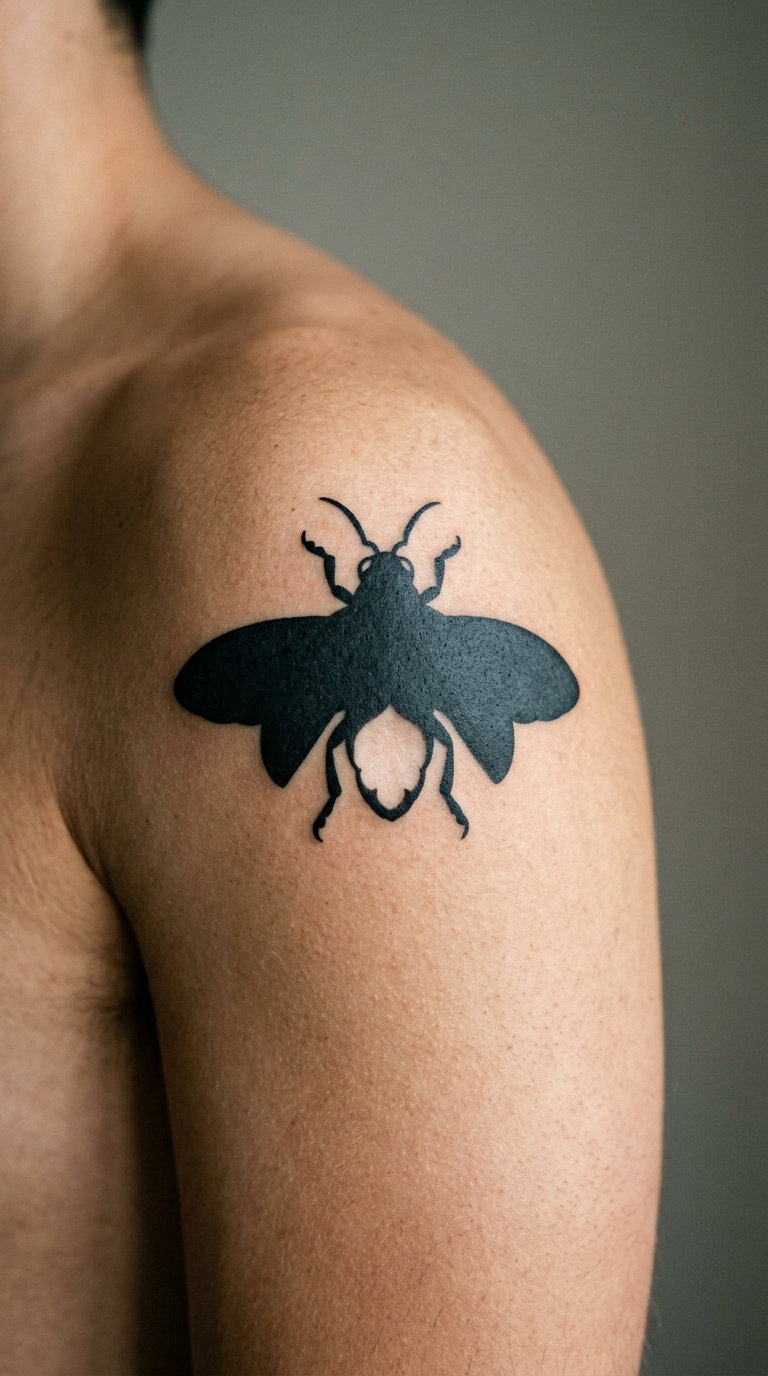
This blackwork firefly tattoo does something clever: the wings are solid black, and the glow is the shape the artist leaves unpainted. The light comes from an absence of ink, which is the only glow that never fades into a grey smear.
It reads dramatic from across a room and clean up close, so it suits people who want a statement on a body part that can carry weight. The deltoid is a good frame for a firefly because the rounded muscle gives the wings somewhere to sit.
Placement: Upper shoulder on the deltoid, or the outer shoulder blade · Size: 2.5 to 4 in (6 to 10 cm) · Style: Blackwork with negative space · Pain: Medium. Bony shoulder tops are uncomfortable, so place the design across the muscle rather than right on the joint · Make it yours: Break the black shapes with a single thin white highlight line inside each wing to suggest light catching an edge.
5. Watercolor Firefly on the Collarbone
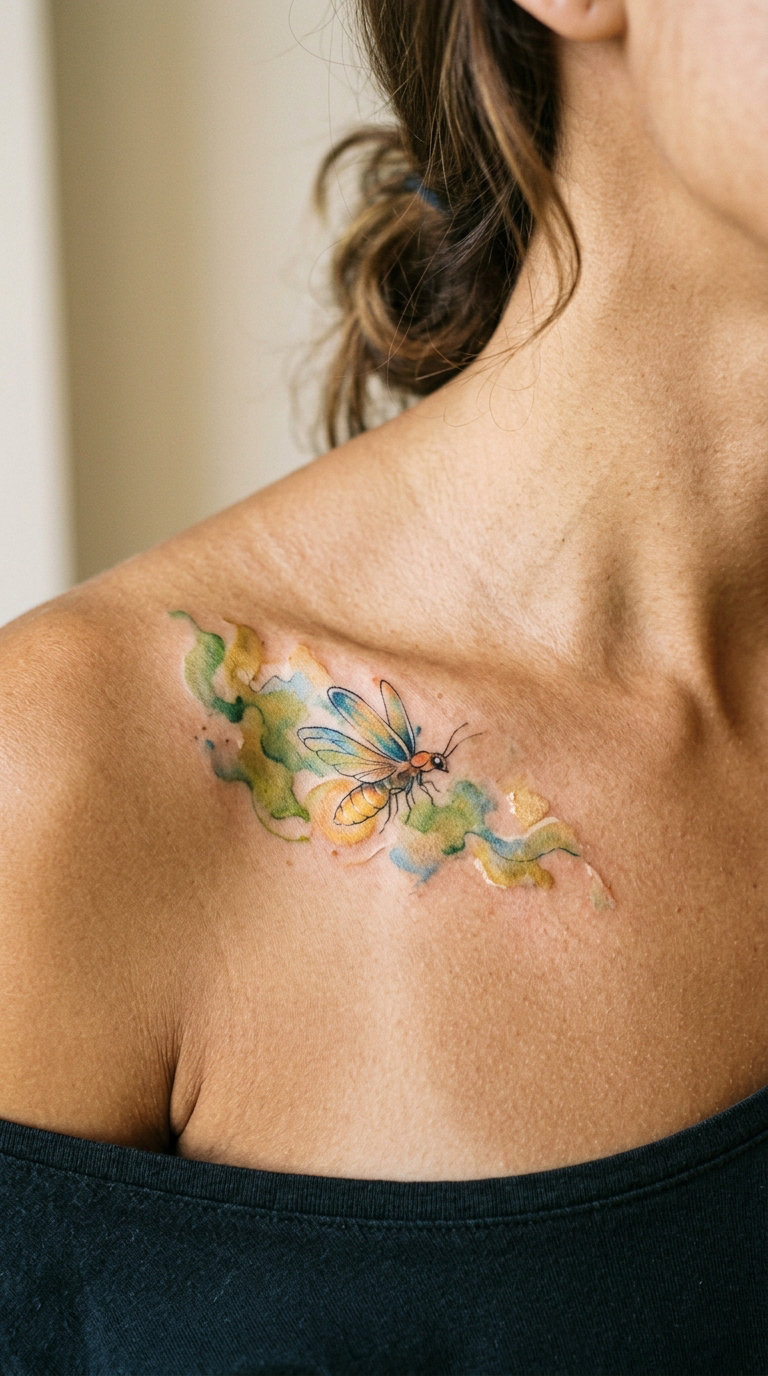
A watercolor firefly tattoo uses no hard outline at all. The body is a loose suggestion in three or four brushy strokes, and soft washes of green, gold and a little blue pool around it and fade out in the skin, which gives the impression the light is bleeding into the air.
Collarbones suit this because the colour can spread into the hollow above the bone without looking out of place, and a soft piece there photographs well. It appeals to people who find bold blackwork too heavy for that spot.
Placement: Along the collarbone, in the hollow above it, or the top of the shoulder where the bone curves away · Size: 2 to 3 in (5 to 7.5 cm) with the washes extending past the body · Style: Watercolour · Pain: Medium, with more of an overall sunburn feeling than a sharp sting · Make it yours: Let the wash trail downward rather than sitting symmetrically, so the piece looks like it is drifting.
6. Traditional Lantern-Fly Motif
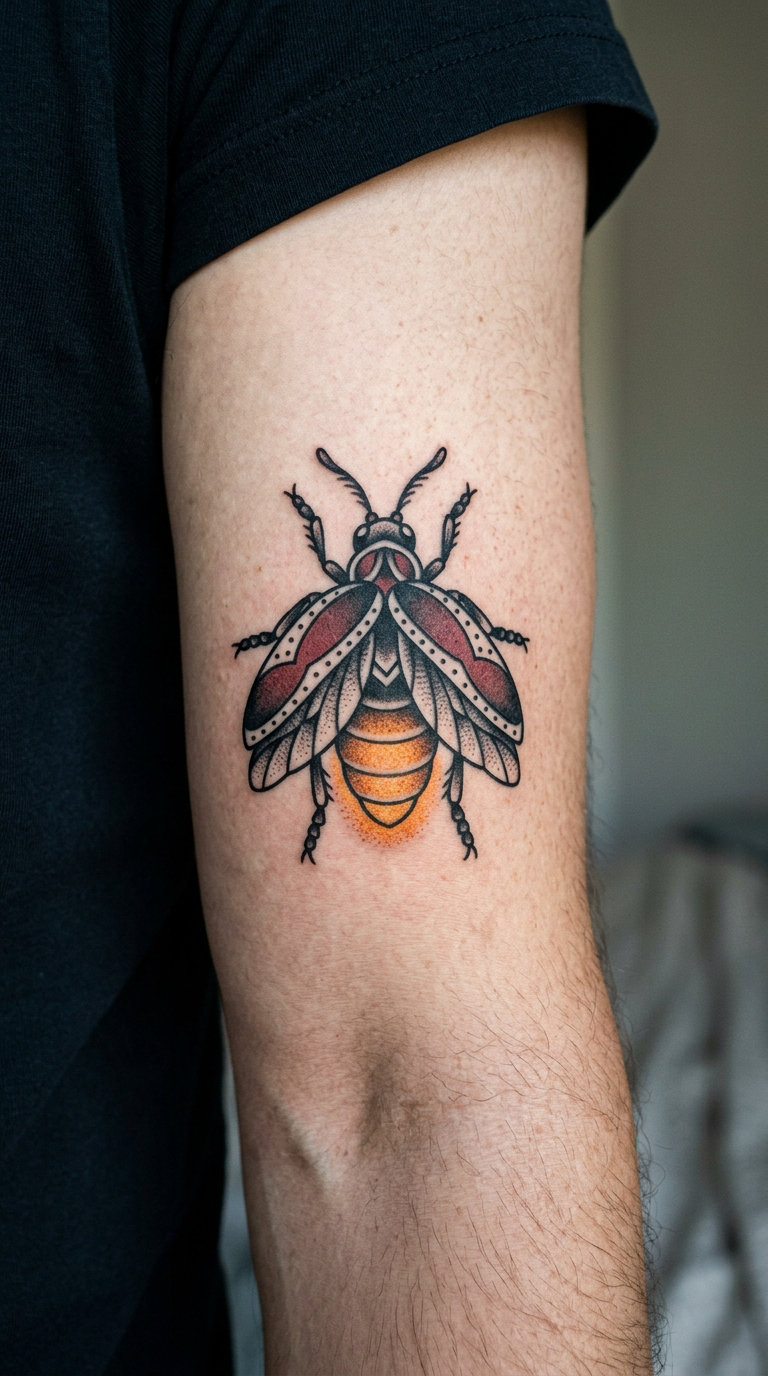
A traditional lantern-fly tattoo looks like something from an old flash sheet: heavy black outlines, a domed body shaded in muted red, and a small amber glow at the tail. The wing shapes are stylised into two neat teardrops, not the folded veined wings of a real insect.
Ask for a firefly specifically rather than describing it as a lantern or a bug, so the artist draws the rounded shield and the glowing abdomen rather than a metal lamp. Traditional work ages gracefully because bold lines and flat colour lose far less to sun than fine shading.
Placement: Outer upper arm, outer thigh, or the calf · Size: 2 to 3 in (5 to 7.5 cm) · Style: Traditional, bold outline and flat colour · Pain: Medium on the upper arm, low on the thigh · Make it yours: Add a small banner of a word that matters to you, or a matching traditional butterfly above it to start a flash collection.
7. Micro Firefly Dotwork Cluster
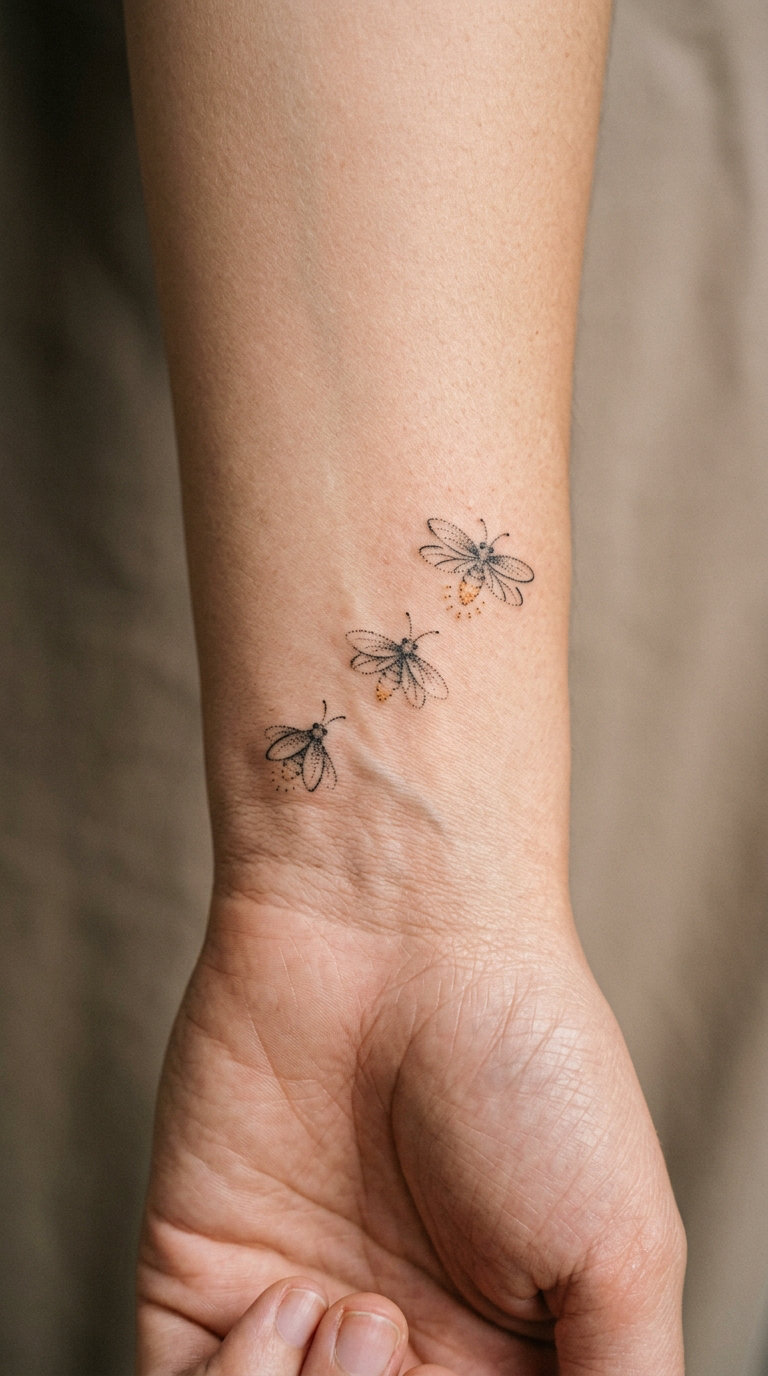
This one is three fireflies built almost entirely from dots and short curved lines, staggered diagonally so none of them repeat at the same angle. The dot technique gives a soft, grainy glow that reads as light rather than as an insect illustration.
Clusters work because the eye merges them into a single drifting shape instead of three separate bugs, and it solves the small-area problem. It is a natural first piece or a second one that matches an existing small tattoo without competing with it.
Placement: Wrist, behind the ear, along a finger, or the inner arm · Size: 1 to 1.5 in (2.5 to 4 cm) for the whole cluster · Style: Dotwork, micro · Pain: Low to medium. Dots are quick individually, but a cluster means a longer session because the needle returns constantly · Make it yours: Let the sizes step down from one insect to three so the cluster looks like it is moving away from you.
8. Glowing Firefly on the Hand
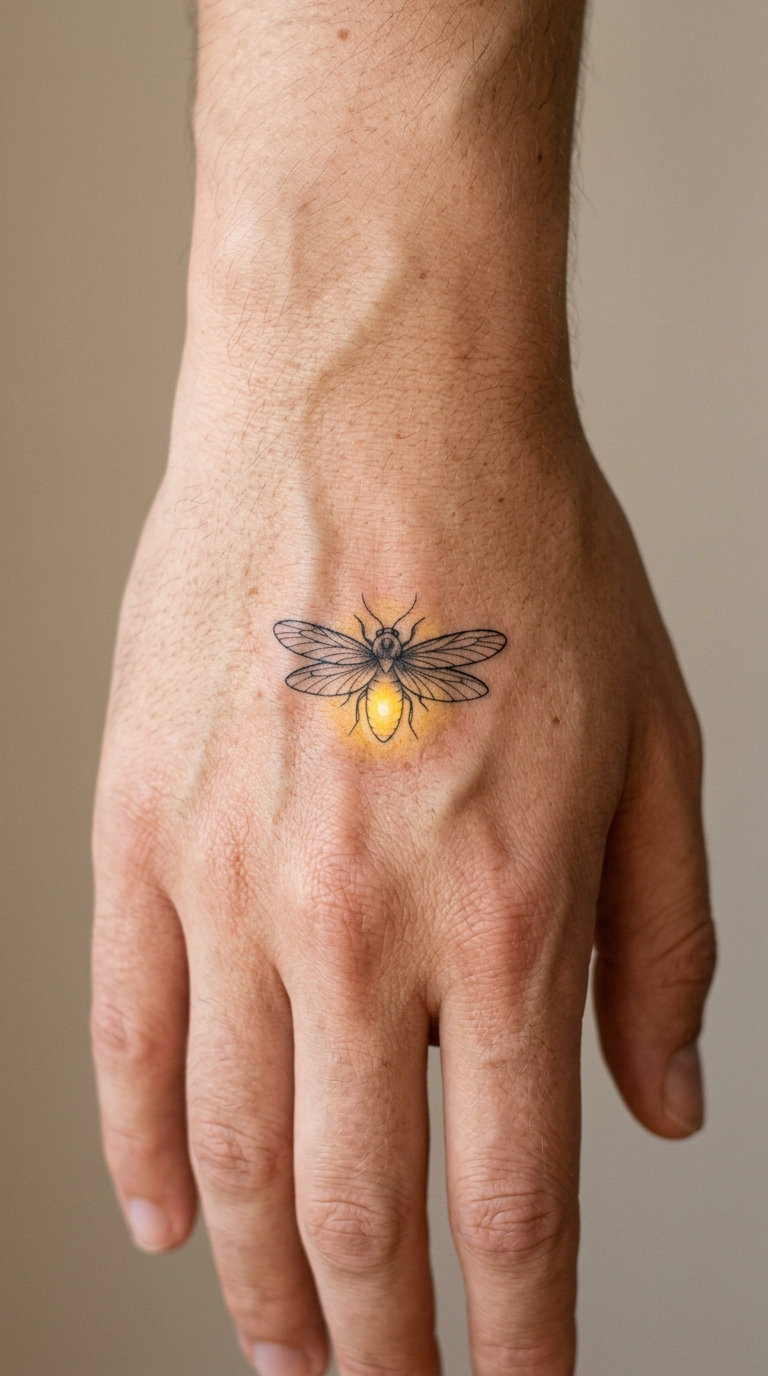
A hand firefly tattoo puts a bright yellow centre inside a fine line body, with a restrained halo of dots around it. Because hands are seen constantly, this is a design that reads at a glance and invites people to ask about it.
Be honest with yourself about hands. Skin there stretches with every movement, creases through the knuckles, and takes more sun damage than most people expect, so a bright glow on the back of the hand will soften faster than the same design on an arm.
Placement: Back of the hand between the knuckles, or the heel of the palm · Size: 1.5 to 2 in (4 to 5 cm) · Style: Fine line with colour · Pain: Medium, more stinging than wrist work, especially over the knuckles · Ageing note: Hand tattoos blur and yellow with sun. Ask about a colour refresh every few years, and use sunscreen on that hand like you mean it · Make it yours: Add a thin line of trailing dots toward the wrist so it looks like it is flying off your hand.
9. Firefly and Wildflower Pairing
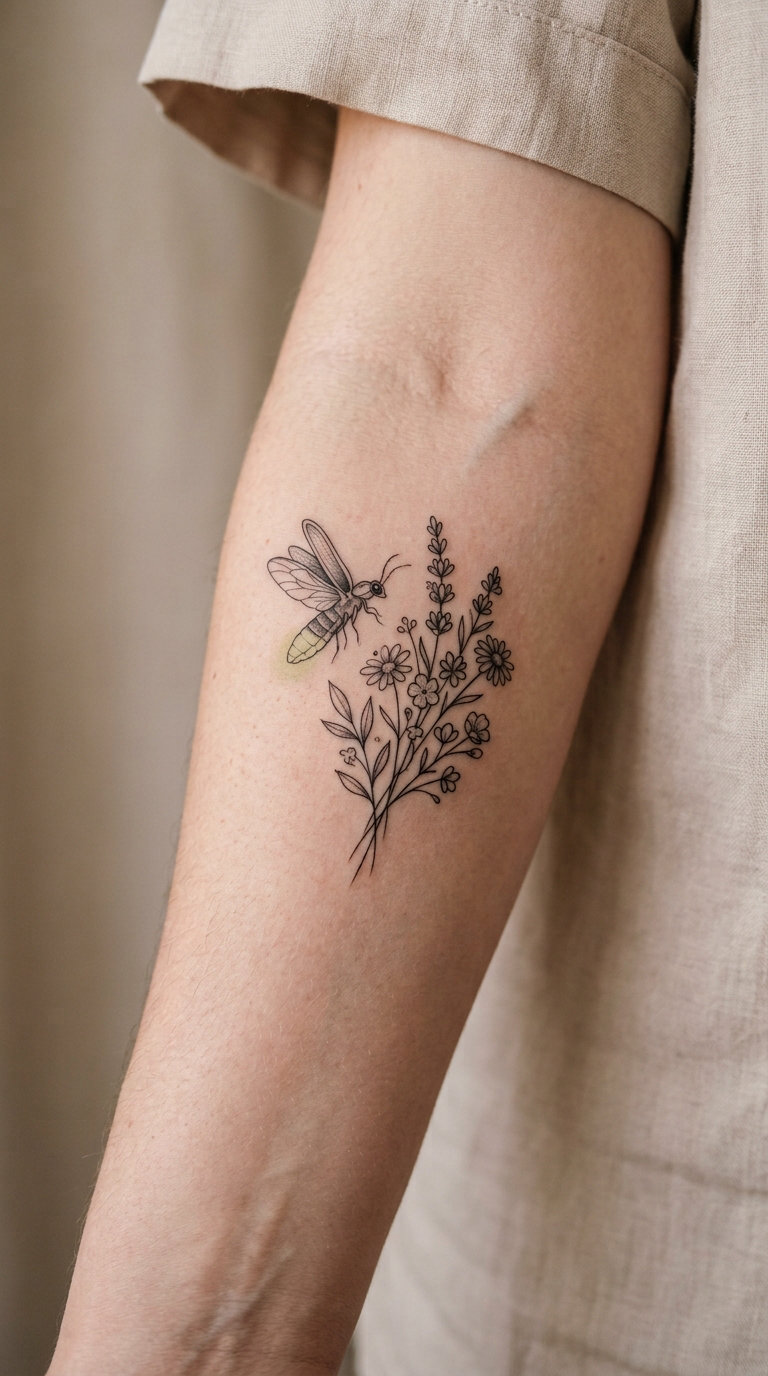
Pairing the insect with a small cluster of wildflowers balances hard insect detail against soft petals, and the two elements fill the space around each other rather than competing. Three or four simple blossoms with a few leaves is usually plenty.
People choose this because a firefly alone can read as sparse, and the botanicals give the design a reason to be larger. It suits a first tattoo of moderate size and fits naturally into a nature-themed collection. If symbolism is your thing, our tattoo ideas that symbolize protection has designs built around the same protective theme.
Placement: Inner arm, forearm, back of the shoulder, or the calf · Size: 2 to 3 in (5 to 7.5 cm) including the flowers · Style: Fine line botanical · Pain: Medium · Make it yours: Use flowers from somewhere real to you, a specific plant from a walk or a garden, and the pairing stops being generic.
10. Neon Firefly on the Ankle
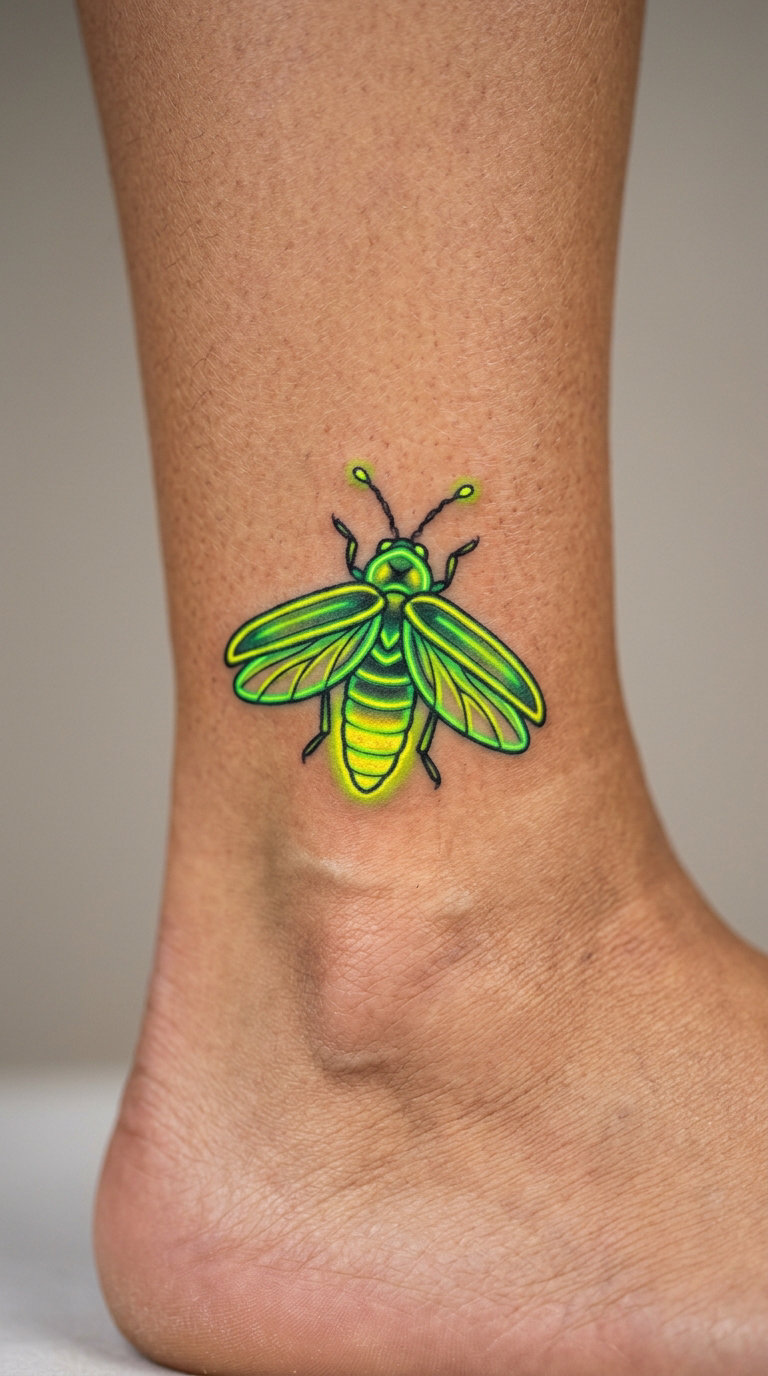
A neon firefly tattoo is drawn like a sign rather than a bug: electric green and yellow shapes, a simple dark outline, and an outer halo that suggests a tube glowing. The style is graphic and a bit retro without tipping into novelty.
Ankles carry a compact design well, and the bone gives the insect a clear flat spot to sit on without much distortion. Bright colour suits a first tattoo too, because it gives you something to look at while you heal.
Placement: Outer ankle above the bone, or the inner ankle · Size: 1.5 to 2 in (4 to 5 cm) · Style: Neon illustrative · Pain: Medium to high. Ankle bone is a bony spot, and ankle tattoos fade faster than most people expect · Make it yours: Add a pair of smaller neon fireflies trailing up the calf to start a leg piece.
11. Black-and-Grey Firefly on the Spine
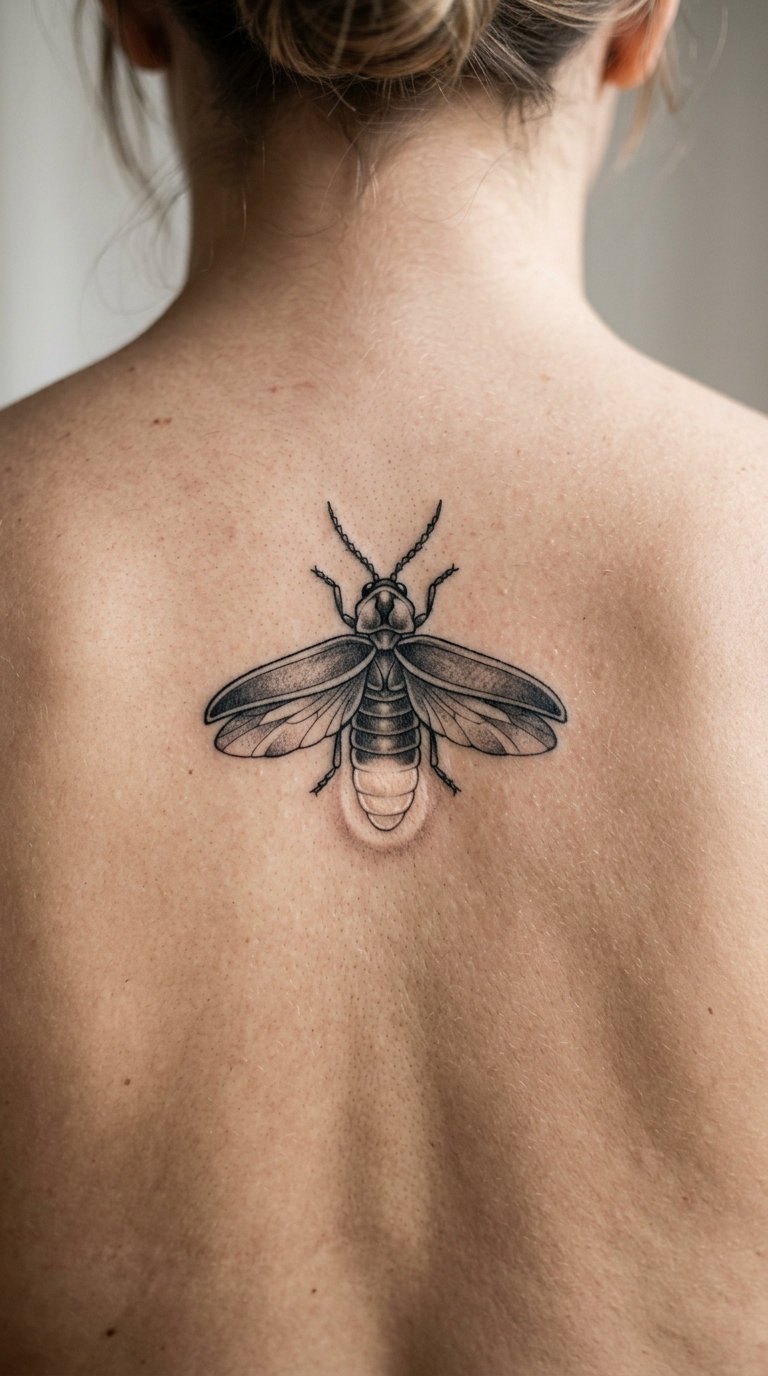
A spine firefly tattoo runs vertically with restrained wings folded close to the body and a smoky grey halo suggesting the light bleeding outward. Keeping the wings tight is what makes it look elegant rather than busy in a narrow column.
A centred spine placement gives a small motif a strong frame, and the symmetry of the body does half the design work for you. It is a private piece in the best sense. You feel it when you roll your shoulders and nobody else knows.
Placement: Between the shoulder blades, or lower along the upper spine · Size: 2 to 3 in (5 to 7.5 cm) tall · Style: Black and grey realism · Pain: High. Spine skin is thin, close to bone, and the position is awkward to sit still in · Make it yours: Angle the body very slightly so it appears to be flying upward along the spine rather than sitting straight.
12. Two Fireflies on the Inner Arm
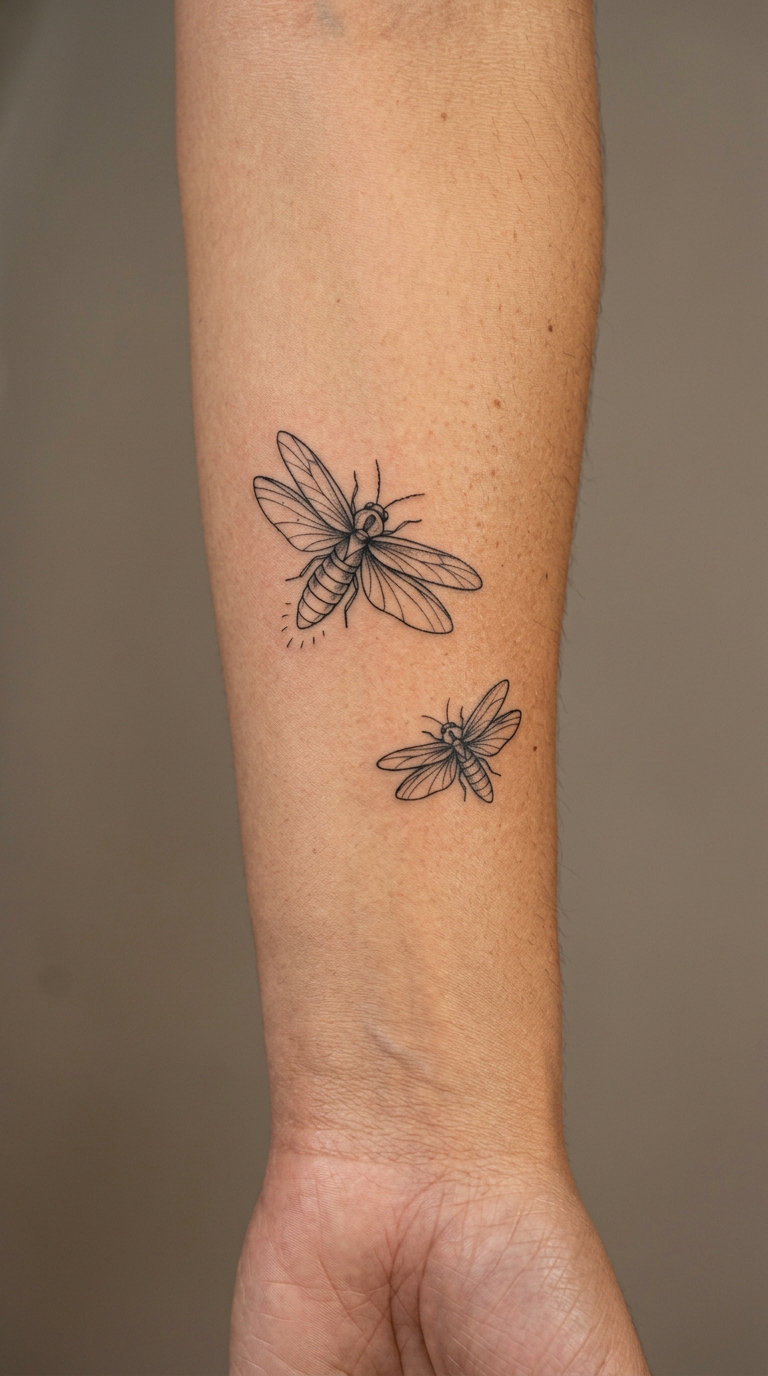
Two fireflies at different angles turn a static symbol into something that moves. One insect is noticeably larger, the second smaller and further along, and the asymmetry is what stops the pair from looking like a stamp repeated twice.
A composition like this gives you more visual interest without more ink, so it works at a size that would look empty with a single bug. It also layers well, since a second small piece can later be added to an existing single firefly.
Placement: Inner forearm, inner arm, or the calf · Size: 1.5 to 2 in (4 to 5 cm) for the larger one, about 60 percent of that for the smaller · Style: Fine line · Pain: Medium · Make it yours: Set the two insects at angles that would put them on diverging paths. It is a small thing, but it is what makes the pair feel alive.
13. Celestial Firefly on the Back
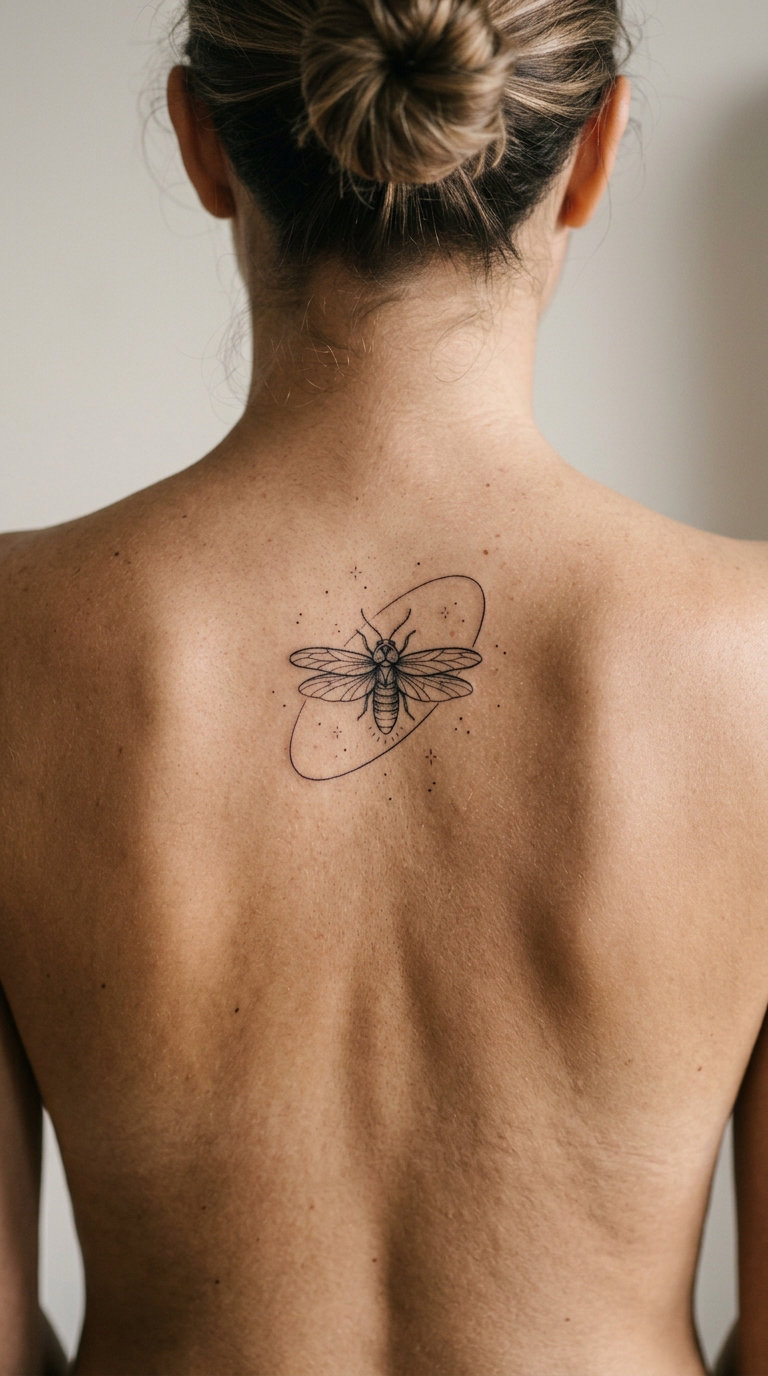
A celestial firefly tattoo gives the insect a night to sit in: a handful of small stars, a scatter of dots, and one thin orbital curve arcing past it. Restraint is the whole trick here, because a busy star field crushes the firefly and you end up with a generic space design.
The back gives you room that a wrist never will, so this is a good option when you want the firefly to sit inside a scene rather than stand alone. If you are building toward a larger back piece, drawing this at scale now saves a lot of rework later.
Placement: Upper back between the shoulder blades, or the shoulder blade itself · Size: 3 to 4 in (7.5 to 10 cm) for the whole composition · Style: Fine line illustrative · Pain: Medium · Make it yours: Make one star slightly larger than the rest, which reads as a focal point and stops the field looking random.
14. Botanical Firefly on the Thigh
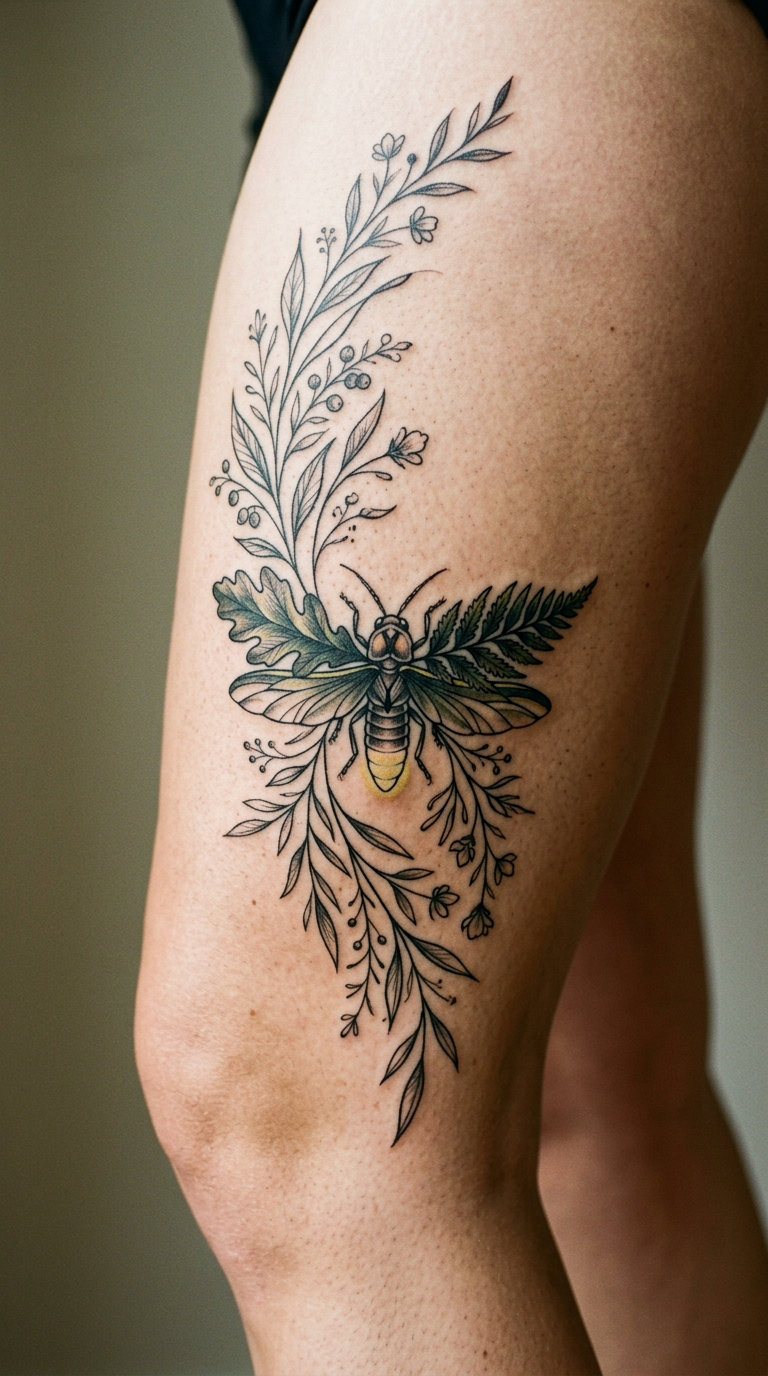
In this design the wings are drawn as leaves, with a stem running through the body and small botanical forms scattered around it. The insect and the plant share one visual language, so nothing looks pasted on.
Thighs have room for larger organic work and the skin is forgiving, which makes this a good choice if you want detail without the pressure of a small unforgiving area. It also sits well in a nature collection alongside leaves and branches.
Placement: Outer thigh, upper thigh near the hip, or the inner thigh · Size: 3 to 4 in (7.5 to 10 cm) · Style: Botanical line with light shading · Pain: Low to medium on the outer thigh, so it is one of the more comfortable ideas on this list · Make it yours: Draw one of the surrounding leaves from a plant you actually keep, and the piece stops being a stock botanical.
15. Vintage Firefly on the Calf
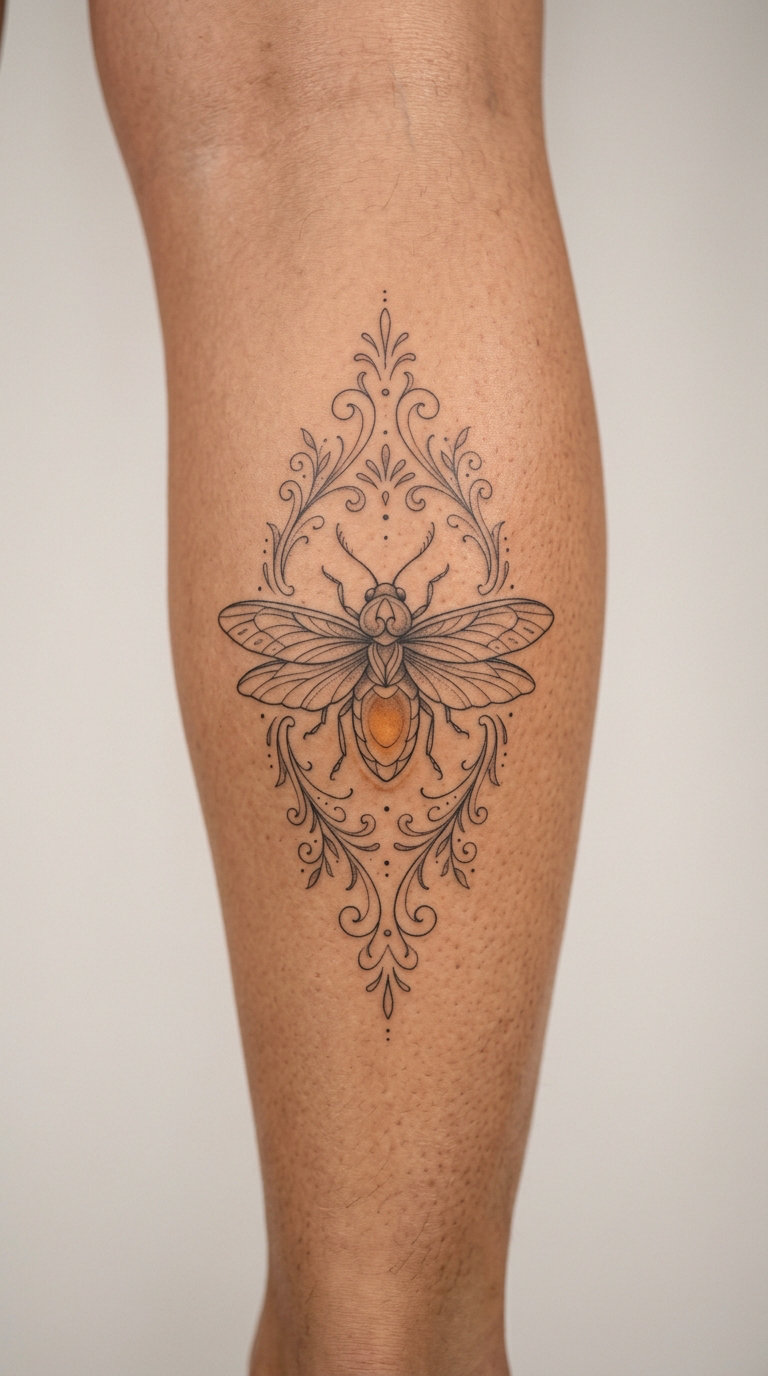
A vintage firefly tattoo is built from thin ornamental lines, a slightly faded-looking amber centre, and hairline flourishes that come off the body like an engraved plate. The old-world look comes from restraint and thin lines, not from adding more ornament than you need.
It is visually distinct from both a realistic bug and a bold traditional one, which makes it an easy choice when you want something that looks antique. On a leg it can stand alone or act as the first element of a leg collection you add to over a few years.
Placement: Outer calf, above the ankle, or the inner calf · Size: 1.5 to 2.5 in (4 to 6 cm) · Style: Vintage ornamental line · Pain: Low to medium · Make it yours: Add a single thin banner of a date underneath. A year is short enough to stay legible and specific enough to mean something.
16. Minimal Firefly on the Finger
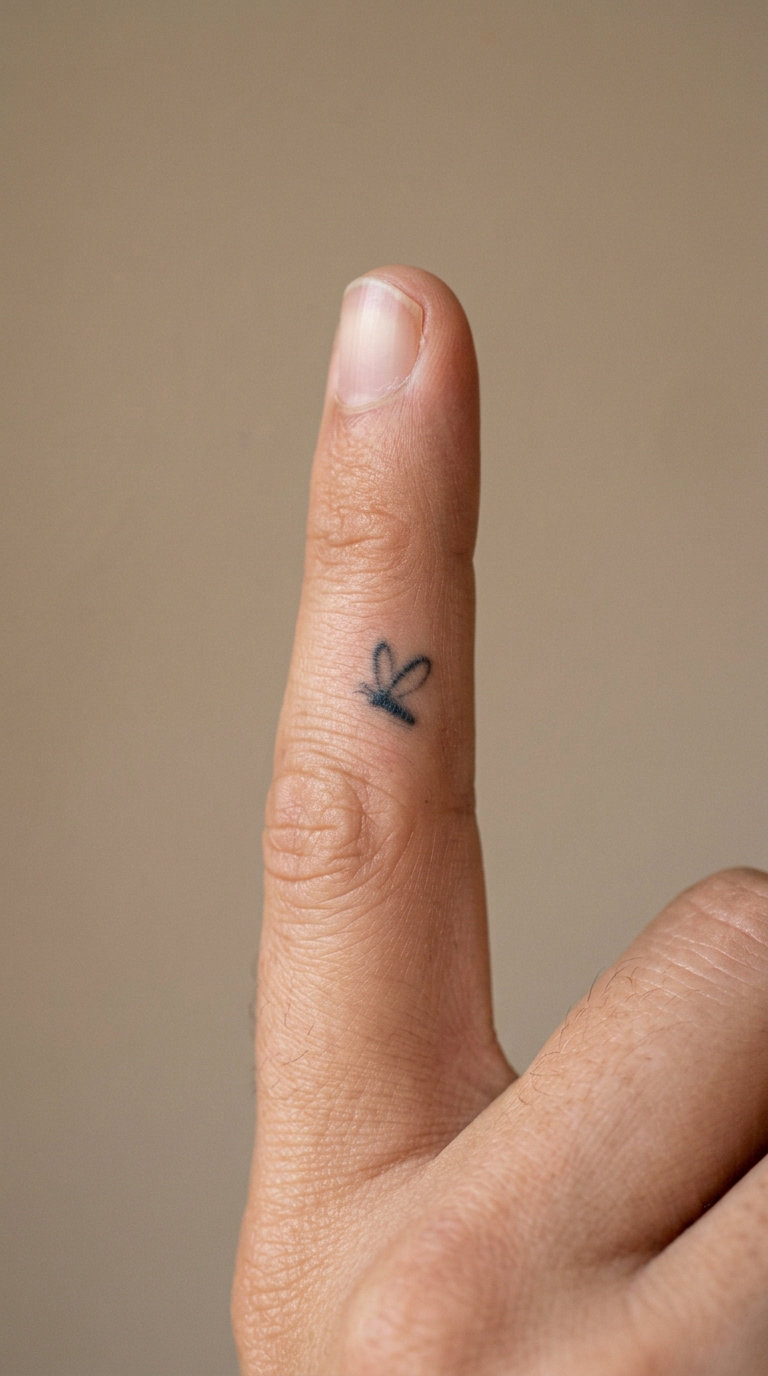
The smallest version of this firefly tattoo is a simplified oval body with two short wing strokes, done in one clean line each. Anything more detailed than that at this size turns into noise, so the artist has to draw with a very fine needle.
A finger firefly suits people who want the tattoo to be nearly private, something only you see. It is also the design most likely to need touching up, so set that expectation before the appointment rather than after.
Placement: Side of a finger, or the inner wrist at the same scale · Size: 0.5 to 0.75 in (1.2 to 2 cm) · Style: Micro minimalist · Pain: Medium, a sharp quick sting because the finger is boned and the skin is thin · Ageing note: Finger tattoos soften, blur and fade fastest of almost any placement. Fine detail disappears within a couple of years, and a colour glow disappears sooner · Make it yours: Add a matching micro firefly on a partner’s or sibling’s hand at a slightly different size, which is a discreet matching set.
17. Realistic Firefly and Leaf on the Rib
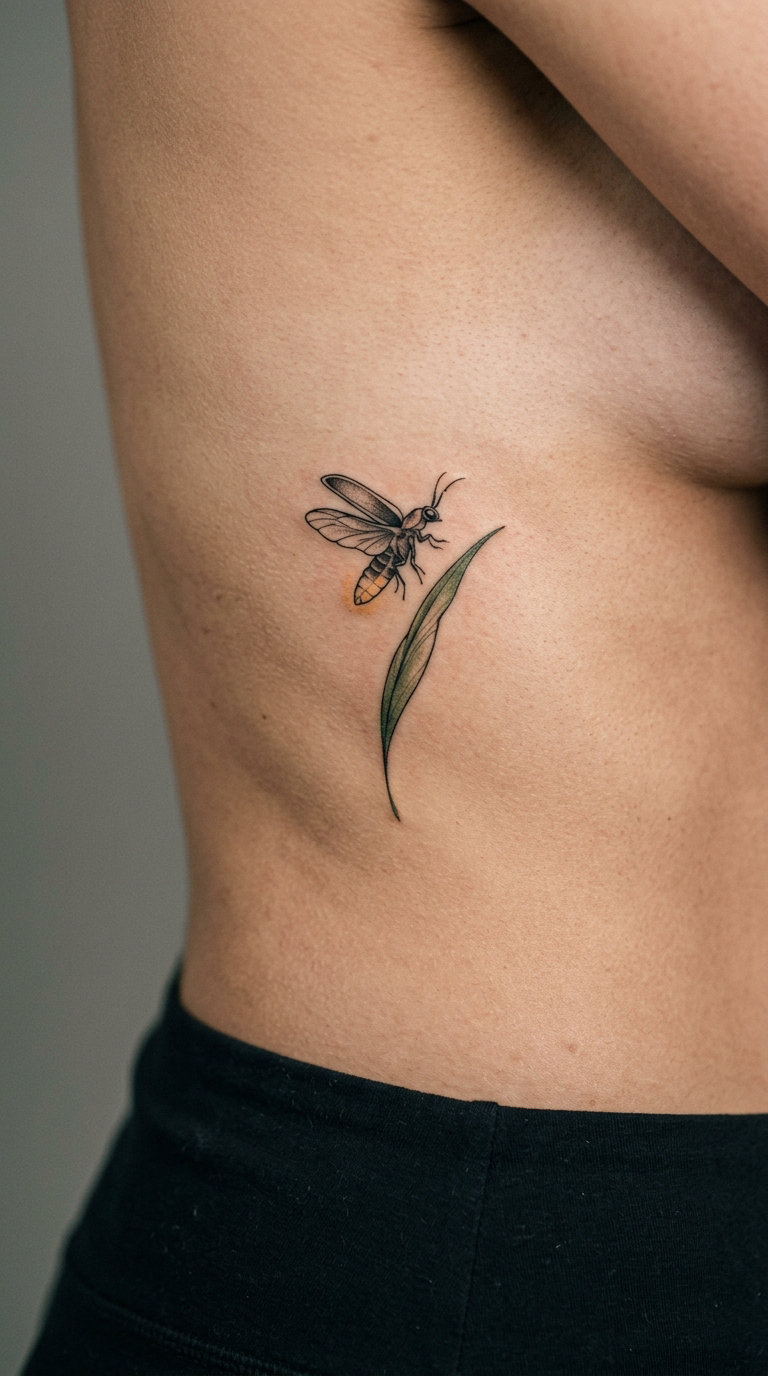
A rib firefly tattoo pairs a more detailed insect with a single narrow leaf, with restrained shading and no extra background. The composition follows the rib’s curve, so the leaf bends with the body and the whole design reads as one long line.
People choose this when they want something organic and understated rather than a bold statement. One leaf is enough, and adding more tends to crowd an area that is already narrow. If you are drawn to softer imagery for stress or anxiety, our minimalist tattoos for anxiety and calm covers that direction in more detail.
Placement: Side ribs, upper side torso, or the flank · Size: 2.5 to 3.5 in (6 to 9 cm) · Style: Fine realism · Pain: High. Ribs are boned, the skin is thin, and shading in one pass over that curve is genuinely hard to sit through · Make it yours: Angle the leaf toward the heart so the composition follows the body’s line rather than sitting straight across it.
18. Glowing Dotwork Firefly on the Sternum
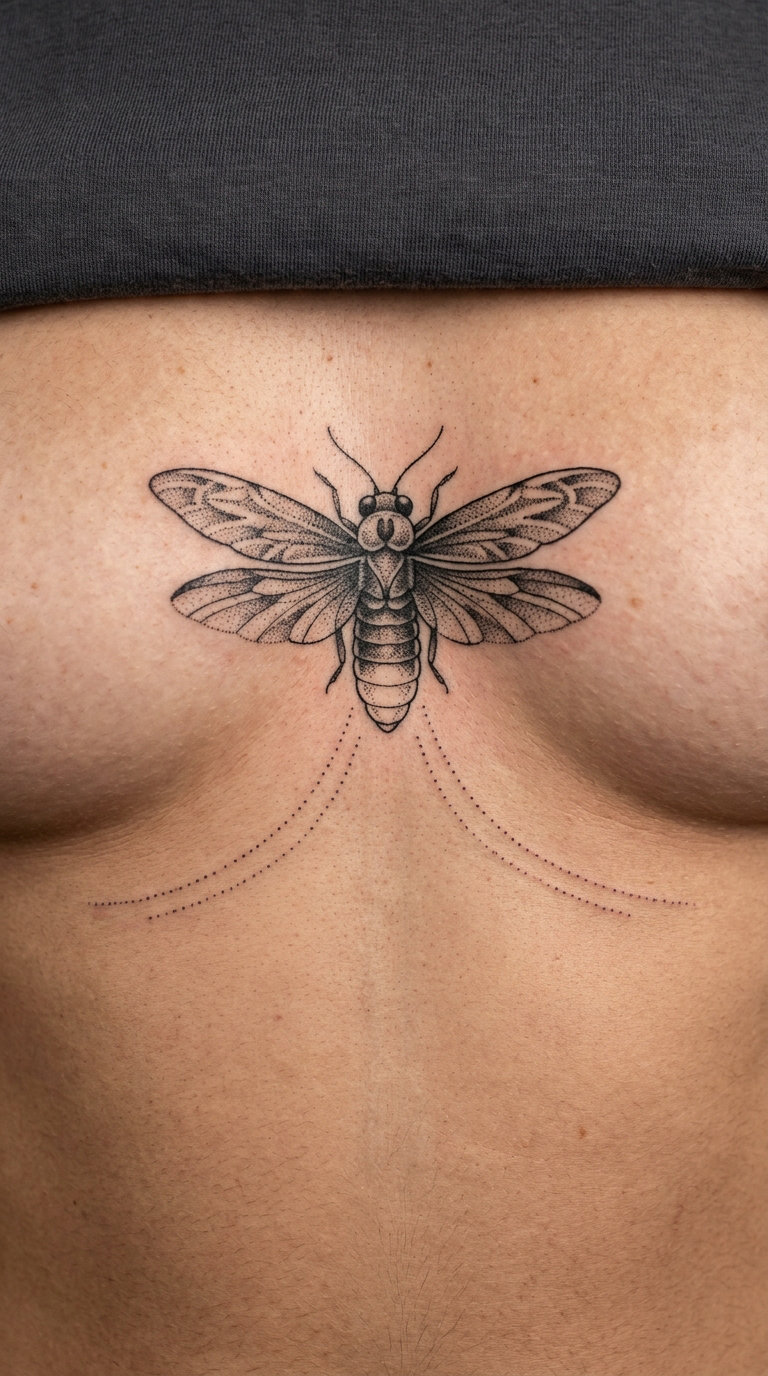
A sternum firefly tattoo centres a small symmetrical firefly between two restrained dot trails that run down toward the ribs. The symmetry is what makes a small design look composed in a place that draws the eye straight on.
It reads as a discreet statement piece because the vertical line it creates is only obvious when your top is off. Keep the dot trails short, since long trails start to look like a spine piece and pull attention away from the insect.
Placement: Upper sternum, between the collarbones · Size: 1.5 to 2 in (4 to 5 cm) for the firefly, trails a further 2 in below · Style: Symmetrical dotwork · Pain: High. The sternum is bone-close and sensitive, and the depth changes between the chest and the dip of the sternum · Make it yours: Run the two trails at slightly different dot sizes so the symmetry reads as deliberate rather than mechanical.
19. Traditional Firefly and Moon
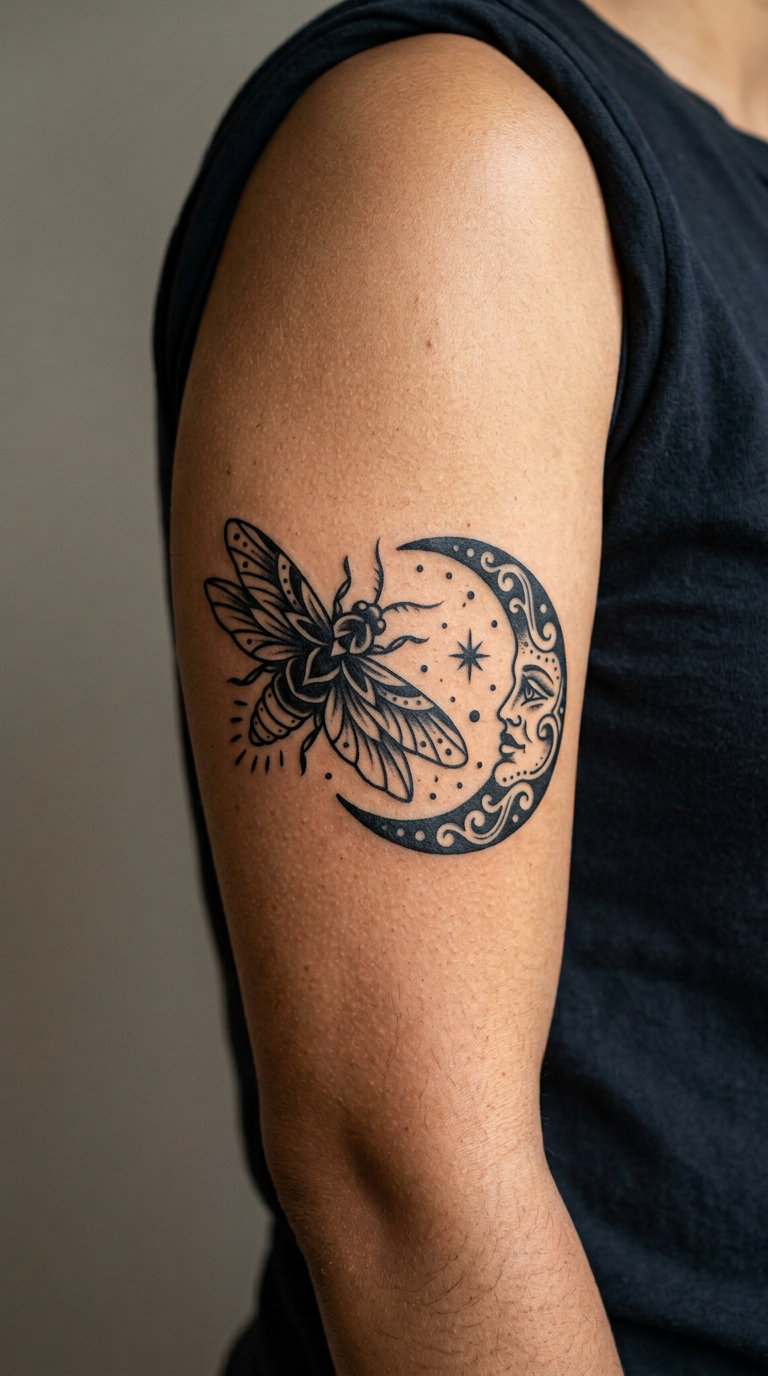
Pairing a traditional firefly with a crescent moon gives the glow somewhere to happen. A field of clean negative space between the two keeps the insect from looking like it is sitting on top of the moon rather than flying past it.
The night setting reinforces the whole reason the motif works, and neither element needs to be large for the pairing to land. I would steer clear of a scene with stars, grass and a sky, because that turns a strong two-shape idea into a small illustration.
Placement: Outer upper arm, calf, or the back of the shoulder · Size: 3 to 4 in (7.5 to 10 cm) for both elements · Style: Traditional with clean negative space · Pain: Medium on the upper arm, low on the calf and thigh · Make it yours: Angle the firefly up and away from the moon so it looks like it is leaving, which makes the pair feel active rather than static.
20. Large Luminous Firefly Sleeve Element
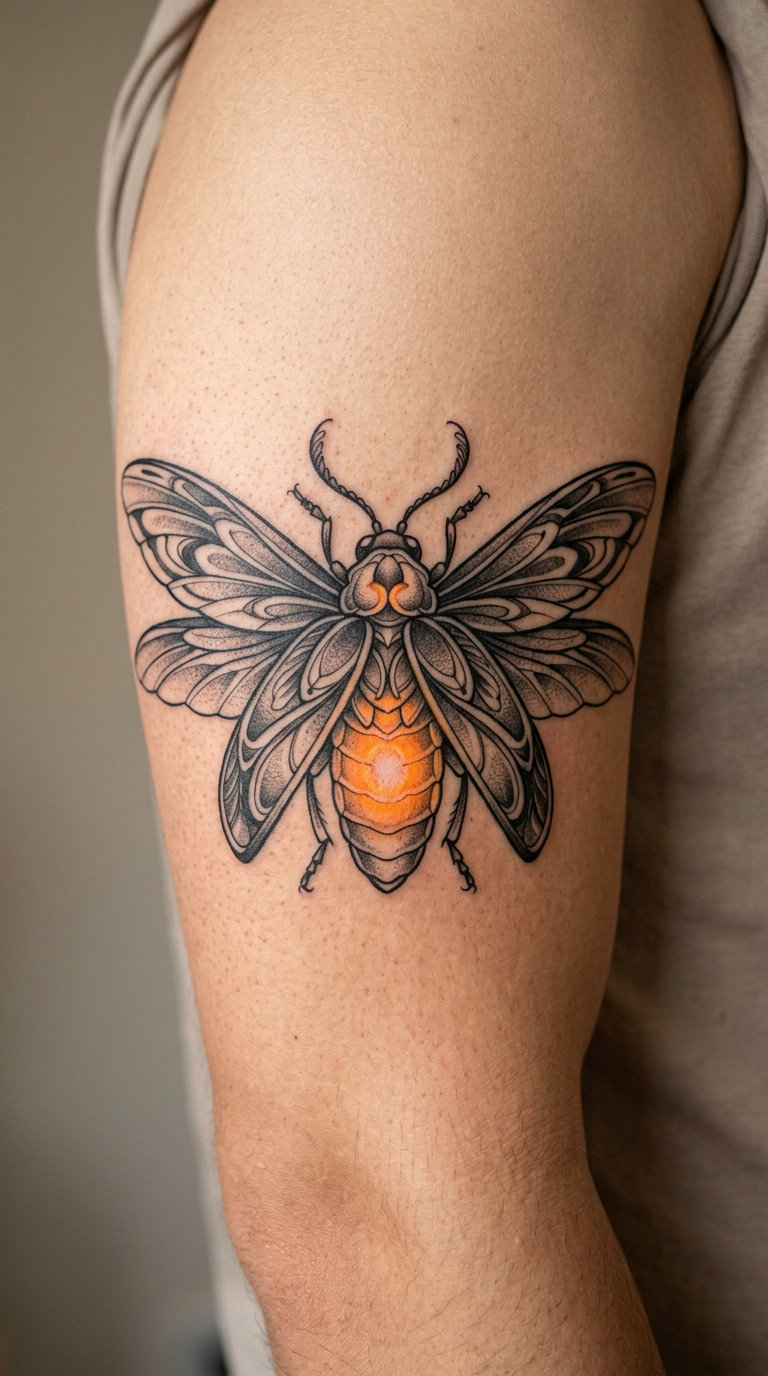
This firefly tattoo is built to be looked at from across a room. Layered wings overlap with soft grey gradients, the abdomen carries the brightest value on the piece, and there is deliberate empty space around it so it can anchor a composition rather than being crowded by one.
It suits someone adding a feature tattoo to an existing collection, because the surrounding space is part of the design and can be filled in years later without redrawing anything. If you are starting from nothing, read the size and session notes below first, because this one is a commitment of time and money.
Placement: Outer upper arm, outer thigh, or the back of the calf · Size: 4 to 6 in (10 to 15 cm) · Style: Black and grey realism · Pain: Medium, though the session length matters more than the sting · Make it yours: Design the empty space around the insect on paper before the appointment. That area is the difference between a standalone piece and a sleeve that never comes together.
How to Choose the Right Design
Six questions settle most of the decision before you walk into a consultation. Answer them honestly and the design usually picks itself.
- Is the firefly the whole design or part of a scene? A standalone insect can be 1.5 in and still read clearly. Add stars, flowers or a moon and you need 3 in or more for the same clarity.
- Do you want colour or black ink? Amber and gold read warm and need refreshing; green-yellow reads closer to a real lightning bug. Pure black gives a glow made of negative space that will outlast any colour.
- Where on the body? Hands, fingers, wrists and ankles show wear fastest. Arms, thighs and the calf hold detail longest. Bony spots hurt more and distort the drawing.
- What size can you keep it? Below 1.5 in (4 cm) a firefly loses its wing detail and starts to look like a speck. If the area is small, pick a simpler design rather than a smaller detailed one.
- Standalone or collection piece? If you plan more tattoos in the same area, sketch the surrounding space now so nothing you add later has to be redone.
- Has the artist done small detailed insect work before? Fine line at small scale is a specialist skill. Ask to see healed work, not fresh work, because you want to see what it looks like three years in.
Cost and Session Time
US prices for a firefly tattoo vary with size, detail, and how long your artist takes. Most studios charge either per hour or a flat rate per piece, and nearly all of them have a shop minimum that a small design still has to meet.
| Size | What to expect | Session time | Typical US range |
|---|---|---|---|
| Tiny (under 1.5 in / 4 cm) | Simplified body, one colour | Under 1 hour | About 80 to 200 dollars, or the shop minimum |
| Small (1.5 to 2.5 in / 4 to 6 cm) | Full wings, one or two colours | 1 to 2 hours | About 200 to 400 dollars |
| Medium (2.5 to 4 in / 6 to 10 cm) | Fine detail, shading, added elements | 2 to 4 hours | About 400 to 800 dollars |
| Large (4 in and up) | Realism, gradients, sleeve planning | 4 hours or split sessions | About 800 to 1500 dollars, often priced per session |
Colour and soft shading add time because they need several passes, and a highly detailed realism piece at 4 in can run past a single session. Location matters a lot too, and rates in high-cost cities sit well above the ranges above. Bring your reference images, a rough size, and your placement, and ask for a total estimate before anything starts.
Aftercare Basics
- Follow your artist’s aftercare instructions first. They know what they did, and generic advice can contradict their plan.
- Wash gently with lukewarm water and a fragrance-free cleanser, then pat dry with clean hands rather than a towel.
- Keep the area loose and covered from direct sun, and skip tight clothing over it while it settles.
- Do not soak, swim, or spend long sessions in steam or hot tubs until the surface has fully closed over.
- Leave it alone. No scratching, no picking, and no covering it with anything tight or sticky.
- Ask your artist before adding any product, including anything marketed specifically for tattoos, and mention any medication you take.
Colour fades faster than line work, and a bright glow on a hand or finger will soften long before the black outline goes. Tattoo sunscreen on exposed placements, or a touch-up session with the artist who did the work, is the practical answer to that.
Frequently Asked Questions
What does a firefly tattoo mean?
A firefly tattoo usually represents light, hope, and the idea that your own glow shows up even in hard times. People also choose it for childhood summers spent catching them, for remembrance of someone they lost, or simply because the insect is beautiful and small. There is no single fixed meaning, so the reason behind yours is worth saying out loud at the consultation.
Will a glowing firefly tattoo fade into a grey smudge?
A glow made with colour will fade first, often within a few years, and can end up looking grey if you never touch it up. A glow built from blackwork and negative space lasts far longer because there is no colour to change. Whichever you pick, the placement decides most of it: hands, fingers, wrists and ankles wear out fastest, while arms, thighs and calves hold detail best.
How small can a firefly tattoo be?
Around 1.5 inches (4 cm) is the smallest size where the wings and glowing abdomen still read clearly. Below that, the design loses its detail and starts to look like a speck, especially on a wrist or ankle. If you want something smaller, switch to a simplified version with fewer lines rather than shrinking a detailed drawing, and consider a dotwork cluster instead.
Does a small detailed firefly tattoo hurt more?
Not because of the detail itself, but because of where it goes. Thin-skinned bony areas like the ribs, sternum, spine, fingers and inner ankle feel sharper, and fine shading means more needle passes over the same spot. A tiny simple line on the inner arm or behind the ear is usually one of the more comfortable tattoos you can get. Pain outlasts nothing, so breathe normally and take breaks when you need them.
Should I get a realistic or a stylised firefly tattoo?
A realistic firefly rewards you with fine detail and a genuinely lifelike insect, but it fades faster because it depends on soft shading and a colour glow. A stylised version, whether blackwork, traditional or minimalist, holds its shape for years and is easier to keep legible at a small size. Pick realistic if you care about the insect itself, and stylised if you want a symbol that still reads in ten years.
Which Firefly Tattoo to Pick First
If this is your first tattoo, go with idea 2 on the inner wrist or idea 1 behind the ear. Both are small, both are simple enough to hold their shape, and both are easy to hide while the healing settles.
If you already have tattoos and you are adding to a collection, idea 4 on the shoulder or idea 20 on the outer upper arm give you a piece with room around it for whatever comes next. A blackwork firefly with a negative-space glow is the version I would pick to lead with, because that glow never fades to grey.
Whatever you land on, save at least two references and bring both to the consultation. If you want a second look at colour-heavy direction, our sunset tattoo ideas with colour shows how a strong palette holds together on skin.