
What Is a Fine Line Tattoo and How Long Does It Last? (2026)
A fine line tattoo is a design built from single, unbroken lines, usually laid down with a single-needle configuration, using very little ink and letting empty skin do the work. How long does it last? Most stay clearly visible for five to fifteen years, while thin lines on fingers, hands, feet and joints often soften much sooner.
That is the honest version, and it is worth having before you sit down. Fine line tattoos are permanent but not permanently crisp. I would rather you pick a size and placement that suits your life than fall for a photo taken two weeks after a session when the ink still looks at its darkest.
Below: what the style actually is, what shortens its life, what each healing stage looks like, and where on the body thin lines hold up best.
What Is a Fine Line Tattoo?
A fine line tattoo is any design made of single, unbroken lines, usually tattooed with a single-needle setup, carrying minimal ink and no colour fill. Detail comes from linework and negative space rather than shading, so the design depends on the clean skin between strokes as much as on the ink itself.
Two things define it in practice. The first is line weight: a true fine line is thin, often around the width of a fine eyeliner or a pencil stroke, and a single-needle line is thinner than anything a standard machine configuration can lay down. The second is restraint. The design is usually composed of a few elements with breathing room around each one, because a fine line tattoo has no spare ink to hide behind when the edges soften.
Most artists in this style work black or a very dark brown. Any shading or grey wash is kept light, and on a lot of pieces it is the first thing to disappear. What is left behind is the outline, which is why so many people re-work the lines and leave the shading alone.
The trade-off is simple. Fine line work is elegant, cheap to change later and quick to heal, but it holds less ink than a bold piece and has no built-in insurance against the slow softening every tattoo goes through. If you want something that still reads as a design in twenty years without any maintenance, a heavier line weight is a better starting point.
Fine Line Tattoo vs. Single-Line and Minimal Tattoos
These terms get used interchangeably online and they are not the same thing. A single-line tattoo is one unbroken stroke with no breaks. A minimalist tattoo is a whole aesthetic that can use thin or medium lines. Fine line is a technique description.
| Term | What it means | Typical lines | How it ages |
|---|---|---|---|
| Single-line tattoo | One continuous unbroken stroke, no breaks or shading | One line only | Any softening reads immediately as a blurred line, so it shows age fastest |
| Fine line tattoo | Thin linework built with a single-needle setup, detail from negative space | Many thin lines | Softens gradually; the overall shape usually outlives the fine detail |
| Micro tattoo | A size description, usually a fine line design under roughly 2 inches | Varies | Size, not technique, drives the speed of the fade here |
| Minimalist tattoo | A restrained design, often fine line but not always | Thin to medium | Depends on the line weight the artist chose |
What Makes Fine Line Tattoos Fade?
The question behind what is a fine line tattoo and how long does it last is really a question about biology. Ink sits in the dermis, held in place by cells called macrophages that partially enclose pigment particles. Over decades those particles drift a little further from where they were placed. That slow movement is called ink migration, and it is normal for every tattoo on your body.
Fine lines have almost no margin for that drift. A bold line two millimetres wide can spread half a millimetre and look identical. A hairline stroke that spreads half a millimetre has become a grey smudge. So the fade you see is not usually ink disappearing; it is ink going exactly where ink goes, at a size too small to absorb it.
The factors that speed it up, roughly in order of how much they matter:
- Line weight and ink density. The single biggest controllable factor. Thin, lightly loaded lines have the least pigment holding their shape.
- Placement. Wrists, ankles, fingers, feet, knees and elbows move constantly and rub against clothes or skin.
- Sun exposure. Ultraviolet light breaks down pigment, and it hits forearms, hands and the face more than it hits a covered back.
- Needle depth and technique. Ink placed too shallow fades and washes out faster than ink placed properly in the dermis.
- Skin movement and skin type. Thinner, sun-damaged skin on the inner arms shows softening sooner because there is less tissue between the ink and the surface.
- Healing and aftercare. A tattoo that is scratched, soaked or sunburnt in its first weeks settles differently from one that is left alone.
Normal ageing and a badly executed tattoo are not the same thing, and telling them apart matters. A tattoo that fades evenly across the whole design over several years is ageing. One that looks patchy within weeks, or whose lines were never consistent from day one, was likely under-inked or placed too shallow.
How Long Does a Fine Line Tattoo Last?
There is no fixed number, because the design, the placement and the artist all count. A well-executed fine line tattoo on a stable area of the body often still reads clearly at ten years. The same design on an ankle or a finger may look noticeably softer in five. Treat touch-ups as part of owning the style rather than as a sign something went wrong.
| Time after the session | What you will usually see |
|---|---|
| Fresh, day 1 | Red, raised and far darker and heavier than it will ever look again |
| Healed, about 1 to 3 months | The real line weight becomes visible; any patchiness settles |
| 1 to 3 years | Still sharp if the line weight, depth and placement were sound |
| Around 5 years | First softening, slight loss of contrast, fine detail harder to read up close |
| Around 10 years | Lines noticeably thicker and softer than day one; light grey wash is mostly gone |
| 15 to 20 years and beyond | Neighbouring lines merge and script can become hard to read without a touch-up |
Most people with fine line work end up booking at least one touch-up in their lifetime. The practical part is simple: lines can be re-worked later, often decades later, and they stay soft and delicate. Shading cannot, which is why experienced artists build a fine line piece so it still reads without the grey.
How Line Weight and Detail Affect Longevity
If longevity matters to you, this table is the useful part. The difference between a hairline stroke and a slightly heavier line is a few millimetres, and it buys you many years.
| Line weight | How it looks | Where it can go | How long it stays crisp |
|---|---|---|---|
| Hairline, single needle | Delicate, light, drawn-on quality | Upper arm, inner forearm, thigh, back, behind the ear | A few years before it needs attention; avoid fingers, feet and hands |
| Medium fine line | Clearly visible but still light | Most placements, including inner forearm and wrist | Roughly 5 to 10 years before a touch-up is usually wanted |
| Slightly heavier line | Still fine line work, readable from a few feet away | Anywhere, including sun-exposed and higher-movement areas | 10 years or more; rarely needs rework |
One detail worth planning around: if you want lettering, ask for a cap height of at least 3 to 4 mm. Below that, letters blur into each other as the lines spread and the word stops being readable.
Healing Timeline: What to Expect Week by Week
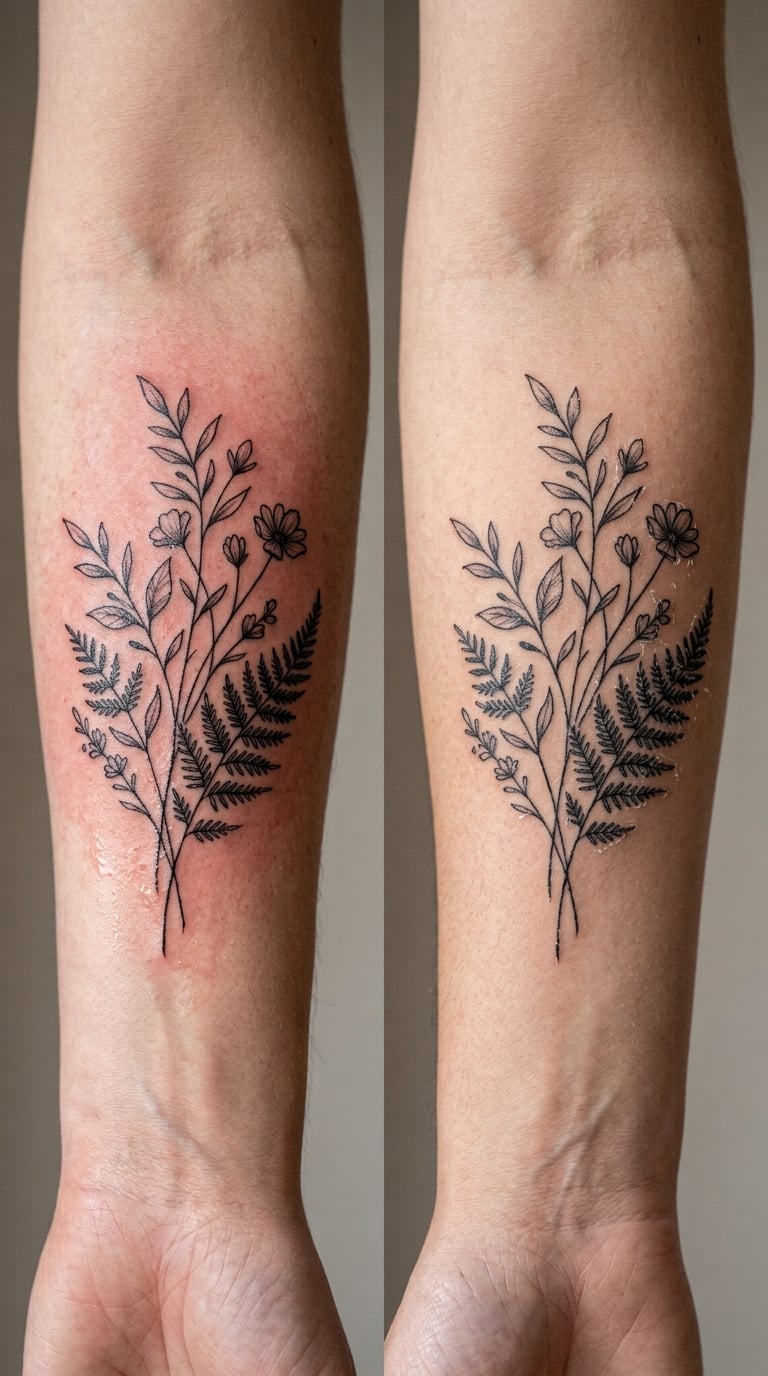
Fine line work heals faster than a heavy shaded piece, mostly because there is less ink and less scabbing. The surface recovers in two to four weeks, while the deeper layers keep settling for two months or more.
| Stage | What the skin looks like | What the tattoo looks like |
|---|---|---|
| Weeks 0 to 2 | Red, raised and tender, with light flaking as the surface sheds | Lines look bolder than they ever will again; detail is partly hidden under swelling |
| Weeks 3 to 4 | Calm, flaky stage finished, skin returning to normal texture | First real look at your line weight; faint patchiness where scabs lifted |
| Weeks 5 to 8 | Normal skin, no visible irritation | Pigment integrating deeper; faintness reduces and the thinnest strokes may look slightly softer |
| Months 3 to 6 | Fully settled skin | Final sharpness becomes easy to judge; this is when a touch-up conversation makes sense |
If you want the day-by-day version, what tattoo ink looks like when healing covers the stages in more detail.
Pain Levels by Placement
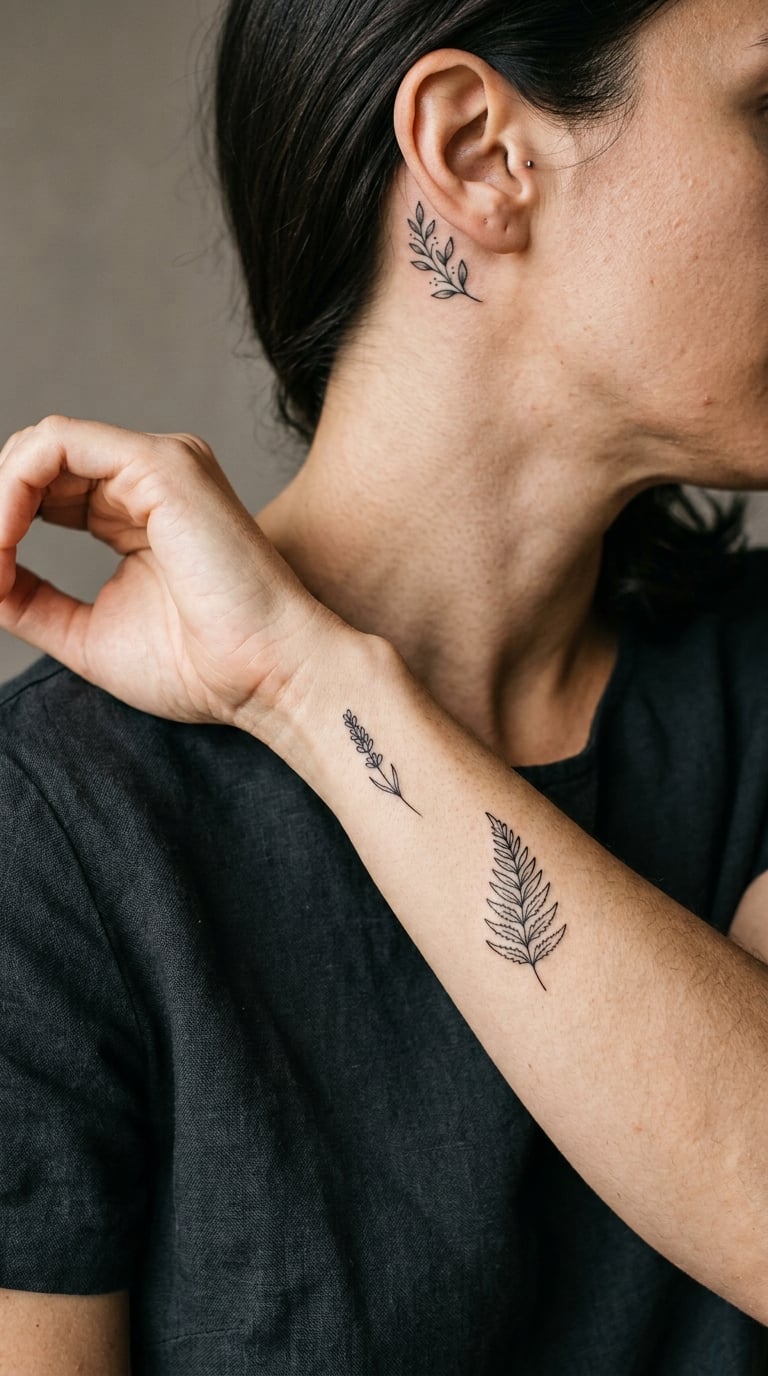
Thin lines are a slower process than a bold filled-in piece, because the machine has to make several careful passes instead of laying down a solid block. That extra time means a fine line session can feel longer than its size suggests. The ratings below are the usual experience for a small fine line design.
| Placement | Typical rating | Notes |
|---|---|---|
| Upper arm, outer upper arm | Low | The easiest common placement for a first fine line tattoo |
| Outer forearm | Low | Good visibility and a flat surface for linework |
| Inner forearm | Low to medium | Mild sting near the elbow, often close to ribs in sensitivity |
| Upper arm, inner side | Low | Hidden placement that ages well |
| Wrist, inner | Medium | Bony and close to the surface, and a high-move spot |
| Collarbone | Medium to high | Skin is thin and the bone sits right under it |
| Ribs and side | High | Frequently described as the most unpleasant fine line placement |
| Ankle | Medium to high | Thin skin, plus constant shoe and sock contact |
| Behind the ear | Medium to high | Sharp, brief sting; the skin here moves a lot |
| Hand, back of the hand | Medium to high | Very thin skin over small bones |
| Fingers and toes | High | Constant joint movement; the fastest fading spot there is |
| Feet and top of foot | High | Shoe contact and sun exposure together |
Everyone reads the scale differently, and sitting still versus moving changes the whole thing. For a fuller breakdown, see our tattoo pain chart by placement.
Choosing a Size and Placement That Will Age Well
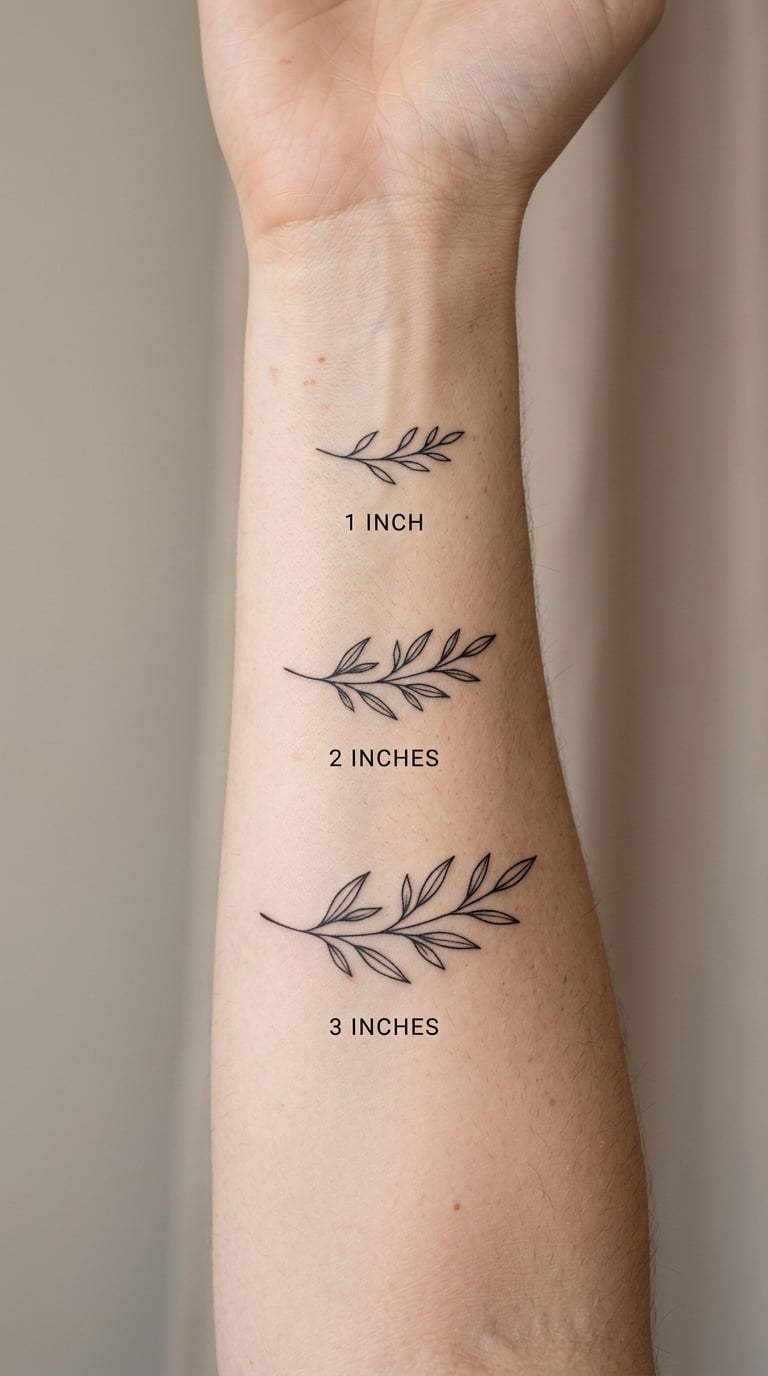
Size is the choice people get wrong most often. A design at one inch has no room to soften without losing its drawing; the same sprig at three inches keeps its shape long after the hairlines have merged. If a design only looks right at postage-stamp scale, it is usually over-detailed for the area.
The practical answer to what is a fine line tattoo and how long does it last comes down to three things: a minimum size of roughly two inches for anything with detail, space between the lines rather than lines touching, and a placement away from daily friction.
| Holds up well | Why | Fades fastest | Why |
|---|---|---|---|
| Upper and outer arm | Stable skin, low abrasion, easy to cover from the sun | Fingers and toes | Constant joint movement plus frequent washing |
| Inner upper arm | Soft skin that barely moves | Feet and ankles | Shoe contact and constant sun exposure |
| Thigh | Broad, flat and rarely rubbed | Inner wrist | Washing, sleeves and a watch band |
| Upper back | Usually covered and rarely flexed | Hands | Thin skin, air exposure, frequent washing |
Cover-up is easier on a fine line piece than on a bold one, but only if the lines stay re-workable. Choose a size and a line weight now that leave you something to work with later.
How Much Does a Fine Line Tattoo Cost?
There is no single fair number for fine line work, and any quote you see online is really a quote for one artist in one city. What drives the number is far more useful than a range, so this is what to ask about.
| Design tier | What it usually involves | What moves the quote |
|---|---|---|
| Tiny single-line mark | One continuous stroke, under an inch | Most studios have a shop minimum, so the session price is set by the shop rather than the work |
| Small detailed fine line | A sprig, small motif or short word, 1 to 3 inches | Line count, hourly rate, how long the design takes to lay down |
| Medium illustrative piece | Several elements with negative space, 3 to 5 inches | Session length, whether shading is included, artist’s rate |
| Larger multi-element work | A full composition, 5 inches or more | Design revision time, custom drawing, city and shop rates |
Ask the studio three things before you commit: is there a minimum charge, what is the hourly or flat rate for this size, and is a touch-up within a set period included or discounted. Plenty of artists will re-work their own lines once, sometimes free, within the first year or two. A discounted touch-up is worth more to you than the cheapest session in town, because a re-worked line saves a re-tattoo later.
Aftercare for Fine Line Tattoos
Start from your artist’s instructions, because they match the ink and technique they used. The general shape of good aftercare is short.
- Follow your artist’s aftercare instructions first; they come first in every case.
- Wash gently with clean lukewarm water and a mild unscented soap, then pat dry rather than rubbing.
- Keep scented lotions, perfumes, harsh cleansers and sanitiser away from a fresh fine line tattoo.
- Protect it from sun once it has healed, and treat sunscreen as maintenance for the whole life of the piece.
- Avoid soaking in baths, pools, hot tubs and the sea while the surface is still healing.
- Skip friction: no rubbing, no scrubbing, no long showers aimed straight at it, no sleeves or shoes that scrape the area.
- Let scabs and flakes come away on their own and never pick at them.
- Watch it rather than treating it, and contact your artist or a doctor if you see spreading redness, heat, swelling or discharge.
Long after healing, the habits that matter most are boring and effective: sunscreen on exposed areas and not letting clothing rub at the lines every day.
How to Choose an Artist for Fine-Line Work
The single best filter is healed work, not fresh work. Almost every artist photographs a tattoo better on day two than it will ever look again, so ask to see healed examples at the size you want.
- Healed line consistency. In healed photos, are the lines still even along their length, or do some sections thin out?
- Clean negative space. Look for space between elements that has stayed open rather than filling in.
- Examples at your size. A beautiful 6-inch piece says nothing about a 2-inch one. Ask to see small healed work.
- That placement specifically. Fingers, ribs and inner wrists are hard. A portfolio that avoids them is telling you something.
- True single-needle work. Ask what configuration they use for thin lines. A thin machine line is not the same thing, and it behaves differently over time.
During the consultation, ask to see a sketch or stencil at actual size, ask what line weight they plan to use in millimetres, and ask whether any part of the design will need a second session. If you are torn between two weights, a tiny test line in a low-visibility spot sometimes settles the question before you commit to the whole piece.
Mistakes to Avoid
- Choosing an over-detailed design at micro size. Detail needs room. Below about 2 inches it has nowhere to go once the edges soften.
- Picking the placement purely for how it looks in a photo. Wrist and ankle shots are beautiful and those are the spots that fade first.
- Treating a healed photo as proof of longevity. A healed photo proves the work was clean, not that it will hold for twenty years.
- Going hairline on fingers and feet. The smallest lines in the worst spots is the combination that disappoints people fastest.
- Judging line weight during healing. The tattoo will not look like its final weight for about three months, so do not book a touch-up in a panic.
- Leaving shading out of the design thinking. If the whole idea depends on grey wash, expect that layer to go first. Do fine line tattoos fade faster? Causes, timelines and care covers this in detail.
- Skipping sun protection after healing. UV exposure is the one ageing factor you can control for decades.
Frequently Asked Questions
Are fine line tattoos a good choice for a first tattoo?
They are a common first tattoo because the session is short, the design is small and it is easy to change later. The trade-off is maintenance: thin lines hold less ink than bold work, so a touch-up is likely at some point. Pick a placement away from daily friction, and ask to see healed examples at your exact size before you commit.
Can a faded fine line tattoo be made darker or bolder?
Usually yes, and re-working lines is the part of fine line tattoo maintenance that works best. An artist can go over the existing strokes with fresh ink once the skin is fully healed. Shading and grey wash are the exception: they rarely come back cleanly, which is why experienced artists rebuild a faded piece around the linework instead of trying to restore the shading.
Can a fine line tattoo be completely removed?
Removal works on fine line work the same way it works on any tattoo, using laser treatments that break down pigment in the dermis. Because fine lines carry very little ink, they are often lighter to treat than a bold piece. Removal is still expensive, it takes multiple sessions, and it does not return skin to its original untouched state.
Do different skin types affect how fine line tattoos fade?
They do, in a few ways. Fading shows up sooner where contrast is high, so a thin line on lighter skin shows its edges changing sooner than the same line on deeper skin. Thinner, sun-damaged skin on the inner arms also has less tissue between the ink and the surface. Oilier skin tends to stay softer and shinier, which can make lines read slightly heavier over time.
When should I consider a fine line touch-up?
Wait until the tattoo is fully healed, which is about three months, then judge it honestly. Signs it is time: script you can no longer read, edges that have merged into a grey blur, or a line that fades in one spot while the rest holds. Planning around what is a fine line tattoo and how long does it last means treating touch-ups as routine maintenance rather than a problem to fix.
Start With Size, Placement, and Healed Examples
If you want a fine line tattoo that still looks deliberate a decade from now, three choices do most of the work. Keep it around two inches or larger, place it away from wrists, ankles, hands and fingers, and ask a slightly heavier line weight than you think you need.
There is no fixed lifespan to memorise here. Fine line tattoos are permanent but not permanently crisp, they soften gradually, and touch-ups are part of the deal rather than a complaint. Confirm the line weight in millimetres, ask to see healed work at your size, and find out what your artist offers for a re-work before you sit down, not after.