
22 White Ink Over Blackwork Tattoo Ideas: Best 2026 Designs
White ink over blackwork is a two-stage technique: an artist lays down an opaque black field, lets it heal, then tattoos the actual picture in white on top. The black becomes the shadow and the white becomes the drawing, so only bold shapes survive.
That constraint is exactly what makes these 22 designs worth saving. Anything with hairline detail disappears into the black within a few years, so the winning concepts are the ones built from big flat shapes, hard edges and wide gaps. If you are still building a blackwork vocabulary, the 30+ bold blackwork tattoo ideas gallery is a good warm-up. This list goes one step further into the two-colour work.
Timing note: if you are planning a piece for a wedding, a milestone birthday or a season of travel, book at least six to eight weeks ahead, and expect a large black field to run across two or more sittings.
22 White Ink Over Blackwork Tattoo Ideas: Quick Guide
| Idea | Style | Best placement | Size | Pain |
|---|---|---|---|---|
| 1. Crescent moon in filigree | Blackwork, filigree | Outer forearm | 3 in / 7.5 cm | Medium |
| 2. Peony with white petal highlights | Floral blackwork | Outer thigh | 5 in / 12.5 cm | Medium |
| 3. Wolf in geometric field | Geometric, high contrast | Upper arm | 4 in / 10 cm | Medium |
| 4. Storm cloud and lightning | Graphic, textured black | Outer forearm | 3.5 in / 9 cm | Medium |
| 5. Snake coiled around white rose | Illustrative blackwork | Calf | 4 in / 10 cm | Medium to high |
| 6. Feather in gothic cross | Gothic, ornamental | Upper back | 5 in / 12.5 cm | Low to medium |
| 7. Minimal eye in ink splash | Minimal, high contrast | Inner wrist | 1.5 in / 4 cm | Medium |
| 8. Koi with white water pattern | Illustrative blackwork | Forearm | 4 in / 10 cm | Medium |
| 9. Floral skeleton in black field | Botanical, dotwork | Upper arm | 4.5 in / 11 cm | Medium |
| 10. Moth with white wing panels | Symmetrical, fine detail | Upper back | 5 in / 12.5 cm | Low to medium |
| 11. Sailboat on a black sea | Graphic, maritime | Inner forearm | 3 in / 7.5 cm | Medium |
| 12. Scorpion with white claws | Blackwork, textured | Calf | 3.5 in / 9 cm | Medium to high |
| 13. Tree of life on black circle | Sacred geometry | Shoulder blade | 4 in / 10 cm | Low to medium |
| 14. Lace band with white ribbon | Ornamental, lace | Upper arm | 2 in / 5 cm | Medium |
| 15. Rose climbing a fingerprint | Fine line, graphic | Outer hand | 2 in / 5 cm | High |
| 16. Phoenix with white feather breaks | Illustrative blackwork | Shoulder blade | 6 in / 15 cm | Low to medium |
| 17. Hourglass in geometric frame | Minimal, geometric | Forearm | 2.5 in / 6 cm | Medium |
| 18. Jellyfish with white domes | Illustrative, abstract | Back of calf | 4 in / 10 cm | Medium to high |
| 19. Mountains under a black sky | Graphic, landscape | Outer forearm | 3.5 in / 9 cm | Medium |
| 20. Chess piece with white crack | Minimal, graphic | Inner bicep | 2.5 in / 6 cm | Medium |
| 21. Dandelion seeds in black branches | Fine line, dotwork | Behind the ear | 2 in / 5 cm | High |
| 22. Serpent and moon, white core | Blackwork, ornamental | Outer calf | 4 in / 10 cm | Medium |
1. Crescent Moon Wrapped in Black Filigree
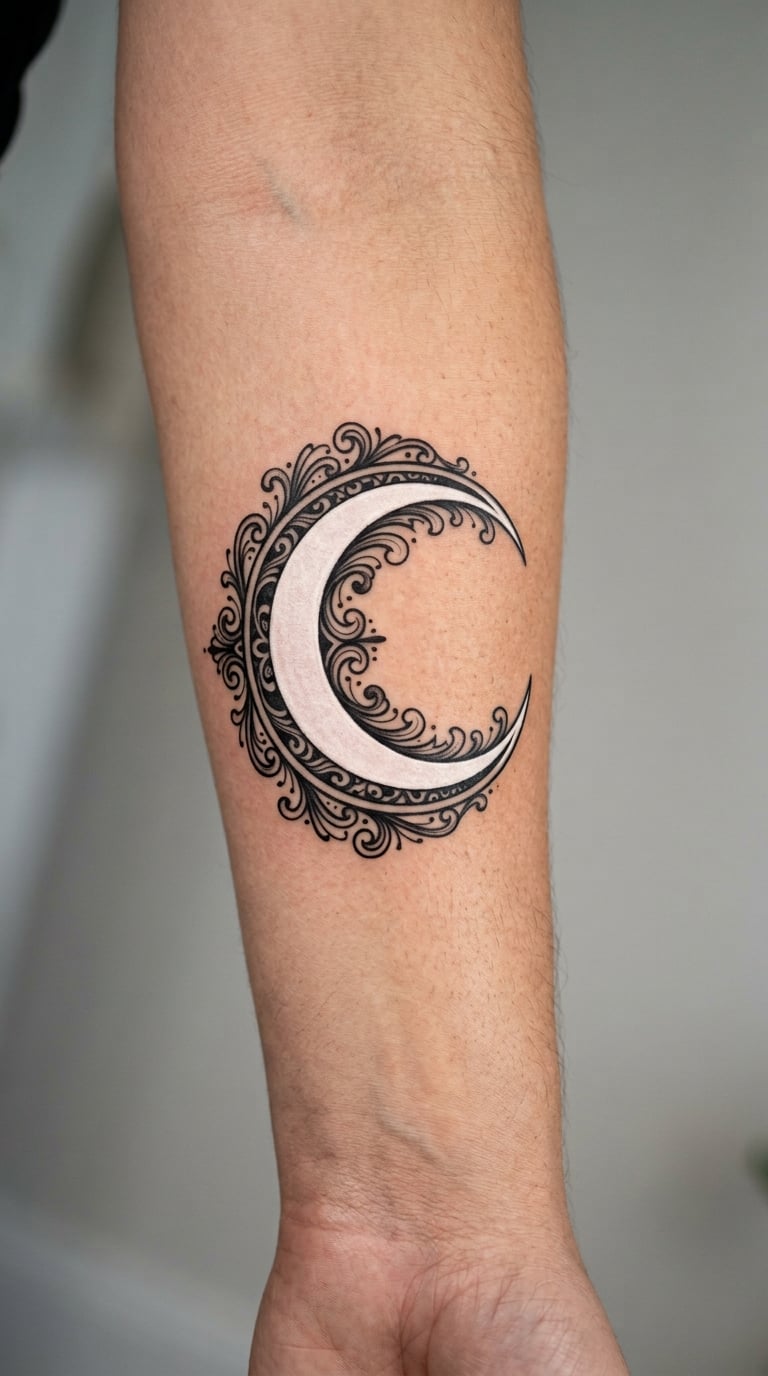
The moon’s curved body is filled with opaque white and ringed with a solid black border, while fine filigree curls away into untouched skin. Gaps between each scroll keep the piece from turning grey.
Most people pick the crescent for its balance rather than a fixed meaning. Some treat it as a cycle they are living through.
Placement: Outer forearm, inner bicep, or high on the calf. Size: 3 to 4 inches (7.5 to 10 cm) across. Style: Blackwork with ornamental filigree line work.
Pain: Medium on the forearm, mild on the bicep. Those hairline scrolls soften and blur first, so expect a touch-up roughly a year in. Make it yours: add a small date along the lower filigree curve, or a second crescent in mirrored black for a matching pair.
2. Blackwork Peony with White Petal Highlights
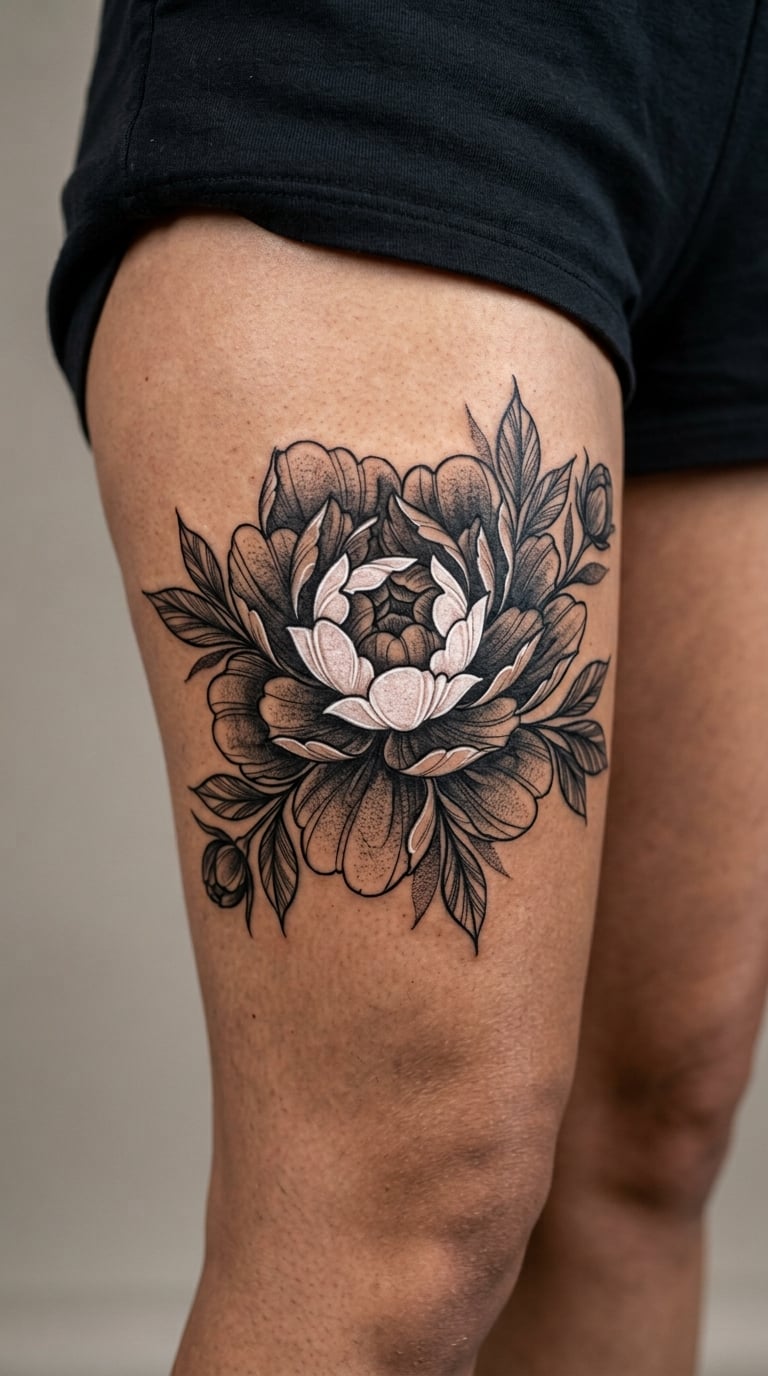
Dense black fills define the outer petals while three central petals lift into solid white. That centre looks lit from within rather than spotty.
The peony is one of the most tattooed flowers in the world, usually picked for its full, layered shape. There is no fixed symbolism here.
Placement: Outer thigh, shoulder cap, or forearm. Size: 4.5 to 5.5 inches (11 to 14 cm) wide. Style: Floral blackwork, high contrast.
Pain: Medium on the thigh and shoulder, higher on the inner forearm near the wrist. Petal edges are the first thing to soften, so keep them wide rather than feathery. Make it yours: shift the white highlights to three petals that form a small triangle, a shape that reads well from across a room.
3. White-Ink Wolf Among Black Geometric Shapes
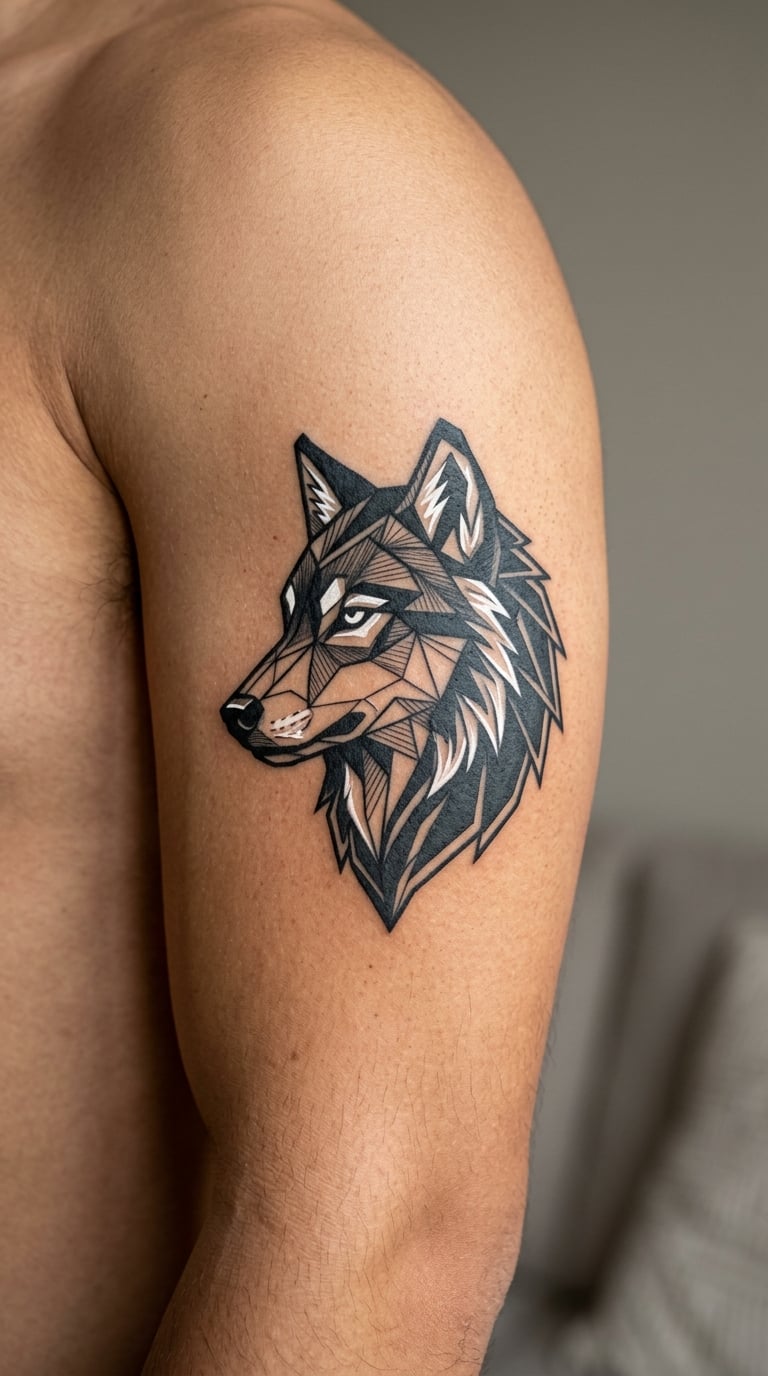
The wolf is a black silhouette cut by white zigzags along the cheek, brow and shoulder, with a few restrained black triangles around it, spaced so they never touch the outline.
Most people choose a wolf for loyalty, family or a stubborn streak they recognise. It is also a strong shape that survives this technique better than a portrait would.
Placement: Upper arm, outer calf, or mid-thigh. Size: 4 to 4.5 inches (10 to 11 cm) tall. Style: Geometric blackwork.
Pain: Medium, and the upper arm is one of the more forgiving spots. Fur texture fades fastest, so keep the white marks as blocks rather than strands. Make it yours: build the surrounding geometry out of the number of pets you have had, or the year something important happened.
4. Storm Cloud with a White Lightning Bolt
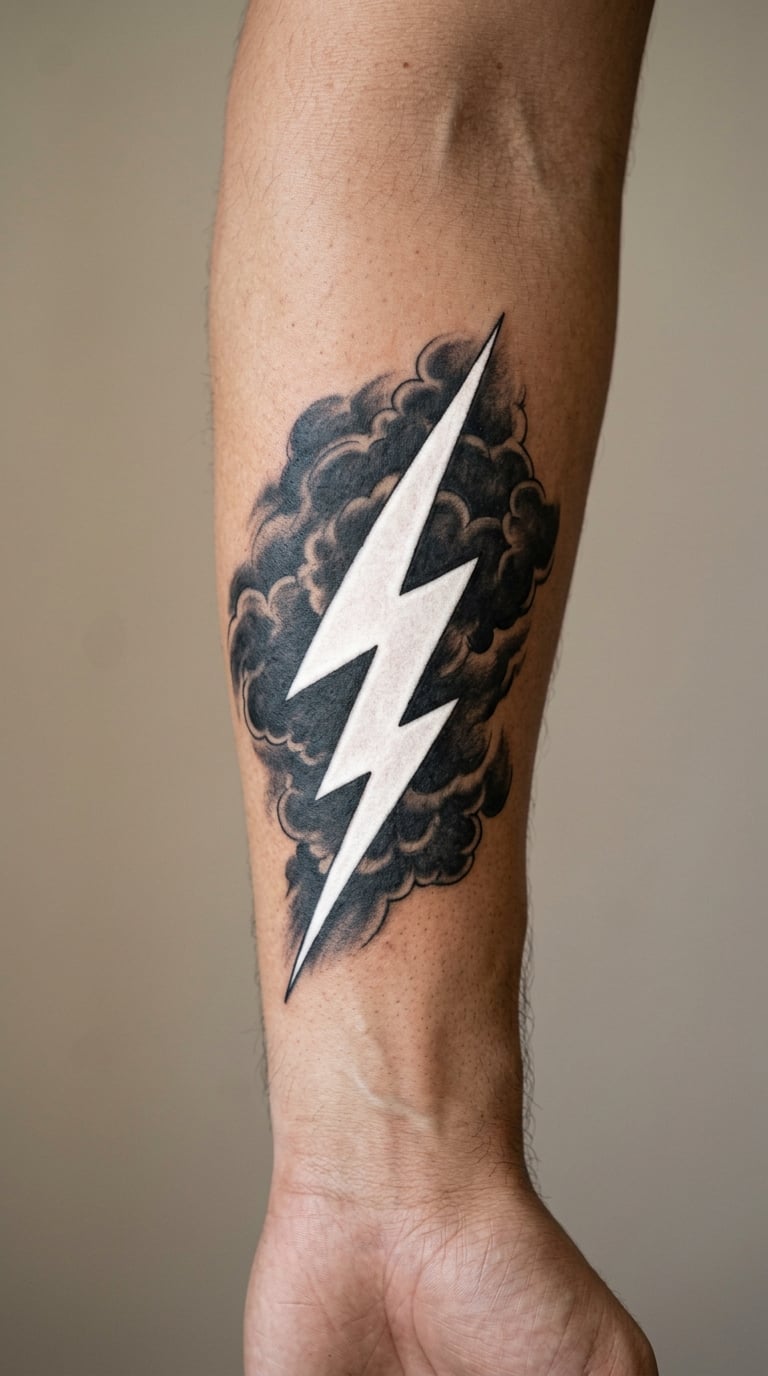
A heavy black cloud mass breaks around a single white bolt running diagonally through it. The artist leaves a thin black gutter so the white does not bleed into the fill.
Storm imagery usually arrives with a hard year behind it. Some clients add rain lines below to mark a season rather than a mood.
Placement: Outer forearm, calf, or across the chest. Size: 3 to 4 inches (7.5 to 10 cm) wide. Style: Graphic blackwork with texture.
Pain: Medium, more sensitive on the ribs or inner arm. Small cloud curls vanish into grey within a few years, so the artist should draw them at roughly twice the thickness you first picture. Make it yours: set the bolt at a diagonal that echoes the line of your forearm rather than running straight down it.
5. Blackwork Snake Coiled Around a White Rose
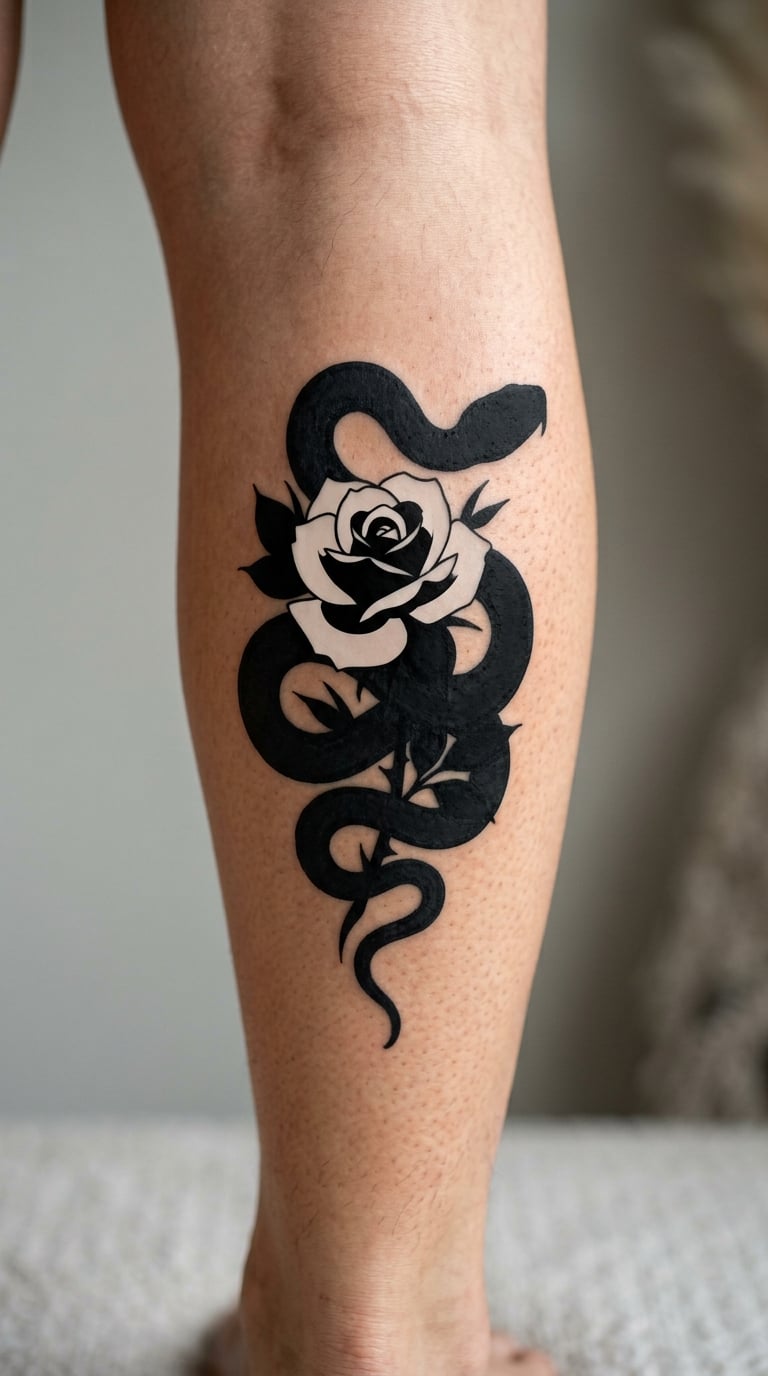
A thick black snake loops twice and its body becomes the frame; the rose inside is built almost entirely from white. That nested arrangement keeps one clear focal point.
The pairing reads as renewal sitting inside something guarded. A snake alone is often chosen for change or survival.
Placement: Calf, forearm, or hip. Size: 4 to 5 inches (10 to 12.5 cm) tall. Style: Illustrative blackwork.
Pain: Medium to high, since the calf and inner forearm are both sensitive. The white rose will dull towards cream with sun exposure, so placement matters more here than with a black-only piece. Make it yours: add a single leaf in white on the opposite side of the coil to balance the composition.
6. White Feather Inside a Black Gothic Cross
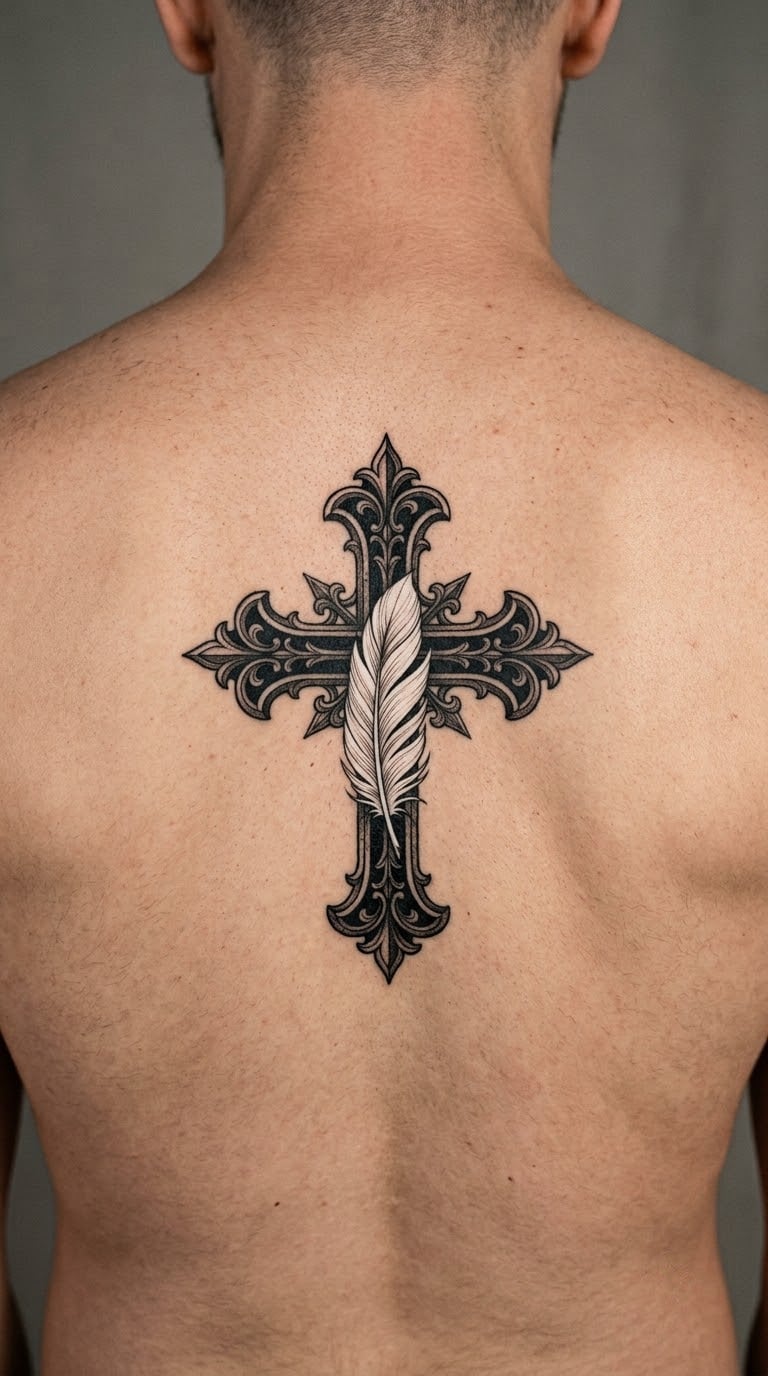
The cross is built from heavy black with ornamental spires at each arm, and a narrow white feather runs down its centre. The feather is a single flat shape, not a set of barbs, which is what makes it hold.
Faith pieces like this are usually personal and occasionally inherited, so ornament count matters less to the client than the proportions do.
Placement: Upper back between the shoulder blades, sternum, or forearm. Size: 4.5 to 5.5 inches (11 to 14 cm) tall. Style: Gothic ornamental blackwork.
Pain: Low to medium on the upper back, which is a soft site and easy to sit still for. The white centre will fade first, so plan on one brightening session. Make it yours: angle the cross a few degrees off vertical so it follows the spine’s natural curve rather than fighting it.
7. Minimalist White Eye in a Black Ink-Splash Frame
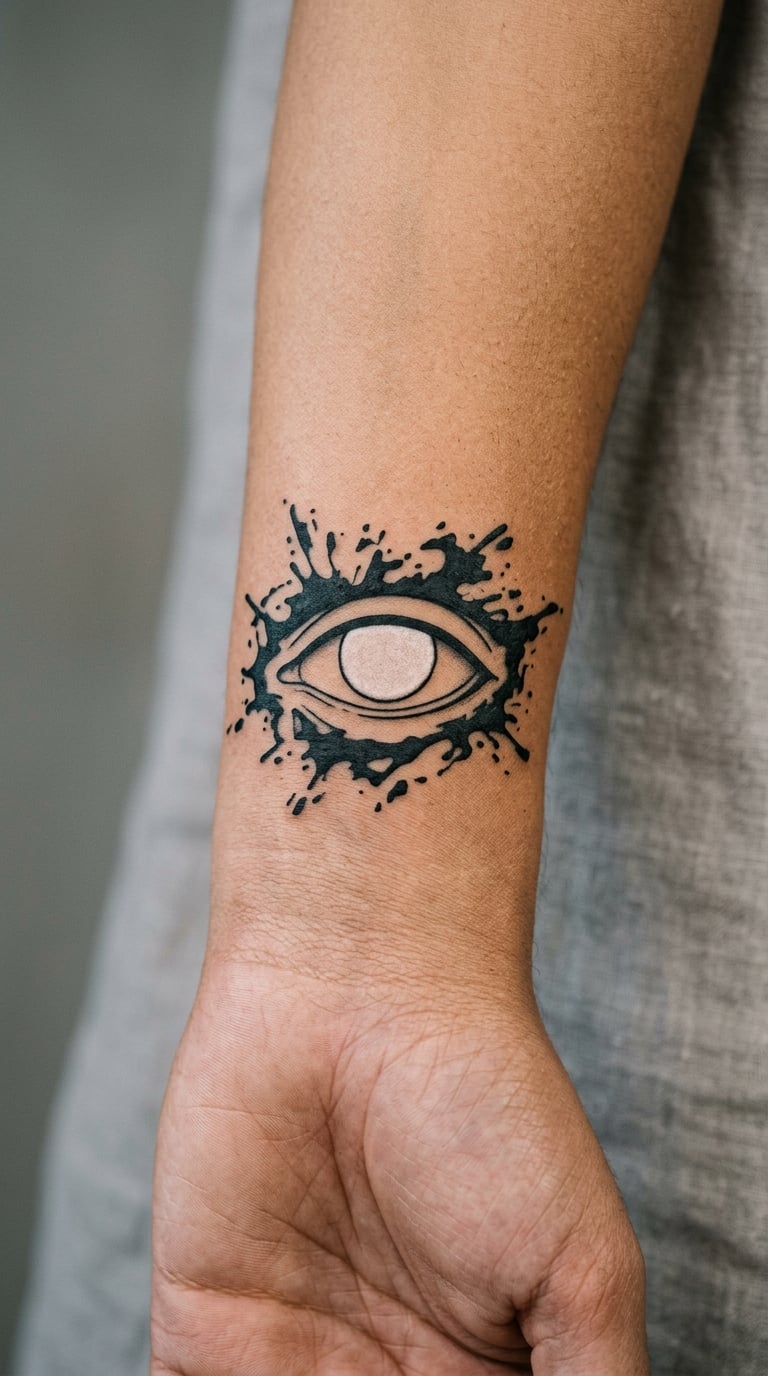
One almond shape in solid white, a small black pupil at its centre, then an irregular black splash thrown around it with ragged edges, so the composition feels caught mid-motion.
The eye is the oldest tattoo subject there is, and here it reads as watchfulness rather than anything spooky. Clients often place it where they can see it themselves.
Placement: Inner wrist, finger, or forearm. Size: 1.5 to 2 inches (4 to 5 cm) wide. Style: Minimal high-contrast blackwork.
Pain: Medium on the wrist, high on the fingers, where the bone sits right under the skin. A small white shape like this can grey down faster than a large one, so a touch-up is normal rather than a mistake. Make it yours: drop a second tiny eye in black only, mirrored, as a small companion piece.
8. Blackwork Koi with a White Water Pattern
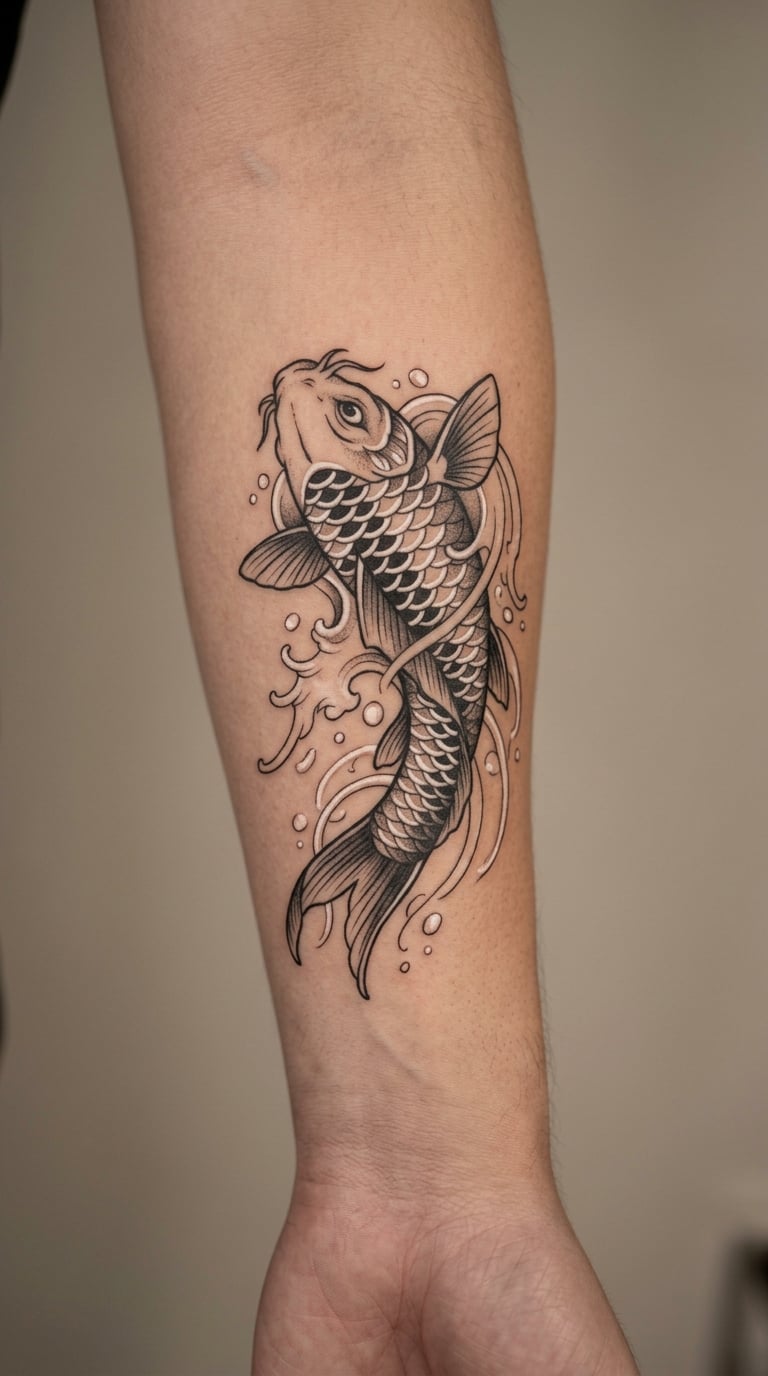
The koi is a black body with white scale clusters along the back and three white water lines curling behind it. Those curved lines are what stop the fish reading as a flat blob.
Koi usually represent perseverance, and plenty of clients add the water lines to reference a river or a stretch of open water.
Placement: Forearm, calf, or thigh. Size: 4 to 5 inches (10 to 12.5 cm) long. Style: Illustrative blackwork.
Pain: Medium, and the tail end near the ankle will be the tender part. Individual scales soften into a mottled grey, so the artist should keep scale shapes chunky and separated. Make it yours: point the koi’s nose up toward your elbow, or down toward your hand, depending on which direction you want it to read.
9. White Floral Skeleton in a Black Botanical Field
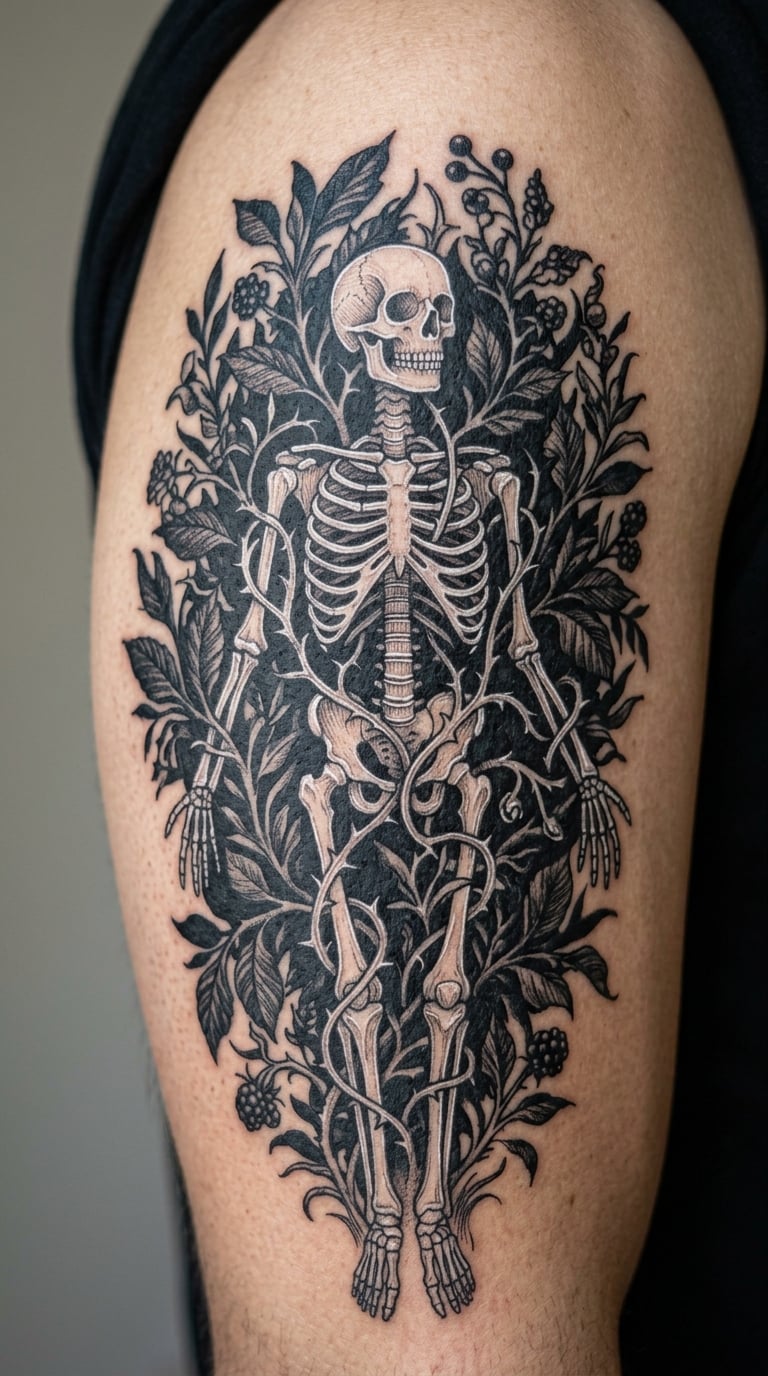
Inside a mass of black leaves and stems sits a small flower skeleton formed in white, its outline left slightly open. The contrast is deliberate: one white object, everything else black.
Botanical skeletons show up in pieces about impermanence and the structure underneath beauty. Bring a reference image of the actual plant you have in mind, since real and invented skeletons look very different.
Placement: Upper arm, back of the calf, or forearm. Size: 4 to 5 inches (10 to 12.5 cm) tall. Style: Botanical blackwork with dotwork detail.
Pain: Medium, mild on the upper arm. Dotwork in the centre is the first casualty of sun and time, so keep the dot field to about a quarter of the design rather than half. Make it yours: build the surrounding black leaves from a plant that grows where you grew up.
10. Black Moth with Luminous White Wings
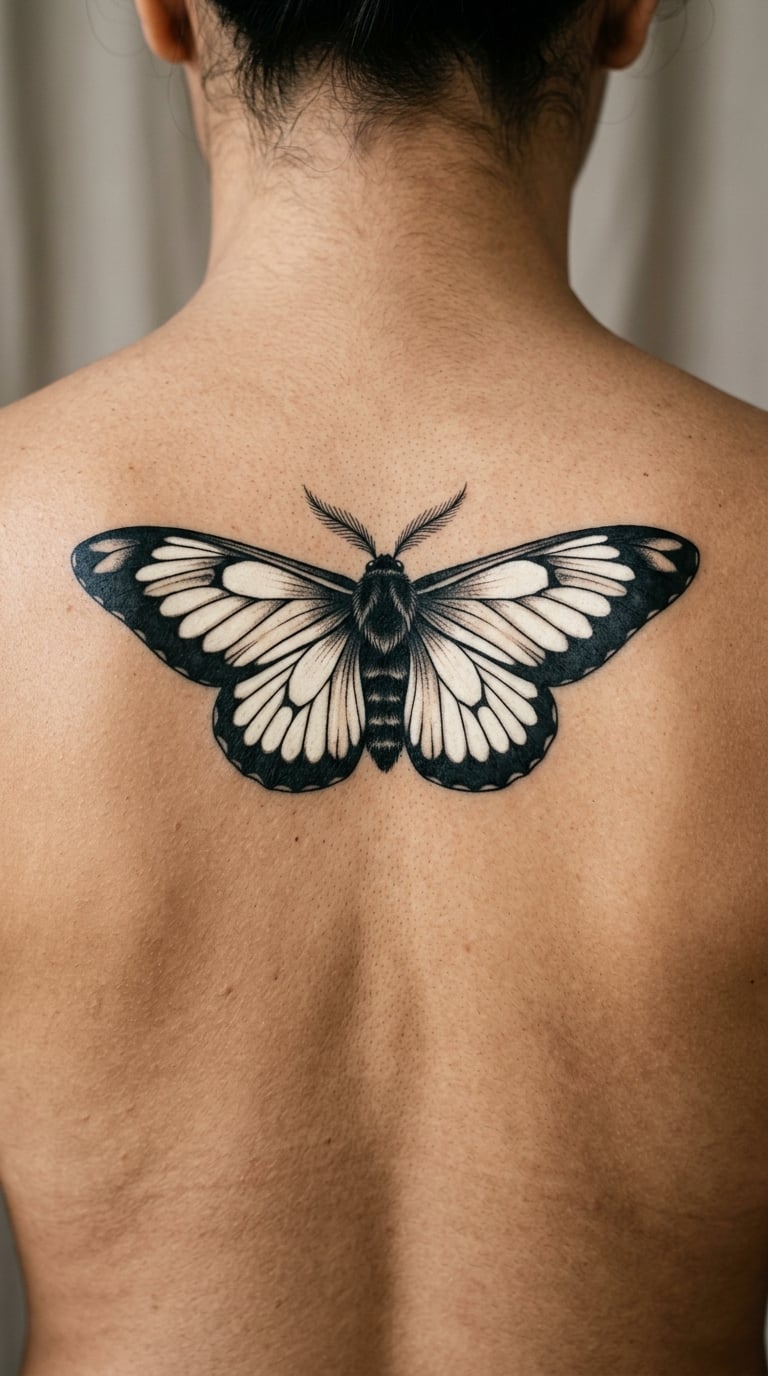
Solid black wing borders frame white interior panels, and a few black vein lines cross each panel. The body stays fully black, which anchors the shape.
Moths pull people in for the transformation they signal, and many collectors pair one with a butterfly piece years apart.
Placement: Upper back, shoulder blade, or between the shoulder blades. Size: 4.5 to 5.5 inches (11 to 14 cm) wide. Style: Symmetrical blackwork with fine vein detail.
Pain: Low to medium on the back, and it is an easy position to sit in for a long sitting. Those vein lines are hairline work inside a white panel, so expect a refresh sooner than the black areas need one. Make it yours: vary the vein pattern on each side so the symmetry feels drawn rather than stamped, and keep the two wings matched in width.
11. White Sailboat Emerging from a Black Sea
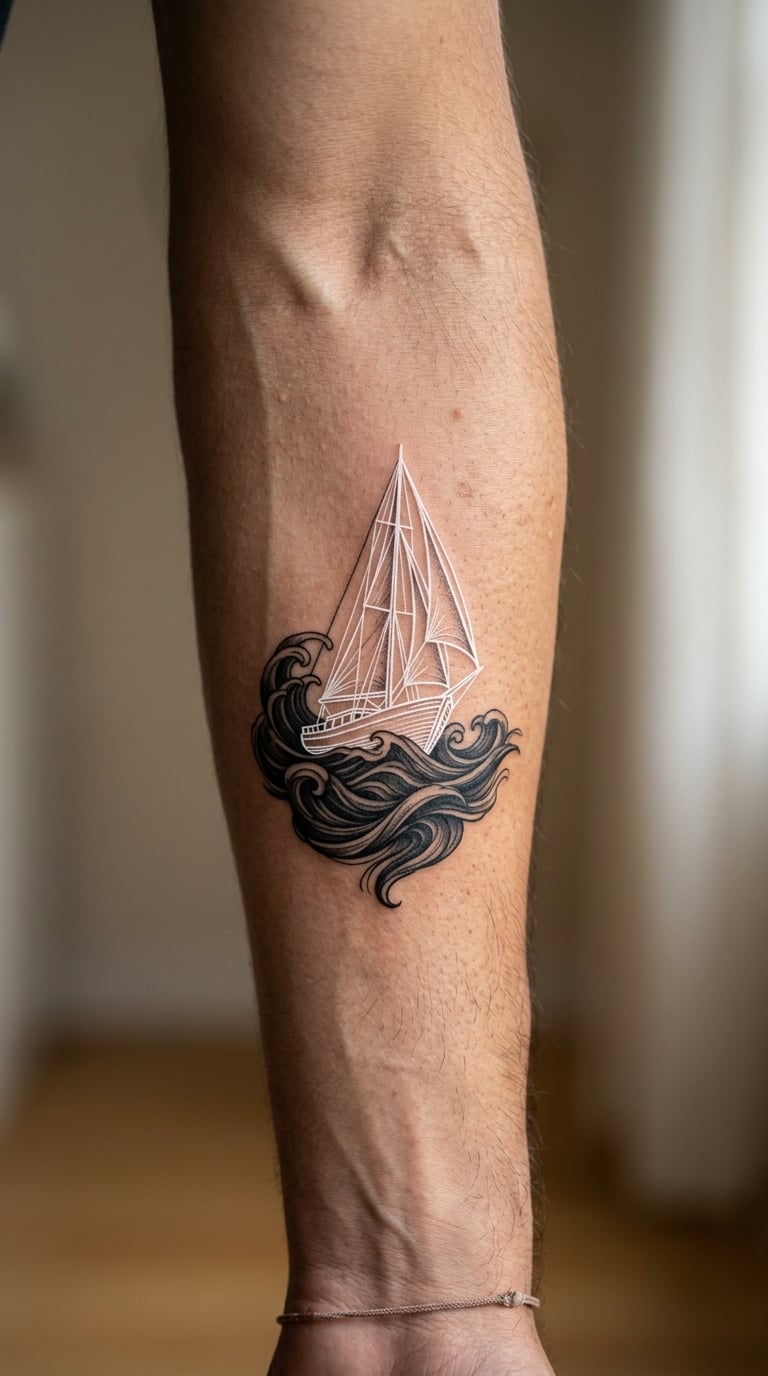
Layered black waves fill the lower third and a solid white hull with a single triangular sail rises out of them. One narrow black gap separates sail from water so the edges stay crisp.
Boats usually stand for travel, a coastline, or a person who got you somewhere. The horizontal wave band makes this one easy to fit into an existing arm piece.
Placement: Inner forearm, calf, or ribs. Size: 3 to 3.5 inches (7.5 to 9 cm) long. Style: Graphic maritime blackwork.
Pain: Medium, and quite tender along the inner forearm. The narrow white sail is the part that dulls first; a slightly wider sail will outlast a narrow one. Make it yours: add a set of coordinates or a date on the hull in tiny black lettering, kept under half an inch tall.
12. Blackwork Scorpion with White Claw Highlights
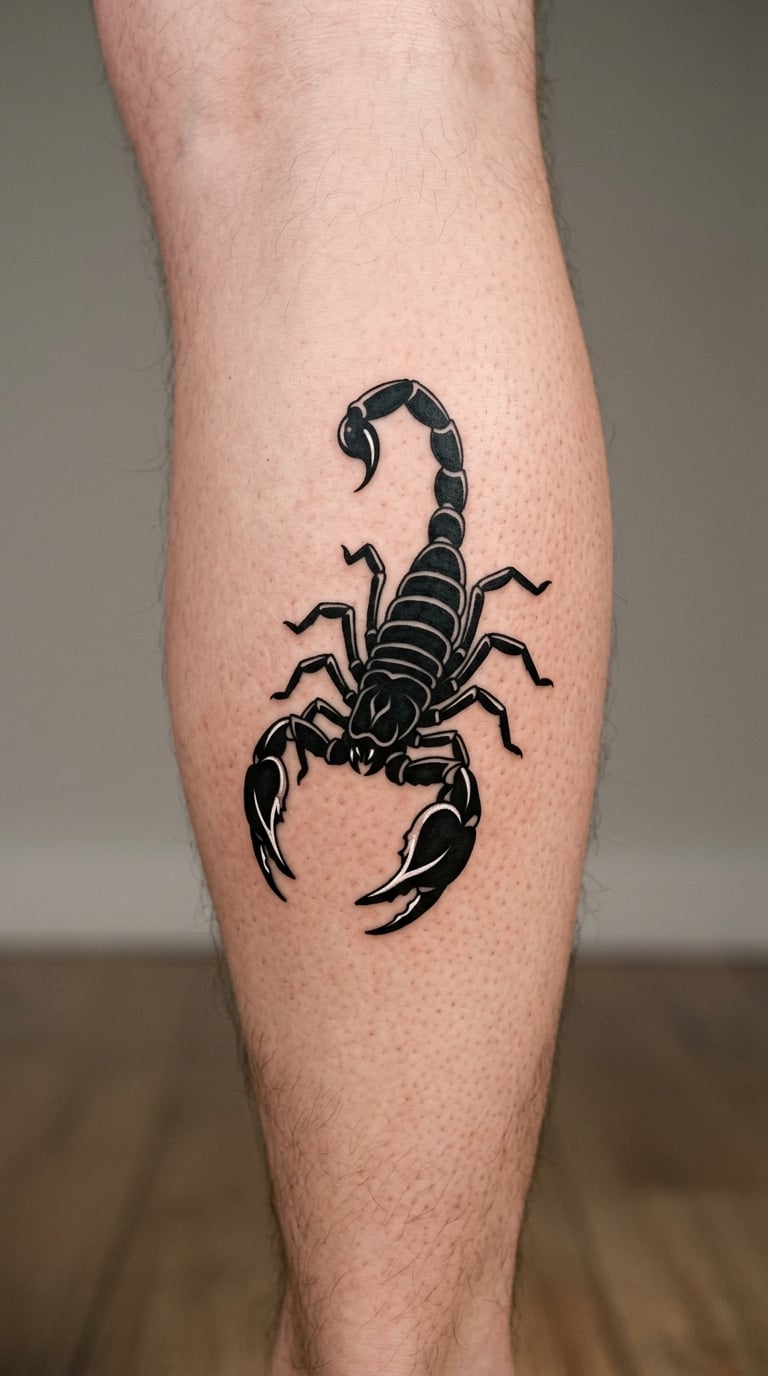
The body, legs and segmented tail are solid black; only the pincers and two tail joints carry white. Keeping the white to a few joints avoids the pale, washed-out look of covering a whole creature.
Scorpions get picked for resilience and for a certain edge. The segmented tail also gives an artist a natural place to hide a short line of text.
Placement: Calf, forearm, or ankle. Size: 3.5 to 4 inches (9 to 10 cm) long. Style: Textured blackwork.
Pain: Medium to high, worse over the shin and the ankle bone. Small tail joints blur into grey, so the artist should thicken them before starting. Make it yours: put a short word or date inside the curve of the tail, large enough to survive at a distance.
13. White Tree of Life Against a Black Circle
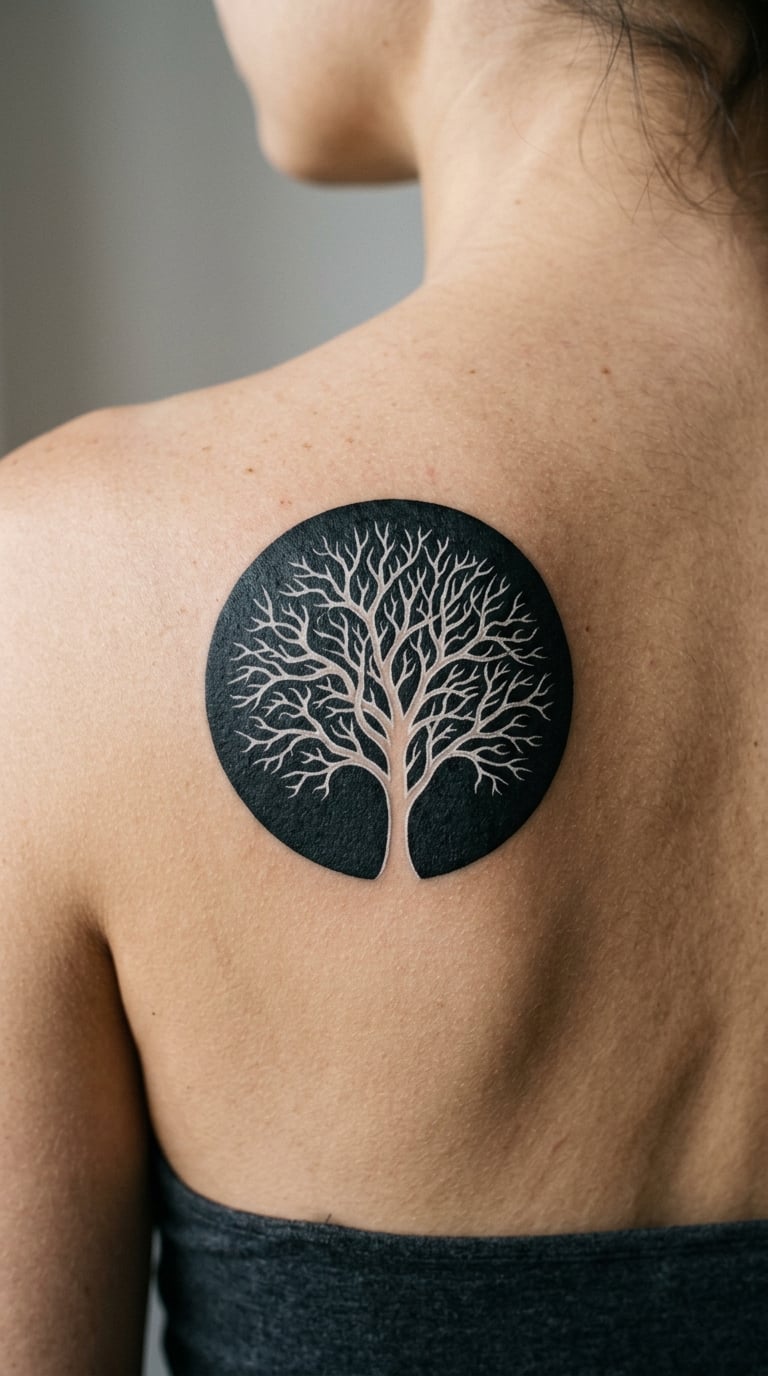
White roots and a branching canopy spread inside a solid black disc, with a few black gaps where branches cross. The circle stops the design drifting and gives the white branches a hard edge.
Tree designs come with a long history of meaning around growth and family lines. Plenty of clients add a specific number of branches to match children or parents.
Placement: Shoulder blade, upper arm, chest, or calf. Size: 3.5 to 4.5 inches (9 to 11 cm) diameter. Style: Sacred geometry, symmetrical.
Pain: Low to medium, and the chest and shoulder blade are both kind sites. Fine white twigs on the outer canopy fade quickest, so trim them back to a simpler shape. Make it yours: count the branches to match a number that matters to you and let the artist split the canopy to fit.
14. Gothic Lace Band with a White Ribbon Accent
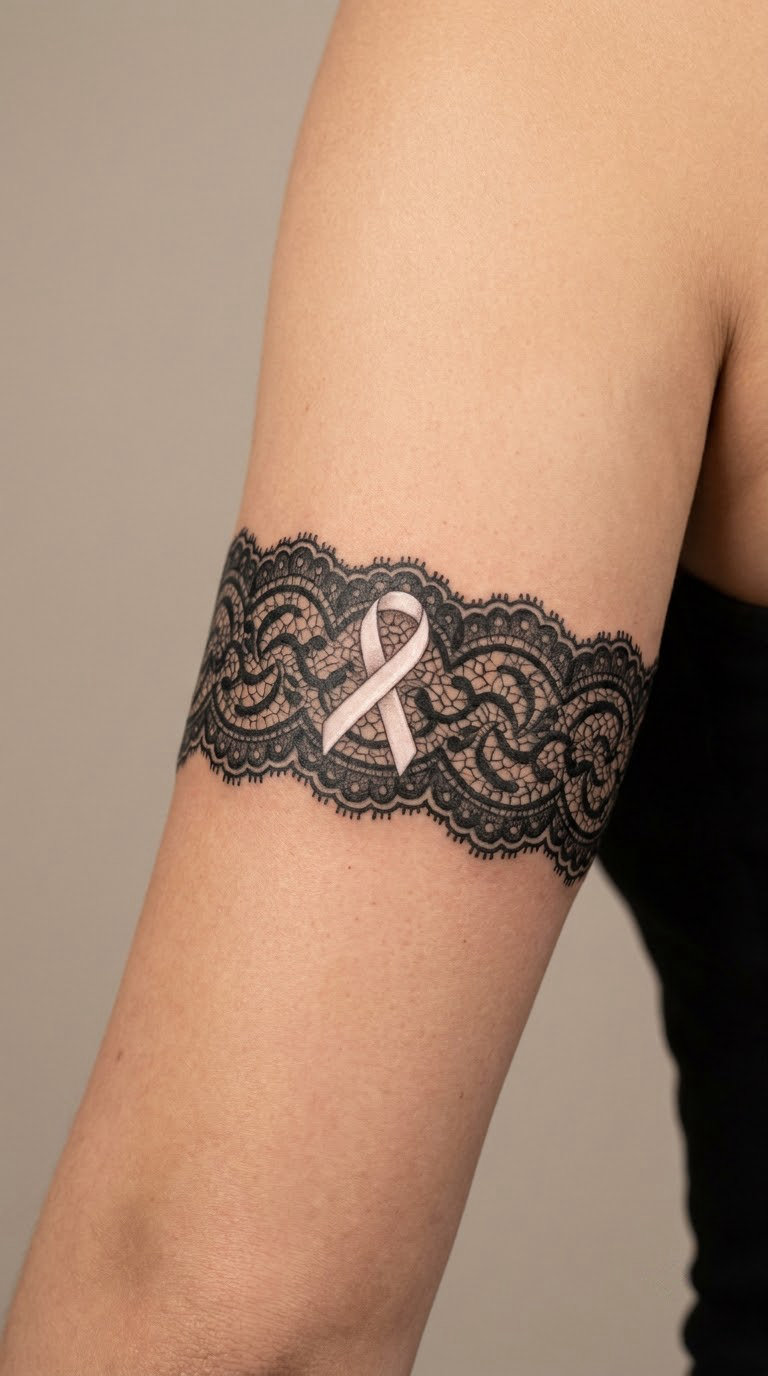
A black lace pattern wraps the limb like a cuff, and one solid white ribbon sits at the front as the focal point. Lace is drawn as open scallops and loops rather than shading, which keeps it readable at small scale.
Arm and thigh bands are often anniversary or memorial pieces, and the white ribbon is where that meaning usually lives.
Placement: Upper arm, thigh, collarbone, or calf. Size: 2 to 3 inches (5 to 7.5 cm) tall, wrapping the full circumference. Style: Ornamental blackwork lace.
Pain: Medium, and the collarbone is the sore spot in that list. A wider band holds its pattern longer than a narrow one, so resist the urge to go under two inches. Make it yours: work a small white charm or a letter into the ribbon knot, or have the pattern taper at the join instead of repeating.
15. White Rose Climbing a Black Fingerprint
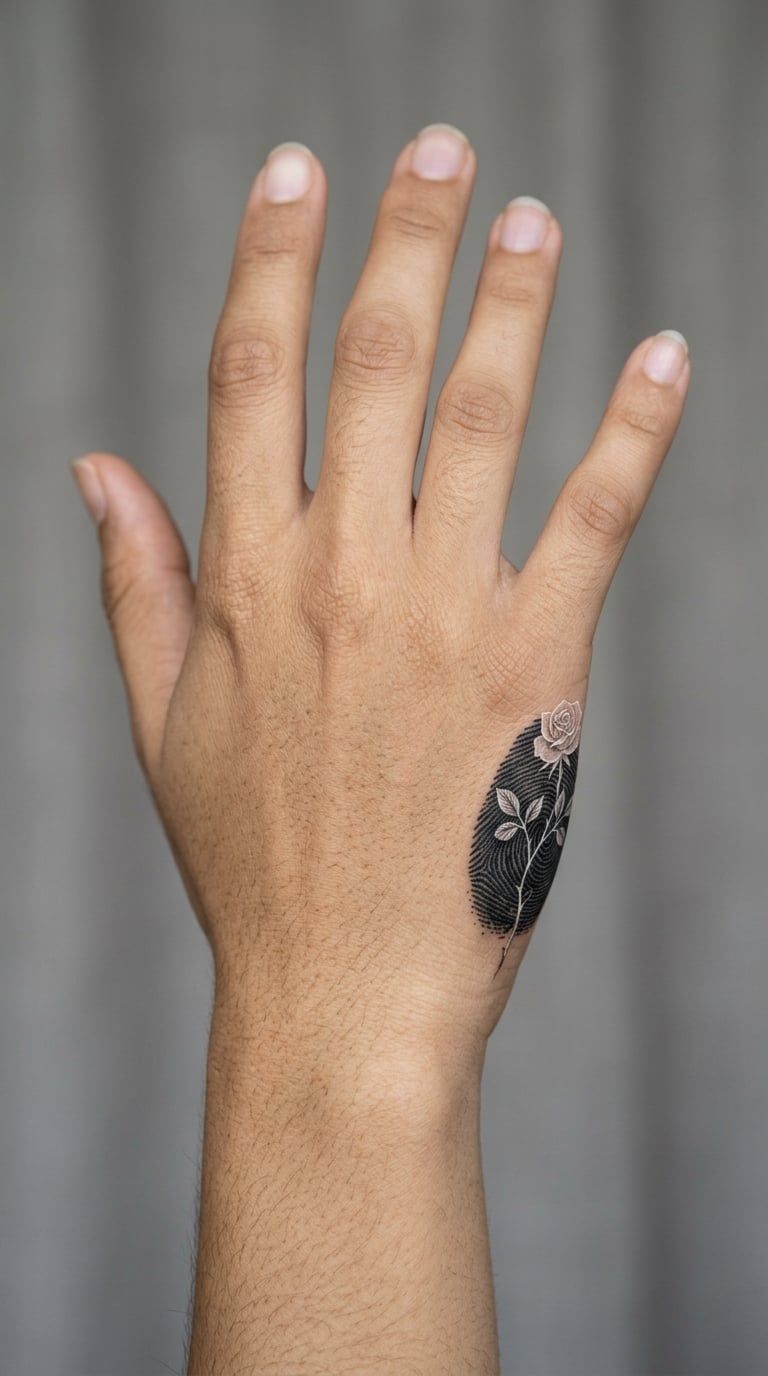
A large solid black fingerprint acts as a field of concentric ridges, and a white rose with a thin stem climbs diagonally across it. The ridges stay graphic lines, not realistic skin texture, which keeps them from turning to mud.
Fingerprints usually stand for a person, a place or a hand that mattered, and the rose growing over it adds a sense of time passing.
Placement: Outer hand below the little finger, or the back of the hand. Size: 2 to 2.5 inches (5 to 6 cm) tall. Style: Fine line and graphic blackwork.
Pain: High. Hand skin is thin, bony and sensitive, and the ridges are closely spaced lines that will soften faster than they look in a reference photo. Make it yours: bring your own fingerprint printout so the ridge pattern is genuinely yours rather than a generic swirl.
16. Black Phoenix with White Feather Breaks
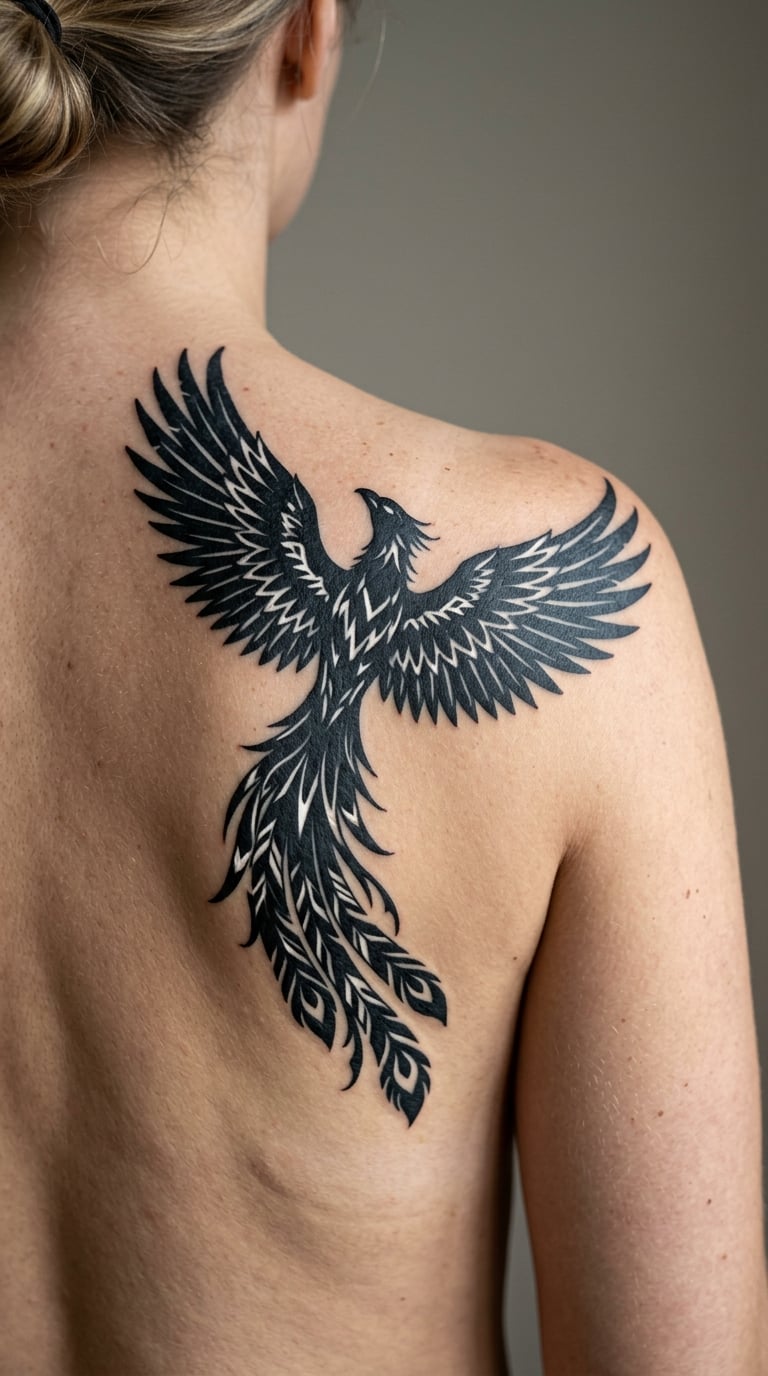
The bird is a black silhouette with three or four solid white shapes cut into the wings and tail. Those breaks read as separate feathers while the outline stays strong.
Phoenix pieces usually mark a rebuild of some kind, a new chapter after a rough stretch. It is a large design, so plan the sessions rather than expecting a single sitting.
Placement: Shoulder blade, upper back, or outer thigh. Size: 5.5 to 6.5 inches (14 to 16 cm) wide. Style: Illustrative blackwork.
Pain: Low to medium in that position, and the back is where long sittings are easiest. The white feather breaks are wide enough to hold, which is the main reason this bird works in two colours. Make it yours: mirror the white breaks on both wings but change the number of them, so the two sides look related rather than stamped.
17. White Hourglass Inside a Black Geometric Frame
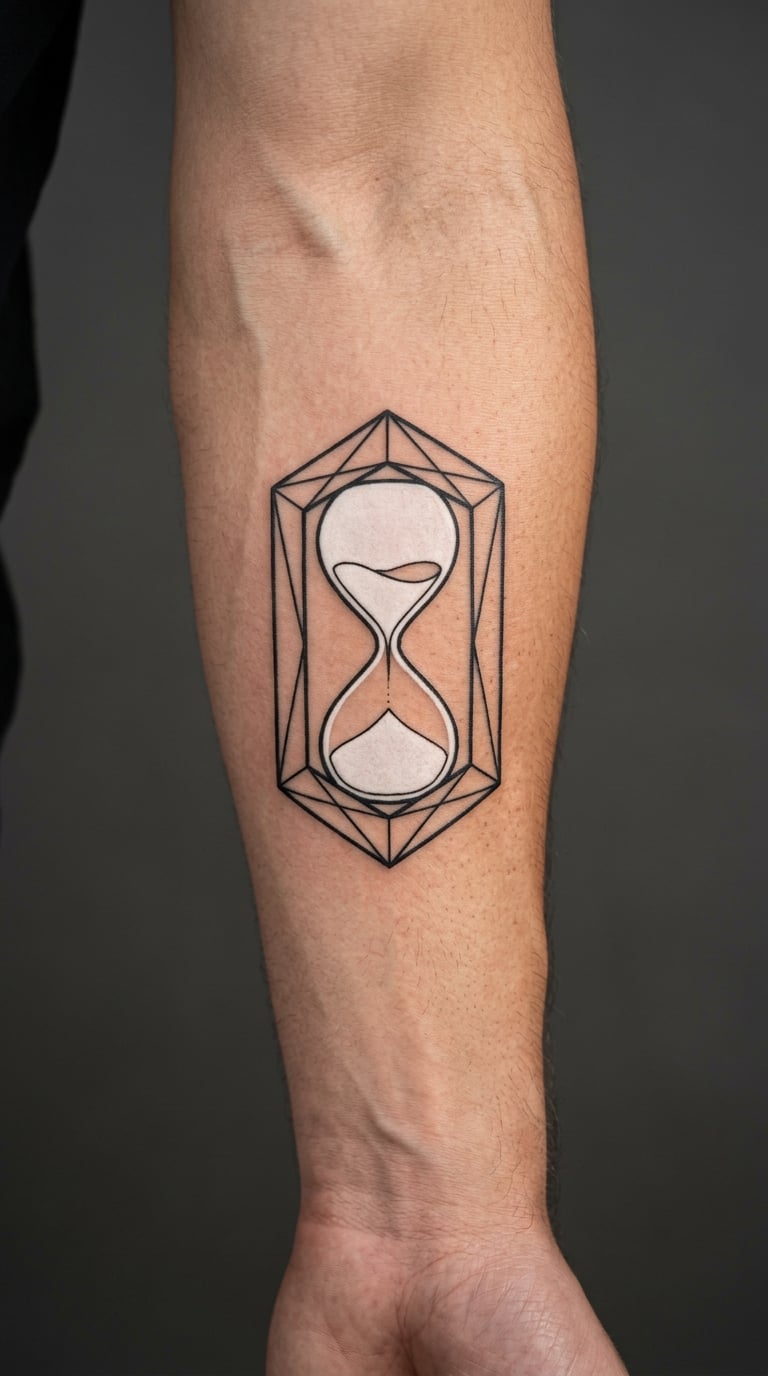
A plain white hourglass sits inside angular black shapes, with the sand left as two flat white triangles. The solid fills hide small irregularities, making this one of the more forgiving designs to get on skin.
Hourglasses are about time passing, and the geometric frame keeps the sentiment from turning sentimental.
Placement: Forearm, inner bicep, or ankle. Size: 2 to 3 inches (5 to 7.5 cm) tall. Style: Minimal geometric blackwork.
Pain: Medium, mild on the inner bicep. The fine gap lines in the frame will blur first, so the artist should keep any outline above roughly the width of a pencil. Make it yours: replace the sand with a handful of black dots that read as grains, or leave the lower chamber empty for a simpler version.
18. Blackwork Jellyfish with White Translucent Domes
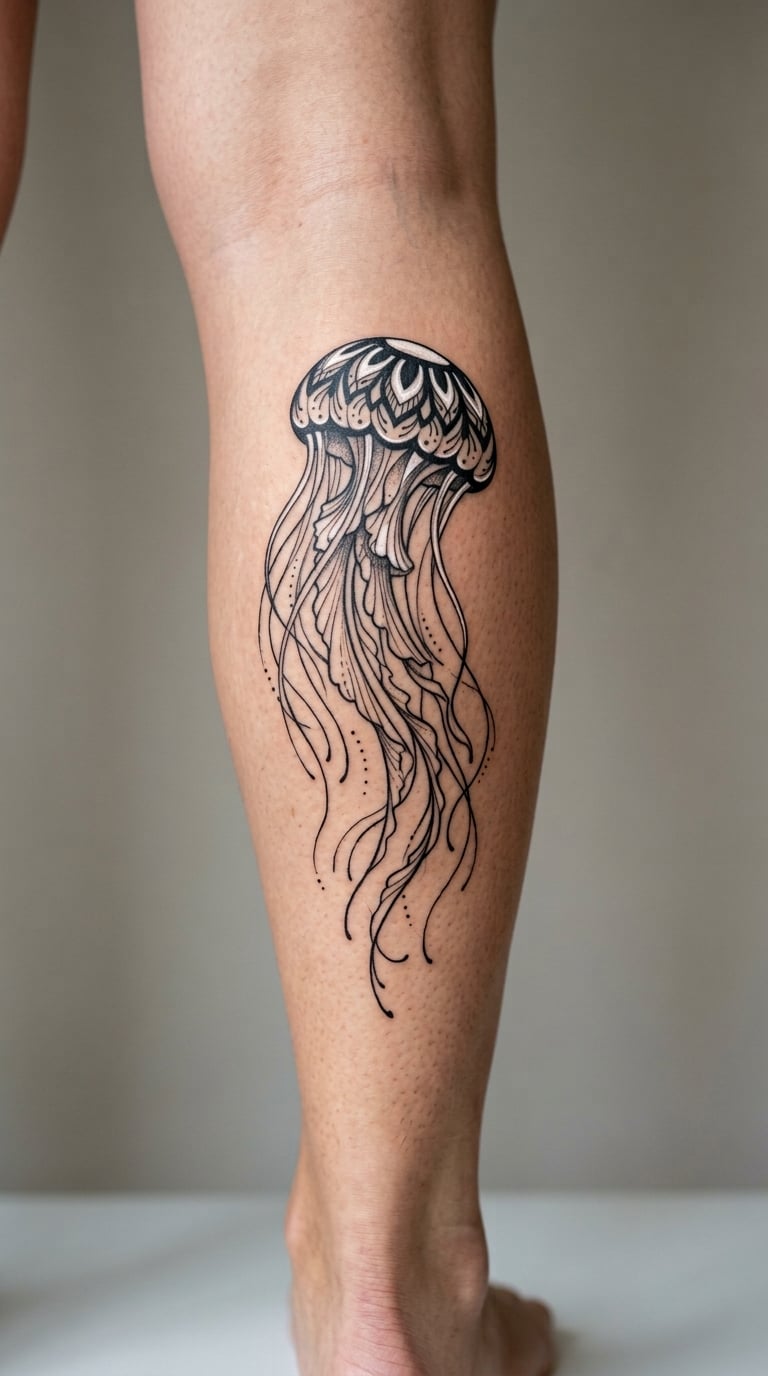
The bell is solid black, and the white domes sit inside it like light passing through. Long black tentacles trail down and fade into a few thin lines, which is where the movement comes from.
Jellyfish are usually chosen for how little they ask you to explain, and the shape is forgiving. They also translate well into a repeating forearm pattern.
Placement: Back of the calf, forearm, or ribs. Size: 4 to 5 inches (10 to 12.5 cm) long. Style: Illustrative blackwork, semi-abstract.
Pain: Medium to high on the back of the calf, and the ribs hurt more. Those fine trailing tentacle lines will not survive a decade, so treat them as atmosphere rather than structure. Make it yours: add a second, smaller jellyfish offset in black only, so the white domes stay the focus.
19. White Mountain Range Beneath a Black Sky
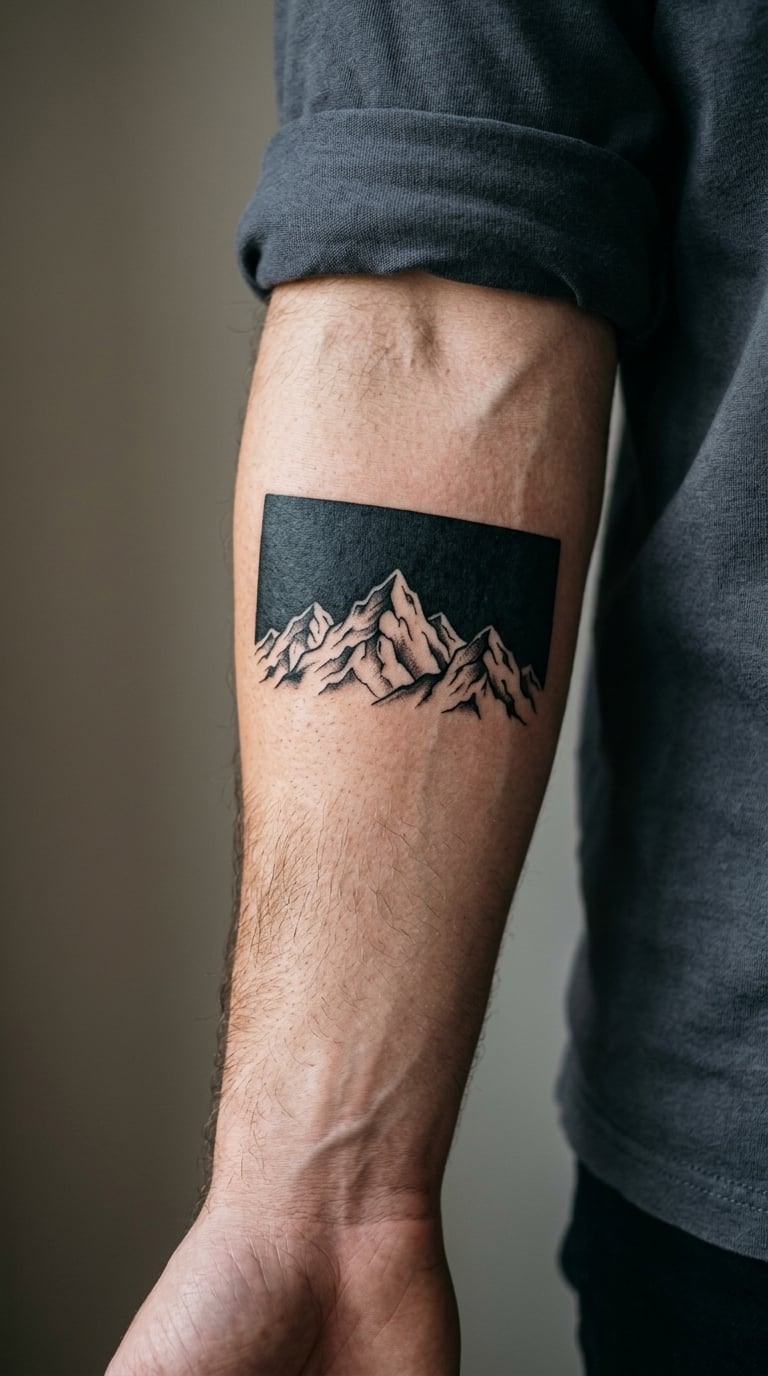
A solid black rectangle fills the upper half and a range of white peaks cuts into it from below, with one black ridge line marking the skyline. Simple tonal division, and it reads from across a room.
Most people connect a mountain piece to a specific hike or a home region, and the rectangle makes it easy to add a name under the peaks later.
Placement: Outer forearm, calf, or ribs. Size: 3.5 to 4.5 inches (9 to 11 cm) wide. Style: Graphic blackwork, tonal.
Pain: Medium, and the rib version is the least comfortable of the three. A large flat black sky is straightforward work and usually heals evenly, which is a plus in a small piece. Make it yours: put the name of the place under the range in black capitals, no taller than a quarter inch.
20. Black Chess Piece with a White Cracked Centre
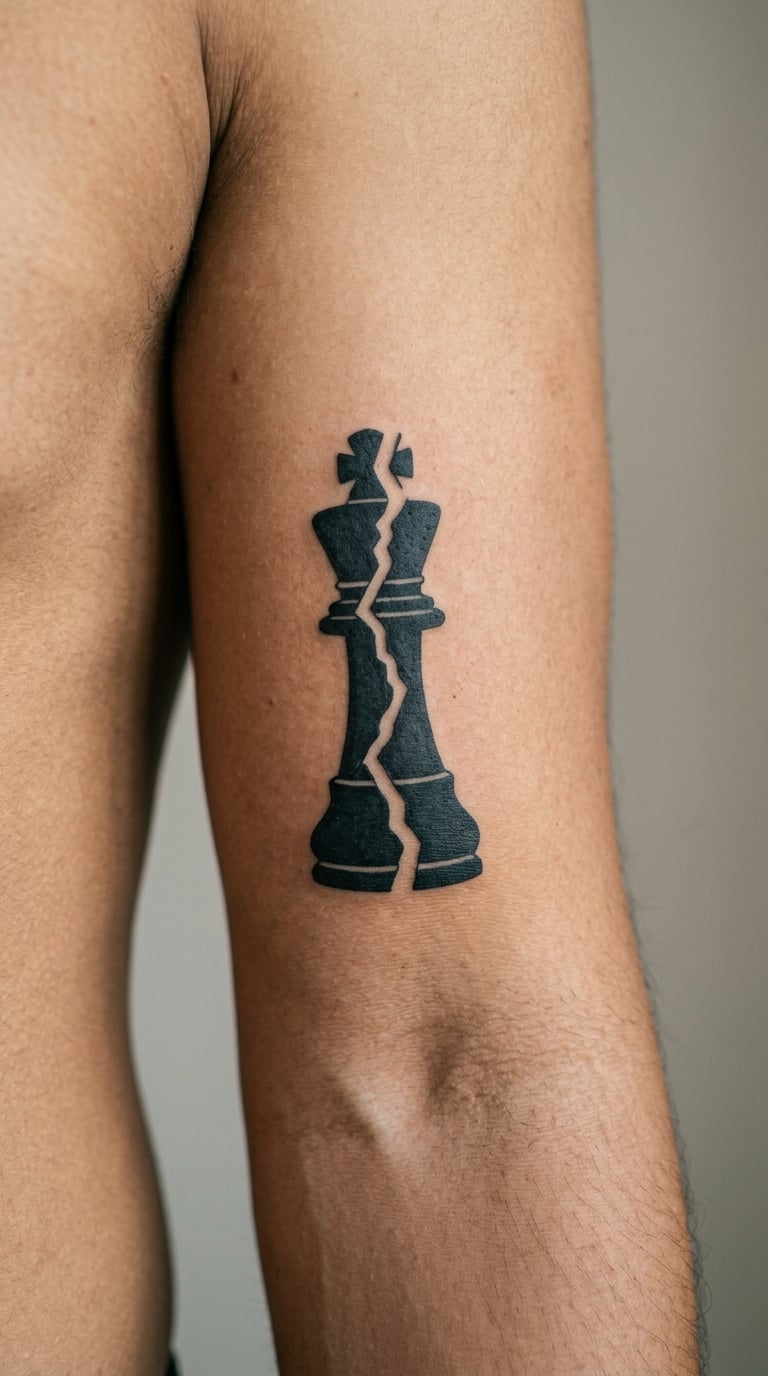
One solid black chess piece, split by a controlled white crack running from base to crown. The crack edges stay sharp and slightly irregular, so it reads as a break rather than a drawn line.
Chess pieces usually point at strategy, patience or a worthy opponent. The crack adds whatever you want it to add.
Placement: Inner bicep, forearm, or calf. Size: 2 to 3 inches (5 to 7.5 cm) tall. Style: Minimal graphic blackwork.
Pain: Medium, and the inner bicep is an easy spot once the first pass is over. A single thin white crack is the part most likely to grey, so a slightly wider gap pays off. Make it yours: add a small black dot inside the crack, or run a short line of text along the base of the piece.
21. White Dandelion Seeds Inside Black Branches
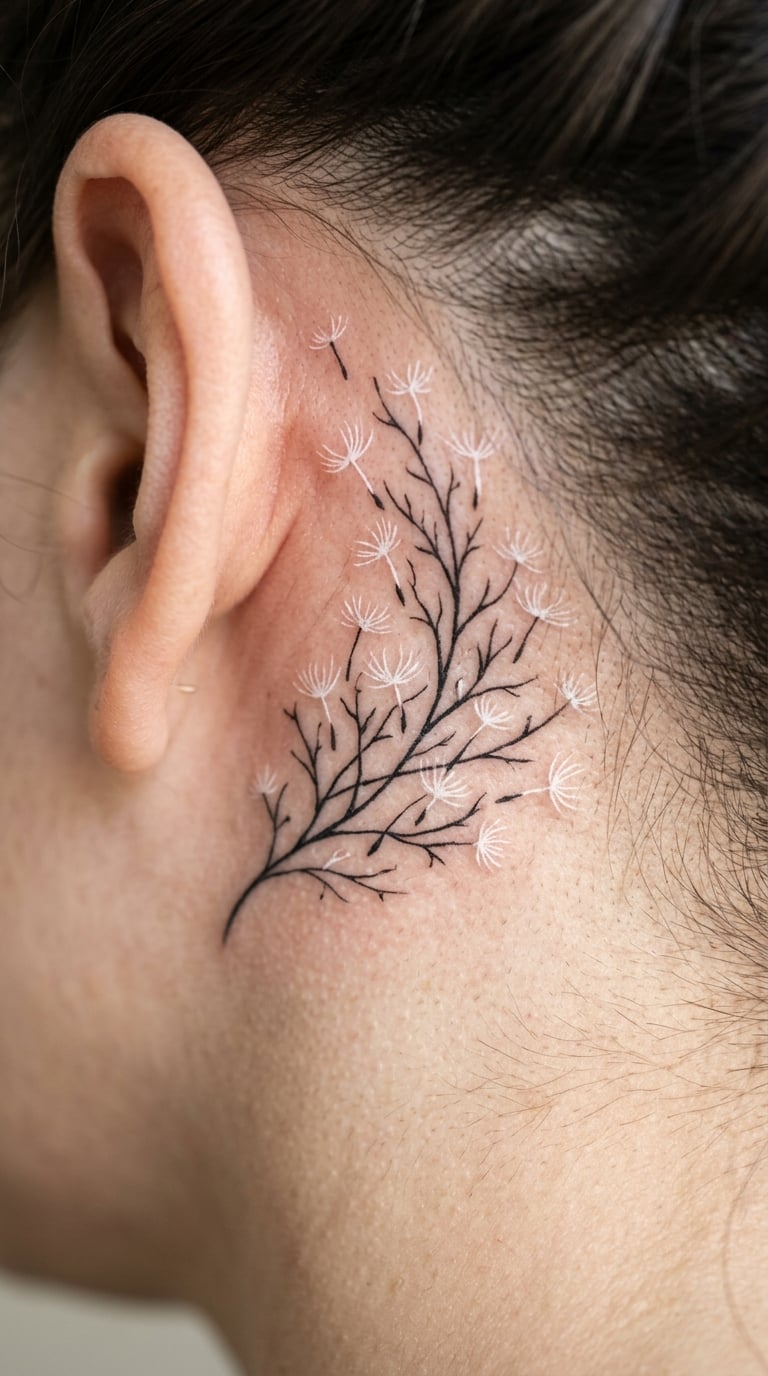
Fine black branches arc through open skin with a few white seed heads and thin radiating lines between them. This is the most delicate design in the list, and the one most sensitive to scale.
Dandelions usually stand for wishes, chance, or something let go on purpose. People tend to add this one years after a first tattoo rather than start with it.
Placement: Behind the ear, inner wrist, or ankle. Size: 2 to 2.5 inches (5 to 6 cm) wide. Style: Fine line with dotwork accents.
Pain: High, and behind the ear stays sensitive for a long while. At two inches the radiating seed lines sit near the limit of what stays visible, so ask for thicker strokes than the reference image suggests. Make it yours: have the seeds drift toward an open edge of the composition, so it follows the line of the neck rather than sitting in a box.
22. Black Serpent and Moon with a White Negative Core
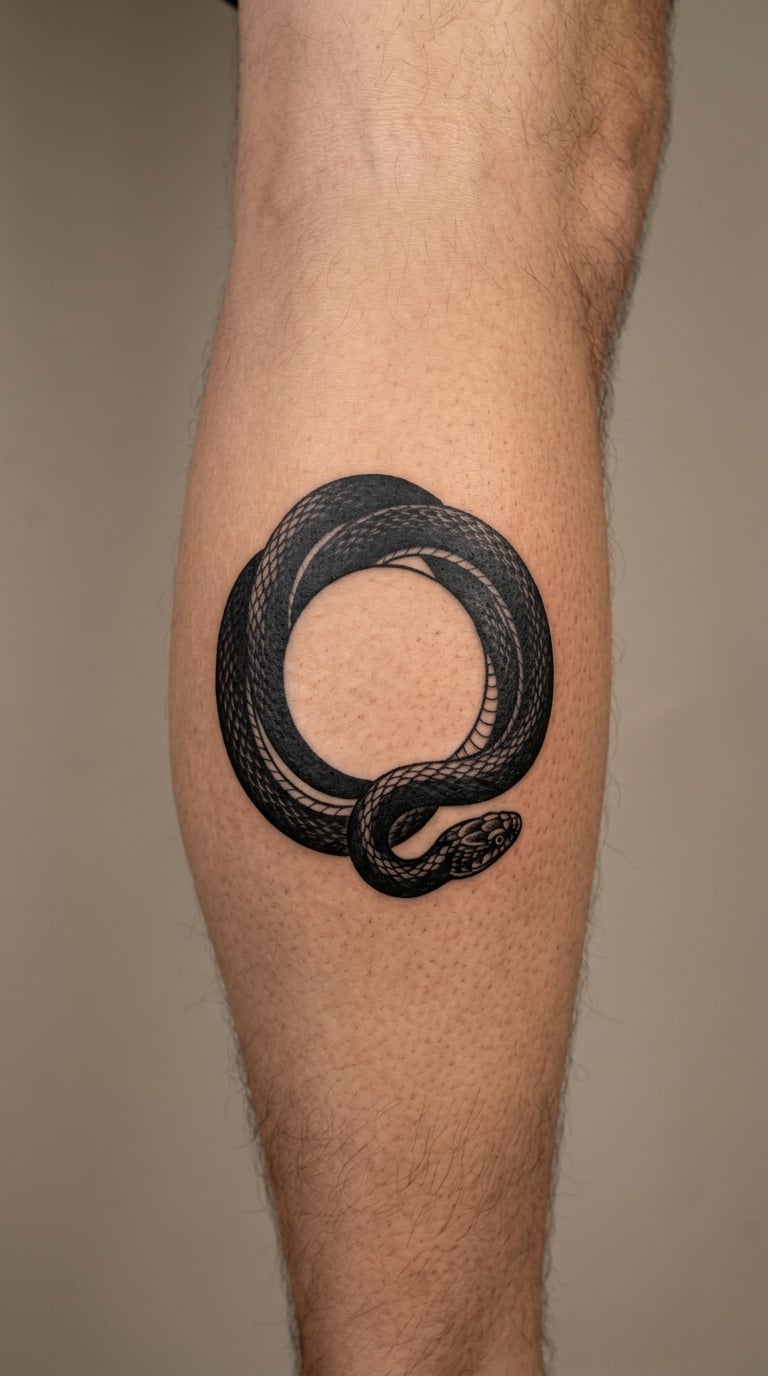
The moon’s centre is left protected and filled with clean white, and a solid black serpent circles it once, tail crossing under the body. That single white core is the whole design; everything else is frame.
Serpents get chosen for transformation and a long cycle, and the moon is a good partner when you want a full piece without extra clutter. It works well as a closing statement for a sleeve.
Placement: Outer calf, forearm, or ribs. Size: 4 to 4.5 inches (10 to 11 cm) tall. Style: Blackwork, ornamental.
Pain: Medium, higher over the calf bone. Keeping the black gaps around the white core wide is what protects the contrast, so ask the artist to plan those spaces before the first pass. Make it yours: place a tiny mark inside the white core, small enough to read as texture rather than a second subject.
How to Choose the Right Design
Check the contrast before anything else. Lay the design out in black and white on paper, then squint at it from arm’s length. If the shapes merge into a grey block, it will not survive on skin.
Ask about minimum line width next. Any white line narrower than about a millimetre will blur into the black field within a few years, and your artist should tell you honestly where that limit sits for the size you have in mind.
Think about how the design follows the body. A moon reads well along a forearm’s curve, while a circular tree wants a flatter site such as the shoulder blade. The 85 bold blackwork tattoo ideas gallery helps here, because placement is where most of those shapes were designed for.
Check compatibility with existing work. White over black sits fine beside solid black, but it fights a piece with grey wash shading, since the white will out-shout it and the black under it will flatten it.
Look for healed work in the artist’s portfolio, not fresh work. Fresh white ink is at its brightest and gives away nothing about how a piece looks at two years, which is the version you are actually choosing.
Finally, be honest about session count. A micro piece and a six-inch phoenix are not the same booking, and an artist who quotes one sitting for either is telling you something useful.
22 White Ink Over Blackwork Tattoo Ideas on Deeper Skin: What Changes
Deeper skin tones do not rule this technique out, but they change what works. The white sits closer in tone to the surrounding skin, so contrast comes from the black doing more of the work rather than the white doing it.
On deeper skin, artists usually widen the white areas into solid blocks and reduce the number of thin white lines, because a narrow white line has little to contrast against. A consultation where the artist sketches directly onto your skin in the position you are considering is worth more than any photograph.
Ask to see healed pieces on skin tones similar to yours, and take that request seriously. Artists who work this way regularly will have the portfolio to show it.
Cost and Session Time
The reliable way to read a price here is by hours of chair time, because the two-colour process bills the same as any other tattooing. Micro pieces often cost little more than the shop minimum, which covers setup regardless of size.
Small-to-medium pieces at two to four inches usually run one sitting of two to three hours. Larger floral or bird designs at five or six inches commonly take two sessions, because the black field has to heal before the white goes on.
A full limb piece is a different project entirely: several long sittings spread over months. Hourly rates, shop minimums, travel and touch-up policies vary by city and by artist, so ask for a written estimate before booking rather than assuming a number.
If you are combining this style with an older sleeve rework, the 20 trash polka tattoo ideas in bold blackwork show a comparable density of black fill, which is a useful reference for what you are signing up for in chair hours.
Aftercare Basics
- Follow your tattoo artist’s aftercare guidance first, since they know exactly what they put in your skin and how much black area you have.
- Wash the area gently with unscented soap and clean water, then pat dry rather than rubbing.
- Keep a thin layer of a recommended moisturiser on it through the first days to stop the healing skin tightening.
- Wear loose clothing over the piece for the first week or two, and change it daily if it sits against skin.
- Keep the area out of direct sun while it heals, and keep sun exposure low afterwards, since UV is what dulls white pigment fastest.
- Book a review with your artist once the surface has settled, so any greyed white areas can be brightened while the piece is still fresh.
Frequently Asked Questions
Does white ink tattoo over blackwork?
Yes, but only in two stages. Your artist first lays down an opaque black field and lets it heal fully, then returns to tattoo the design in white on top. White does not cover black in a single pass, and most pieces need two or more sessions because the pigment has to be built up in layers to read bright.
Will white ink over blackwork fade or change colour?
Expect gradual softening rather than a hard change. White pigment usually settles into a warm cream or a pale grey as it ages, and the black underneath stays solid, so the contrast drops even when the black looks untouched. Sun exposure speeds this up considerably, which is why covered placements hold their brightness longer.
What is the best body placement for white ink blackwork?
Flat or gently curved areas work best, so the upper back, shoulder blade, outer thigh and outer calf are strong choices. Wrists, hands and ankles are harder because the skin is thin, the surface moves constantly and fine detail there fades quickly. Ask to see healed examples on similar skin before deciding.
Can a tattoo artist fix a white area that turns grey?
Usually yes. A greyed white area is usually a saturation problem rather than a dead one, and an artist can rework it by tattooing fresh white into the same spot, sometimes with a slightly bolder outline. Go back to the artist who did the original piece where possible, because they know how much black sits under it.
How should I prepare for a white-ink blackwork tattoo?
Get a good night’s sleep, eat properly beforehand and avoid alcohol, since a large black field is a long sitting. Wear something that opens easily at the placement, because you will not want clothing pulled over fresh black work. Most importantly, book an artist whose healed portfolio already shows this exact technique.
Conclusion
For a first tattoo, start with the minimal white eye in a black splash or the hourglass in a geometric frame. Both are small, both hold their contrast, and neither asks an artist to guess at a detailed drawing.
If you are adding to a collection, the phoenix, the serpent and moon, or the gothic lace band give you something with enough black to fill a gap in a sleeve. Whichever you pick, decide the placement first, then find an artist whose healed work already looks like that design, and book from there.