
25 Surrealism Tattoo Ideas for Art Lovers (October 2026)
These 25 surrealism tattoo ideas cover the full range of the style, from a fine-line star slipping out of a hand to a blackwork storm trapped inside a rib cage. Every entry lists where it sits best, how big to draw it, how the style handles ageing, and one way to make it personal.
Surrealism works on skin when one element is drawn with real care and the physics around it are quietly broken. A teacup rendered in perfect porcelain holds a spiral galaxy. A fish walks across a cloud. The contrast between accuracy and impossibility is the whole trick, and it is why these designs suit people with a specific dream, memory or half-remembered image they want carried around.
Plan the timing, and check the page again in 2026 if you are booking across the turn of the year. Fresh ink looks sharper than healed ink for every style here, and a detailed piece needs four to six weeks of settling before it photographs well, so if you have a trip, a shoot or a family event coming, work backwards from that date rather than forwards from today.
25 Surrealism Tattoo Ideas: Quick Guide
Scan the table first. It lists every design in this article with its style, the placement that suits it, a realistic size in inches and centimetres, and an honest pain estimate for that spot.
| Idea | Style | Best placement | Size | Pain |
|---|---|---|---|---|
| 1. Hand letting a star escape | Fine line | Inner forearm | 3-4 inch (8-10 cm) | Low |
| 2. Melting pocket watch | Watercolor | Outer forearm | 4-5 inch (10-13 cm) | Medium |
| 3. Eye emerging from a cloud | Blackwork | Outer upper arm | 5-6 inch (13-15 cm) | Medium |
| 4. Door floating in space | Micro fine line | Behind the ear | 1.5-2 inch (4-5 cm) | Low |
| 5. Moon with a human profile | Traditional | Calf | 5-7 inch (13-18 cm) | Medium |
| 6. Birds leaving an open head | Dotwork | Shoulder blade | 4-6 inch (10-15 cm) | Medium |
| 7. Teacup filled with a galaxy | Micro-realism | Inner forearm | 2.5-3.5 inch (6-9 cm) | Medium |
| 8. Skeleton holding a bouquet | Traditional | Outer thigh | 6-8 inch (15-20 cm) | Medium |
| 9. Upside-down fine-line portrait | Fine line | Outer upper arm | 4-5 inch (10-13 cm) | Medium |
| 10. Impossible staircase | Black and grey | Back of upper arm | 5-7 inch (13-18 cm) | Medium |
| 11. Flowers growing from a skull | Watercolor | Forearm | 5-6 inch (13-15 cm) | Medium |
| 12. Hand holding a tiny Earth | Micro-realism | Upper arm | 3-4 inch (8-10 cm) | Medium |
| 13. House floating above a hand | Minimal fine line | Inner wrist | 2-3 inch (5-8 cm) | Medium to high |
| 14. Fish walking across clouds | Realism | Thigh | 5-6 inch (13-15 cm) | Medium |
| 15. Key growing a peony | Antique linework | Forearm | 3-4 inch (8-10 cm) | Medium |
| 16. Mushroom house with one lit window | Blackwork | Calf | 6-8 inch (15-20 cm) | Medium |
| 17. Mirror with a different reflection | Realism | Forearm | 4-5 inch (10-13 cm) | Medium |
| 18. Sun with an open mouth | Neo-traditional | Upper arm | 4-5 inch (10-13 cm) | Medium |
| 19. Cloud with small sharp teeth | Watercolor | Ribcage | 4-5 inch (10-13 cm) | High |
| 20. Mountain range growing from a nose | Fine line | Forearm | 3-4 inch (8-10 cm) | Medium |
| 21. Spiral staircase reaching a planet | Dotwork | Upper arm | 4-5 inch (10-13 cm) | Medium |
| 22. Hands holding a cracking moon | Colour illustrative | Collarbone | 5-6 inch (13-15 cm) | Medium to high |
| 23. Butterfly beneath a glass dome | Micro-realism | Forearm | 2-3 inch (5-8 cm) | Medium |
| 24. Storm inside a torso | Blackwork | Side of torso | 8-12 inch (20-30 cm) | High |
| 25. Rain made of tiny letters | Fine line | Forearm | 4-5 inch (10-13 cm) | Medium |
25 Surrealism Tattoo Ideas by Style and Placement
The list moves between three families. Fine-line and micro pieces sit on wrists, forearms and behind the ear. Blackwork and realism pieces want flat, wide areas such as the upper arm, calf and thigh. Watercolor and colour work lands best where skin stays soft and rarely creases.
Read the quick guide for the short version, then open the idea you like for the detail. Every surrealism tattoo idea here is described precisely enough that an artist could sketch it from the text alone, and every one comes with a personalisation option so the piece is not a copy of someone else’s.
1. Fine-Line Hand Letting a Star Escape
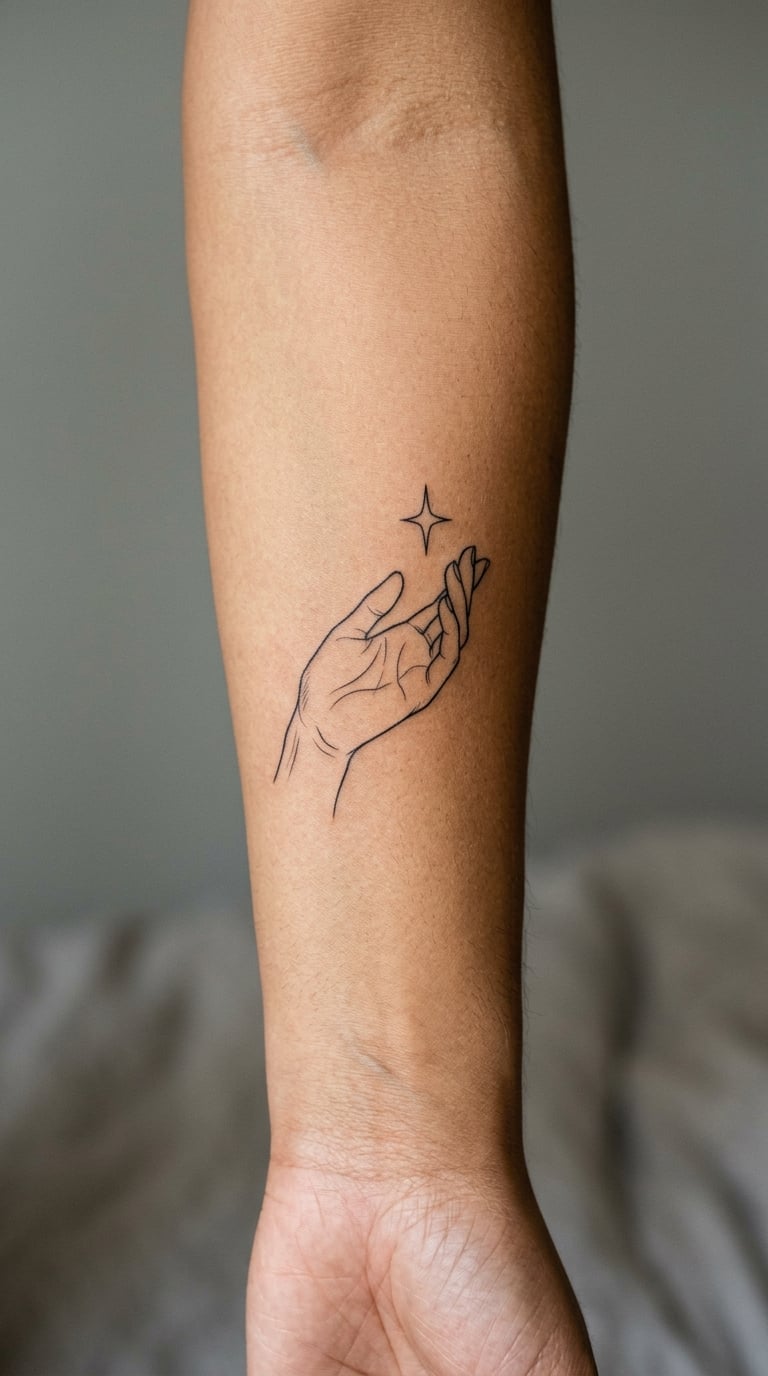
This surrealism tattoo idea shows a relaxed hand drawn with a single consistent line weight, fingers slightly apart, with one small four-pointed star drifting a finger’s width above the fingertips. Nothing is shaded, which is the point: the piece works because of the gap between the hand and the star.
People choose it for the release in the image rather than for a fixed dictionary meaning. It reads as letting something go, and wearers often attach their own reason privately.
Placement: inner forearm, wrist crease to mid-forearm. It also reads on the outer bicep if you want it more public. Size: 3-4 inch (8-10 cm) tall. Style: fine line, single weight, no shading.
Pain: low on the inner forearm, a scratchy sustained feeling. Fine line fades faster than solid black, so plan for a refresh every few years, especially if the hand sits near the wrist crease where skin moves constantly.
Make it yours: replace the four-pointed star with a real constellation of five dots in the same position, keeping the same amount of empty space.
2. Watercolor Melting Pocket Watch
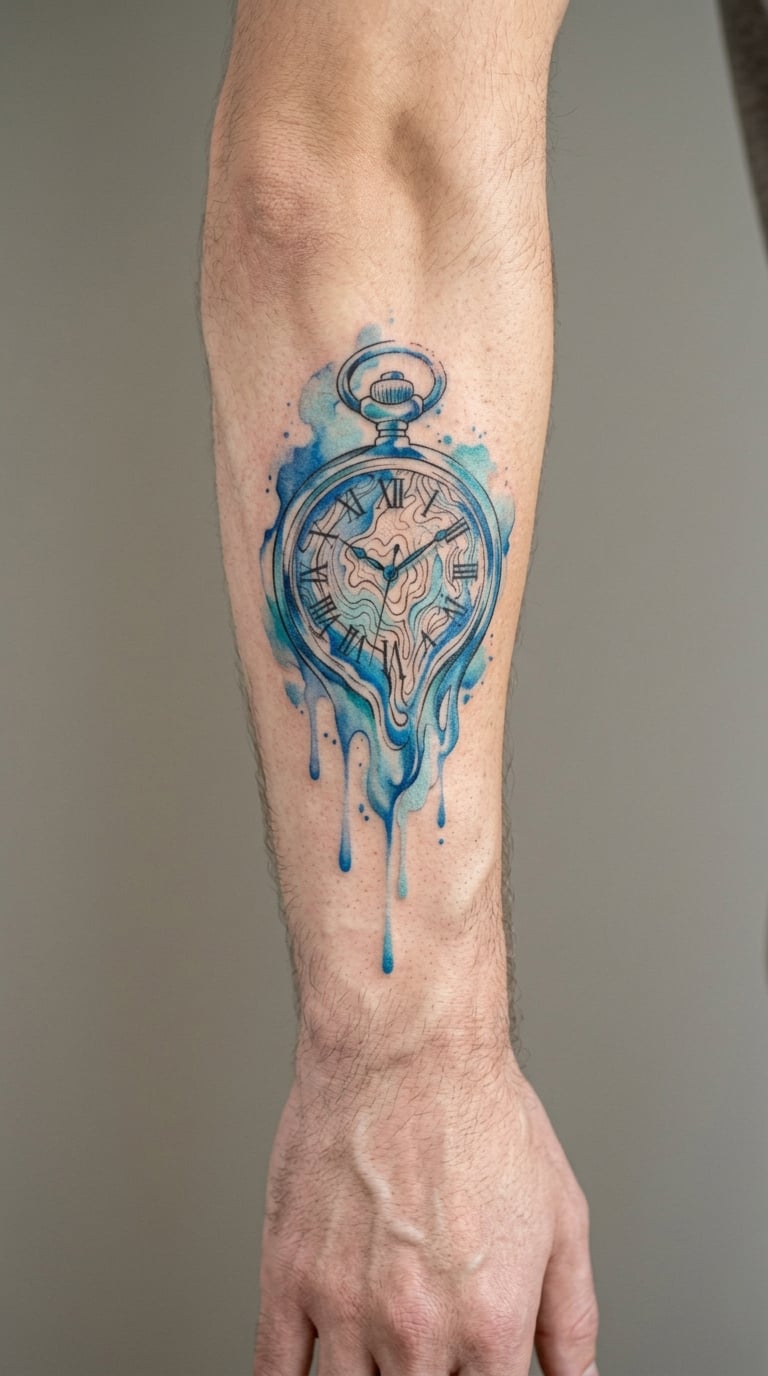
A round pocket watch with a chain loop at the top, its lower half drooping and running into soft bleeds of pale blue and grey as though the case were wet paint. The hands stay crisp and readable, pointing at an hour that makes no practical sense.
The melting clock is the most borrowed image in the style, so people take it for the idea rather than for the association. Anyone can read the impossibility immediately, which is why it works as a first surreal piece.
Placement: outer forearm or the flat of the upper arm. Size: 4-5 inch (10-13 cm). Style: watercolor with a black outline on the dial and loose bleeds below.
Pain: medium. Watercolor shading means many more passes than an outline piece. The bleeds feather over time and a few years of sun will lift the pale blues faster than the black line, so expect occasional colour touch-ups.
Make it yours: set the hands to a time that means something to you and ask for a faint chain trailing off the wrist edge.
3. Blackwork Eye Emerging from a Cloud
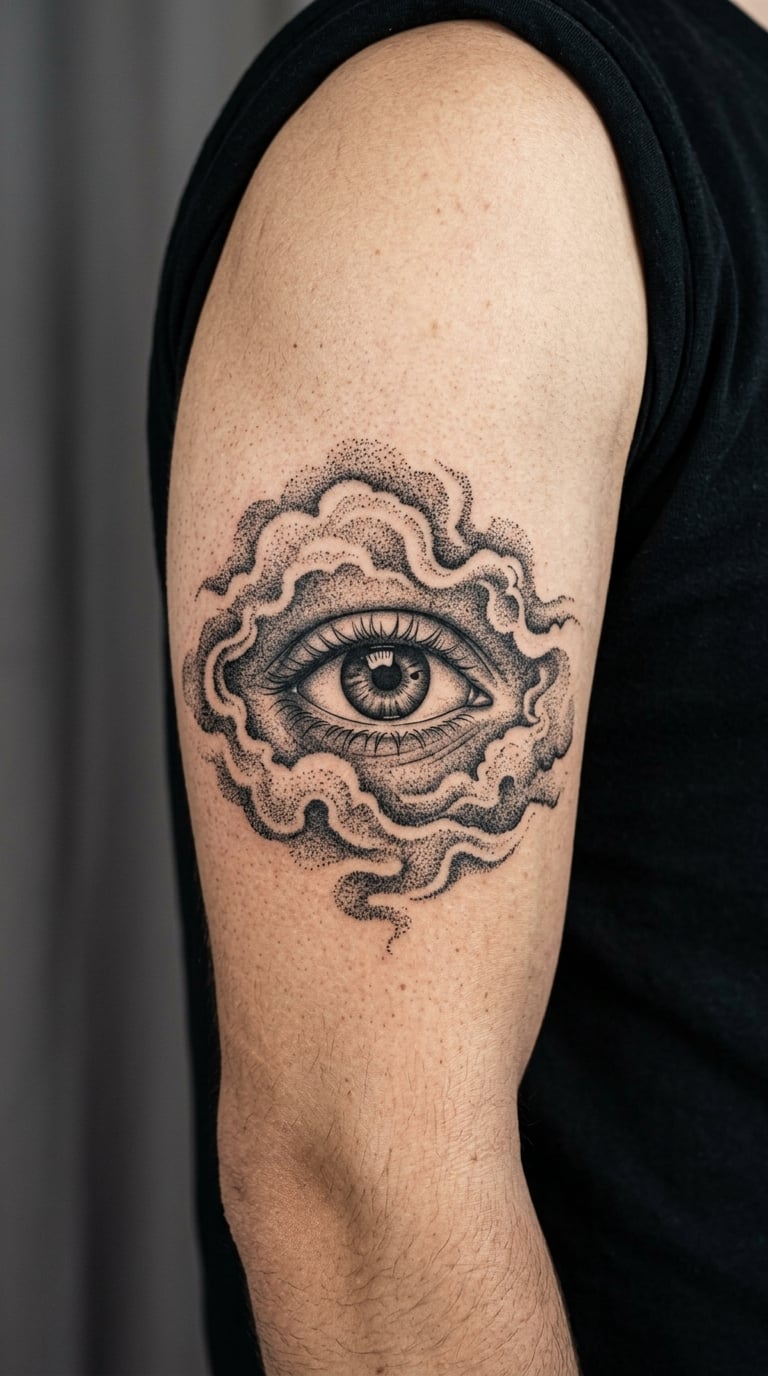
A single eye drawn in solid black linework, iris fully rendered, sitting inside a mass of stippled dots that thins toward the edges. The eye is sharp and finished; the cloud is loose and unfinished. That mismatch is the design.
It appeals to people who want a watchful, slightly unsettling image without committing to dark work across a large area. There is no agreed meaning, so the reading stays personal.
Placement: outer upper arm, deltoid area, where the shape has room to breathe. Size: 5-6 inch (13-15 cm) across. Style: blackwork with stipple gradient, no colour.
Pain: medium, and the stippling is slow work. Solid black holds its shape for decades, which is the main reason to push this one toward heavier coverage rather than thinner lines.
Make it yours: have the dots trail downward like rain rather than spreading evenly, so the cloud falls away from the eye.
4. Micro-Line Door Floating in Space
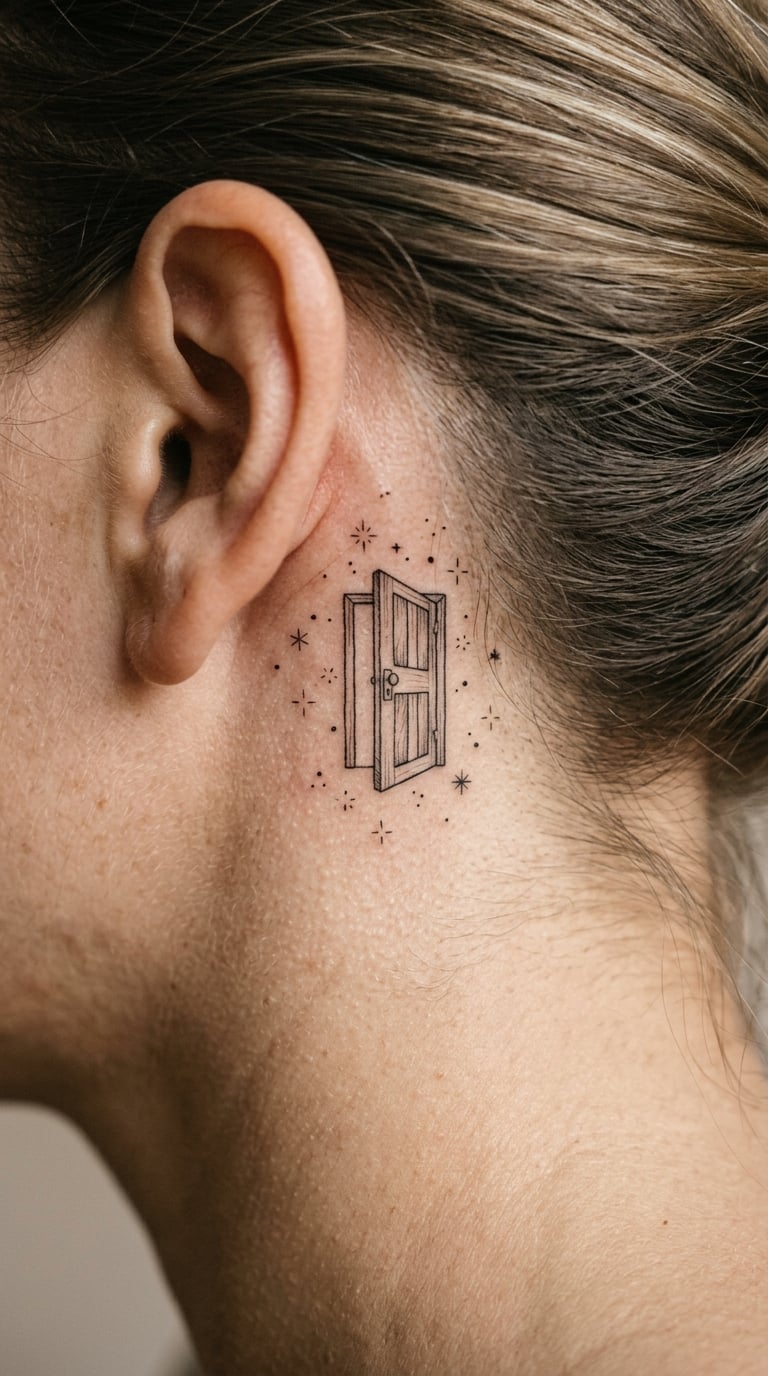
A tiny door with no wall attached, hinged open onto a solid dark interior, surrounded by a handful of scattered pin-point stars. Hairline weight throughout, and the whole thing fits inside a circle you could cover with a coin.
People choose a free-standing door for the open/closed question it quietly asks, not for any agreed symbolism. Behind the ear it stays a private thing that only people standing close get to see.
Placement: behind the ear, inner arm, or the sternum notch. Size: 1.5-2 inch (4-5 cm). Style: micro fine line.
Pain: low, and the session is short. This is the smallest design in the list, so accept that the interior may reduce to a smudged dark shape within five years. Ask for the frame lines a little heavier than you think they need to be.
Make it yours: put a date, in tiny numerals, on the door’s threshold line instead of leaving it blank.
5. Traditional Moon With a Human Profile
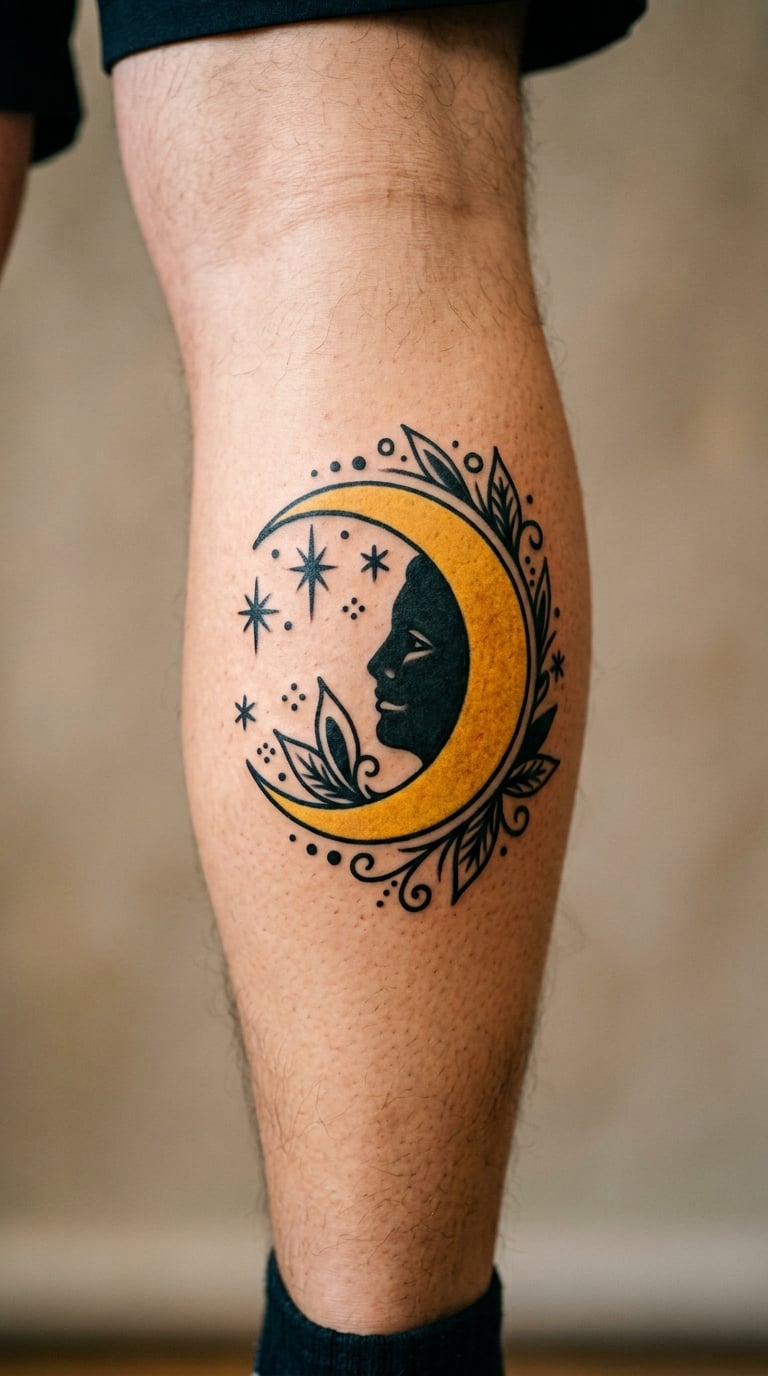
A bold crescent moon in warm yellow with heavy black outline and traditional shading, and inside the crescent a calm human profile in solid black facing left. Clean contour lines, flat colour, nothing photorealistic, the whole thing built like an old-school flash design.
The moon is widely worn, so the profile is what makes this one specific to the person getting it. It is a common request after a birth, a death or a difficult year.
Placement: outer calf, or the flat of the upper arm. Size: 5-7 inch (13-18 cm). Style: traditional, bold outline with flat colour and light shading.
Pain: medium on the calf, which has good muscle but visible bone at the edges. Traditional colour with even saturation fades far more gracefully than shading, and a yellow crescent will need a refresh sooner than the black outline.
Make it yours: turn the profile toward the moon’s open side, or add one small star inside the crescent behind the face.
6. Dotwork Birds Leaving an Open Head
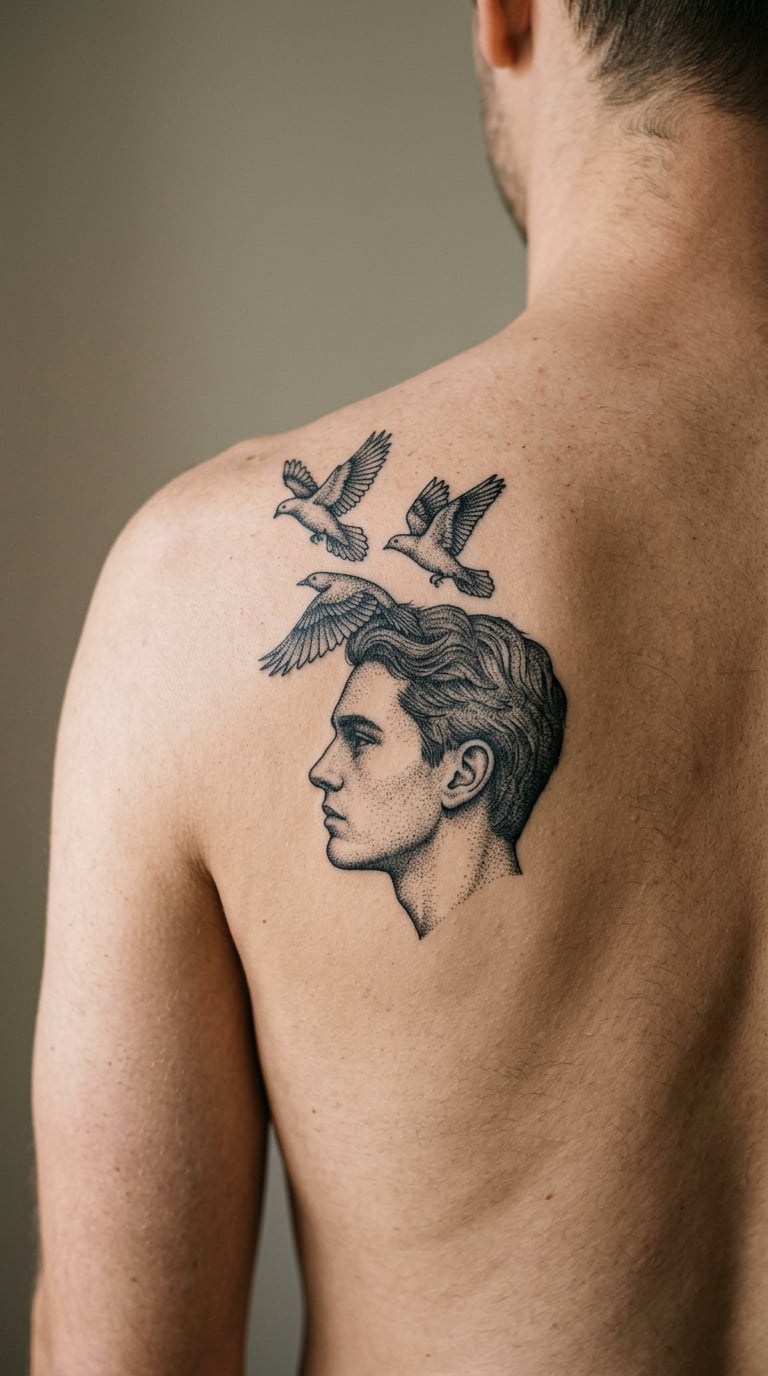
A human head in profile built entirely from dots, the dots denser at the back of the skull and lighter at the face, with the crown open. Three small birds in solid black lift away from that gap, wings mid-beat.
The idea reads as something leaving the mind rather than escaping the body, and the birds are the part people personalise most. It is a common dream-image tattoo.
Placement: shoulder blade, or the back of the upper arm. Size: 4-6 inch (10-15 cm). Style: dotwork with solid black accents.
Pain: medium, and the shoulder blade sits close to bone so you will feel the dots individually. Dotwork tends to develop a faint grey cast after a few years as dots spread, so heavier spacing between them helps it stay readable.
Make it yours: match the number of birds to something specific, three siblings, three years, three moves to a new city.
7. Realistic Teacup Filled With a Galaxy
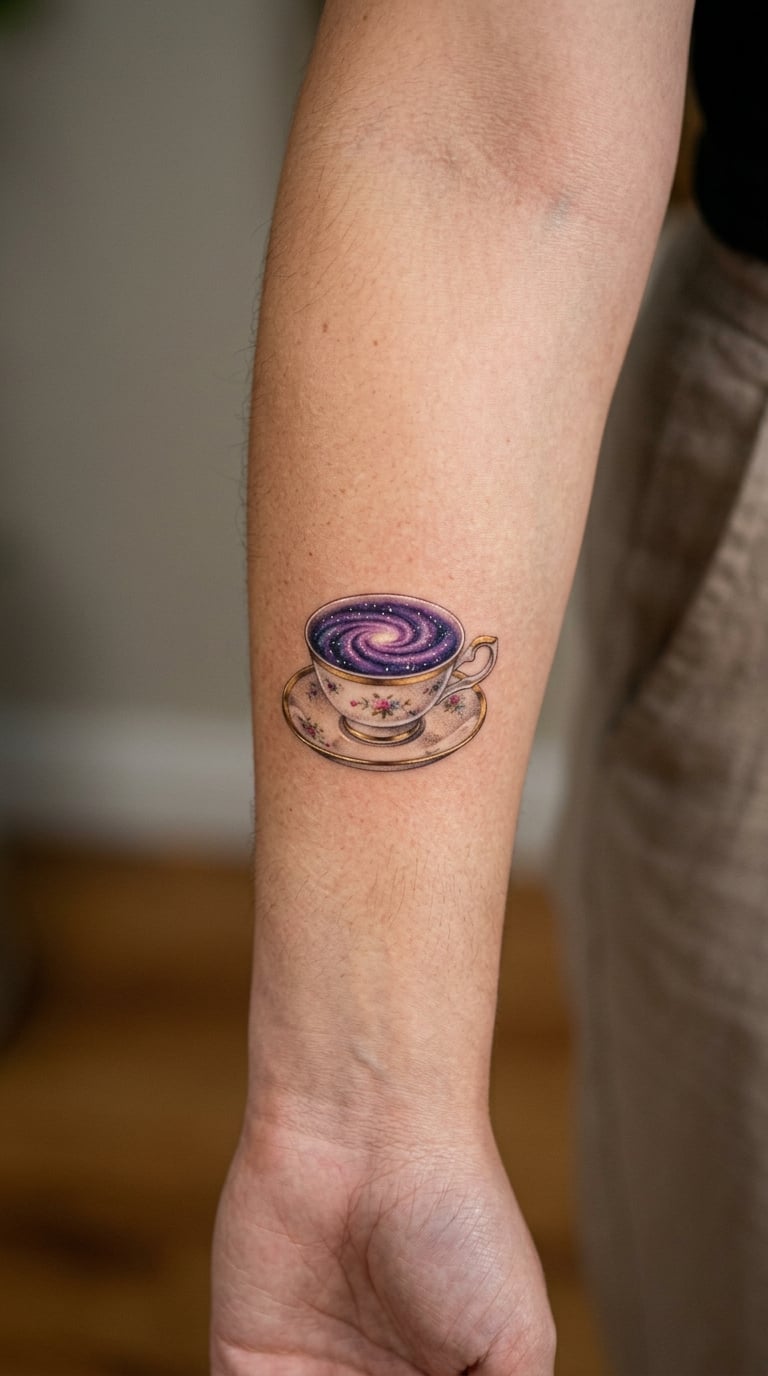
A small porcelain cup and saucer painted in a realistic illustrative style, thin and slightly translucent at the rim, with the tea inside replaced by a spiral galaxy. A few stars spill over the edge of the liquid where it meets the cup wall.
The contrast between a calm everyday ritual and an enormous object is what people respond to. It is cheerful rather than dark, which makes it an unusual choice in this style.
Placement: inner forearm, wrist to mid-forearm. Size: 2.5-3.5 inch (6-9 cm). Style: micro-realism with soft illustrative shading.
Pain: medium, more from the length of shading passes than from depth. Pale purples and light blues are the first colours to fade, so ask the artist to build the galaxy a shade deeper than the reference looks.
Make it yours: use your own teacup pattern on the china instead of a plain rim, and add a second matching cup on the opposite forearm with no galaxy in it.
8. Traditional Skeleton Holding a Bouquet
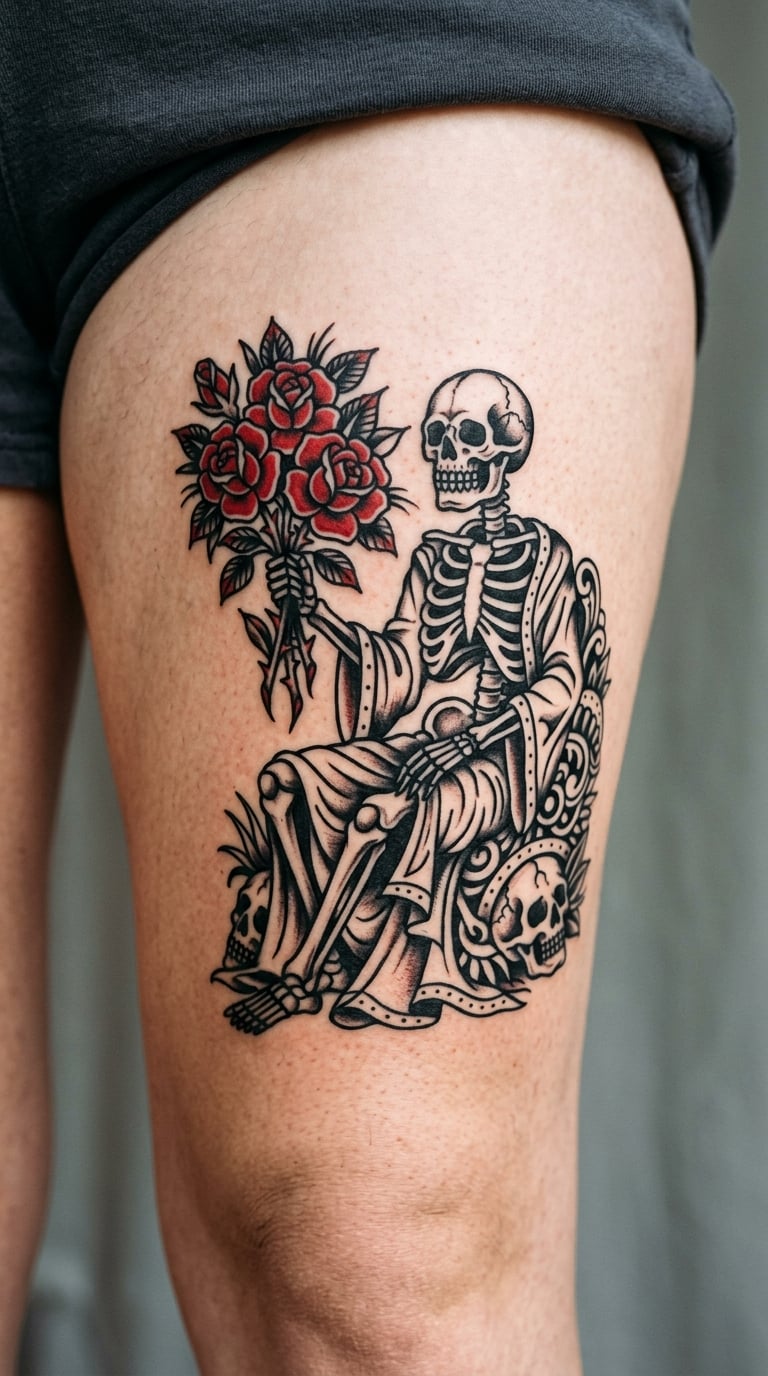
A seated skeleton in old-school anatomical rendering, one leg crossed, holding a bunch of roses in red and green. The figure is drawn with confident black linework and aged stipple shading, while the flowers are flatter and brighter, closer to flash art.
Old-school skeleton work usually means mortality and a long life, and the flowers are what shift the tone. People add them for someone they have lost.
Placement: outer thigh, or the calf. Size: 6-8 inch (15-20 cm). Style: traditional, black linework with red and green.
Pain: medium, and the thigh is one of the easier large canvases because there is muscle to absorb the needle. Traditional shading on the skull is the softest part and will soften first, so a touch-up every few years keeps the contrast with the roses.
Make it yours: have the stems run off the thigh and wrap once like a bracelet, or name a specific rose colour that belonged to someone.
9. Fine-Line Portrait Turned Upside Down
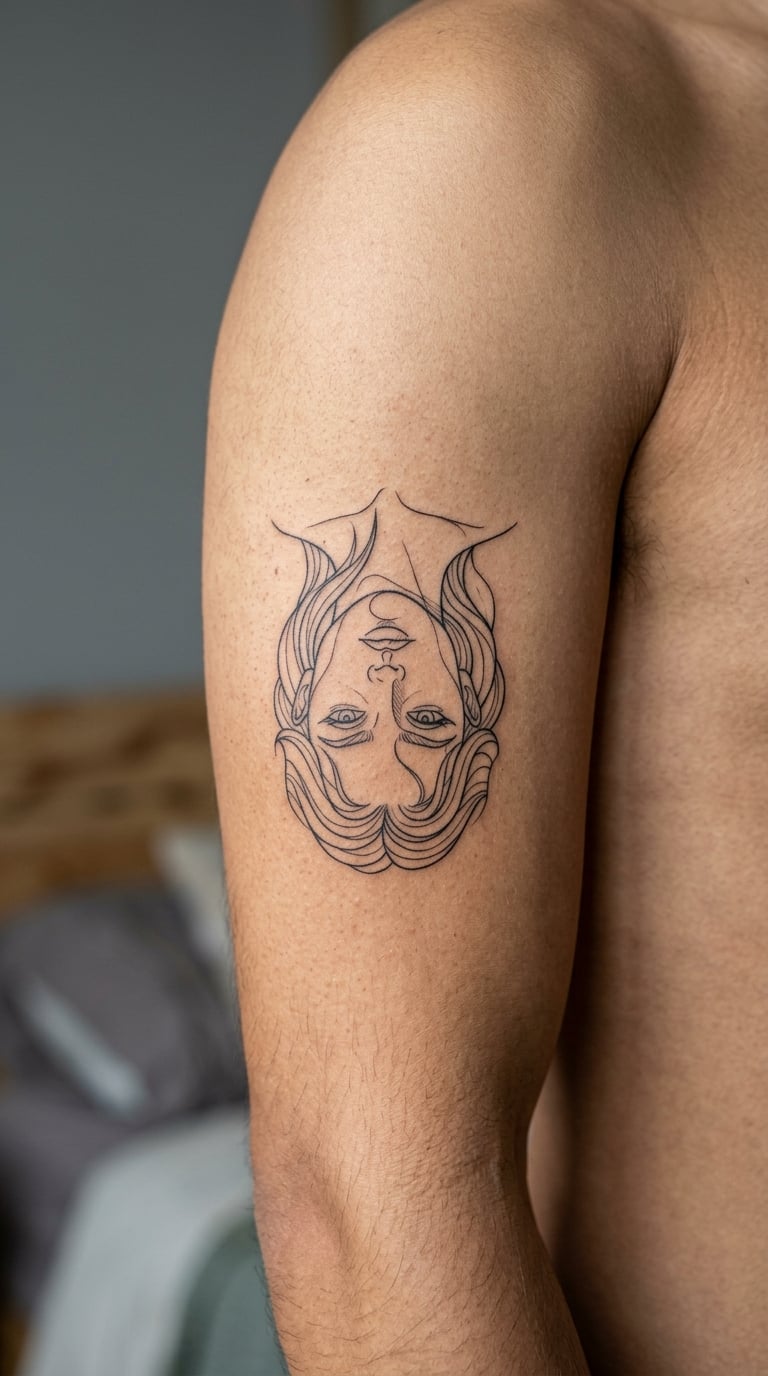
A single continuous-line face with the whole composition rotated 180 degrees, so the eyes sit low and the jaw points up. Nothing is shaded and only a few features are closed, which leaves the viewer to work out which way is right-side up.
Orientation is the entire design. People choose it because a familiar face becomes briefly unreadable, and that half-second of confusion is the point.
Placement: outer upper arm, or a forearm if you want the rotation to change as your arm turns. Size: 4-5 inch (10-13 cm). Style: fine line, minimal facial features.
Pain: medium. Very fine facial detail softens with age, so ask the artist to simplify the mouth and eye lines rather than adding more. Siting it on the upper arm lets you rotate the piece by flexing.
Make it yours: base the face on a photograph of someone, then let the artist strip it back to six or seven lines so it stays a suggestion.
10. Impossible Staircase Through the Clouds
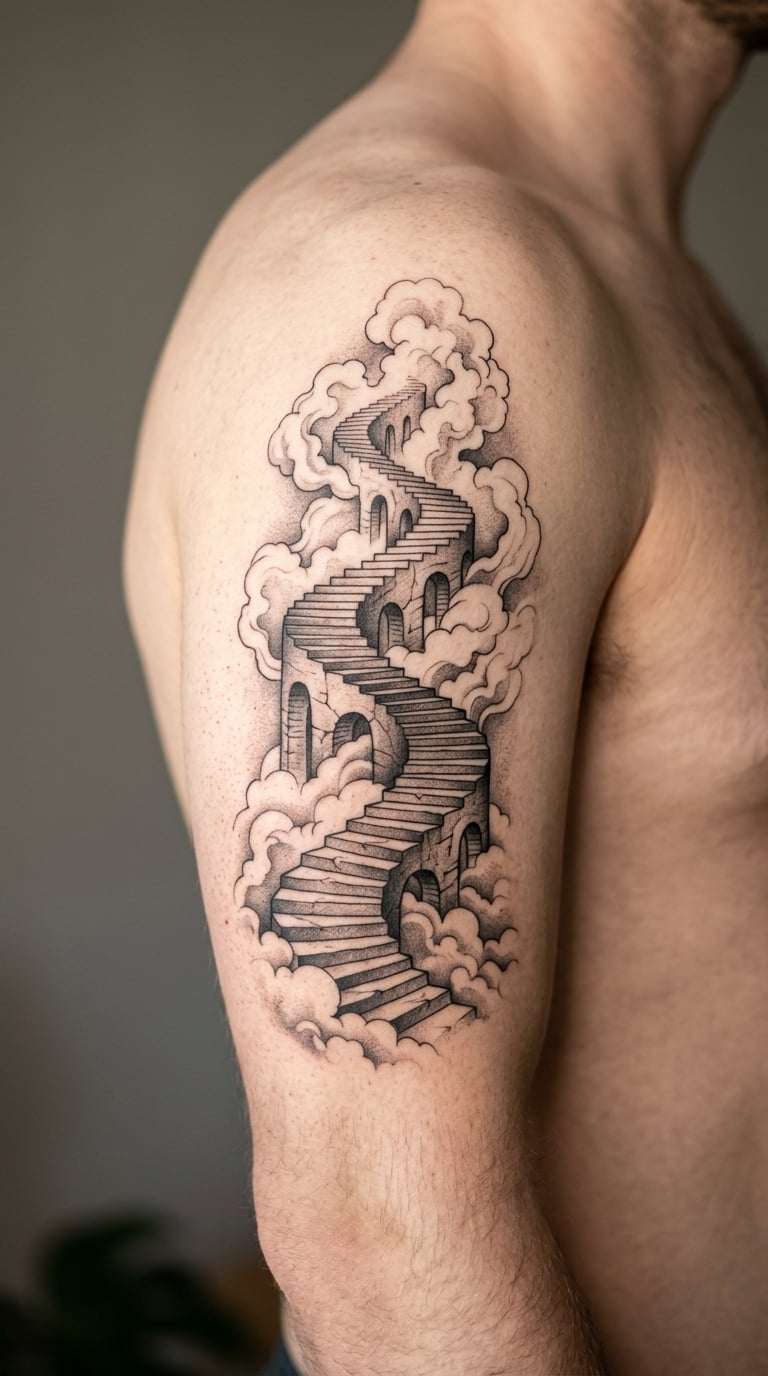
A stone staircase in greyscale that turns two directions at once, so two flights of steps meet at an angle that could not exist, with soft white cloud shading beneath the steps. Drawn from scratch in a Penrose-inspired way rather than copied from any existing artwork.
Impossible architecture appeals to people who like geometry and puzzles, and the cloud layer keeps it from feeling like a diagram. The contradiction is visible in about a second.
Placement: back of the upper arm, or the outer thigh where the design has more width. Size: 5-7 inch (13-18 cm). Style: black and grey realism with soft cloud shading.
Pain: medium to high, because stone texture means dense shading over a wide area. The step edges are the part to watch: sharp architectural lines fade fastest in a piece this shaded, and a slightly heavier edge keeps the illusion readable.
Make it yours: ask for a specific number of turns, or have the lowest flight dissolve into mist at one end instead of stopping at a hard line.
11. Watercolor Flowers Growing From an Open Skull
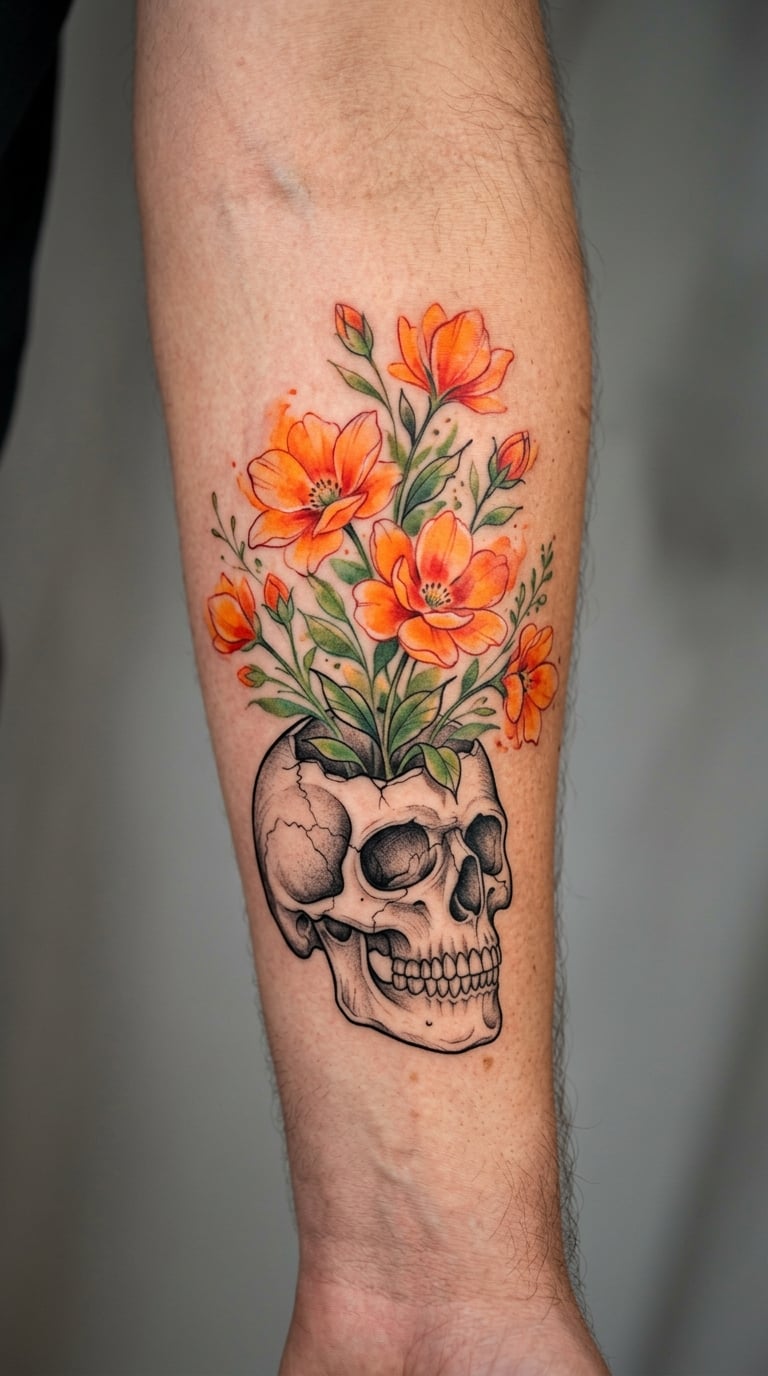
A black-and-grey skull in three-quarter view with the cranium open at the top, and loose orange, pink and green flowers pushing up out of the opening. Watercolour bleeds past the bone lines so the growth looks like it is happening in real time.
It is a different piece from a skeleton holding flowers, because here the flowers are the subject and the skull is the container. People choose it around endings, recoveries and the fact that something keeps growing out of one.
Placement: flat of the forearm, or the calf. Size: 5-6 inch (13-15 cm). Style: watercolor over black and grey realism.
Pain: medium, with a long shading session for the skull. Watercolour pigment settles in the forearm lines, and the orange fades quickest, so ask for a touch-up-friendly colour rather than a pale wash.
Make it yours: use flowers that actually grow where you live, so the piece carries a place as well as an idea.
12. Micro-Realism Globe Held by a Human Hand
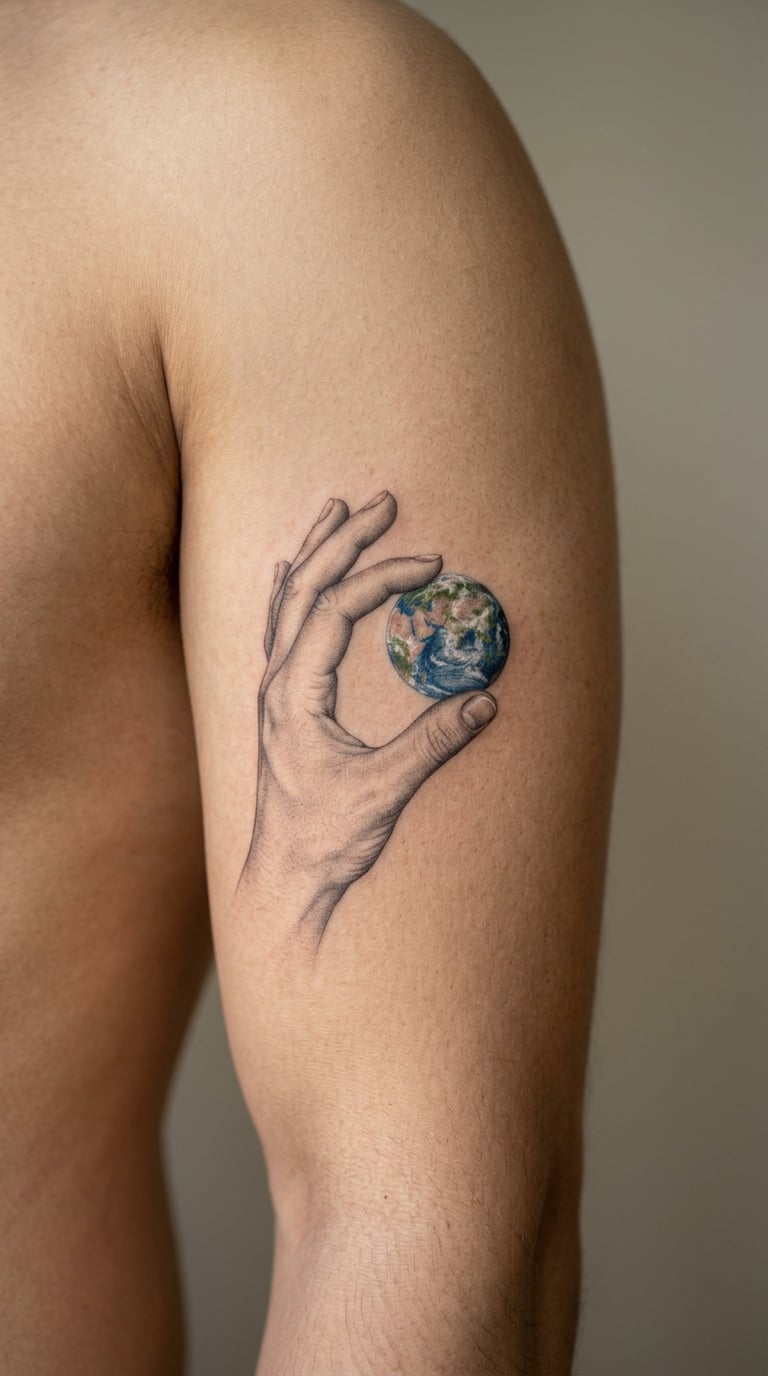
A naturalistically drawn hand, palm up, fingers curled slightly, holding a small Earth at palm level. Skin texture, nails and knuckle creases are rendered carefully, while the globe is small enough that the continents read as shape rather than detail.
Most wearers tie it to travel, family or a place that matters to them, and the design deliberately leaves the meaning open enough to be about the whole world rather than a flag.
Placement: upper arm, inner forearm, or the back of the hand. Size: 3-4 inch (8-10 cm). Style: micro-realism, muted natural colour.
Pain: medium. The hand is the difficult element, and the artist has to keep the silhouette readable at 3 inch or the globe disappears. Slight skin-tone shifts as the piece ages are normal in this style.
Make it yours: have the artist shade only your home country and leave the rest of the globe as plain blue, or turn the globe into a topographical map of one region.
13. Minimalist House Floating Above a Hand
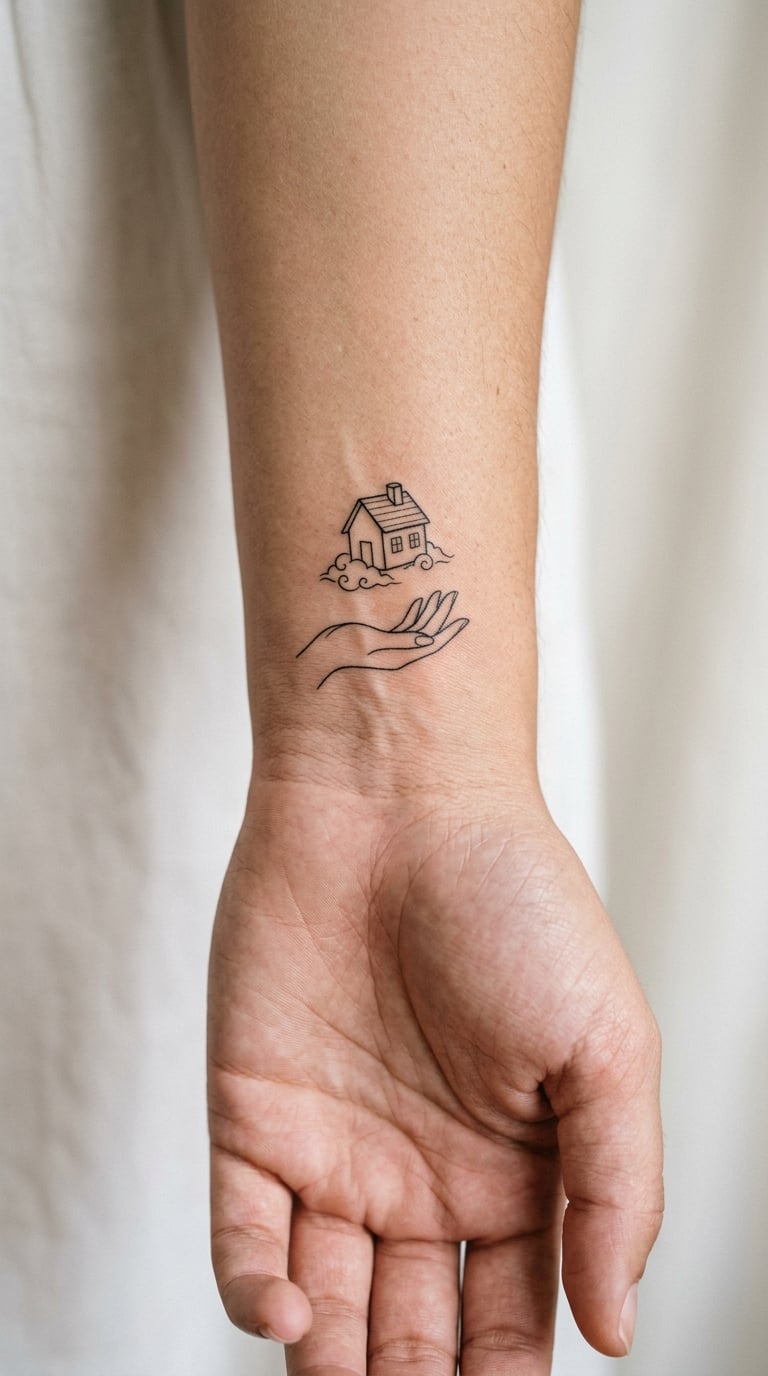
An open palm drawn in one clean outline with a tiny house hovering a short distance above it, the house rendered with no more than six lines. No shadow, no connection, just the two shapes and the gap between them.
It is about support and the idea of holding something up without touching it. People bring it when they move house, start a family, or leave somewhere behind.
Placement: inner wrist, or above the ankle bone. Size: 2-3 inch (5-8 cm). Style: minimalist fine line, two elements only.
Pain: medium to high, because the inner wrist sits on bone and the veins there make the session restless. Hairline weight on the wrist fades fastest on any body, so ask for a single-needle line slightly heavier than the reference and consider a bolder version of the same idea.
Make it yours: add a chimney, a garden gate or one window, then leave the house blank everywhere else.
14. Surreal Fish Walking Across Clouds
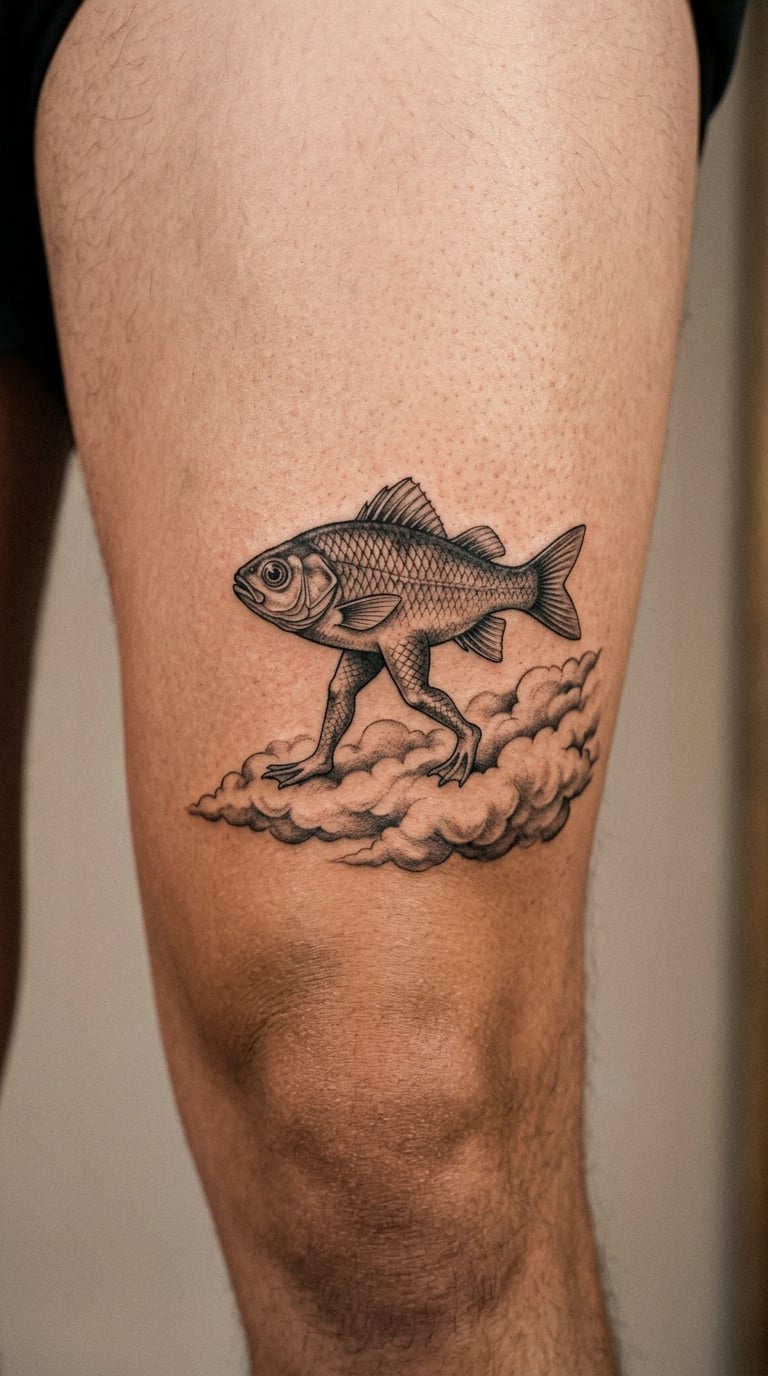
A fully shaded fish with realistic scales, fins and eye, walking left to right across a soft bank of cloud on four very small human-like legs. The fish is treated with complete seriousness; only the legs break the rule.
Impossible animal behaviour creates a specific kind of humour, quiet rather than loud, and it works best where nobody expects a joke in a photorealistic piece.
Placement: outer thigh, or the calf where the cloud can wrap slightly. Size: 5-6 inch (13-15 cm). Style: black and grey realism, no colour.
Pain: medium, and scale detail is slow going. The small legs are the weak point over time, so have them drawn at a size where each leg reads as at least two lines rather than a suggestion.
Make it yours: swap the fish for something from your own water, a koi, a seahorse, a flatfish, and keep the walking legs.
15. Antique Key Growing a Peony Flower
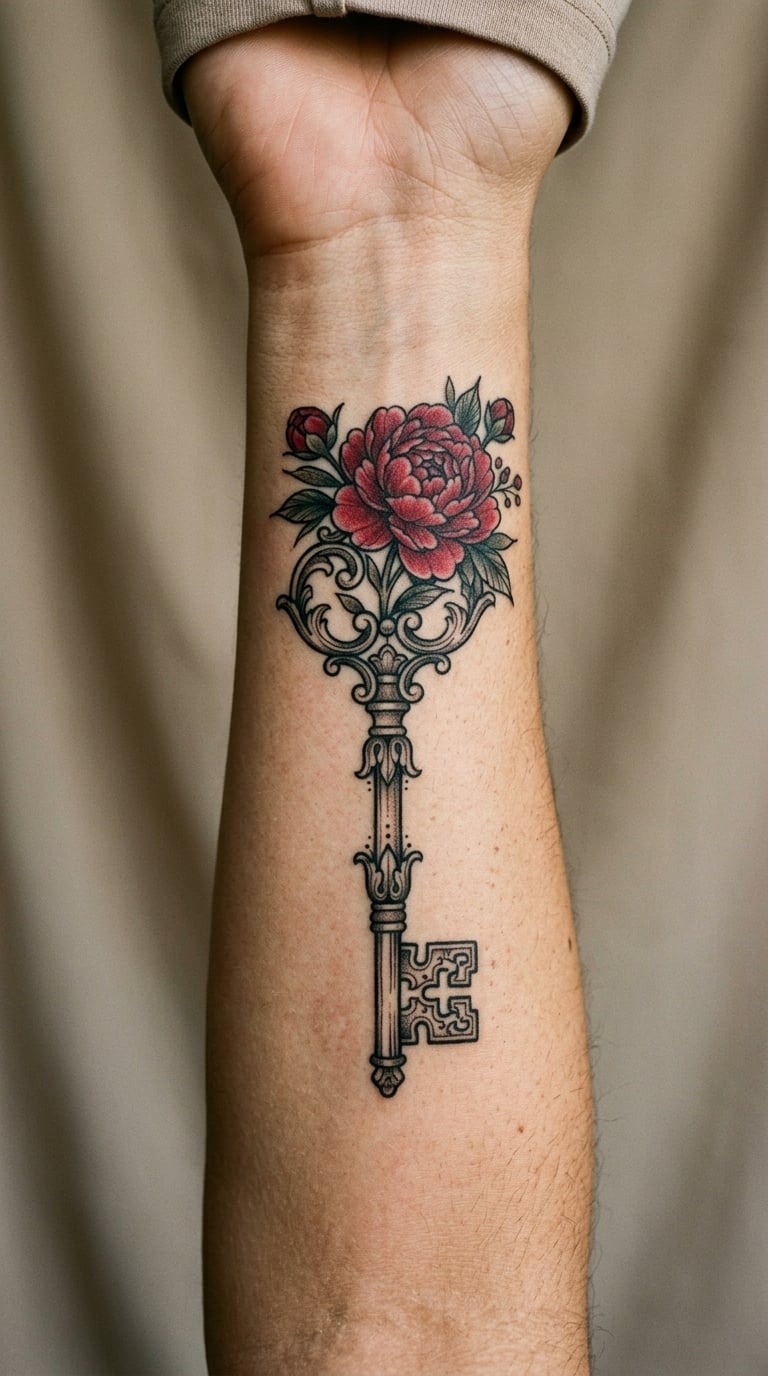
An engraved antique key drawn with fine decorative detail on the bow and teeth, and a single large peony bloom growing straight out of the key’s handle. The key is linework and shadow, the flower is soft shaded colour.
Keys usually mean access, inheritance or a particular house, and the bloom changes the register from keepsake to living thing. Peonies are popular here because they are enormous in bloom and read clearly at small sizes.
Placement: flat of the forearm, or the inner upper arm. Size: 3-4 inch (8-10 cm). Style: antique linework with a botanical bloom in red.
Pain: medium. Fine engraving on the key softens earlier than the flower, so decide which element matters more to you and let the artist put the detail budget there.
Make it yours: reproduce the engraving from a real key you own, or add a second smaller key hanging from the bloom.
16. Blackwork Mushroom House With One Lit Window
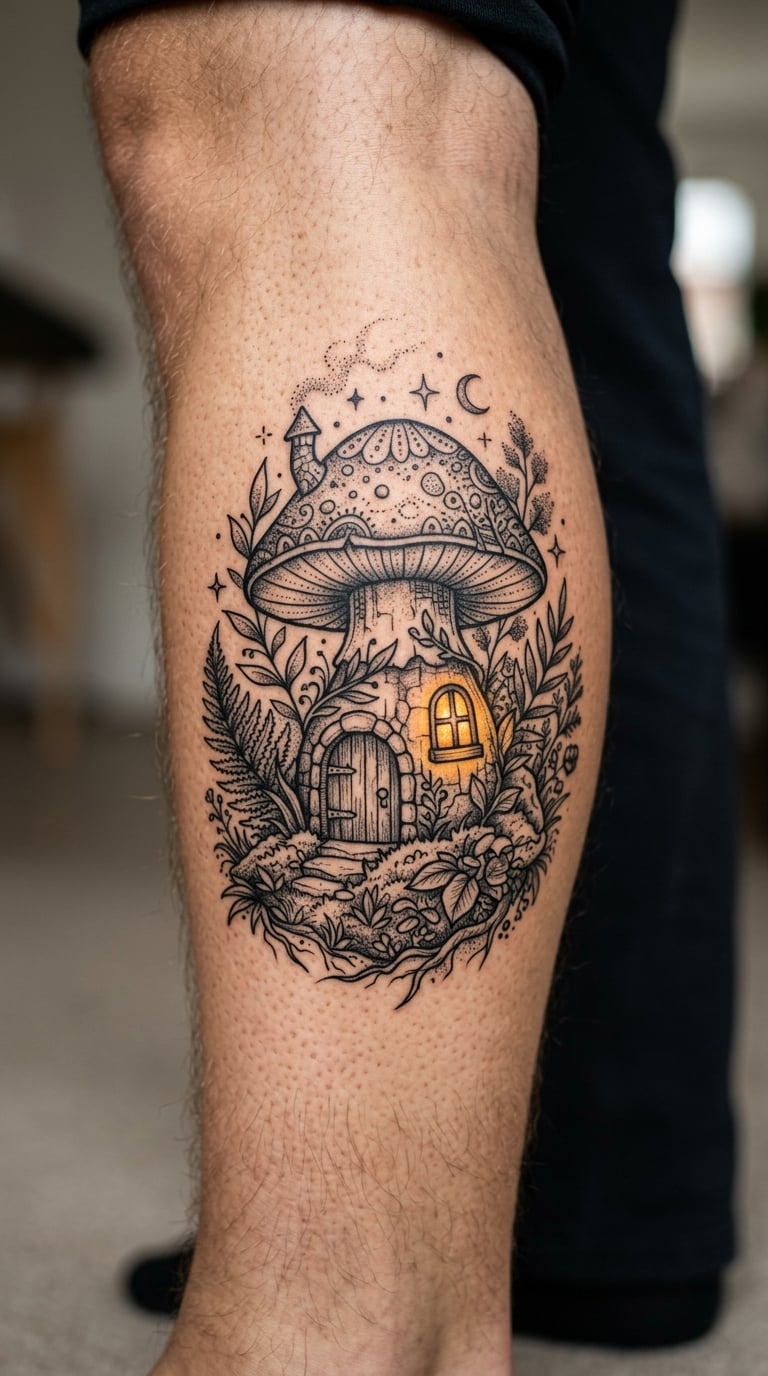
A large dark mushroom rendered in dense blackwork, its cap forming the roof and gills of a small house beneath, with a single rectangular window in warm yellow. Everything else stays black, so the window does all the work.
The one lit window is the part that gets people. It turns a fairly dark piece into something with an occupant, and it gives a place to be rather than a creature to be afraid of.
Placement: outer calf, or the back of the upper arm. Size: 6-8 inch (15-20 cm). Style: blackwork with a single colour accent.
Pain: medium over a long session, since solid black coverage on the calf is a lot of filling. Blackwork holds its edges well, and the yellow is the only element that will need refreshing as the piece ages.
Make it yours: change the window shape to an arch, a circle or a tiny cross, and keep everything else dark.
17. Realistic Mirror Containing a Different Reflection
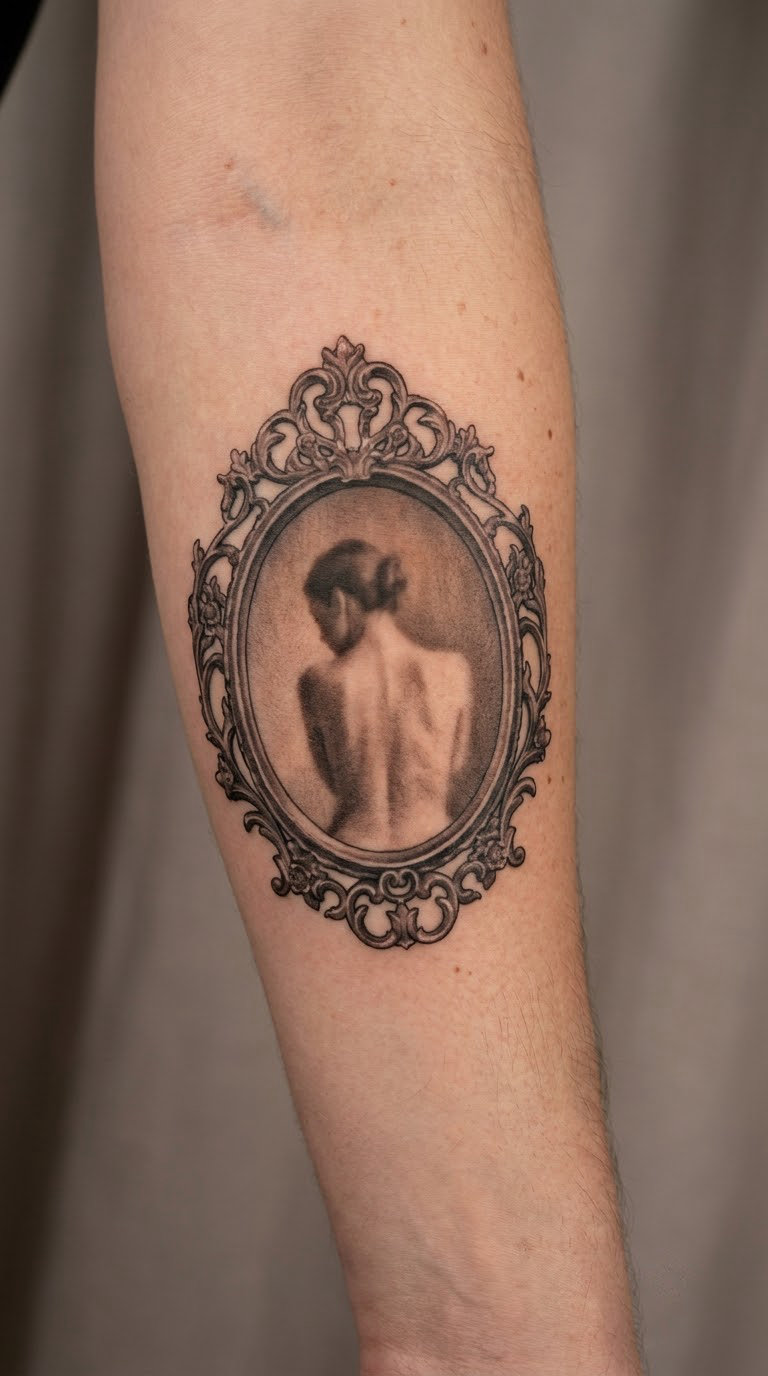
An oval mirror in a thin frame, hanging from a small chain, with a reflection inside it that is anatomically correct but not the same figure as the one implied around it. The reflection is rendered in the same soft greyscale as the frame so nothing looks pasted in.
What the reflection is doing, and who it is, is yours to decide. Most wearers pick the version that matches a private version of themselves rather than the reflection they actually have.
Placement: flat of the forearm, or the inner thigh. Size: 4-5 inch (10-13 cm). Style: realism in greyscale with soft background shading.
Pain: medium to high, because reflected anatomy is genuinely hard work and this is a long session. A face inside a face is the detail most likely to soften, so a slightly smaller reflection reads better over a decade than a larger one.
Make it yours: have the reflection show a different hand position or a different season rather than a different person.
18. Neo-Traditional Sun With an Open Mouth
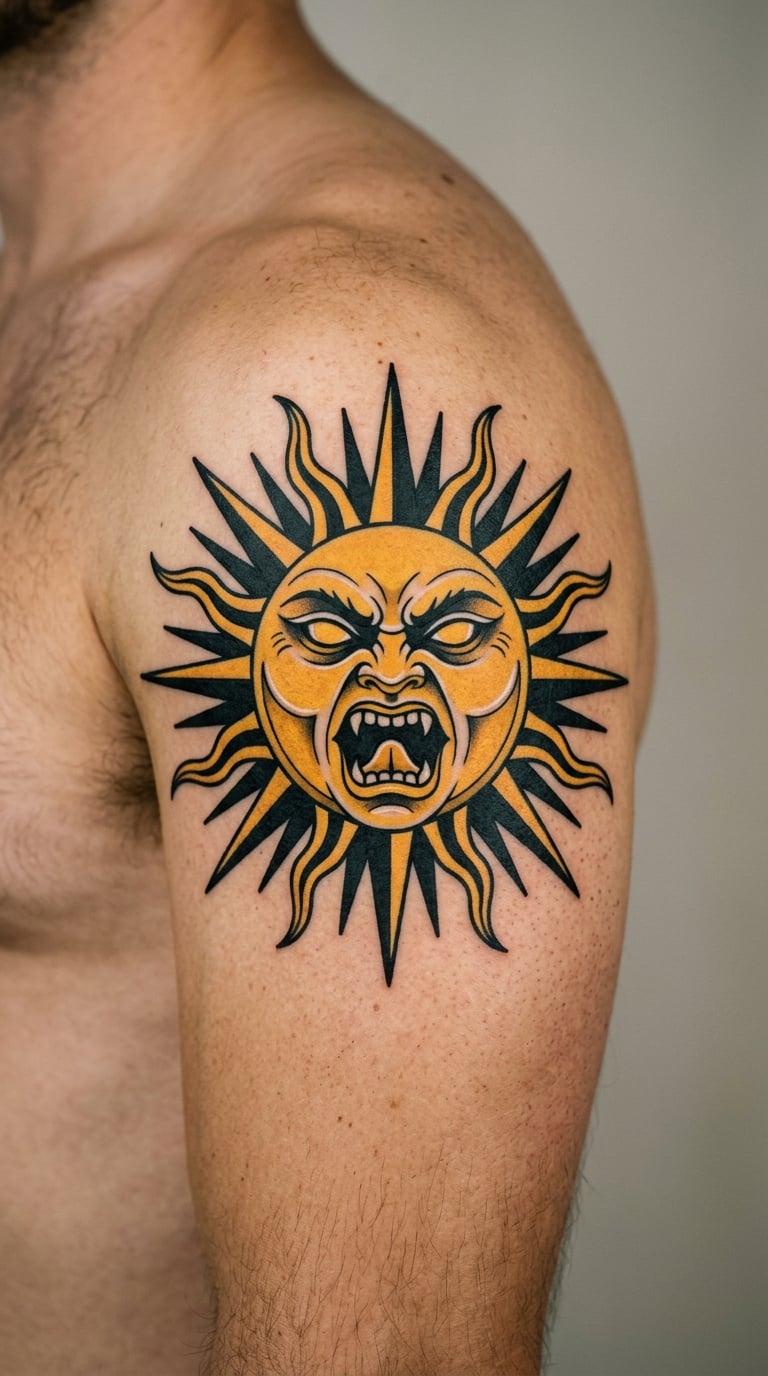
A round yellow sun with a wide open mouth, the interior of it solid black, ringed by straight banner-like rays in red and gold with heavy black outlines. Neo-traditional means more detail and more colour separation than old-school work, and this uses all of it.
A sun is cheerful on the surface and enormous in meaning, so people attach their own: a new start, a difficult summer, a parent. The mouth is what stops it reading as a plain weather symbol.
Placement: outer upper arm, deltoid, or the sternum. Size: 4-5 inch (10-13 cm). Style: neo-traditional, bold outline with layered colour.
Pain: medium, with a lot of flat colour to fill and not much shading. Reds in the rays go first, usually within a few years, while the black outline holds and keeps the shape readable.
Make it yours: set the mouth open on a word instead of a smile, so the expression changes depending on which rays you can see.
19. Watercolor Cloud With Small Sharp Teeth
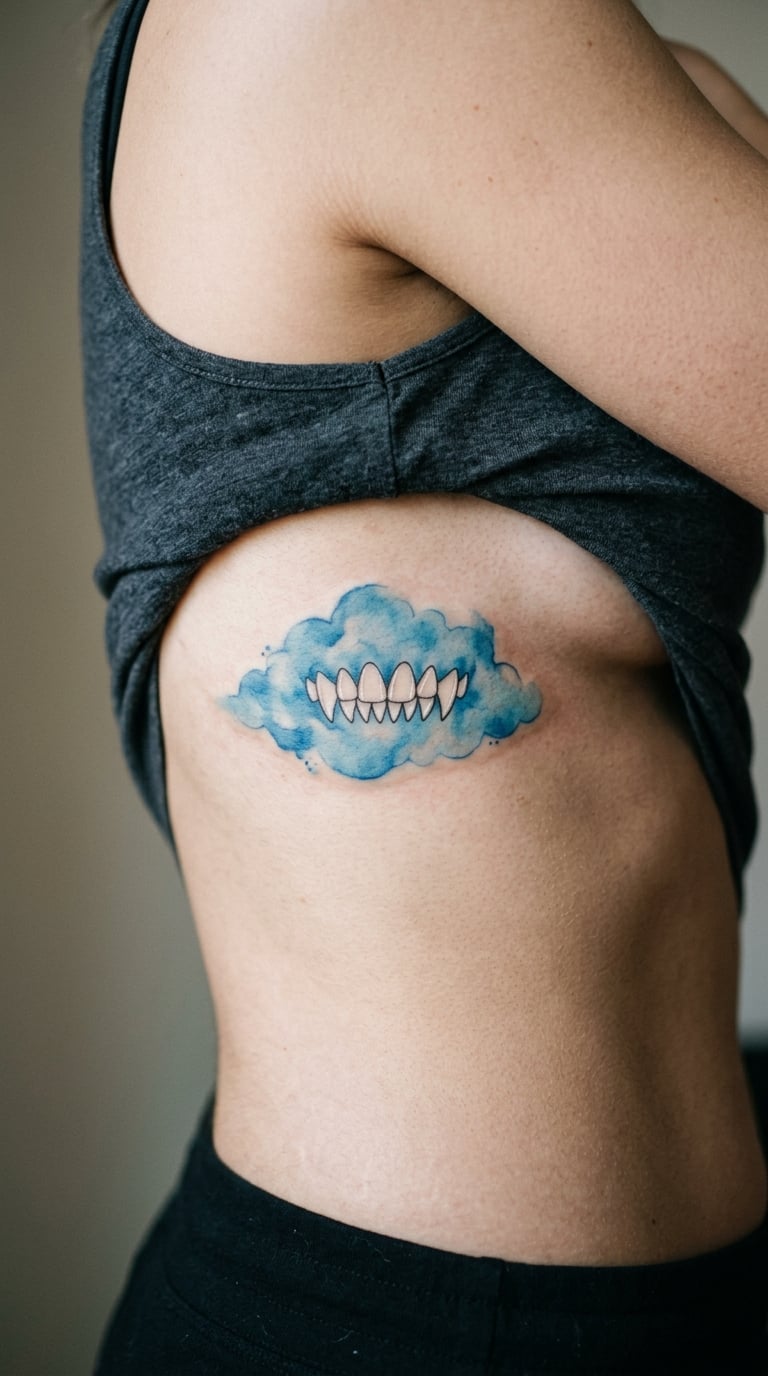
A soft cloud in blue, pink or violet, painted loosely with visible edges where the pigment pooled, and set into its lower edge a narrow row of small pointed white teeth. Nothing else in the design is sharp.
The mismatch is the joke and the unease at the same time. Soft things with hard parts inside them are a recurring theme in people’s dreams, which is often the reason this one gets chosen.
Placement: ribcage, side of the torso, or the upper arm. Size: 4-5 inch (10-13 cm). Style: watercolor with hard-edged white detail.
Pain: high on the ribs, and worth planning a short session for rather than a long one. Watercolour on a ribcage is sun-exposed more than most placements, so it will fade noticeably faster and the teeth are the last thing to disappear because they are white space.
Make it yours: add a small eye at one end of the tooth row, or take the count down to three.
20. Mountain Range Growing From a Human Nose
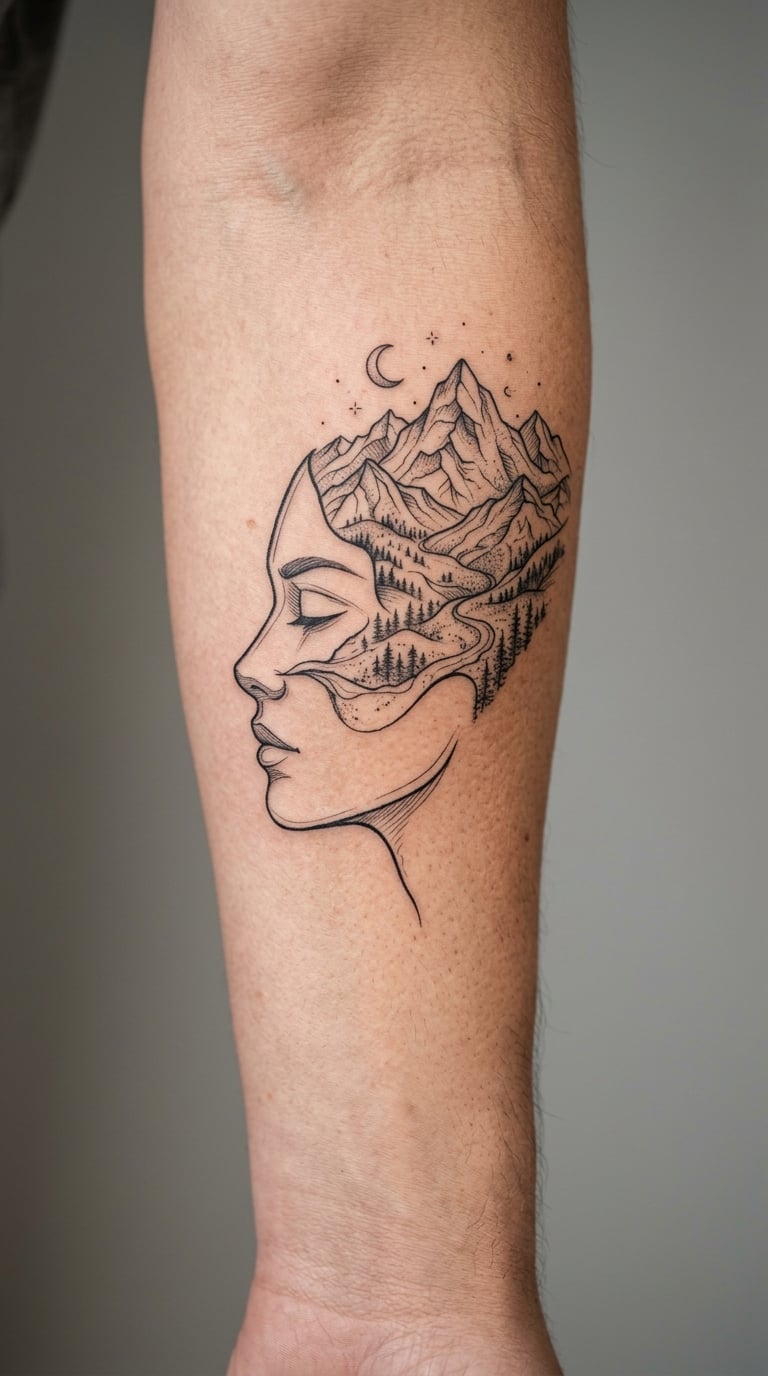
A side-profile face in fine line, drawn to a handful of confident strokes, with a range of small mountains expanding out from the bridge and tip of the nose. The peaks sit where a nose should be and the profile line runs into the ridge line.
A face that spills into scenery is one of the oldest moves in this style, and it works because the transition point hides the join. Wearers like that the change happens mid-feature rather than at an edge.
Placement: flat of the forearm, or the calf where the face can run vertically. Size: 3-4 inch (8-10 cm). Style: fine line with light stipple shading on the peaks.
Pain: medium, more an endurance session than a painful one. Keep the profile to a few lines and the piece stays crisp for years; adding shading and detail to the face is what turns it soft, not the mountains.
Make it yours: make the range match somewhere you have actually stood, and put the sun behind the biggest peak.
21. Dotwork Spiral Staircase Reaching a Planet
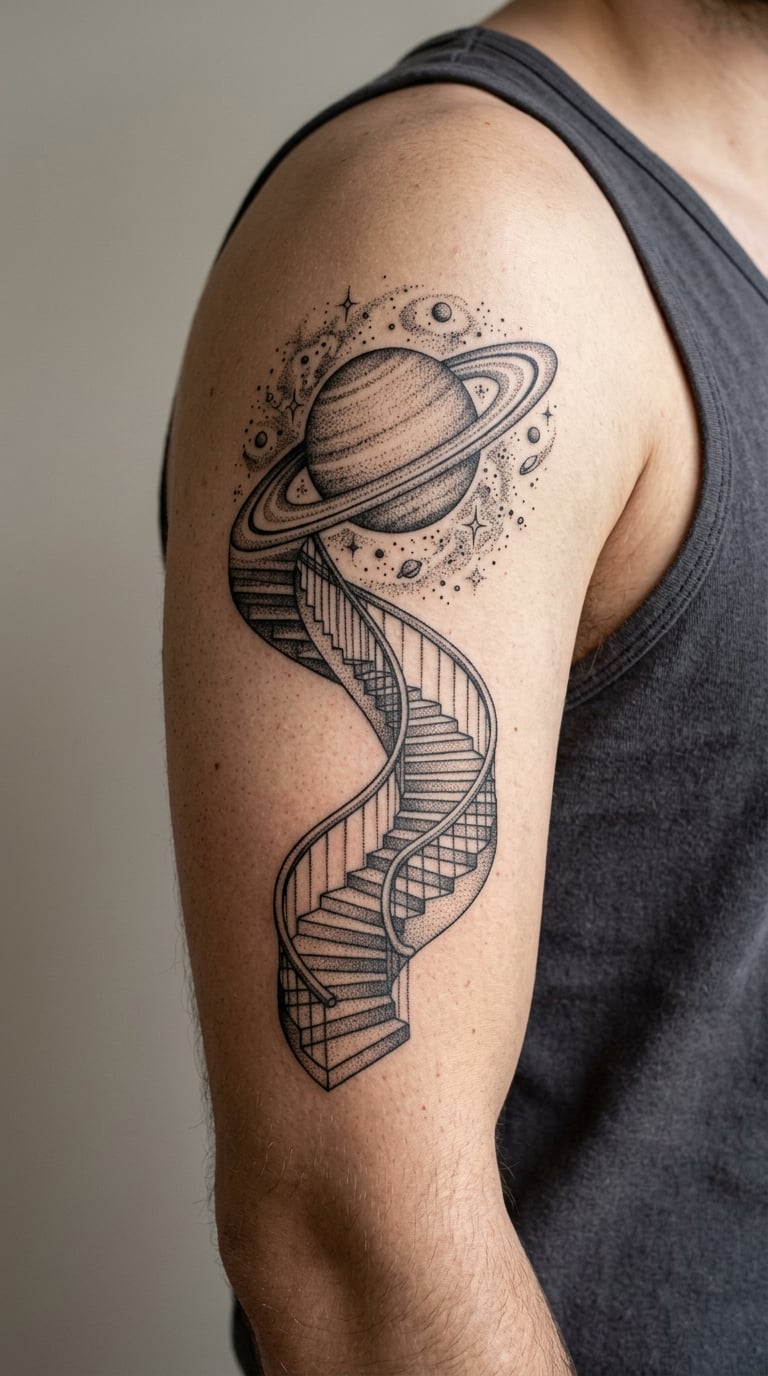
A dotted spiral staircase that curves upward and thins out as it reaches a ringed planet, with the last steps becoming dots of space before they meet the planet’s edge. Density carries the movement, nothing is outlined.
The staircase going somewhere you cannot quite reach is a common reading, and the planet gives it a destination without an arrival. It also suits people who want depth and movement in a piece with no colour.
Placement: outer upper arm, or the back of the forearm. Size: 4-5 inch (10-13 cm). Style: dotwork, no outlines, no colour.
Pain: medium, and dotwork is slow enough that a five-inch piece takes real time. The upper dots are the first to spread into grey, so ask for generous spacing on the outer curve where the detail thins out.
Make it yours: make the spiral turn a number of times that matches something you care about, and keep the planet small so the staircase still leads the eye.
22. Color Hands Holding a Cracking Moon
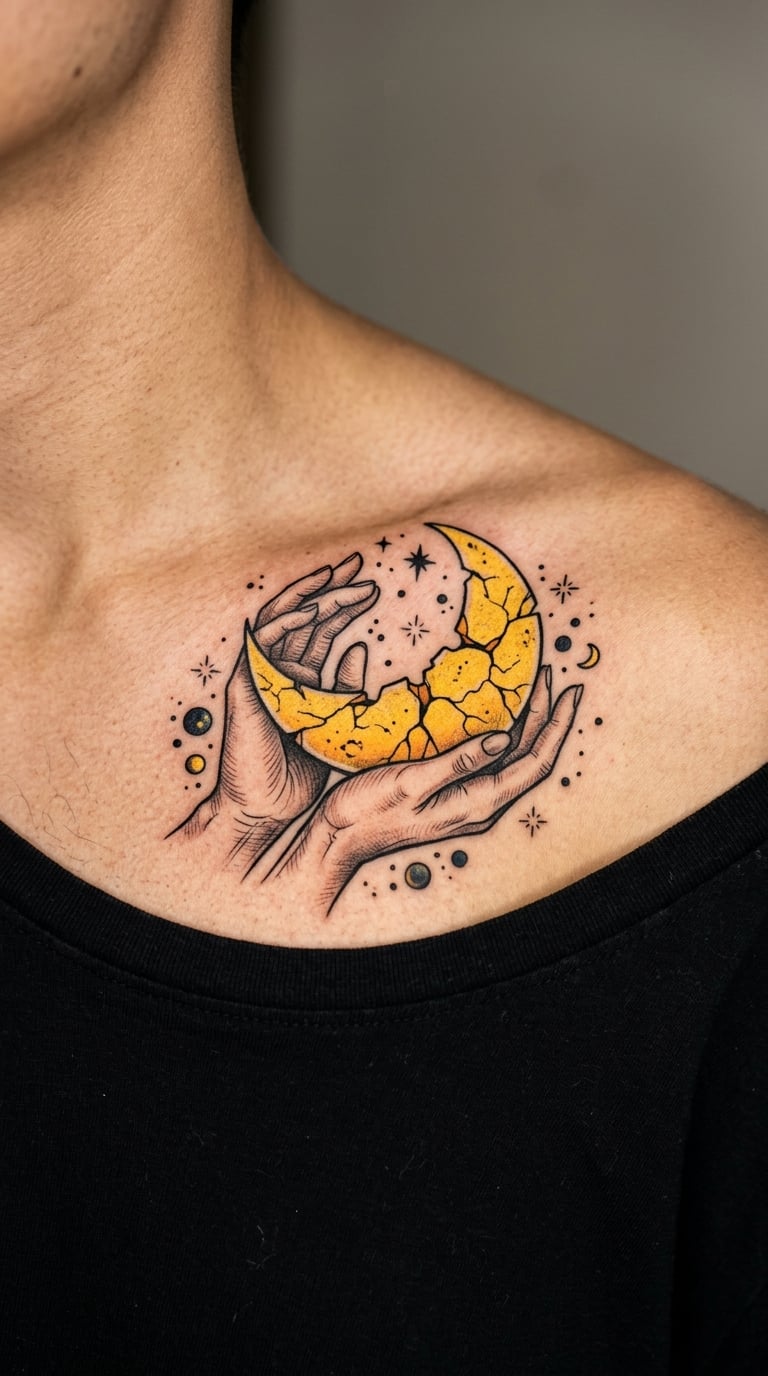
Two hands, coloured in a warm illustrative style with visible outlines, cupping a yellow moon that is split by branching cracks running from top to bottom. The hands float rather than rest, so the moon is held in mid-air.
This is not a simple floating moon. The cracks and the act of holding it are the design, and it is usually chosen around something fragile being kept together deliberately.
Placement: across the collarbone on one side, or centred on the chest. Size: 5-6 inch (13-15 cm) wide. Style: illustrative colour with soft gradient skin tones.
Pain: medium to high, since the collarbone sits directly on bone and the rib edge under it is no better. Skin tones in soft gradient shading shift more than line work does, so budget for a colour refresh rather than a full rework.
Make it yours: have the crack pattern trace a real fracture, a river outline or a coastline, so the break becomes specific.
23. Micro-Realism Butterfly in a Glass Dome
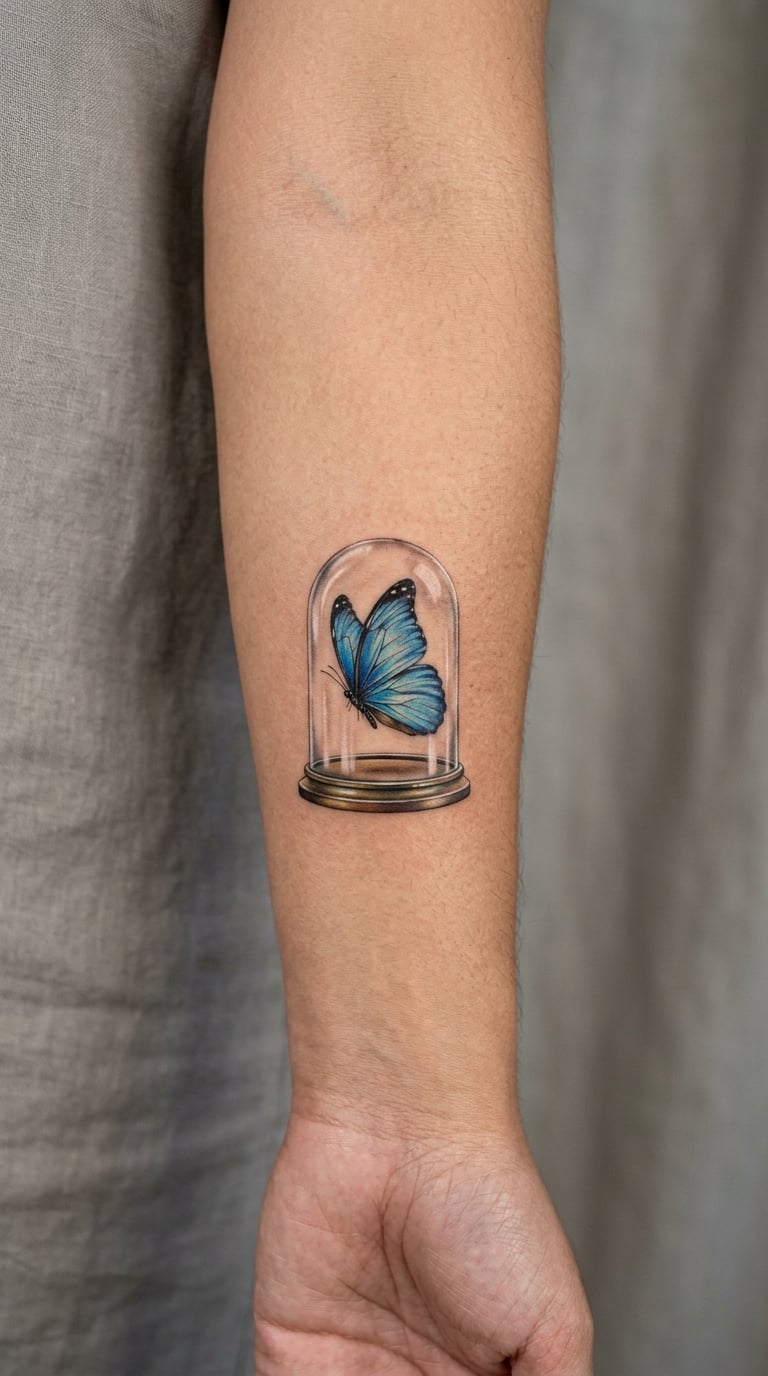
A tiny realistic butterfly with fine wing veins and a dusting of colour, sitting under a bell jar with two curved white highlights on the glass and a simple round base. The glass is drawn entirely with highlights, since it has no outline to ink.
It feels like a specimen in a museum rather than an animal in a scene, and that stillness is the appeal. It is also one of the most wearable small surreal pieces, because nothing in it is aggressive.
Placement: inner forearm, or the upper arm. Size: 2-3 inch (5-8 cm). Style: micro-realism, minimal background.
Pain: medium for such a small area, because the wing veins need a fine needle and a steady hand. The highlights on the glass are the first thing to disappear, and once they go the dome reads less clearly, so treat those two strokes as essential rather than decorative.
Make it yours: use a species from somewhere you have been, or swap the base for a plain stone with a single engraved initial.
24. Blackwork Storm Contained Inside a Torso
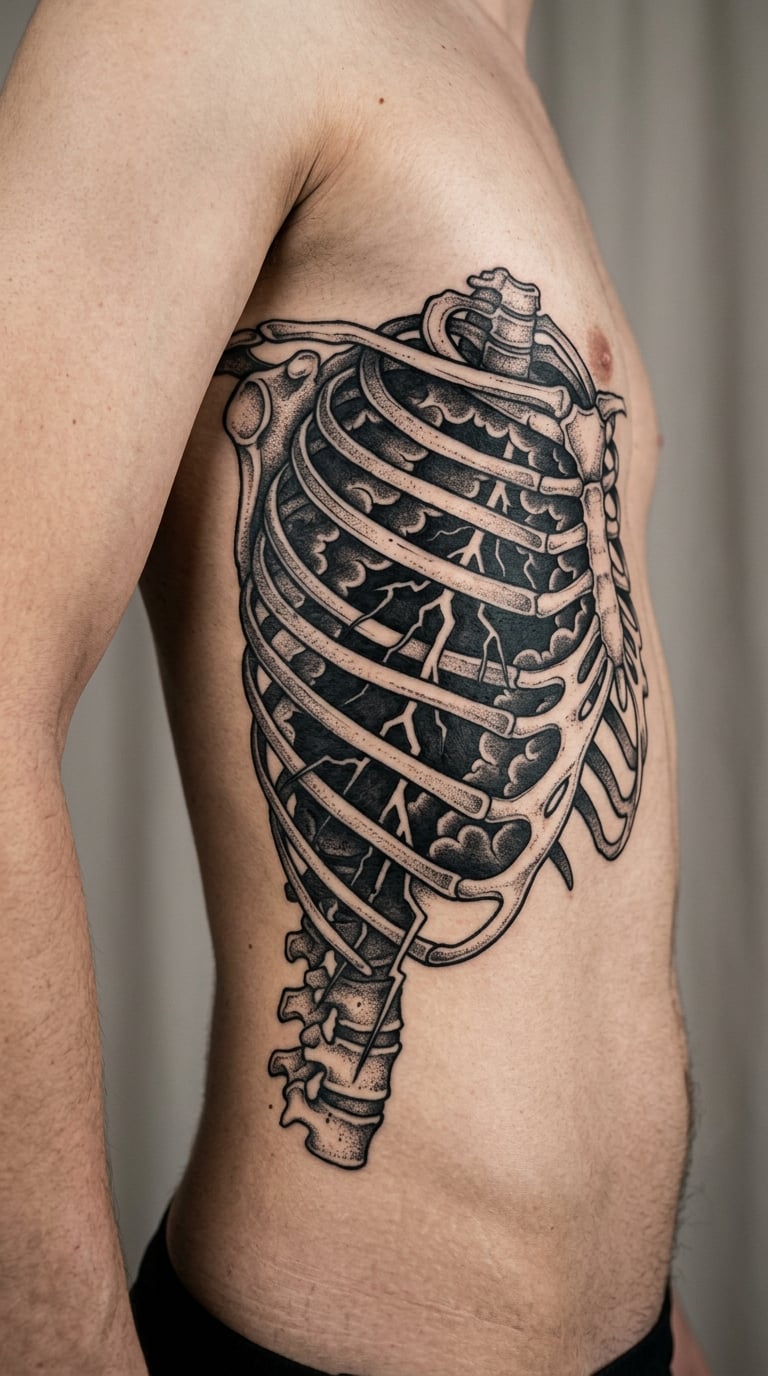
A clean rib-cage outline in fine line, the whole chest cavity filled with heavy black cloud masses, a single jagged lightning form cutting through the middle and a wash of stipple falling out below the last rib like rain. The body is a container, the weather is the content.
This is the one on the list built for a large canvas and for someone adding a substantial piece to an existing collection. The empty skin outside the ribs is as important to the design as the weather inside it.
Placement: side of the torso, or the back in a mirrored version. Size: 8-12 inch (20-30 cm). Style: blackwork, fine outline with solid fills.
Pain: high, because the ribs and the flank are long, bony sessions and this piece needs several hours. Plan it as two or more sessions from the start, and expect a rest break mid-piece. Solid black with a fine rib outline is the right balance here, since the outline is what stays legible as the fills settle.
Make it yours: make the lightning follow a real storm you lived through, or leave the lower ribs empty so the piece looks unfinished on purpose.
25. Fine-Line Rain Made of Tiny Letters
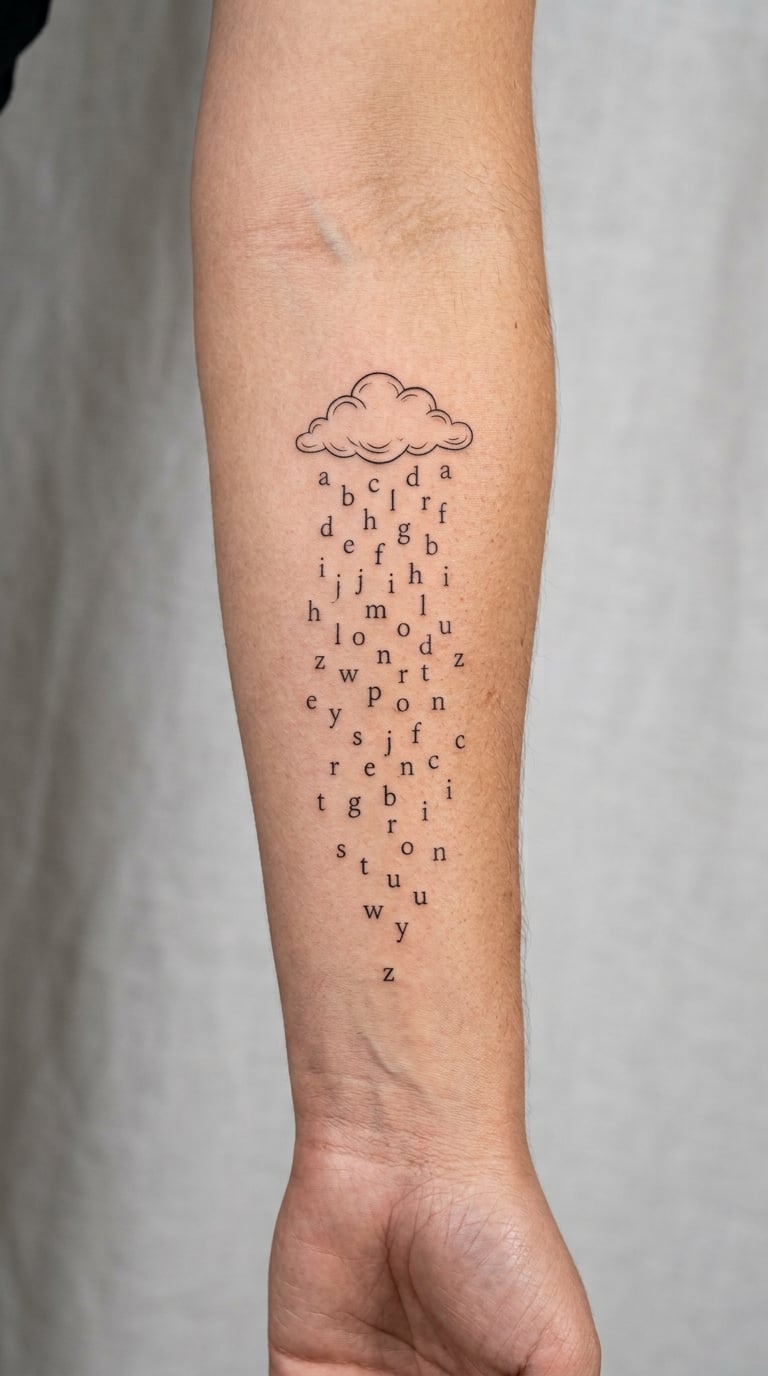
A small outlined cloud near the top of the design with a handful of individual letters falling out of it in a scattered column, each one rotated at a slightly different angle. Some letters are single strokes, some have a full bowl, and none form a readable sentence.
Typography works here because it gives a dream a voice without a message. Wearers usually use initials, a date, or the first letters of something that mattered, and the non-legibility is part of the effect.
Placement: flat of the forearm, or the outer upper arm. Size: 4-5 inch (10-13 cm) tall. Style: fine line typography, single weight.
Pain: medium, with an unusual stretch of sitting still for hands and wrists. Letters are the detail most likely to blur together over time, so fewer and larger characters will hold their shape far longer than a dense column of small ones.
Make it yours: use the initial of someone, one per letter, so the rain becomes a name only you can read.
How to Choose the Right Design
Before booking, run your idea through these six checks. They take five minutes and they save you from a piece that blurs or sits badly.
- Check the silhouette. Squint at the design or shrink it on your phone to thumbnail size. If it stops reading, the interior detail is too fine for the scale you want and the artist will have to cut it.
- Match the style to the skill you need. Micro-realism and impossible geometry take a long, high-skill session. Fine line and dotwork take less time and need a steadier, lighter hand. Ask to see healed work, not fresh work, since fresh ink always looks sharper than what you will live with.
- Pick placement before size. A design that follows a bone or a curve, like the mountain range from the nose or the storm inside a torso, needs a canvas with room. Flat forearm skin takes a small design better than any joint does.
- Decide how much detail you will lose. Anything under 2 inch (5 cm) should be one idea only, with fewer elements. Every extra element in a small piece is detail that will blur.
- Look at the line weight against the spot. Wrists, ankles, hands and fingers wear hairline fine line fastest. The same design will hold up for years on an upper arm. Ask for a slightly heavier line rather than a lighter one.
- Test the colour choice against sun. Anything on an outer arm, a calf or a forearm in short sleeves will fade faster. Black and grey with strong contrast ages more predictably than pale watercolour.
Cost and Session Time
Most shops price custom work by the hour with a shop minimum for the visit, so the two numbers to ask for are the hourly rate and the minimum. Rates vary a great deal by city, by the artist’s booking list, and by how long you are willing to wait for the right person.
Small pieces, the kind under 2 inch (5 cm) with minimal shading, often sit at the low end because they take under an hour. Medium work in the 3-6 inch (8-15 cm) range with realistic shading commonly runs two to four hours, which is where a lot of this list lands. Large compositions, like the storm inside the torso or a full rib-cage study, are priced per session and usually booked as two or three sessions rather than one marathon.
What moves the number more than the size: the shading density, whether colour is involved, whether the artist is drawing it from scratch, and whether you want a fully custom composition or a modified version of an existing design. Bring references and your own sketches, but expect the artist to redraw the idea for your anatomy, which is the normal process rather than a rejection of your input.
Ask for the estimate in writing before the session, ask how many hours are booked, and ask what happens if the piece needs a second sitting. A good answer covers all three.
Aftercare Basics
- Follow your artist’s aftercare instructions first. They know how they worked, what they used and how deep the shading went, so their advice beats anything general you have read.
- Wash gently with clean lukewarm water and a mild unscented soap, then pat dry with a clean towel rather than rubbing. Do this once or twice a day while the area feels raw.
- Protect the tattoo for the first couple of weeks. Skip hot baths, swimming pools, hot tubs and saunas, and cover the area loosely when you are in direct sun.
- Keep it moisturised but not heavy. A thin layer of whatever your artist recommends helps with the tight feeling during the first week, and thick products can trap heat and irritate.
- Avoid friction and stretching for the first stretch of healing. Tight waistbands, waist trainers, backpack straps and a heavy jacket rubbing across new line work are the most common cause of early patchiness.
- Watch the healed result, not the fresh one. A few weeks of flaking and softening is normal, and photographs taken at week two are misleading. Judge the piece at around two to three months, and take that photo for your own reference.
Frequently Asked Questions
What makes a tattoo look surrealistic?
A tattoo reads as surreal when one element is rendered with accurate, careful detail and the world around it breaks physical logic. A photorealistic teacup holding a spiral galaxy, or a precisely shaded fish walking across a cloud, works because the realism of the object makes the impossible part land. If everything in the design is equally abstract, the viewer has nothing to measure the impossibility against and the piece flattens into decoration.
Are surrealism tattoos suitable for beginners getting their first piece?
They can be, but only at the small end of the list. A fine-line floating door behind the ear or the hand letting a star escape are reasonable first tattoos because they are simple shapes, quick sessions and forgiving if the detail softens. Hold off on micro-realism and impossible geometry for a first piece, since both need a long session and a settled result before you can tell whether the artist understood your idea.
What is the best placement for a small surrealism tattoo?
The inner forearm and the flat of the upper arm are the most forgiving spots for a small design, because both are relatively flat and stay clear of joints and constant creasing. Behind the ear suits micro work but wears hair and skin movement over it. Avoid wrists, ankles, fingers and the inside of the elbow if the design has thin lines, since those are the spots where fine line fades and smudges fastest.
Will very detailed surreal tattoos fade over time?
Some of it will, and the areas that fade first are always the same: the smallest elements, the lightest colour and anything sitting on a sun-exposed or frequently creasing spot. Blackwork and bold traditional outlines hold their shape far better than micro detail or pale watercolour. Ask your artist to build a design with a clear silhouette at the smallest scale it will ever be, rather than one that only works in the first photograph.
Should I bring a famous painting as a tattoo reference?
You can, and it is a normal thing to bring, but a full painting usually needs to be adapted rather than traced. A composition copied from a painting onto curved skin often ends up distorted or recognisable in a way you did not want. Bringing one or two crops of the elements you like, plus a note about which parts matter, gives the artist far more room to redraw it properly for your anatomy and your placement.
Conclusion
If this is your first tattoo, look at the restrained end of the list. The fine-line door floating among a few stars or the hand letting a star escape are small, quick and readable, and both keep enough open space that a softened line in ten years will not ruin them. Ask for the healed version of the design before you book, and let the artist thicken anything too fine for the spot.
If you are adding to an existing collection, the mountain range growing out of the nose or the storm held inside a rib cage give you a large canvas with a clear idea, and either one works as the start of a whole theme. Save your references somewhere you can find them again, and talk to an artist who works in this style regularly before you settle on a date. If you want to explore the neighbouring ideas first, our guides to crescent moon tattoo designs, small and bold comet tattoos and constellation placements are good next stops, and each of them pairs cleanly with a piece from this list.