
20 Blackout Sleeve Tattoo Ideas: Best Dark Picks (October 2026)
A blackout sleeve tattoo is a large covering filled with dense, unbroken solid black ink, built as a bold graphic piece in its own right or used as a base to cover older work. These 20 blackout sleeve tattoo ideas cover everything from hard geometry to grey botanical pieces, with real placement and sizing notes for each one.
Who suits this style? People already wearing work they dislike and want it gone for good, plus anyone drawn to heavy blackwork aesthetics who accepts that solid black is close to irreversible and needs a specialist rather than any general tattooer. Practised artists point out in r/tattooadvice that most tattooers simply do not offer large blackout work, so the artist shortlist matters more here than with a normal sleeve.
One useful thing to know before you scroll: solid black that packs evenly is the hardest part of this style. Patching grey into a field and hoping it cures darker is how you end up with an arm that looks like a bruise in three years. Every design below is described in terms an artist could actually sketch.
20 Blackout Sleeve Tattoo Ideas: Quick Guide
| Idea | Style | Best placement | Size | Pain |
|---|---|---|---|---|
| Full-body geometric | Geometric blackwork | Full arm wrap | 18-24 in | High |
| Blackout rose botanical | Black and grey realism | Outer forearm to elbow | 10-16 in | Medium |
| Abstract smoke | Blackwork with greywash | Full arm wrap | 16-22 in | Medium |
| Tribal armor | Modern black tribal | Shoulder to elbow | 12-18 in | Medium |
| Gothic cathedral | Illustrative blackwork | Outer arm | 12-18 in | Medium |
| Wolf and mountain | Blackwork realism | Forearm to shoulder | 14-20 in | Medium |
| Snake wrap | Blackwork with pattern detail | Full arm wrap | 18-24 in | High |
| Celestial eclipse | Blackwork with grey wash | Shoulder to wrist | 16-22 in | Medium |
| Phoenix wing | Solid black feather work | Shoulder to forearm | 14-20 in | High |
| Cityscape | Illustrative blackwork | Forearm wrap | 12-18 in | Medium |
| Serpent and mandala | Symmetrical blackwork | Shoulder to elbow | 10-16 in | Medium |
| Fern and branch | Botanical blackwork | Outer forearm | 10-15 in | Low to medium |
| Horror portrait | Blackwork portraiture | Upper arm | 8-14 in | High |
| Circuit board | Technical geometric | Shoulder to wrist | 16-22 in | Medium |
| Koi and wave | Blackwork with grey water | Full arm wrap | 16-22 in | High |
| Moth and moonlight | Blackwork with grey wash | Full arm wrap | 14-20 in | Medium |
| Viking helmet | Stylised blackwork | Shoulder cap | 8-12 in | High |
| Dragon scale | Repeating scale blackwork | Full arm wrap | 18-24 in | High |
| Rose compass | Blackwork line and wash | Forearm to shoulder | 12-18 in | Medium |
| Abstract shadow | Non-representational blackwork | Any large flat area | 14-22 in | Medium |
If you have never had a large piece before, the quarter sleeve on the shoulder cap is the least dramatic way in. If you already have old black tribal work you want gone, jump to idea 4 or idea 18 — both are structured to hide what is underneath.
1. Full-Body Geometric Blackout Sleeve
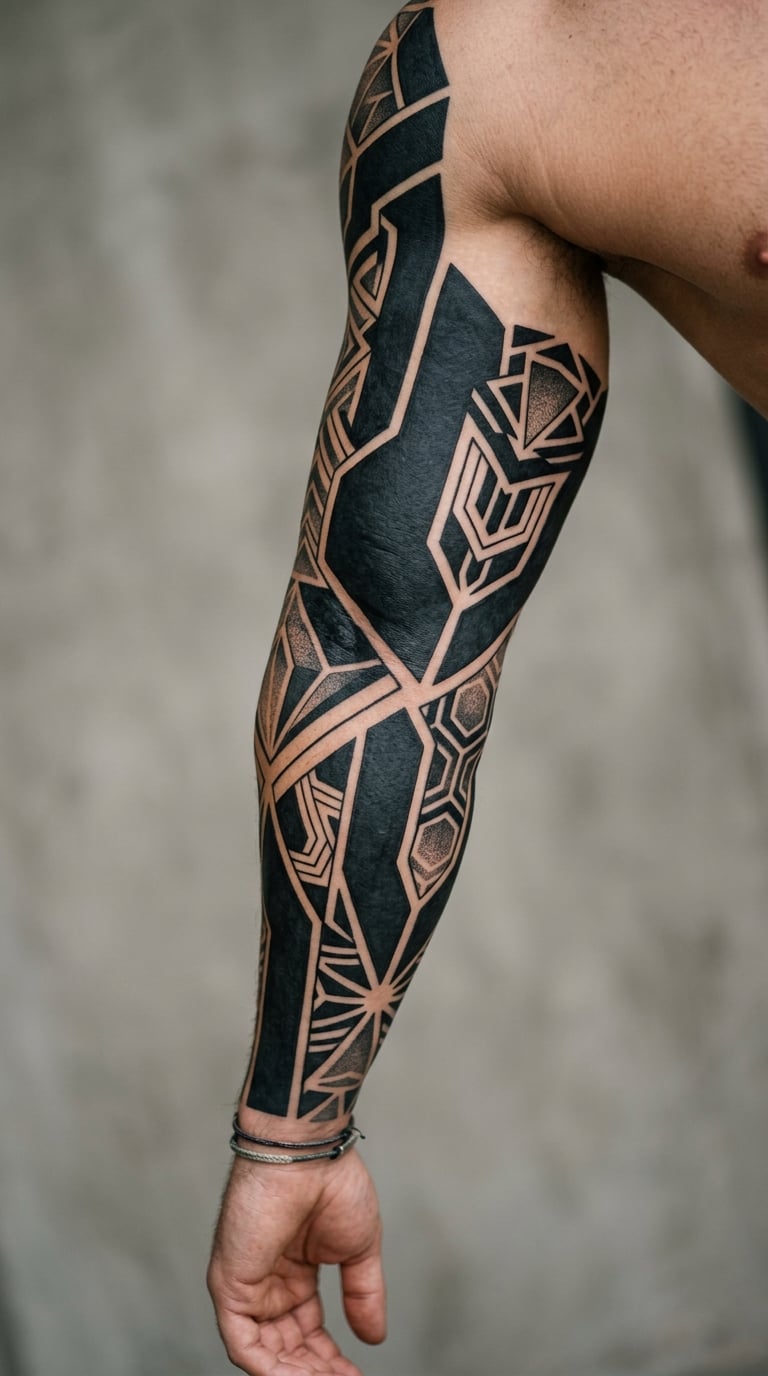
Dense geometric composition built from overlapping angular forms, solid black fields and sharp triangles of unpainted skin. The shapes interlock rather than repeat, so the eye travels across the arm instead of bouncing off a pattern.
People pick this one when they want the sleeve to read as architecture rather than a picture. It has no fixed meaning to assign, which some people like and others find flat.
Placement: Full arm wrap, shoulder cap to wrist, or outer arm only.
Size: 18-24 in (46-61 cm) for a full wrap; 10-14 in for an outer-arm version.
Style: Geometric blackwork with heavy packing.
Pain: High on the shoulder cap and inner elbow, moderate across the forearm.
Make it yours: Set the negative-space shapes to a personal pattern, such as the outline of a map you have travelled.
2. Blackout Rose Botanical Sleeve
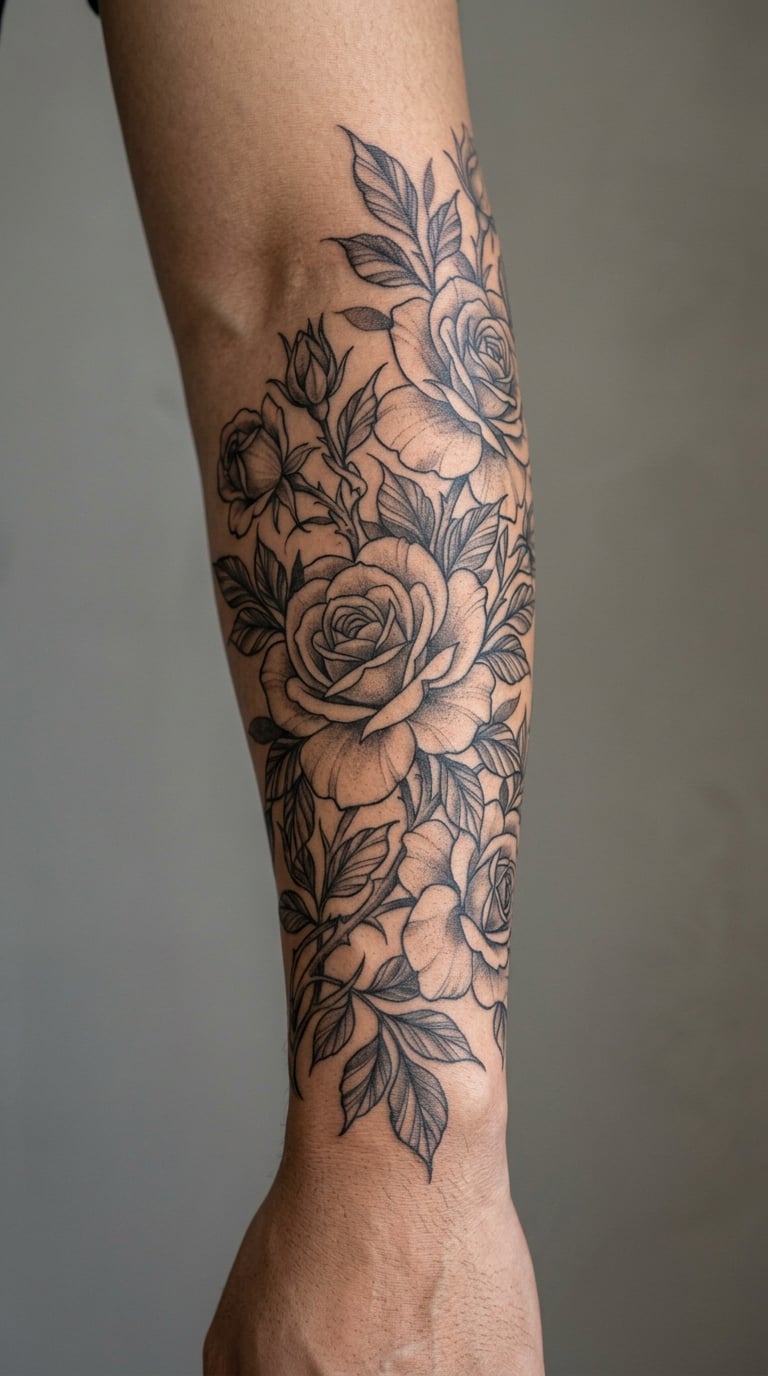
Large shaded roses anchor the composition, with pointed leaves and winding stems filling the gaps in layered grey. Deep black sits behind the darkest petals so the flowers still separate from the background once healed.
It is one of the most requested blackout sleeve tattoo ideas because it hides an old sleeve almost perfectly while still looking like a botanical piece rather than a cover-up.
Placement: Outer forearm to elbow, or shoulder to wrist.
Size: 10-16 in (25-41 cm) for a half-arm arrangement.
Style: Black and grey realism with packed black backgrounds.
Pain: Medium, rising near the elbow crease.
Make it yours: Use a specific rose variety that means something to you, such as a garden rose from a family garden.
3. Abstract Smoke Blackout Sleeve
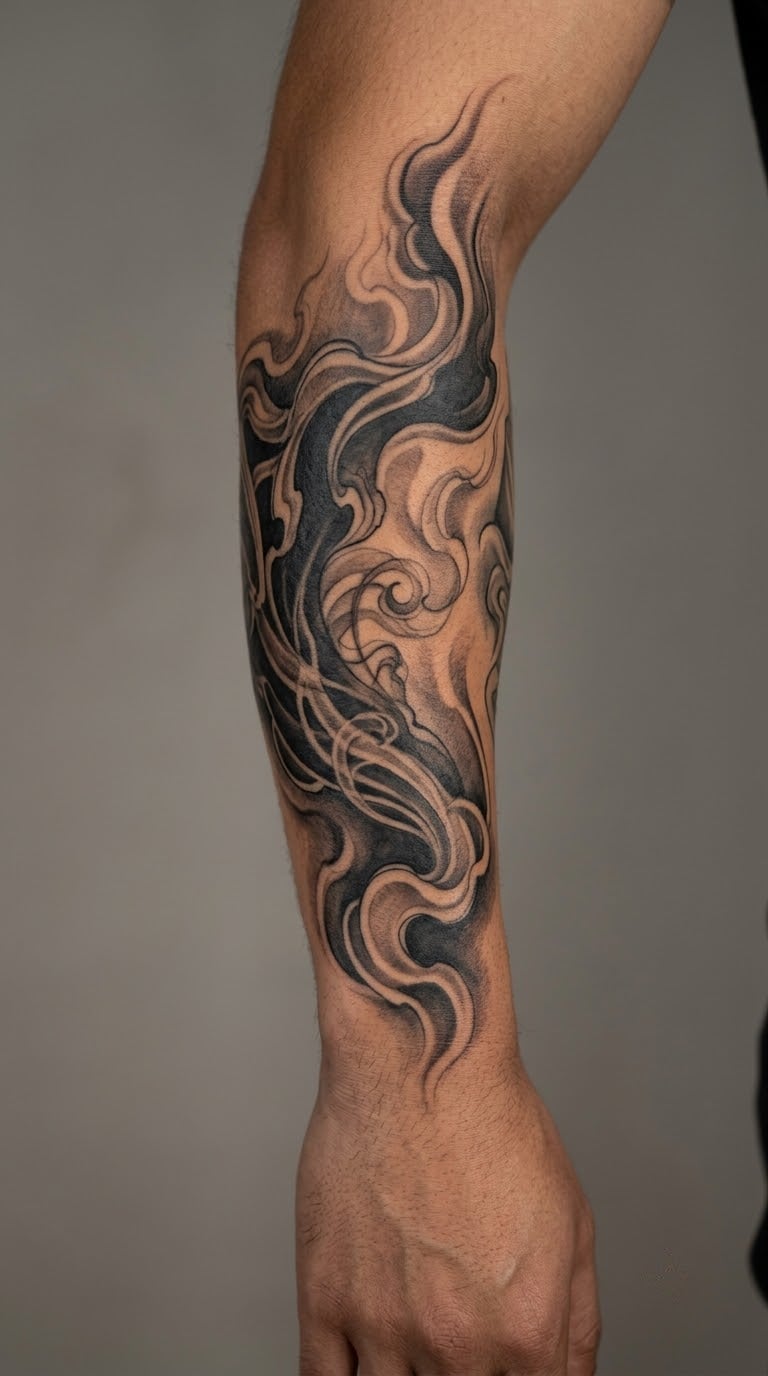
Layered smoke and vapor curls built from soft grey gradients that break into open background space, with one or two heavier black clouds anchoring the piece. Movement comes from where the ink thins out, not from added colour.
This is the softest route into solid black work, and it suits people who like the blackout look but find hard geometry too cold.
Placement: Full arm wrap or inner forearm.
Size: 16-22 in (41-56 cm) for a full wrap.
Style: Blackwork with greywash gradients.
Pain: Medium across the arm, higher over the inner elbow.
Make it yours: Have the smoke form around a word or initial rather than filling the arm evenly.
4. Blackout Tribal Armor Sleeve
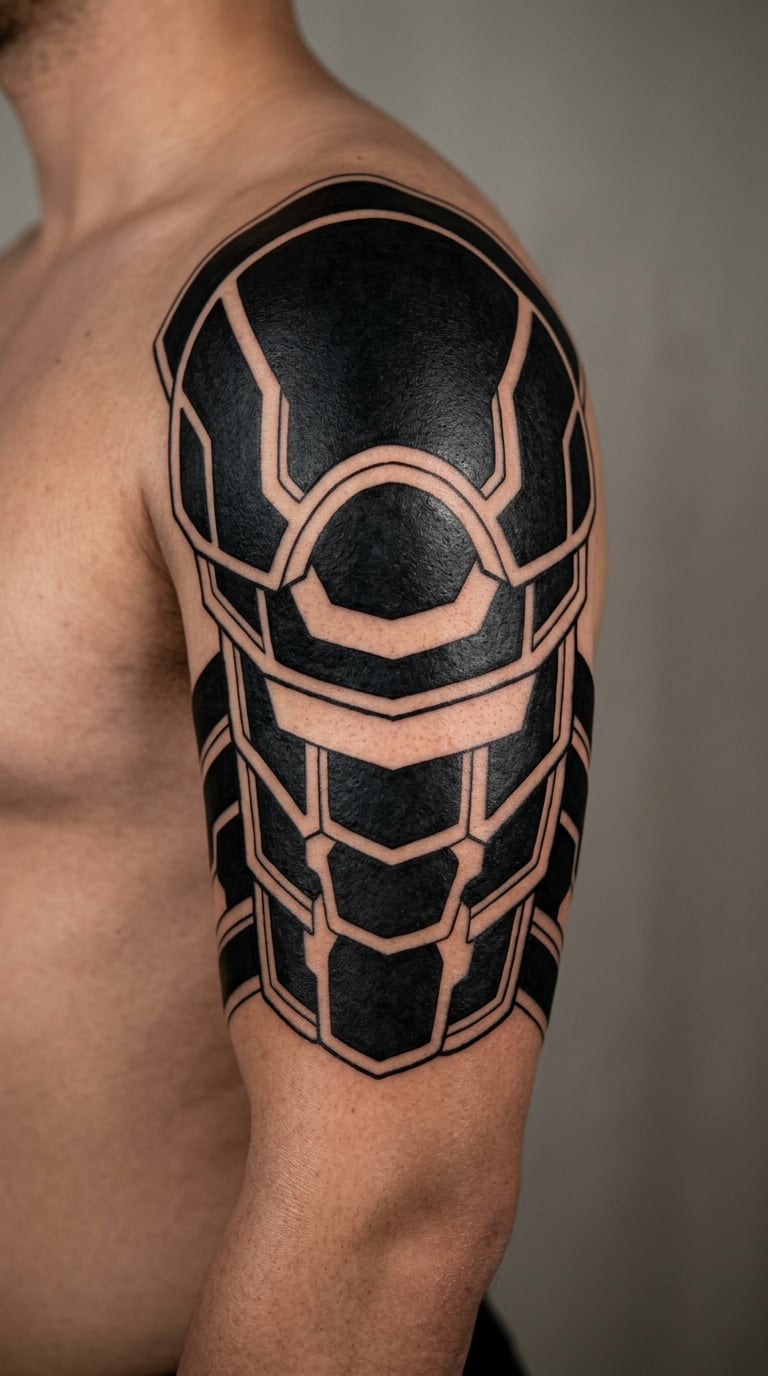
Contemporary black tribal built from armor-like bands, plates and segmented forms with clean outlines and hard edges. It borrows the visual weight of old tribal work without copying any specific cultural design.
This is the practical one to pick when the goal is covering large old black tribal arms. The plate structure follows the muscle groups, so the old shapes disappear underneath rather than showing through as shadows.
Placement: Shoulder to elbow, or full wrap.
Size: 12-18 in (30-46 cm) for the arm piece.
Style: Modern black tribal, solid black fields.
Pain: Medium, with the shoulder cap the toughest zone.
Make it yours: Change the plate geometry to match your own arm shape, so the design looks built for you rather than traced on.
5. Gothic Cathedral Blackout Sleeve
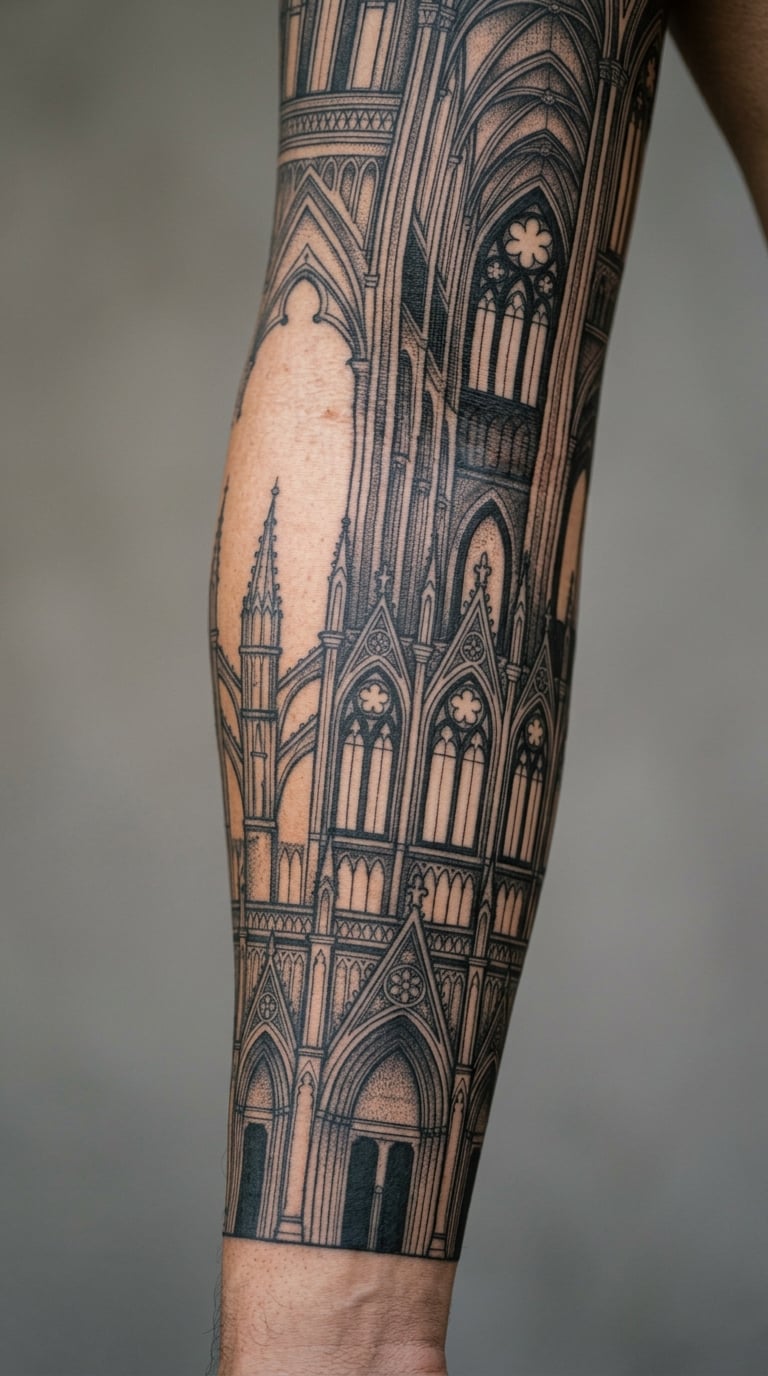
Pointed arches and silhouetted spires stacked vertically up the arm, with small white windows cut out of the black as negative space. The whole thing reads like a church interior seen in shadow.
People choose it for the vertical pull it gives a straight arm, and because the tiny windows add detail without needing colour.
Placement: Outer arm, shoulder to wrist, or upper arm only.
Size: 12-18 in (30-46 cm).
Style: Illustrative blackwork with fine cut-out detail.
Pain: Medium overall; the fine window detail is slow going.
Make it yours: Turn one arch into a doorway shape framing a small portrait or an initial.
6. Blackout Wolf and Mountain Sleeve
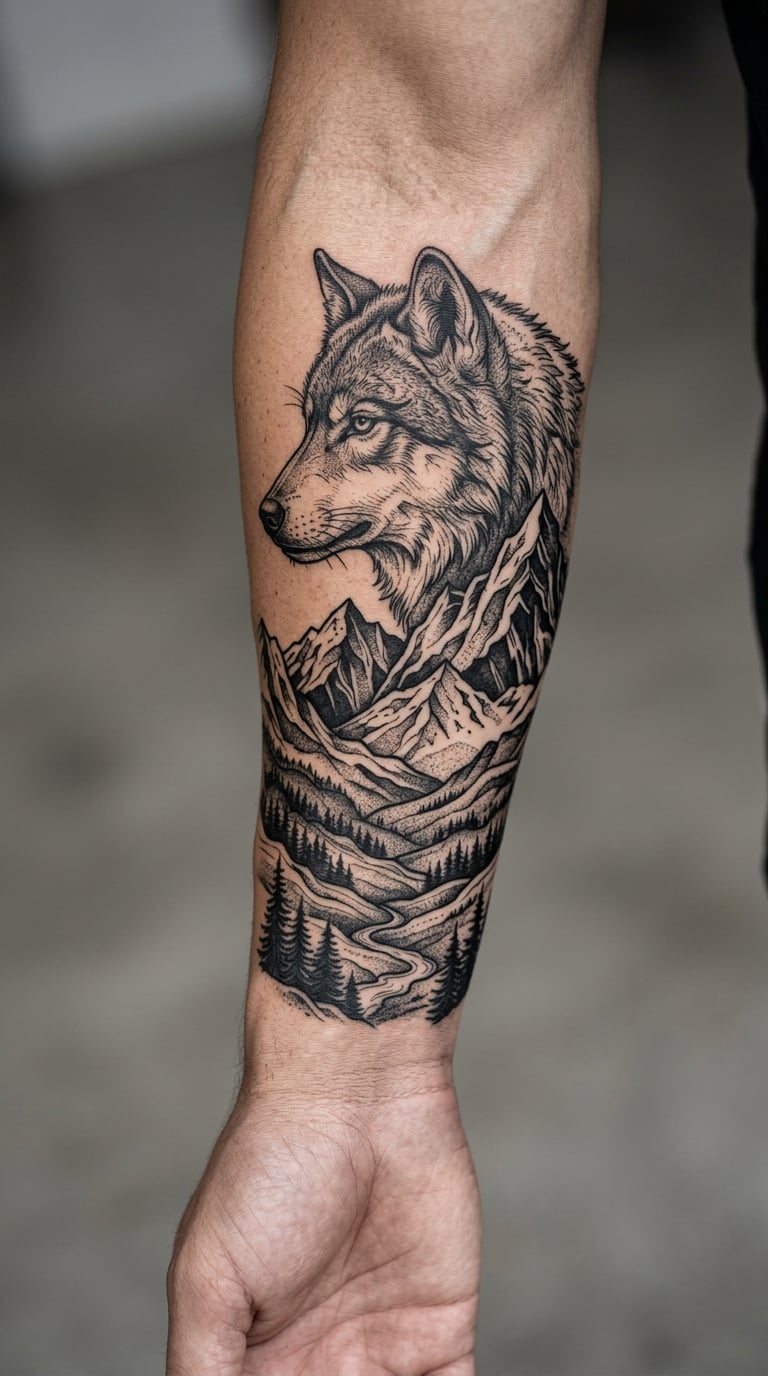
A detailed wolf profile placed against sharp mountain peaks, with layered terrain lines running underneath as a black band. The wolf carries the detail; everything behind it stays simpler so it holds contrast.
It is a common choice for people who want a landscape sleeve without colour, and the mountains give the arm a natural horizon to sit on.
Placement: Forearm to shoulder, or calf for a leg version.
Size: 14-20 in (36-51 cm).
Style: Blackwork realism with solid black skyline bands.
Pain: Medium, with brief high spots on bony areas.
Make it yours: Use peaks from a mountain that matters to you rather than generic jagged shapes.
7. Blackout Snake Wrap Sleeve
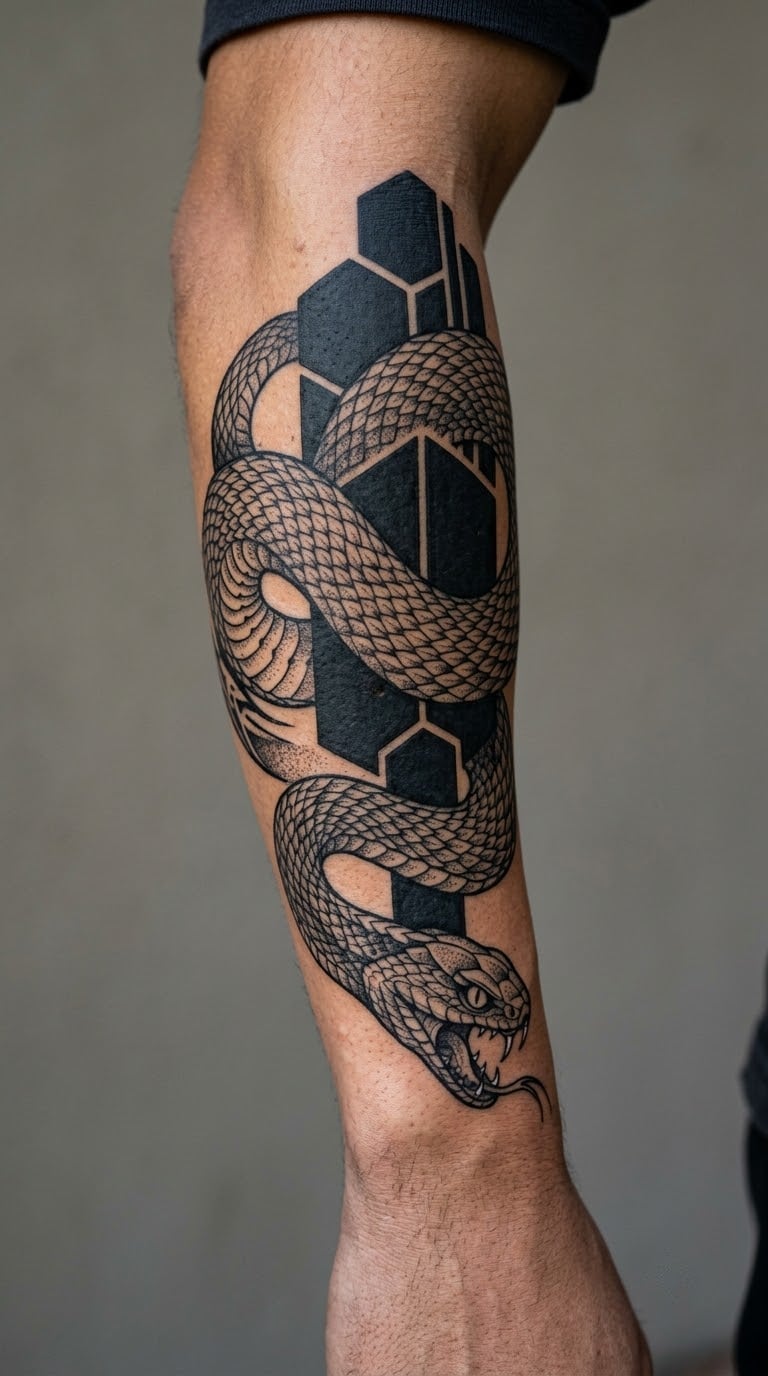
One sinuous snake travelling the length of the arm, its body curling through blocks of solid black and its scales drawn in fine repeating detail. Gaps are kept around the body so the snake never disappears into the black.
People choose a single snake rather than a pattern because it gives the sleeve a subject without crowding it, and serpent imagery has a long history in tattoo work.
Placement: Full arm wrap, wrist to shoulder.
Size: 18-24 in (46-61 cm).
Style: Blackwork with scale pattern work.
Pain: High, because scale detail needs many passes over the same skin.
Make it yours: Choose the snake species that matches your birth sign or a trip you took.
8. Celestial Blackout Sleeve
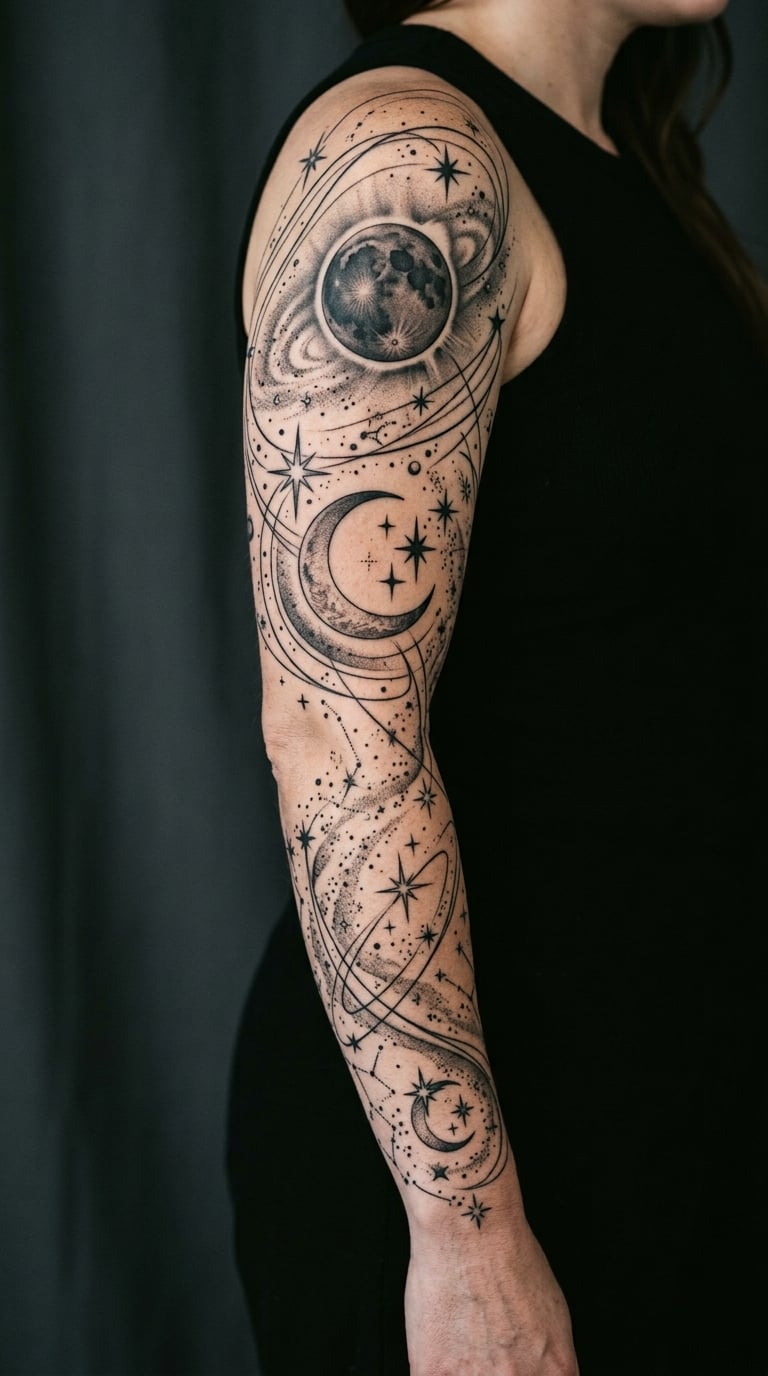
An eclipse as the main event, ringed by crescent moons, scattered stars and fine orbital lines running around the arm. Black space fills most of the field, with the bright shapes cut out of it.
It reads as quiet rather than aggressive, which is why a lot of people choose it for a first large piece even though the coverage is dramatic.
Placement: Shoulder to wrist, or upper arm band.
Size: 16-22 in (41-56 cm) full length.
Style: Blackwork with grey wash and fine line orbital detail.
Pain: Medium; orbital linework over the wrist is uncomfortable.
Make it yours: Put real star positions from your birth sky into the field instead of scattered filler stars.
9. Blackout Phoenix Wing Sleeve
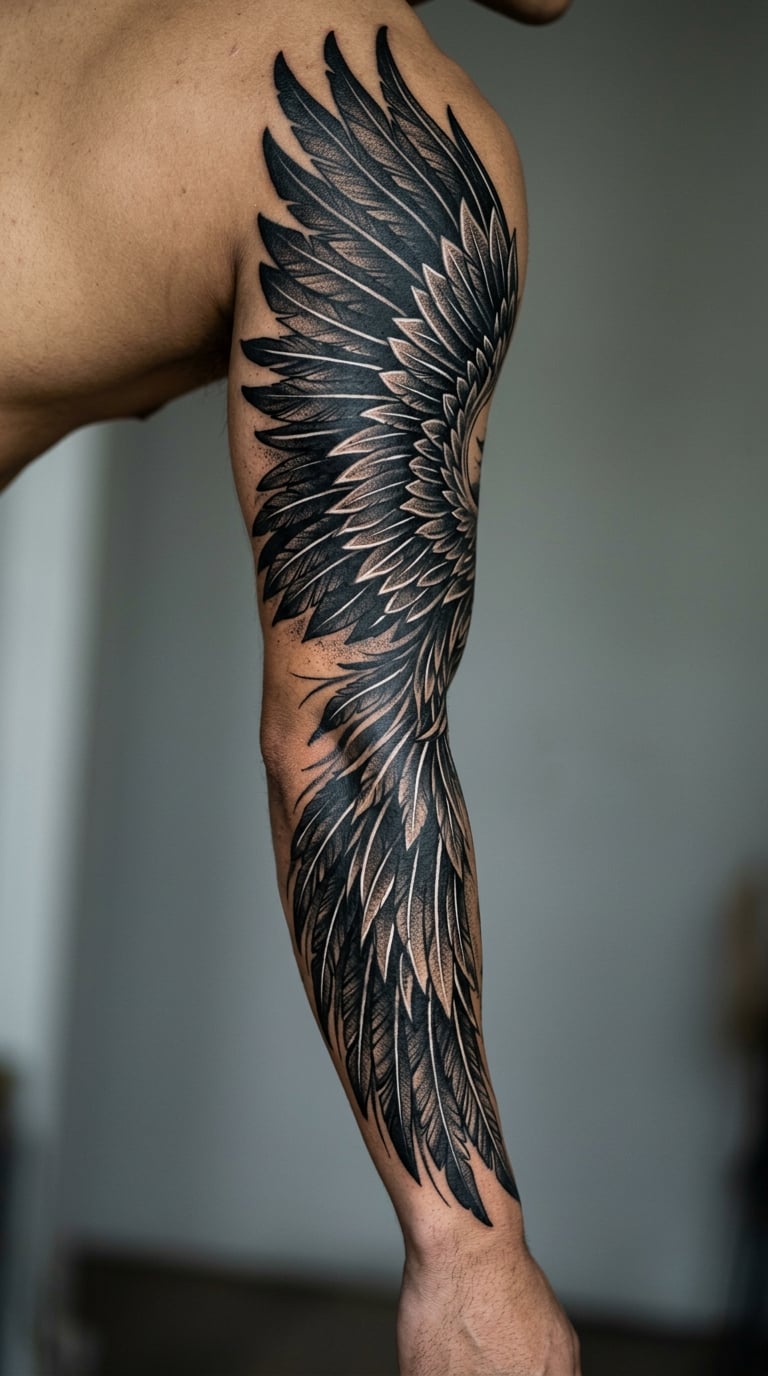
Sweeping wing forms made of layered feather shapes in dense black, with sharp highlights cut out of the ink so the feathers separate. The wing curves with the shoulder and narrows toward the elbow.
The wing shape suits the deltoid better than any other motif, and the cut highlights give an arm a brighter look than a flat blackout.
Placement: Shoulder cap sweeping down to forearm.
Size: 14-20 in (36-51 cm).
Style: Solid black feather work with negative-space highlights.
Pain: High over the shoulder cap and spine of the upper arm.
Make it yours: Pair one wing on one arm with a matching smaller piece opposite so the two read as a pair.
10. Blackout Cityscape Sleeve
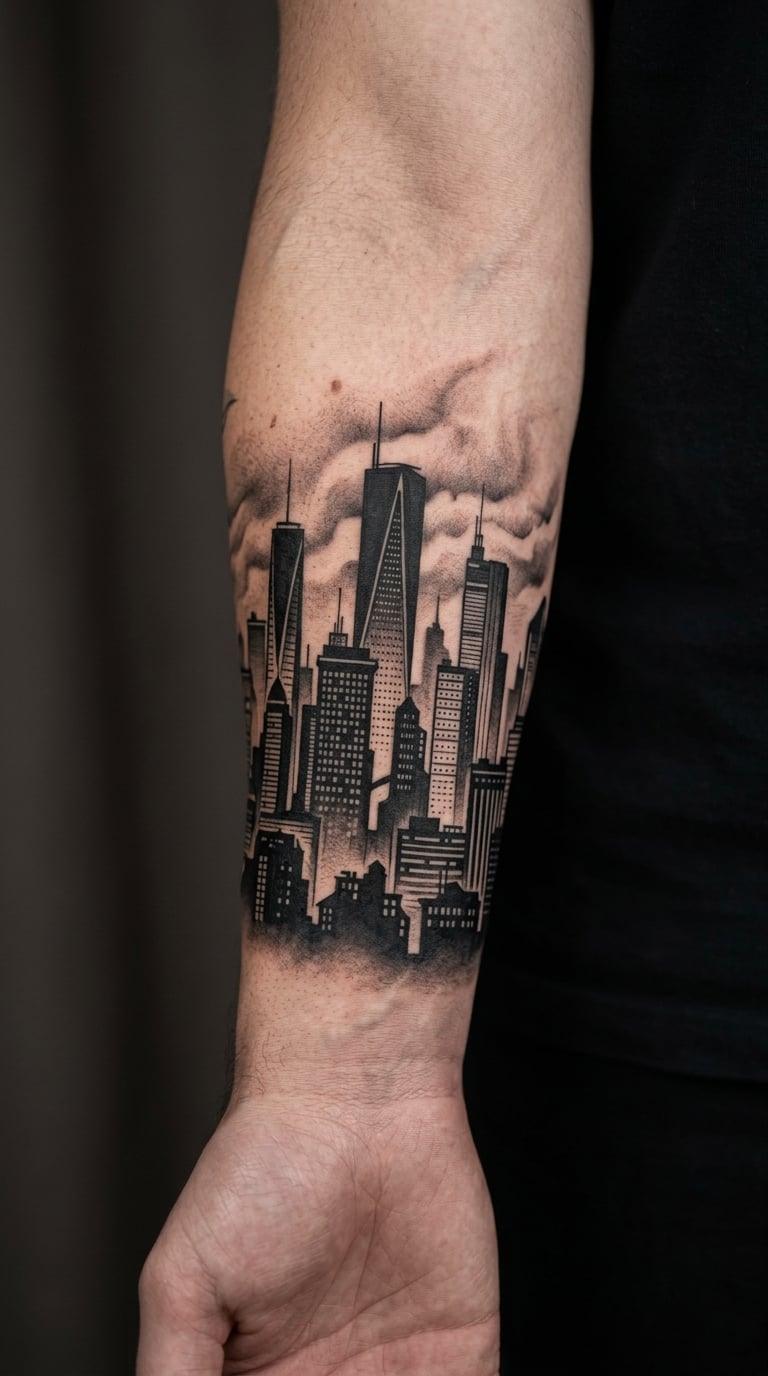
A continuous urban panorama of silhouetted skyscrapers, rooftops and smokestacks, with tiny window shapes and smoky grey shading filling the sky behind them. The skyline runs at one consistent angle so the buildings stay level around the arm.
It suits people who want a place rather than a symbol, and the rooftop line works well as a divider if you are adding to the piece later.
Placement: Forearm wrap, or calf.
Size: 12-18 in (30-46 cm).
Style: Illustrative blackwork with greywash sky.
Pain: Medium; window detail on the inner forearm stings.
Make it yours: Work in rooftops from a city you actually lived in, including a low building you loved.
11. Blackout Serpent and Mandala Sleeve
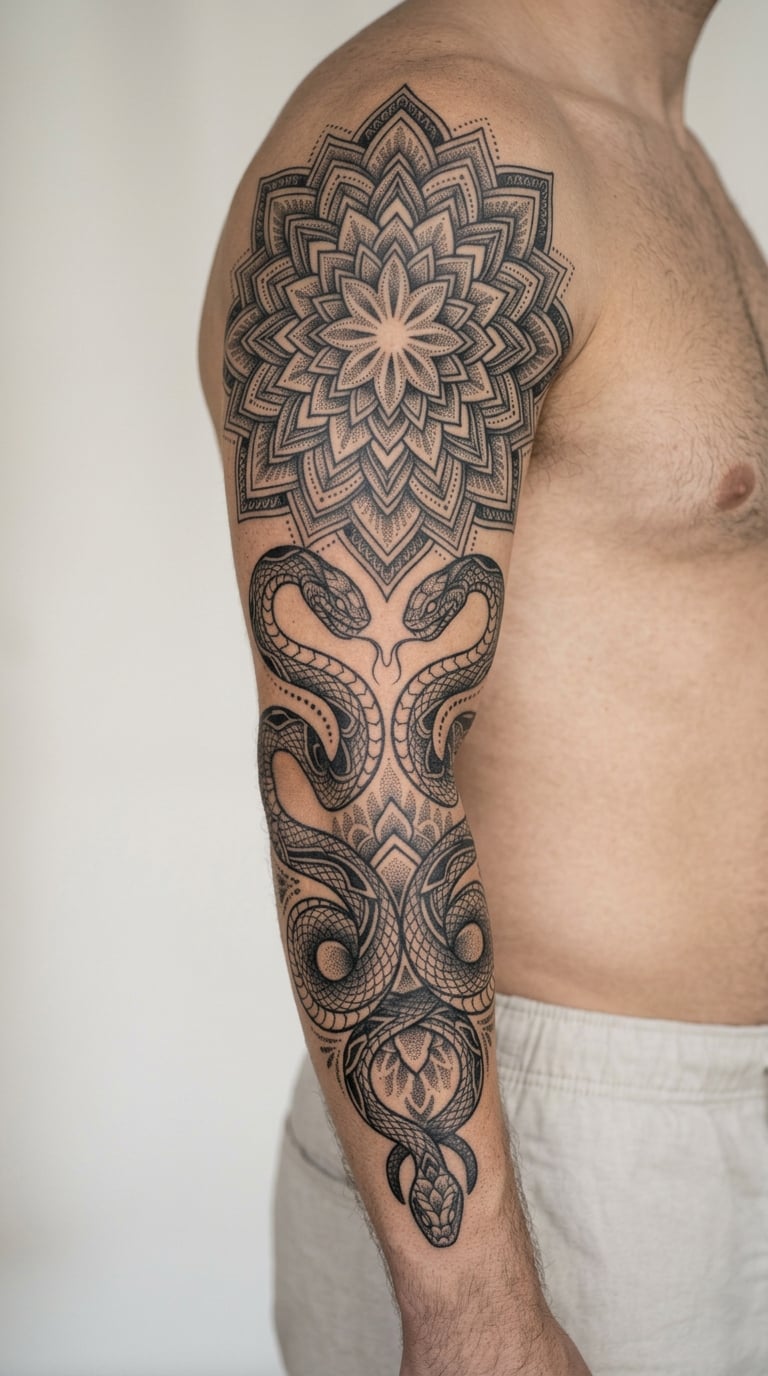
A radial mandala centred on the elbow with a coiling serpent wrapping around it, both built from thin black line over packed black grounds. Symmetry does most of the heavy lifting here.
Elbow-centred radial work looks good on almost any arm because the joint already provides a natural centre point, and it takes a personal emblem well.
Placement: Shoulder to elbow with a smaller lower-arm element.
Size: 10-16 in (25-41 cm).
Style: Symmetrical blackwork, dotwork detail.
Pain: Medium, and the elbow itself is a tough spot.
Make it yours: Build the mandala segments around a number or letter that means something private.
12. Blackout Fern and Branch Sleeve
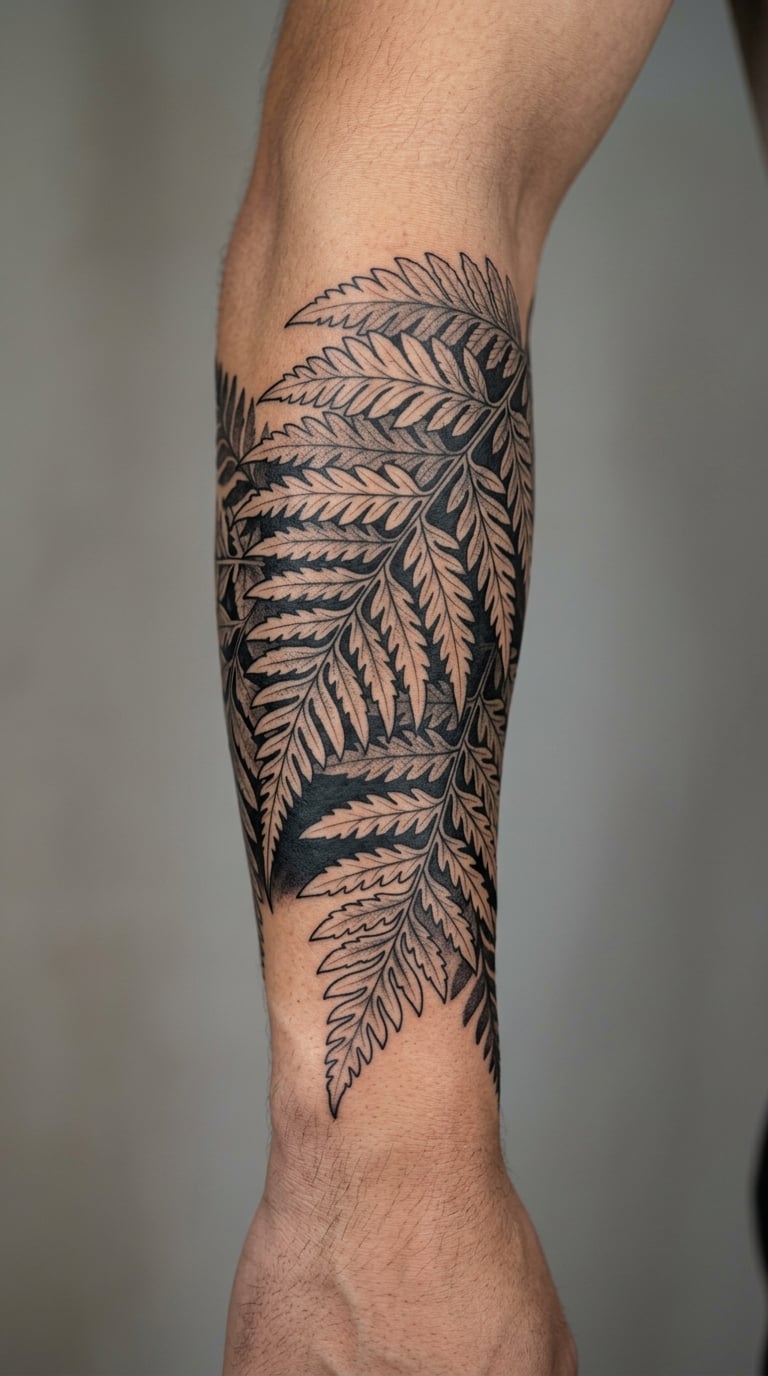
Overlapping fern fronds and branches with fine leaf veins, layered over broad black shadow blocks that push the fronds forward. The shadows are packed solid so the pale linework above stays readable.
Botanical work is the easiest blackout sleeve to live with day to day, since it reads as a normal tattoo from a distance and only shows its density up close.
Placement: Outer forearm, shoulder to wrist.
Size: 10-15 in (25-38 cm) for a single-frond half arm.
Style: Botanical blackwork with solid black shadow blocks.
Pain: Low to medium; the fine veins are quick passes.
Make it yours: Use a fern or branch cut from somewhere you have walked, then date it quietly in the shadow block.
13. Blackout Horror Portrait Sleeve
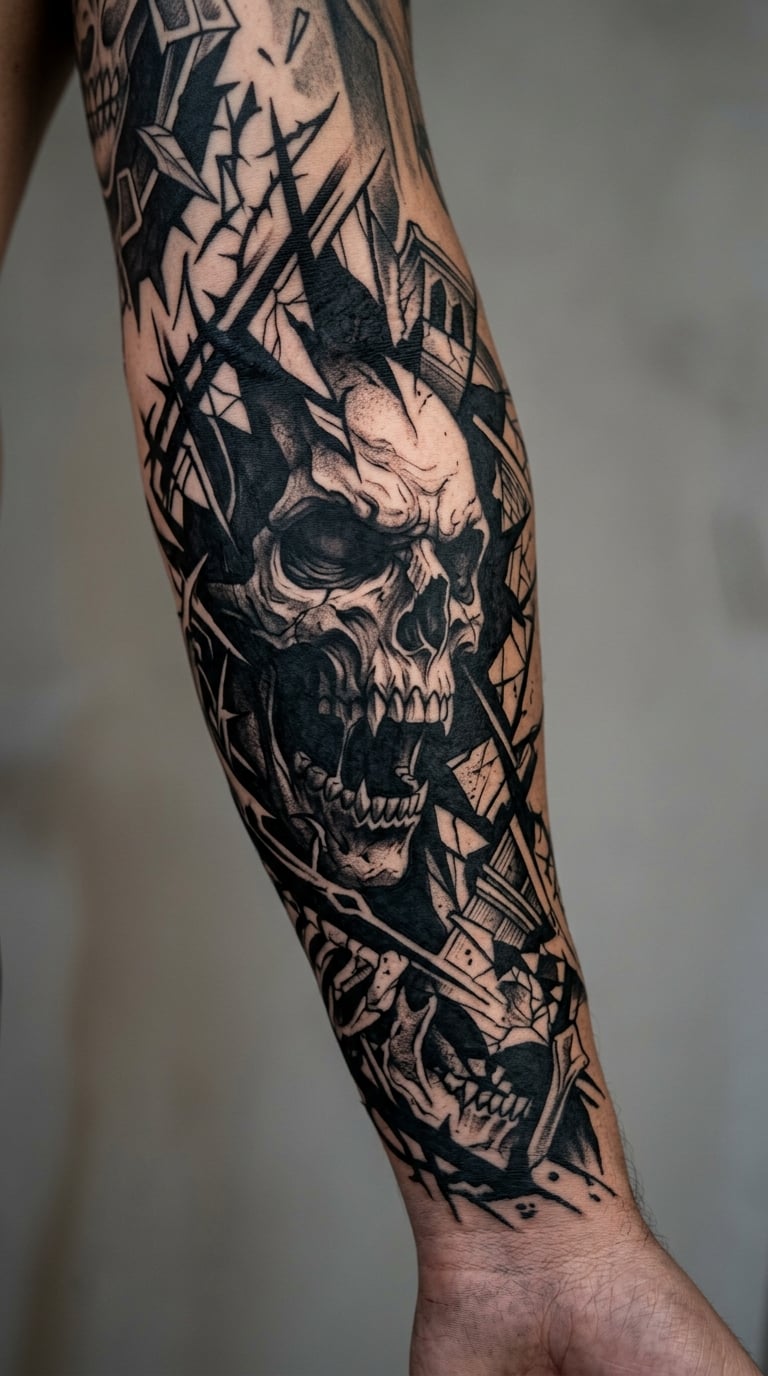
An original shadowy portrait built from one lit section of a face, heavy black shadows and fractured shapes breaking apart behind the head. The portrait has to be drawn for the arm rather than copied from a print, or it will look stretched.
People pick this because it commits. A portrait sleeve leaves no room for anyone to call it generic.
Placement: Upper arm and shoulder, or centred on the outer forearm.
Size: 8-14 in (20-36 cm) for the portrait itself.
Style: Blackwork portraiture with grey shading.
Pain: High; portrait shading needs slow rebuilds in the same spot.
Make it yours: Work with an artist on an original face rather than a reference photo, and keep the fractured background for added dark texture.
14. Blackout Circuit Board Sleeve
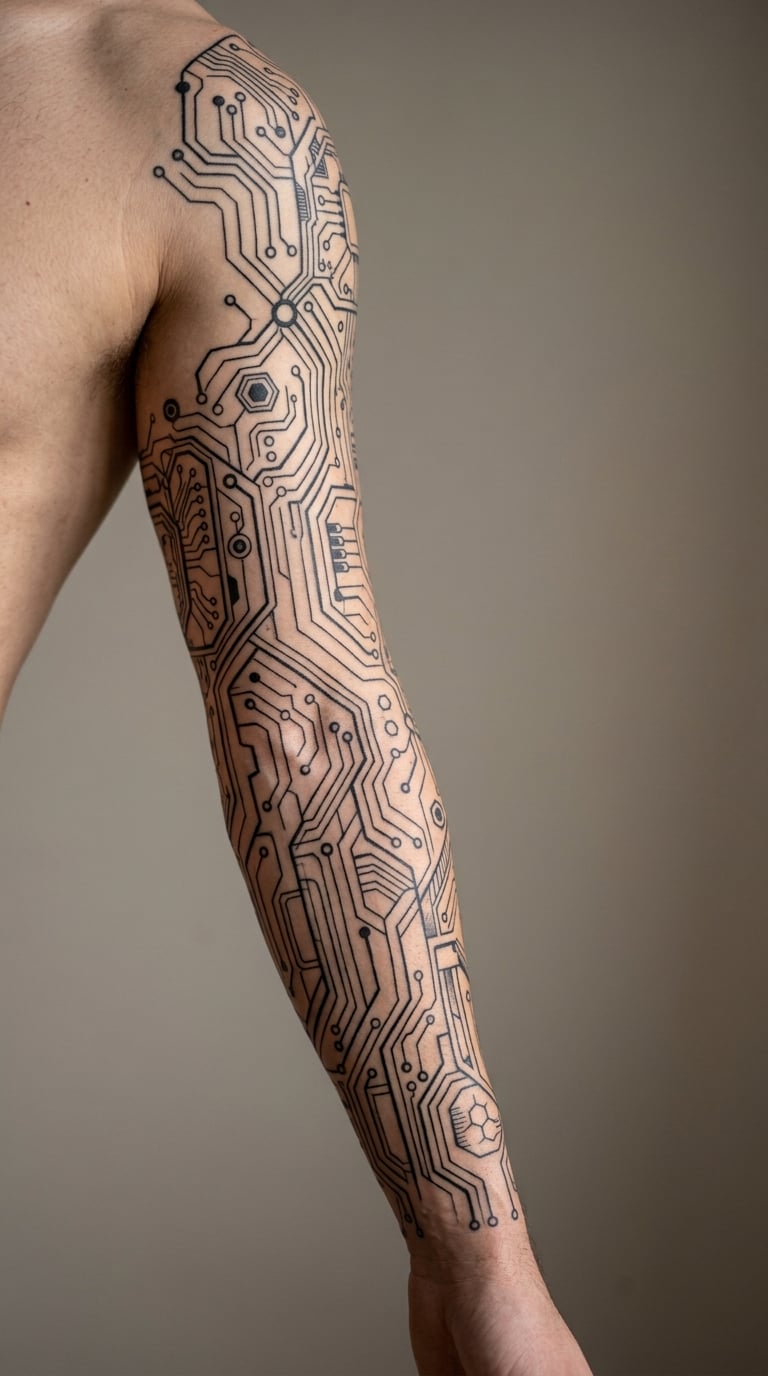
Branching trace lines, circular nodes and dark geometric panels laid out to follow the curve of the arm, with thick black grounds separating sections. The panel edges double as negative space.
It suits people who work in tech or engineering and want something readable as a pattern rather than a picture, and the straight lines hide old work well.
Placement: Shoulder to wrist, following the arm line.
Size: 16-22 in (41-56 cm).
Style: Technical geometric blackwork.
Pain: Medium; long straight runs are easier than tight detail.
Make it yours: Encode something real in the layout, such as a circuit pattern from a project you finished.
15. Blackout Koi and Wave Sleeve
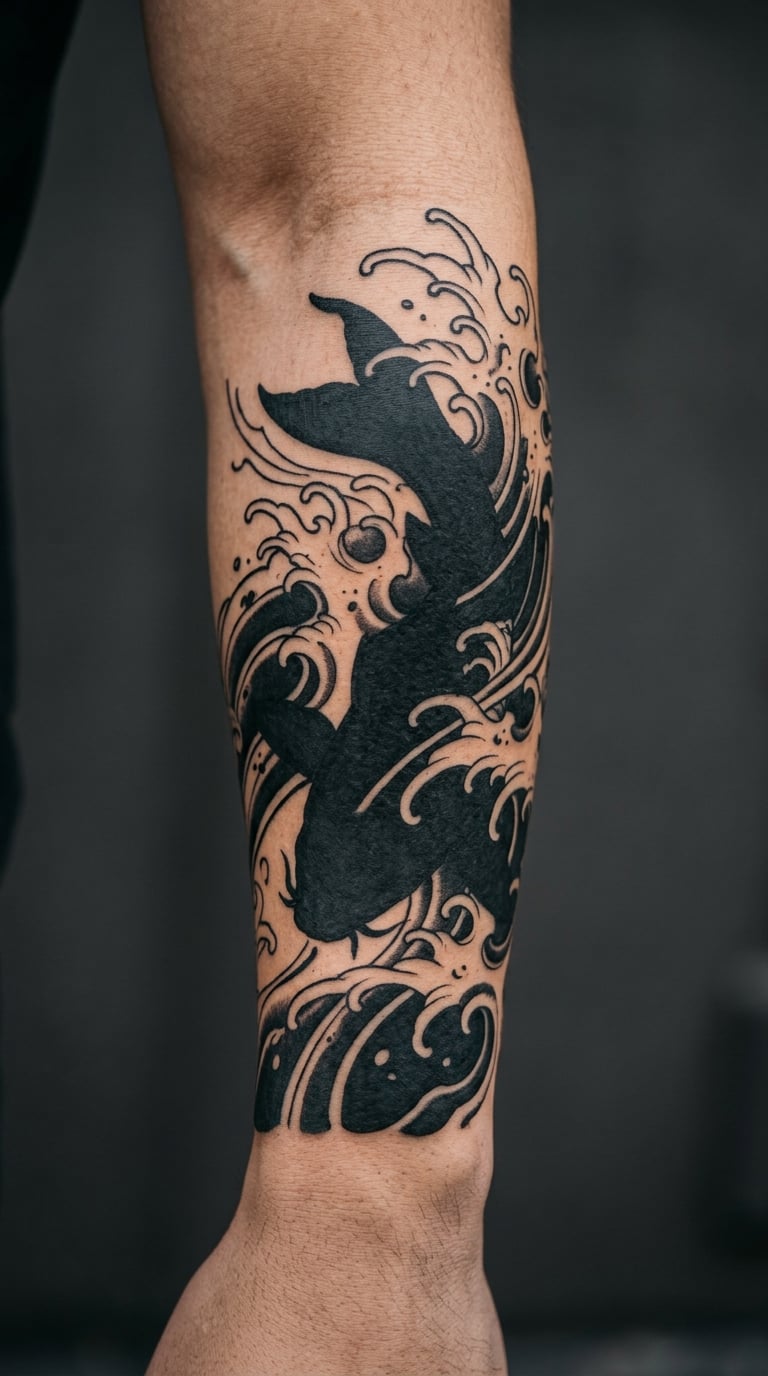
A koi silhouette carried on flowing water lines, with solid black pools of ink beneath and grey foam breaking at the edges. The fish sits at the elbow and the water carries it toward the wrist.
Water lines hide the awkward bends around a joint better than almost any other motif, and the movement suits the shape of a forearm.
Placement: Full arm wrap, or calf.
Size: 16-22 in (41-56 cm).
Style: Blackwork with grey water shading.
Pain: High across a full wrap, because most of it is forearm and elbow.
Make it yours: Give the koi scale pattern a colour you plan to add later over the black.
16. Blackout Moth and Moonlight Sleeve
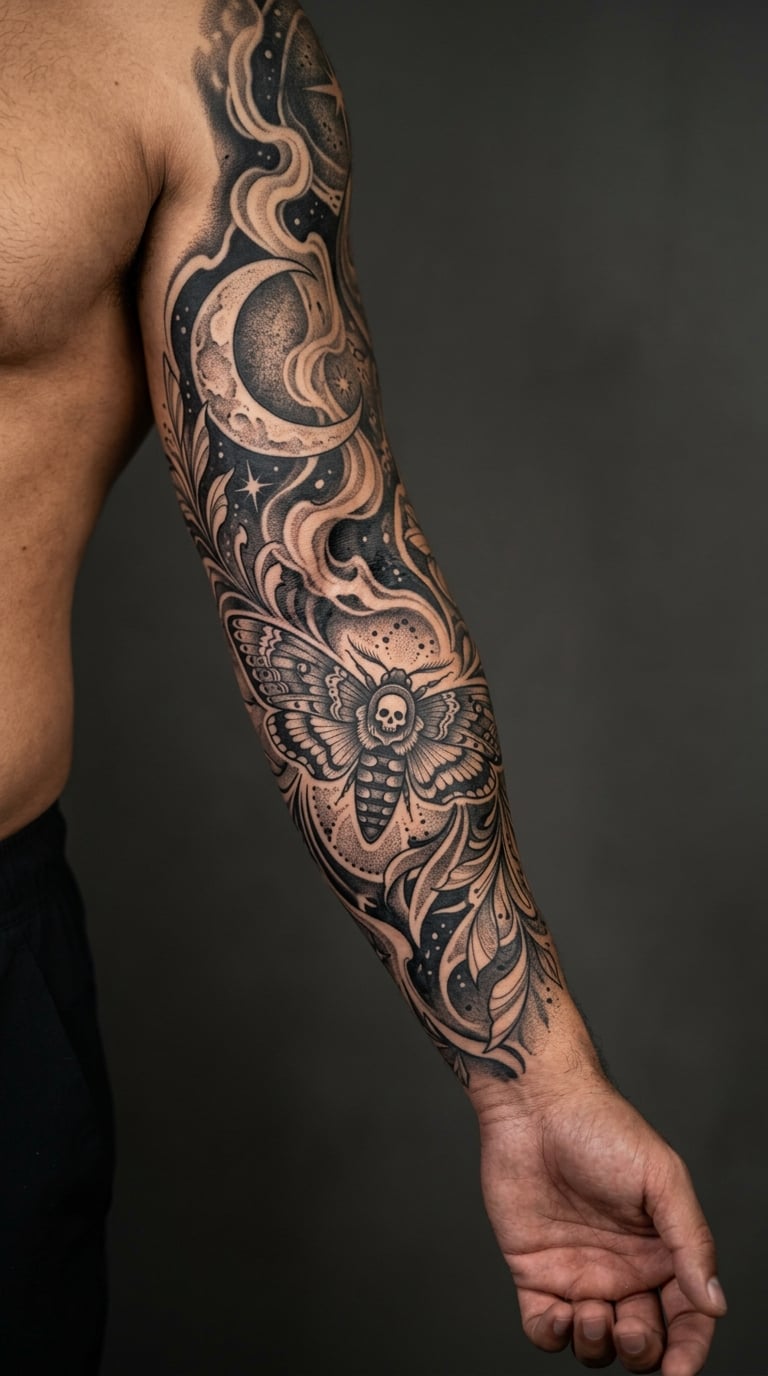
A detailed moth with patterned wings centred under a crescent moon, with soft grey moonlight falling across the arm and dark negative space holding it together. The moth is the one sharply detailed element in an otherwise soft field.
Moth motifs came out of naturalist illustration rather than traditional tattoo symbolism, so people tend to choose them for the look rather than the meaning.
Placement: Full arm wrap with the moth at the upper arm.
Size: 14-20 in (36-51 cm).
Style: Blackwork with grey wash and detailed wings.
Pain: Medium; wing vein work over ribs is the worst part.
Make it yours: Use a moth species from your region so the piece is specific to where you live.
17. Blackout Viking Helmet Sleeve
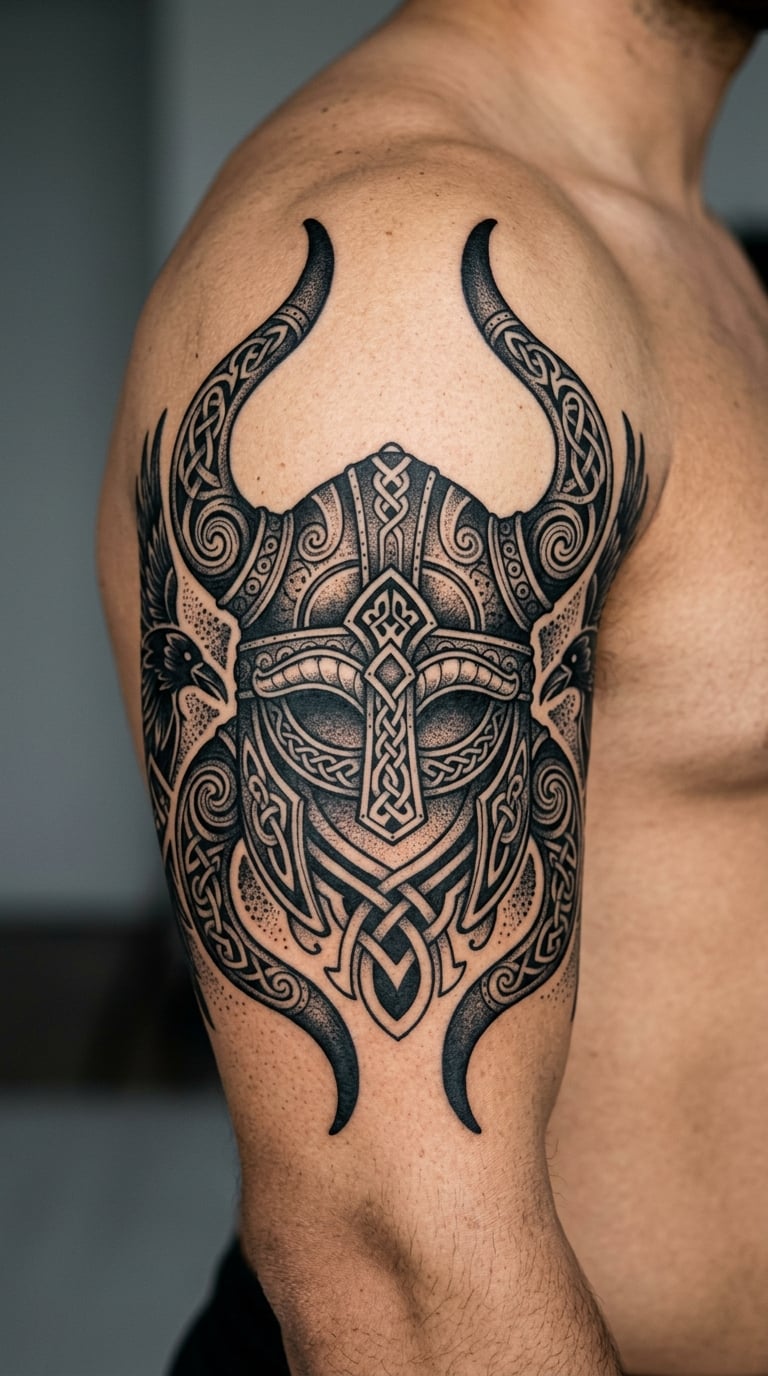
A stylised helmet with curved horn forms, shaded metal bands and restrained ornamentation set into a solid black ground. The helmet is drawn as an object rather than a symbol, which keeps it from looking like clip art.
Historical pieces sit well with this style because the metal shading gives the eye a mid-tone to rest on between solid black areas.
Placement: Shoulder cap or upper arm focal piece.
Size: 8-12 in (20-30 cm) for the helmet, more with a supporting background.
Style: Stylised blackwork with grey metal shading.
Pain: High over the shoulder cap, the most sensitive area on an arm.
Make it yours: Put the wearer’s own name in a runic band along the base rather than adding generic symbols.
18. Blackout Dragon Scale Sleeve
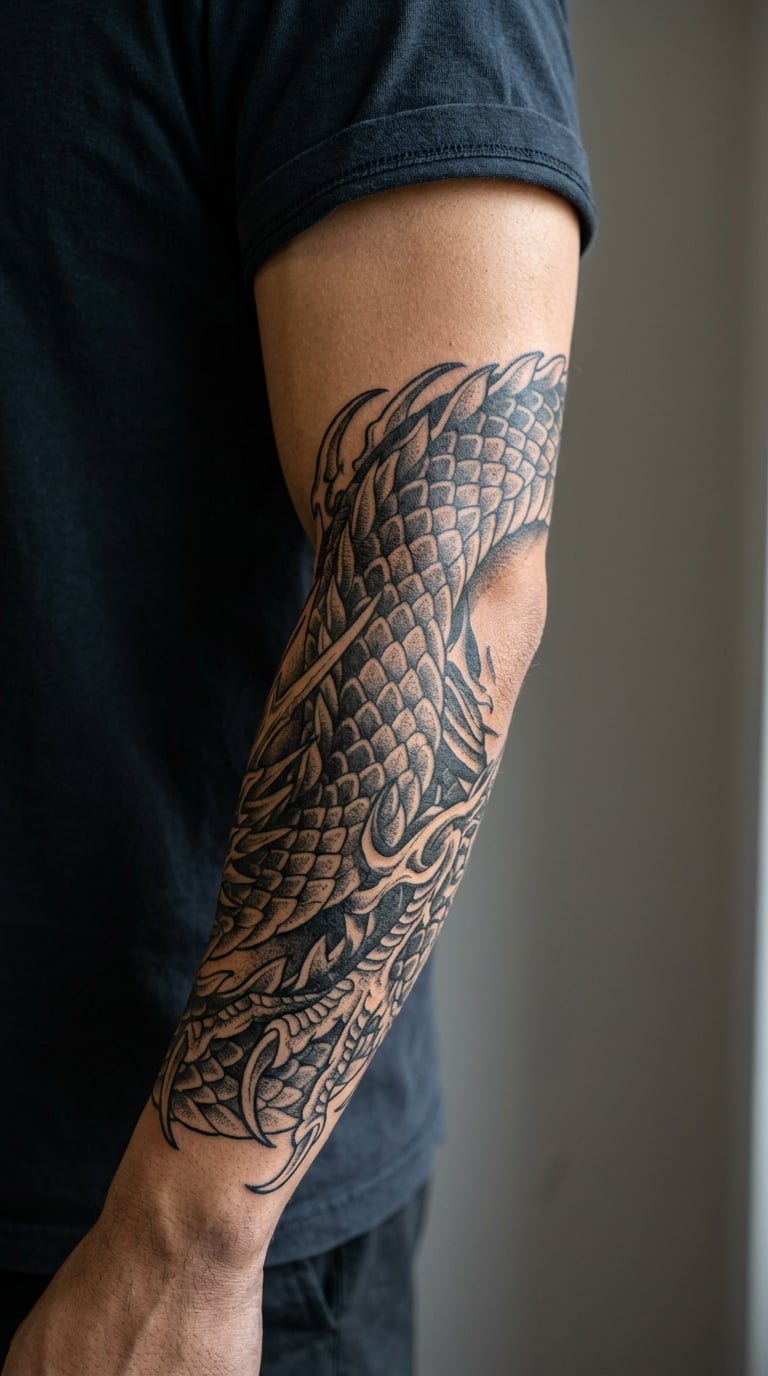
Repeating dragon scales with sharp claw forms breaking the pattern and dense shading that varies in value so the surface never reads flat. Scale density is adjusted around the elbow where the arm bends most.
This is the strongest cover-up option in the whole list. Scales are busy enough to absorb old linework and colour underneath, which is why it turns up so often in r/Tattoocoverups discussions.
Placement: Full arm wrap, wrist to shoulder.
Size: 18-24 in (46-61 cm).
Style: Repeating scale blackwork, solid packing.
Pain: High; dense scale detail means many passes over the same skin.
Make it yours: Vary the scale size so one section reads as a limb and another as a wing membrane.
19. Blackout Rose Compass Sleeve
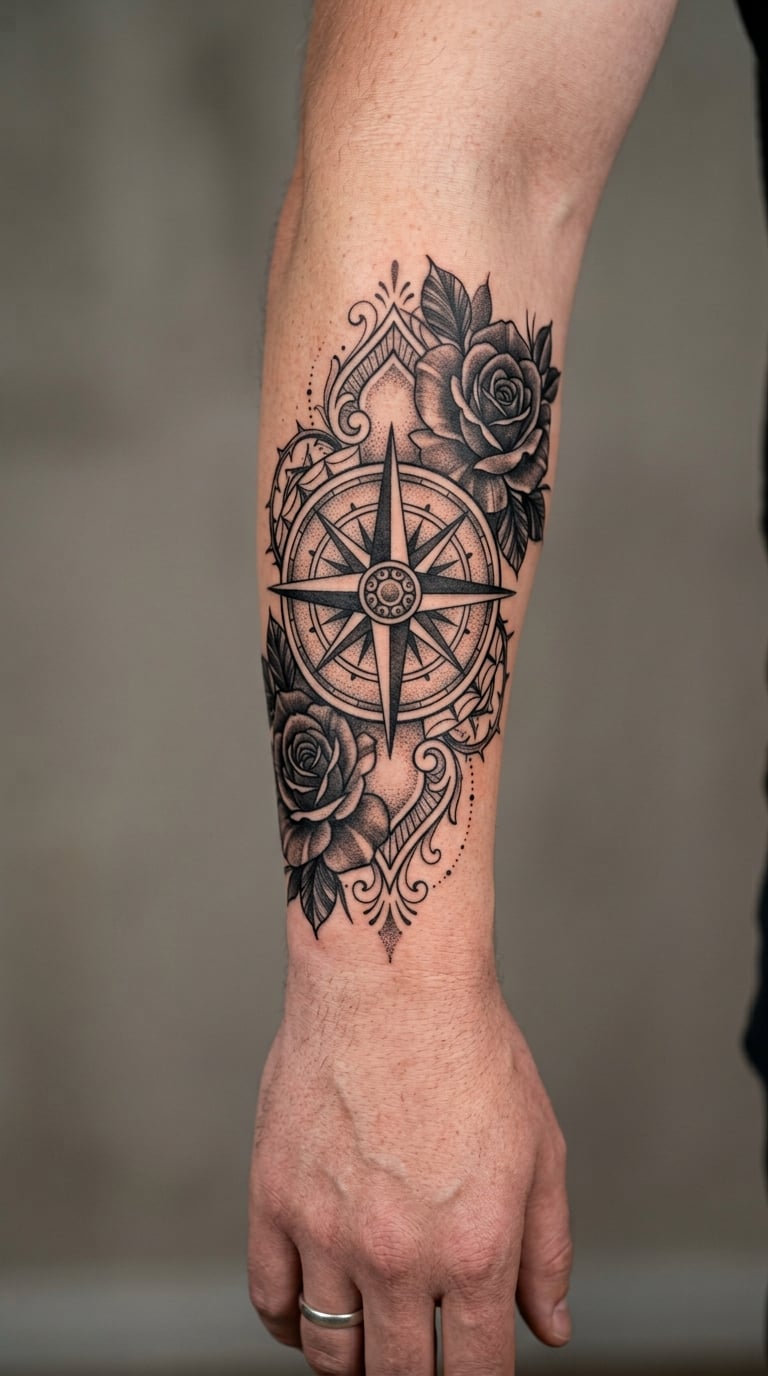
A compass rose with fine directional points surrounded by dark roses and light line accents, all sitting on a packed black ground so the compass face reads white against it.
Direction and guidance is the usual reason people give for a compass, though plenty choose it purely because the geometry is pleasing.
Placement: Forearm to shoulder, or centred on the upper arm.
Size: 12-18 in (30-46 cm).
Style: Blackwork line and wash with floral elements.
Pain: Medium, with the compass points taking longer than the roses.
Make it yours: Point the main spike toward a place you plan to go, or toward home.
20. Blackout Abstract Shadow Sleeve
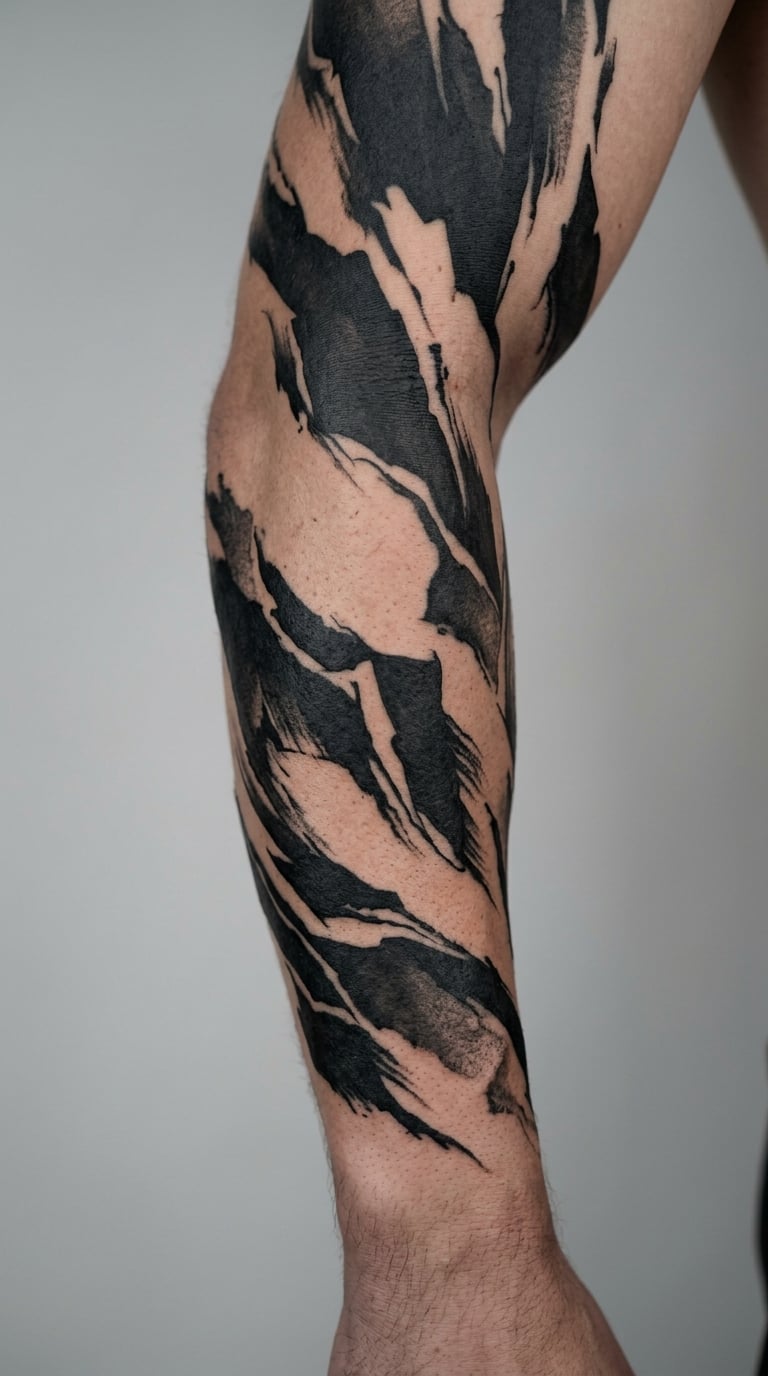
A non-representational composition of irregular shadow fields, torn edges and layered black shapes with no central image at all. Value shifts between the layers keep it from reading as one flat plane.
This is the right pick for someone who wants maximum impact but does not want to explain a single motif to anyone who asks.
Placement: Any large flat area: full arm, half arm, thigh or back.
Size: 14-22 in (36-56 cm).
Style: Abstract blackwork, layered fields.
Pain: Medium; large fields cover faster than detailed work.
Make it yours: Have the torn edges follow a photograph of something, so the randomness has a source nobody else can see.
How to Choose the Right Design
Pick the style before the picture. If you want full coverage with no subject, ideas 1, 3 and 20 do it with the least detail risk. If you want a motif, decide whether it must survive being covered in old ink — botanical and scale work tolerate cover-ups, fine geometric linework does not.
Match the design to the placement, not the other way around. A wolf profile reads across a forearm; it gets squeezed on a shoulder cap. Before committing, look at more examples of black sleeve tattoo ideas at the size you actually intend to get, not just the hero images from big portfolios.
Think about the long term, not just day one. Solid black softens and greys slightly as it ages, and light areas that were left as skin will slowly grow into each other. A design with clear negative space keeps its read for longer than a fully packed field.
Decide how much you want to explain. A white or grey design worked over the black base is the most requested combination in the forums, and one r/tattooadvice poster will only commit to a full blackout shoulder-to-elbow piece if a readable white design can go on top. Decide that at the consult, because the base has to cure flat enough to accept light ink.
Scope your commitment. If this is your first large piece, a half sleeve or a shoulder cap band is a sensible place to find out whether you enjoy a long sitting. Plenty of people add to a sleeve later, and a design that leaves room at the elbow or wrist can grow into a full arm without a cover-up.
Set your expectations on reversibility early. Large solid black is one of the hardest things to laser off later, so the design decisions belong to you, not to the artist who is most eager. If you want the sleeve to sit under long sleeves at work, mention it at the consult — the same list has bold sleeve tattoo ideas for higher-contrast placements.
Cost and Session Time
There is no reliable published figure for a full solid black sleeve, and the honest answer is that the artist breaks it down by area, session length and hourly rate. Below are realistic US ranges for planning, not quotes — your artist will price by the hour and by how many sittings the piece needs.
| Project | Sessions | Hours per session | Total project hours | Typical US range |
|---|---|---|---|---|
| Small focal piece (shoulder cap, single motif) | 1 | 2-4 | 2-4 | USD 300-800 |
| Quarter sleeve (shoulder to mid-bicep) | 1-2 | 3-5 | 4-8 | USD 700-1,800 |
| Half sleeve (shoulder to elbow) | 2-3 | 4-6 | 8-15 | USD 1,500-3,500 |
| Full wrap sleeve (wrist to shoulder, all around) | 3-5 | 5-7 | 20-35 | USD 3,000-8,000 |
| Full sleeve with white or grey design over the base | 4-6 | 4-6 | 25-40 | USD 4,000-10,000 |
Hourly rates across the US commonly run from roughly 80 to 200 dollars an hour, with many studios setting a shop minimum of a few hundred dollars that covers short sessions. A Seattle artist documented on r/tattoo covered a large old black tribal with a solid black sleeve in a single eight-hour session, describing how hard it is to pack black evenly — an unusual outlier, and useful as an example of what a focused day of large-area work looks like. Quarter sleeve tattoo ideas are the cheapest way to test this style before committing to a full wrap.
Ask for the session breakdown at the consult rather than a single flat number. Anyone who cannot say how many sittings, how many hours and which arm zones are in each one is guessing. Also ask what happens if you need a touch-up in the middle, since large solid fields often need one.
Aftercare Basics
Start with your artist’s aftercare instructions, because they know exactly how much solid black went into your skin and how your particular piece was finished.
- Wash the area as directed with clean lukewarm water and a fragrance-free wash, then pat dry rather than scrubbing.
- Apply a thin layer of the ointment or balm your artist recommends rather than a heavy coating; too much can soften fresh black and trap ink.
- Keep the sleeve out of direct sun while it heals and after, because black fades faster in UV than most people expect.
- Wear loose clothing for the first days. A sleeve rubbed by a tight cuff or a laptop sleeve irritates faster than anything else in normal life.
- Expect flaking, itching and a dull-looking surface for one to three weeks as the outer layers peel. Do not scratch or pick it, especially over solid black.
- Watch for heat, spreading redness, yellow fluid or swelling, and contact your artist or a doctor rather than trying to treat it yourself.
Soften, sunscreen and no picking cover almost everything. After the first few weeks your only real job is keeping sun off it for the rest of your life.
Frequently Asked Questions
What does a blackout tattoo on a sleeve mean?
A blackout sleeve is a covering of dense, unbroken solid black ink with no single required symbol. People choose it because the black itself is the design, because they want old work hidden permanently, or because they are tired of explaining meanings to tattoos they have grown to dislike. Some designs cut white, grey or colour out of the black afterwards, which gives the piece its subject without removing the blackout base.
How much does a full blackout sleeve cost?
A full wrap sleeve in the US usually falls somewhere between 3,000 and 8,000 dollars, and adding a white or grey design worked over the black base can push a project to 10,000 dollars or more. Most artists price by the hour, typically 80 to 200 dollars, and a full sleeve takes three to five sittings of five to seven hours. A quarter sleeve is a fraction of that and a much smaller commitment.
How painful is a blackout sleeve tattoo?
A large blackout sleeve is more painful than a typical detailed sleeve because the needle stays in the same areas for hours. Expect low pain across the fleshy upper arm, moderate across the forearm, high on the shoulder cap and the bony top of the forearm, and the worst of it on the inner elbow, armpit and rib edge. Breaks, shorter sittings and staying fed and hydrated make the long sessions easier to sit through.
Is a blackout tattoo racist?
No. Blackout tattooing is a design style, not a symbol, and it has no connection to any group or organisation. It grew out of blackwork and graphic design traditions, and the dense black comes from wanting high contrast and full coverage rather than any belief. Anyone who tells you a solid black sleeve carries a hidden meaning is guessing, because there is no agreed meaning attached to it.
How long does a blackout sleeve take to finish?
Plan on three to five sittings for a full wrap sleeve, usually five to seven hours each, so somewhere around 20 to 35 hours of work in total. A half sleeve from shoulder to elbow needs two or three sittings, and a small focal piece can be done in a single afternoon. A white or grey design over the blackout base adds more sessions, because the light ink needs its own pass after the black has cured.
Can a blackout sleeve tattoo be removed with laser?
Partly, but slowly and with real limits. Laser removal targets ink particles, and solid black holds a lot of pigment deep in the skin, so clearing a full sleeve usually takes many more sessions than removing a coloured piece and can leave a patchy grey tone that itself needs several more treatments to fade. That is the practical reason to treat a blackout sleeve as permanent and to choose the design and artist before the first sitting.
If this is your first large piece, start at idea 17 or idea 12 — a shoulder cap band or a single frond run — and learn how you handle a long sitting before committing to a full wrap. If you already have work you want gone, ideas 4 and 18 are built to cover it, and idea 19 or idea 15 give you something worth keeping once the black is down. Book the consult, ask for the session breakdown, and bring these designs with you.