
20 Irezumi Sleeve Tattoo Ideas (October 2026) Guide
Irezumi is the Japanese tradition of large, storytelling body tattooing: bold outlines, saturated colour, and imagery built to move with the body instead of sitting on top of it. These 20 irezumi sleeve tattoo ideas cover the motifs that come up most often, from waves and koi to dragons, Fuji, and the hannya mask, with real placement, size, and pain notes for each one.
What makes an irezumi sleeve work is flow. A wave has to travel with the curve of the forearm, not fight it. A dragon’s body needs somewhere to go on the shoulder cap that doesn’t look like an afterthought. The artist maps the composition onto your arm before a single line goes down, and a good idea gives them something worth mapping.
Most of these suit a full-colour traditional sleeve, though a handful work beautifully in black and grey. A few are built for smaller arms and shorter commitments. If you are new to big tattooing, read the sizing notes before you fall for a design that needs a back piece to complete it.
20 Irezumi Sleeve Tattoo Ideas: Quick Guide
20 Irezumi Sleeve Tattoo Ideas Compared
| Idea | Style | Best placement | Size | Pain |
|---|---|---|---|---|
| 1. Flowing wave | Traditional colour | Full forearm, outer arm | Medium to large | Medium to high |
| 2. Red-and-gold koi | Irezumi or neo-traditional | Forearm or upper arm | Compact to medium | Medium |
| 3. Black-and-grey dragon | Blackwork | Full or half sleeve | Large | High |
| 4. Mount Fuji and rising sun | Irezumi landscape | Outer forearm to shoulder | Medium to large | Medium |
| 5. Cherry blossom branch | Irezumi floral | Forearm or upper arm | Small to medium | Medium |
| 6. Phoenix | Traditional or neo-irezumi | Full sleeve | Large | Medium to high |
| 7. Tiger and bamboo | Irezumi or neotraditional | Upper arm through elbow | Medium to large | High |
| 8. Three cranes | Irezumi wildlife | Forearm, upper arm, half sleeve | Medium | Medium |
| 9. Red maple leaves | Irezumi botanical | Inner forearm, wrist to elbow | Small to medium | Medium |
| 10. Rain, clouds, umbrella | Irezumi atmospheric | Forearm or half sleeve | Medium | Medium |
| 11. Moonlit geisha-inspired | Irezumi illustrative | Outer forearm or half sleeve | Medium to large | Medium |
| 12. Samurai helmet and armor | Irezumi or blackwork | Upper arm, shoulder to elbow | Large | High |
| 13. Chrysanthemum and moon | Irezumi floral | Forearm or upper arm | Medium | Medium |
| 14. Peony and vine | Irezumi floral | Upper arm, elbow, full sleeve | Medium to large | Medium to high |
| 15. Carp and lotus | Irezumi nature | Forearm, upper arm, half sleeve | Medium to large | Medium |
| 16. Pine tree and snow | Irezumi landscape | Outer forearm or upper arm | Medium | Medium |
| 17. Kitsune and fox fire | Irezumi or neo-traditional | Forearm, upper arm, full sleeve | Medium to large | Medium to high |
| 18. Wind and flying leaves | Irezumi nature | Inner forearm or wrist | Small to medium | Medium |
| 19. Ink-wash ukiyo-e scenery | Irezumi illustrative | Outer forearm or half sleeve | Medium to large | Medium |
| 20. Hannya mask and smoke | Irezumi or blackwork | Upper arm, shoulder, half sleeve | Medium to large | High |
Sizes and pain ratings are general guides. Your arm shape, the artist’s approach, and your own tolerance all shift them. Talk through both at the consultation before anything is booked.
1. Flowing Japanese Wave Sleeve
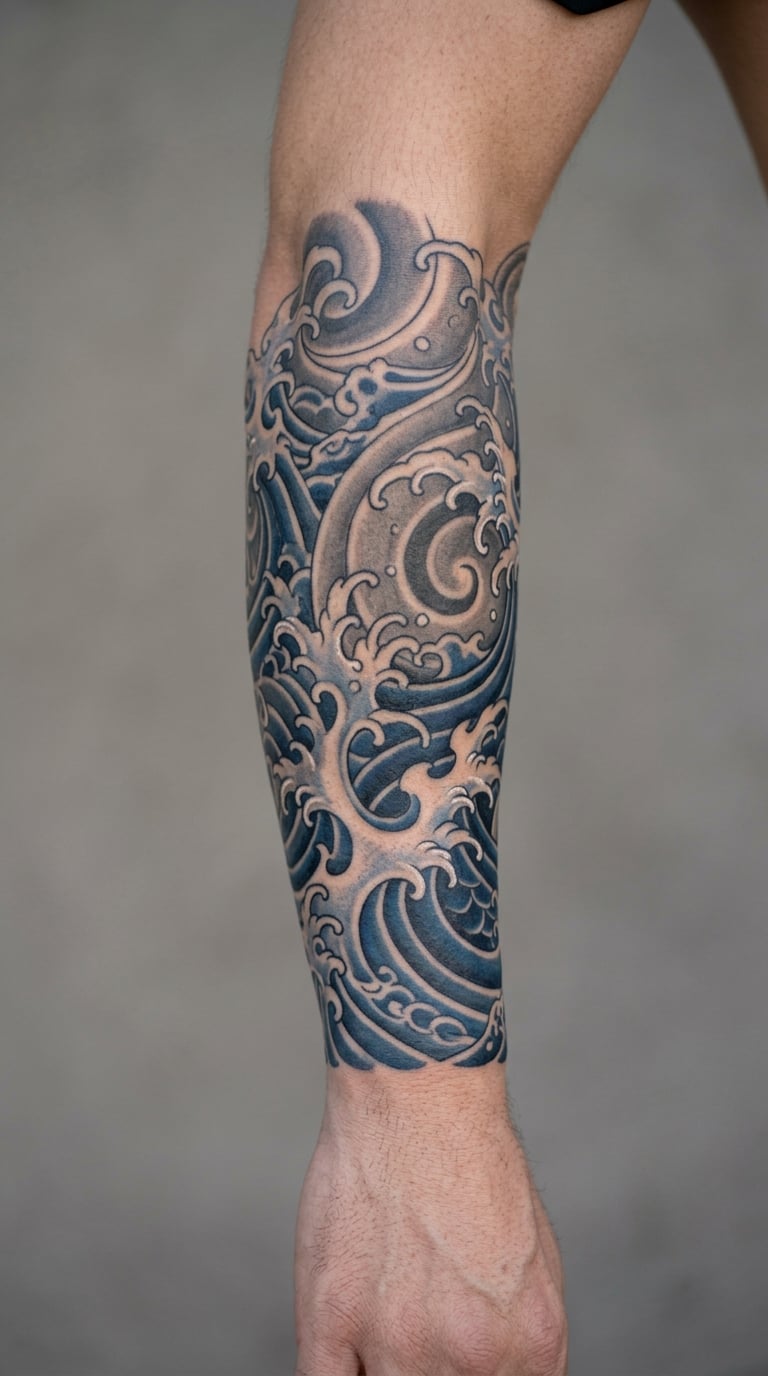
A flowing wave sleeve is built from overlapping blue swells with hard black outlines, white foam caps, and grey background shading that fills the gaps between the crests. The composition is usually two or three waves at different heights so the arm reads as moving water rather than one repeated shape.
Water in Japanese tattooing often reads as resilience and change, since a wave is something that never sits still. People choose it for that reason, though the meaning is personal rather than fixed. The visual appeal is honestly the bigger draw for most people booking this one.
Placement: Outer forearm, or a full forearm wrap that leaves the upper arm open for later work. · Size: 8-12 inch (20-30 cm) across the forearm, larger if it wraps. · Style: Traditional Japanese, irezumi. · Pain: Medium to high, mostly from the elbow area and the tight skin near the wrist.
Fine foam detail softens and blurs over the years, so ask for bolder crests than the reference image shows. If an arm is already being tattooed, tell the artist early so the water can be adjusted to merge with it.
Make it yours: Add a single small element moving through the water, a bird, a floating petal, or a boat, that ties the piece to something personal.
2. Red-and-Gold Koi Sleeve
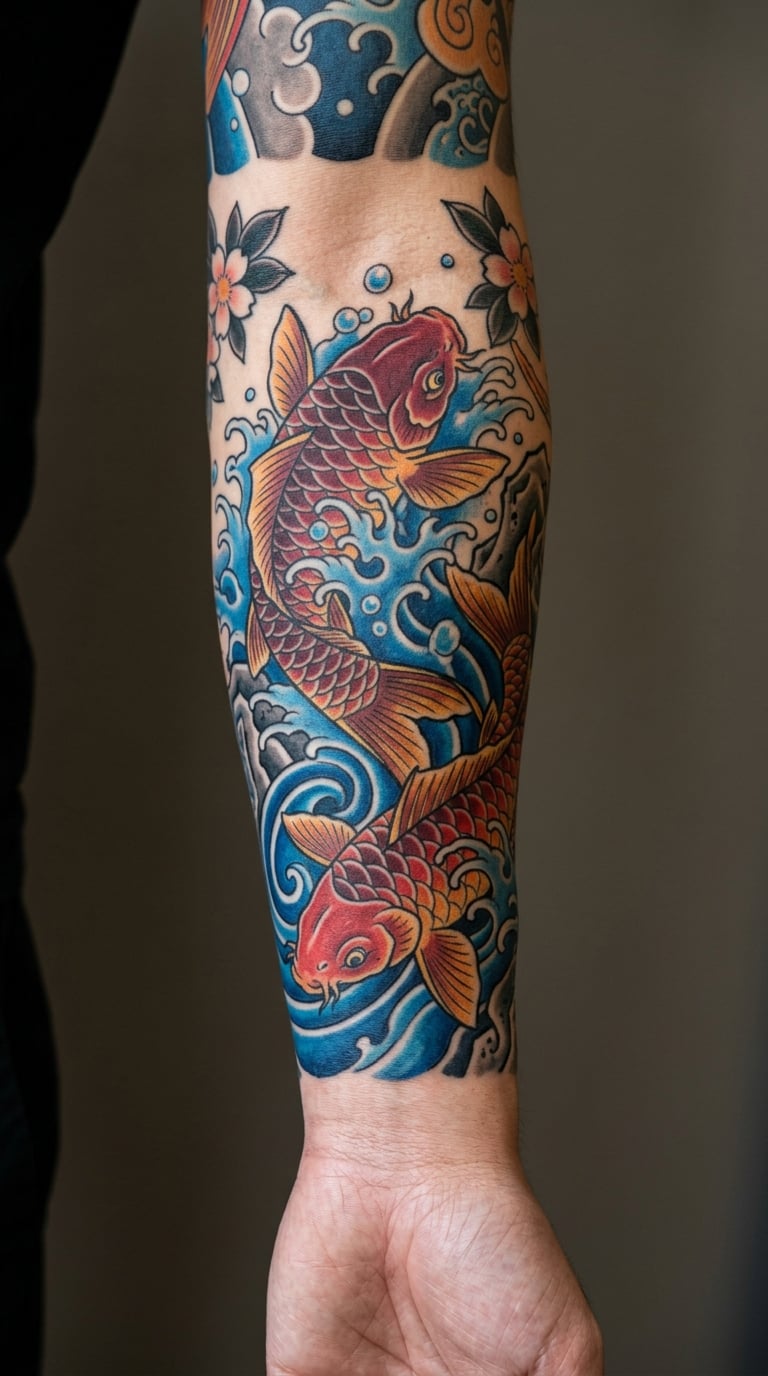
Koi sleeves use overlapping scales laid in rows, a warm red or orange body, and gold or yellow shading along the spine and fins. Water usually follows behind them as pale blue currents and scattered foam dots, with darker background shading to push the fish forward off the skin.
Koi are one of the most requested irezumi motifs, and they carry associations with perseverance and with moving against a current. Most people are drawn to the movement first and attach their own story to it second. Either way is a perfectly good reason to get one.
Placement: Forearm for a compact pair, upper arm for a single large fish. · Size: 5-9 inch (13-23 cm) per fish, up to 12 inches (30 cm) for a hero koi. · Style: Irezumi or neo-traditional. · Pain: Medium, with a harder patch over the inner elbow where the scales bunch up.
Scale work is the first thing to lose definition on a healed piece. Tighter, more deliberate scale rows age better than the loose hand-drawn style you see in a lot of flash.
Make it yours: Choose the colour that carries the memory, deep red for a parent, white and red for a wedding, gold for a birthday you never forget.
3. Black-and-Grey Dragon Sleeve
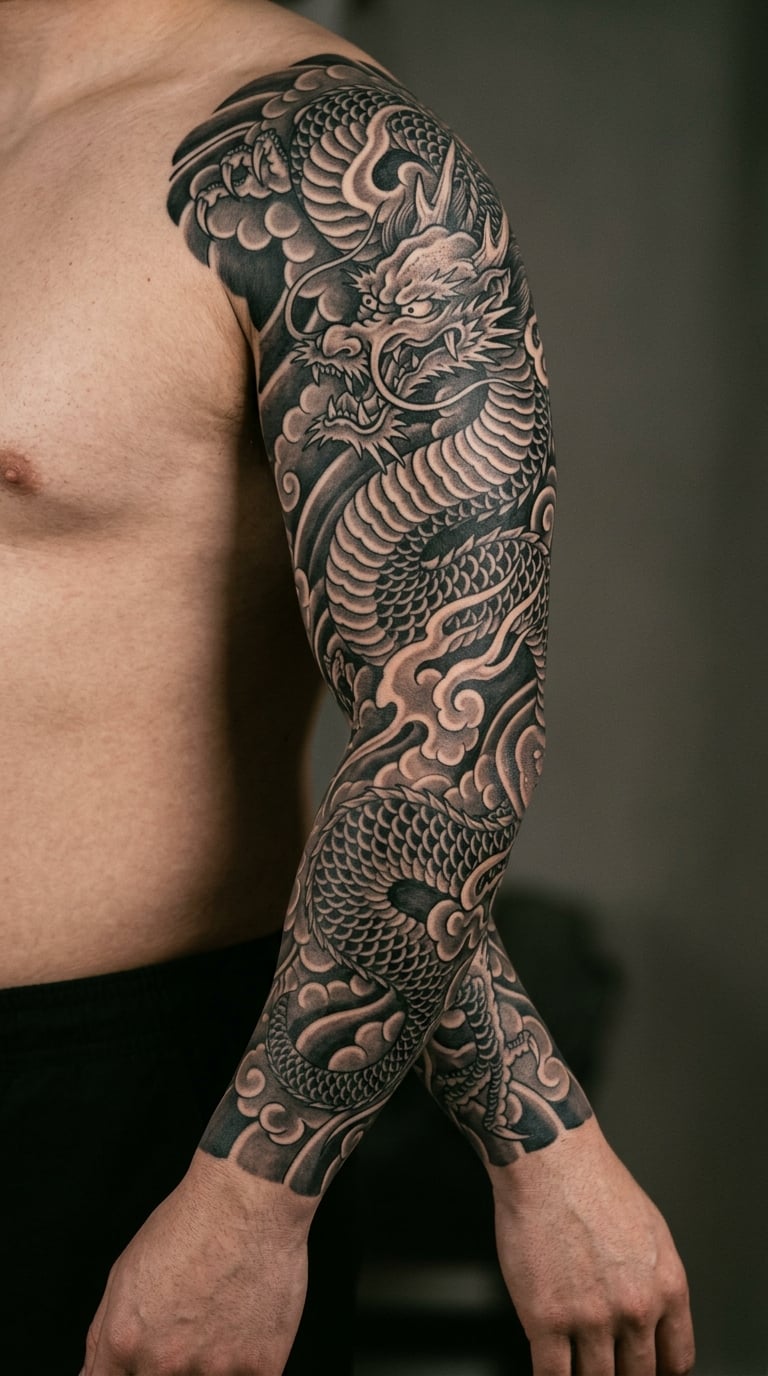
A black-and-grey dragon sleeve drops the colour entirely and works through heavy black fills, mid-tone grey washes, and a smoky background that fades into bare skin. The dragon itself is usually drawn with a long scaled body, clawed limbs, a whiskered snout, and a few wind bars curling around it to fill dead space.
Dragons show up when someone wants a sleeve that reads as strength, protection, or a hard turn in their life. The stripped-back palette is also what makes it forgiving: grey shading hides small imperfections in a way saturated colour does not.
Placement: Full sleeve, or half sleeve from mid-bicep to wrist. · Size: 10-15 inch (25-38 cm) tall for the body of the dragon. · Style: Blackwork or traditional irezumi in black and grey. · Pain: High over bony areas, especially the elbow, wrist, and shoulder cap.
Grey wash ages more gently than colour but does soften with sun exposure. If you want a sleeve that still looks sharp in fifteen years, keep the darkest blacks solid rather than relying on mid-tones to carry the contrast. More black sleeve tattoo ideas for men are worth a look if you lean this way.
Make it yours: A single red accent, an eye or a claw, keeps the piece irezumi in feel without giving up the black-and-grey look.
4. Mount Fuji and Rising Sun Sleeve
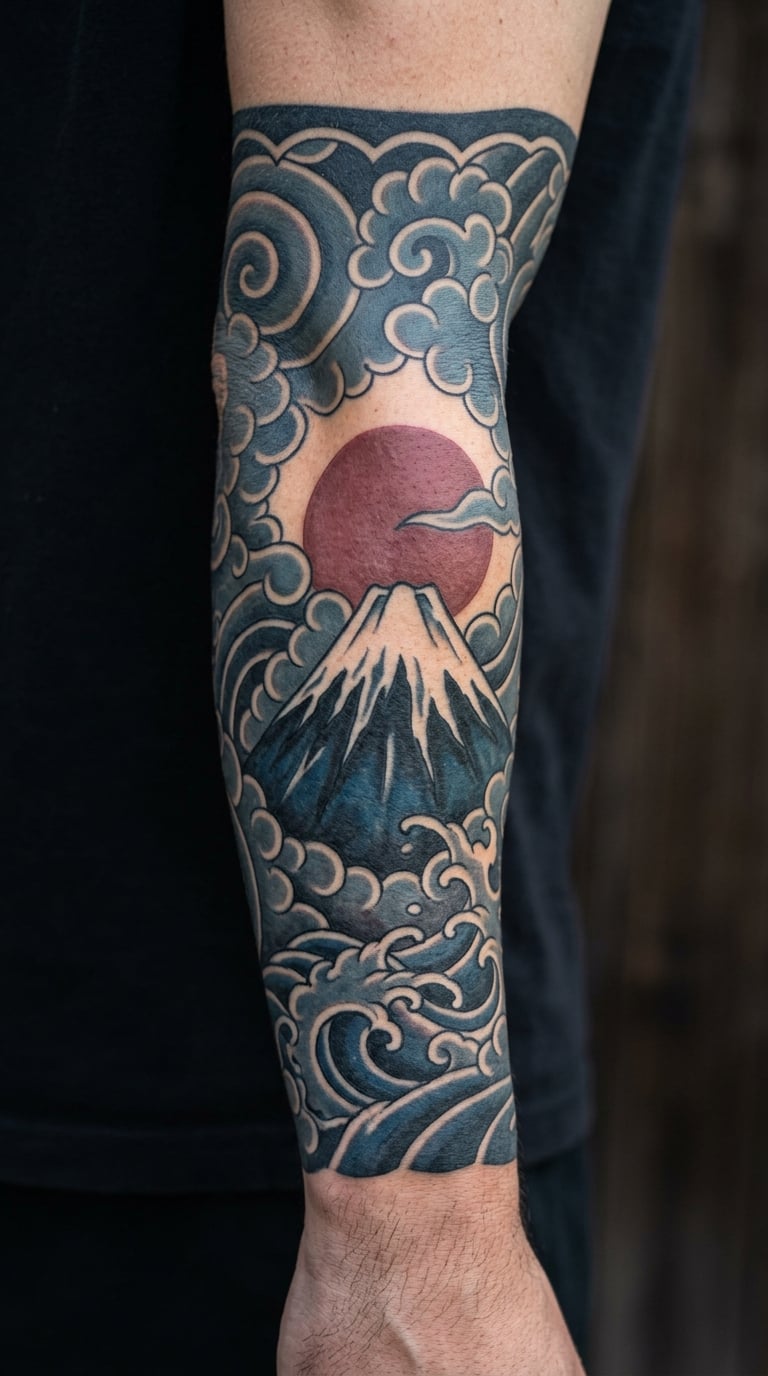
A Fuji sleeve puts a snow-capped peak low on the arm with a red or muted sun disc behind it and bands of blue-grey cloud rolling underneath. The palette stays quiet on purpose, which is what makes it stand out next to the usual red-heavy sleeve.
The mountain is a home reference, and the rising sun reads as a beginning. Plenty of people get it for a specific place they grew up or a view they remember clearly, and that is usually the better reason.
Placement: Outer forearm, or elbow to shoulder on the outer arm. · Size: 7-11 inch (18-28 cm) for the peak and sun. · Style: Irezumi landscape. · Pain: Medium, rising to high where the clouds wrap past the elbow.
Wide smooth gradients look wrong when healed. Ask for layered bands of colour rather than one blended wash, since banding reads as intentional and blending reads as patchy.
Make it yours: Swap the generic peak for a mountain with real meaning to you, or set the scene in a specific season with snow, cherry blossom, or autumn foliage.
5. Cherry Blossom Branch Sleeve
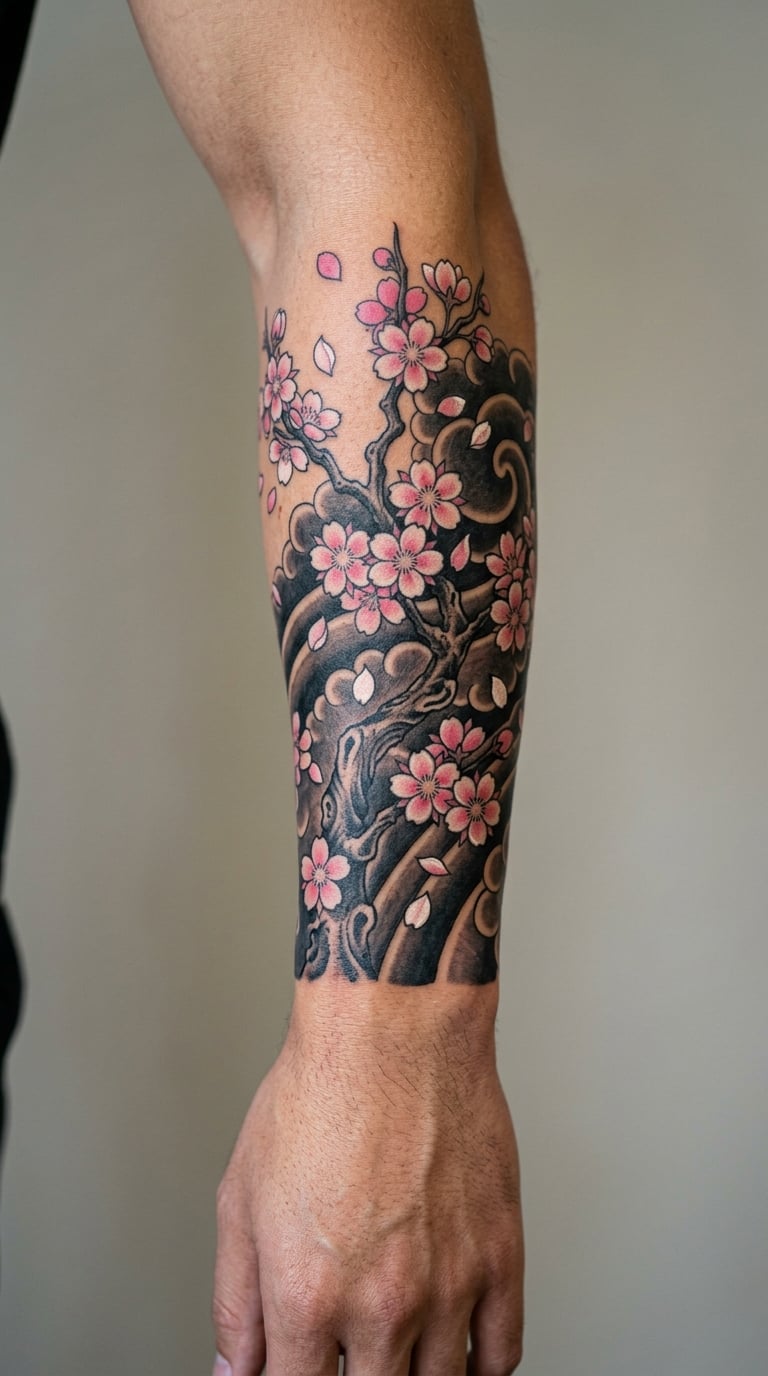
A cherry blossom branch sleeve runs one dark branch along the arm with pink flowers spaced along it and loose petals drifting into the open skin. The trick is restraint: too many blossoms and the negative space disappears, which is what gives this style its calm look.
Blossoms show up for spring, for a person, or for a place where something ended well. They’re also the easiest irezumi motif to extend later, since a second branch can grow from the first without a re-plan.
Placement: Forearm, upper arm, or a wraparound branch that travels from wrist to bicep. · Size: 5-9 inch (13-23 cm) for a single branch. · Style: Irezumi floral. · Pain: Medium, mostly fine line work rather than heavy fills.
Soft pink shading is the first colour to fade on a sun-exposed arm. Plan on a refresh of the petals every few years, or accept the softer version as part of the piece. If you want the floral approach on a smaller scale, forearm sleeve tattoo ideas for women cover the same territory.
Make it yours: Use blossoms from a specific park, garden, or street, and note the date you visited when you book the consultation.
6. Phoenix Sleeve
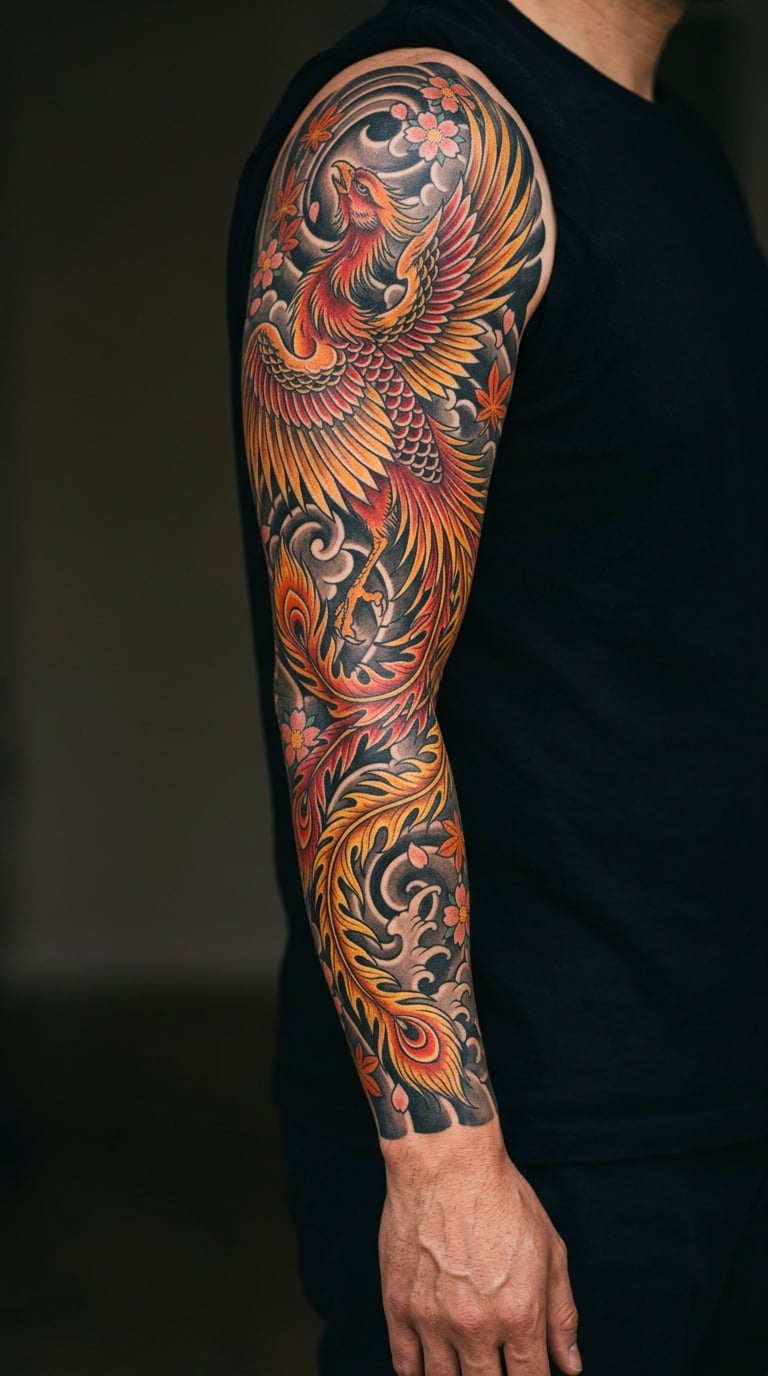
A phoenix sleeve fills the arm with an upward-moving bird: one wing up across the shoulder, one down toward the elbow, and a long tail of layered feathers that fills the remaining space. The colour runs from deep red at the body through orange to gold at the feather tips, all inside hard black outlines.
Fire and rebirth are the usual associations, so it tends to land for people moving through a major change. The upward angle matters, since a rising bird and a falling bird read completely differently across a shoulder.
Placement: Full sleeve, angled so the tail follows the forearm. · Size: 12-16 inch (30-40 cm) tall. · Style: Traditional or neo-irezumi. · Pain: Medium to high, with the shoulder cap and inner elbow setting the pace.
The tail is where the design either works or falls apart. Too few feathers and the arm looks empty under the bird; too many and the colour work gets thin in the middle.
Make it yours: Change the background, a ring of smoke, scattered embers, or a plain dark field, so the bird is the only thing carrying colour.
7. Tiger and Bamboo Sleeve
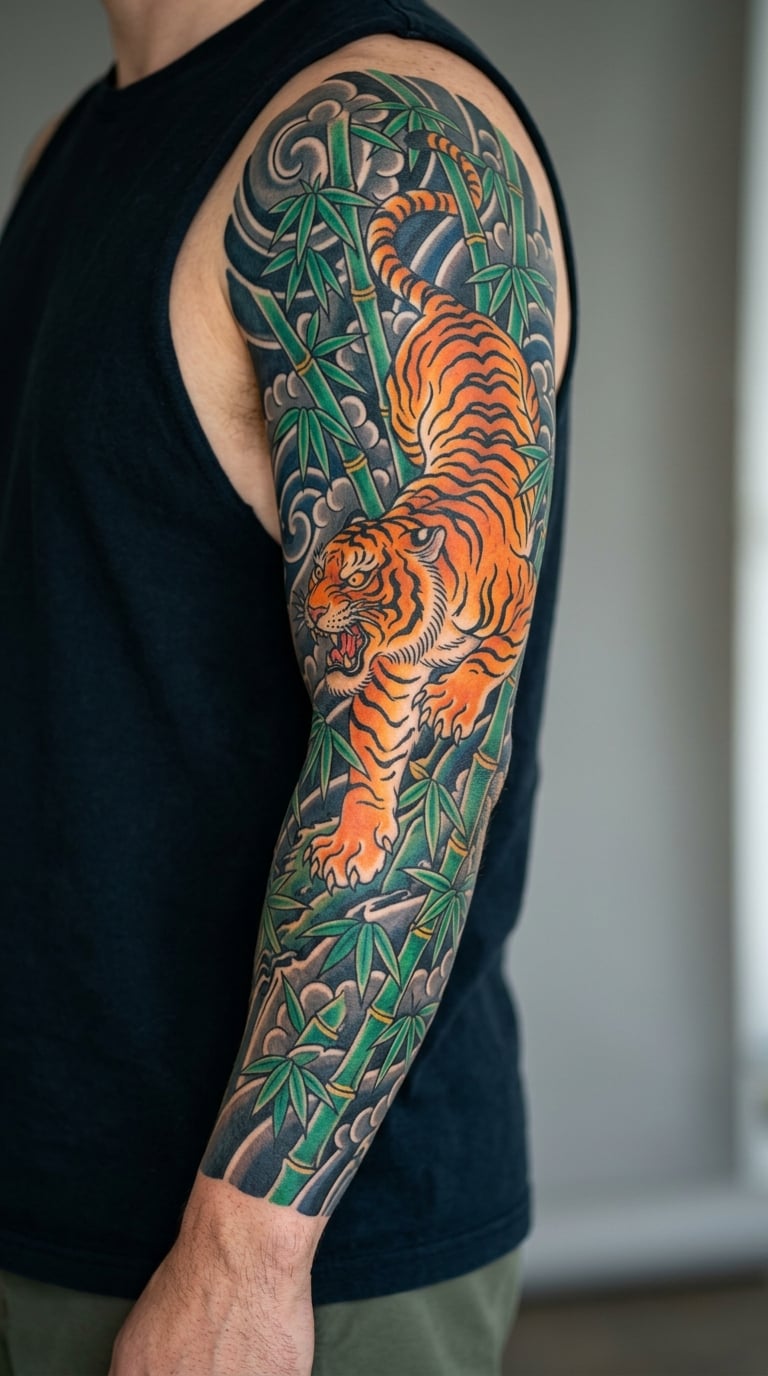
A tiger and bamboo sleeve puts a striped orange tiger against vertical green bamboo stalks with pointed leaves. The bamboo does the heavy lifting structurally, since it gives the artist strong vertical lines to run the length of the arm and fill the space around the animal.
Tigers come with associations of strength and ferocity, and bamboo with resilience that bends without breaking. Put together, they read as force with control, which is a more interesting combination than either motif alone.
Placement: Upper arm, elbow, or full sleeve. · Size: 8-12 inch (20-30 cm) for the tiger, plus full-length bamboo. · Style: Irezumi or neotraditional. · Pain: High, and the elbow is the reason. That inner crease is the least forgiving spot on any arm.
For tiger work specifically, black stripe work stays crisp much longer than soft fur shading, so it is worth asking for heavier stripe weight. Expect more than one session on the elbow area alone.
Make it yours: Pick a bamboo species you recognise from somewhere real, and use it as the personal hook in the design.
8. Three Cranes Sleeve
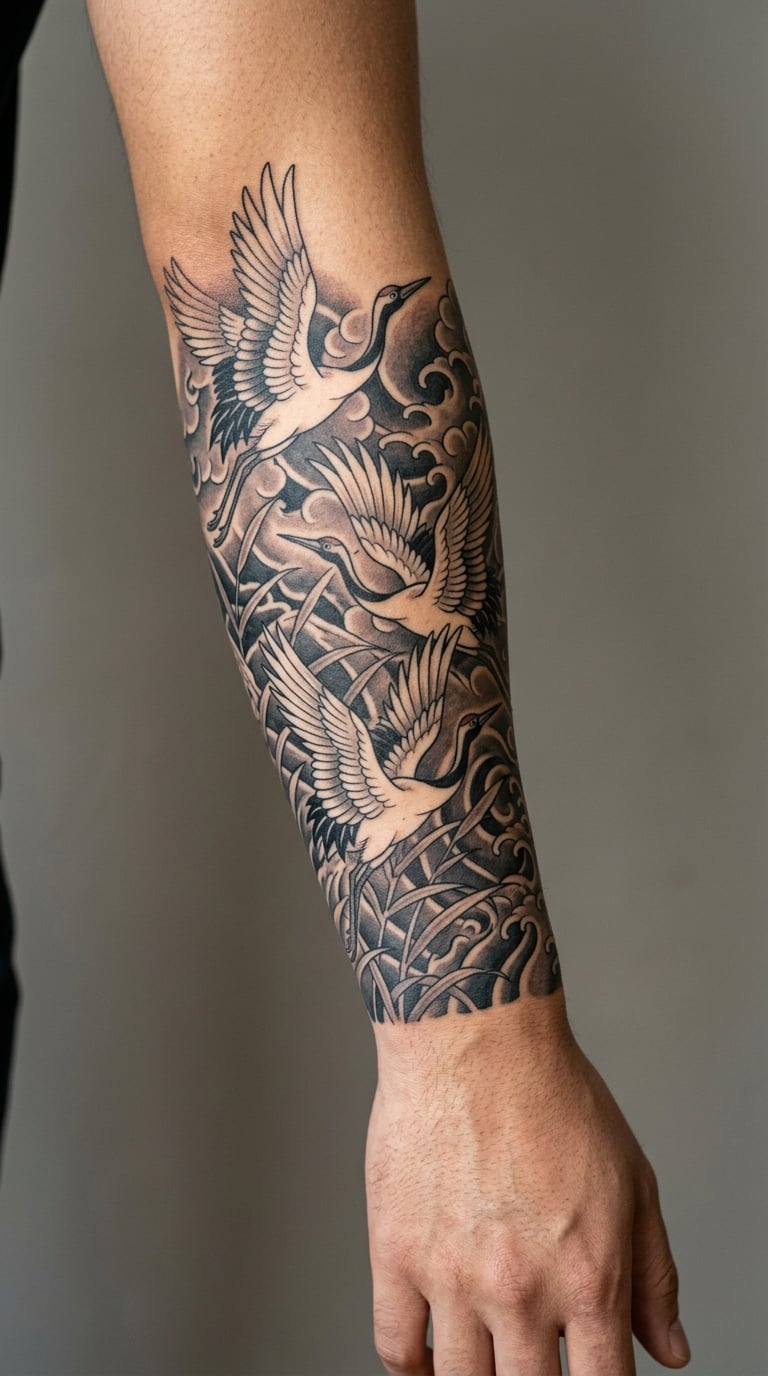
Three cranes are usually drawn in white with black wing tips and a red crown patch, set against soft grey water and a few reed strokes near the wrist. The birds are spaced apart rather than clustered, so each one has room to be a separate shape.
Cranes come with associations of longevity and good fortune, and three of them often stands for family, a trio of people who matter, or a wish rather than a fixed claim. The spacing is deliberate, so the composition feels like flight instead of a stampede.
Placement: Forearm, upper arm, or half sleeve. · Size: 4-7 inch (10-18 cm) per bird. · Style: Irezumi wildlife. · Pain: Medium. White areas are quick to tattoo, and the detail work on wing feathers adds time rather than pain.
White ink on skin has no white pigment, so what reads as white is your untattooed skin. That means a sun tan will change the look of the piece noticeably, sometimes dramatically.
Make it yours: Choose the flight pose that matches what you want it to feel like, wings up for movement, wings folded for stillness.
9. Red Maple Leaves Sleeve
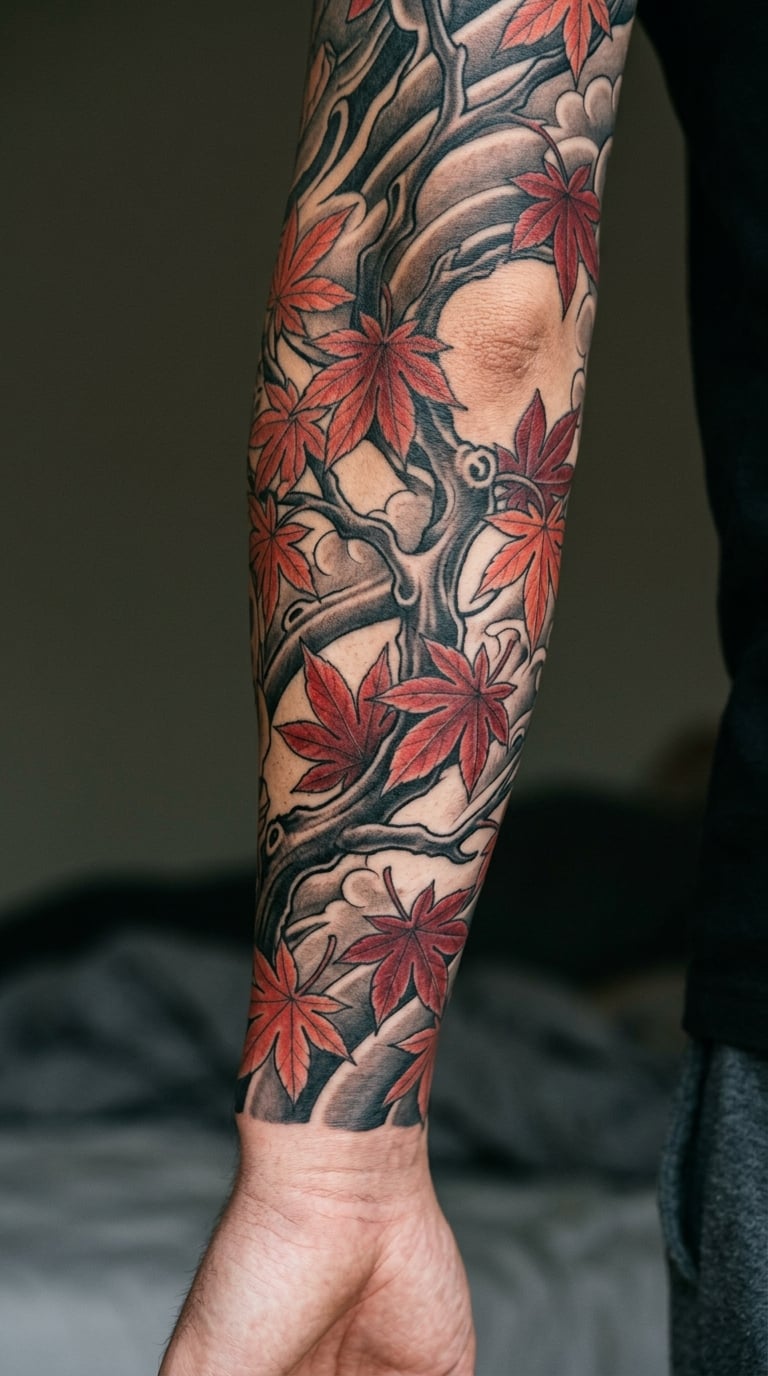
A maple sleeve scatters red and deep orange leaves along thin dark branches, with fine vein lines inside each leaf and light grey background shading to separate the layers. Density is low, so it can run from wrist to elbow without the arm disappearing under ink.
Maple is an autumn reference, and most people connect it to a season, a place, or a specific year. The colour range is narrower than a peony sleeve, which is exactly why it can be spread out so far.
Placement: Inner forearm from wrist to elbow, or scattered over the upper arm. · Size: 2-4 inch (5-10 cm) per leaf, arranged across 10-14 inches (25-35 cm) of arm. · Style: Irezumi botanical. · Pain: Medium, with the wrist feeling more sharply than the bicep.
Fine vein lines blur with age and are the part people come back to have fixed. Bolder, simpler leaf shapes hold up better over a decade.
Make it yours: Work in leaves from a specific place you have walked, or set the whole piece in one autumn colour you actually like.
10. Rain, Clouds, and Umbrella Sleeve
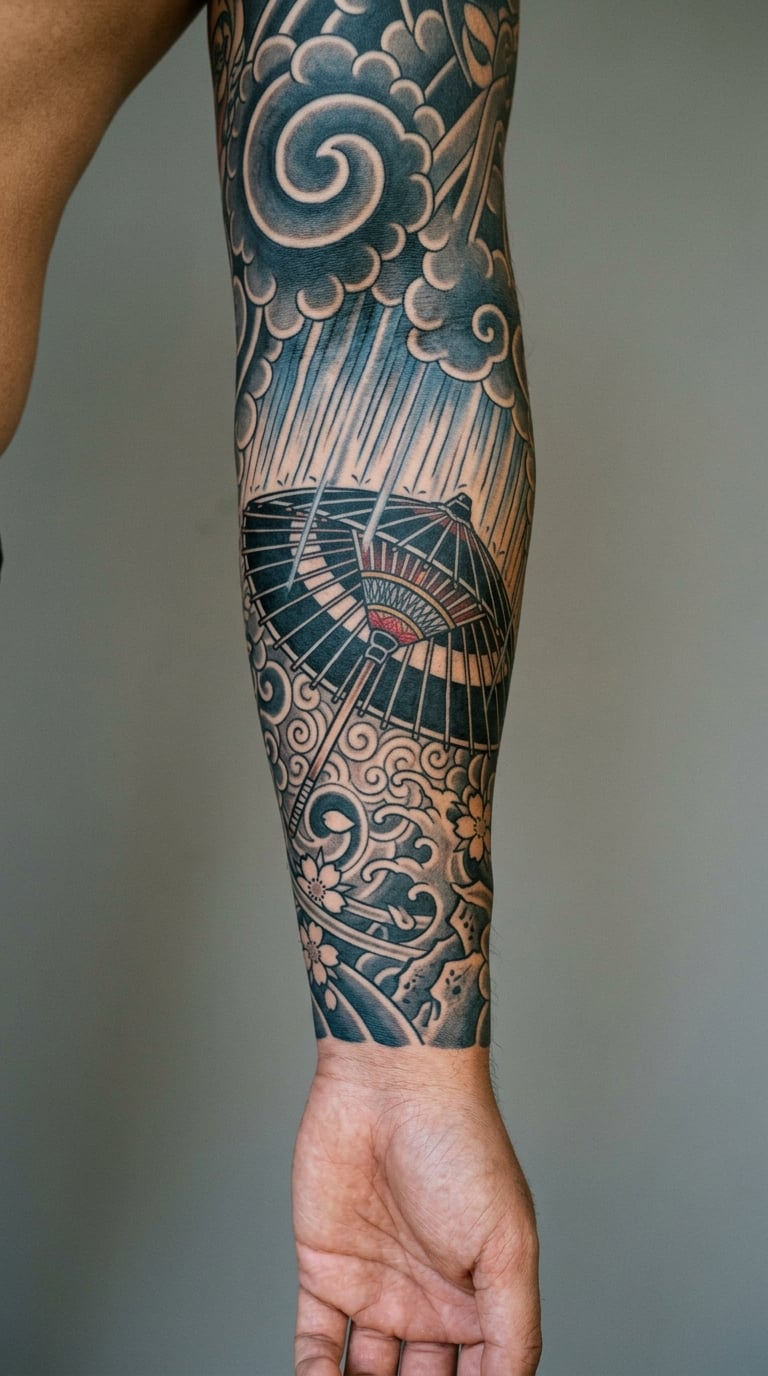
An atmospheric sleeve is built from a single strong shape, here a red or black umbrella, with blue-grey rain streaks falling at an angle and grey cloud curls filling the remaining space. Everything is tilted in the same direction so the whole arm feels like one weather system.
Rain imagery reads as something temporary passing through, and the umbrella is the small human element inside it. It is a moody design that works well for someone who wants a sleeve with atmosphere rather than a stack of symbols.
Placement: Forearm or half sleeve. · Size: 6-10 inch (15-25 cm) for the umbrella plus full-sleeve cloud work. · Style: Irezumi atmospheric. · Pain: Medium. Shading passes add time without much extra discomfort.
Rain lines are thin and high-contrast, so they are among the first details to soften. Ask for slightly heavier line weight than looks right in a reference photo.
Make it yours: Set the rain falling toward a specific city skyline, or use an umbrella pattern from a place that matters to you.
11. Moonlit Geisha-Inspired Sleeve
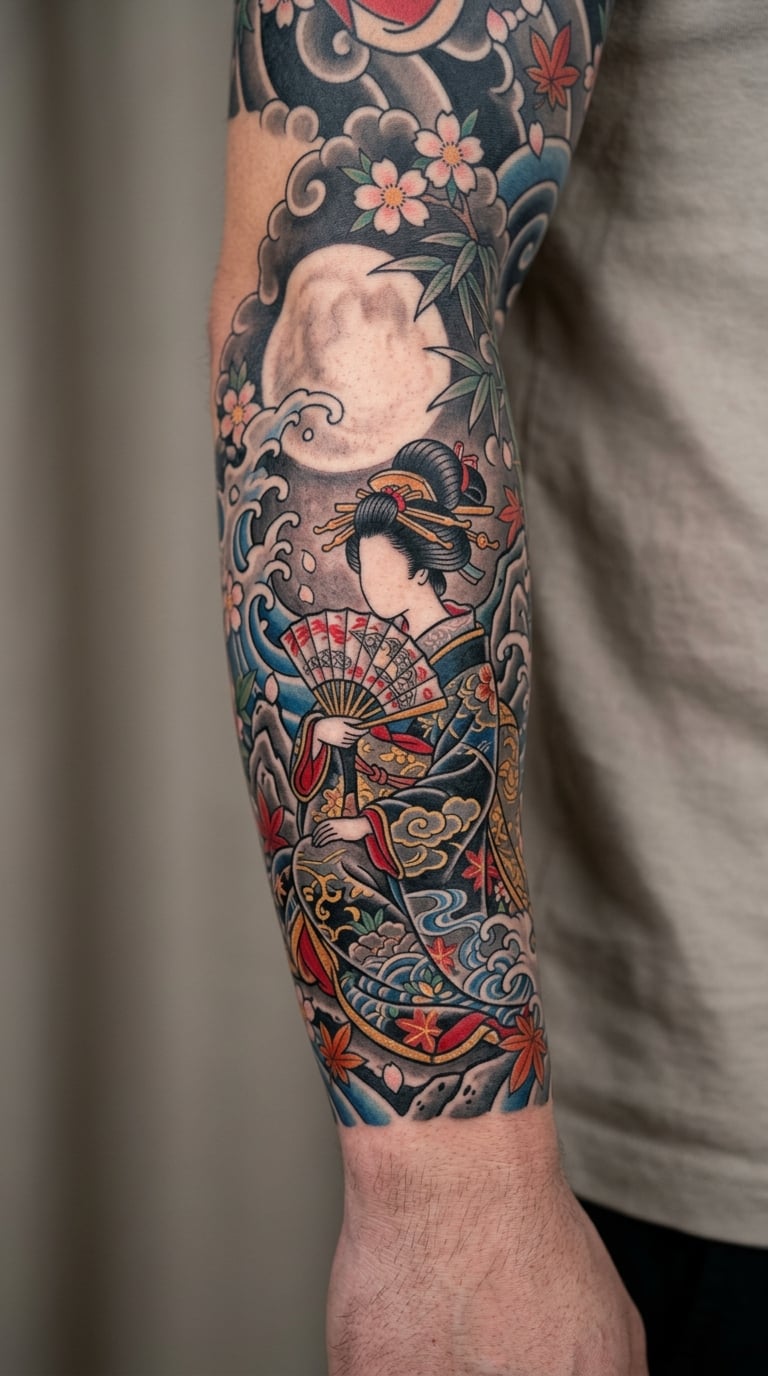
A geisha-inspired sleeve centres on a single figure in profile with fine line work on the face, a folded fan, red accents in the hair and kimono, and a pale moon behind. The face is the hardest part, and it is where most artists either excel or ask you to reconsider the design.
Portrait work like this is chosen for the person, the period, or the style rather than for a motif with a single meaning. It also carries real cultural weight, so talk to the artist about framing before anything is drawn.
Placement: Outer forearm, or half sleeve with the figure reading along the arm. · Size: 7-10 inch (18-25 cm) tall for the figure. · Style: Irezumi illustrative. · Pain: Medium, though the face is slow work and often needs its own session.
Fine facial line work on an arm changes as the arm moves and ages. Healed photos of that specific design should be part of your artist vetting, not just fresh-session photos.
Make it yours: Choose the fan pattern, the season shown, and one red shade to carry through the whole piece.
12. Samurai Helmet and Armor Sleeve
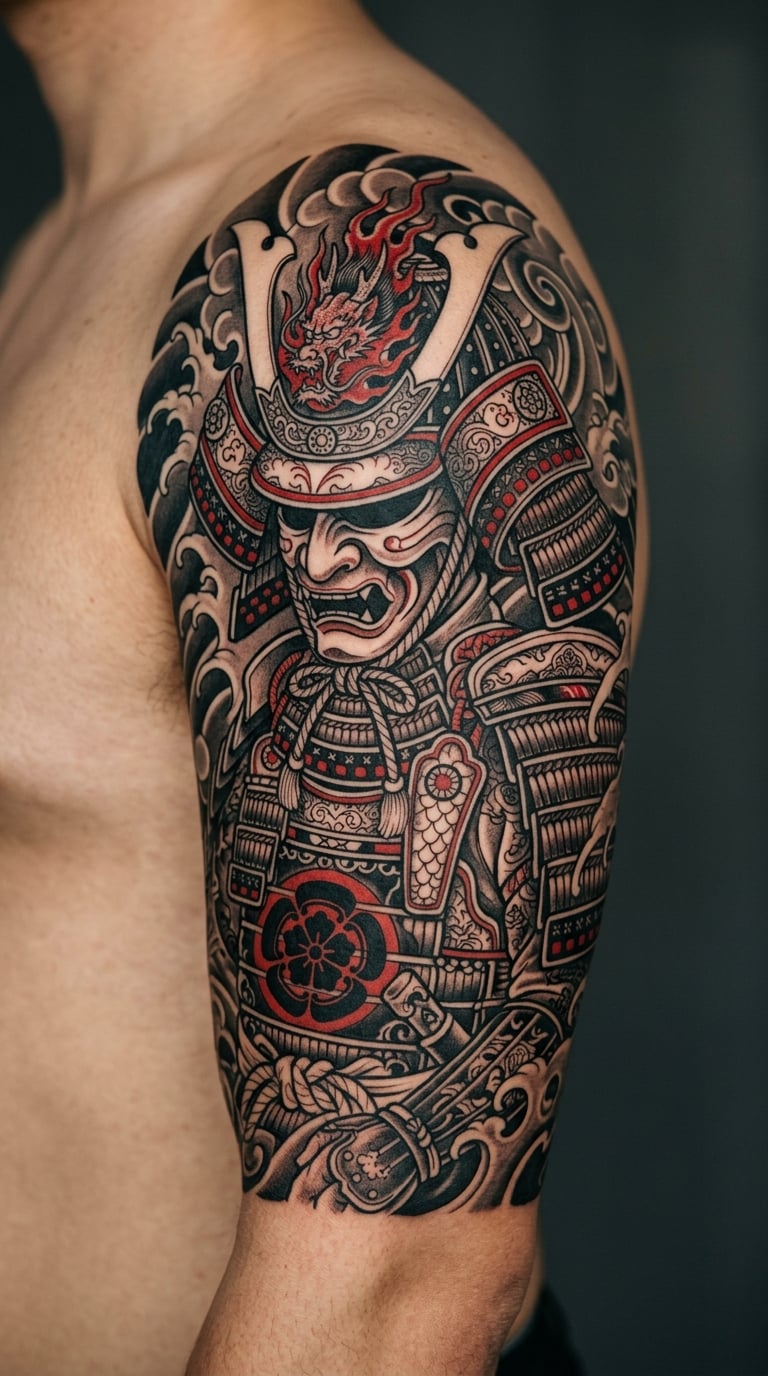
A samurai helmet sleeve centres a kabuto with wide curved plates and a crest on top, layered armour below it, and cords lacing the sections together. Red detailing on the cords and lacing keeps the palette controlled while giving the piece its heat.
Warrior imagery like this gets chosen for discipline, heritage, or a family line rather than for combat. The silhouette is the whole point, so this one reads clearly even from across a room.
Placement: Upper arm from shoulder to elbow, or full sleeve with the helmet high on the shoulder. · Size: 8-12 inch (20-30 cm) for the helmet alone. · Style: Irezumi or blackwork with red. · Pain: High, mostly on the shoulder and over the elbow.
Layered plate edges need to stay distinct after healing. Very fine separations between plates can close up, so the artist should build them with enough weight to survive.
Make it yours: Use a specific family crest, or a crest connected to the place your family is from, and let it be the centre of the design.
13. Chrysanthemum and Moon Sleeve
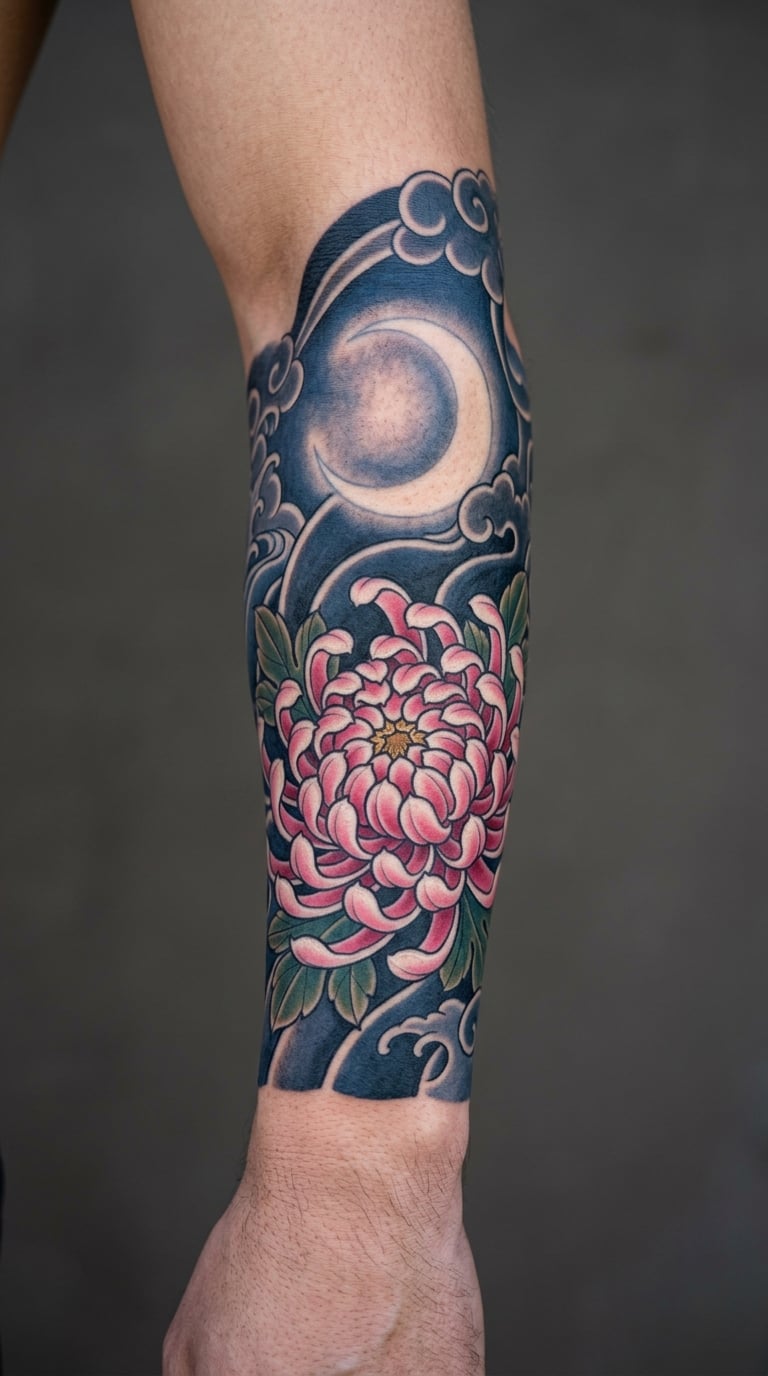
A chrysanthemum sleeve gives the flower the whole arm: layered petals in pink, white, and pale yellow radiating from a dense centre, with deep blue background shading behind it and a moon sitting in the open space. That dark background is what makes the soft petal colour read.
Chrysanthemums carry associations with the imperial family and with autumn, and they double as a birth flower for people born in that season. Most people choose them for the shape, honestly, because the petal pattern is hard to beat.
Placement: Forearm or upper arm. · Size: 5-8 inch (13-20 cm) across the flower. · Style: Irezumi floral. · Pain: Medium. Dense background shading takes time but sits comfortably on most arms.
Back-to-back petals need a black line between each one or they merge into a single blob as they heal. It is a detail worth asking about specifically.
Make it yours: Use your birth flower instead, keep the same composition, and pick the moon phase that matches something you want to remember.
14. Peony and Vine Sleeve
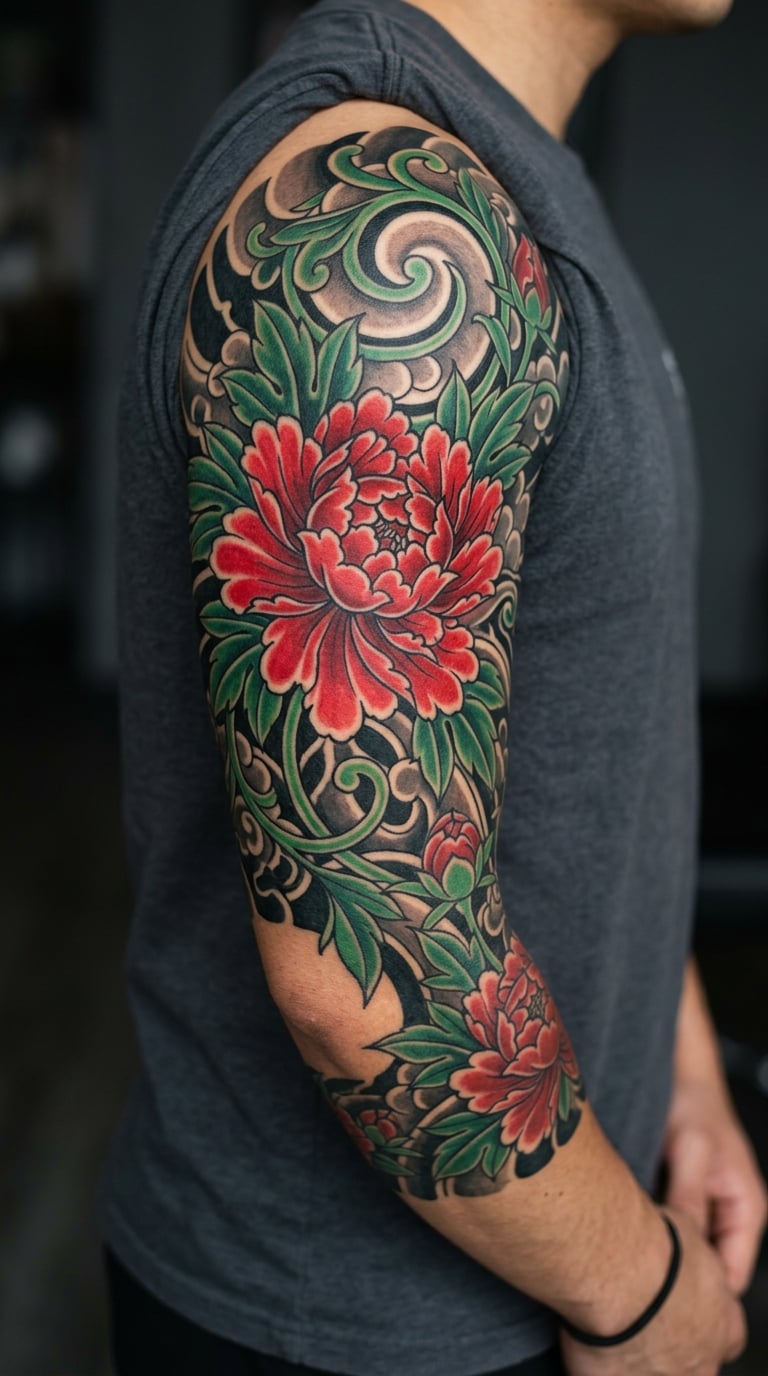
Peony sleeves are the colour-heavy end of irezumi: a large red or pink bloom with layered petals and a yellow centre, wrapped in curling green vines with small pointed leaves. The vine work is the engine of the composition, carrying movement from flower to flower along the arm.
Peonies are associated with wealth, honour, and beauty in Japanese art. That is background, though. In practice people pick them because they want colour on the arm, and there is nothing wrong with that reason.
Placement: Upper arm, elbow, or full sleeve. · Size: 6-10 inch (15-25 cm) per main bloom. · Style: Irezumi floral. · Pain: Medium to high, with the elbow and inner arm doing most of the complaining.
Green vine work is where colour sleeves usually need a touch-up, since mid-tone greens go greyish faster than reds. Ask what the artist plans to use for that.
Make it yours: Choose a flower colour that belongs to someone, and let one vine carry a small secondary motif like a bee or a bud.
15. Carp and Lotus Sleeve
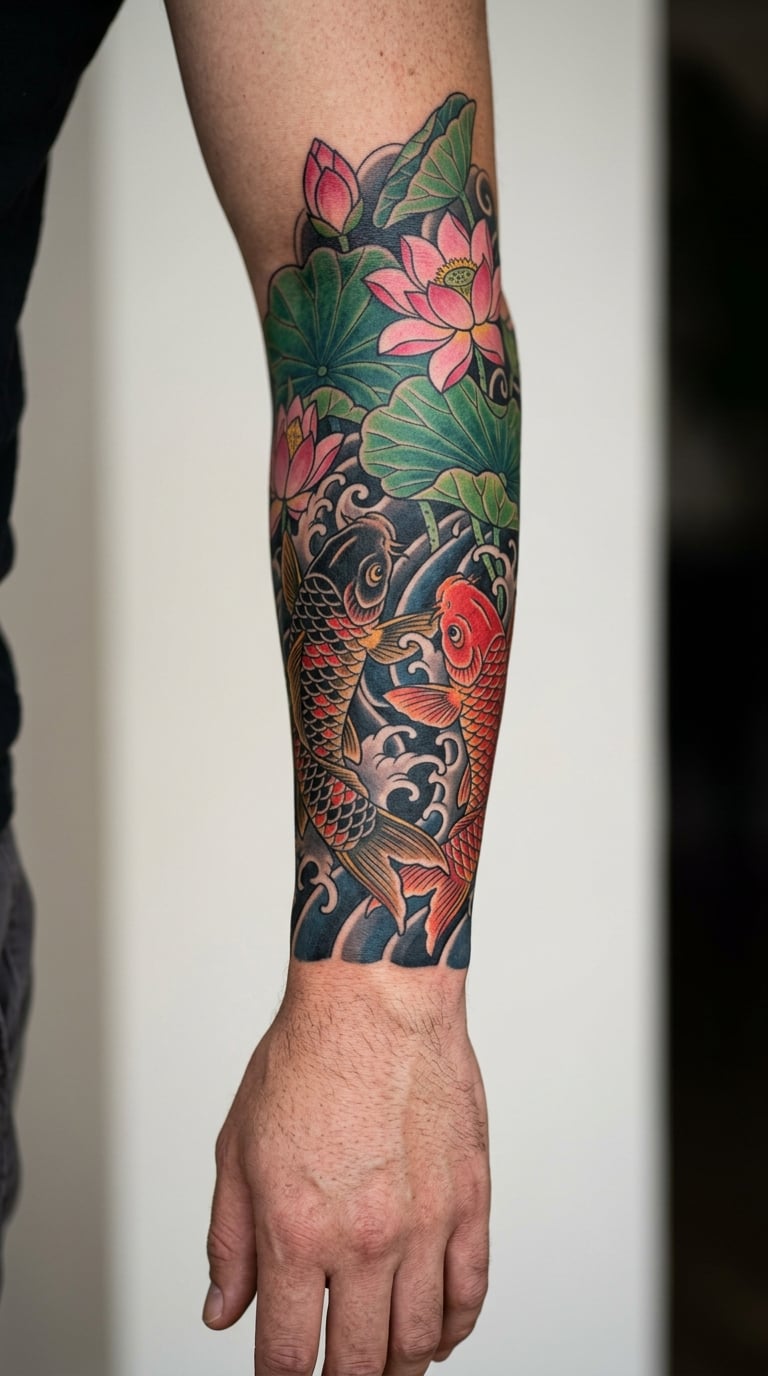
A carp and lotus sleeve sets scaled fish moving through pale blue water with lotus flowers above them and broad round leaves underneath. The leaves are large flat shapes that fill space well, and the fish supply the movement between them.
Carp and lotus sit together often in Japanese imagery, and the pairing reads as transformation and calm at the same time. It is a fuller design than a plain koi sleeve without tipping into too many competing elements.
Placement: Forearm, upper arm, or half sleeve. · Size: 5-8 inch (13-20 cm) per fish, 3-4 inch (8-10 cm) lotus blooms. · Style: Irezumi nature. · Pain: Medium. Water shading and scale rows take time, not extra pain.
Count the fish before the consultation, not after. A two-fish layout and a five-fish layout look like completely different projects on the same arm.
Make it yours: Decide the number of fish first, then pick the lotus colour, since the balance of the two changes everything about the composition.
16. Pine Tree and Snow Sleeve
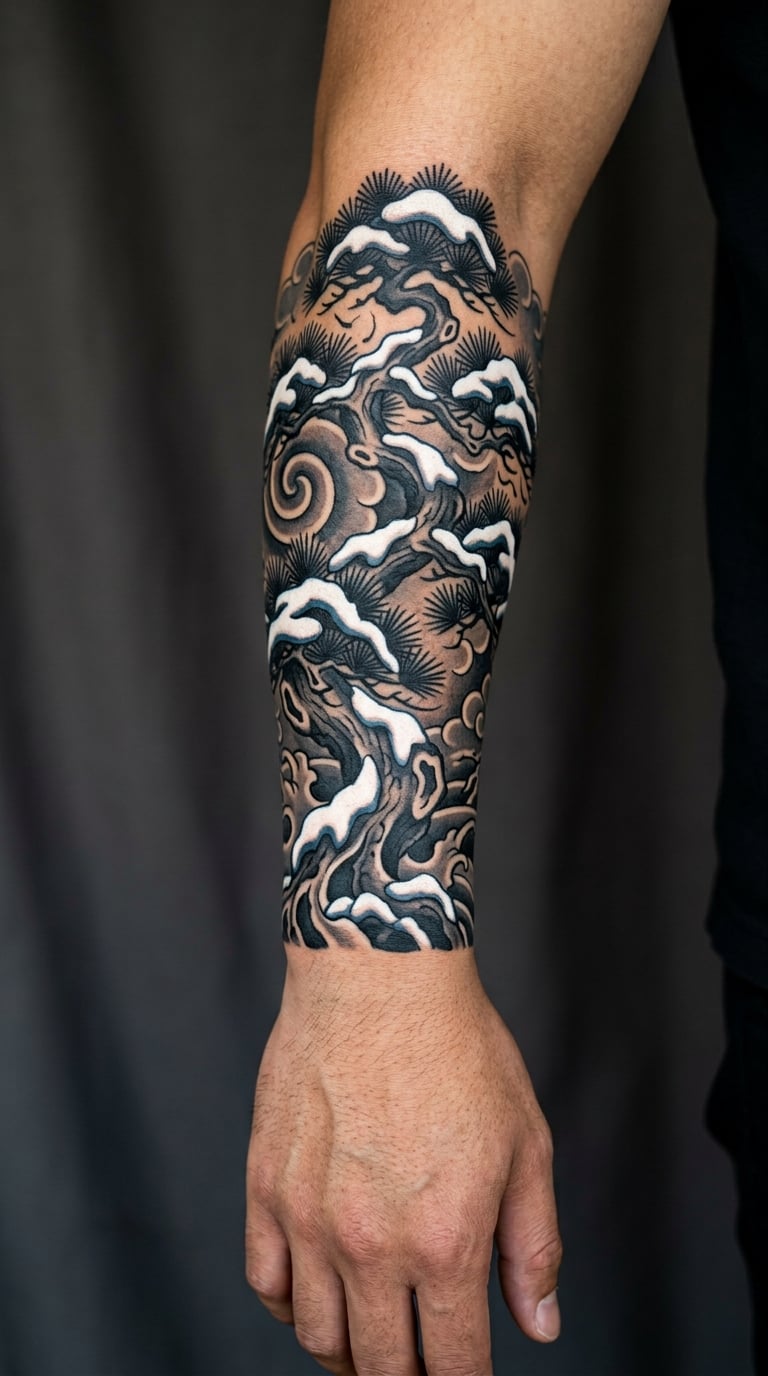
A pine and snow sleeve uses a strong black tree with layered horizontal branches, white snow resting on the branch lines, and muted blue-grey shadows behind. The limited palette keeps it calm, and the horizontal branches give the eye somewhere to rest as it travels up the arm.
Pines are associated with endurance and longevity because they stay green through winter. People choose this design when they want something steady on the arm rather than loud.
Placement: Outer forearm or upper arm, half sleeve. · Size: 8-11 inch (20-28 cm) tall for the tree. · Style: Irezumi landscape. · Pain: Medium. Black fills over the outer arm are steady work with no surprises.
Black pine on light skin holds its weight well, but the white snow is skin showing through, so it will always change with your tan. Decide whether that is a problem for you before booking.
Make it yours: Use a tree silhouette from a place you have actually stood under, and set the season to winter or early spring.
17. Kitsune and Fox Fire Sleeve
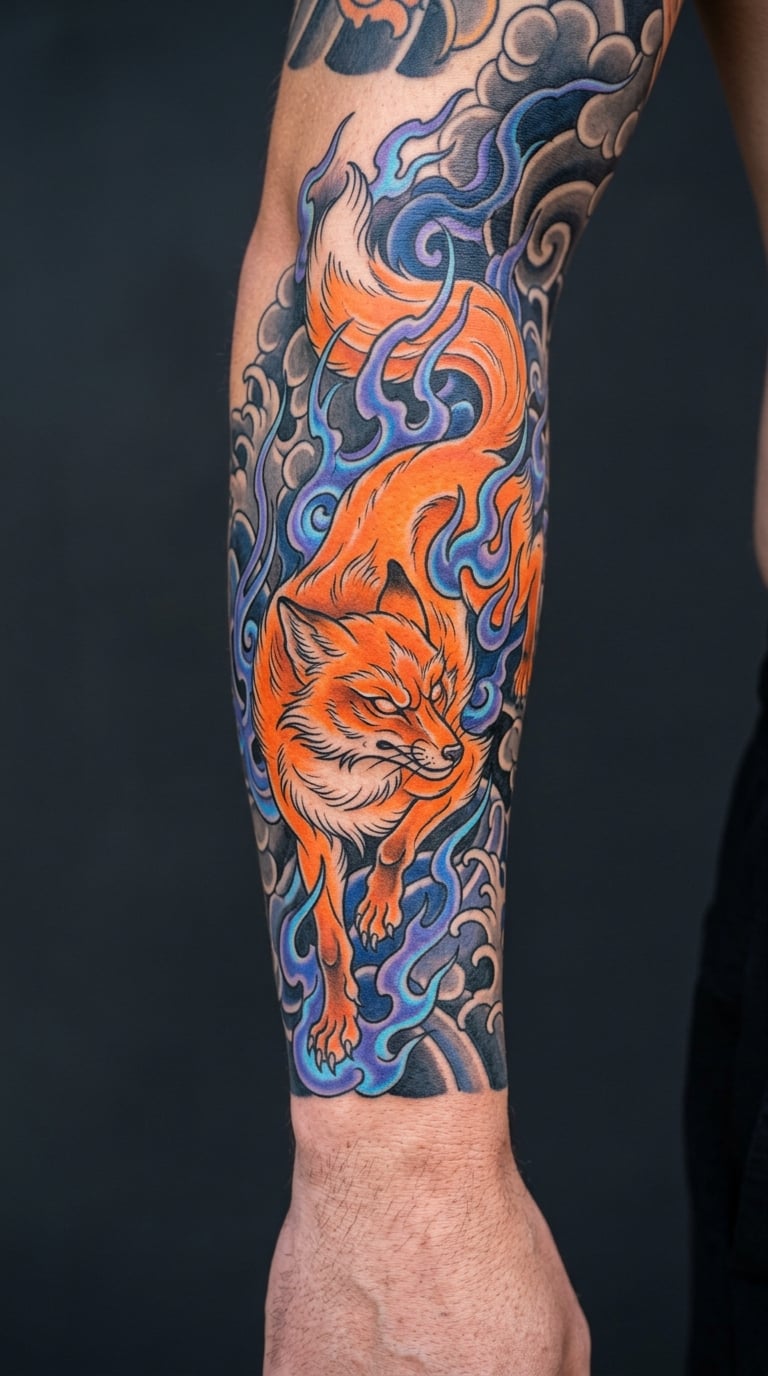
A kitsune sleeve pairs a stylised orange fox, drawn with layered fur and a clean black outline, with blue or violet fox fire curling around it. The fire is graphic rather than realistic, built from flame shapes and smoke that fill the negative space around the animal.
Kitsune is tied to Inari and carries associations of cunning, transformation, and messenger foxes. It is also simply a striking animal to put on an arm, and plenty of people stop there.
Placement: Forearm, upper arm, or full sleeve. · Size: 6-10 inch (15-25 cm) for the fox. · Style: Irezumi or neo-traditional. · Pain: Medium to high, since the fire work means long shading passes.
Violet and blue are the first colours in this design to shift. If the fox fire matters to you, plan on a colour refresh rather than expecting it to hold its first-year tone.
Make it yours: Pick a fox pose that carries the mood you want, curled and still for calm, mid-leap for energy.
18. Wind and Flying Leaves Sleeve
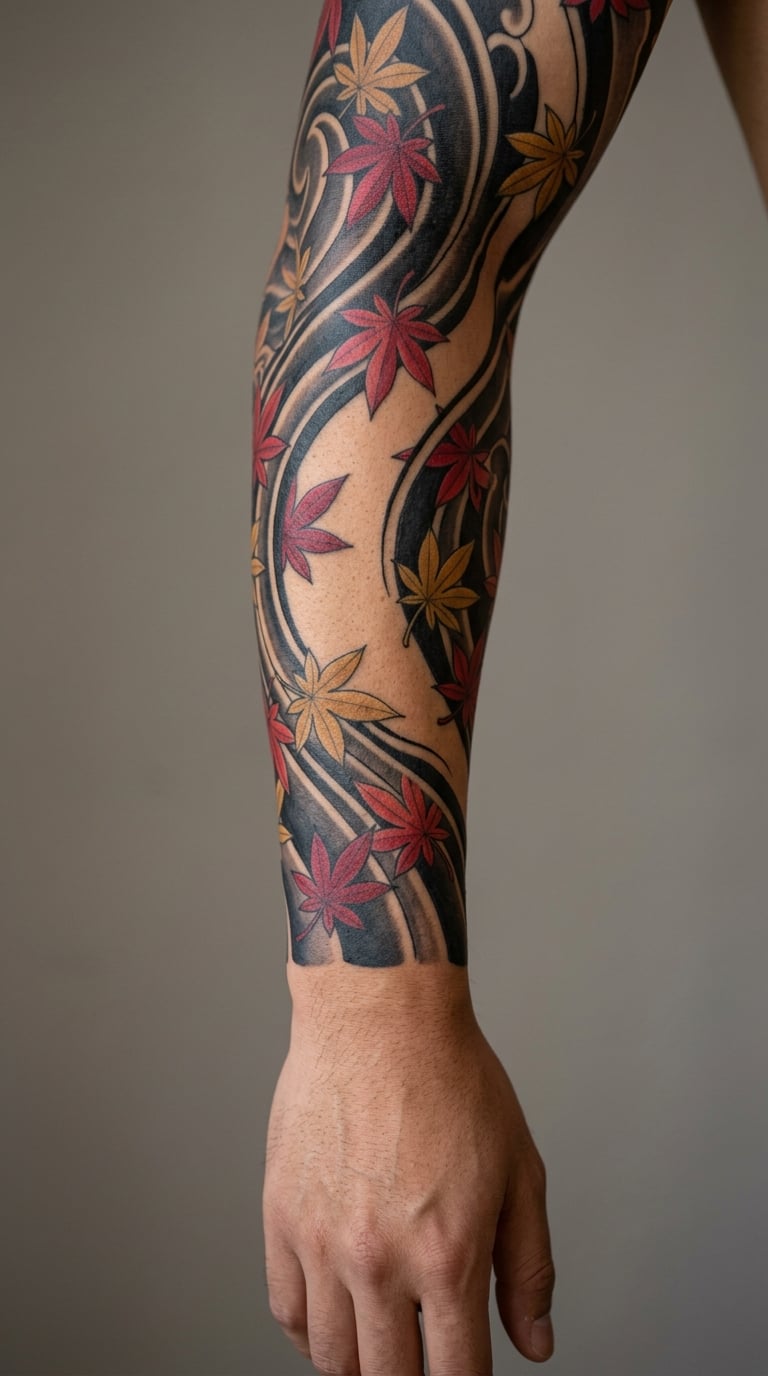
This is the sparse option in the list: long black wind lines sweeping diagonally across the arm with red maple and gold ginkgo leaves caught in them, and plenty of open skin between every element. On a large arm it reads as a half sleeve without the commitment of full coverage.
Wind is movement without a subject, and people pick it when they want irezumi atmosphere on a body that is already heavily tattooed. It also works as the first piece of a sleeve you intend to build over years.
Placement: Inner forearm, wrist, or half sleeve. · Size: 6-9 inch (15-23 cm) across the forearm. · Style: Irezumi nature. · Pain: Medium. Fewer filled areas means fewer long passes, so sessions stay shorter.
Wind lines that run across the elbow or wrist crease distort noticeably as the arm moves. Ask the artist to redirect them along the natural line of the arm rather than straight across it.
Make it yours: Collect leaves from one season in one place and use them as the reference set, so the palette tells a specific story.
19. Ink-Wash Ukiyo-E Scenery Sleeve
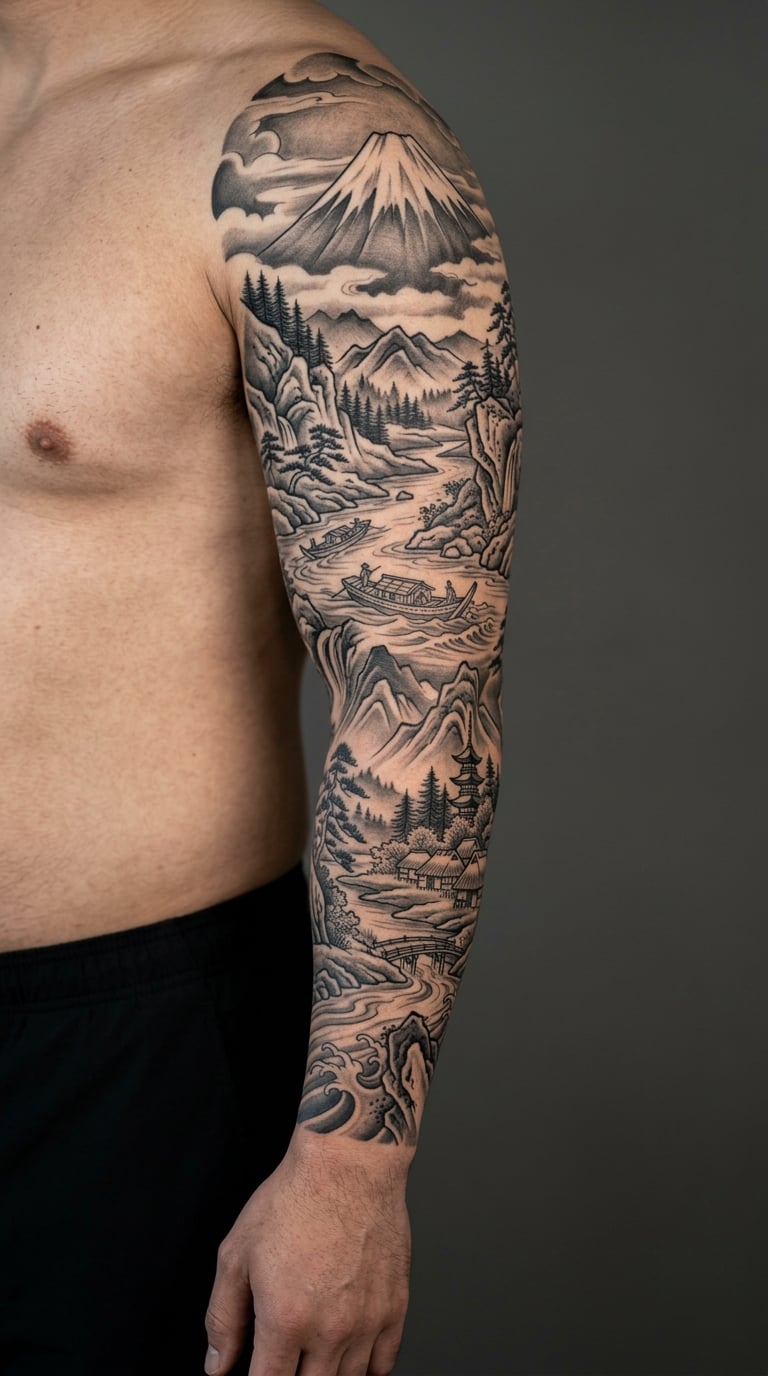
An ink-wash scenery sleeve borrows the composition of ukiyo-e prints, layered mountains receding into mist, flat water, and a small boat for scale, and translates it into an original tattoo design. It is a scene built for an arm rather than a copy of a historical print.
Scenery work is chosen for a place or a feeling rather than a symbol. It reads as travel and distance, and it gives the artist room to work with negative space instead of dense colour.
Placement: Outer forearm or half sleeve. · Size: 10-14 inch (25-35 cm) of continuous scene. · Style: Irezumi illustrative. · Pain: Medium. Fine mist shading is slow, but it is light work.
Reproduction is the line to hold here. Bring ukiyo-e prints as compositional references and make it clear you want an original scene, not a traced historical image.
Make it yours: Swap in a landscape you know well, your own coastline or mountain, and keep the print’s compositional structure around it.
20. Hannya Mask and Smoke Sleeve
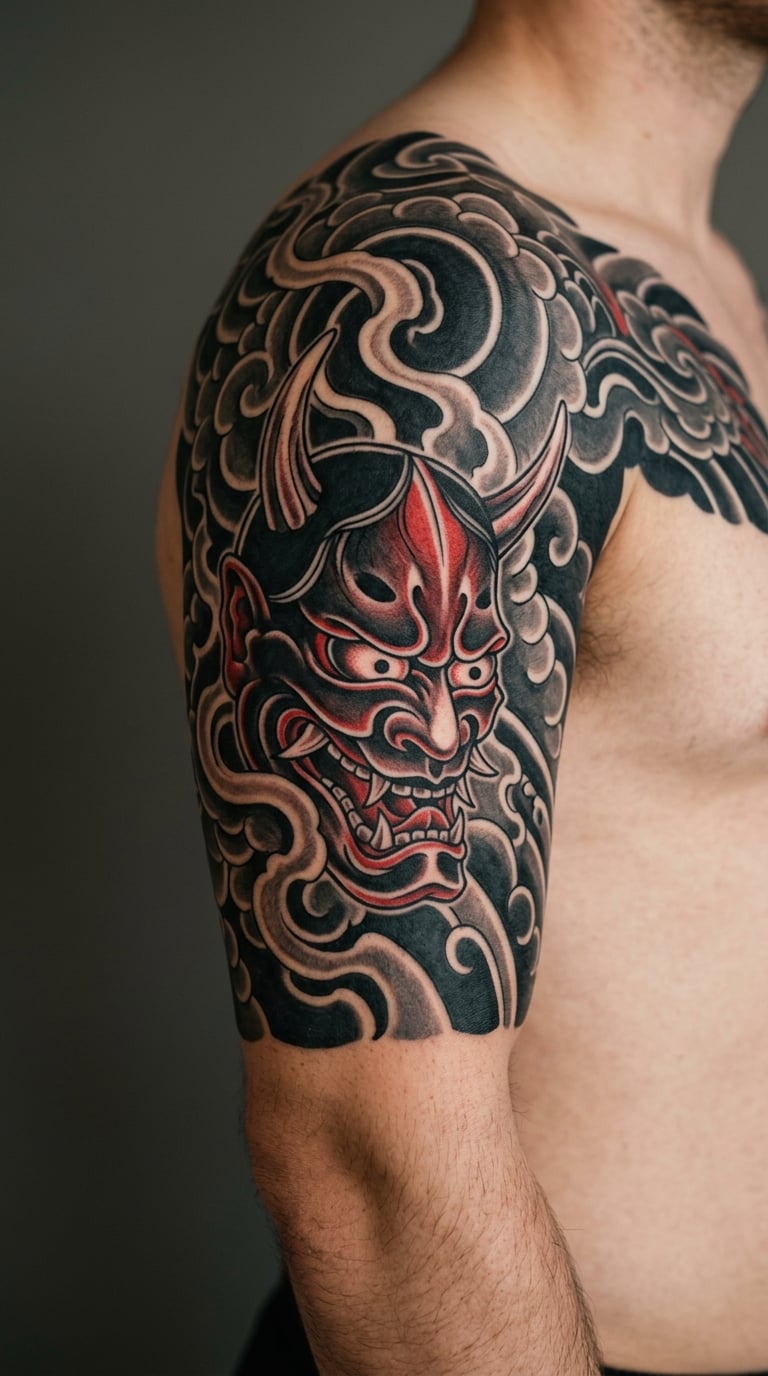
A hannya sleeve puts a dark mask with red eyes and a sharp-toothed mouth at the centre, wrapped in heavy black smoke that fades out into open skin. The controlled negative space is the whole trick, because smoke that fills the entire arm turns into a solid black block.
Hannya masks come from Noh theatre and carry associations with jealousy and transformation. People choose them for the visual impact, and it is a design worth discussing with your artist since it draws on a specific theatrical tradition.
Placement: Upper arm, shoulder, or half sleeve. · Size: 6-9 inch (15-23 cm) for the mask. · Style: Irezumi or blackwork. · Pain: High, mostly from the large black smoke fields and the shoulder area.
Solid black covers more square inches than line work, so it takes longer and stays sensitive longer. This is a design that regularly needs its own session per section.
Make it yours: Choose the smoke colour, grey for something quieter or deep black for full drama, and pick the expression that fits the piece you are building.
How to Choose the Right Design
The right design is the one that fits the arm, the timeline, and the rest of your tattoos. Six questions worth working through before a consultation:
- Composition before motif. Decide whether you want a scene, a single subject, or an abstract background pattern. A motif that needs a full arm of negative space will not compress into a half sleeve without losing its shape.
- Colour or black and grey. Full colour irezumi carries more visual weight and needs more sessions. Black and grey is more forgiving, hides small imperfections, and ages with less colour loss. Both are legitimate choices.
- Size follows body shape. Scale is set by your arm, not by the reference image. A design that works on a larger frame will look thin and unfinished on a smaller one, so let the artist adjust scale to your proportions.
- Placement sets the viewing angle. Shoulder cap, upper arm, elbow, forearm, and inner arm each show a design differently. Decide what you want people to see first and build the composition around that.
- Plan for what comes next. If a back piece or bodysuit is on your horizon, say so at the first consultation. Leaving the right amount of open skin now is far cheaper than reworking a finished sleeve later.
- Ask the artist early. Bring references, explain what you like about each one, and let the artist tell you what will not work on your arm. A specialist who pushes back is doing their job, not turning you down.
On sleeve length specifically, a quarter sleeve gives you a finished piece without the multi-year commitment a full sleeve asks for. Plenty of people start there and extend later.
Cost and Session Time
Irezumi sleeves are among the most expensive tattoos you can book, mostly because of the hours rather than the ink. Realistic US ranges, which vary widely by city and artist:
- Small or compact piece: roughly 300 to 800 USD, usually one session.
- Medium project or quarter sleeve: roughly 800 to 2,000 USD across 1-3 sessions.
- Large piece or half sleeve: roughly 2,000 to 5,000 USD across 3-6 sessions.
- Full sleeve: roughly 5,000 to 15,000+ USD across 5-10 or more sessions.
Artists who specialise in large-scale Japanese work often charge a premium hourly rate, and the total depends on complexity, how much colour is involved, and where you are. Shop minimums apply, and a quote should come with an estimated session count and total hours before any work starts.
Individual sessions commonly run 4-6 hours, with experienced clients sitting longer. A total in the tens of hours is normal for a full sleeve, which is why a clear written plan matters more than the number on the first quote.
Aftercare Basics
Always follow your artist’s aftercare instructions first. They know exactly what they did to your skin, and their directions override anything general you have read.
- Wash the area gently with unscented soap and lukewarm water, then pat it dry rather than rubbing.
- Keep the area out of direct sun while the tattoo heals, and think about sun protection for the life of the piece afterwards.
- Skip swimming, baths, hot tubs, and saunas until the skin has fully healed.
- Wear loose clothing over the sleeve for the first stretch, since tight fabric rubs and catches scabs.
- Let scabs do their job. Picking them is the fastest way to pull colour out of a fresh piece.
- Watch the tattoo rather than touching it daily, and contact your artist if something looks off to you rather than trying to fix it yourself.
Frequently Asked Questions
How much does an irezumi sleeve cost?
A full irezumi sleeve in the US typically runs from 5,000 to 15,000 USD or more, while a half sleeve usually falls between 2,000 and 5,000 USD. The number depends on the artist’s hourly rate, the complexity of the design, how much colour is involved, and your city. A reputable artist will give you a session count and estimated total hours in writing before you commit.
How many hours does an irezumi sleeve take in total?
A full sleeve usually runs 30 to 60 hours of tattooing spread across 5 to 10 or more sessions. Individual sessions commonly last 4-6 hours, with longer sittings for people who have done large work before. The elbow ditch alone can take several hours on its own because it is slow to heal and sensitive to work. Ask for the estimated total when you book, not after the first session.
What are the different types of irezumi sleeves?
The four standard types are quarter, half, three-quarter, and full. A quarter sleeve covers the upper arm only. A half sleeve runs from the shoulder or bicep to the elbow or mid-forearm. A three-quarter sleeve extends to just below the elbow. A full sleeve covers the entire arm from shoulder to wrist, usually with a shoulder cap and back work attached.
Does irezumi age well?
It can, but colour is the deciding factor. Black linework and solid black fills hold their shape for decades, while reds, pinks, and violets fade noticeably faster, especially on sun-exposed arms. Colour sleeves generally want a refresh every few years. Black and grey irezumi ages the most gracefully, and keeping the darkest blacks solid rather than relying on mid-tones makes a big difference.
Is irezumi a good choice for a first tattoo?
It can be, but not as a first full sleeve with no guidance. Most people do better committing to a smaller irezumi piece first, letting the artist see how the work sits on their skin and how their body takes the colour. A quarter sleeve or a forearm piece gives you a finished tattoo in a reasonable time frame and leaves room to grow into more later.
How painful is the inner elbow on a sleeve?
The inner elbow, often called the elbow ditch, is the most commonly complained-about part of a sleeve. The skin is thin, stretchy, and directly over bone, and it tends to stay tender longer than the rest of the arm. It is also slower to heal, so expect it to feel different from the bicep or forearm for several weeks after the session.
Finding the Right Irezumi Sleeve
For a first tattoo, I would point you at something smaller and simpler from this list, and the cherry blossom branch or the wind and leaves sleeve are the two I would pick. Both give you real irezumi linework and colour, both are achievable in a reasonable time frame, and both leave open skin you can add to later without a re-plan.
If you already have a collection and a specific vision for a back piece or bodysuit, the fuller compositions make more sense: a phoenix, a tiger and bamboo, or a carp and lotus run. Those are year-long conversations with an artist, not a booking, and the right artist will tell you that before you start.
Whichever direction you go, bring your references to a consultation and ask for the composition mapped onto your arm. The design is only worth as much as the flow it has when you move.