
20 Disney Tattoo Ideas for Women: Best October 2026 Edition
Twenty Disney tattoo ideas for women, none of them a copied character: every design here is built from an object or shape a film is built around, drawn as an original motif. The rose under glass, the glass slipper, the paper lantern, the acacia at sunrise. Fans recognise them instantly, and the drawing belongs to you.
That distinction matters. Portrait work of a character will blur, age and eventually be something you have to explain at a family dinner. A symbol drawn with clean, confident linework usually still reads in fifteen years. If you are still comparing 20 Disney tattoo ideas for women, start with something in the 1.5 to 3 inch range. If you already collect ink, the wider scene designs at number nine and ten have the room to breathe. Updated for 2026, and worth reading straight through if you are still deciding.
20 Disney Tattoo Ideas for Women: Quick Guide
| Idea | Style | Best placement | Size | Pain |
|---|---|---|---|---|
| 1. Enchanted Rose in a Bell Jar | Fine line plus one colour accent | Inner forearm, upper arm | 2-4 inches | Medium |
| 2. Glass Slipper with Sparkle | Minimalist fine line | Top of foot, ankle, inner wrist | 1.5-3 inches | Low to medium |
| 3. Ornate Magic Lamp with Smoke Curl | Blackwork or illustrative line | Outer forearm, shoulder, calf | 2.5-5 inches | Medium |
| 4. Moonlit Fairy Wings | Fine line and dotwork | Shoulder blade, upper back, behind the ear | 2-4 inches | Medium |
| 5. Seashell Cradled by a Wave | Fine line, optional pastel wash | Inner arm, ankle, rib | 1.5-3.5 inches | Low to medium |
| 6. Sunrise Wave with Heart Reef | Illustrative or neo-traditional | Forearm, calf, lower rib | 2.5-5 inches | Medium |
| 7. Geometric Snowflake and Ice Palace | Geometric fine line with soft colour | Forearm, upper arm, sternum | 2-5 inches | Medium |
| 8. Paper Lantern and Towering Flower | Botanical fine line, warm colour | Outer arm, calf, thigh | 2.5-5 inches | Medium |
| 9. Storybook Castle at Dusk | Blackwork with shading | Forearm, calf, upper arm, mid-back | 3-6 inches | Medium |
| 10. Acacia Tree at Golden Sunrise | Illustrative or neo-traditional | Forearm, calf, lower back, upper arm | 2.5-5 inches | Medium |
| 11. Puppy Paw and Heart of Pasta | Playful fine line or traditional | Wrist, ankle, upper arm, calf | 1.5-3.5 inches | Low to medium |
| 12. Honey Pot with an Acorn | Neo-traditional colour | Forearm, thigh, upper arm, lower back | 2-4 inches | Medium |
| 13. Forest Butterfly and Mushroom | Botanical fine line or micro-realism | Forearm, shoulder, upper back, thigh | 1.5-3.5 inches | Medium |
| 14. Clownfish Among Seaweed | Illustrative or neo-traditional | Arm, ankle, calf, upper back | 2-4 inches | Low to medium |
| 15. Magnolia Blossom and Flying Crane | Botanical fine line, optional ink wash | Forearm, shoulder blade, calf, upper arm | 2.5-5 inches | Medium |
| 16. Feather and Waterfall | Illustrative fine line | Forearm, calf, outer arm, rib | 2-4 inches | Medium |
| 17. Scottish Thistle Under a Crescent Moon | Botanical fine line with dotwork | Forearm, calf, shoulder, behind the ear | 1.5-4 inches | Medium |
| 18. Lily on a Layered Lily Pad | Watercolour realism | Forearm, thigh, lower back, calf | 2-4.5 inches | Medium |
| 19. Small Dragon Following a River | Illustrative fine line or colour neotrad | Forearm, calf, upper arm, shoulder blade | 2.5-5 inches | Medium |
| 20. Shooting Star and Tiny Spark | Minimalist fine line, optional gold | Behind the ear, wrist, collarbone, shoulder | 1.5-3.5 inches | Low to medium |
20 Disney Tattoo Ideas for Women: How to Compare the Options
Four things separate these twenty from a mood board. Visual detail is the biggest: numbers one, twelve and eighteen carry shaded colour and reward size, while numbers four, seventeen and twenty live or die on a single clean line. Ink coverage comes next, since a blackwork castle covers far more of the arm than a two-inch slipper.
Placement flexibility is the third filter. A motif that reads at 1.5 inches works anywhere, including behind the ear, while a castle needs a flat panel of skin. First-tattoo suitability is the fourth, and honestly it is the one people skip. Eight of these designs sit comfortably under three inches, use a single colour or none at all, and finish in one sitting. Start there if you have never been tattooed.
1. Enchanted Rose in a Bell Jar
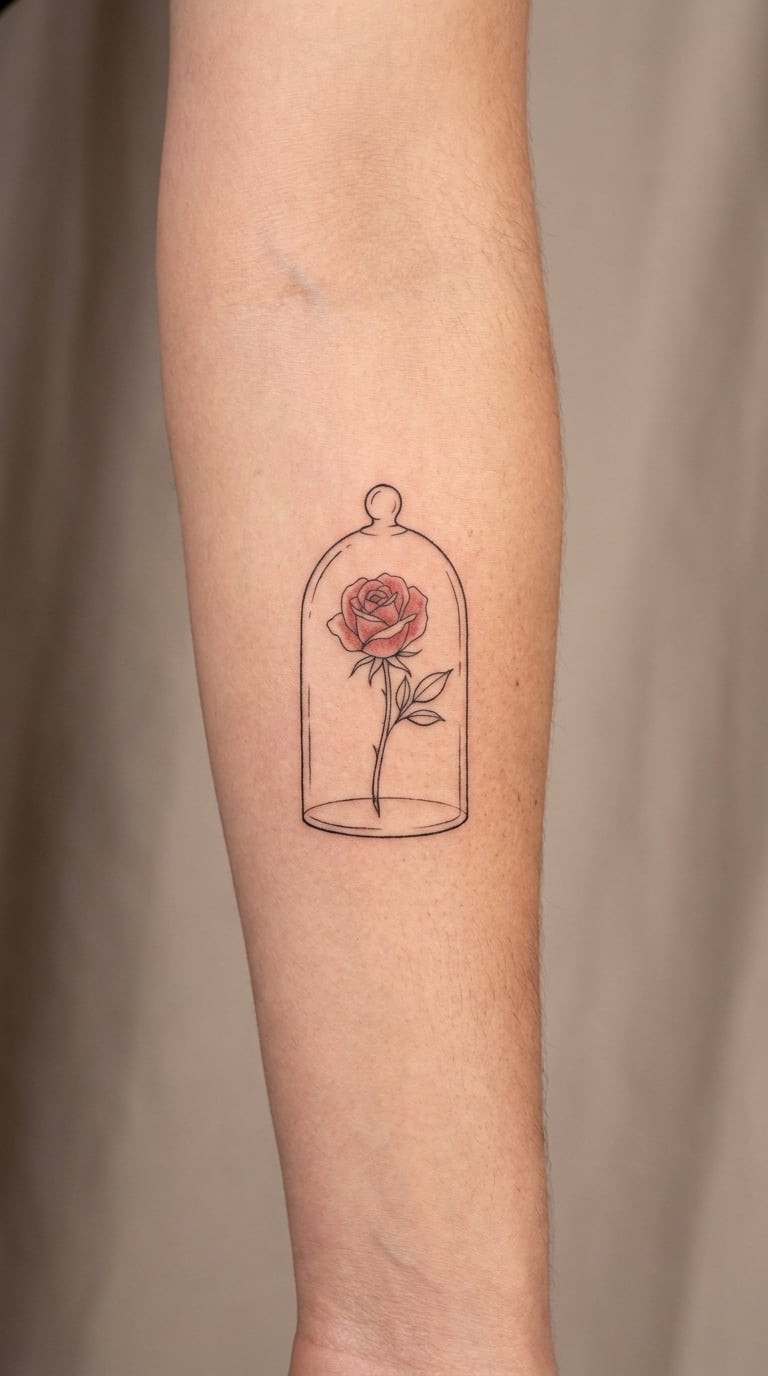
A single rose with three or four leaves, sitting under a hand-drawn bell jar outline in fine black line. The jar is just a domed contour and a flat base, no reflections and no shine, so the eye lands on the flower. One restrained red accent on the petals is all the colour it needs.
It carries the Beauty and the Beast idea without reproducing a character, a scene or a title. People choose it because the flower under glass is the whole story in one object: something beautiful, kept, still alive.
Placement: inner forearm or back of the upper arm. Size: 2-4 inches (5-10 cm). Style: fine line with selective colour. Pain: medium on the inner forearm. Hairlines and the thinnest part of the jar are the first things to soften, so ask your artist for line weight that suits the size you are actually getting.
Make it yours: add a date in tiny script under the base of the jar, or switch the red for a single grey wash so it reads as pure linework.
2. Glass Slipper with a Subtle Sparkle
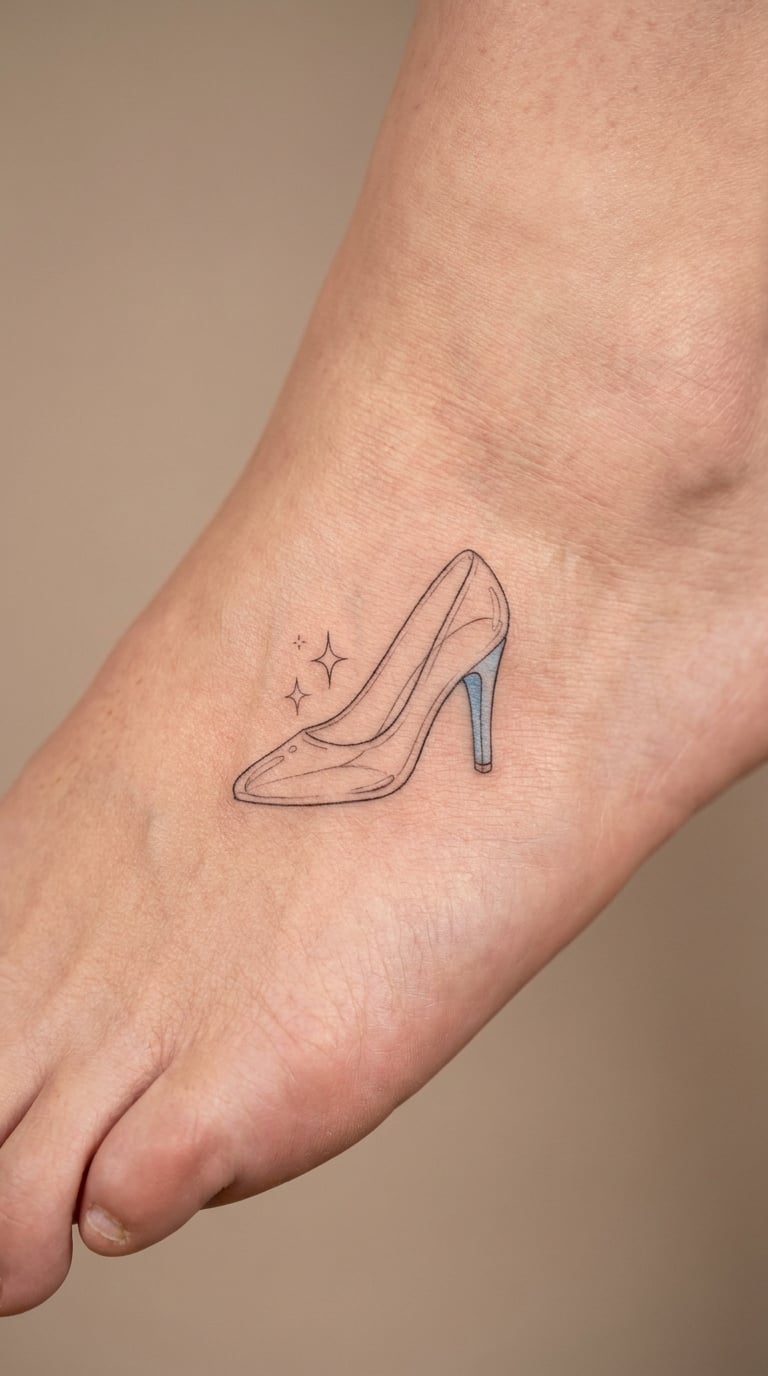
A simplified slipper drawn from the side, with a clean toe curve, a low heel and a single pearl-like highlight left as negative space inside the outline. Two small four-point sparkle marks sit just off the toe. No ribbons, no netting, no glass texture.
It is an object rather than a picture of one, which is why it wears well. Most people who pick it are not making a fashion statement about the film, they just want the smallest possible nod to something that mattered to them at nine years old.
Placement: top of the foot, ankle, or inner wrist. Size: 1.5-3 inches (4-8 cm). Style: minimalist fine line. Pain: medium on the foot, low to medium on the wrist. Foot placement and very fine sparkles can blur sooner than arm placements, and the heel line is where you will see it first.
Make it yours: use a pale blue heel as the only colour in an otherwise black design, or place it beside a tiny companion piece, like a slipper and a pumpkin, on the same ankle.
3. Ornate Magic Lamp with One Smoke Curl
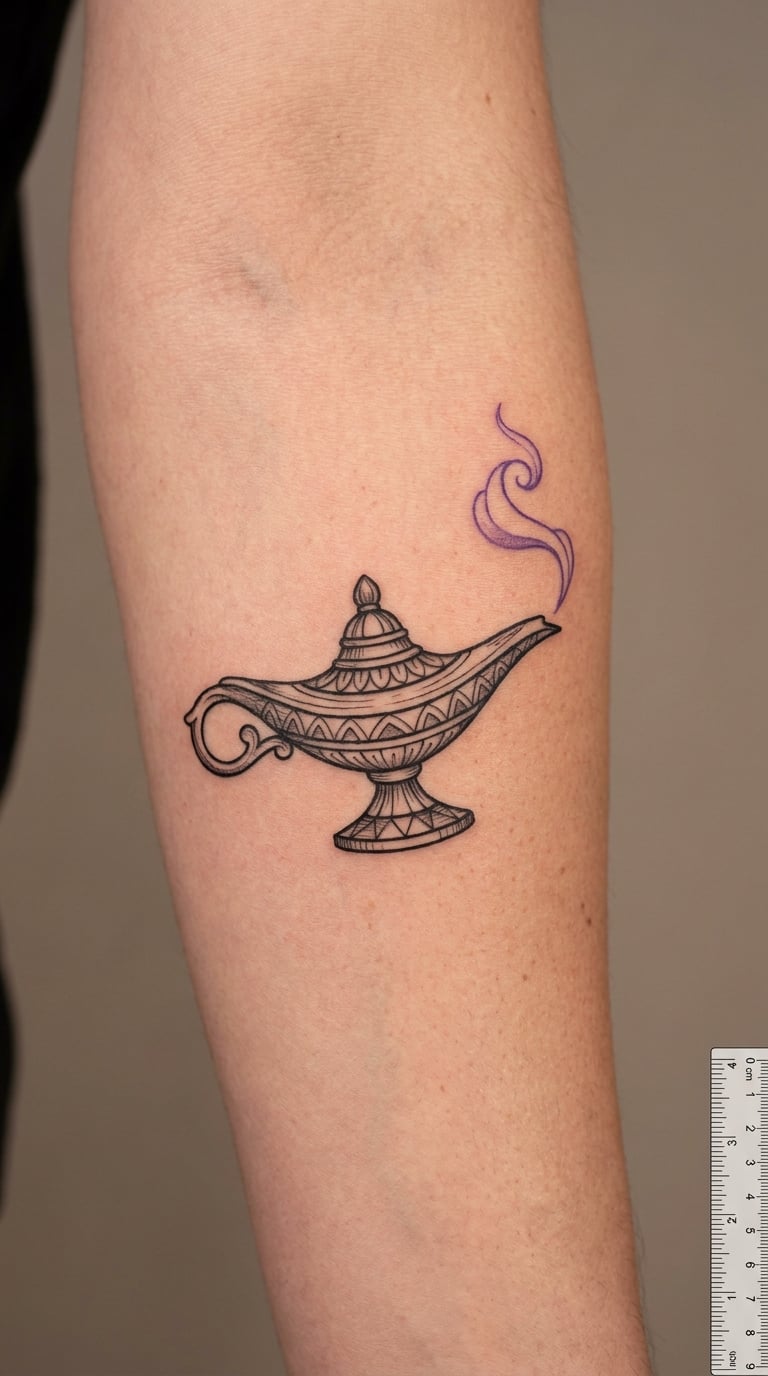
A magic lamp built from solid black contours: a rounded body, a narrow spout, a flat lid, and three engraved decorative bands around the middle. From the spout, one long curling smoke line rises and tapers off, staying abstract rather than gathering into a shape.
The engraving is what lifts this above a plain outline. Those bands give an artist something to shade, and the single smoke curl gives the composition movement without adding a second subject to compete with.
Placement: outer forearm, shoulder, or calf. Size: 2.5-5 inches (6-13 cm). Style: blackwork or illustrative line art. Pain: medium on the forearm and shoulder, and usually medium on the calf too. The smallest engraved bands need generous line spacing or they fill in as the design ages.
Make it yours: replace the engraved bands with a row of small stars, or add a single gold dot inside the smoke curl as the one point of light in the piece.
4. Moonlit Fairy Wings
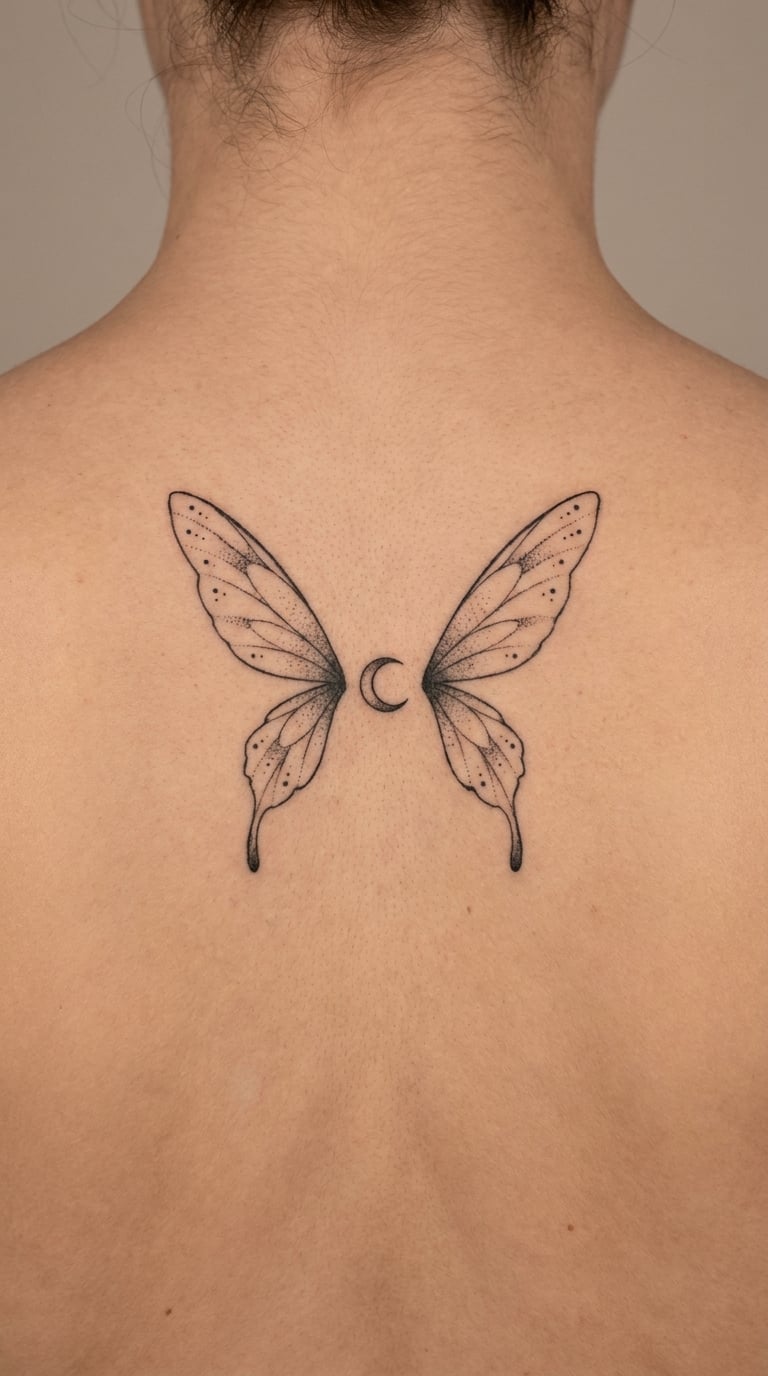
A matched pair of wings, drawn as tapered shapes with a handful of internal segments each, so the structure reads as a wing without imitating any specific design from a film. Light dotwork along the lower edges, and an open centre that lets the skin breathe. A slim crescent moon can sit between them.
Peter Pan sits behind it in most people’s heads, but the drawing is a botanical study with a night sky attached. That is the version that still looks elegant when you are fifty and in a meeting.
Placement: shoulder blade, upper back, or behind the ear for a smaller version. Size: 2-4 inches (5-10 cm). Style: fine line and dotwork. Pain: medium on the shoulder blade, low to medium behind the ear. Tiny dot clusters and fine wing veins catch the least ink and go first, so a simplified two-segment wing ages better than a five-segment one.
Make it yours: mirror a smaller pair behind each ear, or add scattered stars along one shoulder blade so the design reads as a constellation with wings at the centre.
5. Seashell Cradled by a Wave
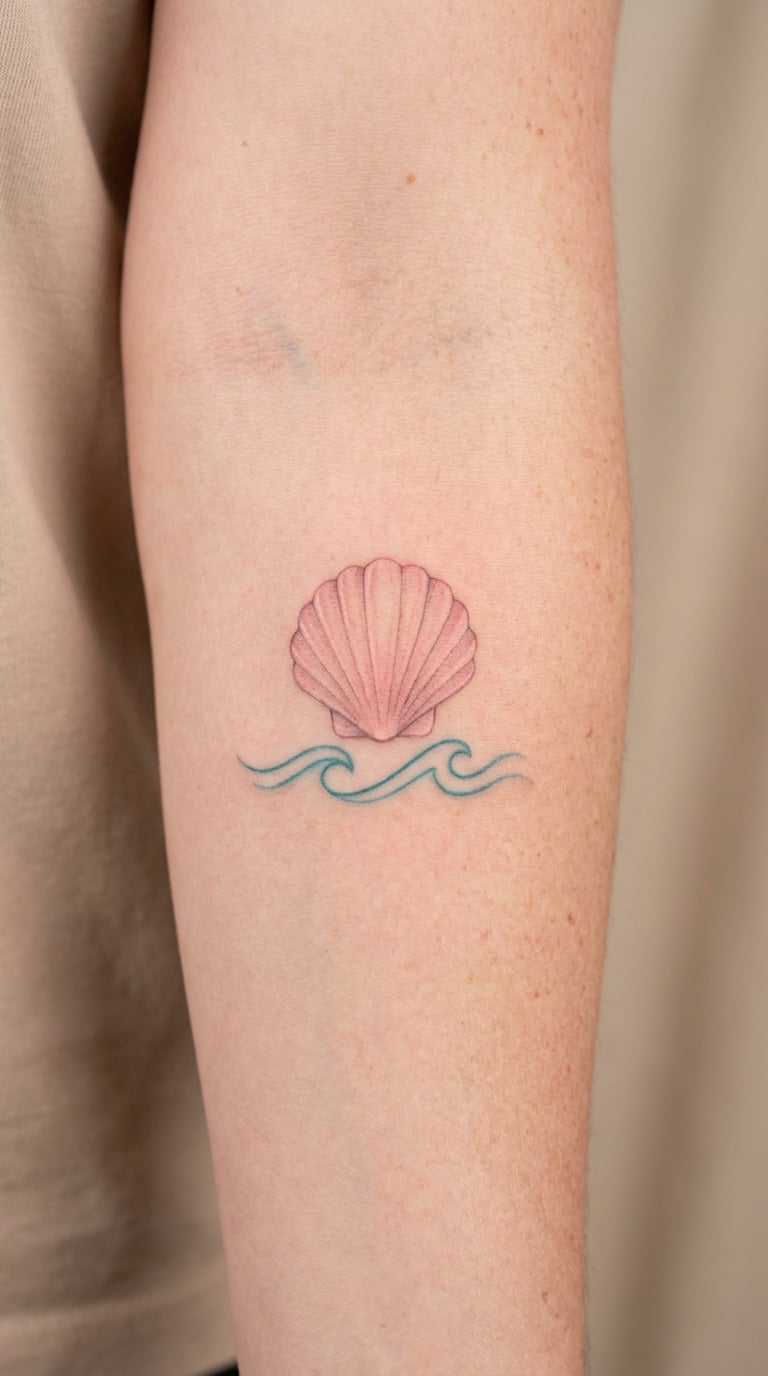
One fluted shell resting just above two clean wave lines, with the shell’s ribs drawn as light parallel strokes that curve toward a point. The whole thing is mostly open space, which is what makes it work on a small area of skin. A soft pastel wash in pink and teal is optional.
It points to The Little Mermaid without a mermaid in it, and the balance of soft and structured is why it suits a rib or an inner arm. People pick it for the calm of the composition rather than the film reference.
Placement: inner arm, ankle, or rib area. Size: 1.5-3.5 inches (4-9 cm). Style: fine line with optional pastel wash. Pain: low to medium on the inner arm or ankle, medium on the ribs. Pastel colour lightens as it fades, and fine shell ribs are the first detail to go soft, so keep the rib count low.
Make it yours: add a second, much smaller shell below the first as a filler piece, or tint the water a single deep green instead of teal for a more grown-up palette.
6. Sunrise Wave with a Small Heart Reef
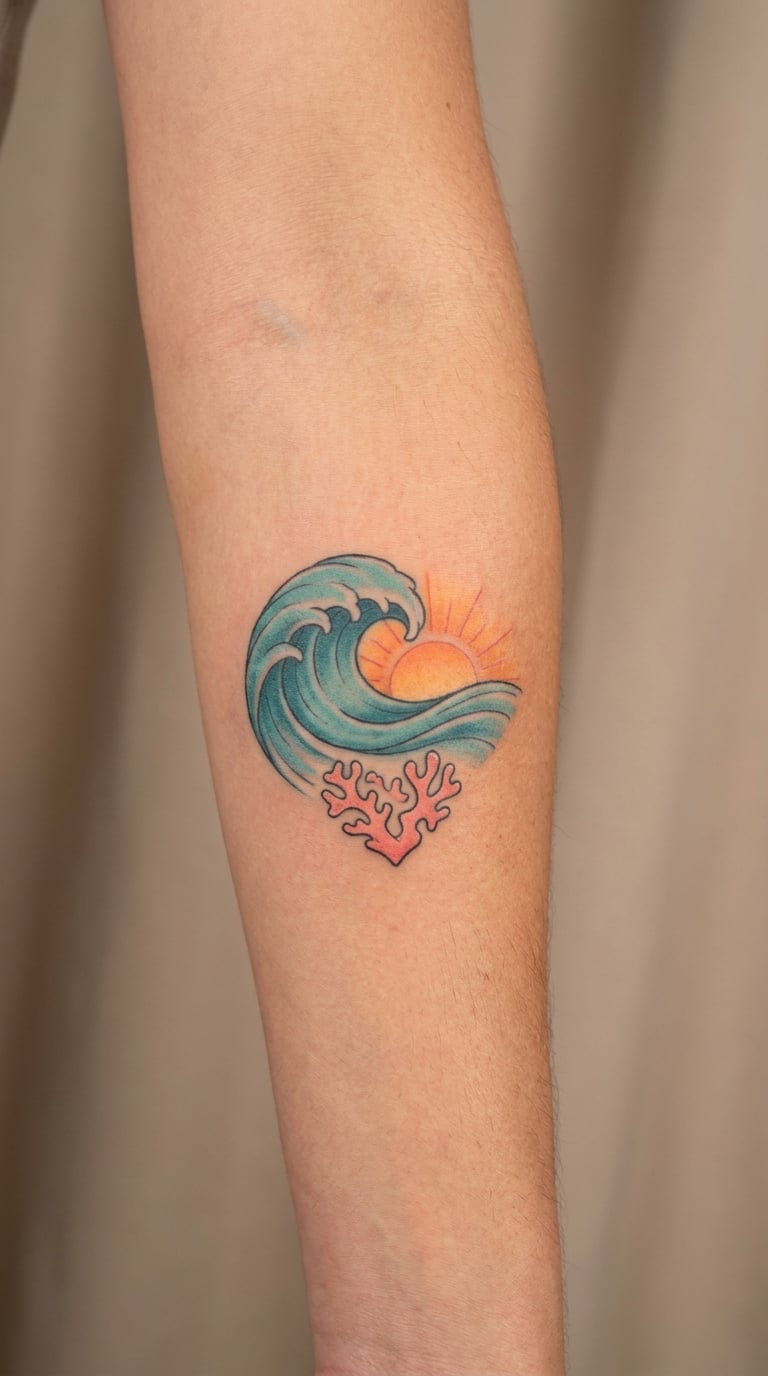
One curling wave with a defined lip and a few interior strokes, sitting under a warm sunrise disc. Beneath the water, a small heart-shaped reef, no more than a quarter of the design, drawn as a simple cluster. No face, no smile, no eyes in the water.
Moana lives in the feeling of it, not the drawing. This one gives you a full-colour piece that still has a clear silhouette, which is a hard balance to hit and the reason it sits well on a forearm or a calf.
Placement: forearm, calf, or lower rib. Size: 2.5-5 inches (6-13 cm). Style: illustrative or neo-traditional. Pain: medium on the forearm and calf. Ribs can feel more intense, so a lower rib placement is usually medium rather than comfortable. Very small colour areas like the reef can lose definition when the surrounding ink is shaded heavily.
Make it yours: put your birth year inside the heart reef in tiny numerals, or repeat the sunrise disc behind the wave in flat orange for a two-tone finish.
7. Geometric Snowflake and Ice Palace
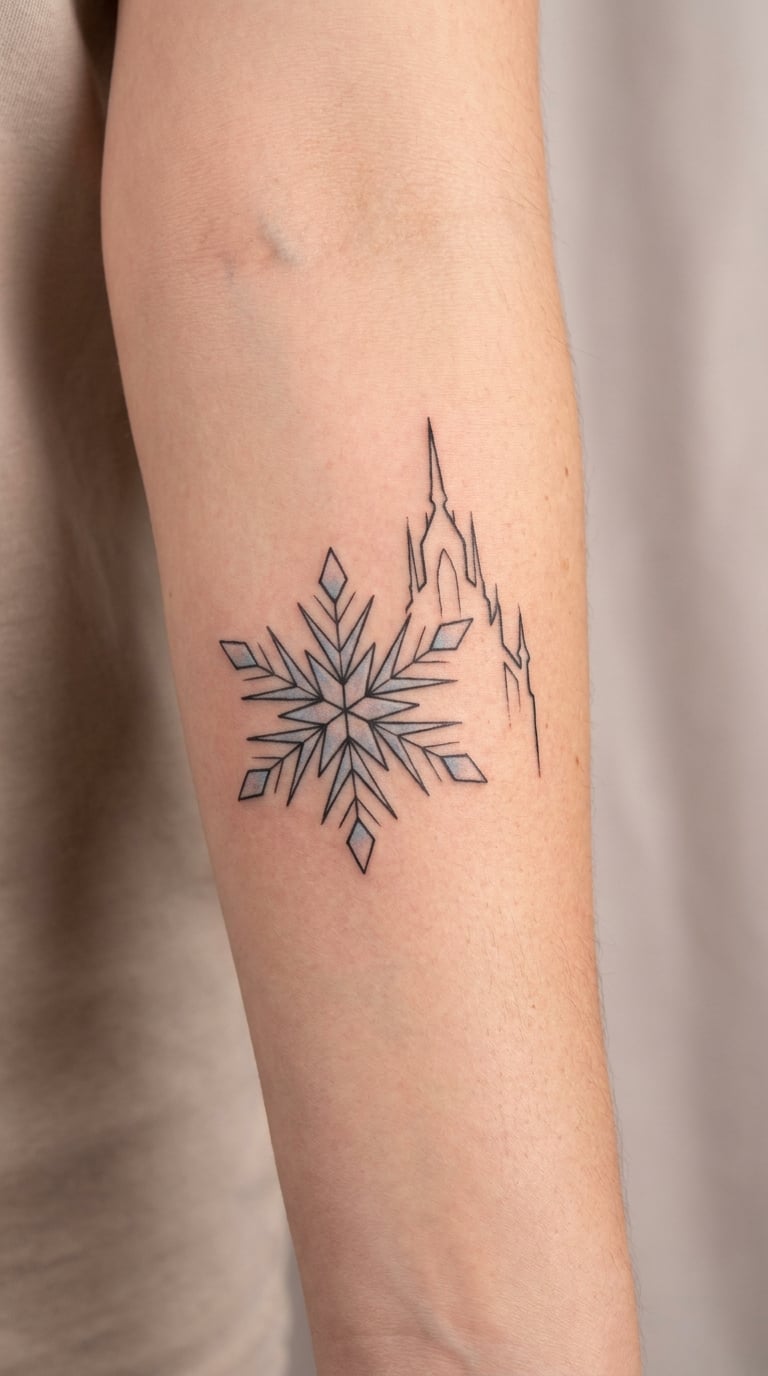
A six-point snowflake built from straight geometric lines, each arm branching once, paired beside a minimal ice-palace silhouette: three stepped towers, pointed roofs, no windows or faces. The negative space between the two shapes does most of the work, with pale blue shading in a few places only.
It is a Frozen design built on geometry rather than likeness, so nothing ages into an unrecognisable smudge. Pairs well with a vertical version, where the snowflake sits above the palace for a sternum or inner-forearm piece.
Placement: forearm, upper arm, or sternum for a vertical version. Size: 2-5 inches (5-13 cm). Style: geometric fine line with soft colour. Pain: medium on the arm and sternum. Pale washes and very narrow snowflake branches lose definition first, so ask for the branches to be spaced wider than looks right in a drawing.
Make it yours: build the snowflake from six identical small symbols, such as stars or snowflakes within snowflakes, rather than six identical arms.
8. Paper Lantern and Towering Flower
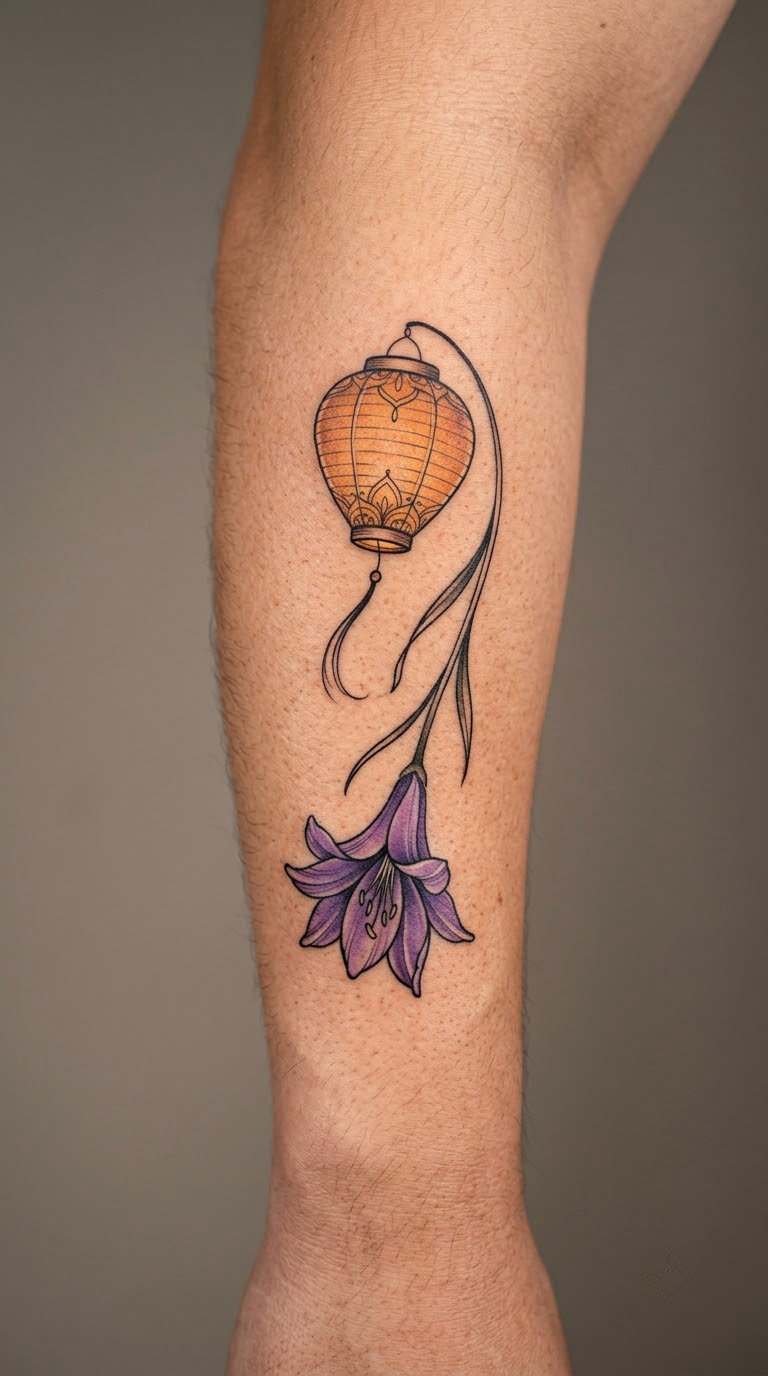
A paper lantern drawn as a rounded rectangle with six or seven horizontal ribs, floating above a tall flower on a gently curving stem. The flower is loosely drawn, with a few petals left open rather than layered. Warm amber in the lantern, one cool colour in the bloom.
Nobody needs to be told which film this is from, and you are not drawing a person, a tower or a face. The vertical shape is the reason this works so well on an outer arm or a calf, where a tall design has room to run.
Placement: outer arm, calf, or side of the thigh. Size: 2.5-5 inches (6-13 cm). Style: botanical fine line with warm colour. Pain: medium on all three. A thin stem and tiny lantern ribs need confident line weight to stay legible, so resist the urge to make the stem hairline-fine.
Make it yours: hang three lanterns at different heights on one stem, or add small drifting sparks between the lantern and the flower to fill the gap.
9. Storybook Castle at Dusk
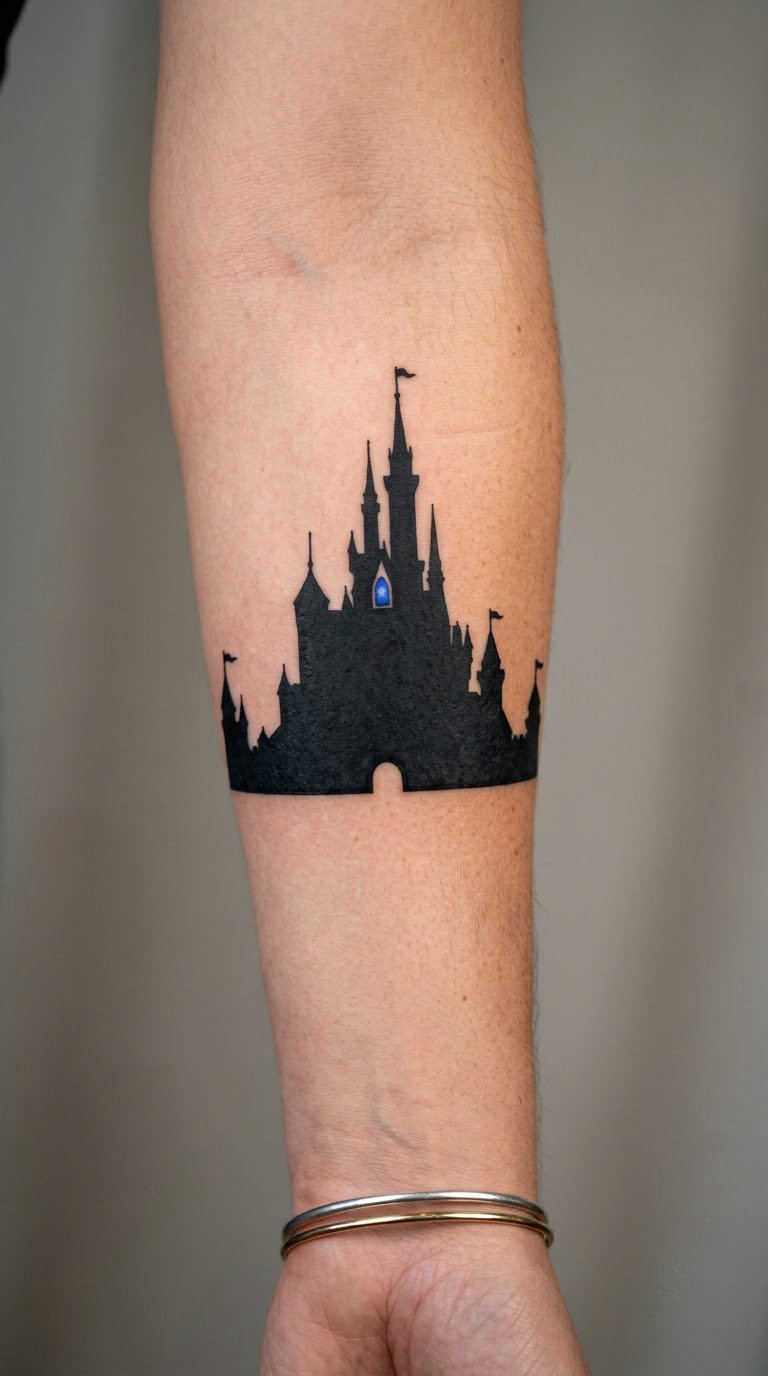
An original castle silhouette with towers of different heights, narrow arched windows, a bridge over an empty moat, and a dusky sky shaded in soft greys behind it. One or two windows lit in a single warm or blue tone. Nothing in it copies a specific park castle, and there is no lettering anywhere.
It is the design people picture when they say Disney tattoo, and it is the one that needs the most room. Anyone already building a larger piece will get more out of it than a first-timer with an untested pain threshold.
Placement: forearm, calf, upper arm, or mid-back. Size: 3-6 inches (8-15 cm). Style: blackwork with atmospheric shading. Pain: medium on the arm and calf, and medium to high if you adapt it to the side body over the ribs. Tiny window details disappear first, so fewer, larger openings read better over time.
Make it yours: sketch your own skyline proportions, maybe a squat wide gatehouse instead of tall spires, so the castle belongs to your drawing rather than to any film.
10. Acacia Tree at Golden Sunrise
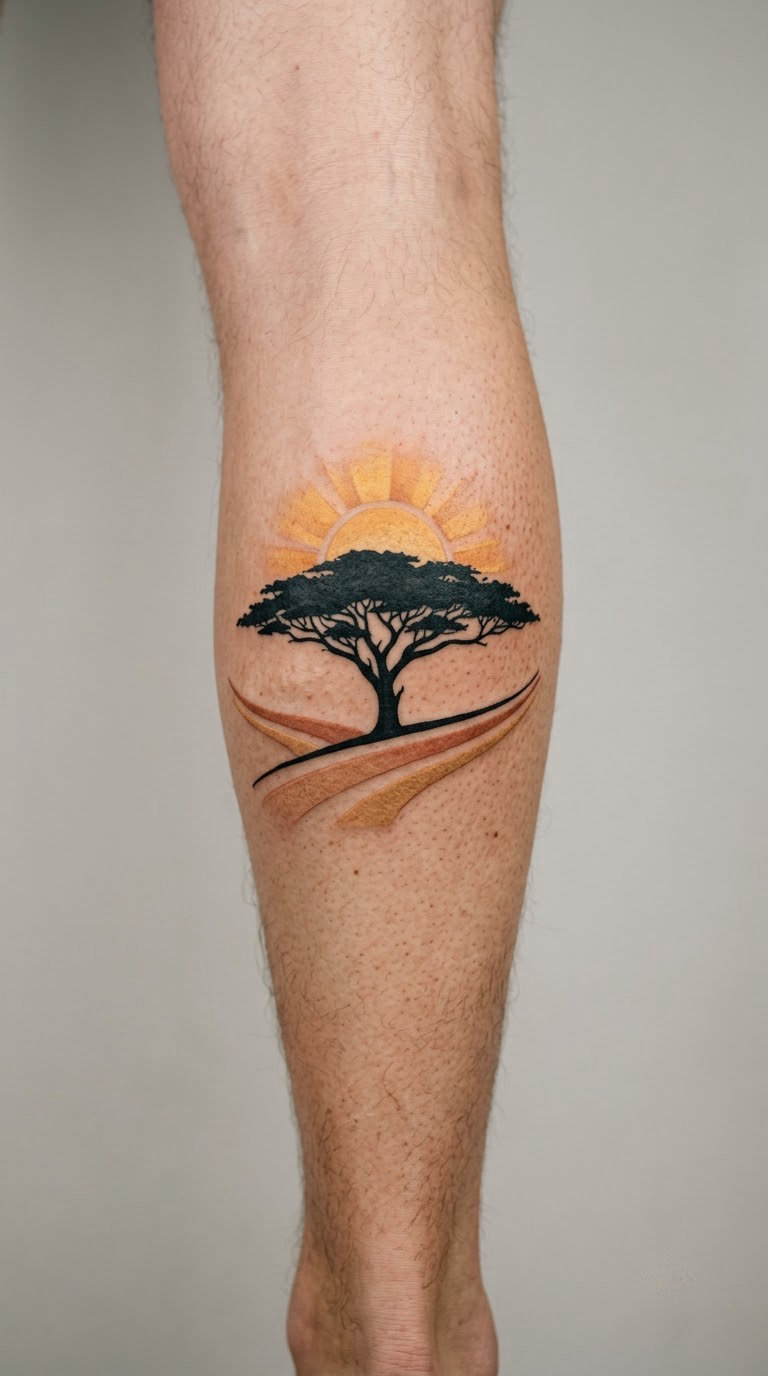
A lone acacia drawn in flat silhouette, its canopy spread wide and flat, standing beneath a large golden sun. Three or four flowing ground lines run underneath in warm tones. No lion, no human figure, no borrowed film frame, just a tree and the light behind it.
The sunrise is the emotional part. It reads as a beginning, a return, a long day, and the flat silhouette means an artist can execute it cleanly in a single pass without shading skill.
Placement: forearm, calf, lower back, or upper arm. Size: 2.5-5 inches (6-13 cm). Style: illustrative or neo-traditional. Pain: medium on the limbs, medium to high on the lower back. Tiny branch tips need broader linework as the tattoo ages, so build the canopy as solid shapes rather than a lace of fine twigs.
Make it yours: put two trees instead of one, matching in size, as a design for you and someone else. Or add a few birds as three-line marks in the open sky above the canopy.
11. Puppy Paw and a Heart of Pasta
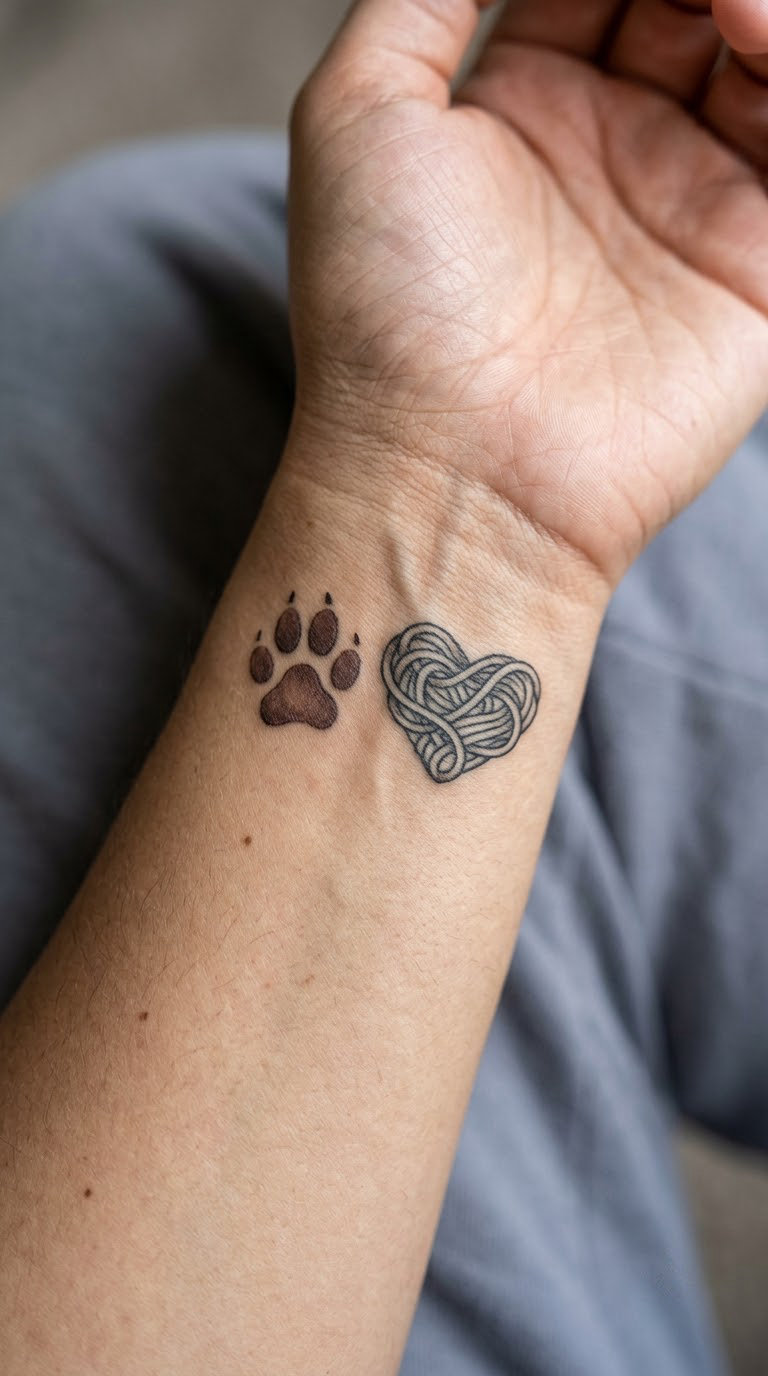
One simple puppy-paw print, four toe pads and a larger pad, drawn in warm brown with a soft outline. Beside it, a small heart-shaped nest of spaghetti, the strands suggested by six or seven loose lines rather than a tangle. No dogs, no people, no plates, no table setting.
The pairing is the joke and the charm. People tend to choose it as a low-stakes first tattoo because it is cheerful, small, and carries no drama even after the reference has faded entirely.
Placement: wrist, ankle, upper arm, or calf. Size: 1.5-3.5 inches (4-9 cm). Style: playful fine line or traditional. Pain: low to medium on the wrist or ankle, medium on the arm. Fine noodle lines are the detail most likely to blur, so keep the pasta loose and uncluttered.
Make it yours: add the paw print of a real dog you have lived with, traced from the shape of the pad rather than a generic print, and let the heart stay as the film nod.
12. Honey Pot with an Acorn
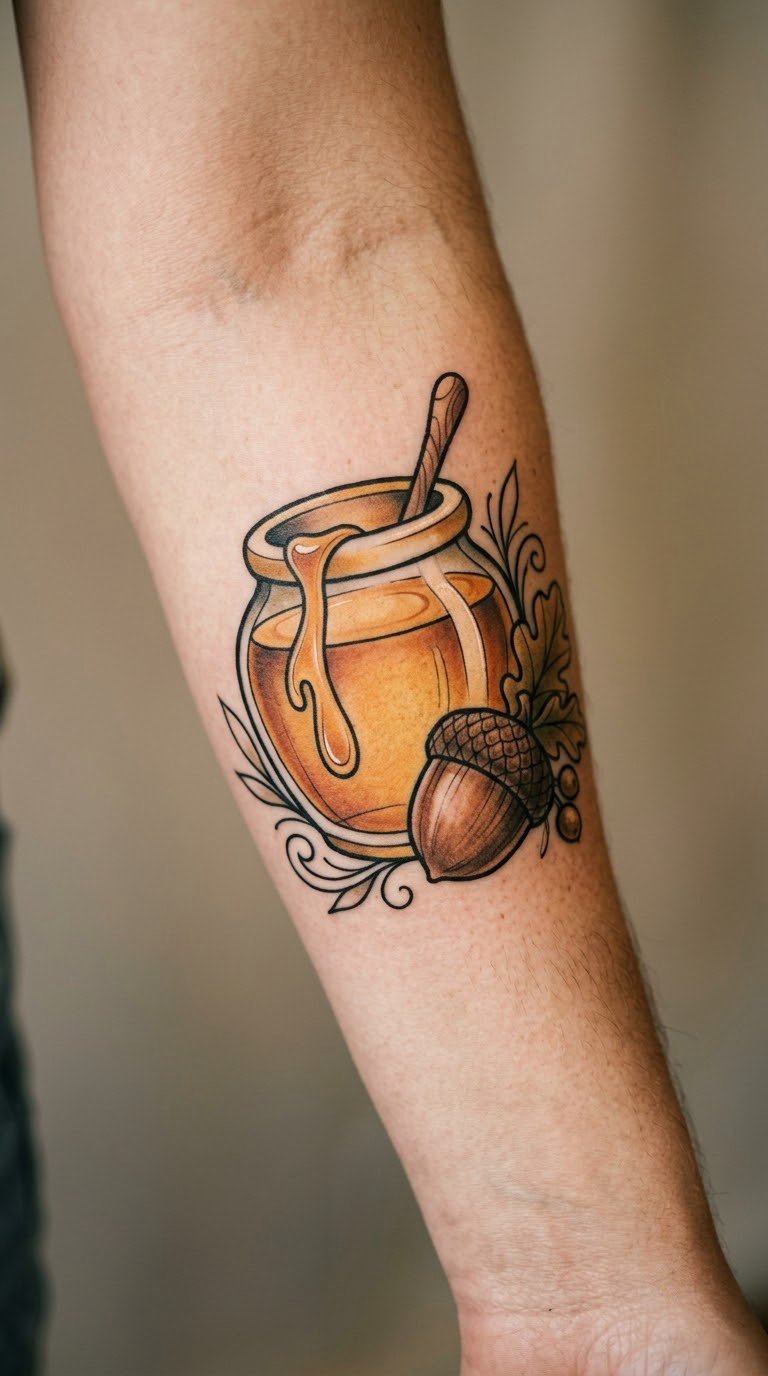
A rounded honey pot in warm amber, one thick drip curving down its side, and a single acorn resting at the base with a crosshatched cap. Shading stays simple: two or three tones of amber and one darker brown. A small red or burgundy accent ties it together, on the acorn or the drip.
It is a Winnie the Pooh design built entirely from props, and the two-object composition gives the eye somewhere to rest. Warm colour suits autumn photographs and reads well against a swimsuit.
Placement: forearm, thigh, upper arm, or lower back. Size: 2-4 inches (5-10 cm). Style: neo-traditional or colour illustrative. Pain: medium on the arm or thigh, medium to high on the lower back. Tiny acorn-cap crosshatching loses definition quickly, so a simplified cap with three lines is more durable than a full texture.
Make it yours: set a small initial on the pot itself, as a maker’s mark, or swap the acorn for a nut from somewhere you actually grew up.
13. Forest Butterfly and Mushroom
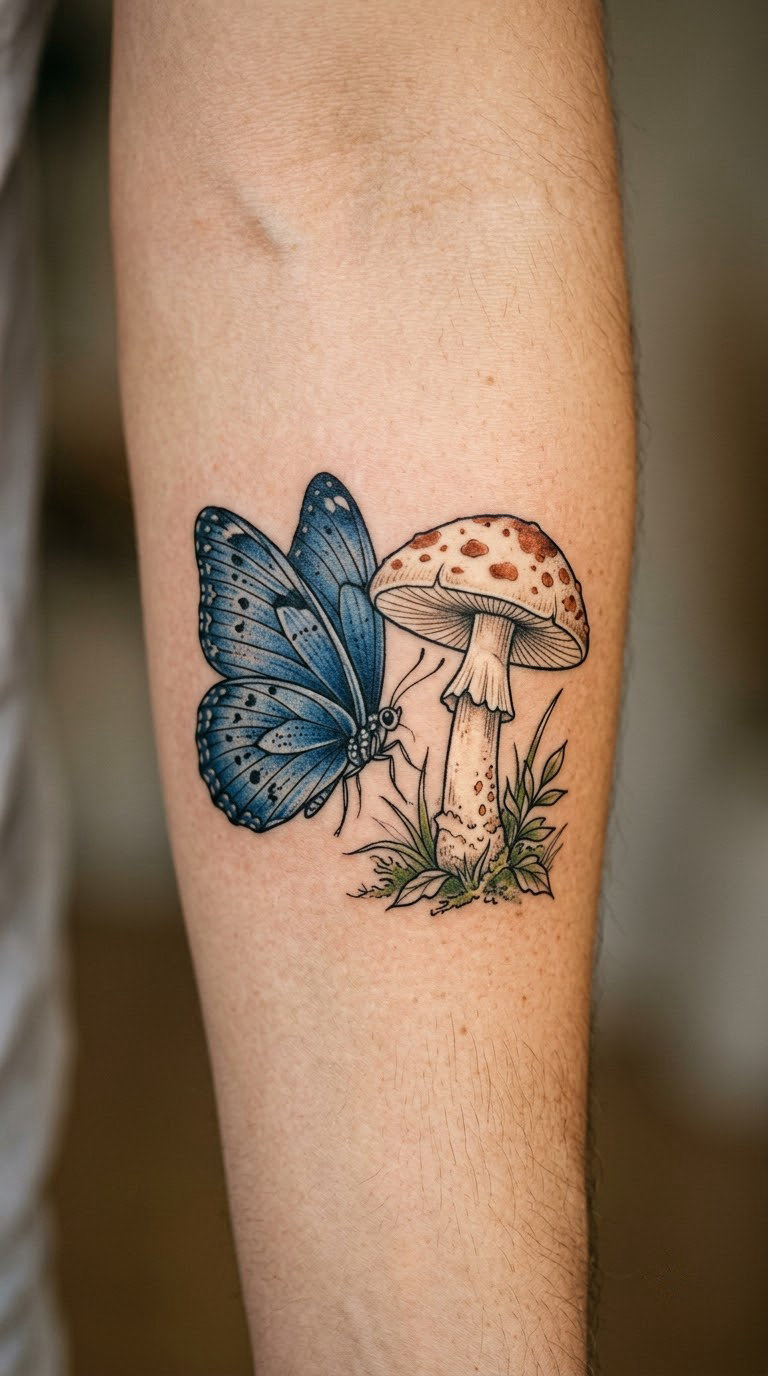
A butterfly with clean wing shapes and light veining, landing beside one small mushroom with a cream cap and a scatter of rust-coloured spots. The composition is balanced rather than symmetrical, with empty space between the two so each keeps its own silhouette.
This is the Bambi woodland without any animals in it, which makes it far more versatile. Insects and fungi are also forgiving subjects, because no one expects a recognisable character from them.
Placement: forearm, shoulder, upper back, or thigh. Size: 1.5-3.5 inches (4-9 cm). Style: botanical fine line or micro-realism. Pain: medium on all four. Tiny wing veins and mushroom spots blur sooner than a simplified silhouette, so decide early whether clarity or detail matters more to you.
Make it yours: colour only the mushroom and leave the butterfly in black line, or repeat the spot pattern from the cap as a small matching tattoo elsewhere.
14. Clownfish Among Curving Seaweed
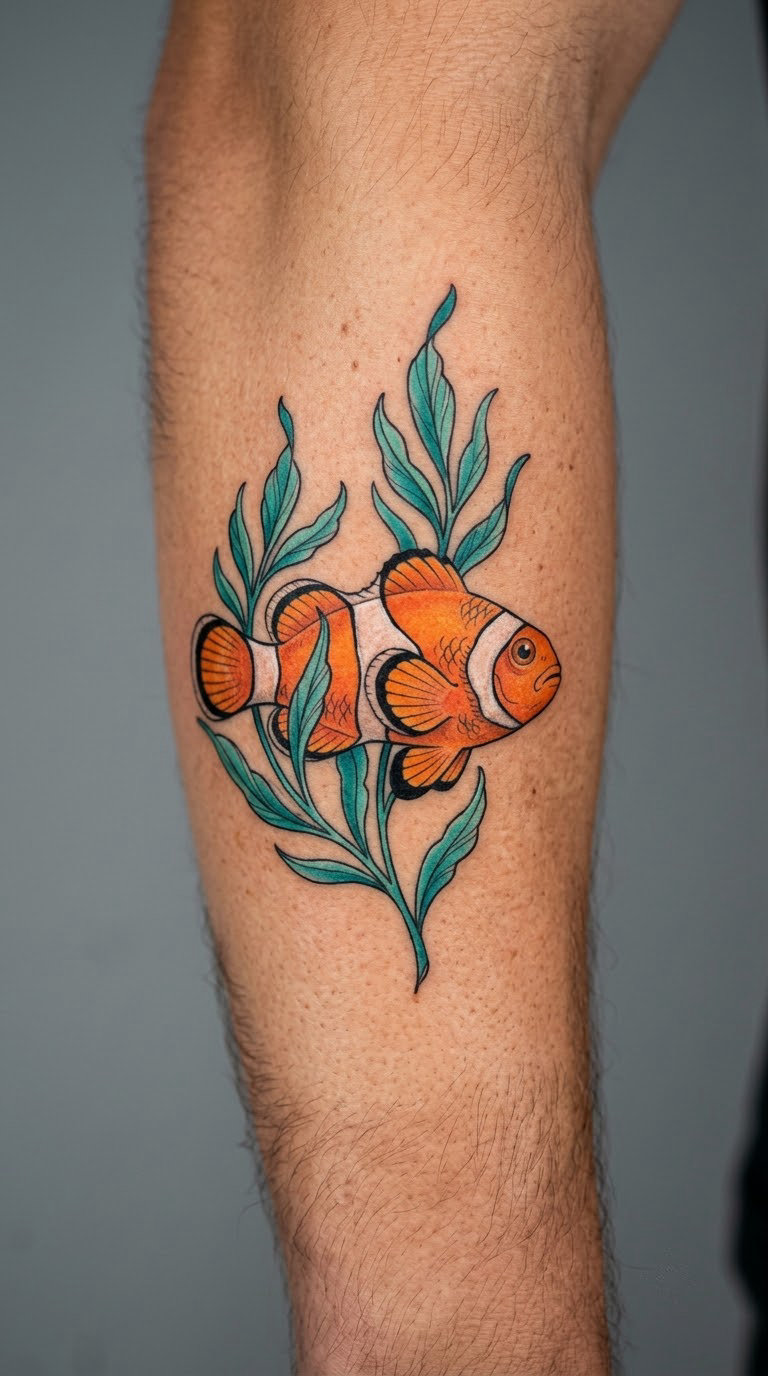
An original clownfish with bold outlines, two white bands and a soft orange body, swimming between three curved seaweed fronds. The fish is drawn with proportions of your own choosing, not traced from a specific character design, and the fronds frame it without crowding it.
Bold outline work is what makes this one survive a small size. A filled orange shape with a thick black edge stays legible at two inches, where a delicate illustration would already be softening.
Placement: arm, ankle, calf, or upper back. Size: 2-4 inches (5-10 cm). Style: illustrative or neo-traditional. Pain: low to medium on the arm and ankle, medium on the calf. Small seaweed tips and fin lines are the first to blur, so taper the fronds into clean points rather than feathery ends.
Make it yours: add an anemone drawn as a ring of rounded tips beneath the fish, or place a second, much smaller fish facing the other way as a filler piece.
15. Magnolia Blossom and Flying Crane
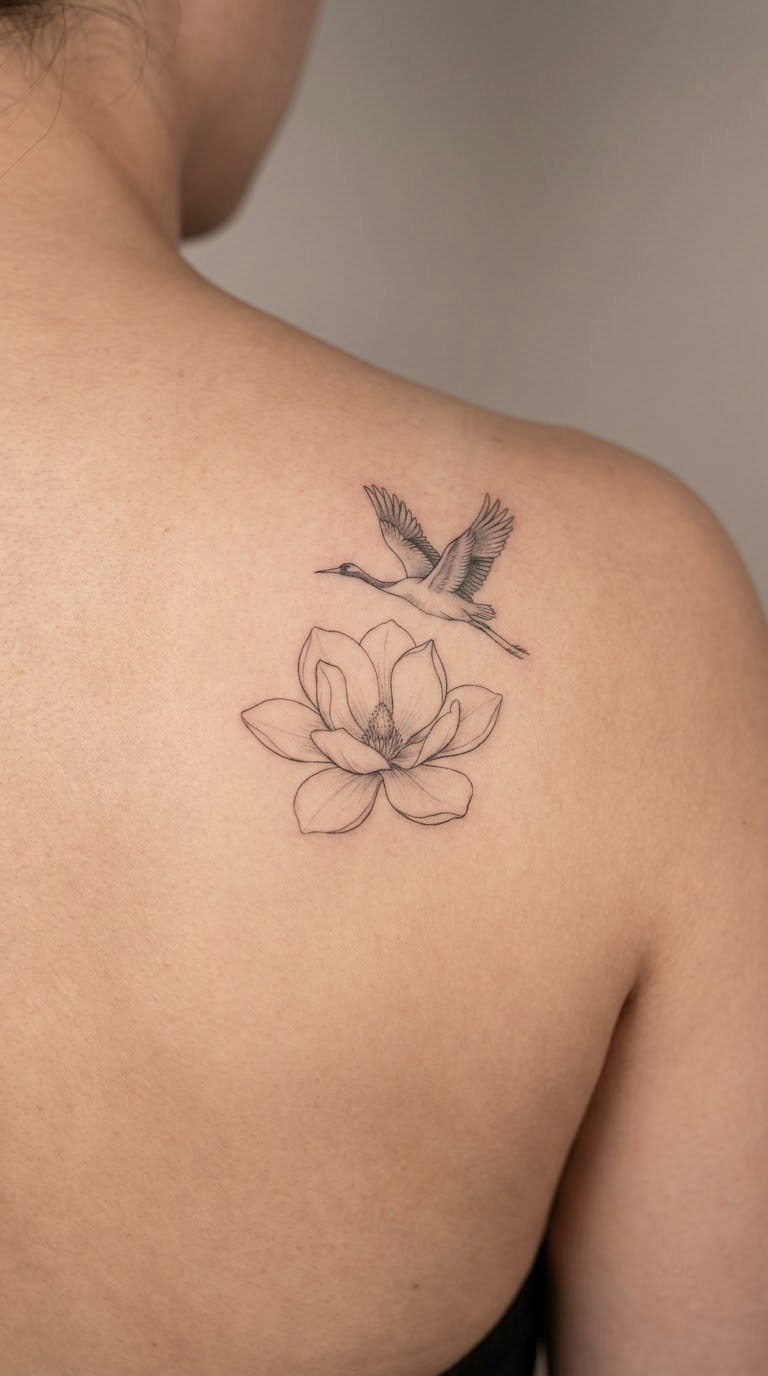
One open magnolia, petals drawn with a few confident strokes and a soft wash for shadow, with a crane in distant flight above it. The crane is small, simplified, wings mid-stroke, and separated from the flower by a good deal of empty skin. No animated pose is borrowed.
Magnolias and cranes carry a lot of cultural weight, so the respectful route is to keep the design decorative rather than claiming a meaning for it. Most people simply like the balance of the two shapes.
Placement: forearm, shoulder blade, calf, or upper arm. Size: 2.5-5 inches (6-13 cm). Style: botanical fine line with optional ink wash. Pain: medium on the suggested areas. The smallest crane wing and the magnolia stamens will soften over time, so resist over-detailing either one.
Make it yours: leave the flower in colour and the crane in grey wash, or tuck a small date into the negative space between them where only you will know it is there.
16. Feather and Waterfall
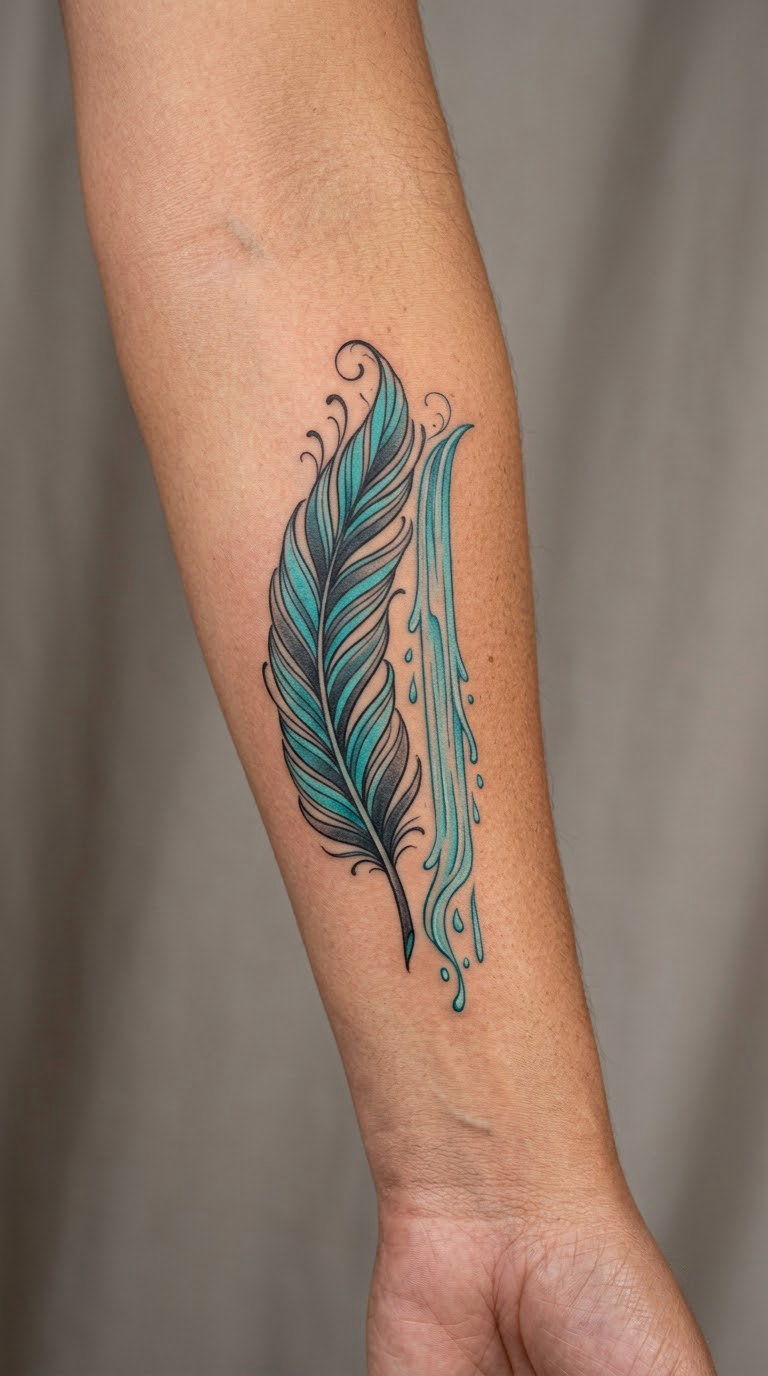
A stylised feather drawn with a central shaft and a handful of clean barbs, in turquoise and charcoal, beside a narrow vertical waterfall built from three or four parallel falling lines and a small pool at the base. No teepees, no figures, no borrowed landscape.
Stacking two vertical elements gives the design direction, so it suits an outer forearm or a rib without feeling cramped. The contrast between soft feather shapes and hard straight water lines is what gives it interest.
Placement: forearm, calf, outer arm, or side of the rib. Size: 2-4 inches (5-10 cm). Style: illustrative fine line. Pain: medium on the limbs and ribs. Tiny feather barbs and fine water lines need deliberate line weight, otherwise both go grey and indistinct within a few years.
Make it yours: run the water lines down into a single long line that follows the shape of the forearm, so the design follows your body rather than sitting on it.
17. Scottish Thistle Under a Crescent Moon
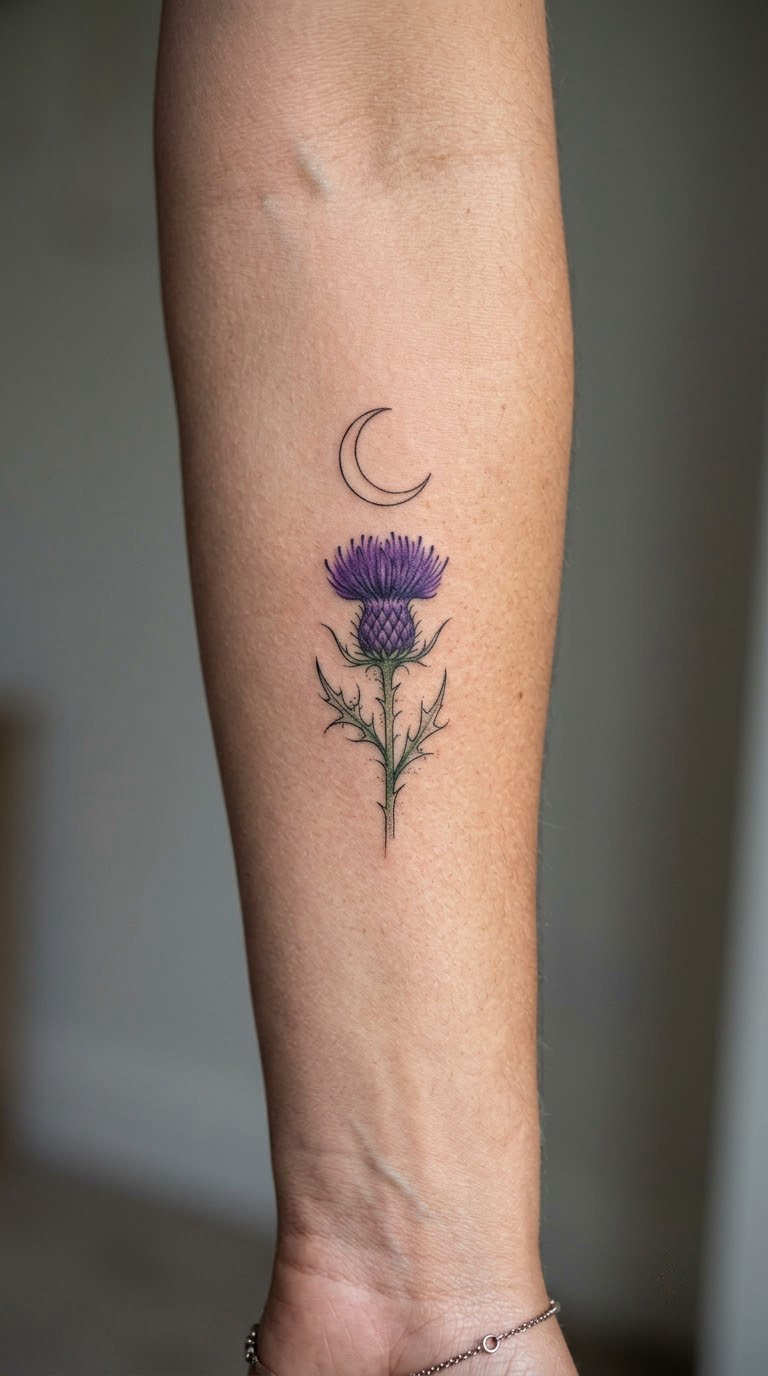
A thistle with a spiky purple bloom, a curved stem with a few small leaves, and fine thorns along the edges, sitting under one slim crescent moon. Sparse dotwork fills the space between them. No face, no tartan, no copied artwork from a film.
The thistle is the strongest single symbol in this whole list for people who want a Brave-adjacent design that nobody can pin on a character poster. It is tough, specific, and a little bit prickly on purpose.
Placement: forearm, calf, shoulder, or behind the ear in a simplified version. Size: 1.5-4 inches (4-10 cm). Style: botanical fine line with dotwork. Pain: medium on the arm, calf, or shoulder, low to medium behind the ear. Fine thorns and dotwork need time and aftercare, and they blur first of everything in this design.
Make it yours: reduce the bloom to a solid purple shape with no inner line work behind the ear, or add a tiny thistle as a matching piece for a friend.
18. Lily Flower on a Layered Lily Pad
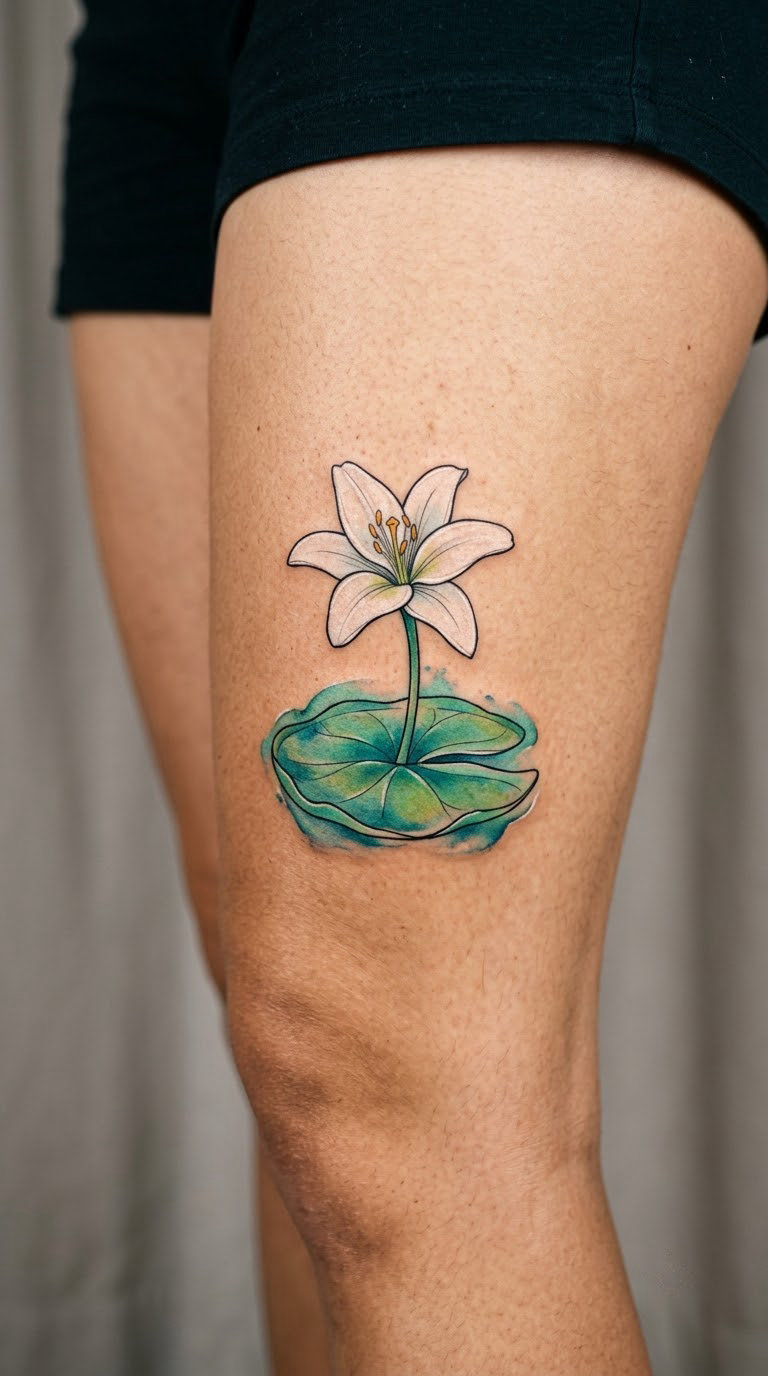
A white lily rising from a broad lily pad drawn in layers, each pad a slightly different green, with soft watercolour edges that fade into the skin. The flower has clean contouring and a warm centre. No frog, no crown, no princess, nothing from the film itself.
Watercolour realism suits a wide, flat placement better than a curve, so a thigh or a forearm works far better than a wrist here. It is the softest, most decorative design in the collection and the one that photographs best in sunlight.
Placement: forearm, thigh, lower back, or calf. Size: 2-4.5 inches (5-11 cm). Style: watercolour realism. Pain: medium on these placements. Pale watercolour detail needs careful aftercare and can fade faster than solid black or saturated colour, so treat sun exposure carefully once healed.
Make it yours: add two or three smaller pads trailing behind the main one at lower opacity, so the design reads as a group rather than a single specimen.
19. Small Dragon Following a River
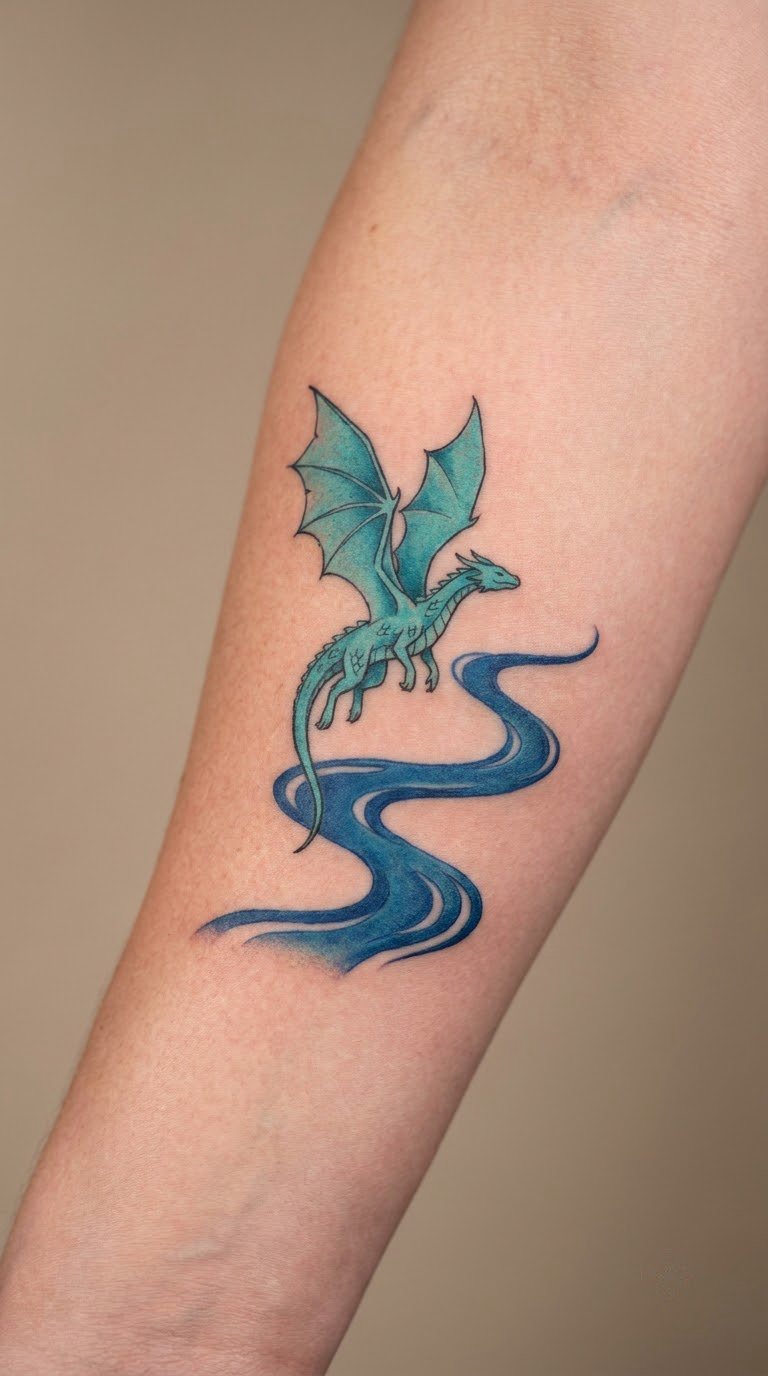
A small original dragon, wings spread mid-flight, following a single river that winds beneath it in deep blue. The creature is fanciful rather than cute, with a long tail and no face resembling a mascot. Keep the wing membranes and teeth simple enough to read at four inches.
The river is what makes it a design instead of an animal portrait. A dragon chasing water is a scene, and scenes have somewhere to put your eye even after the film reference has faded out of reach.
Placement: forearm, calf, upper arm, or shoulder blade. Size: 2.5-5 inches (6-13 cm). Style: illustrative fine line or colour neo-traditional. Pain: medium on the suggested areas. Tiny wing membranes, teeth, and water lines need especially careful execution, and any of them can clog if the artist packs them too closely.
Make it yours: give the dragon a second, smaller companion flying behind it at a distance, which adds depth without adding much work to the session.
20. Shooting Star and a Tiny Magic Spark
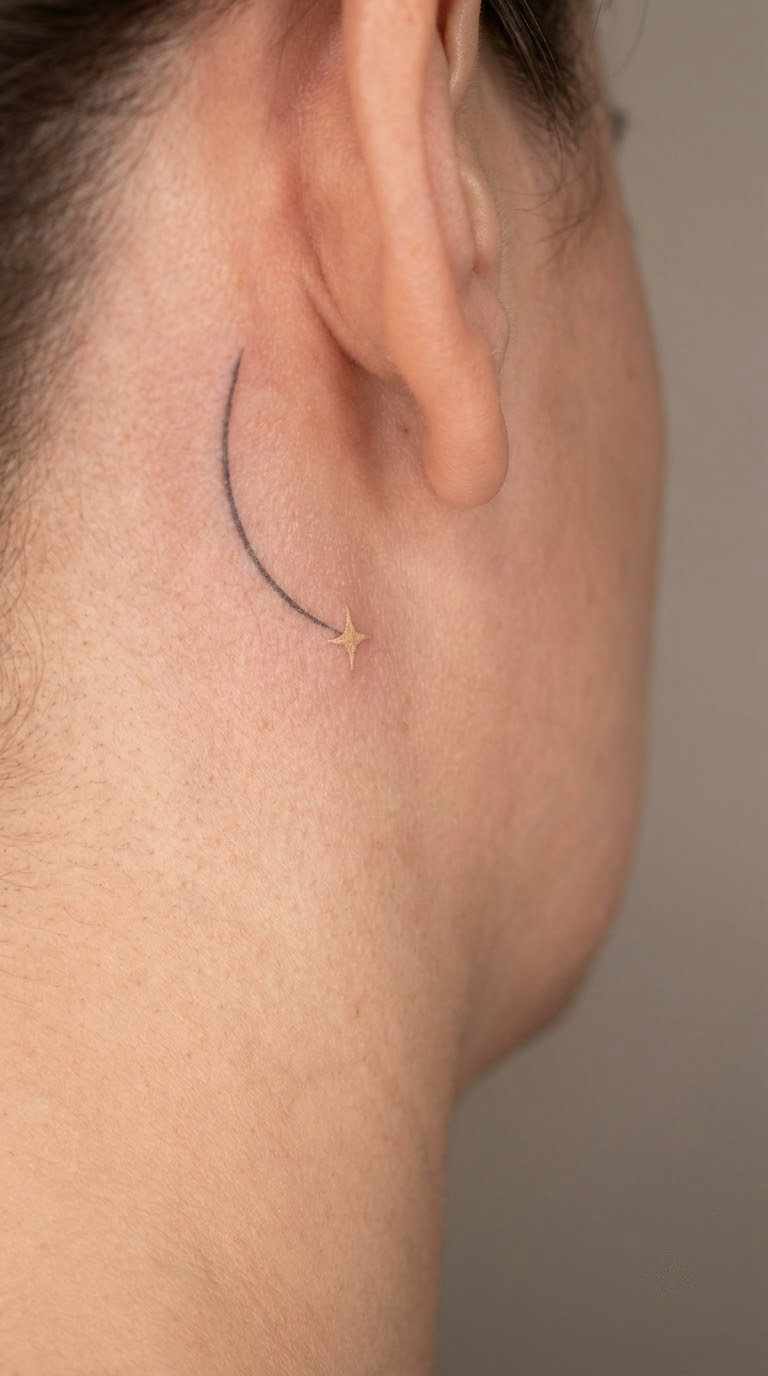
A shooting star with one clean curved trail sweeping across the skin, a small solid star at the head, and a single four-point spark mark below it. Two inches of design, four lines of ink, nothing else. The star can stay black or take a pale gold accent.
It is the smallest and least demanding design here, and for a first tattoo that is exactly the point. If you want a piece that will never be questioned in any room, this is the one.
Placement: behind the ear, wrist, collarbone, or shoulder. Size: 1.5-3.5 inches (4-9 cm). Style: minimalist fine line with optional gold accent. Pain: low to medium on the wrist, collarbone, and behind the ear, medium on the shoulder. The trail is one line and one line softens fastest, so keep it slightly heavier than feels natural.
Make it yours: angle the trail to follow the curve of your collarbone or the line of your wrist, so the design fits your body rather than sitting flat on it.
How to Choose the Right Design
- Start with style. Fine line suits small, quiet, office-friendly pieces. Blackwork and neo-traditional hold up better when you want something with weight and colour.
- Count the detail, not the concept. A two-inch design can hold a rose with four leaves or a castle with twenty windows. Not both.
- Measure before you fall in love. Ask for the size in inches, and test the placement with the artist using a stencil, not a phone screen.
- Check the copyright line. Characters, faces, logos, park names and exact film frames carry trademark and copyright. Original objects drawn by your artist do not. You can see more on how these motifs are built in our 20 line art tattoo ideas for women guide.
- Pick for the next twenty years. Choose a motif you would keep if nobody ever recognised the reference. It is the filter that ages best.
If this is genuinely your first piece, our 24 first tattoo ideas for women guide is a good place to check your expectations on size and session length before you book anything.
Cost and Session Time
In the US, a tiny tattoo under two inches, drawn in one colour, usually runs on a shop minimum of roughly 80 to 150 dollars and takes 30 to 60 minutes. A small piece of 2 to 3 inches with light shading generally falls between 150 and 300 dollars and needs about an hour to an hour and a half. Mid-size work at 3 to 4 inches, especially anything with a limited colour palette, typically sits around 250 to 500 dollars across one to two hours.
A detailed custom piece at 4 inches and above is where numbers move fast, commonly 500 dollars and up, and a large blackwork or watercolour scene can run into four or five hours or be split across two sessions.
Hourly rates, geography, shop minimums, colour count, line density and placement all shift the total, and travel to a good artist usually costs more than a closer, faster one. Ask for an individual quote before you book, and give the artist your actual size and placement rather than a screenshot.
Aftercare Basics
- Follow your artist’s aftercare instructions first. They know what they did to your skin that day.
- Wash gently with clean water and a mild unscented soap, then pat dry rather than rubbing.
- Keep the area moisturised with whatever product your artist recommends, in thin layers.
- Avoid covering it longer than instructed, and keep it out of direct sun, saunas, pools and friction from straps or tight waistbands while it settles.
- Contact your artist, or a qualified clinician, if something unusual or worsening shows up. Nobody online can tell you what a reaction is from a description, and guessing is not diagnosis.
Frequently Asked Questions
Are Disney-inspired tattoo designs copyrighted?
Characters, faces, logos, park names and exact film frames are protected by copyright and trademark, so those are worth avoiding. Original objects drawn by your artist, such as a rose under a bell jar, a glass slipper or a paper lantern, are a different matter. Ask for a design built from an object rather than a character, and keep the film name off the drawing itself.
What is a good size for a first Disney-inspired tattoo?
For a first piece, stay between 1.5 and 3 inches and use one colour or plain black. That range holds a clear silhouette, finishes in a single sitting of roughly 30 to 90 minutes, and keeps fine detail from blurring. Designs like the shooting star, the puppy paw or the shell and wave sit comfortably in that zone.
Which Disney-inspired tattoo is easiest to place on a small area?
The easiest designs for small or awkward areas are the ones with an open silhouette and few lines: the shooting star, the glass slipper, the acorn, and the lily flower. Behind the ear suits anything under two inches with a simple outline. Ribs, collarbones and the inner forearm are the placements where a too-detailed version starts to turn to mush.
Do fine-line Disney tattoo ideas fade quickly?
Fine linework softens faster than filled black or saturated colour, and hairlines are usually the first thing to blur. That is a design problem more than a style problem: fewer, slightly heavier lines and more open space hold their shape far longer. Hands, fingers and anything constantly exposed to sun fade fastest of all.
How can I personalise a Disney-inspired tattoo without copying a character?
Change one element of an object rather than redrawing a person. A date under a lantern, a birth year inside a heart-shaped reef, a real dog’s paw print beside the pasta nest, or a colour swap on the slipper heel all make the piece specific to you. Matching or companion versions work well too, since the motif stays shared while the drawing differs.
Conclusion: Choose Your Storybook Motif
For a first tattoo, the moonlit wings, the shooting star or a simplified thistle will suit you best: small, single-colour, quick, and readable from across a room. If you are adding to a collection, the castle at dusk, the sunrise wave or the acacia give you the surface area a bigger piece needs.
Whichever one you pick, book a consultation with an artist whose portfolio already contains that style at that scale. Send your reference, agree the line weight and the size in inches, and let them adjust the drawing to fit your body. That conversation is worth more than any pin board.