
24 Memorial Tattoo Ideas for a Sister: Best Tribute (2026)
Memorial tattoo ideas for a sister are designs chosen to honor a sister who has died: her name and dates, a flower she loved, a line of her handwriting, a portrait, or a small symbol only the two of you understood. Each one is a quiet, permanent way of carrying her with you.
These 24 ideas cover small wrist pieces through larger custom work, and most were sketched from what people actually get. If other siblings are involved, our picks for sister tattoo ideas that show forever love are worth a look first. There is no rush on any of this. Plenty of people wait years before booking, and starting small is a perfectly sensible place to begin.
24 Memorial Tattoo Ideas for a Sister: Quick Guide
| Idea | Style | Best placement | Size | Pain |
|---|---|---|---|---|
| Intertwined initials and dates | Fine line script | Inner forearm | 2-4 in (5-10 cm) | Low to medium |
| Two butterflies, opposite directions | Fine line with soft colour | Collarbone | 2-3 in each (5-8 cm) | Medium |
| Forget-me-not sprig | Fine line, muted blue | Inner wrist | 1-2 in (3-5 cm) | Low |
| Birthflower with a date | Botanical, soft colour | Outer arm | 2-3 in (5-8 cm) | Low to medium |
| Matching rose stems | Fine line | Forearms | 3-4 in (8-10 cm) | Medium |
| Infinity with two initials | Blackwork or fine line | Side of wrist | 1.5-2.5 in (4-6 cm) | Low |
| Interlocking tree rings | Fine line with dotwork | Upper chest | 2.5-4 in (6-10 cm) | Medium |
| DNA strand with two accents | Fine line, one accent colour | Inner forearm | 3-5 in (8-13 cm) | Medium |
| Paired fingerprint curves | Micro-realism | Inner wrists | 1-1.5 in (3-4 cm) | Low to medium |
| Coordinates and compass point | Minimal line geometry | Outer forearm | 2-3 in (5-8 cm) | Low |
| Moon phases on an arc | Fine line with grey wash | Outer upper arm | 2-3 in (5-8 cm) | Low |
| Miniature star map | Dotwork | Side of upper arm | 3-4 in (8-10 cm) | Medium |
| Compass rose, one detail | Traditional or fine line | Outer wrist | 1.5-2.5 in (4-6 cm) | Low to medium |
| Heartbeat line with two breaks | Fine line | Side of forearm | 3-4 in (8-10 cm) | Medium |
| A line from her handwriting | Delicate script | Inner forearm | 2-3 in (5-8 cm) | Low to medium |
| Two small paw prints | Fine line | Wrist or ankle | 1-1.5 in (3-4 cm) | Low |
| Locket with abstract portrait | Fine line | Upper chest | 1.5-2.5 in (4-6 cm) | Low to medium |
| Minimal feathered wings | Fine line, one accent | Beneath collarbone | 2-3 in (5-8 cm) | Medium |
| Lighthouse with a single beam | Fine line | Outer forearm | 2-3 in (5-8 cm) | Low to medium |
| Shared mountain peak | Minimal fine line | Upper arm | 2-4 in (5-10 cm) | Low |
| Watercolour sunflower pair | Watercolour | Forearm | 2-3 in (5-8 cm) | Low to medium |
| Two cherries, fine stems | Vintage illustrative | Back of hand | 1.5-2 in (4-5 cm) | Medium |
| Rose wrapped around a fine line | Micro-realism | Forearm | 2-3 in (5-8 cm) | Medium |
| Abstract portrait silhouette | Black and grey realism | Upper arm or ribs | 3-6 in (8-15 cm) | Medium to high |
1. Intertwined Initials and Shared Dates
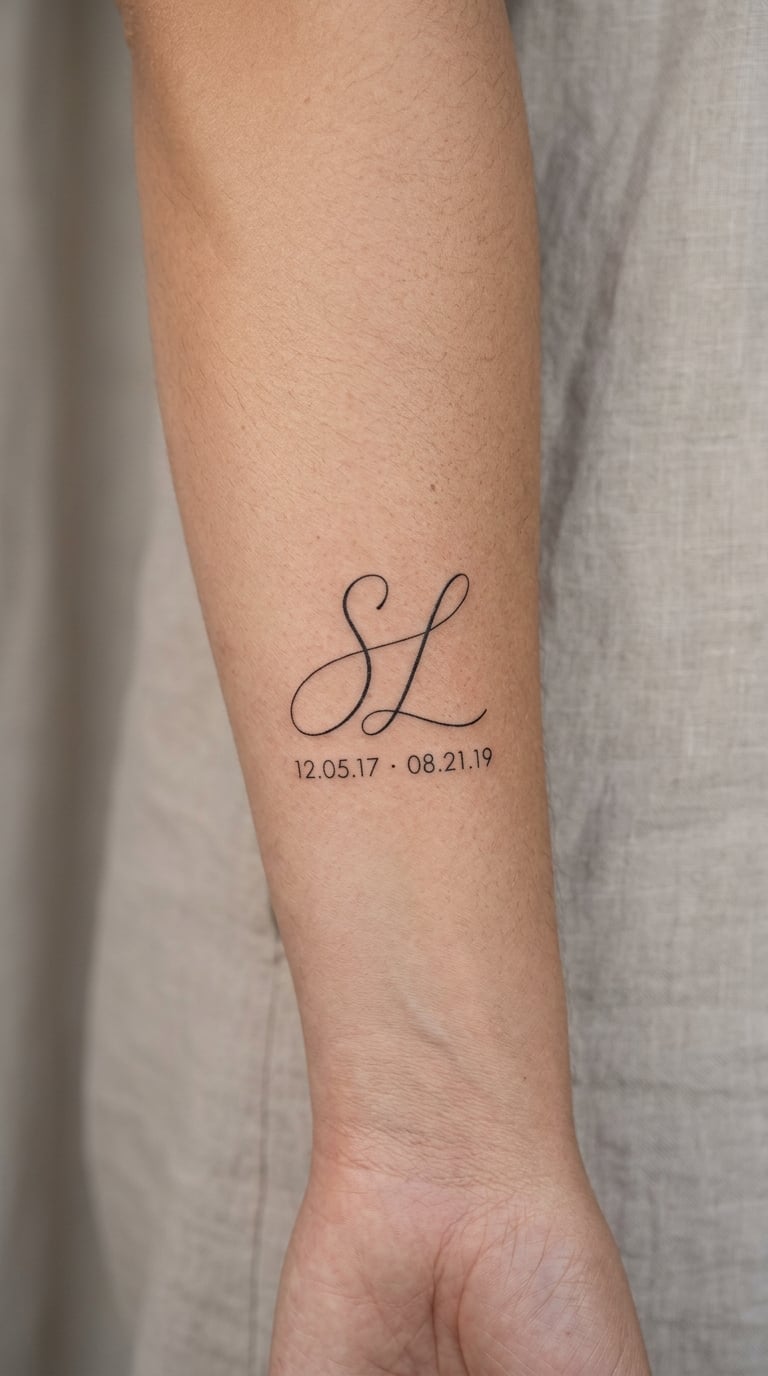
A fine-line or script design built from both sisters’ initials, with the loops of each letter crossing the other’s so the two read as one continuous mark. Dates sit underneath in a smaller hand, either as plain numerals or a short month and year.
It works because it is specific. A name alone is a label; a name looped around another name is a record of a relationship.
Placement: inner forearm, above the wrist crease, or the rib area for a vertical version. Size: 2-4 in (5-10 cm) across. Style: fine line or fine-line script. Pain: low to medium on the inner forearm. Hairline strokes spread and blur over the years, so a slightly heavier line weight now ages better than a whisper-thin one.
Make it yours: use the first letter of a nickname only the two of you used, and set the dates in a hand your sister actually wrote.
2. Two Butterflies in Opposite Directions
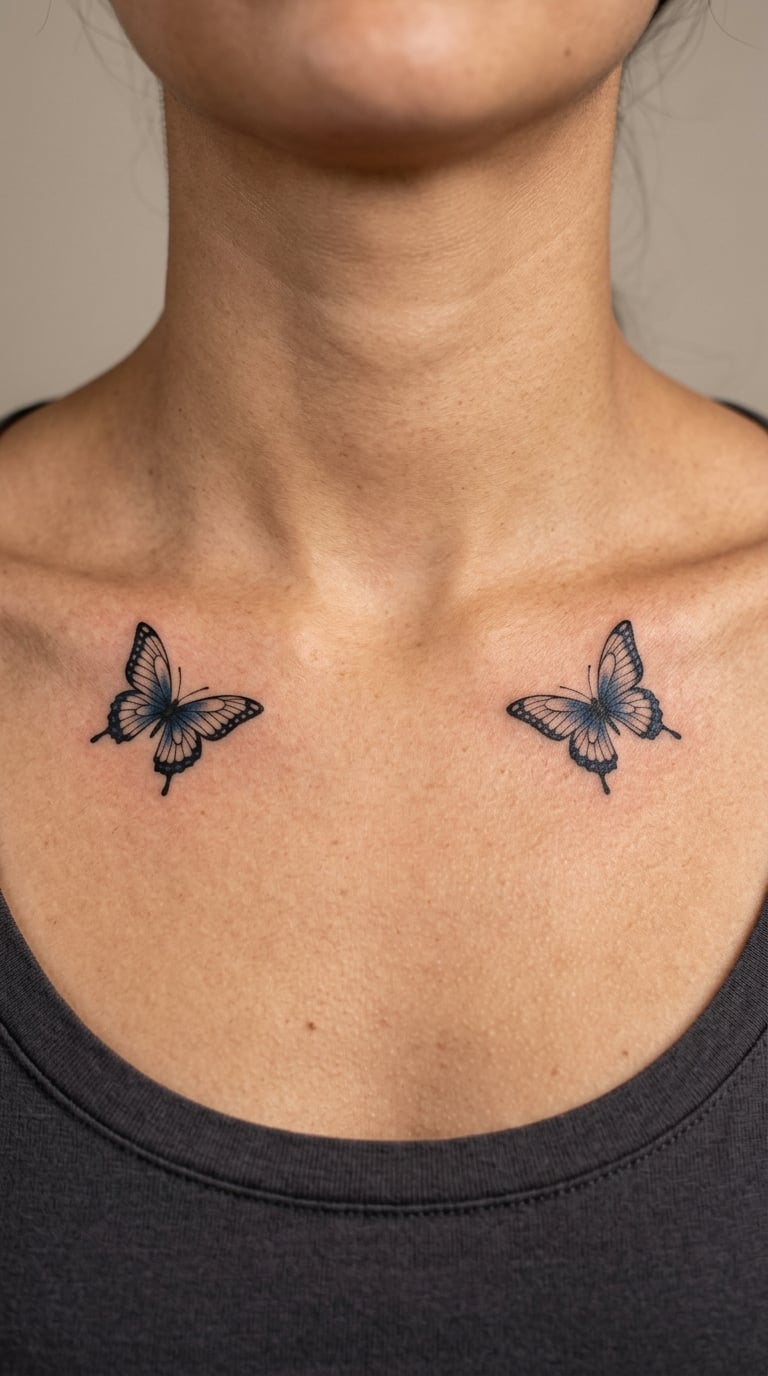
Two butterflies, similar in size but not identical, each travelling in an opposite direction while a faint connecting line or matching wing pattern ties them together. Linework stays thin, with a restrained wash of blue or grey in the upper wing.
Most people choose butterflies for a memorial because they read as change over time rather than as a fixed symbol with one agreed meaning. The mirror composition keeps two separate lives in one design.
Placement: collarbones, one each side, angled outward. Size: 2-3 in (5-8 cm) each. Style: fine line with soft colour. Pain: medium over the collarbone, where skin is thin and bone sits close underneath. Colour fills fade faster than linework, so expect the blue to soften first.
Make it yours: give each butterfly a different wing pattern matching a real species you two knew, and keep them the same size as each sister rather than identical twins.
3. A Tiny Forget-Me-Not Sprig
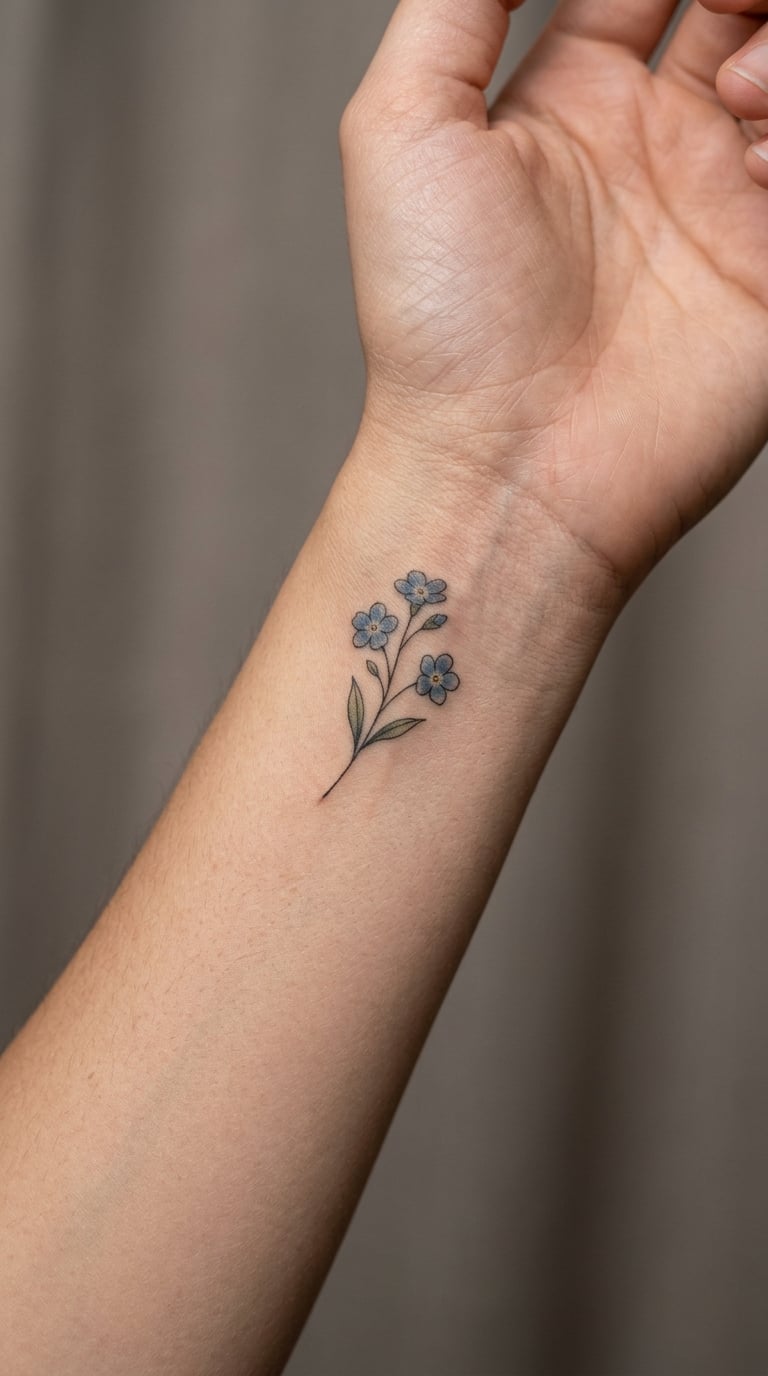
A single forget-me-not sprig: a thin stem, two or three narrow leaves, and one small flower head with five soft blue petals. Shading is minimal, maybe a dot of grey in the centre of the bloom and nothing else.
Forget-me-nots came with an old promise attached, and plenty of people find that association useful without needing to explain it. As a memorial it reads as quiet rather than dramatic, which is often what people actually want.
Placement: just inside the wrist, or the outer ankle. Size: 1-2 in (3-5 cm) tall. Style: fine line, muted blue. Pain: low. The petals are small enough that softening is a real consideration over a decade or more, so many artists bump the line weight slightly.
Make it yours: add a single short date beneath the stem in a different weight, or use her birth month colour for the only bit of colour in the piece.
4. Birthflower With a Small Date
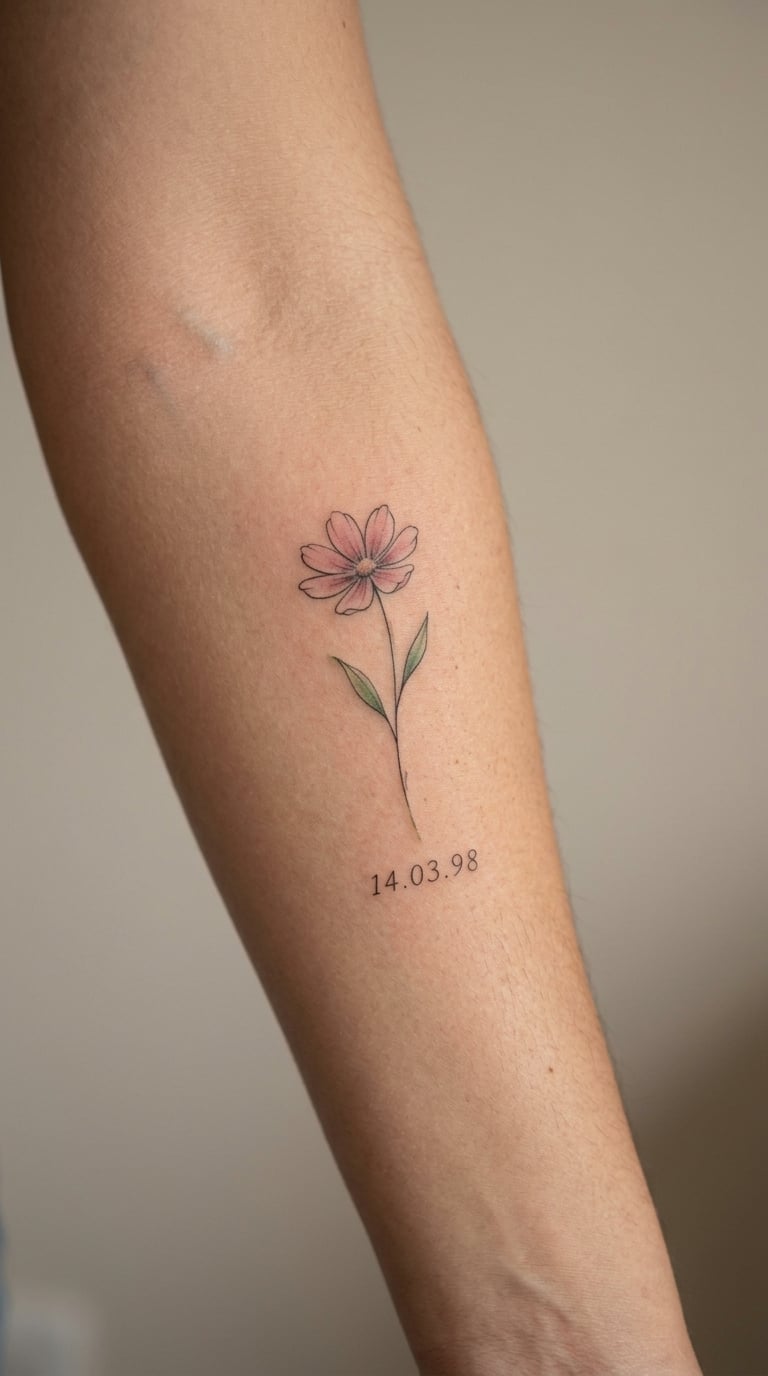
The flower assigned to your sister’s birth month, drawn with believable petals and a little leaf detail, plus one small date set beneath it. Most people keep the colour soft here: two or three tones, no heavy saturation.
Birthflowers give you a starting point decided by the calendar and finished by her actual preferences, which makes them useful when deciding alone feels impossible. If she never liked the assigned flower, use the one she actually grew on the balcony.
Placement: outer arm, shoulder, or behind the ear at a smaller scale. Size: 2-3 in (5-8 cm). Style: botanical with soft colour, or fine line if you want it quieter. Pain: low to medium. Petal edges blur with sun exposure over time, so placement under a sleeve helps more than people expect.
Make it yours: pair her birthflower with her favourite one, stem to stem, so the design holds two different kinds of memory.
5. Matching Rose Stems With Different Blooms
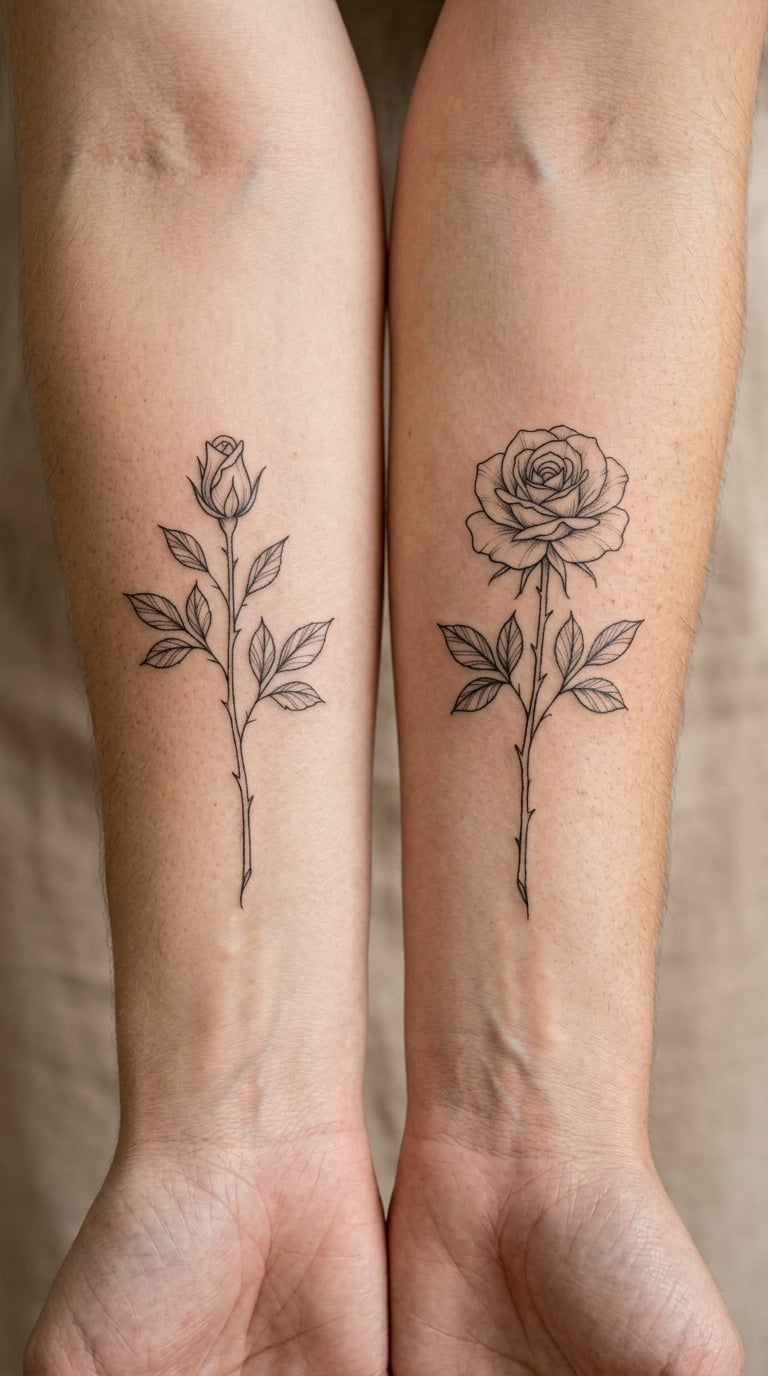
Two rose stems drawn in the same line and weight, each ending in a different stage of bloom: one tight bud, one fully open with a few petals left loose. Stems curve in the same direction so the pair still reads as a set.
This is the version of a matching tattoo that leaves room for two different people. Identical copies feel neat; a bud beside an open flower holds the idea that your sister was her own person, at her own stage, next to you. Our guide to sister tattoo ideas that show forever love covers more of this paired approach.
Placement: forearms, or both inner arms at matching heights. Size: 3-4 in (8-10 cm) each. Style: fine line. Pain: medium on the forearm, more sensitive near the elbow. Bud detail can blur; ask the artist for fewer, larger petal edges.
Make it yours: use the two flowers she grew most often, so the stems stay roses but the blooms say something true.
6. Infinity Symbol Linking Two Initials
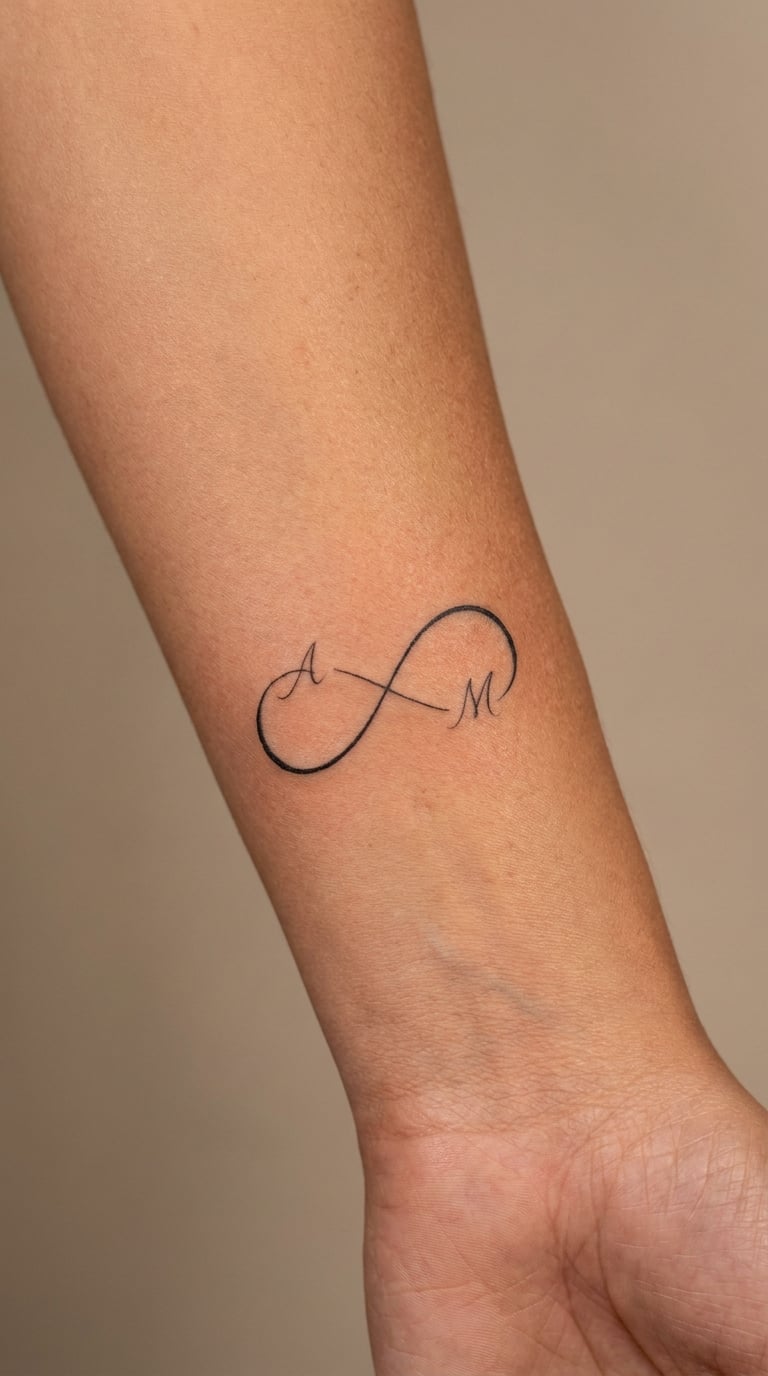
A compact infinity motif drawn as a single unbroken line, with two initials worked into the loops so the left side reads one name and the right side reads the other. Keep the whole thing small and close-lined.
Without a name attached, the shape means whatever the wearer says it means. Plenty of people simply describe it as a promise that runs in both directions, which is a fair reading and does not need defending to anyone.
Placement: side of wrist, ankle, or behind the ear at a reduced size. Size: 1.5-2.5 in (4-6 cm). Style: blackwork or fine line. Pain: low on the wrist. Interiors of small loops fill in over time, so a line weight of about 1 mm is the practical floor for a wrist piece.
Make it yours: let the loops be uneven on purpose, wider on her side, so the shape carries the difference instead of flattening it.
7. Interlocking Tree Rings
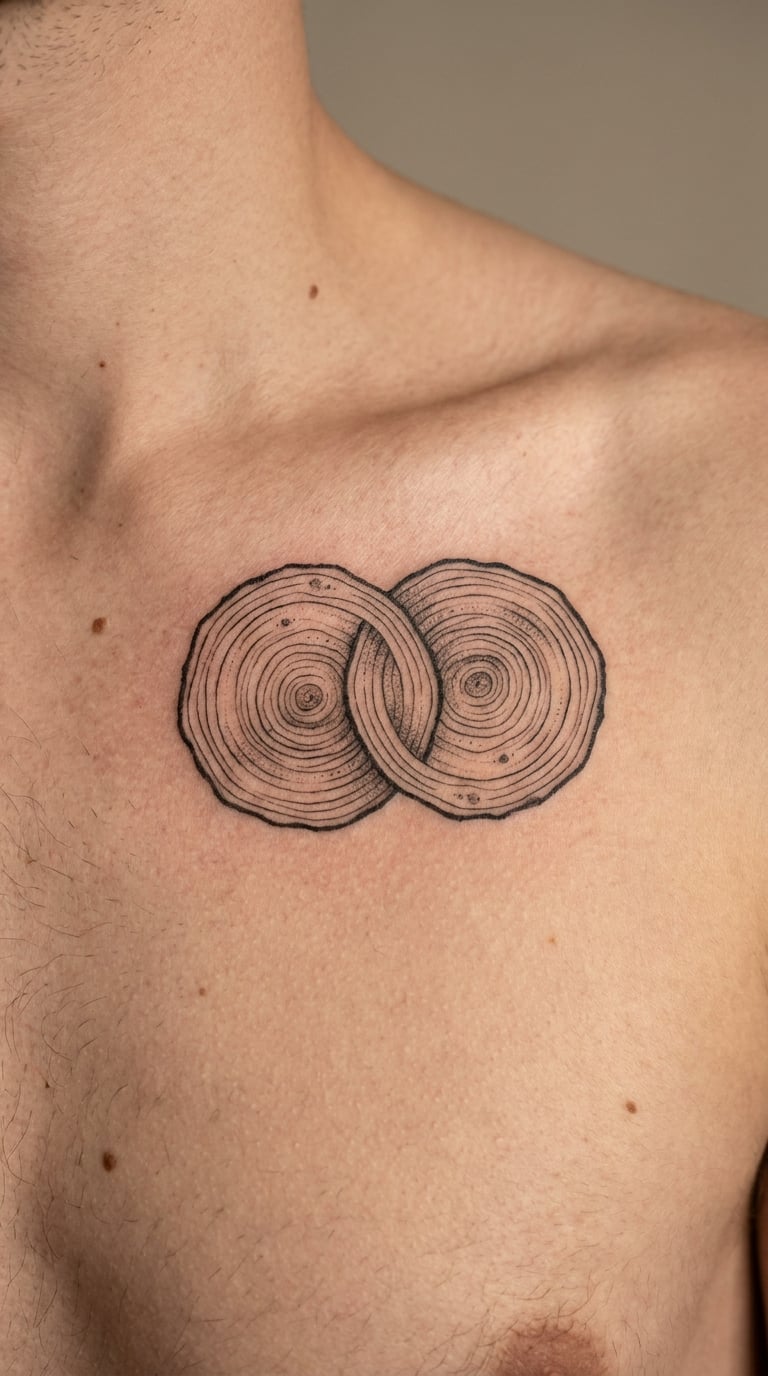
Two circular sections of tree grain, each ring slightly different in thickness and rhythm, overlapping like linked rings. The linework is organic rather than geometric, with sparse dot accents in the background to hold the circles apart.
It is an unusual way to mark a sibling bond: growth rings imply time and change, and two circles that share a small overlapping section say more than two separate ones. Artists who draw trees well can follow a real grain pattern from a photograph of wood.
Placement: upper chest near the collarbone, or the outer arm. Size: 2.5-4 in (6-10 cm). Style: fine line with dotwork. Pain: medium over the sternum. Fine curved lines are more prone to feathering than straight ones, so a touch more weight pays off here.
Make it yours: bring a photo of wood from a tree that mattered to you both, such as one you climbed or a fence post from the family place.
8. Abstract DNA Strand With Two Highlighted Sections
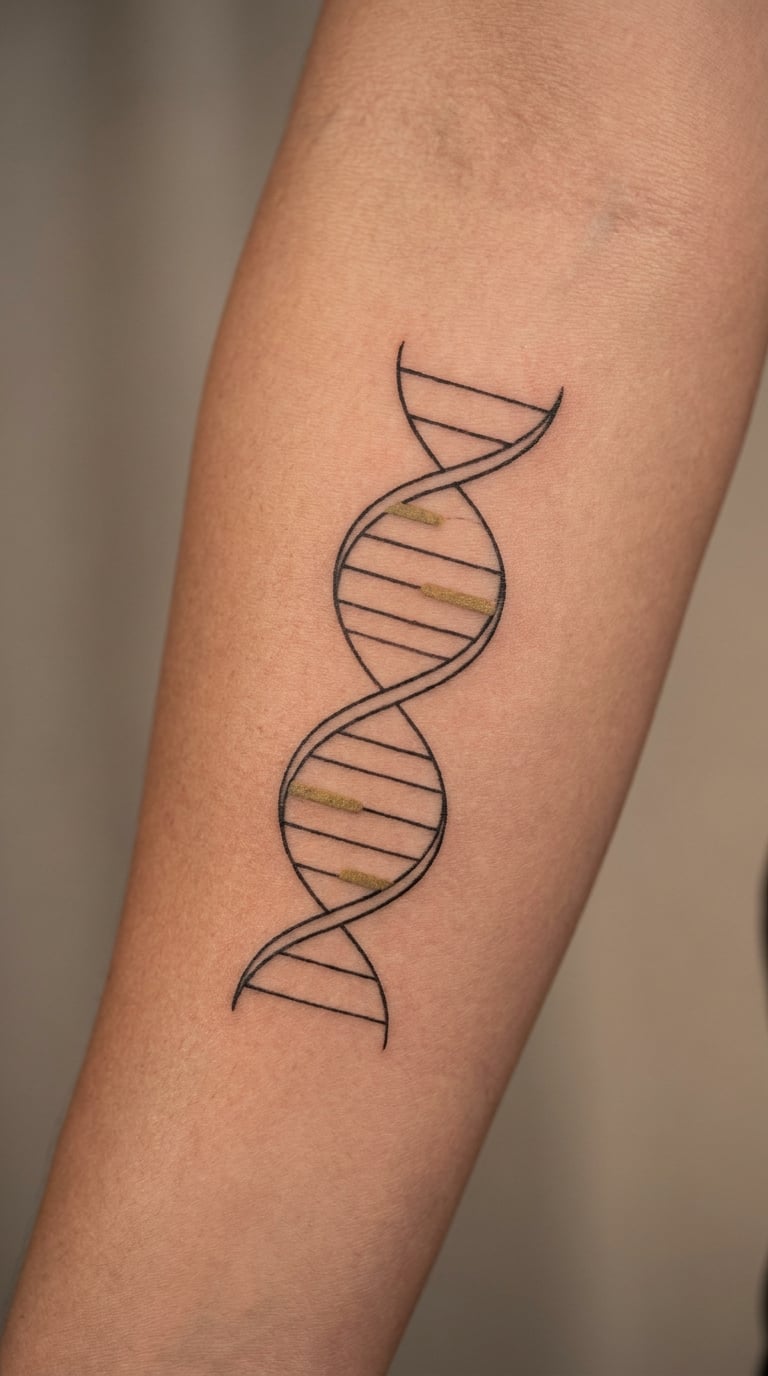
A simplified double helix drawn with even, repeating linework rather than medical detail, plus two short sections picked out in a single colour. It is an abstract strand, not a diagram of anything.
People choose it as a quiet nod to family and shared traits without turning into a scientific claim. Two highlighted sections, one for each sister, keep the concept personal.
Placement: inner forearm, running vertically, or the calf. Size: 3-5 in (8-13 cm) tall. Style: fine line with one accent colour. Pain: medium over a long stretch, and the inner forearm bruises visibly for a few days. The rungs of the ladder blur with age, so fewer and larger rungs hold up better.
Make it yours: have the two coloured sections placed where the strand turns, so the accent sits on the crossing points rather than mid-run.
9. Paired Fingerprint Curves
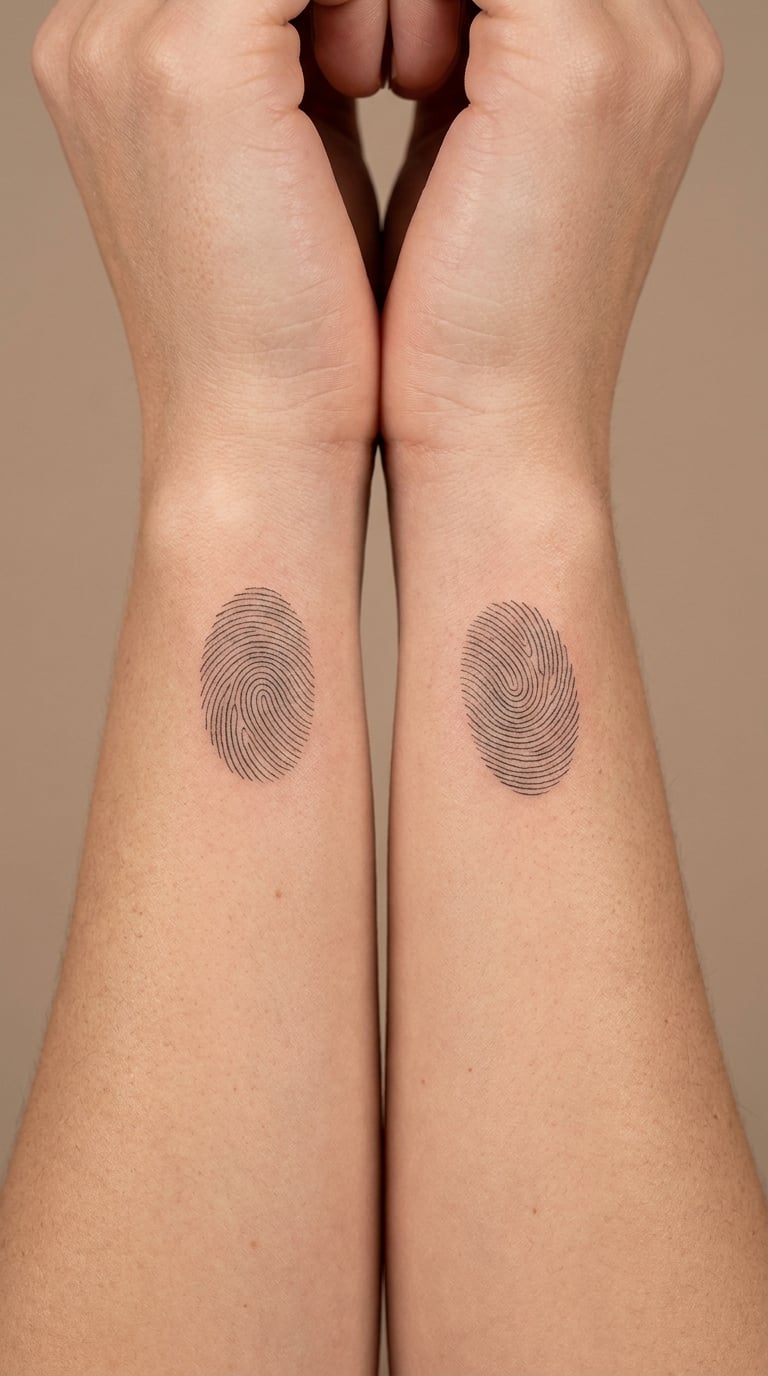
Cropped sections of two fingerprints, taken from a handprint or from the pads themselves, curved so each one reads as a partial arc. No whole handprint, no palm lines, just the ridge pattern at a scale that stays legible.
Partial curves work better than full prints, which turn into smudges at small sizes. It is the most quietly personal option on this list, since nobody else carries those ridges. We have a longer piece on 20 fingerprint tattoo ideas for memorials if you want more ways to crop a print.
Placement: inner wrists, or along the side of the forearm. Size: 1-1.5 in (3-4 cm) each. Style: micro-realism. Pain: low to medium. Fine ridge detail softens noticeably with sun and over the inner wrist specifically, so many people place these on an outer arm instead.
Make it yours: use the ridge from the finger she used most, or crop both prints at the same depth so the pairs mirror each other.
10. Meaningful Coordinates and Compass Point
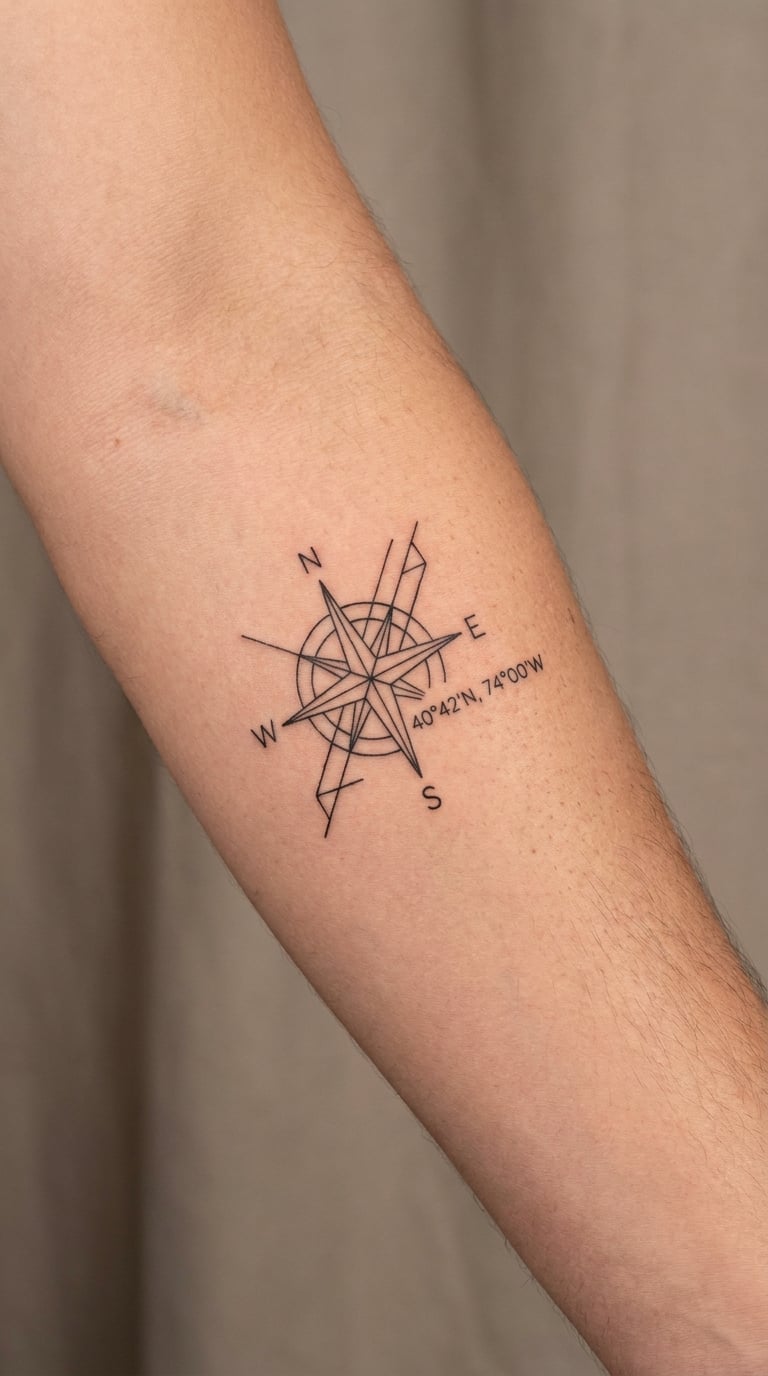
A latitude and longitude set in clean geometric lettering, joined by a small hand-lettered compass point or a simple arrow. The composition stays flat and uncluttered, with everything in one weight of line.
Coordinates mark a place rather than a feeling, which is why they work so well for grief: they point somewhere the two of you actually were. A beach, a hospital car park, a kitchen, the field behind a childhood house.
Placement: outer forearm, calf, or between the shoulder blades. Size: 2-3 in (5-8 cm) wide. Style: minimal line geometry. Pain: low on the outer arm, moderate across the shoulder blades. Decimals and small digits blur, so a well-spaced hand-lettered font beats a tiny typewriter face.
Make it yours: add a two-letter city code or the date you last stood there, set below in the same lettering.
11. Moon Phases Along a Fine Arc
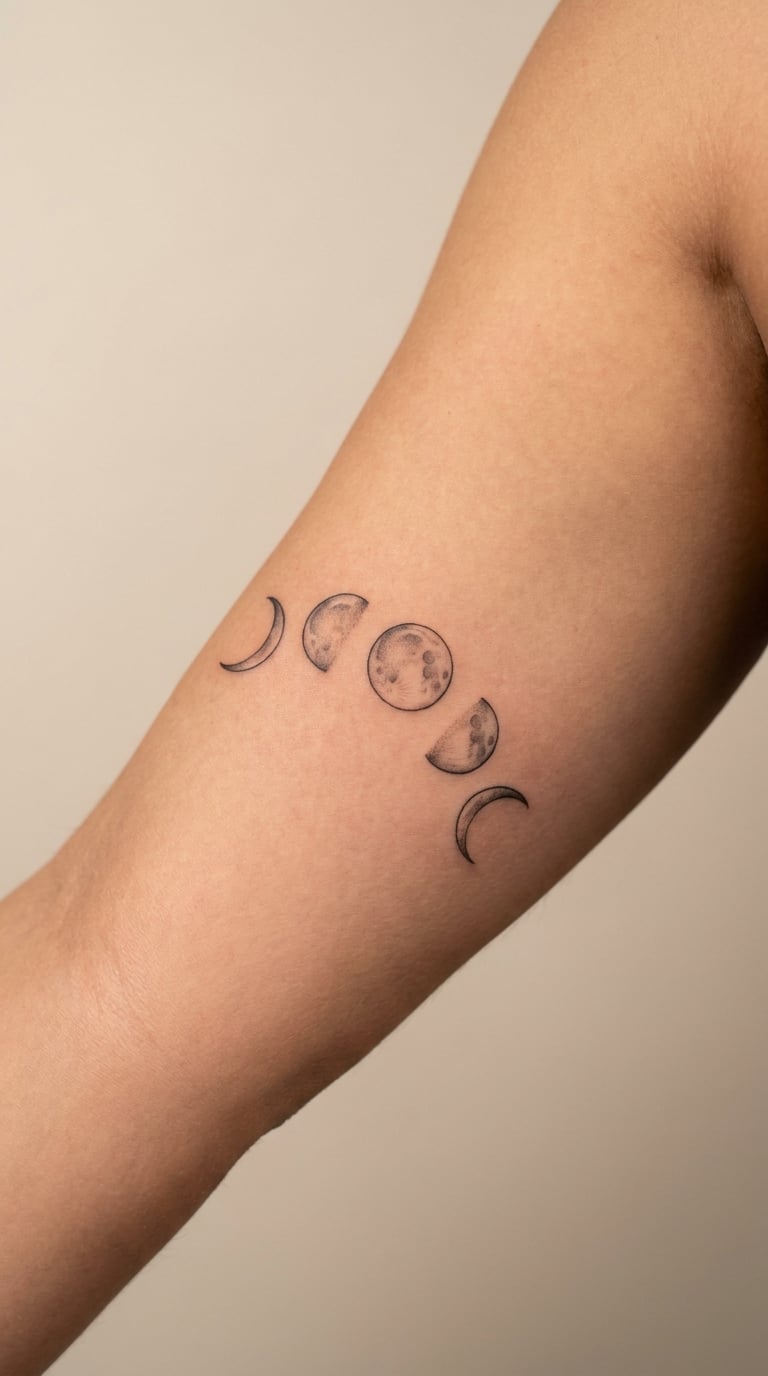
A curved sequence of moon phases following one gentle arc, from a thin crescent through full to a waning sliver, with soft grey wash inside the shadowed halves. Some people run the full cycle; others pick three phases for three dates.
The arc shape is doing most of the work. A straight row of moons reads like an almanac; a curve reads like a path, which suits a design marking a period of time.
Placement: outer upper arm, following the curve of the shoulder, or the hip. Size: 2-3 in (5-8 cm) across. Style: fine line with grey wash. Pain: low. Each moon needs an interior edge, and those interior edges are what soften, so keep phases larger and fewer.
Make it yours: order the phases to match the order of the dates you are marking, so the arc tells a small chronological story.
12. Miniature Star Map From a Shared Sky
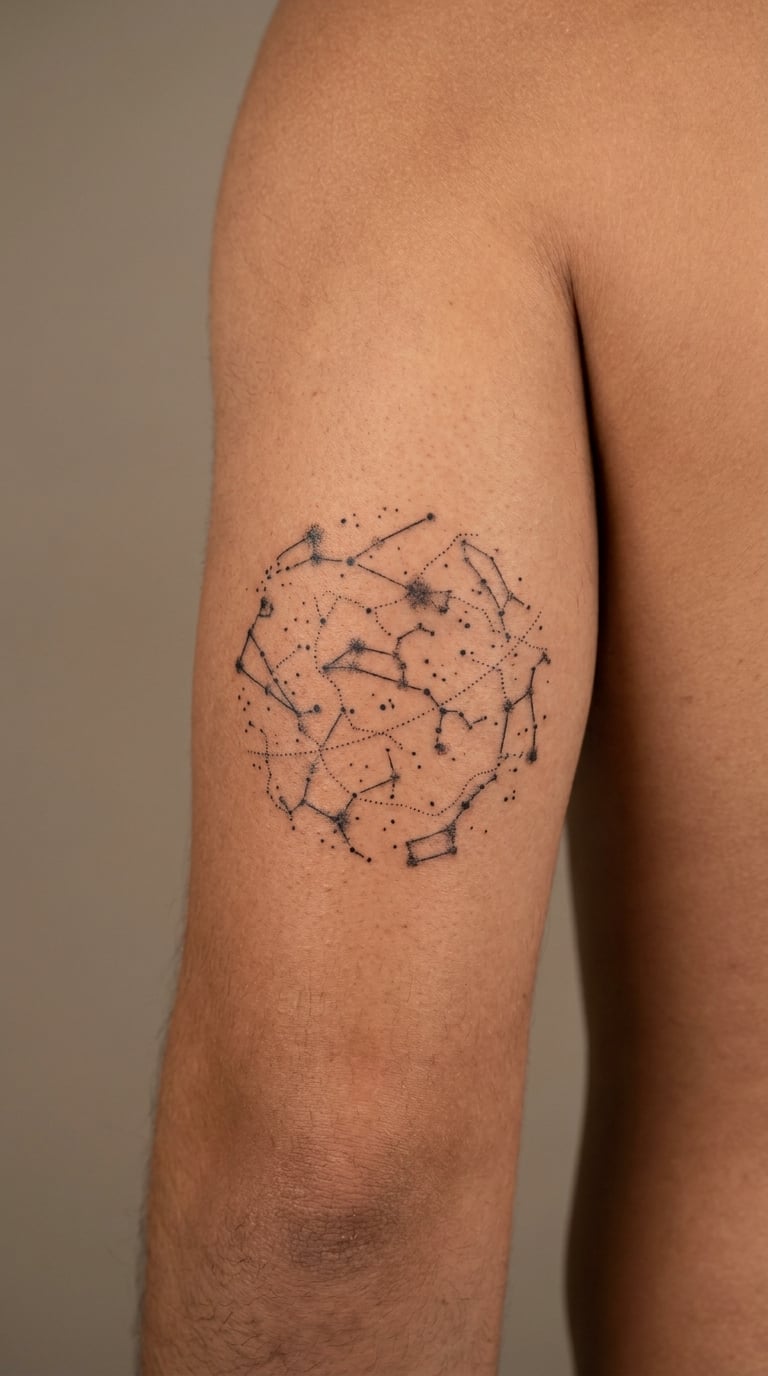
A simplified star map: dozens of small dots placed where the brightest stars sit, joined by a few hairline connectors, sometimes with a small circle or a coordinate at the edge. Black ink, no colour.
Star maps come from real data, which makes them specific without anyone having to explain the symbolism. A sky over a campsite, a night that stayed clear, the evening of a goodbye.
Placement: side of the upper arm, the back, or the calf. Size: 3-4 in (8-10 cm) tall. Style: dotwork. Pain: medium, and a long sitting, since dotwork is a lot of small passes. Dots are the first thing to disappear into soft grey over the years, so many people ask for slightly larger stippling.
Make it yours: use a real star chart app for the date and place that matter, and let the artist copy the pattern exactly rather than approximating it.
13. Compass Rose With a Directional Detail
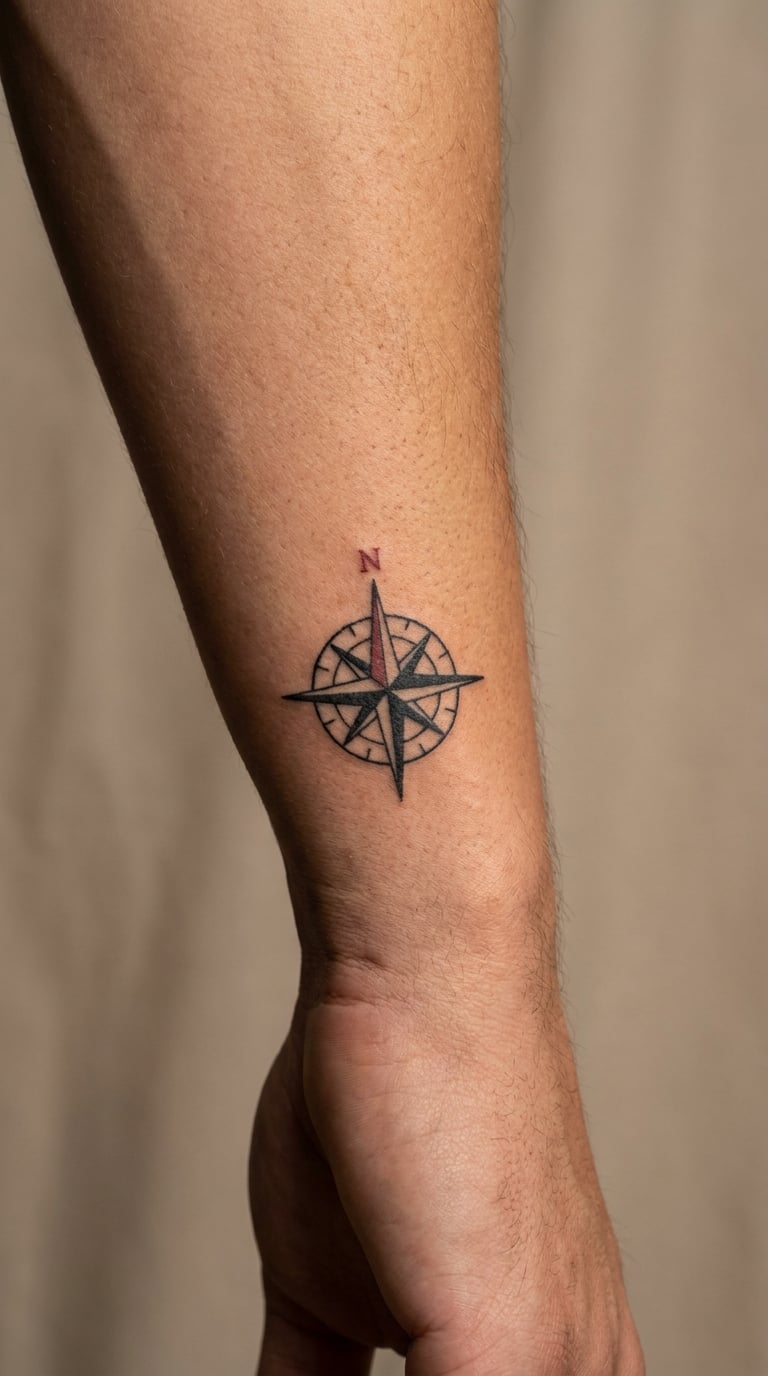
A small compass rose with four long points and four short ones, drawn in crisp black line, with a single point extended, shortened, or filled with a muted ink to mark a direction that mattered.
The directional detail is the personal part. A point towards home, towards a place you both lived, or towards wherever you want the conversation to keep going. Most people keep the ink black and use one restrained accent.
Placement: outer wrist, forearm, or the back of the shoulder. Size: 1.5-2.5 in (4-6 cm). Style: traditional or fine line. Pain: low to medium, and the inner wrist edge is the sensitive strip to avoid. Interior hatching in the points fills in over time, so line weight does the work instead of shading.
Make it yours: label one point with a single letter, or add two short lines of text curved beneath the rose with her name.
14. Heartbeat Line With Two Breaks
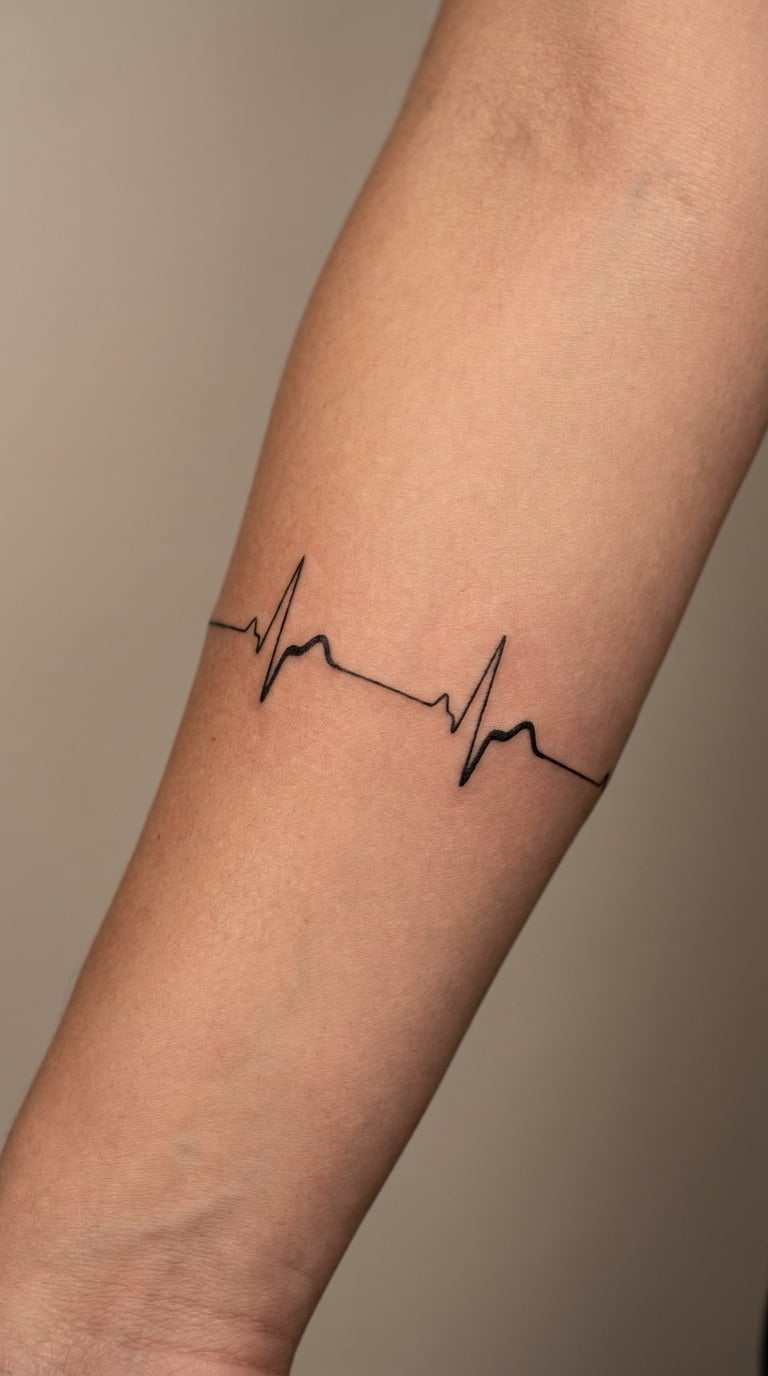
A single natural-looking heartbeat line running in a shallow wave, interrupted or thickened at two points rather than cramming extra symbols into it. Some versions let the two marks sit a little apart, so the line reads as something that carried on.
It is a common choice and it earns its place, but only when the line is drawn well. A stiff or overly regular waveform looks like clip art; a slightly uneven hand-drawn pulse looks alive.
Placement: wrapping around the side of the forearm, or along the inner arm. Size: 3-4 in (8-10 cm) long. Style: fine line. Pain: medium over the forearm. The line thins and greys over time, particularly on the side of the arm where skin stretches as you flex.
Make it yours: set the two accents at her birth and passing dates, or hide a very small date inside the widest peak.
15. A Line From Her Handwriting
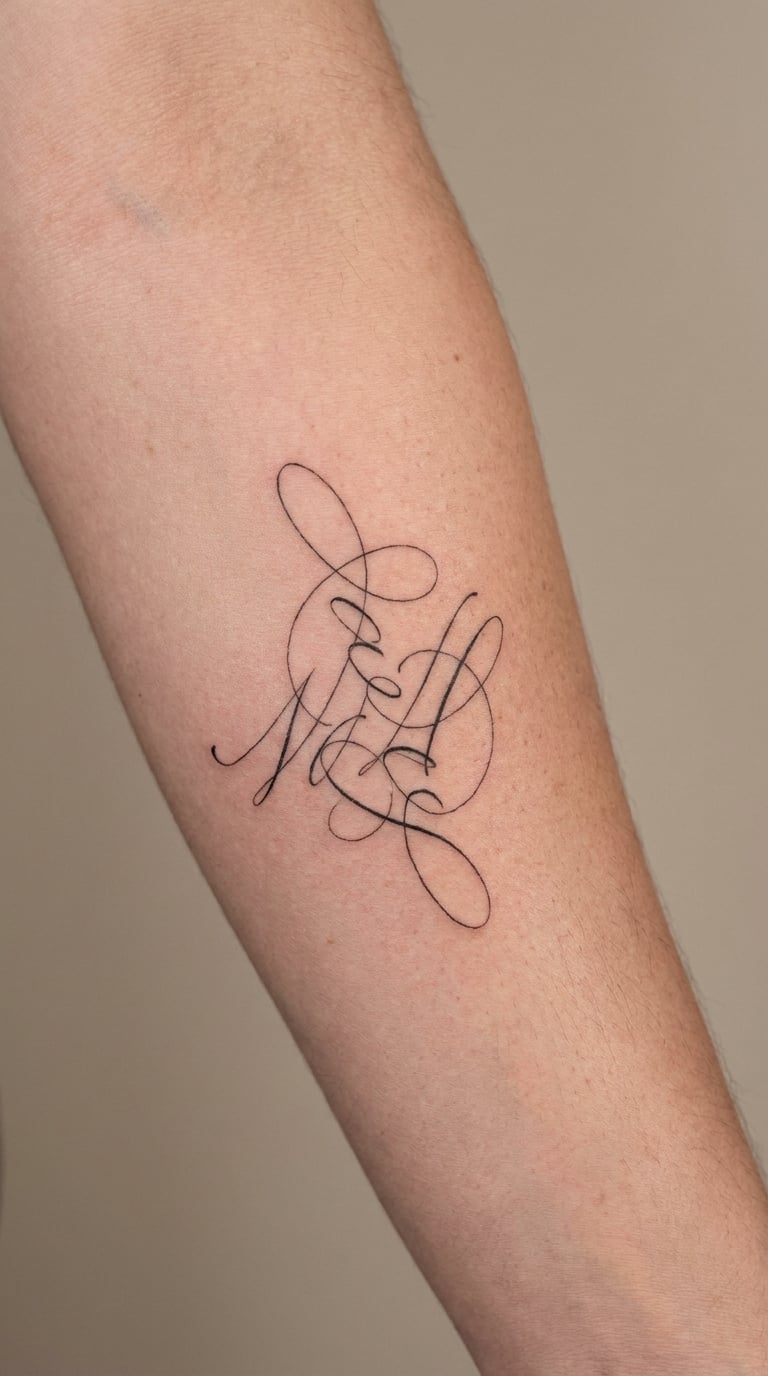
One short line from her actual handwriting, traced and re-drawn in clean script. A signature, the opening of a note, or a handful of words from a card she wrote you. Ask whoever holds family papers before using anything, and skip anything she wrote that was meant only for someone else.
This is the hardest design to get right and the one people are most moved by. Keep the line short. Long passages turn into unreadable script once they are on skin.
Placement: inner forearm, ribs, or the inner upper arm. Size: 2-3 in (5-8 cm) wide. Style: delicate fine-line script. Pain: low to medium. Fine lettering is the first thing to lose definition, and the inner arm moves constantly, so a slightly bolder hand is kinder to the design.
Make it yours: have the artist keep her natural letter spacing and one small error, because a flawless version stops being her handwriting.
16. Two Small Paw Prints
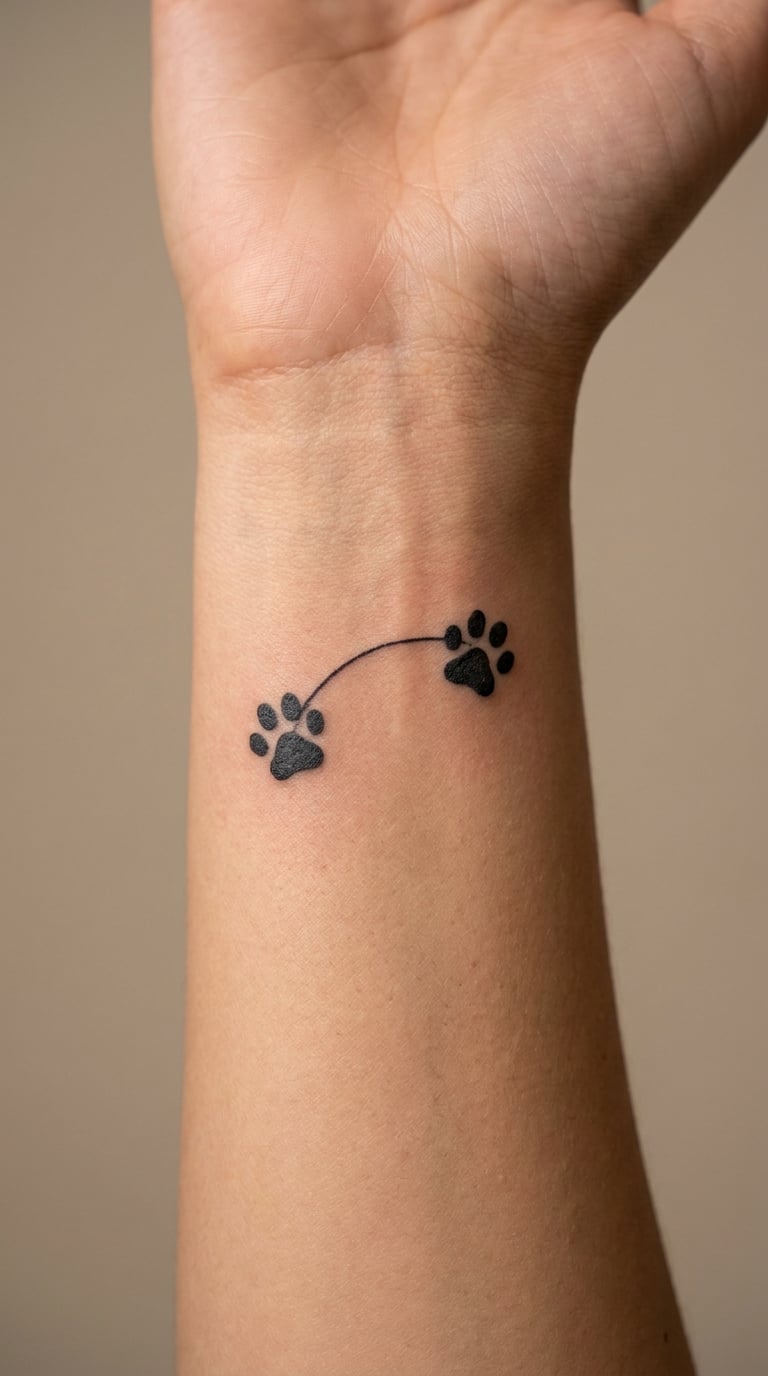
A pair of small paw prints with rounded pads and four toe dots each, linked by a short curved line or a few tiny dots between them. Useful when the memorial is about a shared pet, a dog she grew up with, or a relationship you marked through an animal you both loved.
It is not a common sister memorial, which is a plus if generic angel wings make you cringe. The shape is simple enough to place almost anywhere and small enough to add later.
Placement: wrist, ankle, or beside another small piece. Size: 1-1.5 in (3-4 cm) each. Style: fine line or micro-realism. Pain: low. Toe dots are tiny and blur first, so ask for fewer, slightly larger dots and solid rather than outlined pads.
Make it yours: use her dog’s actual paw shape as the reference, and trail the connecting line toward wherever the animal is buried, or toward the home they have now.
17. Miniature Locket With an Abstract Portrait
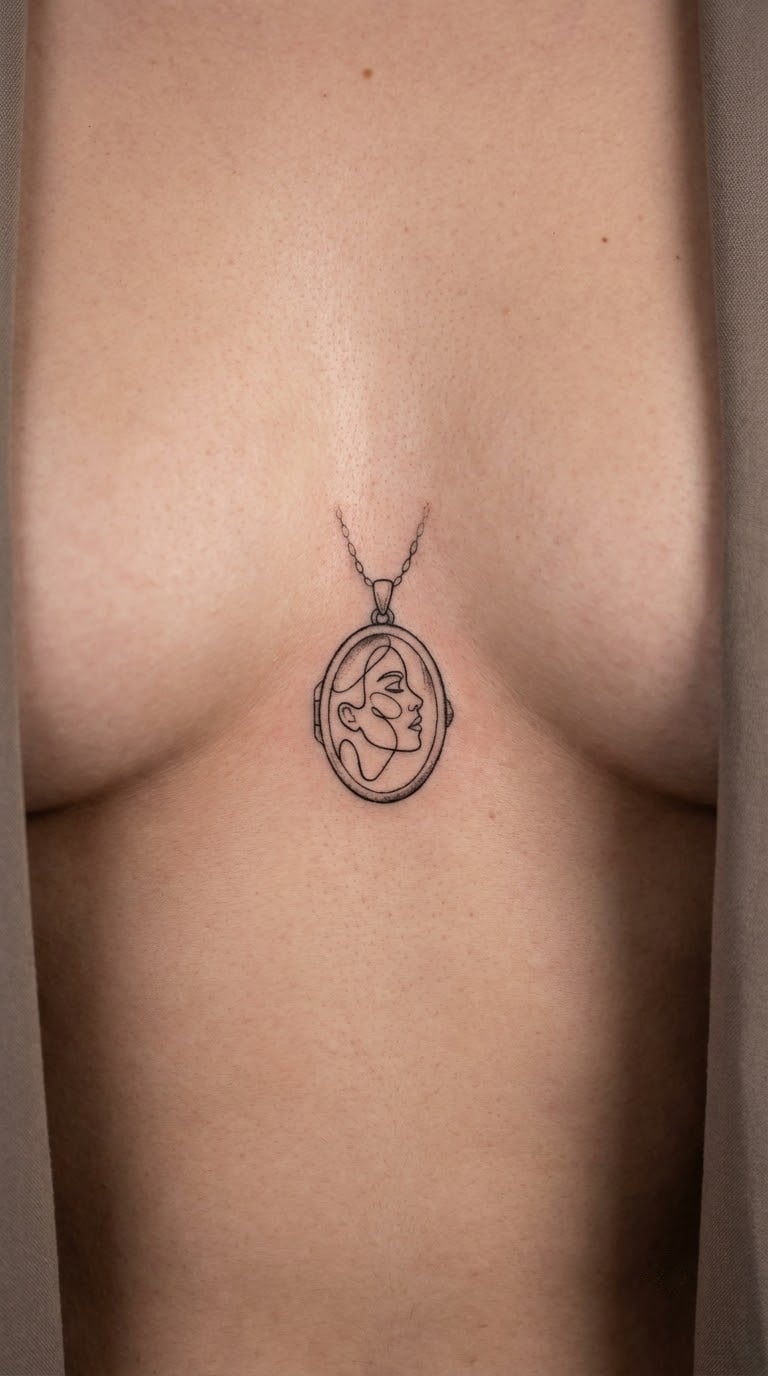
A small locket hanging from a fine chain, its interior holding a simplified profile or an abstract shape rather than a detailed face. The frame is drawn in clean line, with the portrait suggested by a jawline, a nose, and hair.
An abstract interior is the right call at small scale. Detailed faces need several inches to work, and a locket at 2 inches cannot hold one, so the design leans on outline instead. Our picks for tattoo ideas that show sister love cover more neck and chest placements if you want to compare.
Placement: upper chest near the sternum, or the collarbone. Size: 1.5-2.5 in (4-6 cm). Style: fine line. Pain: low to medium, with the sternum area feeling sharper. Interior portrait lines fade faster than the frame, so keep the frame heavier and the portrait lighter in contrast, not in line weight.
Make it yours: put a real engraved date or a small stone colour on the locket bail rather than crowding the interior.
18. Minimal Feathered Wings
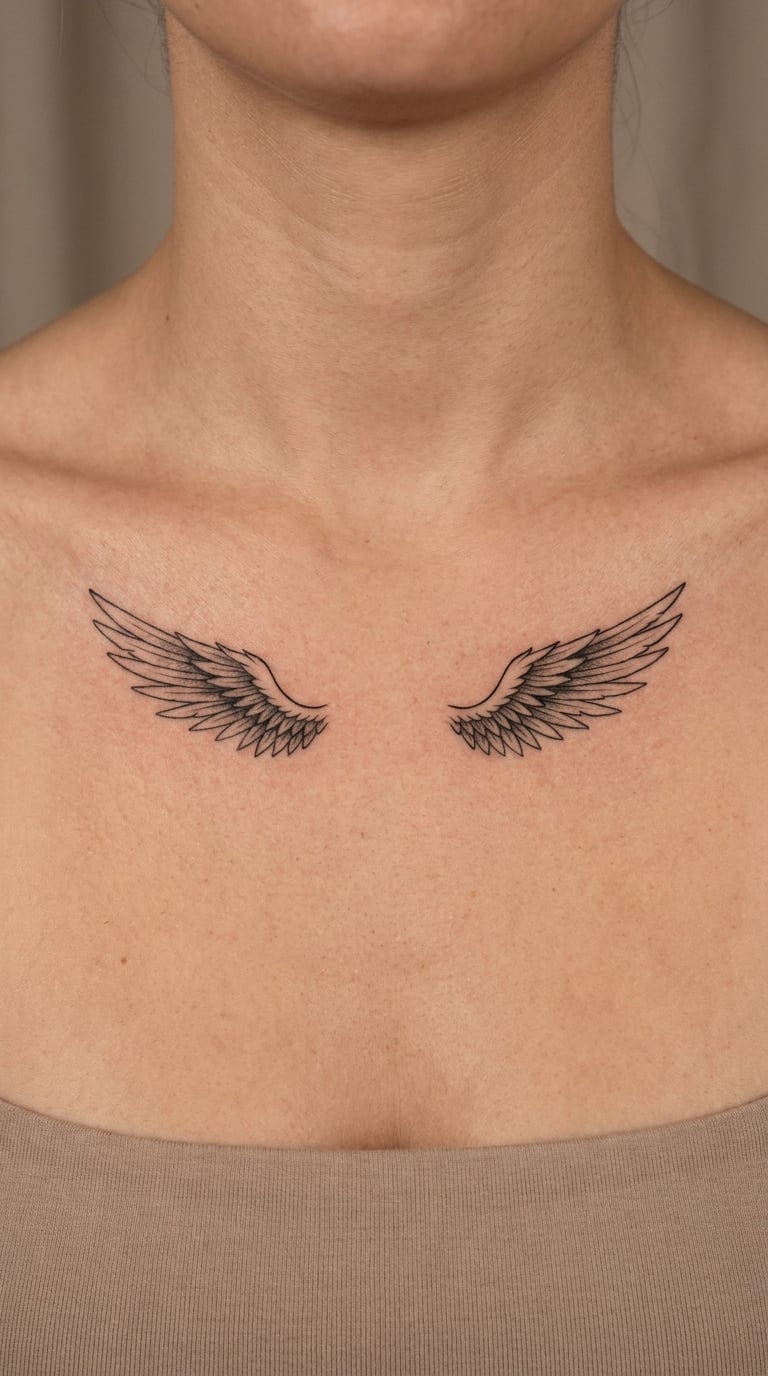
A symmetrical pair of small wings with a few clearly separated feathers each and enough open space between them to stay graceful at a small scale. Black line, with a single accent colour in one feather if you want it.
Wings are everywhere in memorial tattooing, which is exactly why they work when kept restrained. Two small wings under the collarbone read as a quiet mark rather than a statement, and the symmetry suits paired placements.
Placement: beneath each collarbone, or across the shoulder blades. Size: 2-3 in (5-8 cm) each. Style: fine line with one accent colour. Pain: medium under the collarbone. Feather separations are fine lines that can grey out, so fewer feathers with clearer gaps hold their shape better over time.
Make it yours: shade one feather in her birth month colour, or angle the two wings slightly differently so they are mirrored rather than stamped.
19. Lighthouse With a Single Beam
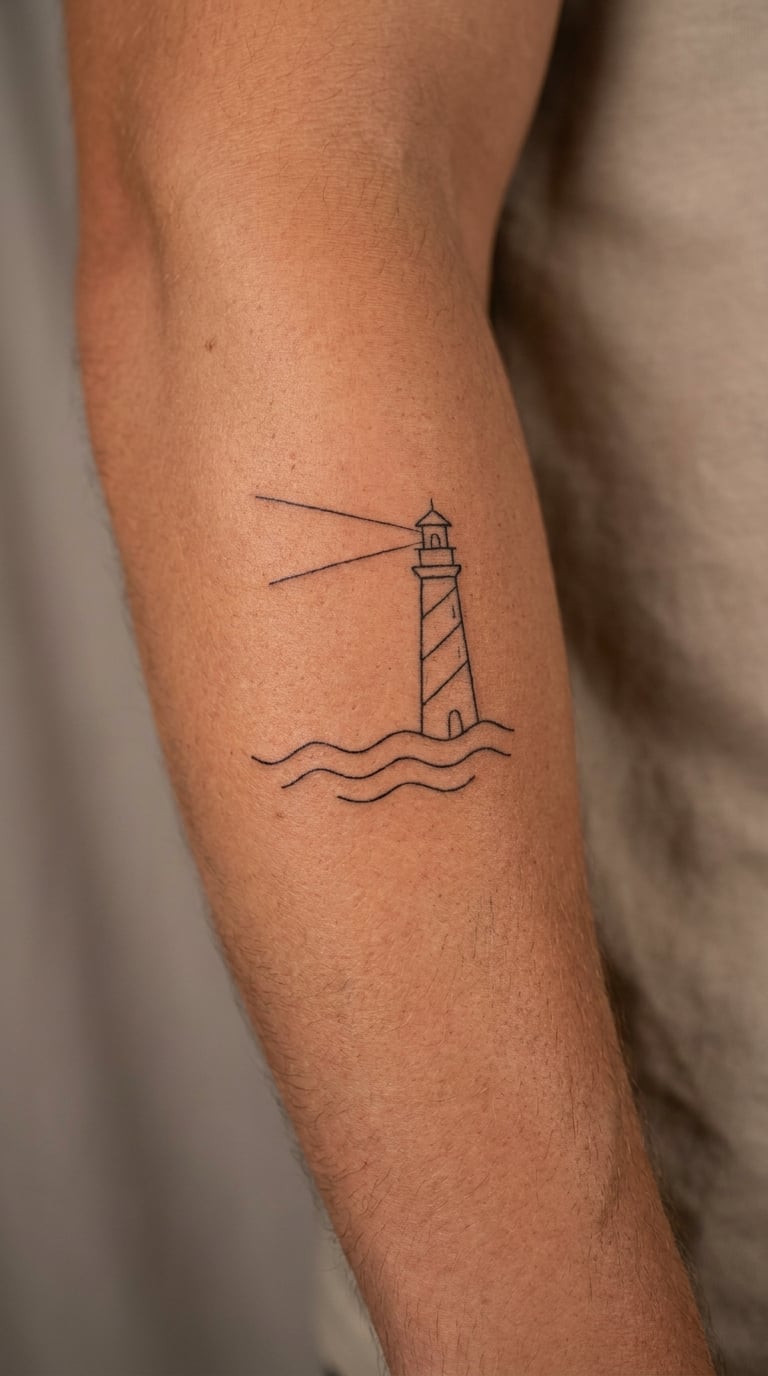
A small lighthouse standing on a rock, with one clean beam cutting outward and two or three minimal wave lines beneath it. Nothing else in the frame, no clouds, no boat.
A lighthouse is a visual metaphor rather than a fixed symbol, and its usefulness is that the meaning is obvious without a caption. Plenty of people pair it with a coastline the two of you knew.
Placement: outer forearm, upper arm, or the back of the calf. Size: 2-3 in (5-8 cm) tall. Style: fine line. Pain: low to medium. The beam is usually a hollow shape, and hollow shapes hold colour and line best when they are wide, so ask for a beam with some body to it.
Make it yours: put a short date beneath the wave line, or draw the beam pointing toward the coast you are both from.
20. Shared Mountain Peak
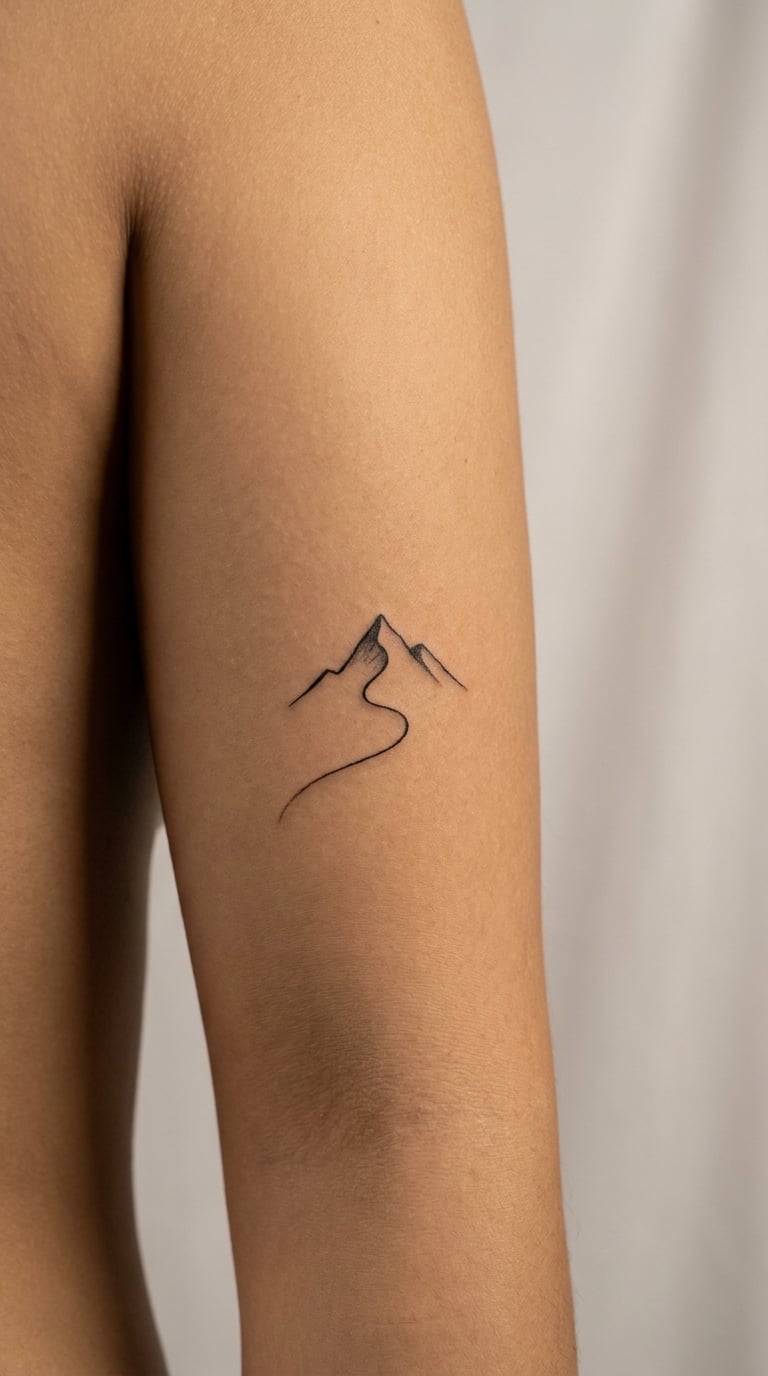
A simplified summit drawn in a few confident lines, with a thin winding trail or path leading up toward it. Some versions add a second, lower ridge for scale. No trees, no text, no shading gradients.
A mountain is a shared-experience shape: you can only really draw it if you have been there. It suits a sister you hiked, camped or drove through with rather than one you mark with a symbol.
Placement: upper arm, calf, or the back of the shoulder. Size: 2-4 in (5-10 cm) across. Style: minimal fine line. Pain: low, one of the easiest areas to sit through. Jagged peak lines are the risky part, since straight-line segments can fade into a soft ridge over time.
Make it yours: sketch your own route on the trail line, using the real twists from the trail you walked together.
21. Watercolour Sunflower Pair
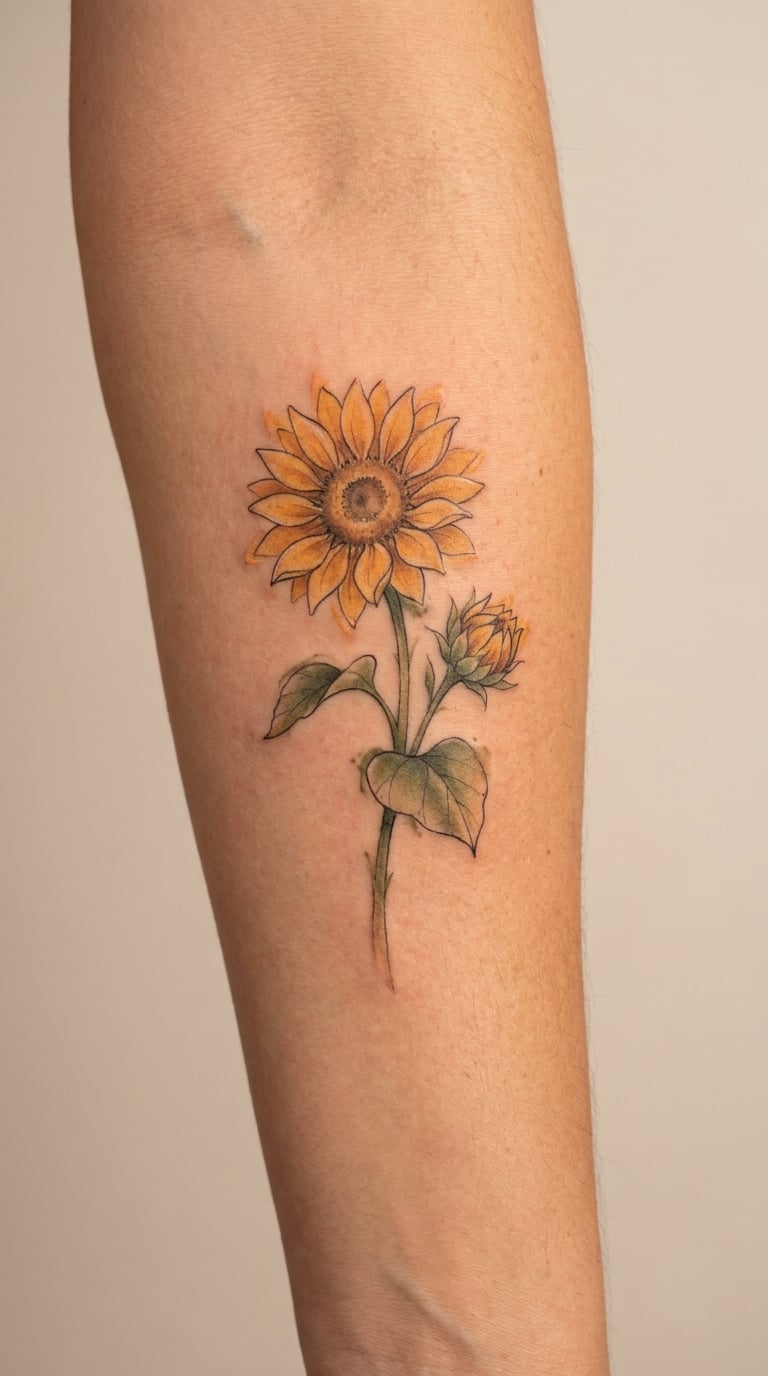
Two sunflowers rendered in translucent watercolour, one open and one still a bud, with edges that bleed slightly past the line of the petals. Amber, ochre and a muted green, nothing saturated.
Sunflowers get chosen when a memorial should feel warm rather than solemn. Two blooms rather than a field also keeps the piece small enough for a forearm and avoids turning it into a busy illustration.
Placement: forearm, shoulder, or calf. Size: 2-3 in (5-8 cm) across. Style: watercolour. Pain: low to medium. Soft washes look faded within months even when the tattoo is healthy, so pick an artist whose faded work you like rather than judging it in week one.
Make it yours: use the two blooms to mark two summers, or tint the bud in a different colour so it reads as not-yet rather than unfinished.
22. Two Cherries With Fine Stems
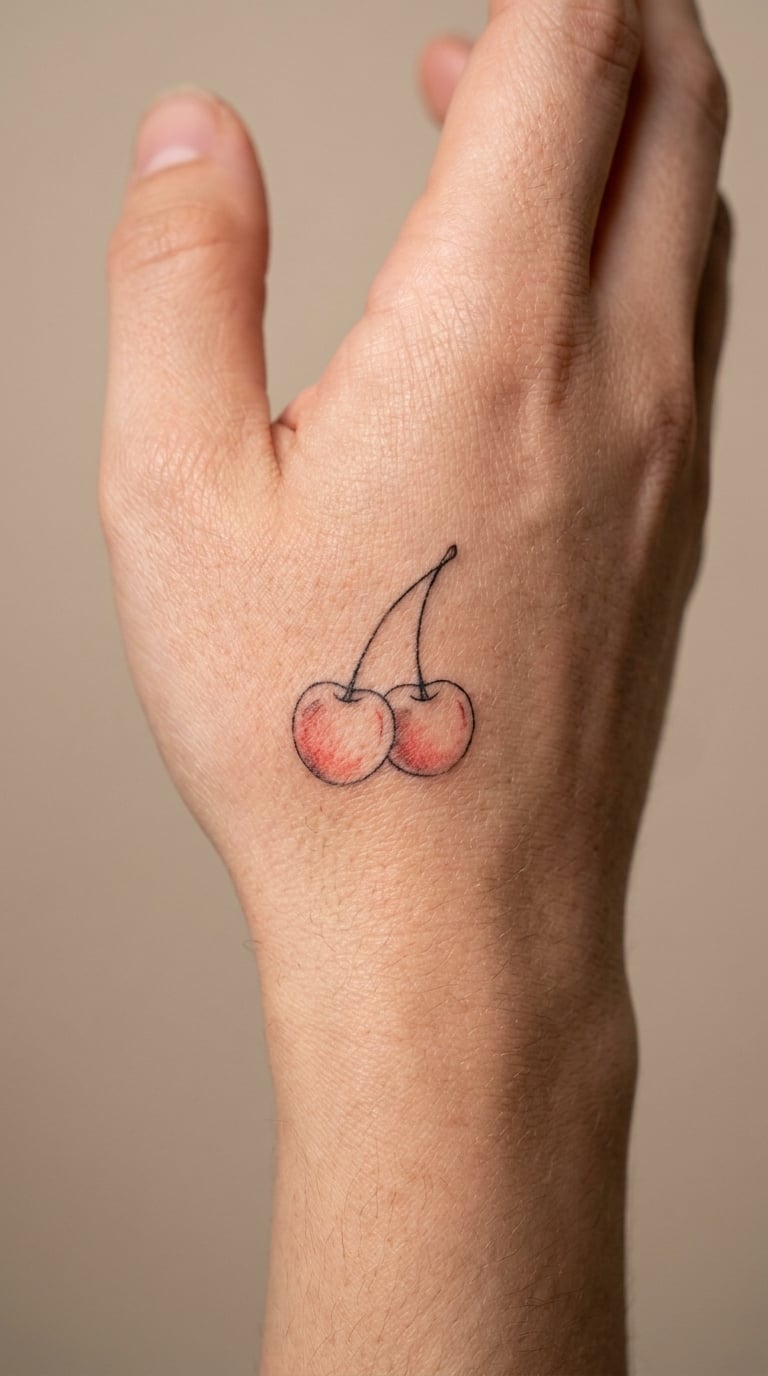
A pair of cherries on long curved stems that meet in a single loop, drawn in a vintage illustrative style with clean outlines and restrained red or pure black fill. The shapes stay simple, not cartoonish.
It is playful without being trivial, which is exactly why it works for some people and feels wrong for others. If your relationship had any humour in it, this is a design that lets the memory keep that too.
Placement: back of the hand, behind the ear, or the inner arm. Size: 1.5-2 in (4-5 cm) across. Style: vintage illustrative. Pain: medium on the back of the hand, where the skin is thin and every line registers. Red fills fade toward orange or brown faster than black line, so expect that.
Make it yours: send the stems curving in the same direction as a real photograph of a branch, or add one tiny leaf at the join.
23. One Rose Wrapped Around a Fine Line
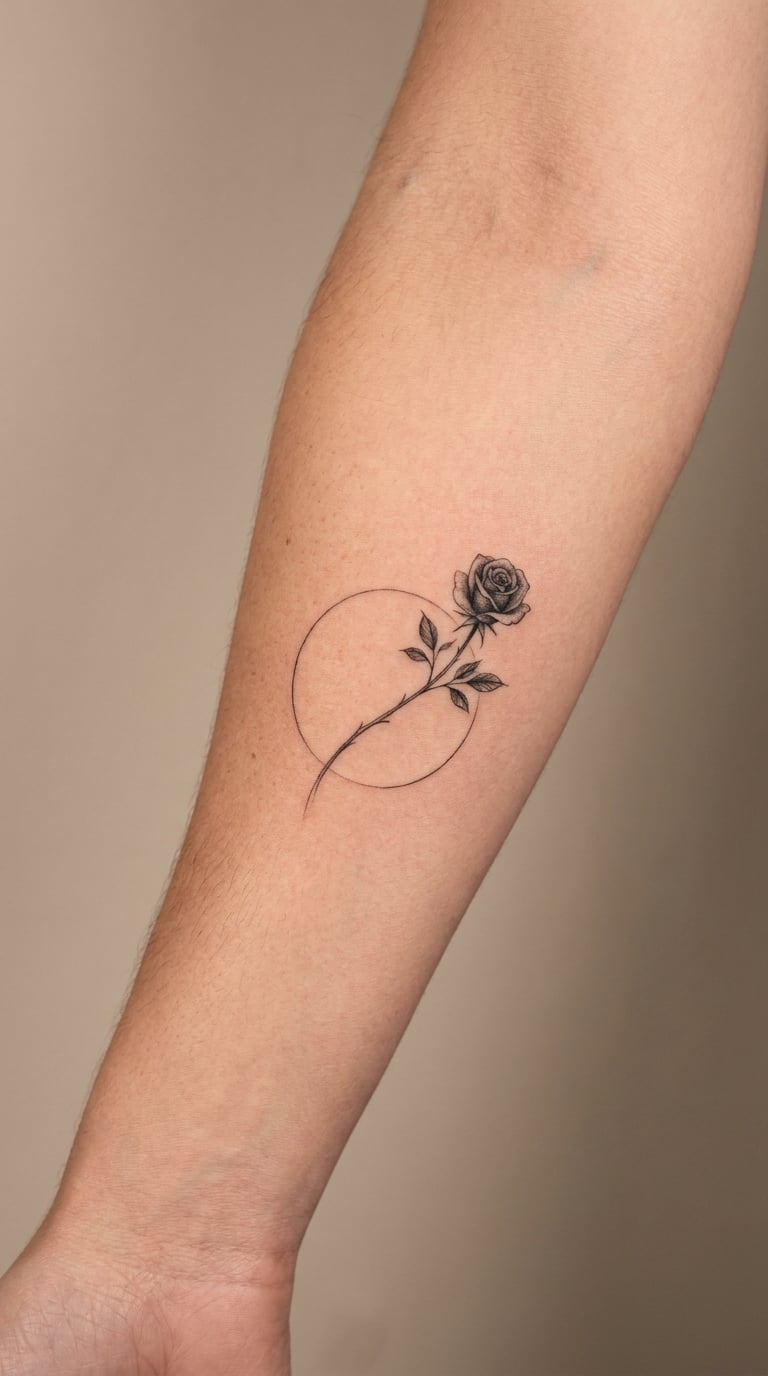
A single rose in micro-realism, its stem following the curve of an existing fine-line element rather than sitting on top of it, so the stem looks like it grew around the line. Useful when you are adding memorial art to a collection that already has fine line in it.
The blend is the whole idea. A realistic flower threaded through abstract linework means one piece can hold a literal and a symbolic register at the same time.
Placement: forearm, wrapping an existing line or circle, or alone on the inner arm. Size: 2-3 in (5-8 cm). Style: micro-realism with fine line. Pain: medium. Shading inside a tight spiral is the first thing to blur, so ask for a slightly open spiral with clear separation between petals.
Make it yours: use a rose from her garden, or a hedgerow she always stopped to photograph on walks.
24. Abstract Portrait Silhouette
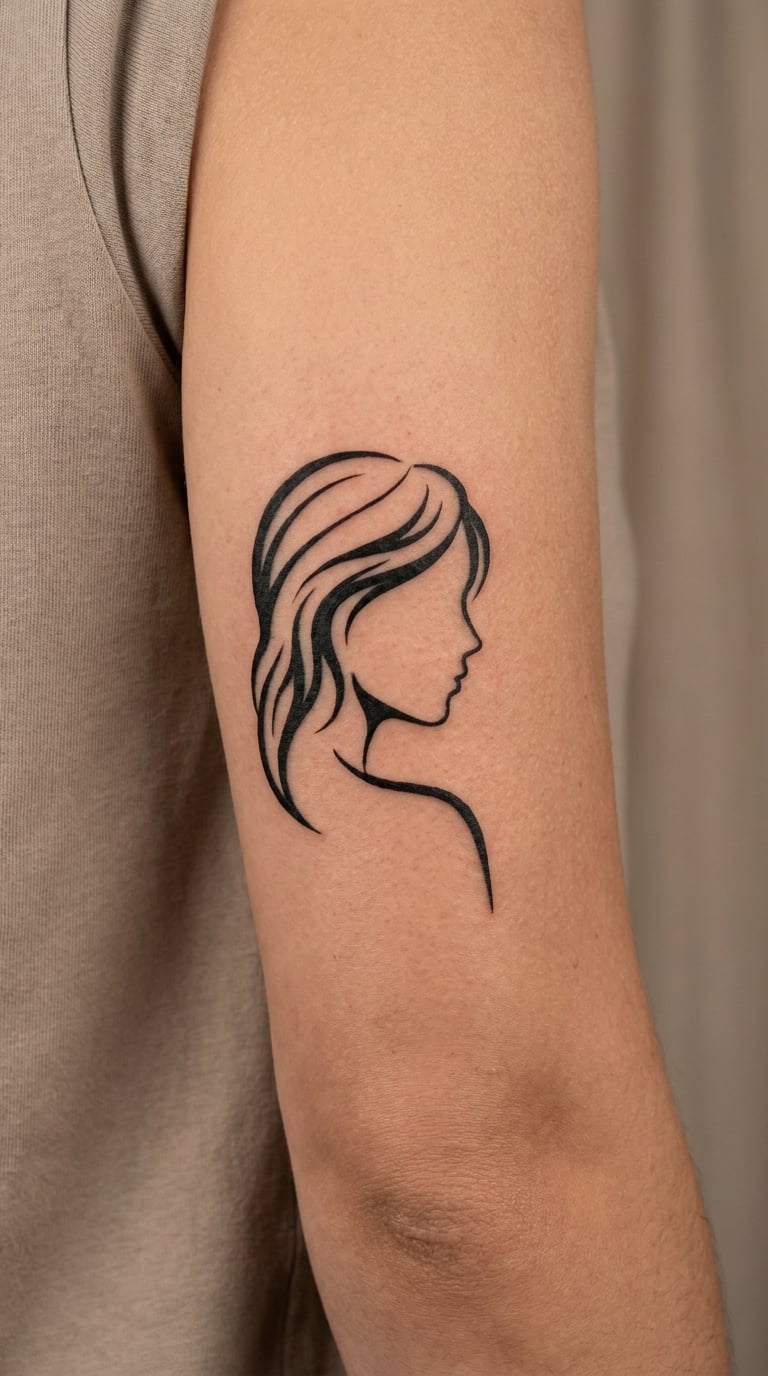
A custom silhouette built from her profile, hair shape and a posture you would recognise instantly, rendered in black and grey. The face is not detailed, and the shoulders are suggested rather than fully drawn.
Silhouettes succeed where photorealistic portraits at small sizes do not, because they rely on outline rather than shading. Bring a clear side-on photo in good light. This one usually needs the longest sitting of anything on the list.
Placement: upper arm, ribs, or the back of the shoulder. Size: 3-6 in (8-15 cm) tall. Style: black and grey realism. Pain: medium to high, and ribs are the difficult area. Larger silhouettes hold their shape better than tiny ones, so resist going under about 3 inches.
Make it yours: set her in a posture you saw often, such as looking over her shoulder, and keep a discreet initial or date beneath the shoulder line.
How to Choose the Right Design
Start from a real reference, not a symbol list
The designs that hold up are the ones tied to something real: her handwriting, a flower she grew, a coastline, a dog’s paw. Generic memorial iconography is easy to find and easy to regret, because anyone could have drawn it for anyone.
Match the emotional tone you actually want
Some people want warmth and humour, which points to the sunflower pair or the cherries. Others want something quiet and private, which points to the forget-me-not sprig or a small line of script. Decide which one you are before you start collecting references, not after.
Pick placement with your day in mind
Wrist and collarbone pieces are visible and small. Ribs, the inner arm and the back are read mostly by you. Artists tend to be consistent on this: many people deliberately choose somewhere only they can see. A design you would rather not explain at work is usually a design that keeps the memory private, and that is a legitimate choice.
Let the size follow the detail
Fine detail wants either more inches or fewer elements. A 1-inch forget-me-not with five petals holds up better than a 1-inch forget-me-not with nine. If a design has faces, dates or ridge patterns, ask what size the artist needs for those features to survive, then size the whole piece around that number.
Protect anything private in the reference
Handwriting, addresses, coordinates and fragments of letters can all identify people or places you would rather not announce. Discuss with the artist which parts get simplified or cropped before the stencil goes down, and use a cleaned-up copy of any document as your reference.
Cost and Session Time
All figures below are US dollars and vary widely by city and by artist. A simple fine-line piece in one colour usually starts around 90 to 200, small script and botanical work often runs 150 to 350, and detailed custom pieces such as a silhouette or a hand-traced script line commonly land between 300 and 800 or more.
Most of these designs fit in a single sitting of roughly one to three hours. The exceptions are worth planning for: a large silhouette, a full star map or a portrait-based design usually needs two or three sessions, and a line from her handwriting may take longer than its size suggests because tracing has to be slow and accurate.
Four things move a quote more than anything else: the artist’s hourly rate, the level of custom drawing involved, the size on the body, and the detail count. Hand-traced lettering, reference-based realism and multi-session work all cost more than the same image done as a simple stock design. Shop minimums, consultation policies and touch-up rules also vary, so ask about all of that in the booking message rather than at the counter.
If a quote feels high, the honest answer is that the artist is quoting their time and skill, not markup. The cheaper route is usually a smaller design or a simpler style, not a cheaper studio.
Aftercare Basics
- Follow your artist’s aftercare instructions first, since they know exactly what they did in the session.
- Wash gently with a clean, fragrance-free product and lukewarm water, then pat dry with something disposable rather than a towel.
- Protect the area with clothing that fits loosely for a few days, and change sheets and pillowcases if the tattoo is on a body part that rests on them.
- Apply whatever ointment or balm your artist recommends in a thin layer, and do not improvise products on fresh ink.
- Keep new work out of direct sun, and remember that a healed fine-line tattoo on an exposed arm or hand will fade faster than one under a sleeve.
- Contact the studio if you notice heavy redness after the first few days, swelling, spreading redness, heat coming off the area, or anything draining that does not look like normal healing. Let them decide whether you need to come back in.
Frequently Asked Questions
What is a meaningful memorial tattoo for a sister?
A meaningful memorial tattoo for a sister is one built from something only the two of you shared: her handwriting, a flower she loved, a place you visited, a pet, or a date that matters. Personal reference beats generic symbolism every time, because it cannot be swapped for anyone else’s tribute.
What is the best small memorial tattoo for a sister?
The best small memorial tattoos are designs with very little detail: a forget-me-not sprig, an infinity with two initials, two small butterflies, a short line of script, or a set of coordinates. Anything under about two inches works best in one weight of line with minimal shading, since fine detail softens fastest at that scale.
Should matching sister memorial tattoos be identical?
They do not have to be. Many siblings choose designs that share a style, a shared element, or a mirrored composition while differing in one detail, such as a bud beside an open bloom or two different flowers from the same stem. Identical copies are an option too, but paired designs tend to stay more personal to the relationship.
Do fine-line memorial tattoos fade quickly?
Fine-line work softens faster than bold blackwork because each stroke is thin, but the difference is about line weight and placement rather than time alone. A slightly heavier line and a spot away from daily sun exposure hold up noticeably better. Fading is gradual, and most fine-line memorials stay legible for many years.
What personal details can I include in a custom sister memorial tattoo?
Useful details include one line of her handwriting, her name in her own script, birth and passing dates, coordinates of a shared place, a flower she grew, a star map of a real sky, a fingerprint curve, or a small silhouette from a familiar photograph. Check with whoever holds family papers before using handwriting or letters.
Conclusion
If this is your first tattoo, start with the birthflower and a small date, or with the intertwined initials. Both are small, both age well, and neither asks you to commit to a large piece before you know how you feel about having it on you.
If you are already building a collection, the abstract portrait silhouette and the paired fingerprint curves give you room to grow into something more involved, and they can be added years from now without reworking earlier work.
Whichever direction you take, bring one real reference that means something specific, and talk it through with the artist before the stencil goes down. That conversation is where a design turns into hers.