
20 Sanskrit Tattoo Ideas: October 2026 Meaningful Design Guide
Sanskrit tattoos are written in Devanagari, the script whose letters hang from a single continuous headline bar, and that one detail decides almost everything about your design. Get the size wrong and the vowel marks above and below the letters fill in. Get the wording wrong and you carry a permanent mistake in a language you cannot read yourself.
These 20 Sanskrit tattoo ideas cover single words, short phrases, mantras and symbols, each with the style, placement, sizing and pain level that suits it. Most people arrive here from a phone in the evening, so pick a few designs you like, then come back to the sizing notes before you book. If you want something with a completely different mood, the crescent moon tattoo ideas for women are a good side track, and 20 north star tattoo ideas covers the same navigation-and-guidance theme in a non-script style.
20 Sanskrit Tattoo Ideas: Quick Guide
| Idea | Style | Best placement | Size | Pain |
|---|---|---|---|---|
| Om symbol | Minimal blackwork | Inner forearm | 2-3 in | Low |
| Gayatri mantra | Fine-line script | Inner upper arm | 3-4 in | Medium |
| Lotus with Om | Fine line and dotwork | Outer upper arm | 3-5 in | Medium |
| Mandala with character | Geometric blackwork | Between shoulder blades | 4-6 in | Medium |
| Ganesha | Fine line | Outer upper arm | 4-6 in | Medium |
| Shiva with trishul | Fine line portrait | Calf | 5-7 in | Medium |
| Nataraja | Black and grey | Back | 7-9 in | High |
| Saraswati with veena | Fine line | Forearm | 5-7 in | Medium |
| Lakshmi with lotus | Symmetrical blackwork | Upper back | 6-8 in | Medium |
| Kali face | Bold blackwork | Upper arm | 4-6 in | Medium |
| Hanuman | Traditional | Upper arm | 5-7 in | Medium |
| Peacock feather with word | Fine line | Outer forearm | 4-6 in | Low |
| Kalash with script | Minimal blackwork | Inner upper arm | 3-5 in | Medium |
| Sanskrit initial | Fine-line script | Wrist behind the thumb | 1.5-2.5 in | Medium |
| Word on the ribs | Clean script | Side ribs | 4-6 in | High |
| Vertical name column | Clean script | Inner forearm | 3-5 in | Medium |
| Paisley with Devanagari | Dotwork and fine line | Shoulder | 4-6 in | Medium |
| Character on the hand | Micro script | Side of the index finger | 1-1.5 in | High |
| Om and mandala back piece | Layered blackwork | Upper back | 8-12 in | High |
| Phrase around the arm | Curved script | Outer forearm | 6-8 in | Medium |
1. Om Symbol in Minimal Blackwork
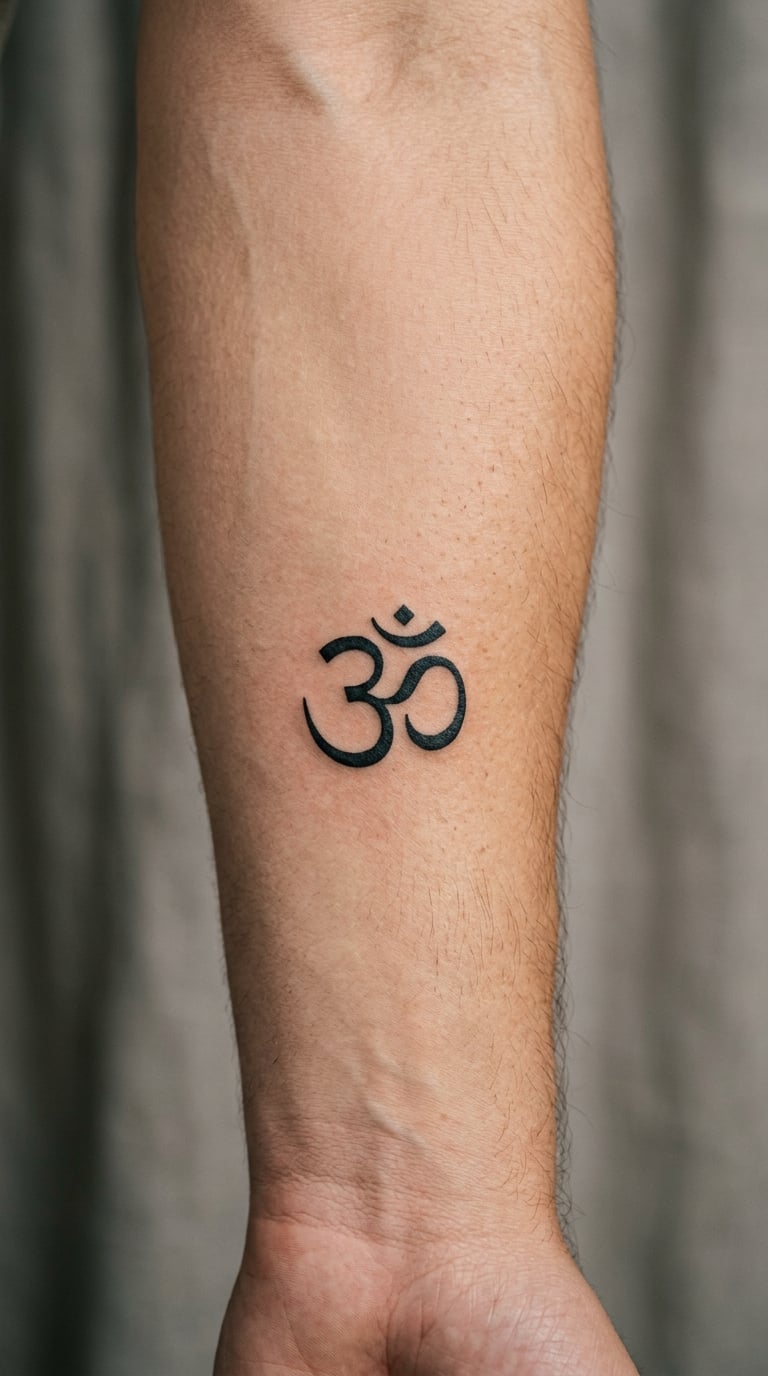
The Om glyph (ॐ) is drawn as one continuous shape with a curl on the upper right, a larger lower curve and a small mark above. Drawn in a single unbroken line with no extra ornament, it reads as a quiet, confident mark rather than a loud sticker.
It is most often described as a sacred sound and a symbol of the universe in Indian religious traditions, though there is no single agreed meaning across them. Placement: inner forearm, wrist or behind the ear. Size: 2-3 inches (5-7 cm). Style: minimal blackwork, single-weight line. Pain: low on the inner forearm, a brief scratch that fades in seconds.
Make it yours: have the artist redraw it once by hand rather than tracing a screen, so the curve looks drawn instead of printed.
2. Gayatri Mantra in Devanagari Script
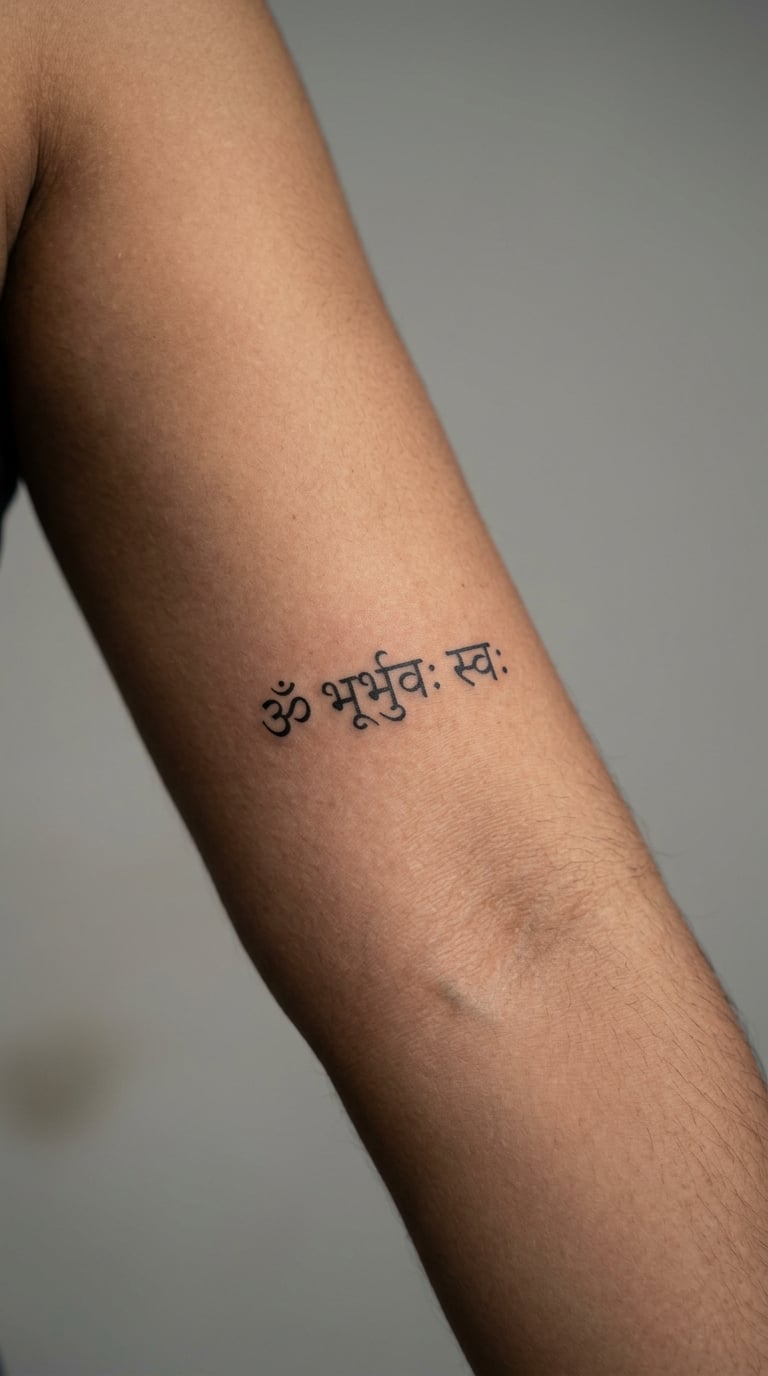
The Gayatri mantra is one of the most requested Sanskrit tattoos: a compact line of Devanagari that asks for illumination of the mind. It is traditionally chanted in Vedic tradition, and the long version runs to well over a hundred characters in a full transliteration.
Tattooing the complete line needs real space, and Devanagari’s headline bar plus vowel marks mean a compressed version blurs fastest. Placement: inner upper arm or forearm. Size: 3-4 inches (8-10 cm) for a short line, longer if you commit to the full mantra. Style: fine-line script in a clean modern Devanagari typeface. Pain: medium on the upper arm, and fine strokes will spread and soften over the years.
Make it yours: have a qualified Sanskrit reader confirm the exact line you want, then bring them a printed copy for the artist to trace.
3. Lotus with Sanskrit Om
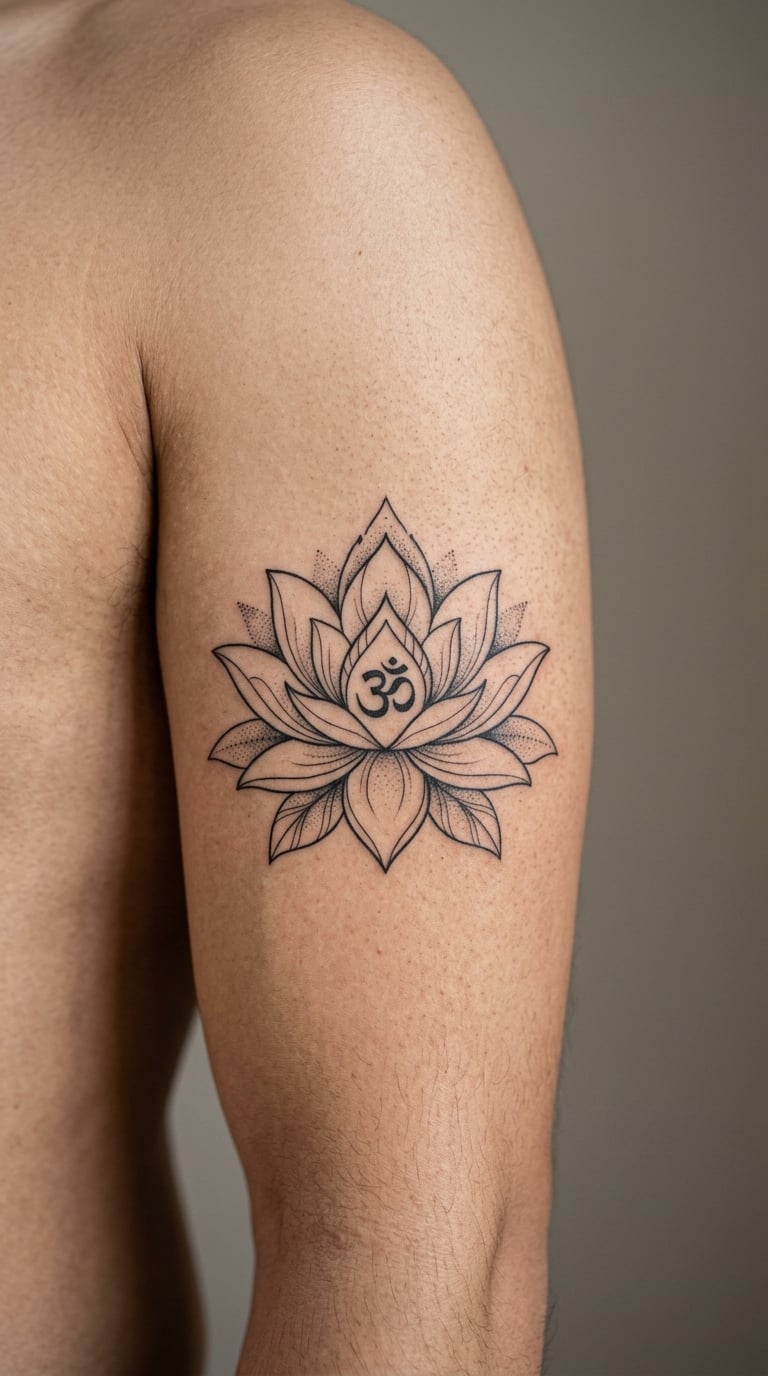
A symmetrical lotus with a small Om at the centre pairs a recognisable flower with a sacred character. Petals are drawn as fine tapered lines, with restrained dotwork between the layers rather than shading that would fill the negative space.
The lotus is widely read as purity and awakening, and pairing it with Om is a common contemporary choice. Placement: outer upper arm, shoulder or inner thigh. Size: 3-5 inches (8-13 cm) across. Style: fine line with dotwork. Pain: medium, and the dotwork between petals is what takes the time.
Make it yours: add a date from a meaningful year in the negative space under the lowest petal, or pick a single accent colour in the centre dot.
4. Mandala with Central Sanskrit Character
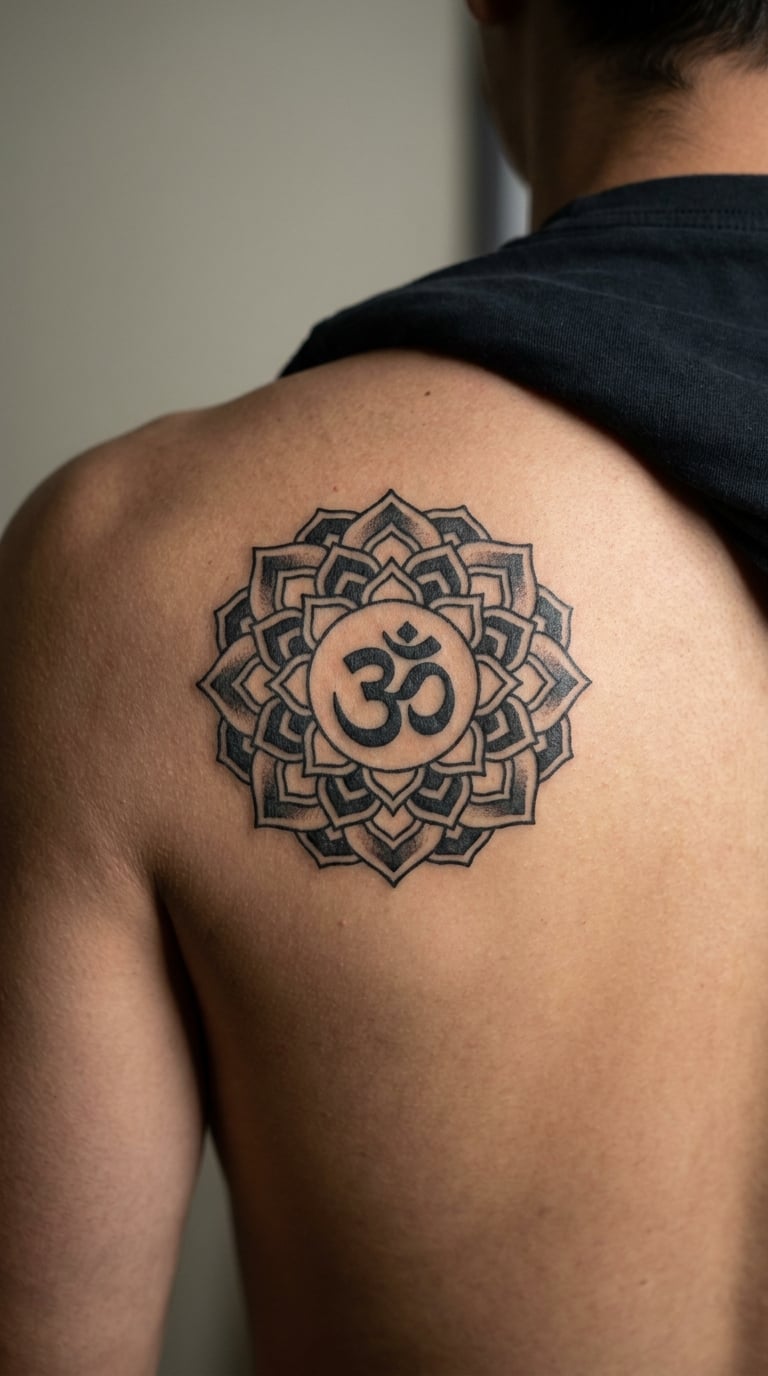
A geometric mandala gives you the largest canvas in this list while holding one carefully chosen Sanskrit character at its centre. The geometry does the visual work: concentric rings, radial symmetry and evenly repeated linework that stay tidy from a distance.
The scale has to protect the letters. Small characters in a mandala centre turn to mush within a few years because the surrounding pattern competes with them. Placement: upper back between the shoulder blades, or the back of the upper arm. Size: 4-6 inches (10-15 cm) across. Style: geometric blackwork. Pain: medium on the back, longer sitting because of the detail.
Make it yours: build the ring count around your word, three rings for a short word and more for a phrase, so the geometry feels built for the text.
5. Ganesha in Fine-Line Style
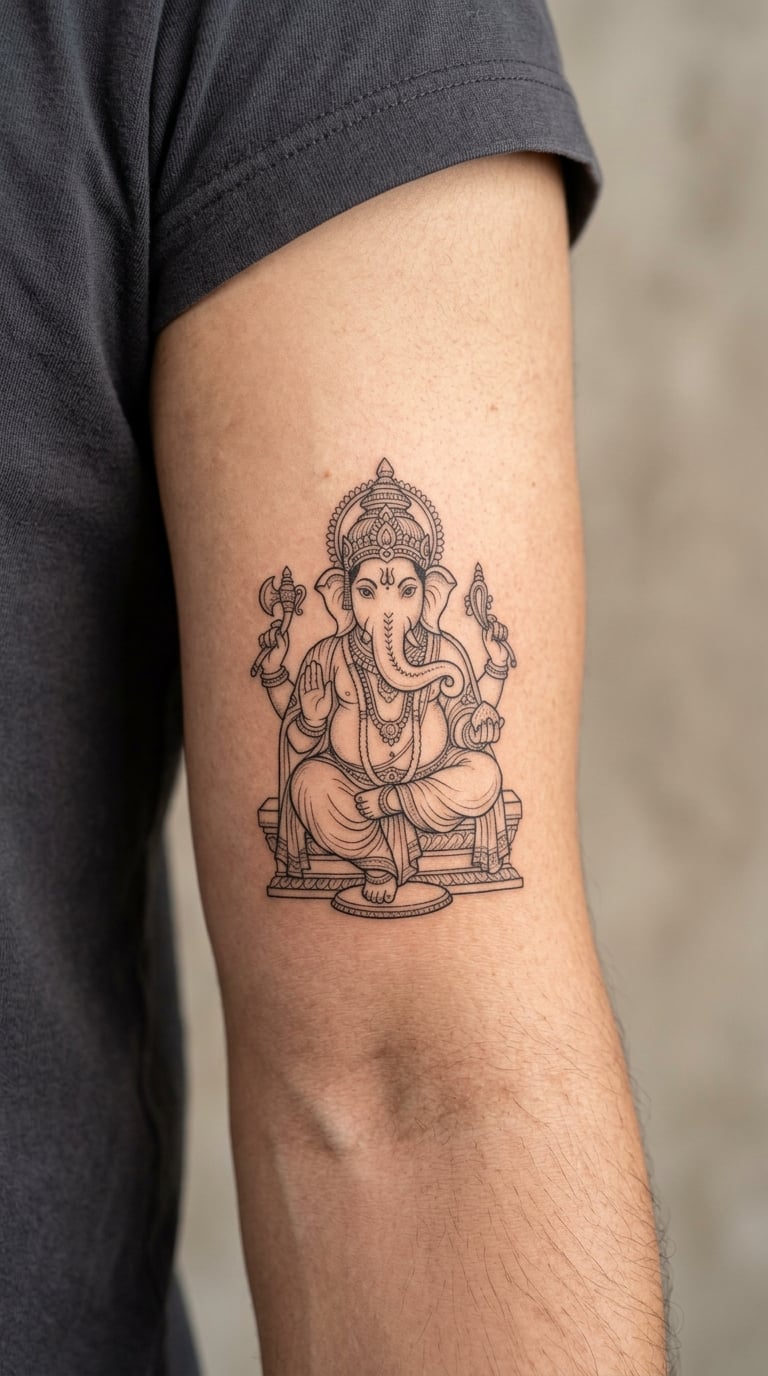
A fine-line Ganesha is drawn with a curved trunk, a crown, a rounded belly and one tusk, with detail kept to outlines and a little hatching. Restrained linework suits the figure better than heavy shading, which turns the face flat.
Ganesha is the remover of obstacles in Hindu tradition, and people often choose the figure for a new start or a hard-won change of direction. Placement: outer upper arm, shoulder or calf. Size: 4-6 inches (10-15 cm) tall. Style: fine line, single needle. Pain: medium, and facial features soften within a few years at this size.
Make it yours: ask for a small lotus under the feet rather than more ornament, so the piece stays quiet.
6. Shiva with Trishul and Small Script
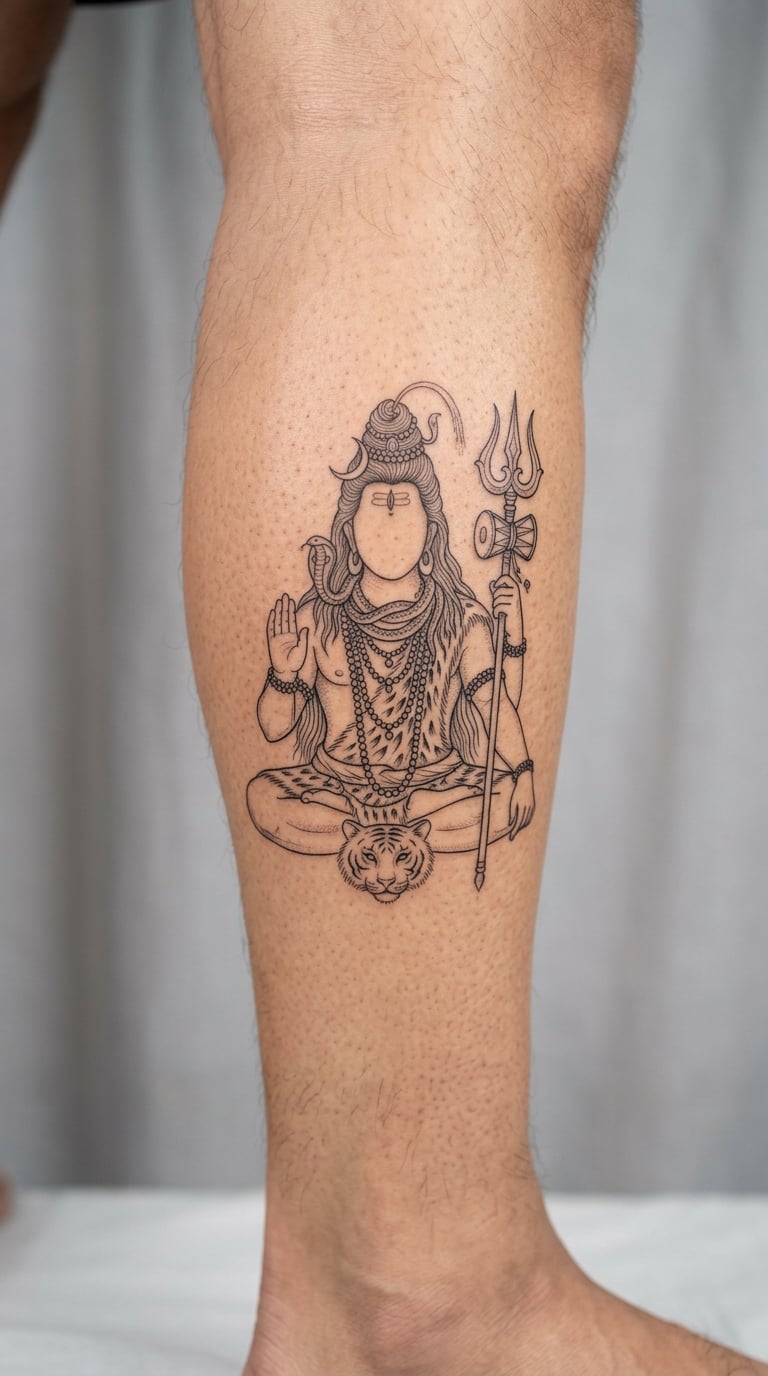
A compact Shiva portrait works as a vertical composition: the trishul rising at one side, flowing hair, the crescent moon, and a third eye rendered as a single small mark. Add one short line of script beneath or beside the figure and the piece needs real height.
Shiva is associated with transformation and with several forms at once, and devotees often describe the trishul as representing the three aspects of existence. Placement: calf, outer arm or side of the torso. Size: 5-7 inches (13-18 cm) tall. Style: fine-line portrait with light grey shading. Pain: medium, more sensitive near the shin bone.
Make it yours: keep the script to a line you have verified and set it in plain text so nothing competes with the face.
7. Nataraja Dancing Shiva Illustration
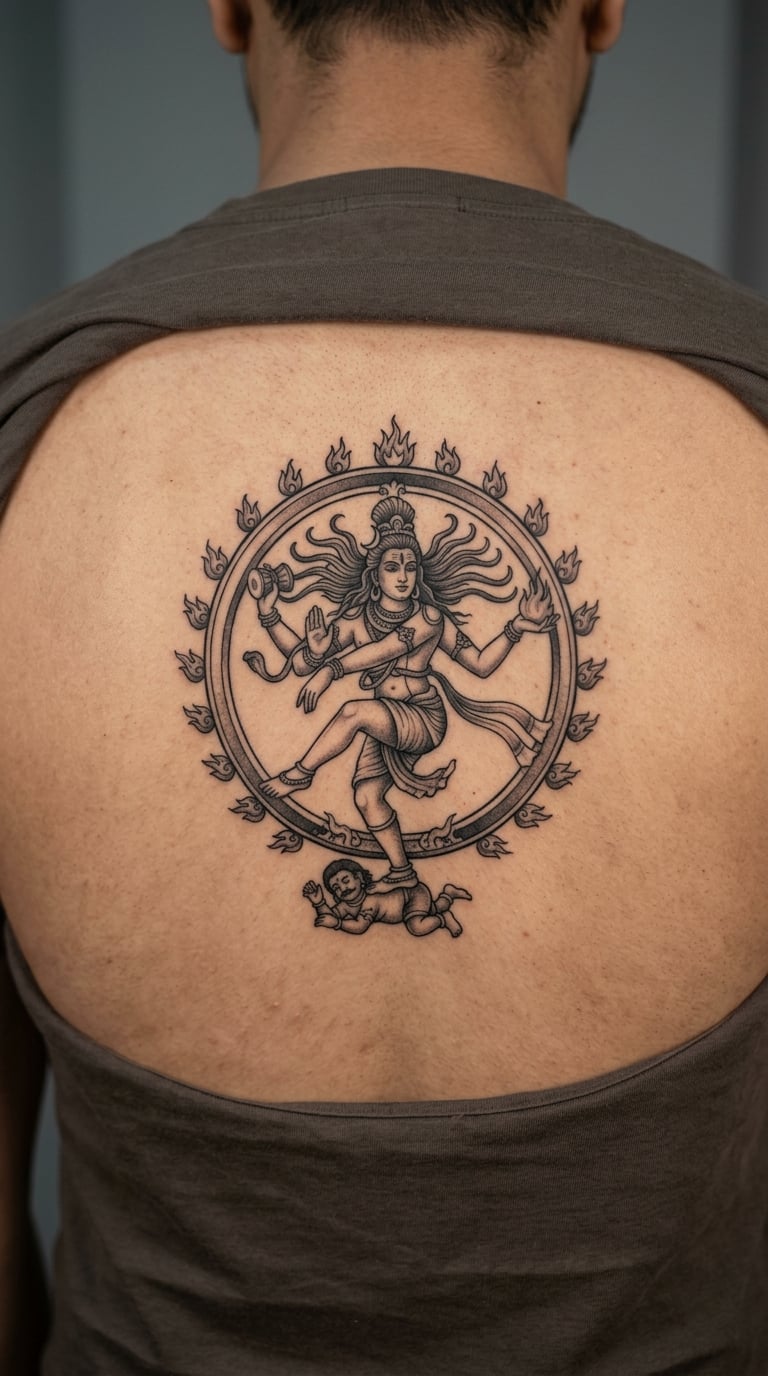
Nataraja is the dancing form of Shiva, and the composition is built around a circle: a raised arm, a lifted leg, a flowing garment across the torso, and a ring of flame around the whole figure. The circle is the point, not a decorative frame.
This is the largest portrait in the list and the one that rewards a collector’s commitment. Placement: centred back, upper back or outer thigh. Size: 7-9 inches (18-23 cm) tall. Style: black and grey with a stippled flame halo. Pain: high, and it will run three hours or more.
Make it yours: add two small lines of verified text below the circle, or leave the halo empty and add it years later as a second sitting.
8. Saraswati with Veena
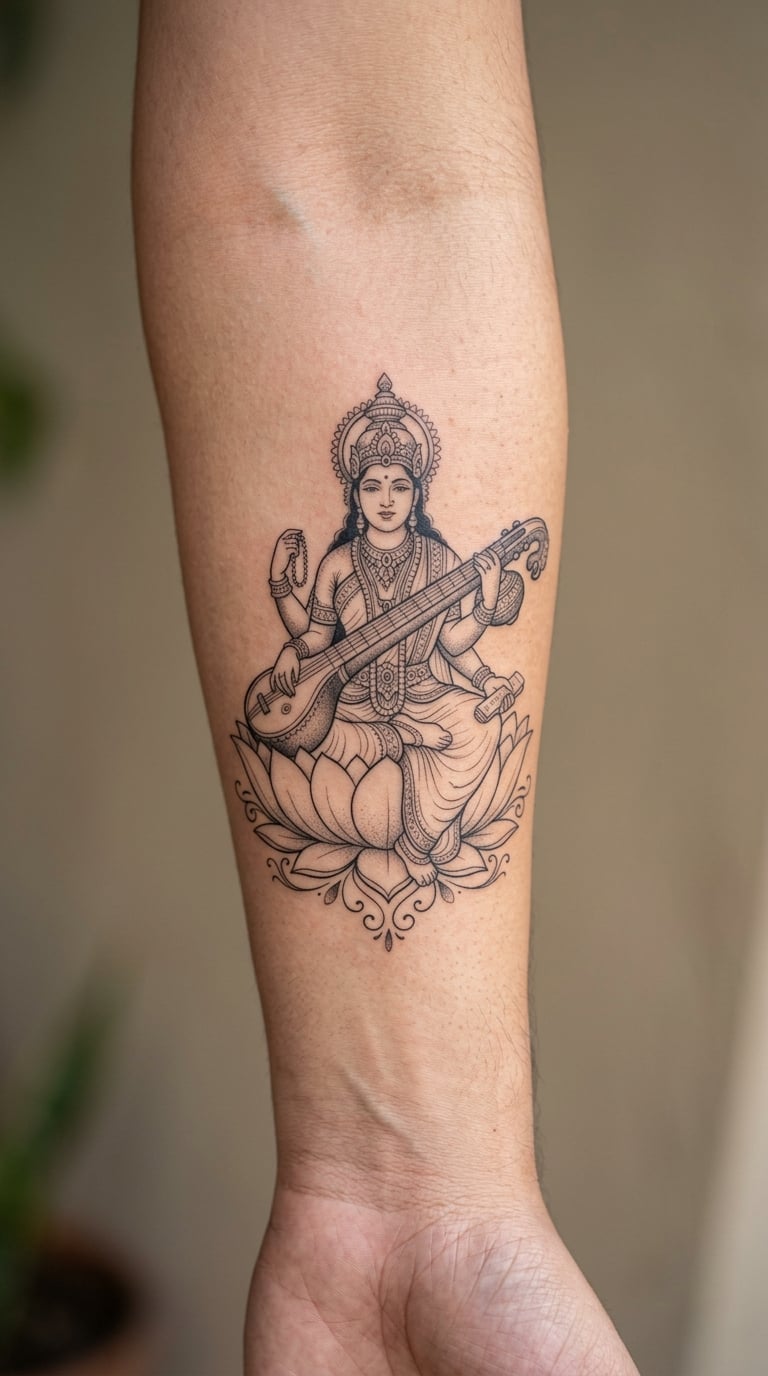
Saraswati is usually drawn with a veena held across the body, a calm expression, long flowing hair and a swan beside her. The instrument sets the composition: the diagonal line of the veena breaks up what would otherwise be a very vertical figure.
Saraswati is associated with knowledge, learning, music and speech, and she is often chosen for a student, a writer or a musician. Placement: inner forearm, upper back or calf. Size: 5-7 inches (13-18 cm) tall. Style: fine line with light grey shading on the veena strings. Pain: medium, and the strings are the fiddly part.
Make it yours: have the strings drawn in your own tuning rather than a stock pattern, or place the figure on the forearm so the veena runs with the muscle line.
9. Lakshmi with Lotus
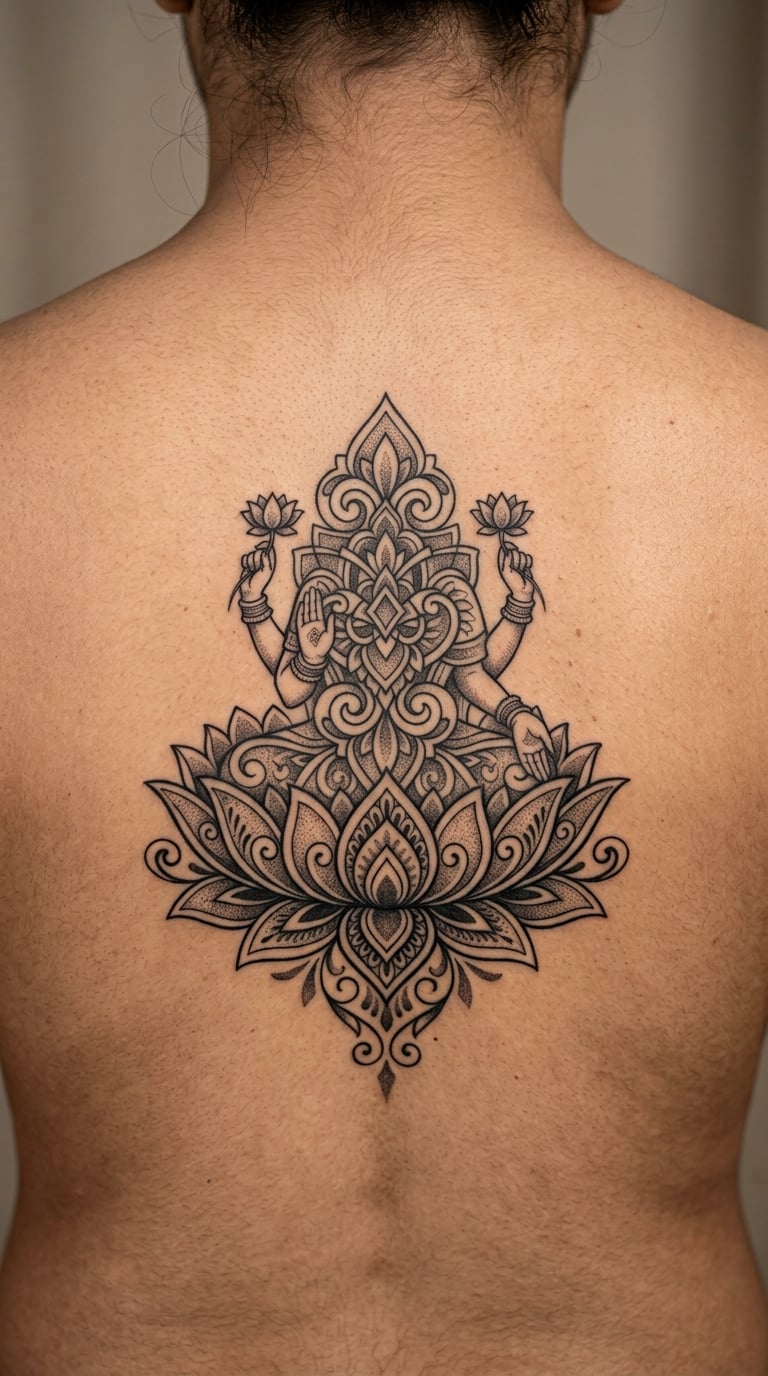
A Lakshmi design is built on symmetry: a seated pose, layered lotus petals beneath, jewellery rendered as simple bands, and a halo of petals or rays behind the head. Symmetry does most of the work, so the piece reads cleanly even from across a room.
Lakshmi is traditionally associated with prosperity, abundance and auspicious beginnings, which is why this figure often appears in wedding-season and milestone tattoos. Placement: upper back, lower back or outer thigh. Size: 6-8 inches (15-20 cm) wide. Style: symmetrical blackwork. Pain: medium, and the lotus petals below the seat take extra time.
Make it yours: add small seeds scattered under the lotus, or a single verified word of plenty beneath the base line.
10. Kali Face in Bold Blackwork
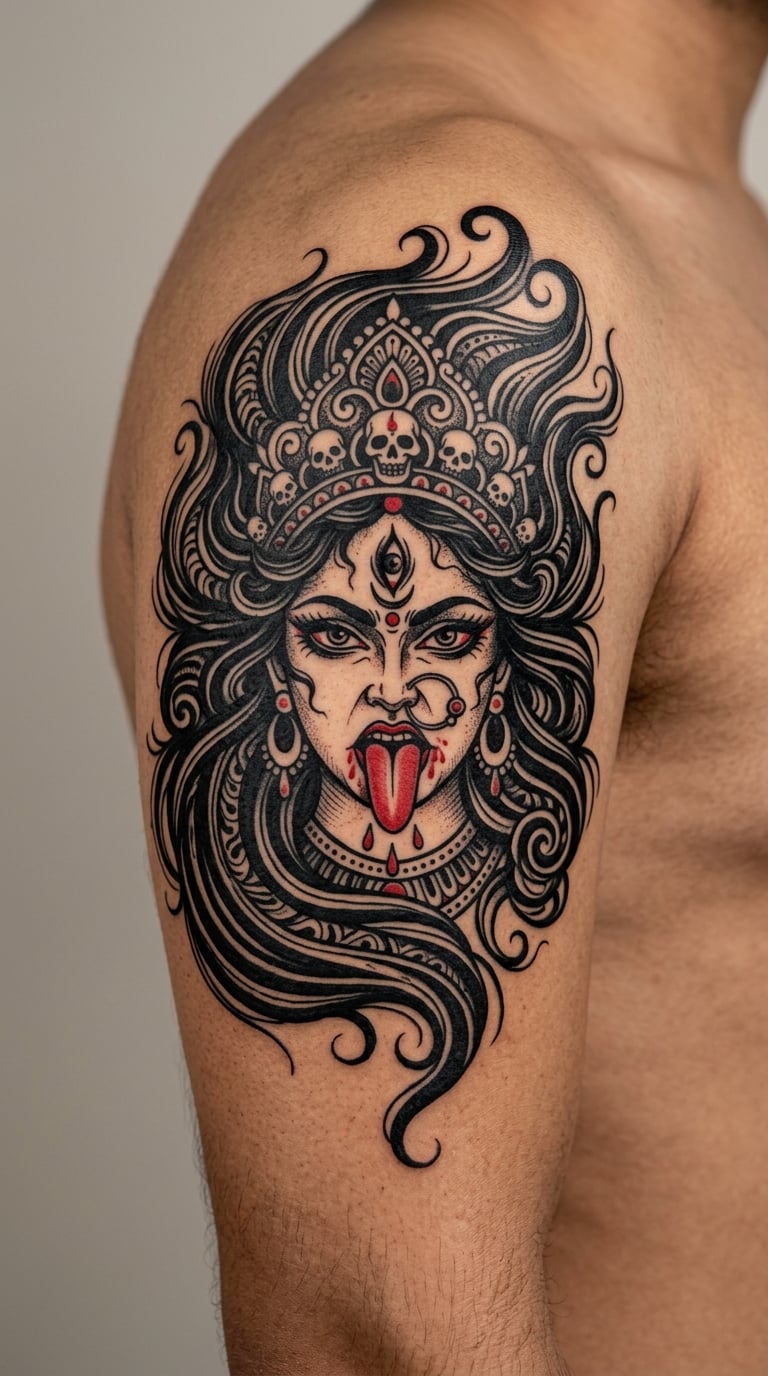
A bold Kali face drops nearly all the background and works in strong black shapes: wide eyes, dark flowing hair, a small bindi and a suggestion of a tongue. Heavy contrast makes it read as a graphic rather than an illustration, and the surrounding symbols stay out of the way.
Kali represents destruction of evil and of ego, and many wearers describe her as fierce protection rather than darkness. Placement: upper arm, thigh or calf. Size: 4-6 inches (10-15 cm) tall. Style: bold blackwork with one accent colour, often deep red. Pain: medium, and solid black fills are quicker than fine line.
Make it yours: keep the accent colour to a single element such as the eyes or the tongue, and ask for a soft grey halo instead of extra symbols.
11. Hanuman in Traditional Styling
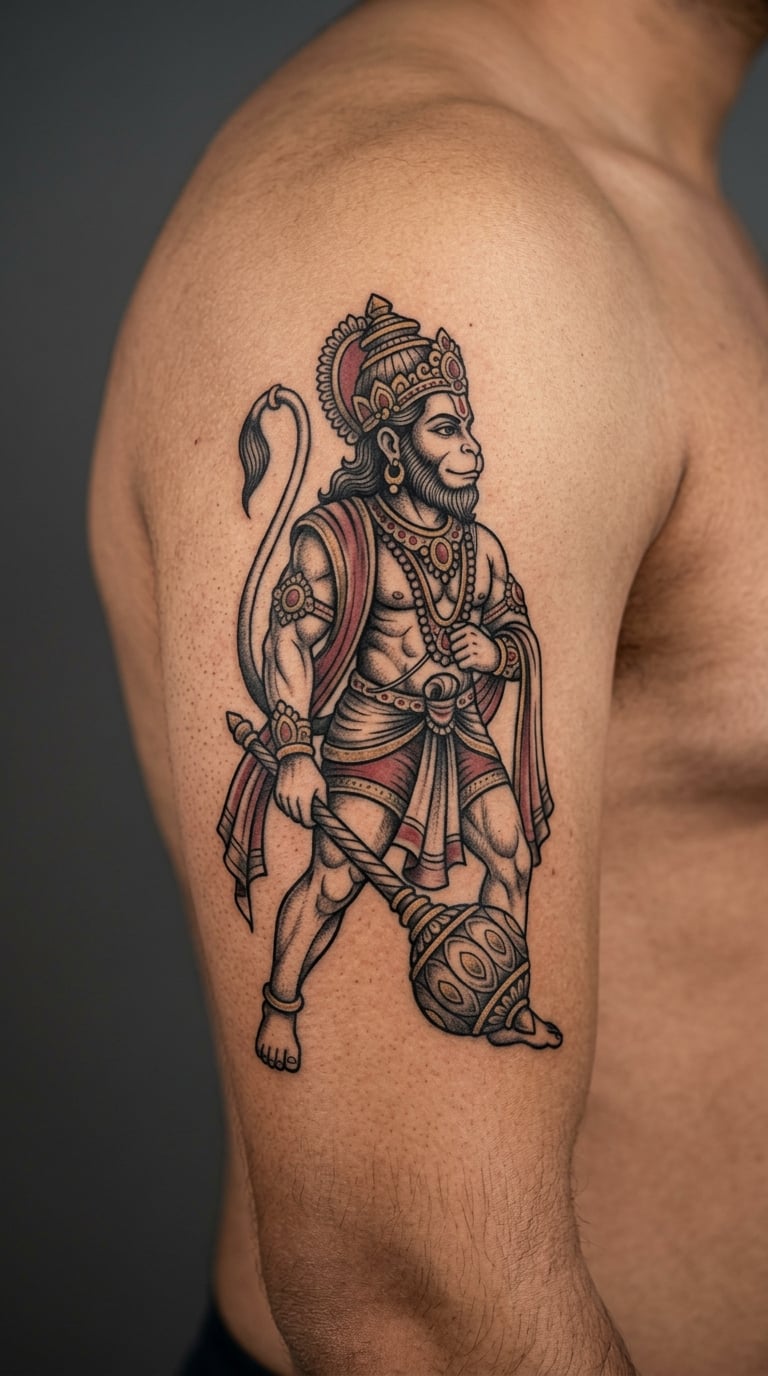
Traditional-style Hanuman is drawn with a firm black outline, a compact dynamic pose, a mace held to one side and a clear silhouette that reads across a room. Flat colour inside the outline gives it the look of classic tattoo flash rather than a portrait study.
Hanuman is associated with devotion, courage and strength, and the mace usually signals that strength directly. Placement: upper arm, shoulder or calf. Size: 5-7 inches (13-18 cm) tall. Style: traditional, bold outline with flat muted colour. Pain: medium, and colour passes add time.
Make it yours: have the mace sized to your own grip and the tail drawn in one confident curve rather than as a separate piece.
12. Peacock Feather with Sanskrit Word
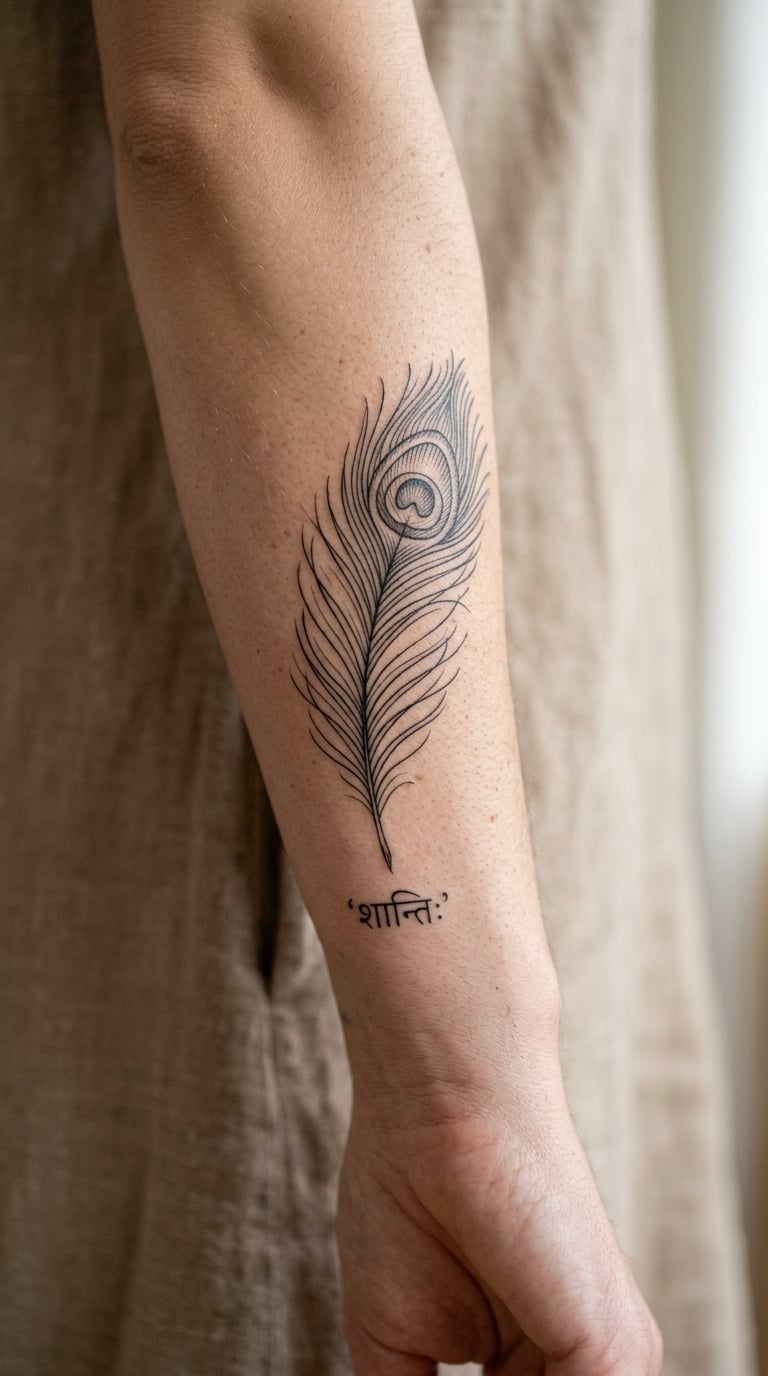
A single peacock feather is drawn with hundreds of fine barbs and one restrained eye motif, which gives you an organic shape that curves nicely along an arm. One verified word beneath it turns the feather into a piece with meaning rather than decoration alone.
The feather is associated with beauty, grace and the peacock of Krishna in Hindu tradition, and a single word underneath gives it a second layer. Placement: outer forearm, ribs or the side of the neck. Size: 4-6 inches (10-15 cm) long. Style: fine line with light dotwork in the eye. Pain: low on the outer forearm, and it needs patience rather than pain.
Make it yours: choose a word that has a natural number of characters so the lettering sits under the shaft without stretching.
13. Kalash with Vertical Devanagari Line
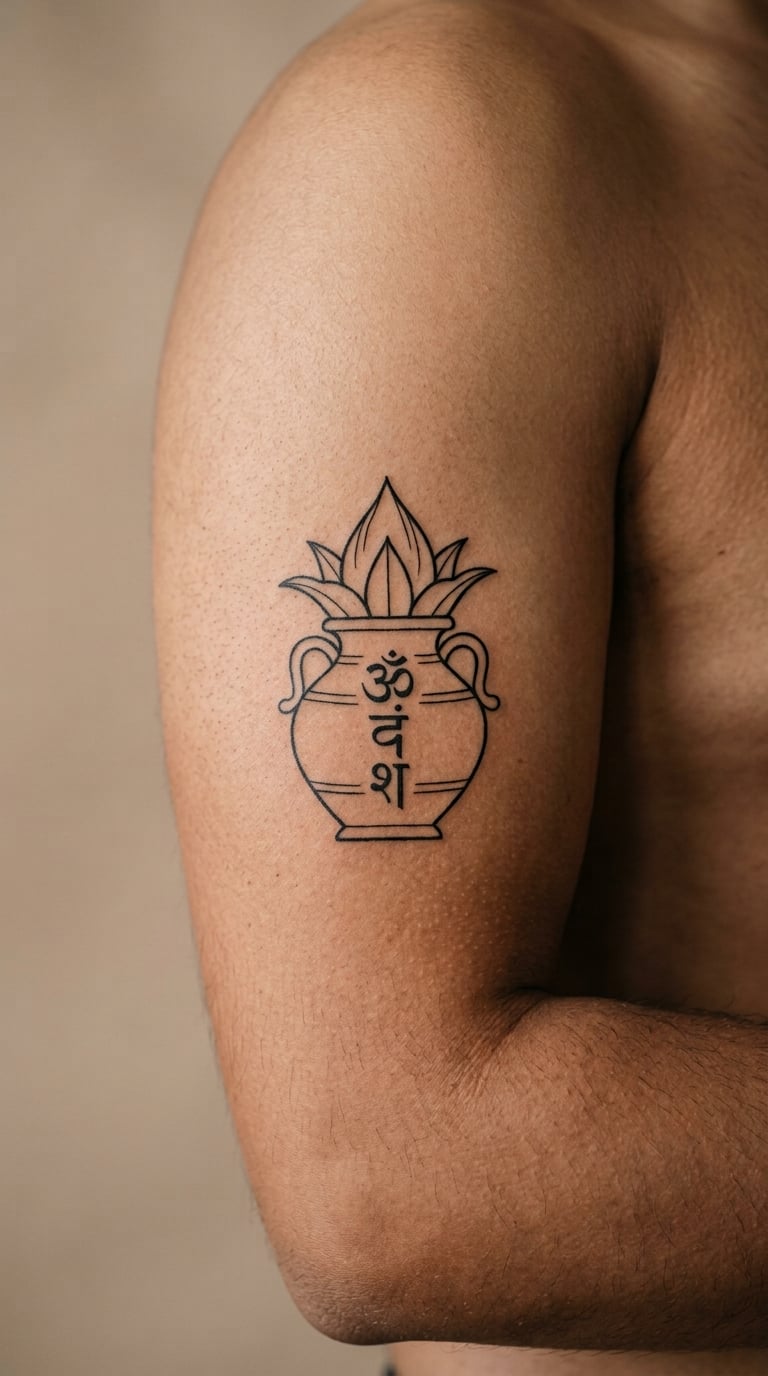
A kalash is a rounded vessel with a narrow neck and a wide decorative rim, and a minimal version is pure geometry: one curve, a neck, a rim. A vertical Devanagari line runs down the centre, and the negative space around it is what keeps the two readable.
The kalash is used in Hindu ceremonies and appears widely in festive decoration, so it reads as auspicious to many people who have no personal connection to the ritual. Placement: inner upper arm, back of the calf or behind the ear. Size: 3-5 inches (8-13 cm) tall. Style: minimal blackwork. Pain: medium, and the rim detail is the sensitive area.
Make it yours: add small mango-leaf shapes to the rim, or set your birth month in Devanagari inside the vessel itself.
14. Sanskrit Initial in Fine-Line Script
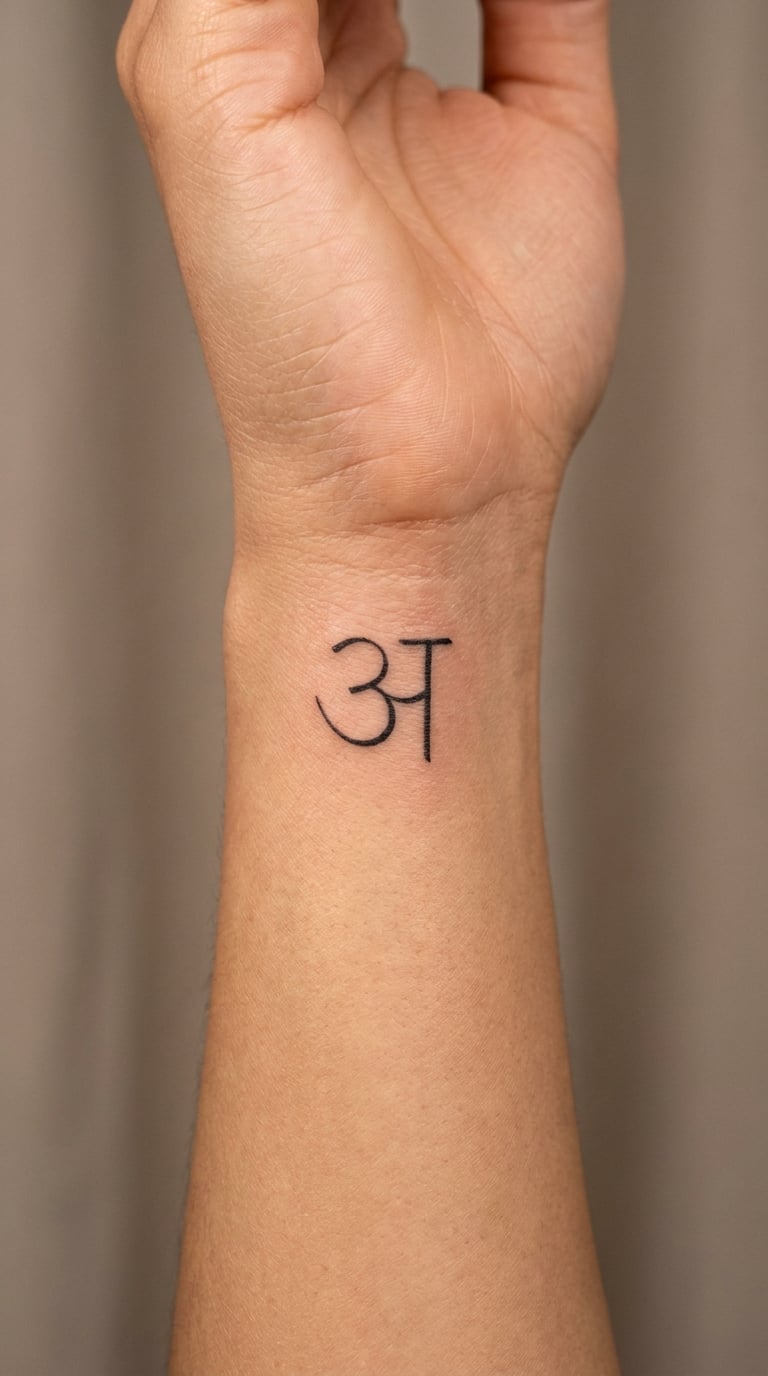
A single initial in Devanagari is the most discreet word tattoo there is, and with delicate flourishes on the vowel marks it can look like calligraphy rather than a letter. The character is verified once, then drawn once, which keeps the risk of an error low.
People usually pick the first letter of a name they carry, or a character whose meaning matters to them. Placement: wrist behind the thumb, inner wrist or behind the ear. Size: 1.5-2.5 inches (4-6 cm) tall. Style: fine-line script. Pain: medium, and wrist script softens fastest because skin moves constantly there.
Make it yours: add a matching second initial for a child or a partner in the same hand, spaced so both stay legible.
15. Short Sanskrit Word on the Side of the Ribs
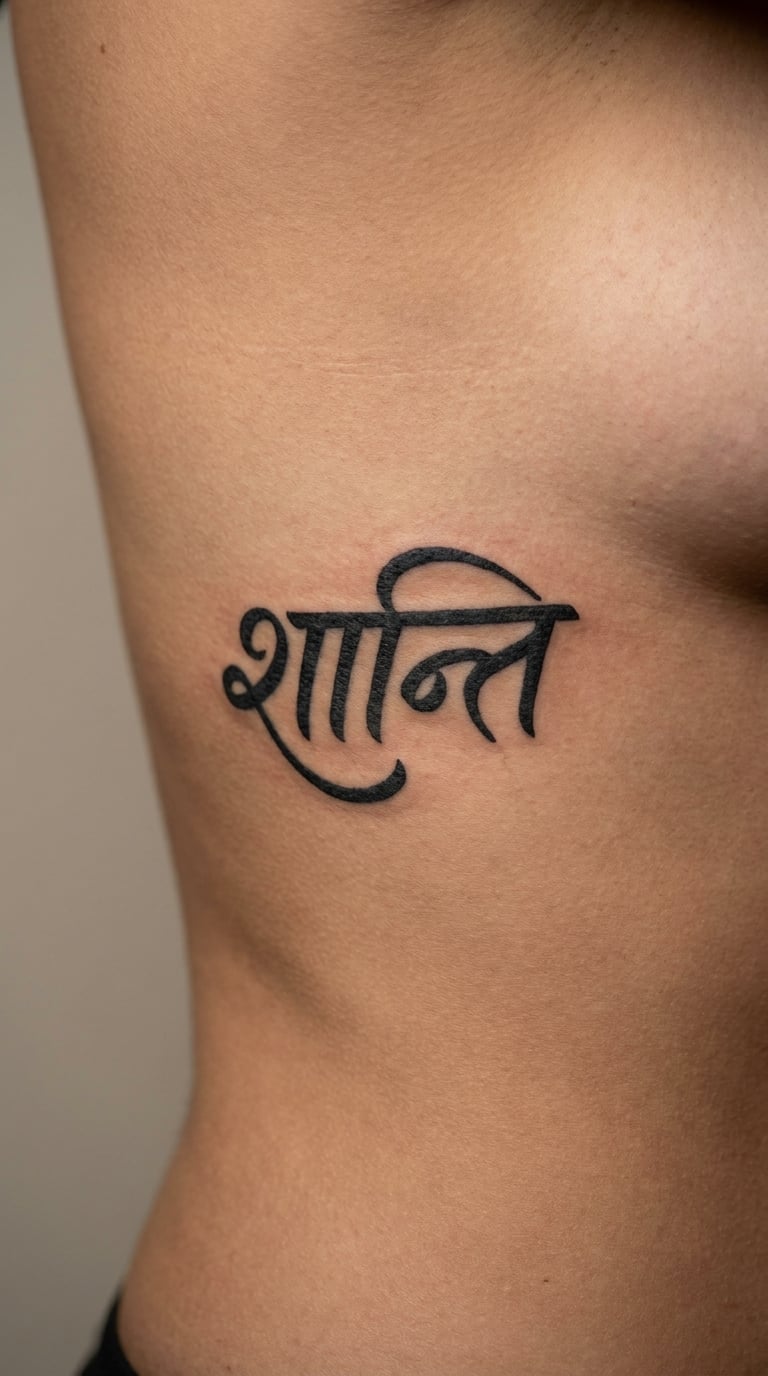
A short verified word set in crisp black script on the side ribs works because the baseline follows the curve of the body. Letters stay the same height and the spacing widens slightly toward the back, or the line looks stretched.
Ribs suit a word rather than a sentence, since anything longer turns into a belt of text you will read every time you breathe. Placement: side ribs, from the floating rib toward the flank. Size: 4-6 inches (10-15 cm) wide. Style: clean script, medium weight. Pain: high, and ribs are the spot people most often move.
Make it yours: curve the word to the body, or run it vertically between two ribs if you would rather feel it than see it.
16. Sanskrit Name in a Vertical Column
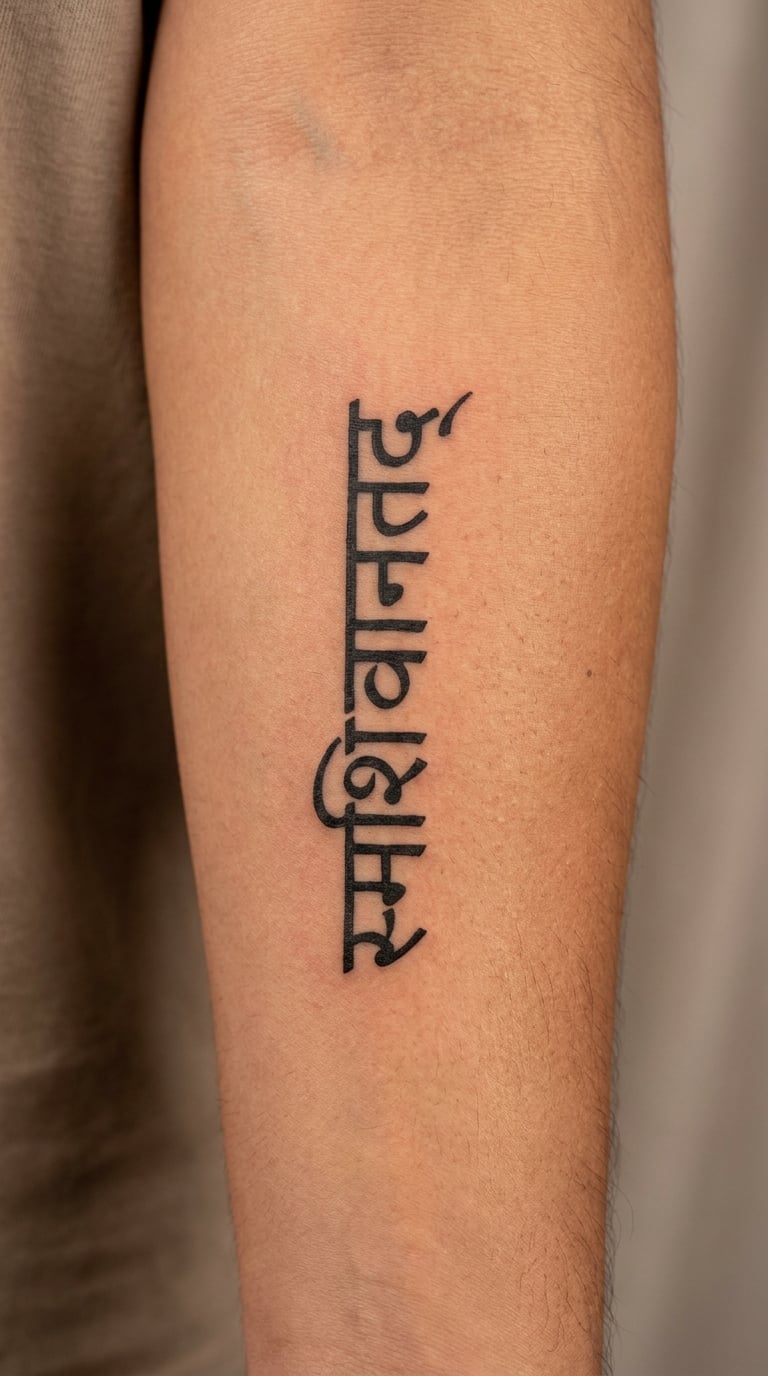
A name stacked into a vertical column runs down the inner forearm, with each character on its own line and consistent line weight throughout. The spacing between characters does more for readability than any amount of extra detail.
This is the format most people mean when they say they want a Sanskrit name tattoo, and it is also the one most often requested without checking the spelling first. Placement: inner forearm or along the spine. Size: 3-5 inches (8-13 cm) tall. Style: clean black script, vertical stack. Pain: medium, and the elbow area hurts more than the rest.
Make it yours: have the first letter of each line aligned in a column so it reads as a design as well as a name, and keep the character count down to a short name.
17. Traditional Paisley with Devanagari Detail
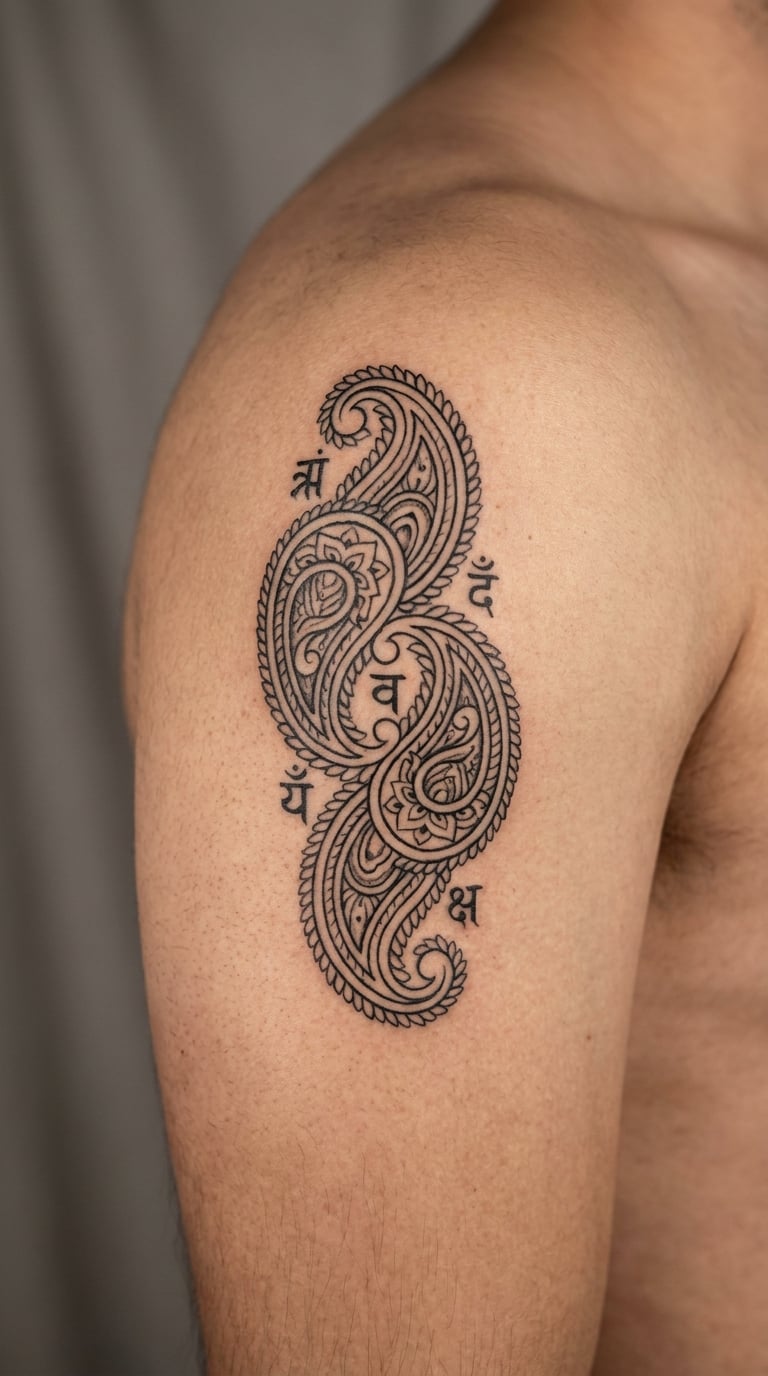
A paisley is a curved teardrop with a hooked top, and a detailed version is filled edge to edge with dotwork, small marks and a few characters tucked into the negative space. Two or three characters work; a full phrase in there turns to noise.
The paisley shape comes from Persian and Indian textile and jewellery traditions and reads as decorative rather than specifically religious. Placement: shoulder, outer thigh or along the calf. Size: 4-6 inches (10-15 cm) long. Style: dotwork and fine line. Pain: medium, and the dotwork is a long sitting rather than a hard one.
Make it yours: place the characters along the paisley’s inner curve so they follow the shape, and add your birth month in numerals at the tip.
18. Minimal Sanskrit Character on the Hand
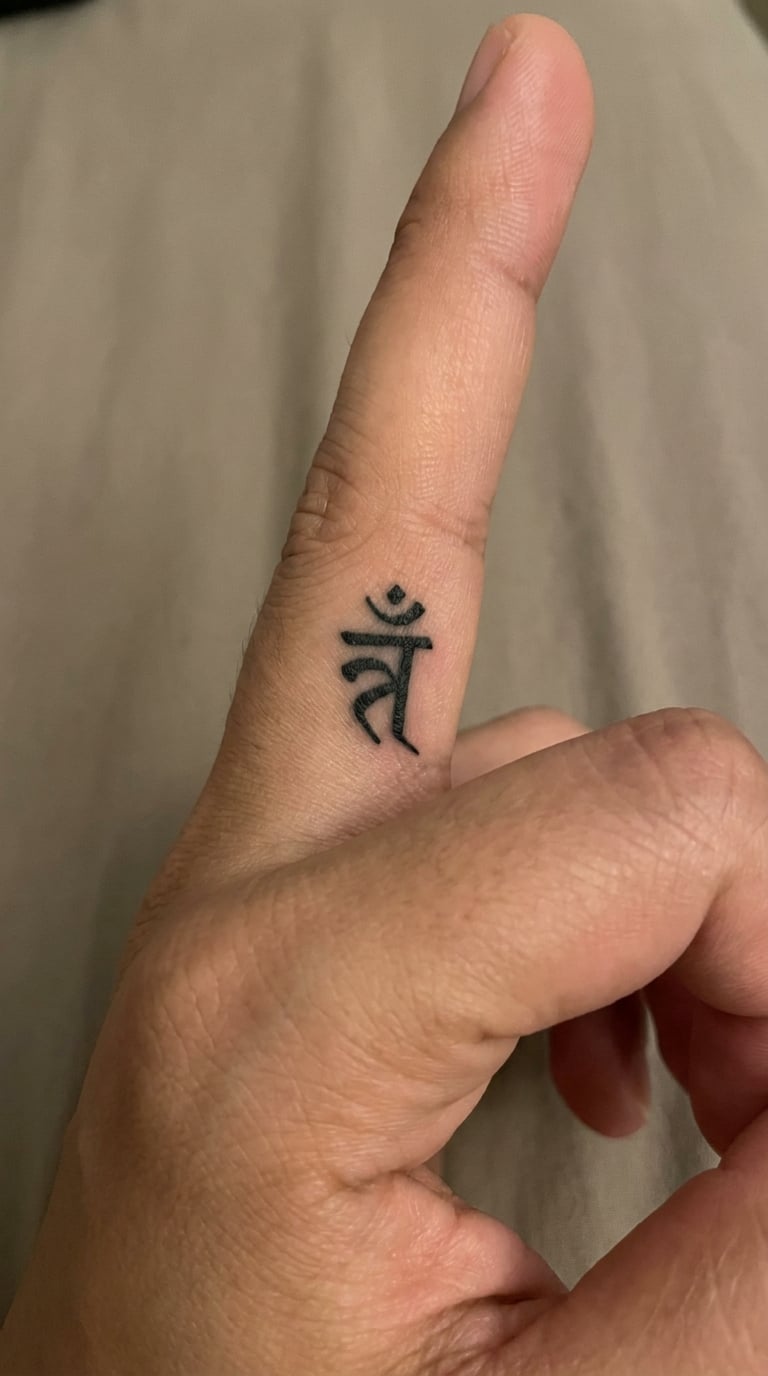
A single verified character on the side of the index finger is about as small as a word tattoo gets. At this scale the artist is drawing one letterform with a consistent line weight, not lettering, so pick a character with a simple shape.
Hand script is highly visible and highly worn, because hands are washed, weathered and used constantly. Placement: side of the index finger or the knuckles. Size: 1-1.5 inches (2.5-4 cm) tall. Style: micro script, one line weight. Pain: high, and fingers bleed more than any other placement.
Make it yours: use a palm-facing placement so it is only visible to you, and ask for a slightly heavier line weight than looks right on paper.
19. Full Om and Mandala Back Piece
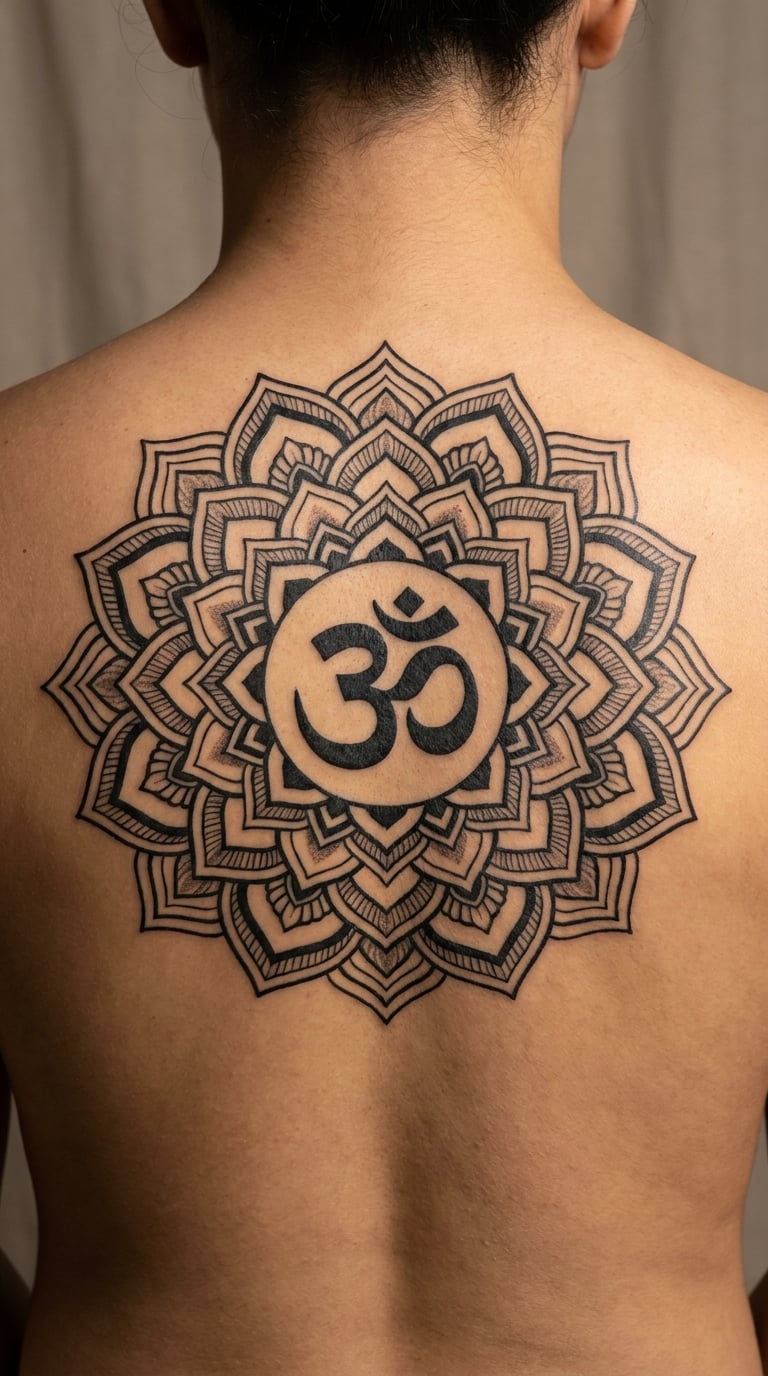
A full Om and mandala composition scales the two symbols most people recognise into one layered piece, with the Om sitting clear in the middle and the mandala rings radiating out around it. The centre stays open so the symbol is not swallowed by pattern.
This is a back-piece scale design for someone already building a collection, and it reads well from a distance in a way a small script tattoo never will. Placement: across the upper back or on a thigh. Size: 8-12 inches (20-30 cm) across. Style: layered blackwork. Pain: high, and it will be split across multiple sessions.
Make it yours: sketch the mandala rings first in pencil and test them against your back in a mirror before any line work starts.
20. Sanskrit Phrase Wrapped Around the Arm
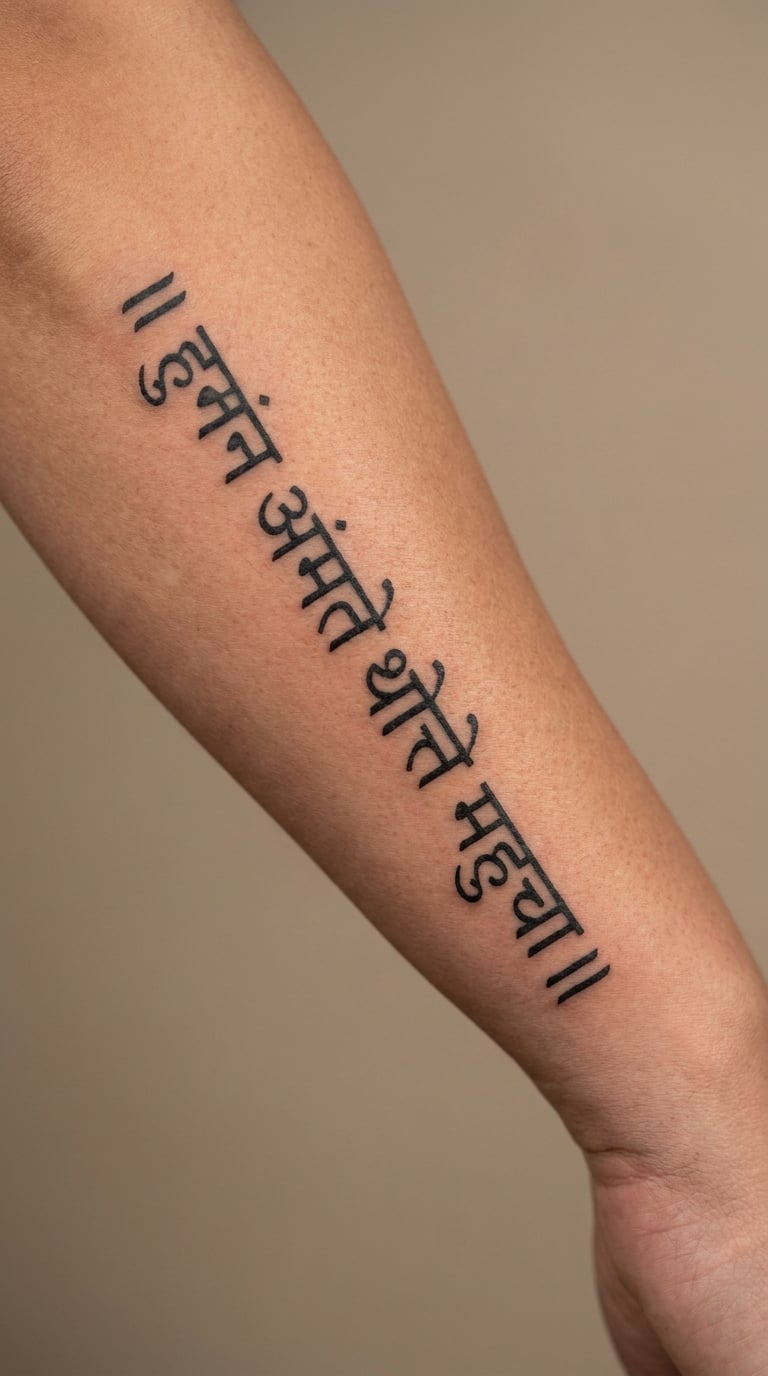
A verified Sanskrit phrase curved around the forearm works when the letter height stays constant from start to finish and the baseline follows the arm’s curve rather than a ruler. Spacing is measured, not eyeballed, or the words drift apart at the far side.
Phrases like Yat Bhavo Tat Bhavati (यत् भावो तत् भवति) are often split across two arms, or one line plus a small symbol underneath. Placement: outer or inner forearm, or wrapped around the upper arm. Size: 6-8 inches (15-20 cm) long. Style: curved script, bold enough to survive the bend. Pain: medium, and the side of the forearm is the tender strip.
Make it yours: have the artist mark the start and end points with a pencil before starting, and split a long phrase across two sittings rather than shrinking the letters.
How to Choose the Right Design
Pick the script length before the style. Devanagari needs more horizontal room than Latin lettering because of the headline bar and the vowel marks, so a long phrase forces small letters. A design that only works at a large size is a design you should plan the placement around, not squeeze onto a wrist.
- Words, phrases, mantras or symbols: a single character is easiest to get right and ages best. A full mantra needs 5 to 7 inches of clean space at minimum.
- Size and body location: inner forearm and ribs give you the longest run; wrist and nape give you a narrow strip. Small text on the wrist softens first because that skin moves and creases constantly.
- Wording accuracy: cross-check the Devanagari with a qualified Sanskrit reader, compare two independent sources, and print the line at final size to hold in your hand before booking. If two sources disagree, stop there and keep checking.
- Line weight and ageing: Devanagari has thin horizontal strokes. Ask your artist for a heavier single-needle line than looks right on a screen, because a decade of sun and skin movement will spread it.
- Cultural fit: people worry about whether Sanskrit tattoos are disrespectful, and it is a fair question. The people who get it wrong are the ones who never check the words and never think about why the phrase matters to them, not the ones who wear the language.
- Artist fit: bring the verified text to the consult and ask the artist to sketch the characterforms by hand. If they trace a screenshot without a transliteration to compare, choose someone else.
If you like the meaning-first approach rather than the imagery, 20 DNA tattoo ideas covers personal symbolism in a completely different visual language.
Cost and Session Time
Sanskrit tattoo cost is driven by the same three things every tattoo is driven by: hourly rate, shop minimum, and hours at the table. Most US shops sit somewhere around $120 to $200 an hour, and nearly all of them have a minimum charge that covers a small piece, so a 20-minute character still costs that floor.
| Size | Example | Time | Typical US range |
|---|---|---|---|
| Micro | Single character on the hand or wrist | 15-20 minutes | $80 to shop minimum |
| Small | One short word on the forearm | 30-45 minutes | $100 to $200 |
| Medium | Gayatri line, lotus with Om, deity portrait | 1-2 hours | $150 to $350 |
| Large | Nataraja or full Om and mandala back piece | 3 hours or more | $350 to $800+ |
Hourly rates vary enormously by city, and an artist who draws Devanagari well is worth searching for rather than settling for. Ask for the total session price before the first line, and ask whether the piece needs a second sitting in the quote rather than after. A back piece like the Om and mandala runs three hours or more and is nearly always split across sittings, so the second sitting is a separate charge in most shops.
Translation services for the wording are a separate cost from the tattoo itself, and they are the cheapest line in the whole budget. If an artist quotes a long phrase at the same price as a short word, the size is the reason, not a discount.
Aftercare Basics
- Follow your artist’s aftercare instructions first, since they know how deep the ink went and how much your skin moved during the session.
- Wash the area gently with clean water and unscented soap, then pat it dry. Do not scrub it.
- Keep it covered and out of direct sun while it heals, and skip swimming pools, hot tubs and saunas until it has fully closed over.
- Do not pick flakes or scabs, however tempting, and do not soak the area.
- Skip shaving over fresh script until the skin has settled, since hair removal lifts the new surface.
- Once healed, keep using sunscreen on exposed placements like forearms and ribs, because sun is what fades fine Devanagari fastest.
Frequently Asked Questions
What is the most important step before getting a Sanskrit tattoo?
Verify the Devanagari with someone qualified before the tattoo, not after. Show the exact text to a Sanskrit reader or scholar, compare two independent sources, and print it at final size to hold before booking. Most garbled tattoos trace back to a machine translation or a screenshot, and ink cannot be edited later.
Are Sanskrit tattoos suitable for small and discreet placements?
They are, within limits. A single verified character or short word of one to three inches works well on an inner forearm, wrist or behind the ear. Longer phrases need five to seven inches of clear space or the letters and vowel marks blur together. Check how much room your placement actually gives you before choosing the phrase.
How do Sanskrit tattoos age on the wrist and fingers?
They soften faster than almost anywhere else. Wrist and finger skin creases, moves constantly and is washed many times a day, so fine Devanagari strokes spread and fill in over the years. Ask for a heavier line weight than looks right on a screen, and expect small hand script to look more like a soft mark after a decade than a crisp letter.
How much does a Sanskrit tattoo usually cost in the US?
It depends on hourly rate, shop minimum and hours, not on the word itself. A micro character takes 15 to 20 minutes, a short forearm word 30 to 45, a mantra or deity portrait one to two hours, and a large back piece three hours or more. Most shops charge a minimum for small pieces, so a quick character still costs that floor. Get the total session price before the first line.
Should I choose a deity design or a word in Sanskrit?
A word is easier to get exactly right and easier to age well, because a short character has more room on the skin. A deity design carries more visual weight and reads as a full piece from across a room, but it needs five inches or more and the face is the part that softens first. Deity work also deserves a respectful reference source, which is worth doing for either option.
How can I make sure the Devanagari spelling is accurate?
Have it checked by a Sanskrit speaker or scholar, not by a translation app or an image search. Cross-check two independent sources, ask for the phrase’s source text where you can, and ask the tattoo artist to draw the characterforms by hand from a transliteration rather than tracing a screenshot. If the artist cannot say how they will check the script, find another artist.
Conclusion
For a first Sanskrit tattoo, the single initial, the minimal Om or the peacock feather with one short word are the safest picks: small enough to place discreetly, quick to heal and simple enough to have verified without drama. If you are already building a collection, the Nataraja, the Lakshmi with lotus and the full Om and mandala back piece are the ones that reward a bigger sitting.
Whichever you choose, verify the script with a qualified reader, print it at final size, and pick an artist who draws characterforms by hand. Do those three things and the rest of the decision is taste.