
22 Lace Garter Tattoo Ideas (October 2026): Delicate Designs
A lace garter tattoo is a band of lace-patterned ink that sits on the body like a real garter, usually around the upper thigh or hip. These 22 lace garter tattoo ideas cover everything from a whisper-thin scalloped edge to a full blackwork panel, so you can find one that matches how bold you actually want to be.
Lace is one of the trickier patterns to tattoo because it is made of very fine repeating lines, and fine lines fill in while they heal. A good artist simplifies the pattern on purpose so it stays readable in five years. If you are planning ahead, book the consultation a couple of months before you want the tattoo, since garters are often booked as multi-session pieces and autumn and spring fill up first.
22 Lace Garter Tattoo Ideas: Quick Guide
Here is every design below in one view, with the style, placement, rough size and expected pain so you can narrow your shortlist before a consultation.
| Idea | Style | Best placement | Size | Pain |
|---|---|---|---|---|
| 1. Fine-line wraparound | Fine line | Upper thigh | 2-3 in tall | Low to medium |
| 2. Black bow on the hip | Blackwork | Hip or outer thigh | 3-4 in wide | Medium |
| 3. Floral lace band | Floral line work | Upper thigh | 3-5 in wide | Low |
| 4. Red rose accent | Colour line work | Outer thigh | 3-4 in wide | Low |
| 5. Lace choker | Fine line | Front of neck | 1 in tall | Medium |
| 6. Upper arm band | Fine line | Upper arm | 2-3 in tall | Medium |
| 7. Wrist cuff | Micro fine line | Inner wrist | 1-1.5 in | Medium |
| 8. Traditional with red rose | Traditional | Upper thigh | 4-6 in wide | Low to medium |
| 9. Neo-traditional hearts | Neo-traditional | Upper thigh | 4-6 in wide | Low |
| 10. Behind the ear | Micro fine line | Behind ear | Under 1 in | Low |
| 11. Forearm ribbon | Fine line | Inner forearm | 5-8 in long | Medium |
| 12. Calf band | Ornamental | Upper calf | 2-3 in tall | Medium |
| 13. Watercolor pastels | Watercolor | Upper thigh | 4-5 in wide | Low |
| 14. Rib outline | Minimal fine line | Side ribs | 4 in long | High |
| 15. Butterfly detail | Fine line | Upper thigh | 3-4 in wide | Low |
| 16. Blackwork peony | Blackwork | Outer thigh | 6-9 in tall | Low to medium |
| 17. Matching couples piece | Fine line | Wrist or ankle | 1-2 in | Medium |
| 18. Pearl detail | Ornamental | Outer thigh | 3-4 in wide | Low |
| 19. Wedding-dress tribute | Fine line | Upper thigh | 2-4 in | Low |
| 20. Lower back panel | Ornamental | Lower back | 8-12 in wide | Medium |
| 21. Collarbone design | Fine line | Collarbone | 3-4 in long | Medium |
| 22. Large thigh panel | Illustrative blackwork | Outer thigh | 8-12 in tall | Low to medium |
1. Fine-Line Lace Garter Wraparound the Thigh
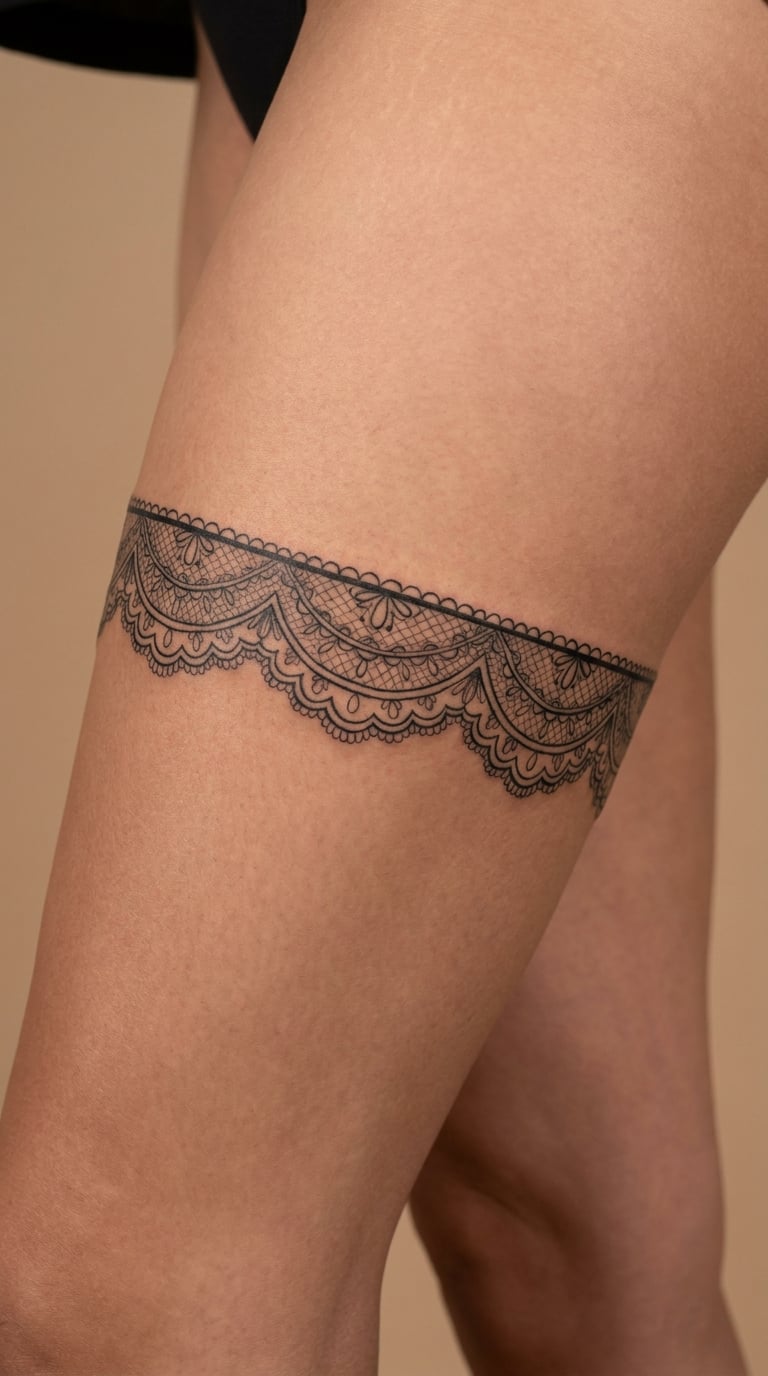
This fine-line lace garter tattoo wraps partway around the upper thigh with a single band of scalloped lace and almost no shading. A good artist keeps the lace edge to one clean line weight so the pattern stays crisp after healing, and stops the band partway round so it reads as a wrap rather than a closed ring.
People choose it because it is decorative without being loud, and it hides easily under jeans or a skirt. It also gives you a first tattoo with real presence without a heavy commitment to black ink.
Placement: outer upper thigh, mid-way between hip and knee · Size: 2-3 in (5-8 cm) tall, wrapping roughly half the thigh · Style: fine line · Pain: low to medium on the thigh, since the flesh is thick over bone. Fine line ages faster than bold work, so expect a light touch-up every few years.
Make it yours: have the artist simplify the lace into a repeating fan of three or four scallops rather than copying a real garment, which keeps the pattern cleaner at small scale.
22 Lace Garter Tattoo Ideas in Fine Line
Fine line suits a first tattoo because there is no heavy shading to cover up if a line drifts. The trick is the opposite of adding detail: the artist rebuilds lace from a handful of repeating arches, keeps line weight consistent, and leaves the open spaces genuinely empty so the pattern has room to spread as it heals.
Placement matters more than detail here. On a flat-ish area like the outer thigh a fine lace band can hold a tight pattern; on a curve like the rib or a joint, the same design stretches and the arches start to close up. If you are choosing among these 22 lace garter tattoo ideas and want the delicate version, pick a flatter site and a smaller design over a curved one with lots of lace.
2. Black Lace Garter with Bow on the Hip
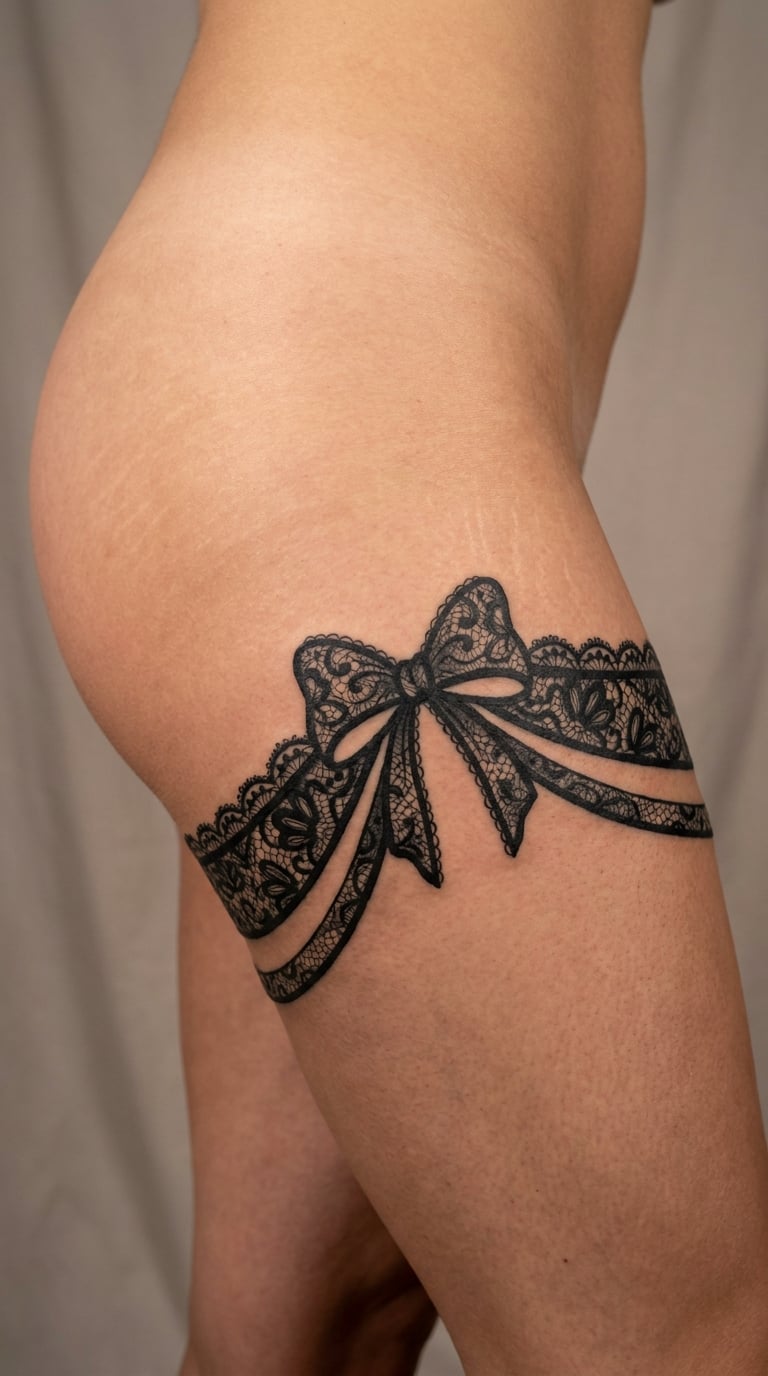
A black lace garter tattoo on the hip is drawn with solid black lace shapes rather than thin outlines, so the pattern reads at a distance. The band curves with the hip bone and a single bow sits on the outer edge, off to one side rather than dead centre.
This is the bolder cousin of the wraparound, and people often get it when they already have a small piece and want something that holds up next to it. The bow gives the composition an anchor.
Placement: hip or upper outer thigh, following the curve of the hip bone · Size: 3-4 in (8-10 cm) wide · Style: blackwork · Pain: medium, higher on the hip bone itself and easier on the soft part above it. Solid black holds its shape well, so this style fades more slowly than a fine-line band.
Make it yours: move the bow to sit on the front of the hip so it is visible when you stand side-on rather than from behind.
3. Floral Lace Garter on the Upper Thigh
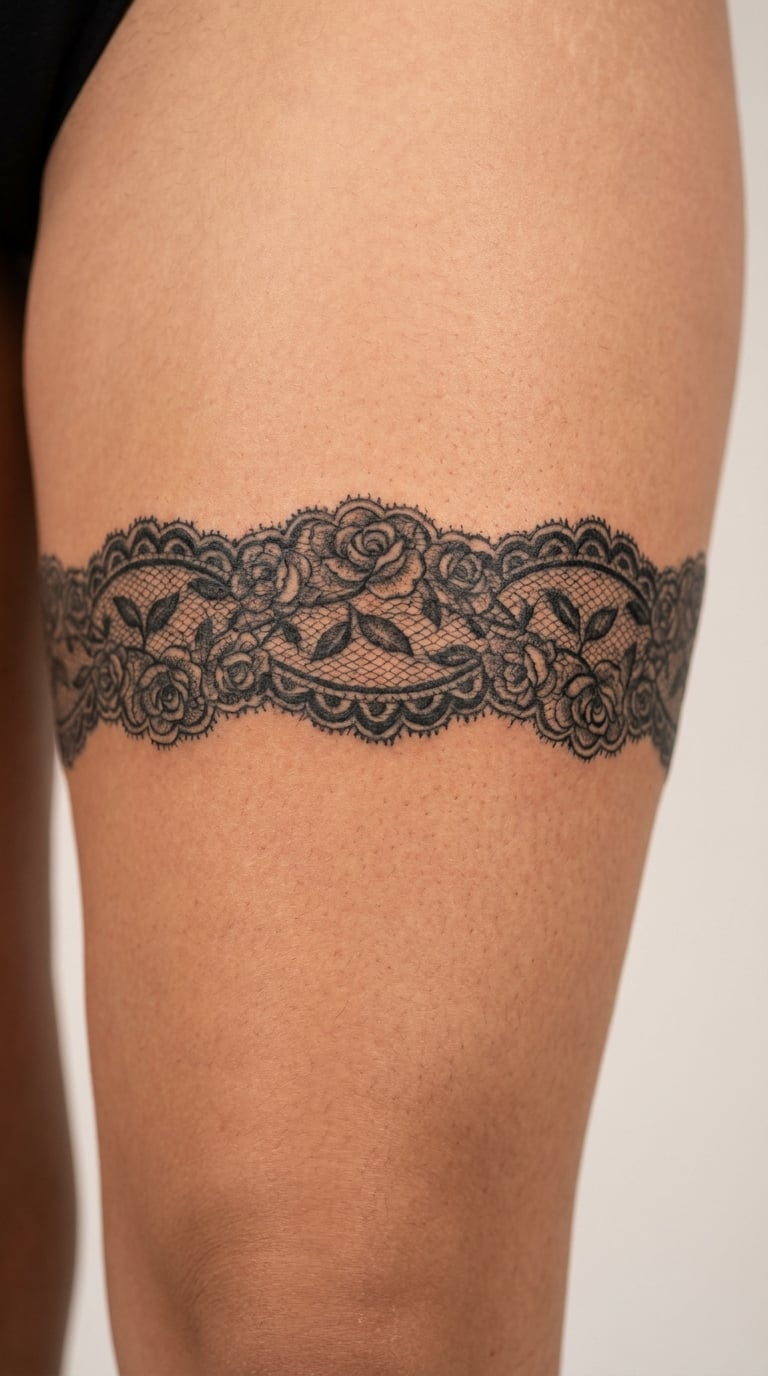
Here the lace trim is joined by small botanical details, usually roses, lavender sprigs or a few leaves threaded through the arches. The lace stays a band rather than becoming a full bouquet, which keeps the piece balanced and stops it reading as a flower tattoo with a ribbon in it.
Florals are the most requested addition in this theme, and the reason is practical. The lace gives the design structure, and the flower gives it a focal point, so the eye has somewhere to land.
Placement: upper thigh, band running horizontally · Size: 3-5 in (8-13 cm) wide · Style: floral line work with light grey shading · Pain: low. The small petal shading needs a steady hand and may take a second session, but the pain stays low.
Make it yours: use one flower type you actually like instead of a mixed bouquet, and let it sit at the centre of the band.
4. Red Lace Garter with Rose Accent
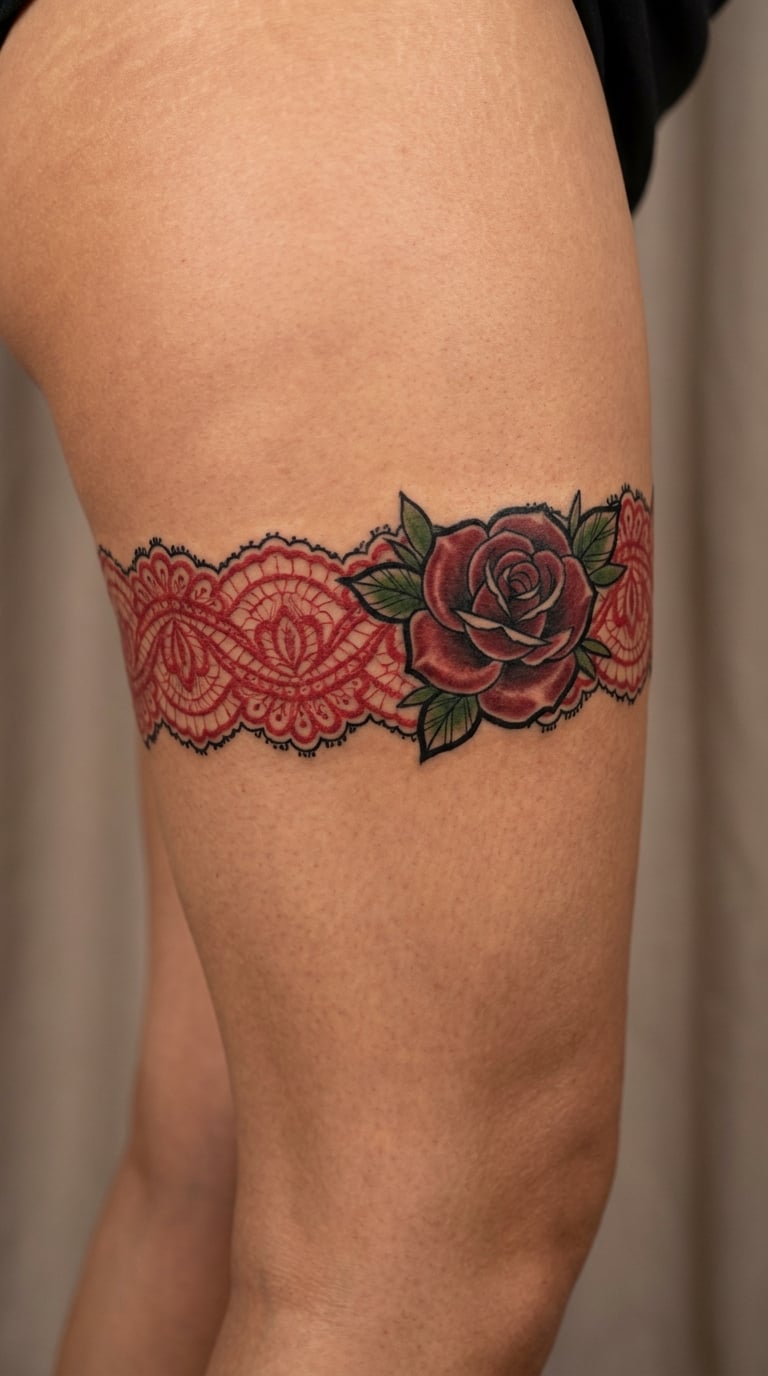
This version keeps the lace in black line work and adds colour in one place only, usually a single rose or a thin red edge along the top scallop. Selective colour is what stops the piece turning into a wall of red, and it makes the accent rose the first thing people see.
Most people who choose it want a small piece of colour in an otherwise classic design. The red reads well against skin without needing a second colour to balance it.
Placement: outer thigh or hip · Size: 3-4 in (8-10 cm) wide · Style: colour line work with black outline · Pain: low. Red fills in more than black, so the artist usually lays a lighter wash rather than a solid block.
Make it yours: ask for the rose in a deep red rather than bright pink, and add a single grey-shaded leaf so the colour is not isolated.
5. Lace Garter Choker Design at the Neck
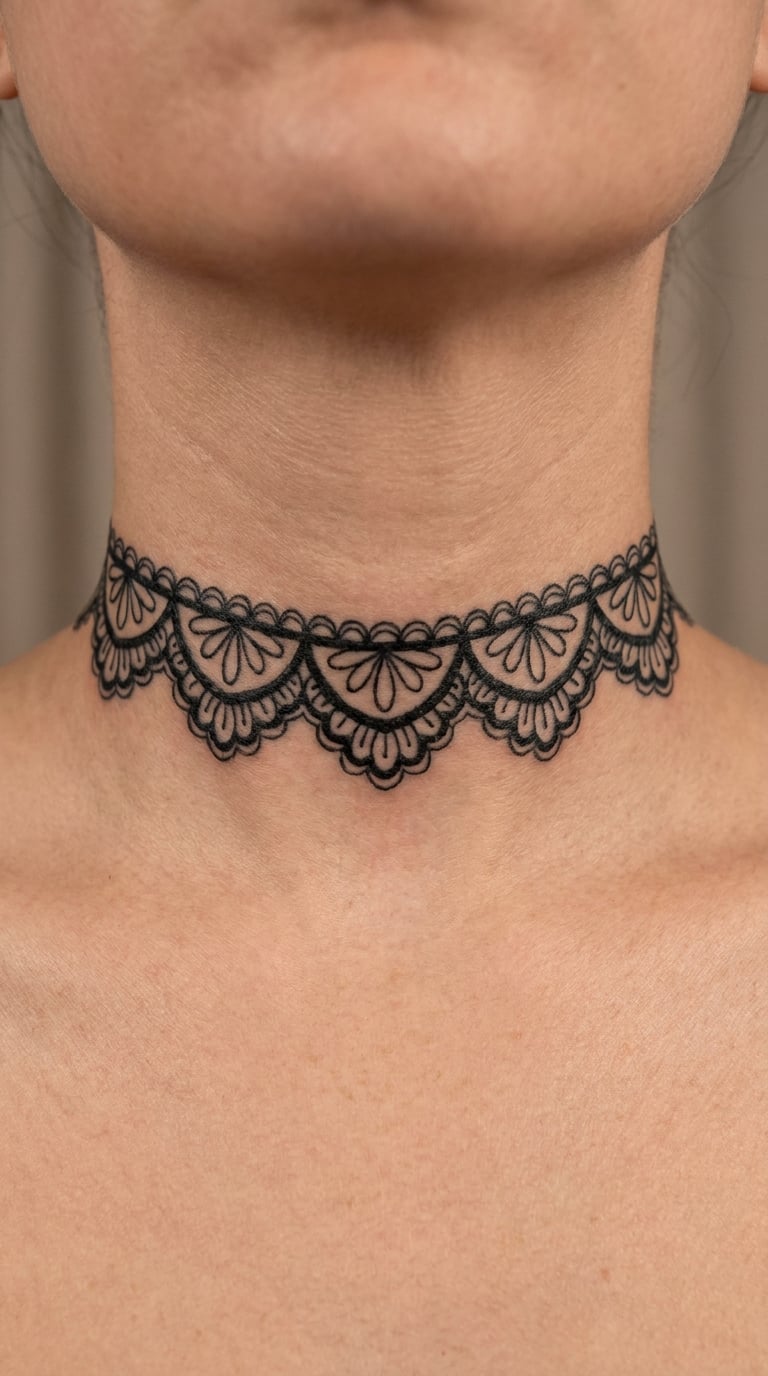
The neck version is not a literal garter. It is a lace-like band that sits like a choker, with narrow ribbon shapes and symmetrical scallops meeting at a small central detail. Keeping the design abstract is what makes it work on the front of the neck, where a full garter shape would be cramped.
It suits people who like the idea of a garter but want a piece that reads as jewellery from across a room. The neck is also a spot most people treat as off-limits for a first tattoo, so check with your artist before you commit.
Placement: front of the neck, just above the collarbone · Size: about 1 in (2.5 cm) tall, 3 in (8 cm) across · Style: fine line · Pain: medium. The neck is thinner skin over sensitive spots, and you will feel every line.
Make it yours: add tiny date numerals in the ribbon tails, kept to the same line weight so the band stays even.
6. Lace Garter Band Around the Upper Arm
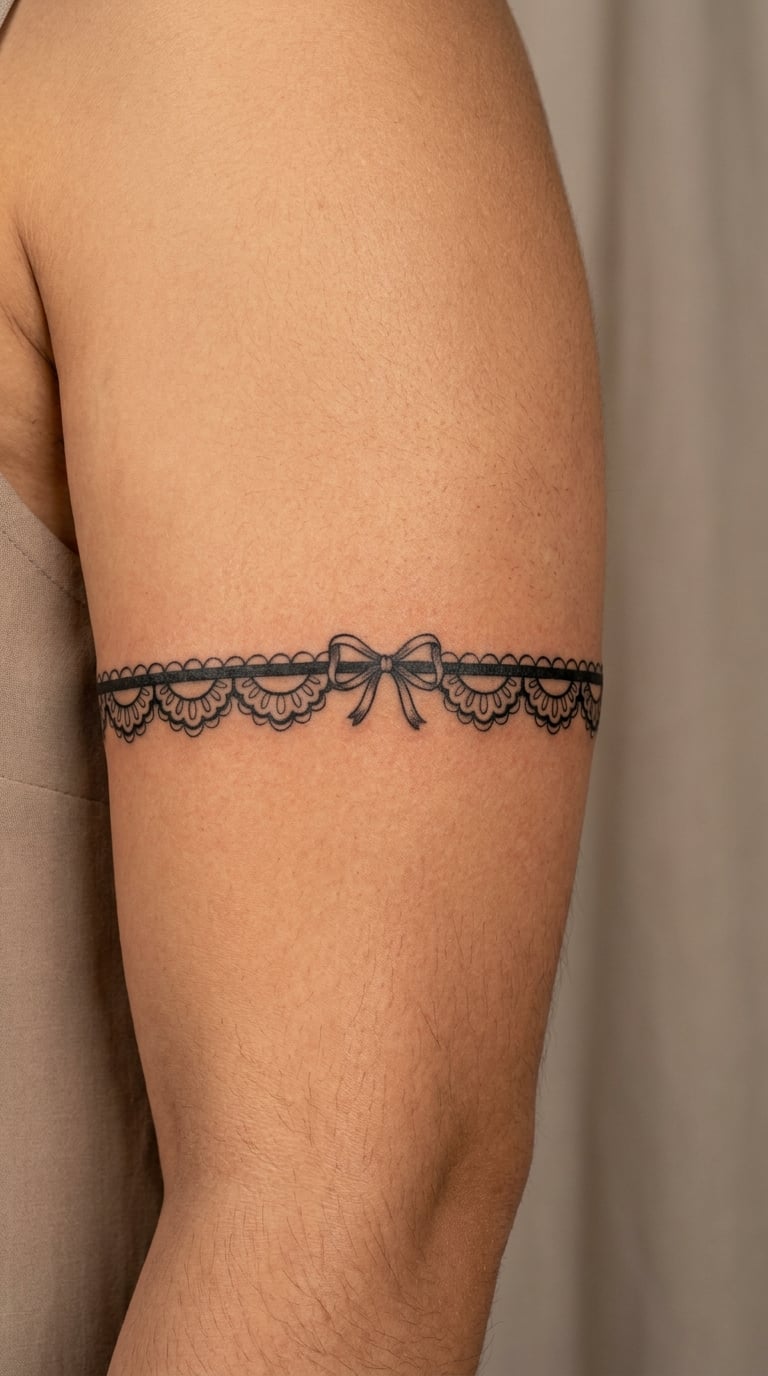
A horizontal band of repeating lace arches sits around the upper arm with a small bow, and the whole thing follows the arm’s natural curve rather than sitting flat. The band is drawn slightly angled so it looks like fabric resting on the arm, not a sticker applied to it.
Upper arm placement is a good pick for anyone who wants a leg-inspired design with easier concealment under a sleeve or a loose shirt.
Placement: upper arm, about a third of the way down from the shoulder · Size: 2-3 in (5-8 cm) tall, wrapping most of the arm’s circumference · Style: fine line · Pain: medium on the outer arm, gentler on the inner side where there is more soft tissue. The bicep side bruises more visibly afterwards.
Make it yours: mirror the bow to the back of the arm so you can see it when you turn your shoulder, which hides a small piece nicely.
7. Lace Garter Cuff on the Wrist
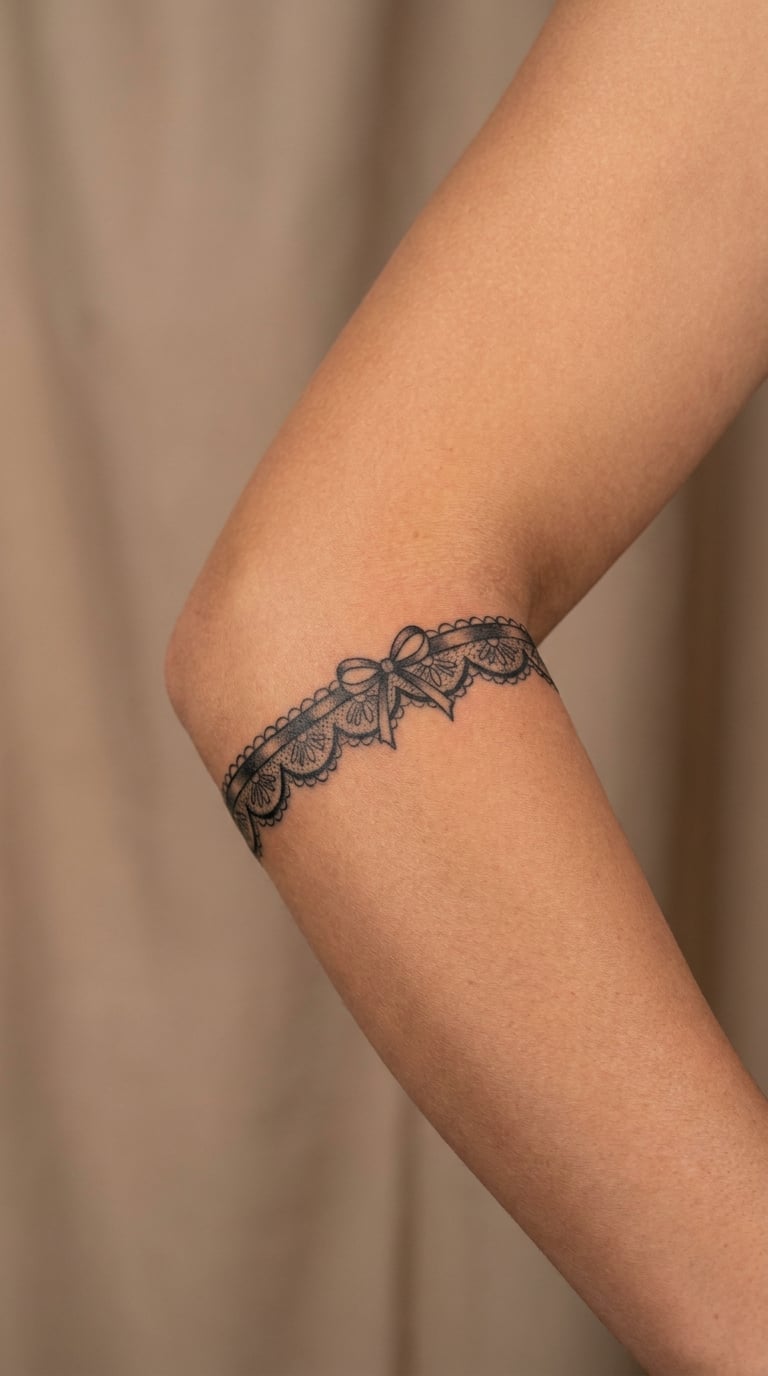
The wrist version shrinks the idea to a small scalloped edge with a tiny bow or an ornamental clasp, often no more than a few arches wide. It is the most delicate option in this list and the one most likely to need a touch-up.
Wrists move all day, and fine detail on a joint softens faster than on a flatter area. I would still wear one happily, just with realistic expectations about how it looks after a few years.
Placement: inner wrist above the bone, or outer wrist near the thumb · Size: 1-1.5 in (2.5-4 cm) · Style: micro fine line · Pain: medium, and it stings more than a thigh piece because the wrist is bony.
Make it yours: have the artist draw the lace larger than you think you want. Micro lace at wrist scale is the version most likely to blur.
8. Traditional Lace Garter with Red Rose
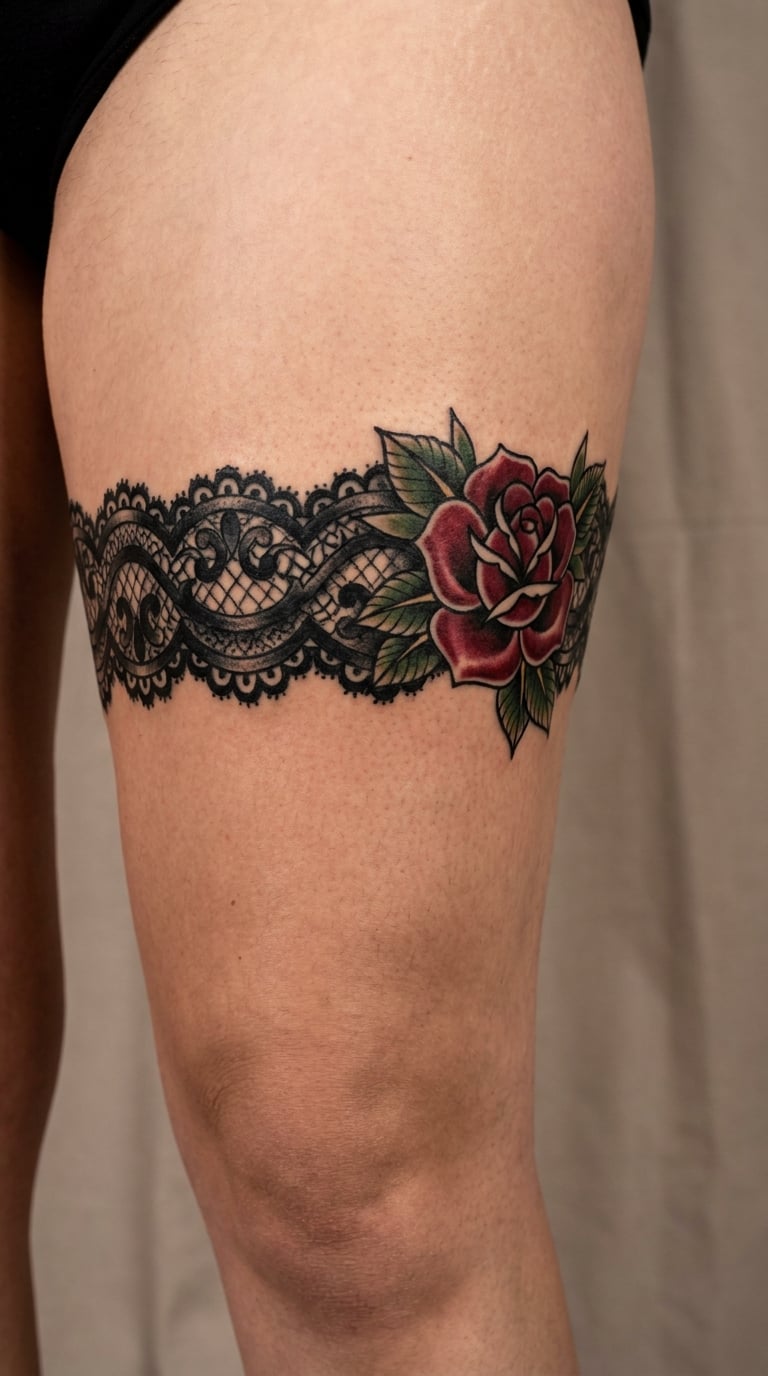
Traditional style brings heavy black outlines, a clearly defined rose in muted red and lace motifs drawn with more solid black than a fine-line version. The bigger line weight means the pattern keeps its shape over time, which is the practical reason to go this way rather than delicate.
It reads as a vintage tattoo rather than a modern one, and people often choose it to sit alongside older pieces or a traditional sleeve.
Placement: upper thigh, band sitting level · Size: 4-6 in (10-15 cm) wide · Style: traditional · Pain: low to medium. The solid black takes longer, so expect a longer sitting, but thigh skin is forgiving.
Make it yours: ask for a slightly muted red on the rose instead of a bright fill, which is closer to traditional shading and ages more evenly.
9. Neo-Traditional Lace Garter with Hearts
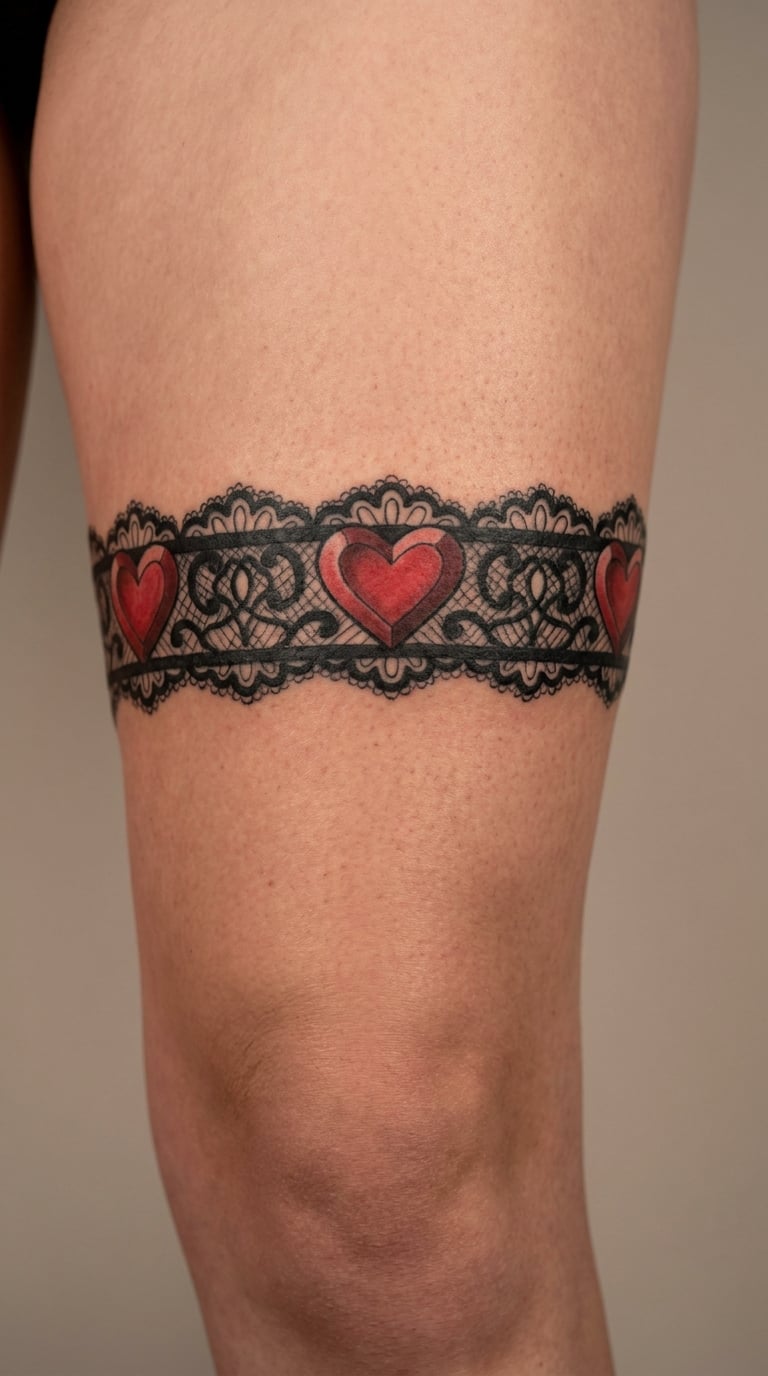
Neo-traditional is the smooth, dimensional cousin of the old-school style: hearts with soft gradients and highlights, rich black lace with a bit of shine left in it, and a cleaner overall shape. A pair of hearts usually sits centred in the band with lace arches running out to either side.
It feels romantic without needing any invented symbolism, and the larger hearts give the design a focal point that holds up at a distance.
Placement: upper thigh · Size: 4-6 in (10-15 cm) wide · Style: neo-traditional · Pain: low. The gradients need repeated passes, so book a longer session rather than a quick one.
Make it yours: use a heart with a small lace tie or ribbon through it instead of a plain heart, tying the motif back to the band.
10. Lace Garter Behind the Ear
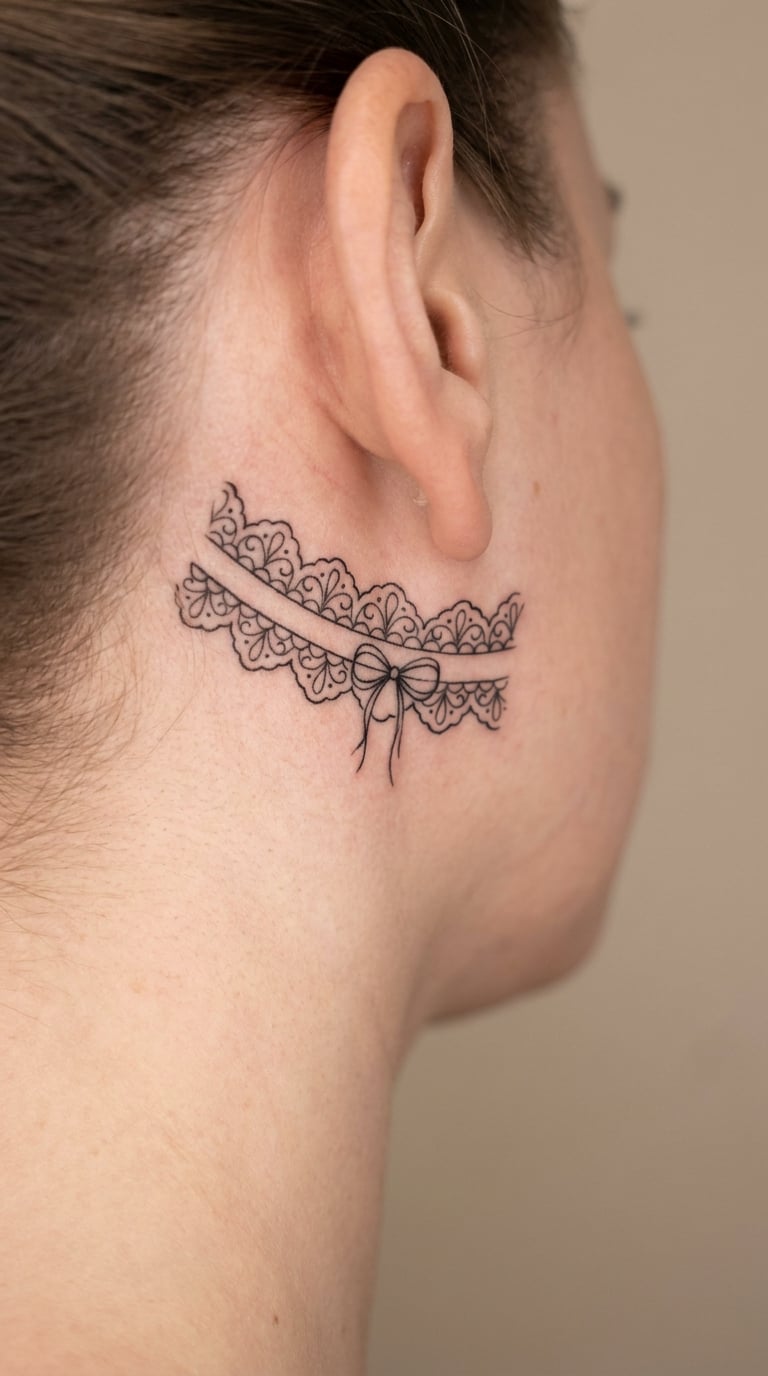
Behind the ear, the design becomes an abstract hint of a garter: two or three scalloped lace edges and a very small bow, tucked into the space between the ear and the hairline. The spacing matters more than the detail, because anything too close together merges in the shadow of the ear.
It is a private piece. Most people who get one tell people about it rather than show it, and that is part of the appeal.
Placement: directly behind the ear, or just below the lobe · Size: under 1 in (2.5 cm) · Style: micro fine line · Pain: low, though the skin is thin and the noise of the machine is close.
Make it yours: place one small lace edge behind each ear. A matched pair like this is listed in more detail in the matching tattoo ideas for a group of five.
11. Lace Garter Ribbon Down the Forearm
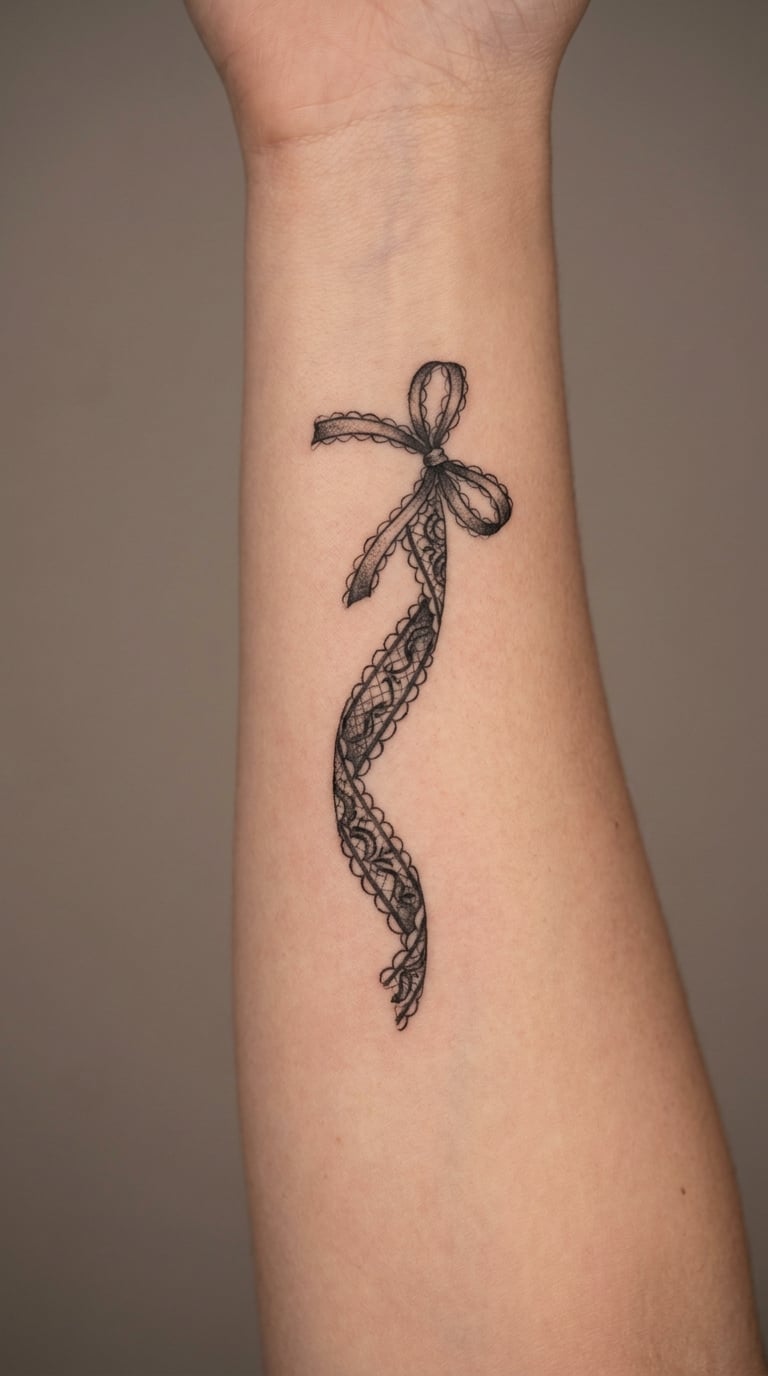
Instead of a band, this design runs a long strip of lace or ribbon vertically down the forearm with a small bow near the top and the tails trailing below. Vertical pieces use the length of the forearm rather than its circumference, so the composition feels open rather than closed.
Orientation is the whole decision here. A ribbon that follows the inner forearm curves with you; one on the outer arm stays straighter but catches more sun.
Placement: inner forearm, wrist to mid-forearm · Size: 5-8 in (13-20 cm) long, 1-2 in (3-5 cm) wide · Style: fine line · Pain: medium, worse near the wrist and easier as you move up the arm.
Make it yours: add a few initials at the bottom of the ribbon tail where the lines already taper, so the text does not need its own weight.
12. Lace Garter Placement Guide on the Calf
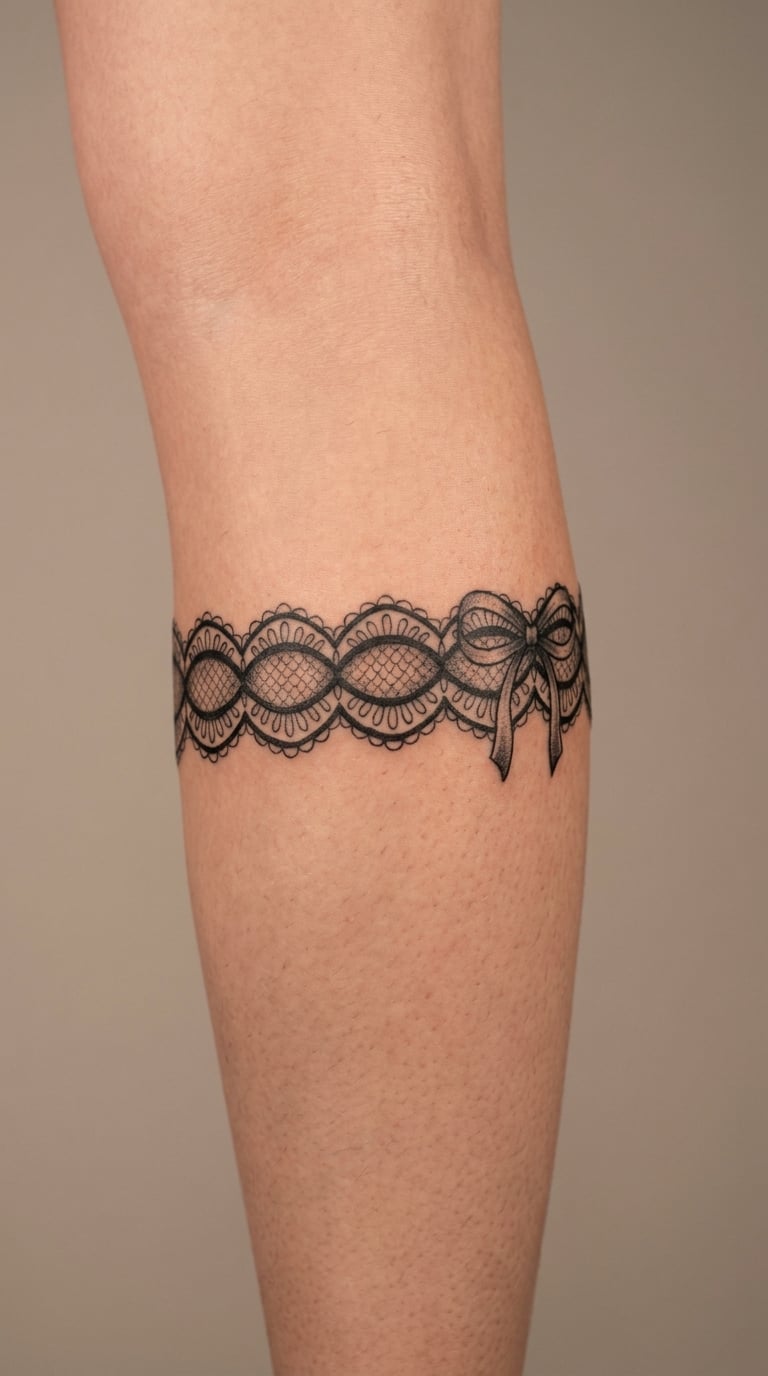
A wider lace band sits around the upper calf, curved to follow the leg and left open at the front with a small bow closing the gap. The calf is a good site because the shape is fairly even, but the design still has to curve: a straight band looks pasted on.
Lower-leg placement reads more like a leg band than a garter, which changes the feel completely. It suits people who want the motif lower on the body than the thigh allows.
Placement: upper calf, or narrow above the ankle · Size: 2-3 in (5-8 cm) tall · Style: ornamental · Pain: medium. The calf muscle tenses during the session, which people find more distracting than the pain itself.
Make it yours: add a second thinner band a few inches below the first so they read as a pair of leg bands rather than a single ring.
13. Watercolor Lace Garter with Pastel Shading
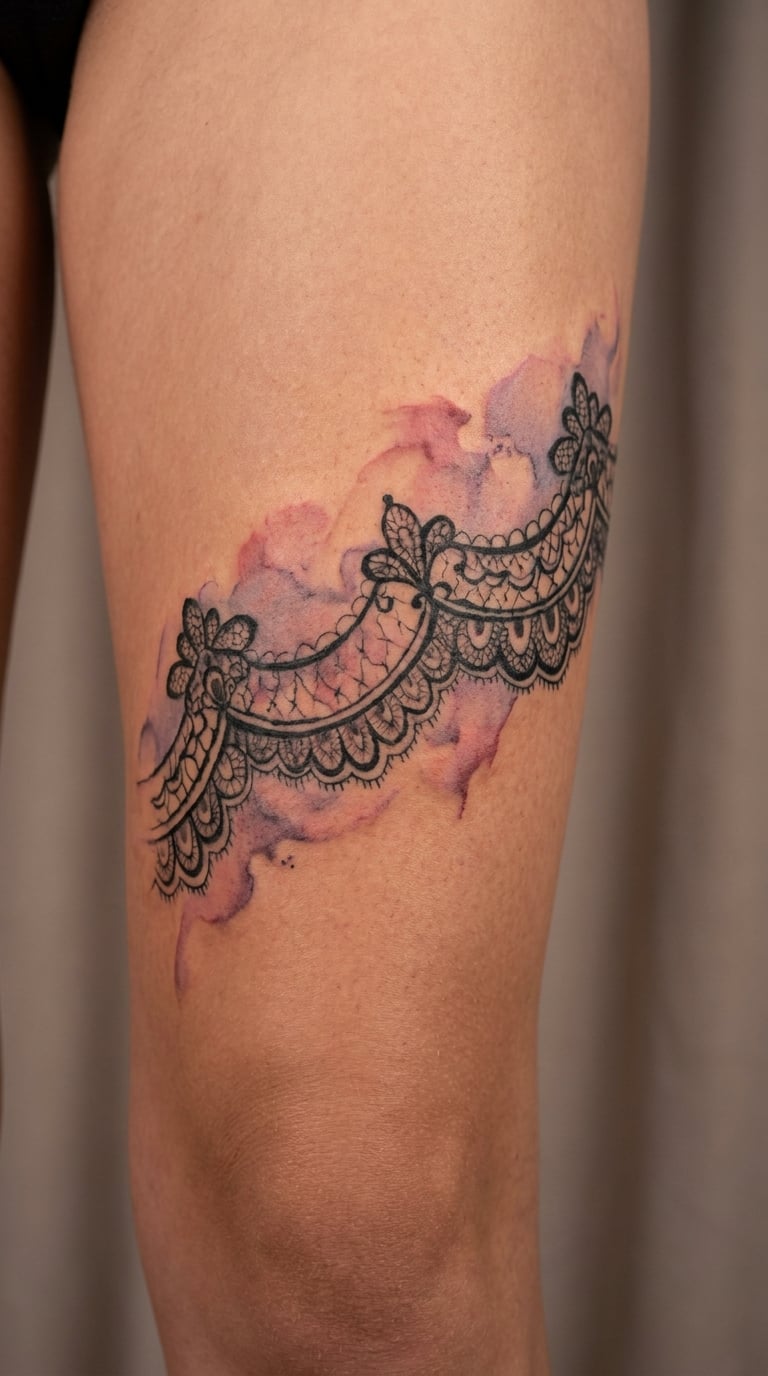
Watercolor here means translucent washes of pink, lavender or pale blue drifting around solid black lace line work, with the colour deliberately loose at the edges. The contrast between the sharp lace and the soft wash is what makes the design feel alive rather than printed.
It suits people who find solid black too severe. Just plan for a touch-up, because the pale washes fade much faster than line work does.
Placement: upper thigh or hip · Size: 4-5 in (10-13 cm) wide · Style: watercolor with black line work · Pain: low. Watercolour layering takes passes over the same skin, so expect a longer session and a tender thigh afterwards.
Make it yours: pick one wash colour that matches something you already wear, so the piece still looks deliberate once the pastel has softened.
14. Minimal Lace Garter Outline on the Ribs
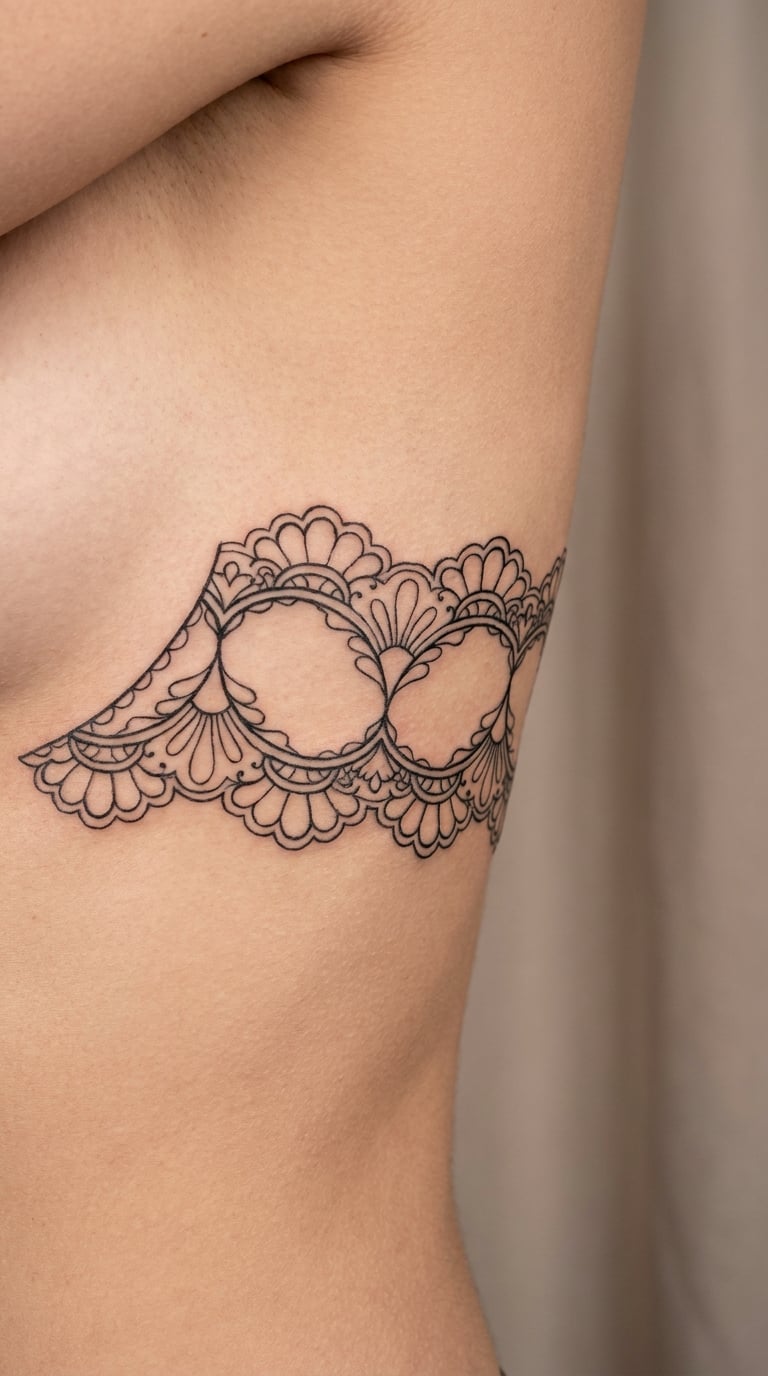
Ribs are where restraint does the work. This design uses a few open lace scallops, a small bow and a lot of empty skin, placed along the curve under the arm. Because the ribs move when you breathe, the artist draws the design stretched slightly so it settles into place once you relax.
This is the most delicate reading of the motif, and it reads as an abstract line pattern rather than lingerie, which is exactly why people choose it.
Placement: side ribs, two to three finger widths below the breast · Size: about 4 in (10 cm) long · Style: minimal fine line · Pain: high. Thin skin over bone, and you will feel it for the whole sitting.
Make it yours: keep the open spaces large and resist requests for extra lace, because rib skin stretches more than any other site here.
15. Lace Garter with Butterfly Detail
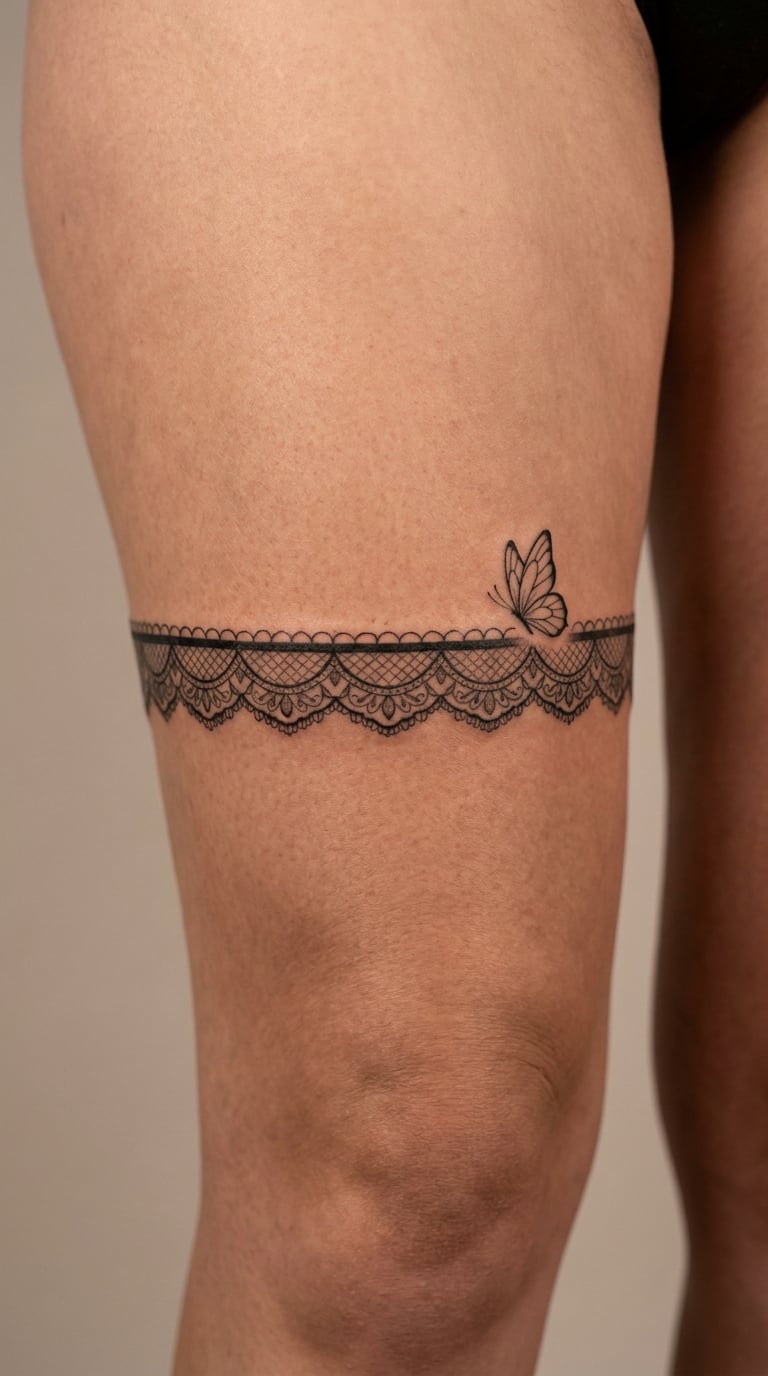
A single butterfly sits just above or beside the lace band, wings slightly open, and everything else stays plain lace. One butterfly is the number that works. Two turns the piece into a motif collection and the lace stops being the subject.
Butterflies are commonly chosen for marking a change, a move or a stage of life, though plenty of people just like the shape. Worth saying that the meaning is yours to define rather than a fixed code.
Placement: upper thigh, butterfly offset above the band · Size: 3-4 in (8-10 cm) wide including the butterfly · Style: fine line · Pain: low. The wing detail is small, so the sitting is short.
Make it yours: have the butterfly wings angled to line up with the top scallop of the lace so the two read as one drawing.
16. Blackwork Lace Garter with Peony
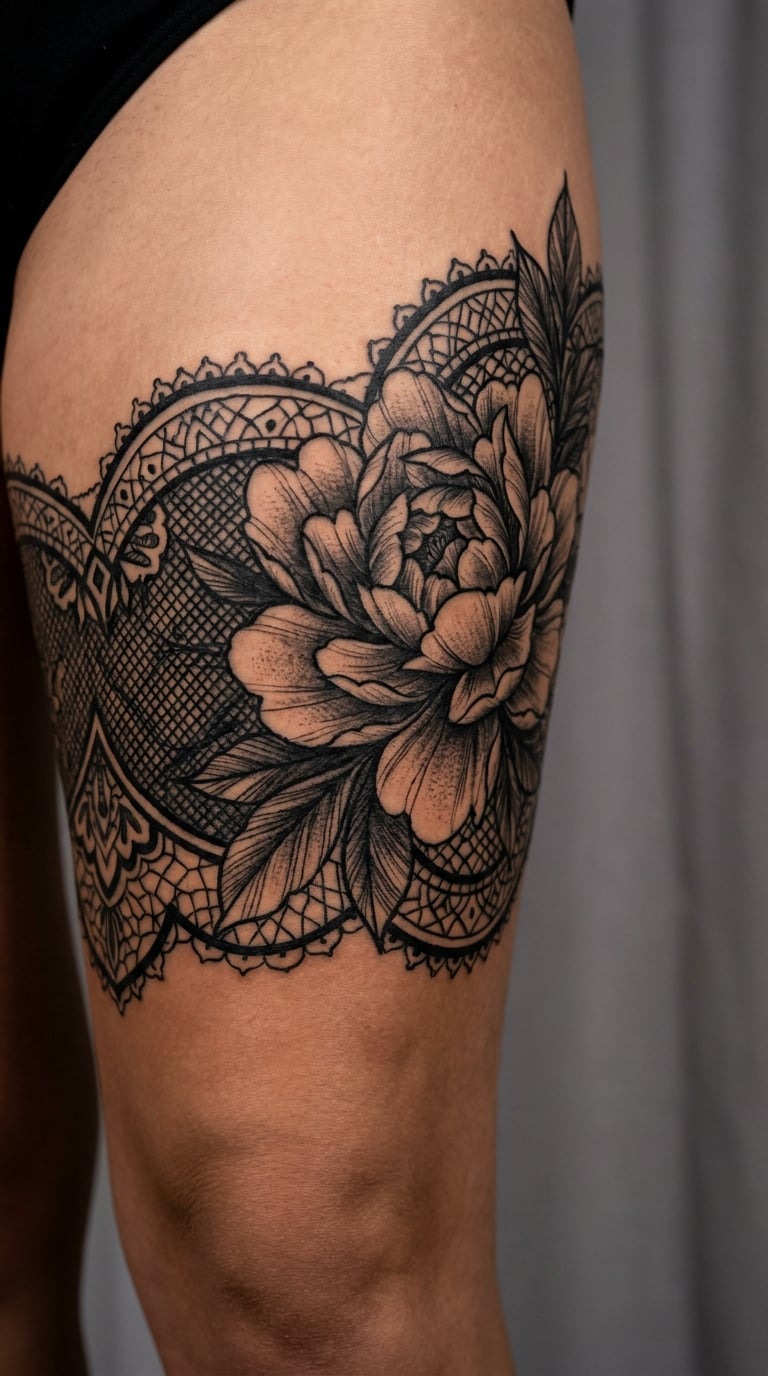
This is the statement piece: a large peony with heavy petal shading sitting inside dense black lace texture, all in solid black and grey. The contrast between the shaded flower and the lace pattern gives the design depth that smaller versions cannot carry.
People get this when they want one big statement thigh piece rather than a delicate band. It is a genuinely different look from every other design here.
Placement: outer thigh · Size: 6-9 in (15-23 cm) tall · Style: blackwork · Pain: low to medium, and the length means two sessions at most studios. Shade areas feel different from line areas, so the worst part is often the flower rather than the lace.
Make it yours: have the lace texture thin out where it meets the petals so the peony stays the focus instead of competing with a wall of black.
17. Lace Garter Matching Piece for Couples
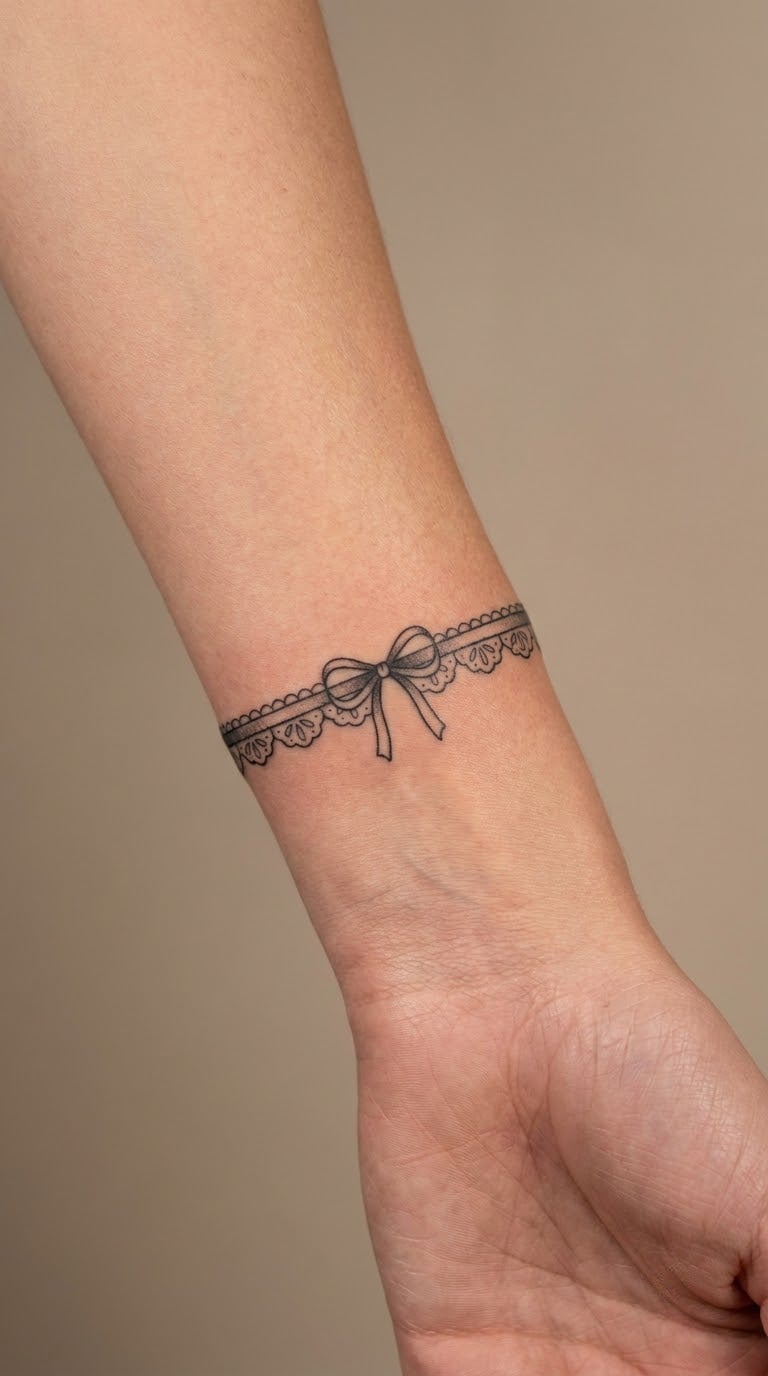
For a couple, the same lace-and-bow concept can be scaled differently on two bodies so the pieces relate without being identical. One person might take the small wrist version while the other takes a wider band on the thigh, and both still read as the same design.
If the pairing is for a wider group rather than two people, the anniversary tattoo ideas for couples roundup has variations that work when more than one design needs to tie together.
Placement: wrists, ankles or ribs on either person · Size: 1-2 in (3-5 cm) each · Style: fine line · Pain: medium, since most matching placements are on smaller, bonier areas.
Make it yours: pick one shared element, such as the number of scallops, and let everything else differ. That detail is what makes the pair look deliberate years later.
18. Lace Garter with Pearl Detail
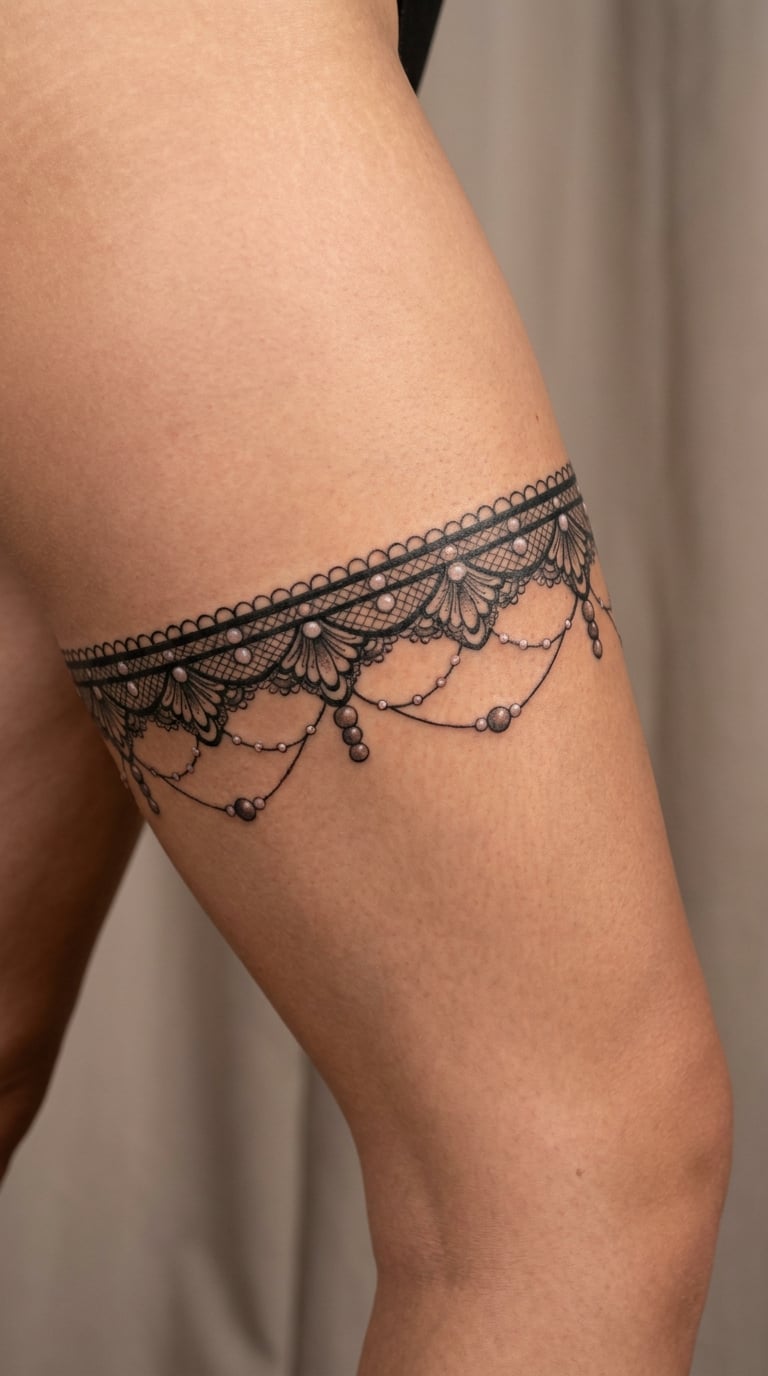
Pearl detail is done with small rounded dots of black or grey with a tiny highlight left open, placed along the lace like beads sewn onto a band. Leaving one highlight dot untouched is what makes a circle read as a pearl instead of a blob, and it is the detail artists care most about getting right.
It gives the lace a jewellery feel without adding a second colour, which keeps it in the same family as the black-only designs.
Placement: outer thigh or hip · Size: 3-4 in (8-10 cm) wide · Style: ornamental · Pain: low. Tiny dots take patience rather than pain.
Make it yours: alternate pearl sizes along the band, larger at the centre and smaller at the ends, so the design has a natural direction.
19. Lace Garter and Wedding-Dress Lace Tribute
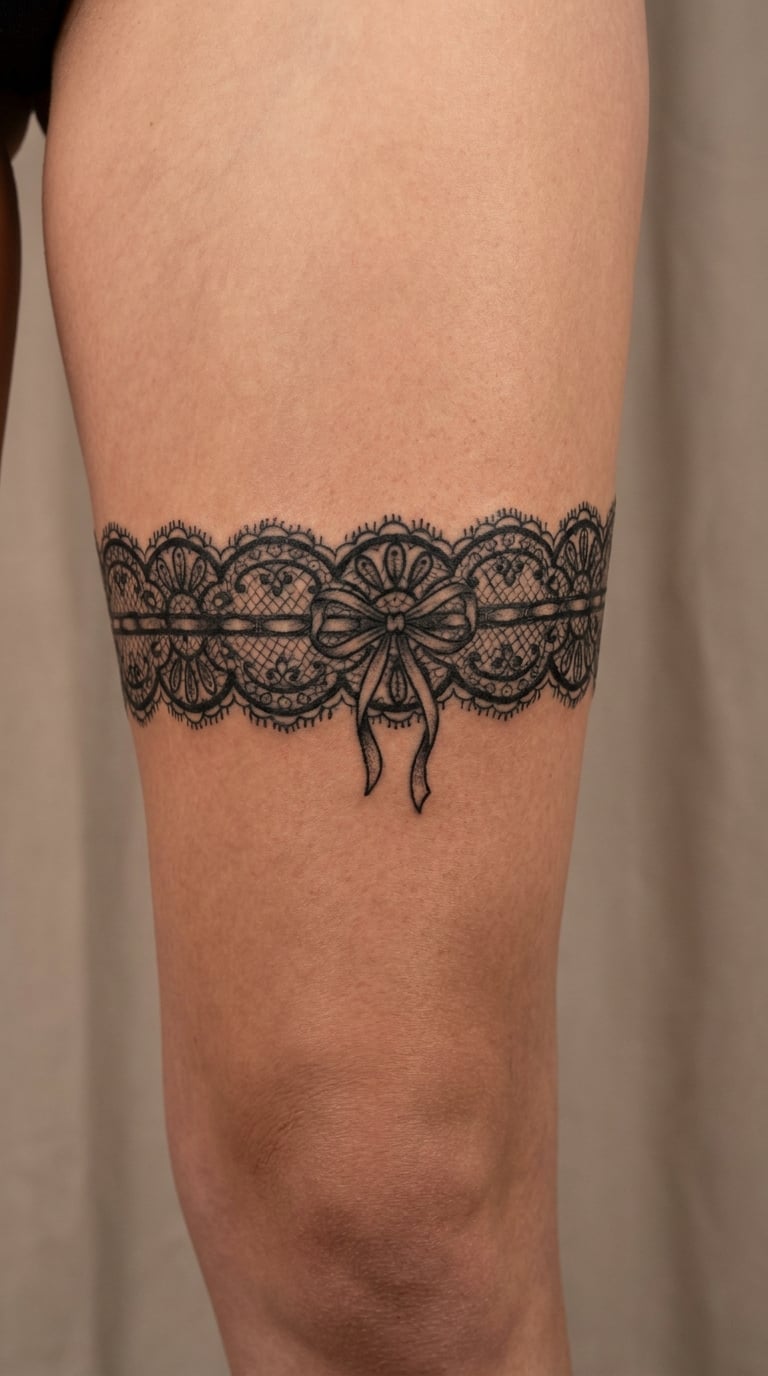
Bring a photograph of a real lace panel from a wedding dress and the artist will rebuild a small section of that specific pattern rather than copying the whole garment. Taking a section solves two problems at once: the detail stays workable at small scale, and the piece becomes genuinely personal rather than generic.
These are usually tattooed after the wedding, often with a date hidden in the ribbon. If the dress belongs to someone else, a swatch of the same lace works just as well.
Placement: upper thigh, inner arm or ribs · Size: 2-4 in (5-10 cm) · Style: fine line · Pain: low to medium depending on the site you choose.
Make it yours: include the hem edge as a straight line at one end of the band, which is a small detail only you would recognise.
20. Lace Garter on the Lower Back
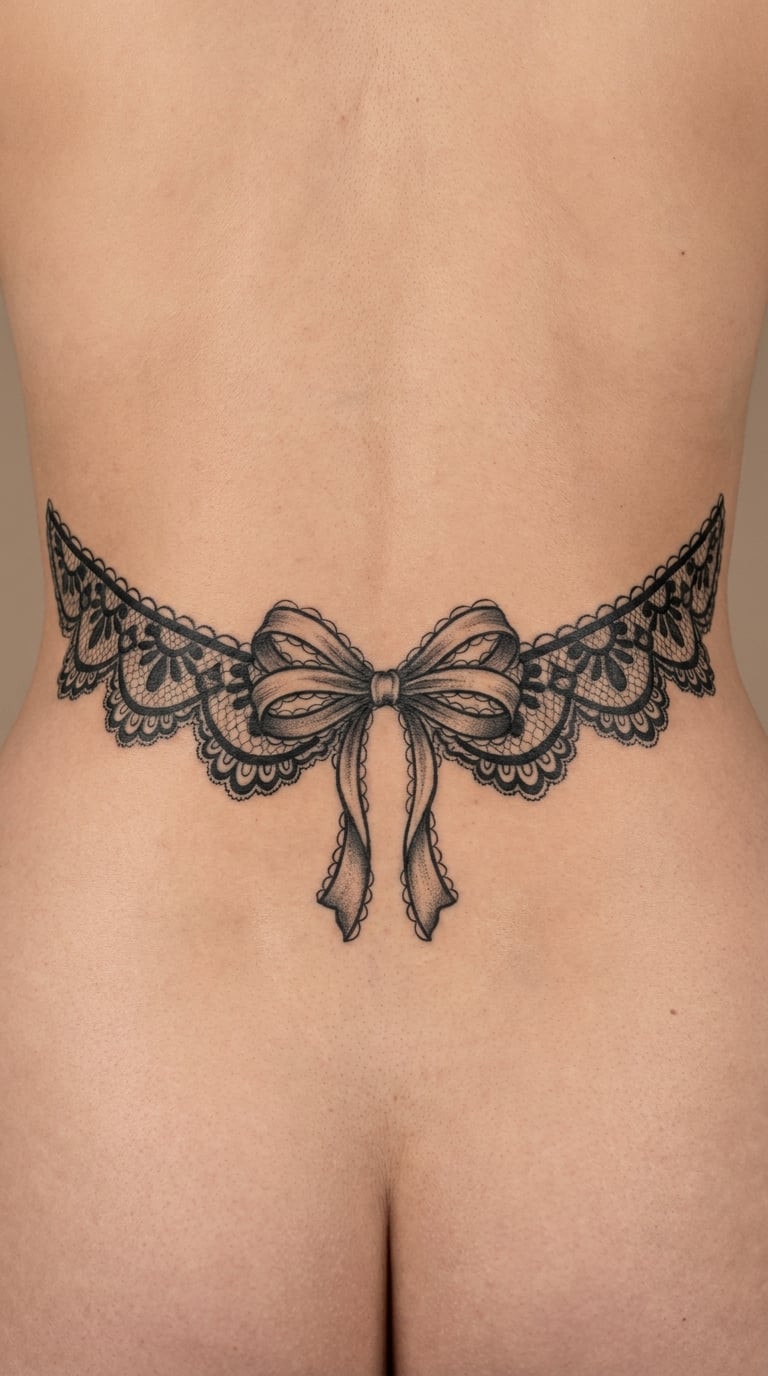
The lower back has the width for a genuinely symmetrical composition: a bow in the centre, broad lace scallops spreading out to either side, and open skin between the pattern and the spine. The design is drawn slightly arched so it follows the curve above the hip bones rather than sitting flat.
Symmetry is what sells this placement. An off-centre band on a wide back looks unbalanced, whereas a mirrored one looks deliberate.
Placement: lower back, centred a couple of inches above the waistband · Size: 8-12 in (20-30 cm) wide · Style: ornamental · Pain: medium, and the lower back gets uncomfortable to lie on for long sessions. Plan a break.
Make it yours: have the lace scallops shorten slightly at each end so the design tapers rather than stopping abruptly.
21. Lace Garter Collarbone Design
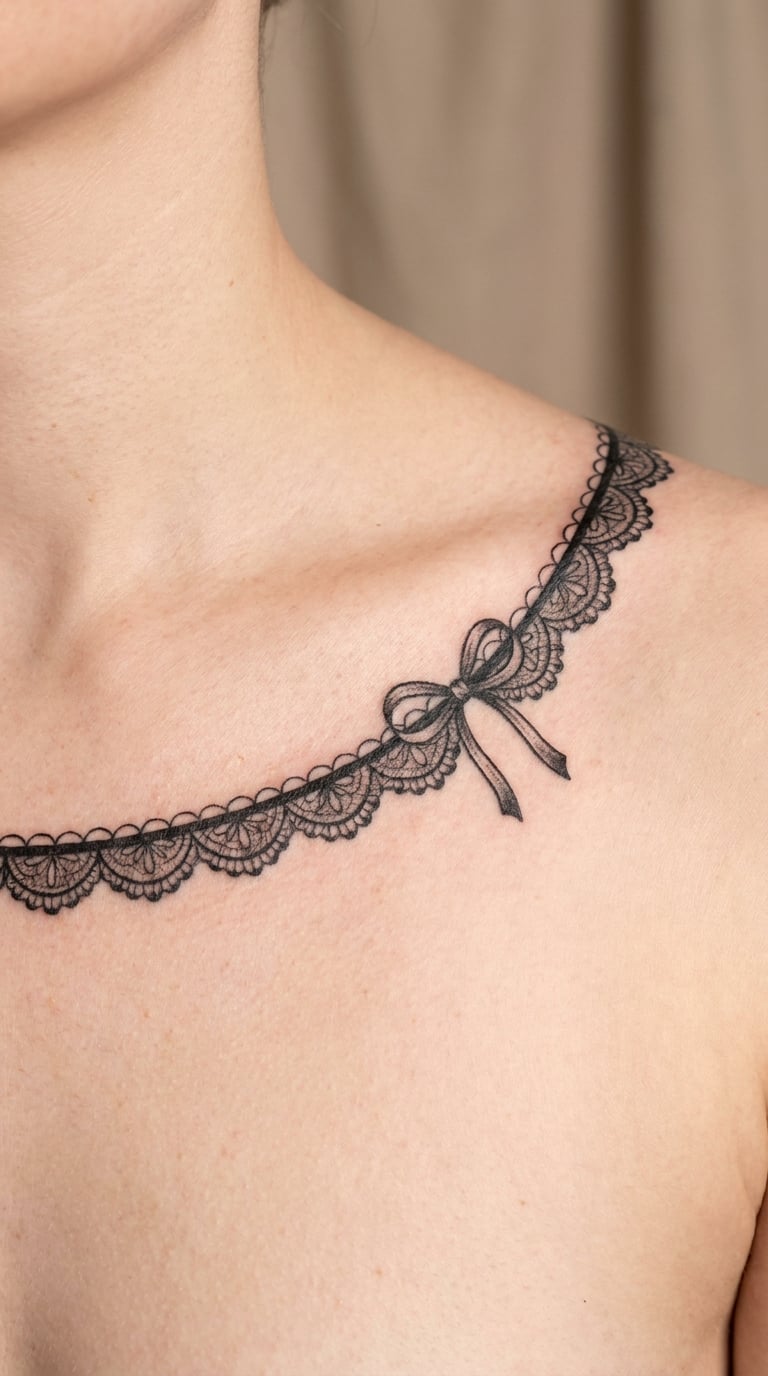
A collarbone piece is a shallow lace arc that follows the bone rather than wrapping anything, with a small bow sitting on one end. Because the arc has to match the curve of the bone, the artist usually draws it on you while you are sitting up and then transfers it in that position.
The visibility of this area changes day to day with neckline choices, which is worth thinking about before you book. For other relationship-based designs, the tattoo ideas that symbolise love for family covers pieces people place in similar spots.
Placement: along the collarbone, one side or mirrored across both · Size: 3-4 in (8-10 cm) long · Style: fine line · Pain: medium, mostly from the collarbone itself rather than the surrounding skin.
Make it yours: mirror the arc across both collarbones, which reads as a deliberate pair even when only one side is visible.
22. Large Lace Garter Thigh Panel
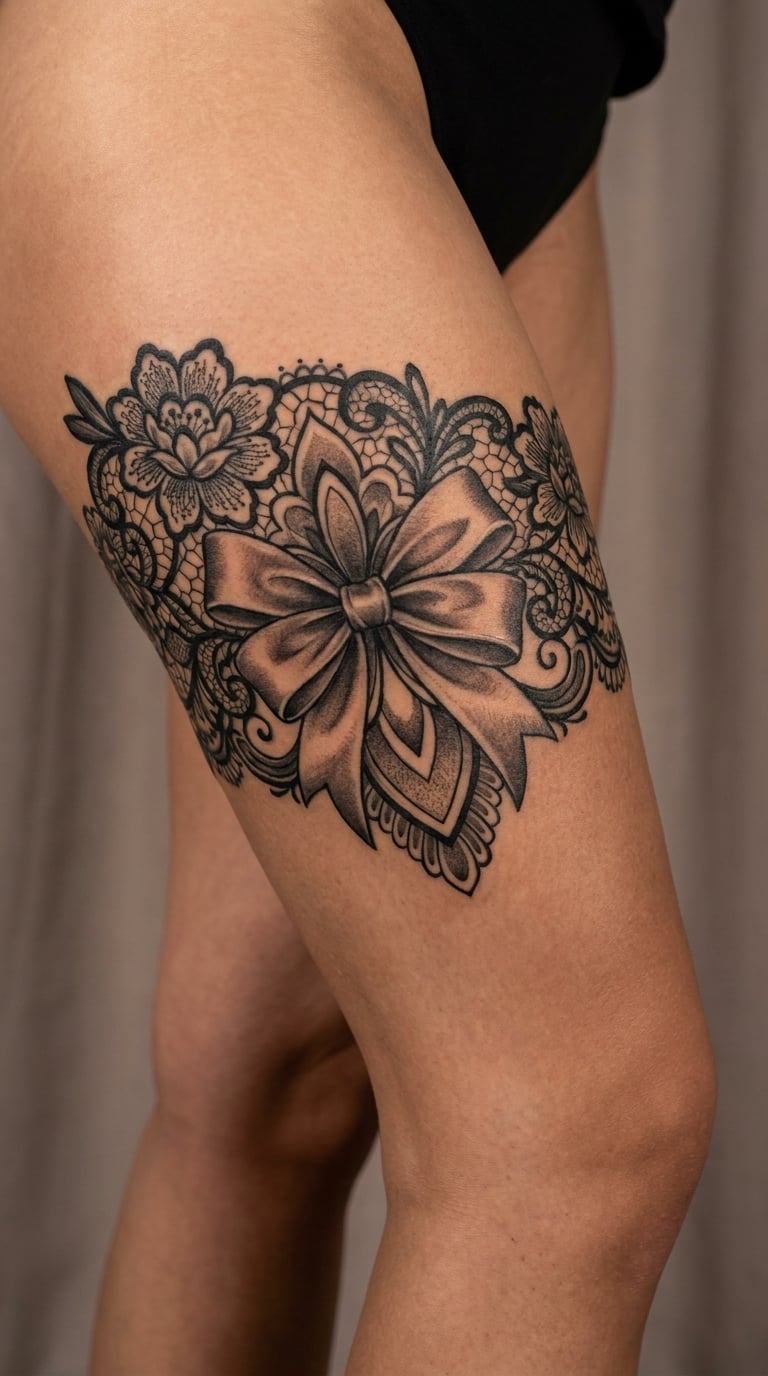
The largest option is a panel rather than a band: layered lace sections, a prominent bow and ornamental shading filling the space between, sized so the artist can build depth instead of hairlines. This is the version to choose if the garter is the centrepiece of a thigh, not a detail on it.
Scale changes what lace can do. At this size the pattern can hold shading, texture and secondary motifs, and it is far more forgiving as lines age.
Placement: outer thigh, from hip toward knee · Size: 8-12 in (20-30 cm) tall · Style: illustrative blackwork · Pain: low to medium, spread over two or three sessions. A panel this size is never a one-sitting piece at most studios.
Make it yours: sketch the panel on paper first and bring it, so the composition is settled before any permanent line goes in.
How to Choose the Right Design
Most people choose badly by picking the drawing first and the placement last. Flip that order and the decision gets much easier.
- Pick the site before the drawing. A fine-line lace band behaves differently on a thigh, a rib and a collarbone, because skin stretch changes the pattern. Choose the body area you actually want inked, then find designs drawn for that curve.
- Match density to scale. Small pieces need a handful of simplified arches. Dense photographed lace at wrist scale is the version most likely to heal into grey mush.
- Decide how bold you want it in ten years. Solid blackwork holds its shape far better than fine line or pastel wash. If you want the design intact long term, heavier is easier.
- Check how it wears. Outer thigh and calf lace rubs against clothing and fades faster on the raised area. Inner thigh stays hidden but is sensitive and mobile.
- Think about the conversation. Some people love that a garter reads as lingerie, others would rather it read as an abstract lace band. Decide which reaction you want, because the same design lands differently depending on line weight.
- Look at healed work, not fresh work. Ask the artist for healed photos of similar lace at similar scale. Fresh tattoo photographs flatter detail that may not survive healing.
Cost and Session Time
Tattoo cost follows time, and time follows size and line density rather than the idea itself. A small wrist cuff and a large thigh panel are priced on completely different scales, and lace raises the time of even a medium design because consistent thin line work is slow.
| Size | Typical example | Sessions | What drives the time |
|---|---|---|---|
| Micro (under 1 in) | Behind ear, small bow | One short sitting | Few elements, minimal line work |
| Small (1-3 in) | Wrist cuff, small band | One sitting | Slow fine line, tight detail |
| Medium (3-6 in) | Floral or pearl band | One sitting, sometimes two | Shading passes and repeated detail |
| Large (6-12 in) | Peony blackwork, back panel | Two or more | Total area, solid black, shading |
Shop minimums and hourly rates vary a lot by city and by artist, so a quote for one of these designs is worth getting in writing before the first sitting. Artists describe garter work as enjoyable but detail-heavy, which is another way of saying it takes longer than the same area filled with something simpler.
Aftercare Basics
- Start with your artist’s aftercare instructions. They know exactly what they did in your skin, and their advice overrides anything general, including this list.
- Wash gently, twice a day. Clean lukewarm water and a mild unscented soap, then pat dry with something clean and soft. No harsh soaps and no scrubbing.
- Protect the area for the first few days. Loose clothing over the tattoo, and avoid anything that rubs, such as tight jeans over a fresh upper thigh piece.
- Keep it out of sun and water. No swimming, soaking or sunbeds while the tattoo is healing. Sun is what fades fine line and pastel washes fastest in the long run too.
- Do not pick scabs or peel flakes. If an itch gets bad, the answer is more lotion from your artist, not scratching.
- Book the touch-up. Fine lace lines soften as they heal. Most artists will check the healed result and retouch the light areas, which is part of the job rather than a failure.
Frequently Asked Questions
Are lace garter tattoos hard to hide at work?
It depends entirely on placement. A band on the outer thigh shows when you wear a skirt and disappears under jeans, while a choker or collarbone version is visible most of the day. A rib or lower back piece is only seen in specific clothes. People who want discretion usually choose the thigh or lower back and avoid high necklines.
Why do fine lace tattoos turn grey after healing?
Lace is made of many very thin lines packed close together. As the skin heals, those lines swell slightly and spread, so gaps that were visible in a fresh tattoo can close up. Artists prevent this by simplifying the pattern and using a slightly heavier line weight than the reference image. The same effect makes micro lace at wrist scale more likely to blur.
What size should a lace garter tattoo be?
Most people land between 2 and 4 inches wide for a thigh band, which is roughly the width of a palm. Larger pieces only work on a flat, wide area such as the outer thigh or lower back, and they need two or more sessions. The main rule is that detail should be simplified as the design gets smaller, not kept at the same density.
Will a thigh garter tattoo stretch or distort over time?
Some softening is normal on any tattoo, and the thigh is a moving area. Inner thigh designs in particular spread as the leg moves and with changes in weight over the years, so slightly larger open spacing in the lace helps. Placing the band on the flatter outer thigh above the muscle usually holds its shape better than the inner thigh.
Should a garter tattoo be literal or abstract?
A literal design shows a garter shape with a bow and lace trim, which is instantly readable and more likely to be noticed. An abstract version uses the same lace and ribbon elements without the full silhouette, so it reads as an ornamental pattern. Most people who are worried about the design being read as too sexual choose the abstract version.
Conclusion
If this is your first tattoo and you want lace, the fine-line wraparound from idea one is the one I would pick. It sits well, hides easily, and a simplified pattern gives you something you will still like in ten years.
If you already have work and want the garter to be the centre of a thigh, the large blackwork panel in idea 22 has the scale for the detail that lace does not survive without. Book the consultation with healed examples in hand, and let the artist simplify more than you think you need to.