
24 Side Hand Tattoo Ideas: Small, Bold and Timeless (2026)
A side hand tattoo is ink placed along the outer edge of the hand, between the wrist and the little finger, where the skin is thin, sits close to bone and shows up every time you gesture, reach for a cup or rest your chin on your hand. That exposed, slightly awkward-to-hide spot is exactly why people choose it, and why the wrong design there looks tired after a few years.
These 24 side hand tattoo ideas are picked for how they behave on that edge rather than for how they look on a flash sheet. Each one comes with a real size, a placement that follows the hand’s curve, an honest pain note and what tends to blur first. If you want a wider gallery before you narrow anything down, the 18 small hand tattoo ideas that age well is a good second stop.
24 Side Hand Tattoo Ideas: Quick Guide
| Idea | Style | Best placement | Size | Pain |
|---|---|---|---|---|
| 1. Fine-line paper plane | Fine line | Outer edge, mid-hand | 1.5-2 in (4-5 cm) | Medium |
| 2. Branching vine | Fine line botanical | Outer edge, following contour | 3-4 in (8-10 cm) | Medium |
| 3. Small sunburst | Blackwork with accent | Outer edge above the wrist | 1-1.5 in (3-4 cm) | Low |
| 4. Rosebud in blackwork | Blackwork | Outer edge, mid-hand | 1.5 in (4 cm) | Medium |
| 5. Crescent moon with dots | Fine line | Outer edge, toward the wrist | 1-1.5 in (3-4 cm) | Low |
| 6. Botanical leaf pair | Fine line | Outer edge, vertical pair | 1-2 in (3-5 cm) | Medium |
| 7. Open rose outline | Fine line | Outer edge, mid-hand | 2 in (5 cm) | Medium |
| 8. Mountain range | Black silhouette | Outer edge, above the wrist | 2-3 in (5-8 cm) | Low |
| 9. Delicate butterfly | Fine line | Outer edge, mid-hand | 1.5-2 in (4-5 cm) | Medium |
| 10. Tiny red heart | Minimal colour | Outer edge near the wrist | 0.5 in (1.5 cm) | Low |
| 11. Wrist-to-hand vine | Botanical | Wrist creeping onto the hand | 4-5 in (10-13 cm) | Medium-high |
| 12. Mini wave | Fine line | Outer edge, mid-hand | 2 in (5 cm) | Low |
| 13. Four-point star cluster | Dotwork accent | Outer edge, scattered | 1-1.5 in (3-4 cm) | Low |
| 14. Small key | Blackwork | Outer edge, mid-hand | 1.5-2 in (4-5 cm) | Medium |
| 15. Laurel half-wreath | Line and blackwork | Curving along the hand edge | 2-3 in (5-8 cm) | Medium |
| 16. Tiny lightning bolt | Bold blackwork | Outer edge near the wrist | 1 in (2.5 cm) | Low |
| 17. Small dagger | Blackwork | Outer edge, vertical | 2-2.5 in (5-6 cm) | Medium |
| 18. Peony micro-realism | Micro-realism | Outer edge, mid-hand | 1.5 in (4 cm) | Medium |
| 19. Small serpent | Blackwork line | Outer edge, vertical | 2-3 in (5-8 cm) | Medium |
| 20. Geometric diamond | Geometric | Outer edge, mid-hand | 1.5-2 in (4-5 cm) | Medium |
| 21. Short word in fine script | Script lettering | Outer edge, running lengthwise | 2 in (5 cm) | Medium |
| 22. Snake and flower | Illustrative | Outer edge, mid-hand | 2-3 in (5-8 cm) | Medium |
| 23. Minimal playing card | Graphic minimal | Outer edge, near the wrist | 1.5 in (4 cm) | Medium |
| 24. Small laurel star | Line and blackwork | Outer edge, centred | 2 in (5 cm) | Medium |
1. Fine-Line Paper Plane
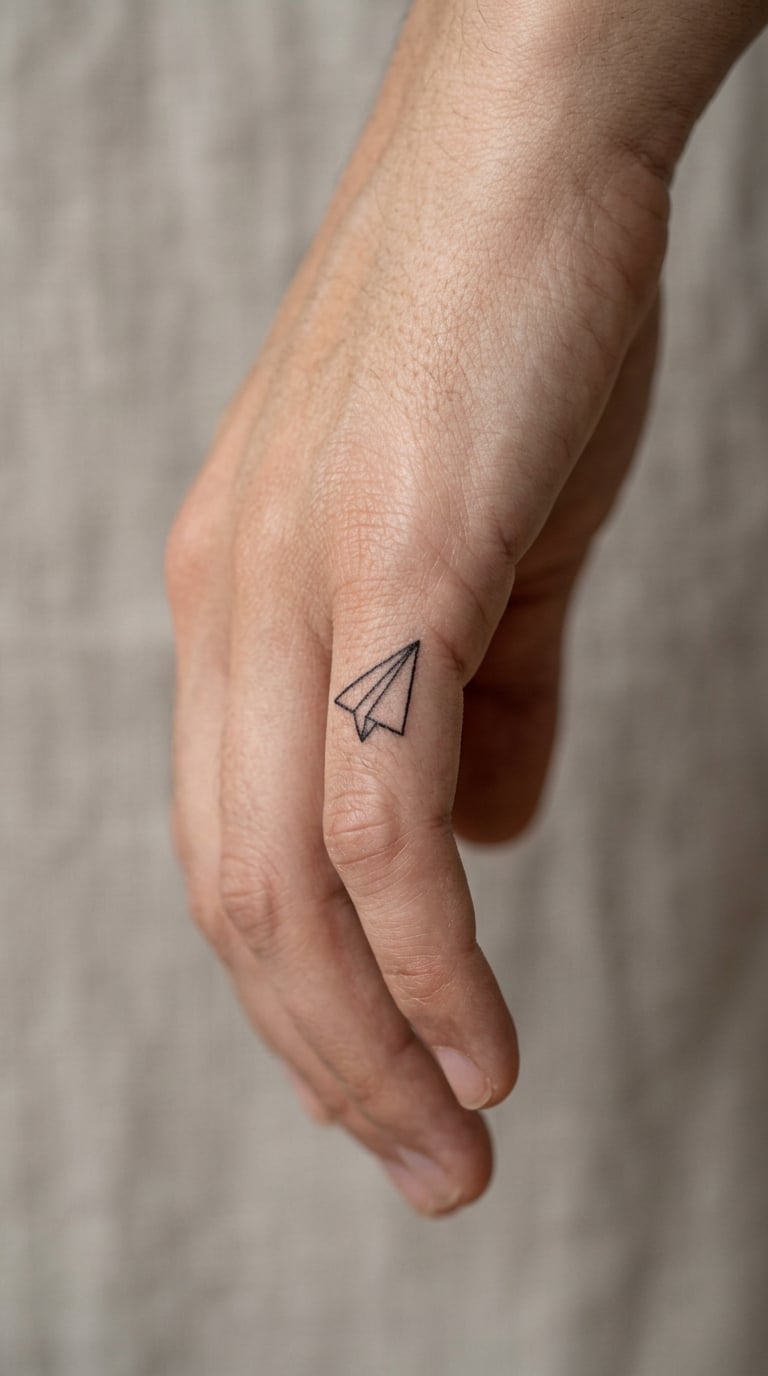
A side hand tattoo in the shape of a paper plane is one line per fold, pointed slightly upward so it reads as moving rather than falling. There is no shading to speak of, just two or three hairlines meeting at a sharp nose, and the whole thing sits at a slight diagonal across the edge of the hand.
People usually pick it for travel, a first move somewhere new, or a small private joke about sending something off. The shape is graphic enough that it still reads clearly at a distance, which is rare for a design this light.
Placement: the outer edge of the hand at mid-hand, angled about 20 degrees so the nose points toward the fingertips. Size: 1.5-2 in (4-5 cm) nose to tail. Style: fine line with a single slightly heavier outline on the top fold.
Pain: medium. Thin skin over bone, and the outline of the palm side stings more than the top. Fine-line hand work softens into grey over the years, so expect the folds to need a touch-up rather than the shape to change.
Make it yours: trail a short line of three dots out of the tail, like a flight path that never landed.
2. Minimalist Branching Vine
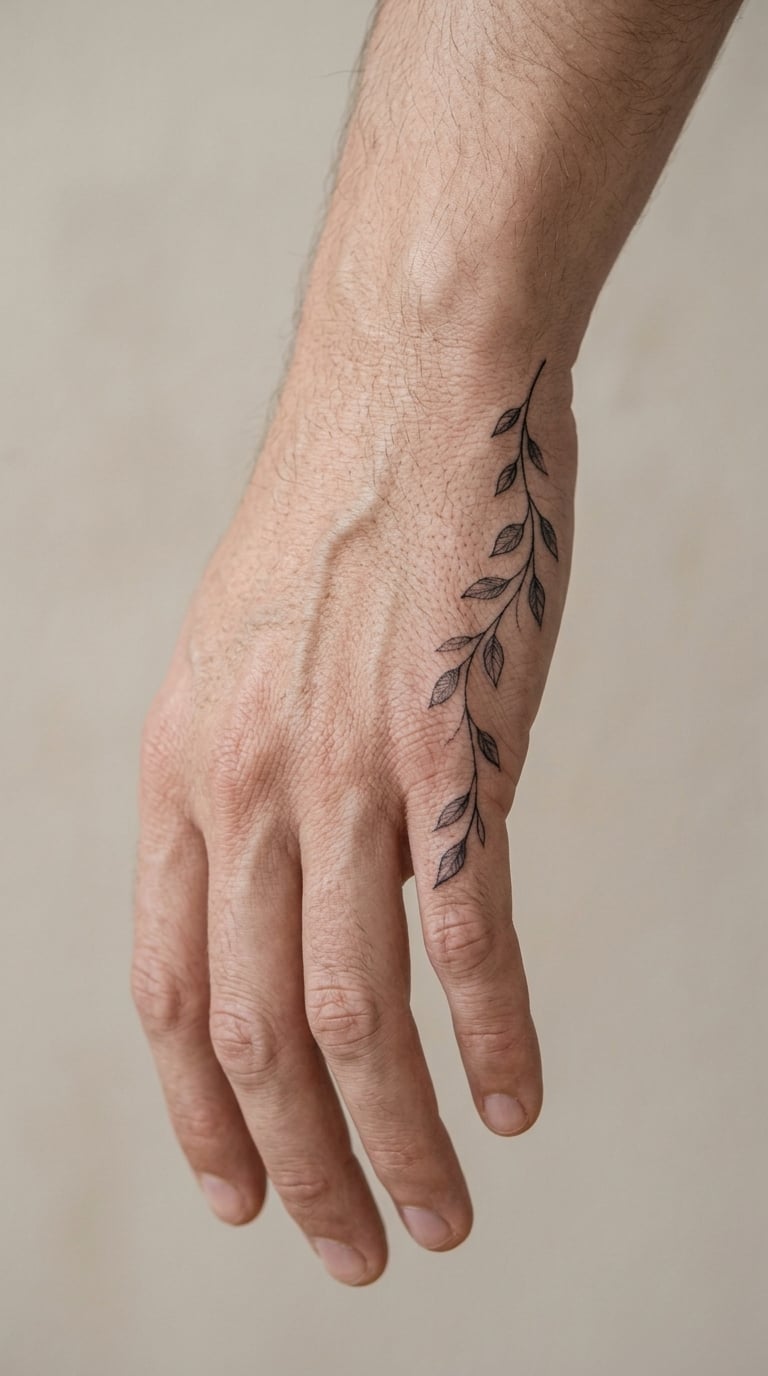
A branching vine for a side hand tattoo is drawn as one stem that follows the natural curve of the hand, with a leaf at every joint and nothing else competing for attention. The stem is a single unbroken line, the leaves are simple almond shapes, and the line weight stays even the whole way along so it never looks thin in one stretch and heavy in another.
Growth and endurance are the usual reasons given, though plenty of people just like how a line that long flatters the hand. Botanical work suits this placement better than almost any other because the hand already curves in the direction the stem wants to travel.
Placement: outer edge, running lengthwise from just above the wrist toward the base of the little finger. Size: 3-4 in (8-10 cm) long. Style: fine line botanical, no background, no frame.
Pain: medium, rising toward the wrist where skin folds and nerve density picks up. A line this long goes grey faster than a small symbol on the same spot, mostly because sun hits the edge of the hand all day.
Make it yours: colour in a single leaf, usually one warm red or deep green, and leave the rest black. One accent is enough to stop it reading as a scribble.
3. Small Sunburst
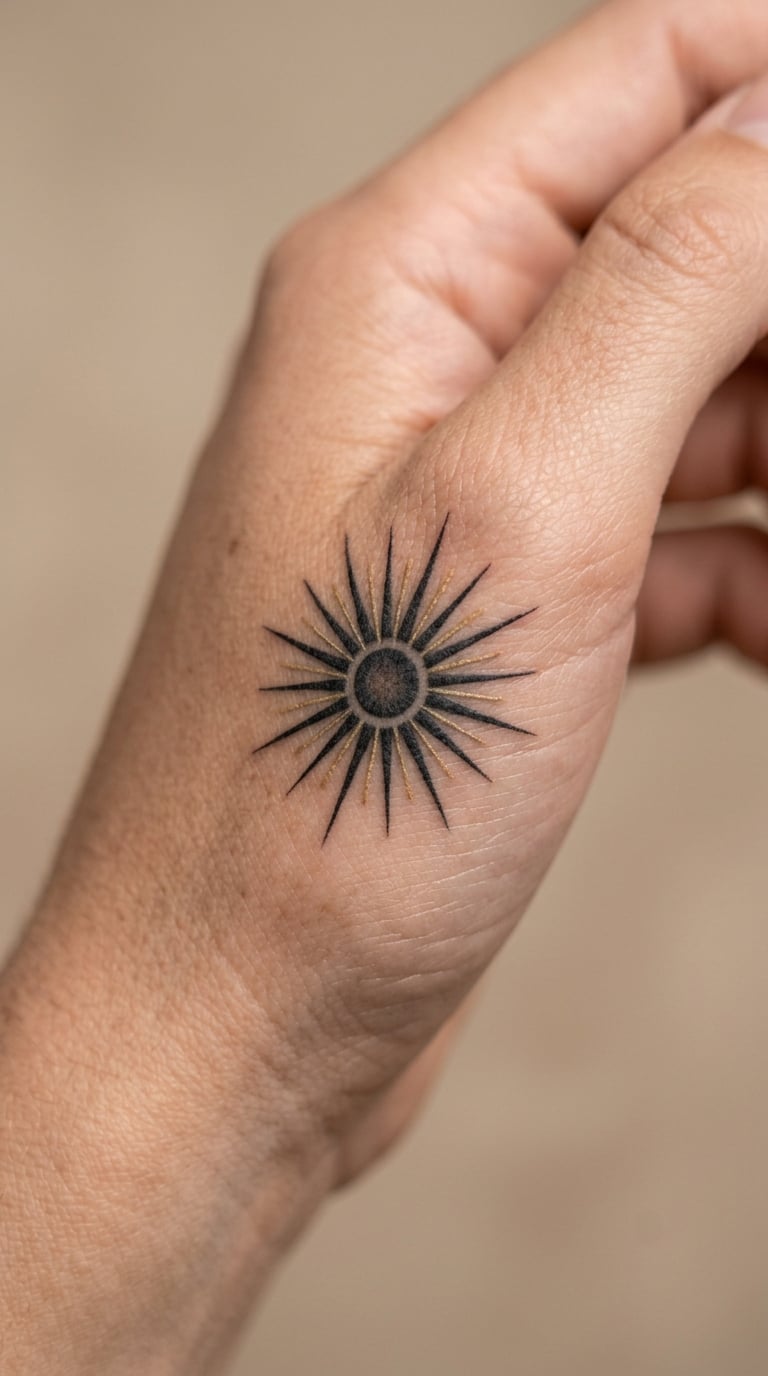
The small sunburst is a circle of straight rays, each one the same length, spaced evenly, with a clean gap between the centre and the first ring of rays. Drawn properly it has no outline at all, just rays radiating off nothing, which makes it look lighter than its size suggests.
It turns up for optimism, new beginnings, a birthday, or the start of a year that mattered. It is one of the few bold-looking shapes that still fits in under an inch and a half on this placement.
Placement: outer edge, centred just above the wrist crease where the skin is flat and the rays have room to breathe. Size: 1-1.5 in (3-4 cm) across. Style: solid black rays, or black with a single gold or ochre ray as an accent.
Pain: low to medium. Radiating lines mean more passes over the same patch of skin, so it stings more than it feels deep. Solid black holds its edge here better than almost any other small design.
Make it yours: make the centre a solid dot instead of leaving it open, and let the rays run a little unevenly, longest at the top.
4. Rosebud in Blackwork
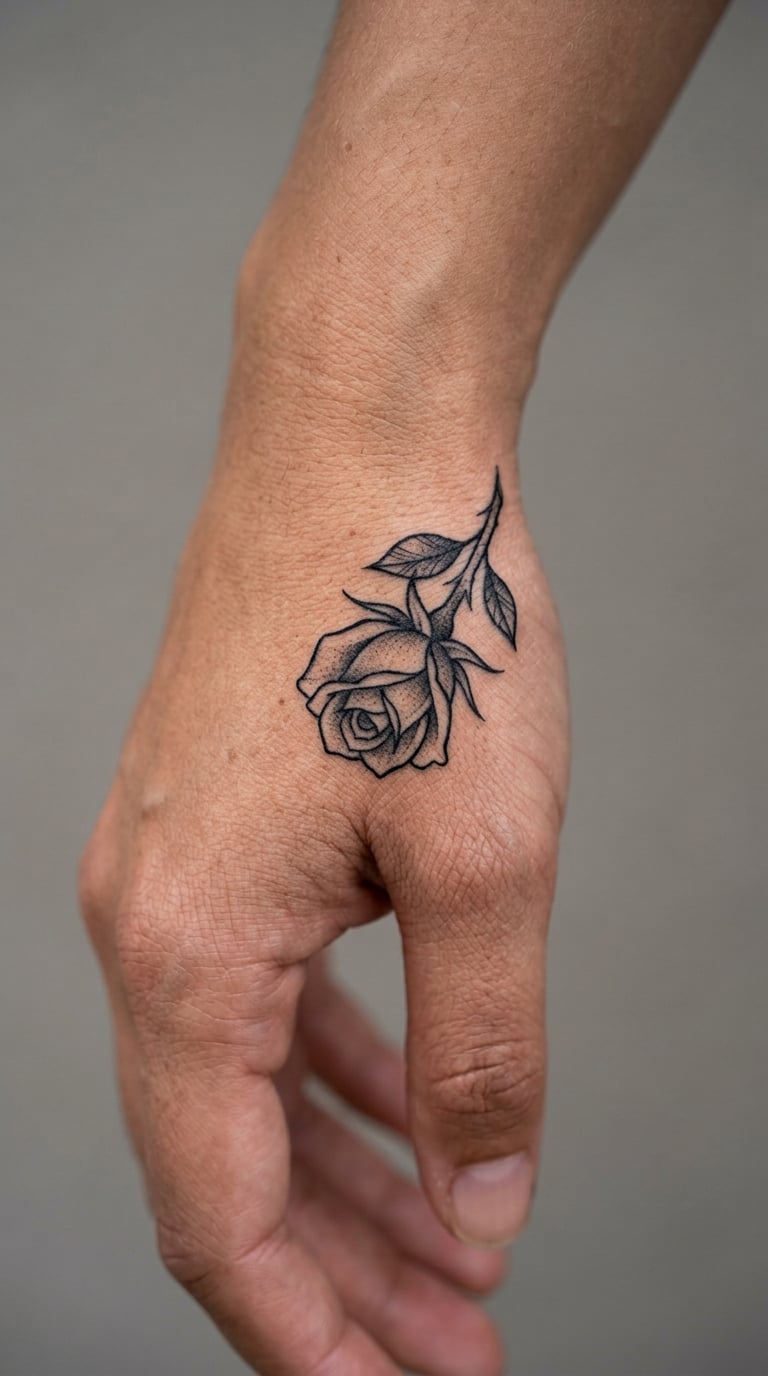
A blackwork rosebud for the side hand is drawn heavy: a thick outer contour, a few interior petal lines, and one soft grey pass in the folds where the petals overlap. Nothing decorative, no stem leaves, no background. The weight of the outline is what makes it hold together at small scale on a curved surface.
It reads as love that is not finished yet, which is why it keeps turning up for anniversaries, in-progress relationships and gifts that were never explained. People also like that a rose at this size feels private without being cryptic.
Placement: outer edge at mid-hand, tilted so the bud leans toward the thumb side. Size: about 1.5 in (4 cm) tall. Style: blackwork with restrained grey shading, no colour.
Pain: medium. Shading means going over the same area twice, and the hand feels every pass. Grey fill on hands wears down faster than solid black, so ask your artist to keep the shading light.
Make it yours: swap the grey for a deep red in the deepest fold only, one small patch of colour inside an otherwise black piece.
5. Crescent Moon and Dot Detail
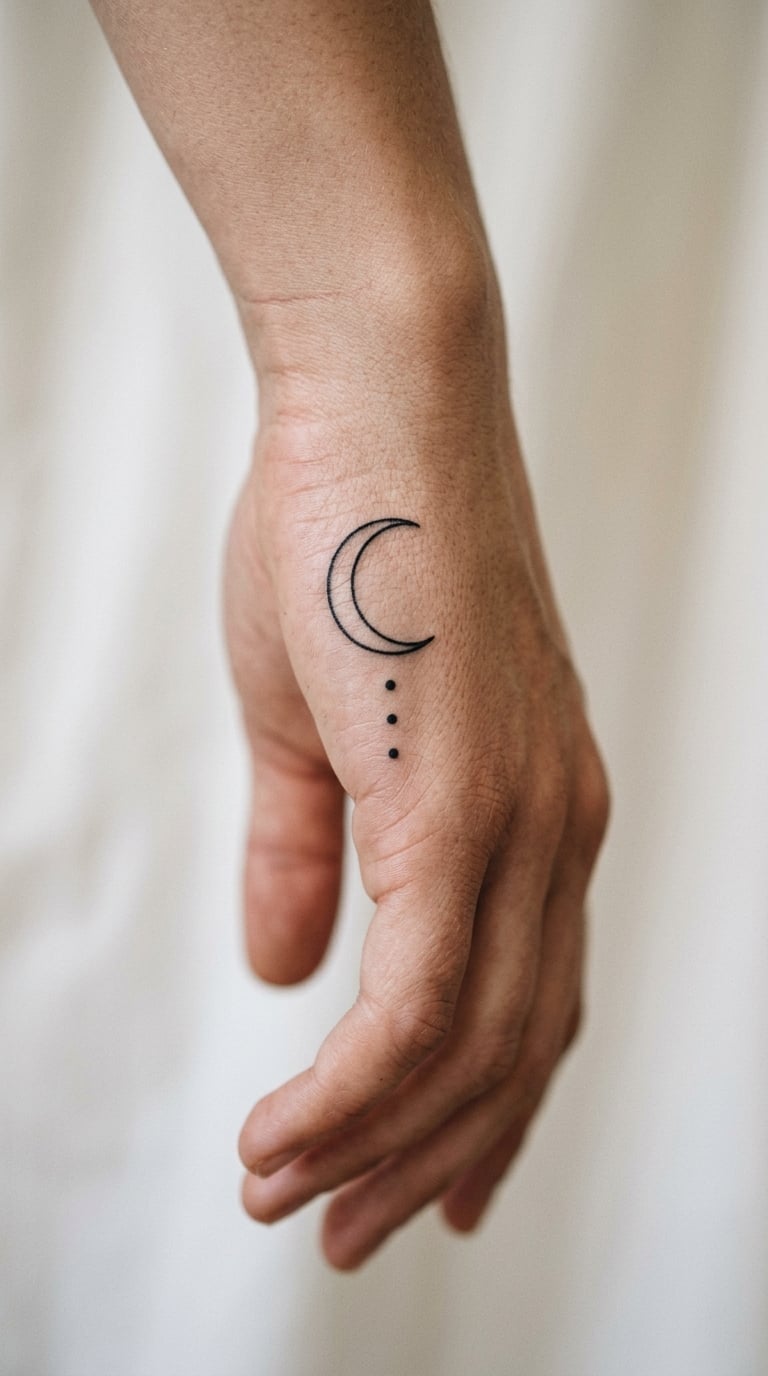
The crescent here is a slim arc with two points that taper to a point rather than a roundness, and a scatter of small dots nearby with plenty of empty space between them. The restraint is the whole design. Two dots too many and it stops feeling like a moon and starts feeling like a list.
Most people choose it for a night-sky reference, a birth month, or simply because the shape sits well on a curve. The dot detail is usually a date, but plenty of clients leave them off entirely and go moon only.
Placement: outer edge toward the wrist, where there is a flatter stretch of skin to sit the arc. Size: 1-1.5 in (3-4 cm) for the crescent, dots no larger than a pinhead. Style: fine line, black only.
Pain: low to medium and quick, because there is very little to fill. Be honest about the dots: they are the first thing to disappear on the side of the hand, and many end up needing redrawing within a couple of years.
Make it yours: one small star tucked inside the crescent’s curve, or the crescent left open so the line becomes a smile rather than a moon.
6. Tiny Botanical Leaf Pair
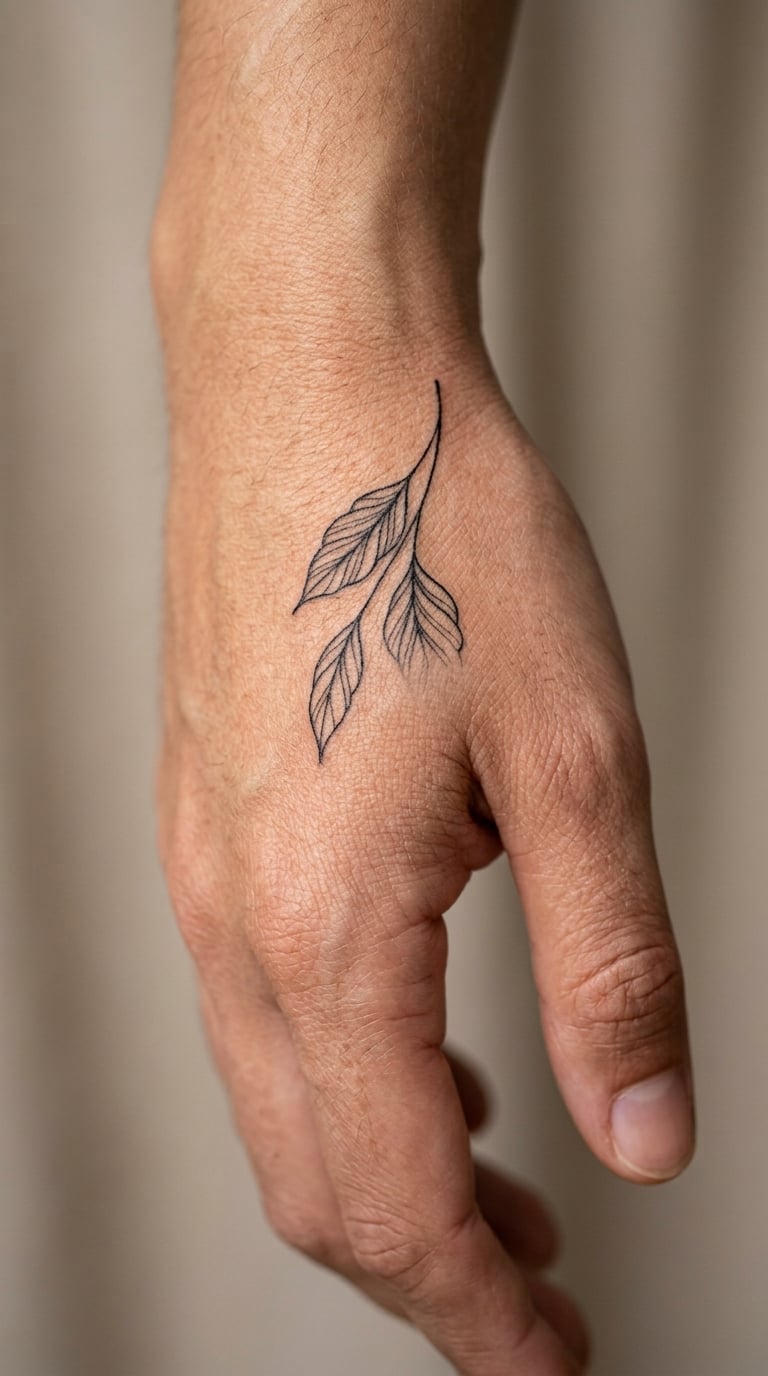
Two leaves, nothing more. One slightly larger, one slightly smaller, set at a gentle angle to each other so the pair looks intentional rather than accidental, with a short gap of bare skin between the stems. The line work is single-weight, with one central vein per leaf and a few side veins that stop short of the edge.
Leaves get chosen for the plant itself more than for a message, so the reason is usually personal rather than symbolic. Ask for something specific and the piece stops looking like a stock botanical flash.
Placement: outer edge, stacked diagonally across mid-hand so the pair follows the slope of the tendons. Size: each leaf 1-2 in (3-5 cm) long. Style: fine line, single needle weight.
Pain: medium. The side of the hand bruises visibly for a day or two, so plan around that if you shake hands for a living. Vein detail on a small leaf is the first thing to soften into a smudge.
Make it yours: name the plant and get the actual leaf shape, olive, eucalyptus, monstera or a fern, rather than a generic botanical shape.
7. Open Rose Outline
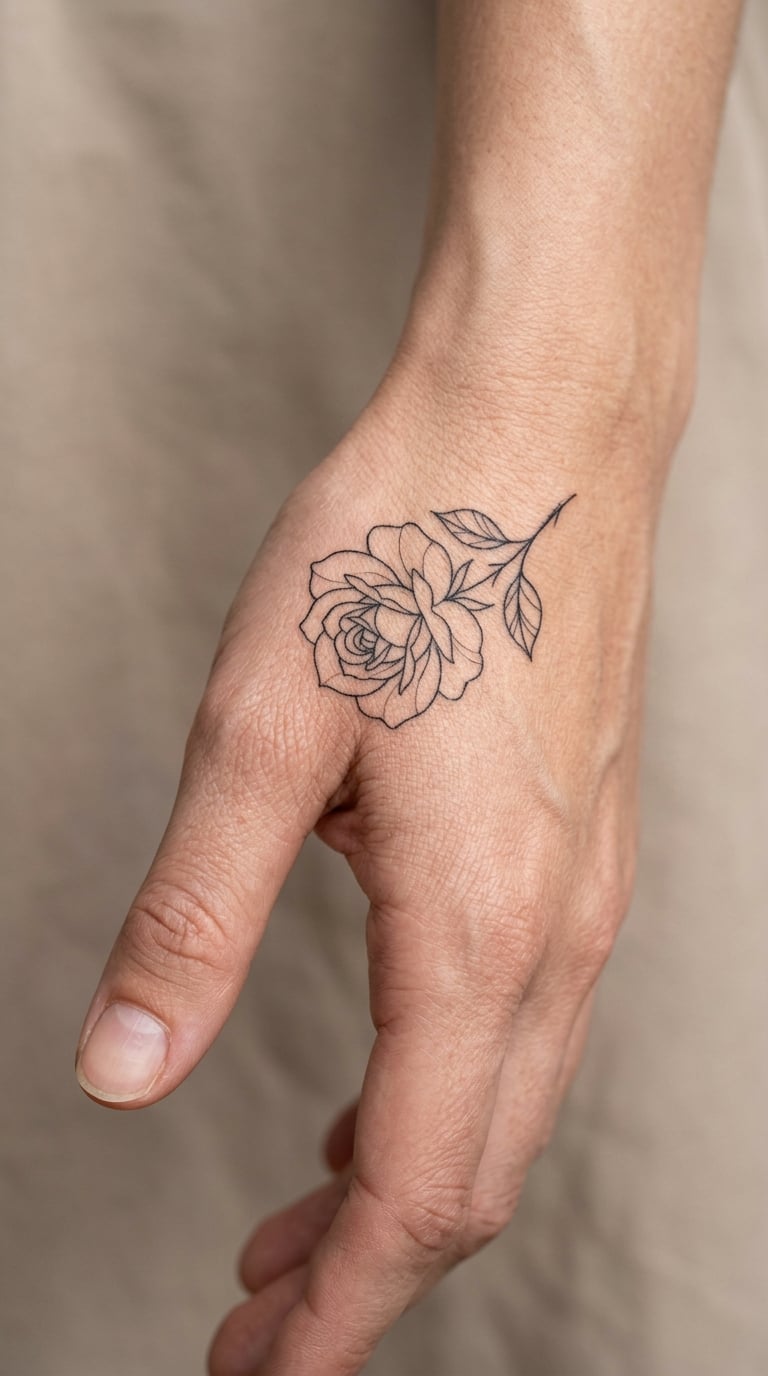
An open rose outline is the same flower as a bud with the petals spread, drawn as a continuous-style line that loops around the outer petals and returns inward. The centre is left open or gets a single spiral, and the outer edge of the flower is not closed off, so it reads airy even though it is nearly two inches across.
Unlike the blackwork rosebud, this one is about movement and softness. People tend to choose it when they want a flower that still looks delicate but does not disappear the way a pure hairlined rose does.
Placement: outer edge at mid-hand, the bloom facing up toward the wrist so the petals follow the natural flare of the hand. Size: about 2 in (5 cm) across. Style: fine line outline with no fill.
Pain: medium. Long unbroken lines are less painful than shading but take their time, and hands swell slightly during a long session, which can distort a design drawn earlier in the session.
Make it yours: turn it into the flower of your birth month, or ask for a single stem line that continues down toward the wrist to make it feel less like a sticker.
8. Small Mountain Range
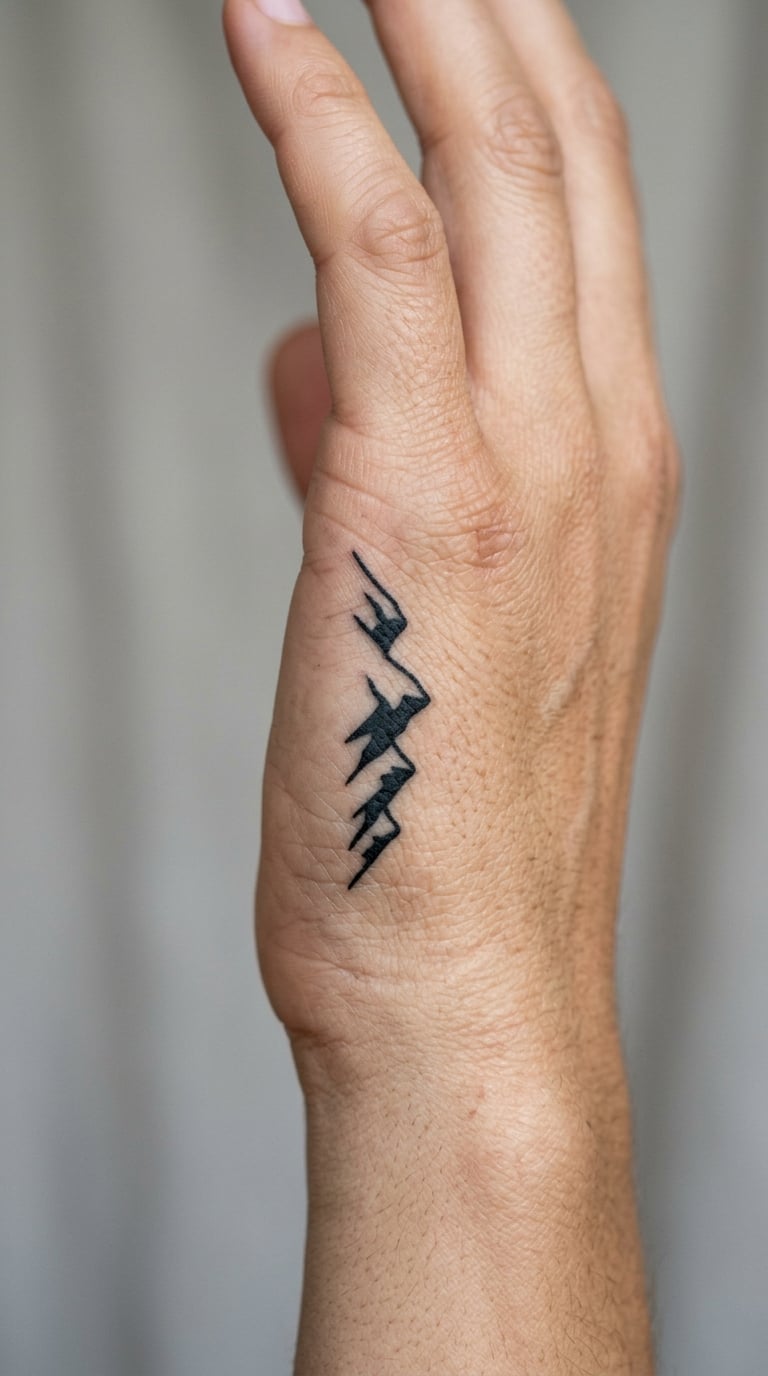
A mountain range for the side hand is a solid black silhouette, two or three peaks, and a straight base line. The peaks are uneven on purpose. A perfectly symmetrical range looks like clip art, while one tall peak with two smaller ones looks like a place somebody has actually stood.
The reason is usually a specific hike, a home state or a stretch of coastline, and it is one of the easiest designs to make genuinely personal because the shape is so simple to adjust.
Placement: outer edge, just above the wrist where the skin is broad and flat. Size: 2-3 in (5-8 cm) wide and under 1 in tall. Style: solid black silhouette, no texture inside the peaks.
Pain: low to medium. Solid black means a saturated line and heavy pressure, so it feels blunt rather than sharp. This is one of the designs that still looks sharp in ten years, because there is no hairline detail to lose.
Make it yours: put your elevation or trail distance in tiny numerals under the base line, which is the only place fine detail survives on this spot.
9. Delicate Butterfly
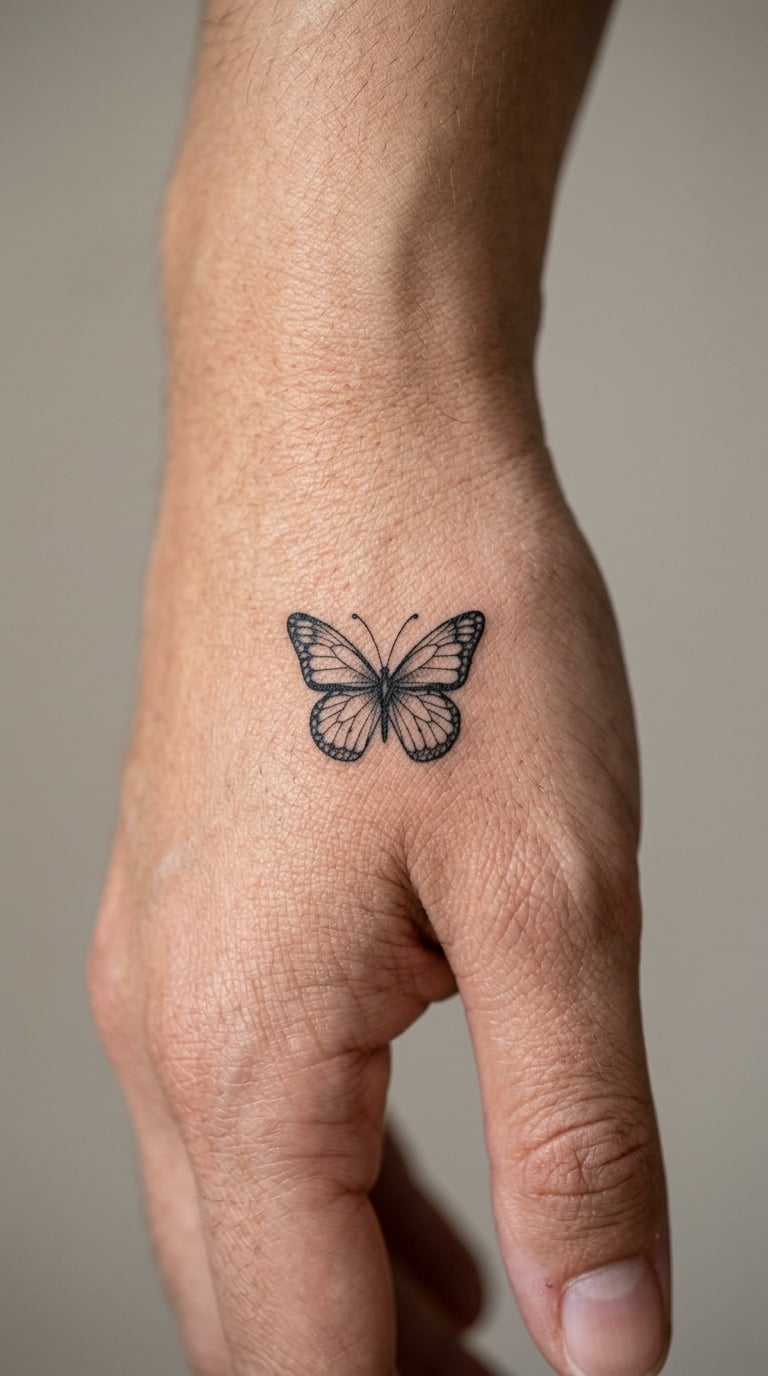
A side hand butterfly works best drawn open and symmetrical, with two upper wings, two lower wings, a slim segmented body and two antennae that stop just short of being fussy. The wings are outlined and lightly patterned inside, not filled, so the design stays light and the hand’s contour still shows through it.
Butterflies get chosen for change and for a first tattoo that is not too heavy. It is also the easiest design here to share, since a matching pair sits nicely on two people.
Placement: outer edge at mid-hand, body running lengthwise along the edge with wings opening upward toward the back of the hand. Size: 1.5-2 in (4-5 cm) wingtip to wingtip. Style: fine line with light interior patterning.
Pain: medium. The antennae are the fiddly part, and a wavering hand on thin skin shows up in them. The wing patterns are the first feature to blur, so keep the interior shapes large rather than lace-like.
Make it yours: use a real species instead of a generic butterfly, a swallowtail or a comma, and give it one coloured wing.
10. Tiny Red Heart
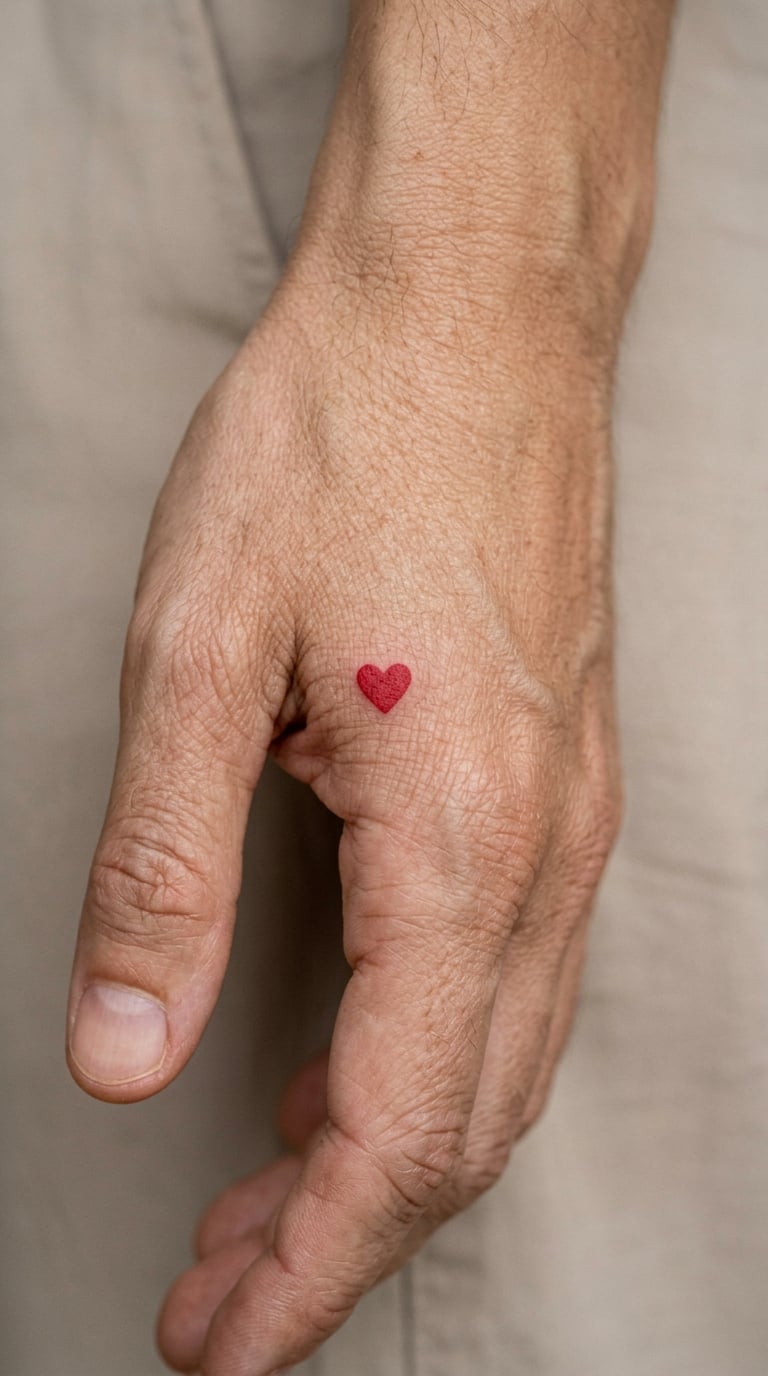
This is a small solid heart, no outline, no shine, no highlight, just a red shape about half an inch tall with a slightly squared-off top. Simplicity is the point. A tiny filled shape is about the least demanding design you can ask for on the edge of the hand, and it still gets noticed.
It is for people who want something sentimental without a story attached to it. Often it is a first tattoo, and it doubles as a tiny piece to test how they handle the placement.
Placement: outer edge near the wrist, or lower still on the side of the hand where a bracelet or watch strap sits nearby. Size: 0.5-0.75 in (1.5-2 cm). Style: solid fill, black or red.
Pain: low. A small solid shape is over in a few minutes. Red on hands fades the fastest of any colour because of sun and hand washing, so expect to refresh it and always ask about sunscreen on this spot.
Make it yours: put a date in black micro script directly underneath it, treating the heart as a heading rather than the whole design.
11. Floral Wrist-to-Hand Vine
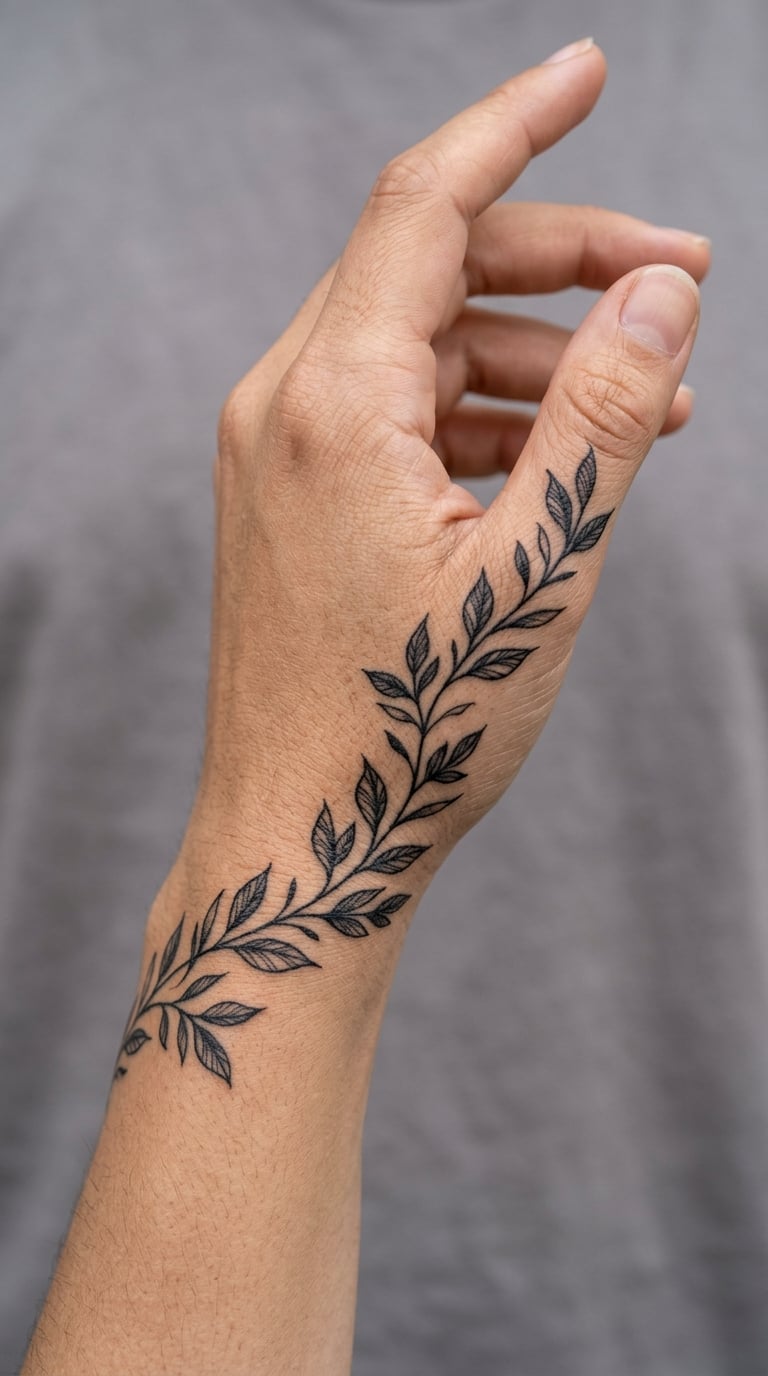
This is the bigger version of the single vine, a stem that starts at the forearm a few inches above the wrist and travels onto the hand, putting small blossoms and leaves along the way. The line weight stays medium rather than fine, and the stem follows the actual curve of the wrist into the hand instead of crossing it in a straight line.
It suits people who want the side of the hand to look like part of a longer piece rather than an isolated sticker, and it is a good first commitment because the design can keep growing later without looking odd.
Placement: the ulnar, or little-finger, side of the wrist continuing onto the outer edge of the hand. Size: 4-5 in (10-13 cm) overall. Style: botanical line work with solid black leaves and one or two small blooms.
Pain: medium-high. The wrist crease is one of the more sensitive spots on the arm, and a long piece means a long session on a placement that swells as you go. Take a break halfway.
Make it yours: pick a stem that grows in a direction you can explain, grapevine, wisteria, olive, and add a single coloured bloom at the point where it reaches the hand.
12. Mini Wave
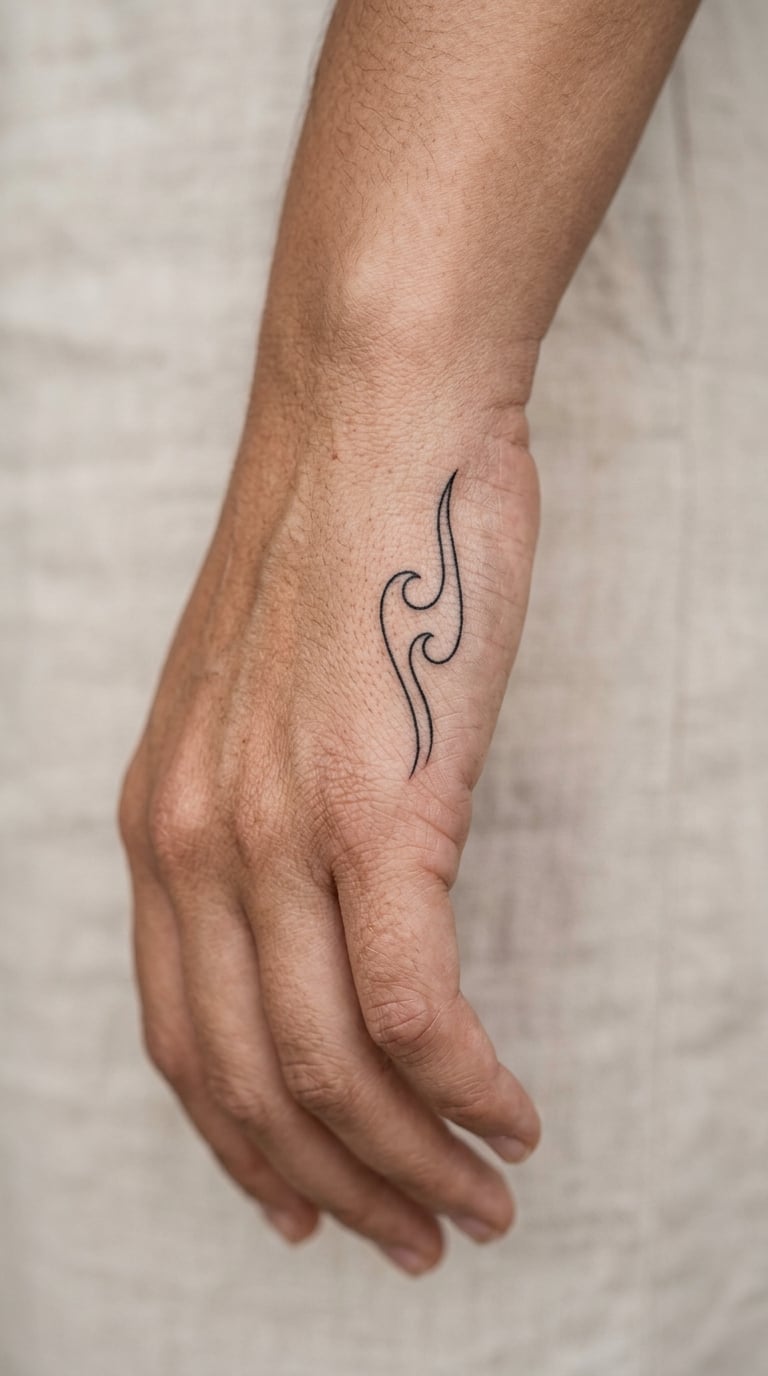
The mini wave is two curved lines and a small curl, drawn with a slightly heavier line at the crest and a thinner one underneath. It is the smallest piece of movement you can put on a hand, and because the hand moves when you make a fist, the shape seems to shift with it.
Surfing, swimming, a coastal hometown, or just a preference for lines over objects. It works as a matching piece because two waves at the same scale on two hands line up when your hands touch.
Placement: outer edge at mid-hand, curl pointing toward the fingertips. Size: about 2 in (5 cm) wide. Style: fine line with one bold crest, or two solid black curves with no interior detail.
Pain: low. There is not much area to work, and the lines follow each other instead of crossing. Two solid curves hold up far better here than a wave filled with foam detail, which disappears within a few years.
Make it yours: add a set of coordinates or a date in tiny type under the wave, or reduce it to a single curl if you want it even smaller.
13. Four-Point Star Cluster
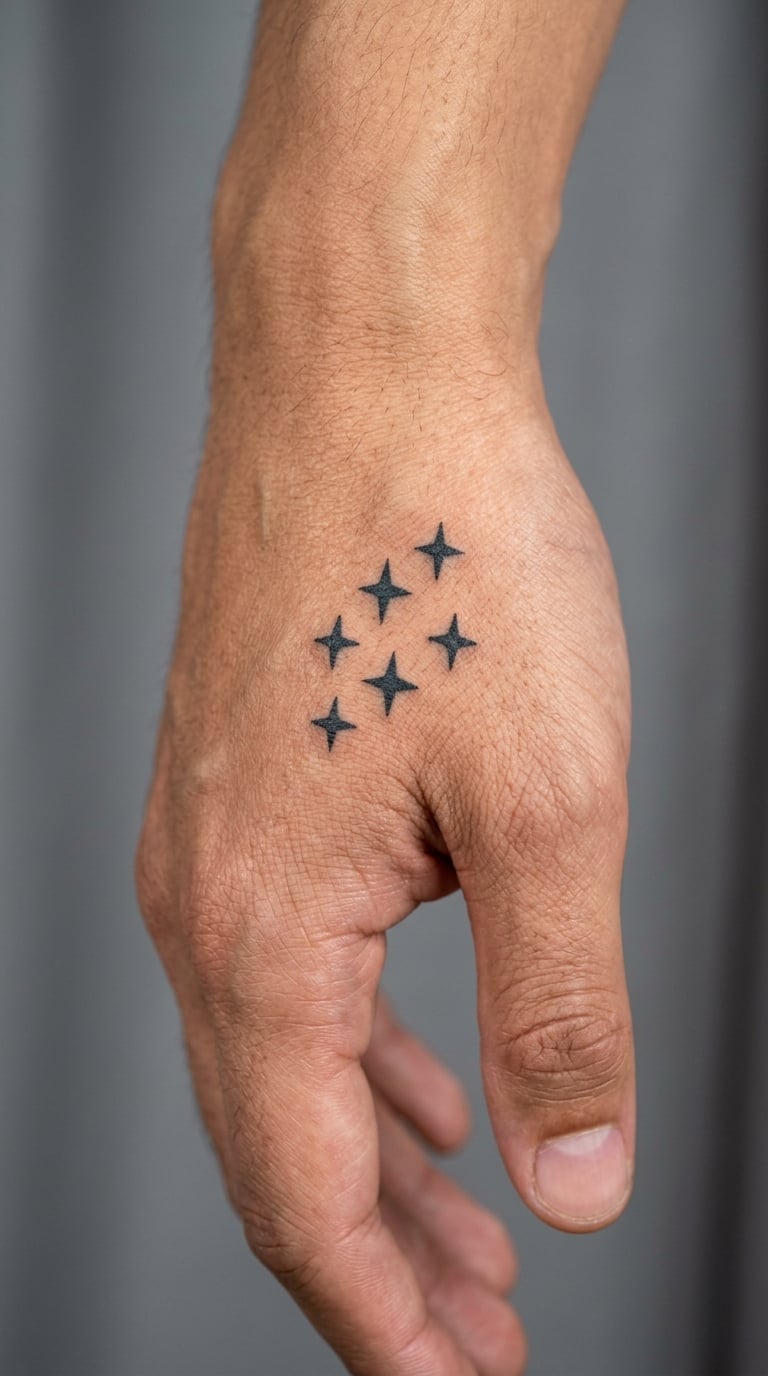
Four-point stars have long thin rays rather than the five points of a classic star, and a cluster of them scattered along the edge of the hand is one of the easiest designs to space out well. Each star is drawn with two crossed lines, a dot at the centre optional, and clear skin between them so the group reads as separate objects.
Most people pick this one for the shape and the quietness of it, or because they are adding to an existing set of small stars elsewhere. It also works as a discreet first piece.
Placement: outer edge, spaced from the wrist to mid-hand in a loose diagonal. Size: each star 0.25-0.5 in (0.5-1.5 cm), cluster spanning about 1.5 in. Style: fine line, sometimes mixed with dotwork.
Pain: low, and the session is short. The catch is the points. The thin tips of each ray are the first thing to fade on the side of the hand, and after a few years stars often need their points redrawn.
Make it yours: cluster the stars to mirror a real constellation, or run them in a straight line down the edge of the hand like a dotted rule.
14. Small Key
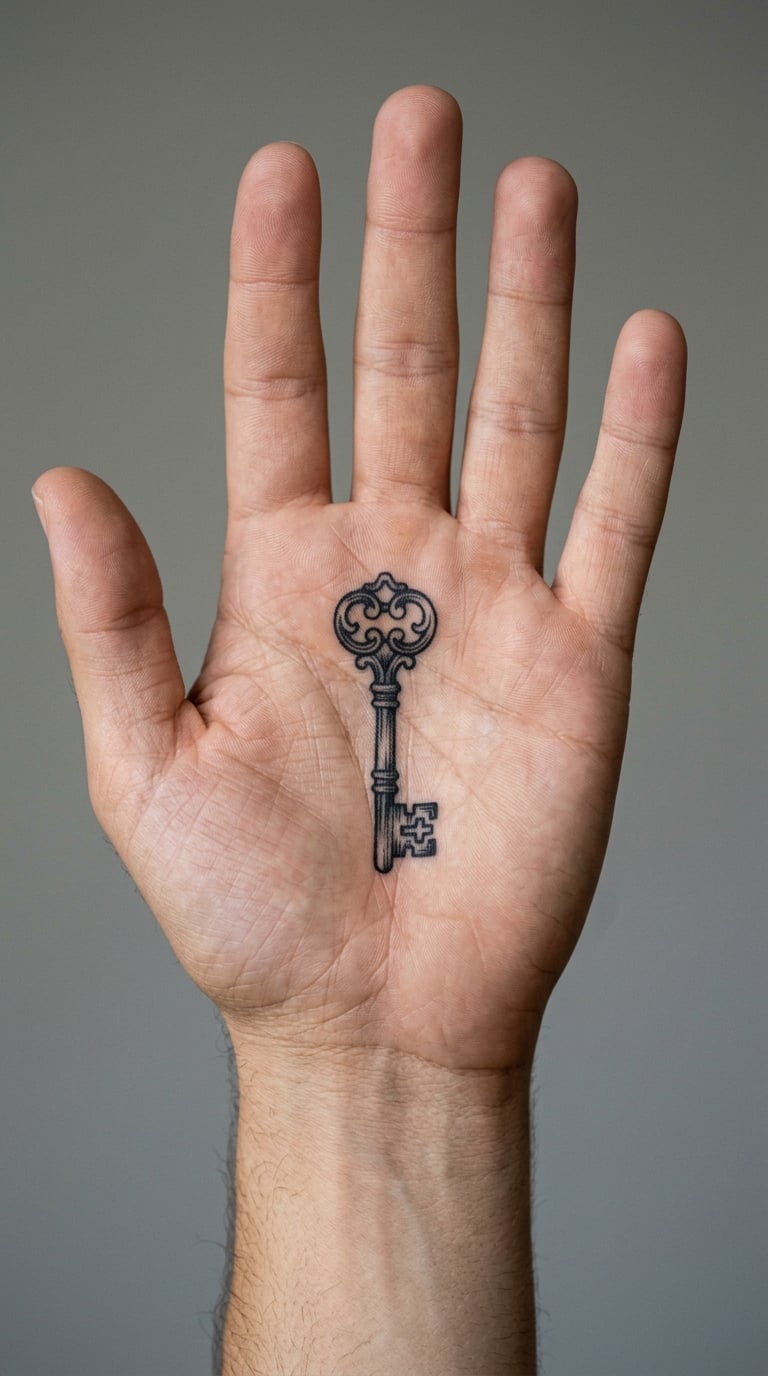
The small key is a vintage shape with a round or bow-shaped head, a straight shaft and three or four simplified teeth. Bold black line, no filigree, no keychain. Keeping the teeth simple is what lets it stay readable at two inches, and a key with a long dangling ring will not fit this placement well.
Keys get chosen for the idea of opening something, a house, a relationship, a new chapter, and for the fact that they are a bit antique-looking without being ornate.
Placement: outer edge at mid-hand, held at a slight diagonal with the head toward the wrist. Size: 1.5-2 in (4-5 cm) long. Style: blackwork line work with solid black on the head and teeth.
Pain: medium. The hand shifts more than most flat surfaces, so a straight shaft takes longer to keep straight. Ask for the shaft as one unbroken line rather than assembled from segments, since joins are where the wobble shows.
Make it yours: put a meaningful initial inside the key head, or cut the bow into a heart instead of a circle.
15. Laurel Half-Wreath
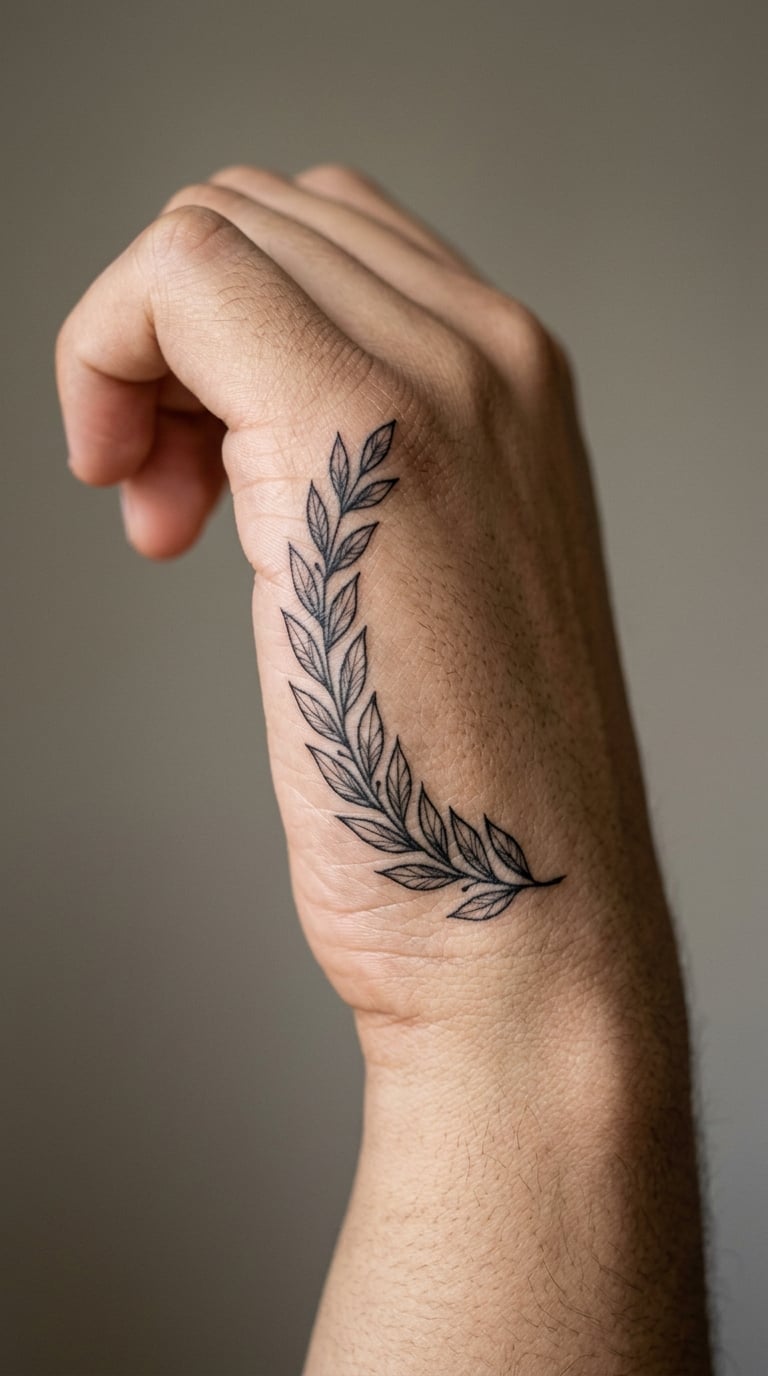
A half-wreath is a single arc of leaves that opens at one end, the way a laurel branch curves around a medal. The leaves alternate along the stem, each one a simple pointed oval, and the whole thing is one open curve rather than a closed ring. On the hand the arc naturally follows the outer edge, which is the reason it looks right there.
It is picked for recognition, effort or a win of some kind, and plenty of clients choose it because it fills a curved space without needing anything underneath it.
Placement: curving along the outer edge from mid-hand toward the wrist, with the opening at the wrist end. Size: 2-3 in (5-8 cm) along the curve. Style: line work with solid black leaves on a thin stem.
Pain: medium. Many small leaves mean many separate little passes, and the hand bruises faster than an arm. A solid-black leaf survives this placement far better than an outlined one, so ask about fill.
Make it yours: tie it to something you earned, and use deep green fill in every third leaf for a two-tone finish that still reads as one branch.
16. Tiny Lightning Bolt
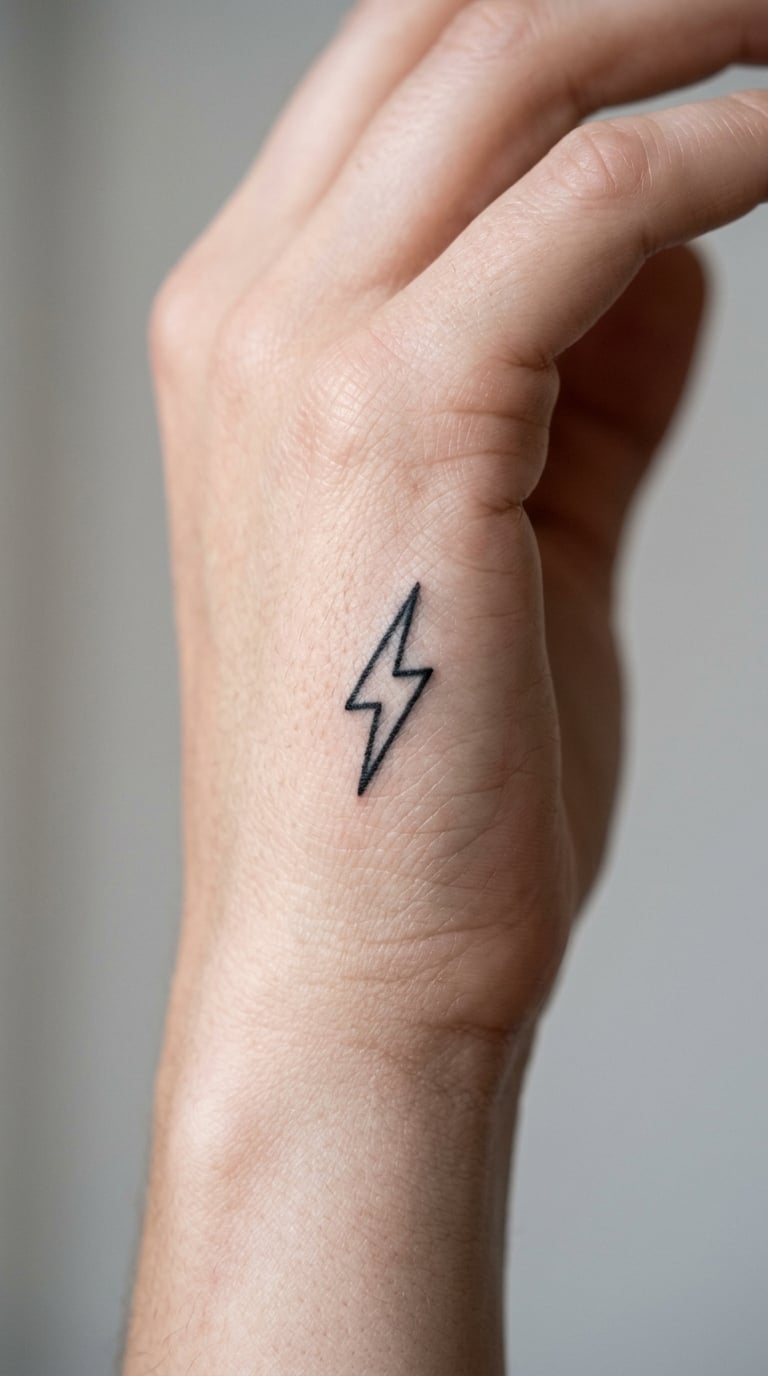
The lightning bolt is the flashiest-looking idea here and the most ordinary, which is fine. What makes it work on a hand is restraint: a single angular bolt, one stroke width, no outline, no glow, no drop shadow. Anything extra and it turns into a graphic from a poster.
People tend to choose it for energy, for a nickname, or because it is a shape with no obvious meaning to explain to anyone at work.
Placement: outer edge near the wrist, running vertically. Size: about 1 in (2.5 cm) tall. Style: solid black single-line graphic, or a bolder filled bolt at 1.5 in.
Pain: low and brief. The honest note is about the edges, not the pain. Sharp corners are the first casualty on the side of the hand, so a bigger, heavier bolt will outlive a delicate one. Choose the filled version if you want it to stay readable.
Make it yours: outline it once, very thin, around a solid bolt, or split it in half and colour one side.
17. Small Dagger
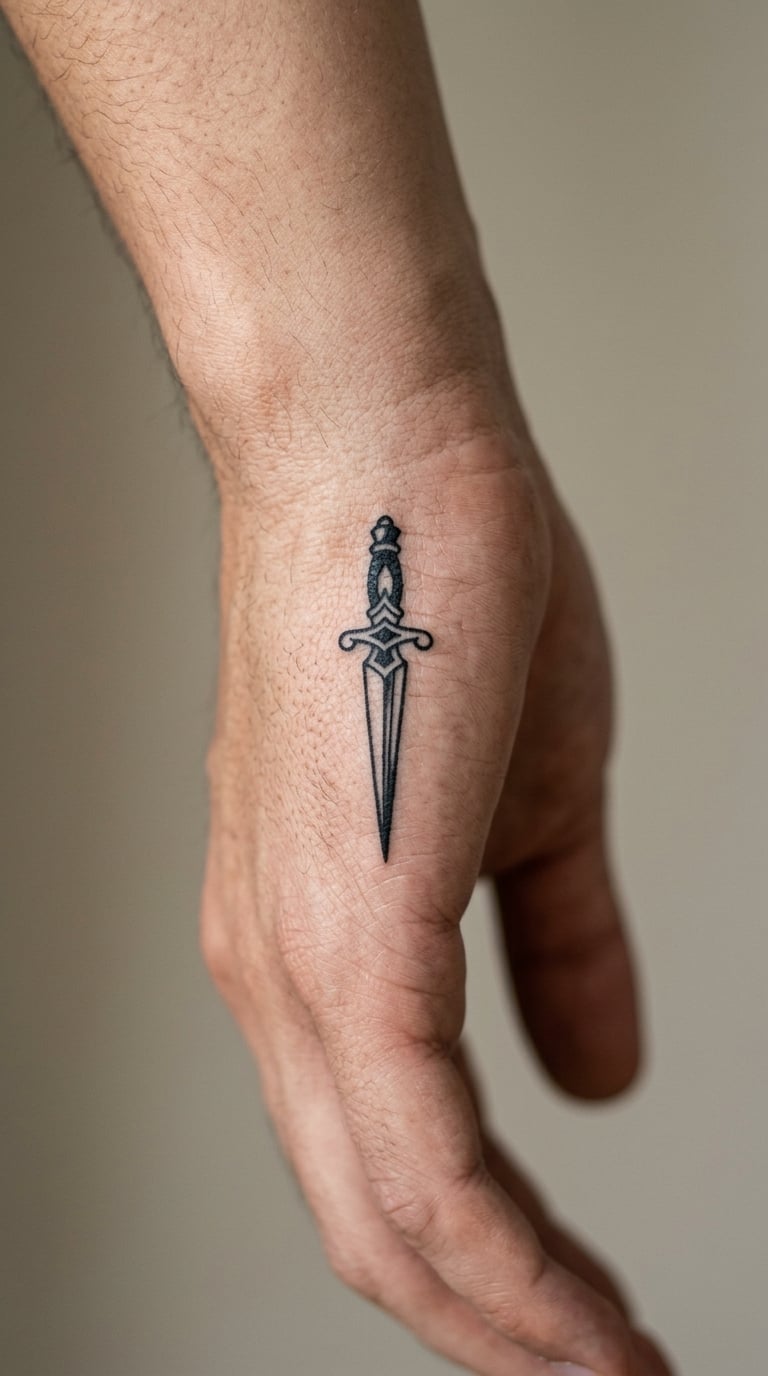
A small dagger for the side hand is symmetrical and vertical, a narrow blade pointing one way and a short handle the other, with a straight crossguard. It is drawn as a silhouette with no dripping, no shading and no ornament, which keeps it graphic and keeps it small. The vertical orientation is what makes it work, because the hand already gives you a straight line to hang it on.
It gets chosen for protection, for a protector, or purely because it is a small object that looks considered. It is a good pick for someone who wants a bold shape without a full traditional style piece.
Placement: outer edge, held vertically from mid-hand down toward the wrist. Size: 2-2.5 in (5-6 cm) long, blade no wider than a pencil. Style: solid black silhouette.
Pain: medium. The handle and guard create hard edges and sudden pressure changes, and bone is close under the whole length. A solid silhouette is fewer passes than a shaded dagger, so it finishes faster than you expect.
Make it yours: engrave a single letter inside the blade in negative space, so the cut-out letter is the only detail in an otherwise solid shape.
18. Peony Micro-Realism
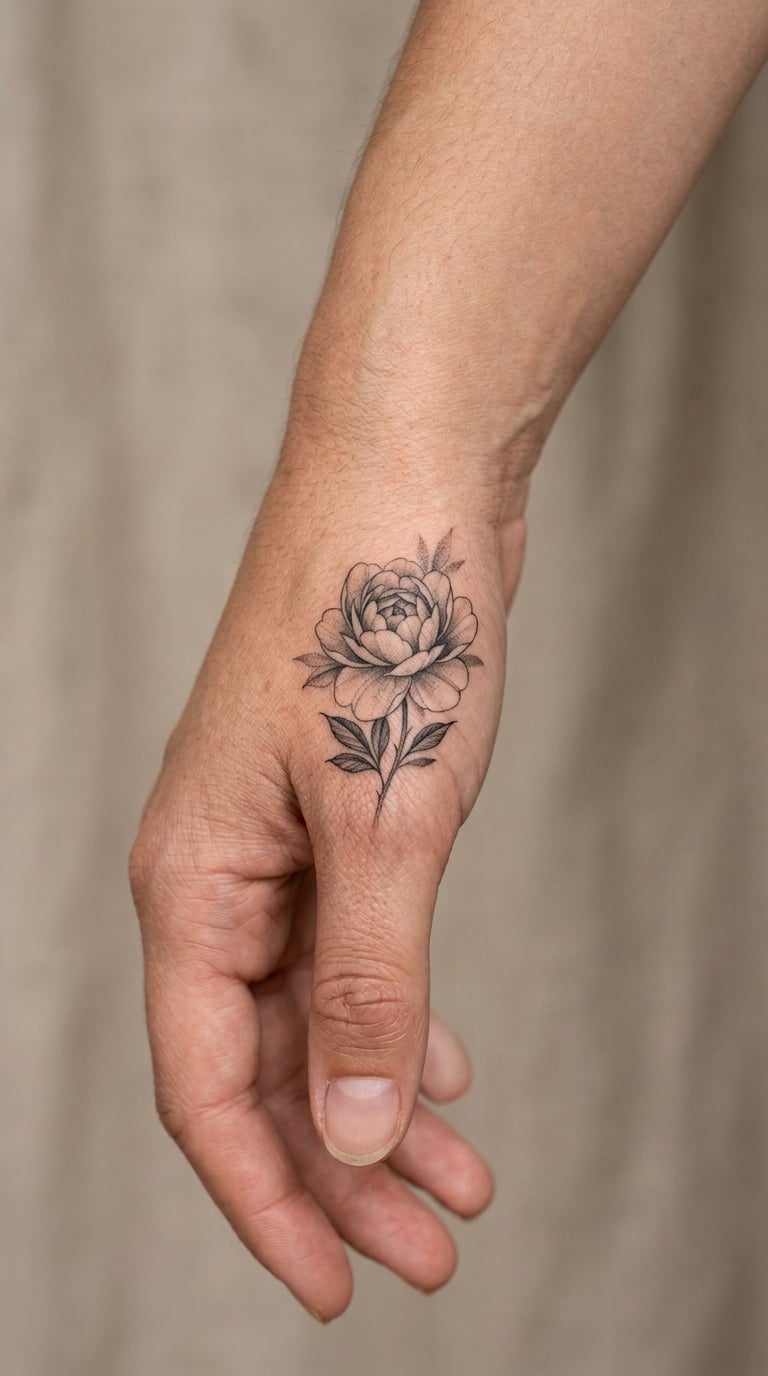
The peony here is the most technically demanding design on this list. Micro-realism means a shaded, almost photographic flower, with soft grey building up in the folds of each petal and darker lines at the overlaps. At 1.5 inches the artist is packing an unreasonable amount of gradient into a very small area, and that is the appeal as much as the risk.
Peonies get picked for a specific person, a grandmother’s garden, a wedding flower, or simply because they are the prettiest flower to get tattooed at this scale, which is a question people ask constantly.
Placement: outer edge at mid-hand, centred so the flower sits flat across the curve. Size: 1.5-2 in (4-5 cm). Style: micro-realism in black and grey, no colour.
Pain: medium to high. Shading means repeated passes over soft skin that is already reacting, and the hand heats up fast. Fine petal edges soften noticeably over the years, so a touch-up in year two or three is normal.
Make it yours: bring a reference photo of a real peony from the garden or bouquet you care about, so the shading follows something specific rather than a generic studio flower.
19. Small Serpent
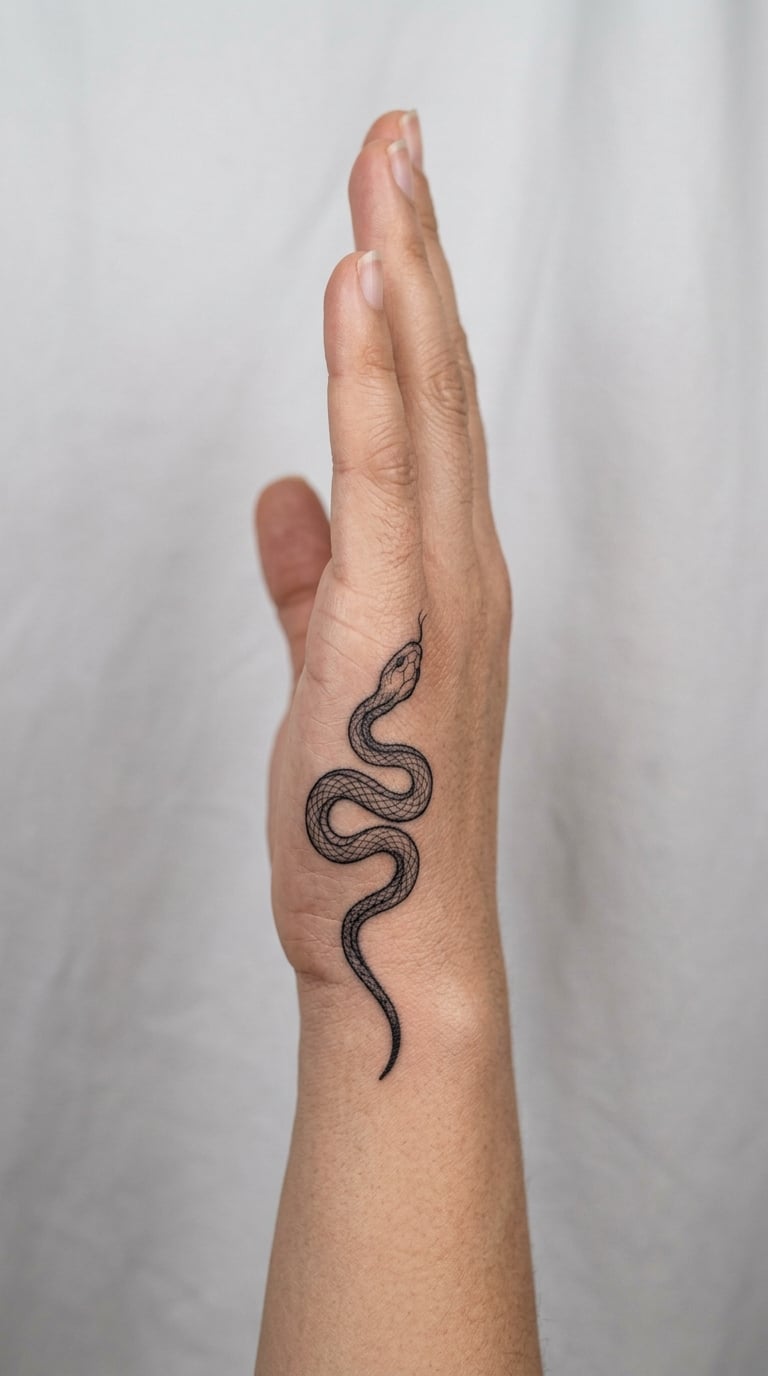
A small serpent is a single S-curve body with a clean head and one line of belly scales, drawn vertically so it coils once and stops. Minimal black line, no shading beyond a hint along the underside. The curve is what makes it fit, because a body that loops lets the design use the hand’s own shape instead of fighting it.
Snakes get chosen for transformation, for protection, for a nod to a zodiac sign, or simply because the shape is elegant. Whatever the reason, it reads as a considered design rather than a doodle.
Placement: outer edge, running vertically with the head toward the fingertips. Size: 2-3 in (5-8 cm) long. Style: blackwork line work with a solid black head.
Pain: medium-high. The outer edge of the hand is dense with nerve endings, and a long single line means a long time in one small area. Keep the sessions short and let the hand settle between them.
Make it yours: add a red tongue, the smallest possible colour accent, or skip the scales entirely and keep the body one unbroken line.
20. Geometric Diamond
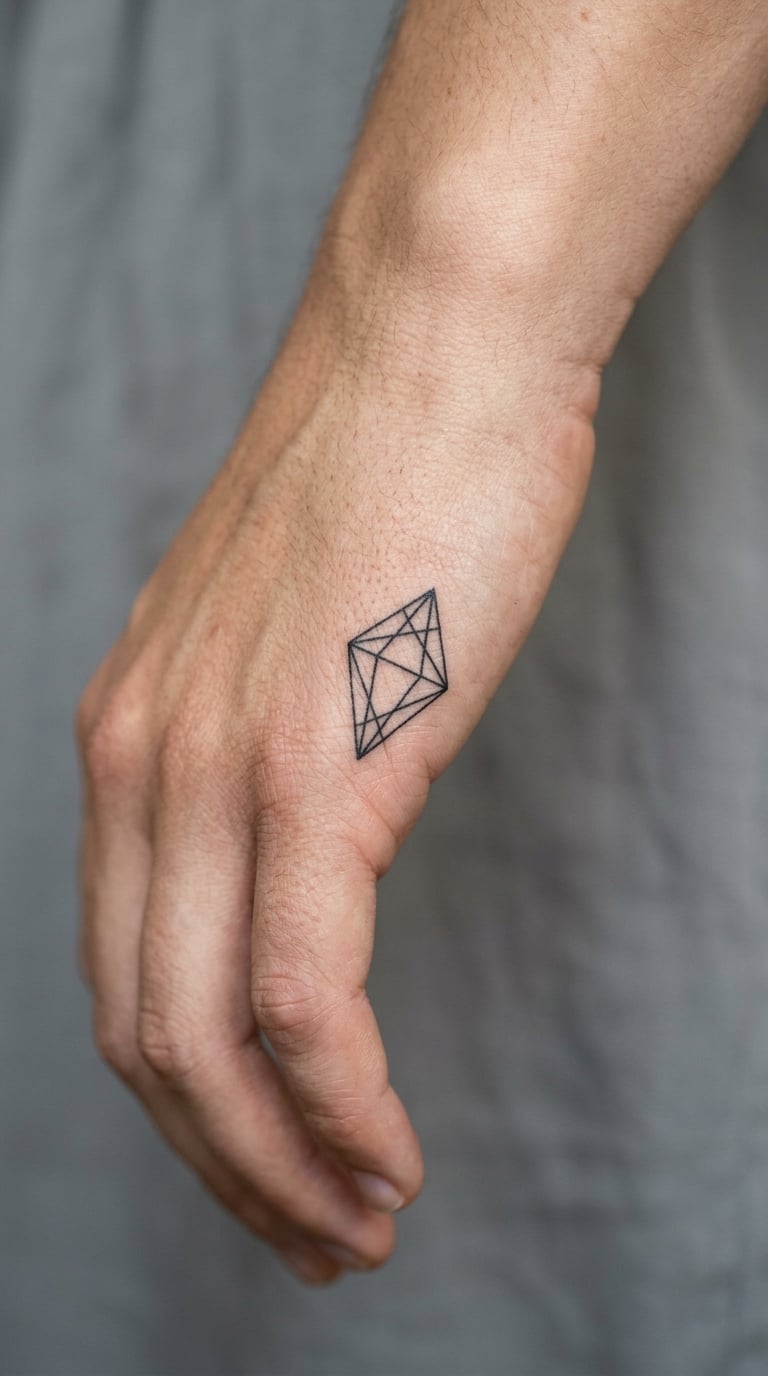
The geometric diamond is built from straight lines only: a top set of facets, a wider middle band, a tapering point below. Some artists split each facet with a thin white gap so the shape reads as cut rather than filled. It is graphic, symmetrical and completely unapologetic about being a shape rather than a picture.
People choose it for the structure of it. Geometric work is one of the more requested styles on hands because it stays legible when everything softer gets worn down.
Placement: outer edge at mid-hand, point downward. Size: 1.5-2 in (4-5 cm) tall. Style: geometric line work, thin gaps between facets.
Pain: medium. Lots of straight lines meeting at angles, and intersections are where the skin gets worked more than once. Keep the facet lines even in weight, since uneven weight is what makes geometric work look amateurish when it fades.
Make it yours: hide a single letter in the negative space of the middle band, or set the point slightly off-centre so it reads as a hand-drawn piece rather than a template.
21. Short Word in Fine Script
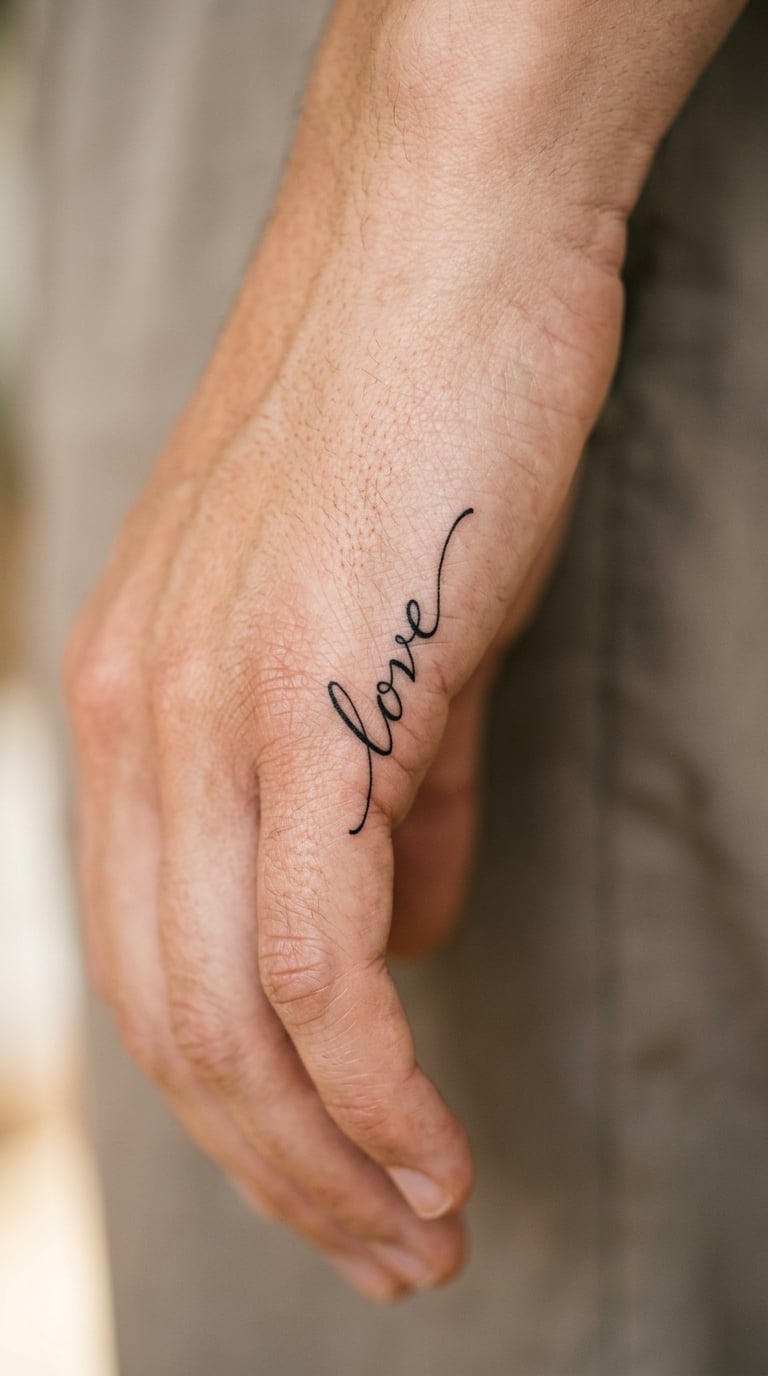
A short word in fine script is one word, no more, set in a connected cursive that runs lengthwise along the edge of the hand. The letters need room to breathe, so the width of the hand gives you a natural line to write along. Anything longer than four or five letters starts to shrink and the whole thing loses legibility.
It is chosen for the word itself, a name, a promise, one word that carries the weight. The appeal is private: most people cannot read it unless they are looking, which is part of why people like script on a visible placement.
Placement: outer edge, running lengthwise from mid-hand toward the wrist. Size: about 2 in (5 cm) of text. Style: fine line script with consistent stroke weight, ideally a monoline rather than a thick-and-thin calligraphic style.
Pain: medium and slow. Lettering is stop-start work, and the hand moves every time you gesture. Monoline script is the right call here: thick-and-thin contrast washes out fastest on the side of the hand, and hairlined loops blur first of all.
Make it yours: add a date in small block capitals beneath the script, which survives better than script and gives the piece an anchor.
22. Small Snake and Flower
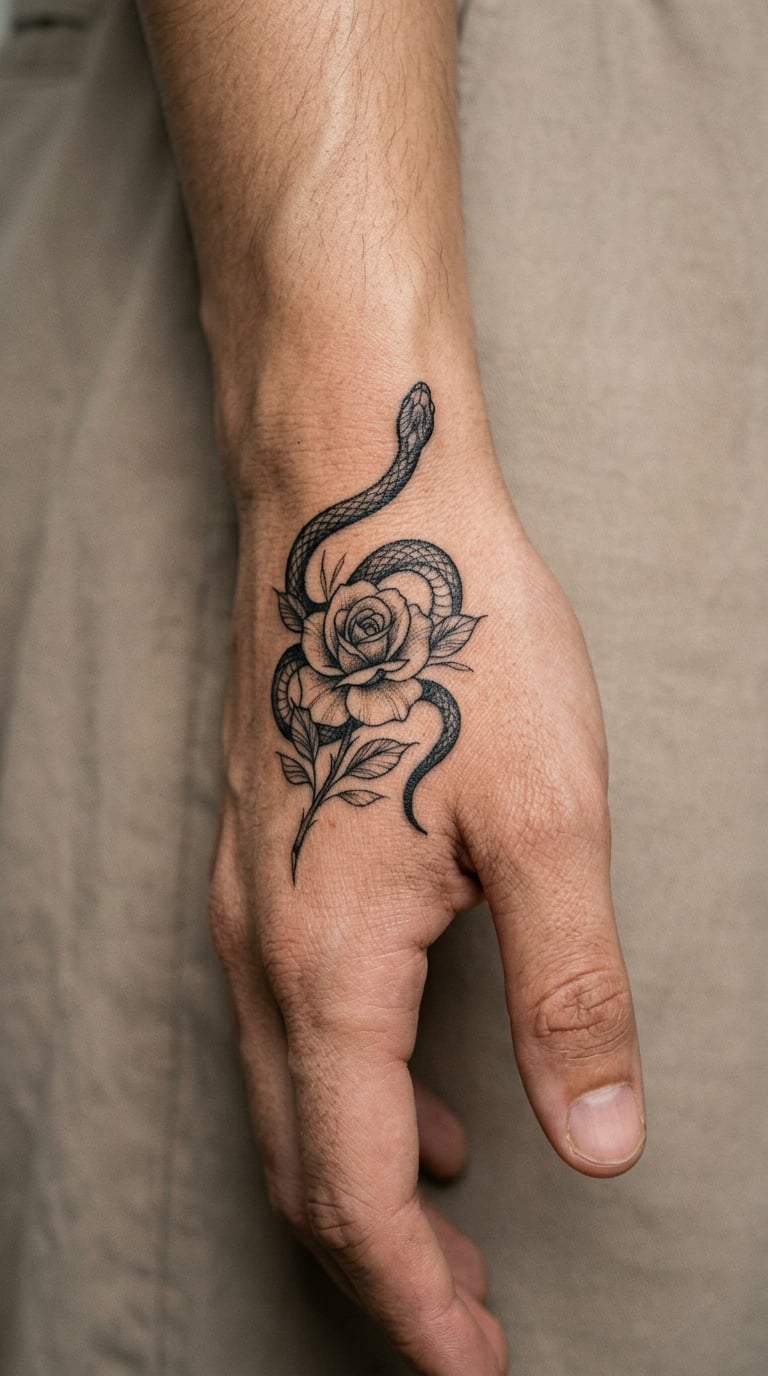
This composition pairs a single slim snake with one open bloom, the snake looping loosely beneath the flower rather than wrapping it, so both elements stay readable. The flower is drawn simply, four or five petals with a small centre, and the snake is one line with a minimal head. Spacing is the hard part, and the gap between the two is what keeps it from looking like a smudge.
It is a more decorative option than either element alone, and people tend to choose it when a plain snake or a plain flower did not feel personal enough on its own.
Placement: outer edge at mid-hand, with enough vertical room for both elements to sit side by side rather than stacked. Size: 2-3 in (5-8 cm) tall. Style: illustrative line work, black only.
Pain: medium to high, and longer than the size suggests because there are two subjects. Two fine elements next to each other need careful spacing in the stencil. Both tend to need tidying up with a touch-up, the flower edges first.
Make it yours: pick the flower for a real reason, a birth month bloom or something from a specific place, and colour only the flower centre.
23. Minimal Playing Card
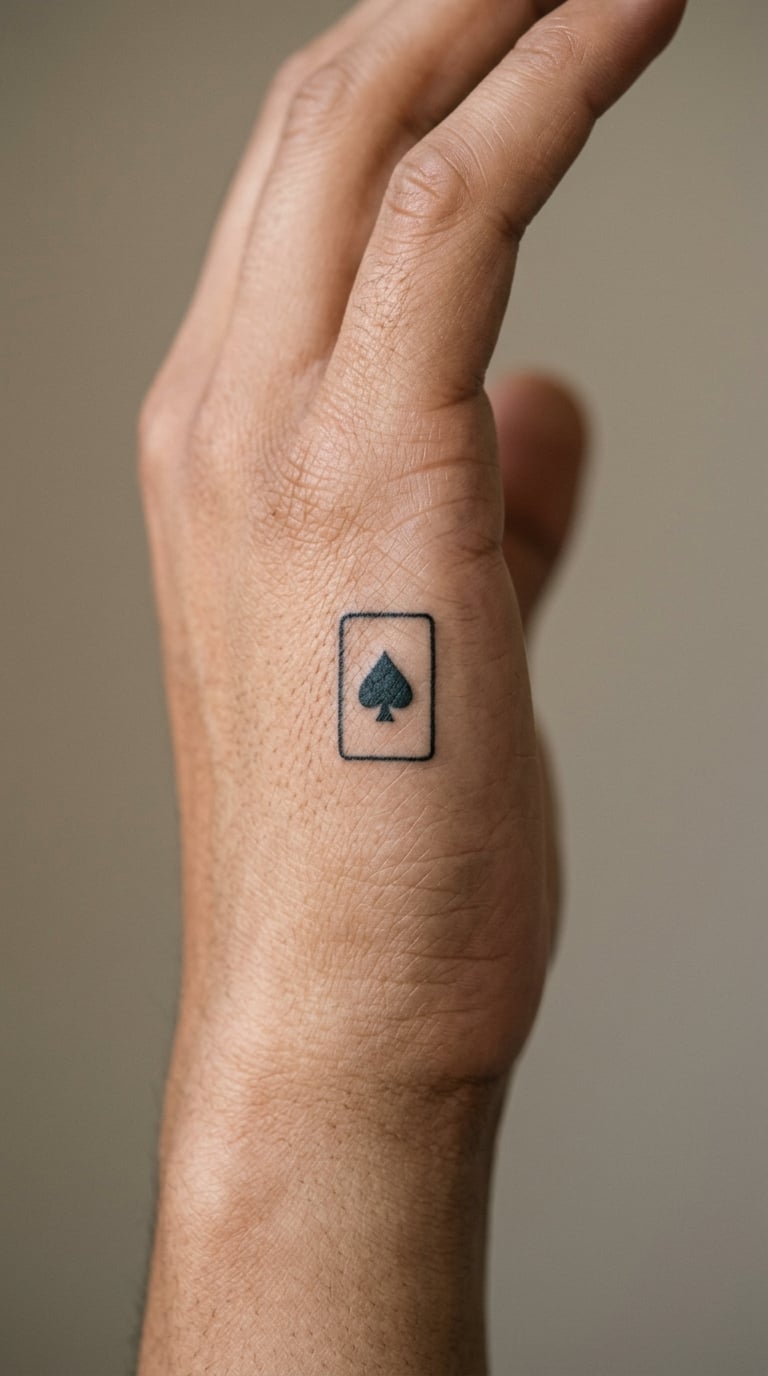
The minimal playing card is a thin outlined rectangle with a single suit symbol inside it, usually a heart, spade, club or diamond, and nothing in the corners. No number, no second pip, no shading. The reduction is what makes it interesting, since the shape is instantly readable and completely flat.
It gets chosen by card players, by people who like the graphic look of a deck, and by anyone who wants a symbol that means something specific to them and nothing to anyone else.
Placement: outer edge near the wrist, held upright, where the rectangle has enough flat skin to sit without curving around the tendon. Size: 1.5 in (4 cm) tall, corners left sharp rather than rounded. Style: graphic minimal, single-weight outline with a solid black pip.
Pain: medium. Straight edges on a curved surface are harder to keep straight than they look on paper, and the corners are where the stencil can slip. Solid black pips hold up; a thin outlined pip does not.
Make it yours: use the suit of a real card that means something, and set the pip slightly off-centre so the card looks hand-placed.
24. Small Laurel Star
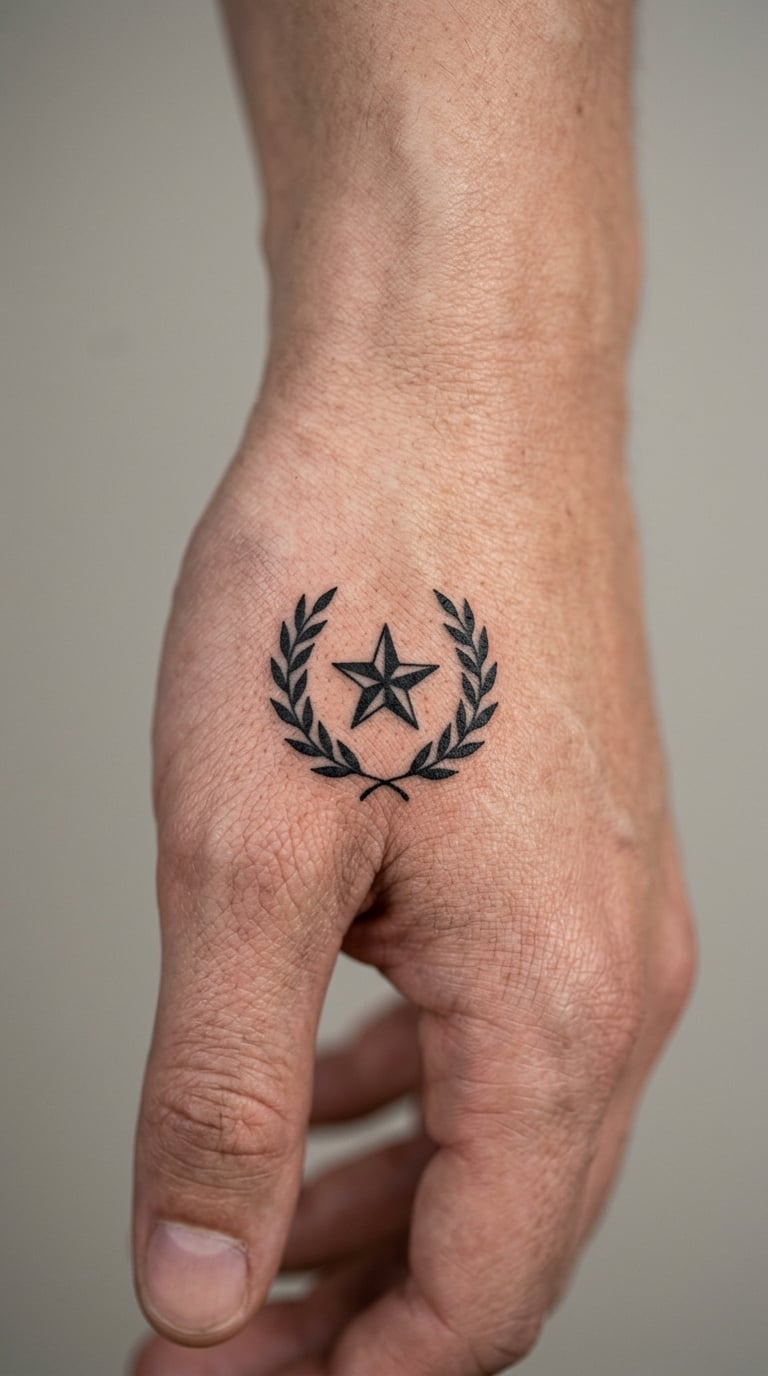
The small laurel star puts a five-point star at the centre and frames it with two short laurel branches curving up on either side, not quite meeting at the top. It is a quieter cousin of the half-wreath, and the reason people like it is the balance: a solid shape in the middle, two open curves around it, nothing fighting for attention.
It is chosen for something achieved or someone honoured, though plenty of people just like the symmetry. It works well as the second piece for someone who already has small hand ink, because it fills the edge without crowding it.
Placement: outer edge, centred at mid-hand with the star upright. Size: 2 in (5 cm) tall overall, the star itself about 1 inch. Style: line and blackwork mix, solid star, fine leaf outlines.
Pain: medium. Many small leaves in a confined area, and the hand swells during a long session. The two open curves are the parts that soften, while the solid star keeps its edges almost indefinitely.
Make it yours: use the outline space inside the star for a birth date in tiny type, or fill the leaves in one deep green while the star stays black.
How to Choose the Right Design
Six checks will save you a bad tattoo. Go through them before you book, not after the stencil goes on.
- Line weight first. Anything thinner than about 1mm will soften on the side of the hand. Ask your artist to thicken the design before they scale it, not after.
- Match the shape to the zone. The hand is a long, slightly curved strip. Designs with a vertical axis fit; wide square compositions fight the contour.
- Check readability at arm’s length. Hold a printed version at that distance. If you cannot tell what it is, it is too detailed.
- Size it against your own hand. Measure from your wrist crease to the base of the little finger and aim for something that fits inside two thirds of that line.
- Plan around your life. Hands are always visible. If client-facing work matters to you, choose something you would be fine explaining to a stranger.
- Ask to see healed work. A healed portfolio piece tells you more about line weight than a fresh photo ever will.
Do side hand tattoos last, and what ages well here?
Yes, side hand tattoos last a lifetime, but they wear faster than arm or torso work. Constant sun, hand washing, desk contact and friction from gloves all take ink out of this spot, and the designs that hold up best are the ones with bold line weight and solid black fill. Micro fine line, hairline script and colour are the first things to need touch-ups here.
Solid black silhouettes and simple shapes hold up best. Fine line and script fade fastest. Colour sits in the middle but red and yellow go first.
Where exactly on the hand does the design go?
| Zone | What it looks like | Visibility | Pain | Notes |
|---|---|---|---|---|
| Outer edge (lateral) | The side of the hand between wrist and knuckles | Shows in most gestures | Medium to high | Thinnest skin, most wear |
| Pinky side (ulnar) | The narrow edge running toward the little finger | Shows in profile and when resting a cup | Medium | Good for vertical designs |
| Thumb side (radial) | The edge closest to the thumb | Shows when gesturing | Medium-high | Nerve dense, near the wrist crease |
| Side of the fingers | Along the side of one or two fingers | Very visible | High | Smallest sizes, fades fastest |
If you are still narrowing the field, the 70+ hand tattoo ideas that women love covers the wider placement, and browsing by style rather than by motif is usually faster than searching for a single perfect picture.
Cost and Session Time
Side hand tattoo cost is driven by size and complexity far more than by placement. Hourly rates and flat design prices both exist, and most shops have a minimum that covers the first part of a session, so a tiny heart and a slightly larger flash design can cost close to the same thing.
- Small single symbols (heart, star, wave, leaf pair): under an inch or so, the shortest session of any design here, usually 15 to 45 minutes and roughly $80 to $180.
- Medium single-subject designs (rose, butterfly, dagger, key, playing card, geometric diamond): roughly 1.5 to 3 inches, 45 minutes to 2 hours, often $150 to $400 depending on the artist.
- Longer botanical or illustrated pieces (wrist-to-hand vine, peony, snake and flower): 3 inches and up, 2 to 4 hours, sometimes split across two sessions, commonly $350 to $800 for fine detail work.
Artist rates, city, shop minimums and how much shading the design needs all shift the final figure, so ask for a written estimate before the first line goes in. A US shop minimum usually sits somewhere between $50 and $150, which is why a tiny heart can cost close to a slightly larger piece. If the number feels high for a small design, that is usually the shop minimum, not the artwork.
Aftercare Basics
- Follow your artist’s aftercare instructions first. Everything below is general guidance; their instructions come first.
- Wash the area gently with lukewarm water and unscented soap, then pat it dry rather than rubbing it.
- Keep it clean and lightly moisturised with whatever product your artist recommends, and nothing else on the skin while it heals.
- Protect it from sun for the first couple of weeks, and use sunscreen on that spot long after healing since this is one of the most exposed areas on the body.
- Expect some flaking or peeling in the first week. Do not pick it, and do not scratch when it itches.
- Avoid friction from tight gloves, heavy lifting and sleeves while the skin is still settling, especially in the first three days.
Frequently Asked Questions
Is a side hand tattoo painful?
The side of the hand is thinner than the forearm and sits close to bone, so most people rate it medium to high, around a 6 out of 10. The outer edge and the area near the wrist crease sting the most, while solid black shapes feel blunt rather than sharp. Short sessions help, because the hand swells as it works and everything hurts more in the last twenty minutes.
How small should a side hand tattoo be?
For a first piece on the hand, somewhere between one and two inches is the sweet spot. Anything under half an inch loses its detail, and anything past three inches starts curving around the hand, which is harder to heal evenly. Measure the line from your wrist crease to the base of your little finger and let the design fill about two thirds of it.
How long does a hand tattoo take to heal?
A small hand tattoo is usually surface-healed within two weeks, with the last of the flaking and tenderness settling by around three to four weeks. The ink itself sits in the dermis and is permanent from the first session. Expect the area to look slightly raised and pink for the first week, and to need a free touch-up check with your artist in the first couple of months.
Do side of hand tattoos fade faster than other tattoos?
Yes, they wear faster than arm or torso work. The edge of the hand gets sun, hand washing, desk contact and glove friction all day, and it has almost no fat or muscle under the skin. Bold line weight and solid black fill hold up best here, while hairline script, dot work and colour are the first things to need refreshing.
Can I hide a side hand tattoo at work?
Not really, and it is better to plan around that than to hope. A design on the edge of the hand shows whenever you gesture, rest your chin on your hand, type with your wrists turned or hold a cup. Small, plain designs in black are the least noticeable, and a long-sleeved shirt covers most of it in cooler months but not in summer.
Is a small side hand tattoo a good first tattoo?
It can be, but it is not the easy one. The placement is visible, it wears faster than most, and the skin is sensitive, so a large elaborate first piece is harder to sit through than people expect. A single symbol of one to two inches is a reasonable starting point, as long as you pick a simple shape and go to an artist whose healed hand work you have actually seen.
Which Side Hand Tattoo Idea Fits You First?
If this is your first tattoo and you want it to stay readable, start with something solid and small: the mountain range, the tiny lightning bolt or the small key. All three are mostly black fill, all three finish fast, and all three still look deliberate in five years.
If you are adding to a collection, the fine-line options open up, and the branching vine or the open rose outline is the natural anchor that later pieces can grow around. If you want something people will lean in to look at, the small eye tattoo ideas for the hand show how much detail this placement can carry when an artist commits to it.
Book a consultation, bring two or three references, and ask to see healed work on the side of a hand before you settle. That one conversation will tell you more than any gallery.