
22 Lantern Tattoo Ideas: Best Unique Designs (October 2026)
A lantern tattoo is a design of a lamp that carries its own flame: an oil lantern, a hurricane lamp, a paper or sky lantern, a Japanese stone lantern, or a Victorian street lamp. People choose one for a simple reason. Whatever version you pick, the motif reads the same way, as inner light, guidance and hope carried by someone who needed to find their own way through a dark stretch.
These 22 lantern tattoo ideas cover a wide range, from a two-inch fine-line drawing on the side of a finger to a five-inch stained-glass piece across the upper back. Every entry below names the style, the placement it suits, an honest size range, how it hurts, and how it ages, so you can walk into a consultation knowing what to ask for instead of what to look up. If you are planning ahead, autumn and early winter are the easiest booking windows, and healing is easier in cooler weather than in a hot, humid summer.
22 Lantern Tattoo Ideas: Quick Guide
| Idea | Style | Best placement | Size | Pain |
|---|---|---|---|---|
| 1. Fine-line paper lantern | Fine line | Inner forearm | 2 to 4 in | Low |
| 2. Traditional red paper lantern | American traditional | Outer upper arm | 3 to 5 in | Medium |
| 3. Watercolor sunset lantern | Watercolour | Shoulder | 2.5 to 4 in | Medium |
| 4. Minimal black silhouette | Minimalist blackwork | Inner wrist | 1.5 to 2.5 in | Low |
| 5. Japanese-style chochin lantern | Illustrative | Outer forearm | 4 to 6 in | Medium |
| 6. Realistic glowing oil lantern | Micro-realism | Upper arm | 3 to 5 in | Medium-high |
| 7. Geometric faceted lantern | Geometric blackwork | Outer thigh | 2.5 to 4 in | Medium |
| 8. Celestial star lantern | Fine line and dotwork | Behind the ear | 2 to 3 in | Low to medium |
| 9. Floral vine lantern | Botanical fine line | Collarbone | 3 to 5 in | Medium |
| 10. Burning match lantern | Illustrative linework | Inner forearm | 2 to 3 in | Low |
| 11. Dotwork moonlit lantern | Dotwork | Upper chest | 2 to 3 in | Medium |
| 12. Victorian hanging lantern | Fine-line illustrative | Outer forearm | 4 to 6 in | Medium |
| 13. Blackwork shadow lantern | Blackwork | Calf | 3 to 5 in | Medium |
| 14. Paper-boat lantern | Fine line and geometric | Inner upper arm | 2.5 to 3.5 in | Medium |
| 15. Neon street lantern | Illustrative colour | Shoulder | 3 to 4.5 in | Medium |
| 16. Botanical greenhouse lantern | Botanical illustrative | Outer upper arm | 4 to 6 in | Medium |
| 17. Antique camping lantern | Neo-traditional | Outer upper arm | 3 to 4.5 in | Medium |
| 18. Broken-frame lantern | Abstract blackwork | Ribs | 2.5 to 4 in | Medium-high |
| 19. Butterfly lantern | Illustrative | Between the shoulder blades | 3 to 4 in | Medium |
| 20. Minimal flame-outline lantern | Micro fine line | Side of the index finger | 1 to 2 in | Medium-high |
| 21. Stained-glass lantern | Neo-traditional colour | Upper back | 4 to 6 in | Medium |
| 22. Celestial constellation lantern | Fine-line celestial | Forearm | 3 to 4.5 in | Medium |
What Does a Lantern Tattoo Mean?
A lantern tattoo means carrying your own light. The flame sits protected inside a frame, which is why the symbol is so popular, it pairs something fragile and bright with something solid that holds it up.
- Guidance. A lantern is the classic wayfinding tool, so it often stands for someone or something that showed you the route through a hard time.
- Hope. Light in the dark is the most common reading, and the one most wearers say they came for.
- Enlightenment and inner light. Some people read the lamp as wisdom, self-knowledge, or a private insight they will not explain to anyone else.
- Resilience. The flame surviving inside a hard shell is a tidy picture for getting through something without being changed by it.
- Transformation. A lantern that has been lit and used looks different from a new one, so it works for a version of you that has already lived a while.
- Remembrance. Memorial lantern tattoos are common, usually tied to a grandparent, a parent, or a person who worked long or late hours.
- Reunion and release. In Chinese lantern tradition, releasing a sky lantern carries a message away. That reading travels with the design even when the wearer has no Chinese connection at all.
- Warmth and welcome. Less mystical, more literal: a lamp left burning at a door is a gesture of welcome, and plenty of people just like the idea of being that welcoming.
The meaning is personal rather than fixed, so check it against your own story before you commit to it. A lantern that reminds you of a grandparent, of one difficult winter, or of a job worked long hours is doing the job better than any dictionary definition.
1. Fine-Line Paper Lantern on the Inner Forearm
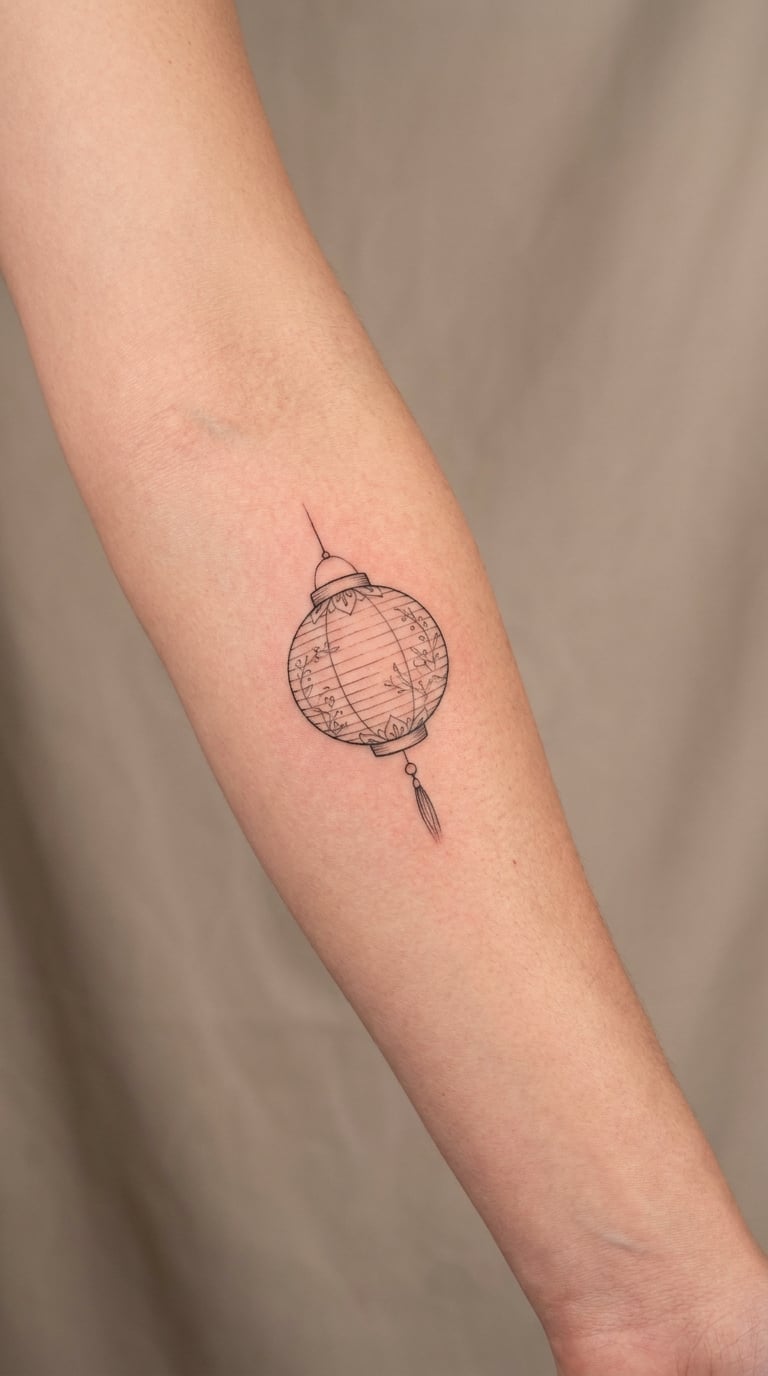
A soft outlined paper lantern with a single warm glow left as negative space in the middle, drawn with one clean line weight and no heavy shading. The ribs get a few hairlines, the top and bottom get a thin band, and that is the whole design.
It reads as warmth and welcome, the kind of lantern that hangs outside a house on a still evening. Most people pick it because it stays delicate after healing and still catches the eye from across a room.
Placement: Inner forearm, or the wrist if you want it smaller. Size: 2 to 4 inches (5 to 10 cm). Style: Fine line, single-needle work.
Pain: Low to medium on the inner forearm. It fades faster than most designs because fine single-needle lines have less ink in the skin, so plan on a touch-up every few years if you want the glow to stay crisp. Make it yours: Add a single character or a date tucked under the lantern in the same line weight.
2. Traditional Red Paper Lantern on the Outer Upper Arm
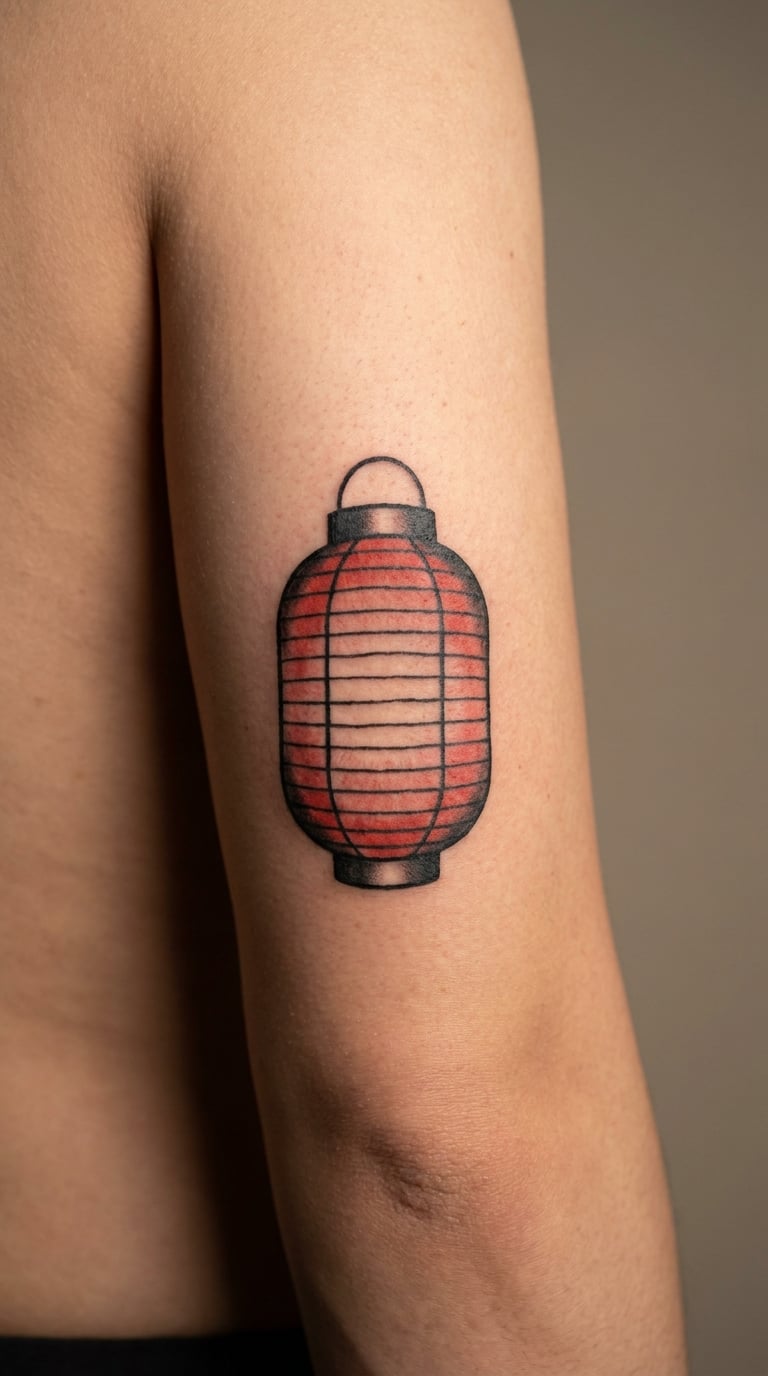
A bold American traditional lantern: heavy black outlines, a red wash filling the body, black shading down one side and a small red flame in the centre. Decorative flourishes, a small scroll or a leaf spray, usually sit under the lantern.
It is a warm, festive image, the visual language of a festival or a family celebration. It suits people who want a lantern tattoo that is obviously a tattoo, not a sketch that reads faintly.
Placement: Outer upper arm, chest, or the outer thigh. Size: 3 to 5 inches (7.5 to 13 cm). Style: American traditional, optionally with a neo-traditional colour twist.
Pain: Medium, and the upper arm has plenty of room for the outline work. Solid colour and heavy line hold their shape well, though a red fill can soften slightly and need refreshing. Make it yours: Put your birth year, a family initial, or a small matching banner underneath it.
3. Watercolor Sunset Lantern on the Shoulder
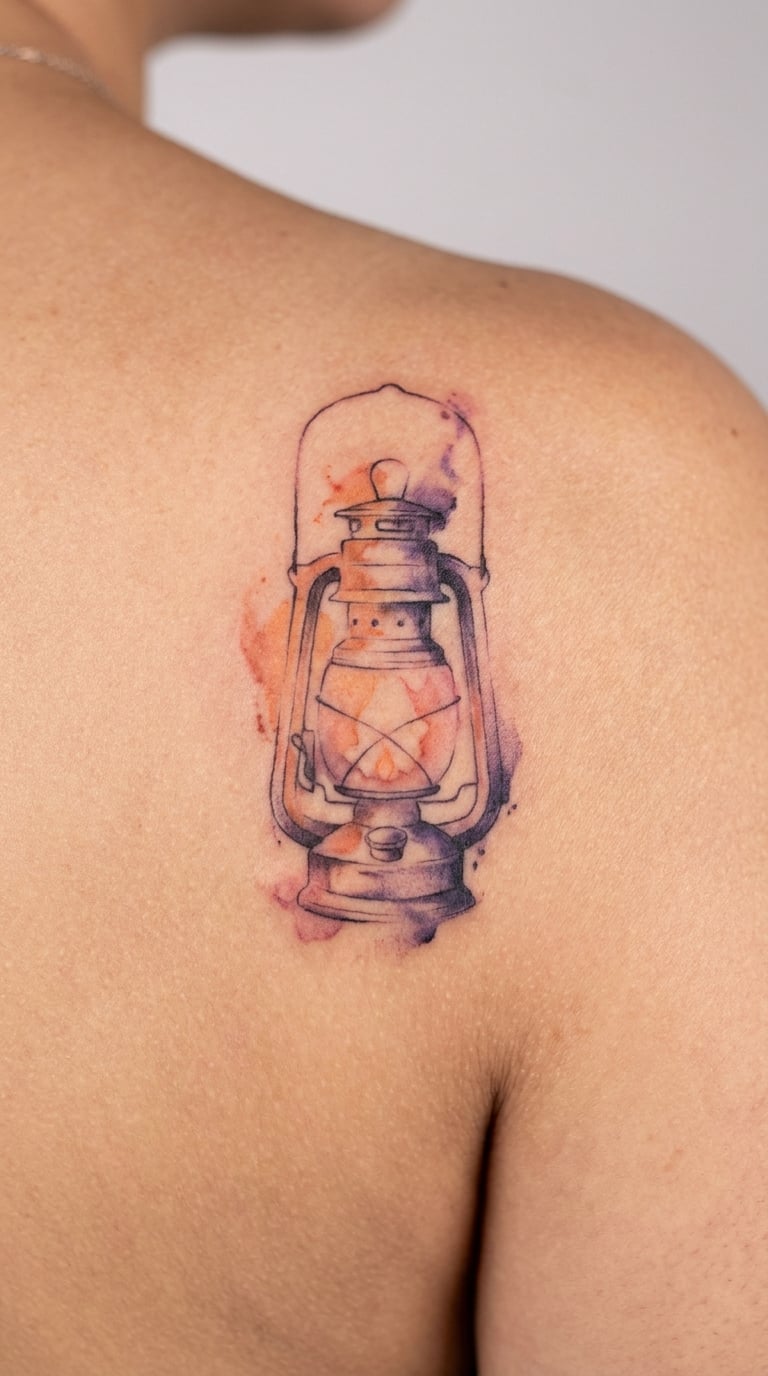
A loose lantern shape with almost no black line, surrounded by translucent washes of orange, pink and violet that bleed outward past the edges of the lamp. The colour sits behind and below the lantern, so it looks like the sky is doing the work.
It is the right pick for a collector who wants colour without the weight of traditional outlines. The mood is soft and atmospheric rather than graphic.
Placement: Shoulder, upper back, or the outer upper arm. Size: 2.5 to 4 inches (6 to 10 cm). Style: Watercolour, loose illustrative.
Pain: Medium, and the shoulder bruises visibly afterwards because it is all muscle. Watercolour is one of the first styles to look tired, since soft pigment settles into the skin over time, so expect a refresh every few years. Make it yours: Use a sunset colour you recognise, or pick a palette from a place that matters to you.
4. Minimal Black Silhouette Lantern on the Inner Wrist
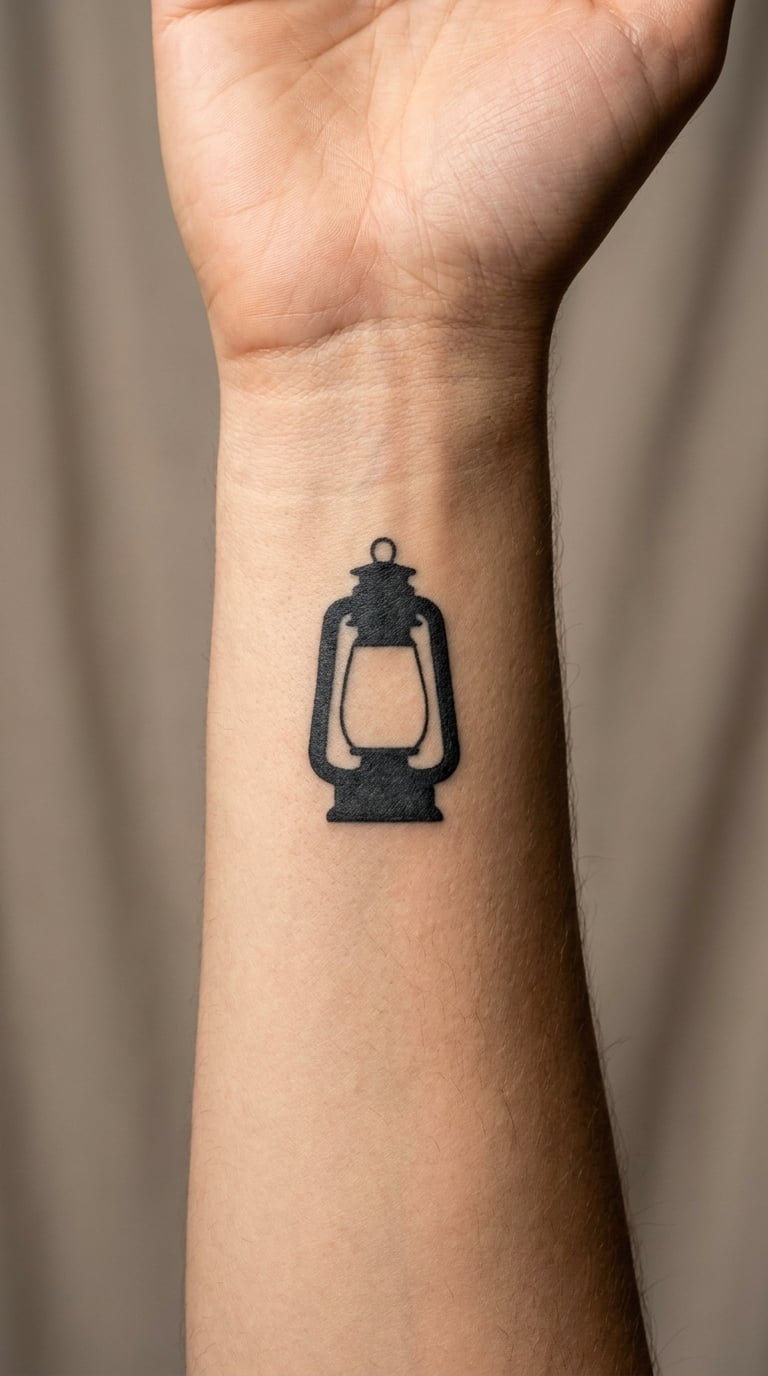
A solid black lantern shape with balanced proportions and nothing inside it but empty skin. No flame, no shading, no chain, just the silhouette and a decent amount of space around it.
The appeal is restraint. It looks good next to almost anything, it hides under a watch or a cuff, and it is easier to live with than a design that demands attention every time you move your wrist.
Placement: Inner wrist, inner arm, or behind the ear. Size: 1.5 to 2.5 inches (4 to 6 cm). Style: Minimalist blackwork.
Pain: Low to medium, though wrist work is fiddly and the wrist bone itself can sting. Solid black is one of the most durable things you can get tattooed, and it barely changes shape. Make it yours: Flip it to hang from a fine line instead, so it reads as a lantern on a string.
5. Japanese-Style Chochin Lantern on the Outer Forearm
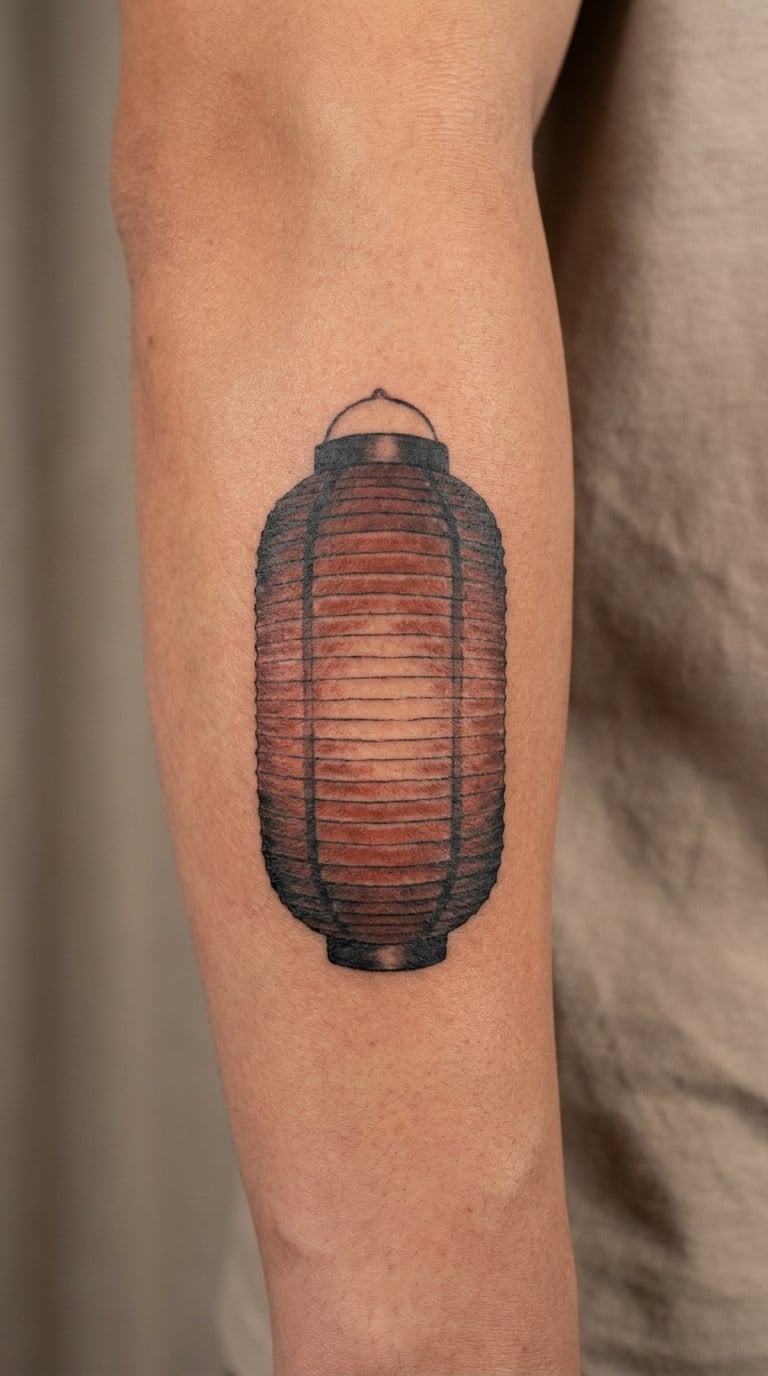
A vertically stretched paper lantern with evenly spaced ribs, a wooden cap and base, and a restrained palette of black line with muted red. The construction is balanced, top loop to bottom finial, with a little negative space inside each rib.
Its appeal is the shape rather than a story. Chochin are the lanterns you see outside restaurants and at summer festivals, and plenty of people like the object itself.
Placement: Outer forearm or upper arm, where the vertical proportion has room to breathe. Size: 4 to 6 inches (10 to 15 cm). Style: Illustrative with light neo-traditional shading.
Pain: Medium. The vertical format needs a flat-ish patch of skin, and the forearm delivers it. Ask for a lighter touch on the ribs, because overworked fine lines in a repeated pattern tend to blur first. Make it yours: Add your own script or kanji on the lower band, placed by someone qualified.
6. Realistic Glowing Oil Lantern on the Upper Arm
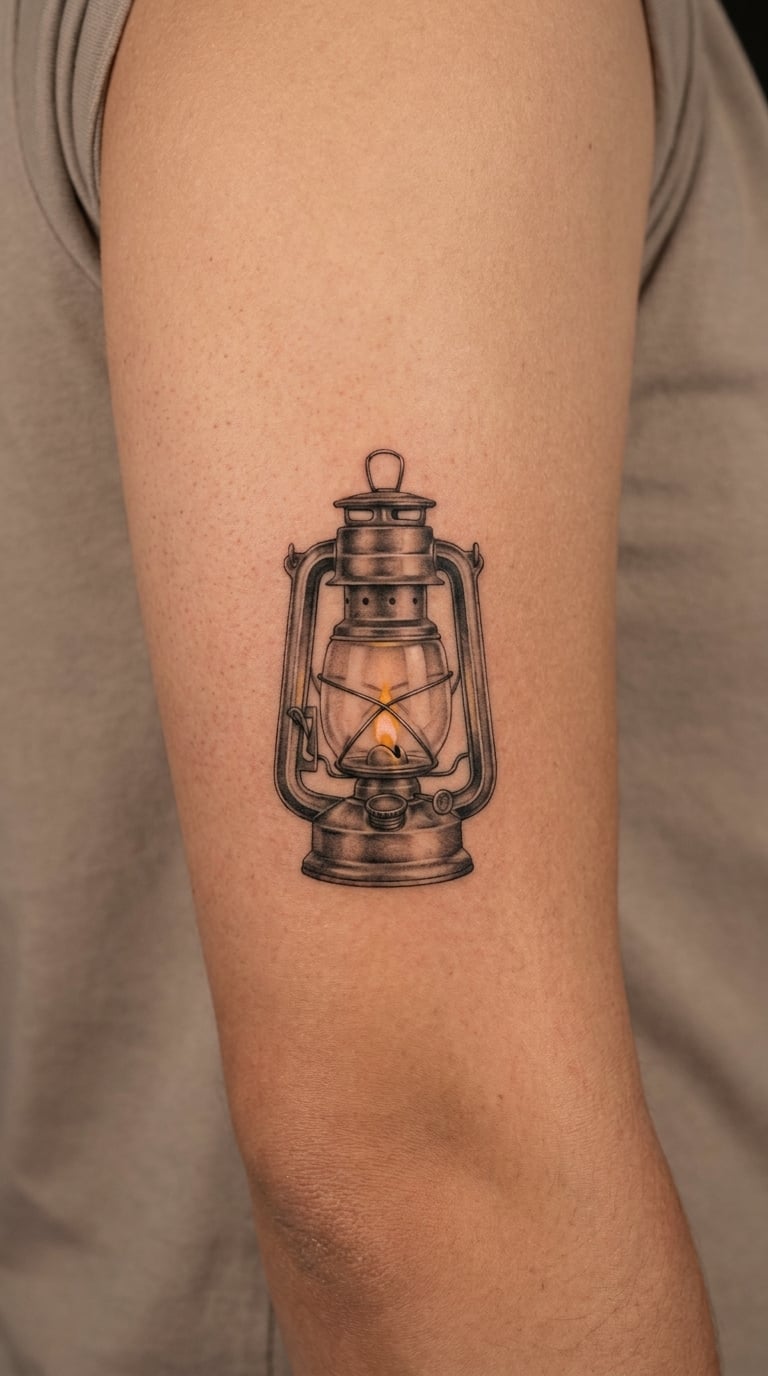
A metal oil lamp rendered close to life, with a warm yellow flame, a pale glass chimney, reflective highlights on the metal and controlled grey shading to give it roundness. The glow is built from contrast, bright flame against a dark frame.
This one is for a collector. It shows range, it takes longer, and it rewards a full session.
Placement: Upper arm, outer thigh, or the back of the arm. Size: 3 to 5 inches (7.5 to 13 cm). Style: Micro-realism with black and grey shading.
Pain: Medium to high, and the shading means more passes over the same skin. Fine highlight work softens over the years, so the picture gradually simplifies, which is normal for this style. Make it yours: Add a faint reflection of the flame on the skin beside the lamp.
7. Geometric Faceted Lantern on the Outer Thigh
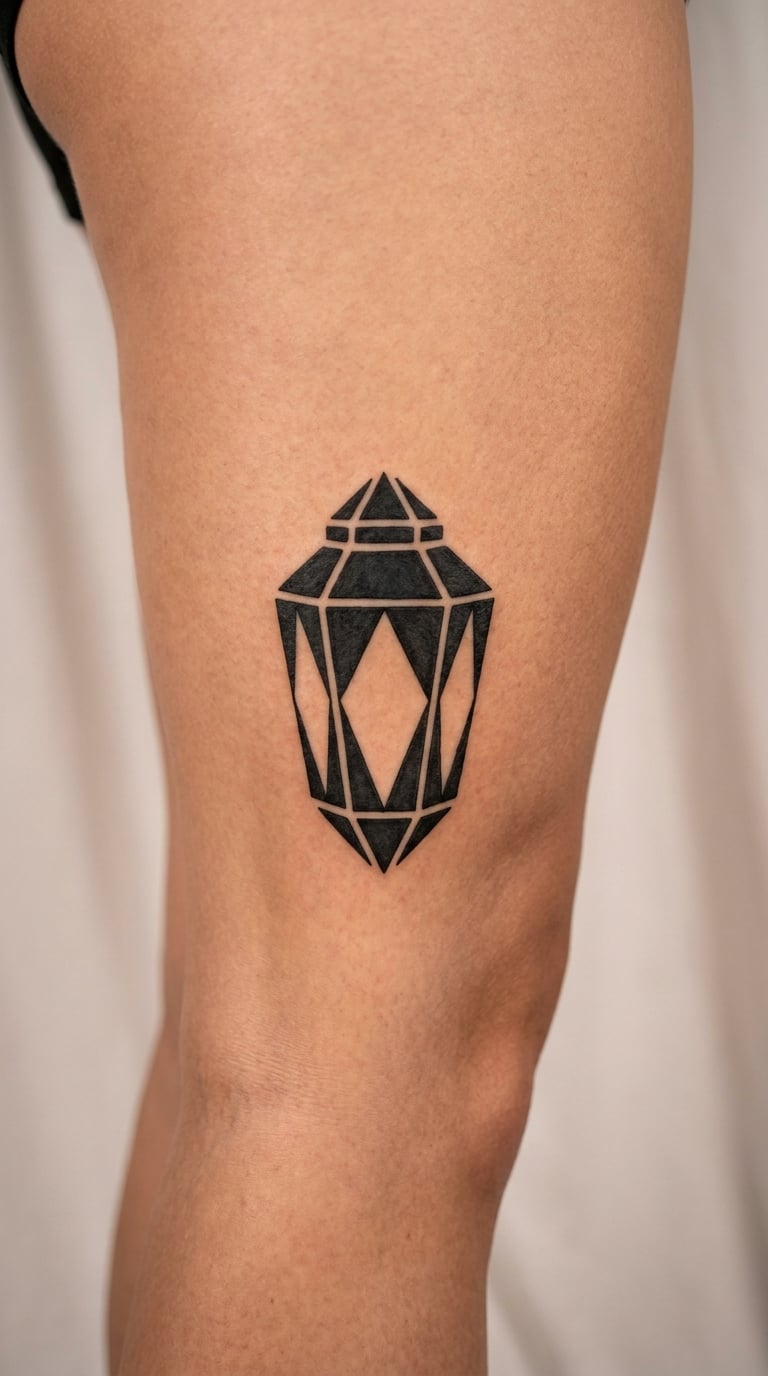
A lantern rebuilt as a crystal, made of sharp polygonal facets with alternating solid black and open sections. Straight edges, no curves, no flame, just the architecture of the light source.
It reads as a modern graphic object, closer to a logo or a piece of jewellery drawing than to a lamp. That distance is the point for people who like clean geometry.
Placement: Outer thigh, calf, or the flat of the upper arm. Size: 2.5 to 4 inches (6 to 10 cm). Style: Geometric blackwork.
Pain: Medium, and the thigh is a forgiving place to sit for a long session. Angular black shapes hold their edges exceptionally well, so this is one of the longer-lasting ideas in the list. Make it yours: Drop one facet to break the symmetry, or line the open spaces with a single colour.
8. Celestial Star Lantern Behind the Ear
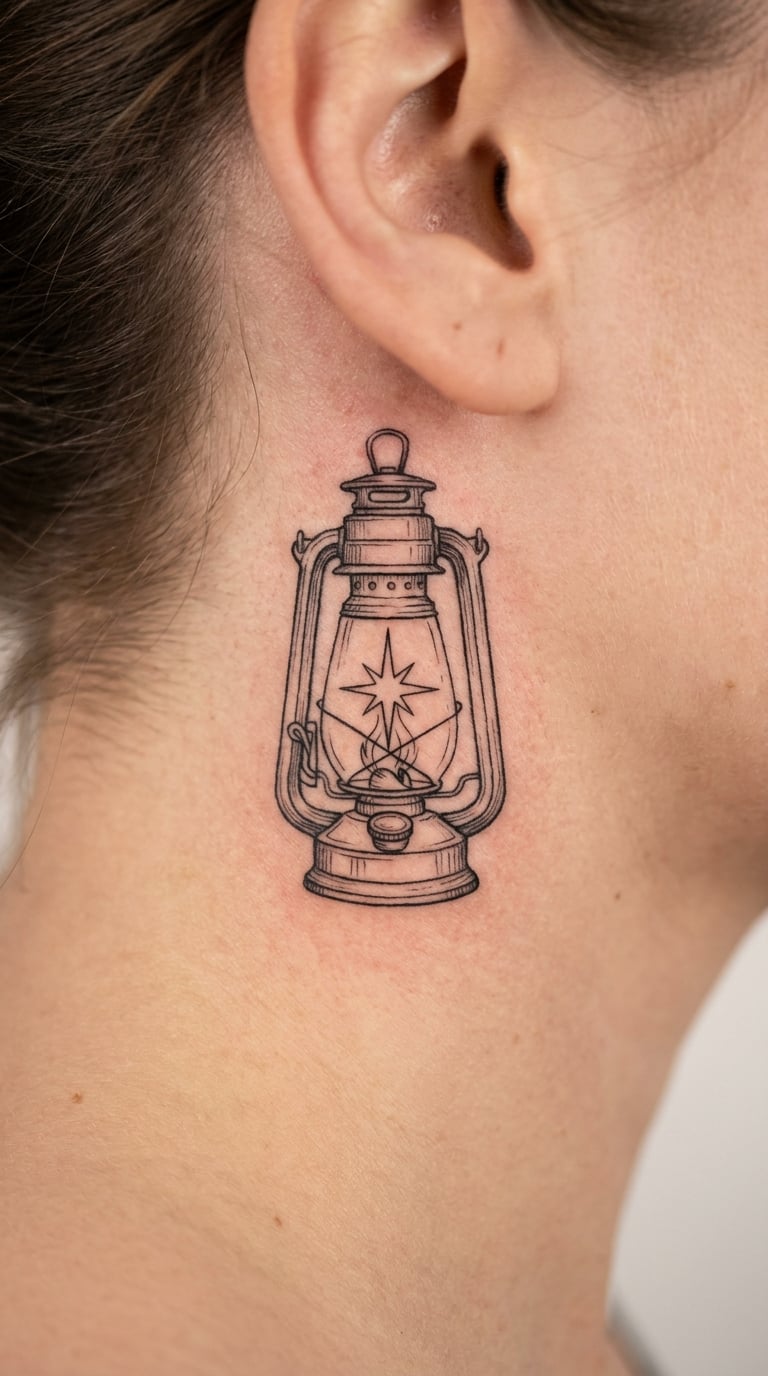
A small fine-line lantern where the flame is replaced by a four-point star, with a few tiny stars scattered above it. The lamp hangs from a short line and nothing else is required to make the idea work.
Turning the flame into a star shifts the meaning toward hope, direction and guidance without needing words. It is a common choice for people who want something meaningful and small.
Placement: Behind the ear, on the upper neck, or at the inner wrist. Size: 2 to 3 inches (5 to 7.5 cm). Style: Fine line with light dotwork stars.
Pain: Low to medium, though the neck and behind the ear are sensitive and the skin is thin. Stars are the first thing to fade here, so keep them slightly larger than feels necessary. Make it yours: Use a real constellation shape for the star pattern above the lantern.
9. Floral Vine Lantern on the Collarbone
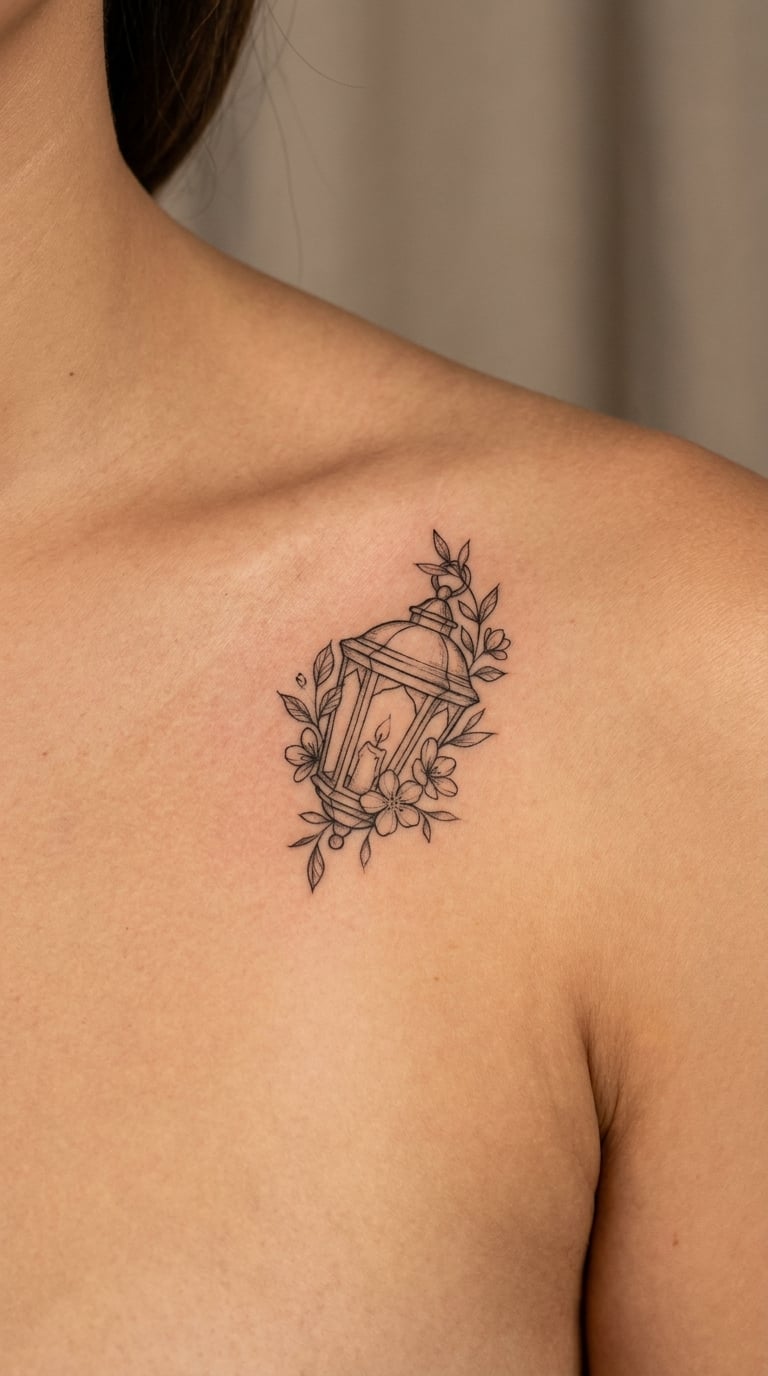
A simple lantern frame with a winding vine that follows the handle and base, small leaves spaced along it and a few blossoms tucked into the joins. Everything is drawn in one consistent black line with no fill.
It is a botanical take on the motif, and the vines do soften the industrial feel of a metal frame. This reads as the most traditionally feminine of the lantern designs.
Placement: Collarbone, shoulder, or the inner arm. Size: 3 to 5 inches (7.5 to 13 cm). Style: Botanical fine line.
Pain: Medium, and the collarbone is close to bone so expect more sting per pass. Leaf and petal edges are the first details to soften, so an artist who leaves a little breathing room between shapes is worth finding. Make it yours: Use a plant that means something to you, or a stem from a wedding bouquet.
10. Burning Match Lantern on the Inner Forearm
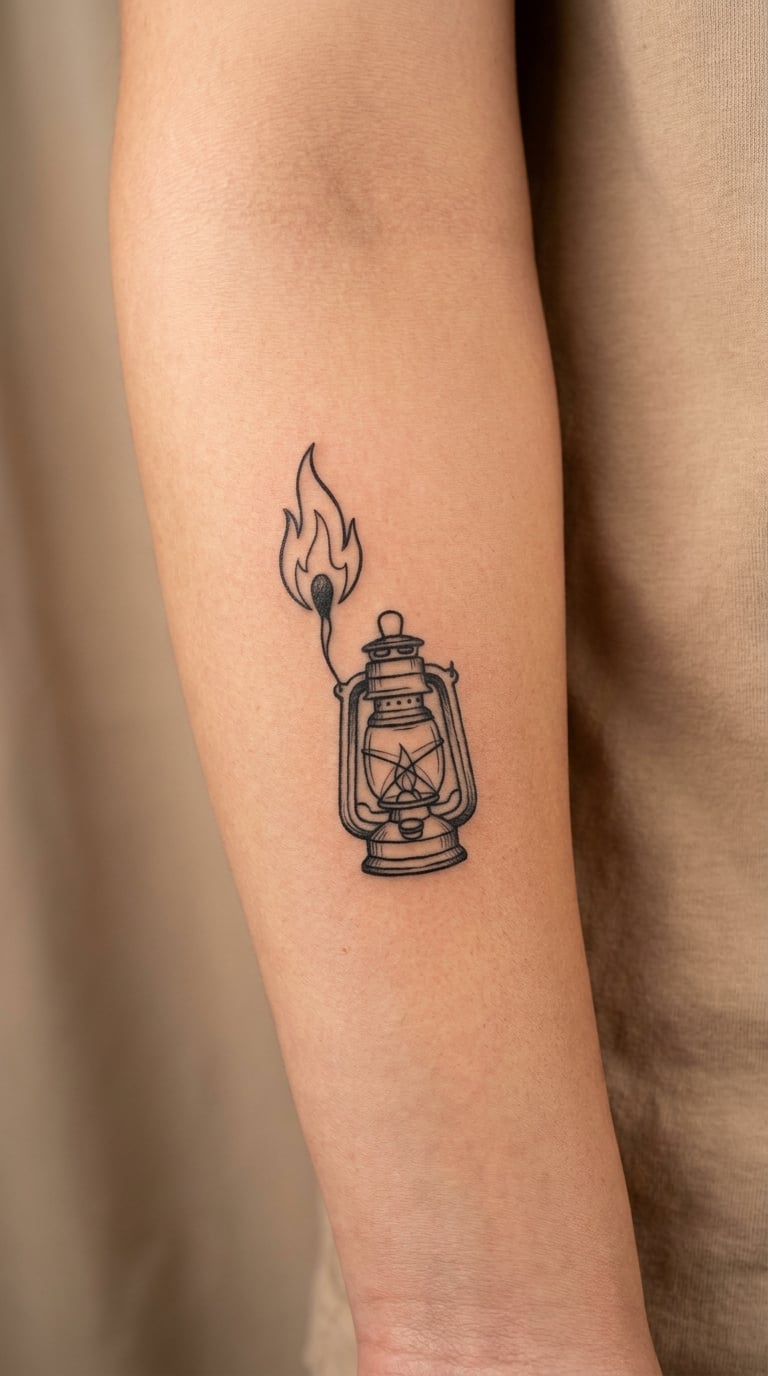
A lit match drawn in clean black line, angled down so the flame meets the handle of a small open lantern, as if the match is lighting it. A few short flick lines around the flame give it movement.
The idea carries a bit of spark and action, the sense of a small thing starting something. It suits people who like their symbolism on the active side.
Placement: Inner forearm or the inner arm. Size: 2 to 3 inches (5 to 7.5 cm). Style: Illustrative linework, light black and grey.
Pain: Low to medium, and it is an easy shape to heal because there is not much shading. Two thin elements meeting at a point is the fragile part, so let the artist build the connection heavier than you want it. Make it yours: Angle the match toward a small star, a date, or an initial.
11. Dotwork Moonlit Lantern on the Upper Chest
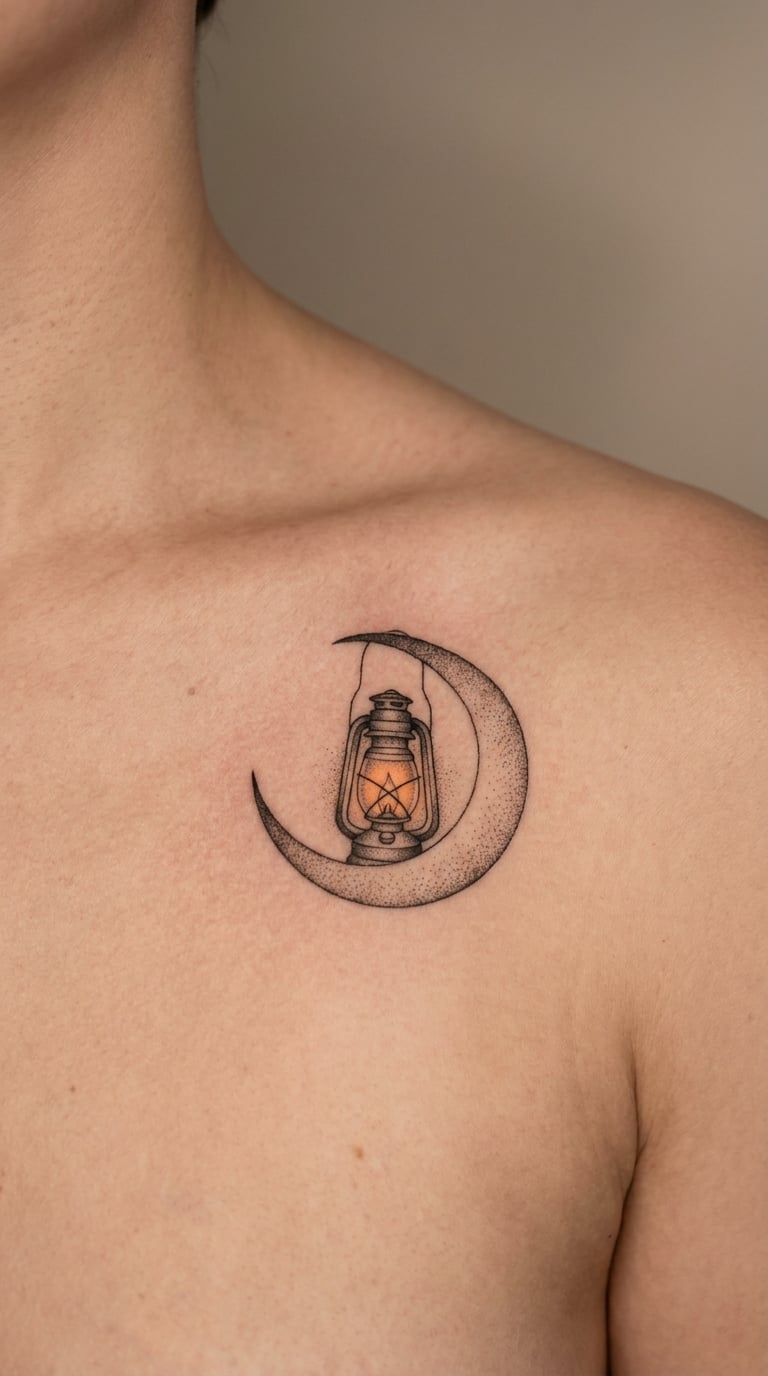
A crescent moon formed from dense dotwork, holding a small lantern in the curve of the crescent. The dots vary in density to shade the moon, and the lantern stays a simple outline with a dot cluster for its glow.
The mood here is quiet and nocturnal, more about a calm night scene than a dramatic flame. It is a nice fit for anyone who likes dotwork as a style on its own.
Placement: Upper chest below the collarbone, sternum, or the inner arm. Size: 2 to 3 inches (5 to 7.5 cm). Style: Dotwork and stippling.
Pain: Medium. Dotwork is slow going and takes real patience from the artist, which shows up in the price. The smallest dots are the first to lose definition, so ask for a slightly larger dot size. Make it yours: Set the crescent to a specific phase tied to a date that matters.
12. Victorian Hanging Lantern on the Outer Forearm
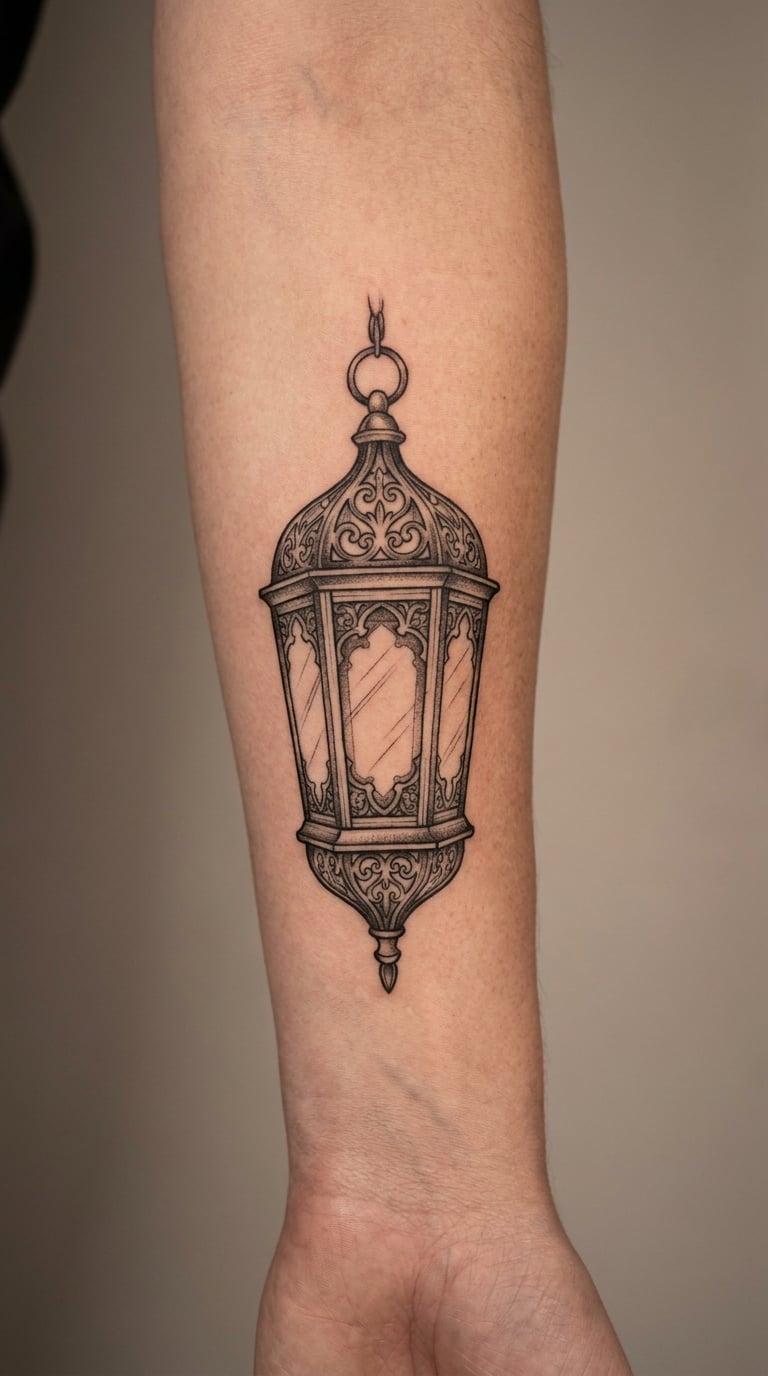
An ornate hanging lamp with a curved top, a slim metal frame, four glass panels and fine decorative filigree at the base. A short chain runs up from the top, and the whole thing is drawn in thin black line with light hatching for the glass.
It has a period character, the kind of lamp you would see outside an old iron gate. That sense of history is what draws people to it.
Placement: Outer forearm, upper arm, or the side of the thigh. Size: 4 to 6 inches (10 to 15 cm). Style: Fine-line illustrative, near-realistic detail.
Pain: Medium, and the filigree means a longer session than the size suggests. Intricate thin detail is the first thing to blur over a decade, so this design looks best as something that softens gracefully. Make it yours: Add a short line of script on the chain, or a second tiny lantern hanging beneath the first.
13. Blackwork Shadow Lantern on the Calf
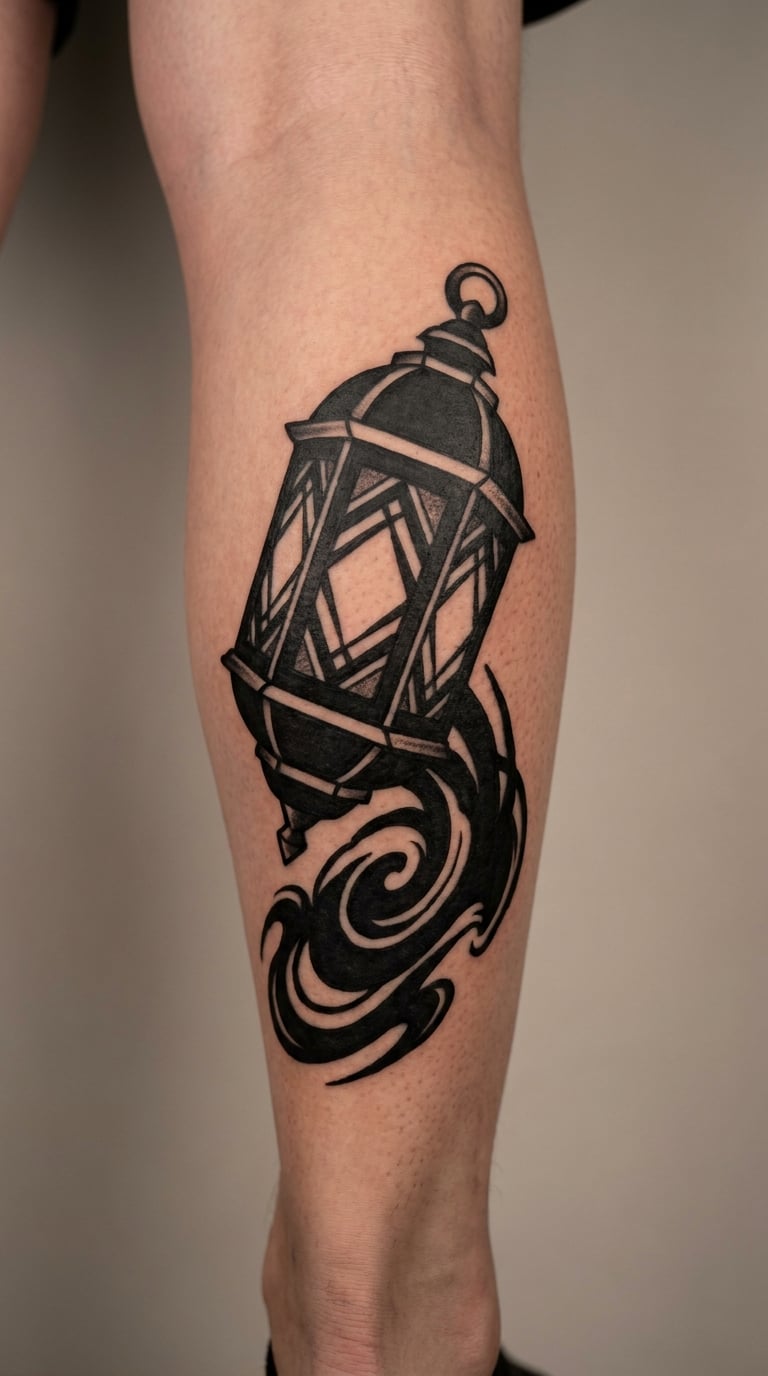
A high-contrast blackwork lantern with a solid black body and a heavy abstract shadow cast beneath the frame, done in one flat dark shape. No grey, no colour, just light and its opposite.
The shadow does the emotional work. A lamp with a dark shape attached says something about carrying brightness and the weight that comes with it, without spelling anything out.
Placement: Calf, outer thigh, or the back of the upper arm. Size: 3 to 5 inches (7.5 to 13 cm). Style: Blackwork, solid and bold.
Pain: Medium, and solid black fills are more painful per pass because more ink goes in per stroke. This is one of the best choices here for ageing, since heavy black areas stay legible for decades. Make it yours: Let the shadow break into scattered fragments at one edge.
14. Paper-Boat Lantern on the Inner Upper Arm
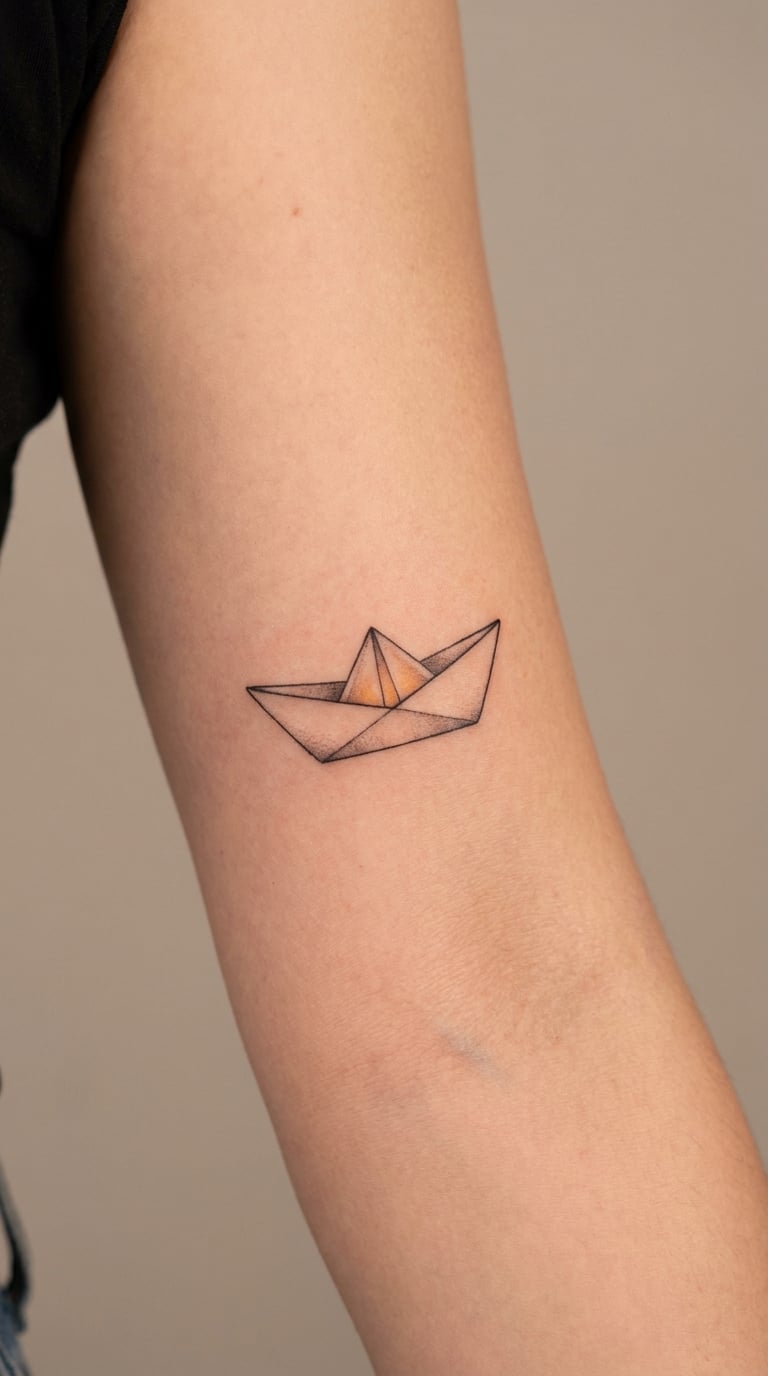
A folded paper boat given a lantern handle and a small amber centre, so the two objects merge into one. Angular folded-paper edges meet a softer glow, and the contrast between the two is what makes the design work.
It has an imaginative, hopeful quality, the picture of setting something small and fragile out to see where it drifts. It reads as a story rather than an object.
Placement: Inner upper arm, inner forearm, or the back of the hand. Size: 2.5 to 3.5 inches (6 to 9 cm). Style: Fine line with a geometric twist.
Pain: Medium on the inner arm, where skin is thin. The fold lines are sharp and pointed, and those points fade fastest, so ask the artist to round them slightly. Make it yours: Add a few water lines or a small reflection under the boat.
15. Neon Street Lantern on the Shoulder
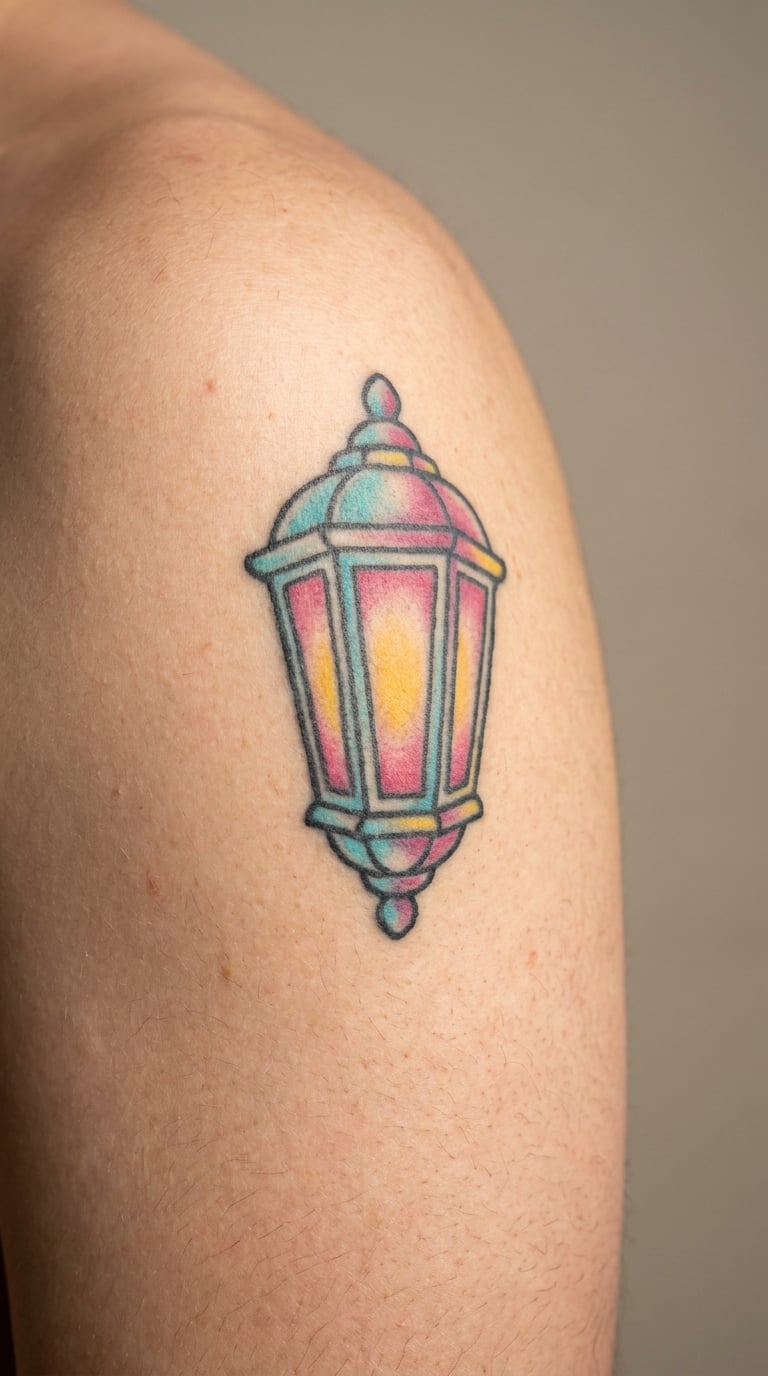
A street lamp drawn like a neon sign, with bright cyan, magenta and yellow shapes, a bold dark outline and a soft glow bleeding past the edge of the tubing. The whole thing has the flat, punchy energy of shop signage.
It is the most contemporary idea on this list, and it works because it borrows from something people already read instantly. Colour does all the work here, not the line.
Placement: Shoulder, upper arm, or the calf. Size: 3 to 4.5 inches (7.5 to 11 cm). Style: Illustrative with bold colour.
Pain: Medium, and bright colour needs more passes so expect a longer sitting. Cyan and magenta are among the first hues to fade noticeably, so a colour refresh every few years is normal here. Make it yours: Use the colours of a specific city, or your team, or a band.
16. Botanical Greenhouse Lantern on the Outer Upper Arm
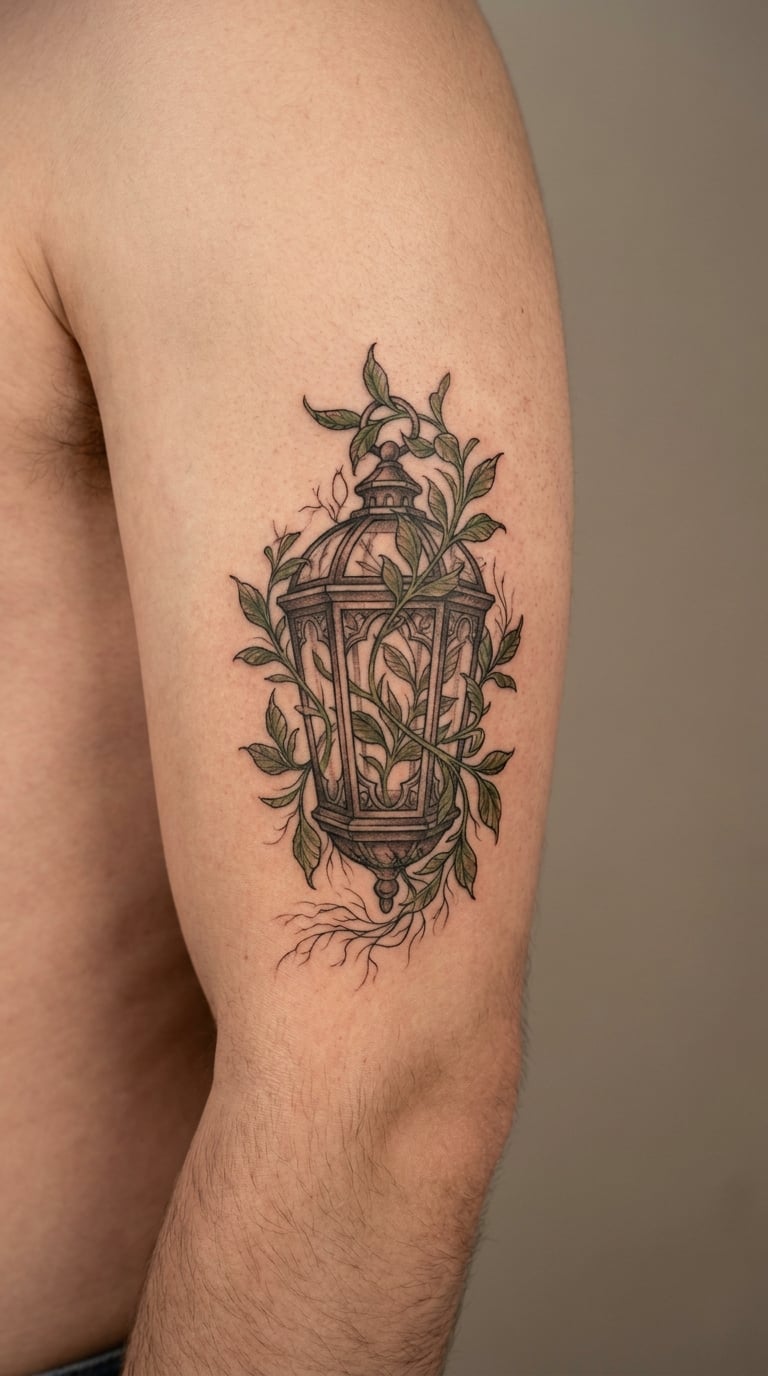
A lantern integrated with leafy vines that climb the frame, fine roots spreading at the base, and thin greenhouse-style glazing bars behind the glass. It is part lamp, part plant study.
Plant lovers tend to land on this one, but it also works as a small landscape piece. The scale is generous, so it suits someone building a fuller composition rather than a single small symbol.
Placement: Outer upper arm, back of the arm, or the thigh. Size: 4 to 6 inches (10 to 15 cm). Style: Botanical illustrative with fine detail.
Pain: Medium, and the session will run long because there is a lot of separate work. Root and tendril lines blur earliest, so a bolder line weight is worth asking for. Make it yours: Build the vines from a plant that grew somewhere you have been.
17. Antique Camping Lantern on the Outer Upper Arm
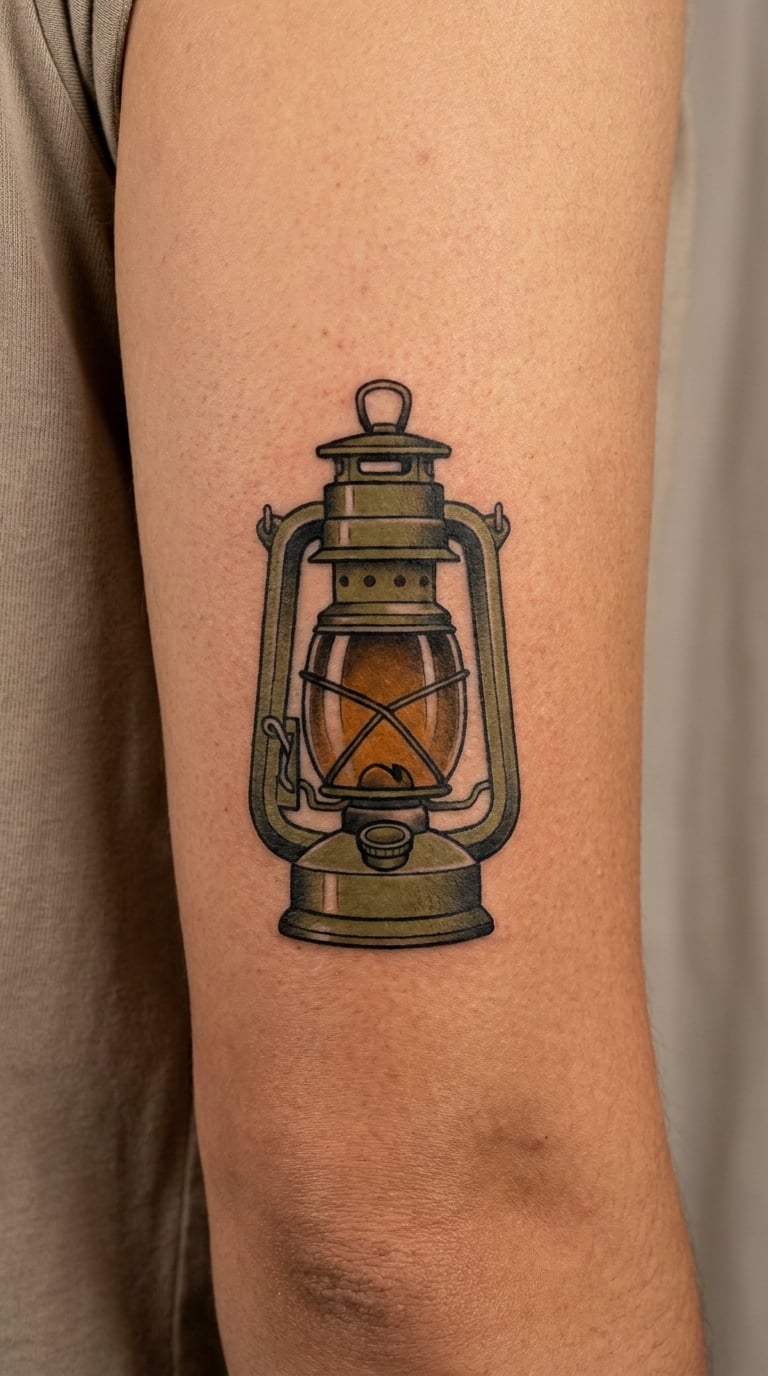
A compact vintage camping lantern with a metal cage, a top carry handle, a softly shaded body in muted green and amber, and black line throughout. It is the practical kind of lamp, not the ornamental one.
There is an outdoorsy, unpolished honesty to it. It is the design for someone who would rather have a working object on their arm than a delicate ornament.
Placement: Outer upper arm, forearm, or the calf. Size: 3 to 4.5 inches (7.5 to 11 cm). Style: Neo-traditional or illustrative with soft shading.
Pain: Medium, and the cage lines over the body are denser than they look. Muted colour and black line age predictably here, with the amber warming and the green holding up better than most light colours. Make it yours: Add a compass point, a mountain outline, or a pair of pines behind it.
18. Broken-Frame Lantern on the Ribs
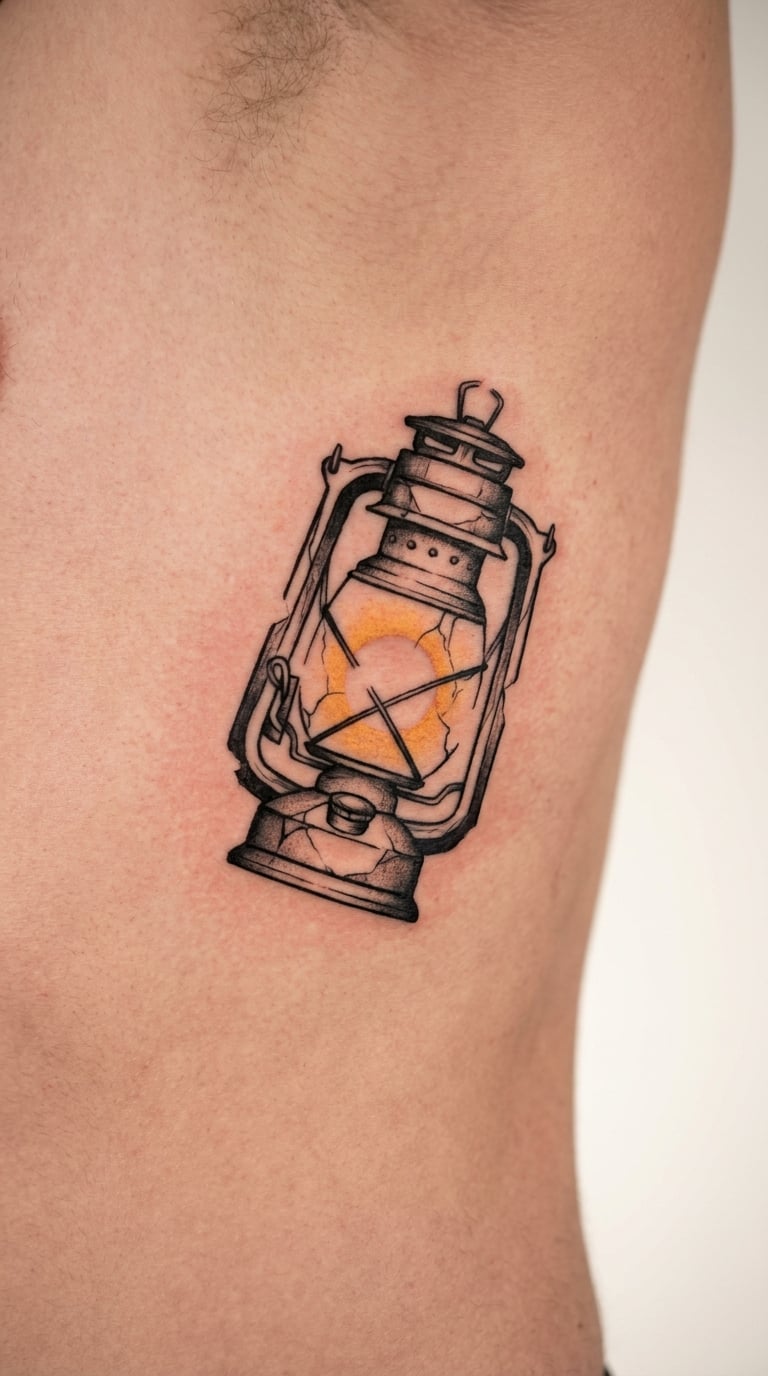
A lantern whose outer frame is interrupted by deliberate angular gaps, with bare skin showing through, while the glowing centre stays whole and unbroken. The contrast between the intact light and the broken shell is the entire idea.
It is the contemporary take on the motif, and it reads as fractured rather than damaged. People pick it when they want a darker emotional register.
Placement: Ribs, side of the torso, or the outer arm. Size: 2.5 to 4 inches (6 to 10 cm). Style: Abstract blackwork with one colour accent.
Pain: Medium to high, because the ribs are bony and the broken lines need control. The gaps themselves are easy to keep, but the edges of each break are fine detail, so those soften first. Make it yours: Use one real break, such as a year, and let the frame resume around it.
19. Butterfly Lantern Between the Shoulder Blades
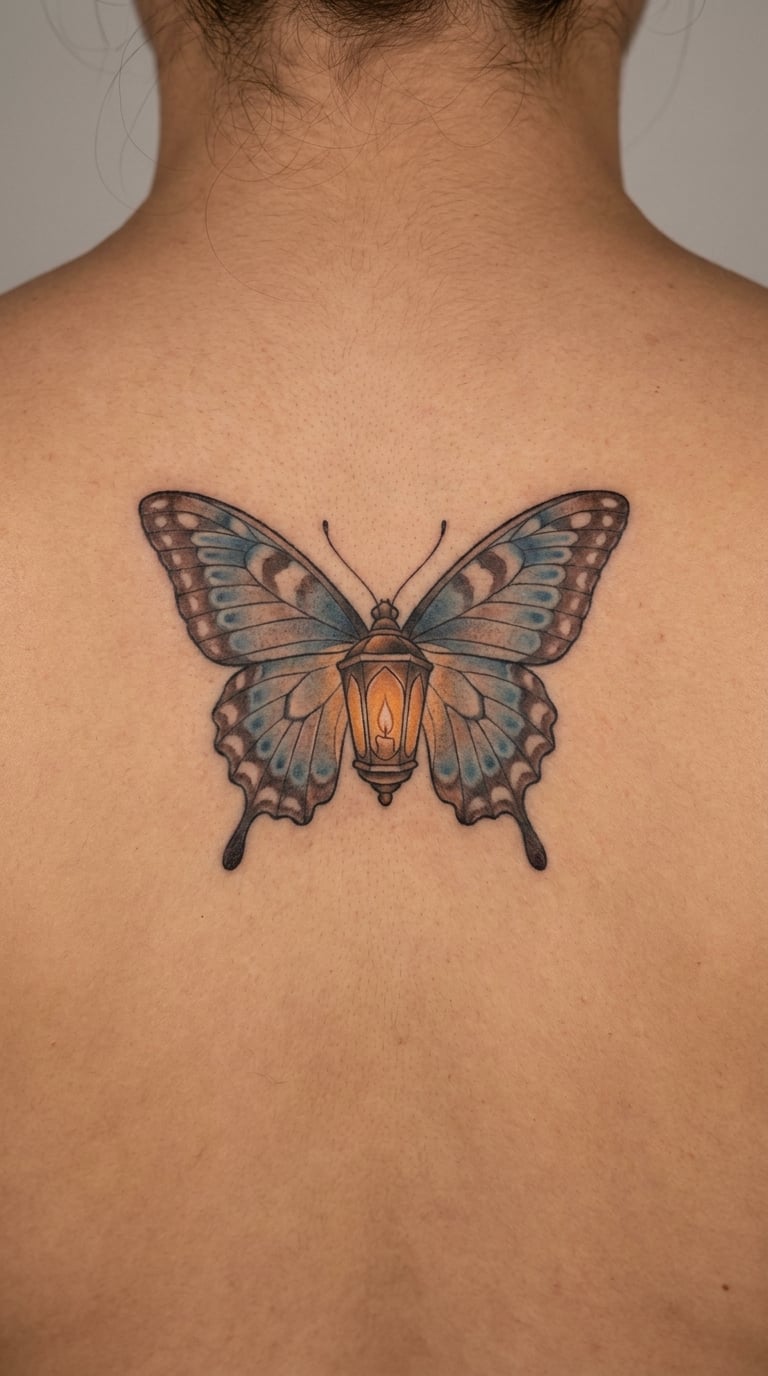
A symmetrical butterfly whose body is a small amber lantern, wings spread evenly on either side, drawn with clean illustrative line and light colour in the wings. The lamp sits where the body would be, so the whole insect glows from the middle.
It is a hybrid for people who like both nature and symbolic objects, without choosing between them. The symmetry gives it a quiet, emblematic quality rather than a decorative one.
Placement: Between the shoulder blades, upper back, or the outer forearm. Size: 3 to 4 inches (7.5 to 10 cm) across. Style: Illustrative with light colour.
Pain: Medium, and the upper back is a sensitive area with thin skin. Wing colour fades, so keeping the wings mostly linework with a small colour accent is the version that still reads in five years. Make it yours: Match the wing pattern to a real species found near you.
20. Minimal Flame-Outline Lantern on the Index Finger
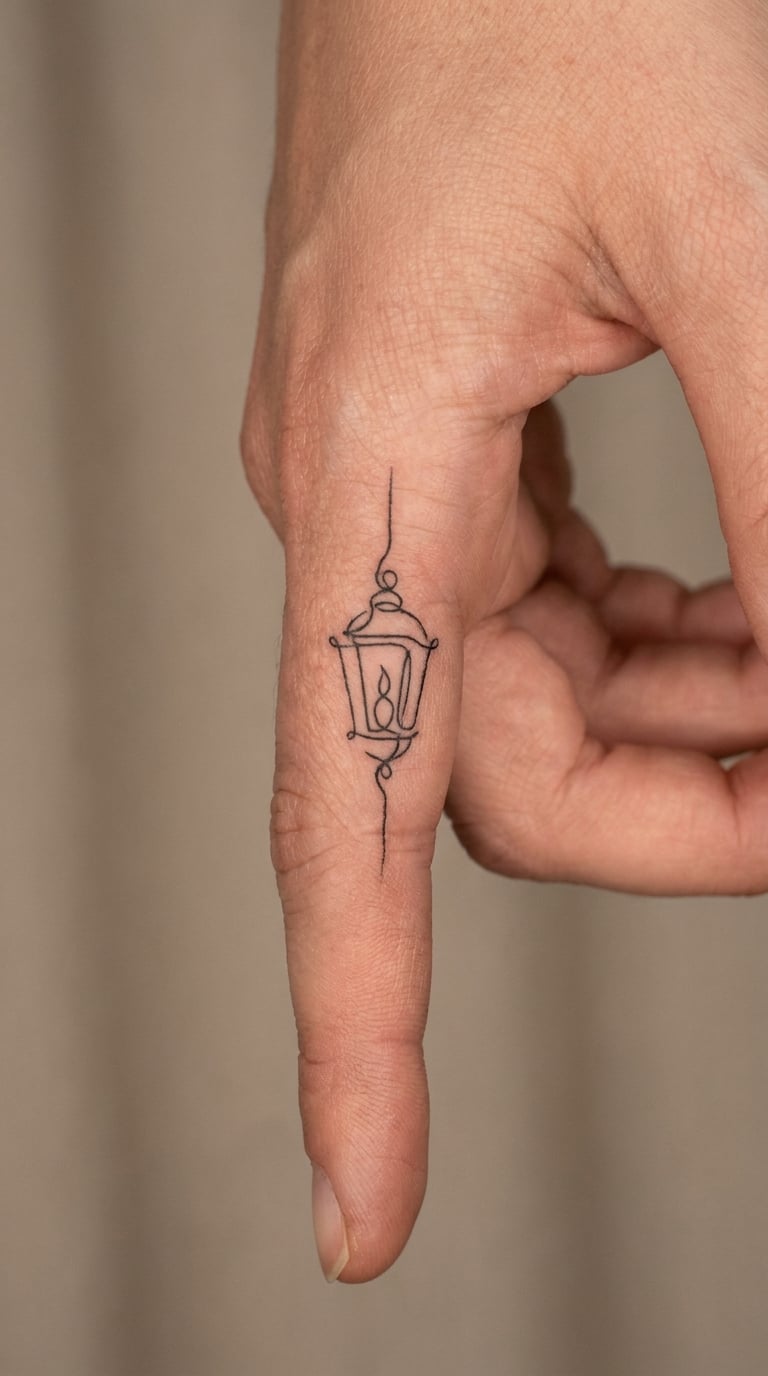
A tiny open-frame lantern drawn from one continuous black line, with a separate small flame at its centre. Nothing is filled, nothing is shaded, and the whole thing is smaller than a matchbox.
It is the most discreet option here, the sort of piece that only shows when you turn your hand. That intimacy is the reason to choose it.
Placement: Side of the index finger, the wrist, or behind the ear. Size: 1 to 2 inches (2.5 to 5 cm). Style: Micro fine line.
Pain: Medium to high despite the tiny size, because finger skin is thin over bone and hard to work with. This fades fastest of all the ideas here, realistically within a few years, so treat it as something you refresh rather than something you protect. Make it yours: Add a matching tiny dot on the opposite hand, which reads as a deliberate pair.
21. Stained-Glass Lantern on the Upper Back
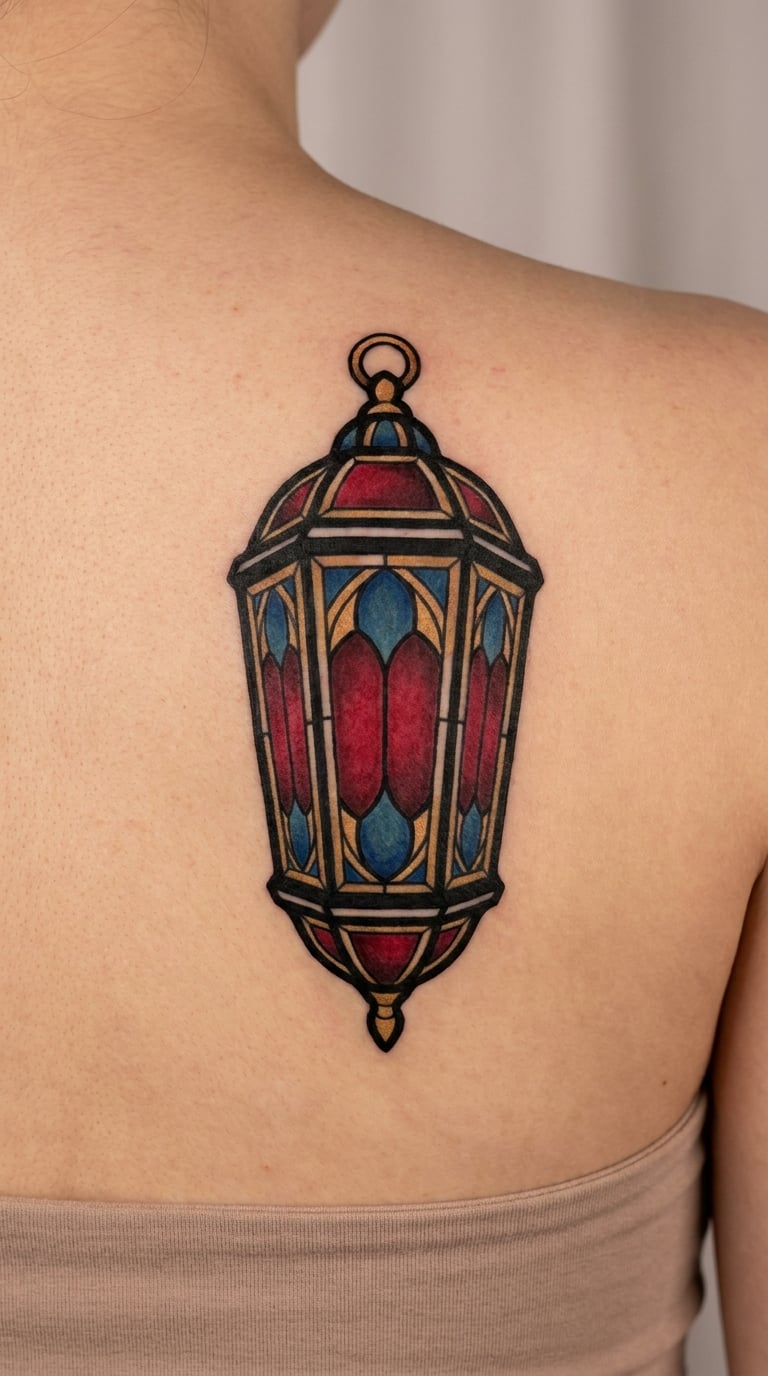
A lantern divided into stained-glass panels, each one filled with a different jewel tone, and every panel edge wrapped in heavy black leading. The colours are deep rather than pastel, so the piece reads as a window rather than a drawing.
It is the boldest decorative option in the list and the one that most clearly says lantern at a distance. Size helps it, since a stained-glass design only really works when there is room for the panels.
Placement: Upper back, outer thigh, or the shoulder blade. Size: 4 to 6 inches (10 to 15 cm). Style: Neo-traditional colour with bold black line.
Pain: Medium, though it needs a proper session and a break, because the colour blocks are substantial. Jewel tones hold better than light pastels, but every colour softens with sun exposure. Make it yours: Build the panel colours from a stained-glass window you have actually stood in front of.
22. Celestial Constellation Lantern on the Forearm
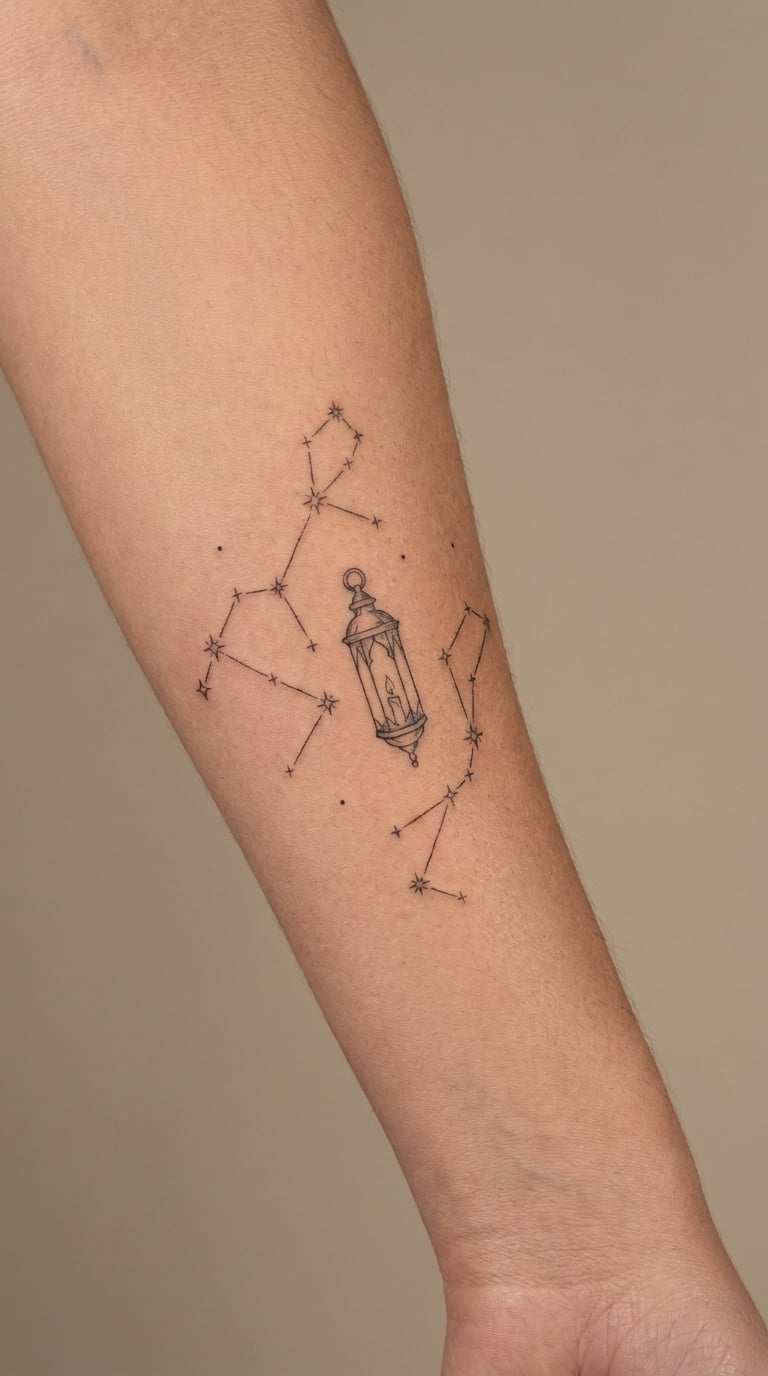
A narrow hanging lantern with a fine chain, surrounded by sparse stars connected by thin constellation lines. Most of the piece is the sky, with the lamp as the small anchor at the bottom of the composition.
It works for anyone drawn to astronomy or to the idea of travel and distance, since a constellation is a map and a lantern is a light. Some wearers use the real coordinates of a place.
Placement: Forearm, inner arm, or the calf. Size: 3 to 4.5 inches (7.5 to 11 cm) including the stars. Style: Fine-line celestial.
Pain: Medium, and the forearm is an easy place to sit. The very fine connecting lines are the first elements to disappear, so an artist who exaggerates them slightly will get you a design that lasts. Make it yours: Plot the real constellation visible from somewhere you have been.
How to Choose the Right Design
Most regret with a lantern tattoo comes down to three things: too much detail, too small a size, or a style that fights the body part. Work through those before you fall in love with a reference image.
Match the style to the body part
Fine line and micro work suit the flat, forgiving areas, so the inner forearm, the collarbone, the calf and the outer thigh. Bold blackwork and stained-glass pieces need a broad flat surface, which rules in the upper arm, the thigh, the upper back and the calf, and rules out the finger and the inner wrist. An ornate design like the Victorian lantern needs a long vertical run of skin, and it will fight you on a forearm that curves sharply.
Pick a size the detail can survive at
A detailed lantern shrunk to one and a half inches turns into an unreadable smudge, and the glow, which is the part everyone wants, disappears first. That is the most common way these designs go wrong. The rule of thumb that works: any internal detail needs roughly a sixteenth of an inch of height to stay crisp. Below two inches, drop to a silhouette or a single-line design, like ideas 4 and 20.
Decide how much ageing you will accept
Solid black holds for decades, thin single-needle lines need refreshing every few years, and watercolour softens fastest of everything here. If you would rather not book a touch-up every three or four years, stay with blackwork or bold traditional. If you want the softness and you are happy to maintain it, the watercolor and fine-line ideas are the better looking option.
One more practical note, and it comes up constantly: nobody can judge your design from a phone screen. Bring references to the consultation and let the artist draw it at your actual size on paper before anything is committed.
Cost and Session Time
What a lantern tattoo usually costs
Tattoo pricing follows size and complexity more than subject matter, so the lantern is not cheaper or dearer than any other motif at the same scale. A micro fine-line lantern, two inches or under, commonly lands in the low hundreds of dollars. A mid-size traditional or watercolor lantern in the three-to-five inch range usually falls in the mid hundreds, and a large stained-glass, botanical or micro-realistic lantern runs from the high hundreds into four figures. Shop minimums and hourly rates vary a lot by city and by artist, so treat these as orientation rather than a quote.
How long it takes
A small fine-line or silhouette lantern, the ideas in the two-to-three inch range, is usually a single sitting of around an hour. Traditional, neo-traditional and stained-glass pieces at four inches and up more often need two sessions, sometimes a three-hour block and a follow-up. Micro-realistic shading and dotwork always take longer than their size suggests, because they are slow techniques rather than fast fills. Ask your artist for a session plan before the first appointment so you know whether the price quoted covers one sitting or the whole piece.
What actually sets the price
- Size, measured in real inches on your body.
- Style. Solid black line is fast. Shading, stippling, dotwork and colour blocks are slow, and slow means more hours.
- Body part. Hands, fingers, neck and ribs cost more because the skin is thin and awkward to work on.
- Artist and city. A well-known realism artist and a small-town shop are not on the same scale.
- Custom work. Building a design from scratch costs more than reproducing an existing flash piece.
Aftercare Basics
Start with your artist’s aftercare instructions, because they know how deep your particular work went. The general shape of it is below.
- Wash the area gently with clean lukewarm water and a mild unscented soap, then pat dry with a clean hand or a fresh paper towel.
- Follow whatever covering your artist recommends, and keep it on for the length they specify rather than your own guess.
- Once the covering comes off, leave the tattoo alone. Do not pick, scratch or peel anything, including the flaking bits that look tempting.
- Keep it out of direct sun while it heals, and think about sunscreen for the tattoo long term, especially the colour pieces like ideas 3, 15 and 21.
- Skip swimming, hot tubs and saunas until the tattoo has closed over, and keep heavy rubbing or friction off the area.
- Send a photo to your artist if anything looks unusual, rather than trying to fix it yourself.
Related reading on caring for new ink is in our tattoo care guides, and if you would rather browse before you decide, our jack o’ lantern tattoo ideas and sunrise tattoo ideas with meaning cover two more light-and-warmth motifs worth comparing.
Frequently Asked Questions
What size should a lantern tattoo be?
For a fine-line lantern, two to four inches is the sweet spot. Below two inches the internal detail and the glow stop reading, and the design turns into a smudge. Four inches and up works for traditional, blackwork and stained-glass pieces, where the internal panels need room. If your body part is small, such as a finger or the inner wrist, go simpler rather than smaller.
Where is the best placement for a lantern tattoo?
The inner forearm, the outer upper arm, the collarbone, the outer thigh and the calf are the strongest all-round spots, because they give the artist a flat surface and a clear vertical or horizontal run. The upper back suits larger designs, and the sternum suits a smaller symmetrical version. Avoid fingers and the inner wrist for anything detailed, since the skin there is thin and the area is awkward to work on.
What does a lantern tattoo symbolize?
A lantern tattoo most often symbolizes carrying your own light, which covers guidance, hope, resilience and remembrance. The flame protected inside a hard frame is a natural picture for inner strength. In Chinese lantern tradition, releasing a sky lantern carries a message away, so the design can also mean release or reunion. Wearers usually settle on the reading that matches their own story rather than a fixed meaning.
Do fine-line lantern tattoos fade quickly?
Yes, relative to other styles. Fine-line work uses less ink and thinner lines than traditional blackwork, so it lightens and softens faster, and single-needle details such as the flame and the star points are the first to go. Hand and finger pieces fade fastest of all because of sun exposure and skin turnover. Most wearers plan a refresh every three to five years, and choose bolder line weight if they would rather not.
Can a lantern tattoo be personalized?
Plenty of ways. A date or an initial under the lantern, the flame drawn as a specific constellation, vines built from a plant that means something, or a colour palette taken from a place you have been all work well. A small matching lantern on a partner or a sibling turns the design into a pair without losing the single-symbol shape. Bring the detail to the consultation and let the artist place it where the composition stays balanced.
Conclusion
If this is your first tattoo, the fine-line paper lantern on the inner forearm, idea 1, is the easiest place to start: small, low on the pain scale, and forgiving if your taste shifts later. If you are adding to an existing collection, the stained-glass lantern or the realistic glowing oil lantern gives you the detail and the permanence that a first piece usually cannot hold.
Whichever one you choose, save the two or three that speak to you, take them to a licensed artist at a real size, and let them redraw the detail for the spot on your body. That last step is what separates a good lantern tattoo from a smudge. For a different take on light and warmth, our starfish tattoo ideas cover coastal placements in a similar spirit.