
22 Nape Tattoo Ideas: Best Small Designs (October 2026)
The nape is the small patch of skin at the back of your neck, just under the hairline and above the collar. A nape tattoo can be a single fine-line symbol barely wider than a coin, or a wide blackwork piece that runs from ear to ear.
These 22 nape tattoo ideas lean small and considered, because that is what actually holds up on a curve this tight. Every entry here covers the look, the best placement, a realistic size, honest pain expectations and one way to make it personal.
If you are planning ahead, allow 30 to 45 days between your tattoo appointment and anything that puts a collar against fresh ink. Short autumn weather is the easiest window because you can wear a coat without the fabric rubbing the healing skin.
22 Nape Tattoo Ideas: Quick Guide
Read the table first. It gives you the style, the spot it suits best, an honest size and the pain you can expect, in the same order as the ideas below.
| Idea | Style | Best placement | Size | Pain |
|---|---|---|---|---|
| Fine-line paper plane | Minimal line | Centred, just below the hairline | 1.5 in | Low to medium |
| Crescent moon | Fine line with soft shading | Centre of the upper nape | 1.5 in wide | Medium |
| Rosebud | Black-and-grey micro-realism | Centre nape, under short hair | 2 in tall | Medium |
| Laurel branch | Fine-line botanical | Following the nape curve | 2.5 in wide | Medium-low |
| Geometric sun | Blackwork geometry | Centred across the nape | 3 in wide | Medium-high |
| Red butterfly pair | Colour fine line | Symmetrical, either side of centre | 1.25 in each | Medium |
| Compass rose | Micro fine line | Centred upper nape | 1.5 in across | Medium |
| Lightning bolt | Single-line minimal | Diagonal across the nape | 2 in tall | Medium |
| Watercolour orchid | Line and wash | Centre nape, hair clipped up | 2.5 in tall | Medium |
| Traditional rose | American traditional | Upper nape, centred | 2.5 in tall | Medium |
| Snake and rose | Blackwork with colour accent | Horizontal across the nape | 3 in long | Medium |
| Dotwork mountains | Dotwork | Horizontal span of the nape | 3.5 in wide | Medium |
| Heart and hands | Fine line with colour | Centred nape | 2 in wide | Medium |
| Eagle head | Bold blackwork | Large centred nape | 3.5 in tall | High |
| Botanical hand | Fine-line botanical | Vertical, centred nape | 3 in tall | Medium |
| Infinity symbol | Minimal line | Centred upper nape | 2 in wide | Low to medium |
| Phoenix | Red and black fine line | Large centred nape | 4 in wide | Medium-high |
| Butterfly outline | Outline minimal | Off-centre nape | 2 in wide | Low to medium |
| Watercolour koi | Line and wash | Diagonal across the nape | 3 in long | Medium |
| Fine-line sunflower | Fine line with one colour | Centred nape | 2.5 in across | Medium |
| Celestial map | Dotwork | Wide span of the nape | 3.5 in wide | Medium |
| Blackwork peony | Soft blackwork | Centred nape | 3.5 in wide | Medium-high |
1. Fine-Line Paper Plane Behind the Ear
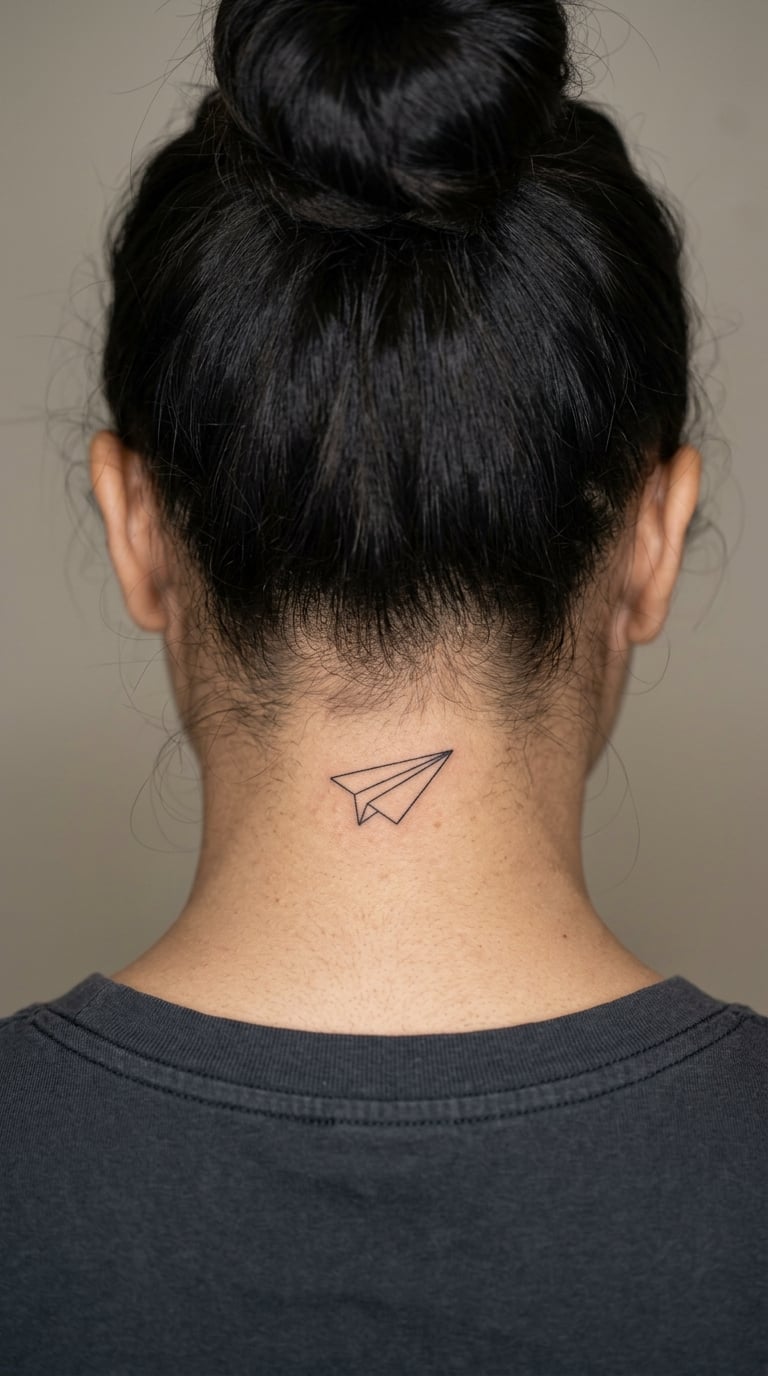
A paper plane is drawn with one continuous line, a long fold and a short keel, usually with no shading at all. Keep the outline thin and even, and let the wing angle upward so the shape reads as motion rather than a triangle.
People pick it for the idea of going somewhere rather than the object itself, though plenty of people just like how simple it looks at the back of the head.
- Placement: centred on the upper nape, or offset toward one side to line up with a behind-ear piece.
- Size: about 1.5 inches (3.8 cm) long.
- Style: single-needle fine line.
- Pain: low to medium, a quick scratchy feeling that stops the moment the needle lifts.
Make it yours: add a tiny trail of three dots behind it, or have the artist put your flight number in the negative space. You can browse more one-line styles in our 20 north star tattoo ideas for the same restrained energy.
2. Minimal Crescent Moon at the Nape
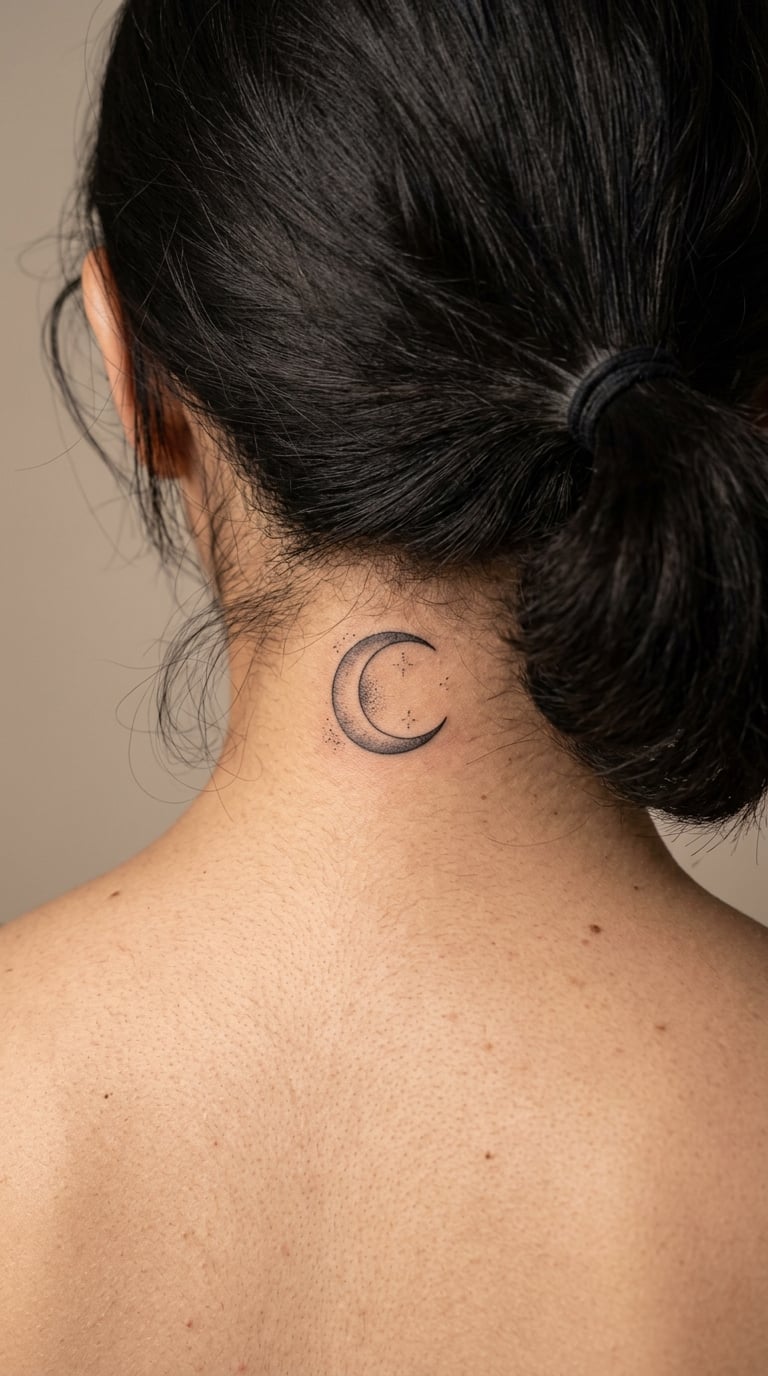
A crescent drawn as a soft grey wash inside two fine arcs sits well on the nape, where flat black can look heavy against the curve. One or two small star sparkles beside it keep the composition from feeling bare.
It is a calm, recurring choice, and plenty of people who start with one crescent come back years later for a full moon phase running down the spine. If you want a whole set of variations, our 20 crescent moon tattoo ideas for women covers size and placement options in detail.
- Placement: dead centre of the nape, high enough to stay above the collar line.
- Size: 1.5 inches (3.8 cm) wide, plus a few millimetres for the sparkles.
- Style: fine line with soft grey shading.
- Pain: medium, mostly from working over the bony ridge of the neck.
Make it yours: tint the crescent in your birth month colour, or add the exact date of something that happened under that moon.
3. Rosebud in Black-and-Grey Realism
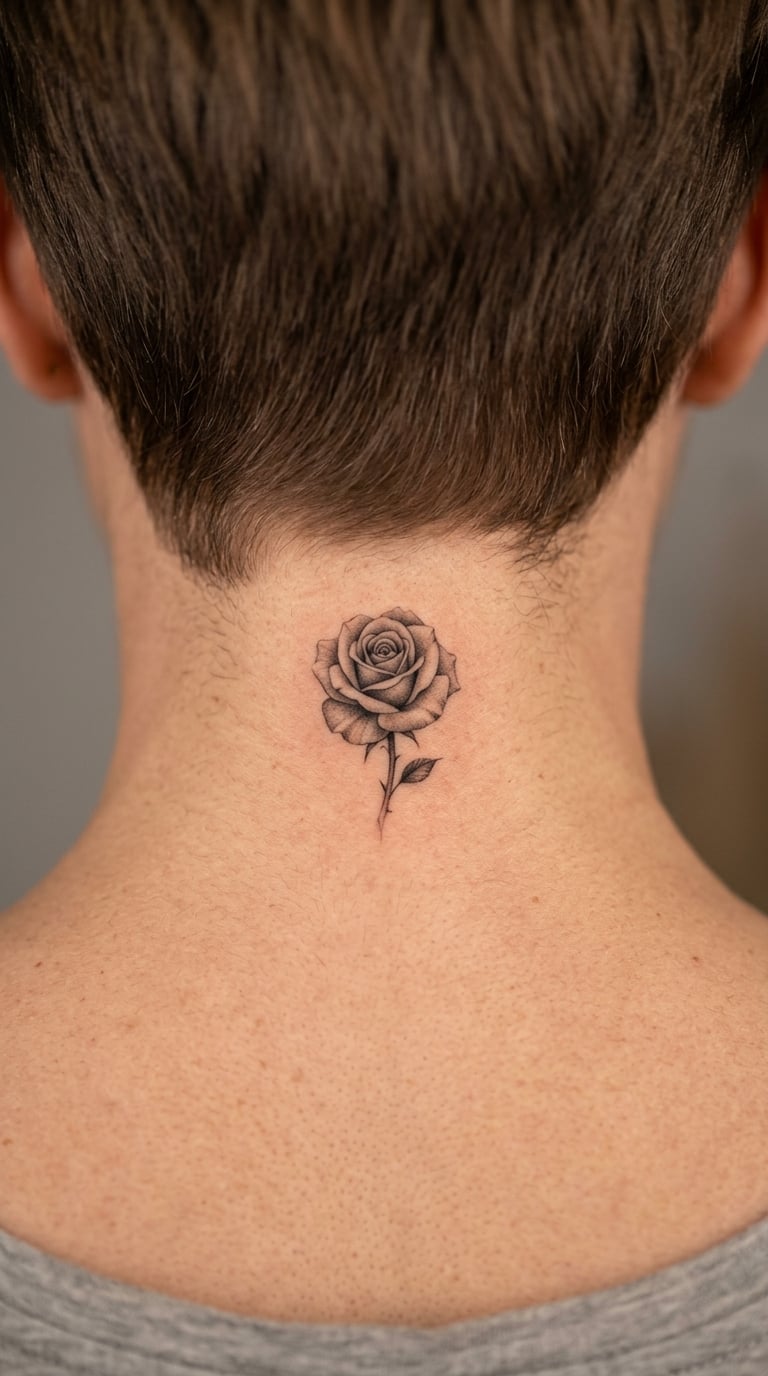
This is a tightly closed bud rather than a full bloom, shaded in layers of grey with the darkest tone tucked into the folds. Petals overlap in a spiral, and a couple of leaves taper away to keep it from looking like a heavy dot blob.
It suits people who want something soft and organic without committing to a full colour flower. A bud also reads better than an open rose at small sizes, because you are not trying to show a face.
- Placement: centre nape, comfortably clear of the hairline so regrowth does not swallow the top petal.
- Size: roughly 2 inches (5 cm) tall including the stem.
- Style: black-and-grey micro-realism.
- Pain: medium, with a slow building ache as the shading fills in.
Make it yours: add a single leaf in one muted green, which makes the grey read as intentional rather than unfinished.
4. Small Laurel Branch in Fine Line
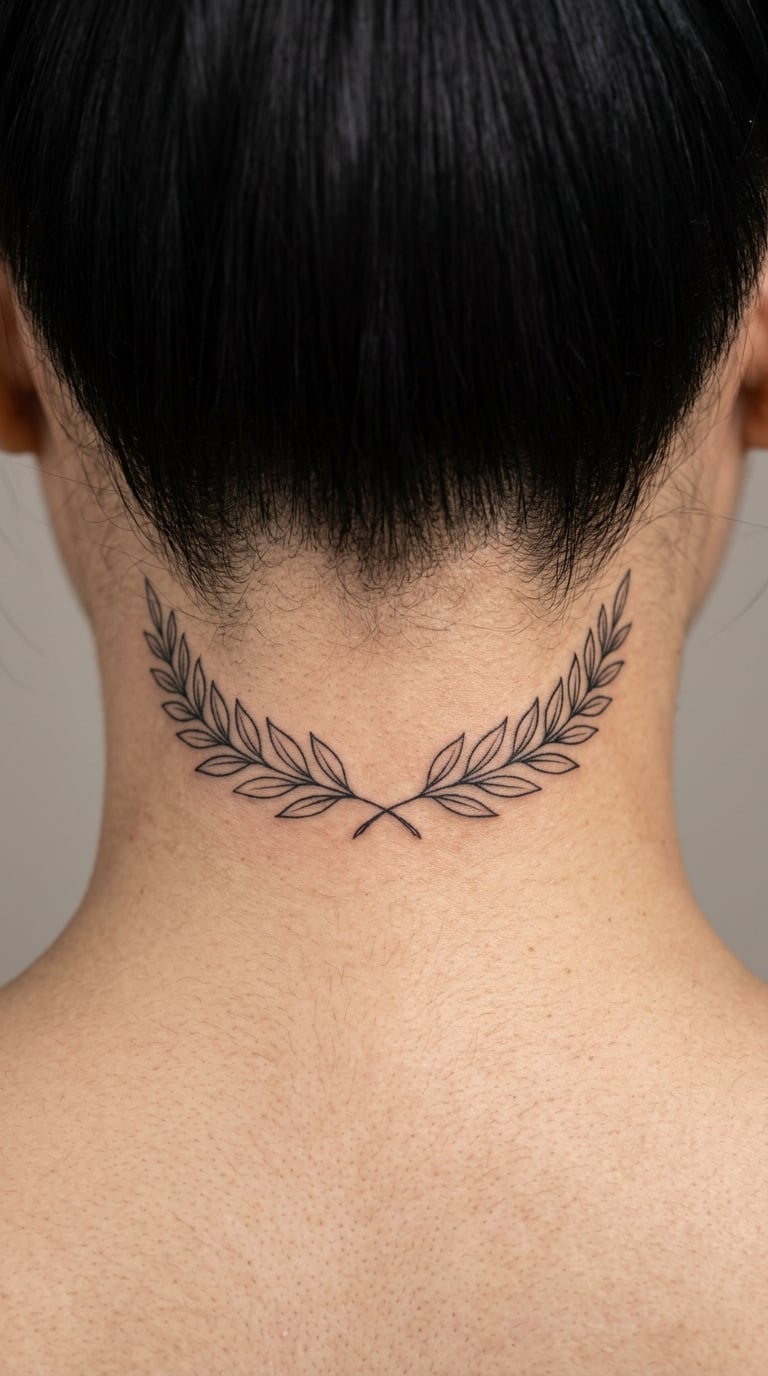
A laurel branch is a curved stem with paired leaves at regular intervals, each leaf a simple teardrop with a centre vein. Drawn along the natural arc of the nape, it looks intentional from every angle, which is hard work on a curved surface.
It is an old, classical motif, chosen most often for how settled and balanced it looks rather than for a single fixed meaning.
- Placement: angled along the nape curve, or mirrored on each side of the centre for a pair.
- Size: 2.5 inches (6.3 cm) wide per branch.
- Style: fine-line botanical linework.
- Pain: medium-low and short, one of the quicker small pieces on the nape.
Make it yours: run a family initial along the stem, or dot the tip in one colour to make it less formal. Our 20 wisteria tattoo ideas has the same trailing-vine look in more detail.
5. Blackwork Geometric Sun
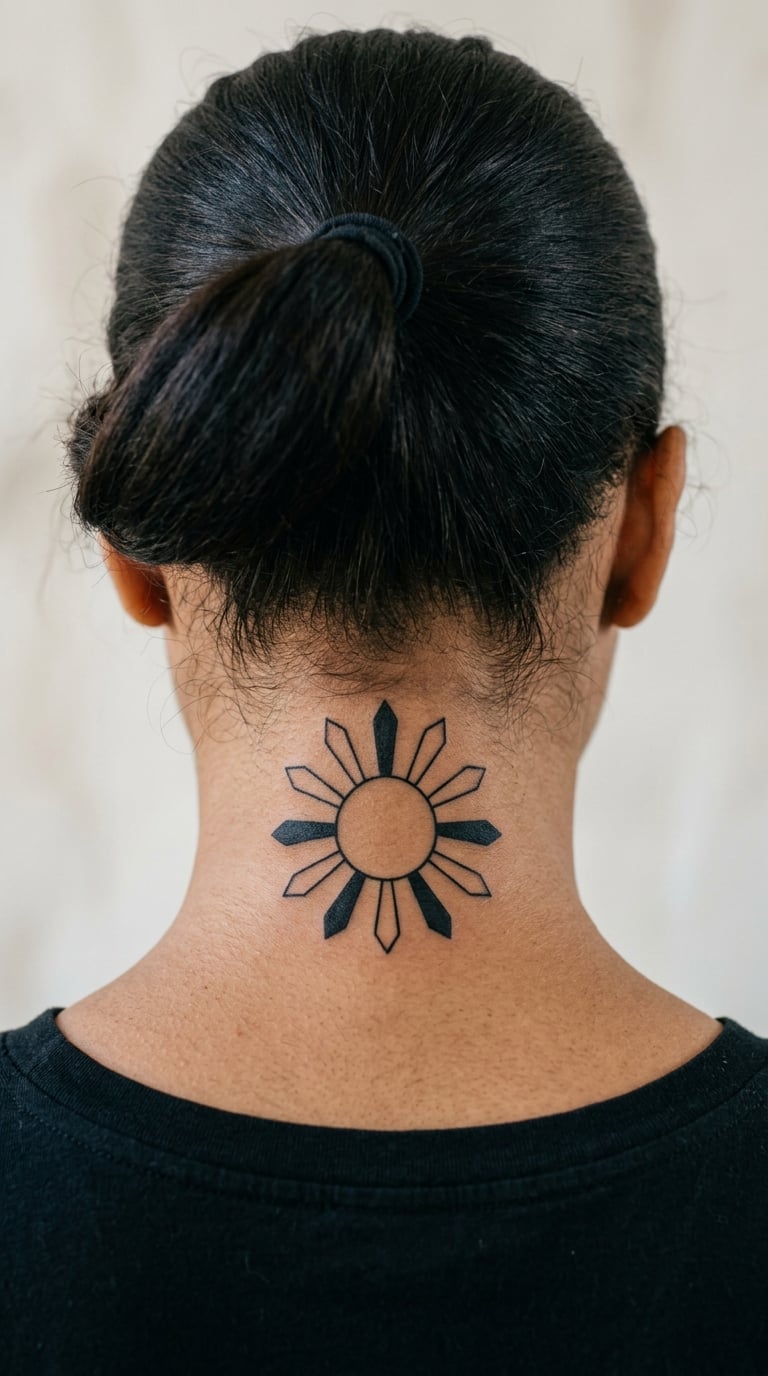
Alternating solid black rays with plain outline rays give a sun real punch, and a thin inner circle around the centre keeps it from turning into a solid disc. Sharp points and even spacing matter more here than detail.
It is one of the bolder statements on this list, chosen when the wearer wants the nape to be the thing people notice when hair goes up.
- Placement: centred across the full width of the nape.
- Size: 3 inches (7.6 cm) across.
- Style: geometric blackwork.
- Pain: medium-high, and longer in the chair because solid black takes passes to lay down flat.
Make it yours: change the ray count to something personal, such as the year you graduated. Solid black fills tend to hold their edge well, so this style ages better than hairline fine line.
6. Tiny Red Butterfly Pair
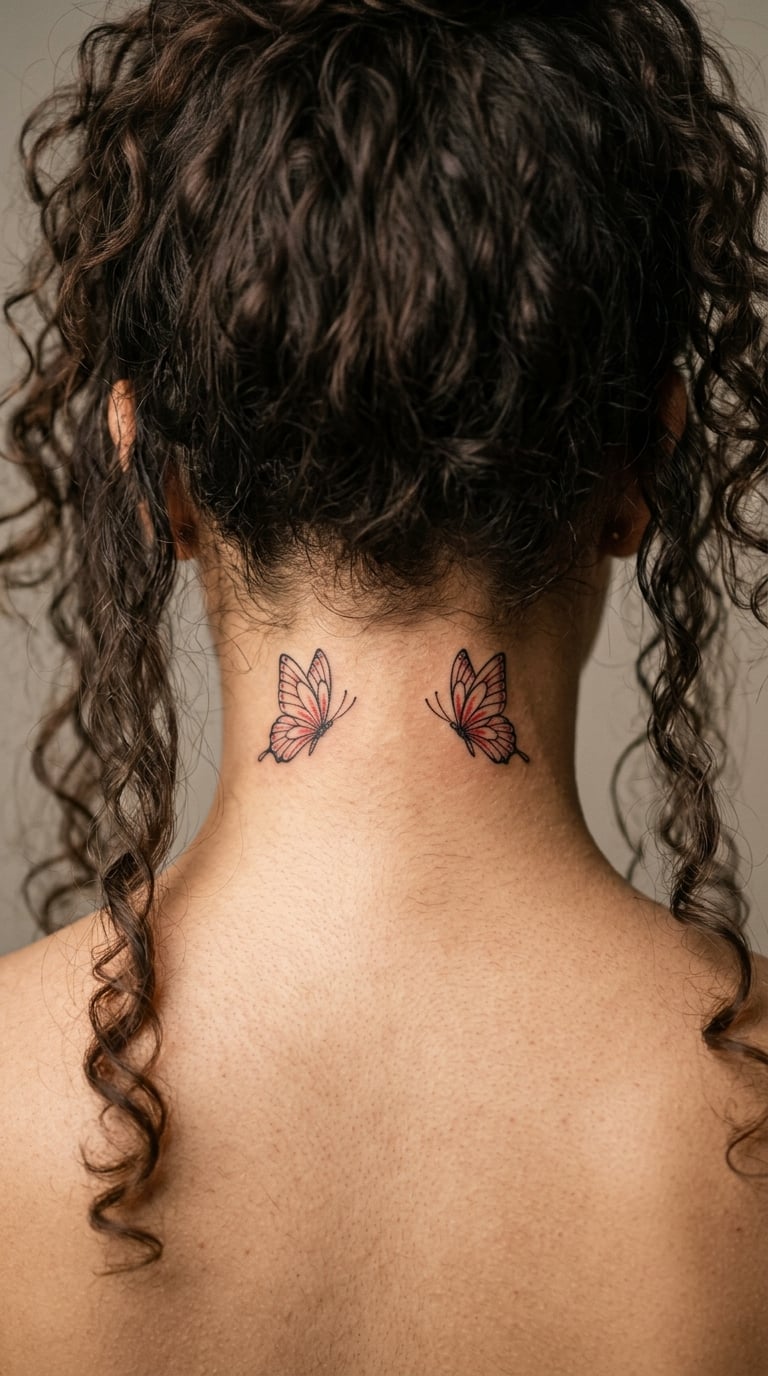
Two butterflies, each no bigger than a thumbnail, drawn with a black outline and a red wash inside the upper wings, with just a hint of black on the bodies. Leaving a wide gap between them makes the pair read as a deliberate composition.
Butterflies are picked for change and for how light the shape feels, though plenty of people just want something small and colourful at the back of the neck.
- Placement: symmetrical, one on each side of the centre nape, spaced about an inch apart.
- Size: 1.25 inches (3.2 cm) wide each.
- Style: colour fine line with light wash.
- Pain: medium, and fast, since each butterfly is a small surface.
Make it yours: use two different colours, one for each butterfly, to mark two people. Tiny colour does fade quicker than black, so ask your artist how much saturation they can build in.
7. Micro Compass Rose
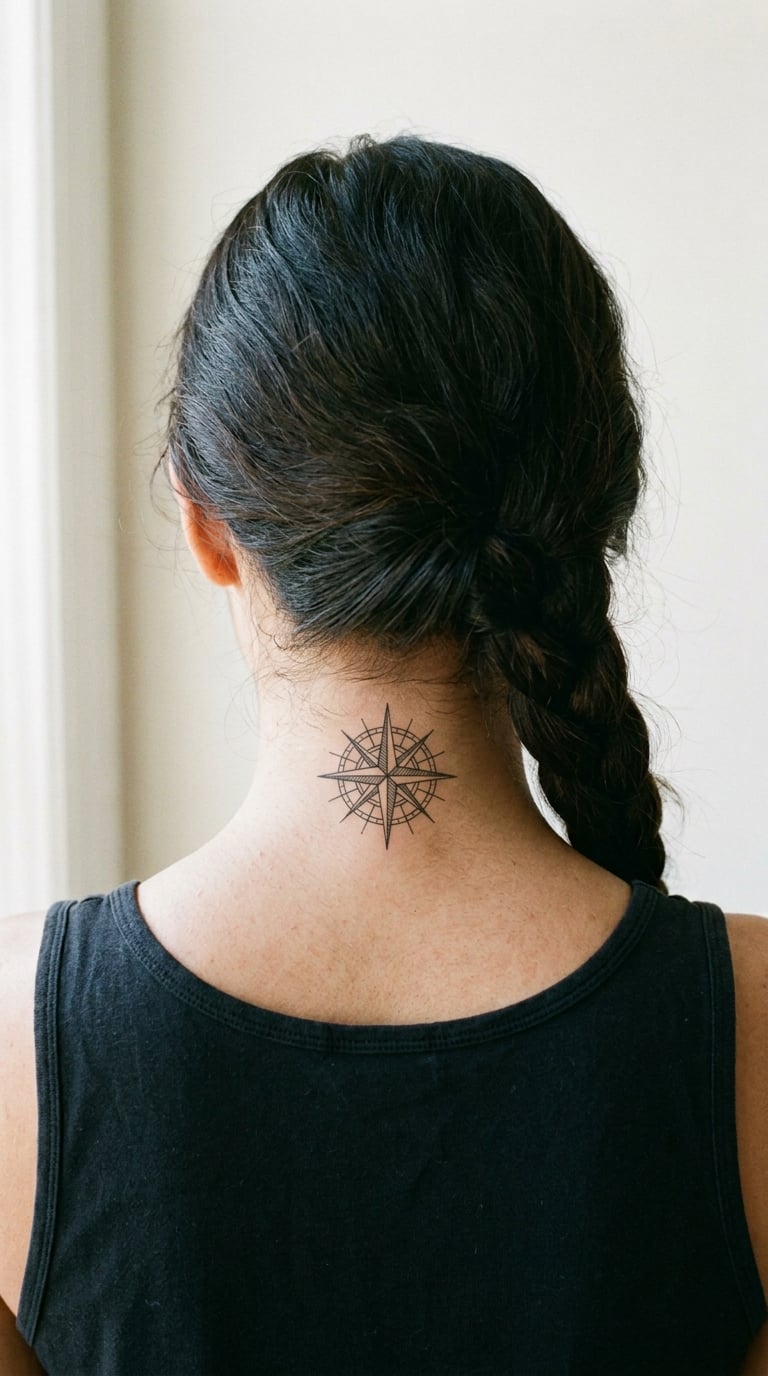
A compass rose is four pointed tips with two shorter tips between them, each tip split into a light and a dark half. That split is what makes a compass look like a compass rather than a star, so ask the artist not to flatten it.
It is a travel or direction motif, usually tied to a specific place rather than to wandering in general.
- Placement: centred on the upper nape, a little high of the deepest curve.
- Size: 1.5 inches (3.8 cm) in diameter, or smaller if the detail is simplified.
- Style: micro fine line.
- Pain: medium, with more passes than the size suggests.
Make it yours: replace the north point with a coordinate, or add a small date arcing over the top. Compass details blur fastest of anything on this list, so book a touch-up every couple of years.
8. Delicate Branching Lightning Bolt
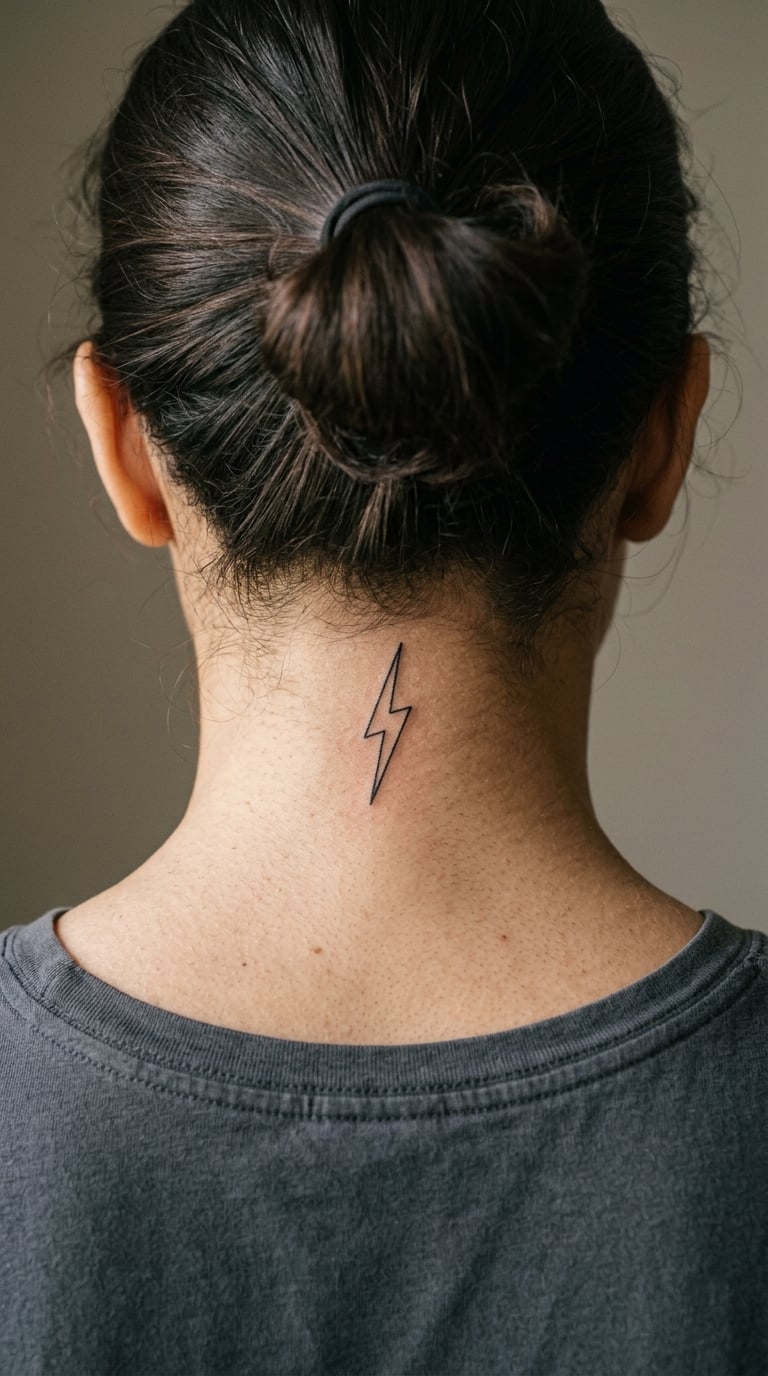
A single bolt drawn as one sharp zigzag with one small fork branching off the main line is enough. The angular shape fights nicely against the roundness of the neck, so it reads clearly even from across a room.
People usually choose it for the energy of the shape rather than a specific meaning, and it is a common first piece because the surface area is small.
- Placement: centred, running slightly diagonal so it follows the neck rather than fighting it.
- Size: 2 inches (5 cm) tall.
- Style: fine line, one or two branches.
- Pain: medium, and over quickly.
Make it yours: add a second thinner bolt parallel to the first, or fill the fork in red. Straight lines on a curve can bow slightly as the skin moves, so a slight angle helps.
9. Small Watercolour Orchid
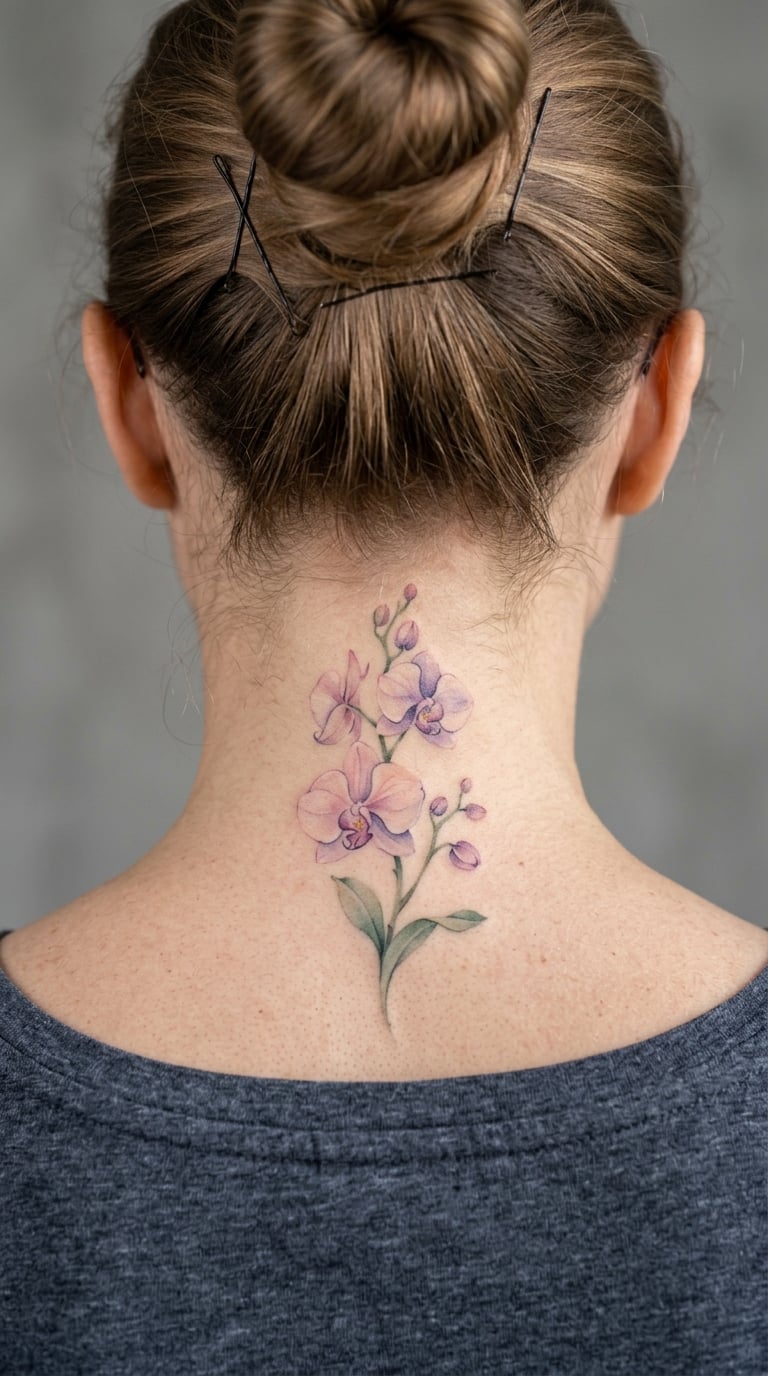
Watercolour work means a thin dark outline and colour that bleeds past it in soft, uneven washes, with a few areas left as bare skin. One orchid needs about three colours to read clearly, and the stem should trail rather than stop abruptly.
This is the right idea if you want colour at the nape but not a solid block of it. The style is forgiving, because nobody expects a watercolour piece to have hard edges.
- Placement: centred nape, with the stem trailing down or across the curve.
- Size: 2.5 inches (6.3 cm) tall.
- Style: line and wash watercolour.
- Pain: medium, with brief sharper spots where the needle passes over the curve.
Make it yours: build the palette from a birth flower colour so the piece carries a specific meaning. Wash work on the nape usually wants a refresh sooner than line work, since the back of the neck gets sun when hair is tied back.
10. Traditional Rose with Green Leaves
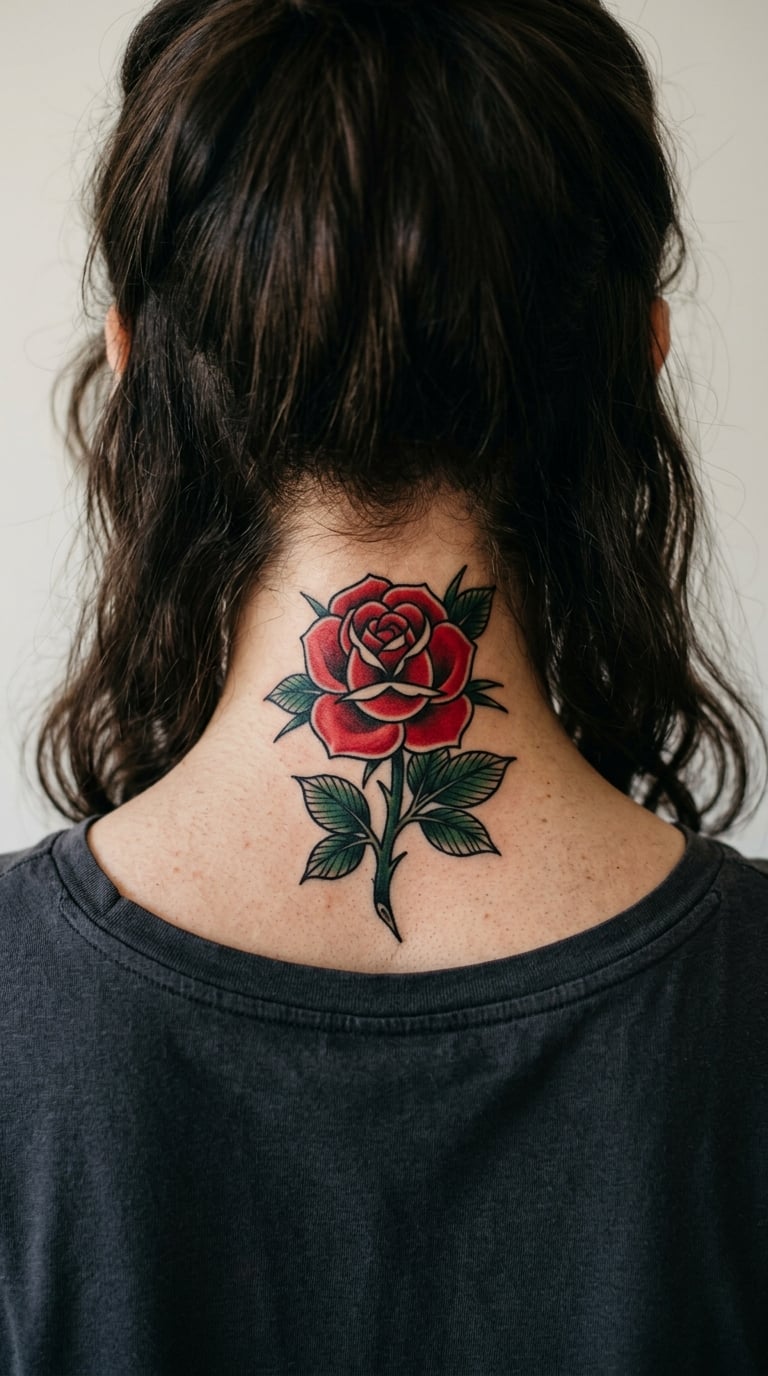
Traditional means bold black outlines, a limited palette of red and green, and deliberate shading that does not fade into grey halfway. A five-petal rosebud with two leaves is the classic version and holds its shape better than a large full bloom.
It is the most traditional flower in tattooing, chosen by people who want colour, clarity and something that will still look like a rose in fifteen years.
- Placement: centred on the upper nape, clear of the hairline.
- Size: 2.5 inches (6.3 cm) tall.
- Style: American traditional with bold outlines and packed colour.
- Pain: medium, and it takes longer than its size suggests because of the shading passes.
Make it yours: add a short stem that wraps toward the shoulder, or drop the green to a single deep olive for a quieter look.
11. Minimal Snake and Rose
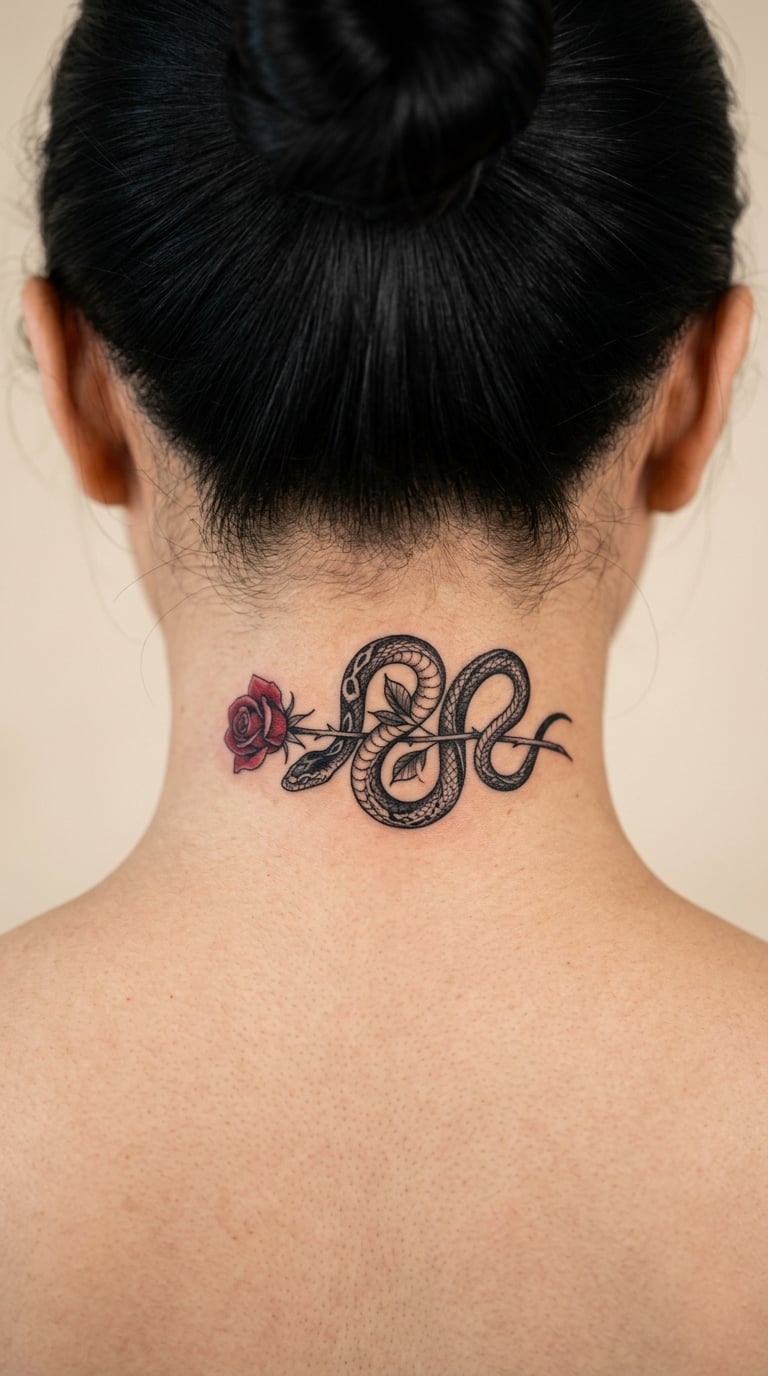
The snake is solid black linework with no scale texture, coiling in one loose loop, and the rose sits inside the curve in one red. Two shapes with very different energies in a small frame is what makes this composition work.
It is chosen for the contrast as much as the symbolism, and plenty of people like that the two elements never quite sit still together.
- Placement: horizontal across the nape, following the natural line of the shoulders.
- Size: 3 inches (7.6 cm) long.
- Style: blackwork with a single colour accent.
- Pain: medium, and the coil gives the artist more surface to work.
Make it yours: colour the rose in a specific shade, or leave the rose grey so the snake reads as the darker half.
12. Dotwork Mountain Range
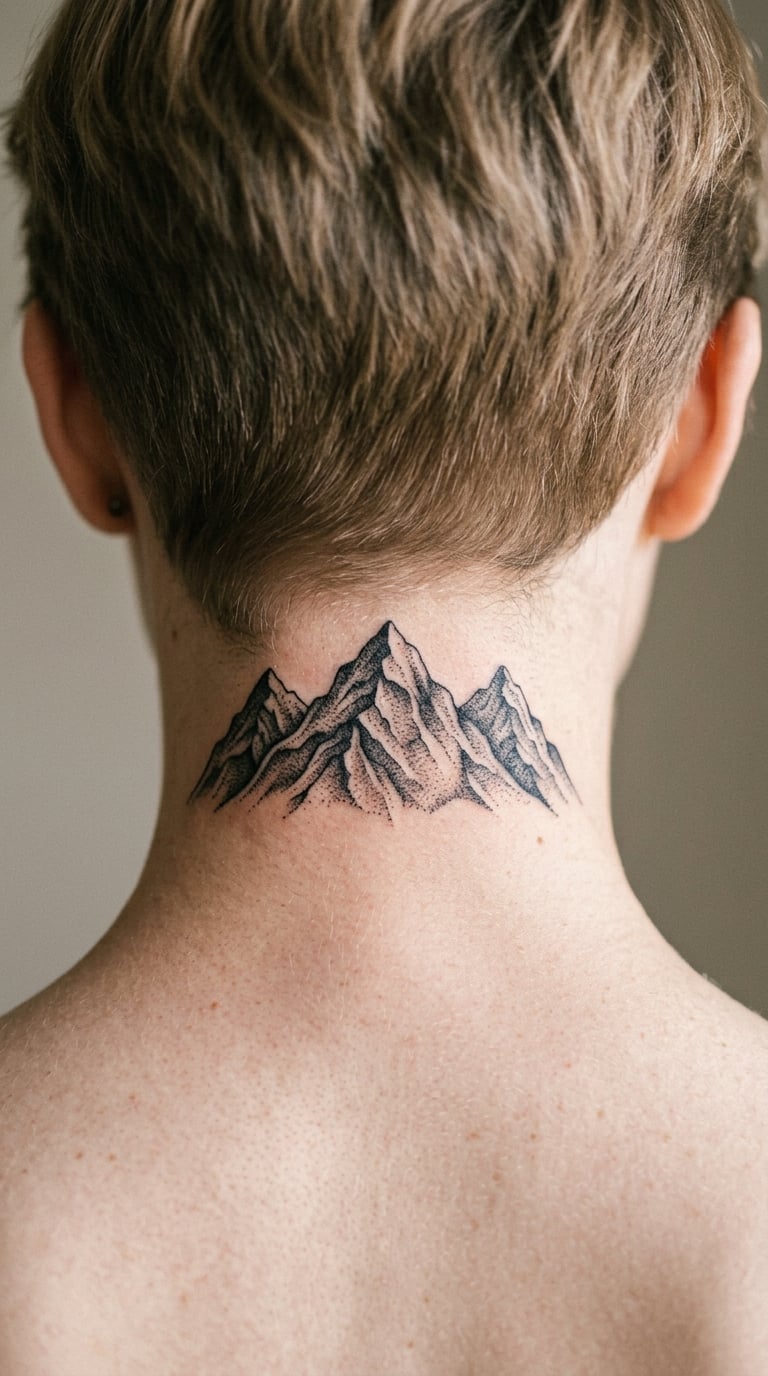
Dense dot shading builds the shadowed slopes while the peaks stay as negative space, so the whole thing lives in one texture. Three peaks of different heights work better than a long range at nape scale, because you can tell them apart at a glance.
Mountains are almost always about a specific place rather than a feeling in general, often a hike or a home landscape.
- Placement: horizontal, spanning the nape with a straight horizon line.
- Size: 3.5 inches (8.9 cm) wide.
- Style: dotwork shading with line peaks.
- Pain: medium, and a long sitting, because dotwork is a lot of individual taps.
Make it yours: have the artist plot the real skyline of a place you have actually stood in. A few added dots can suggest water in the valley below.
13. Small Red Heart with Fine-Line Hands
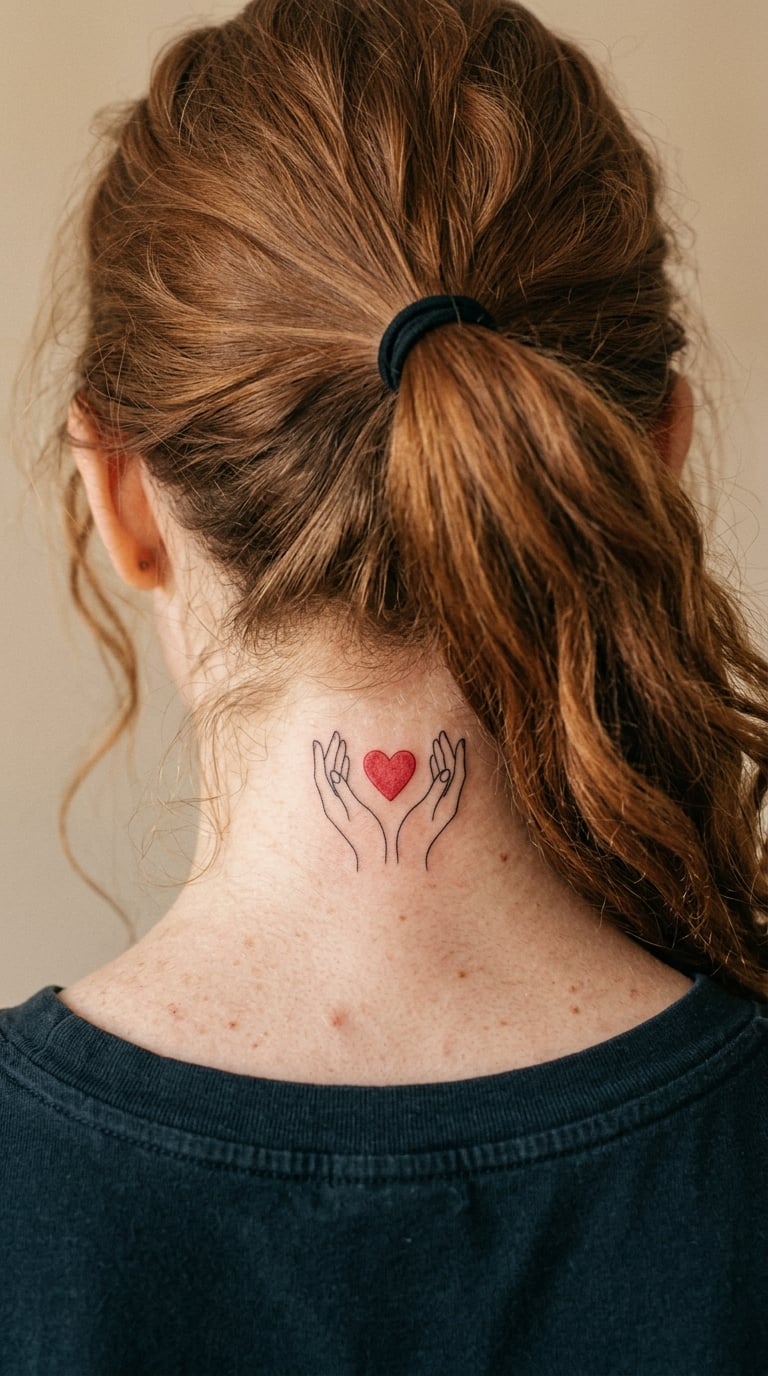
A solid red heart held between two open hands drawn in thin outline, fingers slightly curved rather than straight, keeps the piece balanced. Too many fingers and the whole thing turns into a blob at small scale, so simplicity is the point.
It usually means care or protection, and it is a common first tattoo for that reason.
- Placement: centred on the nape, small enough to read as one shape from a step away.
- Size: 2 inches (5 cm) wide across both hands.
- Style: fine line with one solid colour fill.
- Pain: medium, and the hands take longer than the heart.
Make it yours: add a date in tiny script under the heart, or make it a second piece that matches one on a wrist.
14. Blackwork Eagle Head Profile
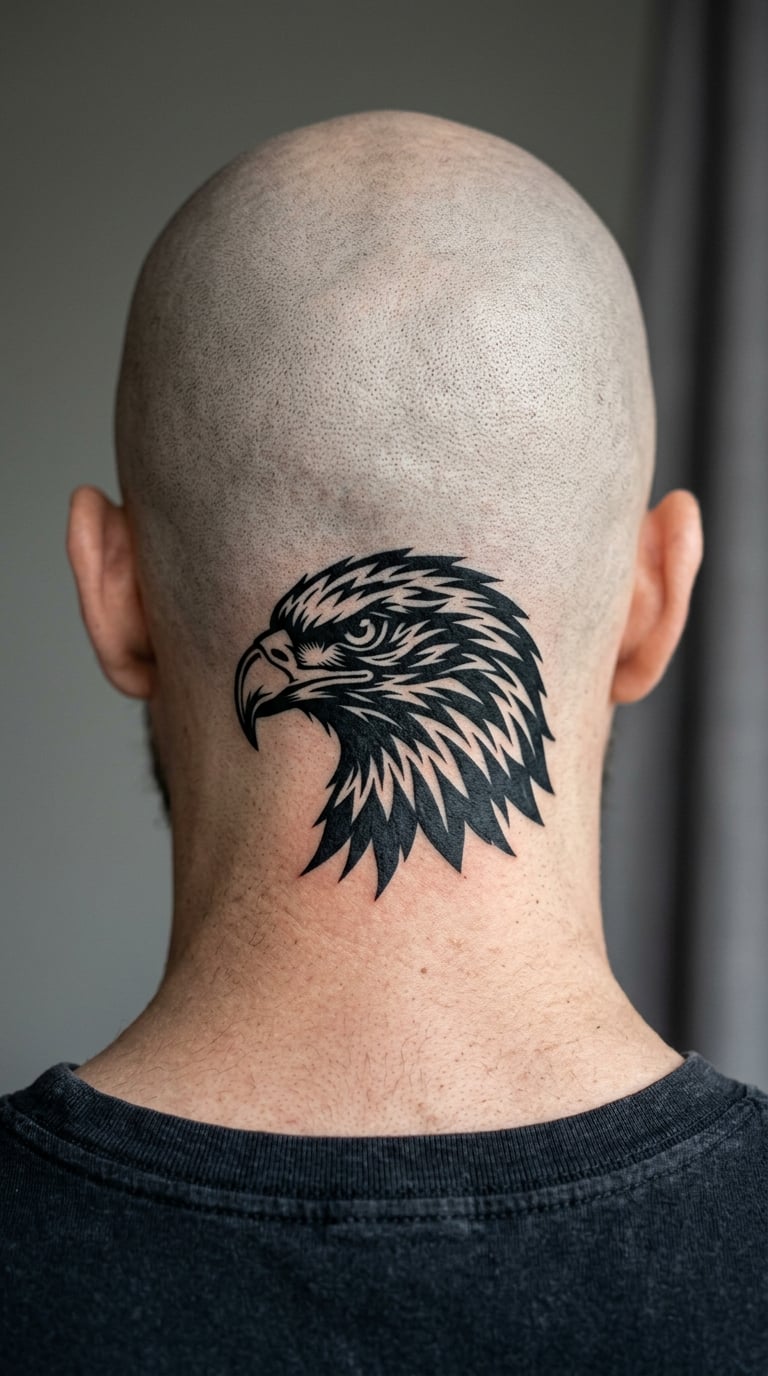
The head is drawn in profile with a hooked beak and a few sharply cut feathers, where the white gaps between solid black shapes do all the describing. That negative space is where the piece either works or turns muddy, so the artist needs patience with the edges.
It is a strength and focus motif, and at this size it is a genuine statement piece rather than a quiet one.
- Placement: centred nape, with room above for the head to sit naturally.
- Size: 3.5 inches (8.9 cm) tall.
- Style: bold blackwork with controlled negative space.
- Pain: high. Bold neck work is a long sitting and a firm commitment.
Make it yours: run a short banner of text along the bottom edge in matching bold lettering. Solid black holds its shape well, so this is a good choice if you want something that ages cleanly.
15. Fine-Line Botanical Hand
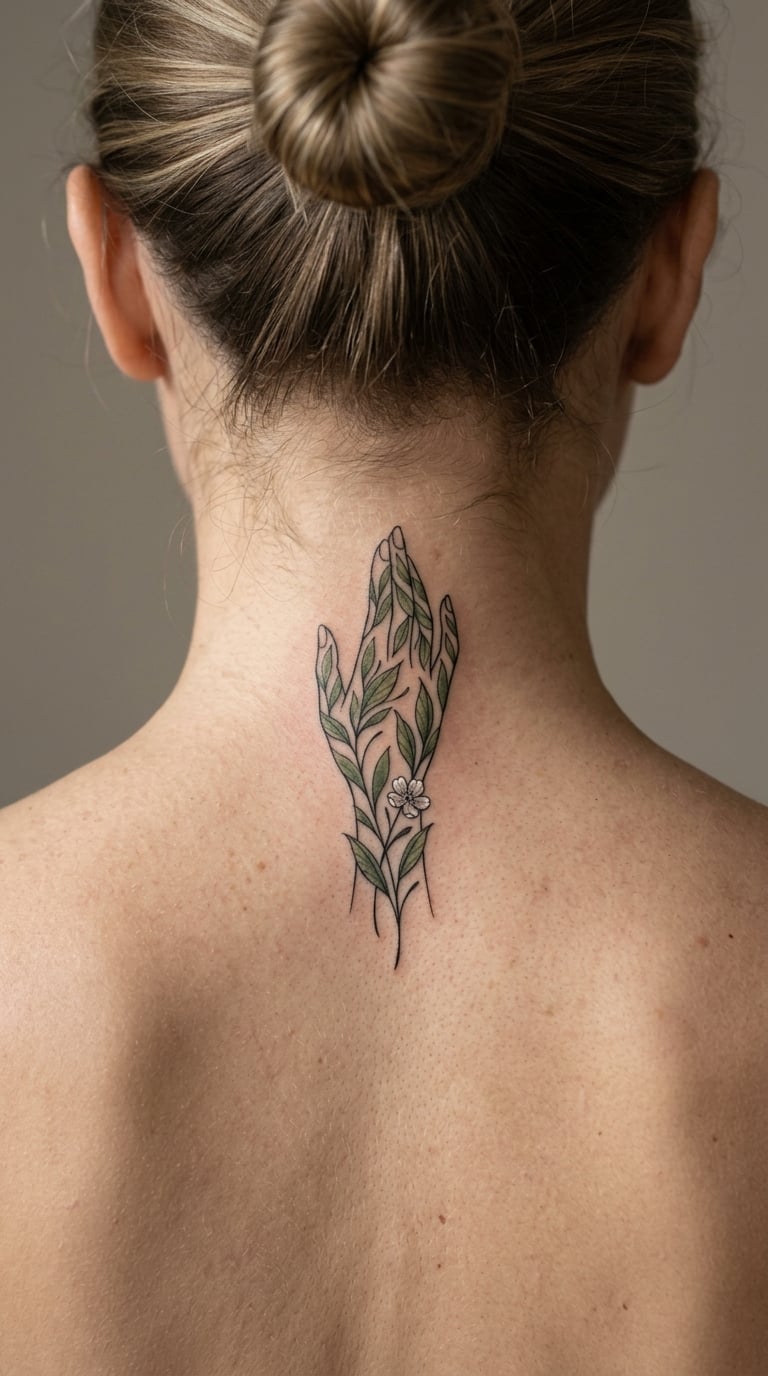
The hand is drawn in outline, then filled with a mix of leaf shapes so the fingers read as separate stems. Different leaf widths in the palm stop it looking like a solid block, and one small bloom near the wrist gives the eye somewhere to land.
It is as much about the craft as the meaning, and it works best for people who like structure and symmetry in a design.
- Placement: vertical, centred, with the wrist toward the shoulders.
- Size: 3 inches (7.6 cm) tall.
- Style: fine-line botanical with muted green.
- Pain: medium, and one of the longer fine-line sittings on the nape.
Make it yours: build the leaves around a birth flower and give it the centre petal. Fine line on the nape is generally durable, but very thin single-needle lines lighten over time, so keep the leaf outlines at a workable weight.
16. Minimal Infinity Symbol
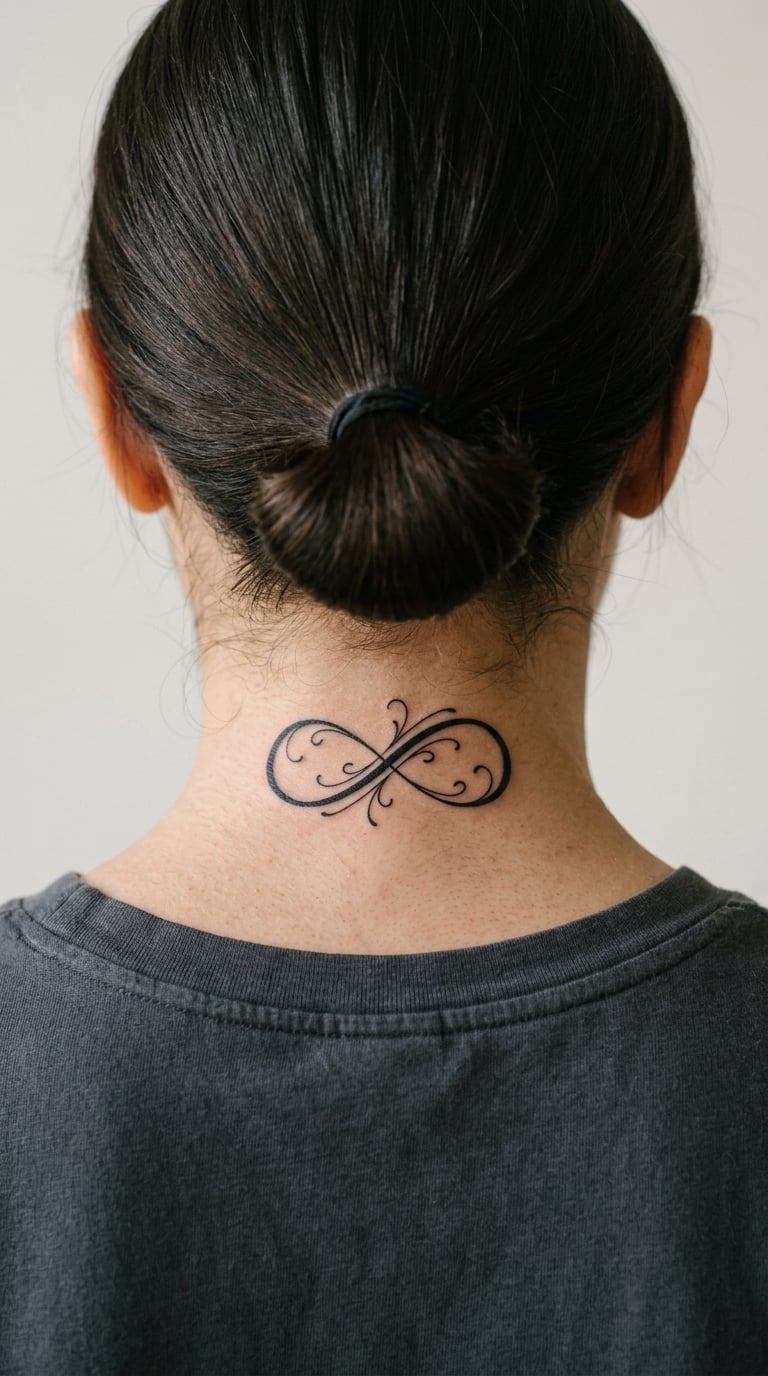
An infinity symbol needs almost nothing to work: a figure of eight with even line weight and two clean crossings. Adding a couple of small flourishes, a sprig or a short date underneath, keeps it from feeling copied off a stock image.
It is a short, lasting design, chosen most often as a quiet nod to something ongoing rather than a grand statement.
- Placement: centred on the upper nape, well clear of the collar.
- Size: 2 inches (5 cm) wide.
- Style: minimal line.
- Pain: low to medium, and one of the shortest appointments on this list.
Make it yours: add two short names in fine script arcing below it, kept small so they do not fight the symbol.
17. Small Phoenix in Red and Black
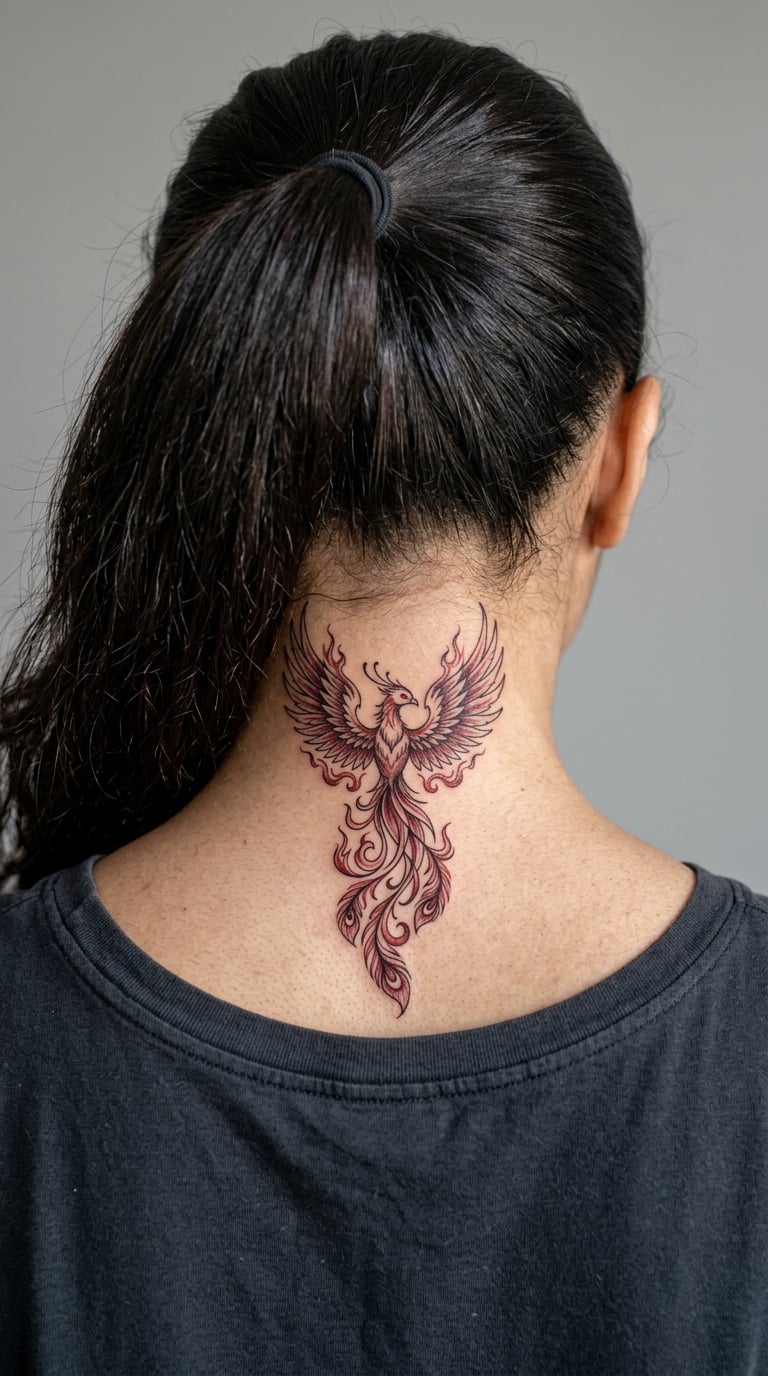
A phoenix with wings raised, a small head and long flame-shaped tail feathers drawn as loose black lines, with red filling only the wing and chest areas. Restraint is what keeps it readable; a phoenix with every feather filled in turns into a dark mass at this size.
It is a rebirth or change motif, and people tend to pick it around a period of transition in their own life.
- Placement: centred nape, large enough for the wings to spread without crowding the hairline.
- Size: 4 inches (10 cm) wide.
- Style: red and black fine line with partial fill.
- Pain: medium-high, and budget a long sitting.
Make it yours: add a date under the tail feathers in matching black. If you already have colour work, matching the red keeps the collection coherent.
18. Simple Butterfly Outline
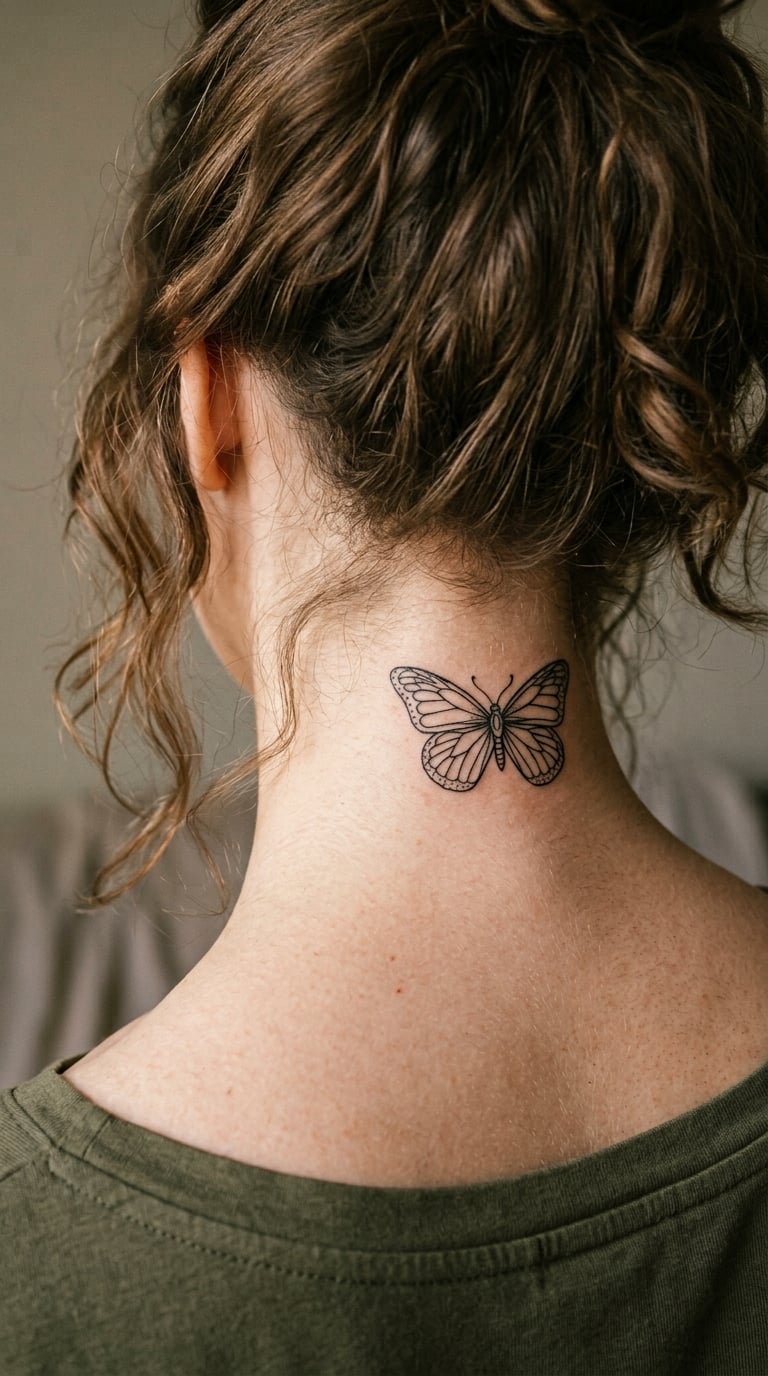
One butterfly, drawn entirely in outline with a narrow body and slightly uneven wing edges so it looks organic rather than stamped. Left in black, it stays legible at a small size and ages far better than a colour version.
It is the most minimal butterfly on this list, and a good option when you want the shape without the commitment of colour on a spot that gets touched by hair every day.
- Placement: slightly off-centre, which makes an outline design look less like a symmetrical logo.
- Size: 2 inches (5 cm) wide.
- Style: outline minimal.
- Pain: low to medium, and quick.
Make it yours: put a matching butterfly at the back of the other ear for a continuous line when your hair is up. That pairing is a favourite way to make a small nape piece look planned.
19. Small Koi in Watercolour Style
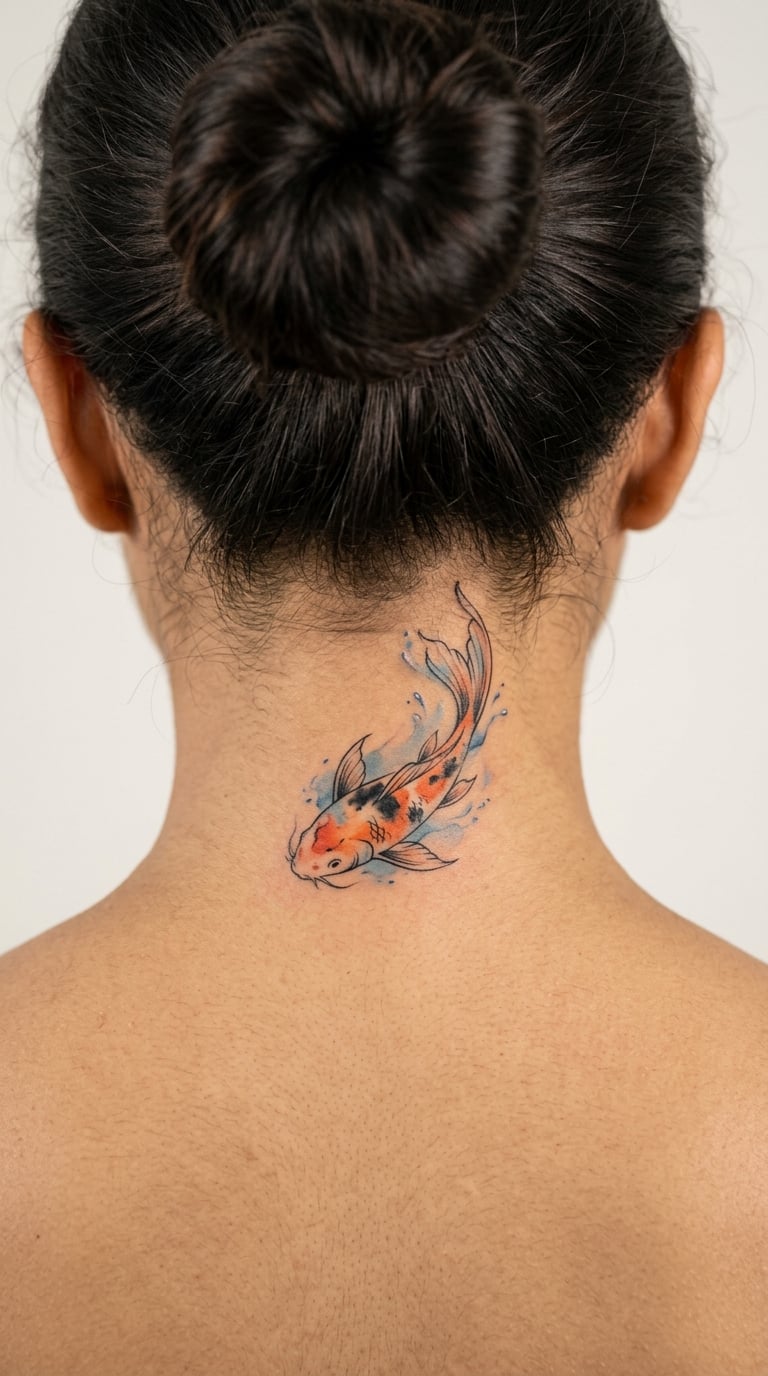
A koi drawn with a thin outline and loose washes of orange, black and pale blue, plus a few soft ripple arcs around it, gives movement without needing a background. The diagonal angle makes the fish look like it is swimming down the neck.
It is chosen for its movement and its colour, and the watercolour treatment suits anyone who finds solid blocks of ink too heavy for the back of the neck.
- Placement: diagonal or centred, depending on how much of the nape you want covered.
- Size: 3 inches (7.6 cm) long.
- Style: line and wash watercolour.
- Pain: medium, with lighter spots where the wash is thin.
Make it yours: pick the main wash from a colour that means something to you, or add your birth year in small script below the ripples.
20. Delicate Sunflower in Fine Line
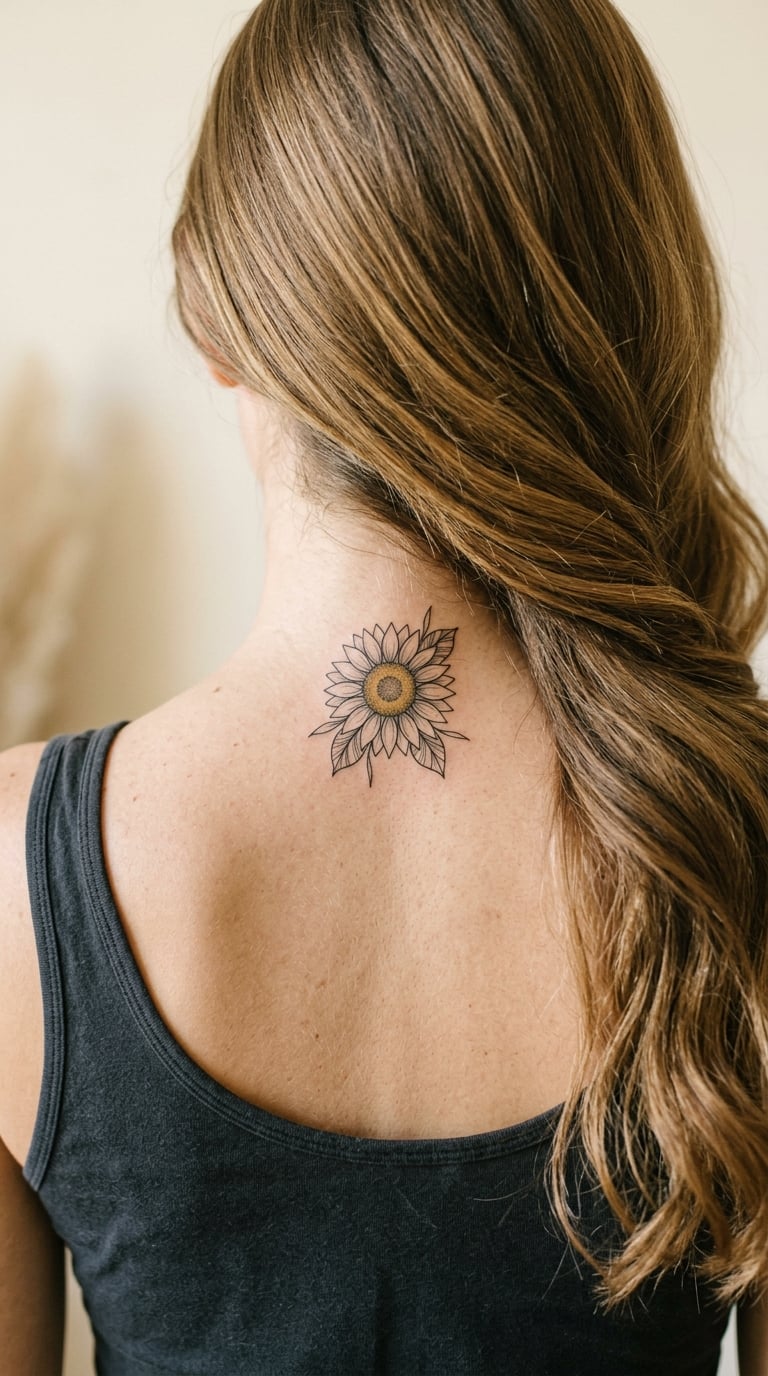
One sunflower with long petals drawn as single fine lines radiating from a densely dotted centre, plus one colour for the centre. Line petals and a solid centre is the balance that keeps it from looking thin once healed.
Sunflowers are picked for warmth and loyalty, and the fine-line version is the least heavy floral idea here.
- Placement: centred nape, angled slightly if your neck curves strongly.
- Size: 2.5 inches (6.3 cm) in diameter.
- Style: fine line with a single colour detail.
- Pain: medium, and the radiating petals take more passes than the outline suggests.
Make it yours: use a meaningful colour for the centre, or add a small closed bud beside it for a sense of a plant rather than a single bloom.
21. Small Celestial Map in Dotwork
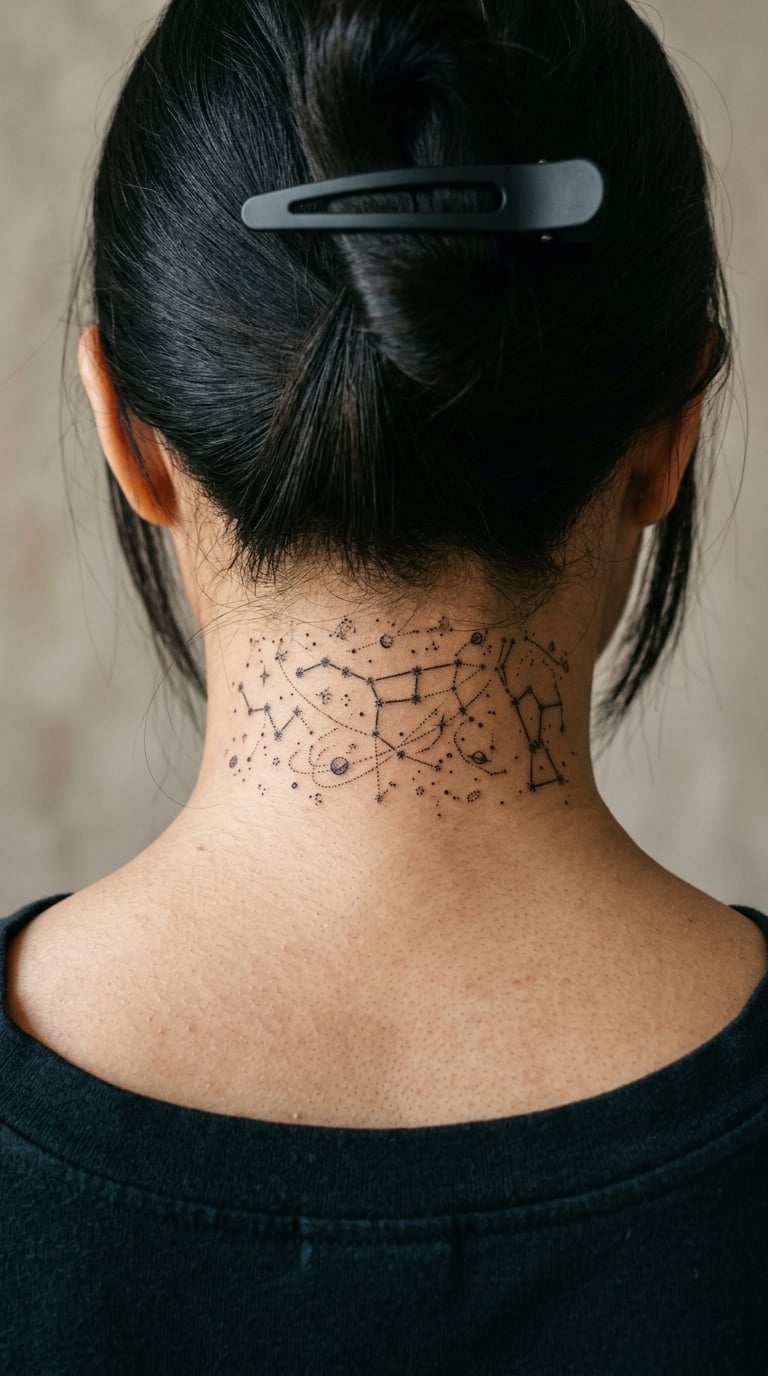
A wide field of tiny stars with three constellations picked out by slightly heavier dots and thin connecting lines, plus one brighter star to anchor the composition. The dots do the describing, so the whole thing works from a distance even without fine detail.
It is usually tied to a real sky, either a night that mattered or the stars over a place you belong to.
- Placement: spanning the nape horizontally, using the width rather than the height.
- Size: 3.5 inches (8.9 cm) wide.
- Style: dotwork with fine line connections.
- Pain: medium, and a long sitting for the density.
Make it yours: have the artist plot an actual sky for your date and location. Request slightly larger dots than feel necessary, because fine star fields soften fastest of all the styles here.
22. Symmetric Peony in Soft Blackwork
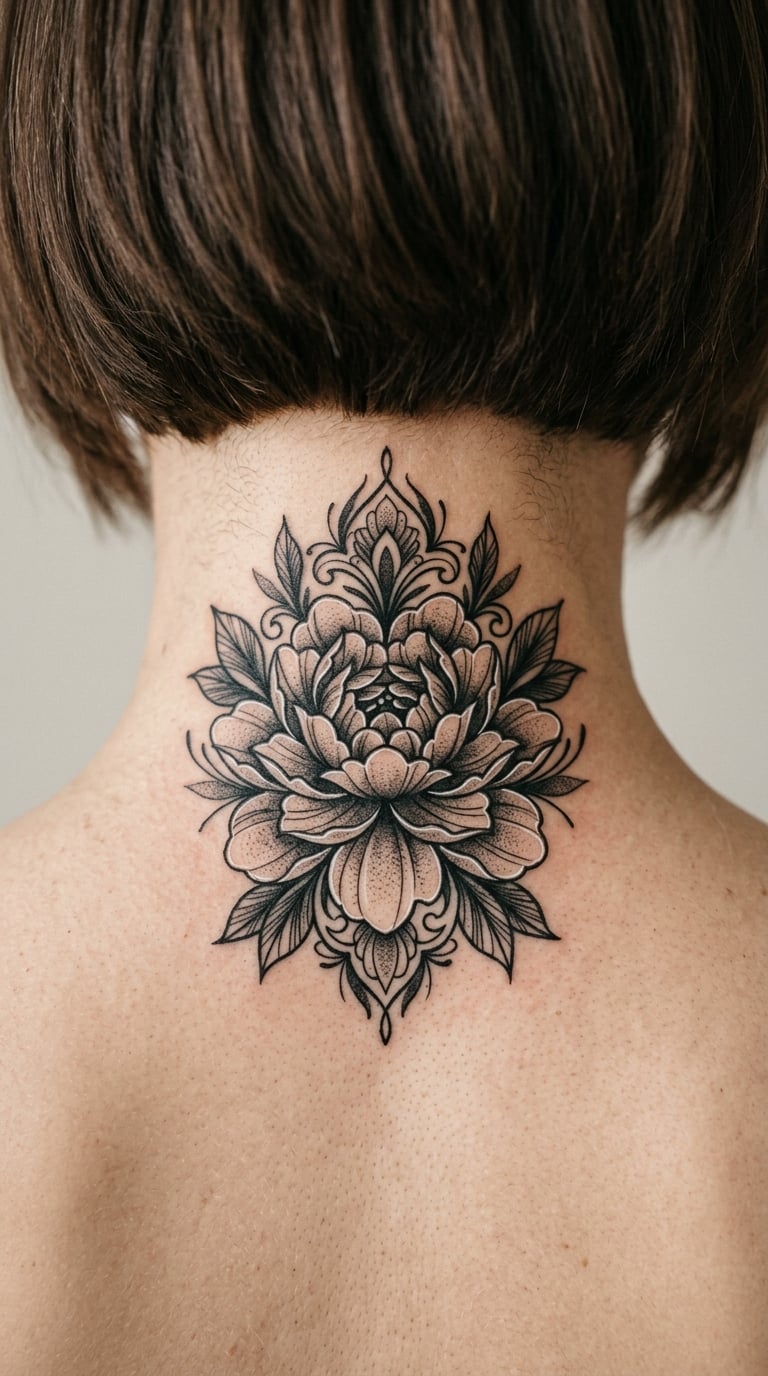
A peony built from layered black petals with narrow white highlights cut through the shadows, which is what stops dense black from looking flat. Symmetrical petal counts across the centre line give it the composed, finished look this style is known for.
It is the boldest floral idea here, and the one that ages most gracefully, because organic petal shapes sit better on skin over time than rigid geometry.
- Placement: centred nape, with enough width for both halves to sit evenly.
- Size: 3.5 inches (8.9 cm) wide.
- Style: soft blackwork with negative-space highlights.
- Pain: medium-high, because every layer of petal is another pass over the same skin.
Make it yours: run a thin coloured edge along the outer petals, which lifts the whole shape and makes it match a colour piece elsewhere.
How to Choose the Right Design
Nape work fails in predictable ways, and all of them are avoidable at the consultation stage. Six checks will tell you whether a design suits the placement before you commit.
Check the scale against your hairline, not your screen
Measure against the width of your own neck, not the reference photo. Anything wider than about four inches will run into the hairline at the sides, and regrowth will grow over the outer edges within a month.
Contrast beats detail at every size
Fine grey shading on a small piece will look like a smudge within a couple of years. Solid black, bold outlines and high-contrast colour hold their read at the nape far longer, and most artists will tell you the same thing.
Think about the curve, not the flat of the design
The nape dips inward, so a design that looks balanced on paper will appear to narrow or stretch once it wraps the curve. Ask the artist to place a stencil, walk away, and look at it in a mirror before any line work starts.
Set your own visibility limit
On a numeric scale, most people put the nape around seven out of ten, higher than the side of the neck and lower than the throat. Decide before the appointment whether you are happy for colleagues, family or clients to see it, because that decision is much harder to reverse than a bad line.
Be honest about whether it should be your first piece
The nape is thin, moves constantly and sits near bone, so it is a harder first placement than an arm or a thigh. Plenty of people get one anyway and enjoy it, but if you are still deciding about placement, an easy spot first is the calmer route.
Plan the hair and the season
Ask your artist at the consult what they would trim, and keep the first two weeks clear of collars, tight ties and anything that rubs. Short sleeves and loose hair are your friends until the surface has settled.
Cost and Session Time
Most US shops charge by the hour, and nape work is priced closer to a specialist rate than a walk-in rate because the surface is awkward and the client cannot easily see it. Small single-symbol pieces and simple line work usually land in the lower end of the range, while multi-colour and full blackwork sit at the higher end.
Custom work, large dotwork fields and watercolour pieces regularly need two appointments, and your artist will usually quote the second one as a separate session rather than a hidden extra. Shop minimums, artist rates, city and how much detail you want all move the final number, so treat any figure you are given before the consult as a starting point rather than a fixed quote.
A useful rule of thumb: if your design needs more than a couple of hours, the artist will probably want a second sitting, and that is a good sign rather than a bad one.
Aftercare Basics
Start with your artist’s aftercare instructions, because they know exactly how their work was done on your skin. Beyond that, a few basics cover most nape tattoos.
- Follow your artist’s aftercare directions first, then keep the area clean with the product they recommend and nothing scented.
- Keep hair ties, collars and hoods loose and off the fresh work until the surface has stopped being tender.
- Expect the skin to flake or scab lightly in the first week, especially along the hairline where movement rubs.
- Avoid sleeping on it for the first few nights if you can, since pressure is the main cause of an early scab.
- Once healed, use sunscreen on the nape when your hair is tied back, because sun exposure speeds fading on colour work.
- Book a free or low-cost touch-up in the same window your artist suggests rather than waiting for a line to fade out entirely.
Frequently Asked Questions
Are nape tattoos painful?
Most people put the nape around seven out of ten, higher than the side of the neck and lower than the throat. The skin is thin, the machine vibrates close to the cervical spine and the area never stops moving. A small fine-line piece is over quickly, while bold blackwork and long dotwork sittings are harder to sit through.
How visible will a nape tattoo be with short or long hair?
With short hair and a normal hairline, most of a nape design stays visible, because it sits just below the hairline where hair rarely reaches. Longer hair pulled back, up in a bun or braided usually covers it completely. If you want it hidden at work, tie it back and check the visibility yourself before the consult.
What size is best for a first nape tattoo?
Something in the two to three inch range works well as a first nape tattoo. Small enough to sit comfortably clear of the hairline and the collar, large enough to hold a clear shape. Avoid anything packed with micro-detail at that size, because fine grey detail on a small neck piece tends to blur within a couple of years.
How long does a nape tattoo take to heal?
The surface usually settles within two to three weeks, with flaking, itching and a light scab in the first ten days or so. Full healing underneath takes closer to two to three months, during which the nape keeps rubbing against hair, pillows and collars. Plan your haircuts and any tight collars around that window.
Can nape tattoos be added to an existing collection?
Yes, and the nape is one of the easiest placements to build a collection around. Many people pair a nape piece with a back-of-ear or behind-ear tattoo to create a continuous line that shows when the hair is up. Match the line weight and style to what you already have so the older and newer work look related.
Do fine-line nape tattoos fade quickly?
Neck tattoos tend to fade a little faster than ink on an arm or leg, and the very thinnest single-needle lines fade first. Keep outlines at a workable weight, avoid pale grey detail and use sunscreen when your hair is tied back. Most artists will check the work once, and a touch-up in the first year keeps the design crisp.
Starting Your First Nape Tattoo
If you are choosing from these 22 nape tattoo ideas and this is your first piece, keep it under three inches with solid black linework. The crescent, the infinity symbol, the paper plane and the single butterfly outline are all forgiving designs that hold their shape and heal quickly.
Adding to a collection changes the maths. At that point pick something that earns the space, like the blackwork eagle, the dotwork celestial map or the soft blackwork peony, and give the artist the full width of your nape to work with.
Whichever way you go, get a named portfolio from your artist and a stencil you have seen on your own neck before any line work starts.