
20 Tricep Tattoo Ideas for Men (October 2026)
The tricep is one of the best places on the arm for a man’s first tattoo. It is big enough for a full illustration, curved enough that a design wraps naturally, and visible with a short sleeve without being in your face all day. These 20 tricep tattoo ideas for men cover everything from a thin-line mountain range you can barely see to a six-inch koi that takes a whole afternoon.
What makes a design work here is simple: it has to be drawn for the arm in motion, not flattened into a straight-on mockup. The muscle narrows toward the elbow and rounds across the back, so a shape that looks balanced on paper can skew once it sits on skin. Every entry below notes where the piece sits, how big it works, and what happens to the detail over the years.
If you like the motif side of this rather than the technique side, our military tattoo ideas for men and hunting tattoo ideas for men roundups cover the heritage and wildlife angles in more depth.
20 Tricep Tattoo Ideas for Men: Quick Guide
Read the table first if you are still deciding. Every design below is listed in order, with the style family, the spot it suits, a realistic size and how the session usually feels.
| Idea | Style | Best placement | Size | Pain |
|---|---|---|---|---|
| 1. Fine-Line Mountain Range | Fine line | Outer tricep, centred | 4 in wide | Low to medium |
| 2. Blackwork Dumbbell | Blackwork | Outer tricep, centred | 3 in wide | Medium |
| 3. Traditional Rose and Dagger | Old School colour | Outer tricep, diagonal | 5 in long | Medium to high |
| 4. Japanese-Style Koi Fish | Japanese-inspired | Wrapping the outer tricep | 6 in long | Medium to high |
| 5. Roman Numerals on a Curved Band | Minimalist black | Mid tricep, following the curve | 3 in wide | Low |
| 6. Minimalist Arrow | Single-line | Outer tricep, horizontal | 2.5 in long | Low |
| 7. Skeleton Hand Holding a Dagger | Neo-traditional | Outer tricep, diagonal | 5 in long | Medium to high |
| 8. Compass Rose | Black and grey | Outer tricep, centred | 4 in wide | Medium |
| 9. Blackwork Eagle Head | Blackwork | Outer tricep, upright | 5 in tall | Medium |
| 10. Geometric Hexagon Pattern | Blackwork geometric | Wrapping across the tricep | 5 in wide | Medium |
| 11. Small Running Bull | Traditional black | Outer tricep, low | 3 in wide | Medium |
| 12. Celtic Knot | Interlace blackwork | Outer tricep, centred | 3.5 in wide | Medium |
| 13. Micro-Realism Wolf | Micro-realism | Outer tricep, small | 3 in tall | Medium |
| 14. Snake Around a Barbell | Illustrative black and grey | Across the outer tricep | 6 in long | Medium to high |
| 15. Dotwork Compass | Dotwork | Outer tricep, centred | 3 in wide | Medium |
| 16. Wordmark in Blackletter | Lettering | Outer tricep, horizontal | 3 in wide | Low to medium |
| 17. Stag Head in Dotwork | Dotwork | Outer tricep, upright | 4 in tall | Medium |
| 18. Laurel Wreath | Fine black linework | Outer tricep, framed | 5 in wide | Medium |
| 19. Hourglass with Geometric Frame | Blackwork geometric | Outer tricep, centred | 4 in tall | Medium |
| 20. Watercolour Mountain Splash | Watercolour | Across the outer tricep | 6 in wide | Medium to high |
1. Fine-Line Mountain Range
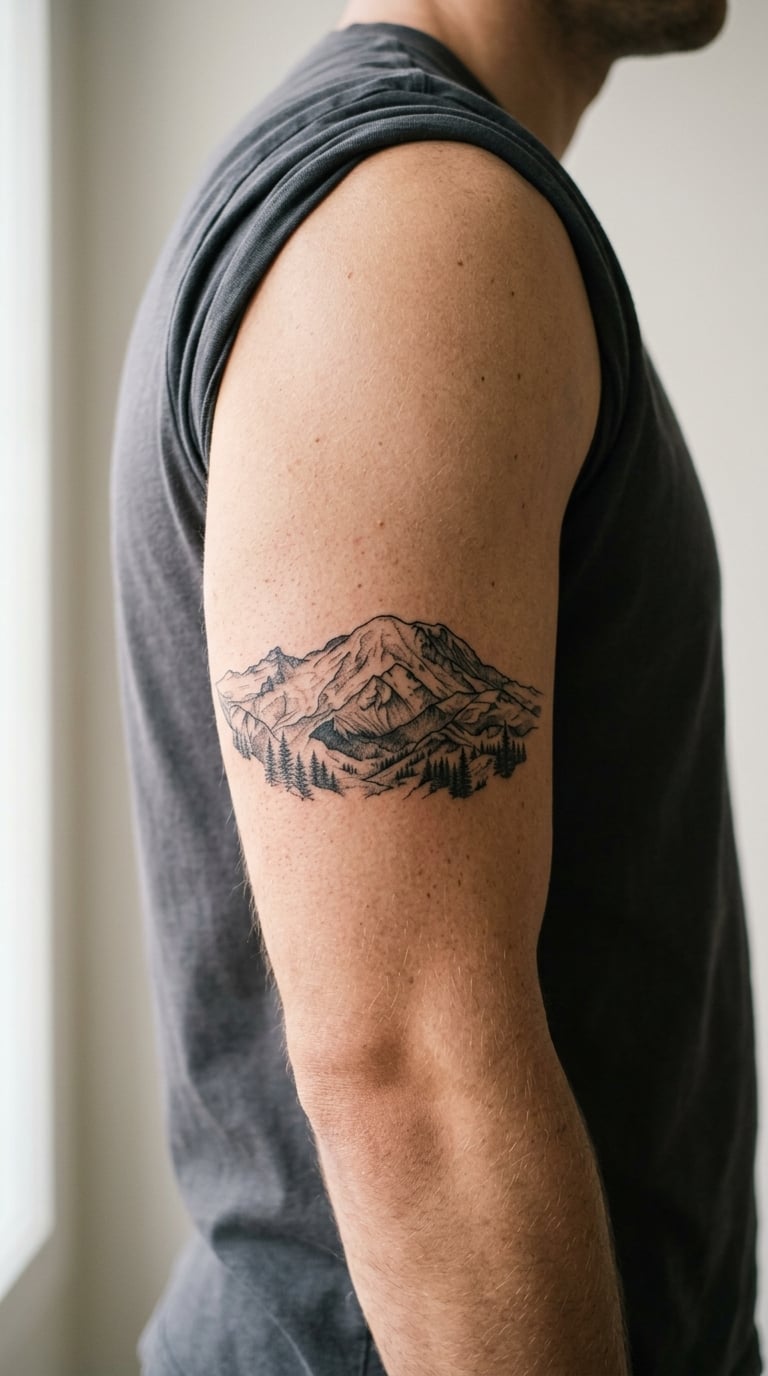
Fine-line mountain ranges are drawn with a single needle grouping, no shading and no fill. Three or four peaks of different heights sit on a broken horizon line, and the whole thing reads as one quiet shape from across a room.
Most people who choose it are marking a trip, a first summit, or a stretch of years that mattered. Some just like that it looks like a landscape rather than a logo.
Placement: outer tricep, centred, with the range running parallel to the elbow. Size: 3 to 5 inches wide, roughly 1.5 inches tall. Style: fine line. Pain: low to medium, the outer arm is fleshy and mobile.
Thin single-needle lines on a moving muscle soften noticeably within about five years, so ask for slightly heavier line weight than the reference photo shows. Make it yours: use the coordinates of the place that shaped you, tucked under the range in a small script.
Why tricep tattoos work on curved arms
The tricep is a long rounded muscle, so anything drawn vertically follows its natural line toward the elbow. Taper matters more than people expect: the arm narrows near the elbow, and a design sized flat will look stretched once it wraps. Most artists sketch straight onto skin with the arm relaxed, then check the piece both flexed and at rest before the stencil is committed.
Composition is the other half. A centred subject with skin left above and below reads clearly from the side, while a wraparound band can hide its edges behind the arm. Muscle flow is why vertical motifs suit this spot and horizontal bands suit the bicep better. Hold your arm out and look at your own tricep in a mirror: whatever you see there is roughly what other people will see from the side.
2. Blackwork Dumbbell
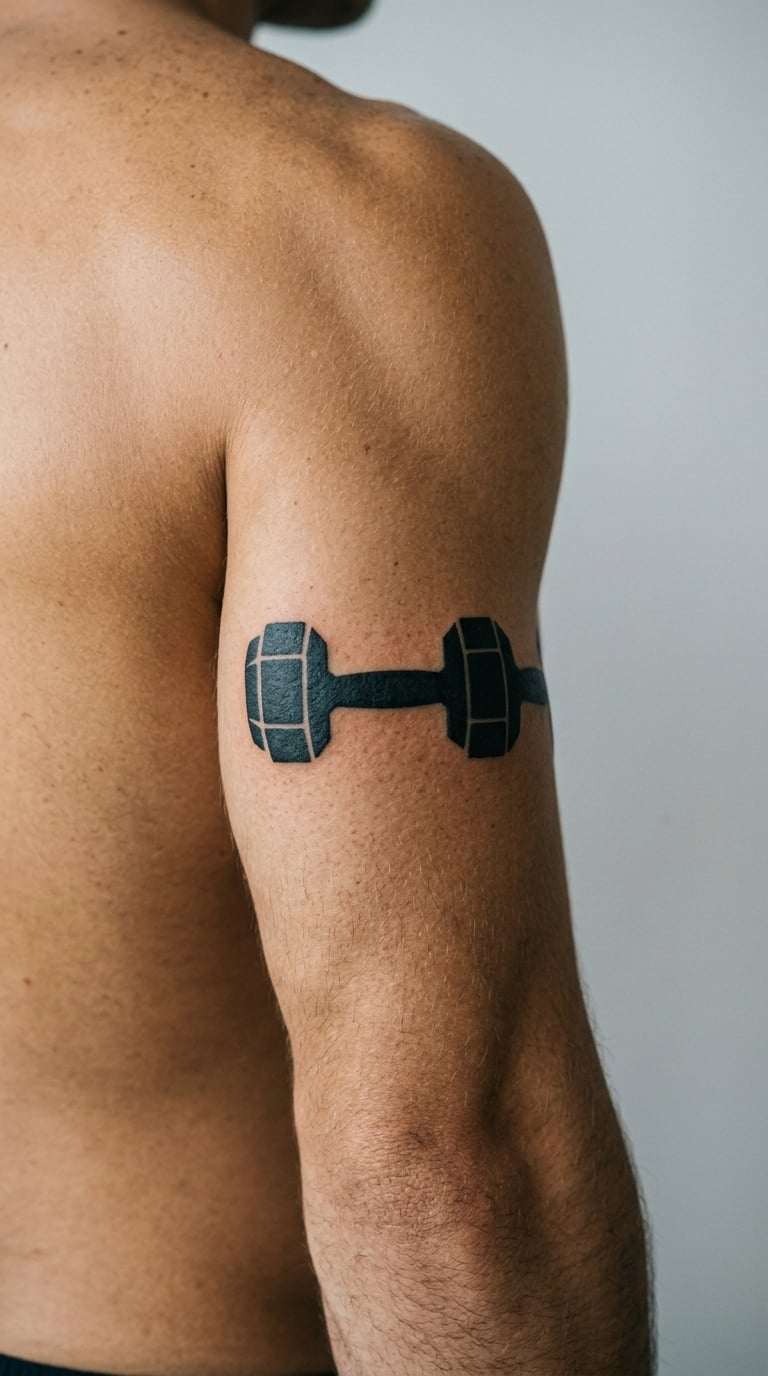
A dumbbell in solid black is the simplest statement piece in this list: two rounded plates, a short bar, heavy even fill with no outline doubling. Because there is no interior detail, the shape stays crisp as the arm moves.
It reads as commitment to training rather than a job title, which is why it keeps showing up on men who want one piece that says something without saying anything loud.
Placement: outer tricep, centred and level. Size: 2.5 to 3.5 inches wide. Style: blackwork. Pain: medium, mostly from the filling rather than the outline.
Solid black is unforgiving of a shaky outline, so pick an artist whose healed blackwork you have actually seen. Make it yours: have the bar wrapped in a thin rope or set your initials inside the bar rather than adding a second object to the design.
3. Traditional Rose and Dagger
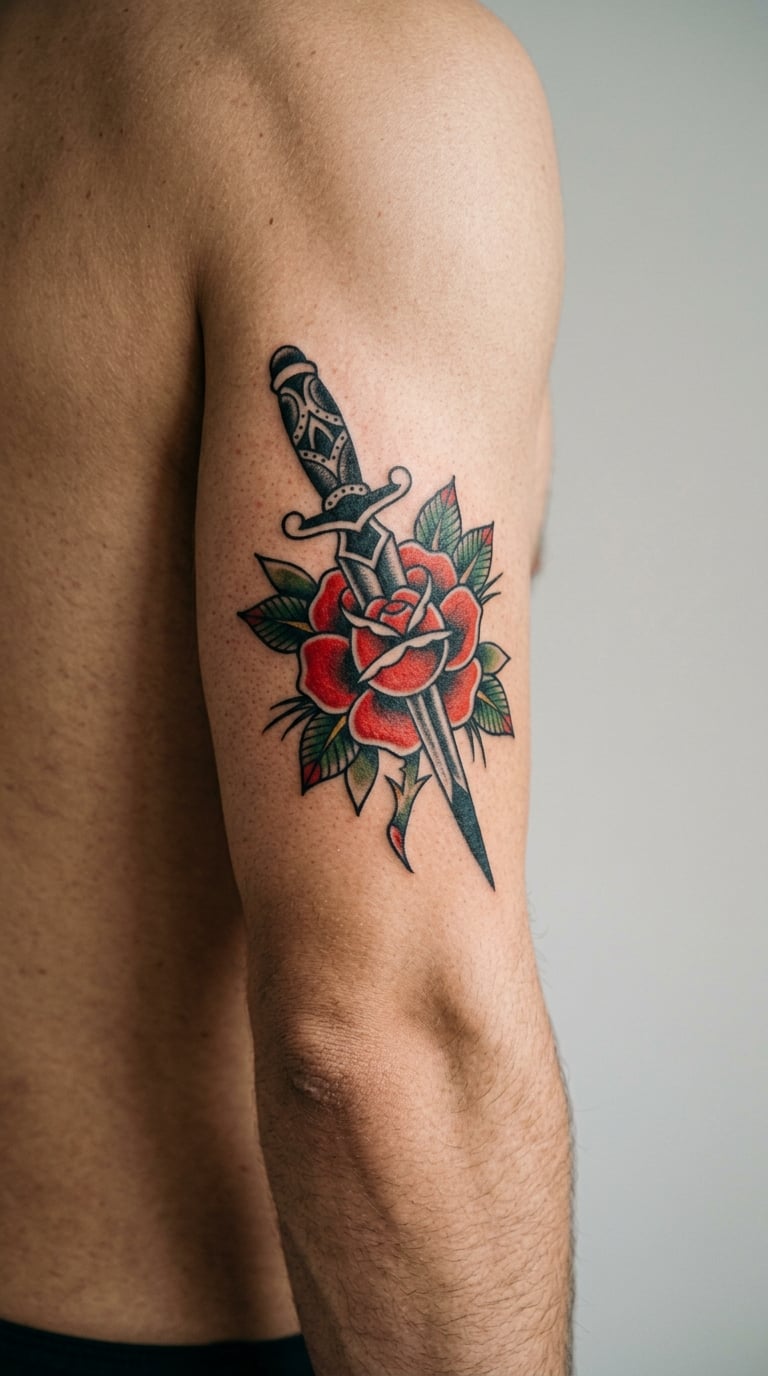
Old School work lives on bold black outlines, flat blocks of colour and heavy black shading. Here the rose is built from layered red petals with green leaves, and the dagger is a curved single-edged blade with a shaded handle, tucked into the stems.
It is a balance of two opposites, which is why it has been redrawn for a century: the flower stands for beauty and pain, the blade for decision and consequence. A tricep version is popular because the diagonal angle follows the line of the muscle instead of fighting it.
Placement: outer tricep, running from the shoulder toward the elbow at about 30 degrees. Size: 4 to 6 inches long. Style: traditional colour. Pain: medium to high, and colour packers pass over the same skin many times.
Colour fades first where sun hits and where the arm rubs fabric, so expect the red to soften before the black line does. Make it yours: change the bloom to a thistle, poppy or night-blooming flower tied to something specific to you.
4. Japanese-Style Koi Fish
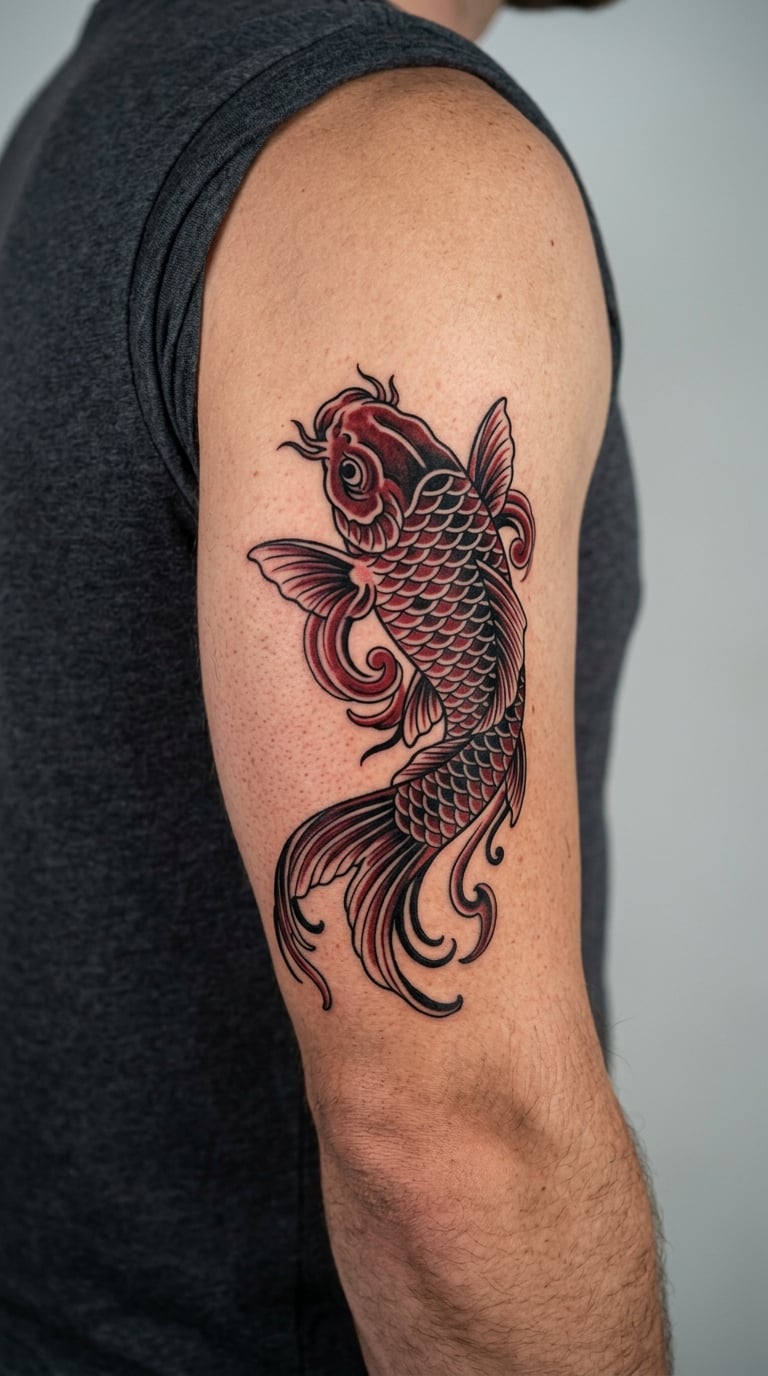
A koi drawn in the Japanese style uses strong black outlines, grey and red scaling, and a body that curves through the composition rather than sitting flat. Scales are suggested with overlapping arcs and soft grey shadow instead of colour blending.
The fish is one of the most requested motifs in tattooing because it survives being shown at an angle. Koi are associated with endurance and with pushing through difficulty, and plenty of men attach a private story to it that they never explain.
Placement: wrapping the outer tricep so the tail disappears toward the bicep. Size: 5 to 7 inches long. Style: Japanese-inspired. Pain: medium to high across a six-inch stretch, with the fin detailing being the sharpest part.
Scale detail is the first thing to blur here, and a bulking cycle can stretch spacing further. Make it yours: ask for a single koi in open water with no bubbles, which keeps the composition calm and the healing simpler.
5. Roman Numerals on a Curved Band
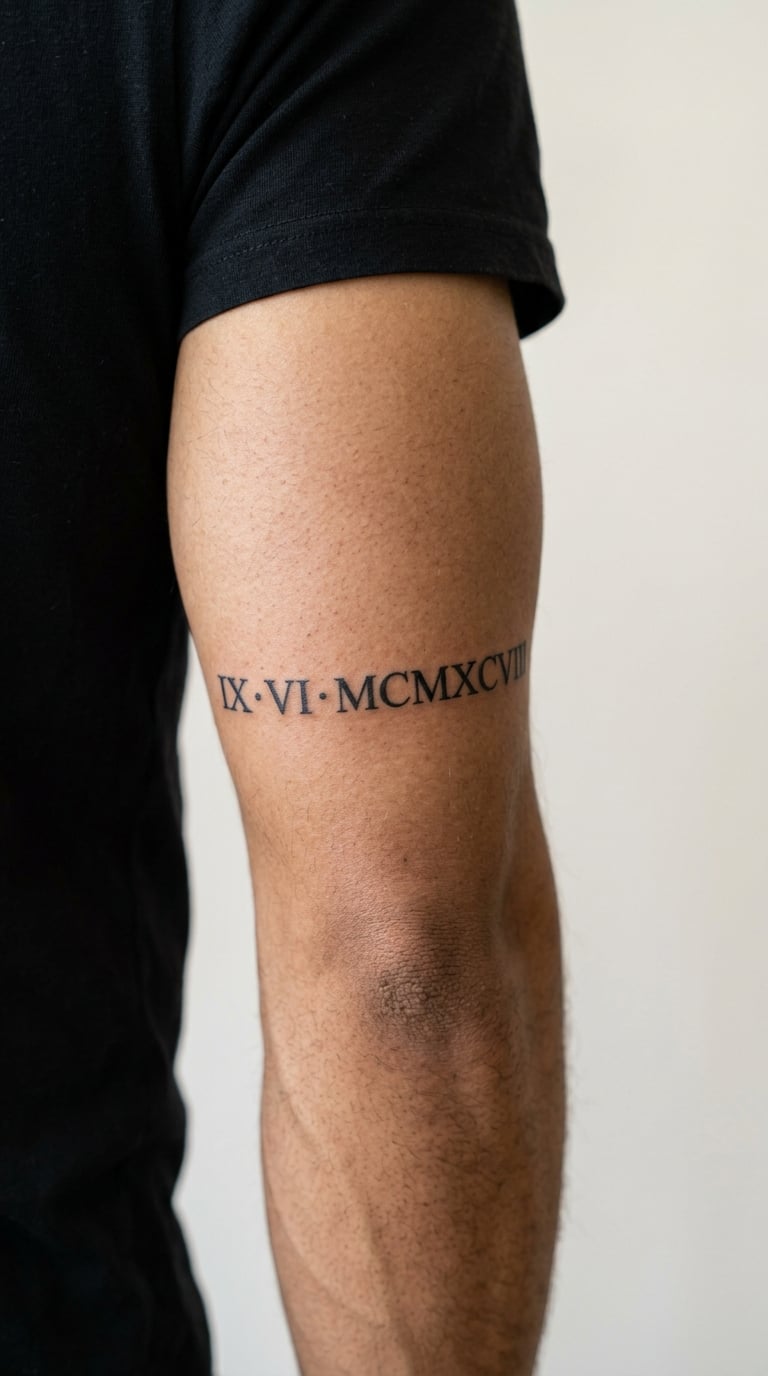
Roman numerals get a reputation for being a tattoo about time, and they earn it. The design is spare: a row of thin serif numerals, generously spaced, arcing gently across the tricep so the line of the numbers echoes the muscle underneath.
People use it for a date, a coordinate, a jersey number or a chapter they wanted marked without an explanation. Discreet is the point.
Placement: mid tricep, following the contour rather than sitting perfectly horizontal. Size: 2.5 to 4 inches wide. Style: minimalist black. Pain: low, one pass, little shading.
Serifs are the weak point at this scale. Ask the artist to widen them slightly and check the spacing in a mirror before the stencil goes on. Make it yours: add a tiny dot or a small mark at the start of the sequence to identify it as yours.
6. Minimalist Arrow
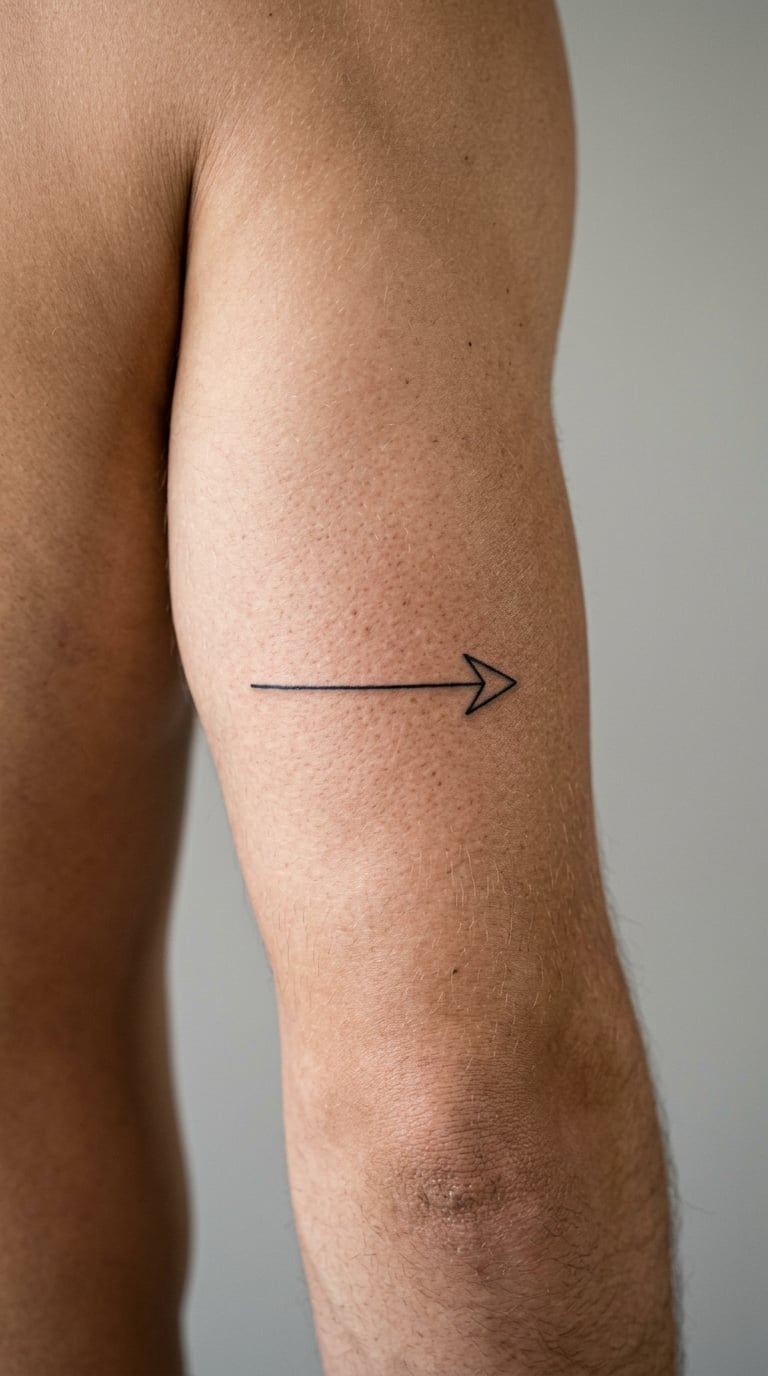
A single-line arrow is one of the cleanest small tattoos a man can get: a shaft drawn with one continuous line, two short barbs at the tail, an open V at the head. No shading, no banner, no scrollwork.
Direction and forward motion are the usual reading, and it works as the first piece in an arm that will grow into a pattern over the years.
Placement: outer tricep, horizontal, anywhere from mid-muscle down toward the elbow. Size: 2 to 3 inches long. Style: single line. Pain: low, most people describe this as a scratch that keeps repeating.
One-line work is the fastest to fade on a muscle that flexes daily, so this is a design to rebook rather than a forever piece. Make it yours: point it toward the elbow rather than the shoulder, which reads as forward movement on the body itself.
7. Skeleton Hand Holding a Dagger
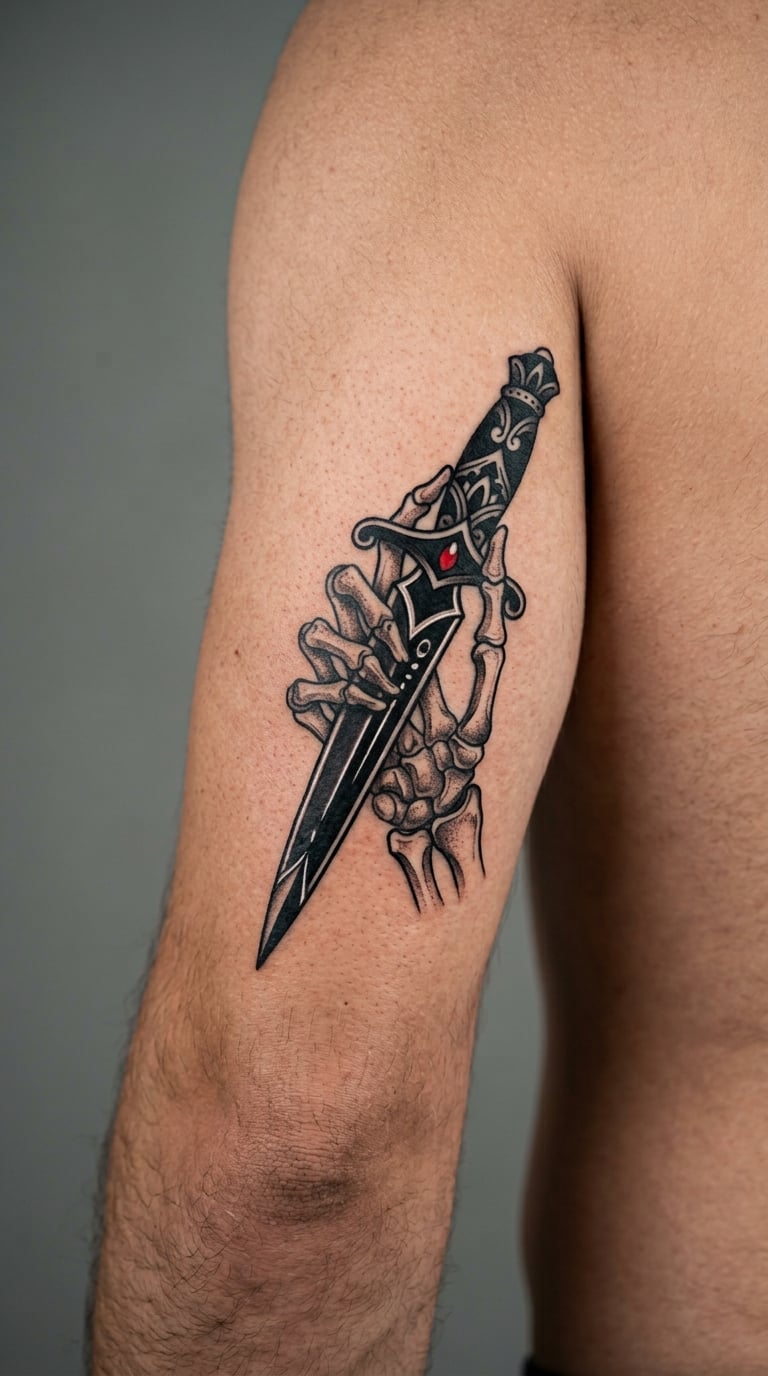
Neo-traditional sits between American traditional and realism: heavy outlines and saturated colour, but with tighter anatomy and more deliberate shading. The hand is drawn bone by bone, knuckles and finger joints visible, wrapped around a dagger with a shaded blade and one red detail such as a drop or a wrapped grip.
It is a resolve motif. The grip says something is being held onto on purpose, and the dagger adds the edge.
Placement: outer tricep on a diagonal, wrist of the hand toward the shoulder. Size: 4 to 6 inches long. Style: neo-traditional. Pain: medium to high, bone rendering rewards patience and slow shading.
Joint definition needs a steady hand and a healing window where you do not train hard, because swelling rounds off the small shadows. Make it yours: swap the dagger for a set of keys, a lighter or a small tool connected to your trade.
8. Compass Rose
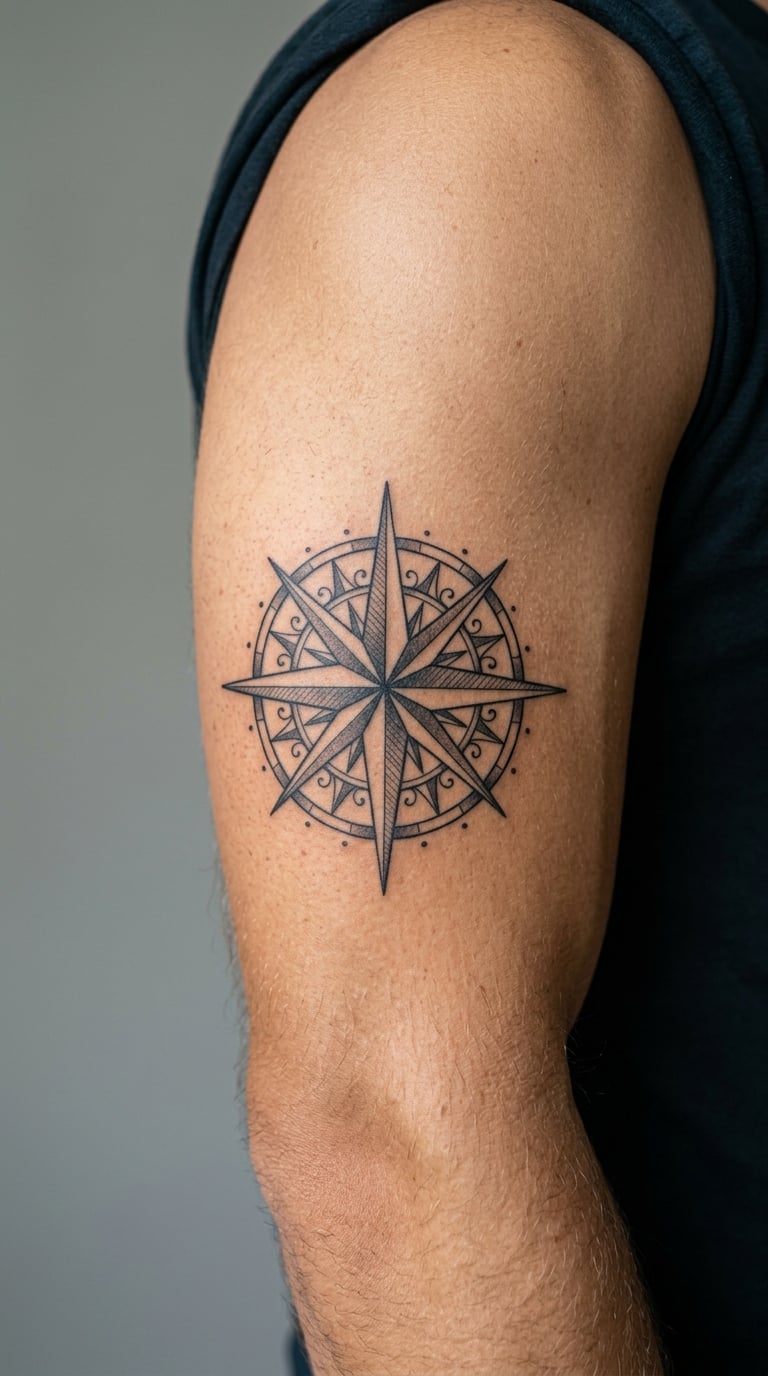
A compass rose on the tricep is usually an eight-point star with a longer N and S axis, drawn in black outline with a light grey wash on alternate points and a fine double circle around the edge. The outer ring is what turns it from a star into a compass.
It stands for guidance, travel and the moment a direction finally became clear, which is a more useful meaning than the star alone gives you.
Placement: outer tricep, centred and upright, with the long points running vertically. Size: 3.5 to 5 inches across. Style: black and grey. Pain: medium, mostly the thin radial lines and the ring.
Radial spokes blur together as the design ages, so more spacing between points is better than a reference image suggests. Make it yours: set the star off-centre with a small bearing or latitude cut into the ring.
9. Blackwork Eagle Head
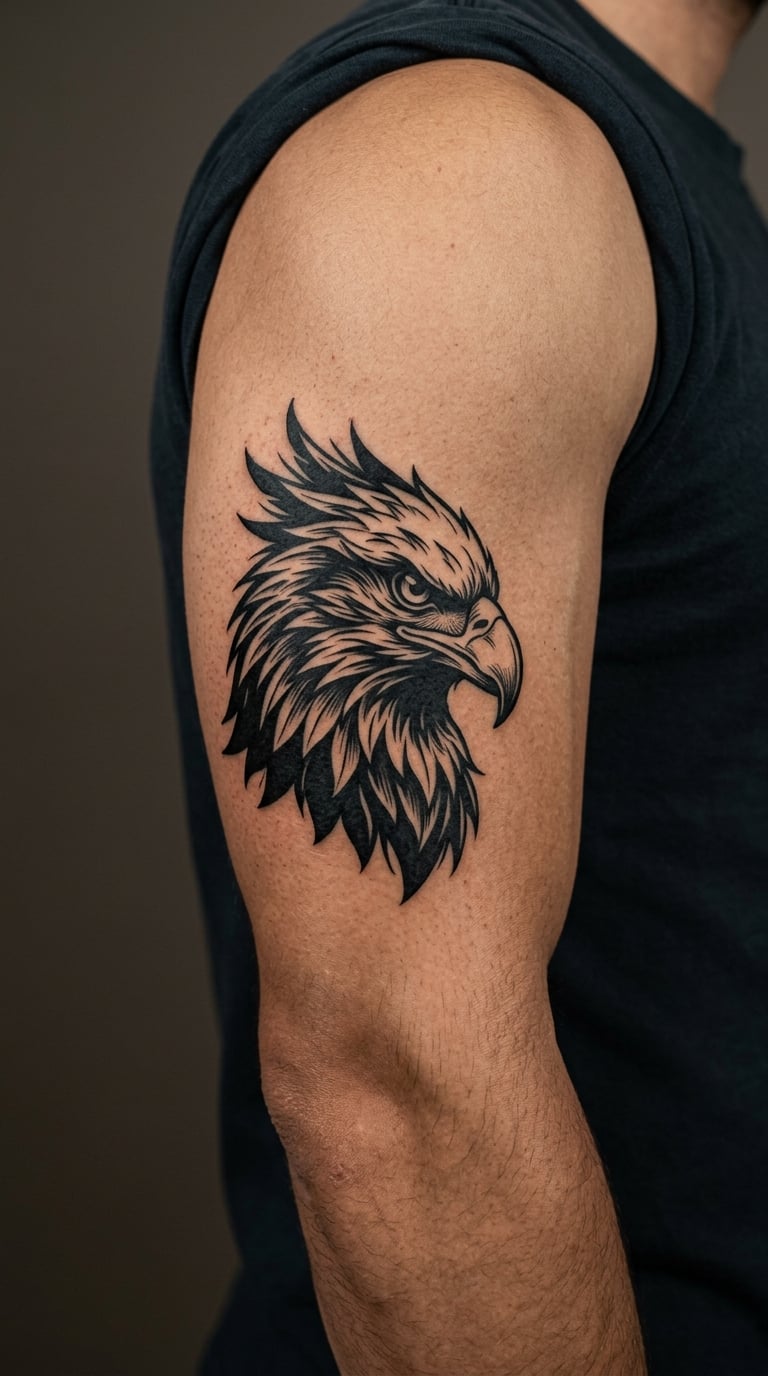
Blackwork eagles are built from solid black shapes separated by clean cuts of bare skin. The hooked beak and eye are the focal points, and the feather rows below the jaw are indicated by negative space rather than shading.
Perspective, courage and freedom are the readings people attach to it, and the profile works well from the side because the beak gives the design one unmistakable silhouette.
Placement: outer tricep, upright, head toward the shoulder. Size: 4 to 6 inches tall. Style: blackwork. Pain: medium, the solid areas go down fast but need patience.
The fine feather cuts inside the black are the first thing to fill in over the years, which softens the head into a heavier shape. Make it yours: keep the profile and change the background to a circular shape of negative space so it reads as a badge.
10. Geometric Hexagon Pattern
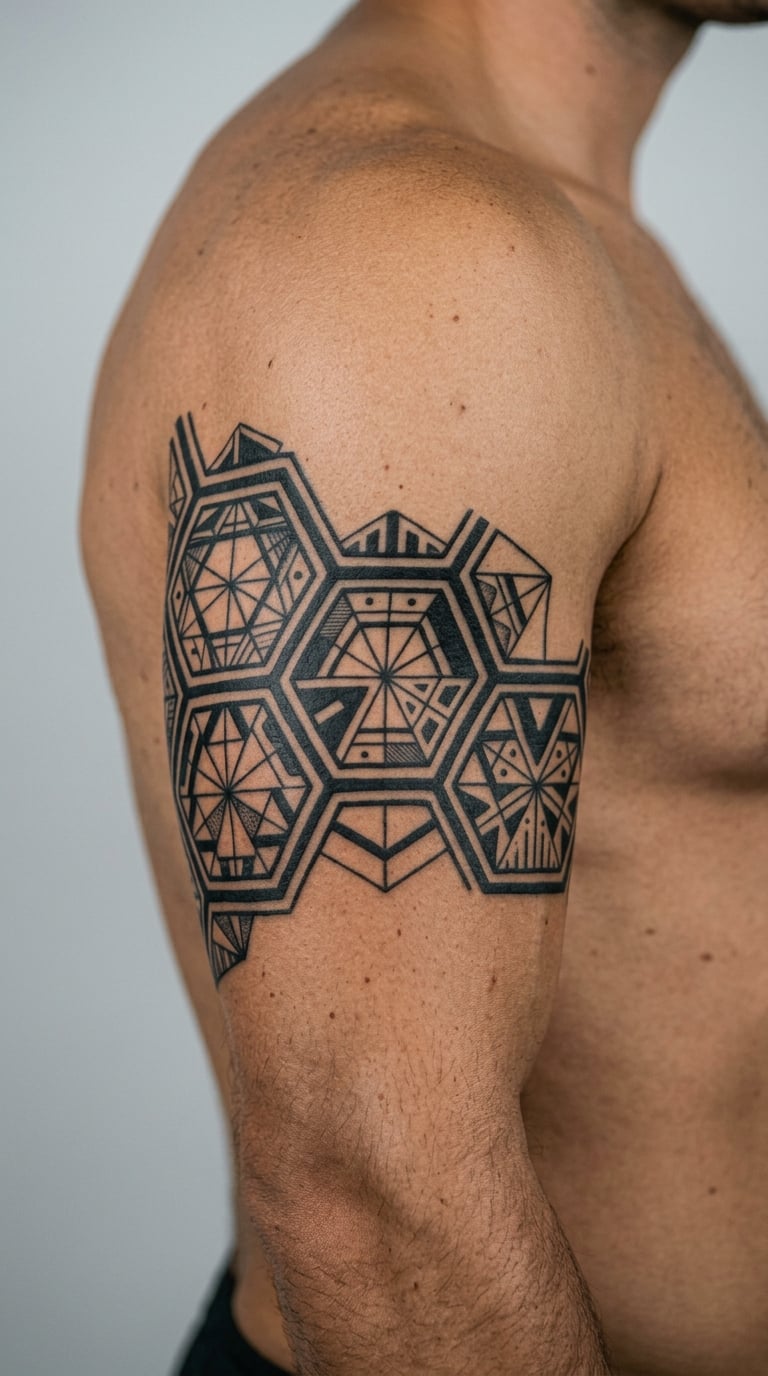
Connected hexagons drawn in solid black, some filled and some outlined, create a pattern with real depth. The trick is alternating solid and empty cells so the eye moves instead of hitting a flat block.
It is one of the easiest designs here to extend later, since a matching panel can be added above or below without repainting anything.
Placement: wrapping across the outer tricep, letting the outer hexagons curve out of sight. Size: 4 to 6 inches wide. Style: blackwork geometric. Pain: medium, steady work rather than sharp pain.
Straight-line geometry shows any wobble on a curved surface, so ask the artist to draw it directly rather than transferring a printed sheet. Make it yours: hide one letter or a small symbol inside a single hexagon for anyone who looks closely.
11. Small Running Bull
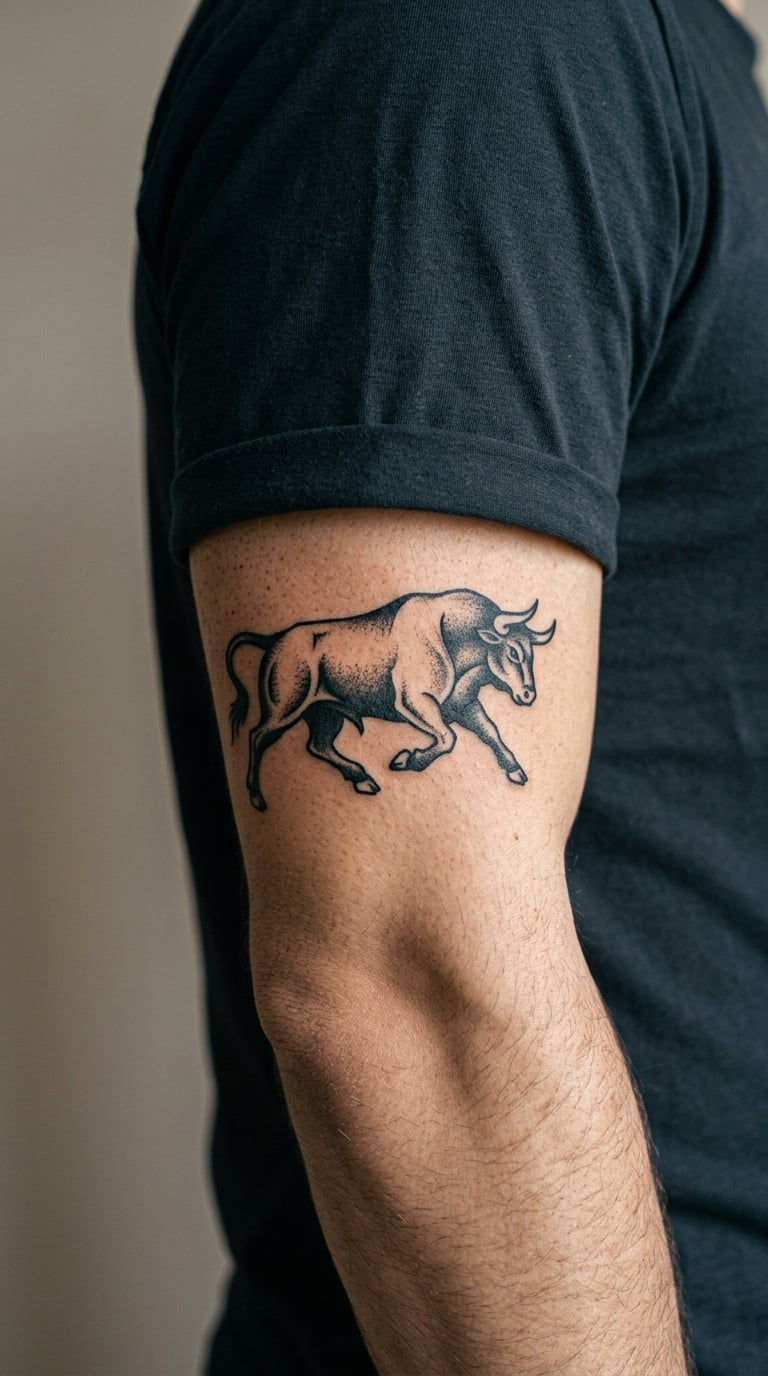
A compact charging bull is a traditional favourite: heavy black outline, minimal shading, head lowered and dust or a curved line behind it. Keeping it small means none of the detail has to be fudged.
Determination and forward pressure are the usual meanings, and it is a common first piece because the drawing is short and the result reads instantly.
Placement: outer tricep, set a little lower than centre where the muscle is flatter. Size: 2.5 to 3.5 inches wide. Style: traditional black. Pain: medium, the horns and face carry the sting.
At this size, a second hoof or a background star is a mistake, so resist the extras. Make it yours: change the breed to a breed you grew up around, or place it low and pair it with a matching one on the other arm years later.
12. Celtic Knot
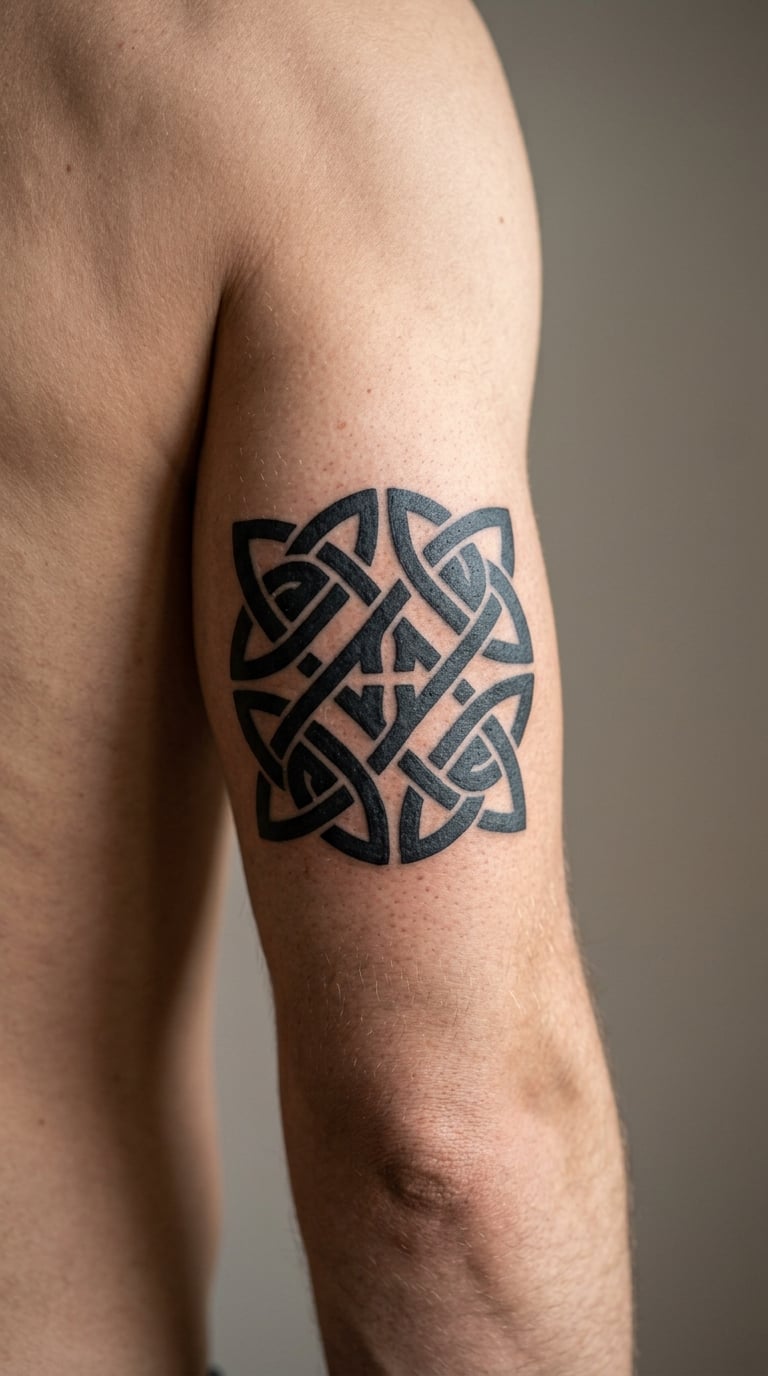
A Celtic interlace is a continuous line woven over and under itself with no beginning or end. Done well, the crossings are consistent and the ribbon width stays even the whole way round the loop.
It is chosen for heritage, for family or for the idea of continuity, and the circular form suits a muscle that curves back on itself.
Placement: outer tricep, centred, with a clear margin of bare skin around it. Size: 3 to 4 inches wide. Style: interlace blackwork. Pain: medium, a long session of careful line work.
The one that separates good work from rushed work is crossing consistency, so ask to see healed knots before booking. Make it yours: ask the artist to weave a family surname into the interlace, which is far more personal than a plain loop.
13. Micro-Realism Wolf
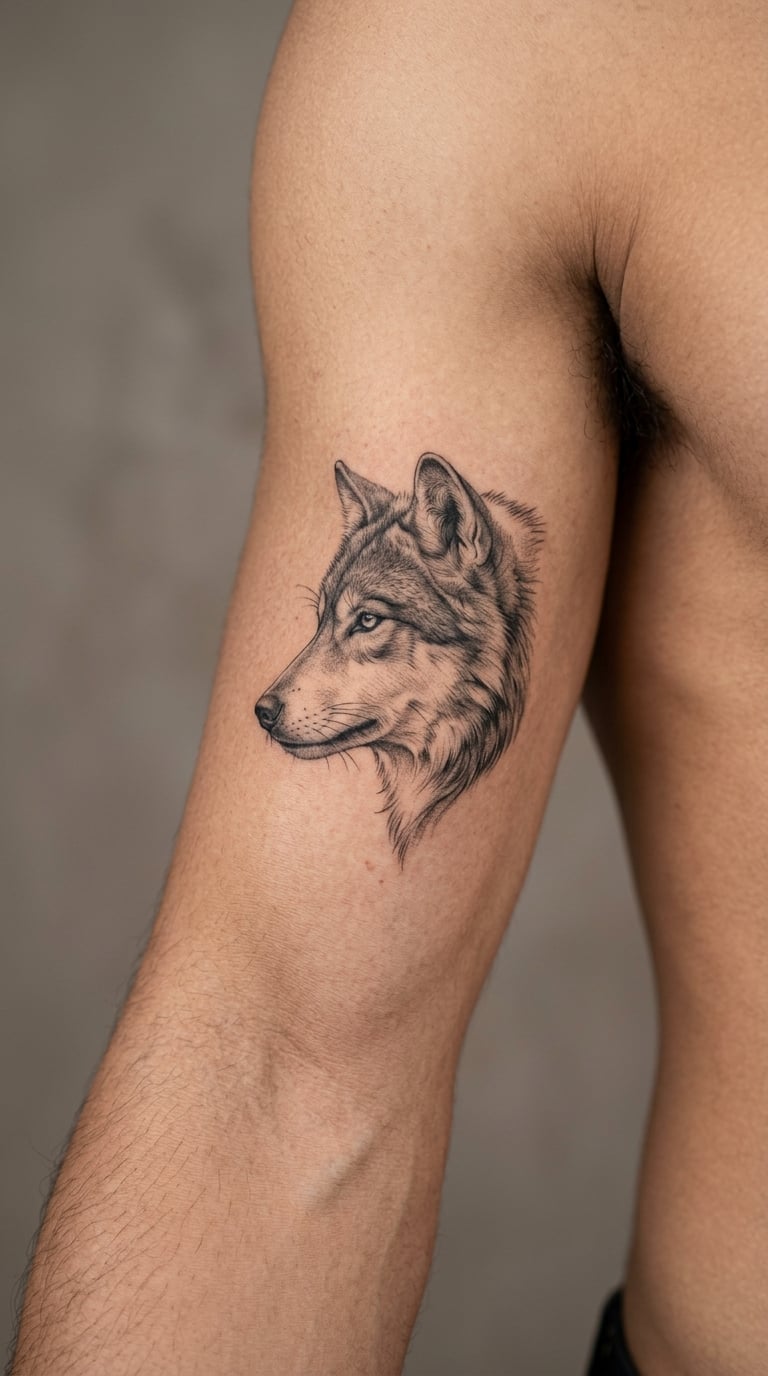
Micro-realism is a small grey-wash portrait with no outline, built from a few hundred tiny dots of diluted grey rather than thick black shading. The eye, ear and muzzle are the only places where any weight is allowed.
It suits a first tattoo or a growing collection because the drawing time is short and the commitment is small. Wolves read as loyalty, instinct and family, and men often get one for a dog.
Placement: outer tricep where the skin is relatively flat, away from the deepest curve. Size: 2.5 to 3.5 inches tall. Style: micro-realism. Pain: medium, the sensation is constant scratching.
Be honest about the ceiling here: at three inches, the eye and nose are the only features that survive. Ask the artist to simplify the fur rather than pretend it will hold. Make it yours: add a date or a paw print one inch below it once it has healed.
14. Snake Wrapping Around a Barbell
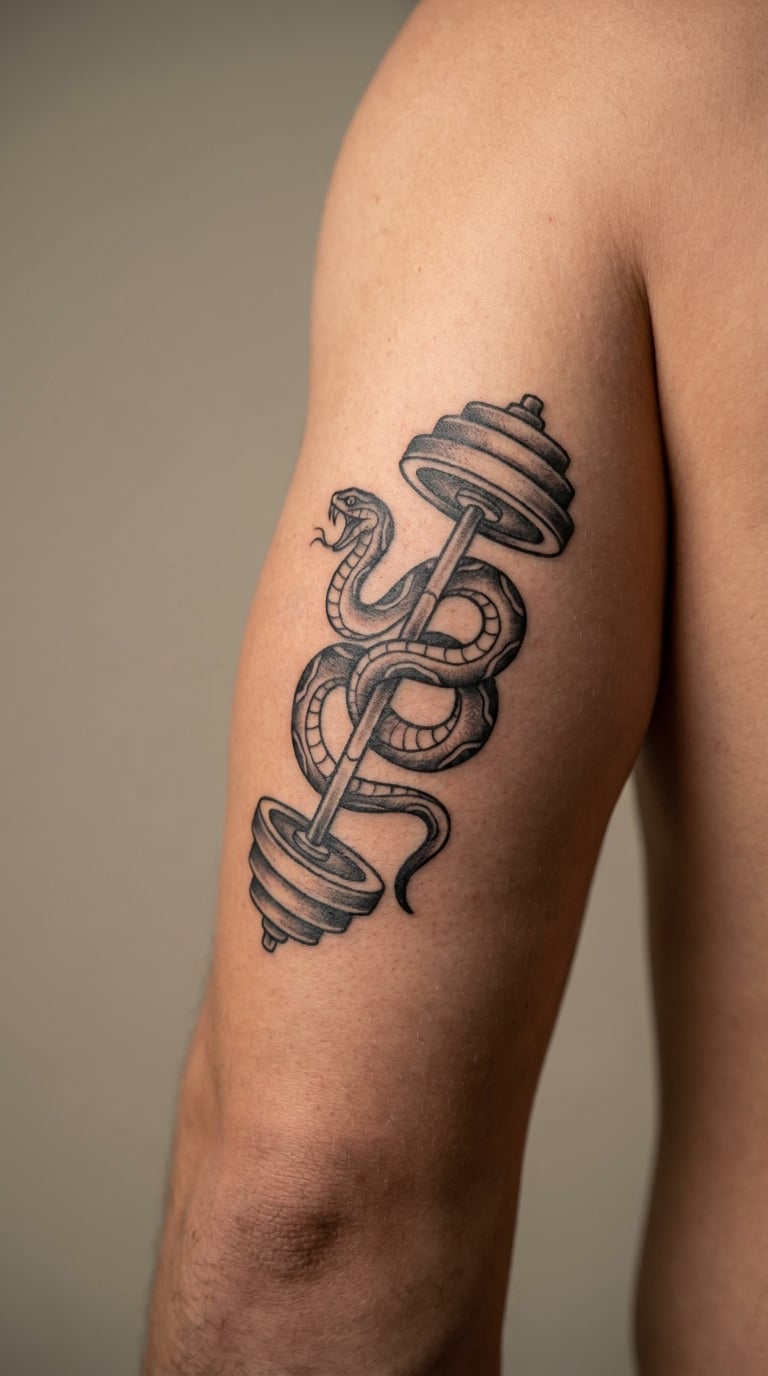
This one combines a detailed snake with a straightforward barbell: scale texture in grey wash, a solid black body, and a bar drawn with weight plates at each end. The snake crosses in front of the bar at two points to give the composition depth.
Discipline with a hint of transformation suits the pairing, since snakes have carried both ideas for a long time in art and tattoos.
Placement: across the outer tricep, slightly diagonal so the bar does not sit parallel to the muscle. Size: 5 to 7 inches long. Style: illustrative black and grey. Pain: medium to high, grey wash means many shallow passes.
Scale texture softens first, so keep the snake’s silhouette bold and let the pattern be the detail. Make it yours: use a bar from your own gym, or your own lifting numbers engraved on the plate.
15. Dotwork Compass
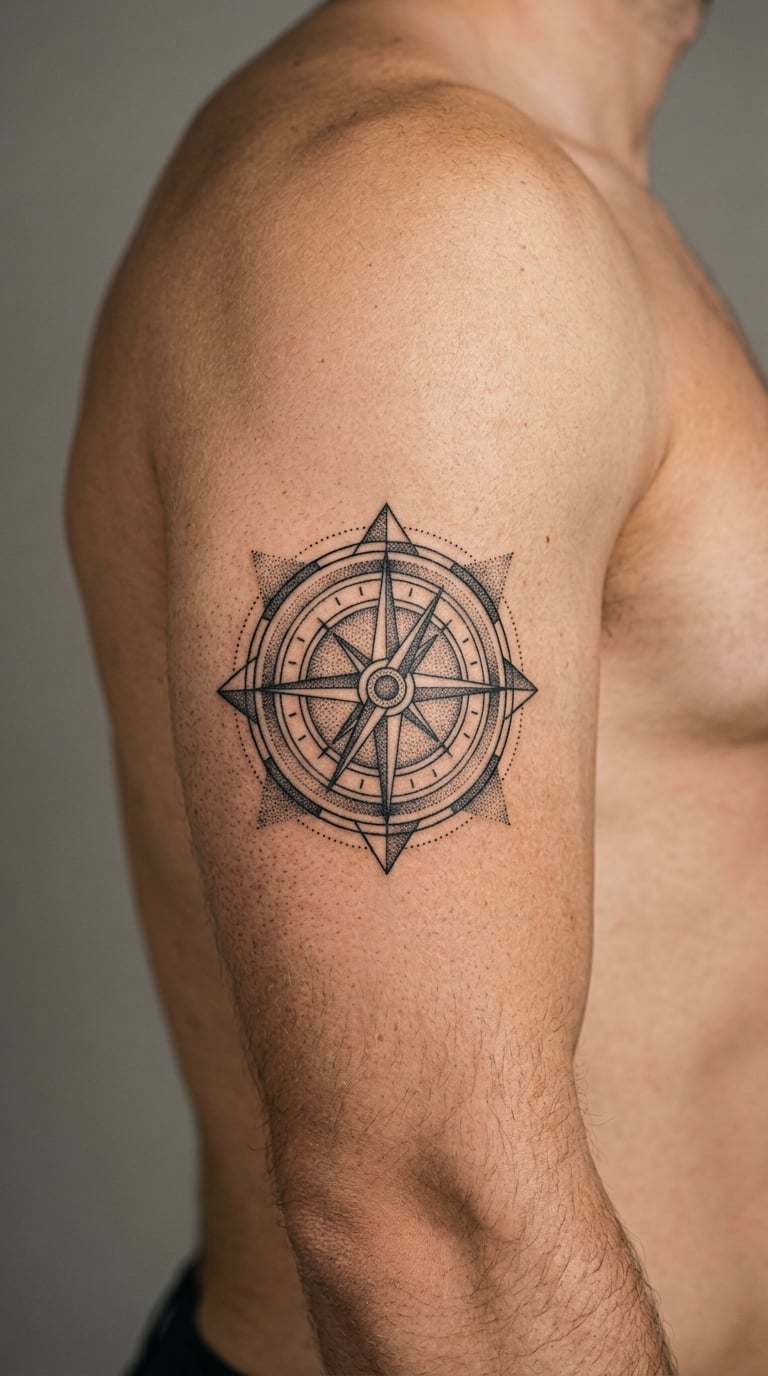
Dotwork translates the compass into tone rather than outline. Dots are packed tight to build a dark ring, spaced wide for the pale centre, and left out entirely for the star points, so contrast does the work that line weight does elsewhere.
It carries the same guidance and travel meaning as the drawn version but reads far quieter on a big arm.
Placement: outer tricep, centred. Size: 3 to 4 inches across. Style: dotwork. Pain: medium, and it is a long sitting because dot placement is slow.
This is the style most prone to blowout on a moving muscle, so treat it as a piece you will refresh rather than one that stays razor sharp forever. Make it yours: have the dot density spell out a latitude or a mountain height in the centre.
16. Wordmark in Blackletter
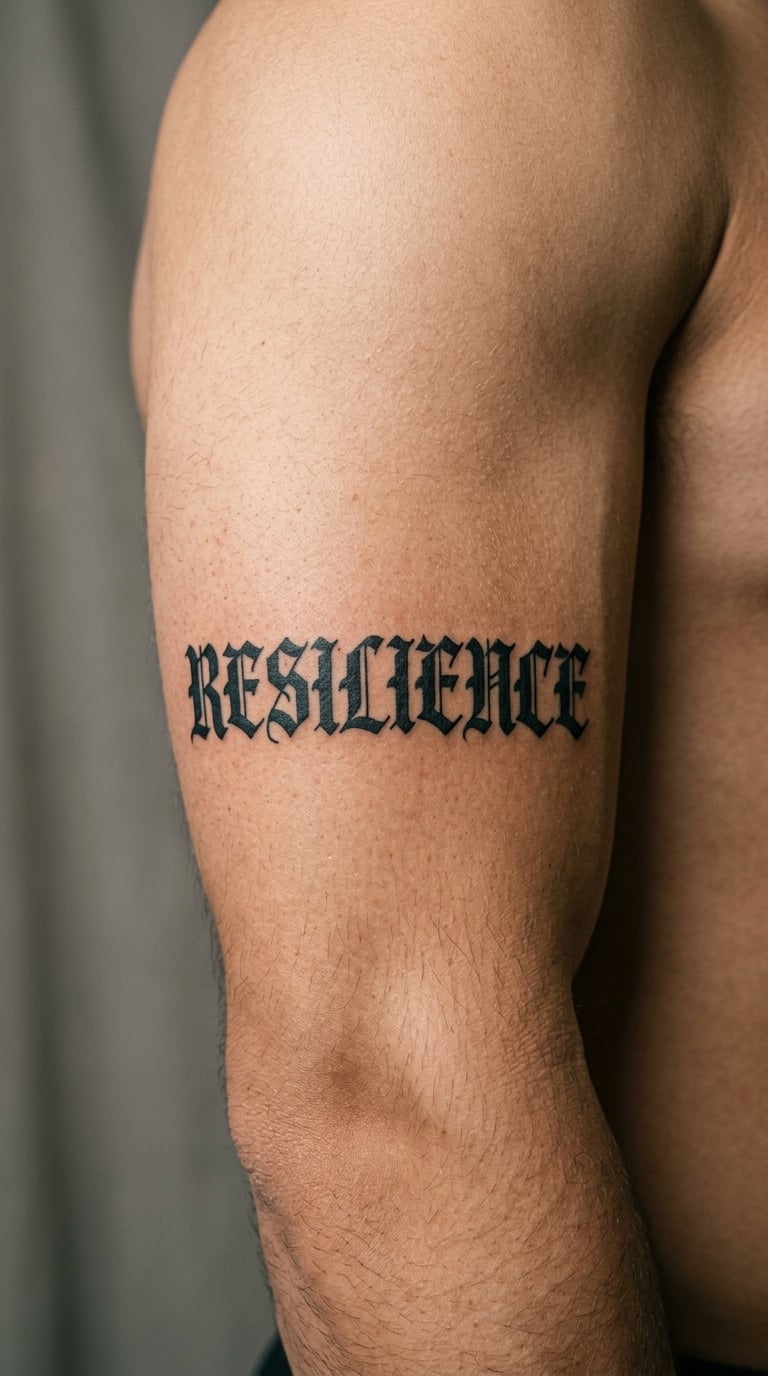
Blackletter is the dense medieval script you see on old signage, with thick vertical stems and broken curves. Set at arm’s length on the tricep it becomes a surname, a nickname, a crew name or a single strong word.
It suits men who want something that reads as personal rather than symbolic, and it doubles as a piece you can add to with dates later.
Placement: outer tricep, horizontal, positioned so the tallest letter falls on the flattest part of the muscle. Size: 2.5 to 4 inches wide. Style: lettering. Pain: low to medium.
Thin flourishes disappear fastest, so ask for a heavier, less decorative version rather than the ornate one. Make it yours: keep it to one word, and have the artist draw the letterforms to fit the width of your tricep rather than stretching a template across it.
17. Stag Head in Dotwork
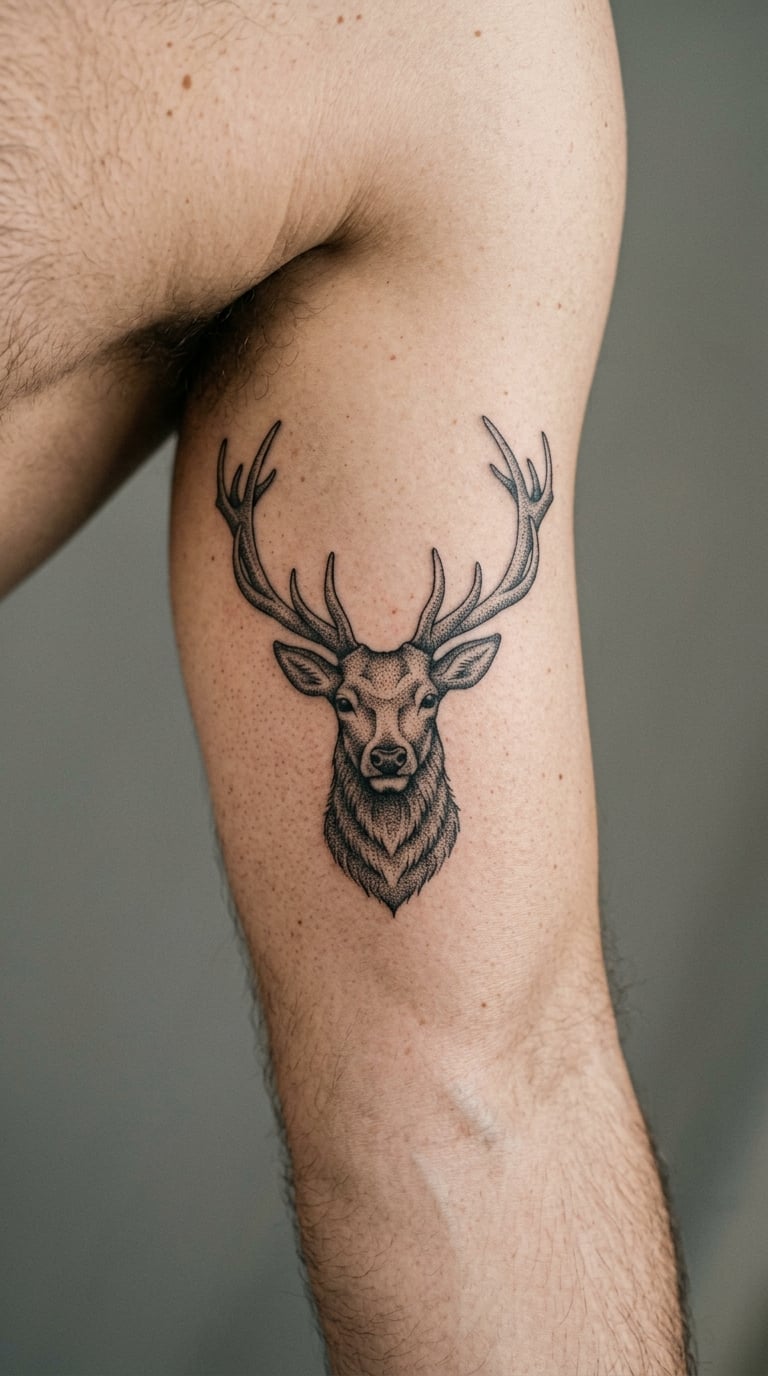
A stag formed entirely from dots and short tapered marks is a bigger ask than a dotwork compass. The antlers are built from broken lines of varying density, the eye is the darkest point, and the muzzle fades into scattered dots rather than an outline.
Stags are usually chosen for the antler structure itself: patience, standing ground, and something that has grown slowly.
Placement: outer tricep, upright, with the antlers given room to spread toward the bicep. Size: 3.5 to 5 inches tall. Style: dotwork. Pain: medium, and expect a long sitting with your arm held still.
Antler tines are the first detail to merge, so fewer, thicker tines hold up better than a dense reference. Make it yours: count a set of tines for something specific, or place it opposite a matching piece years from now.
18. Laurel Wreath
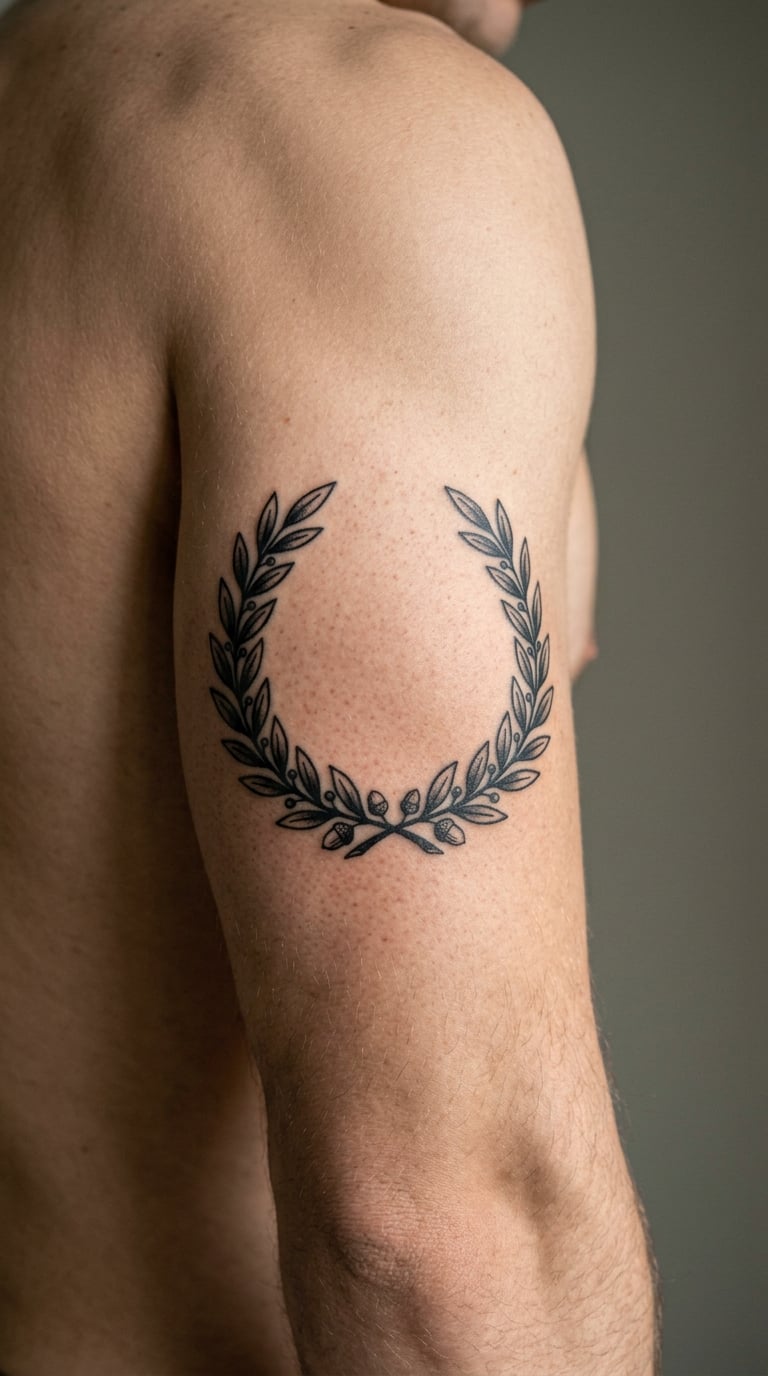
A laurel wreath is two mirrored branches curving upward, each leaf drawn as a simple pointed shape with a centre vein. Done at a consistent weight and with matching leaf counts on both sides, it looks engineered and calm.
It reads as honour and achievement, and it frames the muscle rather than fighting it, which is why it photographs well from any angle.
Placement: outer tricep, centred, open at the top or bottom depending on how the branches curve. Size: 4 to 6 inches wide. Style: fine black linework. Pain: medium, a lot of small repeated leaves.
Asymmetry is the giveaway of a rushed wreath, so check both halves before the artist sets the stencil. Make it yours: engrave a year inside the curve, or swap the laurel for a branch of whatever you actually grew up around.
19. Hourglass with Geometric Frame
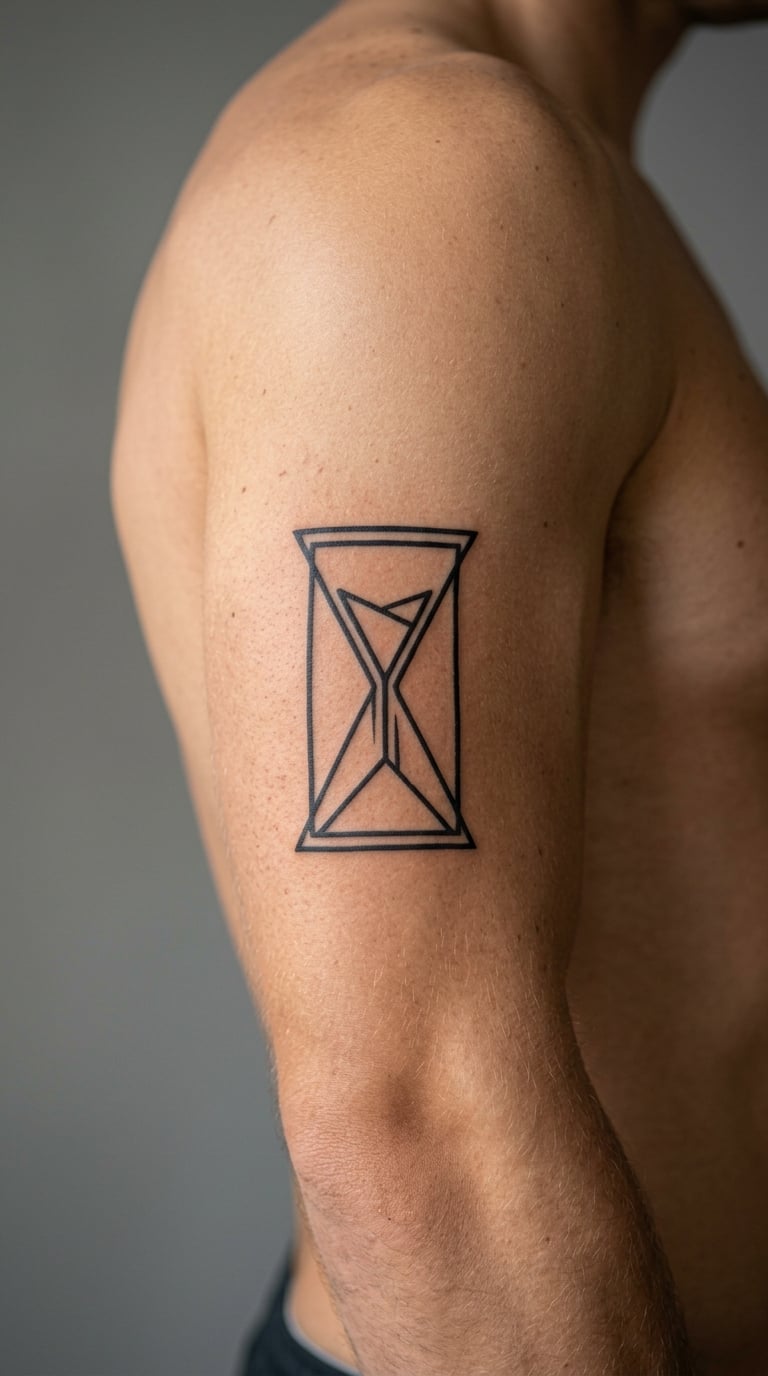
An hourglass framed by sharp geometric lines is the most contemporary option here. The frame is drawn in solid black bars or a clipped-corner outline, and the sand is a fine grey gradient inside an otherwise flat composition.
Time, priorities and how finite a thing is get treated seriously when you put them in a frame like this, rather than left as a bare symbol.
Placement: outer tricep, centred and upright. Size: 3.5 to 4.5 inches tall. Style: blackwork geometric. Pain: medium, the grey gradient needs patience.
The softest part of the design is the sand, so a good artist builds the fade into the frame itself. Make it yours: set the ratio of sand above and below the waist to whatever split means something to you.
20. Watercolour Mountain Splash
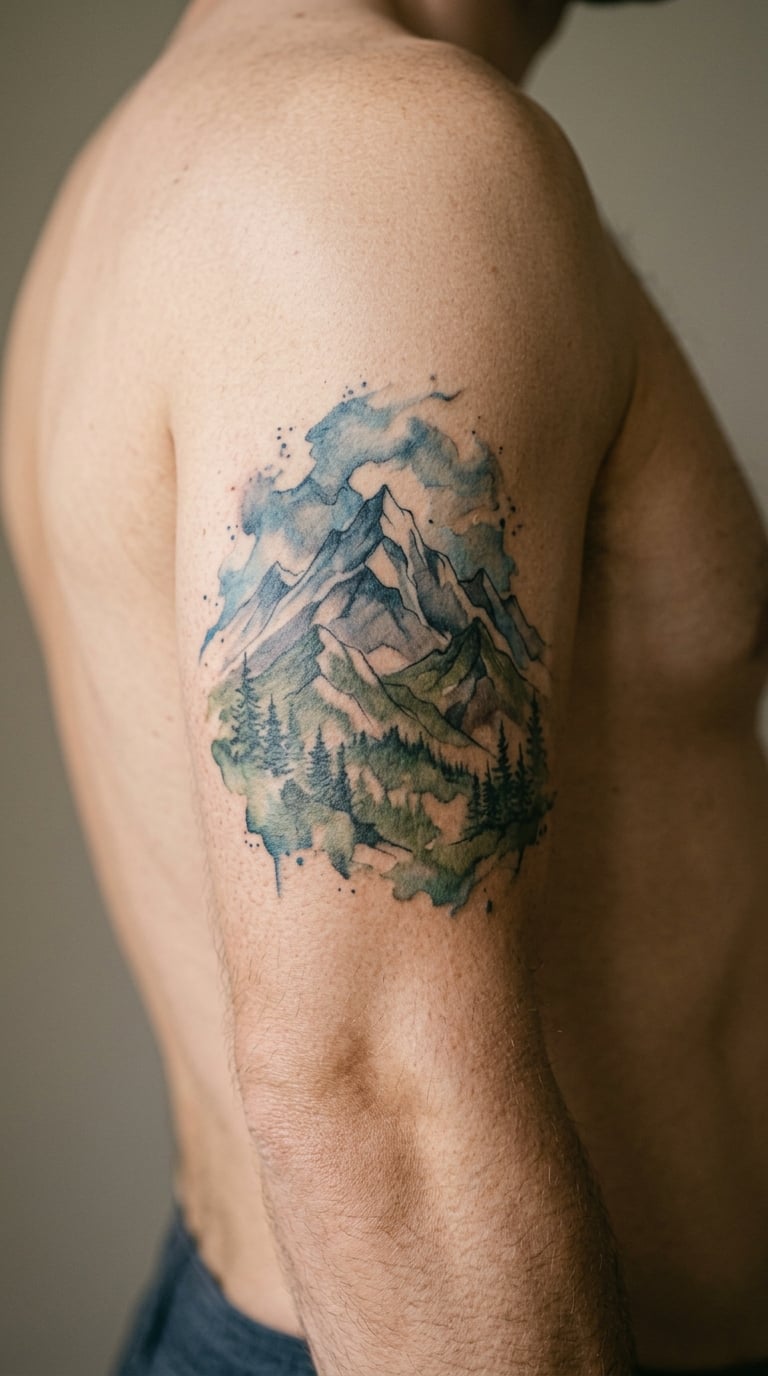
Watercolour is built from translucent layers rather than solid fill: soft blue and grey washes bleeding into each other, a muted green band at the base, and pigment pooling at the edges where a wash dried. The mountains are implied by value, not outlined.
It is the boldest colour choice in the list and the softest to live with, which is a strange trade that works because the movement of the arm keeps it from reading as faded.
Placement: across the outer tricep, angled down toward the elbow so the wash follows gravity in the design and not on the skin. Size: 5 to 7 inches wide. Style: watercolour. Pain: medium to high, a lot of separate colour passes.
Watercolour is the first style on this list to lose its saturation, and sun exposure speeds it up. Make it yours: pick the colours from one specific photograph rather than a palette, so the piece looks like a place instead of a print.
How to Choose the Right Design
Most disappointing tricep tattoos are not badly drawn. They are badly matched to the arm, the size or the client’s expectations. Six checks narrow the field before you book anything.
- Start with the size you will be happy with in ten years. A 2 to 4 inch piece fits the tricep easily, heals predictably and stays quiet. A six-inch illustration commits you to a specific look and a bigger sitting.
- Check line visibility in real light. Fine line and single-line work looks great in a studio and disappears outdoors in winter. If you want it noticed, go heavier than the reference photo.
- Decide how much colour you can live with fading. Traditional and watercolour both soften. Black and grey is the most forgiving over time, though line weight still matters more than colour does.
- Look at the arm flexed as well as relaxed. Any fine parallel detail, and any dotwork, will change shape when the muscle bunches. A design that reads in both states is a design that will still read in five years.
- Check what is already on the arm. If you have a shoulder piece or forearm work, leave a deliberate gap of bare skin rather than crowding the tricep. It can be filled later, but skin cannot be replaced.
- Be honest about your session tolerance. Fine line, dotwork and grey-wash realism need long, still sittings. If two hours is your limit, choose bold fill over detail.
One more thing worth deciding early: whether you want this to stay standalone. Roughly a third of the requests I see for a tricep are for a filler piece between a shoulder cap and a forearm, and that design is drawn to match two other artists’ work, not a single style.
Cost and Session Time
Most studios quote by the hour rather than per design, with a shop minimum that covers a very short piece, and the final number comes from the size and detail of your drawing rather than from the motif. A small fine-line piece sits at the bottom, a six-inch illustration with colour at the top, and a portrait or a dense grey-wash piece is priced by the day because it cannot be rushed.
A rough guide to sitting length: a small black design is under an hour, a four to five inch piece with shading is one to two hours, and a full colour or Japanese-style panel is three to five. Anything over about four hours should be split into two sessions with a healing break, which is better for the line work and far better for your focus.
What extends a sitting more than anything else is the client’s arm position. A tricep session needs a relaxed arm, which means breaks, a change of posture, and a chair you can shift in. Ask your artist how they plan to handle a long upper-arm piece before the day starts.
Price is also the point where taste gets tested. A design full of hairline detail, dotwork or colour gradients will always cost more than the same idea simplified. If the quote feels steep, ask what the artist would cut to bring it down rather than shopping for a cheaper version of the same drawing.
Aftercare Basics
Follow your artist’s aftercare instructions first. Everything below is general guidance, and the person holding the machine knows the ink and the skin in front of them.
- Keep it clean. Wash gently with unscented soap and cool water, then pat dry with a clean towel. No scrubbing and no picking at scabs or flakes, which is the single biggest cause of patchy results.
- Protect it for the first few days. Loose dark clothing over the area helps with both rubbing and sunlight, and a clean sheet on the pillow the first night is worth remembering.
- Moisturise only if your artist tells you to. A thin layer of whatever they recommend, and only for as long as they say. Over-moisturising traps moisture under the skin and is a common self-inflicted problem.
- Leave it alone while it heals. No swimming, no baths, no hot tubs or saunas until the surface has closed, usually around two weeks, and skip the gym if the session sat near the elbow joint.
- Skip the sun. UV is the fastest way to fade a tricep tattoo, and the outer tricep sees direct sun whenever you wear a short sleeve. Once healed, use sunscreen on the area for the rest of your life.
- Know when to call the studio. Ongoing heat, spreading redness, a yellow-green discharge or pain that gets worse after a few days instead of better are all reasons to phone the shop, and they will want to see it.
Frequently Asked Questions
Are tricep tattoos more painful than other arm tattoos?
Pain varies by person and placement, but the outer tricep is usually described as moderate because the skin is mobile and sits over soft tissue rather than bone. The inner tricep and the inside of the upper arm are typically more sensitive, and the area right at the elbow joint can be the sharpest part of an upper-arm session.
What size should a first tricep tattoo be?
Around 2 to 4 inches wide is a practical first tricep tattoo. It fits the muscle without crowding it, heals in a single sitting and stays subtle enough that a change of mind in a few years is not a disaster. Larger illustrations work too, but they are a bigger commitment and usually need more than one session.
Does a tricep tattoo distort when the arm moves?
Some movement is normal, especially near the shoulder, elbow and inner arm. A good artist positions the composition so the main subject stays readable relaxed and flexed, and avoids fine parallel detail that bunches when the muscle contracts. Check the design both ways in the mirror before the stencil is committed.
Should I get a colour or black and grey tricep tattoo?
Black and grey is usually easier to keep visually strong and reads as more timeless, and bold solid black survives movement better than most styles. Colour makes flowers, animals and traditional motifs stand out, but it fades first, particularly in lighter tones. Think about how much colour variation you will still be happy with in ten years.
Can a tricep tattoo be added to an existing arm piece?
Yes, and the tricep is one of the most common gap-filler spots between a shoulder cap and a forearm piece. Bring healed photos of the existing work to the consultation so the artist can match line weight, colour saturation and how far the composition should wrap. Leave a deliberate gap of bare skin rather than filling the whole arm in one go.
If motifs matter more to you than technique, our football tattoo ideas for men roundup goes deeper on a different set of symbols, and it follows the same format of style, size, placement and pain per design.
Conclusion
For a first tricep tattoo, stay conservative: a fine-line mountain range or a short line of Roman numerals placed mid-muscle will be easy to fit, easy to heal and easy to live with. Both hold their shape better than a dotwork or single-line design would at that size.
If you are adding to an arm that already has work, go bigger and bolder. A Japanese-style koi wrapping the outer tricep, a solid blackwork eagle or a six-inch snake around a barbell gives you something with enough scale to read across a room and enough negative space to sit next to what you already have. Pick a design, find an artist whose healed work in that style you can see in person, and have it drawn for your arm in both a relaxed and a flexed position.