
20 Best Waterfall Tattoo Ideas: Nature-Inspired October 2026
Waterfall tattoo ideas work because water is the one thing everybody recognises in a half-second. It moves, it never sits still, and it gives a designer a natural reason to build a piece along a limb. The 20 designs below run from a two-inch wrist line to an eight-inch thigh panel, so you can find something that suits a first small tattoo or a piece you are adding to an existing set.
Two things decide whether a waterfall reads well on skin: the direction the water falls, and how much room the artist has. A cascade that looks balanced on a flat sheet can smear across a shoulder blade, and that is exactly the problem people describe on tattoo forums. Plan the placement first, then pick the style, not the other way round. If you are booking for autumn or winter, note that a fresh tattoo needs weeks of careful care before swimming season.
Waterfall Tattoo Ideas: Quick Guide
Here is the whole list at a glance, with the practical details that decide whether a design works in real life. Sizes are what a person actually ends up with once the artist fits the drawing to the body part.
| Idea | Style | Best placement | Size | Pain |
|---|---|---|---|---|
| 1. Fine-Line Single Cascade | Fine line | Inner forearm | 3 in (7.5 cm) | Low |
| 2. Realistic Waterfall Between Rocks | Micro-realism | Outer upper arm | 4 in (10 cm) | Medium |
| 3. Traditional Cascading Waterfall | Traditional | Calf | 5 in (13 cm) | Medium |
| 4. Waterfall in a Mountain Circle | Blackwork and muted colour | Upper shoulder blade | 5 in (13 cm) | Medium |
| 5. Minimalist Waterfall Linework | Minimalist | Wrist | 2 in (5 cm) | Low |
| 6. Watercolor Rainbow Falls | Watercolour | Shoulder | 4 in (10 cm) | Medium |
| 7. Blackwork Jungle Waterfall | Blackwork | Outer forearm | 7 in (18 cm) | Medium |
| 8. Japanese-Style Waterfall and Pines | Irezumi-influenced | Upper arm | 6 in (15 cm) | Medium |
| 9. Geometric Waterfall Map | Geometric | Upper back | 4 in (10 cm) | Medium |
| 10. Dotwork Waterfall and Ferns | Dotwork | Calf | 5 in (13 cm) | Medium |
| 11. Small Waterfall Behind the Ear | Fine line | Behind the ear | 2 in (5 cm) | Medium |
| 12. Waterfall with Mountain Lake | Scenery realism | Thigh | 6 in (15 cm) | Low |
| 13. Red Ink Waterfall | Colour accent | Side of forearm | 3 in (7.5 cm) | Low |
| 14. Waterfall in a Compass Design | Blackwork | Inner upper arm | 4 in (10 cm) | Medium |
| 15. Tropical Waterfall Sleeve Panel | Illustrative realism | Upper thigh | 8 in (20 cm) | Medium |
| 16. Waterfall with Flowing Quote | Fine line with lettering | Forearm | 4 in (10 cm) | Low |
| 17. Tribal-Inspired Waterfall Motif | Pattern-led | Shoulder | 5 in (13 cm) | Medium |
| 18. Waterfall and Celestial Details | Black and blue | Rib area | 4 in (10 cm) | High |
| 19. Abstract Blue Waterfall Flow | Abstract | Side of calf | 5 in (13 cm) | Medium |
| 20. Memorial Waterfall with Coordinates | Fine line, black and grey | Inner forearm | 3 in (7.5 cm) | Low |
1. Fine-Line Single Cascade
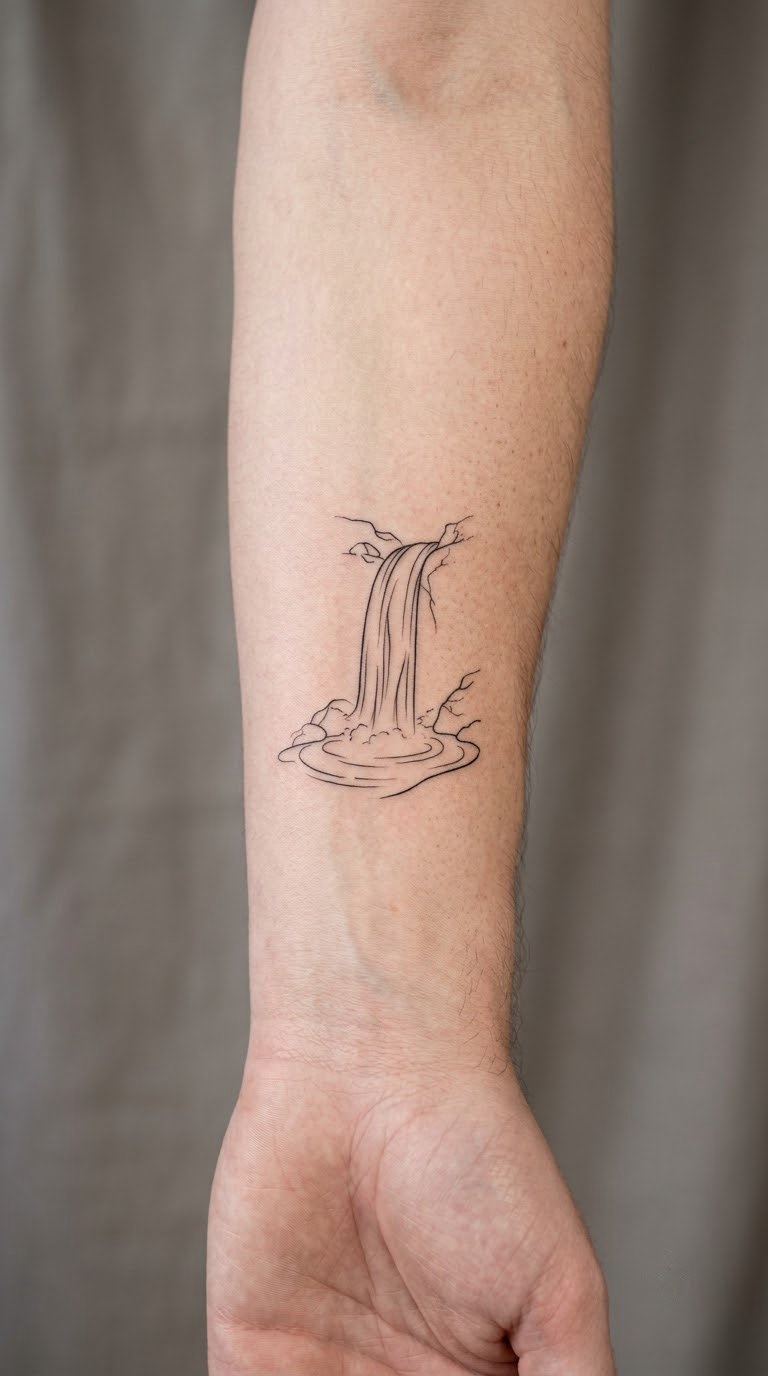
This is the one most people end up with first. The artist draws a narrow fall of water using three to five single-needle lines that widen as they descend, with a few short break strokes suggesting spray where the water lands. There is no cliff, no trees, no shading. The whole thing is line and space, and the empty skin around it does half the work.
People choose it because a single unbroken fall of water reads as ongoing movement without needing any explanation, and because it sits quietly under a shirt cuff. Bring a reference that shows the line weight you want, not a finished tattoo to copy.
Placement: inner forearm, inner bicep, or the soft area just below the collarbone. Size: 2.5 to 4 inches (6 to 10 cm) tall. Style: fine line, single needle.
Pain: low on the inner forearm, more of a steady scratch than a sting. Fine line ages faster than anything else in this list, so expect the thinnest lines to soften within a few years. Make it yours: have one line thicken near the base, so the fall widens and the shape is unique to you.
2. Realistic Waterfall Between Rocks
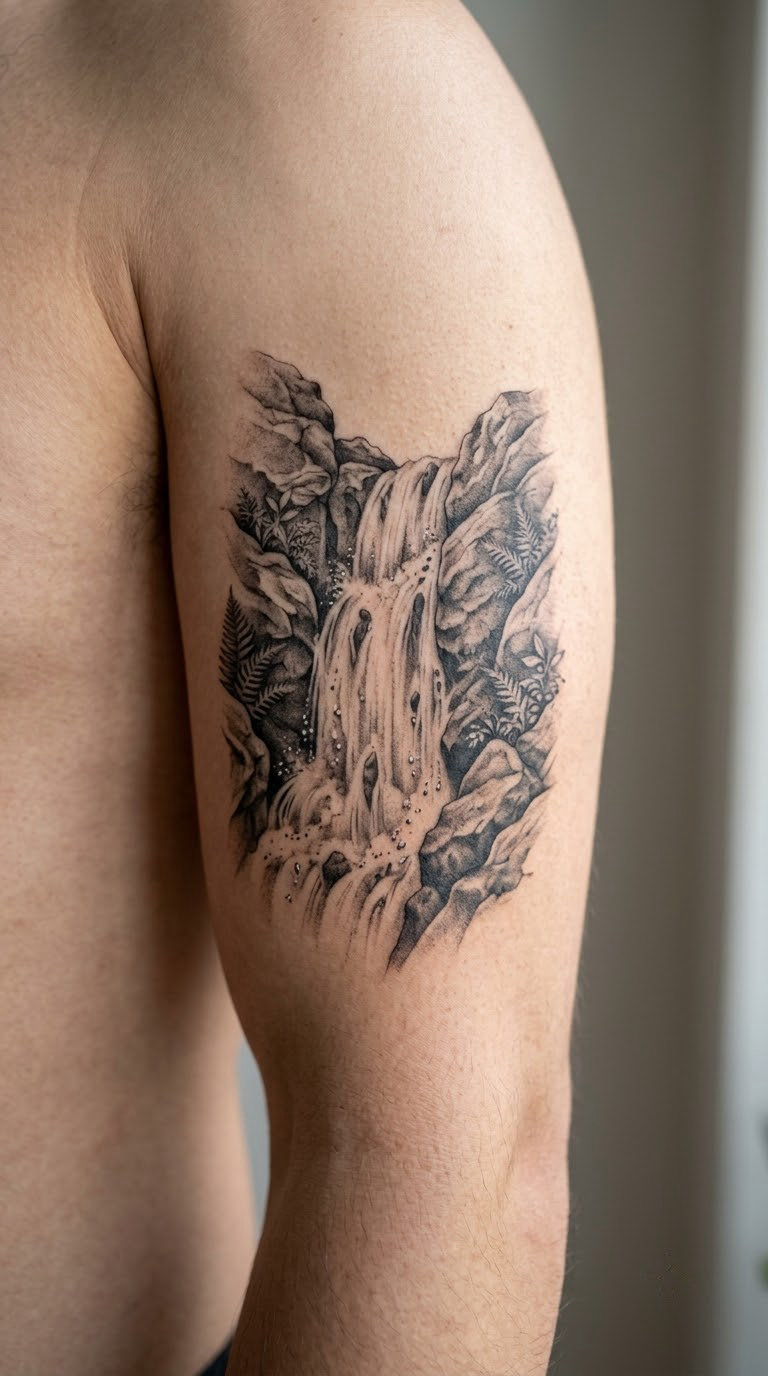
Here the artist builds a small piece of real scenery. Two blocks of stone sit at the top, rendered in layers of grey wash rather than outline, and the water threads down between them with a lighter, almost foamy texture where it breaks. Below, a shallow misty pool is suggested with a few loose grey dots. It is a landscape drawing in miniature, and micro-realism is the style that makes it hold together.
Getting one of these means trusting the artist’s shading more than their linework. Look for healed waterfall work in a portfolio, not fresh line art. Check reviews before you book, because heavily shaded small pieces on a curved upper arm are where hurried work turns muddy.
Placement: outer upper arm, inner thigh, or the flat of the calf. Size: 3.5 to 5 inches (9 to 13 cm) tall. Style: micro-realism, black and grey.
Pain: medium; the grey shading adds passes over the same skin. Fine grain shading will soften over time, so keep the contrast strong at the start. Make it yours: bring the name of a real waterfall you have visited and let the artist work from the rock shapes you remember.
3. Traditional Cascading Waterfall
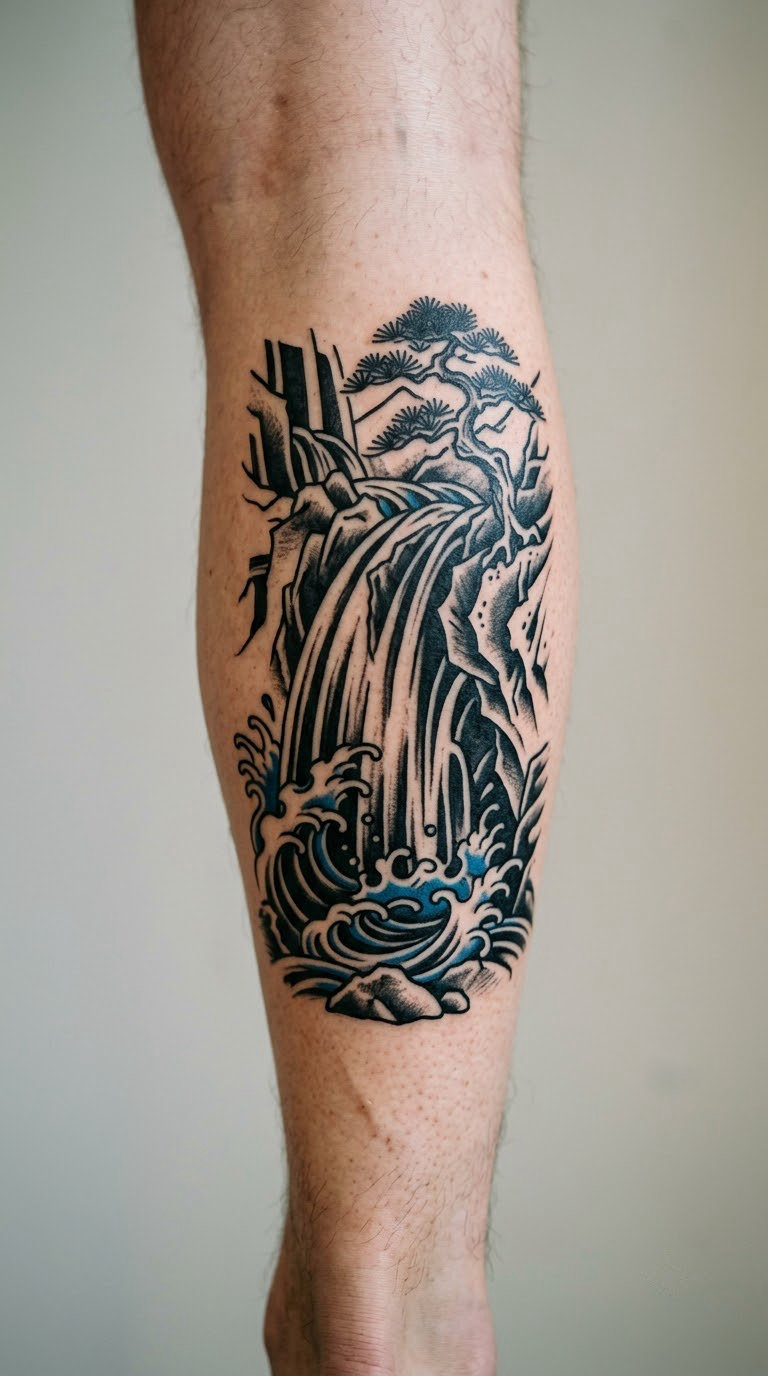
Traditional style treats water as a shape rather than a texture: thick black outlines, a flat blue fill inside the fall, and hard white breaks where the water separates. A simple rock mound anchors the bottom, drawn with a few hard shadow shapes rather than texture. The result has the same boldness as an old-school scroll or a panther, and it holds its shape at a distance.
People who come from a heavy-line background tend to want this, because the alternative, a soft scenery piece, would vanish into their other work. It also suits anyone who wants a waterfall that still reads clearly in fifteen years.
Placement: calf, outer forearm, or lower leg. Size: 4 to 6 inches (10 to 15 cm) wide. Style: traditional, bold colour.
Pain: medium, and the calf position makes the piece bounce with the muscle. A solid blue fill is stable; thin white breaks inside the water are the first thing to fade. Make it yours: swap the blue for a different single colour, or add a small banner of your choosing beneath the rock base.
4. Waterfall in a Mountain Circle
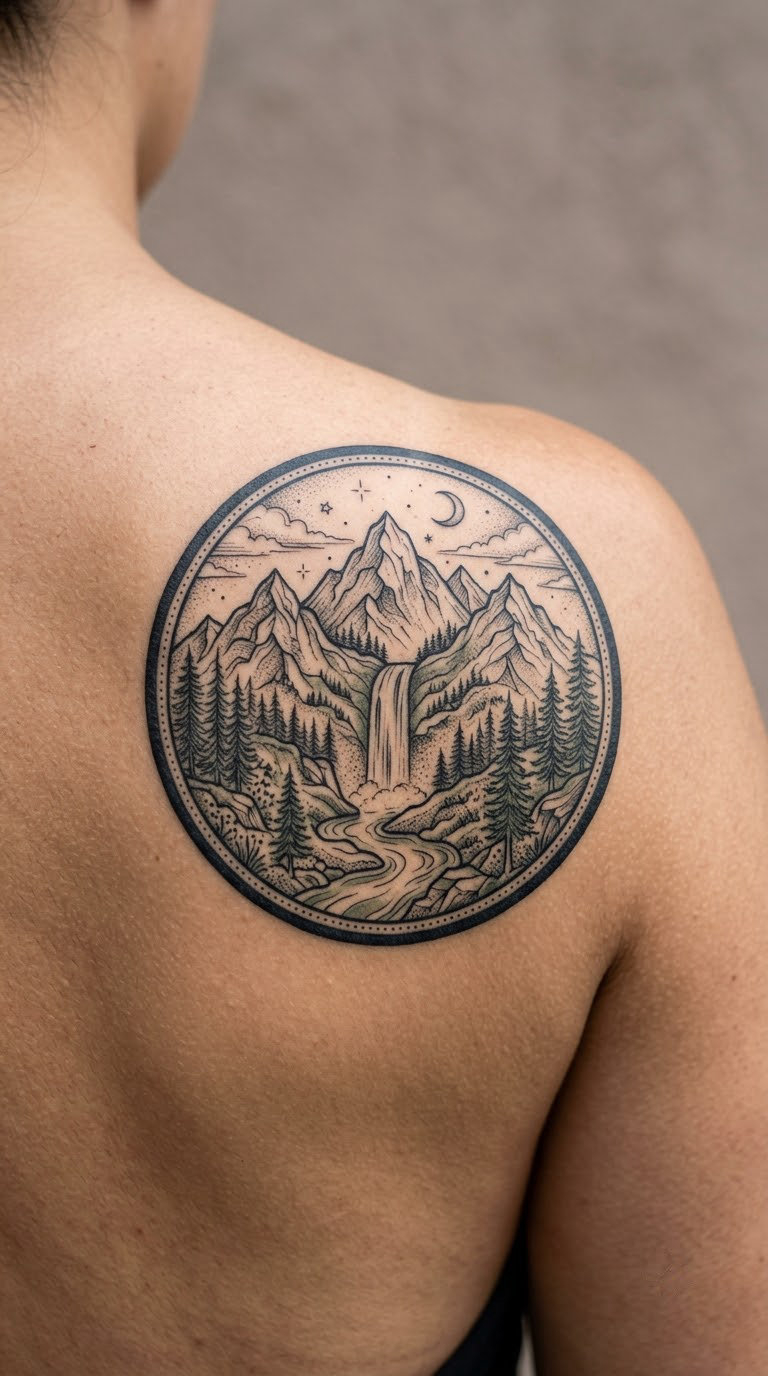
The circle is the whole idea here. A clean double-line border frames a compact scene: mountain peaks along the top arc, a waterfall dropping from a notch between them, and a band of ground along the bottom. Black outline work carries the mountains while a restrained green wash tints only the slopes, so the piece does not turn into a muddy block of colour.
Circular compositions suit people who already collect pieces with a frame, a badge shape or a border, and they are forgiving to place because the outline hides the edge of the skin. If the circle is placed on a curving area, the artist draws the ellipse to fit, never the other way round.
Placement: upper shoulder blade, upper back, or outer upper arm. Size: 4 to 6 inches (10 to 15 cm) in diameter. Style: blackwork with muted colour.
Pain: medium; the shoulder blade moves when you shrug, so the outline can flex in a visible way if the piece is placed too close to the edge. Make it yours: use the name of the range where you grew up and ask for the peak silhouettes you actually remember.
5. Minimalist Waterfall Linework
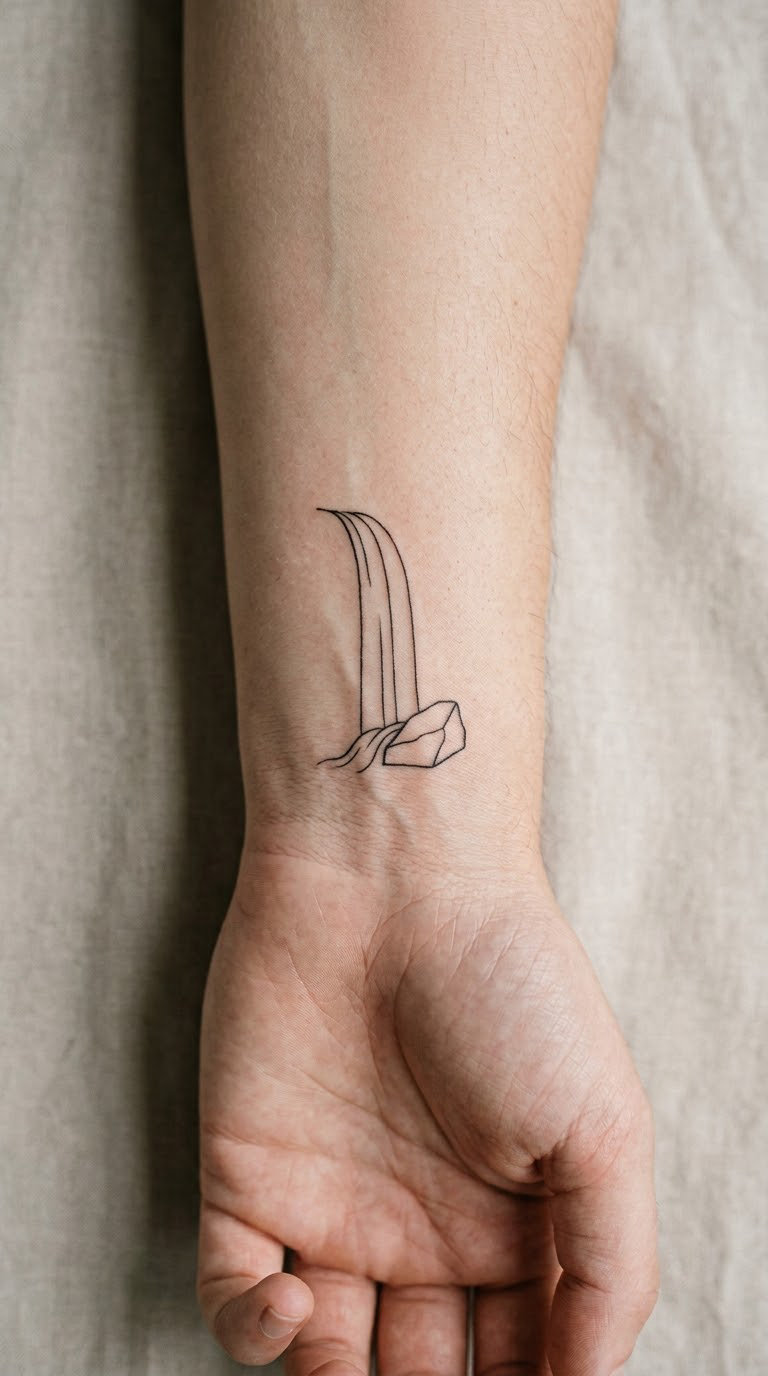
Three vertical lines and one angular rock. That is the entire design, and it works because the rock gives the eye somewhere to start. There is no shading, no mist, no foliage. It looks like a small symbol rather than a picture, which is a different thing from idea 1, where the water itself carries most of the drawing.
This is the right pick for an office, a first tattoo, or a spot where you need something you can hide under a watch strap. Two inches sounds tiny until you see it on a wrist, where it reads clearly at conversational distance.
Placement: inner wrist, behind the ankle bone, or the inner arm near the elbow. Size: 1.5 to 2.5 inches (4 to 6 cm) tall. Style: minimalist fine line.
Pain: low, though the inner wrist near the bone is tender. Minimal fine line is the first thing to blur on a hand or wrist, so ask for a line weight a touch heavier than you think you need. Make it yours: change the rock angle so the fall tips slightly sideways rather than dropping straight down.
6. Watercolor Rainbow Falls
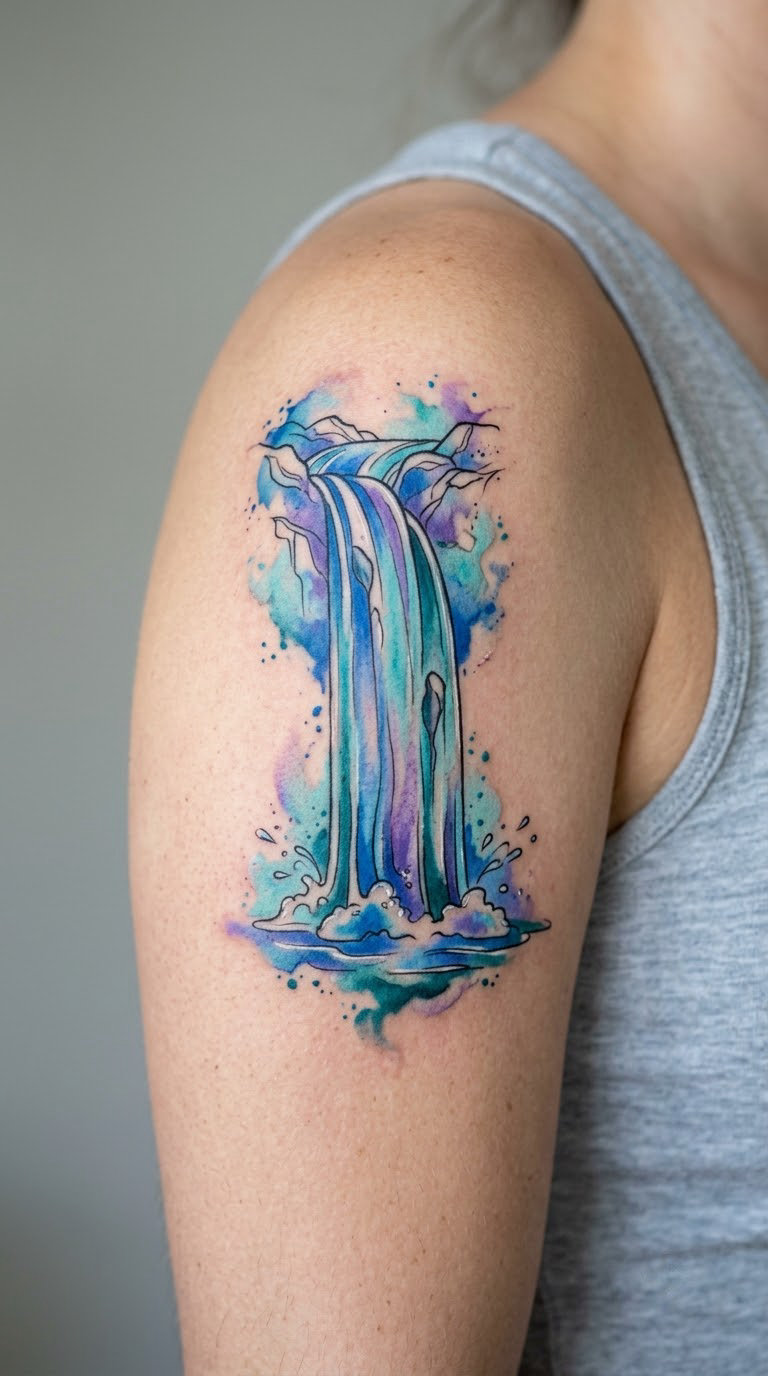
The watercolour approach pushes pigment past the edges on purpose. Blue runs into teal, teal into violet, and the artist leaves soft bleeds that look like wet paper. Under the fall, a loose suggestion of mist dissolves into the skin with no hard outline at all. It is a soft, painterly piece and it reads as light movement rather than a heavy subject.
Most people who pick this already have a colour palette in their other tattoos and want the waterfall to sit with it. Ask the artist for a bleeding practice sample first, because the result depends heavily on how that artist handles loose pigment.
Placement: shoulder, upper arm, or the side of a thigh. Size: 3 to 5 inches (8 to 13 cm) tall. Style: watercolour.
Pain: medium, with more passes than a black piece of the same size. Light blues and violets lose intensity with sun exposure and age noticeably, so plan for a refresh if it matters to you. Make it yours: name the colour you want at the base of the fall so the gradient runs into something personal rather than ending in a stock rainbow.
7. Blackwork Jungle Waterfall
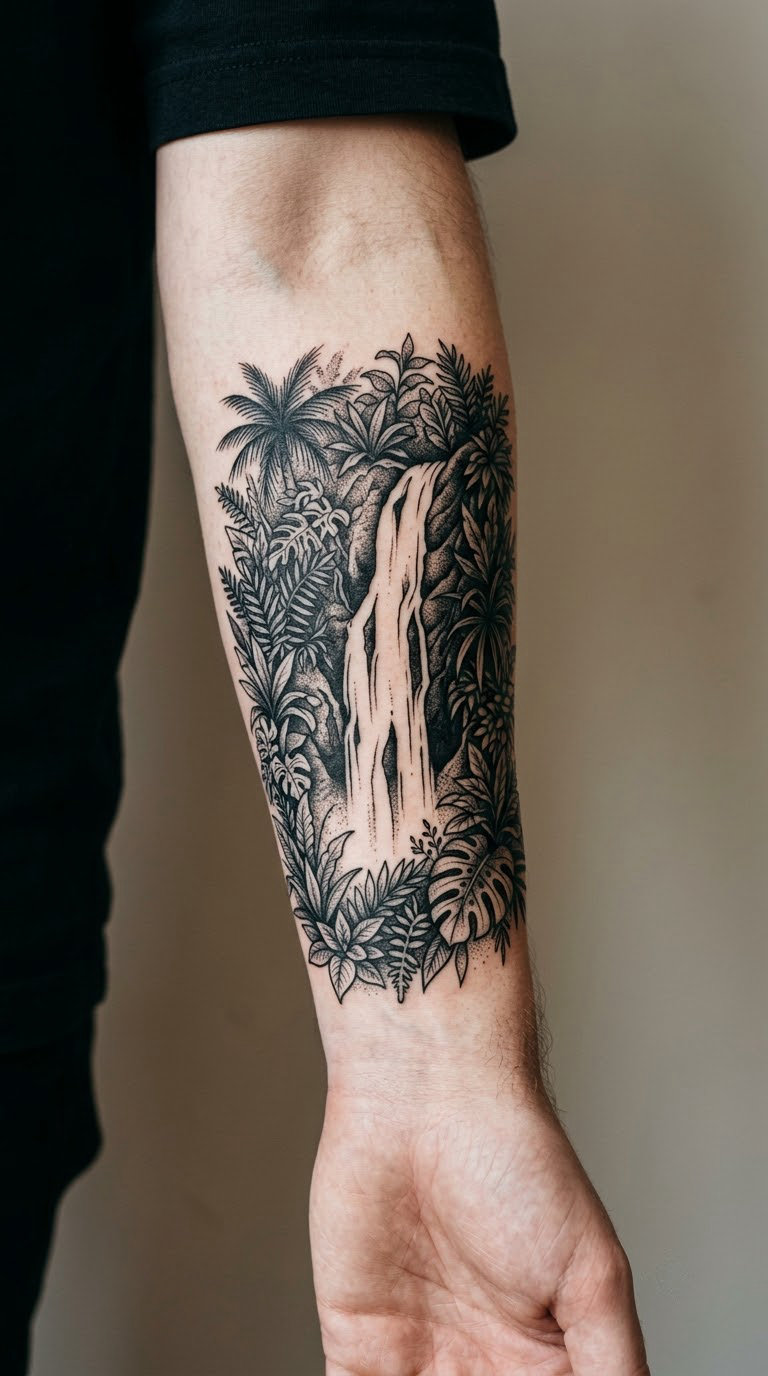
Big leaves, heavy black fills, and water that is not drawn at all. The cascade appears as pure white skin left untouched between two solid black masses, which is the whole trick of blackwork scenery: the brightest part of the image is the part nobody inks. Mist at the base is suggested with a few scattered white gaps in the black.
This is the design for someone who wants a waterfall to feel enormous on a medium-sized patch of skin. The white water can look thin once healed, so a good artist plans the surrounding black to frame it rather than crowd it.
Placement: outer forearm, upper arm, or a back piece. Size: 6 to 8 inches (15 to 20 cm) tall. Style: blackwork with negative space.
Pain: medium to high, and the solid black fills take repeated passes, which is where the discomfort builds. A seven-inch piece like this is normally split across more than one sitting. Make it yours: pick three local plants and ask for them instead of generic tropical leaves.
8. Japanese-Style Waterfall and Pines
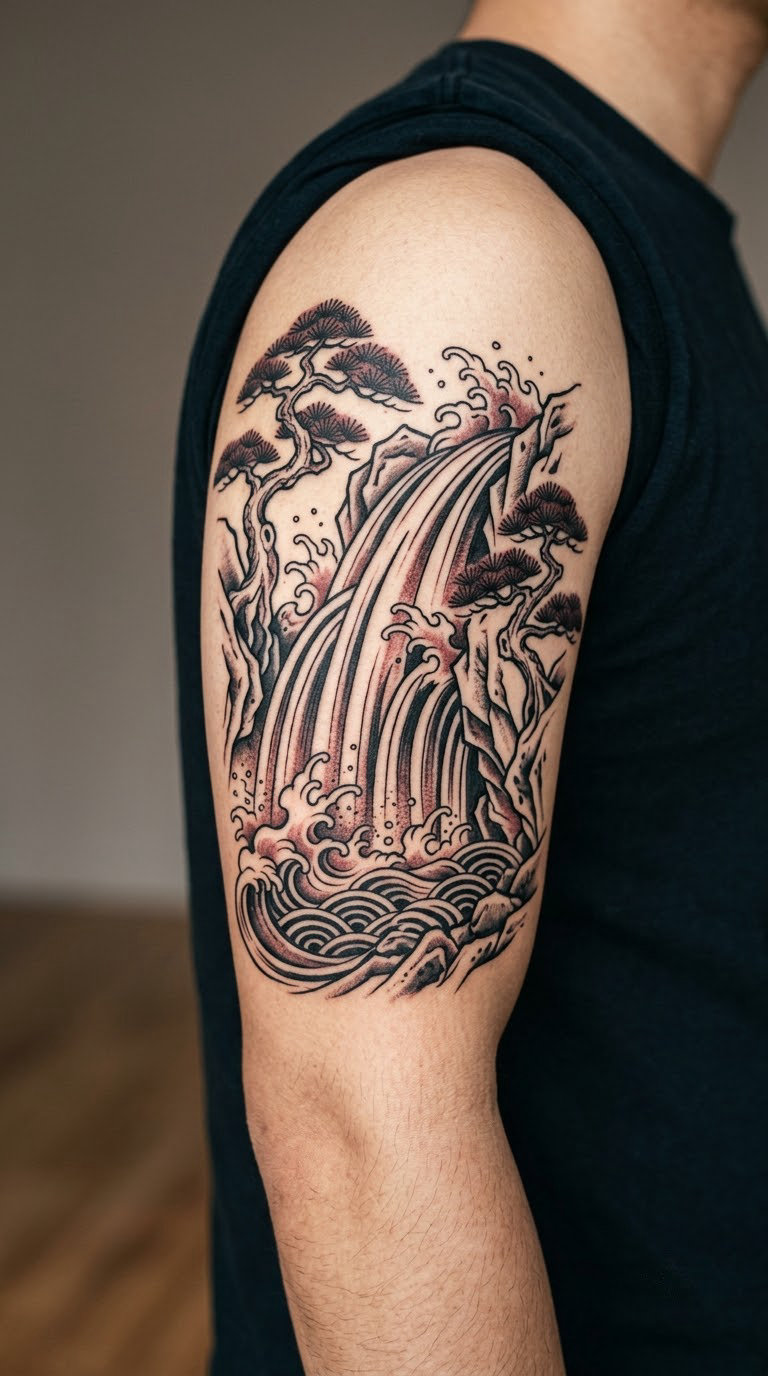
This composition uses the standard vertical structure of a waterfall scene: falling water on one side, a cliff mass holding the eye in the middle, and stylised trees and clouds filling the gaps so the skin around the rock is never empty. Linework is fine and even, clouds are drawn as curling outlines, and pine branches sit in flat clusters with a single muted red accent, often the rising sun.
Japanese composition follows conventions that carry meaning, so this one is worth doing carefully. Ask to see the artist’s finished Japanese work, tell them plainly that you want an homage rather than a copy, and let them decide how much of the classic framing to keep. A good one will be honest if your skin cannot hold the detail.
Placement: upper arm, back, or outer thigh. Size: 5 to 7 inches (13 to 18 cm) tall. Style: irezumi-influenced.
Pain: medium, longer in the chair because of the density of line work. The one red accent is the element most likely to soften first. Make it yours: ask for your own wave or cloud pattern rather than a stock one, and keep the composition open at the edges so it can grow later.
9. Geometric Waterfall Map
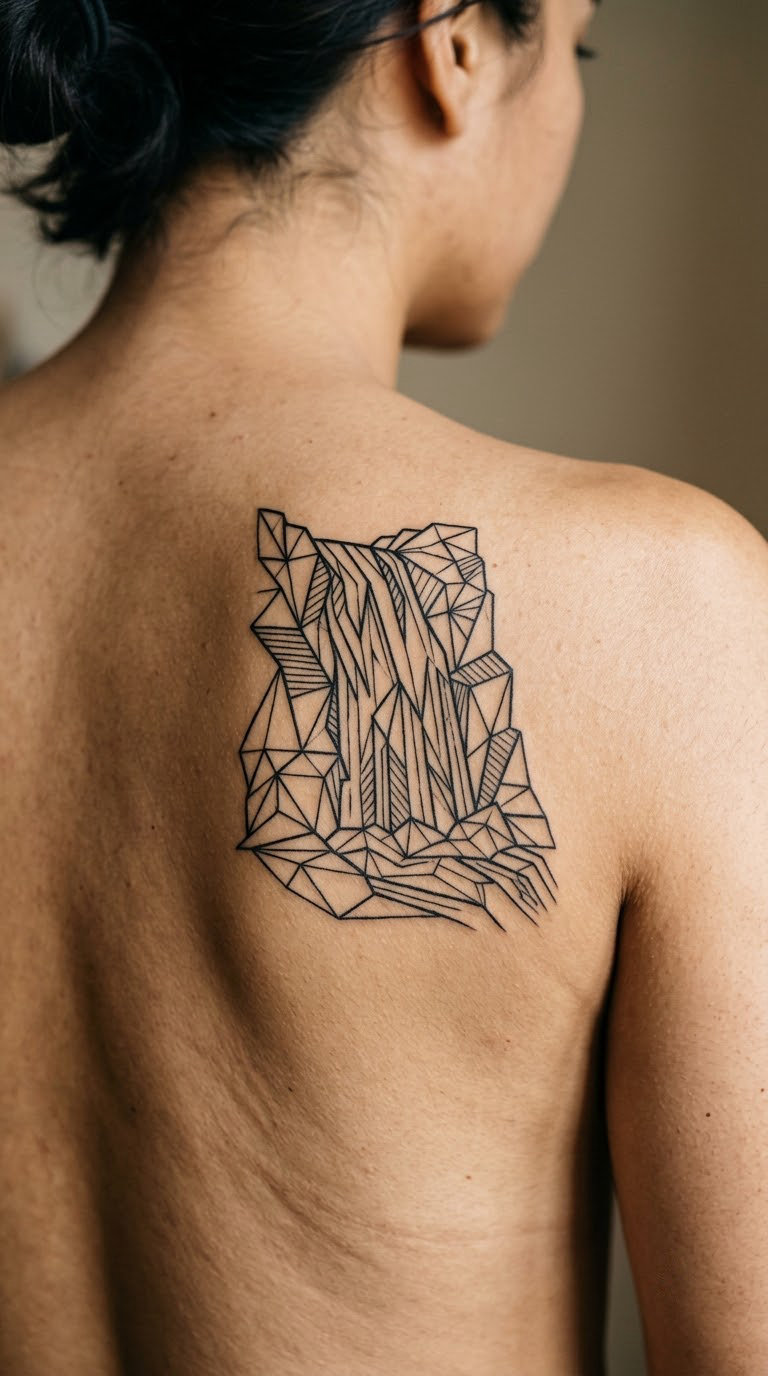
Take a real waterfall, or an invented one, and break it into angles. Rock faces become triangles, the fall becomes a stack of parallel diagonal lines, and the water spreads out at the base in straight segments rather than curves. Almost nothing is shaded, so the design lives on line weight and spacing. It is the most unusual approach on this list and the least like scenery painting.
Good for people who like maps, coordinates, and topography but still want something warm rather than technical. Ask to see the flat drawing before the stencil goes on, because geometry depends entirely on the proportions being right.
Placement: upper back, outer thigh, or a forearm. Size: 3.5 to 5 inches (9 to 13 cm) wide. Style: geometric line work.
Pain: medium; the back is sensitive but the distraction helps. Angular lines read well for years because they are not relying on soft gradient shading. Make it yours: use a real route or trail map as the source and have the artist trace the line of it into the falling water.
10. Dotwork Waterfall and Ferns
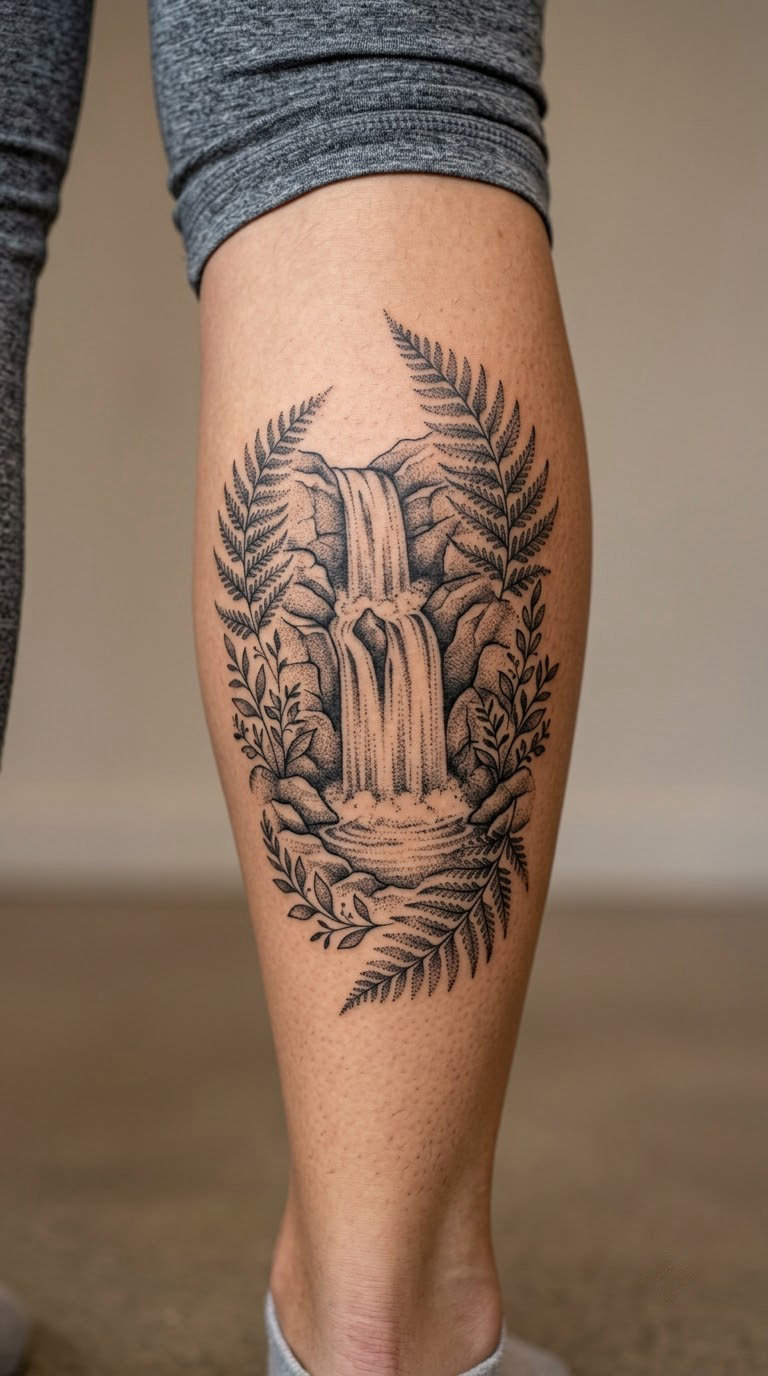
Everything is built from dots. The falling water is a gradient of dot density, darkest at the top where the fall leaves the rock and opening out towards the mist at the base. Small fern fronds frame it on both sides, each built from a line of dots with a little leaf shape at the end. The whole thing is black ink on skin tone, and it is more intricate than it looks in a photo.
Dotwork suits people who collect detailed pieces but do not want colour in the set. It is also one of the styles where the artist’s patience is the design, so check how long they are willing to sit on it.
Placement: calf, forearm, or upper arm. Size: 4 to 6 inches (10 to 15 cm) tall. Style: dotwork.
Pain: medium, and a large dotted area takes a long session. Density controls the value, so ask for the water to stay open rather than packed; over-worked dots turn grey. Make it yours: use a plant that actually grows where you are from, and the piece stops being a generic fern frame.
11. Small Waterfall Behind the Ear
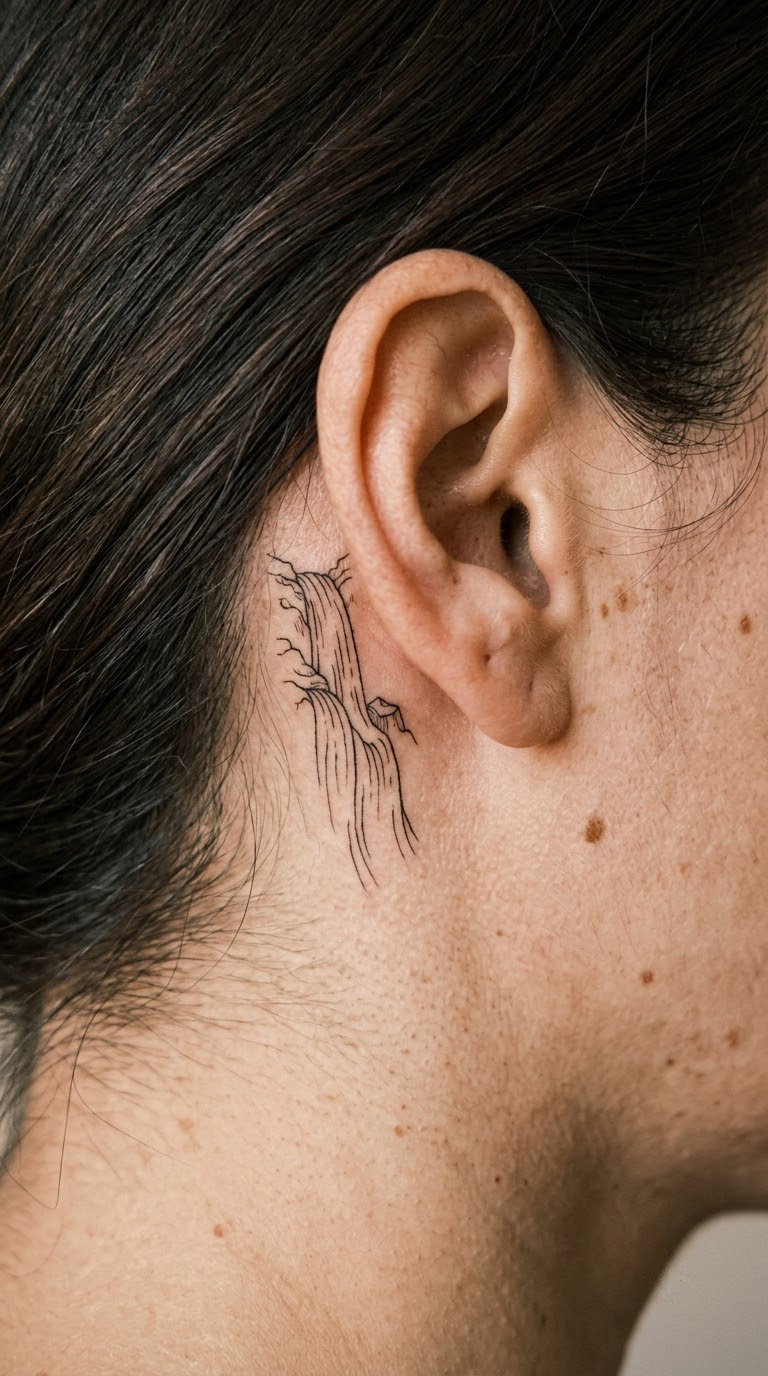
The fall starts above the ear cartilage and runs down towards the neck, with the water lines simply ending where the hair begins. Because the design continues under hair that grows back over it, most people get the top half only, which is why the artist plans the lower line to be the one that stays visible.
This is a placement choice as much as a design choice, and it hides well. It also has one practical drawback: a behind-ear tattoo sits close to a gland, so expect more tenderness and more swelling than an arm placement.
Placement: behind the ear, or the soft skin below the earlobe. Size: 1.5 to 2.5 inches (4 to 6 cm) tall. Style: fine line.
Pain: medium, more sensitive than the forearm but brief. Fine line behind the ear is exposed to sun whenever your hair is tied back, so it fades faster than the same drawing on an arm. Make it yours: have the water disappear into a small spray at the bottom rather than a hard line, which reads better once the hair grows.
12. Waterfall with Mountain Lake
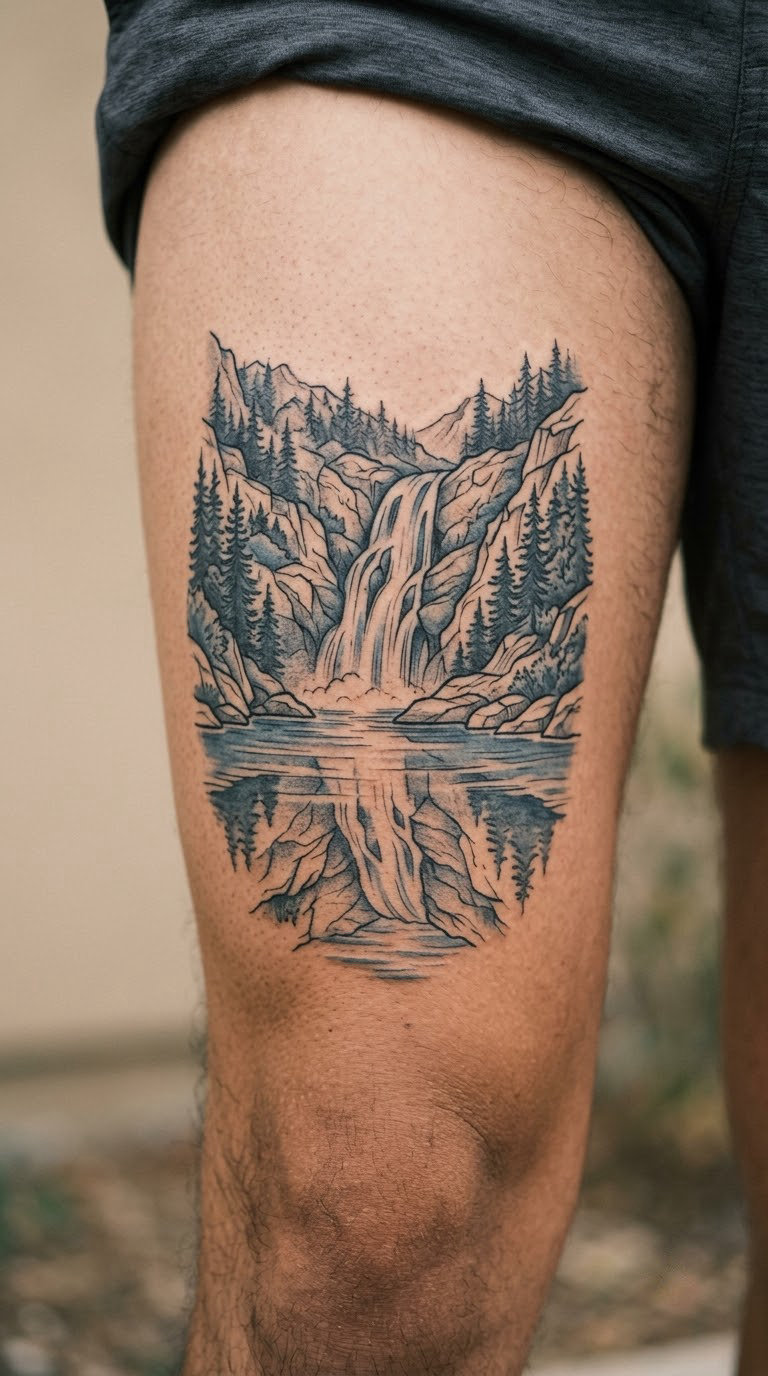
This one tells a whole scene rather than a single subject. The fall drops from a dark rock line at the top, hits a still lake, and the reflection of both the fall and the rock runs down below the waterline in softer, slightly distorted shapes. Muted grey and a thin blue line are enough; adding more colour usually flattens the reflection effect.
It is a good choice if you want a scenery piece without a sleeve commitment. The thigh has a broad flat area, so a six-inch scene sits properly and does not have to follow a curve.
Placement: outer thigh, or the upper back. Size: 5 to 7 inches (13 to 18 cm) wide. Style: scenery realism, black and grey with one colour.
Pain: low to medium; the thigh is one of the more forgiving places to sit through. The reflection lines are the first detail to blur, so keep them slightly heavier than looks right in the drawing. Make it yours: have the lake line follow a real coastline or river bank that matters to you.
13. Red Ink Waterfall
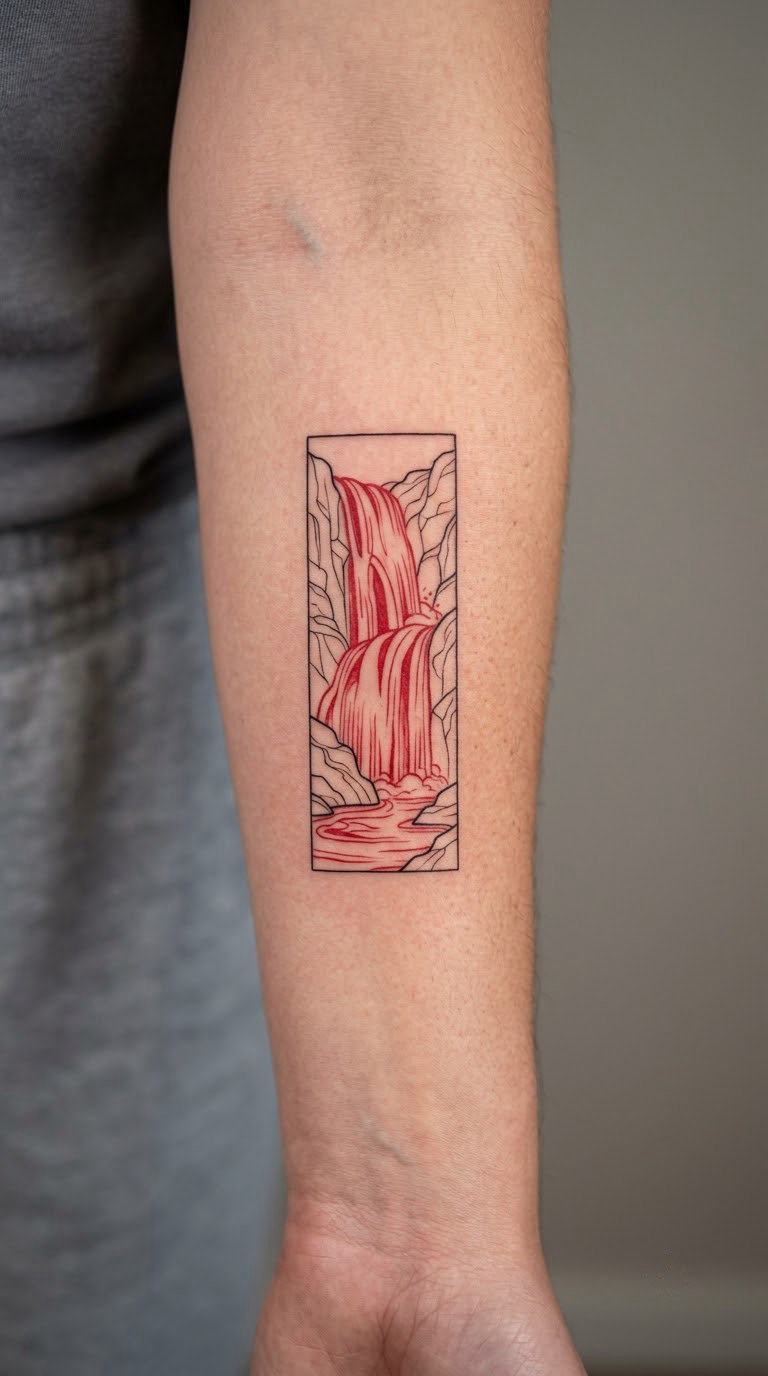
One colour does the work. The fall is a solid red column with a few white gaps running through it, held between two thin black lines that describe the rock edges. Because red reads so strongly against most skin tones, the design needs almost no shading to be legible, which is unusual for a landscape motif.
It is the natural partner to a black and grey piece, since a small red accent is easy to place alongside an existing blackwork set without competing. It also suits people who say they do not want a colourful tattoo and then discover colour works for them.
Placement: side of the forearm, inner arm, or behind the ear. Size: 2.5 to 3.5 inches (6 to 9 cm) tall. Style: red ink with black contour.
Pain: low, since it is a small area with few passes. Red is a warmer pigment and often looks fresher longer than cool blues, but it will still fade with sun exposure. Make it yours: add a second thin red line running parallel a few millimetres away, like spray blowing off the fall.
14. Waterfall in a Compass Design
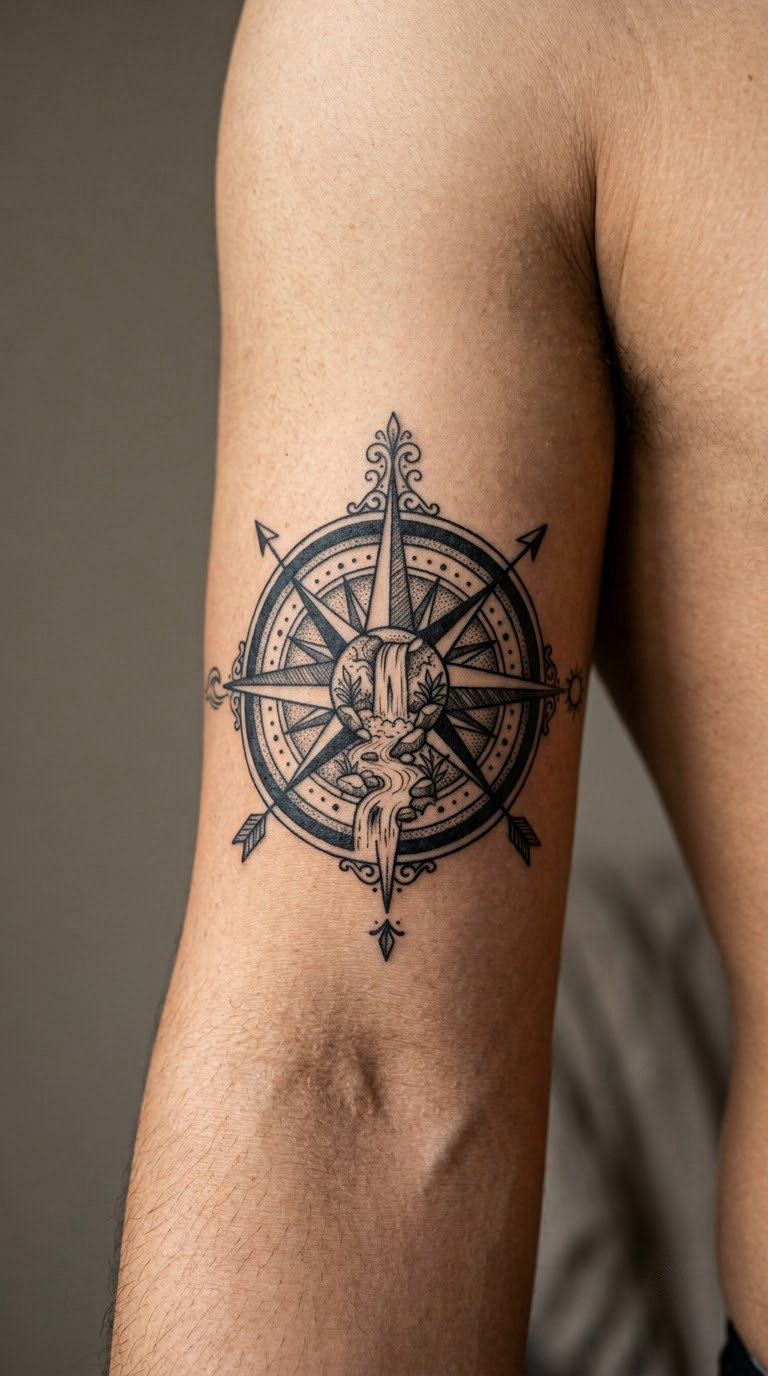
A compass rose gives the composition its balance, and the waterfall takes the vertical axis straight through the middle. Instead of a plain needle, the fall drops through the centre point, with the water widening slightly toward the bottom. The rose points stay fine and even, and the water stays the heaviest element, so the eye lands on the fall first.
Direction and travel sit naturally together here, and most people choose this after a trip or a move rather than as generic scenery. It works well as the middle piece of a set, between two smaller ones.
Placement: inner upper arm, chest, or upper back. Size: 3.5 to 4.5 inches (9 to 11 cm) in diameter. Style: blackwork line work.
Pain: medium, and the inner arm is sensitive near the armpit. The fine rose points blur faster than the waterfall, so the artist should keep the petals simple. Make it yours: mark the real compass bearing from a place that matters to you on one of the points.
15. Tropical Waterfall Sleeve Panel
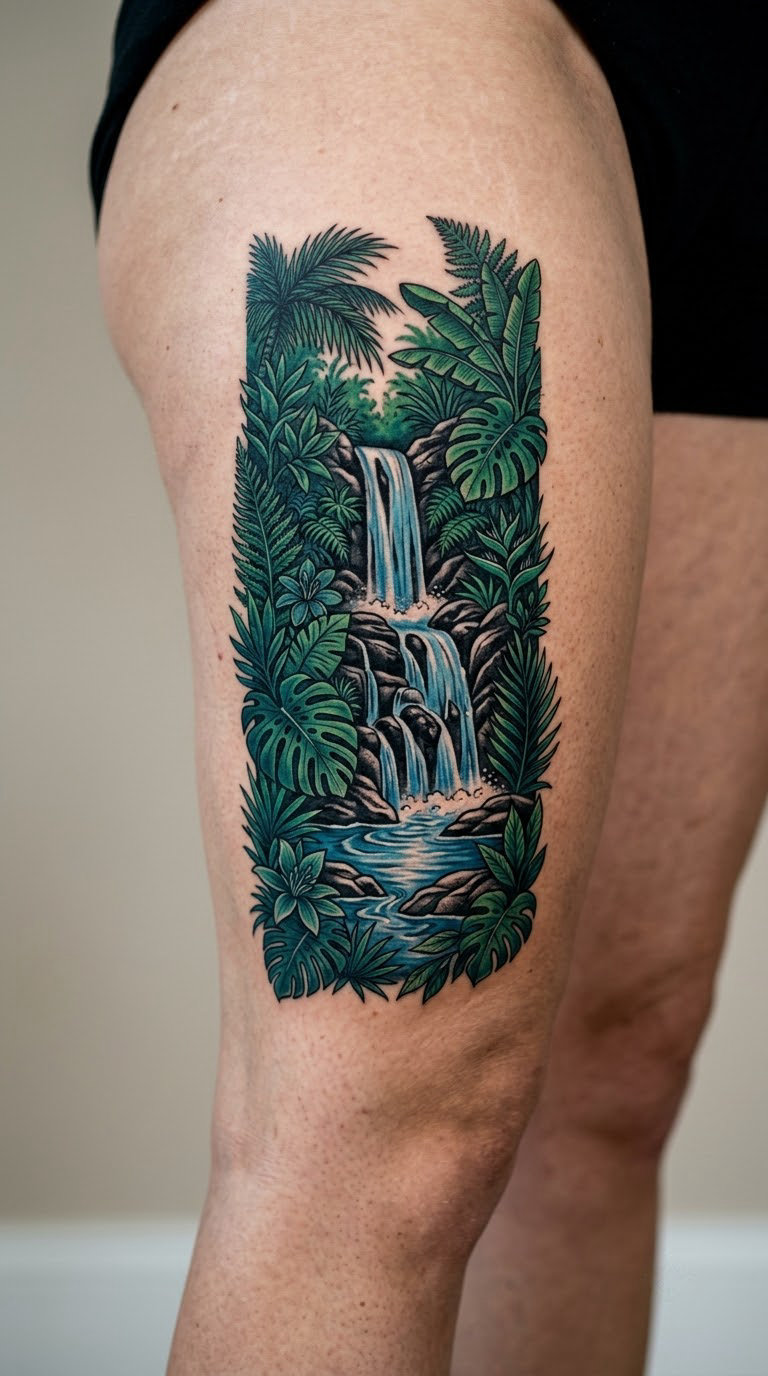
This is a full panel rather than a single element. Broad split leaves frame the sides, the central fall drops in layered blue with white foam at the base, and a misty pool with a few lily pads anchors the bottom. Colours stay in a green, blue and black family so the composition does not fragment, and there is space left at the edges for the piece to grow into a wider scene later.
Panels like this are usually planned as part of a wrapped surface, and tattoo communities give strong praise to waterfall panels on a limb for how well the flow follows the shape. If you are building a sleeve, agree the boundaries of the panel now rather than after the first session.
Placement: upper thigh, calf, or as a sleeve panel on the upper arm. Size: 7 to 9 inches (18 to 23 cm) tall. Style: illustrative realism, colour.
Pain: medium, over several sessions. Large green and blue fills hold better than pale tones, but anything light in the foam will soften noticeably. Make it yours: include one plant from the region the waterfall is in, so the panel is a place rather than a stock jungle.
16. Waterfall with Flowing Quote
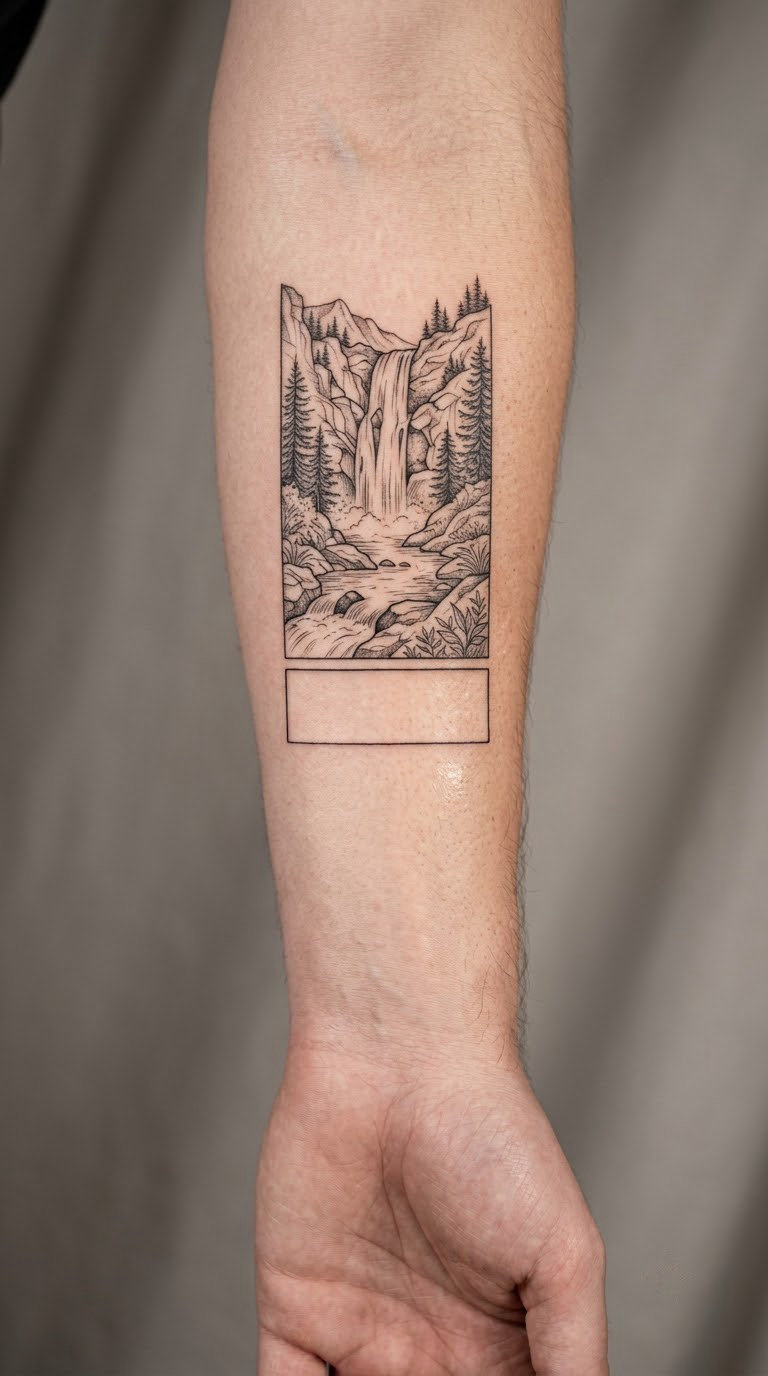
Here the lettering does the emotional work and the fall gives it somewhere to sit. The artist draws the water as two outer lines, leaves a clear band of skin between them, and fits a short phrase inside that band, aligned to the water rather than curved around it. Two or three words is all that reads properly; anything longer turns the stream into a grey blur.
This is the design people pick when the reason for the tattoo is a sentence rather than a view. It works best with plain lettering, and it needs a longer consultation than the other fine-line options here so the words can be sized to fit.
Placement: inner forearm, or along the outer arm. Size: 3.5 to 5 inches (9 to 13 cm) tall. Style: fine line with hand lettering.
Pain: low on the forearm. Fine lettering ages the fastest of any element on this list, so expect a touch-up on the words before the water. Make it yours: keep the phrase short enough to read at arm’s length, and let the last word spill slightly past the water line so it looks like it is flowing out.
17. Tribal-Inspired Waterfall Motif
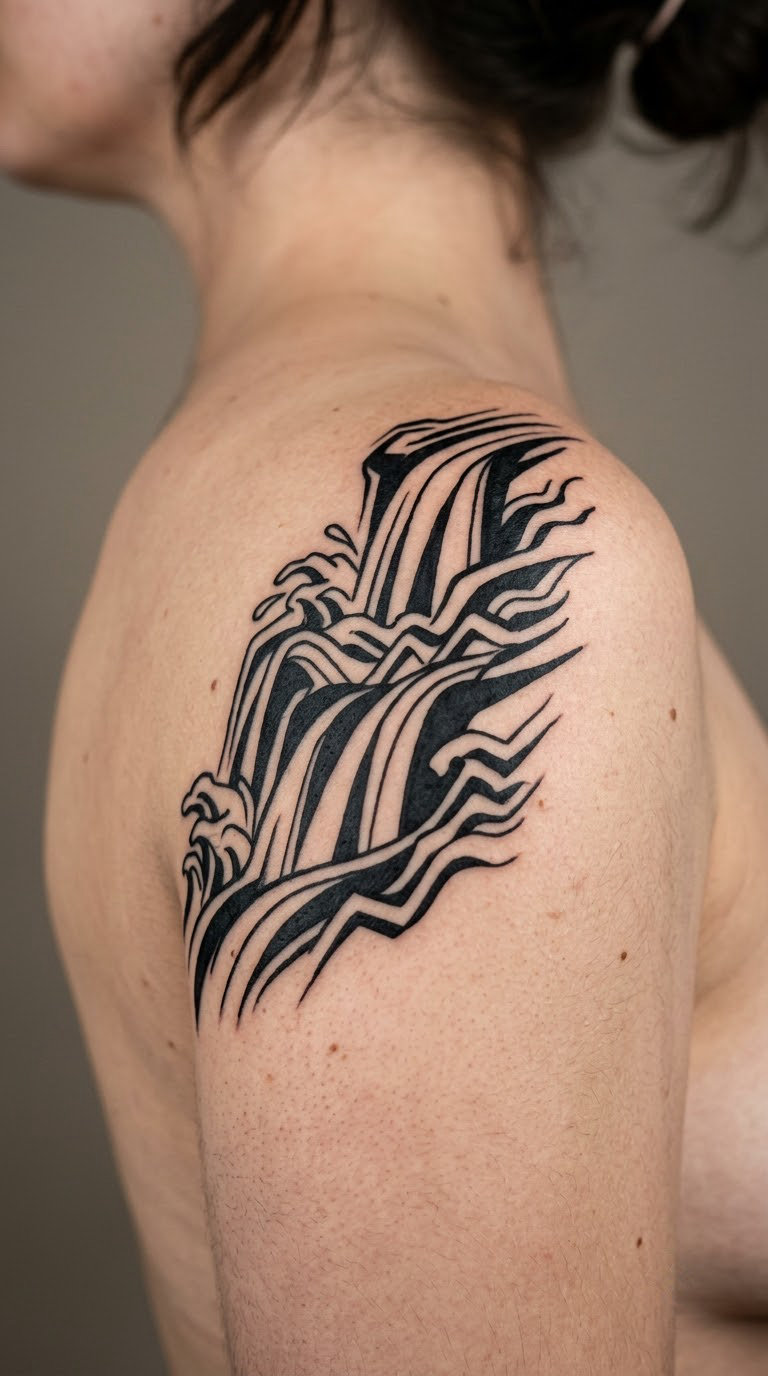
Repeated tapered bands run vertically down the design, and angular wave lines hook off them in a repeating rhythm. The waterfall is implied by the direction and density of the pattern rather than drawn as a picture, and the whole thing is solid black. It is graphic and heavy, and it reads well from across a room.
One honest note. Pattern-led work borrows from specific cultural traditions, and those traditions are not decoration. If you want this look, ask whether the artist draws on a particular tradition and what the pattern means there, and do not describe the finished piece as belonging to a culture you are not connected to. A good artist will either be straight with you or decline, and either answer is better than silence.
Placement: shoulder, upper arm, or the back of the calf. Size: 4 to 6 inches (10 to 15 cm) tall. Style: pattern-led black ink.
Pain: medium; the shoulder moves when you shrug, so a heavy pattern there flexes. Solid black holds up better than almost anything else, so this ages well if the edges are clean. Make it yours: vary the taper of the bands so the fall narrows as it rises, giving the pattern a top and a bottom.
18. Waterfall and Celestial Details
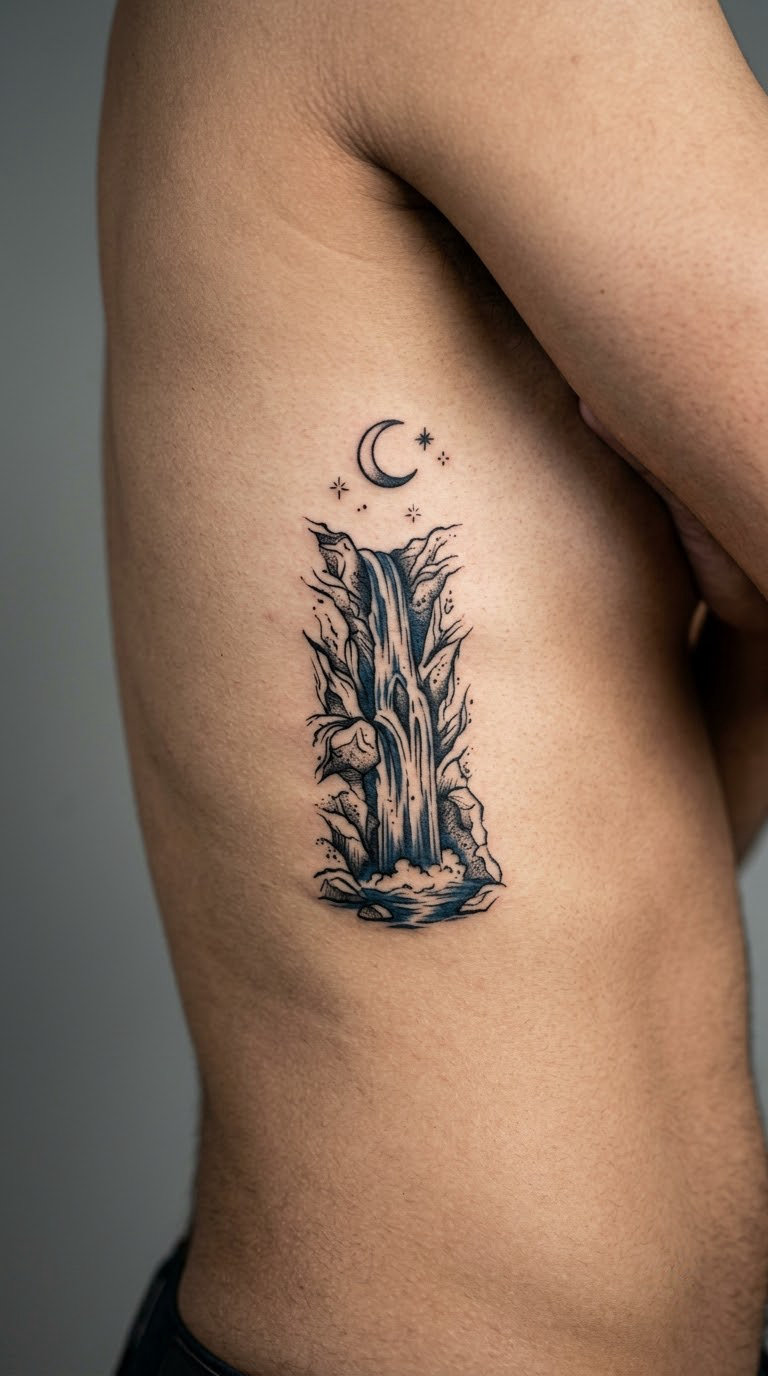
The fall runs down in black line work with one thin blue line for the water, and above it sits a small crescent moon with three scattered stars. The night setting does most of the work, since the moon and stars explain the dark background without needing a landscape behind them. Restraint matters here; more stars and more colour turn a clear idea into a pattern.
This is the design people choose for a date, a time, or a night that mattered. The rib area is a difficult canvas, so the artist will shorten the fall to about four inches and let the moon sit above it rather than fighting the rib curve.
Placement: rib area, side of the torso, or the inner arm. Size: 3.5 to 4.5 inches (9 to 11 cm) tall. Style: black and blue illustrative.
Pain: high. The ribs are the most sensitive spot in this list, and a four-inch piece still takes real time there. Thinner star points will soften first, so ask for them slightly larger than looks necessary. Make it yours: use the actual date of the night in a real sky, and put that number of stars above the moon.
19. Abstract Blue Waterfall Flow
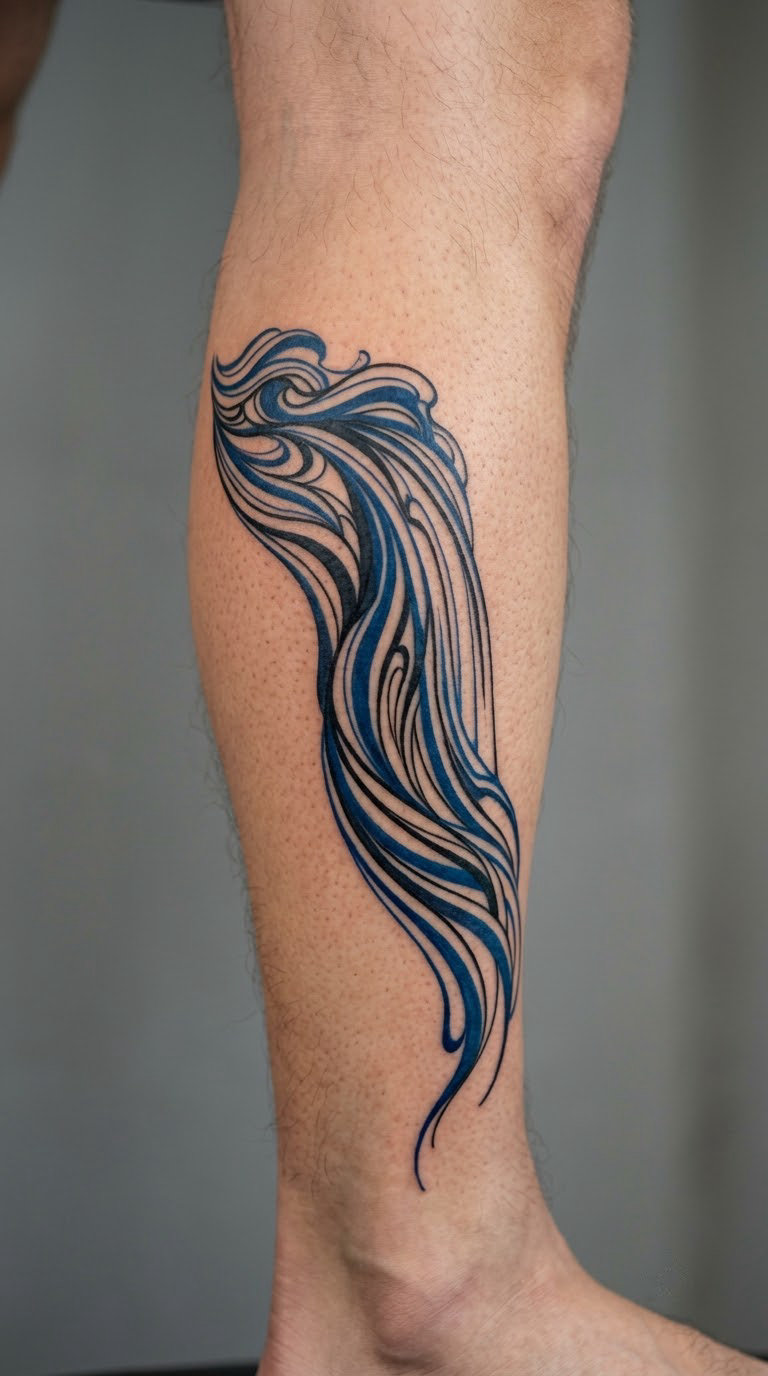
No cliffs, no trees, no mist. Just long sweeping lines in blue and black that curve and cross, with a few translucent blocks of colour where the water appears to gather. The shape of the fall is created by the direction and weight of the lines, so the piece looks different depending on which part of the leg it sits on. On a calf, the lines follow the muscle; on a forearm, they follow the bone.
Abstract work is the riskiest choice on this list, and people on tattoo forums warn about it for a good reason: muted, low-saturation landscape palettes are the ones that end up looking flat or scabbed after healing. Book a consultation specifically for this and ask to see healed examples, not fresh ones.
Placement: side of the calf, outer forearm, or the thigh. Size: 4 to 6 inches (10 to 15 cm) tall. Style: abstract, blue and black.
Pain: medium, and translucent colour needs several light passes. Abstract line work has no outline to hold it together, so it depends on confident, unbroken strokes. Make it yours: give the artist a movement reference, such as wind or long grass bending, and ask for the water to move the same way.
20. Memorial Waterfall with Coordinates
This one is built for somebody specific. The waterfall is drawn in fine black and grey, quiet and unadorned, and beneath it sits one line of coordinates or a date in a small, plain hand. Nothing else is added. The restraint is the point; a memorial piece that is busy becomes something else.
Take your time with the consultation and read every word before the stencil is placed. Small lettering in fine line is the hardest thing here to keep legible, so give the artist the text exactly as you want it and let them adjust the size rather than squeezing it in. If the coordinates are for a place you never visited, that is completely normal and plenty of people do it.
Placement: inner forearm, wrist, or behind the ear. Size: 2.5 to 3.5 inches (6 to 9 cm) tall. Style: fine line, black and grey.
Pain: low to medium, and emotional rather than physical for a lot of people in the chair. Small grey lettering softens faster than the water above it, so plan on a lettering touch-up. Make it yours: have the coordinates sit at the base of the mist rather than below the whole design, so they read as part of the scene.
How to Choose the Right Design
Most disappointing waterfall tattoos are not bad drawings. They are good drawings in the wrong shape for the body part. Work through these four questions before you settle on a reference.
Match the style to how much detail you want visible in ten years
Blackwork, traditional and heavy traditional hold their shape best. Fine line, dotwork and thin lettering soften fastest, and colour in the water loses intensity first. If you want the cascade to still read clearly years from now, give the water solid dark shapes rather than thin lines.
Pick a canvas that matches the direction of the water
A waterfall wants to fall along a vertical axis. Forearms, calves, thighs, the outer arm and the back all give you that. Wrists, ankles and the rib area are short or curved, so the fall has to be compressed and the composition has to be simpler or it will distort. Ask the artist to draw the piece onto your body outline before the stencil goes down.
Decide how much colour you are willing to touch up
Blues, violets and light greys in moving water fade faster than blacks. That is not a reason to avoid colour; it is a reason to decide whether you would come back for a refresh every few years. Choose black and grey if the answer is no.
Know what detail your size can hold
The most common complaint about small waterfall tattoos is mud. Below about two inches tall, the fall, the rocks and the mist all merge into grey. If you want small, choose one of the minimal designs and let the detail go. If you want scenery, give it four inches or more.
Cost and Session Time
I will not put a number on this page, because rates change constantly and the only figure that matters is the one your artist quotes at the consultation. What drives the bill is much more predictable than the price itself.
- Size. A two-inch wrist piece is a short appointment. An eight-inch thigh panel is a project, usually split across two or more sittings with breaks in between.
- Detail density. Dotwork, fine shading and micro-realism take longer per square inch than a bold traditional fill, because the needle passes over the same skin repeatedly.
- Colour. A colour piece needs more passes and more time than the same drawing in black and grey.
- The artist. Rates follow reputation and demand, and shop minimums mean a small piece does not get a proportionally small bill. Ask about the minimum at the booking stage.
- Location. Travel and city differences are real, and a well-reviewed artist booked months ahead will cost more than one available next week.
Ask for the total, the number of sessions, and what happens if the piece needs finishing. Those three answers tell you far more than a headline rate will.
Aftercare Basics
Start with your artist’s aftercare instructions, because they know exactly what they put in your skin and how much of it. Everything below is general and comes second to that.
- Follow the artist’s cleaning routine. Most artists will ask you to wash gently with clean water and a mild, unscented soap, then pat dry rather than rub.
- Protect it for the first couple of weeks. Loose, clean clothing over the area is better than a sealed covering, and tight or scratchy fabric is the thing most likely to cause problems.
- Keep sun off it while it heals and after. Once fully healed, sun protection on the water area is the single most effective thing you can do to slow fading.
- Do not soak, swim, or sauna on a new tattoo. Chlorine, salt water and heat are all hard on a healing piece, and swimming is usually off the table for a few weeks.
- Expect the surface to change. Peeling, flaking and a slightly raised texture are normal in the first weeks. So is itching, and scratching is the fastest way to damage the ink.
- Contact your artist first if something looks wrong. If a piece stays raised, feels hot, or looks like a reaction rather than normal healing, talk to the studio before you do anything else.
Frequently Asked Questions
What size should a waterfall tattoo be?
For a small design, two to three inches tall is the realistic minimum, and below two inches the water, rocks and mist tend to merge into grey. Four inches gives room for scenery detail, and six to eight inches is where a full scene or panel sits properly. The size should match the body part: a curved rib or ankle needs a simpler design rather than a smaller copy of a big one.
Will a waterfall tattoo fade over time?
Yes, and how fast depends on the style. Fine line and thin lettering soften within a few years, and blues, violets and light greys in moving water lose intensity first. Blackwork, traditional and heavy black outlines hold their shape far longer. Sun protection on the area is the most effective thing you can do, and a colour refresh every few years is normal and worth planning for.
Where is the least painful place to get a waterfall tattoo?
The outer forearm, upper arm and thigh are the most forgiving, because the skin is thick and there is little bone directly underneath. The inner wrist, the calf near the knee and the collarbone area are more sensitive, and the ribs are the toughest spot for a vertical design like this. On most clients the forearm sits around the low end of the scale, ribs at the high end.
Can a small waterfall tattoo be added to later?
Yes, and a lot of people build a waterfall in stages rather than starting large. The usual route is a small fine-line or minimal fall first, then a second piece nearby once the first has healed and settled. What does not work well is trying to extend a two-inch tattoo into a large panel later, because the earlier work usually does not match the new shading and scale. Plan the whole scene before starting if you can.
What should I bring to a waterfall tattoo consultation?
Bring references for texture, silhouette and composition rather than a finished tattoo to copy. Tattoo artists recognise a copied composition immediately, and it usually ends in a redesign or a polite no. Two or three images plus notes about size, placement and colour direction give an artist enough to work from, and asking to see healed examples of their waterfall work tells you more than a fresh portfolio shot.
Are there rules about cultural symbols in waterfall tattoos?
There are conventions in some traditions, particularly in Japanese composition, pine and wave patterns, and koi arrangements, and they often carry meaning that changes with orientation and pairing. The respectful approach is to say plainly that you want an homage rather than a copy, and to let the artist guide how much of the traditional framing to keep. Avoid describing a piece as belonging to a tradition you are not connected to, and be prepared to be told a specific motif is not available.
Which Waterfall Idea Should You Choose?
If this is your first tattoo, start with idea 5, the minimalist waterfall linework. Two inches on the inner wrist, low pain, a short appointment, and a design that will still make sense to you in a decade even if the lines have softened. Idea 1 is the better choice if you want the water itself to be the subject rather than a symbol standing in for it.
If you already collect nature work and are building a themed set, idea 7 or idea 15 will carry the most weight visually. Blackwork jungle negative space and a tropical panel both read strongly across a room, and both pair easily with pines, mountains or a moon from the rest of the list.
Whichever one you land on, the first step is the same: bring the artist your placement and your references at the same time, not separately. The best version of this list is the one that fits the shape of your body rather than the shape of a photo.