
22 Navy Tattoo Ideas: Best Maritime Designs for Sailors 2026
These 22 navy tattoo ideas cover the whole vocabulary of the sea, from the anchor almost everybody starts with to the compass rose, the lighthouse and the rope knot nobody else thinks of. Pick the shape that means something to you, then let your artist build the version that suits the skin it will sit on.
A good nautical design survives a decade. That means clear silhouette, enough spacing between elements, and detail scaled to the size of the piece rather than the size of a phone screen. Sailors and veterans usually want the traditional weight of an anchor or a wheel, while family members and ocean lovers tend to want the same shapes done lighter and finer. If you are planning a piece this October 2026, book early. Artists need a few weeks to draw something custom, and the calendar fills up around holidays.
22 Navy Tattoo Ideas: Quick Guide
| Idea | Style | Best placement | Size | Pain |
|---|---|---|---|---|
| 1. Traditional anchor | Traditional | Outer or inner forearm | 3-5 inch | Medium |
| 2. Minimal line-work anchor | Fine line | Inner forearm, wrist, behind ear | 1.5-3 inch | Low to medium |
| 3. Compass rose | Fine line with grey wash | Forearm, shoulder, chest, back | 3-6 inch | Medium |
| 4. Insignia panel | Blackwork | Upper arm, forearm | 4-7 inch | Medium to high |
| 5. Rope and anchor | Traditional | Forearm, calf | 4-6 inch | Medium |
| 6. Wave and horizon | Blackwork or grey wash | Forearm, calf, ribs | 3-6 inch | Medium |
| 7. Lighthouse in a storm | Illustrative blackwork | Upper arm, back | 4-7 inch | Medium to high |
| 8. Naval officer’s eagle | Blackwork with banner | Chest, shoulder, upper back | 5-8 inch | Medium to high |
| 9. Ship’s wheel | Traditional | Forearm, upper arm, thigh | 3-5 inch | Medium |
| 10. Micro realism lighthouse | Micro-realism | Behind ear, wrist, rib | 1-2.5 inch | Low to medium |
| 11. Blue anchor with compass | Colour illustrative | Forearm, wrist, calf | 2.5-4.5 inch | Medium |
| 12. Sailor’s knot | Fine line realism | Wrist, ankle, forearm, behind ear | 1.5-3 inch | Low to medium |
| 13. Flag-inspired panel | Custom panel work | Forearm, upper arm | 6-10 inch | High |
| 14. Octopus and wheel | Blackwork | Forearm, calf | 4-7 inch | Medium |
| 15. Watercolour navy flag | Watercolour | Forearm, calf | 3-5 inch | Medium |
| 16. Minimal helm and wave | Fine line minimal | Wrist, ankle, forearm | 1.5-3 inch | Low to medium |
| 17. Star and constellation map | Fine line and dotwork | Forearm, upper arm, back | 2-4 inch | Medium |
| 18. Realistic vessel at sea | Illustrative realism | Forearm, calf, upper arm | 3-6 inch | Medium |
| 19. Anchor with laurel | Traditional blackwork | Upper arm, chest | 4-6 inch | Medium |
| 20. Blackwork wave stack | Blackwork | Forearm, calf, ribs | 4-8 inch | Medium to high |
| 21. Butterfly and compass | Blackwork with blue accent | Shoulder, back, forearm, calf | 2.5-5 inch | Medium |
| 22. Nautical story sleeve | Custom blackwork | Forearm and upper arm | 8-16 inch | High, several sessions |
1. Traditional Navy Anchor
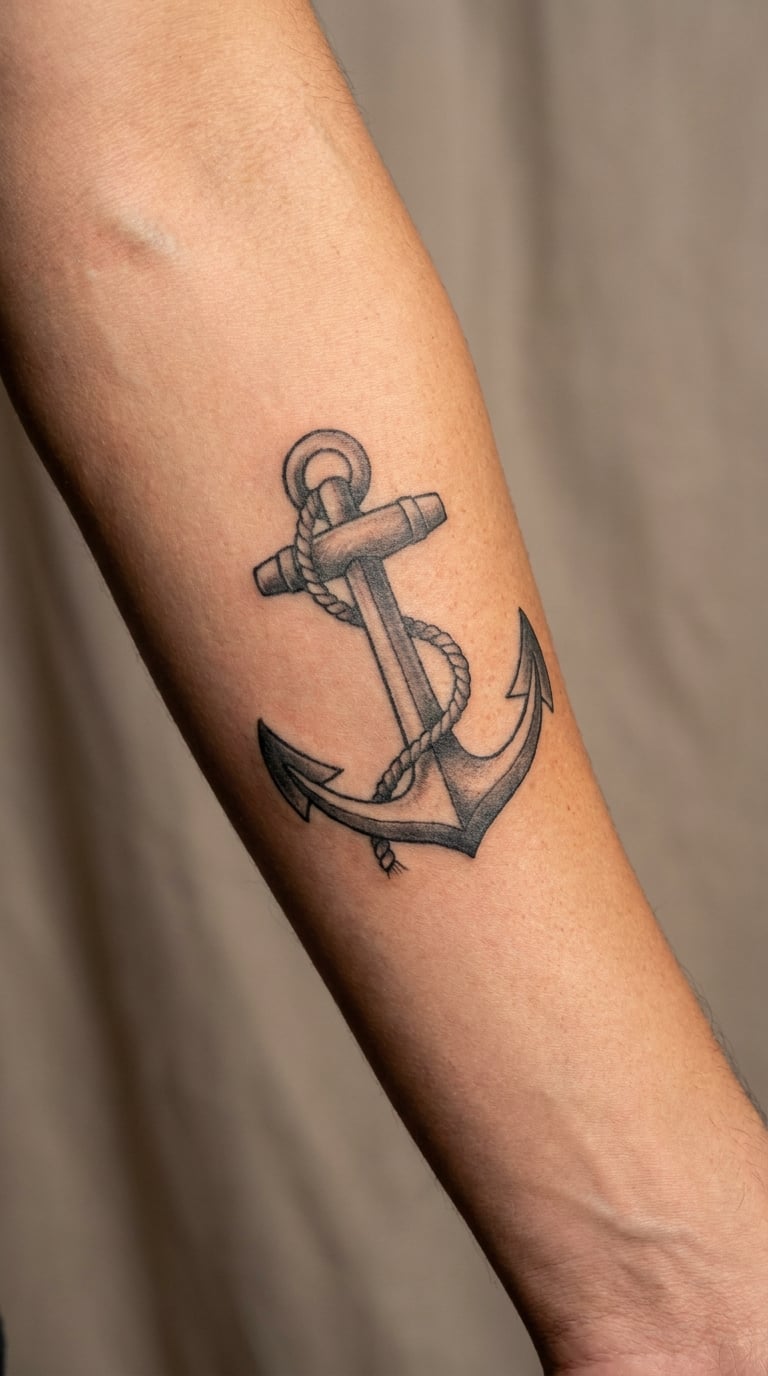
A traditional navy anchor is drawn in solid black with a heavy outline, a domed shank, two curved flukes, and a bar across the top. Shading stays light, usually a soft grey tucked under the arms of the anchor, and a small banner of curved text can sit beneath it without crowding the shape.
The rope is where the character lives. A loose loop or a proper coil reads far better than a tidy bow, and a fouled rope also keeps the piece from looking like clip art. Most people choose it for steadiness, or because a sailor in the family earned one first.
Placement: outer forearm, inner forearm, or upper arm. Size: 3 to 5 inch tall. Style: traditional or neo-traditional. Pain: medium, with a sharp edge where the forearm bone sits close to the skin.
Make it yours: run a hull number, a home port, or a set of coordinates through the banner.
2. Minimal Line-Work Anchor
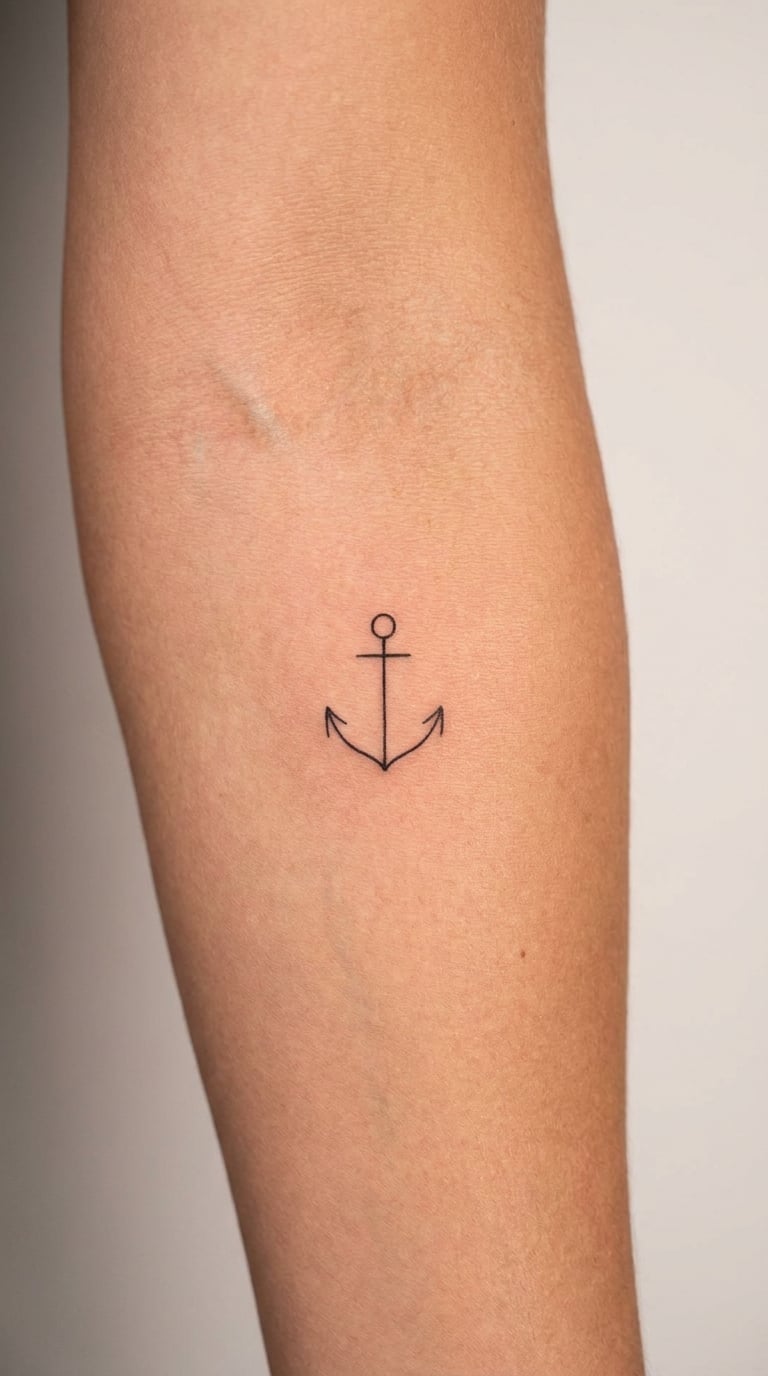
This is the same symbol stripped to its skeleton: one consistent line weight, clean proportions, no shading, no background. A good version has slightly rounded joints and a shank that is not too long, because the eye reads a lopsided anchor as a mistake rather than a style choice.
It suits a first tattoo, and it slots neatly into a small collection on an inner arm. A lot of people also ask for a version shaped like the anchor used on their grandfather’s belt rather than a generic one.
Placement: inner forearm, wrist, or behind the ear. Size: 1.5 to 3 inch. Style: fine line, single weight. Pain: low to medium.
Fine lines are the honest caveat here. Single-weight work softens faster than filled black, and behind the ear and on the fingers it changes the most. Make it yours: keep it pure, or add two tiny tide marks under the flukes for a subtle maritime touch.
3. Sailor’s Compass Rose
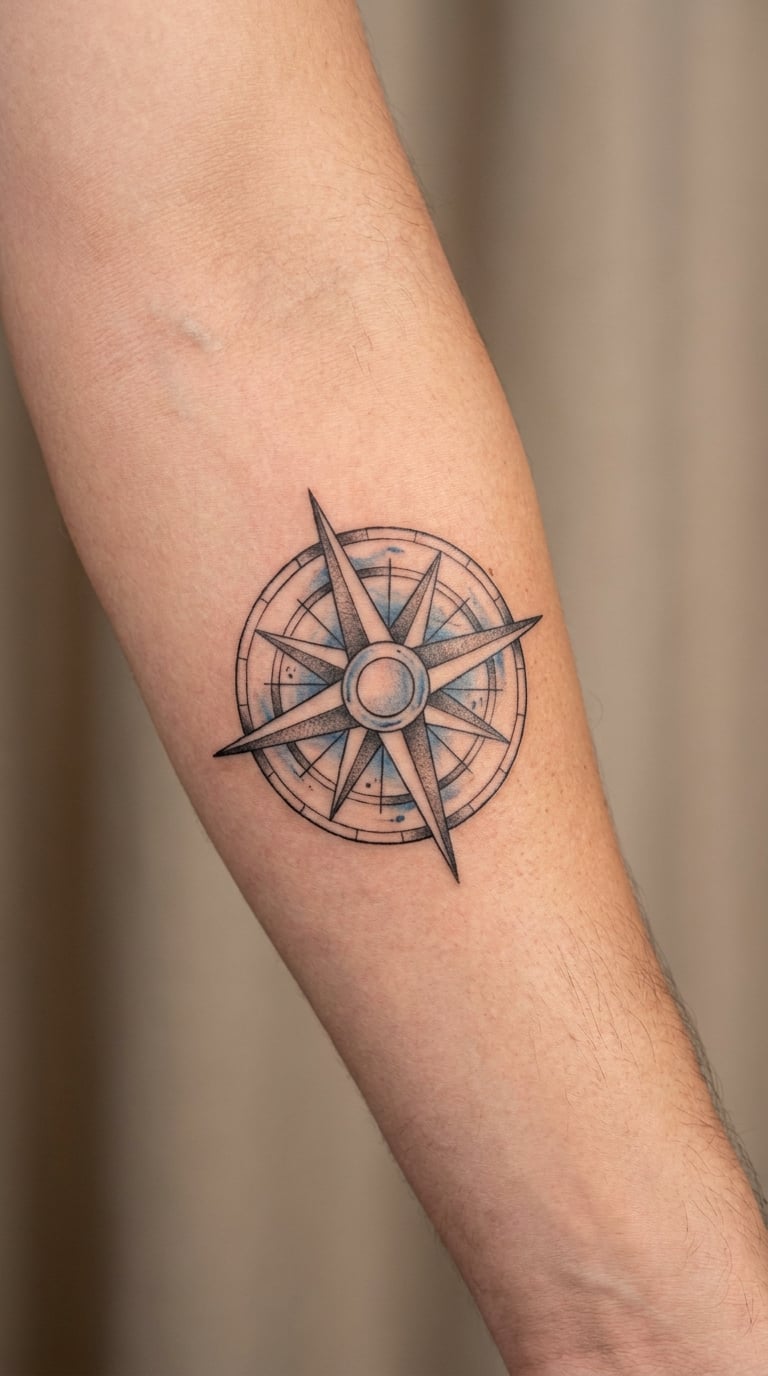
A compass rose is built from a centre point, four cardinal points, and the smaller points between them, with fine geometric divisions filling the gaps. Muted navy blue in the alternating halves is the most popular colour treatment, but a grey wash version looks just as serious and ages more calmly.
People tend to pick it as a way of marking direction or a decision point, or simply because the geometry is satisfying. It reads clearly without any explanation, which is why it works so well as a standalone piece.
Placement: forearm, shoulder, chest, or back. Size: 3 to 6 inch across. Style: fine line with grey wash, or illustrative. Pain: medium on the arm, higher over the ribs or across the shoulder blade.
Small ticks between the points are the first thing to blur, so ask for them to be slightly heavier than the outline. Make it yours: add the latitude of a port you have actually stood in, or the coordinates of home.
4. Navy Insignia-Style Panel
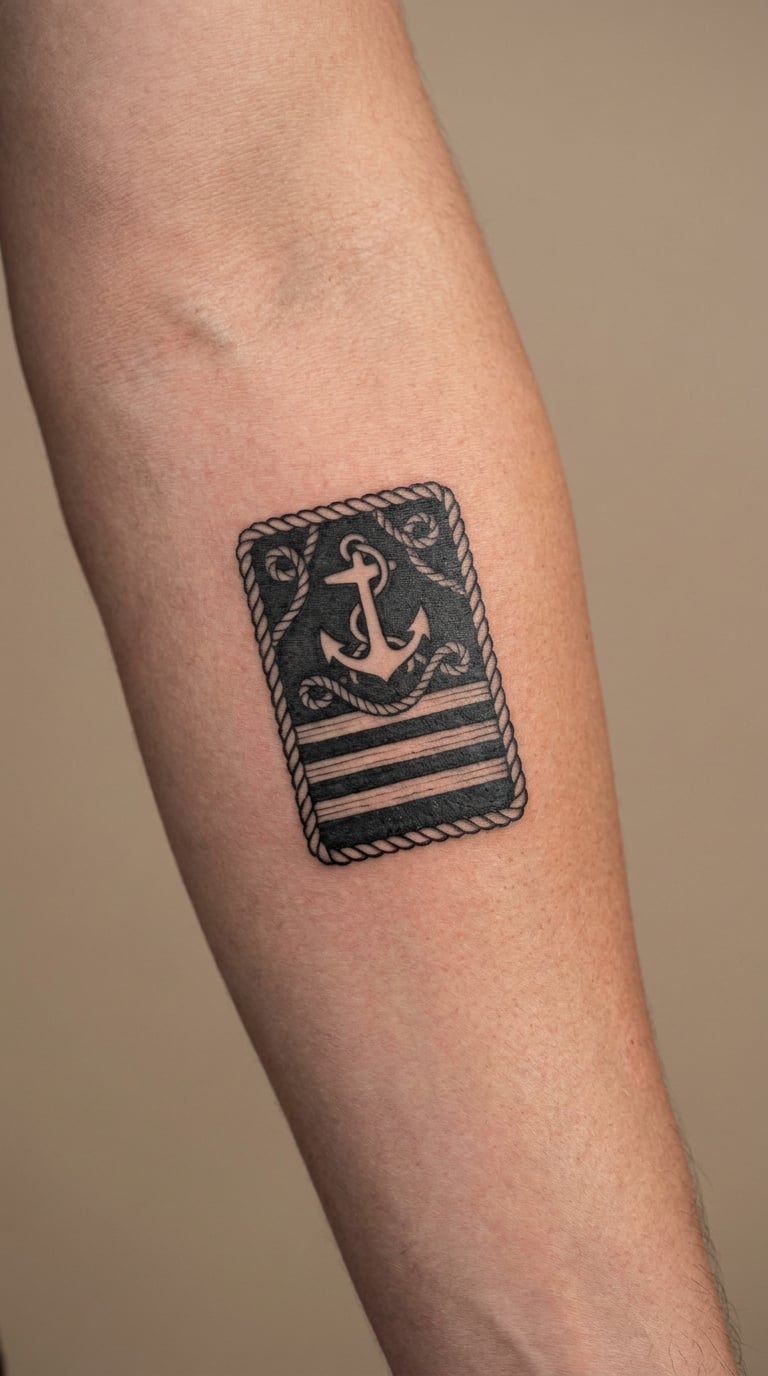
This is a compact panel that borrows the visual grammar of a naval emblem without copying a real badge: a stylised central device, two or three stripes, rope framing the edges, and negative space doing the rest. Good artists will redesign the centre element so it is clearly inspired rather than traced.
It works well for veterans who served under a specific unit but do not want the actual insignia, and it suits anyone who liked the look of a service emblem as a kid. The design has to be checked for originality, especially if it sits anywhere near a name or a number.
Placement: upper arm or outer forearm. Size: 4 to 7 inch panel. Style: blackwork or traditional. Pain: medium to high on the inner bicep and rib area.
Make it yours: swap the stripes for a rank or rate, and keep the rope as the frame that ties it together.
5. Old-School Rope and Anchor
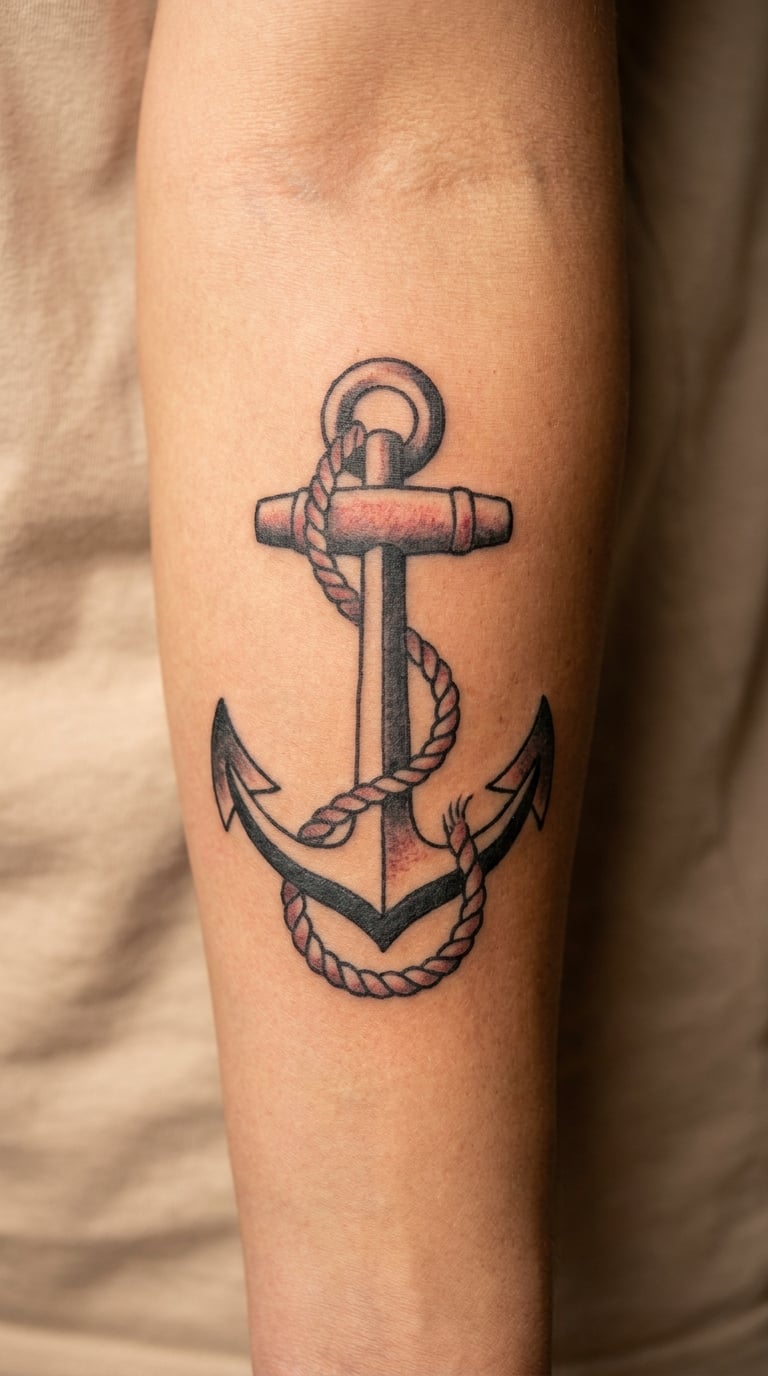
This is the loud cousin of the classic anchor: a heavy shank, a block-black body, and rope that actually interlocks with the metal, twisting over and under the shank. Muted red or gold ink in the rope is the traditional accent, and a little colour is all it needs.
People choose it when they want a piece that reads as a maritime tattoo from across a room, and it is a solid second or third tattoo because the design is bold enough to carry a scar-prone area.
Placement: forearm or calf. Size: 4 to 6 inch. Style: traditional, bold line. Pain: medium, and the calf gives you longer stretches of tolerable work than the forearm does.
Thin interior linework inside a bold outline is the part that ages first, so let the rope be simple rather than photographic. Make it yours: add a short banner of text underneath in the same red.
6. Navy Wave and Horizon
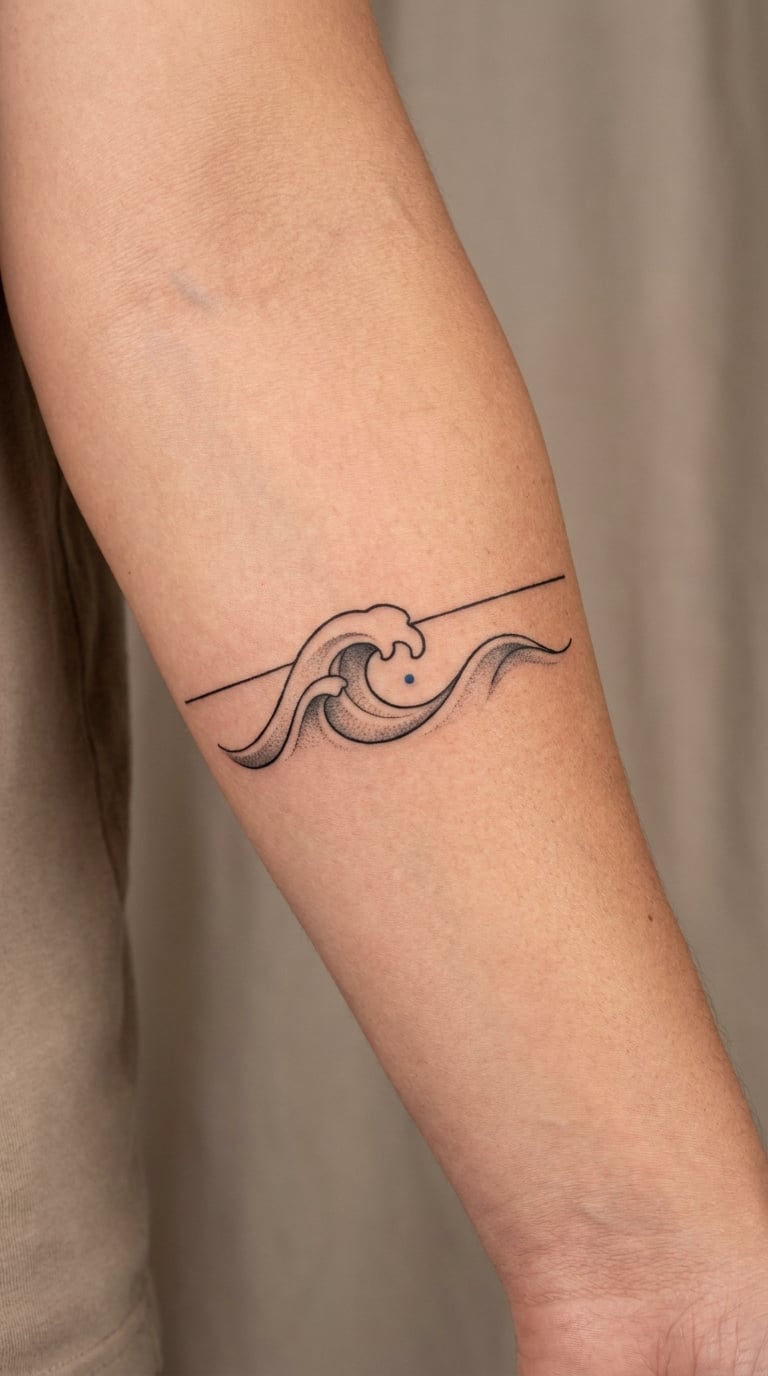
Layered water under a dead-straight horizon line is one of the easiest nautical ideas to make look good. Two or three waves, a black fill on the near crest, grey wash behind it, and a single line running the width of the design to close it off.
It means motion and open distance to most people, and plenty of ocean lovers get it without any naval connection at all. Fewer elements also means fewer things to go soft. If you want the water paired with something on land, our 20 mountain and ocean tattoo ideas covers that side of the combination.
Placement: forearm, calf, or along the ribs. Size: 3 to 6 inch wide. Style: blackwork or grey wash with one colour accent. Pain: medium, higher on the ribs where the skin is thin and moves constantly.
Make it yours: run the horizon line out past the waves to the edge of the space so it reads as a horizon rather than a stripe.
7. Lighthouse in a Storm
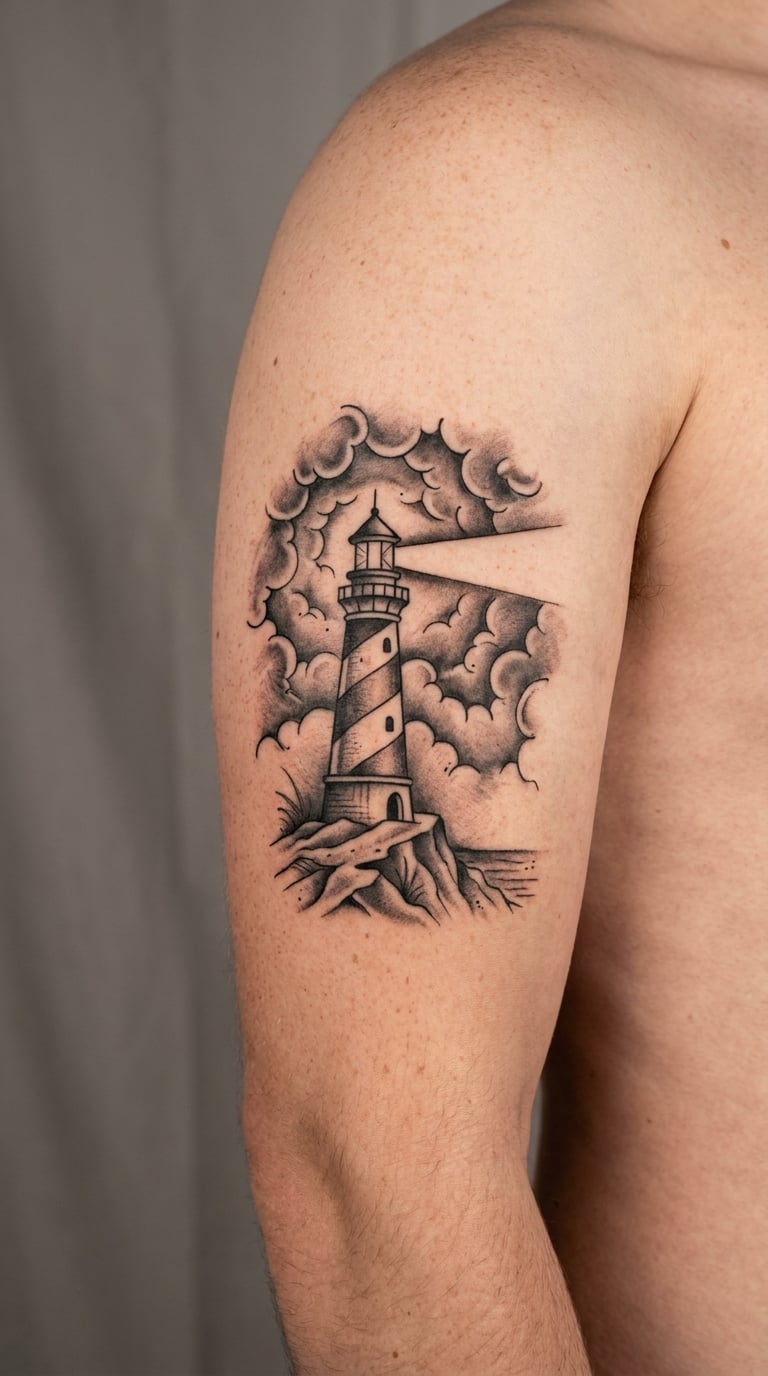
This one is a scene rather than a symbol: a tapered tower, a narrow beam cutting across layered cloud, and dark water at the base. The trick is restraint. A controlled grey in the clouds and a hard black waterline give it weight without turning the whole piece into a grey block.
Guidance and getting through something difficult is the reading people bring to it, though that is personal rather than official. It suits a larger space, because a lighthouse needs room for the beam to travel.
Placement: upper arm, back, or outer thigh. Size: 4 to 7 inch tall. Style: illustrative blackwork. Pain: medium to high, with the cloud shading being the long, dull part of the session.
Small railing details and window slits soften within a few years, so keep them chunky. Make it yours: have the beam point toward a name or a date placed elsewhere on the body.
8. Naval Officer’s Eagle
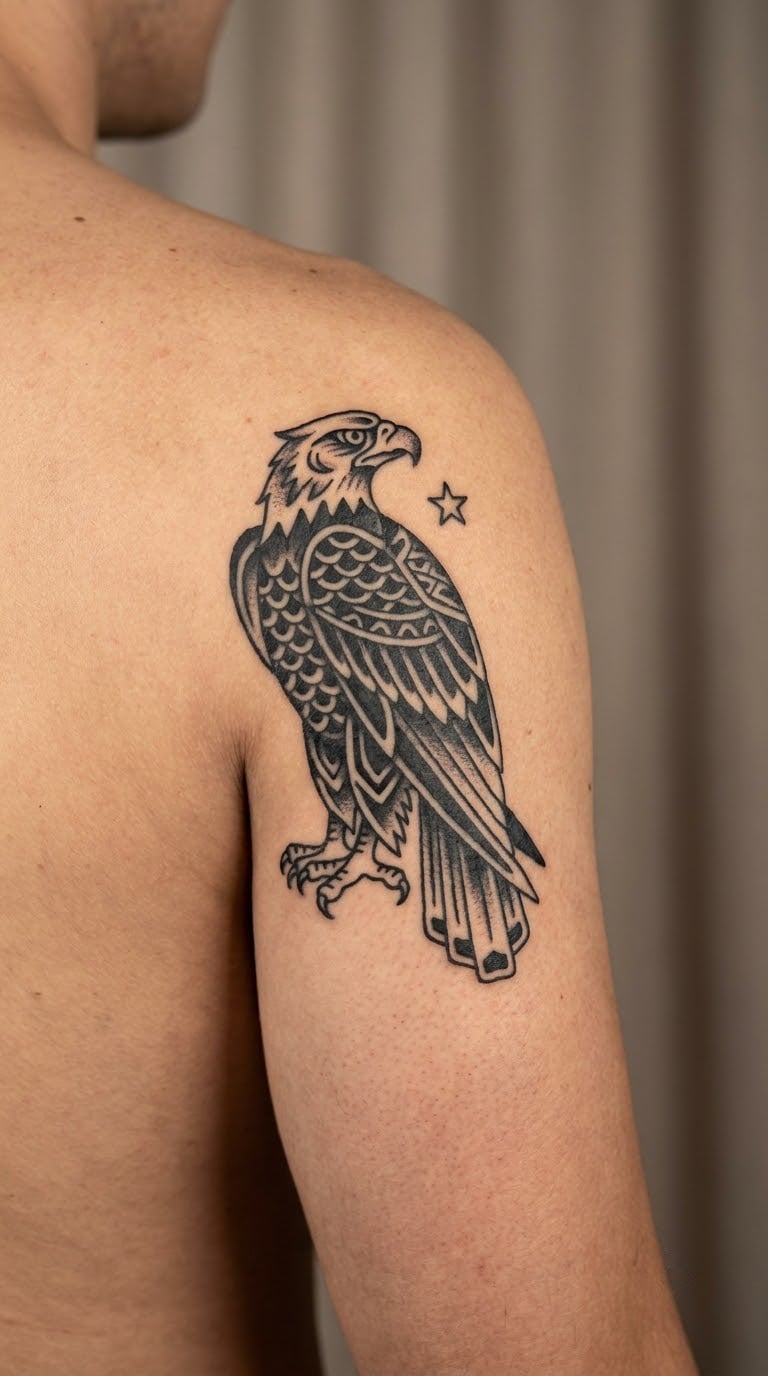
A dignified eagle needs a wide, level wingspan, feathers simplified into a few clean shapes, and a head that looks straight ahead rather than cartoonish. A small star or a short geometric banner underneath keeps it from reading as military insignia, which matters if you never wore the uniform.
Service, pride and freedom are the usual personal readings. Enlisted sailors get this one too, often as a tribute rather than a rank statement.
Placement: chest, shoulder, or upper back. Size: 5 to 8 inch wingspan. Style: blackwork with light grey feather separation. Pain: medium to high, worst over the collarbone and the bony shoulder top.
Feather detail is where the ageing shows, so fewer, larger feathers beat realism here. Make it yours: add the service years in the banner rather than a unit name.
9. Traditional Ship’s Wheel
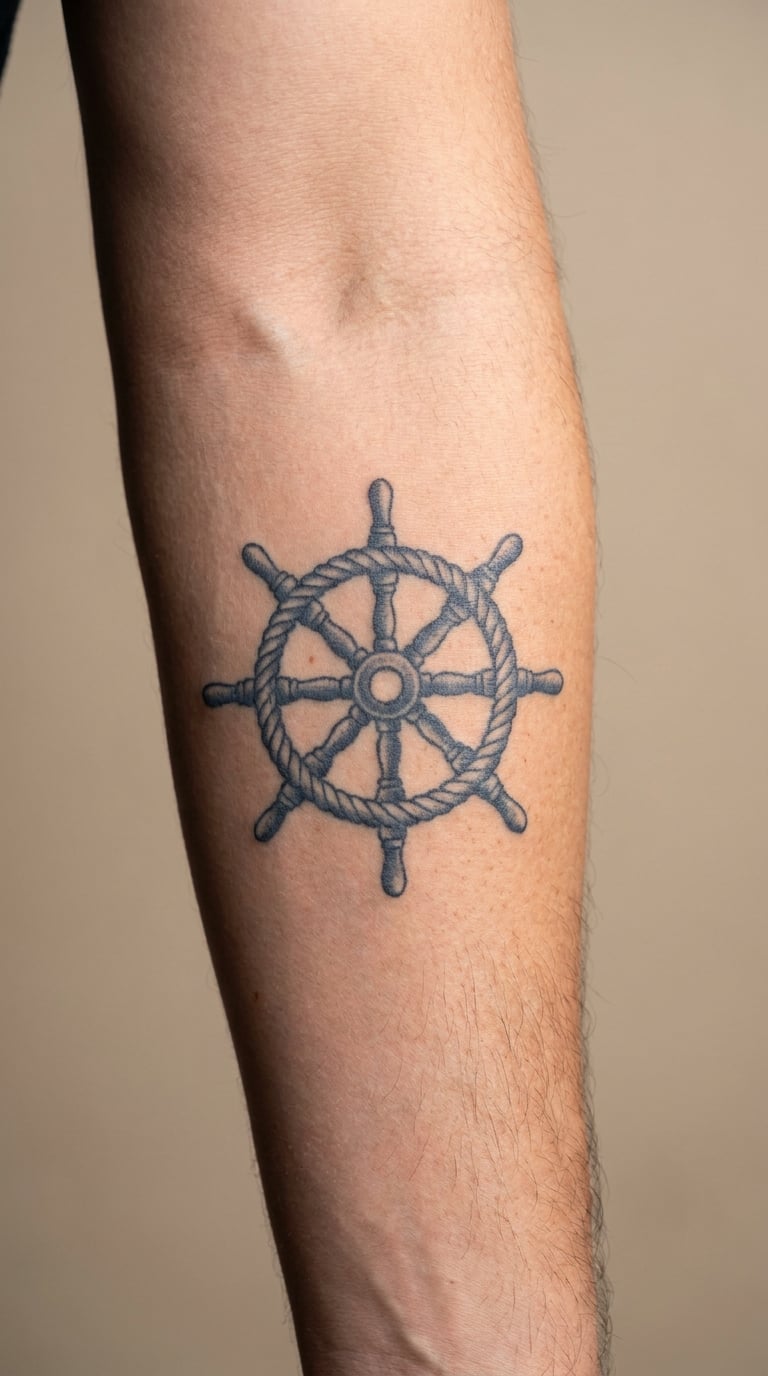
A ship’s wheel needs symmetry to work: eight spokes, a rim with a rope or wood-inspired wrap, and a hub that sits exactly in the middle. Restraint keeps it clean, because an over-detailed wheel at forearm size turns into a dark smudge.
It is one of the oldest images in seafaring tattooing, usually connected to seamanship and to the person steering the course of the ship. Plenty of people wear it simply because they like the geometry.
Placement: forearm, upper arm, or thigh. Size: 3 to 5 inch across. Style: traditional or neo-traditional. Pain: medium.
The spoke ends are the detail that disappears first, so give them a little extra weight. Make it yours: put a date inside the hub, or repeat the wheel smaller on the other arm.
10. Micro Realism Lighthouse
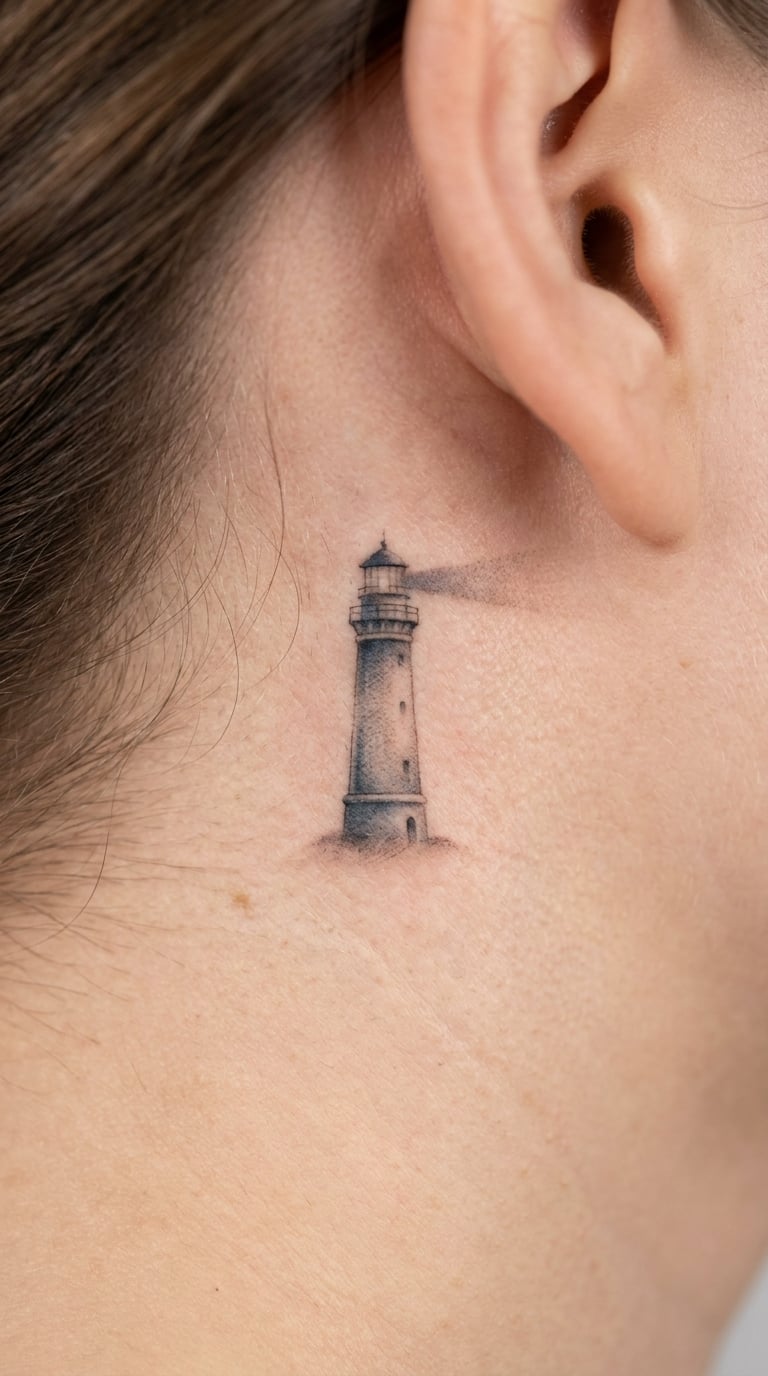
A tiny lighthouse drawn in soft realism is about proportion and restraint: a tapered tower, a clean gallery rail, and one soft beam that fades out rather than ending in a hard line. No background. No clouds. The whole design is the tower and its light.
It works as a private reference, something only you read properly, which is a lot of the appeal. A skilled artist matters more here than anywhere else on this list, because there is no size to hide a wobble in.
Placement: behind the ear, inner wrist, or along a rib. Size: 1 to 2.5 inch. Style: micro-realism. Pain: low to medium, and behind the ear is a ticklish spot more than a painful one.
Tiny shading is the honest drawback: it spreads slightly and the edges go soft within a few years. Make it yours: keep the lamp colour so the beam is the only warm note in the design.
11. Blue Anchor with Compass
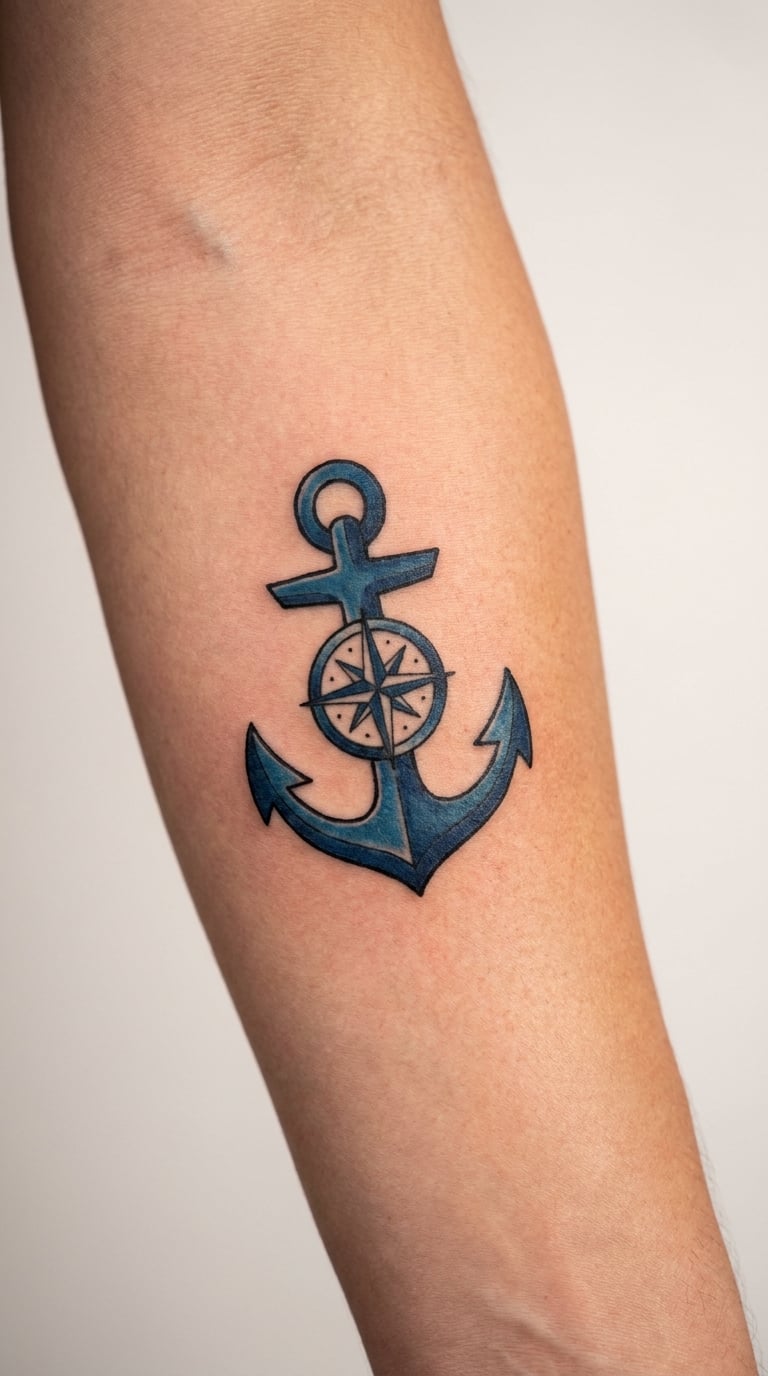
Here the anchor and compass share one composition, with the compass tucked into the curve of the shank so the two shapes lock together instead of sitting side by side. Deep navy blue carries most of the fill, and a black outline keeps it readable against any skin tone.
It is the option for someone who wants a colourful maritime tattoo without going full traditional. Paired symbols also make it a natural candidate for a matching piece with a family member.
Placement: forearm, wrist, or calf. Size: 2.5 to 4.5 inch. Style: illustrative with colour. Pain: medium.
Colour is the maintenance item. Blue reads softer over time than black, and patches need a refresh sooner, so ask for a black keyline around every blue area. Make it yours: let the compass needle point in a real direction that matters to you.
12. Sailor’s Knot
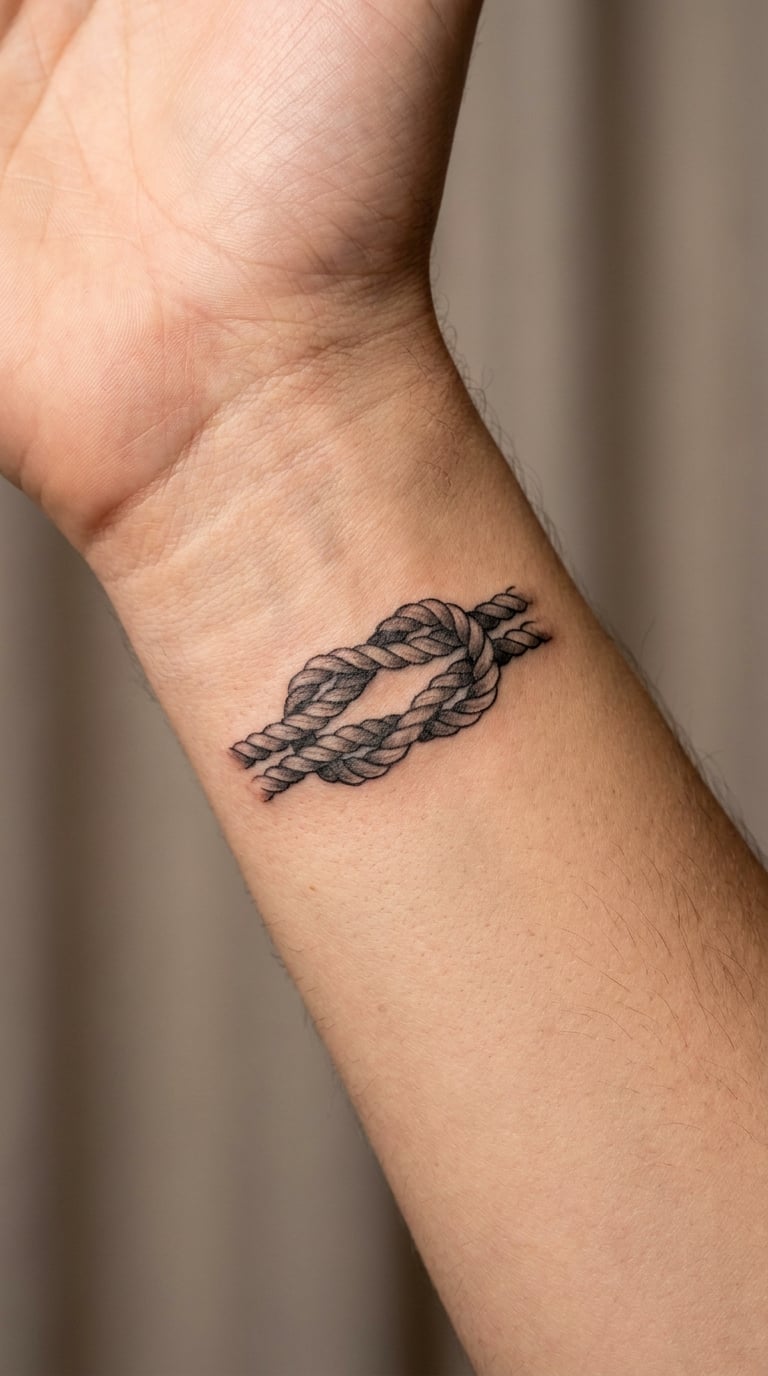
A square or reef knot rendered honestly means showing the twist of the fibres and the shadow where one turn passes over another. Slightly irregular is better than perfectly symmetrical, since real rope never sits flat.
Knots come from seamanship, and most people choose the specific knot they already use for something, a hitch, a bowline, whatever has meaning to them. It is also the least obvious nautical design here, which is a virtue if you would rather not explain yourself.
Placement: wrist, ankle, inner forearm, or behind the ear. Size: 1.5 to 3 inch. Style: fine line realism with light grey. Pain: low to medium.
The fibre texture inside the strands is what fades, so the twist should be readable at arm’s length before you start. Make it yours: pick the knot for what it does, not how it looks in a reference photo.
13. Navy Flag-Inspired Panel
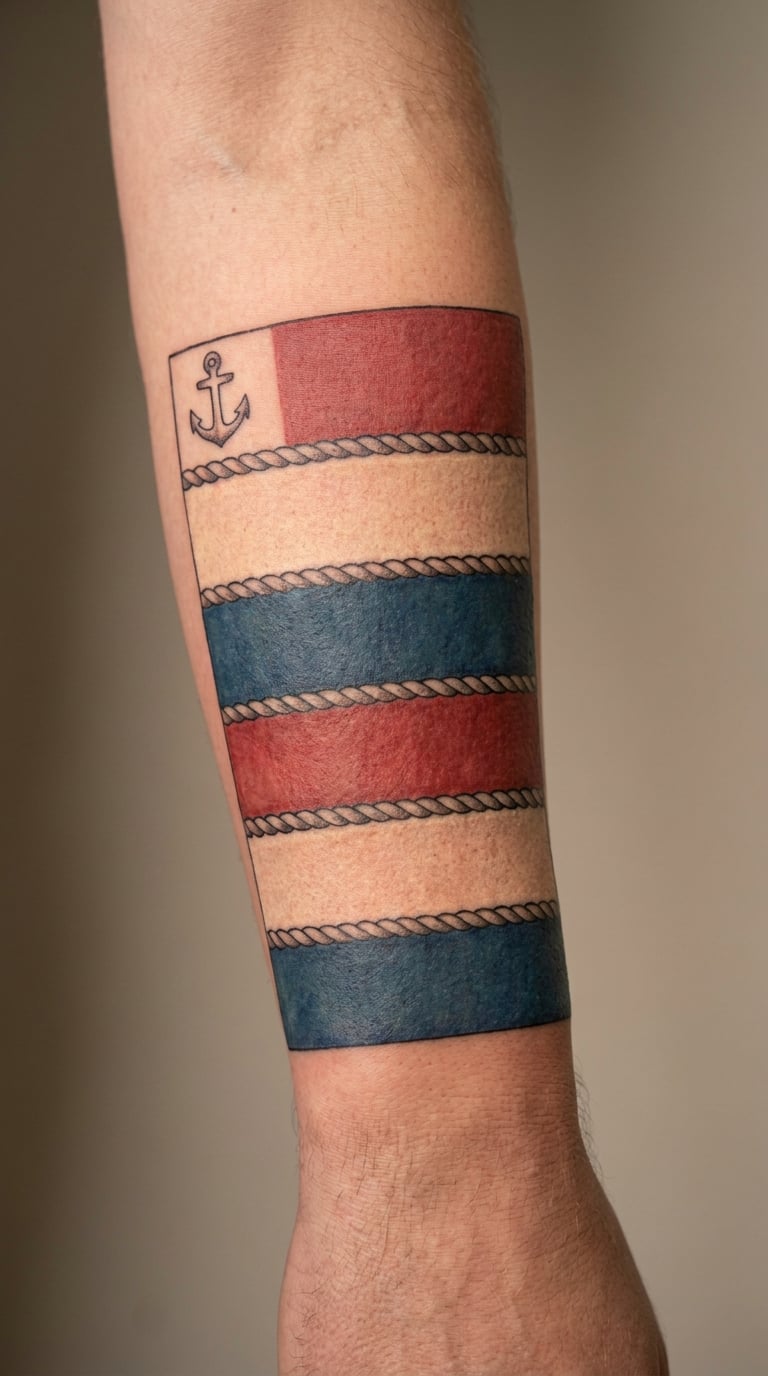
A panel like this borrows the rhythm of a maritime flag, broad stripes divided by rope lines with a small anchor or star set into the negative space. It needs to stay clearly original, so no official emblem and no protected flag layout should be reproduced directly.
It is a commission rather than a flash design, and the consultation matters more than usual. Sailors planning a full arm often build this panel first, then leave the rest of the sleeve breathing room for a second session.
Placement: forearm or upper arm. Size: 6 to 10 inch panel. Style: custom blackwork with traditional accents. Pain: high, and this is a long sitting.
Make it yours: design the stripe count around a number that means something, like years of service or a crew size.
14. Octopus and Ship’s Wheel
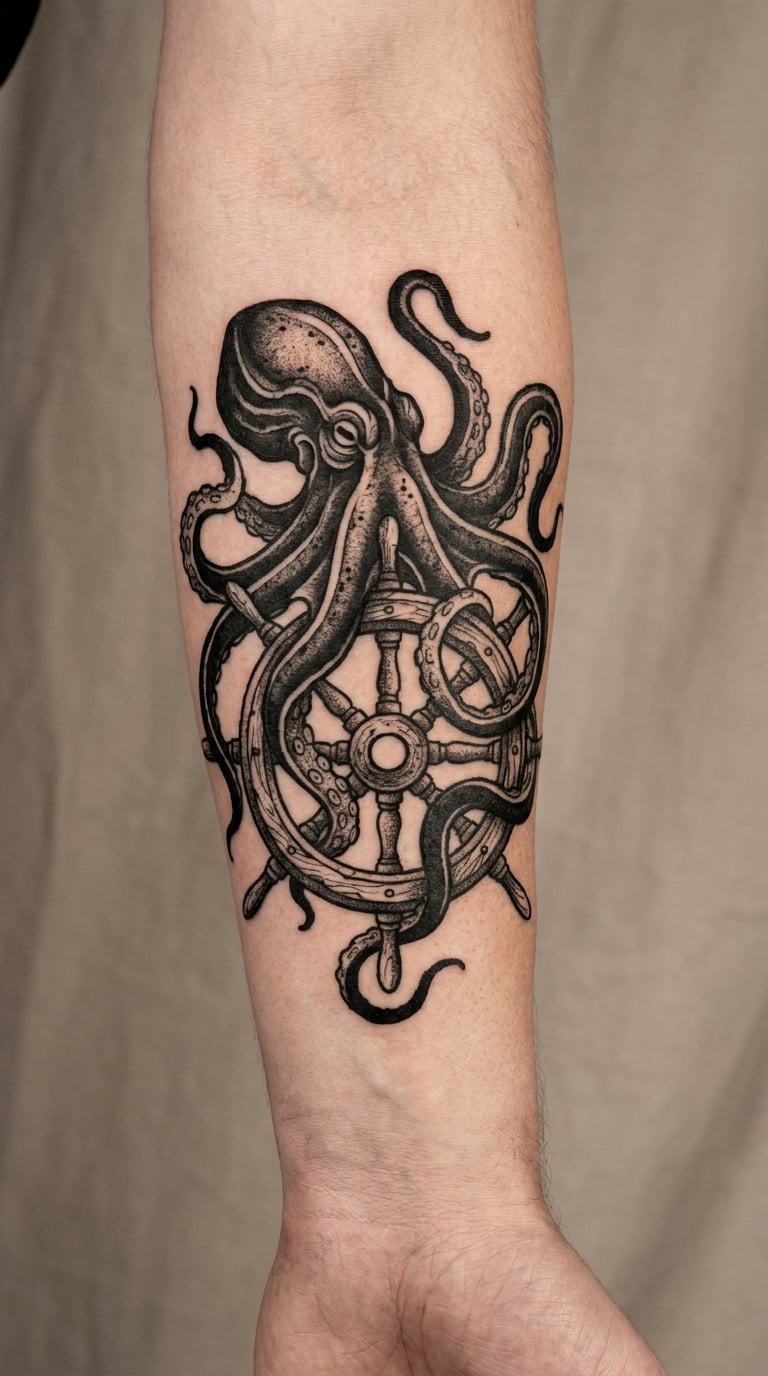
A curling octopus wrapped around a wheel works because both shapes are built from curves. The tentacles should be thick enough to read as solid black ribbons, with a few sucker details left as grey circles, and the wheel stays partly hidden so the pair looks like one creature and one object.
Strength, adaptability and getting a grip on something are the readings people take from it. It is a good choice for someone who likes bold silhouette work more than traditional flash. If the sea life is the part you care about, our 20 coral reef tattoo ideas for ocean lovers stay in the same world with a different palette.
Placement: forearm or calf. Size: 4 to 7 inch. Style: blackwork. Pain: medium.
High-contrast black areas take a while to heal and flake, so plan for a longer aftercare window than a grey piece. Make it yours: have two of the eight tentacles wrap the wheel and let the rest flow into empty space.
15. Watercolour Navy Flag
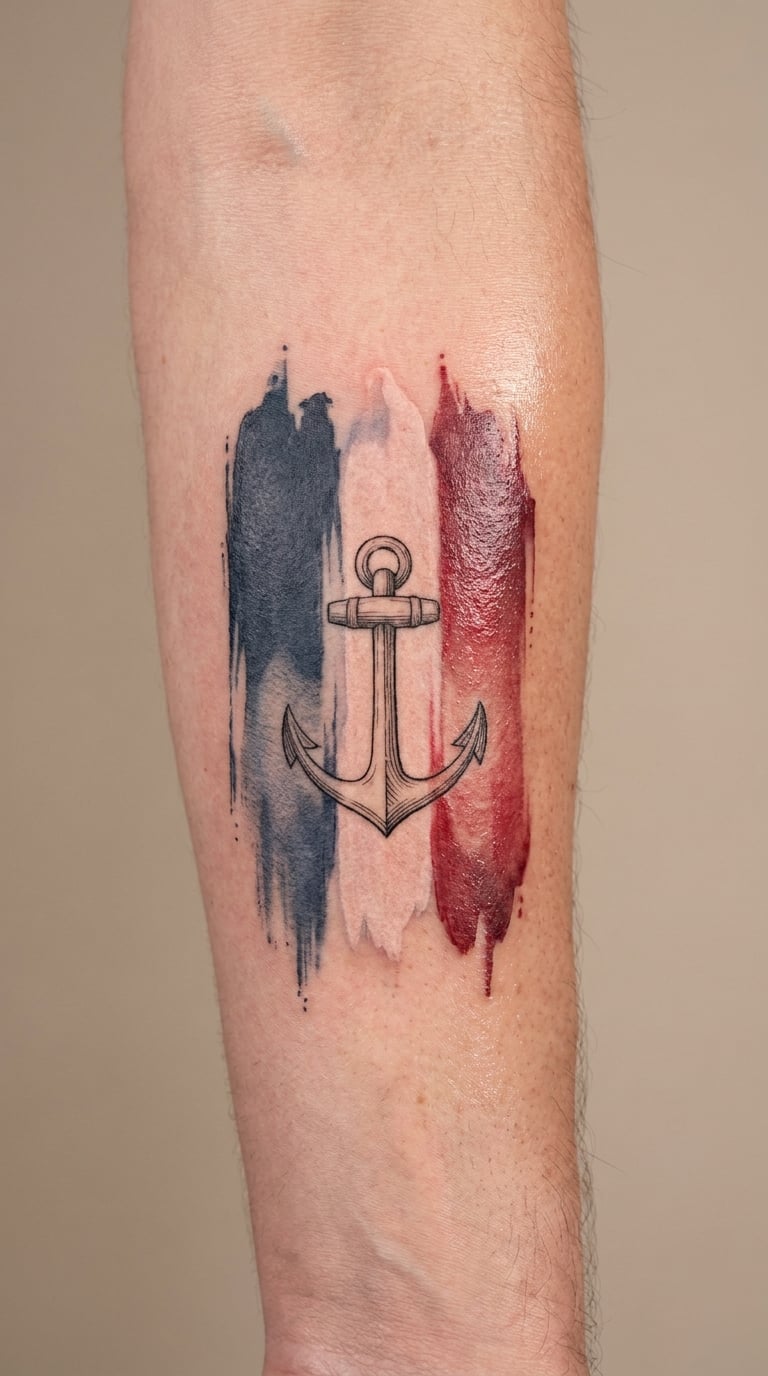
Loose blue, white and red washes with soft, broken edges and one fine-line anchor holding the middle together. Watercolour is about leaving some paper skin visible, so the design works best where there is a flat, reasonably untattooed area to bleed into.
It suits people who like colour without the heaviness of a traditional piece, and it is a surprisingly good match for a memorial design because the softness carries a lot without adding a name and date.
Placement: forearm, calf, or upper arm. Size: 3 to 5 inch. Style: watercolour with fine line. Pain: medium, and there is not much black to sit through.
Watercolour fades faster than people expect, mostly in the lightest washes, so the anchor should be done in solid black and allowed to carry the piece. Make it yours: use the colours of a flag that means something specific rather than a generic red white and blue.
16. Minimal Helm and Wave
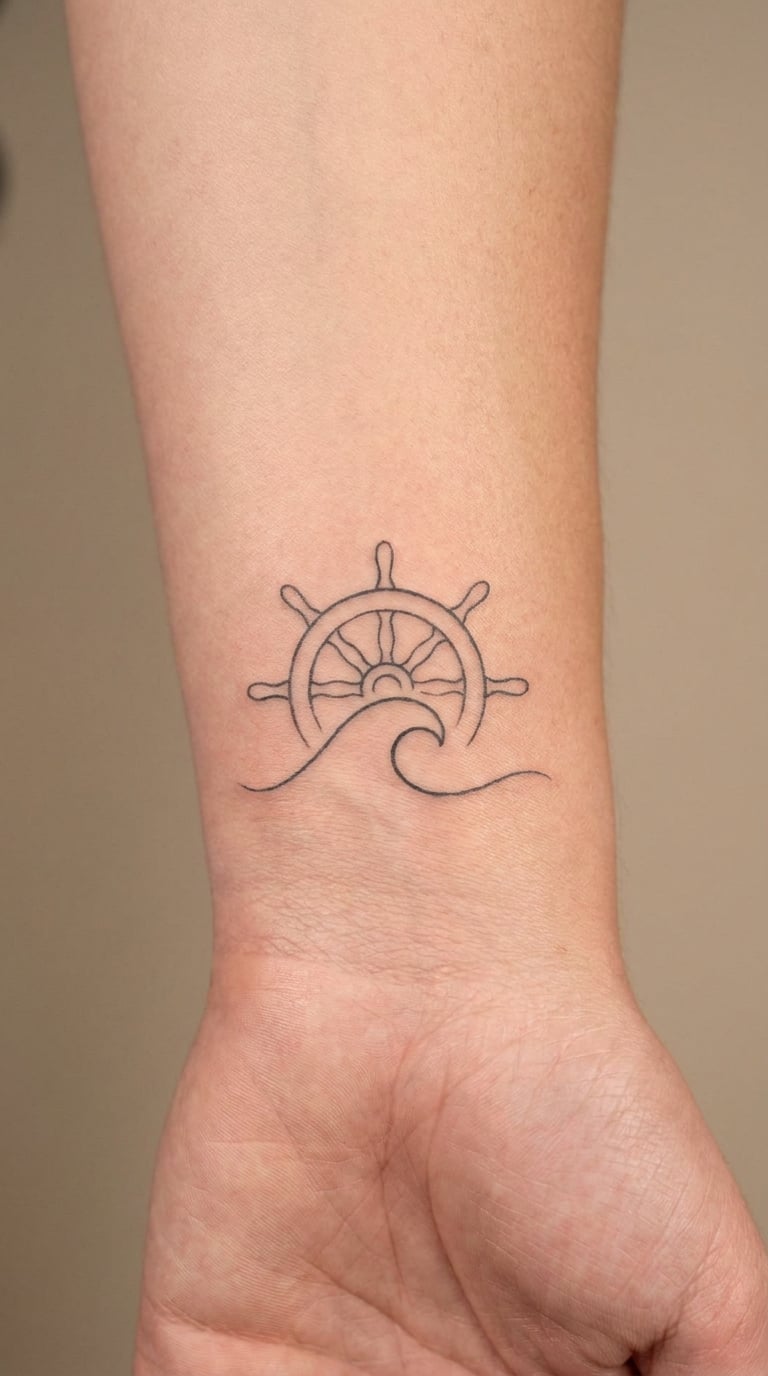
Two or three line weights are all it takes: a simplified helm with six or eight short spokes, a single clean wave underneath, and generous empty skin between them. The negative space is doing most of the work, so resist the urge to add a rope or a banner.
It is a small design for a visible spot, and a good second piece for someone who already has one anchor and does not want a repeat. The proportions matter more than the detail count.
Placement: wrist, ankle, or inner forearm. Size: 1.5 to 3 inch. Style: fine line minimal. Pain: low to medium.
The wrist and ankle are honest places to expect change: the skin moves constantly and fine detail softens faster there than on a forearm. Make it yours: vary the wave so it is one specific, recognisable swell rather than a repeated pattern.
17. Navy Star and Constellation Map
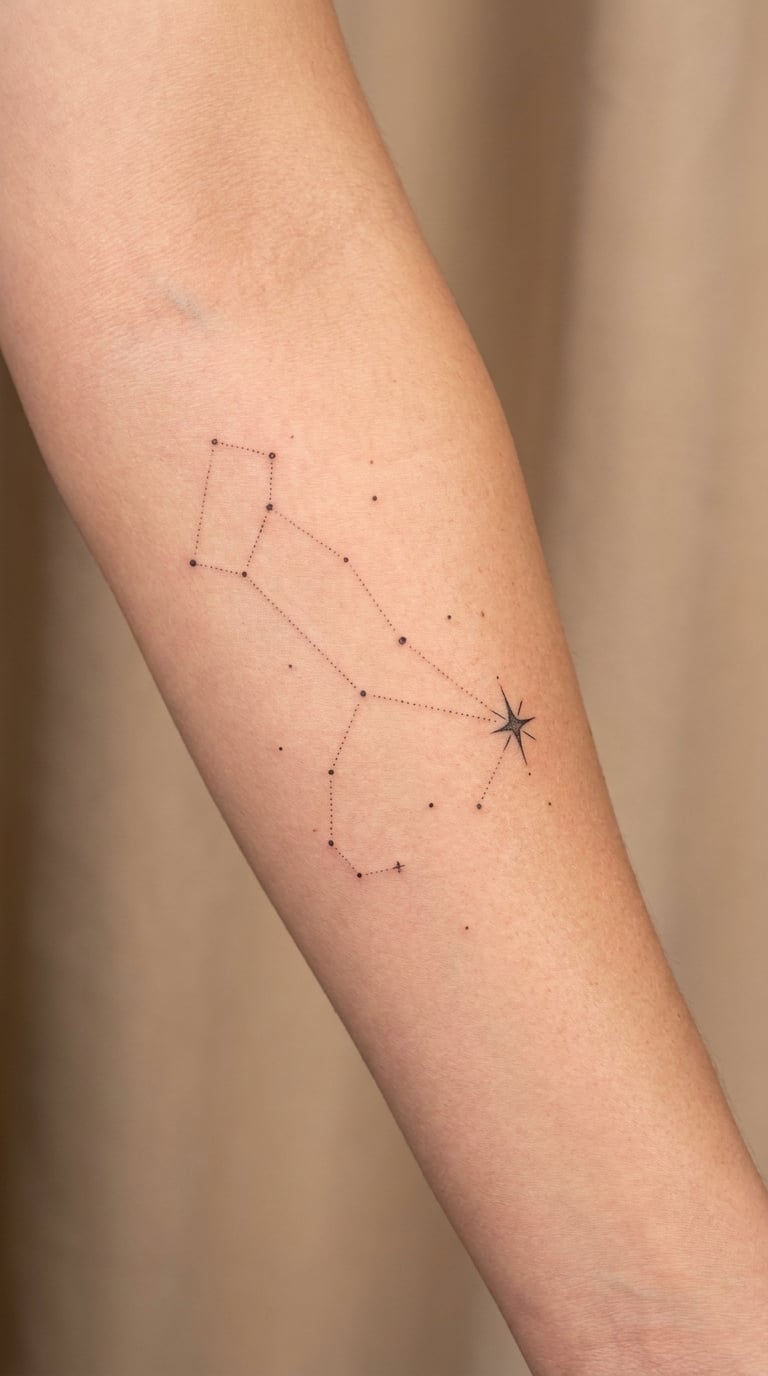
A small map of stars connected by fine straight lines, with one navigational star drawn larger or in solid black, plus a tiny date or coordinate line set in the corner. The star is the anchor of the design, so everything else is thin and quiet.
It works as a record of one voyage, or of a place that matters to you. People with no naval connection still choose it because a star map looks good and reads as direction without explanation.
Placement: forearm, upper arm, or upper back. Size: 2 to 4 inch. Style: fine line with dotwork stars. Pain: medium.
Pinpoint stars and hairline connections blur together over the years, so the dots need to be slightly larger than feels necessary when you approve the drawing. Make it yours: use real coordinates from a voyage you remember.
18. Realistic Vessel at Sea
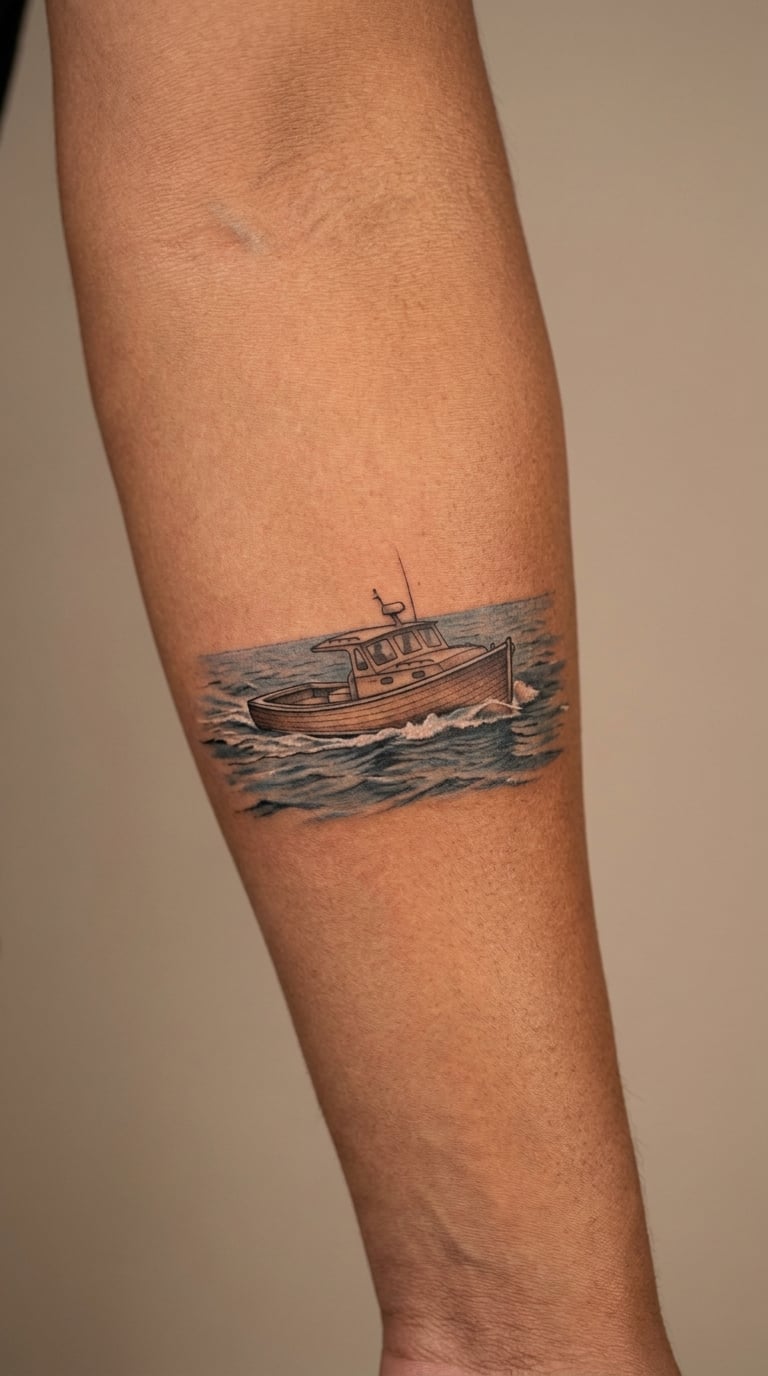
A single vessel in profile on a clean horizon, a wake trailing behind it, and restrained blue-grey water doing the work of a whole ocean. Modern sailors often choose a silhouette of the class they actually served on rather than an age-of-sail ship, which makes the piece personal instead of decorative.
Veterans, serving family members and people who grew up around ports all land here for different reasons. The ship is usually a specific one, and that specificity is the point.
Placement: forearm, calf, or upper arm. Size: 3 to 6 inch long. Style: illustrative realism with grey wash. Pain: medium.
Small vessels turn to a grey blur if the hull lines are too thin, so the profile needs a black keyline. Make it yours: add the hull number under the wake in small caps.
19. Navy Anchor with Laurel
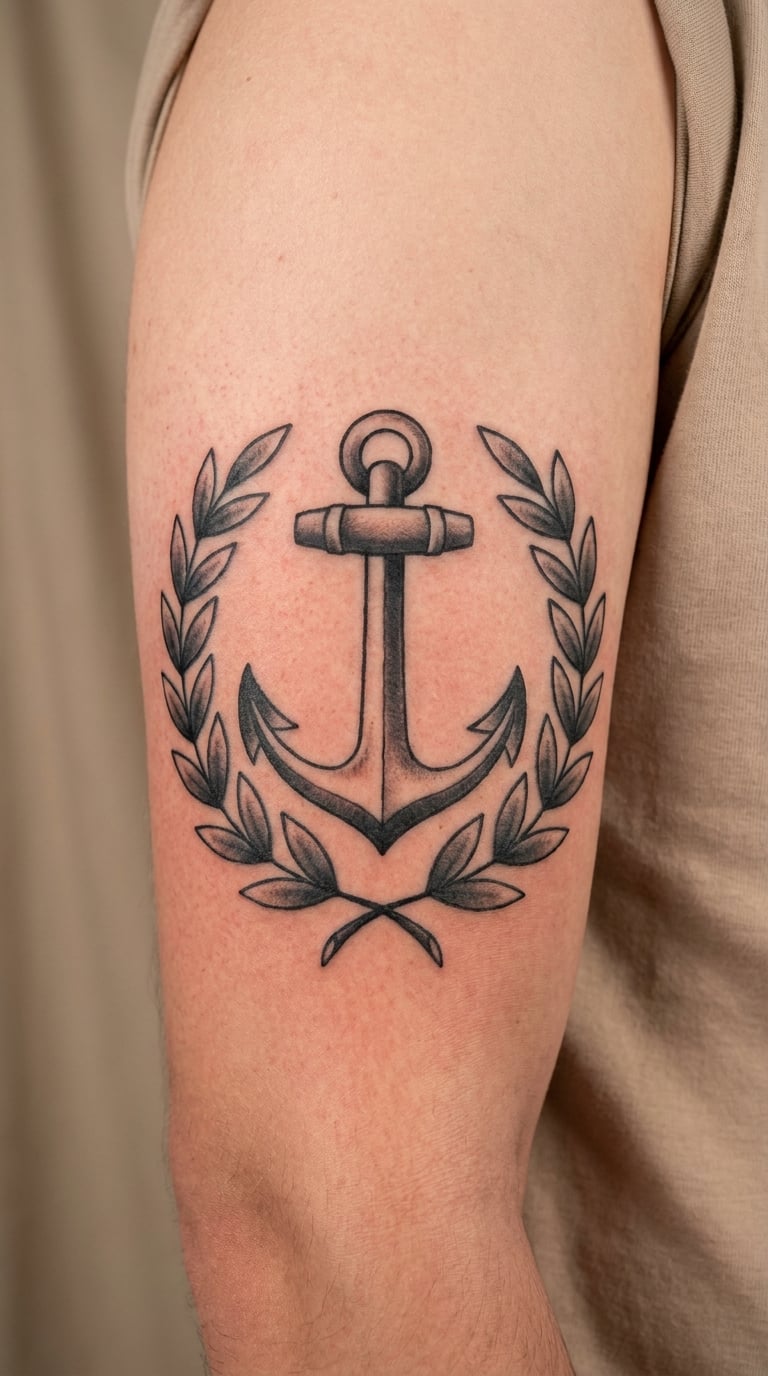
A central anchor framed by two curved laurel branches and a small ribbon underneath. The whole thing has to stay symmetrical without looking machine-made, so the leaves are fewer and larger than you would draw in a botanical study, and the ribbon is a single flowing line rather than a scroll.
Service, achievement and family are the meanings people attach, and it works as a memorial piece when a name goes in the ribbon. Just keep it away from official badge layouts.
Placement: upper arm or chest. Size: 4 to 6 inch. Style: traditional blackwork. Pain: medium.
Leaf edges are the first casualty of time, and the chest is a spot where the design will change shape as the body changes. Make it yours: keep the laurel as the frame and let the ribbon carry the personal part.
20. Blackwork Naval Wave Stack
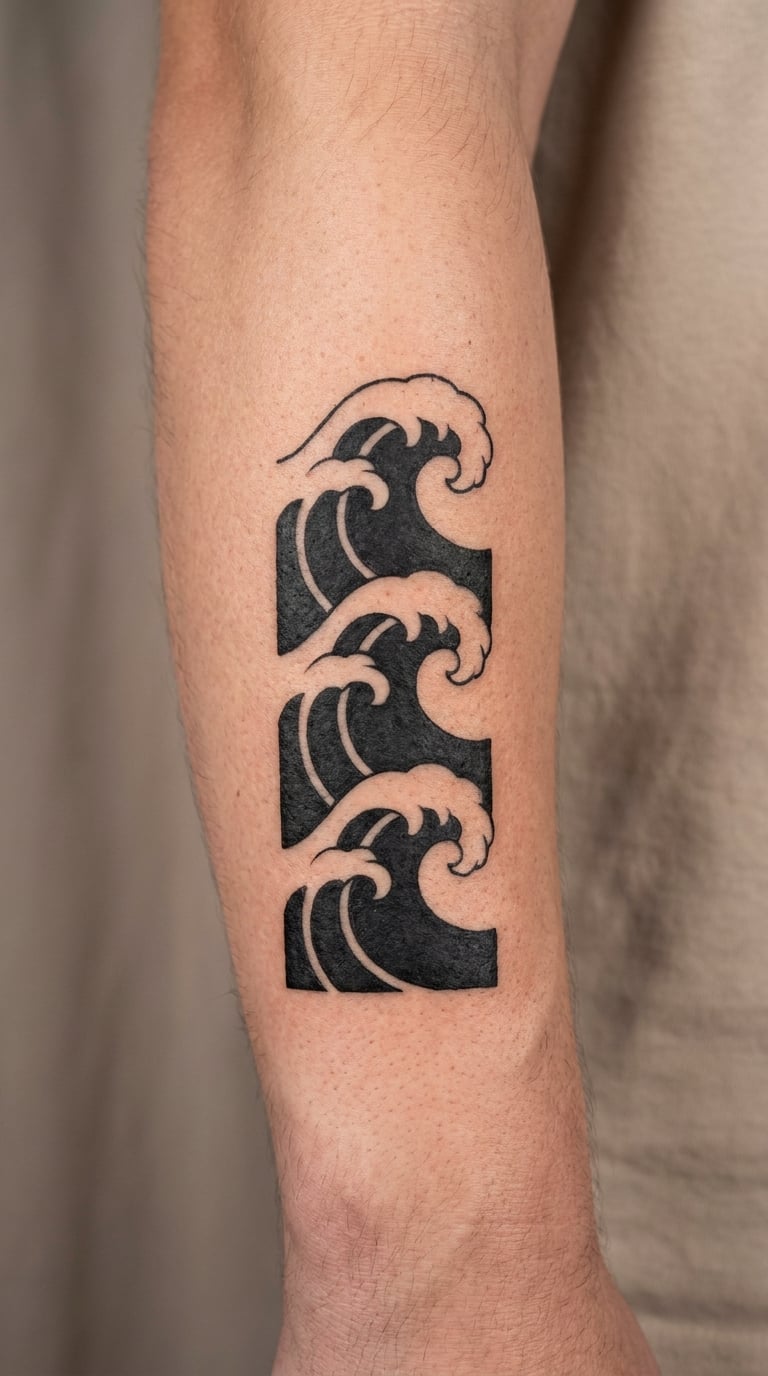
Three stacked waves with solid black fills and a single white negative-space crest cutting across them. That white line is the design, and it has to be drawn boldly or the whole thing turns into a dark block once the skin settles.
It is a good fit for a large flat area, and it works well as the first piece in a blackwork collection that will grow into a sleeve. People who like heavy ink usually recognise it as a nautical piece straight away.
Placement: forearm, calf, or ribs. Size: 4 to 8 inch. Style: blackwork. Pain: medium to high, and solid black filling is more uncomfortable than linework.
Solid black needs more aftercare attention than grey wash and often settles slightly lighter. Make it yours: vary each wave so the stack reads as water moving rather than a repeating pattern.
21. Navy Butterfly and Compass
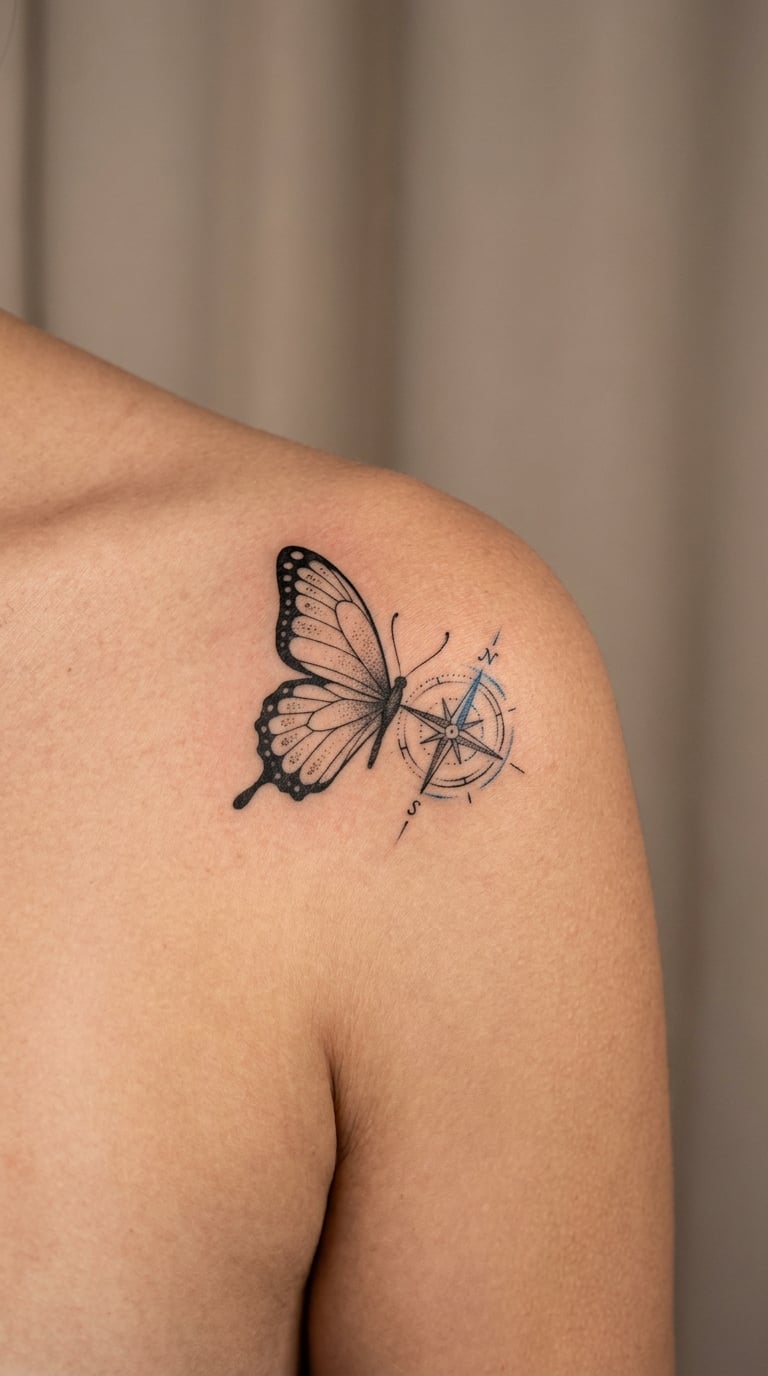
A restrained butterfly with open wings, symmetrical linework, and a small compass beneath it carrying the only blue in the design. The wings should be simple shapes with a light vein pattern, and the compass needs to be small enough that it does not fight the insect above it.
Transformation, direction and a personal change of course are the readings, offered as interpretation rather than a fixed rule. It is a design plenty of people with no naval background choose because it is about change rather than service.
Placement: shoulder, upper back, forearm, or calf. Size: 2.5 to 5 inch. Style: blackwork with one colour accent. Pain: medium, higher on the shoulder where the skin is thick over bone.
Make it yours: point the compass needle in the direction of wherever you are actually going next.
22. Full-Sleeve Nautical Story
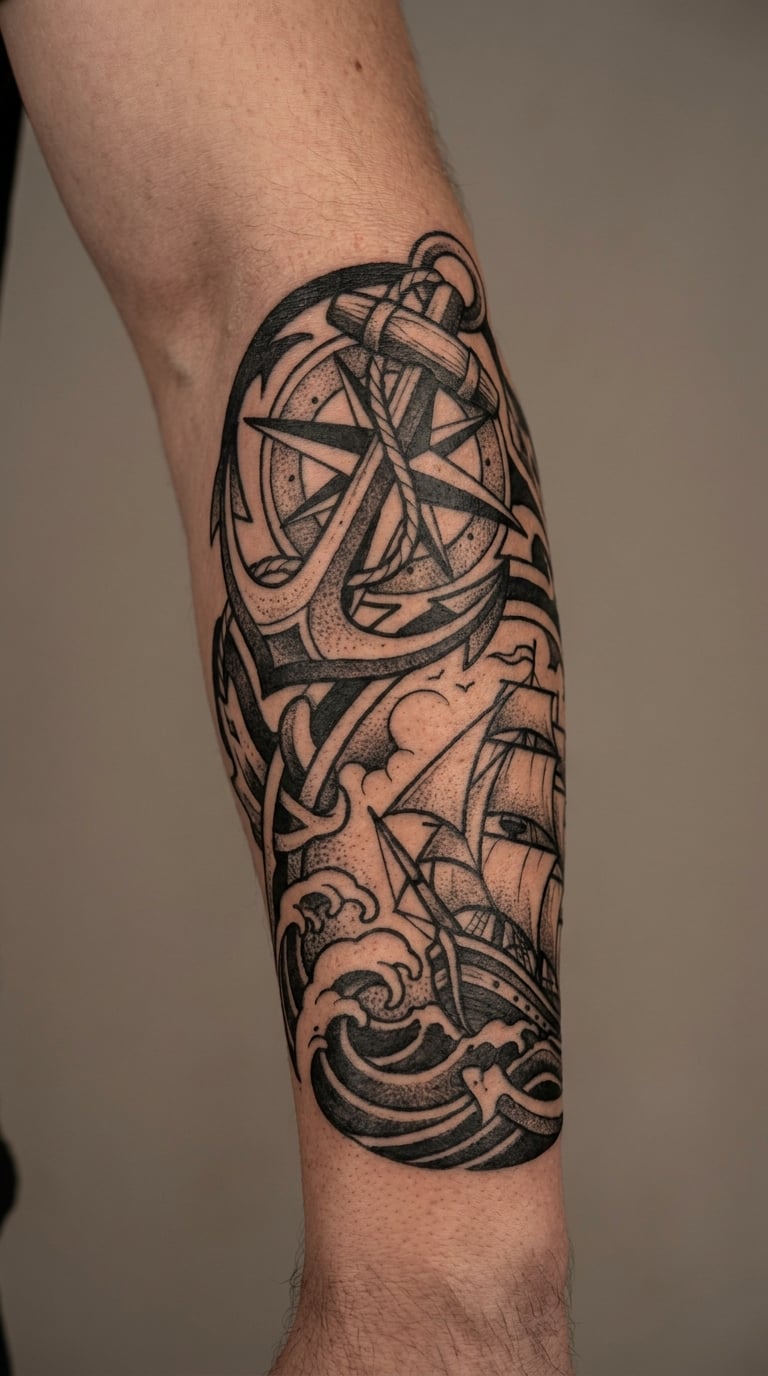
A full nautical sleeve tells a story in order along the arm: waves near the elbow, an anchor or a wheel at the centre, a compass and a vessel carrying the eye toward the shoulder, and negative space between each element so nothing is crowded. The composition has to flow with the shape of the arm, which is why it cannot be copied from a flash sheet.
This is the one to plan properly. Bring references for every element, expect a stencil review before the first sitting, and assume several sessions rather than one long day. If you are still deciding between a full sleeve and a single large piece, our 20 best ocean sleeve tattoo ideas for stunning arms shows how the same water motifs work at both scales.
Placement: full forearm, or forearm and upper arm. Size: 8 to 16 inch of coverage. Style: custom blackwork with selective colour. Pain: high across multiple sessions, and the elbow and inner bicep are the roughest ground.
No official insignia should appear anywhere in a piece this size, and the artist will want to redraw anything that resembles one. Make it yours: decide the reading order in advance, so the sleeve has a beginning and an end rather than a pile of nautical symbols.
How to Choose the Right Design
Match the style to the size
Decide the size first, then pick a style that fits inside it. Filled black, shading and colour need real estate, while a small piece lives or dies on a clean silhouette. A 3 inch anchor done as solid black works. A 3 inch anchor done as fine grey-shaded realism turns to mush.
Pick placement by how the skin moves
Forearm and calf give you flat, forgiving surfaces. Wrists, ankles and inner arms move constantly, so fine detail there will soften faster and change shape. Ribs and collarbones are the ones people regret, usually because the design distorts as breathing and posture shift.
Ask about your navy tattoo ideas before the first sitting
Bring your reference images to the consultation and talk through line weight, colour saturation and originality. Ask to see healed work, not just fresh photographs taken the same week. For any custom emblem, ask the artist directly how they will make it distinct from an official badge.
Think about longevity before colour
Black holds its shape longest, blue fades before black, and watercolour fades before both. If you want colour, ask the artist to build the design so the black keyline still reads on its own once the colour has softened.
Have a reason for the size
A first tattoo that is 1.5 inch and placed quietly is much easier to live with than a 6 inch piece on the forearm. If you are active duty, check your command’s current grooming standards and talk to your leading chief before booking anything near the neck, hands or face. Policies change, so go to the source rather than a forum answer.
Cost and Session Time
Shop rates vary more than people expect, so treat these as ballpark figures for US studios in 2026 rather than a quote. A small single-symbol navy tattoo, roughly 1 to 3 inch and done in solid black, usually lands between 80 and 250 US dollars. Medium pieces from 3 to 6 inch, with shading or a second symbol, tend to run 300 to 900.
Large illustrative work, the lighthouse scene or the insignia panel at 6 inch and above, generally falls between 900 and 2500 and regularly needs two sittings. Watercolour and anything with fine realistic detail sit at the slower end because the shading pass is long.
A full nautical sleeve is a different project entirely, commonly 2000 to 6000 US dollars or more, spread across four to eight sessions depending on how much detail you want. Most simple pieces take one sitting, a detailed design two or three, and a sleeve needs a break every few hours whether you want one or not.
What actually moves the number: the artist’s hourly rate, the shop minimum, your city, the size, how much black you are asking for, and whether you need a cover-up or a colour correction first. Travel adds to it if the good naval work is three hours away, which is normal near a smaller Navy port.
Aftercare Basics
Follow your artist’s aftercare instructions first. They know what they did in your session, and general advice cannot account for that.
Then keep the basics straight: wash the area gently with clean water and unscented soap as directed, pat it dry rather than rubbing it, and protect it from sunlight and friction for as long as you were told to. Avoid swimming, hot tubs and saunas while the skin is still healing, since salt and chlorine are hard on fresh ink. Moisturise only as often as you were instructed, and only with a product your artist approves.
Watch it rather than fussing with it. If something looks wrong, photo it and message your artist before you reach for a treatment or a cover-up. Fresh tattoos flake, itch and look uneven for a while, and that is normal. The one thing worth doing is booking a free check-in if your artist offers one, so a small issue does not turn into a big one.
Frequently Asked Questions
What are the most common navy tattoos?
The anchor comes first for most people, followed by the compass rose, the nautical star, the ship’s wheel and the swallow. Traditional sailors also get the fully rigged ship, rope on the wrist and the shellback turtle, while family members tend to ask for a single symbol with a date or a name rather than a full traditional composition. Modern designs lean toward ship silhouettes, coordinates and memorial pieces instead of classic flash.
What is the best small navy tattoo for a first piece?
A minimal line-work anchor or a small compass rose in the 1.5 to 3 inch range is the easiest first tattoo to live with. Both read clearly at that size, need no shading, and sit well on an inner forearm, wrist or behind the ear. Avoid anything with more than one colour or a rope texture at that scale, since the detail will soften faster than the outline.
Which navy tattoo placements hurt the least?
The upper outer arm, the calf, the back of the shoulder and the forearm above the elbow are the calmest spots. Wrist, ankle, ribs, collarbone and inner bicep sting considerably more because the skin is thin, bony or constantly moving. Behind the ear and the armpit often register more as an insistent tickle than as sharp pain, though the armpit swells noticeably afterwards.
Are military tattoos appropriate if I never served?
Nothing stops you wearing a nautical tattoo without naval service, and plenty of people do. What matters is not claiming something you did not earn, so keep the design away from official rank and unit insignia. If you served, your shipmates will know the difference between a loving design and a costume, and a small personal detail inside the piece settles the question quickly.
How long does a detailed navy tattoo take to age?
Solid black line work holds its shape well for decades with reasonable care. Fine single-weight lines, tiny star dots, rope fibre texture and small interior shading soften noticeably within about five years. Blue fades before black, and watercolour fades before both, so a colour piece usually wants a refresh sooner than a black one.
Can I match a navy tattoo with a family member?
Matching works best when you agree on the symbol and the style, not the exact placement. A small anchor on an inner forearm, a compass on a wrist, or a knot behind the ear can each carry the same design at a scale that suits both of you. Full-sleeve matching is a much bigger project and needs a lot of planning, so keep matching to a single symbol if one of you is a first-time tattooer.
If this is your first tattoo, take number 2, the minimal line-work anchor, or number 16, the minimal helm and wave, and place it somewhere quiet. You will live with it a long time and the small ones are the ones people never regret.
Already building a collection? Number 20, the blackwork wave stack, and number 3, the compass rose, are the two that grow into a bigger piece without looking bolted on later. Whatever you pick, take the drawing to an artist who works in that style every week and ask to see healed work before you commit.