
20 Best Lace Tattoo Ideas for Women: Stunning October 2026
Lace tattoo ideas for women come down to one thing: the design has to leave skin showing between the lines. Real lace reads through its gaps, so the pattern works best when the spaces stay open rather than filling in.
That makes lace unusual among tattoo styles. A floral piece can be heavy or airy, a serpent can be thick or thin, but lace either breathes or it turns into a grey patch. Below are 20 designs, each with the placement, realistic size, style and pain level, so you can hand an artist something more useful than a screenshot.
Booking runs ahead. If you are planning a wedding, a milestone birthday or an autumn trip, most people pick a date roughly 30 to 45 days out, and that gives you time to find a fine-line specialist rather than settling for whoever has a slot open.
Lace Tattoo Ideas for Women: Quick Guide
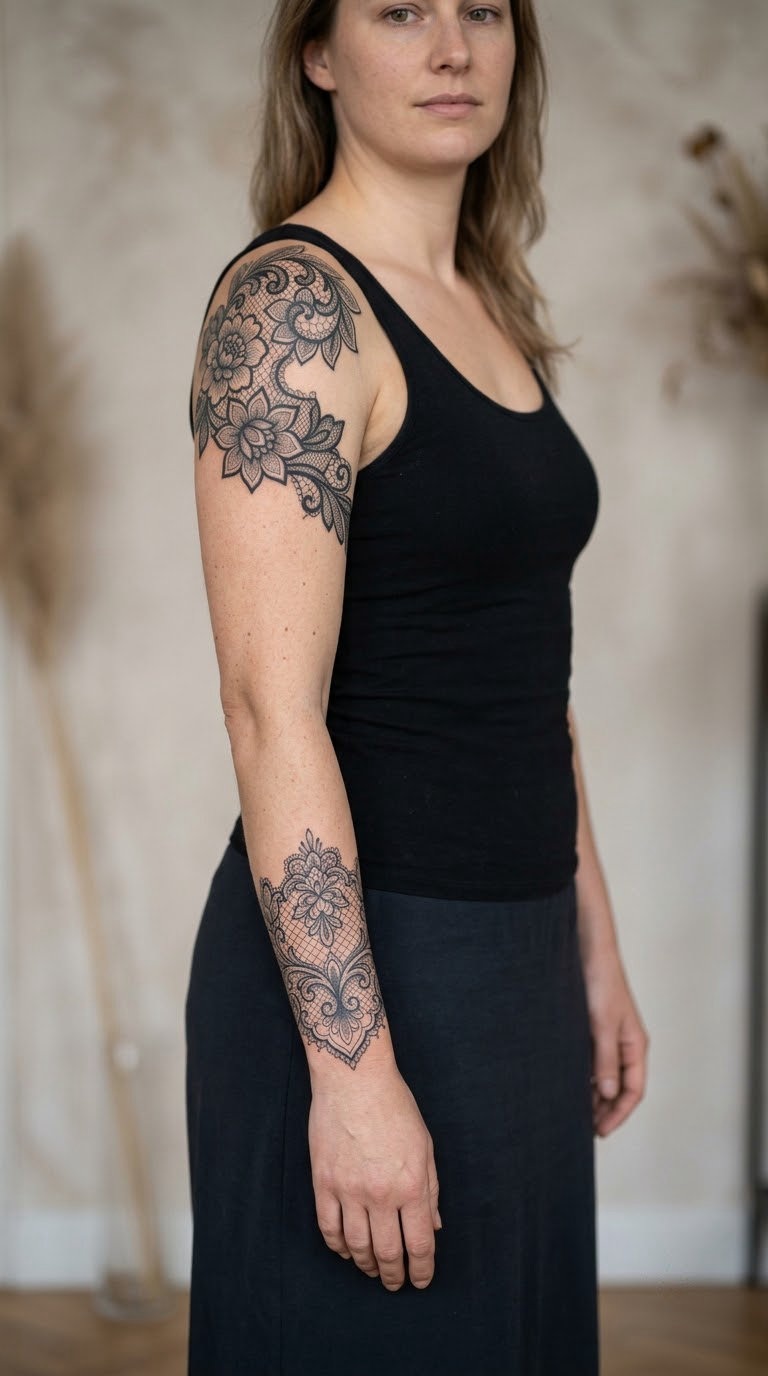
Twenty distinct lace designs, ordered exactly as the sections below, with the numbers you would expect from a real appointment. Sizes are finished-healed dimensions, not stencil dimensions.
| Idea | Style | Best placement | Size | Pain |
|---|---|---|---|---|
| 1. Lace bralette | Fine line | Collarbone, upper chest | 3 to 4 in (8 to 10 cm) | Medium |
| 2. Corset panel | Blackwork | Side ribs, outer thigh | 5 to 7 in (13 to 18 cm) | High |
| 3. Camellia brace | Illustrative | Upper chest, collarbone | 2.5 to 3 in (6 to 8 cm) | Medium |
| 4. Geometric back piece | Geometric blackwork | Upper or mid back | 6 to 9 in (15 to 23 cm) | Medium to high |
| 5. Lace butterfly | Fine line and dotwork | Outer shoulder | 3.5 to 4.5 in (9 to 11 cm) | High |
| 6. Watercolor fan | Watercolor | Inner forearm, thigh | 3 to 4 in (8 to 10 cm) | Low to medium |
| 7. Lace choker | Fine line | Front of neck, wrist | 3 in across (8 cm) | High |
| 8. Vintage glove detail | Vintage illustrative | Back of hand, wrist | 2.5 to 3 in (6 to 8 cm) | High |
| 9. Lace mandala | Fine line and dotwork | Inner forearm, calf | 4 in across (10 cm) | Medium |
| 10. Peony wrist piece | Fine line illustrative | Inner wrist | 2 in across (5 cm) | Medium |
| 11. Thorn rose | Blackwork illustrative | Outer upper arm, calf | 3 to 4 in (8 to 10 cm) | Medium |
| 12. Garter outline | Fine line | Upper thigh | 4 to 5 in (10 to 13 cm) | Medium |
| 13. Spiderweb ankle | Dotwork fine line | Ankle, top of foot | 2.5 in across (6 cm) | High |
| 14. Heart lockup | Fine line and dotwork | Inner forearm, thigh | 2.5 in tall (6 cm) | Low to medium |
| 15. Fan collar | Illustrative | Centered chest, upper back | 4 to 5 in wide (10 to 13 cm) | Medium to high |
| 16. Serpent coil | Blackwork | Outer forearm, calf | 4 to 5 in (10 to 13 cm) | Medium |
| 17. Bridal veil | Fine line illustrative | Shoulder, nape, back | 3.5 in wide (9 cm) | Medium |
| 18. Abstract butterfly | Fine line abstract | Behind ear, inner arm | 2 in wide (5 cm) | Low to medium |
| 19. Sternum panel | Fine line | Sternum, underbust | 5 in long (13 cm) | High |
| 20. Blackwork sleeve accent | Blackwork | Upper arm, thigh | 7 to 9 in (18 to 23 cm) | High |
1. Fine-Line Lace Bralette Collarbone Tattoo
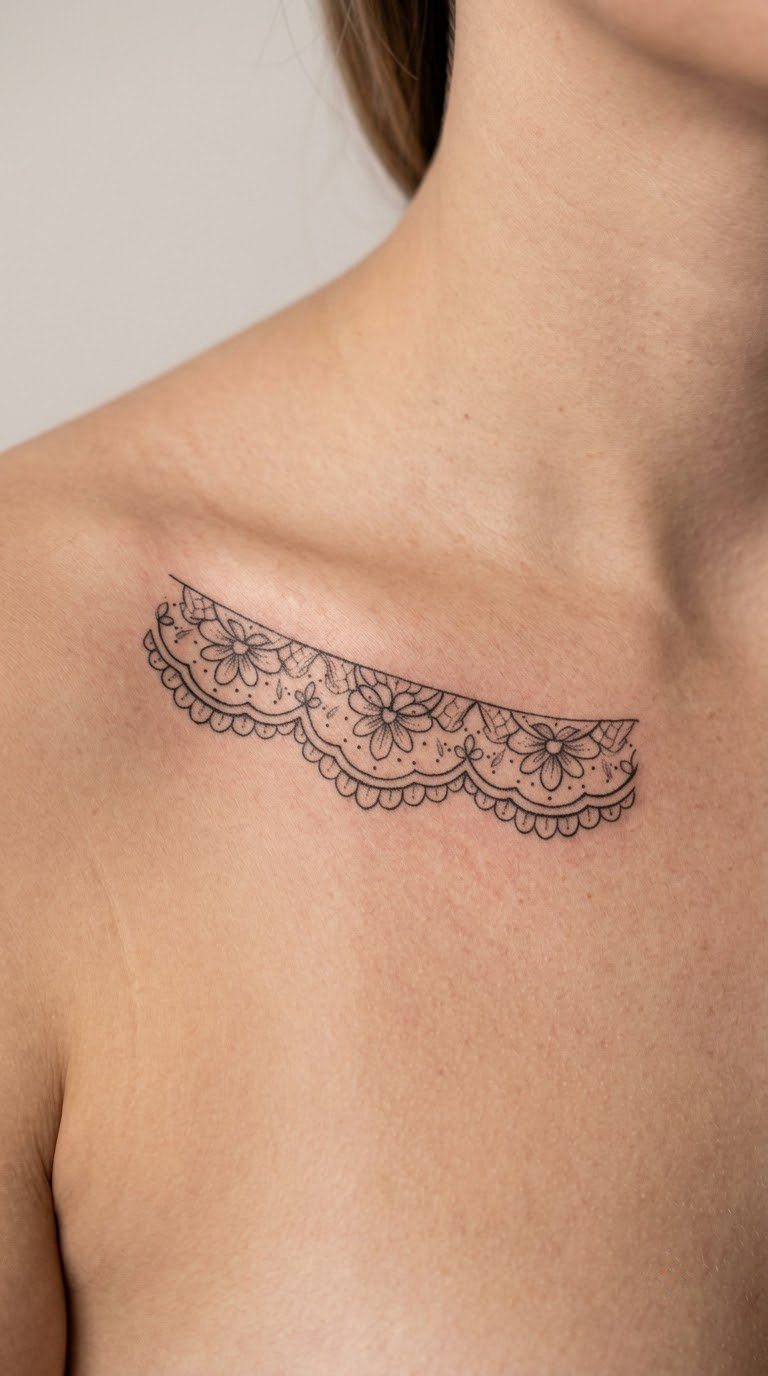
A bralette lace tattoo is two soft triangular shapes of scalloped edging joined by a thin strap line, sitting neatly between the collarbones. The lines are deliberately thin, roughly 0.5 mm, with tiny dots and short petal strokes filling the open spaces without closing them.
People choose it for the shape of it. A lace bralette follows the natural line of the collarbone, so it looks placed rather than parked there. If you want the wider context for that delicate line weight, our roundup of 18 best fine-line tattoo ideas for women (October 2026) covers the neighbouring styles that hold up just as well.
Placement: centered between the collarbones, or offset over one shoulder near the joint.
Size: 3 to 4 inches (8 to 10 cm) across.
Style: fine line, with light dotwork in the open areas.
Pain: medium. Bone sits close under the skin here, and a collarbone reads more strongly than a rib. Expect the linework to look crisper after healing.
Make it yours: add a single initial in the center of the band, worked in at the same line weight.
2. Blackwork Lace Corset Panel
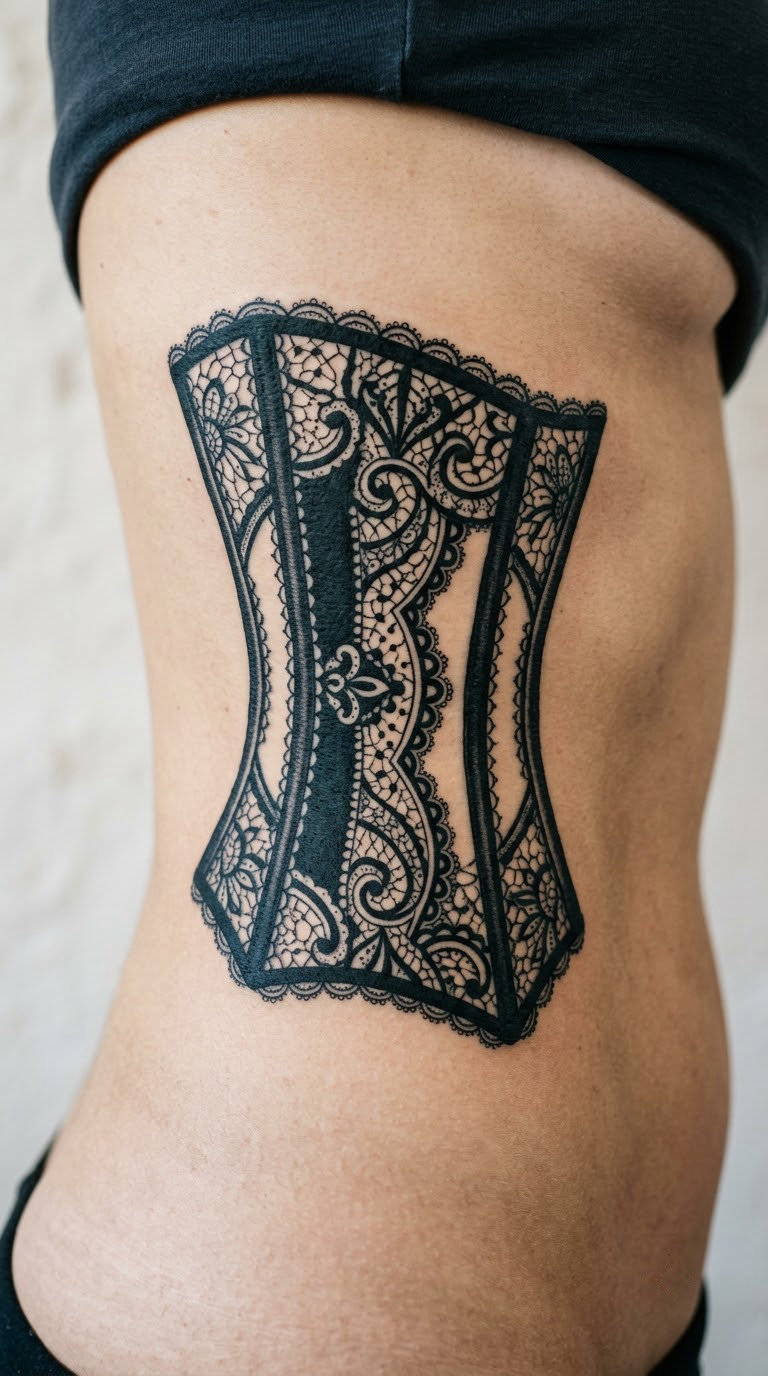
This one runs opposite to most lace work. Instead of thin lines on open skin, a corset panel is built from dense black fill, and the lace is the negative space cut out of that black. The result is high contrast, and it reads clearly from across a room.
It suits someone who likes lace but does not want a delicate-looking piece. The boning lines and eyelets give it structure rather than softness.
Placement: side ribs running diagonally toward the hip, or vertically on the outer thigh.
Size: 5 to 7 inches (13 to 18 cm) tall.
Style: blackwork with lace cutouts.
Pain: high. Ribs are thin skin over bone, and this design covers a wide area, so plan on a long sitting with breaks.
Make it yours: add a lacing detail at the top that ties into a real bow-and-lace motif from a wedding dress or a grandmother’s clothing.
3. Floral Lace Camellia Brace Tattoo
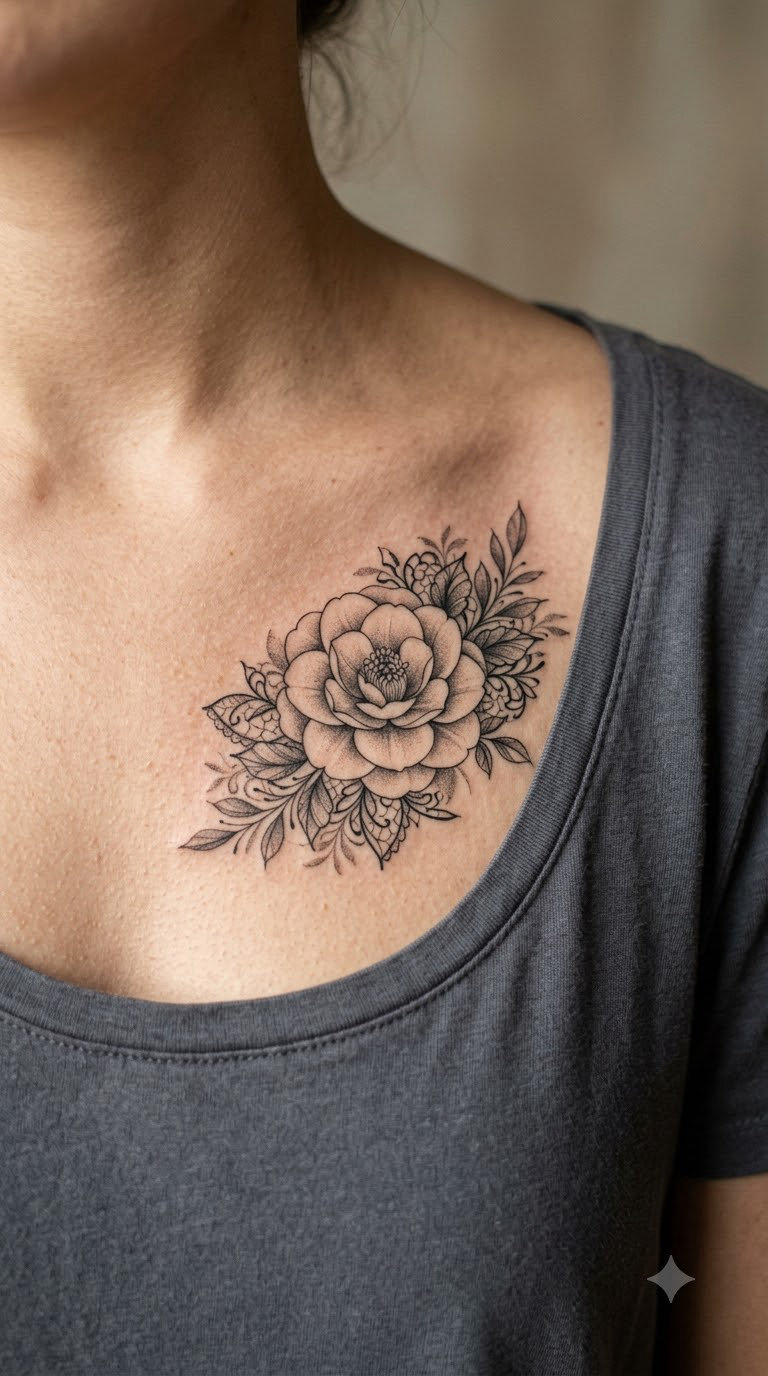
A camellia is drawn as layered rounded petals with a small cluster of stamens in the middle, and the lace enters as a halo of tiny leaves and dotted netting around it. The flower is soft and shaded, the netting is precise, and the contrast between the two is what makes the piece work.
Botanical pieces get chosen for how personal they feel rather than for a fixed meaning. A specific bloom often carries a private association that only you know.
Placement: upper chest just below the collarbone, or on the shoulder blade.
Size: 2.5 to 3 inches (6 to 8 cm) wide.
Style: illustrative black and grey with fine-line netting.
Pain: medium. The upper chest is sensitive but the session is short.
Make it yours: pick a bloom tied to a date or a place, or repeat the same camellia in a smaller size somewhere else later.
4. Geometric Lace Back Piece
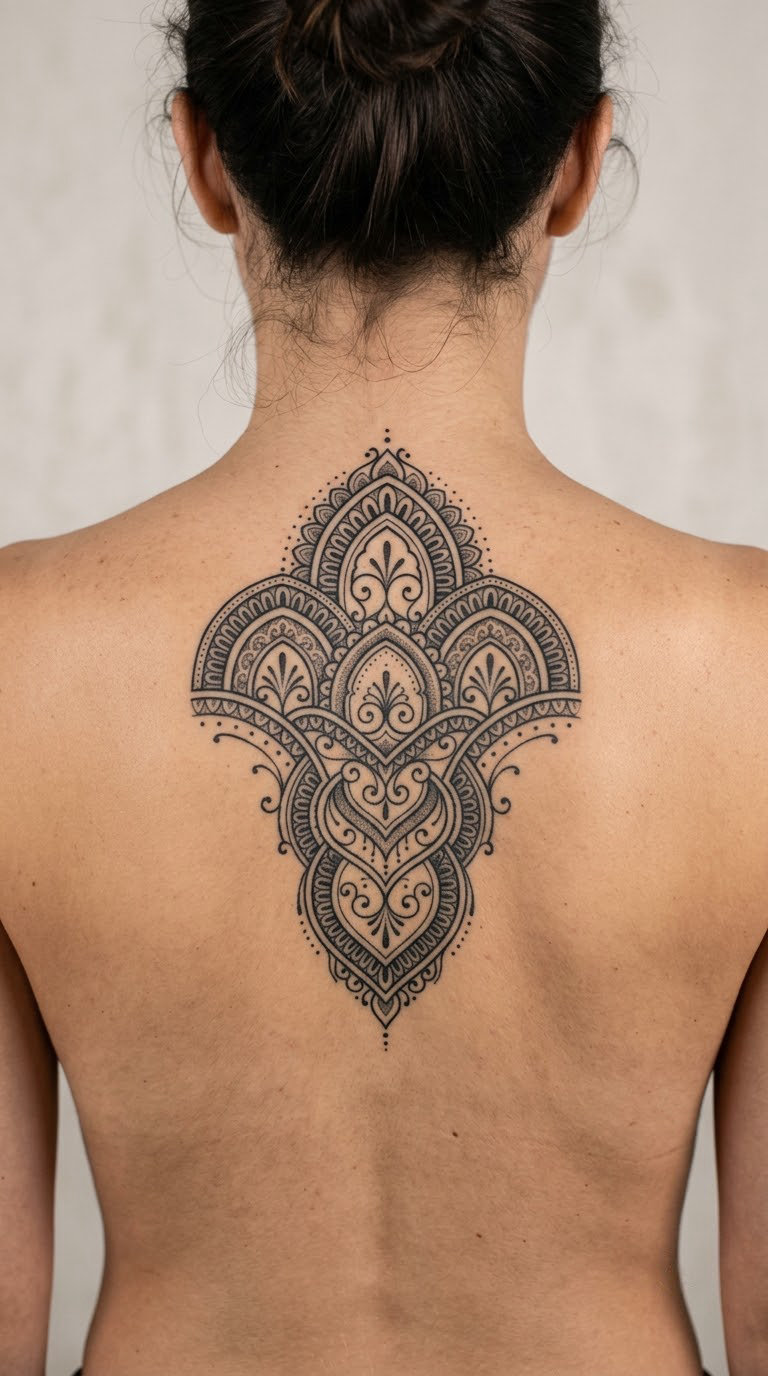
This design borrows from lace-making itself. Straight ruled lines cross at fixed intervals, repeated arches stack into fan shapes, and a small amount of shading sits inside selected sections so the eye still finds open skin. Symmetry down the spine does most of the heavy lifting.
It works well on a back because there is a wide flat surface to hold the geometry, and a symmetrical pattern hides small imperfections well once healed.
Placement: centred on the upper back between the shoulder blades, or across the mid back.
Size: 6 to 9 inches (15 to 23 cm) wide.
Style: geometric blackwork with selective shading.
Pain: medium to high. Upper back skin is thick and forgiving, but the scale means a multi-hour sitting.
Make it yours: change the arch count to match a meaningful number, or add a single flower at the base for a softer finish.
5. Lace Butterfly Shoulder Tattoo
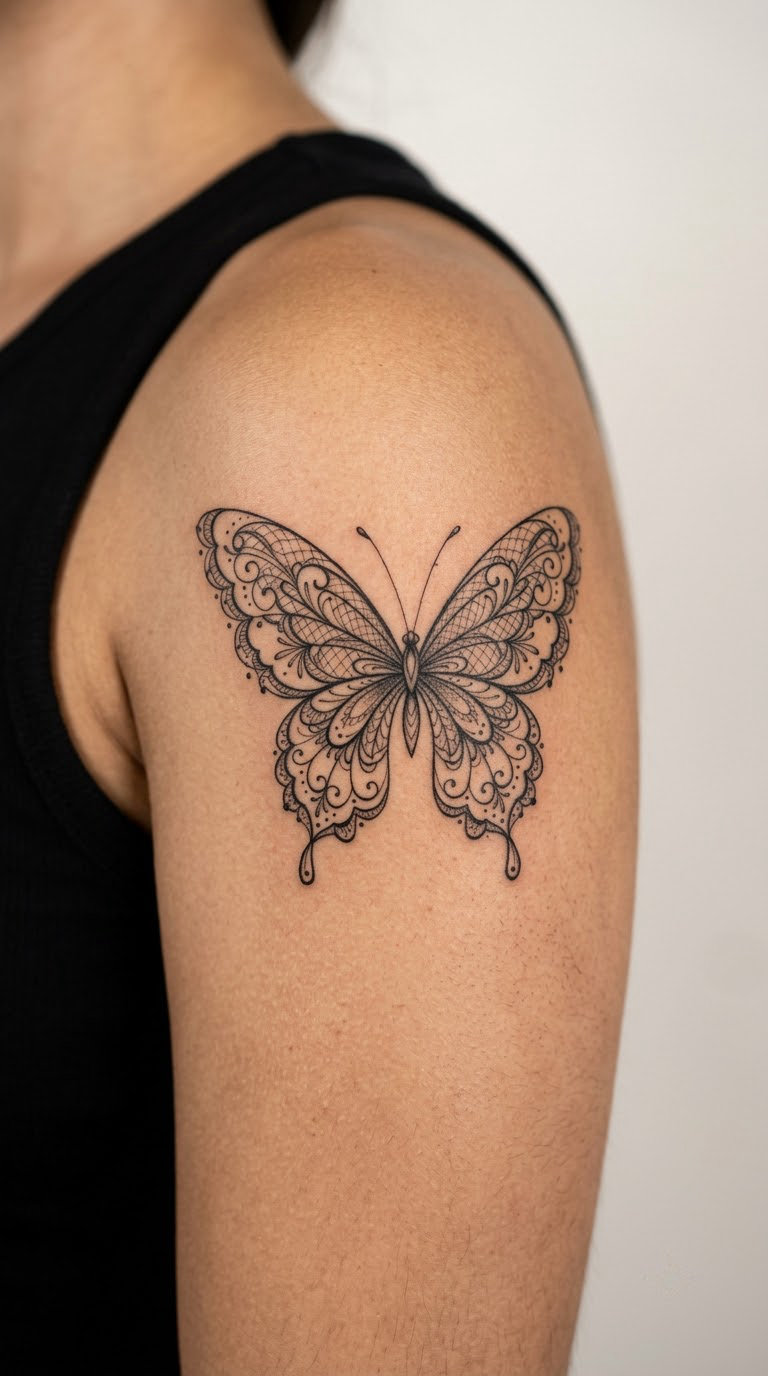
Here the butterfly’s wings are built from loops of line that look like lace edging, with a scalloped lower edge and a scatter of dots between the loops. The body stays simple, a single tapered line, so the eye goes to the wing pattern instead.
Butterflies are a common pick and people usually have their own reason for it, a change, a return, a person. Plenty of wearers also add the wing shape to an existing piece later.
Placement: outer shoulder over the deltoid, angled so the wings follow the shoulder slope.
Size: 3.5 to 4.5 inches (9 to 11 cm) wide.
Style: fine line with dotwork detail.
Pain: high. The shoulder has thin skin over a rounded bone and every stroke registers. Take breaks before fatigue turns into flinching.
Make it yours: use two muted shades in the upper wing so the piece reads as a butterfly and not as a filigree pattern.
6. Watercolor Lace Fan Design
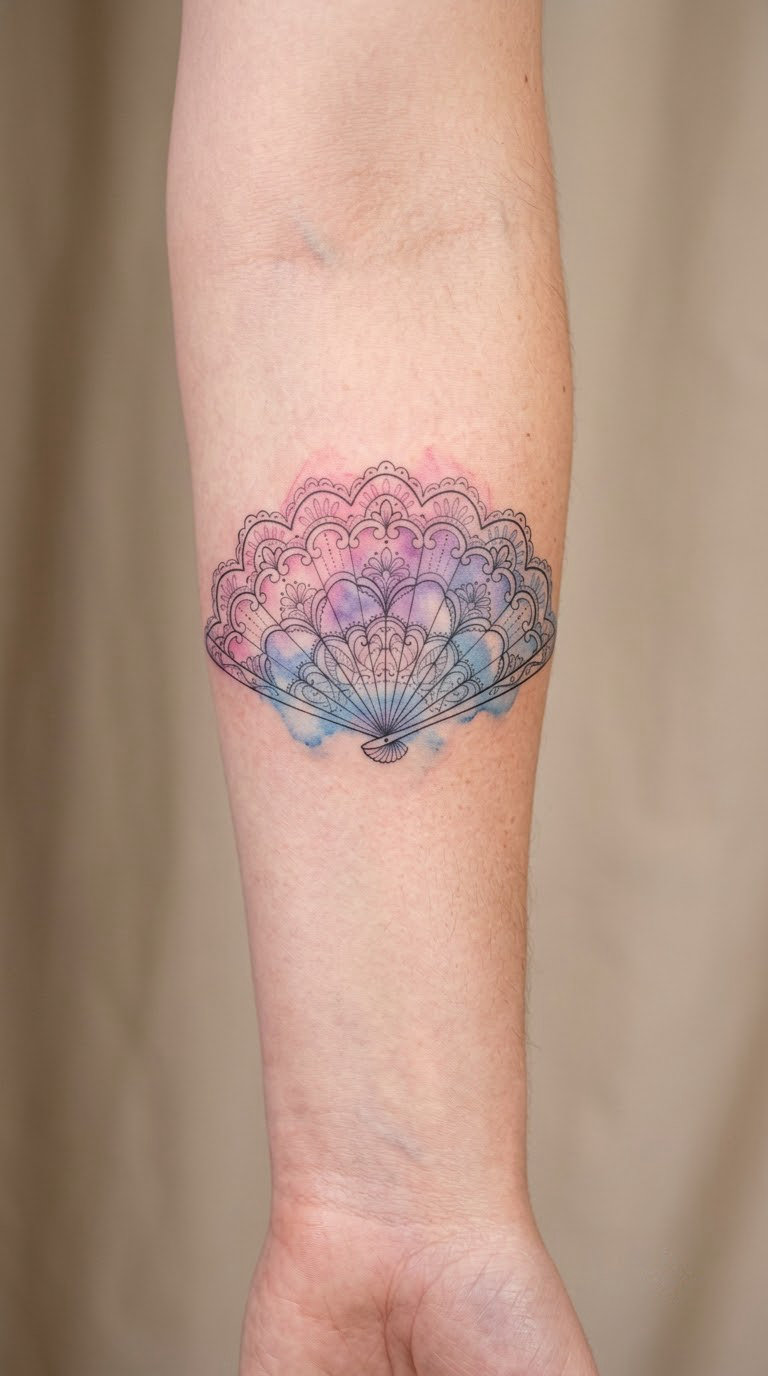
Color changes the character of a lace design completely. The base is still fine-line loops and scallops, but translucent washes of blush, violet or blue sit behind and partly over the linework, so the pattern looks painted rather than stitched.
It is the least traditional option on this list and the most forgiving of a hesitant first tattoo, because the softness of the wash hides small variations in line density.
Placement: inner forearm, or the outer thigh where there is room to soften the color.
Size: 3 to 4 inches (8 to 10 cm) wide.
Style: watercolor over a fine-line base.
Pain: low to medium. The inner forearm is one of the easier spots to sit through.
Make it yours: use two colors tied to something specific, or have the wash fade gradually into bare skin at one end.
7. Lace Choker Neck Tattoo
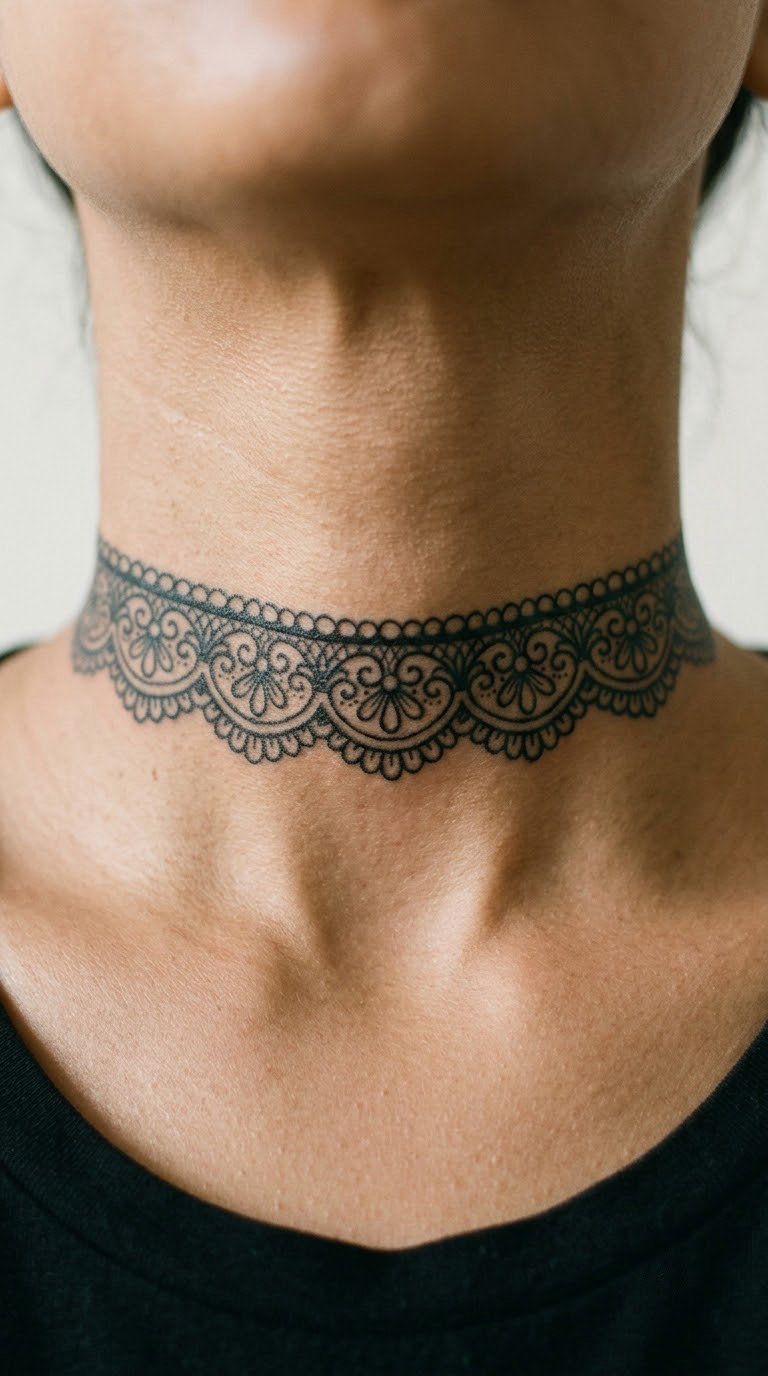
A lace choker is a narrow band of small linked loops, a scalloped lower edge and one restrained ornament at the center, a small stone shape or a single drop. Everything is miniature, which is exactly the point and also the difficulty.
The tiny scale is the difficulty as much as the charm. At 3 inches across, the whole piece can be read in one glance, and the ornament gives it a center of gravity.
Placement: centered on the front of the neck, roughly two fingers below the chin. The inner wrist works well as a quieter alternative.
Size: 3 inches across (8 cm), no taller than 1 inch.
Style: fine line, single-needle work.
Pain: high. The throat is sensitive and the neck moves, so lines are placed in short passes. Tiny loops are the first thing to soften over the years, so expect a light touch-up after several years. If that sounds like a lot of upkeep for a first piece, the same lace pattern as a bracelet on the wrist ages far better.
Make it yours: center the ornament on a stone shape, an initial or a date you can read as shapes rather than words.
8. Vintage Lace Glove Detail
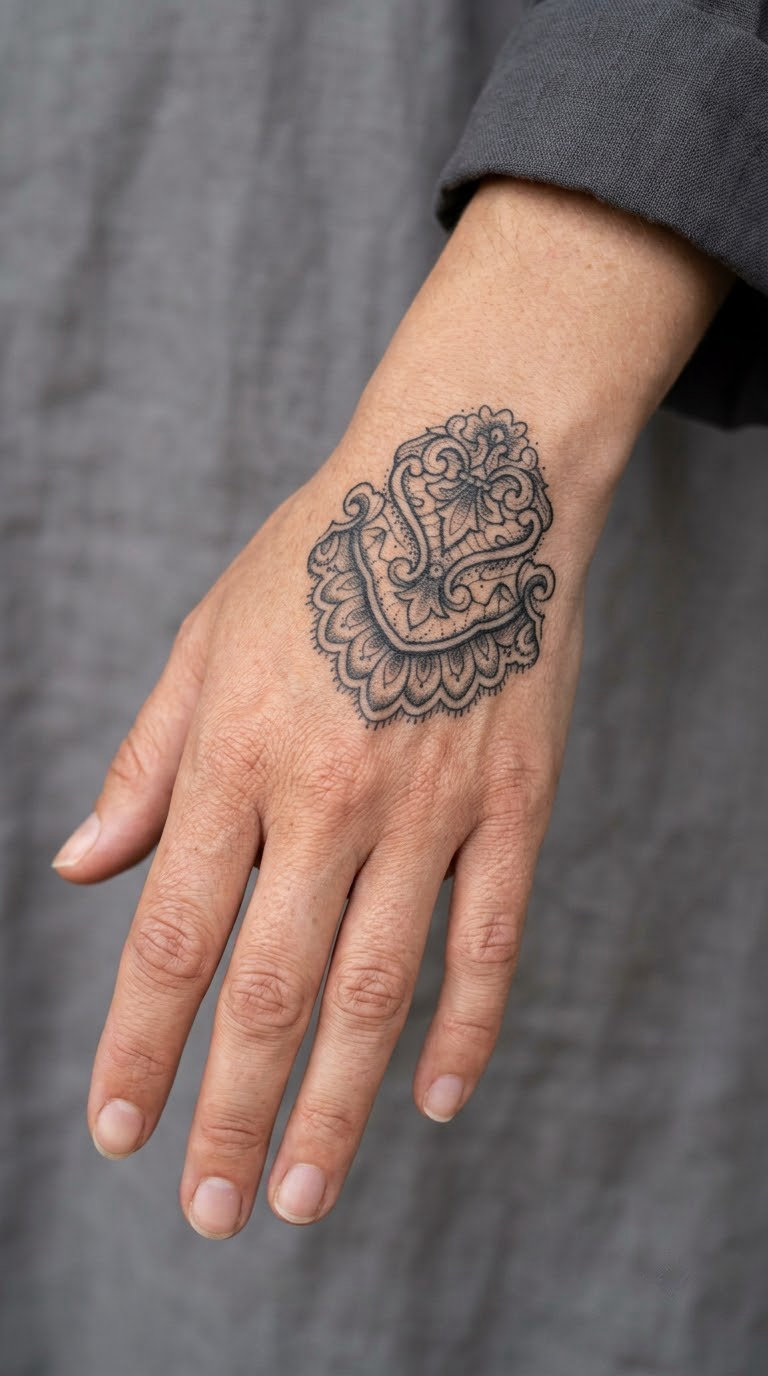
This is a section of a lace glove rather than a whole glove. Fingers, a scalloped cuff edge, a few crosshatched panels and light shading give it the feel of an heirloom textile drawn on skin.
Hand pieces are chosen for how visible they are, and the detail is small enough to sit between the knuckles without crowding them.
Placement: back of the hand between the knuckles, or wrapping the wrist like a cuff.
Size: 2.5 to 3 inches (6 to 8 cm) long.
Style: vintage illustrative with fine shading.
Pain: high. Hands are bony and the nerves sit close to the surface. Fine line on the back of the hand softens noticeably faster than line on the forearm, so plan on a refresh every few years if you want it crisp.
Make it yours: copy the lace pattern from a real garment, or work a small ring of matching lace around one finger as a companion piece.
9. Lace Mandala Forearm Tattoo
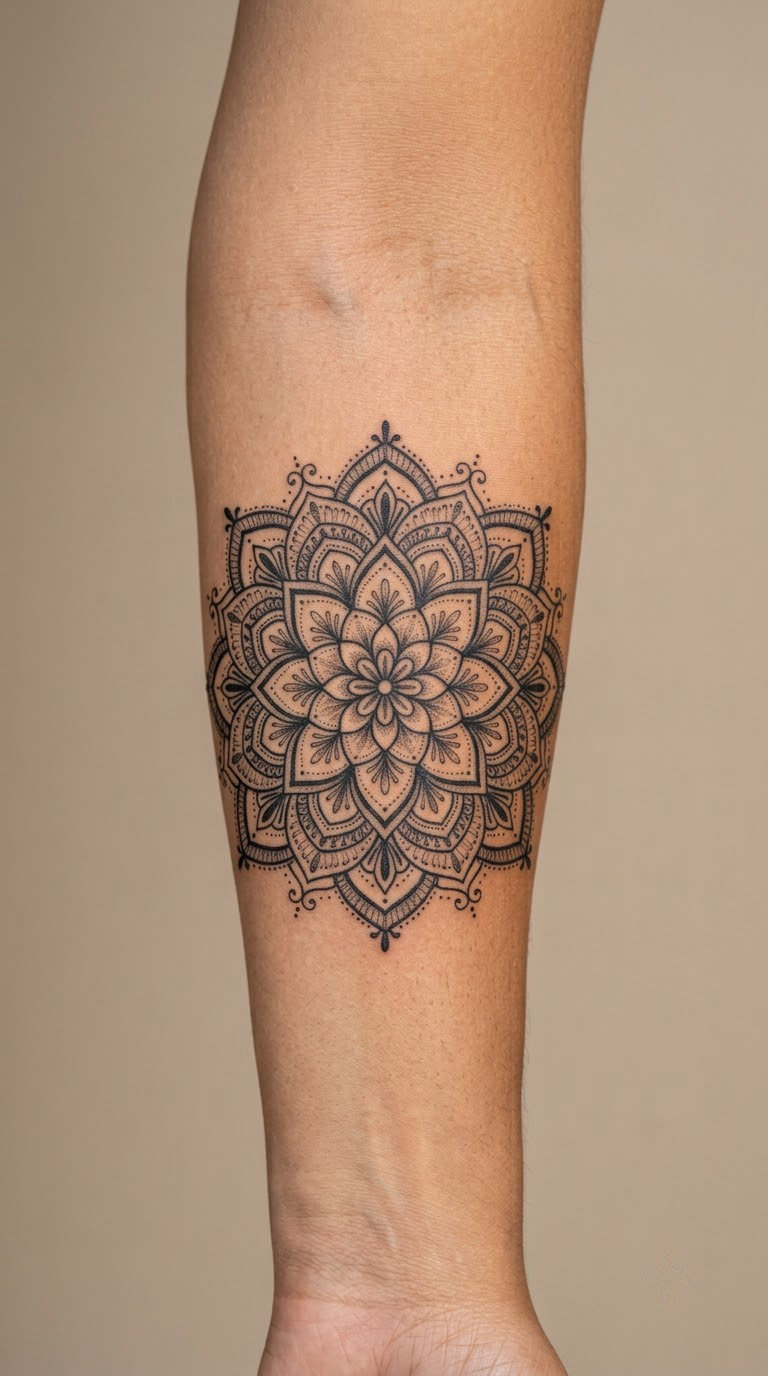
A lace mandala starts from a circle and repeats the same petal shape outward in rings, with the lace rendering built from thin outlines and small dots rather than solid shading. The outer ring can be left open so the design has a soft edge instead of a hard border.
People tend to choose mandalas for the way they look rather than for a claim, and many describe the repeated geometry as calming to draw and to look at.
Placement: inner forearm, or the calf where the curve follows the mandala’s shape.
Size: 4 inches across (10 cm).
Style: fine line and dotwork.
Pain: medium. Comfortable for long stretches, though the inner forearm is ticklish at the start of a session.
Make it yours: color only the central petal, or repeat a single lace ring on the other forearm at a smaller size.
10. Lace Peony Wrist Tattoo
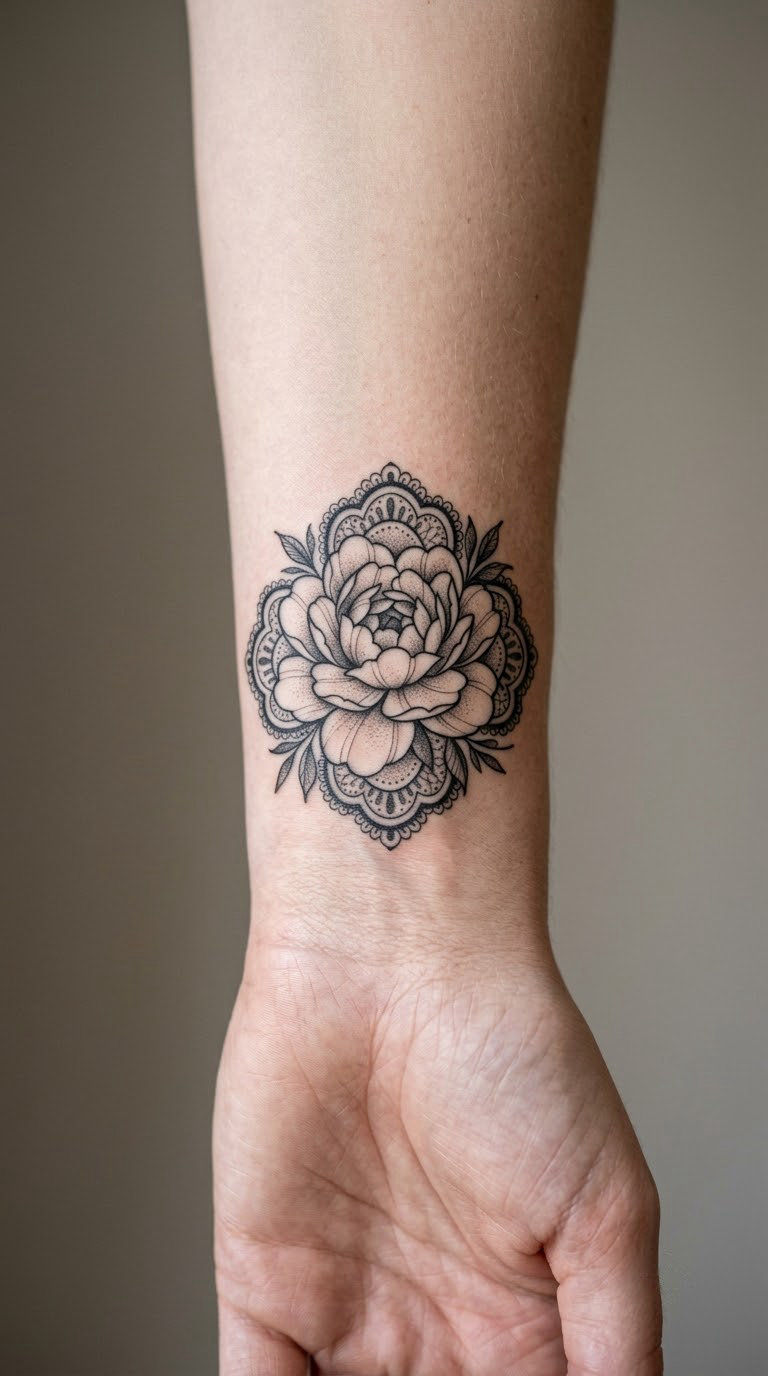
A compact peony with ruffled petals is framed by a single line of lace border, so the design has one soft mass and one structured edge. That pairing is what keeps a 2-inch piece from looking busy.
Small wrist florals are often chosen as a first tattoo because the footprint is small and the meaning can be entirely private.
Placement: inner wrist, or the same spot with a second matching piece a few inches along the forearm.
Size: 2 inches across (5 cm), border included.
Style: fine-line illustrative.
Pain: medium. The wrist is sensitive but the session is short. Petal edges are the detail that softens first, so a heavier petal line holds up better over time.
Make it yours: put a date or an initial inside the lace border rather than under the flower, where it sits hidden until you look.
11. Lace Thorn Rose Design
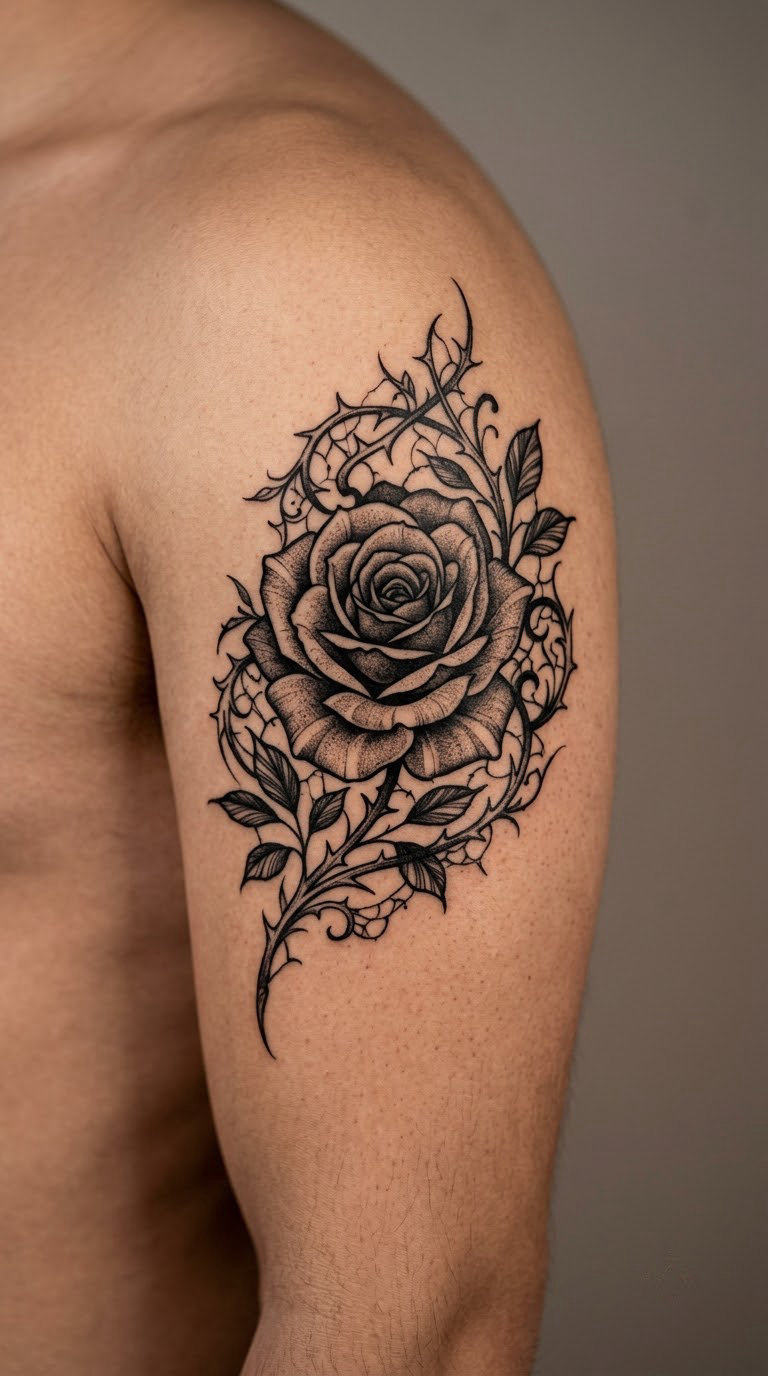
A rose is built from dense layered petals, and the lace arrives as thorned vine lines that loop around it. The softness of the bloom and the sharpness of the thorns sit side by side, which is the whole point of the design. If you want more botanical options, our picks of 14 small rose tattoo ideas for women, best picks (October 2026) cover the smaller versions of the same flower.
It reads as a story about contrast, and the direction the stem travels is usually deliberate too. Plenty of wearers send the stem away from the body and others send it back toward the heart.
Placement: outer upper arm, calf or lower back.
Size: 3 to 4 inches (8 to 10 cm) tall.
Style: blackwork rose with fine-line vine work.
Pain: medium. The arm is an easy area, and the dense petal work needs fewer passes than the thin vine lines.
Make it yours: choose a stem direction that carries a meaning for you, or pull one long thorn line toward a spot that means something.
12. Lace Thigh Garter Outline
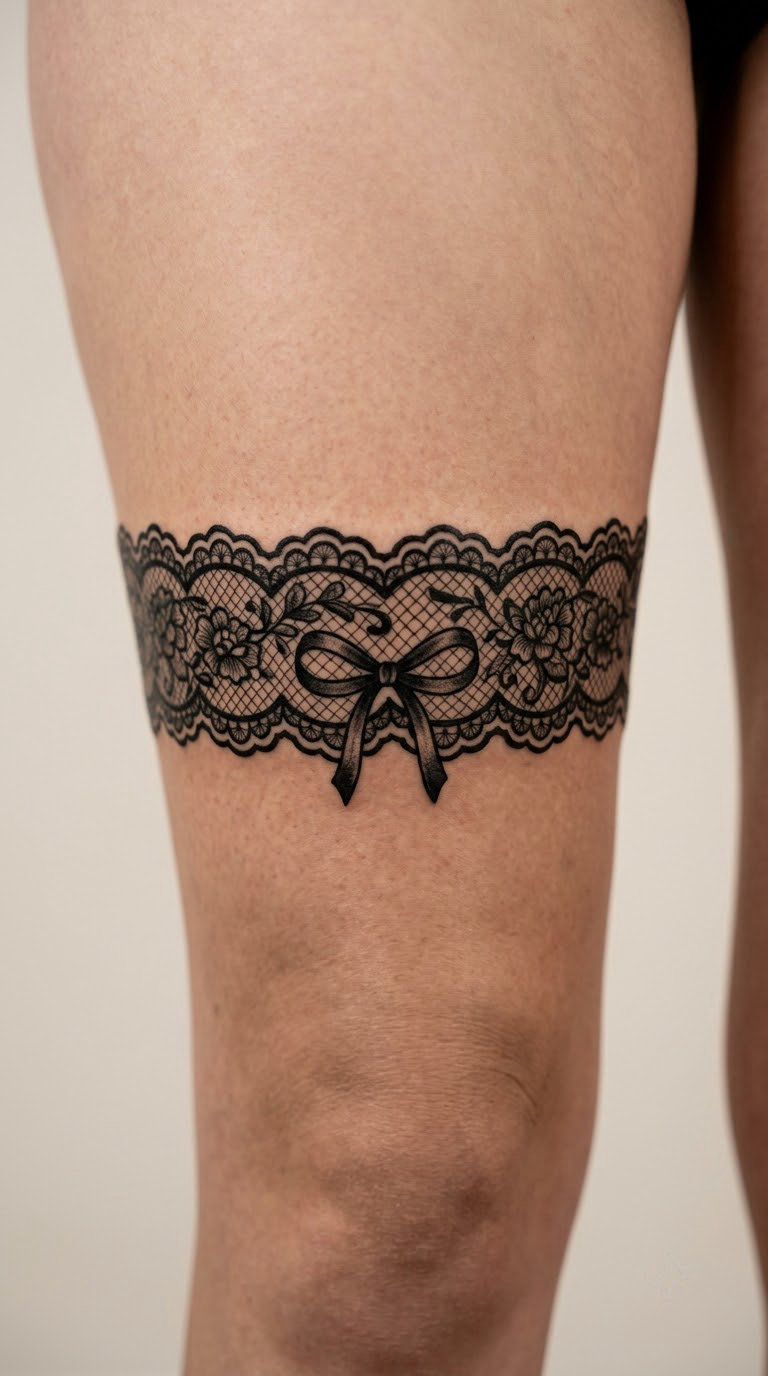
A garter outline is a curved band that follows the line of the upper thigh, with scallops on the lower edge, small loops, and a bow or a single flower at the center. Drawn as an outline rather than a filled panel, it stays light and easy to conceal under clothing.
Of the lace tattoo ideas for women here, this is the one a lot of people picture first. It is the easiest of the twenty to keep looking clean as it ages, because the band is wide enough to hold its line weight without crowding.
The thigh garter is one of the most common lace requests, and it tends to suit a curvier line than a straight one, because the curve of the band follows the body.
Placement: upper thigh, sitting roughly 3 to 4 inches above the knee.
Size: 4 to 5 inches across the front (10 to 13 cm), with the band continuing slightly around each side.
Style: fine line with a small bow in slightly heavier line.
Pain: medium. The thigh is a fleshy area and forgives a long sitting, which makes it a good place for detail-heavy work.
Make it yours: add a small dagger running down from the band, which is a popular combination, or keep the center empty for a later addition.
13. Lace Spiderweb Ankle Tattoo
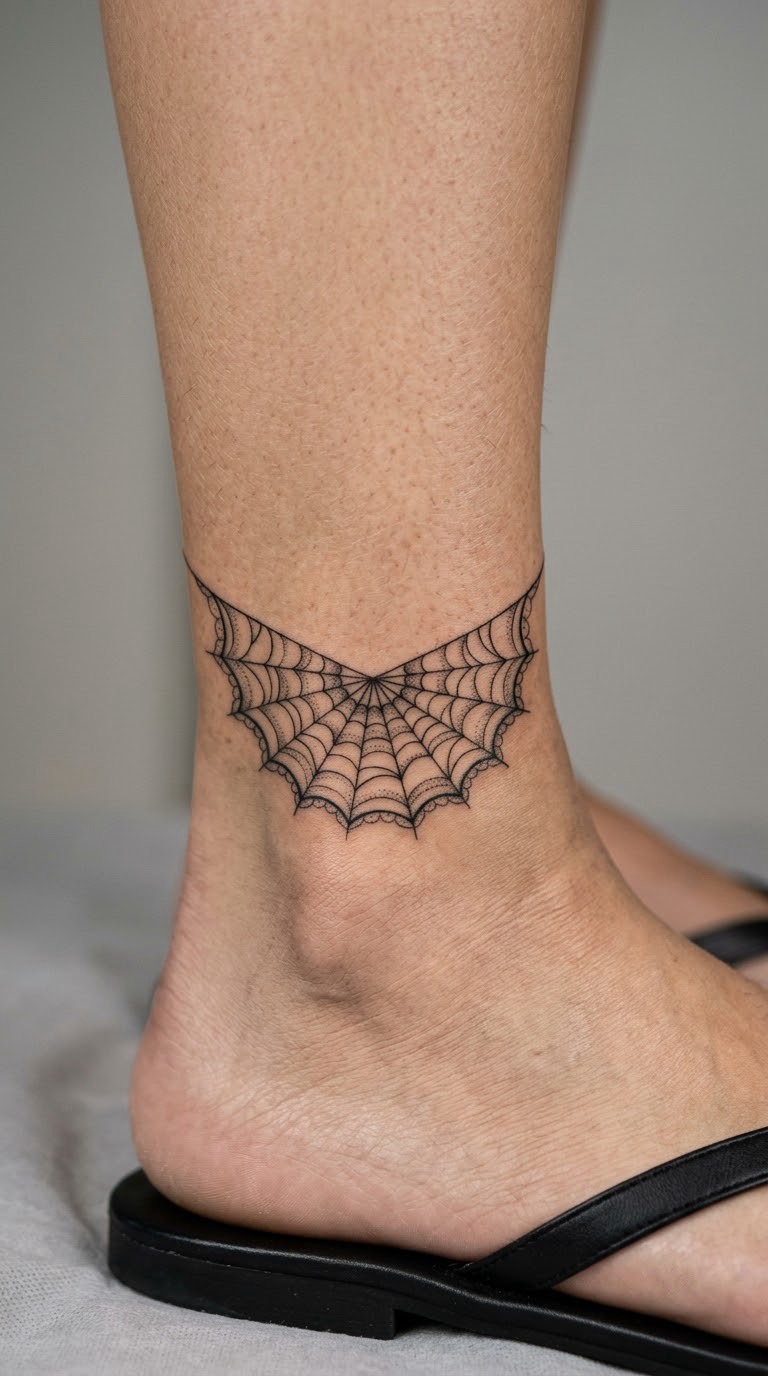
A plain web is easy to copy, so this one adds texture to the strands. Each curved line carries tiny interior marks, and small nodes of dotwork sit where the strands meet, so the web reads as woven rather than drawn with a ruler.
It is a smaller, more graphic option in this list, and it sits well next to an anklet or a fine bracelet.
Placement: above the ankle bone, or on the top of the foot near the base of the toes.
Size: 2.5 inches across (6 cm).
Style: fine line with dotwork.
Pain: high. The ankle bone is directly under the skin and the nerve endings are dense. Small dot accents on the foot fade faster than the same work on the arm, so this is one to plan refreshes around rather than a set-and-forget piece.
Make it yours: add a small drop of dew to one strand as the only curved, non-geometric element.
14. Lace Heart Lockup
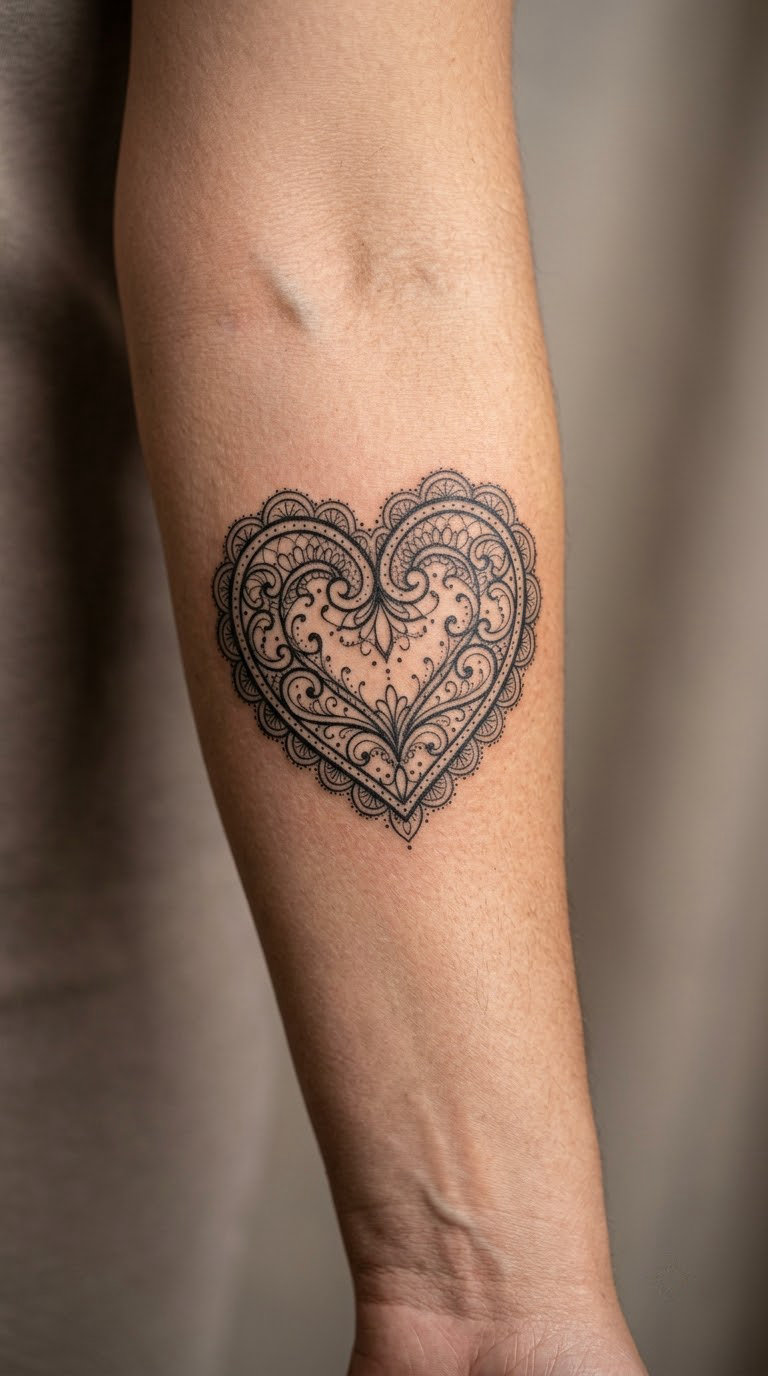
A lace heart is an outlined heart with the interior filled by two or three nested rows of scallops, loops and dot accents, leaving thin bands of open skin between each row. Restraint is what keeps it elegant, so three rows of pattern is plenty.
Hearts are a familiar shape in tattooing, and a lace treatment changes the tone, from a plain symbol to something closer to a piece of craftwork.
Placement: inner forearm, inner arm near the elbow, or the inner thigh.
Size: 2.5 inches tall (6 cm).
Style: fine line with dotwork.
Pain: low to medium. The forearm is forgiving and this is a short sitting.
Make it yours: place a short word or a date in the center of the heart, small enough that the pattern still reads as the main event.
15. Lace Fan Collar Detail
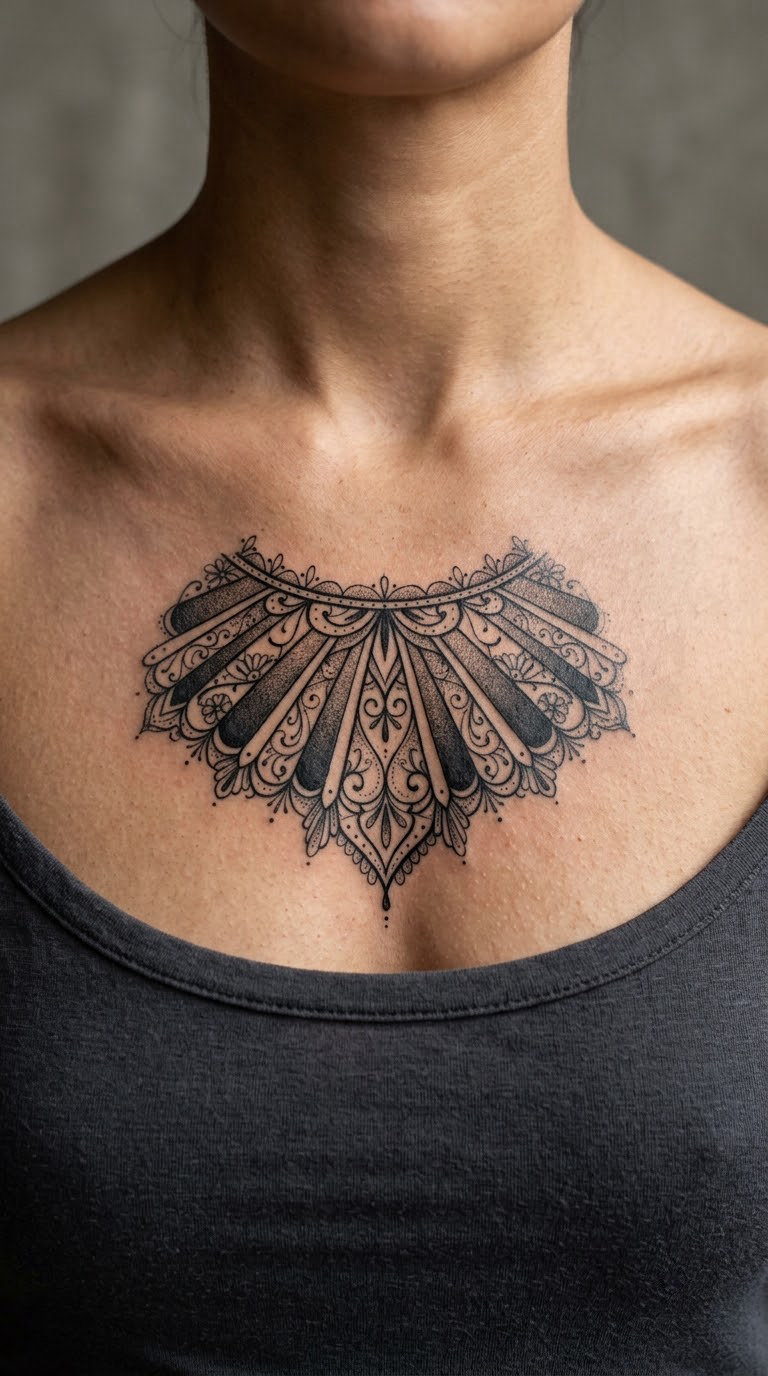
A fan collar radiates from a single low point, with panels spreading outward and upward, each panel holding a narrow line of lace, and a scalloped edge finishing the arc. The panels are separated by open skin, which is what stops the shape reading as a solid block.
It is a piece that benefits from a centered placement, because the symmetry is the design. Slightly off-center it loses the effect entirely.
Placement: centered on the upper chest below the collarbones, or centered high on the back.
Size: 4 to 5 inches wide (10 to 13 cm).
Style: illustrative with black panels and fine line edging.
Pain: medium to high. The sternum area is sensitive, and the pointed bottom of the fan concentrates the work in one tender spot.
Make it yours: run one panel down toward the sternum as a narrow tail, or color only the central panel to pull the eye to the middle.
16. Lace Serpent Coil
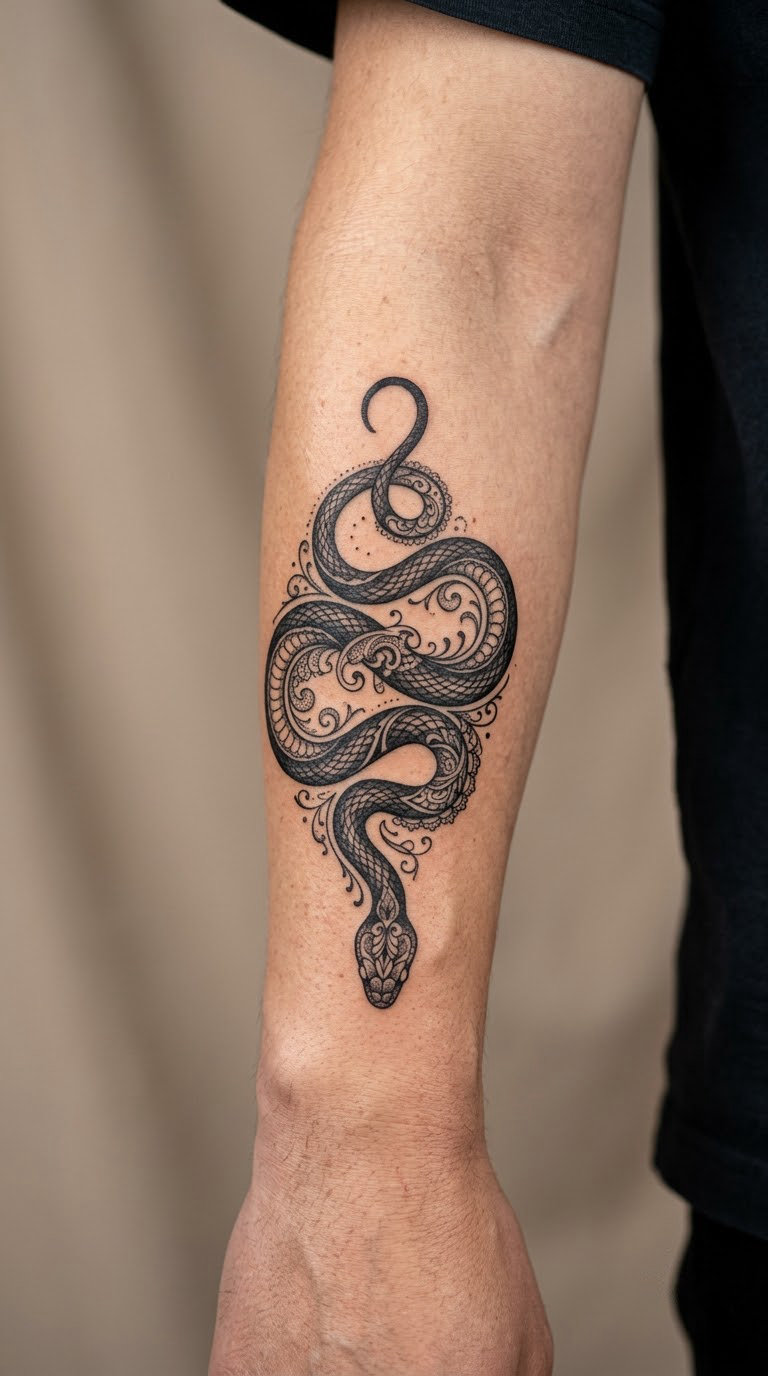
A serpent gives a lace design something solid to sit against. The body is filled dark with scale texture, and the lace loops wrap around the coil and trail off the tail, so the fine work and the heavy work share one composition.
Snake tattoos are often picked as a sign of transformation or protection, which is personal rather than a fixed dictionary meaning. The lace changes the tone more than people expect, softening a bold animal motif.
Placement: outer forearm wrapped around the arm, or the calf.
Size: 4 to 5 inches (10 to 13 cm) long.
Style: blackwork with fine ornamental lace.
Pain: medium on the arm. A coil that wraps fully around the leg takes longer and the lower leg hurts more by the end of a sitting.
Make it yours: leave the lace uncolored and pick a single accent color for the eye, which keeps the whole piece two-tone.
17. Lace Bridal Veil Detail
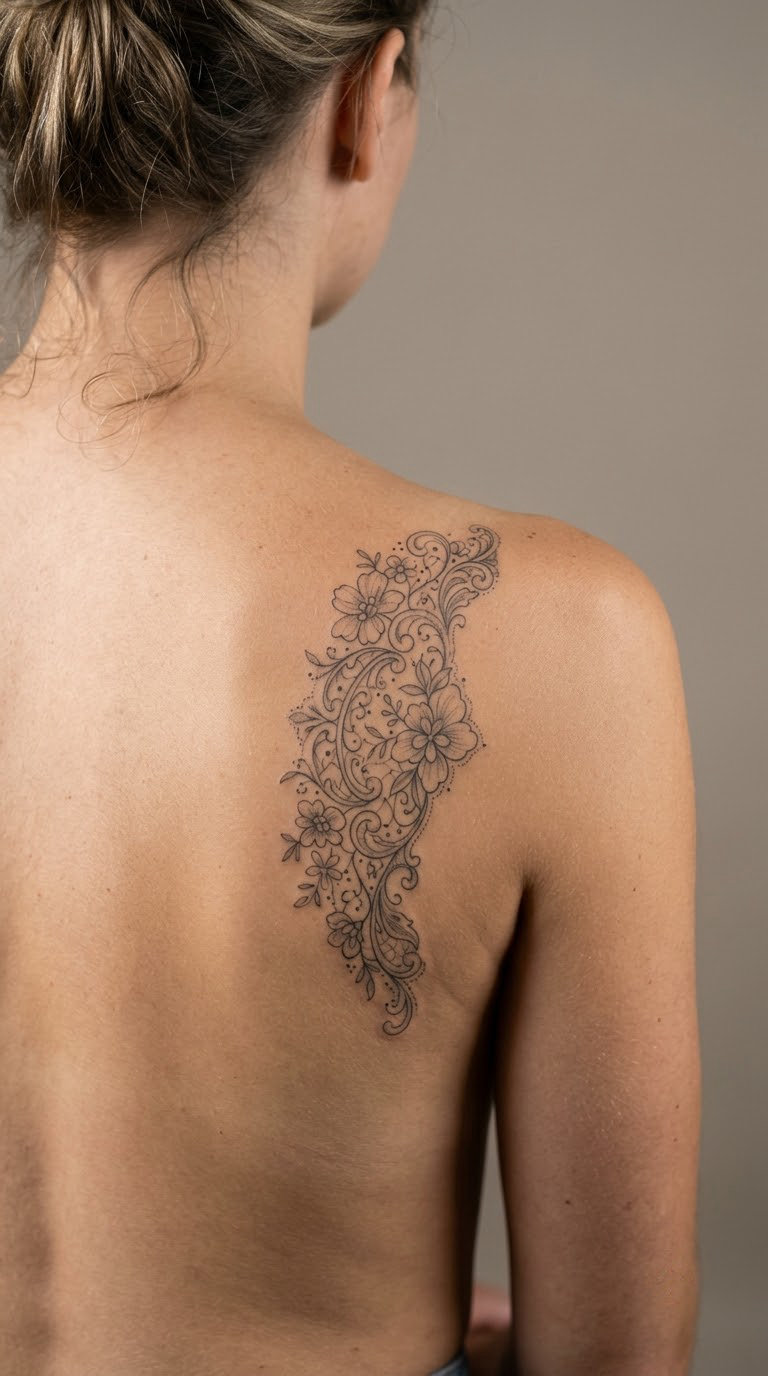
A veil design is mostly absence. Fine translucent lines suggest netting, tiny floral clusters mark where a flower would sit in the fabric, and wide areas of bare skin stand in for the sheer parts of a veil.
It is often booked around a wedding, either as something worn for the day or as a quiet piece afterward. Booking ahead of a date gives a fine-line piece time to settle.
Placement: shoulder blade near the shoulder, the nape of the neck, or the upper back below the collarbone.
Size: 3.5 inches wide (9 cm).
Style: fine-line illustrative with light dotwork.
Pain: medium. The upper back is a comfortable spot, though the shoulder blade edge is tender where the skin is thin.
Make it yours: use the flower variety from a dress, a bouquet or a veil you care about, so the pattern is traceable to something real.
18. Abstract Lace Butterfly Behind the Ear
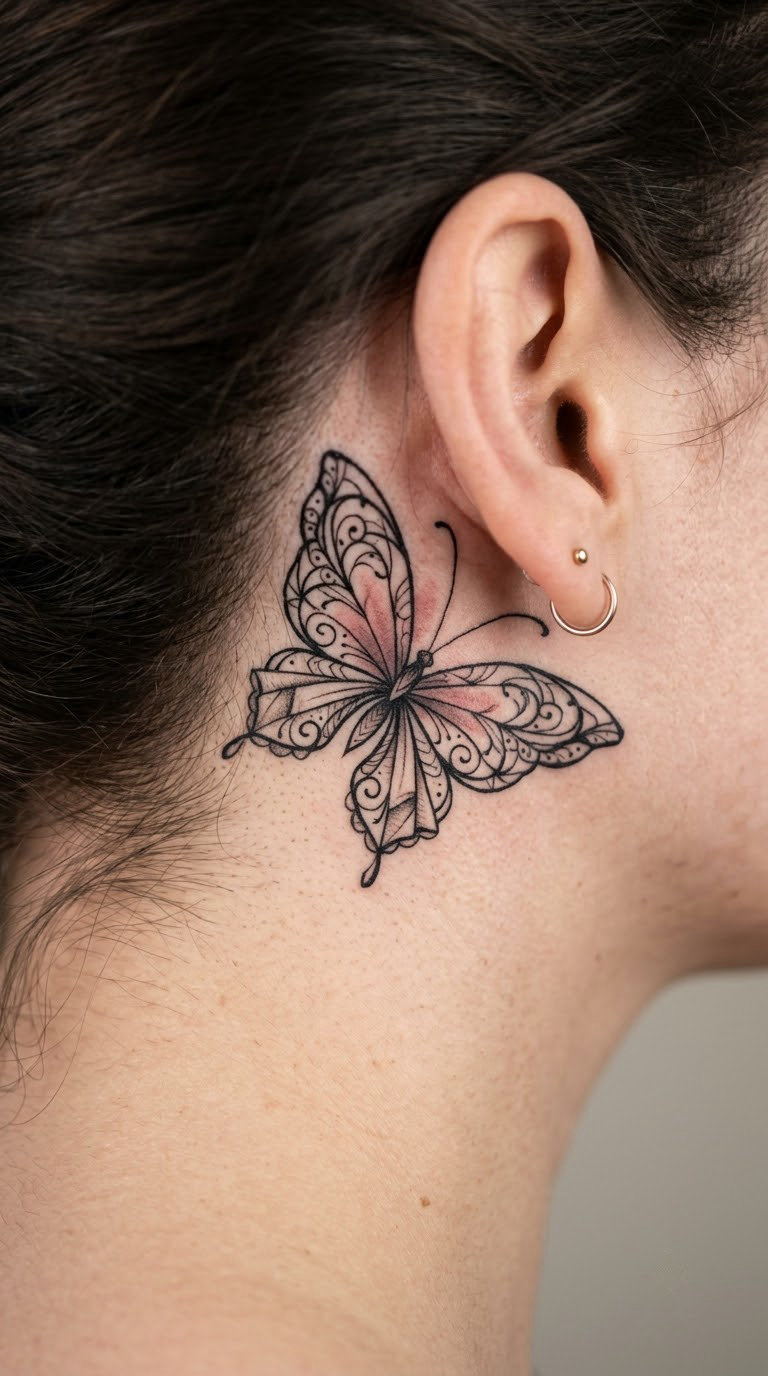
This butterfly is deliberately unrecognizable as an insect. The wings look like folded lace or a crumpled ribbon, built from angular planes and a few looped edges, with one wing slightly different from the other. There is no symmetrical mirror in the middle.
Choosing an abstract version is usually about the feeling of the design rather than the subject, and it gives a small piece more graphic interest than a butterfly rendered realistically would.
Placement: behind the ear, on the inner upper arm, or at the nape.
Size: 2 inches wide (5 cm).
Style: fine-line abstract, one muted color accent.
Pain: low to medium. Behind the ear is a short sitting, though the skin moves when you talk or turn your head, so the artist works in small passes.
Make it yours: mirror the same folded-wing shape on the other side of the body in a matching size, or add a small flower at the point where the wings meet.
19. Lace Panel Sternum Tattoo
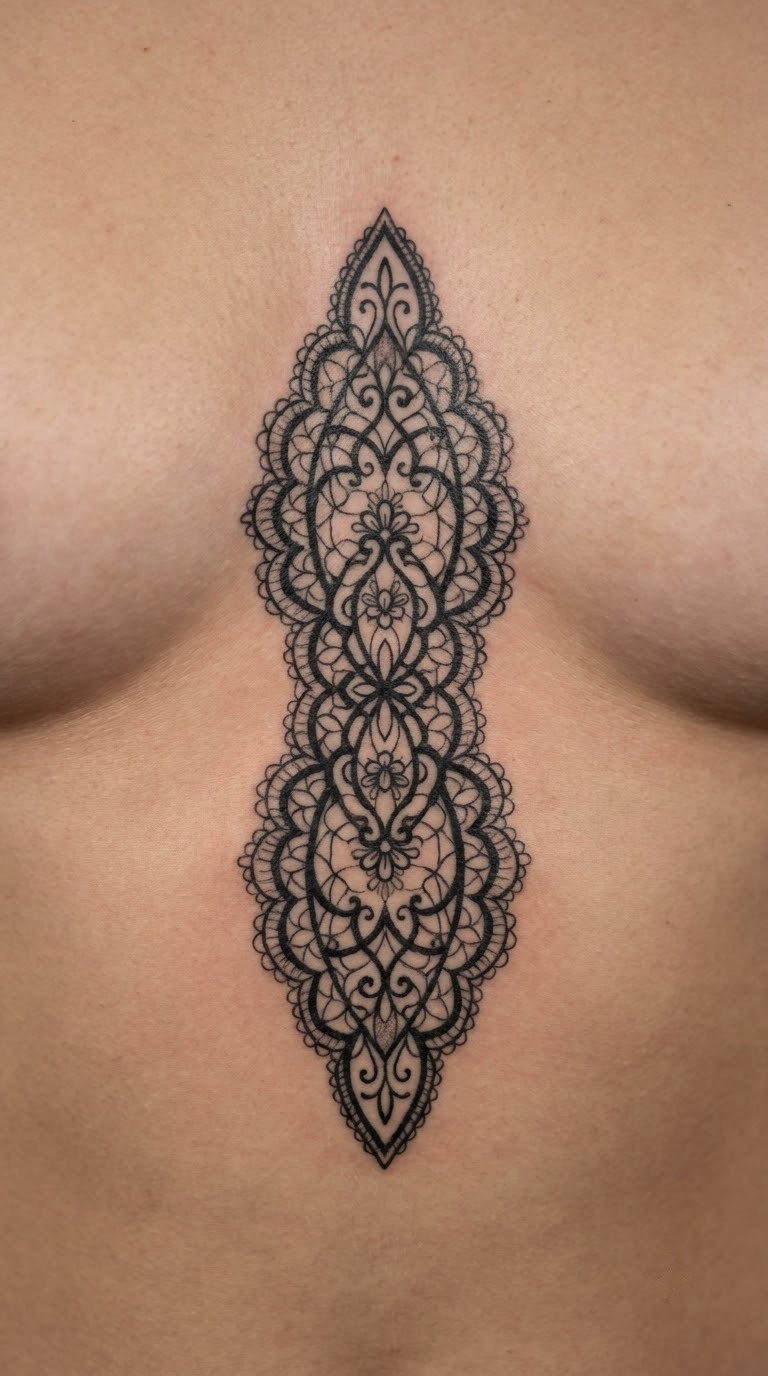
A vertical sternum panel is built as a narrow column of mirrored lace running down the center of the chest, with scalloped borders on both sides and a small floral form at the midpoint. The column stays slim so it follows the sternum instead of spreading across it.
The placement is the reason this one is popular. The sternum is a naturally vertical surface, so a symmetrical panel looks designed rather than arranged.
Placement: down the sternum between the collarbones, or lower on the chest as an underbust piece.
Size: 5 inches long (13 cm) and no more than 1.5 inches wide.
Style: fine line, with the central motif in slightly heavier line.
Pain: high. Bone sits directly under this area and the chest is one of the more sensitive placements for anyone starting out. A break halfway through usually makes the second half easier.
Make it yours: put a single symbol at the midpoint, where the eye lands first, and let the lace run above and below it.
20. Blackwork Lace Sleeve Accent
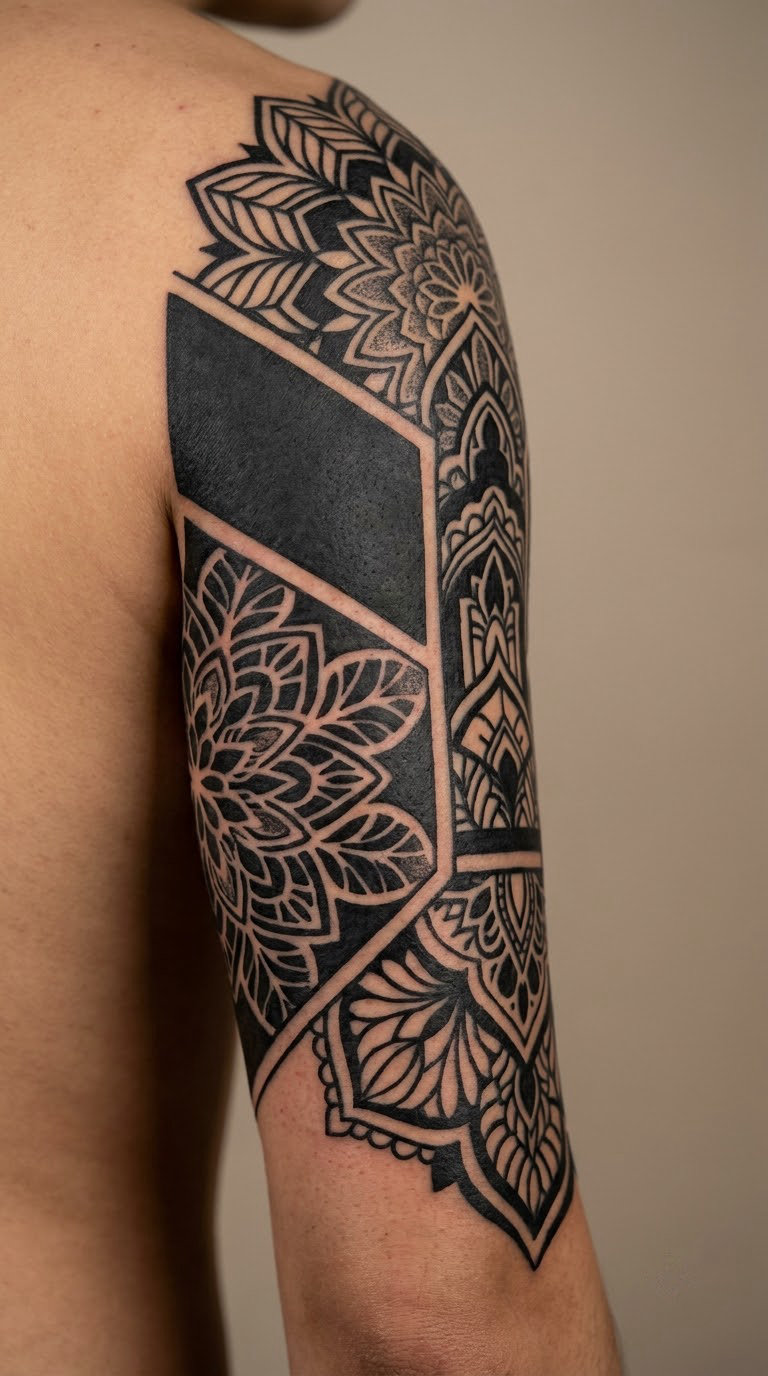
This is the largest option here. A block of black is shaped into panels, and lace appears as cutouts and as negative space worked into the black, with a few areas left completely open so the piece still breathes. Density needs to taper toward the edges or the whole thing reads as a solid patch.
It works two ways: as the lead piece if you want a statement, or as the connector that links two existing parts of a sleeve together across a gap.
Placement: upper arm, or the outer thigh as a standalone panel.
Size: 7 to 9 inches (18 to 23 cm) long.
Style: blackwork with lace cutouts.
Pain: high. Large areas of solid black take a lot of time, and the upper arm burns once you are an hour in. Most people book this over two sittings.
Make it yours: build the open areas around motifs that mean something to you, so the negative space carries as much as the black.
How to Choose the Right Design
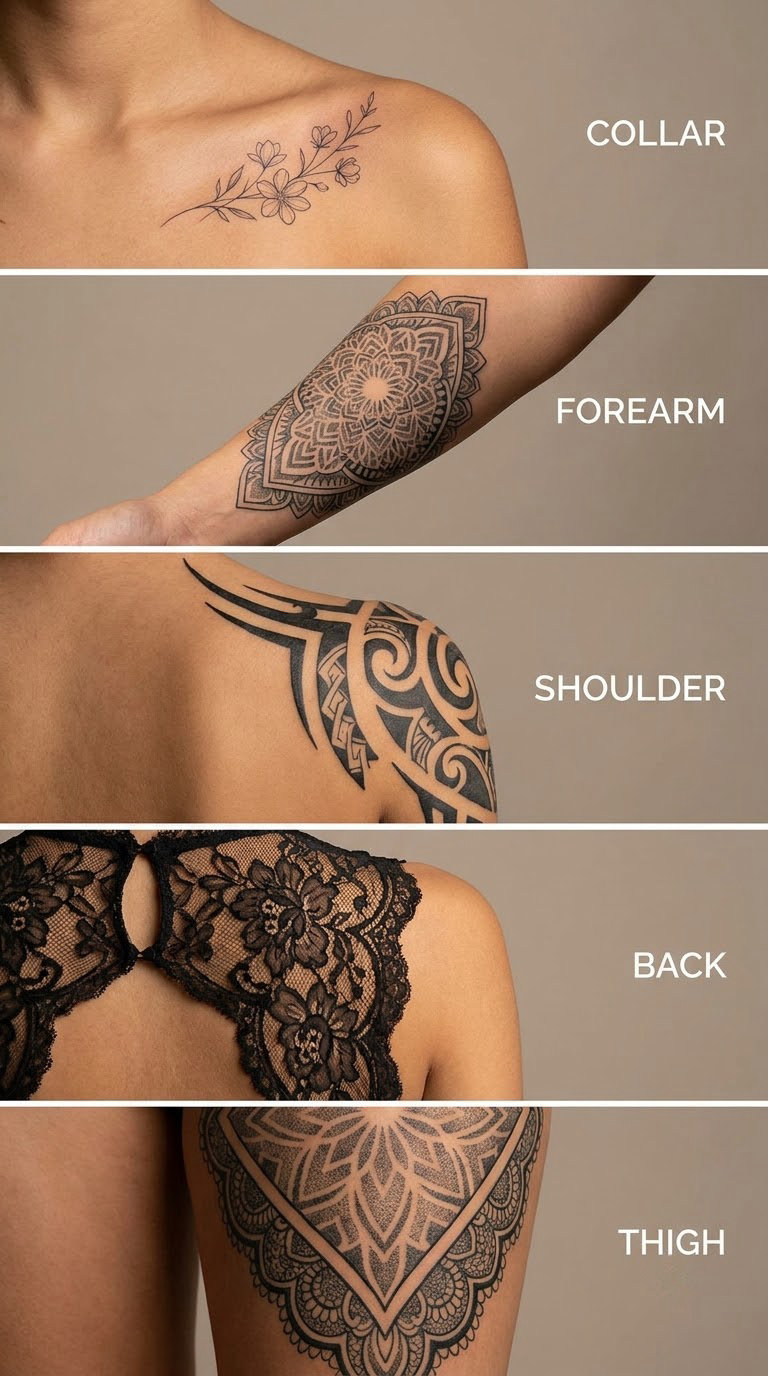
The right design is the one whose detail level matches the body area and the amount of time you want sitting still. Start from the placement, not the picture, and these lace tattoo ideas for women give you a realistic range for each spot.
- Match detail to size. A 2-inch design cannot carry the loop-and-scallop density of a 7-inch panel. Fewer open shapes at small scale keeps the pattern legible once healed.
- Pick the style that suits the contrast you want. Fine line and dotwork read soft and grow more delicate with age. Blackwork reads graphic from a distance and holds its shape better.
- Let the body area guide you. Curved areas like the shoulder, ribs and thigh suit patterns that can bend. Flat areas like the sternum and upper back suit symmetry.
- Plan for fading where it matters most. Fine line on the hands, fingers, ankles and the tops of the feet softens faster than the same work on the forearm, upper arm or thigh.
- Decide how visible you want it. Collarbone, sternum and forearm pieces sit in ordinary clothes. Rib, back and thigh pieces need more thought about day-to-day visibility.
Which body types suit these lace tattoo ideas for women?
Lace is a good fit across body types because the pattern adapts to the shape underneath it. A band design that looks narrow on a curvier thigh will need more width to hold the same number of loops, and a symmetrical panel on the sternum works at almost any torso size because the center line is fixed by the body.
What changes with body type is scale, not suitability. An artist working on a larger frame will usually stretch the pattern and keep the line weight the same, which is why scaling up matters more than choosing a different motif.
Cost and Session Time
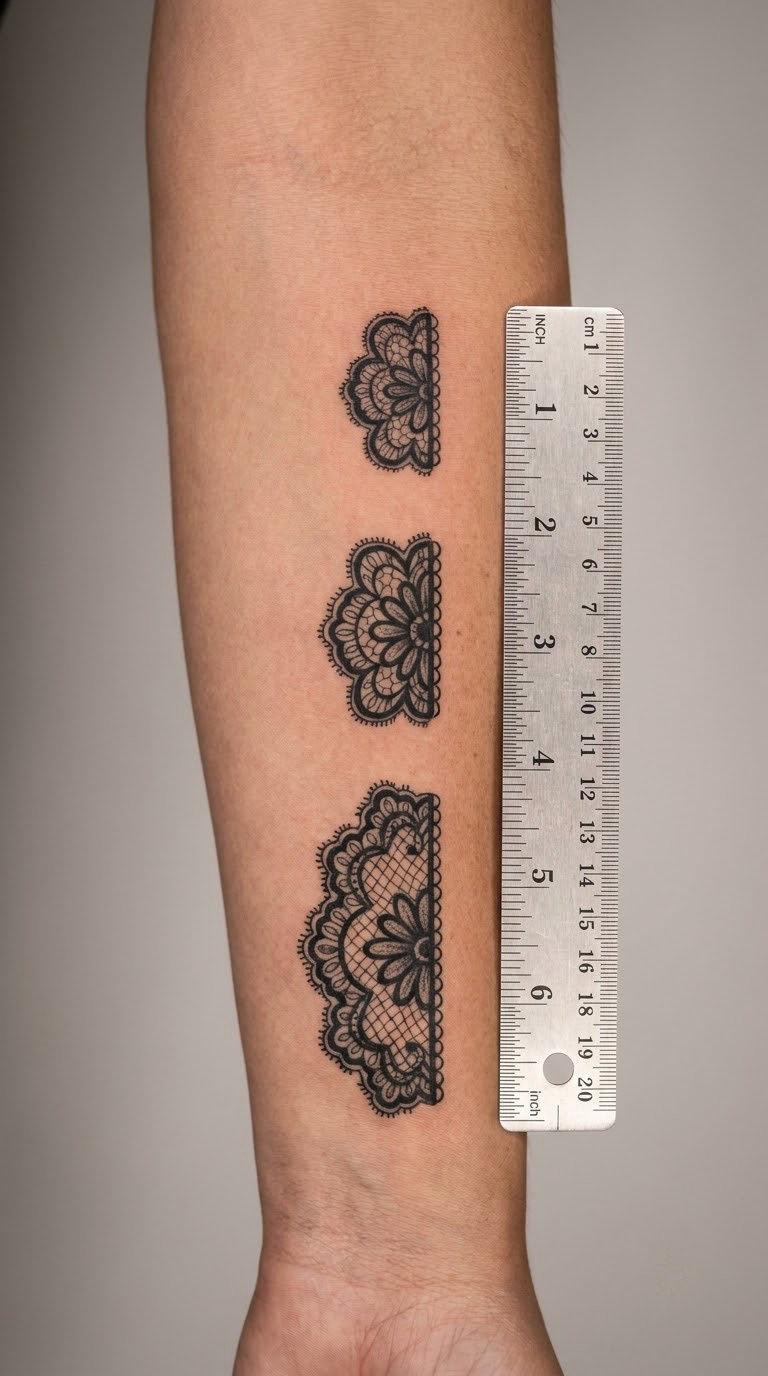
Tattoo pricing in the US usually works as an hourly rate with a shop minimum, so the number that matters is how long the piece takes, not how big it looks. Rates commonly run from 100 to 300 dollars an hour depending on the artist and the city, with most studios setting a minimum of 100 to 200 dollars for any session.
Small lace pieces, anything under 3 inches and mainly single-pass linework, tend to take 30 minutes to 1.5 hours. That puts a first appointment in the range of 150 to 400 dollars including the minimum.
Medium pieces from 3 to 6 inches with dense patterning, shading and fine detail usually need 2 to 4 hours. Expect roughly 300 to 900 dollars, often split across two sessions.
Large pieces above 6 inches, including corset panels and sleeve accents, are commonly booked over 3 to 6 hours or split across two or three appointments. Budget somewhere between 900 and 2500 dollars, and ask whether the quoted figure includes the second sitting.
Two things move the number more than the design does: the number of separate sittings and whether the piece needs a stencil placed on curved skin. Cities with fewer fine-line specialists also tend to sit at the higher end, because fewer tattooers in those areas work in that specific style.
Aftercare Basics
Healed lace work depends on a boring first two weeks, so follow your artist’s aftercare instructions above anything else on this page. Beyond what they tell you, these are the points most people get wrong.
- Wash gently with unscented soap and lukewarm water for the first few days, then pat dry with a clean towel rather than rubbing.
- Keep the area covered loosely while it heals if your artist recommends it, and change the covering if it gets wet or dirty.
- Avoid friction and pressure: tight straps, waistbands, sports bras and carrying heavy bags over a fresh piece on the ribs or thigh.
- Skip direct sun on the tattoo while it heals, and use sunscreen on the area once your artist clears it.
- Contact your artist if you notice heavy ink flaking that does not settle, spreading redness well past day one, or a line that looks clogged or patchy. They would far rather hear from you early.
- Ask about touch-ups before you assume a fine detail has blurred. Lace loops and dot accents often need one refinement session in the first year.
Frequently Asked Questions
Where do lace tattoos look best on a woman’s body?
Collarbone, upper chest, the side ribs, the outer thigh and the upper back are the placements most often recommended, because each gives the artist a smooth, well-lit surface to lay fine linework onto. A sternum panel suits a naturally vertical shape, and the outer forearm works well for a first small piece. Hands, fingers, ankles and the tops of the feet hold detail least well over time.
Do fine line lace tattoos fade over time?
Fine line softens as skin ages, and some placements soften much faster than others. Lace on the back of the hand, the fingers, the ankle and the top of the foot is most affected, usually needing a refresh every few years, while the same work on the forearm, upper arm and thigh holds far better. Denser linework and less tiny dot detail both help. Ask your artist about touch-ups at the end of the healing period.
What size should a first lace tattoo be?
Most people start between 2 and 3 inches, which is large enough to show the pattern but small enough to finish in one short sitting. Below about 1.5 inches, lace detail crowds together and the design loses its openwork effect. Above 4 inches, you are committing to a longer appointment and possibly more than one session. Bringing a reference image at roughly the size you want it to end up is the clearest way to start.
How do I bring a lace reference design to my artist?
Bring two or three images rather than one, and point out the parts you actually like, such as the edging or the way the pattern opens up. Screenshots lose scale, so add a note on the size you have in mind. If you are adding to an existing piece, bring a healed photo of that work too. A tattoo artist working from a clear reference is far happier than one guessing at what you meant from a single photo.
Do lace tattoos suit different body types?
Yes. Lace patterns are scalable, so the same motif can be stretched wider or taller without losing the effect, and the openwork actually sits well on curved areas like the shoulder, ribs and thigh. What changes with body shape is scale and line weight rather than the motif itself. A piece that looks delicate and small on a frame with more room to fill can feel thin, so ask your artist to adjust the pattern width to the area.
Conclusion
If this is your first tattoo, a fine-line bralette on the collarbone or a small floral lace piece at 2 to 3 inches is the safest place to start out of the twenty lace tattoo ideas for women above. You get the full lace effect, one short sitting, and a piece that heals quickly and hides easily under a collar or a sleeve.
If you already have a collection and you want a bigger statement, a blackwork corset panel on the ribs or a lace sleeve accent on the upper arm is the direction to go. Those are long appointments, sometimes more than one, and they reward an artist who works in bold fill as well as fine line.
Whatever you pick, settle the placement, the finished size and the artist before you book. Those three decisions explain nearly every disappointing lace tattoo, and nearly every good one. Bring a reference at the size you want and look at healed work in the artist’s portfolio, not just fresh photos.