
20 Best Sunset Tattoo Ideas With Color (September 2026)
If you are searching for sunset tattoo ideas with color, you are probably picturing a sky that runs golden at the horizon into coral, pink and violet, with something dark sitting in front of it. That dark element is what keeps the design readable once the color settles. A gradient on its own is pretty; a gradient with a palm trunk, a mountain ridge or a lighthouse in front of it is a tattoo people stop to ask about.
Autumn is the season most people plan these, partly because the colors match and partly because a healed piece is ready to photograph by the time the weather turns cold. The twenty designs below run from a two-inch wrist piece to a full back composition, and each one lists placement, realistic size, style, pain and a way to make it yours.
Sunset Tattoo Ideas With Color: Quick Guide
A color sunset tattoo is any design that builds a warm gradient sky in orange, pink, red and purple, then anchors it with a darker element such as a horizon line, silhouette or landscape. The table below maps all twenty designs to the style, placement, size and pain level that suit them best.
| Idea | Style | Best placement | Size | Pain |
|---|---|---|---|---|
| Watercolor sunset over a minimal horizon | Watercolor | Inner forearm | 4-6 in (10-15 cm) | Medium |
| Retro gradient sun behind mountains | Neo-traditional gradient | Outer upper arm | 5-7 in (13-18 cm) | Medium |
| Palm silhouette against a coral sun | Illustrative silhouette | Lower leg | 3-5 in (8-13 cm) | Low to medium |
| Golden sun dipping into ocean waves | Semi-realistic | Calf | 4-7 in (10-18 cm) | Medium |
| Snow-capped mountain sunset | Illustrative landscape | Outer forearm | 5-8 in (13-20 cm) | Medium |
| Desert sunset with cactus | Traditional | Shoulder | 4-6 in (10-15 cm) | Medium to high |
| City skyline at purple dusk | Illustrative with blackwork | Upper chest | 6-9 in (15-23 cm) | High |
| Flowers beneath a gradient sky | Watercolor with fine line | Hip | 5-8 in (13-20 cm) | Medium |
| Tropical beach sunset with frangipani | Color realism | Back of the calf | 5-7 in (13-18 cm) | Medium |
| Watercolor sun, sea and sky blend | Abstract watercolor | Shoulder blade | 6-10 in (15-25 cm) | Medium |
| Geometric sunset from triangles | Geometric | Sternum | 4-6 in (10-15 cm) | High |
| Fine-line sunset with a place name | Fine line | Inner wrist | 2-4 in (5-10 cm) | Low to medium |
| Minimal sunset across three waves | Minimal fine line | Wrist | 2-3 in (5-8 cm) | Low |
| Sunset framed by tropical leaves | Blackwork silhouette | Thigh | 5-8 in (13-20 cm) | Medium |
| Mountain lake reflection at golden hour | Semi-realistic | Outer thigh | 6-9 in (15-23 cm) | Medium |
| Sun and moon phases in a circle | Illustrative with gradient | Upper arm | 4-5 in (10-13 cm) | Medium |
| Hot air balloons crossing a violet sky | Whimsical illustrative | Back of upper arm | 4-7 in (10-18 cm) | Medium |
| Lighthouse facing a red-and-gold horizon | Illustrative blackwork | Forearm | 5-8 in (13-20 cm) | Medium |
| Travel coordinates under a tiny sunset | Minimal with lettering | Inner arm | 2-4 in (5-10 cm) | Low to medium |
| Fiery phoenix emerging from a sunset | Illustrative color realism | Upper back | 10-16 in (25-40 cm) | High |
How These Sunset Tattoo Ideas With Color Compare
Read the table by style first, then by size. Watercolor and abstract pieces tolerate the most improvisation because the artist is blending rather than drawing, so they can be adjusted on the day to suit a forearm or a shoulder blade. Illustrative and semi-realistic scenes need more room: the moment a mountain ridge or a skyline gets small, the detail turns to mush and the artist will tell you so.
Fine-line and minimal designs are the opposite problem. They stay sharp at small sizes but they fade faster, especially on hands, fingers and anywhere that gets sun. Geometric pieces sit in the middle, clean and graphic at almost any scale, though bold triangular color fills need unbroken flat skin. Placement is the last filter: rib and sternum work hurt more, but they give a landscape the vertical canvas it needs.
1. Watercolor Sunset Over a Minimal Horizon
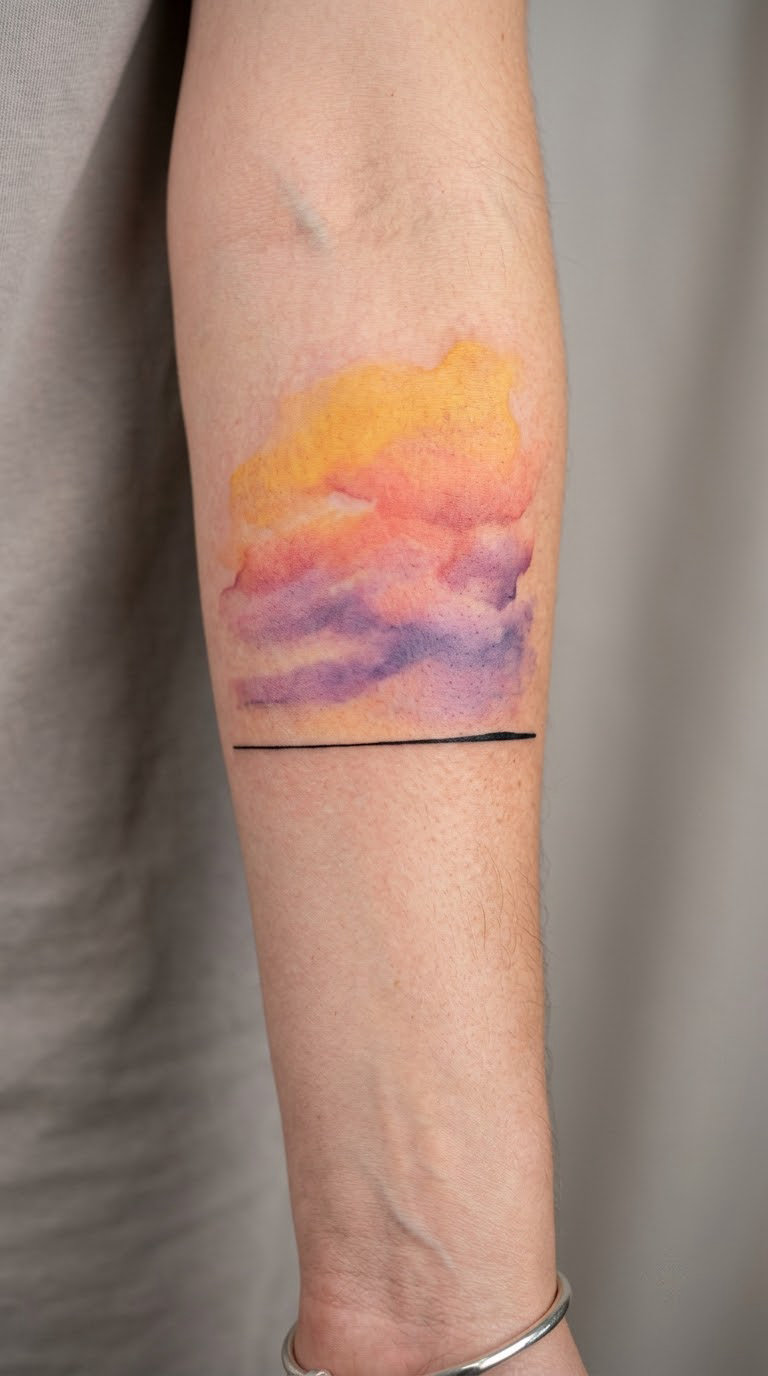
A loose wash of golden yellow drops into coral at the horizon, then into rose and violet at the top, with a single hairline black stroke holding the bottom edge. Nothing else, no scene, no scenery. The artist lays translucent layers and lets the edges stay soft rather than chasing a hard outline.
Most people choose it because the gradient is the whole point. It reads as an ending, a slow evening, or simply a favorite palette, and the meaning is usually personal rather than fixed.
Placement: inner forearm, upper inner arm, or the flat of the calf. Size: 4-6 in (10-15 cm) across. Style: watercolor, with a fine-line horizon. Pain: medium on the forearm, lower over the fleshy part of the arm; the first watercolor layer feels like a slow scratch that becomes a steady sting. Colour softens as it heals and can look dusty for a couple of weeks before it settles. Make it yours: give the artist two colors you actually wear and let the rest of the gradient run between them.
2. Retro Gradient Sun Setting Behind Mountains
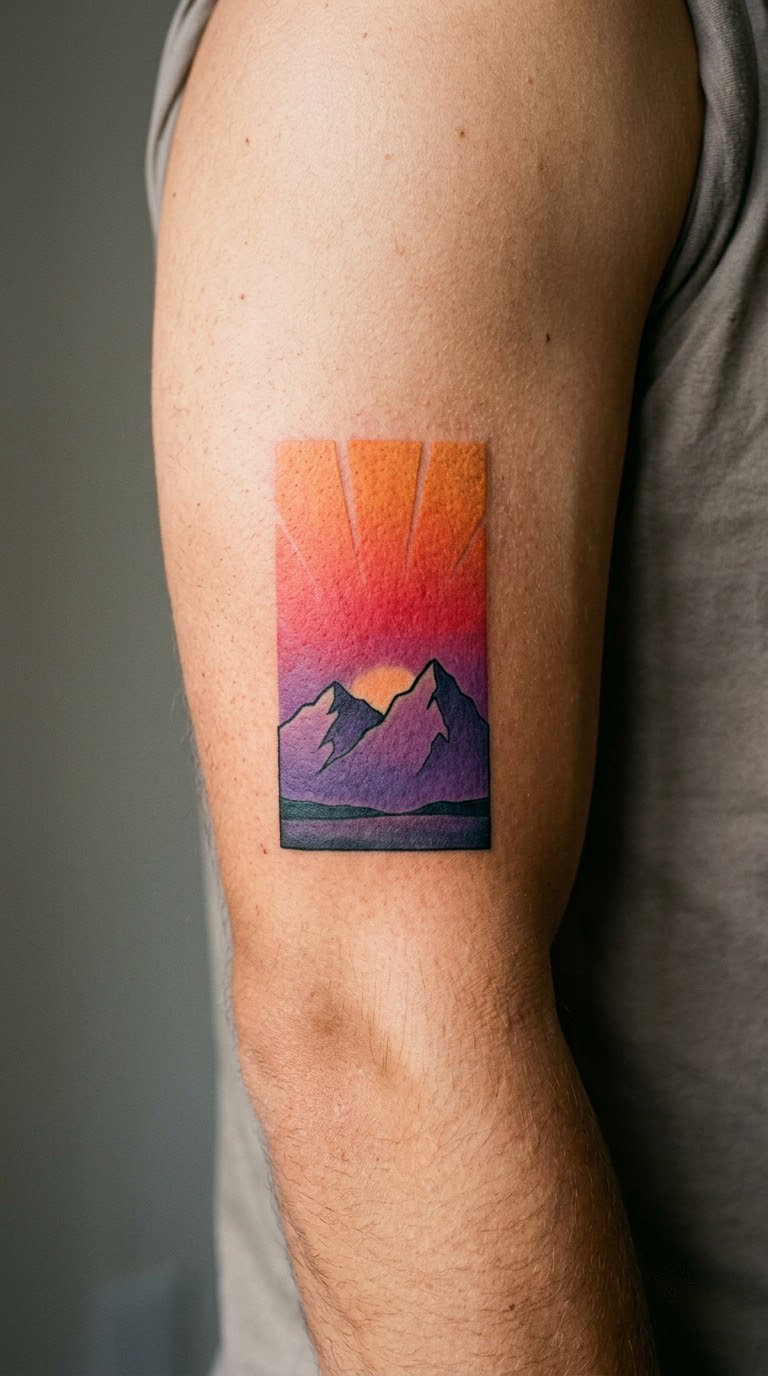
A smooth neo-retro gradient fills a half-disc of sky, warm orange at the base moving to red and then purple at the top edge, and two mountain silhouettes sit across the lower third in solid dark purple. No outlines on the sky, clean shapes on the peaks. It looks printed rather than drawn, which is the appeal.
People usually land here through a favorite place or a sense of an ending done well. The shapes are simple enough that it never reads as a specific location, so it can carry whatever you want it to.
Placement: outer upper arm, shoulder, or mid-back. Size: 5-7 in (13-18 cm). Style: neo-traditional with an ombre gradient. Pain: medium, and the solid silhouette pass is the stingiest part. A gradient like this reads slightly softer after healing than the fresh ink, so plan a touch-up within the first year. Make it yours: shift the top of the gradient toward your birthstone color or a favorite time of day.
3. Palm Tree Silhouette Against a Coral Sun
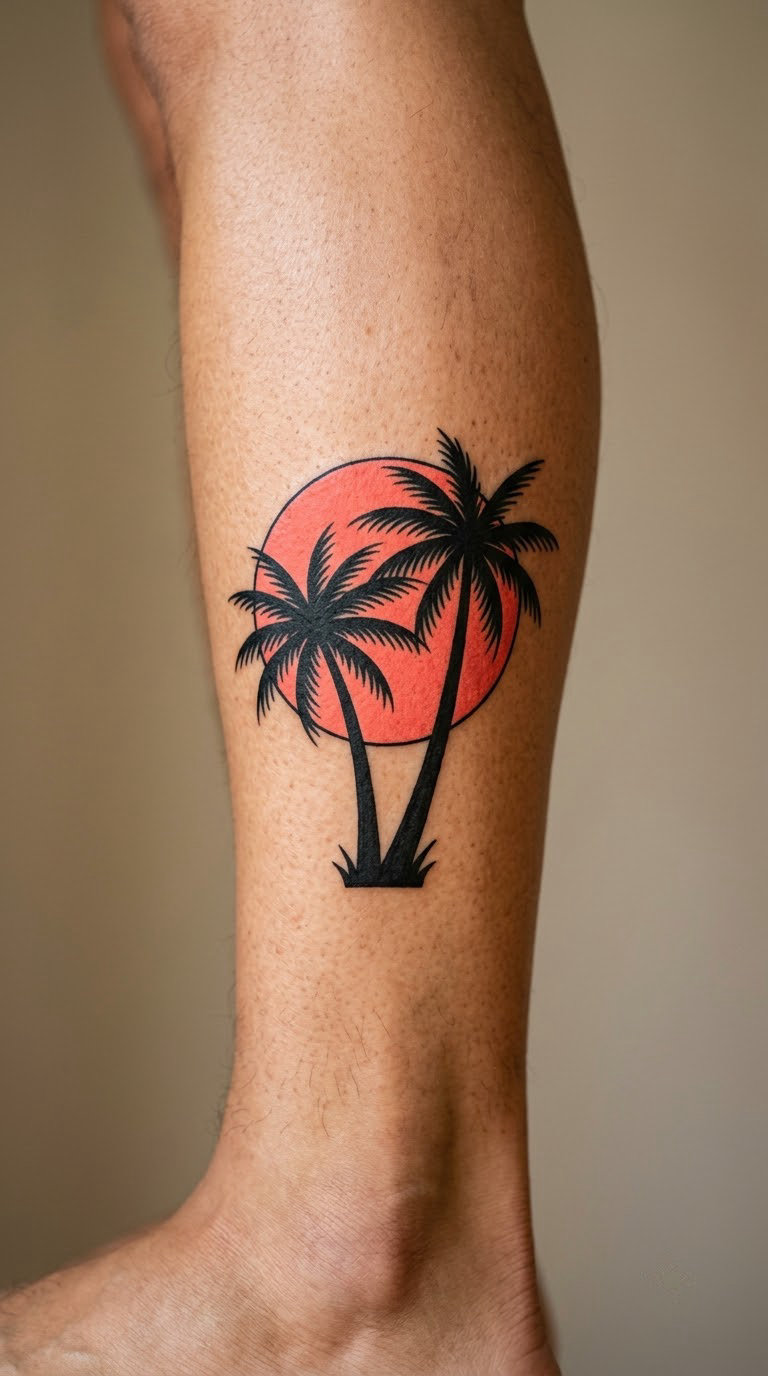
A solid coral-red sun disc with one or two black palm silhouettes crossing the lower edge, fronds cut clean against the color. High contrast, almost no shading, and the sun is large enough to carry the piece on its own. This is the most tattooable sunset design on the list because very little has to be right.
It suits anyone who has a warm place in their history, a holiday, a coast they return to. The colors do the emotional work so the design does not need a slogan.
Placement: lower leg, ankle, inner calf, or the side of the forearm. Size: 3-5 in (8-13 cm). Style: illustrative silhouette. Pain: low to medium on the calf, low on the inner arm. Black lines hold their shape well, and the coral fills fade to a softer red over time. Make it yours: add a location in the negative space under the sun rather than crowding the disc with more palms.
4. Golden Sun Dipping Into Ocean Waves
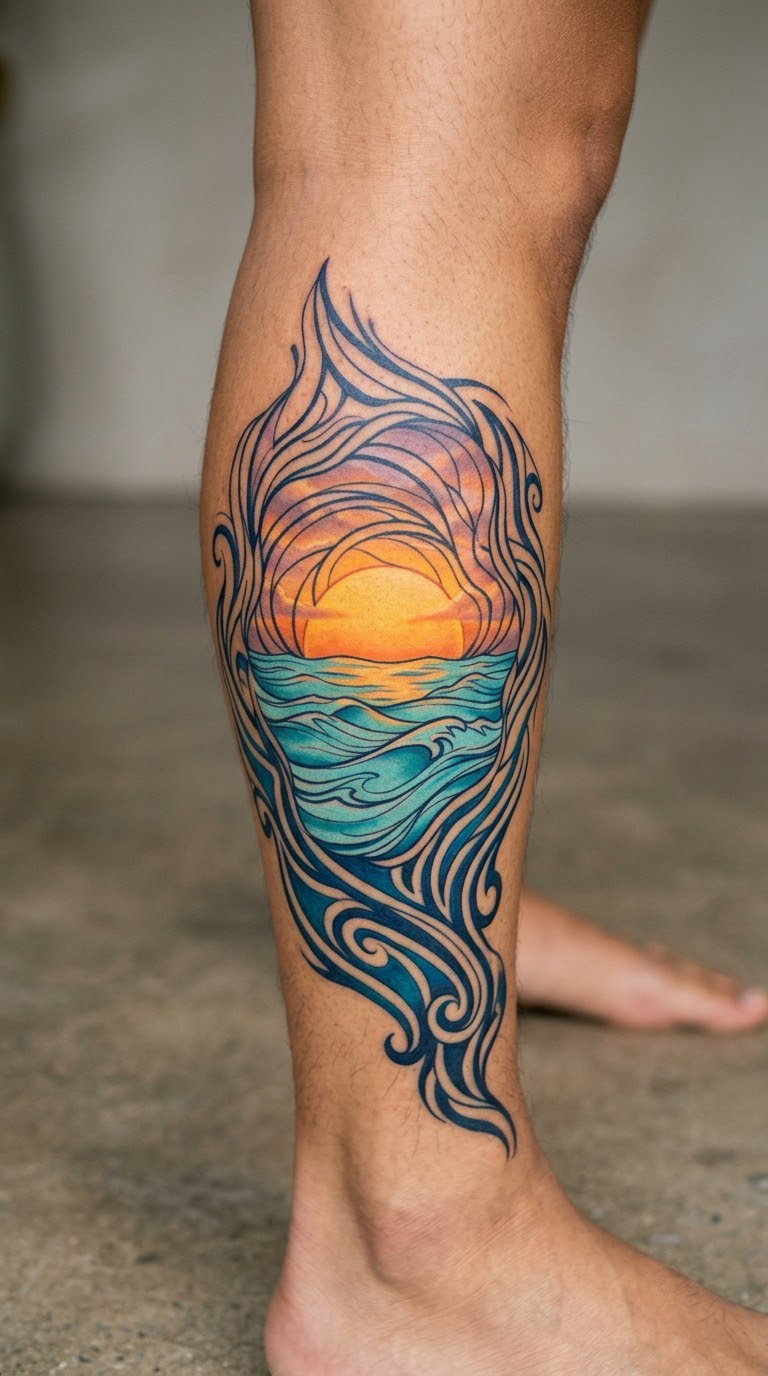
A glowing yellow sun sits half-sunk behind three or four bands of water, turquoise near the surface, deepening to navy where the wave lines stack. The sun edge stays soft so the light appears to bleed into the water instead of sitting on top of it.
It tends to attract people who think of the sea as a calm place rather than an adventure one. The bands of color read as evening light on moving water, and nothing in the design fixes a single interpretation.
Placement: calf, inner arm, or rib side. Size: 4-7 in (10-18 cm); below 3 in the water bands merge. Style: semi-realistic. Pain: medium, with the rib placement noticeably harder than the calf. Turquoise is one of the colors to ask about, because it carries less depth than the yellow and can look duller years later. Make it yours: put the latitude of a coastal place you love in the darkest water band. See also 20 Forearm Tattoo Ideas for Women With Meaning (September 2026) for how that placement shapes other choices.
5. Snow-Capped Mountain Sunset in Layered Color
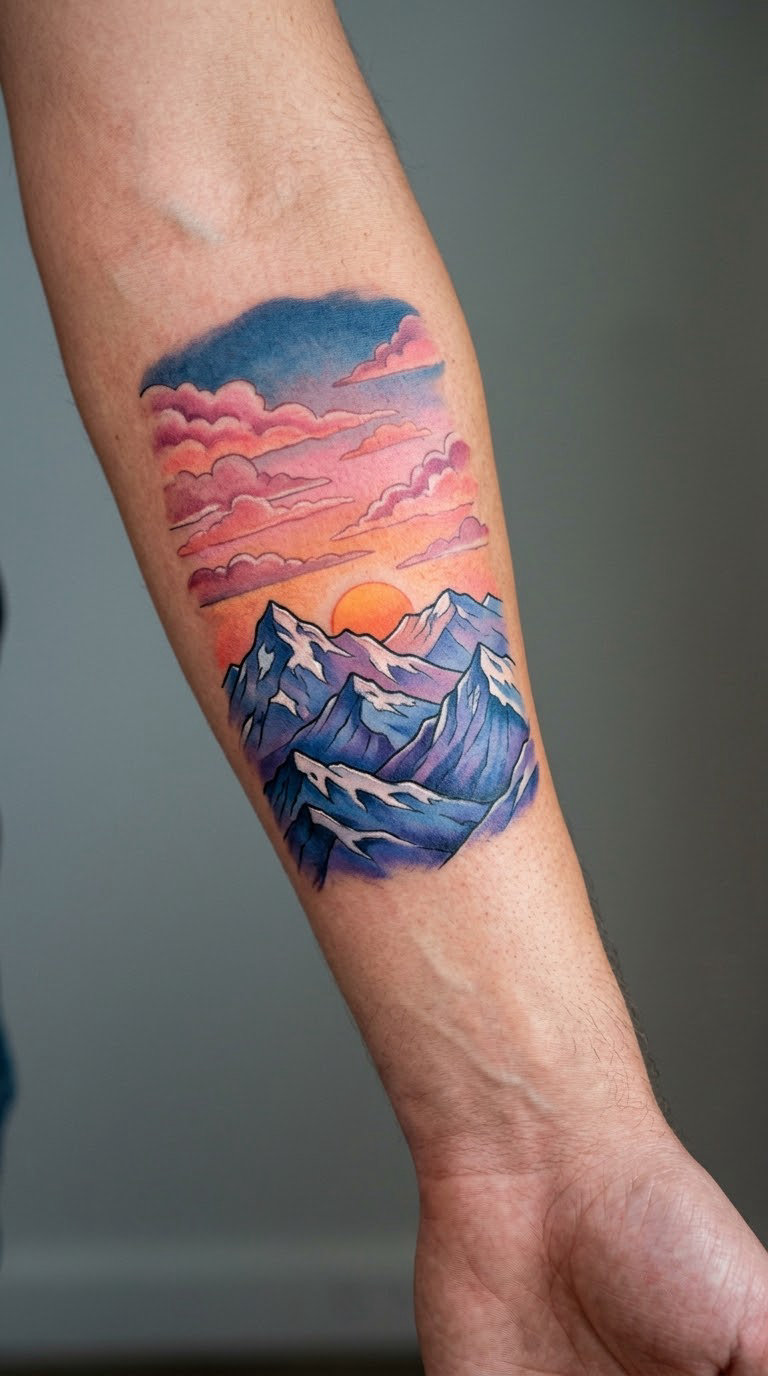
Blue-violet peaks with white snow catching the last light, warm pink clouds stacked behind them, and a low orange sun sitting between two ridges. The composition is built in layers from back to front, which is what keeps it readable once the color settles.
This one is for people who think of the mountains as the calm part, not the achievement part. A layered landscape like this also holds detail better than a single object, so it ages more gracefully than a small motif.
Placement: outer forearm, upper arm, or across the shoulder blade. Size: 5-8 in (13-20 cm). Style: illustrative landscape. Pain: medium on the arm, higher across the back. Snow highlights are the first thing to soften, so a touch-up is often booked a year in. Make it yours: name a real range to your artist and ask for the ridgeline, not the mountain. Our 16 Tiny Mountain Tattoo Ideas, Each With a Placement (September 2026) covers the small-scale version well.
6. Desert Sunset With Cactus and Sand Curves
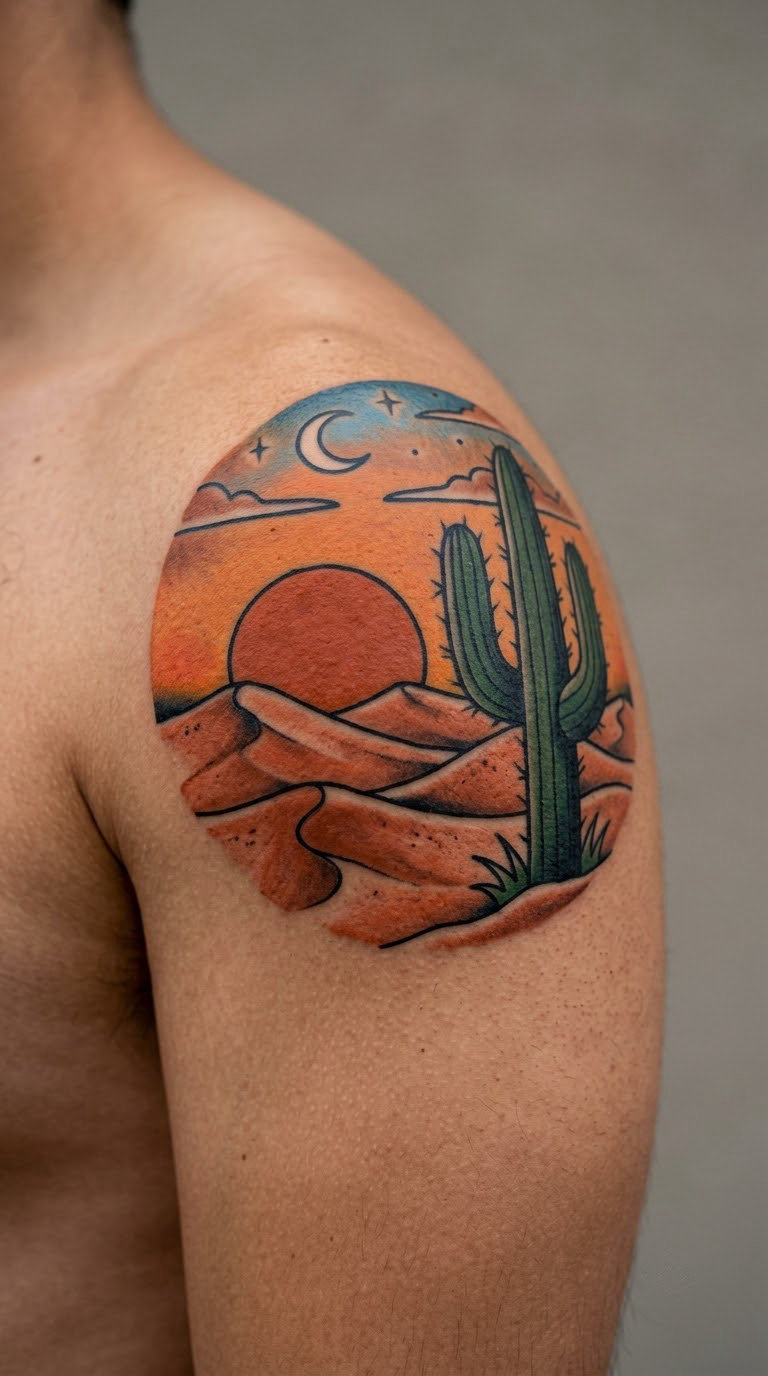
A rust-orange sun low over terracotta dunes, a single dark green saguaro offset to one side, and two or three smooth sand curves doing the work of shadow. The palette is warm, dusty and flat, with bold linework around the cactus doing the structural heavy lifting.
People choose it for a landscape that feels wide and quiet. It reads as western without leaning on any single symbol, and the cactus is common enough to find as a style reference and original enough to avoid looking generic.
Placement: shoulder, upper back, or outer thigh. Size: 4-6 in (10-15 cm). Style: traditional, with flat color fills. Pain: medium to high on the shoulder blade, medium on the outer thigh. The shaded sand curves are thin passes that sting more than the flat fills. Make it yours: add a specific desert you have actually stood in, and let the artist shift the sun’s position to match the real horizon.
7. City Skyline Lighting Up at Purple Dusk
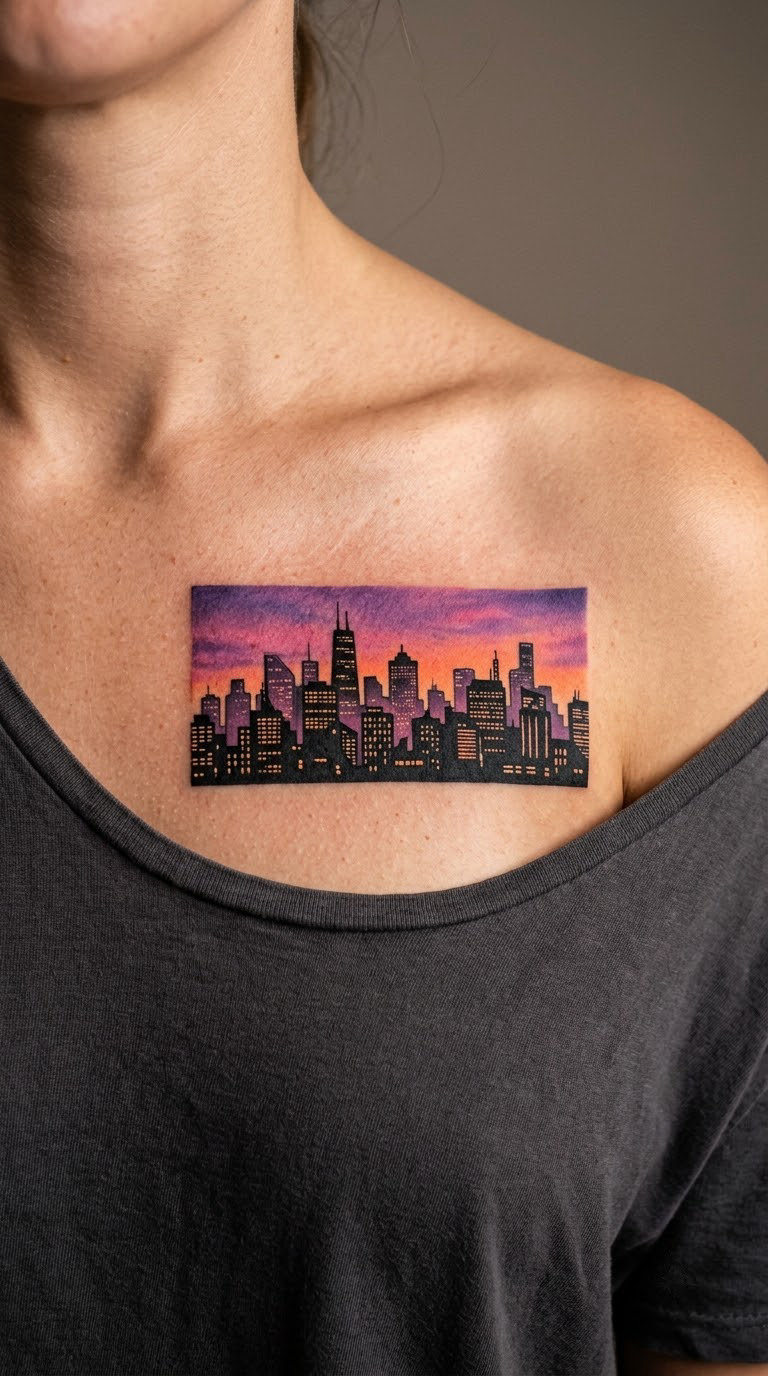
A black skyline silhouette along the bottom third, tiny warm windows lit inside the buildings, and a gradient sky running from violet at the top through magenta into orange at the horizon. The detail is all in the contrast between the flat black blocks and the lit squares.
This is the home-city version of the sunset idea, and people usually have a reason: the building they grew up under, the skyline they moved away from, the view from a specific window.
Placement: upper chest, upper back, or outer arm. Size: 6-9 in (15-23 cm). Style: illustrative with blackwork. Pain: high on the sternum and collarbone, medium on the upper arm. The windows take the longest because each one is a separate pass. Make it yours: pick one building to reproduce accurately and let the rest of the skyline be generic, otherwise the piece reads as wallpaper.
8. Flowers Blooming Beneath a Color Gradient Sky
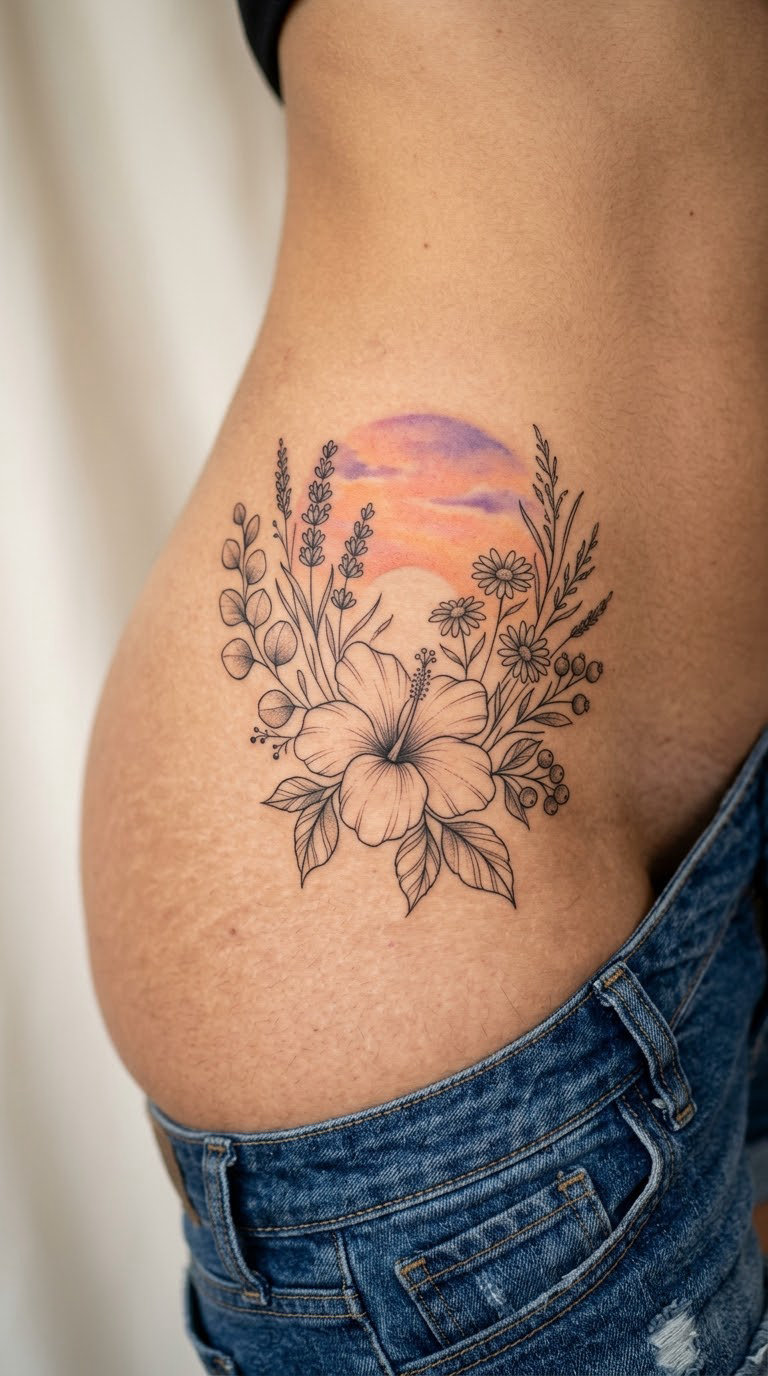
A peach-to-purple wash fills the top of the composition, and fine-line hibiscus, lupine or wildflower silhouettes stand along the bottom edge in black. The flowers are drawn rather than filled, so the color stays above them and the whole thing keeps an open feel.
It is the design people pick when they want the sunset to sit alongside something living. Flowers also age better than pure gradient work, because the linework holds even when the wash softens.
Placement: hip, outer thigh, inner arm, or lower back. Size: 5-8 in (13-20 cm). Style: watercolor with fine line. Pain: medium, and the hip is more sensitive than the arm. Petal edges blur if the design is scaled down too far, so resist shrinking the flowers. Make it yours: swap the mixed wildflowers for one species that means something to you, such as a birth flower or a plant from a family garden.
9. Tropical Beach Sunset With Frangipani
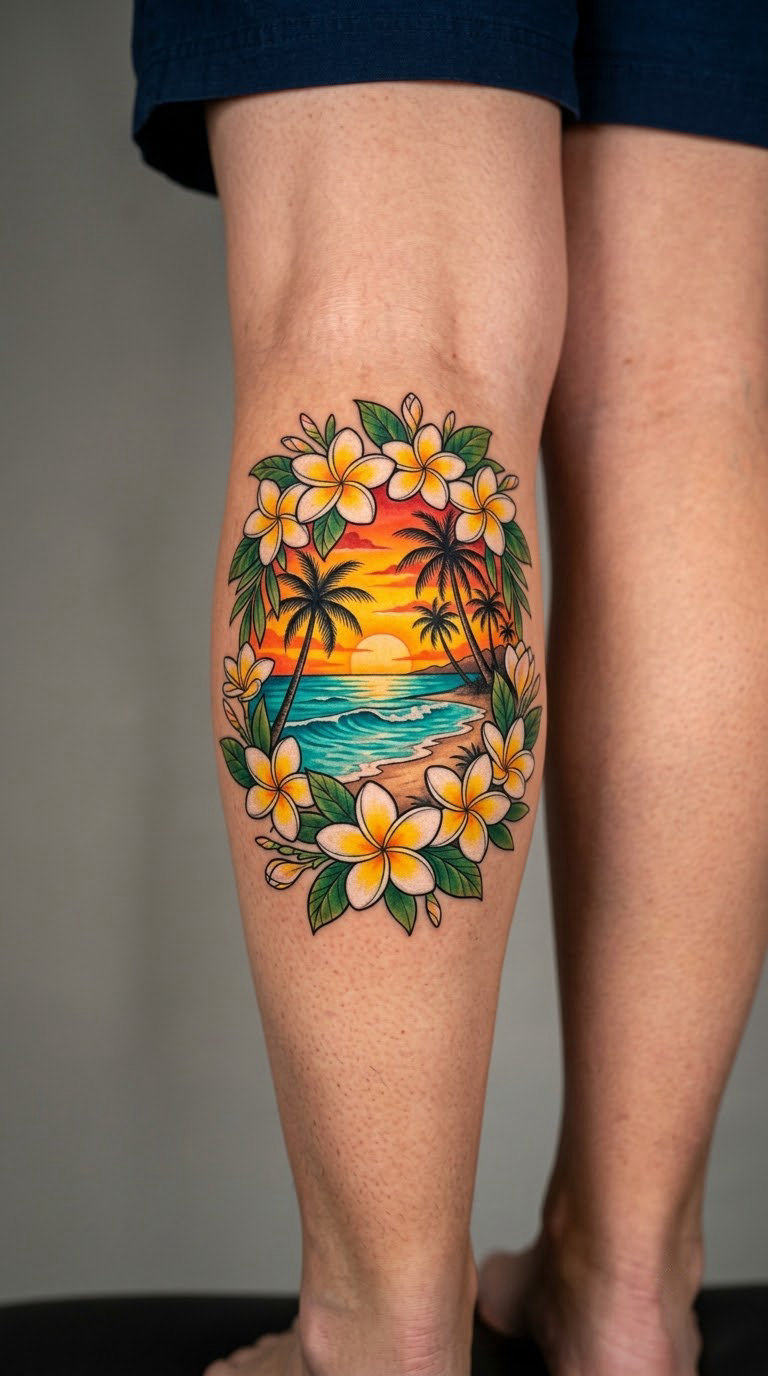
Turquoise water at the bottom, a warm yellow-to-orange sky above it, and white frangipani with yellow centers framing one side of the composition. Soft water, hard flowers: the contrast is what stops this from looking like a generic beach postcard.
Most people are marking a trip rather than an idea. If the reference is a real beach, bring a photograph from the exact spot so the color of that water and that evening sky is what gets tattooed.
Placement: back of the calf, outer forearm, or lower back. Size: 5-7 in (13-18 cm). Style: color realism. Pain: medium; the back of the calf is one of the more forgiving spots for a long session. The white in the flowers will pick up the skin tone underneath, which is worth discussing before the stencil goes on. Make it yours: skip the generic beach and tattoo the frangipani alone at a smaller size, then add the water later if you want to build the piece up.
10. Watercolor Sun, Sea, and Sky Blend
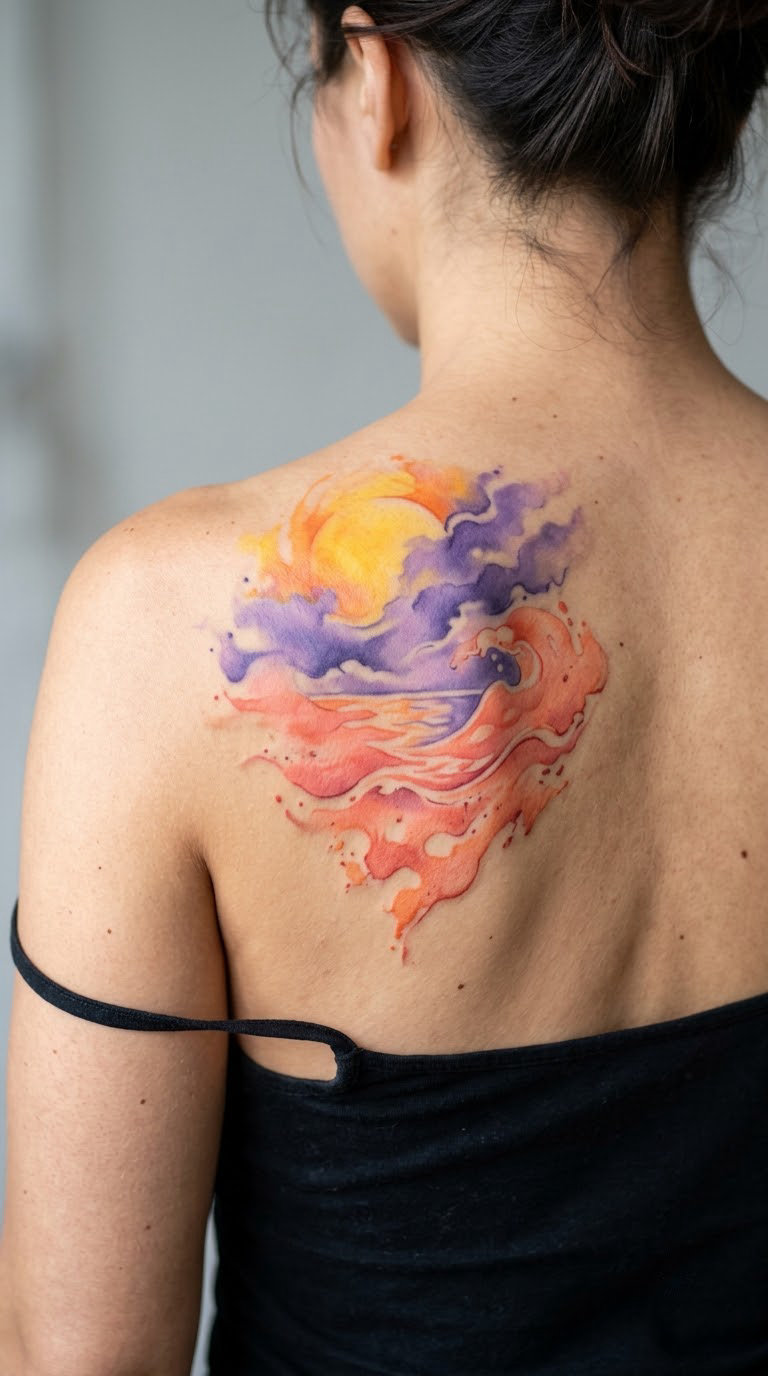
No outlines at all. A yellow sun melts into coral water and a violet sky, with the transitions happening in the pigment rather than in drawn edges. The sun is the only recognizable object, and it is barely a shape. That is the point.
Colour lovers tend to pick this one. It suits a body area with a broad flat surface, because a wash that gets interrupted by the shape of the body stops looking like a wash.
Placement: shoulder blade, upper back, outer thigh, or ribs. Size: 6-10 in (15-25 cm). Style: abstract watercolor. Pain: medium, and a piece this size is usually booked as more than one sitting. The soft edges are the first thing to go as the ink settles, so ask the artist to define the sun just enough to survive. Make it yours: fix three colors you care about and ask the artist to build the whole blend from only those three.
11. Geometric Sunset Made From Triangles
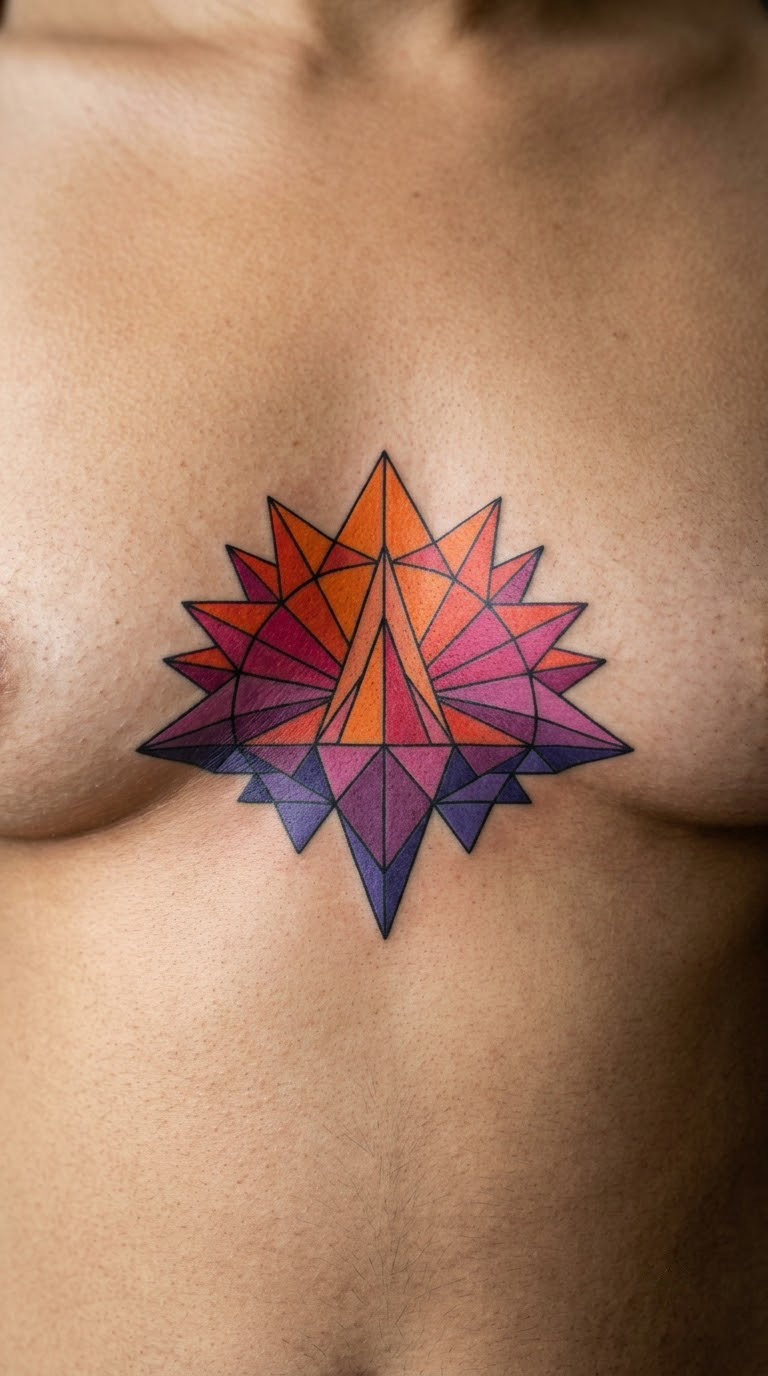
Triangles in orange, red, pink and purple arranged into a symmetrical half-sun, with the shapes meeting along crisp straight edges and no shading anywhere. Read one way it is a sun setting, read another way it is a stack of color blocks.
People who like graphic design rather than illustration tend to choose this one. It is the most modern design in the twenty and the easiest to place symmetrically down the center line of the body.
Placement: sternum, center chest, forearm, or along the spine. Size: 4-6 in (10-15 cm). Style: geometric. Pain: high on the sternum and ribs, medium on the arm. Solid color fills need a steady hand and multiple passes, which is why the chest hurts most. Make it yours: add a single thin line of text or coordinates along the base edge, small enough not to disturb the geometry.
12. Fine-Line Sunset With a Personal Place Name
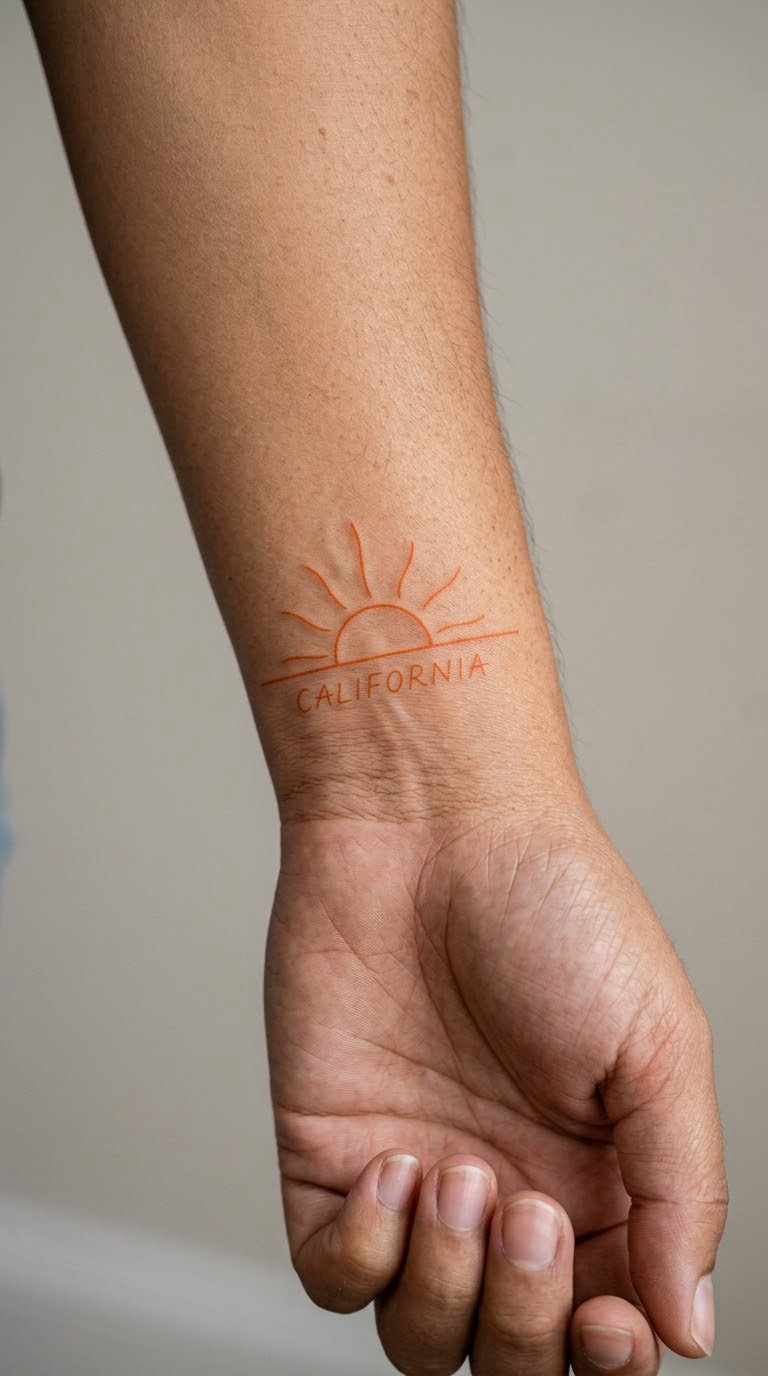
A delicate orange half-sun sitting on a hairline horizon, with a place name in restrained hand lettering underneath. The lettering is the risky part: it needs to stay readable at a small size and survive the first month of healing when the hand or wrist moves constantly.
The name is the reason the piece exists. A city, a beach, the place a person is from, or the place you are going next.
Placement: inner wrist, inner forearm, or the rib side. Size: 2-4 in (5-10 cm). Style: fine line. Pain: low to medium, though the wrist bone and inner arm are sensitive. Fine hand lettering fades and softens within a few years, faster than any other element in this article, so plan on a refresh. Make it yours: test the name on paper at the same size as the tattoo and check it at arm’s length before the stencil is cut.
13. Minimal Sunset Reflected Across Three Waves
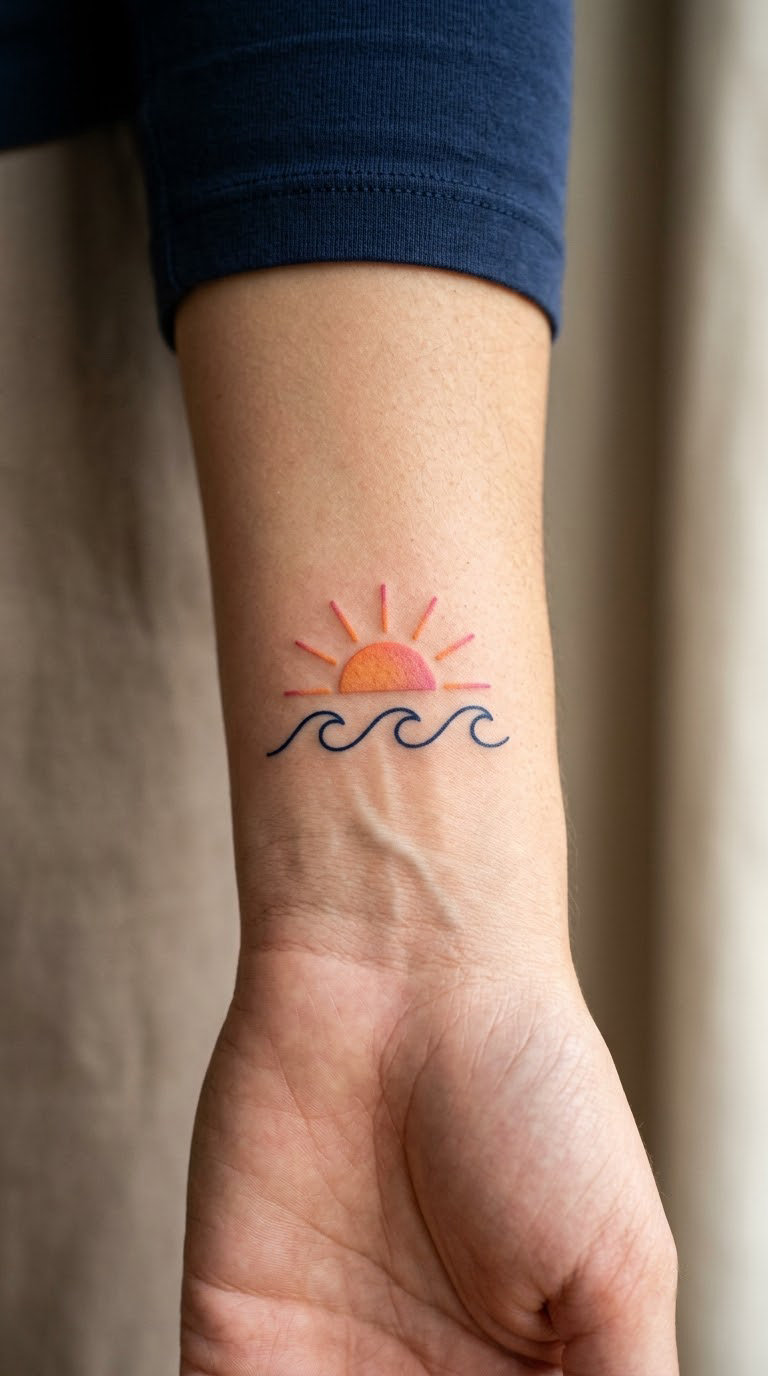
One half-sun in a narrow yellow-to-pink gradient, three clean navy wave strokes below it, and nothing else. The whole design fits inside a circle no bigger than a coin in most versions, and it is the one design here that looks right at the smallest sizes on this list.
It suits first-tattoo clients and anyone who wants a sunset that never competes with an existing piece. The restraint is what makes it work.
Placement: wrist, inner arm, behind the ear, or ankle. Size: 2-3 in (5-8 cm). Style: minimal fine line. Pain: low on the wrist and behind the ear. At 2 in the gradient has to be compressed into two or three tones, otherwise the middle of the sky turns muddy. Make it yours: change the wave spacing to match a rhythm or a number that matters to you, which is subtle enough that nobody else notices.
14. Sunset Framed by Tropical Leaf Silhouettes
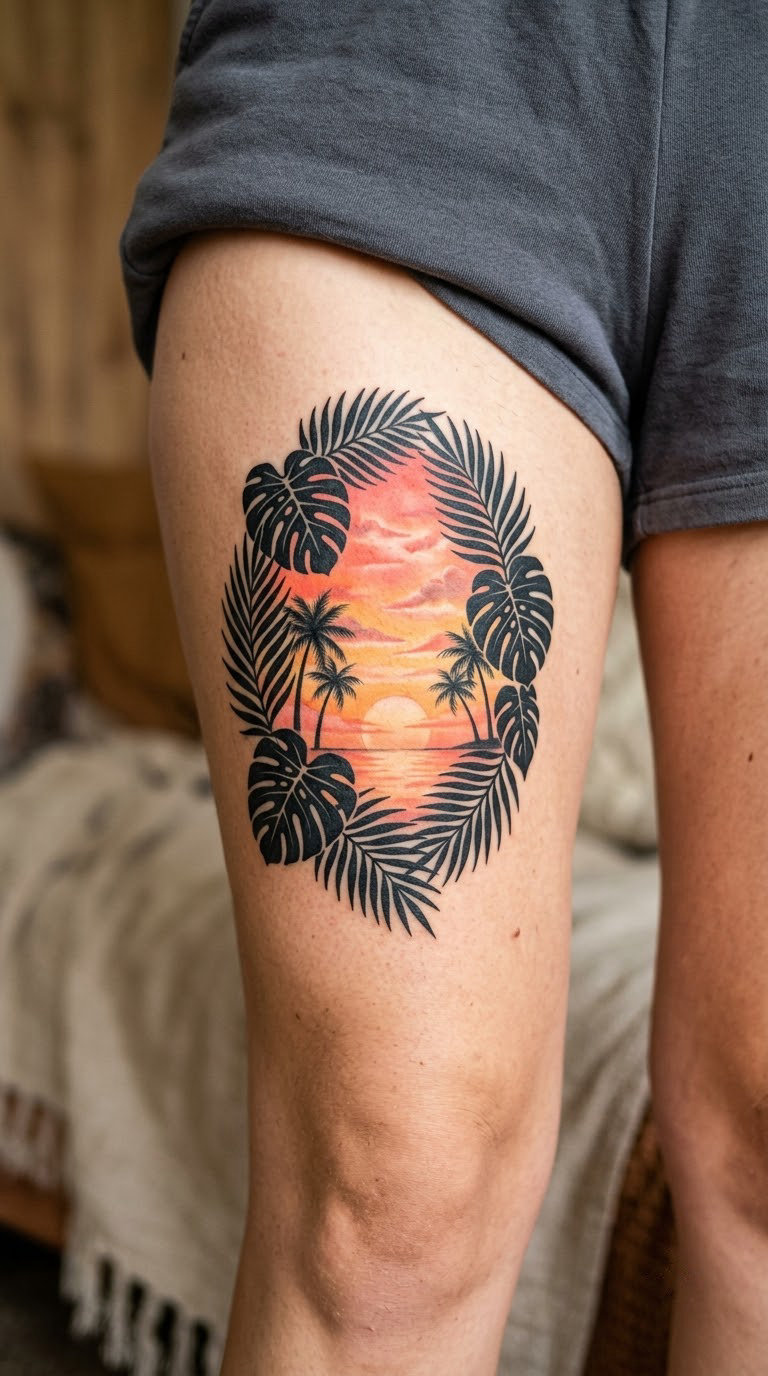
Dark monstera, palm and banana leaf silhouettes lean in from both sides, framing a vivid coral and yellow sky in the middle. Nothing botanical is colored; the leaves are pure black shapes and the sky is the only color in the tattoo.
This is the botanical version of the beach scene, and people usually choose it when the plant matters more than the view. It also has the advantage of wrapping around a curved area better than a landscape does.
Placement: thigh, hip, side of the calf, or lower back. Size: 5-8 in (13-20 cm). Style: blackwork silhouette with a color wash. Pain: medium, and the thigh is easier for a long sitting than the ribs. The black leaf edges are sharp and stay sharp, which is what keeps the composition readable as the wash fades. Make it yours: use leaves from a plant you have actually kept alive, and have the artist cut one that has slightly damaged edges so it does not look like a stock graphic.
15. Mountain Lake Reflection at Golden Hour
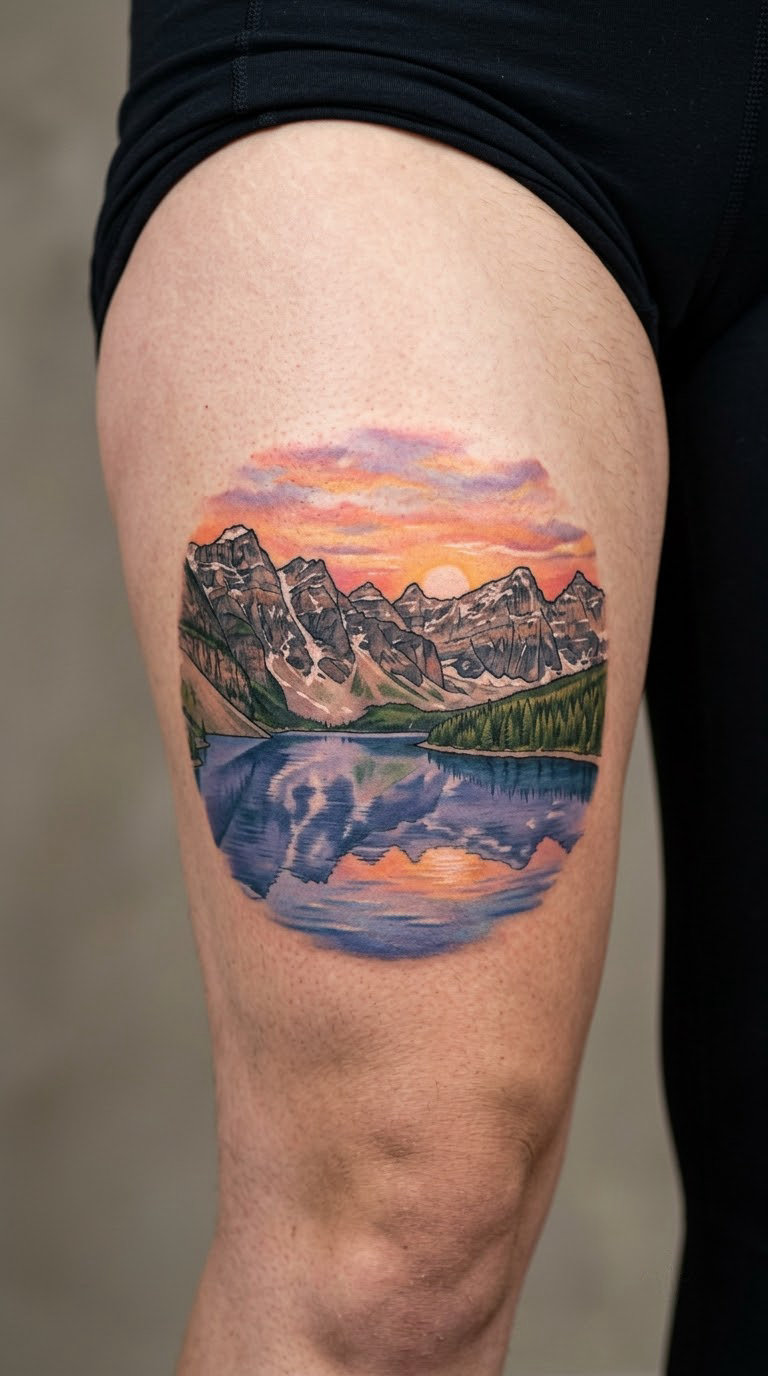
Warm peaks above, an inverted reflection below in blue-violet water, and a narrow band of sky between them. The two halves are close to mirrored rather than identical, which is what keeps it from looking like a printing error.
Still water and open space is the appeal for most people choosing it. Reflections are also forgiving as a subject, because small inaccuracies in the lower half read as movement rather than error.
Placement: outer thigh, shoulder, or across the lower back. Size: 6-9 in (15-23 cm). Style: semi-realistic. Pain: medium on the thigh, higher across the back. Symmetry across two halves takes twice the passes of a single landscape, so expect the sitting to run long. Make it yours: adjust the reflection’s saturation on darker skin tones so the lower half does not disappear against the skin.
16. Sun and Moon Phases in a Gradient Circle
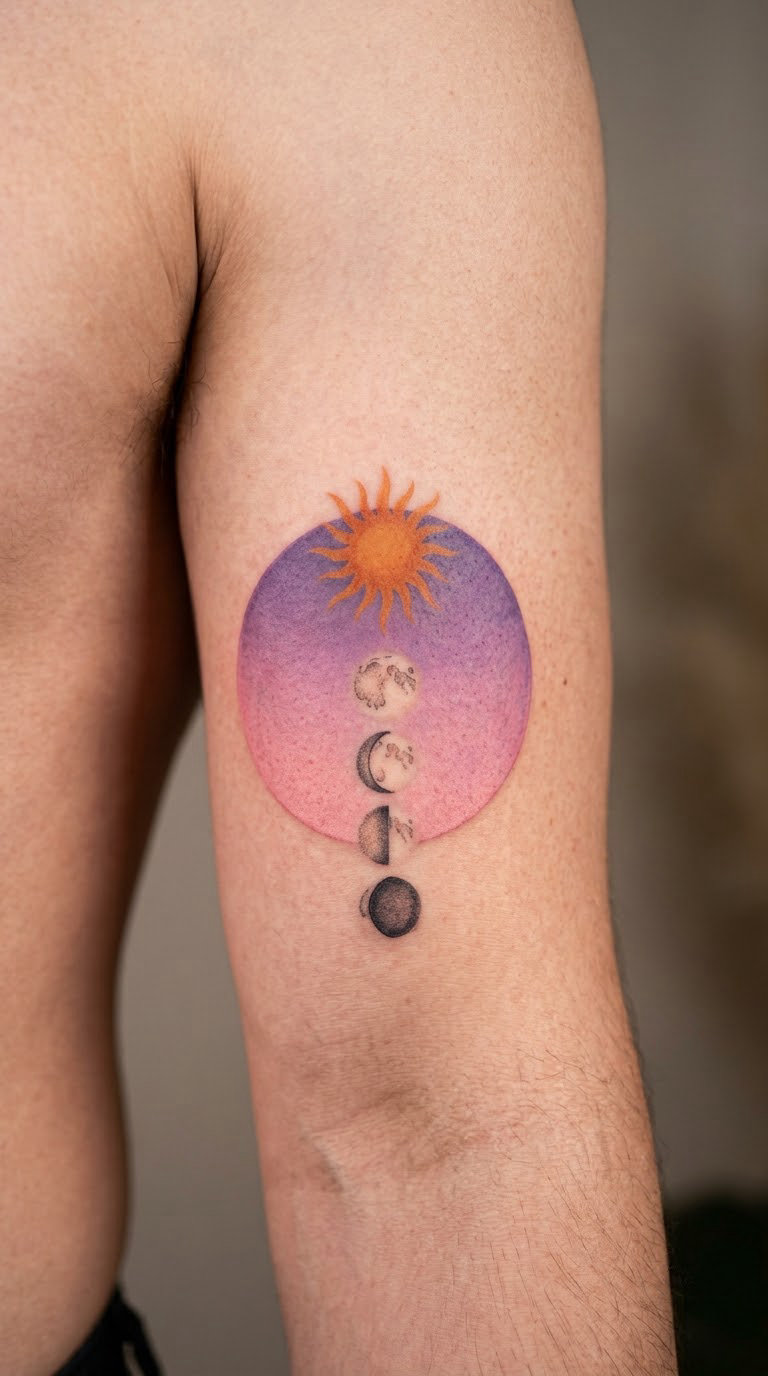
A burnt-orange sun on one side of a circle, lunar phases running through the middle, and a pink-to-purple gradient filling the background of the disc. One continuous circle, everything inside it, nothing outside. The circle border keeps a scattered concept looking designed.
It suits people marking a cycle, a relationship, or a specific date, since the phases can be arranged to match a real sequence. The interpretation is yours to give it; the design does not force one.
Placement: upper arm, forearm, or shoulder blade. Size: 4-5 in (10-13 cm). Style: illustrative with a gradient fill. Pain: medium. Small moon phases are the first detail to blur as the piece ages, so ask for the smallest phase to be at least a quarter inch across. Make it yours: order the phases by the actual moon cycle from the date you are marking. See 20 Sun Moon and Rising Sign Tattoo Ideas (September 2026) for related celestial layouts.
17. Hot Air Balloons Crossing a Violet Sky
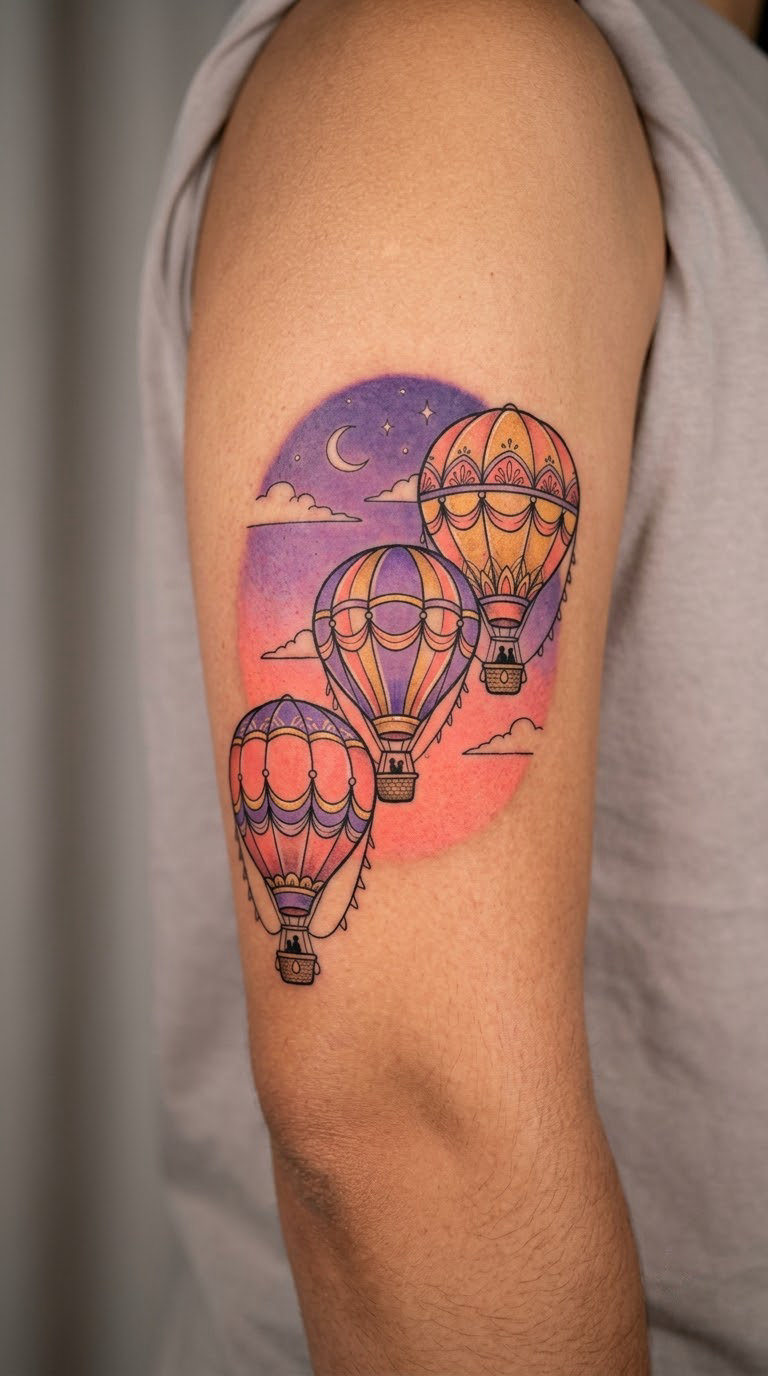
Two or three hot air balloons in coral, gold and violet, each a different size, floating across a purple-to-coral gradient sky with no ground line. The balloons are the only solid shapes, and their stripes do all the color work.
It reads as travel and imagination rather than a specific place, which is why it works for people who want the feeling of a sunset without a location attached.
Placement: back of the upper arm, calf, or upper back. Size: 4-7 in (10-18 cm). Style: whimsical illustrative. Pain: medium; the upper back is the sensitive option here. Stripes on the smallest balloon need to be at least three lines or they disappear. Make it yours: add a real travel date in small lettering under the lowest balloon, kept low enough that it reads as a caption rather than a title.
18. Lighthouse Facing a Red-and-Gold Horizon
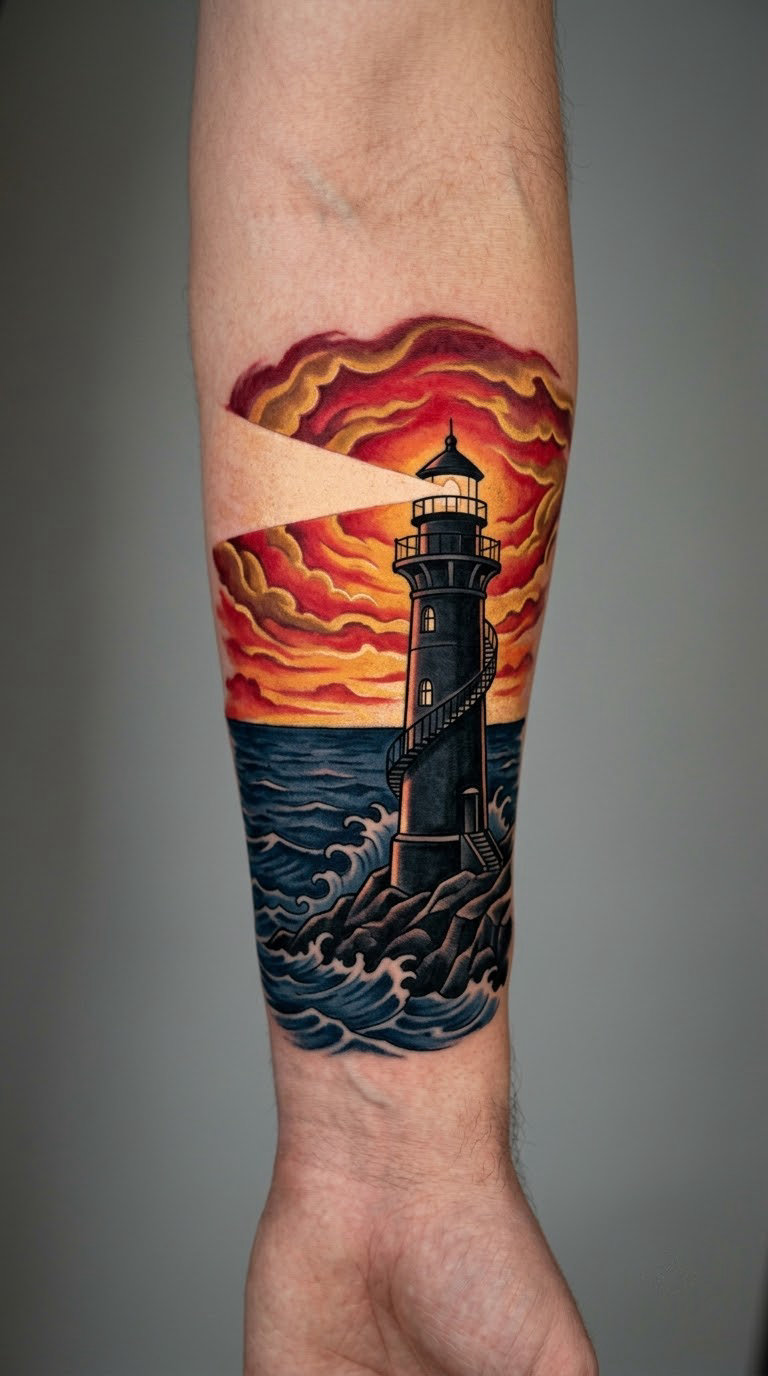
A narrow black lighthouse, a cream beam cutting across the frame, a rough navy sea along the bottom, and a red-and-gold sky taking up the top two-thirds. The vertical lighthouse gives the composition a spine that a pure gradient has no way to fake.
It is the coast version with a structure in it, and people usually bring a real one. A lighthouse they visited, a coastline they grew up near, a working light they have seen from a boat.
Placement: forearm, outer arm, or calf. Size: 5-8 in (13-20 cm). Style: illustrative with blackwork linework. Pain: medium, and the narrow lighthouse stripes are the stingiest part. The cream beam looks light and behaves heavy, since white ink over color needs a different approach than white on skin. Make it yours: give the artist a photograph of the actual lighthouse and ask for the tower proportions to match, since recognizable buildings are mostly about width and window placement.
19. Travel Coordinates Beneath a Tiny Sunset
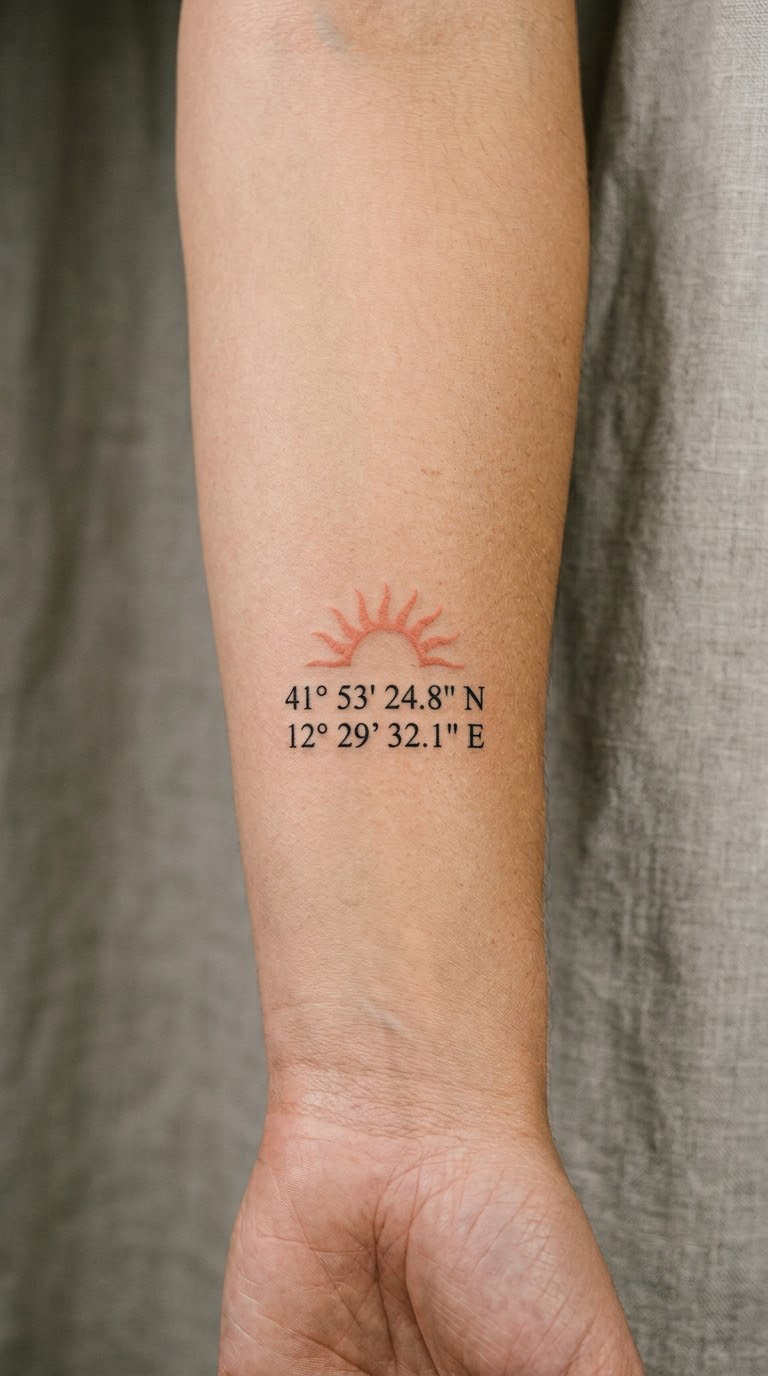
A compact coral half-sun with a hard horizon line, and the exact coordinates of a meaningful trip set in fine black lettering underneath. It is the smallest sunset in this list that still reads clearly, because there is almost nothing in it to blur.
The coordinates are the point. People use it for a first trip somewhere that mattered, a home they left, or a place they are going rather than one they have been.
Placement: inner arm, inner forearm, or the back of the hand. Size: 2-4 in (5-10 cm). Style: minimal with lettering. Pain: low to medium. Punctuation and degree symbols are the practical difficulty: a wrong or missing symbol makes the coordinates wrong, so check them together before the stencil goes on. Make it yours: add the year underneath in a smaller size, and keep the whole block narrow enough to fit under a 2 in sun.
20. Fiery Phoenix Emerging From a Color Sunset
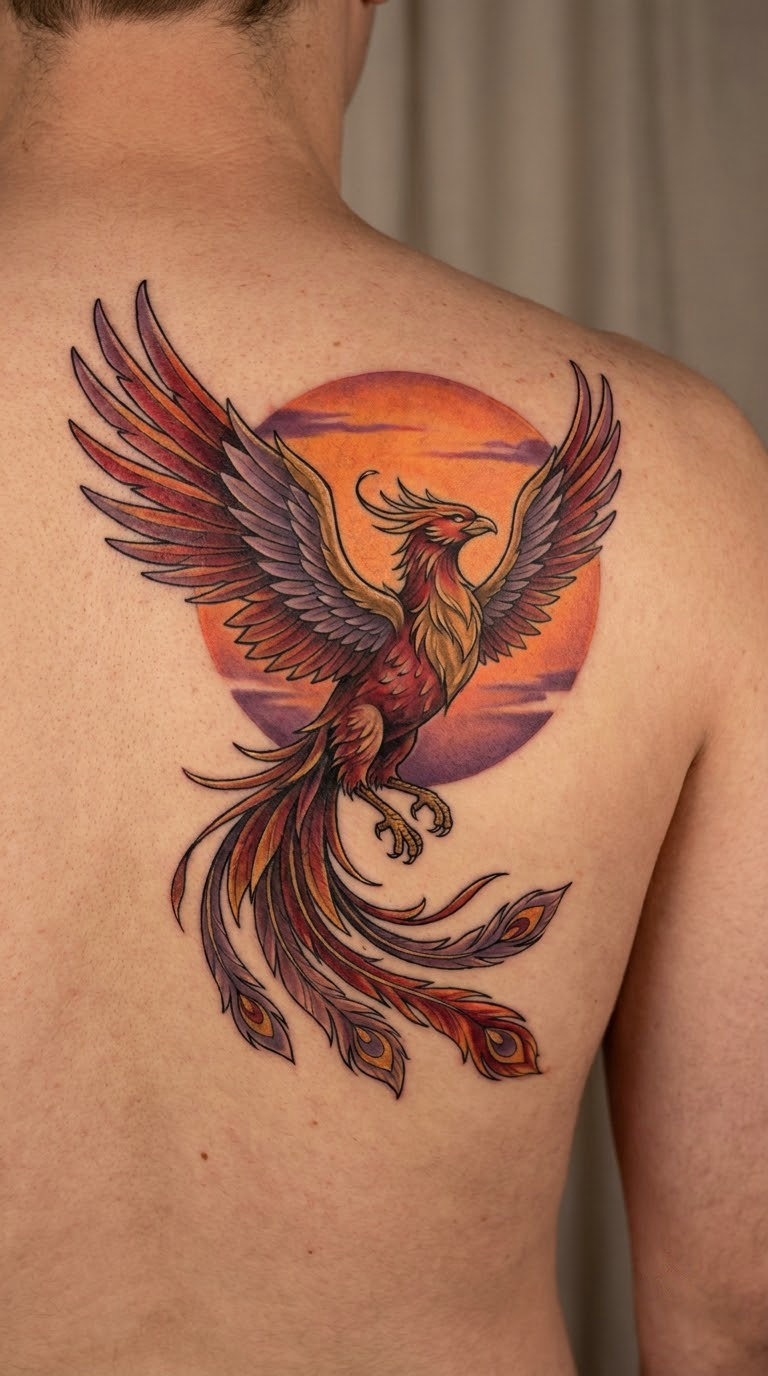
A phoenix with red, orange, gold and violet tail feathers crossing in front of a glowing sunset disc, with individual feather separations kept clean through the whole length of the tail. This is the only design here that needs a color artist working in a real style rather than a beginner trying something manageable.
Rebirth is the reading everyone brings to a phoenix, and some people want that while others are really after the color. Either way it is a commitment piece rather than a first tattoo.
Placement: upper back, back panel, or large chest piece. Size: 10-16 in (25-40 cm). Style: illustrative color realism. Pain: high, and it usually takes several sittings rather than one. Feather detail and a smooth gradient in one composition is a lot of work for an artist, and you want to see healed color work in their portfolio before booking. Make it yours: have the artist tint the tail feathers toward your birth colors so the piece is yours from the first line.
How to Choose the Right Design
- Pick a style family first. Watercolor and abstract pieces give an artist the most freedom to adjust on the day, which suits a curved forearm. Illustrative and semi-realistic scenes need a larger flat area to work at all.
- Match size to detail. Count the elements in your reference before you scale it. A full gradient below about 3 in (8 cm) turns to a single flat color, so a small design has to lose elements rather than shrink them.
- Let body shape decide. A landscape that sits on an upper arm can sit flat and rectangular. On a calf or a thigh, plan the design along the curve so the horizon follows the muscle instead of fighting it.
- Check color contrast on your own skin. A palette that photographs well on pale skin can look completely different on deep skin. Ask the artist to show you the same palette healed, not fresh.
- Count sessions before you commit. Anything over about 6 in (15 cm) with gradients and small detail will usually need more than one sitting, and touch-ups are part of the deal.
- Think about first-tattoo suitability. A minimal half-sun with three waves or a fine-line horizon heals predictably and finishes fast. A phoenix or a skyline does not, and regret after a first piece is common.
Cost and Session Time
There is no single price for a sunset tattoo because the same design can cost very little or a great deal depending on size, detail and how long it takes. The honest way to think about it is by size band and time.
A tiny piece under 2 in (5 cm) with a flat sun and a line of lettering is usually a short appointment and the least expensive option. A small piece of 2-4 in (5-10 cm) with a gradient runs longer. Medium pieces from 4-7 in (10-18 cm) with layered scenery, reflections or a framed composition take the bulk of a session. Large panels and back pieces above 10 in (25 cm) are multi-session work, and you should agree the total and the schedule before the first sitting.
Four things move the total more than anything else: the shop minimum every studio charges, the artist’s hourly rate, how many sessions the design genuinely needs, and whether the work is custom rather than copied from a flash sheet. A simplified version of an over-detailed reference often costs less and ages better, and most artists will say so during a consultation if you let them.
Aftercare Basics
- Follow your artist’s aftercare instructions above anything written on a website, including this one. They know which products and films they used and how much ink went in.
- Wash the area gently with clean water and a fragrance-free cleanser, then pat it dry with a clean towel or paper rather than rubbing it.
- Keep it out of direct sun while it heals, and keep it away from friction, tight clothing, gym bags and hot tubs for the first couple of weeks.
- Ask in advance what products they recommend for moisturizing once the initial dressing comes off, and use that rather than whatever is in the house.
- Ask when to contact the artist. Spreading redness, heat, swelling or ink that has bled far outside the design are all reasons to call, and early contact is always better than waiting.
- Once healed, sunscreen on exposed areas is the single easiest way to slow fading of yellow, coral and violet tones. If your forearm or chest is a daily sun spot, say so at the consultation.
Frequently Asked Questions
What colors work best for a sunset tattoo?
A warm gradient works best: golden yellow at the horizon, coral and orange through the middle, pink and violet above. Anchor the gradient with black linework or a silhouette so the design stays readable. If you want a cooler look, swap the yellow for pale gold and push more violet into the upper sky.
Are small sunset tattoos a good choice for a first tattoo?
Yes, if the design is simple. A half-sun with three wave strokes or a fine-line horizon finishes in one short sitting and heals predictably, which matters for a first piece. Small sizes cannot hold a full gradient, so drop elements rather than shrinking everything. Save the detailed scene for a second tattoo.
Will watercolor sunset tattoos fade quickly?
Watercolor softens more than black linework, because there is no hard outline to hold the shape. Expect the edges to blur within a few years, especially on hands, fingers and any area that gets regular sun. A dark backbone such as a palm trunk or horizon line keeps the piece readable as the wash lightens. Plan on a touch-up every few years.
Where should a colorful sunset tattoo be placed?
The inner forearm, outer arm and calf give the most room and the most predictable healing. Ribs, sternum and upper back handle large landscapes better but hurt more. Wrist and ankle work for small designs and fade faster. Ask your artist for healed work on the same body area before you commit to a placement.
How many sessions does a detailed sunset tattoo take?
Most detailed sunset pieces need two sessions, and large panels or phoenix designs often need three. A gradient, a reflection and fine detail all add passes on the same area. Expect a touch-up visit within the first year as well, since fresh ink looks brighter than the healed result.
Conclusion: Choose Your First Sunset Tattoo
For a first tattoo, the watercolor horizon or the minimal half-sun across three waves is the safest call: small, fast and forgiving as it ages. If you are adding to an existing collection, the mountain, floral or phoenix scene rewards a bigger area and an artist who does color work regularly.
Decide three things before you book a consultation: the composition, the placement and the palette. Then bring two or three healed references rather than a folder of forty, and ask what the artist would cut out of it.