
20 Best Seashell Tattoo Ideas for Women (September 2026)
These seashell tattoo ideas for women cover everything from a two-inch fine-line scallop on the wrist to a realistic shell across the back, with the placement, size, style and pain level spelled out for each one. A shell is one of the easiest marine forms to translate into linework, which is why it keeps showing up in collections that mix small, meaningful pieces.
A good shell tattoo has a clear outer edge, ribs you can count from a normal viewing distance, and a size that matches the curve of the body part. The worst ones were drawn too small or packed with detail that blurred within a few years. If you are planning a beach trip this summer and want something healed before you go, that is a 30-to-45-day window, so book early rather than the week before you fly.
Seashell Tattoo Ideas for Women: Quick Guide
| Idea | Style | Best placement | Size | Pain |
|---|---|---|---|---|
| 1. Fine-line conch | Fine line | Collarbone | 2-3 inch | Medium |
| 2. Minimal scallop | Minimal line | Inner wrist | 1.5-2 inch | Medium |
| 3. Nautilus shell | Black and grey realism | Shoulder | 3-4 inch | Low |
| 4. Two-tone cowrie | Illustrative | Outer ankle | 2 inch | Medium |
| 5. Watercolor abalone | Watercolor | Inner forearm | 4-5 inch | Low |
| 6. Blackwork conch | Blackwork | Behind the ear | 2-3 inch | Low |
| 7. Pink conch | Soft realism | Rib | 3-4 inch | High |
| 8. Row of tiny shells | Micro fine line | Side of finger | 1 inch total | Medium |
| 9. Hammerhead and shell | Micro realism | Outer thigh | 5-6 inch | Low |
| 10. Sun and scallop | Fine line | Upper arm | 3 inch | Low |
| 11. Starfish and shell pair | Fine line | Back of neck | 2-3 inch | Low |
| 12. Floral and shell | Black and grey realism | Upper hip | 5-6 inch | Low |
| 13. Traditional whelk | Traditional | Calf | 4 inch | Medium |
| 14. Spiral with dotwork | Dotwork | Sidearm | 3 inch | Low |
| 15. Two matching shells | Fine line | Both collarbones | 2 inch each | Medium |
| 16. Shell with wave lines | Fine line | Outer thigh | 4 inch | Low |
| 17. Oyster and pearl drop | Soft realism | Upper chest | 3 inch | Medium |
| 18. Blue spiral shell | Colour fine line | Wrist | 2 inch | Medium |
| 19. Shell and seaweed element | Black and grey | Upper arm | 5 inch | Low |
| 20. Large realistic shell | Black and grey realism | Upper back | 6-7 inch | Low |
1. Fine-Line Conch Shell on the Collarbone
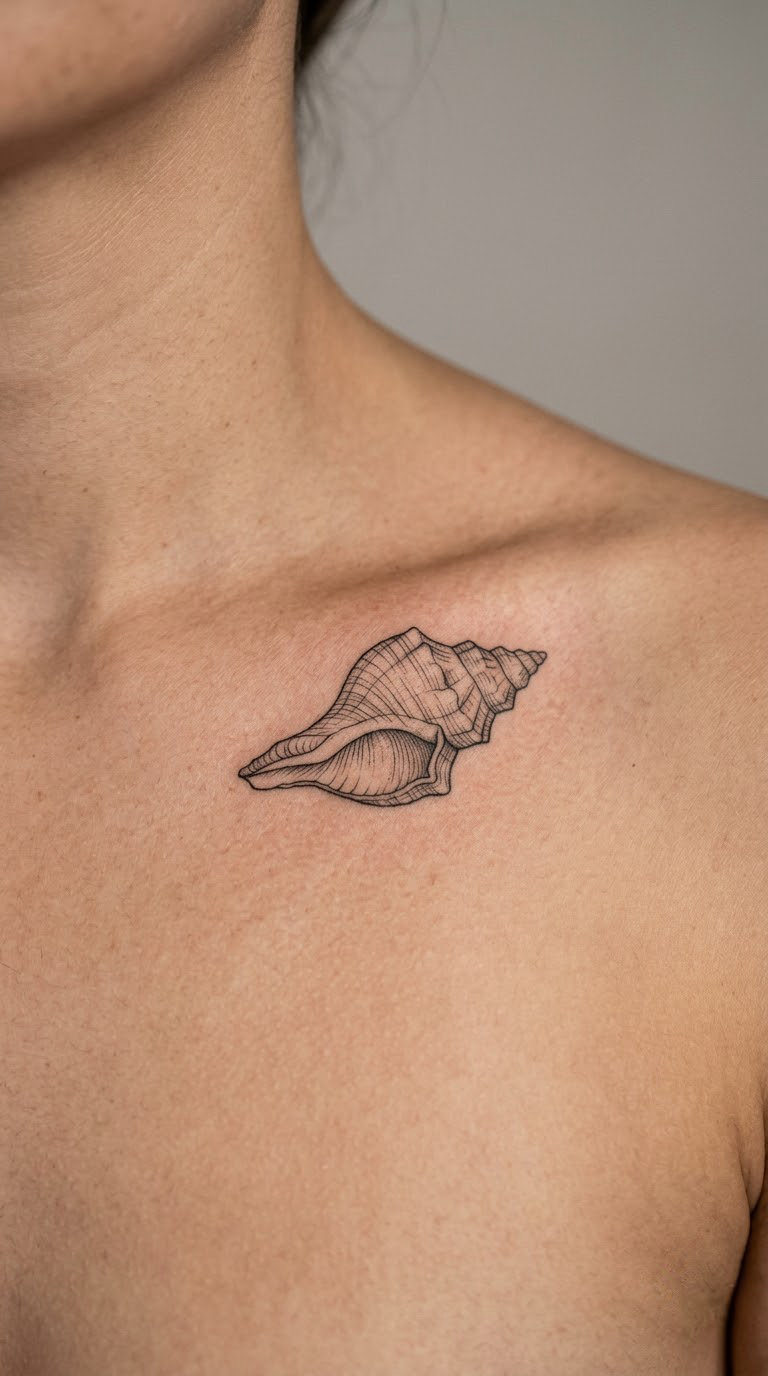
The design is a single conch shell drawn in one consistent line weight, no fill, no grey. The artist traces the spiral opening, then adds three or four curved contour lines along the body of the shell. That restraint is what makes it read as clean rather than fussy.
Most women pick a conch because it feels less common than a scallop while staying instantly recognisable. It carries the same protective, travel-worn associations without looking like a souvenir sticker.
Placement: collarbone, just below the hollow, or the top of the shoulder. Size: 2-3 inches (5-7.5 cm). Style: fine line, single needle.
Pain: medium, and it lingers because the collarbone is bony under soft skin. Ageing note: single-needle line on the collarbone holds better than on the hand, but expect a touch-up somewhere in year two. Make it yours: add a small coordinate pair or a single dot for the year of a trip.
If you want the same restraint in a different register, the 18 best fine line tattoo ideas for women are worth a look before you commit to a shell.
2. Minimal Scallop Shell on the Wrist
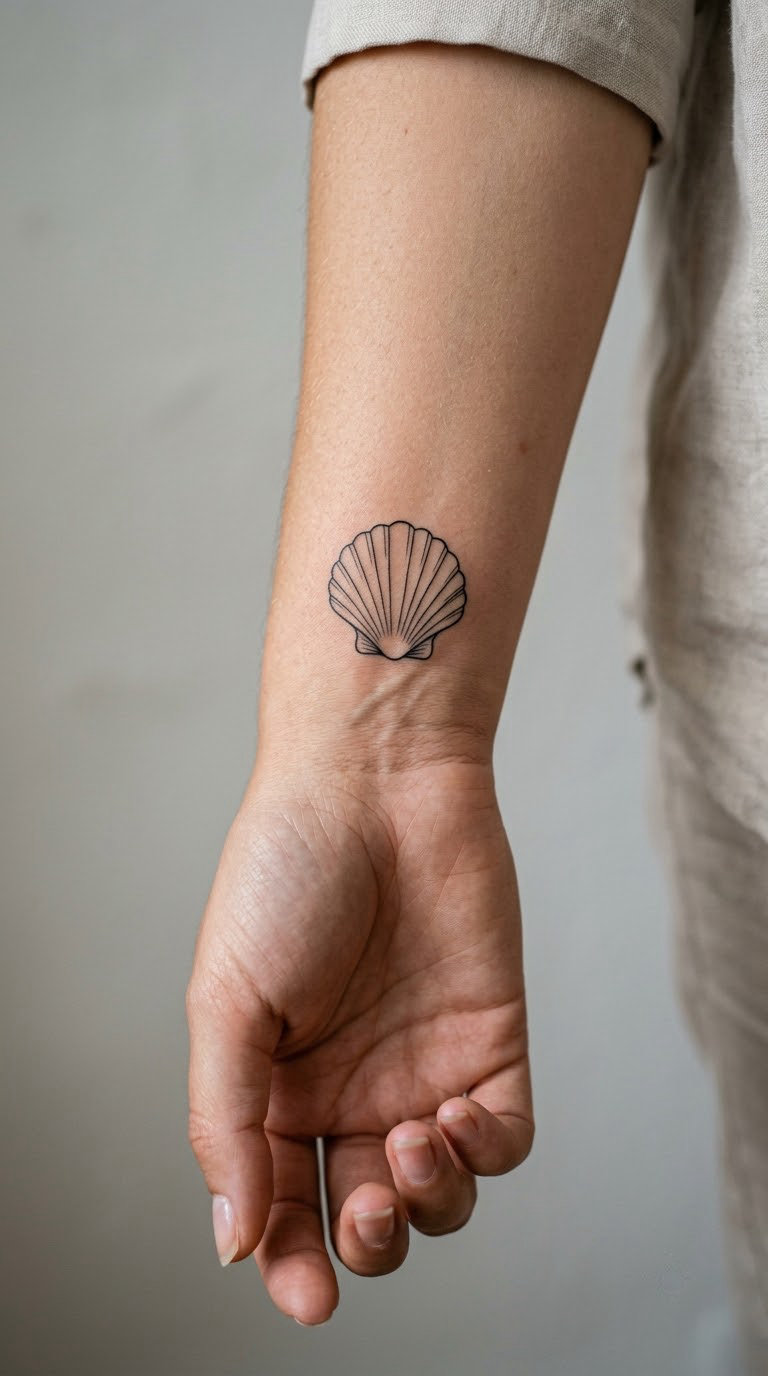
One continuous fan outline, four evenly spaced ribs inside it, nothing else. The balance comes from the spacing: ribs that are too close together turn the interior into a grey smudge once healed.
The scallop is the shell most tied to old pilgrim imagery and to Aphrodite in classical art, so it reads as a symbol of something completed and something protected. Most wearers pick it for that settled quality rather than for drama.
Placement: inner wrist, just above the heel of the hand. Size: 1.5-2 inches (4-5 cm). Style: minimal line.
Pain: medium. Wrist skin is thin and the veins sit close, so it pinches more than the shoulder does. Ageing note: wrist ink sees a lot of hand washing and sun, so budget for an early refresh. Make it yours: one shell for you, one for someone else, matched rather than identical.
3. Nautilus Shell on the Shoulder
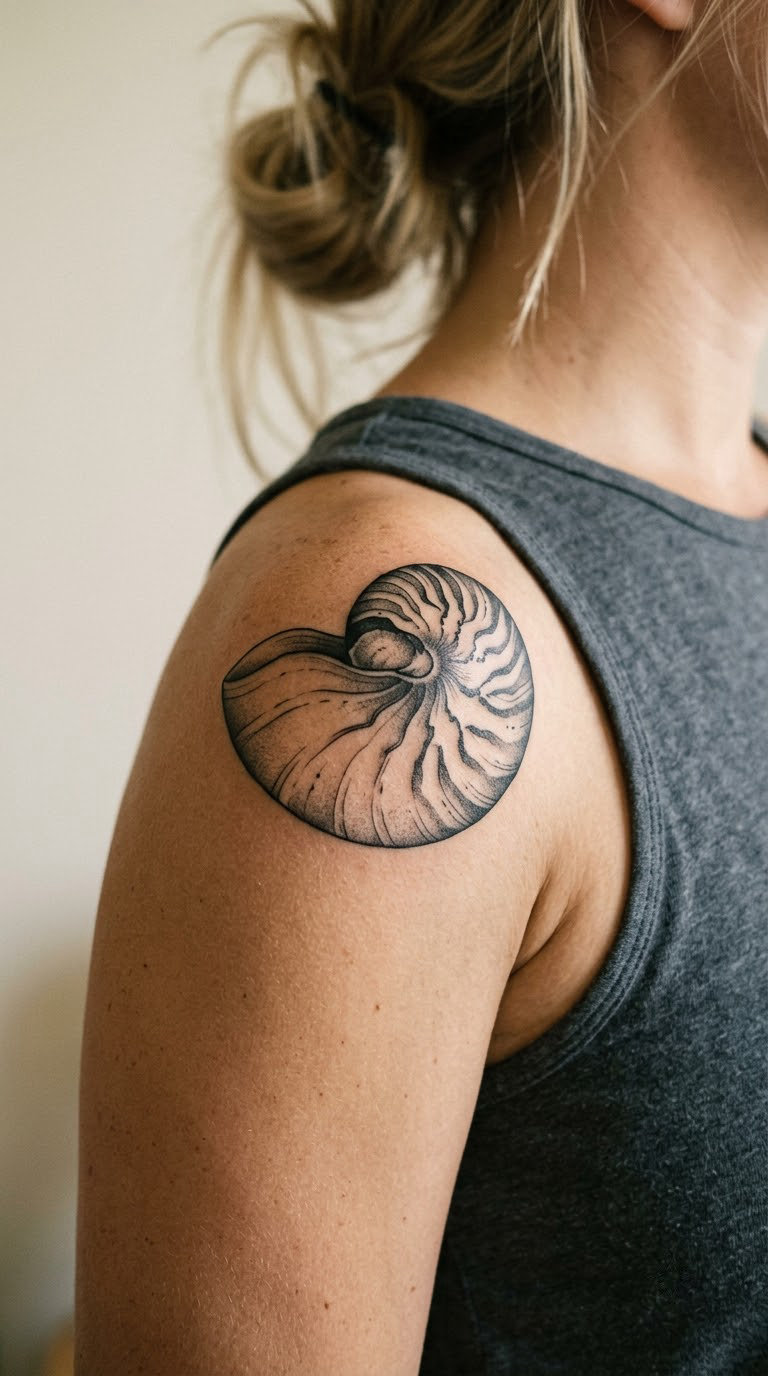
A cross-section nautilus with the internal chamber walls shaded in graduated grey, spiralling outward to a thin outer edge. The artist leaves the deepest chamber almost white and darkens toward the centre so the spiral pulls the eye in.
Because a nautilus grows by adding chambers without ever changing shape, it reads as slow growth and continuity, which is why people choose it around new chapters.
Placement: top of the shoulder, angled forward along the deltoid. Size: 3-4 inches (7.5-10 cm). Style: black and grey realism.
Pain: low, and the shoulder is forgiving even for longer sessions. Ageing note: the chamber lines are the first to soften, so keep the shading contrast strong at the start. Make it yours: add a date in the empty outer chamber where the eye goes anyway.
4. Two-Tone Cowrie Shell on the Ankle
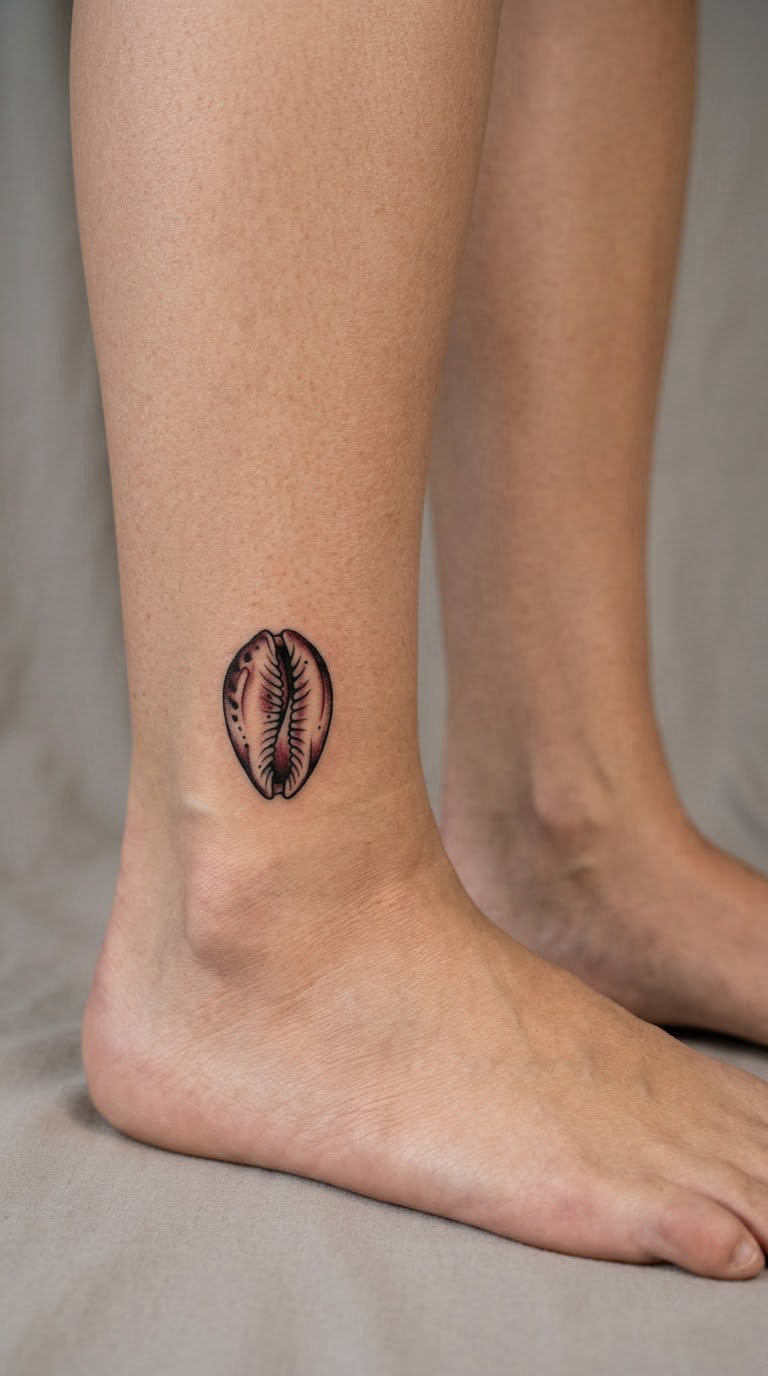
A glossy oval cowrie, cream body with a single black-red wash in the centre and the narrow slit left as a clean dark line. Two colours only, so the shape stays bold at a small scale.
Cowries have long been treated as a symbol of wealth and protection in several coastal cultures, and in a small size that solid, unbroken silhouette does the job better than a detailed shell would.
Placement: outer ankle, above the bone, or the top of the foot. Size: 2 inches (5 cm) long. Style: illustrative with two tones.
Pain: medium. Ankles are bony and bruise visibly afterwards. Ageing note: fine line on the foot fades fastest of any placement, so expect a touch-up every year or two. Make it yours: swap the red for a deep green and pair it with a matching toe dot.
5. Abalone Shell in Watercolor on the Forearm
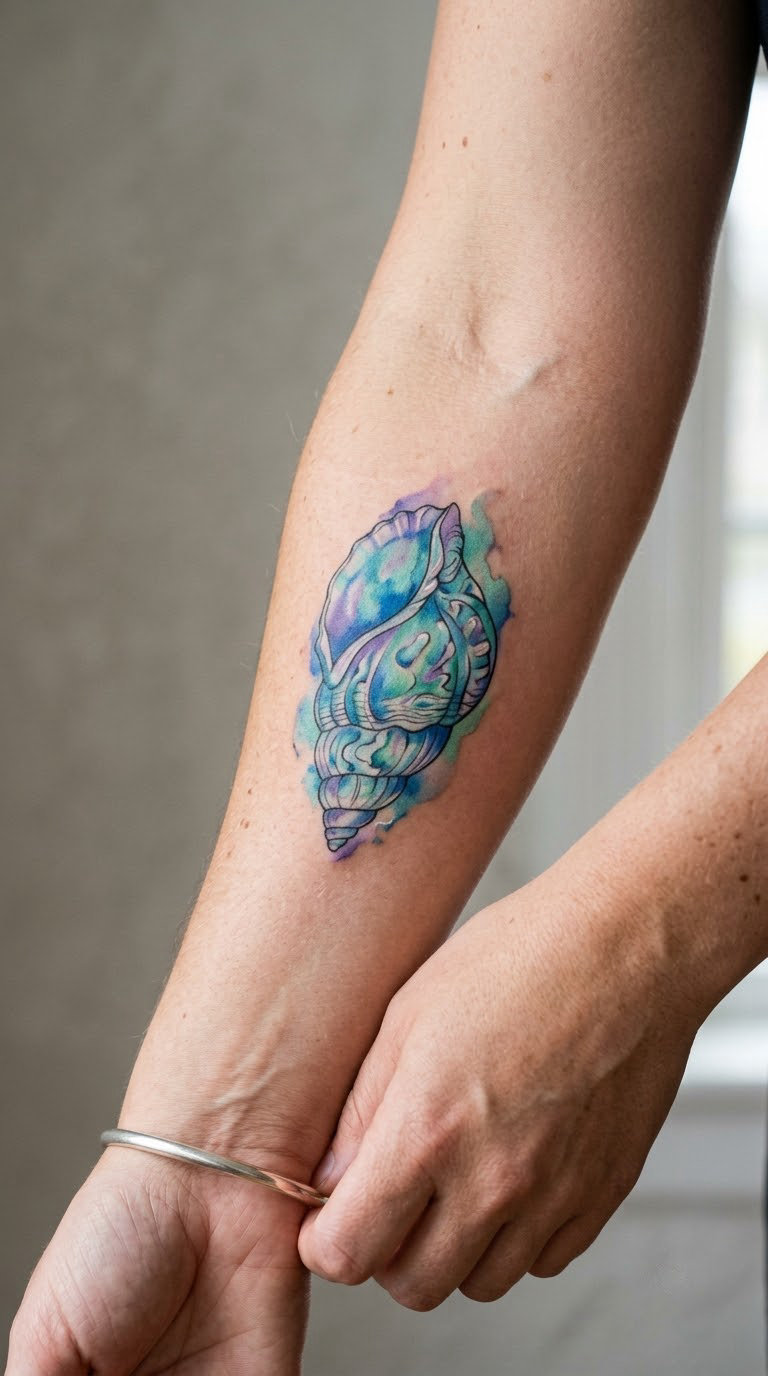
The shell is painted rather than outlined: a loose base shape in blue, green and violet that bleeds slightly past the edge, with a few hard black lines defining the outer curve so it does not dissolve entirely. The patchy shine of a real abalone becomes a colour gradient.
People choose this when they want the sea in the piece without a photograph. It looks like an impression of a shell rather than a diagram of one.
Placement: inner forearm, running along the length of the arm. Size: 4-5 inches (10-12.5 cm). Style: watercolor with light linework.
Pain: low on the inner arm, though the forearm bruises for a few days. Ageing note: colour placed on the arm yellows faster in sun than anywhere on the body, so daily sunscreen is non-negotiable here. Make it yours: pick two colours instead of a full rainbow for a quieter result.
6. Blackwork Conch Shell Behind the Ear
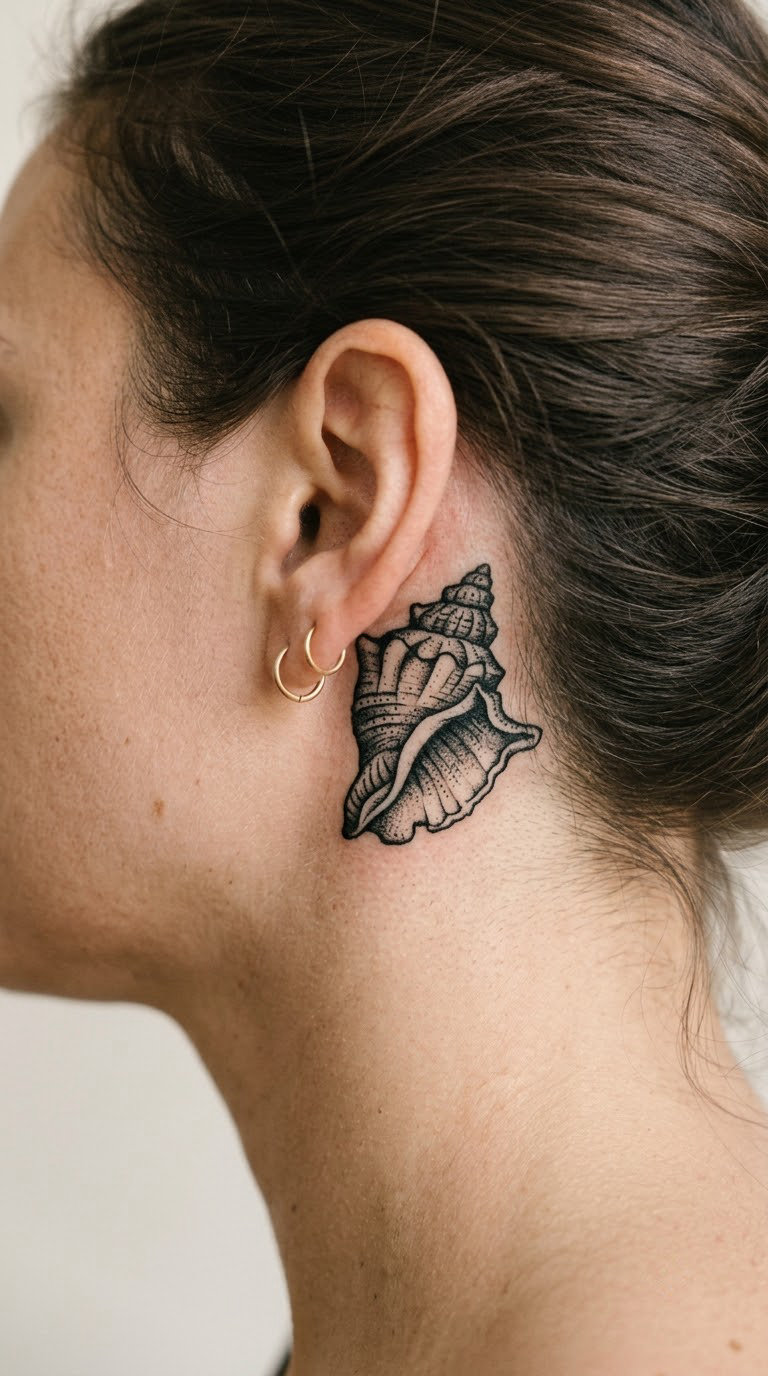
Solid black fills, no shading, the conch reduced to a heavy spiral mass with a couple of negative-space gaps carved through it. The contrast does the work that detail would otherwise do, so it survives at a small size.
Behind the ear is the placement people choose when they want something personal that only a few people ever see. A bold shape suits it better there than a delicate one.
Placement: behind the ear, the shell angled so the spiral points toward the jaw. Size: 2-3 inches (5-7.5 cm). Style: blackwork.
Pain: low, though the cartilage edge is tender at the top of the design. Ageing note: solid black patches can develop small gaps over the years, and a single line session usually keeps it tighter. Make it yours: have the negative-space gap shaped like a wave or a crescent.
7. Pink Conch Shell on the Rib
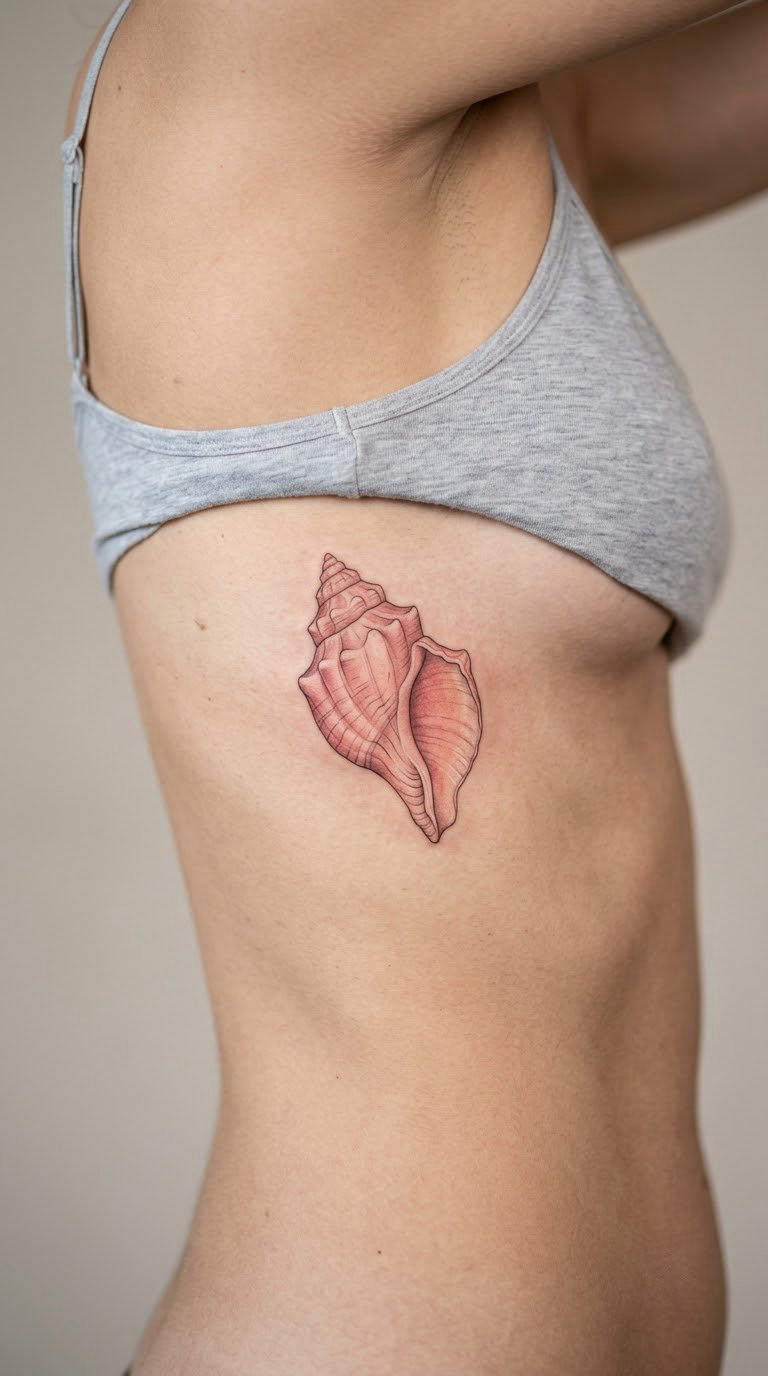
A conch rendered with soft rose and blush shading over a warm base, contour lines kept thin so the colour carries the form. The palette sits close to skin tone, which makes the piece feel worn rather than placed on top.
The rib is the spot women save for something that marks a person or a period in their life, and colour is what makes a small shell read as a statement at that scale.
Placement: side rib, following the curve of the ribcage, ideally 3 to 4 inches (7.5-10 cm) so the design can breathe along the line. Style: soft realism with a single warm hue.
Pain: high. Ribs are the spot people describe as breathing through the needle, and colour means a longer pass. Ageing note: pale pinks are the first to fade toward the skin tone, so ask for two shades deeper than you think. Make it yours: place it at the height of a specific date rather than the last gap you found.
8. Row of Tiny Shells on the Finger
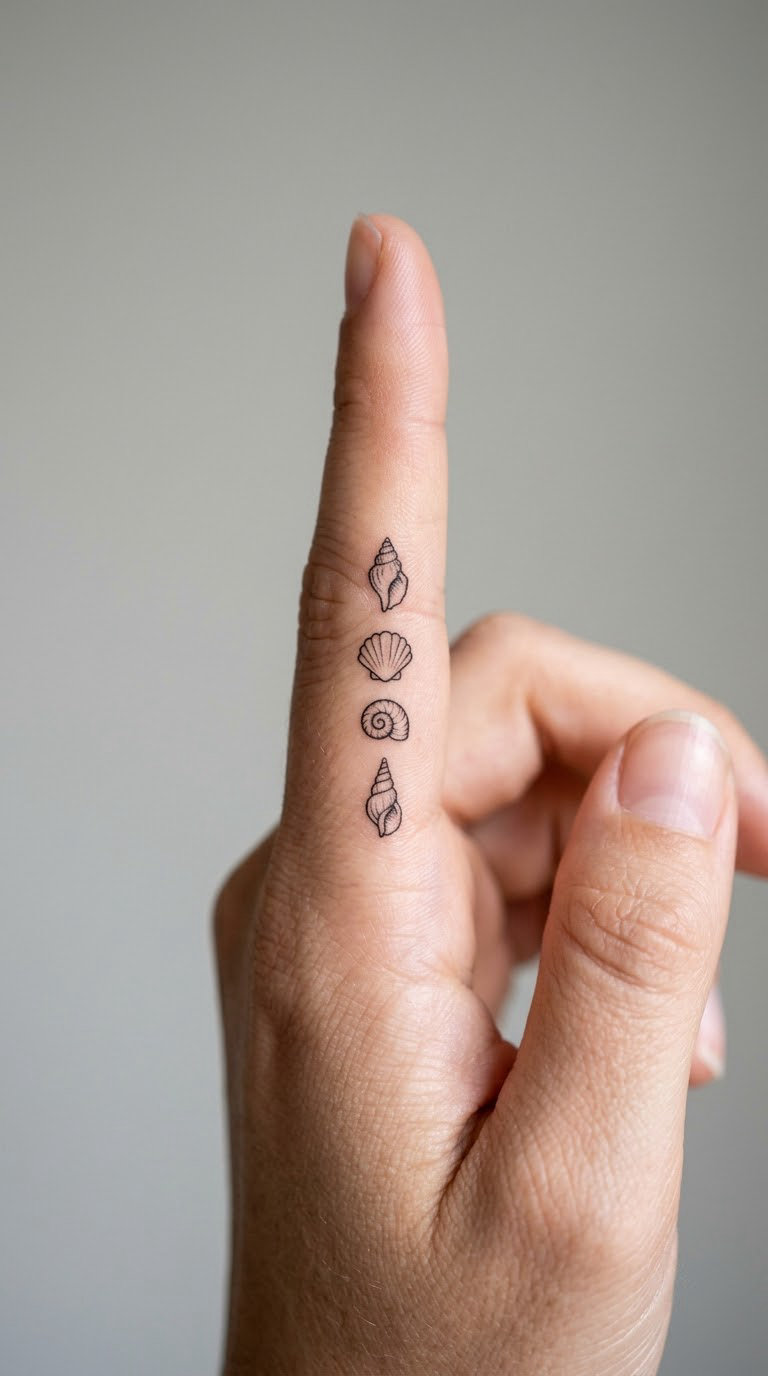
Four miniature shells stacked along the side of one finger, each about a quarter inch tall, alternating between a scallop and a simple spiral. The simplicity is what makes four fit in a small space without turning to noise.
A row like this tends to be a first piece for people who want ink in a spot that still wears rings, or a quiet addition to an existing hand piece.
Placement: side of the index or middle finger. Size: about 1 inch (2.5 cm) total. Style: micro fine line.
Pain: medium and quick, a few minutes once you are past the knuckle. Ageing note: hands take the most abuse of any placement, and tiny ribs soften within a couple of years. Ask your artist to keep each shell simple enough to redraw. Make it yours: one shell per person or one per year, reading bottom to top.
9. Realistic Hammerhead Shark and Shell on the Thigh
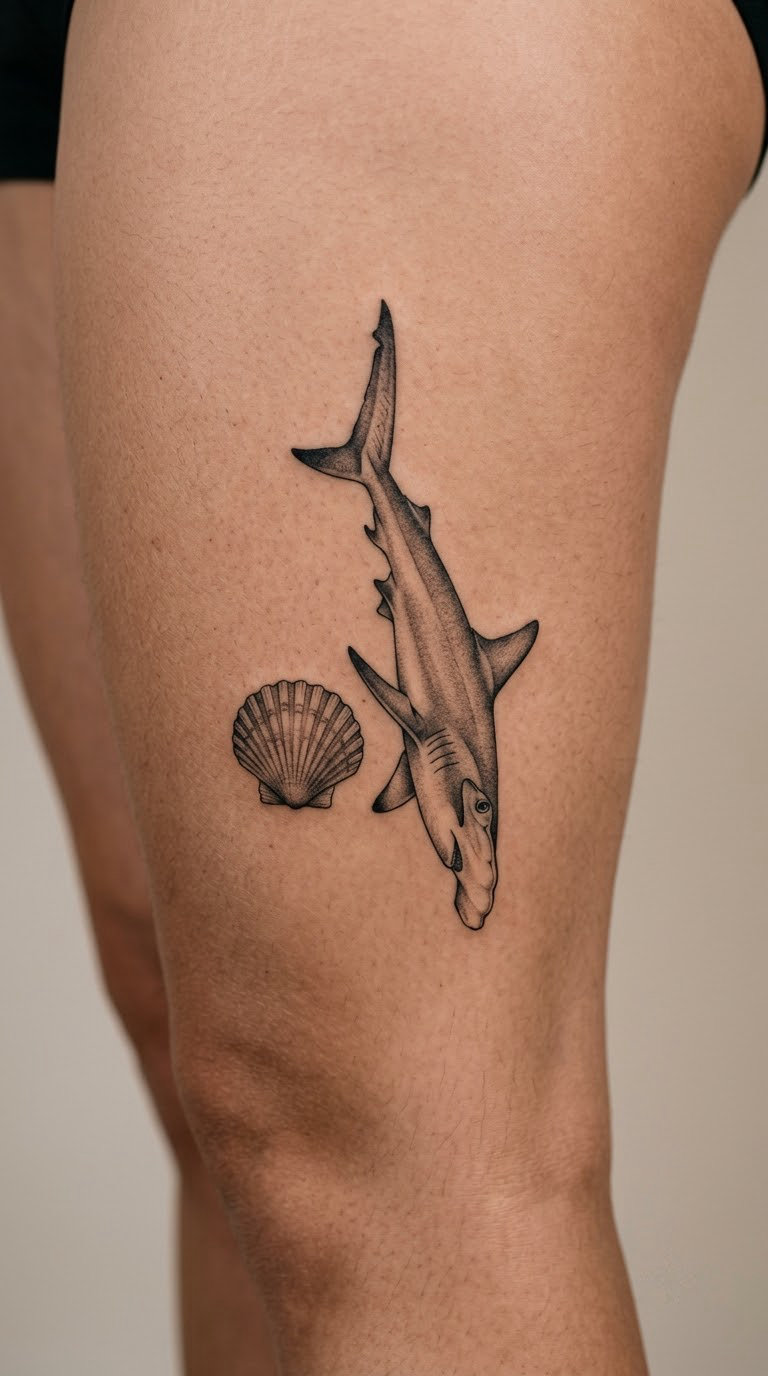
A hammerhead in black and grey swimming across the thigh with a shell below it, the whole thing arranged as one horizontal movement rather than two separate drawings. The shark carries the motion, the shell anchors it.
This is a narrative piece rather than a symbol piece. It suits people who grew up around a particular coastline and want the whole story, not the emblem.
Placement: outer thigh, angled with the leg. Size: 5-6 inches (12.5-15 cm). Style: black and grey micro realism.
Pain: low, and the thigh is a good place to sit through a longer session. Ageing note: the shark’s grey washes stay strong, but any fine texture around the shell will fade first. Make it yours: add small water line marks beneath the shell to fill the gap between the two motifs.
10. Sun and Scallop Shell on the Upper Arm
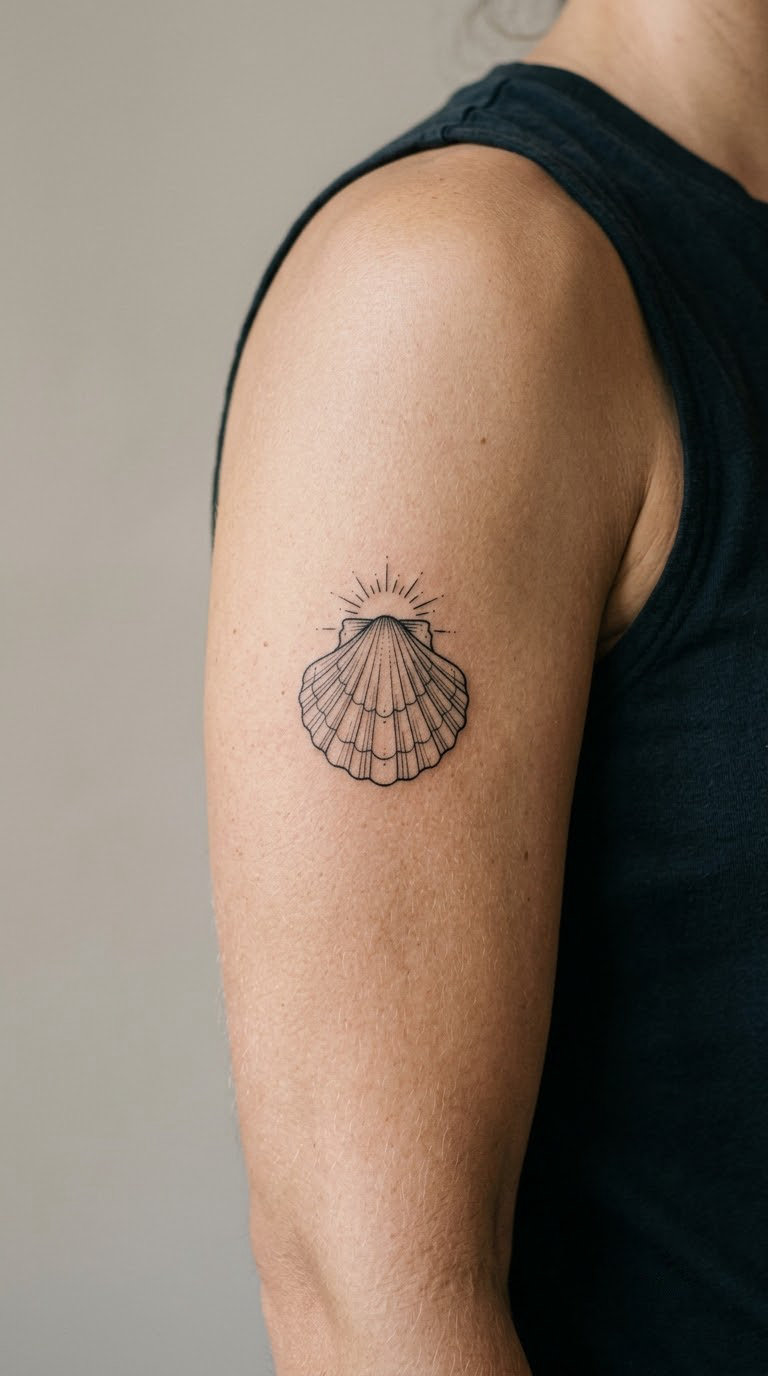
A scallop shell with short rays fanning out behind its top edge, the rays tapered so they shorten toward the bottom and the whole mark stays inside one neat circle of space. The two motifs share one line weight.
Sun and shell together read as a specific latitude and a specific season, usually a holiday that mattered. There is no fixed meaning, which is exactly why people like it.
Placement: outer upper arm, or the deltoid. Size: 3 inches (7.5 cm) wide. Style: fine line.
Pain: low, one of the easier spots on the body. Ageing note: the shortest rays blur first, so ask for rays that are at least a quarter inch long rather than hairlines. Make it yours: skip the rays and put a wave crest under the shell instead for a less obvious piece.
11. Starfish and Seashell Pair on the Back of the Neck
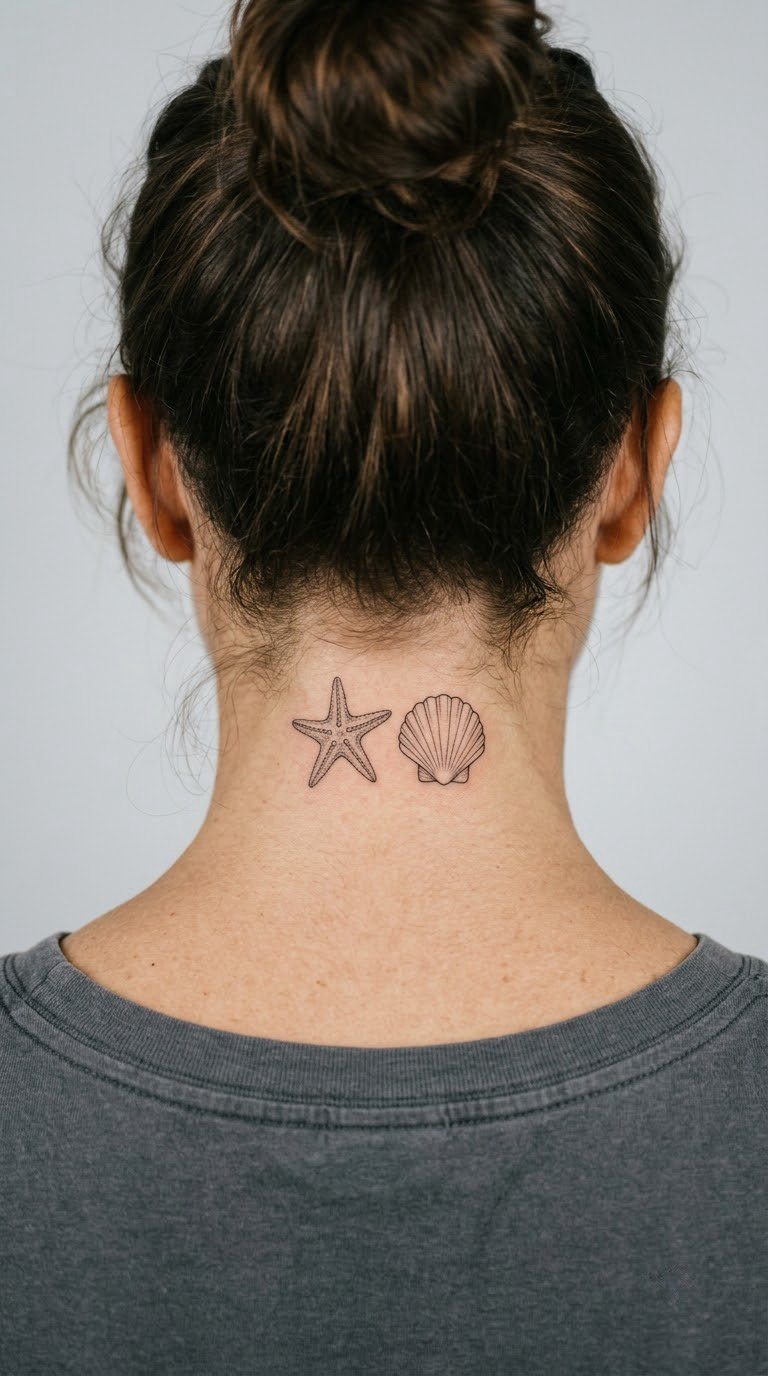
Two motifs side by side, a five-armed starfish and a small scallop, with equal visual weight and a hand of empty space between them. The balance is the whole design: one motif larger would tip it.
Paired marine symbols are popular with people who already have a small piece and want a second that rhymes with it rather than duplicates it.
Placement: centred on the back of the neck, just above the hairline. Size: 2-3 inches (5-7.5 cm) overall. Style: fine line pair.
Pain: low, and the neck barely bruises. Ageing note: hair regrowth and sun exposure both work on this area, so it darkens less evenly than the arms. Make it yours: put the starfish slightly lower than the shell so the pair looks naturally tide-tumbled rather than mirror-matched.
12. Floral and Shell Composition on the Hip
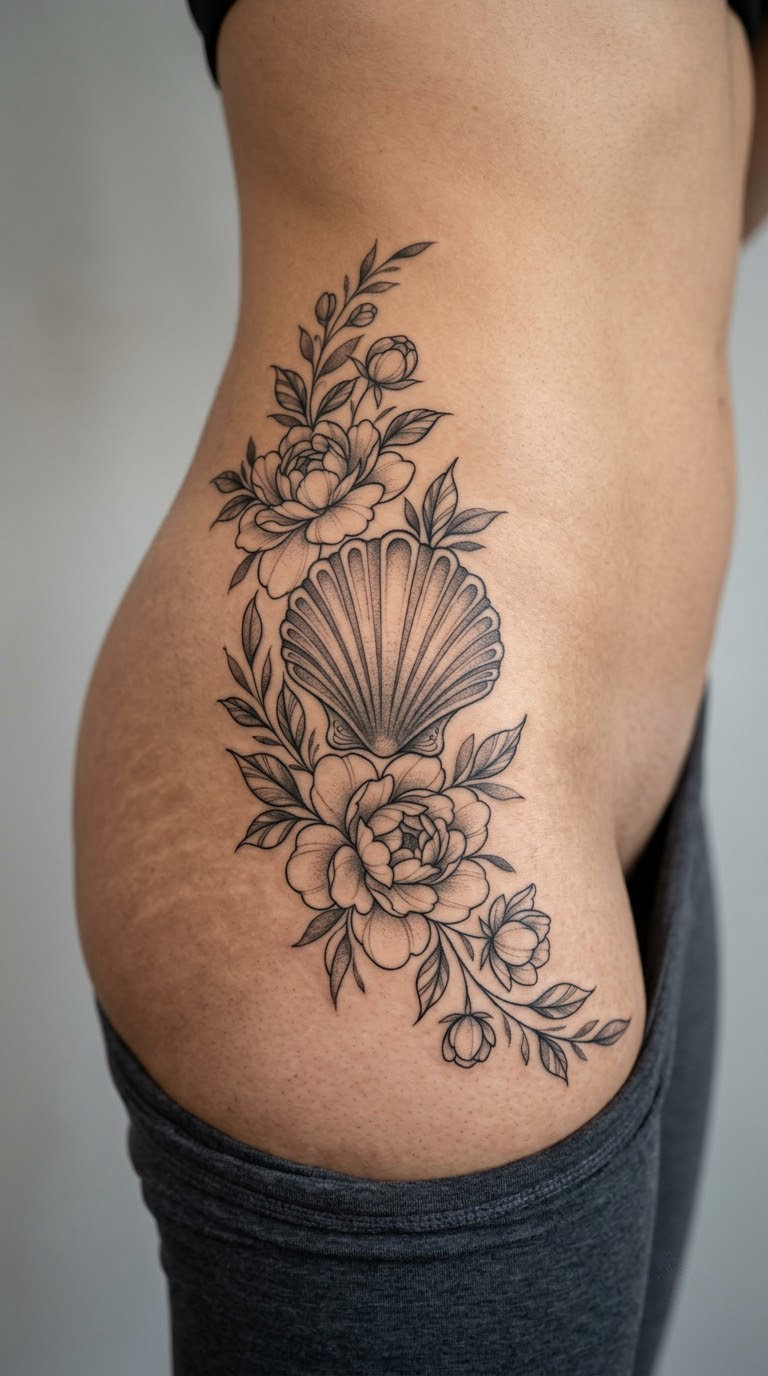
A scallop shell in the centre with flowers and trailing leaves built around it, all in black and grey with grey shading only in the petals. The negative space between stems is planned rather than filled in, which is what keeps a piece this size from going muddy.
Botanical work around a central object is a classic way to say something about a person, a garden or a place without a date. The 12 best floral shoulder tattoo ideas for women have the same approach if you want to see how plants are drawn at a smaller scale.
Placement: upper hip, above the bone, or high on the thigh. Size: 5-6 inches (12.5-15 cm). Style: black and grey realism with soft shading.
Pain: low over a couple of hours. Ageing note: fine petal edges soften faster than the shell, so expect the composition to read as shell-and-greenery within a few years. Make it yours: pick the flower species that grew where you grew up rather than a generic bloom.
13. Whelk Shell in Traditional Style on the Calf
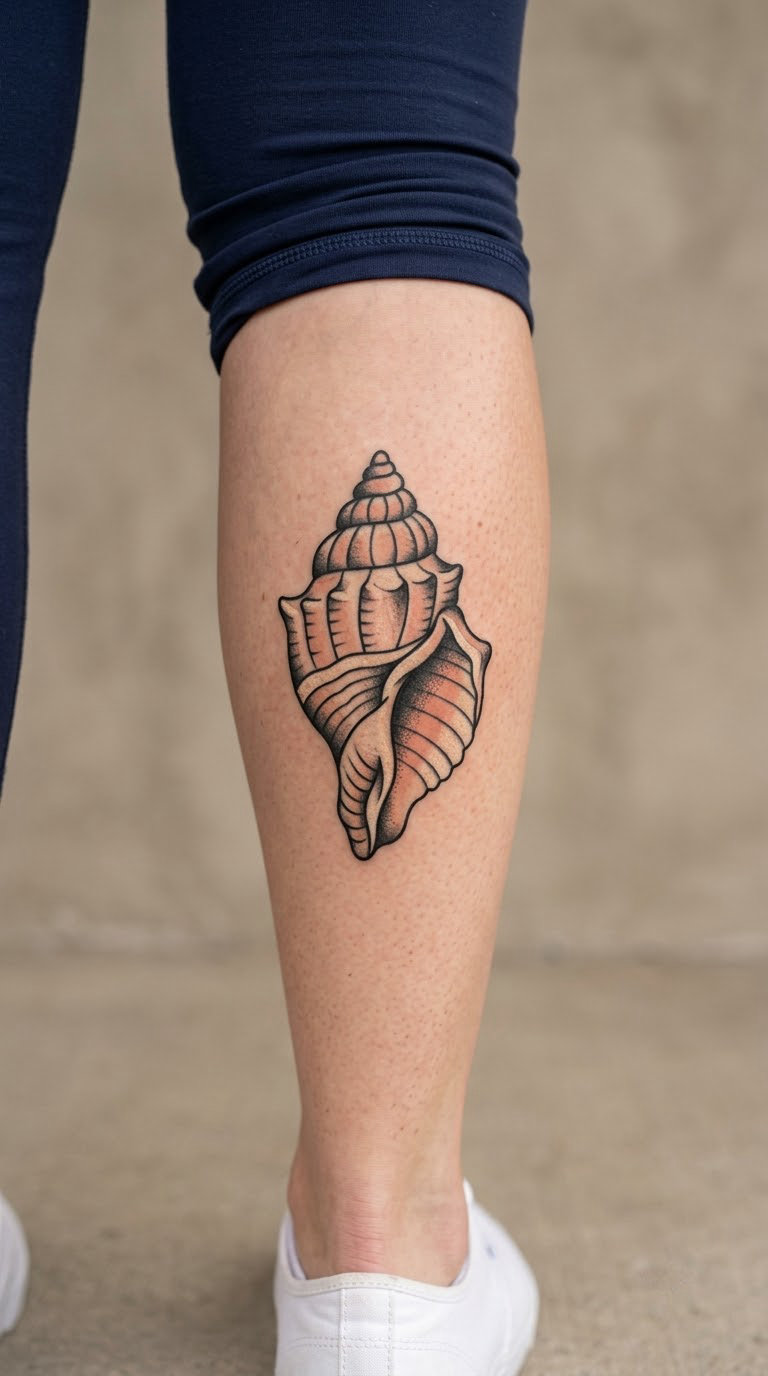
A whelk drawn in old-school style: heavy black outline, flat muted peach fill, a few darker shadow shapes and no gradient at all. The banded spire is suggested with a handful of lines rather than modelled fully.
Traditional work is having a wide moment, and the whelk suits it because the form is graphic. People who grew up with old family tattoos often recognise the style faster than a realistic shell.
Placement: outer calf, running vertically. Size: 4 inches (10 cm) long. Style: traditional or neo-traditional.
Pain: medium on the calf, mostly a deep sustained ache rather than sharp. Ageing note: flat colour holds its shape well, which makes traditional one of the safer choices for a long-term piece. Make it yours: swap the peach for a muted sage and add a small banner with a word underneath.
14. Spiral Shell with Dotwork on the Sidearm
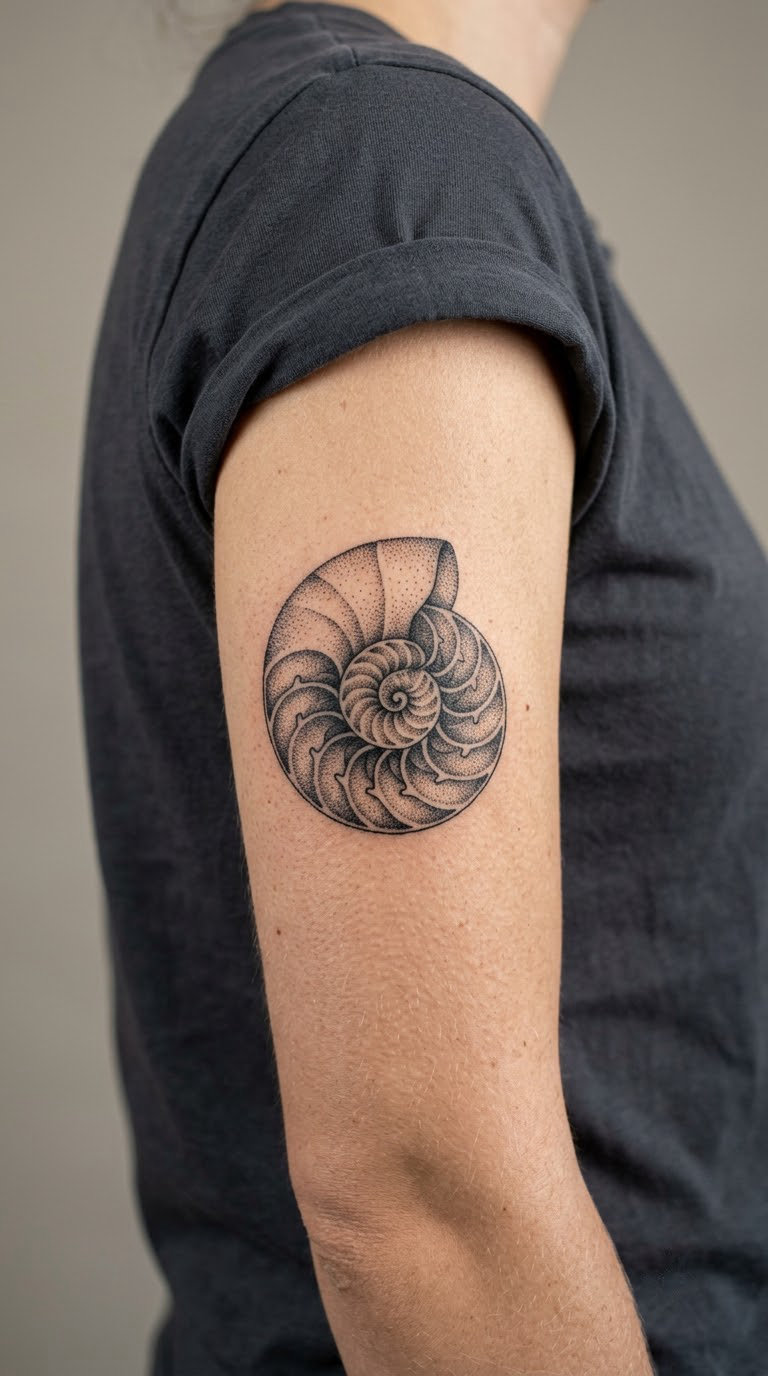
A spiral shell drawn with a fine line, then surrounded by fields of small dots that fade from dense to sparse away from the shell. The dots do the shading work, so the shell itself stays clean and readable.
Dotwork gives a piece texture and depth without adding a single extra line inside the subject, which is why it works so well on a small motif like this.
Placement: side of the upper arm, or the outer forearm. Size: 3 inches (7.5 cm) wide for the shell, with dotwork extending further. Style: dotwork and fine line.
Pain: low but slow, because dotwork takes patience on both sides. Ageing note: dotwork lightens unevenly and can look patchy on sun-exposed arms, so plan for a top-up every few years. Make it yours: have the dot density mapped to a coastline you have walked.
15. Two Matching Shells on the Collarbones
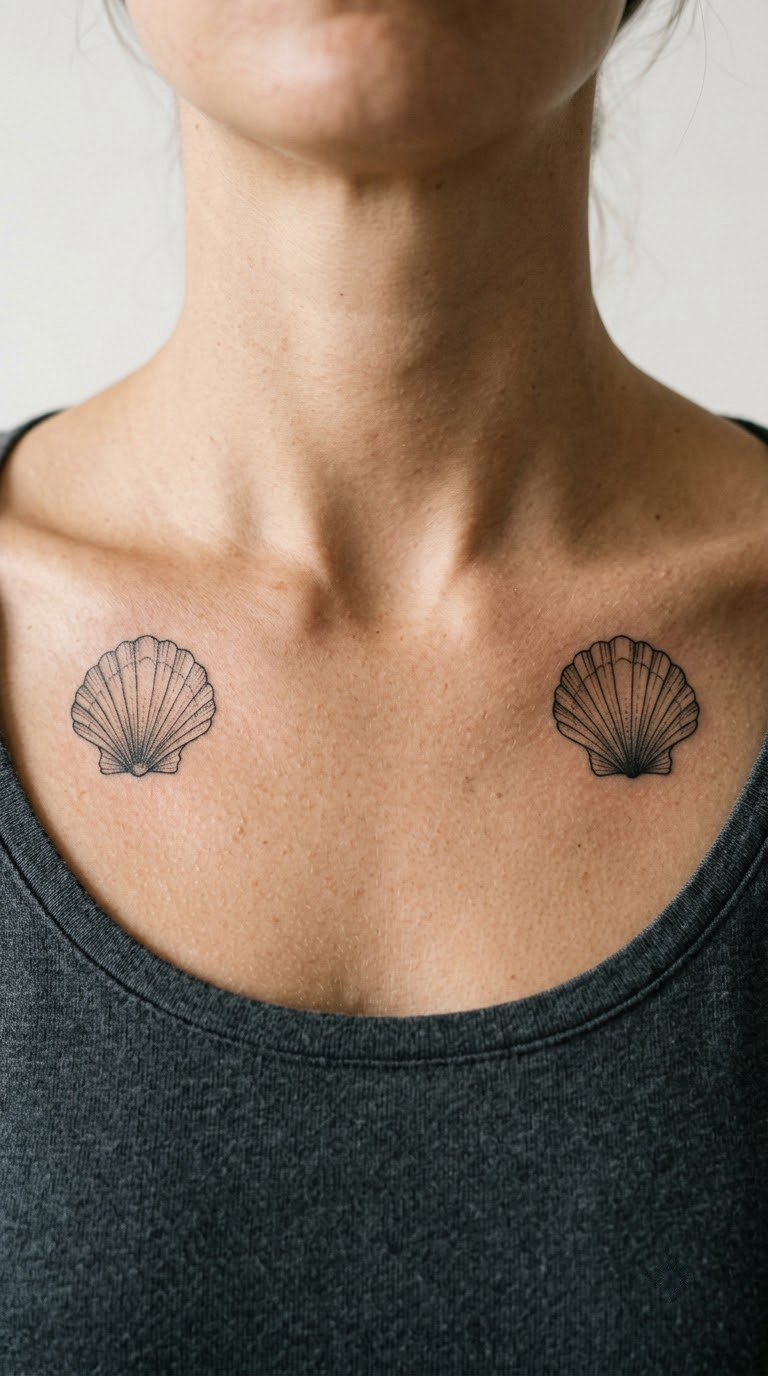
One shell above each collarbone, angled so the openings face inward toward the neck. Artists usually mirror the drawing and then adjust each side a fraction, because collarbones are never quite level on the same person.
Symmetry is the point here, and it is the reason the pair reads as deliberate from across a room. It is also a placement worth thinking about if you work in a collared shirt or a customer-facing role.
Placement: both collarbones, set slightly inward of the bone itself. Size: 2 inches (5 cm) each. Style: fine line.
Pain: medium, and doing both in one sitting is common. Ageing note: identical fine-line pieces often drift apart as each one ages at its own rate, which most wearers end up liking. Make it yours: have the two shells differ by one detail, a stripe or a missing rib, so they are connected rather than copied.
16. Seashell with Wave Lines on the Outer Thigh
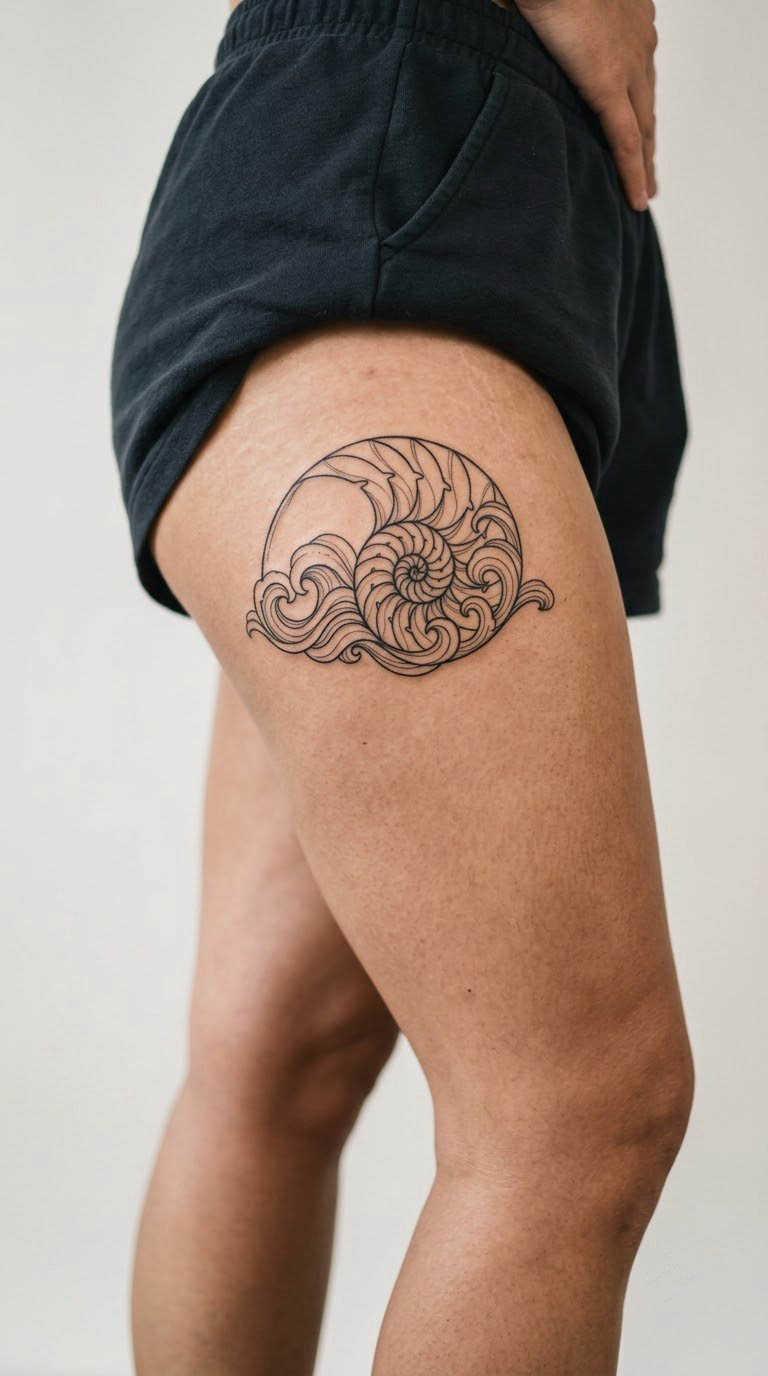
A shell above three or four flowing wave lines that curve around it, the lines tapering at both ends so they fade into the skin rather than stopping. The composition reads as one movement instead of a shell with lines under it.
Shell and wave is the most requested pairing in coastal work and the least fussy way to fill a larger space on a leg without going for full realism.
Placement: outer thigh, or the calf above a boot line. Size: 4 inches (10 cm) wide. Style: fine line.
Pain: low, and the thigh is an easy place to take a break. Ageing note: wave lines are long and unbroken, so they hold better than the short ribs inside the shell. Make it yours: add a third element low in the composition, such as a small fish or a driftwood line.
17. Pearl Oyster Shell with a Pearl Drop on the Chest
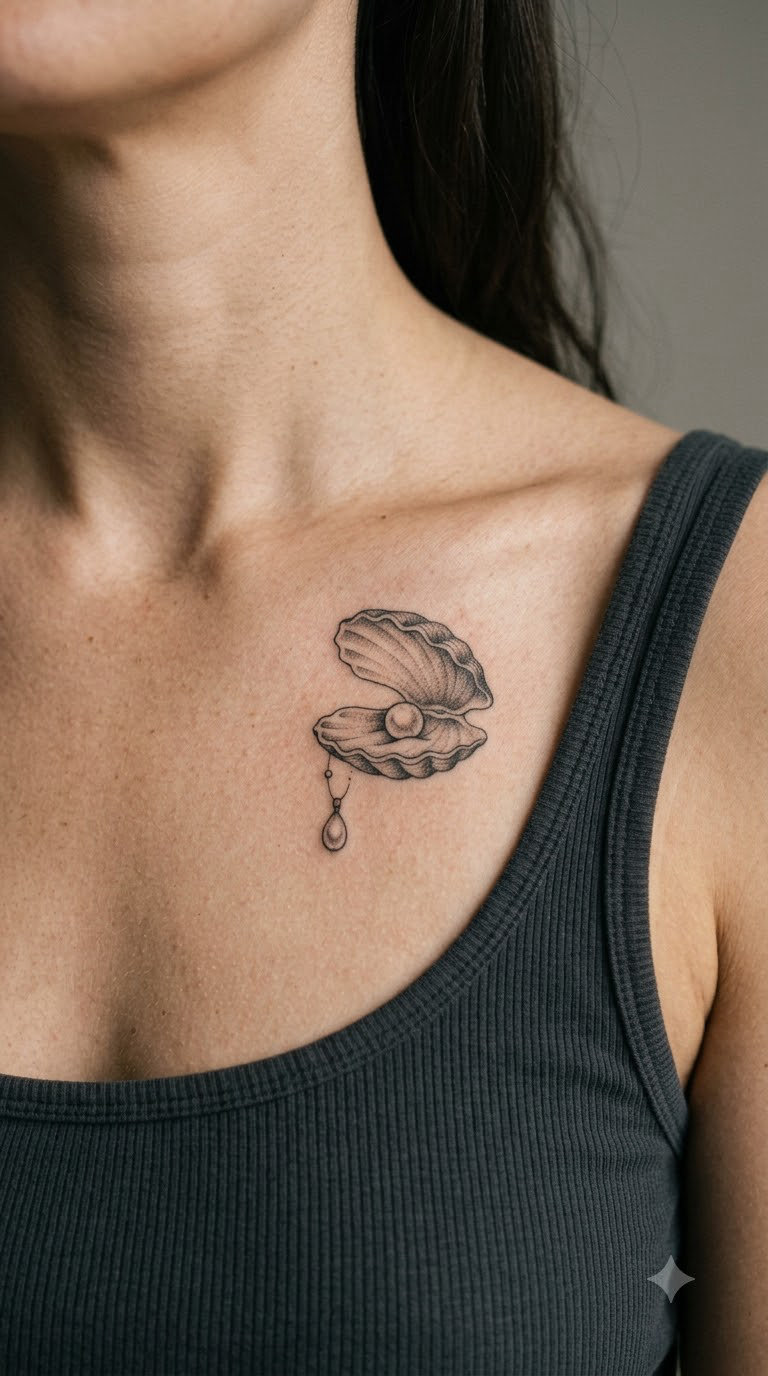
An open oyster shell drawn in soft black and grey, its lip irregular and slightly ruffled, with a single round pearl sitting in the cup. The pearl is left bright, which is what makes it read as a pearl and not a dot.
The oyster and pearl is a common gift piece, given between sisters or friends, and it works as a memorial as easily as a keepsake.
Placement: just below the collarbone or high on the chest between them. Size: 3 inches (7.5 cm) wide. Style: soft black and grey realism.
Pain: medium, since the breastbone area is sensitive. Ageing note: the ruffled lip is a busy edge, so ask for a slightly heavier line there and it will hold better. Make it yours: engrave a date into the oyster lip in a tiny script only the two of you will know.
18. Blue Spiral Shell on the Wrist
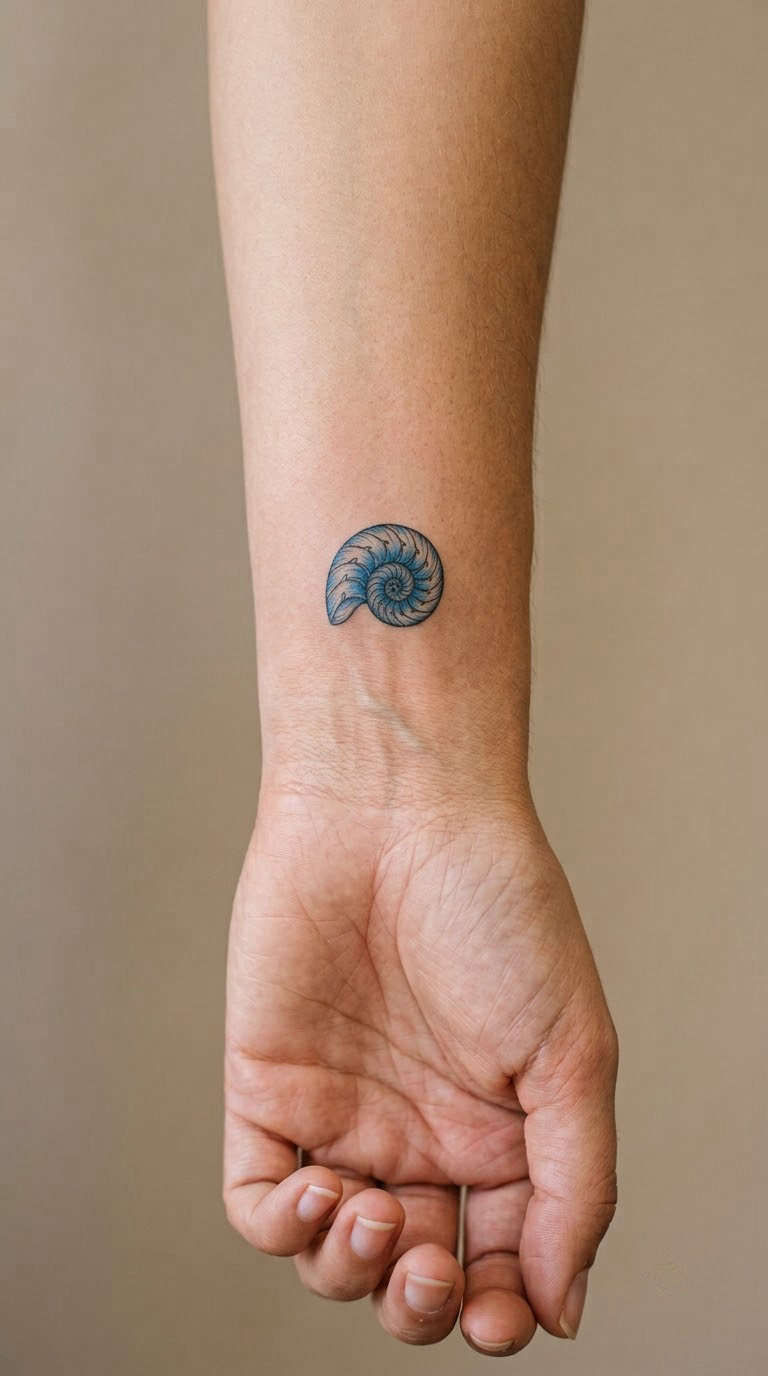
A spiral shell outlined in fine black with the spiral interior filled in a single mid-blue, one flat colour, no blending. The blue sits inside the black lines and stops cleanly at the edge.
One colour accent is enough to make a familiar motif feel new, and blue is the one that keeps its tone longest in salt water and sun compared with pinks and greens.
Placement: inner wrist or the outer wrist near the thumb joint. Size: 2 inches (5 cm) wide. Style: colour fine line.
Pain: medium. Ageing note: the wrist is high-use, so a colour shell here needs a touch-up sooner than the same design on the calf. Make it yours: try a deep navy rather than a bright blue and it will look completely different in two years.
19. Seashell and Seaweed Sleeve Element on the Upper Arm
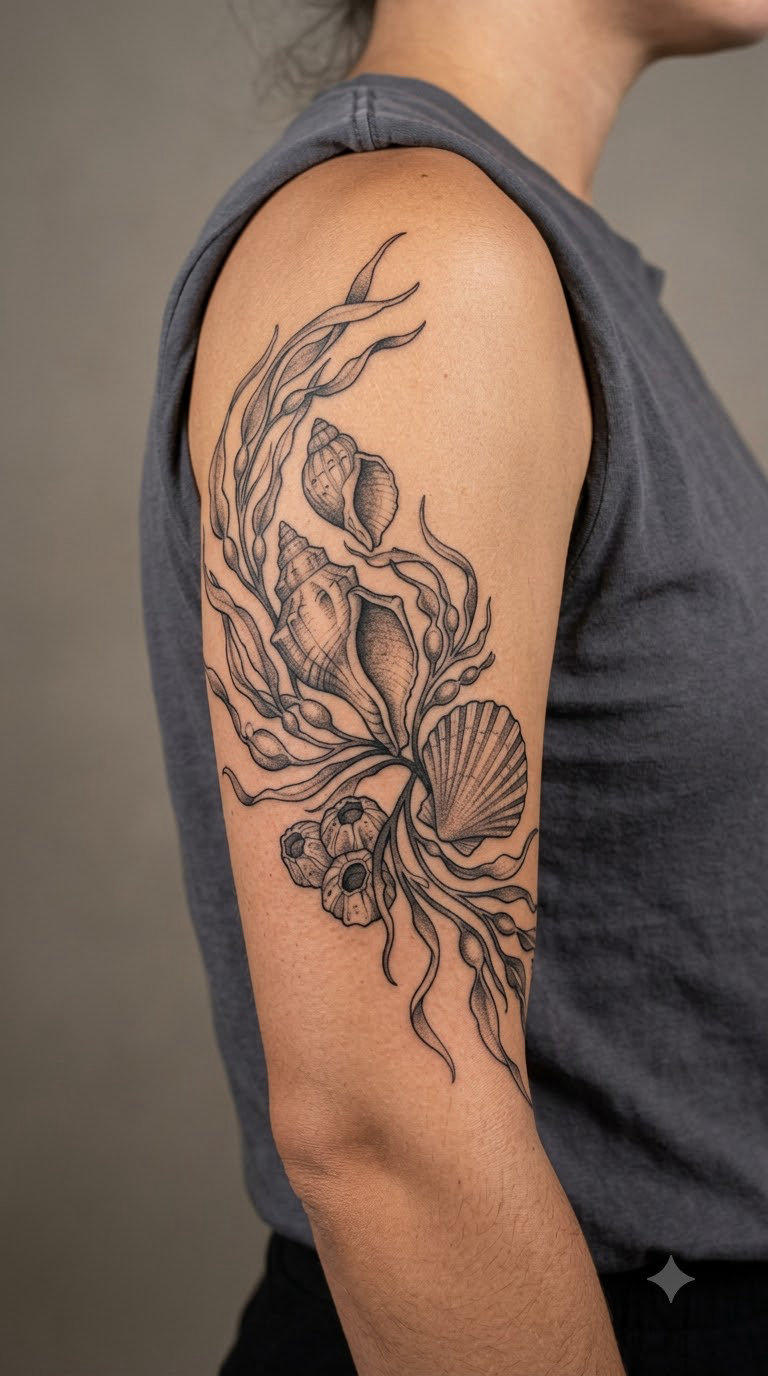
A shell at the base with seaweed fronds trailing above it, drawn in black and grey with the fronds bending with the arm. Space is left open at both ends on purpose so the piece can grow into a fuller sleeve later rather than needing a cover-up.
This is the option for someone who wants one element now and a full ocean arm eventually. Enthusiasts on tattoo forums talk about building sleeves this way for years, adding one motif at a time as budget and patience allow.
Placement: upper arm, wrap position. Size: 5 inches (12.5 cm) as a starting element. Style: black and grey with soft shading.
Pain: low over a two-to-three-hour session. Ageing note: plan the open edges now, since a sleeve that was designed to be finished will heal far better than one that was not. Make it yours: sketch the whole sleeve on paper first and bring the plan to the consult, even if you only book one element this year.
20. Large Realistic Seashell on the Back
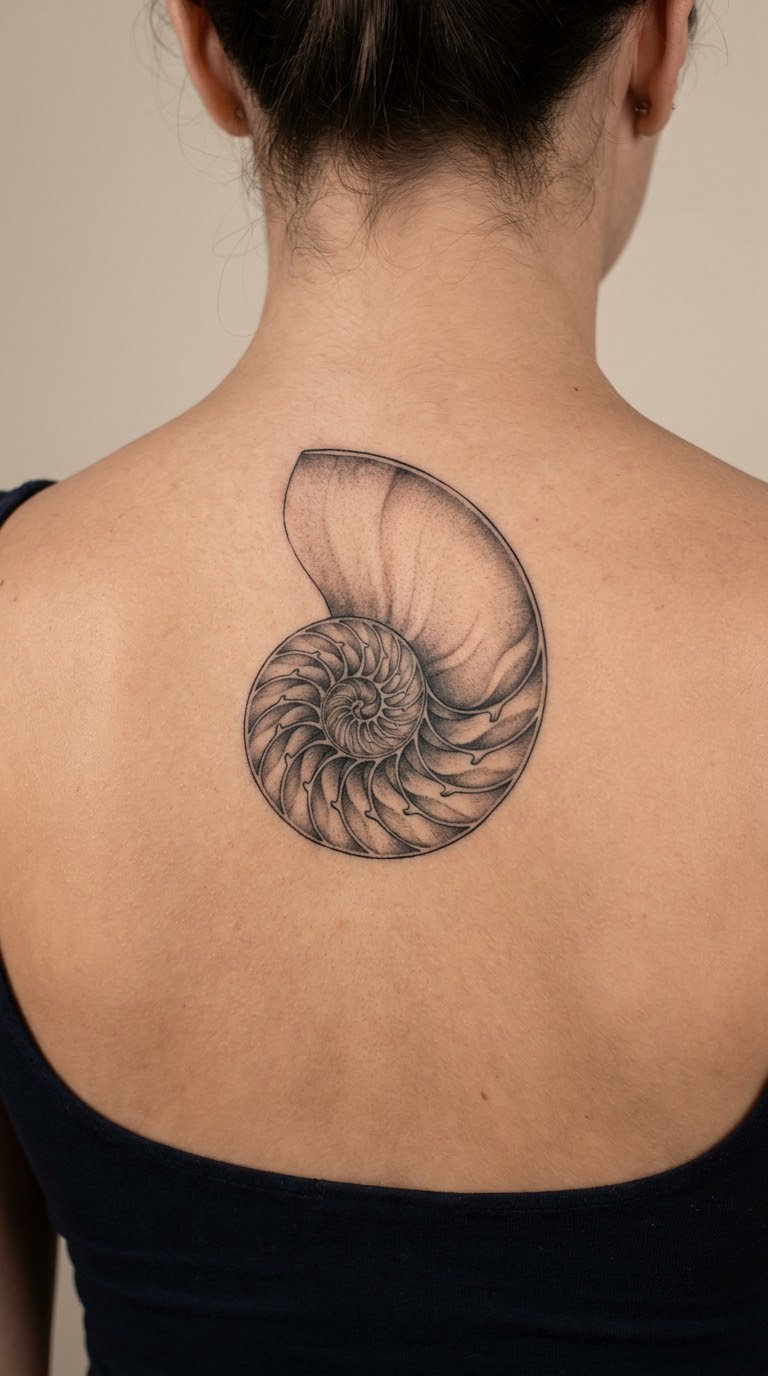
A single shell rendered in black and grey at close to life size, with soft grey gradients building the curve of the body, a few darker lines in the deep grooves, and highlights left as untouched skin. The shading is the design; the outline stays soft.
At this scale the shell stops being a symbol and becomes a piece of work, which is exactly why people choose it as the centrepiece of a back or shoulder blade piece.
Placement: upper or middle back, centred between the shoulder blades or lower down between them. Size: 6-7 inches (15-17.5 cm) or larger. Style: black and grey realism.
Pain: low, because the back has thick skin and good padding, though a piece this size is a long sitting. Ageing note: grey realism ages far better than colour, and the soft gradients here will need less rework than any outline-heavy version. Make it yours: have the artist keep the highlight on the side nearest a window so the piece reads with natural light on you.
Why Seashell Tattoo Ideas for Women Work Best on Skin
Shells translate unusually well to skin because the form is already organised. A scallop is a fan of ribs, a conch is a spiral, a cowrie is a smooth oval with one line through it. The artist is working with structure that guides the hand, which is why these designs look intentional even at small sizes.
Scale is where it goes wrong most often. If the ribs are spaced closer than a couple of millimetres, healed skin fills the gap with soft scar tissue and the interior turns into a grey patch. Ask for a design with fewer, more deliberate details rather than an exact copy of a photograph.
Contrast against the body contour matters just as much. Shells work where the skin is flat enough to hold a clear silhouette, and struggle where the curve fights the outline. A shell placed on a strongly curved rib or ankle needs a wider base and a shorter height so it does not look stretched.
How to Choose the Right Design
Match the style to how visible the piece will be and how long you want it to look untouched. Fine line is delicate and elegant but softens fastest, so it suits areas that are not in constant sun. Blackwork gives a strong silhouette at small sizes and holds its edges best over time. Black and grey realism is the most forgiving on skin and ages well on the back, thigh and calf.
Watercolor and colour work are the highest maintenance. Light blues and greens fade and shift fastest, and salt water and sunscreen matter more. If you live somewhere with year-round sun, that is worth weighing before you pick a palette.
Size follows placement, not the other way around. A 2-inch shell reads clearly on a collarbone and disappears on a shoulder blade. Match the shell’s width to the flat area you have, and go a little larger than the reference image suggests if the design is detailed.
Comparing twenty seashell tattoo ideas for women before you book is more useful than picking the photograph you like best. Look at where each one is meant to sit, how many interior lines it needs, and whether you would still recognise it as a shell with every shade of detail gone.
Ageing is the last filter. Ask yourself whether the design still works as a plain outline if the interior detail fades. If it does, you are safe. If it only works fully shaded, plan on a touch-up in two to three years.
Cost and Session Time
Tattoo pricing in the US usually works by the hour, with most studios setting a minimum charge that a small piece still has to meet. Tiny shells under two inches often run at that shop minimum, so the practical cost of a small shell is the same as the smallest piece they do.
Rough US ranges, so you have a starting point rather than a quote: about $80 to $150 for a tiny shell at the shop minimum, $150 to $350 for a three-to-five-inch composition with shading, and $400 upward for a large realistic back piece that needs several hours. Cities with a heavy convention or tourist trade sit at the top of those bands.
A single small shell is usually a short session of 30 minutes to an hour. A four-to-six-inch composition with shading takes closer to two hours, and a large realistic back piece runs as a multi-hour session, sometimes split across two appointments.
What moves the number more than size is detail. Grey realism, dotwork and anything in colour take far longer than outline work at the same dimensions, and hand-poked shells take the longest of all. Travelling to a different city for a specialist will add to the total, so factor that in before booking an out-of-town artist for a design most local tattooers can draw.
Artist hourly rates and shop minimums vary widely by city, so treat any figure you hear as a starting point rather than a quote. Ask for the full price before the session, not after.
Aftercare Basics
- Follow your artist’s aftercare instructions first. Every studio has a method they trust, and it overrides anything general you have read.
- Wash gently with unscented soap and lukewarm water, twice a day, then pat dry with a clean towel. Do not soak the area.
- Keep it covered from clothing friction for as long as you were told, and avoid tight fabric over fresh ink while it settles.
- Do not pick or peel a forming scab. If a flake lifts on its own, that is normal; pulling it is how scarring starts.
- Once healed, use broad-spectrum sunscreen on exposed placements daily. This is the single biggest factor in how long a colour shell keeps its tone.
- Contact the studio if you develop spreading redness, heat, swelling that worsens over a day, or discharge. Early is always better than late.
Frequently Asked Questions
Do seashell tattoos fade or blur over time?
Fine line is the first to soften, usually starting with the thin ribs inside a shell, and hand and finger placements blur faster than the back or calf. Blackwork holds its edges longest because solid fill has less fine detail to lose. Expect a touch-up every one to three years on a fine-line shell, sooner if it sits on the wrist or ankle. Daily sunscreen on exposed placements slows all of it down.
What is the smallest size a seashell tattoo can be and still read clearly?
A single shell needs roughly one and a half inches across to keep a readable outline and interior ribs. Below that, the interior fills in and the piece reads as a smudge from normal viewing distance, which is the most common disappointment people report. Four tiny shells stacked along one finger work because each one is simplified to two or three marks instead of being drawn as a full shell.
How painful is a seashell tattoo on the wrist or collarbone?
Both sit in the medium range. The collarbone feels sharp and bony because there is very little soft tissue over the bone, and the wrist pinches where the veins run close to the surface. Most people describe it as a steady scratching sting rather than sharp pain, and both placements heal within two to three weeks. Ribs and the breastbone area are noticeably harder than either of these.
Should a seashell tattoo be done in black and grey or in colour?
Black and grey ages better and suits a realistic render, because soft grey gradients hold their tone for years. Colour gives a shell more life, but pale pinks and greens fade and shift fastest, especially with sun and salt water. If you pick colour, go a shade deeper than the reference photo and commit to daily sunscreen. For a first piece that should stay tidy for a decade, black and grey is the safer call.
Can a seashell tattoo cover an old scar or an existing tattoo?
It can work in some cases, because a dense fan shape with radiating ribs is one of the few motifs that can disguise an irregular edge. Success depends on how the scar sits against the body and whether it still changes colour over the year. Bring a photo of the healed tattoo or scar to the consult and ask for the artist’s opinion before committing, because some scars will never sit under ink cleanly.
What does a seashell tattoo symbolize?
A seashell tattoo usually stands for protection, rebirth, femininity and inner beauty, because a shell protects something fragile and was once carried home from a long way off. A scallop leans toward journey and completion, a cowrie toward good fortune, and a nautilus toward steady growth. The meaning is personal rather than fixed, and plenty of people choose a shell simply because they grew up near the sea.
Conclusion
For a first tattoo, the minimal scallop on the inner wrist or the fine-line conch on the collarbone are the two safest picks: small enough to sit in one session, simple enough to still read in a decade, and easy to place where clothes cover it if that matters to you. If you are already building a collection, the large realistic shell on the back or the shell and seaweed element on the upper arm gives you something worth growing around.
Whichever one of these seashell tattoo ideas for women you settle on, bring two or three references and a rough size to the consult, and ask the artist how they would simplify the interior detail for skin. That conversation is where a good shell design gets built.