
What Does a Wave Tattoo Mean? Symbolism & Ideas 2026
A wave tattoo is one of those designs where the answer is almost too broad. Ask ten people what their wave means and you’ll get the ocean, a hard year, a dead parent, surfing, or a move they still haven’t unpacked. That range isn’t a problem. It just means the symbol is genuinely open, and the design only means something once you attach it to your own story.
This guide covers the readings people recognise most often, how style and placement shift the message, what the three-wave version usually signals, and what it costs, hurts and takes to heal. Read the meaning parts first, then the practical ones.
What does a wave tattoo mean? Most often it stands for resilience, change, freedom, emotional depth and renewal, because a wave is powerful, it never stops moving, and it keeps coming back after it breaks. The exact meaning belongs to the person wearing it, and the design details decide how others read it.
There’s more under that short answer, and it matters more than the short answer.
Water represents the emotional side of life: it moves, it adapts, it wears hard surfaces down, and it goes on regardless. A wave adds motion to that idea. Nothing about the sea is ever still, and a wave that breaks has to rebuild itself again and again, which is why so many people read it as inner strength.
What does a wave tattoo mean for the wearer is a separate question. Someone who grew up surfing will hear tribute and home. Someone who got it after a recovery will read it as survival. Someone who lost a person may see an endless cycle rather than an ocean at all. Nobody else gets to settle that, and that’s the part of the symbol most tattooers will tell you to protect.
It’s also worth saying plainly what the wave isn’t. It isn’t a fixed code that strangers can decode. Most people see a wave and think ocean, calm or surf, and they move on with their day.
Common Wave Tattoo Meanings and Symbolism
These are the meanings that come up again and again, both in tattoo studios and in the conversations people have afterwards.
Resilience and inner strength. Water is relentless and the wave always returns after it breaks, so it reads as the ability to take a hit and come back.
Change and going with the flow. The tide never pauses, so the wave is a common marker for a period of transition, a move, a new job, or the end of a version of yourself.
Freedom and escape. Open water means no walls. It suits people who want a design tied to travel, the coast, or the idea of not being pinned down.
Emotional depth. Water carries feeling in most cultures, and a dark, heavy wave tends to read as introspection or grief rather than holiday.
Renewal and cleansing. Water washes things away, so the wave is often chosen to mark recovery, a fresh start, or leaving something behind.
Eternity and return. A circular or repeating wave has no start or end, and surfers will tell you the ocean is where they go to feel small again, which is its own kind of meaning.
The supporting elements change the reading more than most people expect. A sun turns the wave toward hope and new beginnings. A moon pushes it toward mystery, night swims and memory. A ship or anchor adds journey and belonging. A mountain behind the wave suggests something bigger than the individual. A compass makes it about direction, and words or dates in the foam make it unmistakably personal.
How the Style of a Wave Tattoo Changes Its Meaning
Same wave, different execution, different message. Line weight and colour do most of the work.
| Style | How it reads to other people |
|---|---|
| Fine line | Quiet and delicate. Reads as restraint rather than drama, and fades fastest on hands and fingers. |
| Minimalist | Calm, considered, a little philosophical. Often the first tattoo people pick. |
| Blackwork | Heavy and committed. A solid black breaker reads as power and something to protect. |
| Traditional | Classic, nautical, tattoo-shop familiar. Reads as belonging to a tradition. |
| Neo-traditional | The same heritage with modern shaping and shading. Reads confident and current. |
| Japanese irezumi | Sweeping, disciplined, rooted in a specific artistic tradition. Asks to be read in context. |
| Watercolor | Soft, atmospheric, a little memory-like. Often chosen for a person rather than a meaning. |
| Realism | Literally the sea. Carries no extra symbolism, just love of the real thing. |
| Dotwork | Technical and patient. Reads as detailed, deliberate work. |
Popular Wave Tattoo Placements and What They Suit
Placement is a design decision, not a leftover. The wave has a direction and a flow, and skin gives you a canvas shape that either helps or fights it.
| Placement | Visibility | Pain | Suits |
|---|---|---|---|
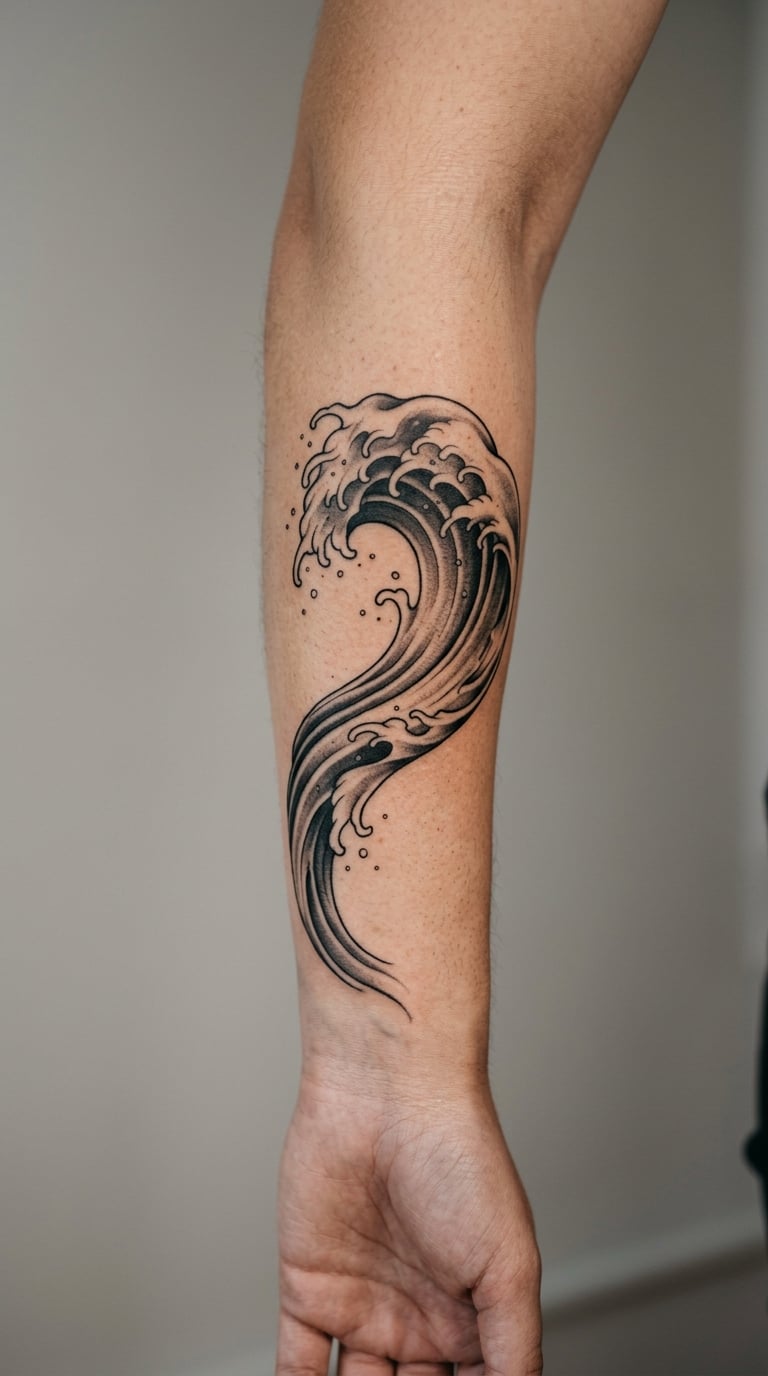
| Inner forearm | Seen when you turn your palm up | Low | A single wave that follows the arm’s curve |
| Wrist | Constant | Low to medium | Small minimal pieces, or a wrapping design |
| Upper arm | Visible in short sleeves | Low | Medium blackwork and stacked waves |
| Shoulder | High | Medium | Wider compositions with sun, moon or a mountain |
| Ribs | Revealed by movement | High | Long, low, horizontal waves |
| Back | Private unless you show it | Medium to high | Large pieces, spare designs, Japanese composition |
| Behind the ear | Hidden | High | A tiny wave, or the tail of a bigger one |
| Ankle | Seasonal | Medium | Fine line and coastal coordinates |
| Calf | Moderate | Medium | Horizon lines and long curves |
Two practical notes. A wave that wraps a joint, like a wrist or ankle, will distort as you move unless the artist designs for the bend. And fine line on the hand or fingers is the classic mistake. It looks lovely in week one and softens badly over the years.
Wave Tattoo Ideas: How to Choose a Personal Design
Most generic wave tattoos come from the same failure: people copy an image without adding anything of their own. Enthusiasts say it plainly in the forums, the endless idea collections all look like the same flash sheet. The fix is small. Decide the state of the water, scale it to the placement, and add one detail that only you would add.
Here are the design directions that carry a clear reading, and what each one is usually for.
Single calm curl. One low, rolling wave with foam on the crest. Peaceful and balanced, and the easiest version to keep legible at small sizes.
Crashing breaker. A heavy, hollow wave with spray. Reads as struggle and force, and works best with heavy black line rather than fine line.
Horizon line. A flat sea with one wave, almost abstract. Minimal, versatile, and easy to place on a narrow strip of skin such as a forearm or calf.
Wave with sun. Half rising, half setting, sitting low on the water. Hope, new beginnings, the end of something. Our 70+ beautiful wave and sun tattoo ideas is a good place to see how many versions exist.
Wave with moon. A night version. Quieter, more inward, and a very common memorial choice.
Wave and mountain. Water meets rock. Reads as something enduring, and as a specific coastline if the mountain matches one.
Wave with compass or lighthouse. Direction and guidance, or a stretch of coast that matters to you.
Matching or memorial wave. The same wave on two people, or one wave holding a date, a set of coordinates, or a word in the foam.
You don’t have to go big. If you want a first piece that stays easy to place, look at 30+ small wave tattoo ideas that will make you feel free before you commit to a large composition.
The number of waves is its own decision, and it is the question I get asked most often.
| Number of waves | Common readings |
|---|---|
| One | A single statement, focus, one chapter. Most people start here. |
| Two | Balance, partnership, or a matching pair. |
| Three | Past, present and future. Body, mind and spirit. Birth, life and death. The most searched version by a distance. |
| Four or more | Family, a crew, a full ocean. Usually a sleeve or back piece rather than a small design. |
For the three-wave design specifically, people land on one of those three readings and stay with it. If you get it, be ready to say which one is yours, and to say why.
Before you book, send your artist three things: a reference photo you like, a rough size in inches, and a sentence about what the wave is for. Enthusiasts trust artists who have done wave work before, so ask to see wave pieces in their portfolio rather than scrolling their general feed.
How Much Does a Wave Tattoo Cost?
There is no set price, because cost tracks size, detail and how long the artist’s needle is on your skin. Realistic US ranges look roughly like this.
| Design | Typical US range |
|---|---|
| Small fine-line wave, 1 to 2 inches | 80 to 150 dollars |
| Small minimalist or line work, 2 to 3 inches | 120 to 250 dollars |
| Medium wave with foam and shading, 4 to 6 inches | 300 to 600 dollars |
| Blackwork breaker, forearm sized | 400 to 900 dollars |
| Watercolor or multi-colour wave, half arm | 600 to 1200 dollars |
| Large illustrative or Japanese back piece | 1500 to 4000 dollars or more |
Most US shops work on an hourly rate, commonly 80 to 200 dollars an hour, and anything detailed will need more than one session. Two other things set the final number: shop minimums, which many charge instead of a price for small pieces, and consultation fees, which some shops credit back against the tattoo and some keep.
How Painful Is a Wave Tattoo?
Everyone ranks this differently and almost nobody is accurate about their own tolerance. The broad pattern: bony areas and thin skin hurt more, fleshy parts hurt less, and a slow session on a forearm is easier than a fast one across the ribs.
| Area | Typical level | Why |
|---|---|---|
| Wrist | Low to medium | Thin skin, near bone, but a small area |
| Inner and outer forearm | Low | Flat, muscle underneath, easy to work |
| Upper arm | Low | Soft, well cushioned skin |
| Shoulder | Medium | Bony at the top, tender close to the armpit |
| Ribs | High | Thin skin, movement with every breath |
| Back | Medium to high | Hard to relax, sensitive near the spine |
| Behind the ear | High | Thin skin on bone |
| Ankle | Medium | Bony, and the skin is mobile there |
| Calf | Medium | Working near the shin hurts more than the muscle |
Short sessions, breaks when you need them, and eating beforehand all help. If you are genuinely worried about a spot, ask the artist about breaking the work up before you commit.
How Long Does a Wave Tattoo Take to Heal?
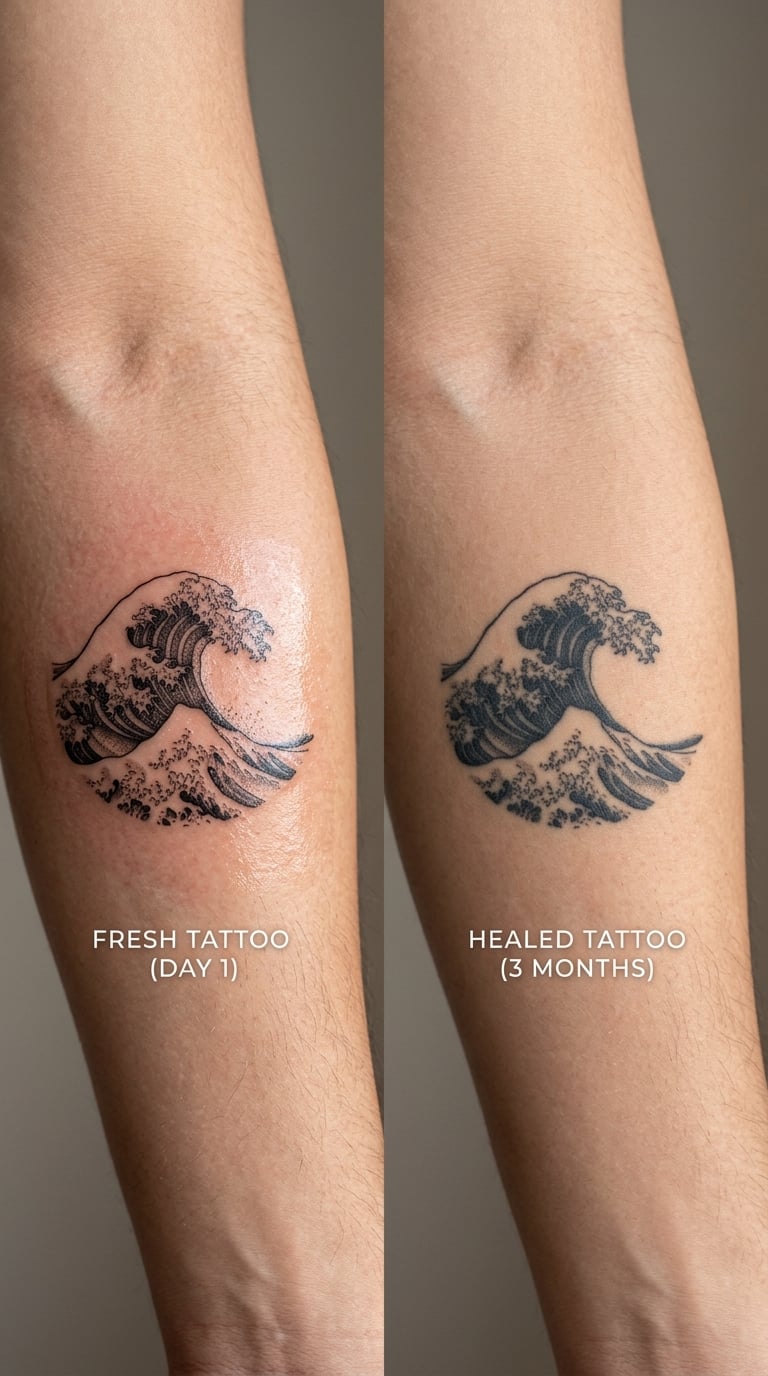
A wave tattoo heals on the ordinary schedule for any piece of work. Large blackwork and saturated blue tones take longer to settle than a small fine line, because the ink sits deeper.
| Time | What is normal |
|---|---|
| Days 1 to 3 | Red, tender, slightly raised. It looks worse than it feels and it will calm down. |
| Week 1 | A light surface scab. Wash gently, pat dry, never pick. |
| Weeks 2 to 3 | Itching and flaking as dead skin sheds. The design looks faded and dusty. That is normal. |
| Weeks 4 to 6 | Cloudiness lifts and the lines return to full strength. |
| Months 2 to 6 | Blue and cyan pigments are slowest to shift and are most vulnerable to sunlight in this window. |
| Beyond | A healed tattoo still fades over a lifetime. A wave in full sun, such as a forearm, will need sun care permanently. |
If redness, heat, swelling or discharge persists past the first week, or if the pain gets worse rather than better, contact the artist first and ask their advice. If the concern continues, a qualified healthcare professional is the right next call.
Wave Tattoo Aftercare Basics
Always start with the aftercare your own artist gives you, because they know exactly what they did to your skin. Alongside that:
- Clean the area with clean water and a mild, unscented wash, then pat it dry. No scrubbing.
- Follow the aftercare product your artist recommends and use it for as long as they say. Moisturising too early can trap the ink.
- Keep loose clothing off it. A shirt seam rubbing a healing blackwork design is the fastest way to flatten the linework.
- Keep it out of pools, hot tubs, lakes and ocean water while the surface is open, and out of direct sun for the first few weeks.
- Once healed, sunscreen on exposed areas, especially a forearm or calf wave, does more for your tattoo than anything else you can do for it.
- Do not wrap it tightly in cling film, soak it, or use anything medicated on it without asking your artist first.
Mistakes to Avoid
Choosing the image before the meaning. If you picked a picture from a collection and cannot explain why it is yours, it will read exactly like a copy, because it is one.
Copying a reference too literally. A traced image carries none of your intent. Use the reference for shape and let the artist redraw it into your body.
Putting a detailed wave somewhere it gets rubbed. Friction flattens fine line and colour faster than time does. Wrist, elbow crease and rib movement are the usual trouble spots.
Choosing a size that fights the placement. A four-inch wave stretched across a two-inch forearm will blur into a stripe. Size the design to the flat area you actually have.
Letting other people answer the question. Strangers will read what does a wave tattoo mean as “surfer” or “beach lover” and move on. What it means to you is the part that counts, and it is the part nobody can see.
Skipping the cultural research. Japanese irezumi and Polynesian motifs come from traditions with rules about who wears what. If a design borrows from one, ask the artist about it before you commit. Tattoos that carry specific cultural or religious ownership, such as kakau or sacred tribal patterns, are the ones worth walking away from.
Frequently Asked Questions
What does a wave tattoo mean in simple terms?
A wave tattoo usually means resilience, change, freedom, emotional depth and renewal. Water keeps moving and a wave always returns after it breaks, which is why people read it as inner strength. It also stands for the ocean, travel and a calmer mind. The exact meaning is personal, and it settles once you attach it to your own story.
What does the 3 wave tattoo mean?
Three waves most often mean past, present and future. People also read them as body, mind and spirit, or as birth, life and death, and surfers have their own long-standing three-wave motto. Pick the reading that holds up when someone asks you about it, because you will get that question more than once.
Is a wave tattoo unisex, and will a small one still read as a wave?
Yes, wave tattoos are worn by everyone, and the meaning has nothing to do with gender. For small sizes, keep it simple. A single clean curl with one or two lines of foam reads clearly; fine detail turns to grey and disappears within a few years, especially on hands and fingers.
Is it disrespectful to get a Japanese or Polynesian wave tattoo if I am neither?
Not automatically, but it deserves thought. Japanese and Polynesian motifs come from living traditions with rules about who wears what, and copying sacred or family-owned patterns is where people step over the line. Pick an artist who works in that tradition or asks about its origin, and avoid designs that mark specific rank, protection or ancestry.
Can a wave tattoo stand for a specific person or a loss?
It can, and many people do it. A dark breaking wave, a wave with a moon, or a design holding a date or a set of coordinates reads as grief or remembrance to most people who see it. The meaning is yours to state, and the tattoo works best when the detail you added is one only you would choose.
How do I make a wave tattoo mine instead of a copy?
Decide the state of the water first, calm or breaking, since that sets the meaning. Then scale the design to your placement rather than the other way around. Add one detail nobody else would add, such as coordinates, a date, or a word hidden in the foam, and send the artist a reference plus a sentence about what it is for.
Conclusion
The readings that come up most for what does a wave tattoo mean are resilience, change, freedom, emotional depth and renewal. Pick the one that is actually yours, size the wave to a placement you want to look at, and add a detail nobody else would think of. Then book an artist who has done wave work before, and take their aftercare instructions over anyone else’s, including mine.