
20 Scar Cover Up Tattoo Ideas for Women: Best September 2026
Most scar cover up tattoo ideas for women searches start with a mark and end with a very practical question: how big does the design need to be, and how dark? Scar tissue is not normal skin. A design that looks like it erases a line in a photo can still leave a faint edge once it heals, because the ink sits on thicker, less even tissue than the skin around it.
These 20 designs are picked for contrast, scale and placement rather than symbolism. If you are planning a first piece, book the artist 30 to 45 days before you need the area to be event-ready, and read the [forearm tattoo ideas for women with meaning](https://thewe.cc/forearm-tattoo-ideas-for-women-with-meaning/) roundup if the mark is on your arm.
Scar Cover Up Tattoo Ideas for Women: Quick Guide
Every design below needs a cover-up artist to look at your specific mark first. Texture, colour and skin tone decide what will actually work, and no reference image can do that for you.
| Idea | Style | Best placement | Size | Pain |
|---|---|---|---|---|
| 1. Fine-line flower branch | Fine line | Inner forearm | 3-5 inch (8-13 cm) | Low to medium |
| 2. Saturated peony cluster | Illustrative colour | Outer forearm | 4-6 inch (10-15 cm) | Medium to high |
| 3. Geometric blocks | Geometric blackwork | Upper arm | 3-5 inch (8-13 cm) | Medium |
| 4. Ornamental scrollwork | Ornamental blackwork | Collarbone | 4-6 inch (10-15 cm) | Medium |
| 5. Watercolor koi | Watercolour | Outer upper arm | 5-7 inch (13-18 cm) | Medium |
| 6. Phoenix with colour blocks | Neo-traditional | Chest and sternum | 6-8 inch (15-20 cm) | High |
| 7. Monochrome botanical cascade | Black and grey realism | Outer thigh | 4-6 inch (10-15 cm) | Medium |
| 8. Abstract reshading | Abstract blackwork | Shoulder | 4-5 inch (10-13 cm) | Medium |
| 9. Symmetrical dragonfly | Fine line illustrative | Inner bicep | 2-3 inch (5-8 cm) | Medium |
| 10. Butterfly with pattern breaks | Illustrative | Sternum | 4-6 inch (10-15 cm) | Medium |
| 11. Songbirds among blossom | Fine line illustrative | Forearm | 4-6 inch (10-15 cm) | Medium |
| 12. Lace panel | Ornamental linework | Lower abdomen | 3-4 inch (8-10 cm) | Medium |
| 13. Offset petal mandala | Geometric floral | Sternum | 4-5 inch (10-13 cm) | Medium |
| 14. Compass rose with stars | Illustrative linework | Wrist | 2-3 inch (5-8 cm) | Medium to high |
| 15. Flowing calligraphy | Calligraphy | Forearm | 3-5 inch (8-13 cm) | Medium |
| 16. Soft portrait with shading | Portrait realism | Shoulder blade | 5-7 inch (13-18 cm) | High |
| 17. Mountain range | Illustrative blackwork | Upper back | 6-9 inch (15-23 cm) | Medium to high |
| 18. Blackwork wolf portrait | Blackwork realism | Shoulder | 4-6 inch (10-15 cm) | High |
| 19. Interlocking geometric maze | Geometric linework | Rib area | 5-6 inch (13-15 cm) | Medium |
| 20. Op-art waves | Op-art geometric | Side thigh | 5-7 inch (13-18 cm) | Medium |
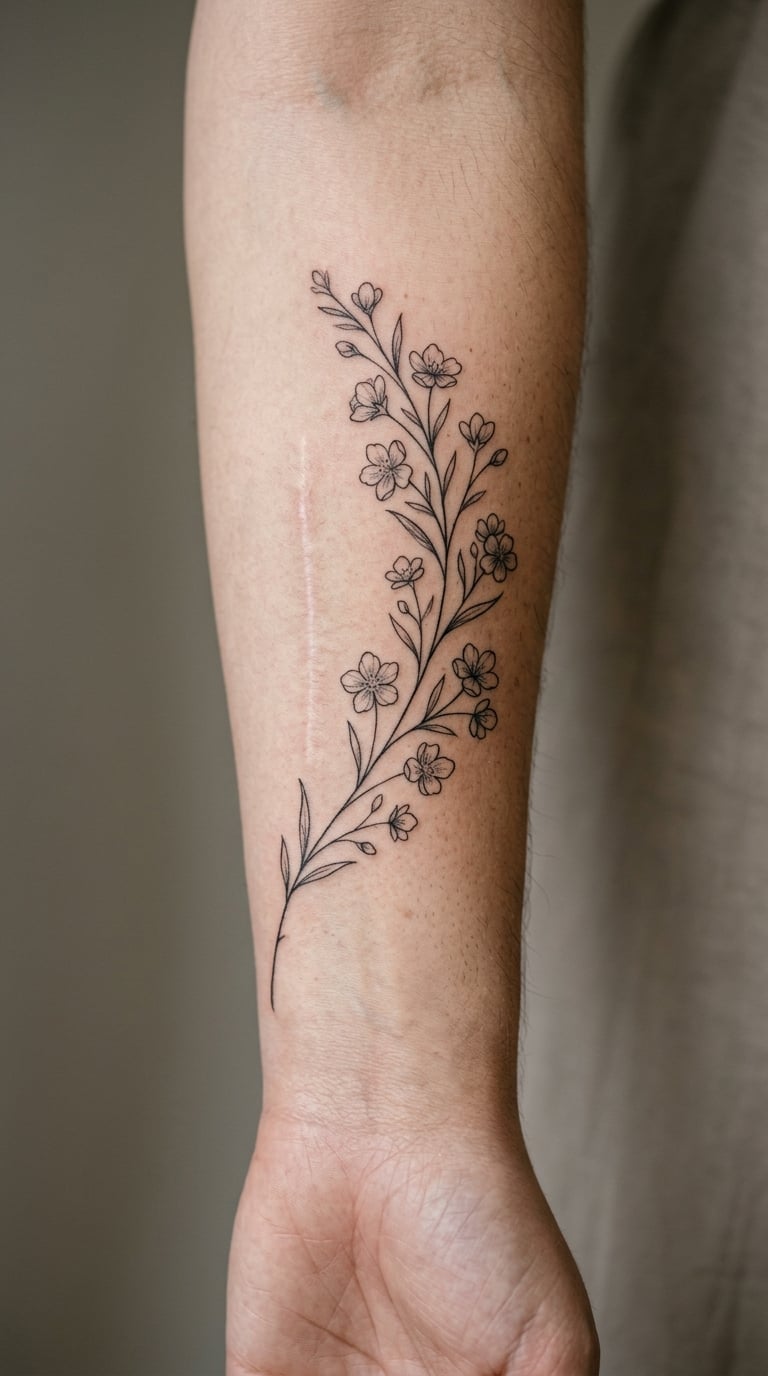
1. Fine-Line Flower Branch Over a Linear Scar
Matching Scar Cover Up Tattoo Ideas for Women to the Mark
Line direction, contrast, scale and texture all change the result, which is why no two cover-ups look alike. A branch drawn across the scar pulls the eye sideways; the same branch drawn parallel to it would echo the mark instead of breaking it. A thick, dark design covers a pale flat line more reliably than a pale thin one. A raised or shiny patch refuses ink differently, so its texture has to be worked into the design rather than fought. Have the artist examine the mark in person before they commit to a colour or a scale.
The design itself is one single-needle stem that curves across the mark, with small five-petal blossoms and narrow leaves spaced along it. No shading, no fill, just clean single-needle curves in black. The bend in the stem is doing the work: it drags attention along a new line instead of the old one.
Most women pick this because it reads as a normal botanical piece, not a corrective one. There is no fixed meaning attached to it.
Placement: inner or outer forearm, the soft dip beneath the collarbone, or just above the knee. Size: 3-5 inch (8-13 cm) long, 1-2 inch (3-5 cm) tall. Style: fine line. Pain: low to medium on a forearm, a scratchy pull rather than a deep sting.
One honest note: hairline petals soften noticeably within five to eight years, and on hands and fingers they fade fastest. Book a free touch-up in the first month to catch any patchy spots.
Make it yours: swap in your birth flower or add a second sprig that crosses the first at a right angle.
2. Saturated Peony Cluster in Color
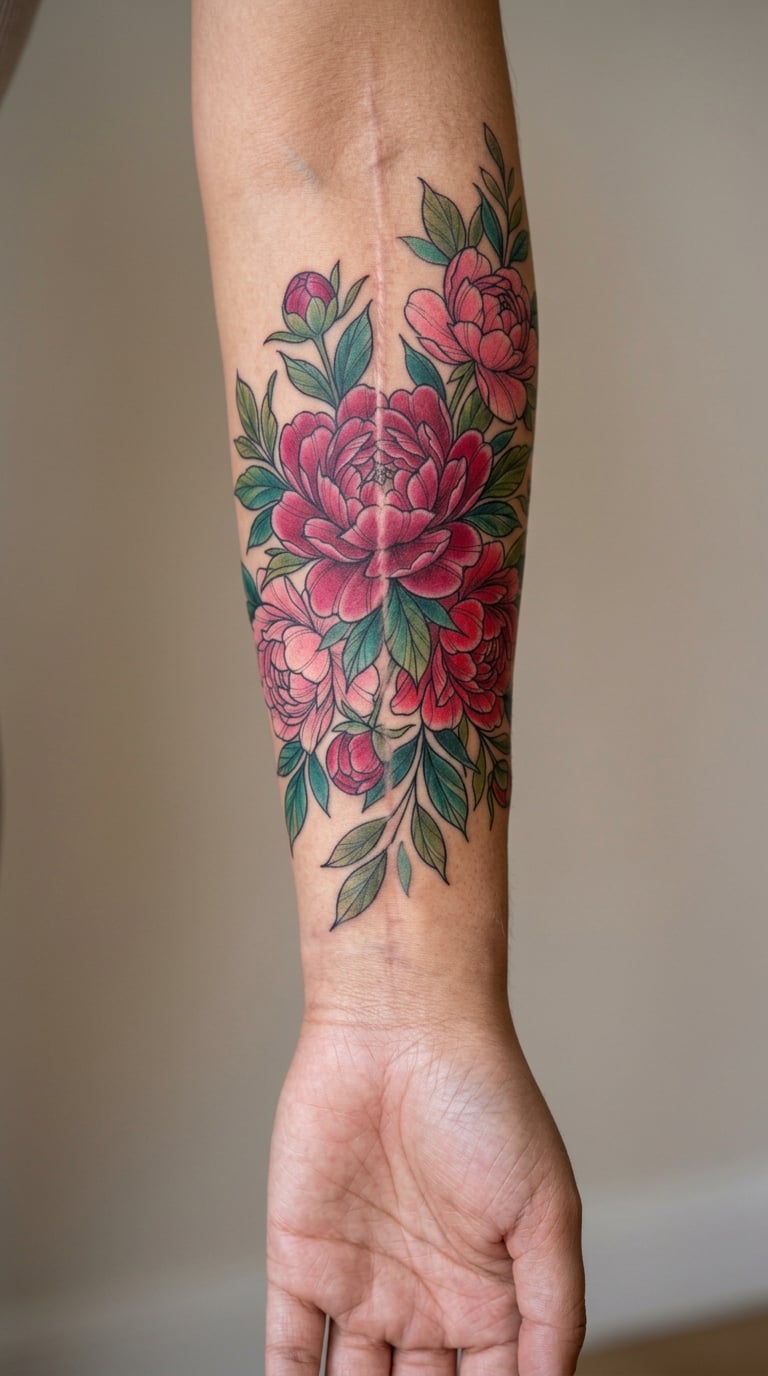
Layered peonies in strong pink, deep red and dark green are the most reliable way to break up an uneven line. Each bloom is built from overlapping petal edges with a warm shadow at the base, so the eye reads texture first and the scar second. Colour density is doing the covering here, not the shape.
This is the option people choose when they want the piece to be noticed. It suits a scar that is irregular rather than perfectly straight, because the uneven petal edges disguise unevenness well.
Placement: outer forearm, upper arm, or a shoulder where there is flat space. Size: 4-6 inch (10-15 cm) across, at least 1 inch (3 cm) of design beyond each end of the mark. Style: illustrative colour. Pain: medium to high, and colour packing on scar tissue is where the sting settles in.
Colour is the first thing to shift. Yellows and light greens fade fastest and can drift toward the skin’s own tone, so pick shades that are dark or deep rather than pastel. A touch-up session is normal, not a sign something went wrong.
Make it yours: keep the reds and swap the greens for one deep blue-green that matches another piece you already have.
3. Geometric Blocks for a Pale Raised Scar
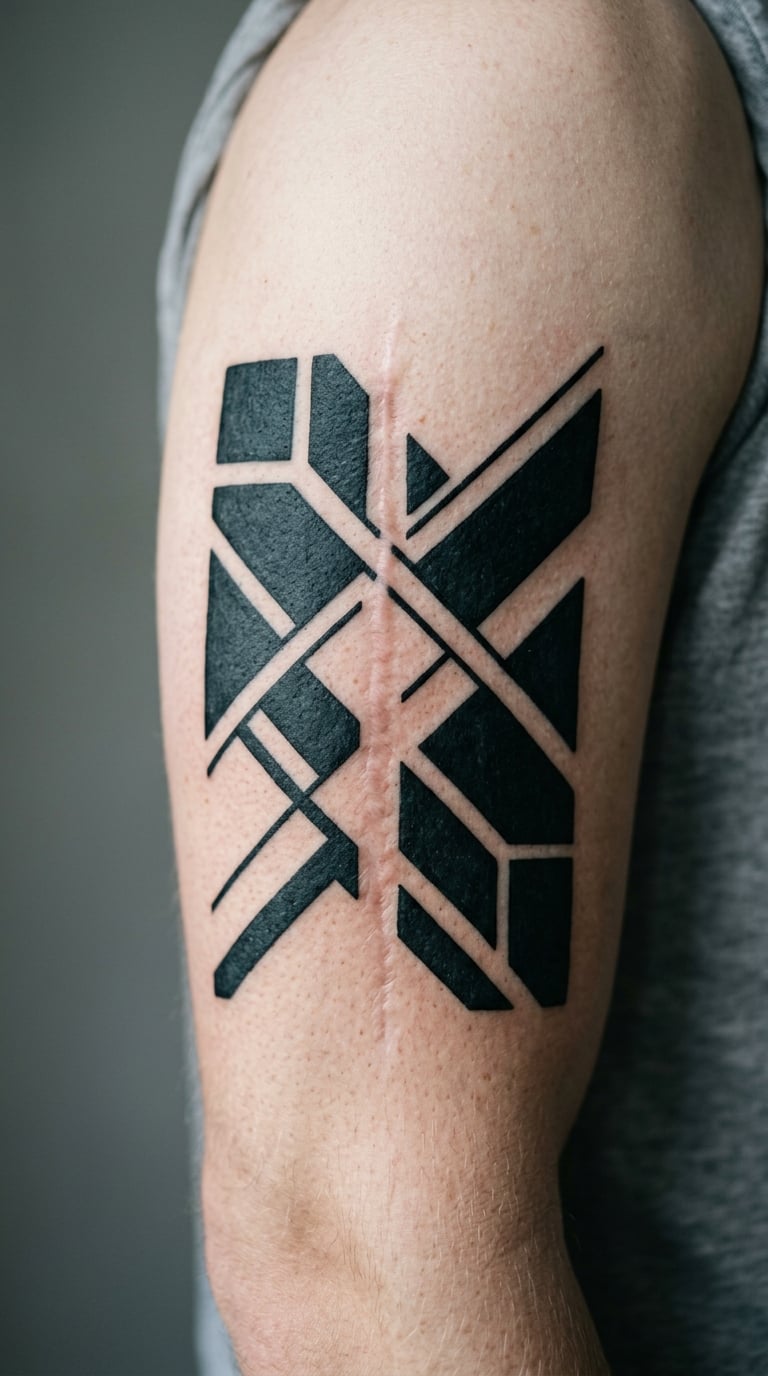
A pale raised scar catches light differently from flat skin, and solid black blocks stop it doing that. The artist lays down filled squares, thick diagonal bands and hard-edged lines, then leaves deliberate gaps of bare skin between them so the mark sits inside a composition rather than under one. The contrast between the dense black and the open skin does most of the work.
Choose this when the scar is light and the surrounding skin is untanned or untattooed, and you want the result to look graphic rather than decorative.
Placement: upper arm, outer thigh, ribs, anywhere with a broad flat area. Size: 3-5 inch (8-13 cm) square. Style: geometric blackwork. Pain: medium, heavier on the ribs and the inside of the upper arm.
The honest risk is edges. If a black block ends exactly on the scar line, the block can outline it rather than cover it. Good cover-up artists overshoot the mark by a few millimetres and let the shape close the gap.
Make it yours: carry a single block shape from one end of the piece to the other so the geometry reads as one thought.
4. Ornamental Blackwork Surrounding a Curved Scar
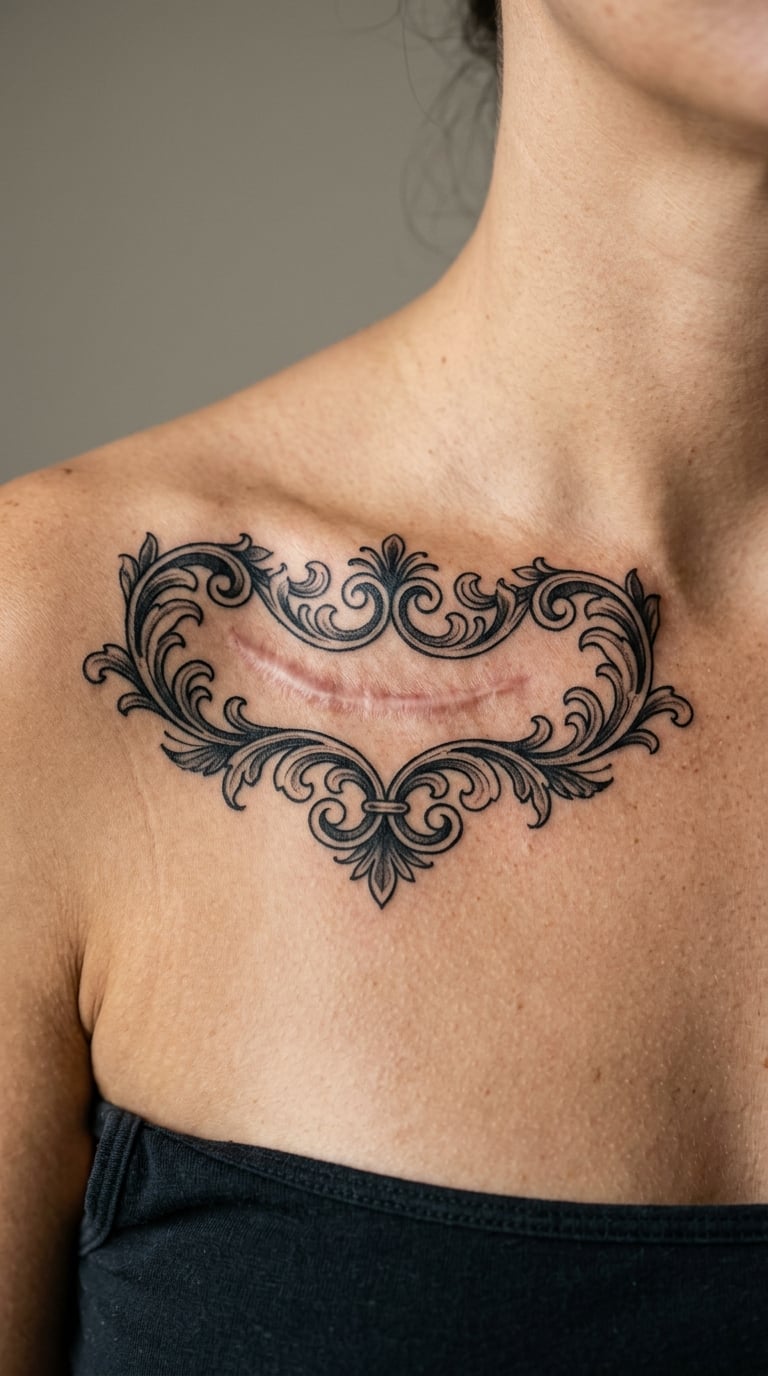
Curved scars are easier to work with than straight ones, because a curve already looks intentional. Dense ornamental linework uses that: mirrored scrolls, nested arcs, small teardrop fills and a few solid black accents arranged so the curve runs along the natural flow of the design. Where the scar bends, the design bends with it.
This is one of the scar cover up tattoo ideas for women that reads as traditional body decoration rather than a repair job, which is why it suits a collarbone or a shoulder.
Placement: collarbone, shoulder, sternum, or wrapping around a hip. Size: 4-6 inch (10-15 cm) along the curve. Style: ornamental blackwork. Pain: medium, and the collarbone bone sits close to the skin.
Ornamental work carries a lot of fine interior detail, and small fills and hairline details blur as the piece ages. Ask the artist to make the outer scroll lines noticeably heavier than the inner detailing so the design still reads at ten years.
Make it yours: add a small symbol inside the central teardrop, a letter, a date or a tiny anchor.
5. Large-Scale Koi in Muted Watercolor
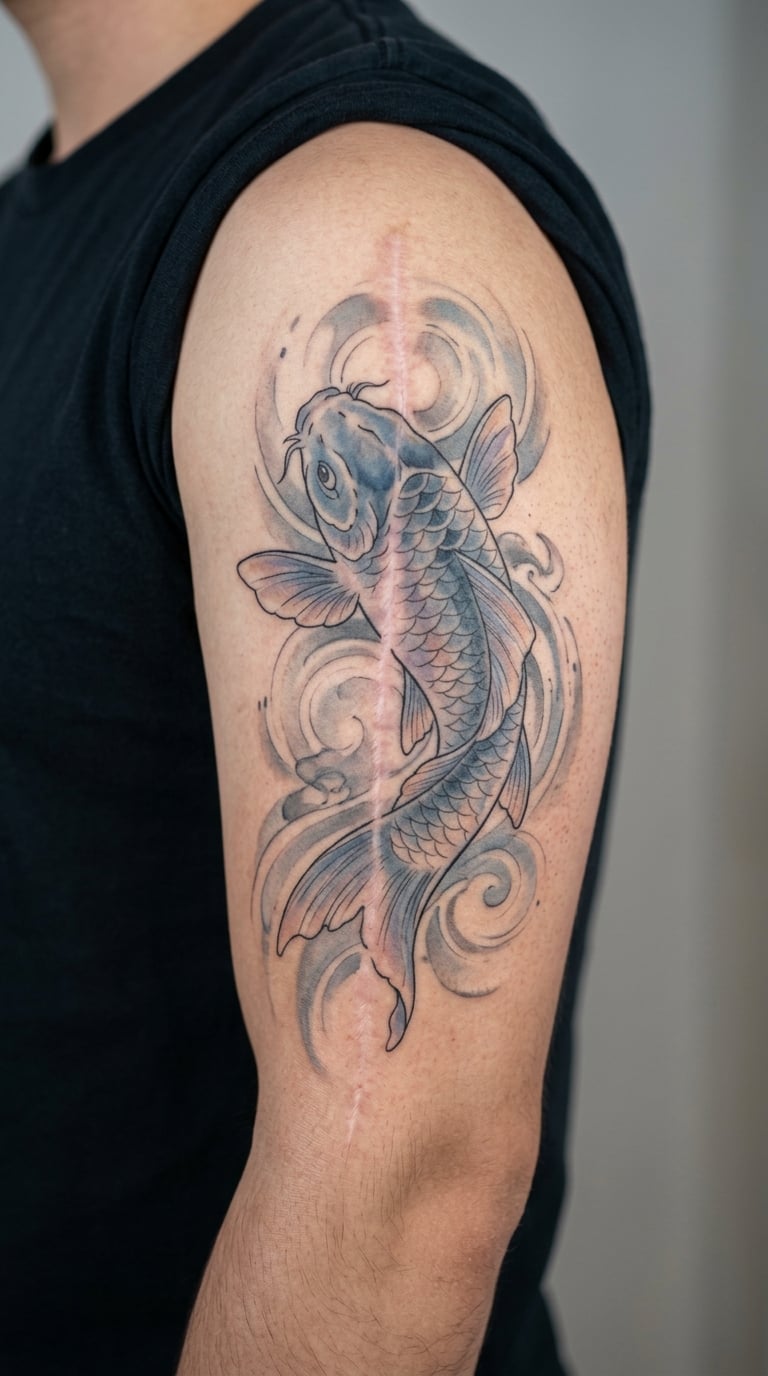
A koi drawn in muted watercolour gives you movement without hard outlines. Soft grey and blue washes bleed outward, the scale texture is built from overlapping semicircles, and a loose circular water motif wraps behind the body of the fish so the composition keeps a defined edge. The flowing direction of the water does the redirecting.
Watercolour suits a larger mark because the washes spread across an area rather than tracing a line. It also ages gracefully, since fading washes still look intentional.
Placement: outer upper arm, shoulder blade, side thigh, or a long section of the back. Size: 5-7 inch (13-18 cm) long. Style: watercolour. Pain: medium, lighter than saturated colour because less pigment is laid down.
Be honest about pigment variation. Two skin tones take watercolour differently, and a pale scar may refuse the first layers and hold them later. Expect a second session to build the density over the mark.
Make it yours: pick one spot of deeper colour, an eye or a single fin, so the piece has one point the eye lands on.
6. Phoenix With Feathered Color Blocking
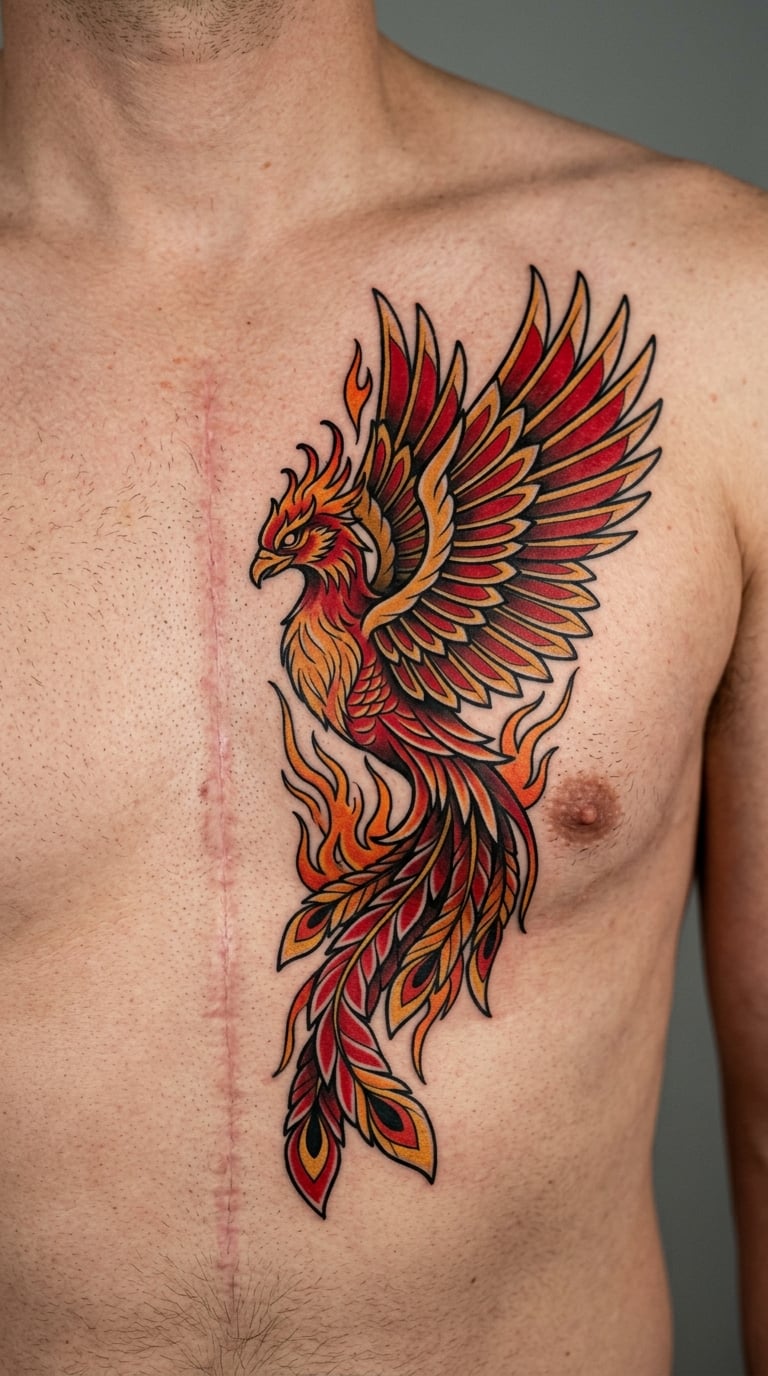
A rising phoenix with wide wings gives you two large shapes to work with, which is exactly what an uneven vertical scar needs. Each wing is built from repeated feather blocks in red, gold and black, stacked so the value shifts from the body outward. The tail drops below in longer strokes that carry the composition down and past the mark.
People choose the phoenix for the upward motion rather than for any single meaning attached to it. It suits a sternum or chest scar because the wings span wider than the mark.
Placement: sternum, upper chest, upper back, or the outer arm. Size: 6-8 inch (15-20 cm) across the wings. Style: neo-traditional. Pain: high, and the chest is one of the more sensitive placements on the body.
Colour blocking is what will fade first. Reds and golds shift over the years, so ask for heavier black linework underneath so the silhouette holds even when the colour softens.
Make it yours: add small flame shapes in the negative space between the wings, or one colour drawn from a birthstone.
7. Dense Monochrome Botanical Cascade
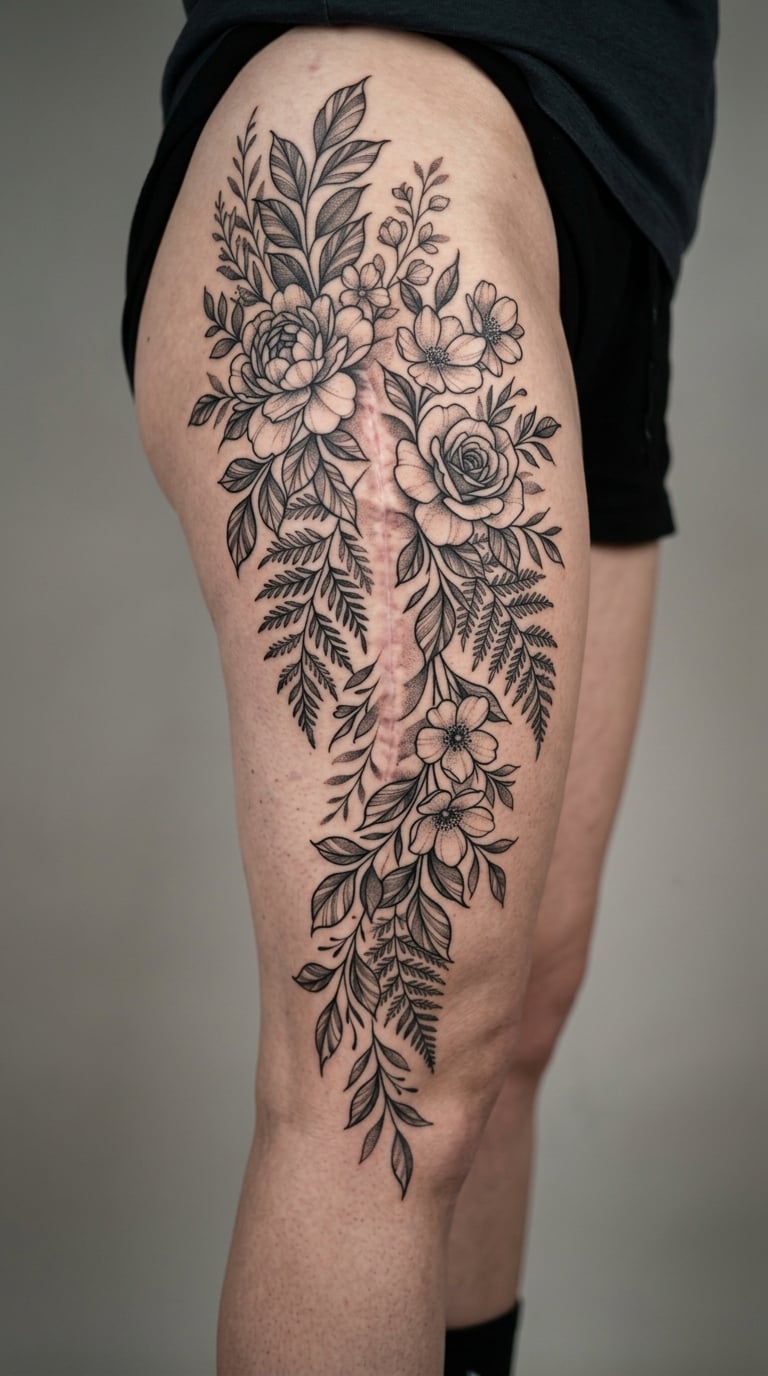
Layered leaves and blossoms in black and grey create a consistent visual density, and consistent density is what covers reliably. Each leaf is filled with soft grey shading that fades toward the tip, and blossoms are built from petal clusters with dark centres. Stacking the layers so nothing sits alone on bare skin gives the design enough weight to sit over a mark of almost any shape.
It is the restrained choice on this list. No colour, no flash, and it reads as a sleeve start you can keep building on.
Placement: outer thigh, inner arm, back of the calf, or the side of the torso. Size: 4-6 inch (10-15 cm) wide. Style: black and grey realism. Pain: medium on the thigh, and shading passes take longer so the session runs long.
Grey is the part that needs maintaining. Light grey washes can fade toward the skin tone and the leaves lose their edges, so a contrast touch-up every few years keeps the depth honest.
Make it yours: use a plant that means something to you, and check the [side thigh tattoo ideas for women](https://thewe.cc/side-thigh-tattoo-ideas-for-women/) gallery for more ways to place it on that spot.
8. Abstract Blackwork With Negative-Space Reshading
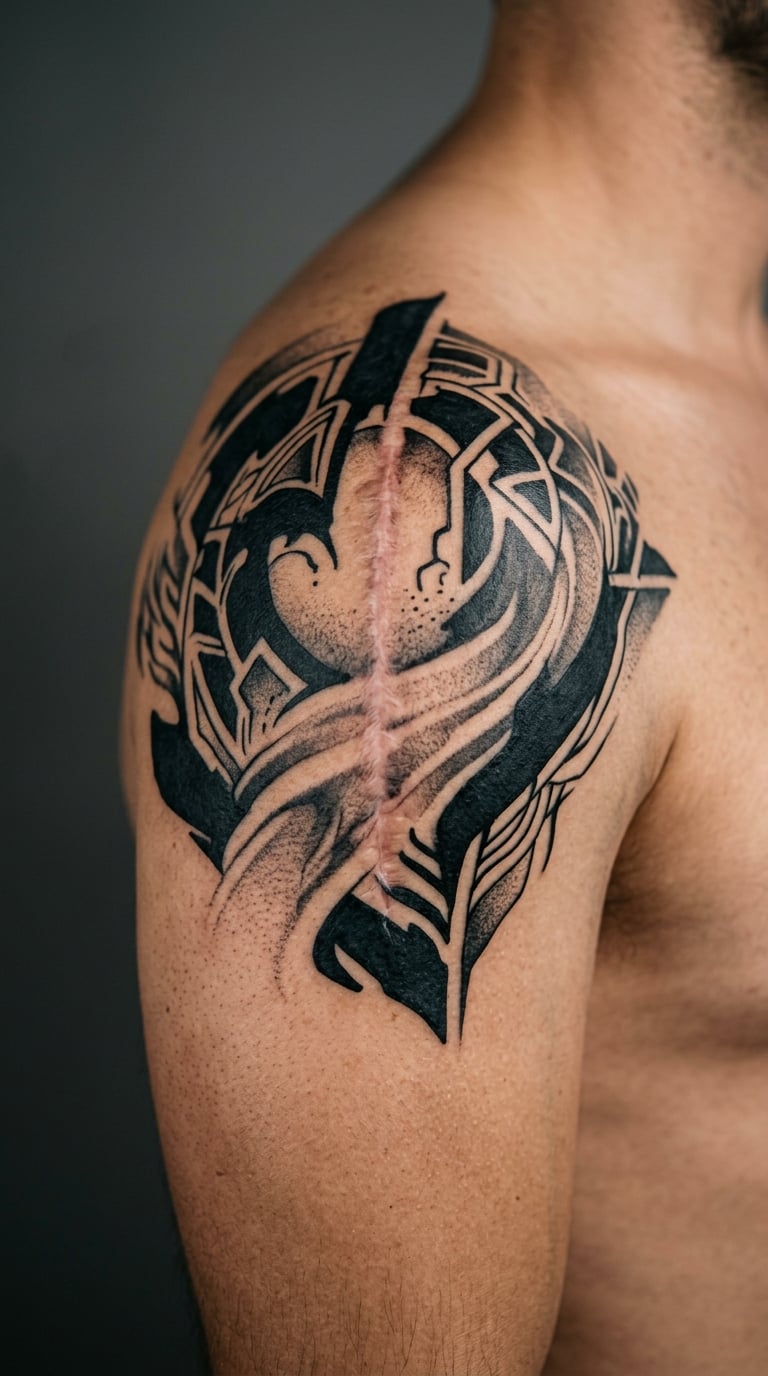
Abstract blackwork does not pretend the scar is not there. Irregular black forms, soft grey reshaping and open negative space are composed around where the mark sits, so the scar line becomes one of the edges in the design rather than a problem to hide. Sometimes the artist shades over the scar deliberately so the skin’s own tone variation disappears into the grey.
Pick this when you do not want a motif at all, and you would rather the piece look like a design decision than a cover-up.
Placement: shoulder, upper arm, back of the calf, ribs. Size: 4-5 inch (10-13 cm) in any direction. Style: abstract blackwork. Pain: medium, with shaded passes sitting deeper than line work.
Shallow grey fades faster than solid black, so the small midtone shapes can lose definition. Ask for the darkest areas to be packed black rather than grey so the composition has an anchor.
Make it yours: bring a photograph of an ink wash or a rock face and let the artist translate its shapes into linework.
9. Dragonfly With Symmetrical Wings
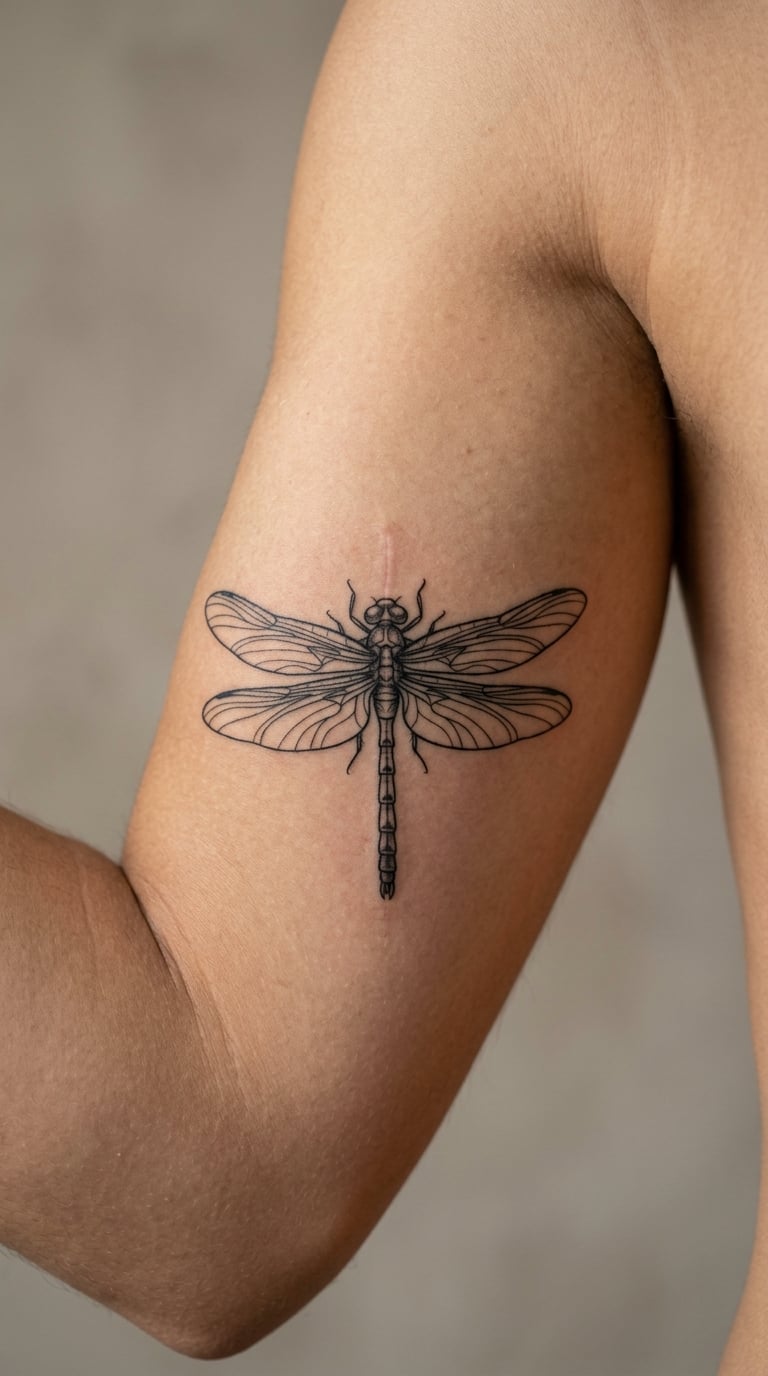
A small mark does not need a small tattoo. Working through the scar cover up tattoo ideas for women, the most reliable approach for a dragonfly is a body that reads dark and wide wings that reach past both ends of the line, so the silhouette does the covering. Each wing is drawn as a clean outlined shape filled with fine vein lines radiating from the base, and the body is segmented with two or three dark bands. A thin ink pool sits under the thorax to hold the whole thing together.
The symmetry is the point. The eye reads the two matching wings before it registers anything underneath them.
Placement: inner bicep, shoulder blade, calf, or the back of the hand. Size: 2-3 inch (5-8 cm) wing tip to wing tip. Style: fine line with illustrative fill. Pain: medium, and the inner bicep is a tender spot.
The wing veins are the ageing risk. A two-millimetre line will soften into a grey blur over a decade, so ask for the veins slightly heavier than feels necessary on day one.
Make it yours: colour just the wing veins, or add a few tiny leaves below the body so it is not floating.
10. Butterfly With Layered Pattern Breaks
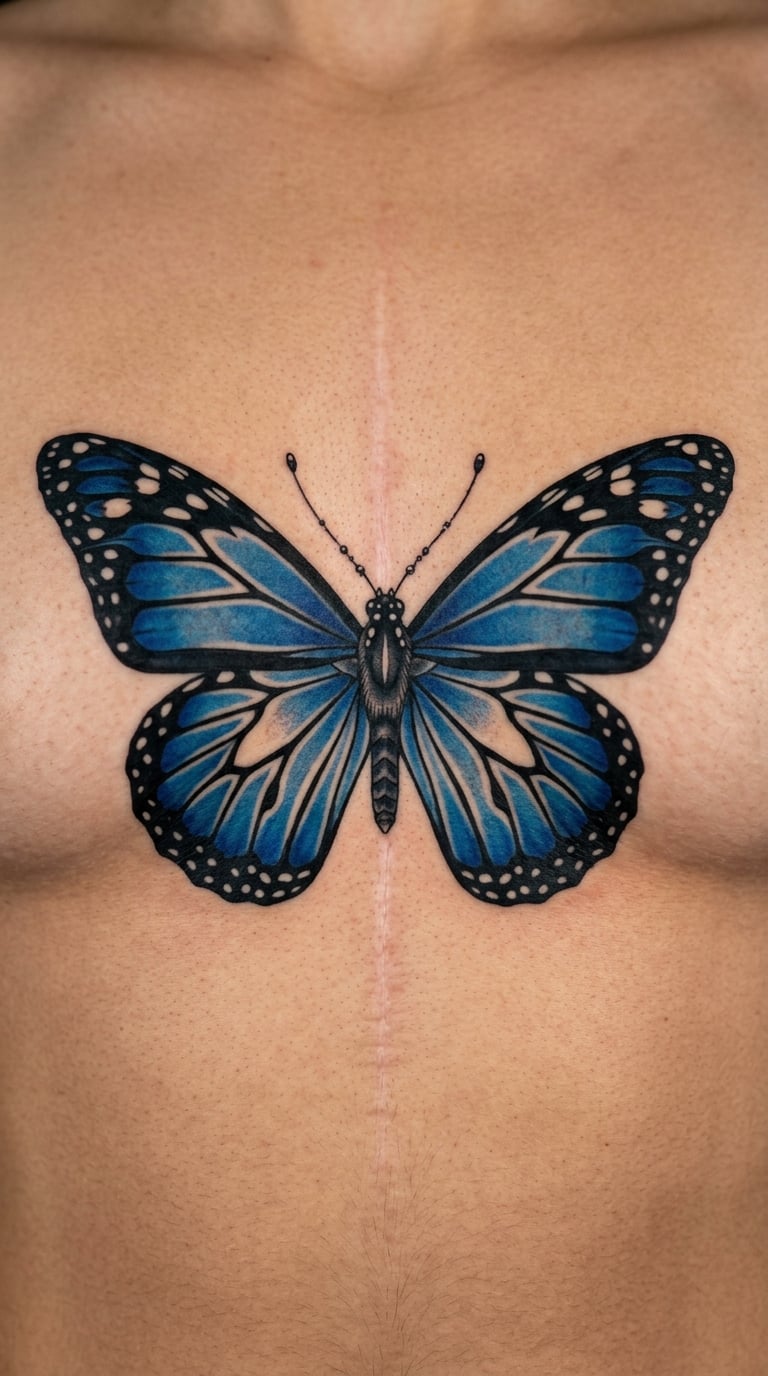
An open-wing butterfly gives you two large panels to fill and a narrow body to align with. Each wing carries a different pattern, and the differences are placed on purpose: solid black scallops on one side, fine veining on the other, and clear breaks of bare skin where the scar runs. The variation stops the eye from tracking straight across and finding the line underneath.
Butterflies are the most requested motif on this list, and this version is designed as cover-up work rather than a small decorative butterfly.
Placement: sternum, upper back, shoulder blade, or the centre of the back. Size: 4-6 inch (10-15 cm) wing tip to wing tip. Style: illustrative. Pain: medium, higher on the sternum and the ribs.
Blues and violets are the first colours to fade here, and a sternum placement sits under whatever you wear, so sun protection matters more than usual. A blue that reads clearly on paper often needs two sessions on skin.
Make it yours: keep the two wings different, and put a small date or initial in the negative space on the lower wing.
11. Songbirds Among Blushing Branches
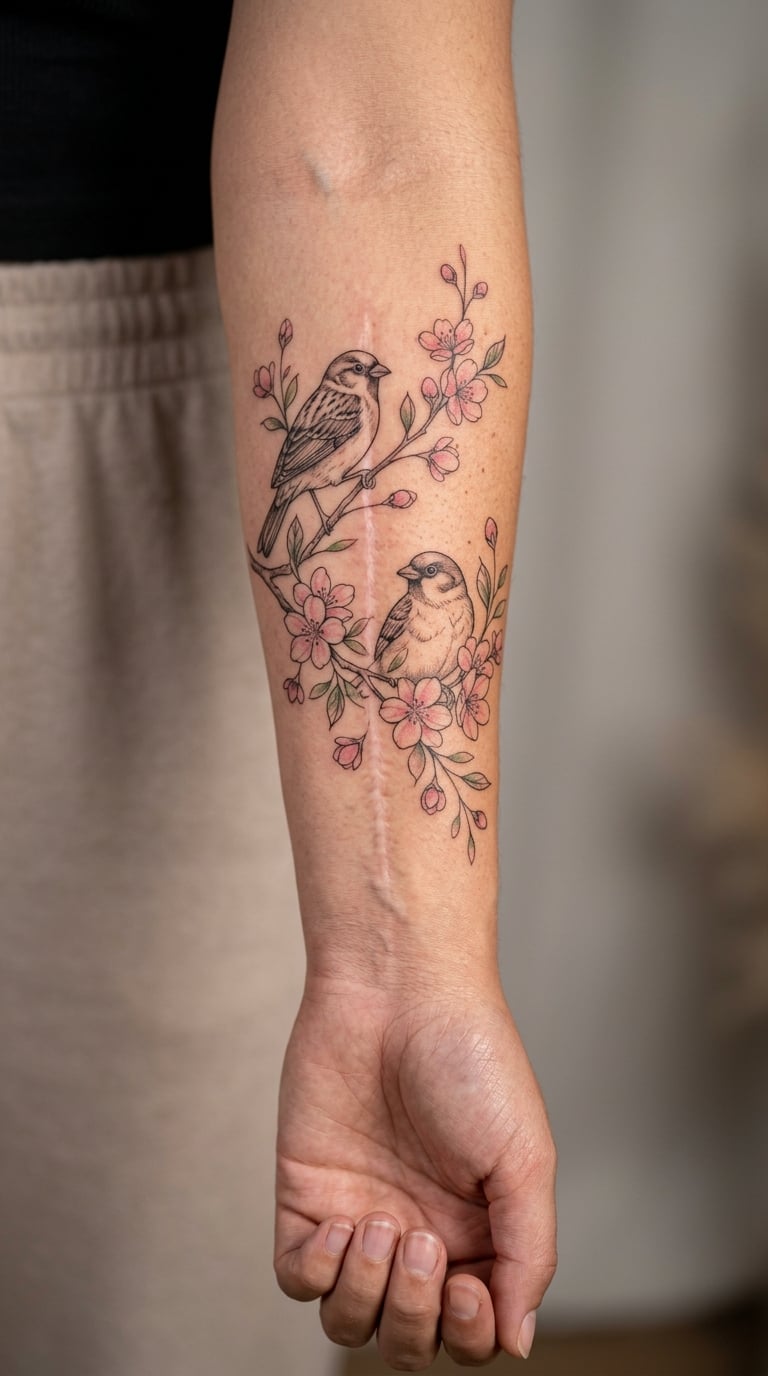
Two small birds among flowering branches creates a scene with movement in it, which suits a longer scar that runs along the arm. The branches cross the mark at shallow angles, blossoms are scattered along them in small five-petal clusters, and the birds are drawn with a few confident lines each: a curved back, a wing edge, a beak. Nothing is filled in, so the piece stays light and open.
The reason this works is direction. Branch lines crossing the scar at an angle keep the eye travelling rather than stopping on it.
Placement: forearm, wrist, ankle, or the inside of the upper arm. Size: 4-6 inch (10-15 cm) long. Style: fine line illustrative. Pain: medium on the forearm, low on the wrist.
Small details are the honest trade-off. Beak lines, leg lines and petal centres soften first, so the artist should build the birds at a slightly larger scale than feels necessary so those details survive.
Make it yours: use the blossom of a tree tied to a place or a person, and add a third bird only if the arm can take the width.
12. Delicate Lace Panel
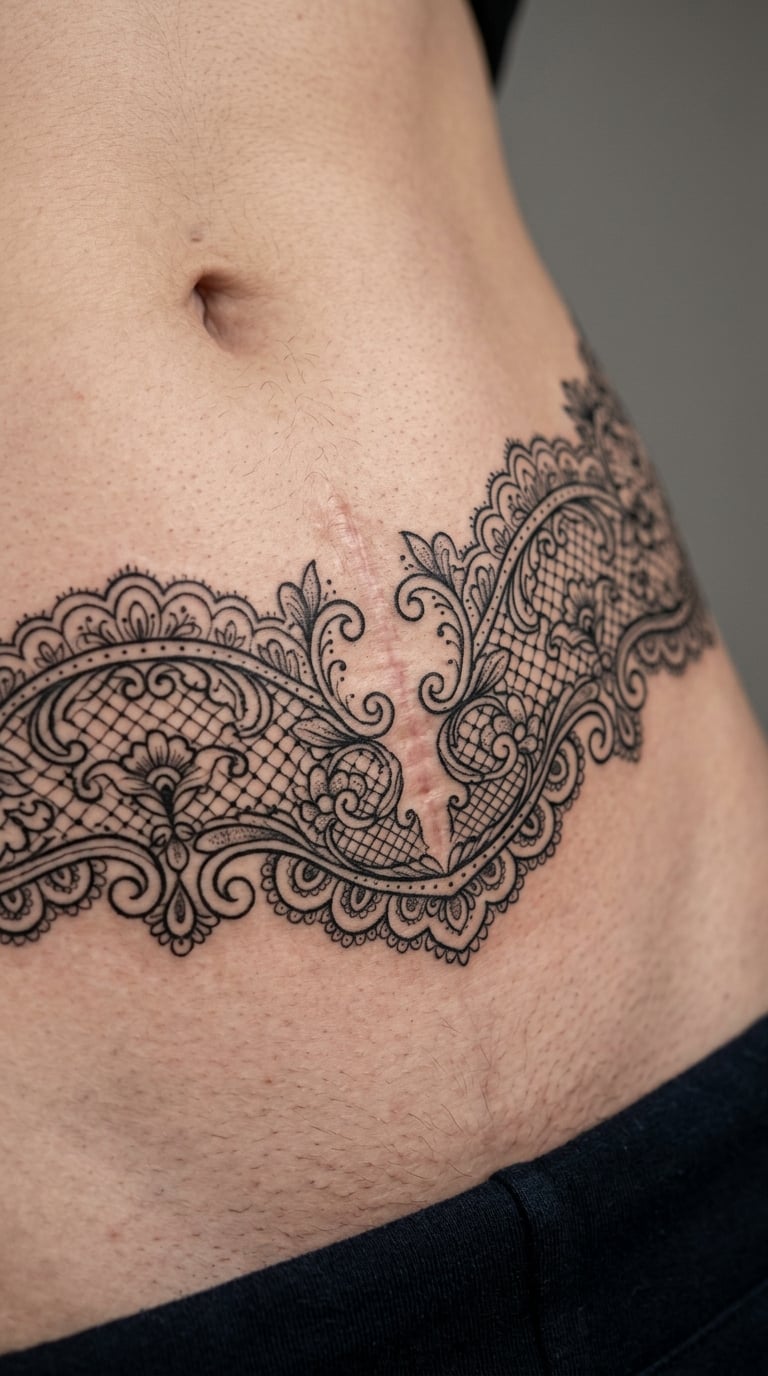
Lace panels are built from repeating loops, scalloped edges, small floral filigree and a fine mesh grid, and they are a popular way to disguise a narrow mark because the pattern is so regular that a straight line inside it becomes hard to see. The loops break the scar into short segments, and the mesh fills the space between them.
It stays airy and feminine rather than heavy, which makes it a good match for a first cover-up on a smaller area.
Placement: lower abdomen, along a collarbone, on the back of the calf, or following a hip scar. Size: 3-4 inch (8-10 cm) long. Style: ornamental linework. Pain: medium, and the abdomen is sensitive after abdominal surgery.
Lace is the fastest-fading design on this list. The mesh grid is built from hairline work, and it disappears within a few years unless the artist leaves the loops noticeably heavier than the mesh.
Make it yours: have one band in a single deep red running through the scallops, which keeps the piece soft but adds a point of contrast.
13. Petal Mandala With a Clear Broken Axis
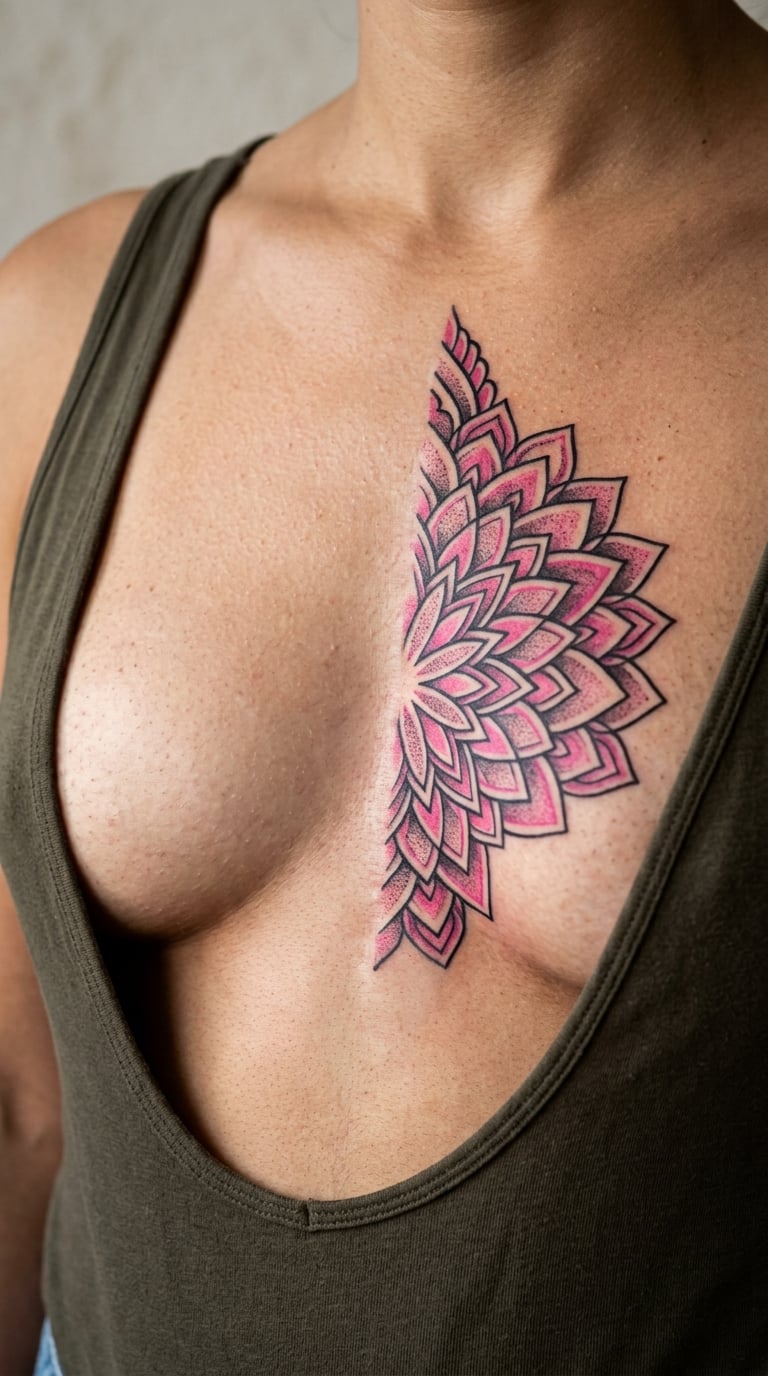
A mandala that stops one ring short on the scar’s side works better than a mandala pretending to be complete. The artist builds concentric rings of pointed petals, then leaves a visible gap where the mark runs, and the eye reads that gap as a deliberate break in the pattern. Pink and black together give the contrast needed to hold over a pale line.
This is one of the clearest examples of incorporating the mark instead of hiding it, and it is why mandalas show up so often in scar cover up tattoo ideas for women.
Placement: sternum, abdomen, upper back, or the centre of the calf. Size: 4-5 inch (10-13 cm) across. Style: geometric floral. Pain: medium, and consistent line weight is hard work over scar texture.
The difficulty is consistency. One ring of petals that runs thick and one that runs thin is visible at a glance, and scar tissue pulls ink differently along its length. Expect a touch-up to even it out.
Make it yours: let the break fall on a ring that means something, or fill only the break with a small symbol.
14. Compass Rose With Celestial Accents
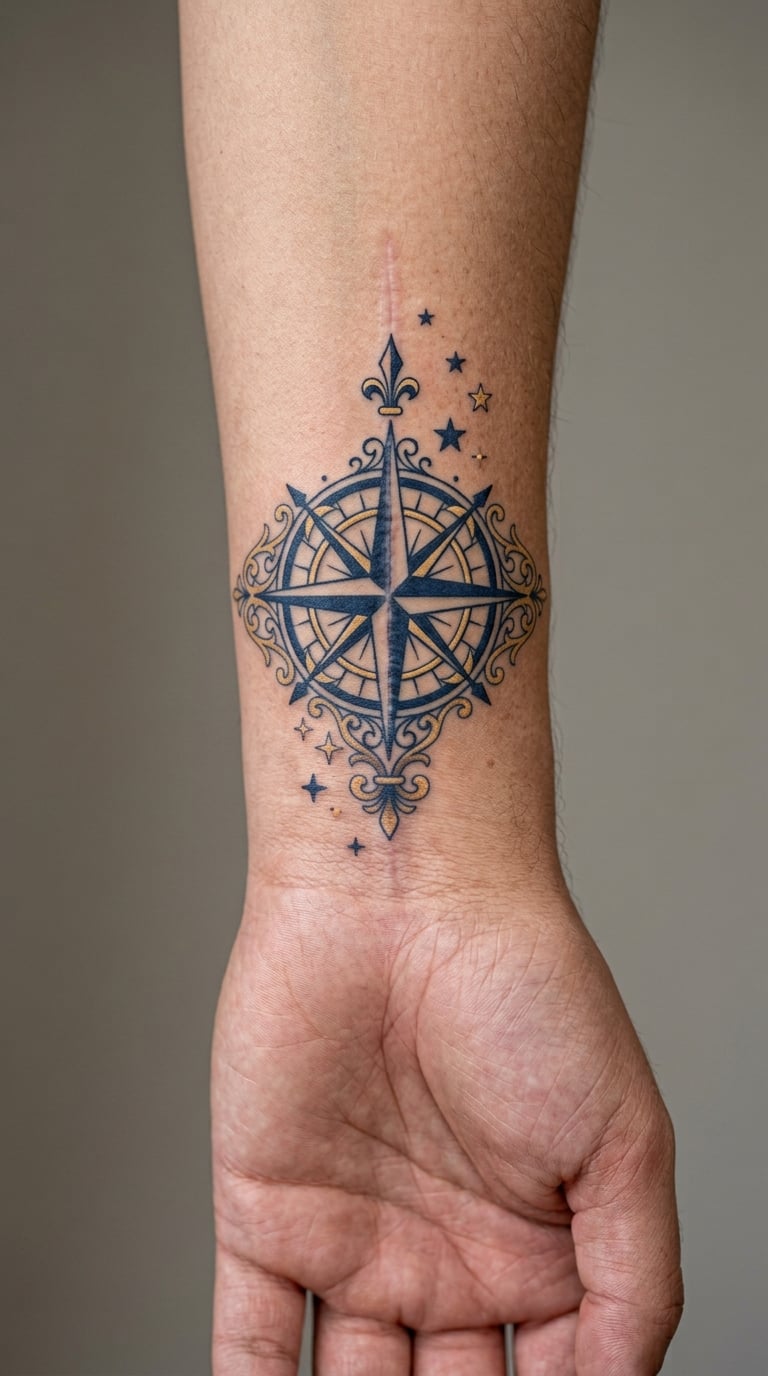
A compass rose fills a compact area with radiating structure, which is useful on a small scar where a large piece would look out of place. Eight points radiate from a two-tone centre, each built from a long triangle and a short counter-triangle, and a restrained set of small stars sits in the surrounding field. Navy for the points and a muted gold for the centre gives strong contrast without going fully black.
The radiating lines are the mechanism. They send the eye outward from the mark instead of along it.
Placement: wrist, inner forearm, ankle, or the top of the foot. Size: 2-3 inch (5-8 cm) across. Style: illustrative linework. Pain: medium to high, and wrist bone and inner forearm are both sensitive.
Linework on hands and wrists ages faster than linework on a thigh, because you use those areas constantly and they see more sun. Gold in particular can look tired quickly if it is not packed well.
Make it yours: set the rose to point in the direction of somewhere that matters, and use your birth month for the number of stars.
15. Flowing Script Set Along the Scar’s Curve
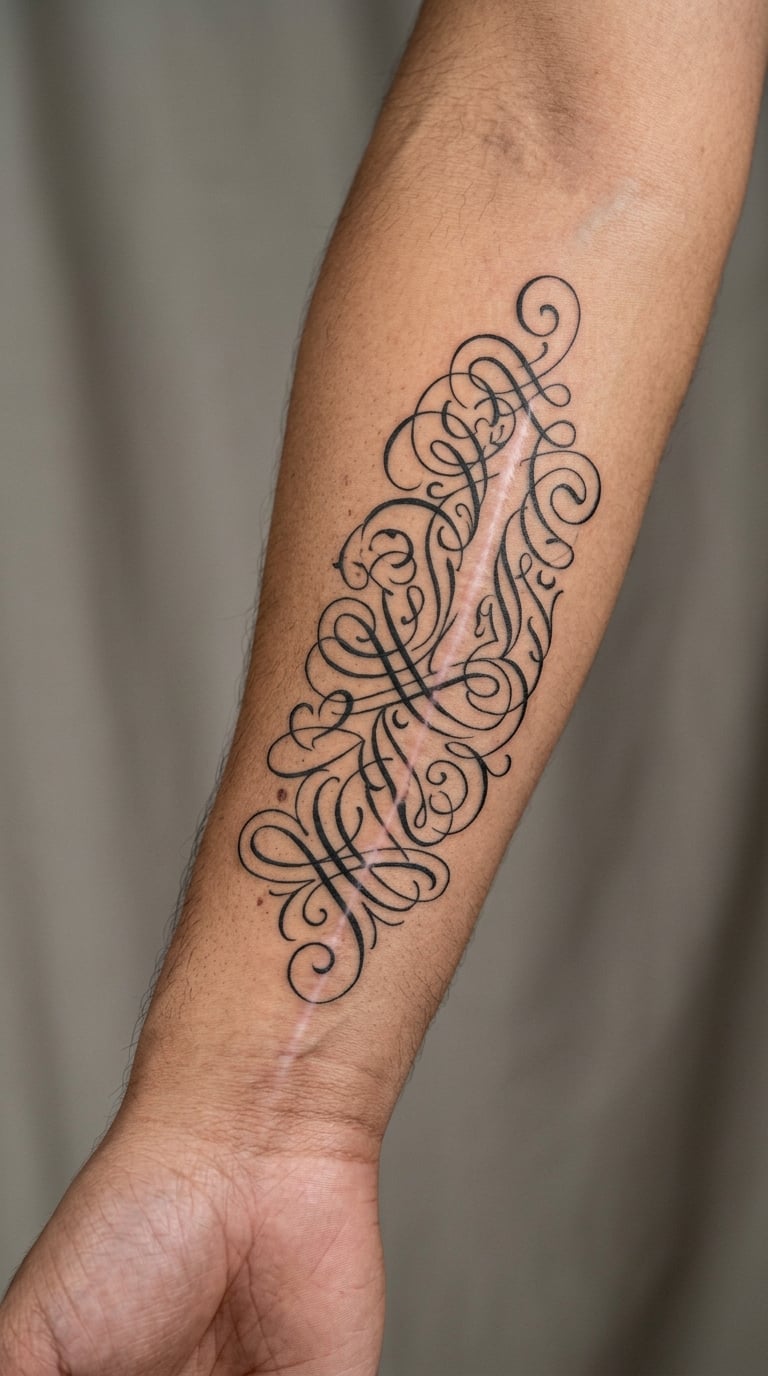
Lettering works when the text follows the mark rather than crossing it. A looping baseline runs along the curve of the scar, with a capital letter rising above it and long exit strokes sweeping under and past the ends, so the script reads as one continuous gesture. Contrasting thick downstrokes against thin upstrokes give enough weight to break a pale line.
Choose a phrase with a reason behind it, since this is the one design on the list where the words carry the meaning rather than the motif.
Placement: forearm, wrist, ribs, or along a hip. Size: 3-5 inch (8-13 cm) of script. Style: calligraphy. Pain: medium, and script takes longer so the session runs on.
Honest ageing note: fine script on fingers and hands softens fast, and a word like a name is the first part to blur into a shape. Ask for slightly larger letterforms and avoid placing it over a joint that flexes all day.
Make it yours: use a date, a name, or the first line of something a person said to you that you want to keep.
16. Soft Portrait With Background Shading
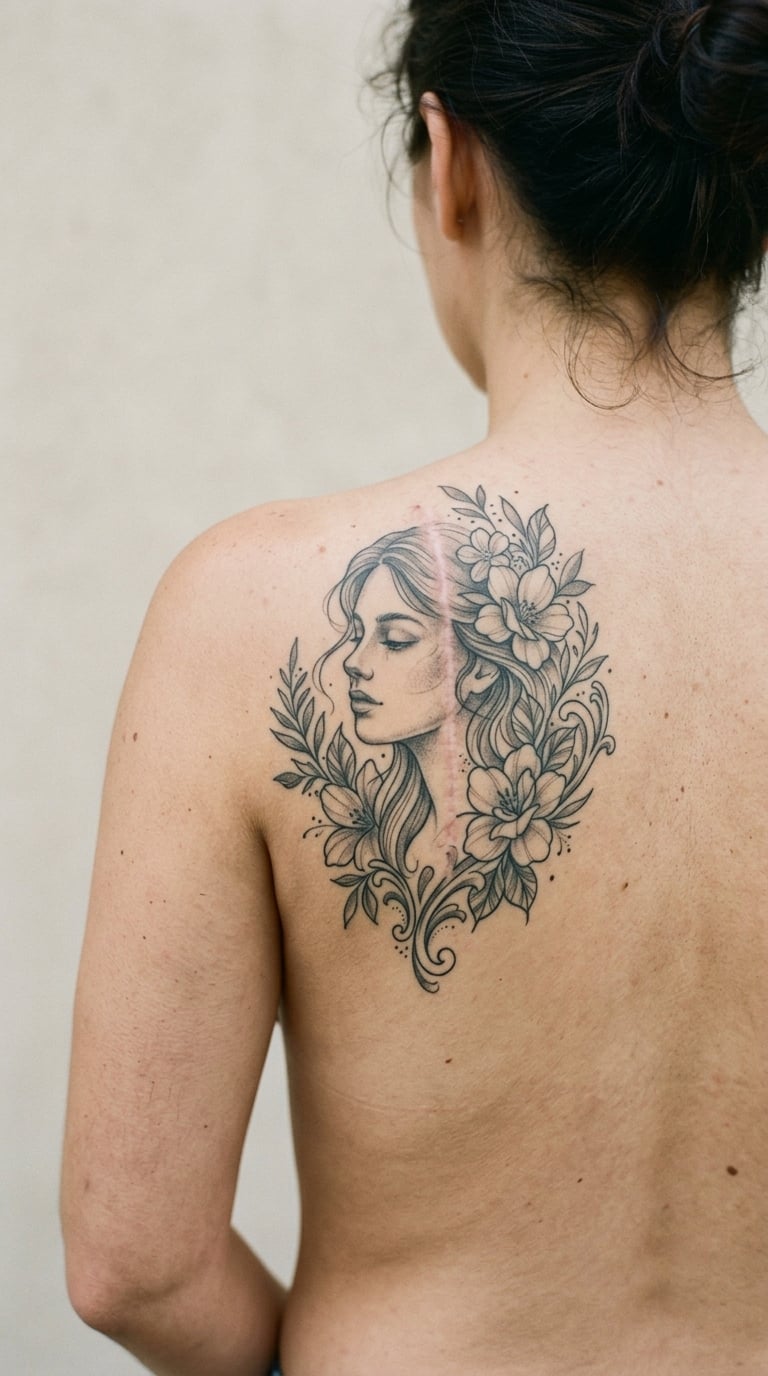
A custom portrait gives you the most coverage per square inch of any option here, because the subject, the hair and the backdrop all carry ink. The face is built from smooth grey gradients with darker accents at the jaw and eye socket, and behind it sits a field of flowers and midtone shading dense enough to swallow a mark of any outline. A custom portrait needs a clear reference, so a good photo taken in even light gets you the closest match.
It suits a larger scar on a flat area, and it takes the longest of any design on this list to heal fully.
Placement: shoulder blade, upper back, outer thigh, or the calf. Size: 5-7 inch (13-18 cm) tall. Style: portrait realism. Pain: high, and a piece this size is usually booked across two sessions.
Gradients are the vulnerable part. A soft grey portrait that loses its midtones goes flat, so ask where the darkest values sit and keep the background darker than the face.
Make it yours: use a person, a pet, or a mountain view you know well, and let the backdrop flowers come from a plant with a connection to them.
17. Mountain Range in Layered Blackwork
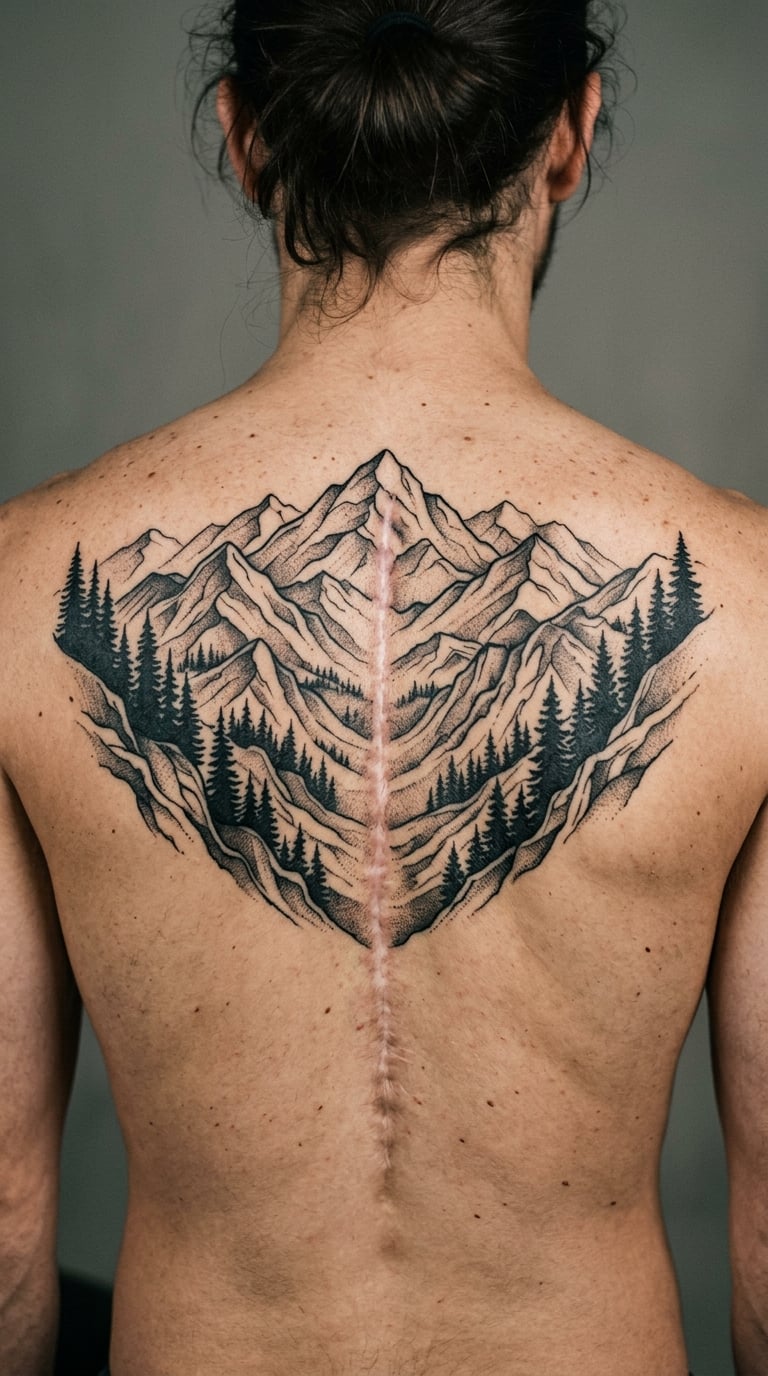
Overlapping ridgelines, pine silhouettes and a band of open sky turn a long irregular mark into terrain. Each ridge is a solid black shape with a broken, uneven crest, the pines are simple triangular clusters along the lower edge, and the sky is left as bare skin. Because every element repeats and interlocks, a scar that wanders simply becomes part of the horizon.
The piece scales well, which makes it a good answer when the mark is longer than most motifs can handle.
Placement: upper back, back of the calf, outer thigh, or a long section of the arm. Size: 6-9 inch (15-23 cm) wide. Style: illustrative blackwork. Pain: medium to high, and the upper back is a bony area that gets uncomfortable quickly.
Tiny pine branches and snow-line details are what blur first, and sun exposure on an upper back is constant. Solid black ridge shapes hold their edge much longer, so build the design around them.
Make it yours: use ridgelines from a mountain that means something, and add your initials worked into the sky area.
18. Blackwork Animal Portrait
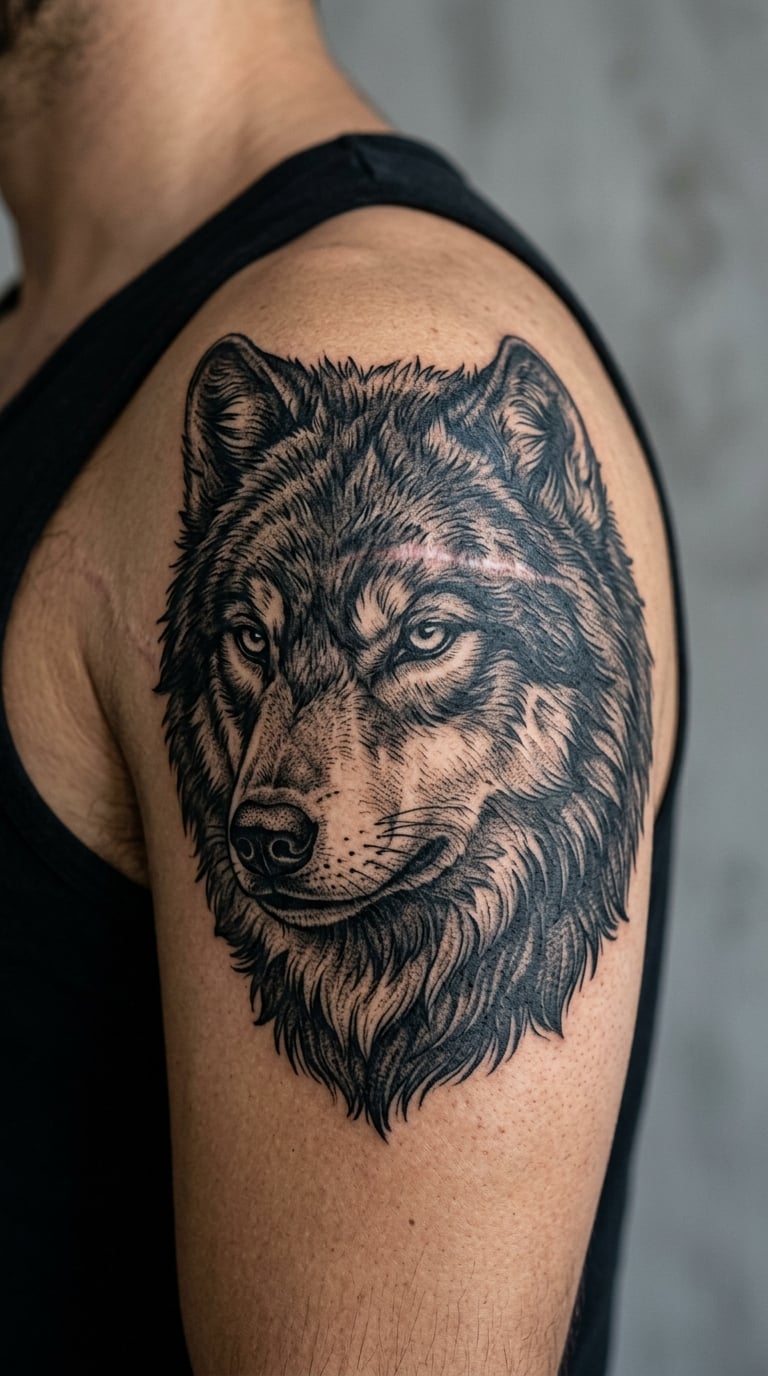
Dense black fur is close to ideal cover-up material because it produces large areas of unbroken dark ink. A realistic dog, wolf or deer portrait built from layered black strokes and soft shadow underneath the jaw gives a mark somewhere solid to sit against. The animal is usually angled three-quarters so the shoulder mass falls across the widest part of the design, with the eyes placed well clear of the scar.
It is a bold, collector-style piece, and it is the one on this list that most people describe as statement work rather than a discreet cover-up.
Placement: shoulder, outer upper arm, thigh, or the upper back. Size: 4-6 inch (10-15 cm) tall. Style: blackwork realism. Pain: high, and fur shading means a lot of needle passes over scar tissue.
Contrast fading is the long-term issue. As the black softens, the fur texture loses depth and the eyes can end up lighter than you planned, so book a touch-up before the first year is out.
Make it yours: tattoo a specific breed or a specific animal, and place the eyes a little higher than natural so they hold the composition.
19. Interlocking Geometric Maze
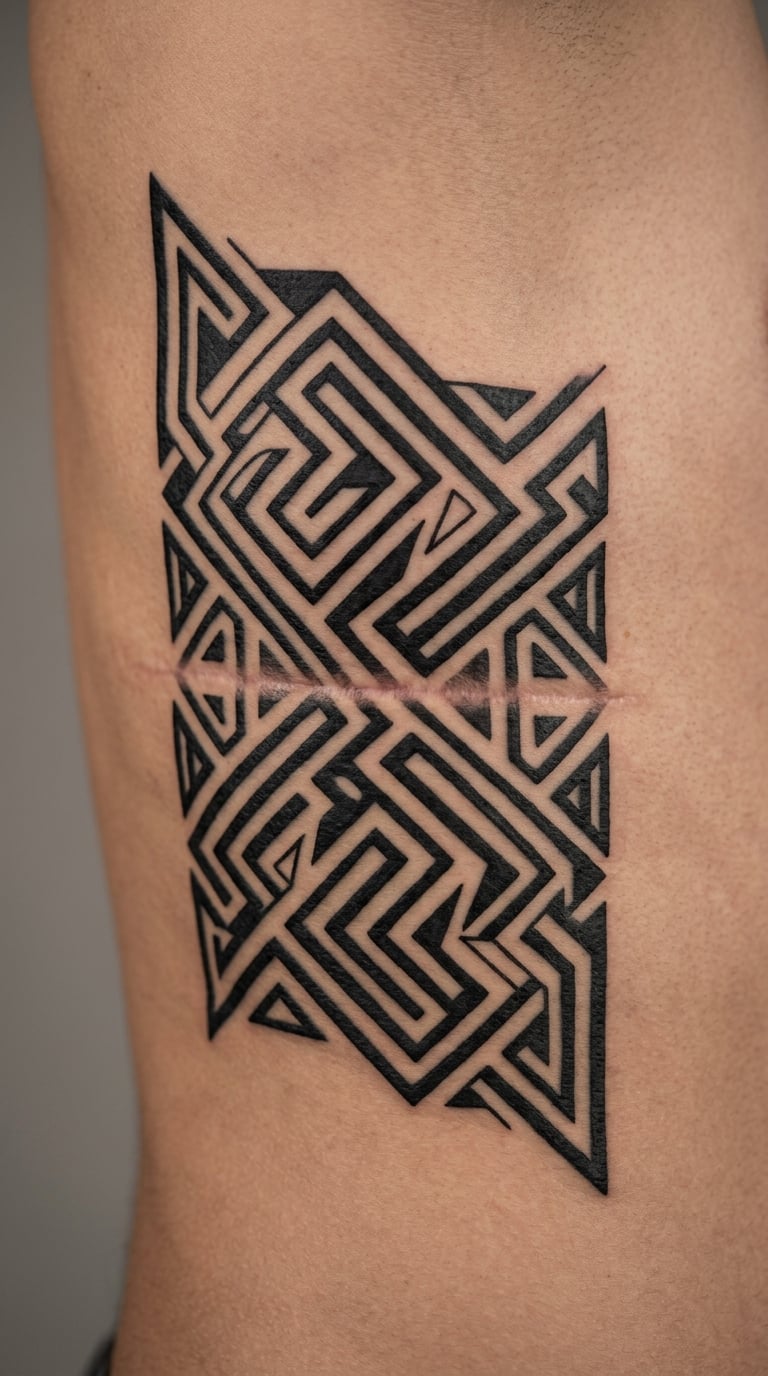
An angular maze fills a space with repeated paths and tight corners, and the repetition is exactly what a straight scar needs. Bands of black lines interlock over and under one another, small triangles mark the junctions, and controlled gaps of bare skin let the pattern breathe. Run the paths across the mark at a slight angle and the horizontal line becomes one of many directions in the piece.
It suits a wide, straight scar and it suits people who want something graphic that can be extended into a larger piece later.
Placement: ribs, forearm, thigh, or the back of the hand. Size: 5-6 inch (13-15 cm) wide. Style: geometric linework. Pain: medium, and ribs are among the more uncomfortable spots on the body.
Small lines are the problem over time. Any path thinner than about 1.5 millimetres will soften within a few years, so the artist should build the maze from heavier strokes and use the gaps for the detail.
Make it yours: hide one small shape in the negative space, a heart or a letter, that only you will know is there.
20. Abstract Op-Art Waves in Black and Red
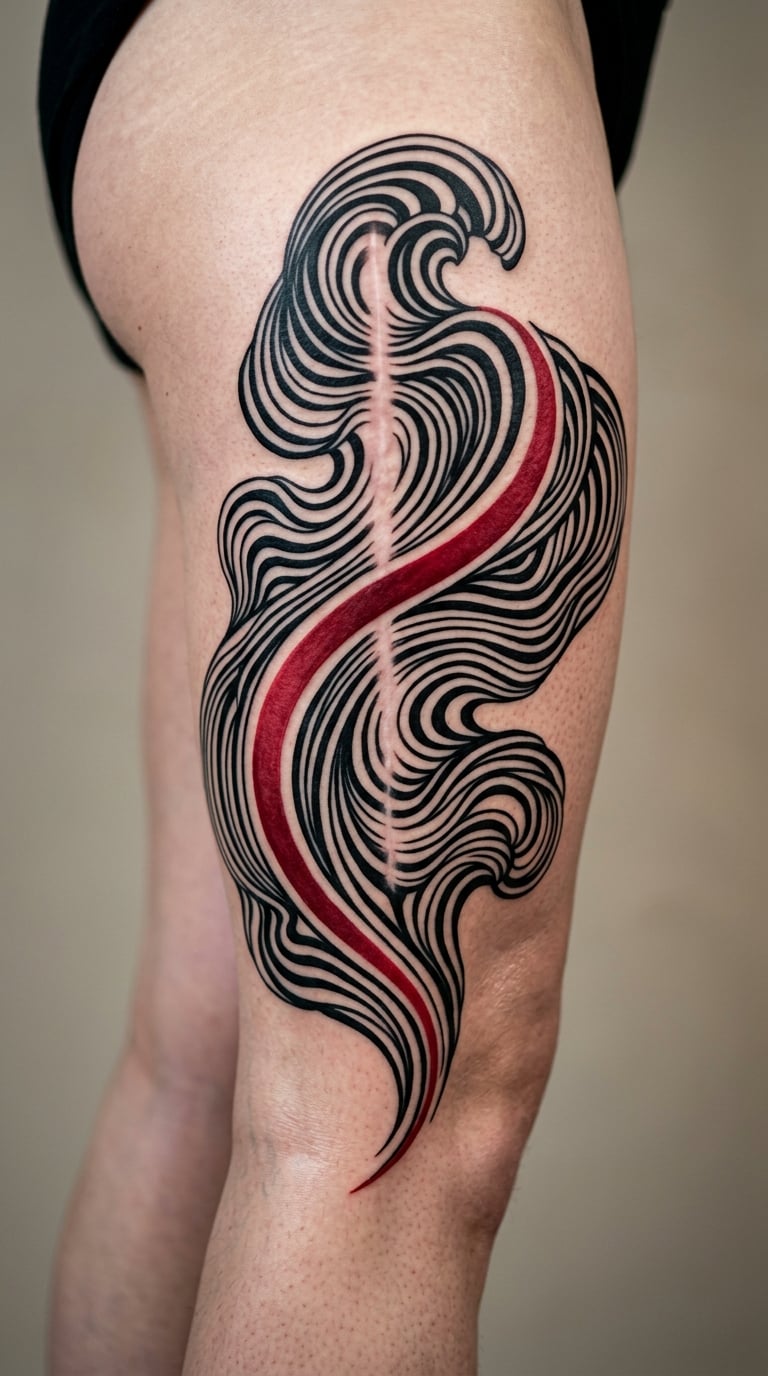
Op-art waves work by repeated curves that shift in thickness and direction, and they keep the silhouette tight even as the internal pattern changes. Bands of solid black curve across the design in tight and wide alternation, and a single deep red wave cuts through the middle so the piece has one clear focal line. The result is movement without a subject, and it works on a long mark because it can run as far as the scar does.
Most people choose it because a body part that felt marked now carries a pattern instead of a line.
Placement: side thigh, calf, forearm, or across the ribs. Size: 5-7 inch (13-18 cm) long. Style: op-art geometric. Pain: medium, and the side thigh is a large flat area that suits a bold piece.
The red is the ageing note. A single warm accent is the most noticeable part of the design once the black settles, and it drifts toward orange over time, so a touch-up every few years is worth it. See the [side thigh tattoo ideas for women](https://thewe.cc/side-thigh-tattoo-ideas-for-women/) roundup for more layouts on that placement.
Make it yours: keep one accent colour and change everything else, or match the wave count to a number that matters to you.
How to Choose the Right Design
- Start with the artist’s scar assessment, not the reference images. A cover-up specialist looks at how old the mark is, whether it is raised or flat, and how pale or pink it still is before recommending anything.
- Match contrast to the mark. Dark black and saturated colour break up a pale line, while a pale design on pale skin does very little. The design needs to be darker and more saturated than the scar, not the same tone.
- Let placement decide style. A 2 inch scar on a wrist and a 6 inch scar on a back do not suit the same design, and pushing a small design over a large mark is the most common reason a first cover-up disappoints.
- Size for the scar, not the mood. Most cover-up artists build the design so it clears the mark on every side by a margin, which usually means a piece larger than you pictured when you started sketching.
- Think about the next ten years. Fine line, pale grey, tiny lettering and hairline mesh fade fastest, so if the mark will not stop existing, a design built from solid black ages better than one built from detail.
Bring photos of your scar in natural light to the consultation, and ask to see healed cover-up work in the artist’s portfolio rather than fresh pieces. Artists who do this work regularly will tell you how many sessions they expect for your mark before you book.
Cost and Session Time
Artists usually quote by the hour or by the piece, and a scar cover up sits toward the higher end of both because the design has to clear the mark on every side and because scar tissue often needs a second pass. A tiny or simple design over a short scar commonly lands in the range of USD 150 to 400. A medium, detailed cover-up with colour and shading usually sits between USD 400 and 1,200 and takes two to four hours.
A large piece, or one that has to be split into several sessions, can run from USD 1,200 to 3,000 or more. What moves your number is the length and texture of the scar, the placement, whether colour correction is needed, the artist’s hourly rate and their shop minimum. Touch-ups are often included, sometimes billed at a reduced rate, and occasionally charged in full, so ask about that before you start.
Aftercare Basics
- Follow your artist’s aftercare instructions first, because they know how deep the work went on your scar tissue.
- Keep the area clean and dry for the first few days, then wash gently with unscented soap as your artist describes.
- Protect the healed tattoo from sun and UV exposure, especially if it contains grey, blue or red pigment, since those fade first.
- Avoid swimming, soaking and covering the area tightly while it is healing, and do not pick at flakes or scabs.
- Contact your artist, or a qualified clinician if you notice unusual irritation, spreading redness or discharge, rather than trying to treat it yourself.
Frequently Asked Questions
Can every scar be covered with a tattoo?
No. Raised, shiny, still-pink or actively healing scar tissue, and skin with a history of keloids, are usually reasons for an artist to wait or to place the design beside the mark rather than on it. Some people also want the mark blended into the skin instead of covered, which is medical scar camouflage using flesh-toned pigment, not a decorative design. Book an in-person consultation so the artist can assess your specific scar.
How long should a scar be healed before a cover-up?
Most artists ask for roughly 12 months after the injury or surgery before tattooing over a scar, and longer for severe marks, often 18 to 24 months. By then the scar should be pale or close to your natural skin tone, flat or nearly flat, and no longer tender, pink or changing. If it still lifts, darkens or itches, that is a sign to wait and ask the clinician who treated it.
Does black ink always work best for covering a scar?
Black and saturated colour give the most contrast, and contrast is what breaks up a pale line. But pure black does not work if the piece is too tight to the mark, because the edge of the black can outline the scar instead of hiding it. Good cover-up artists overshoot the scar by a few millimetres and let a shape close the gap. The colour matters far less than getting the scale and the contrast right.
How long does a scar cover-up tattoo take to heal and settle?
Surface healing for any new tattoo runs roughly two to four weeks, and the ink looks slightly lighter or warmer once the top layer settles. On scar tissue the process usually takes longer and most people need two or three sessions spaced months apart before the mark is genuinely obscured. Book a touch-up rather than assuming the first session is the finish, and keep sun off the area while it settles.
Can a cover-up tattoo be designed around an uneven or raised scar?
Yes, and good artists prefer it. A design built around the mark, a mandala with a deliberate break in one ring, a composition that follows a curve, hides texture better than one pretending the mark is not there. A raised or keloid-prone scar is the exception, and for some of those clients an artist will recommend a design placed just beside it rather than directly on it.
Conclusion: Where to Start
Most scar cover up tattoo ideas for women online show fresh work, and fresh work always hides more than healed work does. Ask to see healed cover-ups instead.
If this is your first tattoo and you want the mark to matter less rather than to be the main event, start with a fine-line botanical direction such as the flower branch or the lace panel. Both read as ordinary body art and both need less ink than a blackwork piece.
If you already collect tattoos and you want real coverage, the phoenix, the blackwork animal portrait and the layered mountain range will outlast anything built from fine detail. Bring photos of your scar in natural light to a qualified cover-up artist, talk through how many sessions they expect, and let them size the design to your mark rather than to a reference image.