
18 Tiny Cross Tattoo Ideas for Discreet Faith Ink (September 2026)
Tiny cross tattoo ideas run from a barely-there dot-work cross on a finger to a small blackwork crucifix between the collarbones. Most people land somewhere in between: 0.3 to 1 inch tall, single-needle linework, placed where they can see it or hide it on demand. This guide breaks the options down by placement, size and style so you can walk into a consultation knowing what you actually want.
These are the first tattoos for a lot of people, because a small cross is hard to get wrong and easy to hide under a cuff. If you are planning ahead, most shops are booked four to eight weeks out, and autumn and early winter are the quietest months to book in. Here is what I would look at first.
What Makes a Cross Tattoo Tiny?
A tiny cross tattoo is usually 0.3 to 1 inch tall, which is 0.8 to 2.5 cm. Under about 0.3 inch the crossbar has trouble staying straight, and a curved line in a small space can thicken as it heals. That is the whole sizing conversation in one sentence.
Below 0.3 inch, you have room for a plain Latin cross in one colour and nothing else. Between 0.5 and 1 inch you can add a crossbar flourish, a small halo, or a thin ring. Celtic knotwork and a crucifix with a visible body need real estate they do not have at this scale, so those live in the 3 inch and 6 inch range instead.
Ask your artist to draw the design at final size on paper before it goes on skin. A design that looks balanced at 3 inch on a phone screen can turn into a lopsided plus sign at half an inch on a wrist.
The 1/3 rule: if you want to add a second element to a small cross, such as a flower, a date, a dove or a word, the secondary element should be no more than about a third of the cross’s height. Anything larger and the cross stops being the subject. At a tiny scale, one idea per tattoo is the rule that holds up.
18 Tiny Cross Tattoo Ideas, Placement by Placement
1. Fine-Line Latin Cross on the Inner Wrist
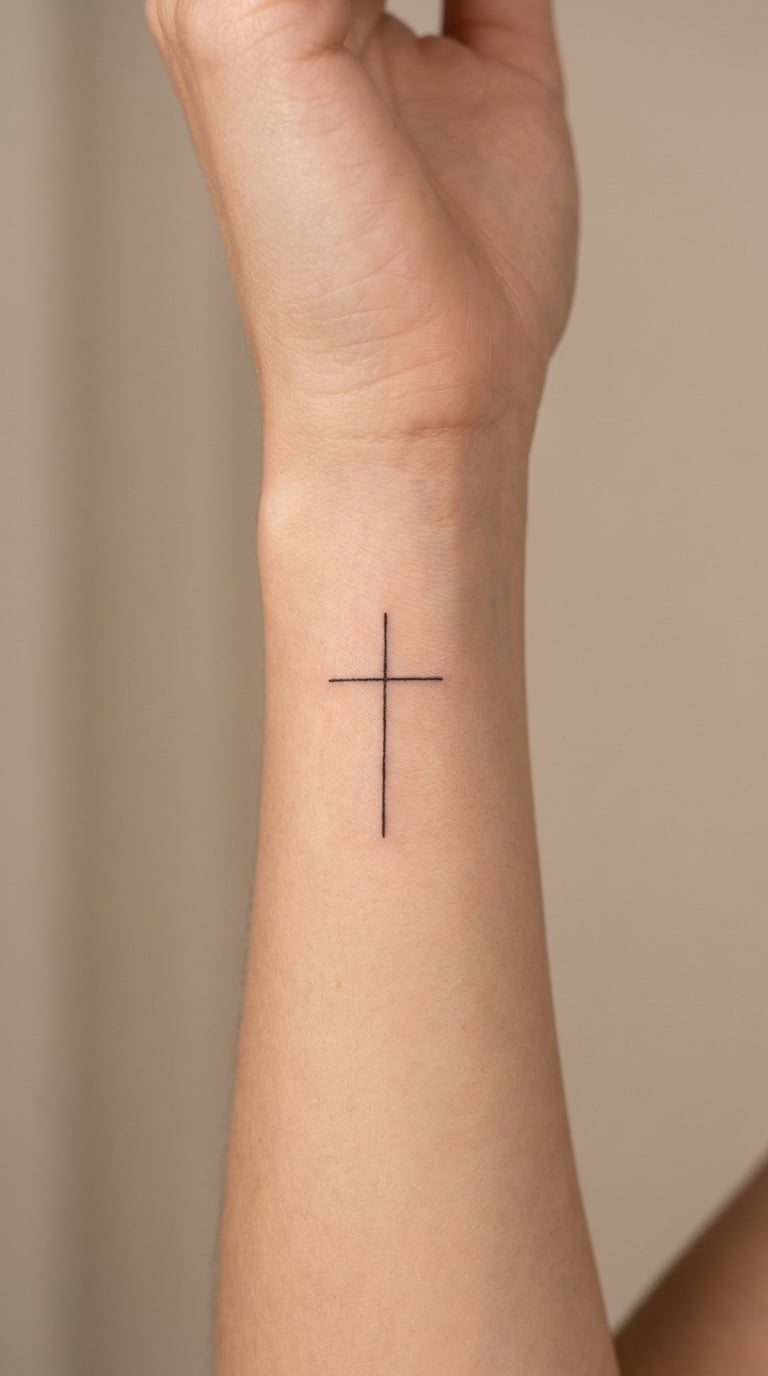
This is the version almost everyone pictures when they search tiny cross tattoo ideas: a plain Latin cross, drawn in one weight of black line, sitting just above the wrist bone. There is nothing ornamental about it, which is the point.
Keep it between 0.5 and 1 inch tall and let the crossbar sit about a third of the way down from the top. Single-needle line at this size heals crisply for two to three years before it starts to soften, and the inner wrist skin is thick enough to hold the stroke.
Pain and time: a 4 out of 10, mostly the wrist bone, and usually 10 to 20 minutes in the chair.
2. Dot-Work Cross on the Ring Finger Knuckle
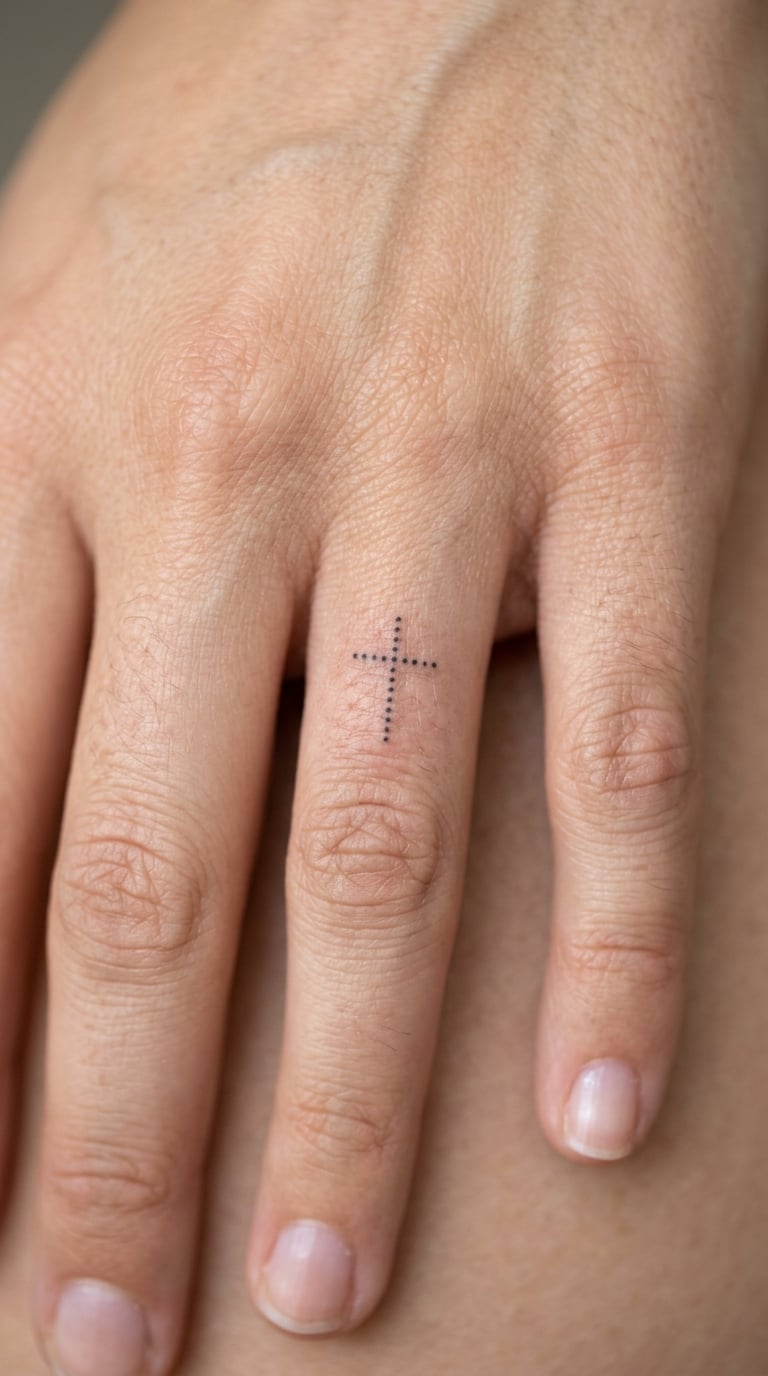
Built from five or six dots rather than lines, this one reads as a cross only once you know what you are looking at, and that is part of its charm. It is the most discreet option in the whole gallery.
Finger knuckle tattoos fade fastest of any small placement because hands get washed, sun-exposed and abraded. Plan on a touch-up every year or so, and ask the artist to space the dots at least 0.5 mm apart so they do not merge into a smudge. A ring finger suits a 0.3 inch version; larger dots need more room.
Pain and time: a 6 out of 10 because knuckles are bony, and 5 to 10 minutes.
3. Blackwork Cross on the Side of the Index Finger
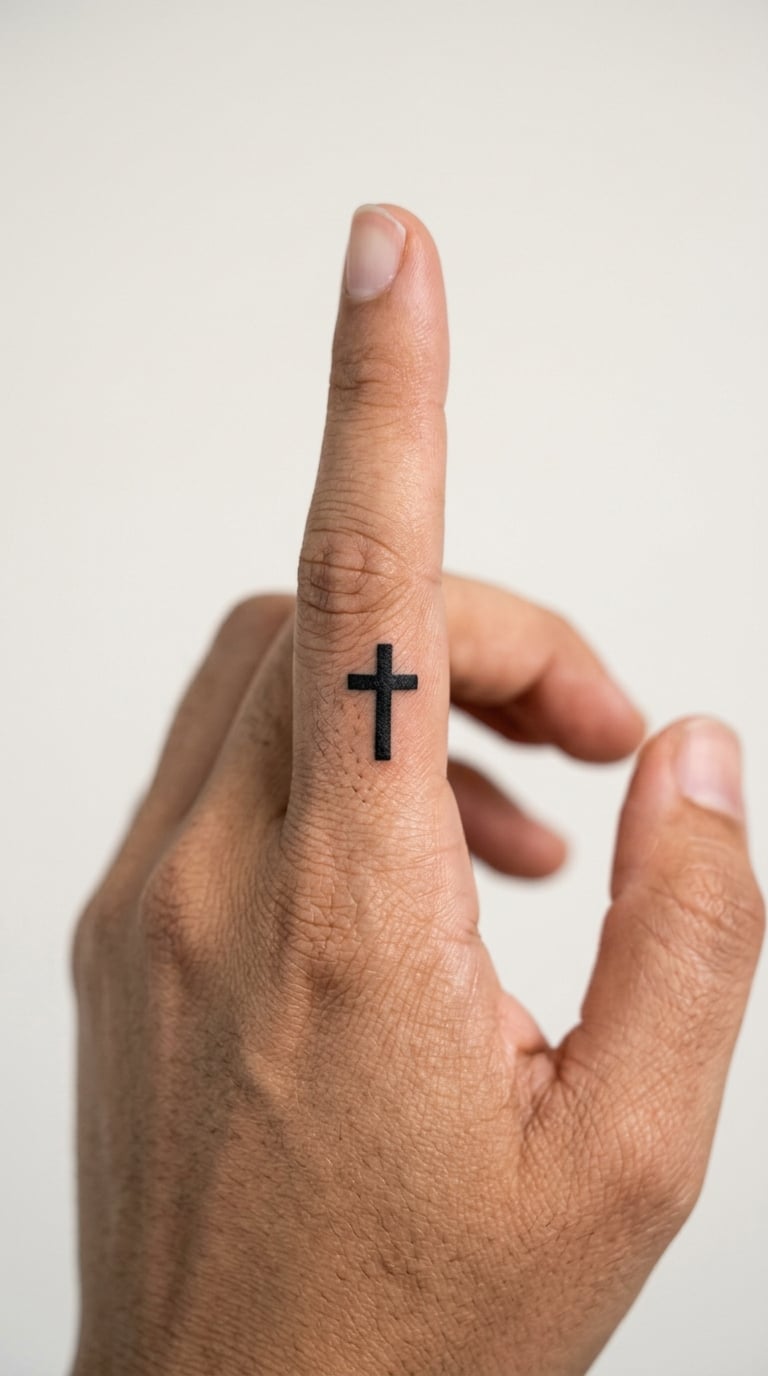
If you want a cross that actually reads from across a room at tiny scale, weight is the answer. A solid black cross with no outline holds its shape where a hairline version would soften into a grey blur within a year.
Side-of-finger placement sits on skin that stretches and bends constantly, so a 0.4 inch design with a thick horizontal bar is more durable than a 0.6 inch one with a thin bar. This is a bold-looking choice that still fits under a long sleeve, which makes it popular with people who want faith ink that is not delicate for its own sake.
Pain and time: a 7 out of 10 on the bony side of the finger, and 10 to 15 minutes.
4. Micro Cross Behind the Ear on the Hairline
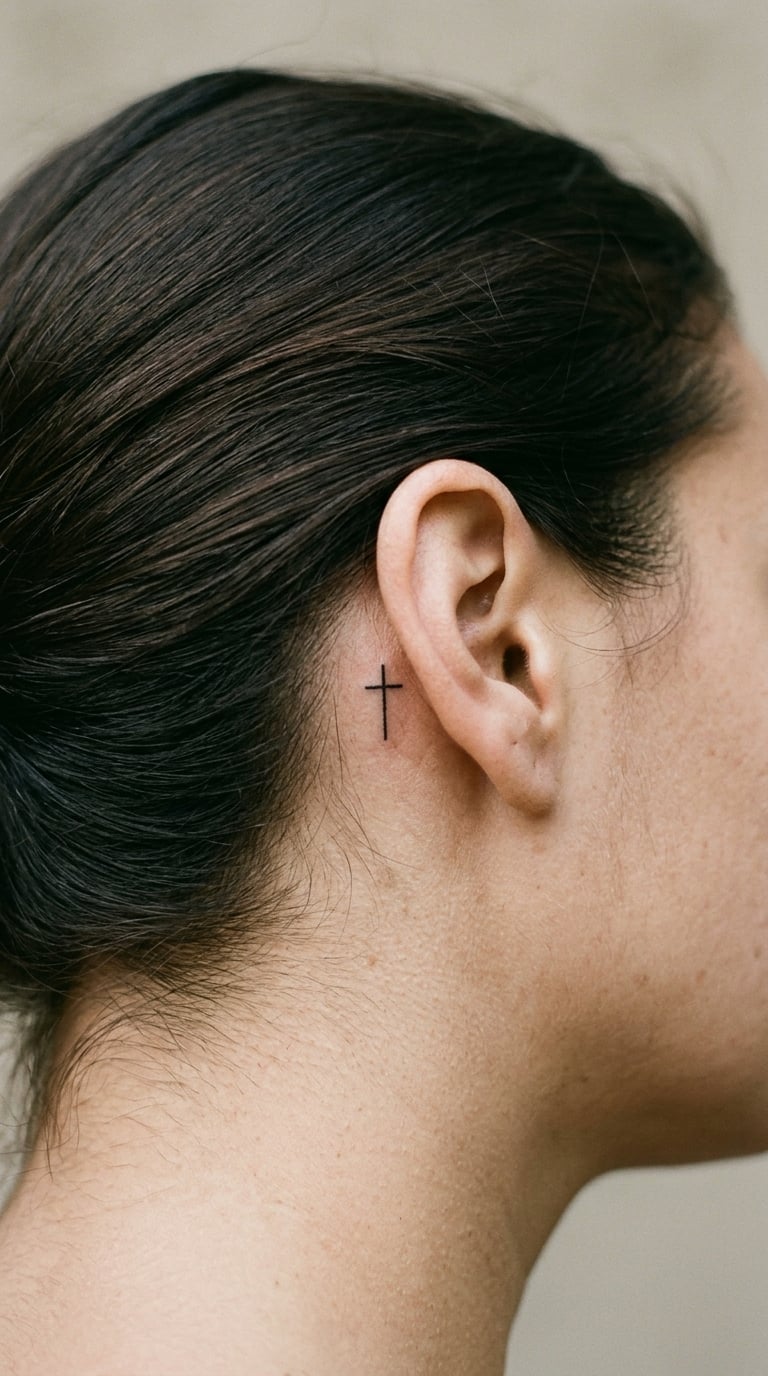
Placed high on the neck just behind the ear, this cross is read by most people as listening: hearing the word, keeping a quiet word close. It shows when your hair is up and disappears completely when it is down.
Skin behind the ear is thin and the surface curves away, so freehand placement beats a flat stencil here. Keep it to a single-stroke cross at 0.4 inch, no shading, and expect the line to soften faster than on the wrist because sun reaches it whenever your hair is back. Most people settle on 0.5 inch so the crossbar has a fighting chance.
Pain and time: a 5 out of 10, and 15 to 20 minutes including the tricky curve.
5. Tiny Cross on the Inner Forearm Below the Elbow
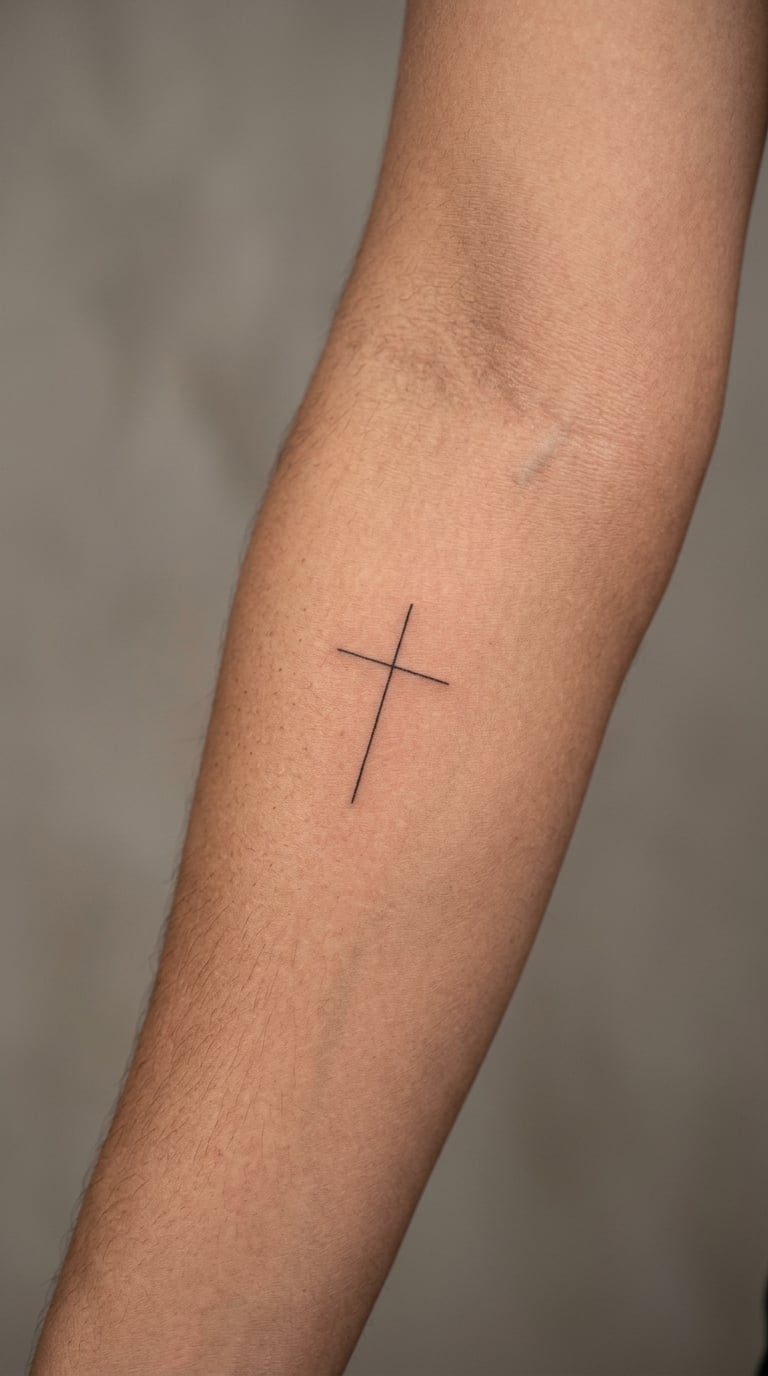
The inner forearm gives you more flat surface than the wrist, which is exactly what a small cross wants. Most artists place it a few centimetres above the elbow crease, where the skin is smooth and the line stays straight.
At 0.7 to 1 inch you can add a short vertical extension at the foot of the cross, or a single line of script beneath it, without crowding. This placement is easy to conceal with a long sleeve and easy to show, and the skin here takes fine line work better than most other spots on the body.
Pain and time: a 4 out of 10, and 15 to 25 minutes.
6. Olive Branch Cross on the Collarbone
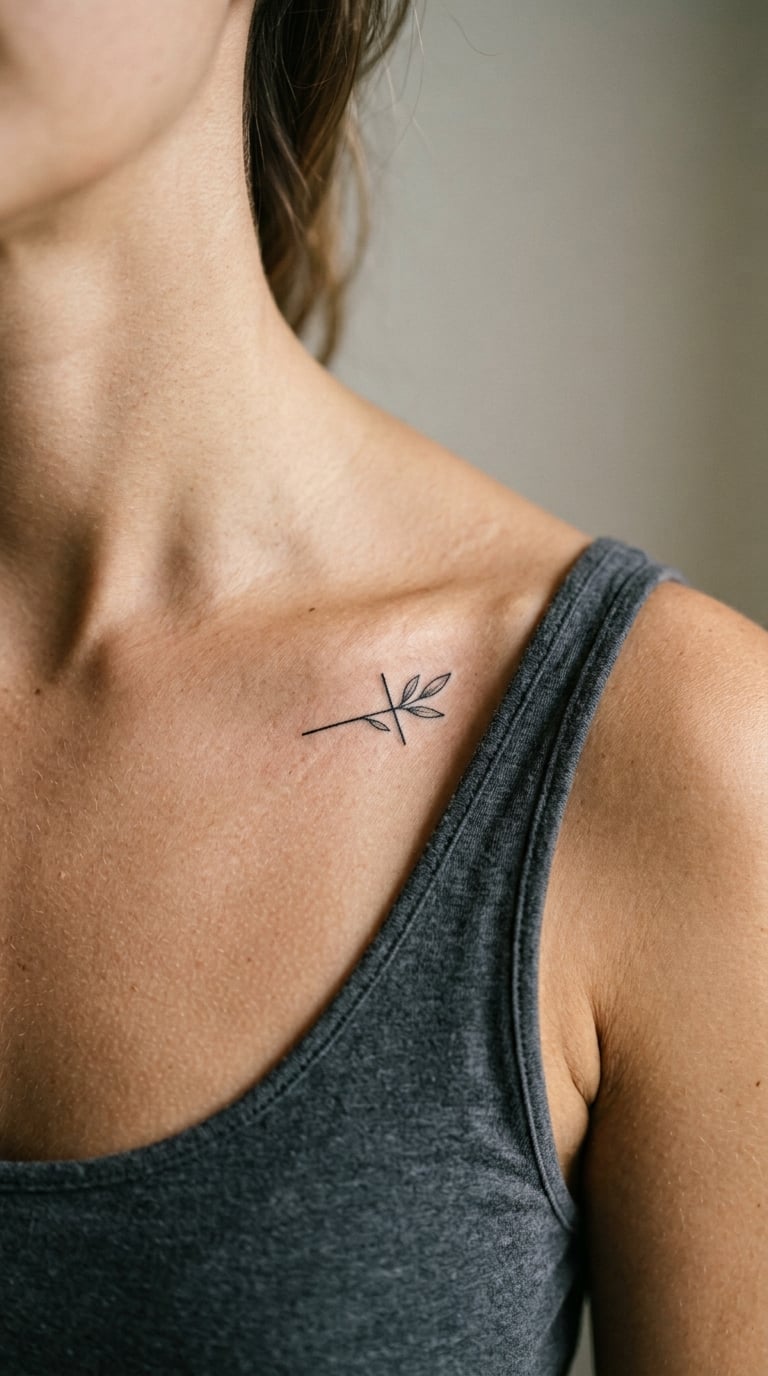
A cross with a single small olive branch sprouting from one arm gives you the symbolism of peace and devotion without turning into a full botanical piece. Two leaves is usually the right number at this scale.
Collarbone skin is thin and moves with the shoulder, so anything with fine internal detail will soften. Keep the branch to two or three leaves on one side only, total design under 1.5 inch across, and go slightly heavier on the line than feels necessary. It sits in a visible spot, so plan around necklines and swimwear.
Pain and time: a 6 out of 10 because the collarbone is sensitive skin, and 20 to 30 minutes.
7. Rosary Chain Cross on the Ankle
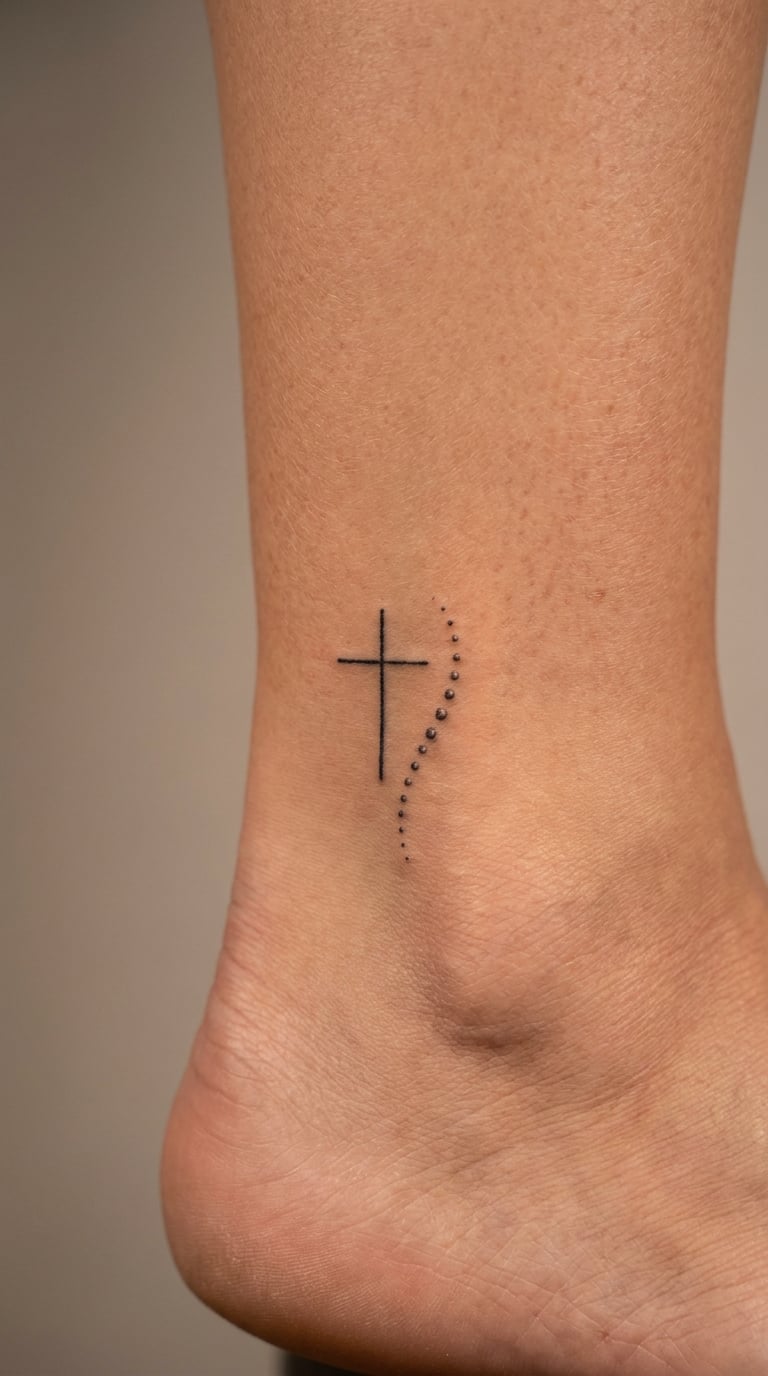
The ankle is where a small cross gets to be both devotional and a little bit of jewellery. A cross at 0.5 inch with a short run of small chain links trailing toward the heel reads as a rosary without drawing the full traditional beads.
Each link needs to be at least 1 mm across to survive healing, so count them before you commit to a length. Ankle tattoos fade faster than arm tattoos because of socks, shoes and sun, and the bony bumps on either side of the ankle are the first places the line goes soft. This is the second most requested first-tattoo placement after the wrist.
Pain and time: a 5 out of 10 near the bone, and 20 to 30 minutes.
8. Three-Bar Cross on the Rib
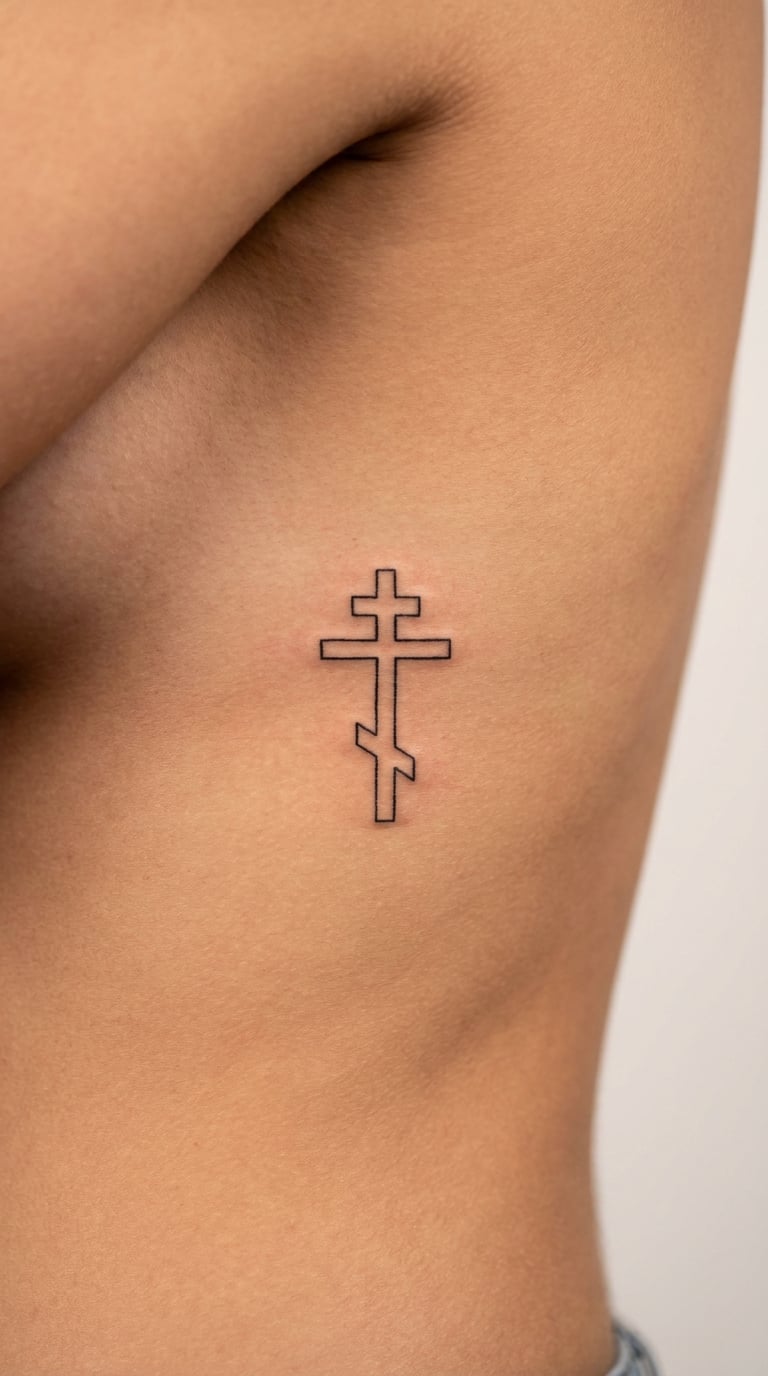
The three-bar, or Eastern Orthodox, cross carries two smaller crossbars above the main beam, angled like the footrest in traditional iconography. Drawn plainly in black line, it is a tradition marker rather than a decorative flourish.
Those two extra bars are the smallest readable detail on the list, so do not go under 0.8 inch or the upper bar disappears. Rib skin stretches when you breathe and twist, and the placement is a popular spot for eventually growing into a larger piece, so tell your artist that is the plan.
Pain and time: a 7 out of 10, and 20 to 30 minutes.
9. Cross on the Second Knuckle of the Hand
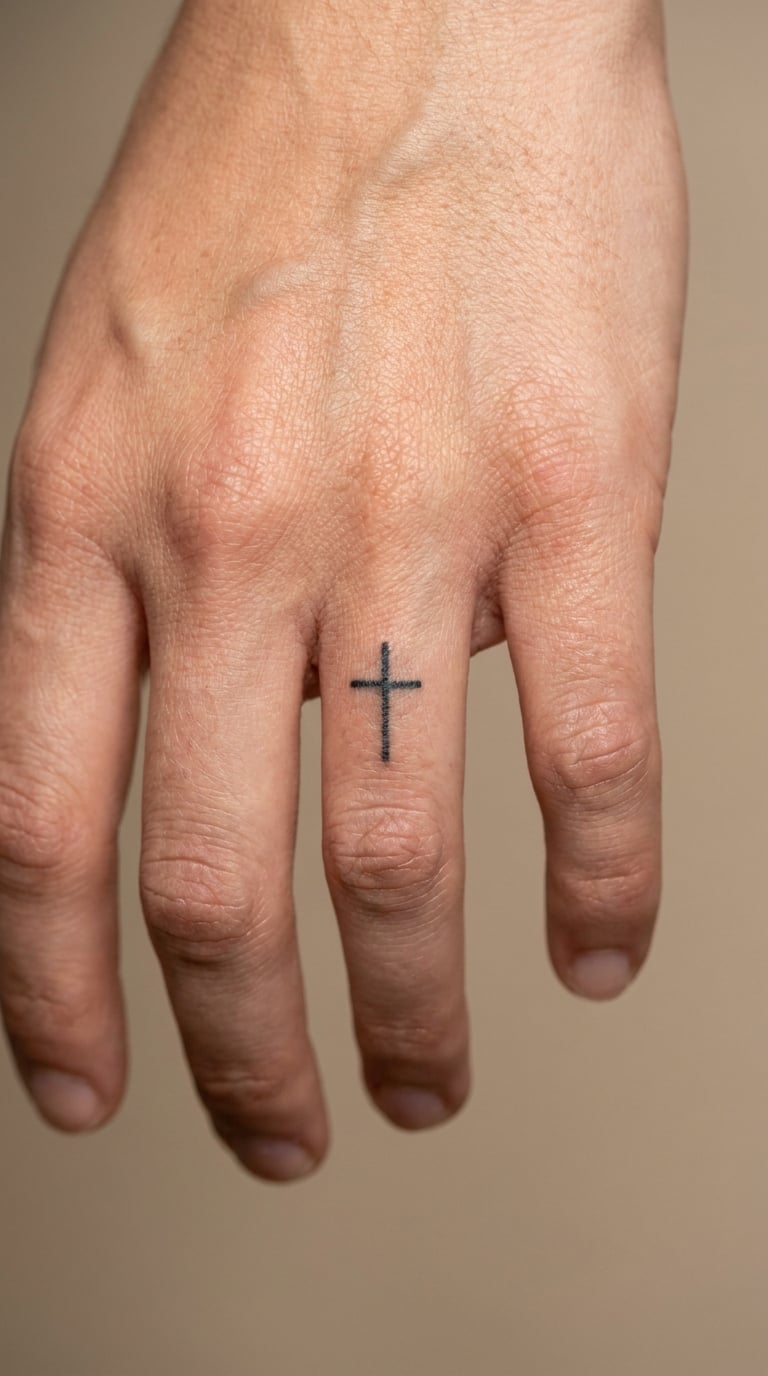
On the back of the hand, a 0.4 inch cross sits between knuckles where there is a natural gap to fill. It looks intentional rather than squeezed in, which is the whole trick with hand placements.
Hand skin is exposed to sun and washing more than almost anything else you own, so a solid or medium-weight line beats a hairline here every time. If you already have hand tattoos, this pairs well; if not, this is the placement most likely to make you add more within a year.
Pain and time: a 6 out of 10, and 5 to 10 minutes.
10. Coptic Cross on the Wrist
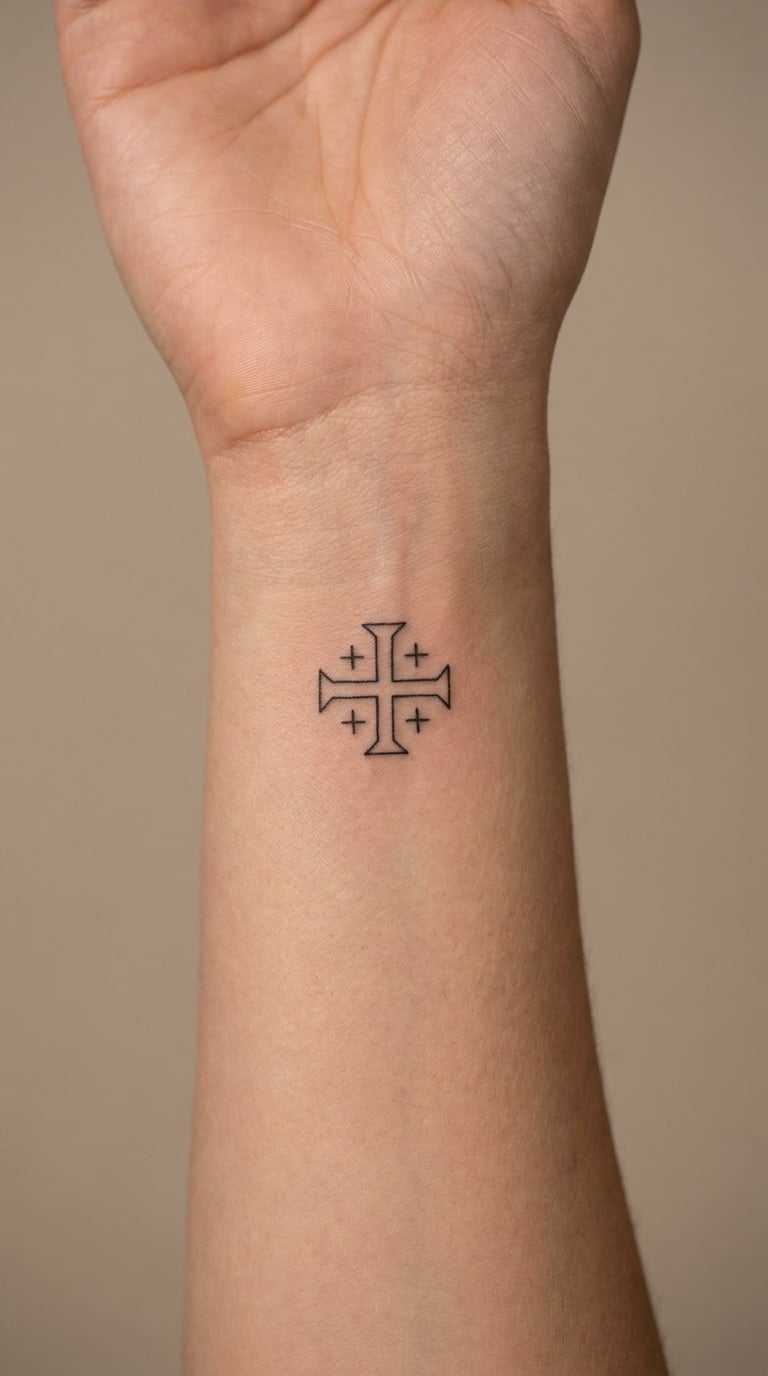
Coptic Christians in Egypt and elsewhere have worn a small cross on the wrist as a visible tradition marker for generations, and the design has equal arms with small bars at each end. It is one of the oldest reasons people get cross ink on the wrist.
Because Coptic crosses are usually small, they work at 0.5 inch as long as the artist keeps the end-bars short. If you are not Coptic and simply like the geometry, that is fine too, but if you are choosing it as a tradition marker, talk to someone in your own community about the specifics first. Faith communities differ on what counts as a faithful representation.
Pain and time: a 5 out of 10, and 15 to 20 minutes.
11. Dainty Cross on the Sternum
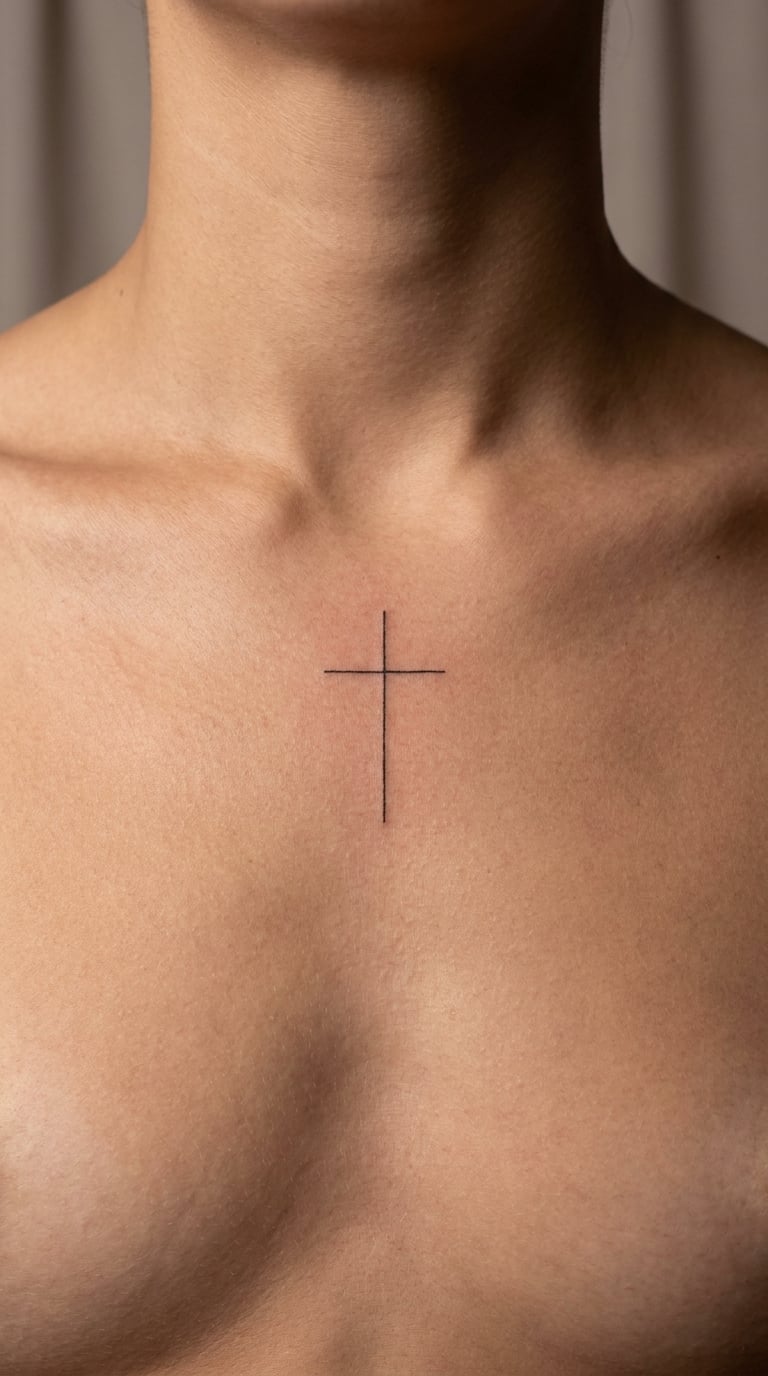
Placed in the hollow just below the throat, a 0.6 inch cross reads as something kept close rather than displayed. The sternum is one of the few placements where a small design draws attention precisely because of where it sits.
Sternum skin is thin and moves a lot with breathing, so keep the design to straight lines with no shading and no colour. A cross here disappears completely under almost any top with a neckline, which makes it a solid choice for people who want faith ink without a daily conversation about it.
Pain and time: a 7 out of 10, the sternum is a sore spot, and 15 to 20 minutes.
12. Cross at the Hairline on the Nape
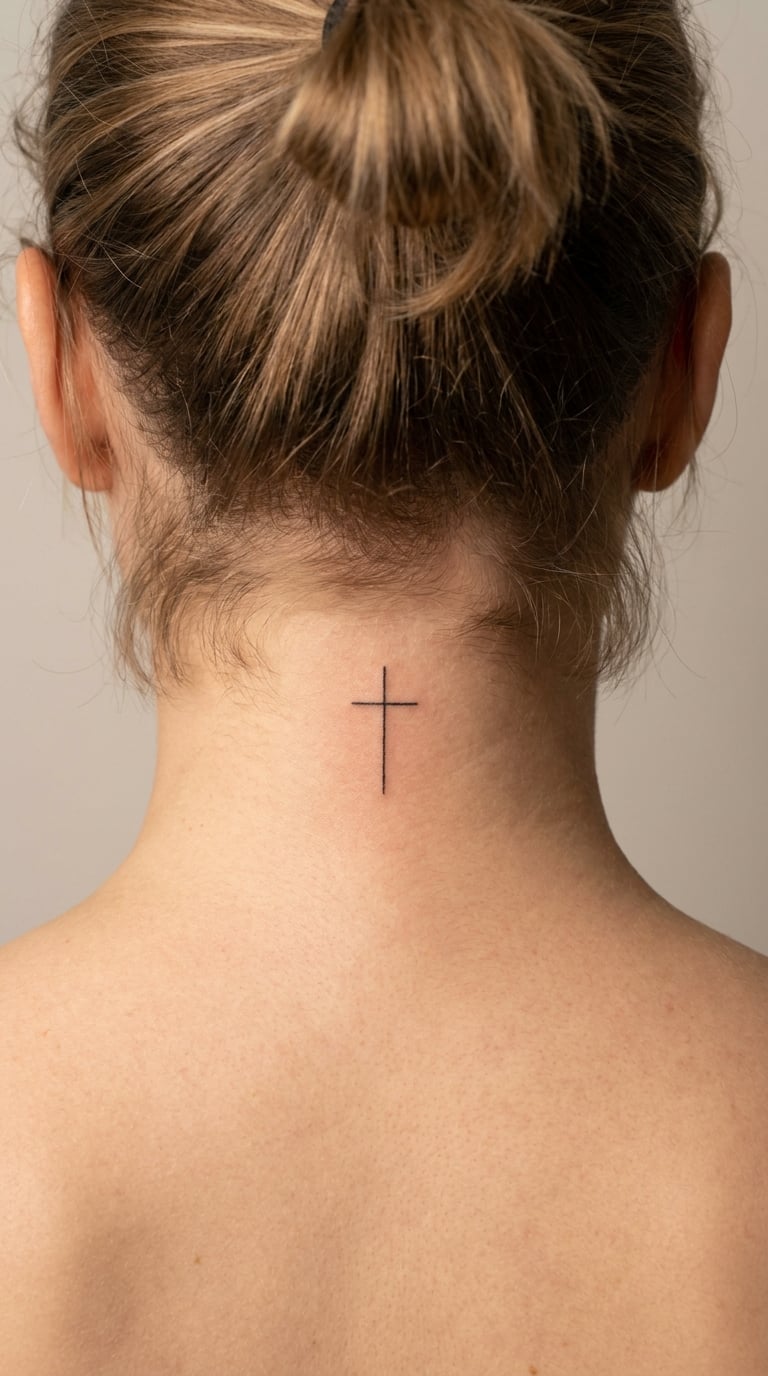
The nape works as a private placement: visible only when your hair is up or when someone is behind you. A 0.5 inch cross here is easy to keep private and easy to reveal, which is the balance a lot of people are looking for.
Hair at the nape grows back against the fresh tattoo, so expect some irritation in the first two weeks and consider having the back of your neck trimmed shorter. Skin at the hairline gets sun exposure constantly, so this is a placement where a slightly heavier line pays off and a touch-up may be due sooner.
Pain and time: a 5 out of 10, and 15 to 20 minutes.
13. Crucifix on the Upper Chest
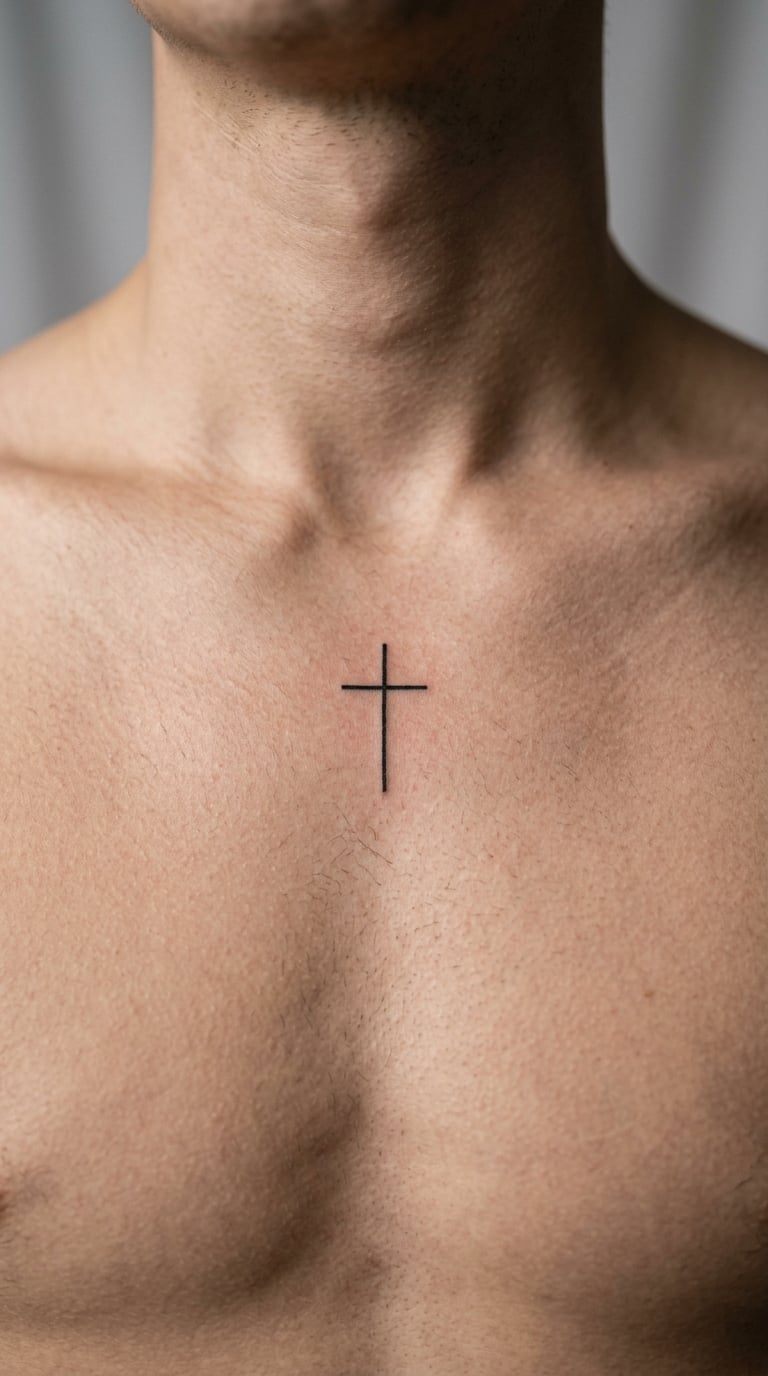
A small crucifix with a simplified figure of Christ is a more explicitly devotional choice than an empty cross. It reads as a statement about the faith rather than a general symbol of it.
Here is the sizing rule worth knowing: a crucifix with a body you can actually see has a floor around 3 to 4 inches, not 1. Below that the figure turns into a smudge within a year. If you want something tiny and still explicitly Christian, a plain Latin cross or a Chi-Rho monogram holds detail far better than a figure does.
Pain and time: a 7 out of 10 on the chest, and 30 to 45 minutes.
14. Chi-Rho Symbol on the Side of the Foot
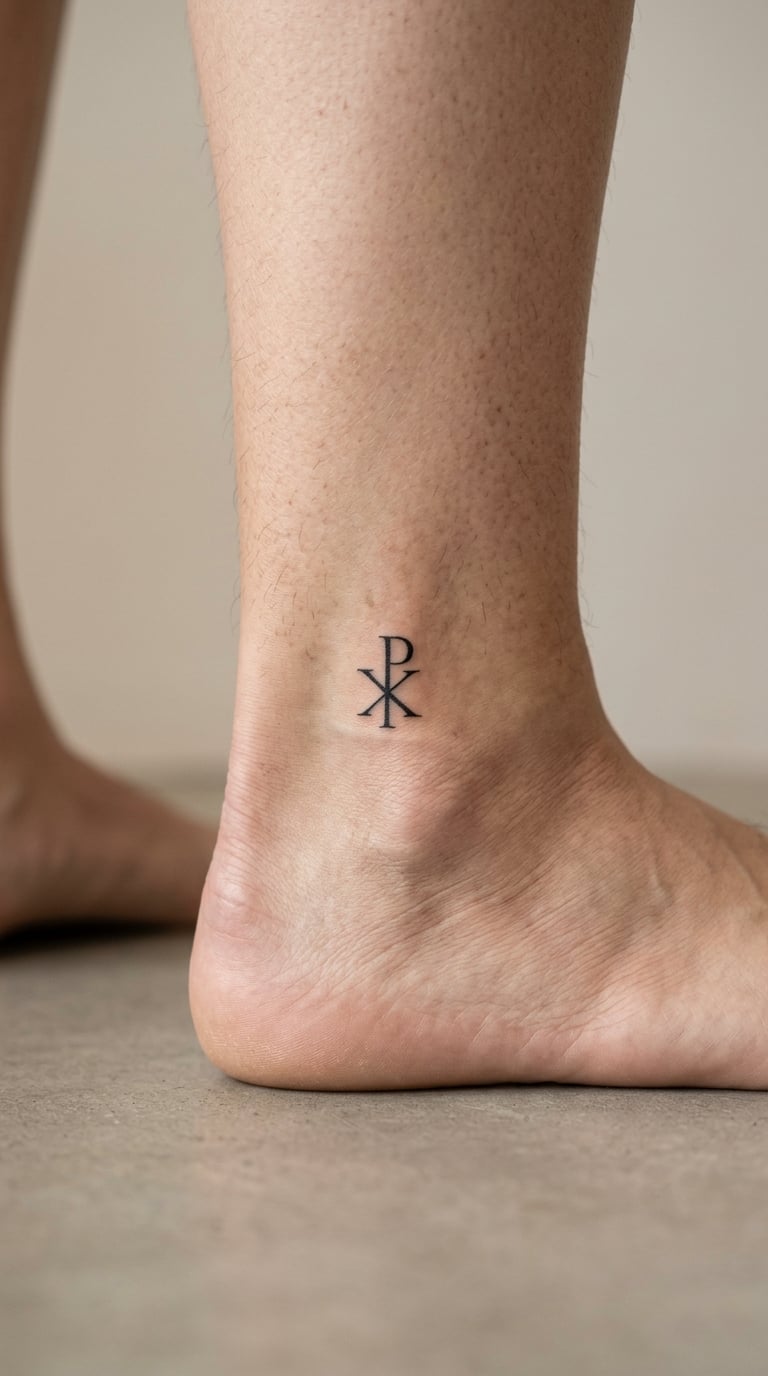
Chi-Rho is the Greek monogram of the first letters of Christ, formed by a P shape with an X and a loop set inside it. It is one of the oldest Christian symbols, and it stays legible at small sizes better than any figurative design.
The outer foot above the ankle bone is a good home for it: flat enough surface, easy to hide in a boot, and visible in sandals. Keep the whole monogram above 0.5 inch and ask for a slightly wider stroke on the loop, which is the part that fills in first as ink settles.
Pain and time: a 6 out of 10, and 20 to 30 minutes.
15. Cross with a Date on the Inner Arm
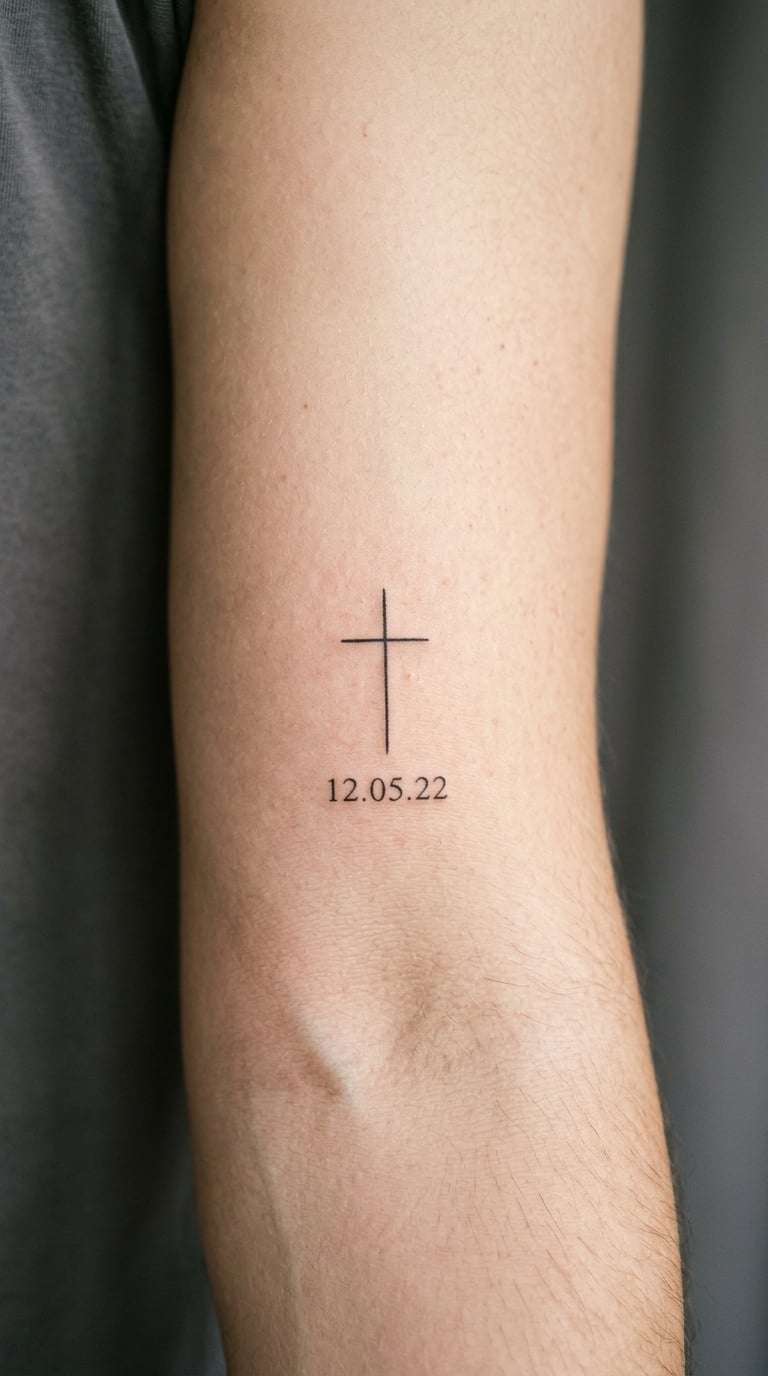
A cross with a short date under it is the classic memorial format, and it is the one most people are searching for when they say tiny cross tattoo ideas without saying it outright. The date is what makes it a memorial rather than a general faith piece.
Numerals are the first thing to blur at small scale, so set the date in a plain sans-serif or a simple block script rather than anything ornate, and do not go under 0.6 inch for the whole lockup. A four-digit year under a 0.5 inch cross is the single most common thing to look like a smudge after healing.
Pain and time: a 5 out of 10, and 25 to 35 minutes.
16. Cross on the Top of the Foot Near the Big Toe
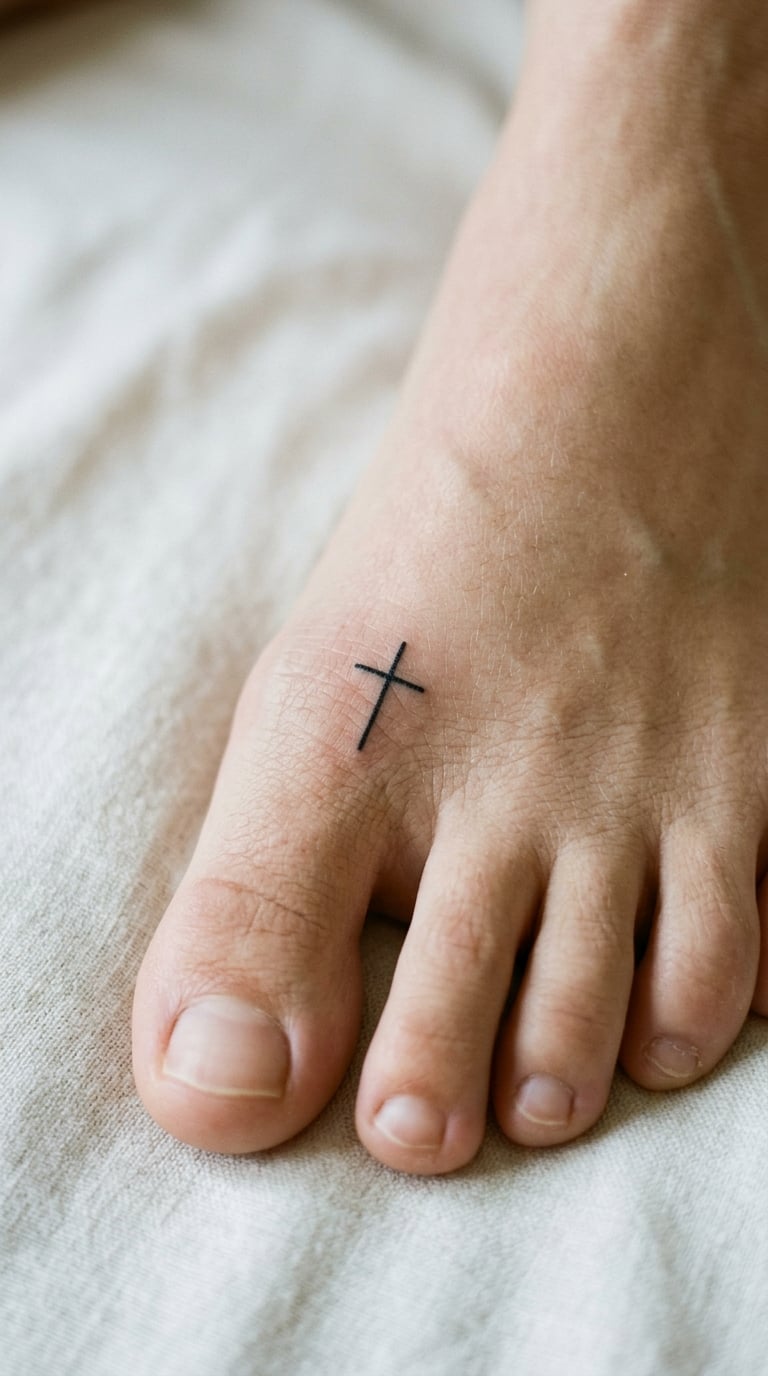
Foot placements are the least common request and the easiest to keep private, since a cross here is only really seen by you. A 0.4 inch design sits neatly in the flat skin between the ankle bone and the base of the big toe.
The skin is soft and slightly cushioned, so the line settles differently than on the wrist. Socks, sandals and floors do more damage to this work than anything else, so expect a touch-up sooner than on the forearm. Choose black over colour here, because coloured pigment on the foot fades unevenly.
Pain and time: a 7 out of 10, and 10 to 15 minutes.
17. Cross on the Inner Bicep
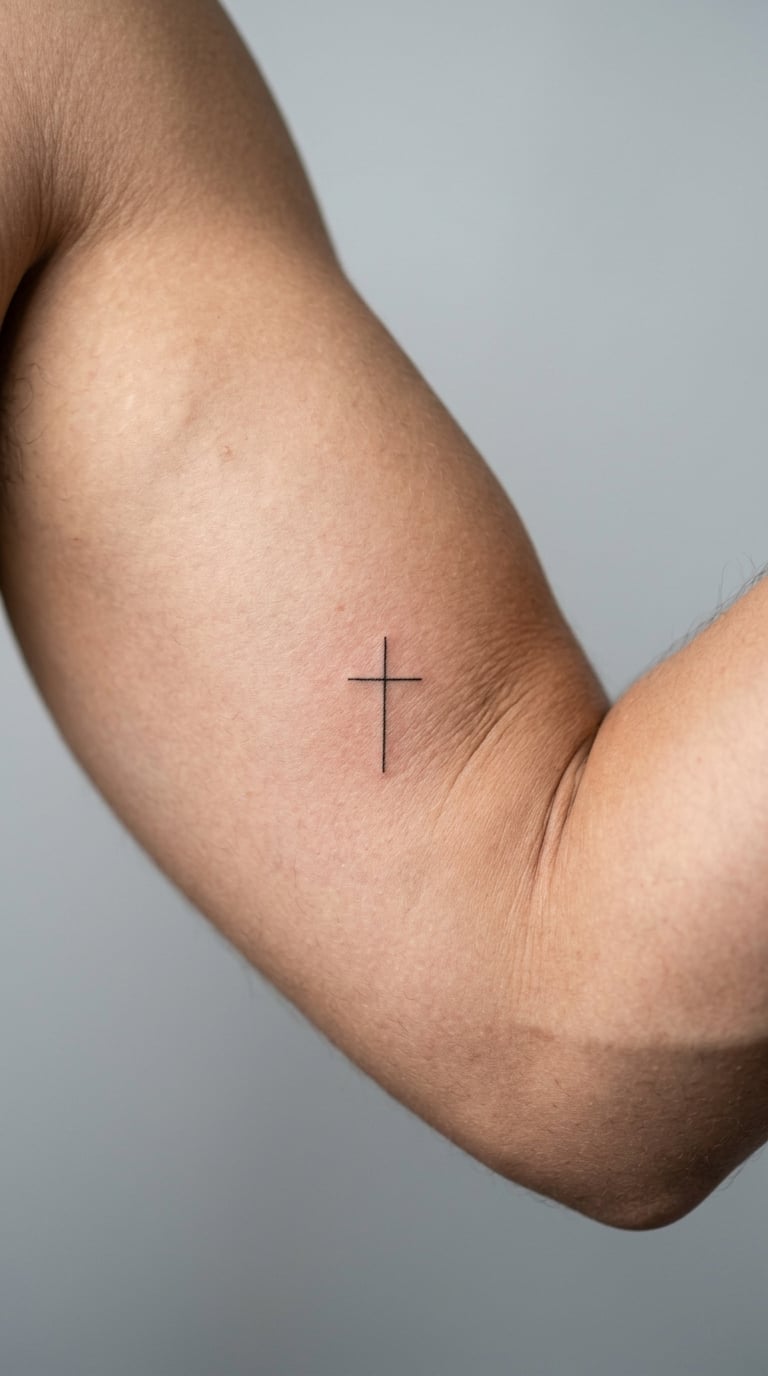
The inner bicep is a comfortable spot for a small cross: mostly hidden, easy to reach for the artist, and rarely exposed to sun, which means it ages more slowly than a wrist or ankle cross.
There is room for a 0.8 to 1 inch design here, so this is one of the few small placements where you can add a thin outer ring or a short line of text without crowding. Skin on the upper inner arm is thick and stable, and the pain is mild, which makes it a good choice for a nervous first-timer.
Pain and time: a 3 out of 10, and 20 to 30 minutes.
18. Cross on the Upper Back Between the Shoulder Blades
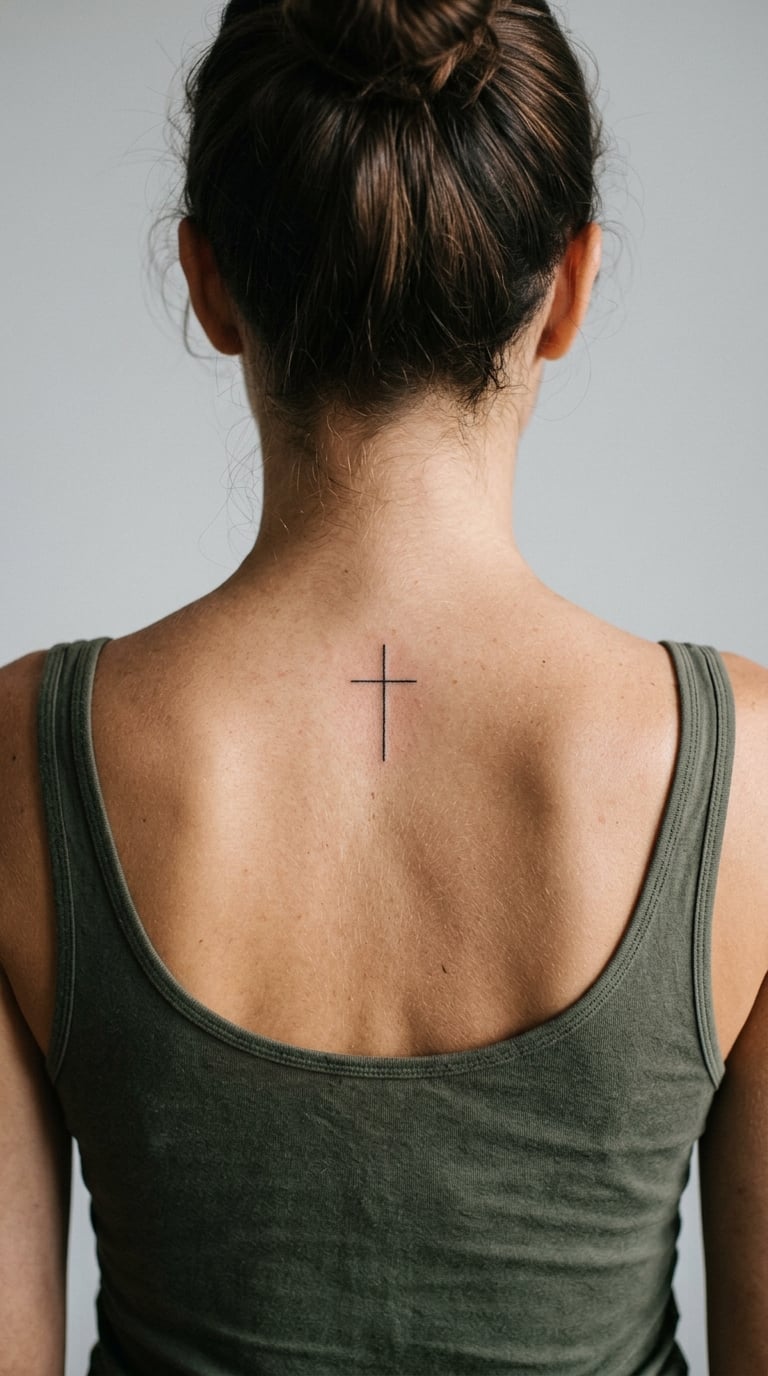
Placed high between the shoulder blades, a small cross is essentially a private piece that only you and whoever is behind you will see. It is the answer for people who want visible faith ink and no visible faith ink at the same time.
Upper-back skin is smooth, well protected from sun and takes fine line work cleanly, so this is one of the better placements for a 0.6 inch single-needle design. You will not see it yourself easily, so decide the orientation now rather than wishing you could check it later.
Pain and time: a 5 out of 10, and 20 to 30 minutes.
Which Way Should a Cross Face?
On the wrist, a cross usually sits upright when the arm is relaxed at your side, with the top of the cross pointing toward your elbow. On the inner forearm, the same upright orientation works, and on the ankle the top of the cross usually points up toward the knee.
The more common choice for a small cross is to have it face inward, toward the other arm or leg, so the design sits against your skin rather than facing outward. It reads as private devotion and it keeps the cross itself from being the first thing anyone sees about you. Plenty of people do the opposite and want it visible, so this is a preference, not a rule.
Where the surface curves sharply, orientation matters more. Behind the ear, the cross is usually drawn so the vertical beam follows the angle of the neck rather than the horizon of the head. Ask your artist to place a water-soluble stencil in both orientations and look at your arm from across the room before anything permanent happens.
Tiny Cross Tattoos by Style and Tradition
Style decides the size floor more than placement does. Here is the practical range for each one, and where it tends to work best.
- Minimalist line cross. One weight, no shading, no outline. Works at 0.3 to 1 inch anywhere. The safest first tattoo.
- Fine line cross with a halo or rays. Needs 0.8 inch or more so the halo stays a separate shape.
- Blackwork cross. Solid fill, holds shape longest, readable at 0.4 inch. Good on fingers, hands and feet.
- Traditional cross. Shaded and outlined, with a ribbon if you want one. Floor is around 2 inches, so this sits at the edge of small.
- Celtic cross. Knotwork and a ring need about 3 inches to stay readable. Below that, use a plain cross instead.
- Crucifix. A visible figure needs 3 to 4 inches minimum. Do not force this one small.
- Three-bar Orthodox cross. Floor of 0.8 inch so the upper bar survives.
- Coptic cross. Equal arms with end bars, works at 0.5 inch, traditional on the wrist.
- Chi-Rho monogram. Holds detail at 0.5 inch and pairs well with black ink.
- Colour accent cross. A single red or gold line inside a black cross. Looks sharp fresh, fades on the colour first.
Colours are worth a word of caution at this scale. A single needle cannot hold a shaded gradient under 1 inch, so coloured crosses work best as an accent inside a black design rather than as the main event.
What Does a Tiny Cross Mean?
A small cross tattoo usually means faith, remembrance, or a private commitment. Those three overlap more than people expect. Someone getting a 0.5 inch cross for a parent they lost is expressing the same thing as someone getting one for daily devotion, in a quieter key.
Beyond that, a cross often functions as an identity marker rather than a statement to anyone else. In Coptic, Arabic Christian and some Pacific Island Christian communities, a small cross on the wrist is simply what you wear, in the same way some people wear a wedding band. If that is your reason, the design is heritage, not an argument.
A cross can also be worn as defiance, especially by people who were raised in a household where faith was either loud or absent. Plenty of people describe their first cross as the tattoo that made a larger one possible.
If you have seen the term three cross tattoo, it usually refers to a design with three crosses, often used as a memorial for a person and their parents, or a reference to the crosses at Calvary. Some Eastern Christian contexts also read a three-bar cross as a theological statement about the Trinity. Ask the artist for a design that matches the meaning you actually intend.
And to be straight about it: most people with cross ink will tell you the design is personal, not performative. What you wear matters far less to almost everyone else than whether you are decent to them.
Where to Put a Tiny Cross: Placement Comparison
Placement decides three things at once: how much it hurts, how much you can hide it, and how fast the ink fades. The table below covers the placements people ask about most.
| Placement | Pain | Visibility | Concealment | Fade risk | Minimum size |
|---|---|---|---|---|---|
| Inner wrist | 4/10 | High | Easy with a long sleeve | Medium | 0.5 inch |
| Inner forearm | 4/10 | Medium | Easy | Low | 0.5 inch |
| Finger or knuckle | 6 to 7/10 | High | Hard | High | 0.3 inch |
| Back of the hand | 6/10 | High | Hard | High | 0.3 inch |
| Behind the ear | 5/10 | Low to medium | Easy with hair down | Medium | 0.4 inch |
| Collarbone | 6/10 | Medium | Medium | Medium | 0.6 inch |
| Sternum | 7/10 | Medium | Easy | Low | 0.5 inch |
| Inner bicep | 3/10 | Low | Very easy | Low | 0.5 inch |
| Nape | 5/10 | Low | Very easy | Medium | 0.4 inch |
| Rib | 7/10 | Medium | Medium | Low | 0.8 inch |
| Ankle | 5/10 | Medium | Easy with socks and boots | High | 0.4 inch |
| Top of the foot | 7/10 | Low | Easy with socks | High | 0.4 inch |
| Upper back | 5/10 | Very low | Very easy | Low | 0.5 inch |
If you want one decisive answer for a first tattoo, the inner forearm is the safest pick: low pain, forgiving skin, easy to hide, and a flat surface that suits small linework. The inner wrist is the most requested and the one people most often regret placing too low, where it sits awkwardly with a watch. The ankle is the easiest to keep completely private.
Things to Know Before You Book
Ask to see healed work, not fresh photos
Any decent artist will show you tattoos they did two years ago, not ones from last week. Fresh work looks sharp on everyone. Healed work on a wrist, an ankle and a finger tells you what your own small cross will look like in three years, and it is the single most useful thing to check before you book anyone.
Do not shrink a detailed design to fit the idea of tiny
The most common mistake is a first-timer bringing a reference image of a crucifix or a Celtic cross and asking the artist to make it 0.5 inch. It will not survive. Ask the artist to redraw the concept in a simpler form instead, and you will usually end up happier with the result.
Small tattoos are not automatically cheaper
Most shops charge a shop minimum, and a one-hour booking is a one-hour booking whether the design takes 15 minutes to draw or the full hour. Custom work on a curved or awkward spot can take longer than the same design on a flat forearm. A tiny cross that needs a stencil, a custom drawing and a careful placement can easily cost the same as something much larger, and the artist charging by the hour is not taking advantage of you.
Fine line needs a heavier line than your sketchbook shows
A single-needle stroke is drawn thin, then partly blows out as your skin heals. If the artist draws it at exactly the weight you want, you will end up with a thicker line than that. Good artists compensate for this deliberately. If a tiny cross comes out looking like a faint scratch rather than a black line, that is a sign it was drawn too thin, not that you healed badly.
Treat sun as the main reason tiny crosses fade
Most fading is sunlight, not age. Once the tattoo is healed, use sunscreen on exposed placements like the wrist, ankle and collarbone, and do not sit in strong sun on it without covering. Wrist and ankle work will typically need a touch-up every year or two, while an inner bicep cross in a long-sleeve shirt can hold for many years untouched.
Healing is slower than most people expect
For the first three to five days, wash it twice a day with plain unscented soap and nothing else. Days four to ten is when the flaking starts and the tattoo looks greyer and lighter than it did on day one, which is the stage that panics first-timers and is completely normal. From week two to week four the ink settles back down and the true darkness comes through. Do not judge the tattoo until the two-month mark.
If you are worried about work, start concealed
Inner forearm, inner bicep, upper back and sternum under a collar all disappear under normal office clothing. A behind-ear cross shows whenever your hair is up, and a finger or hand cross is essentially always visible. If you have a conservative workplace, a placement is a better answer than a design change.
Matching crosses are a real tradition
Couples, siblings and friends often take the same 0.4 inch cross on matching placements, or the same design on opposite wrists. Decide the size and style together before either of you books, because matching tattoos only stay matching if you agree on the line weight. One of you will end up with a slightly darker version otherwise.
Try a temporary one first if you are undecided
Temporary crosses are cheap, quick and a genuinely sensible way to test a placement before committing. Buy two or three, put them on the spots you are considering, and wear each one for a full day at work. It answers the placement question in a way that no gallery image can, because it puts the design on your own proportions.
If your tradition has a written position, ask before you book
Some denominations have formal guidance on religious tattoos, and some have quietly been burned by getting one that felt wrong later. A short conversation with a priest or pastor in your own community, before the design is done, costs nothing and settles a lot of doubt. Leviticus 19:28 is the passage most often raised in these discussions, and how it is read varies widely between traditions and commentators.
Frequently Asked Questions
What does a small cross tattoo symbolize?
Usually faith, remembrance, or a private commitment. A small cross for someone you lost is a memorial, the same symbol worn quietly. In some communities, including Coptic and Arabic Christian ones, a small cross on the wrist is a tradition marker rather than a statement to anyone else.
Where should I put a small cross tattoo?
The inner forearm is the safest first-tattoo spot: low pain, forgiving skin, easy to hide under a sleeve. The inner wrist is the most requested but sits awkwardly with a watch if placed too low. Behind the ear and the upper back are the easiest to keep completely private. Ankle and collarbone fade fastest.
Which way should a cross tattoo face on my wrist?
Upright, with the top of the cross pointing toward your elbow, is the usual choice on the wrist and inner forearm. Plenty of people have it face inward so the design sits against the skin rather than outward. Behind the ear, the vertical beam usually follows the angle of the neck. Test a water-soluble stencil both ways before anything permanent.
How small can a cross tattoo be?
A plain Latin cross in one colour holds at 0.3 inch. Below that the crossbar loses its straightness. Three-bar, Celtic knotwork and crucifix designs have much higher floors: 0.8 inch for the upper bar of a three-bar, about 3 inches for knotwork, and 3 to 4 inches for a figure of Christ.
Do tiny cross tattoos fade quickly?
Sun exposure does most of the damage, not time. Wrist, ankle, foot and collarbone crosses are the most exposed and typically want a touch-up every year or two. An inner bicep or upper back cross under clothing can hold its line for many years. Keep sunscreen on exposed placements and judge the result at two months, not two weeks.
How much does a small cross tattoo cost?
Most shops charge a shop minimum, and hourly custom work costs the same whether the design takes 15 minutes or the full session. A tiny cross needing a custom drawing, a stencil and careful placement on a curved spot can cost as much as a larger piece. Temporary crosses are the cheap way to test placement before you commit.
Conclusion
Start with size, not style. Decide whether you want a 0.4 inch mark that reads as a detail or a 1 inch piece that reads as a symbol, and let that answer settle the style, the placement and the artist. Most first-timers land on an inner forearm or behind-ear plain Latin cross in black, and that is a genuinely good place to begin.
The eighteen tiny cross tattoo ideas above cover the range well. Pick the two or three placements that match how much you want to show it, take those ideas into a consultation, and ask to see healed work in the same style before you commit to anything.