
15 Flower Tattoo Ideas for the Hip That Follow the Curve in 2026
Flower tattoo ideas for the hip work best when the design is built around your bone instead of dropped on top of it. A stem that runs along the iliac crest, a spray that turns down into the hip dip, a vine that carries onto the front thigh — that is the difference between a piece that looks like it grew there and one that looks borrowed from somebody else.
It is also an awkward placement to plan from a reference photo, because the same drawing looks completely different across body types, and the hip is one of the first places fine detail starts to soften. Most people I talk to about this end up choosing a bolder flower, a slightly larger scale, and a spot that clears their waistband. If you are still narrowing things down, these fifteen are the ones worth a serious look.
Quick picks: six hip florals and who they suit
Before the full gallery, here is the short version if you want to start somewhere specific.
- Single stem rose — best for a first tattoo or a small budget of space, placed on the iliac crest.
- Peony cluster — best if you want one bold flower with real presence and you can give it room.
- Wildflower spray — best for following the hip curve naturally, and the easiest to scale up or down.
- Lotus medallion — best for symmetry and for anyone who prefers geometric structure over loose botanical work.
- Wrapping vine — best when you want the piece to keep going and connect toward a future thigh or rib tattoo.
- Botanical branch rework — best for covering an old faded hip or thigh piece you would rather not explain.
Where to place a flower tattoo on the hip
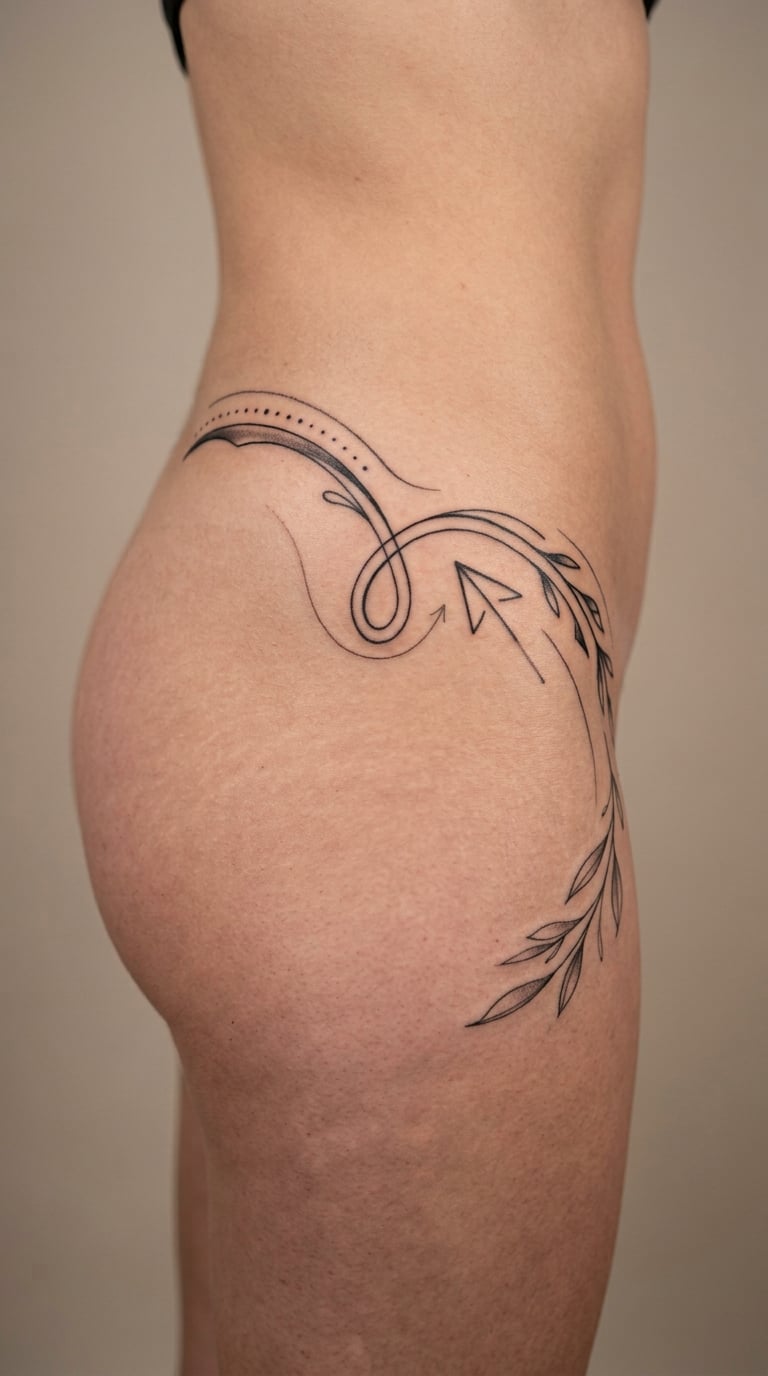
Most people say “hip” and mean four quite different spots. Each one carries a different amount of stretch, sits at a different distance from your waistband, and shows up differently depending on what you wear. Naming the zone is the first useful decision you can make, because it rules out half your reference images before you start.
- Iliac crest (the hip bone). Usually 8-15 cm across, and the best zone for a bold outline, colour, or one hero flower. It stays stable with little stretch, but it sits exactly where a waistband rubs.
- Hip dip. Usually 4-9 cm, and the least mobile part of the whole area, so it takes a small composition with plenty of negative space and holds delicate work best.
- Front hip wrap. Usually 10-20 cm and trailing, made for vines, stems and anything that flows forward. It stretches every time you sit down or shift your weight.
- Hip flank. Usually 6-14 cm, good for sprays, branches and side-facing blooms. It is the highest-movement zone, so fine line softens here first.
One practical note the gallery cannot show you: the artist will usually stencil while you stand in the position you normally wear your clothes in, because the hip sits differently standing, sitting and lying down. If you plan on showing the tattoo, bring the bottoms you would wear with it.
How hip skin changes a floral tattoo
Hip skin is soft, mobile and constantly in contact with a waistband, which is why florals here need a little more planning than the same flower on an arm. Two things happen: fine lines soften first as skin flexes, and any pigment sitting right on the waistband line wears faster than everything around it.
That is the whole fine-line debate in one sentence. A single-needle stem on the hip dip can hold beautifully for years, because that area barely moves. The same single-needle stem wrapping the front hip into your thigh is working against you the whole time. Artists who work on hips a lot will bump the line weight up slightly, keep more negative space between petals, and push the composition a centimetre or two away from the waistband.
Colour and blackwork hold their shape better than the thinnest linework, and saturated petals fade more slowly than pale watercolour washes. For touch-ups, most people land somewhere in the six to twelve month window if they want a specific area refreshed, and treat a full colour refresh around the two year mark as optional rather than mandatory. A lot of that depends entirely on how much the tattoo touches a waistband or a seatbelt, and how much sun it sees.
15 flower tattoo ideas for the hip, one by one
1. Single stem rose on the iliac crest
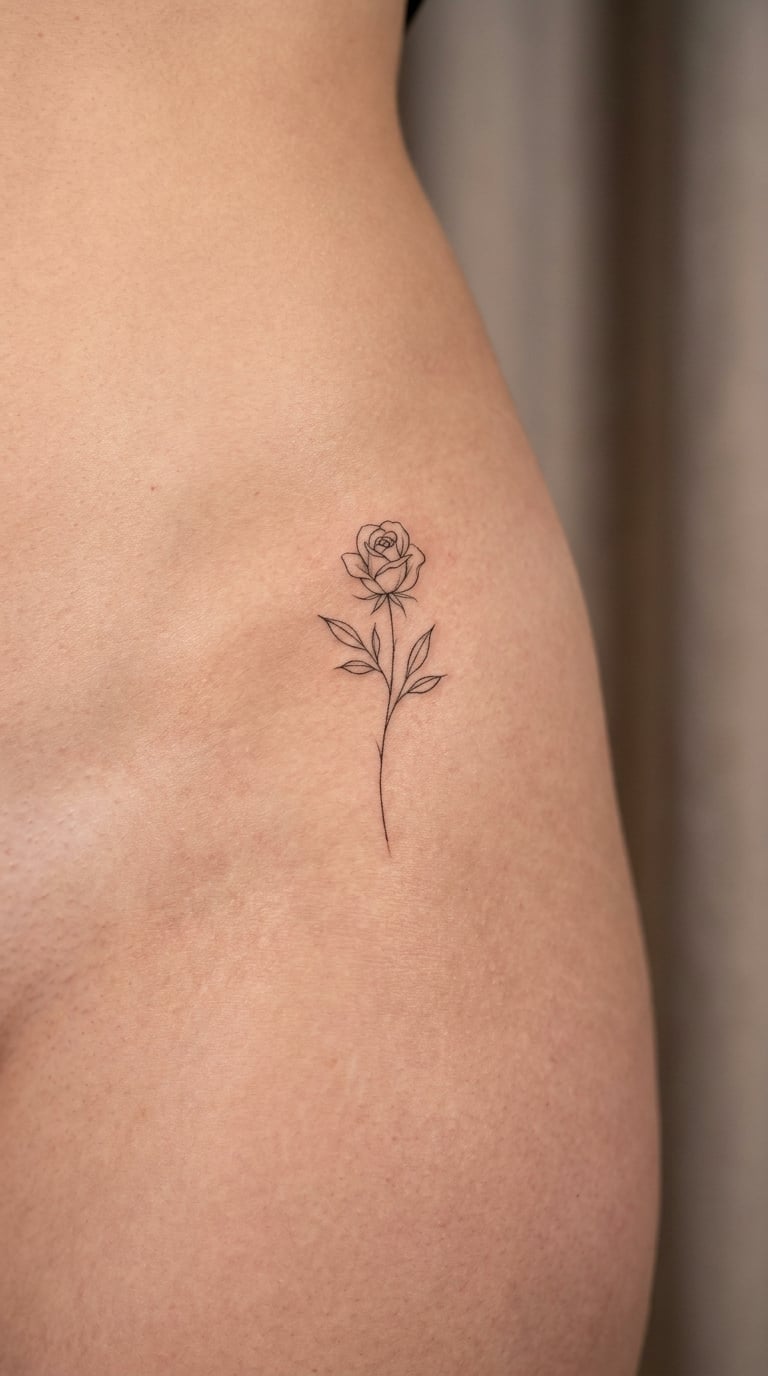
A single stem rose is the least showy option and probably the most popular first hip tattoo. It reads as quiet rather than plain, and the bud-and-thorn version carries more edge than the soft, rounded bloom people usually picture first.
Keep it around 6 to 9 cm tall and let the stem angle back toward your spine rather than straight up. Fine line works here because the iliac crest is a stable ridge, though I would still ask for a slightly heavier line than you would use on an inner arm. It sits right under a waistband on a lot of bodies, so give it room.
Pain & time: about 1 to 2 hours, sitting or lying down. The crest is bony, so expect roughly 5 out of 10 with sensitive stretches near the waist.
2. Peony cluster resting on the hip bone
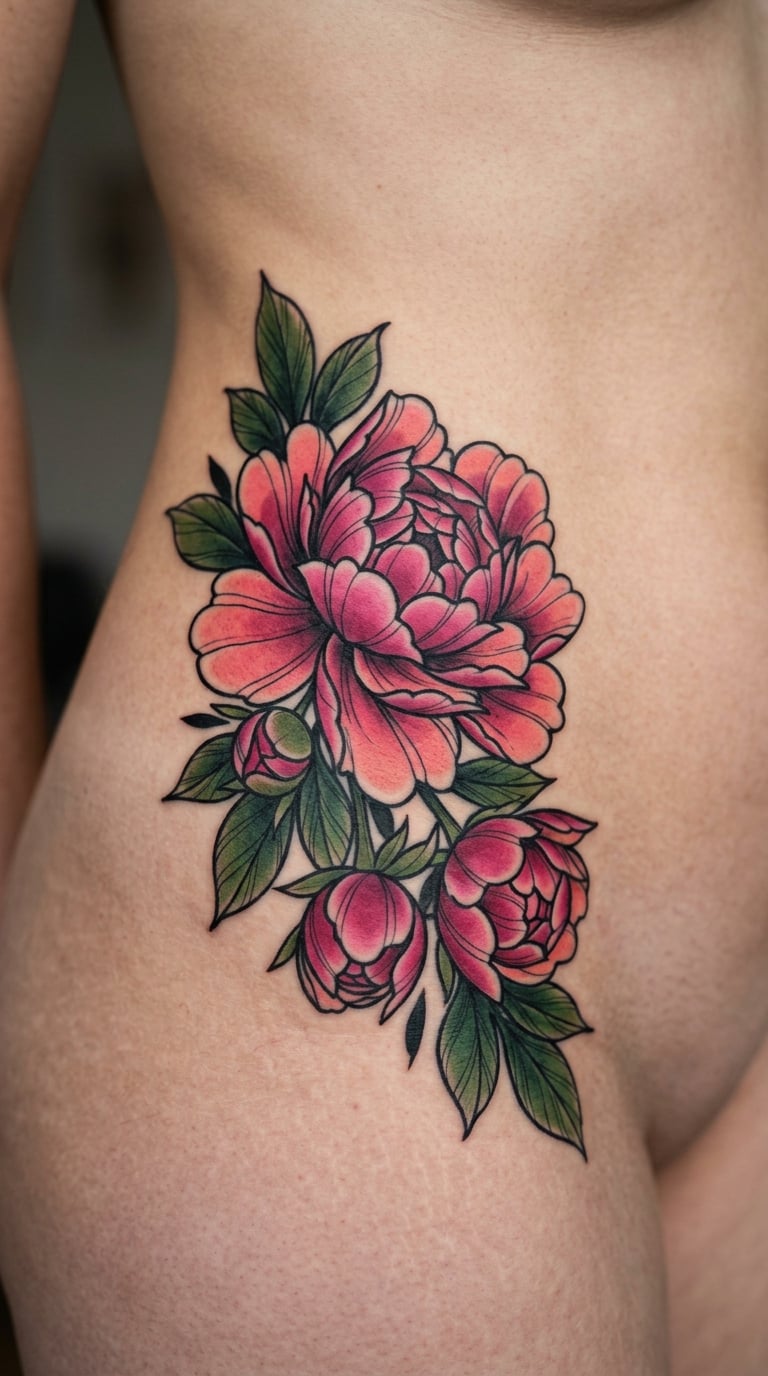
The peony is the loud one. A full cluster in deep pink with green leaves reads clearly from across a room, and the ruffled petal shapes give an artist plenty to work with in a single session.
Give it 12 to 15 cm and put the weight of the flower over the hip bone, letting the leaves spill toward the dip. Neo-traditional with a bold outline ages far better here than a soft watercolour version, because the outline holds the shape when the interior softens. It is a two-session piece more often than one.
Pain & time: 4 to 6 hours, often split across two sessions. This is a fleshy spot, so pain hovers around 6 out of 10 rather than sharp.
3. Watercolour hibiscus with a soft edge wash
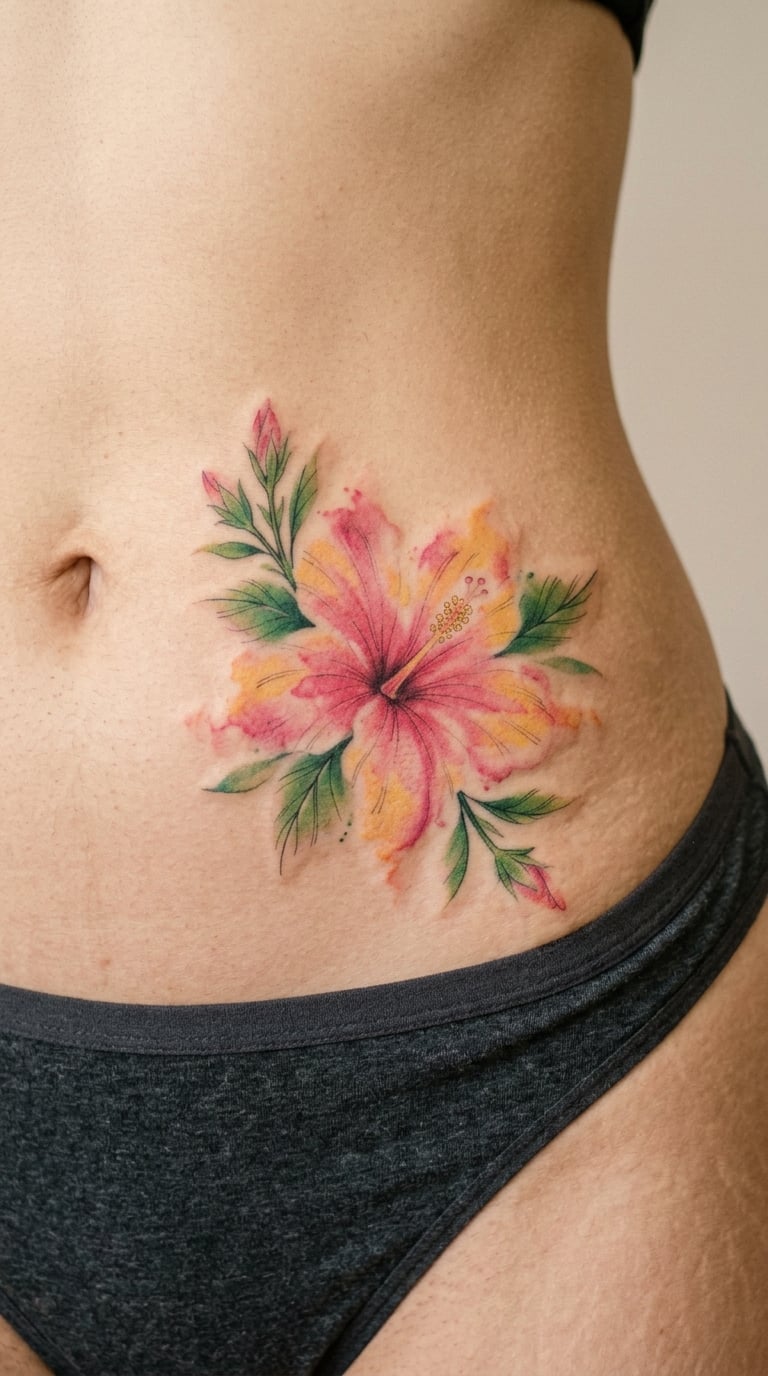
Watercolour hibiscus is the dreamiest of the set. The pigment bleeds past the line of the petal on purpose, so it looks less like a drawing and more like a smudge of colour that dried on skin.
Place it on the front hip, trailing toward the thigh, at roughly 10 to 13 cm. This is the one style where I would push back gently: pale washes on a zone that rubs against a waistband will fade unevenly, and the soft edge that looks clever fresh can turn into a grey cloud later. Ask to see healed examples, not session photos.
Pain & time: 2 to 3 hours, low pain around 4 to 5 out of 10 because the colour work is light pressure.
4. Wildflower spray following the hip curve
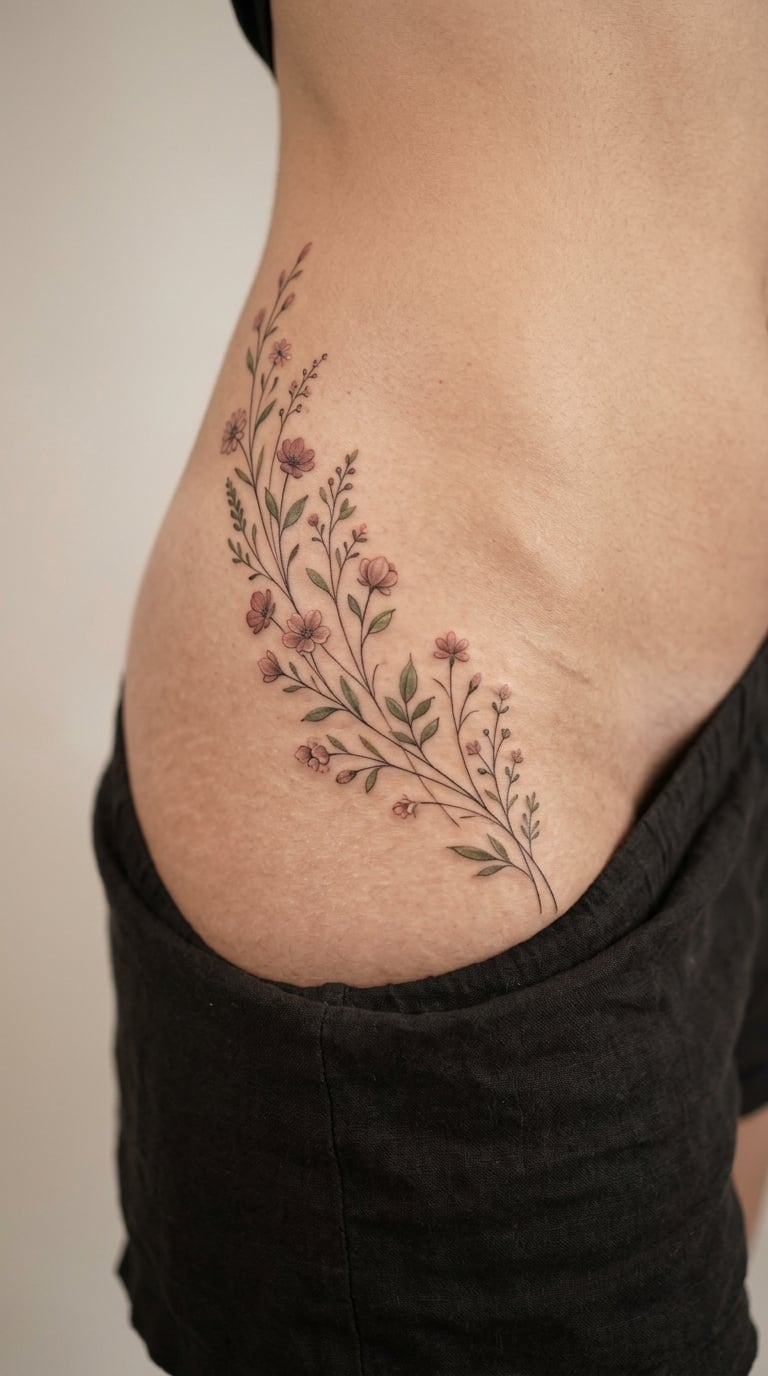
A wildflower spray is the most forgiving design on the hip, because nothing about it needs to be perfect. Five or six different small blooms on thin stems, bending with the curve, look like they belong there in a way a single stiff stem never does.
Run it along the iliac crest and let the stems trail down toward the front hip, 12 to 18 cm long. Scale is flexible, which makes this the safest choice if you are copying a reference photo and cannot judge size. Slightly thicker stems and open spacing between flowers will hold up far better than a tightly packed version.
Pain & time: 3 to 4 hours. The flank stings a little more than the dip, closer to 6 out of 10.
5. Cherry blossom branch on the hip flank
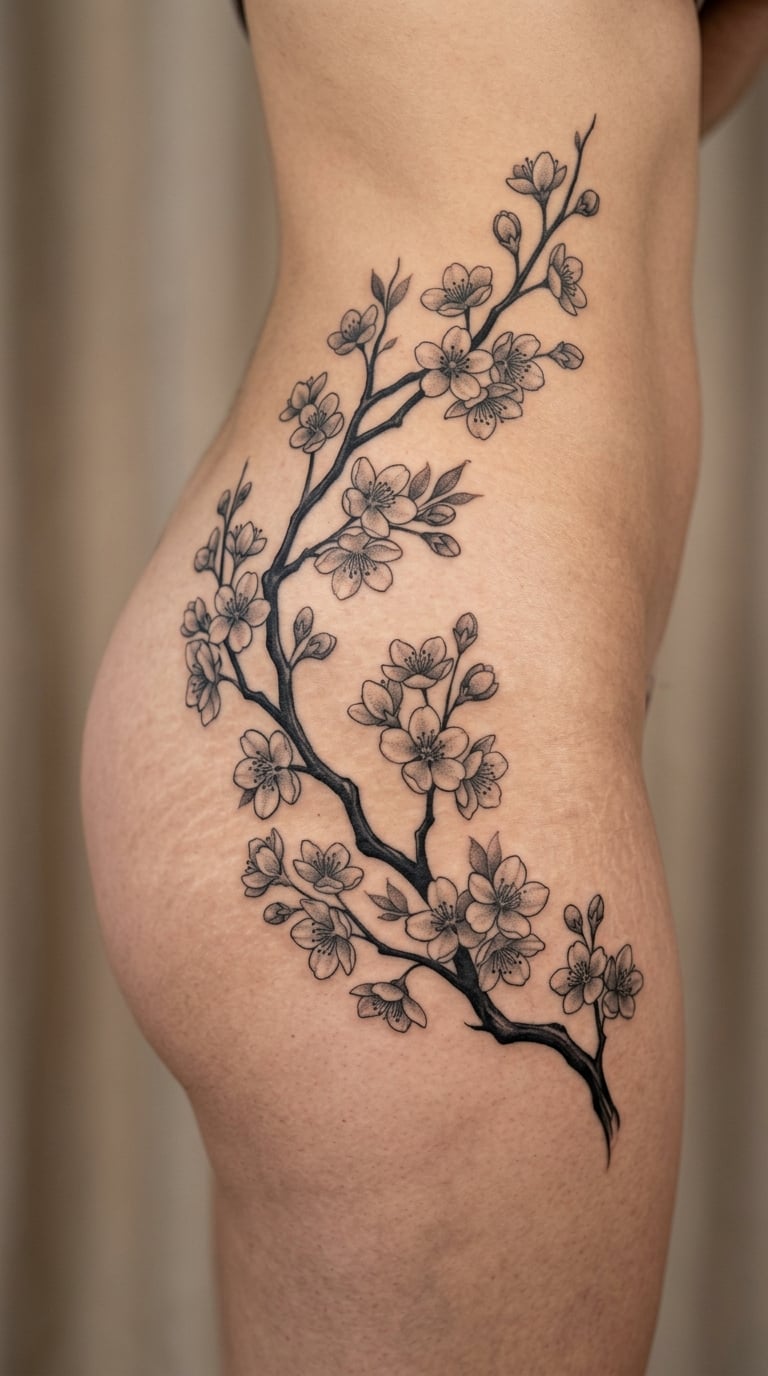
Cherry blossom on the flank gives you a diagonal line, and diagonals are what make hip pieces look intentional. Black and grey keeps it quiet, and the soft petals are a good middle ground between fine line and heavy colour.
Keep it to 10 to 14 cm, angled so the branch points down and back, and let a few petals break free of the branch. Black and grey shading on the hip fades towards a soft grey rather than disappearing, so the shape stays readable. The flank moves a lot when you walk, which is worth remembering at booking.
Pain & time: 2 to 3 hours, about 5 out of 10.
6. Lavender sprigs wrapping toward the front thigh
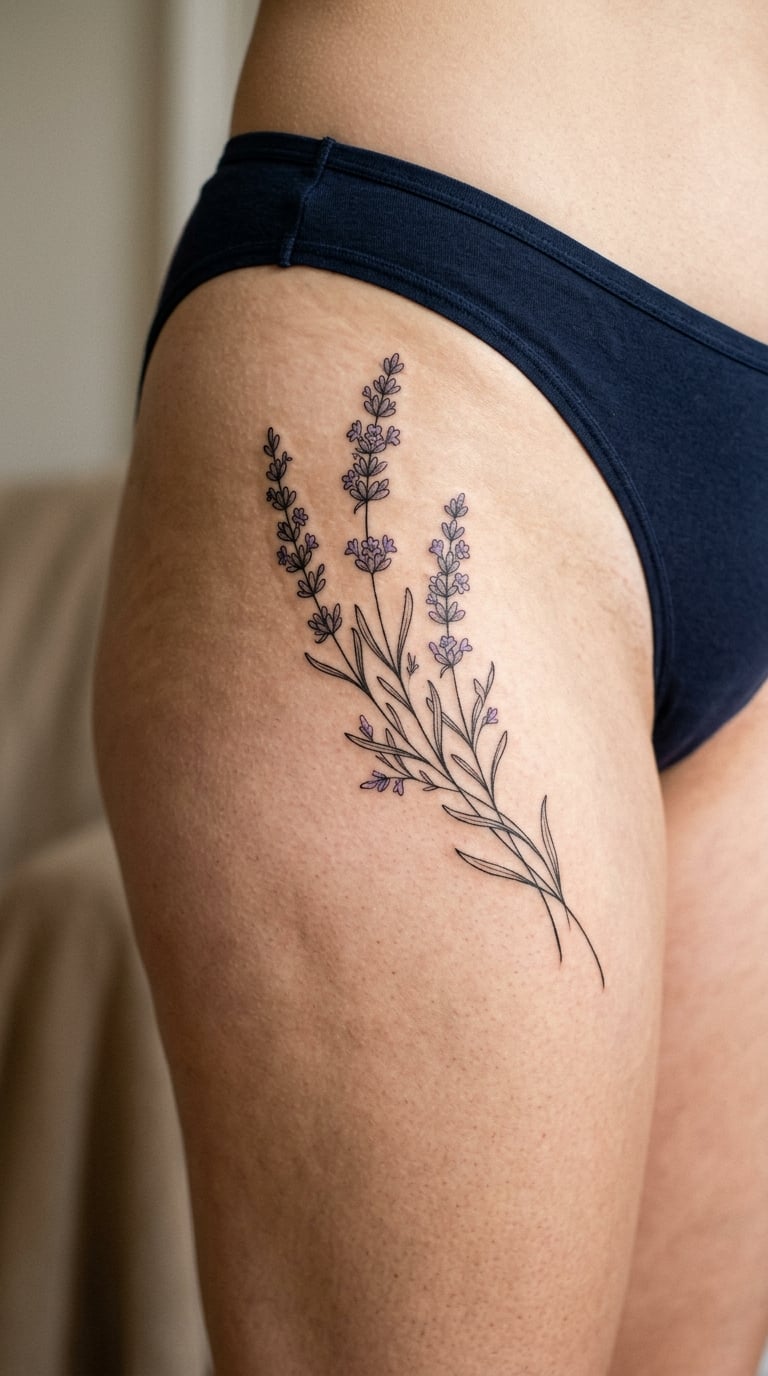
Lavender is a subtle choice: quiet, a little antique-looking, and tied to calm rather than to any loud statement. Three or four slender stems in fine line look elegant in a very small space.
Place them on the front hip, angled down the thigh, no bigger than 8 cm. This is a case where line weight really matters — the stems need to be a touch heavier than instinct suggests, and the flower heads slightly larger, or the whole thing turns to fuzz. Very forgiving if you want it small.
Pain & time: 1 to 1.5 hours, around 5 out of 10.
7. Sunflower pair on the hip dip
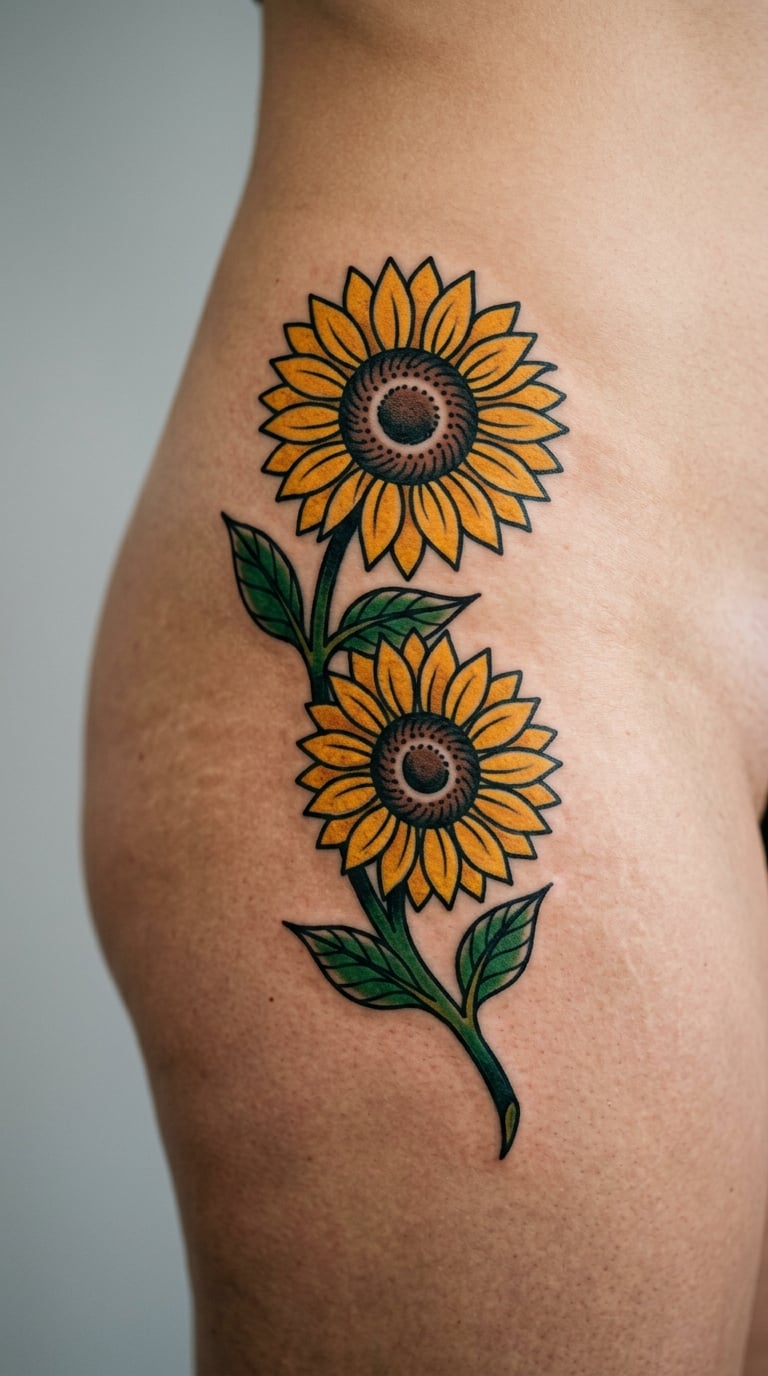
Two sunflowers, one slightly behind the other, is a warm and unapologetic option. The dip is one of the flattest, least moving parts of the hip, so a bold traditional piece sits there really well.
Budget 9 to 12 cm and stack the blooms vertically so they follow the dip rather than fight it. Heavy outlines and saturated yellow survive the hip better than most styles, which makes this a good pick if you want colour that still looks right five years on. It reads bold rather than delicate.
Pain & time: 3 to 4 hours, about 4 out of 10 since the dip is bone over a thinner layer.
8. Lotus mandala at the upper hip
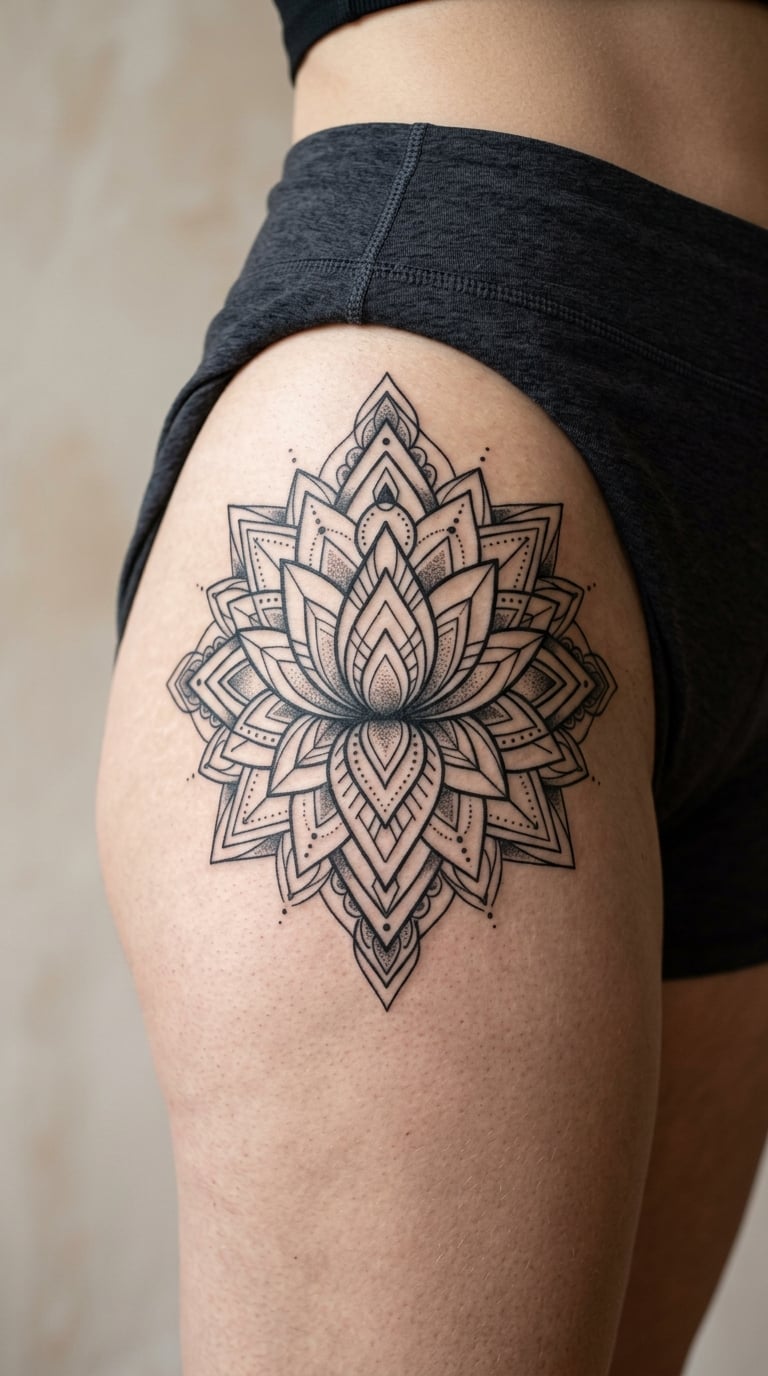
A lotus mandala is the structural option. Radial symmetry on a curved surface looks deliberate in a way most florals do not, and the meaning — purity, rebirth, spiritual awakening — is the most widely read one on this list.
Keep it to 10 to 14 cm and centre it on the upper hip, above the iliac crest. Geometric blackwork depends on clean negative space between the petals, and the artist will want the design opened up if your reference is dense. Symmetry across both hips is the other option people ask about, and it looks genuinely strong when the two sides mirror each other.
Pain & time: 4 to 6 hours, frequently two sessions. Around 6 out of 10, higher on the bony crest.
9. Jasmine vine wrapping the hip
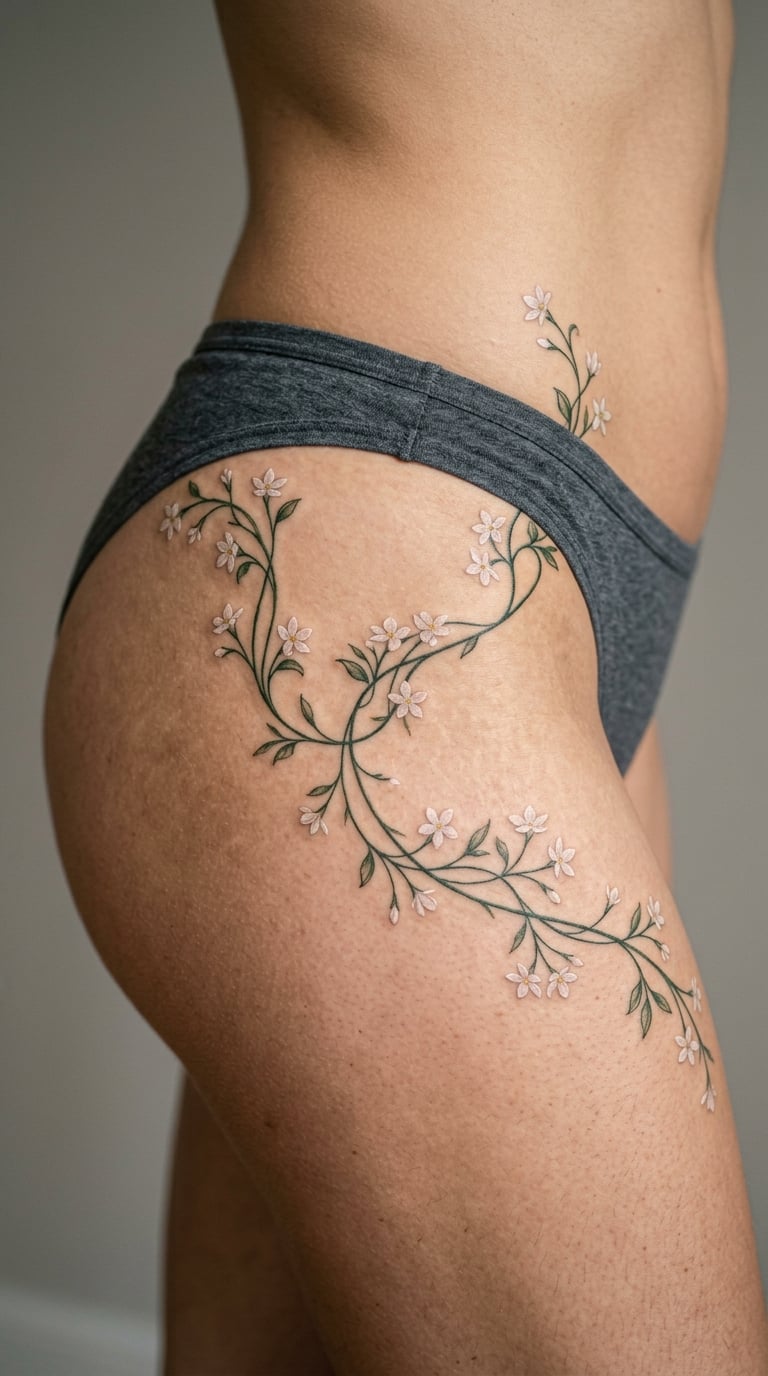
A wrapping vine is the commitment option. One continuous stem travels around the side of the hip with small five-petal flowers spaced along it, and it looks like the beginning of a thigh piece rather than a finished job.
Plan for 15 to 20 cm of travel from the back hip to the front, which usually means the design gets drawn twice as long as the reference you saved. The wrap stretches with sitting and with weight change, so tell your artist if either is likely. If you are starting a bigger project, this is the piece that makes the rest of it make sense later.
Pain & time: 5 to 8 hours, split across sessions. The flank and front hip together run about 6 to 7 out of 10.
10. Small daisy chain at the top of the hip
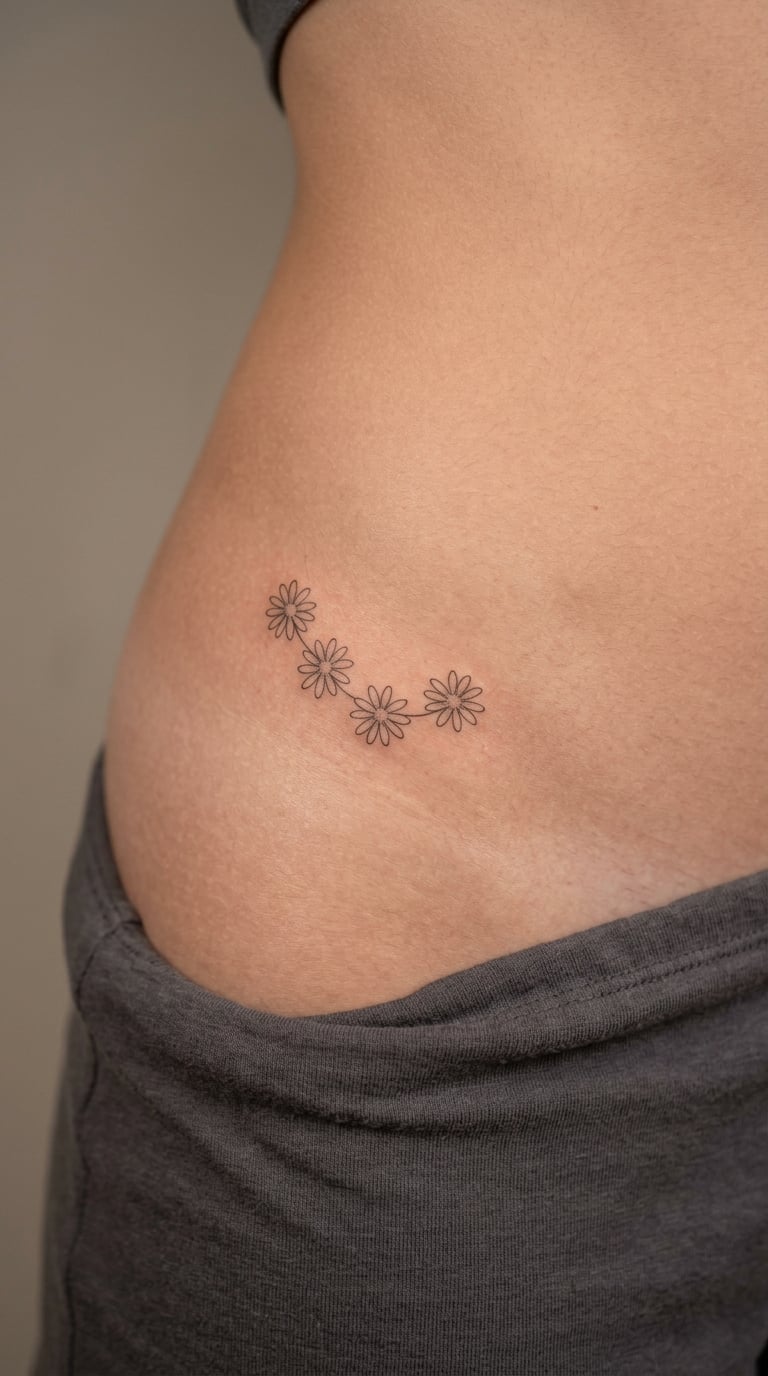
A daisy chain is the most casual of these designs and the one most people end up actually wearing, because it is small and it flatters the curve instead of sitting on it. Five or six daisies, nothing else.
Keep it under 7 cm and place it just above the hip dip rather than on it, so the chain has somewhere to ride. This is a micro-detail design on a moving area, so be honest with yourself about it: it is lovely, it will soften first, and a touch-up in a year is a normal part of this one rather than a failure. Ask for slightly heavier line and slightly larger petals.
Pain & time: 45 minutes to an hour, about 4 out of 10.
11. Forget-me-not constellation on the upper hip
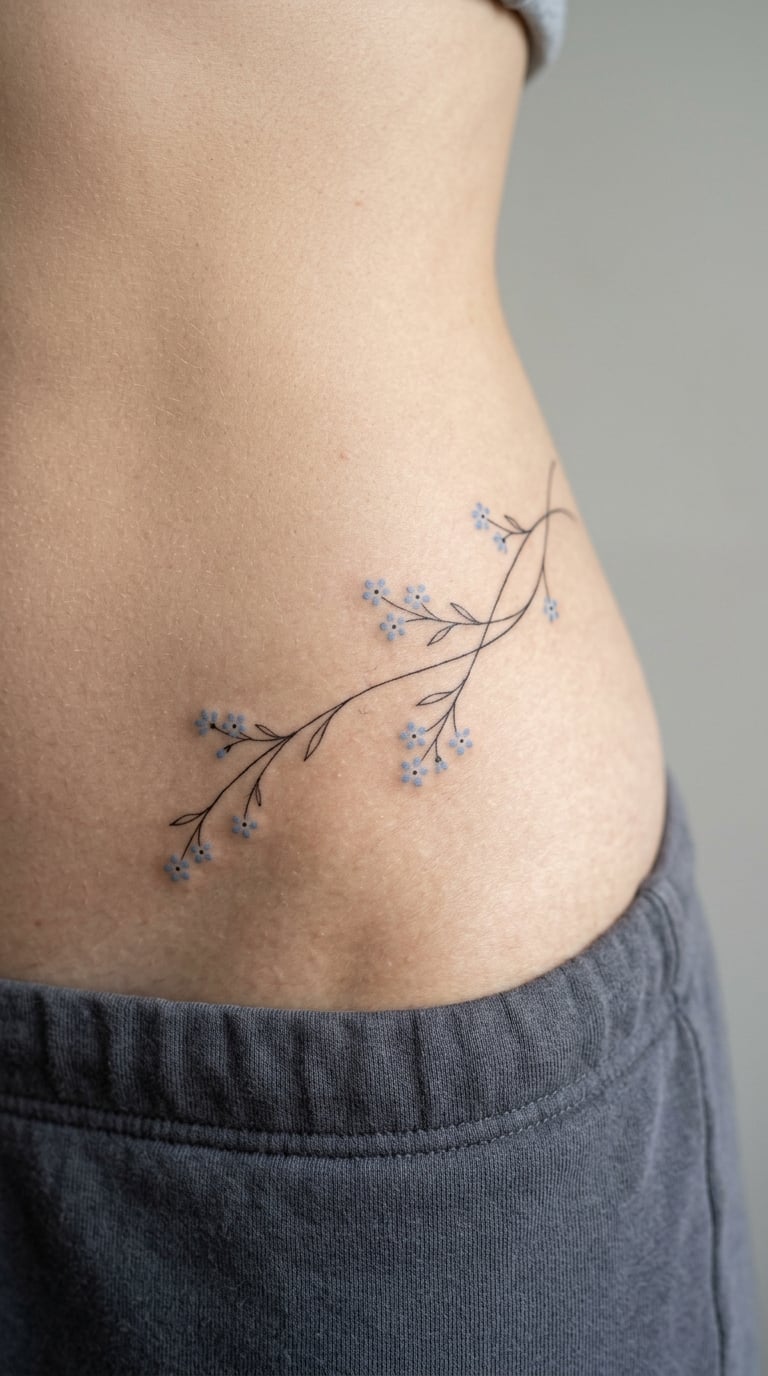
Forget-me-nots carry remembrance more than any other flower here, and scattering small blooms with thin connecting lines between them gives a hip piece a light, scattered quality. It looks bigger than the ink coverage suggests.
Span 10 to 14 cm across the upper hip, above the crest, with generous gaps between the blooms. Because the connecting lines are the fragile part, this belongs slightly higher on the hip where there is less stretch. It suits anyone who wants meaning that explains itself without being a slogan.
Pain & time: 2 to 3 hours, around 5 out of 10.
12. Botanical branch rework over an old hip piece
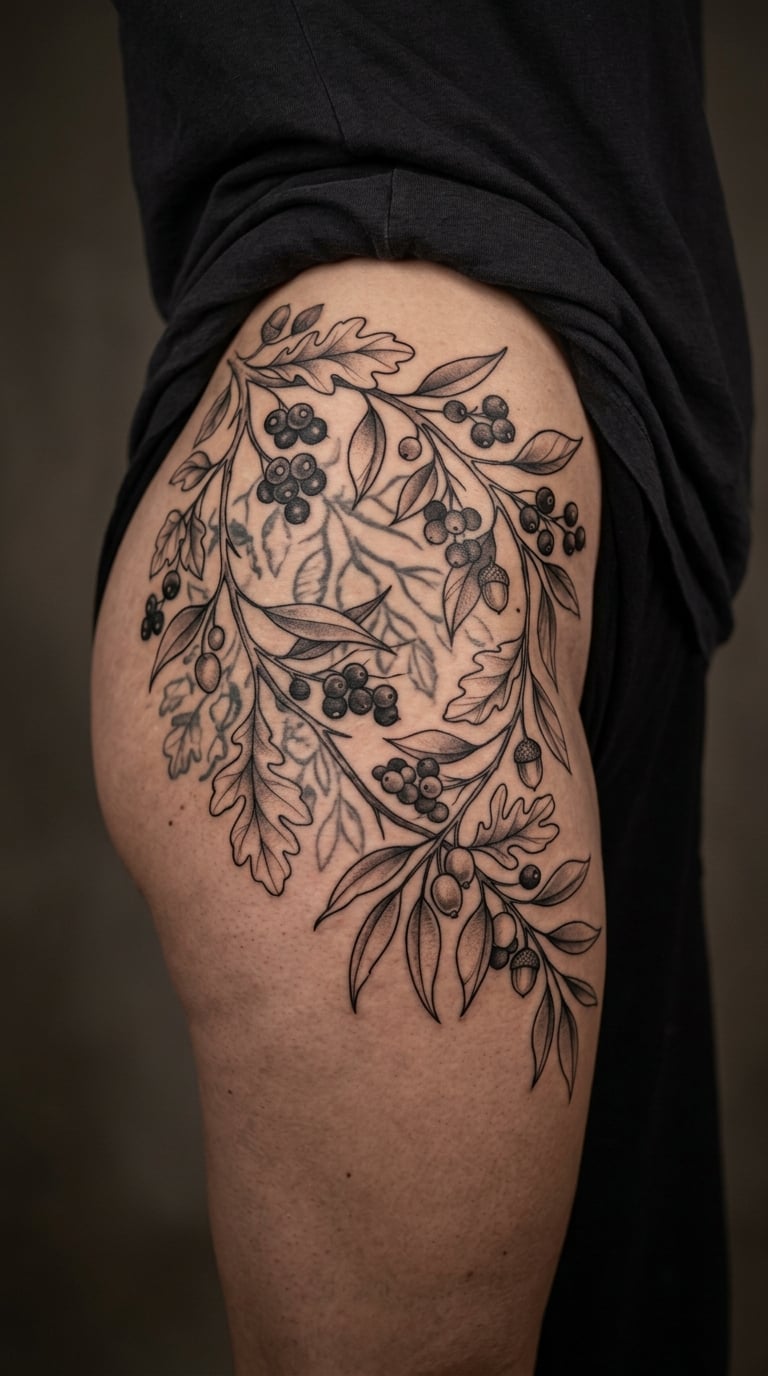
Sometimes the reason to look at flower tattoo ideas for the hip is that something is already there. A faded stem outline, a sun that turned orange, a name you would rather not explain. Dense botanical branches are the best rework source because leaves and berries fill awkward gaps instead of fighting them.
Black and grey with real coverage in places, usually 12 to 18 cm, and expect a longer session because there is old ink to darken under. A good artist will tell you honestly whether the old piece can be worked with or whether it needs to be covered by something with much more coverage. Ask about both options before you commit.
Pain & time: 4 to 7 hours across two or more sessions, around 7 out of 10 because rework means more passes over the same skin.
13. Monstera and magnolia in blackwork
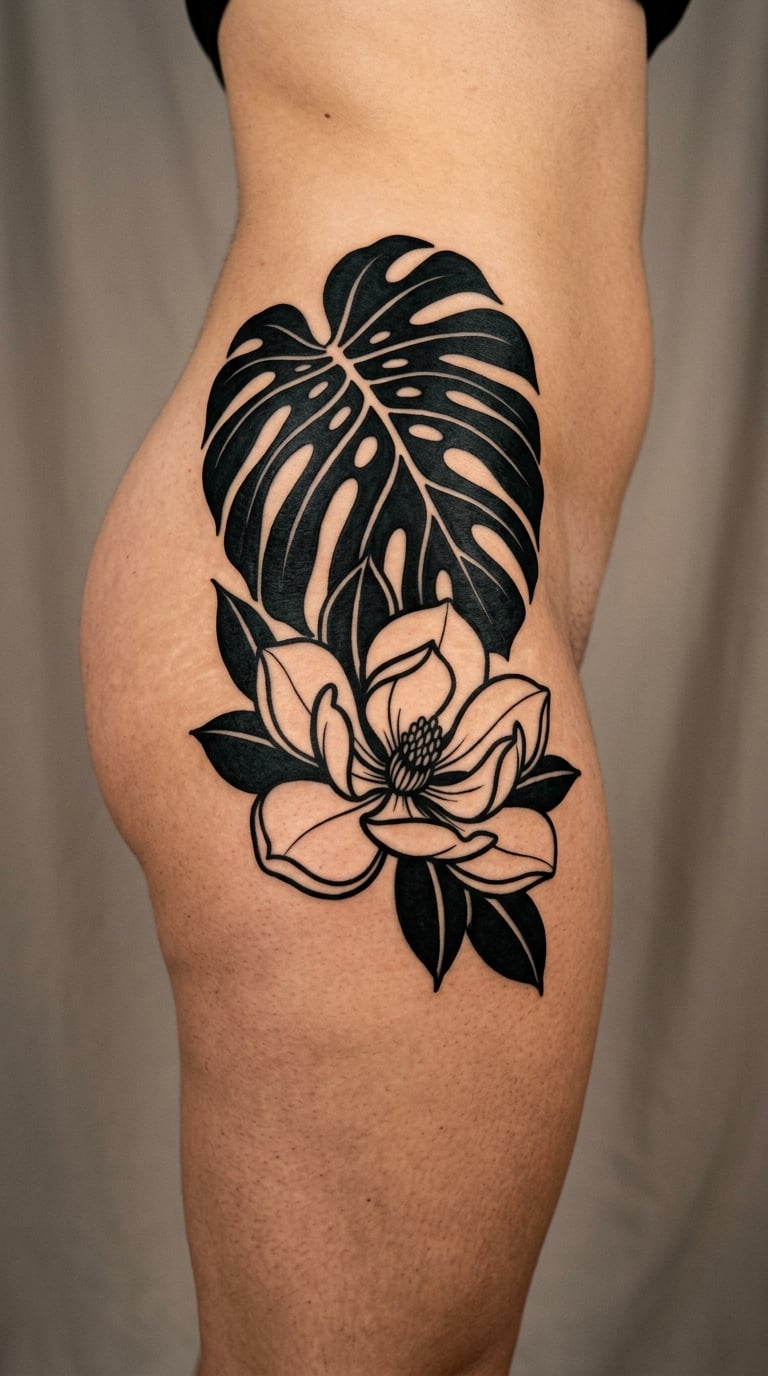
Magnolia and monstera is the version of this list with nothing delicate about it. Solid black shapes, heavy contrast, almost no colour — and it works just as well on a body that does not read as traditionally floral as it does on one that does.
Put it on the iliac crest at 12 to 16 cm, because the bold areas need enough surface to breathe. Blackwork holds its edges better than any other style on the hip, since the fill has mass behind it. Pair the bloom with a leaf that runs down toward the thigh and it looks composed rather than stamped on.
Pain & time: 3 to 5 hours, about 6 out of 10. Shading the solid black takes longer than the linework suggests.
14. Poppy trio across the hip
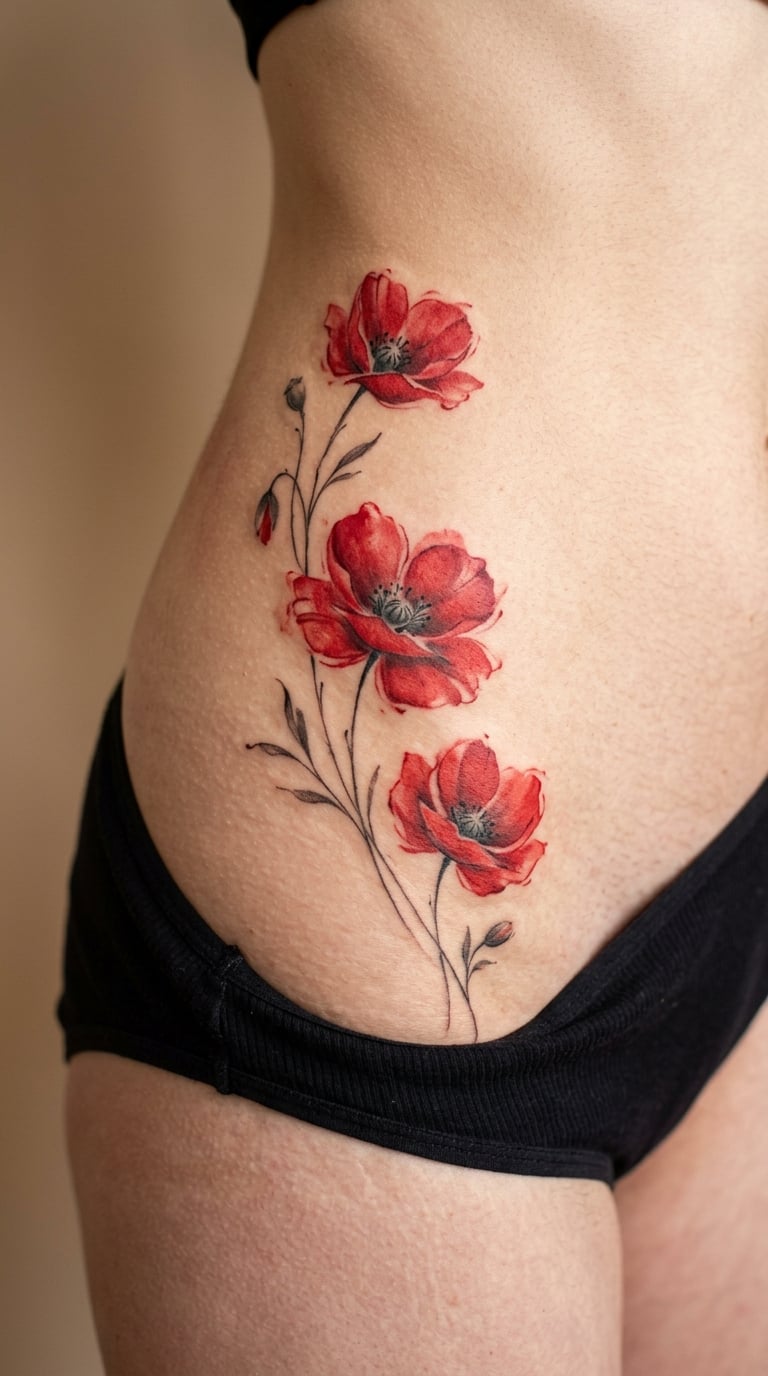
Three poppies on thin stems is the version with movement in it. One bloom upright, two tilted, stems crossing — it looks like it caught a moment rather than a pose, and poppies are the easiest flower to shade loosely without it looking messy.
Allow 11 to 15 cm across the hip, with the stems crossing near the crest. Loose painterly shading suits this design well, and the reds fade gracefully towards a softer brick tone instead of going flat. The main thing to get right is stem spacing — poppies packed too close merge into one blob as they heal.
Pain & time: 3 to 4 hours, roughly 6 out of 10.
15. Mirrored sprigs across both hips
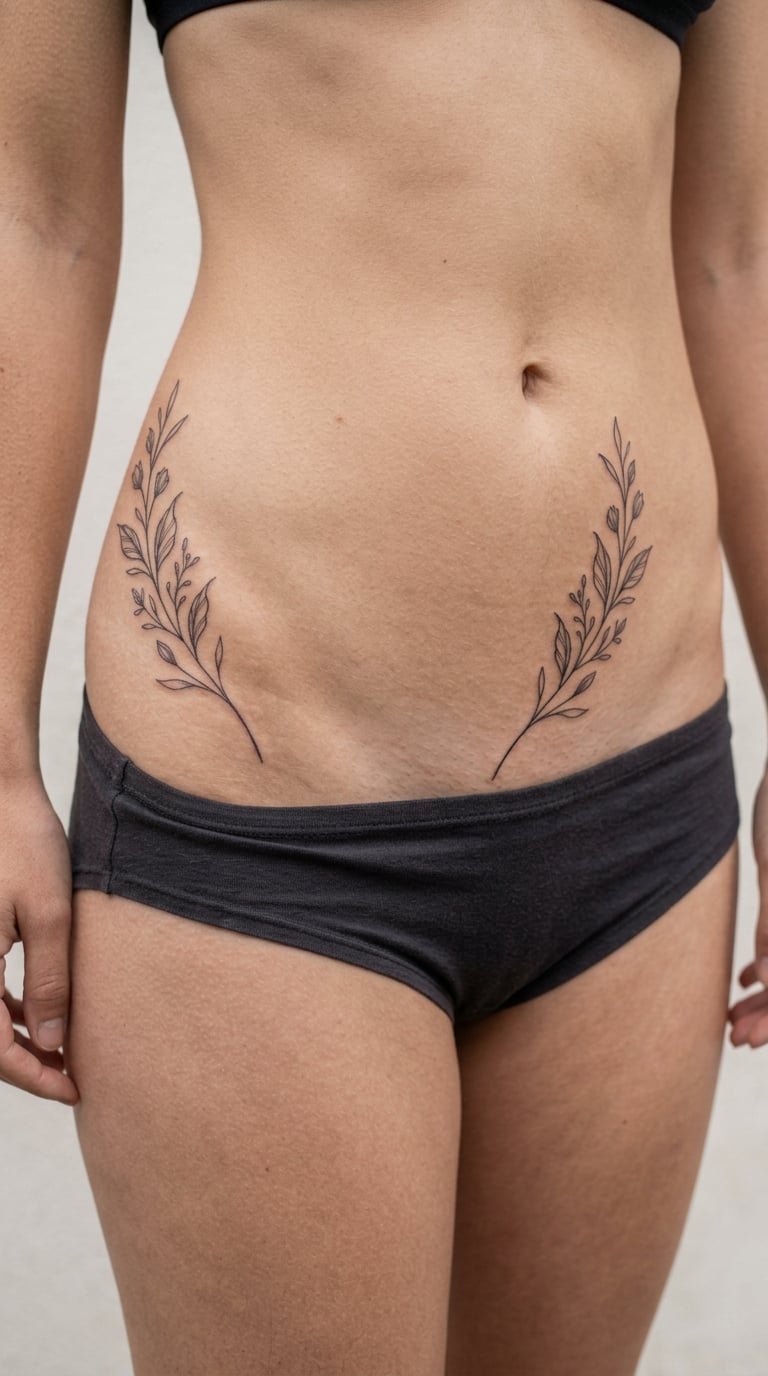
Two small sprigs, one on each hip, mirrored so the leaves face each other. It is the least committed design here, and the one that most often gets praised in comments from people who never liked tattoos until they saw a matched pair.
Keep each side between 7 and 10 cm, mirrored from the same stencil, and place them on the iliac crest so the two halves line up when you stand. If your hips are uneven — most are — the artist will adjust one side so it reads as symmetrical rather than forcing a mirror. Fine line is acceptable here because the crest is stable on both sides.
Pain & time: 1.5 to 2 hours per side, two appointments. About 5 out of 10 on each.
Before you book: what to sort out first
Most disappointing hip florals are placement and planning problems, not design problems. Before you sit down for a consultation, deal with these six things.
- Pick your zone, not just your design. Decide whether you want the iliac crest, hip dip, front hip wrap or hip flank first, then bring references that suit it. It saves everyone time.
- Look at healed work, not fresh work. Ask to see pieces at six to twelve months healed, ideally on a similar hip placement. Session photos flatter everything, and healed photos are the only honest version of your future tattoo.
- Ask what happens to the line weight. A good artist will explain how they adjust for hip movement and why they are putting a little more ink in a line than your reference photo shows.
- Wear something that fits the placement. Bring the bottoms or high-waisted piece you would actually wear with the tattoo, so the stencil can be judged in the position it will be seen in.
- Plan for sun and waistbands. Hip skin gets seen in summer and rubs constantly. Ask what aftercare they want and how they handle a colour refresh in two to three years, then follow it.
- Get the cost in writing after the design is measured. Cost moves with size, detail level, colour and session length, so any number quoted before those are fixed is guesswork. A small stem and a full peony cluster are not the same job.
How to vet a healed portfolio for hip work
Ask for healed photographs from the specific artist who would be doing your piece, not a group shot the studio took. Look for the four things that matter: is the tattoo on a hip or only on arms and ribs, is it healed flat and readable, is the scale believable for a real hip, and does the artist show the touch-ups they have done. If a portfolio has no healed hip work at all, that artist is asking your hip to be their experiment.
Frequently Asked Questions
Are fine-line flower tattoos a bad idea on the hip?
Not as a blanket rule. The hip dips and flattens, and the skin under the iliac crest stays relatively stable, so single-needle stems hold well there. The trouble starts where the design crosses the waistband or wraps toward the thigh, because constant stretch and rubbing soften thin lines first. Ask your artist to bump the line weight slightly and keep more negative space between petals, and check healed examples on the same placement before you commit.
How does hip skin affect how floral tattoos age?
Hip skin is softer and more mobile than an arm or a rib placement, and it spends most of the day in contact with a waistband. Fine detail softens first because the skin flexes constantly, and pigment sitting right on the waistband line wears faster than everything around it. Saturated colour and solid blackwork hold their edges best; the palest watercolour washes fade unevenly first. Most people touch up a specific area somewhere between six and twelve months.
What should I wear to a hip tattoo appointment?
Wear the bottoms you would normally wear with the tattoo, ideally something that stays put during the session. Stencils are usually placed while you are standing in the position the tattoo will be seen in, so low-rise jeans, high-waisted linen or a wrap bottom all give the artist a real sense of where the waistband sits. Loose clothing that can be moved aside works too. Avoid anything that will need to be pulled down mid-session.
What size should a floral hip tattoo be?
Most people land between 8 and 15 cm across for a single flower or small cluster, and 12 to 20 cm for a spray, branch or anything that wraps toward the thigh. The hip dip suits small work, around 4 to 9 cm. Scale matters more than reference photos suggest, because the same drawing can look half the size on a different hip. Ask your artist to stencil at the size your body actually is before any ink goes in.
Do hip tattoos hurt more than other placements?
Generally a little more than the outer arm, and about the same as the outer thigh for most people. The bony iliac crest and the front hip near the waist are the sharpest parts, usually around 6 to 7 out of 10, while the hip dip is closer to 4. Longer sessions get uncomfortable before they get painful, so a 6 hour piece is a different experience from a 1 hour stem. Breaks are normal and always worth asking for.
Will a hip tattoo stretch or distort as the body changes?
A tattoo placed on the iliac crest barely changes. One wrapping the front hip, sitting on the thigh or running through the hip dip will stretch and relax with weight change, pregnancy and ordinary daily movement, and the design shifts with it rather than being ruined by it. Artists handle this by keeping the piece slightly clear of the waistband and by leaving room for stretch in the composition. Tell your artist in advance if either is likely and they can plan for it.
Conclusion
Start by choosing the zone, not the flower. The iliac crest takes a bold bloom, the dip takes something small, the front hip wrap takes a vine, and the flank takes a spray or a branch.
Then bring healed work to the consultation, ask what happens to the line weight, and let your artist stencil at your real size. If you are still torn between a few, the wildflower spray and the peony cluster are the two sets of flower tattoo ideas for the hip that are hardest to regret later.