
Moth Tattoo Meaning: 12 Ideas and Species (September 2026)
A moth tattoo meaning usually comes down to one thing: change that happened quietly, without an audience. The moth is the night counterpart to the butterfly, and it carries transformation, resilience, intuition and the pull toward whatever light you can see in a dark period.
Most people who choose this symbol are the ones who got through something hard and did not want a bright, celebratory version of it commemorated. They want the night version. The rest of this guide breaks the symbolism down by species, colour and placement, then gives you 12 moth tattoo ideas with the practical details that actually matter when you sit down for a session.
What Does a Moth Tattoo Mean?
A moth tattoo means transformation, resilience, and the pursuit of something you cannot see clearly yet. Moths go through complete metamorphosis, they navigate the dark by instinct rather than sight, and they circle light because their navigation system misfires around artificial sources. Each of those real traits maps neatly onto a life that changed shape in private.
Moth tattoo meaning at a glance:
- Transformation – the full metamorphosis from larva to pupa to winged adult, the most common reading by a distance.
- Rebirth and new beginnings – the moth emerges from a casing it cannot grow inside any longer.
- Light in the dark – it keeps moving toward a source even when that source is wrong.
- Inner truth – searching for what is real rather than what is approved.
- Vulnerability – a soft body, huge wings, no armour at all.
- Faith in the unseen – committing to a direction before you can confirm the destination.
- Grief and endings – the night creature as a marker for what has already been let go.
- Quiet private growth – the piece that means something to you and nothing to anyone else.
There is a second reading people worry about, and it deserves an honest paragraph rather than a dismissal. The moth-and-flame image means being consumed by something false, so a moth tattoo can read as self-destruction if the flame is the dominant element. The fix is design: a moth alone, or a moth in a scene with water and growing plants, carries transformation. A moth with a candle and no ground under it carries the warning. Choose the version you actually mean.
Why Moths Go Toward Light, and Why That Matters
Moths are night flyers in the order Lepidoptera, the same order as butterflies, and they make up the large majority of described species in that order. A caterpillar eats, grows, and locks itself into a pupa, and the adult that emerges has a body rebuilt from the inside out. Nothing about that is invented symbolism. It is just what the insect does.
Two real details do most of the interpretive work. Moths steer by a light-sensitive organ that helps them keep a fixed angle to the moon and the stars, and any other light in the sky throws that angle off, so a porch lamp ends up pulling them into a spiral. And moth antennae are feathery or combed rather than clubbed, which is the cleanest way to tell a moth from a butterfly in a drawing or a tattoo.
That spiral is why the symbol works so well. The moth is not flying toward the flame because the flame is good. It is flying toward it because the flame is the only reference point available. For a lot of people getting inked in 2026, that is the whole point.
There is an environmental edge to the story too. Artificial light at night pulls moths away from feeding and off their usual paths, and fewer moths means less pollination in the dark hours. If you want the light in your tattoo to mean something hopeful, you already have a fact to point at.
Moth vs Butterfly Tattoo Meaning
The butterfly tattoo is a public transformation. It is bright, symmetrical, and it finishes with a reveal that other people are meant to notice. The moth is the same biological event with the volume turned down and the setting changed to night.
Butterfly tattoo meaning: joy, celebration of a completed change, beauty that arrives openly. Moth tattoo meaning: change that happened in private, survival rather than celebration, an attraction to something you were not sure was good for you.
People choose the moth over the butterfly for a few recurring reasons. The growth was private and they do not want to explain it. They came through grief, not a happy ending. They like the gothic, nocturnal look of the actual insect. Or a butterfly simply reads as a butterfly to them, and the moth is what they have been noticing in their own garden for years.
On placement, the butterfly tends to land on visible, open areas like the shoulder blade or the calf, and it usually faces outward. Moths are more often placed close to the body, in tighter spaces, sometimes on the sternum or the inner forearm, where the drawing reads as private unless someone is close.
Moth Tattoo Meanings by Species
The species does the heavy lifting in a moth tattoo, because each one carries a different visual personality and a different set of associations. Here is the version tattooed most often, with the reading attached to each.
Luna moth (Actias luna)
Pale green, long tail streamers on the hindwings, and the moth most often used for rebirth and new beginnings. If you want the hopeful version of the symbol, this is the species. The green fades toward yellow as the tattoo ages, which people tend to decide they like.
Death’s-head hawkmoth (Acherontia atropos)
A skull-like marking on the thorax, wide wingspan, and a heavy, powerful body. This is the moth for mortality, grief, and facing the thing directly. The skull is the whole design’s point, and it is the one most often misread as horror rather than courage.
Atlas moth (Attacus atlas)
Huge, rust-red and orange, with windows in the wings and long tails on the hindwings. It reads as rare, dramatic and a little impossible. Atlas is the choice for someone who wants transformation to look like a statement rather than a whisper.
Black witch moth (Ascalapha odorata)
Dark brown, almost black, with a small pale mark near the wing tip. It carries shadow work, intuition, and the parts of a life that only happen at night. This is the goth-leaning species and it photographs extremely well in blackwork.
Rosy maple moth (Dryocampa rubicunda)
Pink and yellow, fluffy, and unusually friendly-looking for something that flies at night. It is the most joyful of the common tattooed species, and it is popular for a memorial, a friendship, or a partner. The colour is what people are drawn to first.
Emperor moth (Gonimbrasia belina)
Large, brown and gold, with a bold circular pattern on each wing. Less commonly tattooed, which means more room to make it yours. It reads as endurance and the value of things that look plain until you look closer.
A quick chooser: rebirth and hope, go luna. Grief and mortality, go death’s-head. Shadow work and intuition, go black witch. Bold and rare, go atlas. Love or a memorial, go rosy maple.
What Moth Tattoo Colours Add to the Meaning
Colour does the quiet work. A blackwork luna and a watercolour luna are the same symbol carrying different weather.
- Black – the base reading, and the sharpest contrast for fine detail. It reads as deliberate.
- White – purity of intent, a new start, and the cleanest option on darker skin.
- Yellow – the lamp in the window. Hope, and the light the moth is actually aiming at.
- Green – growth and the luna’s natural colour. A healing season rather than an ending.
- Grey and brown – realism, restraint, and a drawing that looks like a specimen plate.
- Pink and red accents – affection and warmth added to a nocturnal symbol.
Moth Tattoo Meaning in Spirituality, Grief, and Ancestors
Spiritually, the moth is a symbol of the soul rather than an omen. It is a creature that moves between the world people can see and the one they cannot, and that makes it a natural fit for a guide, a messenger, or a short visit from someone who is gone. People who describe a moth as a sign usually mean it arrived at a moment that already meant something, and the moth was the confirmation.
For a memorial tattoo, the moth works because of the timing rather than the darkness. It marks the moment something ended and something else began, and it leaves room for both. A luna moth with a branch or wildflowers usually reads as remembrance. A death’s-head hawkmoth reads as an acknowledgement that the loss was serious.
Some folk traditions hold that a moth in the house means a deceased relative has visited. I would treat that as a story people tell, not a doctrine, because that is how it usually functions. Still, plenty of people get inked after one lands on their windowsill, and the story does the emotional work regardless of whether anyone in the room believes it.
It is also worth saying that the symbol can be a spiritual warning. Something in a tradition, or in a family, can be a moth to a flame. A moth with a halo and no flame is faith. A moth with nothing else in the frame is often a request for protection.
Moth Tattoo Meaning in the LGBTQ+ Community
Are moths an LGBTQ symbol? Not in the sense of a flag, an organisation, or a documented piece of movement history. What exists is a contemporary personal and community reading, and it is consistent enough that people search for it: the moth represents coming out, transition, and becoming visible on your own terms after a long period of hiding. The night setting fits a life lived in places that were not designed for you.
For trans readers specifically, the moth shows up as transformation that is chosen rather than assigned, and often with the metamorphosis drawn as the central feature. For queer readers generally, it reads as the pull toward authenticity, which is a large part of what coming out costs.
Treat it as belonging to the wearer. Plenty of people get the same drawing for a grief, a sobriety date, or a new city, and nobody has standing to correct them. If the moth means something specific to you, the tattoo does not need an official history behind it.
12 Moth Tattoo Ideas and Where Each One Works Best
Each of these works at a different size and reads differently in a photo, so pick by placement and scale first, species second. The pain and healing notes under each one are what you would want to know before booking.
1. Fine-Line Luna Moth Behind the Ear
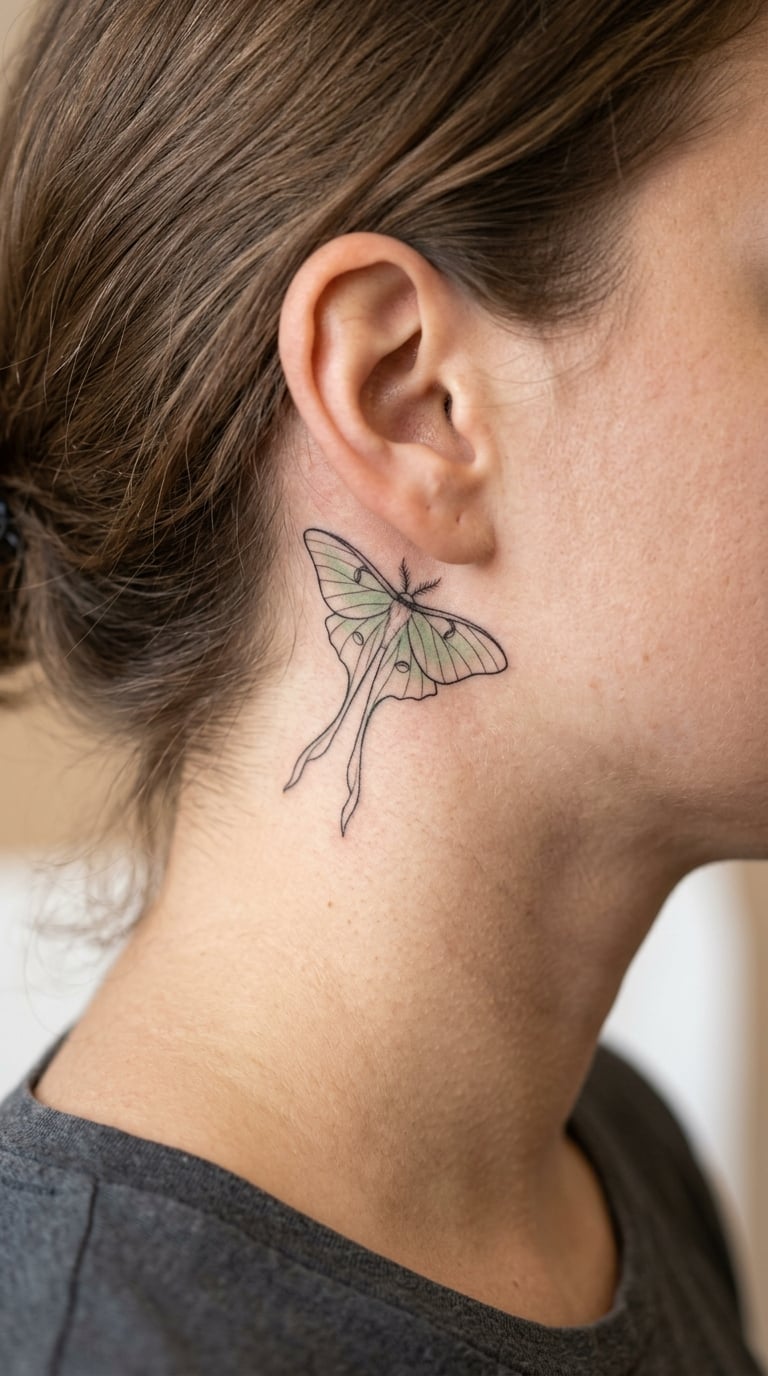
A single hairline luna moth tucked behind the ear is the quietest way to do this symbol. Fine line suits it because the wing edges do the drawing without any fill, and green or black ink both work at this scale.
Behind the ear the skin is thin and the space is small, so the moth stays compact. It is the version people pick when they do not want to explain it, and it is very easy to hide under long hair.
Pain and time: the neck and behind the ear sting more than most people expect, and it is a sensitive spot to sleep on while it heals. A moth this size is usually a short single session, with two to three weeks of tenderness.
2. Blackwork Death’s-Head Hawkmoth on the Inner Forearm
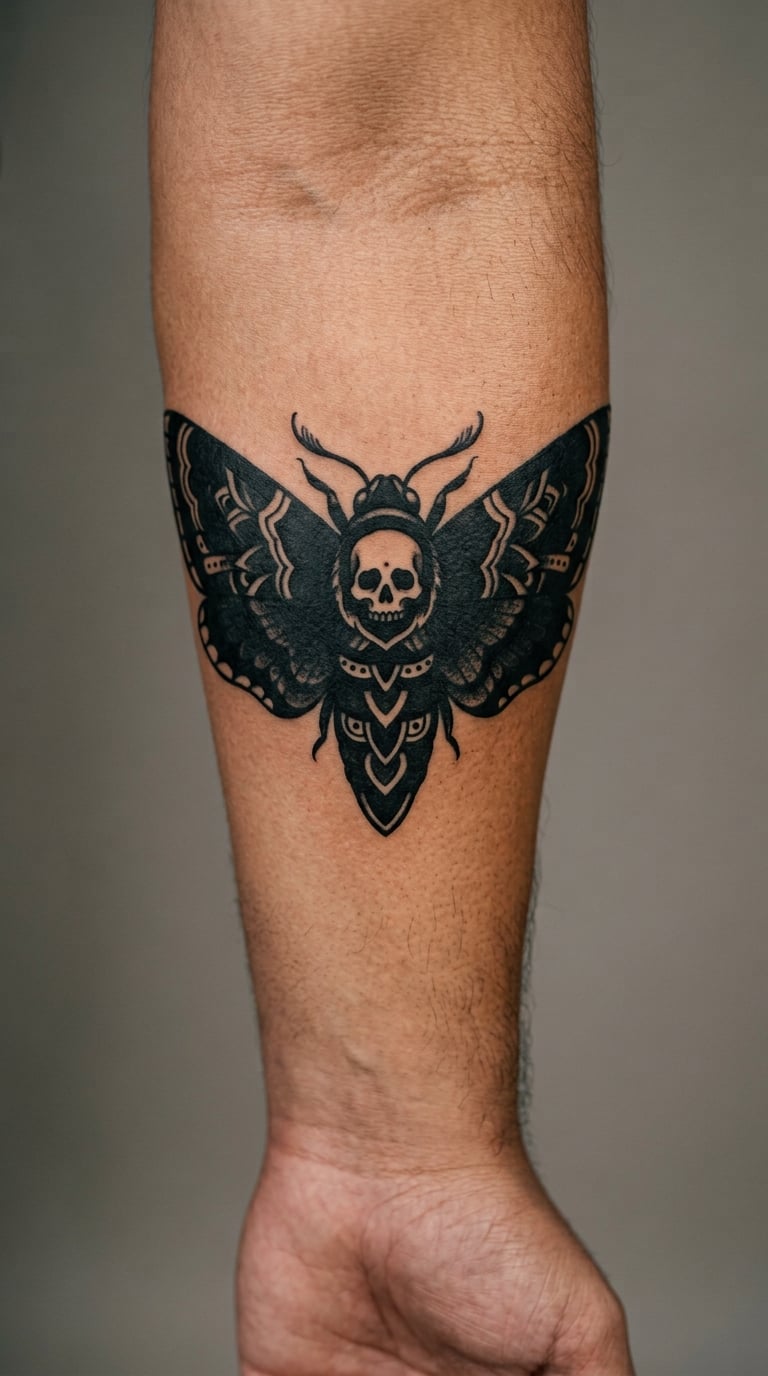
This is the heaviest of the twelve. The skull marking on the thorax is the entire design in one spot, and blackwork gives it the weight of a traditional piece rather than a botanical study.
The inner forearm is a flat, forgiving canvas and it is the easiest place to read fine chest-hair detail at a reasonable size. Expect a long-ish session because the solid black fill takes patience to lay down.
Pain and time: inner forearm is a 5 out of 10 for most people, with the wrist side noticeably sharper. Leave room for a multi-hour session and two to three weeks before the linework stops looking raised.
3. Realistic Atlas Moth Across the Shoulder Blade
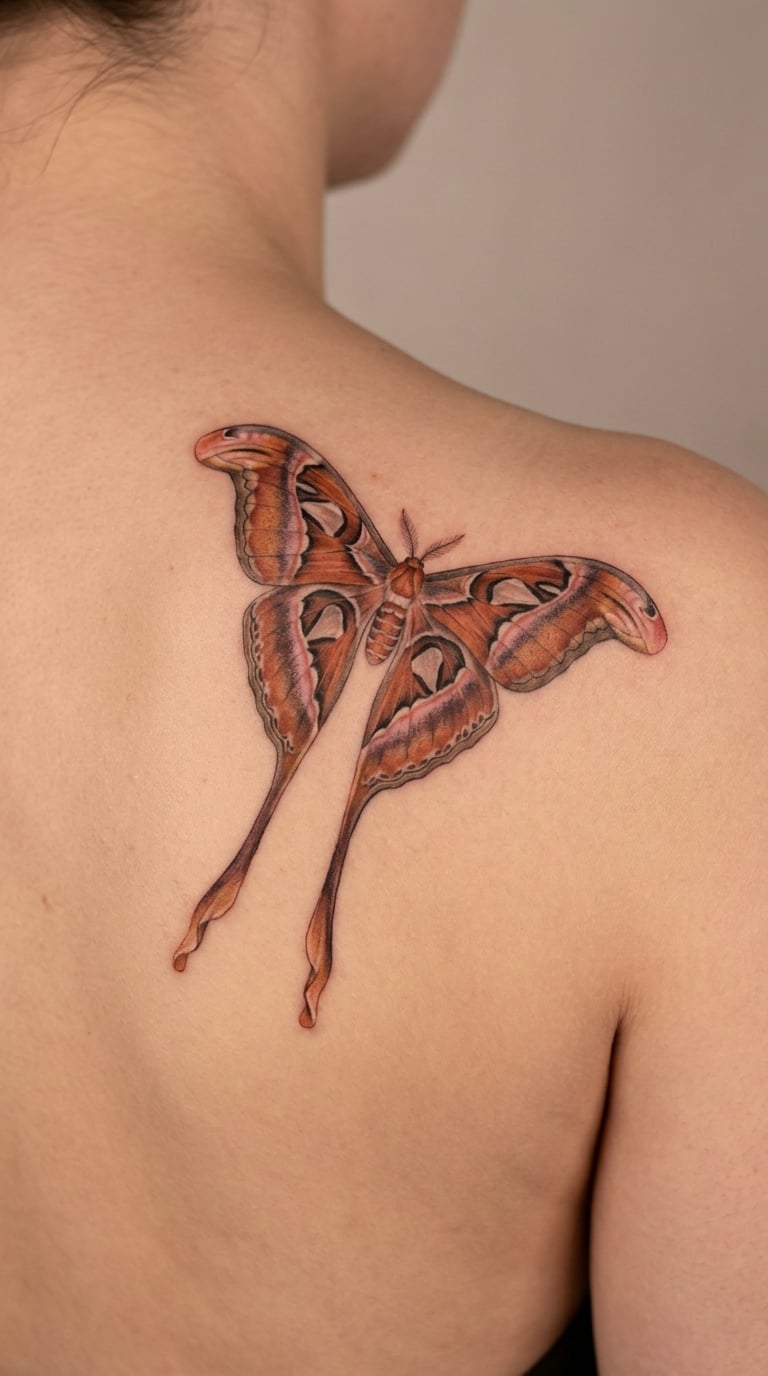
A realistic atlas moth rewards a large flat area. The rust and orange pattern plus the window shapes in the wings give an artist plenty to work with, and the tail streamers look best with room around them.
Shoulder blades are a popular place for moth tattoos because the wings sit symmetrically along the spine. This is a piece that reads as a design choice rather than a small symbol, and it holds colour far better than blackwork would.
Pain and time: upper back is one of the easier placements, closer to a 3 or 4 out of 10, but you cannot watch it and the chair is usually upright. Four to six weeks of healing, and plan the sleeping position before the day.
4. Rosy Maple Moth in Small Scale on the Wrist
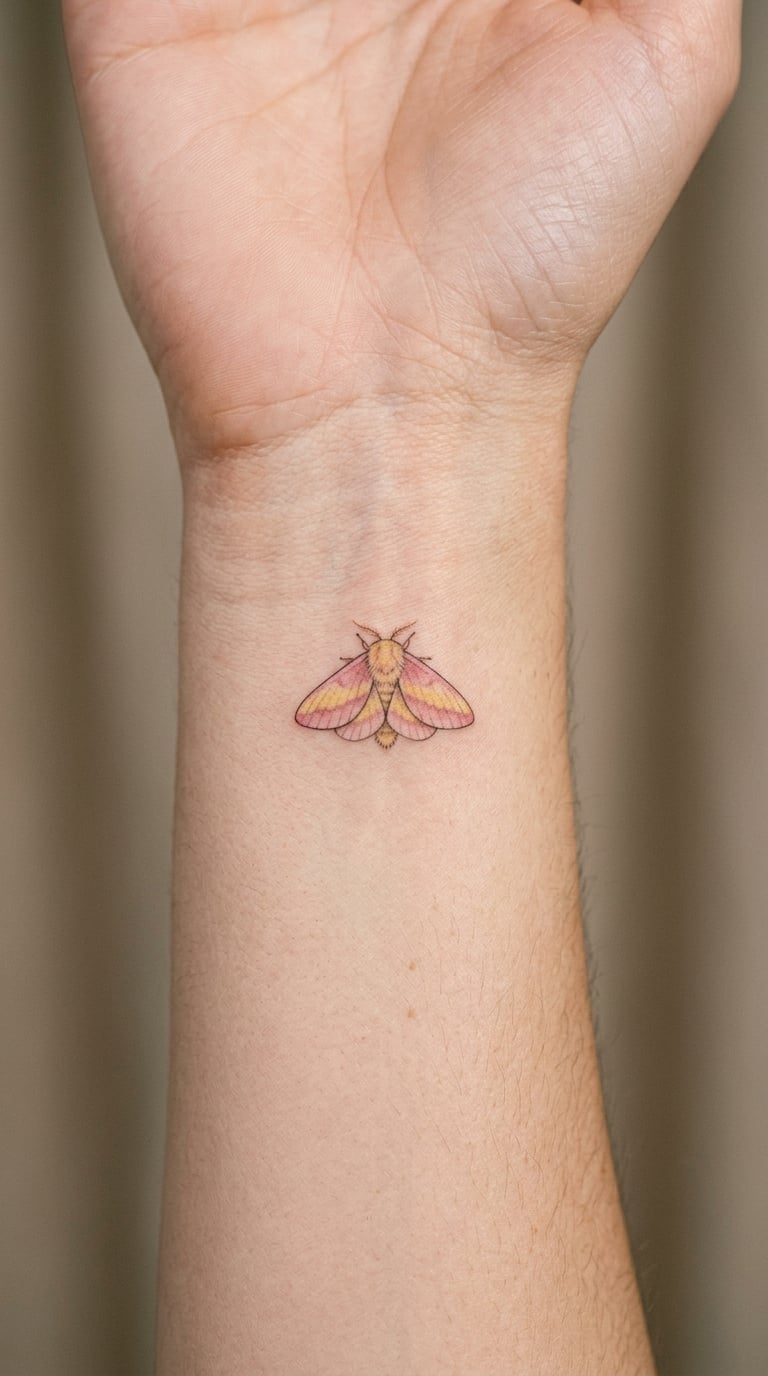
The rosy maple moth at wrist scale is the version that looks like a piece of jewellery rather than an insect. Its pink and yellow colouring survives the small size, which plain blackwork would not.
Inside of the wrist means a very small tattoo, so the artist has to simplify the wing pattern to a few confident shapes. Get the scale decided before the stencil goes on, because there is no room to add detail afterwards.
Pain and time: wrist and inner arm sit around a 5 or 6 out of 10, and wrist tattoos tend to stay tender longest. Sun exposure on that spot matters more than anywhere else on the arm, so it needs covering for the first few weeks.
5. Luna Moth Under a Crescent Moon on the Sternum
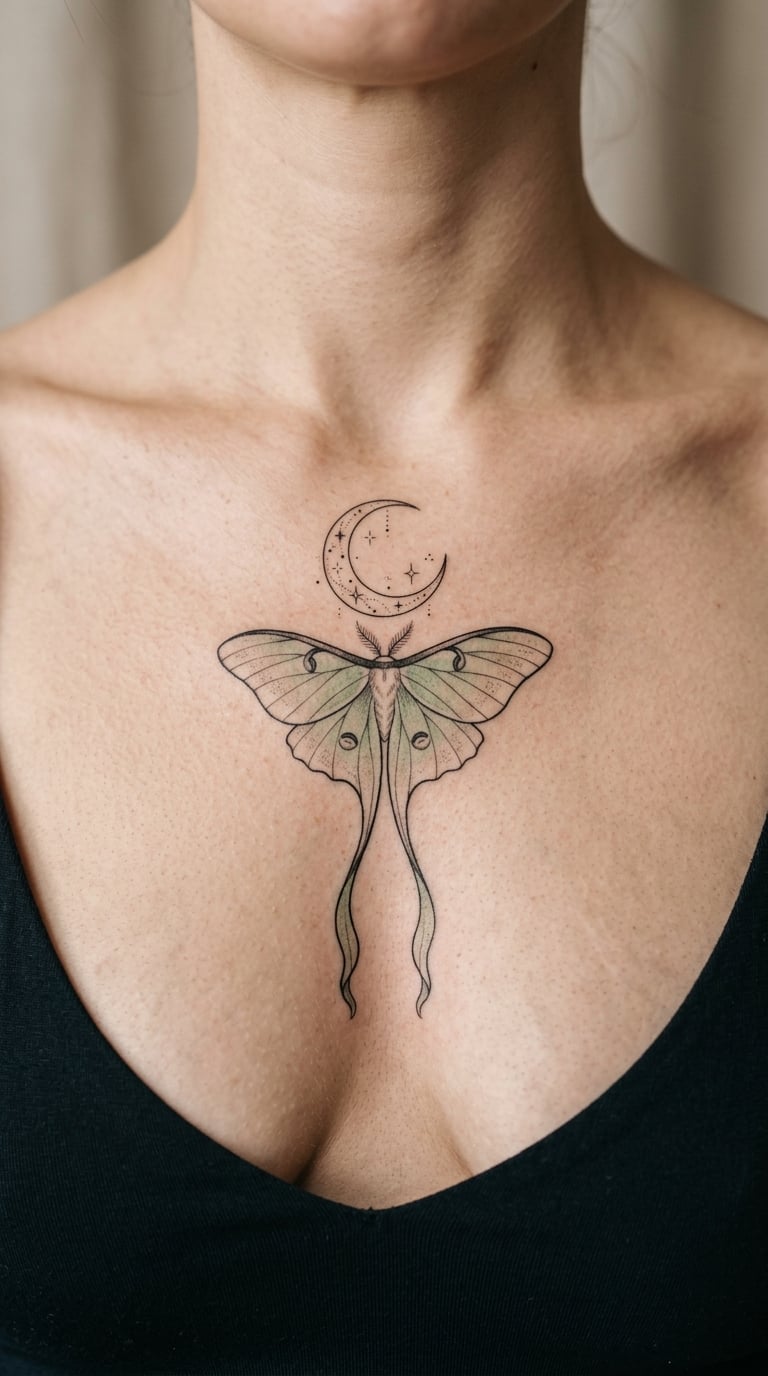
Moon and moth is the most requested pairing in this whole list, and the sternum is why. A moth under a crescent reads as the night creature under the thing that lights the sky, and the composition sits in the exact centre of the chest.
Sternum skin barely stretches, so the drawing needs to be built for a narrow vertical column. Fine line works better than colour here, and keeping the moon as a thin crescent stops the two elements competing.
Pain and time: the sternum is sensitive bone-adjacent territory, often a 7 out of 10, and it bumps against everything. Expect a two to three hour session and around three weeks of noticeable tenderness.
6. Minimal Dotwork Moth on the Ankle
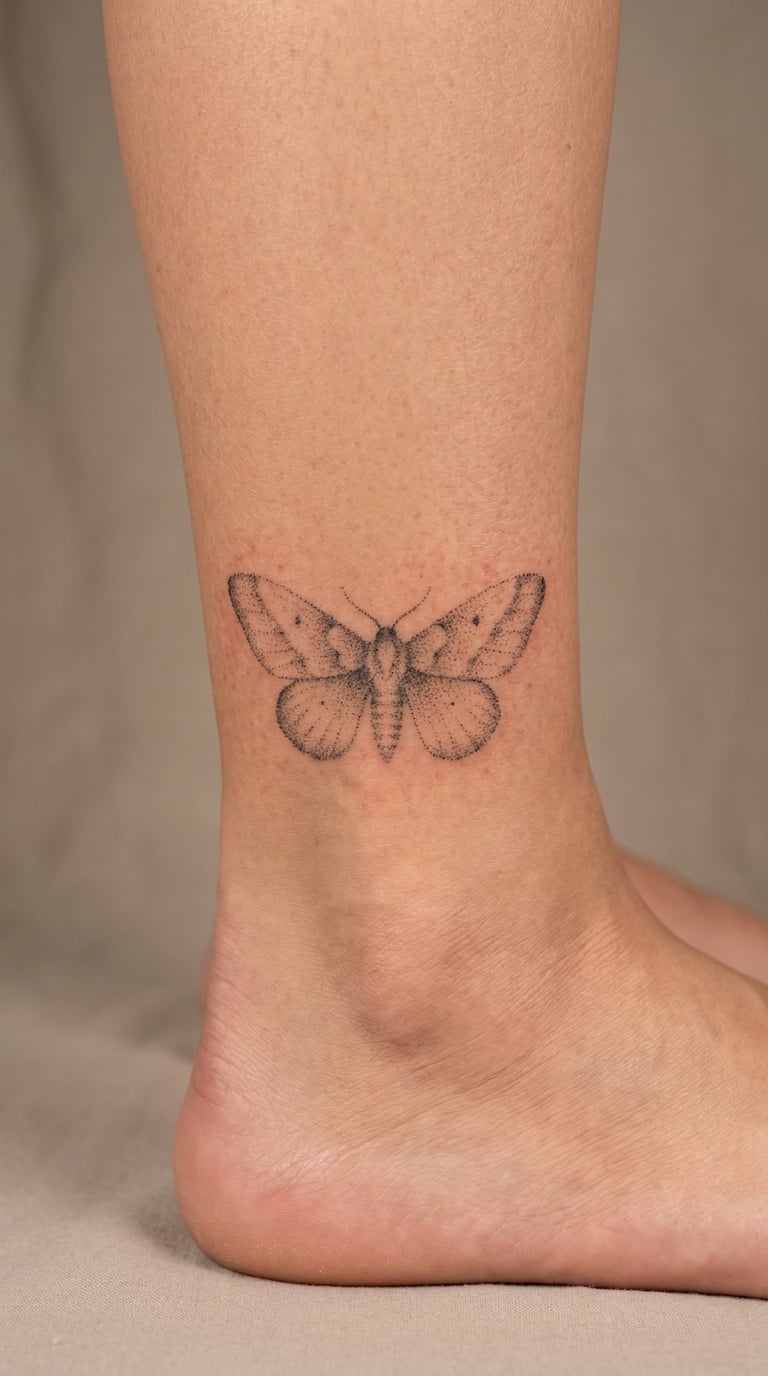
Dotwork handles the moth well because the stippling can build the same soft gradient across a wing that a wash would. It also hides a mistake better than a hard black outline, which matters on ankles.
An ankle placement is visible when you wear shoes and hidden when you do not, so it works for someone who wants a tattoo they control. The foot and ankle swell and shift during the day, so the artist should place it with you standing.
Pain and time: ankle bone is about a 5 out of 10, and the swelling in the first couple of days makes the design feel tight. Two to four weeks, and it needs sun protection permanently if you want the dots to stay crisp.
7. Atlas Moth with Long Tails on the Thigh
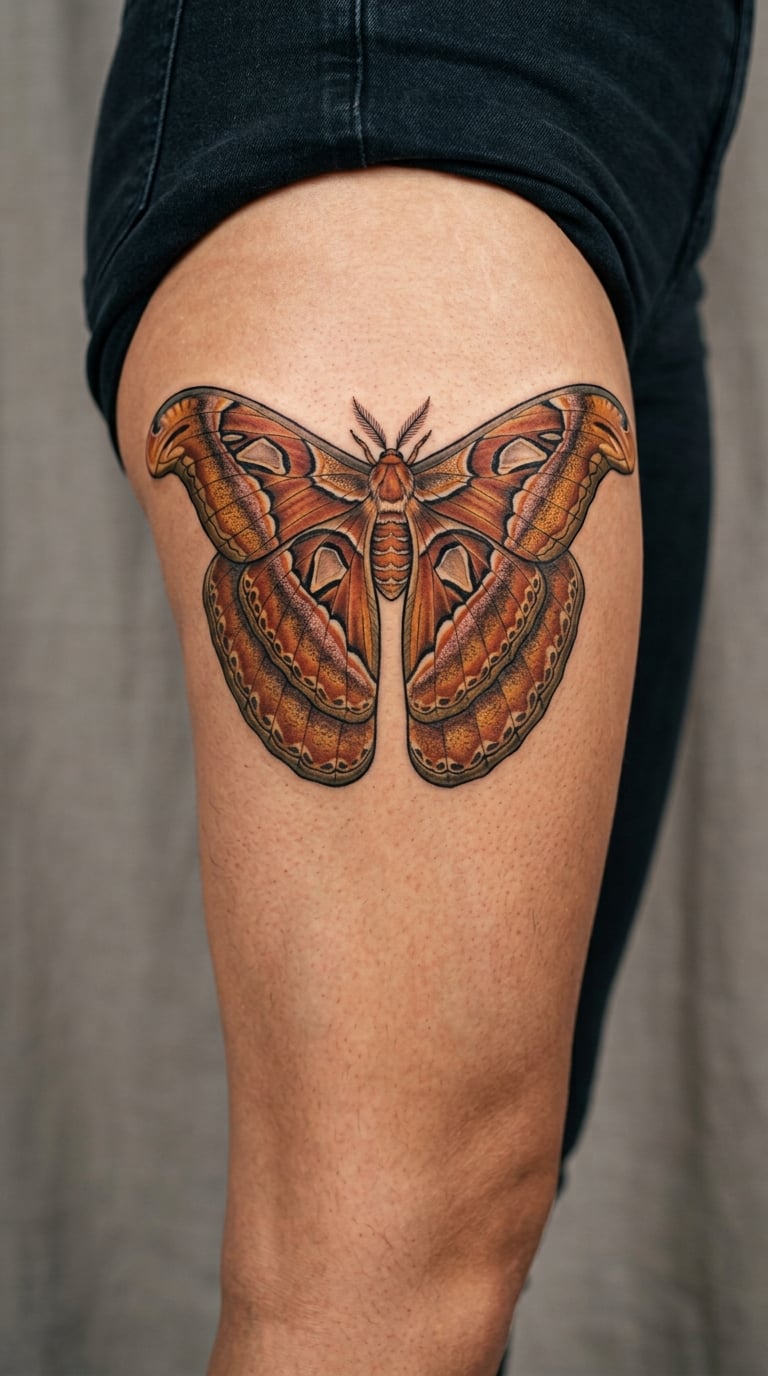
The long hindwing tails on an atlas moth give you a shape that fills a thigh beautifully without needing a dense background. This is the largest-scale option here and the one that most looks like a mural piece.
Outer thigh is a large flat area with a decent amount of give, so it takes both a detailed realism approach and a bold graphic one. The design reads well from a distance, which is where the tails do the work.
Pain and time: thigh is comfortable, usually a 3 out of 10, though a piece this size runs long. Budget a full day or two sessions, and allow six to eight weeks before judging the colour.
8. Green-Illuminated Black Witch Moth on the Calf
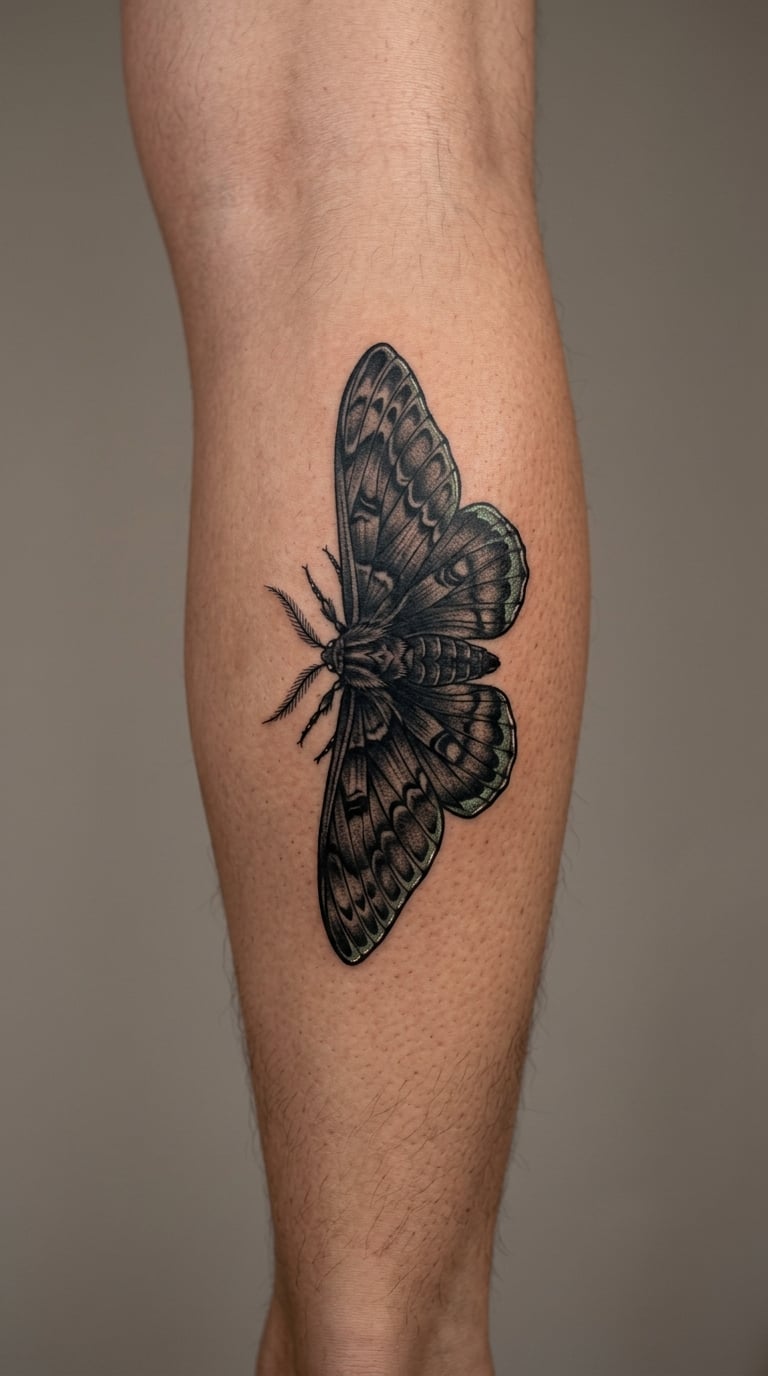
Adding green sheen to a black witch moth shifts the meaning slightly. The dark body still carries shadow work and intuition, and the green brings the growth and healing reading with it.
The calf is a good canvas for a design with a gradient, because the muscle gives the shading a surface to wrap around. Pair it with a small constellation or a few stars if you want the nocturnal context to read clearly.
Pain and time: calf is one of the more tolerable spots, around a 4 out of 10, and the skin heals well there. Three to four weeks, with colour settling noticeably around week three.
9. Emperor Moth Down the Spine
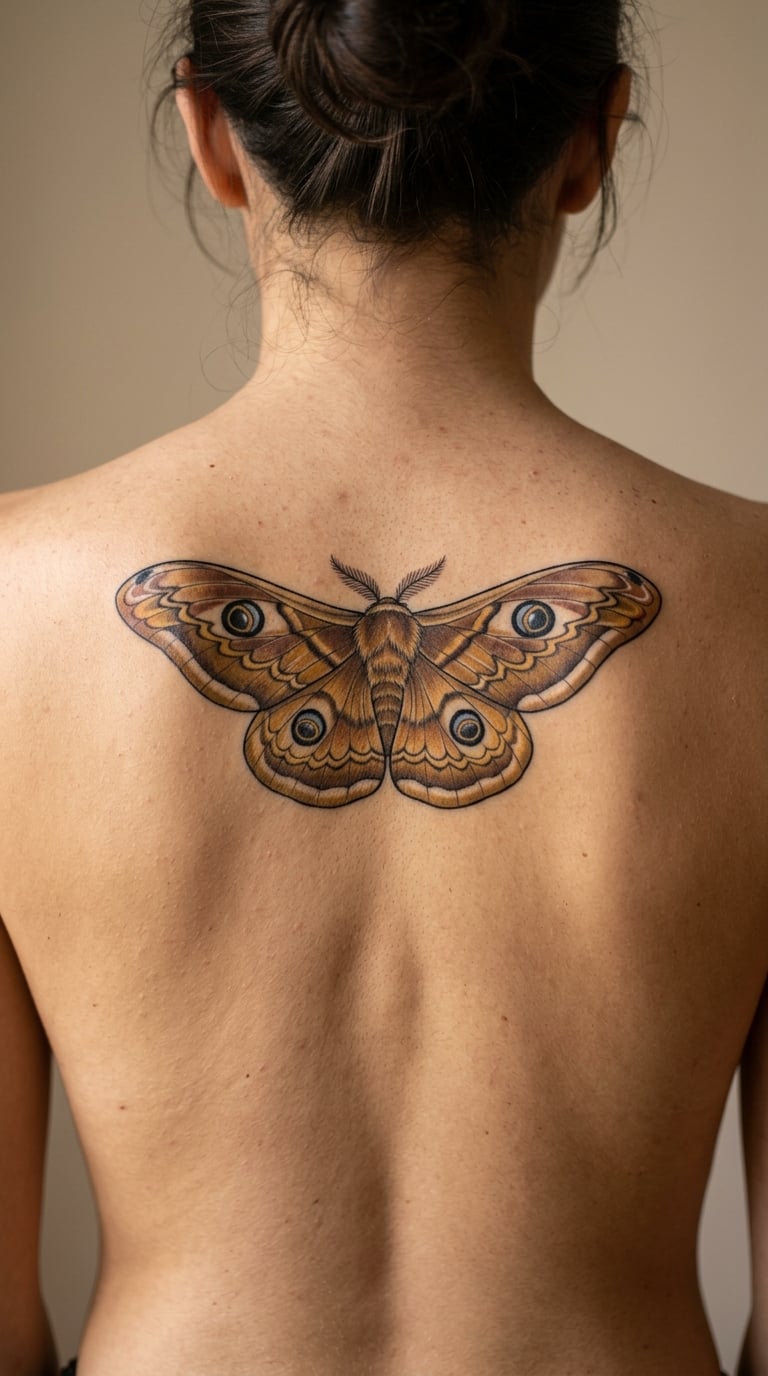
A moth running down the spine is unusual in the best way, because the body position reads as a line of transformation running through the centre of you. The emperor’s circular wing markings give each half a clean anchor.
Central back work is done standing or leaning, and the artist needs the space between your shoulder blades to be relaxed. Keep the moth narrow enough to fit between the shoulder blades if you want it that high.
Pain and time: the spine is a bony, sensitive strip, usually a 6 out of 10, and you will feel every pass. Sitting still for two or three hours is the hard part rather than the pain. Four weeks of healing, and expect some tenderness when you lie down.
10. Moth and Wildflowers on the Outer Forearm
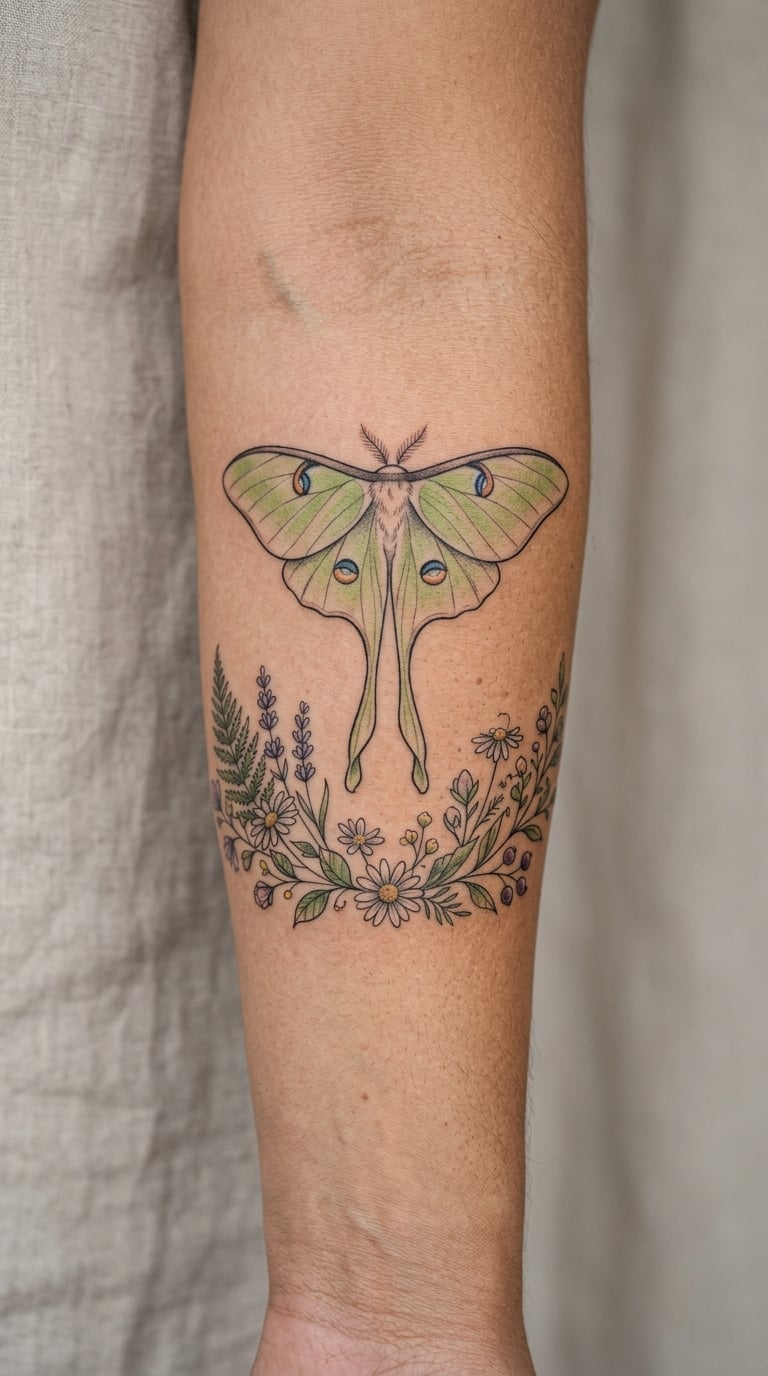
A moth above a band of wildflowers is the gentlest version of this symbol and it works well as a memorial or a relationship piece. The flowers give the drawing a base and stop it floating.
Outer forearm takes a horizontal composition nicely, so this can be small and neat or extended into a longer piece. Fine line with a few colour touches in the flowers keeps it soft without turning sentimental.
Pain and time: outer forearm is around a 4 out of 10 and heals predictably. Two to four weeks, and the flowers will need a couple of touch-ups if you want the petals crisp.
11. Two Moths Circling a Flame on the Upper Arm
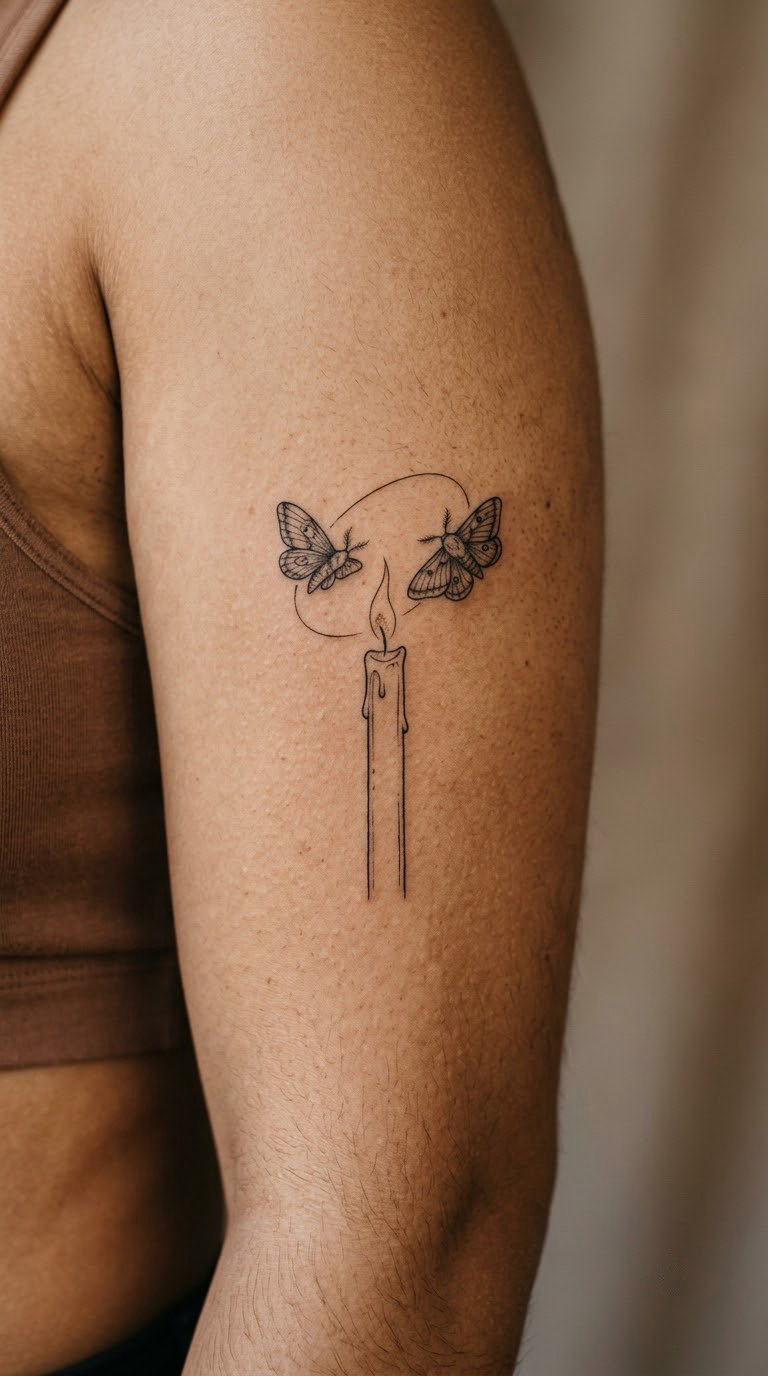
Two moths and a flame is the more complex emotional option. Depending on how you read it, it is either mutual guidance or two people drawn to the same thing, and people rarely agree on which.
Upper arm gives a big enough flat area to leave space around the flame, which is the part that makes the composition read. Keep the flame small. A large candle turns the drawing into a piece about the flame.
Pain and time: upper arm is easy on pain, around a 3 or 4 out of 10, and a session of two to three hours is normal. Three to four weeks of healing, and the wrist-to-elbow area will fade fastest.
12. Vintage Field-Guide Moth Plate on the Biceps
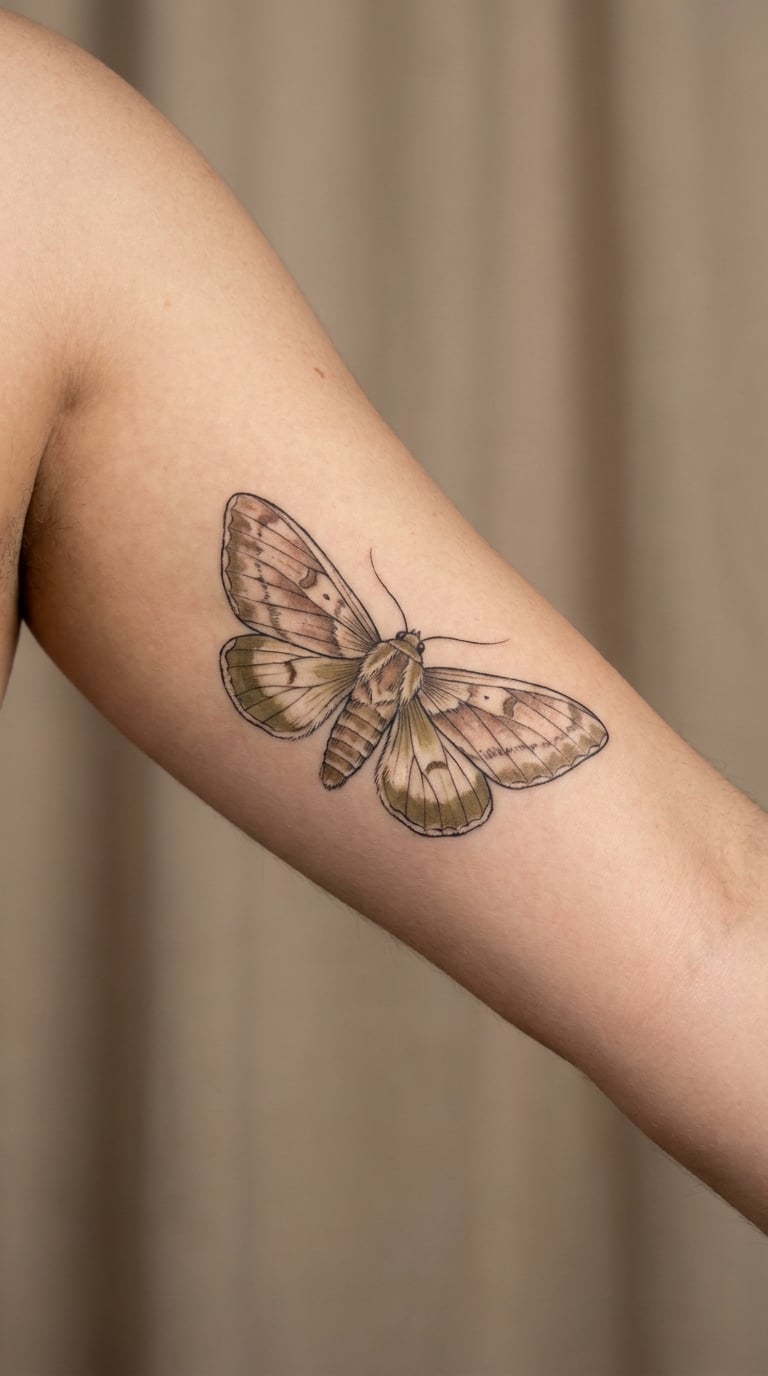
A field-guide plate is a moth drawn the way it appears in an old natural history book: outlined, labelled in feel, evenly spaced, no drama. It suits someone who likes the science of the insect more than the poetry.
The biceps is a decent oval surface for a plate-style layout with a border. Black and grey linework with a single muted wash colour keeps the vintage look without turning brown.
Pain and time: outer upper arm is one of the easier spots, around a 4 out of 10, with a two to three hour session. Three to four weeks, and fine hairline detail there fades faster than detail on the back.
Things to Know Before You Book a Moth Tattoo
Pick the artist off their portfolio, not their front page. Moths are drawn badly more often than butterflies because artists default to a smooth symmetrical shape, and the antennae give it away. Look for someone whose work handles thin detail, wing translucency and asymmetry.
Fix the scale at the consultation. Most moth tattoos that read as butterflies are simply too small for the antennae and the feathery edges. Under about five centimetres across the wingspan, ask for a simpler version or a bigger placement.
Expect a session length that matches the detail. Small fine-line work is under an hour, a realistic piece on the back is a half-day, and anything large on a thigh usually runs over multiple sessions. A moth with a colour gradient takes longer than a line drawing because the shading has to settle.
Check how they place the stencil. For ankles, wrists and lower backs the body shape changes through the day, so a stencil laid while you are lying down can land somewhere completely different. Standing or sitting upright gives a more accurate result.
On pain, expect a 3 out of 10 on the upper arm and thigh, a 4 on the calf and back, a 5 on the wrist and outer forearm, a 6 on the spine, and a 7 on the sternum and behind the ear. Ribs hurt more than the spine and fade faster, so I would avoid ribs for anything fine-lined.
Aftercare is unremarkable: wash it morning and evening, keep it moisturised but not wet, leave the film alone when it peels, and do not soak it for about three weeks. Sun is the one that actually ruins moth tattoos. Ultraviolet light fades the pale luna green and yellow first, so if it is on an arm or a leg, cover it or use sunscreen for the rest of your life.
Cost varies widely with size, detail, colour and where you are, so ask for a quote at the consultation rather than assuming a flat rate. A small fine-line moth and a large realistic atlas across the back are not the same job, and treating them as one is how people get surprised.
Frequently Asked Questions
What does a moth tattoo mean?
A moth tattoo most often means transformation, resilience and the pursuit of inner truth. Moths undergo complete metamorphosis, navigate darkness by instinct, and circle light because their navigation sense misfires around artificial sources. The symbol therefore suits people marking a change that happened quietly, or a recovery nobody else saw.
What does a moth signify spiritually?
Spiritually, the moth is usually read as the soul rather than an omen. It moves between the visible world and the one people cannot see, which makes it a common symbol for a guide, a message, or a visit from someone who has died. In folk tradition a moth indoors is often told as a relative checking in, though that is a story people tell rather than doctrine.
Do moths represent transformation?
Yes, and it is the single most common reading. The moth goes through complete metamorphosis as a larva, a pupa and a winged adult, rebuilding its body in the process. That real biology is why the symbol lands, and why it is picked after a recovery, a move, a breakup, or any other change that rewrote how someone lives.
Are moths an LGBTQ symbol?
There is no flag, organisation or documented movement history behind the moth as an LGBTQ symbol. What exists is a contemporary personal and community reading: coming out, transition, and becoming visible on your own terms after a long period of hiding. Plenty of people also wear the same moth for grief or sobriety, and the meaning belongs to the wearer.
Which moth is associated with rebirth?
The luna moth (Actias luna) is the one most associated with rebirth and new beginnings. Its pale green wings, long tail streamers and light overall tone read as hopeful rather than heavy. If you want grief or mortality instead, the death’s-head hawkmoth with its skull marking is the species tattooed for that meaning.
What does it mean when someone gets a moth tattoo?
Most people choose it after a season they would rather not celebrate publicly, such as recovery, a loss, an ending, or a move to a new city. Some pick it because the insect keeps appearing around them and it has started to feel like a marker. A moth drawn alone usually means transformation, while one drawn with a flame can mean being consumed by something false.
Conclusion
Moth tattoo meaning comes down to transformation that happened in private, plus a light you kept following before you knew whether it was good for you. The species you choose and the flame you leave out will say more about your version of that than any list of meanings will.
Start by deciding which reading is yours, then bring two or three references to a consultation and get the scale settled on the body before anything else. If you have been noticing moths for years, that is reason enough on its own.