
24 Best Dog Portrait Tattoo Ideas for Pet Lovers (September 2026)
Dog portrait tattoo ideas rank high for one reason: people want the face of their own dog, not a generic paw print. A portrait keeps a specific expression permanent, whether that dog is asleep on the sofa right now or gone for years. Everything below is judged the same way — how well the likeness survives on skin, how small it can go, and how it looks in ten years.
These 24 designs span fine line, blackwork, realism, watercolor, dotwork and graphic colorblocking, from a 2 inch piece behind the ear to a 6 inch portrait on the arm. If you are booking around a milestone, most people wait six to eight weeks so the piece is fully healed before a trip, a photo day, or a hard summer in the sun.
A note before you scroll: a dog portrait tattoo is only as good as the reference photo, and only as forgiving as the style you pick. Realism demands a bigger canvas and a specialist. Fine line and illustrative versions are the ones that still read clearly at small sizes and after a decade of fading.
Dog Portrait Tattoo Ideas: Quick Guide
Here are all 24 designs at a glance, in the same order as the sections below. Use the table to shortlist two or three, then take those to a consultation.
| Idea | Style | Best placement | Size | Pain |
|---|---|---|---|---|
| 1. Fine-line side profile | Fine line | Inner forearm | 2-3 inch | Low |
| 2. Realistic forearm portrait | Black-and-grey realism | Outer forearm | 4-6 inch | Medium |
| 3. Traditional with red collar | Neo-traditional | Upper arm | 3-4 inch | Medium |
| 4. Watercolor portrait | Watercolor | Upper shoulder | 3-5 inch | Medium |
| 5. Blackwork clear gaze | Blackwork | Upper arm | 5-6 inch | High |
| 6. Minimalist wrist portrait | Minimalist line | Inner wrist | 1.5-2 inch | Low |
| 7. Micro-realism sleeping dog | Micro-realism | Ankle or inner arm | 2-2.5 inch | Medium |
| 8. Dotwork portrait | Dotwork | Calf | 3-4 inch | Medium |
| 9. Circular framed portrait | Fine line, framed | Shoulder | 3-3.5 inch | Medium |
| 10. Colorblocked portrait | Graphic colorblock | Upper arm | 4-5 inch | Medium |
| 11. Portrait with flower accent | Semi-realism | Forearm | 3-4 inch | Medium |
| 12. Geometric portrait | Geometric realism | Upper arm | 4-5 inch | Medium |
| 13. One-line portrait | Continuous line | Inner bicep | 2.5-3 inch | Low |
| 14. Heart-shaped background | Fine line | Forearm | 3 inch | Medium |
| 15. Dog holding a toy | Illustrative realism | Calf | 3-4 inch | Medium |
| 16. Small circle on the ankle | Fine line blackwork | Outer ankle | 2-2.5 inch | Medium |
| 17. Soft shaded collarbone | Soft black-and-grey | Collarbone | 2.5-3 inch | Medium |
| 18. Portrait with collar tag | Realism with lettering | Inner arm | 3.5-4 inch | Medium |
| 19. Black-and-grey soft fur | Realism | Outer arm | 5-6 inch | High |
| 20. Small portrait on the rib | Fine line | Ribcage | 2.5-3 inch | Medium |
| 21. Matching portrait and paw | Two-piece fine line | Both forearms | 3 inch plus 1 inch | Medium |
| 22. Back-of-arm expressive portrait | Blackwork | Back of upper arm | 4.5-5 inch | Medium |
| 23. Behind the ear | Fine line | Behind the ear | 1.5-2 inch | Low |
| 24. Custom portrait from a photo | Custom realism | Upper arm or thigh | 4-7 inch | High |
1. Fine-Line Side-Profile Dog Portrait
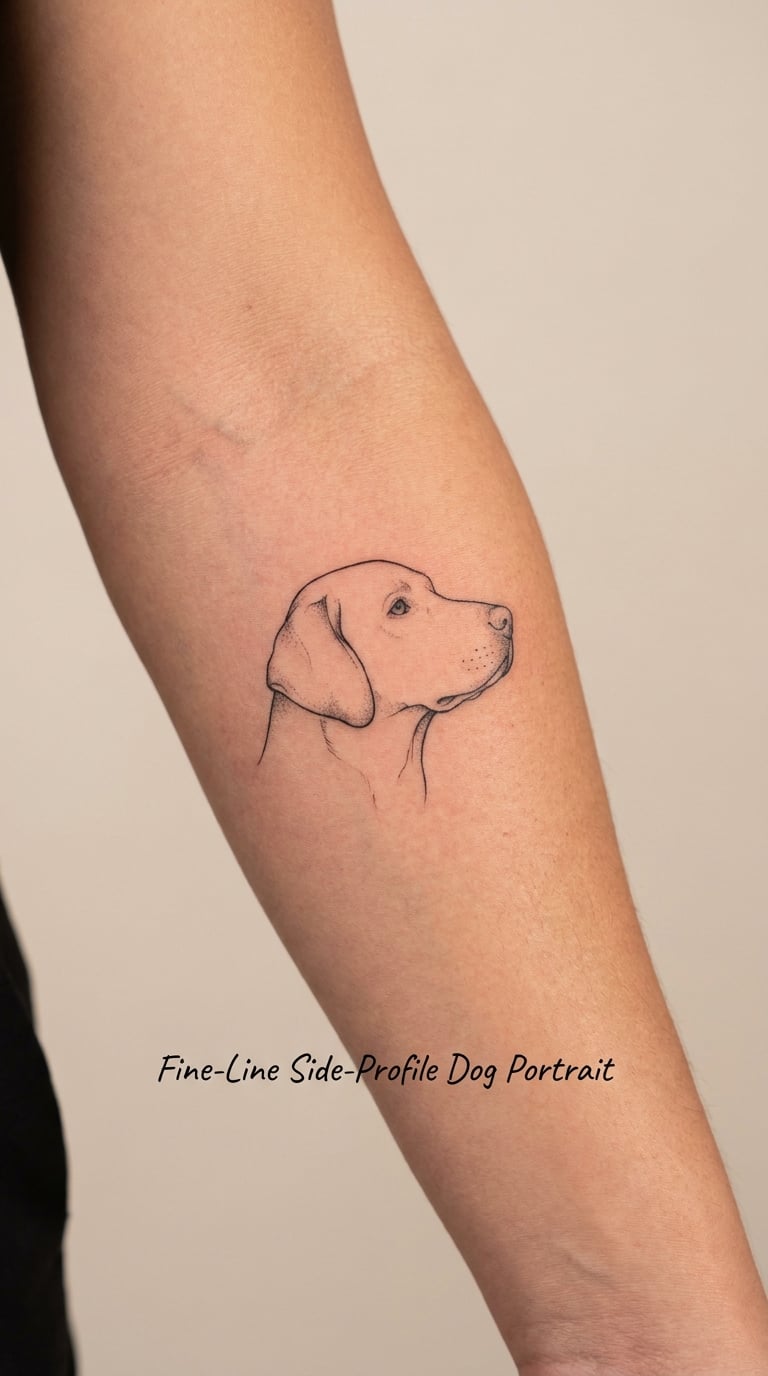
A fine-line side profile is built from a single confident contour: forehead, muzzle, ear, throat, chest. Shading stays to a few soft grey patches under the jaw and behind the ear, so the drawing reads as a shape rather than a picture. Most people choose it because it looks elegant at a glance and asks very little of the artist’s hand.
It usually means companionship — the specific dog you walked with, and the direction it faced on your walks together. People rarely attach a fixed meaning beyond that.
Placement: inner forearm, inner bicep, or the rib. Size: 2-3 inch (5-7.5 cm) tall. Style: fine line. Pain: low on the inner forearm. Ageing note: single-needle lines on the inner arm soften and grey out over roughly a decade, so keep line weight up if you want it crisp long term.
Make it yours: add a single small element at the end of the outline, like a collar tag shape, a paw, or a paw print tucked under the chest line.
2. Realistic Dog Portrait on the Forearm
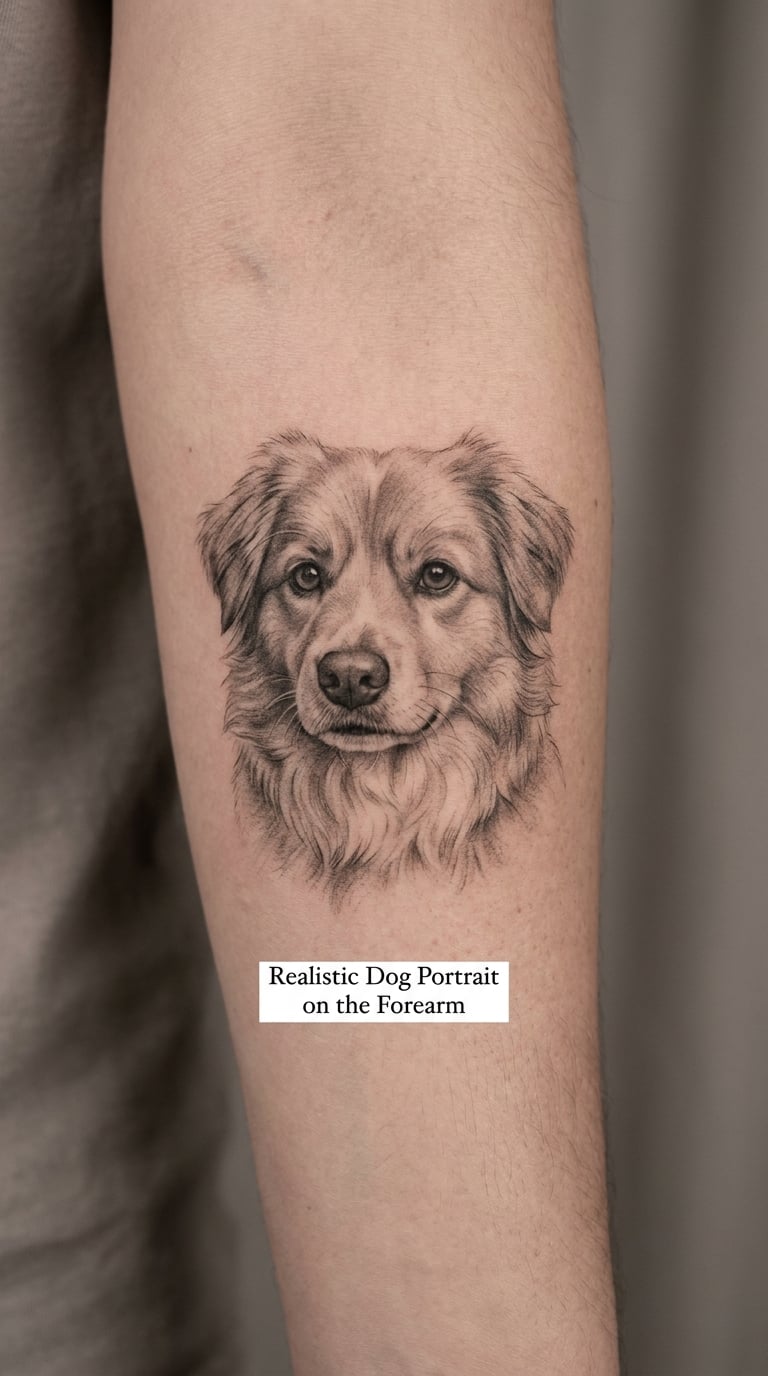
This is the full photorealistic treatment: layered grey gradients in the fur, a dark pupil with a clear catchlight, whiskers fading into nothing, and soft shadow under the muzzle. The likeness comes from value ranges more than from outlines, which is why it needs real canvas and a steady sitting.
It is the version people tattoo for a dog they are completely tied to, living or gone. The face is doing all the work, so no text or extra imagery is needed.
Placement: outer forearm or upper arm. Size: 4-6 inch (10-15 cm) tall. Style: black-and-grey realism. Pain: medium to high across a forearm of that size. Ageing note: mid-tone greys in shaded fur can flatten a little over time, so an artist who mixes in true black keeps contrast longer.
Make it yours: pick a photo where your dog is mid-expression rather than asleep, and mark which features must read first at walking distance.
3. Traditional Dog Portrait with a Red Collar
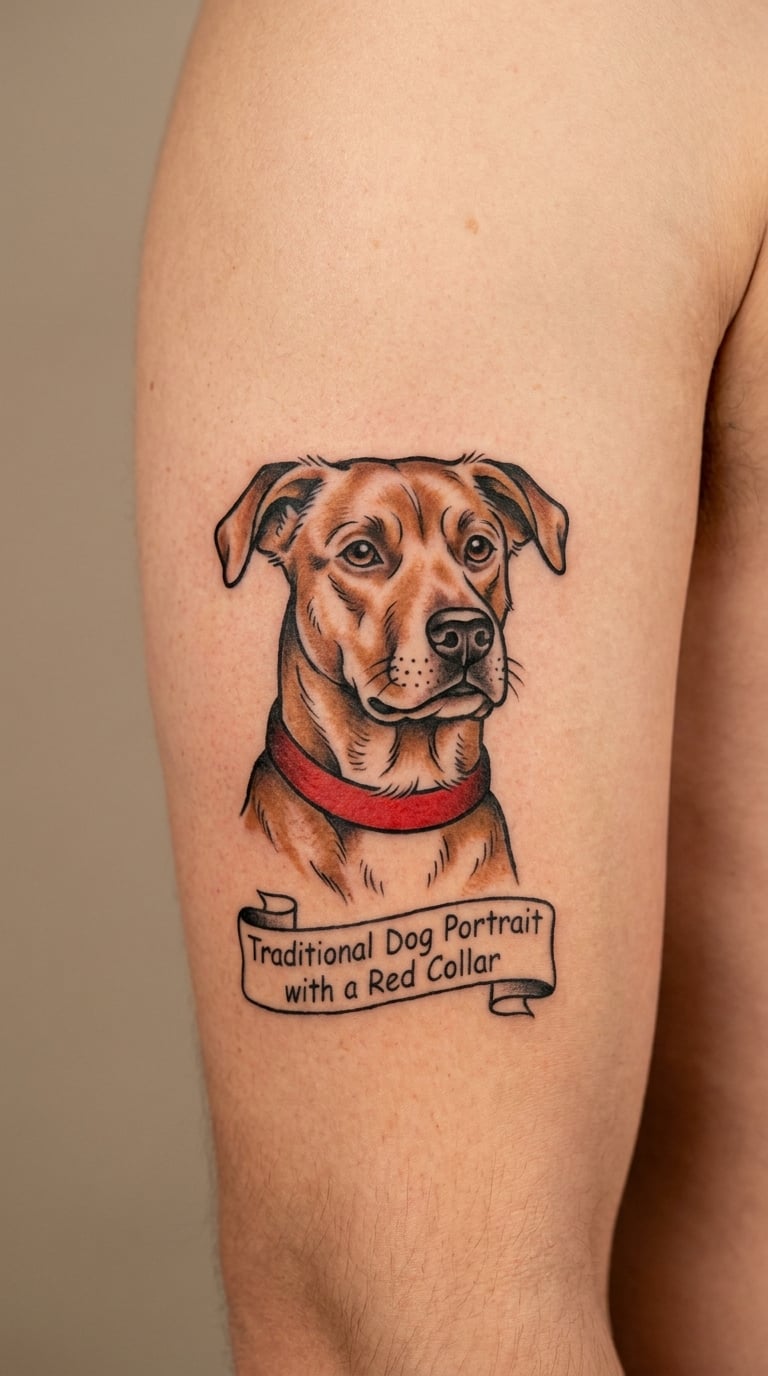
Traditional style throws away realism on purpose: thick confident outlines, flat blocks of colour, a limited palette of warm browns and tans, and one saturated accent. The red collar is that accent, and it does a lot of work — it separates the head from the neck and reads instantly at any distance.
People pick this when they want the tattoo to feel like a keepsake or a badge rather than a photograph. The collar is often the actual collar the dog wore.
Placement: upper arm, calf, or the back of the shoulder. Size: 3-4 inch (7.5-10 cm) tall. Style: traditional or neo-traditional. Pain: medium. Ageing note: bold colour blocks hold their shape better than fine shading, so traditional work often looks tidier as it ages.
Make it yours: copy the real collar colour, or add a small banner underneath with the dog’s name in a plain script.
4. Watercolor Dog Portrait
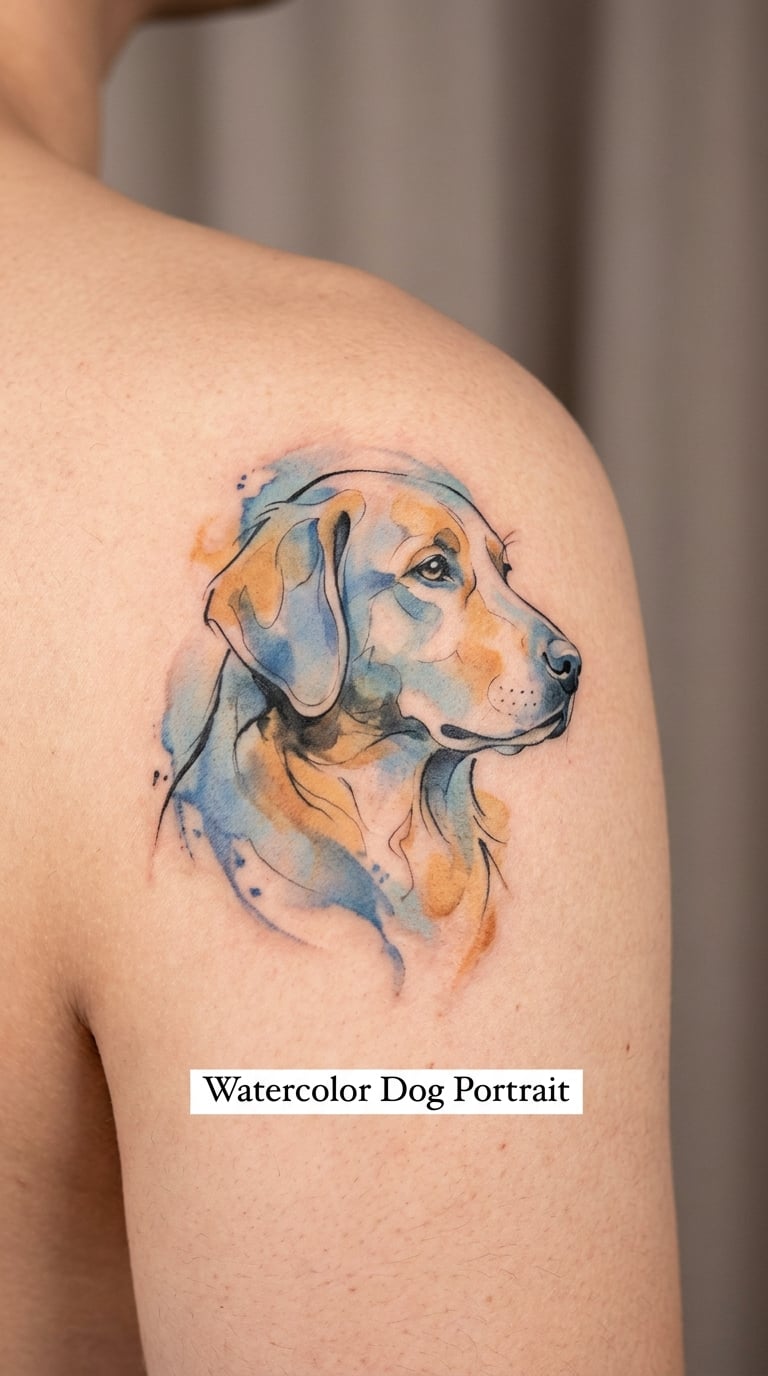
A watercolor portrait is a sketch first: light line drawing of the face, then translucent washes and feathering that let the skin show through like paper. The best versions have no hard border at all, and the colour does not stay inside the lines. Two or three colours is plenty; more turns muddy.
It tends to be chosen for a dog with a specific character rather than a specific face — the scruffy one, the one who was always mid-motion.
Placement: upper shoulder, upper arm, or the back of the arm. Size: 3-5 inch (7.5-12.5 cm) wide. Style: watercolor. Pain: medium. Ageing note: the faintest washes are the first thing to fade, so artists concentrate colour in a few confident pools rather than spreading it evenly.
Make it yours: use the colour of your dog’s collar as the main wash and keep the rest of the palette neutral.
5. Blackwork Dog Portrait with a Clear Gaze
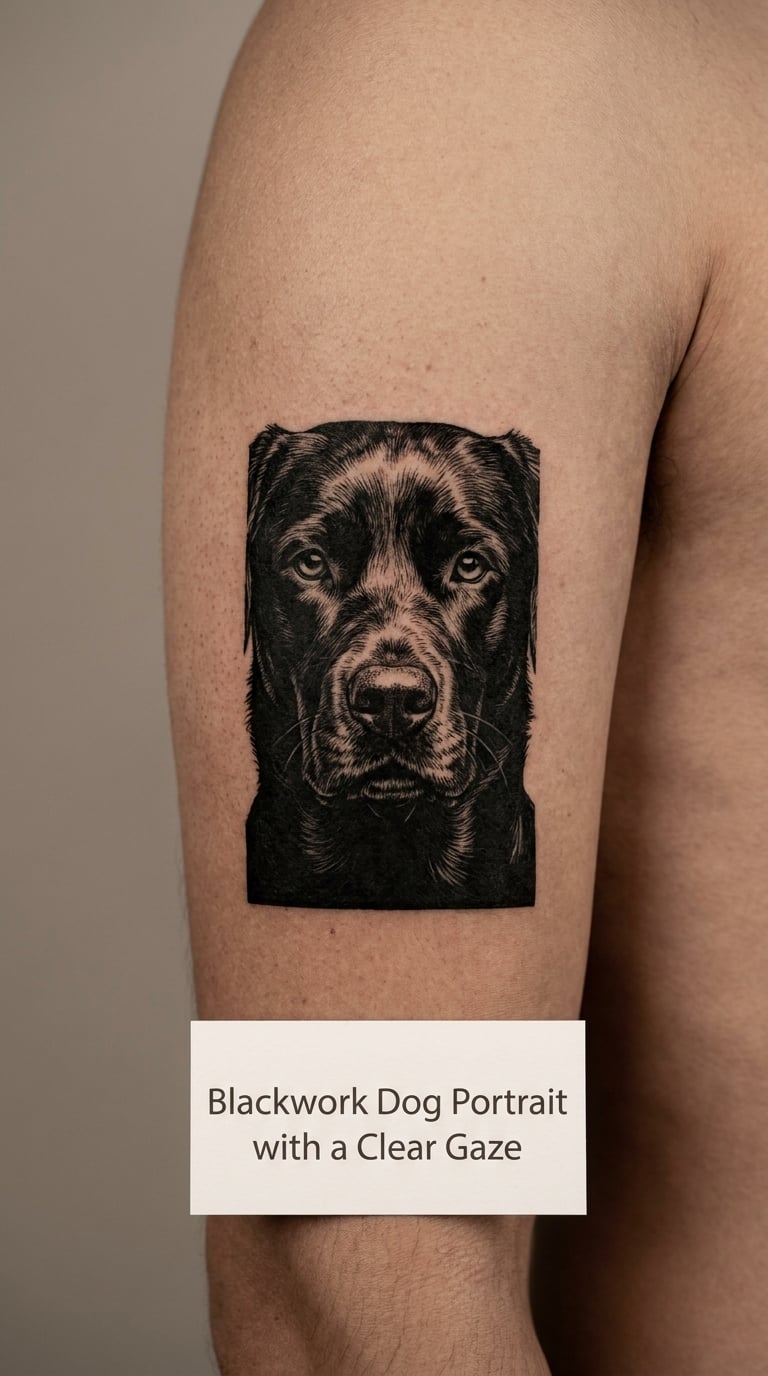
Blackwork is realism pushed to full contrast: solid black masses for the ears and back of the head, sharp white reserved for the eyes and muzzle highlights, and no grey at all. The result is graphic and slightly severe. Most people choosing it want the eyes to carry the whole piece.
The meaning is the same as any portrait — the dog, held on the body — but the attitude is more declarative than soft.
Placement: upper arm or outer forearm. Size: 5-6 inch (12.5-15 cm) tall. Style: blackwork. Pain: high — large solid fills mean repeated passes over the same skin. Ageing note: blackwork is the most durable style on this list because there is nothing subtle to lose.
Make it yours: have the artist keep one ear in solid black and the other in outline, so the light source and the dog’s head turn both read.
6. Minimalist Dog Portrait on the Wrist
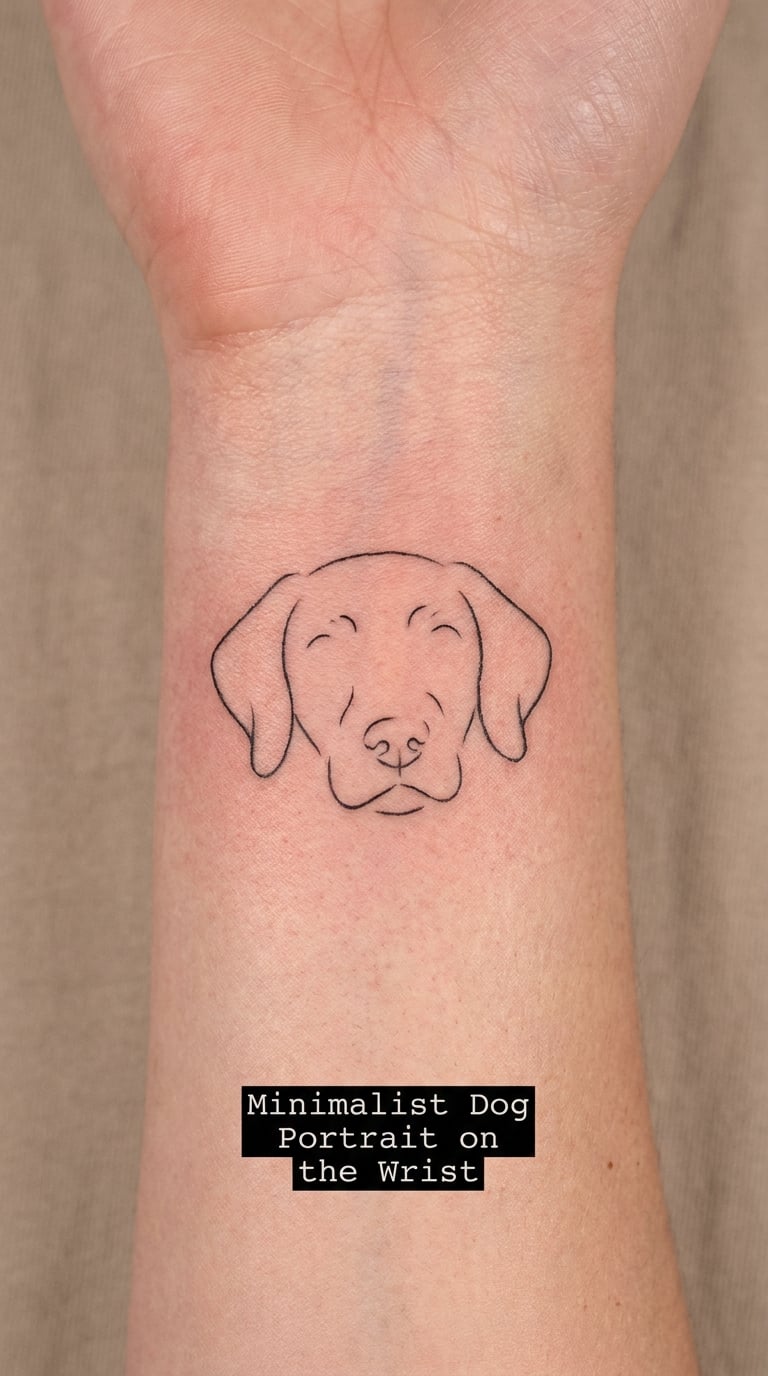
Minimalist versions strip the portrait to the two or three marks that make it your dog: the shape of the head, one eye, an ear that folds forward. It is often drawn as an open contour that stops before closing, which keeps it light and modern. Less detail here is a design decision, not a compromise.
It works best for a dog you see every day, small enough that you catch yourself looking at it.
Placement: inner wrist or the wrist crease area. Size: 1.5-2 inch (4-5 cm) wide. Style: minimalist line. Pain: low, though wrists are bony and the skin is thin. Ageing note: wrists get more sun exposure through clothing and a very small portrait can lose its eye detail first — ask for a slightly heavier line weight.
Make it yours: capture one distinguishing feature only — a crooked ear, a white blaze, a permanently raised eyebrow.
7. Micro-Realism Sleeping Dog Portrait
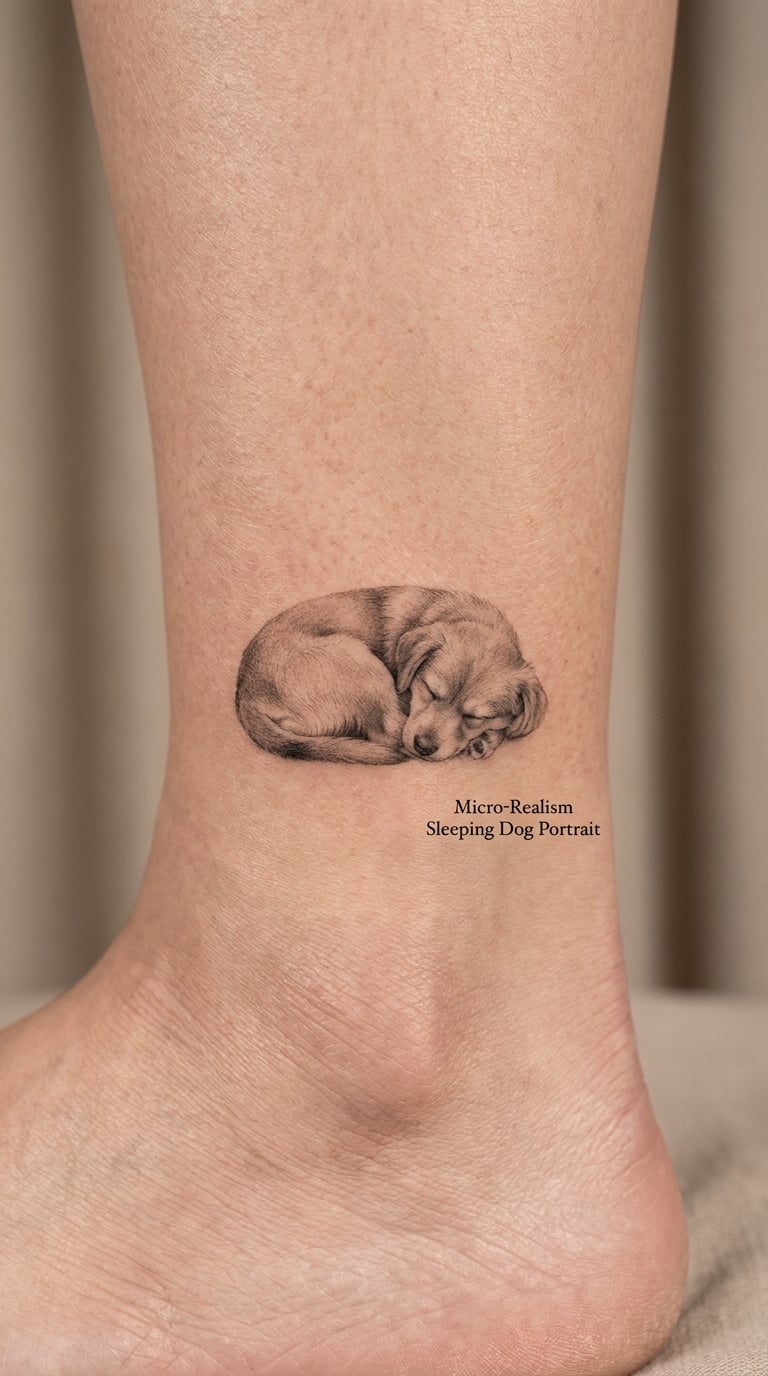
The sleeping pose is the friendliest subject for a small realistic piece: closed eyes and a curled body need very few lines to be unmistakably a sleeping dog. Detail concentrates in the face, where a few grey dots form the closed eyelid and the nose gets one dark accent. The rest of the form stays loose.
It reads as rest and trust, which is why it often shows up as a memorial for a dog that was old at the end.
Placement: ankle, inner arm, or the back of the hand. Size: 2-2.5 inch (5-6 cm) wide. Style: micro-realism. Pain: medium — ankles are bony and sensitive. Ageing note: at this scale, tiny shading dots blend into flat grey over time, so expect the sleeping dog to become a soft grey shape rather than a sharp portrait.
Make it yours: draw the curl in the direction your dog actually slept, which is a small detail that makes the piece read as personal.
8. Dotwork Dog Portrait
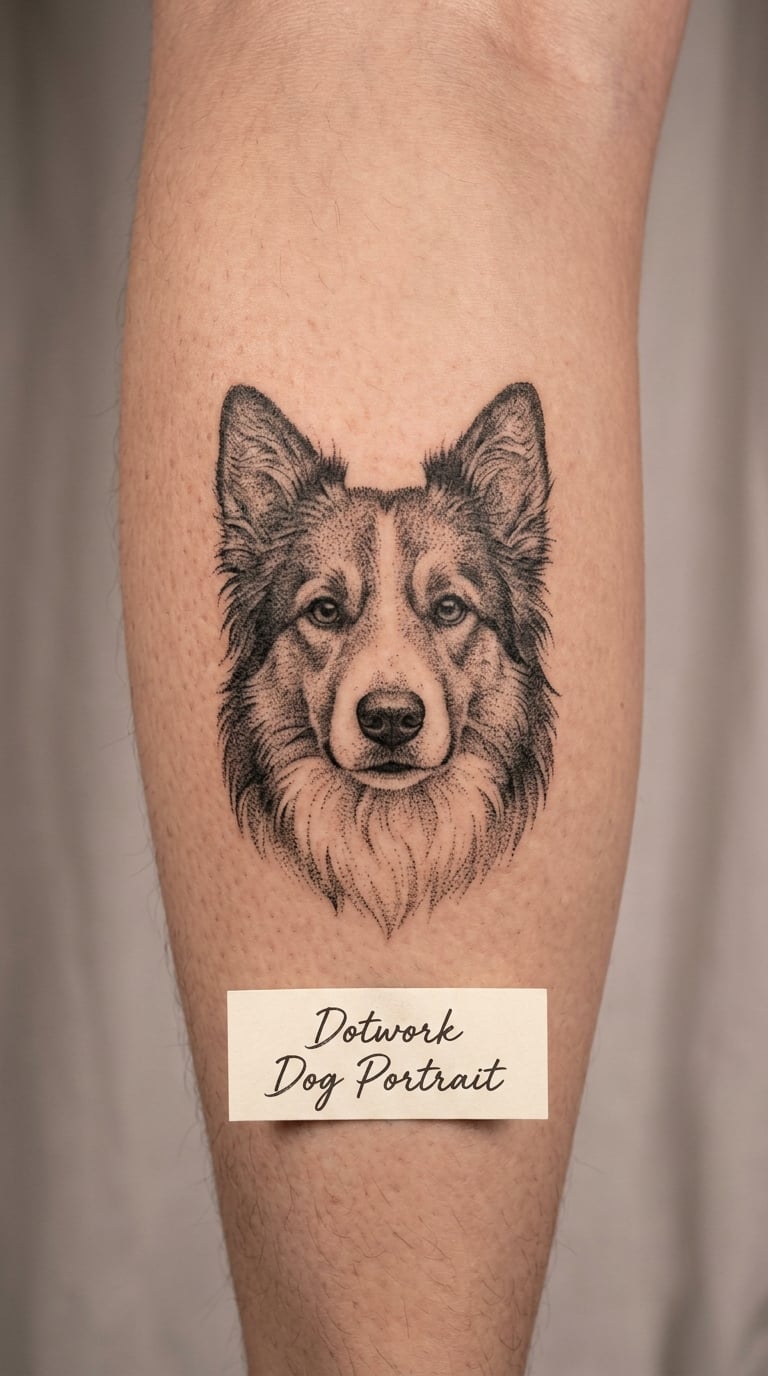
Dotwork portraits are built from thousands of tiny marks rather than lines. Density does the shading: sparse dots in the muzzle and light fur, packed dots in the eyes and ear, solid black in the deepest shadows. Because there is no outline, the shape emerges gradually, which gives the piece a soft, atmospheric quality from a distance.
It suits people who want a detailed portrait that still reads as art rather than a copy of a photograph.
Placement: calf, forearm, or the upper arm. Size: 3-4 inch (7.5-10 cm) tall. Style: dotwork. Pain: medium to high; stippling is slow work. Ageing note: small dots can spread slightly with sun exposure and heal, so a well-healed dotwork piece usually looks better than a fresh one.
Make it yours: add a scattering of dots that trail off the portrait, fading out like the dog moving out of frame.
9. Dog Portrait in a Circular Frame
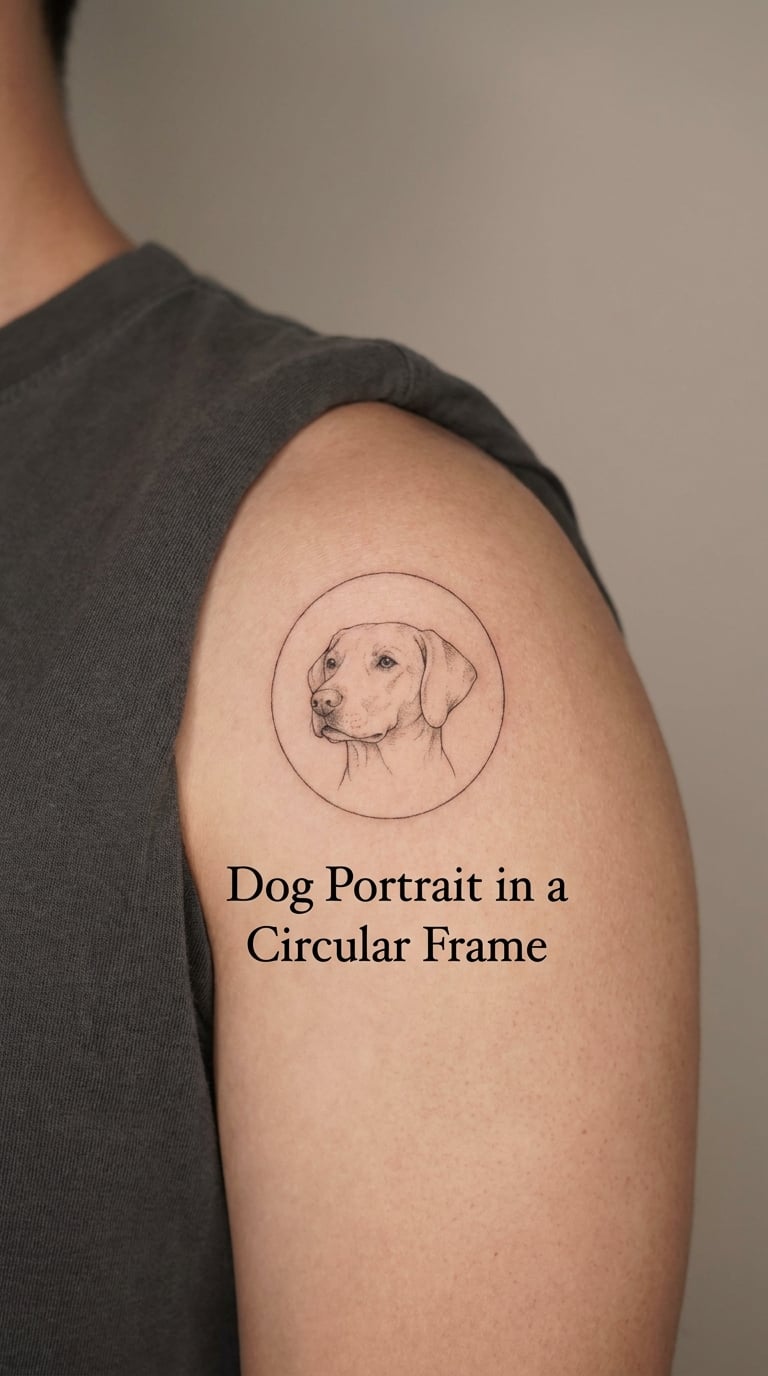
A circular frame solves a practical problem: a round edge contains a head that would otherwise drift across a curved body part. The portrait itself can be fine line or lightly shaded, and the border is usually one thin line, sometimes doubled. It is the easiest design to commission from a photo and the easiest to place well.
There is no fixed symbolism to the circle. People like the way it reads as a finished piece, like a portrait rather than a fragment.
Placement: shoulder, upper arm, calf, or the back of the upper arm. Size: 3-3.5 inch (7.5-9 cm) diameter. Style: fine line, framed. Pain: medium. Ageing note: a crisp border helps the whole composition hold its shape as the interior detail softens.
Make it yours: break the circle at one point and let the dog’s outline cross the gap, so the portrait sits inside the frame rather than trapped by it.
10. Colorblocked Dog Portrait
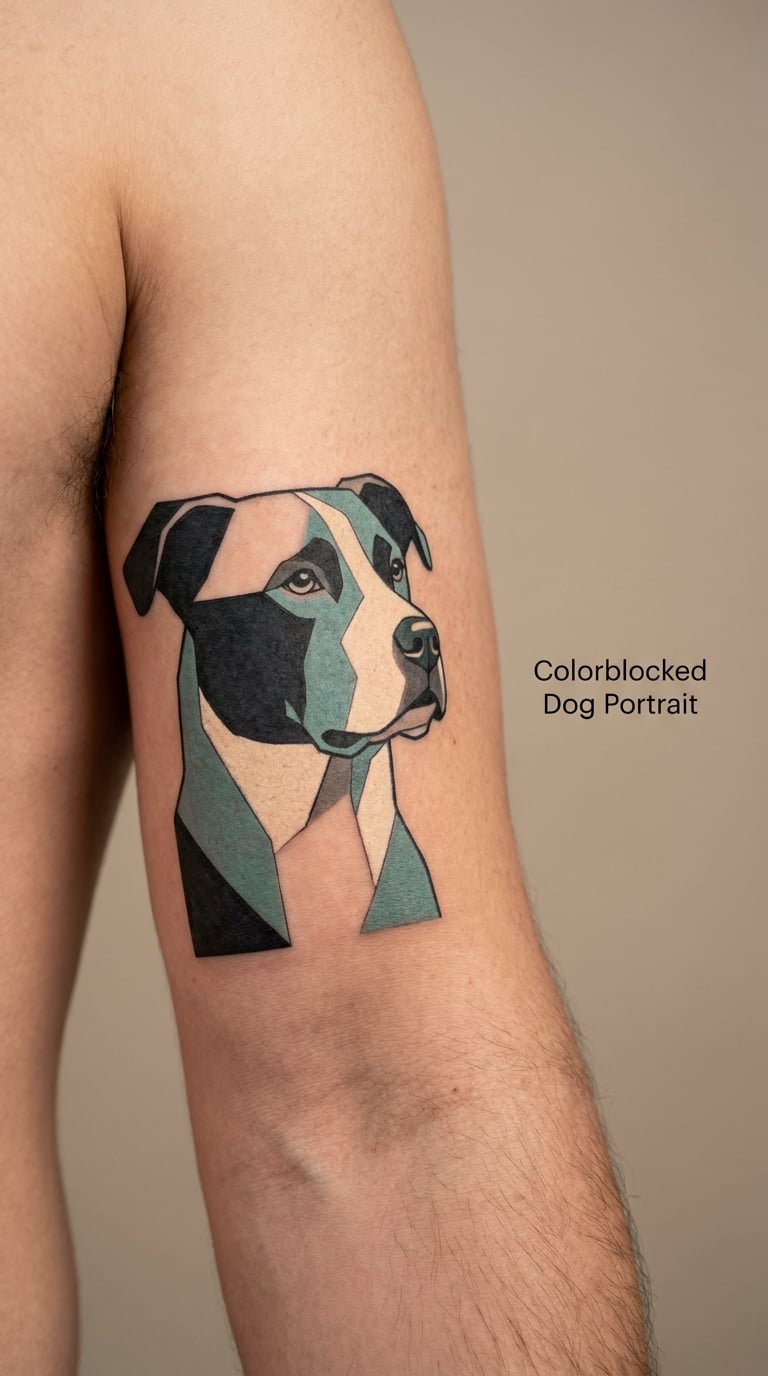
Colorblocking treats the dog like a poster: flat, clean sections of black, cream and one accent colour, with hard edges and no gradient anywhere. The style works because a dog’s face can be reduced to a few recognisable colour zones, and it is far more forgiving of a mediocre reference photo than realism is.
It is a confident, graphic choice — less like a photograph, more like a piece of graphic design that happens to be your dog.
Placement: upper arm, thigh, or calf. Size: 4-5 inch (10-12.5 cm) tall. Style: graphic colorblock. Pain: medium. Ageing note: flat colour is stable, though heavy black sections can look slightly flat once healed — ask for grey mixing inside the large darks.
Make it yours: use the colour of your dog’s eyes for the single accent block and keep everything else monochrome.
11. Dog Portrait with a Flower Accent
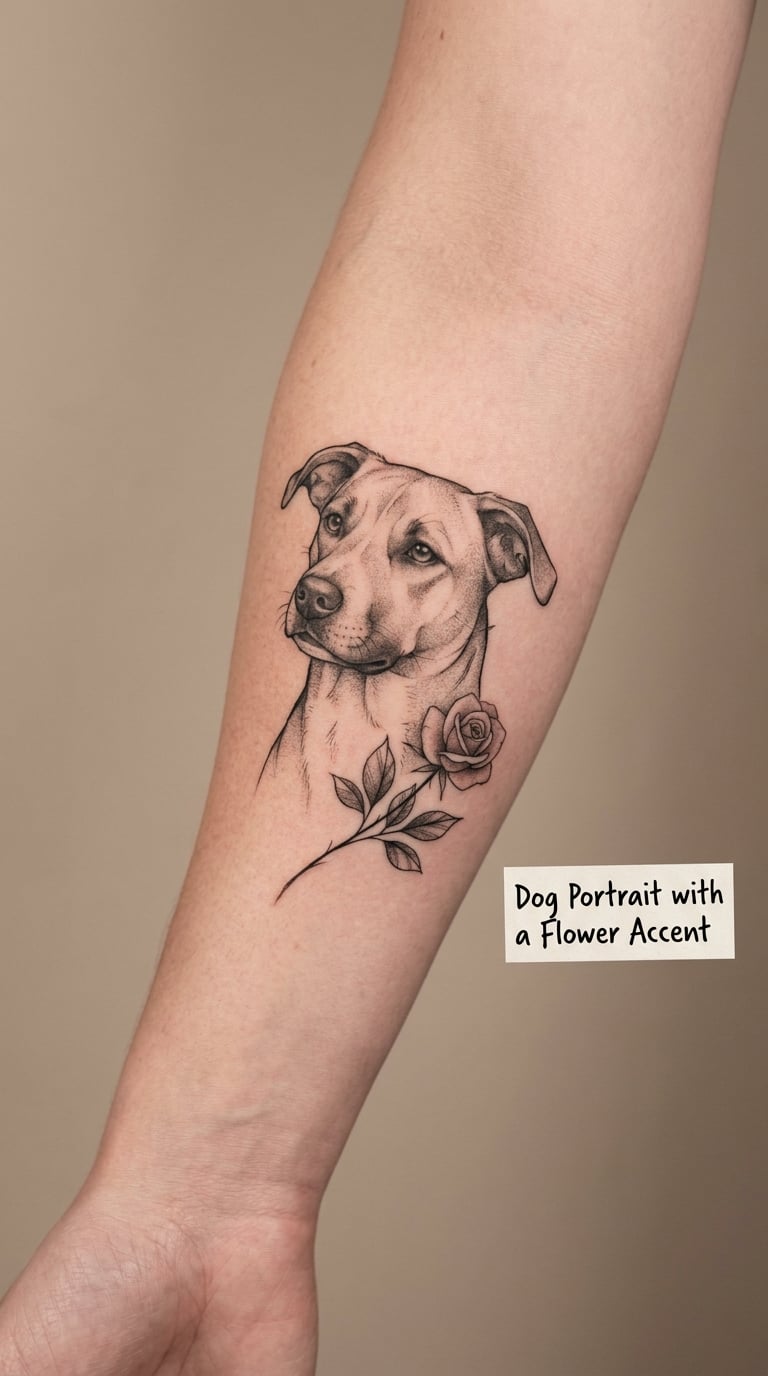
Here the portrait stays realistic or semi-realistic and a single botanical element grows out from behind the head or rests under the chin. One flower, small relative to the head, keeps the composition from turning into a bouquet. The line work is usually shared between the two, so they feel drawn by the same hand.
The flower is decorative unless you give it meaning yourself. Plenty of people choose the breed’s birth flower, a dogwood for a dog named after a tree, or the flower from the garden the dog loved.
Placement: forearm, rib, or the shoulder blade. Size: 3-4 inch (7.5-10 cm) wide. Style: semi-realism with a botanical accent. Pain: medium. Ageing note: petals drawn with very fine hairlines fade faster than the portrait, so ask for a bolder stem and leaf line weight.
Make it yours: have the artist work in one specific flower from your dog’s name, your garden, or the place you first met.
12. Geometric Dog Portrait
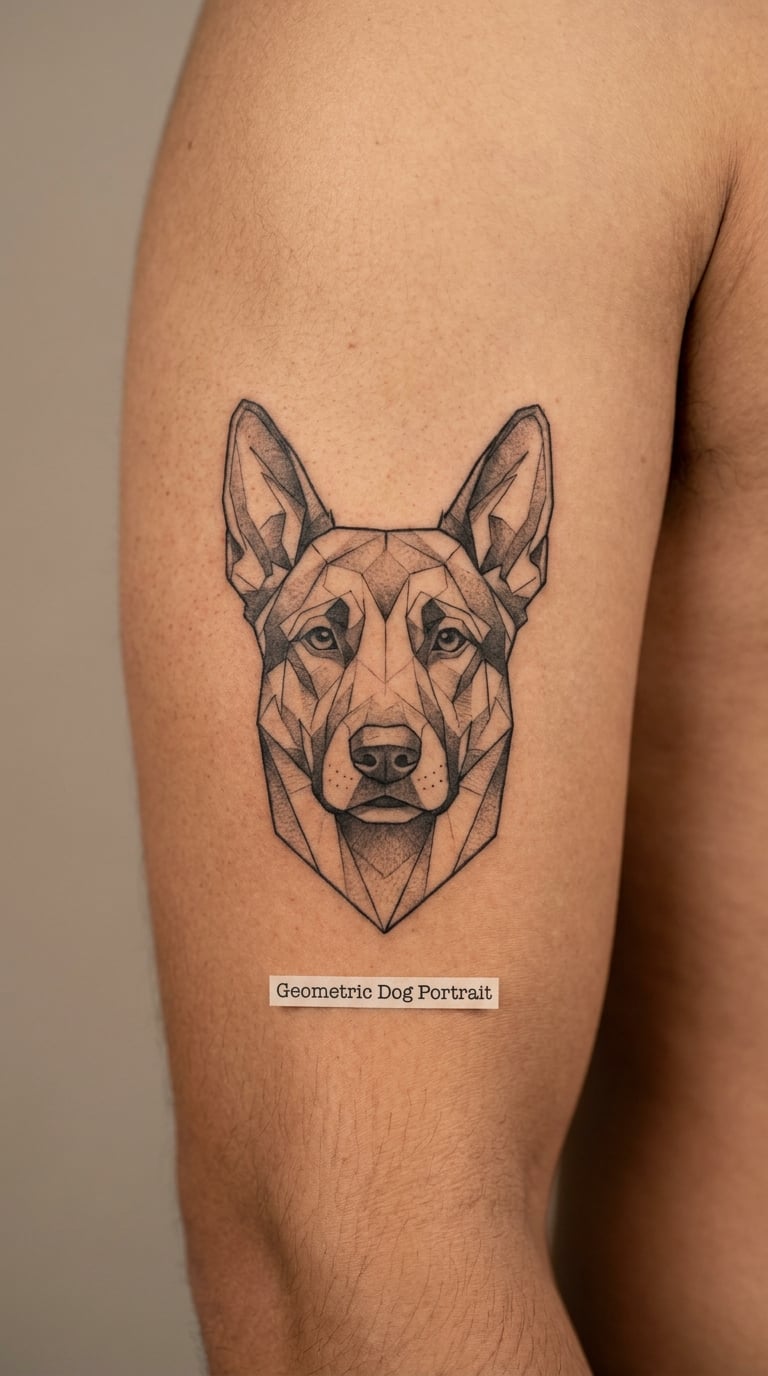
A geometric portrait breaks the head into angular planes, each filled with a different grey or left empty. Straight edges follow the skull and the angle of the ear, and the eye becomes a single clean shape. The result looks modern and architectural, and it hides imperfection well because a slightly off proportion still lands as an intentional facet.
It is chosen for design interest as much as for the likeness, though the marking pattern of your dog — a blaze, a mask, a patch over one eye — is usually preserved in the facet layout.
Placement: upper arm, thigh, or the back of the arm. Size: 4-5 inch (10-12.5 cm) tall. Style: geometric realism. Pain: medium to high on the upper arm. Ageing note: hard-edged facets hold up very well because there is no fine line to blur.
Make it yours: have the facets follow your dog’s actual coat markings, so the geometry and the likeness reinforce each other.
13. One-Line Dog Portrait
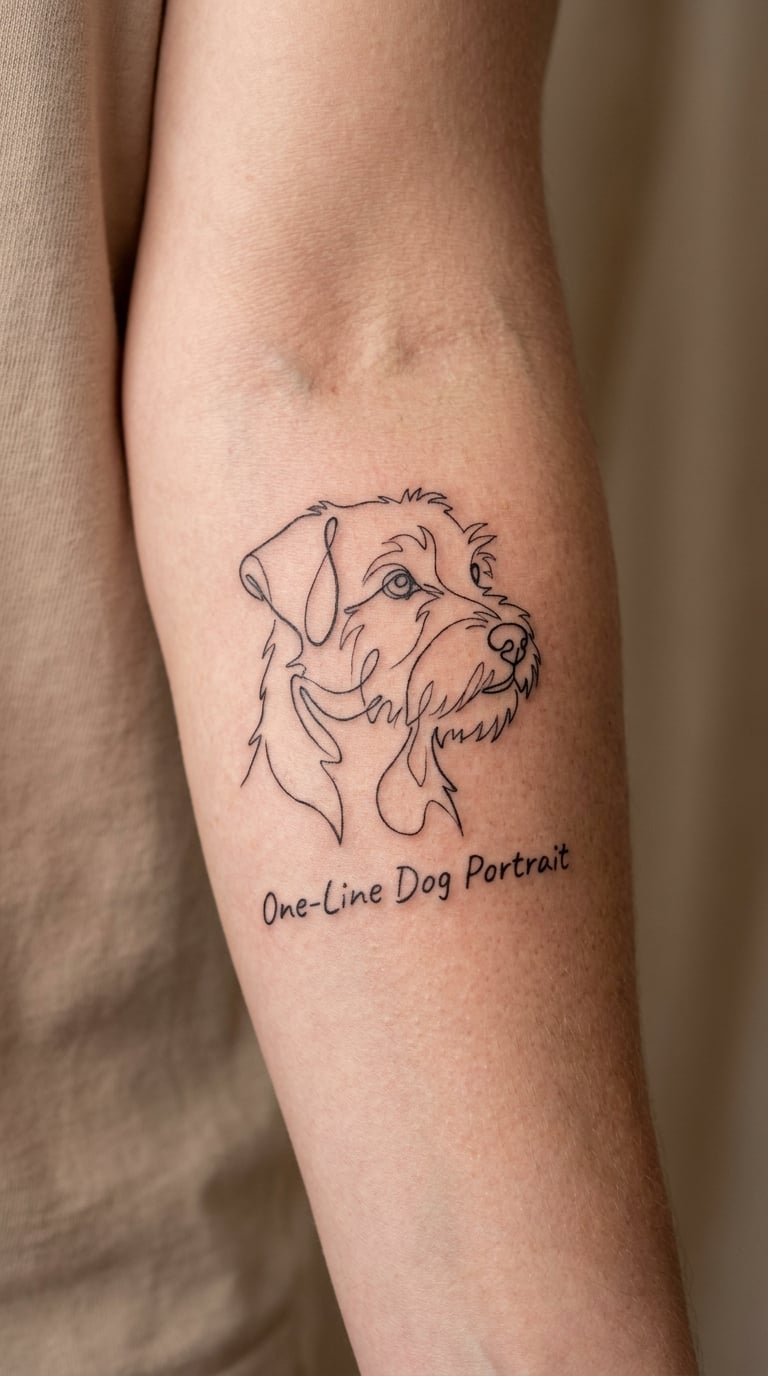
One-line work is drawn in a single unbroken stroke: the artist starts at the nose, runs along the top of the head, and returns to the beginning, using one line for ear, cheek, chest and back. There is no interior detail at all. It is the cleanest style here and the fastest to tattoo, but it is also the least forgiving, because a small wobble changes the whole animal.
People tend to choose it for a dog with a very distinct outline, and for the calm of a short sitting.
Placement: inner bicep, inner arm, or the side of the ribs. Size: 2.5-3 inch (6-7.5 cm) wide. Style: continuous line. Pain: low. Ageing note: a one-line piece is entirely single-needle work, so it is the first style on this list to visibly fade on exposed placements. Inner bicep placement helps.
Make it yours: choose the outline of your dog asleep in a curl, which is one shape rather than many.
14. Dog Portrait with a Heart-Shaped Background
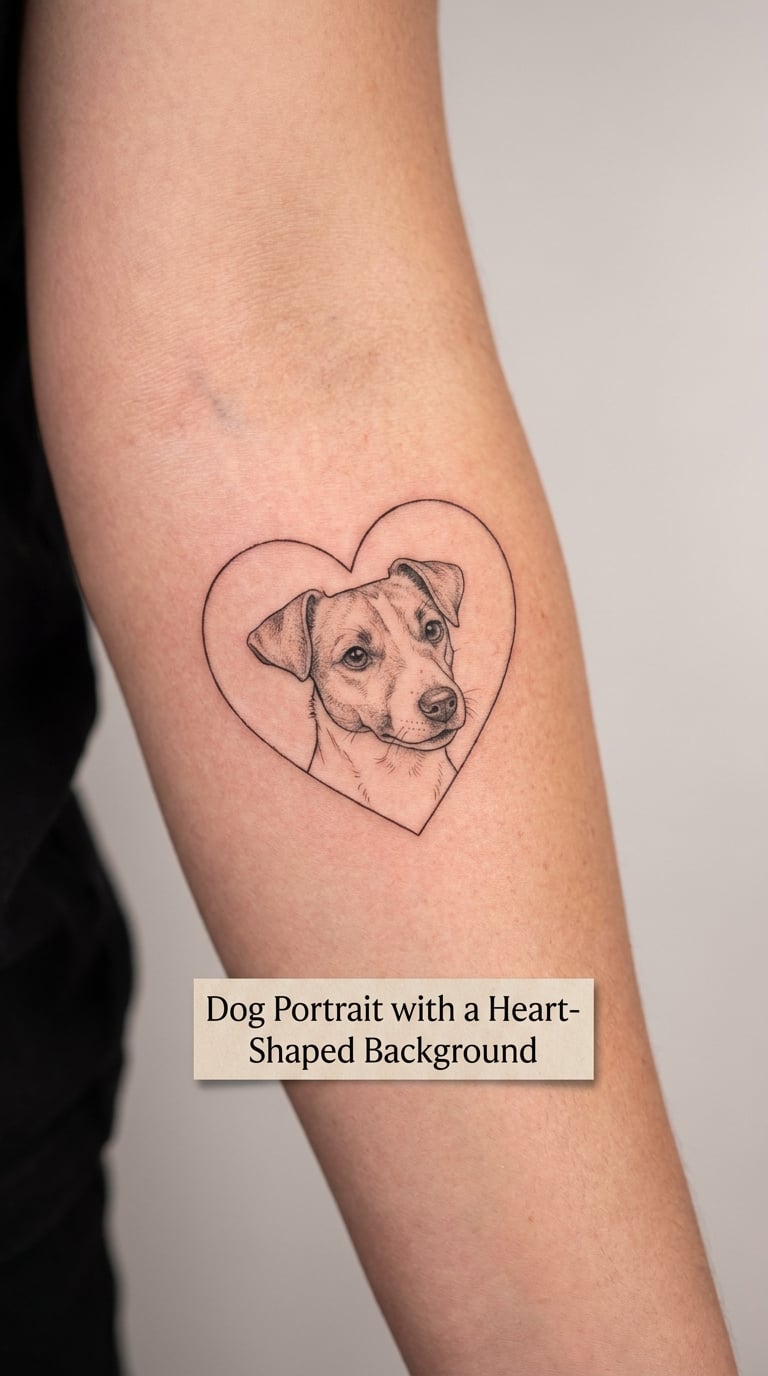
The heart here is a background shape rather than a border, sitting behind the head with the portrait’s outline breaking out of the top. Keeping the heart small and slightly off-centre is what stops the piece looking like a Valentine’s card. The portrait itself is usually fine line or lightly shaded grey.
Most people are not attaching a specific meaning to the heart. It is a way of signalling that this dog matters emotionally, and many of those are memorial pieces.
Placement: forearm, upper arm, or the rib. Size: 3 inch (7.5 cm) wide. Style: fine line with a graphic background. Pain: medium. Ageing note: large flat black background shapes stay sharp, while the fine portrait lines need a heavier weight than you might expect on a first pass.
Make it yours: set a small date in the negative space under the chin, kept to just the numbers rather than a full name.
15. Portrait of a Dog Holding a Toy
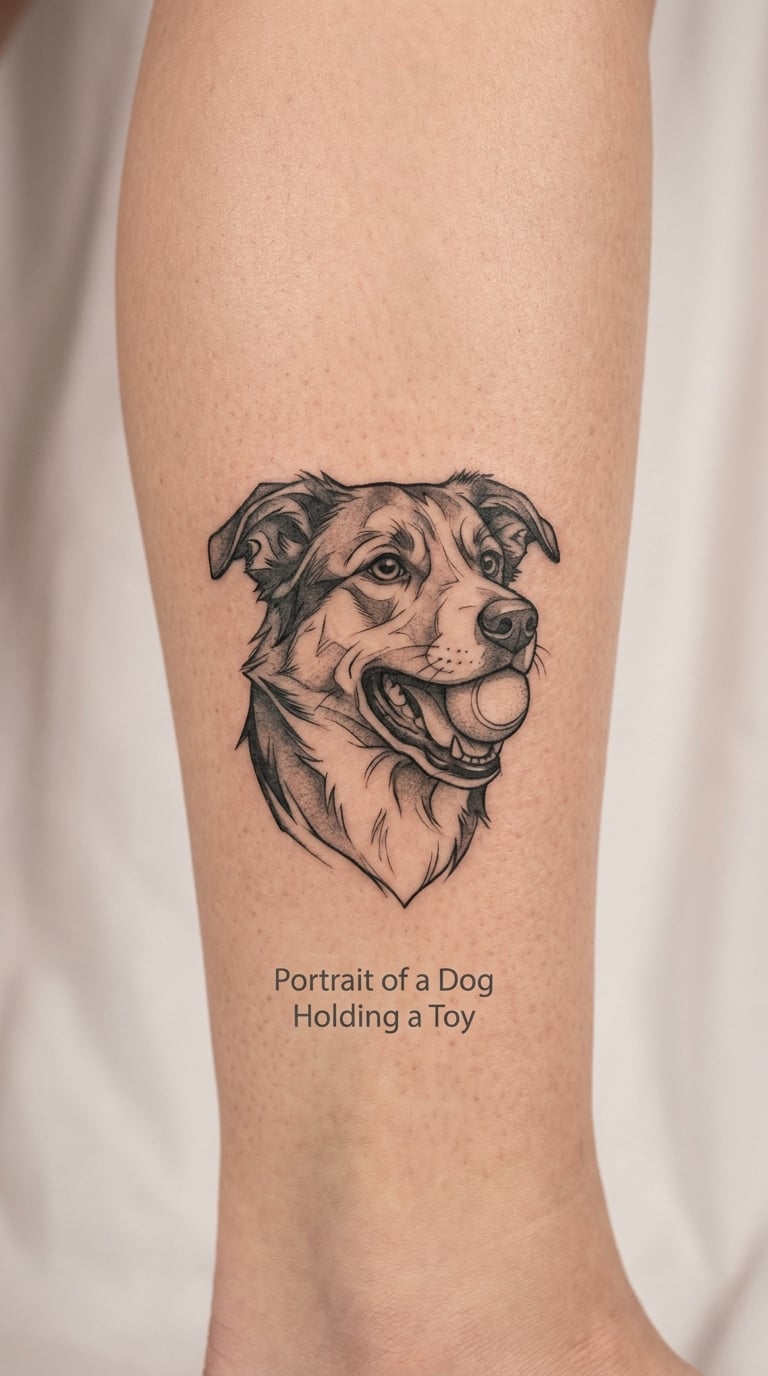
Adding the toy gives the portrait a moment instead of a pose. The dog is often mid-shake or mid-carry, so the expression is open-mouthed and alert, and the toy becomes a solid dark shape that anchors the lower half of the composition. It works in black and grey, and it works in flat colour too.
It stands for a habit rather than an event: the same toy dragged from room to room every evening. That routine is usually what people miss most.
Placement: calf, forearm, or the thigh. Size: 3-4 inch (7.5-10 cm) tall. Style: illustrative realism. Pain: medium. Ageing note: the toy gives the artist a solid shape to anchor the design, which helps keep the face from drifting as the piece ages.
Make it yours: bring a photo of the actual toy — its shape and any chewed corners are what make the portrait read as your dog’s.
16. Dog Portrait in a Small Circle on the Ankle
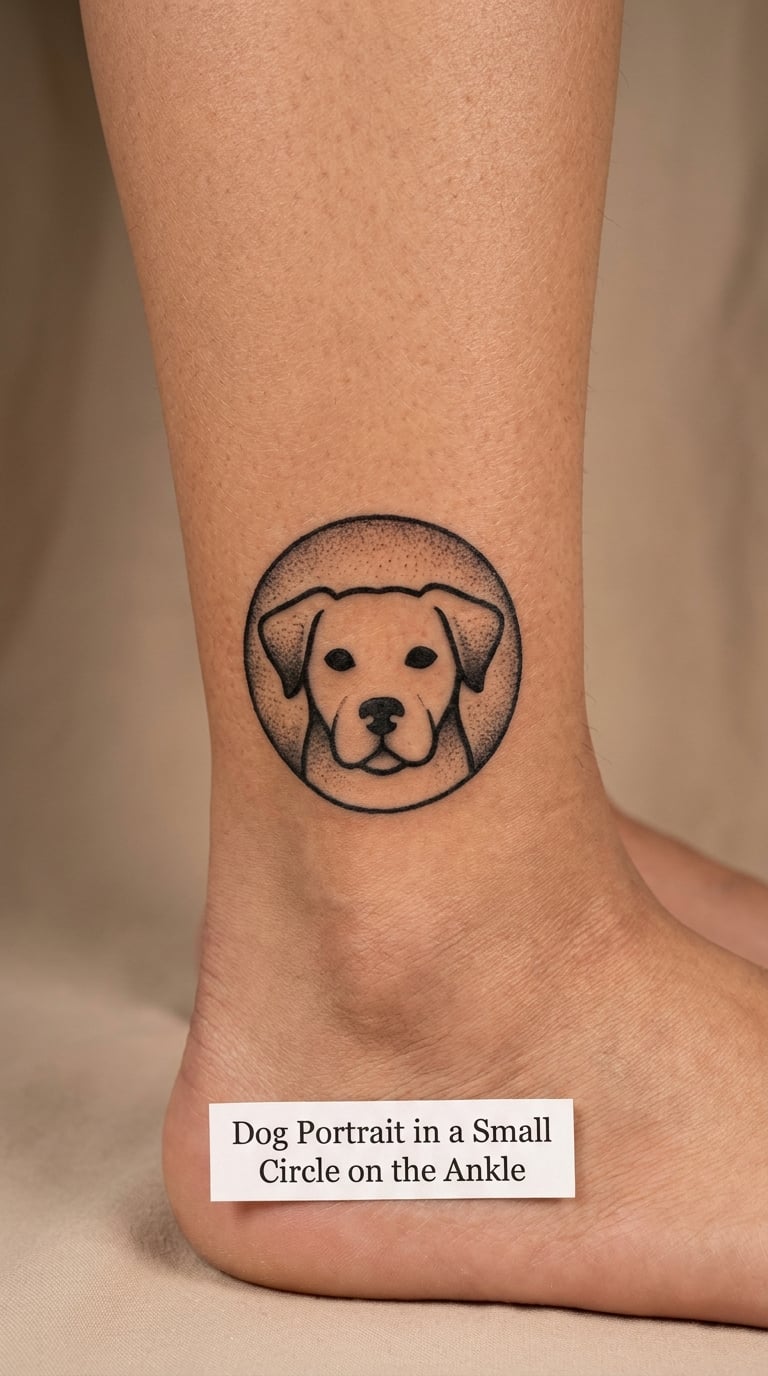
This is the circle idea scaled right down for the ankle: about 2.5 inches across, with the face simplified until it is mostly eyes, ears and muzzle. Interior detail is minimal because the border gives the design its structure, and the composition has to sit in a very flat area of skin.
It is a good first piece for someone who wants a portrait but not a large commitment, and it disappears under a sock or a boot.
Placement: outer ankle or above it on the calf. Size: 2-2.5 inch (5-6 cm) diameter. Style: fine line blackwork. Pain: medium — ankles are bony, thin-skinned and close to the bone. Ageing note: ankle pieces see a lot of sun and fabric rubbing, so expect more fading than the same design on the upper arm.
Make it yours: have the artist place the head slightly off-centre in the circle and let the ear cross the border line.
17. Soft Shaded Dog Portrait on the Collarbone
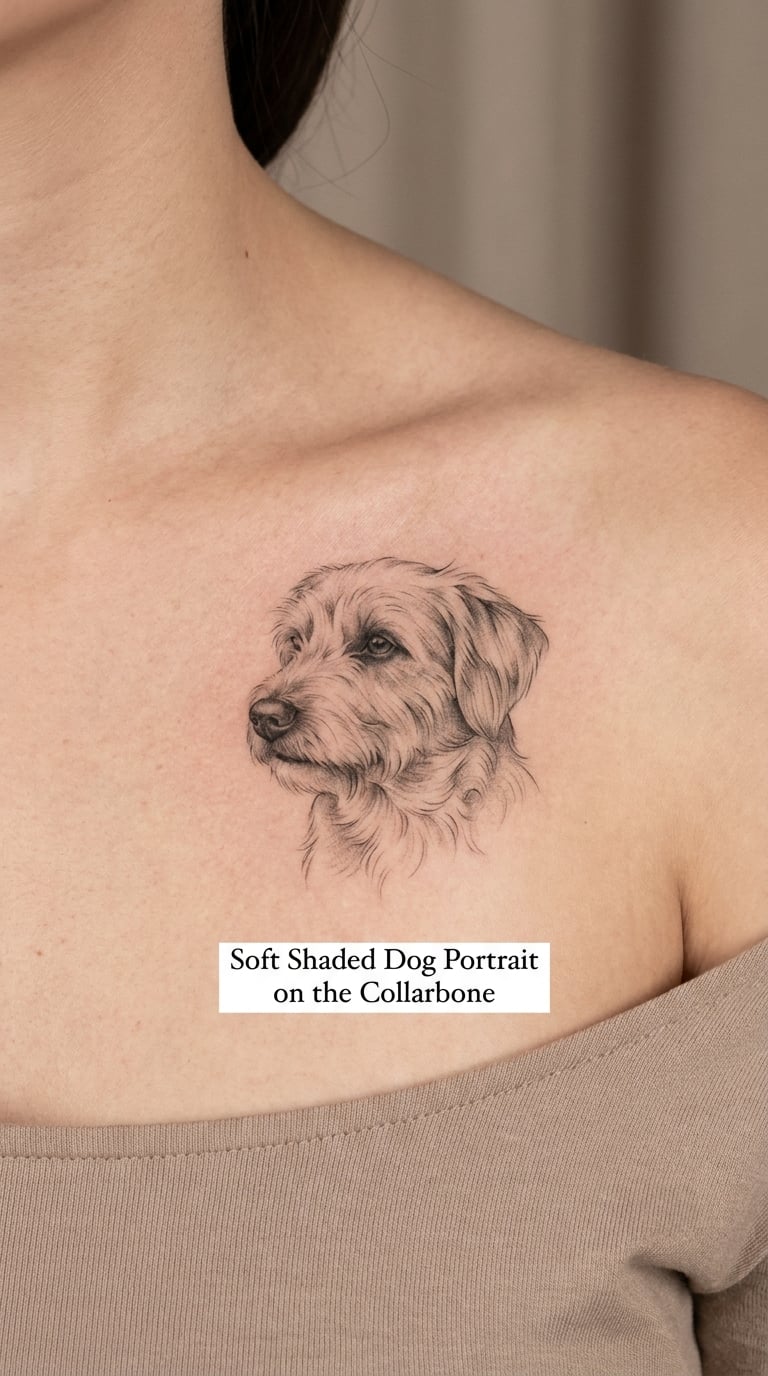
A three-quarter view on the collarbone is a case of matching a design to a curved surface. The artist works with the curve of the bone, so the head sits in the hollow and the chest fades out along it. Shading stays gentle — soft greys and open skin rather than dense black, which keeps the piece from dominating a very visible spot.
It reads as a quiet, close portrait, the kind you notice in a mirror rather than across a room.
Placement: collarbone, just below it, or the upper chest. Size: 2.5-3 inch (6-7.5 cm) wide. Style: soft black-and-grey. Pain: medium to high — collarbone skin is thin and the bone is close underneath. Ageing note: fine facial detail in a very soft palette will blur faster here than the same portrait on an arm.
Make it yours: have the artist keep the background empty skin rather than adding a background shape, so the collarbone curve does the framing.
18. Dog Portrait with a Collar Tag Detail
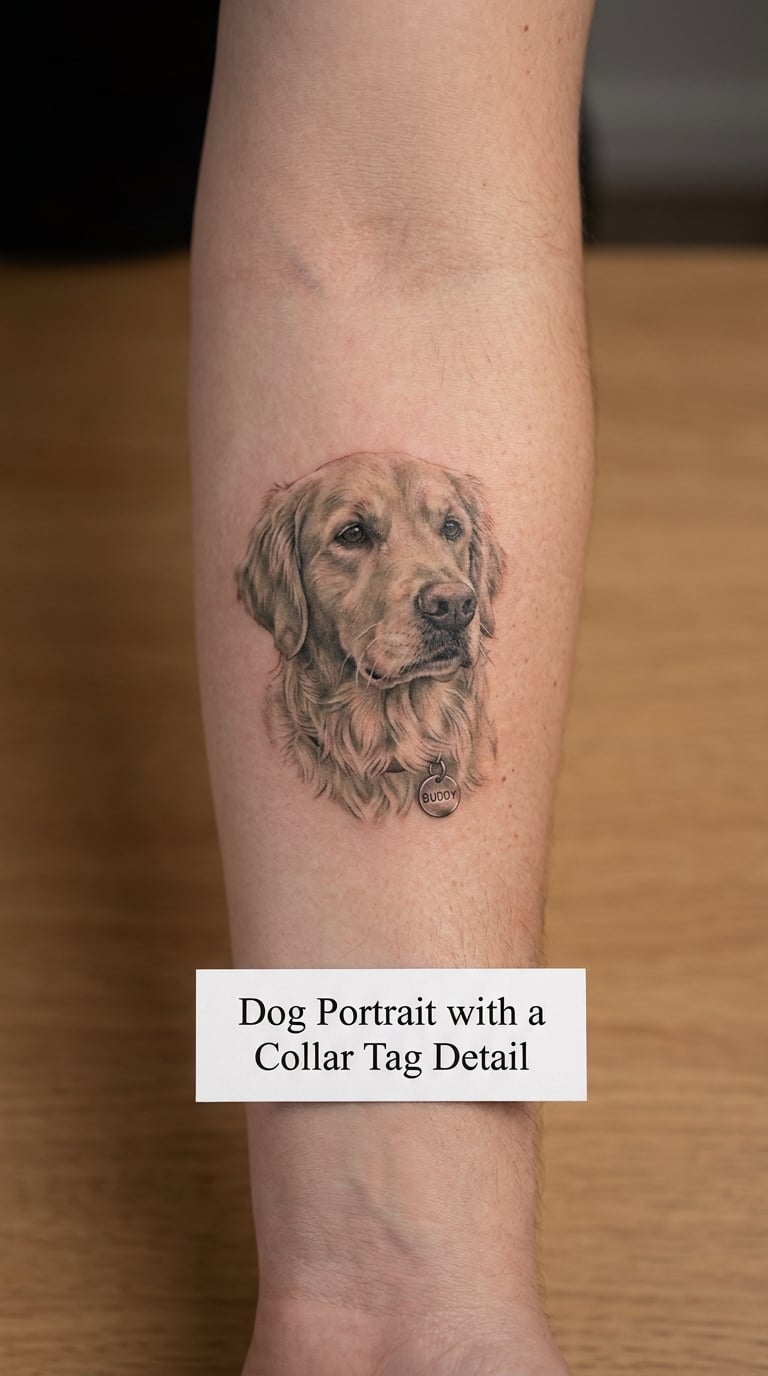
The collar tag is the detail that turns a good likeness into a specific one. A small round or bone-shaped tag hangs from the collar with a name or a short date, and it is usually kept to one short word. Hand-lettered script at this scale needs a steady hand and a stencil rather than a freehand attempt.
People add a tag because the dog’s name is the part they say out loud most. It is also an easy way to mark a memorial piece without a full line of text under the portrait.
Placement: inner arm, inner forearm, or the chest. Size: 3.5-4 inch (9-10 cm) wide. Style: realism with lettering. Pain: medium. Ageing note: script lettering is the first casualty of fading, so keep the tag lettering to one word, and pick a simpler typeface if the piece is small.
Make it yours: send a photo of the real tag so the shape, the engraving and the wear on it are accurate.
19. Black-and-Grey Dog Portrait with Soft Fur
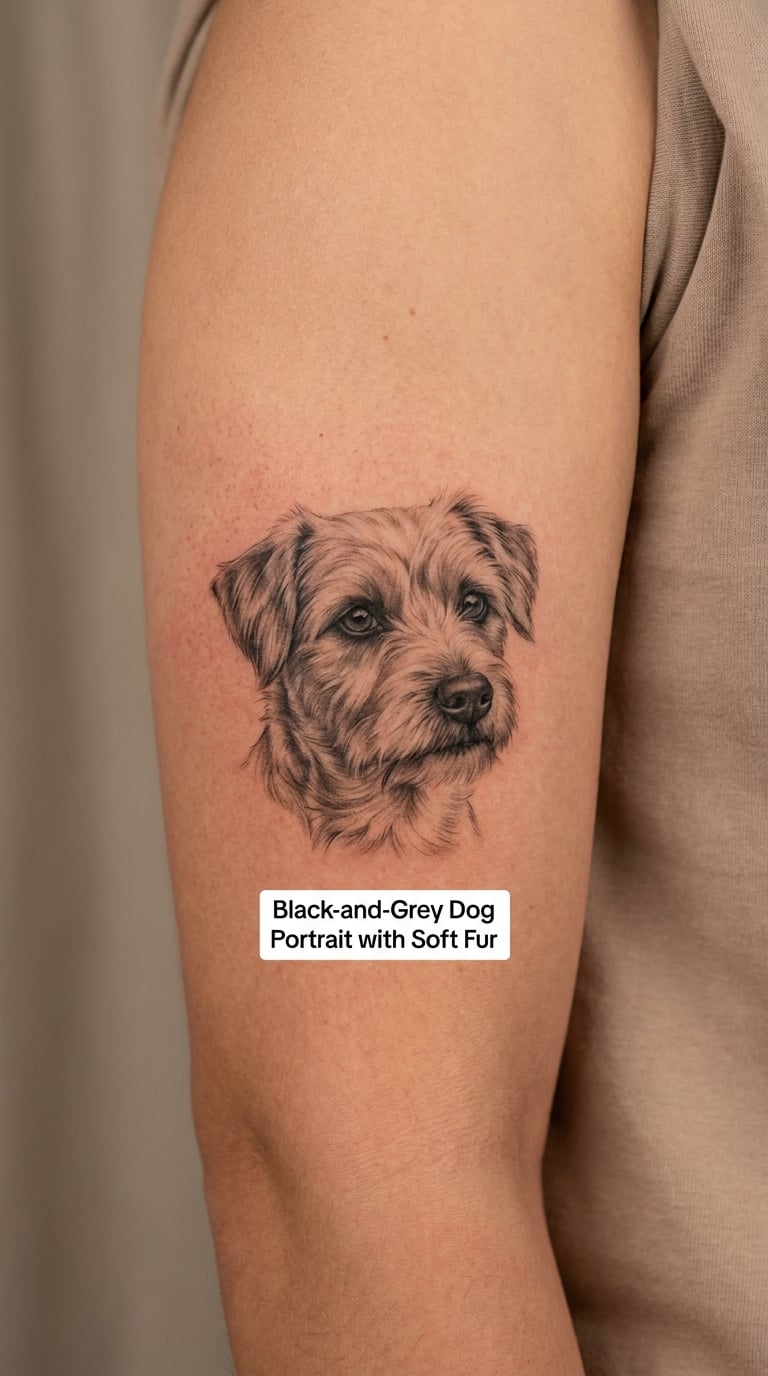
Where the realistic forearm version pushes detail, this one is about texture. The artist builds the coat with flicks and soft gradients that follow the direction the fur grows, then leaves a few lighter areas unworked so the highlights read as light rather than as grey ink. Long-haired dogs suit this approach best, since the texture is the subject.
It is chosen when the coat is the thing people recognise, more than the exact face.
Placement: outer arm, upper arm, or the thigh. Size: 5-6 inch (12.5-15 cm) tall. Style: black-and-grey realism, texture-led. Pain: high, and this is a multi-session piece at this size. Ageing note: the lightest fur shading is the first to fade, so the piece can lose some depth and look flatter after several years.
Make it yours: ask the artist to leave the brightest part of the coat as bare skin — the untouched highlight is what keeps it from going flat.
20. Small Dog Portrait on the Rib
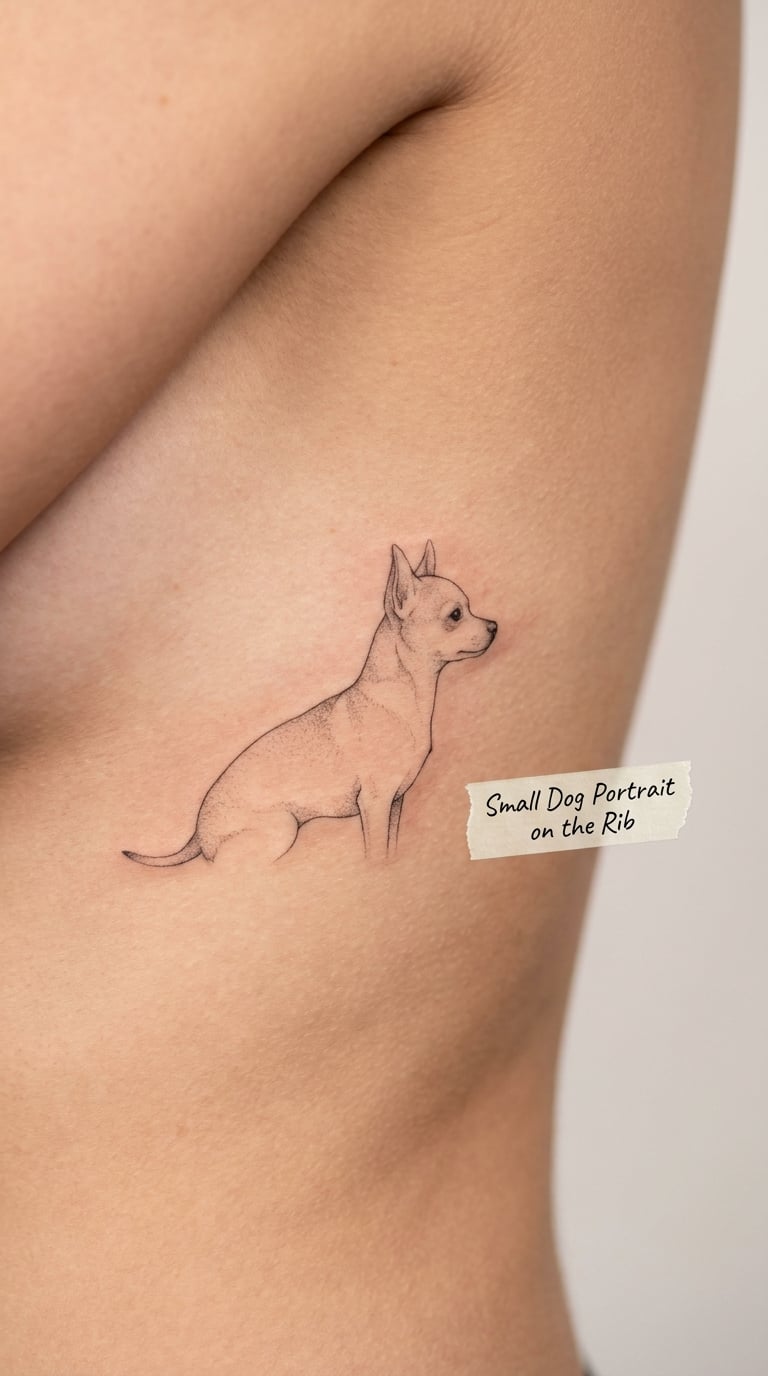
Ribcage placement is the most flattering spot for a small profile, because the line of the ribs gives the design a natural curve to follow. The head sits in the hollow and the chest line trails along the cage, so nothing looks stretched. A side profile works better here than a front-facing head.
It is an intimate placement — hidden under a shirt, seen mostly by you — and plenty of people choose it for exactly that reason.
Placement: the ribcage, upper rib or the side above the hip. Size: 2.5-3 inch (6-7.5 cm) wide. Style: fine line with light shading. Pain: medium to high; ribs are sensitive and the area tightens as you breathe. Ageing note: line weights need to be heavy here, since a thin profile line over a moving area spreads more than it fades.
Make it yours: have the piece follow the rib line with a slight lean, so it sits on the body rather than looking pasted on it.
21. Dog Portrait with a Matching Paw Print
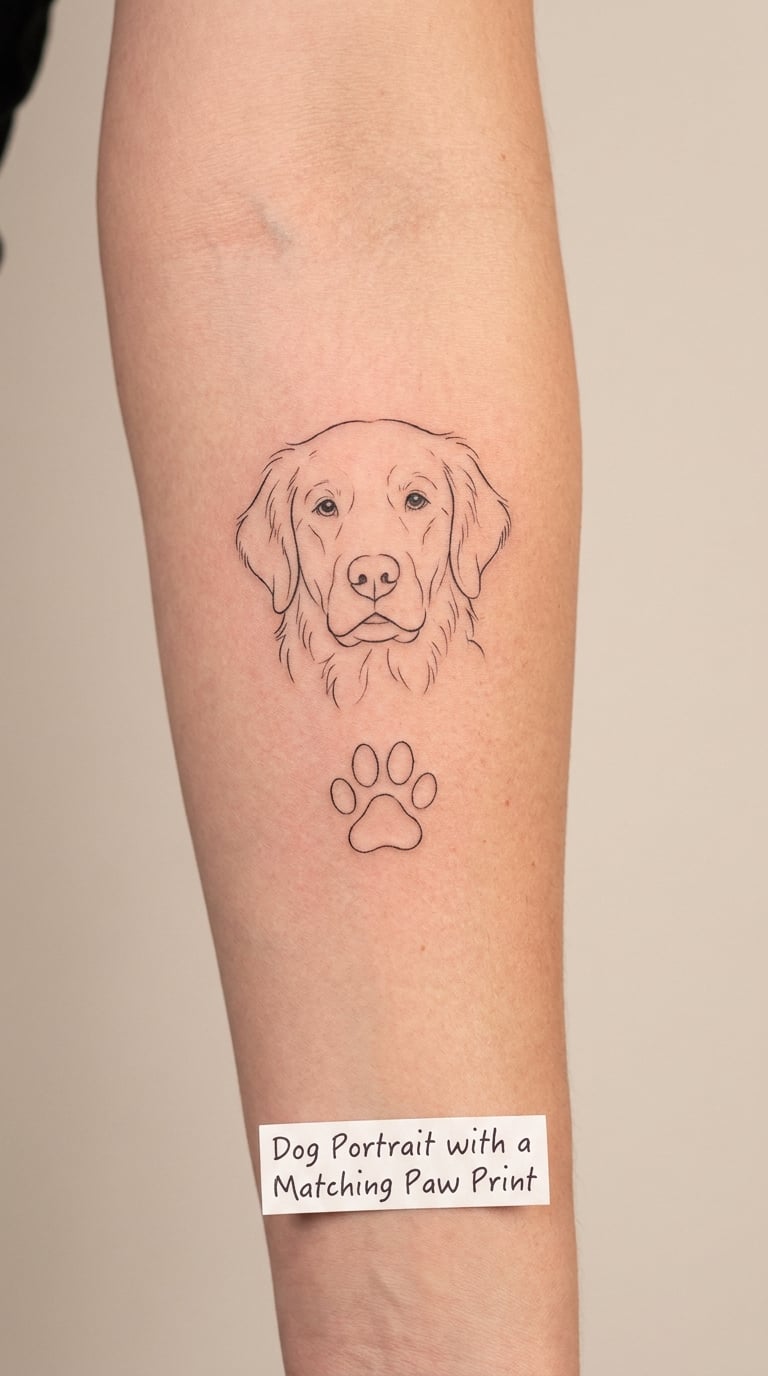
Two small pieces, drawn in the same style and the same line weight, read as a set even if they are months apart. The portrait carries the likeness and the paw print sits nearby or on a matching limb, sometimes with the date beneath it in the same hand as any other lettering in the piece.
This is the version people pick when they want to add to a collection slowly, or coordinate with a partner, sibling or friend who has the same dog. Matching two tattoos across two different artists takes some negotiation on line weight and placement — bring reference images of the first piece to the second consultation.
Placement: both forearms, or a forearm and an ankle. Size: portrait 3 inch (7.5 cm), paw print 1 inch (2.5 cm). Style: fine line, matched pair. Pain: medium, split across two sittings. Ageing note: keep both pieces at the same line weight and skin depth, otherwise one will fade noticeably faster than the other.
Make it yours: scale the paw print exactly to your dog’s actual paw, or use it as the spacing guide between the two pieces.
22. Expressive Dog Portrait with a Back-of-Arm Placement
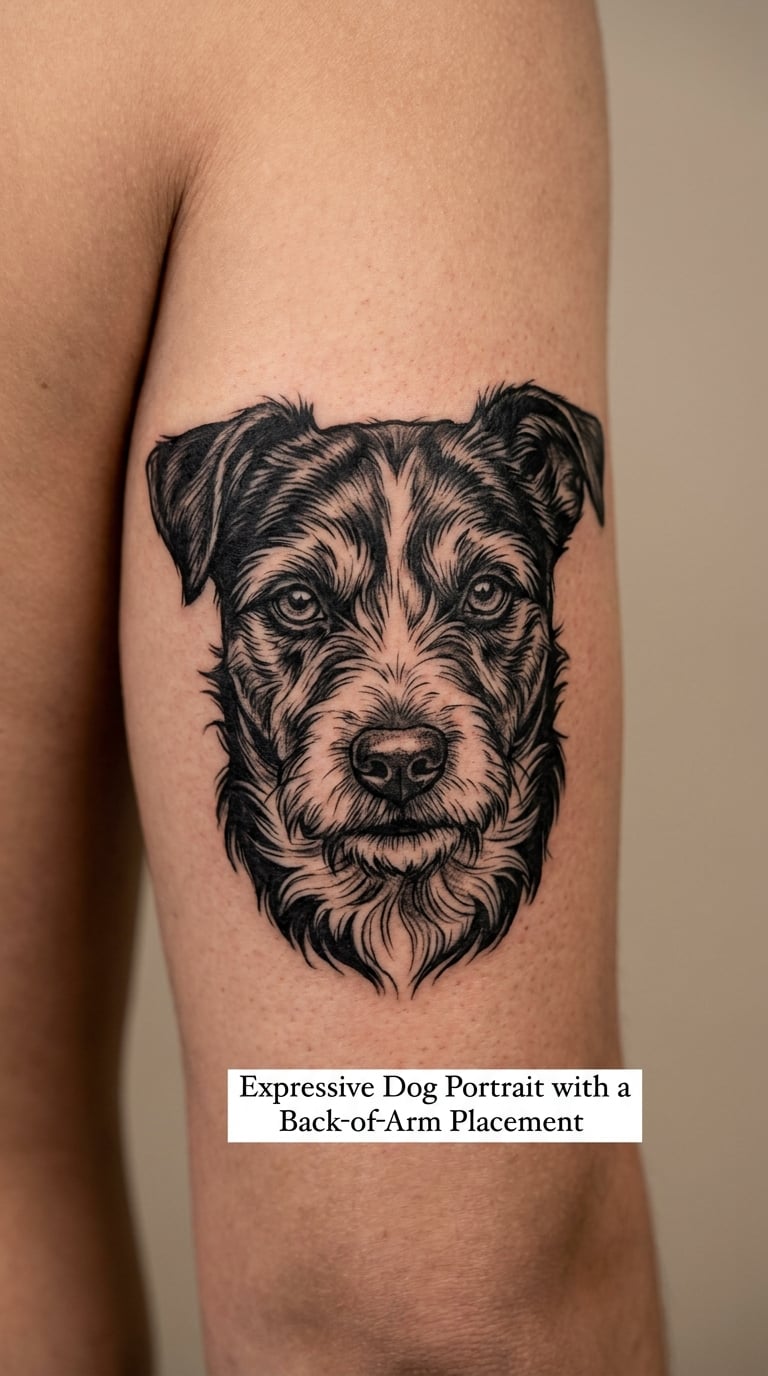
The back of the upper arm is a large flat canvas that people rarely use well. A strong portrait here, with bold eyes and confident fur contours, reads clearly across a room and photographs well. Because there is no bone or tendon defining the area, the artist can work larger than on a forearm without the design fighting the anatomy.
It suits a dog with a big personality — the one that owns the room. The design is often built around the eyes, with the rest of the face in support.
Placement: the back of the upper arm, or the outer bicep. Size: 4.5-5 inch (11-12.5 cm) tall. Style: blackwork. Pain: medium to high. Ageing note: this placement creases when you flex, and heavy black in a crease area can crack and lighten over time.
Make it yours: choose a photo with the dog looking straight at the camera, so the gaze lands properly across a flat surface.
23. Tiny Dog Portrait Behind the Ear
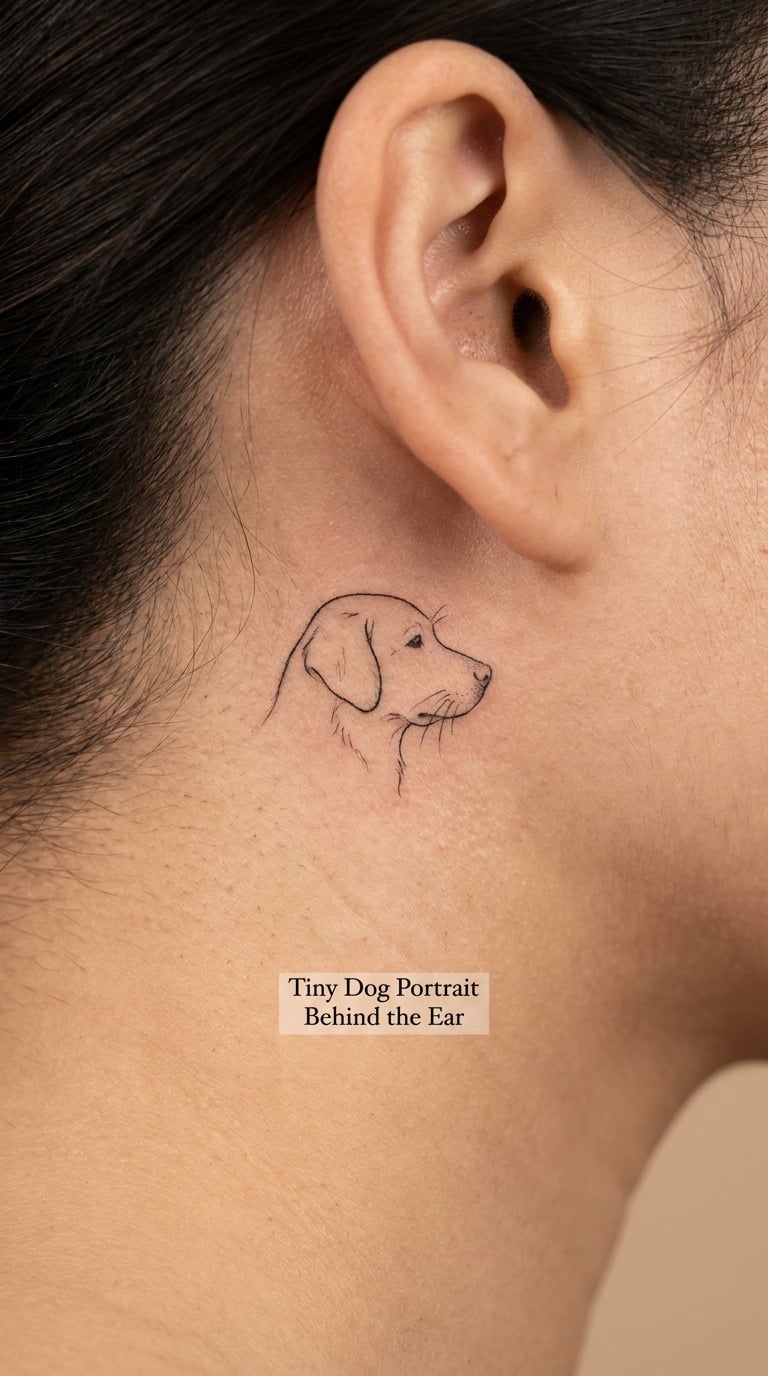
Behind the ear is the smallest placement on this list, so the design has to be reduced to almost nothing: a profile nose, a forehead line, one ear, maybe a few whiskers. The ear itself becomes part of the composition, hiding the top of the design when your hair is down and revealing it when it is not.
Most people here are marking something they see daily without having to look at it, which is a different motive from a display piece.
Placement: directly behind the ear, or just below the earlobe. Size: 1.5-2 inch (4-5 cm) wide. Style: fine line. Pain: low, though the skin behind the ear is thin and the cartilage area is sensitive. Ageing note: at this size, whisker lines disappear within a few years; the outline survives much longer, so the design should work with the outline alone.
Make it yours: have the profile drawn from the angle your dog actually looks at you from when you crouch down to their level.
24. Custom Dog Portrait Based on a Photograph
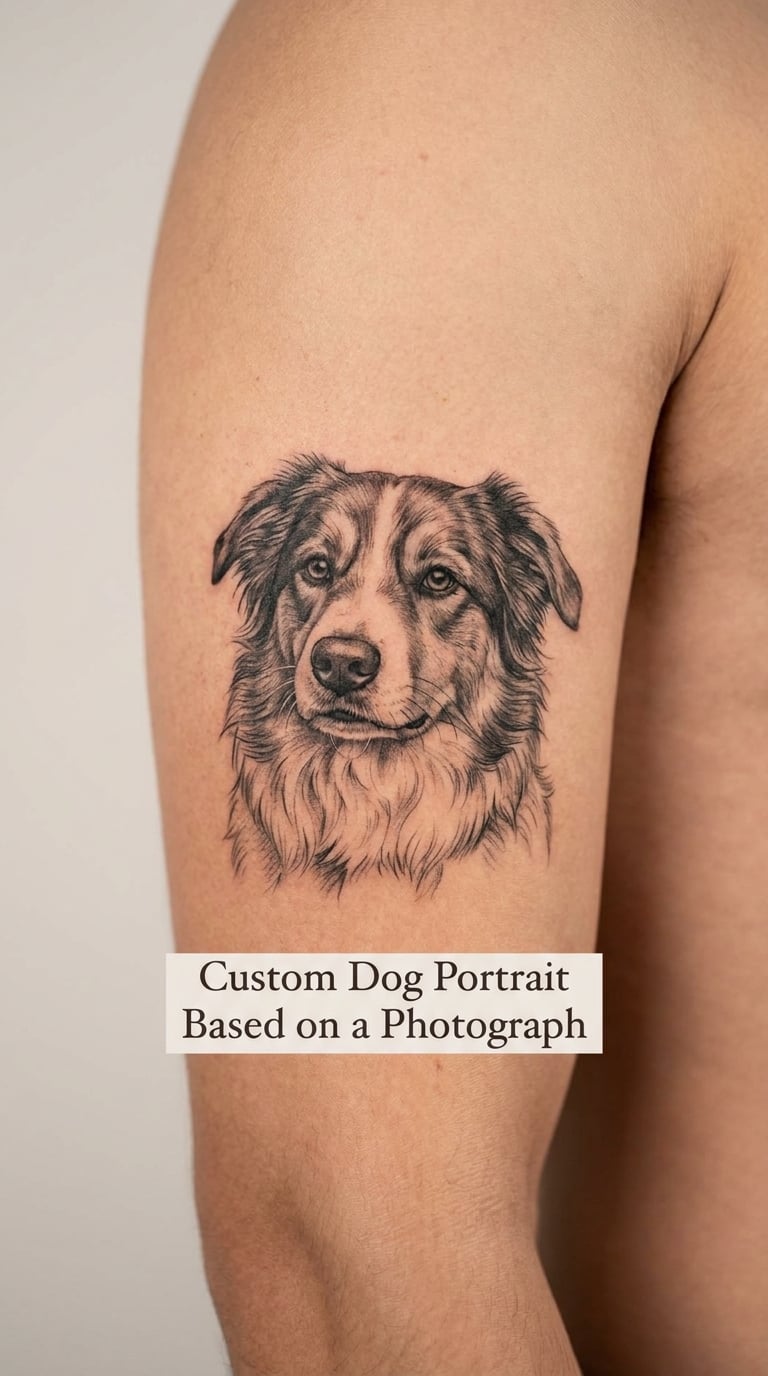
A fully custom portrait starts with the photo and ends with a draft you approve before the appointment. The artist redraws the reference, simplifying what will not translate to skin and keeping the markings, the eye shape and the ear that make your dog recognisable. You get a revision round, then the design is transferred as a stencil and built up with shading.
This is the version to choose if the likeness matters more to you than a quick sitting. Send originals rather than screenshots — file compression is the single most common reason a reference arrives too soft to work from, and people on r/tattooadvice say it over and over.
Placement: upper arm, thigh, or the outer forearm. Size: 4-7 inch (10-17.5 cm) tall. Style: custom realism. Pain: high, and this size often needs two sittings. Ageing note: high-contrast realism ages best, so ask for true black in the eyes and deepest shadows rather than a soft grey throughout.
Make it yours: send three photos — one front-on with good light, one in profile, and one of the full body — plus the details you never want to lose.
How to Choose the Right Design
Most disappointing pet portraits are not bad technique. They are a style that was too detailed for the size, or a size that was too small for the detail. Work through these five questions before you book.
- How recognizable does it need to be? If a stranger should identify the dog, realism or illustrative realism at 4 inches or more. If only you need to know, minimalist and one-line styles hold up at 2 inches.
- Where exactly is the skin? Flat and bony, and a portrait fights it. A flat calf, the back of the upper arm and the outer thigh all give an artist more room. Wrists, fingers, ankles and ribs constrain the design before you start.
- How much detail fits? Fine line and micro-realism need canvas. A detailed 2 inch piece is the one combination most likely to disappoint, because there is nowhere to put the detail.
- How much fading will you accept? Blackwork, traditional and colorblocking hold up longest. Fine line, one-line and pale watercolor washes change the most over a decade.
- Is the artist a portrait specialist? Look at healed dog portraits specifically, not a general portfolio. r/tattooadvice is consistent on this: judge healed work, not fresh Instagram posts.
Two more things worth deciding early. Whether the piece is a memorial changes the design conversation completely, and people on forums talk openly about waiting until they feel ready rather than booking in the worst weeks. And whether you want a draft before the appointment — most good artists offer one, and for a custom portrait it is worth asking for.
Cost and Session Time
There is no fixed price for a dog portrait, and anyone quoting you one over the phone without seeing the design is guessing. What actually drives the number is size, detail level, the artist’s rate and the shop minimum.
Small minimalist or fine-line portraits, 2-3 inches, are often billed near a shop minimum and take 30 to 90 minutes. Mid-size illustrative pieces, 3-5 inches, usually run two to three hours. Large or highly detailed realistic portraits, 5 inches and up, are commonly quoted as a multi-session job across several hours each, and some artists book them as full days.
Two practical notes. Shops usually have a minimum charge that can exceed the cost of a small piece, so ask what it is before you commit. And a cheap quote on a detailed portrait is often just an artist who has not decided what is possible at that size — ask to see the design before booking, not on the day.
Aftercare Basics
- Follow your artist’s aftercare instructions first. They know the needle depth and ink used on your specific piece, and their advice takes priority over anything general you read online, including this list.
- Wash the area gently with unscented soap and lukewarm water, then pat it dry. No scrubbing, no scented products.
- Keep it covered as directed for the first few hours, and change the covering if it sticks to the skin or gets soiled.
- Do not soak, swim, or sit in a hot tub while the piece is still healing. Baths and showers are usually fine once the artist’s recommended time has passed.
- Once healed, use sunscreen on exposed placements for the rest of your life. Sun is the main reason fine line fades and soft greys go flat.
- If a line looks blurred or patchy, ask the artist to look at it before you do anything yourself. Most artists will touch up their own work, and free of charge is often the case early on.
Frequently Asked Questions
How small can a dog portrait tattoo be and still look like my dog?
Around 2 inches, and that is the practical floor. Below that, a portrait loses the eye detail and ear shape that make it recognizable, and the piece starts reading as a generic dog. If you only need small, minimalist and one-line styles handle 1.5 to 2 inches well because they only use outline. Realism needs 4 inches or more to keep the face accurate.
How long does a dog portrait tattoo take?
A small fine-line or minimalist portrait takes roughly 30 to 90 minutes. A mid-size illustrative piece usually runs two to three hours. Large realistic portraits of 5 inches and up are usually booked across two or more sittings, sometimes as full days. Ask your artist how many sittings your design needs before booking, and plan breaks into the appointment.
What photo should I send to a tattoo artist?
Send the original file from your phone or camera, never a screenshot or a photo of a photo. Compression kills the fine detail an artist needs. Give at least three shots: one front-on in good natural light, one in profile, and one of the full body. Tell the artist which features you never want to lose, and mention if the photo is old or shows a different coat length.
Will a small dog portrait tattoo on my wrist or finger fade badly?
Yes, more than most placements. Wrists and fingers get more sun exposure, and single-needle fine line loses definition faster than blackwork or traditional shading. If you want the smallest possible piece, ask your artist to use a heavier line weight than feels necessary, and use sunscreen on the area once healed. Inner bicep or upper arm placements fade noticeably less.
Should I wait before getting a memorial portrait of a dog that has passed?
There is no right timeline, and this comes up constantly in tattoo forums. Many people book only when they feel ready rather than in the first weeks, and most artists are completely understanding about a delay or a reschedule. If you are still deciding, keep collecting photos of your dog now, since good reference shots are the hardest thing to find later.
How do I know an artist is good at pet portraits?
Ask to see healed dog portraits specifically, not a general portfolio. Fresh work looks better than healed work in every style, so a page of recent Instagram posts tells you little. Look for dogs you recognize as dogs, consistent line weight, and faces that hold their shape. It is completely normal to ask whether the artist has done this breed and this style before.
If you are getting your first tattoo and want the likeness to be unmistakable, book the realistic forearm portrait or the custom piece from a photograph, at 4 inches or larger, and pick the flattest skin you have. If you would rather start small and add to it later, the minimalist wrist portrait or the tiny piece behind the ear is a much easier first commitment, and it is easy to place a second piece near it later.
For more plant-based and organic design direction, take a look at 86 beautiful vine tattoo ideas that will make you feel peaceful — the line weight on those pieces works well beside a small dog portrait.