
20 Best Birth Date Tattoo Ideas in Roman Numerals 2026
A birth date tattoo in Roman numerals does one quiet job well: it turns a date everyone already knows into something that looks like it belongs on a museum wall. The numerals are just seven letters, I V X L C D M, so a whole birth date fits in a couple of inches and still reads as a design, not a label.
These 20 birth date tattoo ideas in roman numerals are the ones that actually work on skin. Each one differs in direction, weight, placement or accent, so you can match a design to the size of the area you want covered and to how much you want strangers to read it at a glance. If your date needs a second piece later, these also stack neatly into a group.
Bring a verified numeral string to your consult, printed or written out. The single most common regret with this style is not the font, it is a wrong conversion or a day-month order flip nobody caught before the stencil went on.
Birth Date Tattoo Ideas in Roman Numerals: Quick Guide
Here is every design in this guide, in order, with the style that suits it, where it sits best, a realistic size and how the placement tends to feel.
| Idea | Style | Best placement | Size | Pain |
|---|---|---|---|---|
| 1. Fine-line horizontal date | Fine line | Inner wrist | 1.5-2.5 in | Medium |
| 2. Vertical date | Fine line | Inner forearm | 3-4 in tall | Medium |
| 3. Curved wrist wrap | Fine line | Wrist | 2-2.5 in | Medium |
| 4. Date with heart accent | Fine line | Inner wrist or arm | 2-3 in | Medium |
| 5. Bold blackwork date | Blackwork | Upper arm | 3-4 in | Medium |
| 6. Calligraphic behind the ear | Script | Behind the ear | 1.5-2 in | High |
| 7. Framed by two lines | Minimal fine line | Inner forearm | 2.5-3 in | Medium |
| 8. Dotwork shoulder date | Dotwork | Shoulder | 3-4 in | Medium |
| 9. Micro date on the finger | Micro fine line | Side of finger | Under 1 in | High |
| 10. Stacked sternum date | Fine line | Sternum | 2-2.5 in | High |
| 11. Arched collarbone date | Fine line | Above collarbone | 2.5-3.5 in | High |
| 12. Date with red ink dot | Fine line plus one colour | Inner arm | 2-3 in | Medium |
| 13. Large vertical rib date | Fine line or blackwork | Rib area | 4-5 in | High |
| 14. Circular arrangement | Fine line | Upper arm | 3 in circle | Medium |
| 15. Laurel branch date | Botanical fine line | Forearm | 3-4 in | Medium |
| 16. Handwritten bicep date | Handwritten | Outer bicep | 3 in | Medium |
| 17. Birth flower accent | Botanical fine line | Forearm or ribs | 3-4 in | Medium |
| 18. Negative-space ankle date | Minimal | Outer ankle | 1.5-2.5 in | Medium |
| 19. Moon phase accent | Fine line | Inner arm | 2.5-3.5 in | Medium |
| 20. Ornate shoulder date | Ornate fine line | Back of shoulder | 4-5 in | Medium |
1. Classic Fine-Line Roman Numeral Date on the Inner Wrist
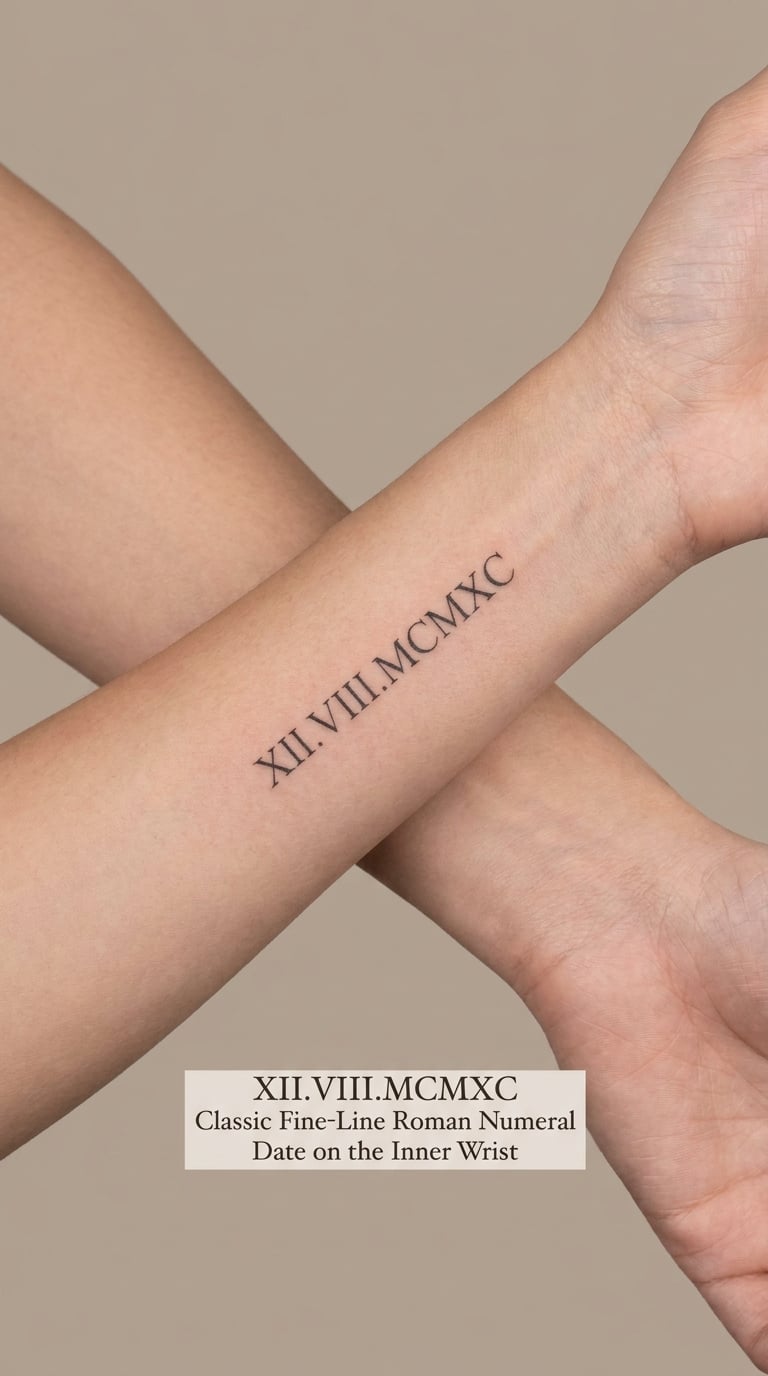
This is the cleanest version of the whole idea: one thin black line of lettering, all in a row, read from left to right. The letters stay upright, spaced evenly, with no frame and no ornament, so the eye goes straight to the characters.
Most people choose this because it carries a date that matters deeply and would rather not explain it. A single line of numerals says that without turning into a conversation piece.
Placement: inner wrist, just above the heel of the hand, or the inner forearm a few inches up. Size: 1.5-2.5 inches (4-6 cm) across. Style: fine line, monoline lettering. Pain: medium, and the wrist aches for a while because the skin is thin there.
Make it yours: swap the separators for small dots, or write the year only if the full date runs past your wrist width.
2. Vertical Roman Numeral Date on the Forearm
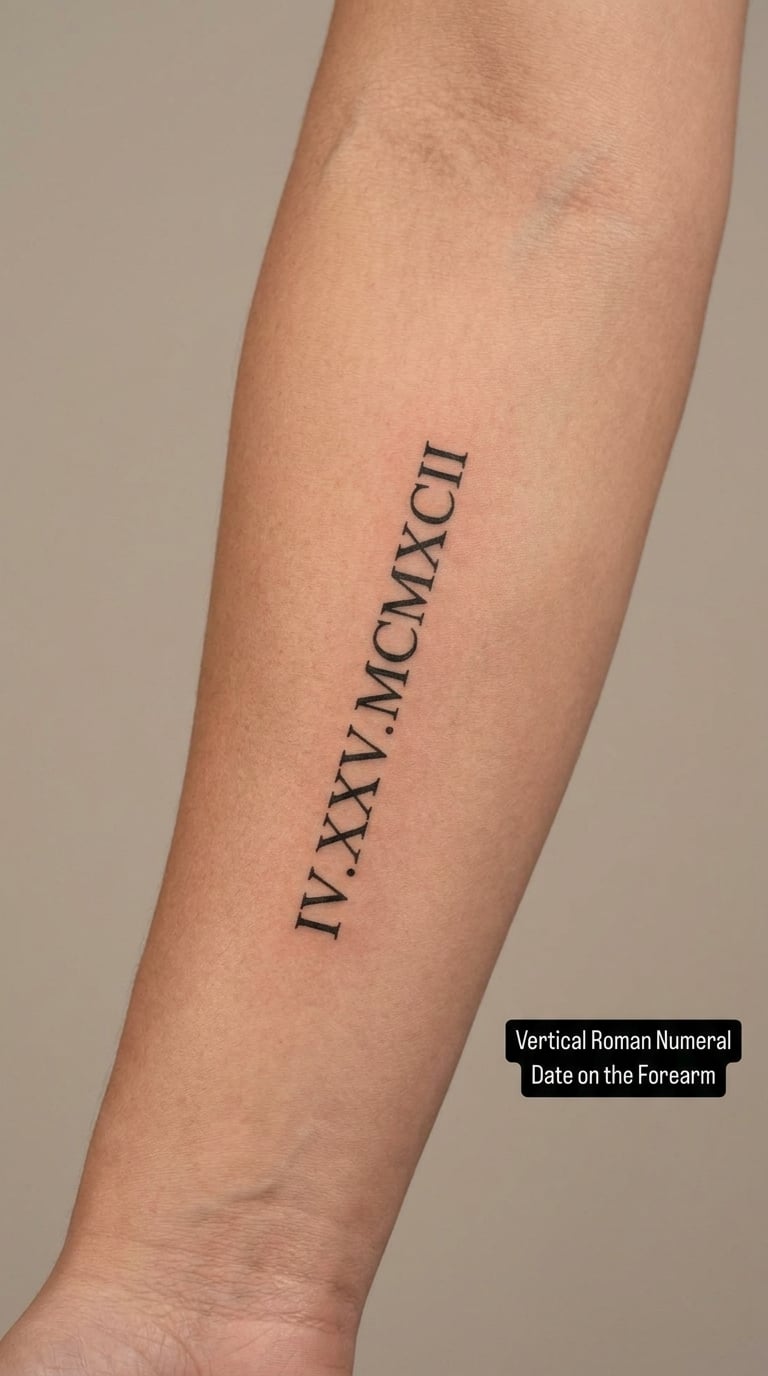
Turned ninety degrees, the same date becomes a tall narrow column that uses the length of the forearm instead of its width. Numerals read from the elbow down, or from the wrist up, depending on which direction feels natural to you.
A vertical layout is the answer when a horizontal date will not fit, and it reads as more deliberate from a distance than a wrist piece does.
Placement: inner forearm, wrist to mid-forearm. Size: 3-4 inches (8-10 cm) tall, roughly an inch per character group. Style: fine line with generous letter spacing. Pain: medium, easing off as the session goes on.
Make it yours: add a small date underneath in Arabic numerals for family, or keep the column pure and add a matching piece later.
3. Curved Roman Numerals Around the Wrist
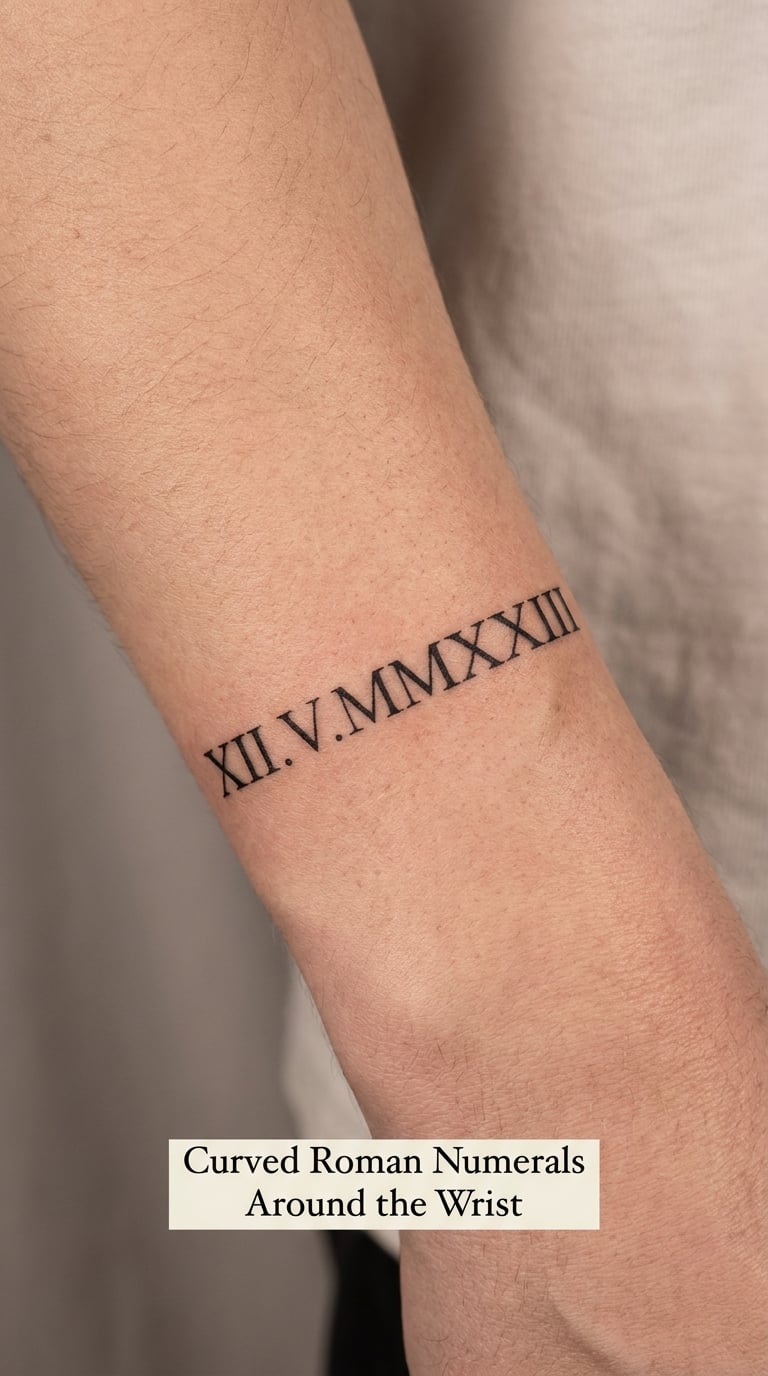
Instead of fighting the wrist’s curve, this design follows it. The numerals arc around the inner wrist, each letter tilted slightly so the whole line reads as one smooth sweep rather than a row bent into an angle.
It suits people whose wrist is narrow or whose inner arm dips inward, because a straight stencil would sit crooked.
Placement: inner wrist, wrapping maybe a third of the way around. Size: 2-2.5 inches (5-6 cm) along the curve. Style: fine line, evenly weighted. Pain: medium, with the letters over the wrist crease feeling sharper.
Make it yours: curve the date into a slight crescent, or mirror a second copy on the other wrist.
4. Roman Numeral Date with a Small Heart Accent
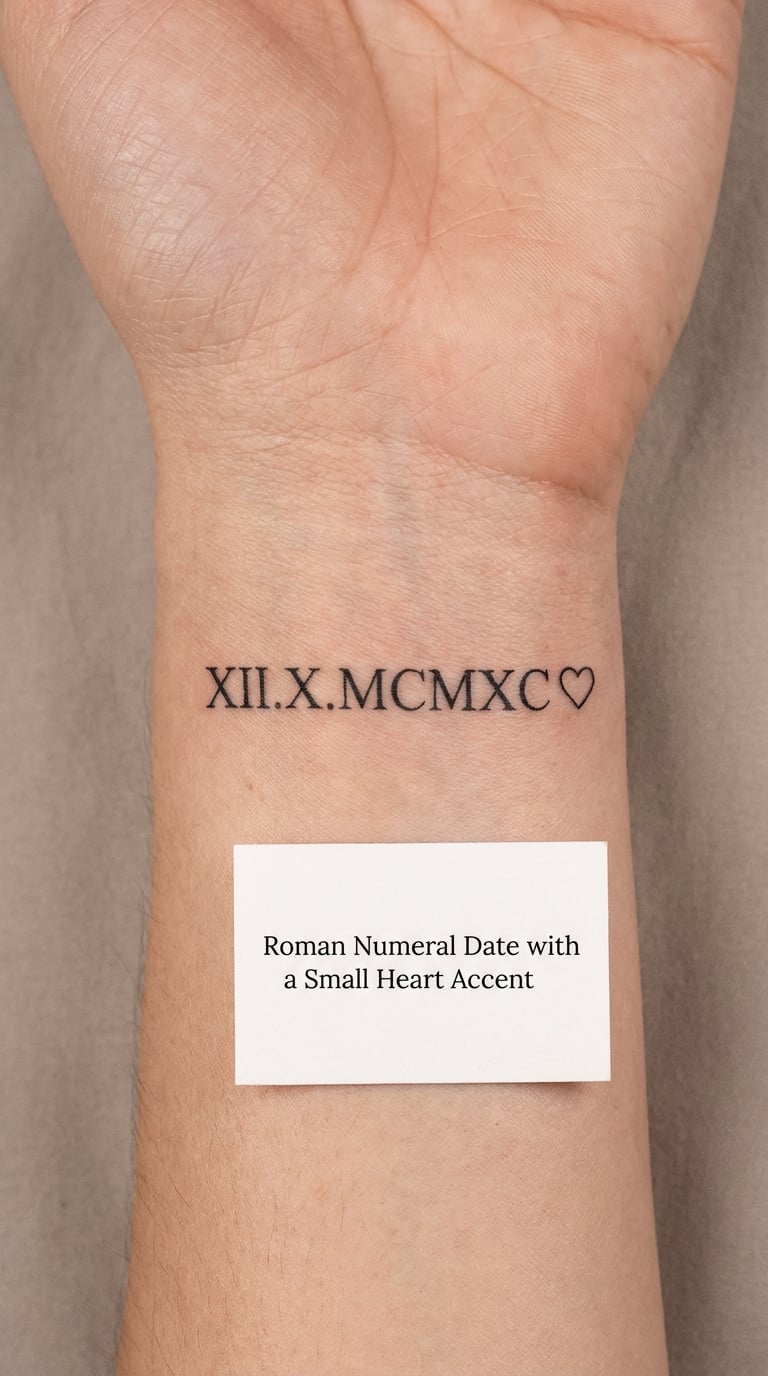
The numerals stay the main event, laid out in a straight fine-line row, with one small outline heart tucked into an empty corner of the composition. The heart is deliberately small, usually under a quarter inch, so it reads as a punctuation mark rather than a theme.
It is a good fit when the date marks something you loved as much as yourself: a partner, a parent, a child, a year that mattered.
Placement: inner wrist or inner arm, with room for the accent. Size: 2-3 inches (5-8 cm) including the heart. Style: fine line outline heart, solid or hairline numerals. Pain: medium.
Make it yours: fill the heart in a single muted colour, or place it so it sits in the gap between two numerals.
5. Bold Blackwork Roman Numeral Date on the Upper Arm
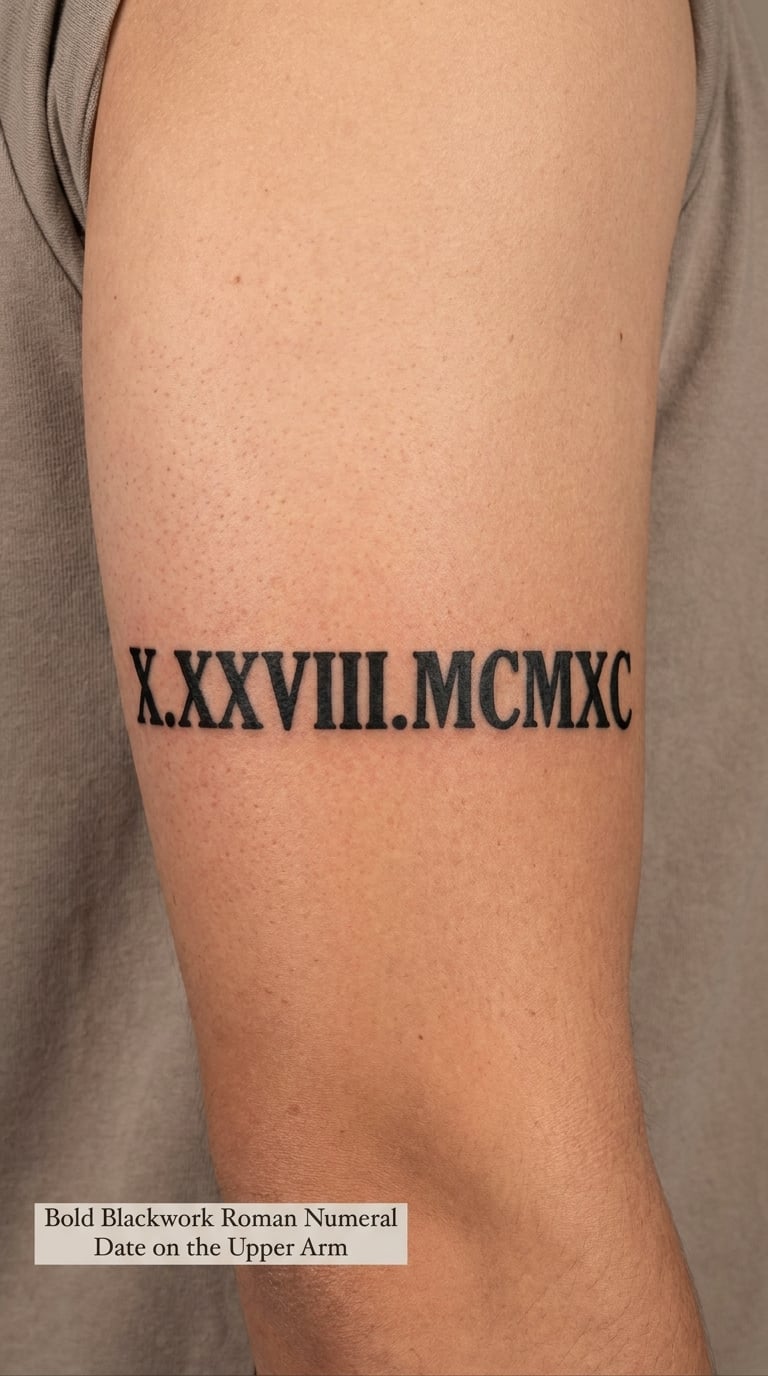
Same letters, opposite treatment: thick strokes, wide spacing, solid black fill. This is the version that still reads from across a room, and the heavy line weight holds its shape far better than hairline work over the years.
It suits people who want a date to be visible rather than discovered, and it pairs well with other solid black pieces on the arm.
Placement: outer upper arm, or the outer forearm for a flatter surface. Size: 3-4 inches (8-10 cm) long. Style: blackwork, bold serif or block lettering. Pain: medium, and the upper arm muscles tighten if you tense up.
Make it yours: break the letters into two rows, or leave the strokes uneven so it looks hand-drawn rather than stamped.
6. Calligraphic Roman Numeral Birth Date Behind the Ear
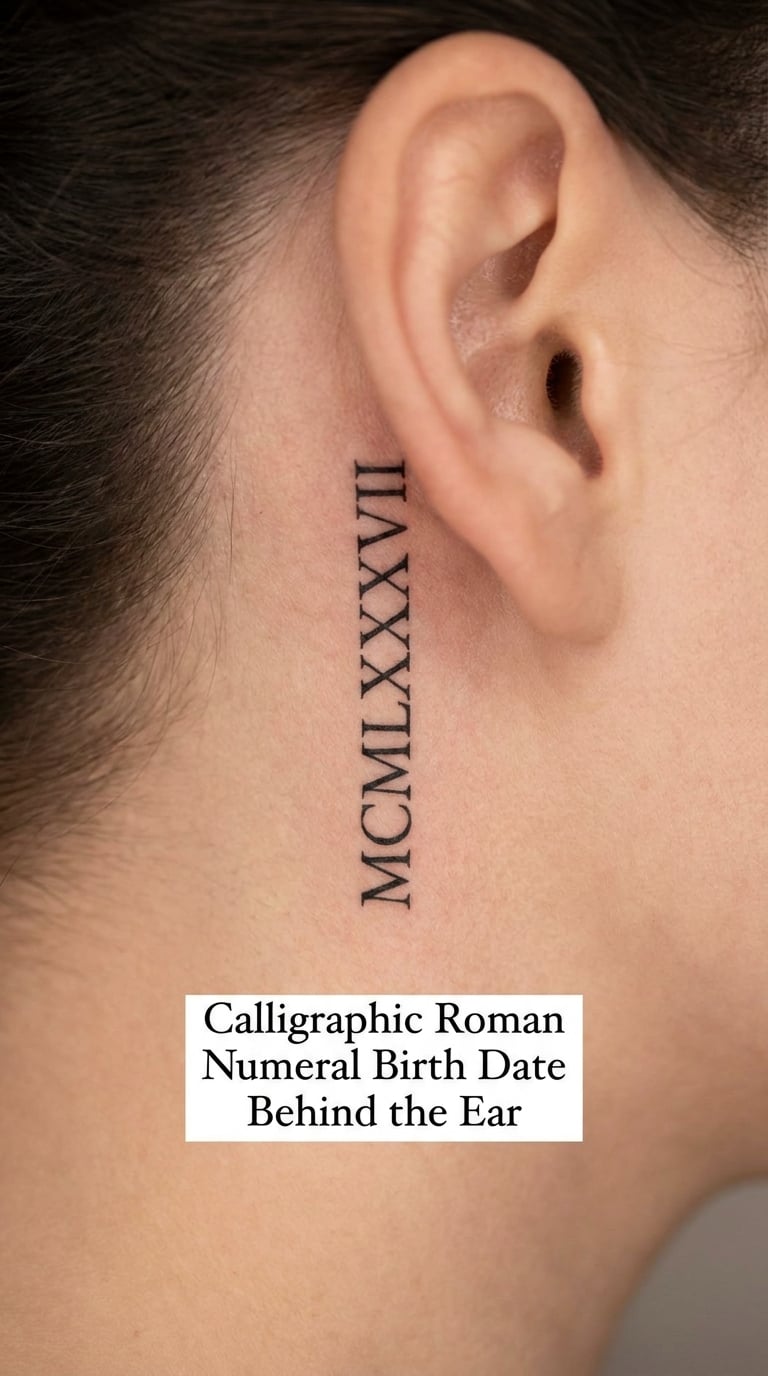
A short numeral string, often just the birth year, written in a slanted script that looks more like handwriting than typography. Behind the ear there is very little room, so four or five characters is usually the practical maximum.
Hair covers it, glasses arms sit near it, and in photos it is only visible if you turn your head. That privacy is exactly why people choose this spot for a date they keep close.
Placement: behind the ear, following the curve of the cartilage. Size: 1.5-2 inches (4-5 cm). Style: fine-line script or calligraphy. Pain: high. The skin is thin, bony and extremely sensitive, and the session is usually short.
Make it yours: add a tiny single line under the numerals, or use your own handwriting as the reference for the script.
7. Roman Numeral Date Framed by Two Fine Lines
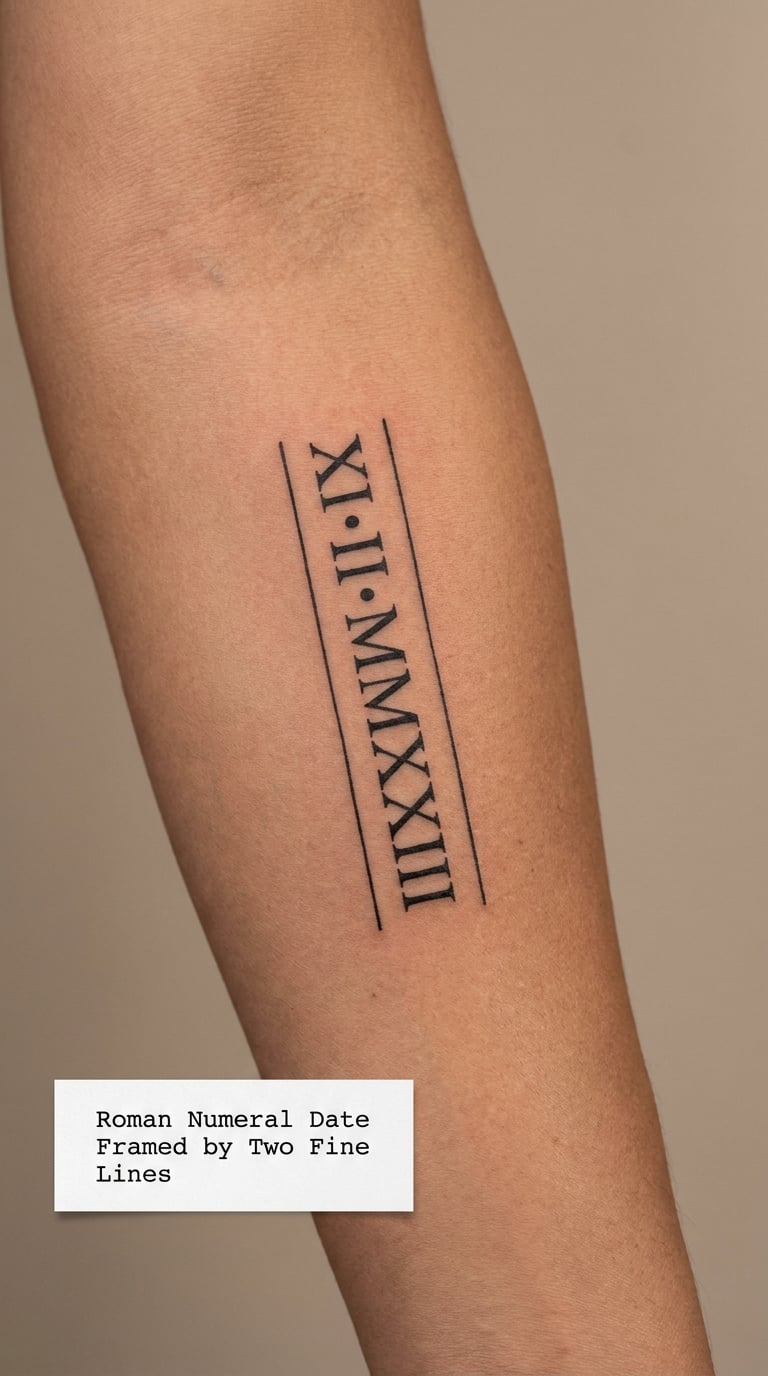
Two hairline rules, one above the numerals and one below, give the date a frame without adding a single decorative element. Horizontal rules suit a horizontal date; vertical rules suit a stacked one. The lines are kept parallel and thin so the design stays quiet.
It reads more architectural than a bare date, which works if you like structure but not ornament.
Placement: inner forearm or outer upper arm, anywhere the surface is flat enough for straight lines. Size: 2.5-3 inches (6-8 cm) including the rules. Style: minimal fine line. Pain: medium.
Make it yours: extend the lines past the numerals as if they were cut off, which looks modern and hides small spacing errors.
8. Dotwork Roman Numeral Date on the Shoulder
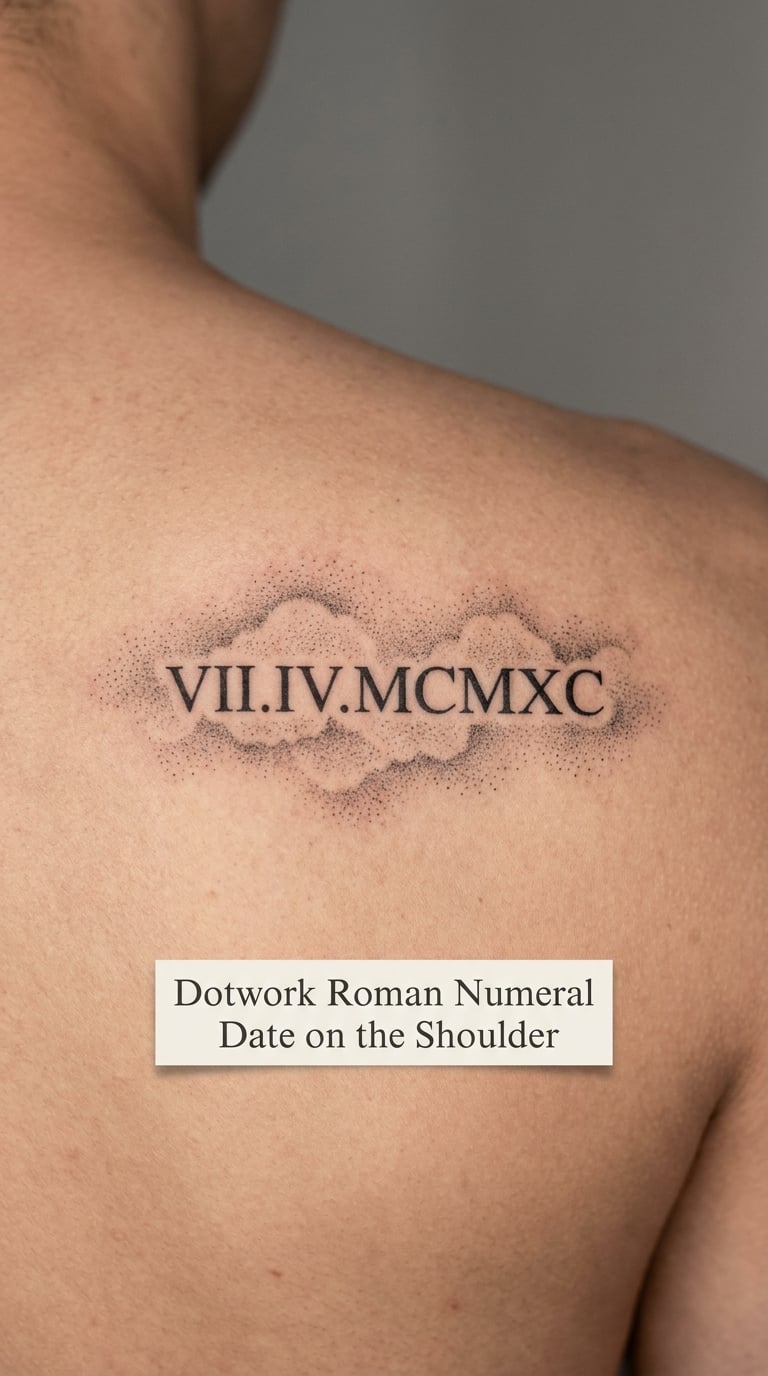
The date sits in clear black lettering while a light field of graduated dots builds soft shading around it, densest at one end and fading to nothing at the other. The dots give the piece depth and a reason to be on the shoulder, which is a large curved surface that flat line work can look lost on.
It is a quieter alternative to a full ornamental piece, and the shading hides small imperfections in the skin texture.
Placement: top of the shoulder or upper chest. Size: 3-4 inches (8-10 cm) across. Style: dotwork with fine-line numerals. Pain: medium, and the shoulder blade shifts under the skin as the artist works.
Make it yours: add a second date in the same dotwork style later so the shading joins into one field.
9. Small Roman Numeral Date on the Side of the Finger
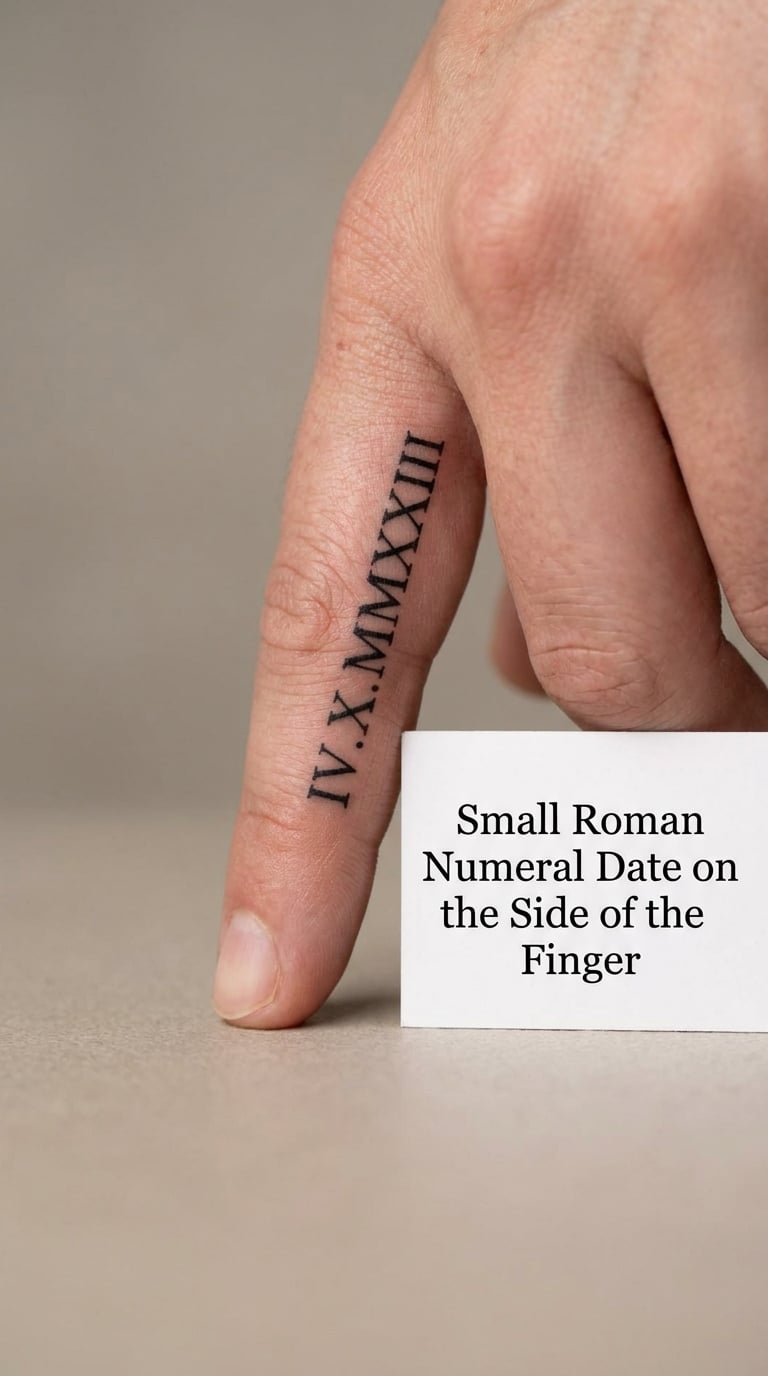
Micro lettering down one side of a finger, usually a birth year or a shortened date, small enough that most people do not notice it at all. The characters are stacked in a tight column with maximum spacing between them, which is the only way micro numerals stay readable.
Be honest with yourself about this one. Tiny black lines on fingers soften faster than lines anywhere else, because hands get washed, worked and bumped constantly.
Placement: side of the index or ring finger, running lengthwise. Size: under 1 inch (2.5 cm). Style: micro fine line. Pain: high, especially between the knuckles, and the finger usually swells during the session.
Make it yours: use the year alone, and plan a touch-up visit at six months rather than assuming the first pass will hold.
10. Stacked Roman Numeral Date on the Sternum
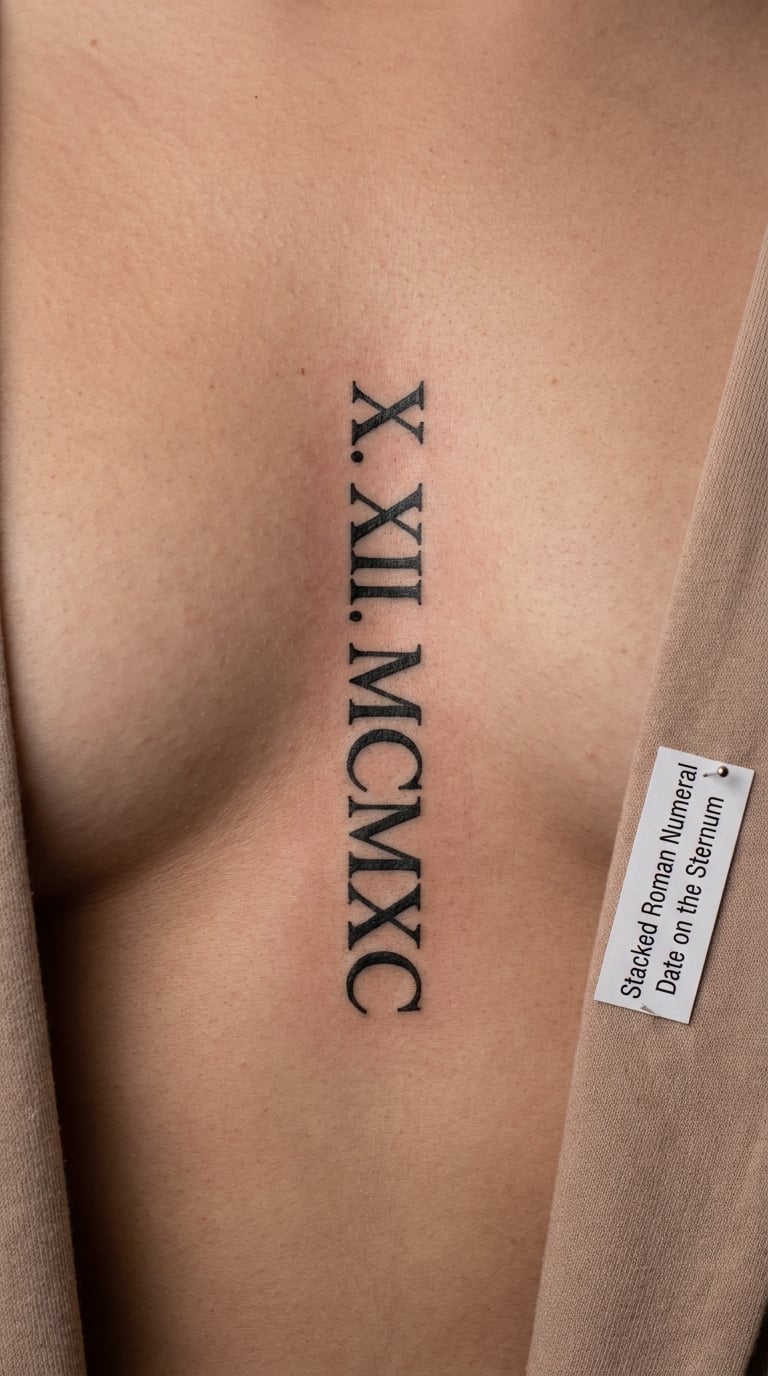
Instead of a long line, the date breaks into short stacked rows: the day on top, the month beneath it, the year at the base, centred on the sternum. The composition is symmetrical and narrow, so it follows the body’s center line rather than sitting across it.
It has a quiet permanence to it. The sternum moves with breathing and posture, and the tattoo moves with you.
Placement: upper sternum between the collarbones. Size: 2-2.5 inches (5-6 cm) tall. Style: fine line, evenly weighted. Pain: high, on bone and thin skin, and the breathing makes it hard to stay still.
Make it yours: put a single small symbol between the rows, such as a dot, so the three tiers read as one piece.
11. Arched Roman Numeral Date Above the Collarbone
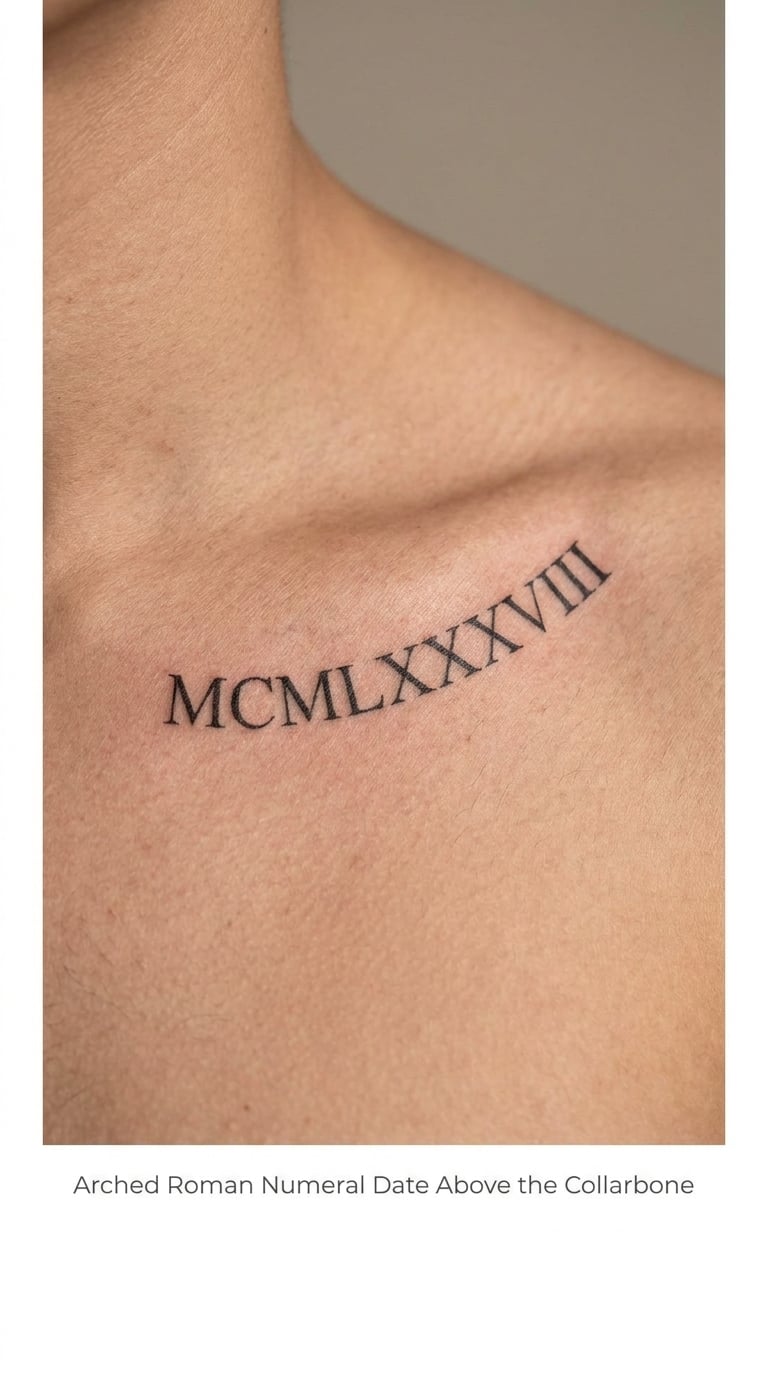
The numerals follow a shallow arch above the collarbone, each letter tilted a few degrees so the line rises and falls with the bone underneath. The arch is what keeps a straight date from looking like it was taped on.
Hair and open collars frame this placement, which makes it one of the most photographed date tattoo spots without being loud.
Placement: just above the collarbone, either side of the sternum. Size: 2.5-3.5 inches (6-9 cm). Style: fine line, serif or monoline. Pain: high. The collarbone is a bony ridge and everyone who has had one there says the same thing.
Make it yours: mirror the same date on the opposite collarbone in a slightly smaller size.
12. Roman Numeral Date with a Red Ink Dot
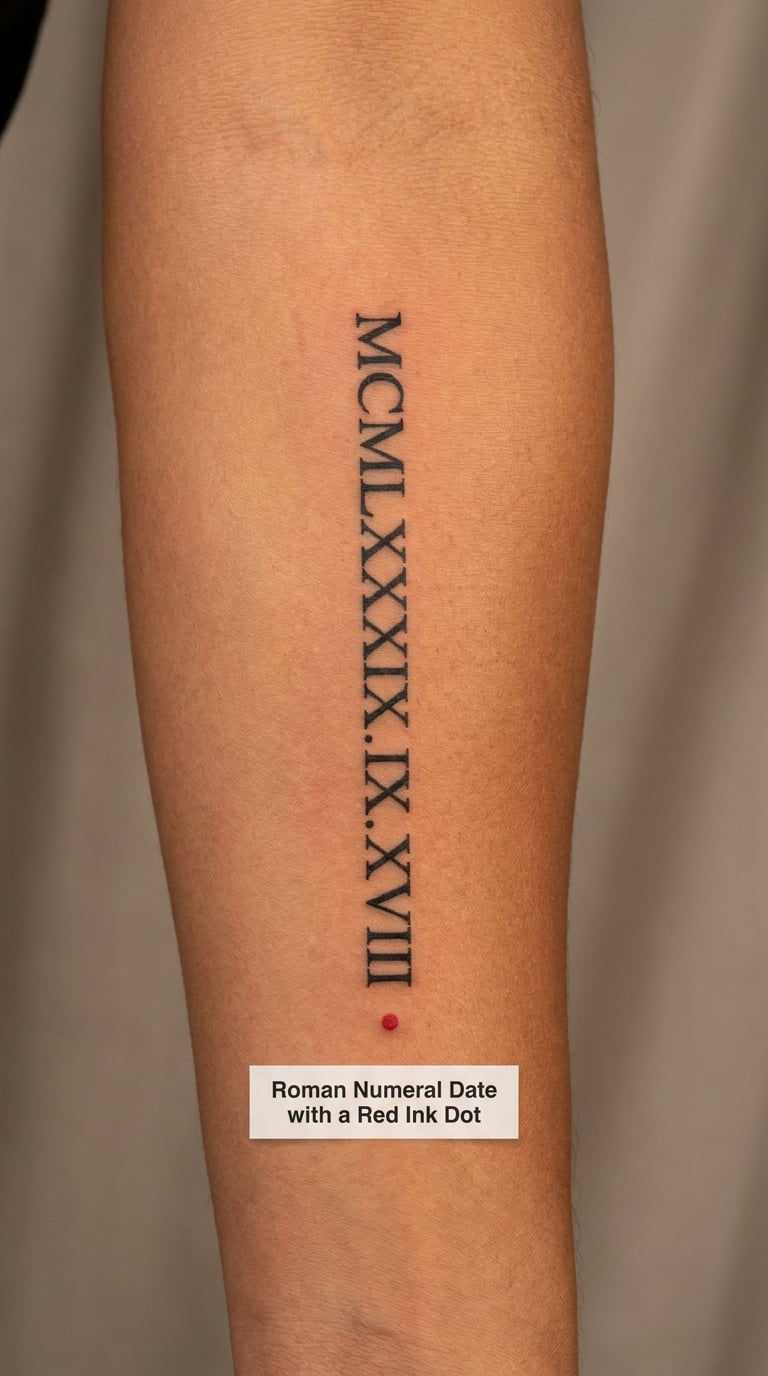
A monochrome date with a single red dot placed as the separator, usually a small solid circle between day, month and year. One accent colour does a surprising amount of work: it makes an otherwise plain design feel deliberate, and red is the one colour that holds its tone well in a small filled shape.
It suits someone who wants a date tattoo but does not want a colourful piece.
Placement: inner arm or inner forearm. Size: 2-3 inches (5-8 cm). Style: fine line with one coloured detail. Pain: medium.
Make it yours: use the dot in place of one separator only, so the format itself carries the accent rather than the whole tattoo.
13. Large Roman Numeral Date on the Rib
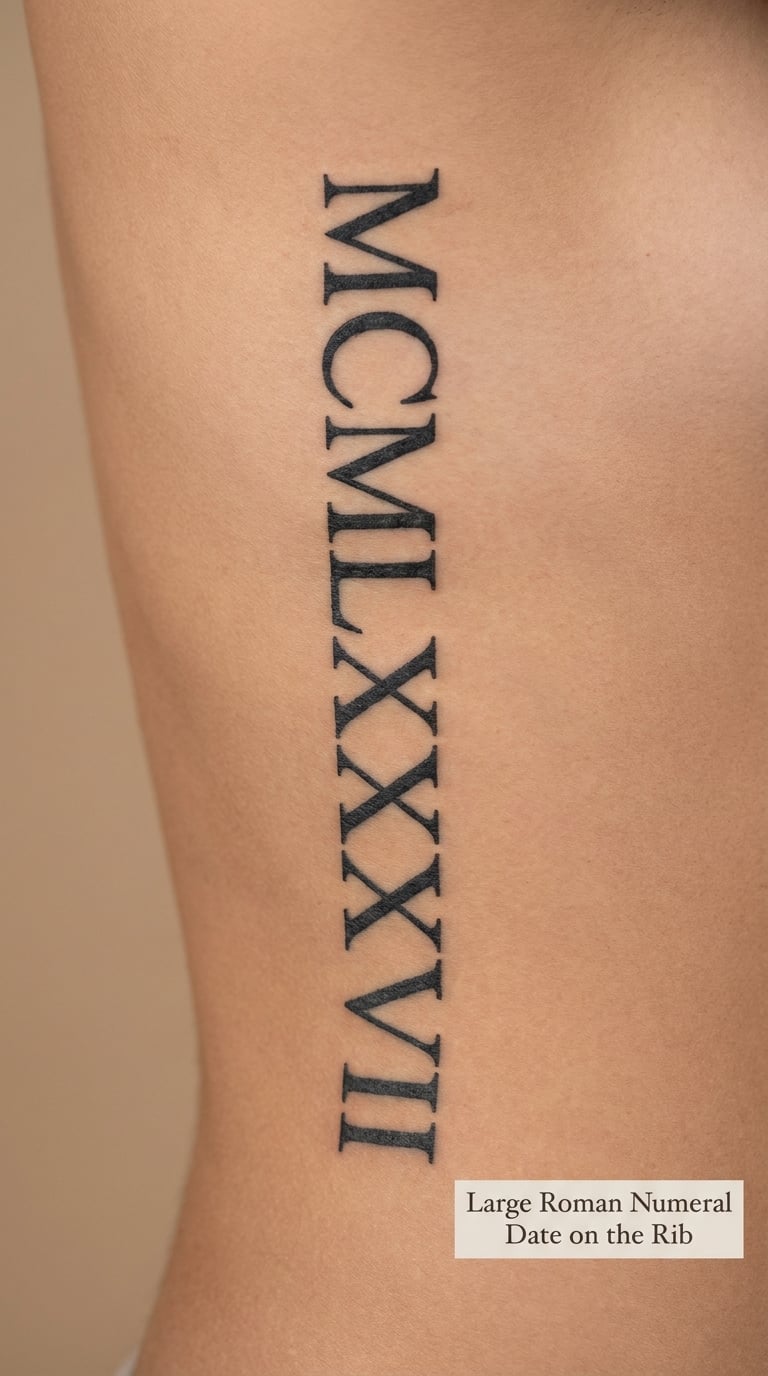
The same vertical arrangement as the forearm version, scaled up and given room to breathe. On the ribs the numerals can run four or five inches without looking oversized, and the length makes the date feel like a statement piece rather than a private note.
Ribs are the placement people are most sure about and most surprised by. Think about how you breathe, sit and sleep before you commit, because the design will stretch and compress every day.
Placement: side ribs, running vertically under the arm. Size: 4-5 inches (10-13 cm). Style: fine line or light blackwork. Pain: high. Ribs and sternum take the sting well, and skin here stretches when you breathe.
Make it yours: split the date into two lines so it follows the curve of the rib cage instead of one long column.
14. Roman Numeral Date in a Circular Arrangement
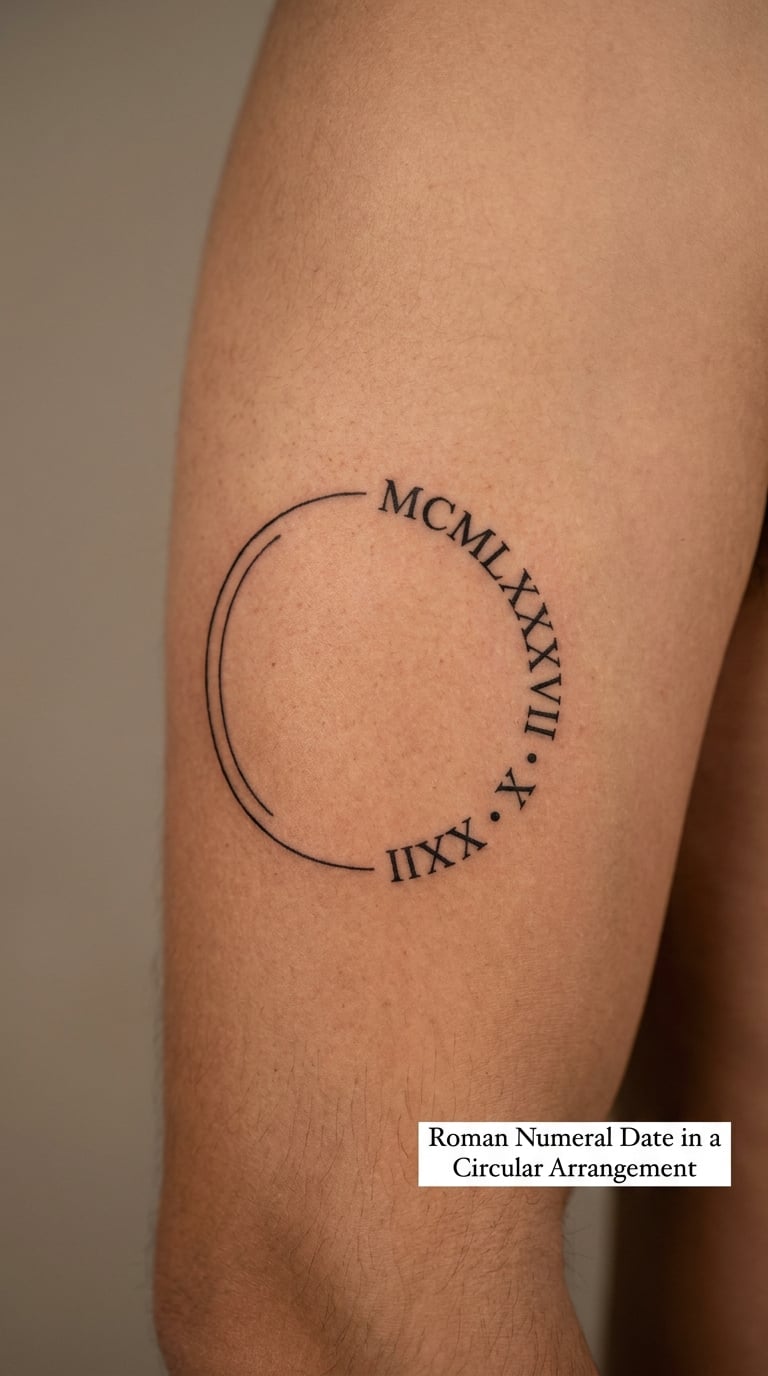
Rather than a full wreath of text, the date occupies one clean arc inside a thin outlined circle, with the characters rotated to follow the curve. It reads as a badge or a seal, which suits a date tied to a milestone you want marked rather than described.
The circle is drawn with a single hairline and left open at one point, which keeps it from looking like a logo.
Placement: outer upper arm or the shoulder blade. Size: about 3 inches (8 cm) across. Style: minimalist fine line. Pain: medium.
Make it yours: put an Arabic date in the open centre of the circle, or leave the centre empty and keep the numerals only.
15. Roman Numeral Date with Laurel Branch Details
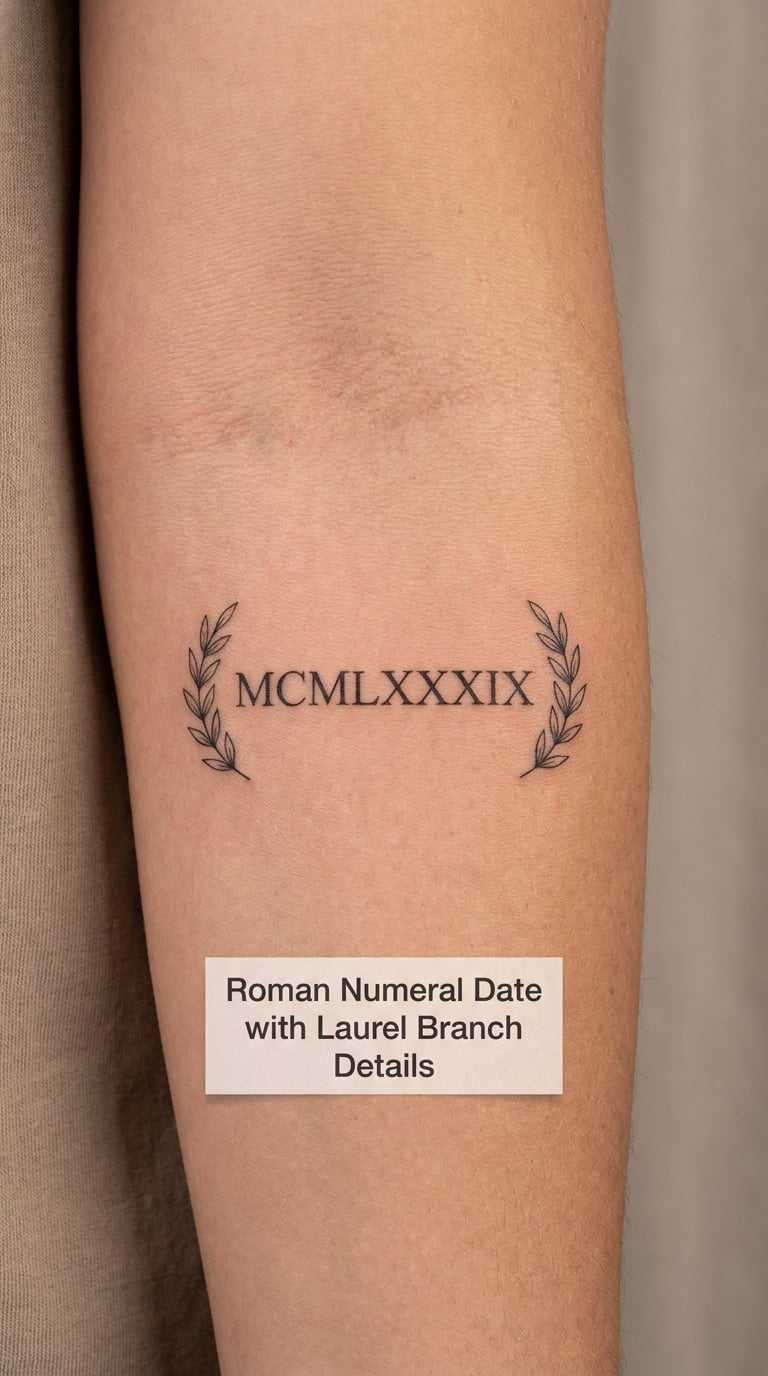
Two small laurel branches, one at each end of the horizontal date, drawn in fine line with a handful of leaves each. Laurel is the most-used botanical in this style, and the restraint is what makes it work: branches with more than a few leaves start competing with the letters.
It reads as a commemoration rather than a birthday, which suits a parent, a memorial date or an anniversary.
Placement: inner forearm, laid out horizontally with space at both ends. Size: 3-4 inches (8-10 cm) including the branches. Style: botanical fine line. Pain: medium.
Make it yours: use the birth flower of the person the date belongs to instead, at the same scale.
16. Handwritten Roman Numeral Date on the Bicep
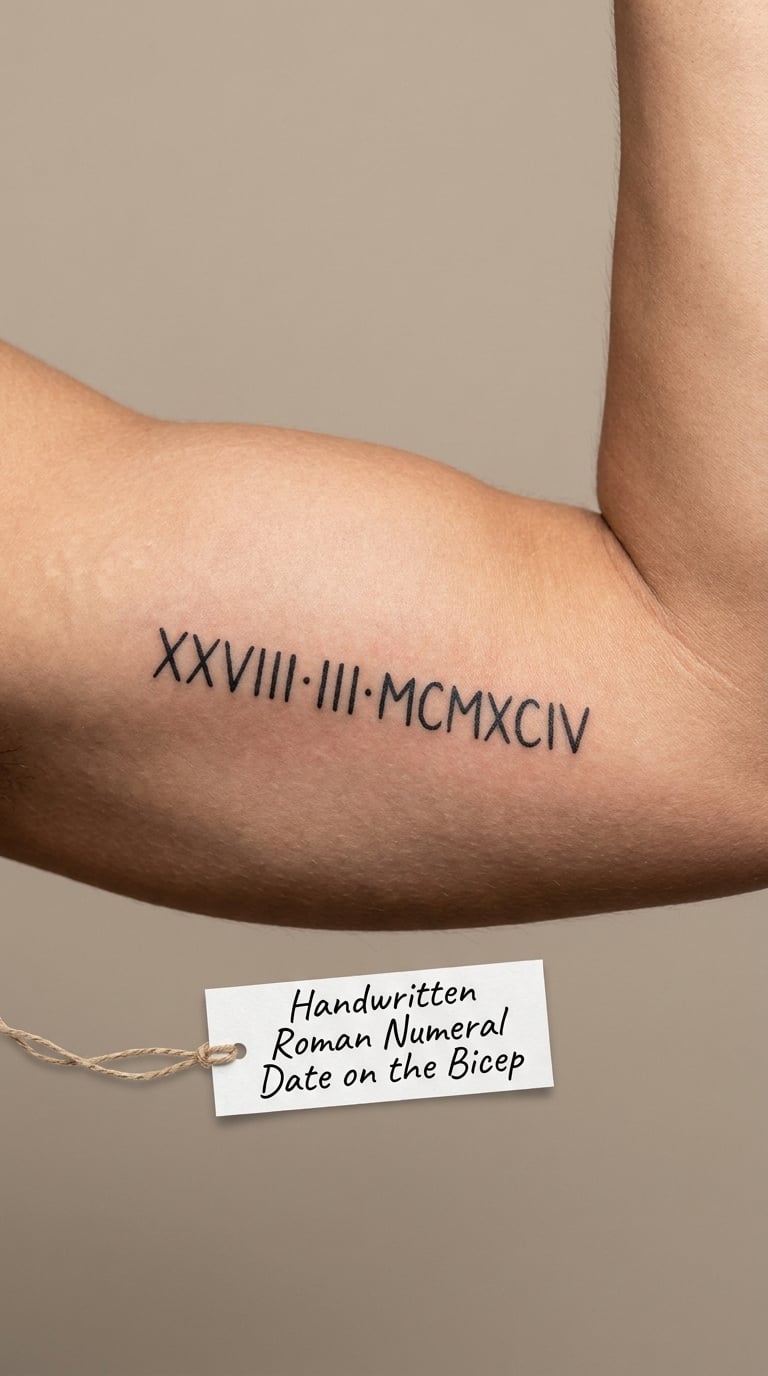
Loose, slightly uneven lettering with visible stroke variation, as if someone wrote the date quickly in a notebook. The letters lean at different angles and the spacing is loose, which gives the piece a personality that typeset lettering cannot.
It suits people who would rather the tattoo look like handwriting than like typography. Just keep the characters readable, because a relaxed style is where wrong-looking numerals hide.
Placement: outer bicep, upper outer arm or side of the torso. Size: about 3 inches (8 cm). Style: handwritten fine line with varying stroke weight. Pain: medium.
Make it yours: bring a sample of your own handwriting or a photograph of a hand-written note so the artist copies your rhythm.
17. Roman Numeral Date with a Small Birth Flower
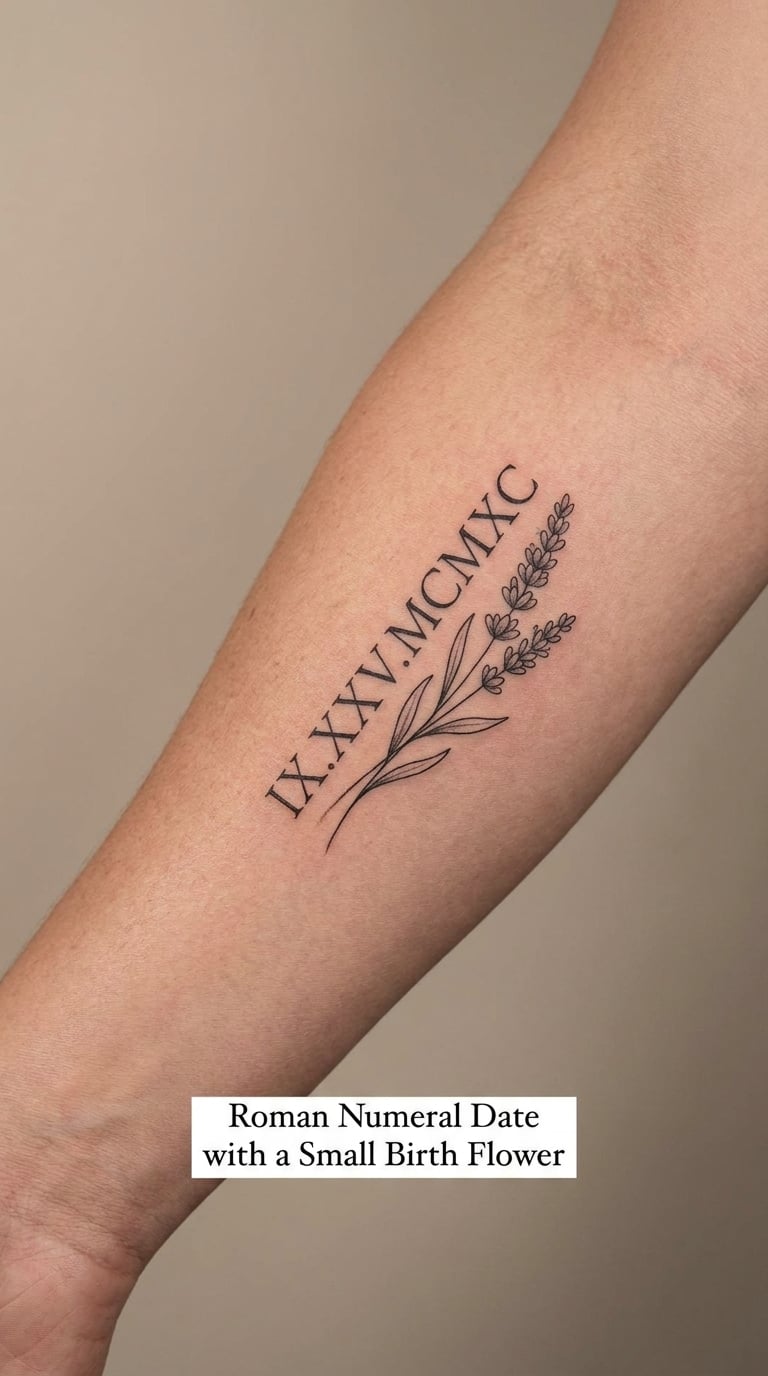
One small sprig of the flower that represents the birth month, drawn in fine line at the end of the date. The size is the whole trick here. A single stem with two or three leaves or petals sits comfortably beside the numerals, while a full bloom ends up twice the size of the date and changes what the tattoo is about.
It is an easy way to make a plain numeral piece feel personal, and it works for your own month or someone else’s. If you want more on that angle, 52 Beautiful Birth Flower Tattoo Ideas That Will Last Forever covers the flower side in detail.
Placement: forearm, ribs or the outer arm. Size: 3-4 inches (8-10 cm) including the sprig. Style: botanical fine line. Pain: medium, and the rib option runs higher.
Make it yours: match the sprig’s stem weight and leaf count to your actual birth month flower rather than a generic one.
18. Negative-Space Roman Numeral Date on the Ankle
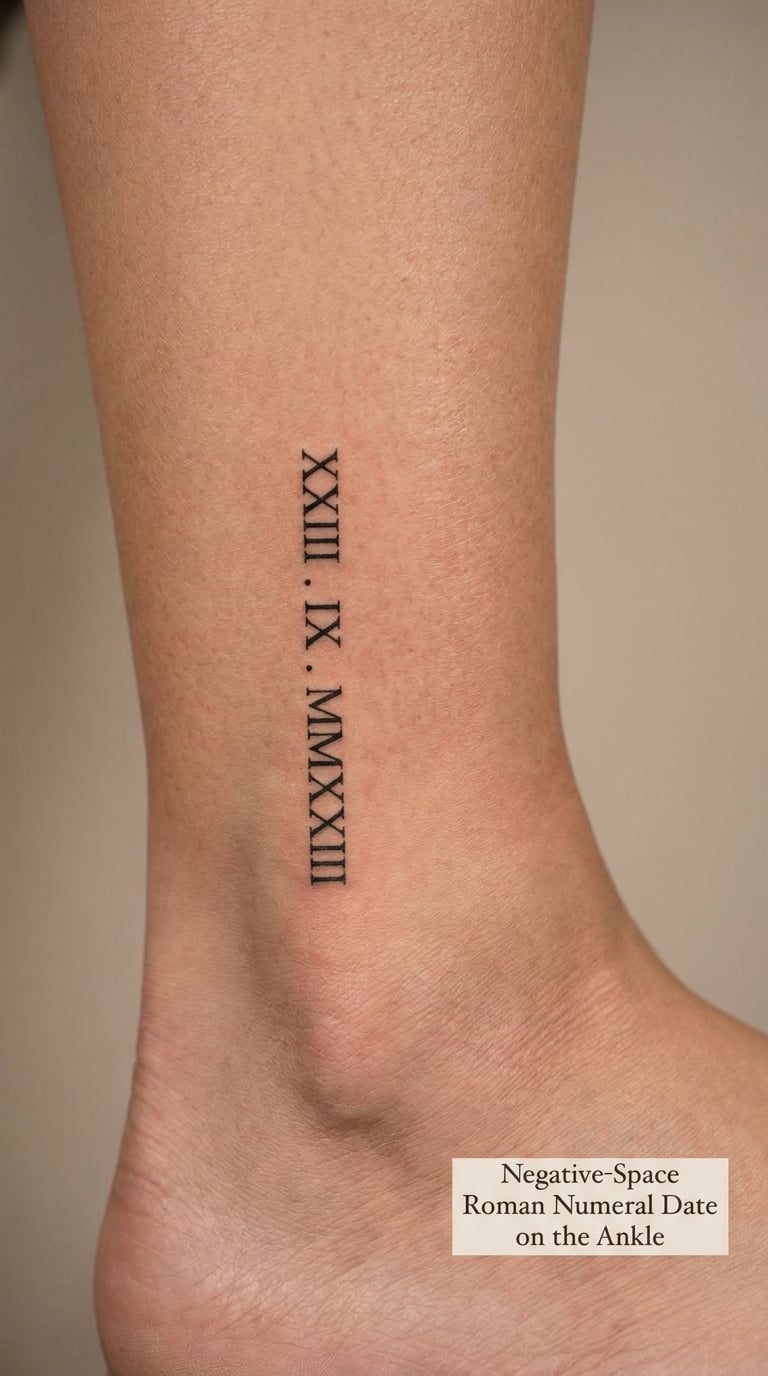
A small set of numerals with wide gaps between the characters, so the empty space carries as much of the composition as the ink does. Nothing frames the date and nothing sits beside it, which gives the piece a modern, almost unfinished look that reads well on a narrow area like the ankle.
Ankles show in summer, so this is one placement where scale matters more than anywhere else on the list. A tattoo that is too small simply disappears from a few steps away.
Placement: outer ankle, above the bone or slightly behind it. Size: 1.5-2.5 inches (4-6 cm). Style: minimal, thin solid lines. Pain: medium, sharp over the ankle bone and duller just above it.
Make it yours: widen the gaps until the design reads as pattern, then keep the spacing identical across all three date groups.
19. Roman Numeral Date with a Thin Moon Phase
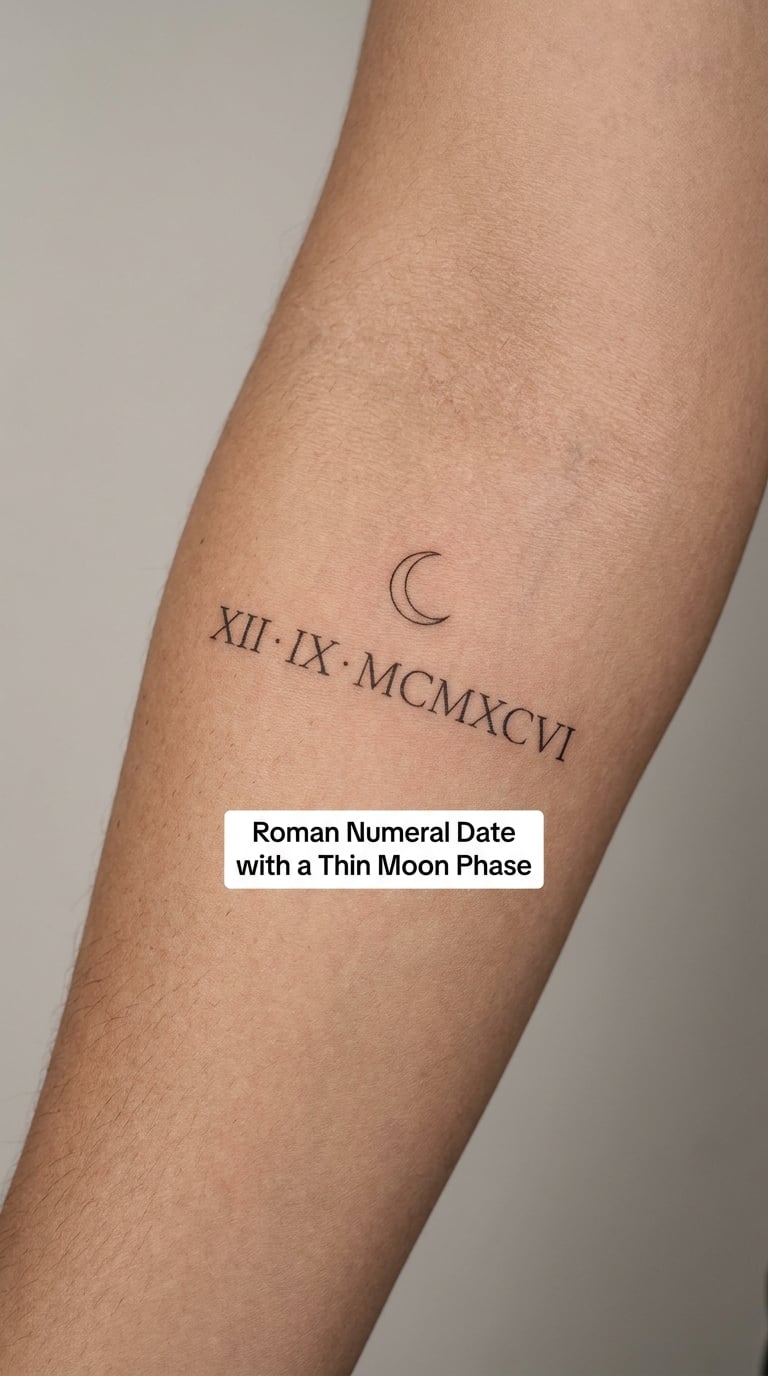
A thin crescent or a short run of small moon shapes sits above or below the horizontal date, drawn in a single hairline weight. The moon is an accent here, not a statement, and it pairs naturally with a date that marks a night, a birth hour or a year you want to remember differently.
Any reading of what the moon phase means belongs to the wearer. Some people link it to the moon’s position on their birth night, some treat it purely as a shape they like.
Placement: inner arm or forearm, with clear space above the numerals. Size: 2.5-3.5 inches (6-9 cm) including the moon. Style: fine line. Pain: medium.
Make it yours: place the moon at the start or the end of the date rather than centred, so it reads as a marker and not a title.
20. Ornate Roman Numeral Date on the Back of the Shoulder
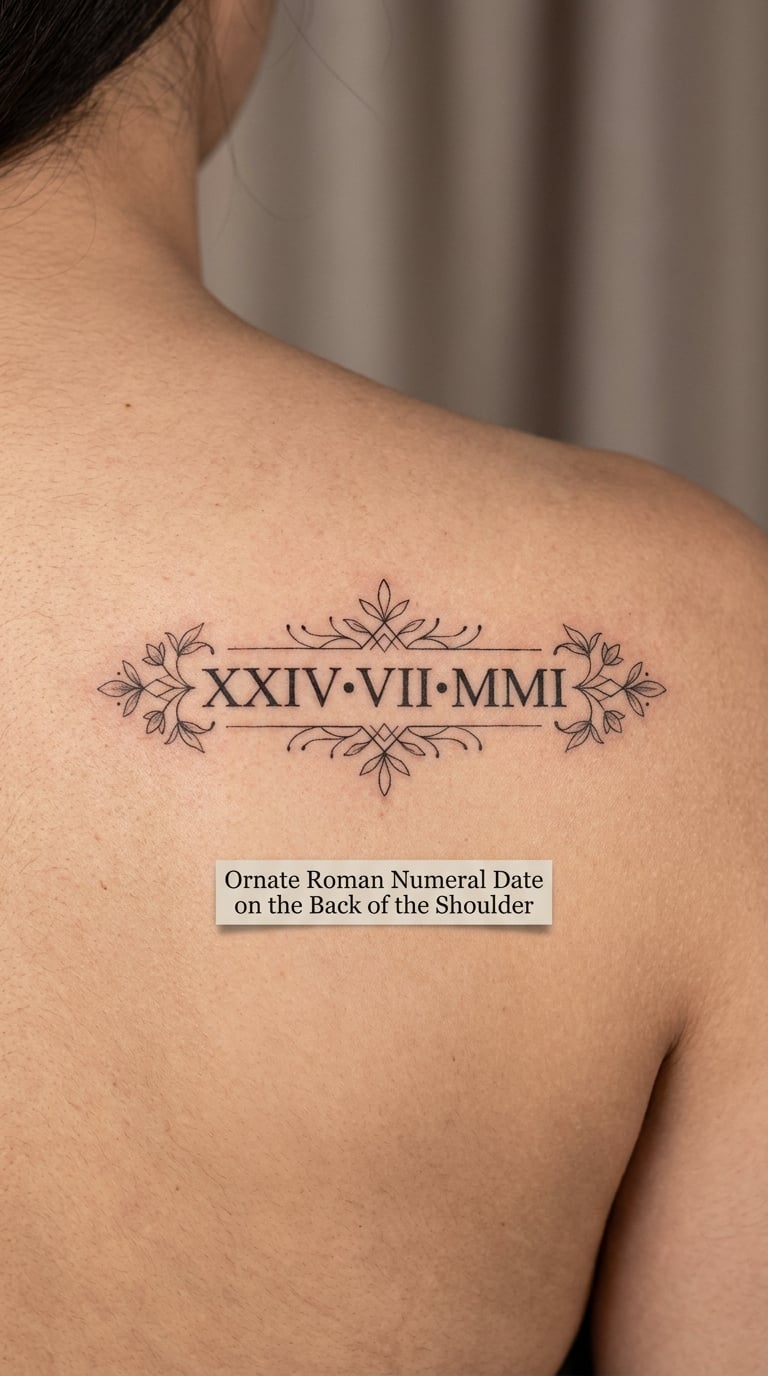
The most decorative option on the list: the date in crisp lettering with symmetrical filigree, small scrolls and hairline flourishes above and below. Done well, the ornamentation frames the numerals and gives them a formal, almost engraved quality. Done badly, it turns into a tangle that swallows the numbers.
Keep the ornament lighter than the lettering in weight and let it sit at least a finger’s width away from the characters.
Placement: back of the shoulder, spanning the upper back. Size: 4-5 inches (10-13 cm). Style: ornate fine line. Pain: medium, and lying down during aftercare is uncomfortable for a few nights.
Make it yours: have the artist sketch the numeral string first at final size, then add ornament to the empty space around it, never the other way round.
How to Choose the Right Design
These checks get you most of the way there, and the numeral accuracy one matters more than the rest of them combined.
Check the numeral string before you book
Convert your date first, then have a second person check it. Roman numerals build from seven letters, I V X L C D M, and smaller values placed before a larger one are subtracted, so IV is 4, IX is 9, XL is 40, XC is 90 and CM is 900. A birth date is normally written year, month, day, so 14 March 1994 becomes MCMXCIV, III, XIV. Write the string out and photograph it. Note that clock faces use IIII for 4 while standard notation is IV, and a tattoo in IIII will read as a mistake to most people.
How birth date tattoo ideas in roman numerals age over time
Thin lines fade first, and fingers, knuckles and ankles fade fastest of all. Spacing matters as much as weight, because numerals set too close together merge into an unreadable block within a few years. Budget roughly an inch per character group as a starting size, and expect to want a touch-up on anything micro.
Also decide day-month order consciously. Whichever you pick, a reader in a country that uses the other order may misread it, so if it matters to you, adding a separator style or the year first settles the intent.
Ask about the surface. Curved and bony areas distort straight lines. A stencil placed on a moving part should be checked in a few positions, not one.
Match weight to size. A full birth date at 1.5 inches needs hairline letters or they will be a blur. A 5-inch rib piece can carry much bolder work.
Keep the first piece small if it is your first. A single date is already a full idea. Adding a second design later is far easier than covering or living with the wrong one.
Cost and Session Time
Time is easier to predict than cost. A small date at 2 inches is usually a short session of well under an hour. A 4 to 5 inch rib or back-of-shoulder piece with ornamentation is a longer sit, often two hours or more, and some artists quote a whole day for that size.
For US rates, think in bands rather than exact figures. A small 2 inch date from a standard font usually lands somewhere between $120 and $250, a medium 3 to 4 inch piece with a custom drawing sits closer to $250 to $450, and a large 5 inch rib or back-of-shoulder design with ornamentation can run from $450 up towards $900 or more. Those are honest ranges, not quotes, and the artist sets the real number.
On cost, what moves the number is size, whether you need a custom drawing rather than a standard font, how many sessions it takes, and how much the ornamentation adds. Shop minimums are common, so a small piece can cost close to a medium one. City, artist experience and how booked they are all factor in, and rates differ enough between a small town and a major city that a single figure would be misleading.
Get the quote at the consult, not over a message, and ask whether it covers the touch-up window. Most artists include at least one free correction for a date, and that is worth more than a small saving elsewhere.
Aftercare Basics
Start with your artist’s aftercare instructions, because they will account for the ink, the placement and how deeply you went in.
- Follow whatever your artist tells you first, and ask them if anything below is unclear.
- Keep the area clean and gently washed, then pat it dry rather than rubbing it.
- Leave the skin alone. No scrubbing, no picking, no scratching when it flakes.
- Moisturise thinly as directed, using a product you already know you do not react to.
- Keep sun off it while it heals, and remember that a tan line across a healed date is normal and usually settles.
- Do not soak it in pools, hot tubs or the sea until the skin is fully closed, and check with your artist for the timing.
Most people ask about itching or fading in month two. Both are normal, and both are easier to sort out with a photo of a healed piece at six months than from day-one skin.
Frequently Asked Questions
Can I get a birth date tattoo in Roman numerals?
Yes. It is one of the most requested date formats and works at almost any size. The only real limits are practical: conversion accuracy, enough room for the characters, and how much detail you expect to keep. Bring your numeral string written out and checked by a second person before your session.
How do I convert my birth date to Roman numerals?
Write the year, then the month, then the day. Split each part using the seven letters I, V, X, L, C, D and M, and subtract smaller values that sit before larger ones: IV is 4, IX is 9, XL is 40, XC is 90, CM is 900. So 14 March 1994 is MCMXCIV, III, XIV. Have a second person check the result.
How big should each numeral be so it does not blur?
Roughly an inch per character group is a good starting point for a main piece, more for anything under an inch tall. Spacing between characters matters as much as size, since numerals set too close together merge over time. Any piece on fingers, knuckles or ankles will soften sooner than one on the forearm or upper arm.
What is the least painful placement for a roman numeral date tattoo?
The inner forearm and the outer upper arm are the easiest going, mostly because there is soft tissue and some muscle to sit against. Wrist, ankle, collarbone, sternum, ribs and behind the ear all sit over bone with thin skin, and people rate those noticeably sharper. A small date in a low-pain spot finishes faster for the same reason.
Should I write my date month-day-year or day-month-year?
Roman numeral date tattoos are normally written year, month, day, so the four digits come first. Whichever order you choose, be deliberate about it, because readers in other countries may assume the opposite and misread the date. You can remove the ambiguity entirely by writing the year first and using clear separators between the groups.
Do roman numeral date tattoos fade over time?
They do, and thin lines fade first. Fine line work on the inner arm holds up well, while micro lettering on fingers and knuckles softens noticeably within a few years, and small dot separators usually disappear before the letterforms do. Booking a touch-up in the six to twelve month window keeps the date readable without redoing the whole piece.
If this is your first tattoo, start with number 1 or number 3: a small fine-line date on the inner wrist, or the curved version if your wrist dips inward. It is the least to lose if something needs changing later, and it is easy to add a second piece beside it. If you already have work on the arm and this would be another, choose something with a different weight, like number 5 or number 13, so the date reads as its own piece instead of disappearing into the rest. Whatever you choose, get the numeral string checked twice and settle the placement while you are still able to say no.