
20 Best Father Daughter Matching Tattoo Ideas (September 2026)
Father daughter matching tattoo ideas work best when the design is simple enough to read at a glance and small enough to sit on two different bodies without anyone feeling outmatched. A two-inch line drawing on an adult inner forearm and a one-inch version on a young wrist will look like a deliberate pair. A full-colour sleeve concept will not.
Most people searching these designs are planning a specific occasion. A birthday, a wedding, a long separation, or simply a first tattoo taken together. Whatever the reason, the practical part is always the same: pick the meaning first, then match the scale, then agree on placement before anyone books. The ideas below are kept current for 2026 and each one comes with the details an artist will ask you for at the consultation.
What Tattoo Symbolizes a Father and Daughter Bond?
There is no single universal symbol for a father and a daughter. The most common choices are an infinity mark, a lion and lioness pairing, sun and moon, a compass or anchor, matching birth flowers, a shared set of coordinates, and a matching date. People choose these because they are easy to read small and easy to personalise, not because they carry one fixed meaning.
What the symbol actually means comes from the story you attach to it. Some families use a favourite flower, others the town they grew up in, others a phrase from a song. A good artist will ask what the design is about before drawing anything, and the answer changes the drawing more than the motif does.
Motifs carry less weight than most people expect. What someone remembers about these tattoos fifteen years later is the story, which is why our roundup of 65 sweet tattoo ideas that show dad’s love for his daughter leans on meaning rather than symbolism. If the pair you are planning is with your son instead, 68 meaningful father son tattoo ideas that show deep love covers the same ground from the other side.
- Infinity – represents continuity and a bond that does not break.
- Lion and lioness – represents protection, courage and family pride.
- Sun and moon – represents balance and two halves of the same whole.
- Compass or anchor – represents guidance, home and someone who keeps you steady.
- Birth flowers – represents a specific month, person or memory.
- Coordinates – represents a place that matters to one or both of you.
- A shared date – represents the moment the story started.
- A paw print or bird – represents a shared interest or a personality trait.
Father Daughter Matching Tattoo Ideas: Quick Guide
The table is a fast reference for all twenty designs, in the same order they appear, so you can narrow the list before the consultation.
| Idea | Style | Best placement | Size | Pain |
|---|---|---|---|---|
| 1. Infinity symbols | Fine line | Inner forearm | 1.5-2 inch | Low to medium |
| 2. Miniature compass | Fine line, black and grey | Inner wrist | 1.5-2 inch | Medium |
| 3. Birth flower pair | Botanical linework | Inner forearm | 2.5-3 inch | Low to medium |
| 4. Same constellation | Fine line, single point stars | Outer forearm | 2-3 inch | Low |
| 5. Tiny moons | Minimal fine line | Inner wrist | 1-1.5 inch | Medium |
| 6. Lion and lioness | Blackwork or traditional | Upper arm, calf | 3.5-4.5 inch | Medium |
| 7. Red heart outline | Single line, colour | Inner forearm | 1.5-2 inch | Low to medium |
| 8. Music note | Fine line or blackwork | Inner wrist | 1.5-2.5 inch | Medium |
| 9. House number | Fine line numerals | Wrist, calf | 1.5-2 inch | Low to medium |
| 10. Rose linework | Botanical or traditional | Forearm, calf | 2.5-3.5 inch | Low to medium |
| 11. Birds in flight | Fine line illustrative | Upper arm | 2.5-3.5 inch | Low |
| 12. Coordinates | Fine line numerals | Inner arm, rib | 2-2.5 inch | Low to medium |
| 13. Rainbow | Blackwork | Wrist, forearm | 2-3 inch | Low to medium |
| 14. Sea turtle | Micro-realism | Upper arm, ankle | 2.5-3 inch | Low to medium |
| 15. Initial and flower | Botanical, script | Inner arm, wrist | 1.5-2 inch | Medium |
| 16. Mountain range | Minimal linework | Forearm, calf | 2.5-3.5 inch | Low to medium |
| 17. Sun and moon | Minimal blackwork | Upper arm, shoulder | 2-2.5 inch | Low to medium |
| 18. Paw print | Minimal linework | Wrist, ankle | 1-1.5 inch | Medium |
| 19. Puzzle piece | Single line | Inner forearm, shoulder | 1.5-2 inch | Low to medium |
| 20. Fine-line date | Handwriting or numerals | Inner wrist, rib | 1.5-2 inch | Medium |
1. Matching Fine-Line Infinity Symbols
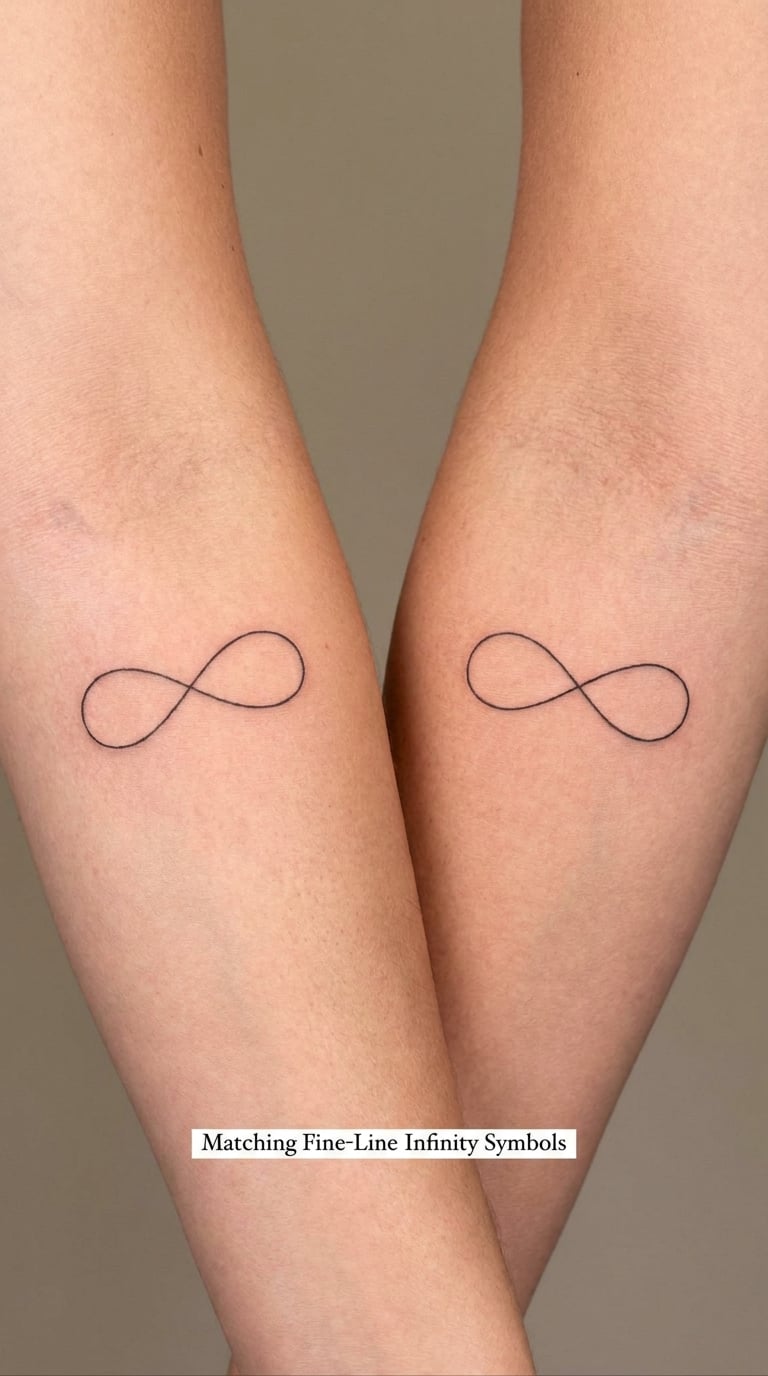
The plainest option in this list, and the one most people come back to. A single-needle infinity with a small break in the loop, no banner underneath and no extra ornament. It is a design an artist can draw freehand in seconds, which keeps the line weight consistent across two pieces done months apart.
Placement: Inner forearm just above the wrist crease, or the outer forearm where a shirt sleeve will not hide it. Size: 1.5 to 2 inches wide for an adult, 1 to 1.25 inches for a child. Style: Fine line, one needle.
Pain: Low to medium, the inner forearm being the first spot most people flinch at. Ageing note: single-needle lines stay legible for years as long as they are not thinner than a hair’s width. Make it yours: Break the loop at a different point in each version.
2. Miniature Matching Compass
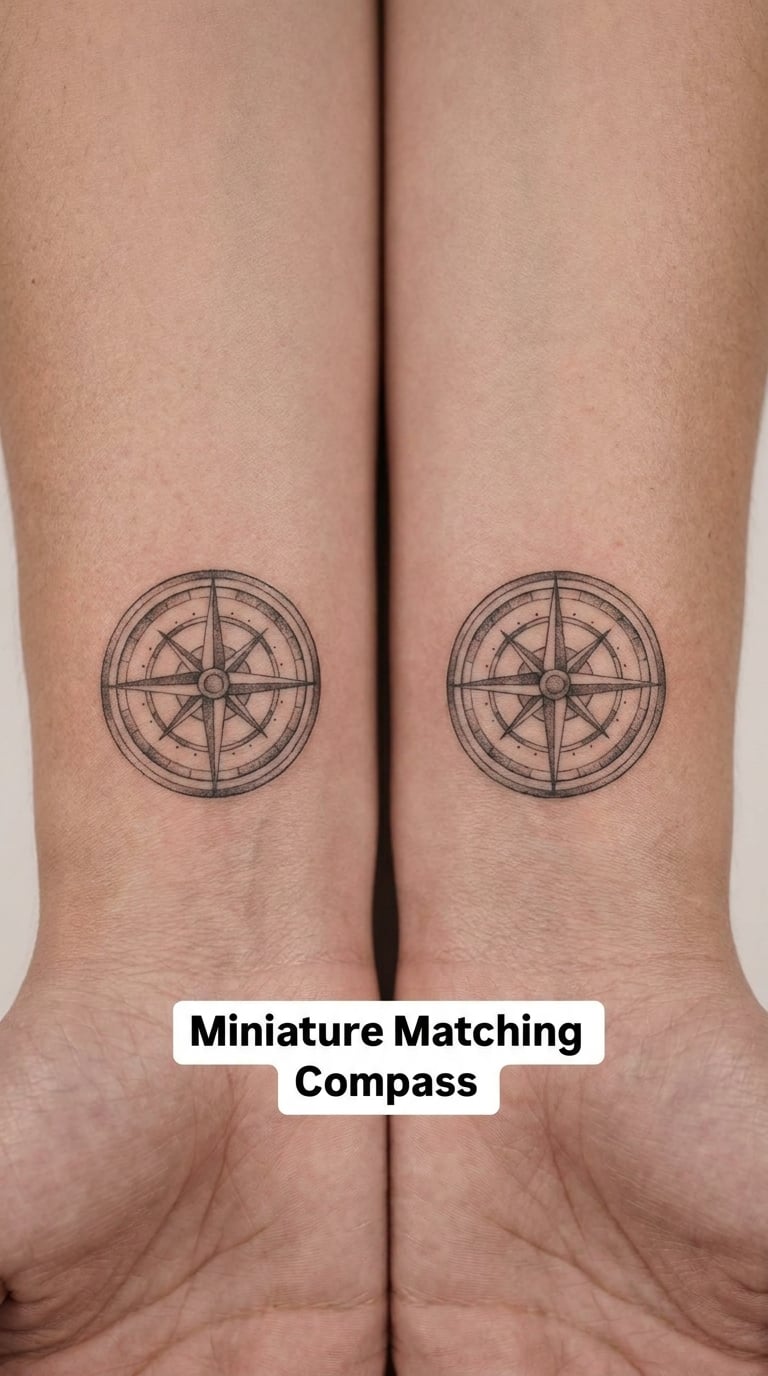
A compass is a good pick when one of you wants a design that reads as protective rather than sentimental. A circle with a needle, four tick marks, and either a shaded north point or a clean outline. The circle keeps the proportions forgiving, so a two-inch version still looks deliberate rather than crowded.
Placement: Inner wrist just above the palm crease, outer wrist, or the ankle bone. Size: 1.5 to 2 inches across. Style: Fine line with light black-and-grey shading, or pure outline if you want it quiet.
Pain: Medium. Wrist and ankle bones leave almost nothing between the needle and bone, so it is sharper and finishes faster. Ageing note: the tiny rim marks blur first, so ask for them slightly larger. Make it yours: Point the needle north on one arm and toward a meaningful place on the other.
3. Matching Birth Flower Pair
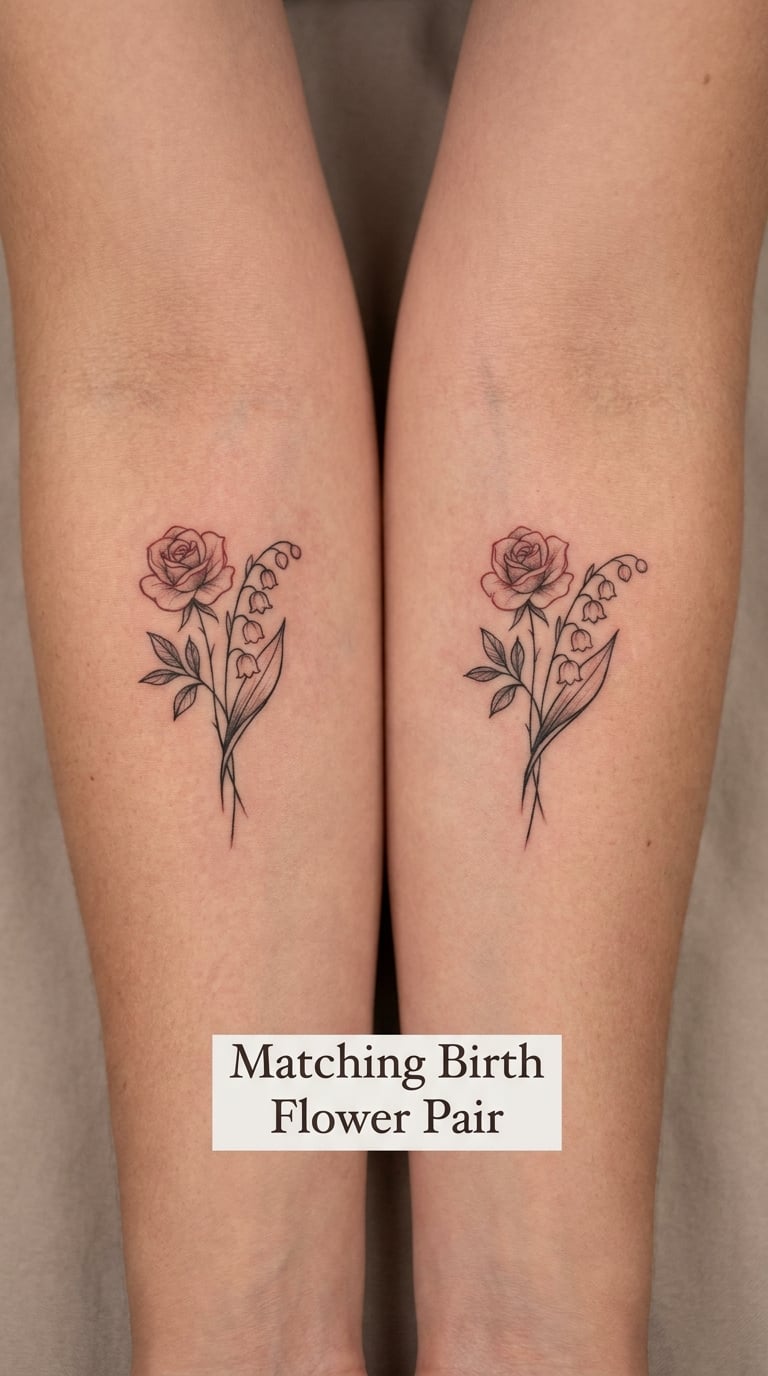
Two flowers from the same family, or the same flower rendered twice, work here. The most common route is a birth month flower for each person: a daffodil and a poppy, a lily and a rose, a sunflower and a daisy. Petal counts and leaf shapes carry the detail, and the stems can curve in opposite directions so the two pieces mirror rather than repeat.
Placement: Inner forearm, the side of the calf, or over the collar bone on a smaller arm. Size: 2.5 to 3 inches tall. Style: Botanical linework with minimal shading, or traditional colour if you want the pink and green to hold.
Pain: Low to medium on the forearm, medium on the ribs. Ageing note: linework flowers soften and small petals merge over a decade, so keep the centre of each bloom simple. Make it yours: Match the ink rather than the flower, with one shared colour accent in both.
4. Same Constellation, Different Sizes
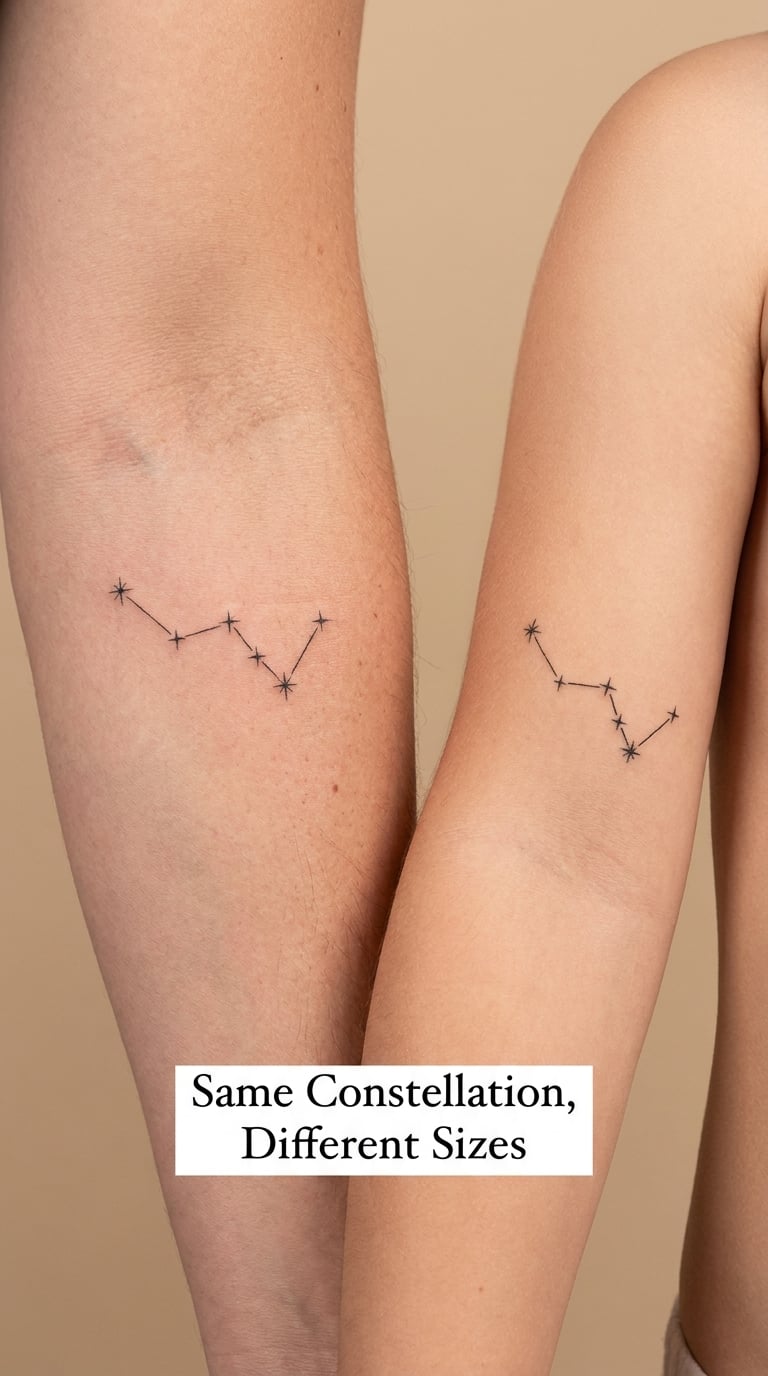
Pick a real star map and copy the same line of stars at two scales. A strip of six or seven connected stars reads as a shape rather than a diagram, and the smaller version keeps the same star order so anyone who looks closely can see it matches.
Placement: Outer forearm, upper arm, or behind the ear. Size: 2.5 to 3 inches for the adult, 1.5 inches for the smaller version. Style: Fine line with single-point stars and hairline connections.
Pain: Low on the outer forearm and upper arm. Ageing note: connecting lines fade first because they are the thinnest element, so ask for them a shade heavier. Make it yours: Use the sky over a real place on a real night, the date inside the shape at matching scale.
5. Matching Tiny Moons
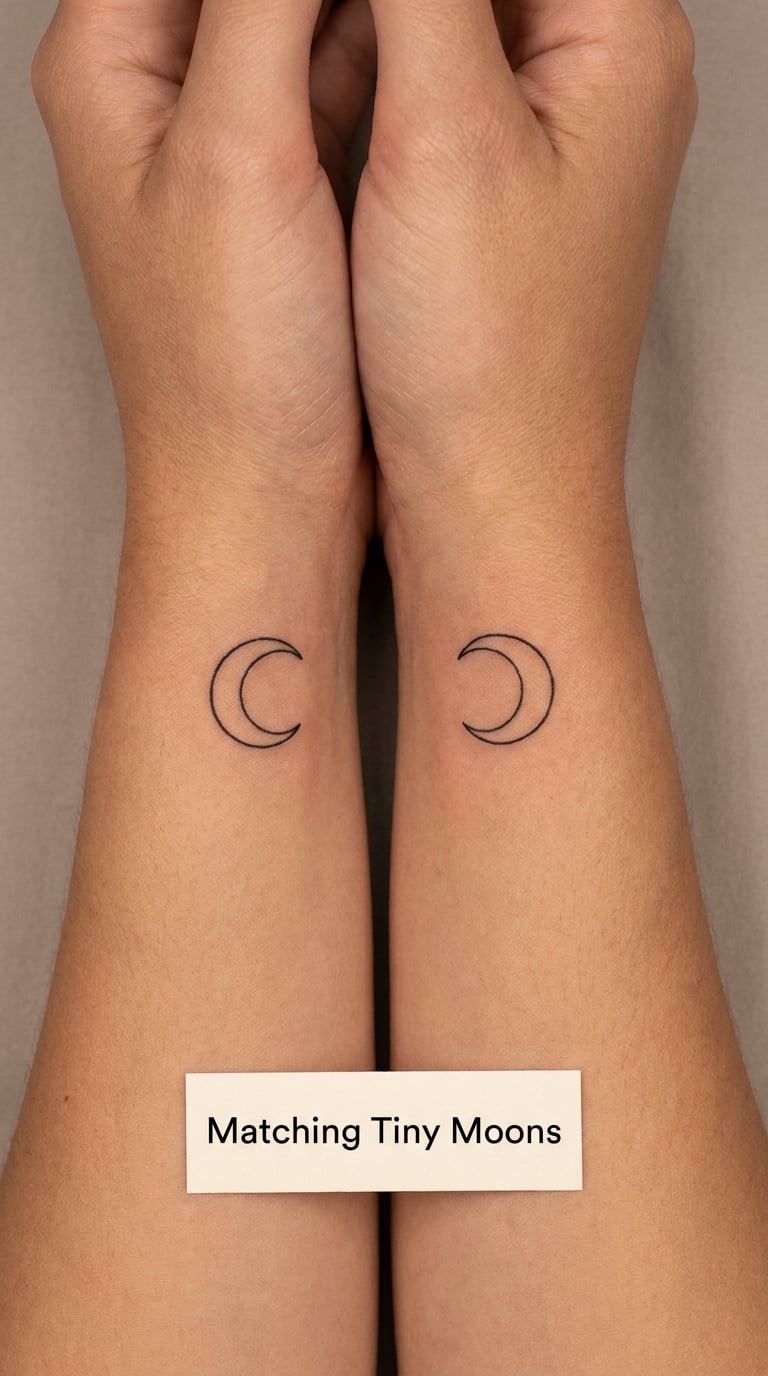
A crescent with a few dots along the inner curve, and nothing else. It is one of the smallest designs here that still looks deliberate on skin, and it works at a size most people assume is too small. There is no fixed symbolism to defend, so let the artist draw a waxing or waning moon based on which one you both like.
Placement: Inner wrist, behind the ear, or the ankle bone. Size: 1 to 1.5 inches across for the daughter, 1.5 to 2 inches for the father. Style: Minimal fine line, solid black fill or outline.
Pain: Medium at the wrist and ankle bone. Ageing note: solid fills hold better than outlines, so a filled crescent at one inch outlasts an outlined one. Make it yours: Mirror the two crescents, or add a dot at the same point on each curve for a shared month.
6. Matching Lion and Lioness
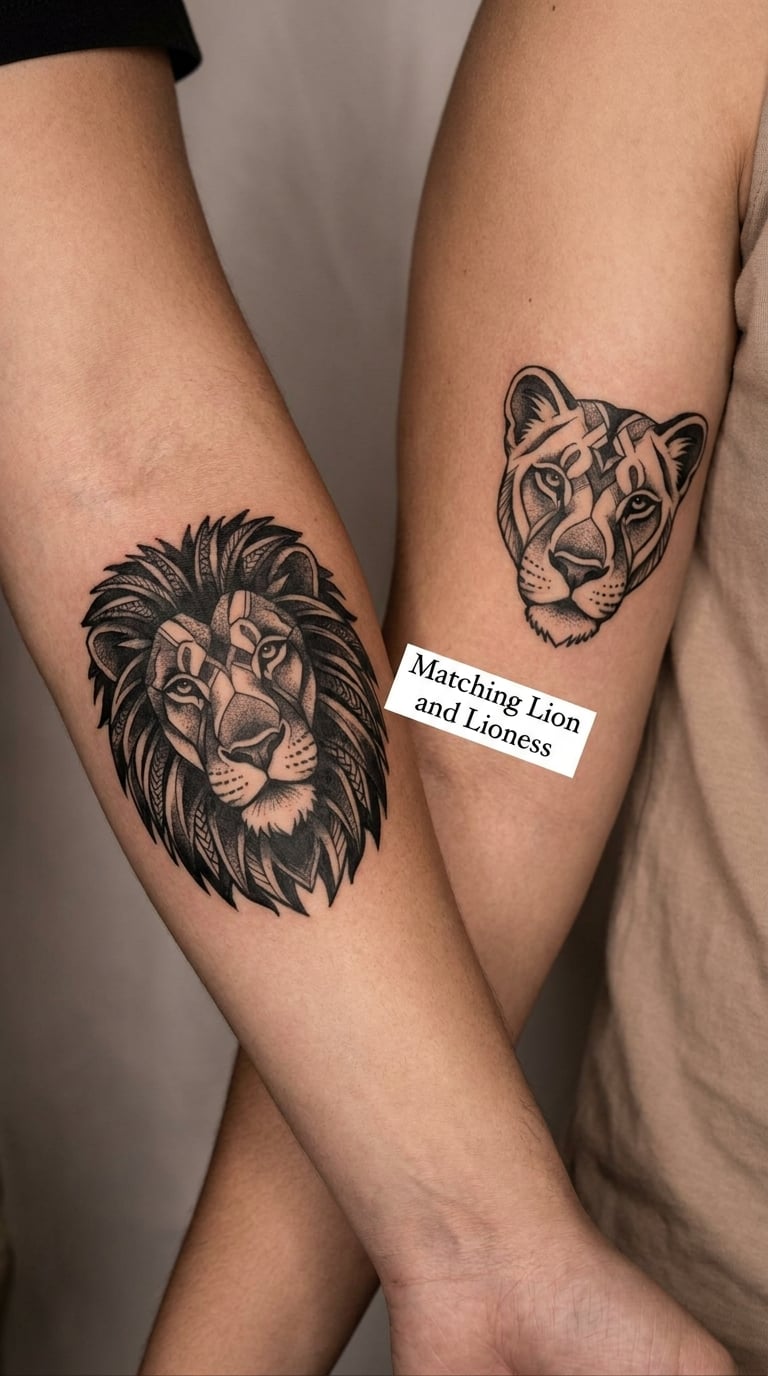
The most demanding design here and the one that photographs best. A maned head in profile for one, the same head shape with a slimmer mane and softer features for the other, ideally in the same line weight. If either of you has never been tattooed, this is a harder first piece than it looks on a screen.
Placement: Outer forearm, upper arm, or calf. Size: 3.5 to 4.5 inches long. Style: Blackwork with solid shadow, or traditional with muted colour and a small banner removed.
Pain: Medium, and a long sitting. The upper arm and calf are forgiving; the forearm is not. Ageing note: heavy blackwork holds its shape better than fine detail, which makes this a good pick for a piece you want in twenty years. Make it yours: Let the two heads face each other, or add a paw print beneath each at the same scale.
7. Matching Red Heart Outline
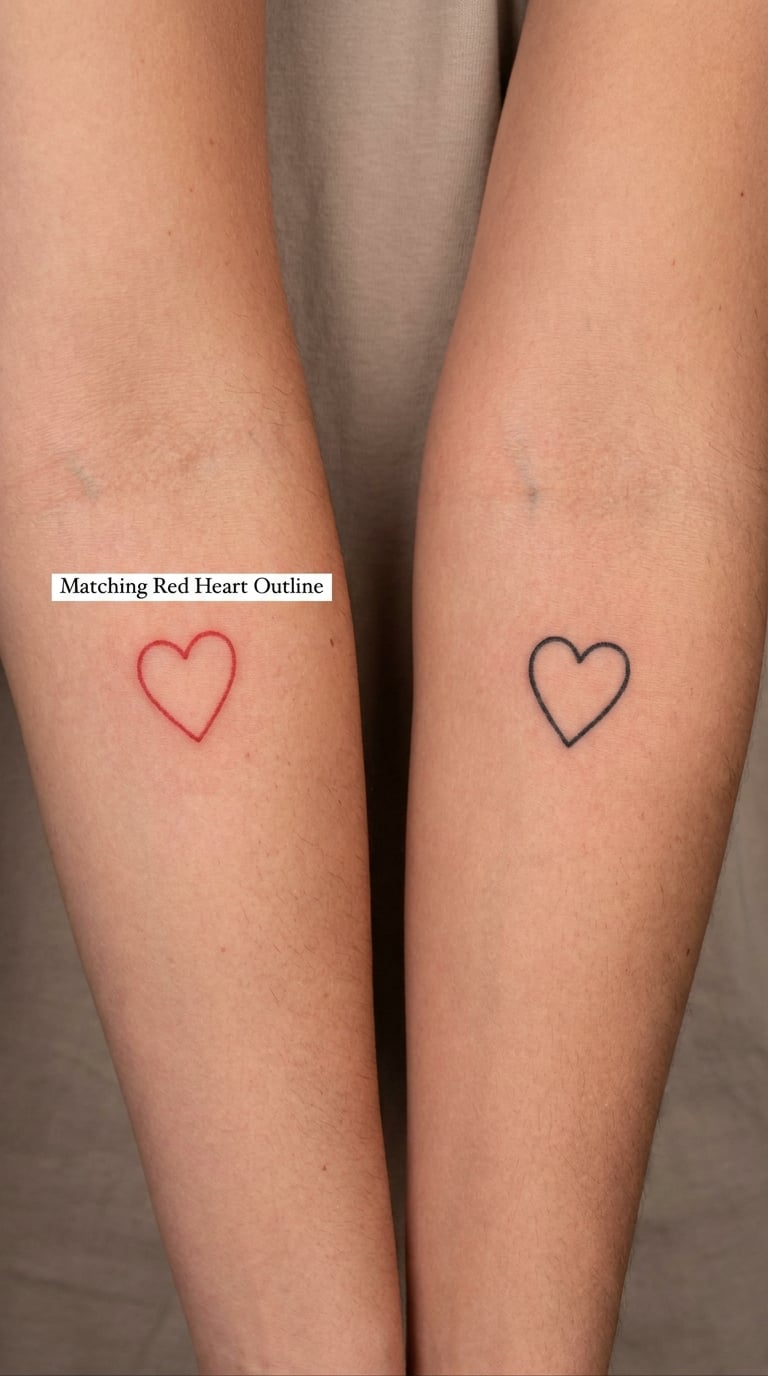
Everyone assumes a heart means a heart, and that is fine. What makes a heart worth booking is the treatment: one continuous line, no doubled outline, no shading, and a colour you both commit to. Two hearts in different colours read as a pair only if the line is identical, so the artist has to hold the shape in the head rather than trace it twice.
Placement: Inner forearm, the fleshy part of the thumb-side palm, or the collar bone. Size: 1.5 to 2 inches tall. Style: Single line, colour or black.
Pain: Low to medium. Ageing note: red fades first and shifts warm over the years, so plan for a refresh or pick a deeper pigment. Make it yours: Add a line of text under the heart, small enough to read as a detail rather than a quote.
8. Matching Music Note
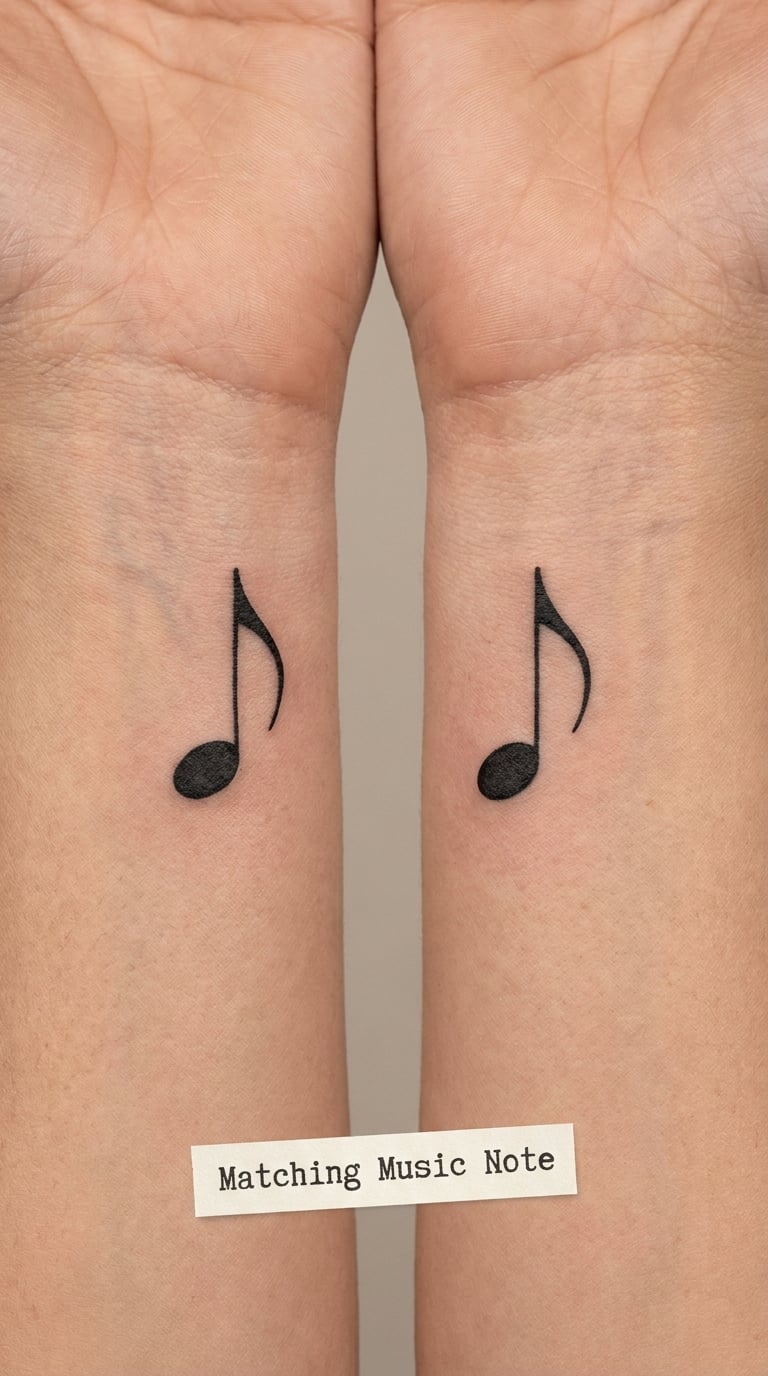
A single eighth note with a flagged stem, or a pair of quavers joined by a beam. One note is easier to match across two arms than a phrase, and it leaves room to make it personal later. Musical families tend to add the actual note at the end of a song that means something to them.
Placement: Inner wrist, behind the ear, or the outer forearm. Size: 1.5 to 2.5 inches tall. Style: Fine line outline, or solid blackwork with a heavier stem.
Pain: Medium at the inner wrist, low on the outer forearm. Ageing note: the flag and beam blur first, so a solid note holds its shape much longer. Make it yours: Ink the pair at the same height on the wrist so they line up when you stand together.
9. Matching House Number
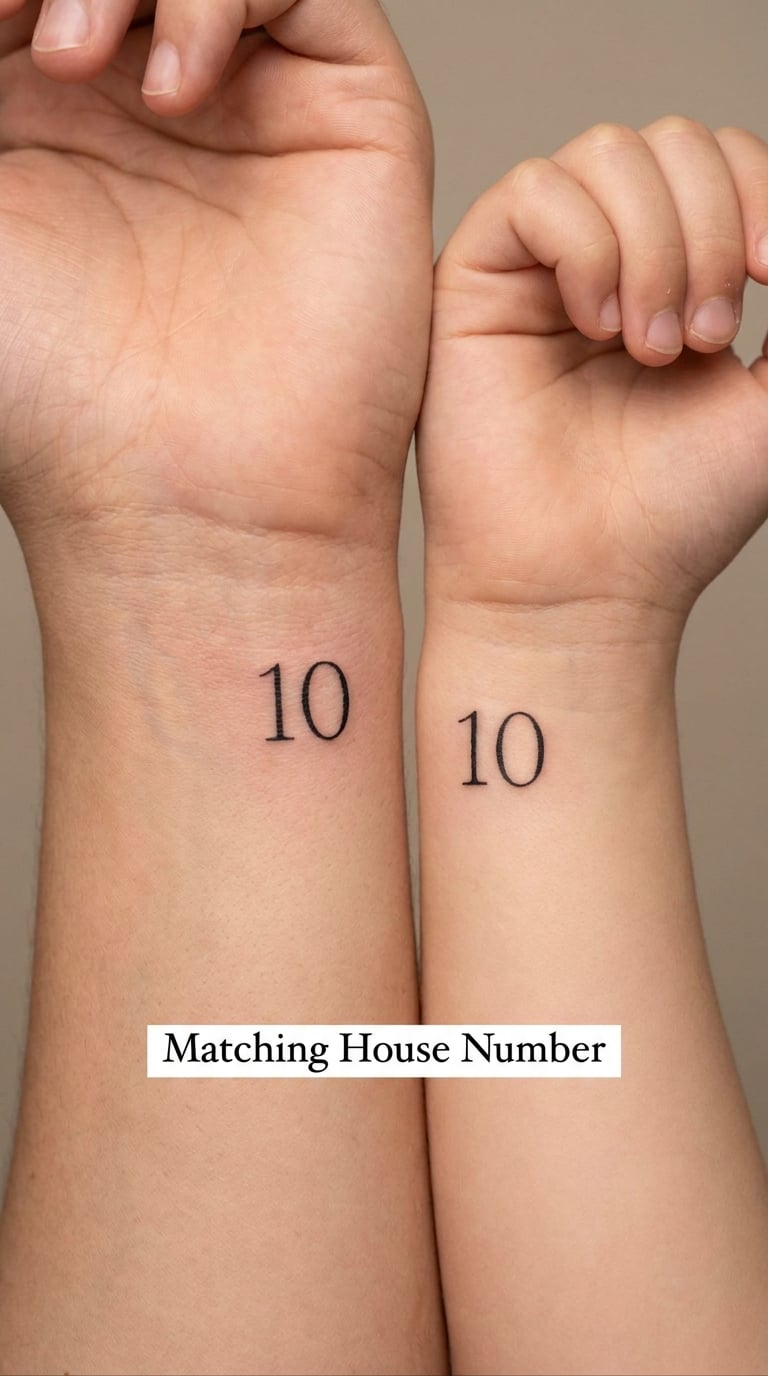
The number from the house you grew up in, set in plain numerals with no script flourishes. It is the design most likely to mean nothing to anyone else, which is usually the point. Numerals also match better than letters because there is no letterform opinion to argue about.
Placement: Outer wrist, the back of the hand, or the inner calf. Size: 1.5 to 2 inches wide. Style: Fine line numerals, or a single-weight stencil font with no shading.
Pain: Low to medium, the back of the hand being thinner and bonier than most people expect. Ageing note: numerals with open counters, like an eight, fill in slightly, so leave more space between the loops. Make it yours: Add the year underneath in the same weight.
10. Matching Rose Linework
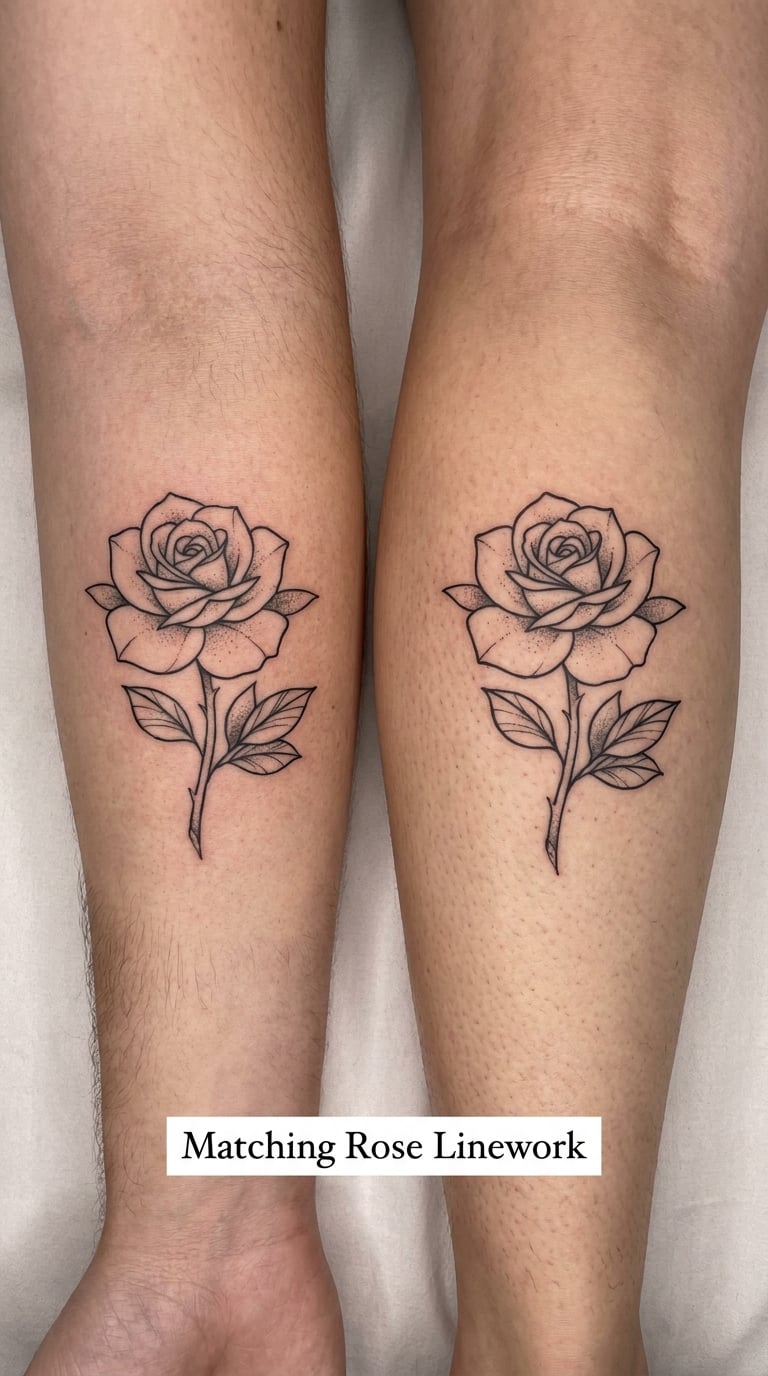
A rose built from a spiral centre, five or six outer petals, two leaves and a short stem with thorns. Linework is the version most people choose for a matching pair because it survives the two-scale problem better than a shaded one. The same drawing at three inches and at two inches keeps its identity.
Placement: Outer forearm, the side of the calf, or the shoulder. Size: 2.5 to 3.5 inches tall. Style: Botanical linework with light stippling, or traditional colour with heavy black outlines and a single red bud.
Pain: Low to medium, the calf and outer forearm both being easy areas. Ageing note: stippled shading inside the petals disappears first, so keep it sparse and the outlines confident. Make it yours: Leave one thorn off in one version and keep all of them in the other.
11. Matching Birds in Flight
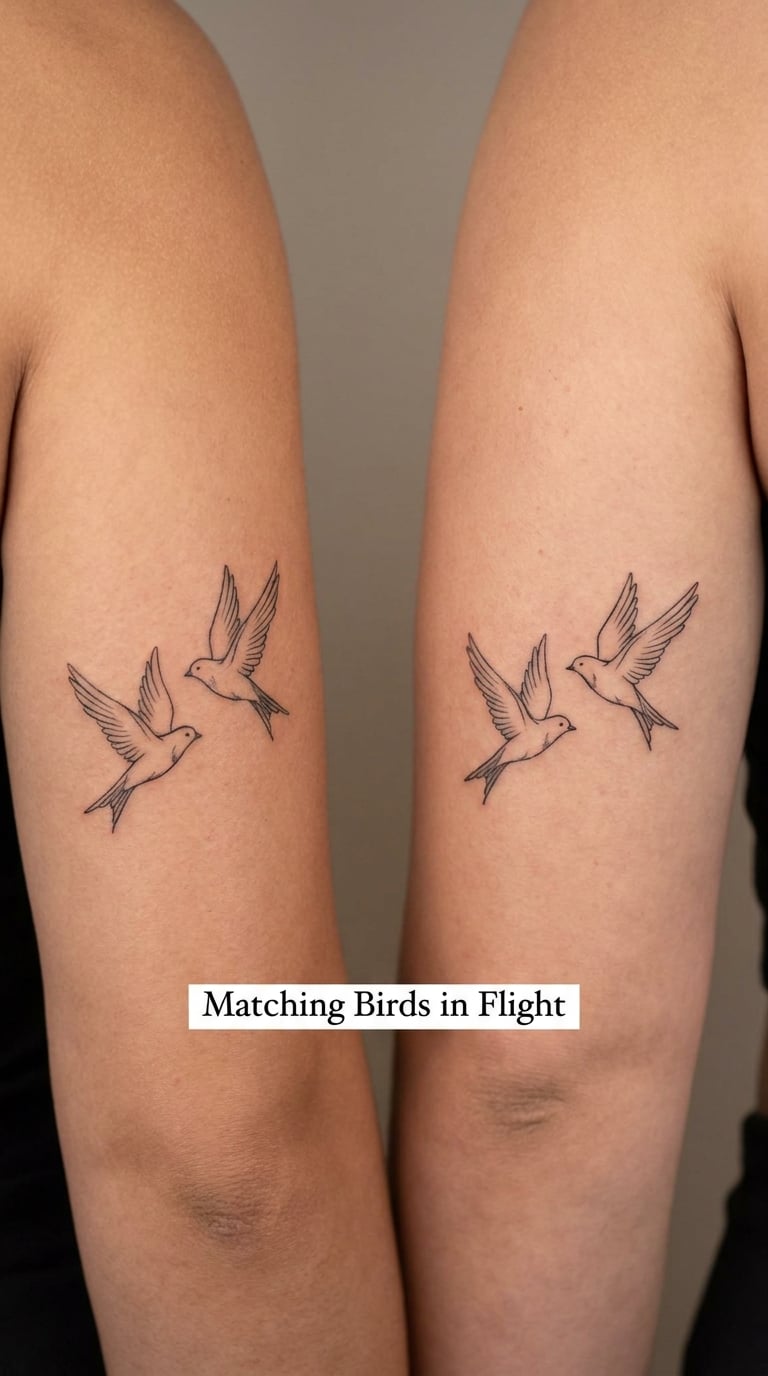
Two or three birds in side profile, wings mid-stroke, moving the same way. A swallow is the most forgiving because the forked tail reads clearly at small size, and a swift works if you want something less tied to one meaning. The wing position is what makes one set look alive and another look like a stamp.
Placement: Upper arm, back of the shoulder, or the outer calf. Size: 2.5 to 3.5 inches wide for a small flock. Style: Fine line illustrative, or blackwork silhouettes with no interior detail.
Pain: Low on the upper arm, medium on the calf. Ageing note: a solid silhouette ages far better than a line drawing with feather detail, so choose by how far away you want it to read. Make it yours: Have the birds face the direction of your home town on one arm and hers on the other.
12. Matching Coordinates
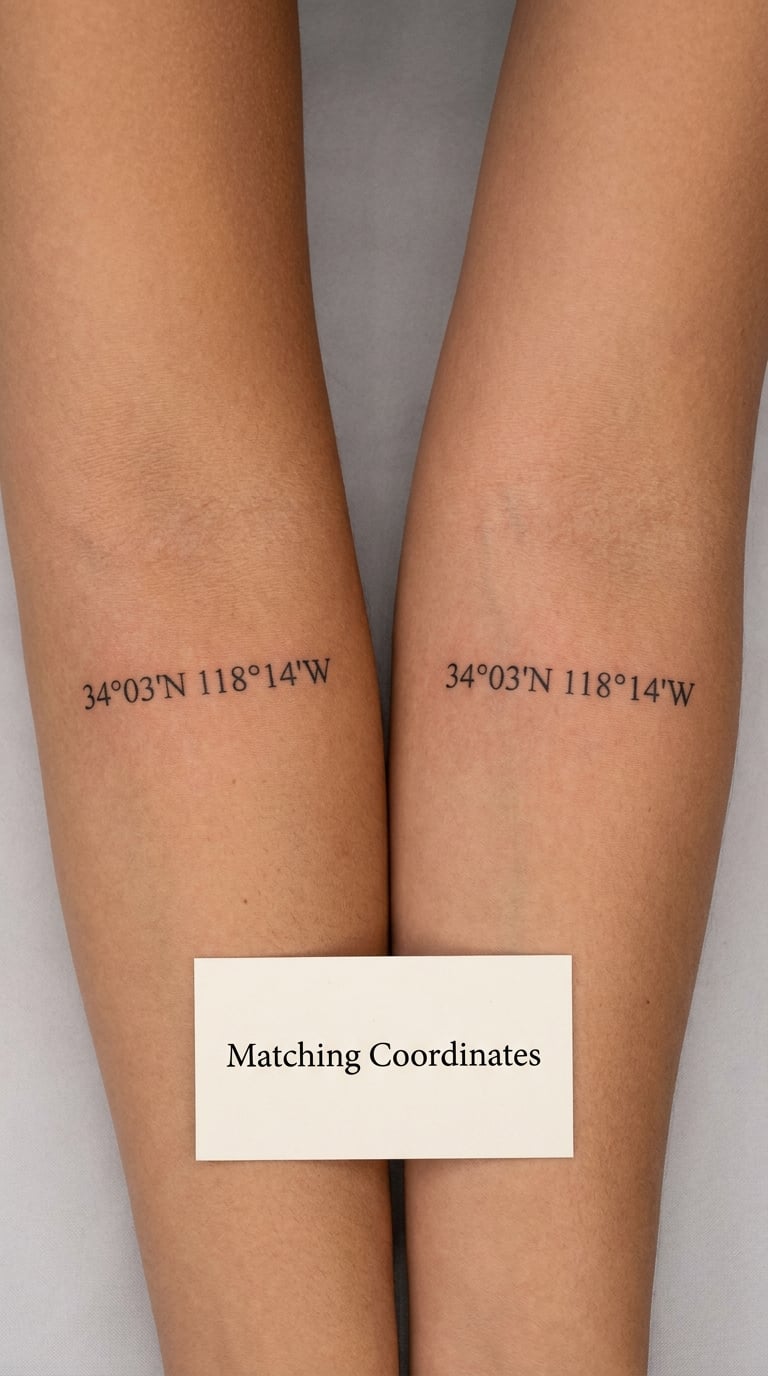
Latitude and longitude for a place that matters: the street you grew up on, the beach from one family holiday, the spot where you last saw each other before a long separation. Two lines of small numerals with a thin dividing line between them. It is precise, quiet and almost impossible for anyone else to interpret.
Placement: Inner arm, the rib, or the inside of the upper arm. Size: 2 to 2.5 inches wide, which gives the numerals enough room to stay readable. Style: Fine line numerals in a plain sans-serif stencil, no italics.
Pain: Low to medium on the inner arm, medium to high on the ribs, where the needle reaches bone through thin skin. Ageing note: small numerals need a heavier line than looks necessary, because there are more thin edges to lose. Make it yours: Put a tiny symbol beside the numbers instead of a name.
13. Matching Rainbow in Blackwork
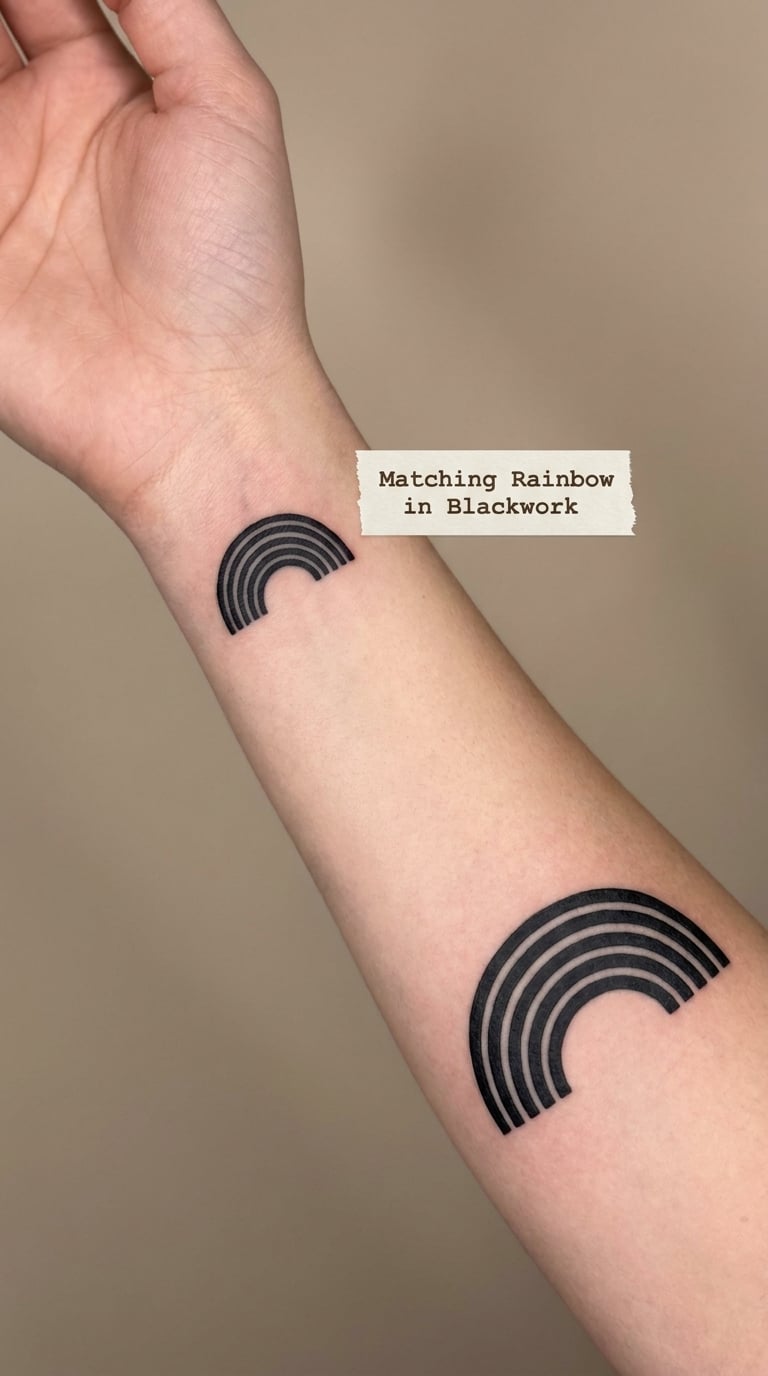
Three or four solid black arches with clean white gaps between them, no clouds and no colour. Because there is no hue in the design, it does not fade in one colour and go flat in another, which makes it a smarter long-term choice than the coloured version most people picture first.
Placement: Wrist wrapping slightly around, outer forearm, or the calf. Size: 2 inches for the smaller version, 3 inches for the larger. Style: Blackwork with consistent line weight and even spacing.
Pain: Low to medium, and a wrist wrap takes a little longer because the artist works around a curve. Ageing note: even spacing matters more than thickness, because uneven gaps are what make an old rainbow look tired. Make it yours: Add one solid dot at the same end of the arch in both.
14. Matching Sea Turtle
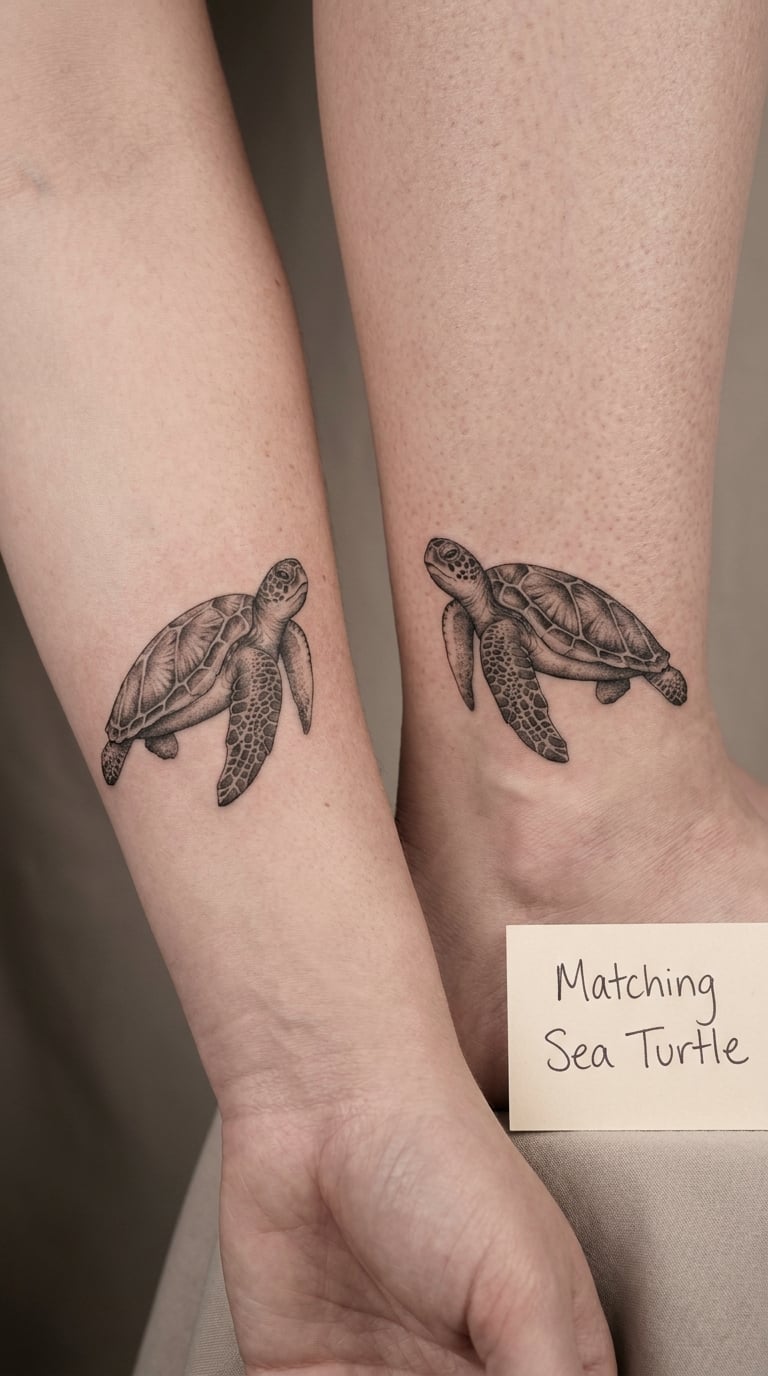
A turtle from above, shell divided into plates, two front flippers stretched out. Micro-realism is the easiest way to get two versions that still read as a set, because the shape is so recognisable. Swapping a shell pattern between the two, or changing the direction of the head, quietly differentiates them.
Placement: The flat of the upper arm, the calf, or the inside of the ankle. Size: 2.5 to 3 inches long. Style: Micro-realism in black and grey, or a bold blackwork shell with the plates filled solid.
Pain: Low to medium. The upper arm and calf are comfortable; the ankle is thin. Ageing note: fine scale texture on the shell softens noticeably, so keep detail to the plate lines and keep the flippers solid. Make it yours: Add a wave line beneath one flipper only, or have one version face up and the other down.
15. Matching Initial and Flower
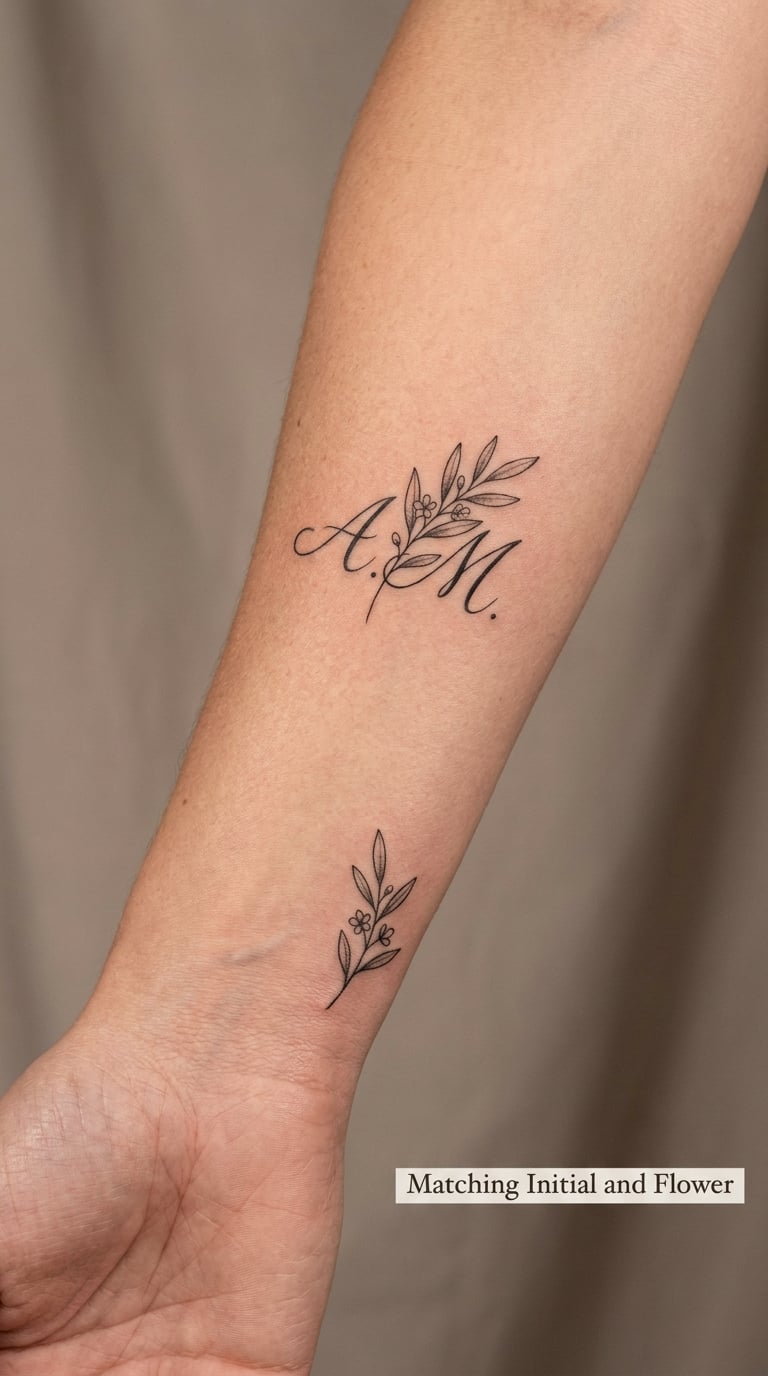
One shared initial, set in a plain serif or a fine script, with a small sprig beside it. The trick is restraint: a monogram plus one stem of leaves is legible, while a monogram plus a full wreath reads as a logo. This is a good design for a blended family, where a name-based option is sensitive and a motif is not.
Placement: Inner arm, the wrist crease, or the back of the shoulder. Size: 1.5 to 2 inches tall including the sprig. Style: Fine line, or a script initial with a botanical stem in solid black.
Pain: Medium. Script lettering and a thin stem are fiddly, so expect a longer sitting at a higher sensitivity than the finished size suggests. Ageing note: hairline script is the first thing to blur, so a plain serif capital is the safer choice for longevity. Make it yours: Swap the sprig for a single leaf.
16. Matching Mountain Range
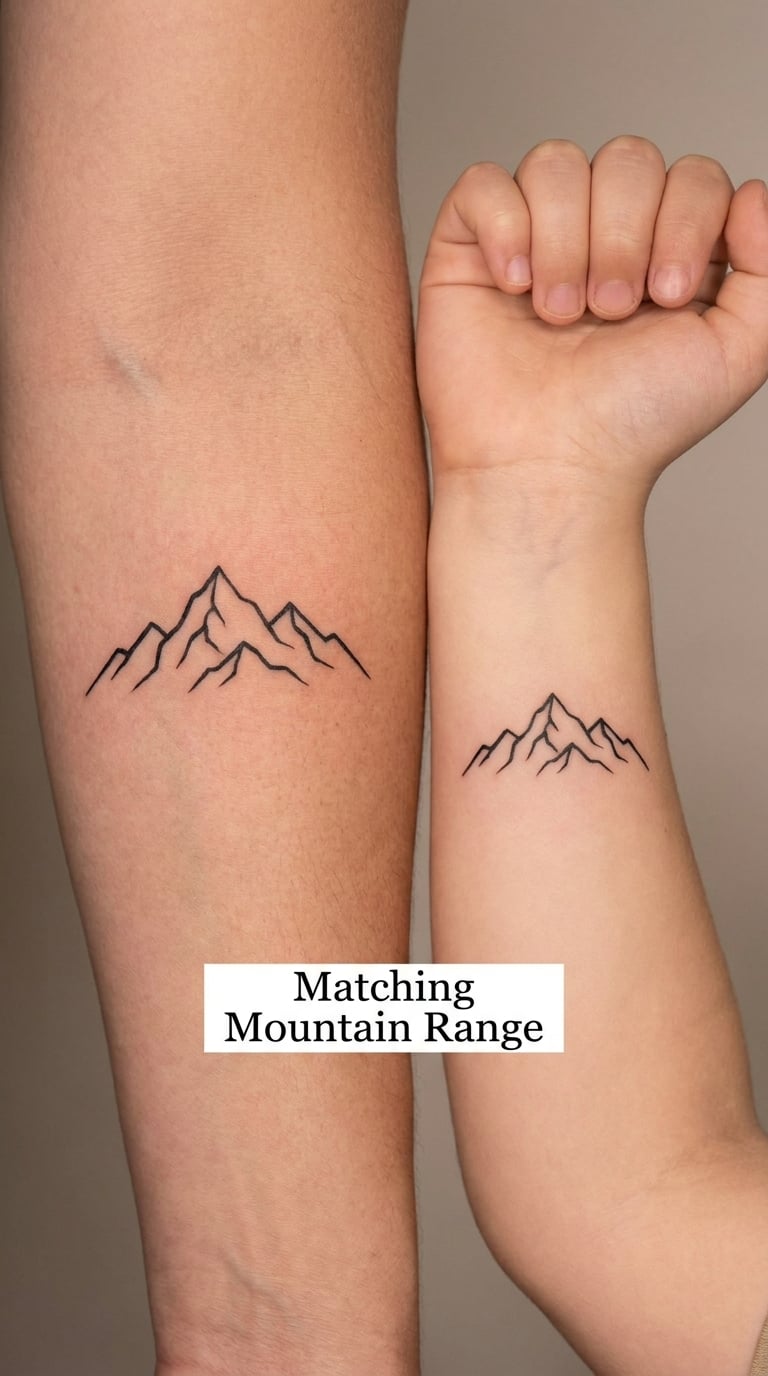
A single ridgeline with three or four peaks, drawn as unbroken linework with no shading. A range from a trip you took together, a mountain you both live under, or a place neither of you has been yet. The two versions should use the same ridgeline traced, not redrawn, or the peaks will drift apart.
Placement: Outer forearm, calf, or the outer arm. Size: 2.5 to 3.5 inches wide. Style: Minimal linework, or a blackwork silhouette with snow caps in white negative space.
Pain: Low, the outer forearm and calf being among the easier places on the body. Ageing note: sharp peak points soften first, so ask for tips slightly blunter than the drawing looks. Make it yours: Name the peaks underneath at matching scale, or show only the ones she has stood on.
17. Matching Sun and Moon
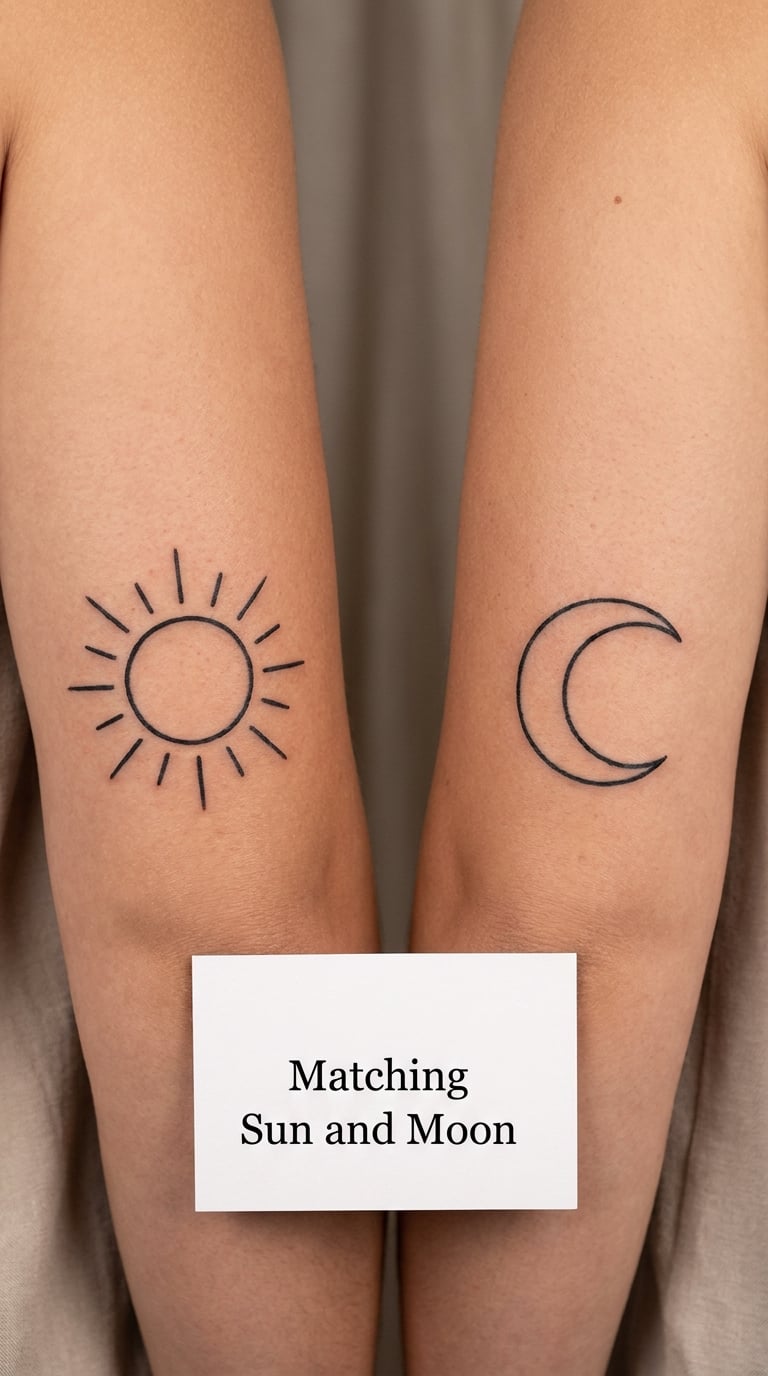
Two complementary pieces rather than two identical ones. A simple sun with straight rays beside a crescent with a soft inner curve, drawn at the same diameter and the same line weight. Complementary pairings like this one are the easiest to match physically, because the artist only has to hold the scale consistent rather than the shape.
Placement: Upper arm, shoulder, or the back of the calf so the two read as a pair when you stand side by side. Size: 2 to 2.5 inches across. Style: Minimal blackwork or fine line, matching weights across both.
Pain: Low to medium, and small enough for a short sitting. Ageing note: individual sun rays blur, so a sun with fewer, thicker rays ages better than a dense one. Make it yours: Put them on the same side of the body so they mirror.
18. Matching Tiny Paw Print
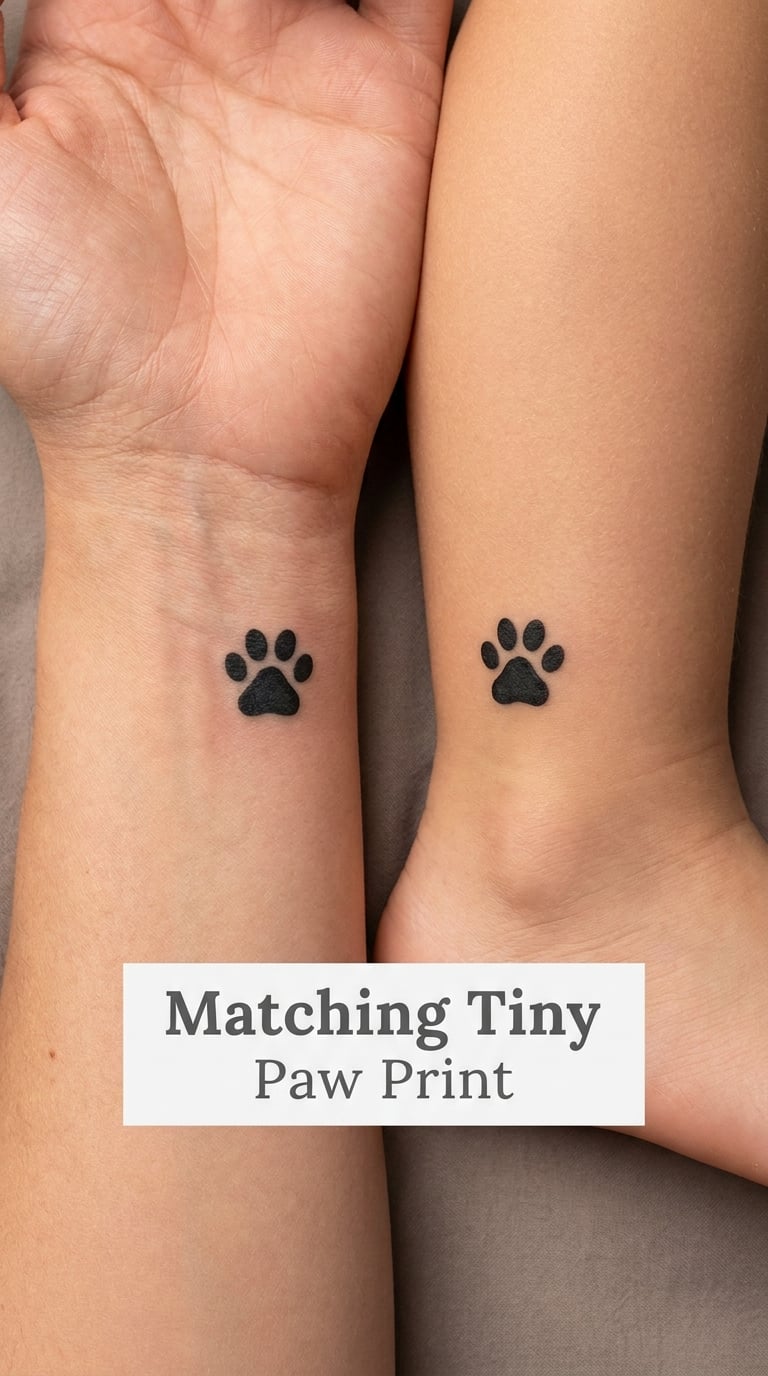
One pad and four toes, nothing else. It suits a family with a dog, and it works just as well for anyone who just wants a small mark. Paw prints are the design most often pushed too small, so ask for a minimum of an inch and a half across and resist the urge to go smaller.
Placement: Wrist, the back of the hand, the ankle, or the calf. Size: 1.25 to 1.5 inches wide. Style: Minimal linework or a solid black silhouette with white gaps between the toes.
Pain: Medium at the wrist, ankle and back of the hand, all thin areas. Ageing note: a solid silhouette outlasts four outlined toes, which merge into a blob within a few years. Make it yours: Have the artist hand-draw the pad shape from your own dog’s paw.
19. Matching Puzzle Piece
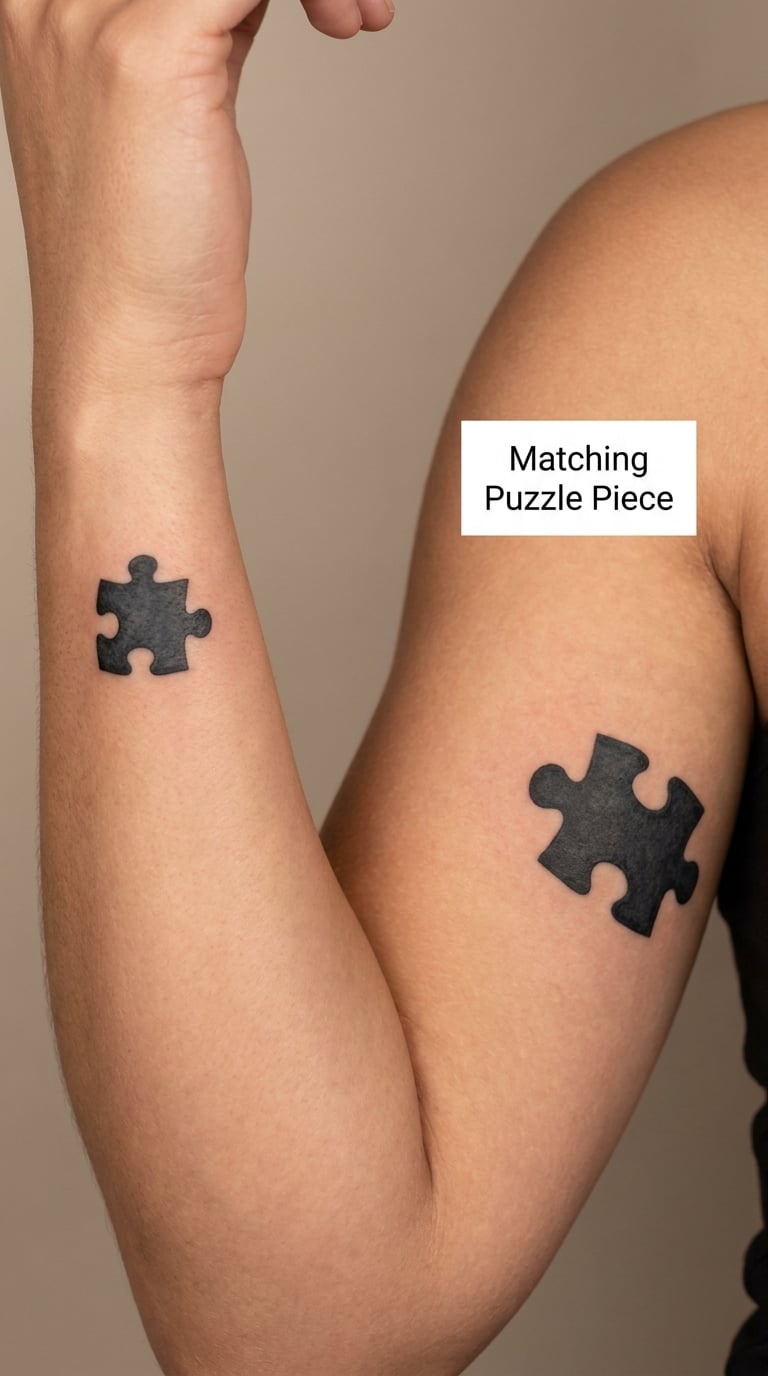
Readers call this the most overdone father-daughter design, and they are largely right. If you book it, attach a specific choice: the piece that fits into your family rather than a generic one. A single interlocking shape with rounded tabs reads cleaner than a cartoon-style one and does not date the same way. Sibling pairs tend to land on the same logic, and 30 sweet matching tattoo ideas perfect for brothers works through it if the two of you are not a father-and-daughter pair at all.
Placement: Inner forearm, shoulder, or the outer arm. Size: 1.5 to 2 inches across, with the daughter’s version at the smaller end. Style: Single line, flat black, or blackwork with a shadow block.
Pain: Low to medium. Ageing note: the inner corners of the tabs fill in over time, so keep the corners generously open. Make it yours: Design the two so they actually interlock when placed side by side.
20. Matching Date in Fine Line
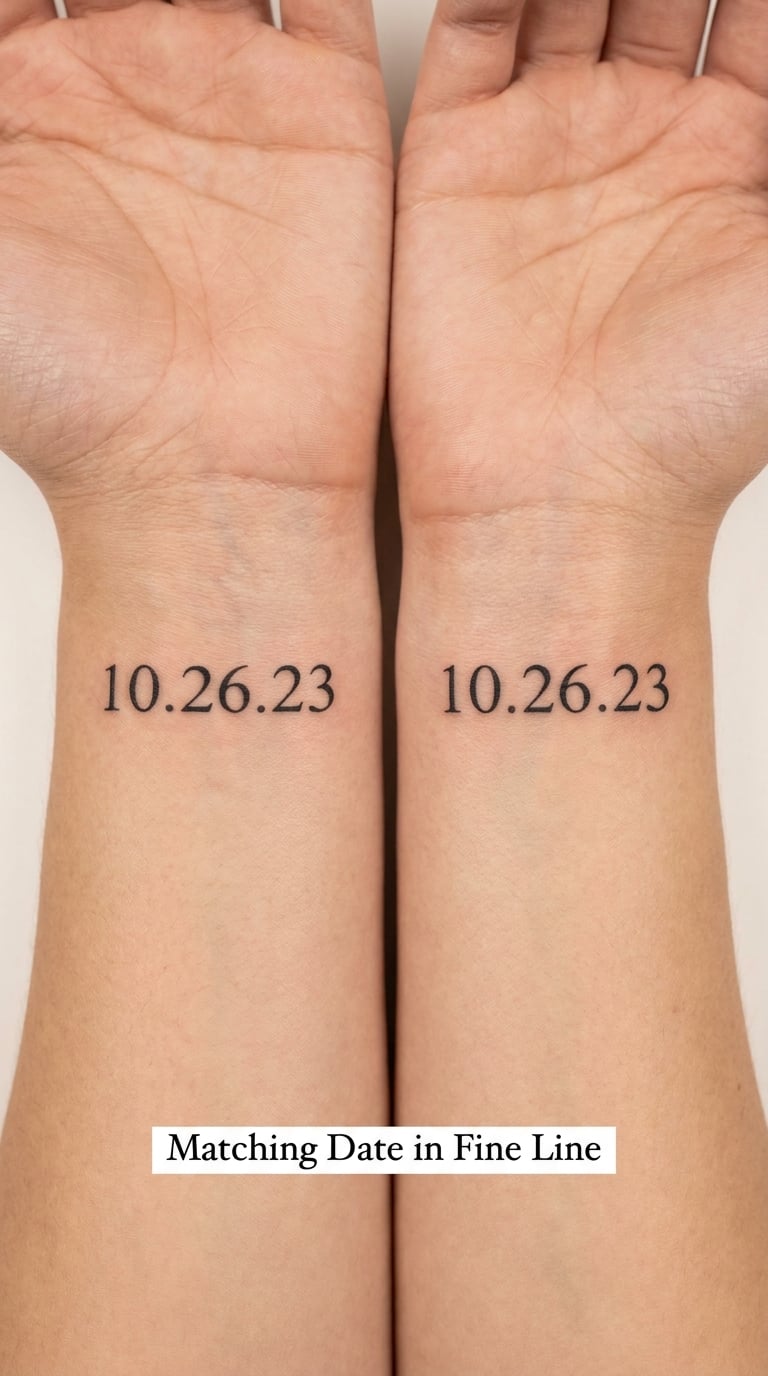
Birthday, wedding day, the day she came home, the day you got the news. In a plain stencil numeral, this is the most flexible design here because the content is yours and the drawing is simple. Handwriting versions exist too, but they need heavier line weight and more session time, which is worth knowing before you book.
Placement: Inner wrist, the rib, or the inside of the upper arm. Size: 1.5 to 2 inches wide for numerals, 2 to 2.5 inches for a handwriting version. Style: Fine line numerals, or a light script with consistent pressure.
Pain: Medium at the inner wrist, medium to high on the ribs. Ageing note: thin numerals lose their crossbars and fine serifs first, so a plain stencil face outlives an ornate one. Make it yours: Trace the date from a note in your own handwriting, then set that same note under both pieces.
How to Choose the Right Design
Most disappointing matching tattoos fail on the mechanics, not the meaning. The meaning was agreed on, the drawing was fine, and then the two pieces ended up at different sizes in different styles on different parts of the body, so the pair never quite read as a pair.
How to pick matching father daughter tattoo ideas you will both keep
- Start with the shared meaning, not the image. Decide what the design is about in a sentence, then let the motif come second. Families who lead with the symbol tend to end up with something generic, because the easiest symbols are the most used ones.
- Decide whose idea it is. If the planning lands entirely on one person, which happens more often than it should, the other person ends up with ink they did not choose. Give both of you veto power and a set number of ideas to rank.
- Agree on the scale before the session. Pick one drawing and one size, then let the artist scale it. Two sizes on purpose is fine, as long as both were chosen rather than one being an accident.
- Mirror the placement. Same design, same size, same spot on the same side of the body, or the same design at two sizes on mirrored sides. Anything less reads as coincidence.
- Check line weight for the smaller body. A single-needle line that looks correct at three inches on a forearm will look weak at one inch. Ask the artist to thicken the daughter’s version, or use the same weight in both.
- Think about visibility and work. An inner wrist is hidden at a desk job and obvious everywhere else. A rib design is private. Decide who is meant to see it, because that changes the placement more than the drawing.
Two more practical things. Book both pieces with one artist where you can, since the same hand holds the line weight far better than two different hands. If you use different artists, send both the same reference and the same final size rather than describing it in words.
Cost and Session Time
Tattoo pricing in the US is not standardised, so treat the figures below as a shape rather than a number. Studios charge either a flat rate per piece or an hourly rate, and a two-person booking on the same day is usually quoted as two separate pieces plus any colour or detail surcharge, not as a package.
- Micro and small pieces, under two inches – a single-needle line drawing usually takes well under an hour and often sits at or near the studio minimum, which is the flat floor a shop charges for any session.
- Small to medium pieces, two to four inches – expect one to two hours depending on detail, and expect the rate to move up from the minimum as the hours go up.
- Larger pieces, four inches and beyond – often hourly rather than flat, and a design like a lion head can run well past a single sitting.
- Colour and shading – add time and therefore add cost. A blackwork piece is generally quicker to complete than the same design in full colour.
- Two people, one day – budget for two sessions, and ask the studio whether they can be booked back to back so you are not charged for a gap between them.
- Tipping – a percentage of what you were charged is the usual convention, paid at the end of each session.
If cost is the deciding factor, the most reliable saving is a simpler design rather than a cheaper shop. Linework at two inches costs less, heals faster and is far easier to match across two people than a shaded or coloured version of the same idea.
Aftercare Basics
- Follow your artist’s aftercare instructions first. They know how deep your particular work went and how your skin reacted, and their guidance replaces anything generic you read online, including this.
- Wash gently, twice a day at most. Lukewarm water and a fragrance-free soap, patted dry with clean hands or a paper towel rather than a terrycloth towel.
- Moisturise thinly. A plain, unscented product in a thin layer keeps the skin from drying out. Heavy creams trap moisture and can irritate a fresh line.
- Protect it from sun. No sunbeds, and cover the area on a beach day. Sun is the main reason fine line tattoos fade unevenly over the years.
- Wear loose clothing. Tight sleeves, straps and waistbands rub a healing tattoo, especially on an inner forearm or a rib.
- Know the healing timeline and when to call. Fine line work on the inner forearm typically settles within about two weeks, with the last of the flaking and itching fading over the following week. Contact the studio if the redness, swelling or itching gets worse instead of better after that, or if you notice anything spreading.
One thing to expect with any matching pair: the two pieces will not age at the same rate if they sit in different places. Sun exposure, how often a wrist is turned over, and skin thickness all vary, and the version on a forearm may look fresher than the one near a bone for years.
Frequently Asked Questions
What size should matching father-daughter tattoos be?
For a first matching pair, one to two inches on a small arm and two to three inches on an adult forearm is the range most artists would call reliable. The design has to be simple enough to survive the smaller version, so avoid anything that relies on fine interior detail. Decide the larger size first, then let the artist scale the smaller piece down from the same drawing rather than drawing a second version from scratch.
Should we get matching tattoos from the same artist?
Same artist is better where you can manage the booking, because the same hand holds line weight and spacing consistent across both pieces. Two different artists can work well too, but send both of them the identical reference and the identical final size rather than describing the design in words. Book the sessions on the same day if the two artists are in the same studio.
How painful is a small tattoo on the wrist?
Wrist tattoos sit in the middle of the range. The skin over the inner wrist is thin and there is little soft tissue between it and the bone, so the sensation is sharper than it is on a forearm, and a small piece on the wrist usually finishes quickly. The outer forearm and the upper arm are noticeably easier. Expect to feel the first line more than the rest.
How do you make two separate tattoos look like a matching pair?
Use the same design, the same style and the same line weight, then choose either identical sizes on mirrored sides of the body or two planned sizes on mirrored sides. What breaks a pair is not the size difference, it is the unchosen size difference. Send the same reference file to both artists, agree the final dimensions in inches before booking, and keep the placements symmetrical.
How do small fine-line tattoos heal and how long do they last?
Fine line work on the inner forearm usually looks settled within about two weeks, with the flaking and itching finishing over the week after that. The long-term risk is fading, and it comes down to how thin the line was and how much sun the area gets. A single-needle line that feels too delicate in the drawing will look weak in a decade, so ask for a slightly heavier weight than feels necessary.
Conclusion
For a first tattoo taken together, the fine-line infinity or the miniature compass is the safest bet. Both are simple, both hold their shape, and neither of you has to commit to a design that will look dated in fifteen years.
For someone already building a collection, the lion and lioness or the matching rose gives you a piece with enough detail to hold its own next to existing work, and it is the kind of design people ask about in person.
Before either of you books, settle three things: the sentence behind the design, the final size of each piece in inches, and the placement on each body. Send those three answers to your artist together, and the pair will look like it was planned, because it was.