
24 Lynx Tattoo Ideas: Stunning Nature Designs (October 2026)
A lynx tattoo is a drawing of a wild cat defined by long ear tufts, a wide cheek ruff, a short bobbed tail and enormous snowshoe paws. Most people choose it for what those features suggest: sharp sight, quiet independence and comfort in the wild.
These 24 lynx tattoo ideas run from a fine-line face on the collarbone to a full-back landscape, and every entry gives you the style, placement, realistic size and an honest read on pain and ageing. Starting out? The paw print and the behind-the-ear silhouette are small, quick and hard to regret. Building a collection? The snowy forest scene and the full-body back piece have the most room to develop.
On references: the same black and grey lynx face looks nothing alike at 2 inches and at 8, so bring several angles rather than one image. Healed work tells you more than fresh flash, and a piece photographed at two, three and five years old tells you more than either.
24 Lynx Tattoo Ideas: Quick Guide
| Idea | Style | Best placement | Size | Pain |
|---|---|---|---|---|
| 1. Realistic forearm portrait | Black and grey realism | Outer forearm | 4-5 in | Medium |
| 2. Fine-line collarbone face | Fine line | Collarbone | 2-3 in | Medium |
| 3. Blackwork upper arm head | Blackwork | Outer upper arm | 3-4 in | Low |
| 4. Tiny wrist paw print | Minimal line | Inner wrist | 1-1.5 in | Medium |
| 5. Traditional lynx with pine | Traditional | Forearm | 4-6 in | Medium |
| 6. Watercolor shoulder lynx | Watercolor | Shoulder cap | 5-7 in | Medium |
| 7. Geometric calf lynx | Geometric | Outer calf | 5-8 in | Low |
| 8. Neo-traditional thigh portrait | Neo-traditional | Outer thigh | 6-8 in | Medium |
| 9. Behind-the-ear silhouette | Minimal solid | Behind ear | 0.5-1 in | Low |
| 10. Snowy pine forest scene | Illustrative realism | Thigh or back | 8-12 in | Medium |
| 11. Dotwork spine lynx | Dotwork | Upper spine | 6-9 in | Low |
| 12. Lynx and mountain compass | Fine line illustrative | Between shoulders | 4-6 in | Low |
| 13. Seal-style motif | Ornamental linework | Inner upper arm | 3-4 in | Low |
| 14. Forearm eye study | Micro-realism | Inner forearm | 3-4 in | Medium |
| 15. Matching lynx profile pair | Fine line | Inner forearms | 2-3 in each | Medium |
| 16. Botanical wreath lynx head | Black and grey | Upper arm | 4-5 in | Low |
| 17. Running lynx on the calf | Black and grey realism | Outer calf | 5-7 in | Low |
| 18. Sticker-style ankle lynx | Sticker and neo-traditional | Outer ankle | 2-3 in | Medium |
| 19. One-line finger lynx | Single line | Side of finger | 1-1.5 in | Medium |
| 20. Lynx and moon on the rib | Fine line silhouette | Ribcage side | 4-5 in | High |
| 21. Maple leaf lynx composition | Japanese-inspired | Shoulder or upper back | 6-9 in | Medium |
| 22. Pixel-art hand lynx | Pixel art | Back of hand | 2-3 in | High |
| 23. Full-body back lynx | Realistic landscape | Upper and mid-back | 12-18 in | Medium |
| 24. Northern lights abstract lynx | Abstract colour | Shoulder | 6-8 in | Medium |
1. Realistic Lynx Portrait on the Forearm
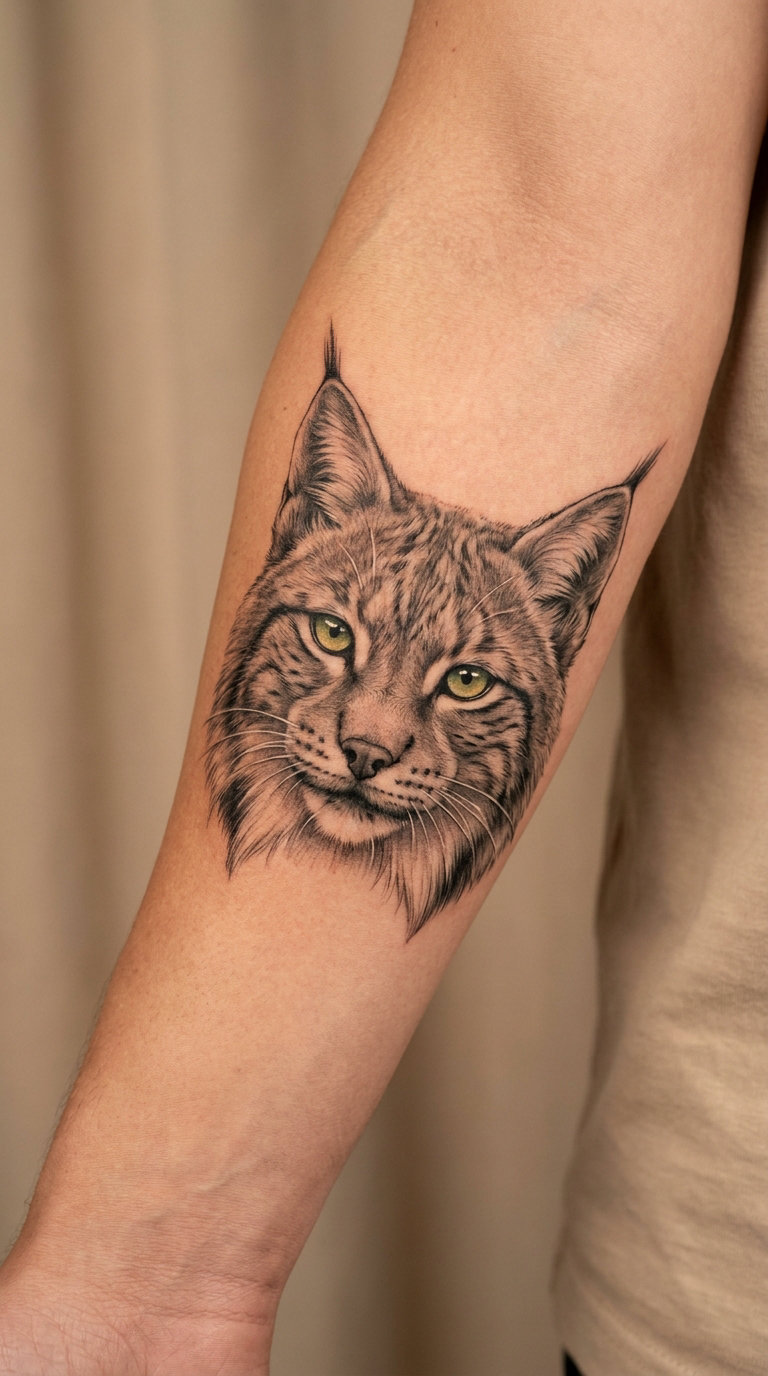
A realistic forearm lynx starts at the face and builds outward: tufted ears, the pale ruff framing the cheeks, short grey strokes over the muzzle and brow. The eyes carry the piece, so the iris stays almost untouched while everything around it darkens.
It reads as alertness and self-possession, which is usually why the animal was picked. Watch how the composition sits over a curved wrist, since a portrait that works flat can distort.
Placement: Outer forearm. Size: 4-5 inches (10-13 cm). Style: black and grey realism. Pain: Medium, mostly the wrist-side edge. Fine shading softens, so expect a touch-up every few years. Make it yours: match the coat to a real reference, since Canadian and Iberian lynx markings differ sharply.
2. Fine-Line Lynx Face on the Collarbone
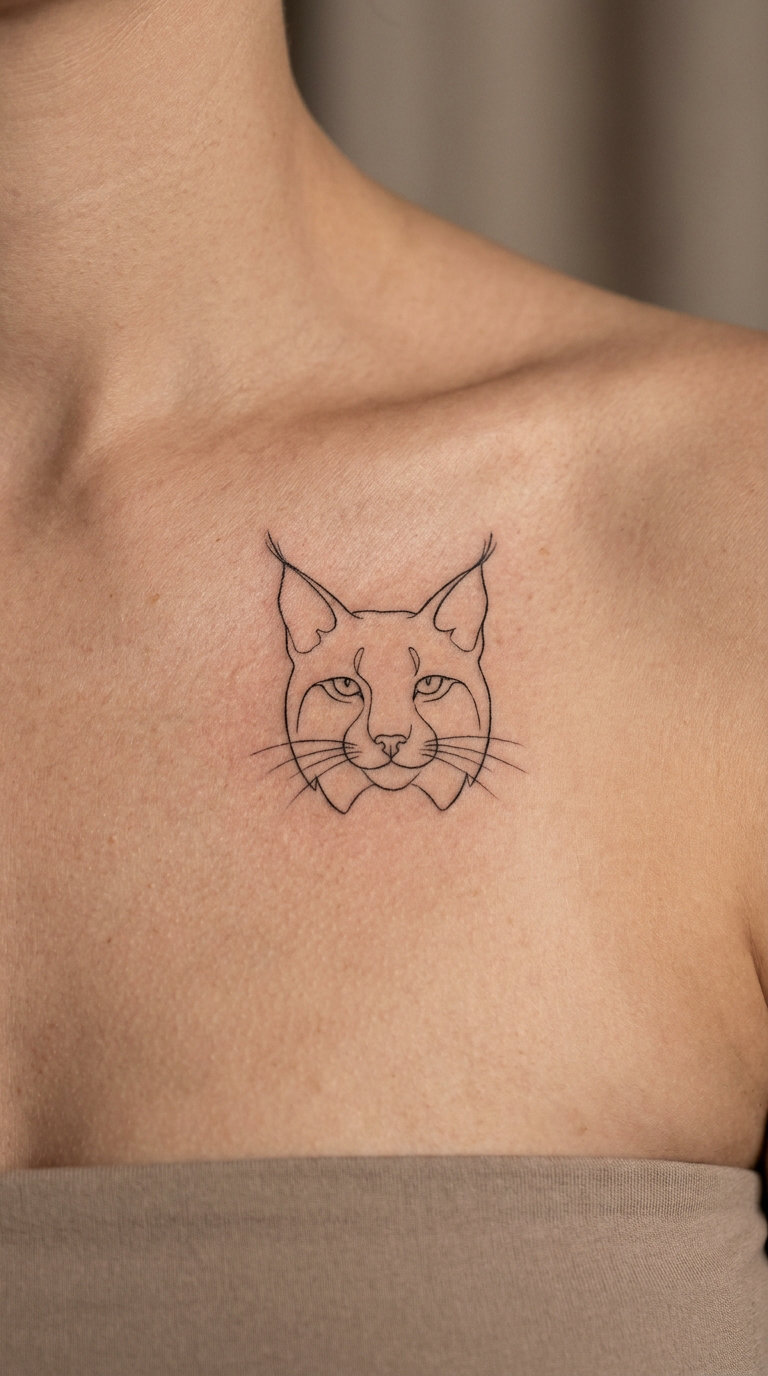
Fine line is the quietest way to wear a lynx, and the collarbone is where it looks most deliberate. The design is one contour: ear, cheek, nose, plus a light break for the eye and no more than three whiskers.
It suits people who like animal tattoos but not the whole animal. Thin skin here also holds fine work better than an ankle would.
Placement: Collarbone, centred or offset. Size: 2-3 inches (5-8 cm). Style: fine line. Pain: Medium, sharper than the arm because bone sits close under. Chest lines fade a little faster. Make it yours: add a small date in the same weight beneath the chin.
3. Blackwork Lynx Head on the Upper Arm
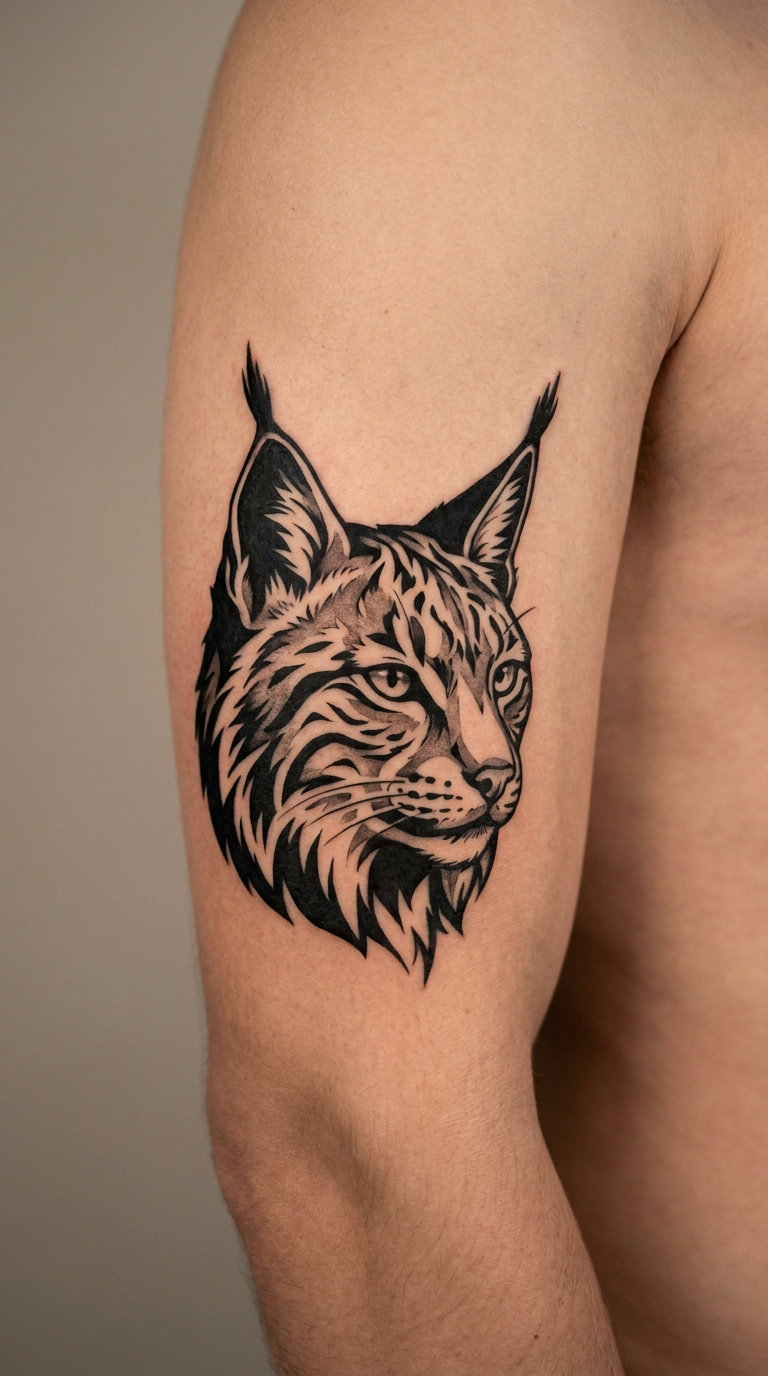
Blackwork drops the shading and keeps the shape. Ears, eye sockets and the underside of the ruff go solid black, then the fur is carved out of them as white space. The lynx still reads from across a room, and there is no gradient to blur later.
It fits a style that is already heavy and black, and it anchors a sleeve naturally. Start a full arm from here, and our 20 Best Black Sleeve Tattoo Ideas for Men covers the pieces that pair well with it.
Placement: Outer upper arm, deltoid to mid-bicep. Size: 3-4 inches (8-10 cm). Style: blackwork. Pain: Low to medium, one of the more forgiving spots. Solid black holds its edge for years. Make it yours: let the black shapes run into a band around the arm so it reads as planned.
4. Tiny Lynx Paw Print on the Wrist
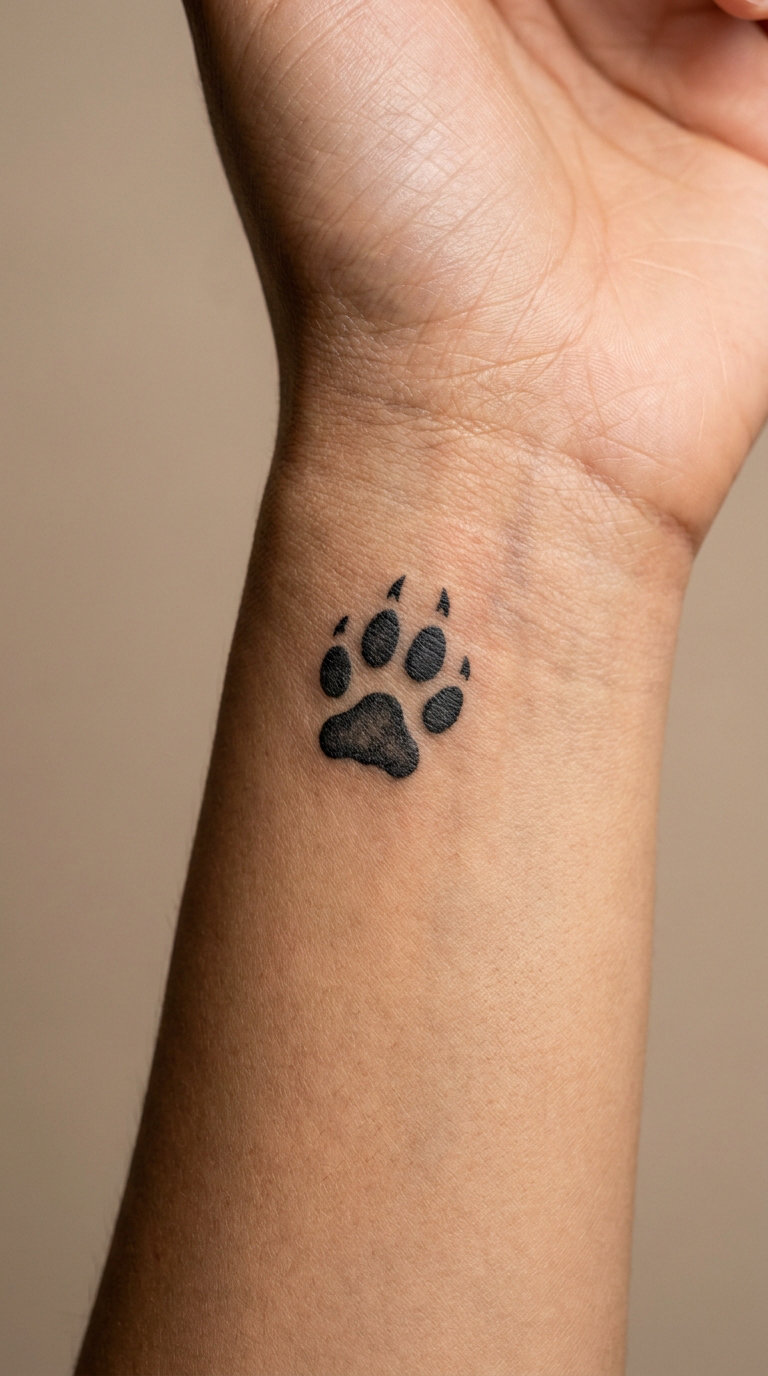
A lynx paw print is the easiest animal in this set to tattoo small. The wide snowshoe shape carries the identity, so one central pad, four toe pads and two short claw marks is the whole design.
Paw prints are about presence rather than portraiture, which suits people who want a private animal mark. It is also the most common first lynx tattoo I hear about.
Placement: Inner wrist, above the vein line. Size: 1-1.5 inches (2.5-4 cm). Style: minimal line or solid black. Pain: Medium, and the wrist feels more sensitive than expected. Daily washing wears the smallest lines down first. Make it yours: trail three prints up the forearm an inch apart.
5. Traditional Lynx with Pine Branch
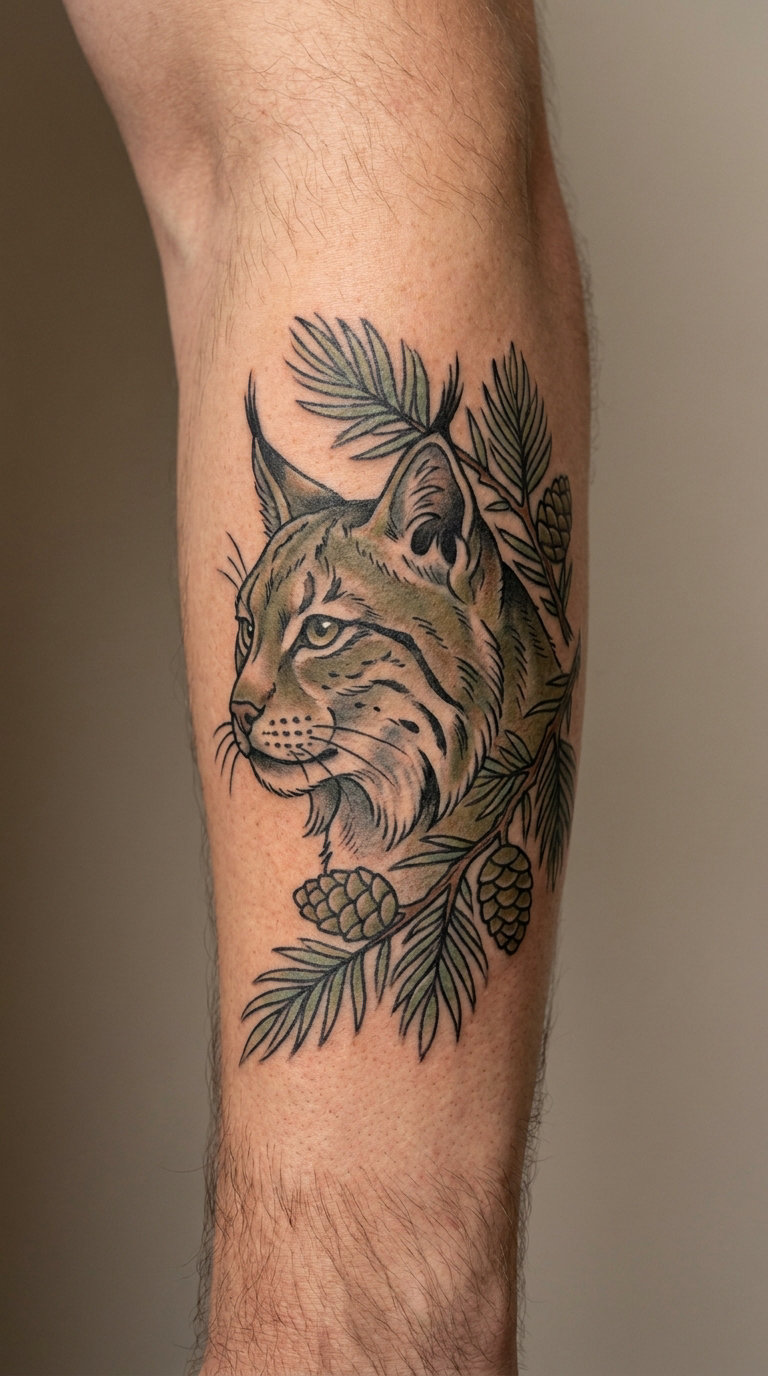
Traditional tattooing treats the lynx like any big cat: bold outline, warm base colour, black ear tips, one accent that carries the eye. A pine branch under the chest line is the standard companion, because the animal already implies northern forest.
Most people asking for this style want colour and history rather than photorealism. It pairs well with a banner or a sun piece on the same arm.
Placement: Forearm or calf. Size: 4-6 inches (10-15 cm). Style: traditional. Pain: Medium. Heavy outlines need fewer passes, so the sitting is shorter than a realistic portrait of the same size. Make it yours: swap pine for birch, which suits an Iberian lynx reference better.
6. Watercolor Lynx on the Shoulder
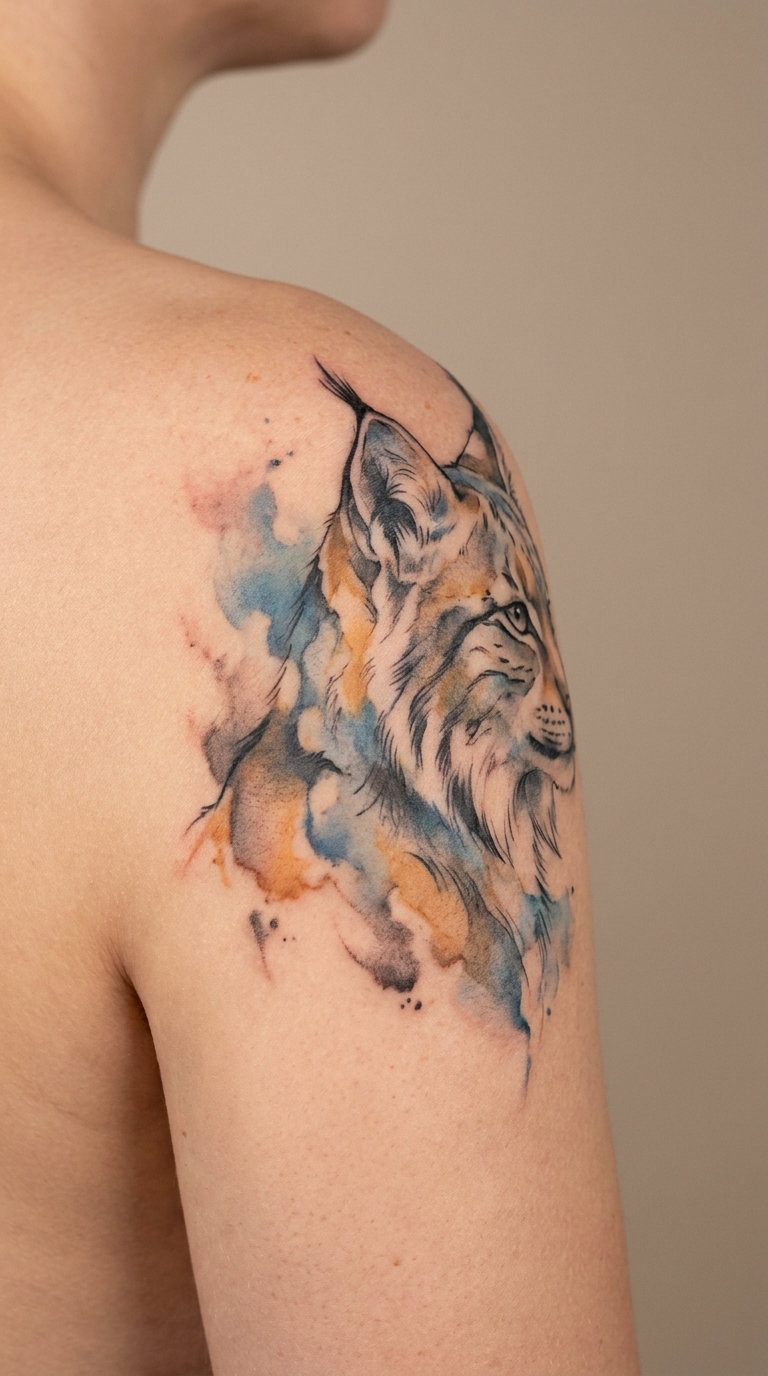
Watercolor tattoos loosen the edges: colour blooms past the linework, washes overlap, and parts of the animal fade out. The face usually stays sharp, so the eyes and ear tufts hold the composition while the ruff dissolves into skin.
It works for anyone who thinks solid black on a shoulder is too heavy, and colour hides small touch-up work better than black and grey does.
Placement: Shoulder cap, front to back. Size: 5-7 inches (13-18 cm). Style: watercolor with light black linework. Pain: Medium; the front of the shoulder turns bony near the collarbone. Make it yours: take your wash colours from a landscape you actually spend time in.
7. Geometric Lynx on the Calf
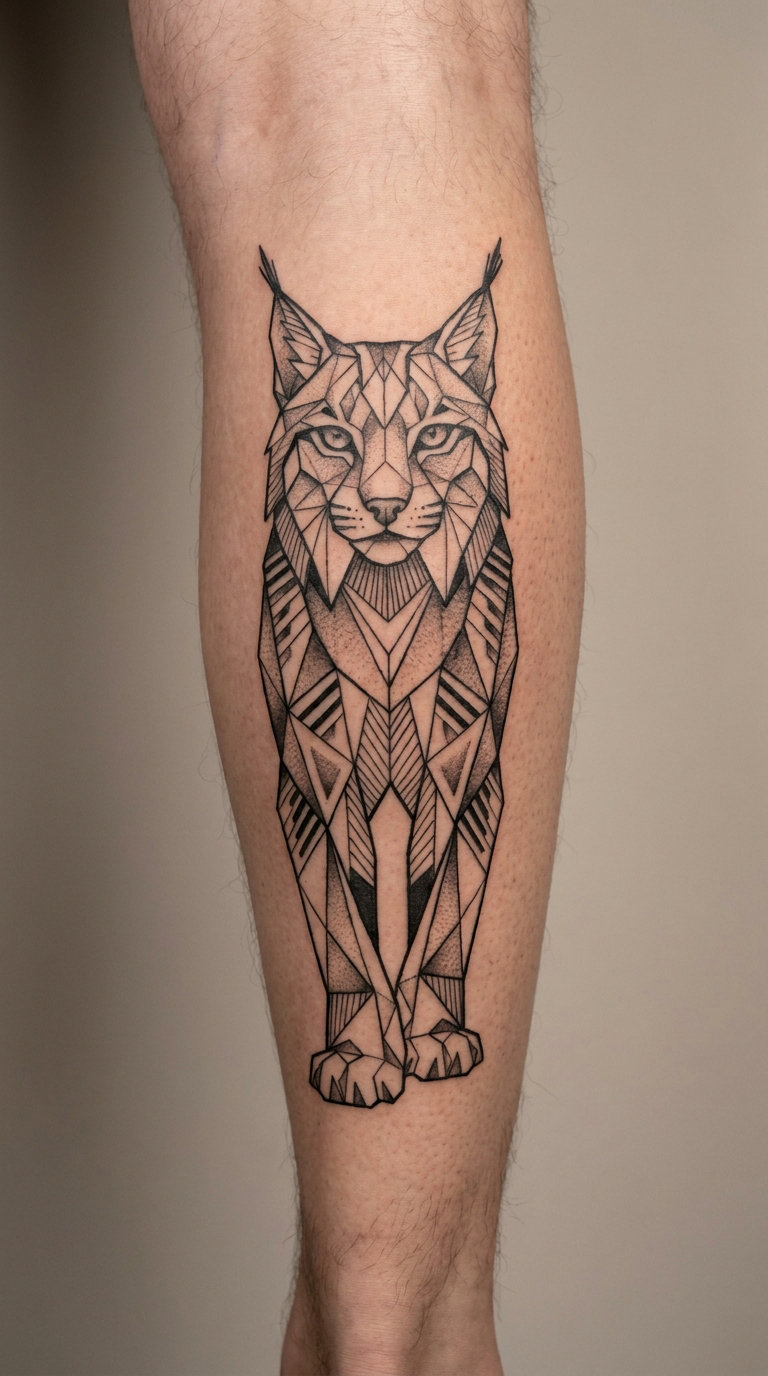
Geometric work reduces the animal to triangles and repeated strokes, then rebuilds the head from them. The ear tufts become two sharp angles and the ruff becomes a fan of lines. Low-poly versions keep small faceted planes and read well at a distance.
This suits someone who likes pattern more than texture, and the curved calf carries it better than a flat forearm would.
Placement: Outer calf, vertical. Size: 5-8 inches (13-20 cm). Style: geometric and polygonal. Pain: Low to medium; the calf is mostly muscle. Make it yours: run the pattern down toward the ankle so it follows the leg’s line.
8. Neo-Traditional Lynx Portrait on the Thigh
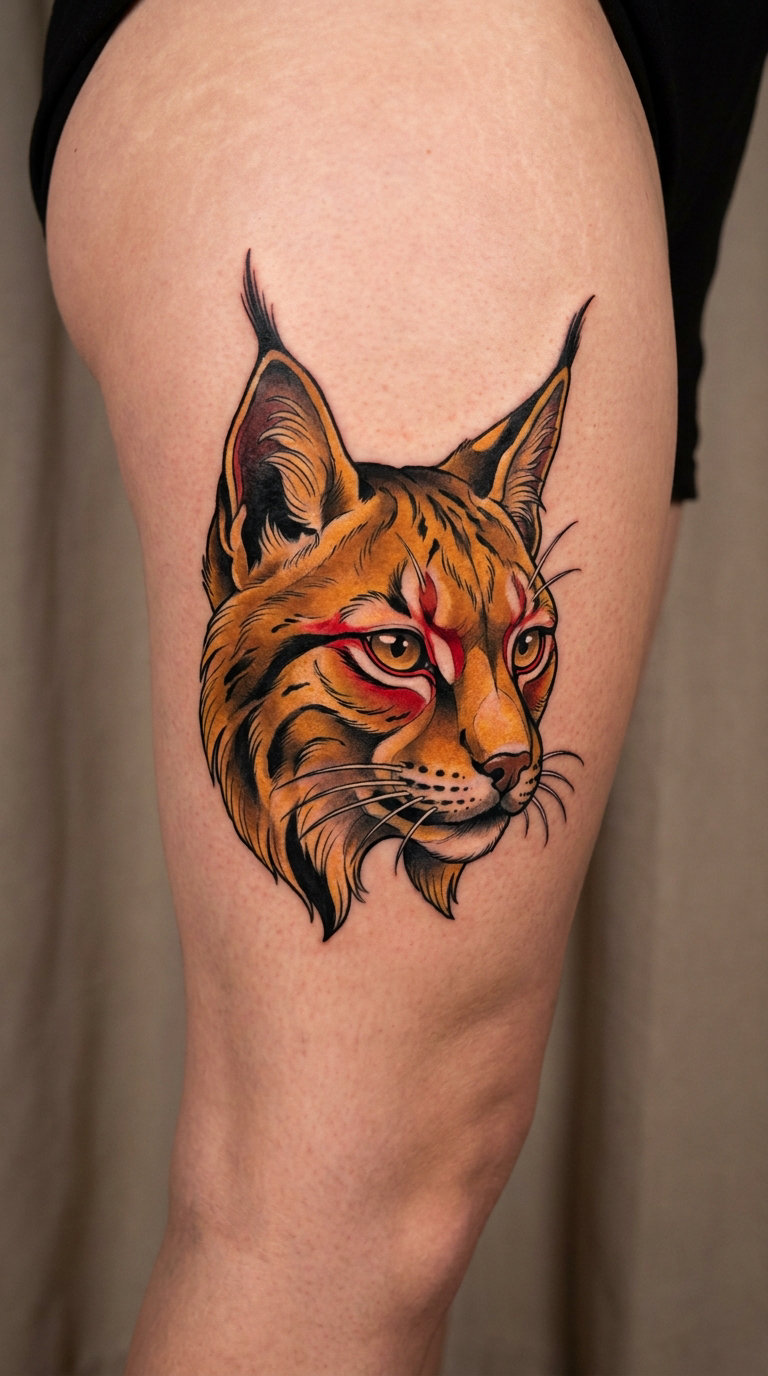
Neo-traditional turns the contrast up. Fur goes to a limited warm palette, shadows go to true black, and the eyes take an accent colour that lands hard. Backgrounds stay minimal, often a few spade shapes or a banner edge, so the animal keeps the focus.
People choose it when they want a large piece that still looks like a tattoo, with the readability of flash and the colour depth of realism.
Placement: Outer thigh, where there is flat surface for a head. Size: 6-8 inches (15-20 cm). Style: neo-traditional. Pain: Medium; the thigh gives the artist stability and the session moves quickly. Make it yours: reuse one accent colour in a later piece to tie the collection together.
9. Minimal Lynx Silhouette Behind the Ear
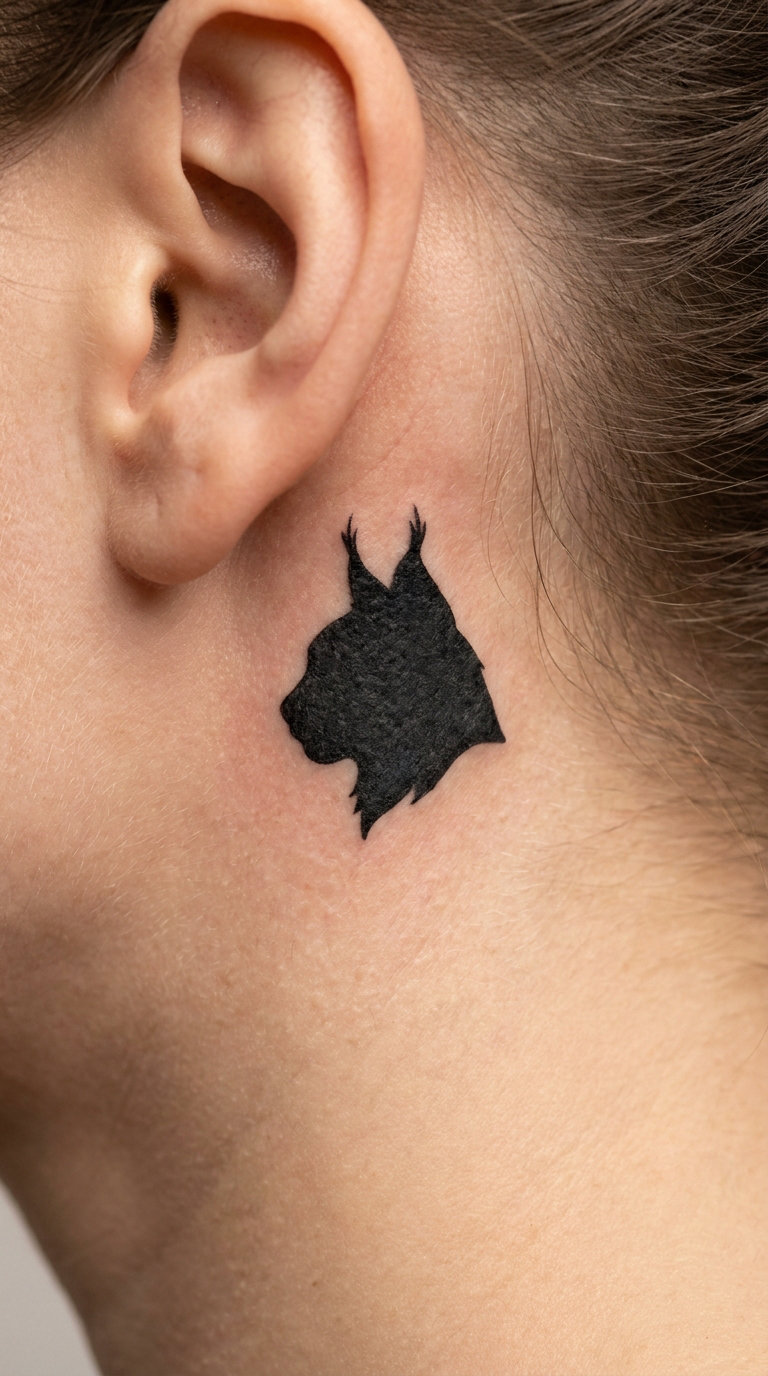
A solid black silhouette in profile is the whole trick: pointed ear, sharp muzzle, deep chest, short tail. With no interior detail the piece is nearly impossible to over-ink, and it stays crisp for years. Behind the ear also hides easily when you need it to.
It is the quietest statement here. Most people who take this route want the animal to be something only they notice.
Placement: Behind the ear, above the neck. Size: 0.5-1 inch (1.5-2.5 cm). Style: minimal solid or single colour. Pain: Low, and over in minutes. Hair regrowth makes it look patchier than it is. Make it yours: repeat the silhouette on a rib or hip, each facing a different direction.
10. Lynx in a Snowy Pine Forest
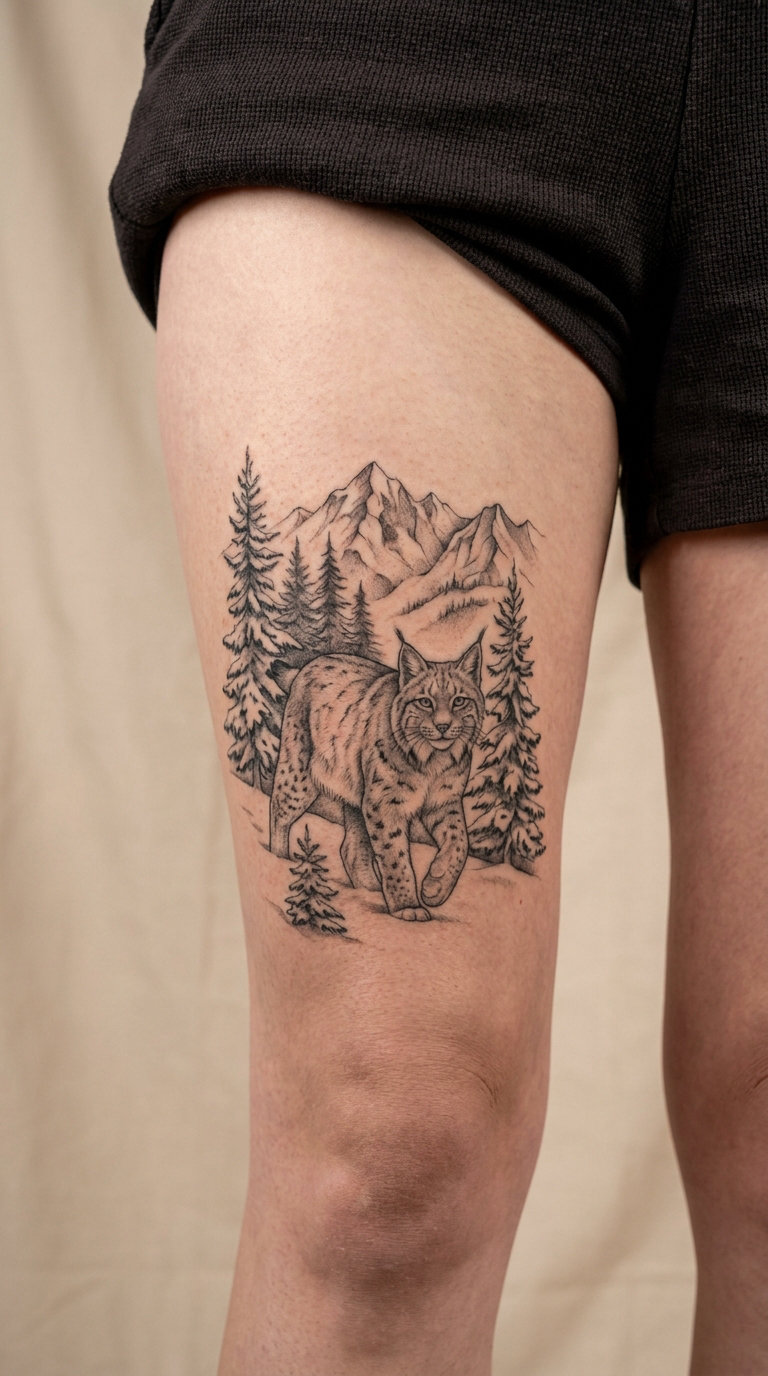
Here the lynx becomes part of a landscape: a walking animal in the lower third, snow-heavy pines stacked behind, distant mountains fading into a pale sky. Black and grey does the work, with maybe one cool blue in the shadows.
It needs real estate, which makes it a thigh or back design. If you want that density on an arm instead, our guide to 20 Best Pine Forest Tattoo Ideas for the Forearm covers the same ground.
Placement: Outer thigh or upper back. Size: 8-12 inches (20-30 cm). Style: illustrative realism. Pain: Medium, spread over a longer sitting. Make it yours: plan a second scene for the opposite side so the back reads as one piece.
11. Dotwork Lynx on the Spine
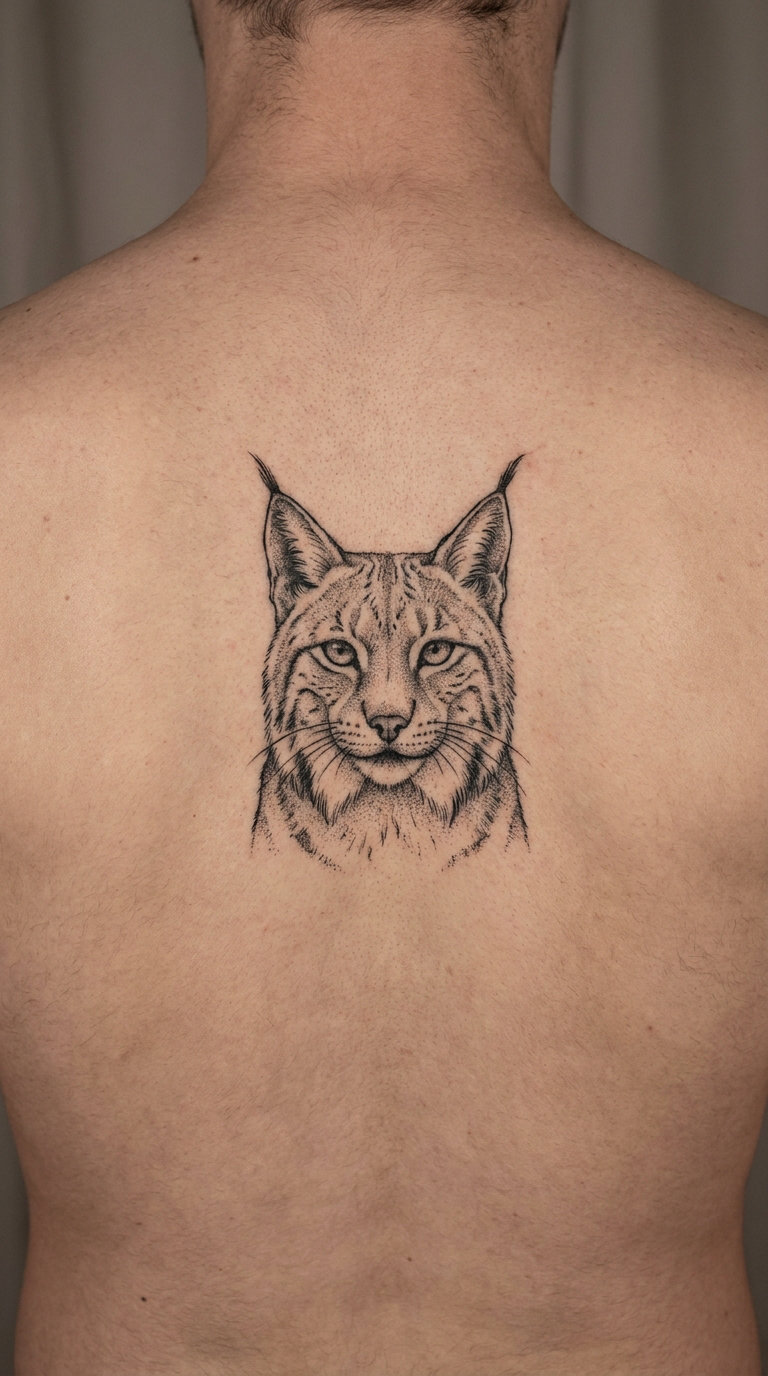
Dotwork builds tone from dots, so the whole design is a gradient. Ear tufts, eye and ruff emerge as dense patches while the body edges soften into sparse stippling. Along the spine it runs vertically, which suits a seated cat looking back over one shoulder.
The style is patient rather than flashy, and it gives visible detail without a heavy outline. Dot density is the artist’s call, so bring plenty of reference.
Placement: Upper spine, between the shoulder blades. Size: 6-9 inches (15-23 cm). Style: dotwork and stippling. Pain: Low to medium, but stippling takes real time. Make it yours: fade the dots out entirely at the base so the piece dissolves into the skin.
12. Lynx and Mountain Compass on the Back
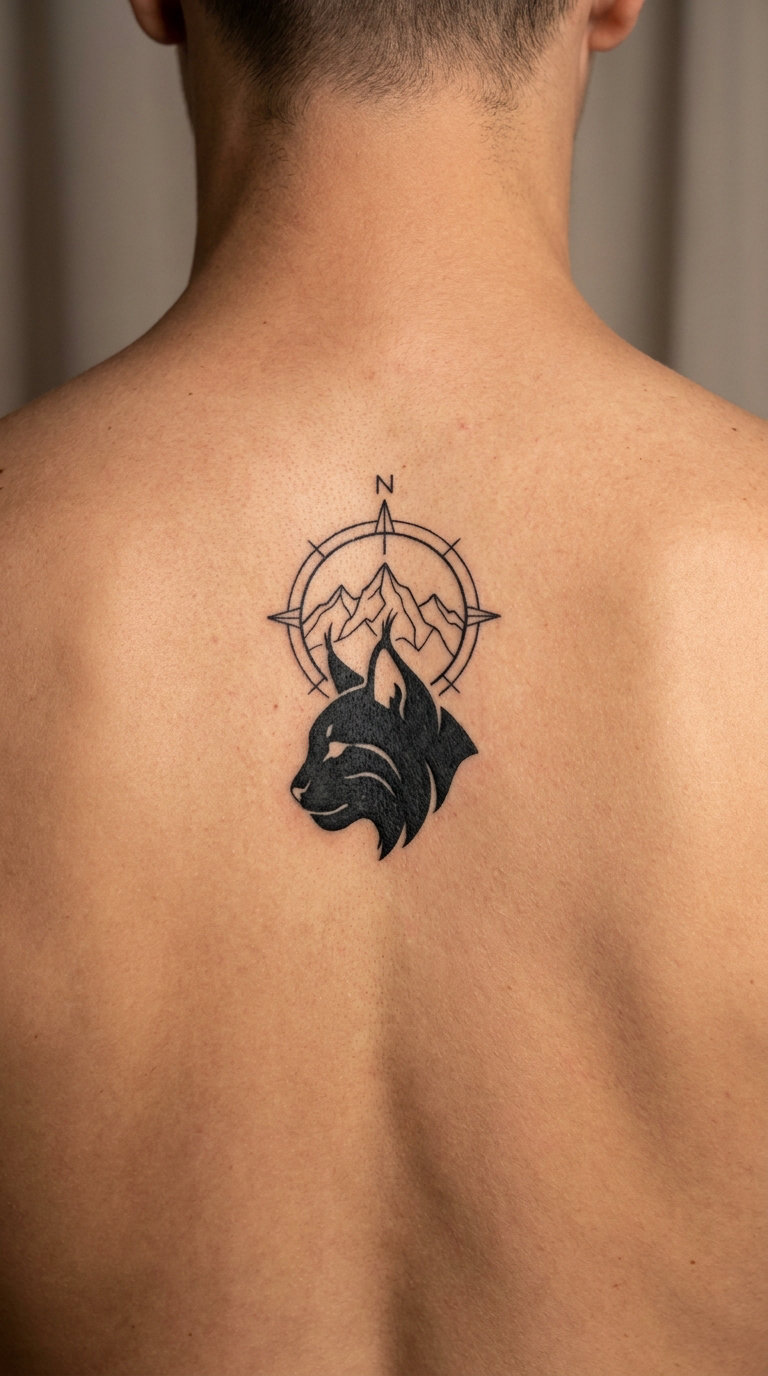
A mountain compass above a lynx profile says direction and travel without writing anything down. The compass stays simple: a circle, a needle, three or four peaks. The lynx sits below it slightly smaller, so the eye moves down rather than across.
People pick it after a trip, a move, or a stretch of travel worth remembering. It reads as a personal marker rather than an animal statement.
Placement: Between the shoulder blades, vertical. Size: 4-6 inches (10-15 cm). Style: fine line illustrative. Pain: Low to medium; the base of the spine is more sensitive than the shoulder blades. Make it yours: set the compass points in an order that means something to you.
13. Ancient Seal-Style Lynx
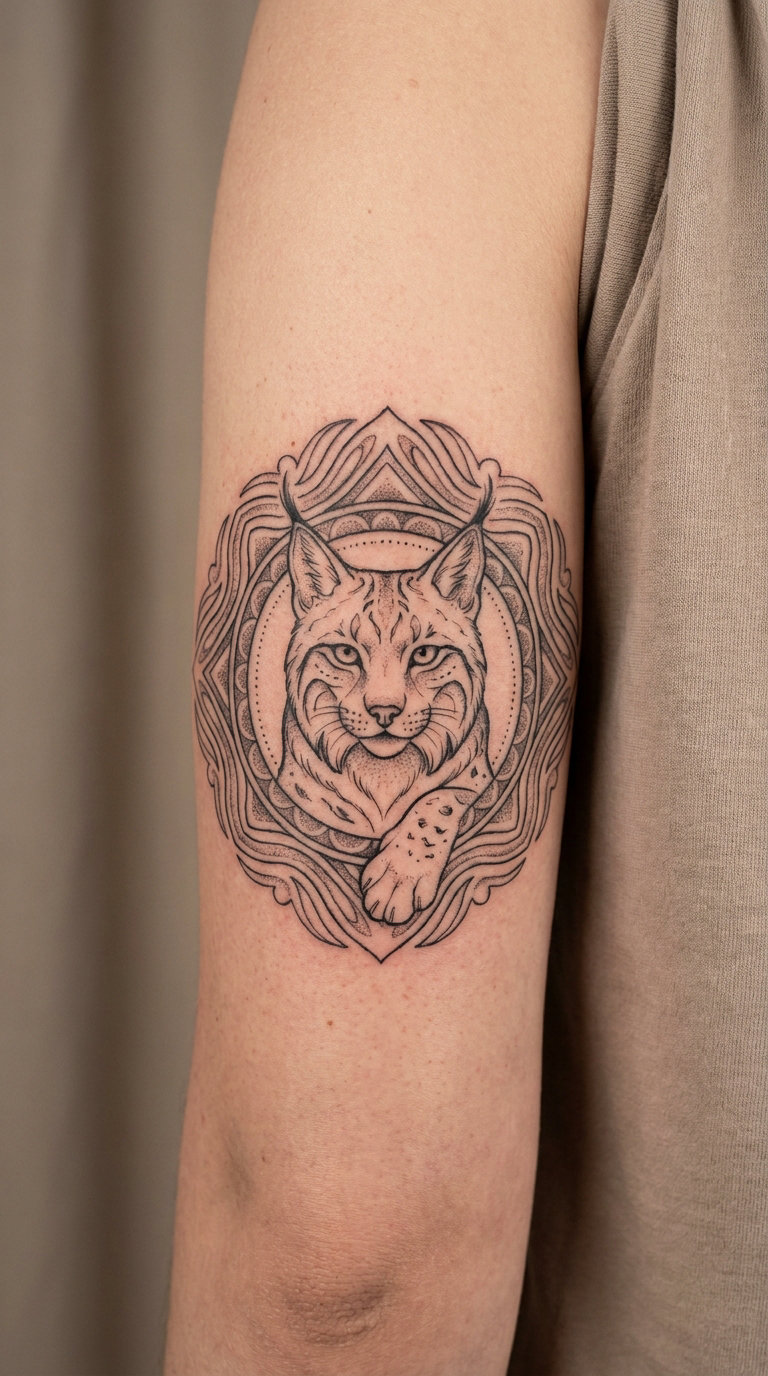
Seal-style work borrows the look of stamped ornament: a symmetrical animal, repeated contour lines, and a border that frames it like a coin. The lynx goes flat and graphic, and the ear tufts stay because they are what separate it from a lion.
It suits people who like history and pattern without a colour palette, and the border handles the composition on a narrow area.
Placement: Inner upper arm or the back of the calf. Size: 3-4 inches (8-10 cm). Style: ornamental linework. Pain: Low. Make it yours: add small breaks in the border, the way a worn coin would have them.
14. Lynx Eye Study on the Forearm
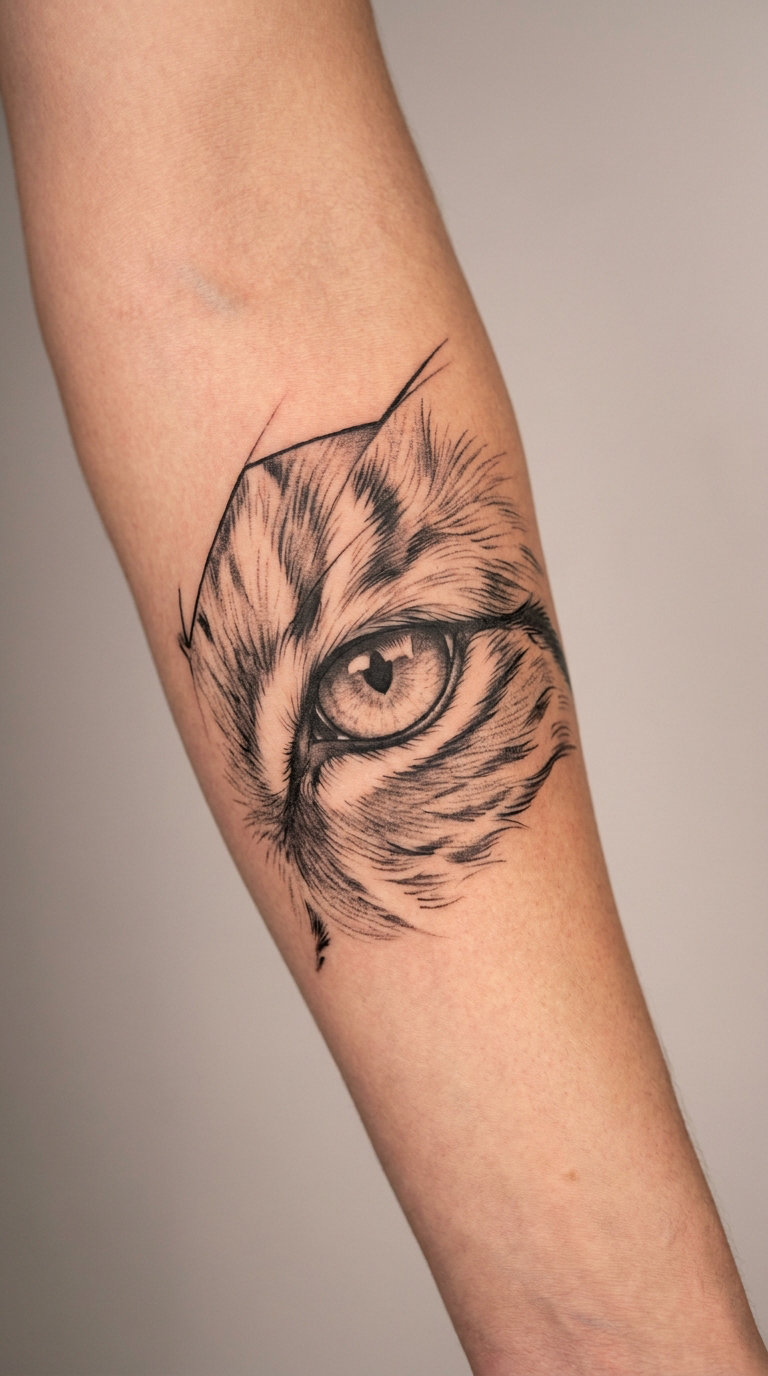
An eye study takes the most expressive part of the animal and drops the rest. The work sits in the brow: that sharp inward angle, the fur rays fanning from it, and the catchlight that makes it read as alive. Keep the pupil round.
It is a strong first piece since it is small, quick and needs no background. Plenty of people add a second element there later.
Placement: Inner forearm. Size: 3-4 inches (8-10 cm). Style: micro-realism. Pain: Medium; sensitive but forgiving. The catchlight is the first detail to soften. Make it yours: match the eye colour to a real subspecies, which artists always notice.
15. Two Lynx Profiles as a Matching Pair
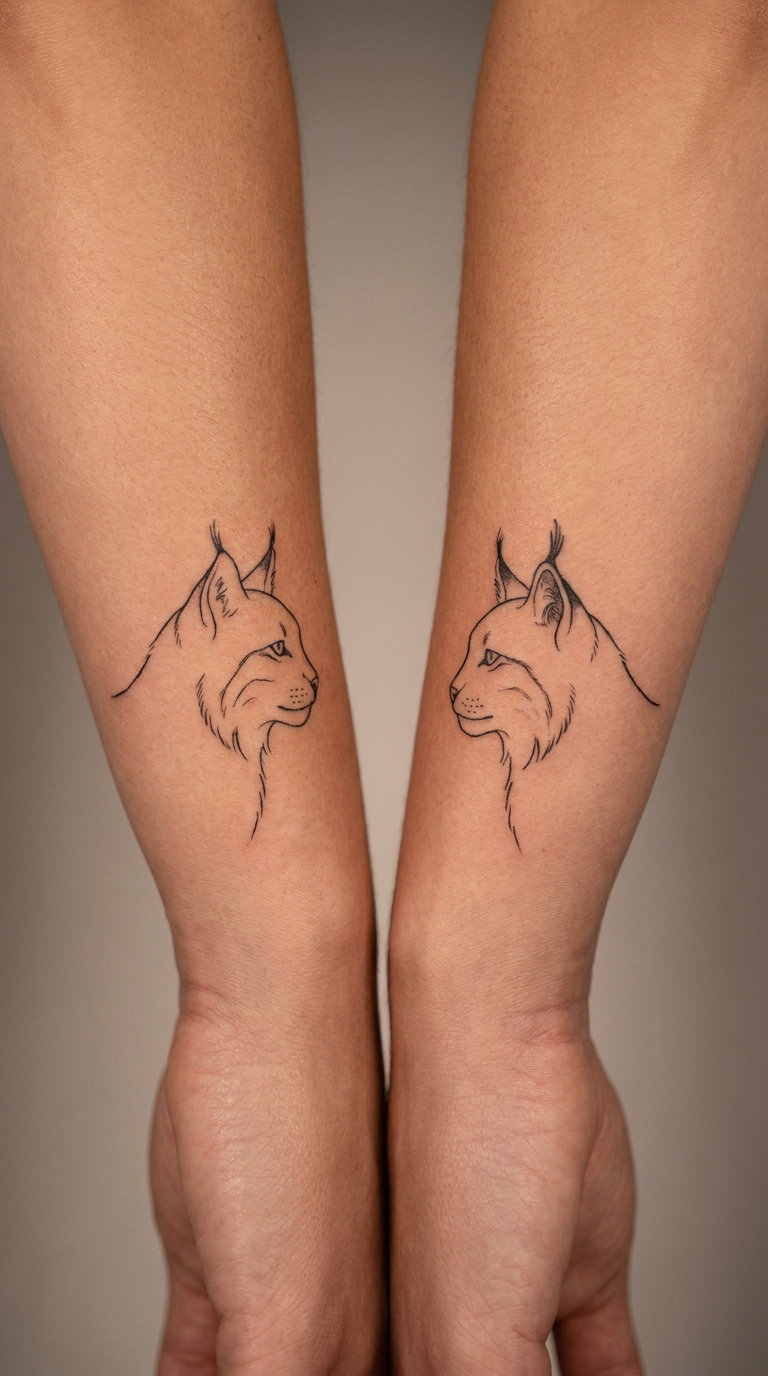
Matching pairs work when the two pieces share a style but not an identical drawing. Here one lynx faces left with a heavier shaded ruff, the other faces right with lighter linework and a different ear marking. Together they read as a pair; separately each holds up.
Couples and siblings use this format, but it works just as well as two halves of one idea tattooed over two sittings.
Placement: Inner forearms, or one on each calf. Size: 2-3 inches each (5-8 cm). Style: fine line with light shading. Pain: Medium, and the second one always goes faster. Make it yours: trail the tails toward each other so they connect when your arms are side by side.
16. Lynx Head in a Botanical Wreath
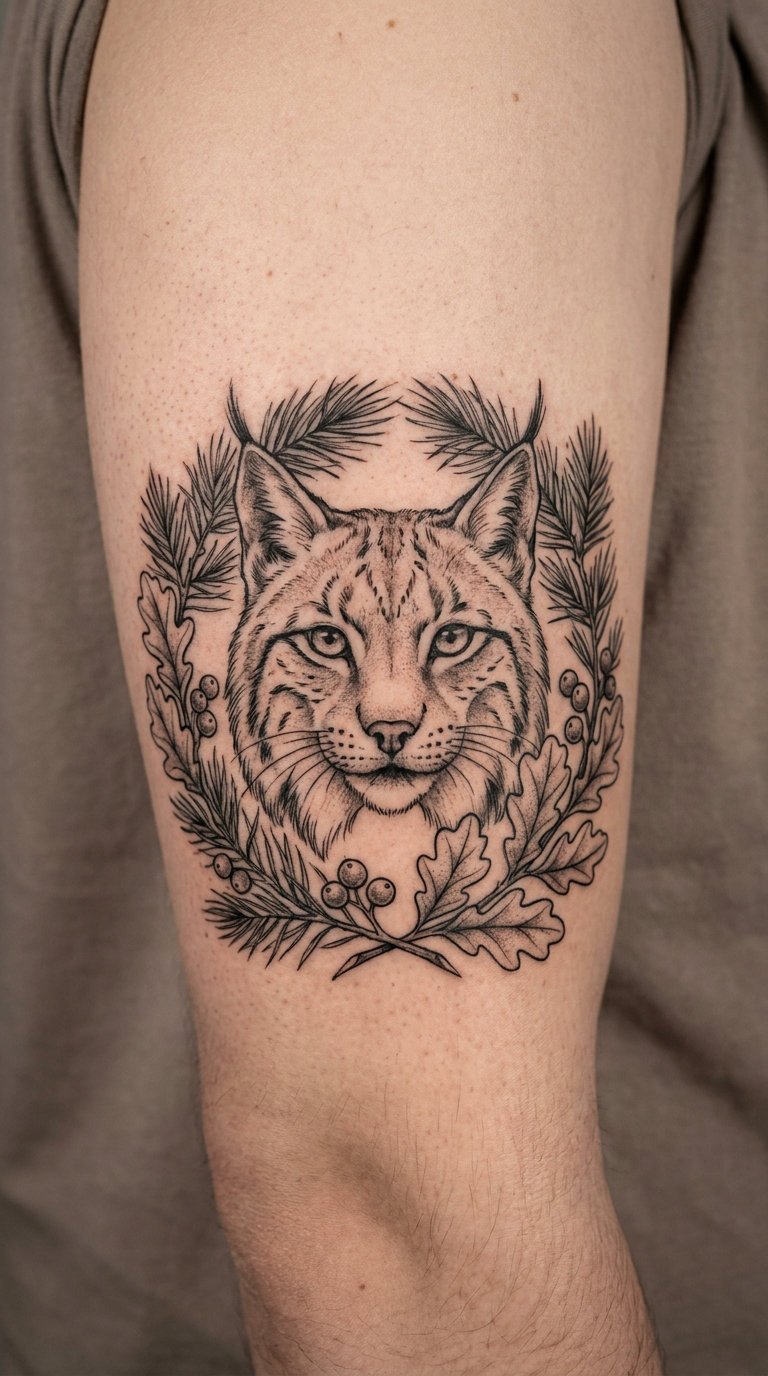
A wreath solves the composition problem of a head-only piece. The lynx sits in the middle, botanicals circle it, and the closed shape makes the design feel finished without a background. Pine needles, spruce tips and small berries all read as northern forest.
It is the design most often chosen by people who want a traditional tattoo feel with a naturalistic animal inside it, and the circle makes it easy to add to later.
Placement: Upper arm or back of the shoulder. Size: 4-5 inches (10-13 cm). Style: black and grey with illustrative botanicals. Pain: Low to medium, though many small passes make it a long sitting. Make it yours: use only plants that grow where you grew up.
17. Black-and-Grey Running Lynx on the Calf
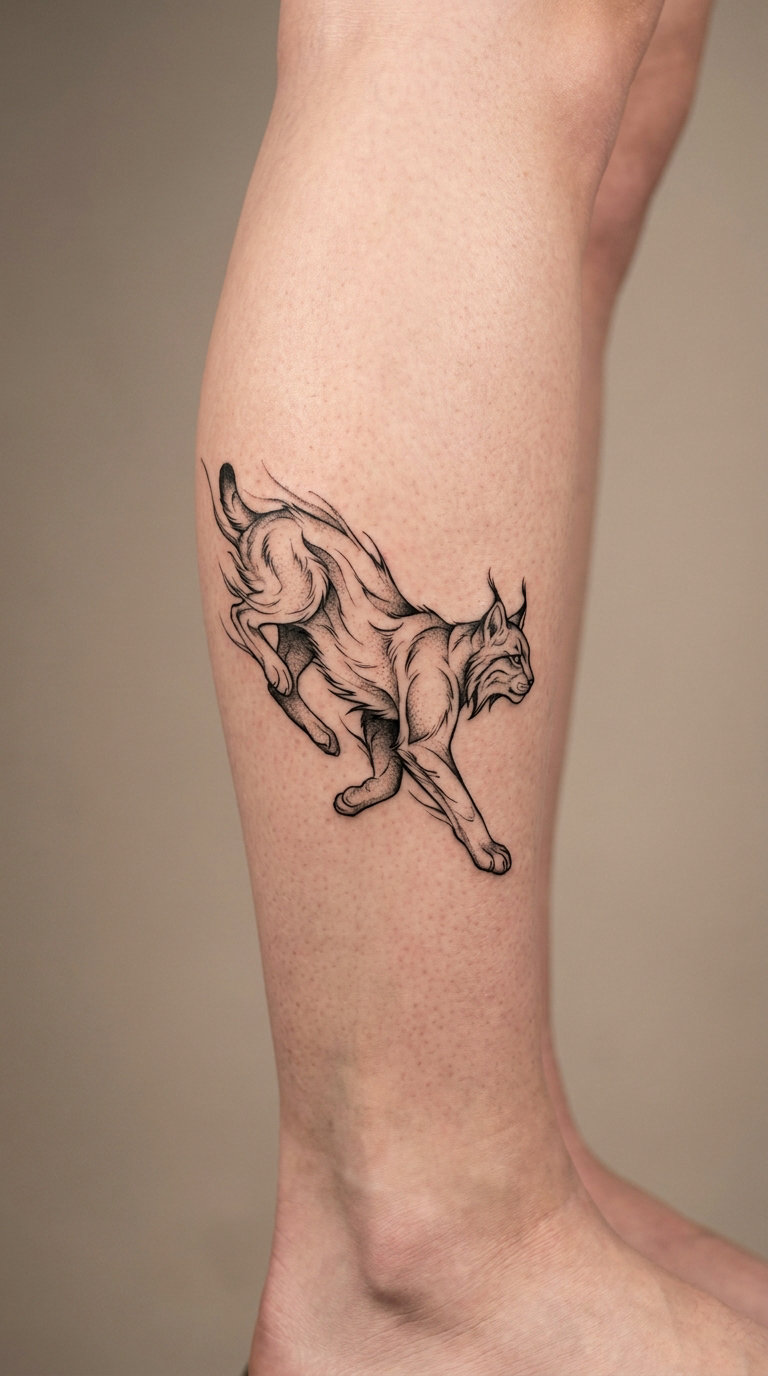
A running lynx is a study in movement: front legs extended, hind legs gathered, the short tail streaming back, fur breaking into loose strands at the edges. The calf suits it because the muscle already curves like a leaping body.
Dynamic animal pieces tend to suit people whose other work moves too, rather than static portraiture. Motion lines behind the animal usually help sell the speed.
Placement: Outer calf, vertical. Size: 5-7 inches (13-18 cm). Style: black and grey realism. Pain: Low to medium, an easier large placement. Very fine motion lines blur over time. Make it yours: mirror the pose on the opposite calf so the two animals appear to chase.
18. Sticker-Style Lynx on the Ankle
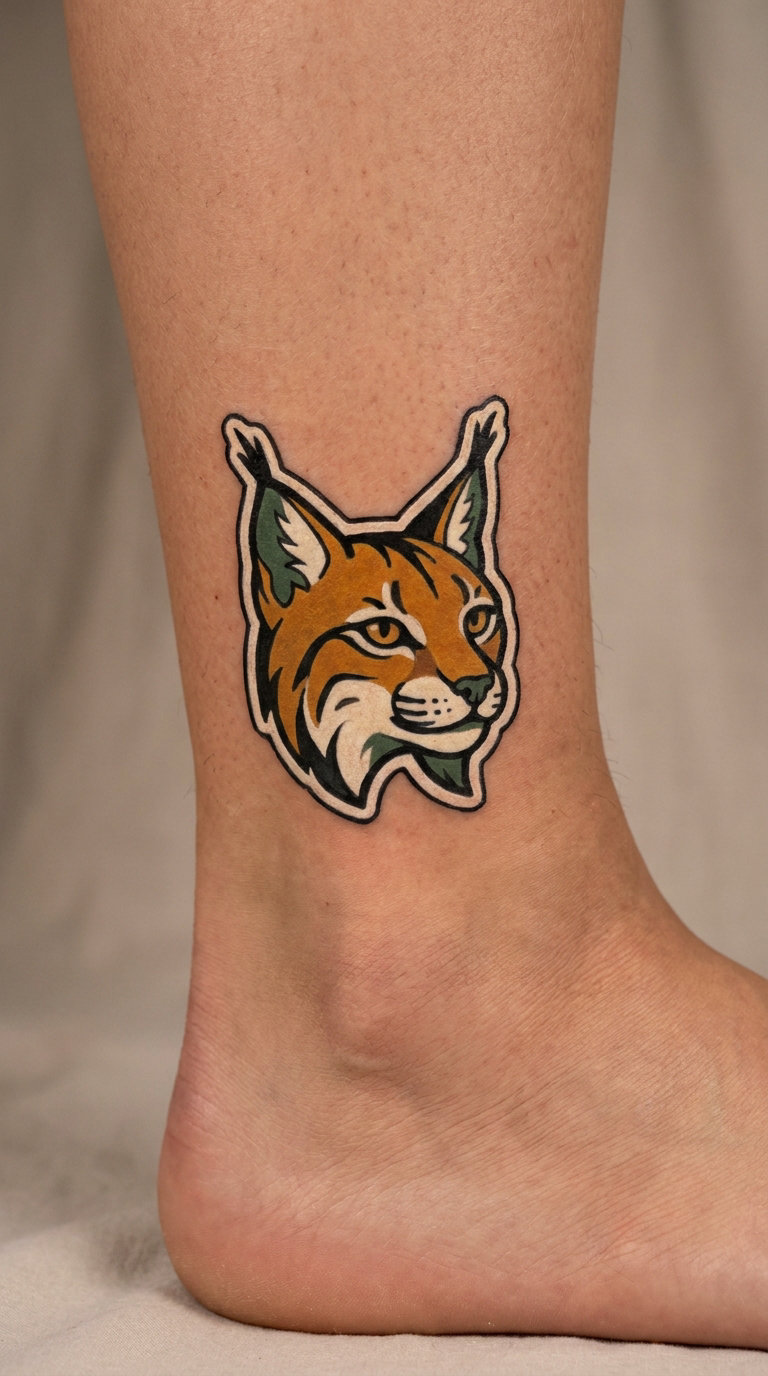
Sticker style borrows from graphic design: thick outline, flat colour blocks, no gradients, a hard edge that lets the animal read at 2 inches. The lynx usually crouches with the ear tufts exaggerated, since shape is doing realism’s job here.
It is playful without turning cartoonish, and ankle pieces tuck away easily. The bone makes fine detail a poor fit, which is exactly why the sticker approach suits the site.
Placement: Outer ankle, above the bone. Size: 2-3 inches (5-8 cm). Style: sticker and neo-traditional. Pain: Medium to high; thin skin over bone, with nerve endings close to the surface. Make it yours: add a single-tone drop shadow under the animal to sell the effect.
19. One-Line Lynx on the Finger
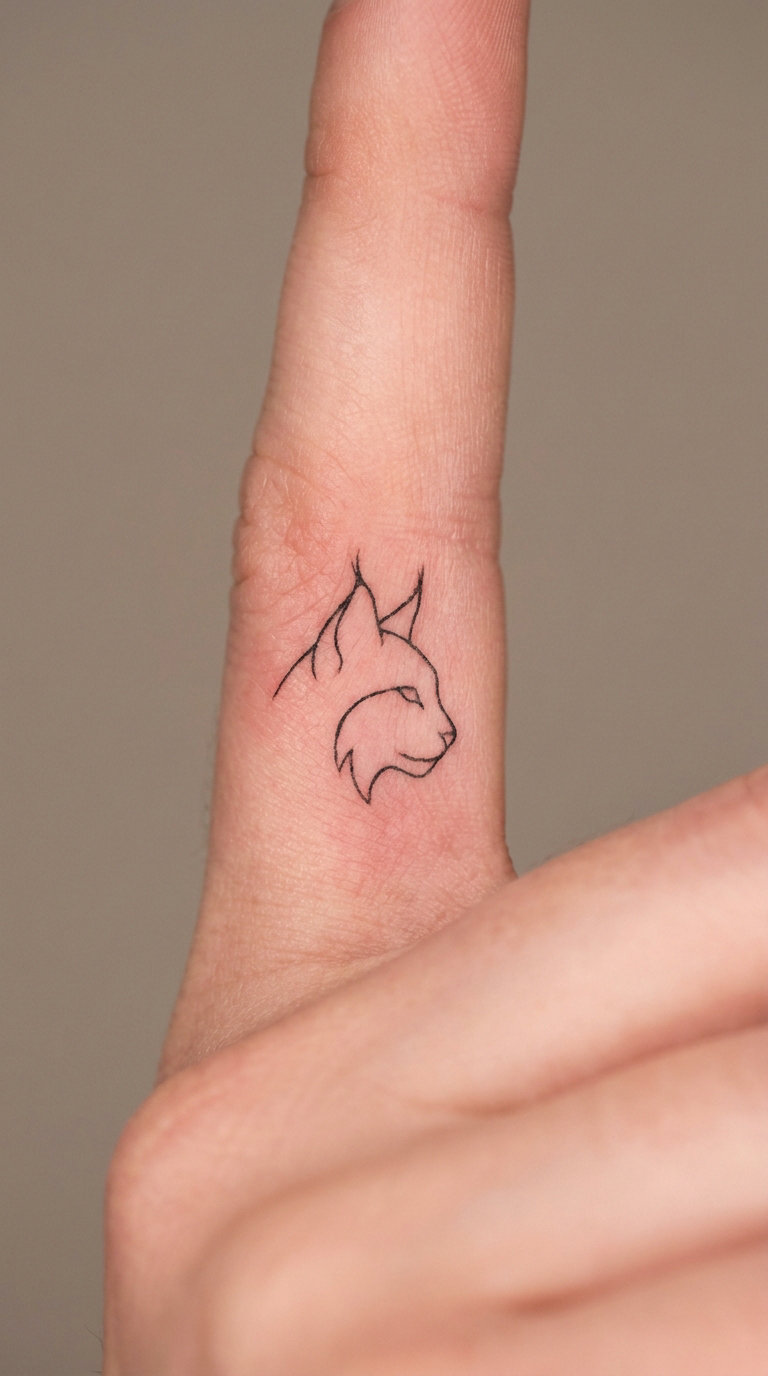
The most minimal design here: one unbroken line from the ear tuft, down the cheek and out to the nose. No eye, no whiskers, nothing to fill in. The curve does all the work, and finding it is the whole conversation with the artist.
People choose it because a finger tattoo is a genuinely small commitment. Plan on a touch-up inside two years though: hands show wear faster than anywhere else.
Placement: Side of the finger, knuckle to tip. Size: 1-1.5 inches (2.5-4 cm). Style: single-line minimalist. Pain: Medium to high on the sides and knuckles, and the finger can look bruised for days. Make it yours: mirror the line on the matching finger, or run it down toward the knuckle.
20. Lynx and Moon on the Rib
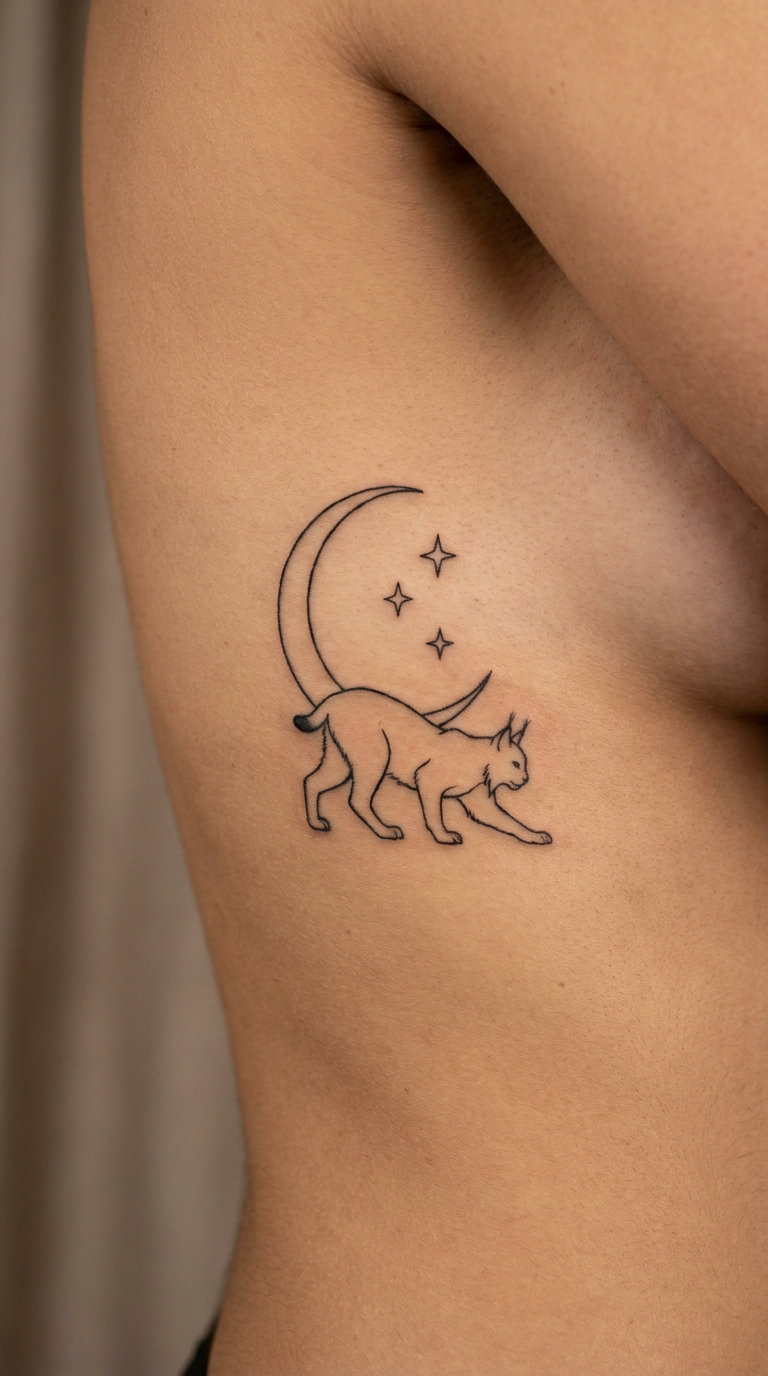
On the ribs the composition should never be a rectangle. A lynx silhouette curves with the cage, a crescent moon sits above the shoulder line, and the stars scatter rather than line up. Fine line keeps it light, which matters with little muscle to work against.
The pairing reads as a night scene and photographs well from the side. Bring a reference for the moon position; artists in this style will follow your drawing closely.
Placement: Side of the ribs, following the curve. Size: 4-5 inches (10-13 cm). Style: fine line silhouette. Pain: High, and ribs are one of the three spots worth bracing for. Stretched skin fades line work faster. Make it yours: choose a waxing or waning crescent, which changes the whole feel.
21. Traditional Japanese-Inspired Lynx and Maple Leaves
Japanese-influenced composition means a strong silhouette, a limited palette and negative space doing real work. The lynx is black with a red accent, framed by flowing lines and seasonal maple leaves, and its direction carries the whole panel. In this idiom the background matters as much as the cat.
Anyone who likes large decorative pieces moves toward this direction because it fills a back properly. Worth finding an artist who works in this style rather than stretching a realism artist.
Placement: Upper back, shoulder or outer arm. Size: 6-9 inches (15-23 cm). Style: Japanese-inspired illustrative. Pain: Medium; the back is sensitive but gives the artist room. Red and black fill the best. Make it yours: keep the leaves strictly seasonal, or deliberately mismatch them.
22. Pixel-Art Lynx on the Hand
Pixel art reduces the lynx to a grid, and the design only works if the squares stay honest. A stray half-pixel changes the whole face. One amber square for the eye is usually the only colour needed, since the silhouette carries the rest.
It looks contemporary next to almost any existing hand tattoo, and it works as a conversation piece because hands get looked at all day.
Placement: Back of the hand, between the knuckles. Size: 2-3 inches (5-8 cm). Style: pixel art. Pain: High; knuckles, tendons and the back of the hand are all sensitive. Hand ink fades faster than arm ink. Make it yours: set the grid so the pixels get smaller toward the tail, giving the sense of walking away.
23. Full-Body Lynx on the Back
On a back the artist can finally show the whole animal: long legs, deep chest, broad paws, the bobbed tail. Sparse trees and a low horizon give scale without filling every inch, and black and grey keeps it timeless.
This is a collector’s design. It needs a free back, a plan across several sittings, and a touch-up conversation every few years.
Placement: Upper and mid-back, shoulder blades to lower ribs. Size: 12-18 inches (30-45 cm). Style: realistic landscape illustration. Pain: Medium overall; the lower back and spine are more sensitive than the shoulder blades. Make it yours: decide the horizon height early, since it changes every other decision.
24. Abstract Lynx Made from Northern Lights
Here the lynx is built from light rather than fur. Bands of green, blue and violet sweep across the composition and the animal resolves out of them: an ear tuft, a lit eye, the edge of a ruff. Too little facial detail and it stops reading as a lynx, so the face stays realistic and everything around it stays loose.
Colour like this rewards a broad surface, and it is the most contemporary option here.
Placement: Shoulder, upper arm or thigh. Size: 6-8 inches (15-20 cm). Style: abstract colour realism. Pain: Medium; fine colour transitions take more than one sitting. Make it yours: use aurora colours from a real sky you have seen.
How to Choose the Right Design
Start from the placement, not the picture. A design you love will not work if it has to shrink into a space that cannot hold it, and that is the most common reason a good idea ends up looking crowded on skin.
- Match style to area. Fine line suits curved, bony places like the collarbone, ribs and fingers. Blackwork and traditional fills handle muscle better, which is why they suit the upper arm, calf and thigh.
- Give detail the room it needs. Below about 2 inches, ear tufts and fur texture stop reading and the piece turns into a grey blob. Above 4 inches, a portrait has space for the ruff, coat markings and whiskers.
- Decide visibility first. A forearm or calf design is seen constantly; ribs and behind the ear are yours alone. Work out whether you want the animal to be a conversation or a secret.
- Check ageing honestly. Thick black and saturated colour hold their shape. Hairline detail on hands and fingers, and thin lines over ribs, need revisiting sooner.
- Bring healed references. Search for lynx tattoos at two, three and five years old. That tells you more than a portfolio of new work.
- Be specific with your artist. Name the species, pose, line weight and size. “Something like this” leaves every decision to the chair.
Cost and Session Time
Pricing in the US runs on hourly shop rate and how many hours the design needs, not on the animal itself. Most shops charge somewhere between $80 and $200 an hour, and a shop minimum usually applies, so that minimum is often what a small piece actually costs. Rates vary widely by city, so treat any figure you find online as the start of a conversation rather than a quote.
- Under 2 inches — paw print, silhouette, one-line finger piece. Well under an hour, often booked as a short appointment, and usually $80 to $150 once the shop minimum is counted.
- 2-4 inches — fine-line face, eye study, sticker style. Commonly one to two hours, so roughly $150 to $300.
- 4-6 inches — forearm portrait, wreath, calf studies. Two to three hours and often split, which puts a coloured piece around $300 to $600.
- 6-9 inches — scenes, spine dotwork, colour shoulder work. Three to five hours, usually split across two sittings, so expect $500 to $900.
- 10 inches and up — full back pieces. Multiple sittings planned in advance, often $1,200 and up for a shaded landscape, with a touch-up session held at the end.
Detail moves the clock, not size. A shaded black and grey portrait takes far longer than a solid blackwork head of identical dimensions, because every gradient is thousands of small deposits of ink. If budget matters more than subtlety, ask which parts can be simplified without losing the lynx.
Aftercare Basics
Start with your artist’s own aftercare instructions, since they know what they did in your skin. The list below fits most new lynx tattoos.
- Follow the washing and moisturising routine you were given, and ask before switching products mid-heal.
- Wash with clean water and a fragrance-free cleanser, then pat dry rather than rubbing.
- Keep it out of direct sun while it heals, then think about sun protection for life. A lynx face loses its eye detail first as ink fades.
- Skip swimming, hot tubs and heavy gym friction for the first couple of weeks, or as long as your artist advises.
- Do not scratch or pick. Flakes that loosen on their own come away without taking ink.
- Book the touch-up your artist recommends, usually 6 to 12 weeks out, and do not skip it because the tattoo looks fine that week.
If a tattoo looks blotchy, or the black reads blue or grey while it heals, that is normal early on. Ink sits at different depths and the surface scabs unevenly. If the colour still looks wrong once the surface has fully healed and your artist has checked it, ask about a correction rather than trying to fix it yourself.
Frequently Asked Questions
What does a lynx tattoo symbolize?
A lynx tattoo most often symbolizes keen sight, independence and a bond with the wild. People also read it as intuition, stealth, quiet strength and guardianship. What the design shows narrows the reading: piercing eyes push it toward alertness, a paw print toward presence, a landscape toward wilderness. Meanings are personal, and most people carry theirs for the animal rather than the symbolism.
Where is the best placement for a lynx tattoo?
The outer forearm is the most versatile spot, since it has flat surface, curves with the arm and stays visible. The upper arm and calf are forgiving for larger blackwork pieces. The collarbone and behind the ear suit small, delicate work, while ribs and sternum read as bolder and hide under a shirt. Whatever you choose, check the design stays legible at the size that area allows.
Is a lynx tattoo painful?
Most placements sit in the middle range. The forearm, upper arm and calf are comparatively easy because there is muscle to absorb the needle. The ribs, sternum, collarbone, fingers and ankles hurt noticeably more, since the skin is thin and bone sits close underneath. Duration matters as much as location: a one-hour sitting on the forearm usually feels better than a five-hour one on the same spot.
Should I get a realistic or a stylized lynx tattoo?
Realistic work needs a larger size and healed examples, because fine shading softens over the years. Stylized designs such as blackwork, geometric or sticker style hold their edges far longer and work at almost any size, which makes them the safer pick for small placements. Choose realism for the animal, stylization for the longevity.
How small can a lynx tattoo be and still read clearly?
Around one inch you can get a paw print or a solid silhouette. At two inches, a lynx head works if the artist keeps it to a few strong features: ear tufts, eye, muzzle. Below two inches, fur texture and whiskers blur together, so simplification matters more than detail. Above four inches a realistic portrait has room for the ruff, the coat markings and the whiskers.
How do I bring a reference an artist can actually use?
Bring three or four images rather than one, from slightly different angles, and mark what matters most to you: the eye, the ear tufts, the pose. Healed work tells the artist more than untouched flash, and a sketch of the placement on your own body helps with scale. Be clear that you want the idea adapted to your body shape, not traced across.
Conclusion
For a first tattoo, the tiny paw print or the behind-the-ear silhouette is the least risky route: small, quick and simple enough that a good result is nearly certain. The fine-line collarbone face is the best compromise if you want the animal to still look like a lynx without committing to a large piece.
If you are adding to a collection, work outward from an anchor. The blackwork upper arm head pairs with a sleeve, and the snowy forest scene or the full-body back piece will carry a whole back on its own. Bring healed references, settle the size before the sitting starts, and let the artist adapt the drawing to your body rather than tracing it flat. That is really the whole decision behind these 24 lynx tattoo ideas: which spot on you can hold the detail you want, and how much patience you have for touch-ups.