
22 Axolotl Tattoo Ideas: Best Small & Realistic (2026)
If you have been searching axolotl tattoo ideas, you have probably noticed the same thing I did: almost every result is an unlabeled wall of images with no size, no placement and no style names. Here is a shorter, more useful list. These are 22 axolotl tattoo ideas, each described closely enough that you could hand the notes straight to an artist at a consult.
Axolotl designs work on skin unusually well. The frilly external gills and the long tail give an artist natural linework and flow, the wide mouth still reads clearly at one inch, and the permanently surprised face does the emotional work without any text. The best axolotl tattoos for beginners are the small, simple ones; the most forgiving are the cute styles, because a slightly wonky tail still looks intentional. Updated for 2026.
22 Axolotl Tattoo Ideas: Quick Guide
| Idea | Style | Best placement | Size | Pain |
|---|---|---|---|---|
| 1. Smiling axolotl | Fine line with soft shading | Inner forearm | 2 to 3 in | Low |
| 2. Realistic pink portrait | Micro-realism | Upper arm | 4 to 5 in | Medium |
| 3. Minimal line art | Continuous line | Wrist | 1.5 to 2 in | Low |
| 4. Peeking from a lily pad | Fine line with watercolour | Calf | 3 to 4 in | Medium |
| 5. Blackwork with flowing gills | Blackwork | Outer thigh | 4 to 6 in | Medium |
| 6. Tiny behind the ear | Micro fine line | Behind ear | 1 to 1.5 in | Low |
| 7. Curled in a bubble | Cute line and pastel | Shoulder blade | 2 to 2.5 in | Medium |
| 8. Watercolour splash | Watercolour | Forearm | 3 to 4 in | Medium |
| 9. Leaping on the calf | Illustrative realism | Calf | 3 to 5 in | Medium |
| 10. Heart-shaped tail tip | Cute line art | Inner wrist | 2 to 2.5 in | Low |
| 11. Traditional with rose gills | Neo-traditional | Upper arm | 3 to 4 in | Medium |
| 12. Dotwork gills | Dotwork | Sternum | 2.5 to 3.5 in | Medium |
| 13. Holding an aquarium plant | Illustrative with muted colour | Inner upper arm | 3 to 4 in | Medium |
| 14. Dotwork and fine lines | Stipple fine line | Forearm | 3 to 4 in | Medium |
| 15. Albino in black and grey | Black and grey realism | Ribs | 3 to 4 in | Medium |
| 16. Wrapped around a finger | Mini blackwork | Finger | 1 to 1.5 in | Medium |
| 17. Sleepy in a cozy bubble | Cute character | Ankle | 2 to 2.5 in | Low |
| 18. Three water drops | Minimal fine line | Collarbone | 2 to 2.5 in | Low |
| 19. Resting in a bowl | Traditional line | Lower abdomen | 3 in | Medium |
| 20. Half-sleeve study | Color realism | Half sleeve | 8 to 12 in | High |
| 21. With a small initial | Black line | Inner forearm | 2 to 3 in | Low |
| 22. Retro aquarium badge | Retro illustrative | Upper back | 3 to 4 in | Medium |
1. Smiling Axolotl with Three Frilly Gills
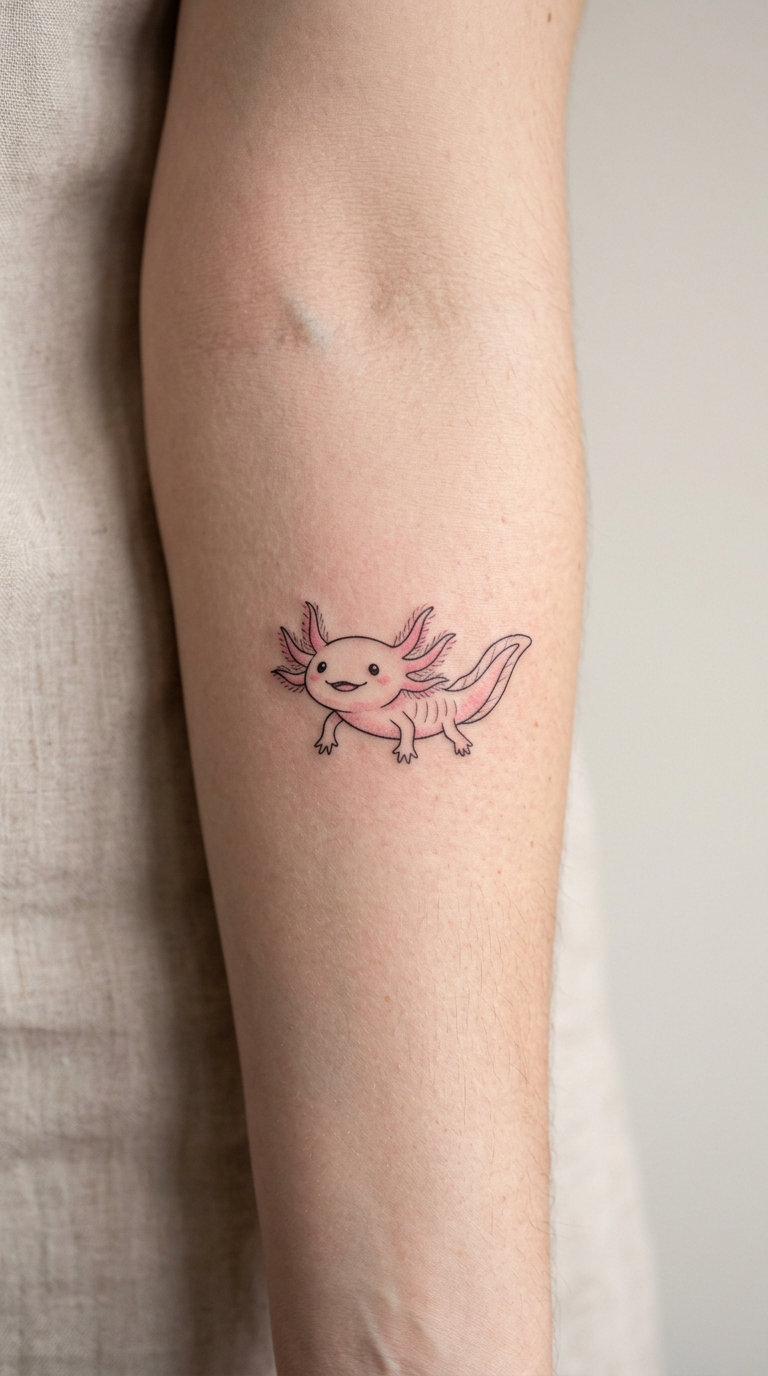
The classic axolotl tattoo idea and still the one most people picture: a cheerful face-on or three-quarter axolotl with three frilly gills fanning out from each side of the head, drawn in even black linework with a light pink wash through the gills and cheeks. The gills get the most attention because that is where the detail lives. A wide, upturned mouth and small dot eyes do the rest.
People choose this one for a playful personality marker, a celebration of something joyful, or simply because it is cheerful without being loud. The expression stays readable at any size, which makes it forgiving.
Placement: Inner forearm, wrist to elbow, or the outer forearm. Size: 2 to 3 in (5 to 7.5 cm) tall. Style: Fine line with light shading. Pain: Low to medium on the inner forearm, and the fleshy part hurts far less than the bony wrist. Fine pink shading on the gills softens and blends over the years, so keep the black line strong enough to carry the design on its own.
Make it yours: Add a small date or a single initial under the tail in the same line weight.
2. Realistic Pink Axolotl Portrait
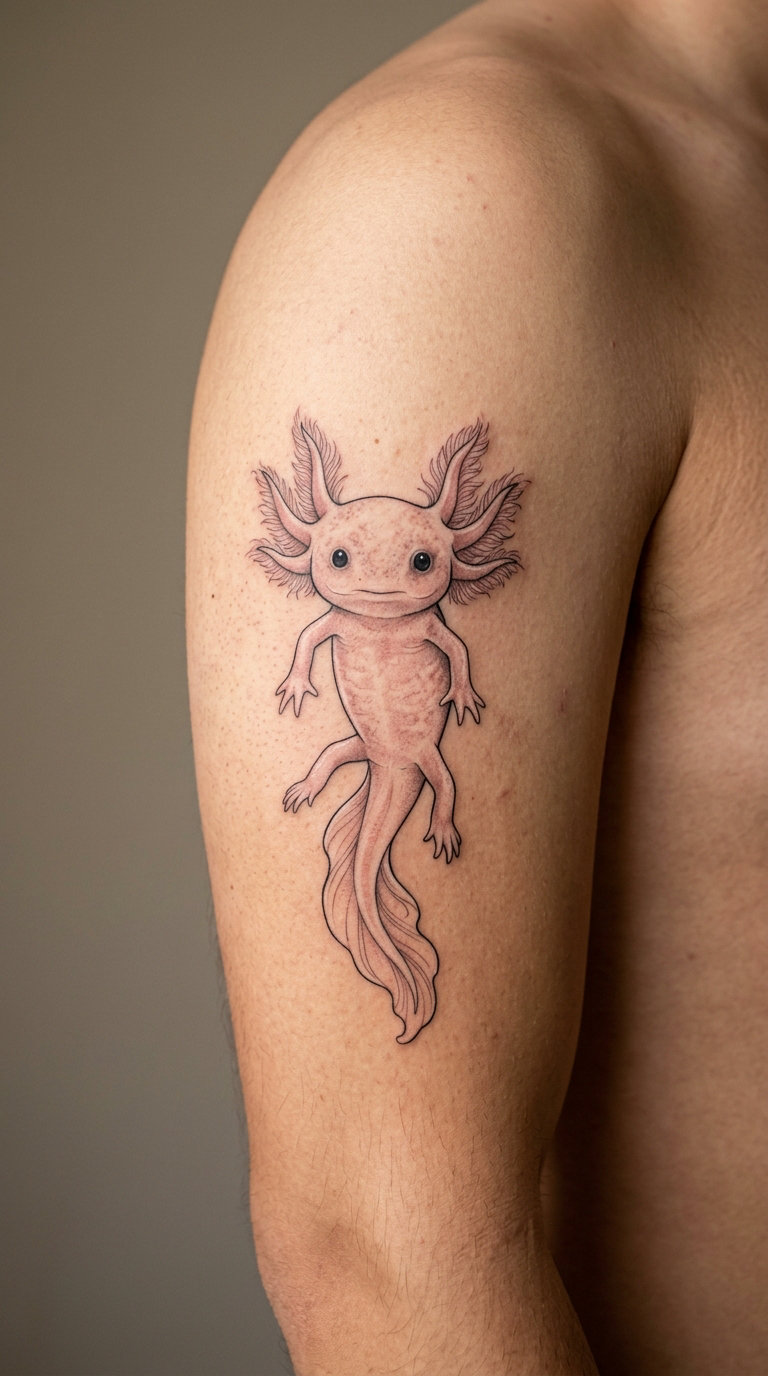
A micro-realistic axolotl portrait treats the animal like a small animal portrait. Layered feathery gills in gradients of pink and coral, faint speckling across the skin, glossy dark eyes and a soft translucent tail fin. It is the version to pick if you want the tattoo to look like a creature rather than a character.
Most people get this one because they keep axolotls, or because they saw a leucistic pet and wanted the color of an actual animal rather than a cartoon pink. It is also the route most axolotl keepers take for a memorial piece.
Placement: Upper arm, vertical, or the outer thigh. Size: 4 to 5 in (10 to 13 cm). Style: Micro-realism with light color. Pain: Medium, and the inner upper arm is noticeably tender. Speckled texture softens with sun exposure, so if this piece lives on an arm that sees the sun, expect the freckles to fade first and the shape to last.
Make it yours: Send your own pet photos to the artist, including a gill close-up and a side view of the tail.
3. Minimal Line-Art Axolotl
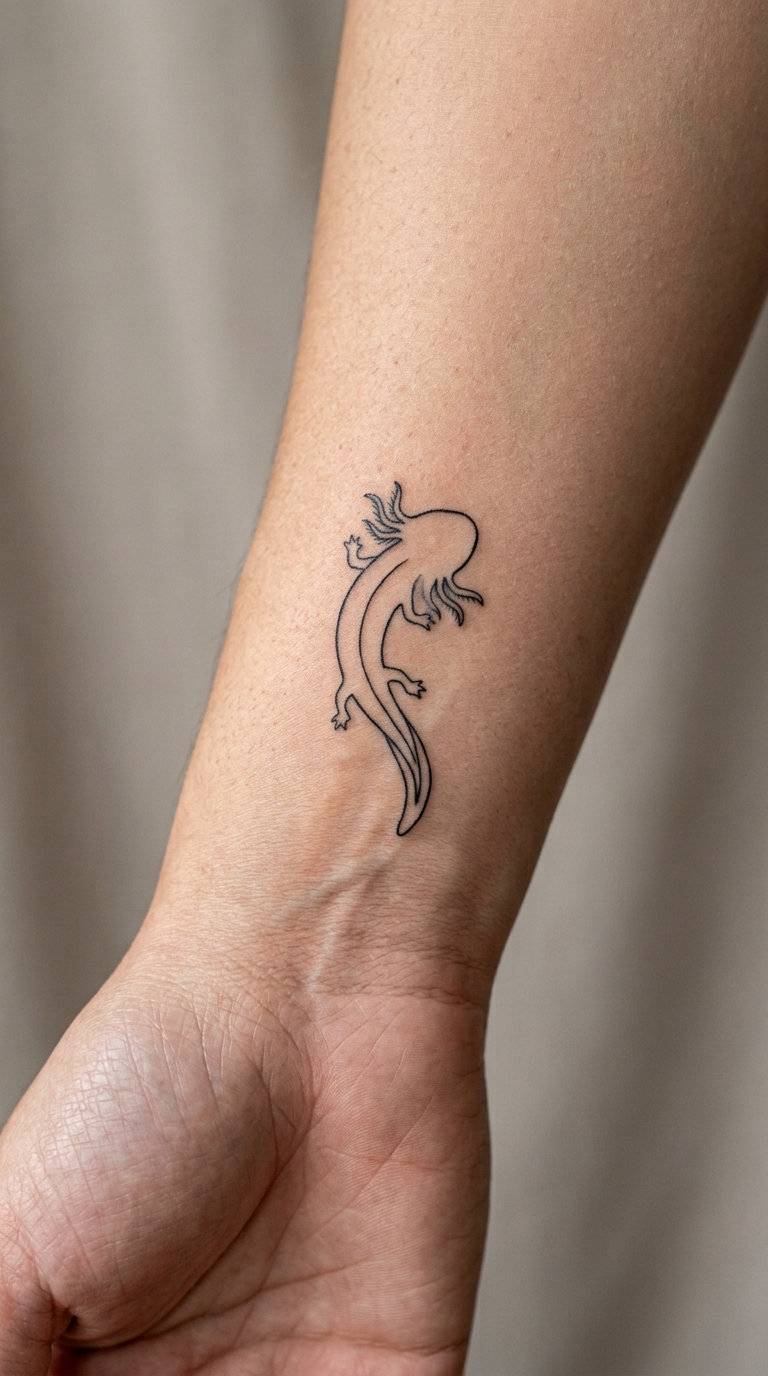
One unbroken line, no shading, just the curve of the body, four stubby feet and three gill strokes trailing behind. This is the most common first tattoo on this whole list, and it works because there is nothing to get wrong. A slight wobble in the line reads as style rather than error.
People pick it as a quiet mark of something they love rather than a statement. It suits a first piece, a matching pair, or a small addition to an existing arm.
Placement: Wrist, inner forearm, or the ankle. Size: 1.5 to 2 in (4 to 5 cm). Style: Continuous line. Pain: Low, though the wrist and ankle bones sting briefly. Hairline single lines are the first thing to blur, so ask for a line weight a little heavier than you think you need.
Make it yours: Curve the body into a crescent or a wave so the shape means something only you recognise.
4. Axolotl Peeking from a Water Lily Pad
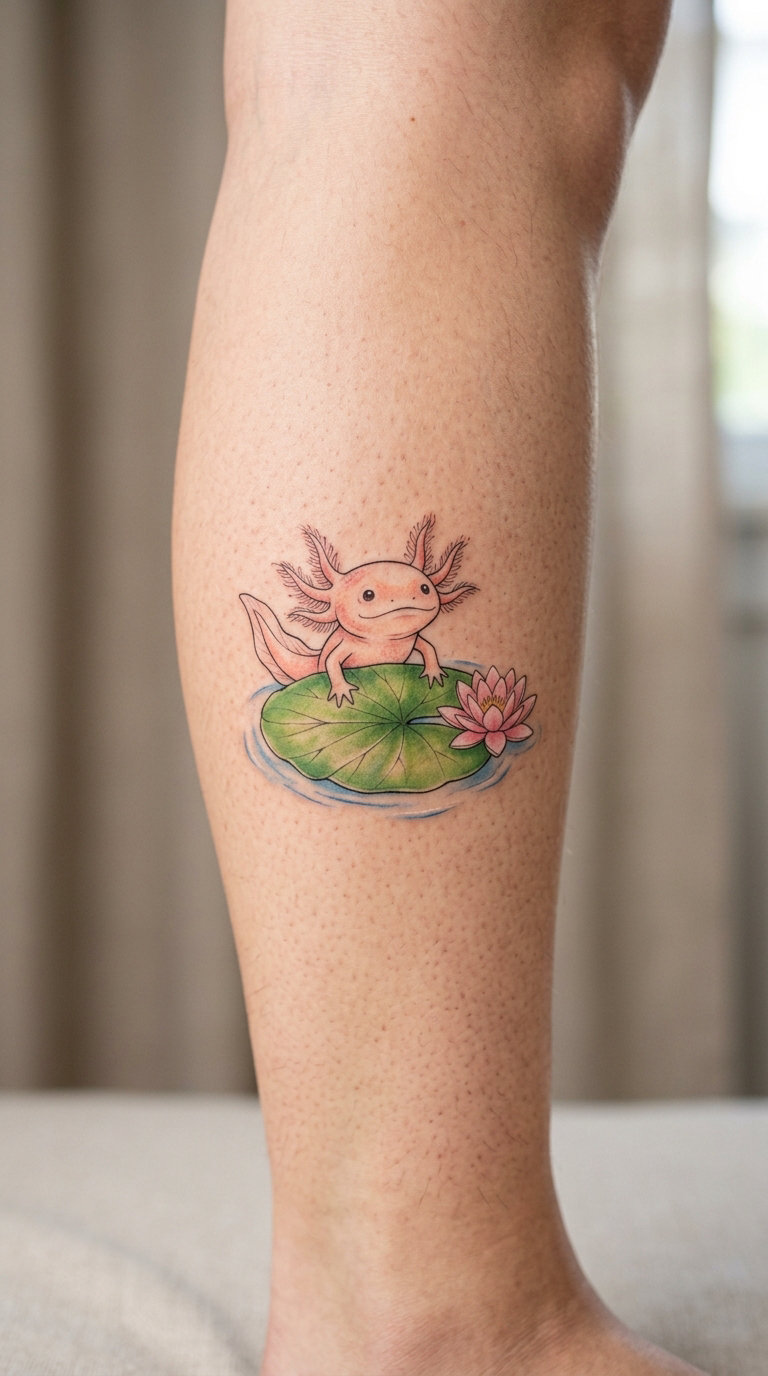
An axolotl with its head and front feet above a round lily pad, one small pink blossom beside it, and a wash of pale green and blue underneath. The round pad is the design’s anchor: it gives a clear graphic shape around a soft, wiggly animal, and the humor arrives from the axolotl appearing to be hiding.
This is the gentler, story-telling version. People usually choose it when the freshwater habitat matters to them, or simply because the axolotl looks like it is about to pop up and say something. If your taste runs toward marine ink rather than freshwater, our 20 best coral reef tattoo ideas for ocean lovers covers the neighbouring underwater set in the same detail.
Placement: Calf, upper arm, or the back of the shoulder. Size: 3 to 4 in (7.5 to 10 cm). Style: Fine line with a light watercolour wash. Pain: Medium on the calf. The translucent watercolour fades faster than the outlines, so ask the artist to keep the pad edge as a defined line rather than pure wash.
Make it yours: Use a lily pad with a notch or a chewed edge instead of a perfect circle.
5. Blackwork Axolotl with Flowing Gills
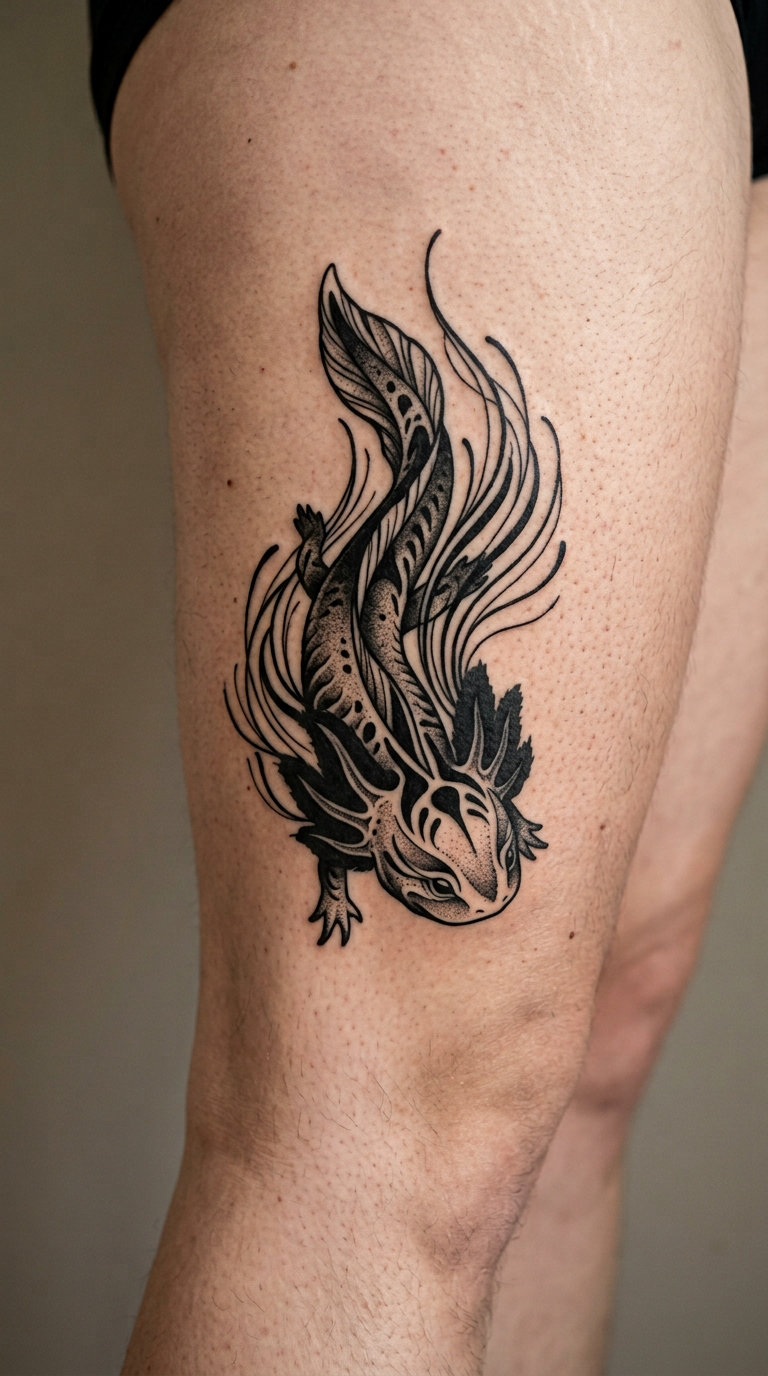
Solid black gills, a shaded body that falls from dense black at the spine to open grey at the belly, and long sweeping gill strokes that fan across the piece. Blackwork suits the axolotl because the animal’s outline is already graphic. Nothing here depends on a soft gradient to hold up.
People who like bold work choose this because it reads from across a room and because solid black stays sharp when fine shading elsewhere would not. It is the strongest statement in the axolotl tattoo ideas list.
Placement: Outer thigh, upper arm, or calf. Size: 4 to 6 in (10 to 15 cm). Style: Blackwork. Pain: Medium to high, since solid fill means repeated passes over the same skin. Solid black is the most durable option here and barely changes over a decade.
Make it yours: Push the gills off the body and let them run out toward the knee for a directional look.
6. Tiny Axolotl Behind the Ear
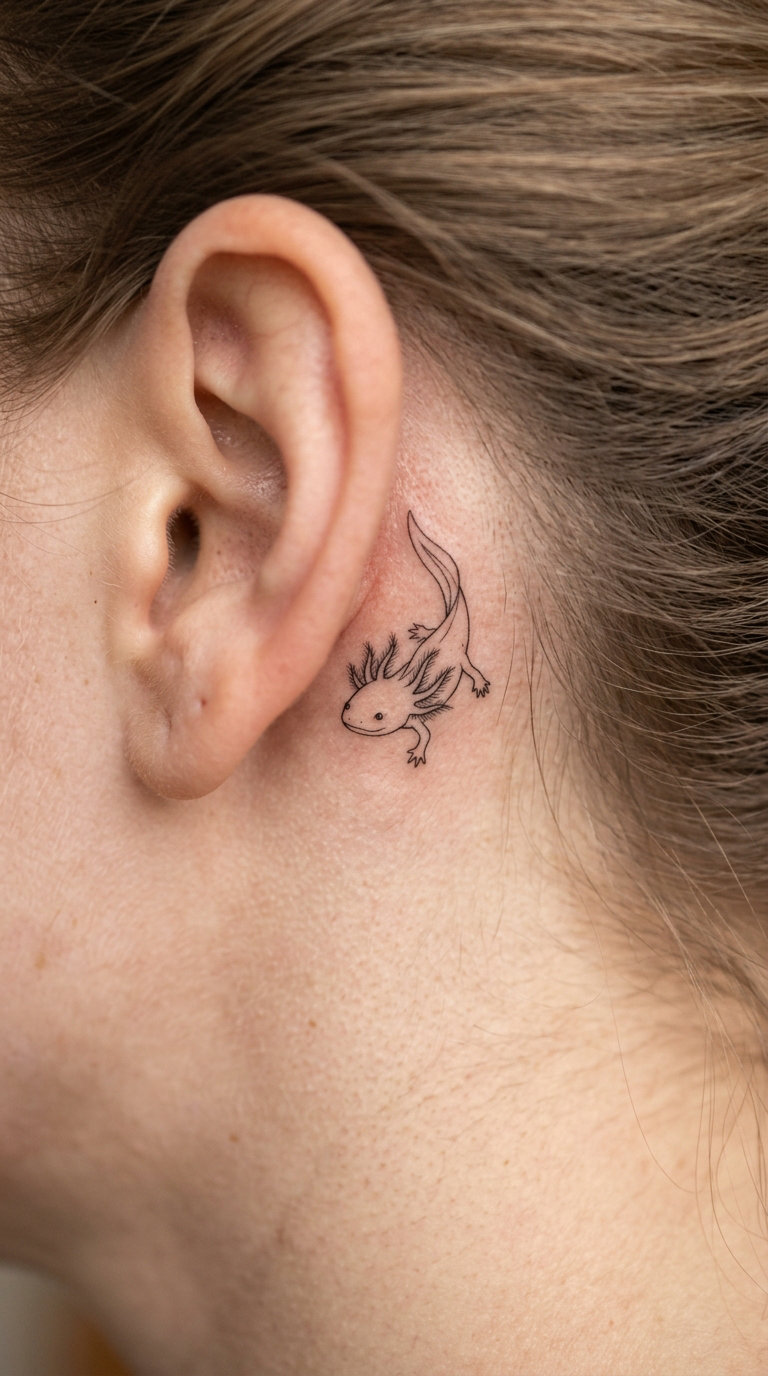
A compact fine-line axolotl no bigger than a coin, tucked into the hollow behind the ear with the gills following the curve of the cartilage. The whole animal is suggested in a handful of lines: body, tail flick, three gills, one dot for the eye.
It is chosen for the secret of it. Only you and the people close enough to see it know it is there, which is exactly the appeal.
Placement: Behind the ear, or under the jaw. Size: 1 to 1.5 in (2.5 to 4 cm). Style: Micro fine line. Pain: Low to medium, though skin behind the ear is thin and sensitive. This is one of the first places fine detail softens, and sun exposure speeds it up, so a hat or longer hair genuinely protects it.
Make it yours: Angle the tail to run behind the earlobe so the two shapes connect from the side.
7. Axolotl in a Bubble
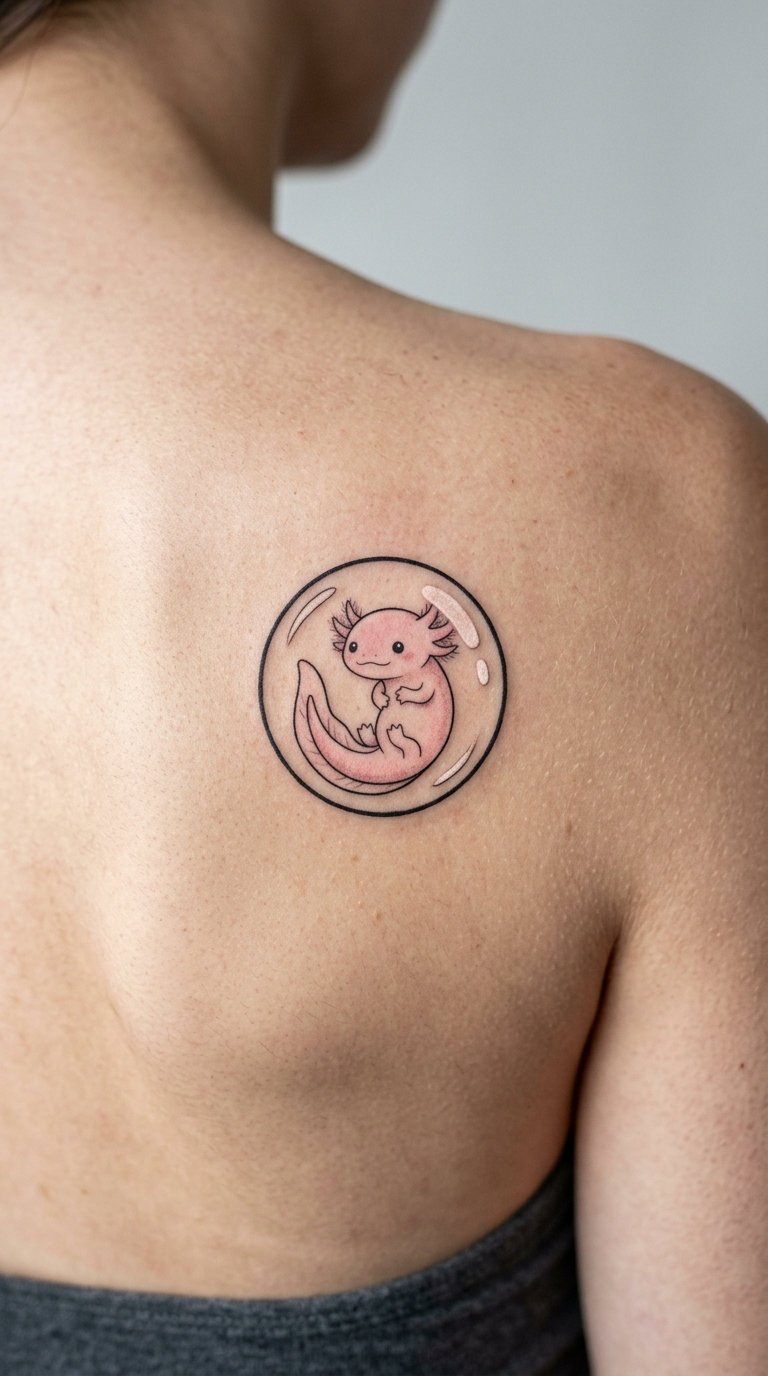
An axolotl curled into a comma shape inside a clean circular bubble, with two short highlight marks on the bubble edge to show it is glass. The bubble is a simple, repeatable shape that frames a soft animal without competing with it, and the curl lets the artist use one continuous flow for the body and tail.
It reads as lighthearted and a bit dreamy rather than symbolic. People tend to choose it for the composition as much as the animal.
Placement: Shoulder blade, upper arm, or the upper back. Size: 2 to 2.5 in (5 to 6 cm). Style: Cute line art with pastel fill. Pain: Medium, and the shoulder blade is a bony spot. Pastel fills fade toward plain line shapes, which is fine for this design since the bubble outline holds it together.
Make it yours: Add a second, smaller bubble offset to one side to suggest movement.
8. Axolotl and Watercolor Splash
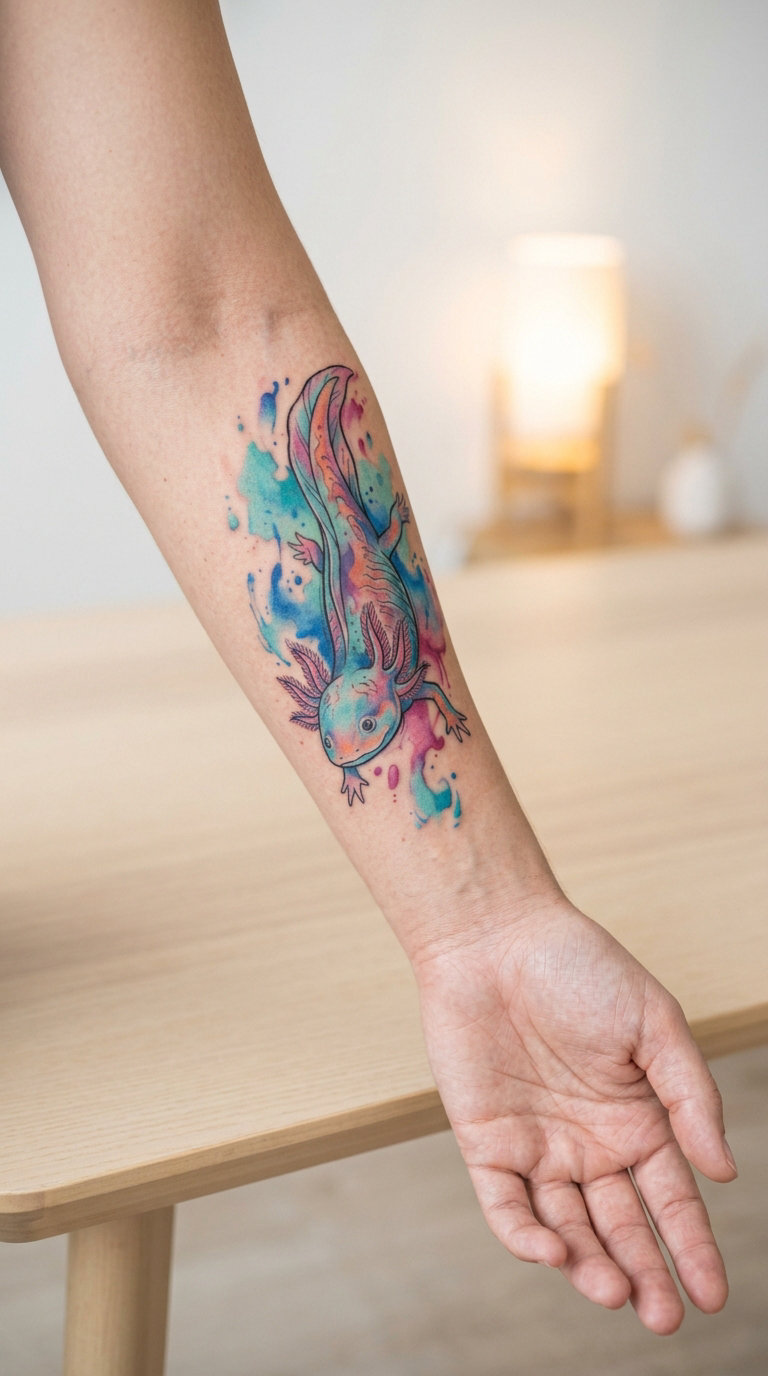
A recognizable axolotl in loose ink and line, with watercolour in aqua, blue and pink blooming around and partly behind it. The splash does the framing so the animal itself can stay fairly simple, which is how this style stays readable when the colors soften.
This is a good middle ground for someone who wants color without a full color-realism portrait. The wash carries the mood and the axolotl carries the subject.
Placement: Forearm, diagonal along the radius, or across the shoulder. Size: 3 to 4 in (7.5 to 10 cm). Style: Watercolour with fine line. Pain: Medium, and color work takes longer in one sitting. The washes fade first and unevenly, so the artist should build the composition so the design still looks balanced with less pigment.
Make it yours: Use the colors of a specific place, such as a lake or a favorite aquarium.
9. Leaping Axolotl on the Calf
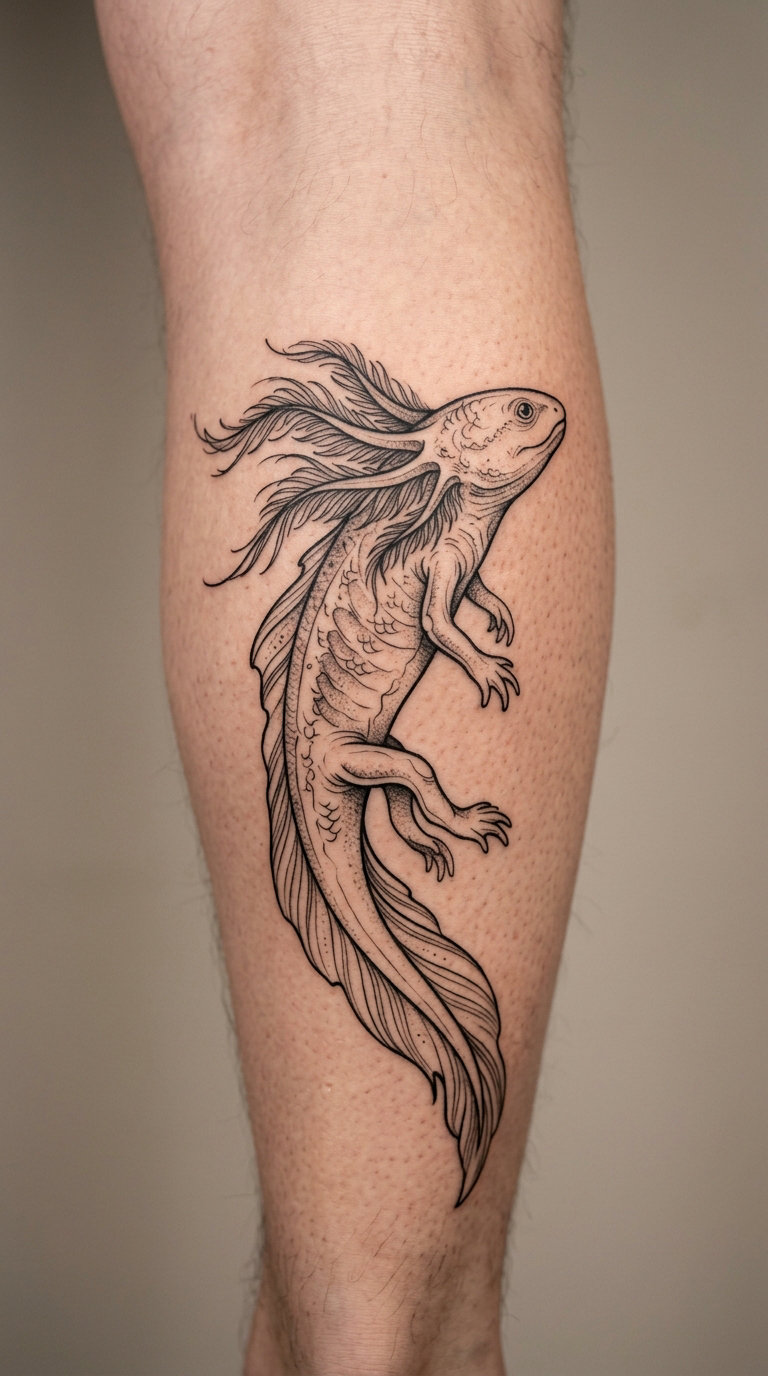
An axolotl in side profile mid-swim, gills streaming back, tail curving into an S, front limbs tucked. Side profile is the trick here: it lets the gills and tail run along the calf’s natural vertical line, so the design looks like it is moving rather than pasted on.
People choose it for the movement. It is one of the few axolotl designs that reads as a creature doing something, and it works well on a leg where vertical flow is free.
Placement: Calf, inner arm, or the outer bicep. Size: 3 to 5 in (7.5 to 13 cm). Style: Illustrative realism with light color. Pain: Medium, and the calf muscle moves under the needle, which changes the skin tension session to session. Fine gill filaments blur over time, so plan slightly bolder gill edges than looks right on paper.
Make it yours: Angle the swim to follow the curve of the leg rather than running perfectly straight.
10. Axolotl with a Small Heart Tail
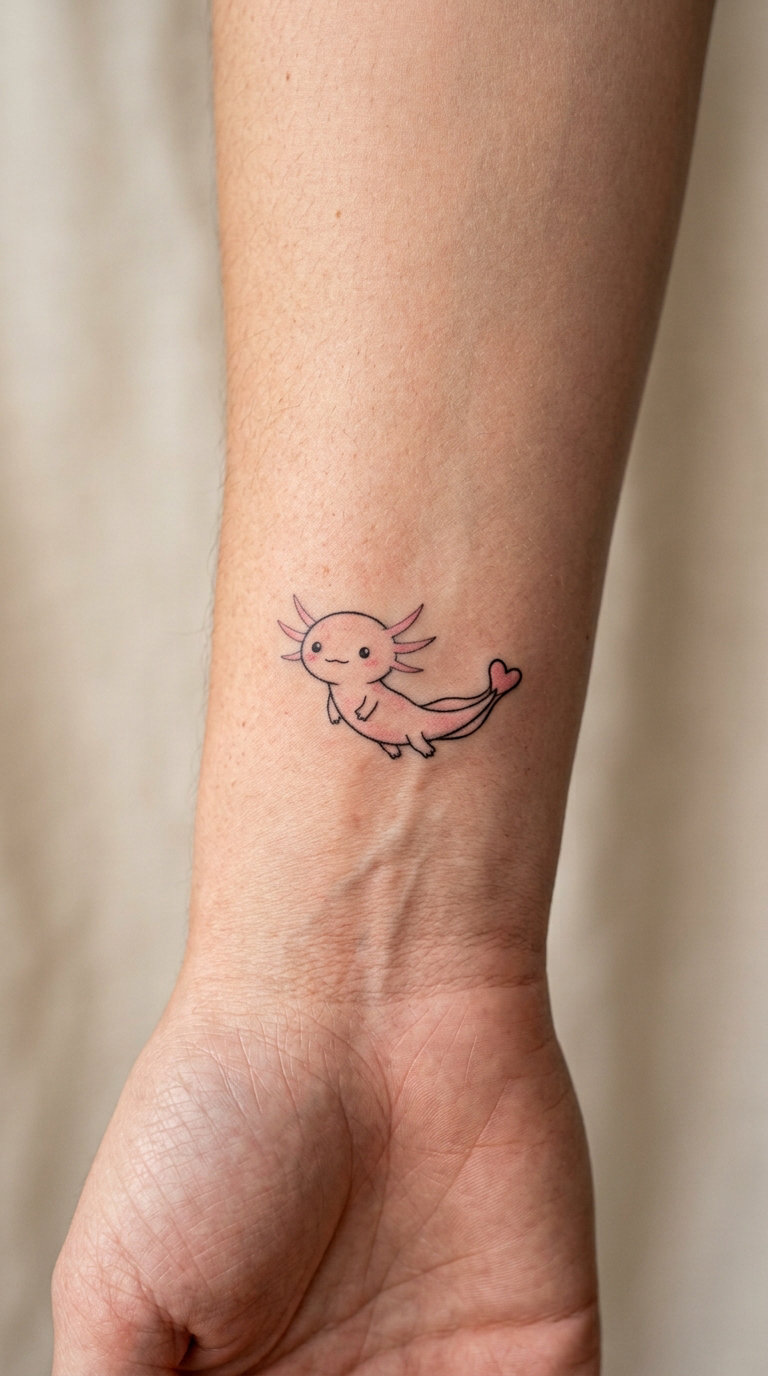
A cute axolotl silhouette with a small heart shape worked into the tip of the tail, and only a light suggestion of gills. The heart is kept small on purpose, more of a punctuation mark than a feature, so the animal stays the subject rather than becoming a valentine card.
The meaning here is personal rather than universal. People use it for a person, a pet, or a date that matters to them, and the axolotl keeps it from looking like a conventional couple’s piece.
Placement: Inner wrist, or the inside of the ankle. Size: 2 to 2.5 in (5 to 6 cm). Style: Cute line art. Pain: Low to medium. Small solid shapes like the heart hold their edges far better than fine internal detail, and the wrist’s movement is gentle on a piece this size.
Make it yours: Use a heart made of two facing gill fronds instead of a solid shape.
11. Traditional Axolotl with Rose Gills
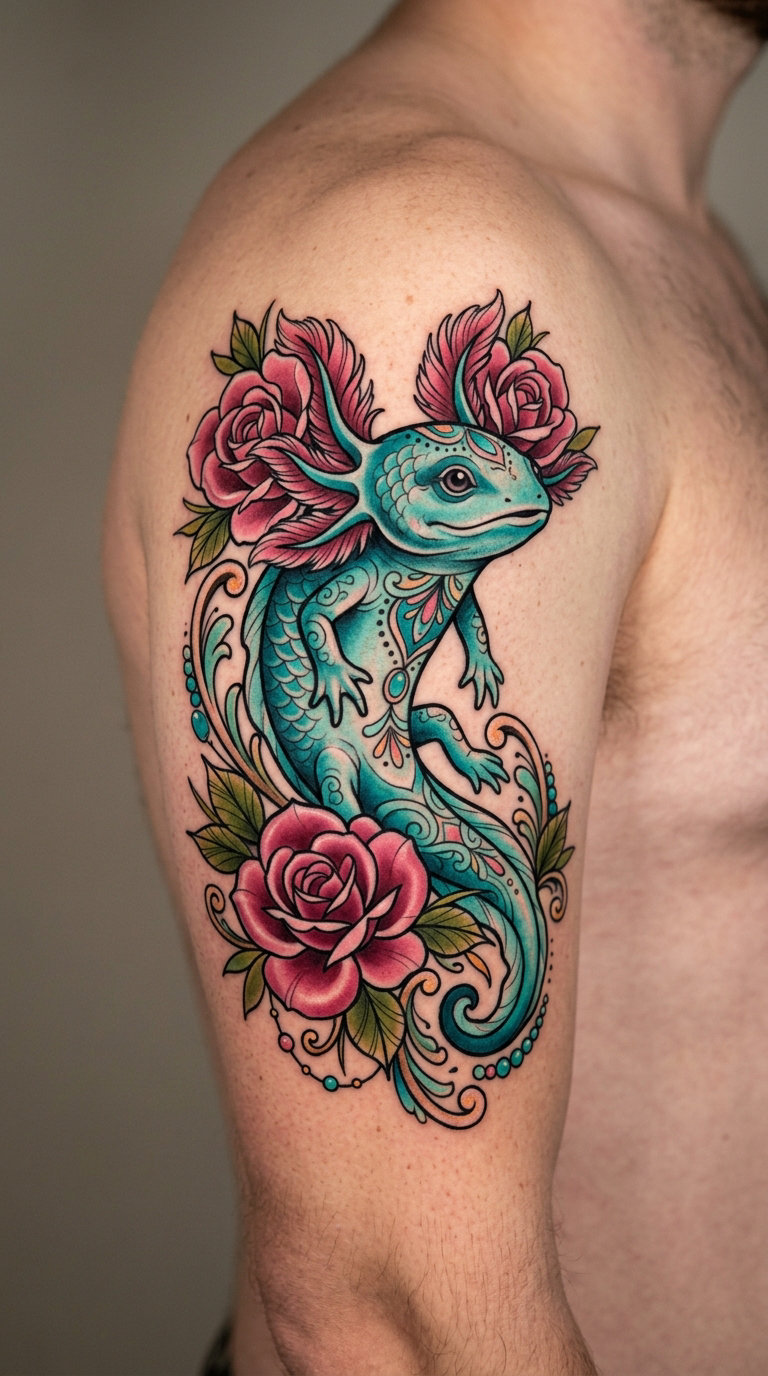
Thick black outlines, a turquoise body, and gills built from pink rose-like shapes with a few green leaves tucked between them. Neo-traditional is the style that turns the axolotl’s gills into ornament, using the frills as petals so the animal reads as decorative rather than documentary.
It is a bolder, older-looking tattoo style that suits people who want their axolotl to sit comfortably next to other traditional pieces. It also hides small irregularities well, because the design expects bold shapes.
Placement: Upper arm, calf, or thigh. Size: 3 to 4 in (7.5 to 10 cm). Style: Neo-traditional. Pain: Medium. Color saturation drops a little with sun over the years, but thick outlines and large flat areas age far better than gradients, so this design holds up well.
Make it yours: Change the rose color to match an existing traditional piece in your collection.
12. Dotwork Axolotl Gills
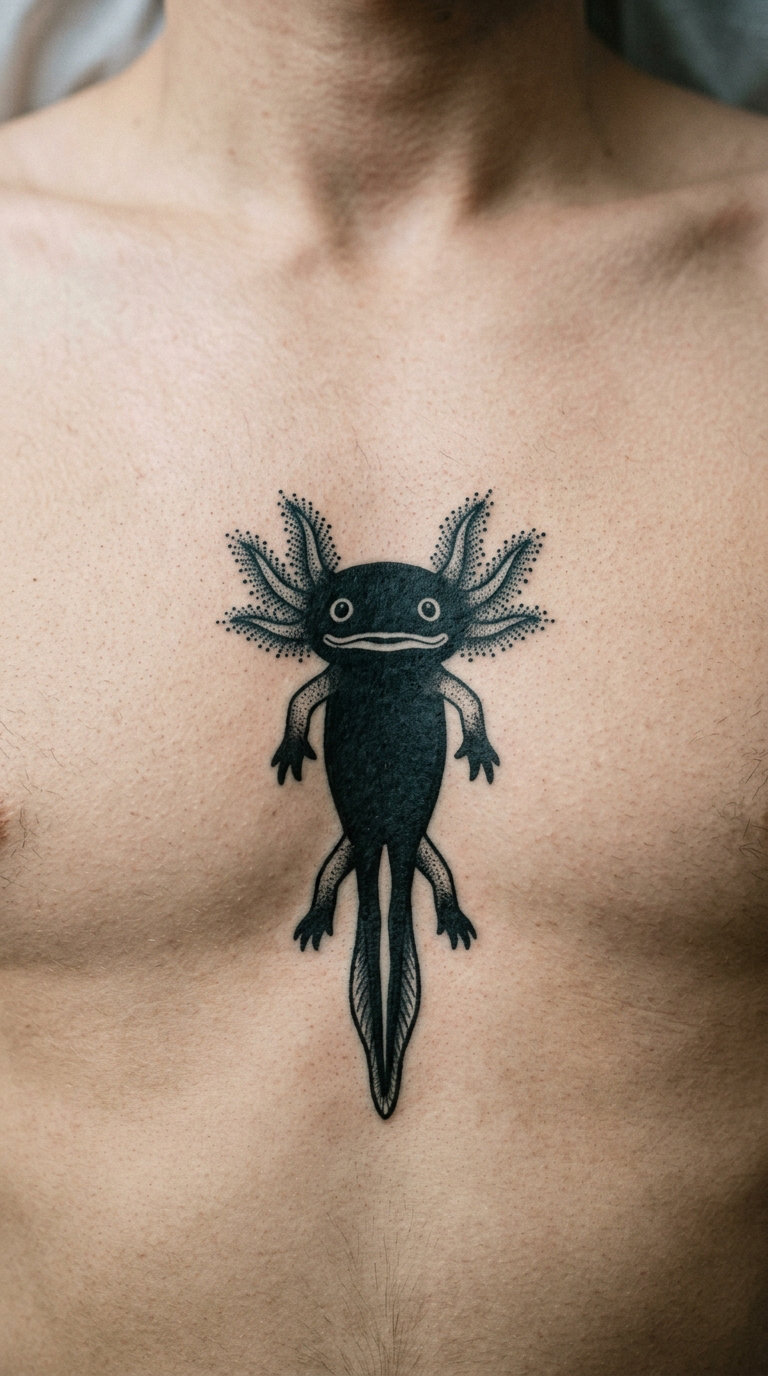
A front-facing axolotl with a clean black body and gills filled entirely with dots, spaced in a mirrored pattern on both sides. The symmetry is the point: the design works as a single shape from a distance and as a texture up close.
It is chosen for a mood rather than a message. People who like geometric work tend to land here, and the sternum placement gives it a centered, formal feel that suits a symmetrical design.
Placement: Sternum, forearm, or along the spine. Size: 2.5 to 3.5 in (6 to 9 cm). Style: Dotwork. Pain: Medium, and the sternum is sensitive bone. Dots need spacing, not crowding, or they merge into grey mud within a few years, so ask the artist to leave visible gaps between them.
Make it yours: Extend the dot pattern into the background as a field so the animal appears to be swimming through it.
13. Axolotl Holding a Tiny Aquarium Plant
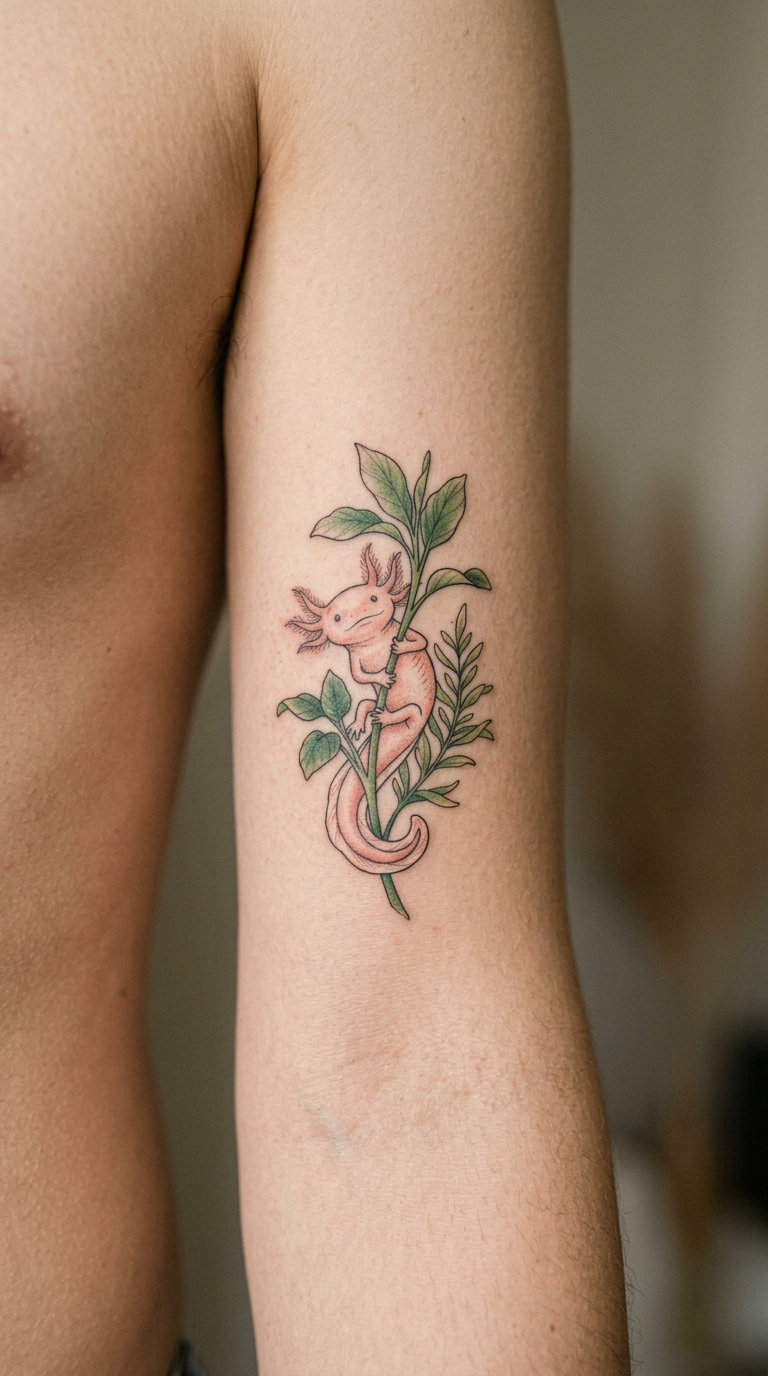
An axolotl with its front limbs wrapped around one long aquarium plant, fine outlines and muted green, the fronds curving up and over the body. One plant rather than a full scene keeps the composition from getting busy, and the curve of the stem gives the artist a natural line to follow.
This leans toward the natural, calm side of the subject. People tend to choose it when the axolotl is tied to an actual tank they have cared for.
Placement: Inner upper arm, forearm, or the ribs. Size: 3 to 4 in (7.5 to 10 cm). Style: Illustrative with muted color. Pain: Medium. The inner arm is a soft, forgiving canvas, and the small leaf shapes are simple enough to keep their edges for years.
Make it yours: Ask for a specific plant, such as an anubias or a java fern, to make the piece point at your own tank.
14. Axolotl Made of Dotwork and Fine Lines
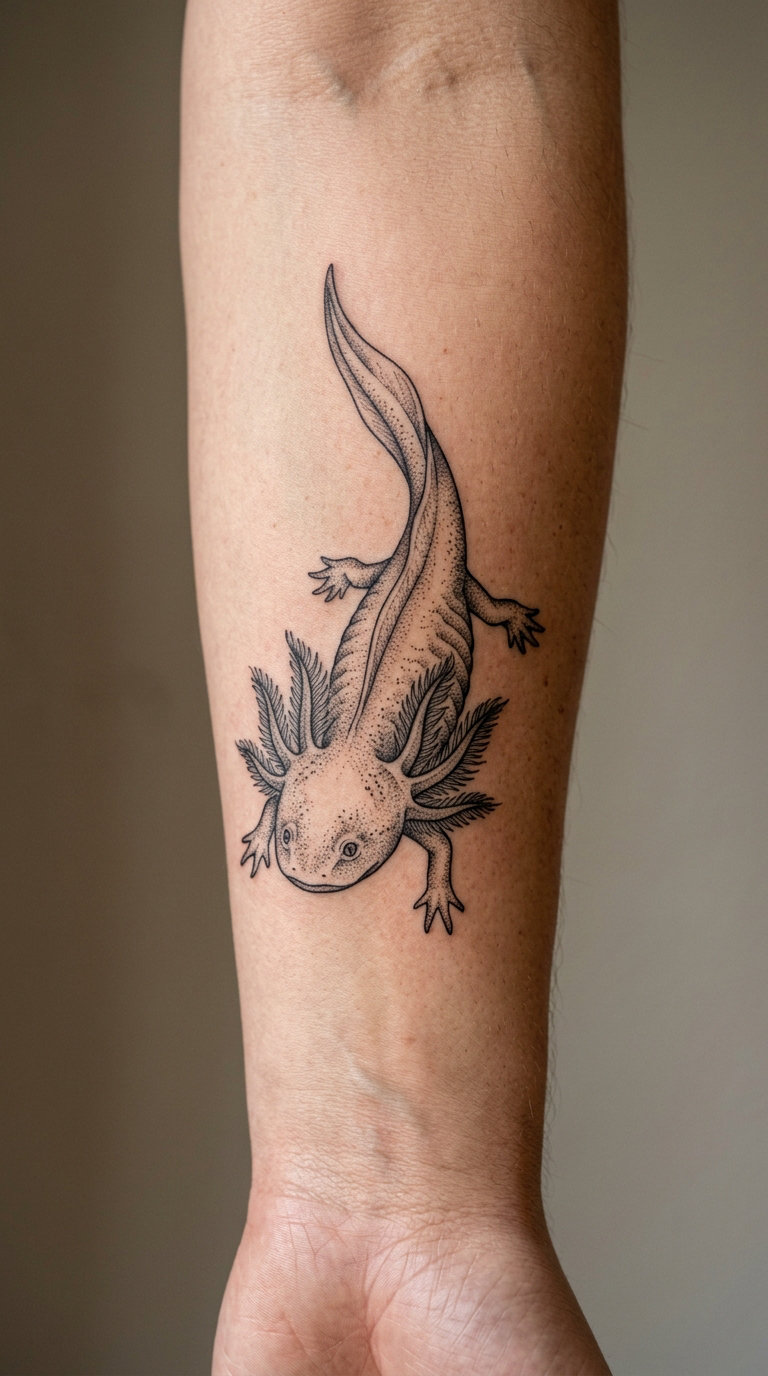
Stippling across the body for shading, thin contour lines for the outline, and the gills drawn as separated filaments rather than solid shapes. It is more textural than idea 12, where the dots are the subject, and the two read very differently even though both use dots.
People choose it when they want something restrained that rewards a closer look. On a flat surface like the forearm the shading is easy to read; over a curve it distorts, so placement matters more here than for most designs.
Placement: Flat of the forearm, upper arm, or the back of the calf. Size: 3 to 4 in (7.5 to 10 cm). Style: Stipple fine line. Pain: Medium, and stippling takes time, so expect a longer session. Be honest about this one: fine dot shading softens noticeably within five to seven years, faster with sun. The contours will outlast it.
Make it yours: Add a second faint outline of the axolotl below the main one, like a reflection.
15. Albino Axolotl in Black-and-Grey
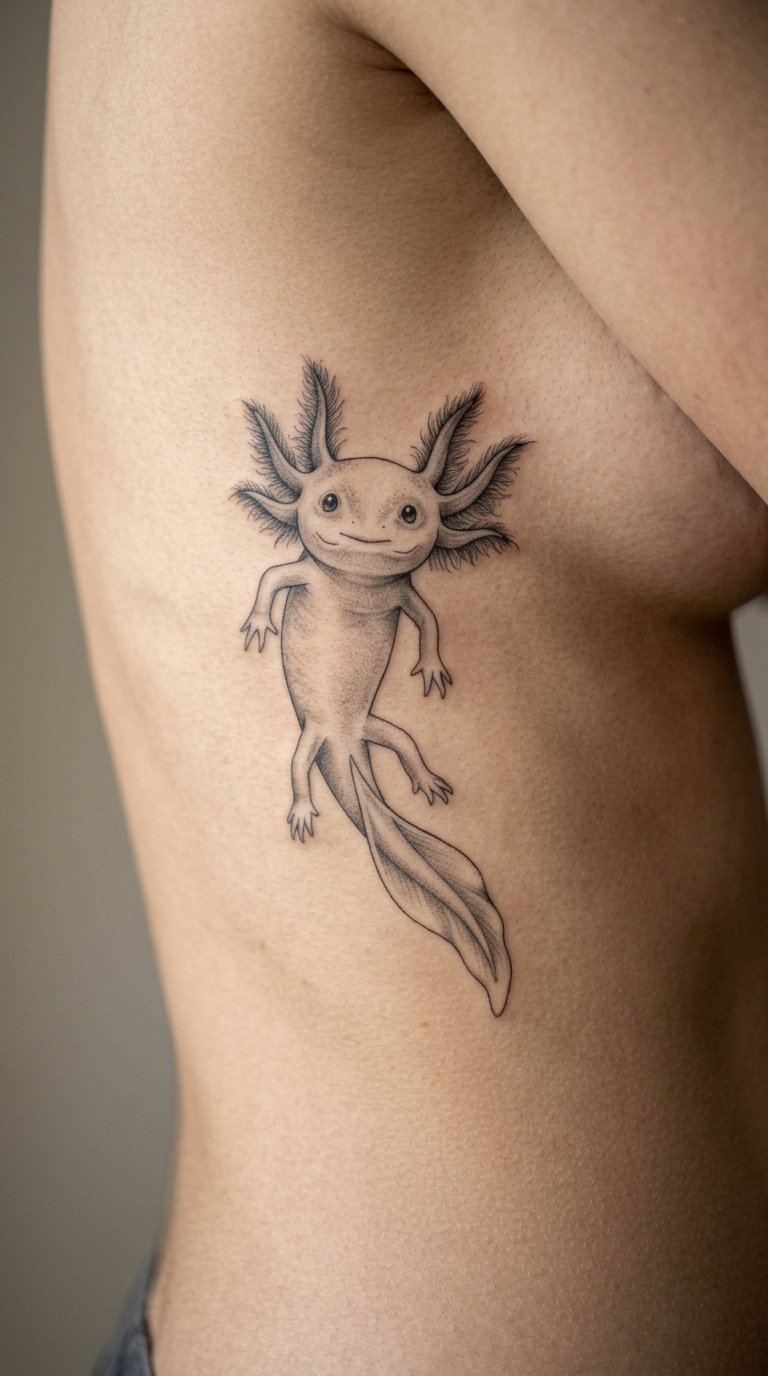
A pale axolotl rendered entirely in black and grey, with soft skin shading, bright unpigmented eyes and detailed feathery gills. Without pink in the palette, the whole design rests on value, which is why the shading has to be gentle and gradual.
It is the choice for someone who wants realism without color on the skin. The pale subject also makes a quieter tattoo than the pink versions, which matters if you plan to add more pieces later.
Placement: Ribs, forearm, or the outer arm. Size: 3 to 4 in (7.5 to 10 cm). Style: Black and grey realism. Pain: Medium to high on the ribs, which are close to bone and thin skin. Grey gradients on a pale subject go slightly flat with age, so the artist should keep a defined edge around the gills.
Make it yours: Add a small waterline behind the animal to give the grey somewhere to fade into.
16. Axolotl Wrapped Around a Finger
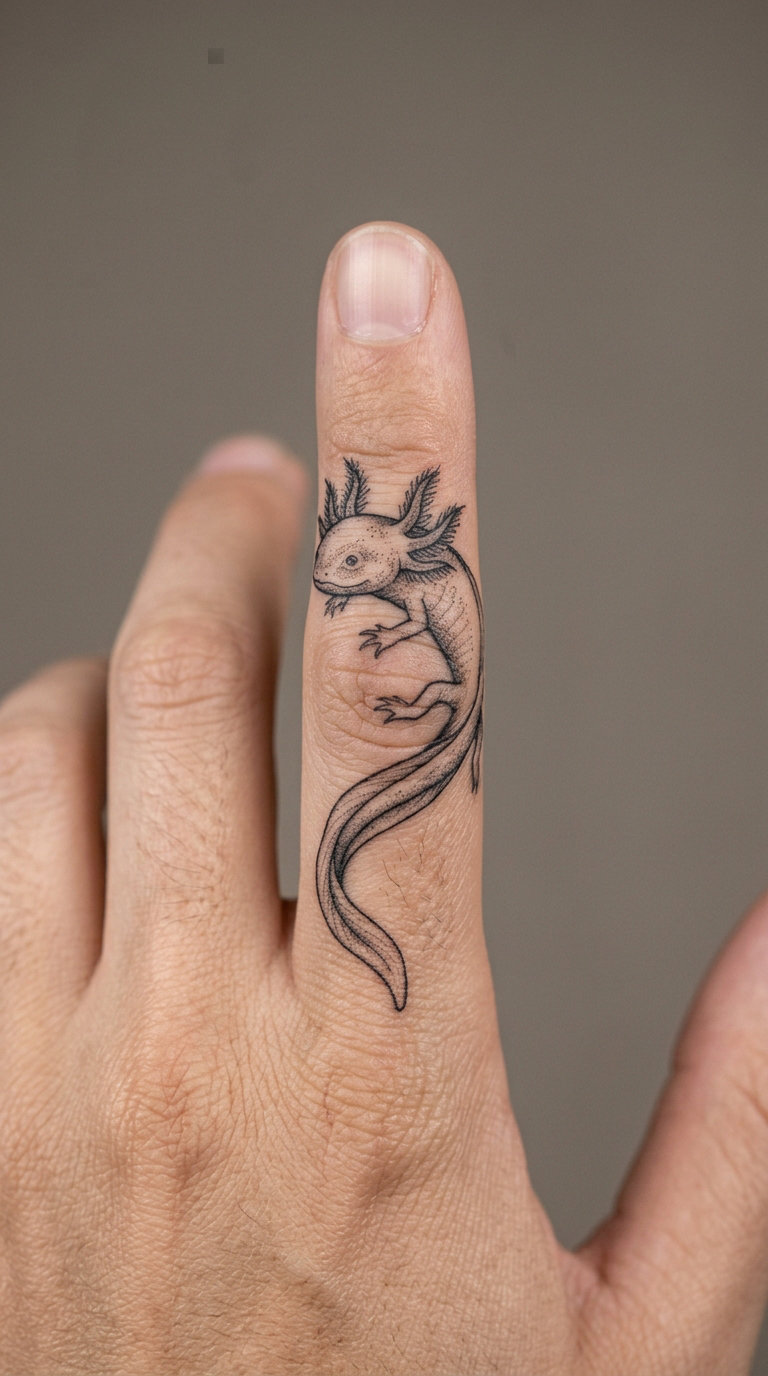
A small blackwork axolotl wrapped around the side of one finger, the tail following the finger’s curve and the three gills facing outward so they stay visible. Wrapping the body around the digit uses the finger’s own cylinder as the form, which is why the design has a natural reason to exist there.
It is a commitment design: visible, small, and hard to hide at work. People choose it deliberately, usually as part of a hand set, rather than as a lone small tattoo.
Placement: Side of the index or middle finger, or the knuckle. Size: 1 to 1.5 in (2.5 to 4 cm) around the finger. Style: Mini blackwork. Pain: Medium to high, and the finger is one of the more sensitive spots because of the bone underneath. Small detail on hands fades fastest of anywhere on the body, so keep the body simplified and let the gills do the identifying work.
Make it yours: Run the tail to continue into a ring or band tattoo on the same finger.
17. Sleepy Axolotl in a Cozy Bubble
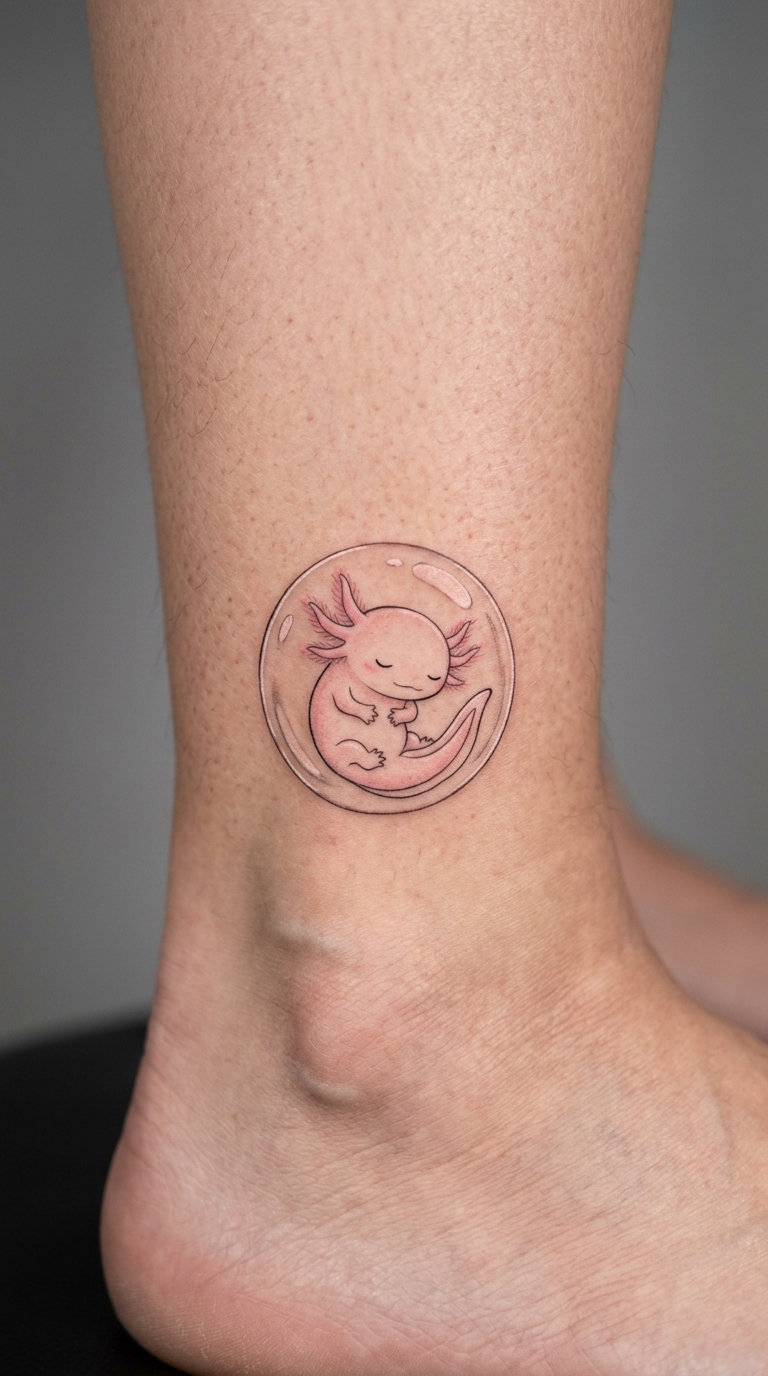
A curled axolotl with closed eyes and a small content expression, tucked into a rounded bubble with its gills folded in close. Closed eyes and a curled posture are what make this one read as sleepy rather than as a standard cute axolotl, and the whole design is soft curves with almost no straight lines.
It is picked for the mood, mostly by people who like the cute and whimsical end of the subject. The ankle placement keeps the softer design away from the more public areas of the arm.
Placement: Ankle, inner wrist, or behind the ear. Size: 2 to 2.5 in (5 to 6 cm). Style: Cute character art. Pain: Low, since the ankle has thin skin over a small area. Light pink on the body fades toward the outline, which is harmless here because the closed eyes and curl carry the expression.
Make it yours: Add a tiny closed eye on the bubble as well, so the whole design is one resting gesture.
18. Axolotl and Three Water-Drop Shapes
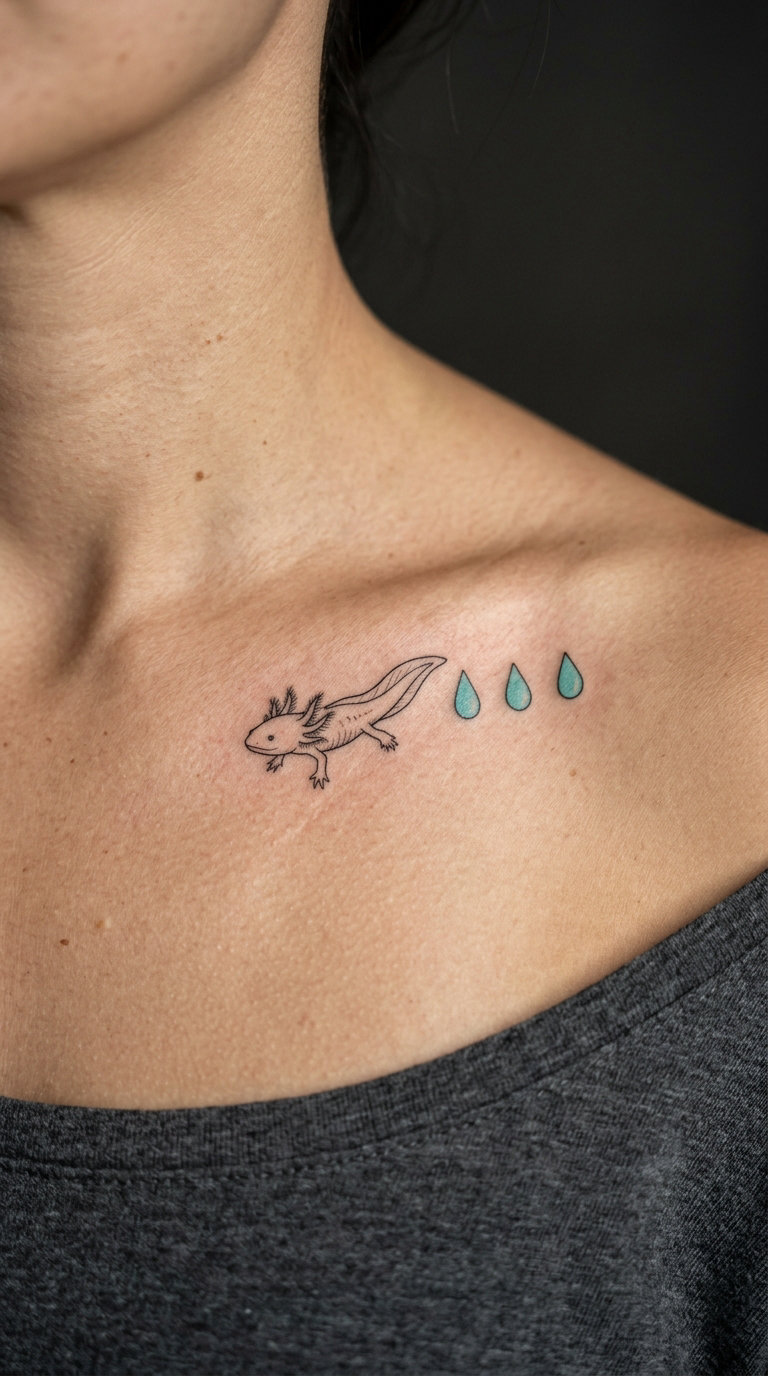
A compact fine-line axolotl with three separate water-drop shapes floating beside it, spaced evenly and filled with flat turquoise. The drops do two jobs: they balance the animal’s shape, and they fill the negative space so the composition does not look like something is missing.
It is a simple, graphic option that works at a small size. People choose it when they want a hint of water and color without committing to a full scene.
Placement: Collarbone, laid horizontally, or the inner forearm. Size: 2 to 2.5 in (5 to 6 cm) wide. Style: Minimal fine line with flat color. Pain: Low to medium, and the collarbone is close to bone so the sting comes fast and passes fast. The flat turquoise drop fills hold better than a soft wash, which is the right call at this scale.
Make it yours: Vary the drop sizes so the three shapes read as rising bubbles.
19. Axolotl in a Ceramic Bowl
A pink axolotl sitting up in a small blue ceramic bowl drawn with a traditional black outline and a single decorative band around the rim. The bowl gives the composition a hard, clean edge to contrast with the soft animal, and it fills the lower body in a way an axolotl alone cannot.
There is no fixed meaning to the bowl, and most people will tell you it is simply a good shape to look at. It suits anyone who wants the animal in a frame rather than swimming free.
Placement: Lower abdomen, forearm, or the back of the calf. Size: 3 in (7.5 cm) wide. Style: Traditional line with flat color. Pain: Medium, and the lower abdomen is sensitive. Flat color inside a hard outline ages very well, so this design will look close to the day it was done.
Make it yours: Put a small pattern or initial inside the band around the bowl rim.
20. Axolotl Half-Sleeve Study
A full composition: an axolotl swimming through aquatic plants, bubbles rising and a soft blue-green background that fades out at the edges. This is the largest of the 22 and the only one that needs a real plan rather than a stencil tweak, because the background, the plants and the animal have to agree with each other across a whole area.
It is for someone already building a collection, or someone who wants the axolotl to be the centerpiece of a piece rather than one element in it. The plants give the background somewhere to go, which is what keeps a large piece from looking like an animal floating in emptiness.
Placement: From the elbow toward the upper forearm, or the reverse. Size: 8 to 12 in (20 to 30 cm). Style: Color realism with illustrative background. Pain: High, and a piece this size is normally split across several sessions. Size is the real issue rather than style: the fine background bubbles will soften noticeably before the axolotl does, so the artist should keep detail density low in the background and high on the animal.
Make it yours: Design it as a wrap from the start so it reads from any angle as one piece.
21. Axolotl with a Tiny Initial
A simple black-line axolotl with a single capital initial set small beneath the tail, aligned so it looks like part of the design rather than a caption. The letter is kept small on purpose, which is what stops the piece turning into a monogram.
It is the most practical way to personalize an axolotl tattoo without crowding it. People usually pick this when a name, a first letter or a family initial is the reason for the piece.
Placement: Inner forearm, wrist, or the ankle. Size: 2 to 3 in (5 to 7.5 cm). Style: Black line. Pain: Low. Letters and hairlines blur faster than body shapes, so ask for the initial slightly larger and heavier than looks balanced next to the animal.
Make it yours: Use a letter that echoes the curve of the tail, such as a C or an S.
22. Axolotl in a Retro Aquarium Badge
An axolotl inside a rounded badge with an arched frame, small bubbles, and muted teal and coral coloring with a slightly aged print feel. The badge format borrows from vintage aquarium signage, so the whole thing looks like a label rather than an animal study.
It is the nostalgic option in this set. People choose it when they want an axolotl that belongs to a specific era rather than a modern illustration, and the frame keeps the composition tidy at almost any size.
Placement: Upper back, chest, or the outer upper arm. Size: 3 to 4 in (7.5 to 10 cm). Style: Retro illustrative. Pain: Medium. Muted color over a large flat area lasts better than soft gradients, so this design holds its character well even as the coral tone softens toward the teal.
Make it yours: Add a short name band along the bottom of the badge, the way an old aquarium label would carry one.
How to Choose the Right Design
Start from your skin, not the picture. A 1 inch axolotl behind the ear and a 6 inch axolotl on the thigh are not the same design at different scales, and the small one has to drop detail to survive the reduction. Fixing the placement first makes the rest of the decisions easier.
How do I pick axolotl tattoo ideas that will still look good in ten years?
Ask what carries the design when the fine work softens. A solid outline does. A blackwork fill does. A soft watercolour background and a hairline gill filament do not, so if longevity is your priority, choose the style where the main shape is the strong part and the detail is the optional part. Idea 5 and idea 19 age best of the 22 for exactly that reason.
Then check three practical things before you fall in love with a reference image. Will it sit well on a curved part of the body, will it still read at the size you actually want, and does it leave room for the rest of your collection. The last question is the one people skip and then regret at their second or third appointment.
Bring more reference than you think you need. Side views, a gill close-up, the tail shape and a photo of the actual animal if you are drawing a pet are all useful, and an artist will tell you quickly which parts of your reference will not translate to skin. It is also worth asking to see healed work in the style you want, since fresh and healed rarely look the same.
Cost and Session Time
Tattoo pricing in the US falls into fairly predictable bands for this kind of design, and axolotl work sits in the middle because it is neither pure line work nor full color realism. Typical rates look like this.
- Tiny designs, 1 to 1.5 in (2.5 to 4 cm): 120 to 300 USD, 20 to 45 minutes.
- Small designs, 1.5 to 3 in (4 to 7.5 cm): 200 to 500 USD, 45 minutes to 90 minutes.
- Medium designs, 3 to 5 in (7.5 to 13 cm): 400 to 1,000 USD, 2 to 3 hours.
- Large designs, 5 to 9 in (13 to 23 cm): 800 to 2,000 USD, one to two long sessions.
- Half-sleeve scale, 8 to 12 in (20 to 30 cm): 1,800 to 4,000 USD, usually three to five sessions.
Shop minimums and hourly artist rates vary a lot by city and by how well-known the artist is, and many studios will not book a small piece shorter than an hour. Expect a consultation fee in some cities that comes off the final total. Color and heavy blackwork always take longer than line work of the same size, so a 4 inch realistic axolotl usually takes meaningfully more chair time than a 4 inch outline one.
Aftercare Basics
Follow your artist’s aftercare instructions first, since they know exactly what they did in your session. Beyond that, the standard advice is short and consistent.
- Follow your artist’s aftercare instructions, and ask what they recommend if anything changes during healing.
- Wash the area gently with clean water and a fragrance-free cleanser, then pat it dry rather than rubbing.
- Keep it clean and dry for the first few days, and change or re-dress the covering as you were told to.
- Do not soak, swim, or use a hot tub until the tattoo has closed over and any scabbing has settled.
- Leave the peeling skin alone. Pulling it off is the most common way people damage their own healing tattoo.
- Once healed, use sunscreen on exposed placements, because sun is the fastest way to fade both fine lines and watercolour.
- Book a free touch-up if linework or color patchiness shows up within the window your artist specifies.
Ask your artist rather than a search engine if anything looks wrong, including anything that does not match what they told you to expect.
Frequently Asked Questions
What does an axolotl tattoo represent?
An axolotl tattoo most often represents resilience and regeneration, because the axolotl can regrow limbs, parts of its heart, parts of its brain and its spinal cord without scarring. People also choose it for being rare and unusual without apology, and for transformation, since the animal keeps its juvenile features for life instead of changing into a land-dwelling adult. The meaning is personal rather than fixed, and plenty of people simply love the animal.
Is an axolotl a good first tattoo?
A small, simple axolotl is one of the better first tattoos, because the wide mouth and rounded body stay readable at small sizes and minor line wobbles read as style. Start at 2 to 3 inches on the inner forearm or the calf and ask for a bold outline rather than fine detail. The realistic and watercolour versions in this list are better second or third pieces, since they depend on line quality and color that a first session will not have.
What is the best placement for a small axolotl tattoo?
For a small axolotl, the inner forearm, the calf, the ankle and behind the ear are the strongest placements. All four have enough flat-ish surface to hold the gills and the tail without the design breaking up over a sharp contour. Wrist and finger work reads nicely but sits on bone and shows wear, and the fingers are where fine axolotl detail fades first. Behind the ear is the most discreet option by a wide margin.
Will a fine line axolotl tattoo fade?
Yes, and it is worth planning for. Single-line work, hairline gill filaments and light pink shading are the first things to blur, typically over five to ten years, and hand and finger placements fade faster than the forearm because of abrasion and sun. Ask your artist for a line weight slightly heavier than the reference image shows. Solid blackwork and thick traditional outlines from this list hold their shape far longer.
Should I get an axolotl tattoo in color or black and grey?
Go black and grey if you plan to add more tattoos later, since it sits quietly under other work and any gradient will flatten a little with age. Go color if the pink and coral of the gills are the reason you want it, and accept that the softest washes fade first, so the artist should keep the gills defined. Skin tone matters more than people expect, so ask to see pigment options on your own skin before choosing.
Should I add something to the empty space beside my axolotl?
No, not unless you want to. Intentional negative space is a real design decision, and plenty of good axolotl tattoos leave open skin around the animal so it reads clearly. People often worry that the gap looks like a mistake, particularly with a single animal in a large area. If you do want something there, a small bubble, a plant frond or a matching piece added later should be designed around what is already healed, not fitted into the leftover space.
Conclusion
If this is your first tattoo, start with idea 3 or idea 1. Both are small, both survive being done quickly, and neither punishes an imperfect line. If you are adding to a collection and want the axolotl to be the main event, idea 5 or idea 20 is the move.
Take the two or three designs above that you actually like to your consult, along with reference photos of healed work in that style, and let the artist tell you which one fits your placement and your skin. The differences between a 2 inch and a 4 inch axolotl matter more than anything else on this page.