
22 Penguin Tattoo Ideas in 2026: Best Small and Bold Tattoos
A penguin tattoo works because it is one of the few animals you can recognise from a shape that small. One curve for the back, a white belly, a hard orange beak, and anyone who has ever seen a nature documentary knows exactly what they are looking at. That is why 22 penguin tattoo ideas keep showing up in searches from people getting their first piece and from collectors adding to an arm that is already full.
What follows is 22 designs I would put in front of a tattoo artist, grouped so you can jump to the scale you want: fine line and micro work, blackwork and realism, colour and traditional, then matching and decorative pieces. Every entry lists the best placement, a realistic size in inches, the style, what the session feels like, and one way to make it yours. I have kept the small detail sharp, because that is where penguin tattoos go wrong most often, not in the drawing but in the line weight a body part can actually hold.
If you are planning ahead of a season, most people book a consultation four to six weeks out. Winter is the easiest time to book, and the healed result is on display by spring, which is why a lot of penguin pieces land in November and December.
22 Penguin Tattoo Ideas: Quick Guide
Here is the whole list at a glance so you can compare before reading any single design in detail. Sizes are the height of the finished design, and pain ratings assume the placement listed rather than the drawing itself.
| Idea | Style | Best placement | Size | Pain |
|---|---|---|---|---|
| 1. Fine-Line Waddling Penguin | Fine line | Inner forearm | 2-3 in | Low |
| 2. Tiny Penguin Behind the Ear | Micro fine line | Behind the ear | 1-1.5 in | Low |
| 3. Realistic Baby Penguin Pair | Black and grey realism | Upper forearm | 3-4 in | Medium |
| 4. Blackwork Penguin With Heart-Shaped Belly | Blackwork | Outer upper arm | 3.5-4.5 in | Medium |
| 5. Minimalist Penguin Outline | Minimalist line art | Wrist | 1.5-2 in | Low |
| 6. Traditional Sailor Penguin | American traditional | Calf | 4-5 in | Medium |
| 7. Watercolor Penguin | Watercolour | Shoulder | 4-6 in | Medium |
| 8. Cute Penguin Holding a Fish | Illustrative | Upper forearm | 2.5-3 in | Low |
| 9. Emperor Penguin in a Circle | Realistic badge | Upper arm | 4-5 in | Medium |
| 10. Geometric Penguin Triangle | Geometric | Forearm | 3-4 in | Medium |
| 11. Dancing Penguin Silhouette | Solid black silhouette | Outer shoulder | 3-4 in | Medium |
| 12. Penguin With Floral Crown | Fine line with floral | Forearm | 2.5-3.5 in | Low |
| 13. Penguin in an Iceberg Scene | Illustrative scene | Thigh | 3.5-4.5 in | Medium |
| 14. Swimming Penguin Silhouette | Black and grey | Lower calf | 4-5 in | Medium |
| 15. Dotwork Penguin | Dotwork | Upper back | 4-5 in | Medium |
| 16. Neo-Traditional Penguin Portrait | Neo-traditional | Upper arm | 4-5 in | Medium |
| 17. Tiny Walking Penguin Finger Tattoo | Micro fine line | Side of finger | 0.75-1 in | Medium-high |
| 18. Penguin and Snowflake Matching Tattoo | Fine line matching pair | Inner wrists | 1.5-2 in | Low |
| 19. Colour Cartoon Penguin | Cartoon colour | Calf | 3-4 in | Medium |
| 20. Realistic Emperor Penguin Forearm Tattoo | Micro-realism | Inner forearm | 6-8 in | Medium-high |
| 21. Black Penguin with Gold Heart | Blackwork with colour accent | Forearm | 2.5-3.5 in | Low |
| 22. Ornate Penguin with Ice Crystals | Decorative fine line | Upper back | 6-8 in | Medium |
1. Fine-Line Waddling Penguin
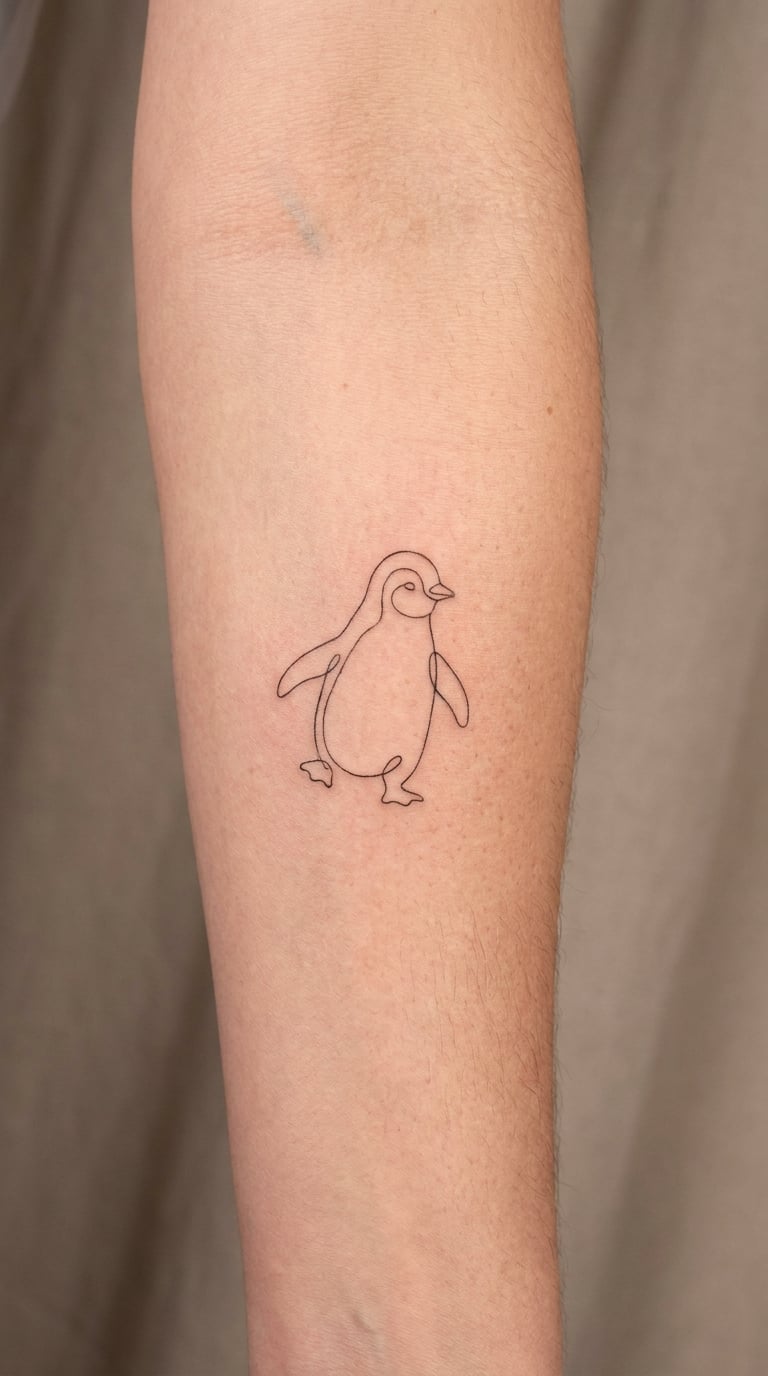
One unbroken line runs from the beak over the head, down the back, around the belly, and finishes where the flippers branch off. Inside there is only a white belly and two short lines for the feet. The walk is mid-stride, one foot forward, which is what keeps it from reading as a generic bird.
People choose this for a first tattoo because it reads clearly small and needs no explanation. It carries the same steadiness as a standing penguin without the fuss.
Placement: inner forearm, wrist crease to elbow, or outer rib. Size: 2-3 inches (5-7.5 cm) tall. Style: fine line, single needle. Pain: low to medium, mostly scratchy. Fine line on the inner arm softens within a few years, so ask for lines slightly heavier than the drawing looks.
Make it yours: add a coordinate or a date underneath in matching weight.
2. Tiny Penguin Behind the Ear
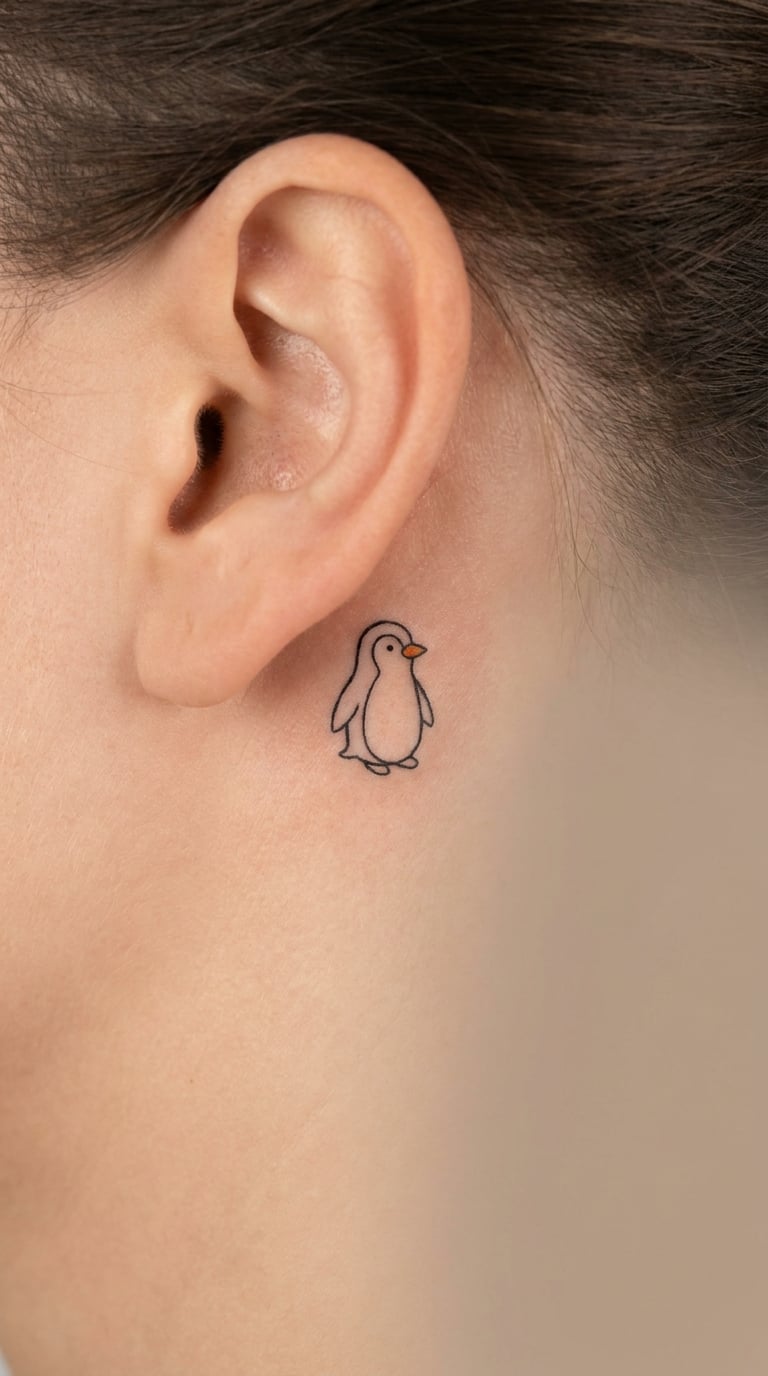
At roughly an inch tall, this is the version people get when they want a penguin on them constantly but not visibly. The body is a rounded wedge, the flippers are implied by a notch in the outline, and the beak carries a single spot of orange. Only the top half of the bird is ever really seen, so the artist crops it deliberately.
It is a private design, which is usually the reason. A hidden penguin tends to mean something more personal than the same bird in a large public piece.
Placement: behind the ear, along the hairline, or under the jaw. Size: 1-1.5 inches (2.5-4 cm). Style: micro fine line. Pain: low, and it bleeds less than most placements. Ageing is the trade-off: behind the ear gets sun and friction, and micro detail blurs noticeably within a few years.
Make it yours: drop the orange beak for a solid black one if you want pure monochrome.
3. Realistic Baby Penguin Pair
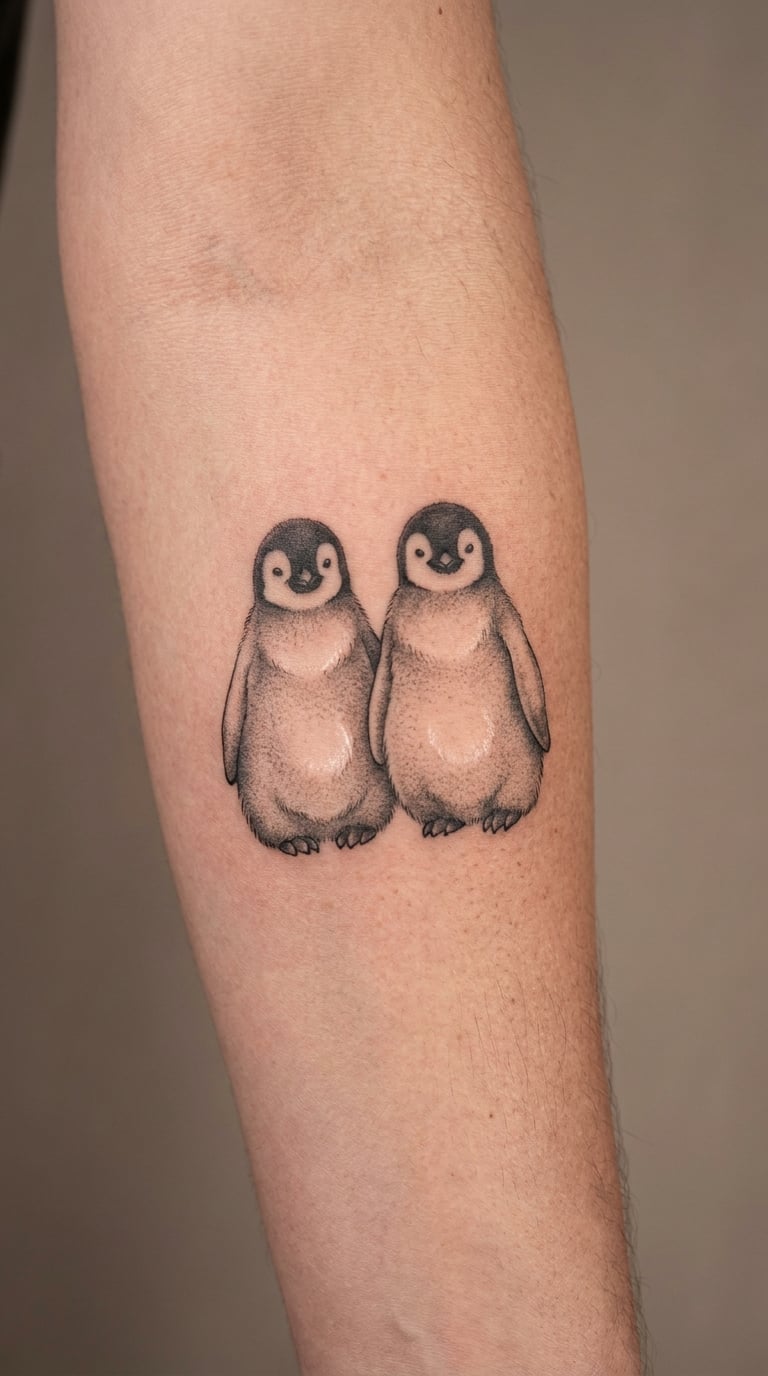
Two chicks in soft grey and black, with downy edges where the ink fades out rather than stopping in a hard line. They stand close enough to touch, one slightly in front. The realism lives in the shading on the heads and the fluff on the chests, not in background detail.
A pair of chicks is the version people choose for a partner, a sibling, or a parent and child. Two birds facing the same direction reads as a partnership rather than a single portrait.
Placement: upper forearm, calf, or across two ribs. Size: 3-4 inches (7.5-10 cm) for the pair. Style: black and grey realism. Pain: medium, and the shading pass takes longer than the line work, so the session runs over. Grey washes on the forearm need touch-ups more often than solid black.
Make it yours: name the species in your reference photo so the proportions match, and add a line of small text below.
4. Blackwork Penguin With Heart-Shaped Belly
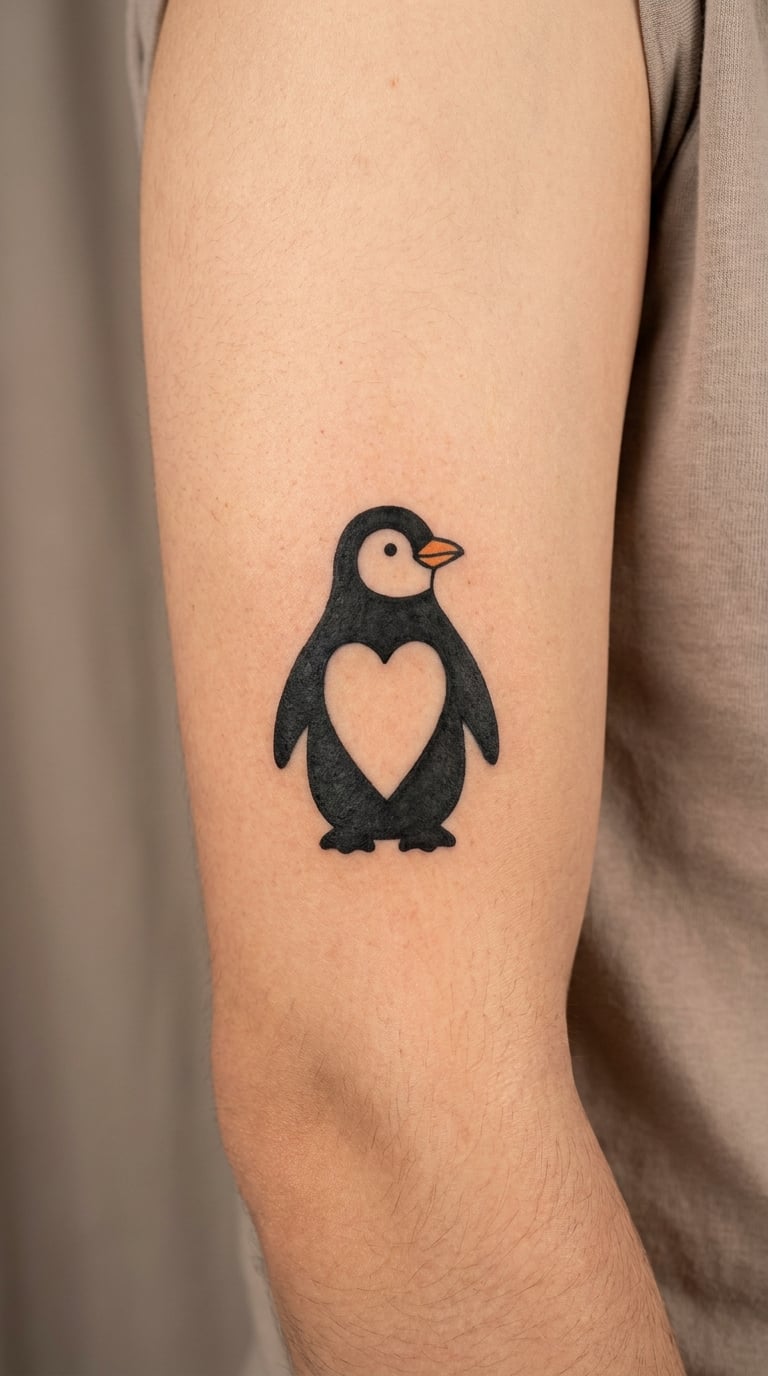
Dense black fills the head, back and flippers as one solid mass, and the belly is cut out as a clean heart shape. From across a room it reads as a penguin; up close it reads as a love letter. A small orange beak is the only colour in the piece.
The heart-on-belly shape is a common request for anniversaries and for partners getting inked separately with a design that has to say something at a distance.
Placement: outer upper arm, flat of the calf, or outer thigh. Size: 3.5-4.5 inches (9-11 cm). Style: blackwork. Pain: medium. Large solid black feels hotter and more insistent than outline work, so take a break halfway. The upside is ageing: solid black stays sharp far longer than grey.
Make it yours: reverse it so the heart sits on the back instead, visible only when you turn your head.
5. Minimalist Penguin Outline
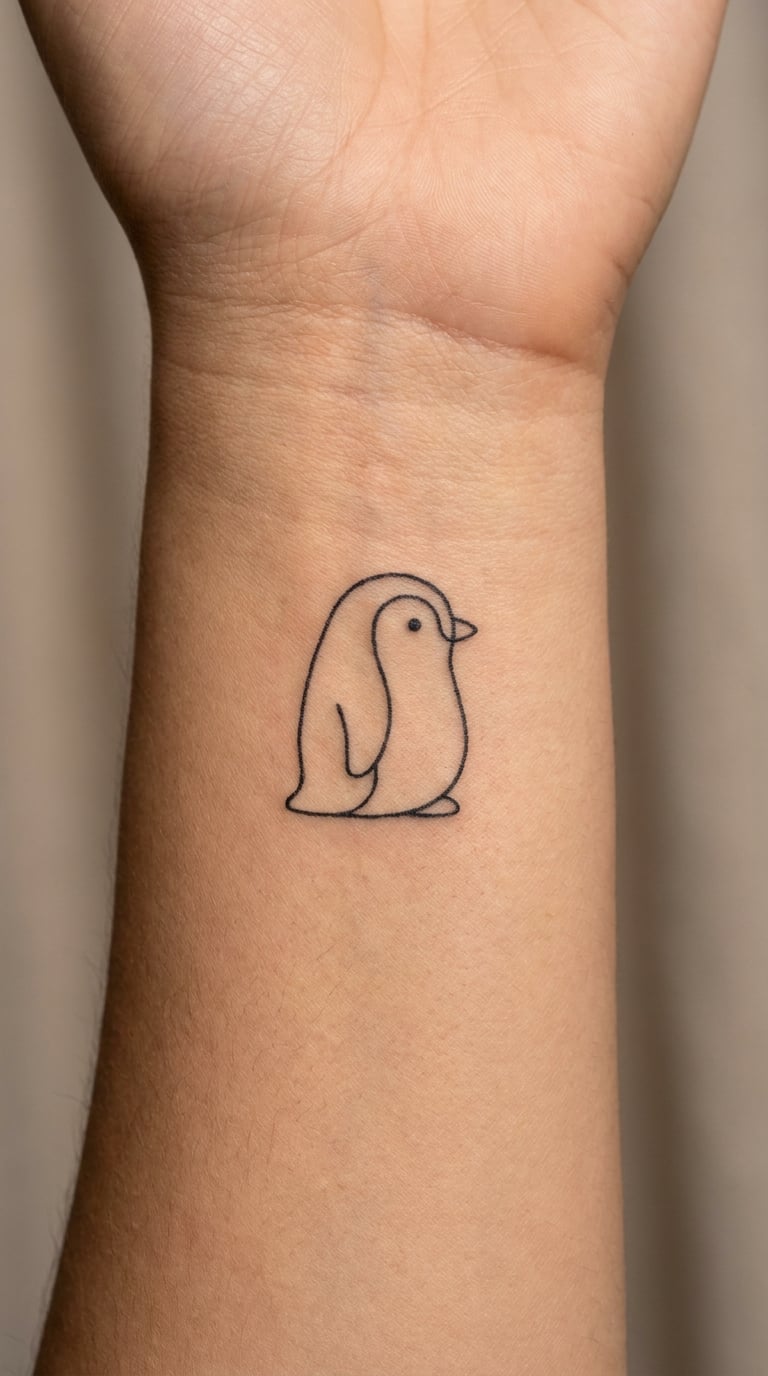
A rounded body, a small beak notch, one dot for the eye, and nothing else. No belly line, no flippers, no shading. What makes it read is proportion: a wide rounded base, a narrow top, and a beak that juts at an angle rather than sitting flat on the head.
This is the one people pick when they like the shape of the animal more than any story attached to it. It also suits anyone who finds a detailed piece fussy but does not want a plain abstract shape.
Placement: wrist, inner arm, or collarbone. Size: 1.5-2 inches (4-5 cm). Style: minimalist line art. Pain: low. Wrists and inner arms are soft and bony, so the session is short. Line weight matters most here: too thin and it disappears within a few summers.
Make it yours: two of these, mirrored and placed on opposite wrists, is a matching pair that works at any size.
6. Traditional Sailor Penguin
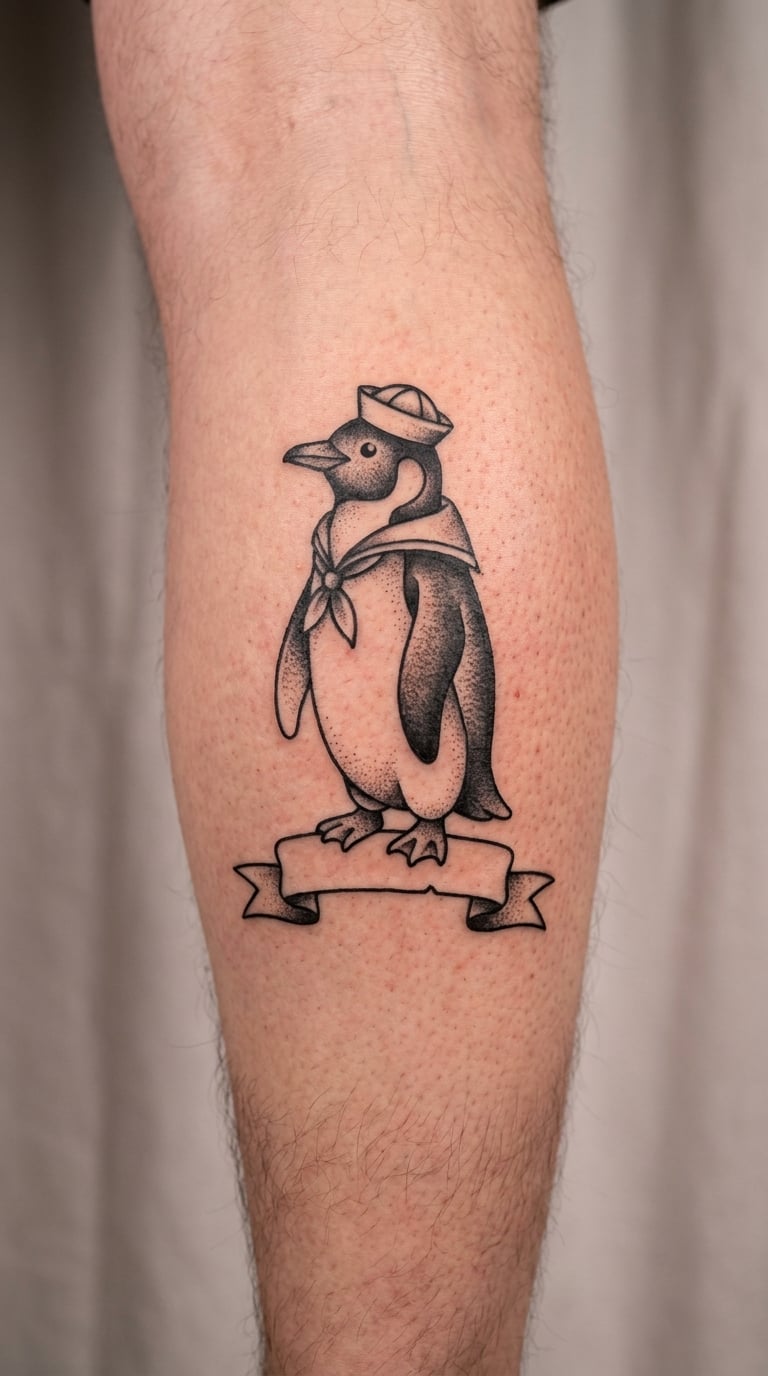
Bold black contour lines, flat areas of black, and stippled grey shading built up in layers the old way. The bird wears a small sailor cap or stands beside a ribbon banner reading a word you choose. The beak and feet are the only colour, painted in a warm orange.
Traditional style suits anyone who wants a piece that ages like a badge rather than a photograph, and it gives you room to add a name or a date without text fighting the drawing.
Placement: calf, outer upper arm, or the flat of the shoulder. Size: 4-5 inches (10-13 cm). Style: American traditional. Pain: medium, and the calf is a fleshy spot that takes a lot of ink. Stipple shading is the slowest part of the session.
Make it yours: put a coordinate, a ship name, or a date on the banner instead of a word.
7. Watercolor Penguin
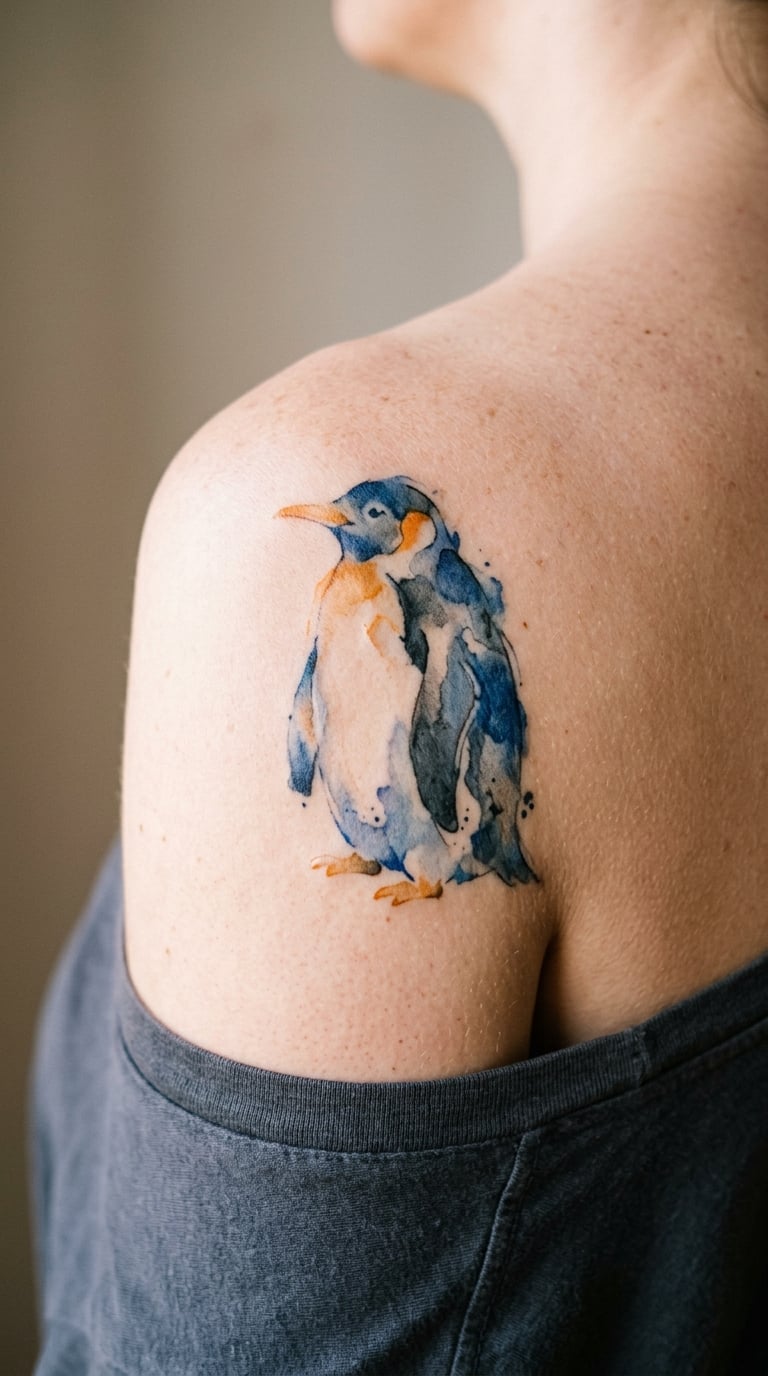
The bird is built from loose washes rather than lines: a grey-black body, a white belly that is paper-white rather than inked white, a dab of orange for the beak, and blue bleeding out at the edges. Some pigment is left to run past the outline, and half the personality of the style is the part that looks accidental.
Watercolour reads as soft and unhurried, which is why people who usually avoid bold animal pieces land here. The trade-off is that it is unpredictable, so the drawing you fall in love with may not heal identically.
Placement: shoulder, upper arm, or thigh where there is room to let the colour spread. Size: 4-6 inches (10-15 cm). Style: watercolour. Pain: medium, with a lot of low passes over the skin. Plan on a touch-up, because colour sitting on top of skin settles and lightens as it heals.
Make it yours: pick two colours that mean something, such as a birthstone and a team colour, and ask for the wash to be built from those.
8. Cute Penguin Holding a Fish
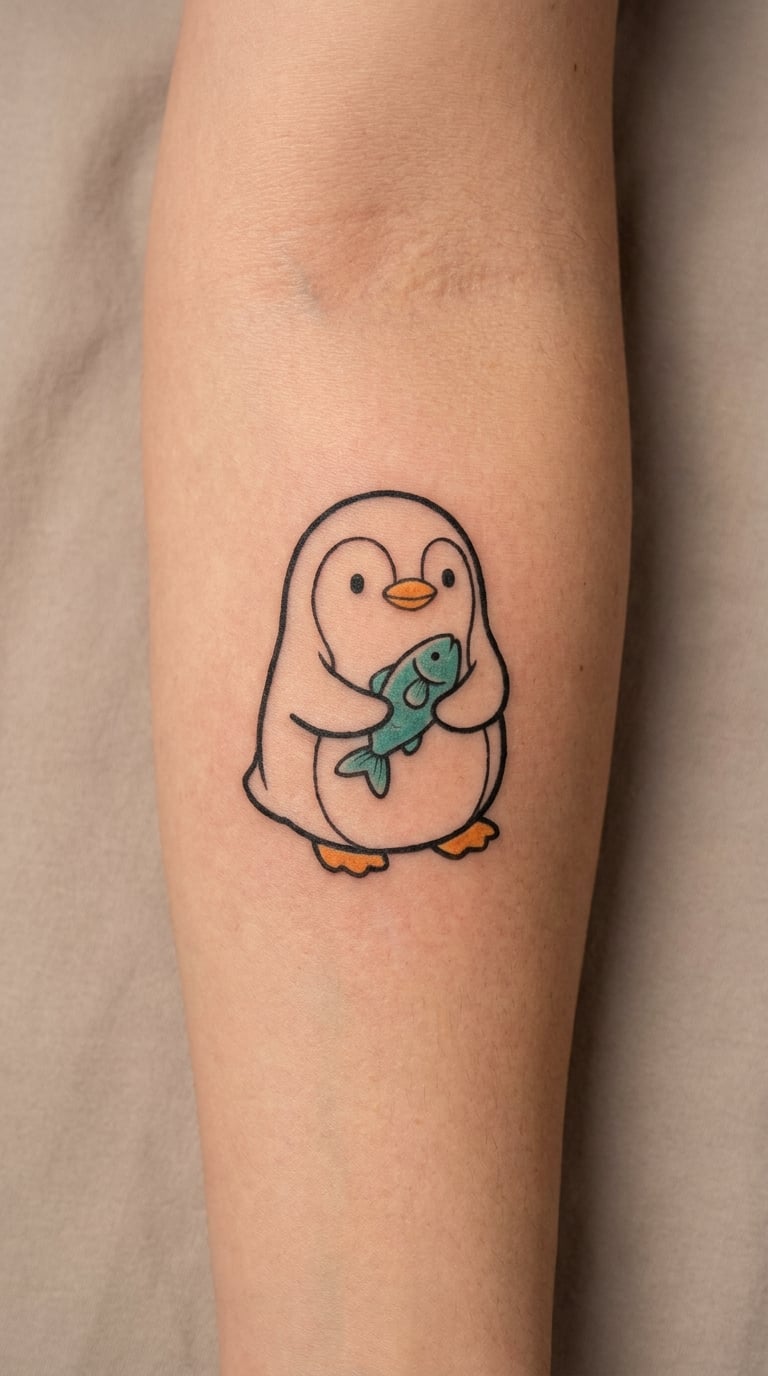
An illustrated bird with rounded proportions, oversized eyes, and one flipper clasping a small fish against its belly. Linework is even and confident, the orange beak and feet are warm, and the fish is a single teal accent. It is a story in one image rather than a portrait of an animal.
People choose this for the humour. The shapes are simple enough for a first piece, and it gets comments every time, which is not always the goal but rarely a problem.
Placement: upper forearm, calf, or the bicep. Size: 2.5-3 inches (6-7.5 cm). Style: illustrative with clean outlines. Pain: low to medium. The even line weight holds up well, which makes this a safer design than it looks for a first tattoo.
Make it yours: swap the fish for something with a story behind it, like a guitar, a camera, or a surfboard.
9. Emperor Penguin in a Circle
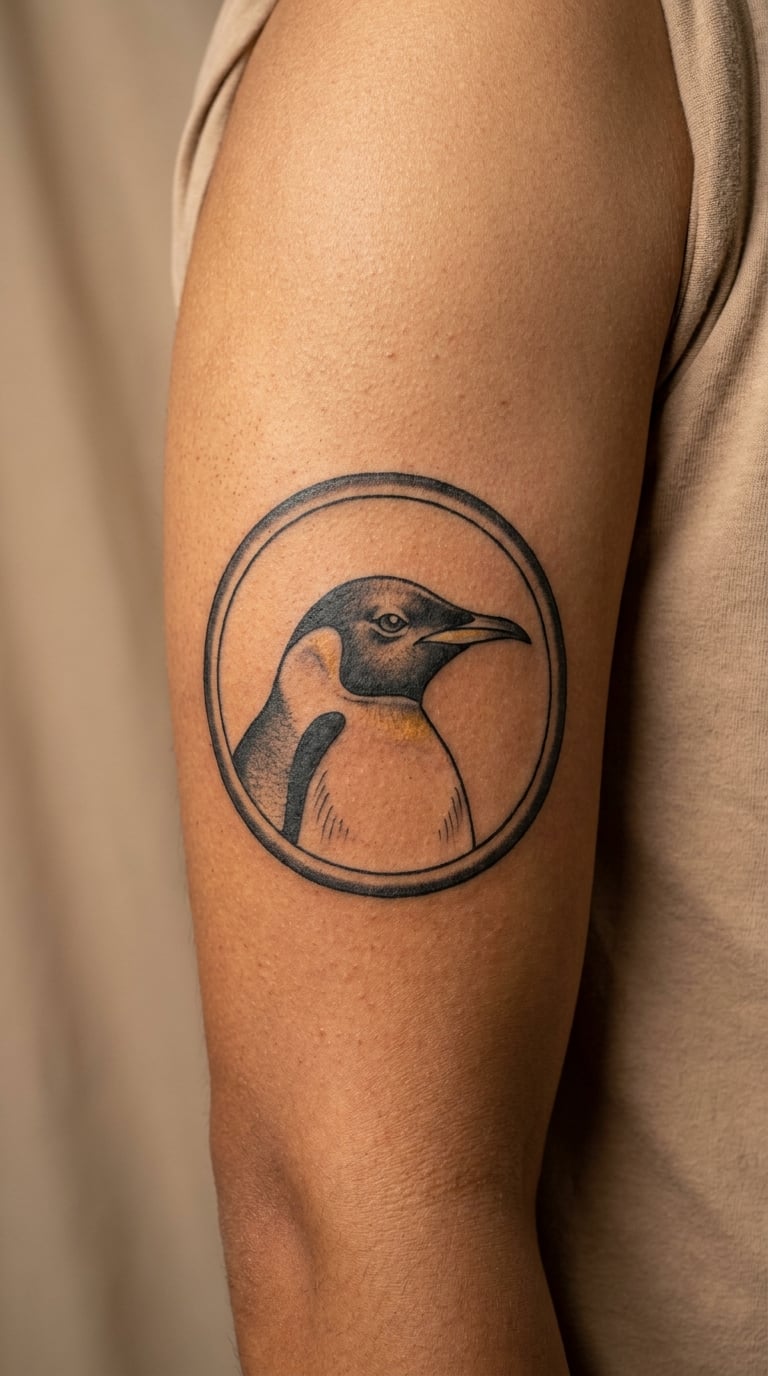
A proper emperor penguin, the largest of the family, standing full height inside a clean circular border. The head fades from black into pale yellow at the neck and throat, the body is built from black and grey tonal blocks, and the flippers hang close to the sides. The circle frames it like a coin.
The circle gives a realistic piece the discipline of a logo, and it hides a body outline nicely, so it sits well on a curved area like the upper arm.
Placement: upper arm, outer forearm, or calf. Size: 4-5 inches (10-13 cm) including the border. Style: realistic with a graphic frame. Pain: medium. Yellow on the neck needs several passes and looks muted in person, so ask for a warm gold rather than a bright lemon.
Make it yours: put coordinates or a date along the bottom edge of the circle.
10. Geometric Penguin Triangle
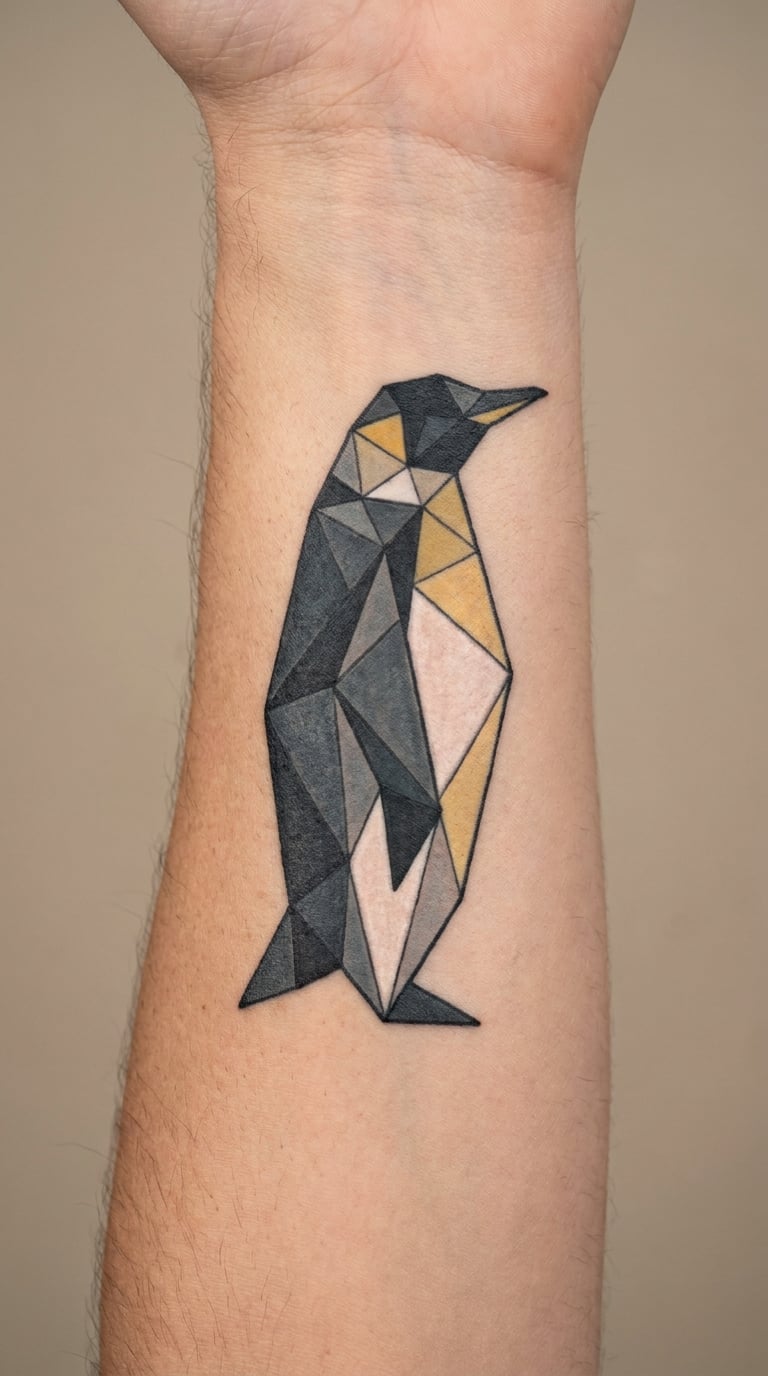
The bird is broken into triangles. One large dark triangle forms the back, smaller ones break up the belly, and a few muted yellow facets pick out the beak and throat. Straight edges meet at clean points, and the silhouette is still a penguin.
Geometric work suits people who like the look of a tattoo but not a literal drawing of an animal. It photographs well and covers a lot of forearm without much colour saturation.
Placement: flat of the forearm, calf, or the side of the thigh. Size: 3-4 inches (7.5-10 cm). Style: geometric. Pain: medium. Hard edges are unforgiving, so the artist may shrink the design slightly on your skin if the flat is not wide enough.
Make it yours: build the triangle from a repeating pattern of dots, small stars, or a lattice instead of solid fills.
11. Dancing Penguin Silhouette
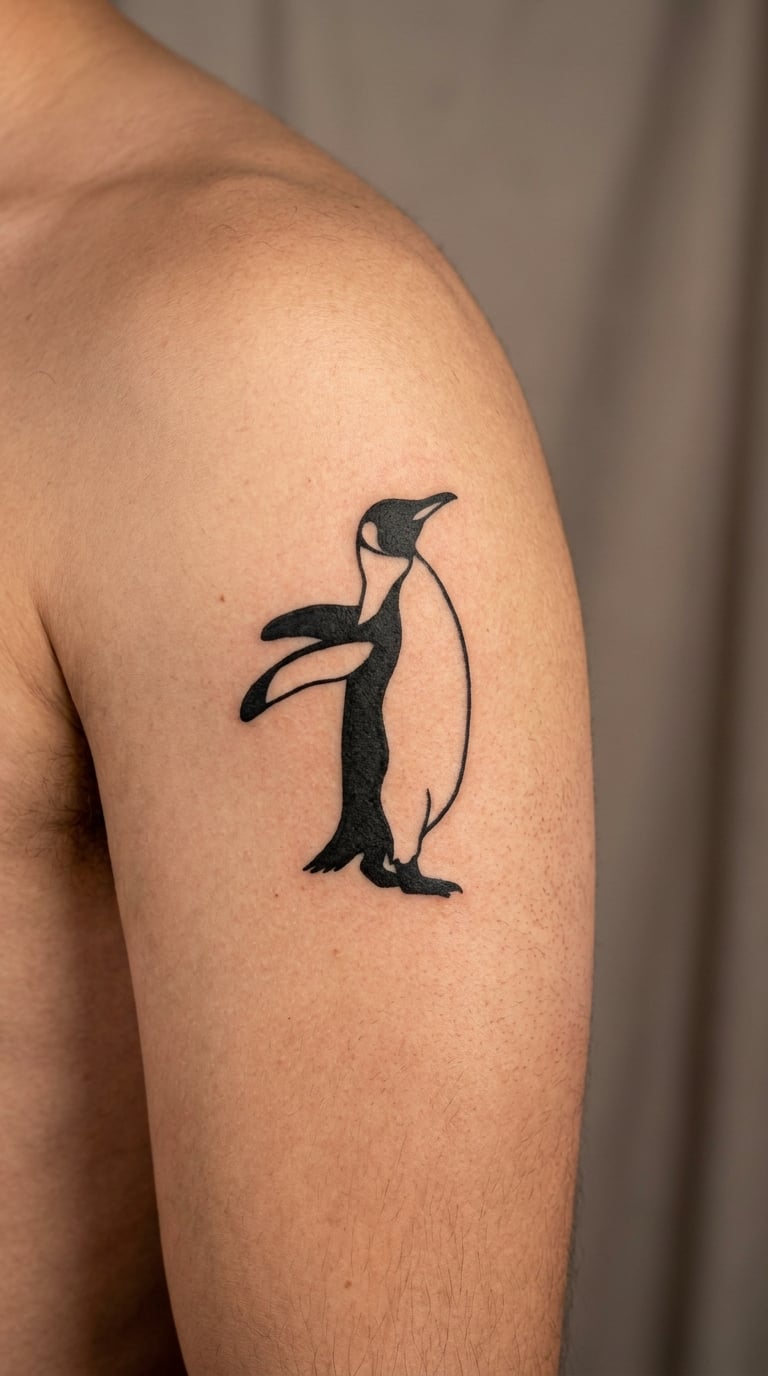
A single solid black shape, flippers thrown up and out, one foot lifted, the whole body tilted into the move. No eye, no beak detail, no belly line. Motion does all the work, and the recognisable feature is the flippers, not the body.
This is the friendliest option in the list: a bird in an obviously good mood, and a common first tattoo because solid black heals predictably and covers a lot of space quickly.
Placement: outer shoulder, calf, or upper back. Size: 3-4 inches (7.5-10 cm). Style: solid silhouette. Pain: medium, and the shoulder near the collarbone is more sensitive than people expect. Fill in one continuous pass if you can, since going over wet black is where the skin complains most.
Make it yours: add motion lines or musical notes behind the bird to set the pose in context.
12. Penguin With Floral Crown
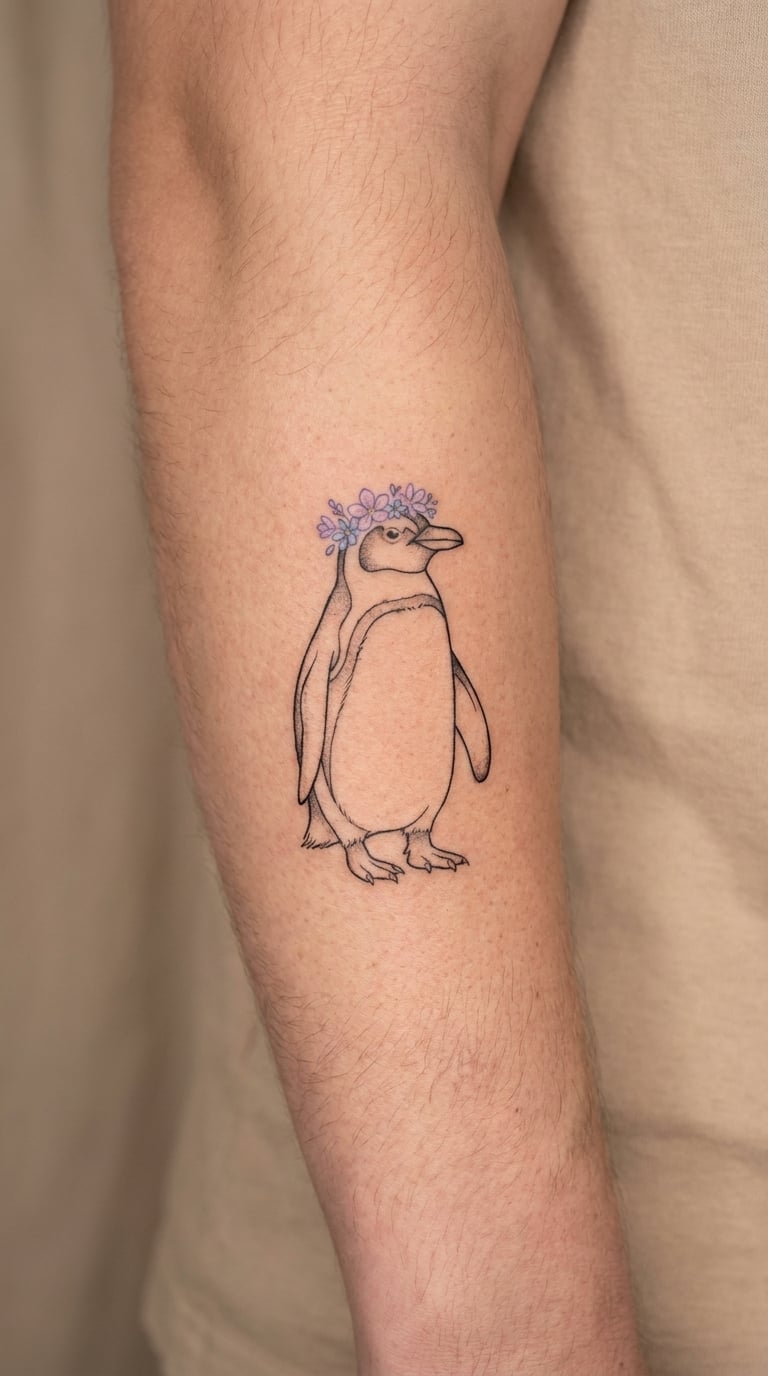
A fine-line portrait of a penguin from the chest up, facing forward, with a delicate crown of small flowers resting across the head. Each bloom is a few lines: lavender spikes, small blue bells, thin leaves on fine stems. The bird stays restrained so the crown carries the detail.
Floral crowns on animal portraits usually mean something about family, celebration or a particular person. A lavender crown is a quiet version of the same idea.
Placement: inner forearm, wrist, or along the collarbone. Size: 2.5-3.5 inches (6-9 cm). Style: fine line with light floral detail. Pain: low. The concern is not pain but line weight: the smallest petals need a needle your artist is comfortable working slowly with, or the design loses shape as it heals.
Make it yours: choose flowers with their own meaning, such as birth flowers for the people the tattoo is for.
13. Penguin in an Iceberg Scene
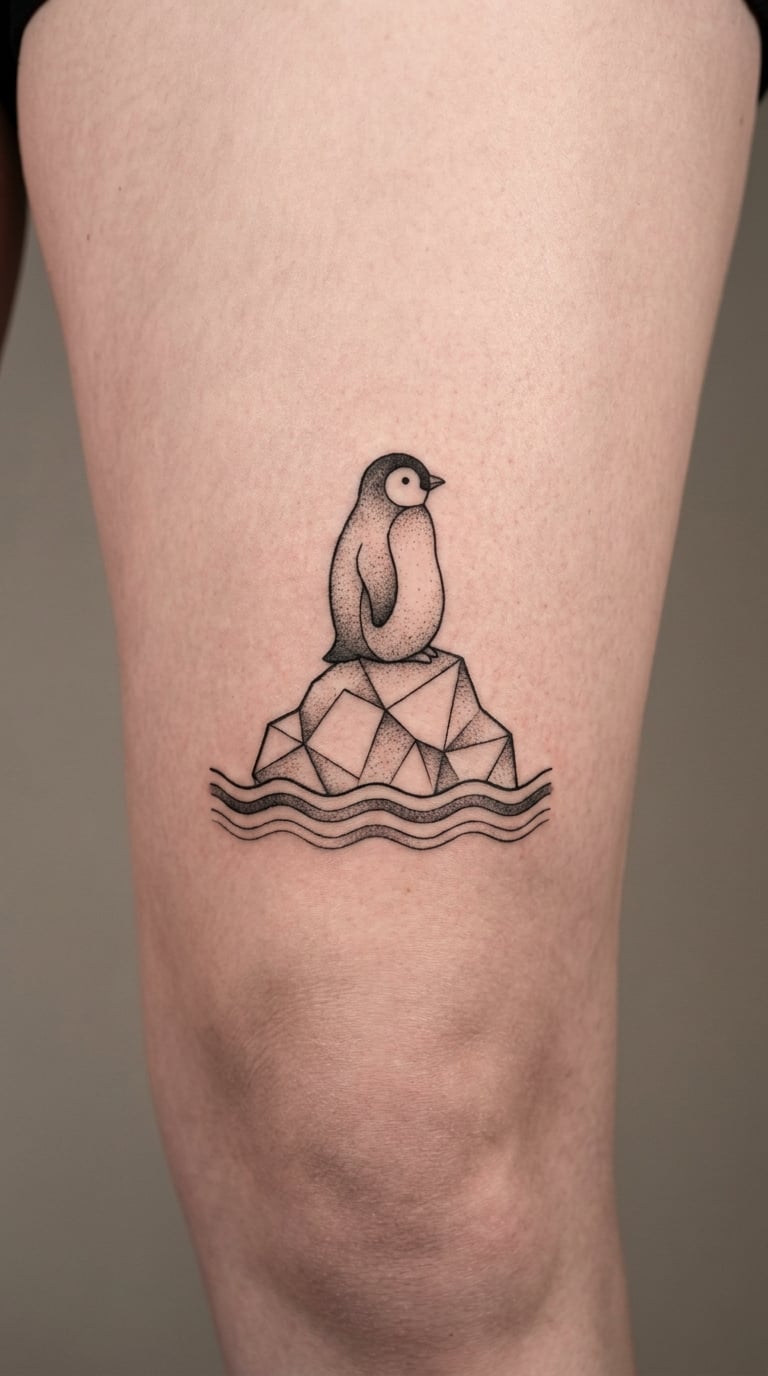
A compact scene: one penguin on the flat top of a faceted iceberg, two or three water lines beneath it, and plenty of empty skin around the whole thing. The iceberg is drawn in clean geometric planes rather than photoreal ice, which keeps the piece readable and the session short.
Scenes like this get chosen for the story they tell rather than the bird. It reads as a journey, a cold place, or a time you spent somewhere far away.
Placement: thigh, calf, or across the ribs. Size: 3.5-4.5 inches (9-11 cm). Style: illustrative scene in black and grey. Pain: medium on the thigh, which is fleshy and a common spot to bruise. The iceberg lines need to be confident and even, since too many facets turn into noise.
Make it yours: name the actual place, or add a small star above the iceberg to mark a latitude.
14. Swimming Penguin Silhouette
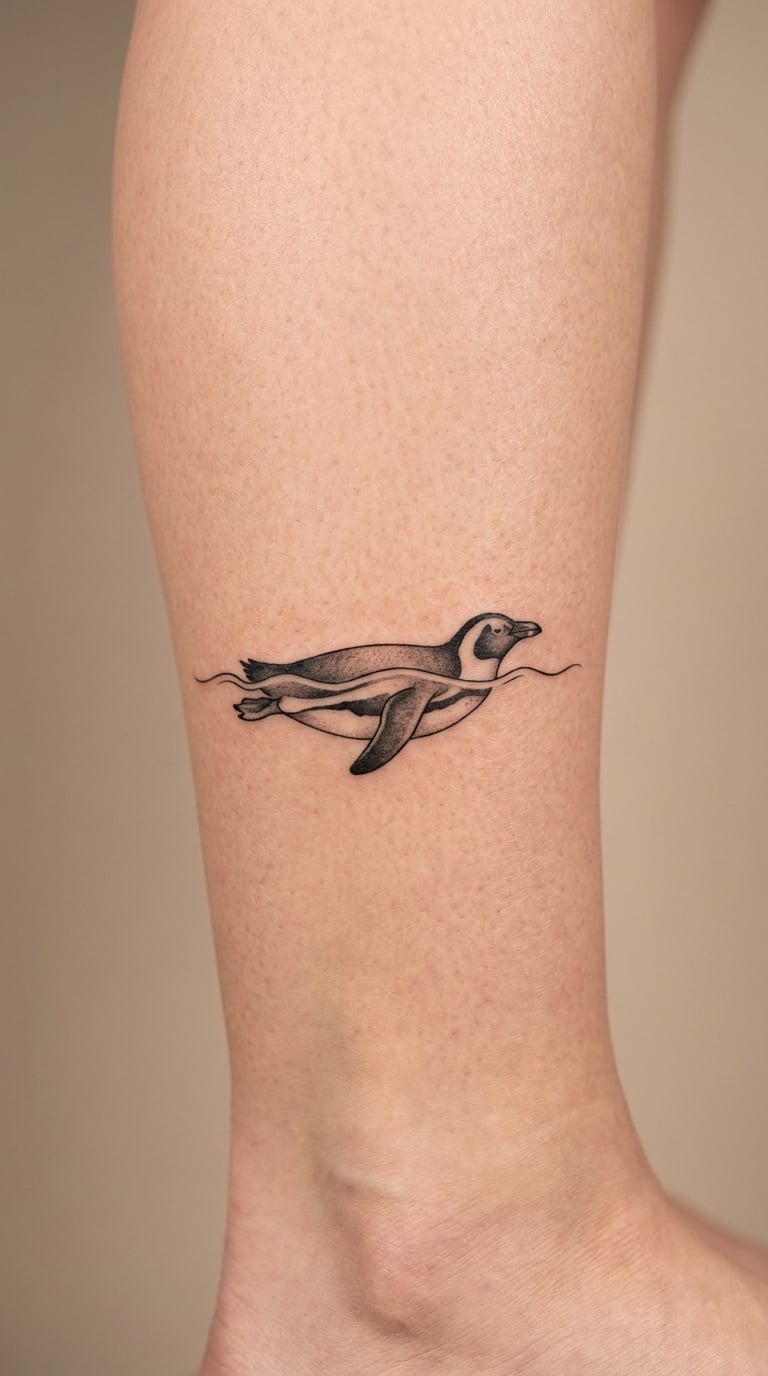
Side view, body horizontal, flippers angled back, one curved line trailing behind it as the waterline. The penguin is rendered in black and grey with the white belly showing as bare skin. That horizontal line is the whole trick, because it turns a standing bird into a swimming one.
Swimming is the version that pairs naturally with other pieces, which is why collectors like it, and it sits well beside wave or mountain work. If you are building a themed arm, our mountain and ocean tattoo ideas guide covers the pairings that read well together.
Placement: lower calf, inner arm, or side of the thigh. Size: 4-5 inches (10-13 cm) across, since the design is horizontal. Style: black and grey. Pain: medium. The lower calf is one of the more sensitive leg spots, mostly because skin is thin over bone near the ankle.
Make it yours: add a smaller penguin swimming the other way for a pair piece.
15. Dotwork Penguin
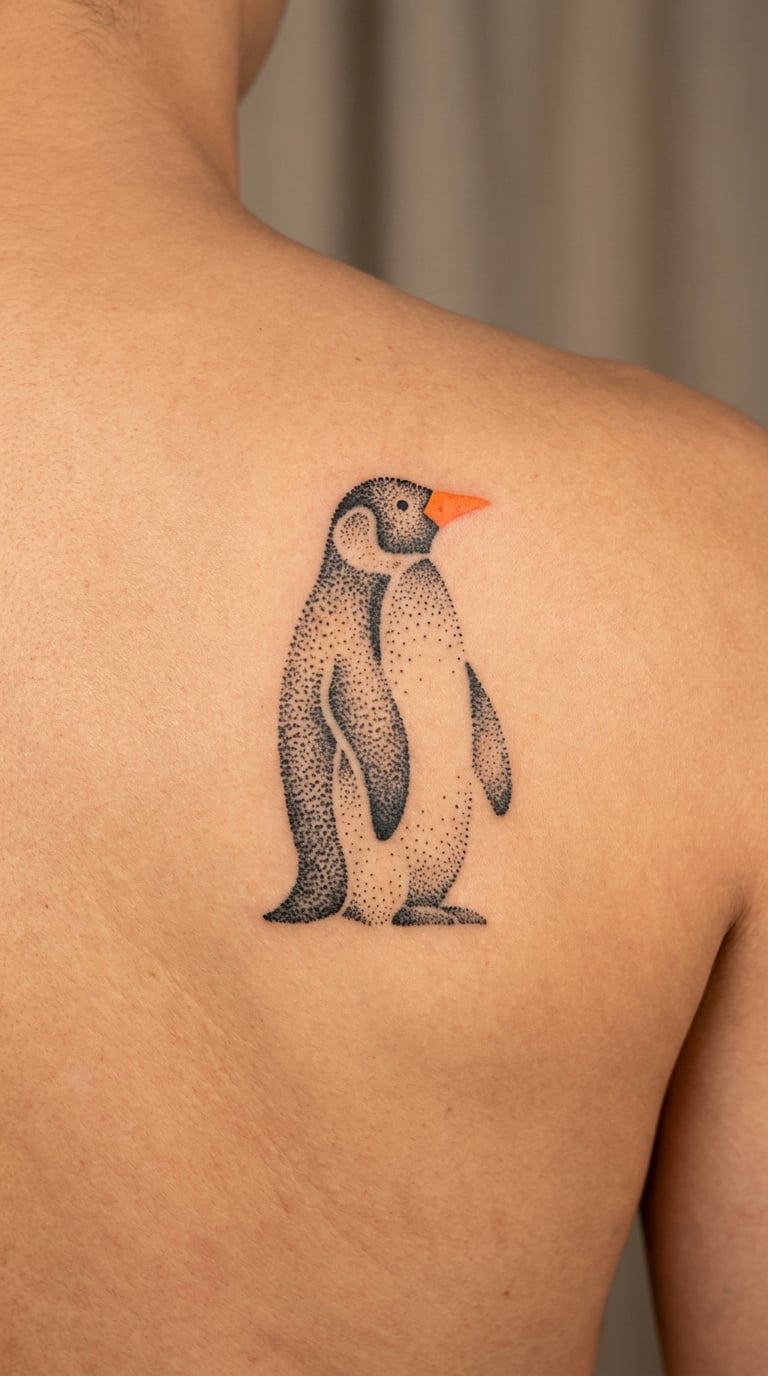
The entire bird is built from dots. Dense clusters make the black back and head, wide spacing makes the shadow on the belly, and the gradient between the two does the rounding. A small orange beak is usually the only solid colour, and it stops the piece fading into pure grey.
Dotwork reads as textured rather than solid, so it sits oddly well next to heavier blackwork. Most people arrive at it from a linework background rather than from animal tattoos.
Placement: upper back, upper arm, or the flank. Size: 4-5 inches (10-13 cm). Style: dotwork and stippling. Pain: medium, and stippling is slow, so a 5-inch piece can run two sessions. The upper back is a wide flat area that makes the density gradient easier to build evenly.
Make it yours: let the dots form a simple pattern in the background, like a star field or a ripple, fading outward from the bird.
16. Neo-Traditional Penguin Portrait
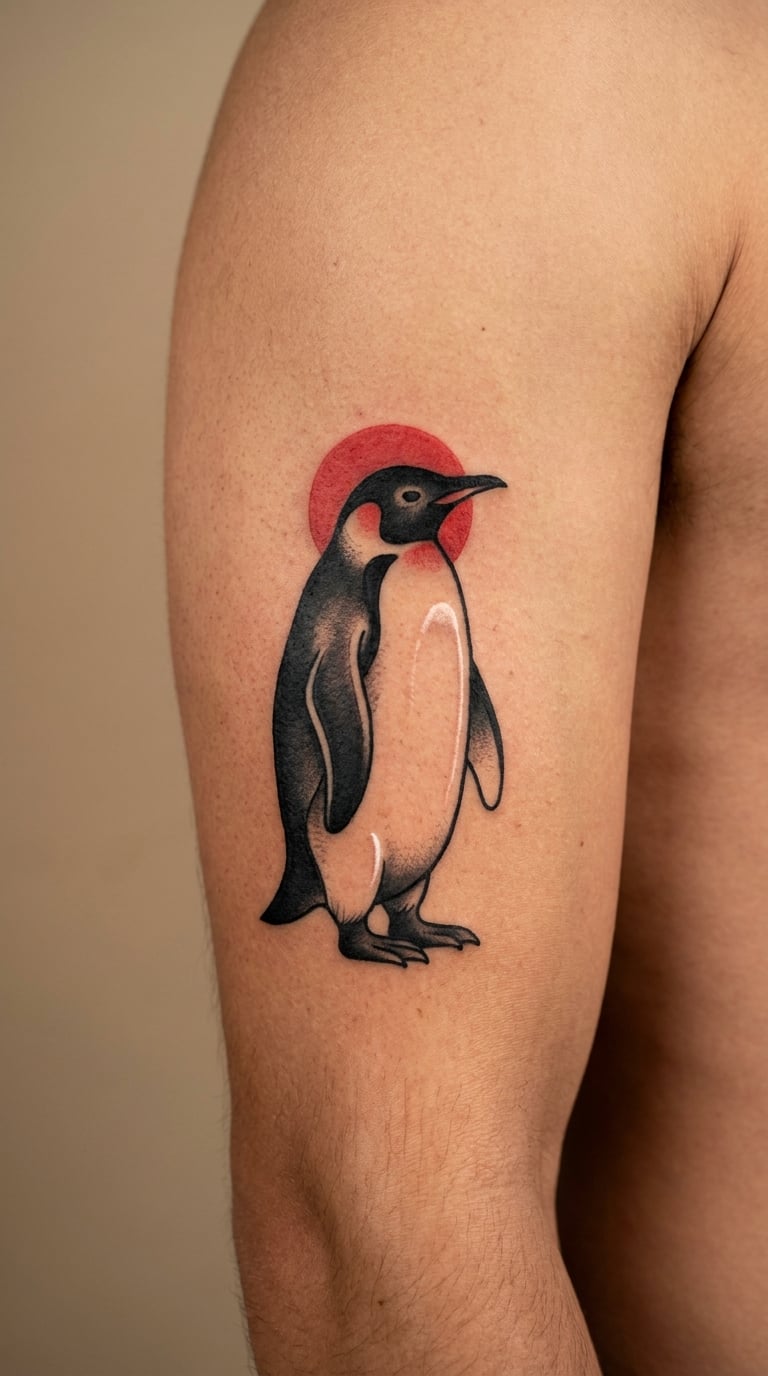
A three-quarter portrait with a heavier, more dimensional approach than traditional work. Deep black shading on the head and back, a red accent block behind the bird, and a bright white belly built from highlights left out of the black. The line weight is thick and confident throughout.
Collectors tend to land here. Neo-traditional rewards a larger piece because the shading needs room to build, and the red gives an arm warmth that a full black-and-grey piece does not.
Placement: outer upper arm, shoulder, or thigh. Size: 4-5 inches (10-13 cm) for the head alone. Style: neo-traditional. Pain: medium to medium-high, because shaded solid black is a lot of ink over a large area. The upper arm balances surface space and sensitivity well.
Make it yours: change the background accent to a colour tied to a place, a season, or a team.
17. Tiny Walking Penguin Finger Tattoo
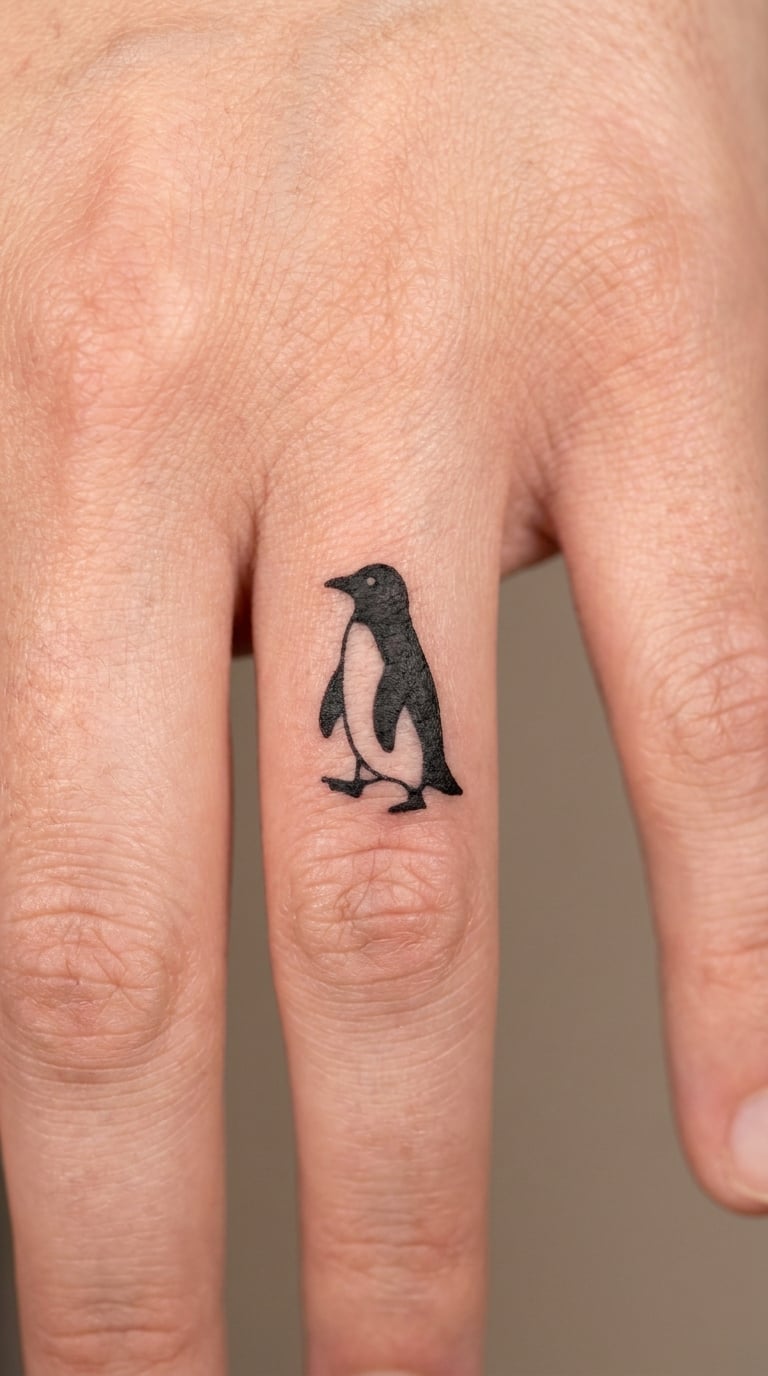
A side-profile bird mid-stride, about three-quarters of an inch tall, drawn with as few lines as the shape allows. One line for the back and belly, a short beak, a single filled foot, and a solid black cap over the head. The design has to survive being read from arm’s length.
Finger pieces get booked by people who already have tattoos and want one more, or by people who want a first tattoo that is essentially private. It is a commitment of attention rather than of size.
Placement: the side of a finger, the thumb, or the web between thumb and index. Size: 0.75-1 inch (2-2.5 cm). Style: micro fine line with solid black fill. Pain: medium-high, because fingers have very little soft tissue and a dense nerve supply. Ageing is the bigger concern: hands and fingers take a beating, and fine line there fades faster than the same design on a forearm.
Make it yours: make it the smaller half of a matching pair your partner gets on the same finger.
18. Penguin and Snowflake Matching Tattoo
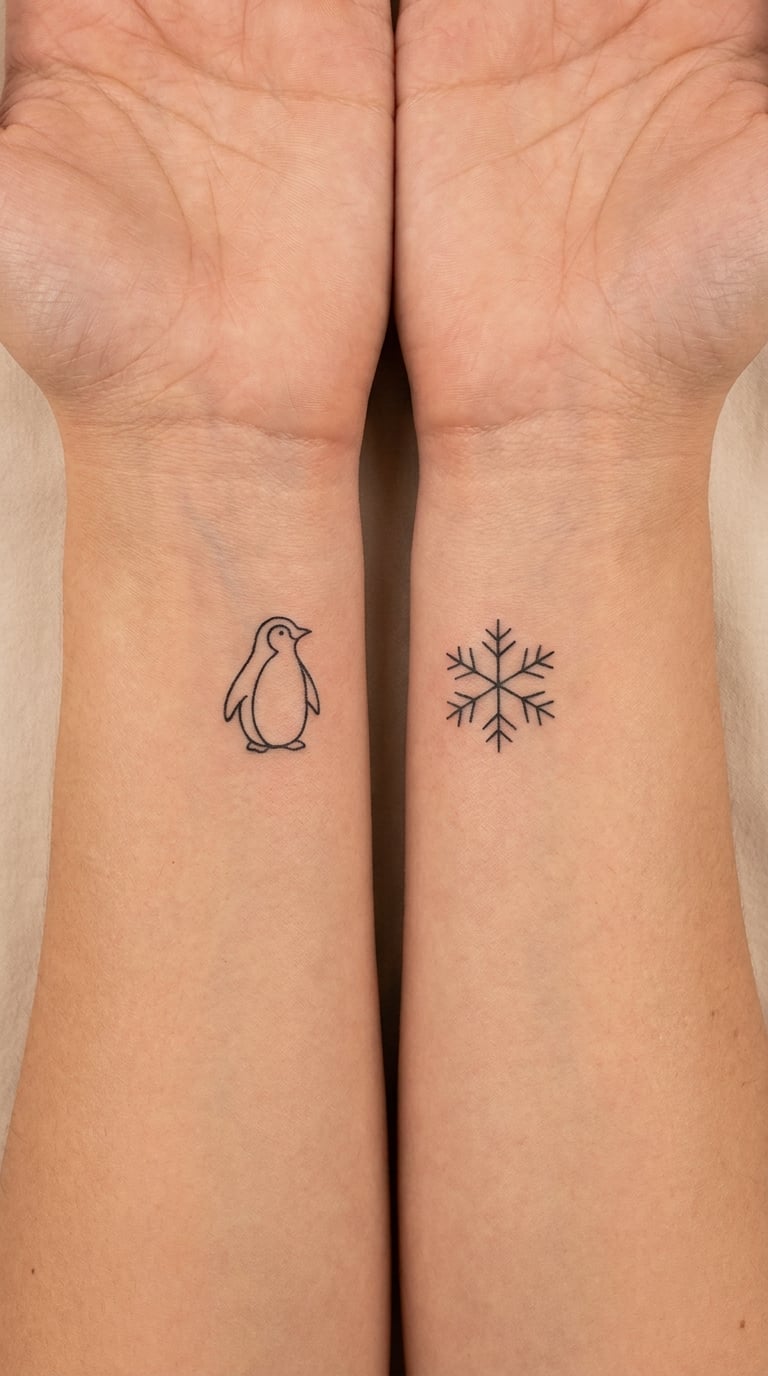
Two small designs drawn in exactly the same weight: a fine-line penguin on one side and a simple six-point snowflake on the other. The penguin is a rounded outline with a solid cap, the snowflake is six spokes with a small branching tip. Same hand and same session if you go together, and the same artist if you can manage it.
Matching tattoos work best when both pieces are genuinely simple. Anything detailed on a wrist starts to blur together within a few years, and matching is about the link rather than the artwork.
Placement: inner wrists, opposite forearms, or behind opposite ears. Size: 1.5-2 inches (4-5 cm) each. Style: fine line. Pain: low on the inner wrist, though wrists are bony and people feel it more than the rating suggests. Inner wrists show veins, so some artists add a thin line of shading behind the design.
Make it yours: pick a snowflake design you both recognise, so the pair means something outside the tattoo. We have more on that in matching tattoo ideas for roommates if you are pairing with a friend rather than a partner.
19. Colour Cartoon Penguin
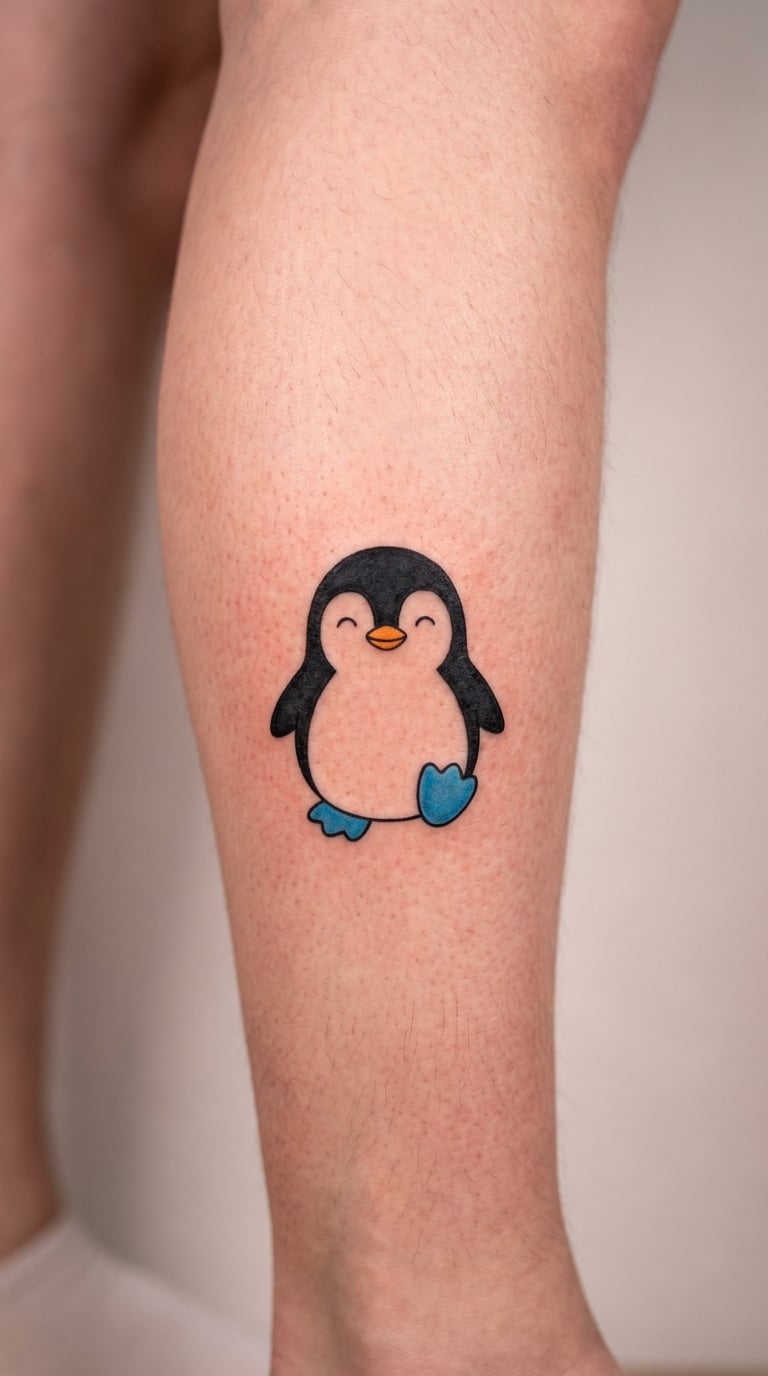
Full colour, thick clean outlines, and proportions pushed for personality: a big rounded body, small feet, a slightly oversized head. The black head, white belly and bright orange beak are accurate, and the feet are an unrealistic blue that exists purely because it looks cheerful next to the orange.
Colour cartoon pieces keep looking like themselves after fifteen years, because colour holds and cartoon shapes do not need to be realistic to stay readable. It is a good choice if your other tattoos are all black and grey.
Placement: calf, upper arm, or the flat of the shoulder. Size: 3-4 inches (7.5-10 cm). Style: cartoon colour with bold outlines. Pain: medium, and the calf takes a lot of colour saturation well. Expect a second session if the artist wants the orange and blue fully saturated rather than washed in.
Make it yours: have the character dressed for something specific, like a scarf, a shirt, or a pair of wellies.
20. Realistic Emperor Penguin Forearm Tattoo
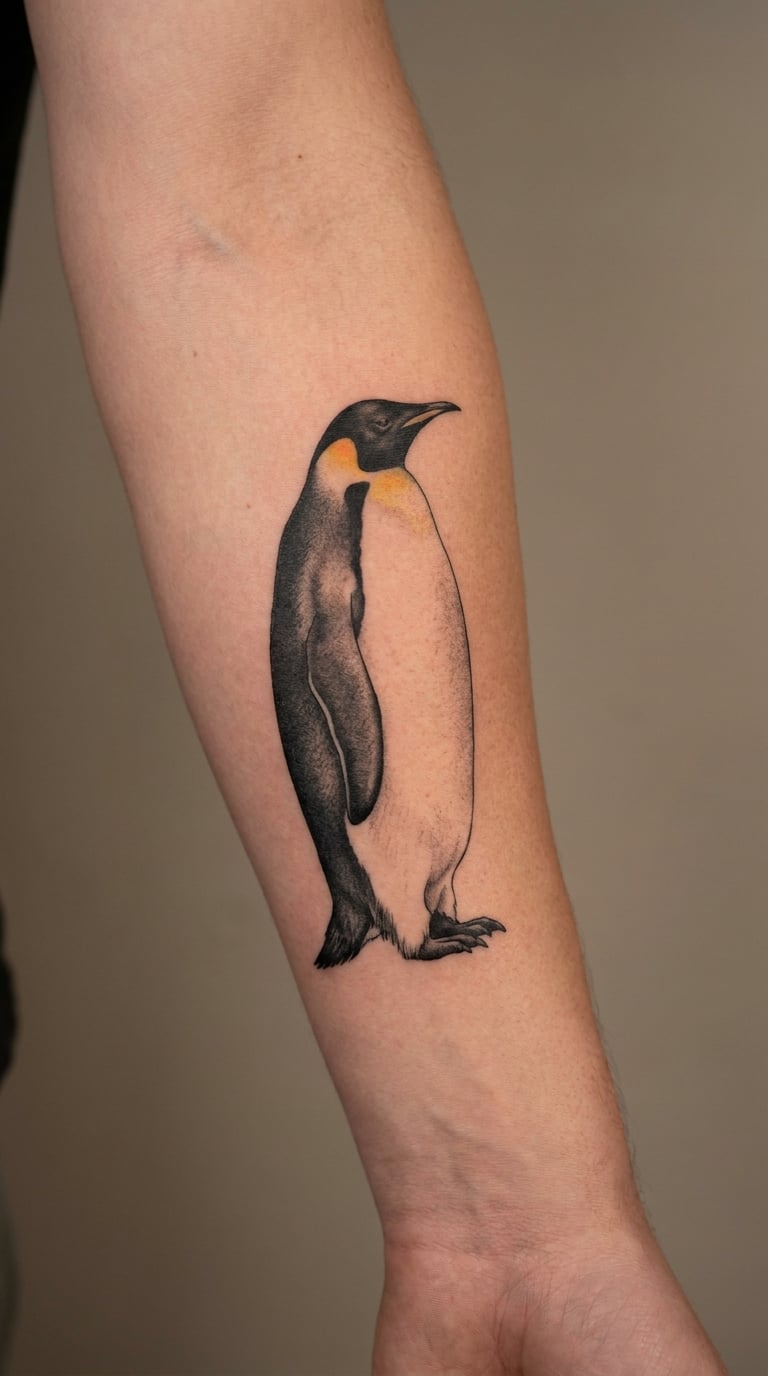
A full-height emperor penguin running vertically along the forearm, from wrist toward elbow. Feather detail at the head and neck, soft grey tonal shifts through the body, and the warm yellow-orange ear and throat patches. It is the largest penguin species, so the proportions are long and upright rather than round.
This is the statement piece in the list. It works because the forearm is one long flat plane that matches a standing animal, and the vertical line of the arm echoes the bird’s posture.
Placement: inner or outer forearm, wrist to elbow. Size: 6-8 inches (15-20 cm) tall. Style: micro-realism with soft shading. Pain: medium-high, and this is a two-session piece at most sizes. Feather detail means many small passes, which the inner forearm notices more than you would expect.
Make it yours: add a low horizon line or a scattering of dots at the base to suggest ice without drawing a whole background.
21. Black Penguin with Gold Heart
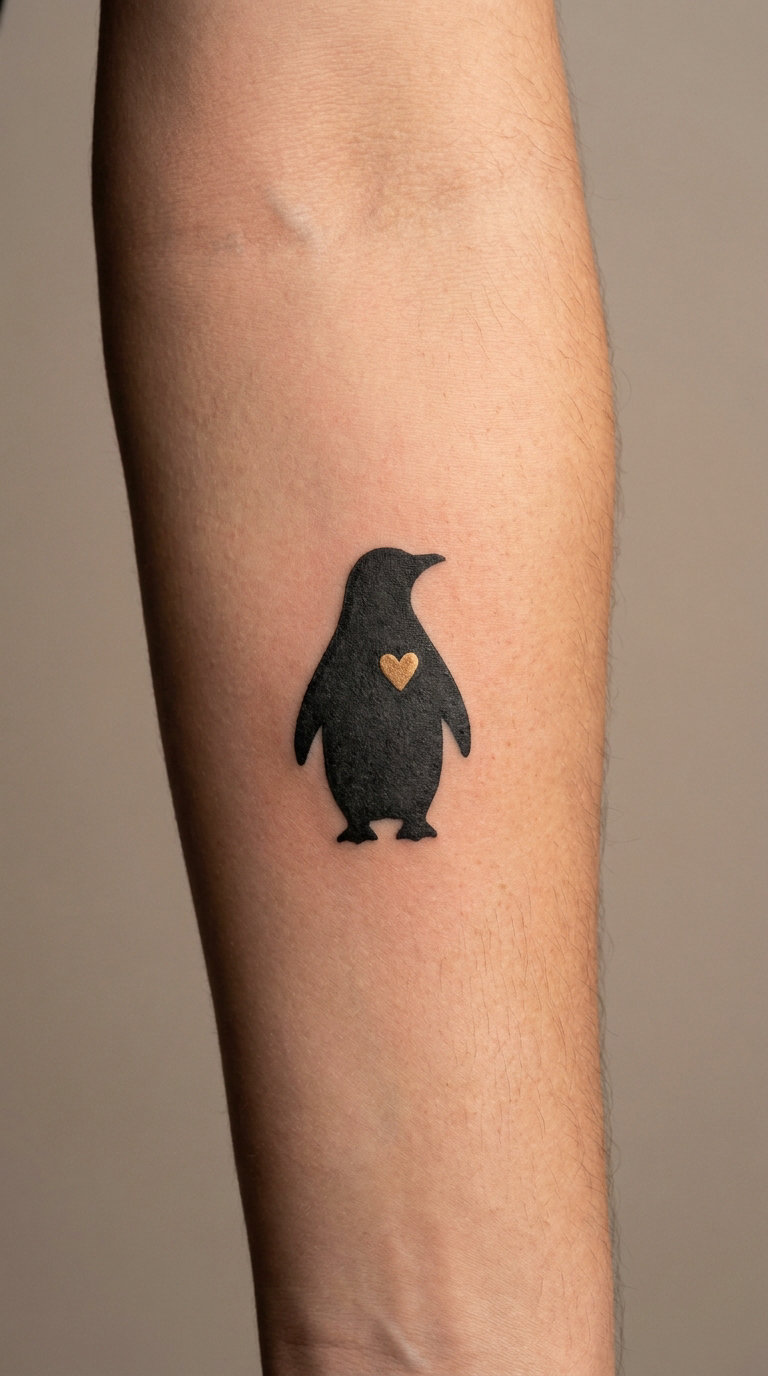
A solid black penguin standing straight, flippers at its sides, with a small gold heart on the white belly, which is bare skin. Two colours, one warm and one black, and nothing else in the design. The gold is the only detail, so it takes the eye straight to the middle of the bird.
People add a heart here for a date, a person, or simply because a small warm spot on a black shape looks good. It is the easiest penguin here to get tattooed in one sitting.
Placement: flat of the forearm, wrist, or inner arm. Size: 2.5-3.5 inches (6-9 cm). Style: blackwork with a colour accent. Pain: low to medium. The solid black is a single fill that goes on quickly. The gold will fade toward a warmer, duller tone over the first couple of years, so ask which pigments the artist plans to use.
Make it yours: have the heart engraved with a date in tiny black lettering, or leave it plain and unlettered.
22. Ornate Penguin with Ice Crystals
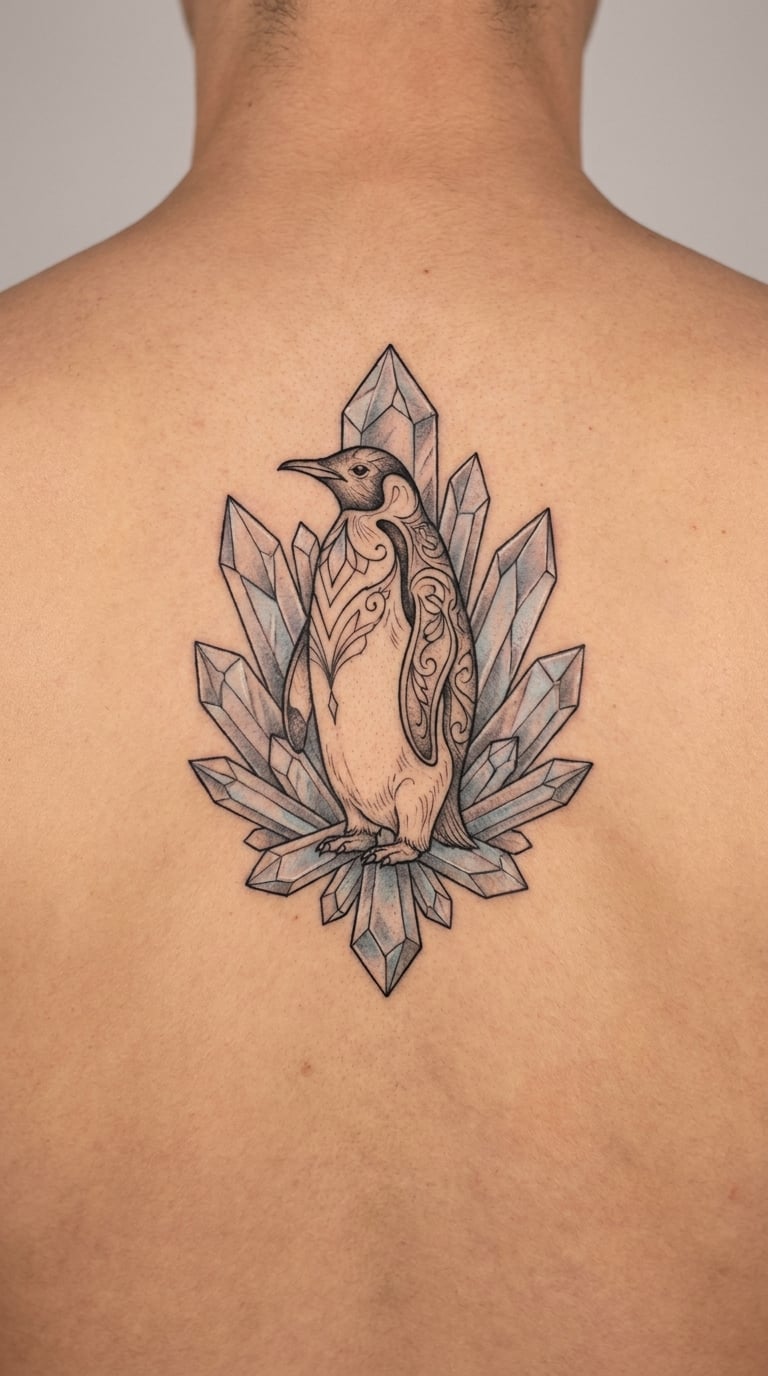
A central penguin framed by symmetrical ice crystals that grow outward on both sides like a set of wings. Each crystal is faceted with internal lines, and the composition is built in fine line with a pale blue wash in the crystal shadows. It is decorative, drawn to be looked at rather than read at a distance.
Ornate pieces suit someone adding to a collection. The symmetry and density mean it needs a big flat surface, and it rewards an artist who enjoys line work more than speed.
Placement: upper back, shoulder blade, or across the chest. Size: 6-8 inches (15-20 cm) across. Style: decorative fine line with light colour. Pain: medium, and the upper back is one of the easier large areas to sit through. Fine lines and a pale blue wash together need a careful touch-up, usually once, around a month after healing.
Make it yours: extend the crystals into bands that wrap around the body, so the piece reads as designed for your shape rather than placed on it.
How to Choose the Right Design
Six questions cover almost every decision, and answering them in order saves a wasted session. Work down the list rather than starting from the drawing you like most, because a beautiful design on the wrong body part is the most common regret in this subject.
- How much space do you actually have? Measure the flat area, not the whole limb. A design that measures 4 inches on paper needs about that much skin plus a centimetre of breathing room on each side, and a curved forearm will eat into the width you thought you had.
- What detail can the body part hold? Hands, fingers and ankles take a beating and lose fine line fast. Forearms, upper arms, the back and the thighs hold detail and shading much better. If the design has many small elements, put it on a flat, sheltered area.
- How much colour do you want to maintain? Black and grey ages the most gracefully. Orange and yellow fade fastest in sunlight, and any colour on the lower leg or the back of the hand needs more sun discipline than you expect at first.
- Does the design need a background? Scene pieces like the iceberg need air around them. A framed piece like the circle or the triangle fills its own space and can be sized tighter to the placement.
- Is this your first piece? Single-line, silhouette and simple illustrative designs are the safest first tattoos. They are quick, they need no shading decisions, and a small version still reads as a penguin, which is more than a dense black and grey piece seen from arm’s length can promise.
- What will still look right in fifteen years? Ask the artist to draw the design without the smallest details and see whether it holds up. If it falls apart, those elements are too fine for that placement and should be simplified now rather than in ten years.
Cost and Session Time
Prices for penguin tattoos follow the same pattern as every other animal tattoo, and what drives cost is area plus detail, not subject. A penguin is a simple silhouette compared to a portrait of a face, so a same-sized design usually sits at the lower end of an artist’s rate.
Most shops price either as a flat rate per piece or by the hour, and the crossover usually sits around three to four inches. A tiny fine-line penguin behind the ear or on a finger is typically the quickest appointment, often under an hour, while a small-to-medium design of two to three inches with light shading usually runs one to two hours.
Larger work costs more in obvious ways. A realistic six-to-eight inch forearm piece or an ornate decorative composition is generally booked as a multi-session project, where the first session sets the drawing and the rest fill in the work, and the total scales with hours rather than appointments.
Shop minimums matter more than the design here. Many studios set a minimum well above a micro piece, so a tiny penguin in a high-rent city shop can cost proportionally more than a much larger piece in a smaller town. Artist rates vary just as much, and colour saturation and fine detail both add time on top of size.
Get the number before you commit, in writing if the piece is large. If a quote feels far off, the most common cause is a detail level rather than a bad fit between the design and the artist.
Aftercare Basics
Start with your artist’s aftercare instructions, because they will know what they used and how your skin reacted to it. The general guidance below fits almost every penguin design, and it does not replace that.
- Wash it gently, twice a day, for the first few days. Lukewarm water, fragrance-free soap, and clean hands. Blood and plasma are normal for the first day or so, and washing them off early is what keeps a tattoo looking clean rather than scabbed.
- Moisturise a thin layer, not a thick one. A thin film keeps the skin supple. Heavy creams trap heat and can irritate fresh tattooed skin, and grease-based products are a common cause of the bumps people mistake for bad healing.
- Keep the sun off it. Fresh skin is more sensitive to pigment, and UV exposure lightens colour permanently. Once healed, the orange and yellow on a traditional or watercolour penguin still need more daily protection than the black areas do.
- Wear loose clothing over it for the first days. Friction and pressure lift ink out of the skin. Sleeves, waistbands and waist strings are the usual culprits, and putting a fresh tattoo under a tight waistband is a mistake I have watched people make repeatedly.
- Skip baths, pools, hot tubs and swimming for two to three weeks. Soaked skin softens and lifts scabs, and chlorine or salt water irritates a healing tattoo badly.
- Do not pick at the scab. It comes off on its own, usually within a week. Everyone picks at it, including people who tell their artist they will not.
Frequently Asked Questions
What does a penguin tattoo mean?
A penguin tattoo usually stands for commitment and steadiness. Penguins pair for life and raise chicks together, so the bird reads as devotion, family and staying the course. It also symbolizes resilience, since penguins huddle through Antarctic winter, and balance, from the sharp black-and-white contrast of their markings. People also choose it as a tribute to a trip, a person, or a species they feel connected to.
What are the most popular styles for penguin tattoos?
Fine line and minimalist outline versions lead, because a penguin reads from a single contour and most people want something small. After that come black and grey realism, which suits the natural black and white colouring, then blackwork silhouettes, traditional colour with an orange beak and feet, watercolour, and cartoon styles. Couples most often pick matching fine-line pairs, and collectors tend to look for realistic or illustrative work.
Do penguin tattoos hurt?
Most penguin placements rate low to medium, in the range of a mild sunburn scratch. The exception is fingers and hands, which are bony and densely nerve-supplied, and the inner forearm, which many people feel more than the ratings suggest. Large solid black areas and heavy shading feel hotter than outline work of the same size. Ask your artist to take breaks, and eat beforehand, because it genuinely helps.
Where do you put a penguin tattoo?
The inner forearm and the flat of the wrist suit almost every style, because they are flat, easy to cover, and easy to show. The outer upper arm and shoulder work well for larger pieces, and the calf and thigh give you room for scene designs. Behind the ear and on the fingers work for tiny birds, but expect faster fading there. The back is the best large surface if you want a detailed decorative piece.
Will a small penguin tattoo still look good in a few years?
It depends on line weight and where it sits. A tiny penguin on a forearm or upper arm holds up well, because skin there is stable and shaded. Fine line on hands, fingers and ankles fades noticeably faster, and a micro design with tiny internal details can blur into a grey smudge. Ask your artist to draw it slightly heavier than the reference, and avoid adding small details that only work at arm’s length.
How much does a small penguin tattoo cost?
A micro fine-line penguin is usually one of the cheapest pieces a studio offers, and it takes well under an hour. Medium colour and illustrative designs are commonly priced as a flat rate per piece. Larger realistic or decorative work is usually charged by the hour across multiple sessions. Shop minimums and artist rates vary widely, and city studios often set a minimum well above a micro piece, so a tiny penguin can cost more than its size suggests.
Conclusion: Choose Your Penguin Tattoo
If this is your first piece, the fine-line waddling penguin or the minimalist outline are the two I would put in front of an artist. Both read instantly at a small size, both finish inside one sitting, and neither depends on shading decisions that are hard to reverse.
If you are already collecting animal pieces, the realistic emperor penguin running along the forearm or the ornate ice-crystal composition on the back will hold the most attention and age the best of anything here.
Pick one design from these 22 penguin tattoo ideas, measure the spot you have in mind, and bring both to a consultation. The artist can tell you in ten minutes whether your line weight will survive on that part of your body.