
22 Violin Tattoo Ideas: Best Small, Bold & Artistic (2026)
These 22 violin tattoo ideas run the full range, from a two-inch fine-line outline behind the ear to an eight-inch blackwork composition on the thigh. They suit orchestral players, music lovers who never picked up an instrument, and anyone commemorating someone who played.
What makes the violin work so well in ink is its silhouette: long, curved, and slightly top-heavy, so it drops into a forearm, calf or rib line without redrawing. Browse the quick guide first, then find the idea that matches the spot you are actually thinking about.
22 Violin Tattoo Ideas: Quick Guide
Every design below is listed with the style it is drawn in, the spot it suits best, a realistic size and an honest pain rating.
| Idea | Style | Best placement | Size | Pain |
|---|---|---|---|---|
| Fine-line outline behind the ear | Fine line | Behind the ear | 2 in (5 cm) | Low |
| Minimal silhouette on the wrist | Minimalist | Inner wrist | 2 in (5 cm) | Medium |
| Floral sound body | Botanical fine line | Outer forearm | 3 in (7.5 cm) | Low |
| Bowed violin across the collarbone | Fine line | Collarbone | 4 in (10 cm) | Medium |
| Realistic portrait on the forearm | Realism, black and grey | Inner forearm | 5 in (12.5 cm) | Medium |
| Micro-realism on the finger | Micro-realism | Side of index finger | 1 in (2.5 cm) | High |
| Traditional violin and banner | Traditional | Outer upper arm | 6 in (15 cm) | Medium |
| Blackwork violin split by staff | Blackwork | Outer forearm | 6 in (15 cm) | Medium |
| Watercolor violin on the shoulder | Watercolor | Upper shoulder | 4 in (10 cm) | Low |
| Geometric violin on the sternum | Geometric | Sternum | 3 in (7.5 cm) | High |
| Note rising from the f-hole | Fine line with motif | Rib | 2 in (5 cm) | High |
| Vintage engraving on the bicep | Antique engraving | Inner bicep | 5 in (12.5 cm) | Medium |
| Violin and bow matching pieces | Minimalist | Inner forearms | 2 in (5 cm) each | Medium |
| Abstract flowing-line violin | Abstract linework | Outer calf | 4 in (10 cm) | Low |
| Gold violin on the hand | Solid gold | Back of the hand | 2 in (5 cm) | High |
| White and black violin on the ankle | High-contrast graphic | Above the ankle bone | 2 in (5 cm) | Medium |
| Sheet-music pattern on the arm | Repeating pattern | Outer upper arm | 8 in (20 cm) | Medium |
| Quarter-frame violin on the hip | Fine line with frame | Outer hip | 3 in (7.5 cm) | Low |
| Violin with a small rose | Fine line botanical | Outer thigh | 3 in (7.5 cm) | Low |
| Bow-only tattoo behind the ear | Minimalist | Behind the ear | 2 in (5 cm) | Low |
| Blue ceramic-style violin | Colour illustrative | Outer calf | 5 in (12.5 cm) | Low |
| Large blackwork violin composition | Blackwork | Outer thigh | 8 in (20 cm) | Medium |
1. Fine-Line Violin Outline Behind the Ear
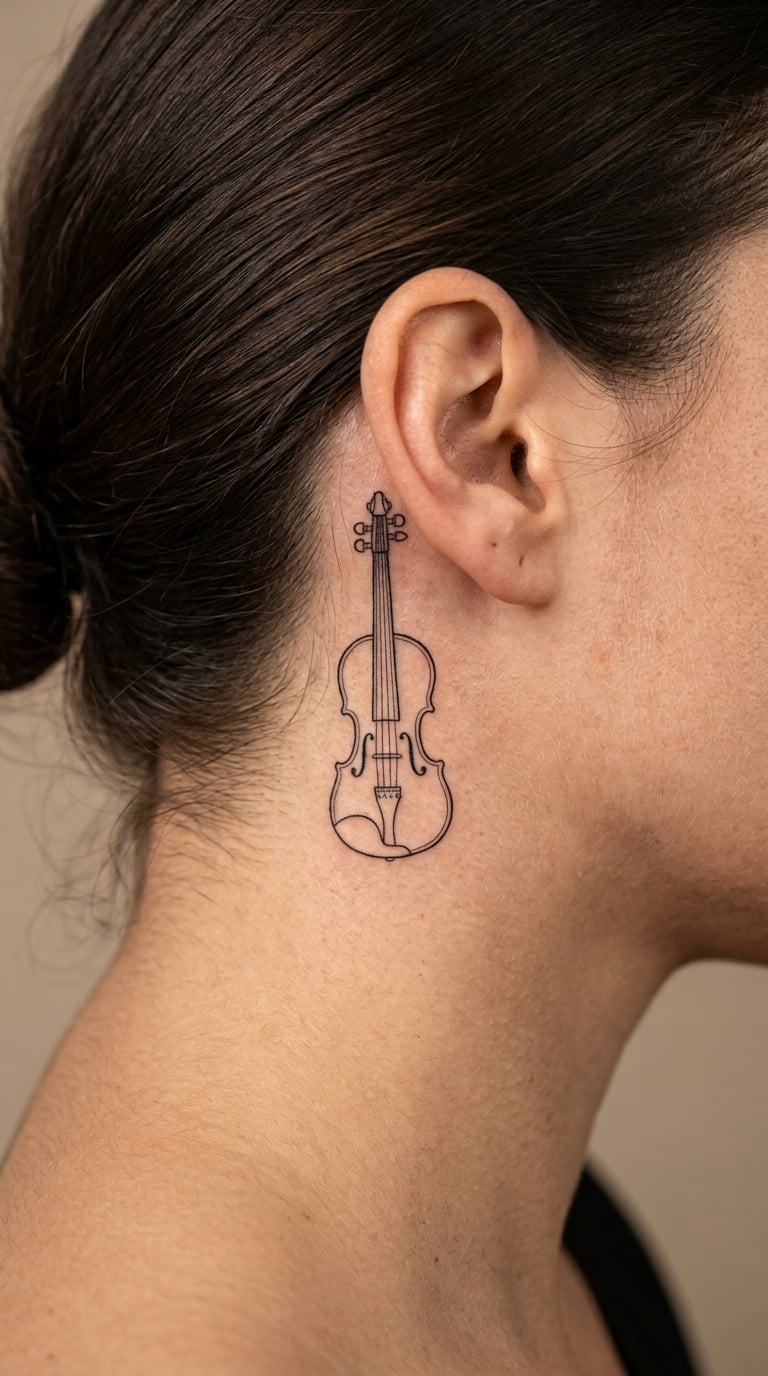
A fine-line violin tattoo behind the ear is a single hairline outline with two or three interior strokes for the f-holes and strings. No shading, no colour, nothing fighting for attention. Because the neck curves there, the body of the violin sits almost hidden and only the scroll shows from the front.
Most people choose this as a discreet tribute to a teacher, a parent or a practice they gave up. It reads as music to anyone who looks twice, and as nothing much to everyone else.
Placement: behind the ear, roughly level with the earlobe. Size: 1.5 to 2.5 inches (4 to 6 cm) tall. Style: fine line, single-needle weight. Pain: low, a scratchy tick, but expect the neck skin to be sensitive for a couple of days. Hairline work behind the ear softens noticeably within three years, so plan for a refresh or a slightly heavier line. Make it yours: add a tiny date or a single initial under the lower bout.
2. Minimal Violin Silhouette on the Wrist
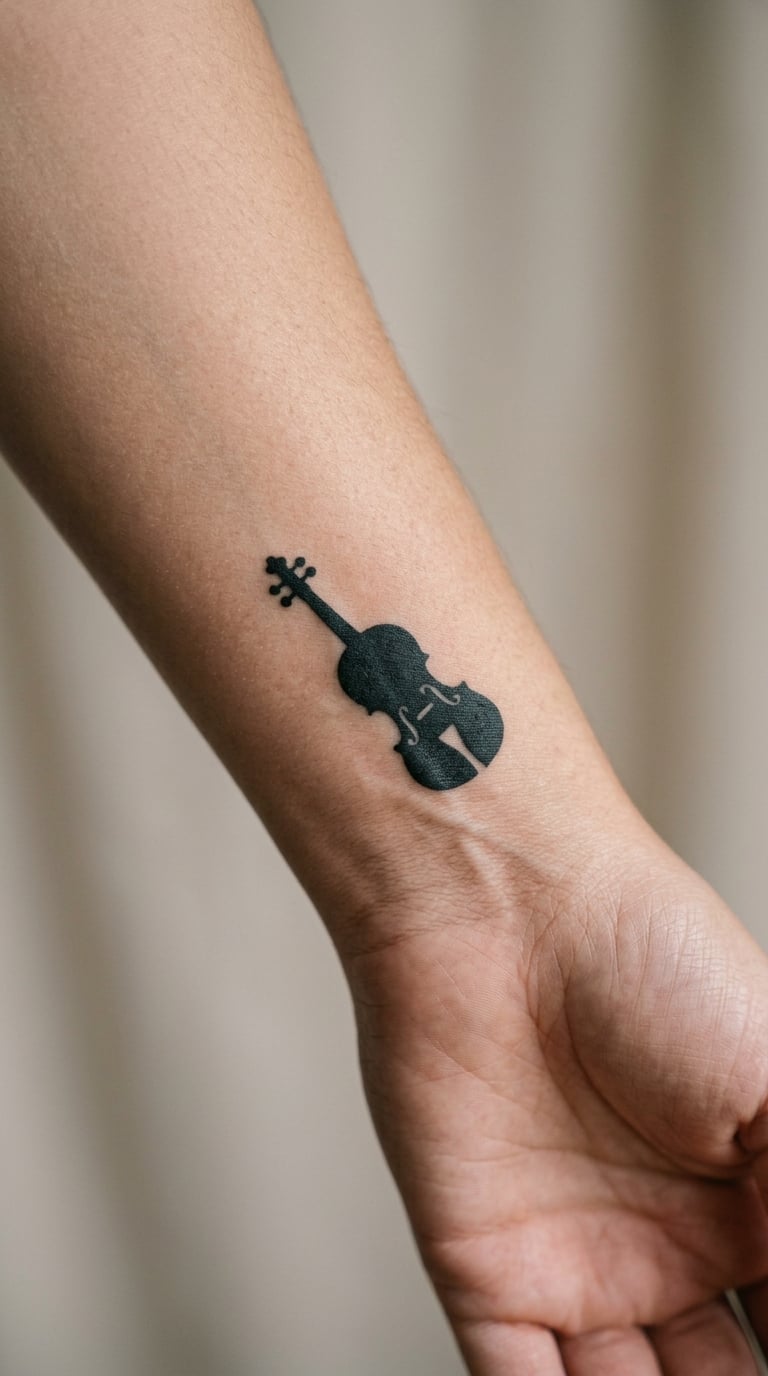
The wrist violin is the one most people picture first: a solid-black silhouette with clean cut-outs for the f-holes, sized so it reads clearly at arm’s length. Drawn flat rather than three-dimensional, it has the look of an icon instead of a portrait, which is why it suits a first tattoo so well.
Wrist and collarbone are consistently the two placements people ask for most on music-themed ink, and this is the version that fits a first one. It also works well as a matching piece later down the line.
Placement: inner wrist, set on a slight diagonal so it follows the forearm line. Size: 1.5 to 2.5 inches (4 to 6 cm). Style: minimalist black silhouette. Pain: medium, roughly a 5 or 6 out of 10, with the wrist bone and the inner forearm tender spots. Solid black fills hold their edges much better than hairlines here. Make it yours: swap the black fill for a single muted colour that matches something you already own.
3. Violin with Floral Sound Body
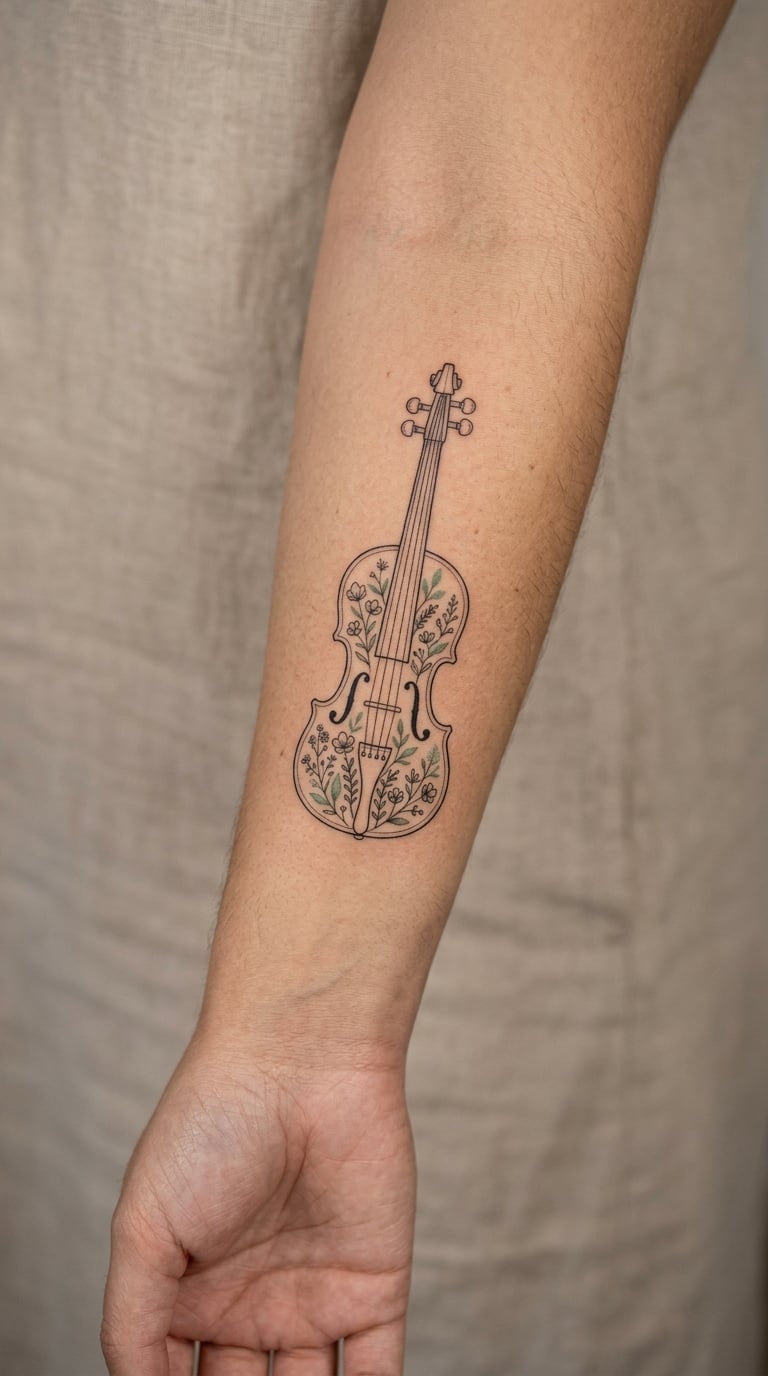
This design keeps the violin outline intact and fills the lower bout and waist with a restrained cluster of small botanical forms, each a few millimetres across. The trick is restraint. Five or six small blooms read as a violin with flowers; fifteen turn into a dense floral piece where the instrument disappears.
It suits people who play and people who simply love music and gardens equally, and it bridges the gap between a literal instrument and a botanical sleeve.
Placement: outer forearm, running lengthwise. Size: 3 to 4 inches (7.5 to 10 cm). Style: fine-line botanical with a light muted green or dusty rose wash. Pain: low to medium, and the forearm is an easy canvas for a first sitting. Thin petals soften faster than a solid silhouette, so keep the washes generous rather than delicate. Make it yours: use flowers tied to a place, like a birth month bloom or a wedding bouquet species.
4. Bowed Violin Across the Collarbone
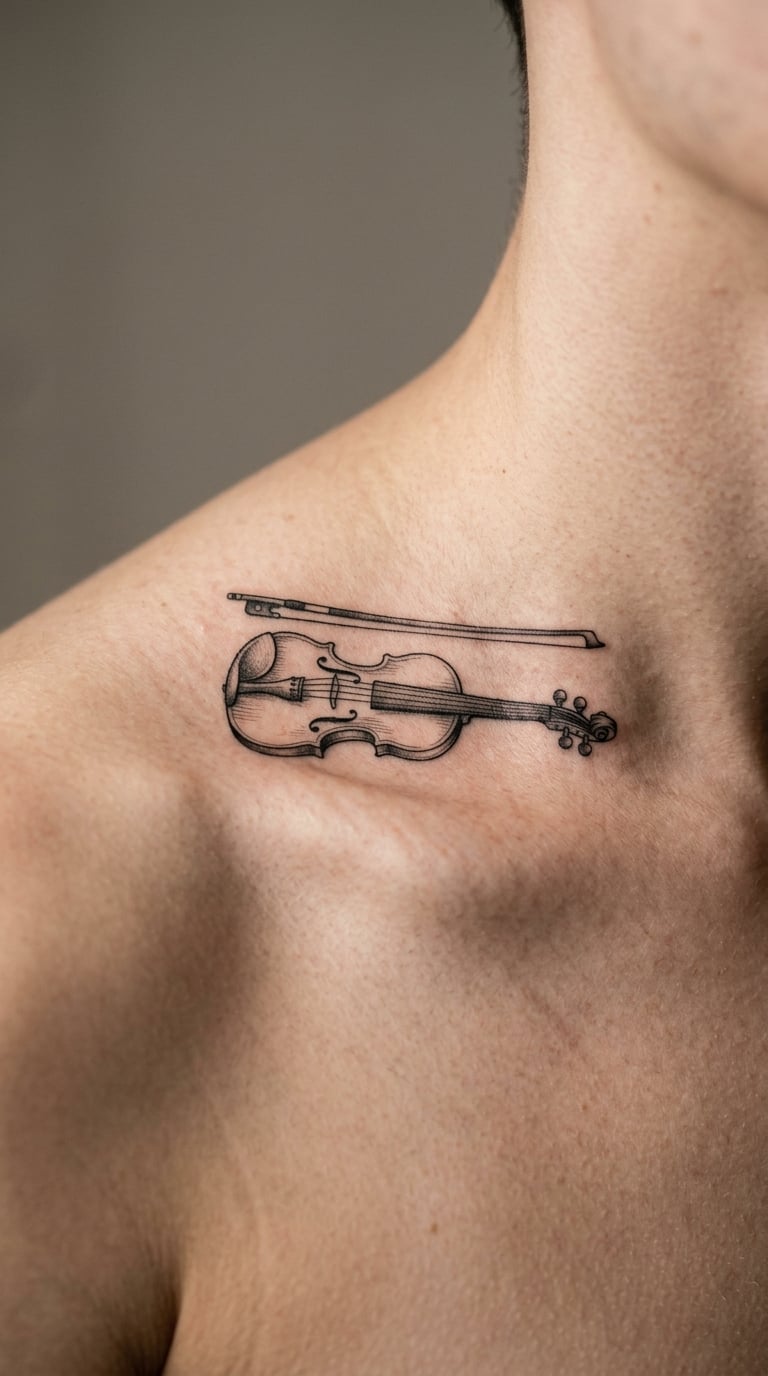
Laying the violin on its side across the collarbone gives the design a completely different energy. The bow runs parallel above or below the body, a few millimetres away, and the whole thing follows the bone rather than fighting it. Nothing here is vertical, which is what makes it stand out from the usual forearm piece.
People pick this one when they want a music tattoo that reads as decoration from across a room rather than as an instrument diagram up close.
Placement: just above the collarbone, or mirrored on both sides. Size: 3.5 to 4.5 inches (9 to 11 cm) wide. Style: fine line with a solid black bow. Pain: medium. Bony areas bruise more visibly and clothing sits right on top of it while healing. Make it yours: angle the bow a few degrees so it looks caught mid-stroke rather than parked.
5. Realistic Violin Portrait on the Forearm
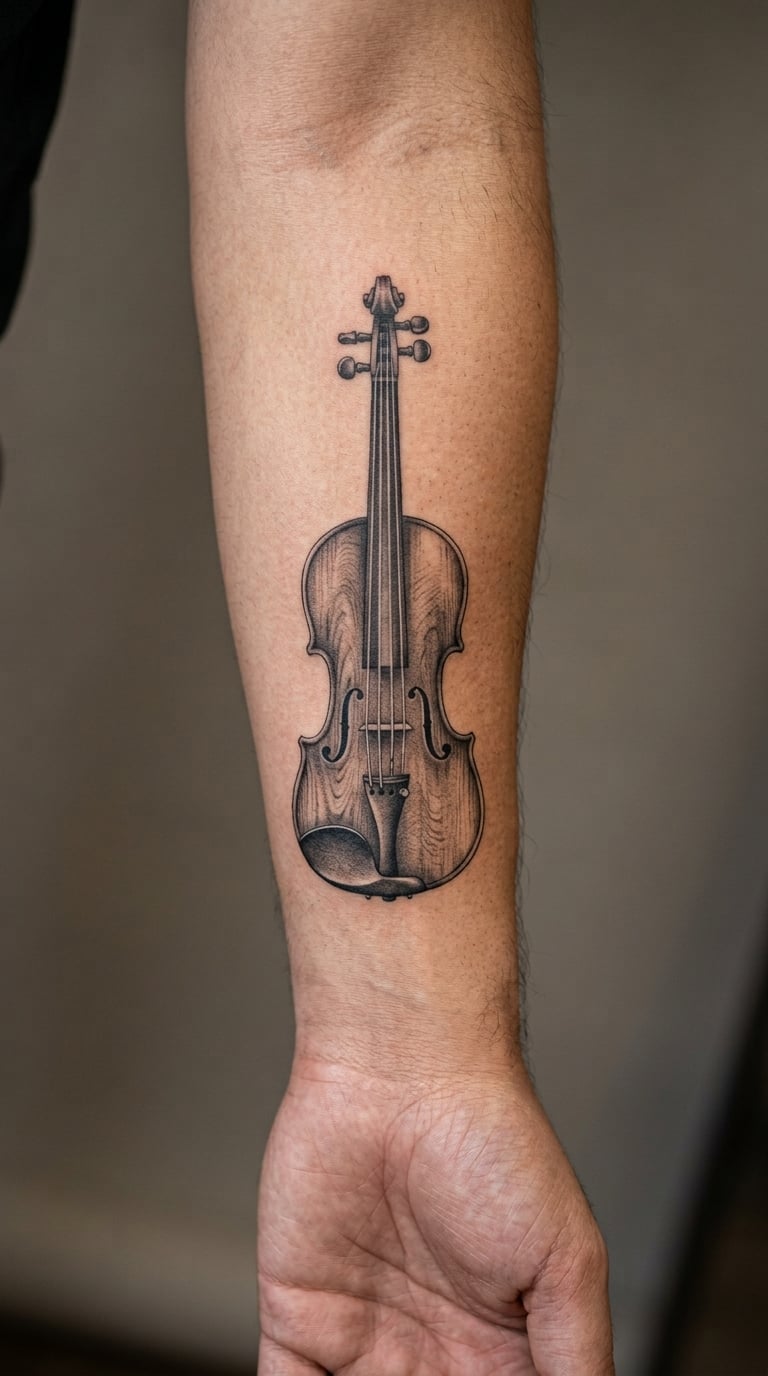
A realistic violin portrait is a study in surface: the curl of the scroll, the flame of the maple on the back, four strings of decreasing thickness, a bridge, and two properly shaped f-holes. Done in black and grey, it looks like a photograph of a specific instrument rather than a generic symbol.
This is the version that suits players, because the details are the ones that matter to someone who has held one. Bring your own violin to the consult if you have it.
Placement: inner forearm, lengthwise, comfortably clear of the wrist crease. Size: 5 to 6 inches (12.5 to 15 cm). Style: black-and-grey realism. Pain: medium, and expect a long sitting since the shading takes patience. Wood grain and string work blur into smudges under three inches, which is the single most common complaint from people who have had this done too small. Make it yours: ask the artist to copy the scroll and purfling of your own instrument.
6. Micro-Realism Violin on the Finger
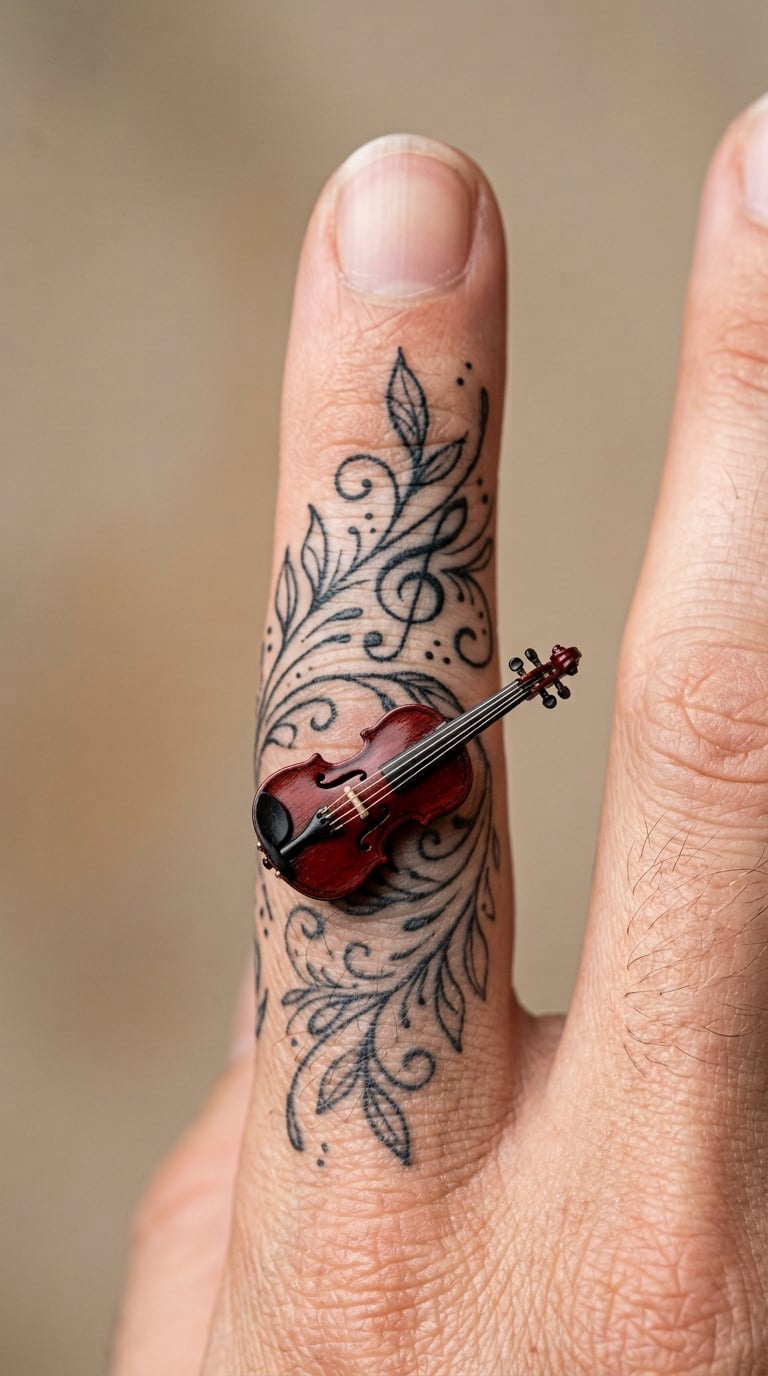
At one inch, this violin can only carry so much: a simplified body, one string suggestion, a single dark-red tone in the wood. Micro-realism works by dropping detail rather than shrinking it, so the piece reads as tiny and specific instead of small and blurry.
It is a good choice for a player who wants a playing hand to look like theirs. It is also the idea on this list most likely to need touching up.
Placement: side of the index finger or along the outer knuckle line. Size: 0.75 to 1.25 inches (2 to 3 cm). Style: micro-realism. Pain: high. Finger skin is thin, bony and extremely sensitive, and you will feel every pass. Knuckle creases eat fine detail, so expect the silhouette to soften within a few years. Make it yours: use a red or brown that matches the varnish of your own violin.
7. Traditional Violin and Banner on the Upper Arm
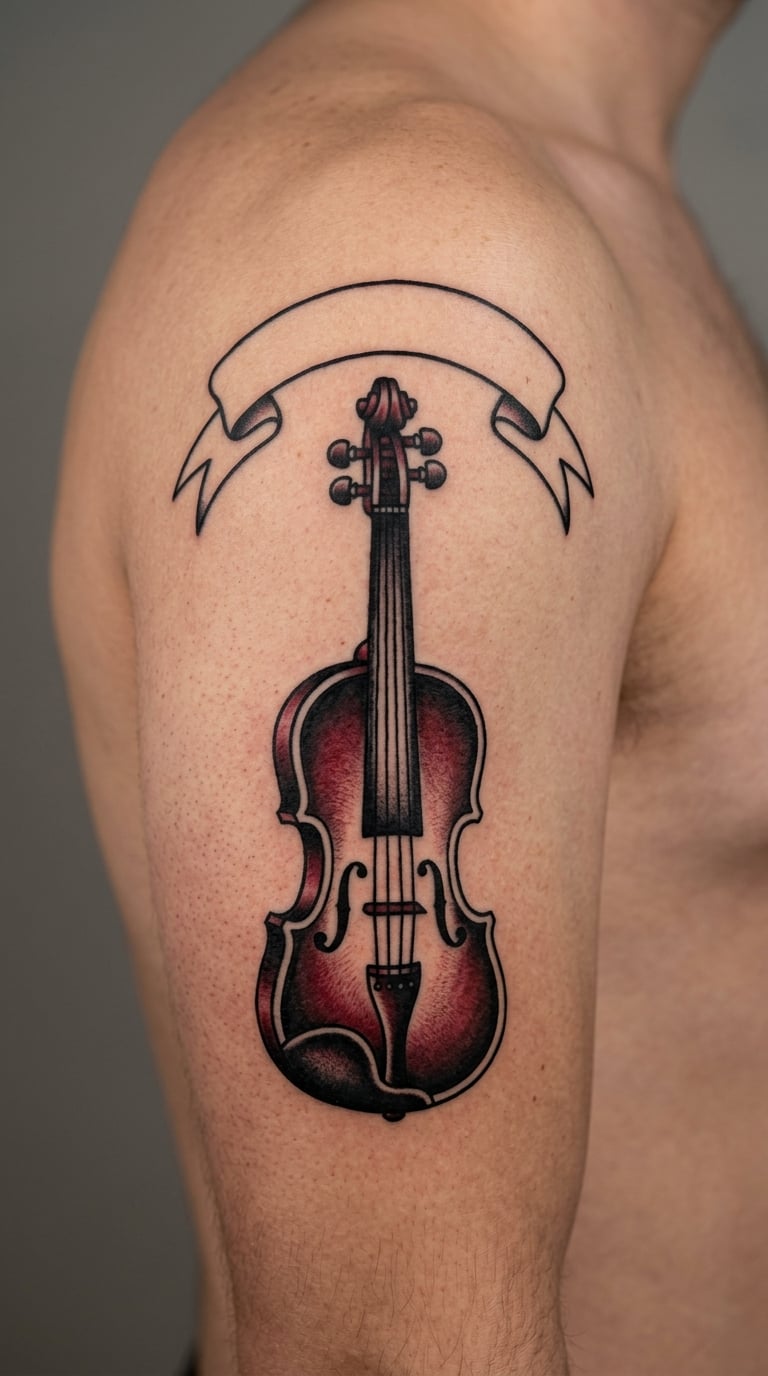
Traditional style gives the violin heavy black outlines, solid red shading and a flash of white in the upper bout, then hangs a short ribbon banner underneath. The banner is the useful part: it holds a name, a date, a place or a musical term without turning the design into a logo.
Pick a term that means something in your own life rather than a band name or an existing album cover, both because it will age better and because it will actually be yours.
Placement: outer upper arm or shoulder, with room for the banner to hang. Size: 5.5 to 7 inches (14 to 18 cm). Style: traditional. Pain: medium, and the upper arm is forgiving skin that takes bold saturation well. Bold fills are the most durable ink you can get, so this ages better than almost anything else here. Make it yours: letter the banner in a serif typeface and keep the wording to three words or fewer.
8. Blackwork Violin Split by Musical Staff
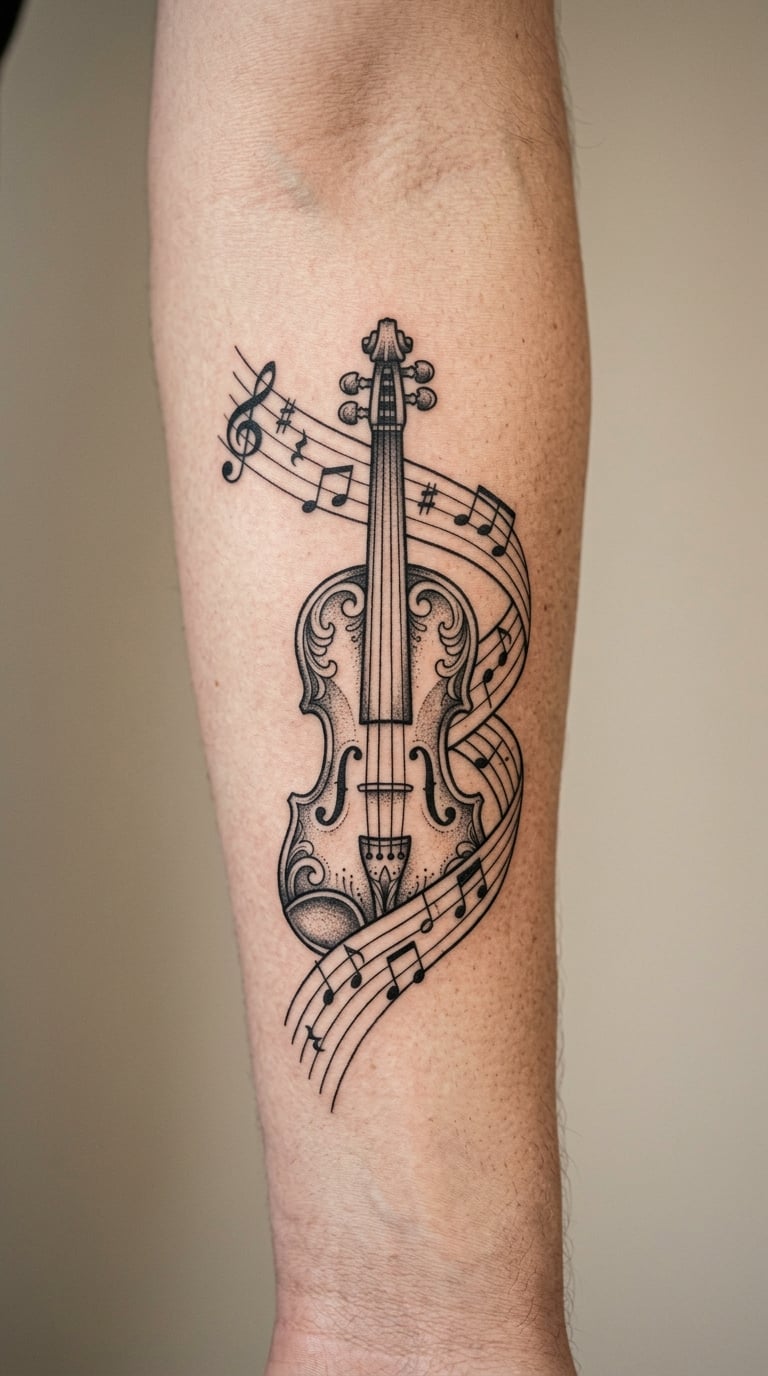
Here the violin is rendered as dense black mass and the staff runs straight through it, staff lines passing behind the body and notes spilling out on either side. The contrast between solid black and clean white space is what gives it movement, and the instrument stays recognisable because the outline stays intact.
This is a bold option with no colour at all, which makes it a good fit for people who want a violin tattoo that does not read as delicate.
Placement: outer forearm, vertical, with a couple of inches of clearance from the elbow. Size: 5 to 7 inches (12.5 to 18 cm). Style: blackwork with solid blacks. Pain: medium, and solid black areas take longer because the needle has to pass over the same spot repeatedly. Blackwork is the most durable option on this list, so it suits anyone who wants a piece that still looks strong in fifteen years. Make it yours: have the notes spell out a rhythm rather than a full melody.
9. Watercolor Violin on the Shoulder
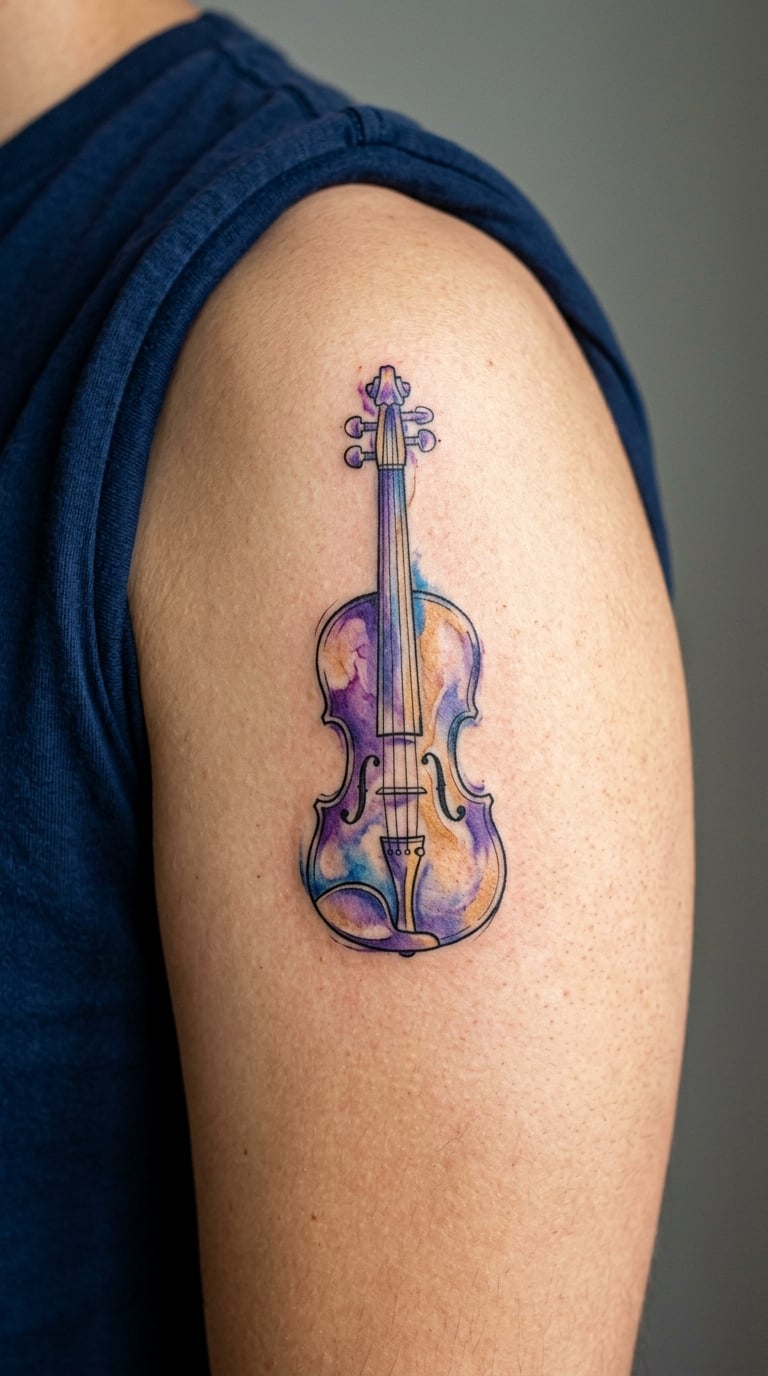
A watercolor violin is drawn in loose washes with a faint pencil or ink outline showing through, so the edges look soft and slightly unfinished. Violet into blue with a gold accent reads beautifully on skin, and the transparency of the fill means the shoulder skin tone shows underneath.
This suits people who like music tattoos but not heavy black ink, and it is the easiest style on the list to add to later without looking mismatched.
Placement: upper shoulder, near the sleeve seam, angled with the collarbone. Size: 3.5 to 4.5 inches (9 to 11 cm). Style: watercolor. Pain: low, and there is no heavy saturation to sit through. The one real drawback is durability. Soft washes fade unevenly, so expect the colour to need a refresh every few years. Make it yours: pick two colours rather than three, and let a little of the pigment run past the outline on purpose.
10. Geometric Violin on the Sternum
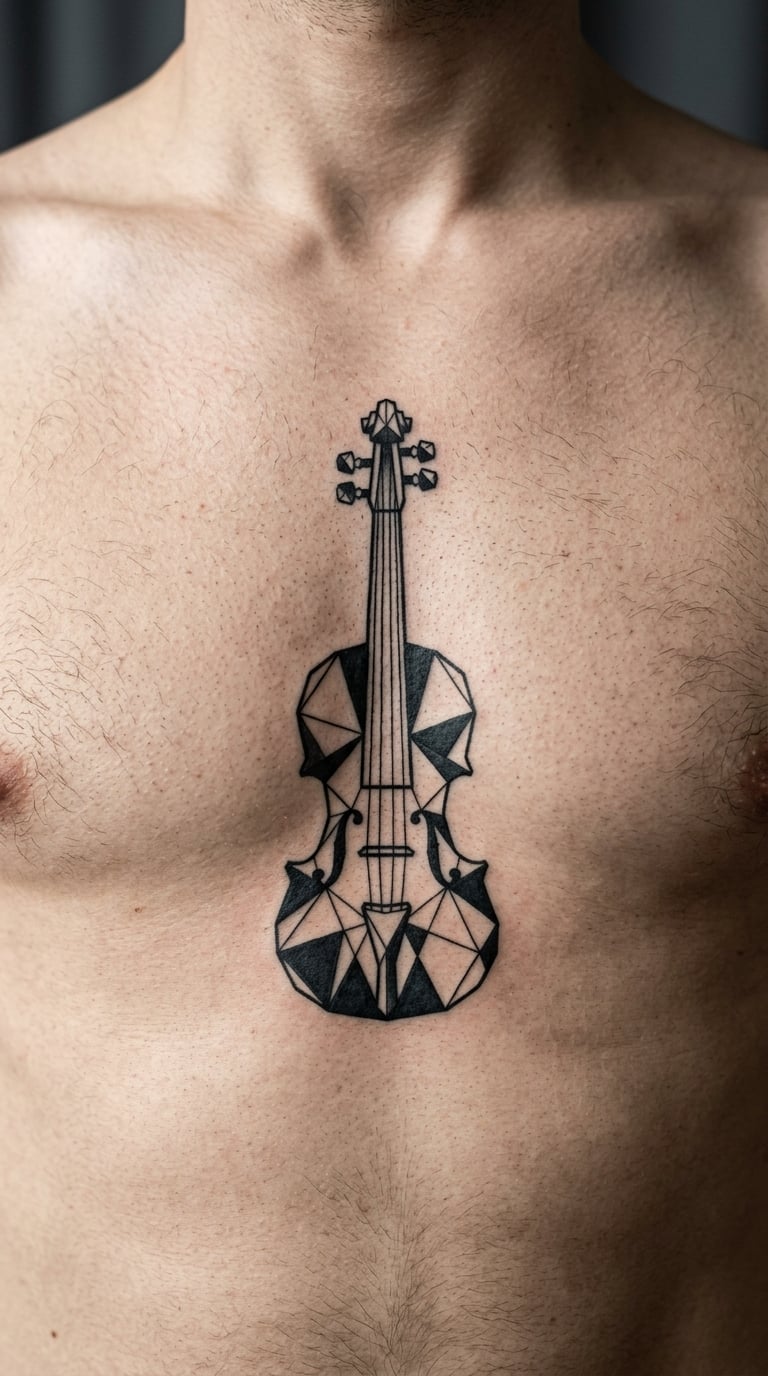
A geometric violin reduces the instrument to mirrored curves, triangles and clean negative space, with no shading anywhere. Drawn symmetrically, it stops looking like a violin and starts looking like a pattern, which is exactly what makes it a sternum design.
The sternum already has a vertical axis, so a bilaterally symmetrical piece sits on it perfectly. This is the boldest small design in the collection.
Placement: centred below the sternum notch, or higher between the collarbones. Size: 2.5 to 3.5 inches (6.5 to 9 cm) tall. Style: geometric linework with solid black facets. Pain: high. Bone and thin skin over the chest hurt, and the movement there makes any fine geometric line difficult. Keep facets chunky; hairline geometric work smears within a couple of years. Make it yours: have the facets pick up a real instrument’s curve rather than a generic template.
11. Violin with a Music Note Rising from the F-Hole
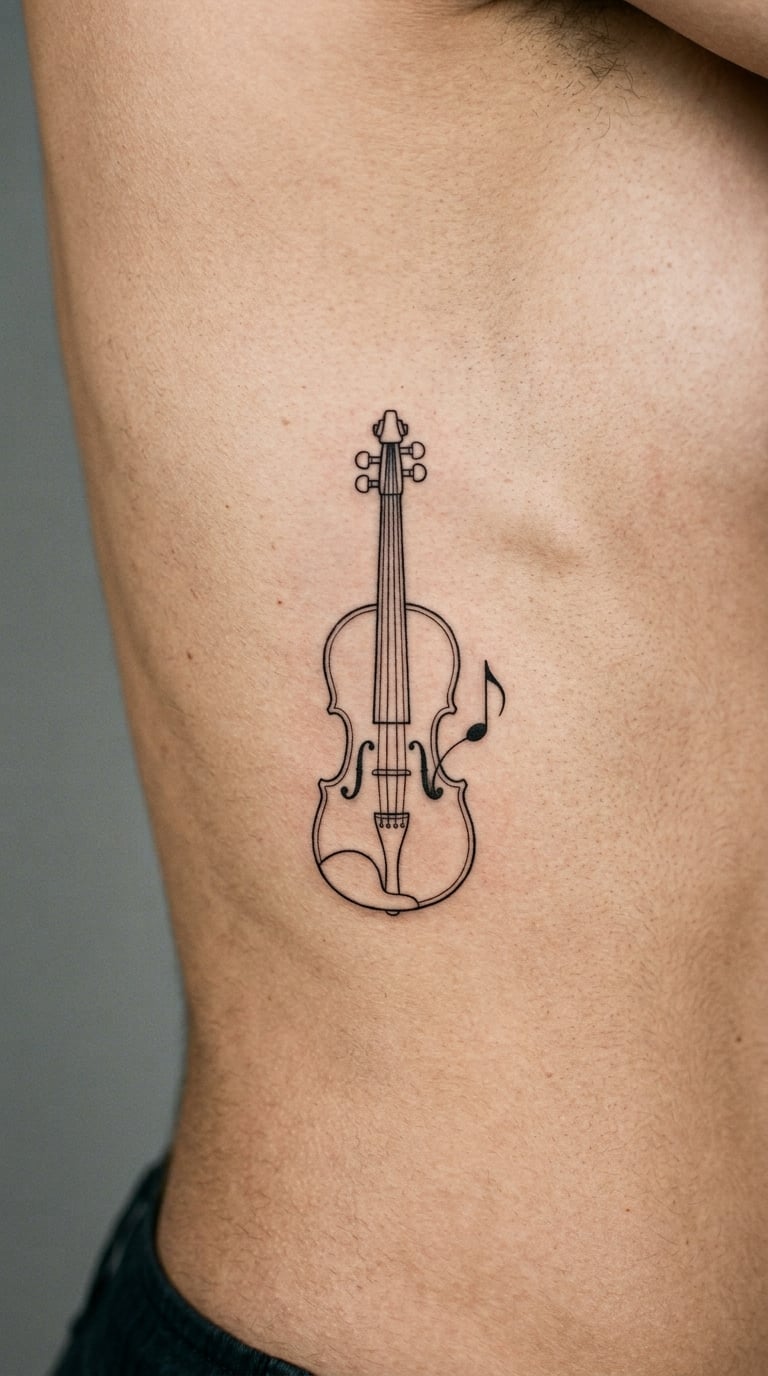
A small note drifts out of one f-hole, as if the instrument had just produced it. Drawn in fine line, the note is a single filled oval with a stem and a curved flag, kept simple so it stays legible next to the instrument. The whole composition is a little playful without turning cartoonish.
It reads as sound made visible, which is a good description of why people get music ink in the first place. I would not attach a fixed meaning to it beyond that.
Placement: rib or side torso, spaced a few inches from the waist curve. Size: 1.5 to 2.5 inches (4 to 6 cm). Style: fine line with one solid element. Pain: high, and rib skin is among the most sensitive areas to tattoo. Side placements also stretch when you twist or bend, which is what bends fine linework. Keep the violin simple and the note solid. Make it yours: make the note an accidental, a rest or a sharp symbol that means something to you.
12. Vintage Violin Engraving on the Bicep
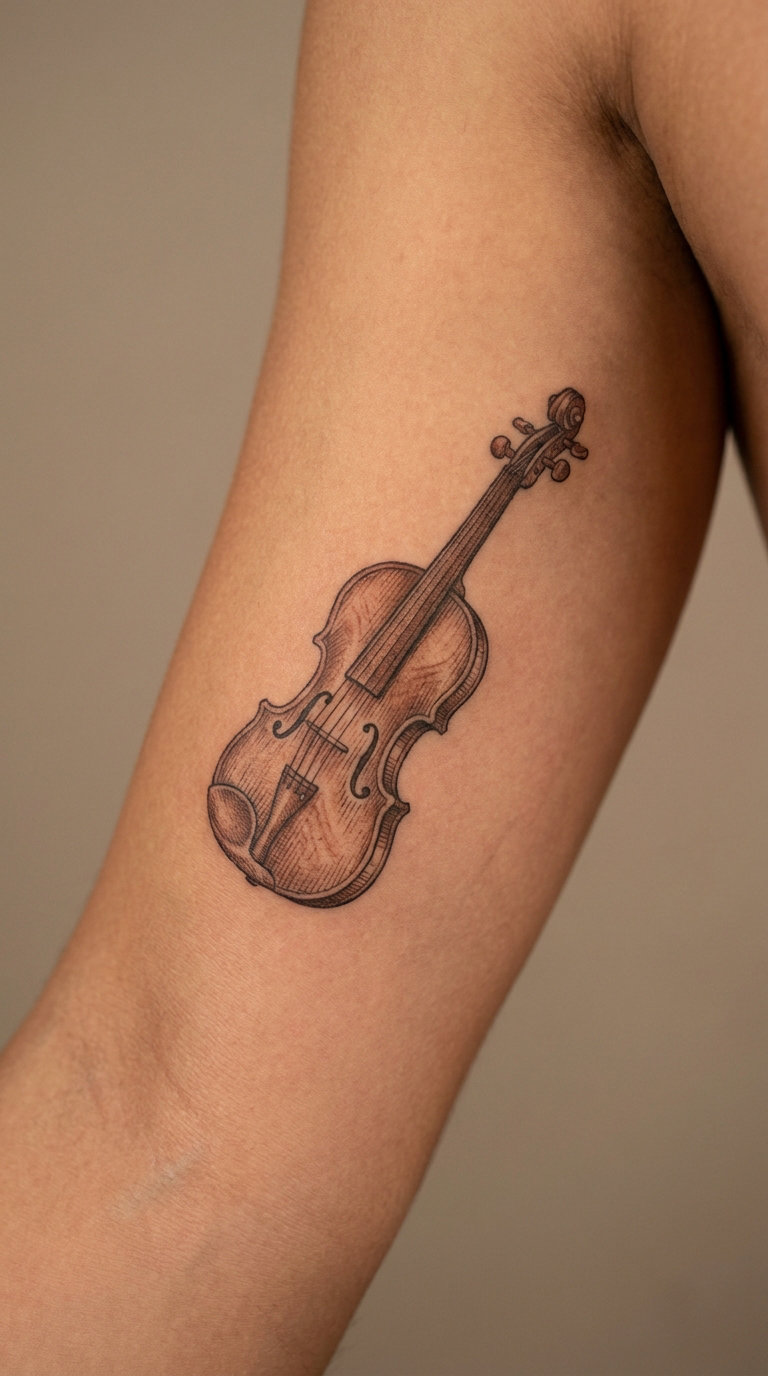
This one borrows from eighteenth-century instrument illustration: fine crosshatched shading, ornamental curves around the scroll and an ink-and-wash sepia palette. Nothing is glossy and nothing is bold. It looks like a page from a book of instrument makers, which gives it a quiet, scholarly weight.
It suits players who care about the craft of the object, and it reads as antique rather than as a music-logo mashup.
Placement: inner bicep, running vertically, or outer bicep. Size: 4.5 to 6 inches (11 to 15 cm). Style: antique engraving with crosshatching and muted brown wash. Pain: medium, and the inner bicep is meaty and one of the more comfortable spots on the arm. Hatching needs a steady hand and a steady client, so expect a long appointment. Make it yours: copy the layout of a real instrument-maker’s plate and include the year on the pattern.
13. Violin and Bow Matching Pieces on the Forearm
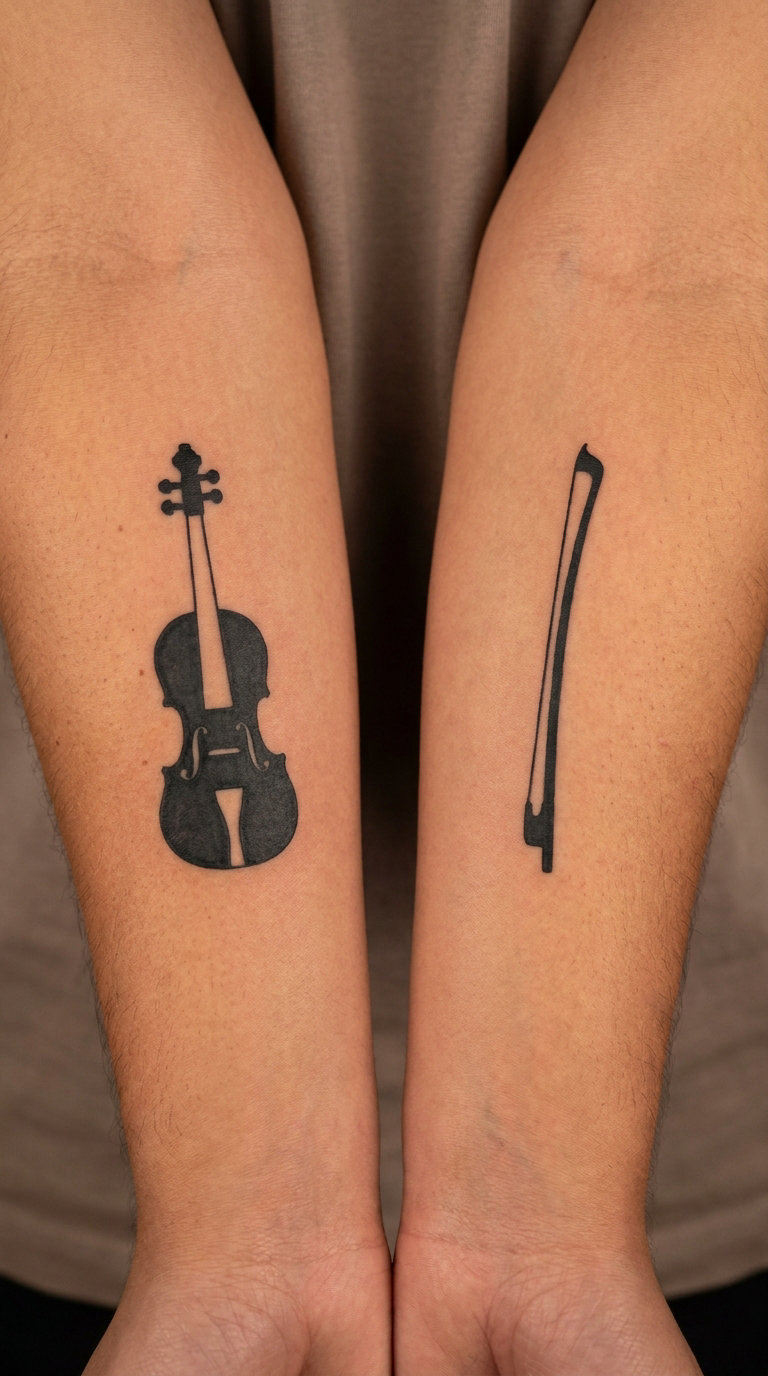
Two small tattoos instead of one: a solid-black violin on one inner forearm and a curved bow on the other, same line weight, same size, the bow turned the other way so they mirror each other. A pair like this reads as a deliberate set even to people who cannot tell you what a violin looks like from behind.
Matching designs are the easiest way to share a music theme with someone without copying the same picture twice. It is a good fit for partners, siblings or close friends who all play, and if you are booking two rather than one, our matching tattoo ideas for roommates covers the sizing and timing side of planning a pair.
Placement: inner forearms, same height on both arms, or one on the wrist and one on the bicep. Size: 1.5 to 2.5 inches (4 to 6 cm) each. Style: minimalist solid black. Pain: medium, twice, though the second sitting is usually easier. Make it yours: put a small private mark inside one of the pieces, like a maker’s stamp, visible only to you.
14. Abstract Violin Built from Flowing Lines
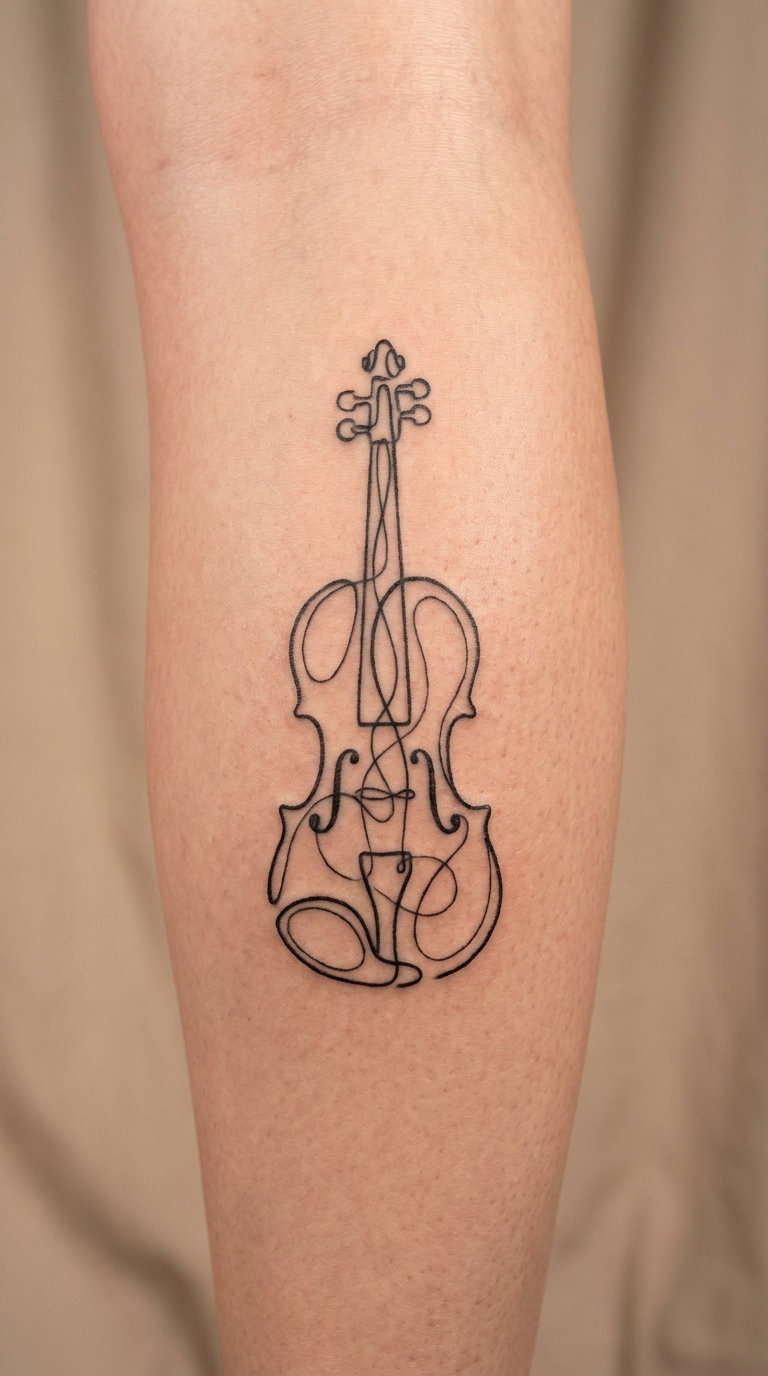
Nobody draws the outline. A single continuous line loops in on itself, tightening at the waist and widening at the bouts until the eye assembles a violin out of the movement. The result is contemporary and light, and it sits oddly well on a large flat area like the calf.
Because the form is never stated outright, there is no fixed meaning to decode. It is a good option if you like music tattoos but find literal instruments too on-the-nose.
Placement: outer calf or inner arm. Size: 3.5 to 5 inches (9 to 12.5 cm) tall. Style: abstract linework. Pain: low to medium, and the calf is a comfortable canvas that barely moves when you do. Fine loops need a bigger canvas than people expect; below three inches the loops tangle into noise. Make it yours: have the line weight vary through the design so the quiet parts look quiet.
15. Gold Violin on the Back of the Hand
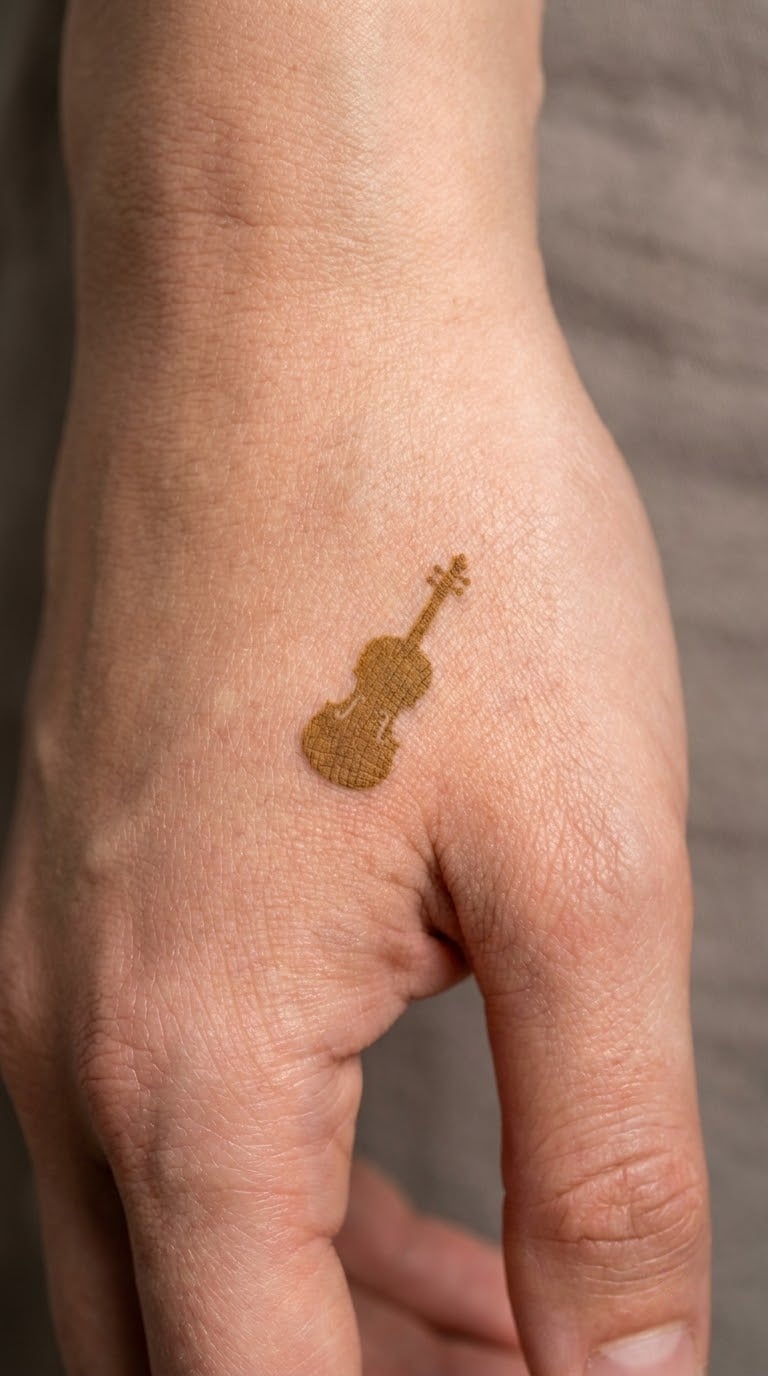
A flat gold violin silhouette, no shading, no highlight, just the solid shape. Yellow and white gold both work; white gold reads more neutral against most skin tones. It is a piece of metal-coloured body jewellery more than a drawing, and it needs the right artist to keep it clean.
Wrist and hand jewellery is popular right now, and this fits that without looking like jewellery from a shop.
Placement: back of the hand between the knuckles, or along a finger. Size: 1.5 to 2.5 inches (4 to 6 cm). Style: solid gold, no shading. Pain: high. Hand skin is thin over bone and knuckles are genuinely uncomfortable. Metallic pigment also fades faster than black, so expect a noticeably duller finish in three to five years and budget for a solid re-fill. Make it yours: match the gold tone to a ring or watch you already wear.
16. White and Black Violin on the Ankle
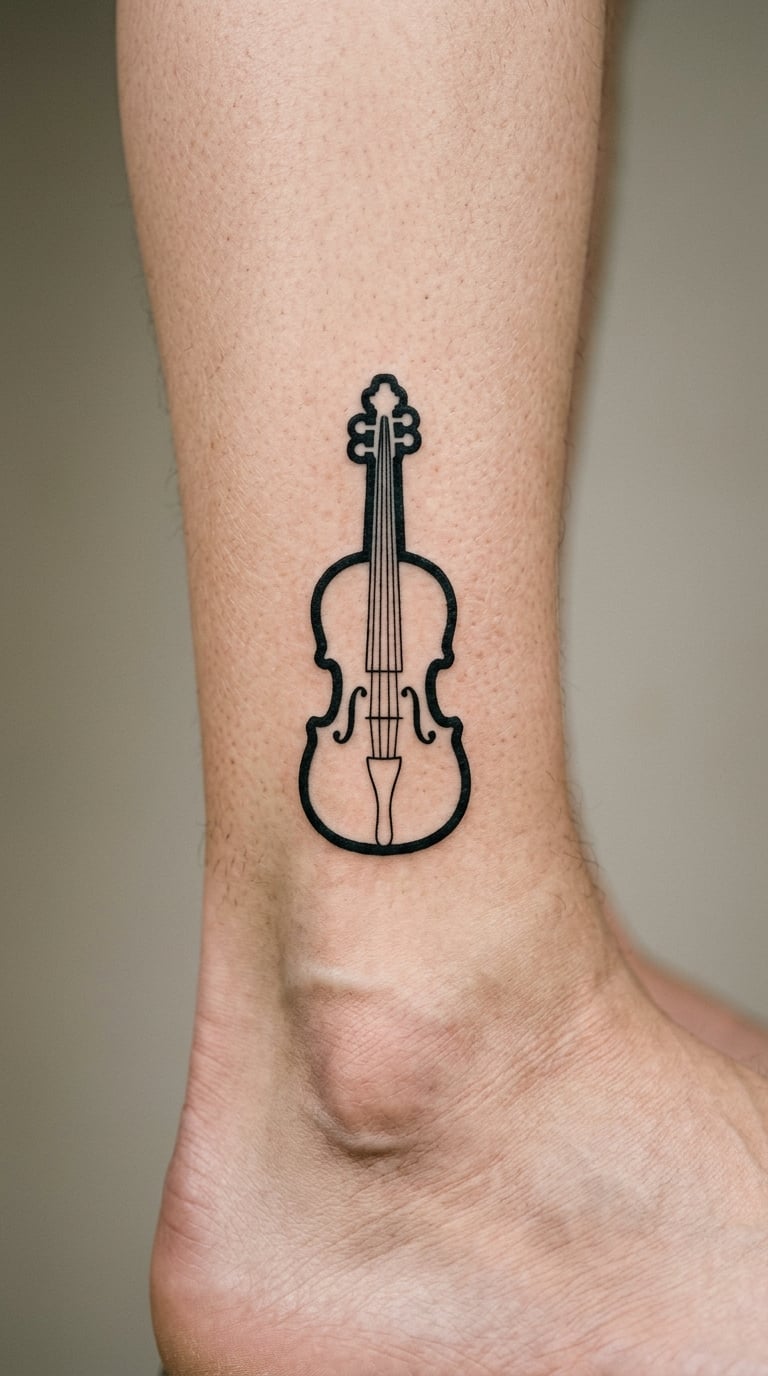
Here the violin is white because of what surrounds it. A heavy black outline is drawn, the interior is left as bare skin, and the shape reads as a cutout. The trick that makes it work at two inches is that no interior lines are added at all; the silhouette does the whole job.
Ankles suit graphic, high-contrast designs, and this one keeps its shape better there than almost anywhere else. It also reads well from a distance.
Placement: just above the ankle bone, or below it near the Achilles. Size: 1.5 to 2.5 inches (4 to 6 cm) tall. Style: high-contrast graphic with negative space. Pain: medium, and the ankle bone is sensitive in a sharp, quick way. Ankle tattoos fade faster than arm tattoos because of shoe rub and sun exposure, so placement and aftercare matter more here than anywhere else on this list. Make it yours: rotate it slightly to follow the tendon line rather than sitting perfectly upright.
17. Violin Sheet-Music Pattern on the Upper Arm
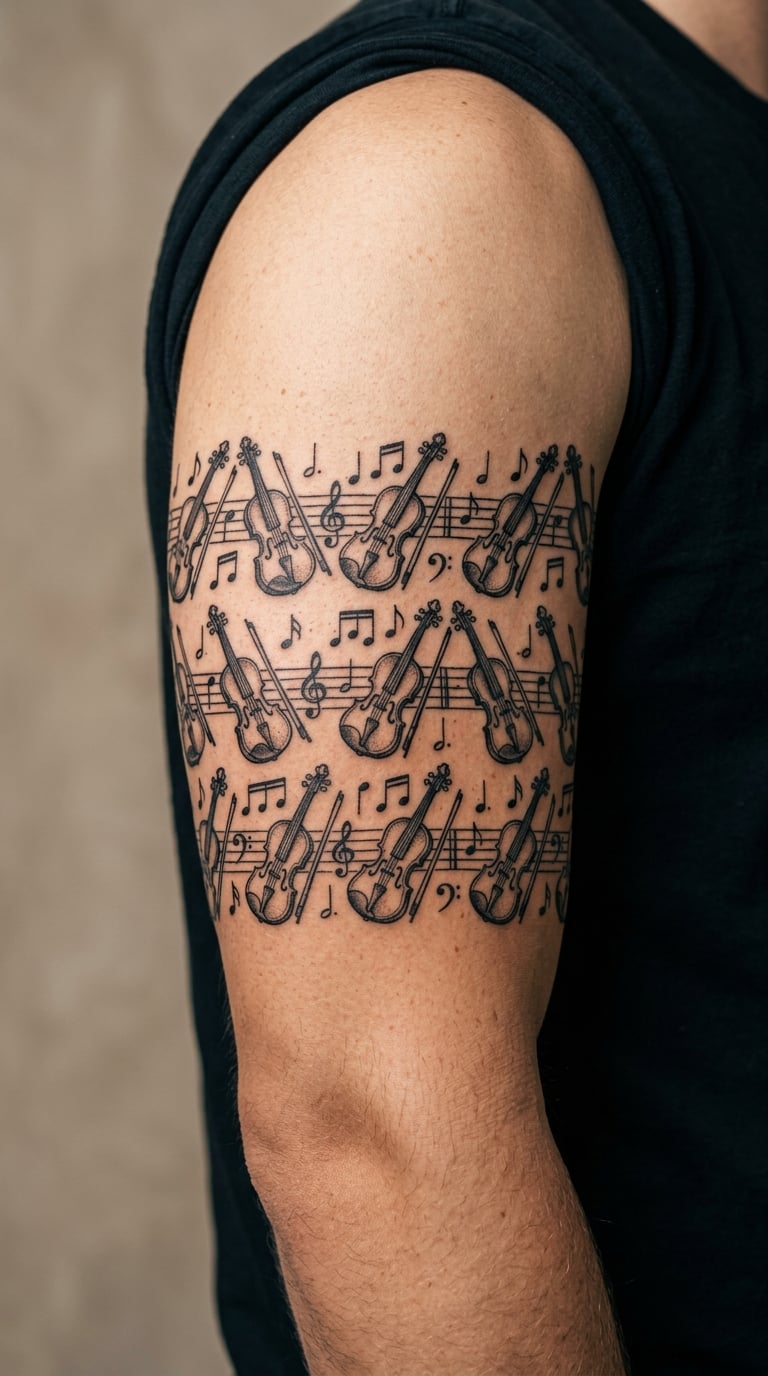
This is a repeat, not a portrait. Small violins alternate with bars of notation across a field, and the pattern fills the space the way wallpaper fills a wall. It is the one design here that is really a pattern piece, and it is closest to a half-sleeve in ambition.
Scale is what decides whether this works. Under four inches tall the repeats collide into visual noise; at seven to eight inches the eye reads a pattern rather than a pile.
Placement: outer upper arm, wrapping slightly, or the upper back. Size: 7 to 9 inches (18 to 23 cm) tall. Style: repeating black-ink pattern. Pain: medium, spread over two or three sessions given the area. Fine notation detail is pointless below five inches; use bars and note shapes as texture instead of readable music. Make it yours: break the repeat once with a single solid violin at the centre, so the eye has somewhere to land.
18. Quarter-Frame Violin on the Hip
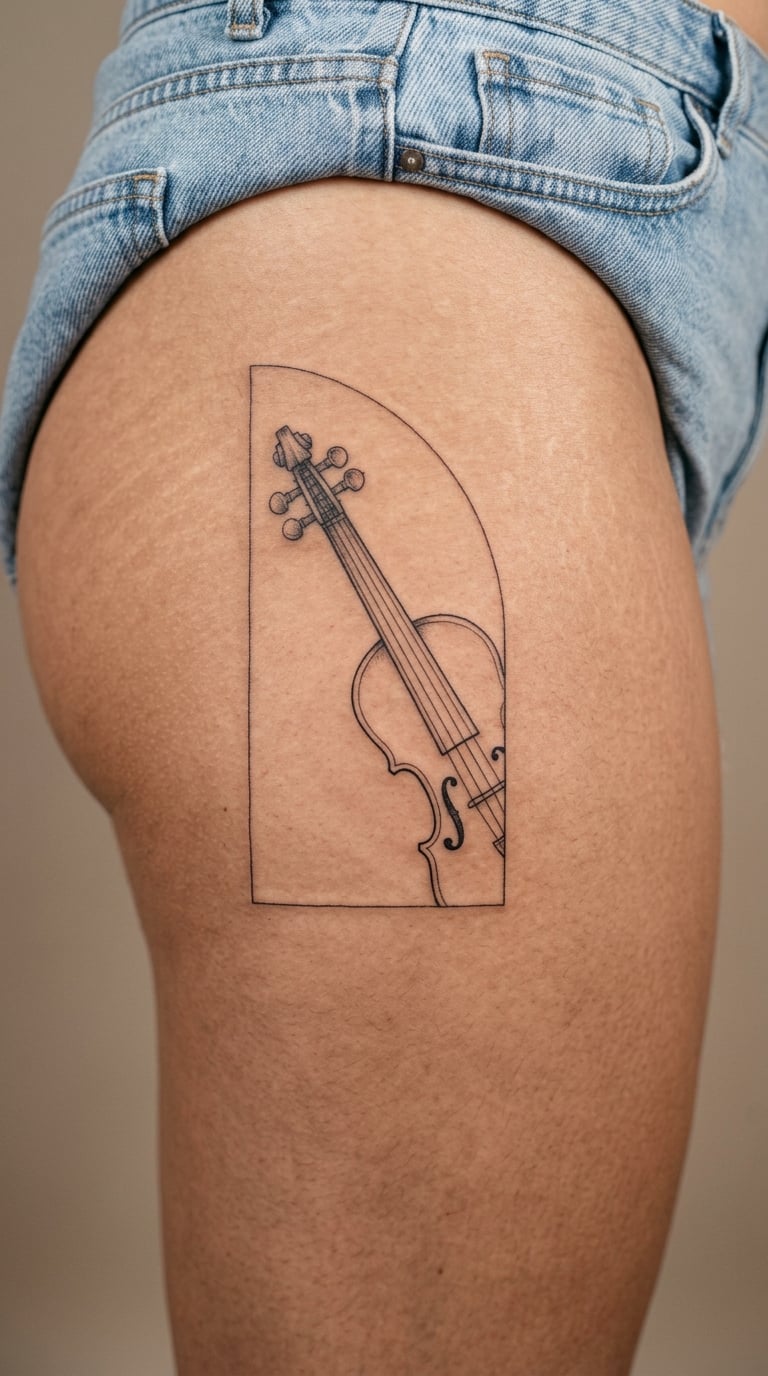
A partial violin curves along the inside of a fine quarter-circle border, so the instrument appears to be sliding out of a window frame. The border is one confident stroke with a consistent weight, and the violin is cut off rather than complete, which keeps the whole thing light.
Hip and rib frames suit curved body locations because the frame echoes the shape of the body instead of fighting it.
Placement: outer hip, above the hipbone, or the side of the ribs. Size: 2.5 to 3.5 inches (6.5 to 9 cm) wide. Style: fine line with a geometric border. Pain: low to medium on the hip, higher if the frame runs down onto the ribs. The outer hip has a slight curve, so the border may need adjusting to sit evenly at the top. Make it yours: use the frame as a date, a set of coordinates or the year you started playing.
19. Violin with a Small Rose Detail
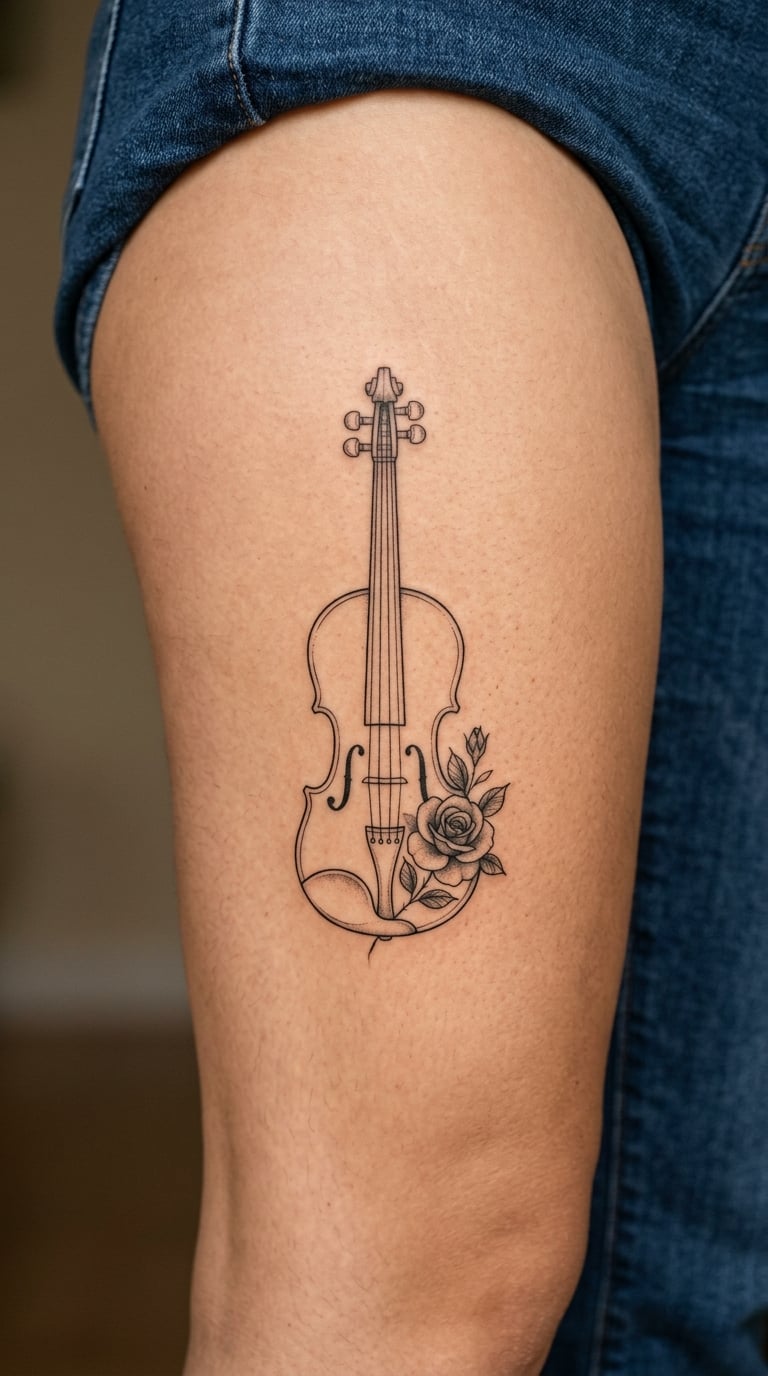
A clean violin outline with a single rose sitting in the lower bout, roughly a quarter of the instrument’s width. One bloom, not a spray. The rose carries the only shading in the piece, a few tight spirals of petal, and everything else stays as an outline.
It is a personal design rather than a symbol, and it works well as a memorial piece for someone who played and also grew things.
Placement: outer thigh, inner thigh, or outer forearm. Size: 2.5 to 3.5 inches (6.5 to 9 cm). Style: fine line with light shading in the flower. Pain: low, and the thigh is a large, calm surface. Spiral rose shading blurs with age, so keep the petals open rather than packing them tight. Make it yours: have the rose be a specific variety with a real name rather than a generic flower.
20. Expressive Bow-Only Tattoo Behind the Ear
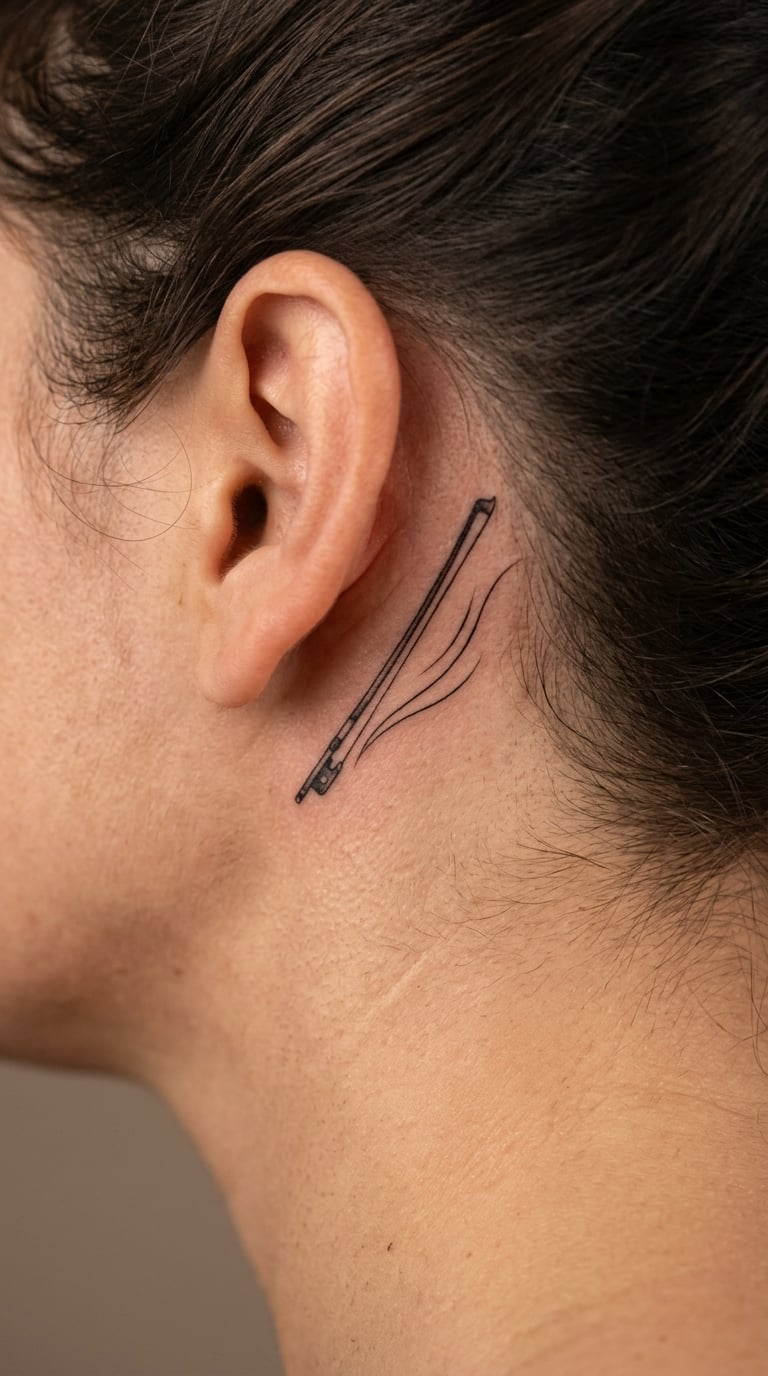
No violin at all. Just the bow, tilted on a diagonal, with three flowing lines trailing off one end to suggest movement. The curve of the stick and the hair line give you two parallel lines, which is enough to make it readable at a very small size.
It is the answer for someone who wants a music tattoo that is unmistakably music-adjacent without being the obvious choice. The bow is a much less used motif than the instrument.
Placement: behind the ear, along the jawline, or on the wrist. Size: 1.5 to 2.5 inches (4 to 6 cm) long. Style: minimalist with a few motion lines. Pain: low behind the ear, medium on the inner wrist. Motion lines drawn too thin will blur into smudges, so give them more weight than feels necessary. Make it yours: angle the bow to match the line of your jaw or the line of your forearm.
21. Blue Ceramic-Style Violin on the Calf
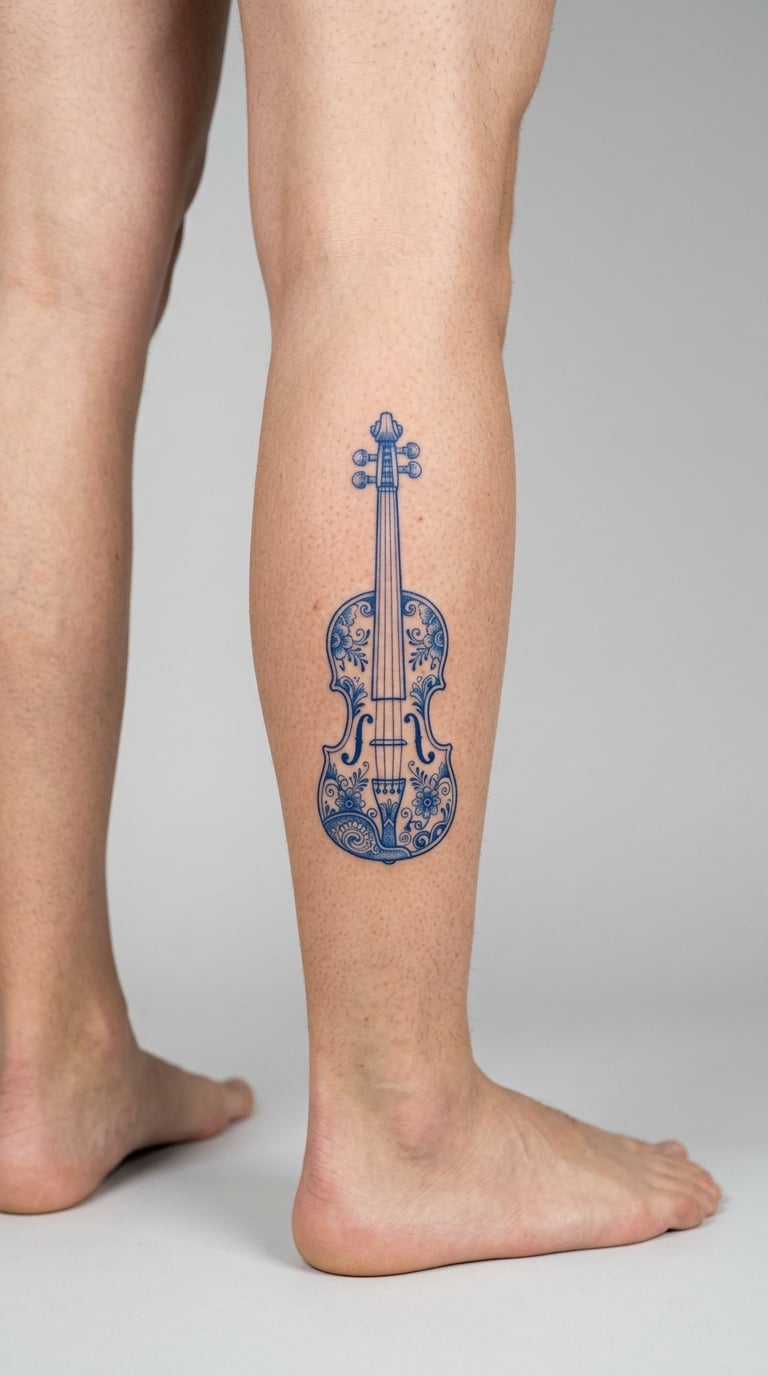
Rendered as if it were glazed porcelain: white body, cobalt and pale blue patterning, crisp outlines where the pattern meets the edge. Small floral or geometric motifs fill the bouts and the border around the instrument. The key is keeping the black outlines sharp so the whole thing does not turn to mush.
It is a craft-inspired style that reads clearly from across a room, and colour work gives you room to add other small pieces later.
Placement: outer calf, which gives the design a tall clean canvas. Size: 4.5 to 6 inches (11 to 15 cm) tall. Style: colour illustrative with bold blue pigment. Pain: low, and the calf is comfortable to work on. Pale blue is a difficult pigment to heal because it settles light, so expect a tone slightly deeper than the reference image. Make it yours: use a pattern family tied to somewhere you have actually been, like a tile style from a trip.
22. Large Blackwork Violin Composition on the Thigh
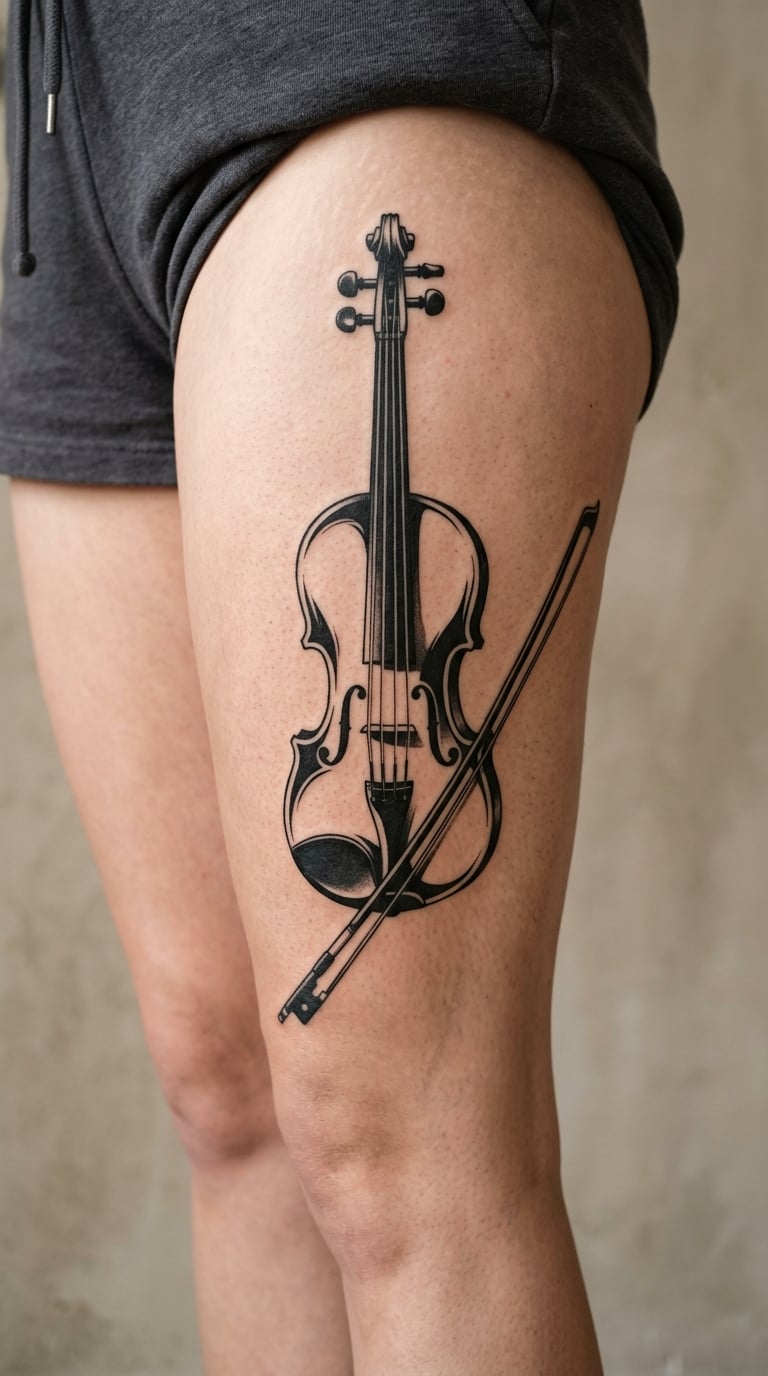
The big one. A full-size violin at eight inches or more, rendered in dense blackwork with a bow sweeping across the body and wide areas of clean white space left untouched. The black areas carry the weight, the white areas carry the shape, and the whole thing reads like a poster rather than a sketch.
This is a collector’s piece. It needs a real canvas, more than one session, and an artist who does blackwork at that scale well. If you have never been tattooed, this is not where you start.
Placement: outer thigh, or the upper back for a similar vertical drop. Size: 7 to 10 inches (18 to 25 cm) tall. Style: blackwork with solid blacks. Pain: medium, though a thigh session is long and uncomfortable by the second hour. Blackwork is durable, so the finish will still look strong in ten years. Make it yours: commission the composition around a specific instrument rather than a stock silhouette.
How to Choose the Right Design
Check the canvas against the detail before you check anything else. These 22 violin tattoo ideas vary from a one-inch silhouette to a ten-inch blackwork composition, and detail that reads well at eight inches turns to smudge at two.
Match detail to size. Strings, wood grain and readable sheet music need at least four or five inches. Below that, work with silhouette, negative space and one solid shape.
Pick a placement you can live with. Wrist and collarbone suit small pieces. Forearm, bicep, calf and thigh suit larger work. Ribs, sternum, fingers and the back of the hand hurt more and fade faster.
Decide how literal you want to be. Silhouette and fine-line designs are understated. Traditional, blackwork and geometric designs are loud. Watercolor and ceramic styles are colour without heavy saturation.
Be honest about your music. Players usually want the instrument’s details right. If you do not play, a bow, an f-hole or an abstract line version often means more than a full portrait.
Plan for fading, not just for the day. Hairlines, pale washes, whites and small detail on hands, feet and ribs all soften first. Bold black line and solid black are the most durable.
Bring a reference and a reason. A photo of a real instrument, a specific instrument-maker’s pattern or a melody you want encoded gives an artist far more to work with than a mood board.
22 Violin Tattoo Ideas by Style, Size and Placement
Grouped by style, here is how the 22 designs divide up and where each group works best on the body.
| Style group | Ideas | Typical size | Best placements | Durability |
|---|---|---|---|---|
| Fine line and minimal | 1, 2, 3, 11, 13, 16, 18, 19, 20 | 1.5 to 3.5 in (4 to 9 cm) | Behind the ear, wrist, forearm, hip, thigh | Softens fastest |
| Realism and micro-realism | 5, 6 | 1 to 6 in (2.5 to 15 cm) | Inner forearm, finger, bicep | Depends on line weight |
| Traditional | 7 | 5.5 to 7 in (14 to 18 cm) | Upper arm, shoulder | Very durable |
| Blackwork | 8, 22 | 6 to 10 in (15 to 25 cm) | Outer forearm, thigh, upper back | Very durable |
| Colour | 9, 21 | 4 to 6 in (10 to 15 cm) | Shoulder, calf | Washes fade, solid blue holds better |
| Geometric, abstract and pattern | 10, 14, 17 | 3 to 9 in (7.5 to 23 cm) | Sternum, calf, upper arm | Solid facets last, hairlines do not |
| Antique engraving | 12 | 4.5 to 6 in (11 to 15 cm) | Inner or outer bicep | Hatching softens with sun exposure |
Cost and Session Time
US tattoo shops price by the hour or by the piece, and the same violin design costs dramatically more at eight inches than at two because the needle has far more area to cover. Rates vary widely by city and by artist, and most studios have a shop minimum that applies no matter how small the work is.
A rough guide by size band:
Micro (under 1.5 inches): usually the shortest session, often 20 to 45 minutes and roughly $80 to $150, though the shop minimum often applies more than the time does. Hand and finger micro work is the most commonly declined request for new clients.
Small (1.5 to 3 inches): roughly 45 to 90 minutes, usually about $150 to $300. A fine-line outline, a silhouette or a bow-only piece sits comfortably here.
Medium (3 to 6 inches): roughly 90 minutes to two hours, commonly $300 to $600. This is the band where realism, traditional and most colour work live, and where the extra detail actually starts to pay off.
Large (6 inches and up): split across two or more sessions of three hours or less, starting around $600 and climbing well past $1,200 for a full blackwork thigh piece. The thigh composition, the pattern piece and the full realism portrait all fall here.
Two things drive the total more than size does: the artist’s hourly rate, and how many times a large black area has to be filled to get solid coverage. Ask what the hourly rate is and whether the design fits in one sitting before you commit. Touch-ups on a free line are normal, but colour on the shoulder and metallic gold are not free, and both need budgeting for a second session within the first year or so.
Aftercare Basics
- Follow your artist’s aftercare instructions first. They know what they used on your skin and how deep it went.
- Wash gently with clean water and unscented soap, then pat dry with something that is not a paper towel.
- Keep the fresh tattoo loosely covered for the first few days while you sleep and shower, then leave it open to the air.
- Wear loose clothing over the area. A collarbone, ankle or wrist tattoo pressed against a tight waistband or shoe is what causes most early damage.
- Keep it out of direct sun, especially for the first few weeks, and skip swimming pools and hot tubs until it has closed over.
- Use only the product your artist recommends. Avoid mixing healing salves from different sources without asking them first.
Frequently Asked Questions
What is the best violin tattoo for a first tattoo?
The minimal silhouette on the inner wrist is the safest first violin tattoo, because a solid black shape holds its edge far better than fine line or realistic detail. Keep it between one and a half and two and a half inches so the f-holes stay readable. A fine-line outline behind the ear works well too, though it will need refreshing sooner.
Are violin tattoos suitable for small and delicate placements?
Yes, as long as the design matches the size. At two inches you can hold a silhouette, a bow, a scroll or an f-hole, and you can use negative space to keep it readable. Realistic strings, wood grain and legible sheet music all need four or five inches minimum. Below that, detail turns to smudge within a few years.
Does a violin tattoo hurt more on the wrist or ribs?
The ribs hurt noticeably more than the wrist. Wrist tattoos usually sit around a five or six out of ten, while ribs are bone over thin skin and are among the most sensitive places to be tattooed. Ribs also stretch when you twist, which is what bends fine linework over time. Ribs suit bold black and solid colour far better than hairlines.
What happens to fine-line violin tattoos over time?
Fine line softens noticeably within a few years and blurs faster behind the ear, on the hands, on fingers and on the ribs, where skin stretches and shoes rub. Solid black silhouettes and blackwork hold their edges much longer. If you want the least maintenance, ask for a heavier line weight or a filled shape from the start rather than planning on touch-ups.
What does a violin tattoo mean?
A violin tattoo usually signals a personal relationship with music, whether that is playing, listening, or a memory of someone who played. The added elements shift the meaning: a broken violin leans toward loss, sheet music points to a specific piece, wings toward freedom. Plenty of people choose it purely for the shape, and nobody can read that as anything other than what you tell them.
Conclusion
Pick through these 22 violin tattoo ideas and you will still only find one that suits you. For a first tattoo, the minimal silhouette on the inner wrist gives you a clean, low-maintenance design that still reads as a violin. If you already have a few pieces and want something that will look strong in ten years, the blackwork thigh composition is the more serious option.
Start by comparing references that look like the size you actually want, then think honestly about where it will live on your body and how much detail that spot can hold. Book a consultation with an artist whose portfolio already has violin geometry in it, and bring a reference image, even a photo of your own instrument.