
25 Gothic Flower Tattoo Ideas: Best Dark Designs (October 2026)
These 25 gothic flower tattoo ideas cover everything from a fine-line black rose on the inner forearm to a nine-inch dark mandala on the thigh. Every entry below describes the linework, shading and placement clearly enough that you could hand it to an artist as a starting brief.
A gothic floral sits in a very specific visual lane. Heavy black fills, hard contrast against open skin, grey wash where light is needed, and flowers shown as half-open, dormant or already collapsing rather than fresh. If you are after soft pastel petals, this is the wrong list. If you want dark romantic, witchy, dark academia or Victorian mourning aesthetics without a skull in every design, you are in the right place. These are updated for 2026, and most people book a floral once and never regret it.
25 Gothic Flower Tattoo Ideas: Quick Guide
| Idea | Style | Best placement | Size | Pain |
|---|---|---|---|---|
| 1. Fine-line black rose with ink drip | Fine line | Inner forearm | 2-3 in | Medium |
| 2. Blackwork peony wrapped in thorns | Illustrative blackwork | Outer upper arm | 4-5 in | Low |
| 3. Gothic lily beneath a cathedral arch | Fine line architectural | Forearm | 4 in | Medium |
| 4. Bleeding poppy in black and grey | Realism | Calf | 3 in | Low |
| 5. Dark rose with spiderweb background | Traditional | Upper arm | 4-5 in | Low |
| 6. Moonlit white rose in blackwork | Blackwork | Upper thigh | 3-4 in | Medium |
| 7. Dead peony, crumbling petals | Micro-realism | Wrist | 1.5-2 in | Medium |
| 8. Victorian mourning bouquet | Fine line | Forearm or thigh | 5-6 in | Medium |
| 9. Black dahlia with Art Nouveau curves | Illustrative blackwork | Calf | 3-4 in | Low |
| 10. Ink-bleeding anemone | Watercolour blackwork | Shoulder | 3-4 in | Low |
| 11. Gothic succulent and thorn cluster | Illustrative realism | Outer arm | 4-5 in | Low |
| 12. Poppy seed head and crescent | Minimal fine line | Behind the ear | 2-2.5 in | Low |
| 13. Black iris with stained-glass shading | Geometric colour | Forearm | 3-4 in | Medium |
| 14. Wilting orchid, neo-traditional | Neo-traditional colour | Calf | 3-4 in | Low |
| 15. Dotwork mandala flower on the spine | Dotwork | Upper spine | 7-8 in | Medium |
| 16. Black hibiscus with negative-space drips | Graphic blackwork | Ribcage | 4-5 in | High |
| 17. Carnation, smoke and serpent stems | Neo-traditional colour | Forearm | 5-6 in | Medium |
| 18. Minimal black poppy on the hand | Loose fine line | Back of hand | 2-3 in | High |
| 19. Wisteria hanging from fine chains | Illustrative with colour | Forearm | 6-7 in | Medium |
| 20. Black sunflower with a closed eye centre | Blackwork with accent | Upper arm | 3-4 in | Low |
| 21. Pressed lily, antique botanical | Etched fine line | Calf | 4-5 in | Low |
| 22. Thorned rose rising from black smoke | Blackwork with red | Thigh | 4-5 in | Medium |
| 23. Bellflower vine at the ankle | Fine line with grey wash | Outer ankle | 5-6 in | Medium |
| 24. Macro thorn and dark rose, collarbone | Illustrative blackwork | Collarbone | 4-5 in | High |
| 25. Large dark floral mandala, thigh | Blackwork with burgundy | Outer thigh | 8-9 in | Medium |
1. Fine-Line Black Rose with Ink-Drip Accent
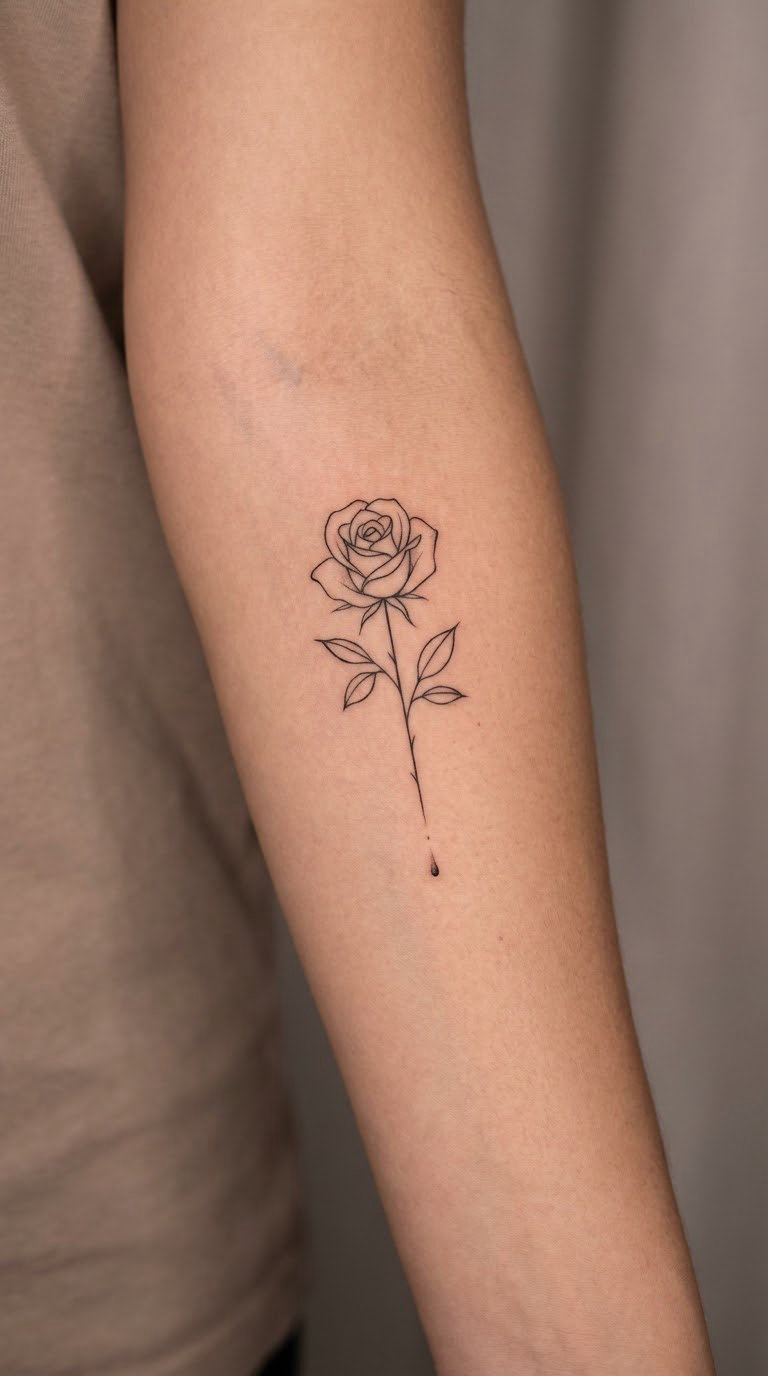
A single black rose drawn with a thin, steady line, its petals built from nested arcs rather than solid fill, with one short drip of ink running from the lower petal. The darkness comes from the subject, not from heaviness of ink.
People choose this one because a dark rose is widely read as beauty that has already ended, though the meaning is personal and nobody will assign it for you. It is the version of the gothic flower tattoo idea that suits someone who wants the aesthetic without announcing a subculture.
Placement: inner forearm, wrist crease or behind the ear. Size: 2-3 inches (5-7 cm) across. Style: fine line with one solid accent.
Pain: medium on the inner forearm, and expect the wrist crease to sting more. Fine lines on hands and fingers fade fastest, so keep it off the knuckles.
Make it yours: swap the drip for a single thin line of script running along the stem.
2. Blackwork Peony Wrapped in Thorns
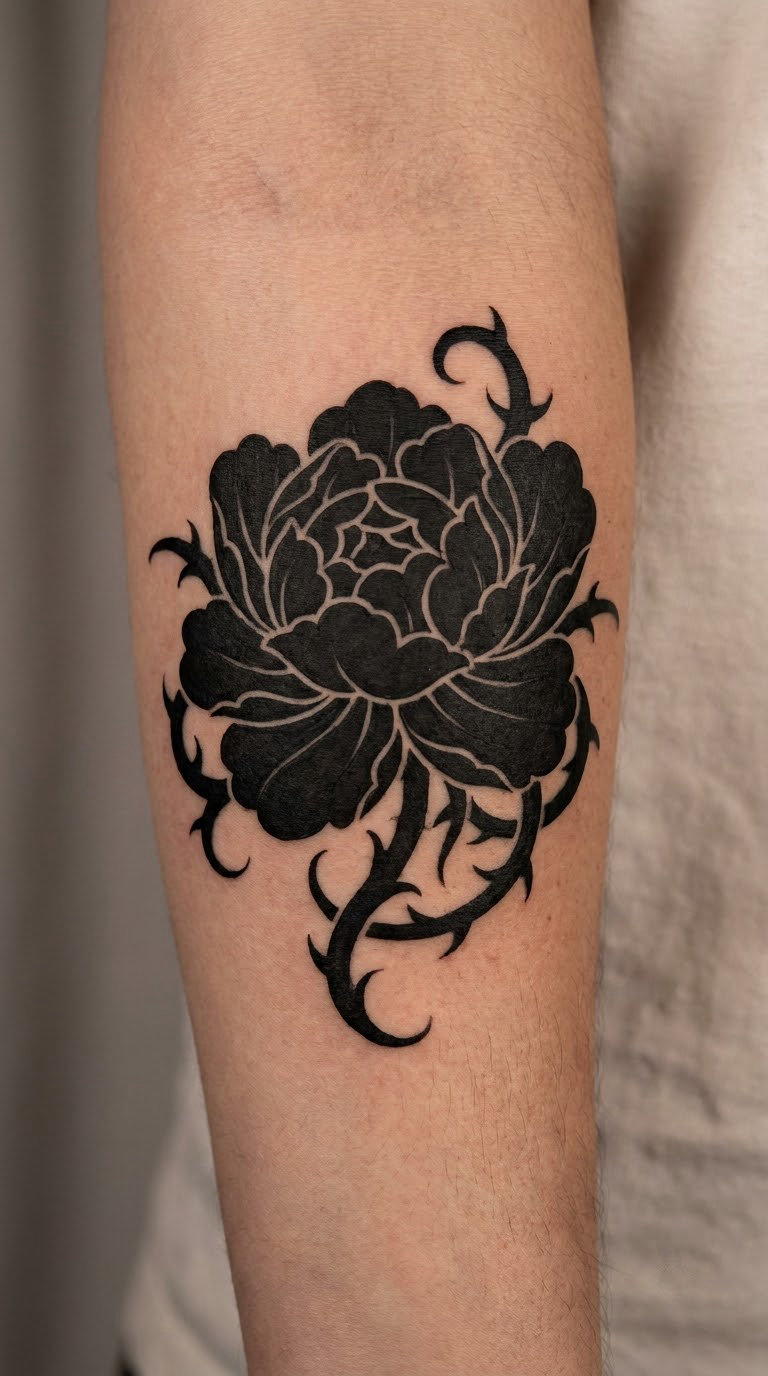
A full peony rendered in solid blackwork, its rounded petals packed into one dark mass, with a thorny vine curling around the outside of the bloom. The flower is soft in shape and the vine is sharp in line, and that contrast is the whole design.
Peonies get chosen for their fullness, so a dark version reads as a bloom at peak that has turned in on itself. A dense black composition like this suits collectors who already have ink and want a piece that holds its own next to it.
Placement: outer upper arm, shoulder blade or the flat of the calf. Size: 4-5 inches (10-13 cm). Style: illustrative blackwork with negative space in the petal folds.
Pain: low over fleshy areas like the outer arm and calf. The shading pass over a solid black fill takes longer than people expect, so the session is more uncomfortable than sharp.
Make it yours: leave one thorn uncapped, or add a single thin outline of a second smaller bud behind the vine.
3. Gothic Lily Beneath a Cathedral Arch
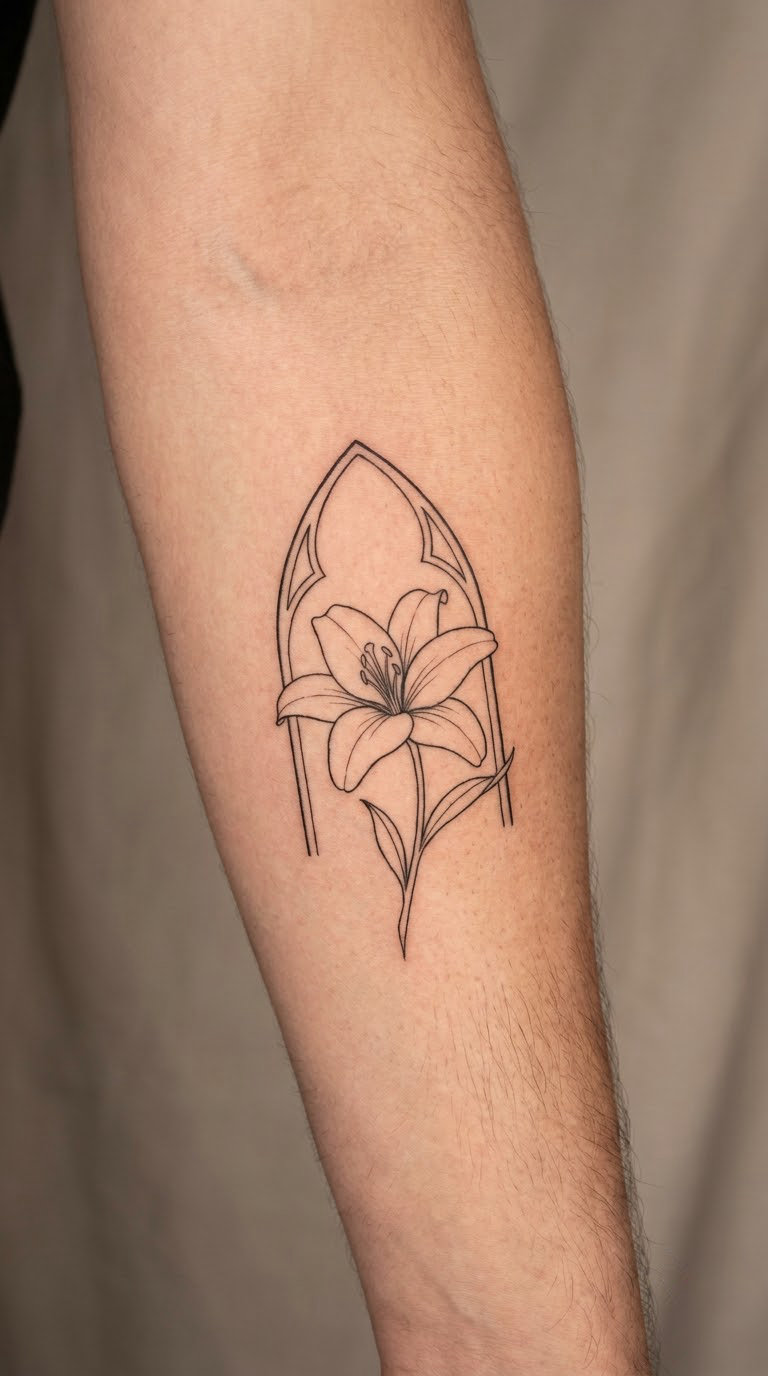
An upright lily in clean outline sits under a small pointed arch drawn with the same weight of line, with a few short radiating strokes suggesting tracery above the apex. Both elements share one line weight so the composition stays quiet rather than busy.
Architecture is what turns a floral from pretty into gothic, and a lily is a natural partner for it because the trumpet shape points upward. If you want the style without literal religious imagery, an abstract arch and a column-free outline are the safe version. There is more on this style in our round-up of gothic tattoo ideas beyond florals.
Placement: forearm, upper chest or along the spine. Size: 4 inches (10 cm) tall. Style: fine line architectural linework.
Pain: medium on the forearm, higher along the sternum if you place it on the chest. Fine architectural linework is the first thing to soften over the years, so ask for slightly heavier lines than feel right at the consult.
Make it yours: change the arch into a narrow window frame, or add a small date in the base stones.
4. Bleeding Poppy in Black-and-Grey Realism
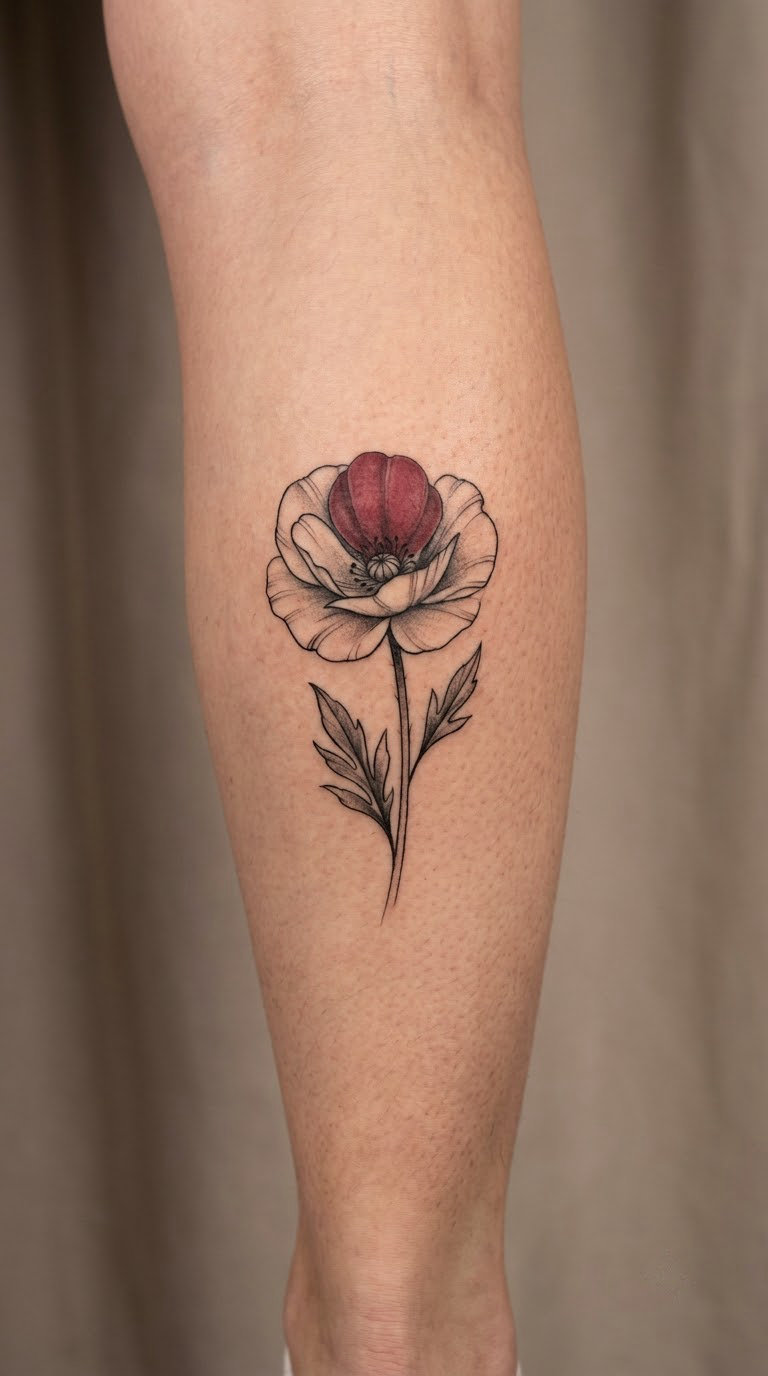
A realistically shaded poppy head with crinkled petals, a dark hollow centre, and one petal carrying a deep red wash that bleeds slightly past its edge. The stem is a single confident line rather than a shaded one.
Poppies carry remembrance in most Western traditions, and a red accent pushes an otherwise restrained black-and-grey piece toward the dramatic end of the gothic flower tattoo idea range. It reads as a memorial motif without needing a date or a name in the composition.
Placement: calf, forearm or the back of the shoulder. Size: 3 inches (7.5 cm) tall. Style: black-and-grey realism with one colour accent.
Pain: low on the calf and outer arm. Grey wash is unforgiving on sun-exposed skin, so a colour touch-up is more likely than on an all-black piece.
Make it yours: use your own birth flower, or keep the red and switch to a deep burgundy that will not shift as fast.
5. Traditional Dark Rose with Spiderweb Background
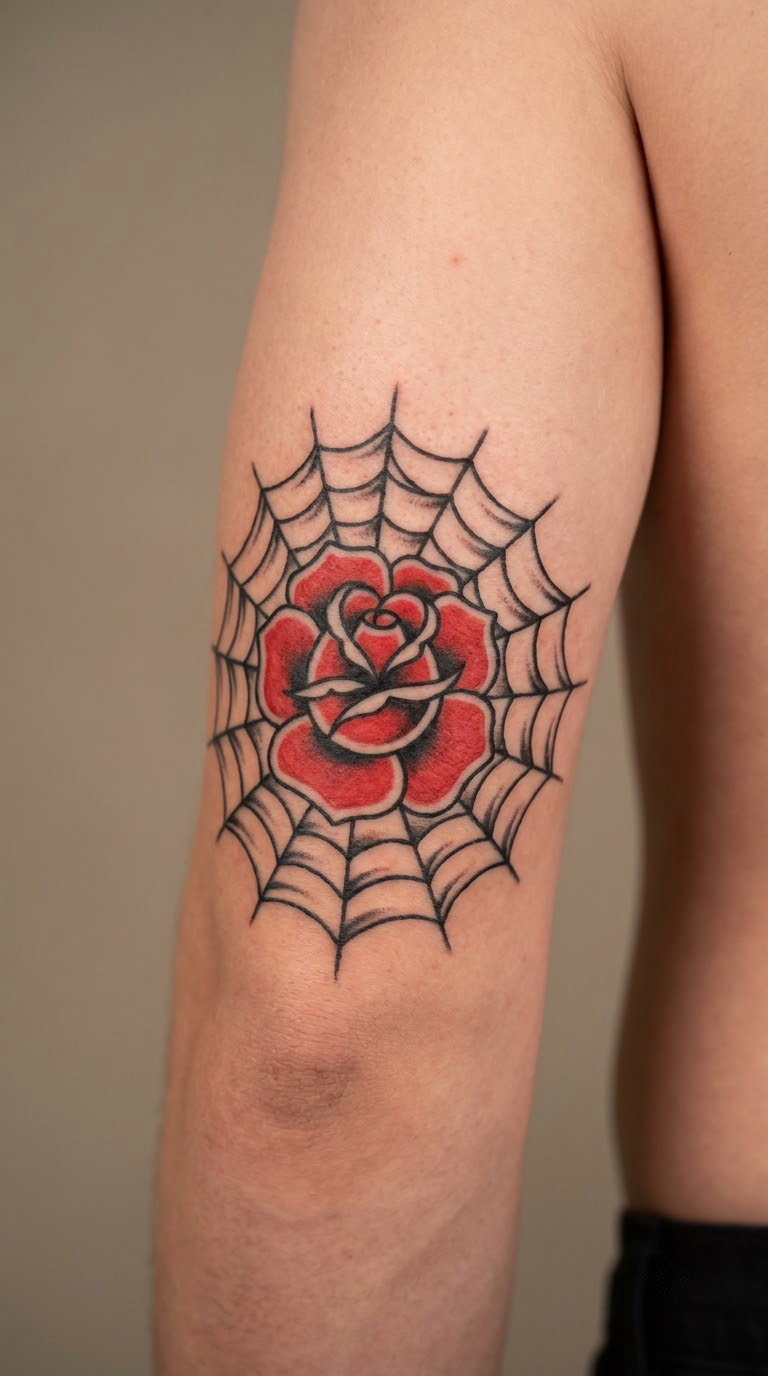
A bold traditional rose with heavy black outlines, red petals shaded in the classic drop-shadow style, and an open spiderweb radiating behind it in one unbroken line. The web is a backdrop, never a second subject.
Traditional American florals have been tattooed for a century, which is exactly why they feel gothic when the palette drops to black and oxblood. The pairing works because the web is airy and the rose is dense, so the two never fight for attention.
Placement: upper arm, shoulder or thigh. Size: 4-5 inches (10-13 cm). Style: traditional with bold outlines and flat shading.
Pain: low on the upper arm. Traditional shading is surface work on skin with plenty of soft padding underneath, so this is an easy first session even at statement size.
Make it yours: swap the spiderweb for rain, or run the web lines into a thorny stem so the background becomes part of the plant.
6. Moonlit White Rose in Blackwork
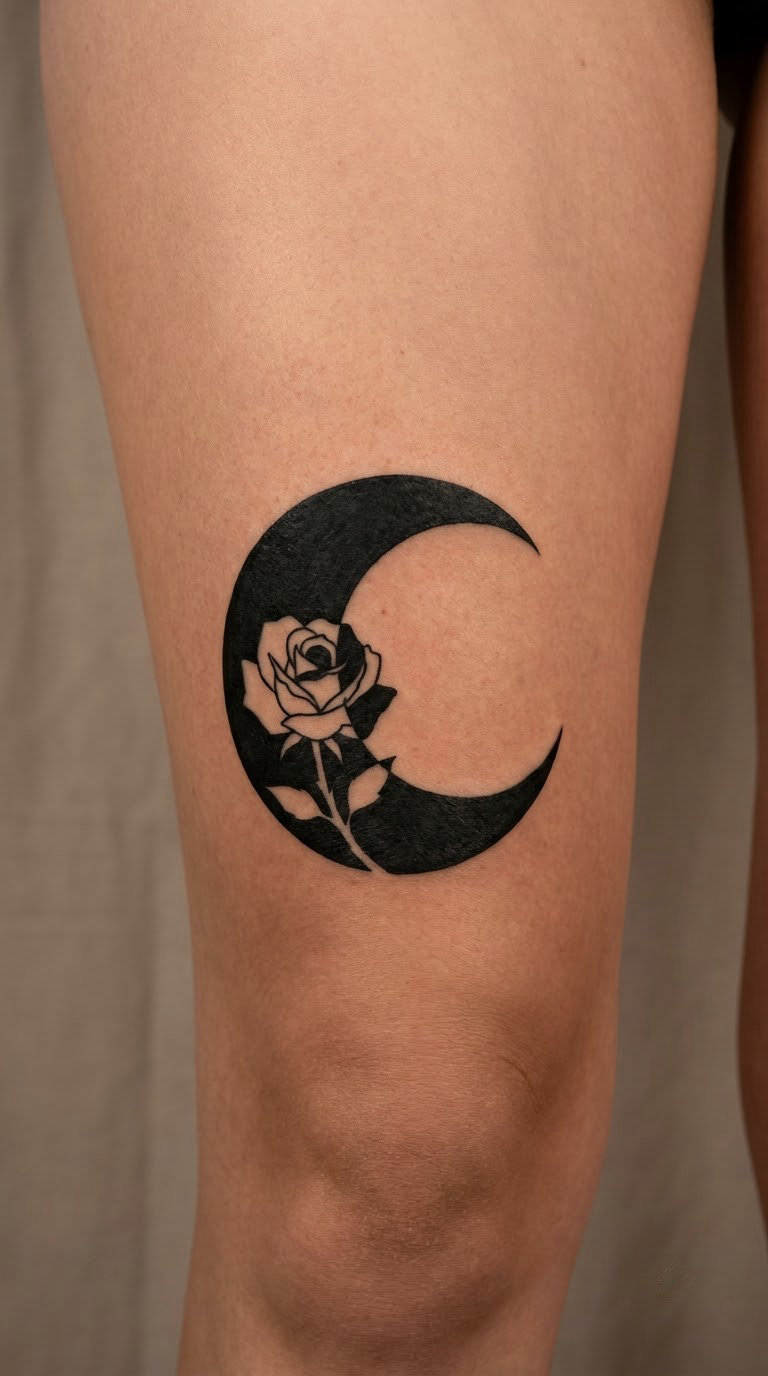
A crescent filled with solid black ink, and a rose left entirely un-inked in the shape of its own negative space, so the skin itself forms the petals. A thin inner line marks the petal edges where they need definition.
Reversing a black rose into a white one is a small trick with a big payoff: it looks like a light source inside a dark shape, which suits anyone drawn to the nocturnal side of the style. It is also one of the most forgiving gothic flower tattoo ideas to age, because the black carries the structure.
Placement: outer thigh, upper arm or hip. Size: 3-4 inches (8-10 cm). Style: blackwork with negative space.
Pain: medium. The solid black fill is a long pass over a large area, so build in a break before the shading stage.
Make it yours: add a second crescent behind the first for a layered look, or set a few small solid stars in the black.
7. Micro-Realism Dead Peony with Crumbling Petals
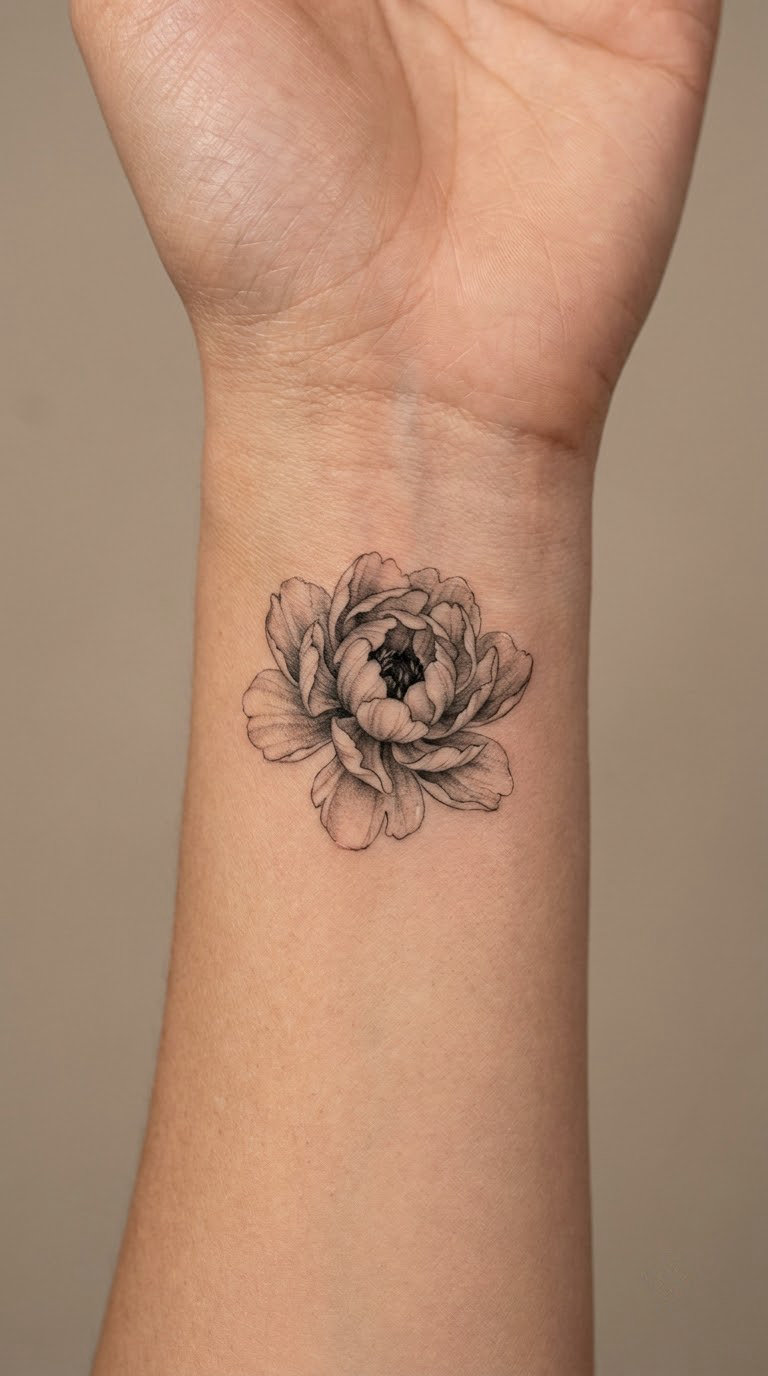
A small peony caught mid-collapse, with petals curling inward, edges fragmenting into soft grey, and a soft shadow beneath the bloom. Detail is concentrated in two or three places rather than spread evenly.
This is a design about endings rather than decay for its own sake, and it is one of the few gothic flower tattoo ideas that carries a quiet emotional register instead of a dramatic one. Wearers of small florals often say the same thing: they never get tired of looking at it.
Placement: inner wrist, behind the ear, or the ankle bone. Size: 1.5-2 inches (4-5 cm). Style: micro-realism in black and grey.
Pain: medium on the wrist. Here is the honest caveat: at two inches, the soft petal edges will soften and blur over the years. Solid shapes and strong outlines hold up; feathered greys do not.
Make it yours: add a tiny date under the bloom in a thin, slightly heavier line so it survives.
8. Victorian Mourning Bouquet in Fine Line
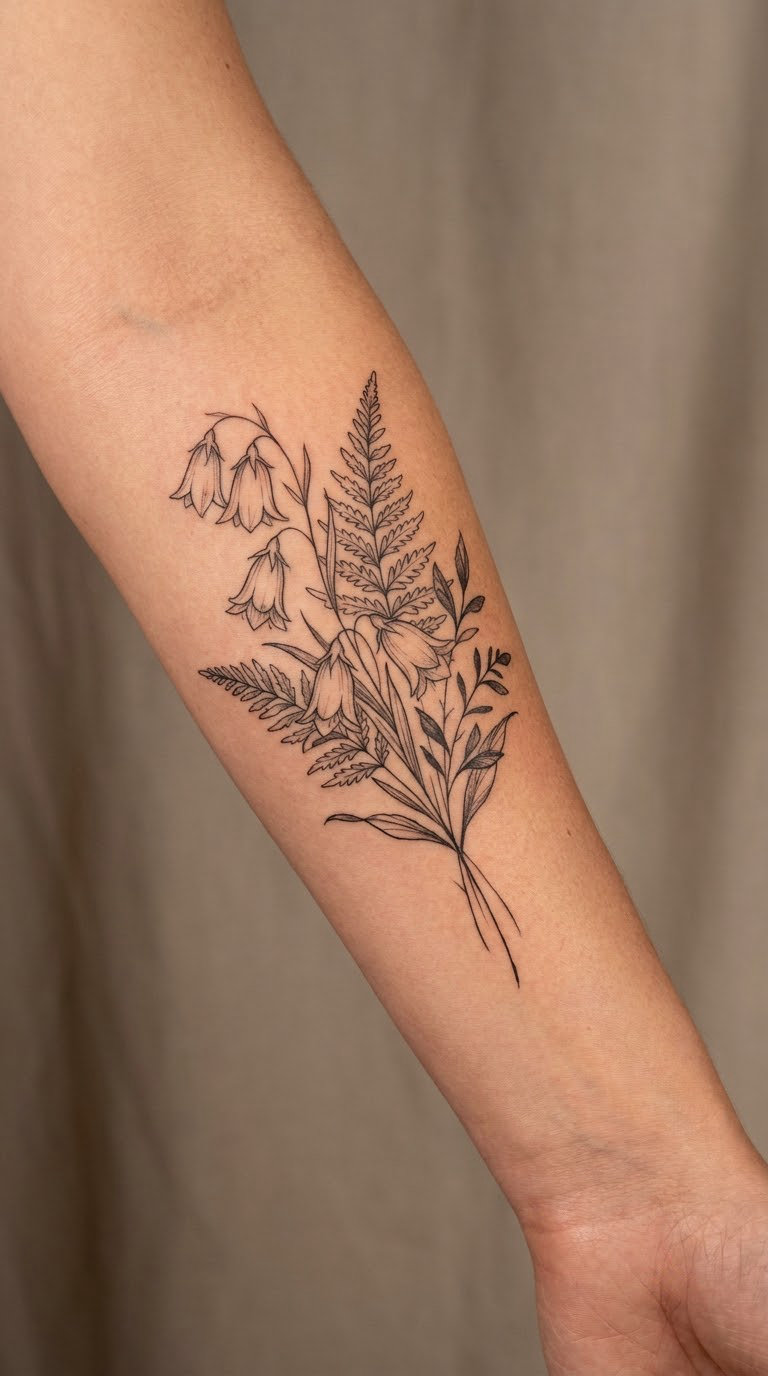
An elongated bouquet built from drooping bellflowers, half-open roses and sparse trailing foliage, drawn entirely in single-weight line with no fill. The stems converge into a loose tie near the base, letting the arrangement fall diagonally.
Victorian mourning jewellery put flowers, hair and seed pods into dark enamel pieces as keepsakes, and this composition borrows that formality without the sentimentality. Fine line keeps it elegant, which is how most of these gothic flower tattoo ideas avoid looking like a costume.
Placement: forearm laid diagonally, collarbone, or the outer thigh. Size: 5-6 inches (13-15 cm) long. Style: fine line, single weight.
Pain: medium. The collarbone is more sensitive than most people expect, so plan a shorter session or a different placement if you are new to long sittings.
Make it yours: use flowers tied to a specific person or season, or add a small locket shape at the base of the stems.
9. Black Dahlia with Art Nouveau Curves
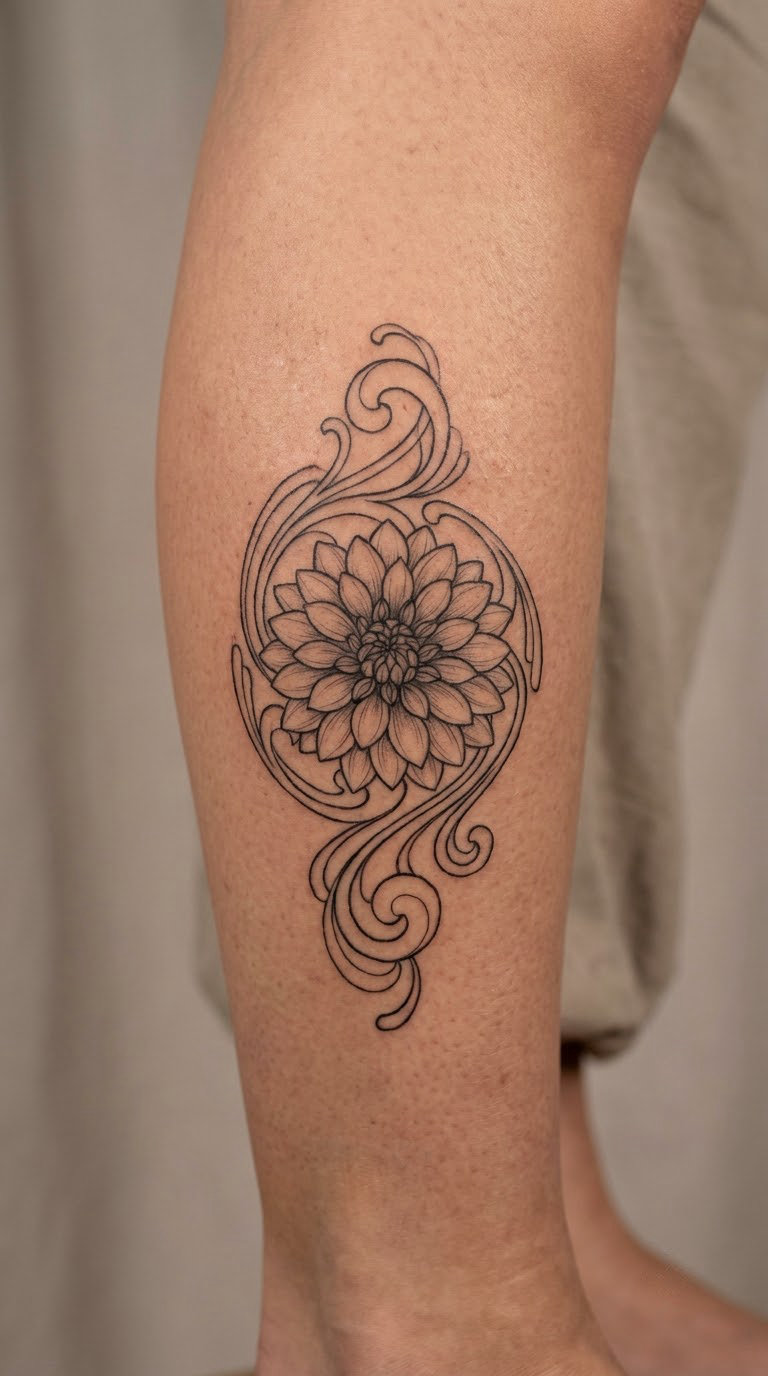
A densely layered dahlia in solid black, with pointed petals radiating from the centre, framed by two or three long sinuous lines that arc around the bloom and stop short of touching it. The curves are the frame, never a second flower.
Black dahlia is the darkest of the commonly tattooed blooms, and pairing it with the flowing curves of Art Nouveau gives the darkness an elegant frame rather than letting it read as a blob. It is one of the cleaner gothic flower tattoo ideas for a leg panel.
Placement: calf, shoulder blade or the ribs. Size: 3-4 inches (8-10 cm) tall. Style: illustrative blackwork with ornamental line.
Pain: low on the calf. Ribs are a different story, so if you want the composition vertical, keep it off the side torso.
Make it yours: have the curves echo a letter or a wave shape, or leave one petal unshaded to break up the black mass.
10. Ink-Bleeding Anemone in Watercolour
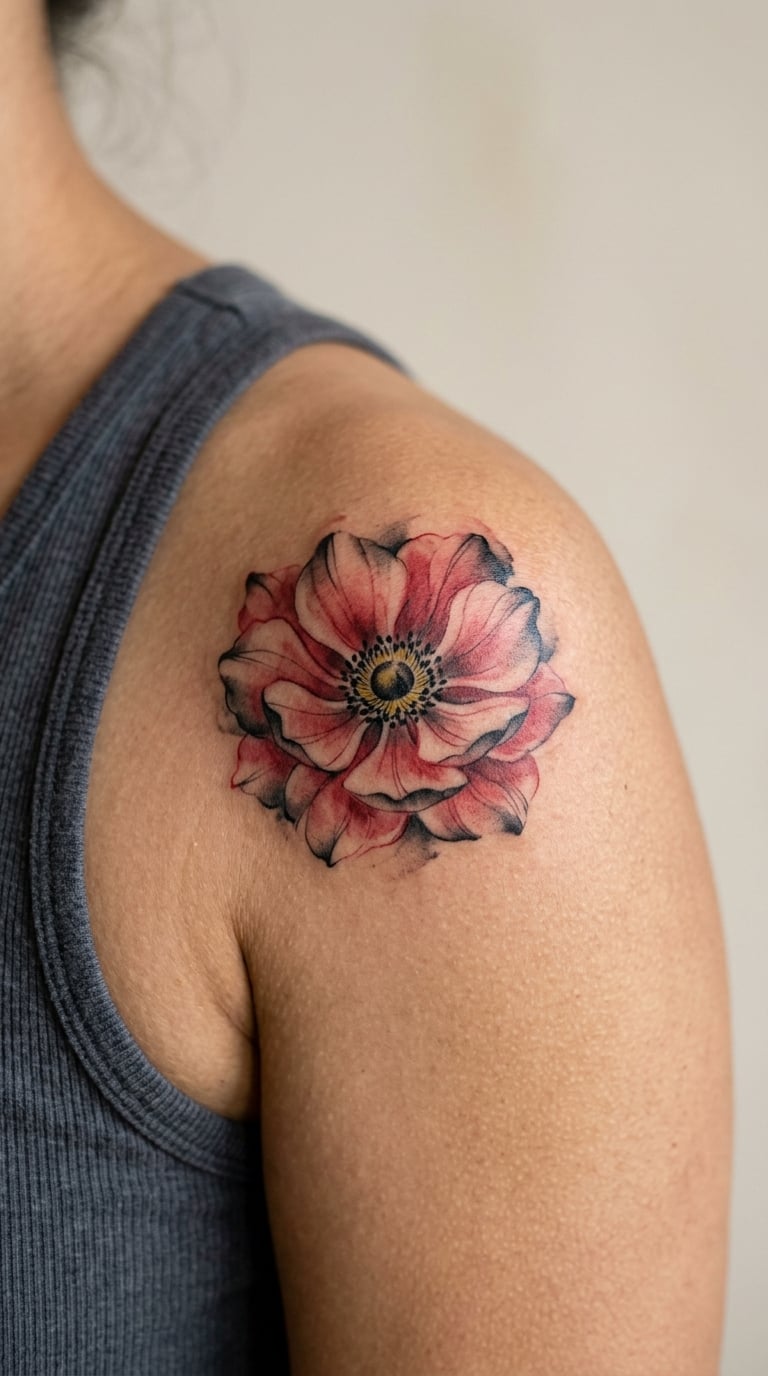
An anemone with petals built from diluted crimson that fades at the edges, surrounded by smoky black washes that bleed into the skin. A few hard black lines hold the centre together so the flower does not dissolve entirely.
Watercolour is the softest way into a dark floral, and it works well for people who find solid blackwork too heavy. The trick is restraint: the artist controls where the wash is allowed to travel, so the effect stays deliberate instead of looking unfinished.
Placement: shoulder, upper arm or the back of the hand. Size: 3-4 inches (8-10 cm) wide. Style: watercolour blackwork with one colour.
Pain: low on the shoulder and outer arm. Washed areas tend to need more than one pass, which lengthens the session even though the sensation is mild.
Make it yours: use one muted colour only, or add a second smaller bloom bleeding off the main stem.
11. Gothic Succulent and Thorn Cluster
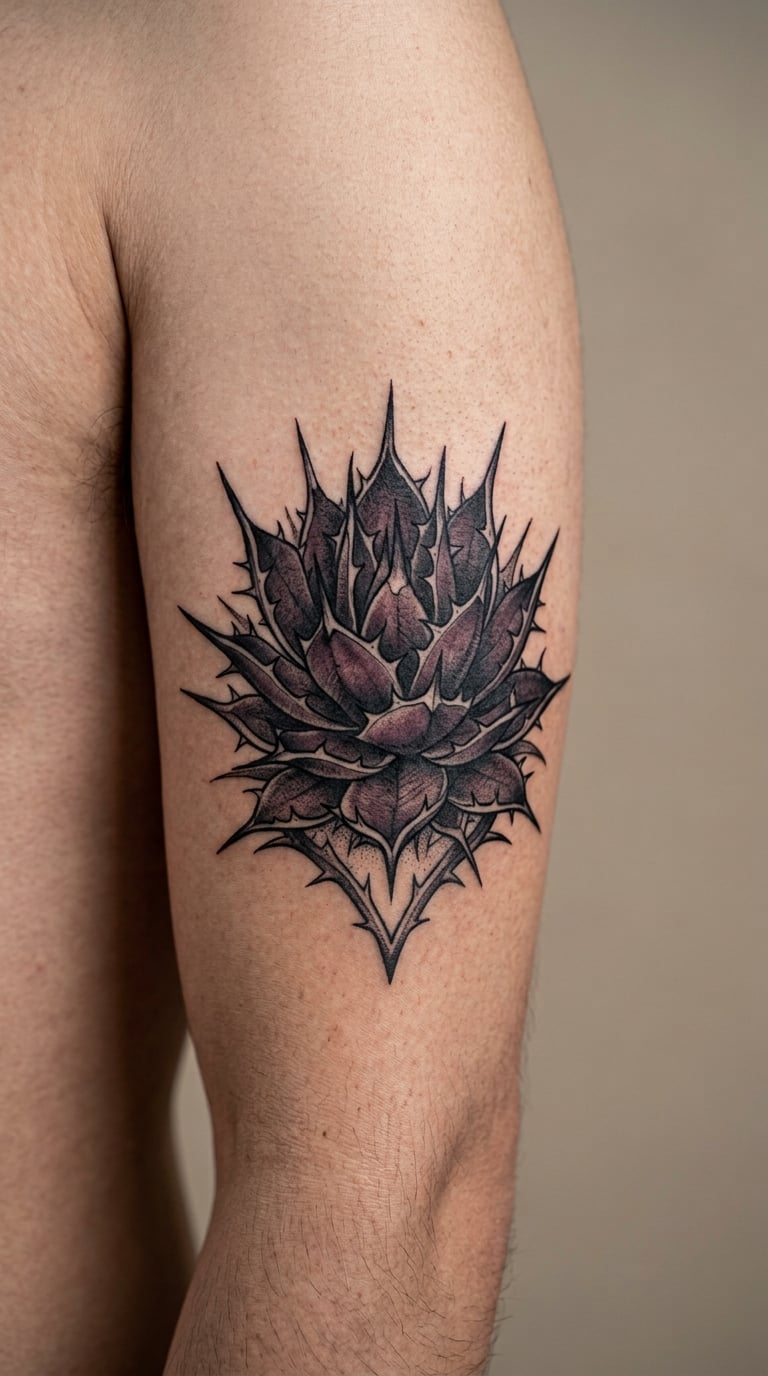
A rosette-shaped succulent rendered in illustrative blackwork with deep purple in the deepest folds, surrounded by long thorns and a few dark secondary blooms. The shapes are geometric and architectural rather than soft and romantic.
Succulents are an unusual but strong choice in this style because they already look strange and survive neglect, which suits the mood without any added skull or dagger. It is one of the more modern gothic flower tattoo ideas and it photographs well from a distance.
Placement: outer arm, shoulder or the upper back. Size: 4-5 inches (10-13 cm) tall. Style: illustrative realism with one colour accent.
Pain: low on the upper arm and back. The spines of the rosette mean more needle changes than a rose, so allow a little extra chair time.
Make it yours: combine it with a trailing stem so the cluster reads as a plant rather than a specimen.
12. Fine-Line Poppy Seed Head and Crescent
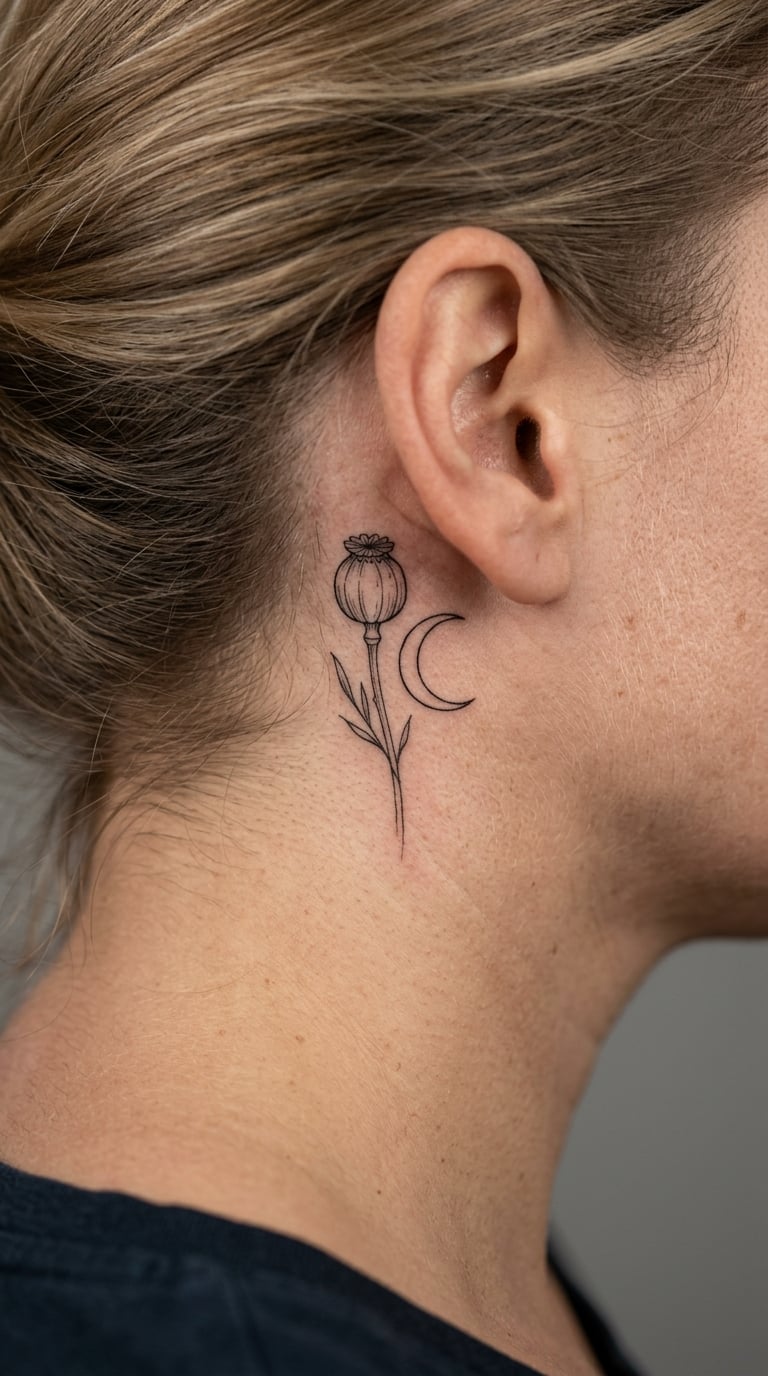
A single poppy seed head on a bare curved stem, drawn with the thinnest line you can hold, placed beside a narrow crescent. Two thirds of the design is open skin, which is what makes it read as elegant rather than busy.
The seed head is the part of the poppy that comes after the bloom, so it carries a quiet, ended quality without a single drop of blood. Minimal designs like this are the easiest of the gothic flower tattoo ideas to place well and the hardest to execute cleanly.
Placement: behind the ear, ankle, inner arm or the wrist. Size: 2-2.5 inches (5-6 cm) tall. Style: minimal fine line.
Pain: low behind the ear, medium on the inner arm. Lines this thin can disappear or blur over a decade, which is a fair trade for the delicacy.
Make it yours: add three or four loose seeds drifting off the head, or set the crescent a little further away for asymmetry.
13. Black Iris with Stained-Glass Shading
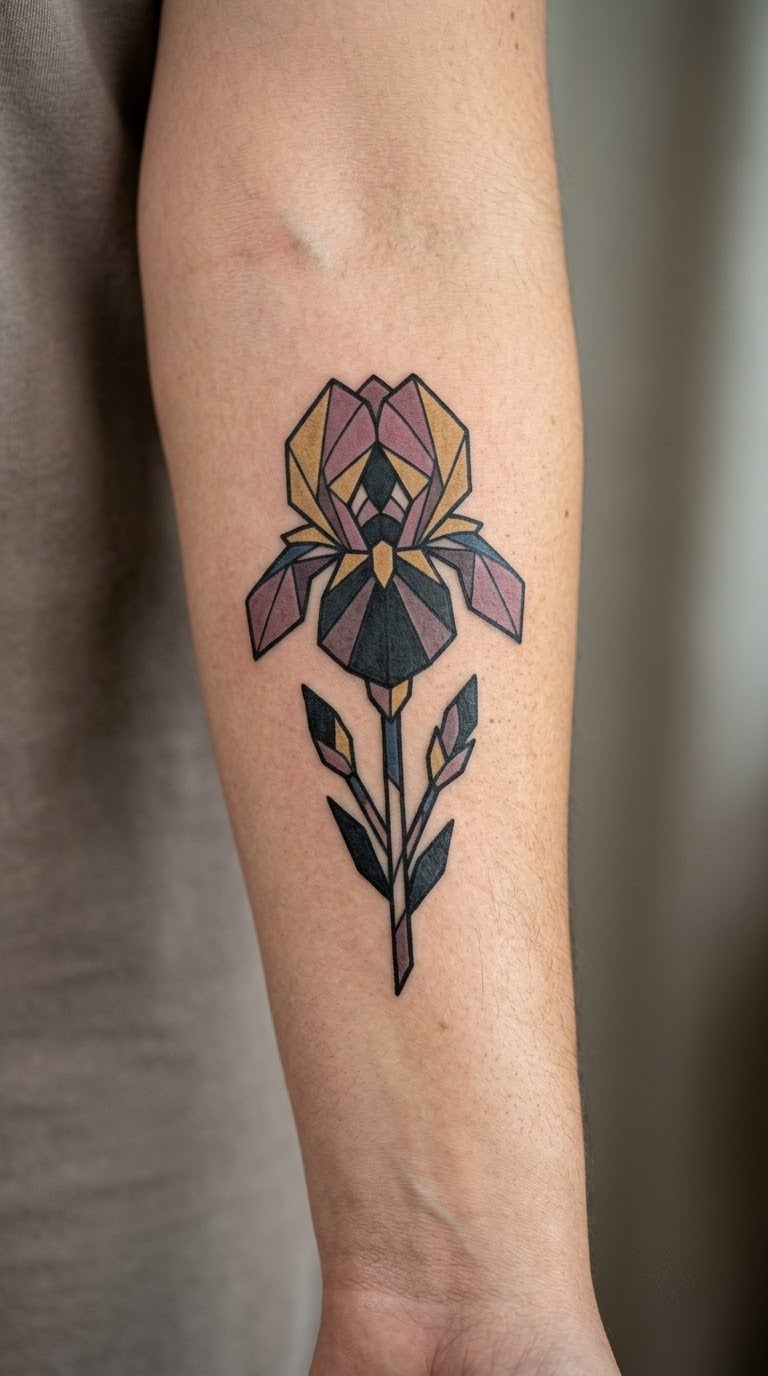
An iris divided into angular sections by thick black outlines, each section filled flat with charcoal, muted plum or a dulled gold, the way leaded glass is pieced together. Everything is flat colour, no gradients.
Iris petals have a naturally folded, architectural shape that suits geometric treatment better than most blooms. The result sits halfway between our stained glass tattoo ideas in gothic colours and a botanical drawing, which makes it one of the more flexible gothic flower tattoo ideas on this list.
Placement: forearm, upper arm or the chest. Size: 3-4 inches (8-10 cm) tall. Style: geometric colour with black outlines.
Pain: medium on the forearm and inner bicep. Flat colour work means many needle changes rather than deep shading, so the discomfort comes in waves instead of one long burn.
Make it yours: restrict the palette to two colours so the piece stays monochrome in feel, or add a thin stone-texture border.
14. Wilting Orchid in Neo-Traditional Colour
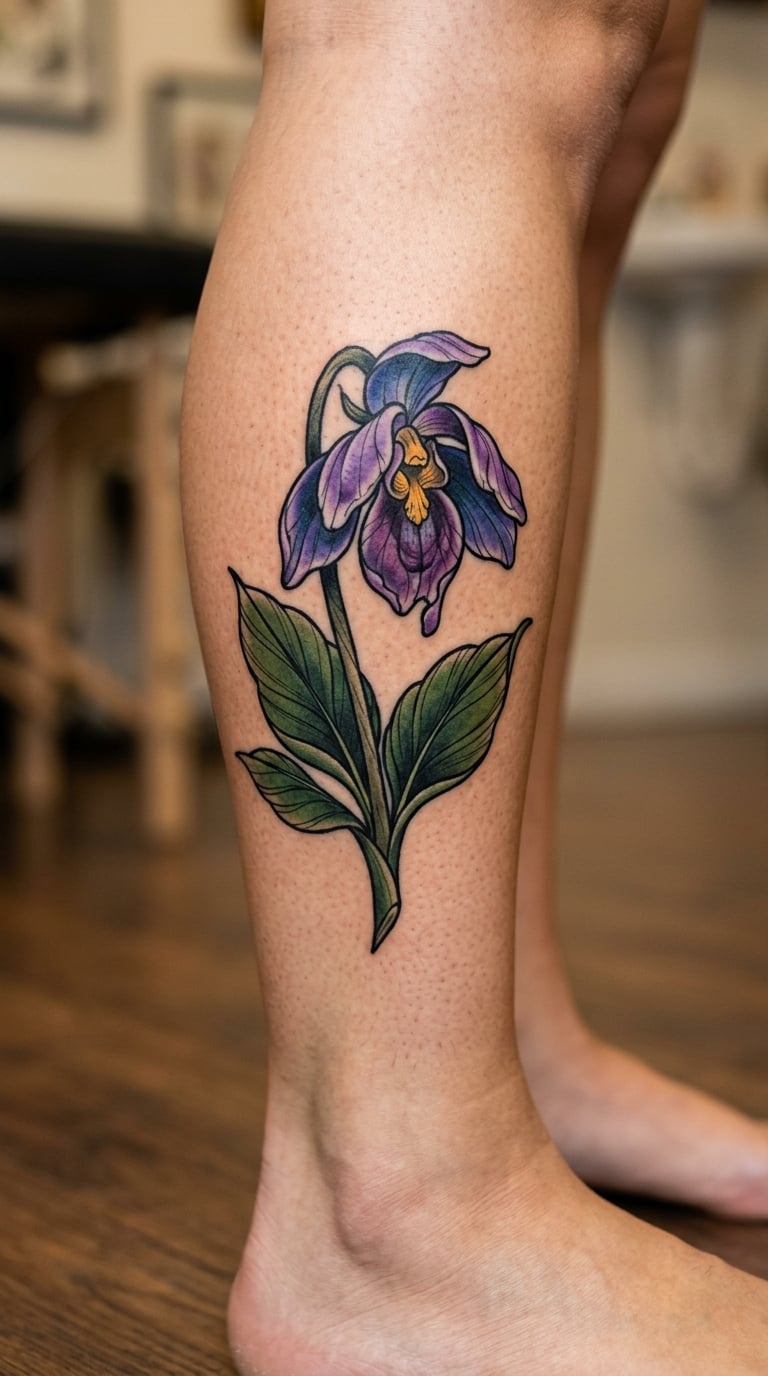
A drooping orchid with violet petals shaded toward the edges, deep green leaves with visible vein lines, and black contours that keep the colour areas crisp. The stem bends downward so the bloom hangs rather than stands.
Orchids read as cultivated and expensive, which is a nice contrast to a thorny rose. Setting it wilting instead of fresh keeps it in the gothic register without any gothic imagery at all.
Placement: calf, forearm or the shoulder blade. Size: 3-4 inches (8-10 cm) wide. Style: neo-traditional colour with black contour.
Pain: low on the calf and upper arm. Colour packing takes more time than line work but sits shallow on the skin, so most people find it easier than a black-and-grey piece.
Make it yours: add a single cut stem beside the plant to make the wilt read as deliberate.
15. Dotwork Mandala Flower on the Spine
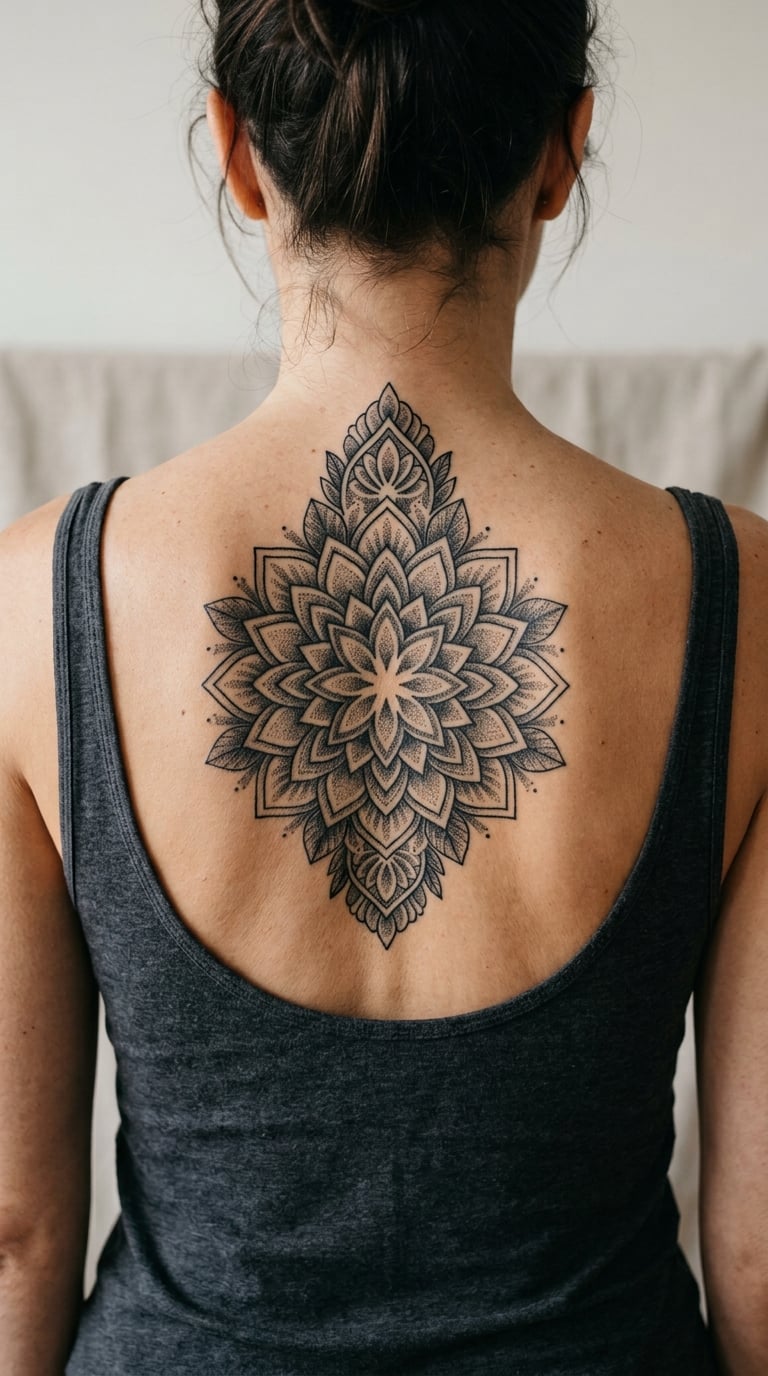
A symmetrical mandala built from repeated petal shapes and graduated dot patterns radiating from a central bloom, drawn so it reads as one mirrored object rather than a row of separate flowers. The spacing tightens toward the centre.
Mandala work is the most meditative of these gothic flower tattoo ideas, and the spine is the only canvas where symmetry genuinely holds without a fight. It suits anyone who wants dark decoration rather than a story.
Placement: upper or mid spine, centred. Size: 7-8 inches (18-20 cm) tall. Style: dotwork and geometric repetition.
Pain: medium, and it takes real endurance because it is an all-over piece on a long canvas. Dots are shallow, so it is uncomfortable rather than painful for most people.
Make it yours: have the dot gradient run from dense at the centre to sparse at the edges, or add a matching element behind one ear.
16. Black Hibiscus with Dripping Negative Space
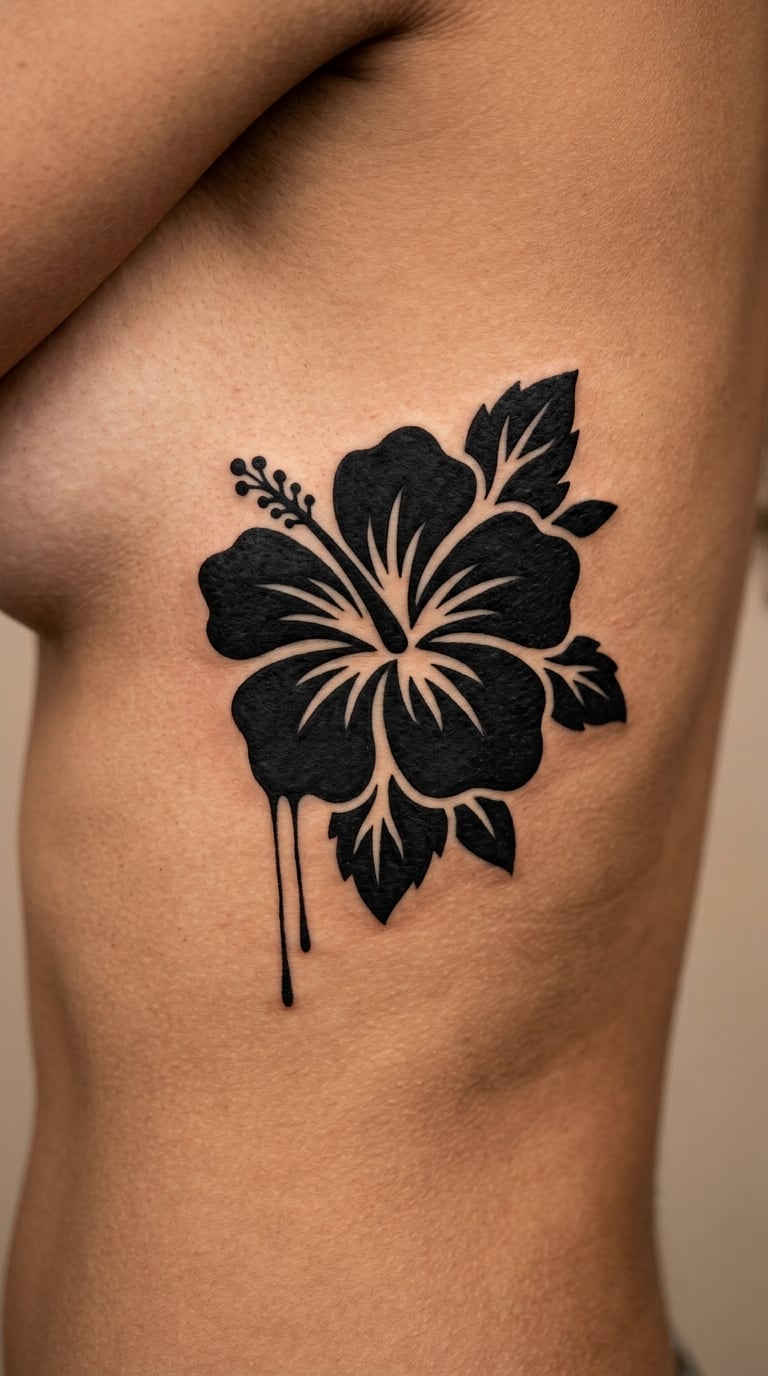
A hibiscus built from one large black mass, with narrow white channels cut through the petals to separate them, plus two short controlled drips falling from the base. The channels do the work that outlines would do in a lighter design.
Graphic contrast like this stays legible from across a room, which is exactly what a dark floral should do. It is one of the bolder gothic flower tattoo ideas here, and the drip needs to be short enough that it reads as a graphic device rather than as a smudge.
Placement: ribcage, outer thigh, upper arm. Size: 4-5 inches (10-13 cm) wide. Style: graphic blackwork with negative space.
Pain: high on the ribs, low on the thigh and upper arm. If you want this on the torso, book it as a two-session piece.
Make it yours: replace one channel with a thin coloured line in oxblood or deep plum.
17. Carnation, Smoke and Serpent Stems
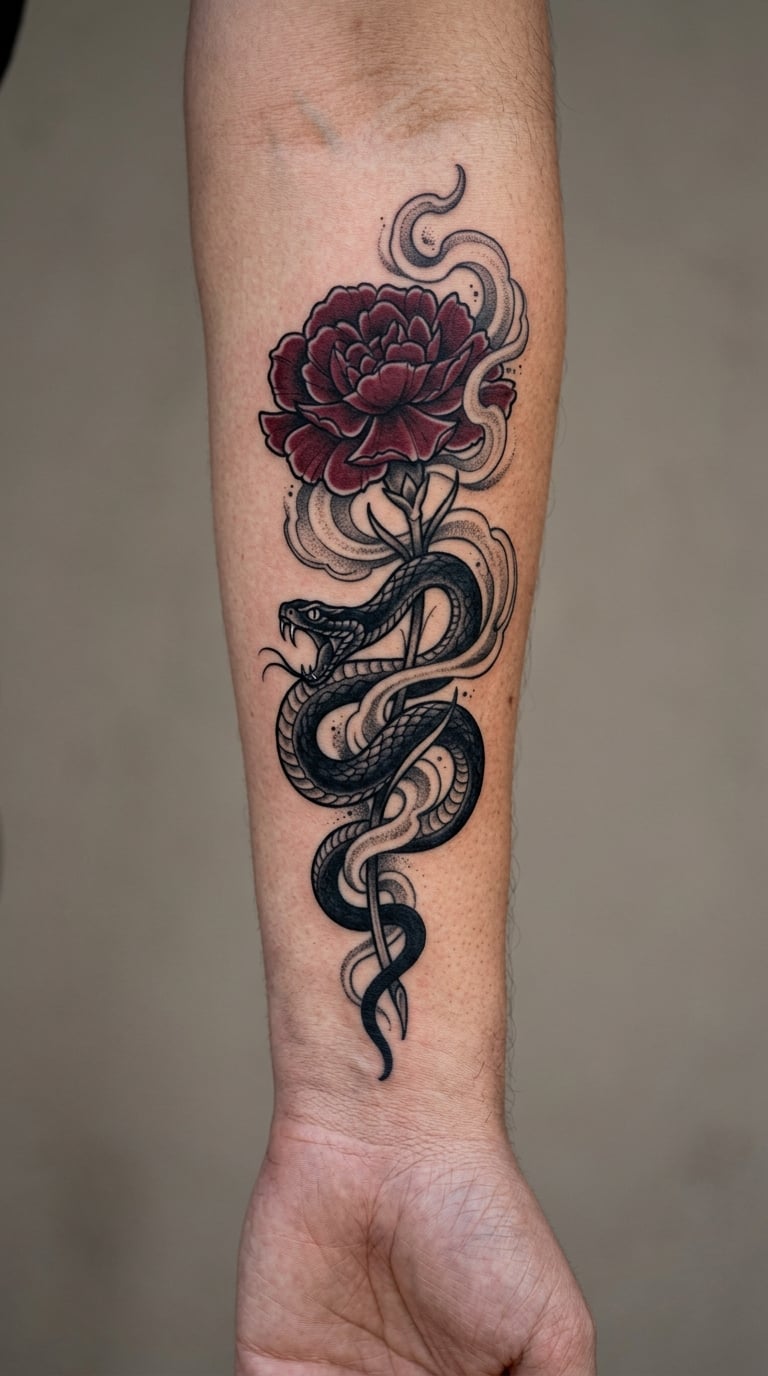
A dark red carnation with frilled petal edges, grey smoke drifting around the bloom, and a non-threatening serpent wound loosely around the stem. The carnation is the largest element and everything else supports it.
Carnations carry mourning associations in parts of Europe, and smoke gives the piece a transitional, in-between quality. Keeping the serpent calm and unraised is what stops the composition drifting into threat imagery, which many wearers specifically do not want.
Placement: forearm, upper arm or the calf. Size: 5-6 inches (13-15 cm) long. Style: neo-traditional colour with grey wash smoke.
Pain: medium. The grey smoke is light, repetitive work, so the session is long but shallow.
Make it yours: add a name or date in blackletter tucked into the smoke, keeping the lettering short so it stays readable.
18. Minimal Black Poppy on the Hand
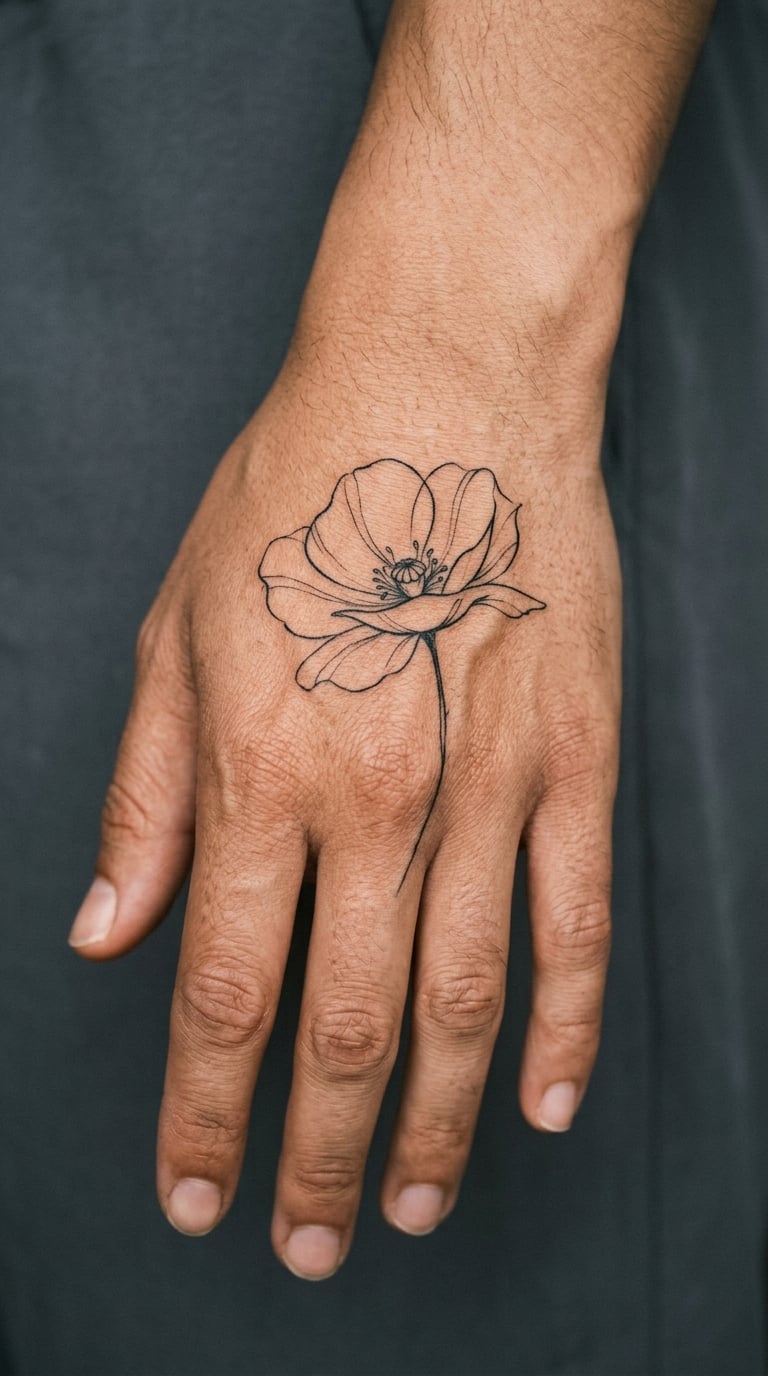
A single poppy drawn with loose, slightly asymmetrical petals and one solid black centre, sized to sit between the knuckles rather than cover them. The imperfection is the point; the design looks drawn rather than stamped.
Hands are the most visible canvas and the most unforgiving one. This is the idea people fall for first and regret fastest, because hands change shape constantly and the skin there is thin.
Placement: back of the hand, or the inside of the wrist below the crease. Size: 2-3 inches (5-7 cm) wide. Style: loose fine line with one solid element.
Pain: high. The hand is dense with nerves, and knuckle areas are worse. Be honest with yourself about sitting through a full session there.
Make it yours: add a second, smaller poppy offset behind the first so the hand does not look empty later.
19. Gothic Wisteria Hanging from Fine Chains
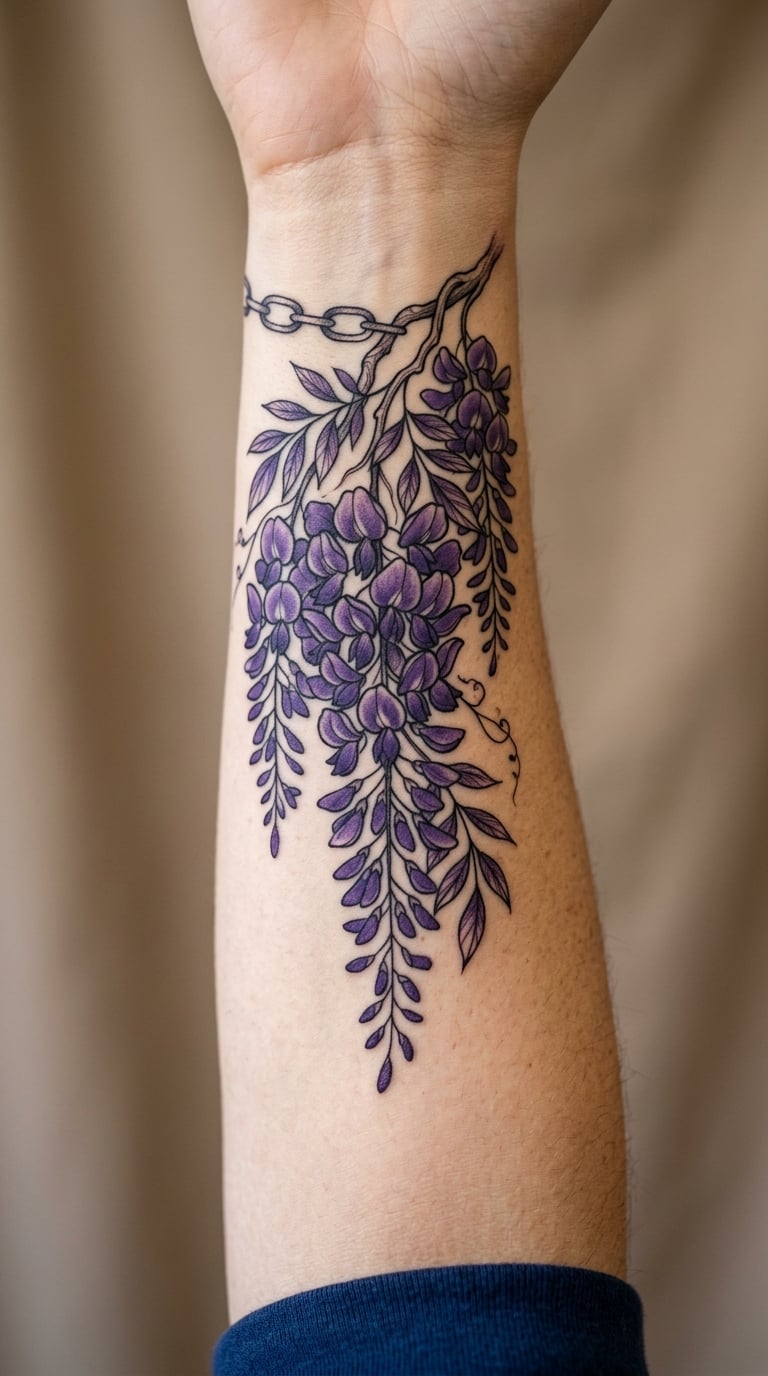
Long clusters of wisteria hanging downward in deep purple, outlined in black, suspended from two restrained chain links at the top. The chains stay plain and thin so they read as a structural anchor, not as jewellery.
Wisteria’s trailing shape suits gravity better than any other bloom, and the chains add an element of weight and restraint that keeps the piece from turning into a pastel hanging garden. We have more on this flower in our round-up of wisteria tattoo designs.
Placement: forearm, calf or the shoulder blade. Size: 6-7 inches (15-18 cm) long. Style: illustrative blackwork with purple shading.
Pain: medium. On the forearm the piece crosses thinner tissue near the wrist, which you will feel more than on the calf.
Make it yours: run the longest cluster along the natural line of the arm or leg so the piece follows the body instead of sitting on top of it.
20. Black Sunflower with a Closed Eye Centre
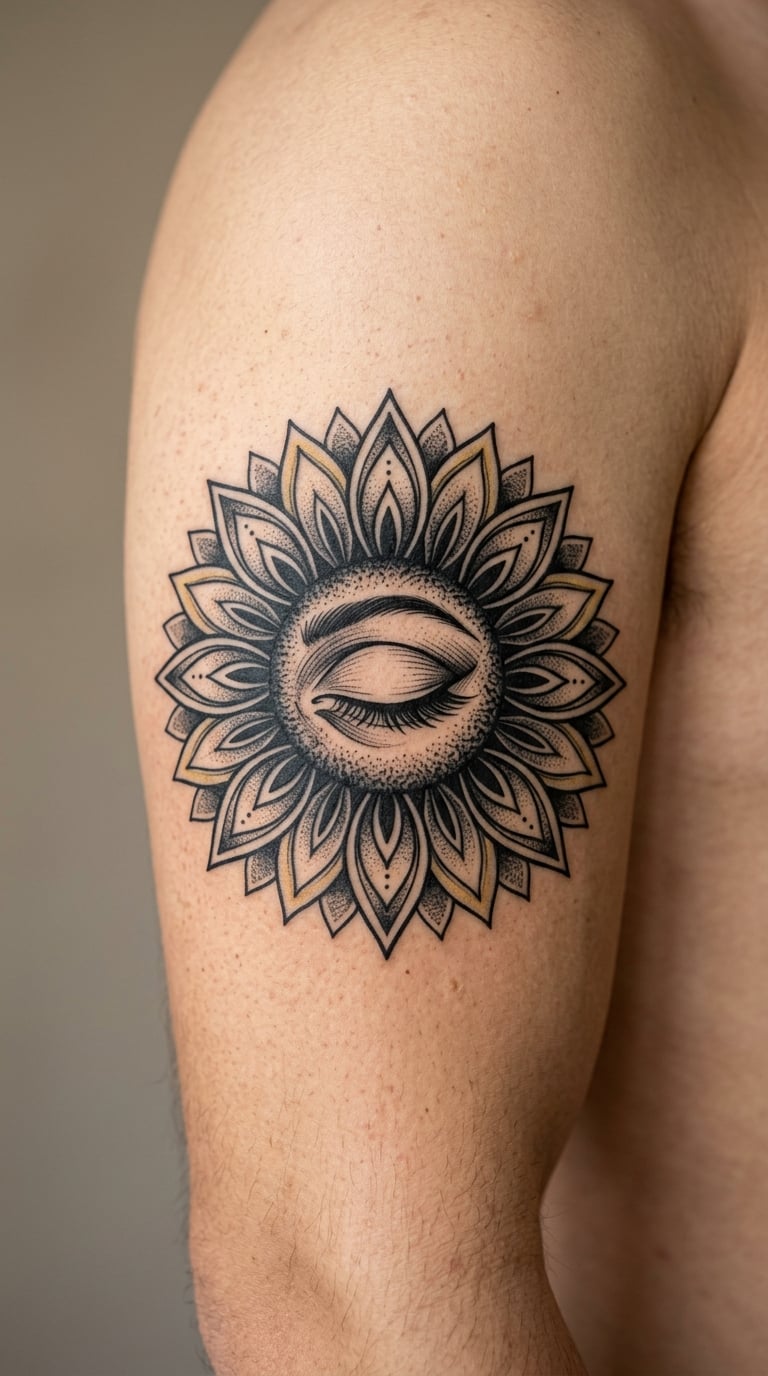
A sunflower with heavy black petals and a central disc containing a single closed eye with lashes, drawn small and precise. One muted yellow stays in a few petals so the bloom does not go entirely flat.
Sunflowers are cheerful by default, so putting an eye in the middle changes the reading of the whole flower. The surreal detail is the only thing that makes it unsettling, and it works because everything else stays botanical.
Placement: upper arm, shoulder or the back of the calf. Size: 3-4 inches (8-10 cm) wide. Style: blackwork with a single muted colour accent.
Pain: low across the upper arm. The eye is tiny, so it is worth having it tattooed freehand by someone comfortable with small facial detail.
Make it yours: leave the eye uninked and let the petals wrap around it, or use a second bloom in profile as a companion piece.
21. Pressed Lily in Antique Botanical Style
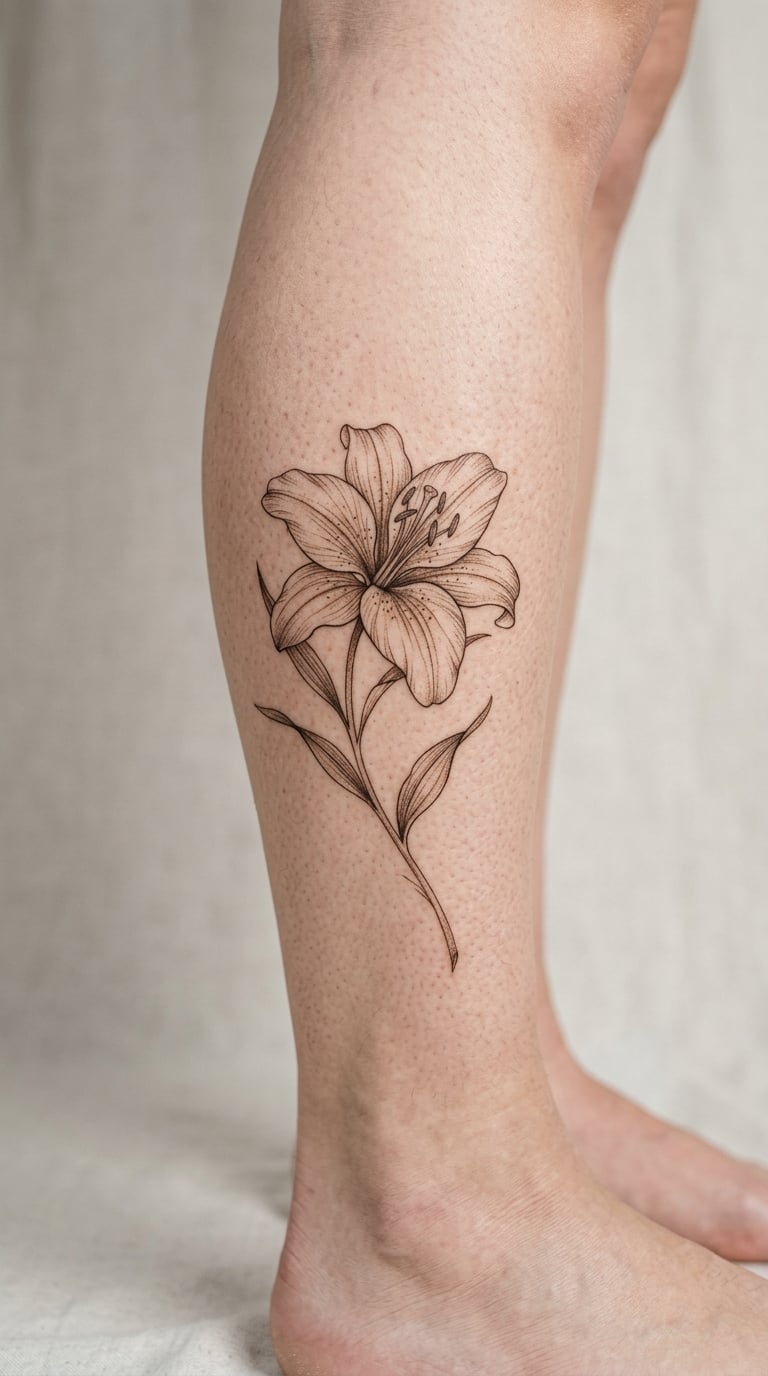
A lily rendered as a flattened preserved specimen, with sepia-toned shading, fine vein detail across every petal, and a soft aged tone achieved with diluted grey rather than any colour.
Botanical illustration plates are the quietest of these gothic flower tattoo ideas, and the aged-paper effect comes entirely from ink choice. It suits people who want a dark floral that reads scholarly rather than dramatic.
Placement: calf, forearm or the back of the upper arm. Size: 4-5 inches (10-13 cm) long. Style: antique etched fine line with sepia wash.
Pain: low on the calf and outer arm. Vein detail is shallow, repetitive work, so the session is a long one without much pain.
Make it yours: add a small hand-lettered Latin name beneath the specimen, kept to a single line.
22. Thorned Rose Emerging from Black Smoke
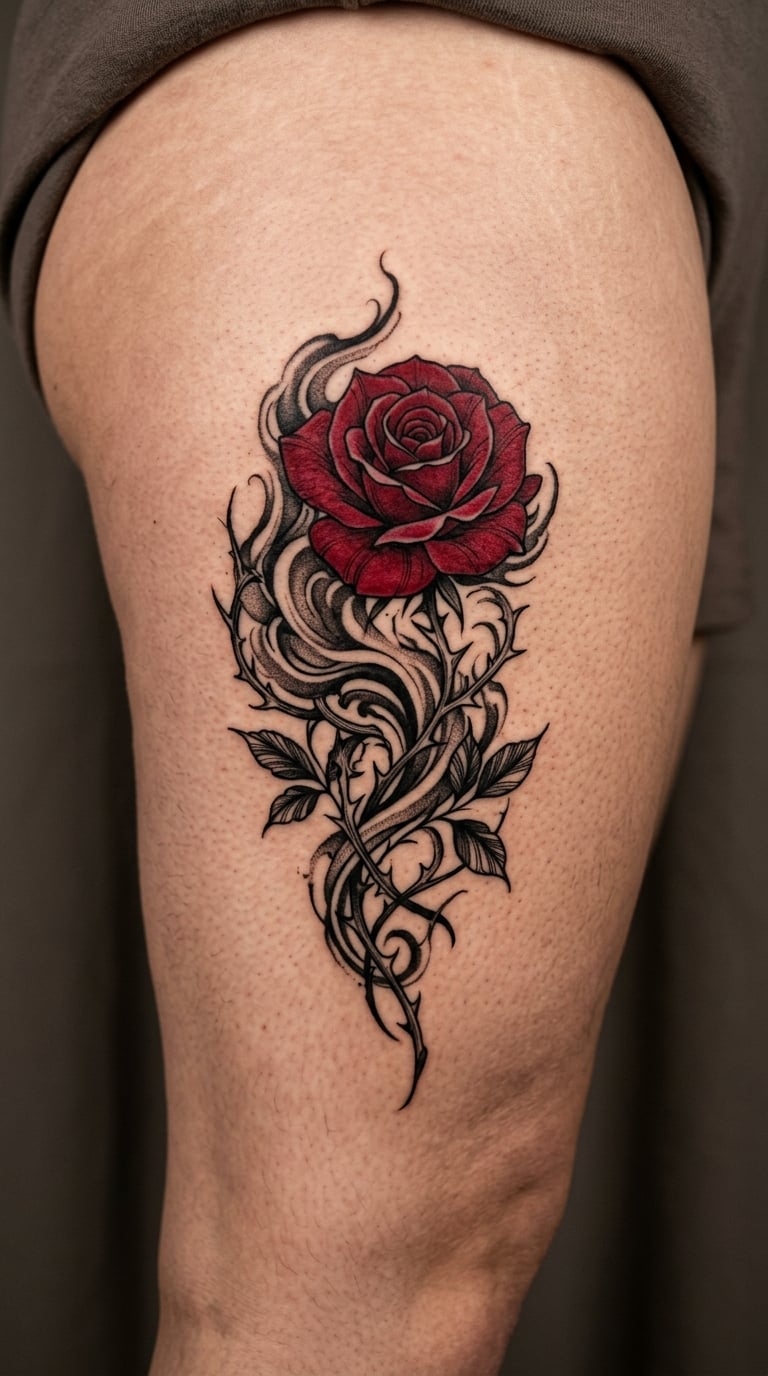
A red rose rising out of an untidy base of soft black smoke, with thorned stems crossing underneath, and enough open skin around the bloom that the flower keeps a clear silhouette.
The smoke is deliberately loose so it reads as atmosphere rather than as a solid object. Leaving skin between the rose and the smoke is what separates this from a heavy black rectangle, and it is the detail to point out at your consultation.
Placement: outer thigh, upper arm or the calf. Size: 4-5 inches (10-13 cm) tall. Style: blackwork with red colour and a smoke base.
Pain: medium on the thigh. Smoke gradients mean many light passes over a wide area, so this usually runs long.
Make it yours: push the smoke lower so the piece fades out toward the wrist or ankle instead of ending in a hard line.
23. Gothic Bellflower Vine Wrapping the Ankle
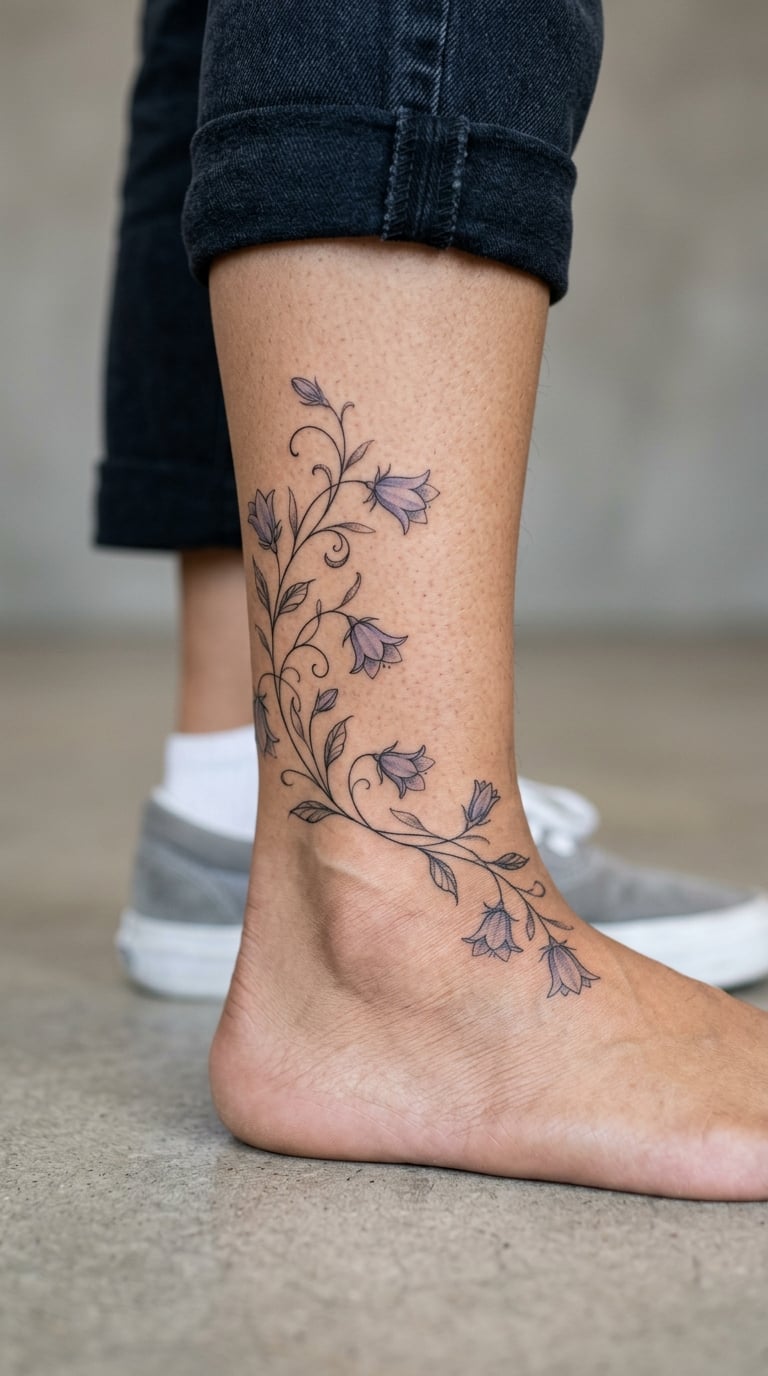
A vine of drooping bellflowers in muted purple-grey, with sparse small leaves, following the line of the outer ankle before trailing off the shin. It follows the contour rather than forming a full ornamental wrap.
Ankles move and swell through the day, so the composition has to be drawn for the bone and the tendon underneath it. Sparse leaves and one clear direction of travel keep it from becoming a mess when the ankle is bent.
Placement: outer ankle, lower calf or the wrist. Size: 5-6 inches (13-15 cm) long. Style: fine line with light grey wash.
Pain: medium. Bony areas are thin and the ankle bone sits right under the design, so expect more sensitivity than on a fleshy calf.
Make it yours: add a second thinner vine trailing in the opposite direction so the ankle does not look bare when the piece is hidden by footwear.
24. Macro Thorn and Dark Rose on the Collarbone
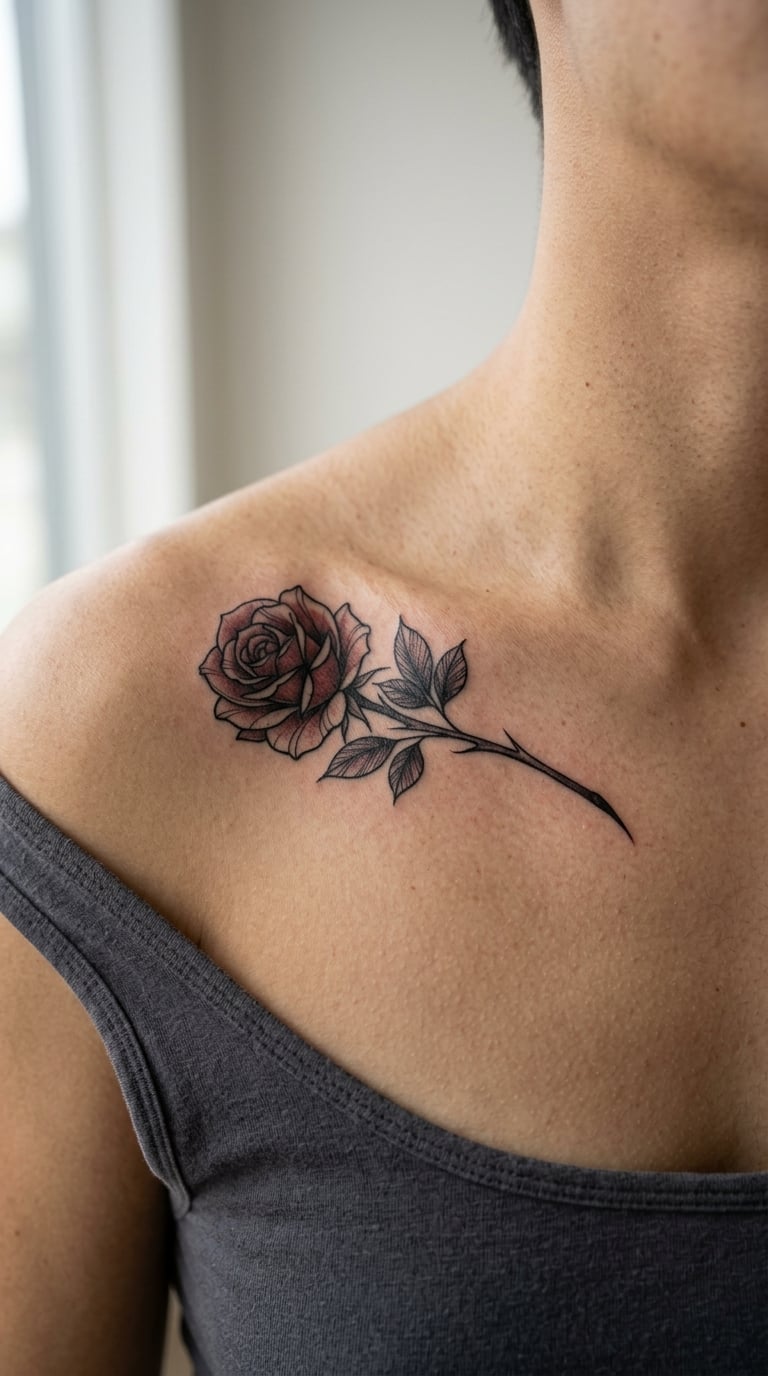
A wide, horizontal dark rose with red shading in the petals and one long thorn crossing diagonally through the composition, drawn to sit flat rather than tall so it follows the collarbone’s line.
Most floral collarbone pieces fail by being drawn too upright. Running the bloom horizontally and letting a single thorn do the vertical work keeps it readable under a collar or a neckline.
Placement: collarbone, sternum or the top of the shoulder. Size: 4-5 inches (10-13 cm) wide. Style: illustrative blackwork with red shading.
Pain: high. The collarbone and sternum are among the more sensitive placements, and this is worth knowing before you book a long session there.
Make it yours: mirror a second smaller thorn on the other side, or let the stem trail toward the shoulder as a hint of a future piece.
25. Large Dark Floral Mandala for the Thigh
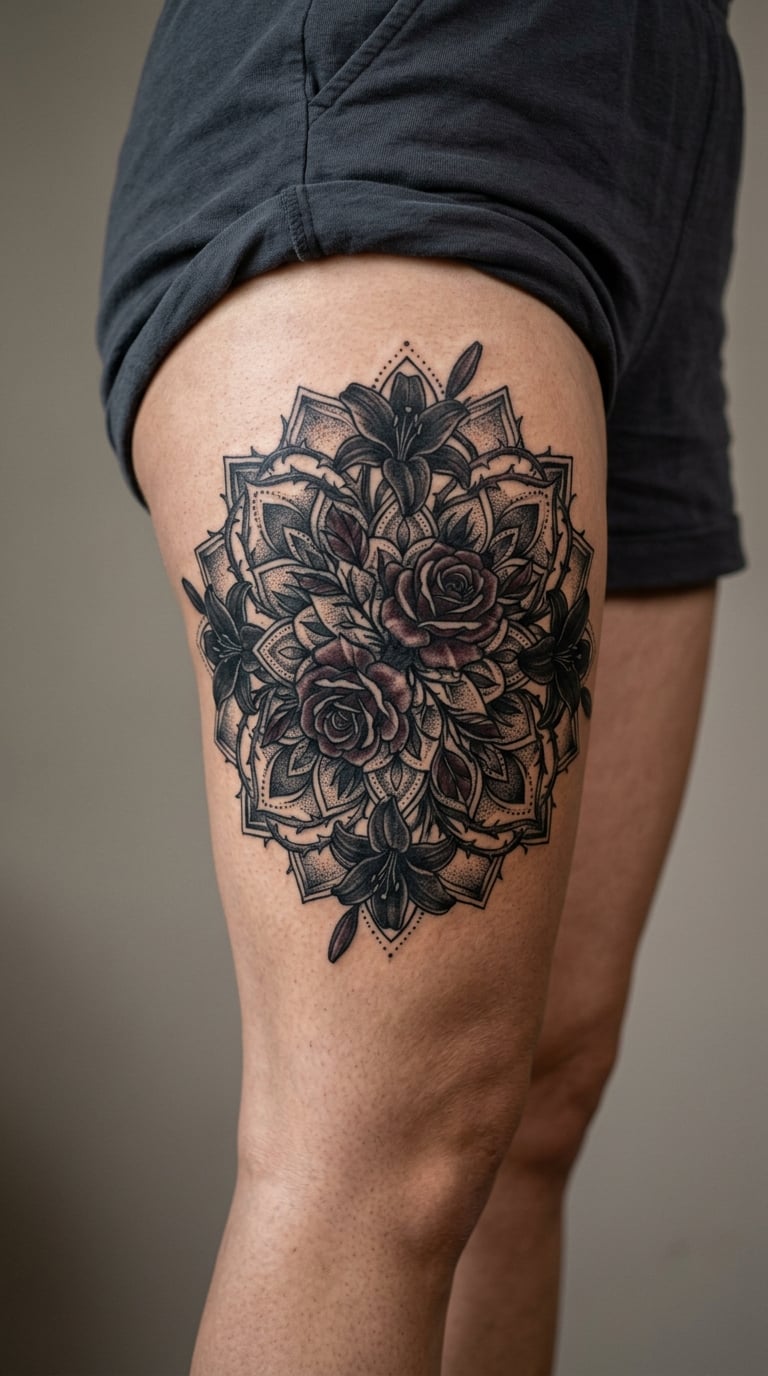
A commanding thigh composition with black lilies, roses and thorned vines arranged around architectural negative space, using muted burgundy sparingly so the black stays dominant. Shapes are drawn large and simplified so nothing turns to mud.
Multi-flower compositions only work when the flowers are given room. This is the clearest example of that in the whole list, and it is where people who already have several tattoos tend to end up.
Placement: outer thigh, upper back or the shoulder blade. Size: 8-9 inches (20-23 cm) wide. Style: blackwork with muted burgundy accents.
Pain: medium on the thigh, and it is a long sitting. Plan it as a two-session piece with a healed photo review in between.
Make it yours: keep the burgundy to a single flower so the eye has one place to land, and leave the outer edge to fade into the skin rather than closing it off.
How to Choose the Right Design
Most unhappy gothic florals were not bad ideas. They were good ideas drawn at the wrong scale for the body part. Six checks will narrow it down before you sit down with an artist.
- Match detail density to the canvas. A composition that works at six inches on a thigh turns to grey mush at two inches on a wrist. Ask the artist what their smallest legible scale is for that design.
- Decide blackwork or colour before you shop around. Solid black and grey wash are durable; thin colour and feathered washes need more touch-ups. Changing your mind mid-process is what creates revisions.
- Check the placement against your existing tattoos. Look at spacing, scale and line weight together. A dense blackwork floral next to a fine-line script piece usually looks like two different people.
- Pick the flower before the style. Knowing whether it is a rose, a poppy or a poppy seed head tells an artist far more than a mood reference does.
- Test the silhouette in solid black. If the outline does not read clearly filled in, extra detail will not rescue it. That test is also what predicts how it will look in ten years.
- Look for healed work in an artist’s portfolio, not just fresh ink. Fresh pieces are at their sharpest. Healed photos show you exactly what to expect.
Cost and Session Time
Session length is the honest way to think about what a gothic flower tattoo costs, because almost every shop prices by the hour or by the piece with a shop minimum. The number on the quote follows the hours, not the design’s difficulty rating.
A tiny flash design, one to two inches of single-flower line work, is usually well under an hour. A small blackwork or shaded piece of two to three inches typically takes an hour to two. A medium composition around four to six inches, with colour or heavy black fill, commonly runs two to four hours. Large thigh and spine pieces, especially the mandala styles, can run five hours or more and are usually split across two sessions so the artist and the client both stay fresh.
Artists charge different hourly rates, most shops set a minimum booking, and travel and accommodation can add more than people expect if the right artist is not local. Ask for the total, the session plan and the touch-up policy in writing before the first appointment, and expect a touch-up on light grey wash once healed.
Aftercare Basics
- Follow your artist’s aftercare instructions first. They know how deep your particular work went and how it is healing. Everything below is general and comes second to that advice.
- Wash gently. Lukewarm water and a mild unscented cleanser, patted rather than scrubbed, then let it air dry before you put clothing back on.
- Moisturise thinly. A plain unscented moisturiser applied a few times a day keeps the skin from tightening and flaking. Thick balms can trap heat.
- Choose loose, dark clothing for a few days. Cotton over the area, nothing tight, and change it if it soaks through.
- Keep sun off it. Solid black fill lasts longest when it is not regularly exposed. That matters most for the grey wash and colour in these designs.
- Let the artist decide about touch-ups. Wait until the piece is fully healed, then show them healed photos. Never judge a fresh tattoo by how dark it looks in week one.
Frequently Asked Questions
Are gothic flower tattoos suitable for first-time tattoo clients?
Yes, if the design is scaled to the chosen body area. A small black rose or poppy is usually easier to place cleanly than a dense multi-flower composition. During the consultation, ask the artist how they would simplify the reference for that size, and let them draw a reduced version before you commit to the full piece.
Should a gothic flower tattoo be black or colored?
Blackwork often makes gothic botanicals feel dramatic and cohesive, and solid black ages the best. Muted colour adds depth without making the design look cheerful. Plum, oxblood, moss green and charcoal are common choices. If you go colourful, keep it to one or two shades on a single flower so the piece still reads dark.
What is the least painful placement for a gothic flower tattoo?
The upper arm, outer thigh and calf are often more comfortable than the ribs, sternum, spine, inner arm or hands. Pain varies with the person, the placement and how long the session runs, so treat it as information rather than a rule. Bony placements and long sessions hurt more regardless of how tough you are.
Which gothic flower tattoo is best for a first tattoo?
A fine-line black rose, a minimalist poppy or a small single-flower cluster is usually the simplest starting point because the artist can concentrate on one silhouette. Choose an artist whose portfolio shows the specific style you want, and ask to see healed pieces. Avoid starting with a large dense mandala on your first session.
How do I stop fine detail in a gothic flower tattoo from fading?
Ask for bolder linework than feels necessary at the design stage, keep the piece covered from direct sun, and moisturise lightly while it heals. Fine grey wash and hairline detail soften first, so a solid outline carries the design after the shading fades. Book a touch-up once healed rather than trying to protect tiny detail forever.
Conclusion
Start with the constraint, not the picture. Pick the body part, pick the size that part can hold, and then choose among these gothic flower tattoo ideas from what survives that filter. A fine-line black rose at three inches is the most manageable option for a first piece, because one silhouette gives the artist room to work cleanly. If you already have ink and want a dense composition that anchors the arm or leg, the thorn-wrapped blackwork peony is the stronger choice. Bring your references to the consultation, ask for a scaled-down version of anything complex, and check the healed work in the portfolio before you book.