
22 Memorial Tattoo Ideas for a Pet: Best Tributes (2026)
If you are looking for memorial tattoo ideas for a pet, the good news is that the design does not have to be complicated to mean something. Paw prints, portraits, silhouettes, and a name with two dates cover almost every case, and each one tells the story better in a different way.
Most people arrive here somewhere between a few weeks and a few years after a pet dies, and they all want the same thing: something small enough to live with, personal enough to be unmistakably theirs, and honest enough that looking at it still feels good. The list below is arranged so you can jump to a style, compare placements in the quick guide table, and then take one idea into a consultation.
Planning ahead for a bigger piece? Artists book out weeks in advance, so a consultation for October 2026 is worth scheduling early.
22 Memorial Tattoo Ideas for a Pet: Quick Guide
Every design below is broken out the same way: the style, where it sits best on the body, a realistic size, and how the session tends to feel. Rows follow the numbered sections in the same order.
| Idea | Style | Best placement | Realistic size | Pain |
|---|---|---|---|---|
| Fine-line paw print with tiny heart | Fine line | Inner wrist or inner forearm | 1.5 to 2.5 inch | Low to moderate |
| Miniature pet portrait | Black and grey realism | Inner wrist, rib, or ankle | 2 to 3 inch | Moderate |
| Matching human and pet portraits | Fine line or black and grey | Paired inner forearms | 2 to 3 inch each | Moderate |
| Pet silhouette in a sunset | Watercolor with black outline | Outer forearm or calf | 3 to 4 inch | Moderate |
| Nose print | Minimalist realism | Side of a finger or wrist | 1.5 to 2 inch | High on fingers |
| Memorial date lettering | Fine line script | Inner forearm, vertical | 2 to 3 inch tall | Moderate |
| Portrait with floral accent | Black and grey with watercolor | Inner arm or rib | 3 to 4 inch | Moderate |
| Sleeping pet in a heart | Fine line | Inner wrist or chest | 2 to 3 inch | Low to moderate |
| Interlocking hearts | Fine line or solid black | Outer forearm or wrist | 1.5 to 2.5 inch | Moderate |
| Micro-realism eye portrait | Micro-realism | Behind the ear or inner arm | 1 to 1.5 inch | Moderate |
| Paw print trail with hearts | Minimal line work | Forearm or trailing up the calf | 2 to 4 inch trail | Low |
| Name in elegant script | Fine line calligraphy | Collarbone, wrist, or rib | 2 to 4 inch wide | Low to moderate |
| Traditional-style portrait | Neo-traditional | Upper arm, thigh, or calf | 3 to 5 inch | Moderate to high |
| Blackwork silhouette | Blackwork | Outer forearm or calf | 3 to 5 inch | Moderate |
| Watercolor portrait | Watercolor | Upper arm or shoulder | 3 to 4 inch | Moderate |
| Pet and home line drawing | Single-weight line art | Inner forearm | 2.5 to 3.5 inch | Low to moderate |
| Memorial ribbon with paw | Blackwork or fine line | Ankle, wrist, or shoulder | 2 to 3 inch | Low |
| Two matching pet tattoos | Fine line or blackwork | Matching wrists or calves | 1.5 to 2.5 inch each | Moderate |
| Initials with a laurel | Lettering with traditional detail | Forearm, calf, or upper arm | 2.5 to 4 inch | Moderate |
| Tiny portrait behind the ear | Fine line | Behind the ear | 1 to 1.5 inch | Low to moderate |
| Pet under a starry sky | Blackwork with dotwork stars | Upper arm, back, or calf | 4 to 6 inch | Moderate to high |
| Portrait with blanket pattern | Black and grey with pattern | Forearm or calf | 3 to 5 inch | Moderate |
1. Fine-Line Paw Print with a Tiny Heart
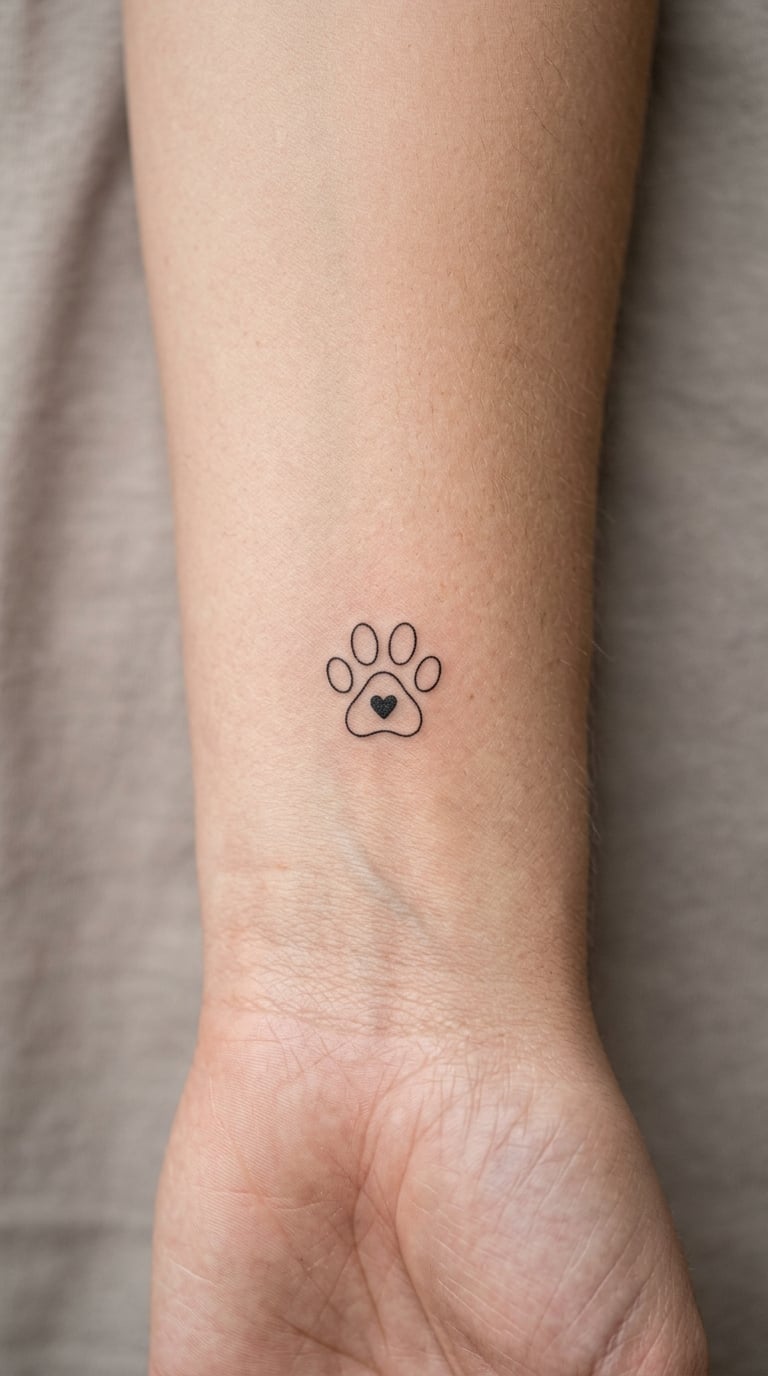
A fine-line paw print with a tiny heart is the most-requested memorial tattoo idea for a pet, and the simplest one to live with. One thin black line weight outlines a single pad print, and a small heart sits either inside the main pad or beside the heel.
People choose it because it reads instantly as a companion without turning into a portrait anyone might argue with. It works as a first tattoo, as a quiet addition to an existing piece, or as a repeat design for every pet you lose.
Placement: inner wrist, inner forearm, or just below the elbow crease. Size: 1.5 to 2.5 inch (4 to 6 cm) across. Style: fine line. Pain: low to moderate, since the inner wrist is thin skin over a vein, and a sore wrist is a strange souvenir to carry around.
Make it yours: if your pet was missing a toe, that owner often puts the little heart in the empty space instead of beside the print. Tattooers on r/tattoo say the version that includes the quirk is the one that still makes them cry years later.
One ageing note worth planning for: single-needle fine line on the inner forearm softens noticeably after five to seven years. It is a cheap fix at touch-up time, but ask your artist to build in slightly heavier line weight now.
2. Miniature Pet Portrait on the Wrist
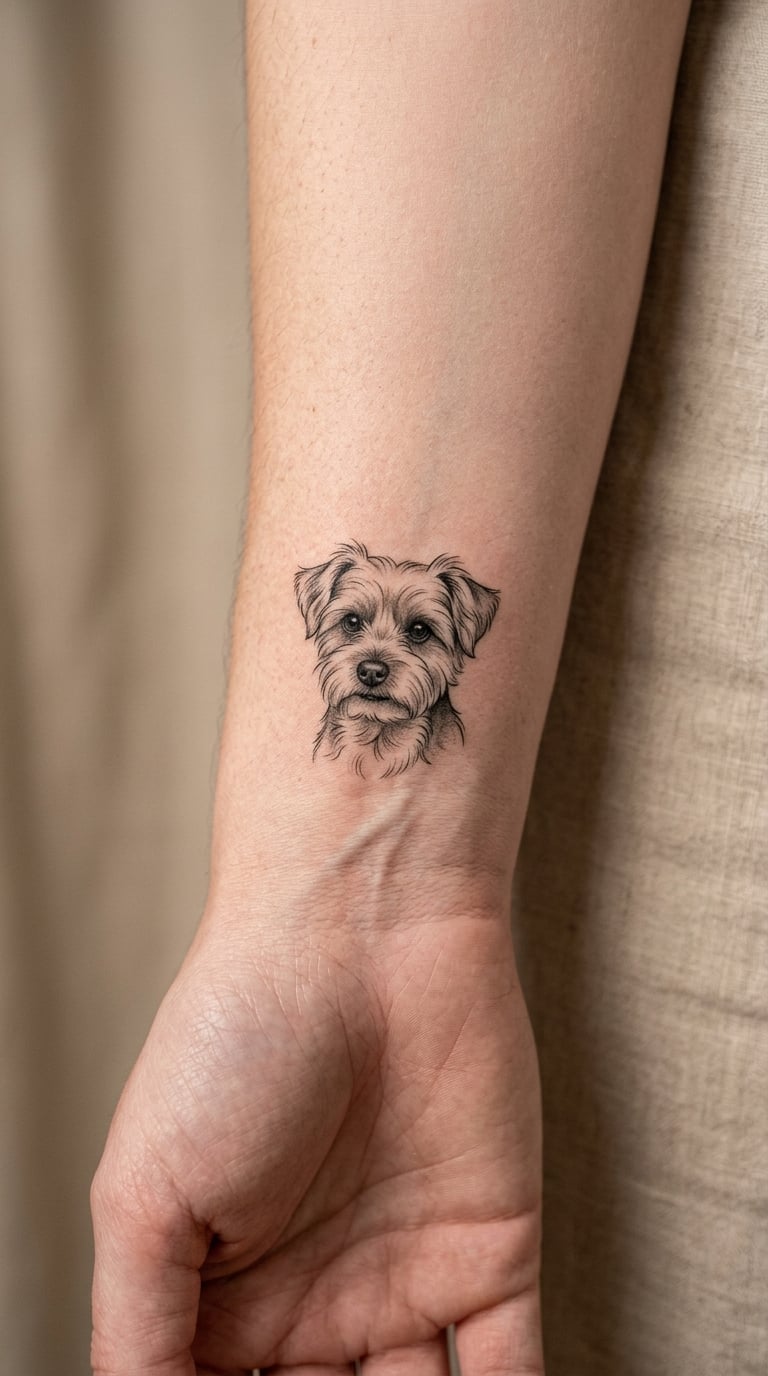
A miniature pet portrait on the wrist captures your dog’s or cat’s defining features in a size you can actually see every day. The artist works in black and grey with soft shading, building the face from shadow rather than outline: the tilt of the head, the shape of the muzzle, the specific ear that flopped.
It suits people who want the likeness and not a symbol, because a portrait remembers an individual rather than a category of animal. The small scale also keeps it safe. A 2-inch face on the wrist is a private thing, not a billboard.
Placement: inner wrist, inside of the arm near the elbow, or the ankle bone. Size: 2 to 3 inch (5 to 8 cm) tall. Style: black and grey realism. Pain: moderate, and the wrist bones are more sensitive than the fleshy part of the forearm.
Make it yours: bring three or four photographs, including one where the pet’s face is square to the camera. Portrait artists on r/tattooadvice consistently say the reference quality decides the result more than the artist’s reputation does.
Small shading is the part that softens first. Expect one free touch-up inside the first year if the face is under 2 inches, and treat sun exposure as the main reason a tiny portrait fades.
3. Matching Human-and-Pet Portraits
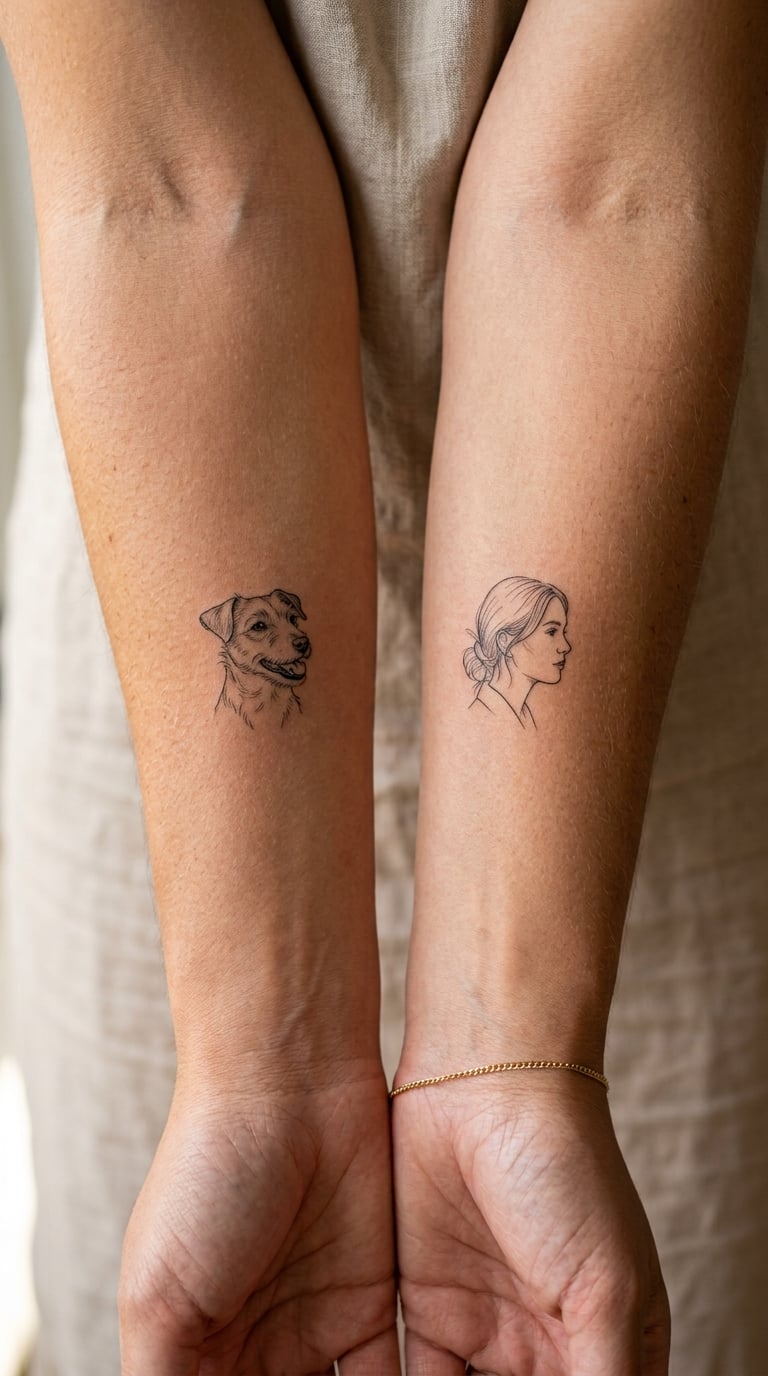
Matching human-and-pet portraits put two faces side by side in the same style and scale, one of a person and one of the pet. Fine line or soft black and grey, drawn so the eye level and lighting direction match, so the two pieces read as one thought.
Some people take the design further and make them a matching pair for a partner or a family member, each person carrying one half of the same picture. That is the version that turns a memorial into a shared one.
Placement: inner forearms, wrists, or the space above the ankle on each leg. Size: 2 to 3 inch (5 to 8 cm) each. Style: fine line or black and grey. Pain: moderate, and the inner forearm is a curved surface, so the shading has to be built in more than one pass.
Make it yours: match the light source in both drawings to the direction you actually stand in. It is a small detail that makes two separate tattoos look composed.
Matching work takes planning, because the two pieces have to be drawn from the same reference and scaled the same way. Bring both photos to one consultation rather than booking two independent appointments.
4. Pet Silhouette Inside a Sunset
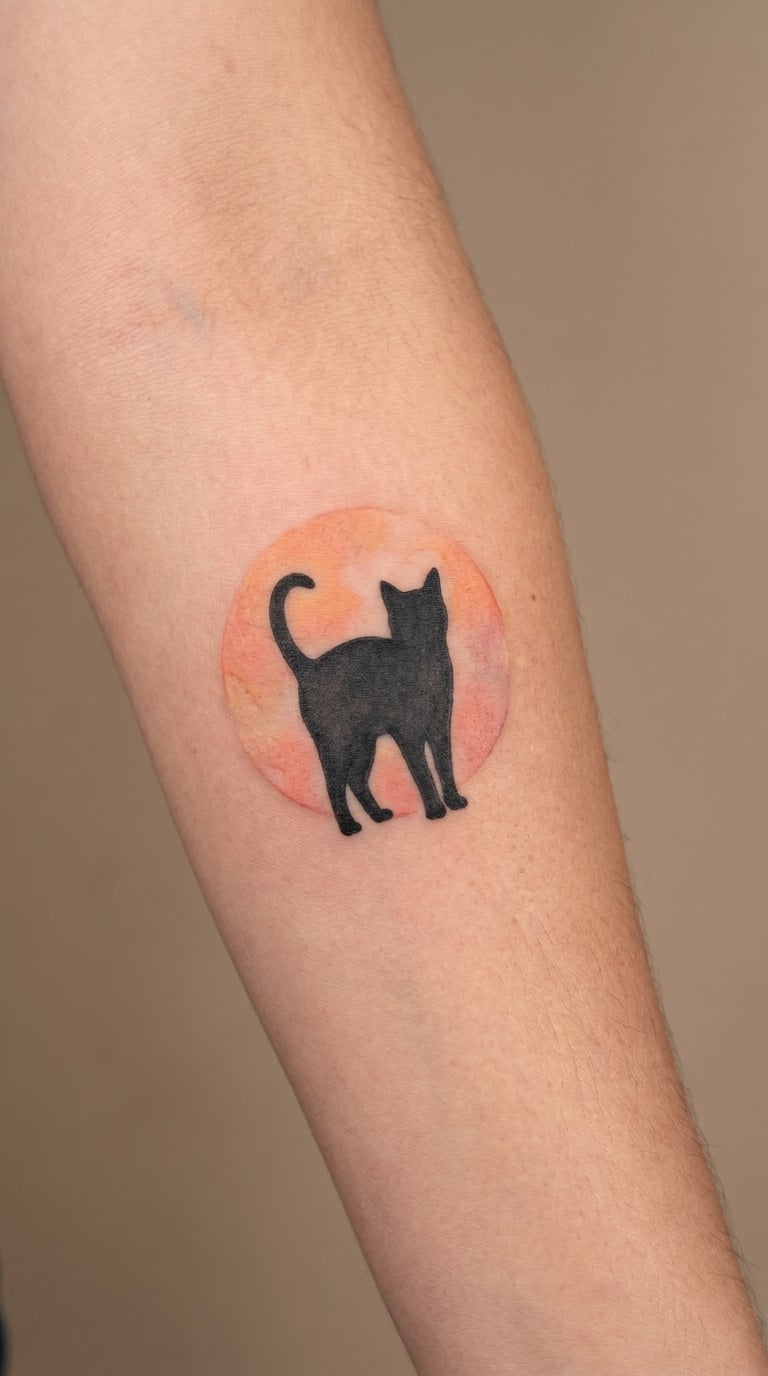
A pet silhouette inside a sunset places your pet’s outline against a warm wash of orange, pink, and muted yellow, with the shape rendered in a single solid black. The scene has depth, but the silhouette is what carries the identity, so the design stays readable even when the colour is not.
It is one of the more emotional memorial tattoo ideas for a pet because the setting does part of the feeling for you. You can show the moment your pet used to sit in a window, on a porch, or against the last light of the evening.
Placement: outer forearm, calf, or the flat of the upper arm. Size: 3 to 4 inch (8 to 10 cm). Style: watercolor wash with a black outline. Pain: moderate; the colour passes are lighter than a shaded black and grey portrait.
Make it yours: use your pet’s actual posture, tail position, and ear angle rather than a generic animal outline. A sitting dog with a specific head tilt is the whole point of the piece.
Watercolor needs less touch-up than fine line, since there is no hairline detail to lose, but pale washes fade toward grey over roughly a decade on a sun-exposed forearm.
5. Nose Print in a Minimalist Style
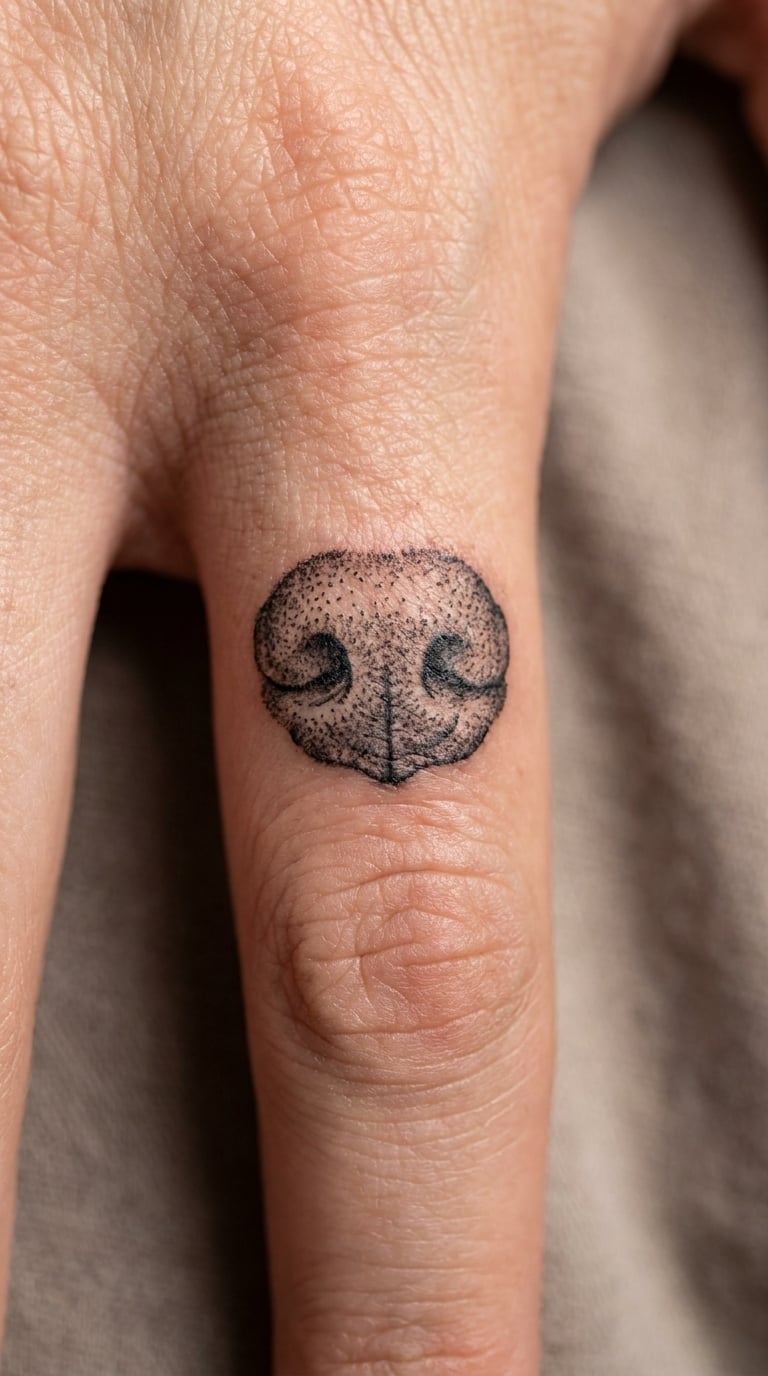
A nose print is the most personal ink you can put in a tattoo, because no two pet noses are the same and nobody else in the room can claim yours. The artist renders the nostrils, the texture, and the outer shape in black, with just enough stippling to suggest the nose leather.
It is also the hardest reference to get wrong gracefully. Take an ink or clay print from your vet, or use a sharp photo straight on, because a nose at an angle loses the symmetry that makes it recognisable.
Placement: side of a finger, the fleshy pad of the thumb, or the inside of the wrist. Size: 1.5 to 2 inch (4 to 5 cm). Style: minimalist realism. Pain: high on fingers, and the side of a finger is mostly nerve and bone with no cushion.
Make it yours: add a tiny initial beside it in the same black line work so the two elements read as a single stamp.
Fingers take a beating. Expect noticeable change over a decade from knuckle flexing and sun, and ask for line weight heavy enough to survive it.
6. Memorial Date in Fine-Line Lettering
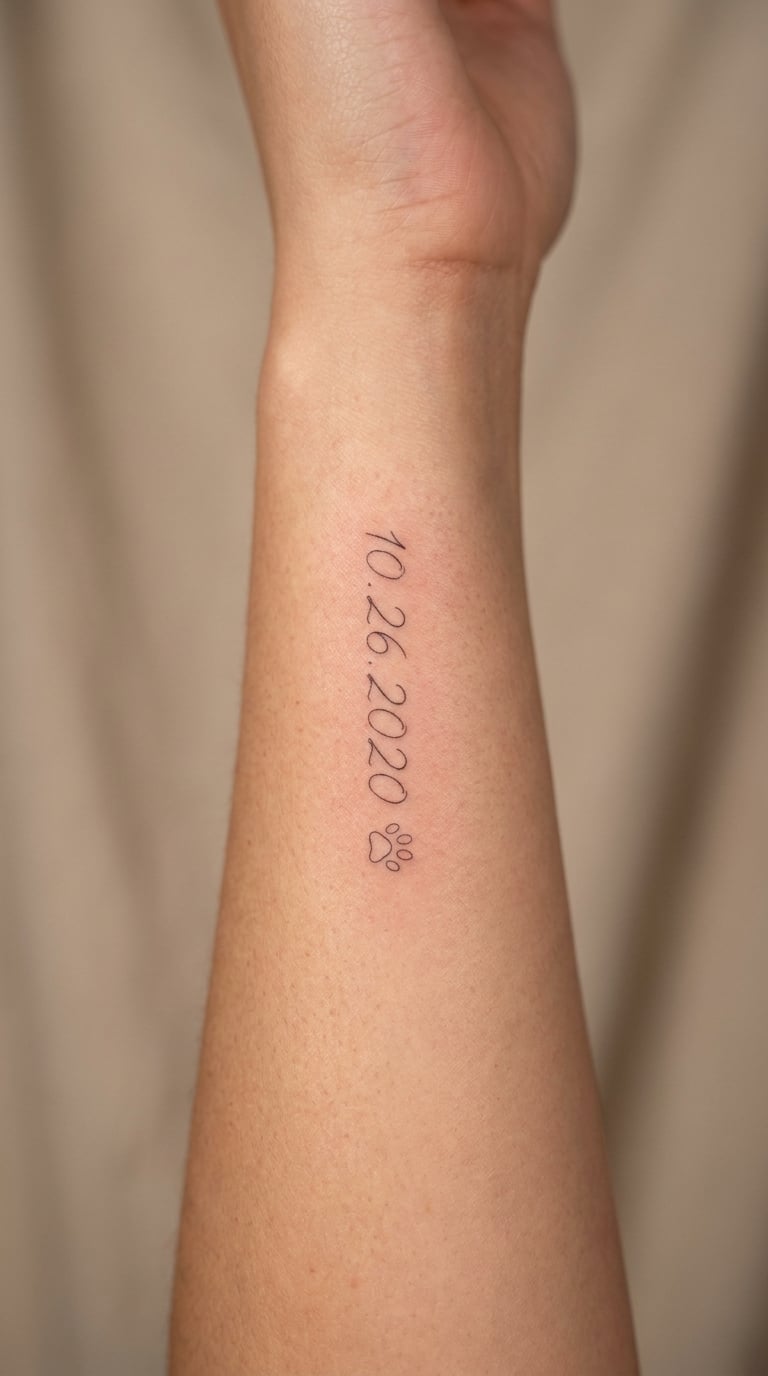
Memorial date lettering is the quietest of these memorial tattoo ideas for a pet: the years your pet lived, sometimes with an age in months, set vertically in fine-line script, sometimes with a small paw or star beneath.
Dates are the piece people come back to and add to. A lot of tattooers report clients returning years later for a second pet, so plan a spot with room for an extension rather than crowding a forearm with three stacked dates.
Placement: inner forearm set vertically, or the inside of the arm below the elbow. Size: 2 to 3 inch (5 to 8 cm) tall. Style: fine line. Pain: moderate, and the inner forearm bruises visibly for a few days afterwards.
Make it yours: use the full years for an older pet, or the two years and the months for a young one. If your pet’s birthday and the day you said goodbye are the same date, that is worth saying in one line.
Thin script fades faster than anything else on this list. Insist on a single-needle line at least a shade heavier than looks comfortable in a photo, and plan on a refresh every few years.
7. Pet Portrait with a Floral Accent
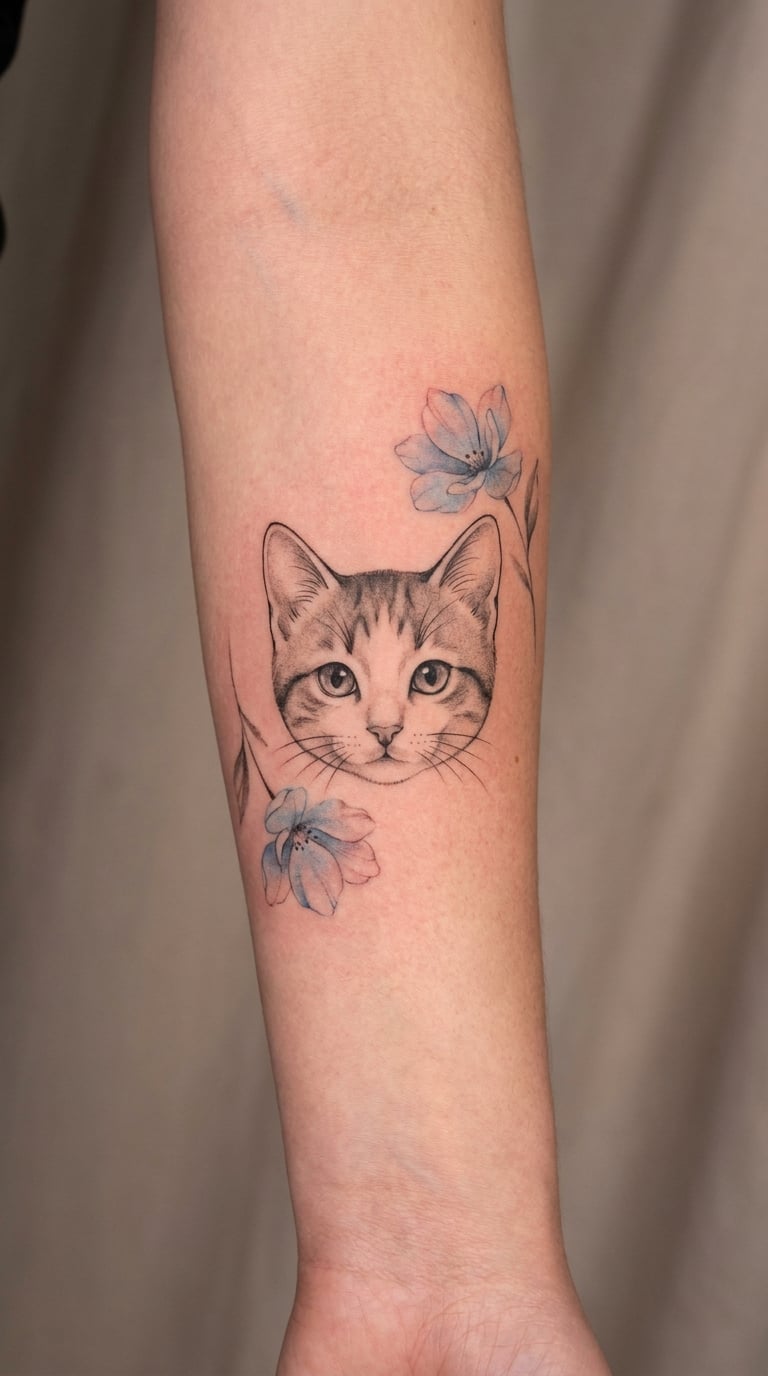
A pet portrait with a floral accent keeps the likeness in black and grey and lets the flowers carry the colour, usually as two or three small blooms in loose watercolor rather than a dense bouquet.
Flowers are the traditional way to mark a life that ended, and pairing them with a portrait lets you acknowledge that without turning the design into a mourning symbol other people might read. The birth flowers of your pet’s birth month are a common choice, though people also use their own.
Placement: inner arm, the rib area, or the back of the shoulder. Size: 3 to 4 inch (8 to 10 cm). Style: black and grey with watercolor. Pain: moderate, and the ribs are more sensitive than most people expect.
Make it yours: pick the species of flower with a reason, then repeat it on another pet’s memorial years later so the series stays yours.
Keep the flowers fewer than you think you want. Three well-rendered blooms frame a face; a dozen turn the portrait into wallpaper.
8. Sleeping Pet in a Heart Outline
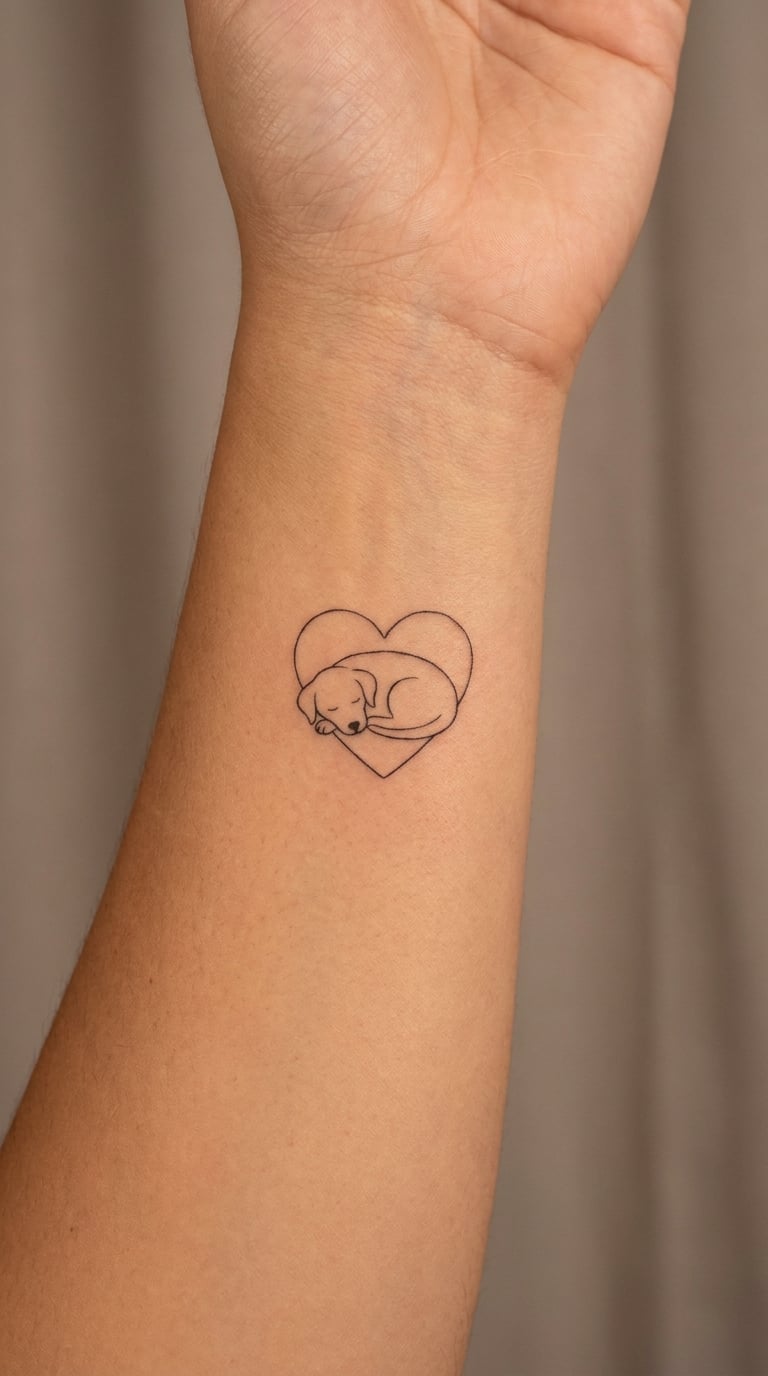
A sleeping pet in a heart outline is a tender one: the animal curled up, drawn in a single continuous fine line, closed inside a thin heart that frames the shape without touching it.
It appeals to people who remember the sleeping version of their pet more than the playing one, the Sunday-morning lump under the covers with a foot sticking out. A designer who has never seen your pet still can draw that posture, and a designer who has seen your photographs can draw your specific one.
Placement: inner wrist, the hollow at the base of the throat, or the chest just below the collarbone. Size: 2 to 3 inch (5 to 8 cm). Style: fine line. Pain: low to moderate, and the chest is usually the most sensitive part of this list.
Make it yours: have the heart outline break in one place so the pet appears to be tucked inside rather than boxed.
Curled poses rely on clean contour lines, which are exactly what softens first. Ask your artist to double the line weight on the back and the ear curve.
9. Pet and Owner Interlocking Hearts
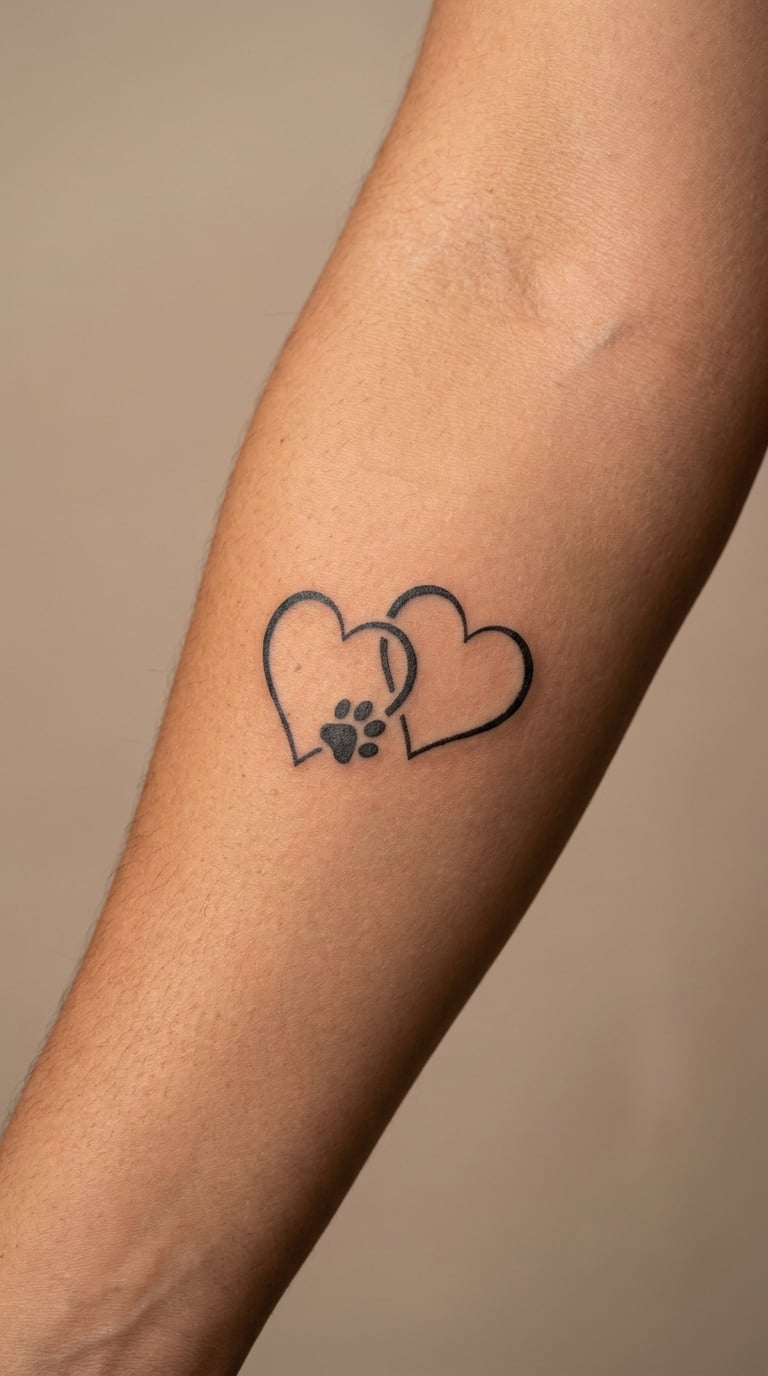
Interlocking hearts say the bond without drawing either side of it: two heart outlines linked at the centre, with a small paw print tucked into the space where they meet. The design is symmetrical, which makes it far easier to render well at small sizes than a face ever is.
That safety is the reason it keeps showing up. It carries meaning that other people can read, and it does not depend on an artist’s ability to draw your specific animal accurately.
Placement: outer forearm, wrist, or the upper arm. Size: 1.5 to 2.5 inch (4 to 6 cm). Style: fine line or solid black. Pain: moderate, and bone-heavy spots on the outer forearm sting more than the same design on the inner.
Make it yours: put a date in the space between the two hearts, small enough to read as a line of texture at a distance and readable up close.
Symmetrical line work ages well because both halves wear at the same rate. This is a good design to add to a collection without it looking like an afterthought.
10. Micro-Realism Eye Portrait
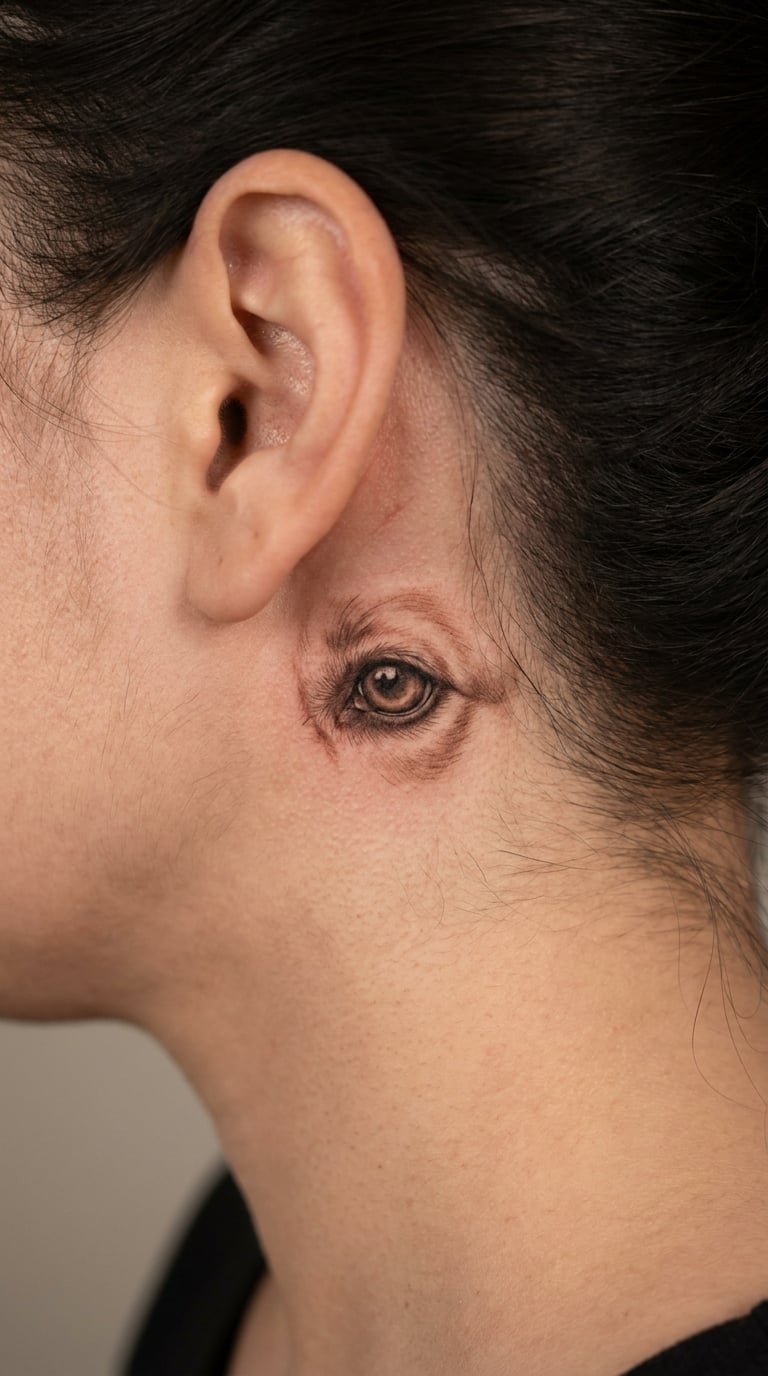
A micro-realism eye portrait is the most intimate of these memorial tattoo ideas for a pet: one eye, rendered in a tiny area with the iris, wet line, and lashes built from real shading rather than drawn lines.
It works emotionally in a way a full portrait cannot. People who have chosen it usually say the eye is the part they actually remember, and at small scale it holds detail far better than a whole face would.
Placement: behind the ear, the inner forearm, or the ankle bone. Size: 1 to 1.5 inch (2.5 to 4 cm). Style: micro-realism. Pain: moderate, and the tiniest work often needs two sessions because the artist works slowly on purpose.
Make it yours: match the eye colour exactly. Bring a photo in daylight, because a warm indoor flash will put the wrong hue on the iris permanently.
Find an artist whose portfolio is portraits and eyes, not generalists. A one-inch eye has no margin for a near miss, and colour correction means a fully healed session before any touch-up.
11. Paw Print Trail with Hearts
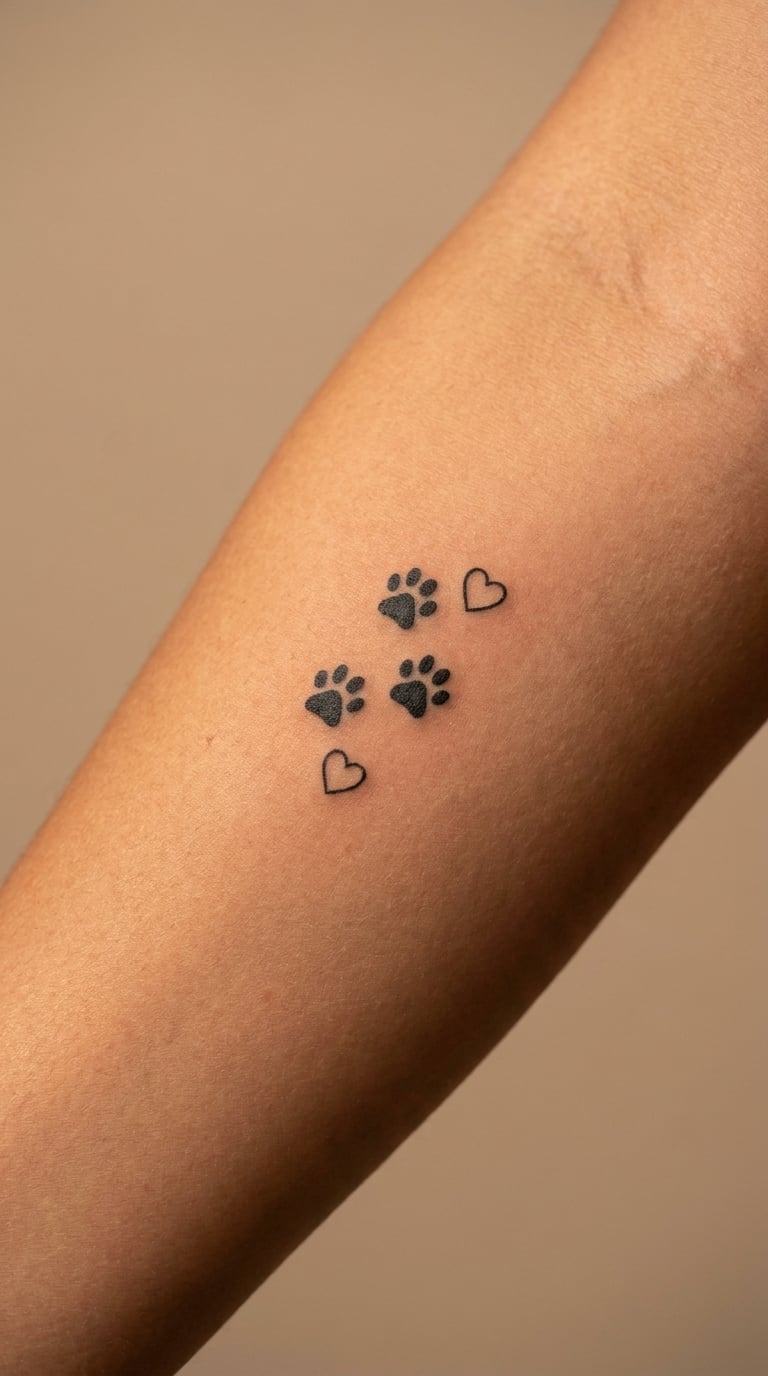
A paw print trail with hearts is a sequence rather than a single image: small prints walking diagonally across the skin, with one or two hearts between them. Three or four prints works better than seven, because each one needs enough space to read.
It suits people who plan more than one memorial, since a trail is easy to extend later with another paw and a date. On r/tattooadvice, owners describe building a repeatable small black-ink design for every pet they have lost, sometimes trailing up the leg.
Placement: forearm, calf, or along the side of the ribcage. Size: 2 to 4 inch (5 to 10 cm) for the whole trail. Style: minimal line work. Pain: low, since every element is a small hit of single-needle shading.
Make it yours: vary the size of each print slightly and have one print lighter than the others, so the trail reads as movement rather than pattern.
Leave more space than your reference photo suggests. Prints that sit too close together fill in as the skin relaxes and turn into an unreadable smudge within a few years.
12. Pet Name in Elegant Script
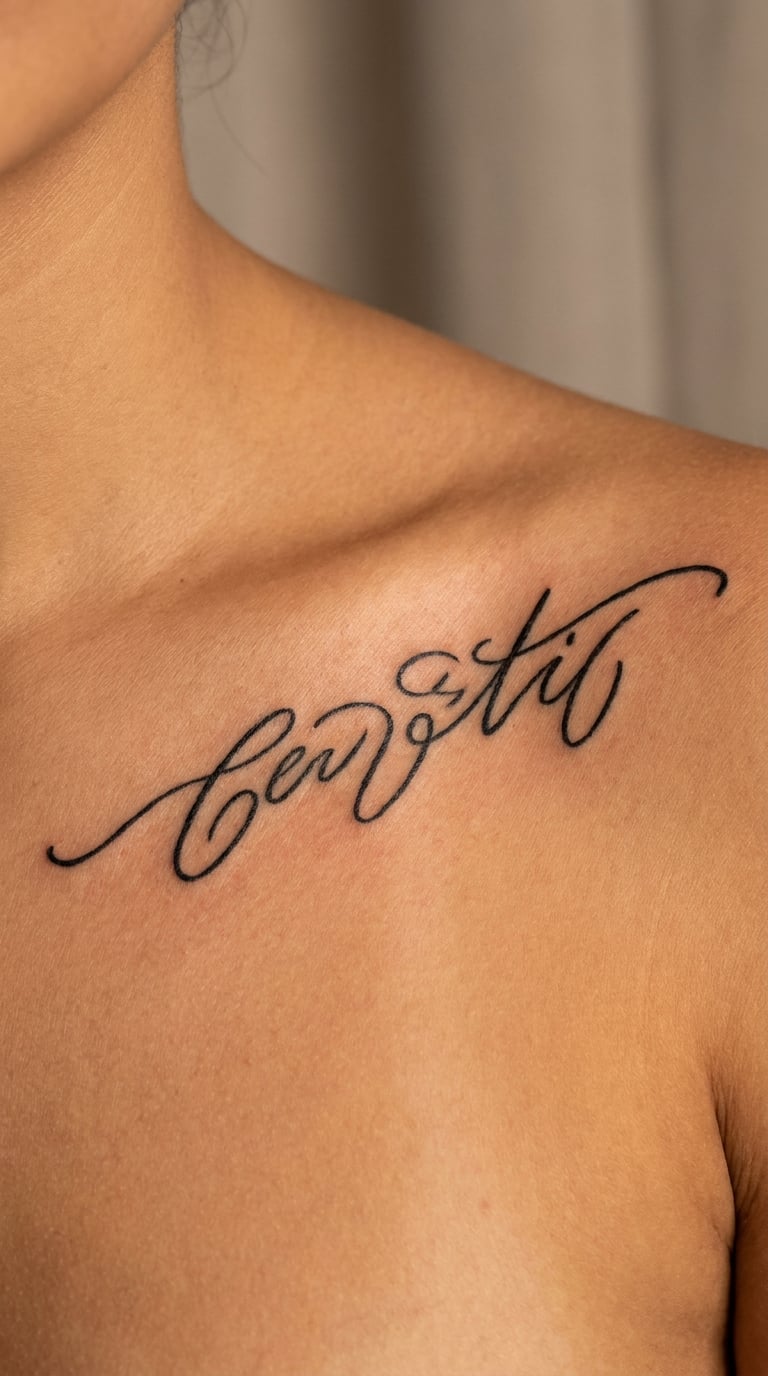
A name in elegant script is the plainest and most direct tribute in the list. Nothing but the word, set in a copperplate or a modern calligraphy hand, usually with the last letter trailing into a small curve that catches the eye.
Naming your pet in handwriting feels more like handwriting than like a memorial, and that is often the point. The reference is a sample of how you wrote their name, so hand the artist an example in your own hand if you have one.
Placement: collarbone, inner wrist, ribs, or the inside of the arm. Size: 2 to 4 inch (5 to 10 cm) wide. Style: fine line calligraphy. Pain: low to moderate, though the collarbone is a bony one to sit through.
Make it yours: add the years underneath in a small sans-serif, which stays legible longer than a second line of script.
Script is the first thing on any memorial list to need a refresh. Test the design on paper at the actual size before you commit, because a name that looks elegant at six inches can turn into a smudge at two.
13. Traditional-Style Pet Portrait
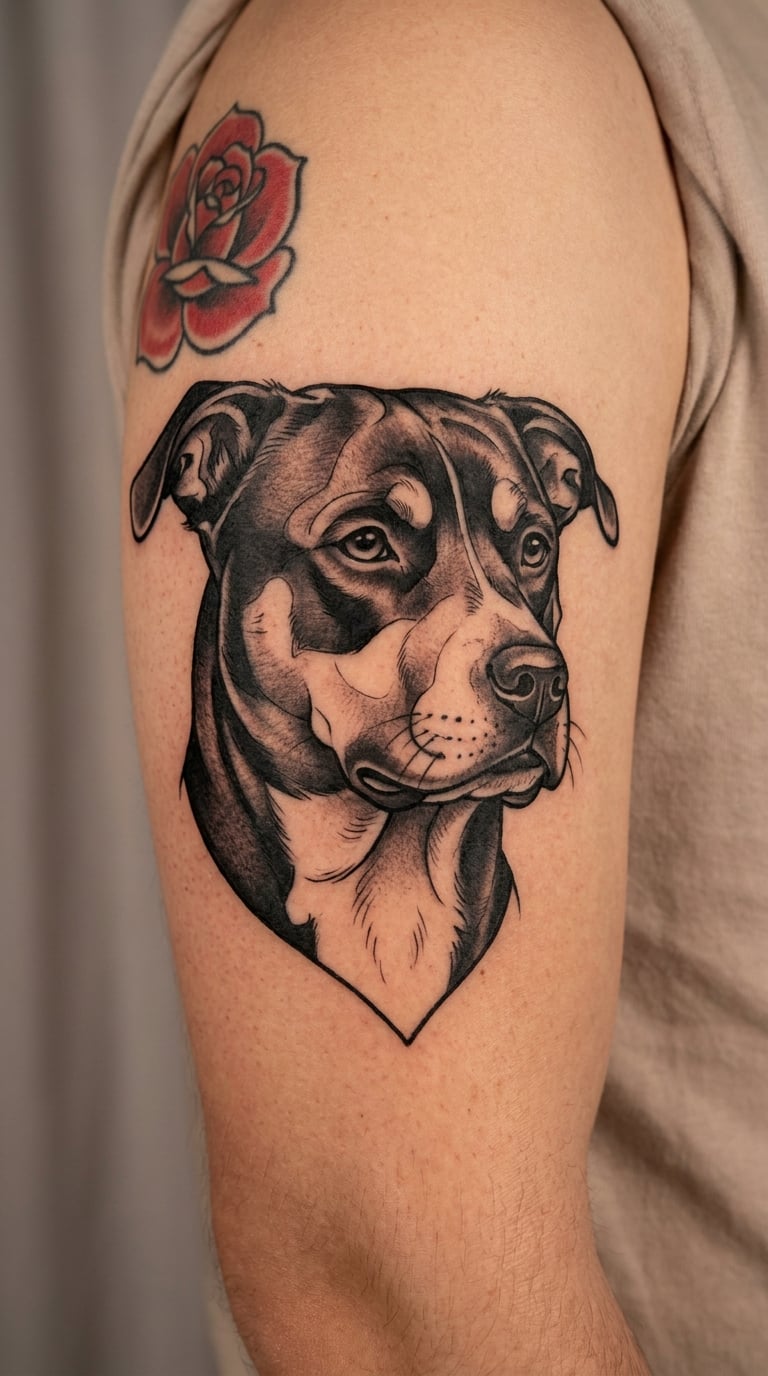
A traditional-style portrait uses the old tattoo vocabulary: heavy black outlines, flat blocks of colour, and a strong shadow shape. The result is bold and durable, closer to an old flash sheet than a photograph, and it is the sturdiest option here for a design that has to survive decades.
Traditional work suits people who want the memorial to be visible, not whispered. It is a large, confident piece that starts a conversation, and it holds its edges long after fine line would have blurred.
Placement: upper arm, thigh, calf, or across the shoulder. Size: 3 to 5 inch (8 to 13 cm). Style: neo-traditional. Pain: moderate to high, and this is a long sitting on a fleshy area with colour saturation.
Make it yours: have your pet’s actual colouring translated into the tradition’s palette, even if that means shifting a colour you would have picked otherwise.
Book a consultation with an artist whose portfolio is traditional work, and expect this to be a full session rather than a quick piece. A 5-inch portrait is often a three-hour job.
14. Blackwork Pet Silhouette
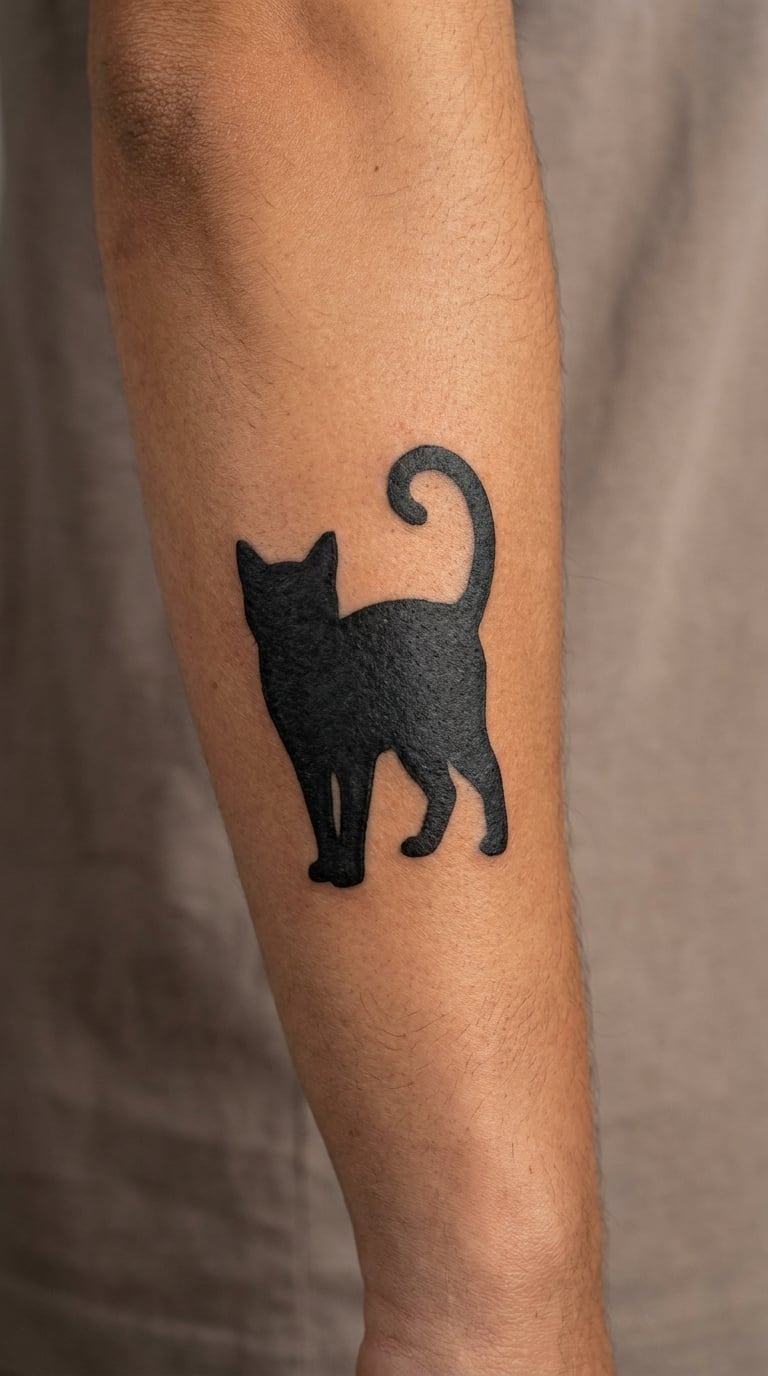
A blackwork silhouette reduces your pet to a solid black shape, usually the whole body or the head in profile. The skill is entirely in the outline: the ear shape, the curve of the back, the tail position, the gap between the legs.
Because there is no interior detail, a silhouette cannot be subtly wrong. That is a real relief for anyone worried about a realistic portrait rendering a near miss, and it is the reason silhouettes come up so often in those conversations.
Placement: outer forearm, calf, back of the shoulder, or the flat of the upper arm. Size: 3 to 5 inch (8 to 13 cm). Style: blackwork. Pain: moderate, and a solid fill is quicker to tattoo than shading, though the saturation is a different kind of uncomfortable.
Make it yours: give the artist a photo of your pet mid-stretch or mid-play, because a distinctive frozen pose does more work than any ornament.
Blackwork needs no touch-up and barely fades. The risk is entirely in the drawing, so spend your consultation time on the reference rather than the style.
15. Watercolor Pet Portrait
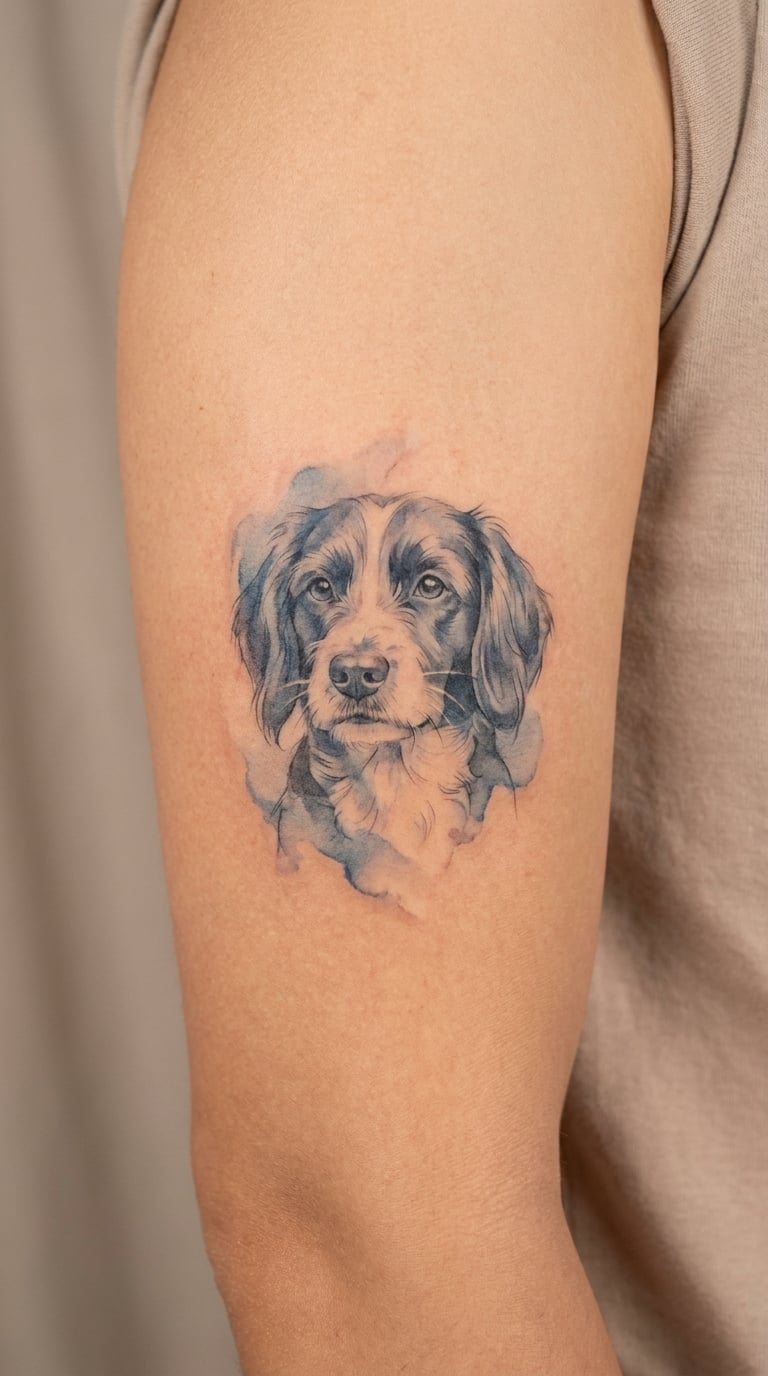
A watercolor portrait builds the face out of soft washes bleeding into each other, usually with a few darker lines to hold the eyes and the edge of the muzzle. The result is emotional and soft rather than documentary.
Watercolour suits people whose memory is about feeling rather than features. It also forgives a certain amount of vagueness in the likeness, which is a genuine advantage when the reference photos are old and slightly out of focus.
Placement: upper arm, shoulder, or the back of the calf. Size: 3 to 4 inch (8 to 10 cm). Style: watercolor. Pain: moderate; washes go in light, so it feels easier than a black and grey portrait of the same size.
Make it yours: pick a colour from something your pet owned, a blanket or a collar, and let the whole wash run in that hue.
Light watercolour fades fastest of any style here. Ask about a light layer of black in the eyes and the nose, because those two areas carry the whole likeness once the colour settles.
16. Pet and Home in One Line Drawing
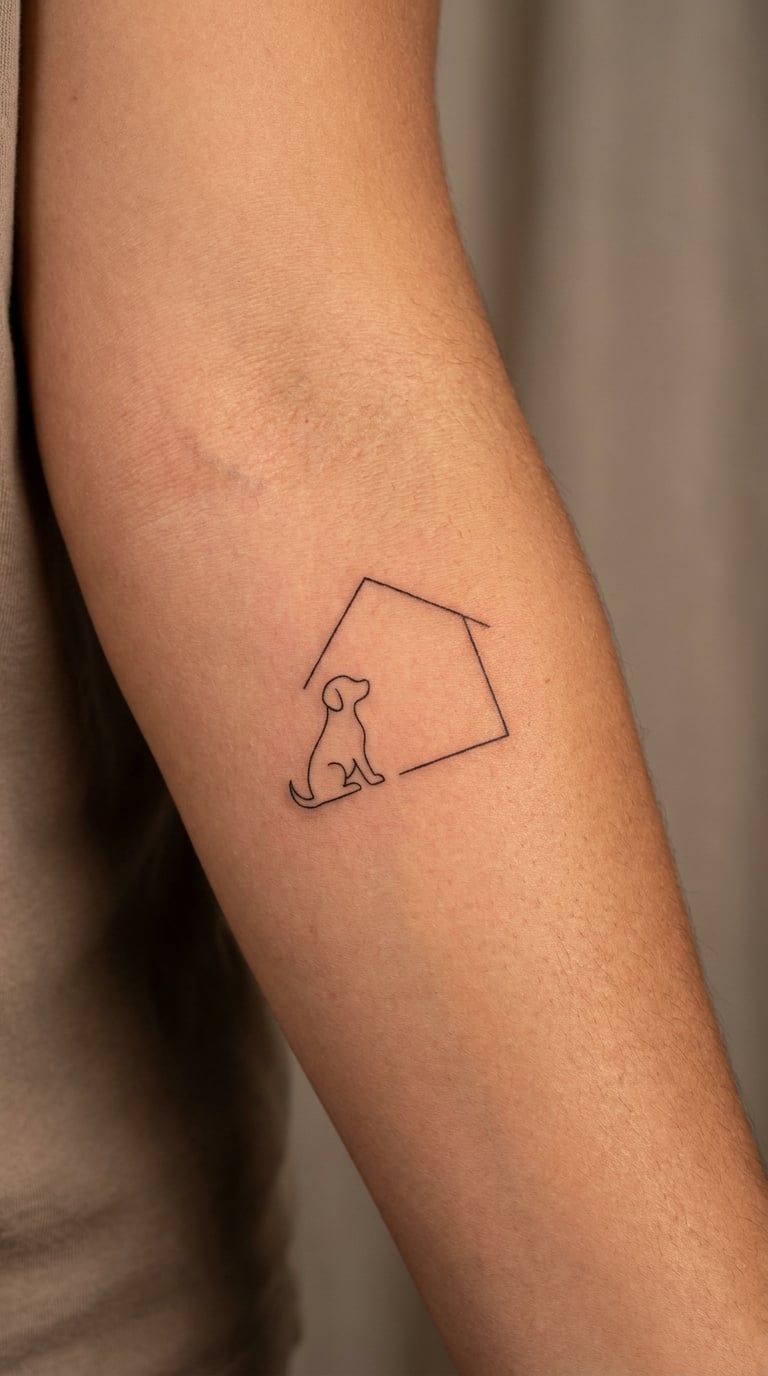
A pet-and-home line drawing puts a small animal outline next to a simple house, a porch step, a garden gate, or a window, all in one continuous-weight black line. Two subjects, one line style, one compact scene.
It works because the location is part of the memory. A plain square with a cat sitting beside it reads as home instantly, and it lets you keep the design small without making it feel bare.
Placement: inner forearm, calf, or the flat of the upper arm. Size: 2.5 to 3.5 inch (6 to 9 cm) across. Style: line art. Pain: low to moderate.
Make it yours: draw the actual house shape, not a generic cottage. The proportions of one specific door or window is what makes it a memory.
Two subjects in one line weight needs a wide enough canvas. If your pet and your house both have to fit under 2 inches, the drawing turns to mud and one of them has to go.
17. Memorial Ribbon with a Paw Print
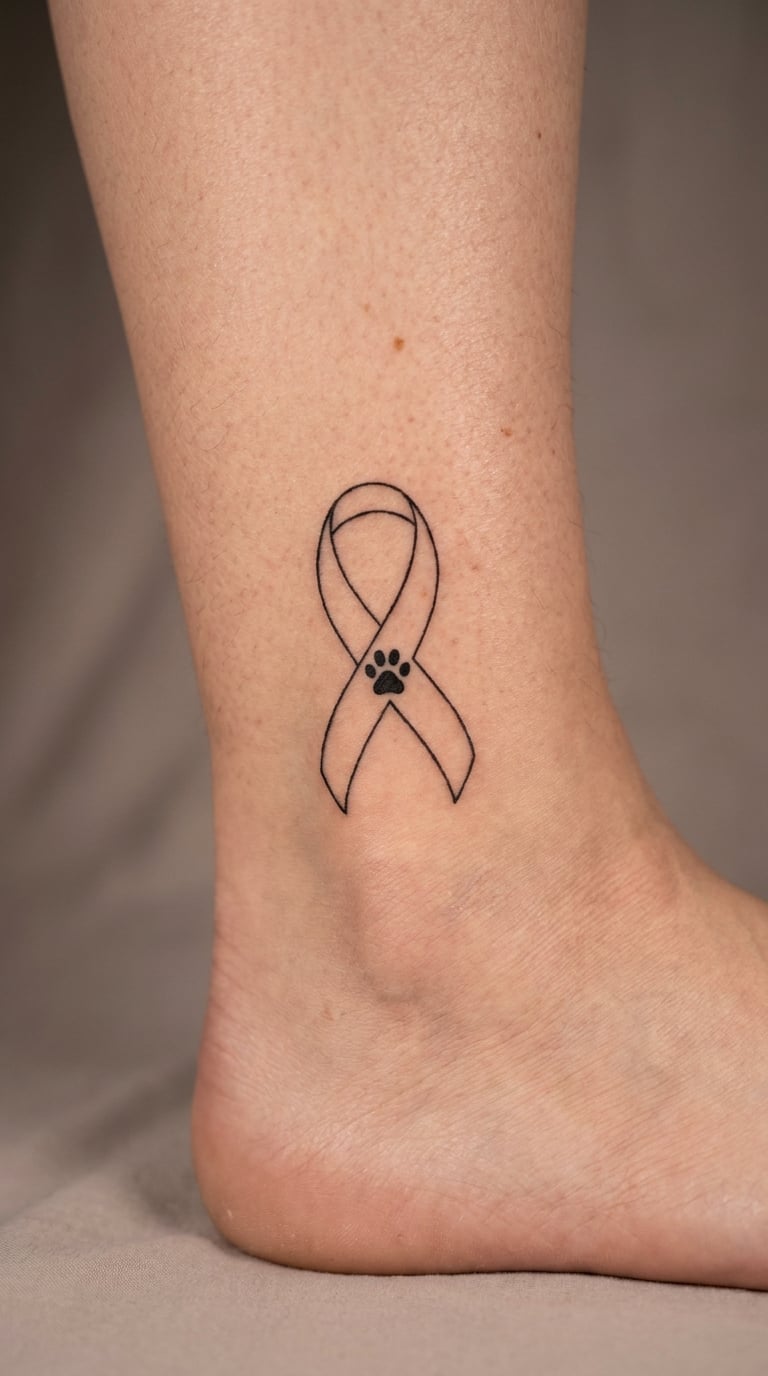
A memorial ribbon is a narrow awareness-style loop rendered in black, with a small paw print at the centre where the ribbon crosses itself. It borrows from the ribbon symbolism people recognise from charities and memorials.
What makes it personal is not the ribbon. It is the paw at the middle of it, and the choice to leave off the words. A lot of people get the ribbon without any text specifically because they would rather the symbol carry it alone.
Placement: ankle, inner wrist, the back of the shoulder, or the ribs. Size: 2 to 3 inch (5 to 8 cm). Style: blackwork or fine line. Pain: low; the ankle and ribs are both workable spots for a small design.
Make it yours: shade the ribbon rather than leaving it flat, and let the paw sit on top in solid black so the two textures separate cleanly.
Ribbons fade more than people expect because they are all soft edges. Ask for a defined inner and outer contour on both loops.
18. Two Matching Pet Memorial Tattoos
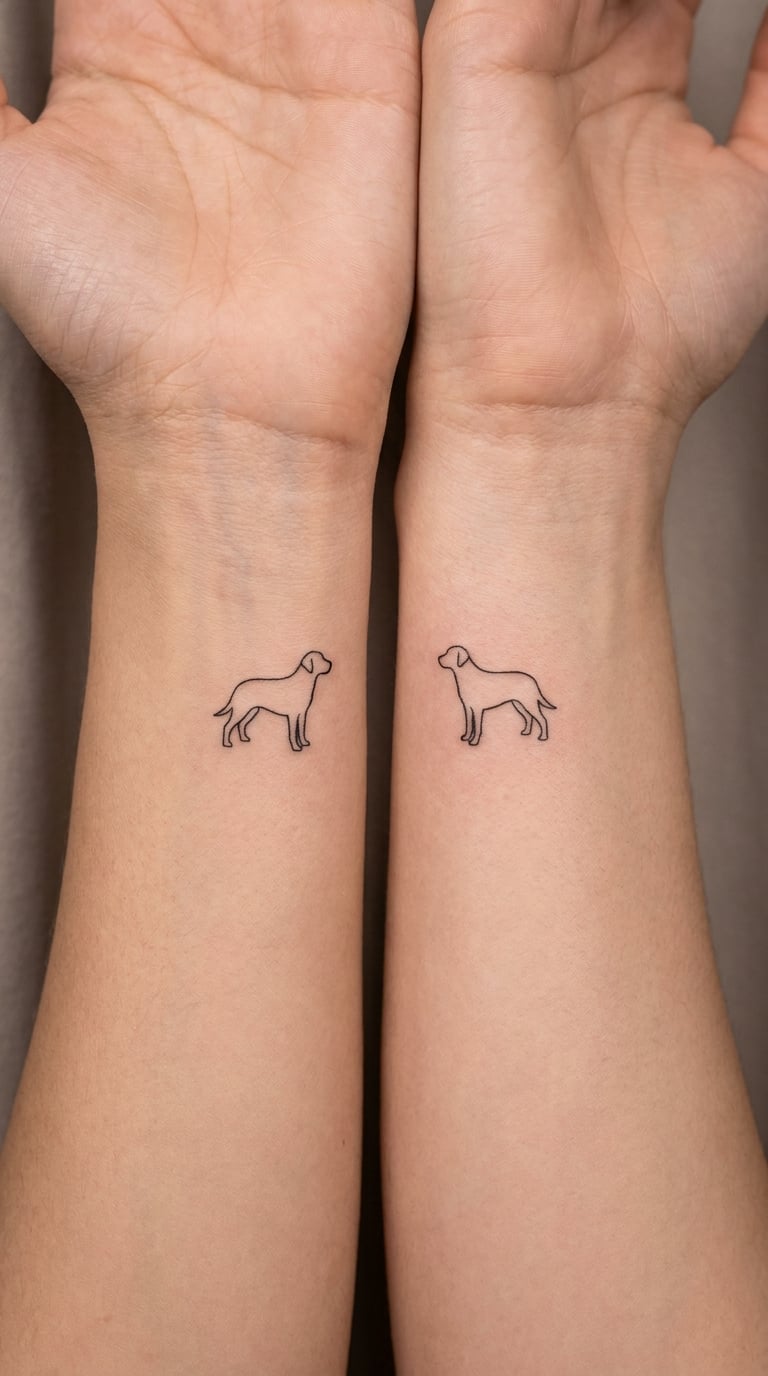
Two matching pet memorial tattoos are a pair, either one pet represented twice on the same person, or one half given to a partner or family member. The design stays identical in style, scale, and line weight, which is what makes the pair look deliberate.
This is the design for a household rather than an individual. It answers the situation that comes up more than any other on pet forums: the whole family grieves, and the parent who does not want a tattoo wants a way to be part of it.
Placement: inner wrists, matching forearms, or the two ankles. Size: 1.5 to 2.5 inch (4 to 6 cm) each. Style: fine line or blackwork. Pain: moderate, and the second one is always psychologically harder than the first.
Make it yours: give both people the same reference file and the same size on paper, because nobody’s skin stretches the same way.
Book them close together so the ink ages at the same rate. A pair done five years apart always looks like a pair done five years apart.
19. Pet Initials with a Laurel
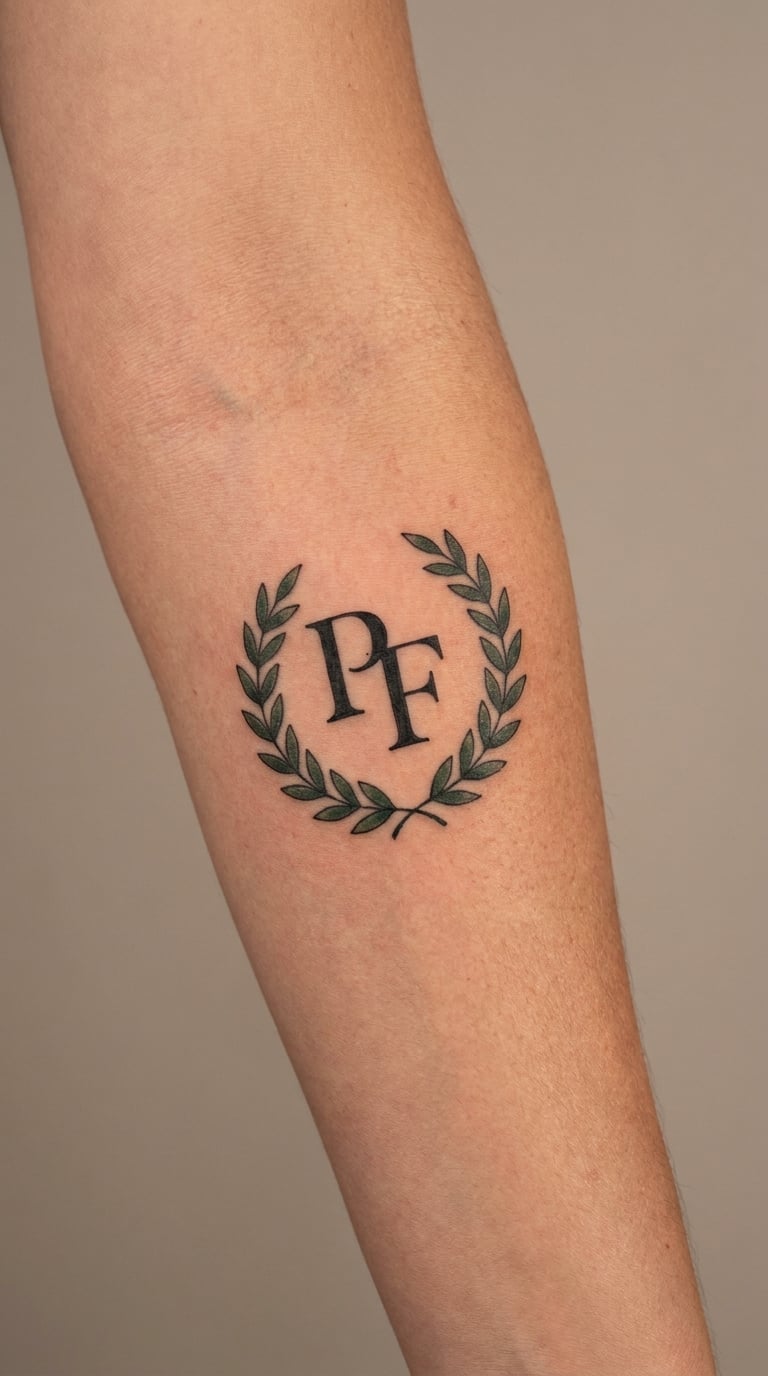
Initials with a laurel is the traditional memorial format: the pet’s initial in a serif letter, framed by a small leafy wreath. It reads as an emblem, and it is about as far from a photograph as a memorial tattoo gets.
It suits people who never liked tattoo realism anyway, and it takes up very little space. You can add one for every pet you have lost and build a small column over the years without redesigning anything.
Placement: forearm, calf, upper arm, or the bicep. Size: 2.5 to 4 inch (6 to 10 cm). Style: lettering with traditional wreath detail. Pain: moderate, and the leaves take about as long as the letter.
Make it yours: use the pet’s first and last initial even for a cat, and put the years along the bottom curve of the wreath.
Laurel leaves are fine interior line work, so this is a design that will need a refresh in the leaves before the letter. It is a cheap fix, but book it rather than ignoring it.
20. Tiny Portrait Behind the Ear
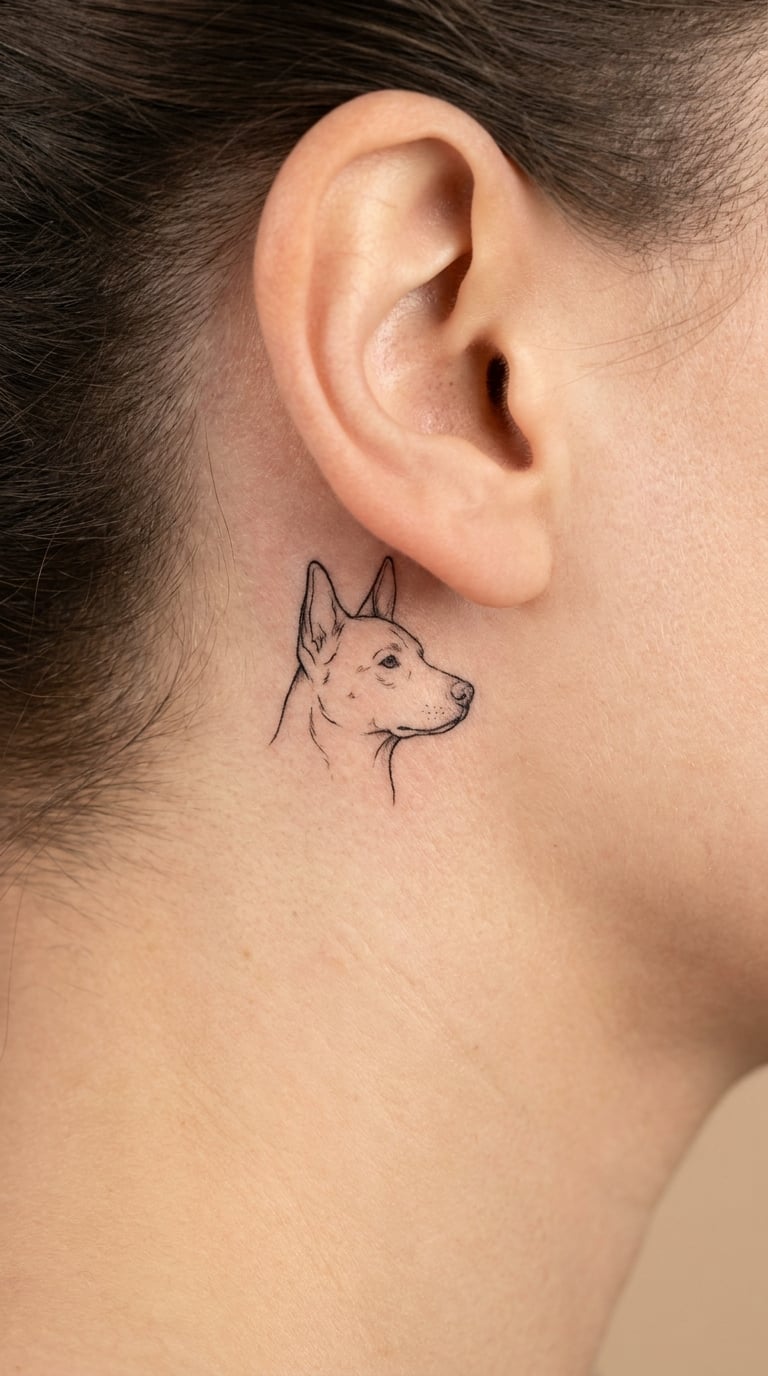
A tiny portrait behind the ear is the most private placement on this list. The design is small, usually a head in fine line or soft black and grey, tucked into the curve behind the ear where only you and close company will see it.
It works for people who want the memorial and would rather not explain it. It also sits on skin that moves constantly, so the line work has to be extremely confident, and it is a bad place for anything that needs to stay crisp.
Placement: behind the ear, along the edge of the jaw, or on the neck just below the ear. Size: 1 to 1.5 inch (2.5 to 4 cm). Style: fine line. Pain: low to moderate, and skin this thin bruises visibly for a day or two.
Make it yours: have the portrait face slightly outward, so the profile reads clearly from the side without you turning your head.
Fine line behind the ear blurs faster than anywhere else, partly from sun and partly because it gets washed, scrubbed, and slept on. Plan a touch-up every two or three years.
21. Pet Under a Starry Night Sky
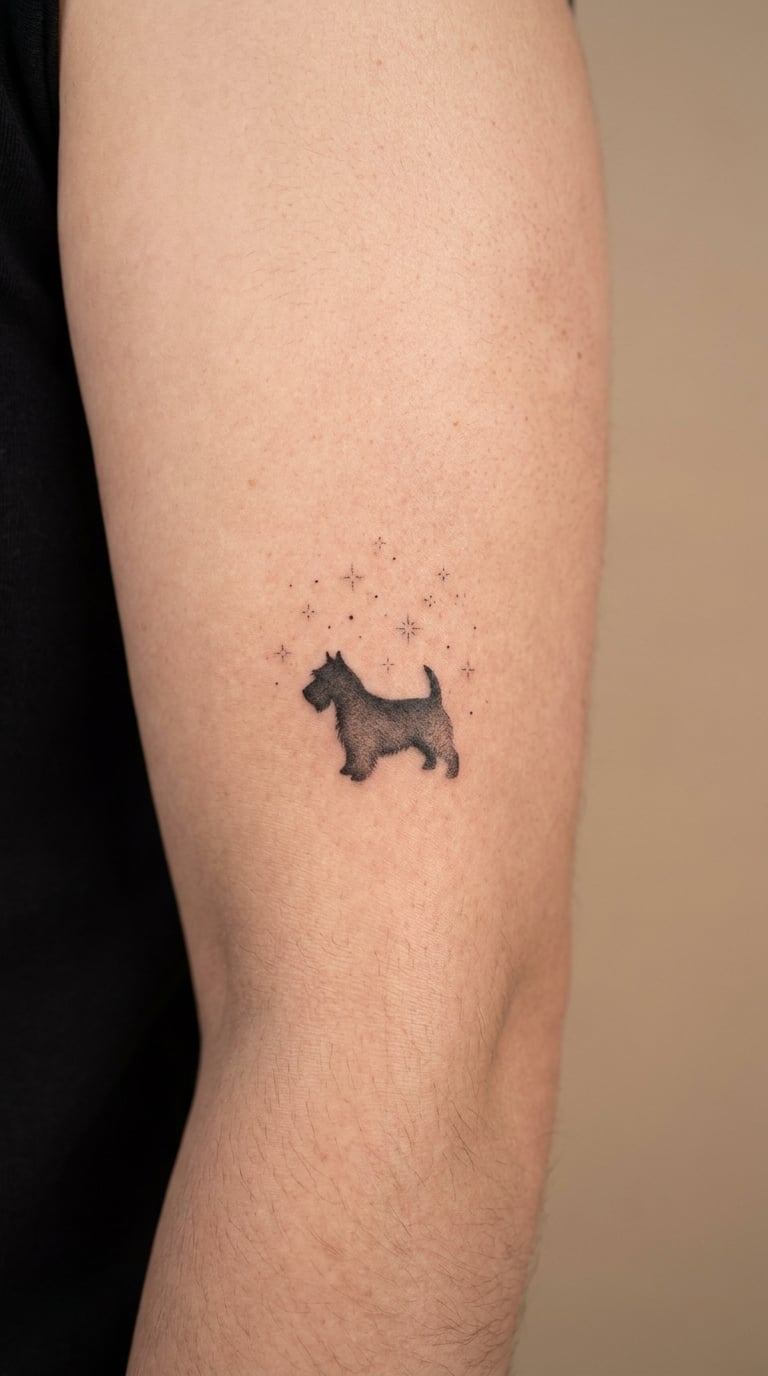
A pet under a starry sky is a scene piece: your pet’s silhouette in solid black at the bottom, a field of small dotwork stars above, and a lot of empty night sky between them. The space in the middle is doing the work.
It suits a bigger canvas and a bigger feeling, and it is the one design on this list that reads clearly from across a room. It also pairs naturally with a second piece later, when the sky has room for another constellation.
Placement: upper arm, back, or calf. Size: 4 to 6 inch (10 to 15 cm). Style: blackwork with dotwork stars. Pain: moderate to high, and 6 inches of dotwork is a long sitting, often split in two.
Make it yours: use the birth dates as star coordinates, or place one brighter star where your pet’s favourite spot in the room was.
Book the consultation well ahead. This is a two-session design for most people, and rushing the second session is how dotwork ends up uneven.
22. Pet Portrait with a Blanket Pattern
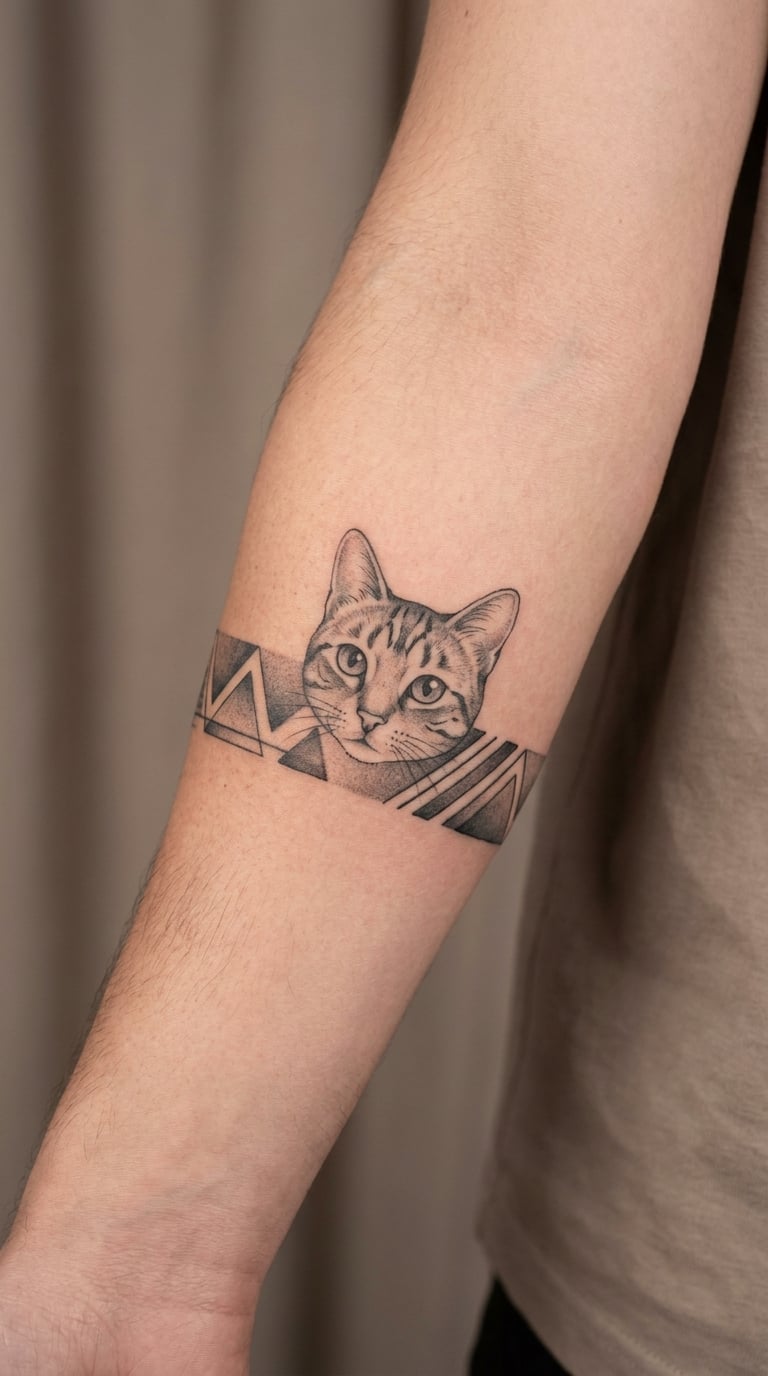
A portrait with a blanket pattern pairs your pet’s face with a piece of fabric they actually owned: a knitted throw, a tartan blanket, a quilt with a repeating square. The pattern sits behind or beneath the portrait in flat line work.
It is the most specific design in the list, and specificity is what makes it hit. A tartan pattern is instantly that pet, not a symbol of a pet, and nobody else who sees it will have the same blanket.
Placement: forearm, calf, or the flat of the upper arm. Size: 3 to 5 inch (8 to 13 cm). Style: black and grey with pattern line work. Pain: moderate, and repeated pattern is a lot of small needle work.
Make it yours: copy the actual stitch pattern from a photograph of the blanket, and use one colour thread of the real thing as the single ink hue.
Keep the pattern simple. A tight repeating motif at this size will fill in, and a simplified version of the same blanket reads better than an accurate one.
How to Choose the Right Design
The right memorial tattoo is the one that still feels right in ten years, which is a different test from the one that feels right in the week you book. A short framework helps more than browsing portfolios for an afternoon.
| Decision | Ask yourself | Why it matters |
|---|---|---|
| Style | Do you want a likeness, a symbol, or a word? | Portraits risk a near-miss detail. Symbols cannot. Words need heavy line weight. |
| Size | How small can it be and still read as your pet? | Under 2 inches, every detail has to be simplified to survive. |
| Placement | Who sees it, and how much does it move? | Sun-exposed and high-movement areas fade and soften faster. |
| Reference | Do you have a real print or a good photograph? | Physical references give an artist far more than a phone gallery. |
| Artist | Has this person done this exact style before? | A generalist who is great at flash may not be right for a portrait. |
| Timing | Has the design stopped changing in your head? | Designs that keep shifting usually mean the decision is not settled yet. |
On timing: the people who get it right tend to wait until the design in their head has stopped changing from week to week. Not a fixed number of weeks, just the point where you would pick the same design again without hesitating.
Cost and Session Time
Price follows time on the needle, and time follows size and detail, so the honest way to talk about it is by design type. A small fine-line paw print is quick work and usually billed at a shop’s minimum. A five-inch watercolour portrait is several hours and priced by the hour.
| Design size | Typical US range | Session length |
|---|---|---|
| Tiny, under 2 inches (paw print, nose print, initials, eye) | About $80 to $200 | 30 minutes to 1 hour |
| Small, 2 to 3 inches (miniature portrait, script name, date) | About $180 to $450 | 1 to 2 hours |
| Medium, 3 to 5 inches (blackwork silhouette, traditional or grey portrait) | About $450 to $1,200 | 2 to 4 hours |
| Large, 4 inches and up (starry sky scene, blanket pattern in full colour) | About $1,000 to $2,500+ | Split across 2 or more sessions |
Shop minimums, hourly rates, and travel rates vary widely by city and by who is doing the work, so the only reliable number is the one your artist gives you after seeing the design. Bring a clear idea and a reference to that appointment and you will get a real quote rather than a guess.
One practical note: if you are booking for a specific season, reach out early. Memorial appointments in autumn tend to fill first, and getting on the books is free.
Aftercare Basics
Whatever your artist tells you at the end of the session outranks anything written on a website, including this list. Start there, then keep the basics in mind.
- Follow your artist’s aftercare instructions first, including how long they want any covering or wrap left in place.
- Wash gently with a mild, fragrance-free cleanser and lukewarm water, then pat dry with a clean towel rather than rubbing.
- Keep it out of direct sun while it heals, and remember sun is the main reason memorial ink fades over the decades.
- Wear loose clothing over the area for the first stretch of healing so nothing sticks to fresh line work.
- Skip the extras. No harsh soaking, no scratching, no unprescribed creams or steroid products unless your artist asks for them.
- Book the free touch-up check most artists offer in the first year, especially for small fine-line lettering and tiny portraits.
Take a clear photo of the finished tattoo on the day of the session. If the ink fades unevenly over the years, that image is the single most useful reference you will have.
Frequently Asked Questions
What is the best tattoo to remember my dog?
Most people choose either a paw print with a small heart or a black and grey portrait of their dog’s face. A paw print suits first-time tattooers and anyone who wants a small everyday piece. A portrait suits people who want the likeness and do not mind a larger design. The best tattoo is the one built from a real reference, such as a clay paw print or a good photograph.
Should I wait after my pet passes before getting a memorial tattoo?
There is no fixed waiting period, and no medical rule about it either. What matters is whether the design in your head has settled. If you are still changing your mind about placement, size, or whether you want a tattoo at all, waiting keeps the door open. If the design has felt stable for a while, you are probably ready.
What does a dog paw print tattoo symbolize?
A dog paw print tattoo symbolizes the presence, loyalty, and unconditional companionship a dog gave you. In a memorial context it stands for a specific animal rather than dogs as a group, and it is often the piece people keep when a realistic portrait feels too fragile or too hard to read at a small size.
Do memorial pet tattoos hurt more than other tattoos?
No, pain tracks placement and size, not meaning. Inner wrists, ribs, collarbones, ankles, and fingers rate highest; the upper arm, calf, and forearm rate lower. A tiny fine-line paw print is a quick low-pain job, while a large watercolour or dotwork scene is a long sitting that leaves the area tender for days.
Can I turn a real clay or ink paw print into a tattoo?
Yes, and people regularly do it. Owners on tattoo forums hand the clay or ink print back from the vet or cremation directly to the artist as the reference. Bring it flat and undamaged, plus a photograph of your pet for scale. The artist transfers the print, then adjusts the line weight so the toes and pad stay readable once healed.
If this is your first tattoo, start with idea 1, a fine-line paw print with a tiny heart, or idea 14, a blackwork silhouette. Both are small, both are hard to get subtly wrong, and neither locks you out of a different design later.
If you are adding to a collection, pick something that ages in a different way from what you already have. A watercolour portrait, a micro-realism eye, or a scene with dotwork stars sits comfortably next to existing fine-line work and keeps the set from looking like one decade.
Either way, take a real reference to the consultation. The people whose memorial tattoos still make them cry the good kind are the ones whose pet is in the ink, not just the idea of a pet.