
22 Forearm Wrap Tattoo Ideas for Men: Best 2026 Designs
A forearm wrap tattoo is a design that keeps going around the arm, crossing from the inner forearm to the outer forearm so it reads as one piece from any angle. These 22 forearm wrap tattoo ideas for men are organised by placement and style so you can narrow the list down fast.
Men pick this format for a simple reason: it looks like a finished piece of tattoo rather than a symbol that ran out of skin. A wrap is substantial, it sits entirely on the forearm if you want to stay away from full sleeve territory, and it leaves the elbow, bicep and shoulder open for later. Most of the time the work is deciding what the design should be doing as it disappears around the underside of the arm.
Fall booking fills up weeks ahead, so if you are planning a piece for a specific season, start talking to artists now. If you want a shorter, single-sided design instead of a full circumference piece, our inner forearm tattoo ideas for men guide covers that side of the arm.
22 Forearm Wrap Tattoo Ideas for Men: Quick Guide
Every row below matches the numbered sections that follow, in the same order, so you can jump to the one that fits your arm, your style and your patience.
| Idea | Style | Best placement | Size | Pain |
|---|---|---|---|---|
| 1. Fine-line geometric | Fine line | Inner forearm | 5 by 2 inch | Low to medium |
| 2. Bold blackwork tribal-style | Blackwork | Outer forearm | 8 by 3 inch | Medium |
| 3. Traditional rose and vine | Traditional | Inner forearm | 7 by 2.5 inch | Medium |
| 4. Japanese-style wave | Japanese-influenced blackwork | Lower inner forearm | 8 by 3 inch | Medium to high |
| 5. Minimalist chain-link | Minimalist blackwork | Inner forearm | 4 by 1.5 inch | Low |
| 6. Compass rose navigation | Black and grey | Outer forearm | 5 by 3 inch | Medium |
| 7. Mountain range linework | Fine line | Inner forearm | 7 by 2 inch | Low to medium |
| 8. Snake scale pattern | Illustrative blackwork | Full circumference | 8 by 3 inch | Medium |
| 9. Circuit-board tech | Blackwork illustration | Inner forearm | 7 by 2.5 inch | Medium |
| 10. Botanical laurel | Botanical linework | Outer forearm | 8 by 2.5 inch | Low to medium |
| 11. Nautical rope and anchor | Traditional illustrative | Inner forearm | 6 by 2.5 inch | Medium |
| 12. Abstract black ink ribbon | Abstract blackwork | Outer forearm | 7 by 3 inch | Medium |
| 13. Pine tree and mountain | Illustrative | Inner forearm | 8 by 3 inch | Medium |
| 14. Celtic interlace band | Blackwork | Outer forearm | 7 by 2 inch | Medium |
| 15. Lightning and storm | Neo-traditional | Inner forearm | 6 by 2.5 inch | Medium |
| 16. Dragonfly and dotwork | Dotwork | Outer forearm | 5 by 2 inch | Medium |
| 17. Phoenix feather | Illustrative black and grey | Inner forearm | 8 by 3 inch | Medium to high |
| 18. Hourglass and geometric lines | Minimalist fine line | Outer forearm | 5 by 1.5 inch | Low |
| 19. Eagle head blackwork | Blackwork | Outer forearm | 6 by 3 inch | Medium |
| 20. Watercolor lightning | Watercolor | Inner forearm | 6 by 3 inch | Medium |
| 21. Serpent and laurel interwoven | Illustrative black and grey | Outer forearm | 8 by 3 inch | Medium to high |
| 22. Minimalist number and line | Minimalist | Inner forearm | 4 by 1.5 inch | Low |
Simple single-band options like the chain-link and numeral designs are also covered in our forearm band tattoo ideas for men round-up.
1. Fine-Line Geometric Forearm Wrap
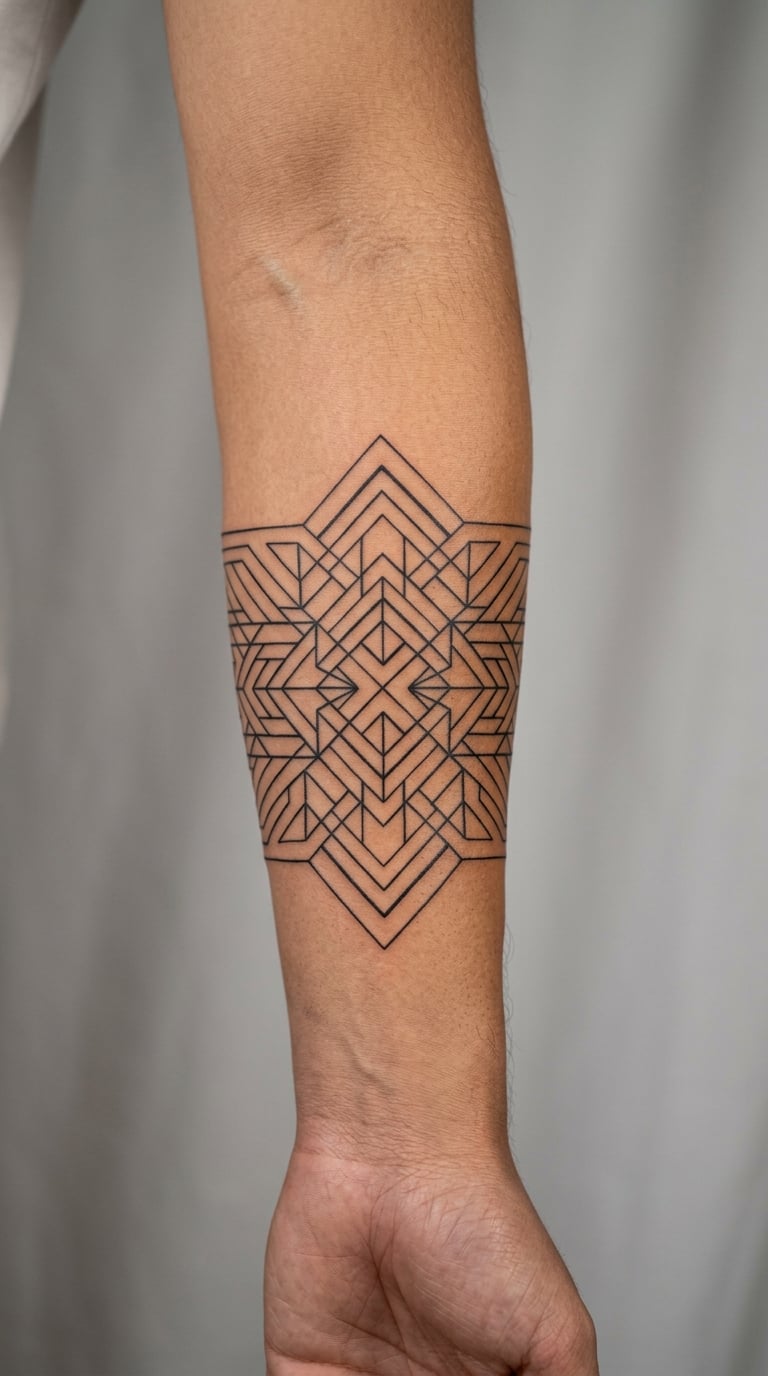
A fine-line geometric forearm wrap is built from single-needle angular lines that lock into each other like folded paper, with plenty of open skin left between them.
It suits people who want something that looks current without shouting. Nobody has agreed on what geometry means, so treat it as a design choice rather than a statement, and pick a motif you like the look of.
Placement: Inner forearm, from mid-forearm toward the wrist. Size: 4 to 6 inch by 2 inch (10 to 15 cm by 5 cm). Style: Fine line. Pain: Low to medium, the inner forearm is sensitive but the lines are shallow.
Fine line softens faster than thick blackwork, and hair plus daily friction on the inner arm will blur it first, so plan a touch-up in a year or two. Make it yours: add one hand-drawn line in a different weight so the pattern has a focus point.
2. Bold Blackwork Tribal-Style Wrap
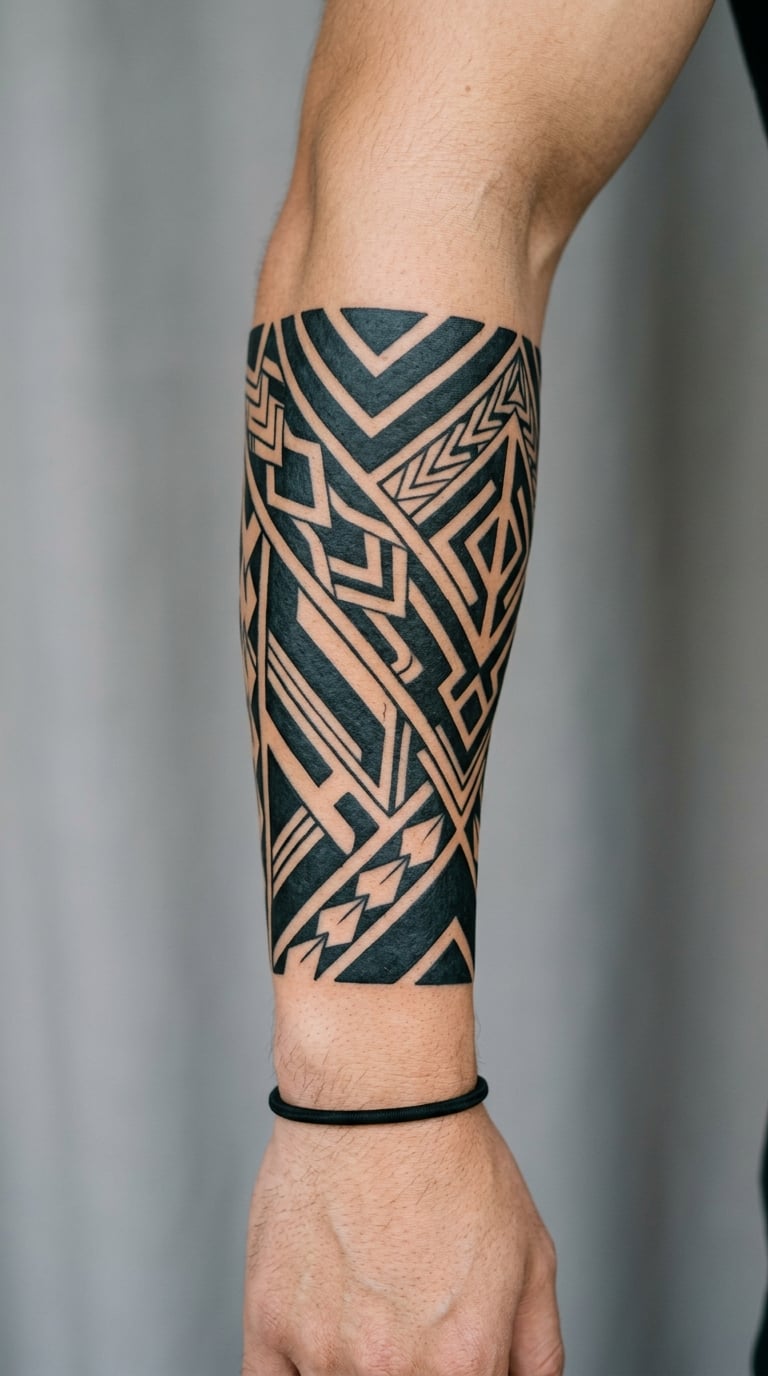
This one is heavy solid black: broad tapered bands, sharp angles between them, and deliberate gaps of bare skin so the design breathes.
Men usually choose it for the weight and the graphic punch, not for any inherited meaning. If a real cultural tradition is what you are after, work with an artist who belongs to that tradition rather than borrowing a pattern as decoration.
Placement: Outer forearm, wrist to mid-forearm. Size: 7 to 9 inch by 3 inch (18 to 23 cm by 7.5 cm). Style: Blackwork. Pain: Medium, solid fills take longer than outlines.
Bold black holds contrast well for decades, which makes it a practical option here for covering older thin forearm ink. Make it yours: have the band ends break at a different point on each side so the wrap has no obvious seam.
3. Traditional Rose and Vine Wrap
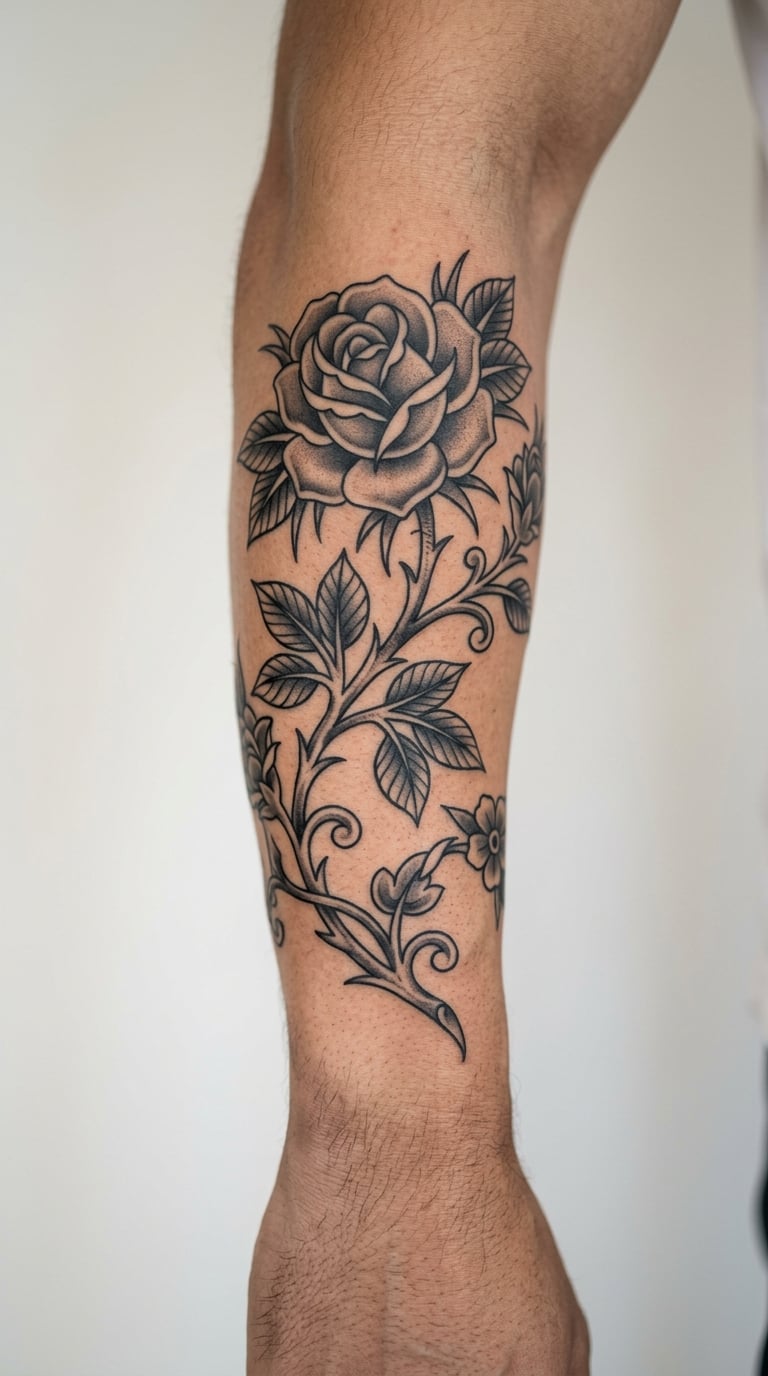
A traditional rose and vine wrap sets one large shaded rose at the centre of the inner forearm, then sends a vine of leaves and small buds around the arm to close the composition.
It is an ornamental option that has barely changed style in decades, and most people who get one connect it to a person, a place or a period of their life rather than to a fixed traditional meaning.
Placement: Inner forearm, centred just above the wrist crease or mid-forearm. Size: 6 to 8 inch by 2.5 inch (15 to 20 cm by 6 cm). Style: Traditional. Pain: Medium, the inner arm is thin-skinned and the shading adds passes.
Grey wash in a small rose can look tired once the arm flexes and the ink spreads, so keep the darkest values on the outer edge of the stem. Make it yours: choose a real flower variety for the bloom rather than a generic one.
4. Japanese-Style Wave Wrap
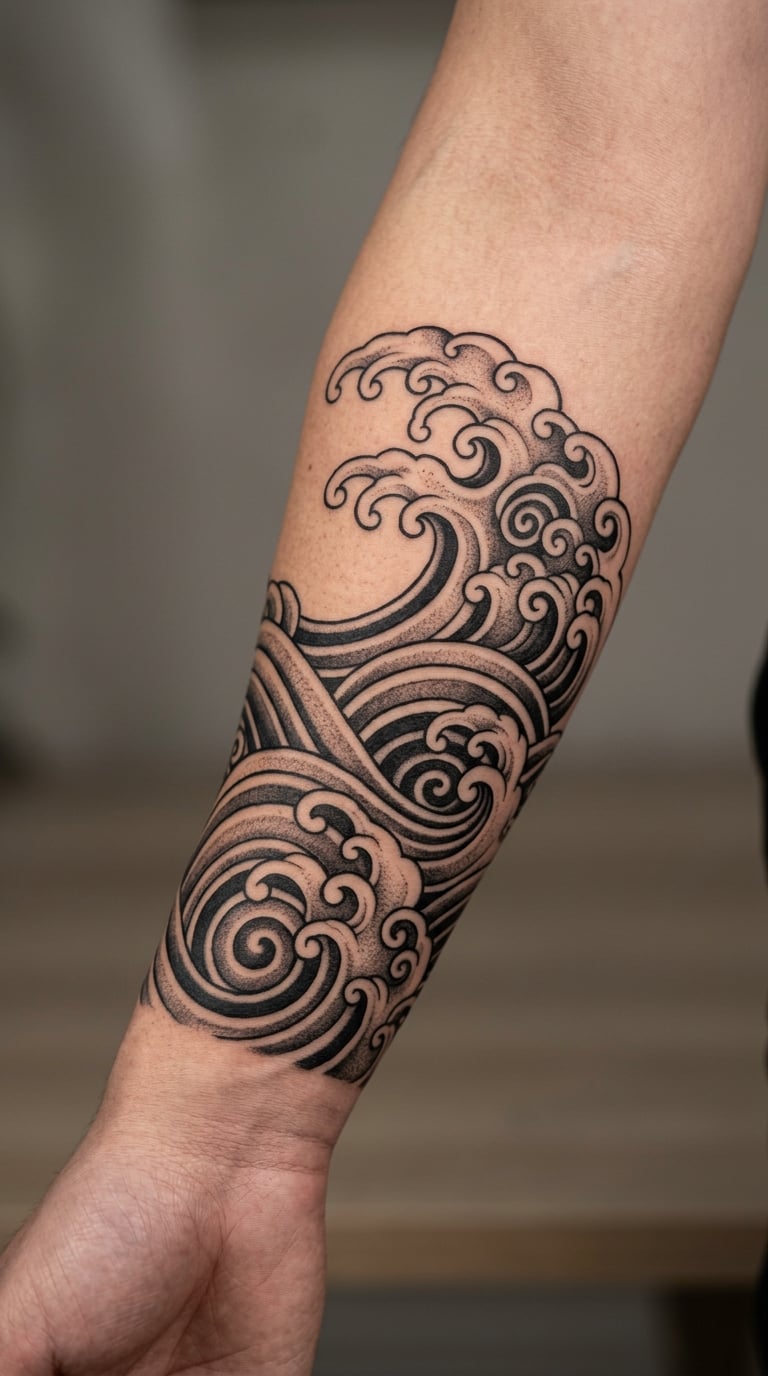
A Japanese-style wave wrap stacks three or four curling wave forms with claw-like foam crests, heavy black outlines and a few soft grey tones behind the spray.
The appeal is movement. Wave patterns in Japanese composition were built to read from a distance and follow a body curve, which is exactly what a forearm does.
Placement: Lower inner forearm, wrist to elbow. Size: 7 to 9 inch by 3 inch (18 to 23 cm by 7.5 cm). Style: Japanese-influenced blackwork. Pain: Medium to high, the lower inner arm and the elbow end are the most tender parts of the wrap.
Thin foam hooks are the first detail to disappear, so ask the artist to build the crests at a line weight that will still read in ten years. Make it yours: run one wave higher than the others so the stack has a clear top and bottom.
5. Minimalist Chain-Link Wrap
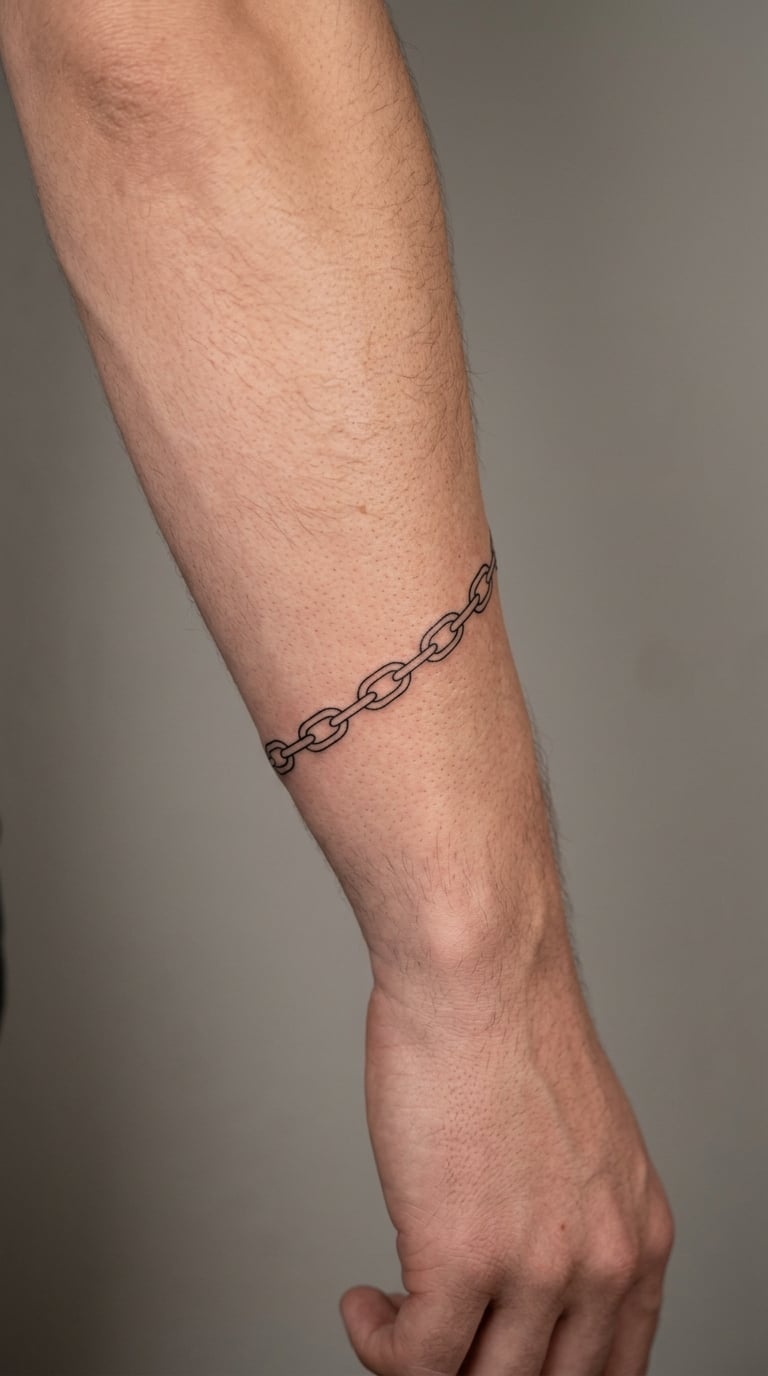
A minimalist chain-link wrap is a short run of interlocking oval links, drawn as clean outline with no shading, following the natural curve of the arm.
It works as a single graphic statement, and it stays quiet if you want ink on the forearm now and a sleeve conversation later.
Placement: Inner forearm or outer forearm, any position. Size: 3 to 5 inch by 1.5 inch (8 to 13 cm by 4 cm). Style: Minimalist blackwork. Pain: Low, it is a short, shallow design.
Chain links scaled too small merge into a dark smudge as ink spreads, so fewer, larger links age better. Make it yours: leave one clasp open so the piece looks caught mid-moment.
6. Compass Rose Navigation Wrap
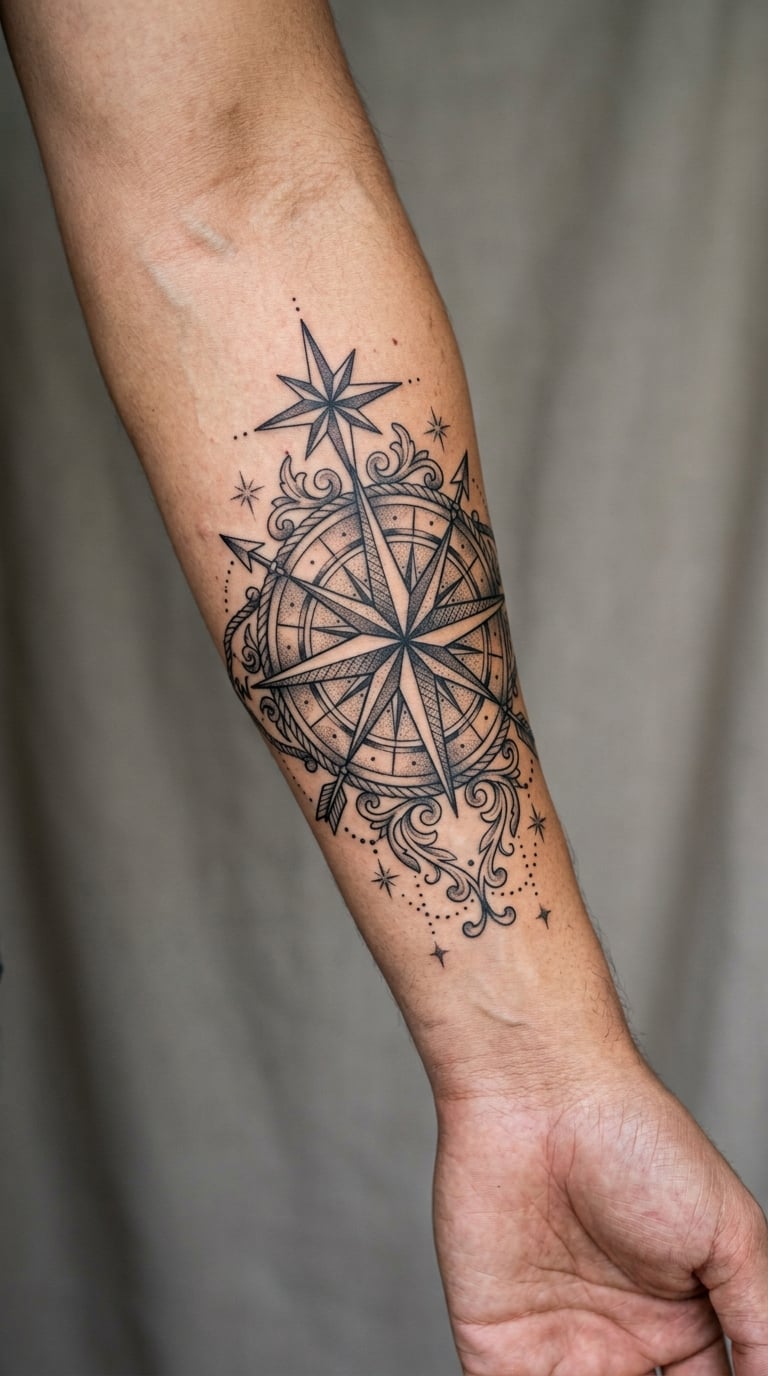
A compass rose wrap centres an eight-point star with fine internal line detail and small north star accents, held inside a pair of narrow bands that carry it around the arm.
Travel, guidance and direction are the usual reasons people choose it, though the meaning sits with the person wearing it rather than with the symbol itself.
Placement: Outer forearm, mid-forearm so the rose faces forward. Size: 5 by 3 inch (13 by 7.5 cm). Style: Black and grey. Pain: Medium.
The tiny tick marks between the points are the first thing to blur, so keep the smallest radial lines off the outermost curve of the arm. Make it yours: put a real set of coordinates in one band rather than a decorative ribbon.
7. Mountain Range Linework Wrap
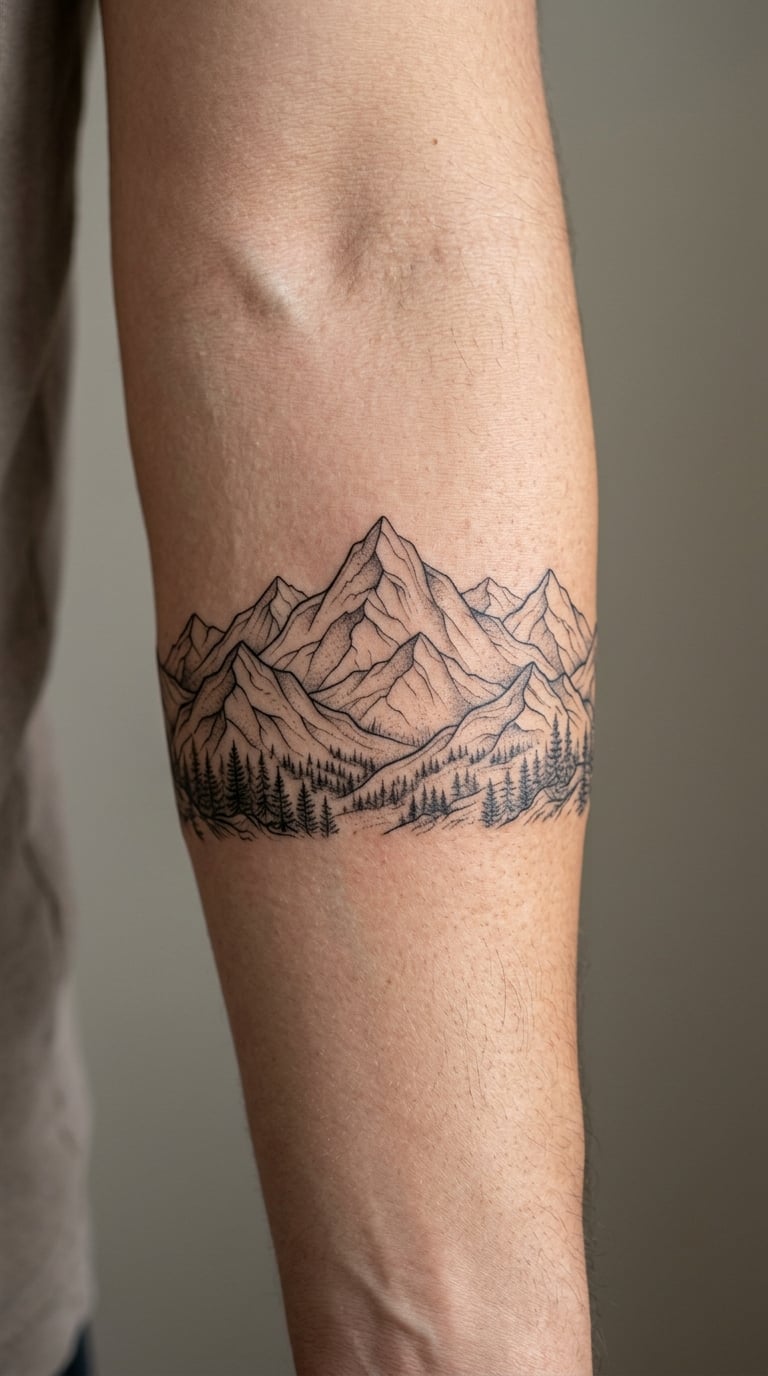
A mountain range wrap draws three overlapping ridgelines in fine contour lines, each ridge set slightly lighter, with a few short hatch marks for the shaded faces.
For most people the reason is a specific place: a range they grew up under, a hike that mattered, a state flag nobody else would recognise. That personal reference beats any generic symbolism.
Placement: Inner forearm, wrist to mid-forearm. Size: 6 to 8 inch by 2 inch (15 to 20 cm by 5 cm). Style: Fine line. Pain: Low to medium.
Contour hatching fades unevenly because sun hits the outer arm and not the inner, so expect the exposed sections to need work sooner. Make it yours: sketch the silhouette of one peak you know by name into the centre ridge.
8. Snake Scale Pattern Wrap
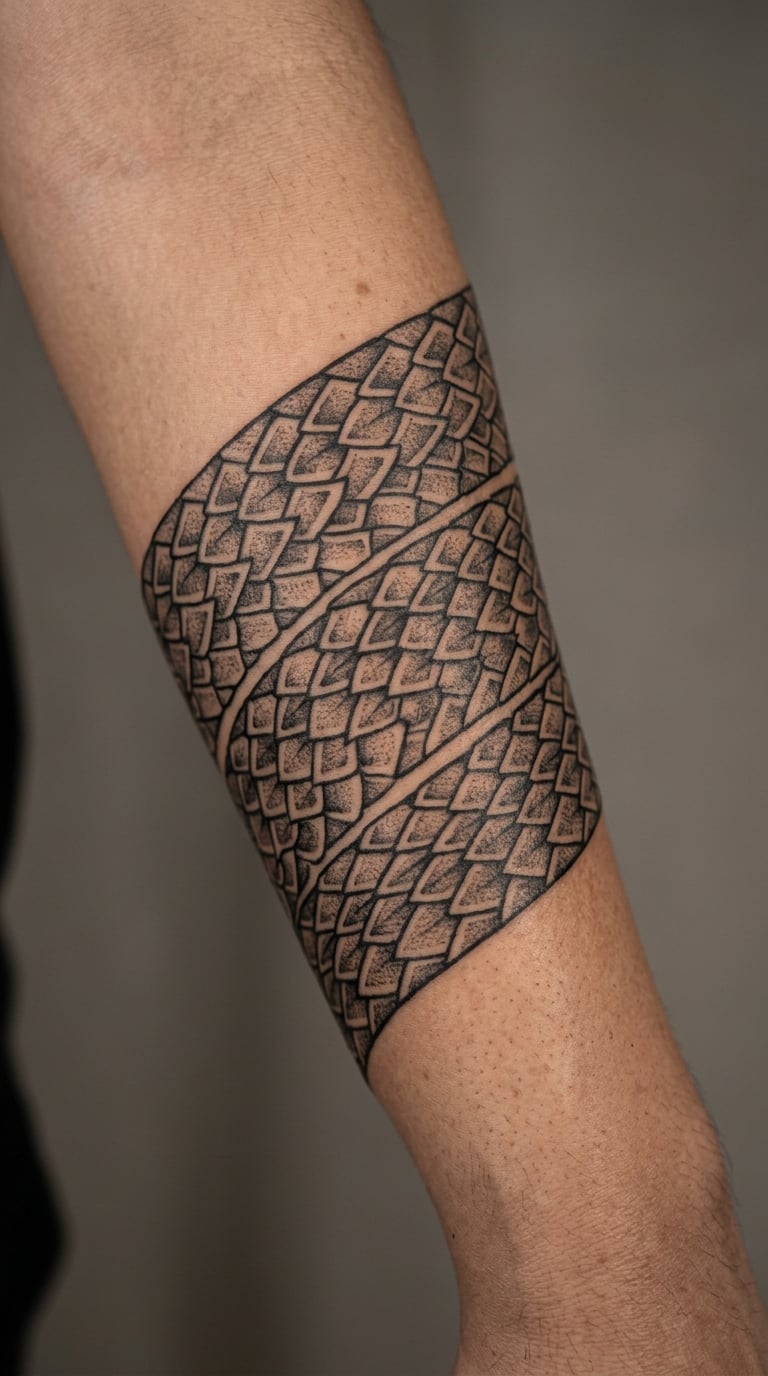
A snake scale wrap is a field of repeating scale shapes, each one with a soft gradient edge, wrapping in a loose helix so the pattern appears to move around the arm.
Texture does the work here. Without a head or a face, the piece is a pattern that happens to scale, which is why it never needs an explanation to look good.
Placement: Full circumference, wrist to elbow. Size: 7 to 9 inch by 3 inch (18 to 23 cm by 7.5 cm). Style: Illustrative blackwork. Pain: Medium, and expect a long sitting.
Every scale is a small gradient, and a wall of them will darken and merge as the years pass, so fewer and larger scales hold better. Make it yours: let one scale be left unshaded, or add a single spot of colour to a single scale.
9. Circuit-Board Tech Wrap
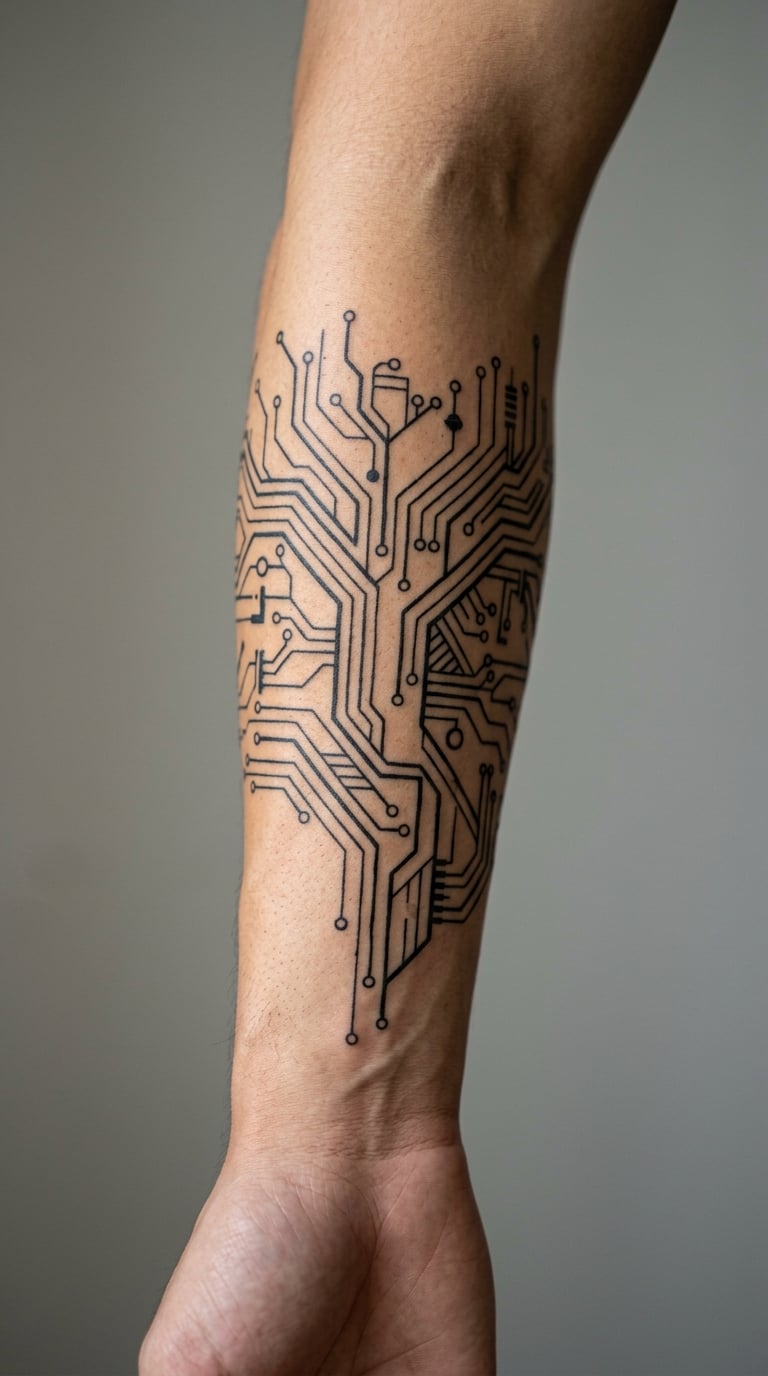
A circuit-board wrap is branching trace lines with rounded nodes, small square chips and a few labelled connection points, laid out like a real board flattened into a band.
It is picked by people who work in tech or engineering, usually because it looks like their job in one glance. It also scales down well, which makes it a decent second tattoo after a first.
Placement: Inner forearm or outer forearm. Size: 6 to 8 inch by 2.5 inch (15 to 20 cm by 6 cm). Style: Blackwork illustration. Pain: Medium.
Very small components fade into grey smudges, so tell the artist to enlarge anything under about two millimetres. Make it yours: replace one chip label with a real reference from your own work.
10. Botanical Laurel Wrap
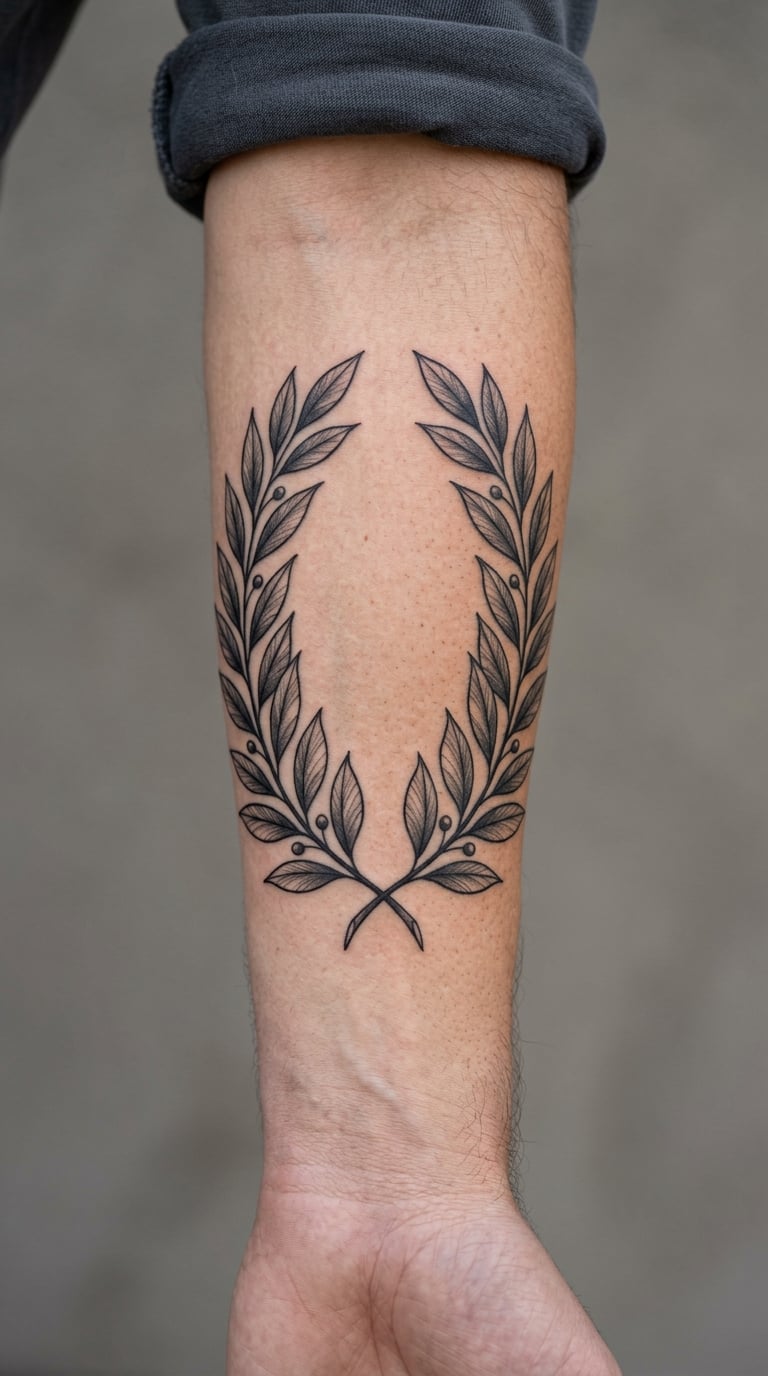
A botanical laurel wrap sets two mirrored stems of individual leaves along the outer forearm, each leaf with its own light shading and a clean outline.
Laurel is a victory and honour motif in plenty of traditions, but what usually sells it is the balance: a symmetrical pattern wraps around an arm far better than a single stem does.
Placement: Outer forearm, wrist to elbow. Size: 7 to 9 inch by 2.5 inch (18 to 23 cm by 6 cm). Style: Botanical linework. Pain: Low to medium, the outer arm is less sensitive than the inner.
Shading inside small leaves muddies with age, so ask for a single tone rather than a gradient and the shapes stay readable. Make it yours: use leaves from a plant that actually grows where you grew up.
11. Nautical Rope and Anchor Wrap
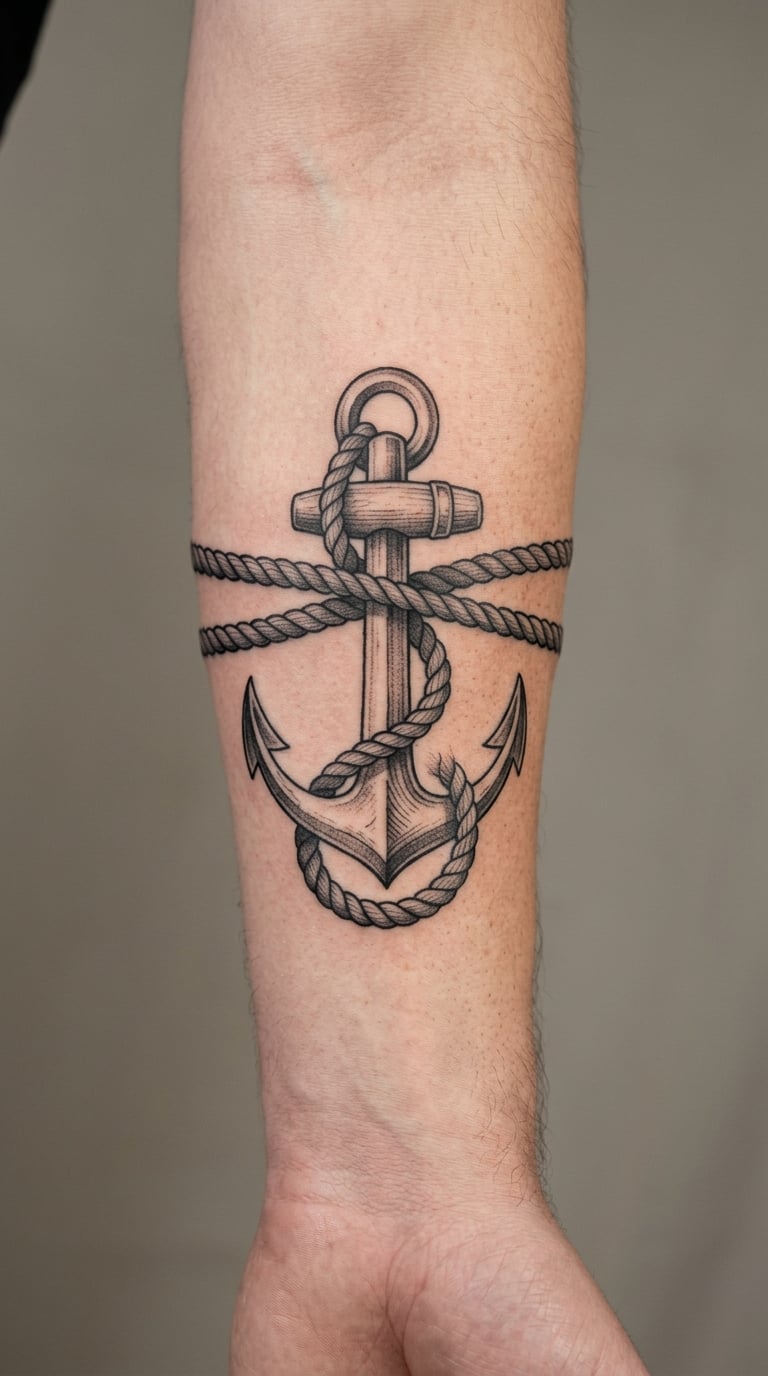
A nautical wrap twists a single rope in a consistent helix and threads a compact black anchor through it, with a short length of loose line trailing off to close the band.
Maritime family, fishing background, a boat in the family, time spent at sea. This is one of the few wrap subjects where the reason is usually a real biography rather than an aesthetic.
Placement: Inner forearm, mid-forearm. Size: 5 to 7 inch by 2.5 inch (13 to 18 cm by 6 cm). Style: Traditional illustrative. Pain: Medium.
Rope twist detail turns to mush where the skin is thinnest, so keep the twist wide and the shading light. Make it yours: replace the stock line at the end with coordinates or a boat name from your own family.
12. Abstract Black Ink Ribbon
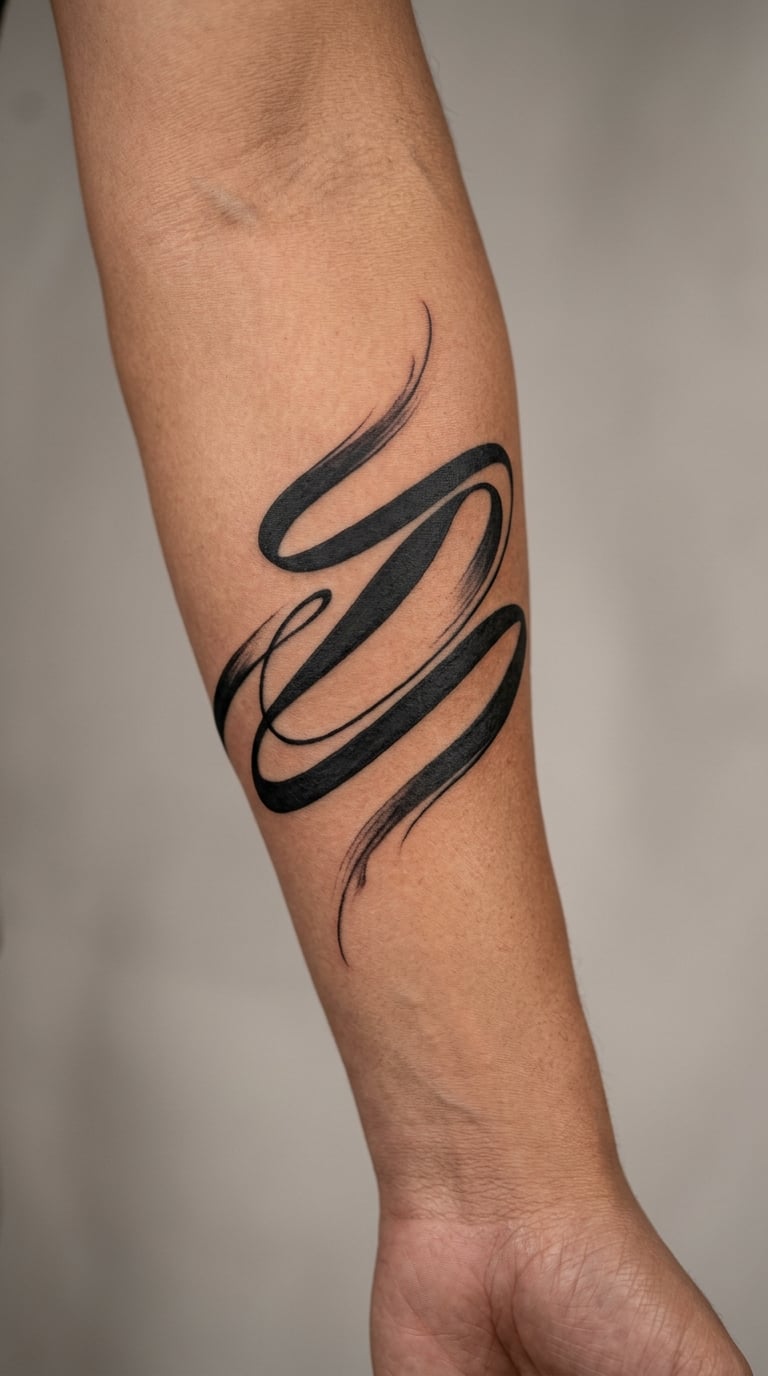
An abstract ribbon is a single ink stroke thickened in the middle and tapering to nothing at both ends, looping around the forearm with real open skin between the passes.
It is the option for someone who wants a bold result but refuses a literal subject. Abstract work rewards a good artist more than a motif does, since there is nothing to hide behind.
Placement: Outer forearm, any level. Size: 6 to 8 inch by 3 inch (15 to 20 cm by 7.5 cm). Style: Abstract blackwork. Pain: Medium.
Thin tapered ends are fragile; ask for them to finish in a clean blunt end rather than a whisker-thin point if you care about the ten-year look. Make it yours: set the line direction to follow your dominant writing hand.
13. Pine Tree and Mountain Wrap
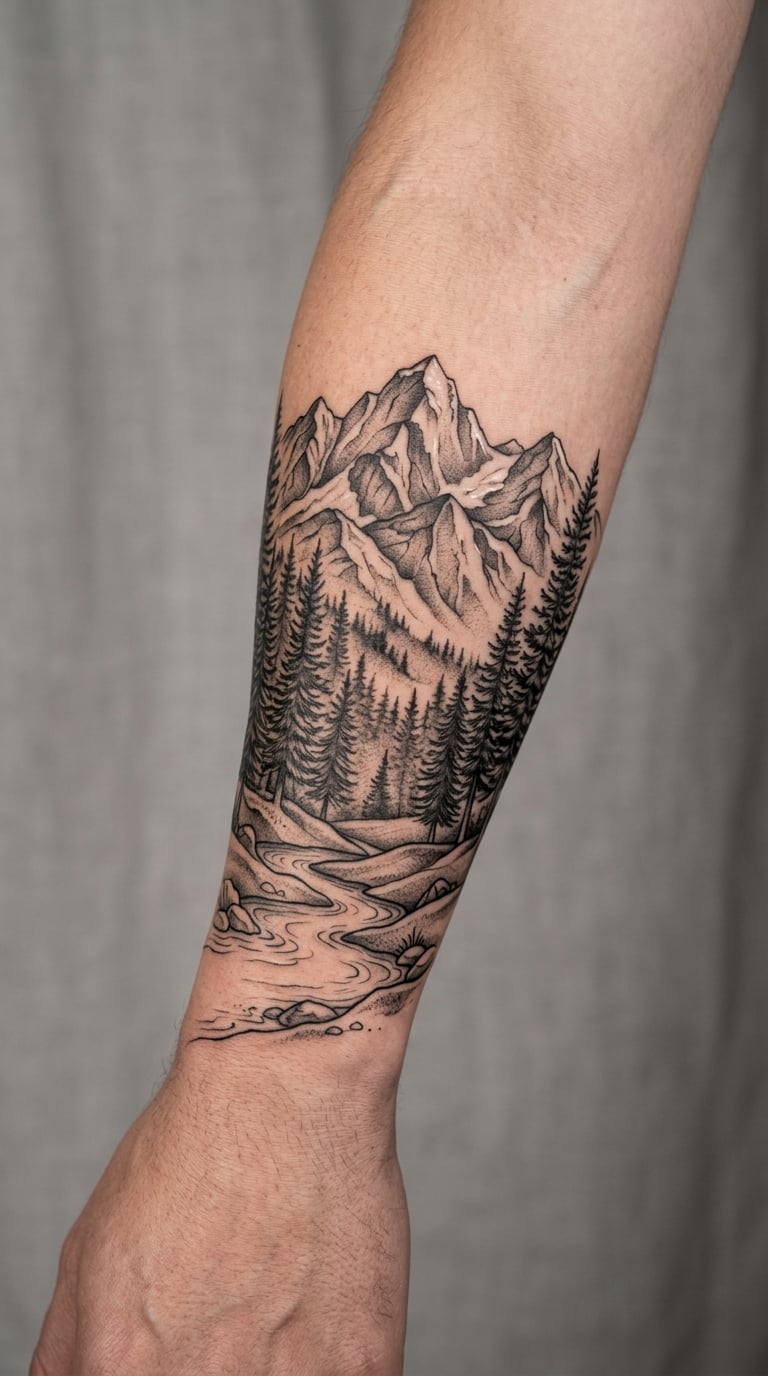
A pine and mountain wrap places a row of tall pines above an angular mountain profile, with a single flowing ground line tying the scene into one band.
It reads as a specific view once you know the place. The usual reason is outdoor time, and putting a real skyline in the band makes it personal rather than decorative.
Placement: Inner forearm, wrist to elbow. Size: 7 to 9 inch by 3 inch (18 to 23 cm by 7.5 cm). Style: Illustrative. Pain: Medium.
Tree needles drawn as individual lines will soften noticeably within a few years, so a simplified pine silhouette keeps working far longer. Make it yours: use the exact ridge line of a trail or viewpoint you have stood on.
14. Celtic Interlace Band
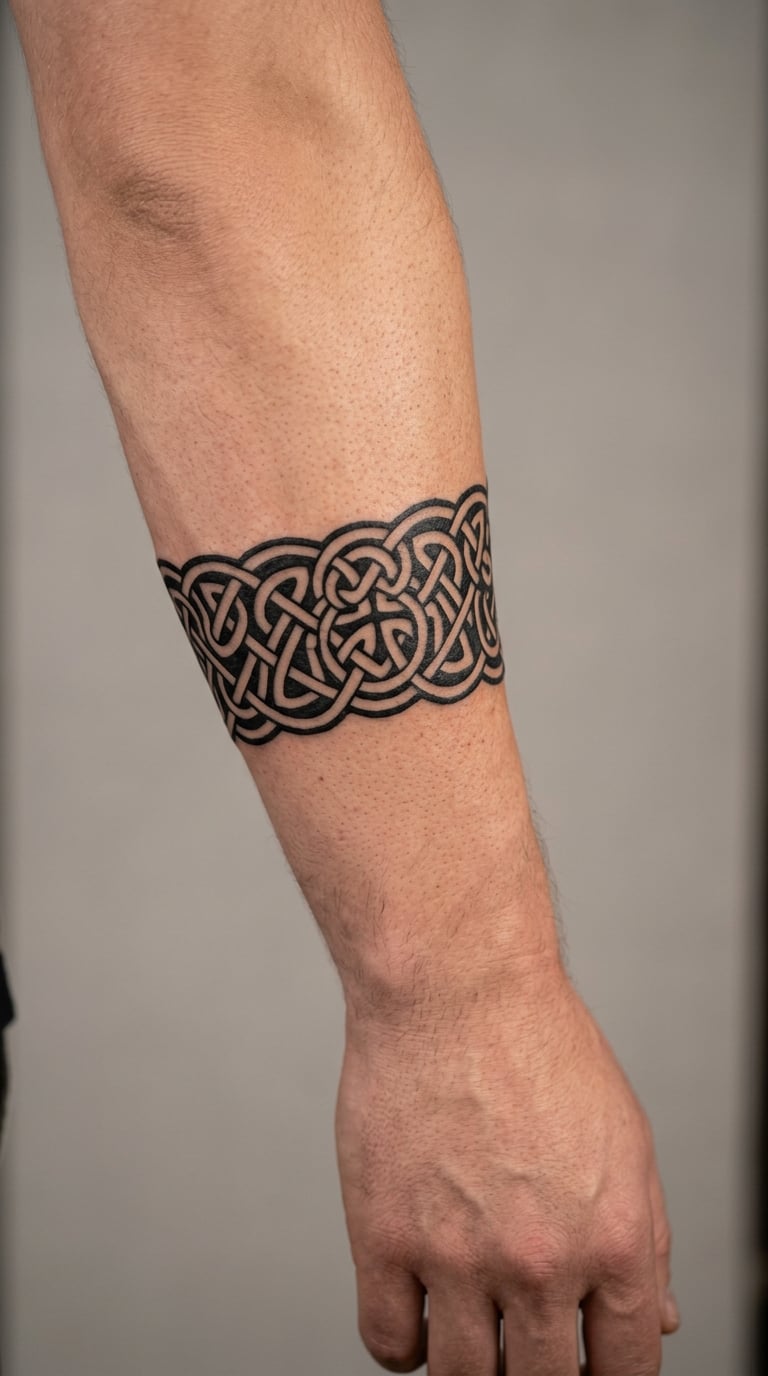
A Celtic interlace band is a repeating woven pattern where one continuous line passes over and under itself, drawn as an original design rather than a copy of any historical manuscript piece.
The repeating structure is the point: it fills the circumference evenly, so it looks deliberate from any angle and needs no single focal image. Ask for a pattern drawn for your arm, not traced from a book.
Placement: Outer forearm, mid-forearm. Size: 6 to 8 inch by 2 inch (15 to 20 cm by 5 cm). Style: Blackwork. Pain: Medium.
Interlacing has a lot of tight negative space, and those gaps fill with ink over time, so the artist should leave more space between strands than looks right on paper. Make it yours: use knot counts that matter, such as a date or a family number.
15. Lightning and Storm Wrap
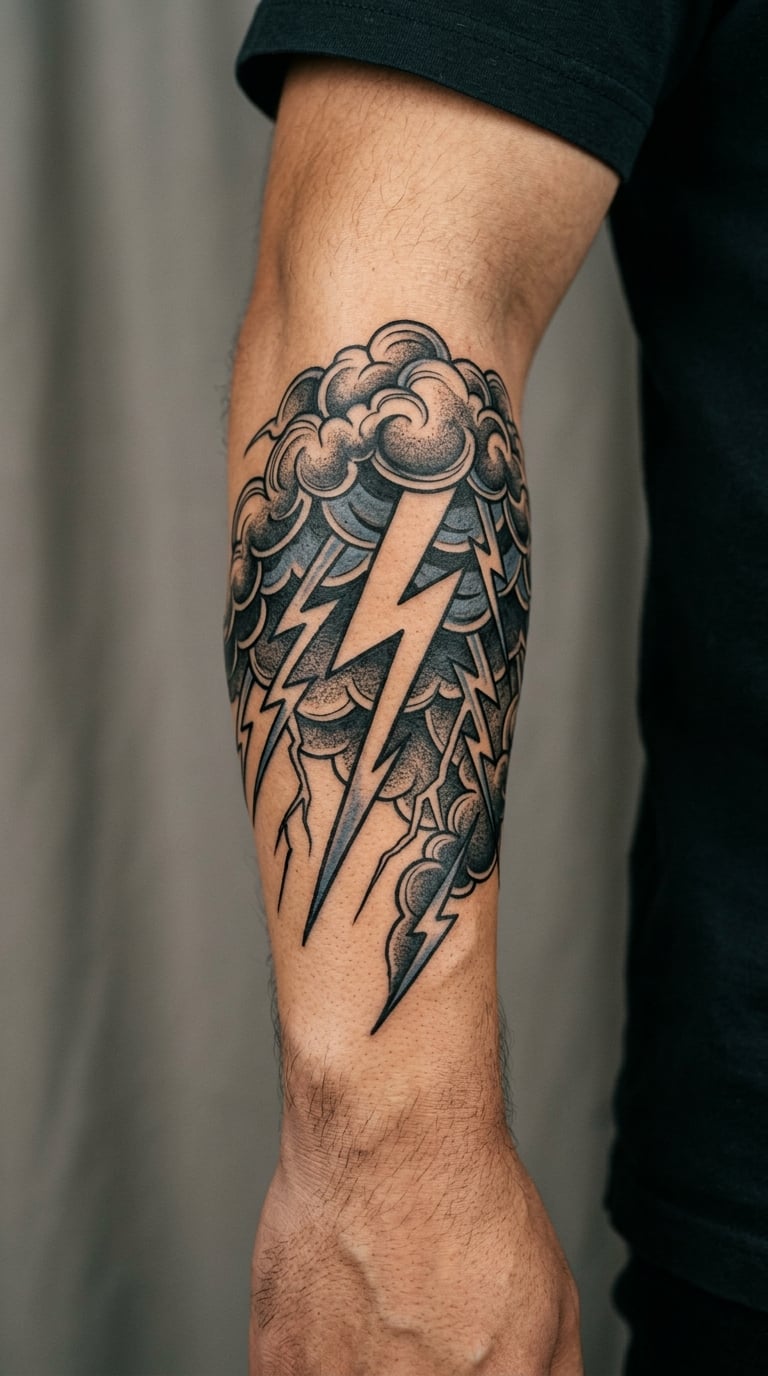
A lightning and storm wrap runs one hard-edged bolt across the forearm with smaller arcs branching off it, backed by a few soft cloud forms and a single sweeping storm line.
High contrast and movement without a face or a figure in it. It suits people who want a graphic piece rather than a decorative one, and it hides older line work well because of the dark areas.
Placement: Inner forearm, mid-forearm. Size: 5 to 7 inch by 2.5 inch (13 to 18 cm by 6 cm). Style: Neo-traditional. Pain: Medium.
Sharp zigzags look wrong the moment an artist fattens the lines for healing, so expect the final version to be a touch heavier than the drawing. Make it yours: add a single colour wash behind the bolt in a muted tone, not a bright one.
16. Dragonfly and Dotwork Wrap
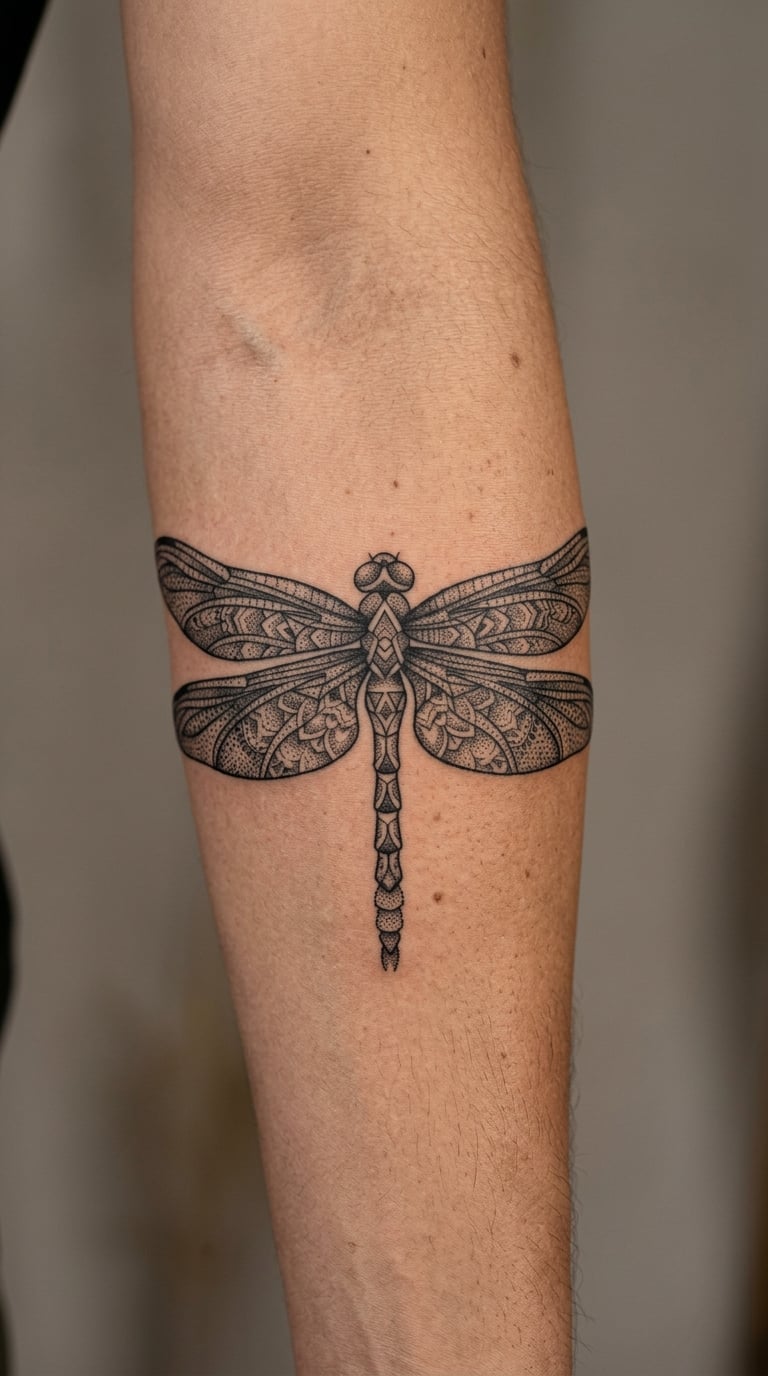
A dragonfly wrap centres a symmetrical insect with four long veined wings over a field of controlled dotwork, with a few straight geometric lines holding the band together.
The insect gives it a centre of gravity and the dotwork gives the arm some texture without adding ink weight. Dotwork also fills the hidden underside gracefully when the pattern runs out of view.
Placement: Outer forearm, mid-forearm. Size: 4 to 6 inch by 2 inch (10 to 15 cm by 5 cm). Style: Dotwork. Pain: Medium, stippling is slow going.
Dotwork is the first thing to blur as the skin absorbs ink, so dots laid down thin can lose separation. Make it yours: arrange the flight path so the wings point toward a date or a direction that means something to you.
17. Phoenix Feather Wrap
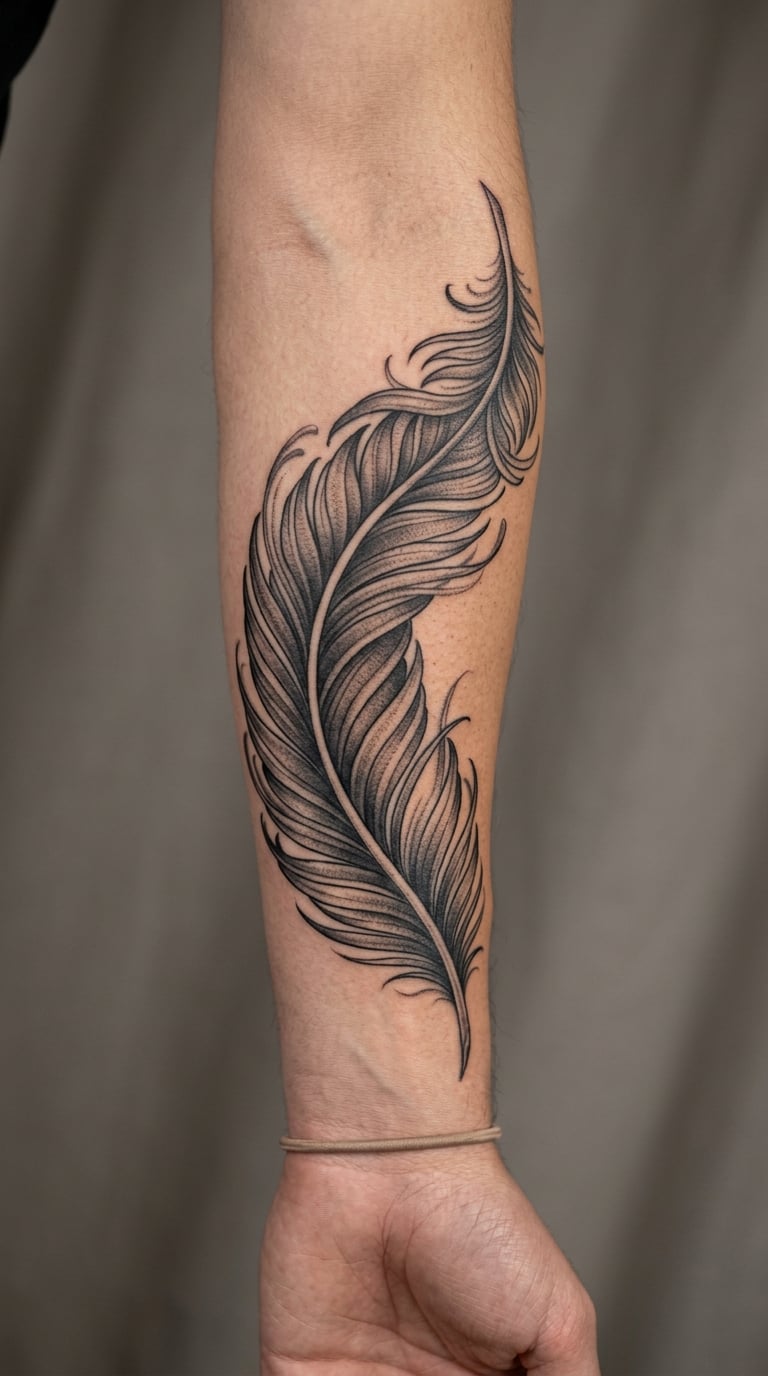
A phoenix feather wrap draws one long curved quill with layered barbs peeling away from it in overlapping rows, shaded black to grey so the edges stay soft.
Most people describe it as a reminder of a change they came through, which is a personal reading rather than a fixed one. The barbs give the piece movement that survives the curve of the arm.
Placement: Inner forearm, wrist to elbow. Size: 7 to 9 inch by 3 inch (18 to 23 cm by 7.5 cm). Style: Illustrative black and grey. Pain: Medium to high, the lower inner arm is a tough stretch of skin.
Fine barb separation lines are fragile and grey washes go flat, so lean on contrast in the quill rather than detail in the barbs. Make it yours: set the feather at an angle that matches the line of an existing tattoo nearby.
18. Hourglass and Geometric Line Wrap
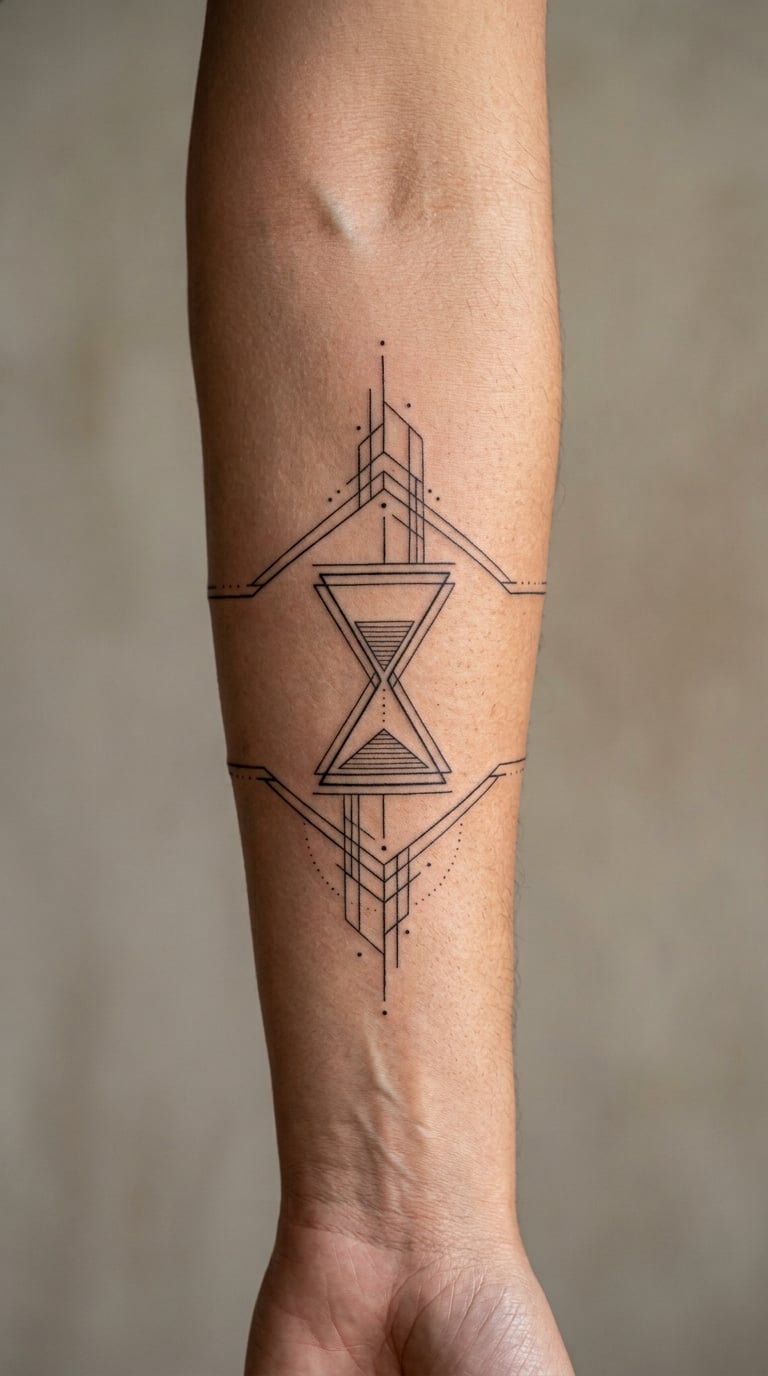
An hourglass and line wrap puts a small hourglass motif between two long precise lines that travel around the arm, with a few short geometric ticks where the lines cross.
It is restrained and modern, and it works well for someone who wants the shape of a wrap without the visual weight. Time is the usual personal reading, though plenty of people just like the form.
Placement: Outer forearm, mid-forearm. Size: 4 to 6 inch by 1.5 inch (10 to 15 cm by 4 cm). Style: Minimalist fine line. Pain: Low.
Single-needle lines on the sun-exposed outer arm thin out faster than anything else in this list, so budget a touch-up or accept a lighter piece over time. Make it yours: encode a date as the number of ticks between the two long lines.
19. Eagle Head Blackwork Wrap
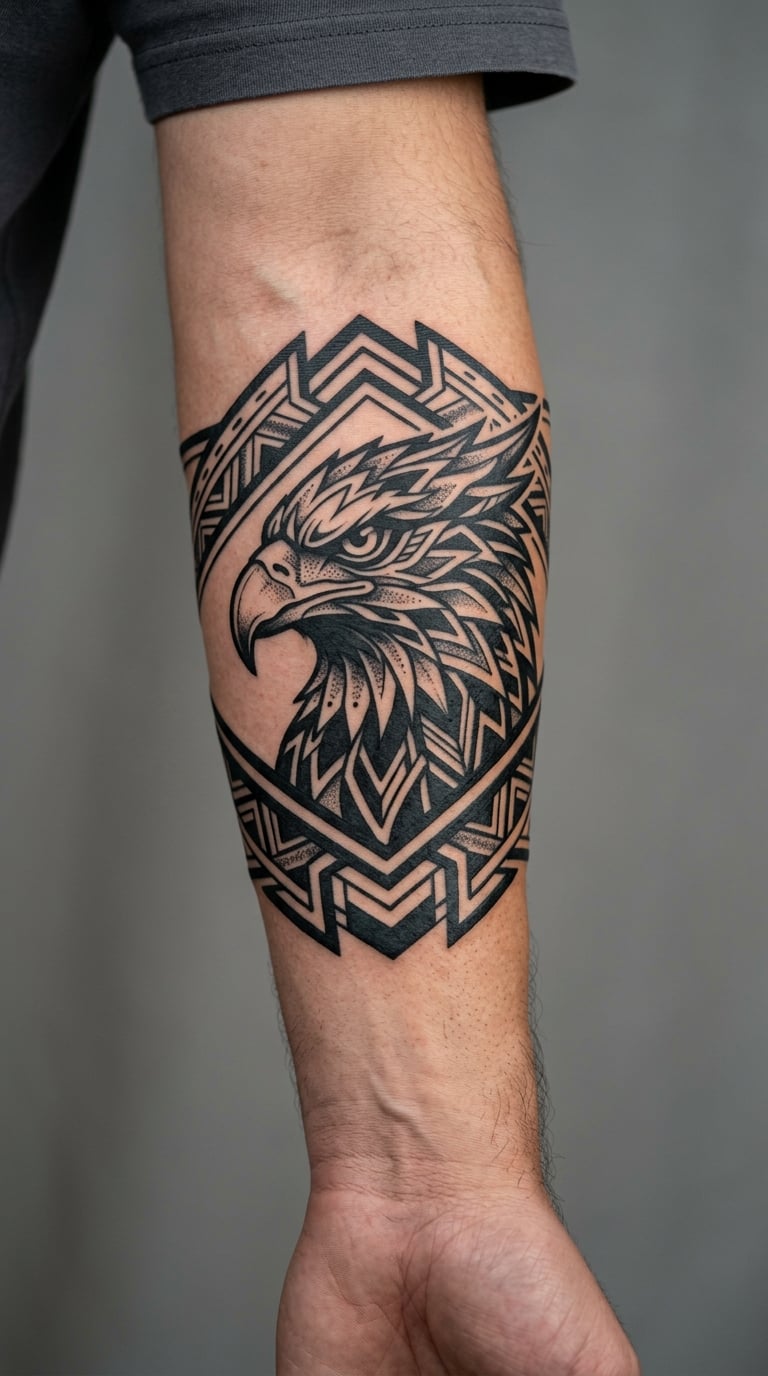
An eagle head blackwork wrap is a single solid-black head in profile, hooked beak and layered feather notches, held between two angular bands that follow the arm above and below it.
Strength, vision and freedom are the stock associations, but what people actually comment on is how visible it is. Solid black like this reads clearly from across a room.
Placement: Outer forearm, mid-forearm, angled with the beak up. Size: 5 to 7 inch by 3 inch (13 to 18 cm by 7.5 cm). Style: Blackwork. Pain: Medium.
Solid black on the outer forearm takes the most sun of any area on the arm, so it fades to grey faster than the same ink on the inner side. Make it yours: let one feather notch be a reference to something specific, and skip the flag everyone else adds.
20. Watercolor Lightning Wrap
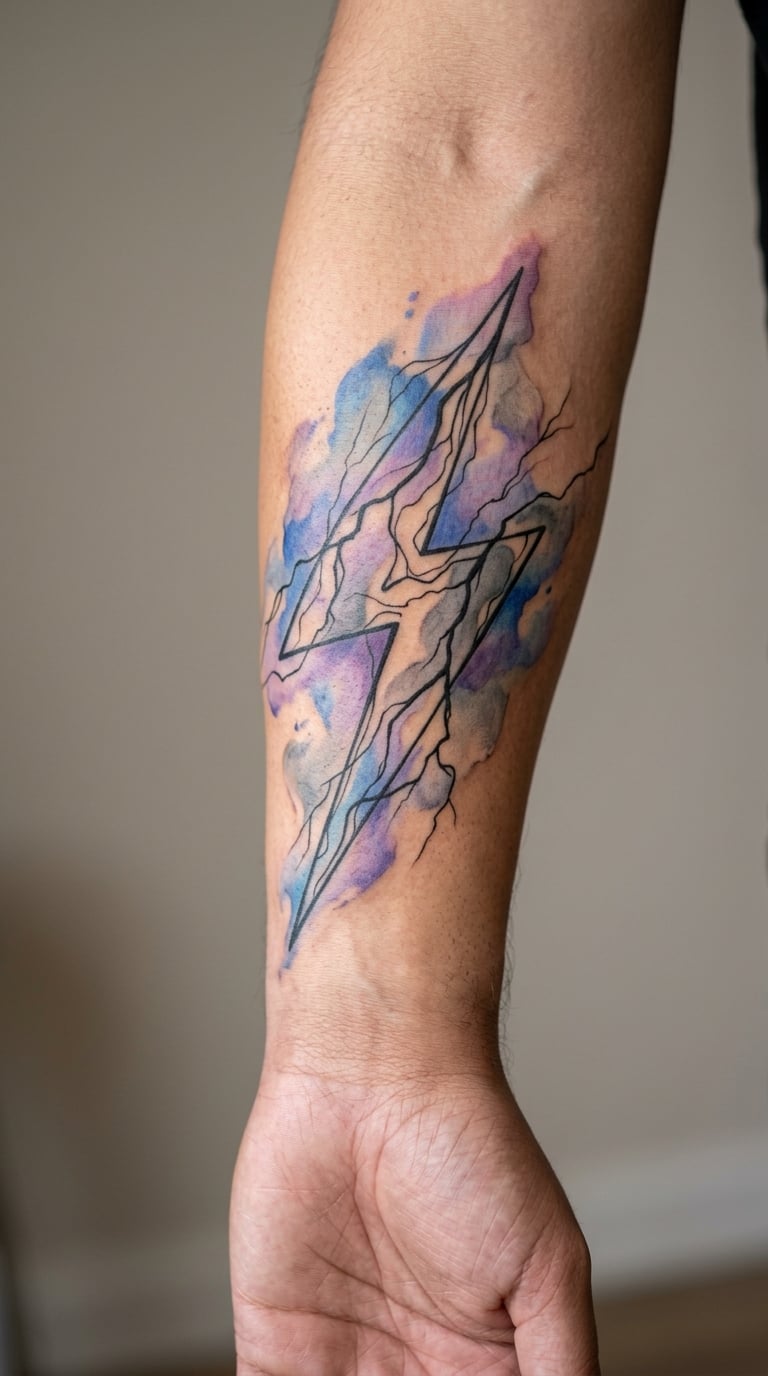
A watercolor lightning wrap keeps the bolt itself as a crisp black line and lets colour bleed away from it in soft irregular washes of blue, violet and grey.
The contrast between a sharp graphic mark and loose colour is what makes it work. It is the one option here that is genuinely suited to a long-sleeved shirt without feeling out of place.
Placement: Inner forearm, mid-forearm. Size: 5 to 7 inch by 3 inch (13 to 18 cm by 7.5 cm). Style: Watercolor. Pain: Medium.
Pale washes and second-skin colour sit high in the skin and will soften first, so keep the black linework as the piece’s actual content. Make it yours: limit the palette to two colours that already mean something to you.
21. Serpent and Laurel Interwoven Wrap
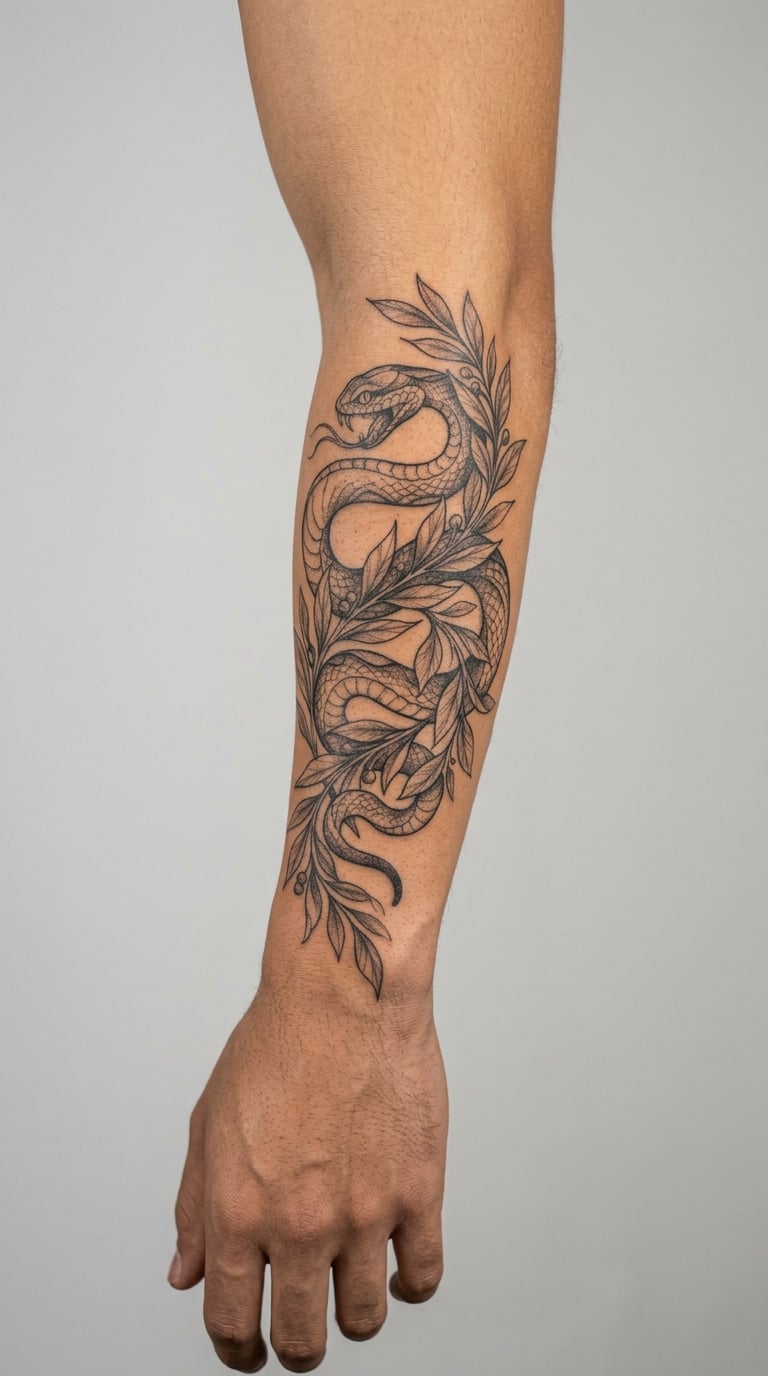
A serpent and laurel wrap threads one serpentine body through two mirrored leaf stems, the snake’s scales shaded so it separates cleanly from the foliage wherever they cross.
It can carry any story you hand it, and a lot of people build one around something they went through. The balance between two elements is what makes the composition hold around a full circumference.
Placement: Outer forearm, wrist to elbow. Size: 7 to 9 inch by 3 inch (18 to 23 cm by 7.5 cm). Style: Illustrative black and grey. Pain: Medium to high, and it is a long sitting with two full elements.
Crossing points are where the two elements merge after a few years, so give each a hard outline and a light gap of skin between them. Make it yours: use the number of leaf pairs and scale rows to mark something real, like a family count.
22. Minimalist Number and Line Wrap
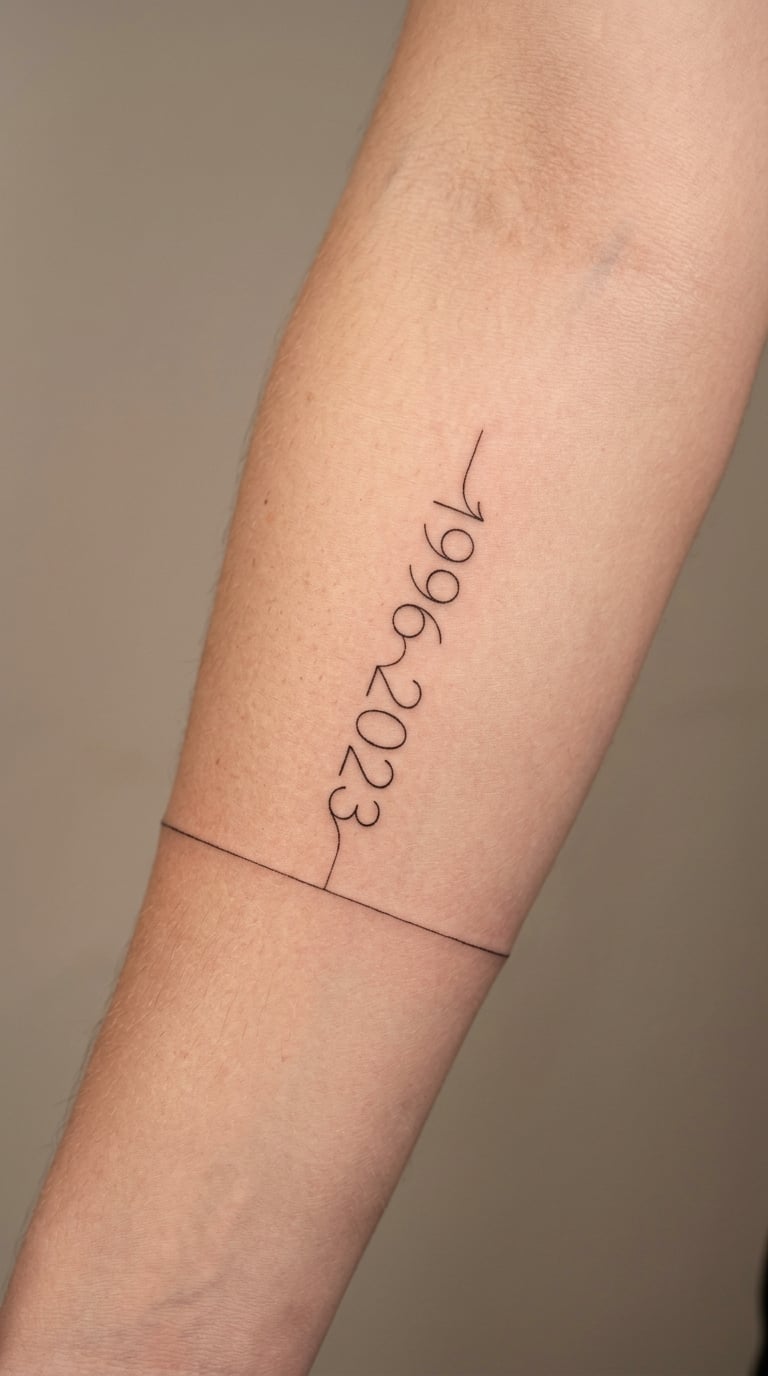
A number and line wrap sets two or three meaningful numerals in a clean hand or plain geometric type, joined by a single fine line that carries the band around the arm.
A number and line wrap is a strong candidate for a first forearm tattoo: small, quick, easy to hide, and it still reads as a considered wrap rather than a placeholder. Our full forearm tattoo round-up has more low-commitment starting points.
Placement: Inner forearm, anywhere from wrist to elbow. Size: 3 to 5 inch by 1.5 inch (8 to 13 cm by 4 cm). Style: Minimalist. Pain: Low, it is a short and shallow design.
Check lettering spelling and date digits with the artist before the stencil goes on, and again before the session ends. Make it yours: use a coordinate, a jersey number or an initial paired with a year in the same hand.
How to Choose the Right Design
The best forearm wrap tattoo is the one whose composition still works when it turns out of sight. Work through these six checks before you book anything.
- Match the subject to the wrap. Continuous subjects that travel well include rope, vine, scale, wave and any repeating pattern. A single centred image, like the rose or the compass, reads as a band because the bands frame it.
- Scale the design to your forearm. A piece designed on a 10 inch arm will not survive being scaled onto a 12 inch arm; the fine detail just gets bigger and weaker. Send your artist photos of the arm in the same lighting.
- Pick the surface. The inner forearm is expressive and easier to conceal under a long sleeve, but it flexes, moves and is more painful. The outer forearm is far less sensitive and far more exposed to sun.
- Decide what it looks like half done. If you plan a sleeve later, check that the wrap’s edges can be absorbed into a larger composition rather than fighting it.
- Budget for the ink, not the idea. Bold blackwork and solid fills need more hours than fine line. Decide how much sitting time you can actually give it.
- Look at healed work. Ask to see healed pieces from the artist, not fresh studio shots. Photographs of work that is four to six weeks old tell you far more about line retention than a portfolio shot taken the same day.
Whatever you pick, get the composition checked with the artist before it becomes permanent. A ten-minute stencil on the actual arm answers placement questions that no online gallery can.
Cost and Session Time
A small wrap is a short appointment; a full-circumference design in colour is a multi-session project. Typical US ranges give you a fair idea of what to expect, though shop minimums, hourly rates and your artist’s local market move the numbers a lot.
| Wrap type | Size | Typical hours | Appointments | Typical US range |
|---|---|---|---|---|
| Single motif, fine line or minimal | 3 to 5 inch | 1 to 2 | 1 | 250 to 600 US dollars |
| Single motif, shaded or illustrative | 5 to 7 inch | 2 to 3 | 1 to 2 | 500 to 1,200 US dollars |
| Multi-element black and grey wrap | 7 to 9 inch | 4 to 6 | 2 to 3 | 1,200 to 2,500 US dollars |
| Full-circumference colour or fine detail | 9 inch and beyond | 6 and up | 3 to 5 | 2,000 US dollars and up |
Most studios charge an hourly rate rather than a flat piece price, so a 5 hour detailed black and grey wrap is not the same as a 5 hour bold blackout piece. Detailed grey work quoted at roughly five hours is not unusual, and plenty of experienced artists will happily split a bigger wrap across two or three sittings so the line weight stays right.
Shop minimums apply, a consultation may be free or may be credited toward the work, and touch-ups on black and grey are usually included or charged at a reduced rate. If your design is a starting stage for a sleeve later, ask the artist to design the edges so that extension is possible.
Aftercare Basics
- Follow your artist’s aftercare instructions first. They know exactly what they did in your skin, and their advice outranks anything general you read online.
- Wash the wrap gently with lukewarm water and unscented soap, then pat it dry. Most shops tell you to do this two or three times a day while it is fresh.
- Keep it covered with a clean, non-stick dressing for the first few hours if your artist asks for it, and change the dressing rather than peeling it off.
- Leave scabs alone. Picking at a healing wrap is the fastest route to patchy ink loss, and the inner forearm gets disturbed constantly without you noticing.
- Keep the outer forearm covered from strong sun. UV exposure is the main reason exposed arm ink goes grey within a few years.
- Contact your artist if you notice spreading redness, heat, swelling, a soaking wet feeling inside the bandage, or a fever. Signs of a problem show up in the first days, not months later.
A wrap takes roughly two weeks to settle and a couple of months to look like its final self. Judge it then, not on day three.
Frequently Asked Questions
What are good forearm wrap tattoo ideas for men?
The strongest options are subjects that travel around the arm: rope, vine, scale, wave and interlace patterns all keep working when the design disappears out of sight. A single centred motif such as a compass rose, a rose or an hourglass also works when it is framed by bands. These 22 forearm wrap tattoo ideas for men cover blackwork, fine line, traditional, dotwork and watercolor so you can match a style to your arm before you talk to an artist.
How big should a forearm wrap tattoo be?
Most wraps sit between 5 and 9 inches long and 2 to 3 inches tall, spanning wrist to mid-forearm or mid-forearm to elbow. Going larger than 9 inches often means a piece that crowds the elbow or the wrist crease, where the skin folds and the ink wears unevenly. A smaller design scaled up to fill a bigger arm loses its fine detail, so size the design to the arm rather than forcing either end.
Is a forearm wrap tattoo more painful than a normal forearm tattoo?
Slightly, mainly because the session is longer and the piece covers more ground. The lower inner forearm near the wrist crease and the section close to the inner elbow are the most sensitive, and the outer forearm by the elbow is usually the easiest. Most people rate a full wrap a six or seven out of ten rather than a nine, and the discomfort is more of an endurance test than a sharp one.
Should a forearm wrap go on the inner or outer arm?
The inner forearm is more expressive and hides under a long sleeve, but it is sensitive, it flexes constantly, and detail there blurs faster. The outer forearm is less painful, easier to tattoo cleanly, and far more visible, which also means far more sun exposure and faster fading. If you work somewhere formal, the inner arm buys you more options day to day.
How long does a forearm wrap tattoo take to heal?
Treat the first two weeks as the vulnerable period: expect redness, swelling, a dark or dull look to the ink, and some flaking as it settles. The surface looks calm at around two weeks, but the ink is still settling into the dermis and keeps deepening for several more weeks. Judge the healed result at roughly eight weeks, and expect any touch-up to be scheduled after that.
Can a new forearm wrap work with an existing forearm tattoo?
Often yes, and a bold blackwork wrap is one of the easiest ways to deal with old thin forearm ink, because solid black covers faded linework cleanly. Finer work is harder: the artist has to redesign the composition around what is already there rather than stenciling straight over it. Bring photos of the existing piece to the consultation so the artist can tell you in person whether it works as a cover-up or whether the old ink needs dealing with first.
Conclusion
If this is your first forearm tattoo, the minimalist number and line wrap or the chain-link is the sensible starting point: small, quick, low commitment, and it still reads as a proper band. If you already have arm ink and you want something with real weight, the bold blackwork tribal-style wrap or the eagle head blackwork wrap will carry across a room and do useful work over older linework.
Whichever direction you lean, choose the design, the placement and the artist to fit you rather than the other way round. Bring references, ask to see healed work, and get the composition checked on your own arm before anything goes on permanently.