
25 Rhino Tattoo Ideas: Best Blackwork & Realistic (October 2026)
If you are weighing up a rhino, the animal reads louder than almost any other on skin. Big, blunt, slow to start and impossible to push around. This roundup of 25 rhino tattoo ideas runs from a 2-inch fine-line outline you could get as a first tattoo up to a photorealistic panel built for a sleeve.
Every entry below covers what the design actually looks like, where it sits best, a realistic size, the style tag an artist would recognise, and how it feels to sit through. Scroll to the table first if you want the whole list on one page, then work through the ones that catch you.
25 Rhino Tattoo Ideas: Quick Guide
| Idea | Style | Best placement | Size | Pain |
|---|---|---|---|---|
| Fine-line outline | Fine line | Inner forearm | 3-5 in | Low to medium |
| Blackwork head | Blackwork | Upper arm | 5-7 in | Medium |
| Charging rhino | Black and grey realism | Outer thigh | 6-9 in | Medium |
| Side profile | American traditional | Forearm | 5-7 in | Medium |
| Low-poly facets | Geometric | Forearm | 4-7 in | Medium |
| Baby rhino | Minimal fine line | Inner wrist | 2-3 in | Low |
| Watercolor wash | Watercolor | Outer calf | 5-8 in | Medium |
| Dotwork portrait | Dotwork | Shoulder | 4-6 in | Medium |
| One-horn silhouette | Minimal | Inner bicep | 2-4 in | Low |
| Sculpted head | Neo-traditional | Chest | 6-8 in | Medium |
| Floral silhouette | Blackwork floral | Outer thigh | 6-9 in | Medium |
| Matching pair | Minimal | Inner arms | 2-4 in each | Low |
| Mountain scene | Black and grey | Outer forearm | 5-8 in | Medium |
| Rhino eye | Micro realism | Inner arm | 1-2 in | Low to medium |
| Horn emblem | Emblem line work | Wrist | 2-4 in | Low |
| Adult and calf | Dense blackwork | Upper arm | 7-10 in | Medium |
| Flowing bands | Tribal blackwork | Outer calf | 5-8 in | Medium |
| Horn and eye study | Minimal line work | Inner forearm | 2-4 in | Low to medium |
| Woodland rhino | Illustrative | Inner forearm | 5-7 in | Medium |
| Colour blocks | Colour geometric | Shoulder | 5-8 in | Medium |
| Sleeping rhino | Continuous line | Inner forearm | 4-6 in | Medium |
| Rhino skull | Blackwork | Outer forearm | 5-7 in | Medium |
| Savanna scene | Illustrative realism | Outer calf | 7-10 in | Medium |
| Behind the ear | Fine line | Behind ear | 2-3 in | Low |
| Sleeve panel | Black and grey realism | Outer arm | 5-8 in tall | Medium |
1. Fine-Line Rhinoceros Outline
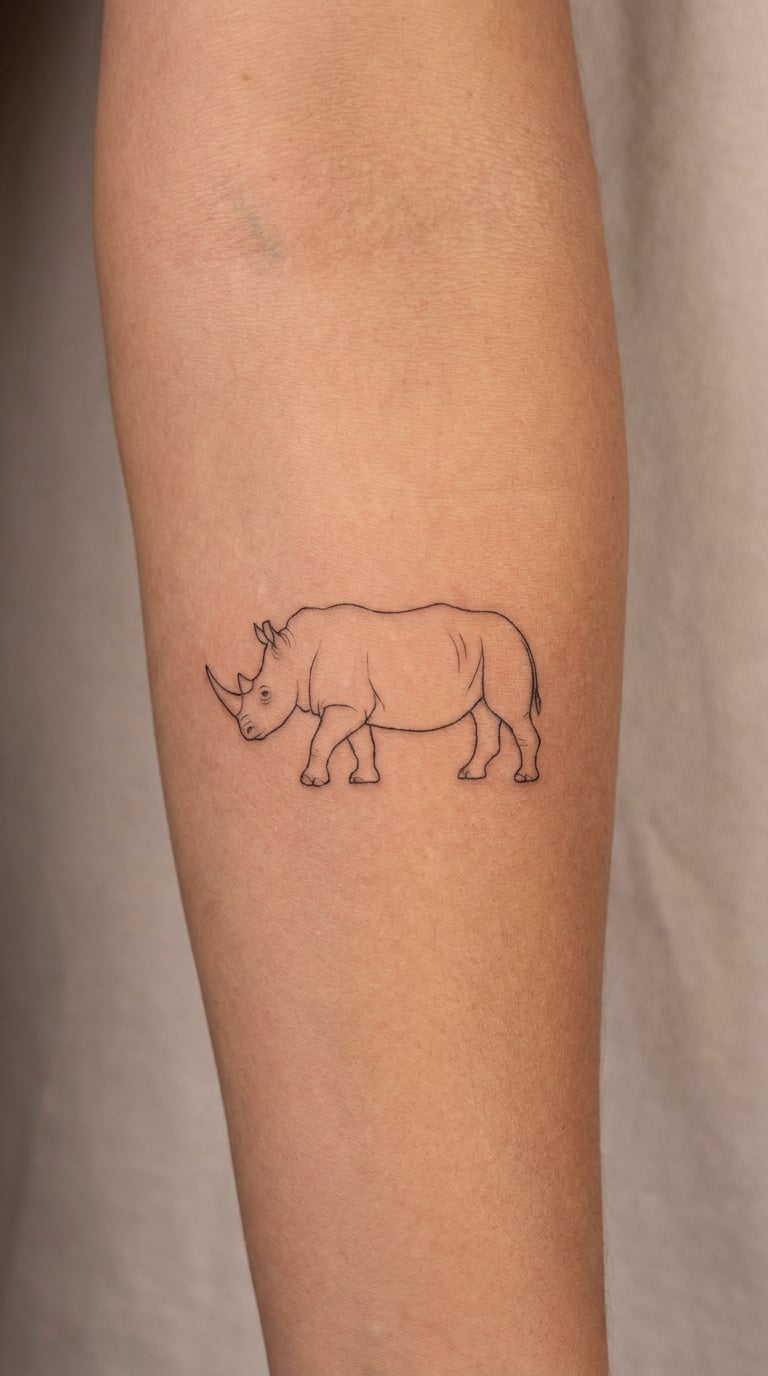
A single continuous contour traces the back, the shoulder hump, the ear and the horn of a standing rhino, with nothing shaded and no background at all. The whole thing works on restraint: two or three confident lines and a lot of skin left alone.
It is a calm, understated pick, and most people choose it because the animal says enough without a caption. Some use it as a first tattoo, some as a quiet companion piece.
Placement: Inner forearm, inner bicep or calf. Size: 3-5 inches (8-13 cm). Style: Fine line. Pain: low to medium, and the inner forearm bruises visibly for a few days.
Make it yours: A short date tucked under the belly line, set in the same weight so it reads as part of the drawing rather than a label.
2. Blackwork Rhinoceros Head
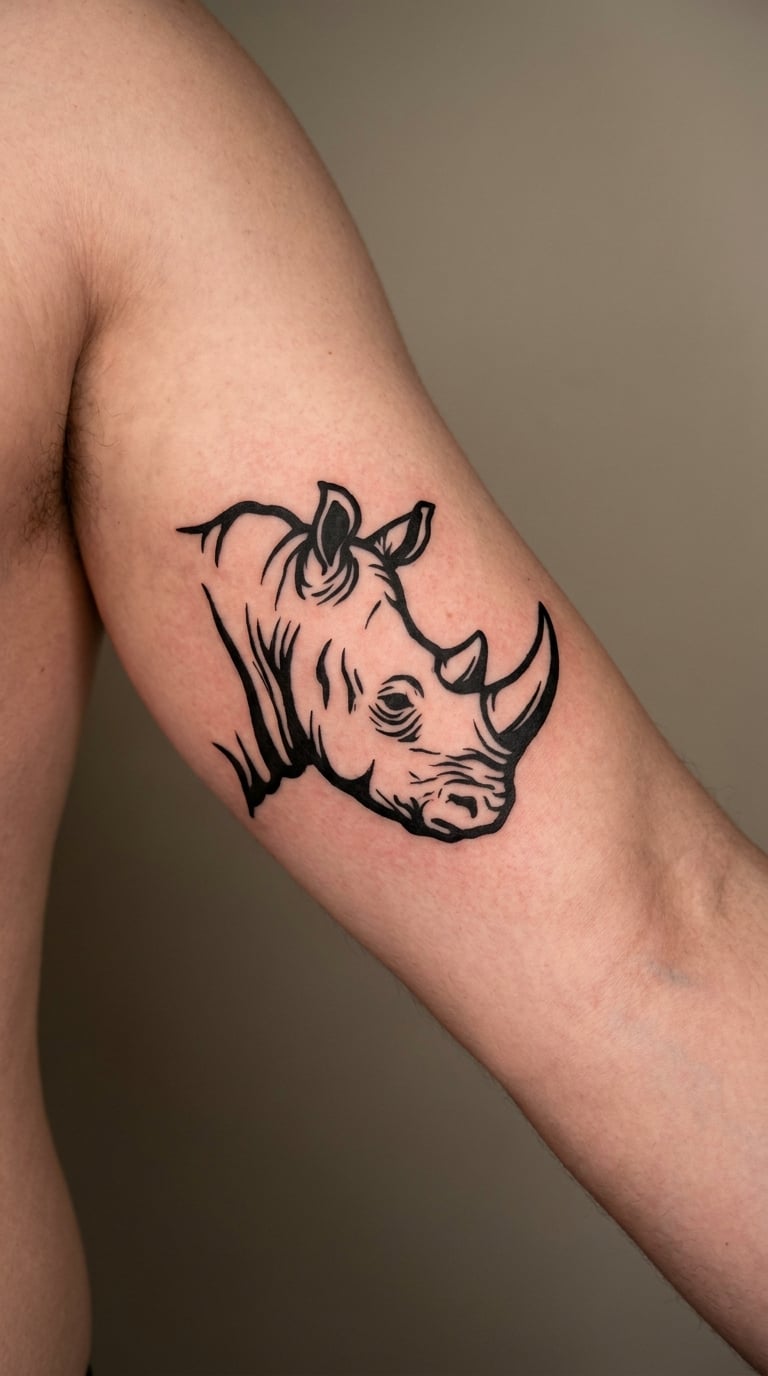
This one is built from solid black shapes rather than drawn detail. The head sits in profile, the horn a heavy wedge, the folds of the hide left as clean negative space so the form still reads as a rhino and not a blob.
People pick it for presence. There is no fixed meaning attached to it, but anyone reading it will get strength, so wear it where you want that to land.
Placement: Outer upper arm, chest or shoulder. Size: 5-7 inches (13-18 cm). Style: Blackwork. Pain: medium, with the solid fills taking longer than you expect.
Make it yours: Give the artist freedom on the ear and eye so a few small marks break up the solid mass.
3. Realistic Charging Rhinoceros
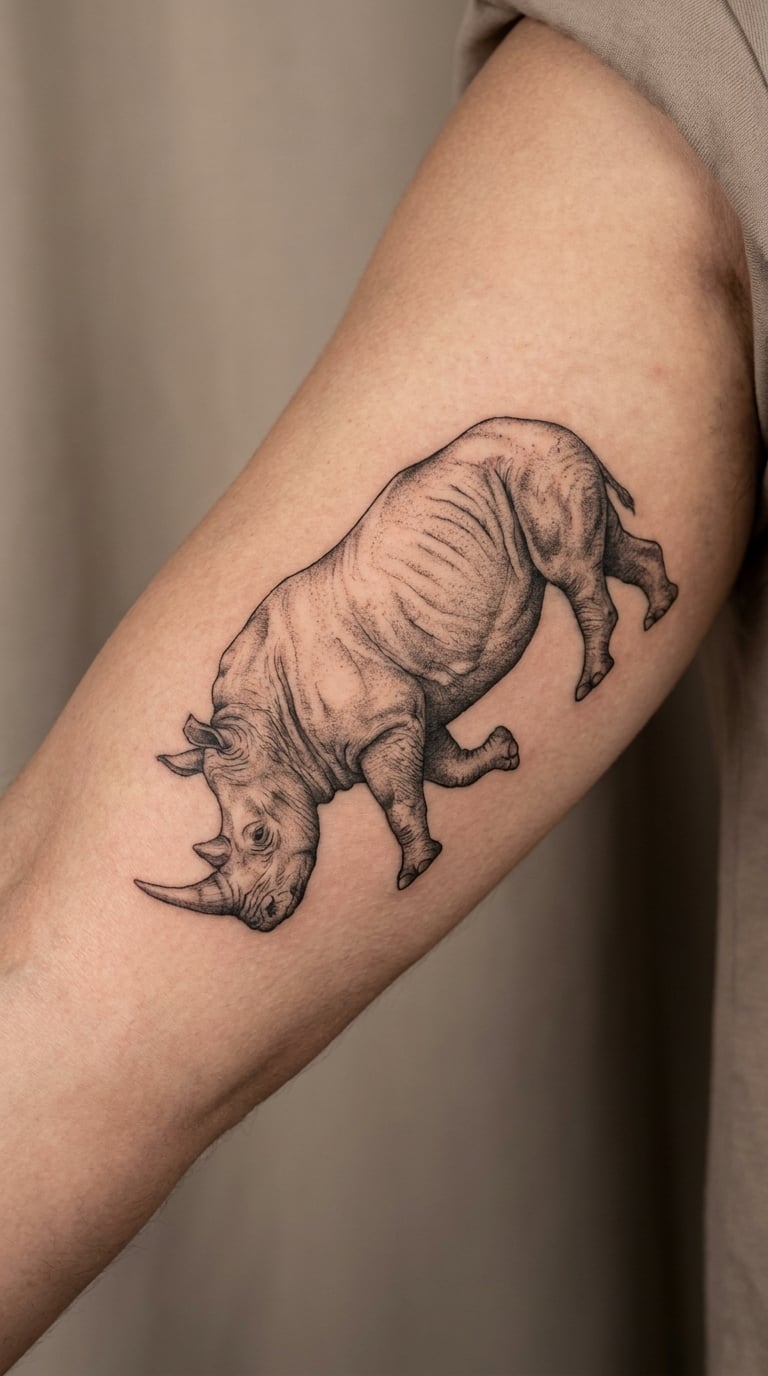
A photorealistic rhino in motion, head low, front shoulder lifted, the hide built up with fine tonal shading until the skin texture and the horn both catch light. This is the design where an artist’s grey gradient work matters more than anything else on the page.
Motion and forward weight are the point here. People choose it when they want determination rather than stillness.
Placement: Outer thigh, upper arm or back. Size: 6-9 inches (15-23 cm). Style: Black and grey realism. Pain: medium on the thigh, a bit more on the ribs of the forearm.
Make it yours: Keep the hide slightly different from a reference photo, more scarred in places, so it reads as a specific animal.
4. Traditional Side-Profile Rhino
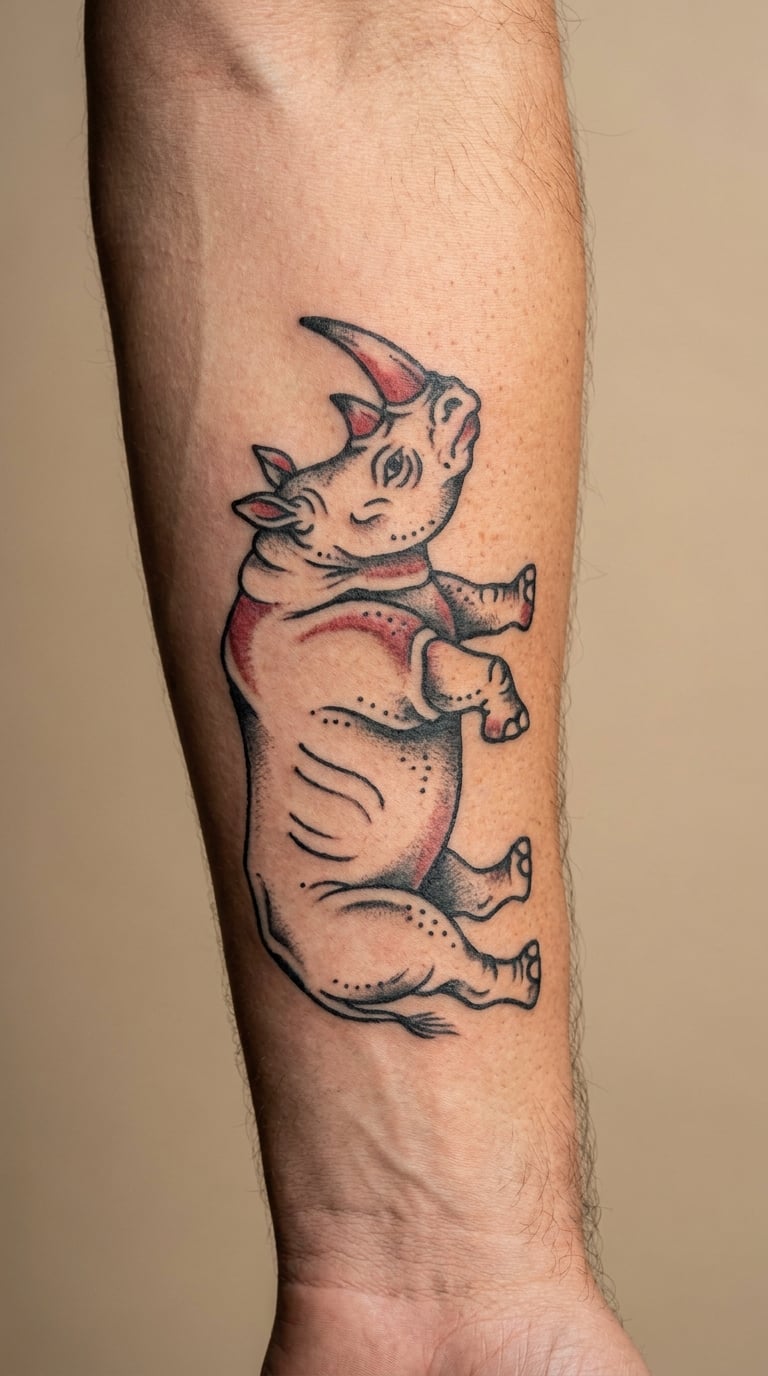
Heavy black outline, flat areas of colour, a couple of shadow shapes under the jaw and belly, and anatomy pushed toward the old flash sheets rather than a photograph. A red accent on the ear or the horn base is the classic way to finish it.
It is a style that rewards boldness over subtlety, and it holds its shape well at a distance on a forearm or calf.
Placement: Forearm, calf or upper arm. Size: 5-7 inches (13-18 cm). Style: American traditional. Pain: medium.
Make it yours: Swap the red for a two-colour palette, or add a small banner shape underneath for a word that matters to you.
5. Geometric Low-Poly Rhinoceros
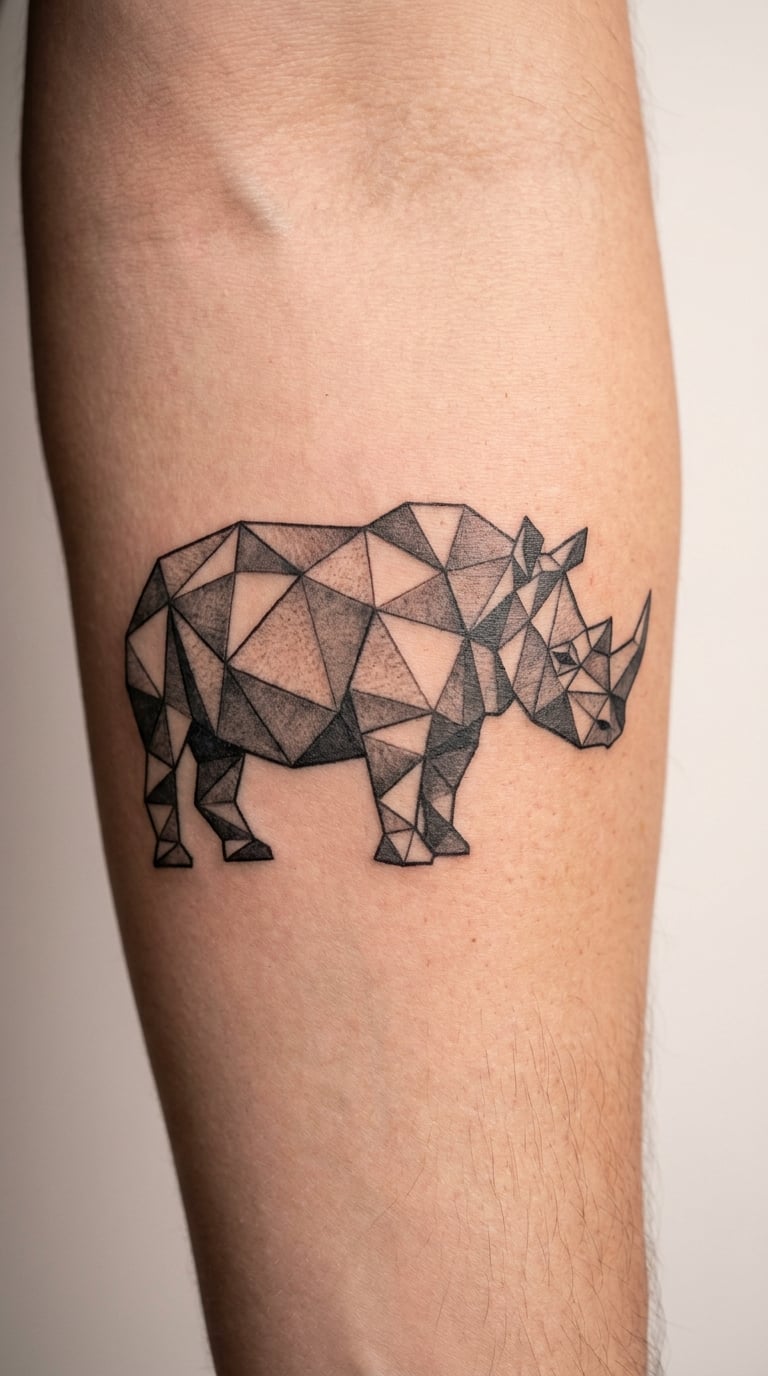
Straight lines only. The animal breaks into triangular facets, each one filled flat in black, mid grey or left empty, and the eye picks up the shape from a few feet away. It reads as a rhino without a single curved line.
It suits people who like their tattoo art to look like graphic design rather than drawing, and it stacks neatly with other faceted pieces.
Placement: Forearm, calf or shoulder. Size: 4-7 inches (10-18 cm). Style: Geometric. Pain: medium, and the needle passes over the same zones twice.
Make it yours: Fill a handful of the facets in a single colour, such as a birthstone shade, and leave the rest monochrome.
6. Minimal Baby Rhino Line Tattoo
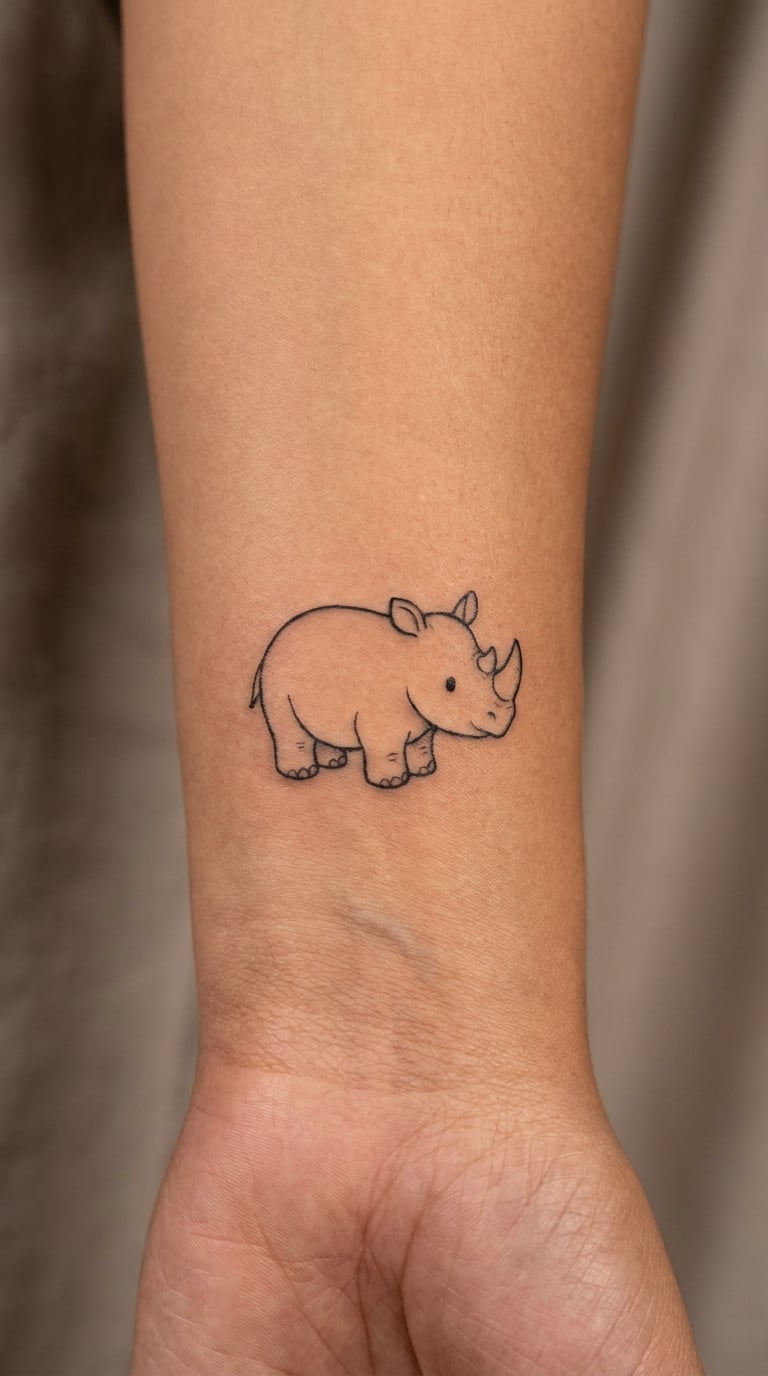
A calf version, drawn with rounded proportions, a soft dome of a head and very little facial detail beyond one dot for an eye. Roundness is what makes it read as young rather than as a badly proportioned adult.
Plenty of people get it for a family connection, and plenty just like the look of something soft on a hard animal. Nobody has to attach a story to it.
Placement: Inner wrist, behind the ear or ankle. Size: 2-3 inches (5-8 cm). Style: Minimal fine line. Pain: low, and it is over quickly.
Make it yours: Add a second tiny animal from the same family, placed on a matching spot, so the pair reads as a set.
7. Watercolor Rhinoceros
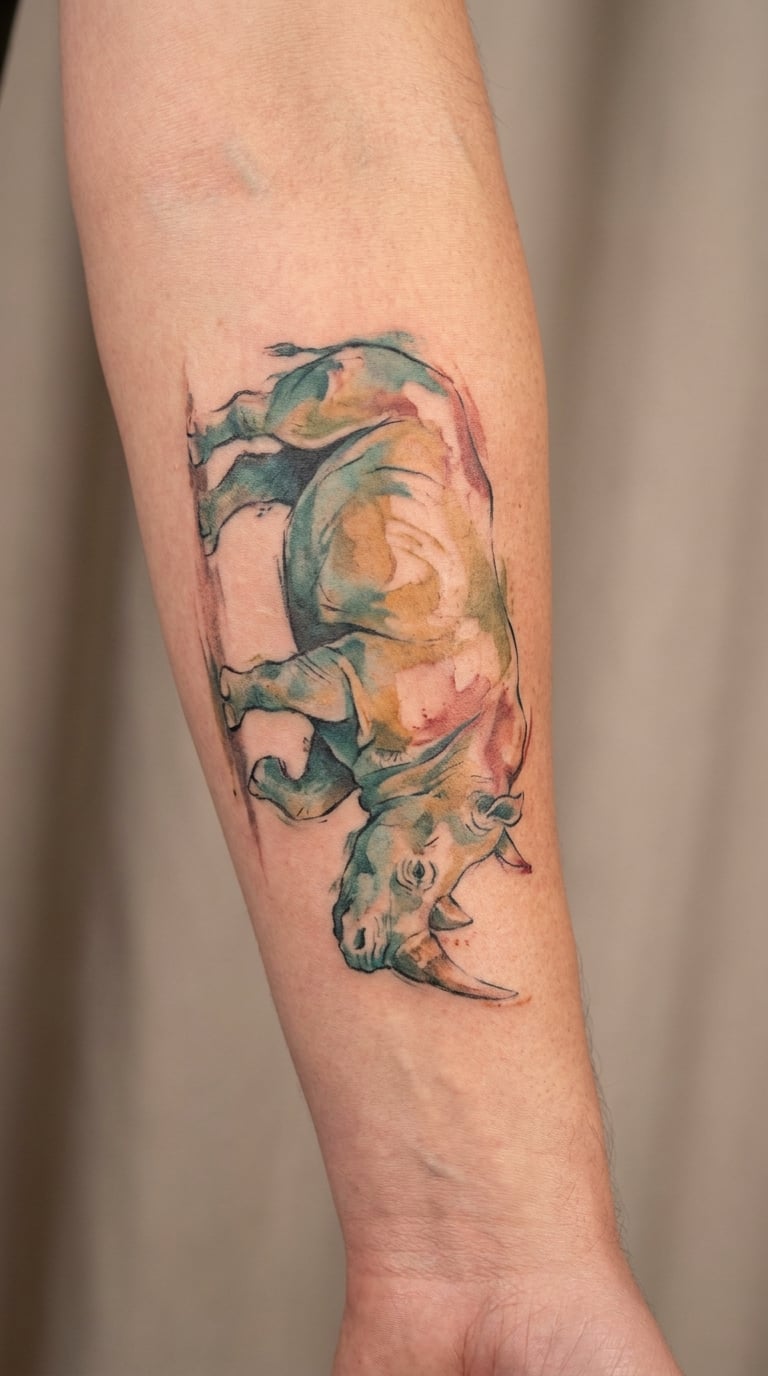
Soft washes bleeding into one another, pigment blooms at the edges, and detail dropped everywhere except where the eye lands. A good one keeps a solid core in the head and lets the legs dissolve into nothing.
It is aimed at people with a folder of colourful tattoos already, or anyone who wants a big animal shape without a heavy black block sitting next to it.
Placement: Outer calf, shoulder or upper arm. Size: 5-8 inches (13-20 cm). Style: Watercolor. Pain: medium.
Make it yours: Pick the palette before the appointment and bring references, since the colour choice does most of the personalising here.
8. Dotwork Rhinoceros
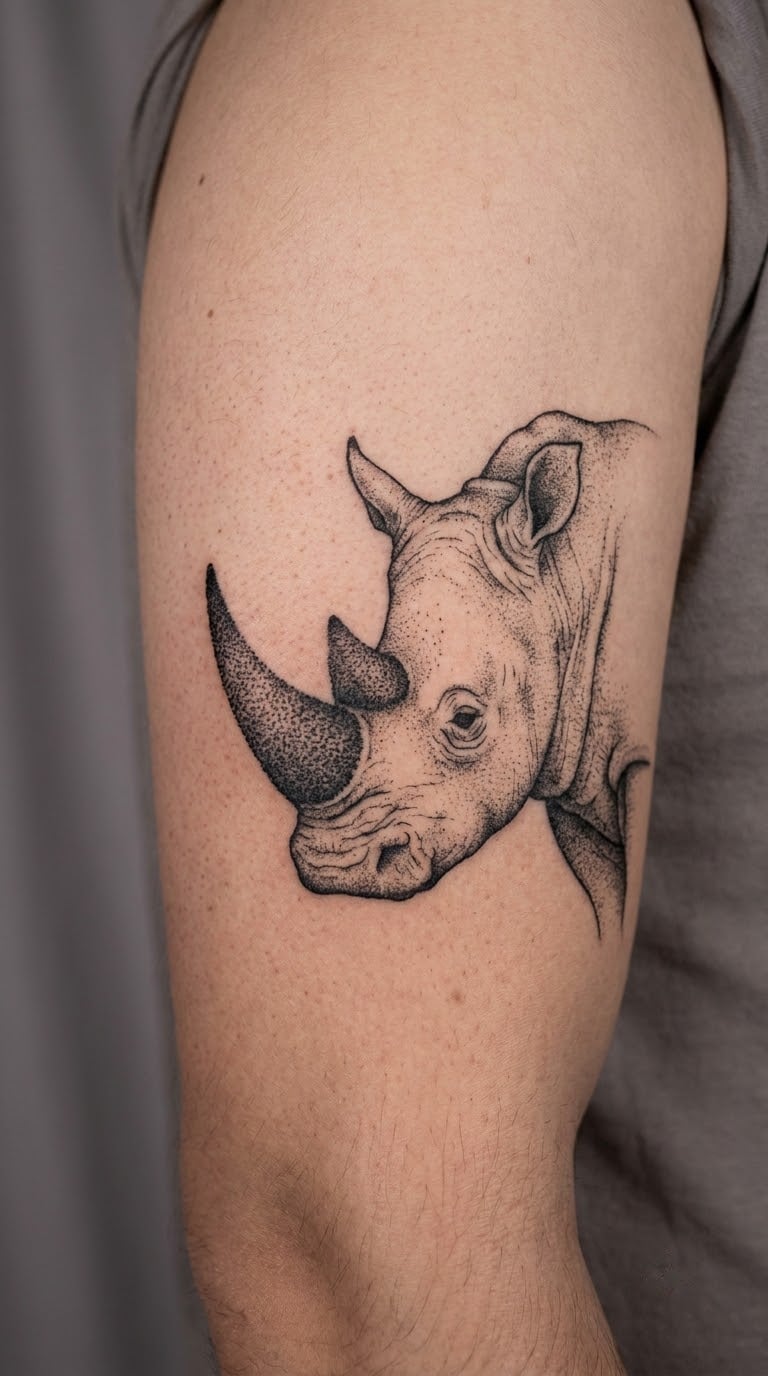
A portrait built entirely from stippling, with dot density doing the work that grey wash does elsewhere. Sparse dots for the flat of the cheek, tightly packed dots under the jaw and along the horn so the whole thing gains depth from pattern alone.
It is a slower design that rewards a steady hand, and it looks best where nobody is close enough to count the dots.
Placement: Outer shoulder, upper arm or calf. Size: 4-6 inches (10-15 cm). Style: Dotwork. Pain: medium and long, because dotting an area takes real time.
Make it yours: Ask for the horn to be packed darker than the face, which pushes the horn forward and holds the contrast years later.
9. One-Horn Minimal Rhino
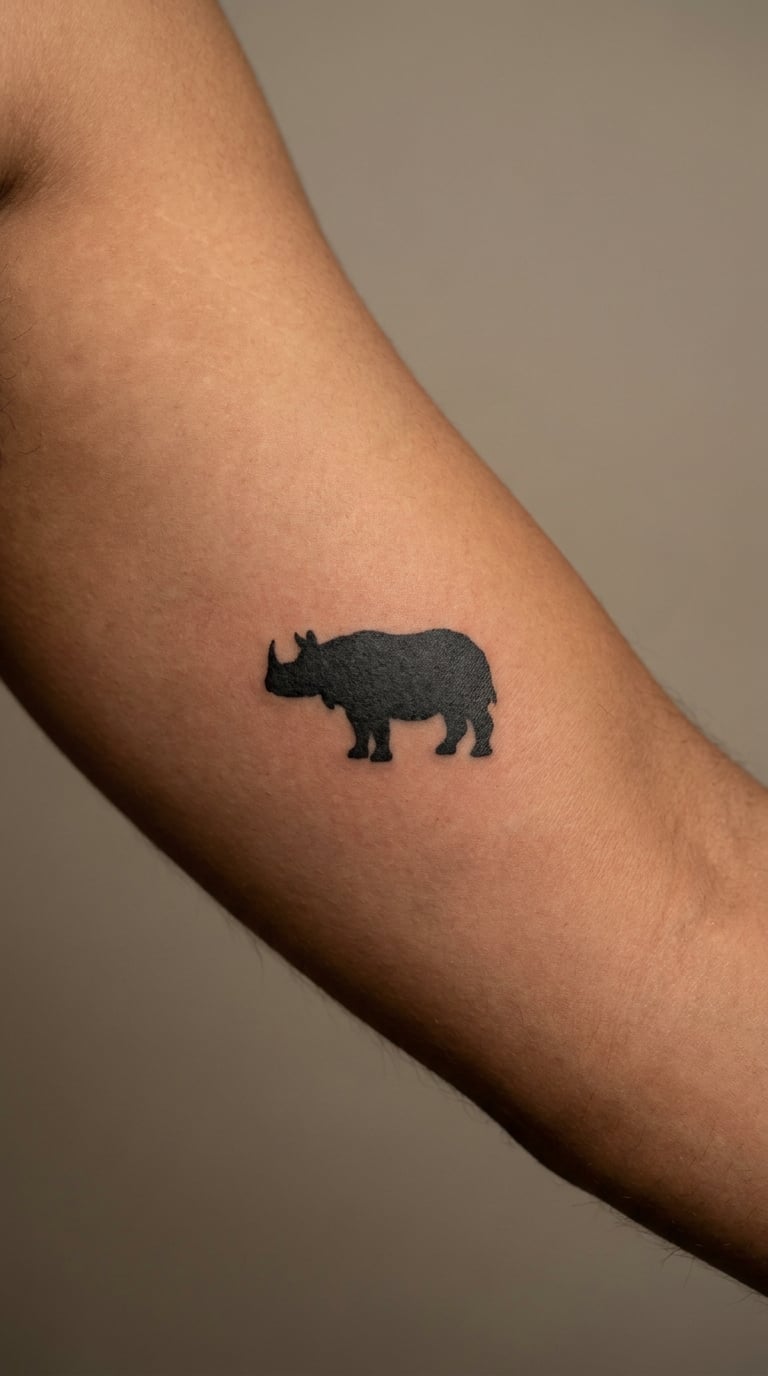
One horn, a heavy shoulder, a low stance and a handful of confident curves. Nothing else. It is about as economical as an animal design gets, which is exactly the appeal for a first tattoo or a discreet piece.
The single-horn silhouette is the most compact way to say rhino, and it disappears nicely into an existing blackwork arm.
Placement: Wrist, inner bicep or ankle. Size: 2-4 inches (5-10 cm). Style: Minimal silhouette. Pain: low.
Make it yours: Add a small initial or a short date in the same line weight, tucked under the front leg.
10. Neo-Traditional Rhinoceros Head
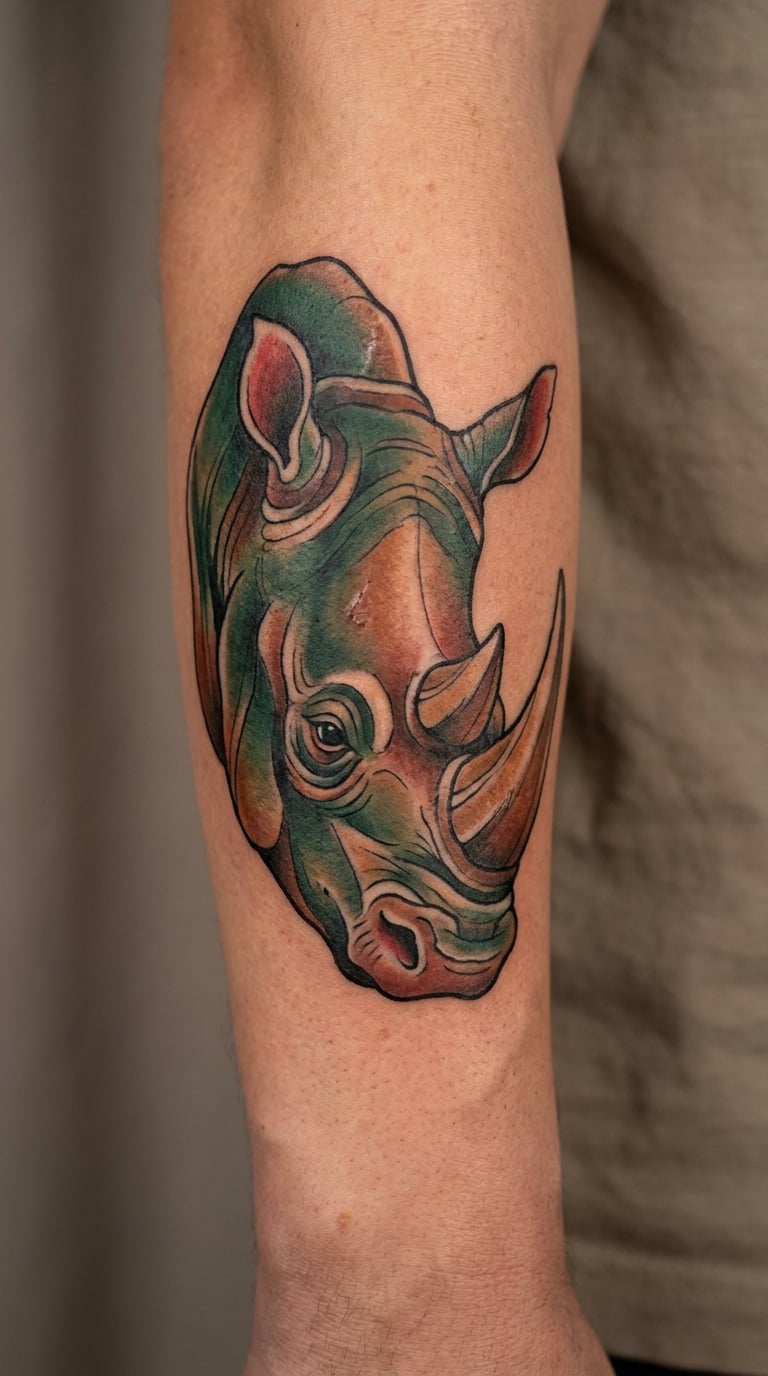
A sculpted head with dimensional shading, ornamental curls or scrollwork behind the ear, and a colour palette deep enough to be interesting. Where American traditional keeps colours flat, this one models the form with shadow.
It carries the same quiet force as the plain blackwork head, just dressed up, so it works well if your other tattoos are already colourful.
Placement: Chest, shoulder or outer forearm. Size: 6-8 inches (15-20 cm). Style: Neo-traditional. Pain: medium.
Make it yours: Change the accent colour, such as swapping red for deep green, and it changes the whole mood of the head.
11. Floral Rhino Silhouette
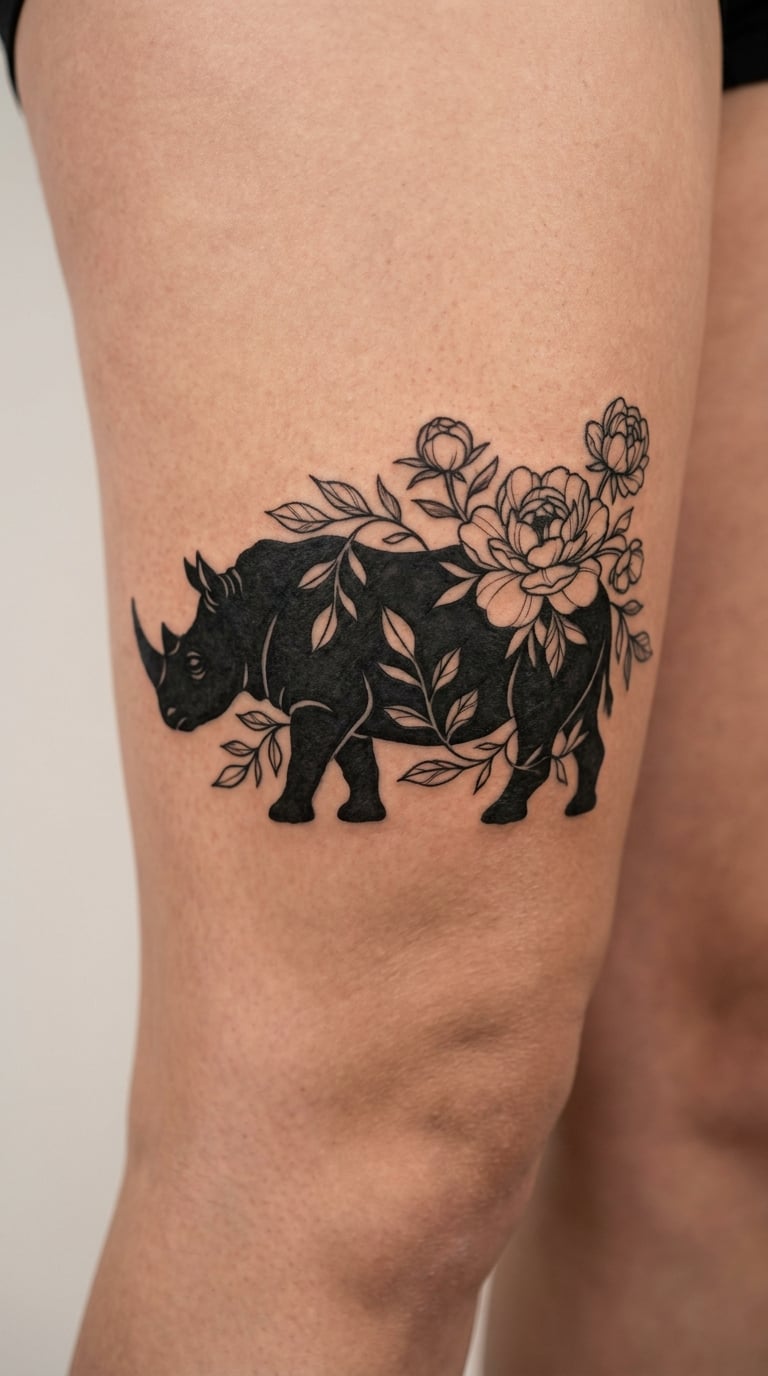
A solid black rhino silhouette with flowers woven through it, peonies, roses or thistles depending on the look you want. The shapes need to stay readable, so the botanicals grow from the animal rather than sitting beside it.
It softens the bluntness of the animal, and the balance between hard silhouette and soft petal is the whole appeal. Big pieces read best with room to breathe.
Placement: Outer thigh, calf or upper arm. Size: 6-9 inches (15-23 cm). Style: Blackwork with florals. Pain: medium.
Make it yours: Choose the specific flower for a reason, a thistle if you have Scottish roots, a poppy if you want something quieter.
12. Two-Rhino Matching Tattoo
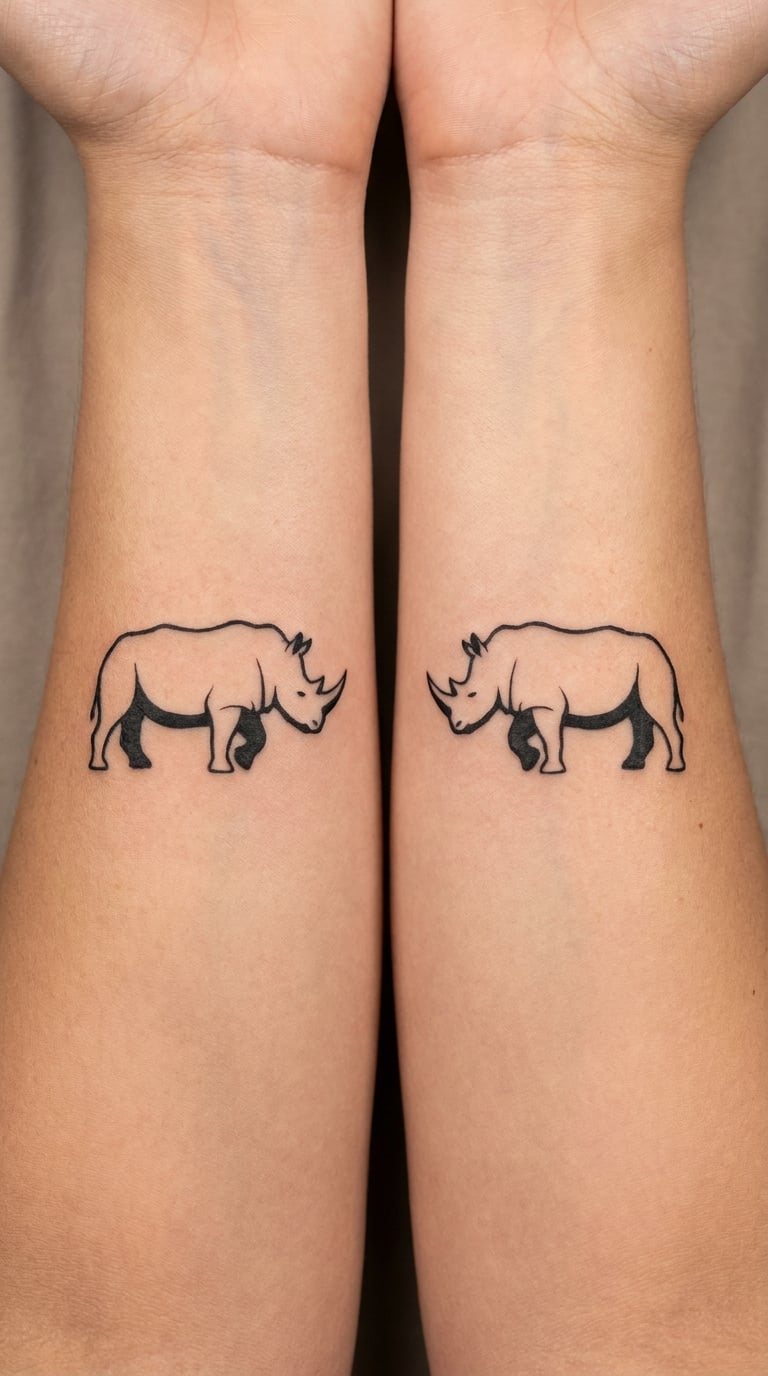
Two simplified rhinos facing one another, small enough that both sit comfortably on a forearm. They read as a pair the moment they are side by side, even at a distance.
Plenty of people use these with friends, partners or family. The relationship behind them belongs to whoever wears them, and the design itself stays neutral.
Placement: Inner arms, matching calves or opposite wrists. Size: 2-4 inches (5-10 cm) each. Style: Minimal. Pain: low.
Make it yours: Mirror the placements, one inner arm and one outer, so the two line up when your arms are side by side.
13. Rhino with Mountain Background
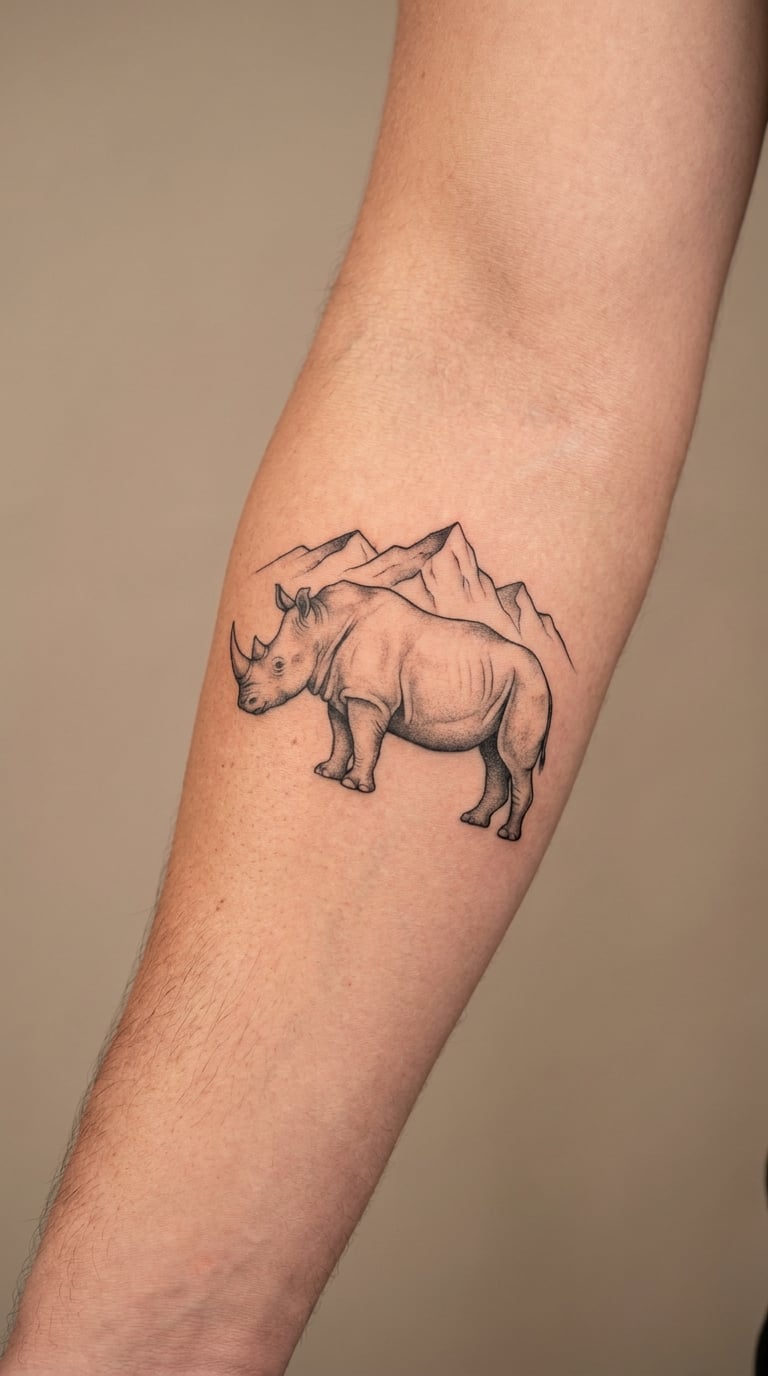
A side-profile rhino standing in front of a restrained mountain range, with the peaks kept as simple overlapping shapes so the animal stays the subject. Line work carries the range, shading carries the rhino.
For some people the peaks are simply a place that matters. For others the pairing is about scale, the animal set against something enormous and indifferent.
Placement: Outer forearm, calf or upper arm. Size: 5-8 inches (13-20 cm). Style: Black and grey. Pain: medium.
Make it yours: Have the artist use a specific peak you have actually stood on. Our guide to mountain and ocean tattoo ideas has more on working scenery into a piece without it crowding the animal.
14. Micro Realism Rhino Eye
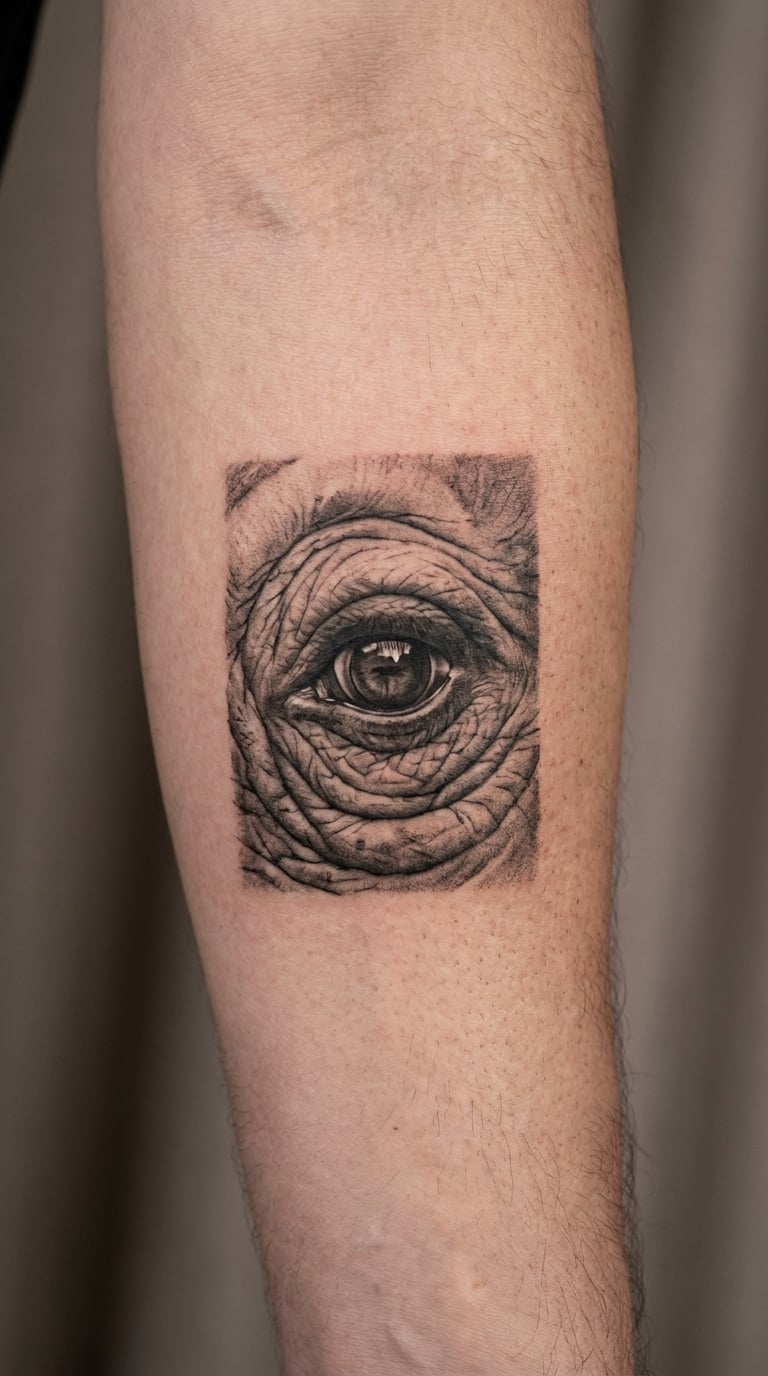
Cropped tight to the eye and the textured crease above it, rendered photorealistically in black and grey. At this size there is nowhere to hide, so contrast and clean edges decide whether it works.
It is the smallest design on this list that still asks for real technical skill. Come to the appointment with healed references from the same artist if you can.
Placement: Inner arm, shoulder or calf. Size: 1-2 inches (3-5 cm). Style: Micro realism. Pain: low to medium, mostly the psychological kind.
Make it yours: Take the highlight slightly stronger than you think you need, because fine detail softens faster than heavy black.
15. Three-Horn Rhino Mark
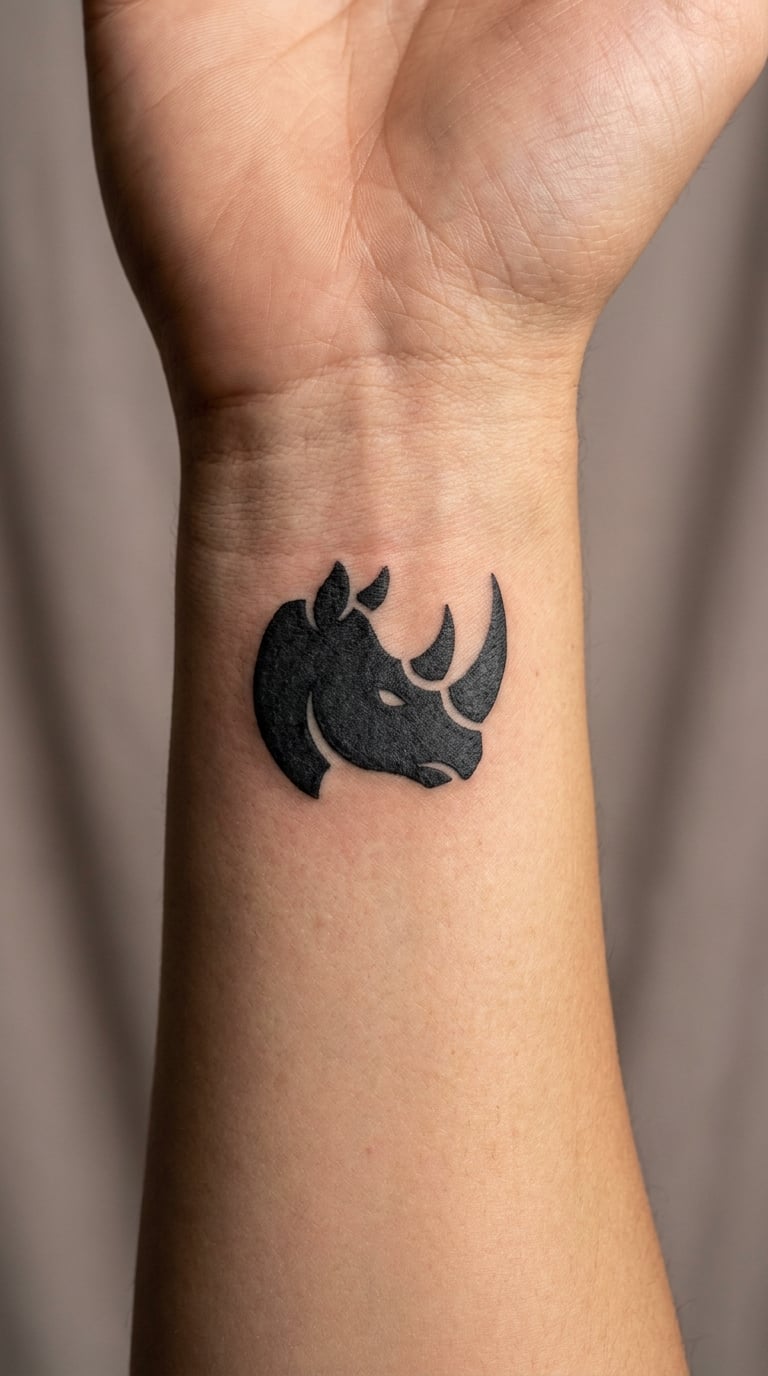
A compact emblem that combines a rhino head with three stylized horn shapes. It is not a strict anatomical specimen, and that is the point. It is a mark built for shape and balance rather than accuracy.
Small emblems suit people who want a rhino reference they can wear anywhere, including places a big realistic piece would never go.
Placement: Wrist, ankle or upper arm. Size: 2-4 inches (5-10 cm). Style: Emblem line work. Pain: low.
Make it yours: Set a few letters underneath in a matching weight, in a font that stays legible at that scale.
16. Blackwork Charging Formation
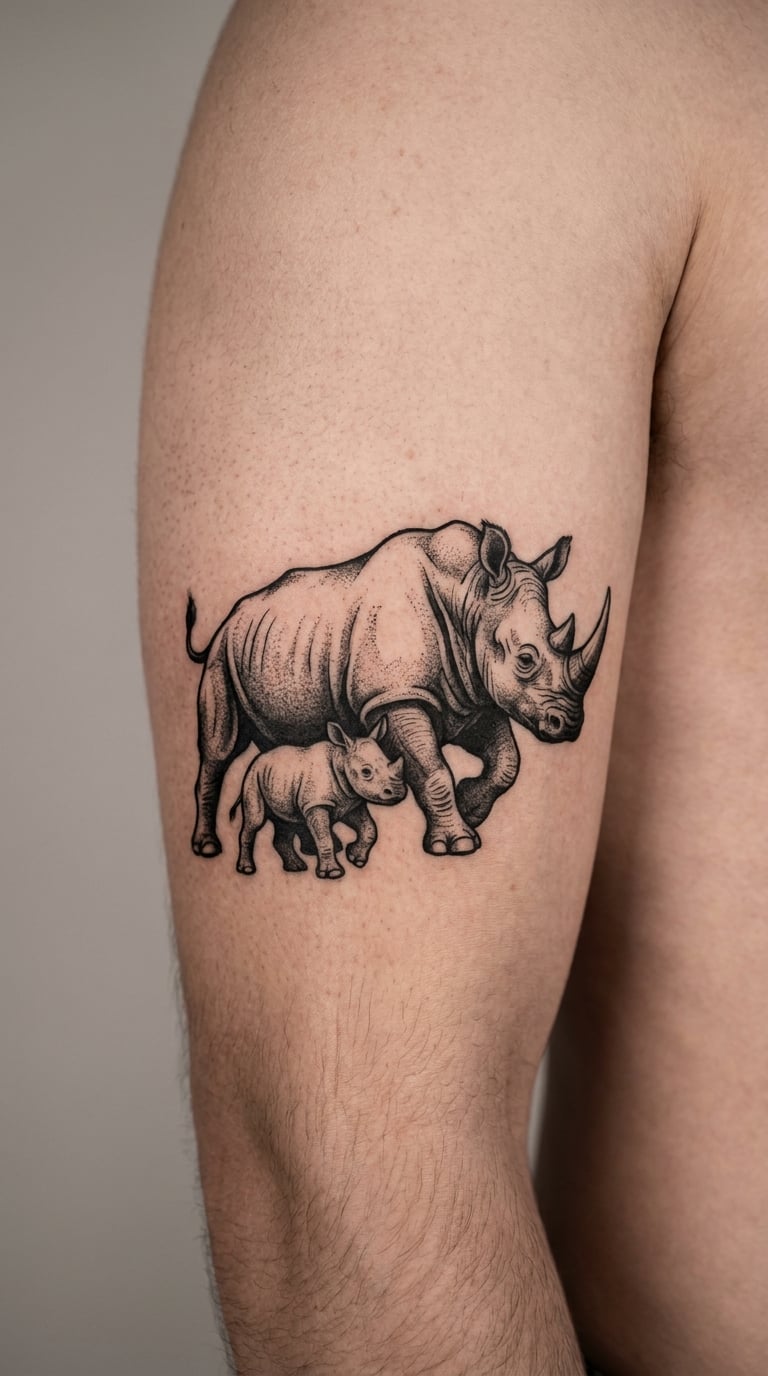
An adult rhino charging forward with a calf running beneath and slightly behind it, packed into a dense black composition where the two bodies merge into one heavy shape. The contrast between the big animal and the small one is the entire point.
It is a lot of black, so it needs a canvas that can take it. Anything under six inches turns into a smudge.
Placement: Upper arm, back of the calf or chest. Size: 7-10 inches (18-25 cm). Style: Dense blackwork. Pain: medium, and a long sitting for solid black.
Make it yours: Add a matching calf silhouette somewhere else on the body so the pair is a running thread across the tattoos.
17. Rhino Made from Tribal Lines
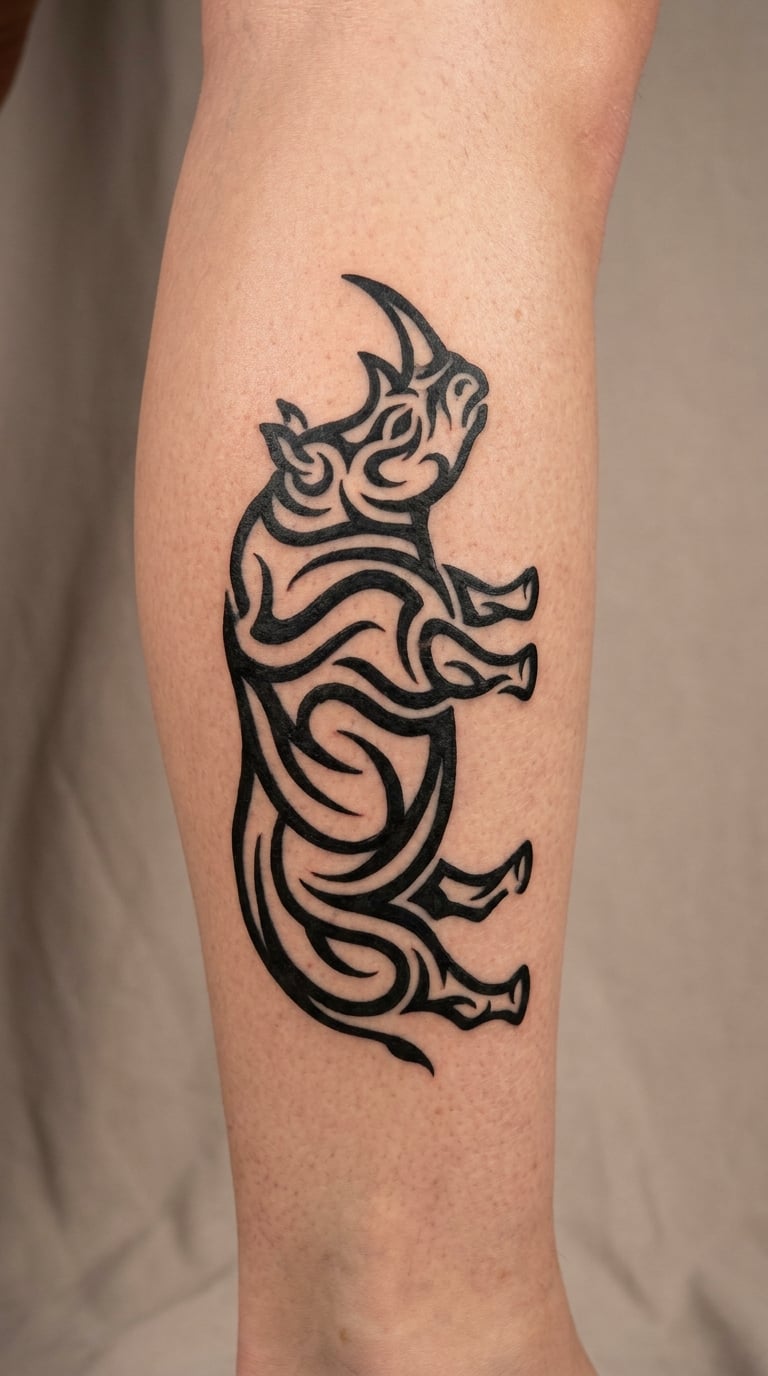
The animal described by broad flowing black bands that sweep along the body, curve into the horn and break into open shapes at the legs. Keep the bands wide and the design stays readable from across a room, which is exactly what thin tribal line work does not.
It is a graphic choice first. If the pattern language matters to you, ask the artist how they handle a specific animal rather than picking from a generic sheet.
Placement: Outer calf, forearm or shoulder. Size: 5-8 inches (13-20 cm). Style: Tribal blackwork. Pain: medium.
Make it yours: At smaller sizes ask for the pattern to be simplified, fewer bands and more space, so nothing fills in as it ages.
18. Linework Horn and Eye Study
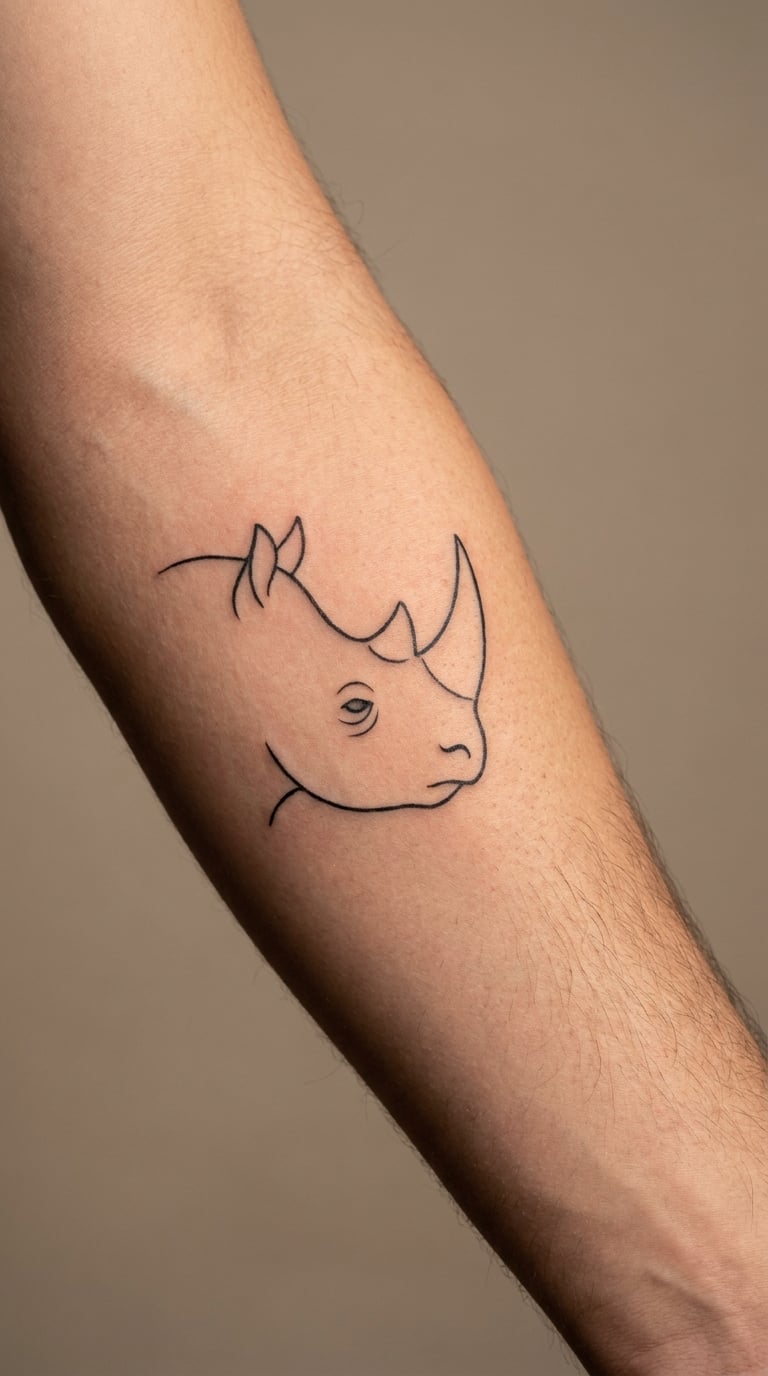
A cropped study of the horn and the eye, drawn with a handful of thin lines and nothing else. No body, no background, no context, and it still reads as a rhinoceros to anyone who has looked at one.
Good when you want the animal to be present without the weight of a full figure. The horn texture is where the character sits, so that is what to talk about with your artist.
Placement: Inner arm, wrist or below the ear. Size: 2-4 inches (5-10 cm). Style: Minimal line work. Pain: low to medium.
Make it yours: Ask for a slightly heavier line weight than feels comfortable on day one, because thin lines lose their edge over the years.
19. Whimsical Woodland Rhino
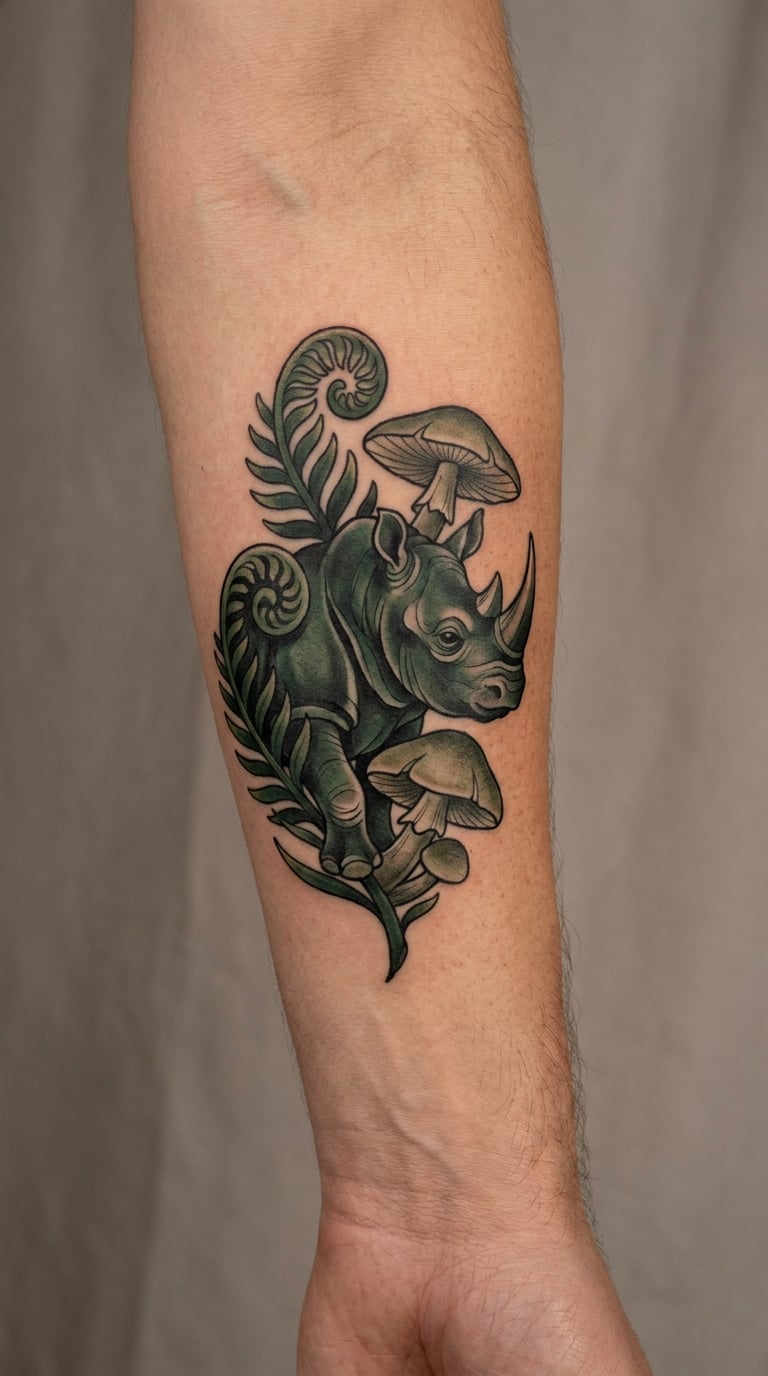
A friendly illustrated rhino among ferns, mushrooms and small flowers, drawn with soft rounded lines rather than sharp realism. The palette is usually two or three colours, black with one green and one warm accent.
It is nowhere near photorealistic, and that is the draw. Woodland pieces suit arms that carry illustration work already.
Placement: Calf, inner forearm or shoulder. Size: 5-7 inches (13-18 cm). Style: Illustrative. Pain: medium.
Make it yours: Include one plant native to where you grew up, and the design quietly becomes about a place instead of a generic forest.
20. Colored Geometric Rhino
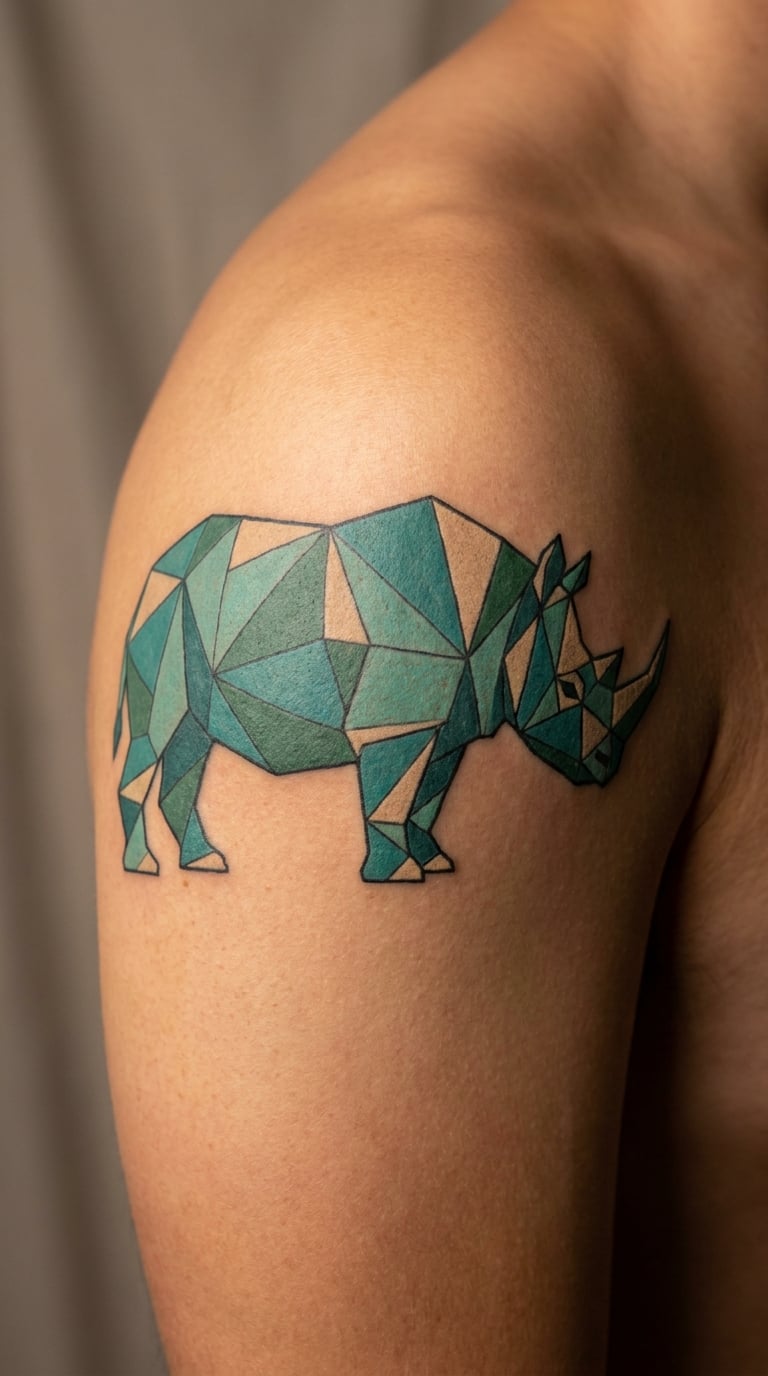
The low-poly idea rebuilt in colour, with the facets filled in teal, forest green and warm sand blocks. Colour is what gives the geometry depth, since two neighbouring blocks now read as separate planes.
It is a good compromise when blackwork feels too heavy and a realistic animal feels too fussy.
Placement: Shoulder, calf or upper arm. Size: 5-8 inches (13-20 cm). Style: Colour geometric. Pain: medium.
Make it yours: Keep the palette to three colours and pick them from something you already own, so it looks planned next to your other work.
21. Sleeping Rhino Line Art
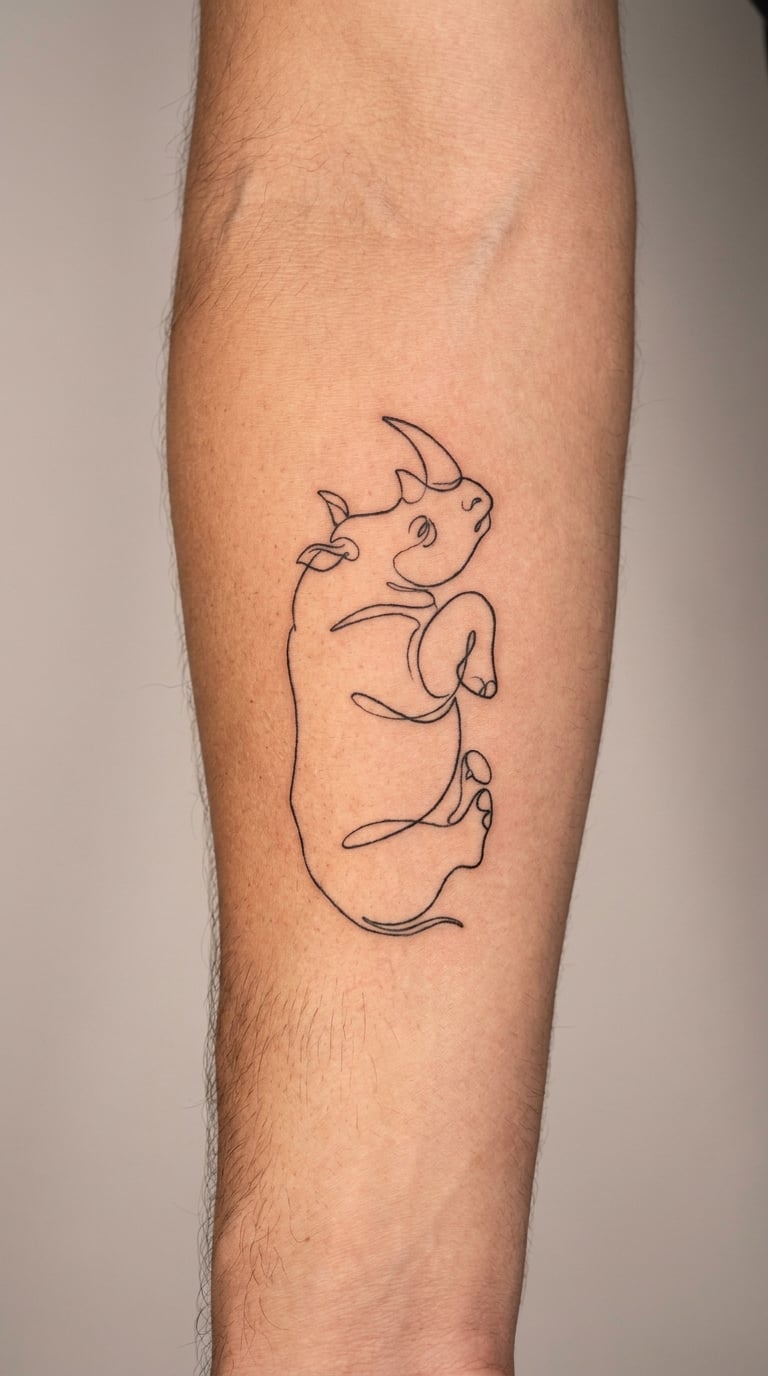
A rhino curled on the ground with eyes closed, drawn in sparse continuous line, the whole animal reduced to a few unbroken curves. Sparse composition means the forearm stays quiet, which is unusual for a piece this size.
Some people read rest or grounding into it. That reading is personal, not a rule, and the calm composition is what most people are actually buying.
Placement: Forearm, calf or rib area. Size: 4-6 inches (10-15 cm). Style: Continuous line. Pain: medium, and the rib placement is the sharpest of the three.
Make it yours: Add one grounding element, a stone, a low blade of grass, and let it be the only detail in the piece.
22. Blackwork Rhino Skull
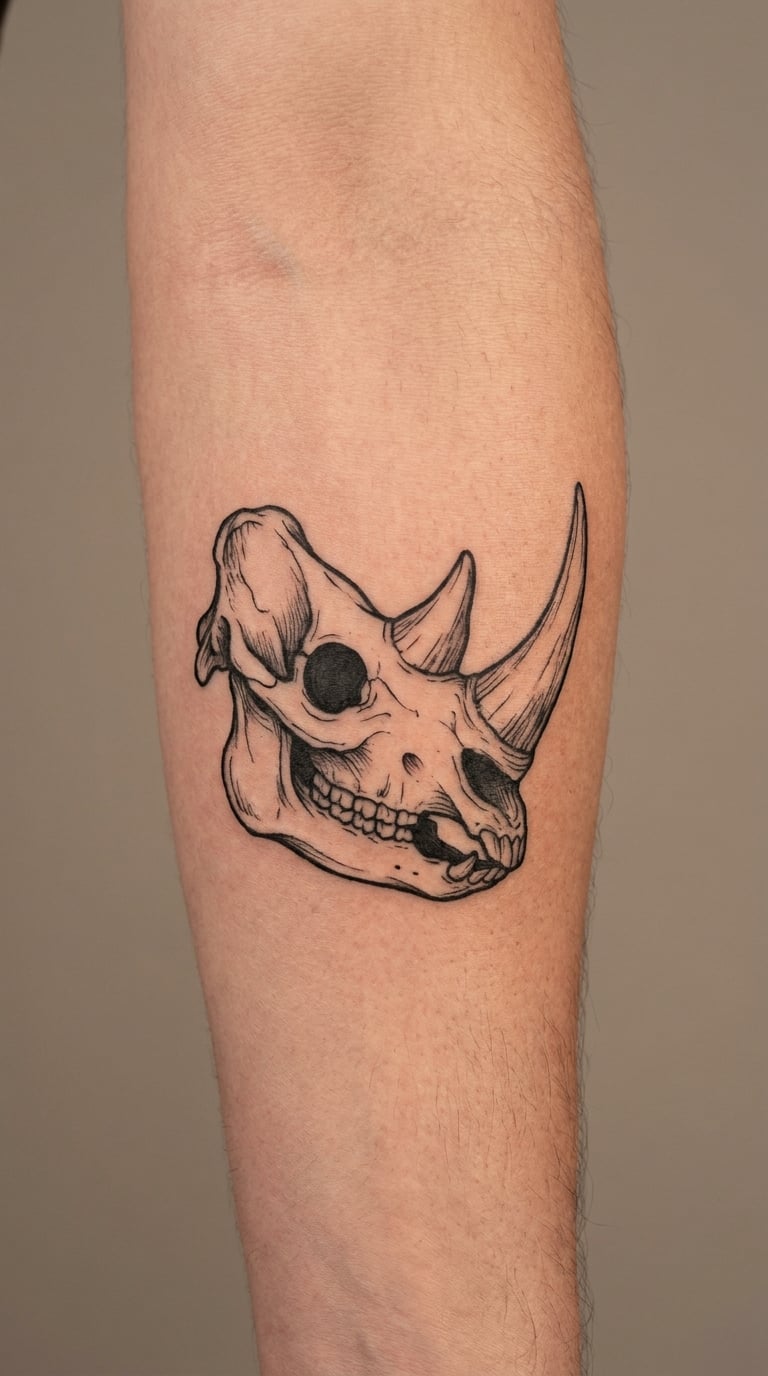
A stylised skull with clearly defined horn sockets, a heavy brow ridge and legible bone shapes. The anatomy has to stay readable, so the artist keeps the front view straight rather than twisting it for drama.
It is a bold aesthetic choice rather than a coded message, and it sits well next to other skull work.
Placement: Outer forearm, upper arm or calf. Size: 5-7 inches (13-18 cm). Style: Blackwork. Pain: medium.
Make it yours: Soften the lower edge with a single small flower, which keeps the piece from reading as an all-dark block.
23. Safari-Style Rhino Scene
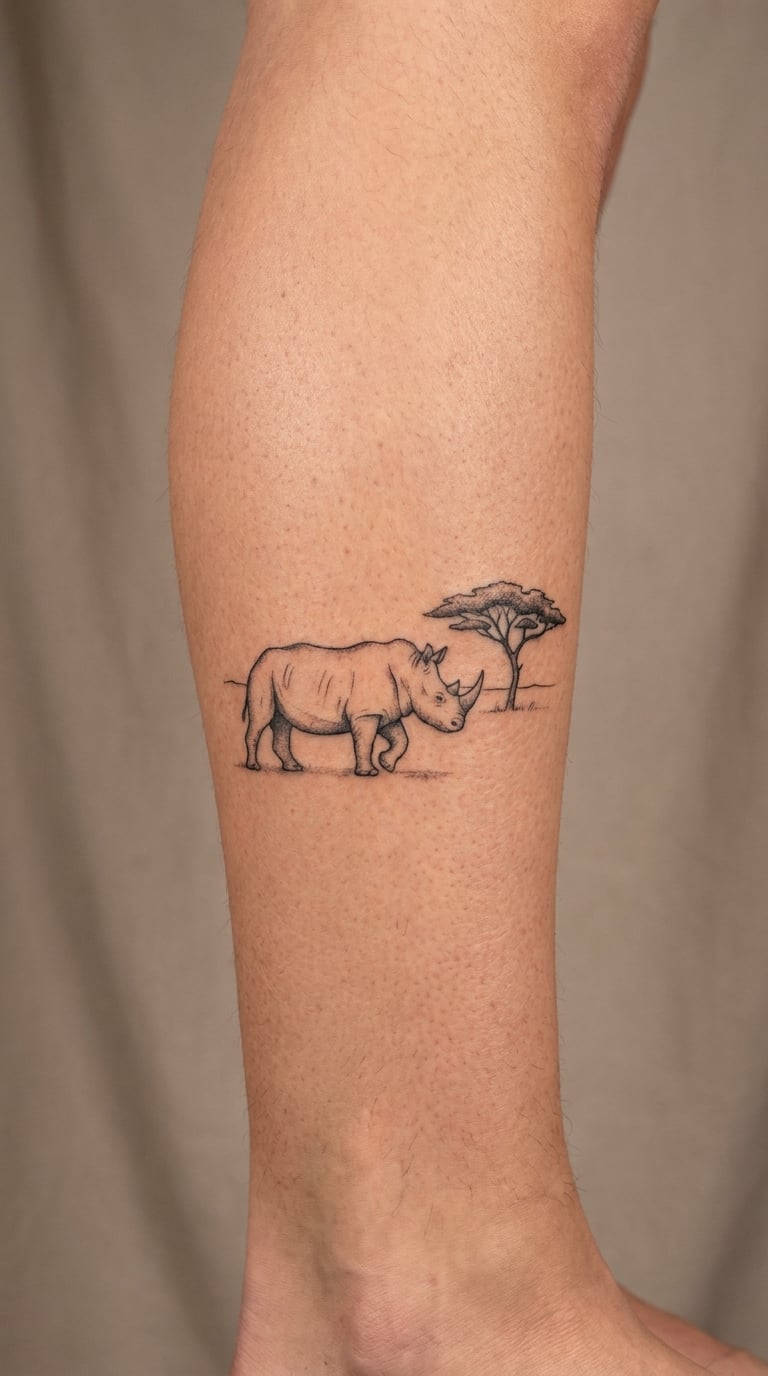
A side-view rhino placed in a sparse savanna scene, with dry grasses, a low acacia and a flat sun sitting behind the animal. The scenery stays secondary, painted in washes, while the rhino carries the line work and the contrast.
Travel memories are the common reason for this one, a particular view from a particular trip. Sometimes the background scenery is simply there to give the animal a world.
Placement: Outer calf, thigh or back of the arm. Size: 7-10 inches (18-25 cm). Style: Illustrative realism. Pain: medium, and expect a longer sitting than the size suggests.
Make it yours: Bring a photo of the view you actually remember rather than a generic savanna shot, and the background will mean something.
24. Tiny Rhino Behind the Ear
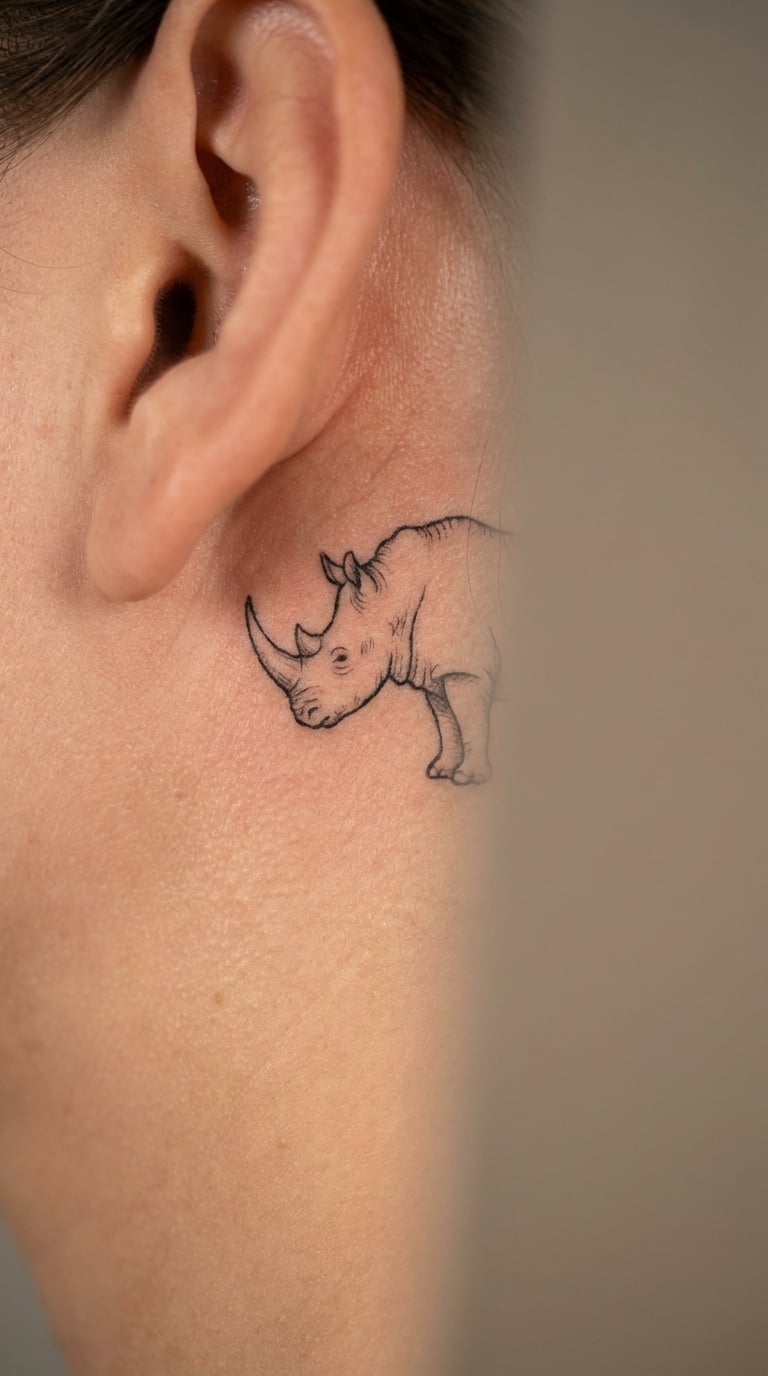
A compact profile tucked into the space behind the ear, where the horn and the curve of the back do the work because the leg and the tail will not be visible. Simplification is forced on you here, and it helps the design.
It is a discreet placement, the kind of tattoo that people notice at a certain angle only. The head and upper back usually hurt more than people expect.
Placement: Behind the ear, or high on the neck. Size: 2-3 inches (5-8 cm). Style: Fine line. Pain: low, and the session is short.
Make it yours: Have the artist test the line depth on a hidden patch first, since tiny fine lines behind the ear are the ones that blur fastest.
25. Full Rhino and Calf Sleeve Panel
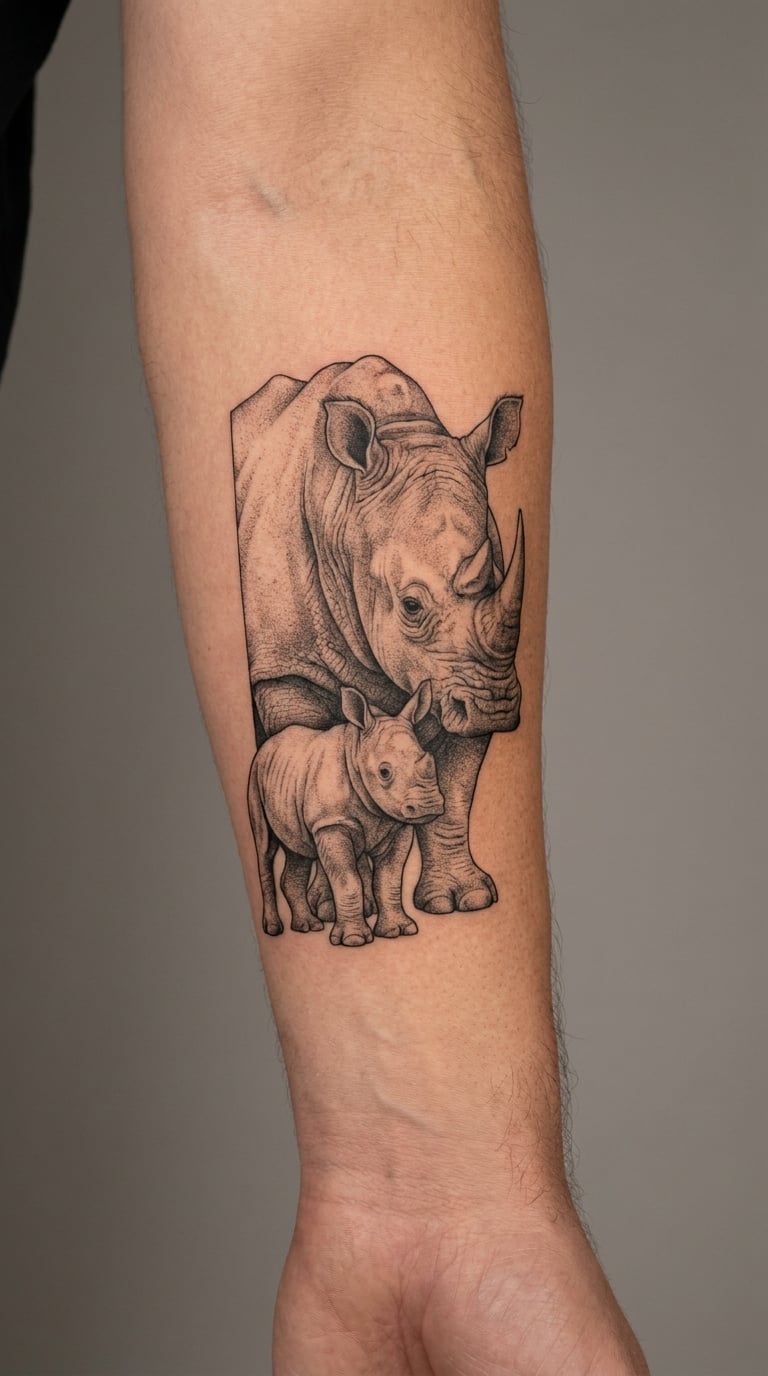
An adult rhino standing behind a calf, detailed enough to anchor a bigger composition on an arm or leg. The panel works as a standalone piece with empty skin around it, or as the centre of a sleeve that grows over the next few years.
If you are collecting, this is the one to build the rest of the arm around. Working out the flow first saves a lot of covering up later.
Placement: Outer arm, outer thigh or calf. Size: 5-8 inches tall (13-20 cm) within a larger composition. Style: Black and grey realism. Pain: medium, and realism like this usually takes more than one sitting.
Make it yours: Add a landscape or repeat the calf silhouette elsewhere, so the panel has somewhere to lead when you add to it.
How to Choose the Right Design
Six checks will save you from a design that cannot be executed at the size you want.
Match the style to the space. A solid blackwork head needs a flat-ish surface and breathing room. A charging rhino or a safari scene needs a canvas that can hold detail.
Size the detail, not the drawing. Anything with texture, shading or fine skin detail wants 5 inches or more. Below 3 inches, silhouette and outline win every time.
Check contrast against ageing. Heavy black holds for decades. Thin single-needle lines on hands, fingers and behind the ear soften first, so plan the line weight accordingly.
Think about the body shape, not the flash sheet. A calf, a forearm and a shoulder all curve differently, and a design drawn on flat paper has to be adjusted to whatever you are working with.
Look at healed work, not fresh. Ask to see tattoos this artist did two to five years ago. That is when line weight and grey saturation show what they really do.
Plan a sleeve before you start one. If the rhino is the first of several pieces, leave consistent space and let the artist sketch the full flow before anything is tattooed.
How to Choose 25 Rhino Tattoo Ideas for Your Body
Start with the area, not the drawing. Decide where the piece sits, measure that area honestly, then shortlist from this list. If the area is small, ideas 1, 6, 9, 12, 15, 18 and 24 are the ones that survive at their stated size. If you have a large flat canvas, ideas 3, 16, 23 and 25 have the room to breathe.
Then pick by style rather than by meaning. Nobody can tell from across a room whether your rhino was for your grandmother or because the silhouette was good. What people can see is line weight, contrast and whether the animal is recognisable at the distance you will usually be seen from.
Finally, bring references to the consultation. Our notes on matching tattoo ideas for roommates cover how to plan paired work so both pieces match in scale rather than just subject.
Cost and Session Time
There is no honest single number for a rhino tattoo, because what you pay tracks size, detail and how many hours the chair is occupied. Small line work, two to four inches, is often finished inside an hour. A mid-size blackwork or colour piece, five to seven inches, more often runs two to three. Realistic and scenic work at eight inches and above is regularly split across sessions.
Two things push the figure up. The first is detail per inch, since a photorealistic hide needs far more needle passes than a silhouette. The second is placement, because ribs, the inner arm and the neck go slower than a forearm or calf.
Most studios set a shop minimum that covers a short session, so even a quick piece has a floor. Hourly rates differ a lot between cities and between artists inside the same city, and a specialist in black and grey realism will usually sit above a generalist. Ask for the total before you commit, including whether the deposit comes off the final bill.
Aftercare Basics
Follow your artist’s aftercare instructions first, since they know exactly what they put in your skin. On top of that, the basics apply to every rhino design.
- Wash the area twice a day with clean lukewarm water and a fragrance-free soap, then pat it dry rather than rubbing it.
- Protect fresh work from sun for the first couple of weeks, and keep it covered under loose clothing on the way home.
- Skip the heavy creams and butters early on. A thin layer of a plain ointment is usually all that is wanted.
- Do not soak, swim, steam or stretch the area while it is still healing.
- Expect colour to look duller and slightly raised for the first few days. That is normal and it settles.
- Contact your artist if anything looks unusual, and speak to a medical professional if you develop spreading redness, heat, swelling or a fever.
For fine-line and dotwork pieces, sun protection matters most in the long run. Those styles carry the least ink, so they have the least to lose, and the first place to show it.
Frequently Asked Questions
What does a rhinoceros tattoo symbolize?
Most people pick a rhino tattoo for calm strength rather than aggression. The animal is enormous and heavily built, yet almost never reacts, so it reads as steady resolve and staying power. Some wear it as a quiet marker of a hard year survived, and some because the species is heavily poached and the ink signals support for conservation. None of that meaning is fixed, so your own reason is the one that counts.
Are rhinoceros tattoos painful compared with other animal tattoos?
Pain tracks placement more than subject. A rhino on the outer forearm or calf sits around a 4 out of 10, while the same design on the ribs or inner elbow runs closer to a 6. Heads and horns feel sharper than the body because there is less soft tissue over bone. Solid blackwork fills also take longer, which means more time sitting still, and time is most of what people actually dislike.
What size should a rhinoceros tattoo be for the best detail?
Five inches and up is where texture, skin folds and grey shading start to read properly. Between two and four inches you are limited to outline, silhouette or emblem work, where a simple shape carries the design. Below two inches, only the horn, the eye or a bold filled head will still be recognisable in a few years. Ask your artist what their line work can hold at the size you want.
Will a fine-line rhinoceros tattoo fade over time?
Fine line fades faster than blackwork, mostly because it holds less ink. Expect the outline to soften and thicken into a faint grey within five to ten years, especially on sun-exposed spots like forearms, hands and behind the ear. You can slow it down with sunscreen and by keeping the line weight a little heavier than feels necessary on the day. Black and grey realism ages far better for that reason.
Should a first rhino tattoo be realistic, traditional or minimal?
For a first tattoo, minimal or fine line is the safest call. They cost less, take less time, sit in a small space and leave room if you later want a cover-up. Traditional works well too, since bold outlines stay readable. Save photorealistic work for a large flat area and a later date, because it is the hardest style to execute and the most unforgiving when detail does not hold. Pick the size first, then the style.
Conclusion
For a first small tattoo, start with idea 6, the minimal baby rhino, or idea 1, the fine-line outline. Both are quiet, quick to heal and easy to live with, and neither needs a story attached to it.
If you are already collecting, or you have a large flat area and time to sit through a real session, idea 25 is the one to book. Talk it through with the artist before the drawing is finalised, since these 25 rhino tattoo ideas will narrow down fast once your artist tells you what your skin can hold.