
22 Forget Me Not Tattoo Ideas: Best Floral Designs in 2026
A forget me not tattoo is a design built around the tiny five-petalled blue flower, usually drawn in fine line with a small yellow centre, and it carries one clear message: do not forget me. People choose it for remembrance, for a friendship that stuck, for a person who is still here but not always present, or simply because they love a small blue flower that fits on a wrist.
That is the whole reason this list exists. Search results for this flower are almost all image boards with no captions, no sizes and no placement advice, so I built these 22 forget me not tattoo ideas the way I would plan my own: every entry tells you what the design looks like, where it sits, how big it realistically is, how much it hurts, and how it ages. Sizes are in inches with centimetres in brackets, because sizing is the one thing a gallery photo cannot tell you.
If you are planning a piece for a date, book the consult first. Autumn and early spring fill up weeks ahead, and a tiny floral needs a longer booking than most people expect.
Couples often start with a date piece and add florals later, so our 20 best anniversary tattoo ideas for couples is worth a look if that is where you are starting.
22 Forget Me Not Tattoo Ideas: Quick Guide
| Idea | Style | Best placement | Size | Pain |
|---|---|---|---|---|
| 1. Fine-line single stem | Fine line | Inner forearm | 1.5-2.5 in (4-6 cm) | Low to medium |
| 2. Watercolor sprig | Watercolor | Above wrist, collarbone | 2-3 in (5-7.5 cm) | Low to medium |
| 3. Blackwork cluster of three | Blackwork | Outer forearm, upper arm | 3-4 in (7.5-10 cm) | Medium |
| 4. Micro-realism blue bloom | Micro-realism | Wrist, finger, behind ear | 0.6-1 in (1.5-2.5 cm) | Low |
| 5. Minimal line art | Minimalist | Wrist, ankle, rib | 1-1.5 in (2.5-4 cm) | Low |
| 6. Traditional bouquet | Traditional | Forearm, thigh | 3-5 in (7.5-12.5 cm) | Medium |
| 7. Vertical stem | Botanical realism | Forearm, ribs, spine | 6-9 in (15-23 cm) | Medium |
| 8. Behind the ear | Micro fine line | Behind the ear | 0.5-0.8 in (1-2 cm) | Low to medium |
| 9. Blue wrist flower | Fine line with colour | Inner wrist | 1.5-2 in (4-5 cm) | Medium |
| 10. Dotwork branch | Dotwork | Shoulder, calf, upper arm | 4-7 in (10-18 cm) | Medium to high |
| 11. Collarbone trail | Fine line botanical | Collarbone | 3-4 in (7.5-10 cm) | Medium |
| 12. Forearm wreath | Botanical, grey wash | Inner forearm | 3-4 in (7.5-10 cm) | Medium |
| 13. Ankle pair | Fine line, two blooms | Inner ankle | 0.8-1.2 in each (2-3 cm) | Medium |
| 14. Black and grey bouquet | Black and grey realism | Hand, forearm, upper arm | 3-4.5 in (7.5-11 cm) | Medium |
| 15. Sleeve accent | Botanical realism | Within an existing sleeve | 2-3 in each (5-7.5 cm) | Medium |
| 16. Hand sprig | Fine line | Back of the hand | 2-2.5 in (5-6 cm) | High |
| 17. Side-rib branch | Botanical realism | Side ribs | 5-7 in (13-18 cm) | High |
| 18. Shoulder blade watercolour | Watercolour | Shoulder blade | 4-5 in (10-13 cm) | Medium |
| 19. Monochrome sleeve | Blackwork monochrome | Upper arm, shoulder | Half sleeve | High |
| 20. Finger micro flower | Micro fine line | Side of a finger | 0.3-0.5 in (0.8-1.2 cm) | High |
| 21. Celestial design | Fine line plus symbols | Ankle, upper arm, back | 2.5-3.5 in (6-9 cm) | Medium |
| 22. Remembrance portrait piece | Micro-realism plus type | Forearm, upper arm, ribs | 3-5 in (7.5-13 cm) | Medium to high |
Two rules before the list. If you already have bold black and grey work on the same limb, a hairline forget me not will disappear next to it, so ask for a heavier line weight. And blue pigment reads cool and pale on deeper skin tones, which means more saturation in the reference, not less.
1. Fine-Line Single-Stem Forget-Me-Not
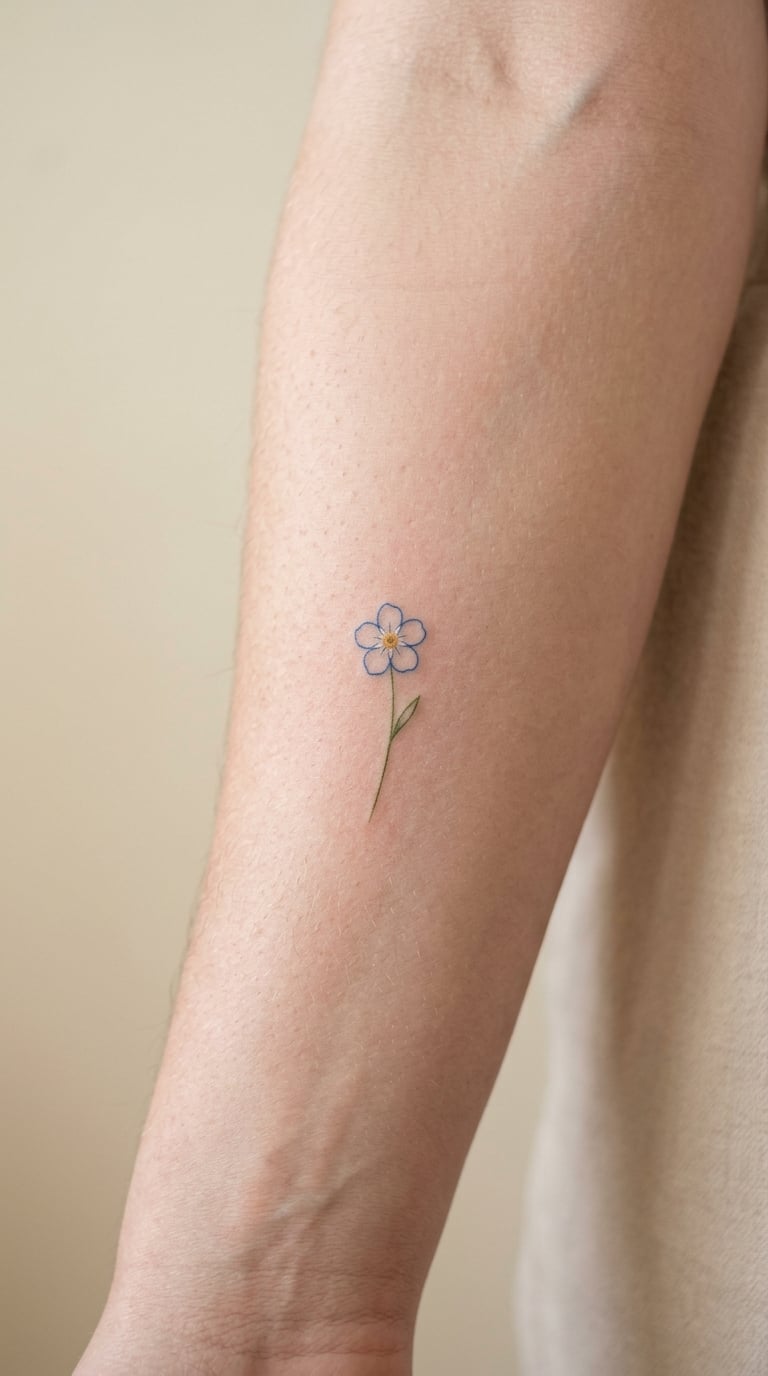
One flower, one stem, two small leaves, drawn in a single hairline weight. The petals are outlined, the yellow centre is a dot, and there is no shading. This is the design most first-timers end up with.
Placement: inner forearm above the wrist crease, or the flat of the upper forearm. Size: 1.5 to 2.5 inches (4 to 6 cm) tall. Style: fine line.
Pain: low to medium. Fine line softens noticeably within a year, so expect a slightly greyer version later.
Make it yours: curve the stem toward the hand as if it grows out of the wrist.
2. Watercolor Forget-Me-Not Sprig
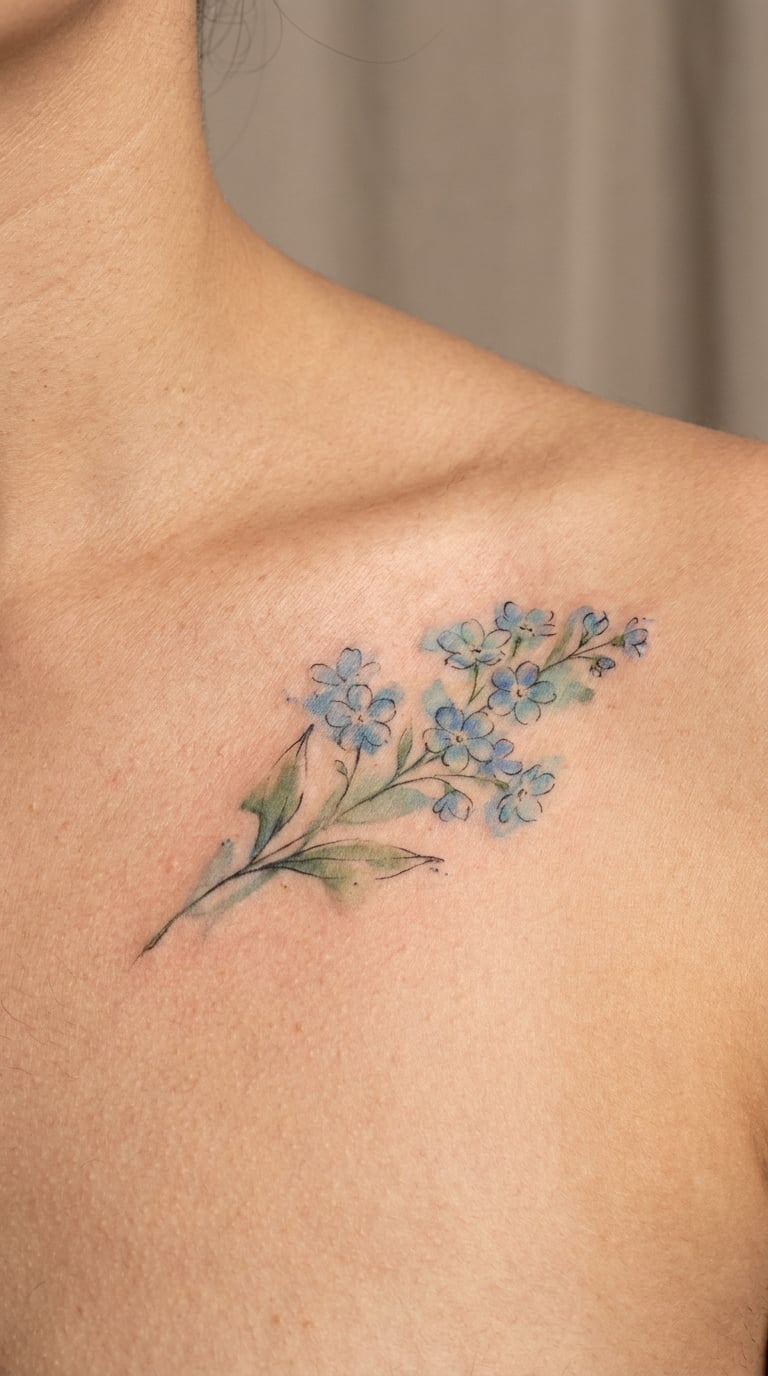
A two or three bloom sprig with the outline dissolved into colour, like a wet-on-wet painting. A soft blue wash sits across the petals, darker strokes add the stems and leaves, and nothing has a hard edge.
Placement: above the wrist on the inner arm, or along the collarbone. Size: 2 to 3 inches (5 to 7.5 cm). Style: watercolor.
Pain: low to medium, but the sitting runs longer because pale blues are built from two or three layers.
Make it yours: match the wash to a colour you already wear, or leave one bloom unpainted as a bud.
3. Blackwork Cluster of Three Flowers
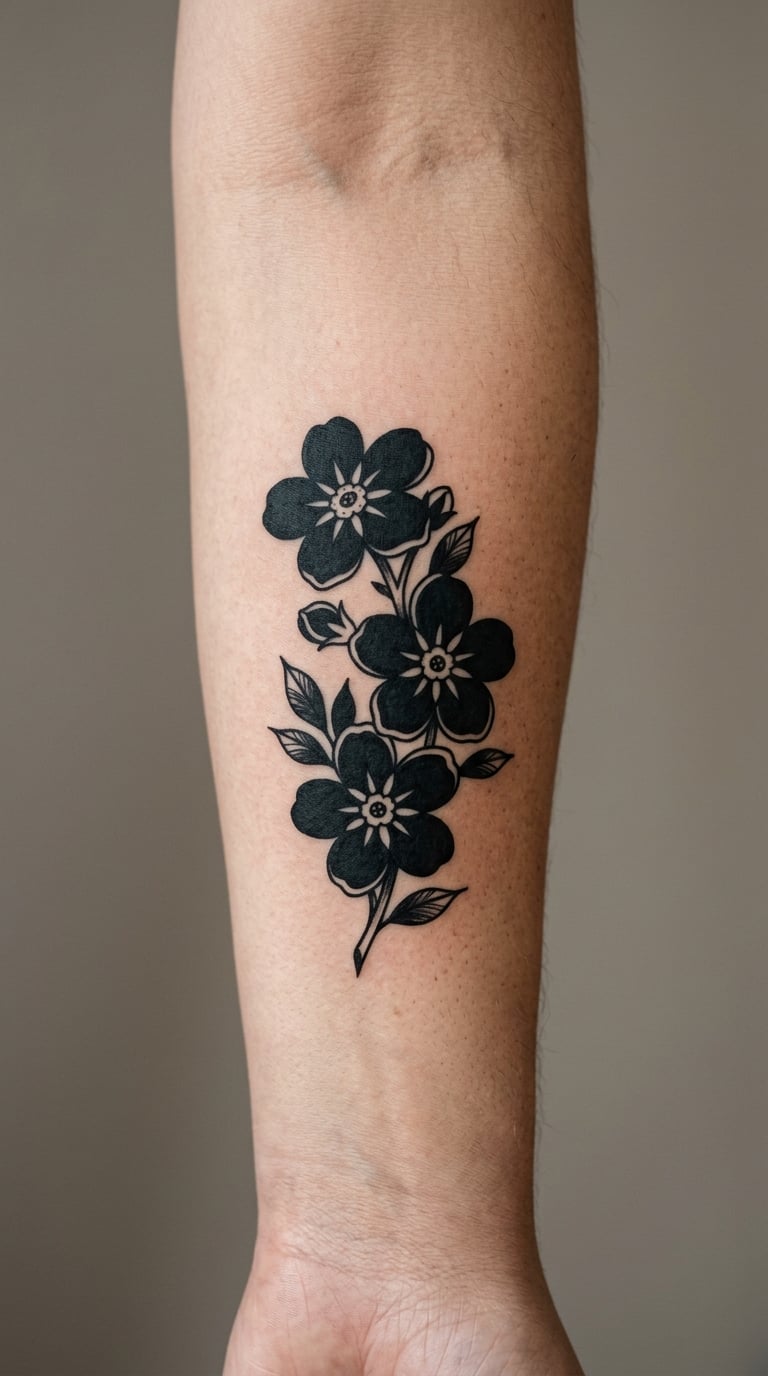
Three blooms at different heights, petals filled solid black with the centre left as a small skin-coloured dot. Heavy line weight, simplified shapes, and enough negative space between the flowers that the cluster stays readable.
Placement: outer forearm, upper arm, or the shoulder. Size: 3 to 4 inches (7.5 to 10 cm) across. Style: blackwork.
Pain: medium, since solid fills need real pressure. Black holds its shape for years, which makes it the safest pick on a sun-exposed arm.
Make it yours: three blooms for three people, plus one thin stem running under all of them as a baseline.
4. Micro-Realism Blue Forget-Me-Not
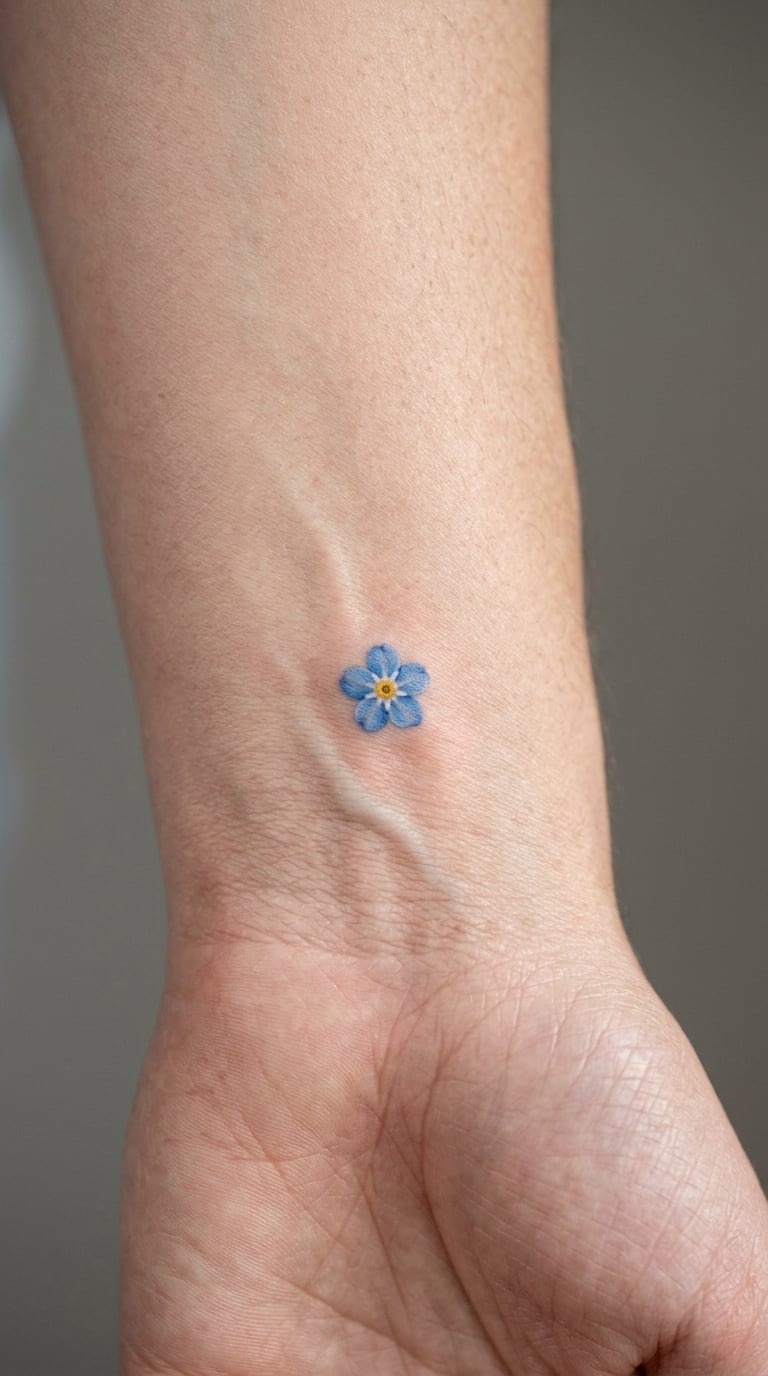
A single bloom drawn realistically at a scale most people never attempt: layered blue petals with a lighter edge, a small yellow centre, a hint of stem. Ask to see healed work at that size, because micro-realism is not every tattooist’s strength.
Placement: inner wrist, side of a finger, or behind the ear. Size: 0.6 to 1 inch (1.5 to 2.5 cm). Style: micro-realism.
Pain: low at the wrist, more noticeable on the finger. Below half an inch the petals merge into a blue dot as it heals.
Make it yours: one bloom for one person, or three on three fingers at graduated heights.
5. Minimal Forget-Me-Not Line Art
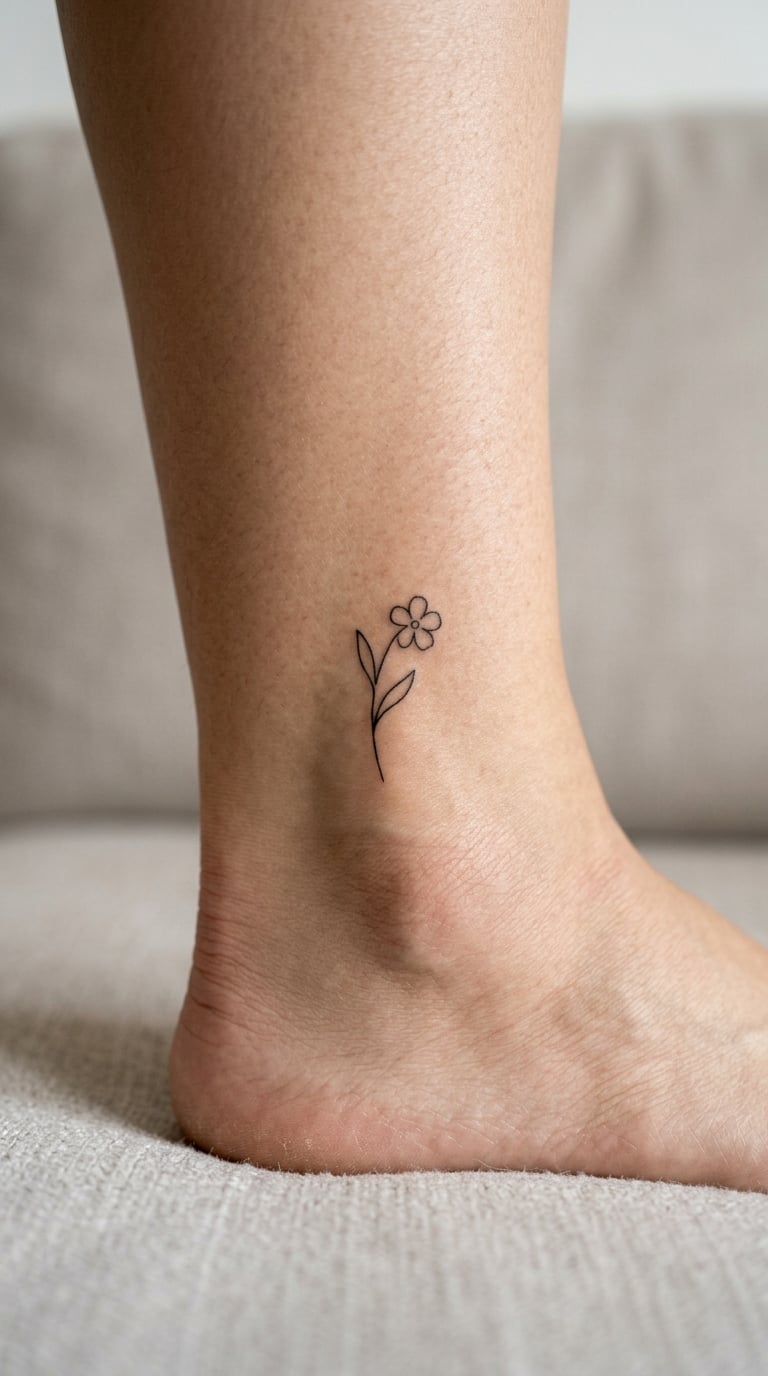
Outline only, in black, with a straight stem and two leaves drawn as quick single strokes. No colour, no shading, no gradient. It reads as a line drawing of the flower rather than a tattoo of it.
Placement: inner wrist, ankle, or a single rib on the side. Size: 1 to 1.5 inches (2.5 to 4 cm). Style: minimalist line art.
Pain: low almost everywhere. Black outline flattens within a year, so this design changes quietly rather than fading away.
Make it yours: add a small hand-drawn bow at the base of the stem.
6. Traditional Forget-Me-Not Bouquet
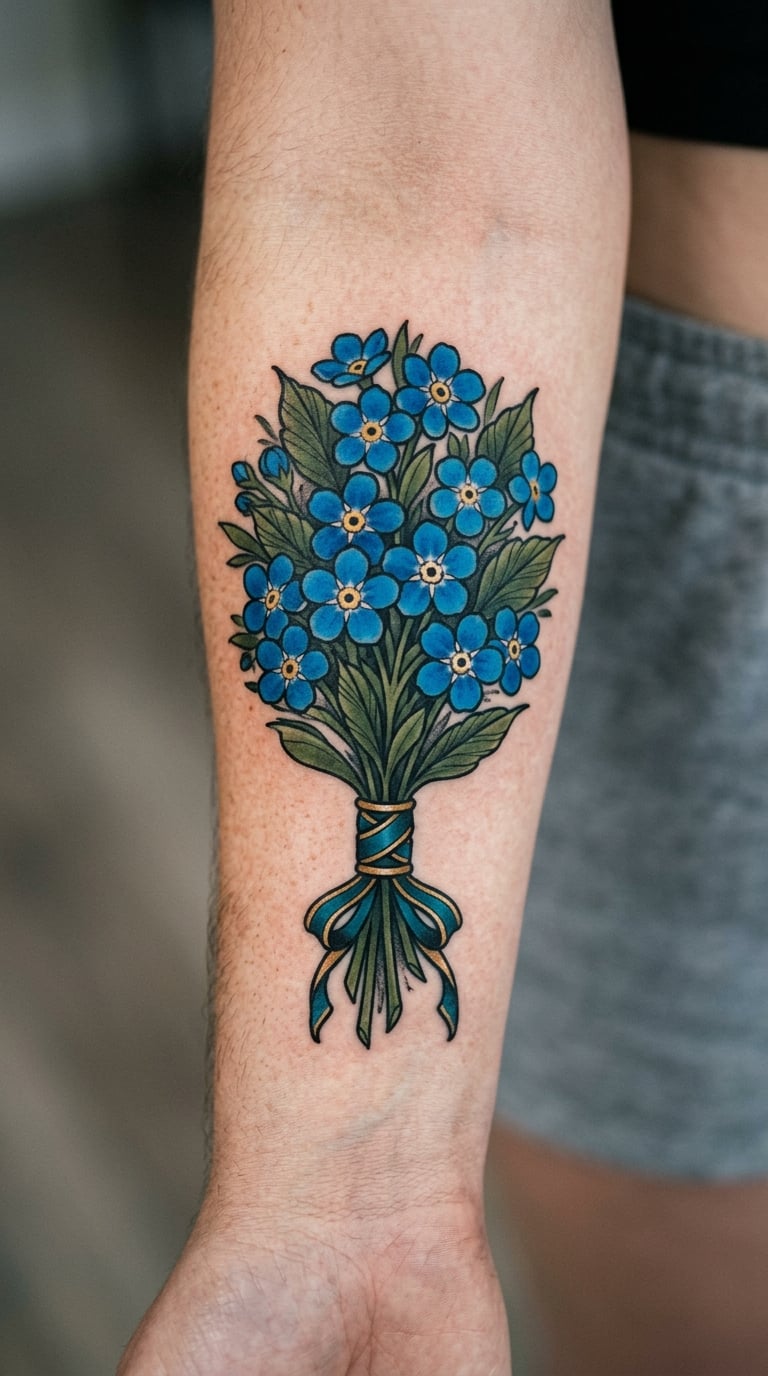
A compact bouquet, usually five to nine blooms, with defined dark outlines, saturated blue fills, veined green leaves and a small ribbon at the base. Even spacing between the small flowers is what keeps the cluster from turning into a blue smear.
Placement: forearm, upper arm, or thigh. Size: 3 to 5 inches (7.5 to 12.5 cm) across. Style: neo-traditional.
Pain: medium, and a real time commitment. Nine detailed blooms is a three to four hour sitting, usually split over two appointments.
Make it yours: one colour per person in the bouquet is a common way to build a family piece.
7. Vertical Forget-Me-Not Stem
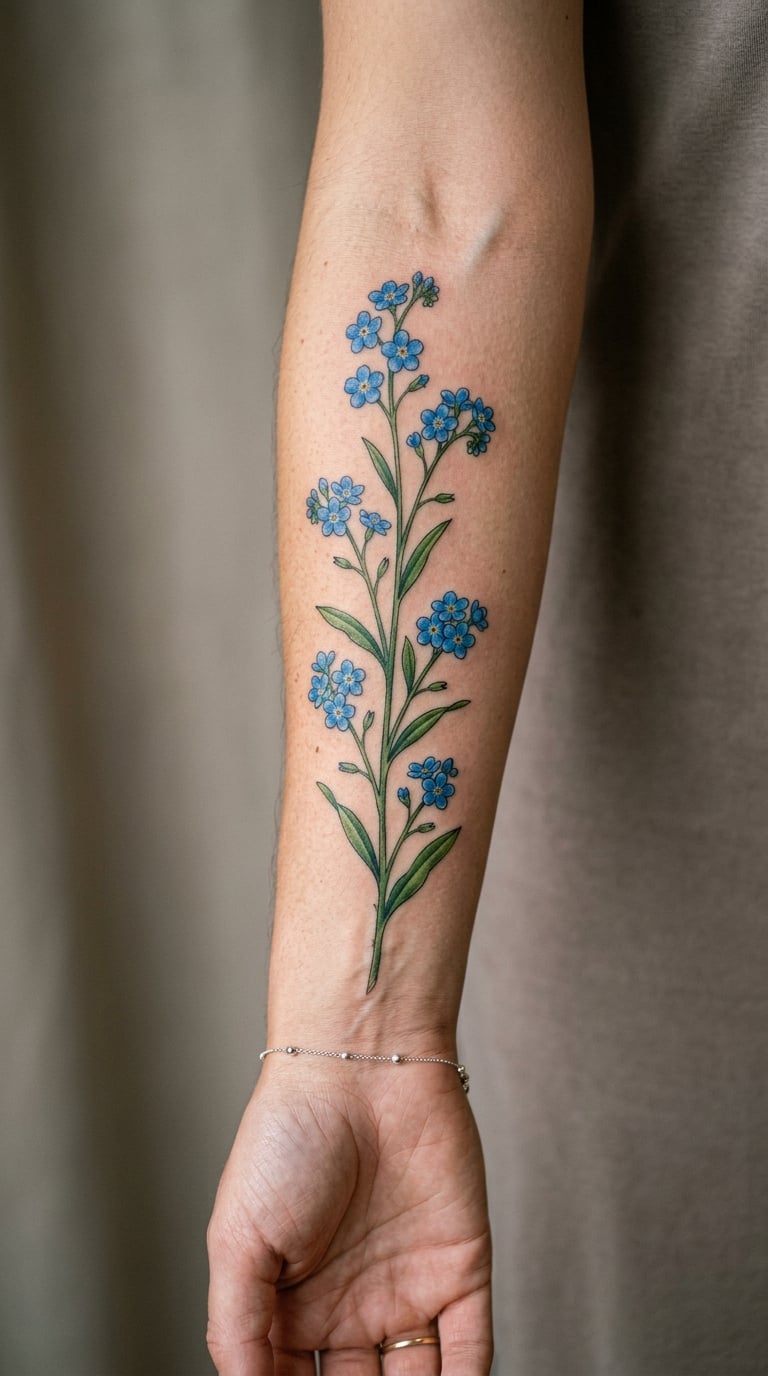
A single stem running the length of the forearm with blossoms, buds and leaves spaced along it at irregular intervals. The largest bloom sits at the base and the smallest at the tip, so the composition follows the taper of the limb.
Placement: inner or outer forearm, along the ribs, or down the spine. Size: 6 to 9 inches (15 to 23 cm) long. Style: botanical realism.
Pain: medium on the arm, high over ribs and spine. Long pieces need a second sitting.
Make it yours: leave an unopened bud at the top, the usual way people mark a pregnancy or a person still to come.
8. Tiny Forget-Me-Not Behind the Ear
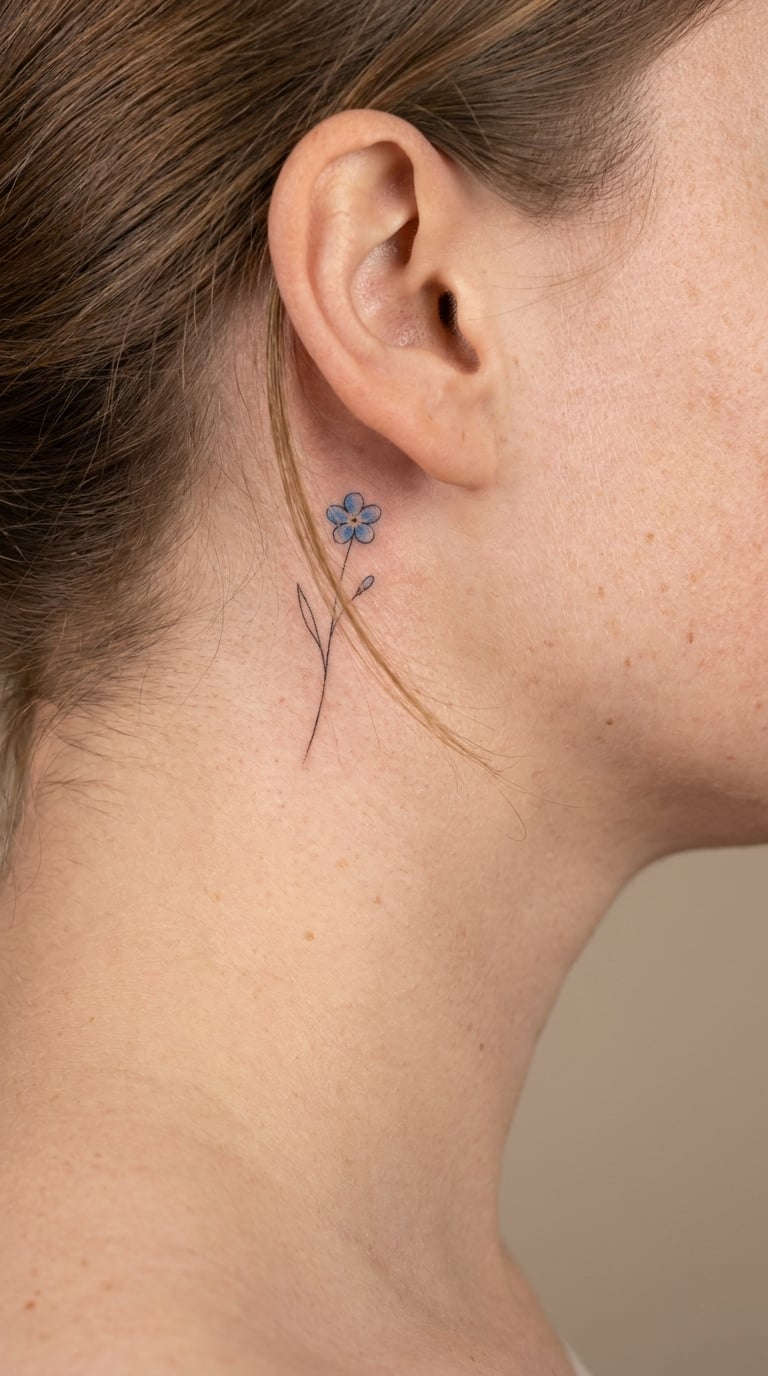
One small bloom tucked into the hairline behind the ear, often with a short stem disappearing toward the jaw. From the front you see nothing, which is the reason people like it.
Placement: behind the ear, or just below the lobe on the neck. Size: 0.5 to 0.8 inch (1 to 2 cm). Style: micro fine line.
Pain: low to medium, but the skin here is mobile and sensitive. Hair rubbing the healing line is the main risk.
Make it yours: one bloom behind each ear, or a different flower on each side so only you know the pairing.
9. Blue-Colored Wrist Forget-Me-Not
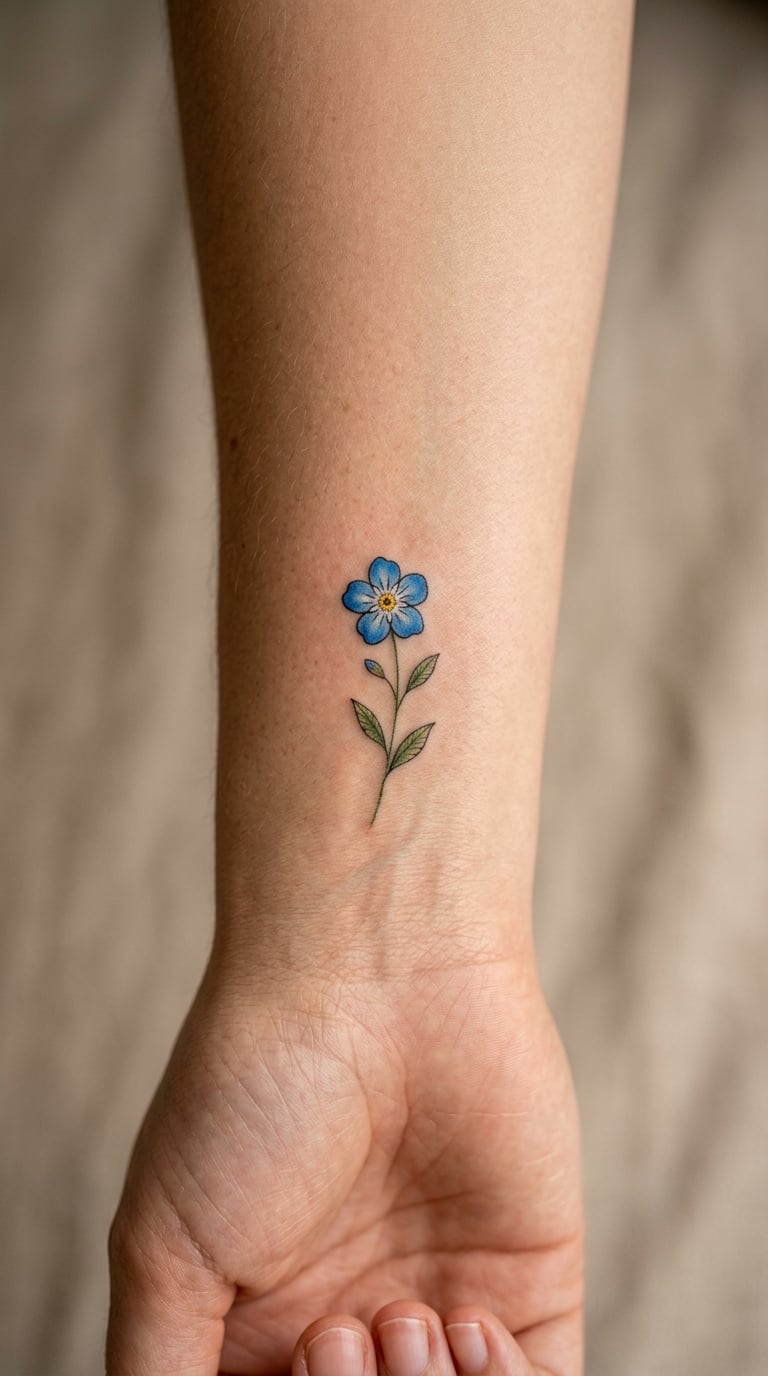
Fine line drawing the flower, with the petals filled in a soft blue and the centre left yellow. This is the version most people picture when they search this flower, and it is the most requested design in the posts behind every gallery image of it.
Placement: inner wrist, sitting just above the wrist crease. Size: 1.5 to 2 inches (4 to 5 cm). Style: fine line with colour.
Pain: medium, because the inner wrist is close to bone and the veins there make it sting more than the arm does. It heals in two to three weeks and the colour settles down noticeably after the first month.
Make it yours: the back of the hand and the inner wrist are both visible at the same time, so one small bloom on each reads as a deliberate pair.
10. Dotwork Forget-Me-Not Branch
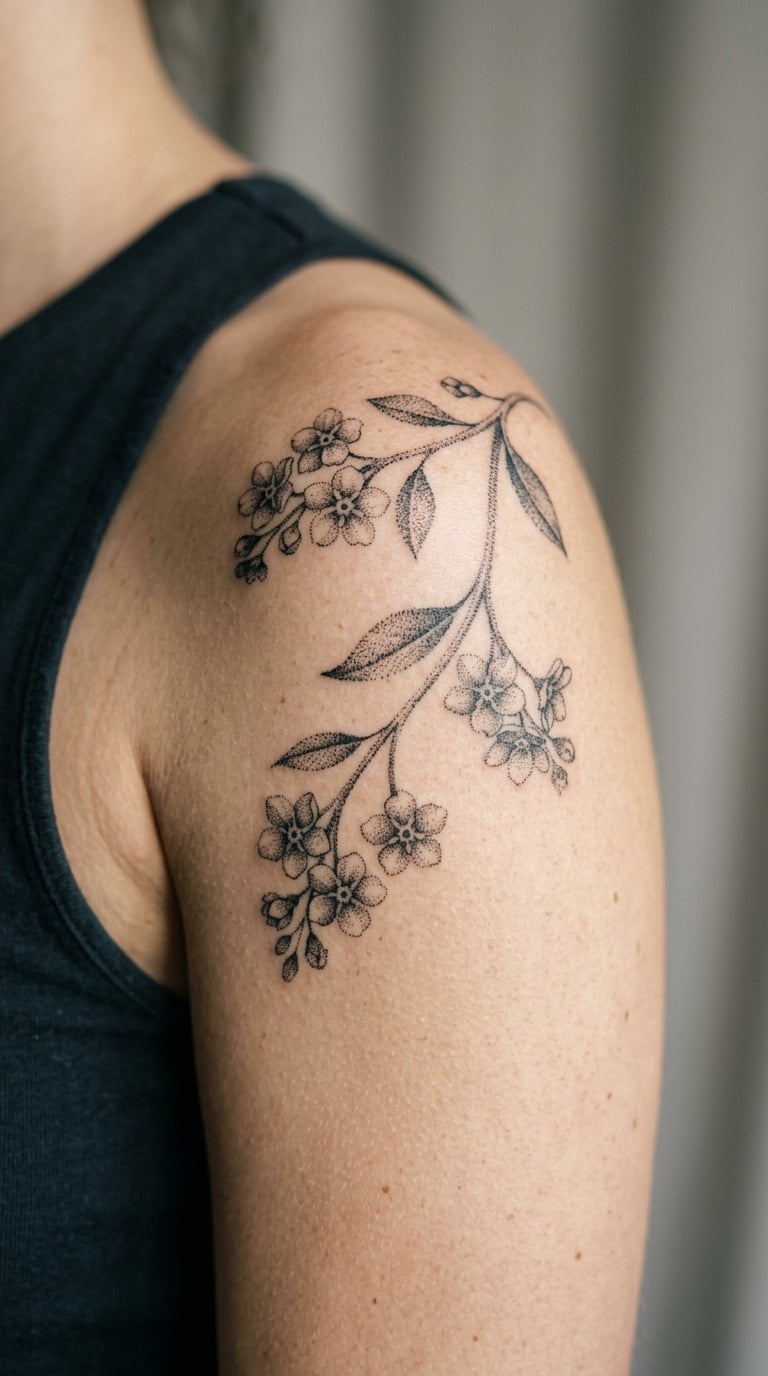
A branch built entirely from dots, with density doing the work that outlines do in line art. Light grey stippling forms the petals, darker dots build the stem and leaf veins. Dotwork is forgiving in a way line work is not, because a slight smudge just becomes another shade.
Placement: upper shoulder, outer upper arm, calf, or the back of the upper arm. Size: 4 to 7 inches (10 to 18 cm). Style: dotwork.
Pain: medium to high. Dotwork is one of the longest sittings you can book because each dot is a separate needle placement. Ask for a long session and take a proper break rather than grinding through it.
Make it yours: build the gradient from a single open bud at one end to a full bloom at the other, and add a few loose dots drifting away like seeds.
11. Collarbone Forget-Me-Not Trail
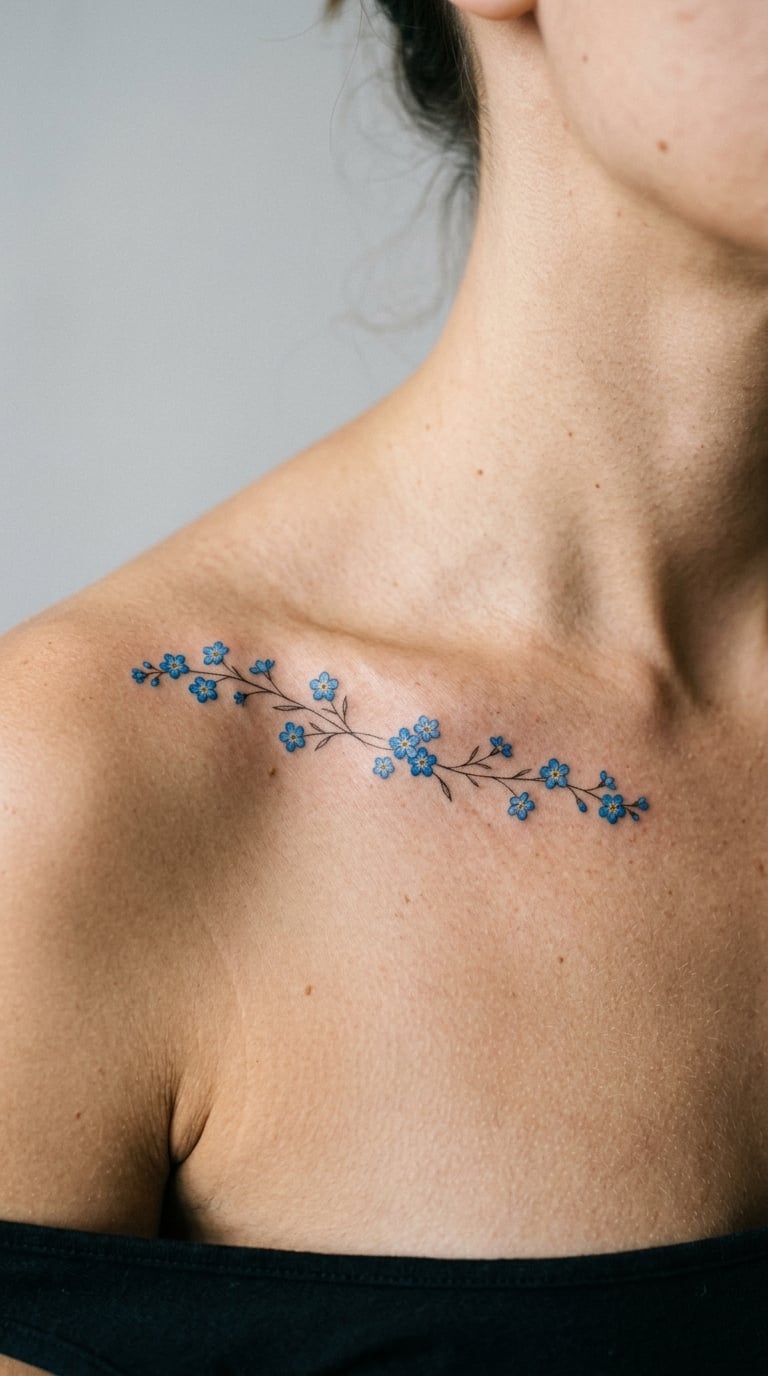
A run of small blooms travelling along the collarbone, each one a little different in size and spacing so the eye moves across the bone. Some artists add very short stems, others draw a single connecting line. The gap between the blooms is what stops it looking crowded, so leave real space.
Placement: along one or both collarbones, or across the upper chest in a shallow curve. Size: 3 to 4 inches (7.5 to 10 cm) wide. Style: fine line botanical.
Pain: medium, since bone is close to the surface here and the area shows every movement. Sleep position matters for the first two weeks. On deeper skin tones, ask for a more saturated blue and slightly heavier line.
Make it yours: one bloom per person in the family, sized small to large in order of age, or repeat the trail on the opposite side at a shorter length.
12. Forearm Forget-Me-Not Wreath
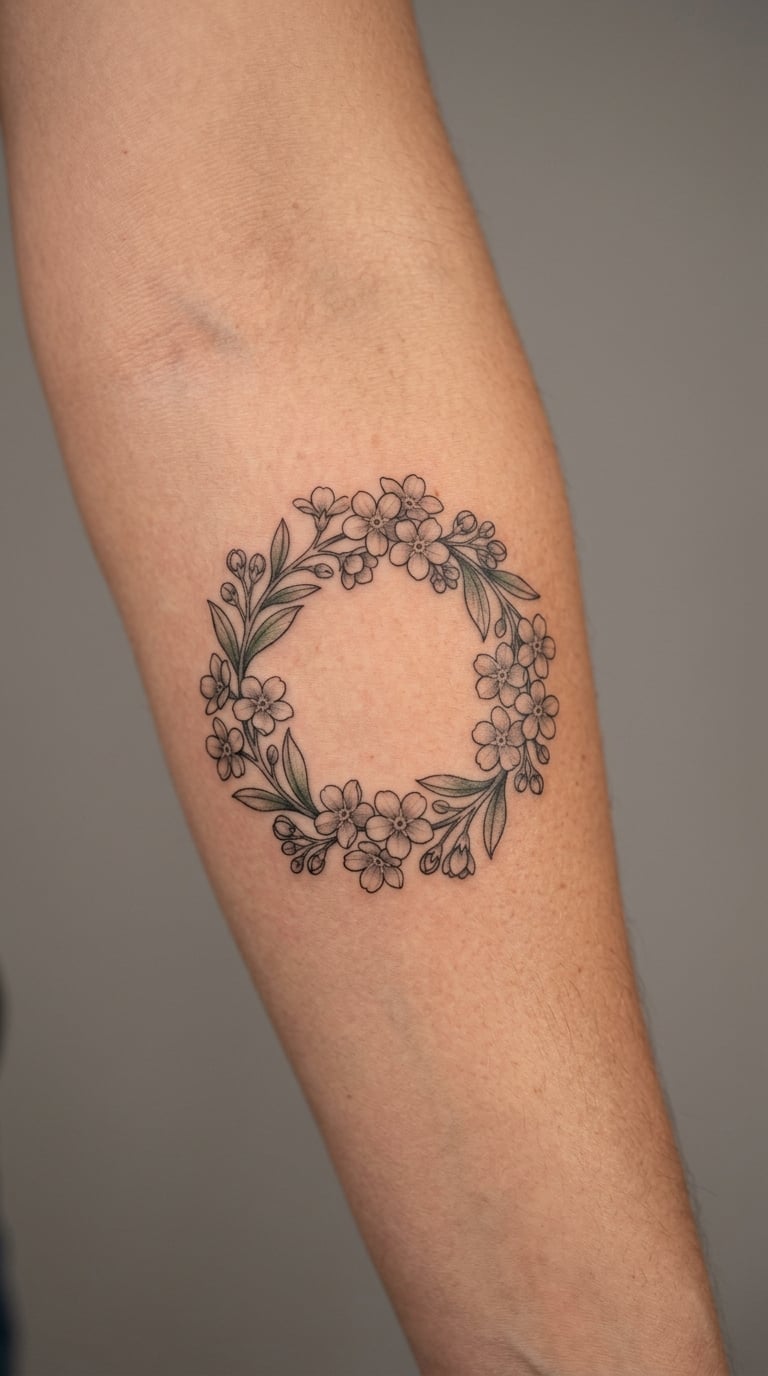
A closed circle of blossoms and leaves on the inner forearm, drawn botanically with a light grey wash in the shadows and a hint of blue kept in the petals. The wreath shape is popular because it fills a round area of the forearm evenly and needs no border to look finished.
Placement: inner forearm, upper arm, or the back of the hand. Size: 3 to 4 inches (7.5 to 10 cm) across. Style: botanical with grey wash.
Pain: medium. A full ring of mixed line and wash takes two to three hours. A thin hand and a large ring are a bad combination, so scale the diameter to the width of the forearm.
Make it yours: have the wreath broken at one point with a small gap, and put the date or name in that gap rather than below the design.
13. Ankle Forget-Me-Not Pair
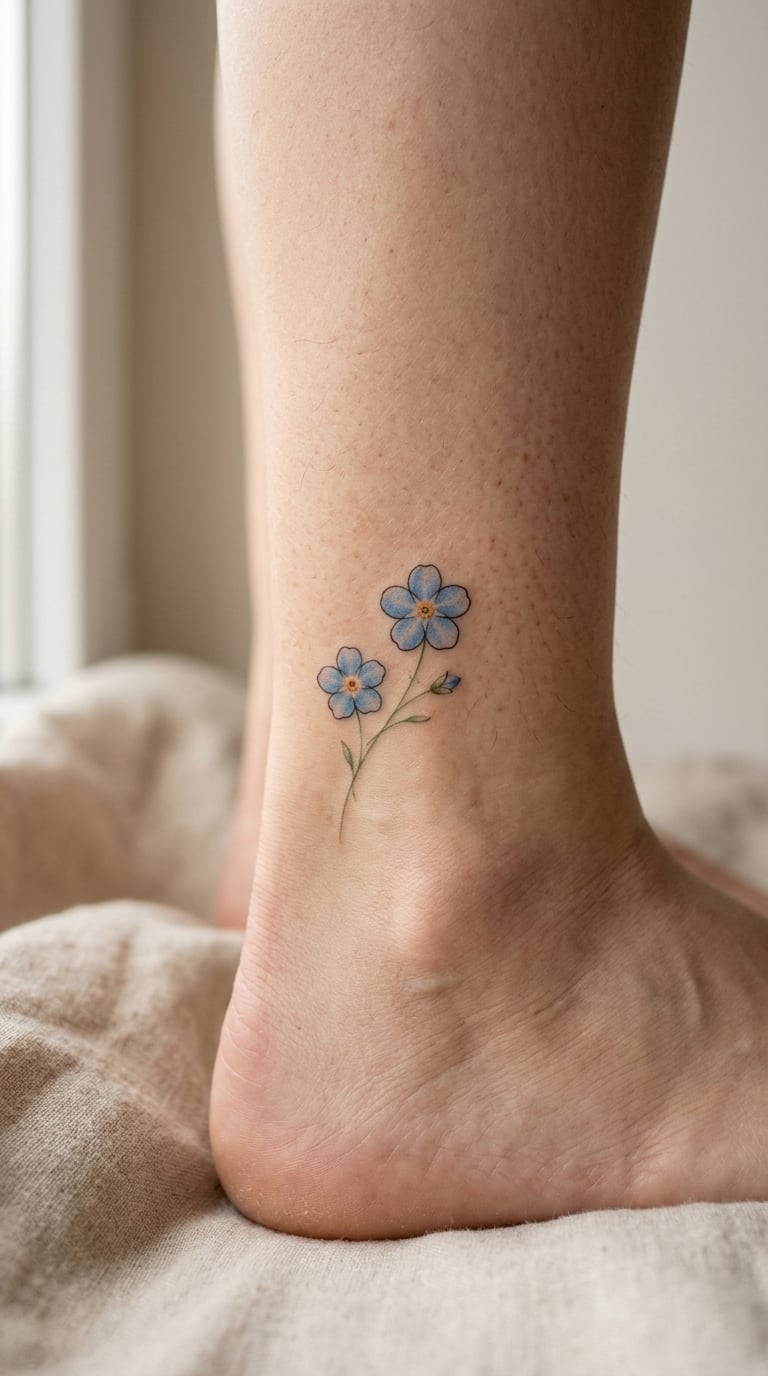
Two small blooms on the inner ankle, either mirrored so they face each other or coordinated so both angle the same way. A pair gives the design a balance a single bloom cannot, and the ankle keeps a small piece discreet.
Placement: inner ankle, above the bone, or the outer ankle just below the malleolus. Size: 0.8 to 1.2 inches (2 to 3 cm) each, with 1 to 2 inches of space between them. Style: fine line, minimal colour.
Pain: medium. The ankle bone is close under thin skin and the foot moves constantly, so expect the piece to feel tight for a few days. Ankle tattoos are also the ones most likely to need a free touch-up because shoes rub them.
Make it yours: two blooms for two people, or a small leafy sprig on the other ankle to complete a pair across both legs.
14. Black-and-Grey Forget-Me-Not Bouquet
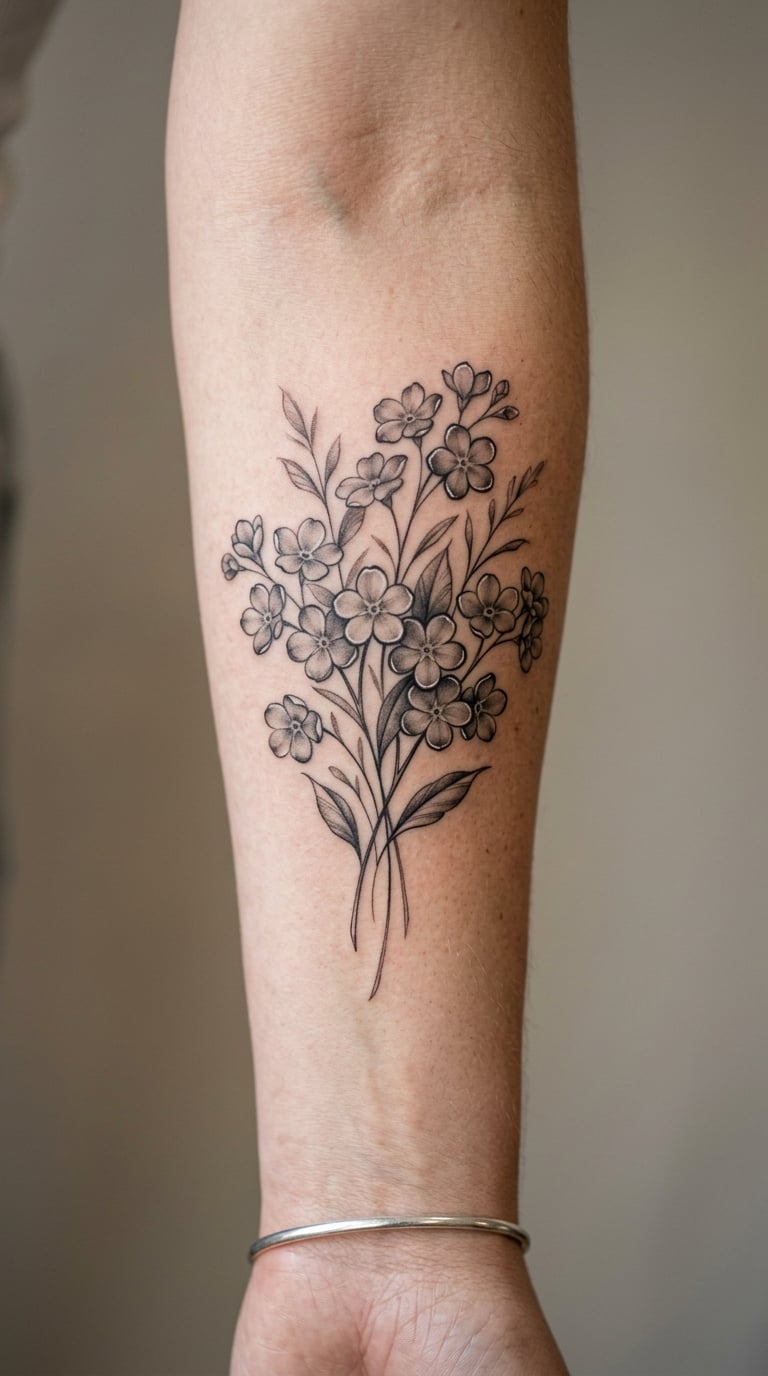
A bouquet rendered without any colour, using grey washes and darker edges on the petals to build depth. Because the flower is small and simple, shading does most of the work, and the darker petal edges are what stop five tiny blooms from blending into one grey mass.
Placement: back of the hand, forearm, or upper arm. Size: 3 to 4.5 inches (7.5 to 11 cm) across. Style: black and grey realism.
Pain: medium, and grey work is fussy rather than painful. Expect three hours for a well-shaded bouquet. Black and grey holds far better than blue in sunlight, which makes it the smart pick for an exposed arm.
Make it yours: have the artist leave one bloom in full colour inside the grey bouquet, so the piece reads as one flower standing out from the rest.
15. Botanical Forget-Me-Not Sleeve Accent
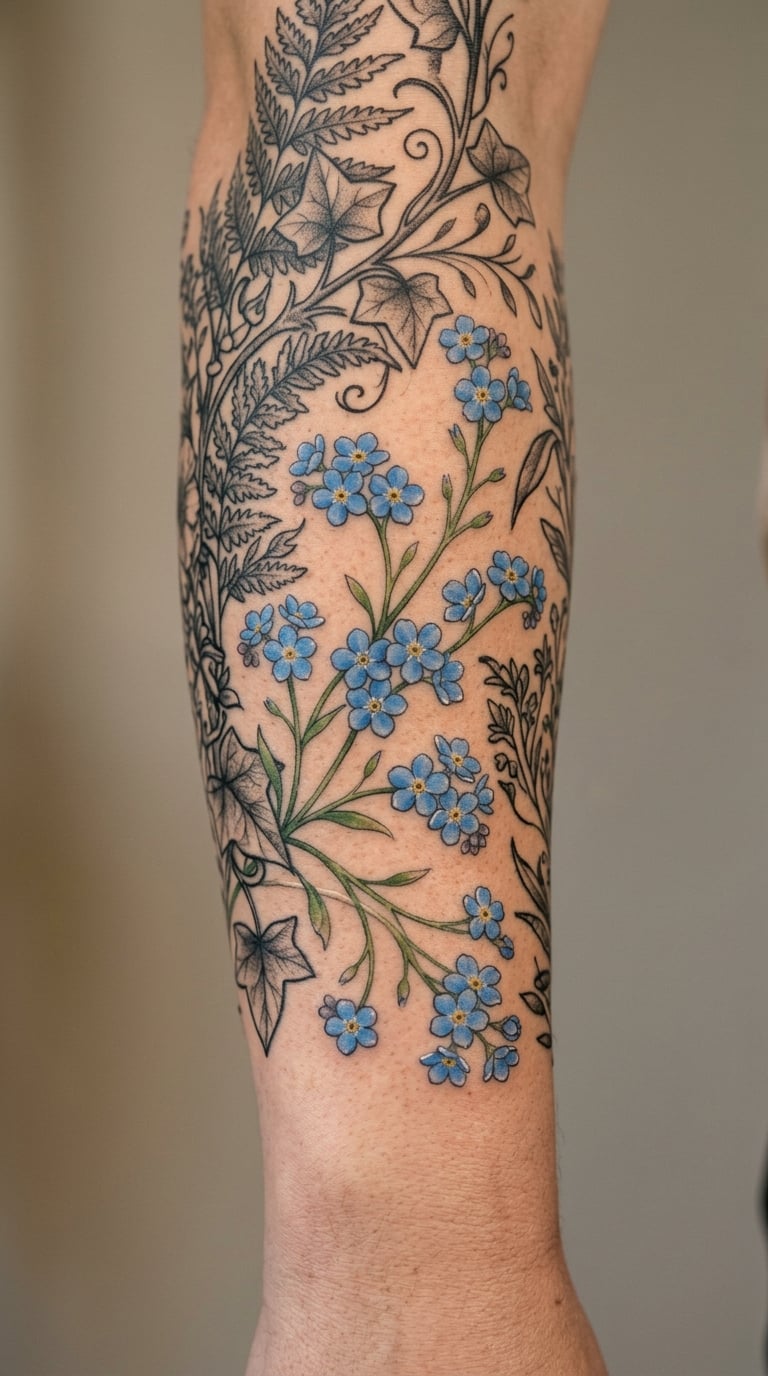
Set of forget-me-nots added to a sleeve you already have, repeated at different angles along the flow of the existing stems. The tricky part is negative space. A sleeve already full of flowers needs empty skin between the new blooms or the whole thing turns to wallpaper.
Placement: threaded through an existing botanical sleeve, usually along the gaps in the composition. Size: 2 to 3 inches (5 to 7.5 cm) per bloom. Style: botanical realism, matched to the sleeve.
Pain: medium, though the edges of an existing sleeve are freshly healed and far more sensitive than untouched skin. Book the add-on for at least six weeks after the sleeve is healed.
Make it yours: ask the artist to match the petal angle and line weight of what is already there, then add one bloom in a different shade to mark where the piece started.
16. Hand-Placement Forget-Me-Not Sprig
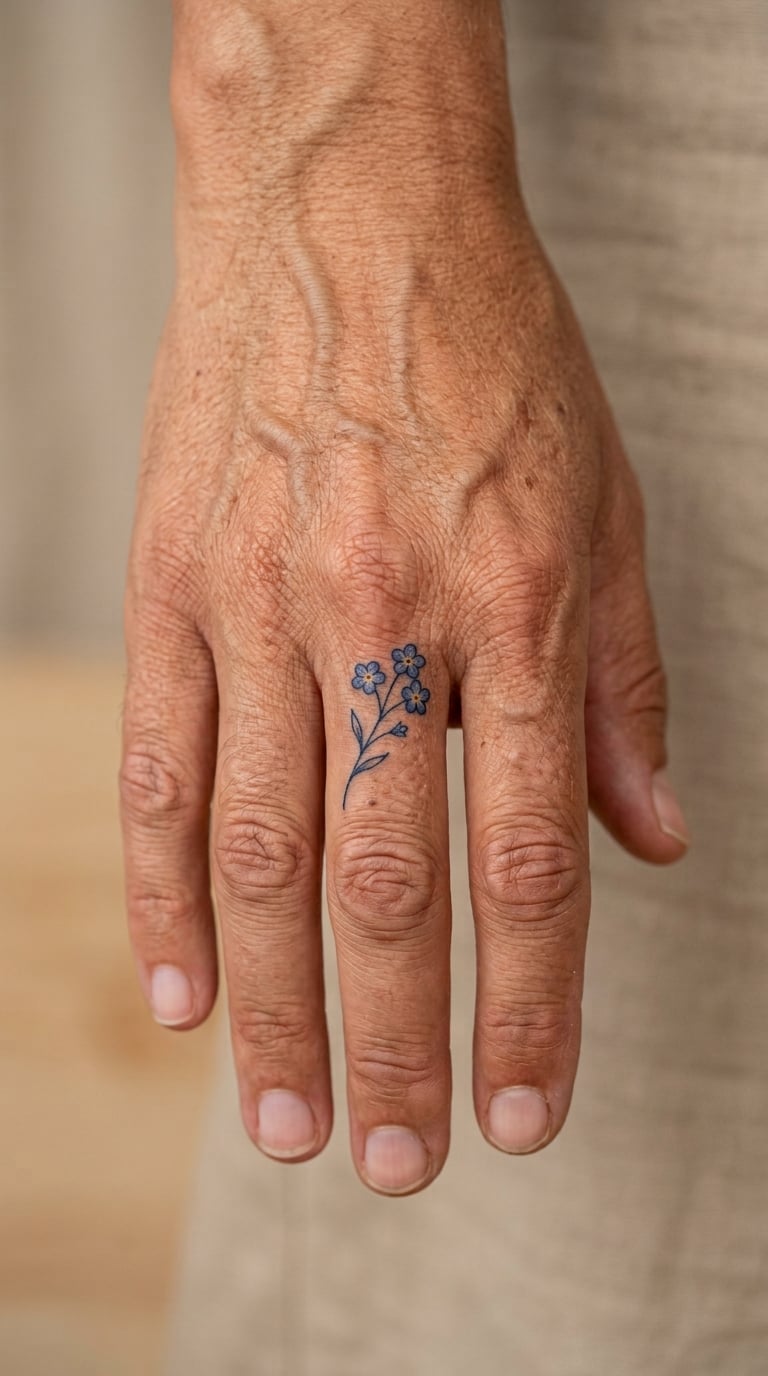
A simplified sprig on the back of the hand, running from the wrist toward the knuckle of the index finger. The veins and tendons there make any hand piece distort as the hand moves, so keep the design short and let it follow the line of a tendon rather than cross it.
Placement: back of the hand, between the thumb and index knuckle. Size: 2 to 2.5 inches (5 to 6 cm). Style: fine line.
Pain: high, and it is the placement most likely to need touch-ups. Hand skin is thin, sun-exposed, creased constantly and creases run right through fine line. A black and grey version at 3 inches will outlast a hairline version every time.
Make it yours: put the date of a last conversation on the inside of the wrist instead, and keep the hand piece purely decorative.
17. Side-Rib Forget-Me-Not Branch
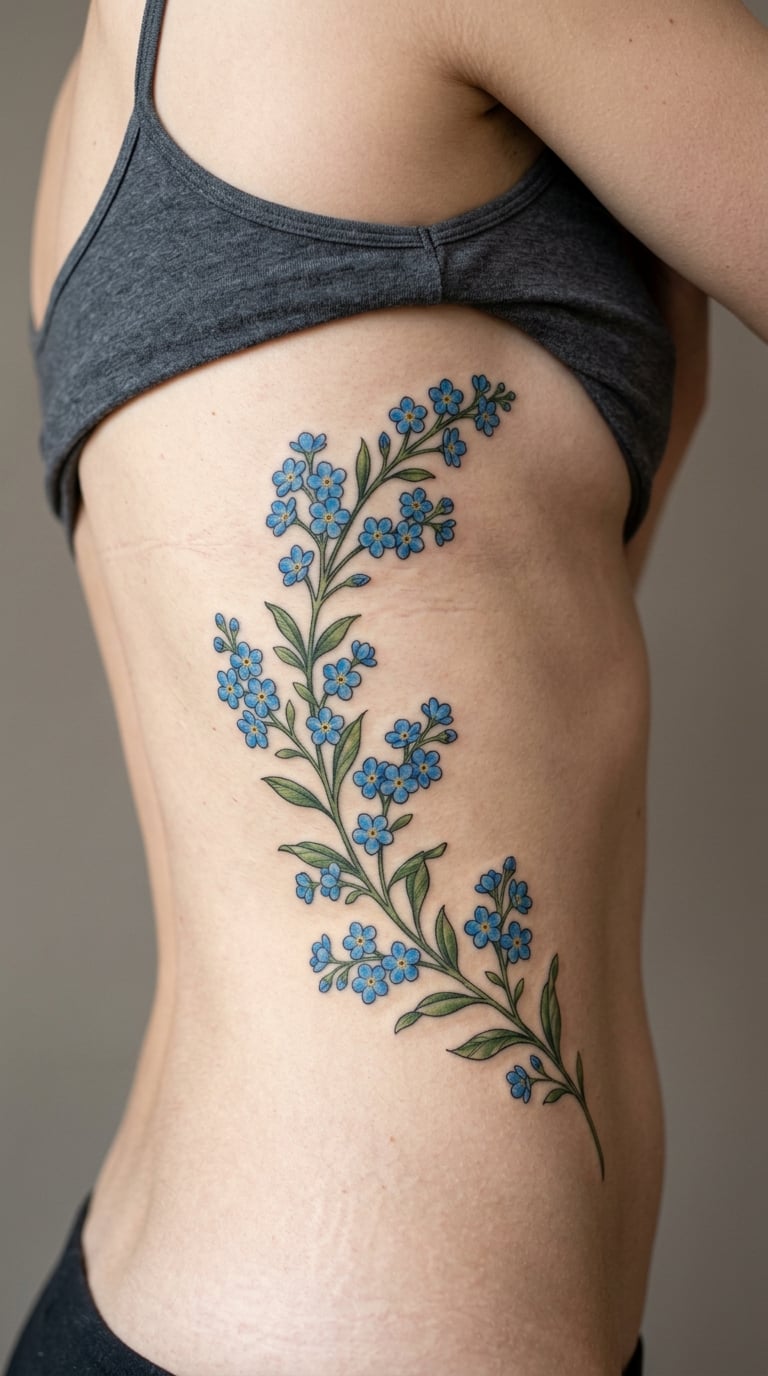
A branch that follows the curve of the side ribs, entering from the lower back area and curving forward, with the blossoms angled toward the viewer rather than lying flat along the body. It has to be planned around how the torso compresses when you sit and bend, which is why the branch curves and never crosses the waist straight.
Placement: side ribs, running forward from the flank. Size: 5 to 7 inches (13 to 18 cm). Style: botanical realism.
Pain: high. The ribs are bone over bone and this is one of the more common requests to walk away from. It needs a long sitting with real breaks.
Make it yours: scale the whole branch to your torso, not to a photo. Ribs differ enough between body types that a design copied at a fixed size can end up crowding the front of the chest.
18. Shoulder Blade Watercolor Flowers
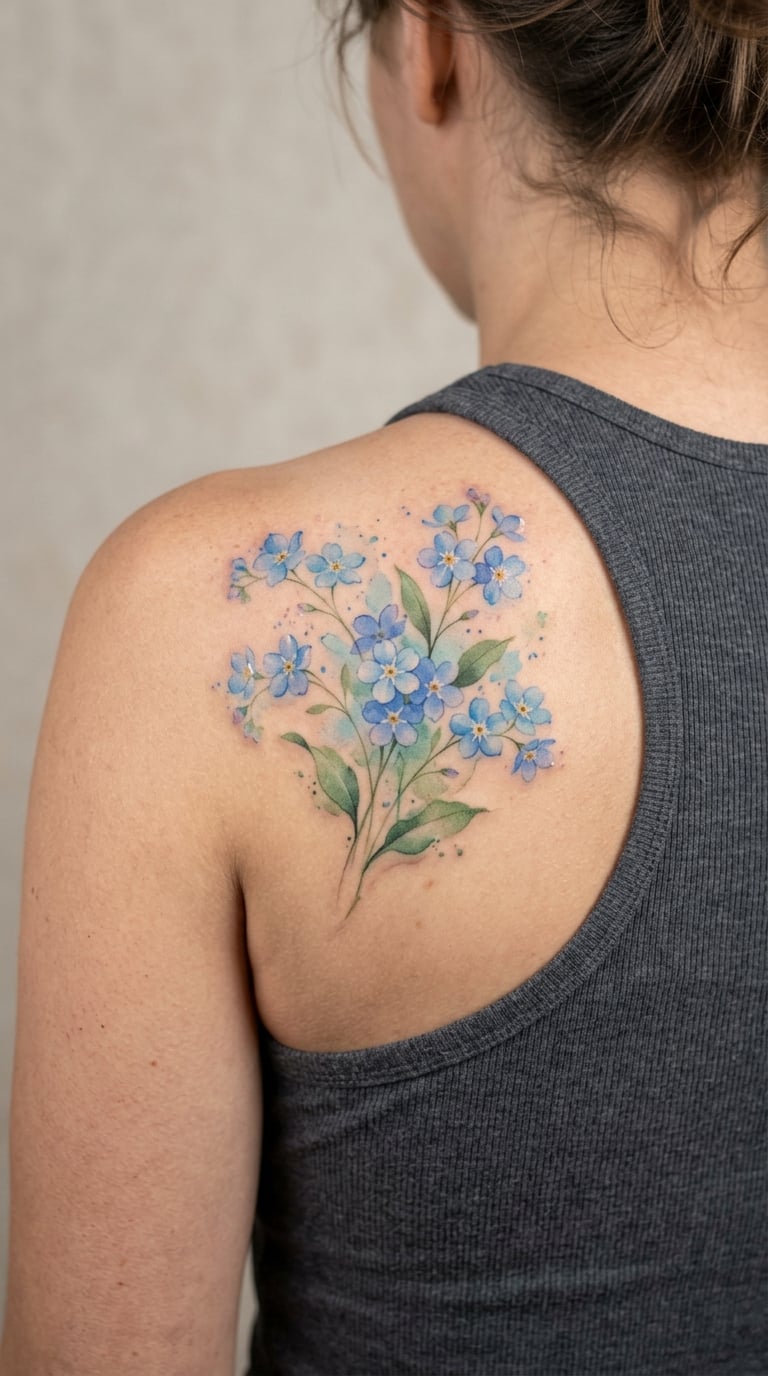
A loose cluster of translucent blue petals with green leaves, painted in watercolour on the shoulder blade so the design appears to sit under the skin rather than on it. The wide flat area of the blade takes a spread-out cluster better than almost anywhere else, and the movement there is limited once the arm is down.
Placement: shoulder blade, occasionally a small trail running out from the spine. Size: 4 to 5 inches (10 to 13 cm) across. Style: watercolor.
Pain: medium, and again time-limited by how many wash layers the design needs. Blue watercolour drops in saturation as it heals, so the piece you leave with is softer than the day you get it.
Make it yours: fade the far edge of the cluster into single loose petals so the design seems to run off the shoulder, or add a line of forget-me-nots across the spine to tie the back together.
19. Monochrome Forget-Me-Not Sleeve
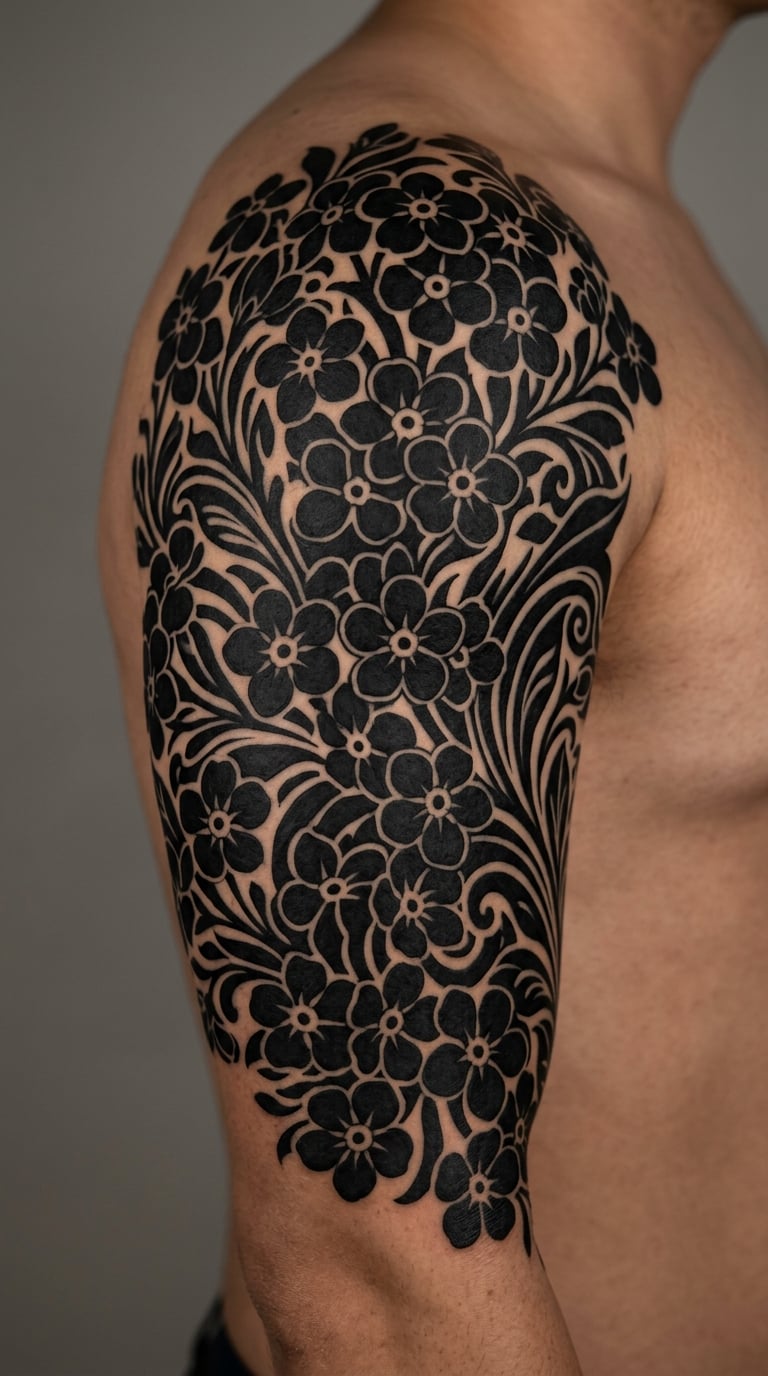
A full black-only composition of layered forget-me-not flowers and leaves running from the shoulder to the elbow or past it, built from solid black petals, fine stems and dense negative space. It is a commitment piece, and the natural choice when you want a second tattoo that reads as part of a collection rather than an addition to one.
Placement: upper arm, shoulder, or the full sleeve from shoulder to forearm. Size: a half sleeve typically measures 7 to 9 inches (18 to 23 cm) in length. Style: blackwork monochrome.
Pain: high, and it runs to multiple sessions. Ask for two to three sittings with real gaps between them, and expect the second one to be the one that decides whether the design reads well.
Make it yours: build a motif that repeats: one forget-me-not shown in bud, in half bloom and fully open, repeating up the arm like a botanical study.
20. Tiny Finger Forget-Me-Not
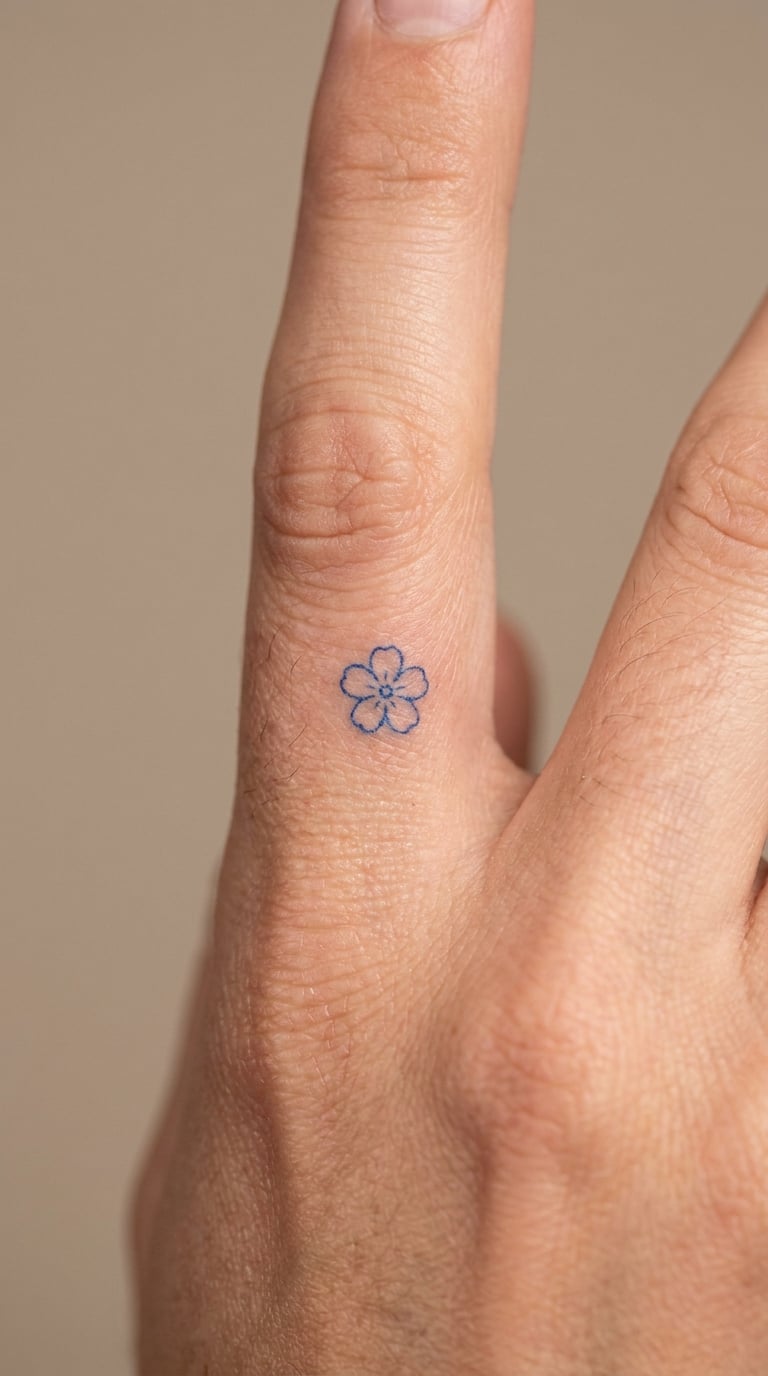
A single simplified flower on the side of a finger, small enough to sit between the knuckle and the fingertip, with five petals, a dot for a centre and almost no stem. It is one of the most requested tiny florals and one of the most demanding, because there is almost no flat surface to work with.
Placement: side of the index or ring finger, or the outer hand below the pinky. Size: 0.3 to 0.5 inch (0.8 to 1.2 cm). Style: micro fine line.
Pain: high, and the finger knuckle joint is the most sensitive square inch most people will sit through. Fine line here fades fast from daily contact, washing, and the stretch of bending. A solid black micro bloom holds noticeably better than a line version at the same size.
Make it yours: one flower per finger, or the same bloom on the same finger of both hands at slightly different heights so they only line up when your hands are together.
21. Celestial Forget-Me-Not Design
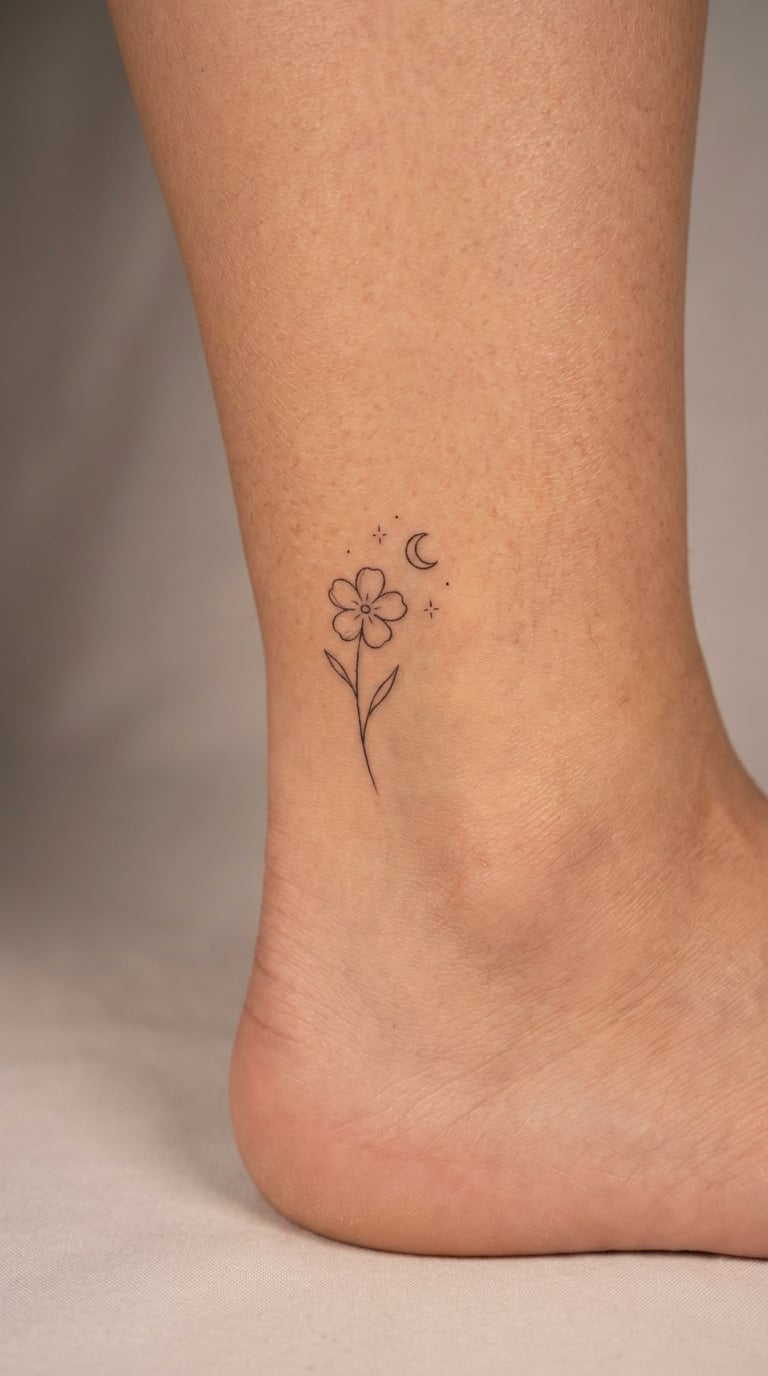
A small cluster of forget-me-not blooms with one thin crescent moon and a few small stars, kept sparse so the flower stays the subject. The temptation is to add more, and that is usually the mistake. Two or three stars and one moon reads as intentional; a sky full of them reads as a page from a storybook.
Placement: inner ankle, upper arm, or the back. Size: 2.5 to 3.5 inches (6 to 9 cm) across. Style: fine line with light colour or black ink throughout.
Pain: medium. The stars are quick single-stroke work, so the sitting is shorter than the number of elements suggests.
Make it yours: use one small star for each person, or set the crescent below the flower as a small cup so the bloom appears to rest in it.
22. Remembrance Forget-Me-Not Portrait Piece
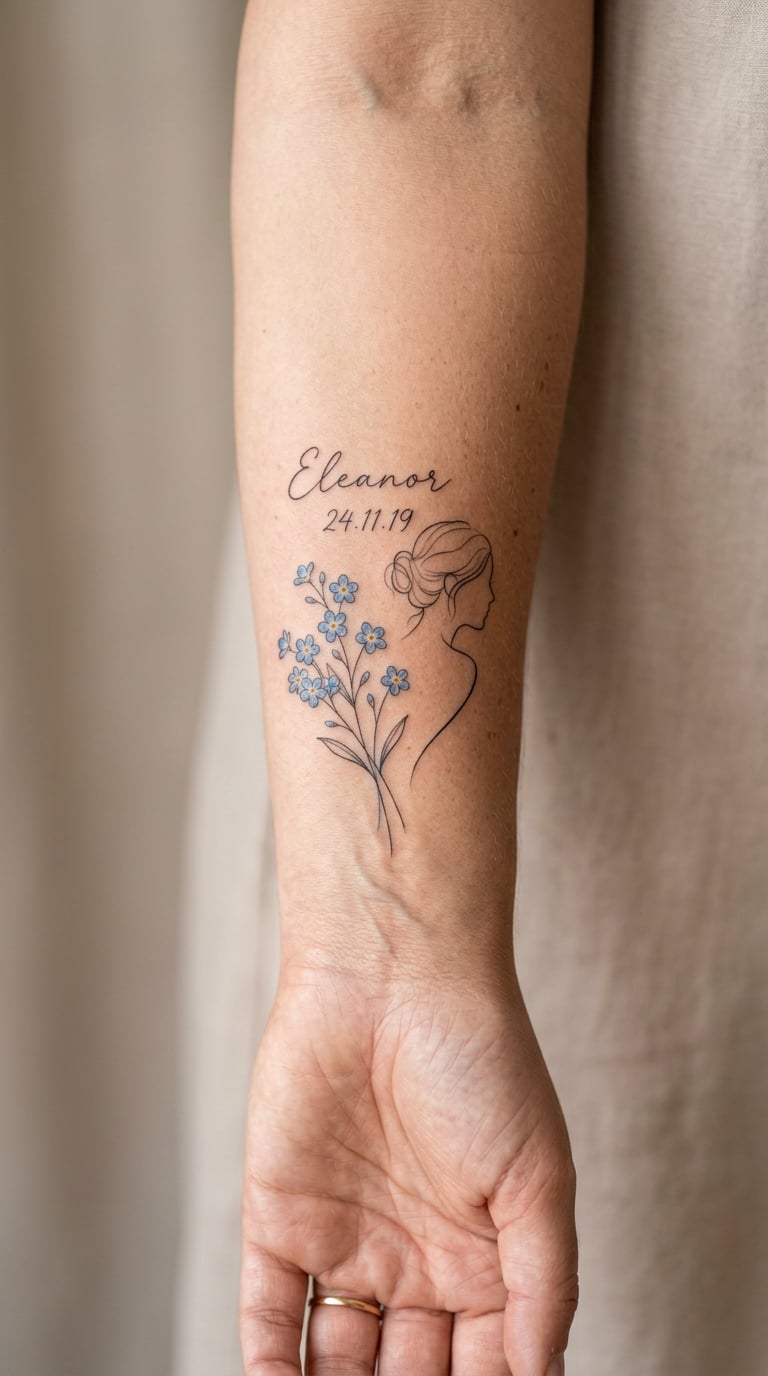
The most personal design in the list: a forget-me-not paired with an initial, a date, or a small portrait element, composed so the flower carries the meaning and the text supports it. Spacing does the work. The text needs clear space around it, and the bloom should sit beside or above the words rather than crowding them.
Placement: inner forearm, upper arm, or over the ribs. Size: 3 to 5 inches (7.5 to 13 cm). Style: micro-realism paired with fine line lettering.
Pain: medium to high, and lettering plus a bloom is a longer sitting than either alone. Small hand-lettering is the detail most likely to need a free touch-up, so build the session plan around that rather than hoping.
Make it yours: write the name or date along the curve of the stem so the words grow out of the flower instead of sitting underneath it, which is a technique already in wide use and worth asking any floral specialist about.
How to Choose the Right Design
Five questions settle most of the decision before you ever talk to an artist.
Where to place a small forget me not tattoo
The bloom decides the placement more than the other way round. A design under an inch wants a small, flat, out-of-the-way spot: behind the ear, the inner ankle, the side of a finger. Anything from two to four inches wants a flat plane with skin that does not crease through it, which is why the inner forearm, the upper arm and the collarbone come up so often. Past four inches, you need a surface with a shape to follow, and the forearm, the ribs and the shoulder blade are the ones that give you room.
How small is the bloom? Below about half an inch, five petals start merging into a blue dot as the tattoo heals. If you want tiny, ask for a simplified flower with solid petals rather than a detailed one. If you want detail, go up to three quarters of an inch or more and pick a placement that has room.
What is already on that limb? Fine line next to heavy blackwork reads as a mistake, and the light piece is the one that suffers. On an already-tattooed arm, ask for a thicker line weight or choose the blackwork or black and grey version instead.
How much light hits the placement? Blue is the first colour to fade in sunlight, and the outer forearm, the top of the foot and the ankle all see a lot of it. Black and grey holds up better on exposed skin, and if you want blue, plan on a richer saturation and a possible touch-up every few years.
Does the design follow the body’s shape? A round motif wants a round or gently curved area. A vertical stem wants a long taper like the forearm or the ribs. A wrap-around bracelet needs room on a limb that actually moves as a cylinder, and your writing arm and dominant hand will not be the same one.
What does the piece need to say? One bloom for one person, a cluster for a group, a bouquet for a whole family or season. If you are starting from scratch and the meaning is already decided, bring a sentence, not just an image, and our 24 tattoo ideas that symbolize growth for first timers is a useful next read for turning a meaning into a shape.
Cost and Session Time
Bring your references, and bring your reasons for each one. A gallery image tells the artist what the design looks like, but a sentence about who the flower is for tells them what to keep and what to leave out. Most tattooists would rather hear that than guess.
Cost is the number people ask about first, and for a small flower the size bands below are a fair US starting point before you add an artist’s rate or your city.
- Micro pieces (under 1 inch, finger or behind the ear): roughly $80 to $180, often set by the shop minimum rather than by the design.
- Small pieces (1 to 2.5 inches, a single stem or small sprig): roughly $150 to $350.
- Medium pieces (3 to 5 inches, a cluster, wreath or small bouquet): roughly $400 to $900, and more if it is in full colour or grey wash.
- Larger pieces (5 inches and up, a vertical stem, rib branch or sleeve work): roughly $900 to $2,500 and up, almost always split across two or three sittings.
Session time is easier to estimate than anything else in a tattoo, and it matters more for a small flower than you would think. A single fine-line bloom under two inches is usually 30 to 60 minutes. A three-bloom blackwork cluster runs one to two hours. A traditional bouquet, a grey-shaded bouquet, a dotwork branch or anything with lettering is a three to four hour sitting, and most artists will split that across two appointments rather than book it in one.
The pieces worth planning around are the long ones: the vertical stem, the rib branch, the wrap-around sleeve accent and the monochrome sleeve. Anything past four hours in a single sitting tends to be rushed near the end, and rushed shading is where a bouquet loses its definition. Two sittings with a break in between is a better result than one long one.
What moves the number is size, detail, colour, the artist’s rate and where you are. Shop minimums mean a tiny finger flower can cost close to a small forearm piece, and cities carry higher rates than most other areas. Ask for the price of the whole design at the consultation, not the hourly rate alone, and ask what the minimum is before you commit to something small.
Aftercare Basics
- Follow your artist’s aftercare first. Their instructions for how long to keep it covered, how long to keep it out of water and when to start moisturising override anything general you have read, including this list.
- Wash it gently. Lukewarm water, a fragrance-free cleanser, washed with clean hands and patted dry rather than rubbed. No harsh soap and no scrubbing during the flaking stage.
- Protect the cover. Keep the protective film or wrap on for as long as your artist specified, and keep loose clothing away from the area while it is still damp.
- Moisturise thinly. Once your artist says to start, use a plain fragrance-free lotion in a thin layer. Thick balms and heavy ointments trap heat and can slow things down.
- Keep it out of the sun. This is the one that decides whether the blue survives. Sunscreen on a healed piece in direct sun, and no sunbeds at all until the line has settled, which is usually a few months.
- Book the free touch-up. Fine line fills in and tiny petals blur as the tattoo heals, which is normal. Most studios will adjust a piece once within the first few months, and that appointment is the right time to have any colour topped up.
Frequently Asked Questions
What does a forget me not flower tattoo usually mean?
A forget me not tattoo most often means remembrance and undying love, taken from the flower name itself: do not forget me. People also use it for friendship, for a partner who is far away, and for a person who is still alive but not always present. Some wear it to mark miscarriage or dementia awareness. The traditional meaning is fixed, but your reason for choosing it is your own.
What color should I get for a forget me not tattoo?
The flower is naturally a soft blue with a yellow centre, and that is the colour most people picture. Artists build the blue from two or three layers because a single pass reads too dark. If you have a sun-exposed placement, consider black and grey, which holds its shape far better. On deeper skin tones, ask for a more saturated blue and a slightly heavier line so the shape still reads.
Are forget me not tattoos suitable for beginners?
They are one of the better choices for a first tattoo. The bloom is simple, the shape is small and forgiving, and a single fine-line flower takes 30 to 60 minutes. The main thing to get right is size. Ask for a piece at least half an inch across, because anything smaller loses the five petals as it heals. Bring reference images and let the artist simplify where they think it is needed.
How small can a forget me not tattoo be?
Around half an inch (1.2 cm) across is the practical floor for a single bloom. Below that, the five petals fill in and the flower reads as a blue smudge once healed. Under a quarter inch, simplify the design to solid petals and a single centre dot rather than a detailed flower. A simplified micro design holds up better than a detailed one at the same tiny size.
Do fine line forget me not tattoos fade quickly?
They change faster than almost any other style. Hairline work sits in the skin at a depth that softens over a few years, and small fine details blur first, so the petal edges and leaf veins are what you lose. Hands and fingers fade fastest because of sun, washing and constant movement. Black and grey, or a heavier line weight, holds noticeably better if you want the design to stay legible.
Where is the least painful place to get a forget me not tattoo?
The upper forearm, the bicep and the shoulder are the easiest, because the muscle absorbs the needle and the skin is thick. The inner wrist, the ribcage, the ankle bone and the fingers are the ones people brace for. The inner forearm is the most requested placement for this flower and sits in the middle of the range, so it is a reasonable place to start if the size is small.
Conclusion
If you are getting your first floral, go with the fine-line single stem at around two inches on the inner forearm. It is quick, it heals predictably, and the meaning sits in the flower itself rather than depending on added elements.
Of these 22 forget me not tattoo ideas, the traditional bouquet or the monochrome sleeve concept is the stronger second piece if you are building a collection, because both give you room to add later without the new work looking like an afterthought. Take three or four references to the consultation, ask what the minimum bloom size is for your placement, and let the artist tell you which of your saved images will not survive at the scale you have in mind.