
24 Tattoo Ideas That Symbolize Growth for First Timers 2026
If you are looking for tattoo ideas that symbolize growth, they all share one shape: something small moving into something bigger. A seedling breaking soil, a flame climbing, a root system pushing downward while a shoot reaches up, a stair that ends in a star. People getting their first tattoo keep landing on this theme because the meaning is simple to say out loud and easy to carry.
Most of the designs below work as a first piece because they read clearly at a small size, and small is exactly what a first appointment should be. Some of my favourites here use colour and watercolour washes, which take a longer session, so if you have never sat through a tattoo before, read the cost and session time section first. If you are still deciding whether you want a commitment piece or a quiet one, the tattoo ideas that represent strength for women guide covers a different set of symbols with a similar first-timer focus.
tattoo ideas that symbolize growth: Quick Guide
Every design in this list appears in the same order below, with the style, placement, realistic size and expected pain for the suggested spot. Sizes are what an artist will actually draw on you, not the size of a reference image.
| Idea | Style | Best placement | Size | Pain |
|---|---|---|---|---|
| Fine-line sprout | Fine line | Inner wrist | 1.5-2.5 in (4-6 cm) | Medium |
| Tree of life | Minimalist linework | Inner forearm | 4-6 in (10-15 cm) | Low |
| Rising flame | Blackwork | Outer forearm | 3-4 in (8-10 cm) | Low |
| Cherry blossom branch | Watercolour | Collar bone | 4-6 in (10-15 cm) | Medium |
| Geometric mountain range | Geometric | Outer calf | 5-7 in (13-18 cm) | Low |
| Expanding sun | Blackwork with accent | Upper arm | 3-4 in (8-10 cm) | Low |
| Seedling from a heart | Minimalist | Collar bone | 1.5-2.5 in (4-6 cm) | Medium |
| Upward arrow | Fine line | Inner forearm | 2.5-3.5 in (6-9 cm) | Low |
| Rising phoenix | Black and grey realism | Shoulder blade | 6-8 in (15-20 cm) | Medium |
| Climbing vine | Fine line botanical | Outer calf | 4-5 in (10-13 cm) | Low |
| Wave into a spiral | Illustrative | Inner ankle | 2.5-3.5 in (6-9 cm) | Medium |
| Open-wing butterfly | Illustrative | Upper back | 3-4 in (8-10 cm) | Low |
| Paper plane in motion | Geometric fine line | Behind the ear | 1.5-2.5 in (4-6 cm) | Medium |
| Graduated bar with a rising dot | Minimalist | Outer wrist | 2-3 in (5-8 cm) | Low |
| Lotus with unfurling petals | Fine line | Upper back | 4-5 in (10-13 cm) | Low |
| Acorn into a young oak | Micro-realism | Outer upper arm | 2-3 in (5-8 cm) | Low |
| Spiral with a new leaf | Single-line | Inner forearm | 1.5-2.5 in (4-6 cm) | Low |
| Staircase to a star | Fine line with dotwork | Calf or inner arm | 4-5 in (10-13 cm) | Medium |
| Upward koi | Illustrative with colour | Outer thigh | 4-6 in (10-15 cm) | Low |
| Roots and new growth | Botanical fine line | Centre chest | 4-5 in (10-13 cm) | Medium |
| Crescent moon with botanicals | Fine line | Ribcage side | 3-4 in (8-10 cm) | Medium |
| Phoenix feather | Micro-realism | Forearm | 3-4 in (8-10 cm) | Low |
| Hourglass with a sprouting flower | Fine line | Inner arm | 2.5-3.5 in (6-9 cm) | Medium |
| Three stages of a bloom | Botanical with wash | Forearm | 5-7 in (13-18 cm) | Low |
1. Fine-Line Sprout on the Inner Wrist
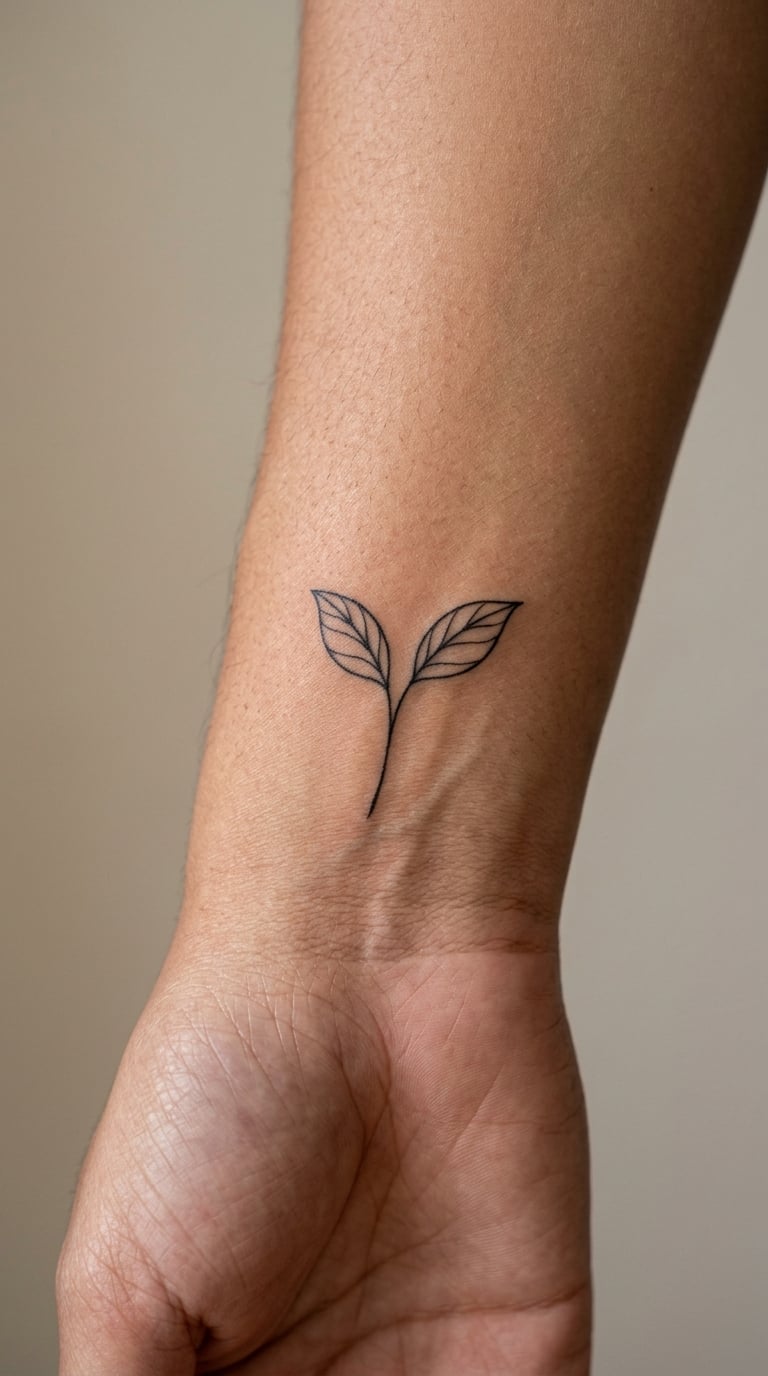
A fine-line sprout is two leaves on a short curved stem, drawn in one consistent black line weight. Some artists add a third half-formed leaf so the plant reads as still in progress.
It is one of the most requested growth tattoos because the meaning needs no explanation. People often get it after finishing a course, leaving a job or moving somewhere new.
Placement: inner wrist above the crease, or inner forearm near the elbow. Size: 1.5-2.5 in (4-6 cm) across. Style: fine line, single line weight.
Pain: medium, and sharper than it should be, because the inner forearm sits close to bone and moves when you flex. Ageing note: fine lines on the inner wrist fade faster than on the upper arm. Make it yours: add a dot at the base of the stem for the year you started.
2. Minimalist Tree of Life on the Forearm
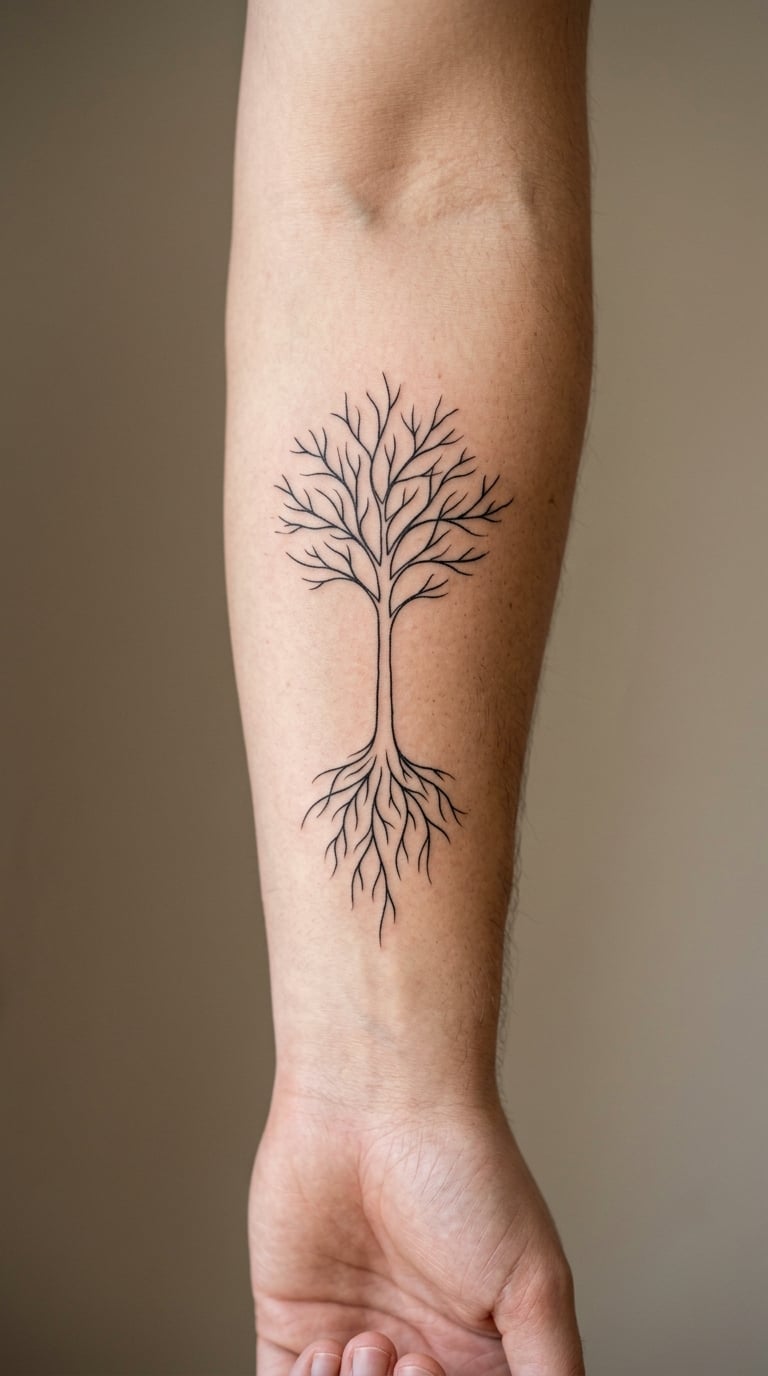
A tree with a narrow trunk, a few branching limbs and a canopy suggested in soft grey wash or a scatter of small leaves. Minimalist versions drop the leaf detail and let the branch shape carry it.
The tree of life is the oldest growth symbol here by a wide margin, and it shows up in a lot of different traditions for a simple reason: roots below, canopy above, everything in the middle. The established reading is renewal and long life.
Placement: inner or outer forearm, running vertically. Size: 4-6 in (10-15 cm) tall. Style: minimalist linework, optional grey shading in the canopy.
Pain: low to medium, since the forearm has muscle under the skin. Ageing note: grey wash spreads over the years, so ask for it a shade deeper than you think you want now. Make it yours: have the artist add root tendrils spreading toward the elbow.
3. Rising Flame in Blackwork
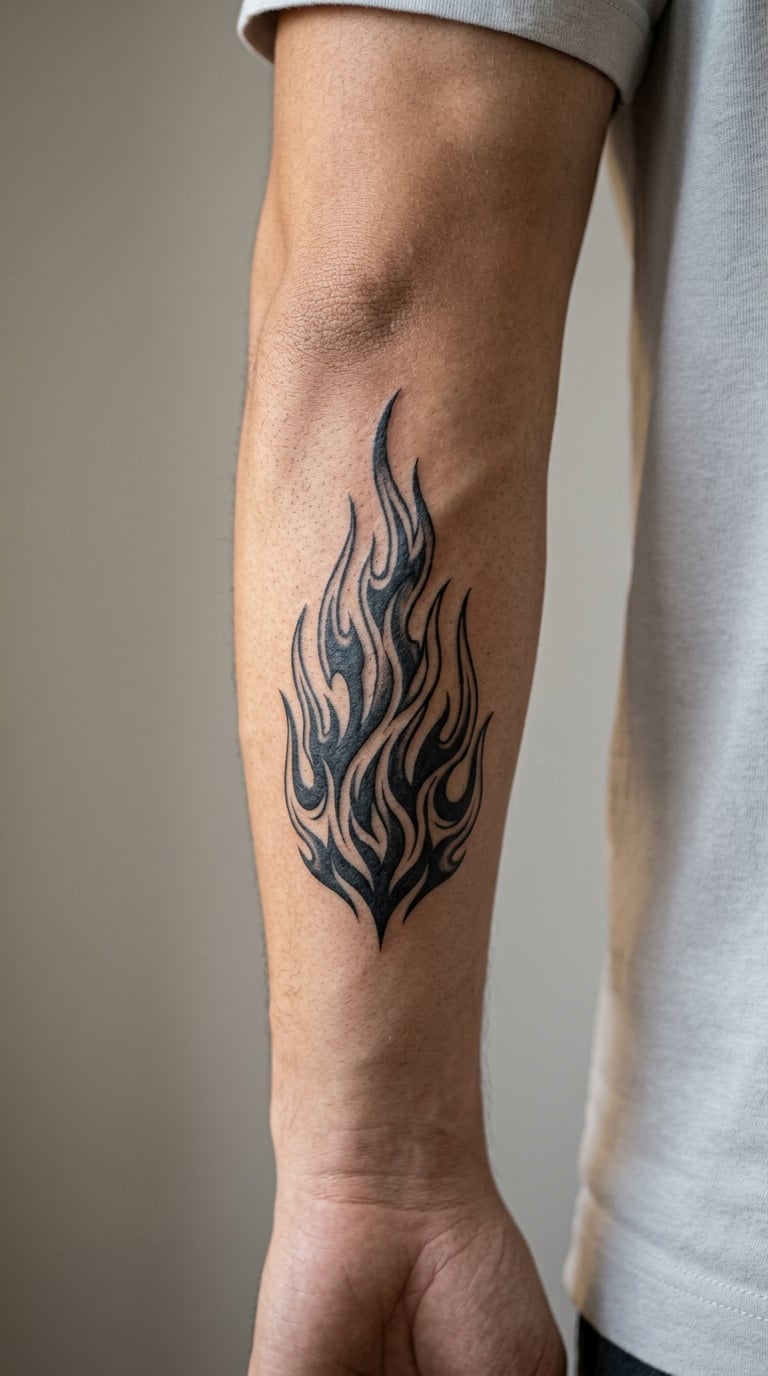
A rising flame in blackwork is a solid black shape with sharp cuts of negative space through the middle, the way heat shows through fire. The silhouette narrows at the base and splits into two or three tongues at the top.
Fire is what people reach for when the change was hard. It reads as resilience because the same material is reshaped without being destroyed, which is a usable metaphor for getting through something difficult.
Placement: outer forearm, upper arm, or outer calf. Size: 3-4 in (8-10 cm) tall. Style: blackwork, solid fill with hand-cut negative space.
Pain: low, since solid fill is quick and the needle passes repeatedly over the same area. Ageing note: blackwork holds its edge better than anything else on this list. Make it yours: set a small red or orange core inside the flame and keep everything else black.
4. Watercolor Cherry Blossom Branch
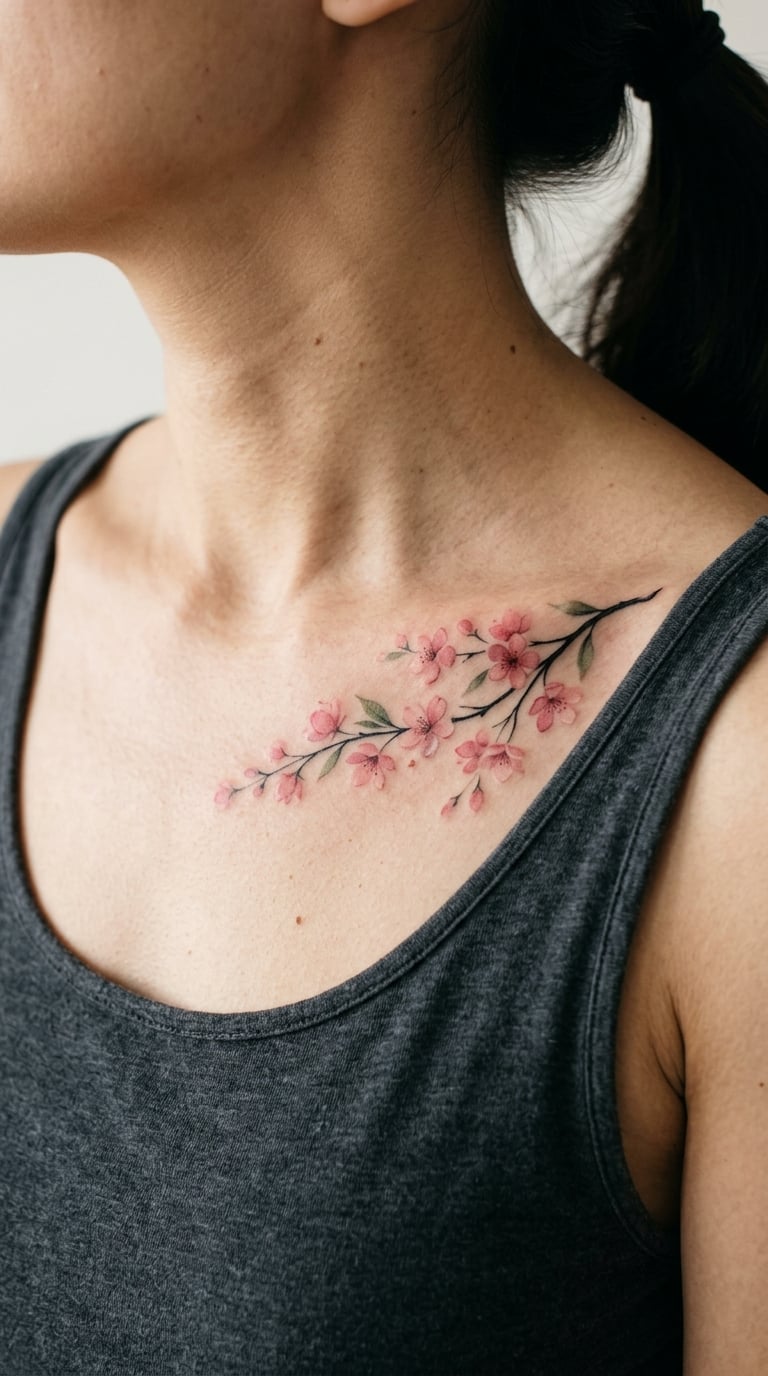
A thin black stem with five-petal flowers built up in transparent pink washes, some petals left as bare outline. The colour is layered wet-on-wet so edges stay soft, and the leaves are usually a muted grey-green.
Blossom on a bare branch is the standard image for change and renewal, because flowers appear while the wood is still bare. It suits people marking a transition everyone around them can already see.
Placement: collar bone, shoulder, or inner forearm. Size: 4-6 in (10-15 cm) long. Style: watercolour over fine black linework.
Pain: medium on the collar bone, low on the arm. Book a longer session, because watercolour needs more passes than a black outline. Ageing note: the pink fades first and the black stem stays readable. Make it yours: colour one blossom fully and leave the rest as pale outline.
5. Geometric Mountain Range on the Calf
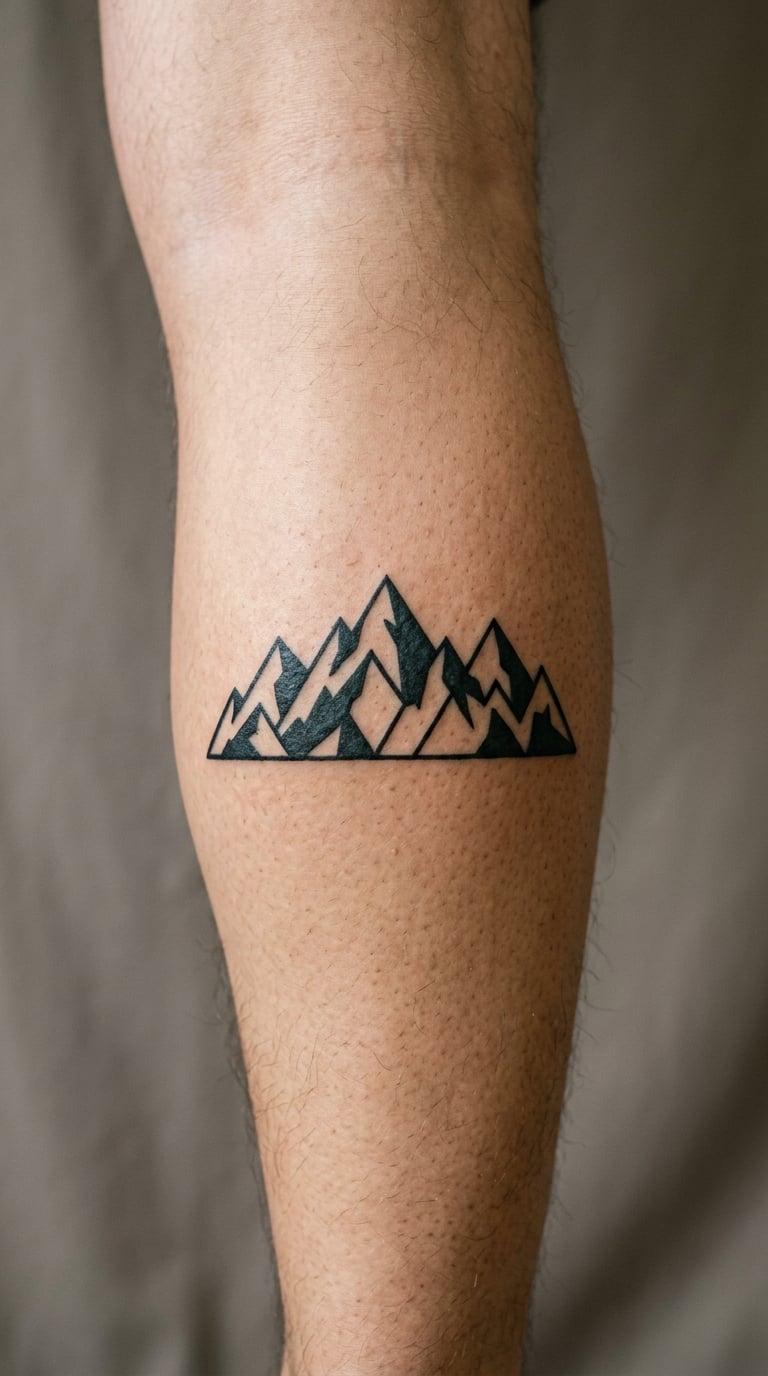
A row of angular peaks in solid black, each triangle overlapping the next so the line between one summit and the next valley is a single sharp zigzag. Some artists break the silhouette with a few thin contour lines inside.
Mountains are the most literal growth symbol in the list: the difficult thing is the climb, and the view comes from the top. People choose it for work they finished, a qualification, or a move to a harder city.
Placement: outer calf, forearm, or across the shoulder. Size: 5-7 in (13-18 cm) wide. Style: geometric, solid black fills with hard edges.
Pain: low, since the calf takes ink without much complaint. Ageing note: fine contour lines inside the peaks blur first, so keep detail at two line weights or heavier. Make it yours: add a thin summit line rising above the tallest peak.
6. Sun With Expanding Rays
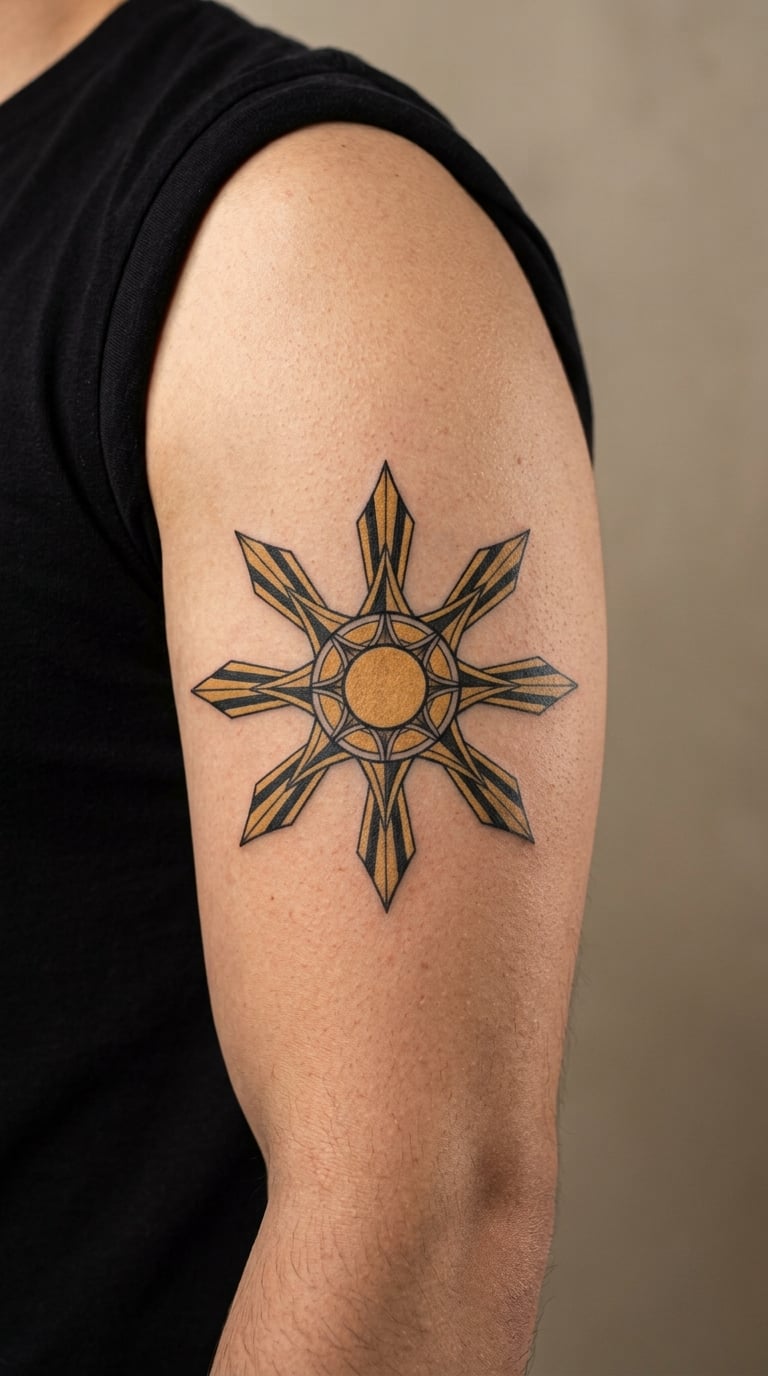
A filled circle with rays that get longer and thicker as they move outward, so the design feels like it is pushing past its own edge. Straight-sided rays look graphic, curved rays look like a retro print.
It is the optimistic one on this list, which is exactly why people pick it after a hard year. Sun imagery reads as becoming and warmth rather than struggle.
Placement: upper arm, chest, or back of the shoulder. Size: 3-4 in (8-10 cm) across. Style: blackwork with a single warm accent.
Pain: low on the arm, medium on the chest. Ageing note: a gold or yellow centre warms towards orange over the years, which is normal. Make it yours: set a date along the bottom ray, aligned with the longest one.
7. Seedling Emerging From a Small Heart
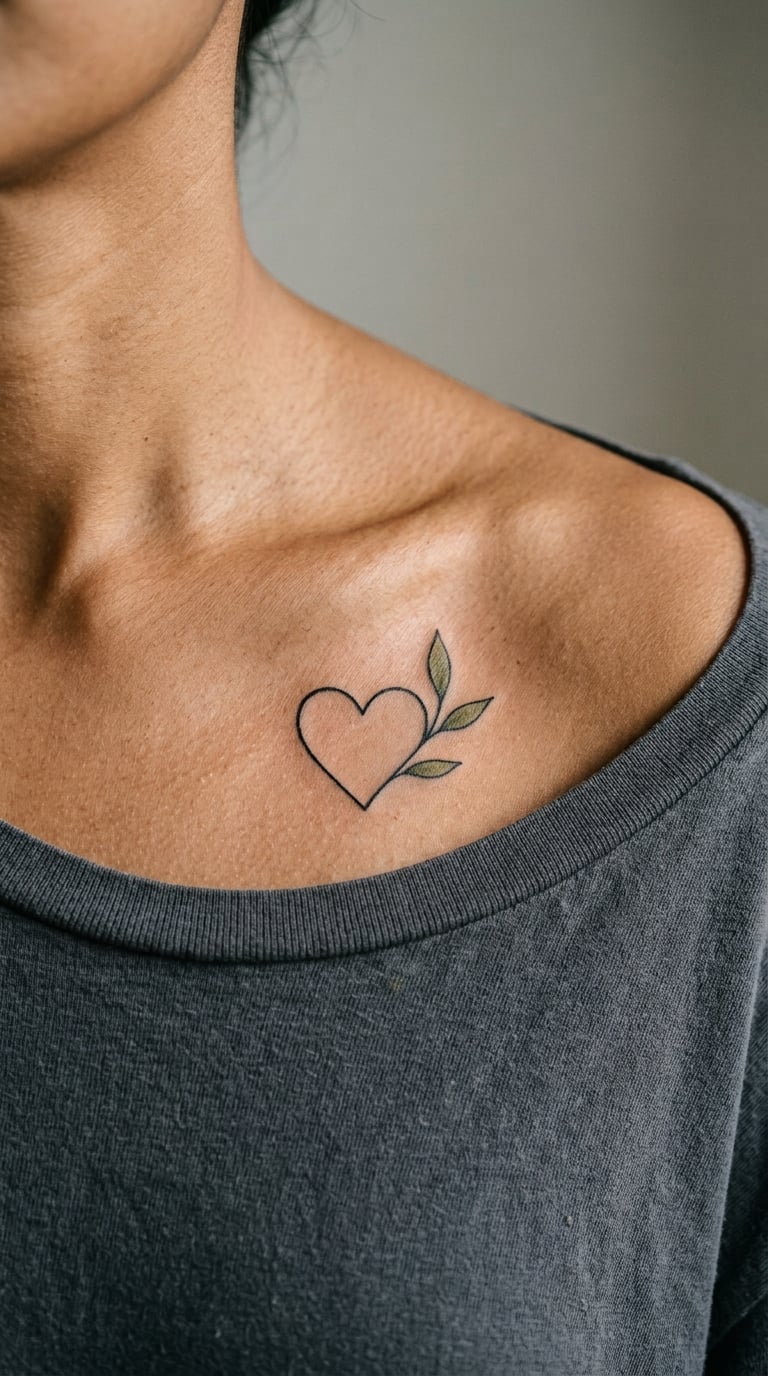
A simple outlined heart with two small leaves pushing up out of the top point, the stem often breaking the outline slightly. Pure black line works, or a soft green wash on the leaves only so the heart stays neutral.
It combines two symbols that usually sit apart. The heart carries care and self-worth, the seedling carries potential, and together they tend to mean tending to yourself rather than anyone else.
Placement: collar bone, inner forearm, or behind the ear. Size: 1.5-2.5 in (4-6 cm) wide. Style: minimalist outline with a colour accent.
Pain: medium near the collar bone, where bone sits under thin skin. Ageing note: heart and leaf merge visually after a few years at small sizes, so 2 inches is the practical floor. Make it yours: trail the stem past the heart toward your elbow.
8. Upward Arrow With Fine-Line Details
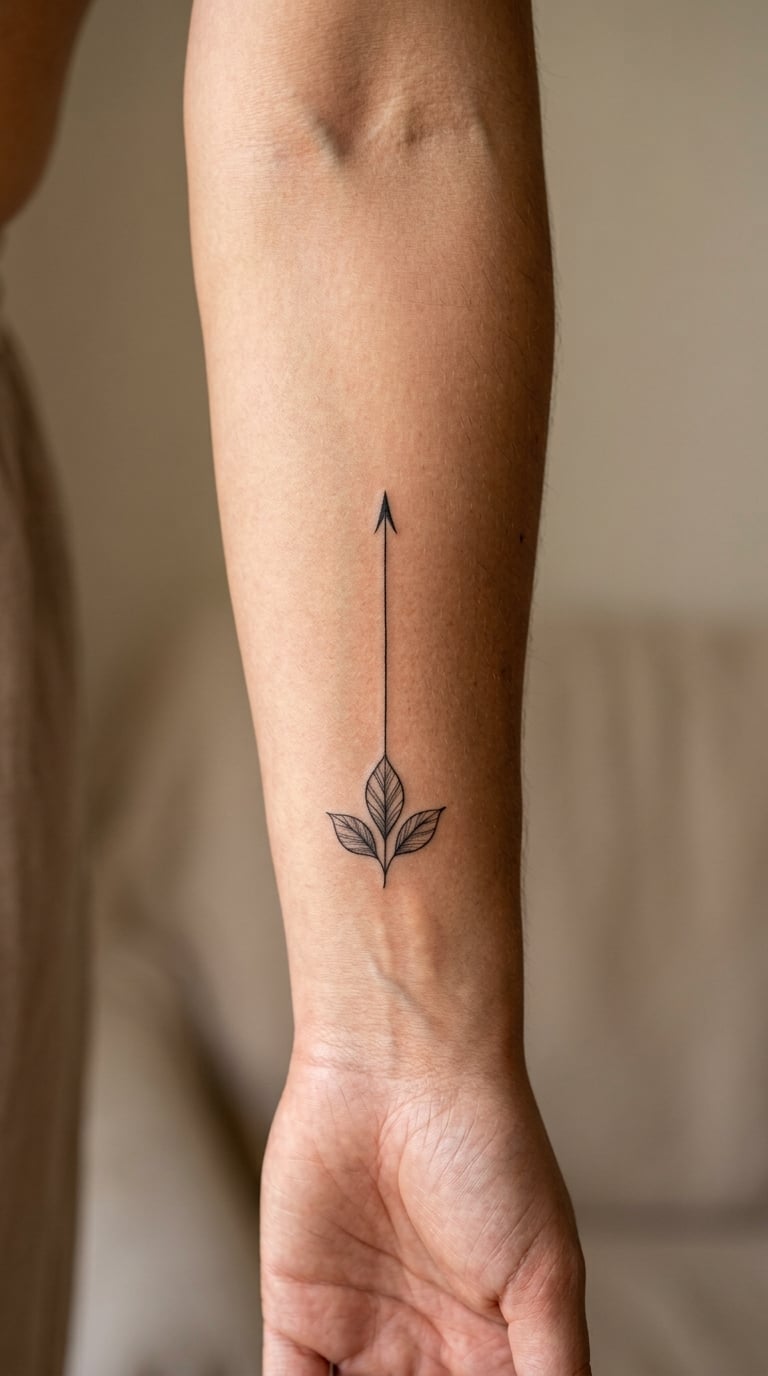
A single shaft with a clean V-shaped head, kept deliberately plain. Restrained decorations near the tail, three tiny leaves, a set of coordinates, a short date, are what stop it looking like clip art.
It is the most direct growth tattoo here and the least poetic. People who are goal-led rather than sentimental tend to choose it, and the meaning stays legible: forward motion, direction, next.
Placement: inner forearm, outer arm, or calf. Size: 2.5-3.5 in (6-9 cm) long. Style: fine line, single weight.
Pain: low, since long single passes down a forearm are the easiest work to sit through. Ageing note: decorations disappear before the arrow does, so keep them chunky. Make it yours: add the coordinates of the place where next actually started.
9. Phoenix Rising in Black and Grey
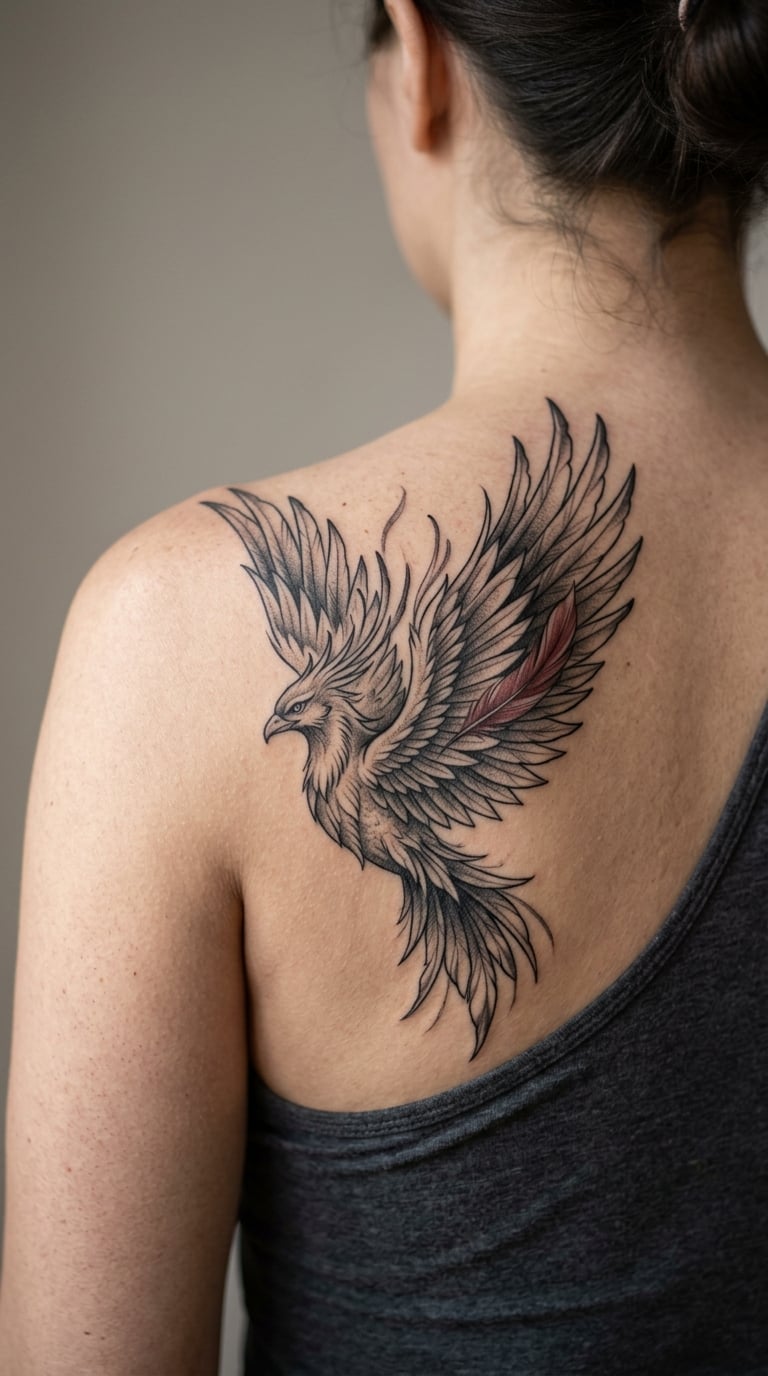
A rising phoenix is a bird with wings thrown upward, rendered in grey wash with darker feather separations, sometimes with flame curls where the tail breaks apart. The head usually turns to one side so the piece has a direction.
Rebirth after destruction is the phoenix’s job in every story that uses it, from the Bennu of ancient Egypt to later Western retellings. It is a strong choice when the growth followed something you lost rather than something you gained.
Placement: shoulder blade, upper back, or outer arm. Size: 6-8 in (15-20 cm) wide. Style: black and grey realism with one colour accent.
Pain: medium, and expect two hours or more since shading outlasts linework. Ageing note: soft grey in the wing membranes spreads first, so keep the value range wide. Make it yours: keep one feather muted red and leave the rest monochrome.
10. Climbing Vine Wrapping a Branch
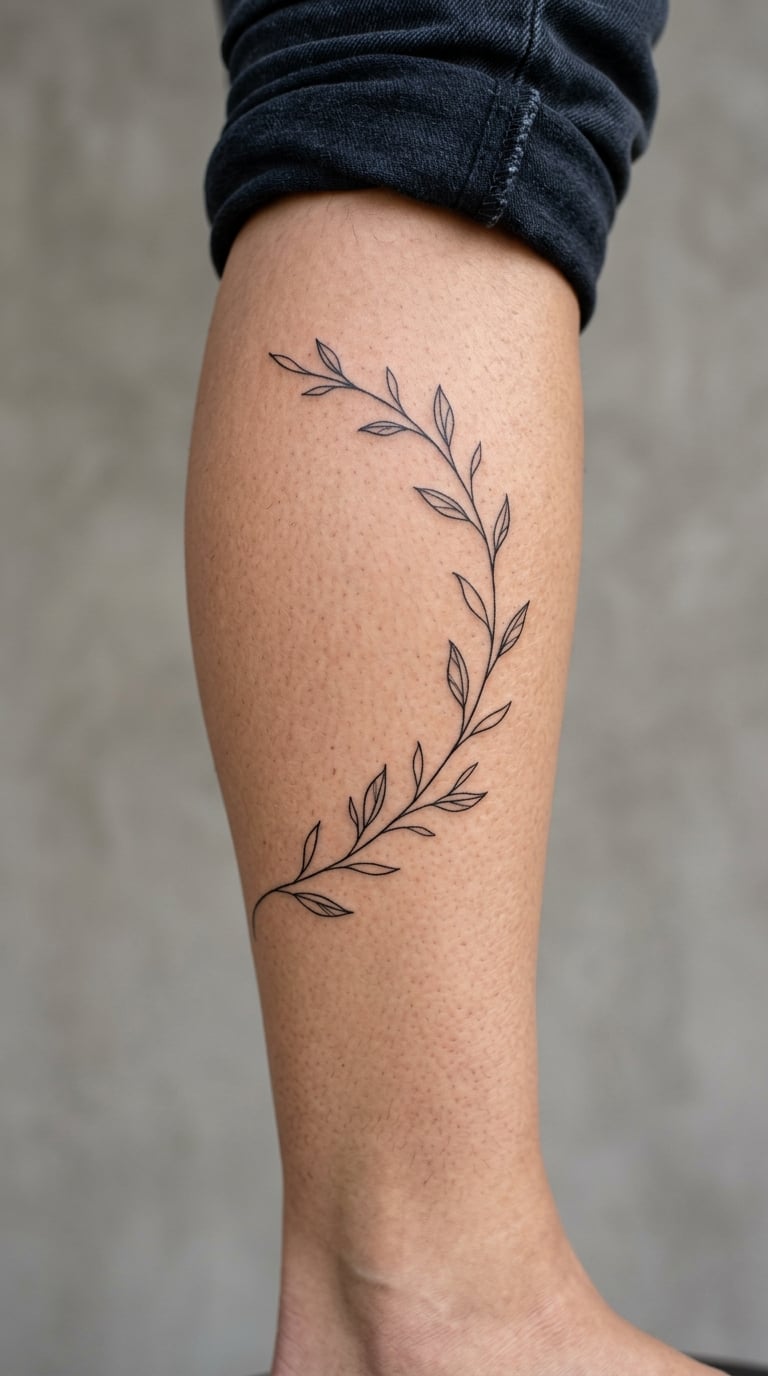
A single curving stem that loops around a straight branch, with small almond-shaped leaves alternating along its length. The linework is one weight, with the leaves filled solid black for contrast.
Vines in a design language like this are about persistence rather than transformation. The plant does not change shape overnight, it just keeps going in one direction for years, which is a quieter and more useful kind of growth symbol than a butterfly.
Placement: side of the calf, forearm, or along the ribcage. Size: 4-5 in (10-13 cm) long. Style: fine line botanical.
Pain: low on the leg, medium on the ribs. Ageing note: botanical linework fades unevenly, so a touch-up around year two is normal. Make it yours: run the vine around an existing first tattoo so the two read as one piece.
11. Wave Cresting Into a Spiral
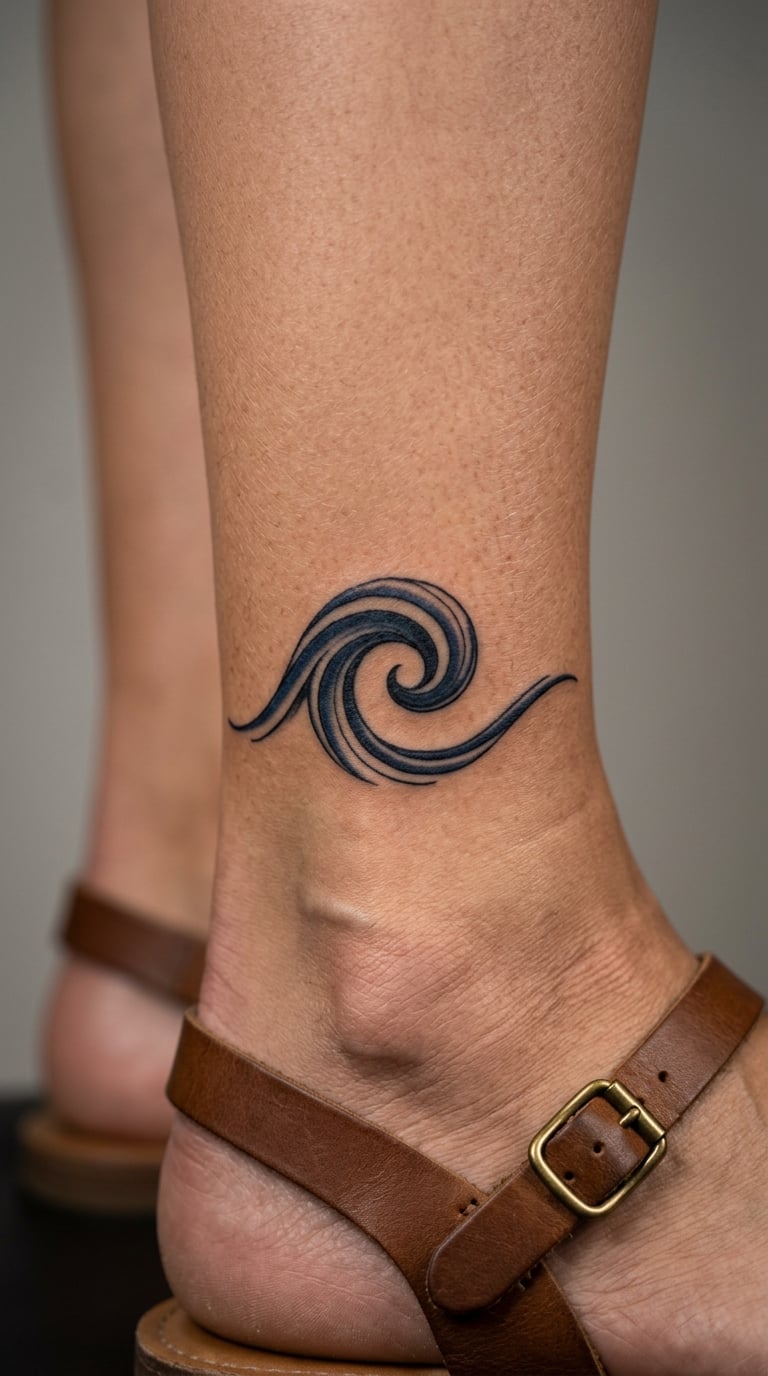
One cresting line that curves inward and tightens into a coil, with the water in solid black or deep blue and the spiral left in clean outline. The transition between the two is the whole design.
Water reads as going with change rather than fighting it, and the spiral adds something older: momentum that never quite arrives at a centre. Together they suit people more interested in staying in motion than in reaching a goal.
Placement: inner ankle, forearm, or ribs. Size: 2.5-3.5 in (6-9 cm) wide. Style: illustrative with a single ink colour.
Pain: medium on the ankle, where the bone is close under a thin joint. Ageing note: if the coil is under half an inch across, it will blur. Make it yours: use black for the wave and soft blue only inside the coil.
12. Butterfly With Open Wings
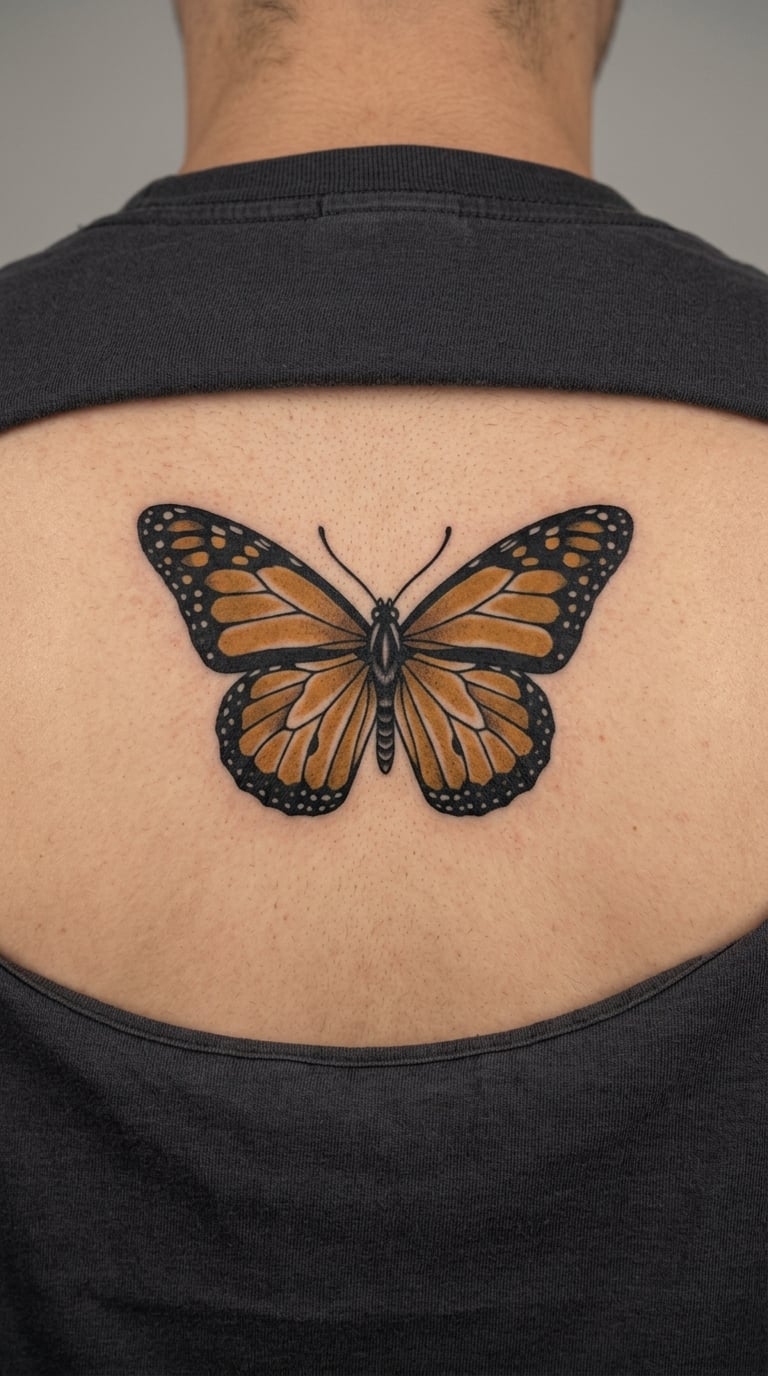
A butterfly in full symmetry has both wing pairs spread flat, with the body a simple tapered line down the middle. Warm ochre and black edging looks good; a plain black silhouette is cleaner and hides minor asymmetry.
Transformation and change is the established reading, drawn from the caterpillar and chrysalis story. It is also the most overused growth symbol there is, and the honest question is whether the common version still feels like yours.
Placement: upper back, shoulder blade, or calf. Size: 3-4 in (8-10 cm) wide. Style: illustrative or blackwork silhouette.
Pain: low, since the upper back is a flat area over muscle. Ageing note: thin wing outlines soften within a few years; filled wing shapes hold far better. Make it yours: tuck a small date into one wing where the pattern is thinnest.
13. Small Paper Plane in Motion
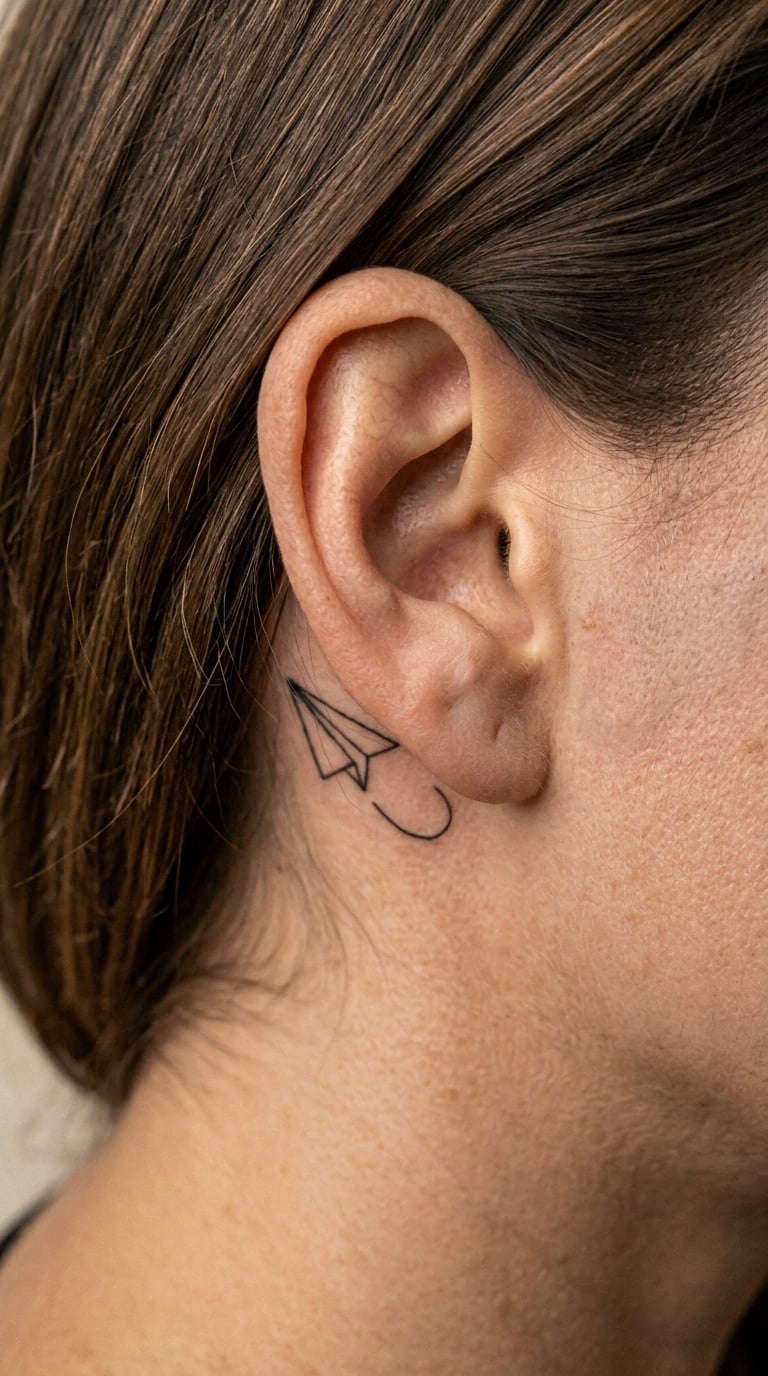
A paper plane is built from two or three long straight facets meeting at a nose, usually one fine black line with a single curved trail behind it. Behind the ear is the placement that made this design popular, because the plane looks like it is flying away over the shoulder.
It reads as a new direction and something not yet delivered, which suits people who would rather mark where they are going than what they have already survived.
Placement: behind the ear, inner forearm, or ankle. Size: 1.5-2.5 in (4-6 cm) wide. Style: geometric fine line.
Pain: medium behind the ear, a bony spot where the skin moves as you talk. Ask the artist to keep the line count low. Ageing note: this is where fast fading shows up first, so ask for heavier line weight than feels comfortable while sketching. Make it yours: curve the trail around the ear to the jaw, or drop the trail and put a coordinate at the nose.
14. Graduated Bar With a Rising Dot
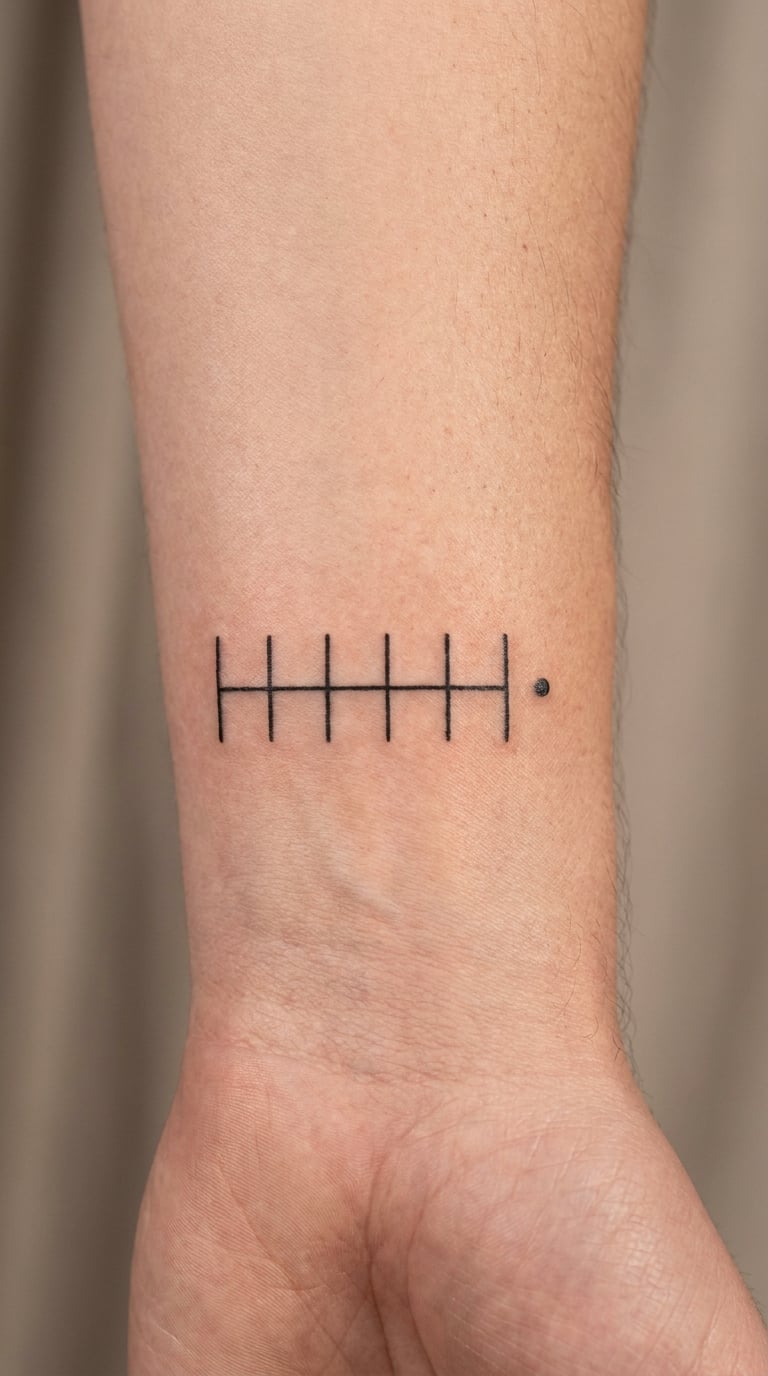
A graduated bar is a rectangle divided into narrow vertical segments, most filled solid black, with a single solid dot above the end of the bar. It looks like a loading meter from a phone screen, which is the reference most people bring in.
This is the contemporary one. It means steady advancement rather than a dramatic transformation, and it suits someone who thinks of progress as a percentage that moves a little each week.
Placement: outer wrist, forearm, or outer arm. Size: 2-3 in (5-8 cm) long. Style: minimalist, solid black geometry.
Pain: low to medium, since a wrist bar is short work on a bony spot. Ageing note: the gap between segments is the thing that closes in, so keep segments at least a sixteenth of an inch apart. Make it yours: fill the bar to a real milestone and set the date underneath in matching type size.
15. Lotus With Unfurling Petals
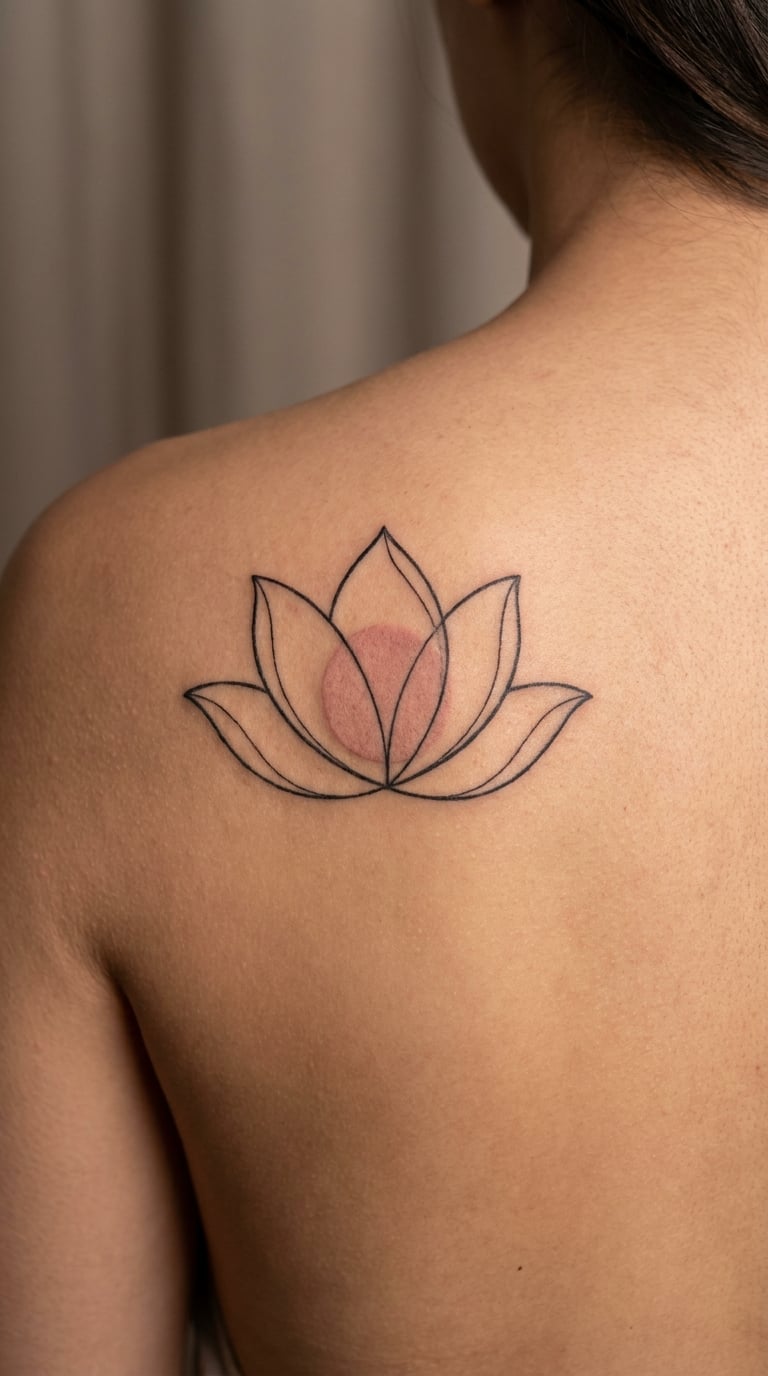
A ring of pointed petals with one or two more opening inside the outer ring, in fine black line with an optional pink or yellow wash at the centre. The asymmetry of the inner petals is what makes it look like it is opening rather than sitting there.
The lotus carries real religious weight in Hindu and Buddhist traditions, where rising from muddy water to bloom above the surface is the standard image for awakening. If that context matters to you, say so at the consultation; if it does not, plenty of people simply like the shape.
Placement: upper back, lower back, or foot. Size: 4-5 in (10-13 cm) wide. Style: fine line with a light wash.
Pain: low on the back, medium on the foot. Ageing note: fine petal lines on the foot fade faster than anywhere else on the body, so go bolder there. Make it yours: colour only the centre petal and leave the outer ring as pure line.
16. Acorn Turning Into a Young Oak
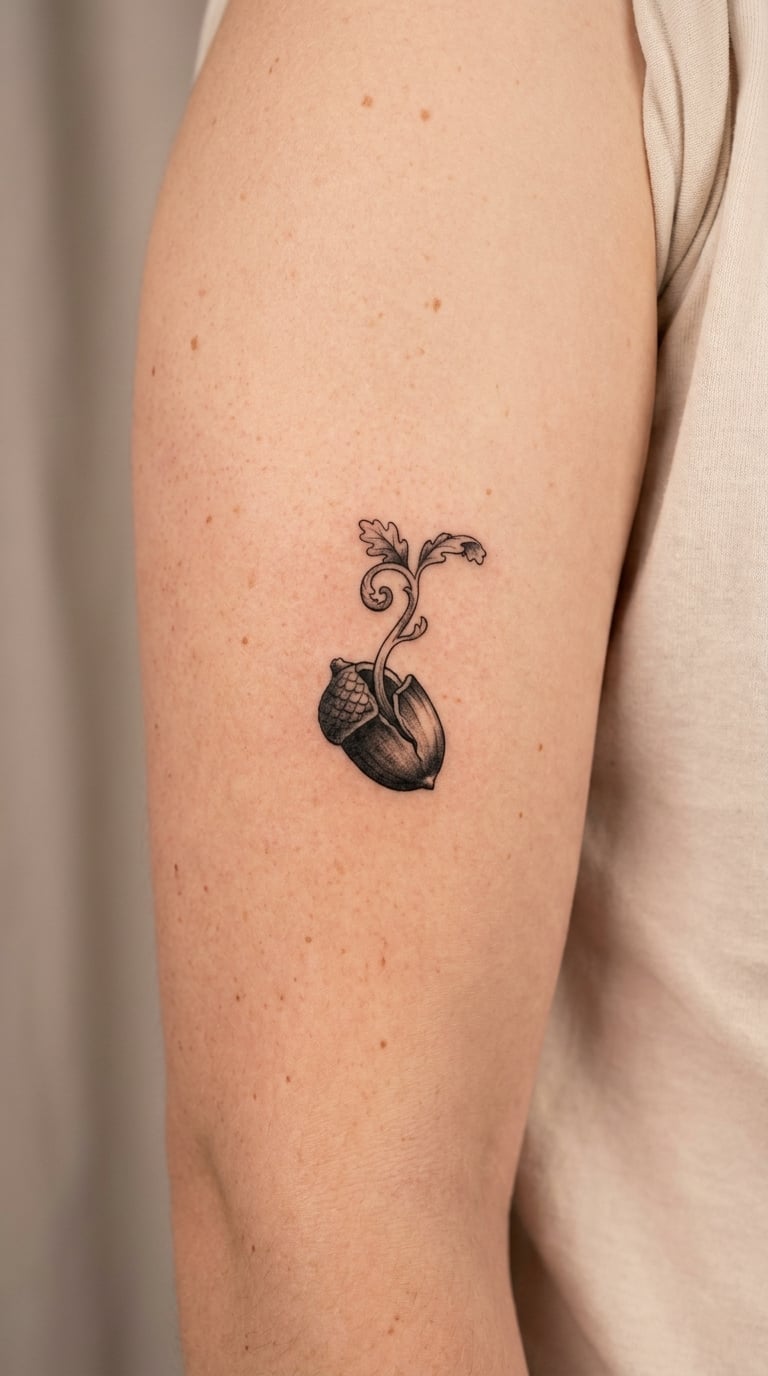
An acorn with a shoot is a rounded cap-and-nut shape at the bottom with two small lobed oak leaves and a thin stem out of the top, sometimes with the acorn split along one side. Micro-realism versions have a textured cap; line versions are three simple shapes.
It is the most literally potential-based design here: an entire tree held inside something small. People choose it to mark the start of something rather than a finished result, which is why it works so well as a first tattoo.
Placement: outer upper arm, forearm, or behind the ear. Size: 2-3 in (5-8 cm) tall. Style: micro-realism or simple linework.
Pain: low, since upper arm skin is thick and even and the design is small. Ageing note: the texture on a realistic acorn cap goes first, so ask for simplified ridges. Make it yours: place it over the spot on your body you check when you need reminding.
17. Spiral With a New Leaf at Its End
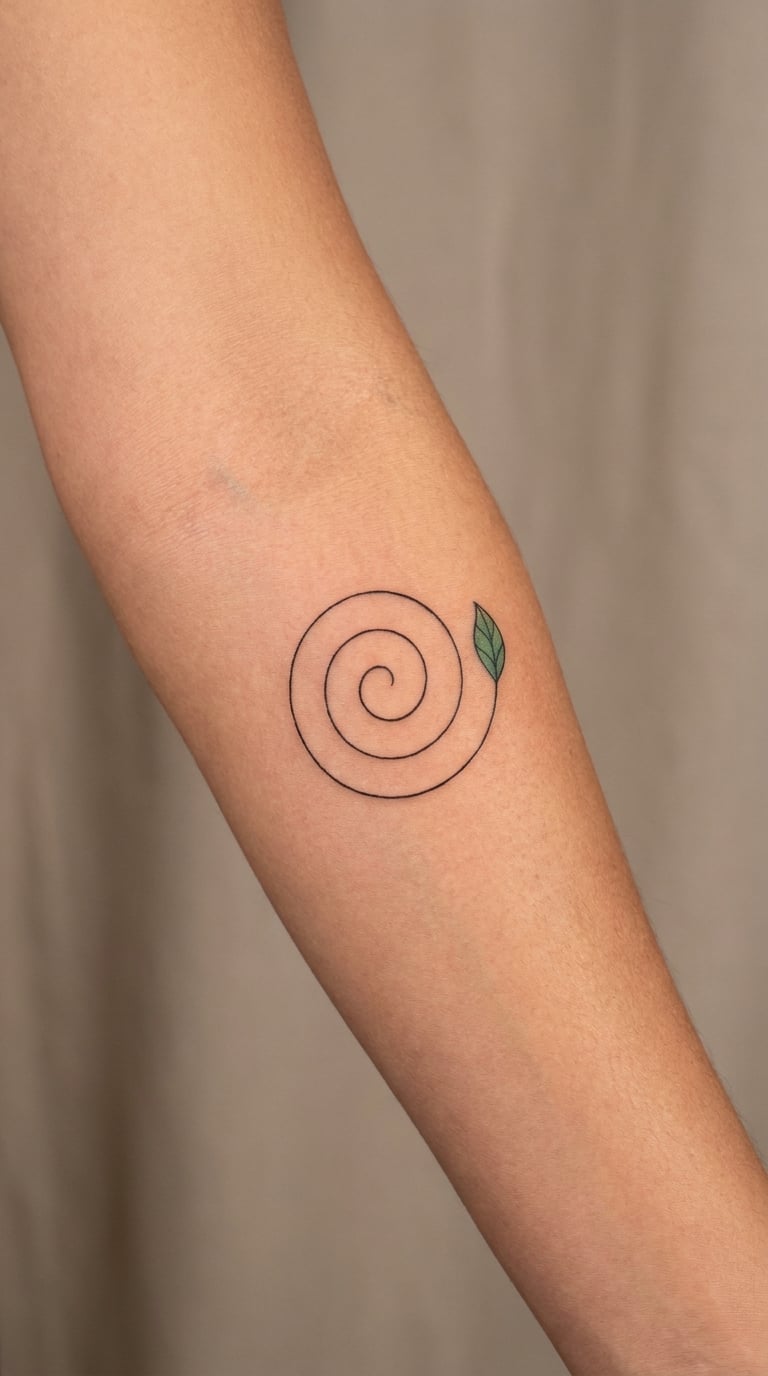
A single unbroken black line that turns in on itself two or three times, then travels outward to end in a small filled leaf. The unbroken line matters; it is why the design reads as continuity.
It frames growth as something continuous rather than a series of separate events, which is a quieter way to say it. Spiral forms are used across many cultures for the same reason, so the motif is very old and widely shared.
Placement: inner forearm, upper arm, or behind the ear. Size: 1.5-2.5 in (4-6 cm) across. Style: single-line minimalist.
Pain: low to medium, since the inner forearm moves a lot and slow passes sting. Ageing note: the inner coil is the part that closes up first, so ask the artist to space the turns a little wider than the sketch shows. Make it yours: set a birth or turning-point date beneath it in the same line weight.
18. Staircase Leading to a Star
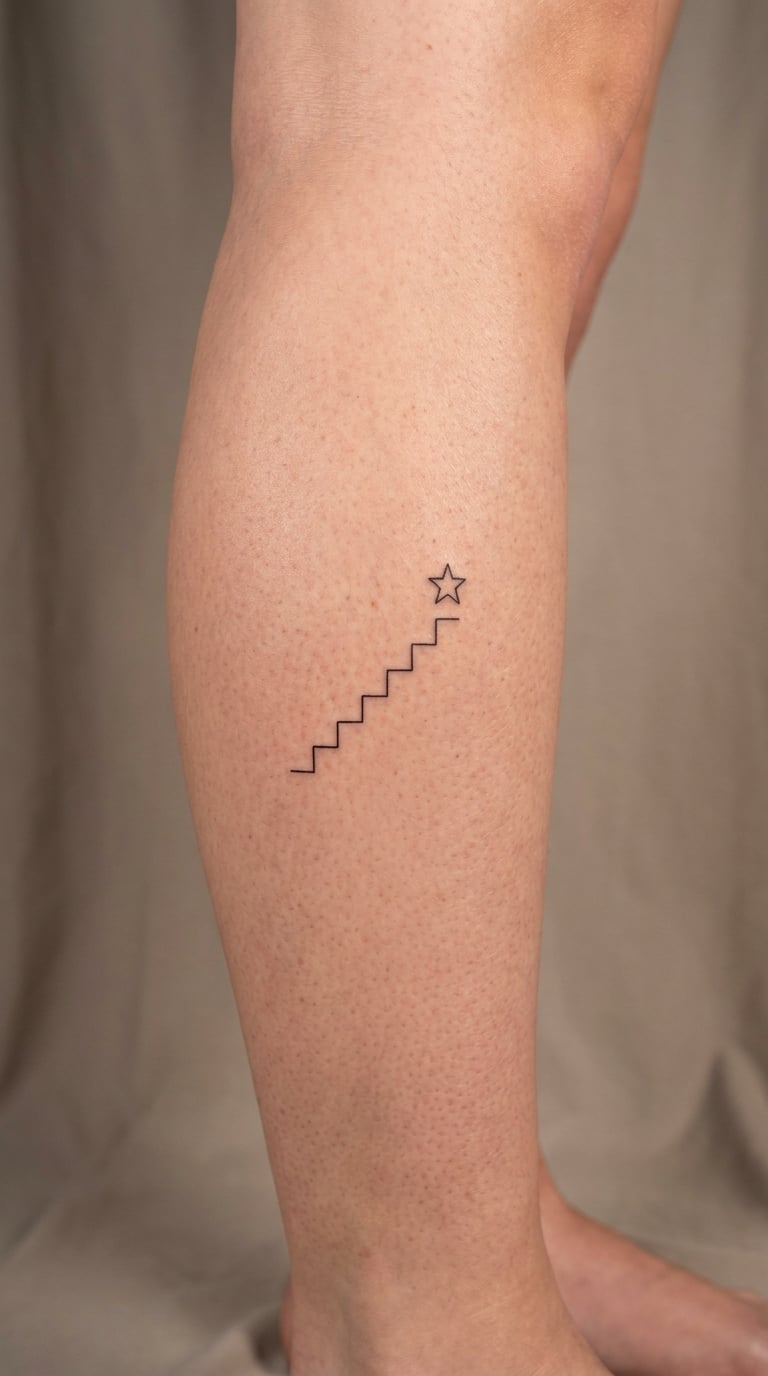
A zigzag of steps in profile, each one a small square corner, climbing diagonally until it meets a small five-point star outline at the top. Dotwork shading in the empty space under the steps is a common addition and gives the piece depth.
Effort toward something is the point, and the number of steps is the part you control. It reads well as a record of a specific grind: a qualification, a rehab, a save, a year of saving money.
Placement: calf, inner arm, or ribs, always oriented so the steps climb. Size: 4-5 in (10-13 cm) tall. Style: fine line with dotwork.
Pain: medium on the calf and ribs, low on the arm. Dotwork is many short passes, which tires you more than sharp pain. Ageing note: one-dot spacing will spread, so ask for a larger dot size. Make it yours: match the number of steps to something countable and leave the star empty.
19. Koi Swimming Upward
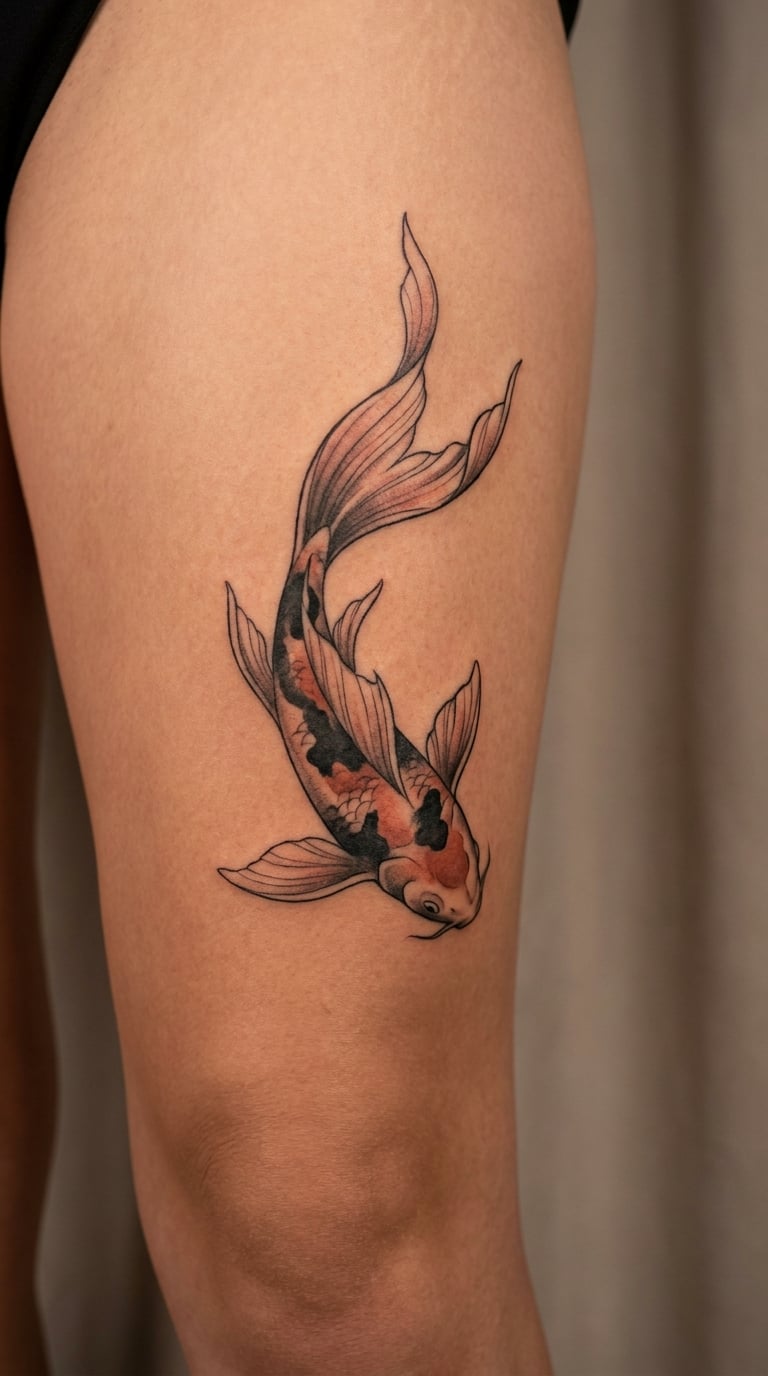
An upward koi is a curved fish body drawn along a gentle S, head pointing up and tail flowing down, fins built from a few separated strokes. Traditional versions fill scales in a repeating pattern; illustrative versions scatter a few patches of red and leave the rest as skin.
The koi is about perseverance, and the upward orientation is essential. Japanese legend holds that a koi which swims to the source of a river becomes a dragon, which is why the fish reads as effort that eventually changes what you are.
Placement: outer thigh, calf, or forearm, following the curve of the limb. Size: 4-6 in (10-15 cm) long. Style: illustrative or traditional with colour.
Pain: low on the thigh and calf. Ageing note: outlined scale patterns need touch-ups sooner than solid patch colour, so ask for more red and less pattern. Make it yours: add a wave line above the head and leave the tail unfinished at the edge.
20. Plant Roots and New Growth
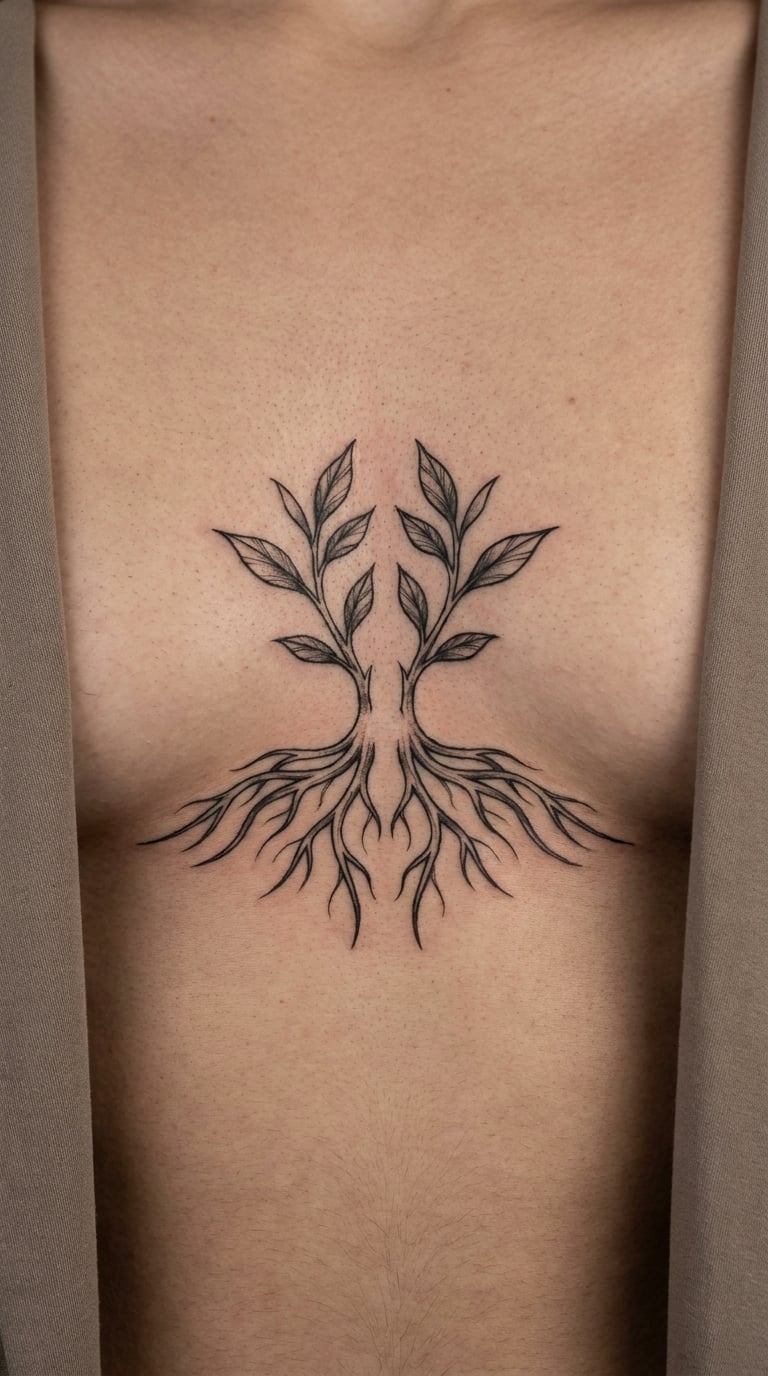
Split along a faint horizontal centre line: branching roots below it, two or three young shoots above, both in the same fine weight. The symmetry is the whole effect, so the artist usually draws the axis first and mirrors each side.
It is the most balanced growth symbol here because it shows foundations and new growth at once. People pick it when they want the tattoo to say they are grounded as well as moving forward, not just chasing the next thing.
Placement: centre chest, sternum, or centre back. Size: 4-5 in (10-13 cm) wide. Style: symmetrical fine-line botanical.
Pain: medium, since the sternum and chest are thin and sensitive. Ageing note: sun hits the chest unevenly through clothing, so mirrored halves diverge over time. Make it yours: make it a matching pair across both forearms, roots toward the elbow.
21. Crescent Moon With Growing Botanical Detail
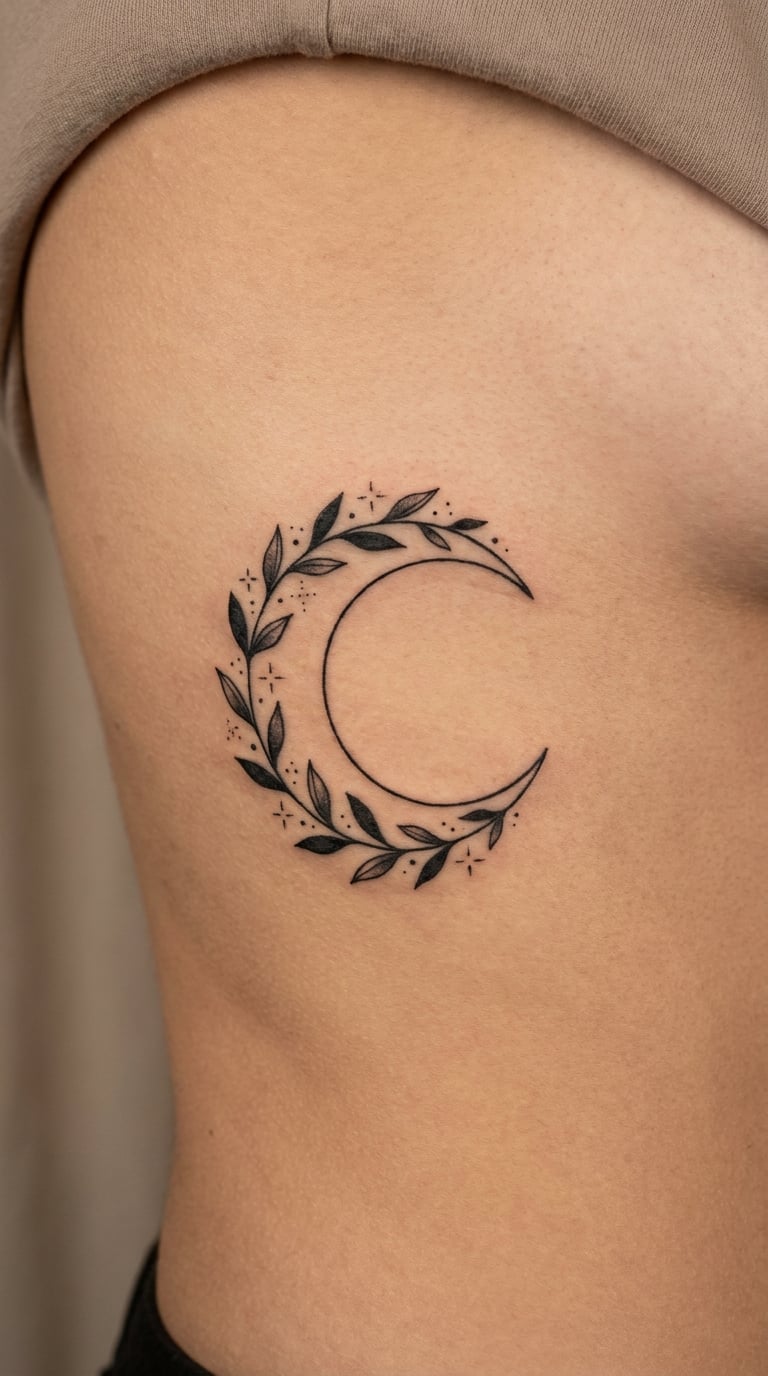
A solid black crescent with a handful of small leaves and dots arranged around the open side, balanced without a hard border. Some artists tuck a thin stem along the lower curve so the leaves look like they grow out of the moon.
Cycles and becoming is the established reading, and it works well for people whose growth has not been a straight line. It says there is a rhythm to it rather than a single upward push.
Placement: side of the ribcage, shoulder, or hip. Size: 3-4 in (8-10 cm) wide. Style: fine line with a black fill shape.
Pain: medium on the ribs, and breathing changes the whole session, so take breaks when you need them. Ageing note: the tiny leaves and dots are the fragile part, so keep them at least an eighth of an inch across. Make it yours: swap the generic leaves for your birth flower or a plant from where you live.
22. Phoenix Feather in a Vertical Micro-Realism Design
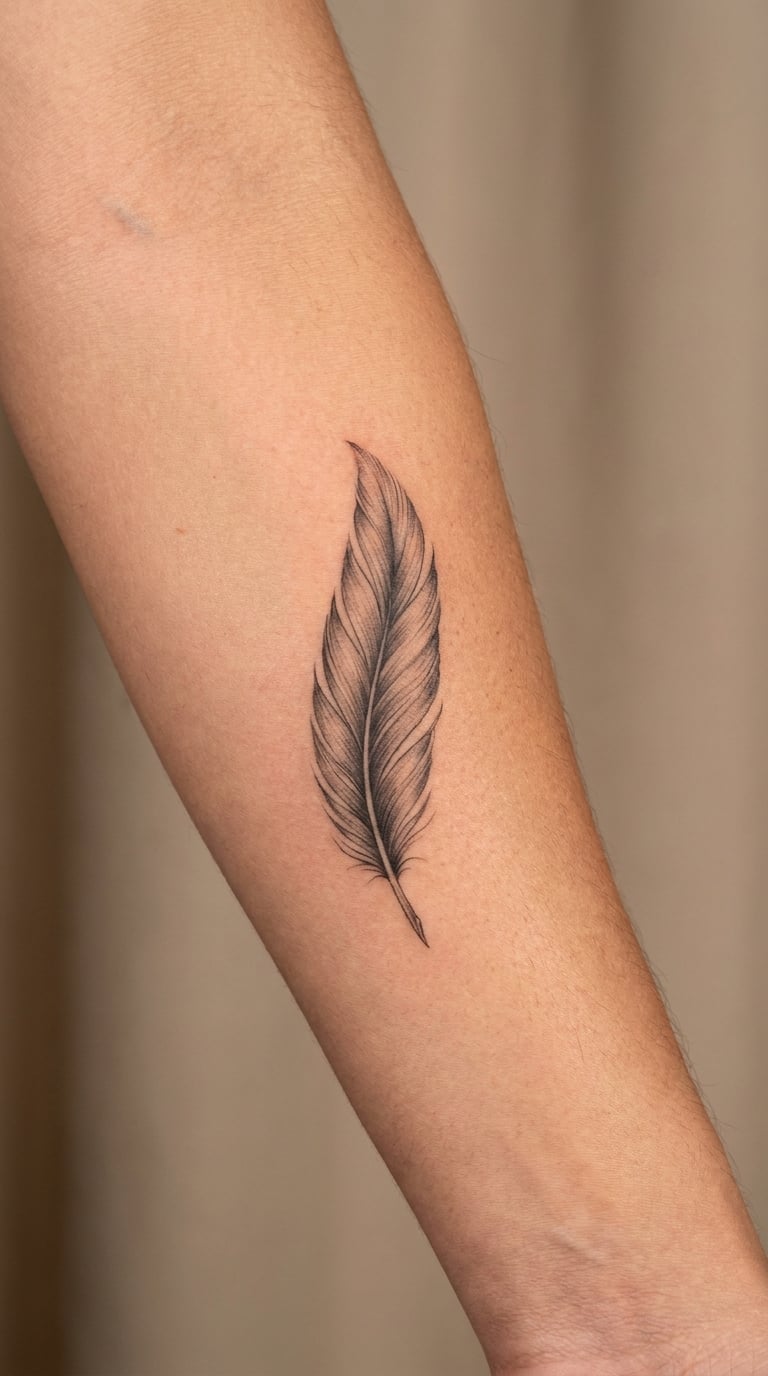
A single feather in micro-realism has a central shaft with barbs splitting away at a shallow angle, shaded in soft grey and separated into a few strands at the bottom. It is one object, not a bird, and much easier to wear than a full phoenix.
You keep the phoenix meaning of renewal and resilience without the size, which makes it a good middle ground for someone who loves the idea but is not ready for a shoulder-blade piece. It also fits into a sleeve later.
Placement: forearm, upper arm, or calf, oriented along the limb. Size: 3-4 in (8-10 cm) long. Style: micro-realism in black and grey.
Pain: low, and a feather takes about an hour. Ageing note: micro-realistic barb lines blur more than almost anything else in a decade, so ask for a heavier value range. Make it yours: wash one third of the feather in a single deep colour and leave the rest grey.
23. Hourglass With a Sprouting Flower
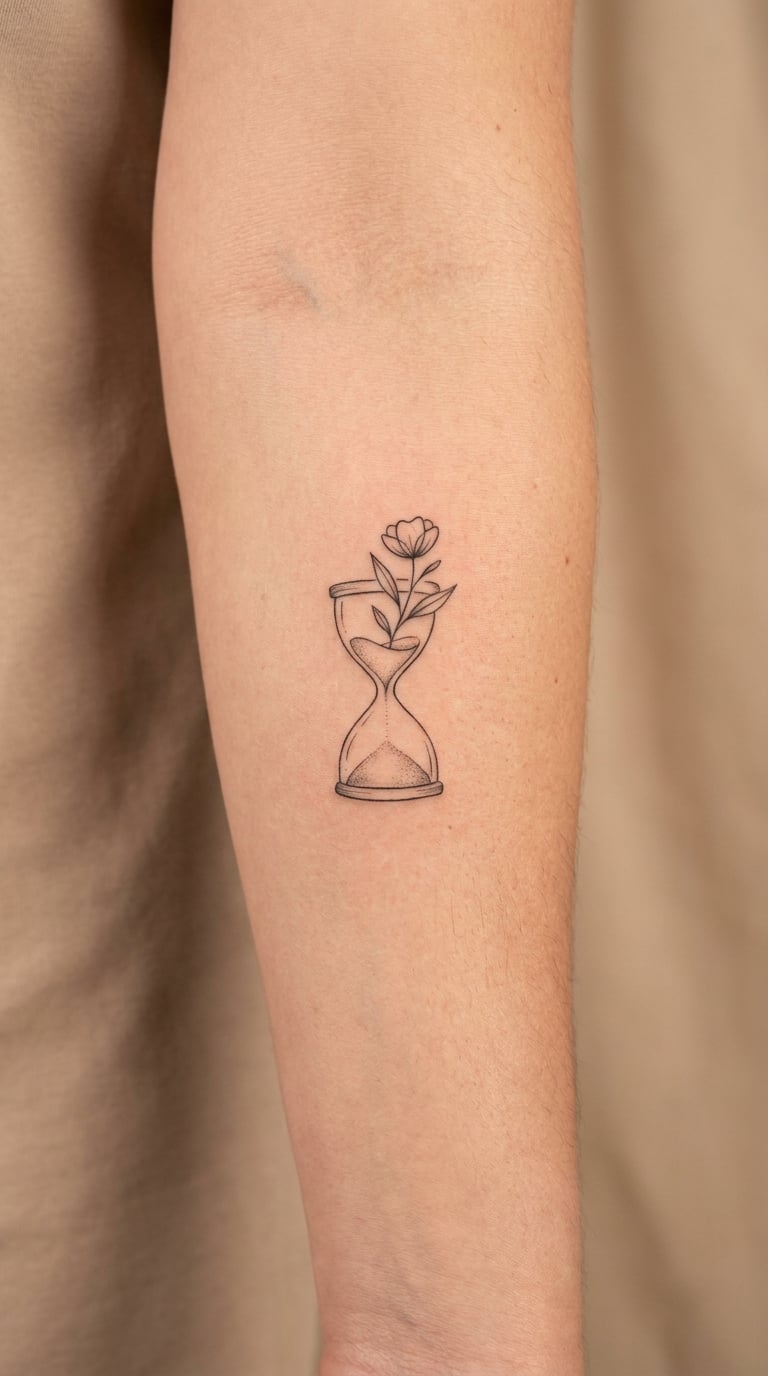
A fine-line hourglass frame, the sand replaced with a small stem that pushes up through the top and opens into a bloom with two leaves. The frame can be straight, curved, or decorated at the corners.
It is the most layered reading on this list: time passing and something coming out of it. People usually choose it to mark a deadline met, a season turned over, or a period they do not want to lose.
Placement: inner arm, forearm, or behind the ear. Size: 2.5-3.5 in (6-9 cm) tall. Style: fine line.
Pain: medium on the inner arm, where the needle works over bone. Ageing note: the frame lines should be heavier than the flower or the whole shape softens together. Make it yours: draw the sand as a row of tiny dots and set the marked date beneath it.
24. Three Stages of a Blooming Flower
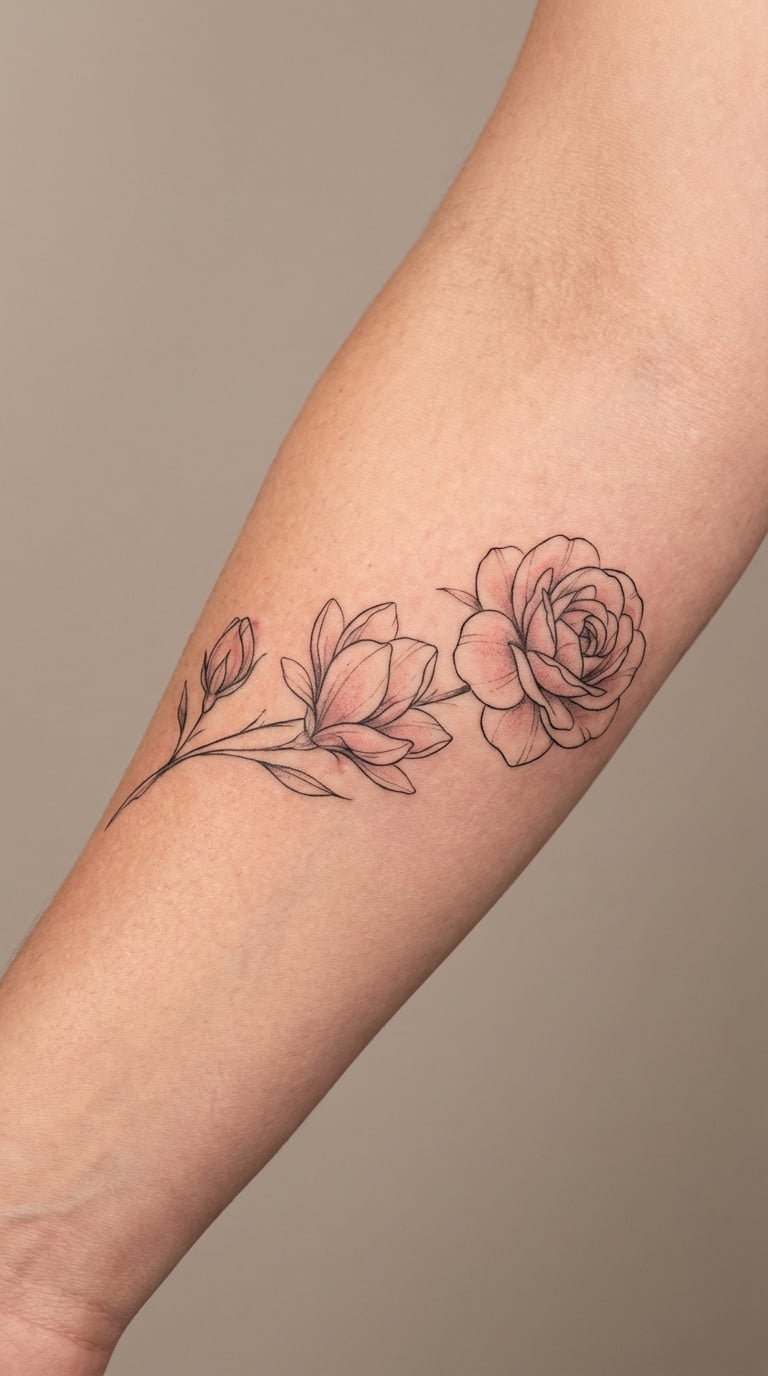
Three stages in one row is the clearest growth narrative a tattoo can hold: a tight closed bud on the left, a half-open bloom in the middle, a full flower on the right, all on one curved stem. A thin line runs underneath to hold the sequence together.
Development over time rather than a single moment, which makes it a strong choice for long-term progress. It also gives an artist a lot to work with, and the best version is drawn to fit a limb rather than copied from a rectangle.
Placement: forearm, calf, or side of the thigh, following the line of the limb. Size: 5-7 in (13-18 cm) wide. Style: botanical linework with a light wash.
Pain: low on arm and leg. It is a long design in area but not in sensitivity. Ageing note: the closed bud is the smallest element and blurs first, so outline it slightly heavier. Make it yours: use three stages of a plant that is yours, a coffee plant or your birth flower.
How to Choose the Right Design
Start with the style, because it decides how the design will look in five years more reliably than the symbol does. Fine line suits people who want something discreet and changeable, blackwork suits people who want the mark to stay legible, and watercolour suits people who accept a softer, quieter piece that will fade to a hint of colour over the years.
- Fine line and single line: clean and light, easiest to place almost anywhere, but the one to expect a touch-up on. Good first choice if you have never sat through a tattoo.
- Blackwork: solid fills hold their edges longest and read from a distance, so nothing about them becomes vague. Harder to cover later, so get the shape right.
- Botanical and illustrative: the most natural fit for growth imagery, since the subject is already plant and animal forms.
- Geometric and dotwork: clean and symmetrical, and a good way to make a common symbol like a butterfly feel like your own.
- Watercolour: the most forgiving about small imperfections in placement, because soft edges hide a lot.
Then think about how visible you want it to be. People who describe their tattoo as a daily reminder usually end up somewhere they can see it, like an inner forearm or wrist, while the same design on a rib or a shoulder blade stays private. You can read more about small-scale placement in our small hand tattoo guide, though hands fade fastest of all.
Size is the last decision and the easiest to get wrong. If you are adding to an existing collection, match the line weight and the scale of your first piece rather than jumping to something larger. If this is your only piece for now, err small. A two-inch design that still reads at ten years beats a six-inch one that has turned grey.
Cost and Session Time
Shop rates vary enormously by city and by artist, and most US shops set a minimum that covers the first hour. In that environment, a small fine-line piece usually lands somewhere around 100 to 250 dollars, a medium piece with colour or shading around 250 to 600, and a large design like the phoenix or the three-stage bloom runs 600 and up. Those are ranges, not quotes.
Session time follows detail rather than size. A two-inch sprout is often finished in under an hour. Watercolour on the blossom branch, grey wash on the phoenix, and dotwork on the staircase each add time because the needle keeps returning to the same areas, and none of them should be rushed.
What actually changes your bill is detail, colour count, and body placement. Hands, feet, ribs and the neck carry a premium almost everywhere. Ask for the total estimate for the whole design before you start, not just the hourly rate, and if the design will not fit one sitting, ask how the artist plans to split it.
Aftercare Basics
- Follow your artist’s aftercare instructions first. They know what they did and what your skin is doing, and their advice outranks anything general you have read, including this list.
- Wash it gently with clean lukewarm water and unscented soap, then pat dry with something you have not used on the rest of your face. Patting rather than rubbing matters more than people think.
- Keep it covered with a clean bandage or wrap for as long as you were told, usually a few hours. Sleeping on it with a fresh pillowcase beats letting it rub on fabric.
- Keep it out of water for the first couple of weeks. No swimming pools, no hot tubs, no baths where it sits submerged, and no saunas.
- Keep fresh direct sun off it, especially if you have colour in the design, and do not apply sunscreen over a tattoo that is still fresh without checking with your artist first.
- Let it settle. Do not pick flakes or scabs, and if it is itchy, keep washing it instead of scratching. It flaking and peeling is normal in the first two weeks.
Frequently Asked Questions
What symbol symbolizes growth the most?
There is no single best answer, but the sprout, the tree, the upward arrow and the phoenix come up most often. A sprout represents new beginnings and potential, a tree represents long steady development, an arrow represents direction and forward motion, and a phoenix represents renewal after something difficult. Pick the one that matches the change you actually want to remember, not the one that sounds most impressive.
What is a good first tattoo for someone who wants meaning?
A fine-line sprout or a spiral with a leaf is a good first tattoo because both are small, sit in a low-pain spot, and are quick to complete. A single-session design under about two inches also keeps the decision reversible, which matters if you are still figuring out what you want to wear for the next thirty years. Bring references, not a finished design, and let the artist adapt it to your placement.
Do fine line growth tattoos fade quickly?
Fine line work fades faster than blackwork, and it fades fastest on the inner wrist, hands, fingers and feet. Expect a touch-up at around the one-year mark, and more often than that on the hands. You can slow the process by keeping fresh tattoos out of strong sun and swimming water while they heal, and by moisturising daily once the skin is fully closed.
Should a growth tattoo be visible or hidden?
That depends entirely on what the growth was for. A visible placement, like the inner forearm or the wrist, works as a daily prompt you keep seeing. A hidden placement, like the ribs, the inner upper arm or the lower back, works if the meaning is private or if you change your mind about who sees it later. A fair number of people start visible and add a hidden piece years later.
Is it a bad idea to get a common growth symbol?
Not bad, just less personal by default. The butterfly, the lotus and the tree of life are drawn so often that the shape alone rarely says anything specific. The fix is usually personal detail: a date, a birth flower, a local plant, an unfinished element, or a style nobody else in your area works in. With that added, a common symbol can still be completely your own.
Conclusion
If this is your first tattoo, start with the fine-line sprout, the spiral with a leaf, or the single upward arrow. Each one is small, sits somewhere forgiving, and finishes in a sitting you will actually be happy to sit through. A first piece you are still pleased with a year later is worth more than a dramatic one you resent.
If you are building a collection, the phoenix, the three-stage bloom and the mirrored roots and new growth give you room to work at a bigger scale and to add to later. Our flower tattoo ideas for the hip cover the placement side of botanical work if you want to see how a design sits on a curve before you commit.
Either way, take the quick guide above, line up the placement and the size against your body and your style, and make sure the meaning is one you want to still be carrying in ten years. Then book the consultation and let the artist draw it to fit you.