
20 Best Forearm Sleeve Tattoo Ideas for Women (September 2026)
Forearm sleeve tattoo ideas for women fall into a handful of families: fine-line botanicals, blackwork florals, traditional colour, ornamental geometry, moths and butterflies, and soft watercolour. What separates a design that works on a forearm from one that looks great on a flat piece of paper is how it follows the bone from wrist to elbow, how much skin the artist leaves alone, and whether the detail stays readable at arm’s length.
The twenty below are ordered loosely from lightest to boldest, and each one comes with the placement, realistic size, style label, pain note and a way to make it your own. If you want meaning-first pieces rather than pure aesthetics, start with forearm tattoo ideas for women with meaning; if you already know you want delicate work, fine line tattoo ideas for women is the tighter filter.
Forearm Sleeve Tattoo Ideas for Women: Quick Guide
A forearm sleeve can be one continuous composition wrapping wrist to elbow, or a set of connected sections that read as one idea from a distance but were tattooed in separate sittings. Both work. The continuous version hides joins better and costs more up front; the staged version lets you stop at any point and look at how it sits before committing to the elbow.
| Idea | Style | Best placement | Size | Pain |
|---|---|---|---|---|
| 1. Fine-line botanical | Fine line | Outer forearm, wrist to mid-arm | 7-10 in (18-25 cm) | Low to medium |
| 2. Japanese maple branch | Irezumi-influenced | Outer forearm toward elbow | 9-12 in (23-30 cm) | Medium |
| 3. Blackwork rose vine | Blackwork | Wrap, inner to outer | 10-14 in (25-35 cm) | Medium to high |
| 4. Watercolour butterflies | Watercolour | Inner forearm | 8-11 in (20-28 cm) | Low |
| 5. Celestial moon and stars | Fine line and dotwork | Inner forearm | 6-9 in (15-23 cm) | Low to medium |
| 6. Traditional rose and dagger | Traditional | Outer forearm, elbow side | 9-12 in (23-30 cm) | Medium |
| 7. Minimalist geometric lines | Geometric | Top of forearm, wrap | 8-12 in (20-30 cm) | Low |
| 8. Peony and sparrow | Illustrative colour | Outer forearm | 9-13 in (23-33 cm) | Medium |
| 9. Ornamental mandala | Ornamental blackwork | Elbow to wrist wrap | 10-14 in (25-35 cm) | Medium to high |
| 10. Gothic moth and wildflower | Realism and blackwork | Inner forearm | 8-11 in (20-28 cm) | Medium to high |
| 11. Art Nouveau lilies | Art Nouveau | Inner forearm | 8-11 in (20-28 cm) | Low to medium |
| 12. Black-and-grey rose bouquet | Black and grey realism | Outer forearm, elbow to wrist | 10-14 in (25-35 cm) | Medium to high |
| 13. Fern and mountain | Illustrative nature | Wrap around the arm | 10-14 in (25-35 cm) | Medium |
| 14. Serpent and blossom | Neo-traditional | Outer forearm | 10-14 in (25-35 cm) | Medium |
| 15. Floral brace and vine | Floral, bracelet format | Wrist or mid-forearm band | 3-7 in (8-18 cm) | Low to medium |
| 16. Dotwork hummingbirds | Dotwork | Inner forearm | 7-10 in (18-25 cm) | Low to medium |
| 17. Abstract botanical blackwork | Blackwork | Outer forearm | 10-14 in (25-35 cm) | Medium to high |
| 18. Butterfly and vine gradient | Fine line and blackwork | Wrist to elbow, full forearm | 12-16 in (30-40 cm) | Medium |
| 19. Traditional cloud and rain | Traditional | Top and outer forearm | 9-13 in (23-33 cm) | Low to medium |
| 20. Floral bouquet and ribbon | Soft realism | Outer forearm | 9-13 in (23-33 cm) | Medium |
Read that table twice. The sizes are the vertical span of the design along the arm, not the circumference, and they assume an average adult forearm of roughly 9 to 11 inches from inner wrist crease to elbow.
1. Fine-Line Botanical Forearm Sleeve
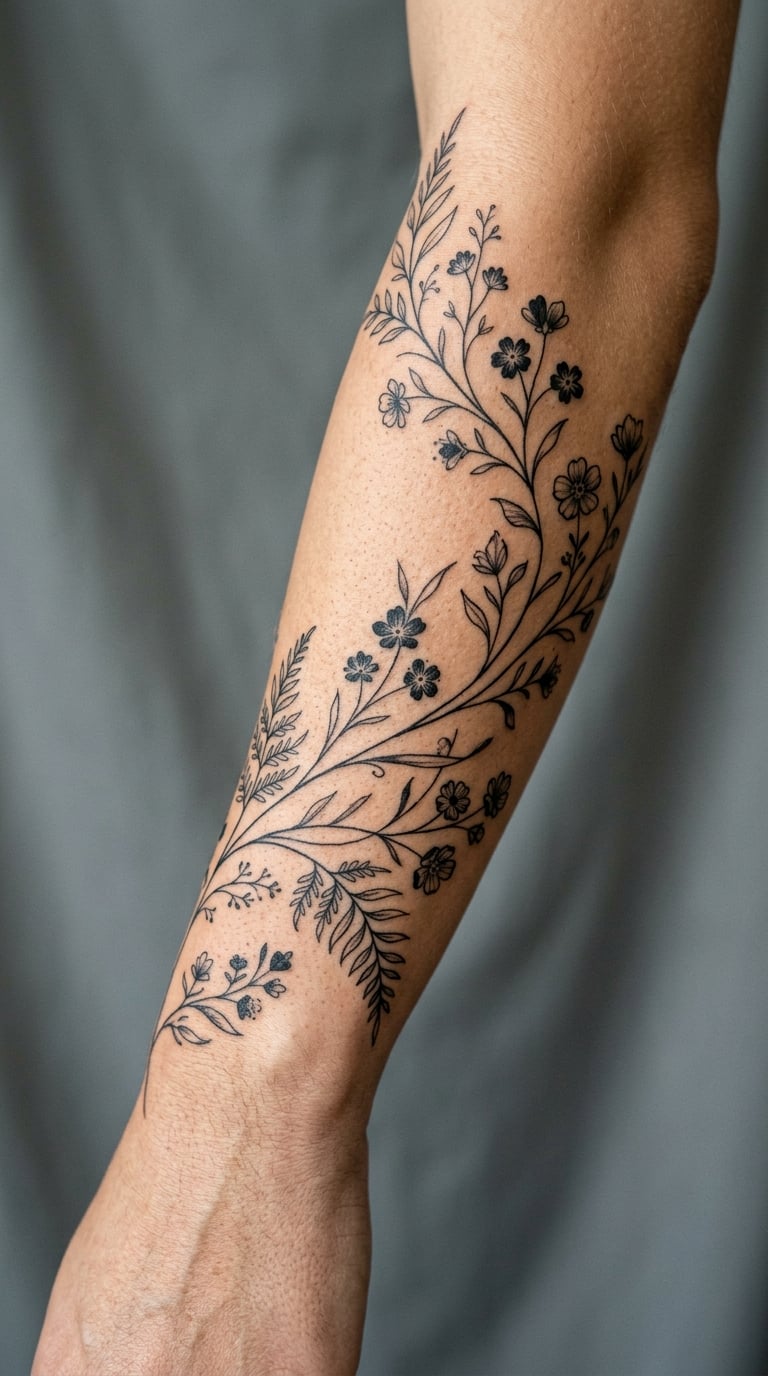
A fine-line botanical sleeve is built from single-needle stems that curve with the arm, small leaves at alternating intervals, and occasional blossoms no bigger than a fingertip. The whole thing is black ink, no shading, no colour. What makes it read as a sleeve rather than a scatter of small tattoos is the uninterrupted line running the length of the forearm.
People pick it because it looks like a piece of illustration that happens to be on skin, and because fine line keeps the commitment visually light even when the coverage is large. It suits anyone who wants volume without heaviness.
Placement: outer forearm from the wrist to mid-arm, or wrapped so the line continues onto the inner wrist. Size: 7-10 in (18-25 cm). Style: fine line. Pain: low to medium, and the shallow needle depth means less post-session soreness. Fine line fades faster than filled colour, so expect a refresh every few years, especially on the sun-exposed outer arm.
Make it yours: use botanicals that mean something where you grew up, or have the artist draw one specific stem at a slightly heavier weight than the rest so the eye has an anchor.
2. Japanese Maple Branch Sleeve
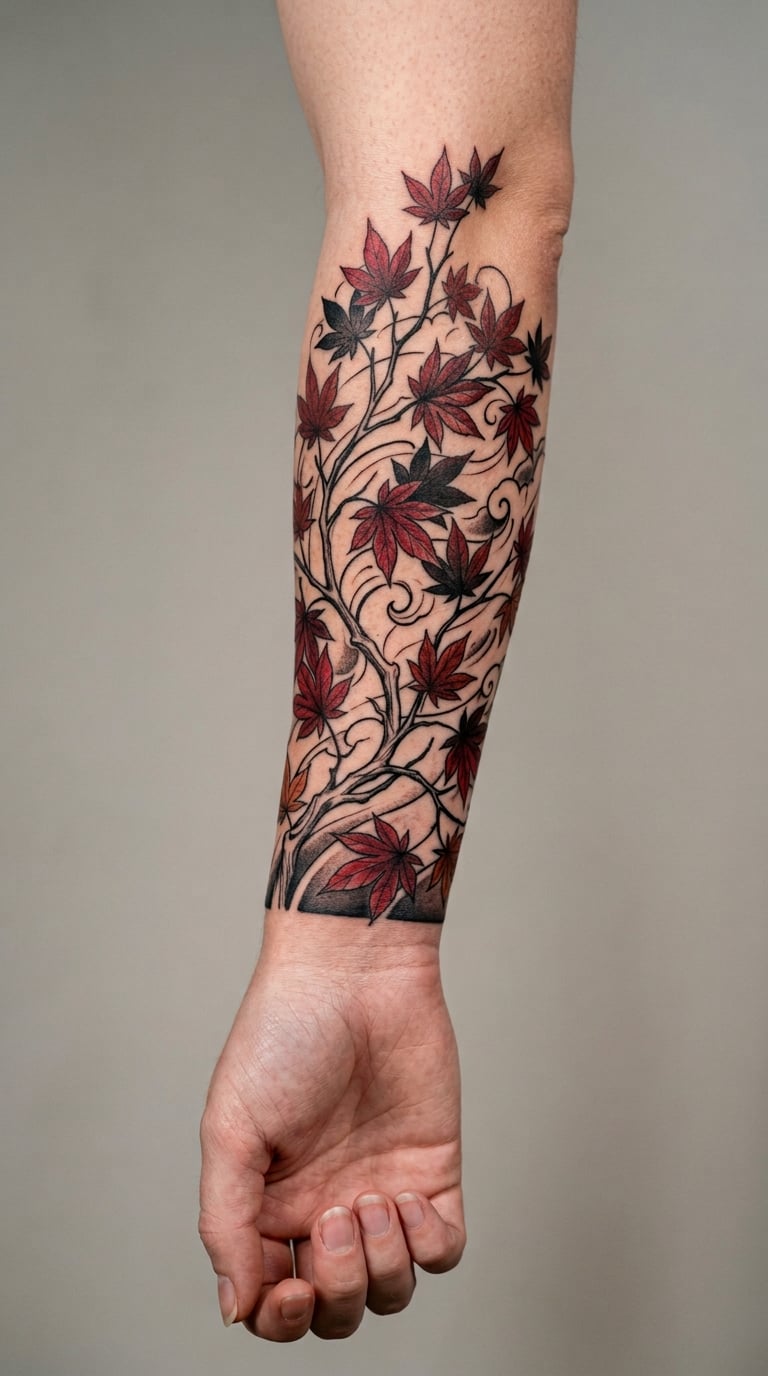
A maple branch sleeve uses slender tapering branches as the spine of the composition, with leaves clustered at the joints and a lot of skin left bare between them. Deep red with a black outline is the most requested version, but plenty of artists keep it in black and a single rust tone. The negative space does as much work as the leaves.
The seasonal read is obvious, which is part of the appeal, and a bare branch suits people who want a sleeve that feels calm rather than loud. It also travels well: if you later add an upper arm piece, the branch can continue up the arm.
Placement: outer forearm, running toward the elbow, with the thickest part of the branch nearest the elbow. Size: 9-12 in (23-30 cm). Style: irezumi-influenced illustrative. Pain: medium, more on the elbow-side inner arm where skin is thinner. Red pigment on the outer forearm will soften in sun faster than black line.
Make it yours: add a single falling leaf in saturated red near the wrist, or have the artist sign the branch in small script near the elbow crease.
3. Blackwork Rose Vine Sleeve
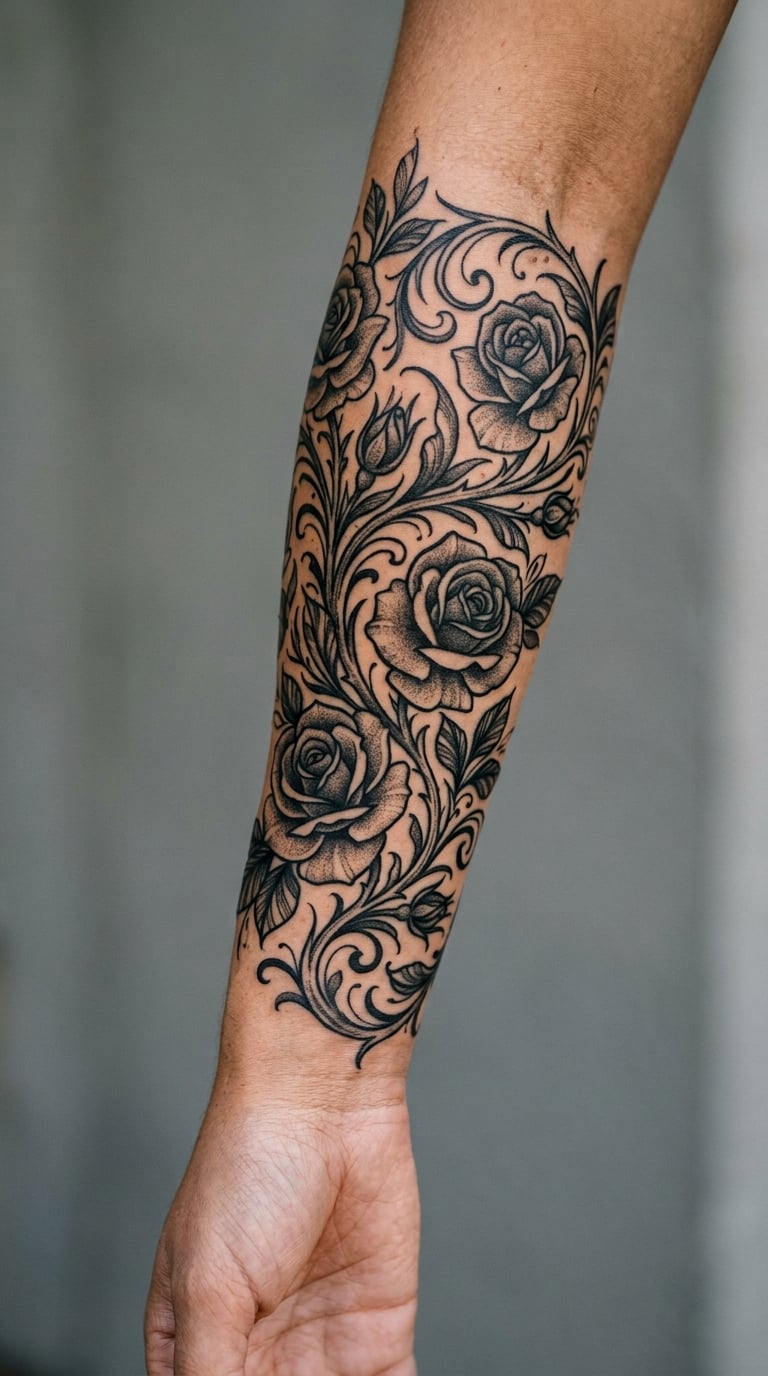
Blackwork rose vines are the boldest of the floral group: fully shaded roses in dense black, sharp-edged leaves, and stems that thicken as they travel so the composition has weight at the elbow and tapers toward the wrist. Most artists place three to five roses with vine running between them, wrapping so the design continues around the arm rather than sitting on one flat plane.
It gets chosen for the way it photographs in black and white and for how well the dark mass hides a busy background. If you want a sleeve that reads as a single object from across a room, this is the one.
Placement: wrap from inner forearm around the outer, elbow to wrist. Size: 10-14 in (25-35 cm). Style: blackwork. Pain: medium to high, because solid black means more passes over the same skin. Bony forearms and the crease at the wrist sting more than the fleshy middle section.
Make it yours: leave one rose uninked in the pattern so the skin itself forms the flower, or have a hidden initial tucked into the darkest vine.
4. Watercolour Butterfly Migration Sleeve
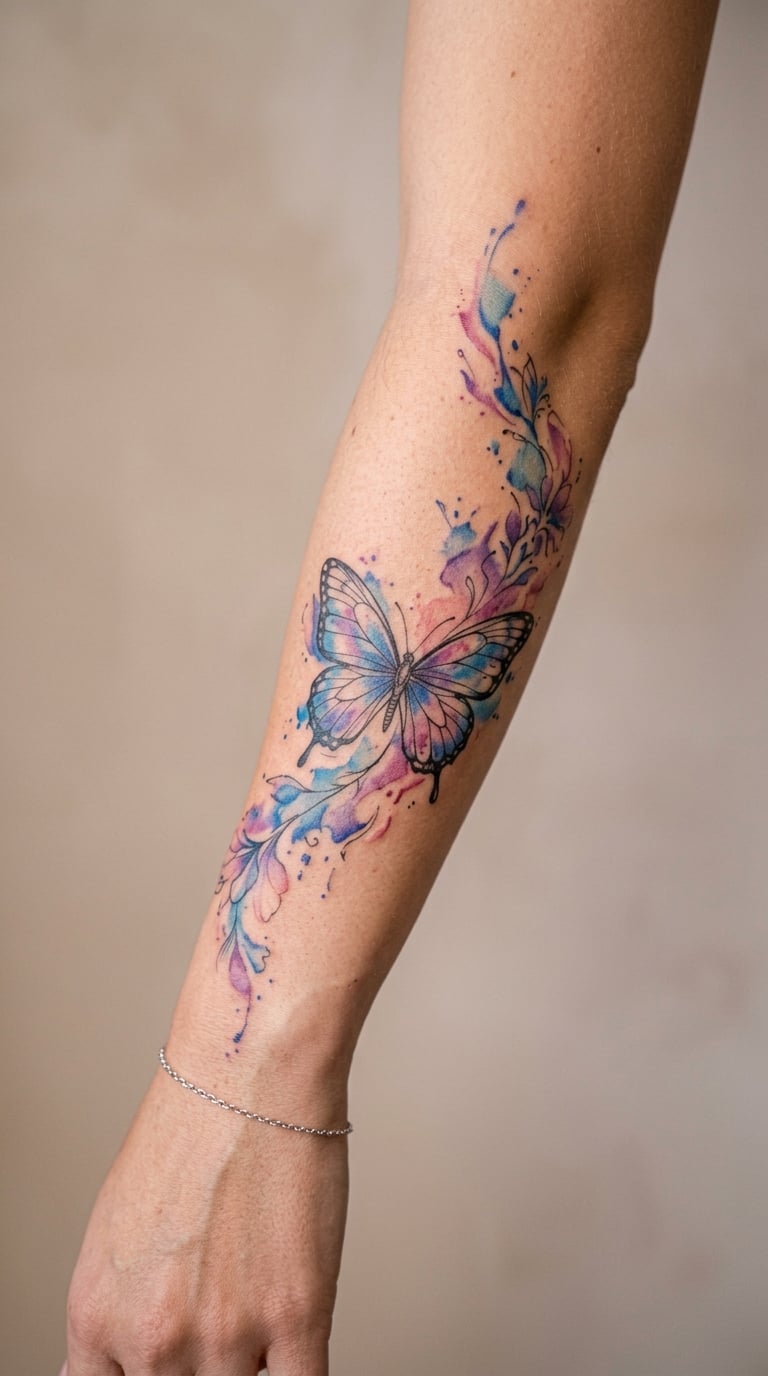
Butterflies at three or four different sizes, with loose washes of blue, violet and blush bleeding out behind them and a few hard black outlines to anchor the wings. Because the colour is soft and unfinished at the edges, the arm still shows plenty of skin and the piece never looks crowded. This is the one that photographs best in daylight.
Butterfly sleeves are chosen for the transformation idea, or simply because the movement suits a curved surface. It is a forgiving style for a first large piece since a small smudge or uneven wash is much less noticeable than a missed line.
Placement: inner forearm, where the skin is flat and the wrist shows the design when your hand rests on a table. Size: 8-11 in (20-28 cm). Style: watercolour with fine outline. Pain: low, since shading passes are light. Pale washes on the inner forearm stay cooler than they would outdoors, but yellows fade first wherever they sit.
Make it yours: give the artist a colour you actually wear and ask them to build the whole wash palette from it, or add one realistic monarch among the loose ones.
5. Celestial Moon and Star Sleeve
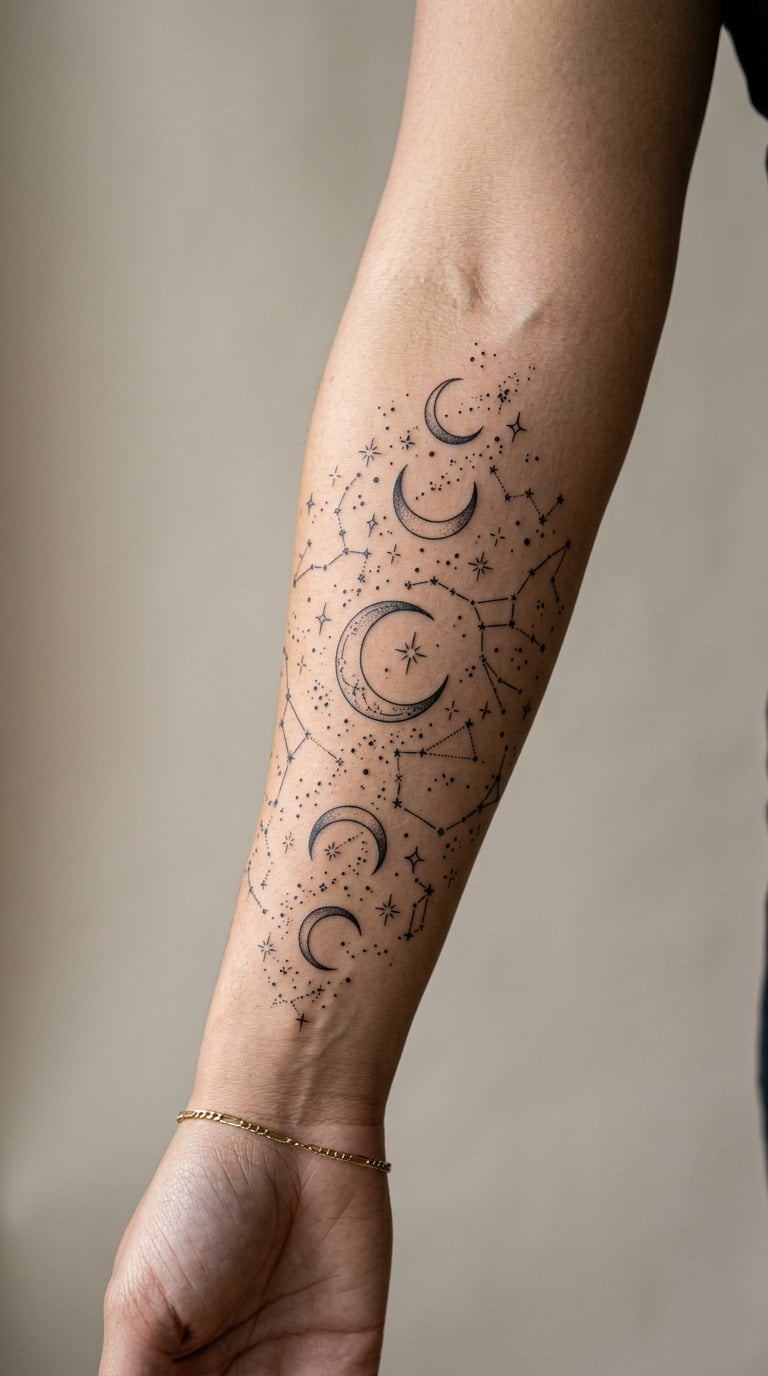
A celestial sleeve sets crescents and small stars at uneven intervals across the inner forearm, with a few constellations drawn as fine connecting lines and open space doing the rest. Some designs add dotwork clusters for texture; others keep it to single-needle stars only. The result is quiet from a distance and detailed up close.
It is a common choice for a memorial or a period of change, and the crescent motif in particular tends to be picked for cycles and timing rather than decoration alone. It also layers easily under a watch strap or bracelet.
Placement: inner forearm, wrist to just below the elbow. Size: 6-9 in (15-23 cm). Style: fine line and dotwork. Pain: low to medium. This is the design where detail scale matters most: stars smaller than about 1/16 inch blur noticeably within five years, so ask for slightly larger marks than the reference photo shows.
Make it yours: plot the birth dates of people you care about as small constellation groups, or have the artist place one star in gold ink at the exact spot for the date.
6. Traditional Rose and Dagger Sleeve
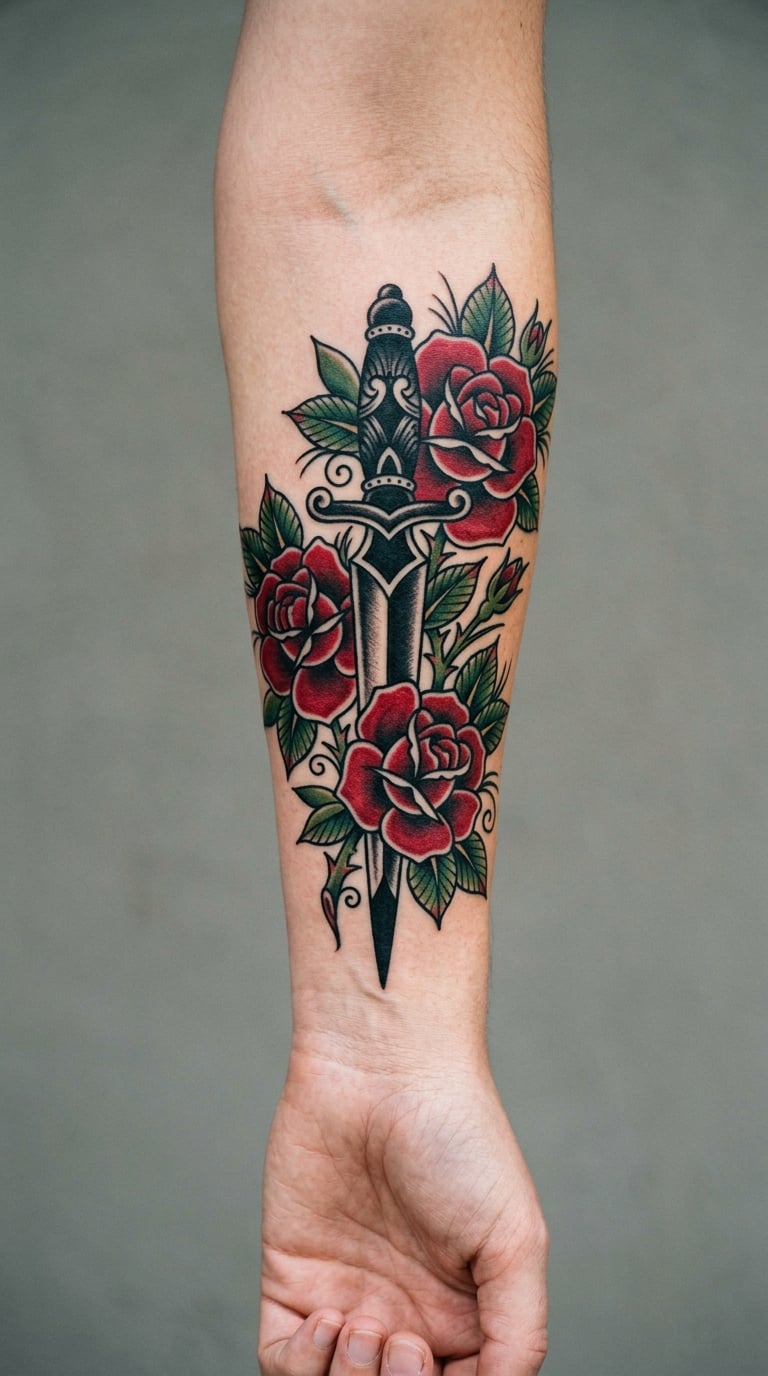
Traditional rose and dagger work is built on heavy black outlines with flat, saturated fills: red roses, green leaves with white highlights left in, and a dagger in black and grey with a wrapped handle. The palette stays narrow on purpose, three or four colours, which is what makes it readable from a distance and forgiving of a slightly uneven arm shape.
It is chosen when someone wants a classic look that still feels strong rather than retro. The bold outline carries well, and because the fills are flat, small areas of skin between elements stay clean.
Placement: outer forearm with the dagger angled across the elbow side, point down toward the wrist. Size: 9-12 in (23-30 cm). Style: traditional. Pain: medium, and the elbow-side inner forearm is the tender stretch. Red on the outer arm needs sun protection from day one or it goes noticeably pinker and lighter than the black.
Make it yours: swap the dagger for a key, a compass or a small anchor and keep the same bold outline weight, or add a banner of script under the roses.
7. Minimalist Geometric Line Sleeve
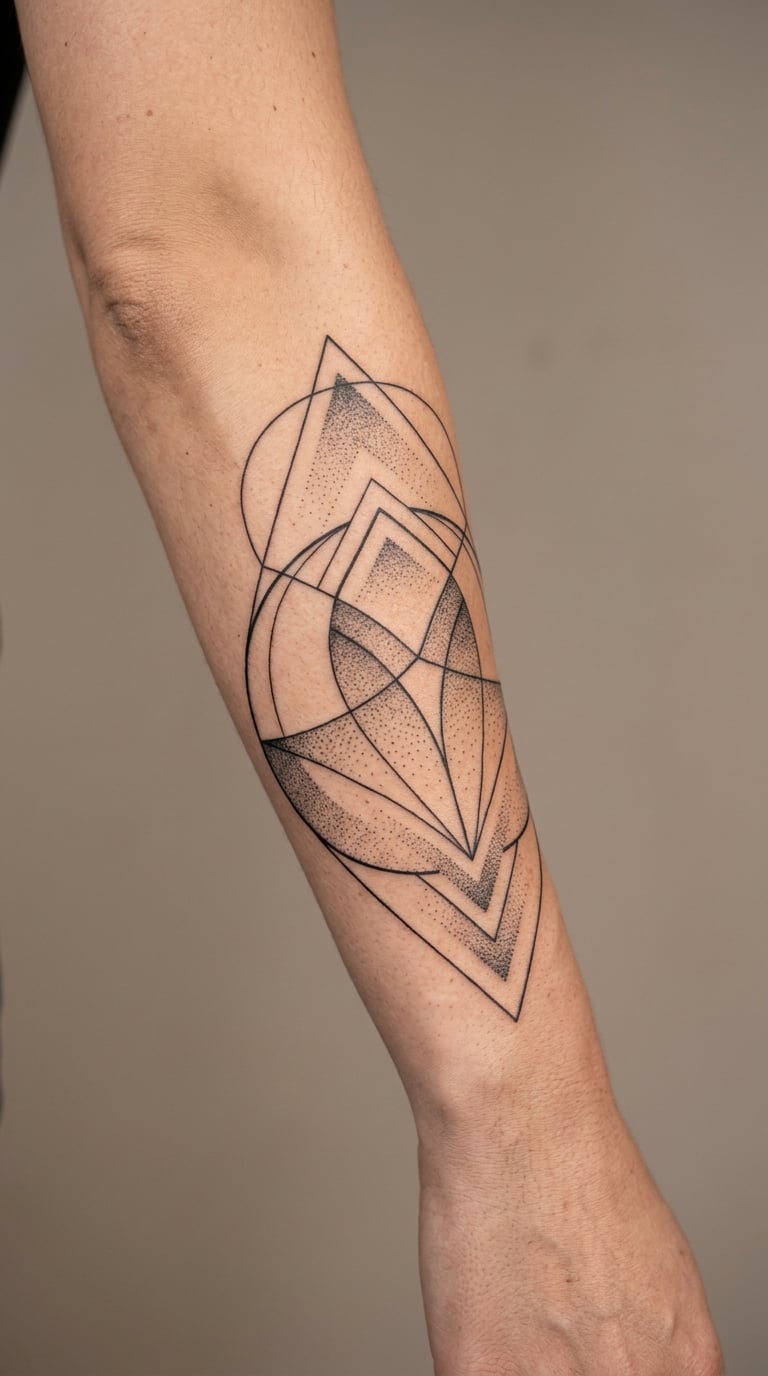
Geometric line sleeves use arcs, half circles, single hairlines and dot grids that follow the taper of the forearm without depicting anything. Some designs read as a set of bands that narrow toward the wrist, others as one continuous line that loops and crosses itself. Nothing is filled, so the piece stays light even at full length.
This suits people who like structure and symmetry but not identifiable imagery, and it works well on slimmer forearms where a dense design would overwhelm the shape. It is also the easiest sleeve style to extend later, because a new segment can simply continue the line.
Placement: top and outer forearm, wrapping toward the inner side. Size: 8-12 in (20-30 cm). Style: geometric, fine line. Pain: low, the lightest application time of any bold-looking option here. Hairline work is the first thing to blur, so keep line weight even and avoid putting the thinnest marks across the wrist crease.
Make it yours: have the line path follow a real contour, such as a coastline or a river route, while keeping the geometry of the shapes intact.
8. Peony and Sparrow Sleeve
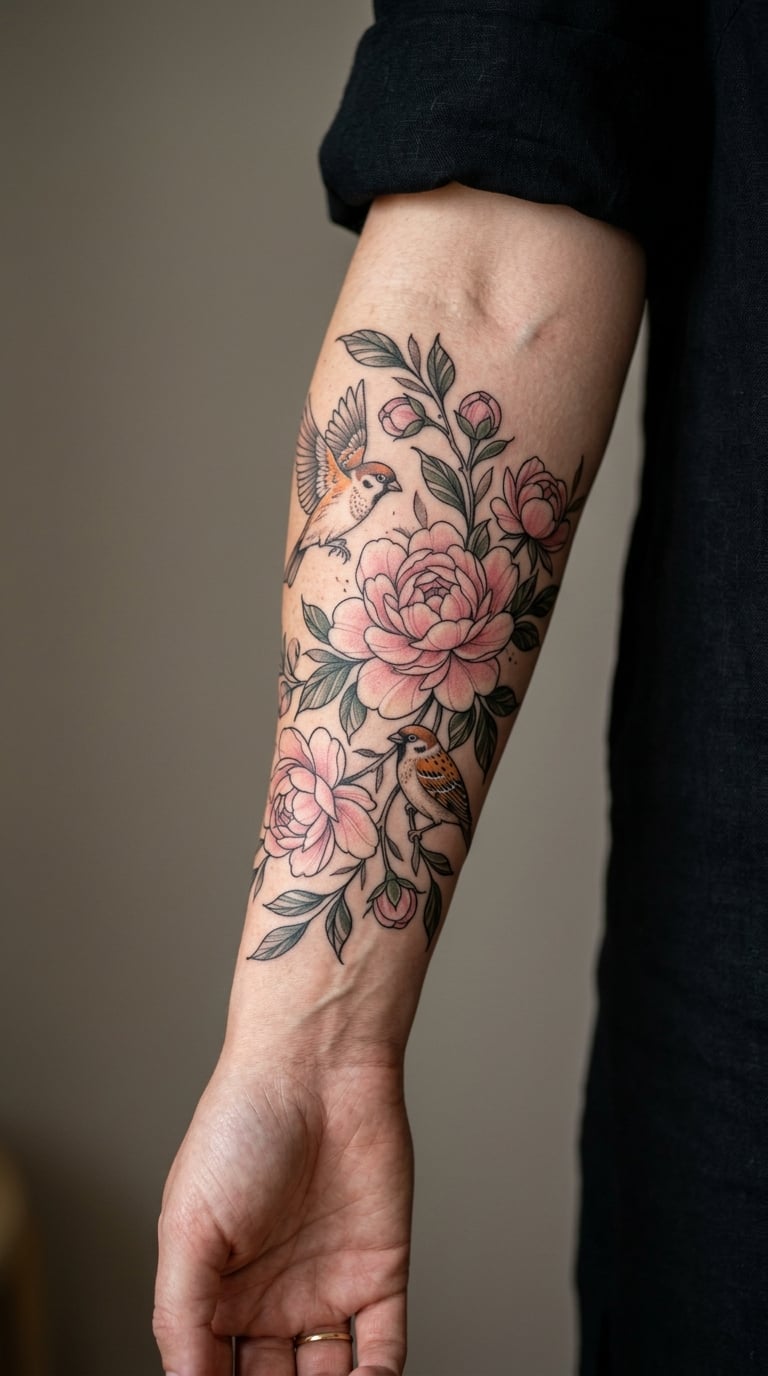
Soft pink peonies in loose layers, green leaves underneath, and two or three sparrows perched or mid-flight between the blooms. The birds are small and lightly detailed, so they read as movement rather than as portraits. Spacing is the whole trick here: peonies grouped in two or three clusters, with air around each, look intentional rather than busy.
It gets chosen for a look that is floral without being a garden sleeve, and the sparrows add a sense of movement that pure florals sometimes miss. It pairs easily with a small wrist piece in the same greens.
Placement: outer forearm, largest peony near the elbow. Size: 9-13 in (23-33 cm). Style: illustrative colour. Pain: medium; the birds take concentrated passes in small areas. Pastel pinks show every sun exposure, so a colour sleeve on the outer arm is a sunscreen commitment rather than a one-time decision.
Make it yours: ask for one bird mid-flight rather than perched, or have a real bird from your garden sketched in with your description of the markings.
9. Ornamental Mandala Sleeve
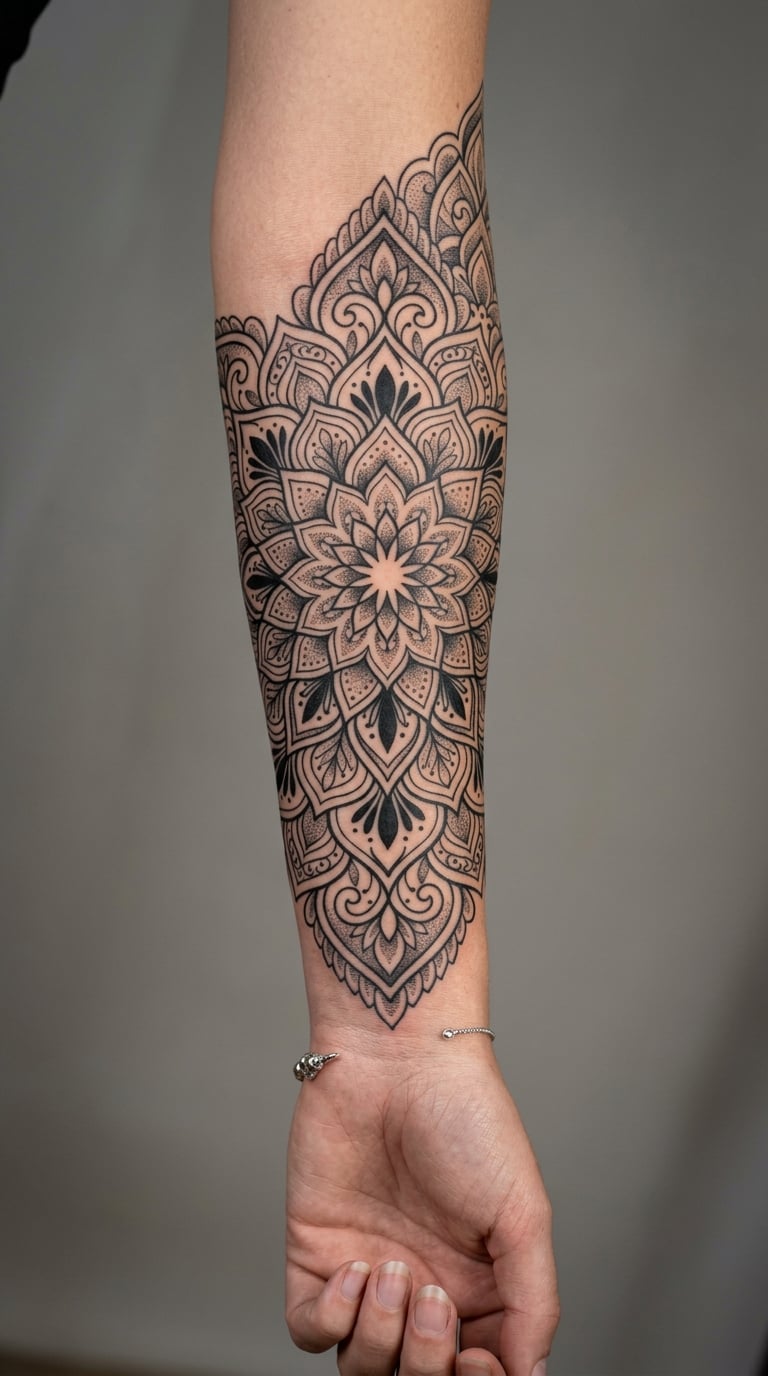
An ornamental mandala sleeve takes the circular mandala form and stretches it lengthwise: petals become long teardrops, the outer border becomes repeating scallops, and curved filigree fills the gaps. Two or three mandala centres are usually spaced along the forearm, connected by a repeating border, so the eye travels from wrist to elbow.
It is chosen for how symmetrical and complete the arm looks when the design is finished, and it suits readers who like ornament and pattern more than illustration. Because the pattern is regular, it flattens a very bony forearm particularly well.
Placement: elbow to wrist, wrapping, with the largest centre on the outer arm. Size: 10-14 in (25-35 cm). Style: ornamental blackwork. Pain: medium to high. Fine interior linework in the filigree is the part that softens first, so ask the artist to keep interior lines at a similar weight to the border.
Make it yours: have one petal left as an outline only, or build a second band of smaller mandalas that circles the elbow to hide the joint.
10. Gothic Moth and Wildflower Sleeve
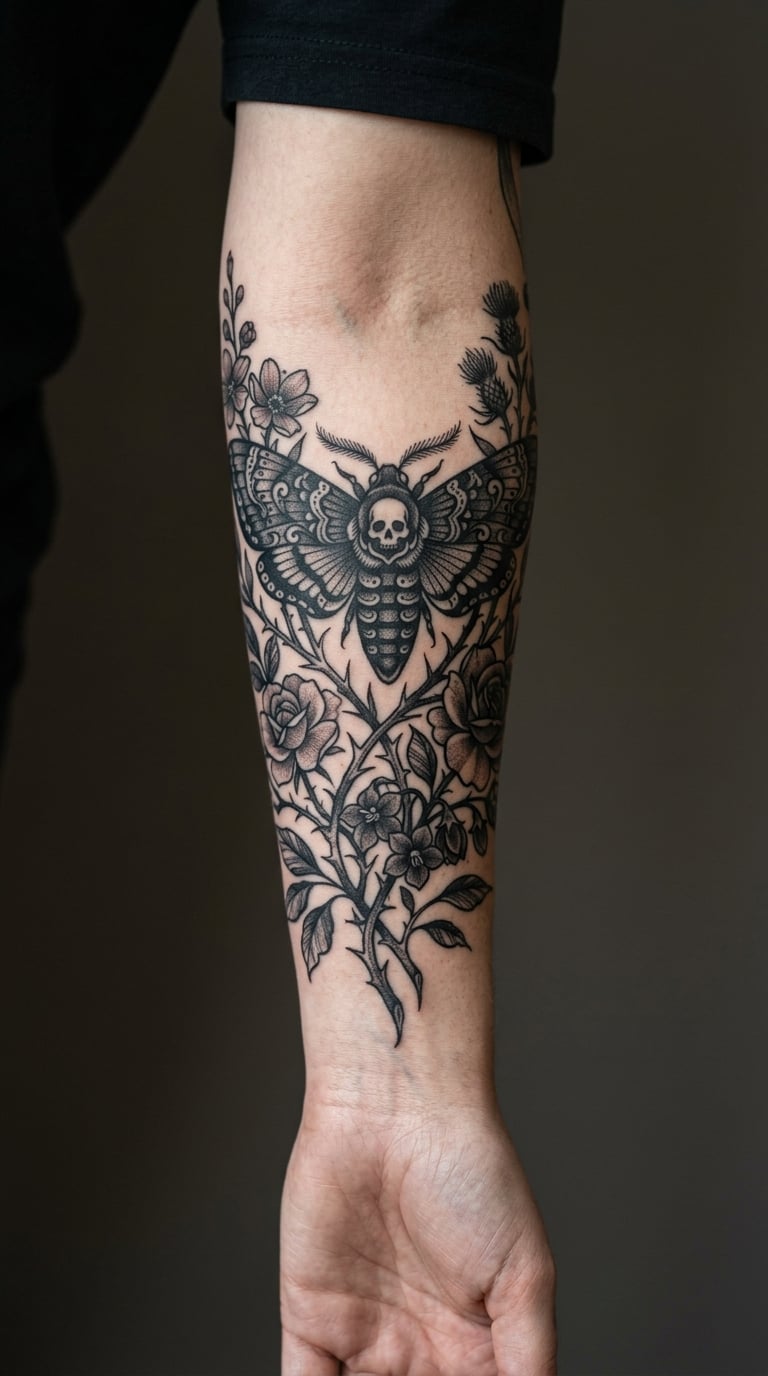
A large moth with veined wings and two thin antennae sits near the elbow, with thorny stems, seed heads and muted flowers in dusty rose, sage and grey trailing toward the wrist. The palette is desaturated on purpose so the moth’s dark wings read as the focal point. A few pieces of negative space around the wings keep it from turning into a solid mass.
Moths get chosen for the night-togetherness and the idea of being drawn to something dimly lit, which is a different read from the brightness of a butterfly. It suits a moody aesthetic and looks striking in sleeves with long cuffs.
Placement: inner forearm, moth on the elbow side so the wings follow the arm’s width. Size: 8-11 in (20-28 cm). Style: realism blended into blackwork. Pain: medium to high, with the wing shading taking repeated passes. The inner forearm has prominent veins and tendons; a good artist stretches the skin there, otherwise fine wing detail breaks up.
Make it yours: pick a moth species that lives near your childhood home, or add your birth flower in the trailing stems at the wrist.
11. Art Nouveau Lily Sleeve
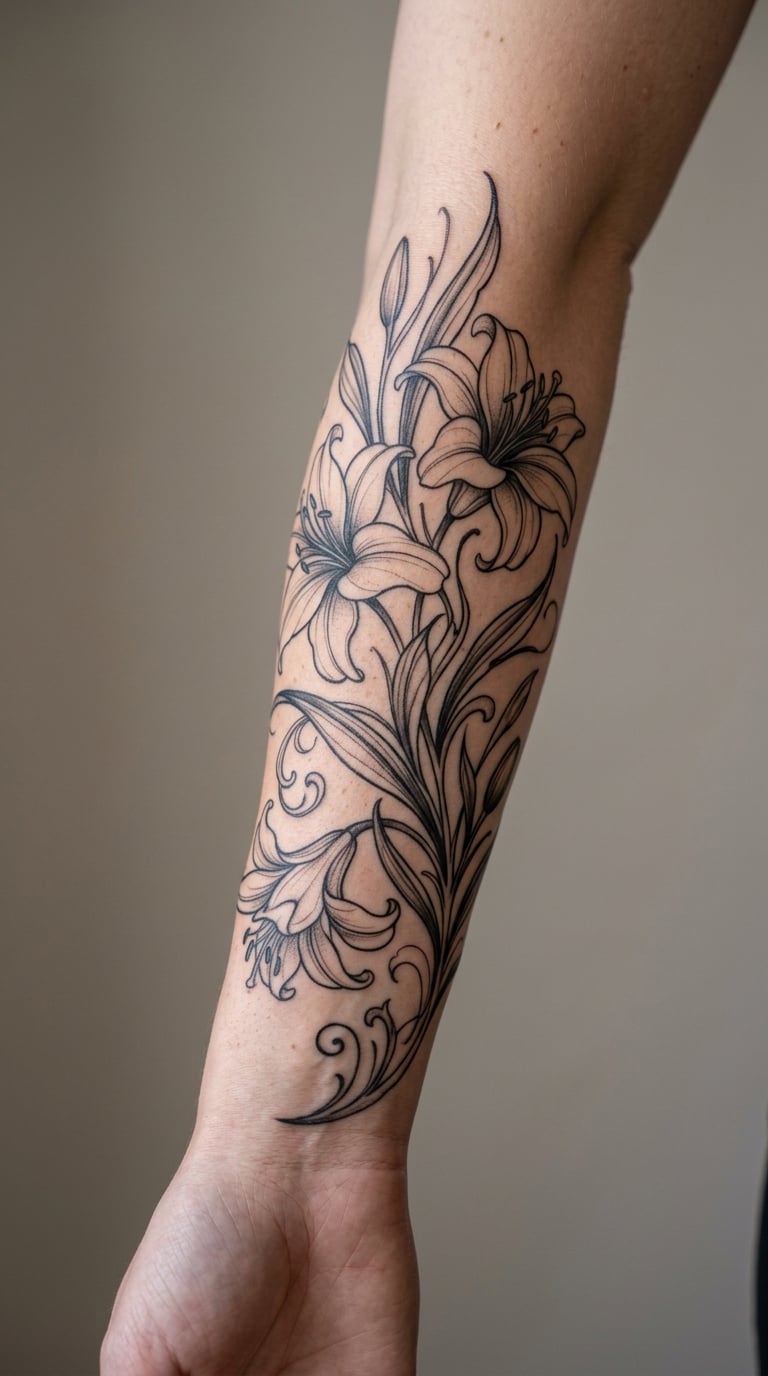
Lilies with long tapering leaves, drawn in the Art Nouveau manner: one confident outer contour, a few interior lines for the petal folds, and curved stems that sweep across the forearm. Some artists add a thin border line that runs the length of the design, which frames the arm nicely. Colour is optional; black and a pale wash works as well as full saturation.
It gives you a floral sleeve with a decorative structure behind it, so it reads as designed rather than as a collection of flowers. The long leaves are flattering on a narrow forearm because they lengthen the line of the arm.
Placement: inner forearm, stems running wrist to elbow. Size: 8-11 in (20-28 cm). Style: Art Nouveau illustrative. Pain: low to medium. The border line is a single-needle pass and adds very little time. Interior petal lines under about 1/16 inch will soften, so the artist should build the folds from a few confident lines instead of many tiny ones.
Make it yours: run the border line into a small word or a date at the elbow end, or make one lily a full colour bloom while the rest stay black.
12. Black-and-Grey Rose Bouquet Sleeve
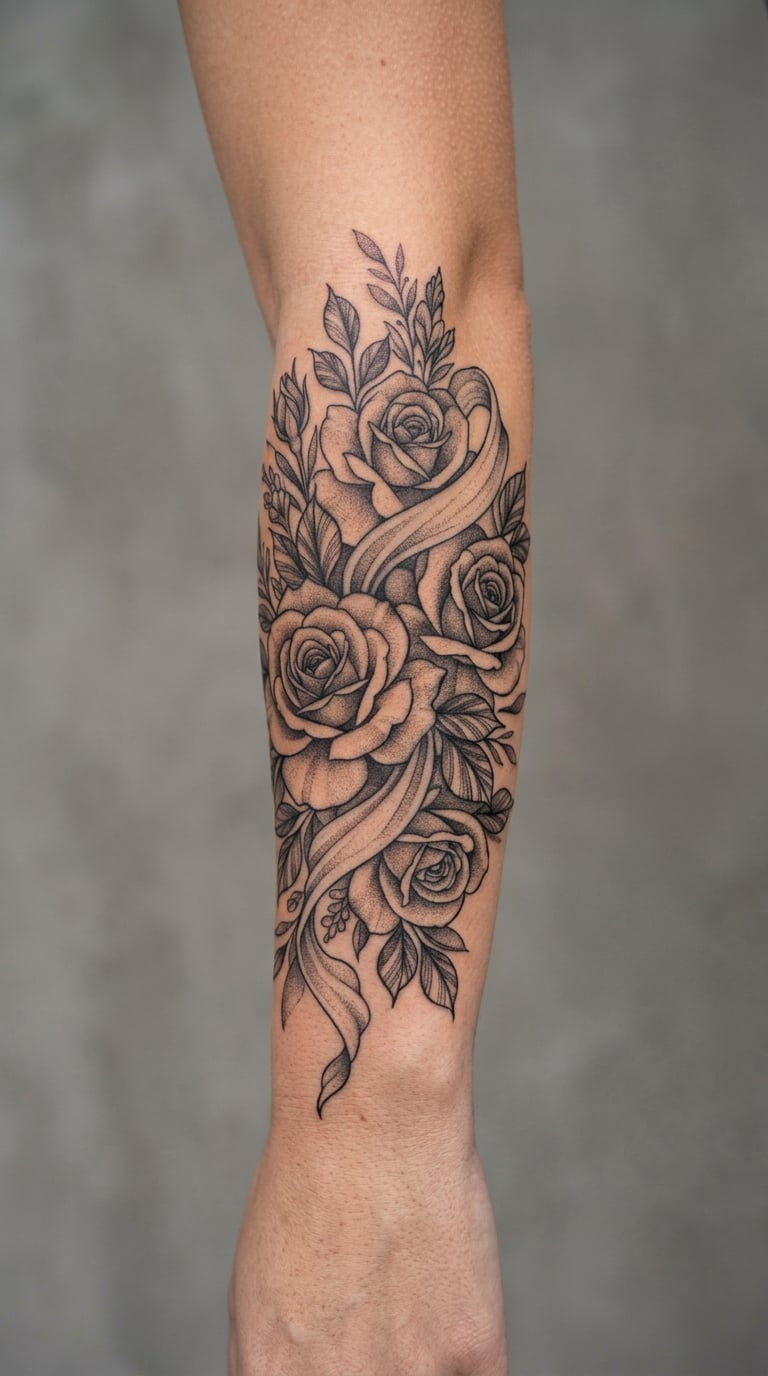
A tonal sleeve of roses, leaves and ribbon-like folds in black and grey only, built from smooth gradient shading rather than outlines. The bouquet gathers near the elbow and the ribbons trail down toward the wrist, which gives the design a direction and stops the arm reading as one flat mass. Deep blacks at the top fade gradually to mid-grey at the wrist.
Black and grey is chosen for a classic, dressier look that suits offices where colour might not, and it never needs retouching for faded colour. It also shows off an artist’s shading ability more than a line-heavy design does.
Placement: outer forearm, elbow to wrist, with the ribbon tails reaching the wrist crease. Size: 10-14 in (25-35 cm). Style: black and grey realism. Pain: medium to high, because smooth grey gradients need a lot of layering and rework. Greys spread slightly during healing, so expect the finished piece to be a touch lighter than the day of the session.
Make it yours: have the ribbons spell out a name in script at the wrist end, or ask for one rose left unshaded as a white highlight in the middle of the bouquet.
13. Fern and Mountain Sleeve
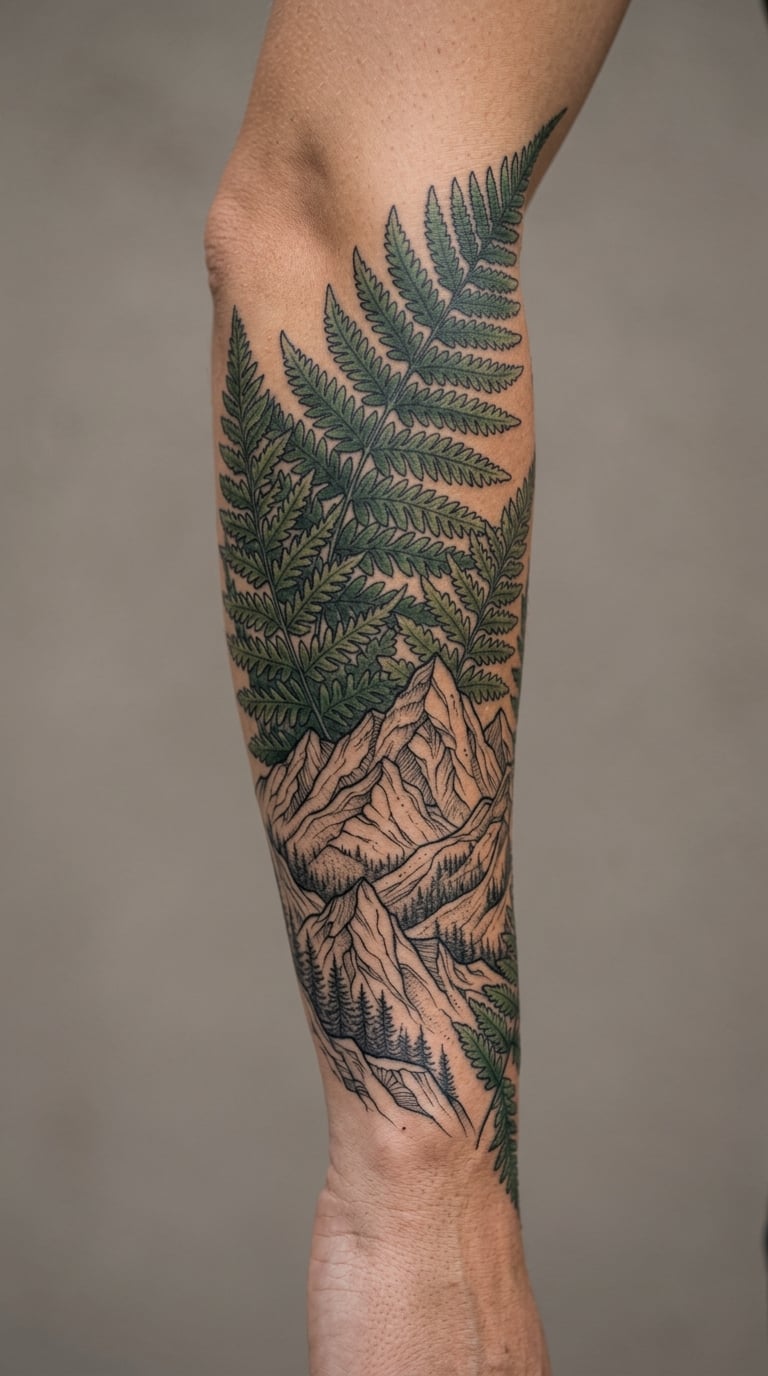
Layered fern fronds in two or three greens overlap mountain peaks and a few horizontal landscape lines, with the scale shifting from small details near the wrist to large fronds near the elbow. Changing the size of elements is what keeps this from feeling repetitive across a long stretch of skin.
It is picked for a outdoorsy, personal feel, and it works well as a wrap because the horizon lines can run right around the arm. Plenty of people build it around a specific hike or a place that matters to them.
Placement: wrap around the arm, with the peaks crossing the inner side so the scene continues as you turn your wrist. Size: 10-14 in (25-35 cm). Style: illustrative nature. Pain: medium. Fine landscape lines in the distance blur faster than the fronds, so detail should get finer toward the wrist, never the reverse.
Make it yours: use the outline of a real ridge you have walked, or name the plant species from where you grew up so the artist can draw accurate fronds.
14. Neo-Traditional Serpent and Blossom Sleeve
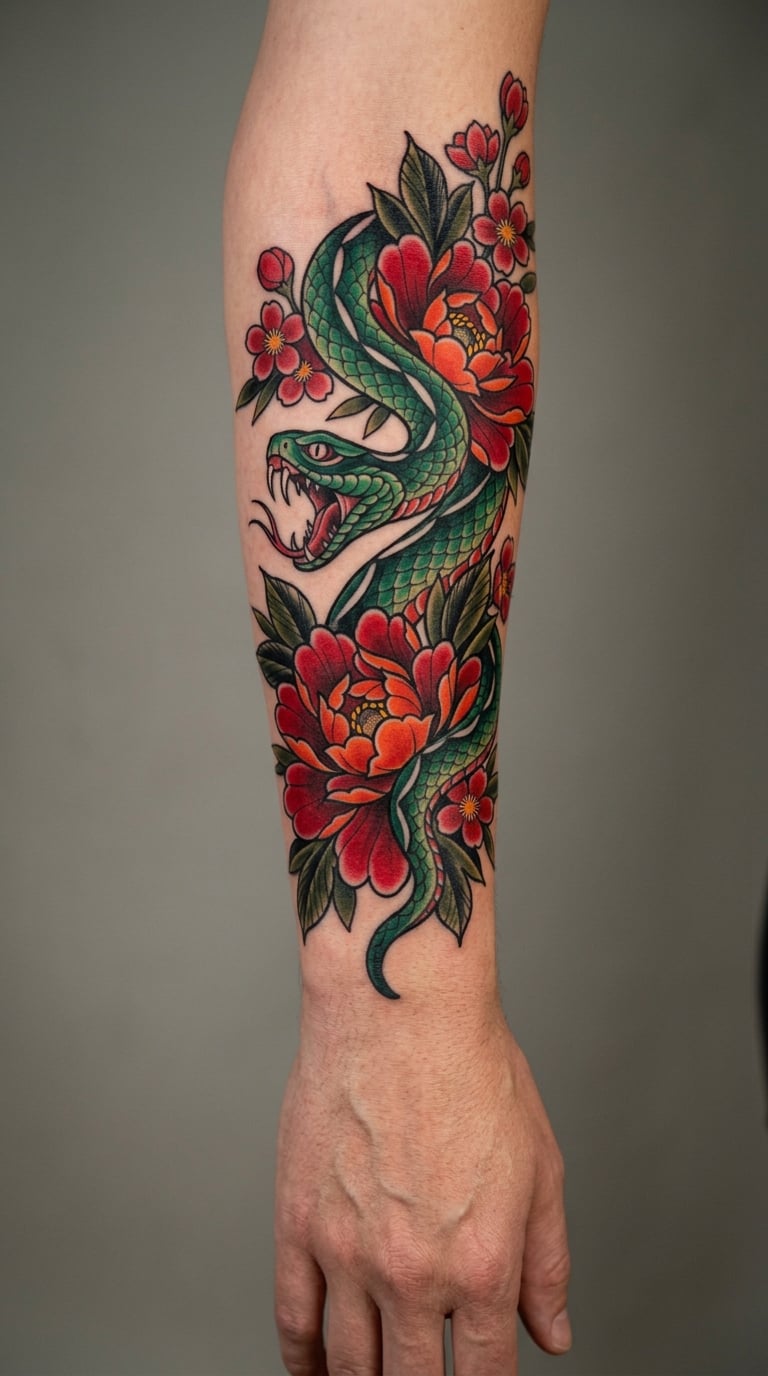
A serpent coils from the elbow toward the wrist with flowering branches growing between the loops: green scales, red blossoms, heavy black outlines and smooth shading. Neo-traditional means simplified forms and confident lines rather than fine realism, so the serpent reads clearly even where it passes under the arm.
It is chosen when someone wants a bold, graphic sleeve that is still legible, and the colour is limited enough that the piece works with plain clothes. The coiling shape follows the forearm curve better than most subjects.
Placement: outer forearm, serpent body wrapping toward the inner arm. Size: 10-14 in (25-35 cm). Style: neo-traditional. Pain: medium, and the scale shading along the underside is the slow part. Saturated red and green on the outer forearm need regular sun protection; without it, green turns yellow-grey within a couple of summers.
Make it yours: have the serpent’s eye pick up a colour from your birthstone, or add a small blossom where the tail ends near the wrist.
15. Floral Brace and Vine Sleeve
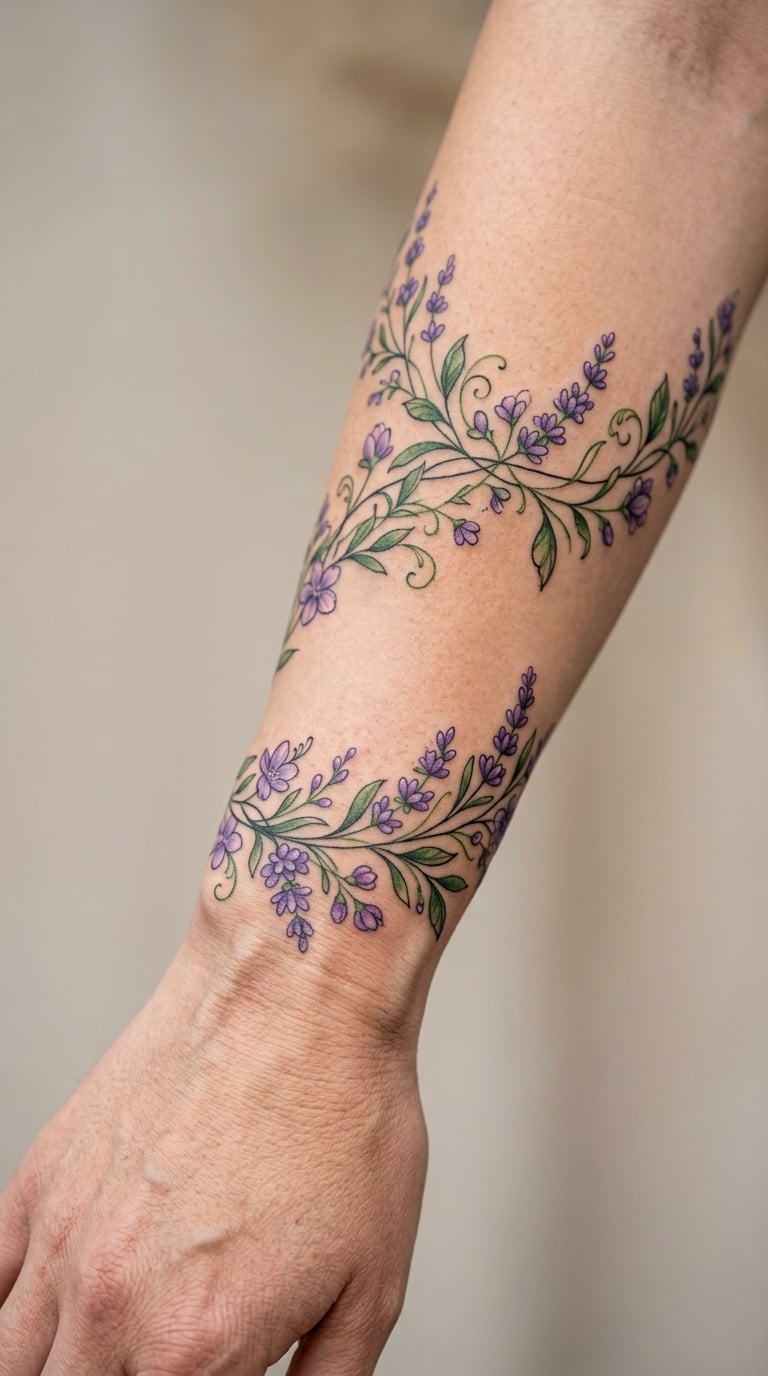
A bracelet-style floral band: small flowers, leaves and looping vines forming a continuous ring around the forearm, sometimes two rings with a narrow gap of bare skin between them. Because the band has defined top and bottom edges, it gives the forearm a clean horizontal line that reads well under short sleeves and doesn’t compete with anything else.
This is the most flexible concept on the list. It can sit at the wrist like a bracelet, at mid-forearm, or travel as a set of bands toward the elbow as the sleeve grows.
Placement: wrist, mid-forearm, or a series of bands between the two. Size: 3-7 in (8-18 cm) tall. Style: floral with fine line. Pain: low to medium. Bands near the wrist crease sit over moving skin and tend to blur faster, so an experienced artist will place the top edge a little above the crease.
Make it yours: repeat the same band on the opposite forearm, or add a thin chain-link line between two bands so the negative space becomes part of the design.
16. Dotwork Hummingbird Sleeve
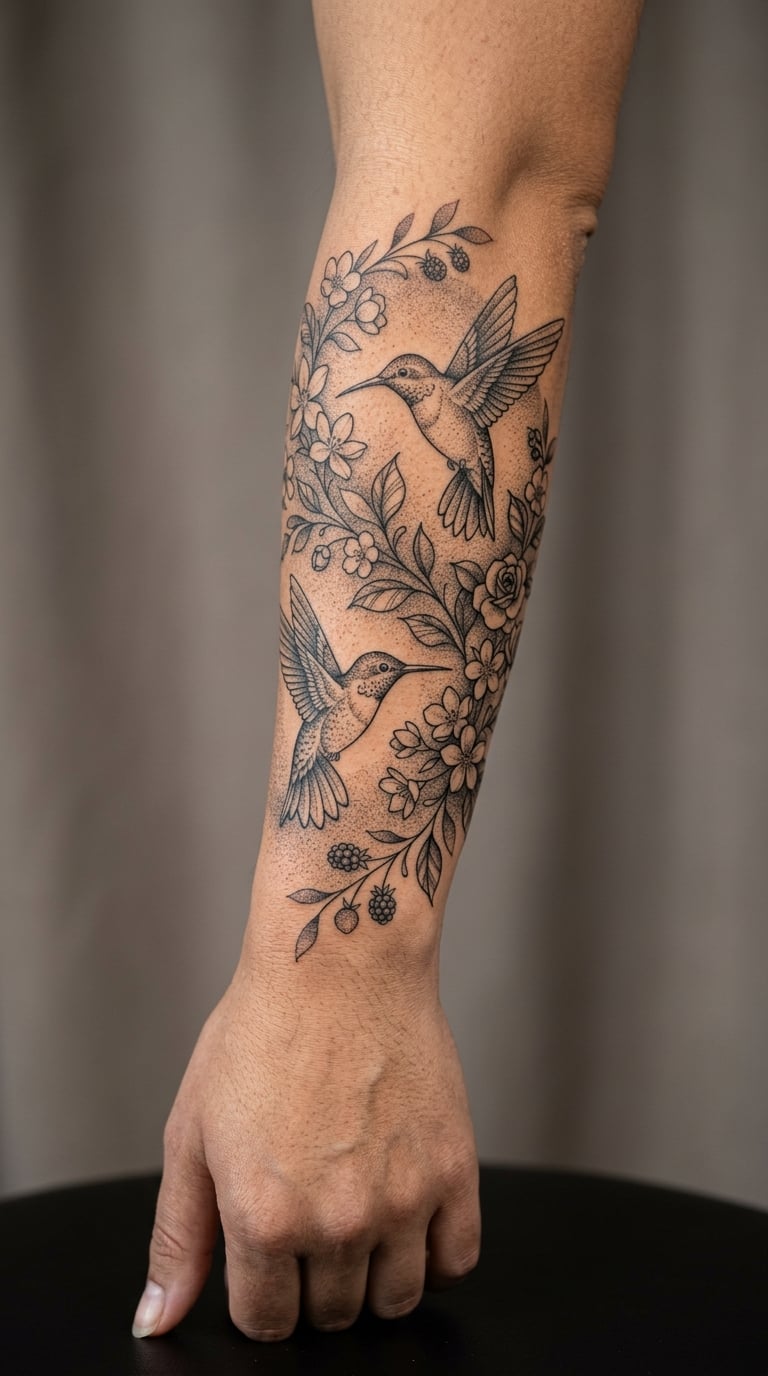
Two hummingbirds rendered in stippling and dot gradients, hovering near small blossoms with plenty of open skin between them. The shading is built from dot size and density rather than grey wash, so the piece stays very light overall. A soft dot gradient behind the birds gives depth without filling the background.
Hummingbirds are chosen for lightness and movement, and dotwork suits anyone who wants a sleeve that shows a lot of skin. It is also a forgiving style for a first large piece, because small irregularities in dot spacing read as texture.
Placement: inner forearm, with the birds angled as if moving along the arm. Size: 7-10 in (18-25 cm). Style: dotwork and stippling. Pain: low to medium, though dotwork takes a long time and a good artist will work in short sessions. Dots under roughly 1/16 inch blur together over the years, so ask for coarser stippling near the wrist.
Make it yours: tint the throat of one hummingbird with a single spot of colour, or have the dot gradient shaped like a heart or a set of initials rather than a plain cloud.
17. Abstract Botanical Blackwork Sleeve
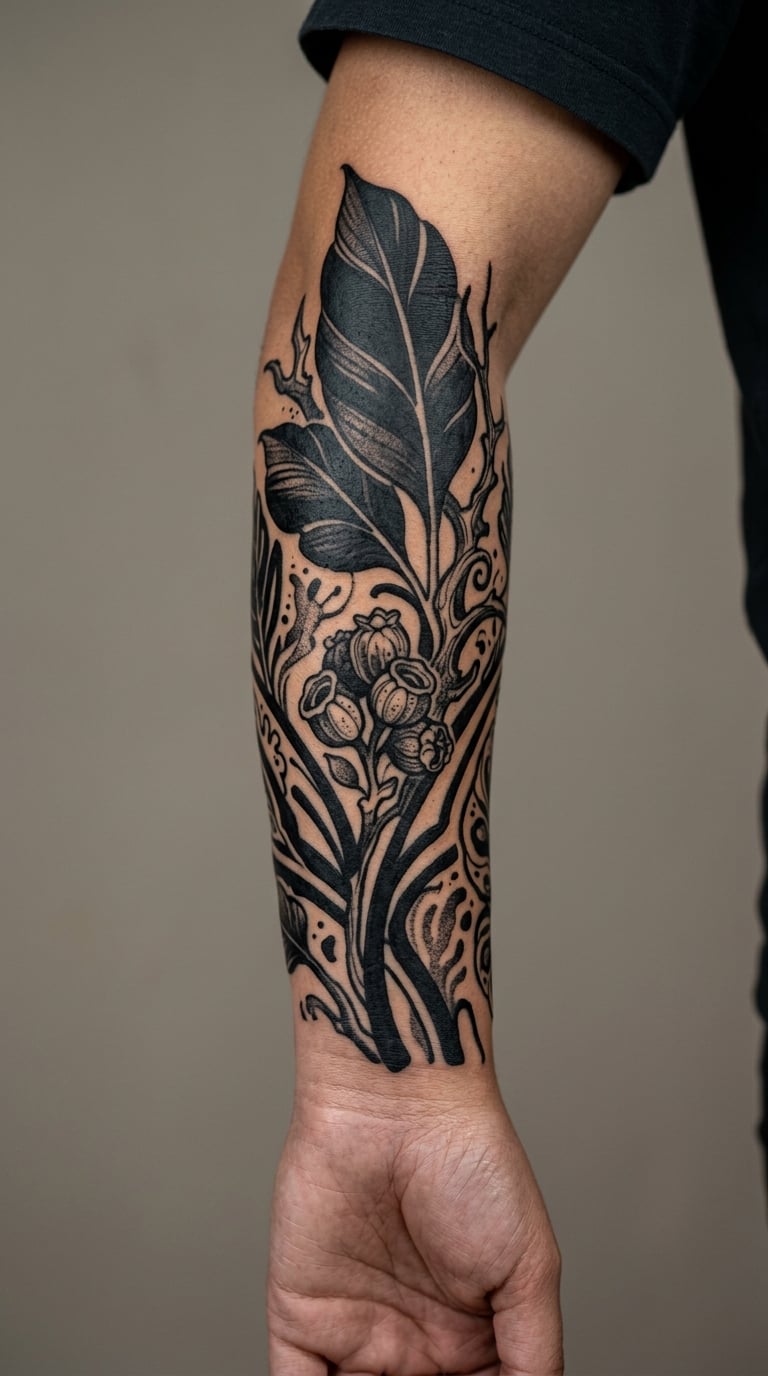
Oversized leaves and seed pods filled in solid black, with thick stems and cut-out shapes of bare skin doing the work that fine line would do elsewhere. It is bold and graphic, closer to graphic design than illustration, and the strong shapes suit an arm with clear bone definition underneath.
Chosen when someone wants a modern, dark sleeve that isn’t floral-cute, and it hides older small work remarkably well because the solid black covers unevenly spaced marks. It also photographs extremely well in high contrast.
Placement: outer forearm, largest leaf at the elbow, stems tapering toward the wrist. Size: 10-14 in (25-35 cm). Style: blackwork, abstract. Pain: medium to high, the most time-consuming application of the lighter-looking bold styles because the black areas are filled. Filling a large black shape over a bony forearm usually needs splitting across two sittings.
Make it yours: leave one leaf as an outline so the solid black has something to read against, or cut your initial out of the negative space inside one pod.
18. Butterfly and Vine Gradient Sleeve
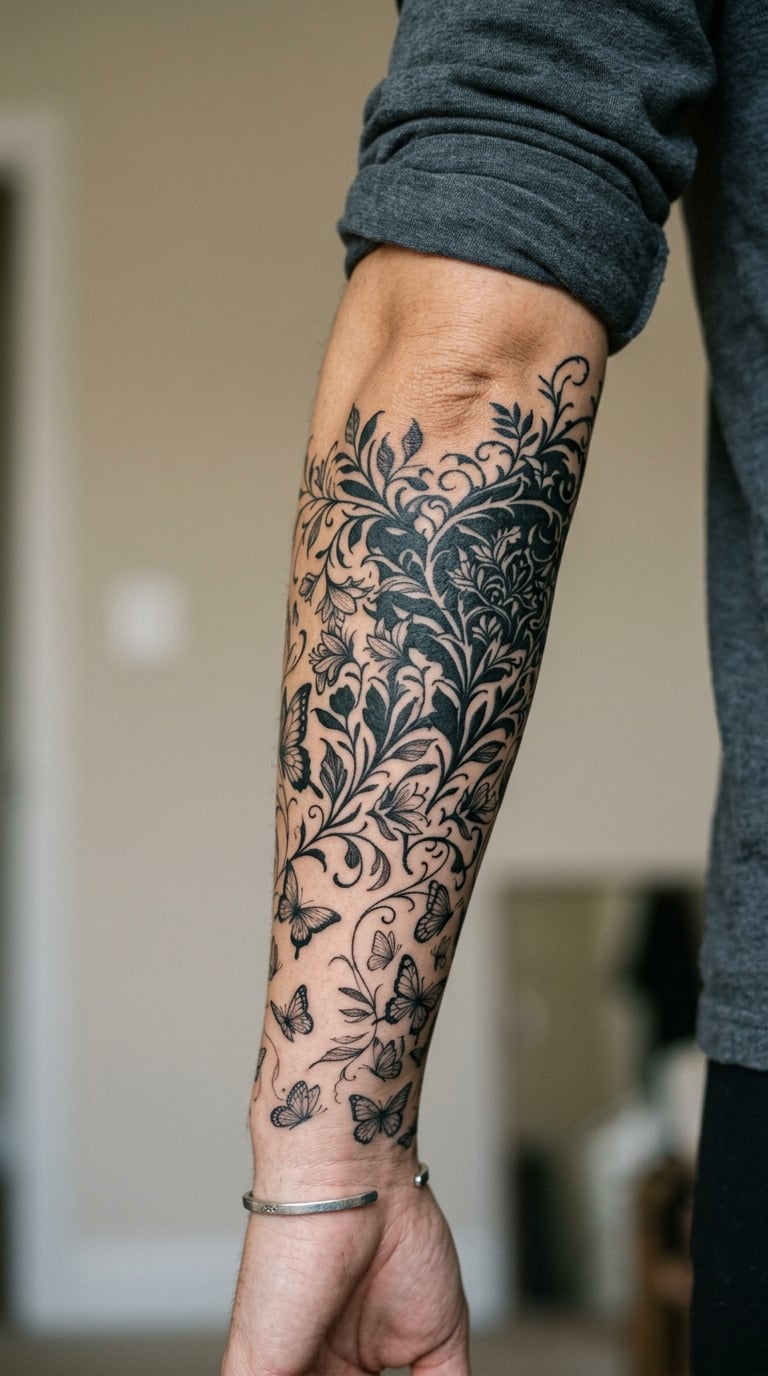
A full forearm sleeve that changes as it travels: small fine-line butterflies and light vines at the wrist, medium butterflies in the middle, and dense shaded vines with larger moths near the elbow. The gradual shift in scale and darkness is the entire idea, and it works because the arm is read in motion rather than as one flat picture.
This is a strong choice for a first large piece because the light end near the wrist is a small commitment, and you can stop there if the rest does not suit you later. Plenty of people extend it toward the upper arm years afterwards.
Placement: wrist to elbow, the full length of the forearm. Size: 12-16 in (30-40 cm). Style: fine line blended into blackwork. Pain: medium across the whole arm, higher in the elbow-side inner section. Plan on two or three sittings rather than one long day.
Make it yours: set the darkest point at a meaningful distance, such as the length of your child’s arm at a certain age, or have the vines follow a real path you have walked.
19. Traditional Cloud and Rain Sleeve
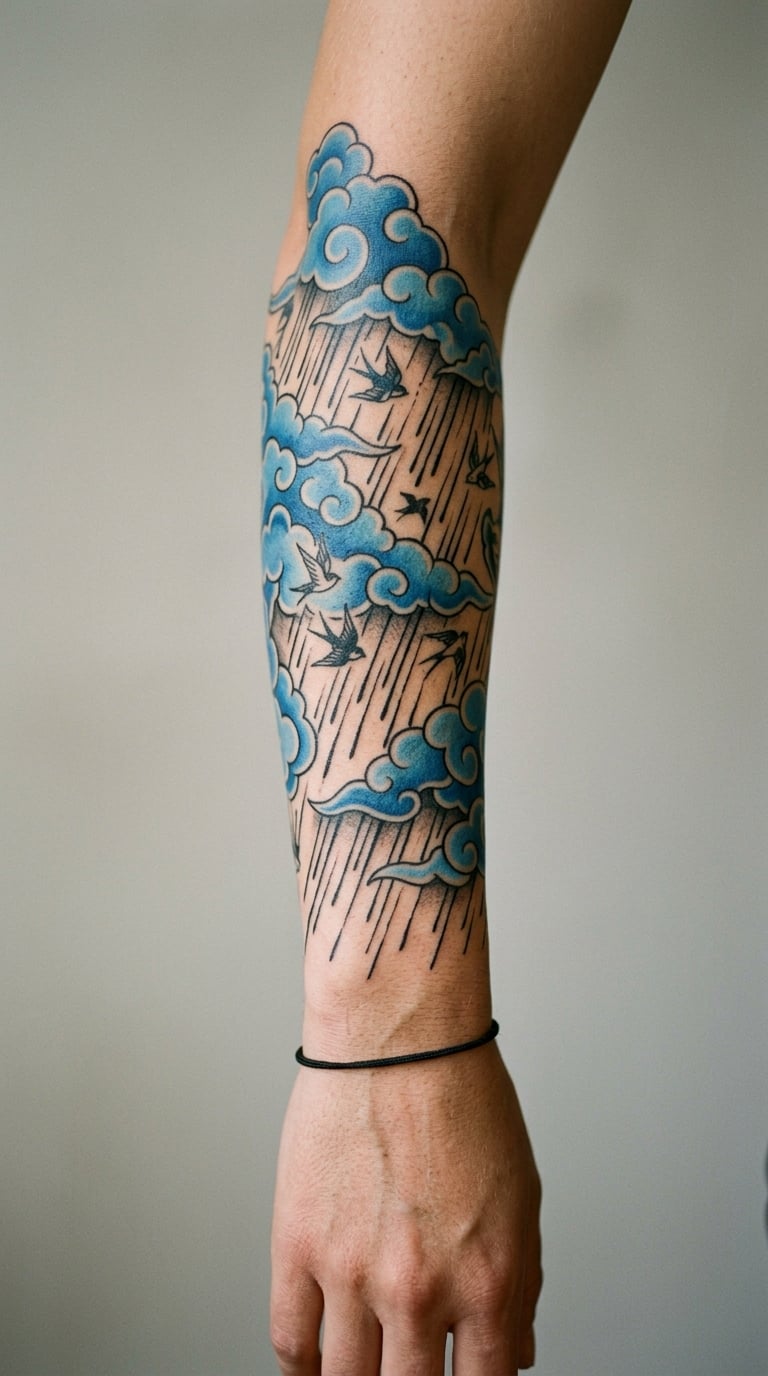
Stylised clouds in two or three blues with black rain lines falling beneath them, a few small birds in the gaps, and open sky left as bare skin between the cloud banks. Because the subject is soft and rounded, the palette can stay gentle and the whole thing feels lighter than a traditional floral sleeve of the same size.
It is chosen for a mood rather than a symbol, and the open spaces make it forgiving on a fuller forearm where dense work would crowd. It also layers beautifully later, since dark vines can grow into the bare patches near the elbow.
Placement: top and outer forearm, clouds crossing the wrist and rain trailing toward the elbow. Size: 9-13 in (23-33 cm). Style: traditional with soft colour. Pain: low to medium; smooth colour packing needs passes but not much pressure. Blues and light greys are the first colours to wash out, particularly on the outer arm, so this one ages visibly faster than black line.
Make it yours: have one cloud break apart into small birds at the elbow end, or pick a sky colour from a photograph you took yourself.
20. Floral Bouquet and Ribbon Arm Sleeve
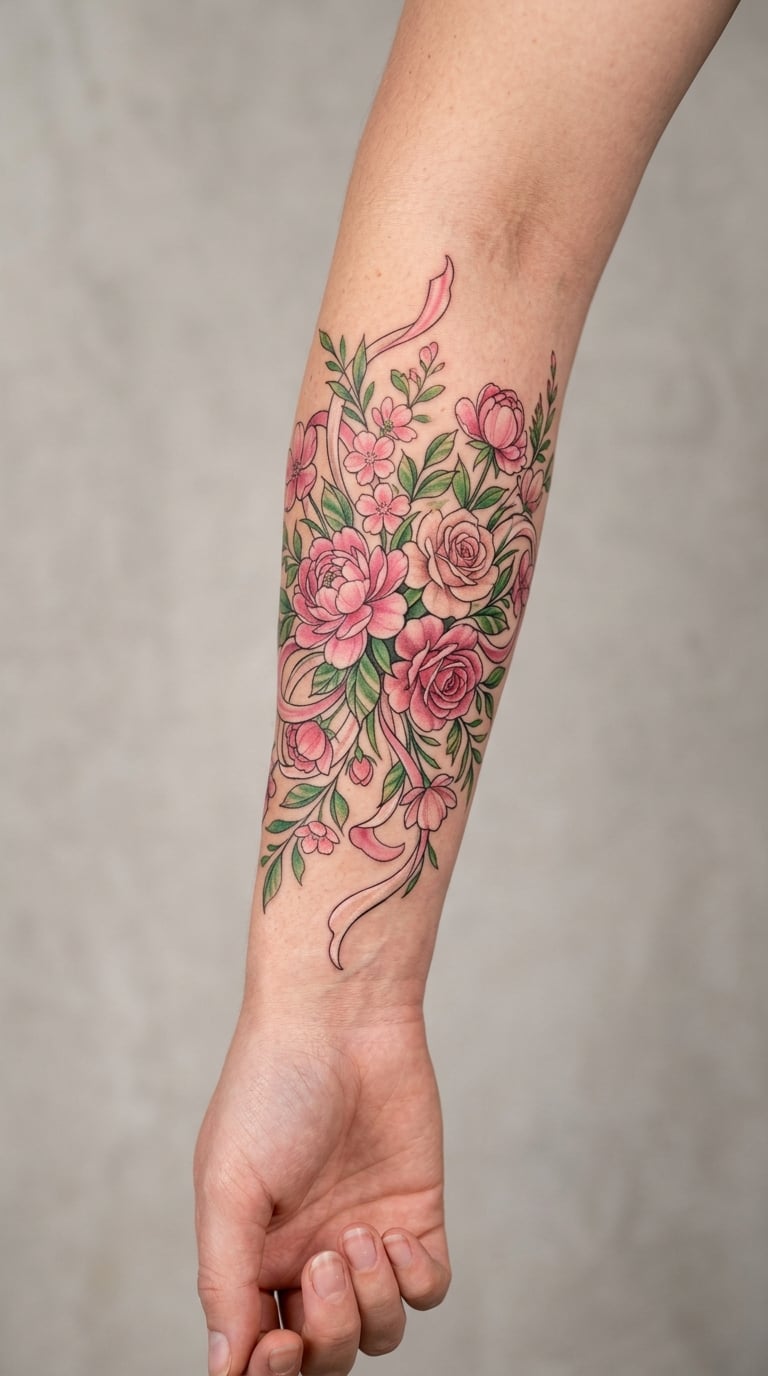
A gathered bouquet of pink and cream flowers with green leaves, and long ribbons that wrap around the forearm and trail toward the wrist. The bouquet sits near the elbow where there is more surface area, and the ribbons take the eye down the arm. Shading is soft rather than outlined, which keeps the finish looking painted.
It is chosen for a romantic, soft look, and because ribbons wrap naturally, the design can be shortened to a half forearm without redesigning anything. It is the easiest of the large florals to extend into a full sleeve later.
Placement: outer forearm with the bouquet at the elbow end. Size: 9-13 in (23-33 cm). Style: soft realism. Pain: medium, mostly from the gradient shading inside the petals. The forearm is one of the most sun-exposed parts of the body, so pinks here will fade faster than the same design on the upper arm.
Make it yours: have the ribbon carry a hand-written name or date in script, or swap the bouquet for a single large bloom repeated at three sizes along the arm.
How to Choose the Right Design
Six things decide whether a forearm sleeve will still suit you in ten years. Go through them with your artist before the stencil goes on, because changing the design afterwards means covering or living with it.
How long should the sleeve be?
Measure from your inner wrist crease to the inside of the elbow, then subtract an inch at each end. Most people land between 8 and 11 inches, and leaving the wrist and elbow clear is the simplest choice because it looks intentional from any angle. Anchoring into the elbow or wrist is also fine, but then commit to the upper arm later.
Which style suits your forearm shape?
Slender forearms suit fine line, dotwork and Art Nouveau work, all of which lengthen rather than crowd. Fuller forearms take dense blackwork and traditional colour well, because there is more surface to spread it across. If you are not sure, ask the artist to sketch your design twice, once dense and once open, and look at both on your own arm.
What detail scale holds up?
The rule of thumb most tattooers use: nothing much smaller than a grain of rice, and no interior line thinner than the outline. Fine line and dotwork both soften noticeably over a decade, so a design that depends on tiny detail should be one you would still like as a softer version of itself.
Does the design work with what is already there?
Existing small tattoos can usually be absorbed into a floral or ornamental sleeve by asking the artist to build the new composition around them. Fine line and minimalist designs cannot. If you have older work on the same arm, look at the blackwork and abstract options first, and see our half sleeve tattoo ideas for women for designs that leave more skin visible.
How will the arm bend?
Ask to see the design with your arm straight and with your wrist bent toward you. Small lettering placed across the wrist crease distorts when the hand moves, and anything on the inner elbow side compresses every time you reach for something. Wrist and elbow placements need forgiving shapes rather than precise ones.
Is it a first piece or the next piece?
If it is your first large tattoo, the butterfly and vine gradient sleeve and the fine-line botanical are forgiving places to start, because you can stop at the wrist end. If you already have a sleeve, a wider range opens up and colour or full blackwork becomes easier to place around existing work.
Cost and Session Time
A forearm sleeve in the US usually lands somewhere between 1,500 and 5,000 US dollars depending on coverage, style and how established the artist is, and full-sleeve-scale work on the same arm goes considerably higher. Shop minimums, hourly rates and city differences swing that range wider than most first-timers expect.
| Size | Typical coverage | US price range | Sessions |
|---|---|---|---|
| Small | Single motif, wrist to mid-forearm | 250-800 US dollars | 1 |
| Medium | Floral branch, cloud, celestial band | 800-2,000 US dollars | 1-2 |
| Large | Most of the forearm, one side | 1,500-3,500 US dollars | 2-3 |
| Sleeve-scale | Wrist to elbow wrapping the arm | 3,000-6,000+ US dollars | 3-5 |
What pushes a quote up: fine line or dotwork needs single-needle work and takes hours per square inch, solid blackwork needs many layered passes, and wrapping the design around the arm increases the area compared with a flat panel. What brings it down: choosing black and grey over colour, keeping the design narrower, and accepting a design built to your skin rather than a stock composition.
A quote is only as good as a consultation. Book one, show the artist the references you saved, and ask what they would change for the shape of your arm. That conversation costs a small amount of time and saves money on a design that would not have read well.
On session length: most shops cap a sitting at three to five hours, and a forearm sleeve of any size is usually split across several appointments. Longer sessions produce worse work because the skin tires and the lines get heavier. Book a break in your day to eat, and plan on the arm being warm and stiff afterwards.
Aftercare Basics
Follow your artist’s aftercare instructions first, since they know exactly what they put in your skin. Everything below is general guidance, not a substitute for their advice.
- Wash gently twice a day with lukewarm water and unscented soap, then pat dry rather than rubbing.
- Keep the area covered and out of direct sun while it heals, especially during the first two weeks.
- Skip swimming pools, hot tubs and saunas until the skin is fully closed, which is usually around two weeks.
- Moisturise with a plain, fragrance-free product once the skin has stopped feeling raw.
- Use sunscreen daily on the forearm afterwards, since the outer arm is the most sun-exposed part of a sleeve and colour fades there first.
- Watch the healed result rather than the fresh one: swelling and redness are normal for the first days, while spreading redness or a hot feeling to the touch is not, and both are worth a call to the shop.
Full settling takes several months. The shading and reds you see on day three are not the colours you will live with, so book the touch-up after healing is complete rather than judging it early.
Frequently Asked Questions
Do forearm sleeve tattoos hurt more than other arm tattoos?
The forearm is moderately sensitive, and the inner wrist side and the inside of the elbow are the tender stretches because the skin there is thin over bone and tendon. The outer forearm and the top of the arm are noticeably easier to sit through. How much it hurts depends more on session length and breaks than on the design, so splitting a sleeve across several shorter appointments makes a real difference.
How long does a forearm sleeve take to heal?
Surface healing, meaning the skin closing over, usually takes two to three weeks, and the area can look and feel healed well before the ink has settled underneath. Full settling into the skin takes several months, and fine line and grey shading often look noticeably different at that point. Book a free touch-up after healing is complete rather than judging the piece in week two.
Can you build a forearm sleeve in stages?
Yes, and many people do. Tattooing wrist to elbow in order, with the lightest section at the wrist, lets you stop whenever you want and see how the design sits on your arm before committing to the rest. Artists often plan the whole composition first and tattoo the sections across separate sittings, so the joins are planned rather than improvised.
How many sessions does a forearm sleeve need?
A single motif on one side of the forearm is often a one-session job, while a design that wraps from wrist to elbow usually takes two to five appointments. Fine line and dotwork need more hours than the finished size suggests, and solid blackwork gets split rather than pushed through in one long day. Most shops cap sittings at three to five hours, and long sessions produce heavier lines.
Which sleeve styles fade fastest on a forearm?
The outer forearm gets more sun than almost anywhere else on the body, so warm colours and fine line fade there first. Pale pinks, yellows and light blues wash out noticeably within a few summers without protection, and single-needle lines soften over a decade. Heavy black line and black-and-grey shading hold their shape longest, and daily sunscreen makes a large difference.
What styles are most requested for forearm sleeves right now?
Fine-line florals, blackwork with strong negative space, ornamental mandala work and moth and butterfly motifs are the ones showing up most often in current portfolios, alongside a strong return of traditional colour and Japanese-influenced work. Smaller, lighter designs worn as bands rather than full coverage are also common, and micro-realism remains popular for people who want detail without a dark sleeve.
Conclusion
For a first large tattoo, the fine-line botanical sleeve or the butterfly and vine gradient are the safest starting points, because both let you stop at the wrist and see how the work sits before you go further. For someone already collecting pieces, the blackwork rose vine or the black-and-grey rose bouquet gives you the coverage to work with and around existing tattoos.
Whatever you choose, bring references rather than a finished design, and ask the artist to adapt it to your arm’s length and bone structure. Compare a few portfolios, check how the artist handles a bent wrist, and only book once the plan feels like your arm and not a reference photo. Forearm sleeve tattoo ideas for women cover a lot of ground, but the decision comes down to placement, detail scale and how the design will look in ten years.