
What Does a Black Band Tattoo Mean? (2026) Symbolism Guide
Short answer first: a black band tattoo is a single unbroken line of solid black ink wrapped around the arm, wrist, hand, ankle, or leg, and the most common meaning is mourning and remembrance of a loved one who has died. But that is not the only reading, and it is not a fixed code either. Wearers pick the meaning, and plenty of people wear one with no story behind it at all.
This matters more than most tattoo guides admit. A stranger will read your band as a memorial, a gang marker, a prison code, or a trend, and they will usually guess wrong. Understanding the full range of readings before you book the appointment saves you from a conversation you did not sign up for.
If you are still narrowing the design, the forearm band tattoo ideas for men round-up is a decent place to see how much variety one limb can carry.
What Does a Black Band Tattoo Mean? Common Interpretations
Because the design is a plain black shape with no imagery, it resists a single definitive reading. The meaning is set by the person wearing it, and the same band can carry grief for one person and nothing but geometry for another. Here is the range you will actually run into.
Traditional and cultural meanings:
- Grief and remembrance: the most widely recognised reading, carried over from the Western custom of wearing a black mourning band of cloth on the arm or hat after a death.
- Multiple people lost: one line for each person, so several thin bands on one arm often mean several names rather than a code.
- Faith and devotion: some wearers treat a closed loop as eternity, or pair the band with a rosary design, a cross, or dates instead of a name.
- Family and lineage: Polynesian, Hawaiian, and Borneo armlet traditions used bands around the upper arm to signal rank, tribal belonging, and standing, and that history still informs the design for some.
- Club and subculture belonging: outlaw motorcycle clubs and prison gang systems both use solid black bands, which is the single most misread meaning in practice.
Modern and personal meanings:
- Strength and resilience: a quiet marker for coming through something hard, worn for yourself rather than for an audience.
- Commitment or matching bands: partners, close friends, or family members wearing the same band in the same place as a private signal.
- Minimalist aesthetics: single-colour line work, high contrast, and the practical bonus that a long sleeve covers it at work.
- A boundary: the unbroken loop reads as a limit, a rule, or a line that was not going to be crossed.
Why the same design gets read three different ways
Symbols only carry meaning when a group agrees on them. Mourning has a centuries-old cloth tradition behind it, so most people land there first. Gang and prison systems use black because black is cheap, easy to hide, and impossible to alter later, so anyone who knows that world reads it that way. And because the design is now common enough to be a fashion choice, a lot of people assume trend. All three readings are visible on any given street.
The honest answer to your question is that what does a black band tattoo mean depends on the person under the ink. Ask, if it matters to you, but be prepared for a shrug.
Black Band Tattoo Meaning by Style
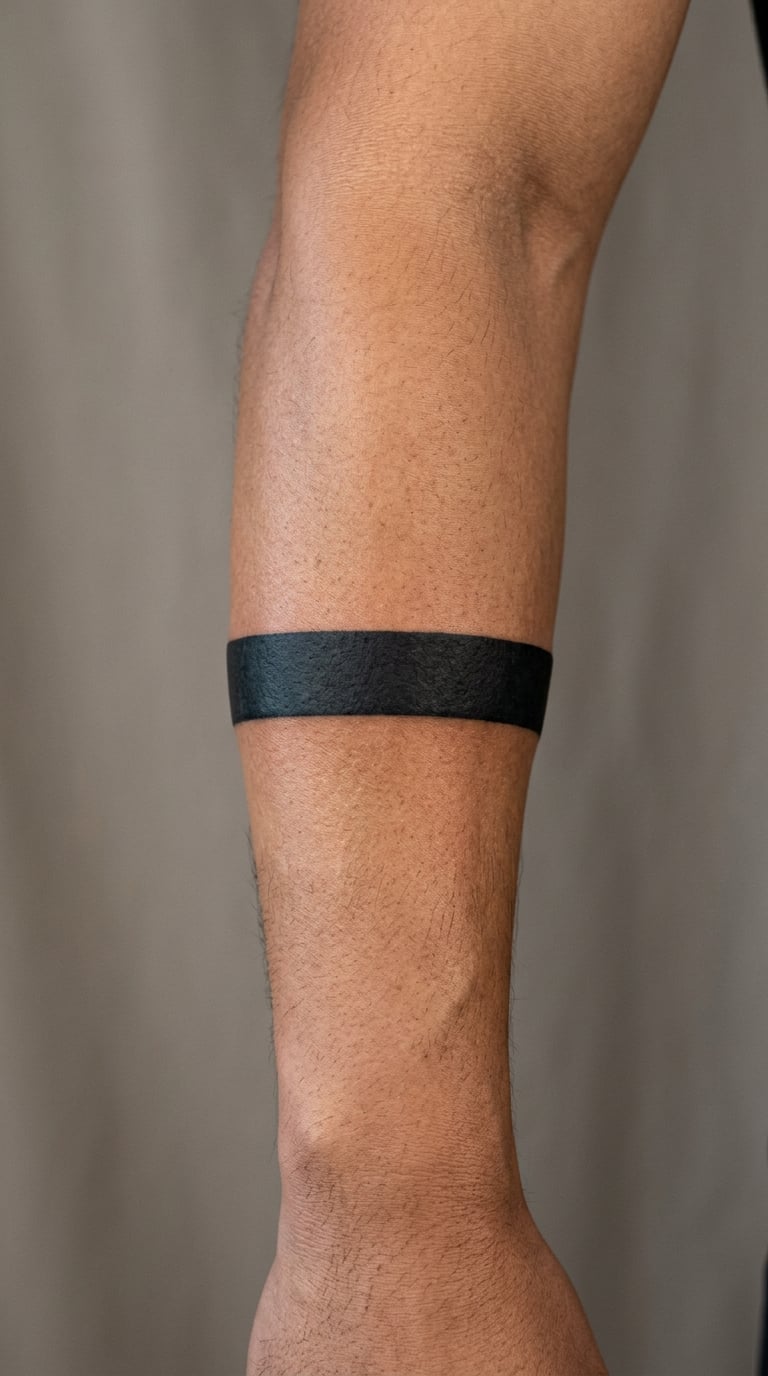
Style changes the weight of the piece, and weight changes the first impression. A heavy solid band on a bicep announces itself from across a room. A hairline wrist band reads as a private mark that only people standing close will notice.
What Does a Black Band Tattoo Mean in Different Styles?
No style has a fixed symbolism attached to it, but visual weight shapes the assumed meaning. Bold blackwork tends to be read as deliberate and serious, which pushes people toward the memorial or commitment readings. Fine line and thin bands get read as understated and personal, which invites the aesthetic interpretation instead. Textured and faded treatments skew grunge, and nobody attaches a grief story to them nearly as often.
| Style | What it looks like | How it usually gets read |
|---|---|---|
| Solid black band | One opaque line, usually a quarter inch or wider | Memorial or commitment, the most deliberate reading |
| Thin line band | A single fine line, hairline to a sixteenth of an inch | Understated, private, often missed entirely by strangers |
| Double band | Two parallel lines with a narrow gap between them | Paired people or paired dates, though the wearer decides |
| Patterned or broken band | A repeating motif, tick marks, or a band with gaps | Custom or memorial dates, less likely to be mistaken for a code |
| Faded or textured band | Distressed, dry-brush, or grey-washed black | Style choice, rarely read as gang or prison related |
| Memorial band | A black band paired with a name, dates, a rose, or script | Unambiguous tribute, and the easiest one to explain |
Patterning the band is the simplest way to buy yourself clarity. Two lines with a small gap between them look deliberate and specific rather than like a signal from another world.
Where Do Black Band Tattoos Look Best?
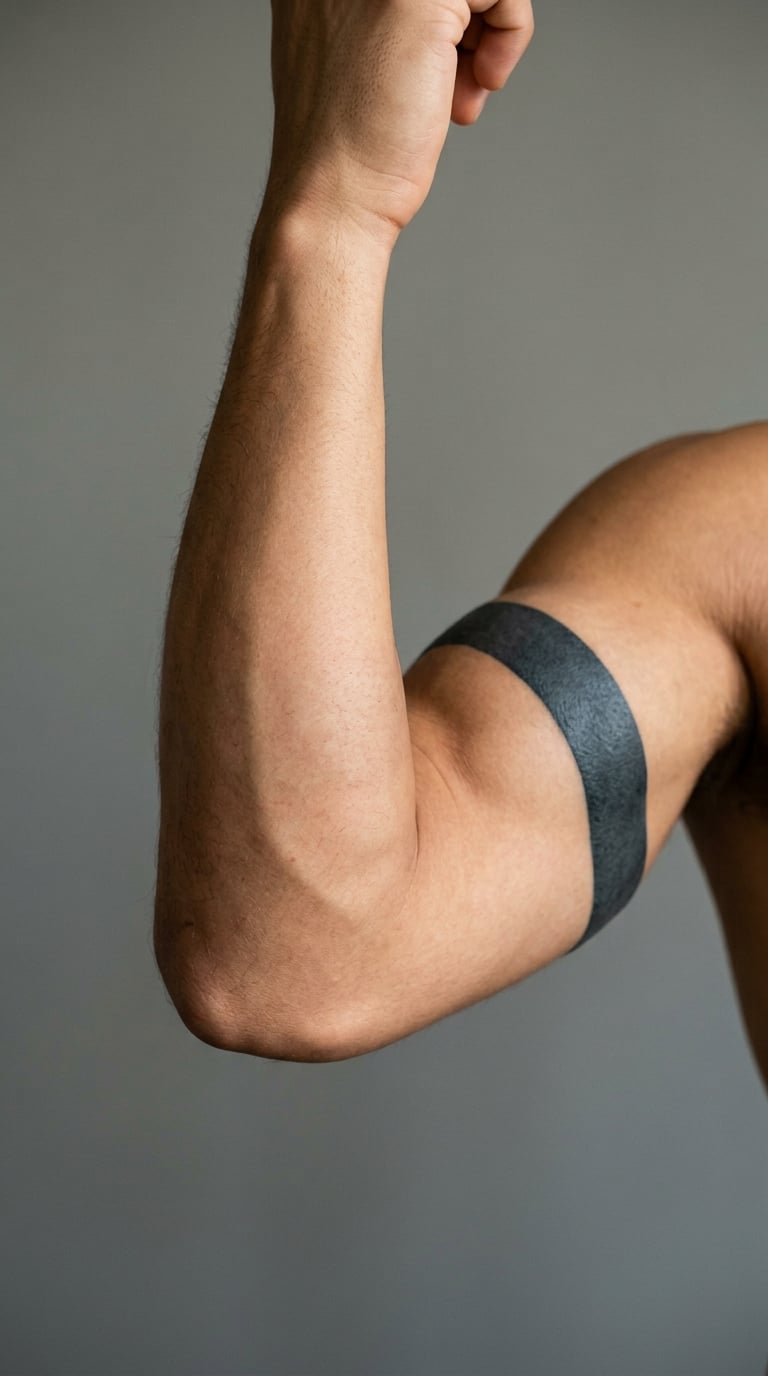
Placement does more work for a band than for most designs, because there is no artwork to anchor it. A band has to sit on a part of the limb that actually reads as a cylinder, and the line weight has to match the circumference it wraps around.
| Placement | How it looks | Suits |
|---|---|---|
| Inner forearm | The most requested spot, with a flat muscle to draw a straight line across | Bold solid bands and anything that needs to sit straight |
| Upper arm | Wider, more dramatic, and easy to hide under a sleeve | Thick bands, the lineage-style armlet look |
| Wrist | Small, close to the hand, highly visible in daily life | Thin or double lines, not heavy solids |
| Hand and fingers | Bold statement, moves as the hand moves | Short segments rather than a full wrap |
| Calf | Reads cleanly in profile, similar feel to the upper arm | Solid bands and multiple thin lines |
| Thigh | Large canvas, easy to keep straight across a flat surface | Bolder pieces and wider bands |
| Rib area | Curved and narrow, so a straight line takes real skill | Thin single lines, single sessions |
| Collarbone | Follows the bone, so the line will never be perfectly straight | Short arcs rather than full wraps |
A solid band suits a wide, flat area like the forearm or upper arm. Narrow or repeated designs fit the wrist, ribs, and collarbone, where a heavy line would fight the shape of the body.
What does a black band on the left arm mean versus the right?
There is no reliable dictionary for this. The left arm is simply the one most people shake hands with, and the one most gang systems historically favour, so a band there attracts more second-guessing. The right arm tends to be read as more decorative. If you want a memorial to be understood, add a name or a date. If you would rather it stay private, keep the band plain.
More design context sits in our round-up of band tattoo design ideas, which covers the wider range of band layouts beyond the solid black one.
How Much Do Black Band Tattoos Hurt?
Band work sits somewhere in the middle of the pain scale for most people. It is a single continuous pass rather than a shaded block, so it is quicker than a full blackwork piece, but the line has to be laid evenly and the nerve endings in the inner arm are not shy. Thin bands on the wrist or ribs sting more sharply because the needle is closer to bone.
| Placement | Typical pain | Why |
|---|---|---|
| Upper arm | Low to medium | Thick muscle, and the line travels across rather than along the bone |
| Outer forearm | Medium | Some nerve endings sit close to the surface here |
| Inner forearm | Medium | Visible and sensitive, especially near the elbow crease |
| Wrist | Medium to high | Thin skin over bone and tendon |
| Fingers and hand | High | Bone sits directly under the skin, and the hand cannot be numbed well |
| Collarbone and rib | High | Bone and membrane areas react sharply |
| Calf and thigh | Low to medium | Good muscle coverage, easy placement |
Three things move the number more than the body part does: the needle depth and machine your artist uses, whether the skin was already irritated, and how long the session runs. A solid black band is a fast session, and fast usually feels better than slow. If you have a low tolerance, ask about breaks and about numbing cream before you start rather than during.
How Black Bands Age and Change Over Time
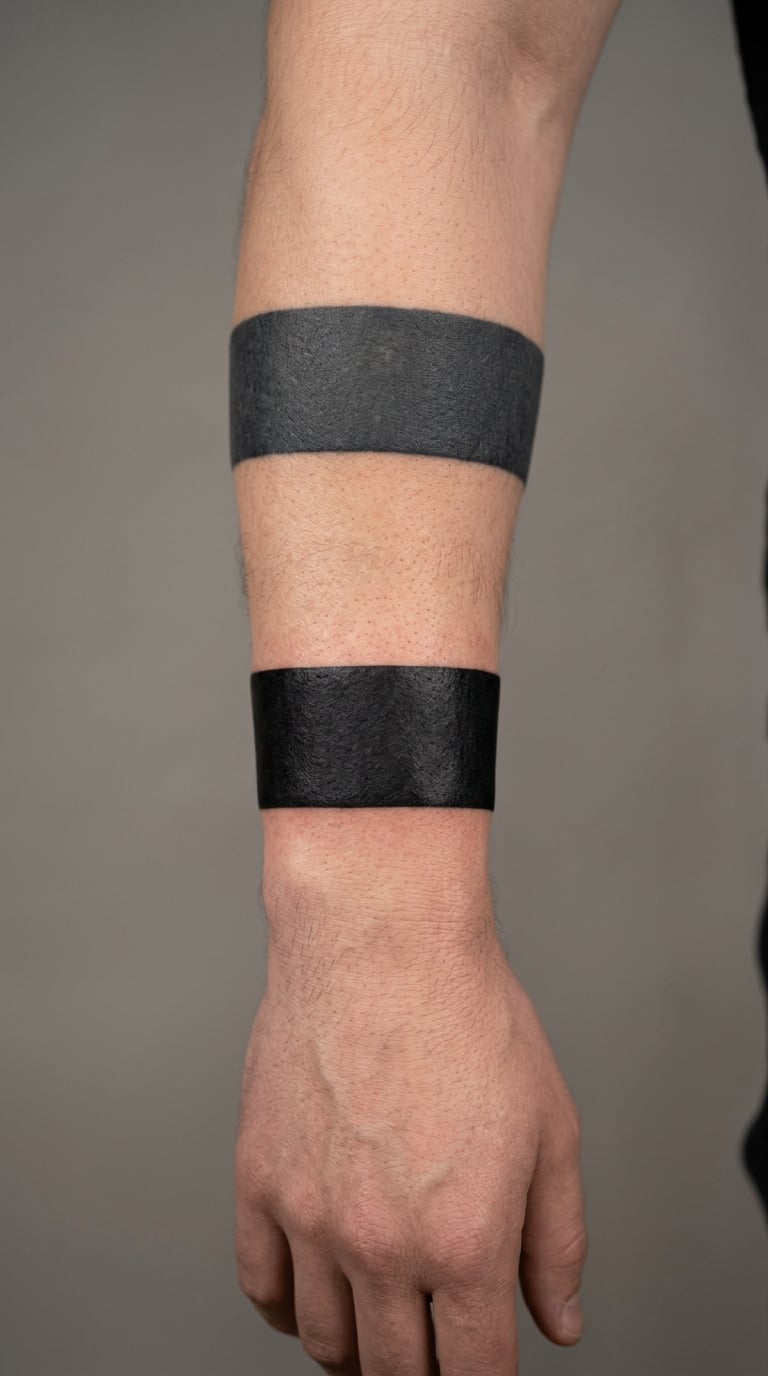
Every tattoo fades, and a solid black band fades more evenly than a shaded piece but also more visibly, because there is no line work to hide the softness. Expect the edges to blur within the first year. A band that looked laser-cut on day three looks hand-drawn by year five.
Patchiness is the part that surprises people. Black pigment can settle unevenly as it heals, and a band can develop faint lighter patches in the middle of the line where the skin took the ink differently. Fingers and hands are the worst offenders, since the skin there is thin, constantly moving, and exposed to washing. A finger or wrist band usually needs at least one touch-up to fill back in, and you should expect that rather than treat it as a mistake.
Placement changes the ageing story too. A forearm band sits in the sun every time you roll a sleeve, and sun exposure is the fastest cause of fade. A band hidden under a long sleeve will hold its colour noticeably longer. Thick skin on the upper arm and thigh holds black better than the thin skin on the inner wrist.
The practical takeaway: buy the design you want healed, not the one you want fresh. Look at healed work by the same artist, not just the reference photos from the front of the shop.
How Much Does a Black Band Tattoo Cost?
Almost everything about the price follows one rule: artists charge by the hour, and the hour is decided by how much surface the line has to cross. A solid black band that runs the length of the forearm is quick work. One that wraps the full circumference of the arm, or a set of five bands, is a much longer sitting and priced accordingly.
| Design | Typical US range | Session length |
|---|---|---|
| Thin wrist or finger band | Roughly 100 to 200 dollars | Short, often at or near the shop minimum |
| Single line across the inner forearm | Roughly 120 to 250 dollars | Short |
| Solid band around the upper arm | Roughly 200 to 350 dollars | Short to medium |
| Full circumferential forearm wrap | Roughly 300 to 500 dollars | Medium |
| Multiple bands, three to five | Roughly 500 to 900 dollars | Long, sometimes booked across two sessions |
| Bands paired with names, dates, or script | Roughly 500 to 1,000 dollars and up | Long, and fine text drives the time |
Shop minimums set a floor, and a major city sits well above the national average while a small-town shop sits below it. Travel, consultation fees, and a second session for a touch-up all add to the total, so ask whether the quoted figure includes a free follow-up. That single question saves more money than any shop comparison will.
How Long Does a Black Band Tattoo Take to Heal?
A band follows the standard tattoo healing schedule, with one extra stage that catches people out: the patchy phase, when the surface looks uneven before the pigment settles into its final tone. It looks worse than it is.
| Time | What you will see | What to do |
|---|---|---|
| Days 1 to 3 | Red, raised, tender, and slightly shiny | Follow the aftercare your artist gave you and leave the film alone |
| Days 4 to 10 | Flaking, dry, and itchy as the surface skin sheds | Moisturise thinly, never scratch, keep hands off |
| Weeks 2 to 3 | Patchy or uneven-looking in places, edges still settling | Wait it out, this is normal for solid black |
| Weeks 4 to 6 | Surface skin back to normal, black reading closer to its final tone | Return to normal routines, keep sun exposure low |
| Months 2 to 6 | Final settling, with edges softening slightly | Ask your artist about a free touch-up if any line looks thin |
Full settling takes several months, and the true final appearance is somewhere around month six. Judge the result then, not in week two.
How to Care for a Black Band Tattoo
Start with your artist’s aftercare instructions, because they know exactly what they did. Beyond that, the basics are simple and short.
- Wash gently with clean water and a fragrance-free wash, then pat dry with something that is not a rough towel.
- Keep a thin layer of a plain moisturiser on it while the skin is flaking, and stop once the flaking ends.
- Leave the tattooed skin alone. No picking, no scrubbing, no picking again.
- Cover it loosely for the first few days if your clothing rubs against the line, which matters most on the inner forearm and wrist.
- Use sunscreen on exposed bands from the first month onward, since sun is the biggest driver of fade on a solid black piece.
- Skip the gym for a couple of days if the band is on the arm, or at least avoid sessions where clothing drags across it.
Contact your artist, or a doctor, if the redness and swelling get worse after the first week, if the area starts leaking thick yellow fluid, or if the skin feels hot to the touch. Those are not normal healing stages.
Mistakes to Avoid
Choosing a placement from a reference photo alone. A picture does not show you how the band sits on your actual arm, how it looks against your skin tone, or how it will move when you flex. Ask the artist to draw it on your body in marker first, and look at it from a normal conversation distance.
Assuming a black band has one fixed meaning. It does not. The design is deliberately plain, which is exactly why strangers project onto it. If the meaning matters to you, make it legible by adding a name, a date, or a second element.
Going too thin too small. A hairline band on a wrist or a finger will blur within a couple of years and may need rebuilding. Slightly heavier than you want on day one is the safer long-term choice.
Overlooking what is already there. A band cannot be tattooed through an existing sleeve or over scarred skin without the result changing. Existing work on the forearm is a hard limit, and artists will tell you so at consultation rather than after you have paid a deposit.
Judging the healed result too early. The patchy stage around week three makes a solid black band look worse than it is. Waiting until month six before requesting a touch-up saves you from chasing a problem that resolves on its own.
Believing the internet depth-marker story. The viral claim that a black band on the wrist is a prison depth marker has no documented origin and is rejected by tattoo artists and by the people who would actually know. It is a meme, and it is the reason some wearers get stopped by strangers asking questions they never asked.
Frequently Asked Questions
Does a black band tattoo always mean mourning?
No. Mourning and remembrance are the most common readings, but the design is a plain black shape with no fixed code, and plenty of wearers choose it for a commitment, a faith idea, a hard period they got through, or pure aesthetics. If the meaning matters to you, add a name or a date so it is not down to guesswork.
Can a black band tattoo be colourful or decorative?
Yes. A solid black band is the classic version, but bands are often built with a repeating pattern, a script word, a date, a small symbol, or a broken line that lets colour show through. A decorated band reads as personal and specific, which also makes it much less likely to be mistaken for a group code by strangers.
Is a solid black band better than a thin black band?
Neither is better, they suit different jobs. A solid band is bolder and more likely to be read as deliberate or commemorative, and it suits wide, flat areas like the forearm. A thin band is subtle, works on the wrist or ribs, and lasts less well on fingers and hands where it often needs a touch-up. Choose for the placement and the privacy level you want.
Why does a black band tattoo look patchy as it heals?
Solid black pigment can settle unevenly while the skin repairs itself, so lighter patches and uneven edges are common around weeks two and three. Fingers, hands, and the inner wrist are the most affected because the skin there is thin and constantly moving. The tone evens out over several months, and artists fill in any thin spots at your follow-up.
Can a black band tattoo be changed or covered later?
It can, though solid black is a difficult cover-up target because lightening black ink is harder than lightening colour. An artist may need to re-tattoo over the band or redesign around it rather than cover it cleanly. Removing it entirely is possible with laser, but expect several sessions and a patch of skin that still reads differently for a while.
Conclusion
So, what does a black band tattoo mean? Whatever the wearer decided it means, and that includes a lot of things: a person they miss, a promise they made, a year that was hard, or nothing at all beyond how the line looks wrapped around the arm. Because the design stays deliberately plain, it is the most re-interpreted tattoo in common use, and strangers will fill the gap with whatever they have heard.
If you are choosing one, look at healed work rather than fresh reference photos, and pick a line weight that suits the placement. A single thin band on the wrist or forearm is the quieter option, and a good first piece for anyone who wants something meaningful without announcing it. A solid black band is the bolder statement, and it fits better if you already have an established collection and know what you are adding to it.
Then talk to the artist before you commit. Ask them to place it on your body in marker, ask what their touch-up policy is for solid black, and say plainly if the meaning is a memorial so they can design the edges to suit it. The band is the easy part. Deciding what it says is the work.