
24 Deer Antler Tattoo Ideas (September 2026): Best Picks
Deer antler tattoo ideas run from a single fine-line antler on your inner forearm to a full blackwork stag head anchoring a sleeve, and the range is wider than most galleries suggest. Antlers are the part of a deer people recognise instantly, so a design can skip the face entirely and still read clearly from across a room.
That makes the motif a good fit for a hunting or heritage piece, a memorial, or a small first tattoo you can hide at work. Antlers are also seasonal animals: they shed and regrow every year, which is where most of the symbolism comes from. Autumn is the busiest booking season, so if you want a piece done before the new year, talk to an artist now. For broader deer designs, start with 54 beautiful deer tattoo ideas that tell your story.
Deer Antler Tattoo Ideas: Quick Guide
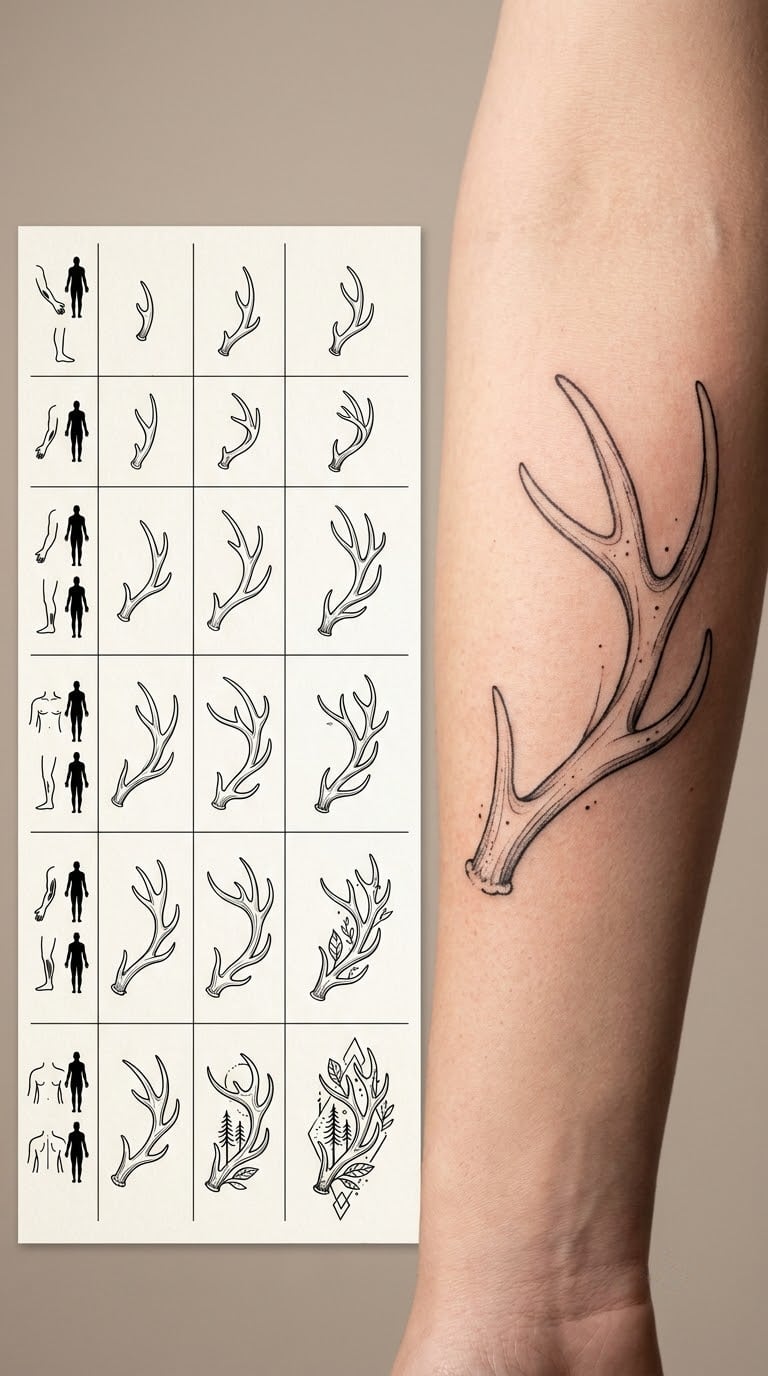
All 24 designs are below in the same order, with the practical details side by side so you can rule things out fast. Sizes are realistic healed dimensions in inches, not the tiny versions you find on mood boards.
| Idea | Style | Best placement | Realistic size | Pain |
|---|---|---|---|---|
| 1. Single Fine-Line Antler | Fine line | Inner forearm | 2-3 in (5-8 cm) | Low |
| 2. Minimal Antler Branch | Minimalist | Wrist | 1.5-2.5 in (4-6 cm) | Medium |
| 3. Geometric Antler Triangle | Geometric | Inner upper arm | 3-4 in (8-10 cm) | Low |
| 4. Antlered Stag Silhouette | Blackwork | Calf | 4-5 in (10-13 cm) | Low |
| 5. Realistic Emerging Antlers | Black and grey realism | Forearm | 4-5 in (10-13 cm) | Medium |
| 6. White Stag in Blackwork | Blackwork | Upper arm | 5-6 in (13-15 cm) | Medium |
| 7. Antlered Deer in a Moon | Fine line | Inner arm | 3.5-4 in (9-10 cm) | Low |
| 8. Botanical Antler with Pine Needles | Botanical | Forearm | 4 in (10 cm) | Low |
| 9. Floral Antler Design | Fine line | Outer arm | 3-4 in (8-10 cm) | Low |
| 10. Antler-Frame Mountain Scene | Black and grey | Forearm | 4-5 in (10-13 cm) | Medium |
| 11. Deer Head with Watercolour Splashes | Illustrative colour | Shoulder | 5 in (13 cm) | Medium |
| 12. Traditional Antlered Buck | Traditional | Upper arm | 5-6 in (13-15 cm) | Medium |
| 13. Neo-Traditional Antler Medallion | Neo-traditional | Chest | 5 in (13 cm) | Medium |
| 14. Dotwork Antler Pair | Dotwork | Inner arms | 3 in (8 cm) each | Medium |
| 15. Antler Line-Art Skull | Fine line and stipple | Forearm | 4 in (10 cm) | Medium |
| 16. Minimal Antler on the Collarbone | Minimalist | Collarbone | 2-3 in (5-8 cm) | Medium |
| 17. Antlered Deer Behind the Ear | Micro fine line | Behind the ear | 1.5-2 in (4-5 cm) | Medium |
| 18. Antler and Compass Design | Fine line | Upper arm | 3.5 in (9 cm) | Low |
| 19. Antlered Stag in a Forest | Illustrative | Calf | 3-4 in (8-10 cm) | Low |
| 20. Abstract Split Antler | Abstract blackwork | Forearm | 4 in (10 cm) | Medium |
| 21. Antlered Deer Profile | Black and grey realism | Outer arm | 4.5-5 in (11-13 cm) | Medium |
| 22. Antlers and Hand-Poked Moon Phases | Hand-poked | Forearm | 3-4 in (8-10 cm) | Medium |
| 23. Antlered Deer Sleeve Accent | Blackwork | Forearm sleeve | 5-6 in (13-15 cm) | Medium |
| 24. Matching Antler Half-Tattoos | Fine line | Inner forearms | 2.5-3 in (6-8 cm) each | Low |
1. Single Fine-Line Antler
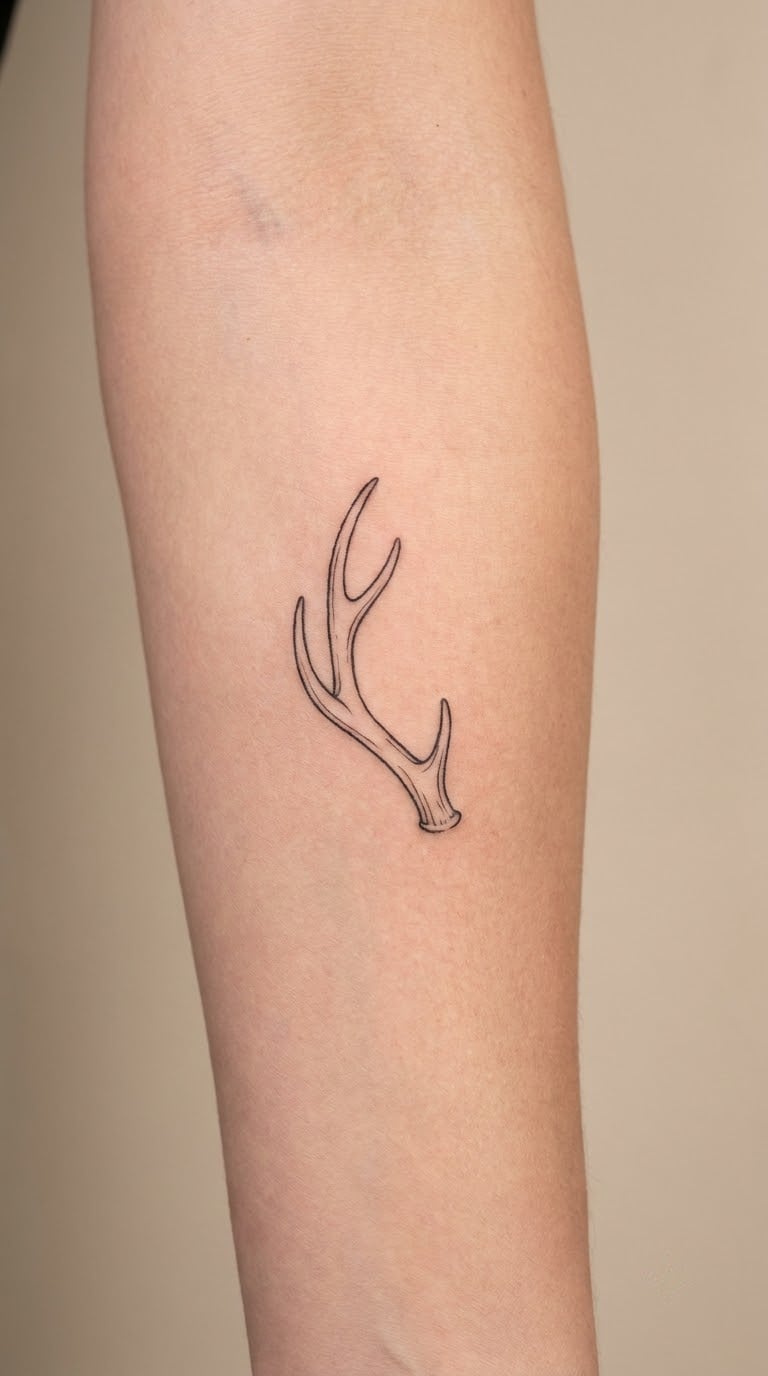
One antler, drawn with a single needle in one continuous line that tapers as it climbs, with three or four tines branching off the main beam. Nothing behind it, nothing shading it. The restraint is the whole point.
People choose a single antler when they want a symbol that stays quiet. It reads as wilderness, growth and renewal without spelling anything out, which is handy if the meaning is private.
Placement: Inner forearm, wrist or behind the ear. Size: 2-3 in (5-8 cm) tall. Style: Fine line, single-needle work. Pain: Low on the inner arm. Fair warning: line this thin softens over the years, so plan for a touch-up or ask for a slightly heavier line if you want it sharp for decades.
Make it yours: Add the year you first saw a deer in the wild where you were born.
2. Minimal Antler Branch
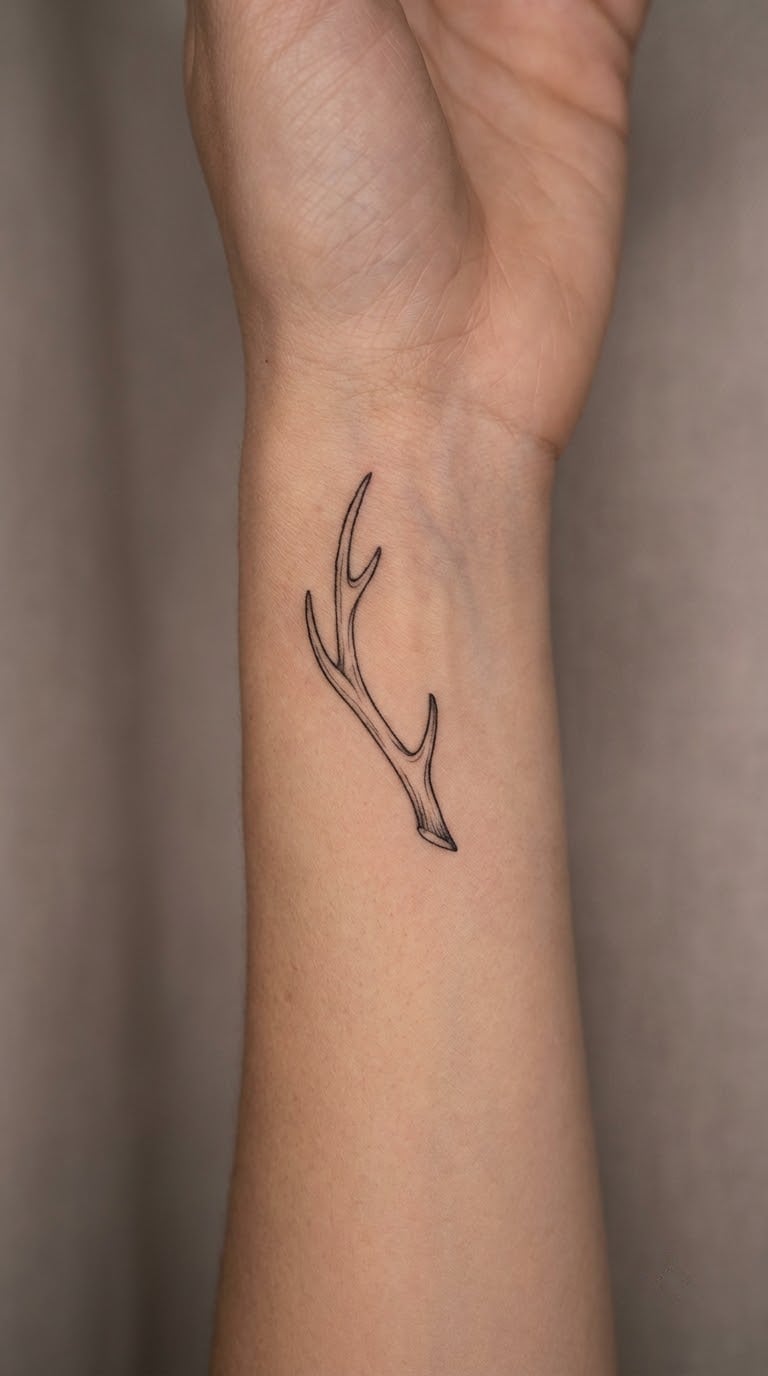
Even simpler than a full antler: a single beam with a couple of tines, sometimes just a fork. Most artists finish a piece this size inside one sitting, which makes it a practical choice for a first appointment.
It works as a standalone mark or as the opening element of a bigger nature piece you add to later.
Placement: Inner wrist or inner forearm. Size: 1.5-2.5 in (4-6 cm). Style: Minimalist line art. Pain: Medium on the wrist, where the skin is thin and the veins sit close to the surface. Wrist linework distorts as the wrist flexes, so keep it small.
Make it yours: Mirror it on the opposite wrist so the two branches meet when your hands rest together.
3. Geometric Antler Triangle
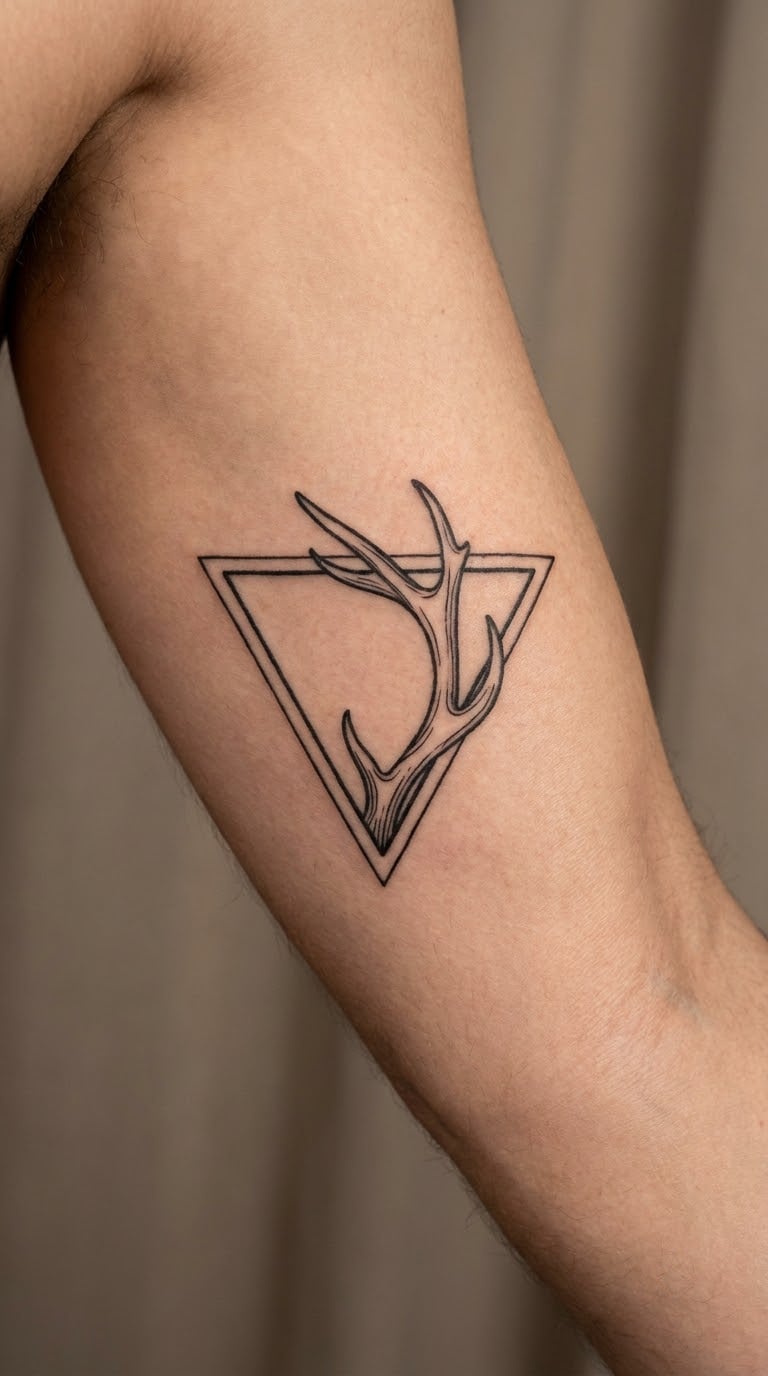
Antlers reduced to angles. Straight beams, triangular tines and a frame around the whole thing, sometimes with a dot or a thin line repeating underneath for balance. The result looks engineered rather than organic.
This is the modern pick for anyone who likes symmetry and clean shapes but does not want a heavy black piece. Geometric and mandala-style deer work is treated as a category of its own rather than an offshoot of realism, so most artists keep a folder of it.
Placement: Inner upper arm, forearm or shoulder blade. Size: 3-4 in (8-10 cm). Style: Geometric linework. Pain: Low to medium; the upper arm is one of the easier canvases. Line weight matters here, because thin geometric lines blur into each other when healed.
Make it yours: Count the tines and set that number as a triangle, a year or a family count.
4. Antlered Stag Silhouette
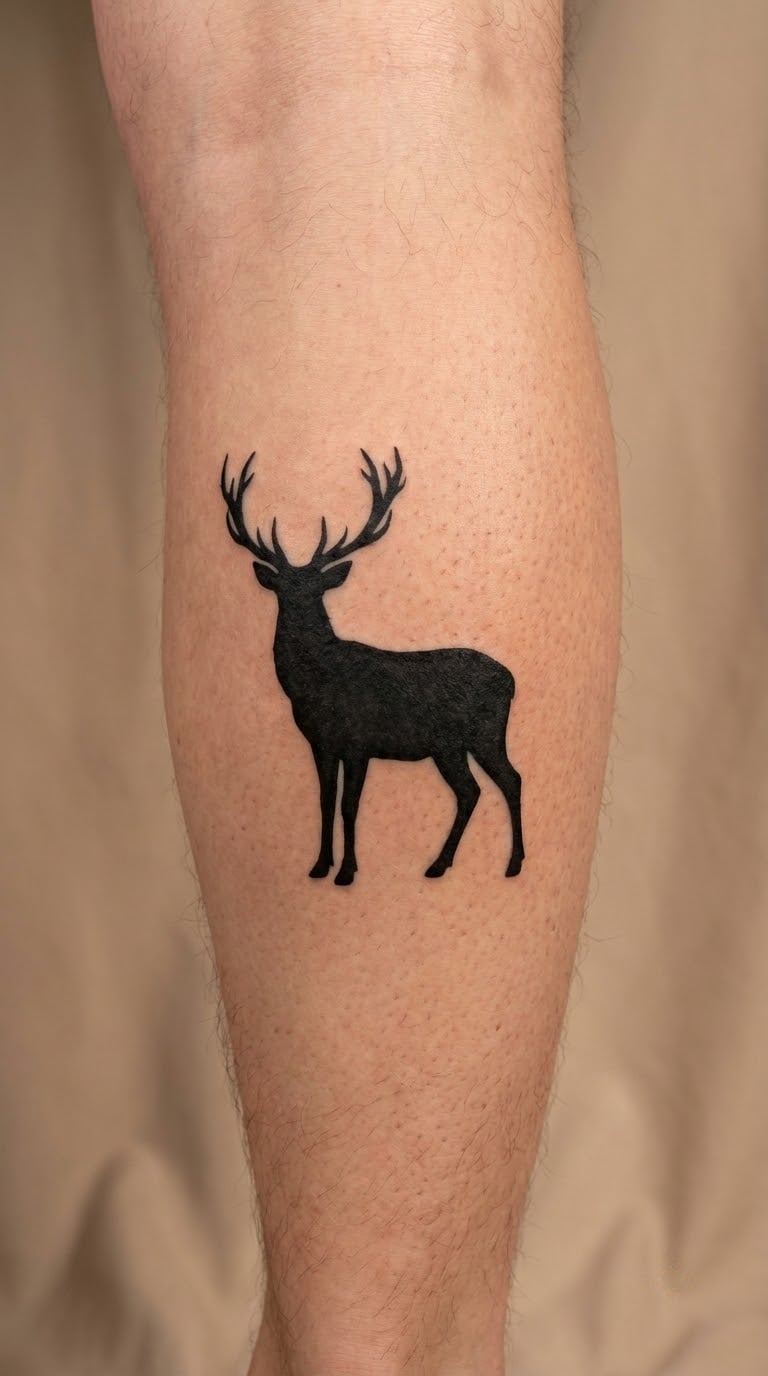
A single solid black shape: head, neck, branching rack, done flat with no gradient. Because the antlers are drawn as part of the silhouette, the shape has to be anatomically believable or it turns into a mess of black.
Solid silhouettes age well. They are the antler equivalent of a bold logo, and they read from a distance, which is why so many of them sit on a calf or an outer arm.
Placement: Calf, outer arm, upper back. Size: 4-5 in (10-13 cm) long. Style: Blackwork silhouette. Pain: Low to medium on the calf. Filling in solid black takes longer than the linework looks like it will, so budget extra chair time.
Make it yours: Set the stag on a treeline or mountain ridge as a separate, much lighter layer behind it.
5. Realistic Emerging Antlers
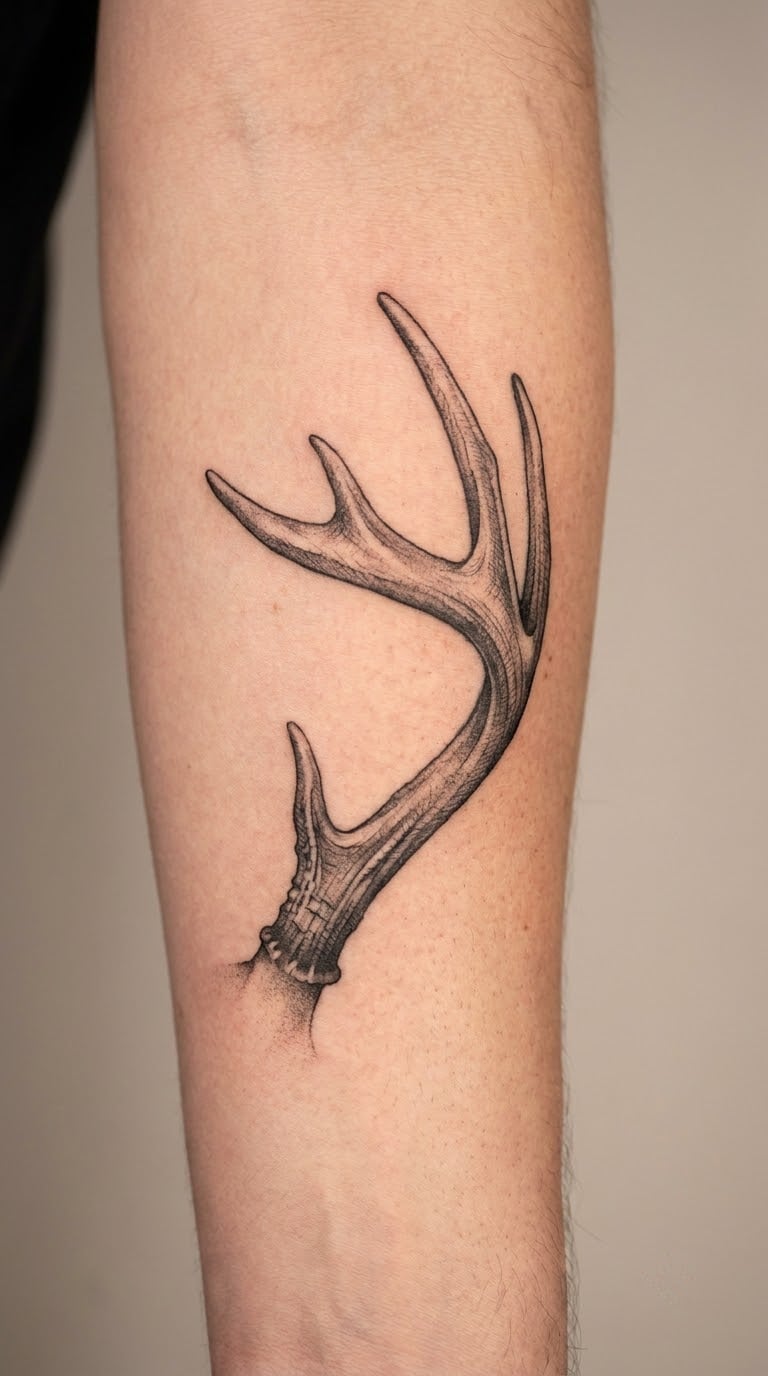
Antlers drawn as they grow: velvet at the base fading to hard bone at the tines, pores and burrs picked out with soft grey shading. It is a study of texture rather than a picture of a deer.
Good realism work here depends on actual reference photographs of a real rack. Anatomy errors on antlers are the first thing anyone notices, so bring your own references.
Placement: Forearm or outer thigh. Size: 4-5 in (10-13 cm). Style: Black and grey realism. Pain: Medium on the forearm. Expect a second session, because soft grey shading takes far longer to build than the finished piece suggests.
Make it yours: Model the rack on a specific species, whitetail, elk, roe deer or caribou, since the tine counts and branching differ.
6. White Stag in Blackwork
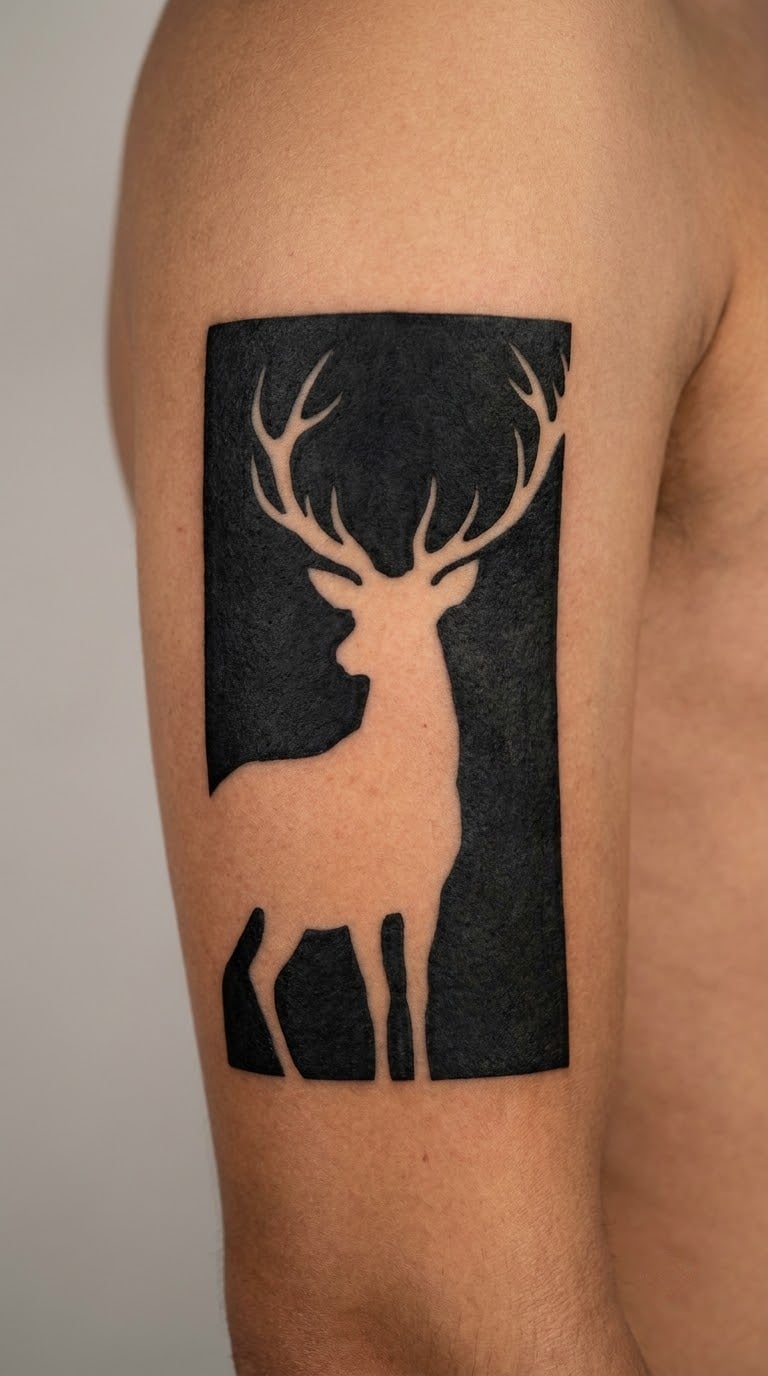
A dense field of black with a stag cut out of it, the animal appearing as untouched skin. The antlers are usually the most detailed part, drawn as thin white lines running up through the solid black.
It gives you a bold piece that still has fine detail hiding inside it. The white stag is also the most common antler design I get asked about for people who want a memorial piece without a face or a name.
Placement: Outer upper arm, back of the shoulder, chest. Size: 5-6 in (13-15 cm) tall. Style: Blackwork with negative space. Pain: Medium, and longer in the chair than a solid silhouette of the same size because the black has to be laid down in layers.
Make it yours: Hide a small date in the lower black area where the eye never goes.
7. Antlered Deer in a Moon
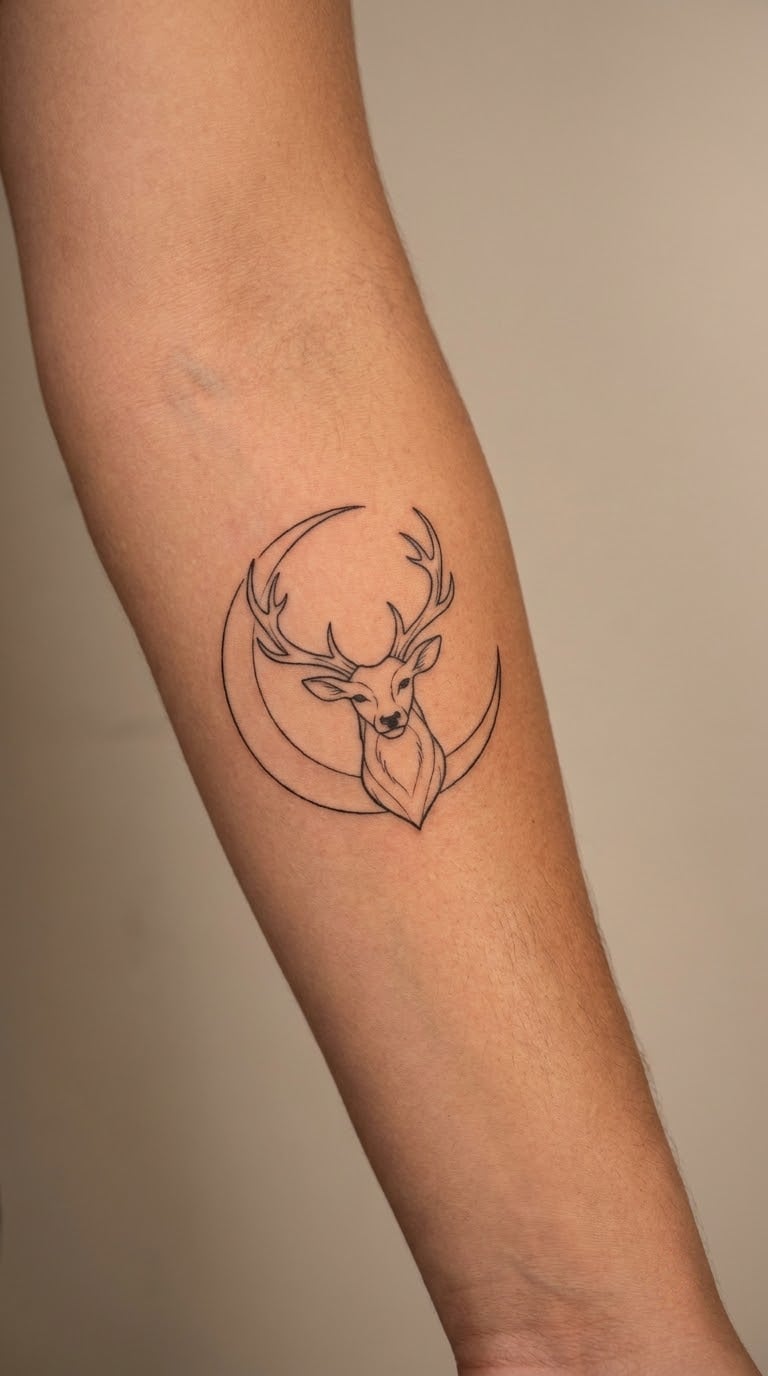
A deer head in fine line, wrapped by a thin crescent that curves around the antlers and closes near the muzzle. Some artists add a scatter of tiny dots as stars inside the gap between moon and head.
The moon gives the design a nocturnal, quiet mood, and the crescent is a natural fit for the antler curve because both shapes arc in the same direction.
Placement: Inner arm, ribs, behind the ear. Size: 3.5-4 in (9-10 cm) tall. Style: Fine line with a celestial accent. Pain: Low on the inner arm, moderate over the ribs. The crescent gives the artist a natural guide for keeping the circle even.
Make it yours: Turn the crescent into a full moon and add your birth phase to the star dots.
8. Botanical Antler with Pine Needles
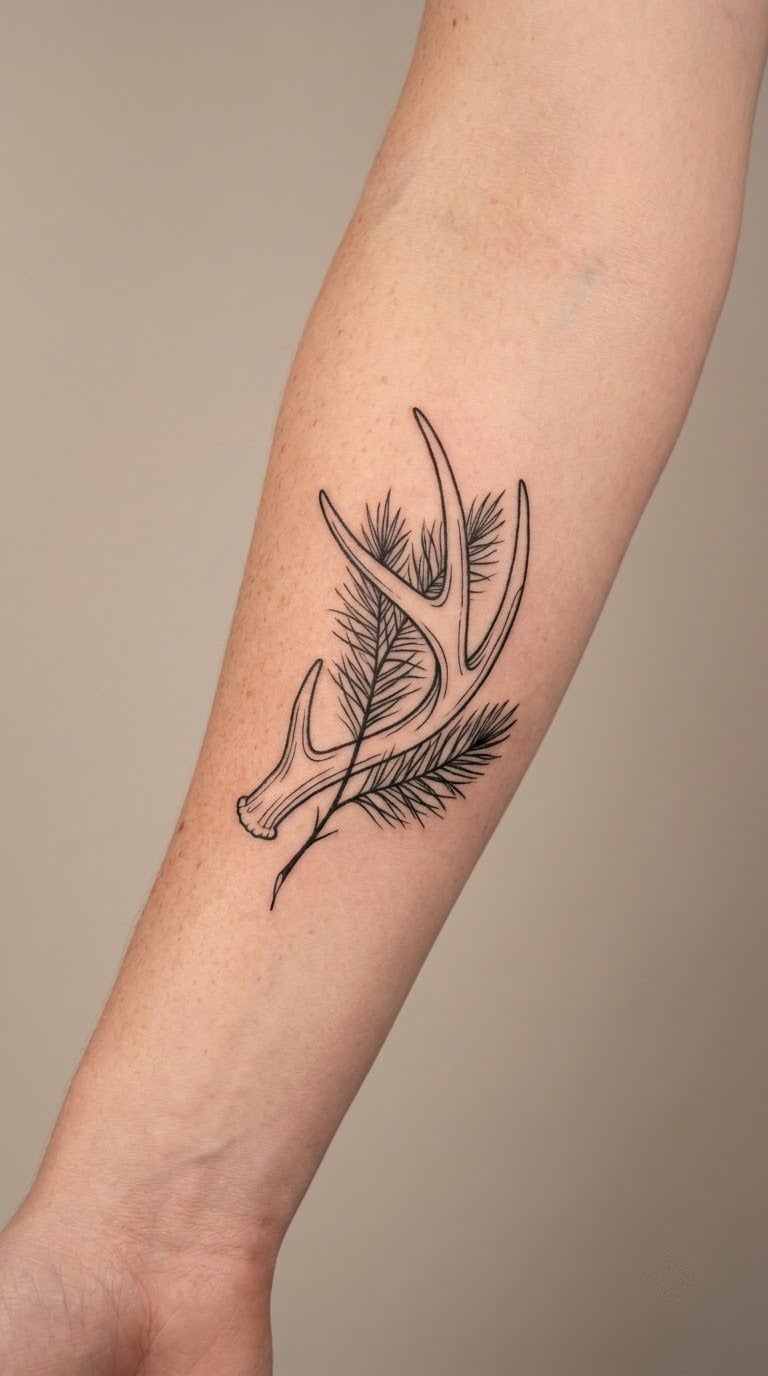
Antlers woven with evergreen sprigs, needles threading between the tines as if the rack is growing through a branch. It stays in one ink and one weight, which keeps it clean at a modest size.
The pairing says outdoors without needing a whole forest behind it. It suits a hunting heritage piece that you would rather not look like a hunting scene.
Placement: Forearm, outer arm. Size: 4 in (10 cm) long. Style: Botanical linework. Pain: Low on the forearm. A lot of needle tips means a lot of tiny passes, so the stinging is spread out rather than concentrated.
Make it yours: Use a conifer from the place you grew up, cedar, pine or spruce.
9. Floral Antler Design
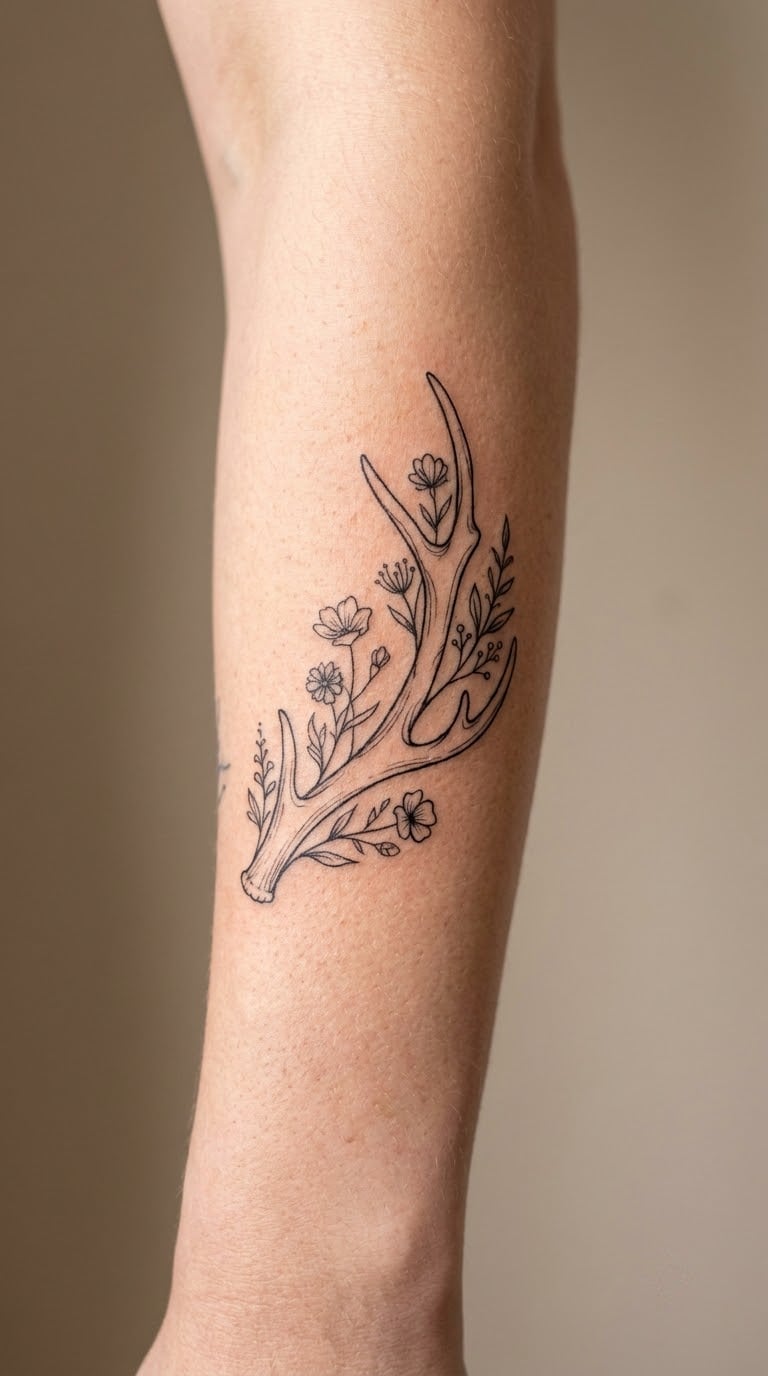
Antlers with wildflowers, thistles or ferns growing between the tines, usually drawn in a single weight so nothing competes for attention. The most common version has the flowers clustered low near the burr and thinning out toward the tips.
Floral antlers are the version that most often gets picked by people who do not want the traditional masculine reading of a deer piece. It is a soft motif with a wild edge.
Placement: Outer arm, shoulder, collarbone area. Size: 3-4 in (8-10 cm) wide. Style: Fine line botanical. Pain: Low to medium. Petal edges and thin stems are the first lines to blur, so ask for slightly bolder contours.
Make it yours: Choose flowers with a date attached, a birth flower for someone, or wildflowers from a walk you wanted to keep.
10. Antler-Frame Mountain Scene
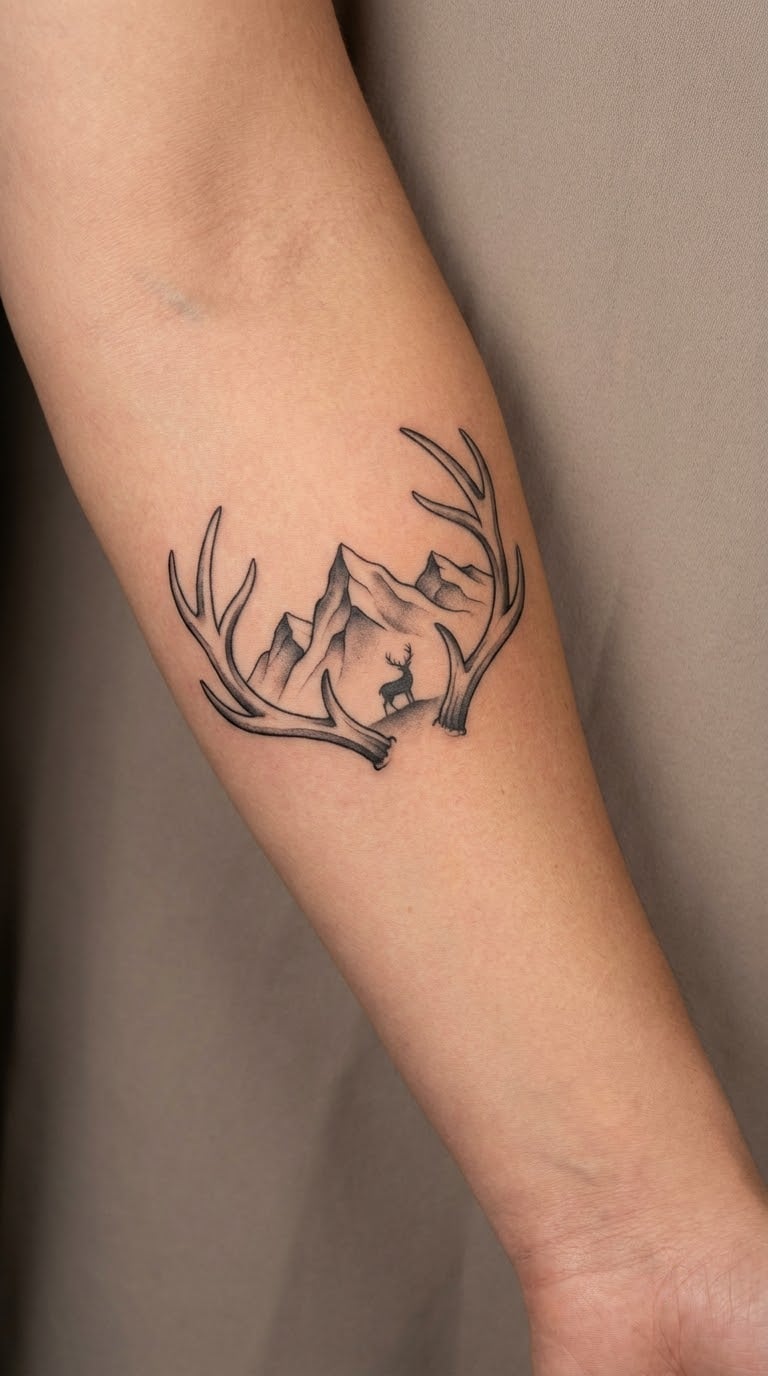
A pair of antlers drawn as an open frame, with distant peaks and a small deer silhouette sitting inside the negative space between the branches. The mountains are usually soft grey and far less detailed than the antlers.
It gives you a full scene in a small footprint, and it is a favourite when the piece is for a specific mountain, park or stretch of forest.
Placement: Forearm, outer arm, chest. Size: 4-5 in (10-13 cm) wide. Style: Black and grey with fine line framing. Pain: Medium. Two line weights in one piece often means a second sitting, and the shaded mountains are what take the time.
Make it yours: Use a real ridge line from the view you want, traced from a photograph you took yourself.
11. Deer Head with Watercolour Splashes
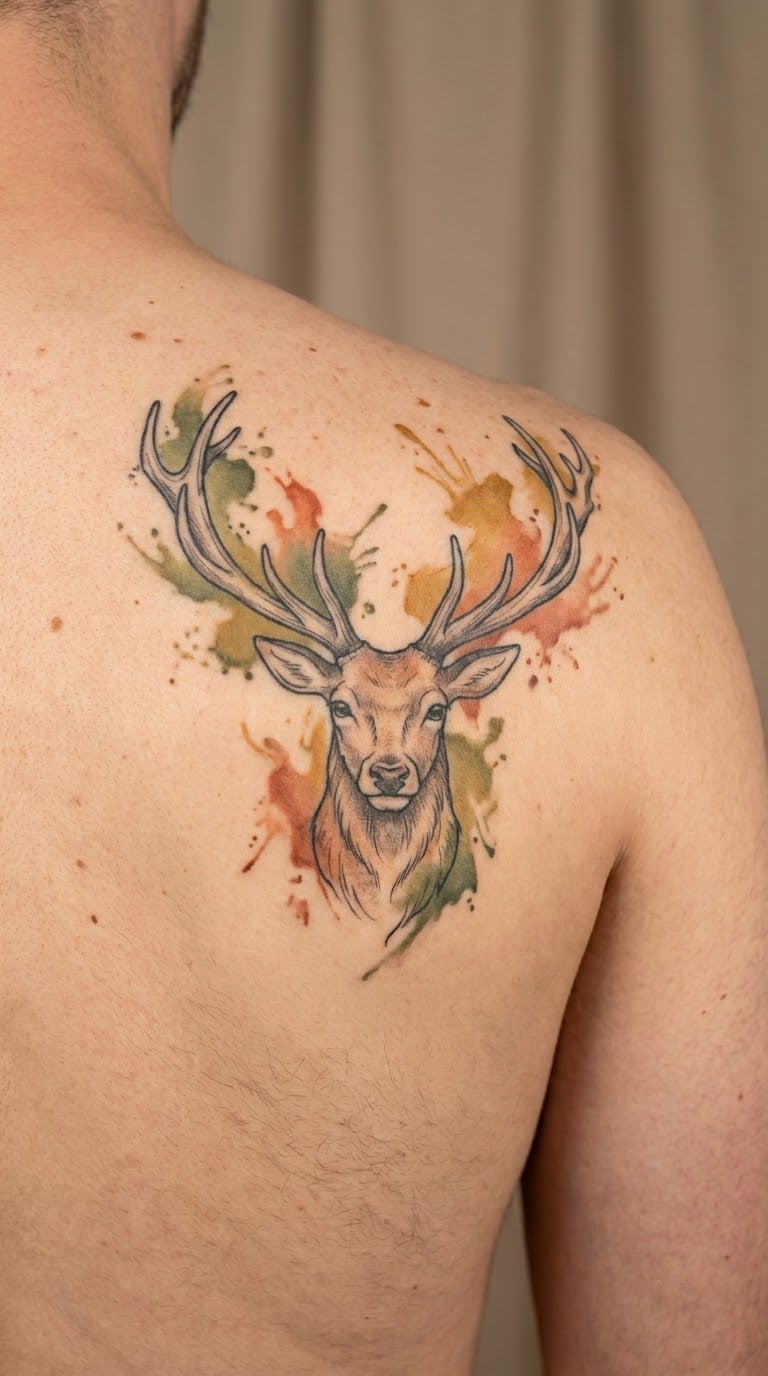
A realistic or semi-realistic deer head in black, with loose watercolour washes behind the antlers, usually muted green, rust, ochre or a single wash pulled across the whole piece. The colour bleeds past the linework on purpose.
This is the strongest choice for someone who wants a realistic animal but does not want the piece to read as flat black. Colour placement takes planning, so talk it through before the session.
Placement: Shoulder, chest, outer thigh. Size: 5 in (13 cm) wide. Style: Illustrative colour with realism linework. Pain: Medium, and colour means multiple passes over the same skin, so expect a longer sitting or two sittings.
Make it yours: Match the wash to one colour that matters to you, a team, a season, a place.
12. Traditional Antlered Buck
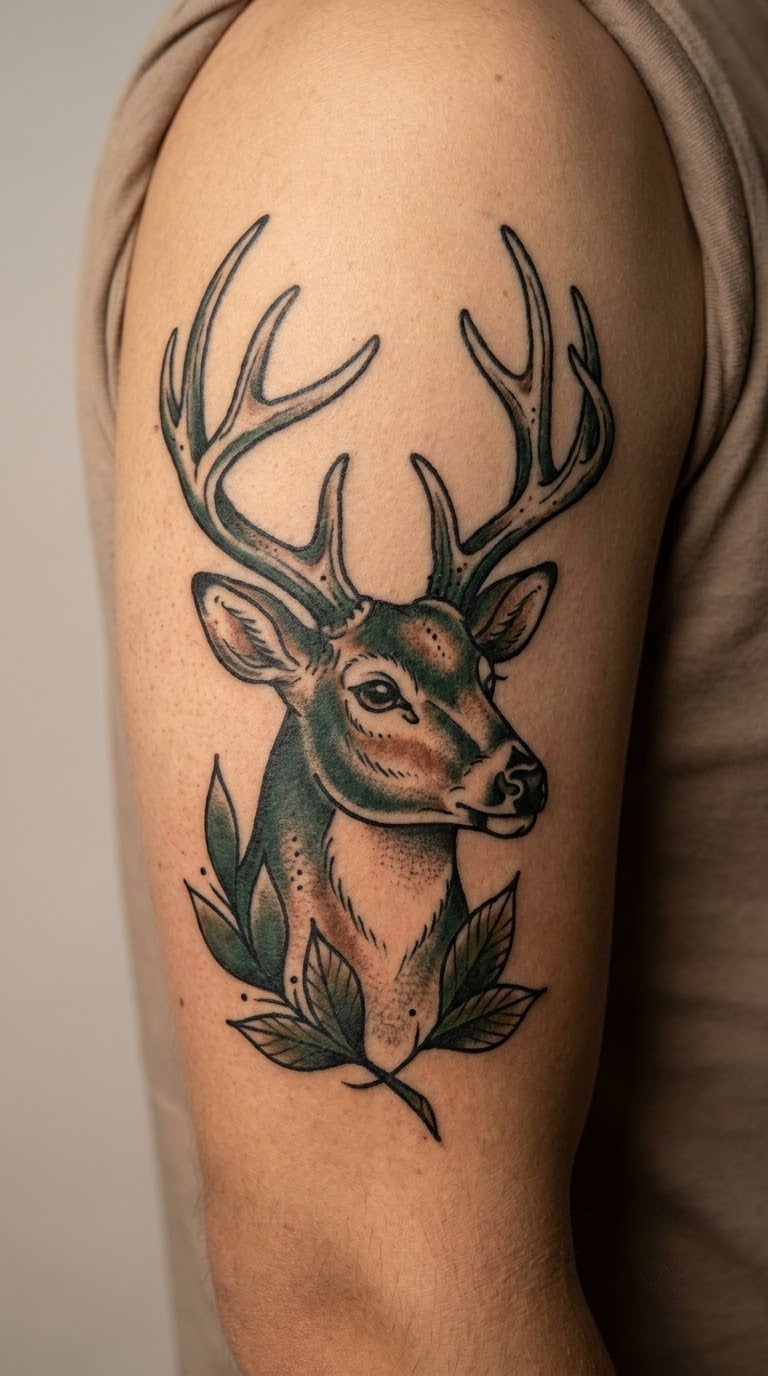
Bold outlines, flat colour, minimal shading, the old tattoo flash look. A buck facing forward or in three-quarter view, with antlers that spread wide and read clearly at a distance.
Traditional work ages better than almost anything else in this list. Colour may soften, but a bold outline holds its shape for decades.
Placement: Upper arm, forearm, calf. Size: 5-6 in (13-15 cm) long. Style: Traditional, flat colour with heavy black line. Pain: Medium. Coloured areas get worked over several passes, which is more uncomfortable than a single black fill.
Make it yours: Ask for your buck in the colours of a hunting coat or a place, rather than the studio defaults.
13. Neo-Traditional Antler Medallion
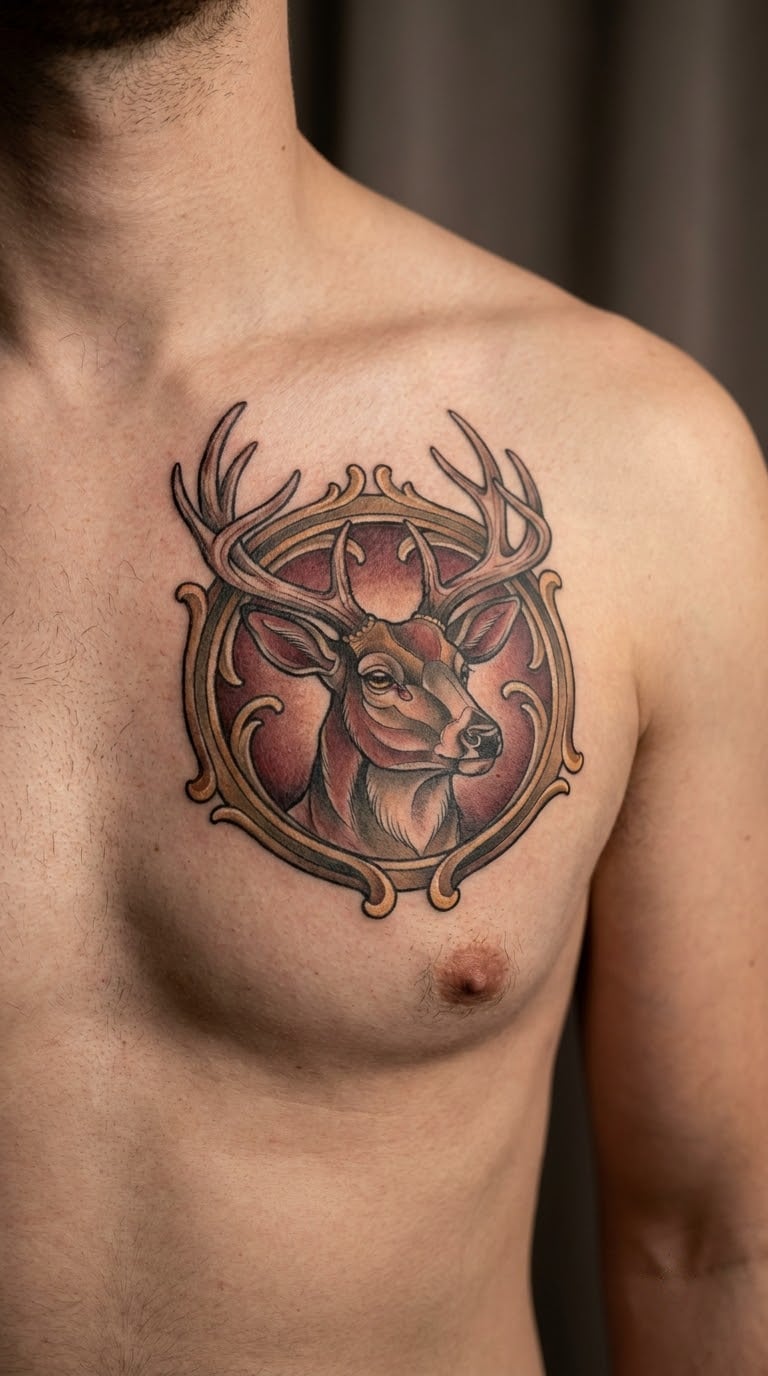
A stag head centred inside a symmetrical antler frame, built like a badge. Smooth gradient shading, ornamental scrollwork between the beams, a tight palette, usually red, gold and deep green or blue.
The framing turns a wildlife subject into something decorative, and it fills the chest better than a bare animal head. Neo-traditional artists are used to building this structure.
Placement: Chest, upper back, thigh. Size: 5 in (13 cm) wide. Style: Neo-traditional with ornamental framing. Pain: Medium on the chest, and gradient shading is a lot of needle work, so plan on two sittings.
Make it yours: Put a small year inside the scrollwork between the antler beams.
14. Dotwork Antler Pair
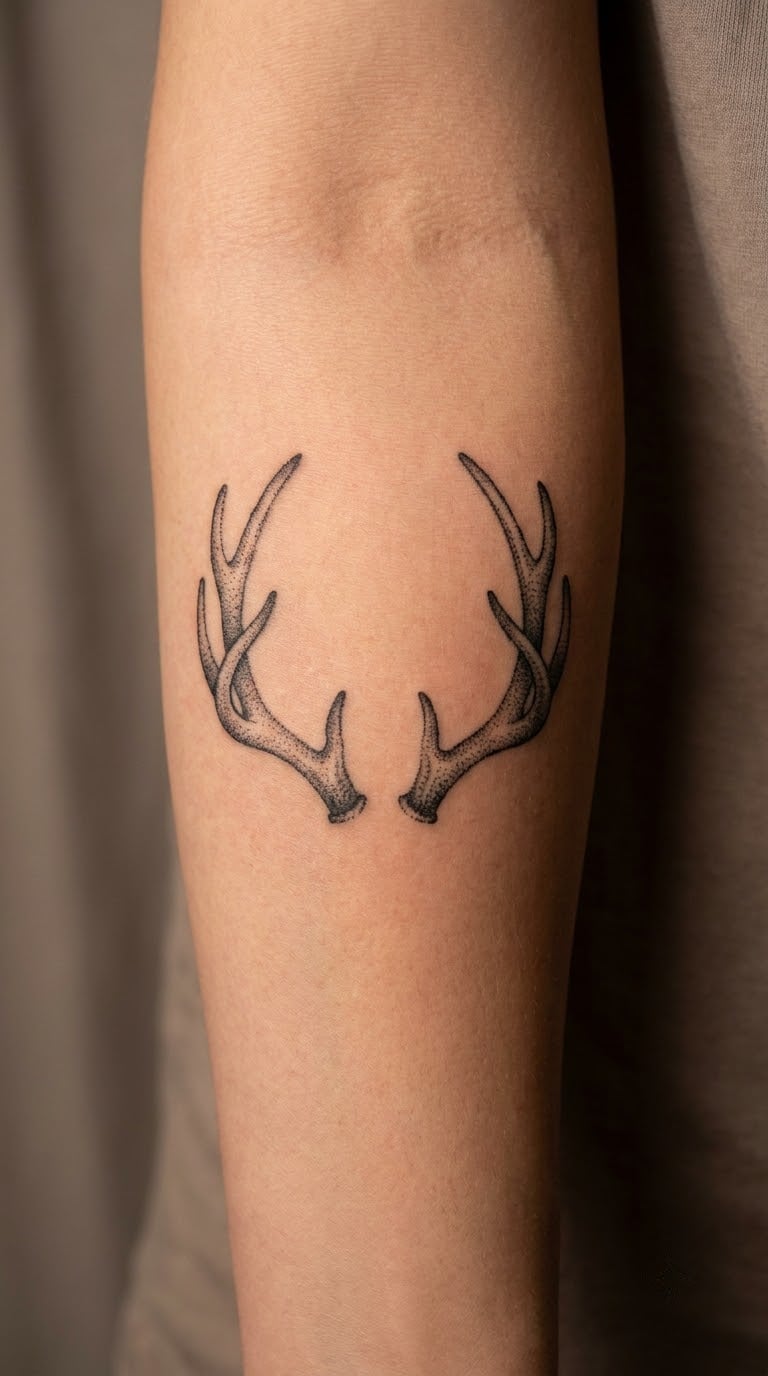
Antlers built entirely from dots, the density shifting from sparse to packed so the shape and shading come out of the pattern. Two mirrored pieces, one on each inner arm, is the usual arrangement.
Dotwork gives you texture and tone without a single block of solid black, so it reads softer than a silhouette while still having plenty of visual weight. The pair balances naturally.
Placement: Inner arms, forearms. Size: 3 in (8 cm) tall each. Style: Dotwork. Pain: Medium, and dotwork takes real time, often a full long sitting per arm. The inner forearm is fleshy, so the session feels rougher than the pain scale suggests.
Make it yours: Grade one arm slightly darker than the other so the pair has depth rather than a mirror finish.
15. Antler Line-Art Skull
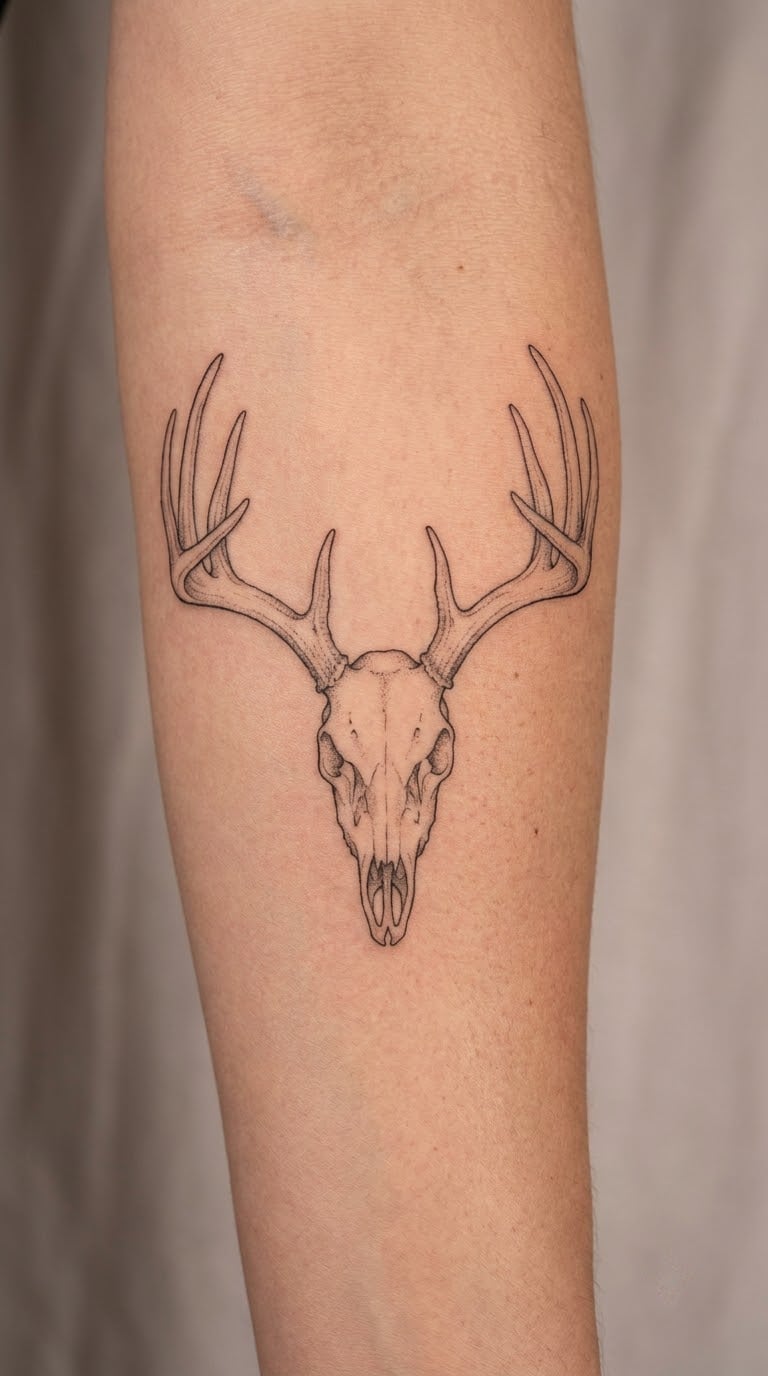
A deer skull in thin contour lines with light stippling in the bone, the antlers branching wide above it. Some versions keep only the skull, others let the antlers run into leaves or smoke at the tips.
The skull is a recognised category in tattoo culture rather than a compromise between a deer and a skull, and it has a long record in the genre. Expect people to read it as a hunting keepsake.
Placement: Forearm, upper arm, ribs. Size: 4 in (10 cm) wide. Style: Fine line with stipple. Pain: Medium. Over the ribs, a skull that wide gets uncomfortable by the end of the sitting.
Make it yours: Add a band of coordinate numbers or a hunting season date under the skull.
16. Minimal Antler on the Collarbone
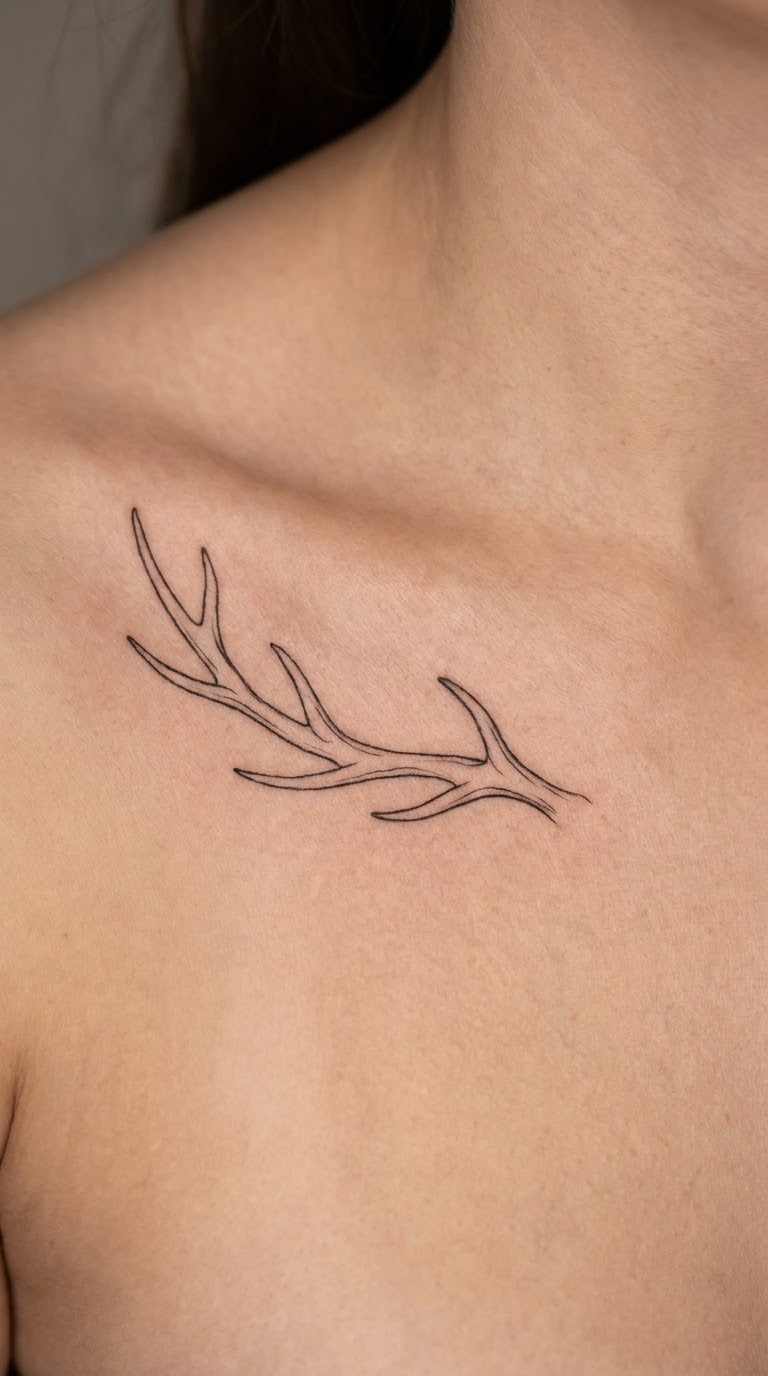
A small fine-line antler placed along the collarbone, following the bone’s curve rather than sitting flat across it. Usually a short beam with two or three tines, angled so it reads with the body.
It is a discreet option that appears when you wear a low neckline and disappears under a shirt, which is why it appeals to people starting their first tattoo.
Placement: Beneath or just above the collarbone. Size: 2-3 in (5-8 cm) wide. Style: Minimalist fine line. Pain: Medium, because the collarbone sits right on bone. The ribs under the collarbone also shift when the design is placed too low.
Make it yours: Add a second matching antler on the other collarbone, small enough that both read as a detail rather than a statement.
17. Antlered Deer Behind the Ear
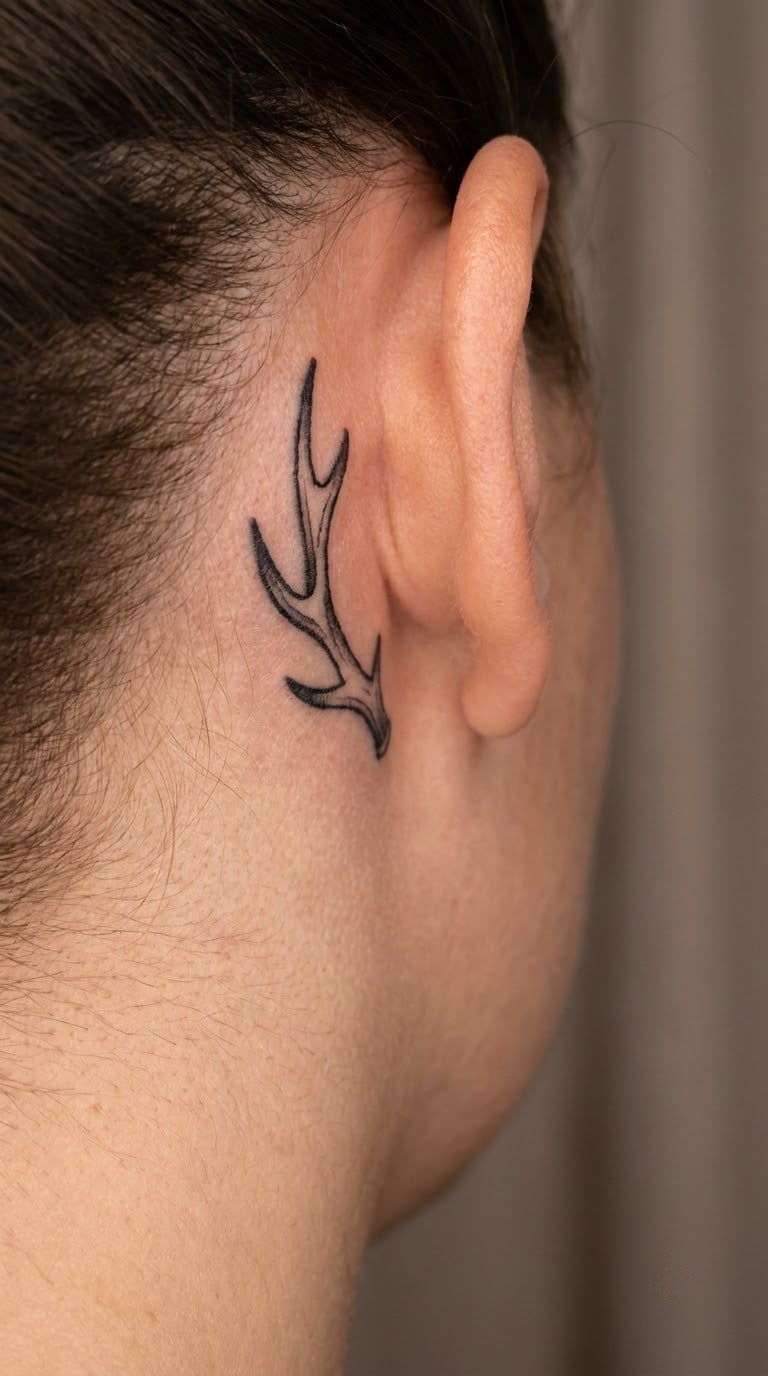
A very small antler tucked into the curve behind the ear, drawn in one or two tapered lines. Because it is hidden in the shadow of the ear, the size that would look lost on a forearm looks deliberate here.
It is the most discreet way to carry the motif. People with visible arm tattoos sometimes choose it because it can be shown or hidden with a hand.
Placement: Behind the ear, along the hairline. Size: 1.5-2 in (4-5 cm) long. Style: Micro fine line. Pain: Medium, closer to moderate, and the skin here is thin and mobile. Small is the right call: below 1.5 in the tines start to merge.
Make it yours: Angle the beam so it follows the curve of your ear rather than sitting straight.
18. Antler and Compass Design
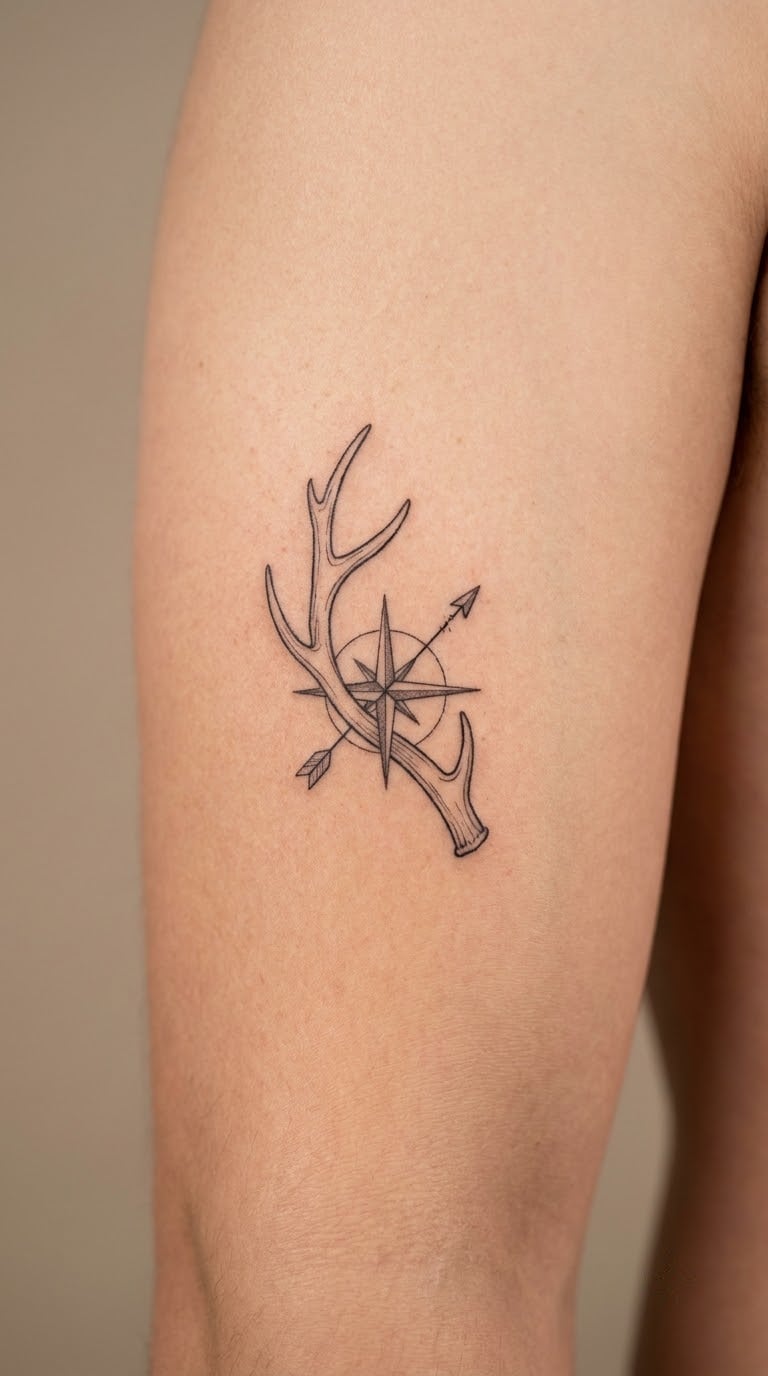
A compact compass rose with an antler crossing it, drawn in fine line with one clear arrow point. The compass is usually small and simple so it does not turn the piece into a nautical design.
Antlers plus a compass reads as direction and travel, which is why this pairing shows up for a first big trip, a move abroad, or a year spent outdoors.
Placement: Upper arm, forearm, calf. Size: 3.5 in (9 cm) tall. Style: Fine line with a geometric accent. Pain: Low to medium. Tiny tick marks on a compass take patience, and patience takes time in the chair.
Make it yours: Put a real destination’s coordinates in the centre of the compass face.
19. Antlered Stag in a Forest
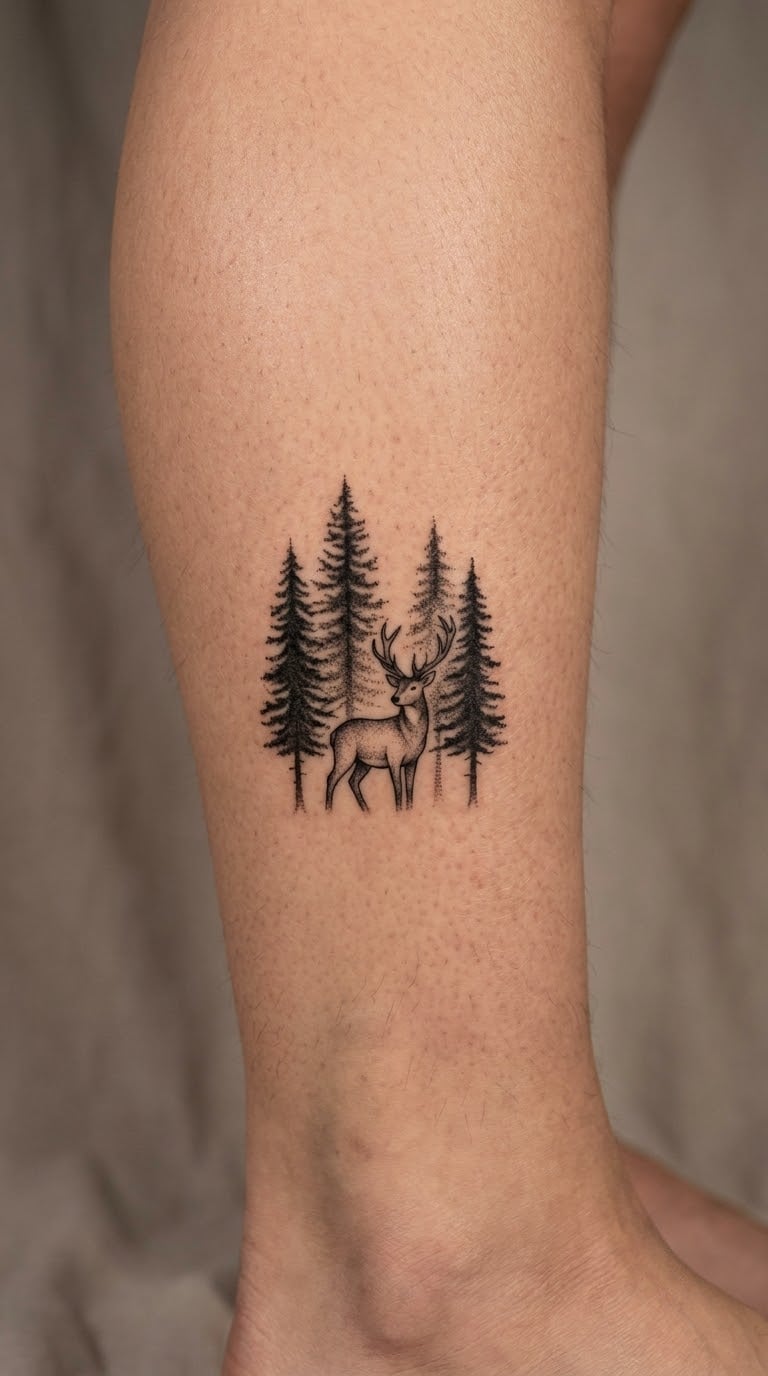
A small stag in profile with a few pine silhouettes behind it, the trees simplified into dark shapes and the deer kept lighter. The scale contrast does the work: the deer is the subject, the forest is context.
It reads as wilderness without being a hunting scene. Ask the artist to keep the tree line soft so the antlers stay the sharpest thing in the piece.
Placement: Calf, outer arm, thigh. Size: 3-4 in (8-10 cm) long. Style: Illustrative black and grey. Pain: Low to medium on the calf. Packed black tree shapes go down faster than fine linework but sting more.
Make it yours: Specify a tree species from somewhere you have actually walked.
20. Abstract Split Antler
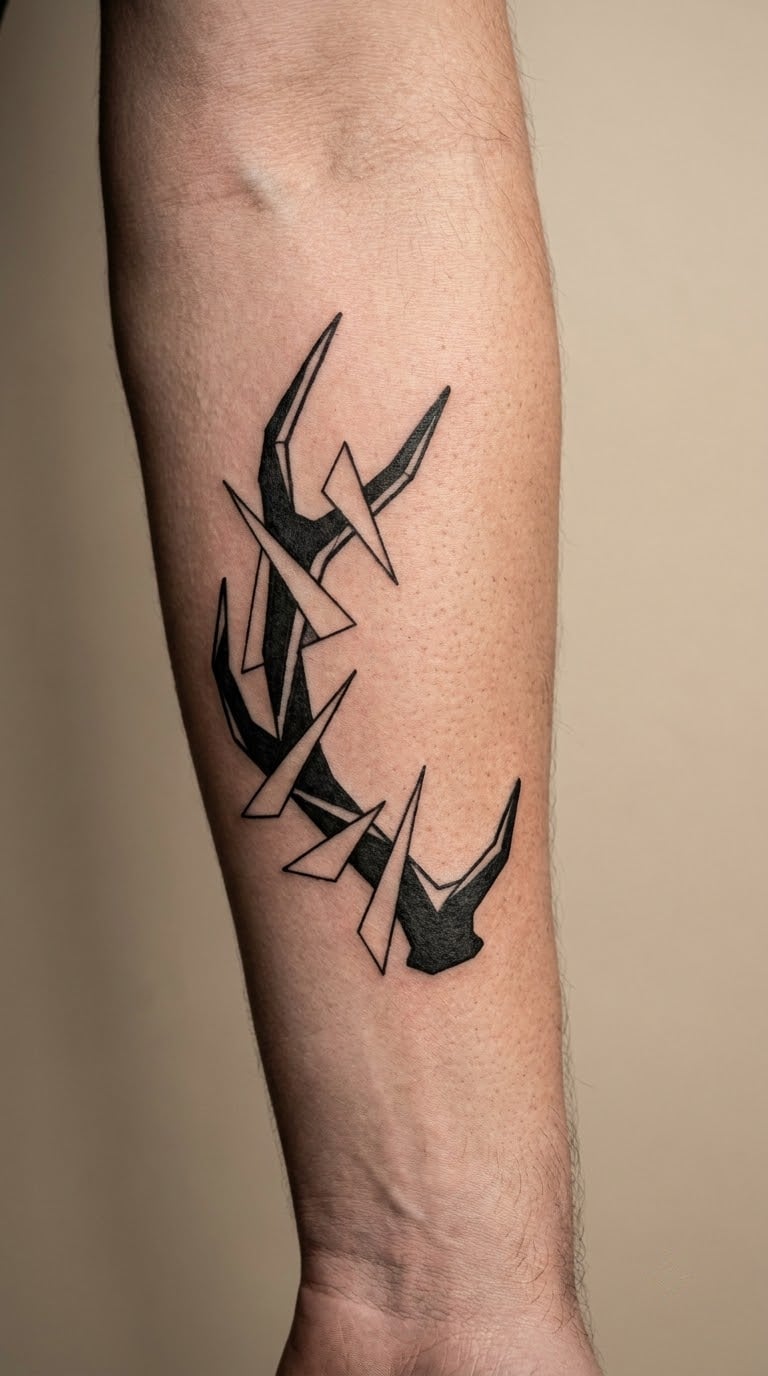
The antler broken into angular slabs of black separated by clean white gaps, so the shape reads as antler and abstraction at once. The edges are sharp and the gaps deliberate, not accidental.
It is the boldest non-animal option here and works well as the only piece on an arm. Abstract antlers age very well, since the design is built from solid shapes rather than delicate lines.
Placement: Forearm, outer arm. Size: 4 in (10 cm) long. Style: Abstract blackwork. Pain: Medium, since large filled areas need several passes. Solid black ages better than the fine line elsewhere in this list, which is a real advantage.
Make it yours: Set the negative gaps so they spell a date when the arm is straight.
21. Antlered Deer Profile
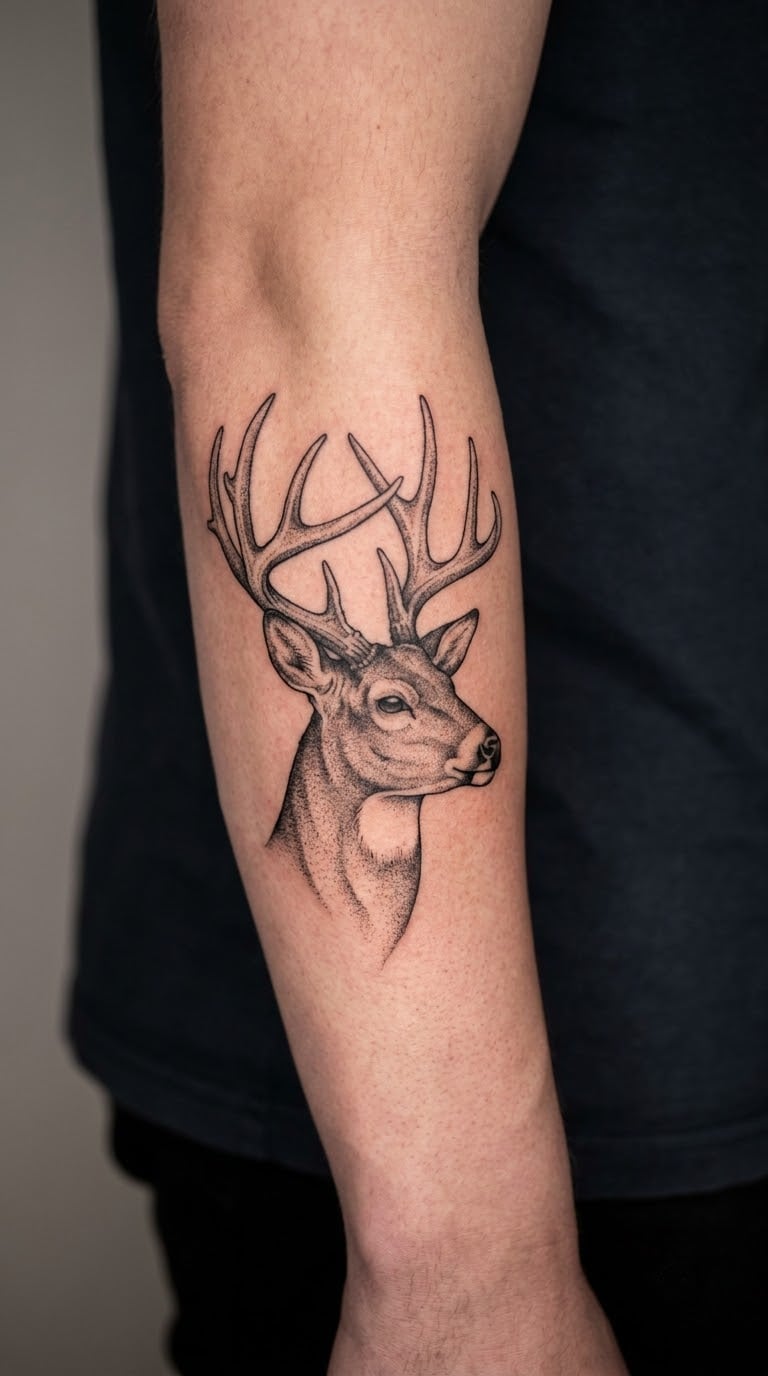
A deer in profile, drawn realistically in black and grey, the antlers branching above the head. The profile angle shows the antler shape more clearly than a front-facing portrait, which is the main reason to choose it.
It is the safest realistic option if you want the animal to be recognisable from a distance without going full portrait. Anatomy accuracy is everything here; check a healed portfolio, not studio flash.
Placement: Outer arm, calf, thigh. Size: 4.5-5 in (11-13 cm) long. Style: Black and grey realism. Pain: Medium, with a realistic piece this size usually split across two sittings.
Make it yours: Draw the deer with its head turned slightly back over its shoulder for more movement in a static shape.
22. Antlers and Hand-Poked Moon Phases
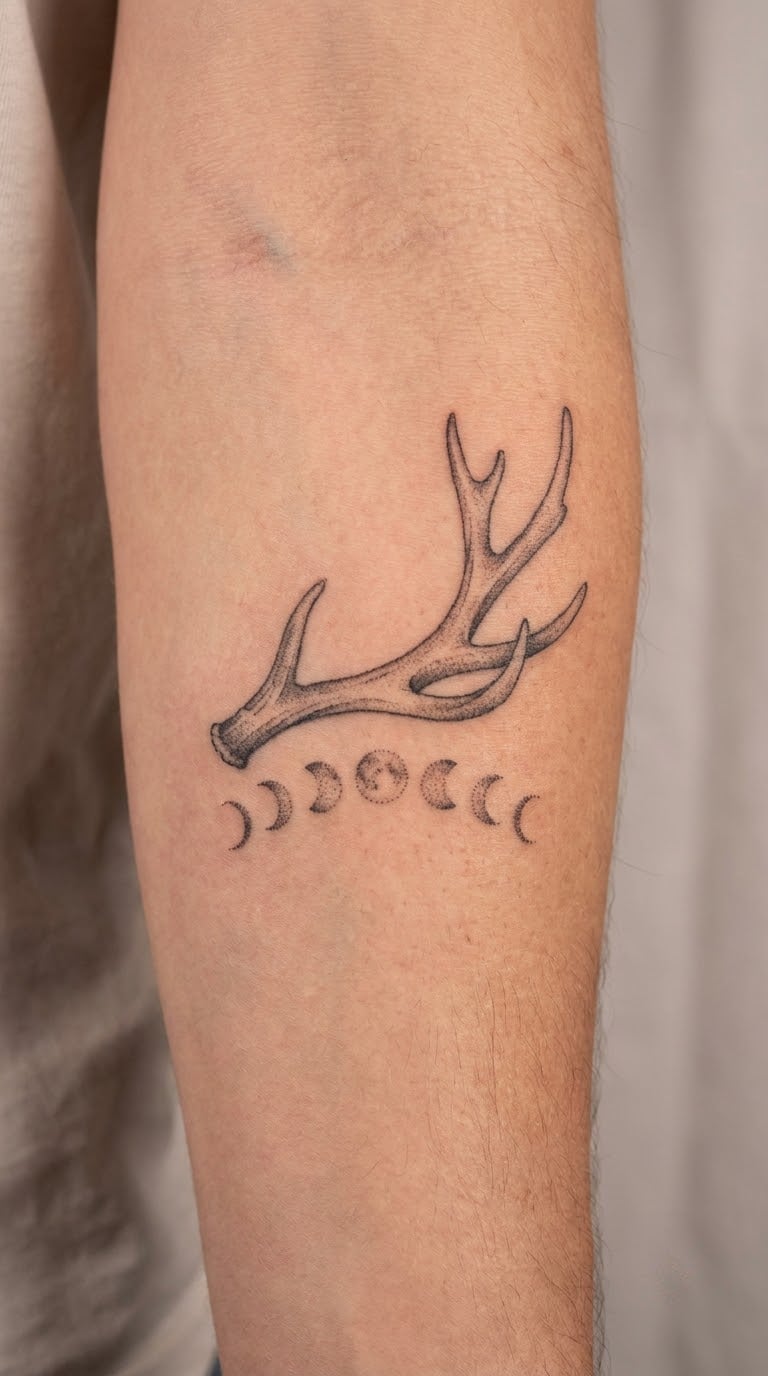
A branching antler drawn hand-poked, with a row of moon phases running underneath it in order from new to full and back. Hand-poked work uses a single needle and a light touch, so the lines vary slightly in depth.
Moon phases give the piece a timeline reading, which is why this one often carries a date or a year of something that changed. The hand-poked texture is the point, not a limitation.
Placement: Forearm, inner arm, calf. Size: 3-4 in (8-10 cm) long. Style: Hand-poked, soft black and grey. Pain: Medium to moderate, and hand-poked is slower, so a 3.5 in piece can take most of a sitting. Ask what happens if you run out of time mid-piece.
Make it yours: Mark the phase that matches a real date, rather than laying out all eight evenly.
23. Antlered Deer Sleeve Accent
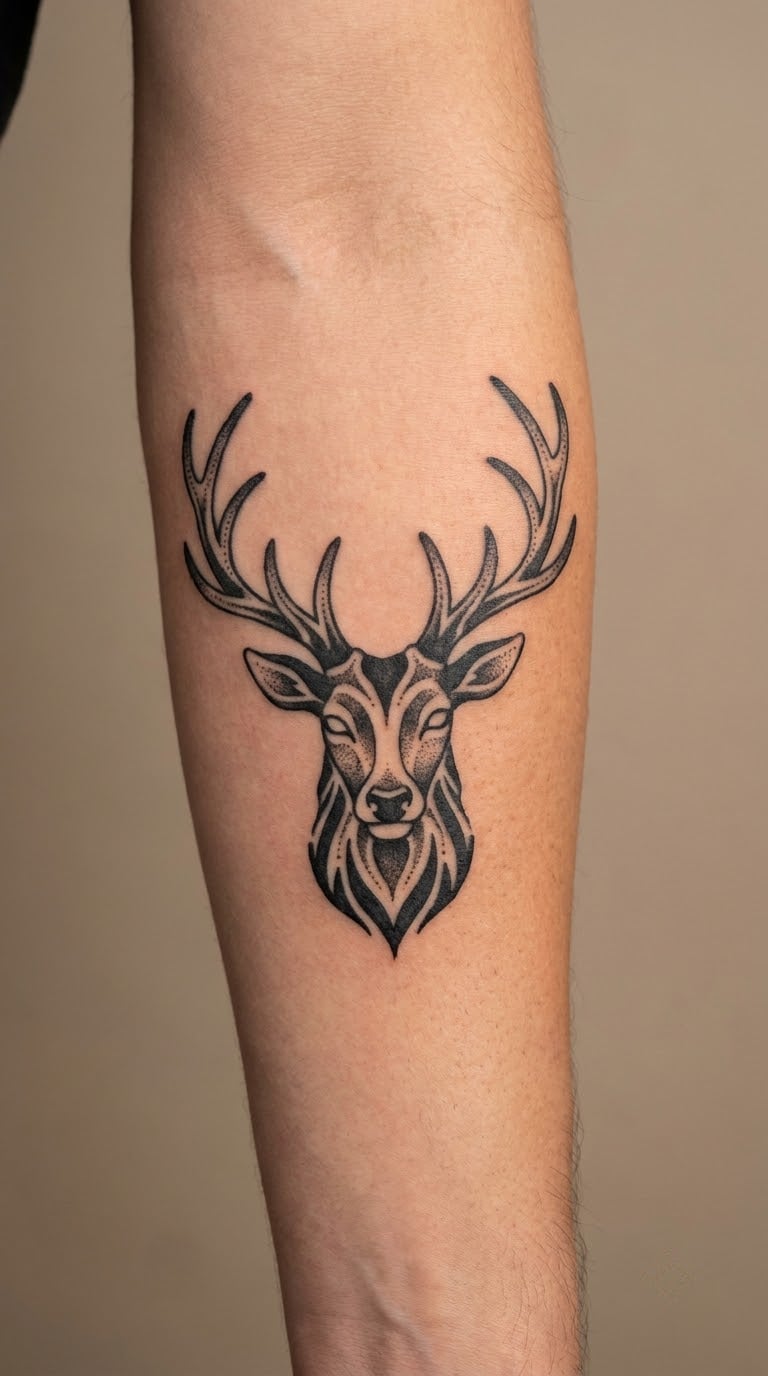
A stag head and full rack built as the anchor of a larger blackwork sleeve, with the space around it deliberately left open. The antlers break the outline of the composition rather than sitting inside a frame.
This one only works with a plan. Artists building a sleeve usually start at the back and work toward the wrist, and the stag tends to land in the middle of that sequence rather than on day one.
Placement: Forearm, upper arm, back of the arm. Size: 5-6 in (13-15 cm) wide as the central element. Style: Blackwork. Pain: Medium per sitting, spread over several appointments. The open skin around the head is what keeps the sleeve readable later.
Make it yours: Sketch the whole sleeve on paper first, at full scale, so the stag is not boxed in later.
24. Matching Antler Half-Tattoos
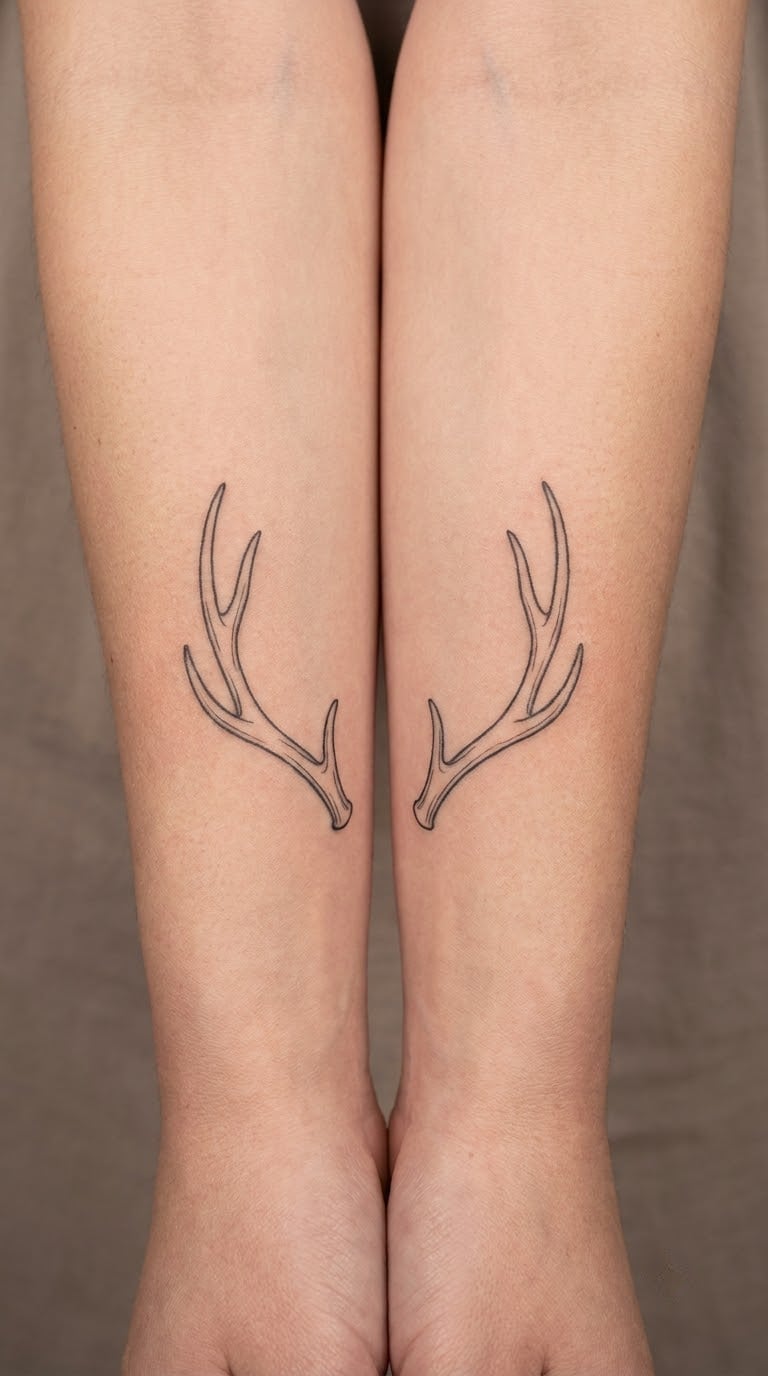
One half-antler each, mirrored so the two branches meet when you rest your forearms side by side. The cut is usually made on the beam, with the outer half on one person and the inner half on the other.
Matching sets get a lot of attention and a lot of commitment, so agree on size and line weight before either of you books. Healing at different rates can leave the two temporarily out of step.
Placement: Inner forearms, matching. Size: 2.5-3 in (6-8 cm) each. Style: Fine line, mirrored. Pain: Low to medium on the inner arm. Both of you should expect a short touch-up window once the ink settles.
Make it yours: Add one small shared element, a date, an initial, a small bird perched on one branch and not the other.
How to Choose the Right Design
Once you have narrowed the gallery down, the deciding factors are space, style and meaning. Answer these in order and the right design usually becomes obvious.
- How much flat space do you have? Antlers sit well on a forearm, outer arm, calf, thigh and upper back. They fight you on a joint, a rib or anywhere the skin folds.
- How bold do you want it to read? Silhouettes, blackwork and traditional pieces read from several metres away. Fine line reads as a private detail, mostly to you.
- How much fade risk will you accept? Very fine lines soften first. Heavier black, flat colour and abstract shapes hold their shape longest, and any fine linework may need a touch-up in time.
- What do you want it to mean? Antlers carry growth, renewal, wilderness and hunting heritage. A full stag reads differently from a single antler, and a skull reads as a keepsake rather than a portrait.
- How small is too small? Below about 1.5 in (4 cm) the tines start to merge into a blob. If you want fine detail, give the piece more room instead of shrinking it.
- One piece or part of a project? A small antler now can grow into a sleeve later. If you plan ahead, ask for line weight and placement that can be built on.
A reference sheet works better than a folder of saved images. Print three or four designs you like, mark what you like about each one, and bring your own photographs of the species you actually want. Artists work far more happily from a mood board with clear preferences than from a single image to copy.
Cost and Session Time
Almost every tattoo shop prices by the hour, and the hourly rate is the only number most clients ever hear. Everything that drives price also drives time: size, detail, colour, placement and how much of the design is solid black.
- Small fine-line pieces usually take 30 minutes to an hour, and fit comfortably in one sitting.
- Medium designs with shading or a scene take two to three hours, which is most shops’ comfortable limit in one session.
- Realistic or colour work is usually split across two sittings, because soft grey shading and watercolour washes need breaks.
- Sleeves are priced per session and take several appointments from start to finish.
Shop minimums, hourly rates and what counts as a small piece vary widely between artists and cities, and travel costs more if you go somewhere for a specific style. Collarbone, elbow, ribs, behind the ear and knuckle placements usually need a break built into the session because the area gets uncomfortable before the design is finished. Ask your artist what happens to a piece that does not get completed, and agree the plan before you start.
Aftercare Basics
- Follow your artist’s aftercare instructions first. They know how deep your particular lines went, and generic advice does not always match the session.
- Wash it gently. Clean lukewarm water, a mild unscented soap, and pat dry with something clean. No scrubbing and no picking at scabs.
- Protect it for the first few days. Loose clothing over the area, and keep it out of direct sun. A shower is usually fine; a hot bath is not.
- Wash it daily after that, and moisturise thinly. A thin layer of unscented lotion or balm keeps the skin supple while the new layer settles.
- Keep it out of the sun long-term. Sun is what fades fine antler linework fastest, and a healed tattoo in shorts and sun every summer will show it. High SPF on exposed areas, or cover-up with sleeves when you can.
- If it looks irritated, stop and ask. Redness that spreads, swelling, heat or discharge are reasons to contact your artist and, if needed, a clinician. Do not pick, scrub or re-treat it yourself.
Frequently Asked Questions
What does a deer antler tattoo mean?
A deer antler tattoo usually points to growth, renewal and wilderness. Antlers shed and regrow every year, so the motif reads as rebirth and resilience. A single antler leans toward individuality, a full rack toward strength, and a deer skull toward hunting heritage or a memorial keepsake. There is no fixed dictionary of meanings, though: most people attach their own story to it, and the artist is drawing yours, not a textbook one.
What does a deer antler tattoo symbolize most often?
Strength, resilience and a connection to the outdoors are the three most common readings, followed closely by renewal because antlers regrow every year. Antlers are also the part of a deer people recognise fastest, which is why designers can leave out the face entirely and still get a clear read. If you want a specific meaning, say it plainly to your artist and ask for the design to carry it.
Is a single antler better than a full rack?
Neither is better; they read differently. A single antler is a smaller, quieter piece that works almost anywhere and suits a first tattoo, while a full rack needs more room and usually reads as bolder and more decorative. A single antler also carries the meaning of individuality, a rack of strength and maturity. If you are undecided, start with one antler and add to it later if you want.
Do fine-line antler tattoos fade quickly?
They can. Very thin single-needle lines soften sooner than solid black or flat colour, and sun exposure speeds it up, so fine antler work needs more careful aftercare and long-term sun protection. Many people plan on a touch-up once the first healing settles, often within the first year. Asking your artist for a slightly heavier line weight costs you nothing visually and buys you far more years of sharpness.
What hurts most, and what is easiest, for an antler tattoo?
The inner forearm, outer arm and calf are the easiest, which is why so many antler designs sit there. Wrist, collarbone, behind the ear and chest land in the middle. Elbow, ribs, spine, knuckle and the inner bicep are the hard ones, mainly because the skin is thin, bony or sits over a nerve. A smaller design in an easier spot beats a large one in a painful spot for a first tattoo.
How small can a deer antler tattoo go?
Around 1.5 inches (4 cm) is the practical floor for a recognisable antler. Below that, the tines start merging into a blob once the ink heals, especially if the design has more than three or four branches. If you want a small piece, ask for fewer tines and a bolder line rather than simply shrinking the drawing. Behind the ear and the inner forearm are the two spots where very small pieces still read well.
Conclusion
If this is your first tattoo, start with number 2 or number 17: a small minimal antler on the inner forearm or behind the ear, 1.5 to 2.5 inches, one sitting, and it can be hidden whenever you want. If you already have pieces and want something with more presence, the white stag in blackwork or the traditional buck hold their shape better than almost anything else in this list.
Before you book, save the designs here that you actually like, print three of them, and bring your own photos of the species you want. Then look at healed work rather than studio flash when you choose an artist. That short preparation step prevents most of the disappointment people describe afterwards.