
20 Best Horse Tattoo Ideas for Women: September 2026 Styles
Horse tattoo ideas for women run from a single-line horse head resting on the collarbone to a mare and foal racing across the outer thigh. A horse carries strength, freedom, loyalty and grace in one shape, and the same silhouette reads completely differently on a wrist than it does across a rib.
Twenty designs follow, each with its placement, realistic size, pain level and one way to make it personal. If you ride or grew up in a saddle, the placement and gear notes will matter more to you than the style. If you have never ridden, that is a perfectly normal reason to want one too, and the tattoo community does not treat it as strange.
Horse Tattoo Ideas for Women: Quick Guide
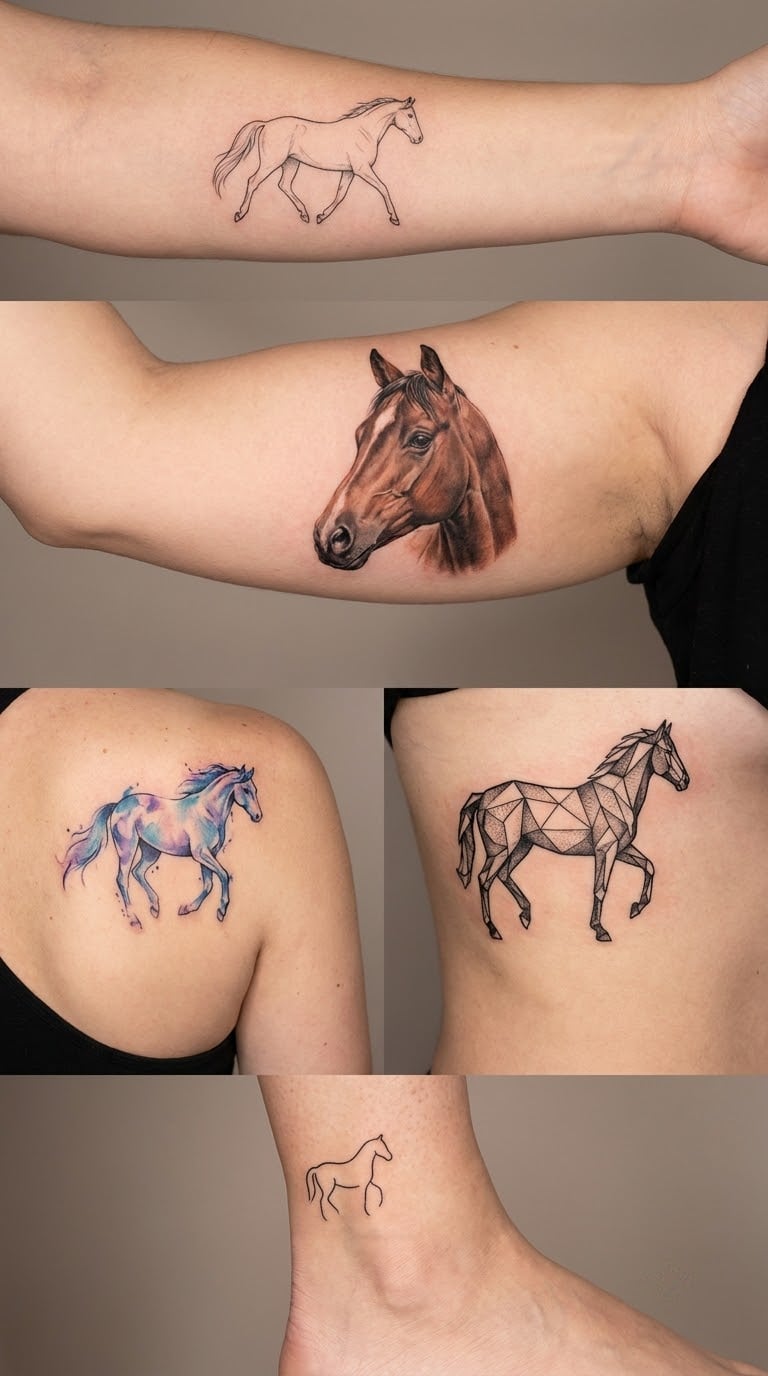
All twenty designs below are compared side by side. The table gives you the style, the body spot that suits it best, an honest size range and what the session actually feels like, so you can narrow the field before you sit down with an artist.
| Idea | Style | Best placement | Size | Pain |
|---|---|---|---|---|
| Fine-line running horse | Fine line | Inner forearm | 3 to 4 inch (7 to 10 cm) | Low to medium |
| Bridled horse portrait | Black and grey realism | Outer upper arm | 5 to 6 inch (12 to 15 cm) | Medium |
| Minimalist horse head | Minimalist line | Collarbone | 2 to 3 inch (5 to 7 cm) | Medium |
| Watercolor galloping mare | Watercolor | Shoulder | 3 to 5 inch (7 to 12 cm) | Low |
| Blackwork horse with wildflowers | Blackwork | Side rib | 5 to 7 inch (12 to 18 cm) | High |
| Horse-shoe symbol | Minimalist symbol | Behind the ear | About 1 inch (2.5 cm) | Low |
| Western traditional horse | Traditional | Forearm | 4 to 5 inch (10 to 12 cm) | Medium |
| Horse-and-rider silhouette | Silhouette | Back of the neck | 2 to 3 inch (5 to 7 cm) | Medium to high |
| Micro-realism horse eye | Micro-realism | Inner wrist | 1 to 1.5 inch (2.5 to 4 cm) | Medium |
| Leopard-print horse | Illustrative | Outer thigh | 5 to 7 inch (12 to 18 cm) | Medium |
| Flowing-mane horse | Fine line illustration | Shoulder blade | 4 to 5 inch (10 to 12 cm) | Low to medium |
| Celestial horse | Symbolic illustrative | Inner arm | 3 to 4 inch (7 to 10 cm) | Low |
| Blackwork horse head | Blackwork | Back of hand | 2 to 3 inch (5 to 7 cm) | High |
| Horse and rose | Fine line with floral | Ankle | 2 to 3 inch (5 to 7 cm) | Medium to high |
| Jumping horse in dotwork | Dotwork | Calf | 3 to 5 inch (7 to 12 cm) | Medium |
| Side-profile horse | Contour line | Upper hip | 4 to 6 inch (10 to 15 cm) | Medium |
| Horse skeleton | Anatomical blackwork | Forearm | 4 to 6 inch (10 to 15 cm) | Medium to high |
| Horse trotting with a moon | Fine line | Calf | 3 to 4 inch (7 to 10 cm) | Low to medium |
| Geometric horse | Geometric | Lower back | 4 to 6 inch (10 to 15 cm) | Medium |
| Mare and foal | Colour illustrative | Outer thigh | 5 to 8 inch (12 to 20 cm) | Medium |
Horse Tattoo Ideas for Women by Style
The list below runs from the most delicate work to the heaviest black. Fine line and minimalist designs use a single needle and almost no shading, so they need a small flat area and a steady artist. Realism and traditional pieces carry colour and bold outlines, which hide small imperfections but want a bigger canvas. Blackwork, dotwork and geometric styles sit in between: graphic, structured, and more forgiving than realism about a shaky line.
Around 2026, the most requested horse designs are the ones that keep a light hand. Fine-line manes, horses with wildflower or wildflower-fill accents, and loose watercolor washes are the three I see asked for most. That is partly trend and partly practicality. Thin lines and pale washes on a small rib or collarbone placement stay delicate, while the same design scaled up to a thigh needs far more pigment to hold up.
1. Fine-Line Running Horse on the Forearm
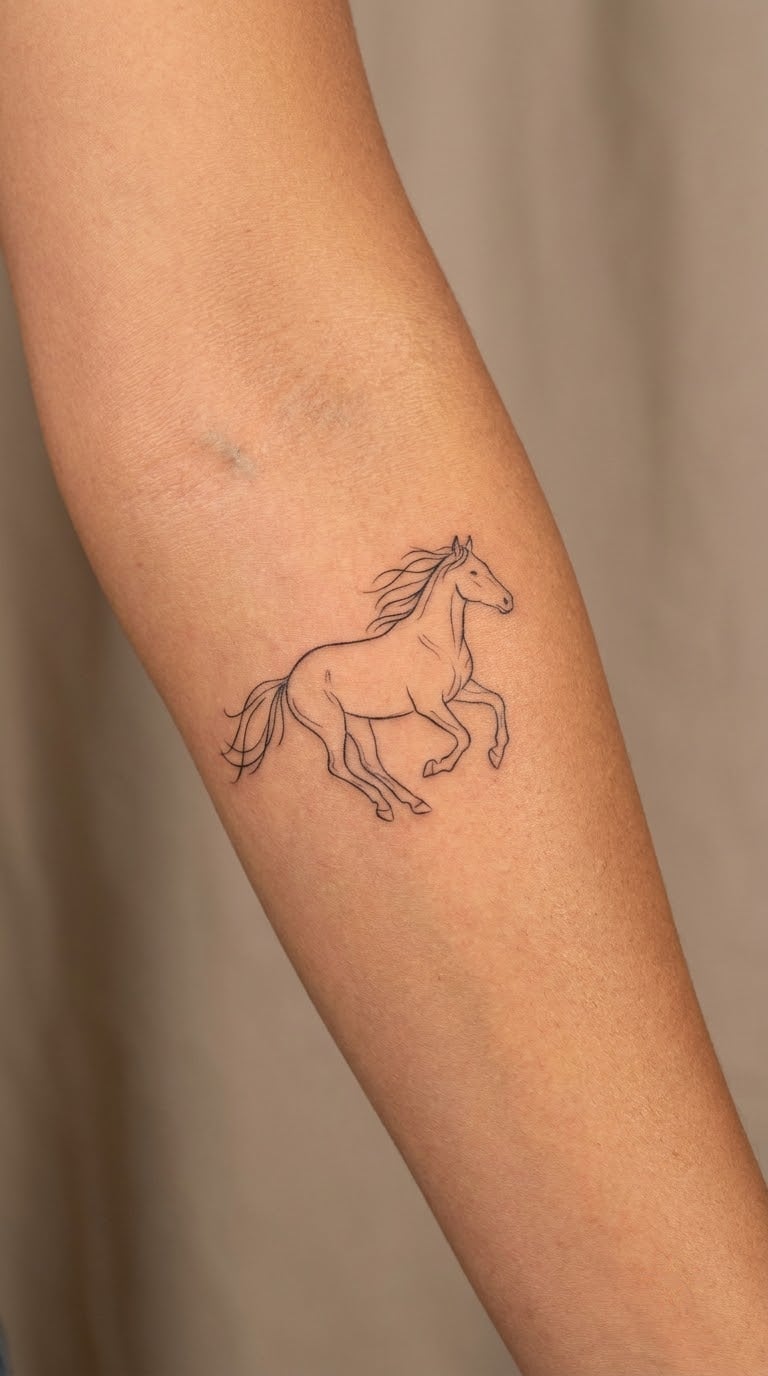
A single black line draws the horse mid-stride, front legs lifted, with the mane trailing in a few loose strokes behind the neck. Nothing else is added: no shading, no background, no shadow under the belly. The line thins as it goes, so the body feels light even at a decent size.
People choose this one because it says movement without shouting. It is a quiet symbol of freedom, or just a good drawing of a horse you have always loved.
Placement: inner forearm, wrist to mid-forearm, or the same design along the outer arm. Size: 3 to 4 inch (7 to 10 cm) long works well. Style: fine line, single needle. Pain: low to medium, and the forearm is a spot most people can sit still through.
Fine-line work softens and spreads over the years, so expect a touch-up every few years. Make it yours: change the stride to a canter if your horse moved that way, or add a single hoof detail in solid black for contrast.
2. Realistic Bridled Horse Portrait on the Upper Arm
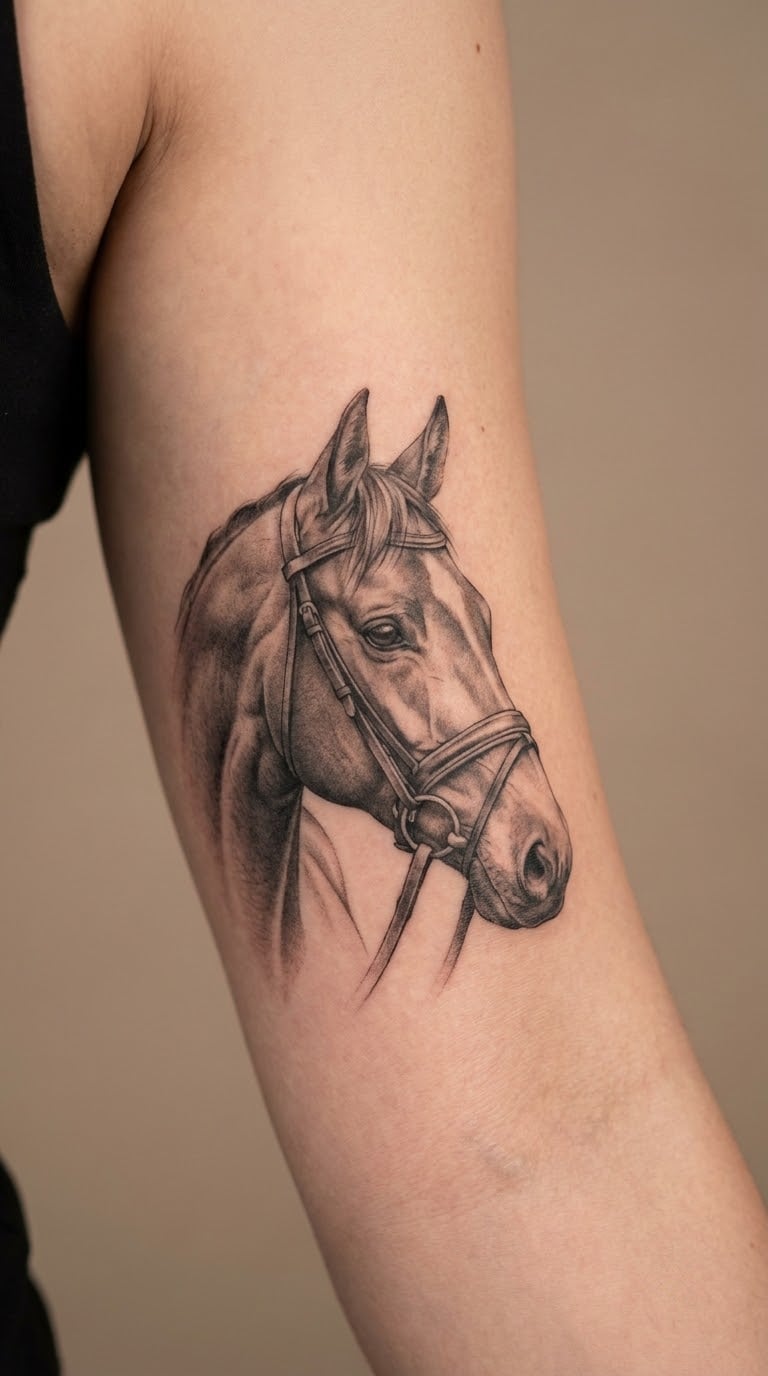
This is a proper portrait: the head in three-quarter view, a leather bridle rendered with texture, and an eye that catches light with a small unshaded highlight. Grey wash builds the shadow along the cheek and neck, and the mane is suggested with short directional strokes rather than drawn strand by strand.
A bridle usually points to a horse you actually know, especially when there is a story behind it. Without one, it reads as a working or ridden horse, which suits plenty of riders too.
Placement: outer upper arm, high enough that the head does not distort when the arm bends. Size: 5 to 6 inch (12 to 15 cm) tall. Style: black and grey realism. Pain: medium, a long session on a fleshy area but not a sharp one.
The small shading detail around the eye will soften with age, and sun exposure speeds that up, so this is a good candidate for long-term cover or a sleeve later. Make it yours: have the artist copy the exact brow marking or blaze pattern from photographs of your horse.
3. Minimalist Horse Head on the Collarbone
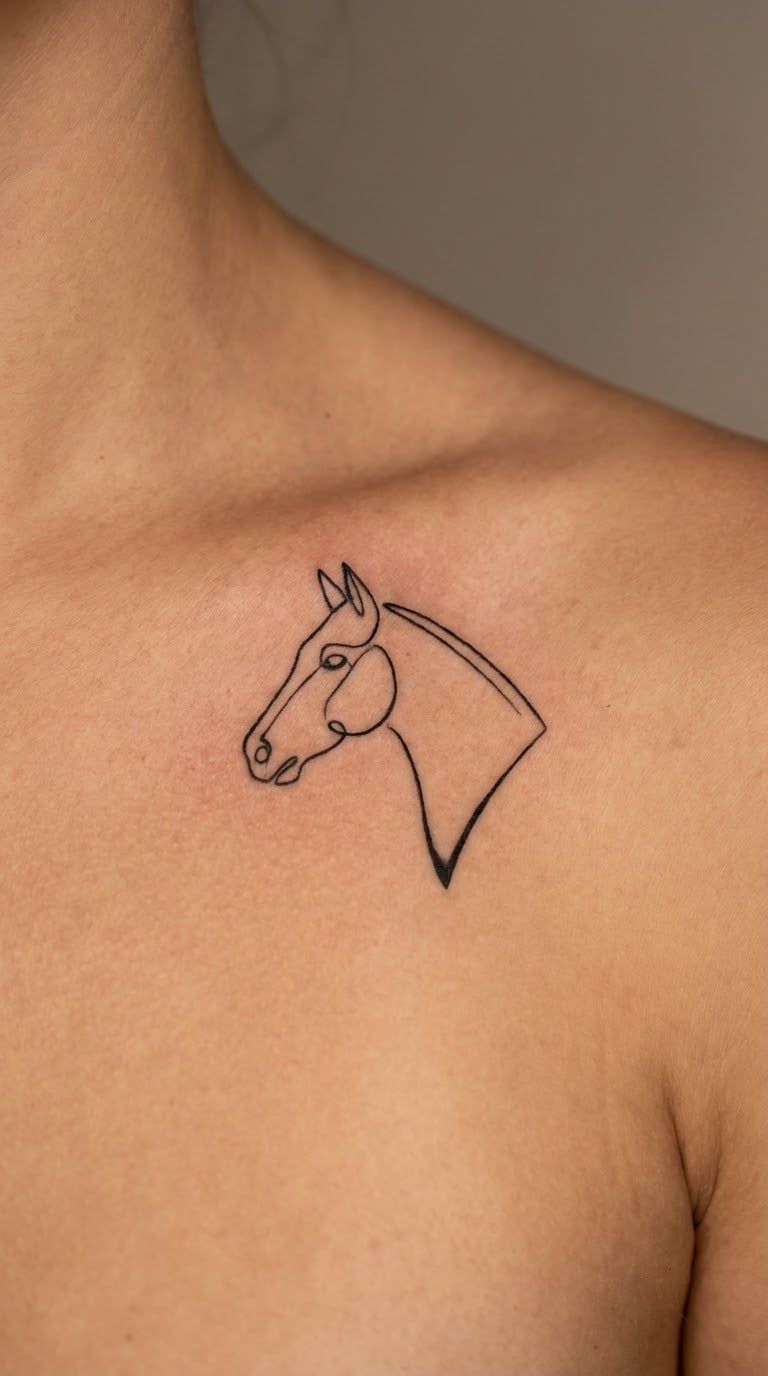
One continuous line outlines the profile of a horse head from the poll to the muzzle, with the interior left almost empty. Maybe one short line marks the jaw, maybe nothing does. The neck tapers and stops, and the shape reads as elegant at conversation distance and interesting up close.
Collarbone tattoos get noticed because the skin there shifts when you move, and a horse head is a shape almost nobody else has. Grace is the usual reason people land on it.
Placement: collarbone, sitting above or just below the bone, angled slightly. Size: 2 to 3 inch (5 to 7 cm). Style: minimalist line. Pain: medium, because the collarbone feels bony and the skin is thin.
Bony spots and sun exposure both soften this design, so plan on a refresh after a few summers. Make it yours: keep the mane as a single flowing stroke, or trim the line to just the nose and eye for something smaller still.
4. Galloping Mare in Watercolor on the Shoulder
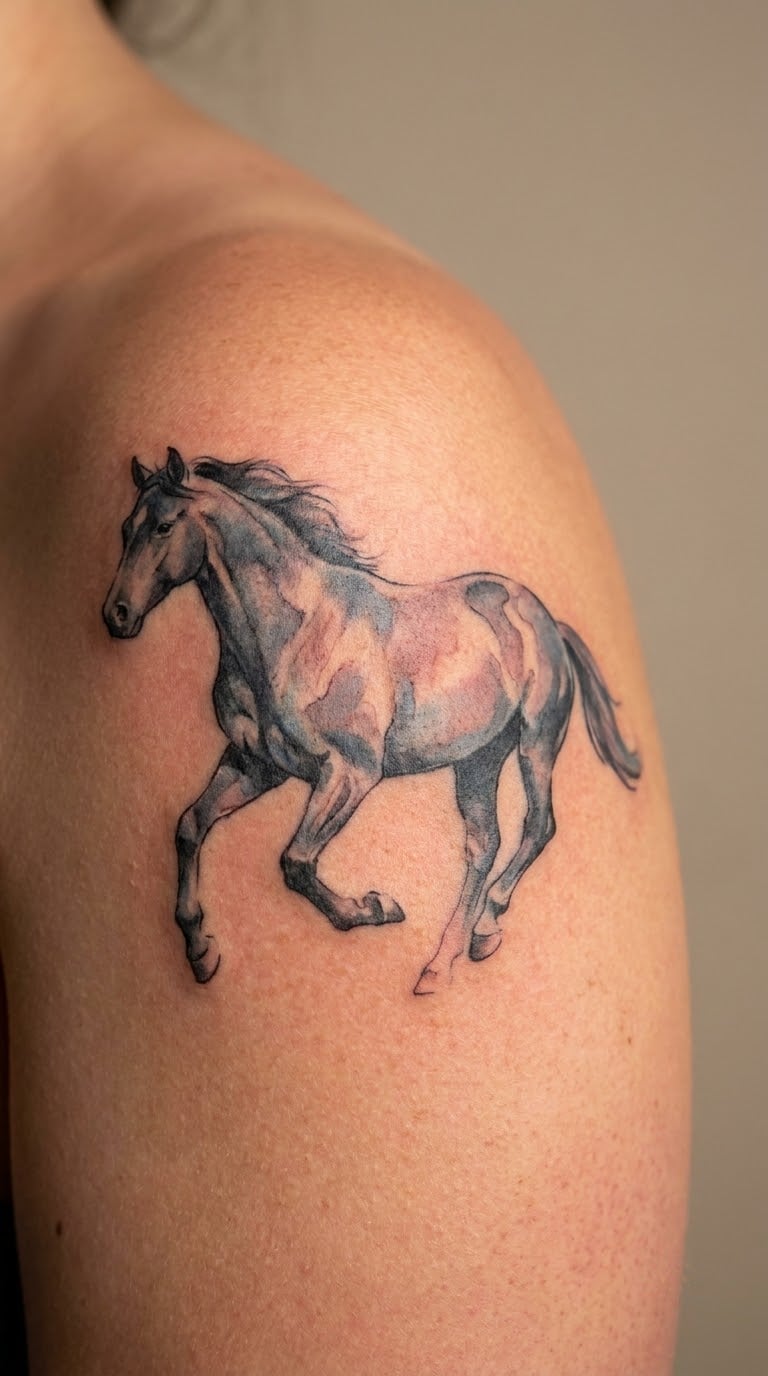
The horse is drawn in loose, confident lines, then filled with washes of muted black, slate blue and a dusty rose. Colour pools along the haunch and tail and breaks into nothing at the edges, with a few splatter dots suggesting spray. Bare skin between the washes is what makes it read as watercolour rather than a faded photograph.
It feels like movement captured mid-second rather than an animal standing still. People pick this style when they want a tattoo that feels like a painting rather than a picture of an animal.
Placement: shoulder or upper arm, where a broad flat surface lets the washes breathe. Size: 3 to 5 inch (7 to 12 cm) wide. Style: watercolor. Pain: low, since there is very little needle work in the open areas.
Colour pigment fades faster than black, and pale washes lighten noticeably on sun-exposed skin like the shoulder. Make it yours: pick two washes in a colour from your own life, and let the artist leave one section of the body almost untouched.
5. Blackwork Horse and Wildflowers on the Side Rib
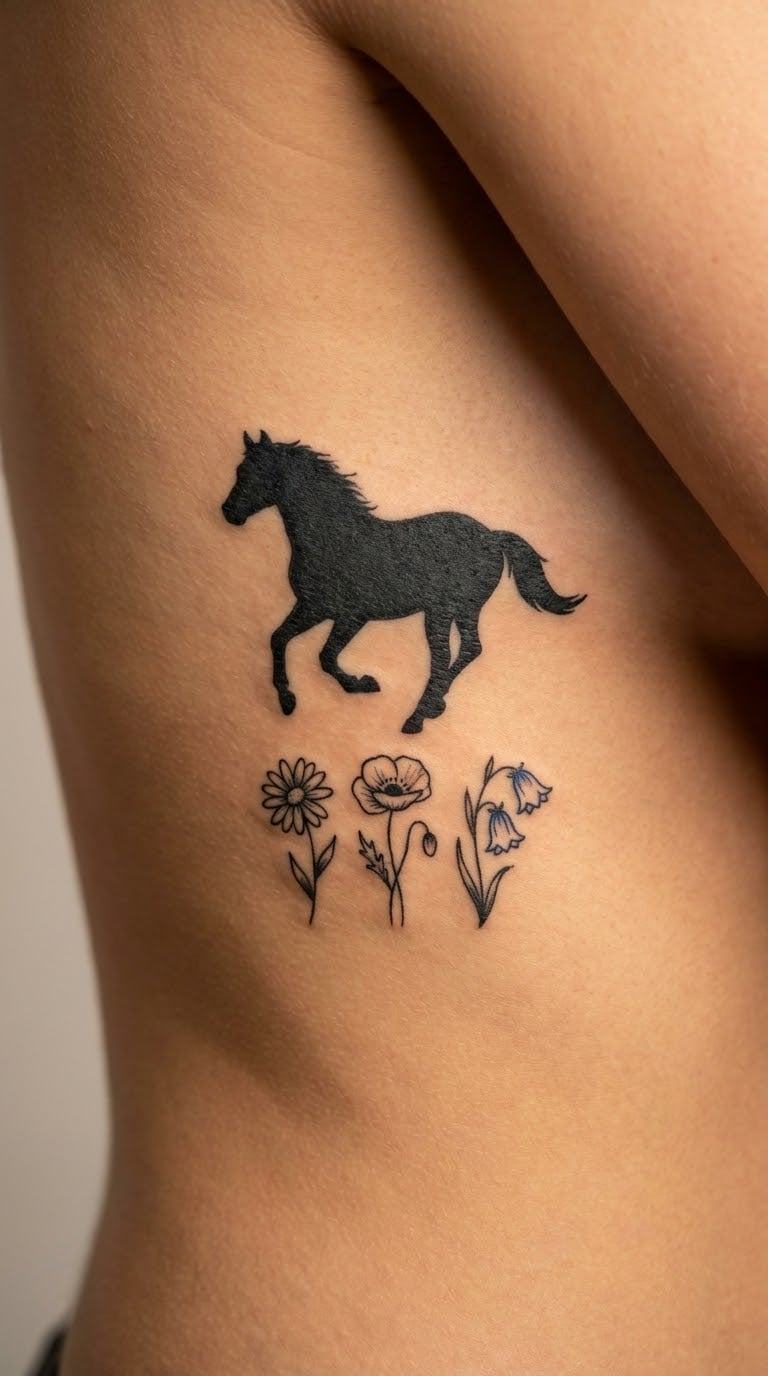
The horse is a solid black silhouette with clean cut-out detail where the legs separate, so it stays readable at a distance. Three small wildflowers sit along the belly line, each one separate, each one small enough that they do not compete with the animal. No gradients anywhere.
The balance is the whole point. The horse brings the strength, the flowers soften it, and the combination tends to appeal to people who find a pure black silhouette too severe.
Placement: side rib, following the curve of the ribcage, roughly between the bra and the waistband. Size: 5 to 7 inch (12 to 18 cm) long. Style: blackwork. Pain: high, ribs are the sharpest common spot and breathing makes it hard to stay still.
Solid black ages well, but the thin gaps between the legs can fill in slightly over time. Make it yours: swap the three wildflowers for one stem of something personal, or a small number tucked behind the tail.
6. Tiny Horse-Shoe Symbol Behind the Ear
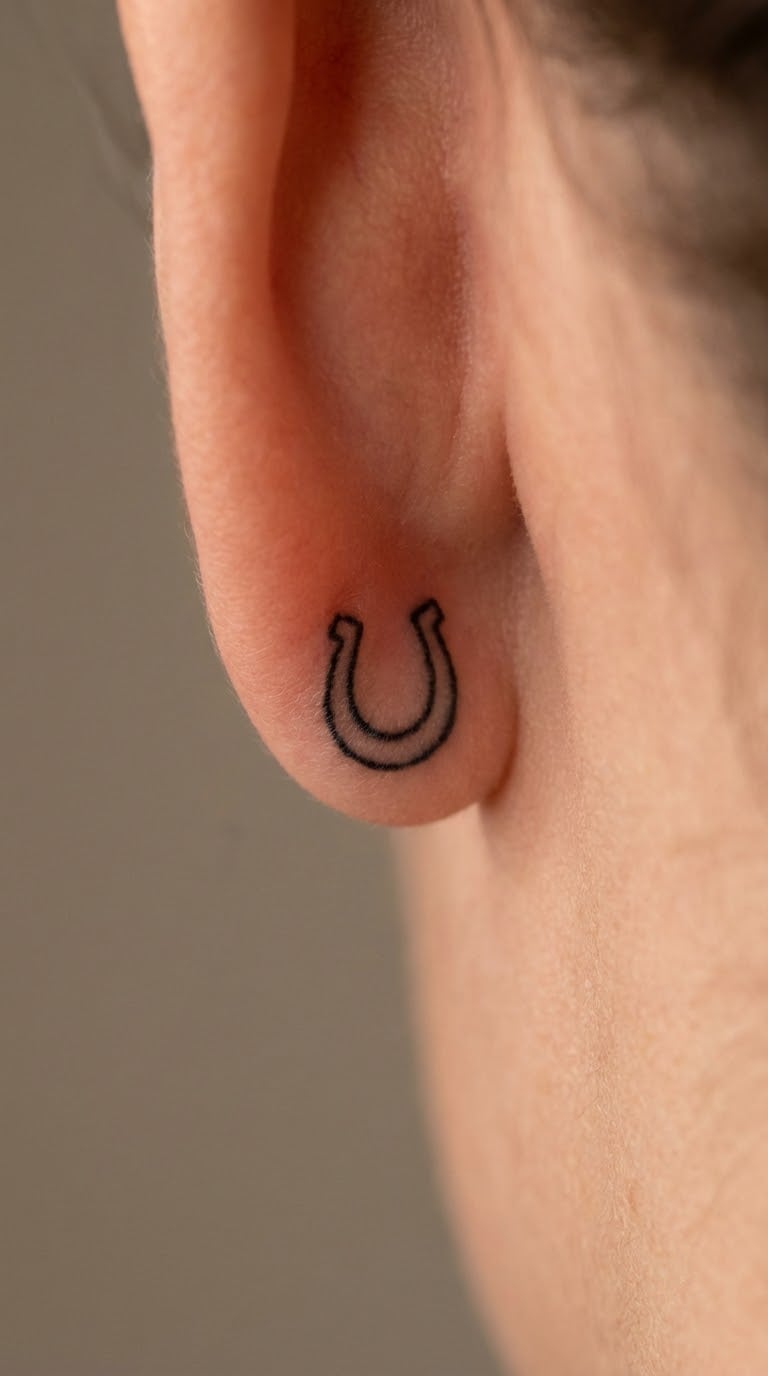
A single small horseshoe, drawn open at the bottom with even line weight and two tiny nail holes. That is the whole design. It is the smallest idea on this list, which is exactly why it works for people who want a horse tattoo that nobody spots until they are standing close.
Horseshoes are the shorthand for equestrian life without drawing the animal. Riders tend to pick them out of habit, and non-riders pick them because the curve is a good shape.
Placement: behind the ear, on the neck below the hairline, or the inner wrist. Size: about 1 inch (2.5 cm) wide. Style: minimalist symbol. Pain: low, and the session is short enough to book on a lunch break.
Very fine lines blur first, so a slightly heavier line at one inch is smarter than a delicate one. Orientation is a personal call. The open side facing up is the common choice because it reads as luck held, not luck spilled. Make it yours: add a tiny engraved initial inside the curve, or turn it into a small cluster of three.
7. Western Horse in Traditional Flash on the Forearm
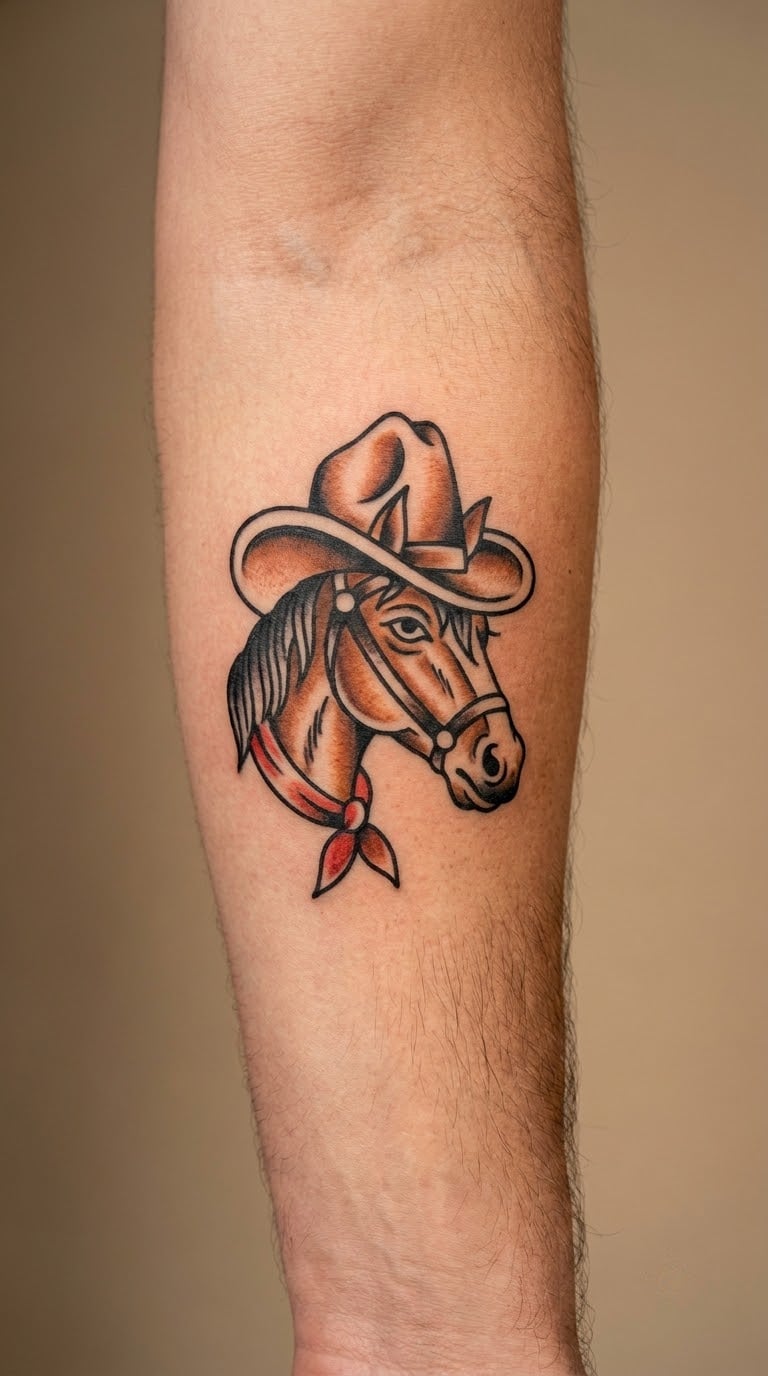
Built like old-school flash: a heavy black outline, warm brown shading in the neck and shoulder, and a small red accent somewhere in the tack. The mane is drawn as a series of clean shapes rather than strands, and the background stays nearly empty apart from a low scroll or ribbon under the hooves.
Traditional western work has a confident, graphic look that suits people who want a horse tattoo with visible weight to it. The colour is limited, so it does not shout even at forearm scale.
Placement: forearm, wrist to elbow, where the straight muscle line suits a full-bodied horse. Size: 4 to 5 inch (10 to 12 cm) long. Style: traditional and neo-traditional. Pain: medium.
Bold outlines hold their shape well; the small red accent is the first thing to fade. Make it yours: change the accent colour to your ranch, your flag, or the colour of your horse’s blanket.
8. Horse-and-Rider Silhouette on the Back of the Neck
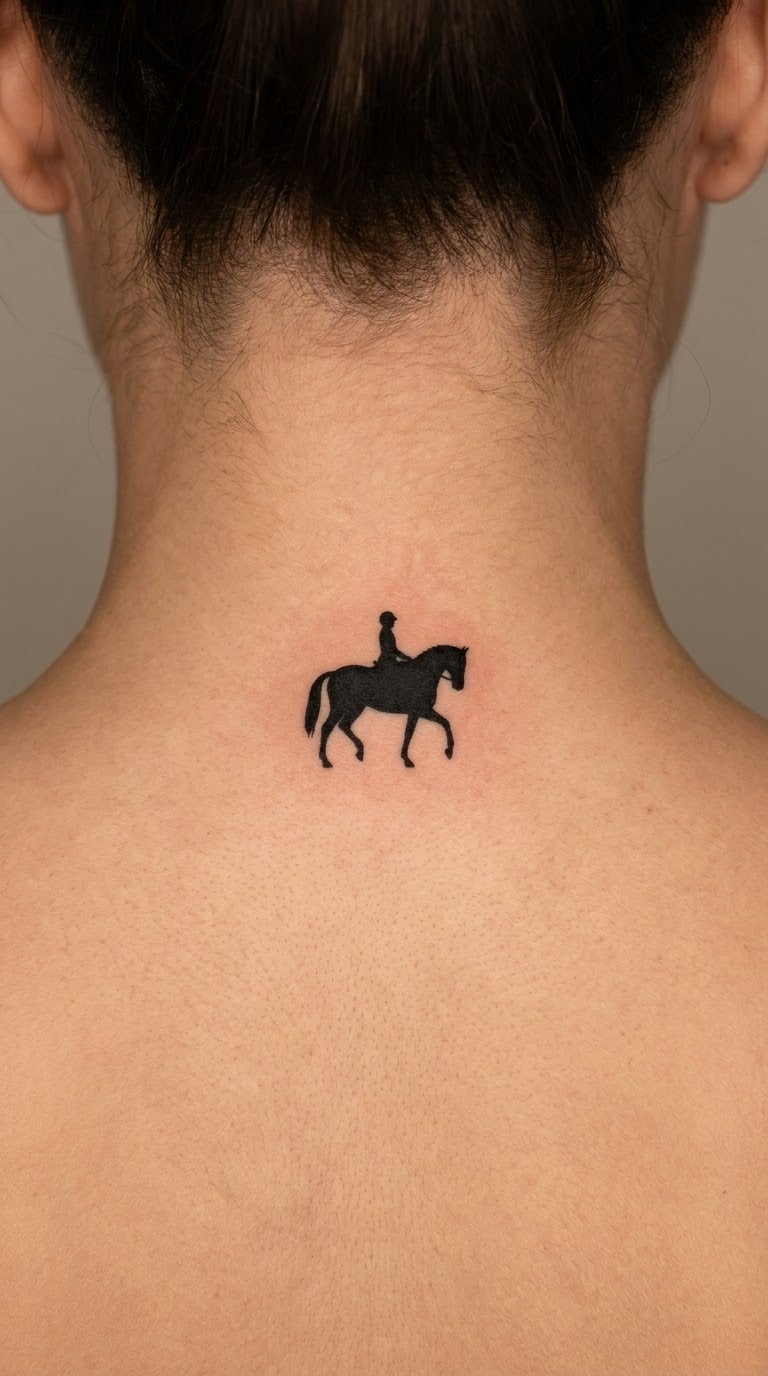
Both figures are filled solid black with clean edges: a horse in a collected trot with a rider sitting forward, heels down. No background, no ground line, no detail inside the shapes. The negative space around them does most of the work, which is what keeps a small neck piece legible.
A rider silhouette is often the version people want when the horse is not the only point. It says the partnership between the two, not just the animal.
Placement: centred on the back of the neck, sitting between the hairline and the collar. Size: 2 to 3 inch (5 to 7 cm) wide. Style: silhouette. Pain: medium to high, because the neck is sensitive and you cannot see it well while it is being done.
Neck pieces are exposed to sun and hair products, and the small interior details of a rider, like a rein or a boot, are the first to blur. Make it yours: use a simplified rider with no facial features at all, or add a hair tie band at the wrist in solid black.
9. Micro-Realism Horse Eye on the Wrist
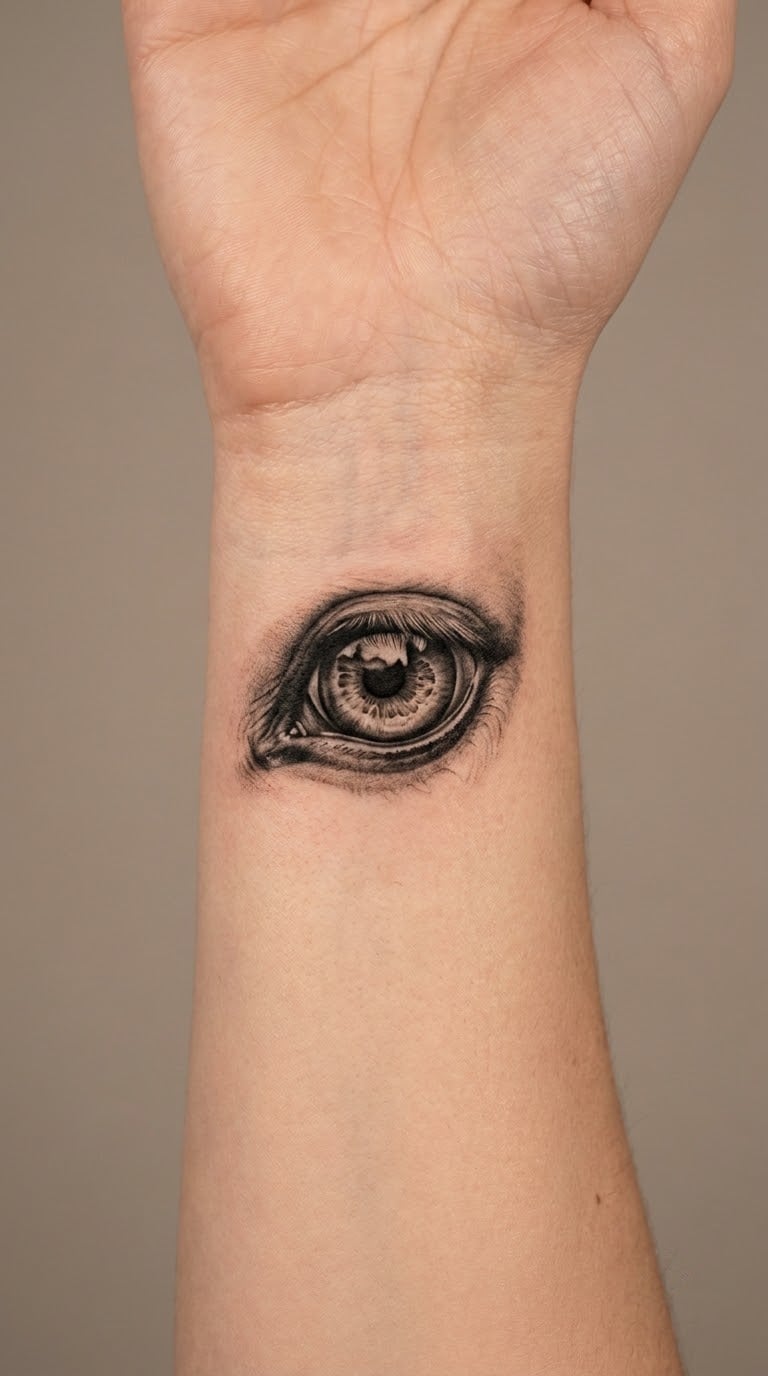
Just the eye, filling a small oval of skin. The iris has a defined rim, fine lashes, and grey shading that softens out towards the lids. There is no nose, no mane, no outline of a head. The whole design is built to hold up when you look down at your wrist.
It is the detail choice rather than the animal choice. A lot of people who wanted a specific horse ended up here because a small piece keeps them from committing to a full portrait.
Placement: inner wrist, or the crease just below the thumb. Size: 1 to 1.5 inch (2.5 to 4 cm) wide. Style: micro-realism. Pain: medium, with an odd pinch feeling in the wrist crease.
This is the design that softens fastest. Tiny shading in a small area spreads out over time, and the inner wrist creases with age, so the lashes and lid shading will need a touch-up. Make it yours: match the iris colour to your own eyes or your horse’s with one small colour accent in the centre.
10. Leopard-Print Horse on the Thigh
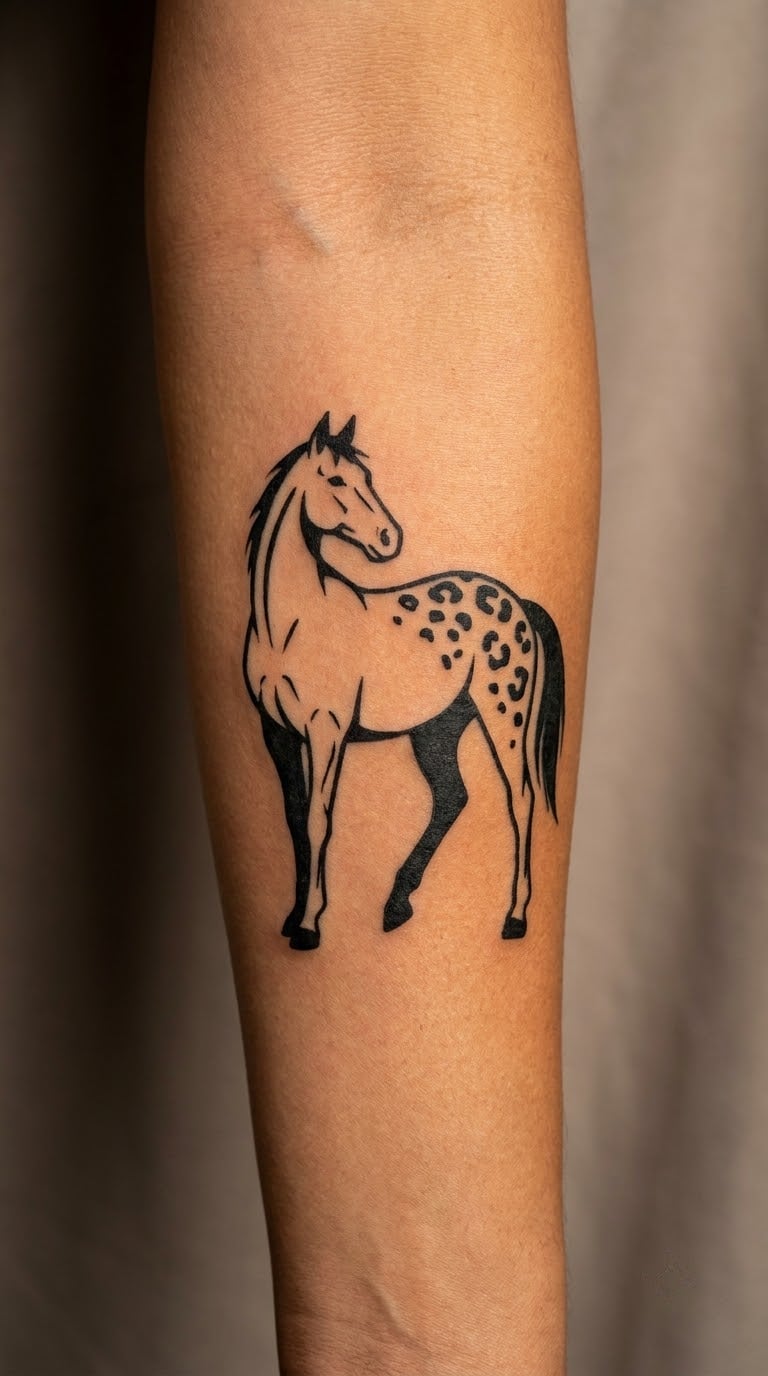
The horse keeps a graphic, poster-like contour, and the body is filled with irregular spotted markings that follow the muscle rather than sitting on top of it. Ink is left open between some of the spots so the design keeps breathing, and the mane is a single sharp shape at the back of the neck.
The pattern moves this from a standard animal tattoo into a fashion piece. It suits people who like their horse tattoos to look designed rather than drawn, and it is hard to copy from a standard flash sheet.
Placement: outer thigh, angled slightly forward along the leg. Size: 5 to 7 inch (12 to 18 cm) long. Style: illustrative, high-contrast blackwork. Pain: medium, with the outer thigh sensitive near the crease.
Thigh skin stretches as the leg moves, and a heavy solid black area across a joint can soften noticeably. Make it yours: change the spots to paw prints, stars, or a scatter of small flowers for a softer version.
11. Horse with Flowing Mane on the Shoulder Blade
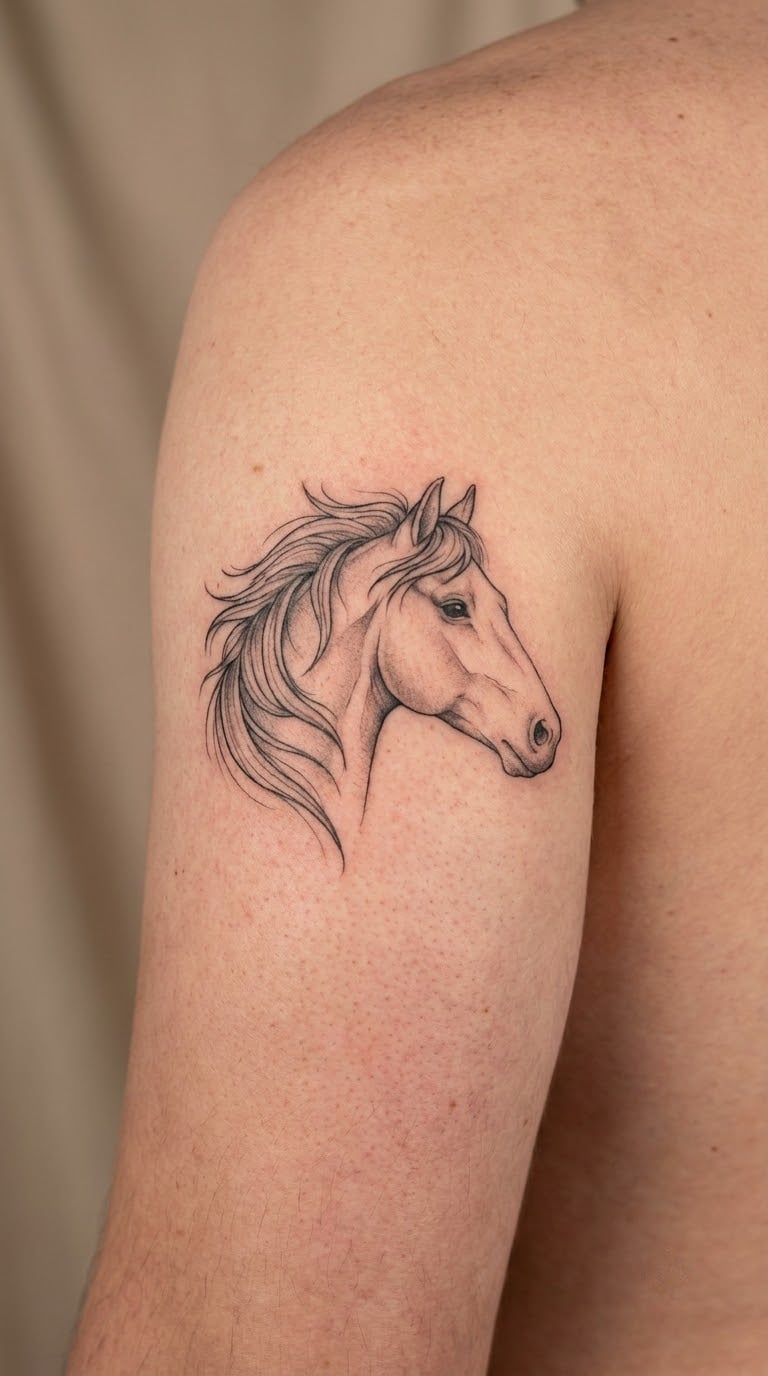
A horse in profile with its neck arched and its mane blown backwards in long, separated strands. The linework follows the direction of the hair, so the whole design sits along the shoulder blade rather than fighting the shape underneath. A little soft grey under the jaw and belly keeps it from looking flat.
An arched neck and moving mane suggest speed and pride, and it is a graceful option for anyone who wants a horse that feels alive rather than anatomical.
Placement: shoulder blade, following the bone, or the upper back. Size: 4 to 5 inch (10 to 12 cm) wide. Style: fine line illustration. Pain: low to medium, one of the more relaxed spots on the body.
The separated mane strands are fine lines and will soften over the years, and shoulder blades are sun-exposed. Make it yours: have the artist trace the actual wind direction from a photograph taken in a field, so the mane matches a horse you know.
12. Celestial Horse on the Inner Arm
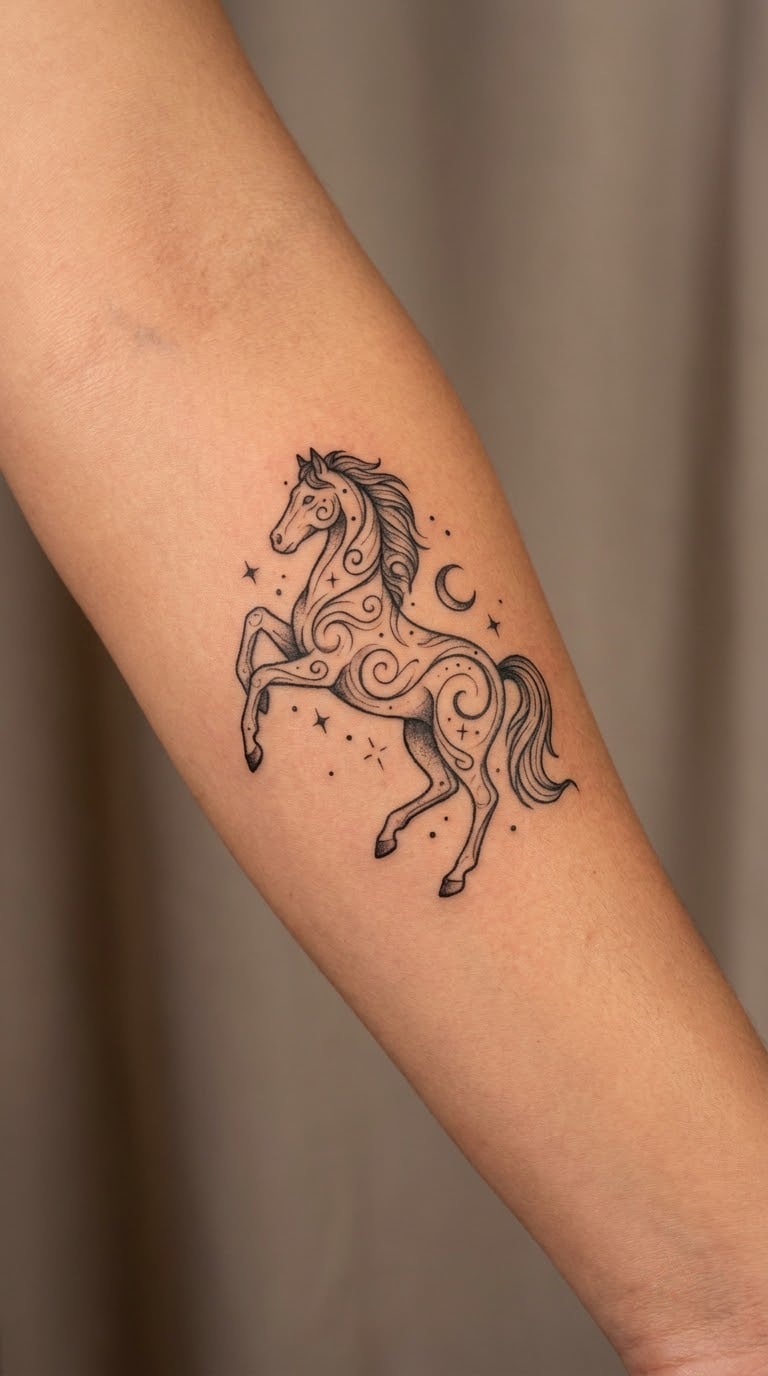
A horse drawn in outline with an open body, and the space inside the outline filled with small stars, a scattering of dots, and a thin crescent moon behind the hindquarters. The line stays thin and even throughout, and nothing spills past the outer contour of the animal.
Starlight around a horse is a common way to say wonder or freedom without being too literal about it. The symbols are doing atmosphere work, not secret code.
Placement: inner arm, running from just above the elbow towards the wrist. Size: 3 to 4 inch (7 to 10 cm) long. Style: symbolic illustrative. Pain: low, with relatively little needle work inside the stars.
Small stars on the inner arm are fine lines, and they blur with sun exposure over time; bigger solid stars hold better. Make it yours: use a real birthdate constellation instead of a generic star scatter, or drop the moon and keep only the stars.
13. Blackwork Horse Head on the Hand
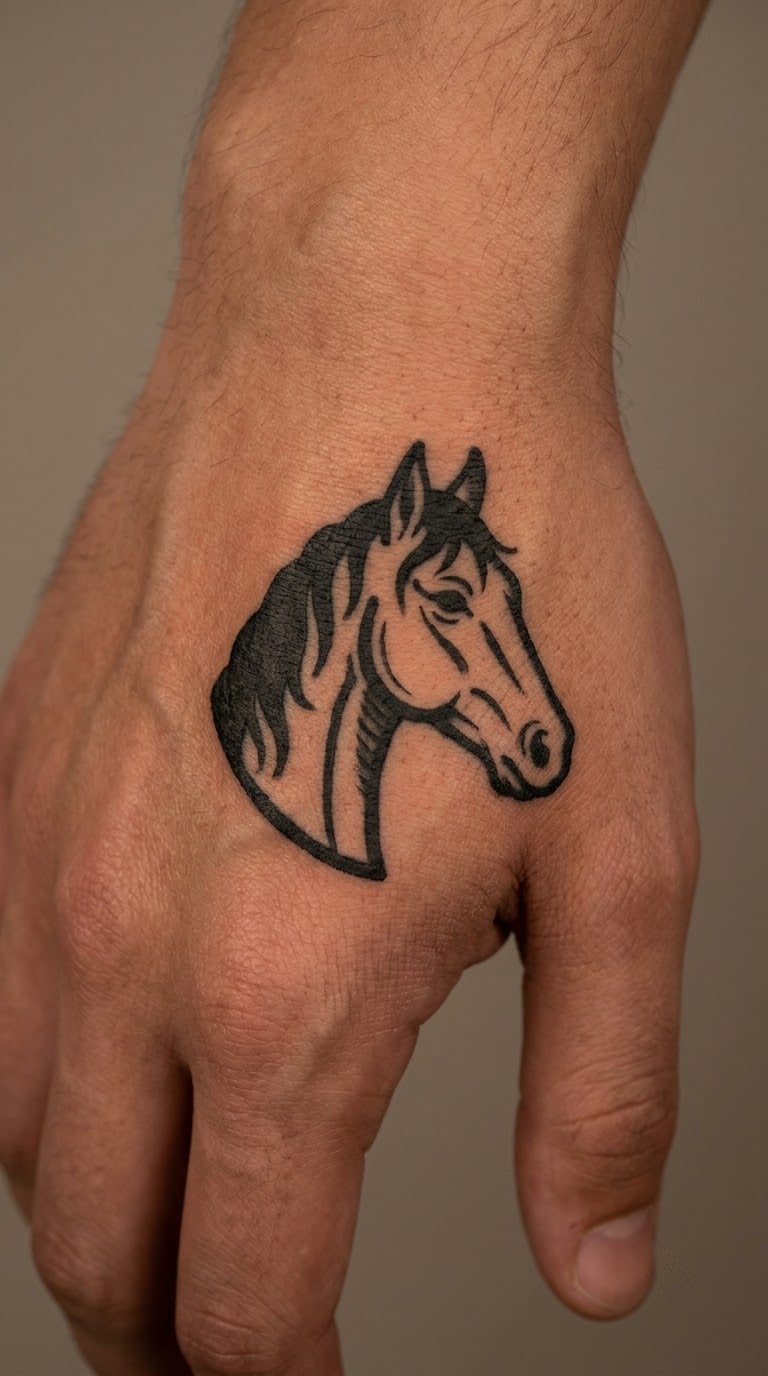
A horse head in heavy blackwork, built from thick shapes and cut-out white gaps rather than thin shading. The eye is a solid shape, the mane is a series of sharp blocks, and there is no background texture anywhere. Between the thumb and index finger it reads small and graphic; across the back of the hand it becomes a proper statement.
Hand tattoos are visible in a way nothing else is. You look at them hundreds of times a day, which is either the appeal or the deal-breaker depending on the person.
Placement: back of the hand, or in the web between the thumb and index finger. Size: 2 to 3 inch (5 to 7 cm) wide. Style: blackwork. Pain: high, the knuckles and finger bones are unforgiving and the nerve endings sit close to the surface.
This is the placement to think about longest. Hand skin creases with age, hair grows through it, and a detailed hand tattoo is a more visible commitment than most people expect at the booking stage. Make it yours: keep it to outline only and skip the shading, which ages far more gracefully on hands.
14. Horse and Rose on the Ankle
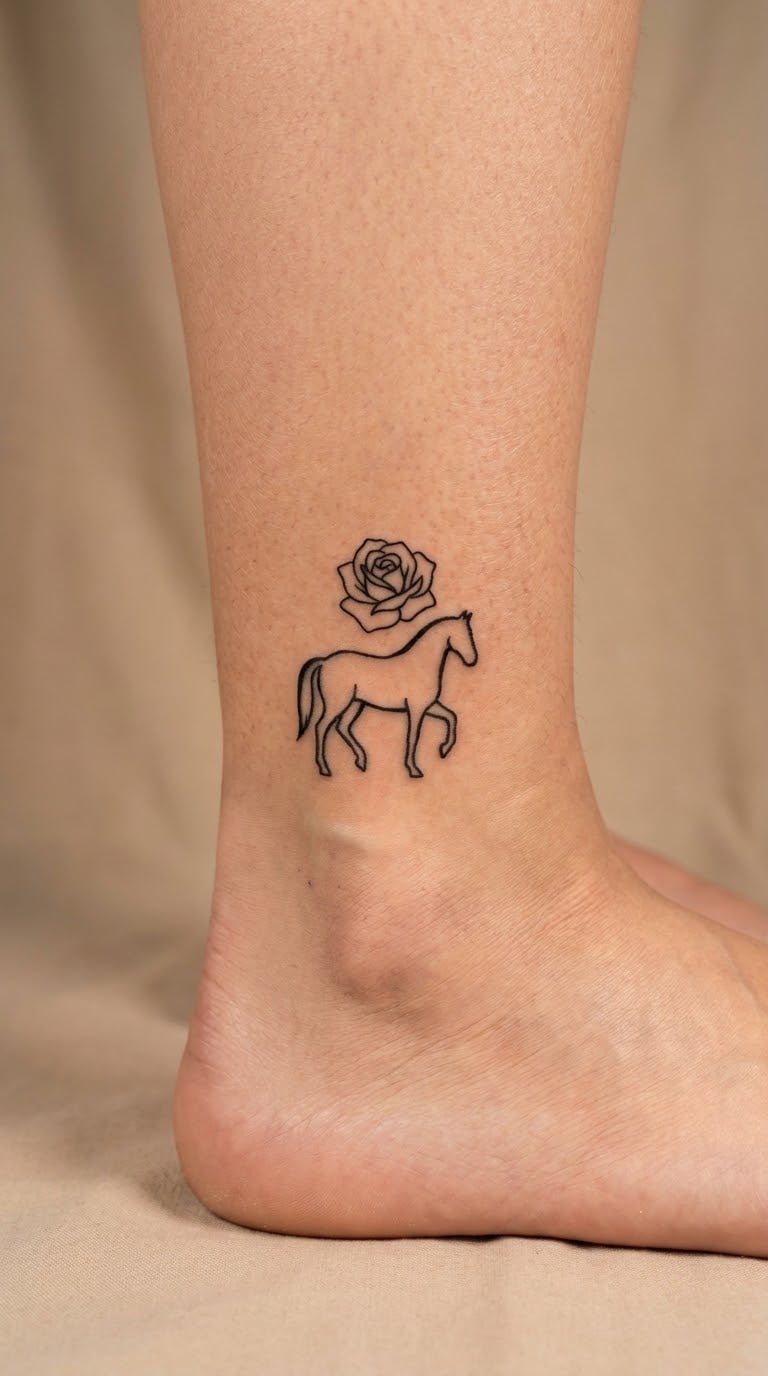
A small horse in fine line, head up, one foreleg lifted, with a single rose drawn beside it rather than behind it. The rose is outlined with a few petal lines and no fill, so both halves of the design share the same weight. Nothing else is added, and the skin around the piece stays open.
The pairing of animal and flower is about balance. The horse brings movement, the rose brings a still point, and people usually like one far more than the other in the end.
Placement: just above the ankle bone, inside or outside the ankle. Size: 2 to 3 inch (5 to 7 cm) long. Style: fine line with a floral element. Pain: medium to high, the ankle is bony and the nerve endings are close under the skin.
Fine line on the ankle fades faster than on the upper arm, and shoes and boots rub at the edge of the design. Make it yours: swap the rose for a single stem of lavender or a thistle, and angle the whole piece to follow the bone.
15. Jumping Horse in Dotwork on the Calf
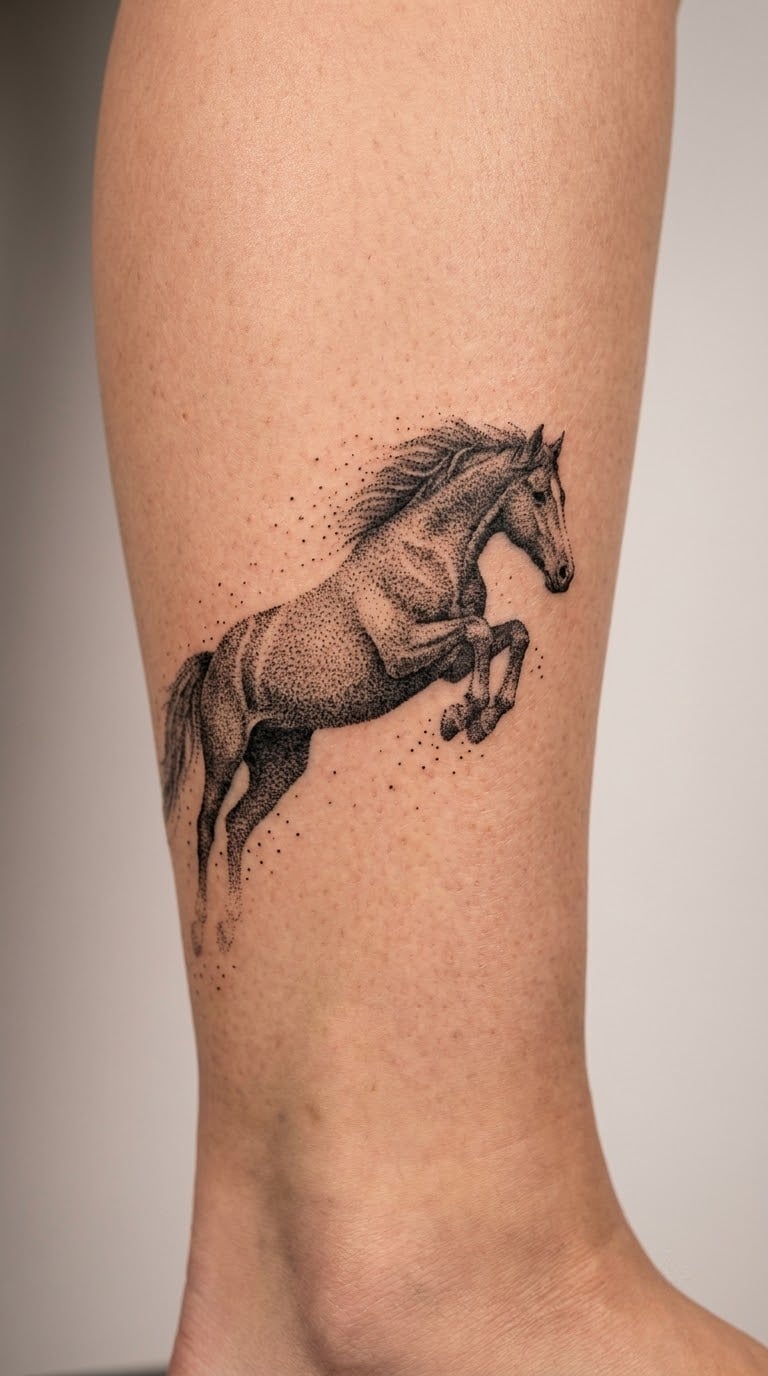
The horse is caught at the top of a jump, front legs tucked and hind legs trailing, and the whole body is built from graduated dots. Dense dots define the neck, shoulder and haunch, and they thin out towards the legs and the edges of the composition. There is no outline and no solid fill.
Dotwork creates depth from texture alone, so a horse reads with real volume while staying light on the skin. It is a good choice when you want a large piece that is not a heavy black block.
Placement: outer calf, which is a flat and forgiving surface. Size: 3 to 5 inch (7 to 12 cm) long. Style: dotwork. Pain: medium, a long steady session rather than a sharp one.
Small dots spread slightly with age, so the lightest areas blur first and the design softens. A sun-exposed calf fades the pale areas fastest. Make it yours: fade the dots downwards into a trail of scattered specks below the hooves, so the horse looks like it is breaking out of the design.
16. Side-Profile Horse on the Hip
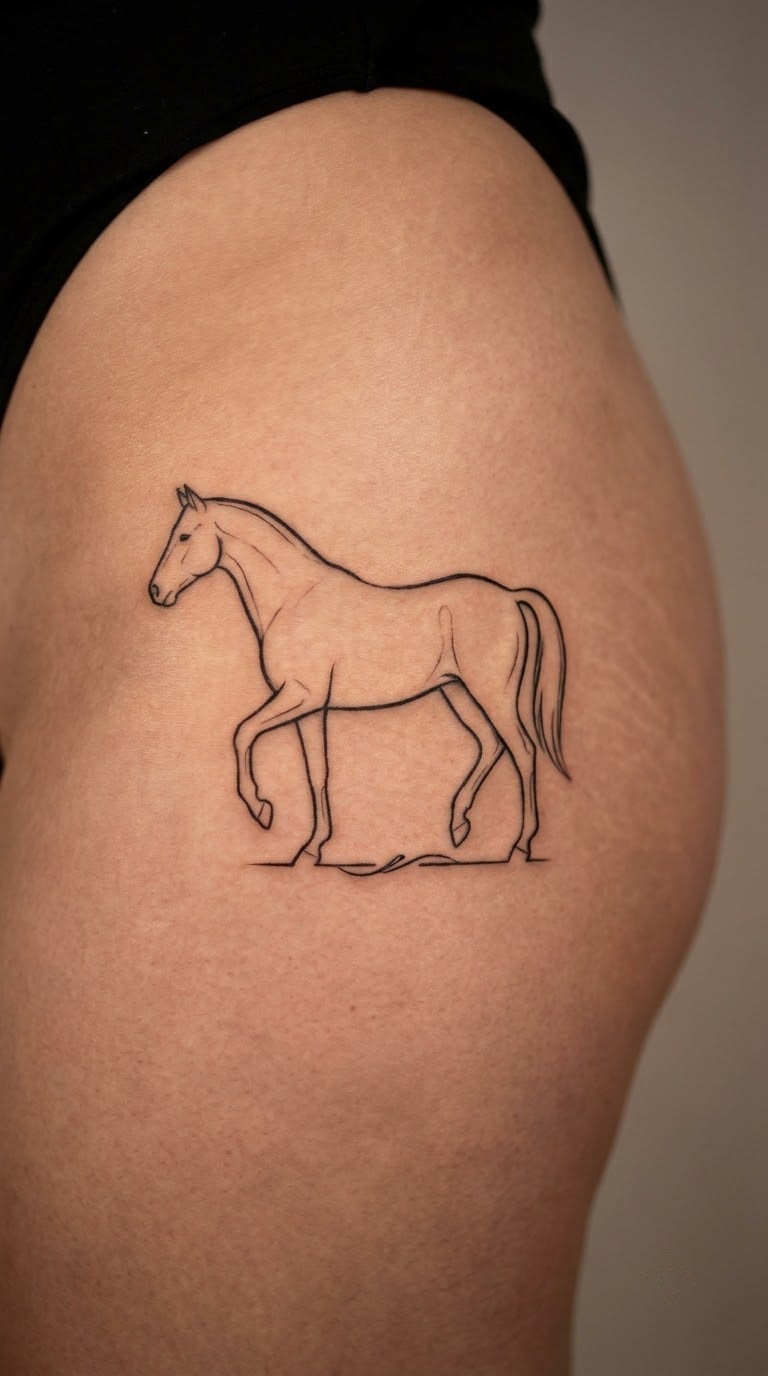
A long-necked horse in profile, standing or walking, drawn with smooth unbroken contours and almost no interior detail. One or two soft shadows mark the jaw and the underside of the neck. A short decorative line under the hooves anchors the design without adding a scene.
Side profile is the classic way to show a horse’s outline, and the hip gives you room for a longer neck and a longer stride than the forearm does.
Placement: upper hip, just above the belt line, or on the outer thigh. Size: 4 to 6 inch (10 to 15 cm) wide. Style: contour line. Pain: medium, and the hip is one of the easiest spots to lie still on.
Hip skin stretches and relaxes with sitting, so heavy solid areas in the middle of the design can soften noticeably over time. Make it yours: have the artist add a small mane detail or a tail in a second pass once the outline has healed flat.
17. Horse Skeleton Design for the Forearm
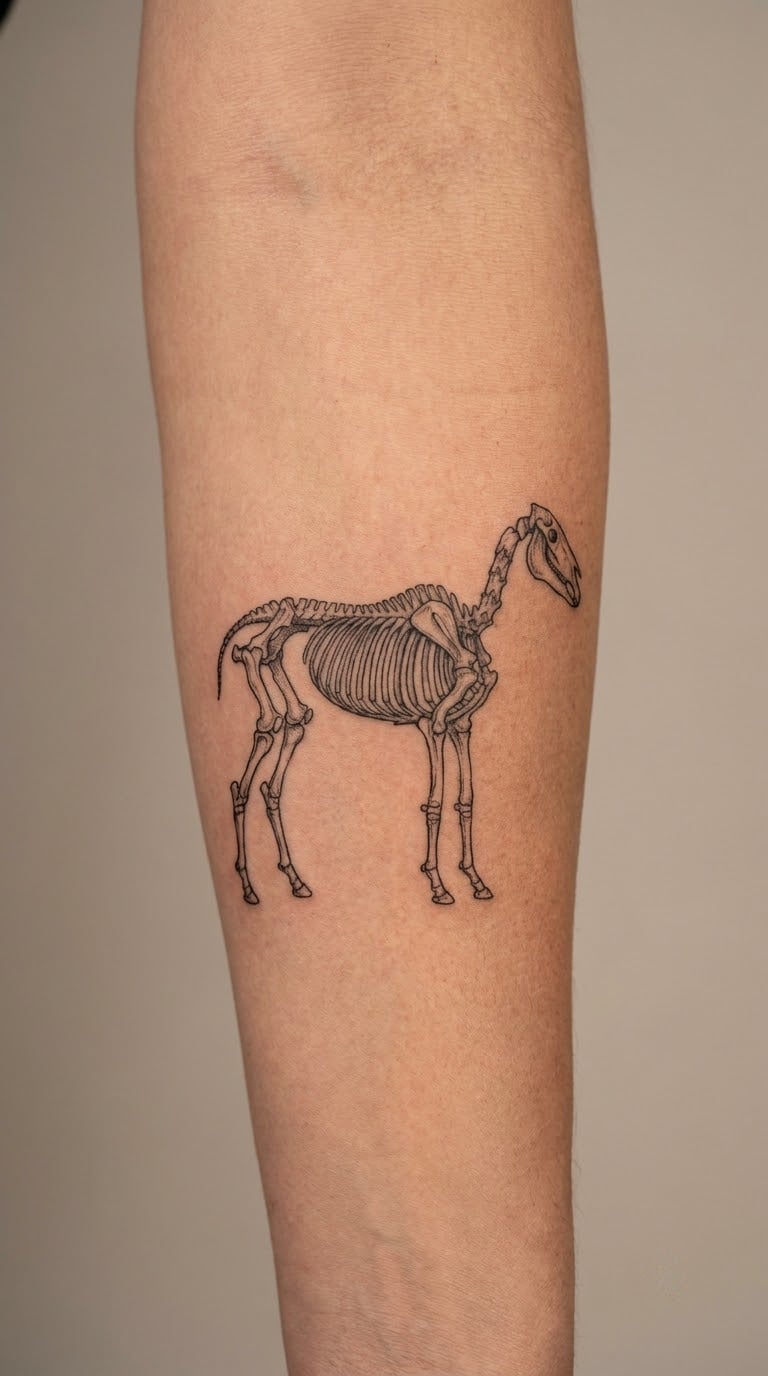
A clean anatomical horse skeleton in side view: skull, spine, ribcage, pelvis, and the long leg bones laid out with the joints in the right places. Black line work on plain skin, no background, no scroll, no ornament. The bones are drawn accurately rather than stylized.
The skeleton strips the horse back to structure, which appeals to people who like anatomy and science as much as they like the animal. It also avoids the whole problem of shading a face well.
Placement: forearm, where the design’s own bone shapes echo the shape underneath. Size: 4 to 6 inch (10 to 15 cm) long. Style: anatomical blackwork. Pain: medium to high, and a long session on a spot you will want to move.
Small joints and the fine lines between the ribs blur faster than the long bones, so a slightly heavier line at the joints pays off. Make it yours: have the skeleton modelled on your horse’s actual conformation, or add a single name in small script beneath the hooves.
18. Horse Trotting Through a Small Moon on the Calf
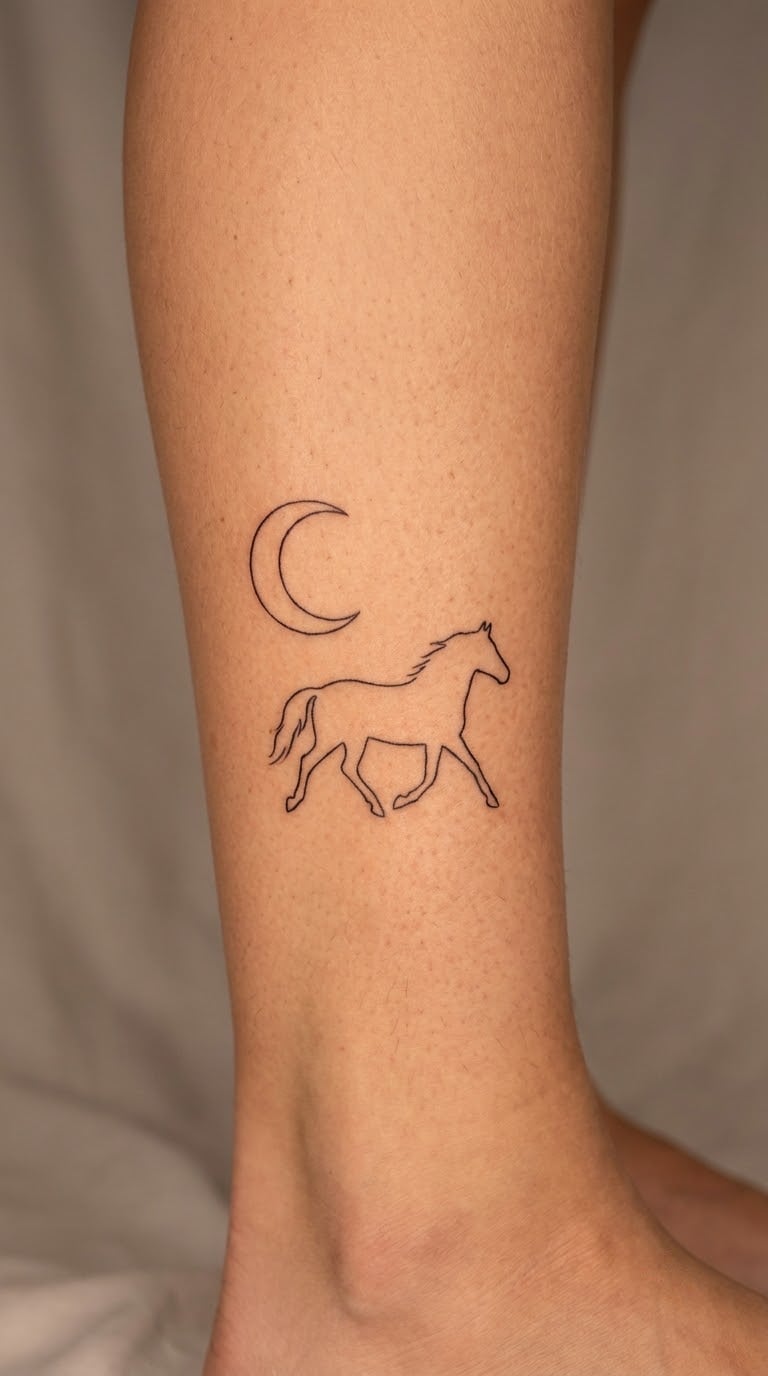
A graceful horse in a collected trot with its head slightly lowered, positioned beneath a simple crescent or full moon drawn in outline. The moon is kept open, with no shading inside it, and the two elements are spaced so each one reads on its own. The composition sits vertically on the calf.
A single round shape is an easy way to organise a design. The moon gives the horse something to pass through instead of floating in empty space, and the whole thing reads clearly at a small size.
Placement: outer or inner calf, vertical orientation. Size: 3 to 4 inch (7 to 10 cm) wide. Style: fine line. Pain: low to medium.
Both elements on the lower leg are exposed to sun and to trouser cuffs, so the thin line work fades sooner here than on the upper arm. Make it yours: put the horse mid-stride through a filled black moon instead of an outlined one, which makes the moon the heavier element and the horse the lighter one.
19. Geometric Horse on the Lower Back
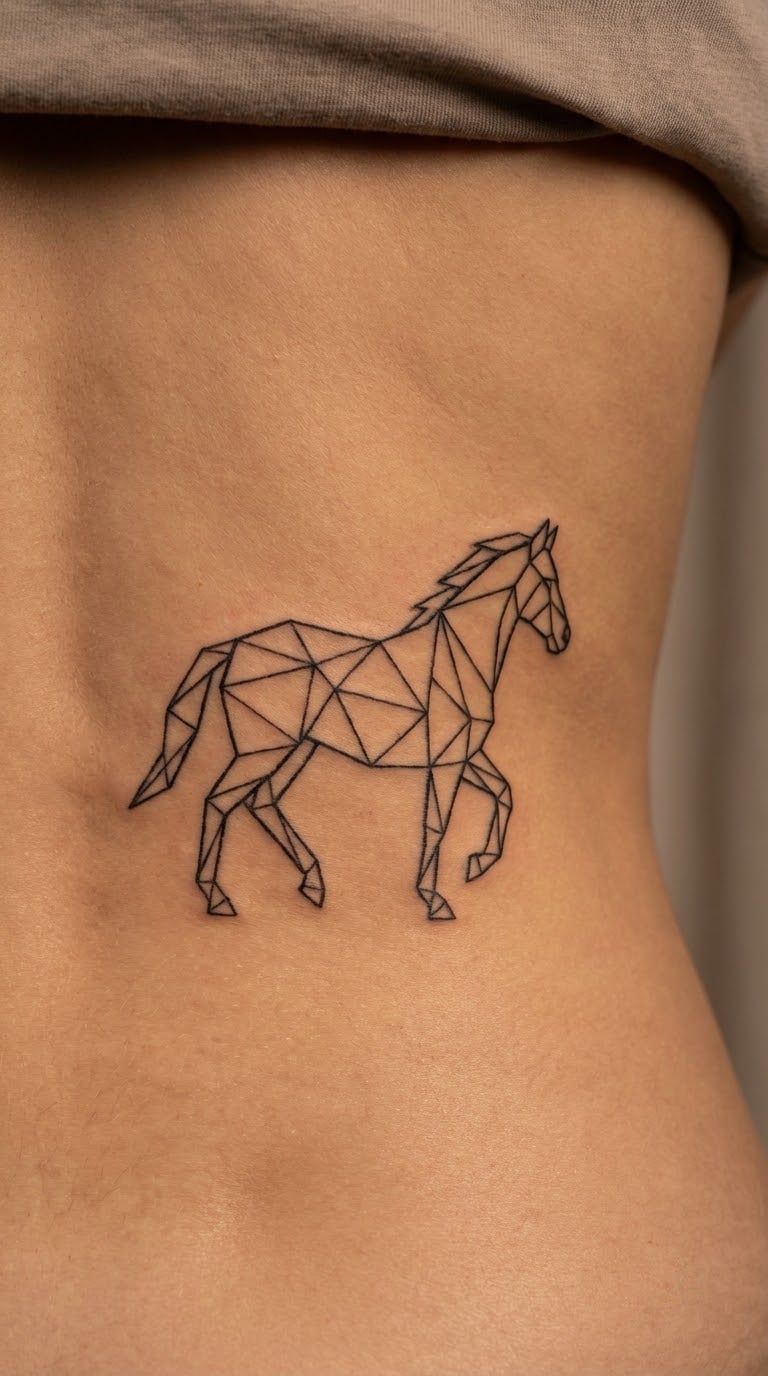
The horse is built from angular polygons: a triangular head, a segmented neck, a body made of four or five flat planes. Shapes stay crisp and unfilled, with the background left as bare skin. The result is a modern, architectural horse rather than a picture of one.
Geometric construction suits people who like design logic more than anatomy. It also holds together well, because a broken outline is less noticeable when the whole piece is made of separate closed shapes.
Placement: lower back, centred just above the belt line. Size: 4 to 6 inch (10 to 15 cm) wide. Style: geometric. Pain: medium, though the lower back is sensitive and you cannot see the design while it is being done.
The lower back is a curved surface, so a wide piece can distort as you move and the polygons can lose their crispness. Make it yours: work your own birth date into the number of segments, or have the artist build the horse out of a repeating triangle grid that matches another piece you already have.
20. Colorful Mare-and-Foal Design on the Thigh
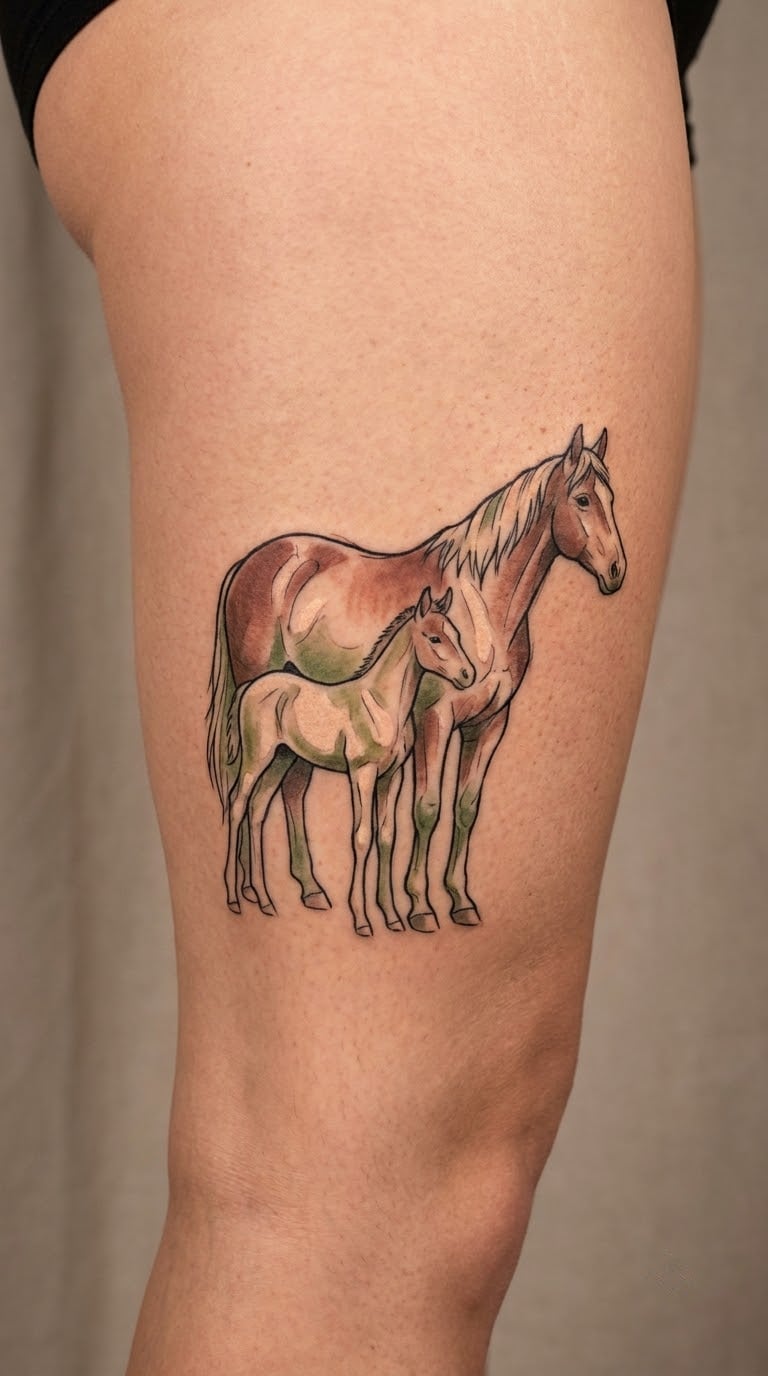
A mare walking with a foal close beside her, both in full profile, drawn with confident black linework and filled with soft colour. The mare is chestnut with a cream mane, the foal lighter, and a few muted green strokes suggest grass at the hoof line. The two animals are kept clearly separated so the relationship reads at a distance.
Two animals is the maximum that stays readable at thigh size. More than that and the design turns into a herd, which is a different piece entirely.
Placement: outer thigh, where there is a long flat surface for a horizontal composition. Size: 5 to 8 inch (12 to 20 cm) long. Style: colour illustrative. Pain: medium, a long session split across two appointments at most studios.
Colour pigment on the thigh fades at a different rate to black linework, so the outlines stay crisp while the fills wash out over time. Make it yours: give the mare and foal the actual coat colours of two horses you know, which makes the piece unrecognisable to anyone but you.
How to Choose the Right Design
Start with the canvas, not the picture. The area you are willing to cover sets the size, the size sets the level of detail, and the detail sets the style. A 3 inch (7 cm) patch of skin can hold a clean outline or a horse eye, and it cannot hold a rendered portrait with shading. If you are still narrowing horse tattoo ideas for women, work down this list rather than picking a picture first.
- Match the style to the size. Fine line works at almost any size but wants a small, clean design. Realism needs 5 inch (12 cm) or more before the shading has room to breathe.
- Match the design to the body shape. A long horizontal horse suits a forearm, a hip or a thigh. A vertical design suits the calf, the inner arm or the lower back.
- Think about what you already have. A small horse head works next to an existing blackwork piece. A large colourful mare-and-foal does not.
- Be honest about sun exposure. Outer arms, lower legs and shoulders take more sun, so fine lines and pale watercolour washes fade first there.
- Count the detail, not the subject. A two-horse scene has twice the anatomy to get right as a single horse, and anatomy is the part riders notice most.
- Plan for later additions. If you might add to it, ask the artist to keep the edges open and the background clear so a second piece has somewhere to sit.
One more practical point. Riders on forums ask constantly about how clothing affects a tattoo, and the honest answer is that friction matters more than fabric. A calf tattoo under riding breeches gets rubbed daily, and a collarbone piece under a shirt collar gets stretched every morning. Neither is a problem, but both are worth thinking about before the stencil goes on.
Cost and Session Time
A small horse tattoo, around 2 inch (5 cm) or under, usually runs somewhere between 150 and 300 dollars for a single line of work. A mid-size piece at 4 to 6 inch (10 to 15 cm) with shading or colour falls between 300 and 700 dollars, and a large thigh or rib design with a full scene sits above 700 dollars and often above 1,000.
Session length follows the detail. Simple outline work can finish in an hour or two. Dotwork, realism and colour need three to five hours, which is why most studios split a large piece across two appointments rather than running a marathon.
Shop minimums are the thing that catches people out. Plenty of studios set a floor of 150 to 200 dollars on the booking, so a tiny design still counts as one session. Hourly rates vary widely by city, artist and style, and a blackwork or realism specialist charges more per hour than a generalist. Bring your reference photos to the consultation and ask for a total estimate in writing before you commit.
Aftercare Basics
- Follow your artist’s aftercare instructions first. They watched your session and know how your skin behaved.
- Wash it twice a day with lukewarm water and a plain, fragrance-free soap. Pat dry with a clean hand, not a towel.
- Keep it covered while you work on it. A clean, non-stick dressing is better than letting a shirt rub against fresh ink all day.
- Do not soak, swim or sauna for around two weeks. Until the surface has fully sealed, water gets underneath the scab.
- Protect it from sun for the rest of its life. This matters most for fine line, dotwork and anything with colour. Daily sunscreen on an exposed arm or calf is the single biggest thing you can do for it.
- Expect an irritated or flaky patch in week two. That is normal healing, not a failure. Contact the studio if redness, swelling or pain gets worse instead of better after the first few days.
Frequently Asked Questions
What does a horse tattoo usually represent?
A horse tattoo most often stands for freedom, strength, loyalty and grace. Riders usually mean their bond with a specific animal, while non-riders tend to mean a love of the animal itself. Specific versions carry their own meanings: a bridle or saddle points to riding, a black horse is often read as mystery or grief, a white horse as purity, and three horses together as a well-known reference to the mares of East Anglia.
What is the best placement for a horse tattoo for women?
The collarbone, inner forearm, shoulder blade and outer thigh are the most popular spots, because each one takes a design cleanly and stays visible in normal clothing. The calf is the favourite among riders, since breeches usually cover it. Choose a spot where the design matches the shape underneath: horizontal horses suit a forearm or hip, vertical ones suit the calf or lower back.
Are small horse tattoos suitable for a first tattoo?
Yes, and a small outline is a sensible first piece. You are choosing a shape you already understand rather than a full rendered portrait, the session is short, and mistakes are less costly than on a large piece. The one caution is line weight. At 1 inch (2.5 cm) a shaky line is obvious, so ask for a slightly heavier line or pick a design with fewer, bolder strokes.
How painful is a horse tattoo on the ribs, thigh or arm?
Expect low to medium on the arm and shoulder, medium to high on the thigh and calf, and the most painful of the three on the ribs. Ribs hurt because the skin is thin and stretches every time you breathe, so deep breaths make it worse. Thigh and calf are muscle, which hurts more while the machine is working but settles quickly. Long sessions build a dull ache on top of the sharp part.
Will fine-line horse tattoos fade over time?
They do soften, and it is worth planning for. Fine line spreads slightly as it ages, and it fades faster on sun-exposed placements such as the outer arm, lower leg and shoulder. Covered spots like the inner forearm and ribs hold up much better. Most people get a refresh every few years, and a slightly heavier line at the start holds noticeably longer than a delicate one.
Should I choose a realistic or traditional horse tattoo?
Choose realistic if your horse is a specific animal you want recognised, and give the artist good photographs to work from. Choose traditional if you want a bold, graphic piece that reads at any distance and hides small imperfections. Realism needs 5 inch (12 cm) or more and rewards an artist with a strong portfolio. Traditional is more forgiving and usually finishes in a shorter session.
Start With One Honest Question
If you are still choosing between horse tattoo ideas for women, the minimalist horse head on the collarbone or the fine-line running horse on the forearm are the two I would pick. Small, clean, and they do not depend on shading that can go wrong. Book a consultation, and if you have a real horse in mind, bring photographs of that animal rather than a flash drawing from a screen.
For someone adding to a collection, the blackwork horse head on the hand or the mare-and-foal piece on the thigh is the more confident direction. Both are larger, both take a real sitting, and both give a small follow-up piece something to sit beside later. Whichever you pick, save healed photographs of your own once you are a year in. That is the only design record that will tell you the truth.