
20 Best Child Birth Flower Tattoo Ideas for Moms (September 2026)
A birth flower tattoo carries a child’s birth month in a shape that never needs explaining. There is no fixed bloom for every family, but the convention is simple: each month has a flower, and a mom wears the flower of the month her child arrived. One stem for a first child, a gathered posy once there are three, and a design you leave room to grow when you know another child is coming. That is the whole idea behind this list of child birth flower tattoo ideas for moms, and it works because the flower does the remembering quietly.
Most of these designs sit in the fine-line or micro-realism range, because that is what survives a small size on soft, moving skin. The rest run bolder for anyone extending a collection. Read the placement and size notes before you fall in love with a picture, since the same bloom behaves very differently on an inner forearm than on a rib. If you are still narrowing things down, the birth flower tattoo ideas roundup covers styles more broadly, and tattoo ideas for new moms goes wider than flowers altogether.
Child Birth Flower Tattoo Ideas for Moms: Quick Guide
| Idea | Style | Best placement | Size | Pain |
|---|---|---|---|---|
| 1. January carnation with birth date | Fine line | Inner forearm | 2-3 in | Low |
| 2. February iris | Fine line, muted violet | Behind the ear | 1-1.5 in | Low |
| 3. Daffodil with three birth stars | Fine line, one colour | Outer collarbone | 2 in | Low |
| 4. April daisy with handwritten name | Fine line with script | Wrist | 3 in | Low |
| 5. Lily of the valley micro bouquet | Fine line, grey wash | Upper shoulder | 2 in | Low |
| 6. June rose with a hidden initial | Micro realism, black and grey | Inner wrist | 2-2.5 in | Medium |
| 7. Larkspur stems, matching pair | Fine line, violet | Outer forearm | 2 in | Low |
| 8. Watercolor poppy with a date | Watercolour with line | Forearm | 2.5 in | Low |
| 9. Aster sprig with birth month | Fine line, muted colour | Side of wrist | 2 in | Low |
| 10. Marigold with a handprint | Fine line with colour | Back of hand | 2 in | Medium |
| 11. Chrysanthemum in a date circle | Botanical, black and grey | Calf | 3 in | Medium |
| 12. Narcissus line drop | Minimal black line | Side of index finger | 1 in | High |
| 13. Birth flower into newborn name | Fine line, single flow | Inner arm | 3.5 in | Low |
| 14. Three-child bouquet | Fine line, three colours | Upper arm | 3 in | Medium |
| 15. Blackwork flower around a finger | Bold blackwork | Middle finger wrap | 2 in | High |
| 16. Birth-month stem on the wrist | Minimal fine line | Inside wrist | 2 in | Low |
| 17. Poppy with newborn handprint | Fine-line realism | Back of hand | 2.5 in | Medium |
| 18. Sleeve accent bloom | Botanical fine line | Forearm, within a sleeve | 2-3 in | Medium |
| 19. Micro-realism flower, hidden year | Micro realism | Rib | 2 in | Medium |
| 20. Mother-and-child floral portrait | Fine-line illustration | Forearm | 5 in | Medium |
1. Fine-Line January Carnation With Birth Date
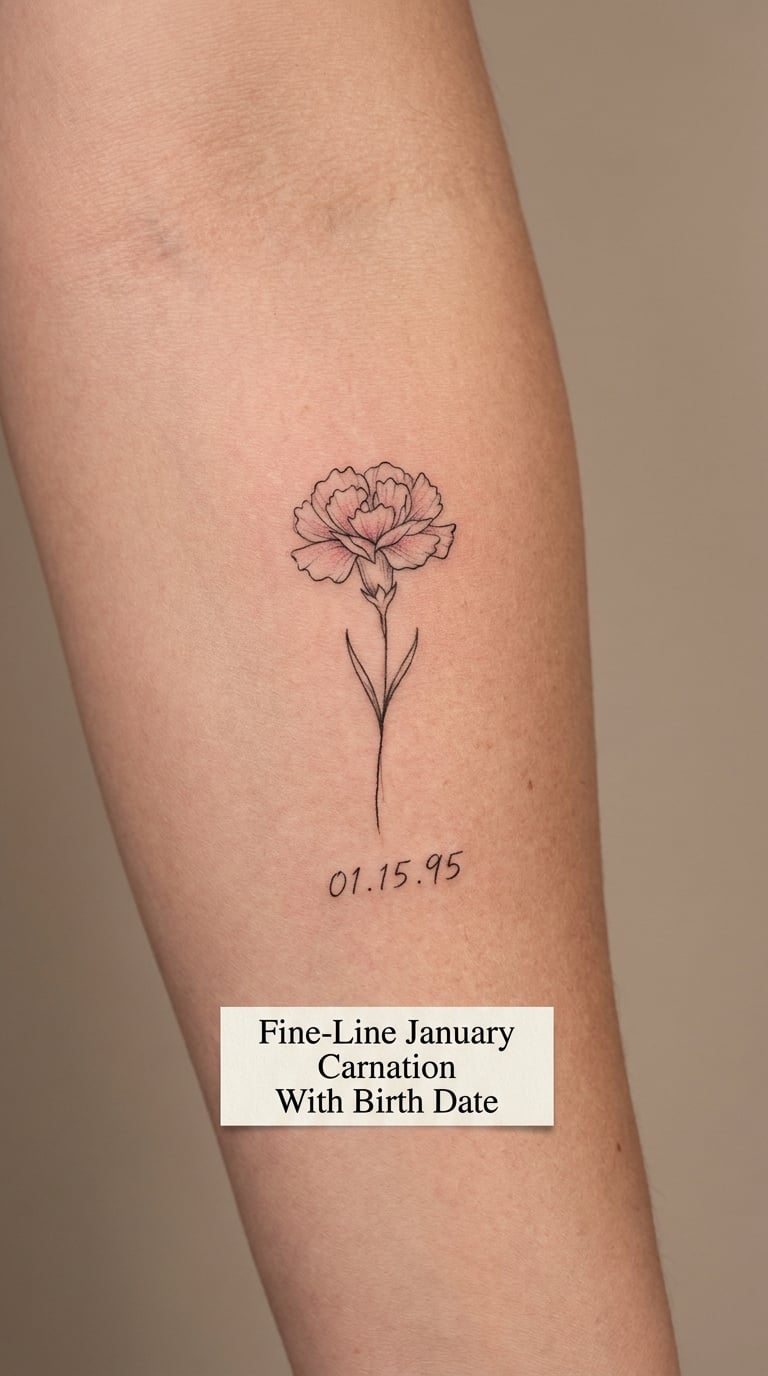
A January child gets a carnation, and the carnation has plenty of petals to work with, which makes it forgiving at a small scale. The petals are drawn as a few clean curved lines with restrained shading in the ruffled edges rather than solid fills, and the birth date sits underneath in a matching fine-line script. Ask for blush pink or deep red in the petal centres only, so the piece still reads as a black-and-grey tattoo from across a room.
People choose this one because the date is visible without being loud. It is a keepsake you read rather than explain.
Placement: inner forearm, wrist crease side, or the flat of the upper inner arm. Size: 2 to 3 inches (5 to 7.5 cm) across. Style: fine line with light shading. Pain: low, forearm skin is forgiving. Honest ageing note: the smallest shading inside the petals is the first thing to blur, and thin date numerals on the inner wrist can fade faster than the bloom. Make it yours: repeat the same carnation in reverse on your partner, or add a matching date beneath yours years later.
2. Minimal February Iris Behind the Ear
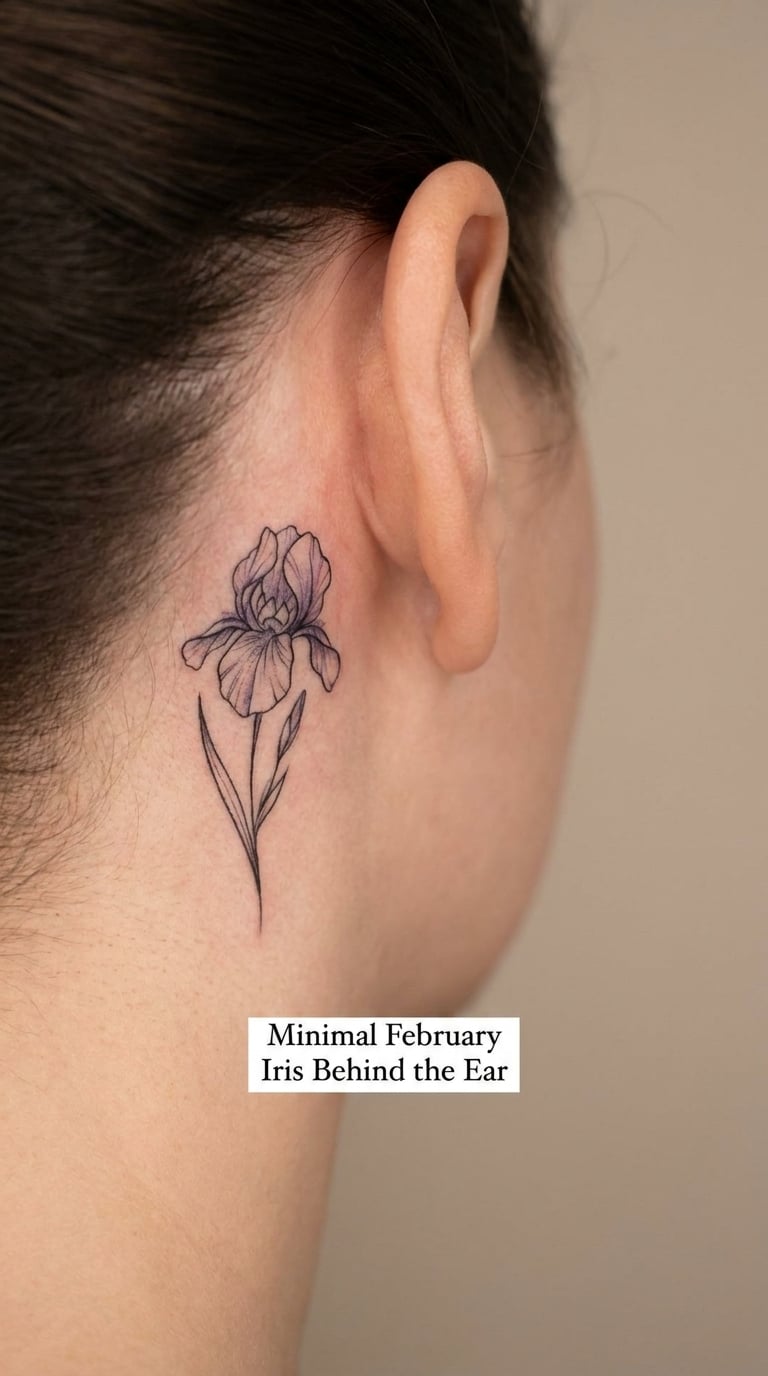
An iris is a good fit for a February birth flower because three upright petals give it height without bulk. Here the drawing stays spare: fine-line petals, a muted violet wash through the falls, and a stem that fades out rather than ending in leaves. It is a compact composition that disappears neatly into the hairline. A new mother often picks a hidden placement like this one because it is a private reminder that only she knows about.
Placement: behind the ear, just below the lobe, or the small flat spot behind the jaw. Size: 1 to 1.5 inches (2.5 to 4 cm) tall. Style: fine line with a soft violet tint. Pain: low, though the spot behind the ear is bony and you will feel the buzzing more than you will feel pain. Ageing: colour in a small area fades first, so a black-only version holds up longer than a tinted one. Make it yours: tuck a tiny initial into the stem, or ink the same iris on your daughter and let the two versions be recognisably related rather than identical.
3. Daffodil and Three Tiny Birth Stars
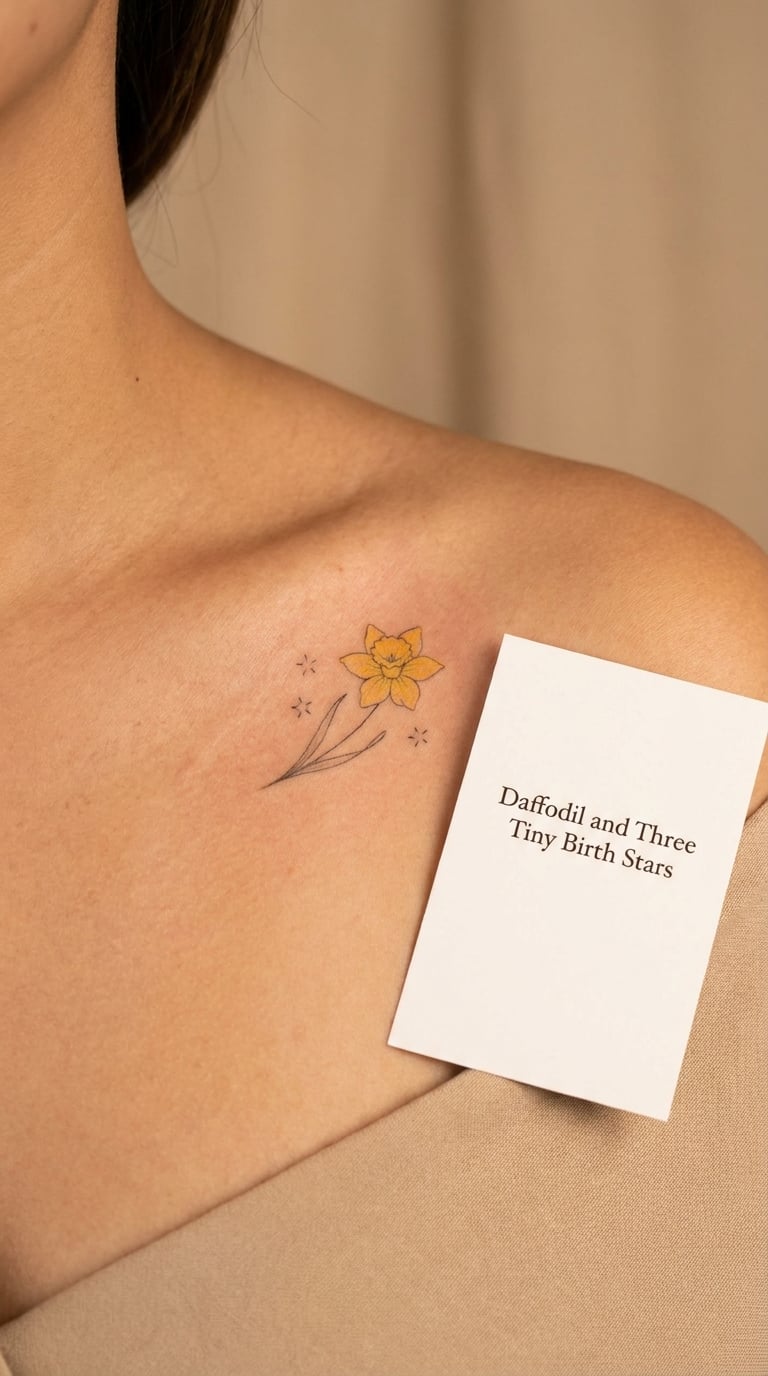
Three stars, one for each person you are marking, set a daffodil at a slight tilt. The daffodil itself is simple to draw: a trumpet centre, six radiating petals, a single straight stem. The stars are tiny four-point shapes placed in a loose diagonal, not in a rigid row, so the whole thing reads as a small constellation rather than decoration. The yellow stays light, a warm wash in the trumpet only.
It is a good design when you want the count of the family to be part of the picture rather than a list of names.
Placement: outer collarbone, the shoulder cap, or the inside of the upper arm. Size: about 2 inches (5 cm) tall. Style: fine line with one restrained colour. Pain: low on the collarbone, moderate over the collarbone bone itself. Ageing: the stars are the first detail to soften, so go slightly larger than feels necessary now. Make it yours: keep the count in the design by adding a fourth star after another child arrives.
4. April Daisy With a Handwritten Name
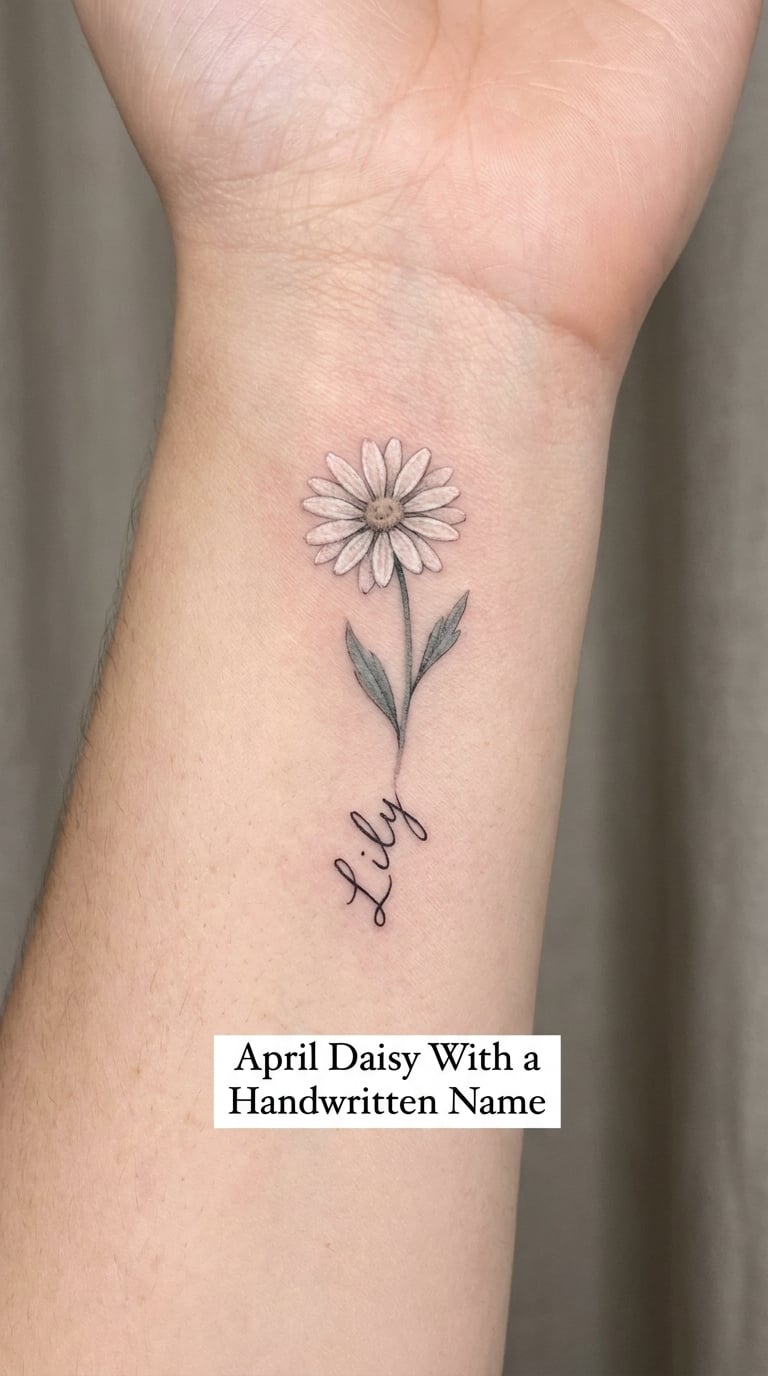
An April daisy is instantly recognisable, which makes it a good shape to pair with lettering. The bloom is drawn with a soft grey-green stem and narrow leaves, and the child’s name runs beneath in a restrained cursive with consistent letter height so it stays legible once healed. Fit matters more than flourish here: the daisy sits at the top, the name curves gently under the stem, and the whole column stays narrow enough for a wrist.
This is the one people save for a keepsake box and then regret not doing sooner.
Placement: inside wrist, the forearm above it, or the back of the hand. Size: 3 inches (7.5 cm) wide for the bloom, with the name adding another half inch. Style: fine line plus script lettering. Pain: low to moderate on the wrist. Ageing: thin script on the inner wrist fades noticeably faster than the daisy, so a slightly heavier hand is the safer choice. Make it yours: have the name written in your own handwriting, or use a nickname only the family uses.
5. Lily of the Valley in a Micro Bouquet
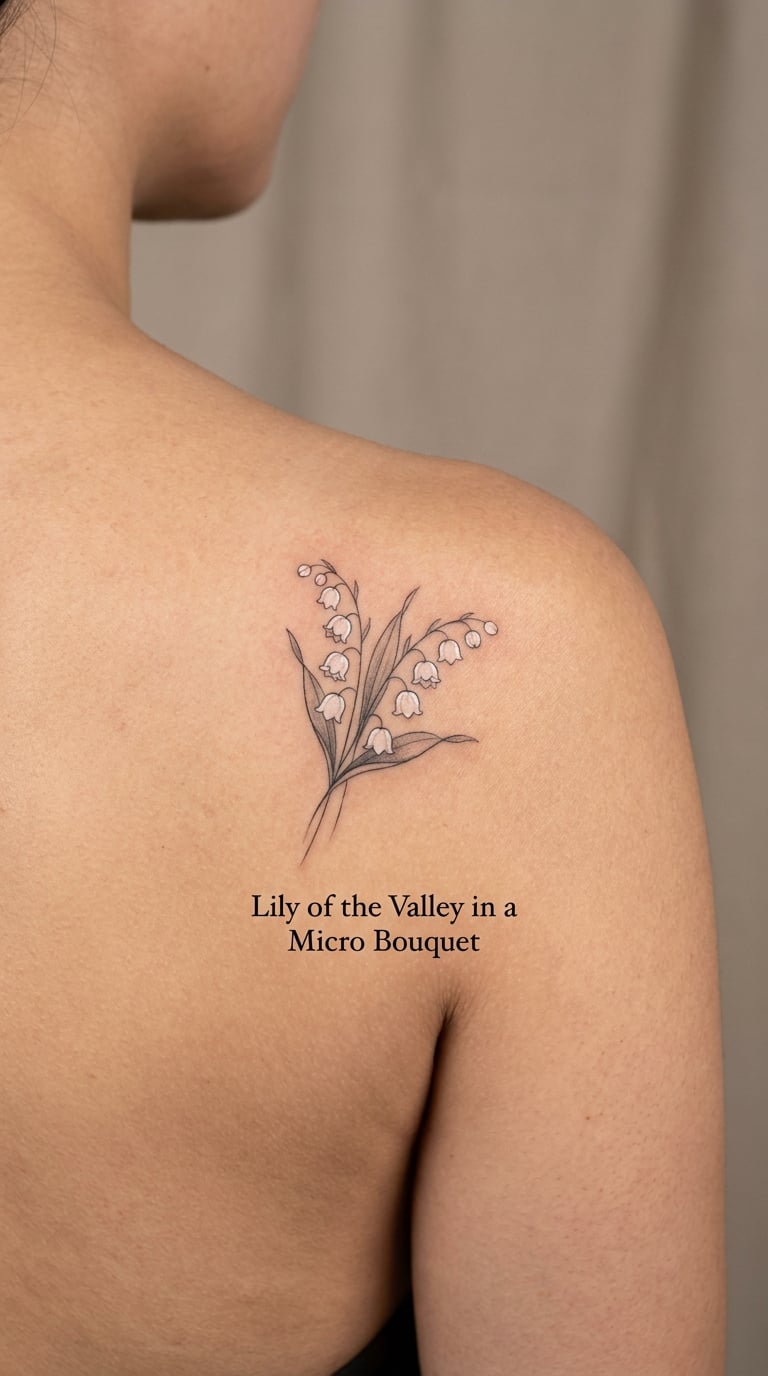
A small bundle of lily of the valley bells makes a keepsake that feels complete in a very small footprint. Each bell is drawn as a two-line drop with a few interior strokes for the petals, and two narrow leaves in grey wash anchor the stems. It is a compact composition with no ribbon and no bow, which keeps it from turning into a generic floral tattoo.
There is no single fixed meaning people attach to it, and that is part of the appeal. It simply marks a May birth month and the child in it.
Placement: upper back of the shoulder, the small of the back, or behind the ear. Size: 2 inches (5 cm) wide. Style: fine line with grey wash. Pain: low, though the shoulder blade shifts under the skin while you sit still. Ageing: the tiny bell interiors blur first, so the artist should keep the shapes open rather than filling them in. Make it yours: add a birth date under the leaves in the same grey, or pair it with a matching cluster for a second child.
6. Single June Rose With a Child’s Initial
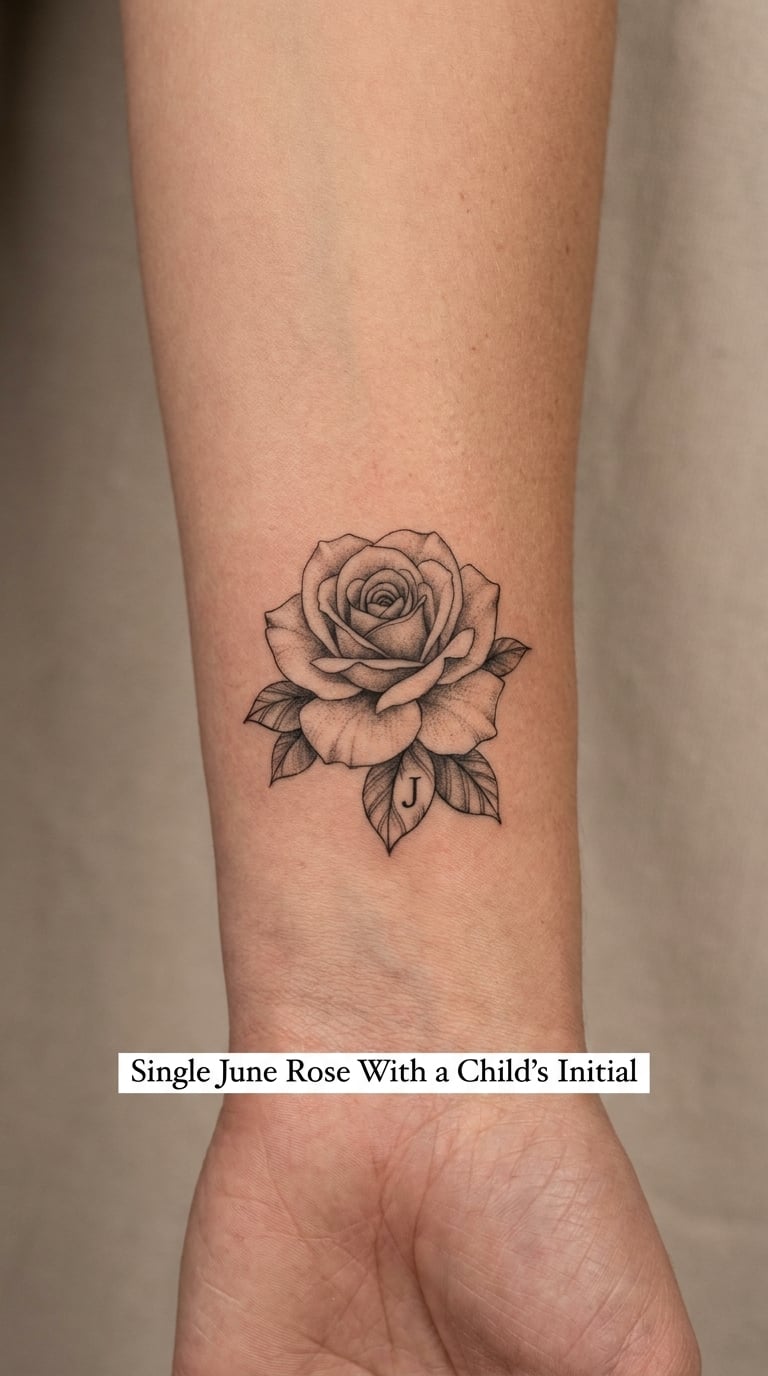
A rose gives an artist room to work, and a June birth flower in black-and-grey realism is a piece people keep for decades. The petals are shaded in soft gradients with the darkest tone at the centre of the bud, and the outer edges are left as skin. The initial goes into one leaf near the base, small enough that it reads as texture up close and as a leaf from a distance. Balancing dense shading against open space is what keeps a rose from looking heavy on a small canvas.
Placement: inner wrist, forearm, or the outer bicep. Size: 2 to 2.5 inches (5 to 6 cm) tall. Style: micro realism, black and grey. Pain: moderate, and shading means more passes over the same skin. Ageing: realistic roses are among the most forgiving florals long-term because the detail is broad rather than hairline. Make it yours: put a colour in the negative space, the way a few artists add a single red petal, or add a date to the stem line.
7. Larkspur Stems in a Matching Mother’s Line
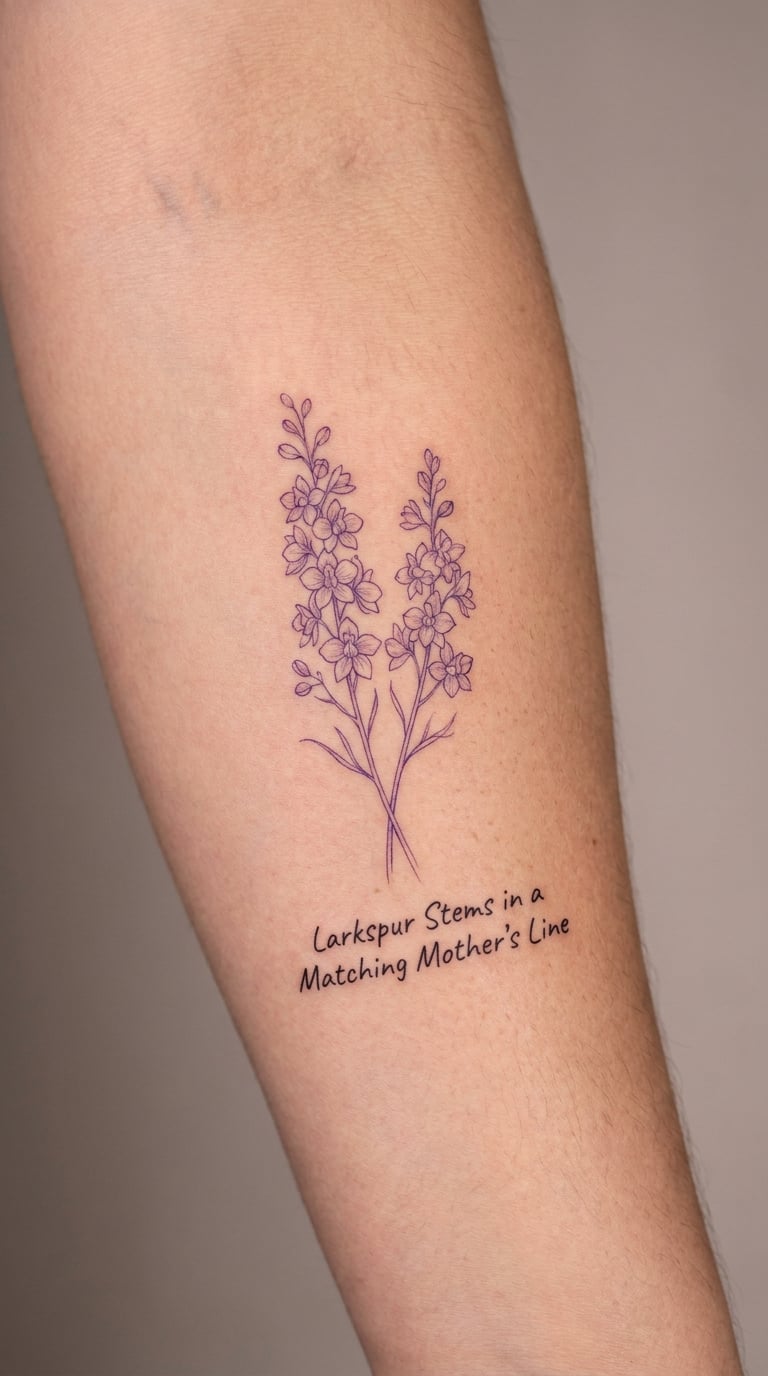
Two larkspur stems of slightly different heights make a design that is meant to sit beside something else. The petals cluster along the top of each stem in the loose, airy way larkspur actually grows, drawn with fine lines and a soft violet through the lower petals. A design like this is usually a second piece, inked in the same session or a later one as a match to a mother’s existing floral line, and the matching is in the line weight and colour choice rather than the subject.
It suits a July birth month and it suits a family that already has one piece.
Placement: outer forearm, the calf, or the upper arm. Size: 2 inches (5 cm) tall per stem pair. Style: fine line with a violet tint. Pain: low. Ageing: the airy petal clusters lose separation over time, so ask for a slightly firmer line than you would in a drawing. Make it yours: match the stem count to the children you are marking, and choose the violet to sit alongside whatever is already inked near it.
8. Watercolor Poppy With a Tiny Birth Date
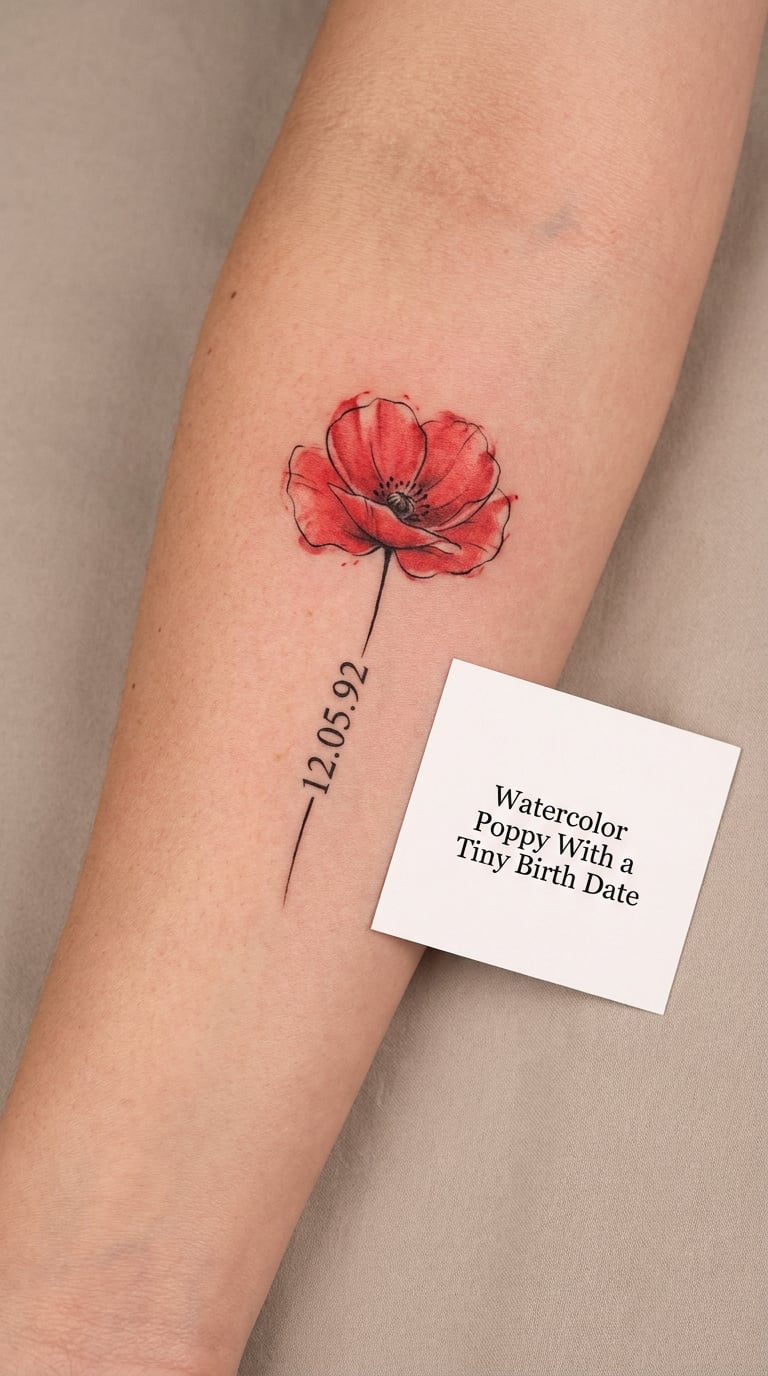
A loose poppy is one of the easiest ways to make a small tattoo look painterly. The petals are laid in as translucent red or coral wash with soft edges that run slightly outside the outline, and a fine black line defines the date underneath. The contrast between the wet colour and the dry line is what makes it feel modern rather than like a printed illustration. For an August birth flower, the poppy also has a natural weight that holds its shape without much shading.
Placement: the flat of the forearm, the upper arm, or the calf. Size: 2.5 inches (6 cm) wide. Style: watercolour with fine line. Pain: low, and the colour passes are quick. Ageing: light washes fade faster than line work, so expect the red to soften toward the outline within a few years and plan a touch-up into the budget. Make it yours: pick a hue tied to something specific, the colour of the birth card or a room in the house, rather than defaulting to plain red.
9. Aster Sprig Wrapped Around a Birth Month
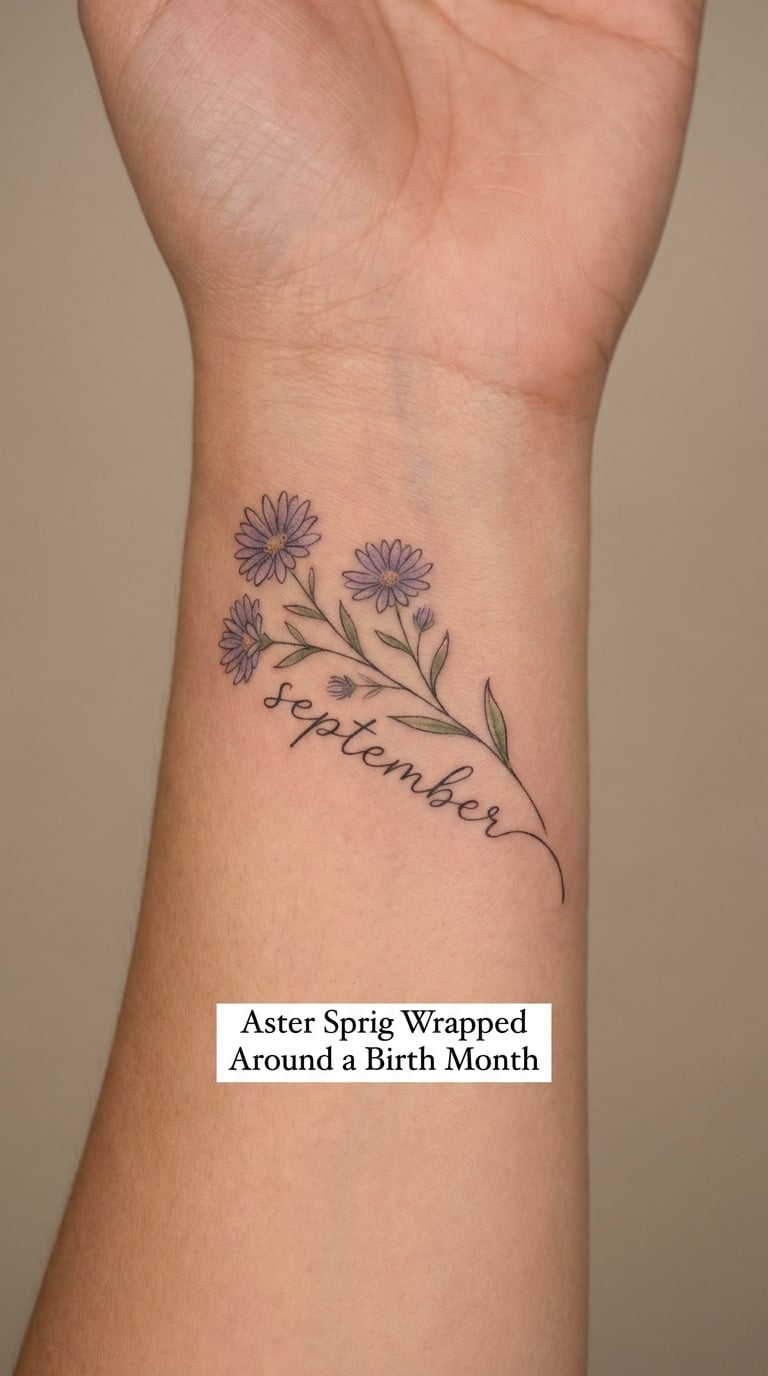
An aster has narrow petals radiating from a small centre, which makes it forgiving to draw small. This version keeps the linework clean, with an optional muted lavender or blue through the petals, and the birth month curves under the sprig in small lettering that follows the arc of the stem. The effect is a subtle family marker rather than a statement piece, and it sits comfortably next to a watch band or a bracelet.
September and October babies both get aster-style blooms in the convention, so the month label is doing real work here.
Placement: side of the wrist, the inside forearm, or behind the ear. Size: 2 inches (5 cm) tall. Style: fine line with muted colour. Pain: low. Ageing: the curved lettering loses definition before the flower does, so give the letters a little more weight than feels necessary. Make it yours: run a thin vine or line around the wrist and let the lettering sit on the curve, or add a family surname instead of the month.
10. Marigold With a Child’s Handprint
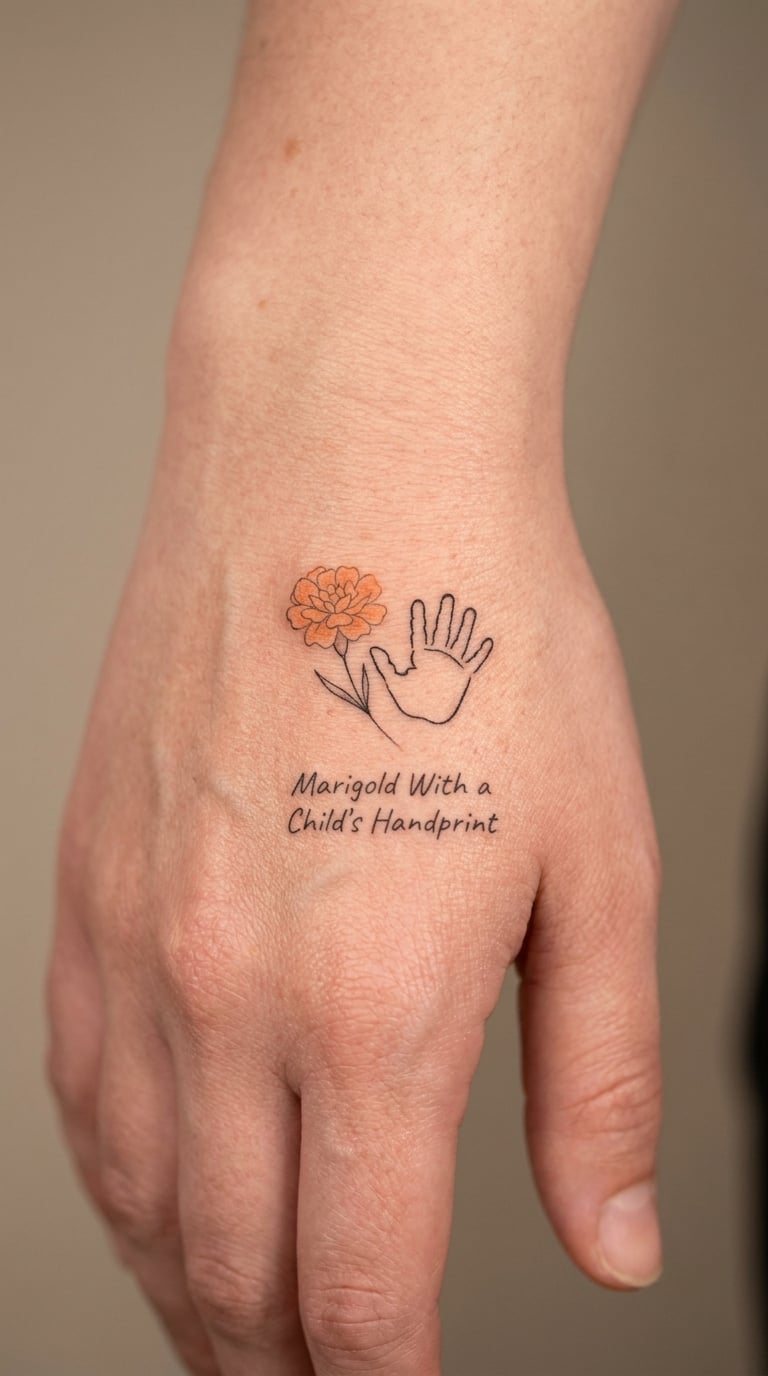
An October birth flower and a handprint sit side by side here rather than inside each other, which keeps both readable. The marigold is drawn as a full round bloom of layered petals in a warm ochre or orange, and the handprint next to it is reduced to five simple lines for fingers plus a rounded palm. The flower supplies the weight and the handprint supplies the movement, so the pair looks designed rather than assembled. There is no fixed symbolic reading to this pairing. It simply is what a mom wanted on her arm.
Placement: the back of the hand, the shoulder, or the flat of the forearm. Size: 2 inches (5 cm) wide for the pair. Style: fine line with one colour. Pain: moderate on the back of the hand, which is bony and sensitive. Ageing: finger shapes in a simplified handprint are the first lines to round off, so keep them short and bold. Make it yours: trace a real hand outline rather than inventing one, or add the birth date along the marigold stem.
11. Chrysanthemum in a Circular Birth-Date Frame
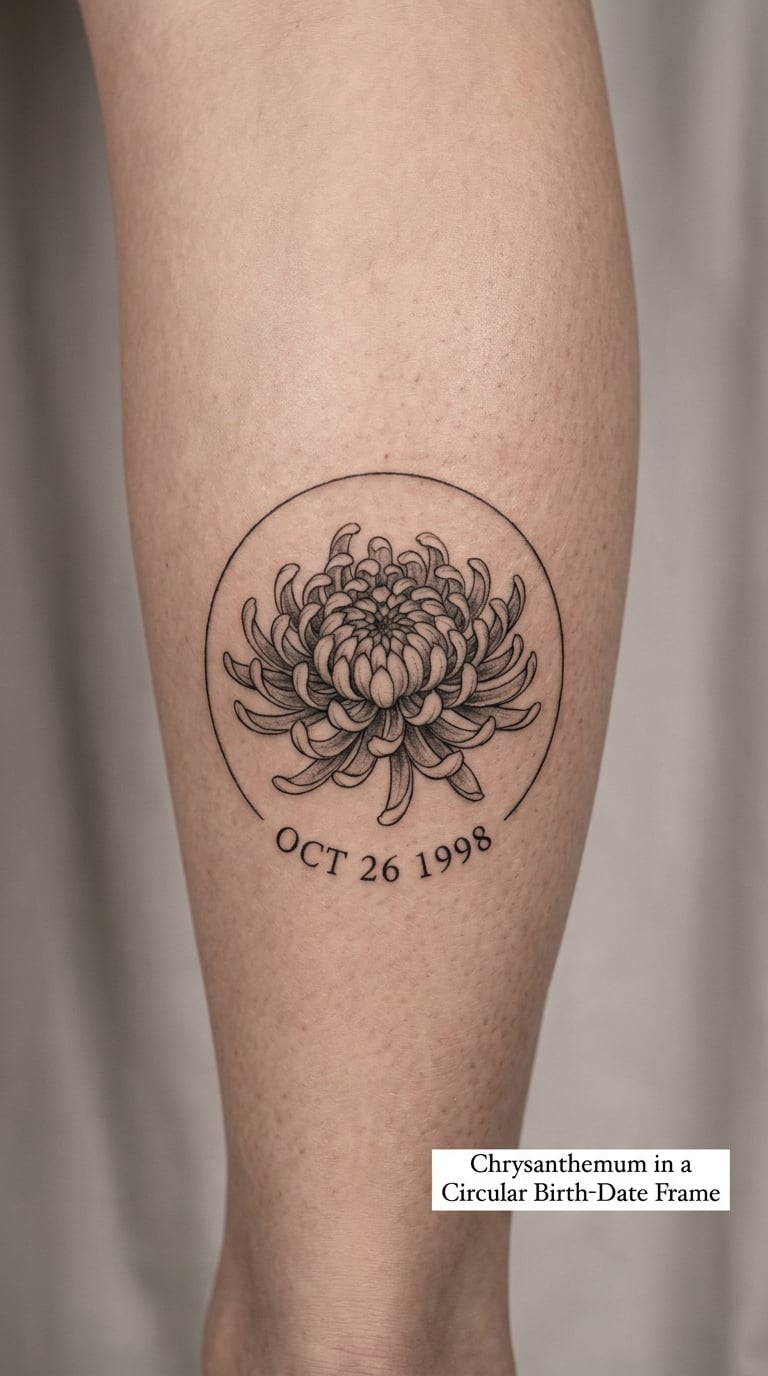
A chrysanthemum is dense, with petal layers radiating in every direction, and it sits well inside a thin circle that holds the composition together like a stamp. The flower is drawn in black and grey with each layer slightly different in tone, and the full birth date runs along the bottom of the circle in small capitals. Because the bloom fills the frame, the negative space is limited, which is one of the reasons this design reads cleanly at a distance and holds its shape longer than most November birth flower pieces.
Placement: the calf, the outer thigh, the upper back, or the forearm. Size: 3 inches (7.5 cm) wide. Style: botanical, black and grey. Pain: moderate, and the calf is a spot people tense up on, so lying down helps. Ageing: dense petal work stays legible longer than sparse line work, but the date inside the circle will still need a touch-up eventually. Make it yours: repeat the circle format for a second child in a different frame, or add a small name on the opposite arc.
12. Narcissus in a Minimal Line-Drop Style
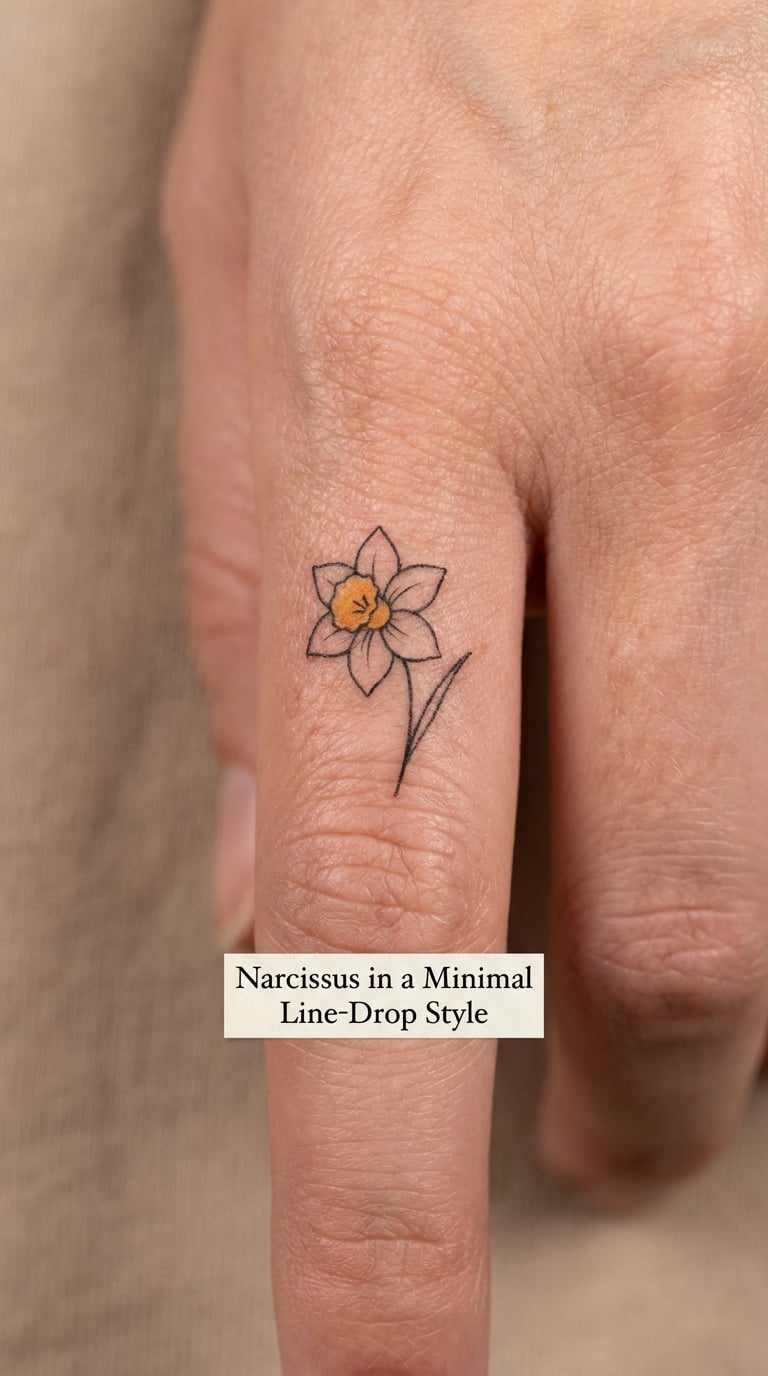
This is a small December birth flower tattoo built for a finger: an open narcissus drawn with a few black lines, six petals around a trumpet centre, and a warm yellow dot in the middle. There is no stem and no leaves, which is the point. Finger tattoos get bumped, washed and exposed constantly, so a design that needs no fine detail survives the placement far better than a full botanical study would. Ask for a line weight that fills the fingertip comfortably, not one that would look delicate on paper.
Placement: the side of an index or middle finger, the knuckle, or the back of the hand. Size: 1 inch (2.5 cm) wide. Style: minimal black line with a colour dot. Pain: high, on bone. Ageing: fingers fade faster than almost any other placement, and this one will need more than one touch-up. Make it yours: place one small dot beneath the flower for each child, or match it with a matching floral drop on the partner’s hand.
13. Birth Flower and Newborn Name in One Fine-Line Line
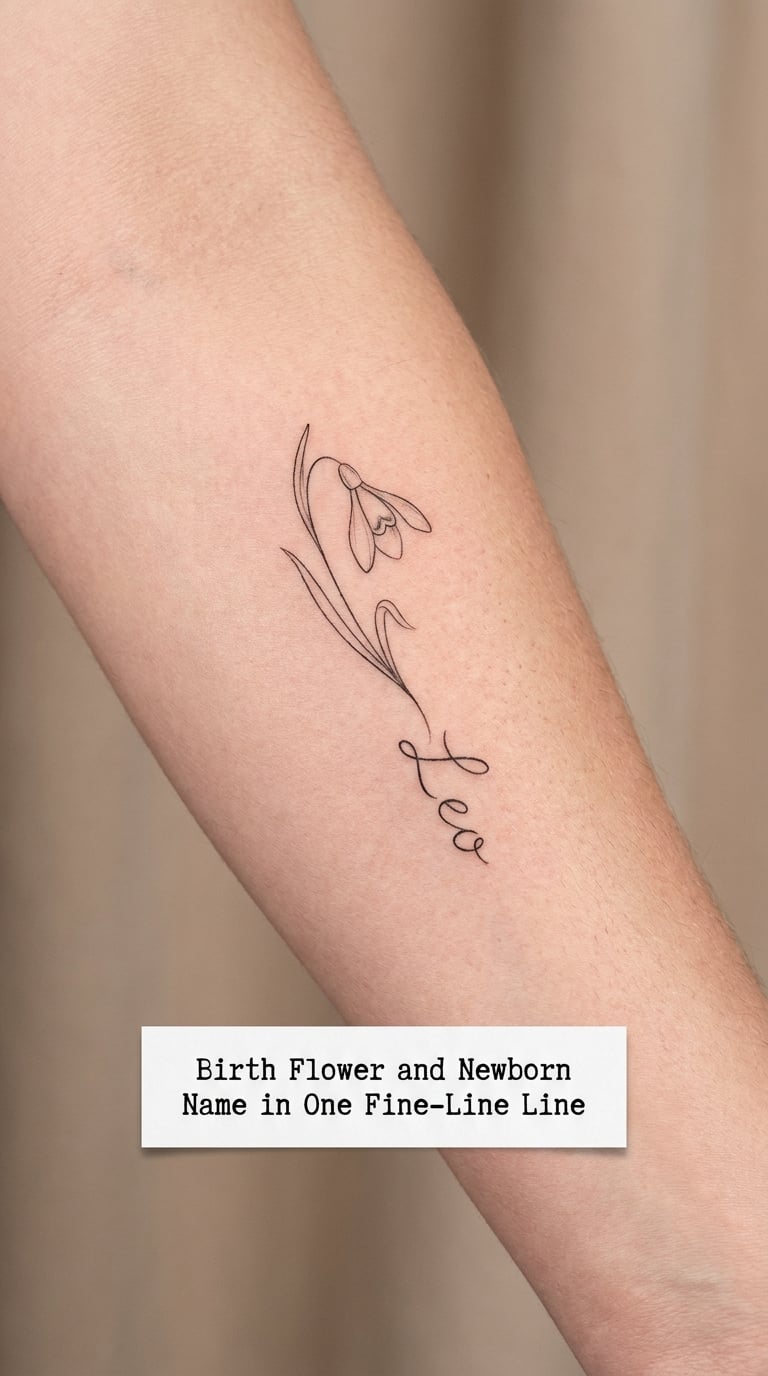
Rather than stacking a flower above a name, this design lets one continuous line run out of the stem, along the underside of the bloom, and into the lettering of the child’s name. The flower sits at one end, the name travels along the same baseline, and the spacing between the two gives each its own room to read. This is the version that looks considered rather than assembled, and it is the one I would point a first-time client toward when they know the name but not the placement yet.
Placement: the inner arm from wrist toward elbow, or the flat of the forearm. Size: 3.5 inches (9 cm) long. Style: fine line, single continuous flow. Pain: low, though the inner arm near the elbow is tender. Ageing: the connecting line is the vulnerable part, so the artist should avoid thin hairlines between the two elements. Make it yours: add the birth year at the far end of the name, or choose a handwriting style that matches something already on the body.
14. Three-Child Bouquet With Distinct Flowers
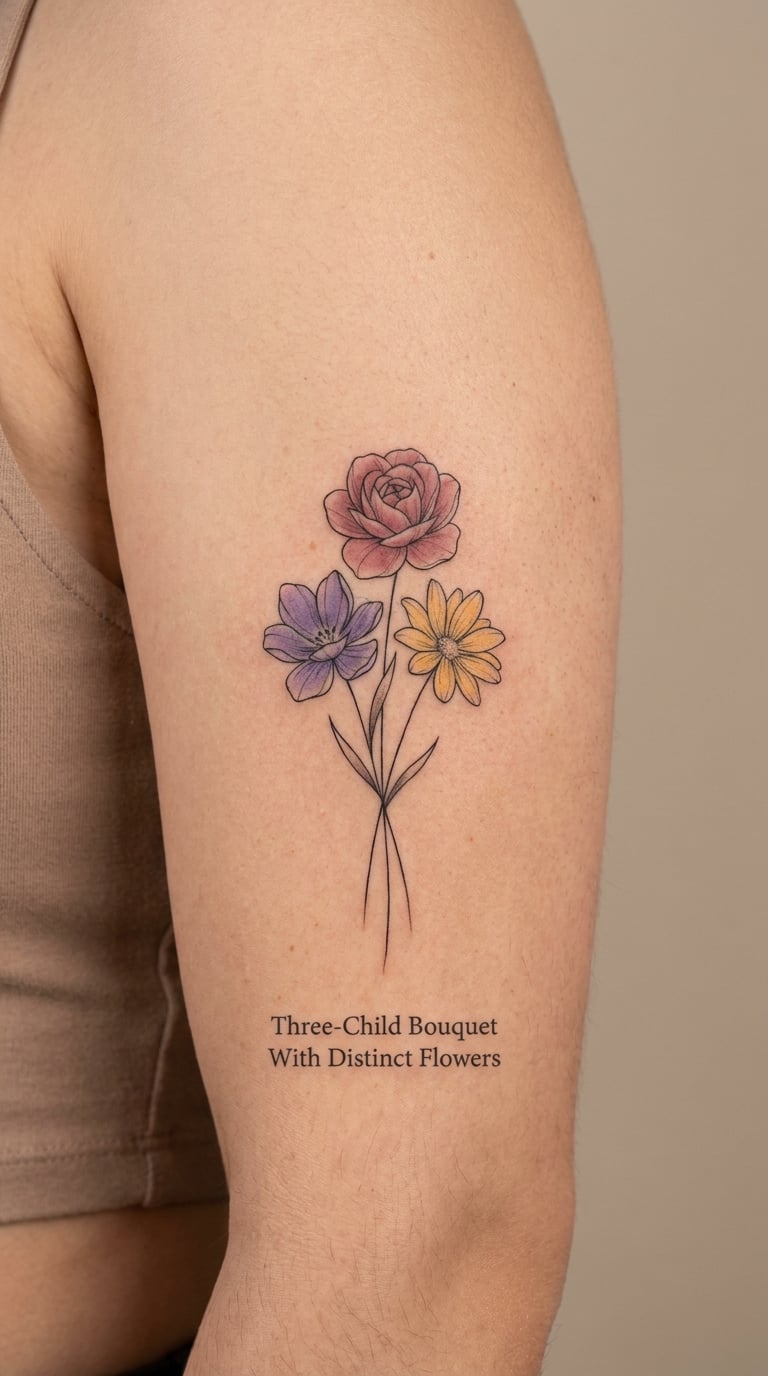
Three flowers with three different stem lengths is the fix for a bouquet that would otherwise look like a pile. The tallest stem sits at the centre, the other two angle out and down, and each bloom keeps a different colour so the eye can separate them instantly. Small identifying details work too, a single initial on a leaf, or a tiny date tucked under one stem. The rule that makes a many-flower composition read well is that every flower gets its own space; if two touch, they merge within a few years.
Placement: the upper arm, the outer forearm, or the shoulder. Size: 3 inches (7.5 cm) wide. Style: fine line with up to three muted colours. Pain: moderate, since three times the line work means longer in the chair. Ageing: crowded designs blur toward a single mass, so the artist should leave clear gaps between the blooms. Make it yours: choose each flower’s colour from something real to that child, a favourite object or a colour they wore as a newborn.
15. Blackwork Birth Flower Wrapped Around a Finger
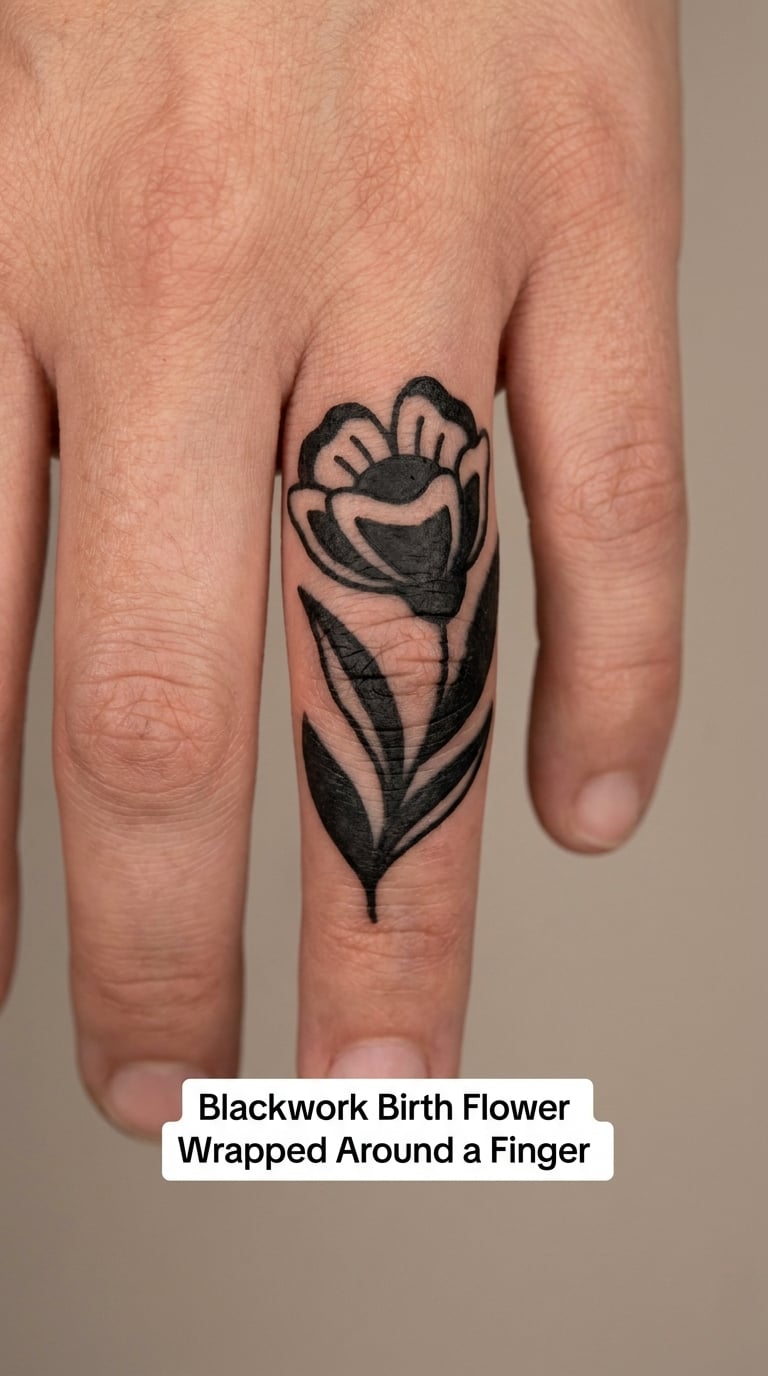
Not every birth flower needs to be delicate. A bold blackwork bloom wraps partway around the finger like a botanical ring, with thick filled petals and clean skin left as the highlight between them. The composition has to stay secure because the finger moves constantly, so most artists anchor it on the side of the finger rather than the pad and keep the ends of the wrap simple. It reads as a single graphic shape from any angle, which is exactly the point.
Placement: the middle or ring finger, wrapped from the side toward the top. Size: 2 inches (5 cm) tall, wrapping most of the finger’s width. Style: bold blackwork. Pain: high, on bone and over joints. Ageing: solid black stays solid, which is the one advantage a bold piece has on a finger. Expect to want the edges tidied once. Make it yours: use a colour from the birth month in a thin band at the base, or add a solid matching band below it later.
16. Minimal Birth-Month Stem on the Wrist
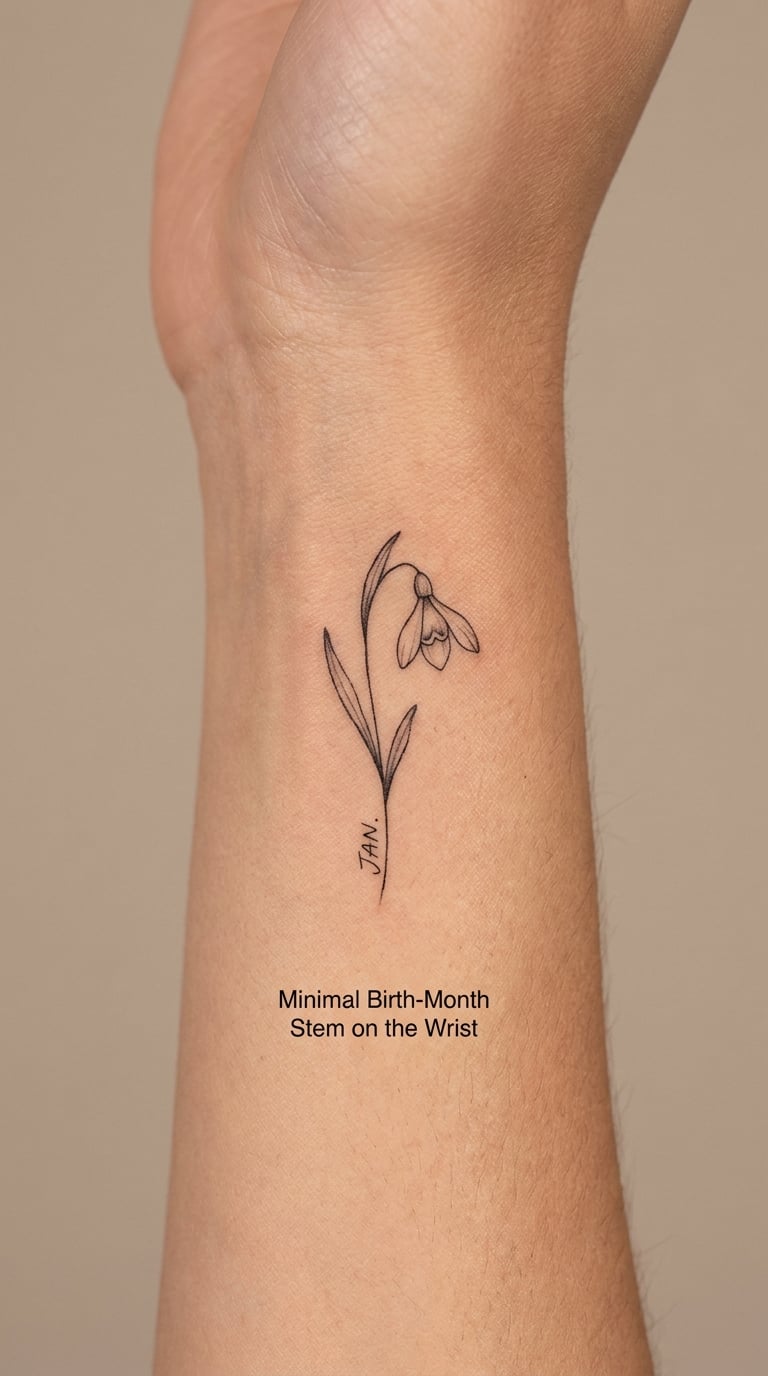
This is the quietest design in the set: one stem, one bloom, the birth month written small at the base. There is no second flower, no date and no framing, so the whole thing depends on proportion. A good artist will make the stem long and the bloom small, which is the opposite of most floral tattoos and the reason it looks modern. It is also the easiest of these designs to place well, because the inside of the wrist is flat, familiar and easy to photograph for a reference.
For a first tattoo with a lot riding on it, this is the one I would book.
Placement: the inside wrist, a few centimetres above the crease, or the inner forearm. Size: 2 inches (5 cm) tall. Style: minimal fine line. Pain: low to moderate, and the wrist bone is the tender point. Ageing: wrist fine line fades faster than the same work on an upper arm, so choose a slightly heavier line weight. Make it yours: use a dot in the birthstone colour, add the birth year in numerals at the stem base, or match it with a second stem in a different month later.
17. Poppy and Baby Handprint in Fine-Line Realism
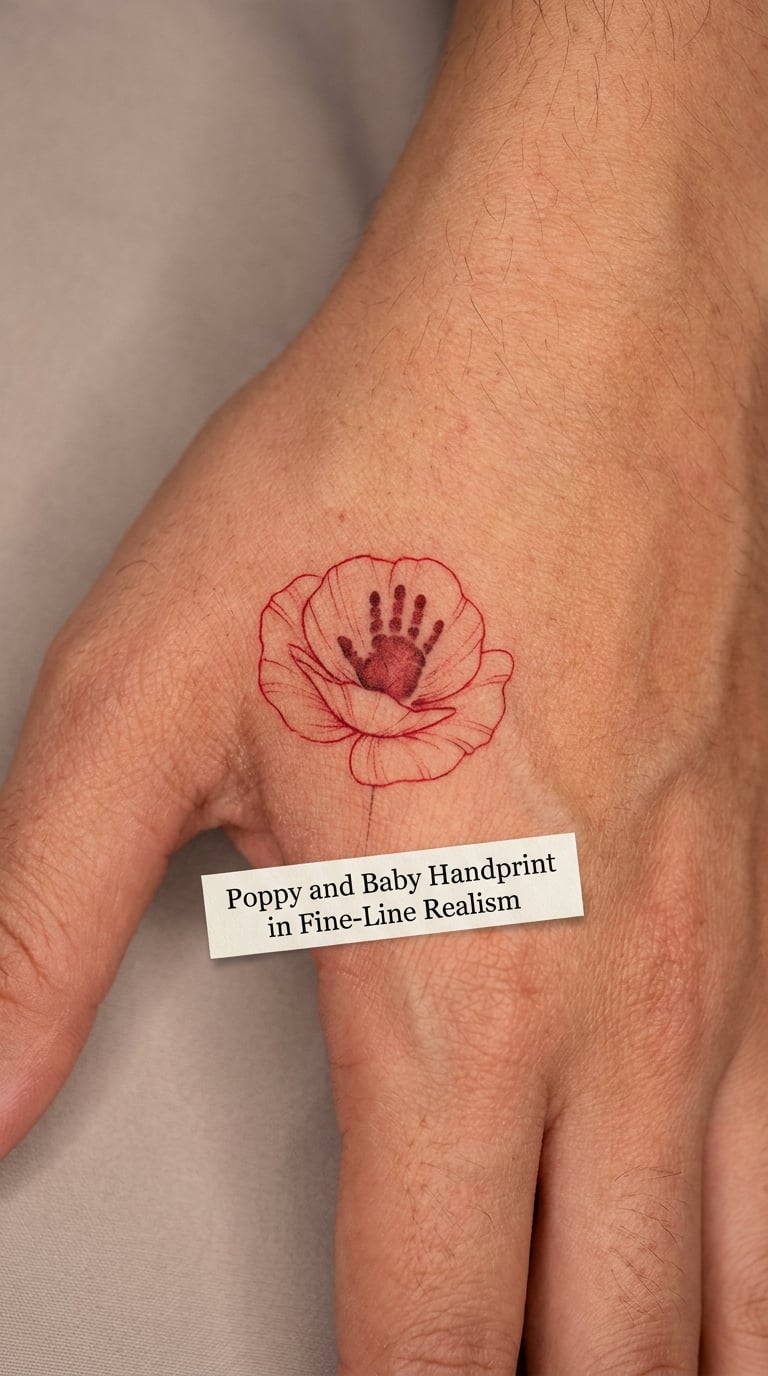
Here the handprint sits inside the bloom, which is a stronger image than putting the two side by side but a harder drawing. The poppy is outlined in fine black line with translucent red through the petals, and the handprint is reduced to five short finger shapes and a rounded palm centred in the dark middle of the flower. The handprint has to be simplified hard to hold its shape at that scale. A print taken from a newborn is naturally tiny, which works in your favour here.
Placement: the back of the hand, the forearm, or the shoulder. Size: 2.5 inches (6 cm) wide. Style: fine-line realism with a light wash. Pain: moderate on the back of the hand, low elsewhere. Ageing: the finger shapes inside the bloom soften first, so a slightly bolder print outline is the safer drawing. Make it yours: bring a photo of the actual hand or footprint and let the artist trace it, or set the birth date under the stem.
18. Botanical Birth-Month Sleeve Accent
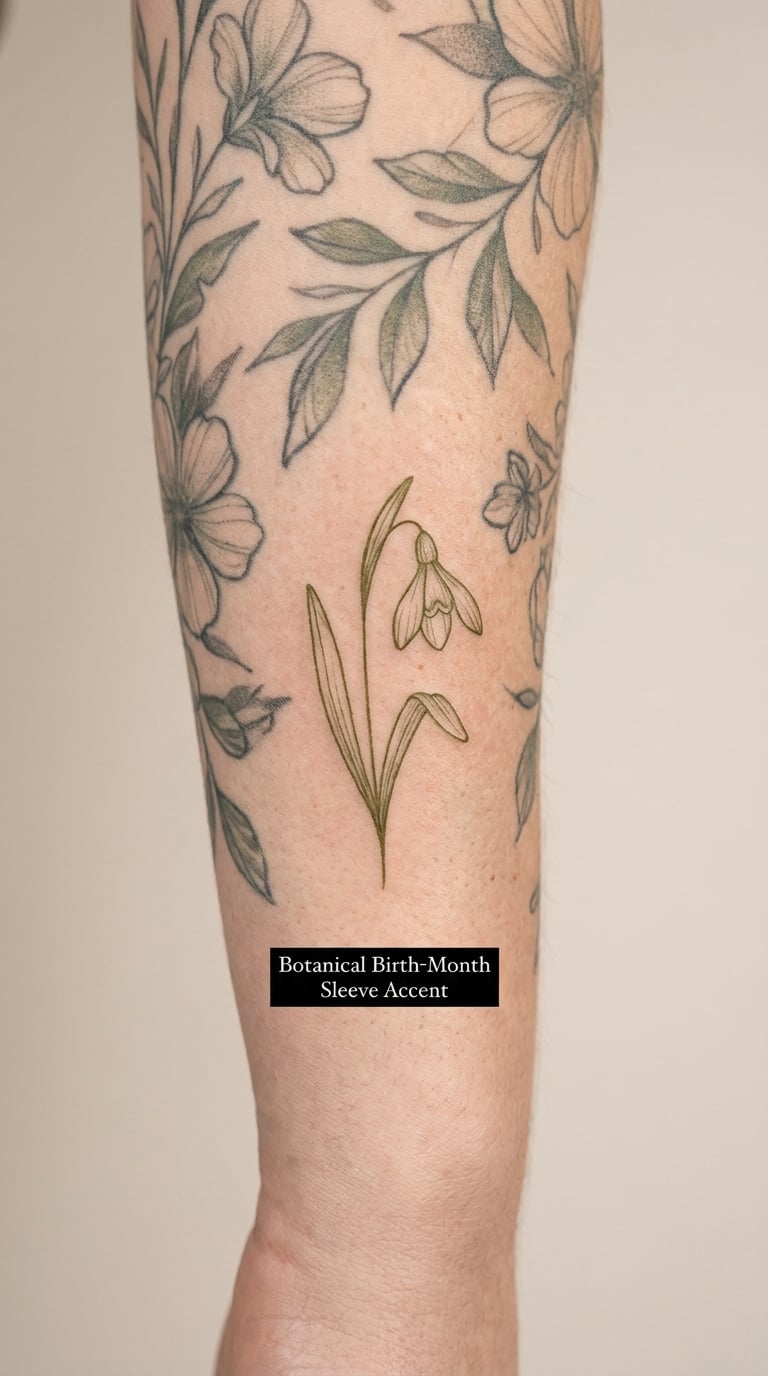
A sleeve accent is a single bloom built to live inside work that already exists. The design has to follow the directional flow of the surrounding stems, which usually means leaning with the branch rather than standing upright against it. Scale is the other constraint: an accent that is much smaller than the neighbouring flowers reads as an afterthought, and one that is much larger pulls the eye off the composition. Ask to see healed photos of the work it will sit inside, since fresh ink on new lines is misleading.
Placement: anywhere within an existing botanical or floral sleeve, usually the forearm or upper arm. Size: 2 to 3 inches (5 to 7.5 cm) tall, matched to the existing work. Style: botanical fine line with muted green, or a style that matches the sleeve. Pain: moderate, and freshly tattooed skin nearby is often more sensitive than the rest. Ageing: consistency matters more than detail here, since mismatched line weight shows as the sleeve ages. Make it yours: match the leaf and stem treatment exactly, and use the birth month colour as the only new hue in the piece.
19. Micro-Realism Flower With a Hidden Birth Year
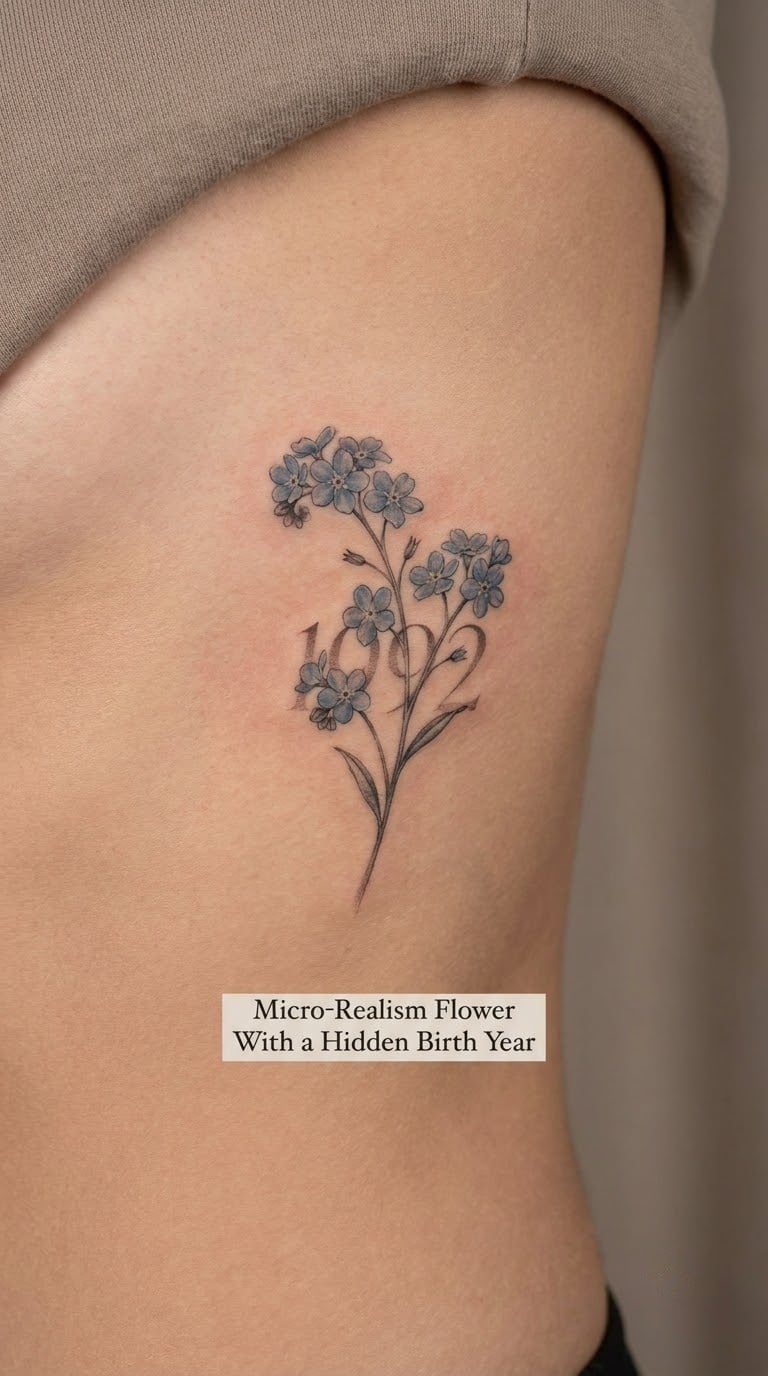
The idea is that you know the year is there and nobody else does. The flower is drawn with dimensional shading in soft blue and grey, and the four-digit year runs underneath the lowest petals where the bloom overlaps it, so the numbers are partly covered by the flower itself. It is a personal detail rather than a message, and that is what keeps it from feeling heavy. The shading gives the piece more presence on the body than a flat line drawing of the same size.
Placement: the rib, the side of the torso, the inner arm, or the upper back. Size: 2 inches (5 cm) wide. Style: micro realism with soft colour. Pain: moderate, and ribs are bony, so breathing deep during a session is uncomfortable. Ageing: micro shading blurs over the years, so the overlap that hides the numbers will also blur; have the design explained in case you forget the position later. Make it yours: put an initial in the same hiding place instead of a year, or circle the flower in a thin line so the shape reads even when the shading softens.
20. Mother-and-Child Floral Line Portrait
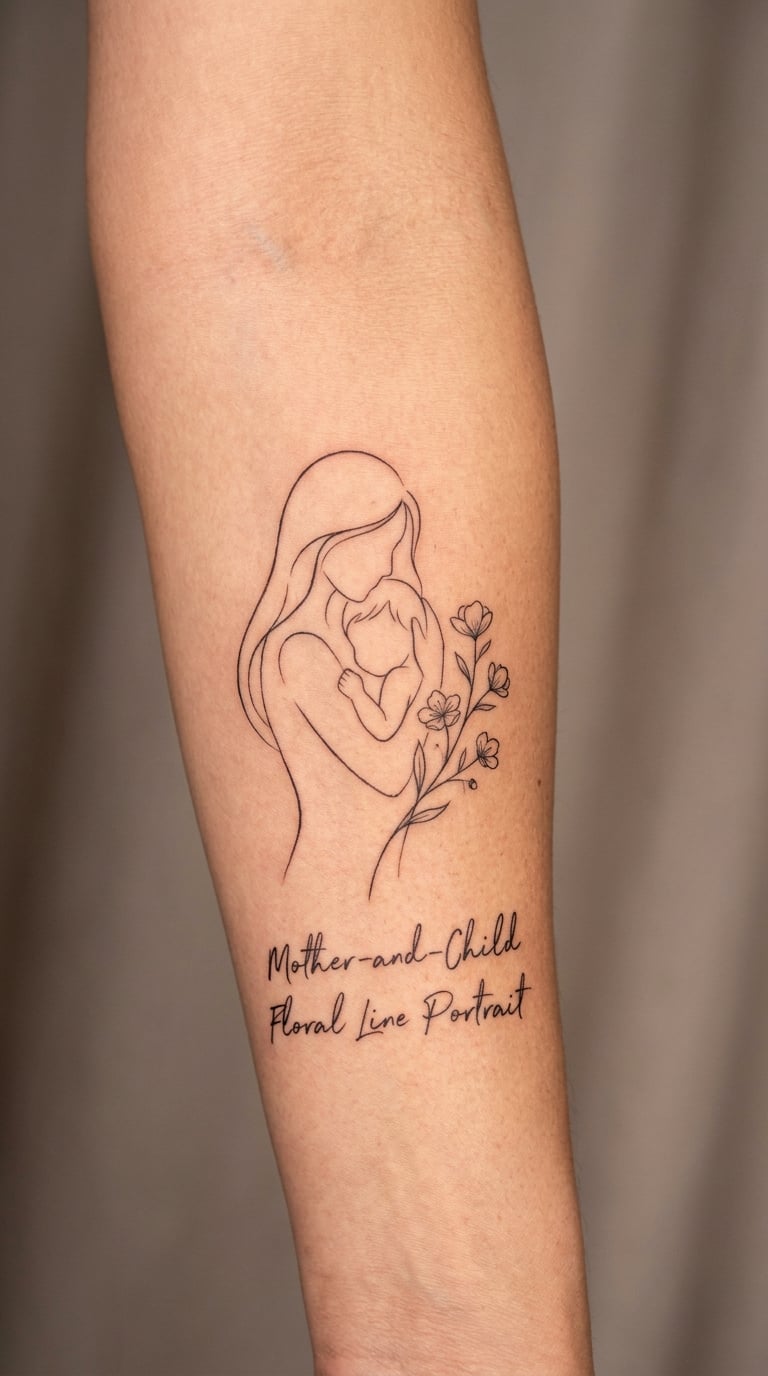
The last one is the most ambitious: an abstract fine-line outline of a mother holding a child, with a small birth flower growing up beside the two figures. It is an original illustrative motif drawn for you, not a copy of a photograph of anyone, and the artist will work from a reference photo of your own poses if you want the composition to look like you. The figures are simplified to a few confident lines, and the flower is the only place colour is allowed, which keeps the emotion in the drawing rather than the ink.
Placement: the forearm, the upper arm, the calf, or the side of the ribs. Size: about 5 inches (12.5 cm) tall, and most artists will spread it over two sessions. Style: fine-line illustration with one coloured bloom. Pain: moderate across a larger area, and longer sessions are harder to sit through. Ageing: bold outline lines hold better than the thin interior details, so ask the artist to keep the interior of the figures simple. Make it yours: choose the pose that matches how you actually hold your child, and set the flower type to the birth month so the detail carries the same meaning as the line work.
How to Choose the Right Design
Five questions narrow a shortlist down to one design quickly, and answering them before the consultation saves time in the chair.
Fine line, blackwork or realistic?
Fine line suits small placements and a discreet look, and it is the only one of the three that needs a bolder line weight than you would draw on paper. Blackwork holds its shape better on fingers and hands, where fine line fades fastest. Realistic shading reads beautifully on the forearm, the calf and the ribs, but it needs more space than people expect. A useful test: if the design has to disappear under a sleeve at work, fine line is the answer.
How small can it go?
One stem can hold at 1.5 to 2 inches (4 to 5 cm). A three-flower bouquet needs closer to 3 inches (7.5 cm) before the stems have room to separate. Below an inch, only the simplest shapes work, and clustered-petal flowers such as the chrysanthemum and the lily of the valley lose definition first. Ask your artist to draw it at final size on paper before anything is stencilled.
Which placements fade soonest?
Fingers and the back of the hand go first, then the inner wrist, because they get sun and abrasion. The outer upper arm, the calf and the shoulder hold line work noticeably longer. Hands and fingers are not off limits, they just need realistic expectations and a touch-up budget.
Should the date or the name be the hero?
Decide this first, because it changes the layout. A date underneath a bloom reads cleanly and needs less room. A name needs width and careful letter spacing, and thin cursive fades faster than numerals. If you cannot choose, hiding one of them inside the composition, as in idea 6 or idea 19, gives you both without competing.
What about matching work?
If you already have a piece, take a photo of it healed, not fresh, to the consultation. Matching works at two levels: identical designs side by side, or the same style and line weight with a different flower. The second option ages better, because the two pieces will never fade at exactly the same rate. Leave deliberate space in a first design if you expect more children, the way several parents on forums describe planning a line that can be extended later.
Cost and Session Time
US tattoo pricing runs roughly 150 to 250 dollars an hour in most US cities, and most shops set a minimum of around 100 to 150 dollars for the shortest appointments, which means a small design is effectively priced as a short session rather than by the hour.
A micro design of one to two inches usually takes 30 to 60 minutes. Three to four inches of fine line with lettering runs one to two hours. A three-flower bouquet or anything with soft colour shading takes two to three. The larger mother-and-child composition is commonly split across two sessions, and the cost of that scales with the hours, not the design.
Complexity, colour, and the artist’s own hourly rate move the number more than size does. A botanical or realism artist in a high-rent city will sit well above the ranges above, and a colour wash takes measurably longer than line work on the same shape. Consultations are sometimes free and sometimes credited toward the session, and a quote should always follow a direct conversation with the artist rather than a generic price list.
Aftercare Basics
- Follow your artist’s aftercare instructions first. They know exactly what they did in your skin, and their advice outranks anything general.
- Clean the area gently with unscented soap and lukewarm water, then pat it dry with a clean hand or a paper towel rather than a towel you use for your face.
- Wear loose clothing over a fresh tattoo for the first few days. A waistband or a sleeve seam rubbing across the design is the most avoidable irritation there is.
- Leave the tattoo alone. No picking, no scratching, no soaking in a bath, pool or hot tub while it is still healing.
- Keep it out of strong sun, and once healed, remember that faded line work usually starts with the parts that see daylight, especially the outer forearm and the wrist.
- Use only the products your artist recommends, and ask them directly if you are unsure about a cream or a product you already have at home.
Frequently Asked Questions
What is the best birth flower tattoo for a new mom?
The best birth flower tattoo is simply the bloom assigned to your child’s birth month, drawn at a size and in a style you will still want in ten years. For a first piece most moms choose a single stem of two inches or so, because one flower leaves room to add another later without crowding the design. A small stem on the inner wrist is the most common first choice.
Can I combine my child’s birth flower with their name and birth date?
Yes, and the two elements need different amounts of room. A date fits neatly under a bloom in a narrow column, while a name needs width and careful letter spacing. If you want both, a continuous line running from the stem into the lettering works well, or you can hide the year beneath overlapping petals. Bring a reference of the real handwriting if you are using a name.
Where should a small birth flower tattoo be placed?
The inner wrist, the outer upper arm, the shoulder and the calf all hold a small floral design well and fade more slowly than most spots. Behind the ear works if you want it discreet. Fingers and the back of the hand take the smallest sizes but fade fastest and need the most touch-ups. Pick the placement before the design, since the same bloom behaves differently on each of these areas.
Are birth flower tattoos better in fine line or blackwork?
Fine line is the better choice for a small, discreet piece and for anywhere that rubs or flexes daily. Blackwork holds its edges much longer and is a smarter option on fingers and hands where fine line softens quickly. Realistic black and grey shading reads beautifully on the forearm and ribs but needs more space than most people expect. Ask your artist what line weight they would use at your chosen size.
How much does a custom birth flower tattoo cost?
Most US artists charge roughly 150 to 250 dollars an hour, with a shop minimum of about 100 to 150 dollars covering the shortest sessions. A small single stem is usually 30 to 60 minutes, while a three-flower bouquet or a design with colour runs two to three hours. Larger custom compositions are often split across two sessions, and rates vary widely by city and by artist speciality.
Conclusion: Choose Your Meaningful First Bloom
If this is your first tattoo and you want it to stay quiet, the minimal birth-month stem on the wrist is the one to book. One bloom, one small label, and enough clear skin to add a second flower when the family grows. If you already have floral work, the blackwork finger wrap or the sleeve accent will sit better with what is already there than a new standalone piece would.
Pick the flower, pick the placement, and decide whether the date or the name leads before you sit down with an artist. Those three decisions do most of the work. Browse more month-by-month designs in the September birth flower tattoo guide, then bring your reference photos to the consultation and let the artist draw the composition at final size on paper first.