
20 Best Cat Silhouette Tattoo Ideas for Minimalists (September 2026)
A cat silhouette tattoo is a solid black shape with no interior detail, and that single decision is why so many people choose one. The outline does all the work, so nothing inside it can fade away over the years. The best cat silhouette tattoo ideas below cover everything from a one inch cat behind the ear to a ten inch prowling cat across the upper back, with honest placement, size and pain notes for each.
Silhouettes suit first tattoos more than almost any other subject, and they translate onto any skin tone because there is no shading to lose. If you are browsing in September and booking for late 2026, give an artist three to six weeks of lead time for a custom piece, and take a look at healed work rather than fresh photographs.
Cat Silhouette Tattoo Ideas: Quick Guide
| Idea | Style | Best placement | Size | Pain |
|---|---|---|---|---|
| 1. Minimalist sitting cat | Black silhouette, clean edges | Inner forearm | 2 in tall | Low to medium |
| 2. Cat and moon outline | Fine line | Outer upper arm | 3 in wide | Medium |
| 3. Cat in a window | Blackwork with negative space | Upper back | 4 in wide | Medium |
| 4. Stretching cat | Solid black silhouette | Inner forearm | 3 in long | Medium |
| 5. Traditional kitten | Traditional with light line accents | Calf | 2.5 in tall | Medium |
| 6. Walking cat profile | Line with solid paw accents | Outer wrist | 3.5 in long | Medium |
| 7. Loaf cat | Minimalist solid black | Ribcage side | 2 in wide | Medium to high |
| 8. Cat with flower cutout | Silhouette with negative space motif | Outer thigh | 3 in tall | Medium |
| 9. Roaring traditional cat | Traditional blackwork | Shoulder blade | 5 in tall | Medium to high |
| 10. Dotwork cat | Dotwork, no outline | Upper arm | 3 in tall | Medium to high |
| 11. Low-poly cat | Geometric | Outer upper arm | 4 in tall | Medium |
| 12. Micro cat behind the ear | Micro solid black | Behind the ear | 1 in long | Low to medium |
| 13. Cat with long tail | Minimalist silhouette | Inner wrist | 4 in long | Medium to high |
| 14. Watercolor cat | Silhouette with colour wash | Inner upper arm | 3 in tall | Low to medium |
| 15. Cat with star cutouts | Silhouette with negative space | Ankle | 2.5 in tall | Medium to high |
| 16. Finger cat | Micro side profile | Side of index finger | 1 in long | High |
| 17. Cat in a crescent moon | Silhouette inside a frame | Inner forearm | 3 in tall | Medium |
| 18. Two cats facing each other | Paired silhouettes | Upper calf | 4 in wide | Medium |
| 19. Continuous-line cats | One-piece line work | Forearm, lengthwise | 3 in wide | Medium |
| 20. Large back piece | Large solid black | Upper back | 10 in wide | Medium to high |
1. Minimalist Sitting Cat Silhouette
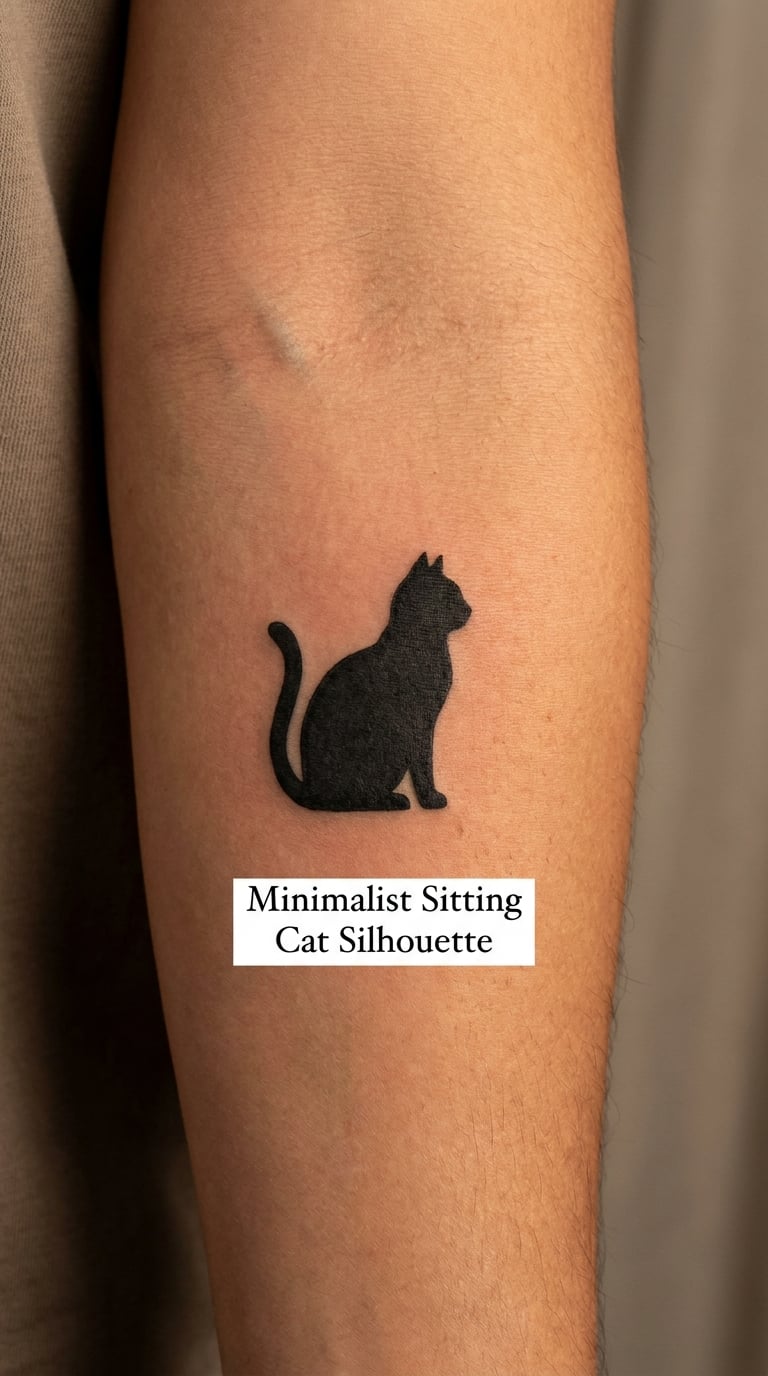
This is the one most people picture when they hear cat silhouette: a cat sitting upright, head turned slightly, tail curled around the front paws, filled solid black with nothing inside it. No eyes, no fur, no whiskers. The artist draws a single confident contour and packs it flat.
It is the safest first cat tattoo because the shape reads at a small size and a bold fill has very little to lose as it ages.
Placement: inner forearm, wrist, or the outer bicep. Size: 1.5 to 2.5 inches tall (4 to 6 cm). Style: minimalist solid black. Pain: low to medium on the inner arm, and the solid fill goes on fast. Make it yours: have the tail curl on the opposite side from your cat’s favourite lounging direction, or add a small notch to one ear.
2. Fine-Line Cat and Moon Outline
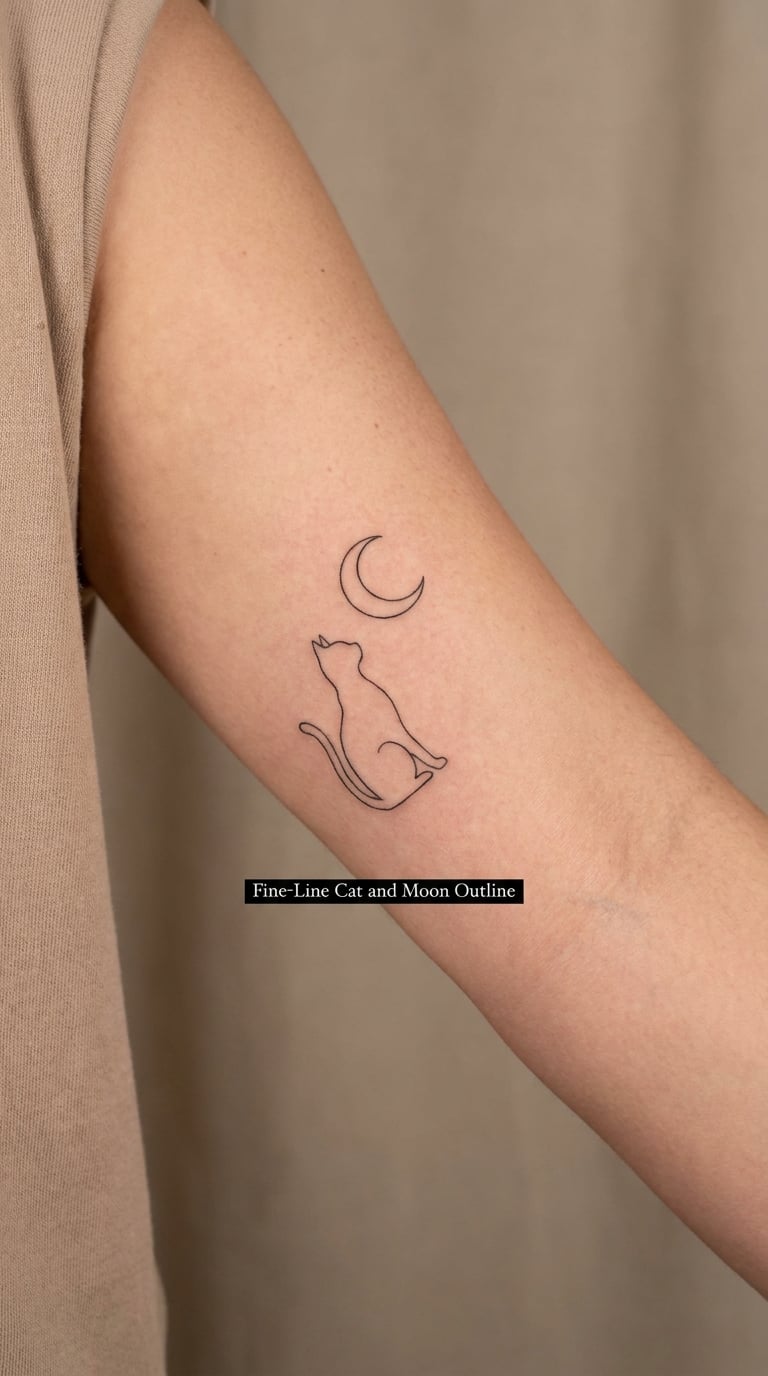
A slim cat in profile paired with a thin crescent moon, drawn as outline only, with no fill anywhere. The appeal is the composition: an empty circle of skin with two delicate shapes inside it, and a lot of breathing room between the lines.
Fine line is the style people reach for when they want something that looks light in a photograph and easy to hide at work. It asks for patience, because single-pass hairlines need an artist who slows down.
Placement: outer upper arm or the inside of a forearm. Size: 2.5 to 3.5 inches wide (6 to 9 cm). Style: fine line outline. Pain: medium, and expect some redness and itching as it heals. Make it yours: replace the moon with your birth sign, or place the exact date of a rescue under the circle in matching thin line.
3. Blackwork Cat in a Window
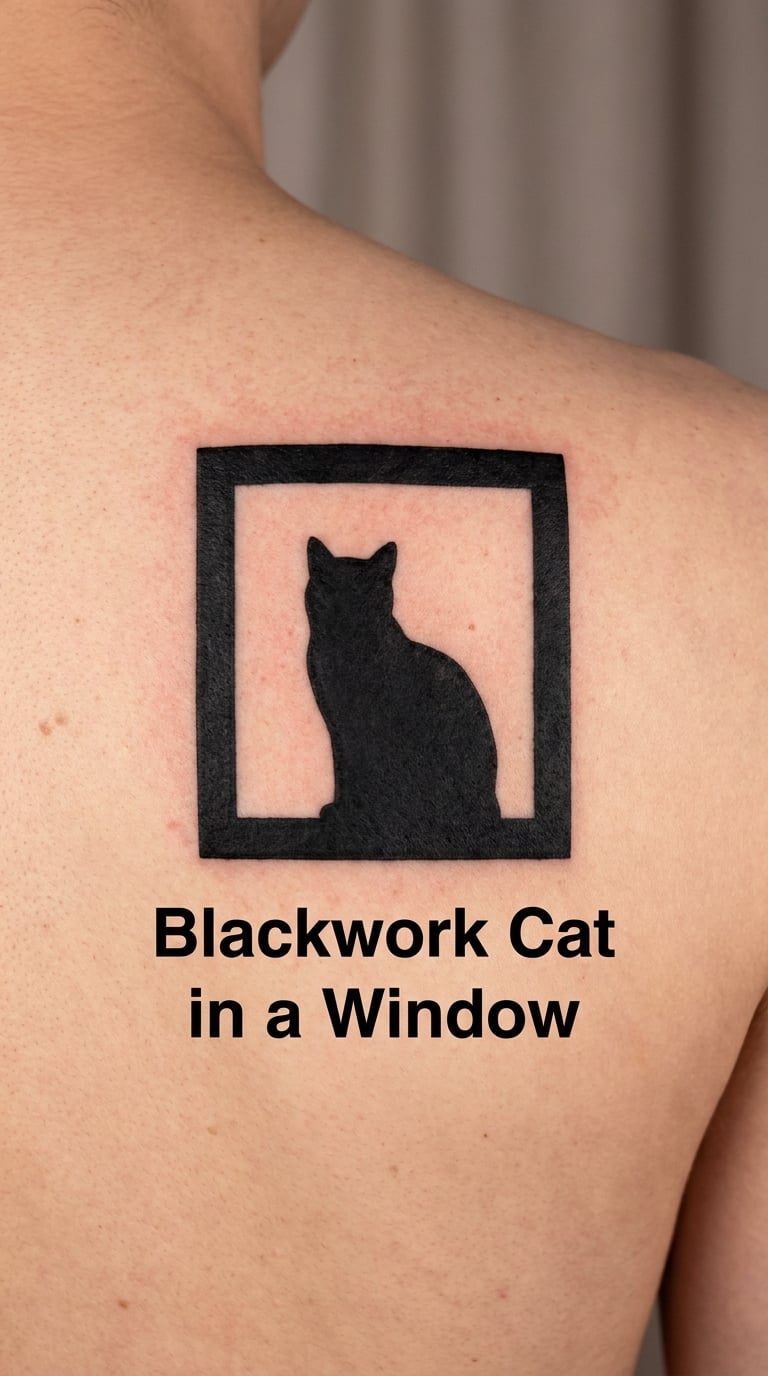
A cat sitting inside a simple four-pane window frame, the body a solid black shape against unfilled skin. The window is the whole trick. It adds a second shape, a little architecture, and enough negative space that the piece never looks like one heavy black blob.
Because the fill is large and flat, this is a forgiving design to heal. Solid black lightens a shade or two as it settles, then stays put.
Placement: upper back, chest, or thigh. Size: 3.5 to 5 inches wide (9 to 13 cm). Style: blackwork with negative space. Pain: medium across the back, where the skin is meaty and forgiving. Make it yours: have the window sashes drawn open, or change the pane count to match the year the cat came home.
4. Stretching Cat in Black Ink
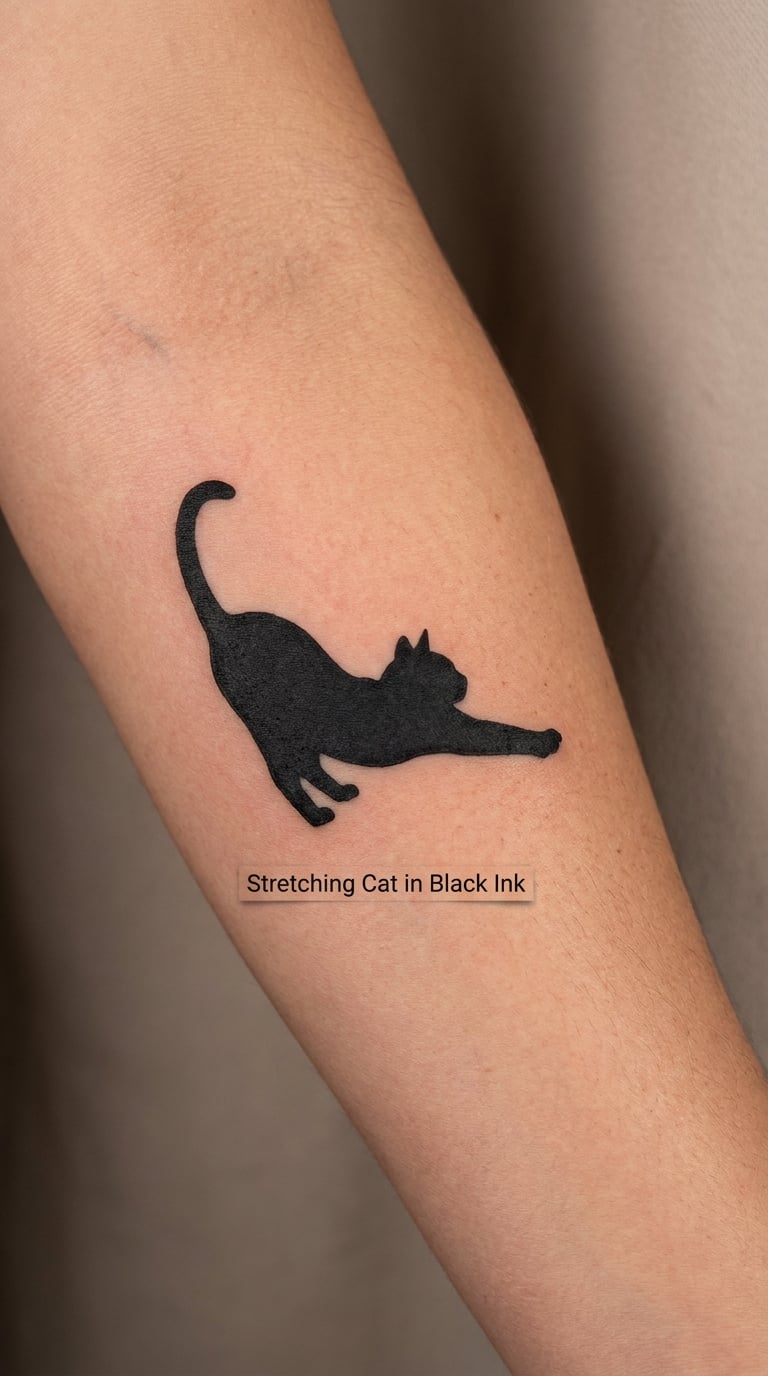
The stretch, back arched, front paws extended, tail high: a pose most people recognise from their own sofa. Drawn in solid black it becomes a shape with a lot of energy in it, which is unusual for something this minimal.
It suits a curving body part well. Along the forearm or calf the arch follows the natural line of the limb, so the design looks fitted rather than stuck on.
Placement: inner forearm, calf, or across the shoulder. Size: 2.5 to 3.5 inches long (6 to 9 cm). Style: solid black silhouette. Pain: medium, with a little sting in the tail tip. Make it yours: have the paws stretched further apart than feels natural, exaggerating the yawn, or name the exact moment the pose came from.
5. Traditional Kitten Silhouette
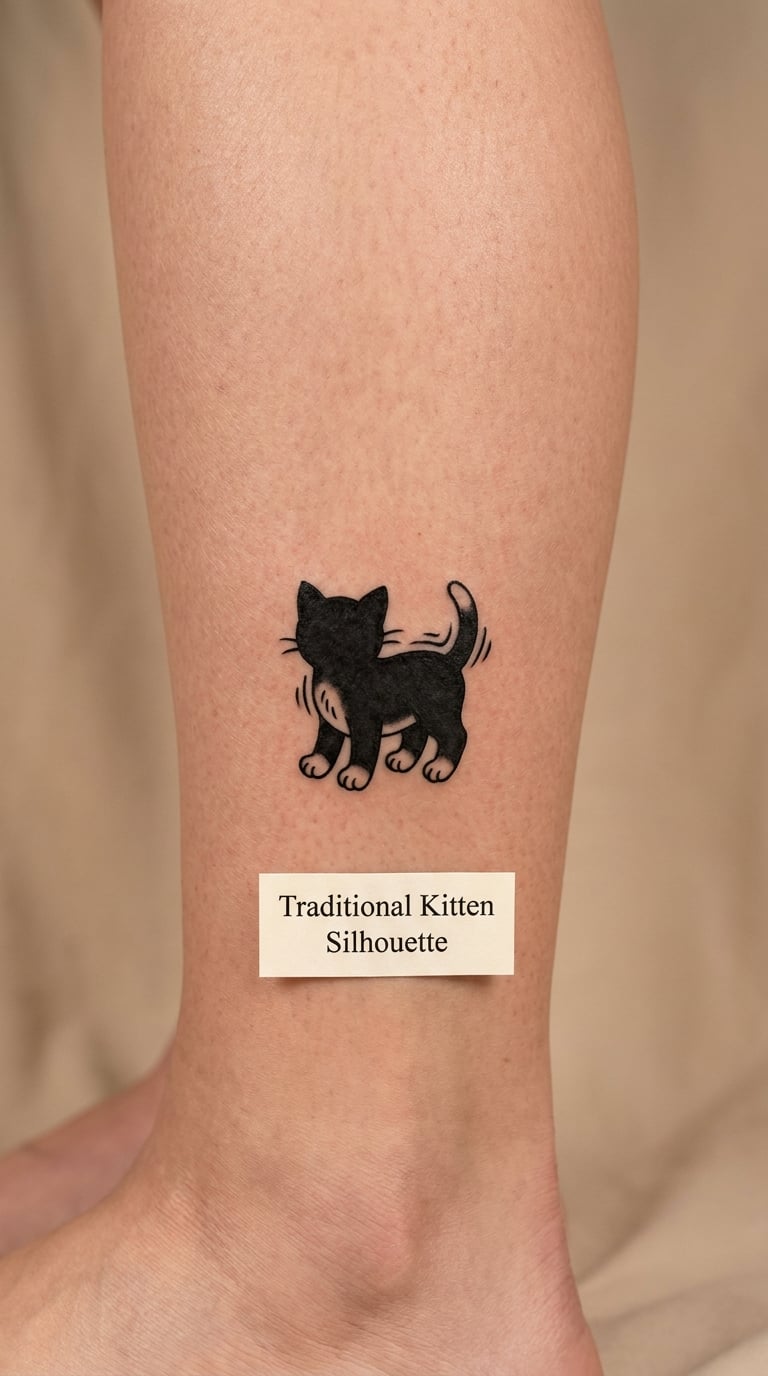
A seated kitten with rounded paws and a soft, slightly chubby outline, filled black with a few thin accent lines across the chest or toes. It sits closer to American traditional flash than to a pure silhouette, which is what gives it that vintage poster feel.
Traditional line work is built to be legible from across a room, so it holds up well at small sizes. That is exactly why kitten shapes work in this style.
Placement: calf, thigh, or upper arm. Size: 2 to 3 inches tall (5 to 7.5 cm). Style: traditional with fine accents. Pain: medium, similar to any solid fill. Make it yours: add a tiny collar line with a date, or ask for whisker dashes on just one side so the shape stays mostly black.
6. Walking Cat Side Profile
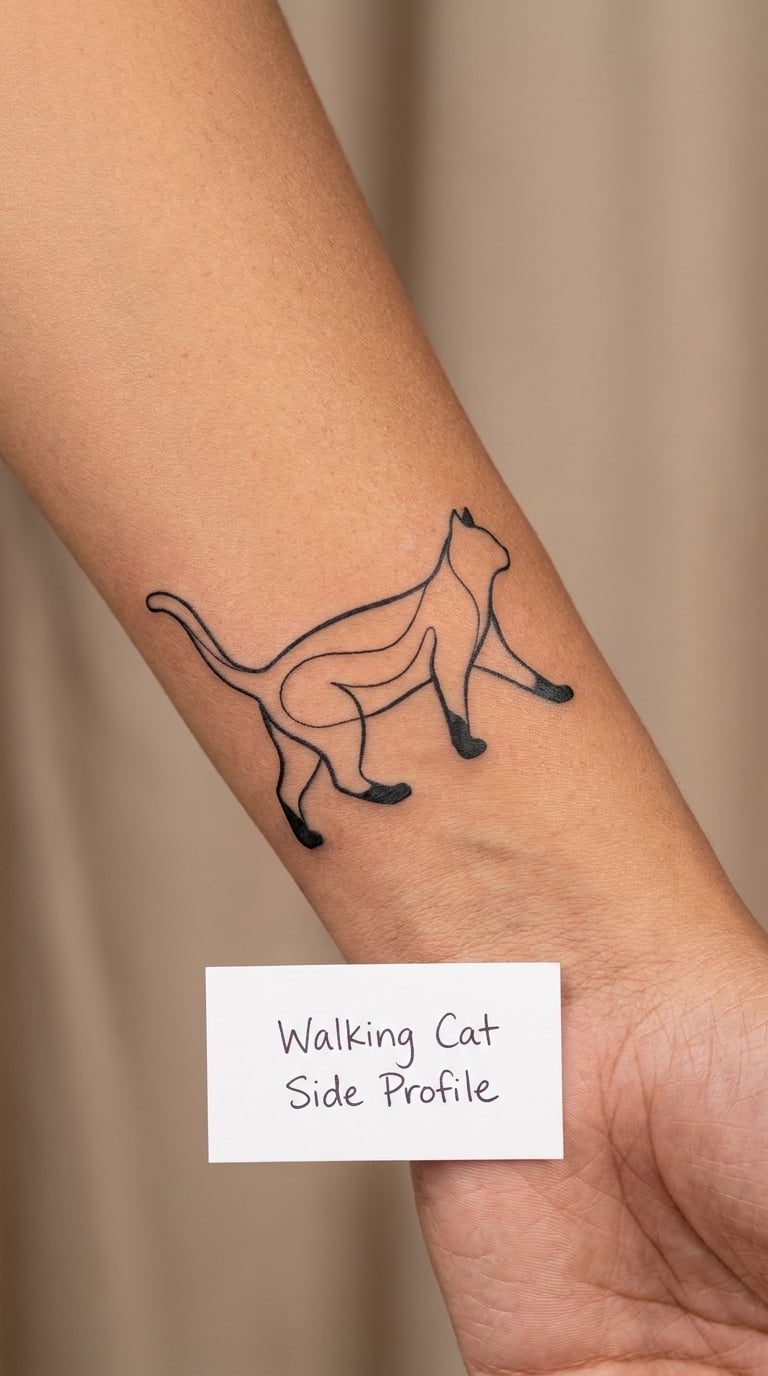
One cat, caught mid-stride, in clean side profile: a single continuous outline with the paws picked out in solid black and nothing else filled. It reads as movement without tipping into illustration, which is the tricky part of a walking pose.
Most of the drawing is a single line, which is where the skill shows. Ask to see healed examples of that artist’s single-line work, not just clean flash on paper.
Placement: outer wrist, ankle, or along the forearm. Size: 3 to 4 inches long (7.5 to 10 cm). Style: line with solid accents. Pain: medium on the wrist, more sensitive near the bone. Make it yours: match the leg position to a real photo of your cat walking, or point the profile toward the hand as a quiet reminder.
7. Loaf Cat with Tucked Paws
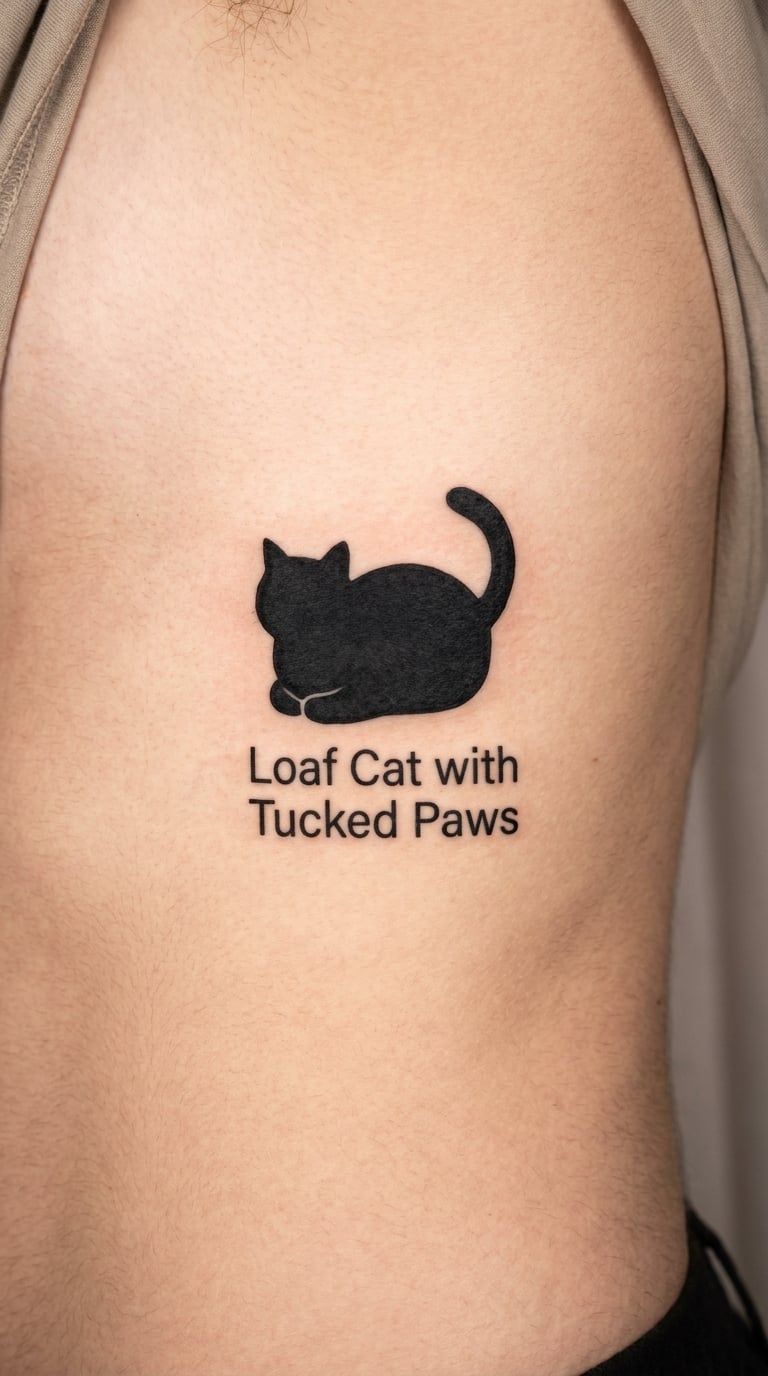
The loaf: paws hidden, spine flat, tail tucked along the side. As a silhouette it becomes a rounded block with one curved tail, about as simple and warm a shape as a cat can produce. People usually laugh at it, which is half the point.
Because it is nearly a geometric shape, it works at very small sizes, and it hides an awkward patch of skin better than most designs.
Placement: side of the ribcage, under the breast, or the lower back. Size: 1.5 to 2.5 inches wide (4 to 6 cm). Style: minimalist solid black. Pain: medium to high on the ribs, one of the more sensitive areas on the body. Make it yours: use your cat’s actual loaf proportions, wide and low or long and slim, or add a single straight line above it as a shelf.
8. Cat Silhouette with Flower Negative Space
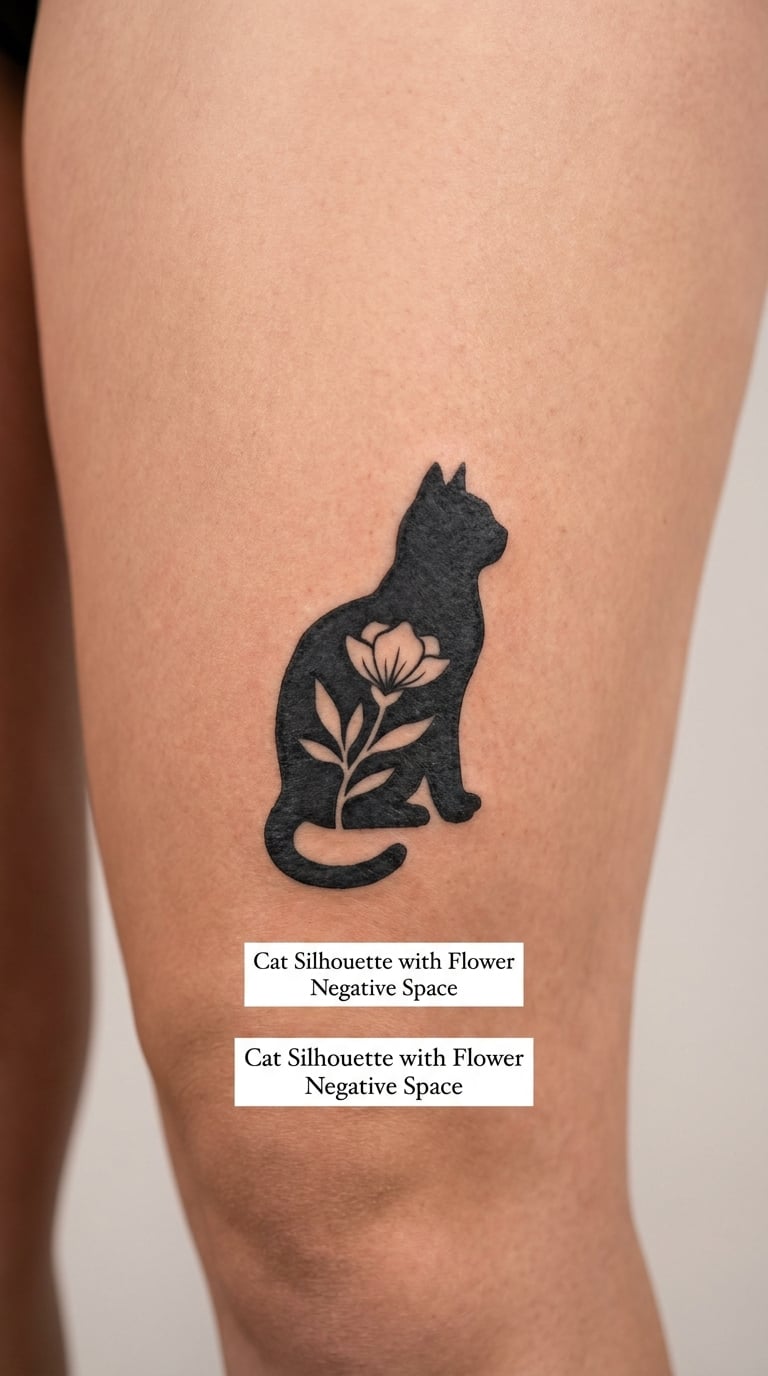
A seated cat filled solid black, with a leaf, a bloom or a sprig of vine left white inside the body. The cutout is not decoration for its own sake: it breaks up a heavy shape and gives the design a focal point you can personalise precisely.
There is no fixed meaning to a particular flower inside a cat. People usually pick something that matters to them, a birth flower or a plant from a garden, and the symbolism is personal rather than traditional.
Placement: outer thigh, calf, or shoulder. Size: 2.5 to 3.5 inches tall (6 to 9 cm). Style: silhouette with negative space. Pain: medium on the thigh, quite manageable for a filled shape. Make it yours: put a specific plant inside, or stitch a small cutout heart into the chest instead of a flower.
9. Roaring Cat in Traditional Blackwork
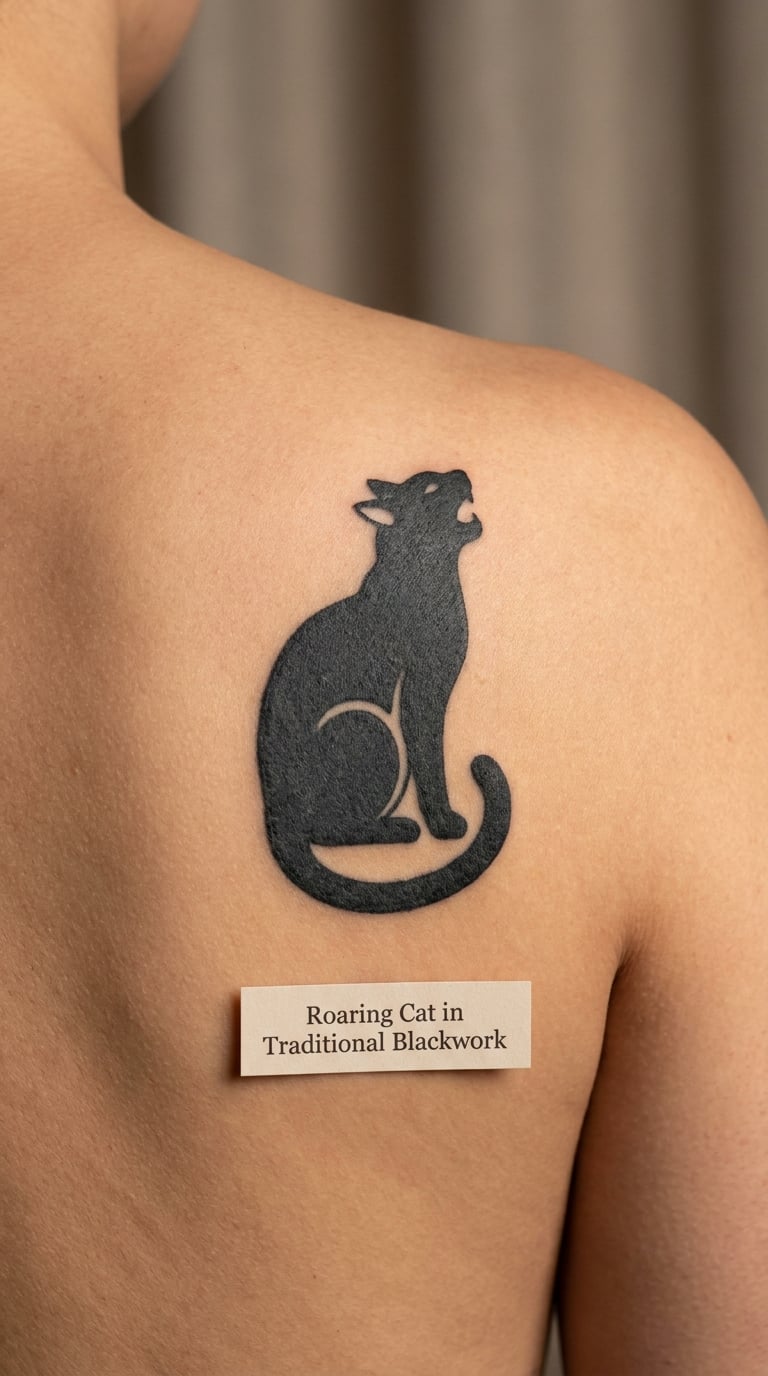
A cat with its head raised and mouth open, built from heavy solid black and traditional shaping. The raised head and curled tail give it a confident, almost heraldic stance, and the dense fill makes it a genuine blackwork piece rather than a small minimal one.
This is the ambitious option on the list. It needs an artist who works in traditional and blackwork regularly, not someone doing occasional fine line.
Placement: shoulder blade, outer thigh, or across the upper back. Size: 4.5 to 6 inches tall (11 to 15 cm). Style: traditional blackwork. Pain: medium to high over the shoulder blade, and a long sitting for that much solid fill. Make it yours: keep the mouth open and add a small traditional banner beneath it, or trim the design down to just the head and neck.
10. Dotwork Cat Silhouette
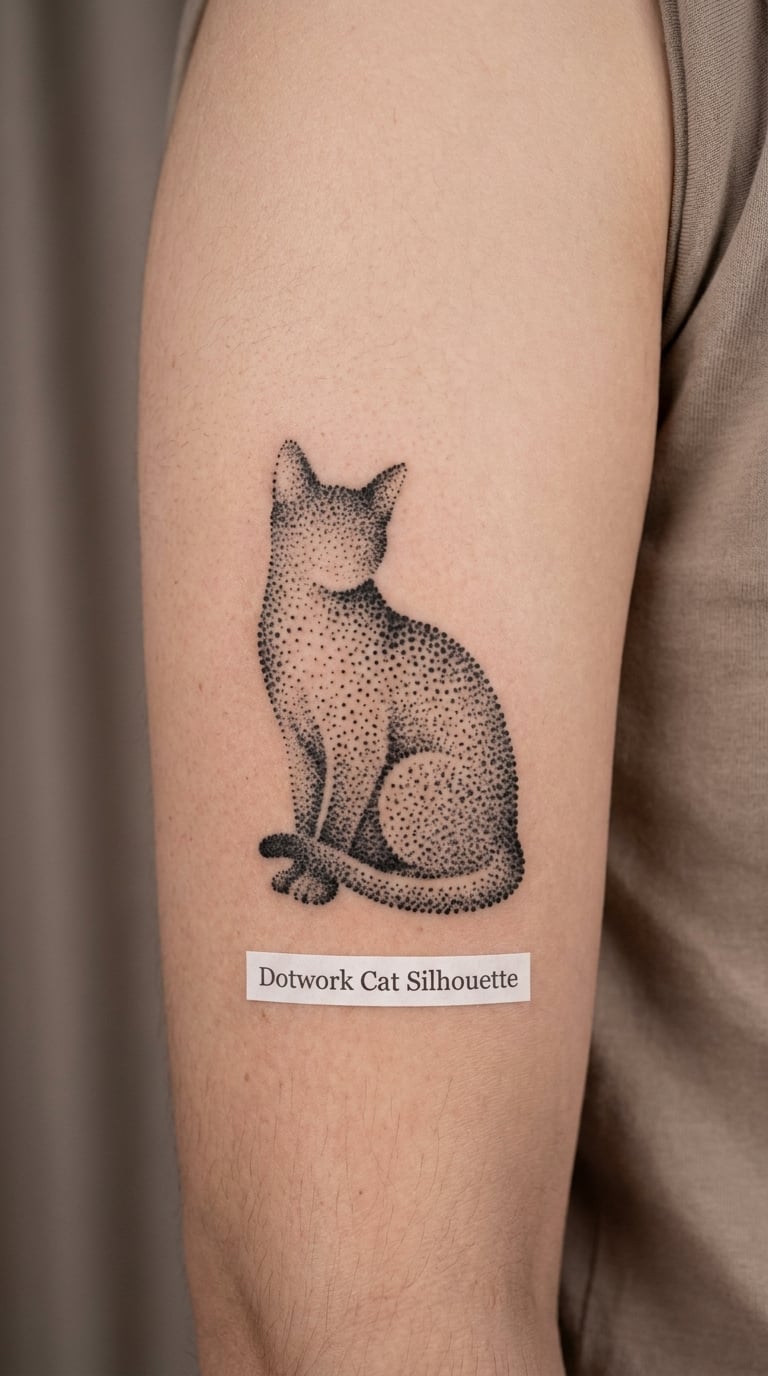
The same seated cat, but built entirely from dots. Dense black at the back and haunch, thinning to scattered points along the chest and tail edge, with no outline at all. It looks like the cat is made of shadow, which is a genuinely lovely effect on an upper arm.
Dotwork is a slow technique and it takes more time than a solid silhouette, so expect a longer sitting for a small design.
Placement: upper arm, shoulder, or forearm. Size: 2.5 to 4 inches tall (6 to 10 cm). Style: dotwork. Pain: medium to high, because each dot is an individual needle pass. Make it yours: set the dot density to follow a gradient from your cat’s dark patches to its white chest, or add a scattering of loose dots beyond the outline.
11. Geometric Low-Poly Cat
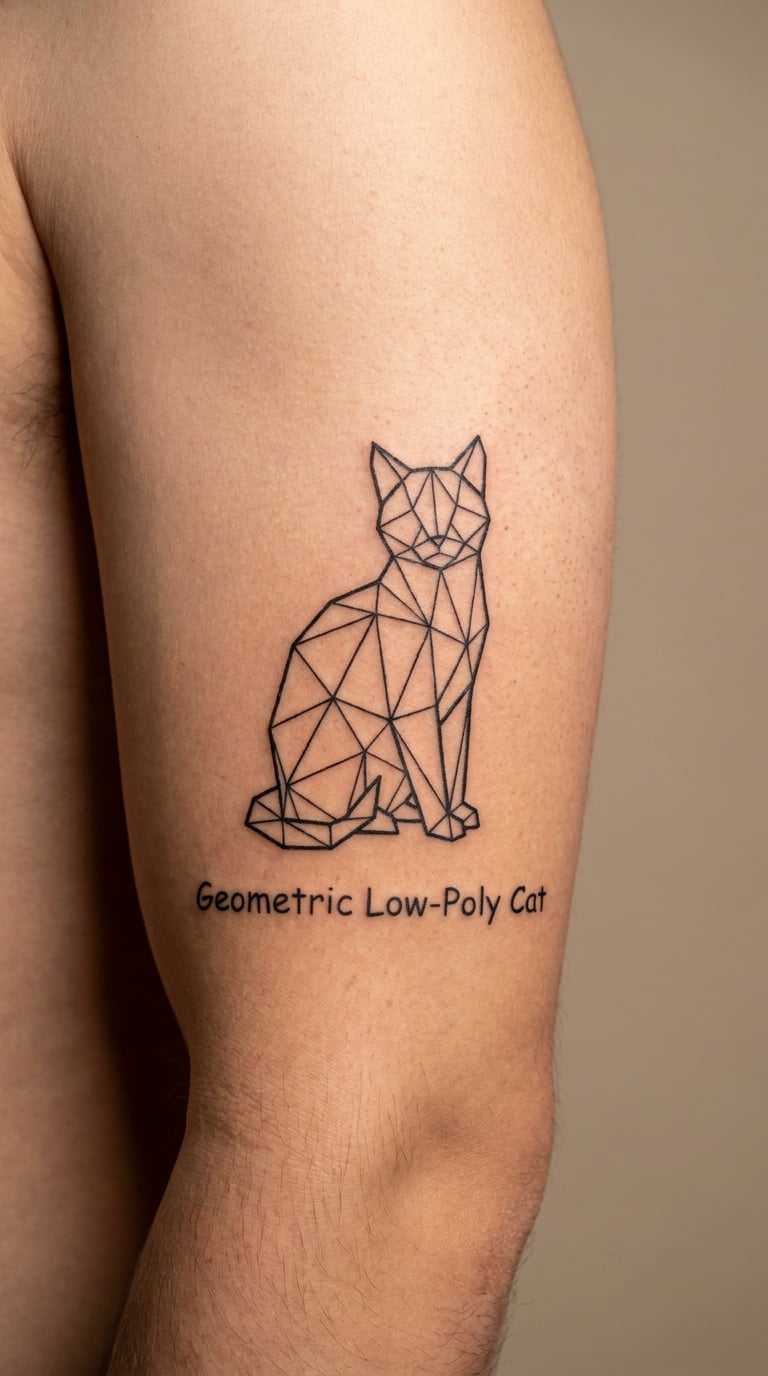
A seated cat broken into angular facets, some filled solid black and some reserved as bare skin, so the shape is described entirely by triangles. It is the most architectural design in this roundup and it looks deliberate from a distance.
Geometric work is a style, not just a motif, and it rewards an artist who thinks in straight lines. If your reference images are all cute minimal cats, the artist will have to invent the facets.
Placement: outer upper arm, forearm, or calf. Size: 3.5 to 4.5 inches tall (9 to 11 cm). Style: geometric low-poly. Pain: medium, since fills are small and separated. Make it yours: ask for the facet pattern to follow the markings on your real cat, or reserve one facet as a heart shape hidden inside the body.
12. Micro-Cat Silhouette Behind the Ear
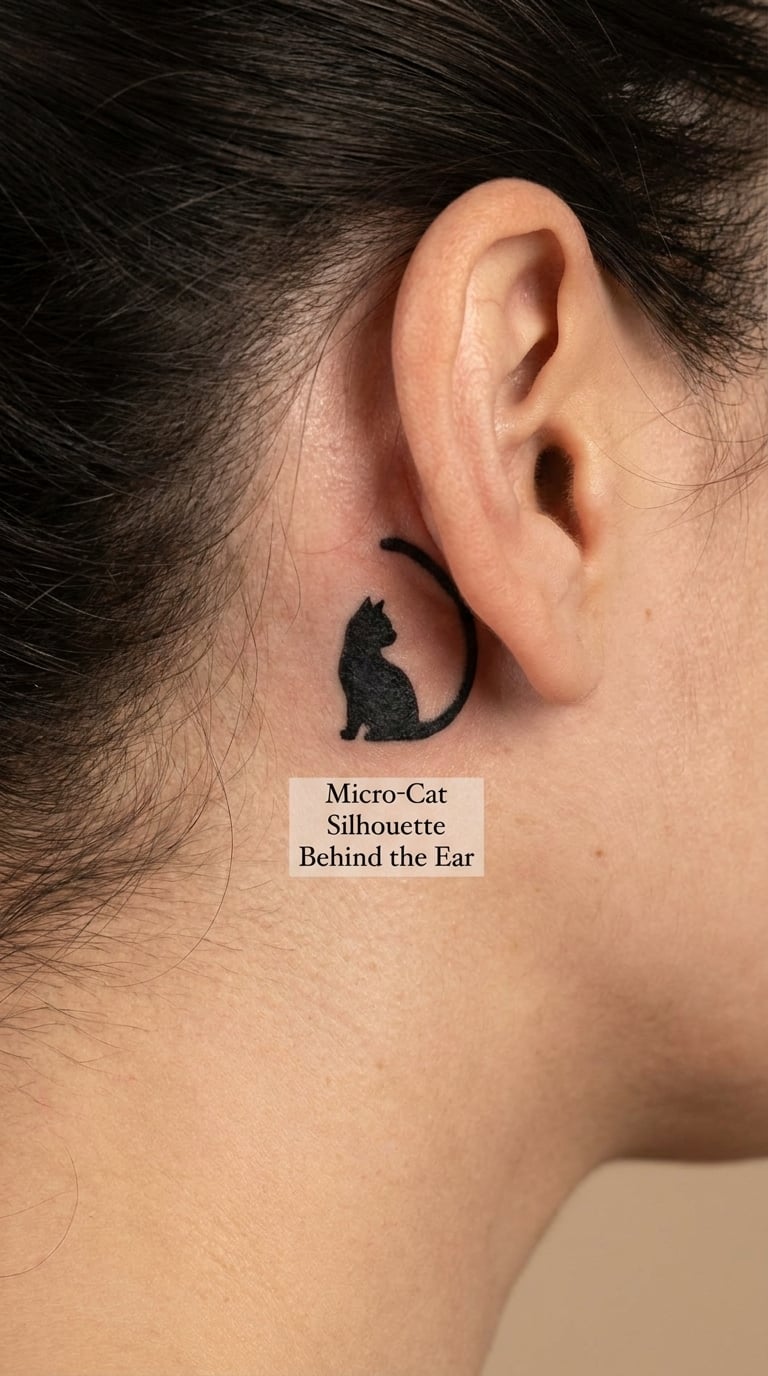
A cat the size of a thumbnail, tucked into the space behind the ear where the skin curves away. At an inch long it has room for almost nothing: one solid body, a head, a tail. The appeal is the placement, and the fact that only a few people will ever see it.
This is where planning matters most. Hair regrows along that edge and covers the design over time, so decide whether you want it fully hidden or peeking out.
Placement: directly behind the ear, or the small hollow beneath it. Size: 0.75 to 1.25 inches long (2 to 3 cm). Style: micro solid black. Pain: low to medium, though skin is thin and bony there. Make it yours: angle the cat to follow the curve of your ear, or mirror a second one on the other side for a pair.
13. Cat Silhouette with a Long Tail
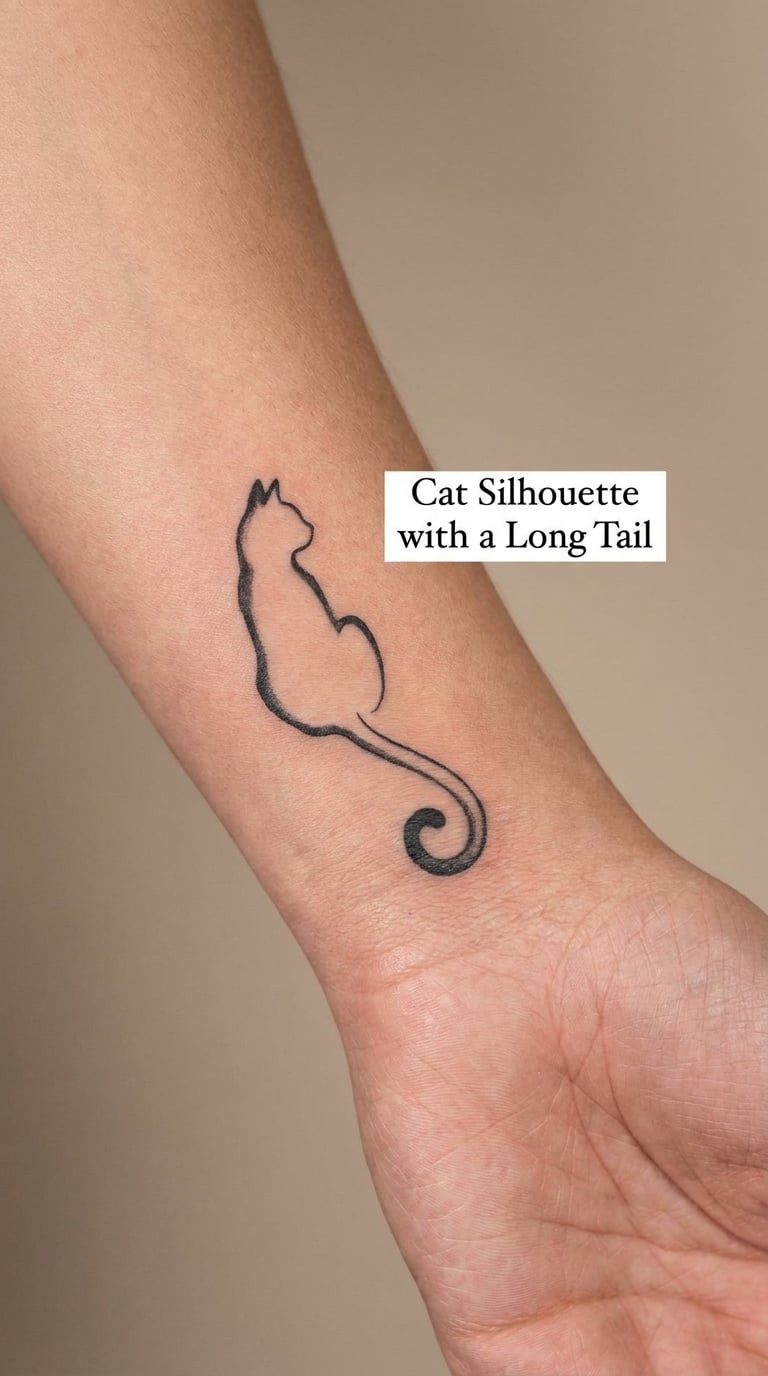
A small seated body with an outsized tail that does all the work, curling in a long S or a loose spiral away from the cat. Design the tail first and let the body be simple. That is what keeps the piece interesting without adding detail inside the silhouette.
A tail this long suits a diagonal placement, since it needs a run of clear skin. Laid along the inner forearm or up the wrist it looks like the cat is holding on.
Placement: inner wrist, inner forearm, or the side of the calf. Size: 3.5 to 5 inches overall length (9 to 12.5 cm), body roughly 1.5 inches. Style: minimalist silhouette. Pain: medium to high on the inner wrist. Make it yours: copy the real curl direction of your cat’s tail, or turn the tail into a thin line that continues into a word or date.
14. Watercolor Cat Silhouette
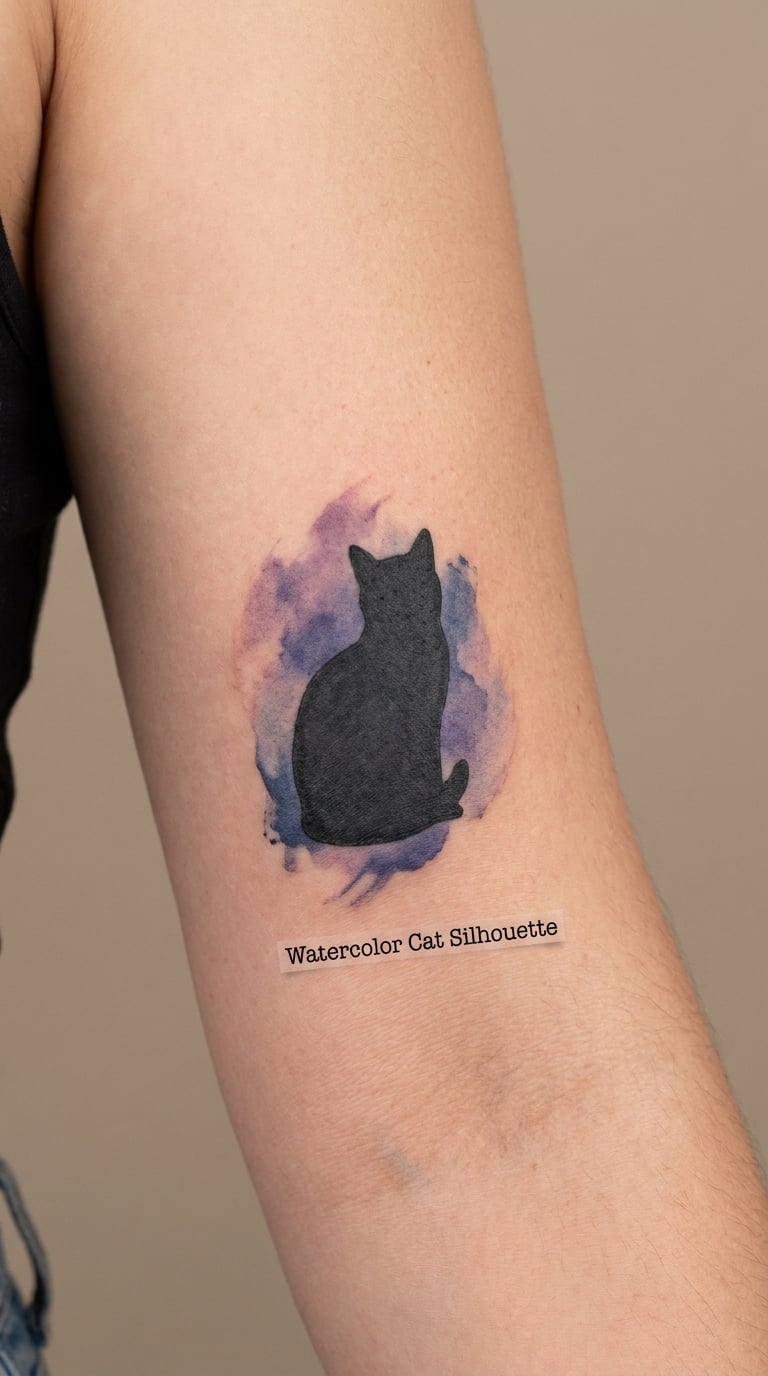
A hard black cat shape with colour bleeding softly around and partly through it, as if the silhouette were sitting in a wash of colour. The contrast between the crisp outline and the loose wash is what makes it work.
Keep the colour restrained. A wash that covers the whole shape turns it into an illustration, and the solid black edge is what still reads as a cat in ten years.
Placement: inner upper arm, forearm, or shoulder. Size: 2.5 to 3.5 inches tall (6 to 9 cm). Style: silhouette with watercolour wash. Pain: low to medium, since the coloured area is light shading. Make it yours: pick colours from a specific photograph or a flag, or let the wash fade out in one direction so the cat seems to be emerging from it.
15. Cat Silhouette with Star Cutouts
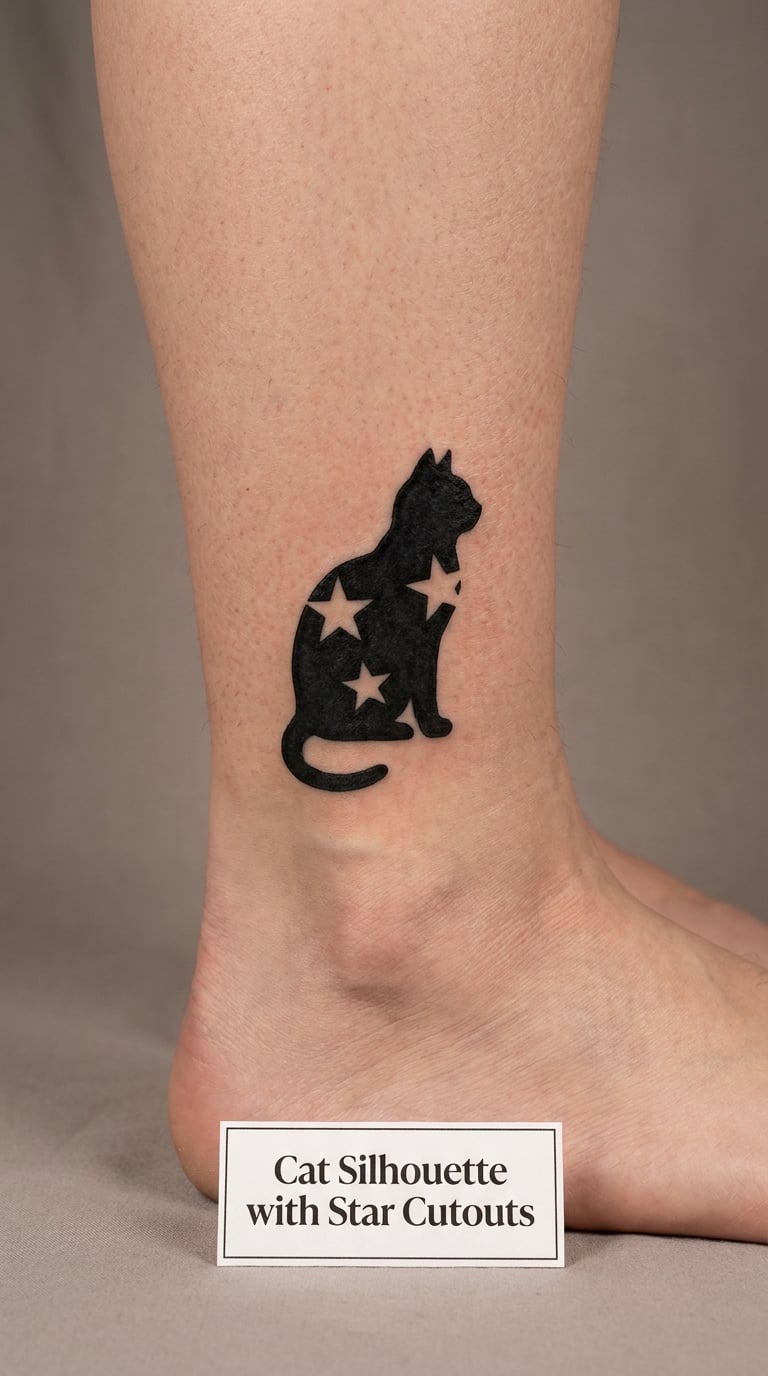
A compact sitting cat with a few small stars punched out of the black, leaving white shapes inside the body. At two and a half inches you are limited to two or three stars before the fill turns patchy, and that limit is what makes it look clean.
Star cutouts are pure negative space, so nothing thin is left to blur. The outline stays solid, which is exactly the durability argument for a silhouette.
Placement: ankle, wrist, or behind the ear. Size: 2 to 3 inches tall (5 to 7.5 cm). Style: silhouette with negative space. Pain: medium to high on the ankle and wrist, both bony and low on flesh. Make it yours: use the star cutouts for a specific number of cats you have had, or replace them with a tiny moon, paw print or initial.
16. Tiny Cat Silhouette on a Finger
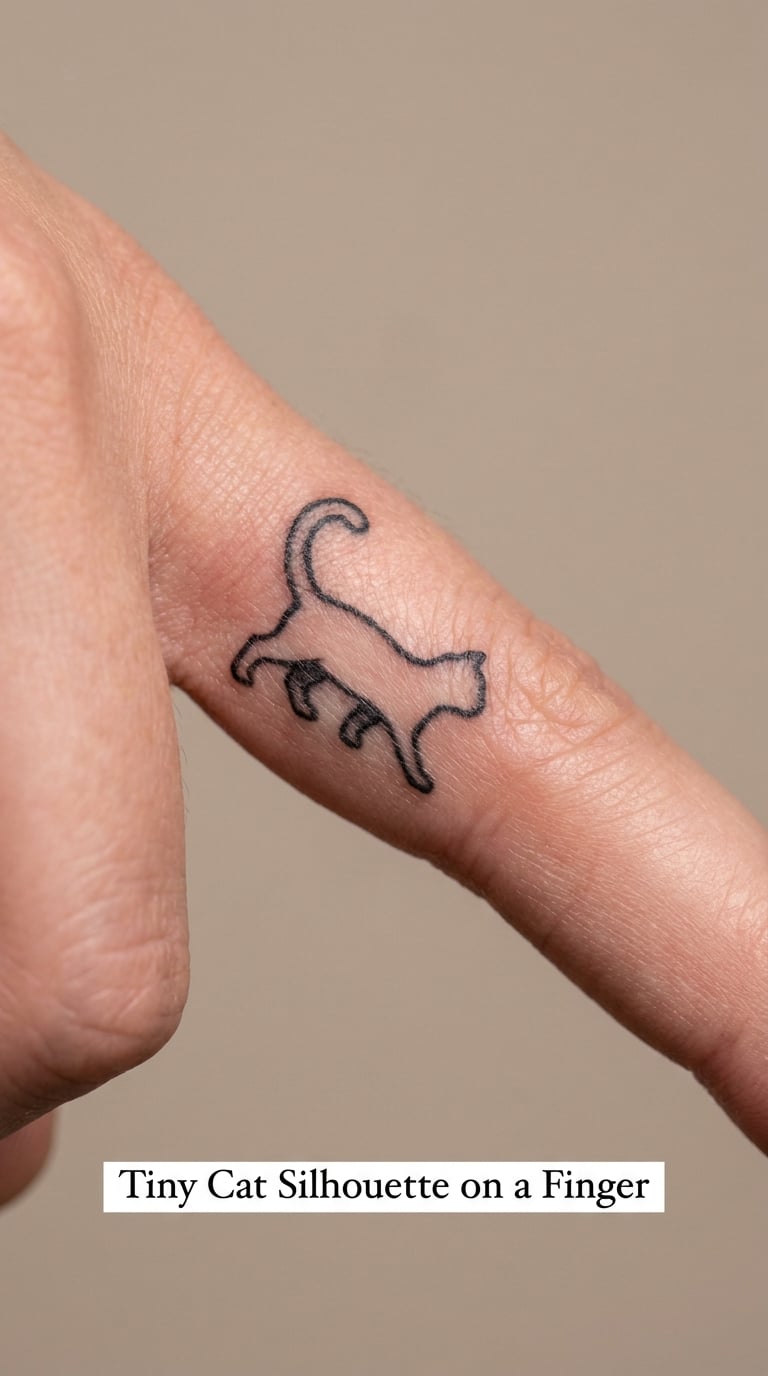
A side-profile cat about an inch long, running along the side of a finger so the body follows the bone. The proportion is the entire design: the head has to be big relative to the body and the paws simplified to two small bumps, because anything more turns to mush.
Finger tattoos age faster than almost anything else. Hands get washed, stretched, sunburned and abraded, and the knuckle area moves constantly.
Placement: the side of the index or ring finger, along the inner finger. Size: 0.75 to 1.25 inches long (2 to 3 cm). Style: micro silhouette. Pain: high, on bone and between joints, and the finger may swell during the session. Make it yours: orient the cat so it walks toward the fingertip, or have it curled and sleeping rather than mid-stride.
17. Cat Silhouette Curled in a Crescent Moon
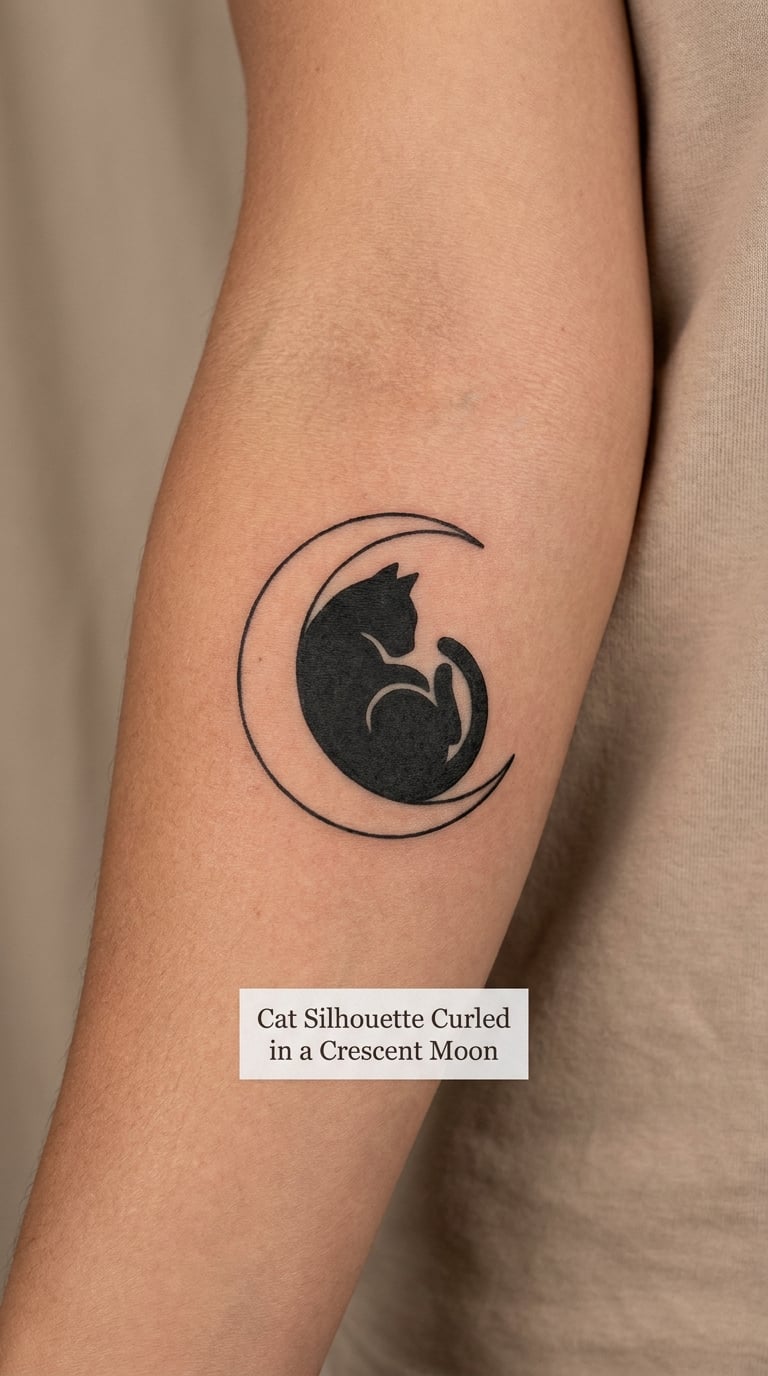
A cat curled asleep inside the curve of a thin crescent, the moon drawn as a light single line and the cat filled solid black inside it. The contrast between the hairline frame and the heavy body keeps the piece readable even at a modest size.
There is a long cultural history here. The Japanese beckoning cat and the Egyptian Bastet both get folded into crescent designs, and people usually pick this shape for the balance rather than a specific religious reference.
Placement: inner forearm, calf, or behind the ear. Size: 2.5 to 3.5 inches tall (6 to 9 cm). Style: silhouette inside a line frame. Pain: medium, with a little extra from the thin moon line. Make it yours: add small stars along the crescent, or keep the crescent unfinished at the top so the tail can overlap the edge.
18. Two Cats Facing Each Other
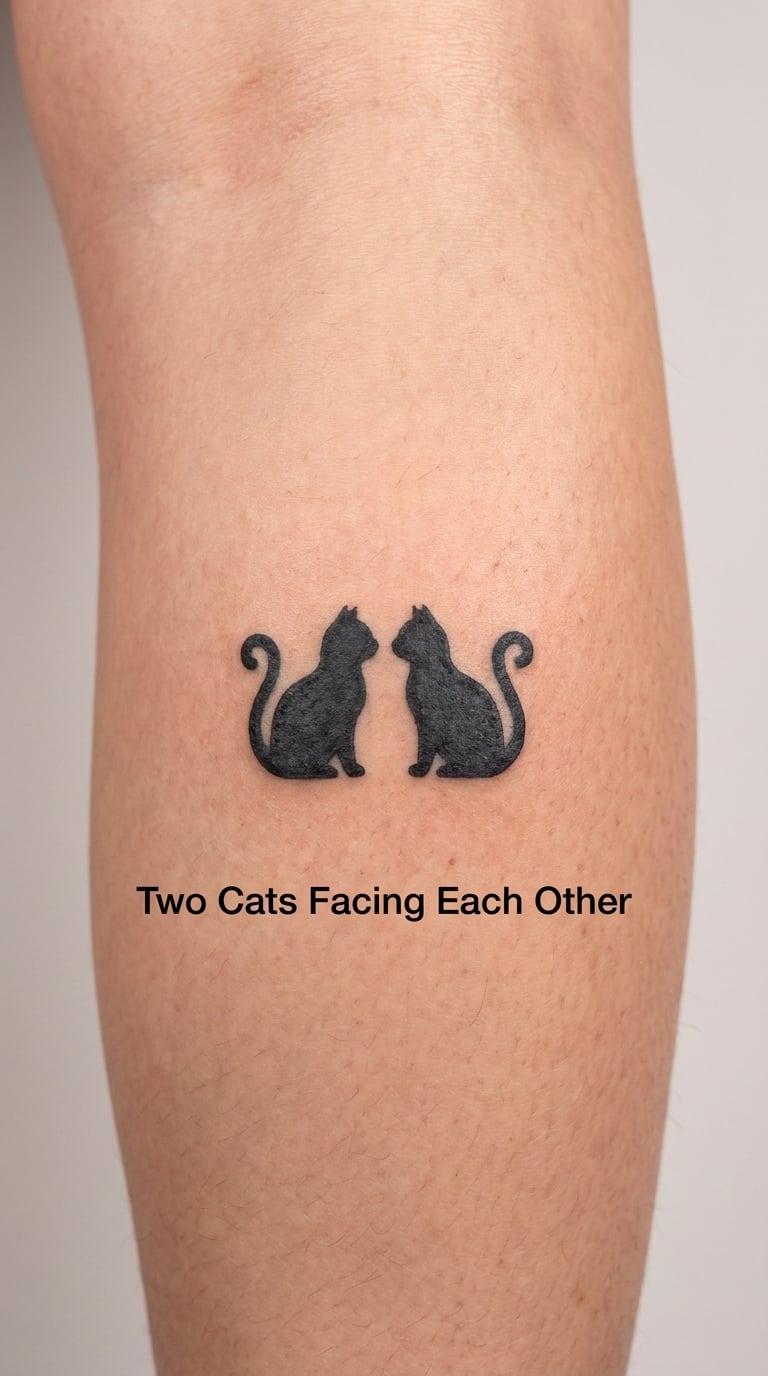
Two simplified cats turned toward each other with raised tails, one slightly smaller than the other. Getting the pair balanced takes a little more drafting than a single shape, so the spacing matters more than the detail.
These are usually matching pieces, one per person, often on the same leg of two different people. They are also the standard choice for two cats from the same litter or two cats you rescued together.
Placement: upper calf, forearm, or ribs. Size: 3.5 to 5 inches wide (9 to 12.5 cm). Style: paired solid silhouettes. Pain: medium on the calf, medium to high on the ribs. Make it yours: size one cat slightly smaller for an age difference, or set them nose to nose rather than fully facing, which is easier to balance.
19. One-Piece Continuous-Line Cats
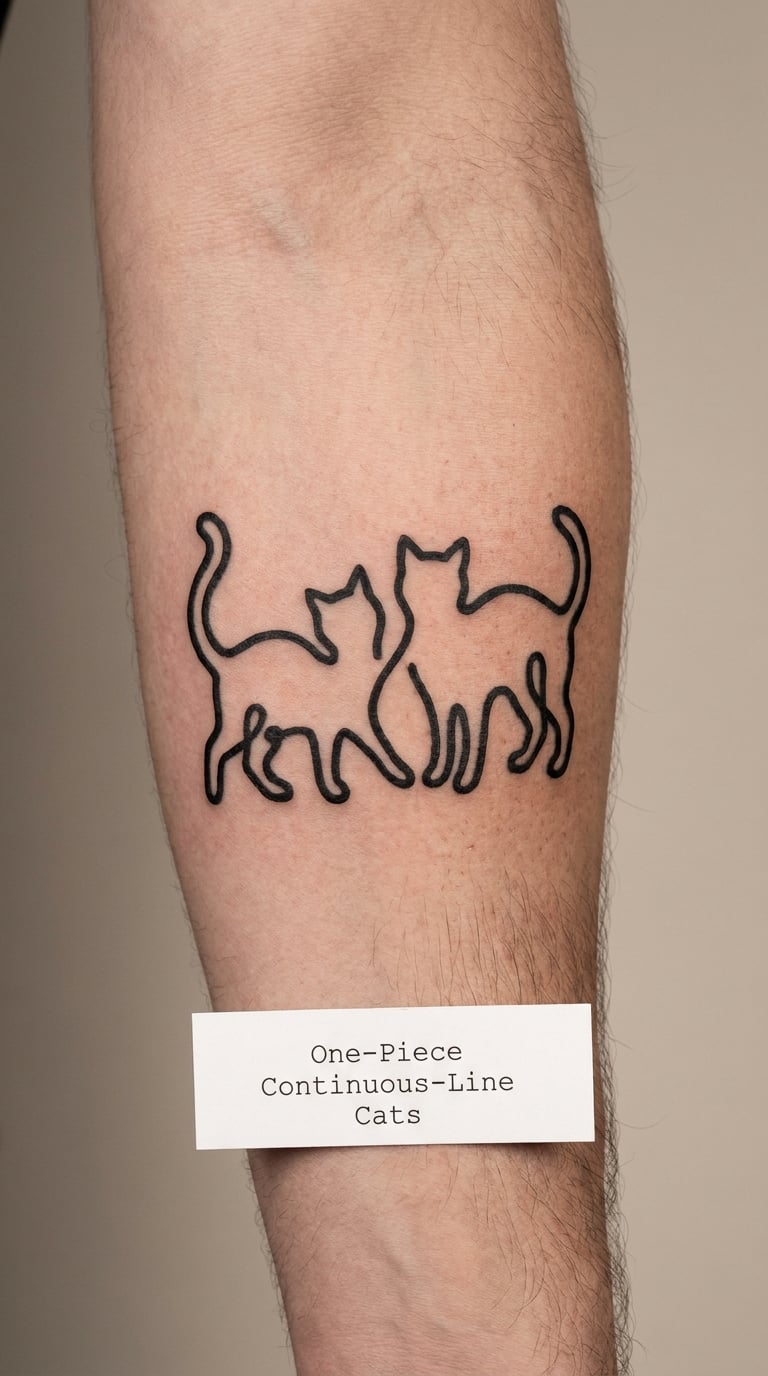
Two cats drawn in a single unbroken line, with the tail of the first becoming the body of the second, finished without lifting the needle. It is a technical flourish rather than a silhouette, but it fills the same space in a collection.
Continuous line work is unforgiving. One hesitation and the line wanders, so pick an artist who posts healed continuous-line pieces rather than judging from a single fresh photo.
Placement: forearm, lengthwise, or along the calf. Size: 2.5 to 3.5 inches wide (6 to 9 cm). Style: one-piece continuous line. Pain: medium, since it is a single unbroken needle path. Make it yours: have the joining point become a small paw print, or have the second cat leap rather than sit so the line has more energy.
20. Large Black Cat Silhouette Back Piece
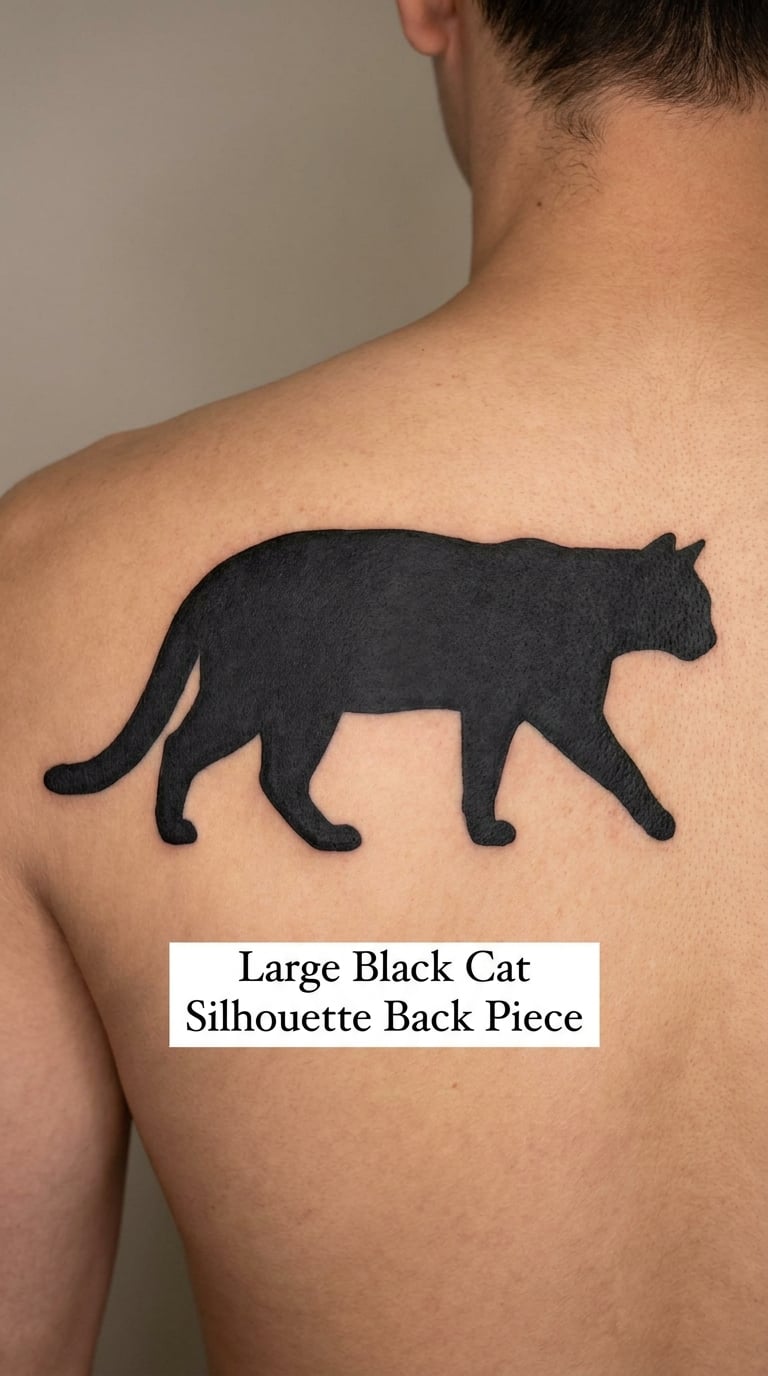
The full version: a prowling cat, maybe ten inches across, centred on the upper back with plenty of bare skin around it. The reason it works is restraint. No clouds, no banner, no compass rose, just a big black cat and empty space, and the emptiness is what makes it look expensive.
A piece this size is a multi-hour job, and you will need a deposit and a booked-out artist. Plan the sitting, or ask whether it can be split across two appointments.
Placement: upper back, centred between the shoulder blades, or across the upper arm. Size: 8 to 12 inches wide (20 to 30 cm). Style: large solid black silhouette. Pain: medium to high, and a long time under the needle, so plan breaks. Make it yours: take the pose from a photograph of your cat mid-stretch, or ask for the tail to extend onto the shoulder so it wraps the body.
How to Choose the Right Design
Most people pick a design by the image, then find out the placement fights it. Flip that around and the choice gets much easier.
- Check it reads at small size. A silhouette that only looks like a cat on a studio photo will not work at two inches. Ask the artist to print or draw it small before committing.
- Match the style to the area. Solid black suits the flat planes of the thigh, calf and back. Fine line suits the forearm, where the skin is smooth and unhurried.
- Think about the line weight. Hairlines soften and blur within a few years, especially on hands, feet and anywhere sun hits. Fewer, heavier lines hold their shape.
- Use negative space deliberately. Cutouts and gaps inside a solid shape age better than interior detail, because there is nothing thin left to lose.
- Be honest about your first piece. If it is your first tattoo, a small simple silhouette on an area you can cover is the comfortable choice, and the community advice on r/tattooadvice leans the same way.
- Expect the fill to lighten. Fresh solid black looks jet black; as it settles it lightens a shade or two and stays there. A good artist will saturate for that.
Cat silhouette tattoo style, size and placement
Comparing cat silhouette tattoo ideas across style, size and placement comes down to one number: how much room you have. Under two inches, choose a solid filled shape with no interior detail. Between two and four inches you can add a frame, a moon or a few cutouts. Above four inches, a prowling or traditional blackwork design has space to breathe.
Two to five inches on the forearm, thigh or calf is the sweet spot for a custom silhouette. Smaller works if you keep the interior solid, and larger only pays off if you are leaving negative space around the cat rather than filling the space with more drawing.
Cost and Session Time
Tattoo cost follows size and time more than it follows subject. A cat silhouette is one of the cheaper subjects to tattoo, because a solid fill takes minutes where shading and detail take hours.
- Micro pieces (under 2 inch): most US shops quote 80 to 150 as a flat rate, with the cheapest studios at the bottom of that range.
- Small pieces (2 to 4 inch): roughly 150 to 300.
- Medium pieces (4 to 6 inch): roughly 250 to 500.
- Large pieces (8 inch and up): 500 to 1200 and up, often split across two or three sittings.
Shop minimums matter more than the headline rate. Plenty of studios charge a 150 minimum regardless of size, which means a one inch cat can cost the same as a three inch one. Hourly rates in the US usually run from 120 to 200 depending on the artist and the city. Dotwork, traditional and continuous-line designs land at the higher end because they are slower per inch. A large solid back piece is the most predictable, since it is a measured block of black.
Aftercare Basics
- Follow your artist’s aftercare instructions first. They know what they put in your skin and how deeply they worked.
- Wash gently. Clean with lukewarm water and a mild unscented soap, then pat dry with a clean hand or paper towel rather than rubbing.
- Protect it while it heals. Keep it out of direct sun, avoid swimming pools and hot tubs, and skip tight clothing over the area for the first couple of weeks.
- Keep it lightly moisturised. A thin layer of a plain ointment helps if the skin tightens or flakes, but do not soak it.
- Know what is normal. Redness, mild swelling, itching and a little flaking are ordinary for the first week or two. Contact your artist or a healthcare professional if something looks warm, pus-filled or spreading.
- Give solid black time to settle. A bold fill often looks patchy for a few weeks before the pigment reads evenly. Let it be before you judge it.
Frequently Asked Questions
What does a cat silhouette tattoo usually mean?
Most people choose a cat for independence, curiosity and self-possession, and the silhouette form adds a layer of mystery because the face is hidden. People also use it as a pet memorial, working from a photo of their own cat. There is no single official meaning, so it is always worth asking your artist what the design means to you.
What is the best size for a cat silhouette tattoo?
Two to three inches tall is the range where a silhouette still reads clearly as a cat and can hold a frame, a moon or a few cutouts. Under one inch you are limited to a solid shape with no interior detail. Above five inches the same drawing gets sparse, so a larger piece needs more negative space rather than more line.
Where should I place a cat silhouette tattoo?
The inner forearm, outer upper arm, calf and side of the thigh are the easiest flat surfaces for a solid shape. The wrist and ankle suit small designs but are bony and more painful. Behind the ear works well for a micro piece. The upper back has room for a large back piece and less nerve, so it is a good first-tattoo option for bigger work.
Do fine-line cat tattoos fade quickly?
Hairline detail softens fastest, and hands and fingers are the worst areas for it because of washing, stretching and sun. Whiskers and fur texture are usually the first things to blur. A solid silhouette has no interior detail to lose, which is why it stays legible far longer than a fine-line cat drawn at the same size.
Are cat silhouette tattoos painful?
A solid fill moves quickly, so a small silhouette is often a short sitting. Expect low to medium on the forearm and upper arm, medium on the thigh and calf, and medium to high on the ribs, the wrist, the ankle and the fingers. Bony areas hurt more than meaty ones, and a large back piece is uncomfortable mostly because of the time under the needle.
How do I prepare for a cat tattoo consultation?
Bring reference photos of your own cat in even light against a plain background, ideally in profile, plus any silhouette images you like. Decide roughly how small or large you want it and which body area feels right. Ask to see healed work, and be honest if it is your first tattoo so the artist can keep the design simple and readable.
Conclusion
If this is your first cat tattoo, the minimalist sitting silhouette at two inches on your inner forearm is the easiest place to start: quick sitting, lowish pain, and a shape that still reads in ten years. If you already have pieces and want something that anchors a collection, the large prowling back piece or the traditional roaring cat gives you the scale and the weight to hold a wall of skin together.
Whichever one you pick, bring references to a consultation, ask to see healed work, and agree the size before the stencil goes on. A cat silhouette tattoo is simple to draw and hard to get right at small scale, so let the artist tell you honestly what will survive at that scale.