
20 Forearm Band Tattoo Ideas for Men: Best Designs September 2026
A forearm band tattoo wraps the arm like a watch strap, and the good ones look deliberate rather than loud. These forearm band tattoo ideas for men run the full range: solid black blocks you can read from across a room, and fine-line work that only shows when you push your sleeve up. What separates a band that ages well from one that looks dated in five years is usually one decision, which is how much visual weight the design carries.
Most people land somewhere between the two extremes. A band that follows the natural curve of the forearm, keeps lines thick enough to heal cleanly, and leaves a little bare skin between the edges tends to age far better than a thin outline crammed with detail. If you are booking ahead of summer, talk to your artist early, because sleeves, sun exposure, and gym schedules all change how a healed band looks on the arm.
Quick Guide: 20 Forearm Band Tattoo Ideas at a Glance
| Idea | Style | Best placement | Realistic size | Pain |
|---|---|---|---|---|
| 1. Solid black band | Blackwork | Mid-forearm, full wrap | 1 to 2 inch tall | Low to medium |
| 2. Fine-line geometric | Fine line | Inner mid-forearm | 0.5 to 1 inch tall | Medium |
| 3. Tribal-style shapes | Bold blackwork | Outer mid-forearm, full wrap | 2 to 3 inch tall | Medium |
| 4. Braided rope | Black and grey realism | Mid-forearm, full wrap | 1 to 1.5 inch tall | Medium |
| 5. Celtic knot | Interlace linework | Inner forearm | 1 to 2 inch tall | Medium |
| 6. Japanese wave | Irezumi-influenced | Outer forearm to elbow | 1.5 to 2.5 inch tall | Medium to high |
| 7. Mountain range | Minimalist blackwork | Mid-forearm | 1 to 2 inch tall | Low |
| 8. Snake wrap | Black and grey realism | Mid to upper forearm | 8 to 12 inch long | Medium to high |
| 9. Compass rose | Fine line with accent | Inner forearm | 2 to 3 inch across | Medium |
| 10. Winged band | Symmetrical blackwork | Outer forearm | 4 to 6 inch span | Medium |
| 11. Laurel band | Botanical | Inner forearm | 1.5 to 2 inch tall | Low to medium |
| 12. Viking knot | Heavy interlace | Mid-forearm, full wrap | 1.5 to 2.5 inch tall | Medium |
| 13. Chain link | Black and grey realism | Mid-forearm | 1 to 1.5 inch tall | Medium |
| 14. Runic lettering | Lettering with border | Inner forearm | 1 to 2 inch tall | Medium |
| 15. Dragon claw | High-contrast blackwork | Outer forearm | 2 to 3 inch tall | Medium to high |
| 16. Circuit board | Minimalist fine line | Inner forearm | 1 to 2 inch tall | Medium |
| 17. Animal claw marks | Distressed linework | Mid-forearm, half wrap | 2 to 3 inch span | Low to medium |
| 18. Nautical rope | Realistic texture | Mid-forearm, full wrap | 1 to 2 inch tall | Medium |
| 19. Blackwork checker | Graphic blackwork | Mid-forearm | 1.5 to 2 inch tall | Low to medium |
| 20. Gradient fade | Shaded blackwork | Any forearm position | 2 to 3 inch tall | Medium |
1. Solid Black Forearm Band
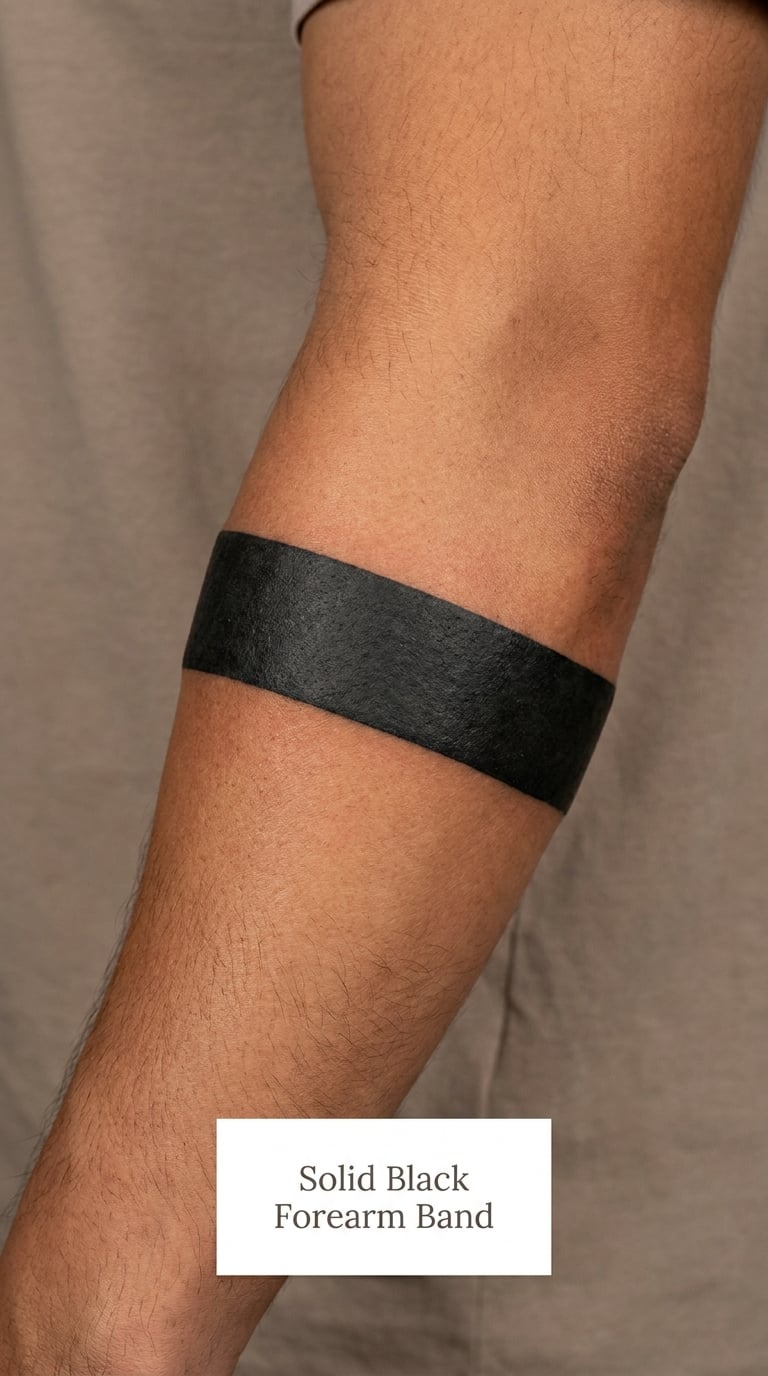
The simplest idea on this list is also the hardest to do well. A solid black band is one continuous ring of packed ink, usually with clean straight edges and nothing inside it at all. Because there is no detail to hide behind, the execution is the whole design, and sloppy saturation across the top of the forearm is obvious from a few feet away.
Men usually pick it because it does one job without explaining itself. It reads as commitment, and it is the easiest band here to hide under a long sleeve or a watch when the situation calls for it.
Placement: Mid-forearm, just above the wrist or a little higher toward the elbow. A full wrap works best, and keeping it 2 to 3 inches away from the elbow crease stops it from disappearing when you flex. Size: 1 to 2 inches tall. Style: Blackwork.
Pain: Low to medium. A solid band is mostly one continuous pass, which is quicker and usually easier than many thin lines. It is also the most forgiving design here about ageing, since there is no fine detail to blur and no grey to fade unevenly.
Make it yours: Have the artist angle the edges very slightly so the band is a touch wider on the underside of the arm, or add a single hairline outline one-eighth inch outside the black for a framed look.
2. Fine-Line Geometric Forearm Band
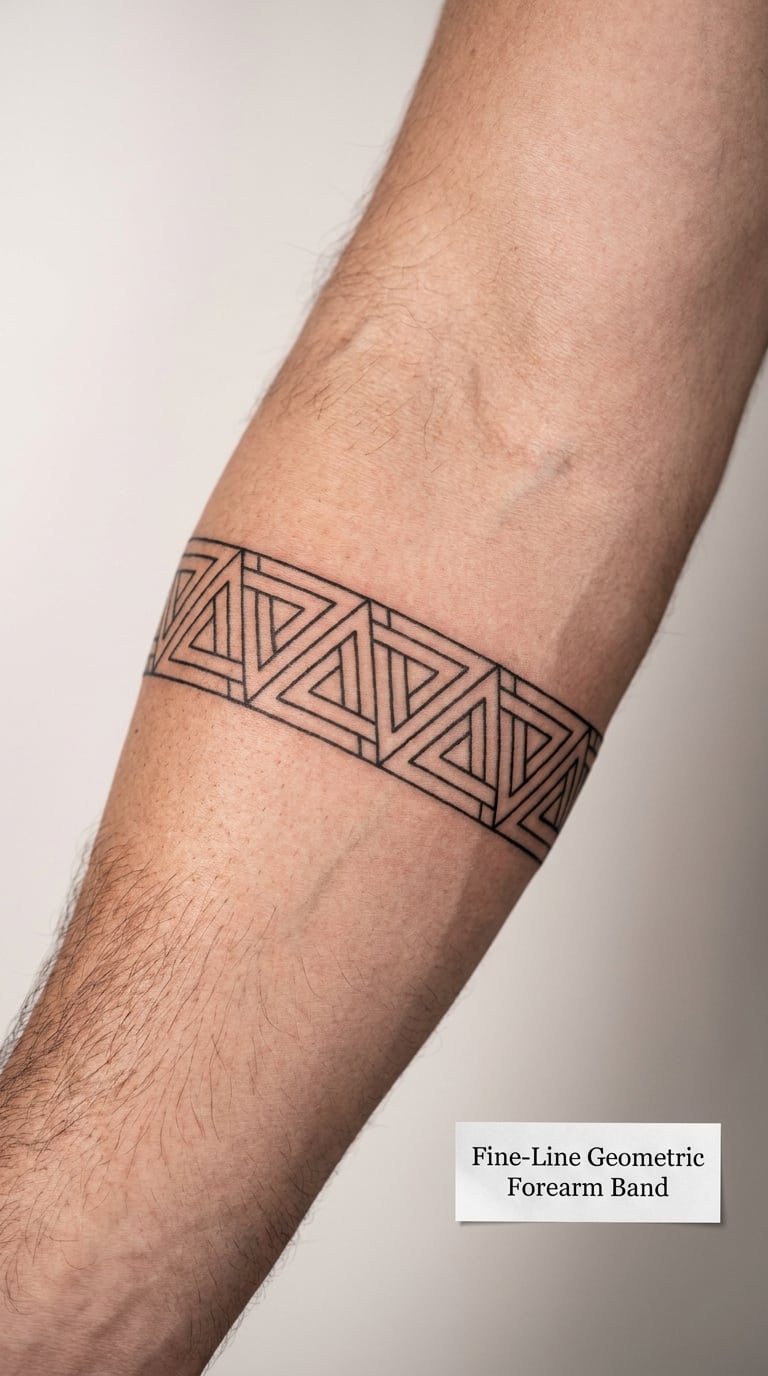
This one is built from repetition: a row of small triangles, nested chevrons, or a chain of angular outlines that step down in scale as they travel around the arm. Done well, it looks like a woven texture from across the room and like a piece of drafting work up close.
It is a good pick for a man who wants a detailed forearm tattoo but does not want a sleeve. The catch is line weight, and this is where most of these designs go wrong.
Placement: Inner mid-forearm, where the skin is flat and the design stays readable when the arm is bent. It can also wrap to the outer side if you want it visible while you are typing or lifting. Size: 0.5 to 1 inch tall. Style: Fine line, geometric.
Pain: Medium. Repeated fine lines take longer than a solid pass, and the inner forearm is sensitive. Ageing is the real trade-off here: single-needle linework around half a millimetre softens noticeably over the years, so ask your artist to run a minimum weight the skin can hold.
Make it yours: Set the repeating pattern to a rhythm that means something, such as one triangle per year since a milestone, and leave the last shape open rather than closed so the pattern reads as continuing.
3. Tribal-Style Forearm Band
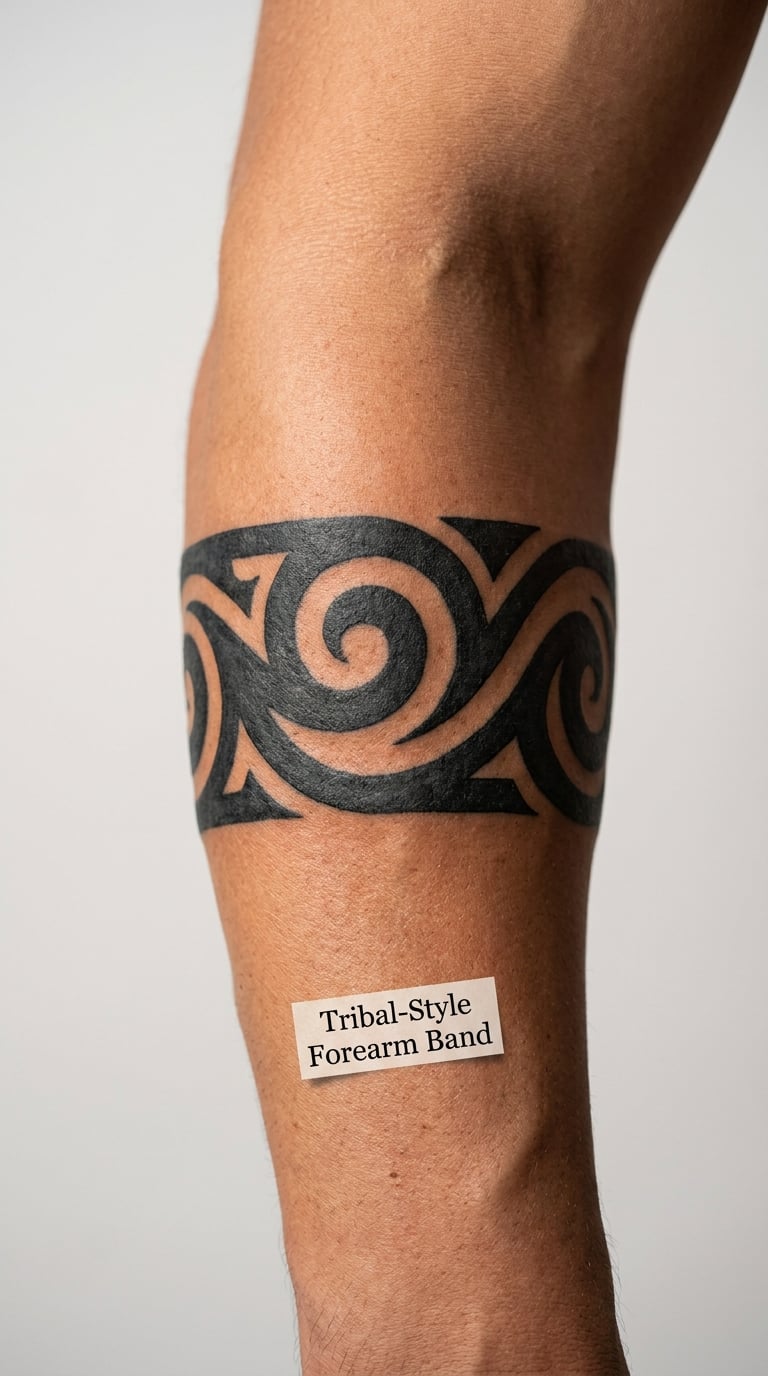
Tribal-style forearm band designs use broad black shapes, sharp negative-space cutouts, and heavy curves that follow the taper of the arm. The best ones are drawn around the anatomy rather than dropped on top of it, which is why the design looks like it grew there instead of being stamped on.
This is a decorative style, full stop. A lot of people pick it for how it reads, not for any meaning attached to it, and there is no fixed symbolism attached to any particular pattern. If you are actually after a specific cultural tradition rather than the look, do your research first and find an artist who works within it, because borrowing a specific pattern from a living tradition is a different request entirely.
Placement: Outer mid-forearm with a full wrap, or a half band from the inner elbow down. Size: 2 to 3 inches tall for the main shapes, with cutouts reaching toward the edges. Style: Bold blackwork.
Pain: Medium. Large black areas go down fast, though the skin right below the elbow crease is more sensitive than the mid-forearm. Bold blackwork holds its edges well, but the fine negative-space details are what soften first.
Make it yours: Adjust the taper so the band is widest at the forearm muscle and narrows toward the wrist, which flatters most arm shapes and makes the design look custom rather than traced from a flash sheet.
4. Braided Rope Forearm Band
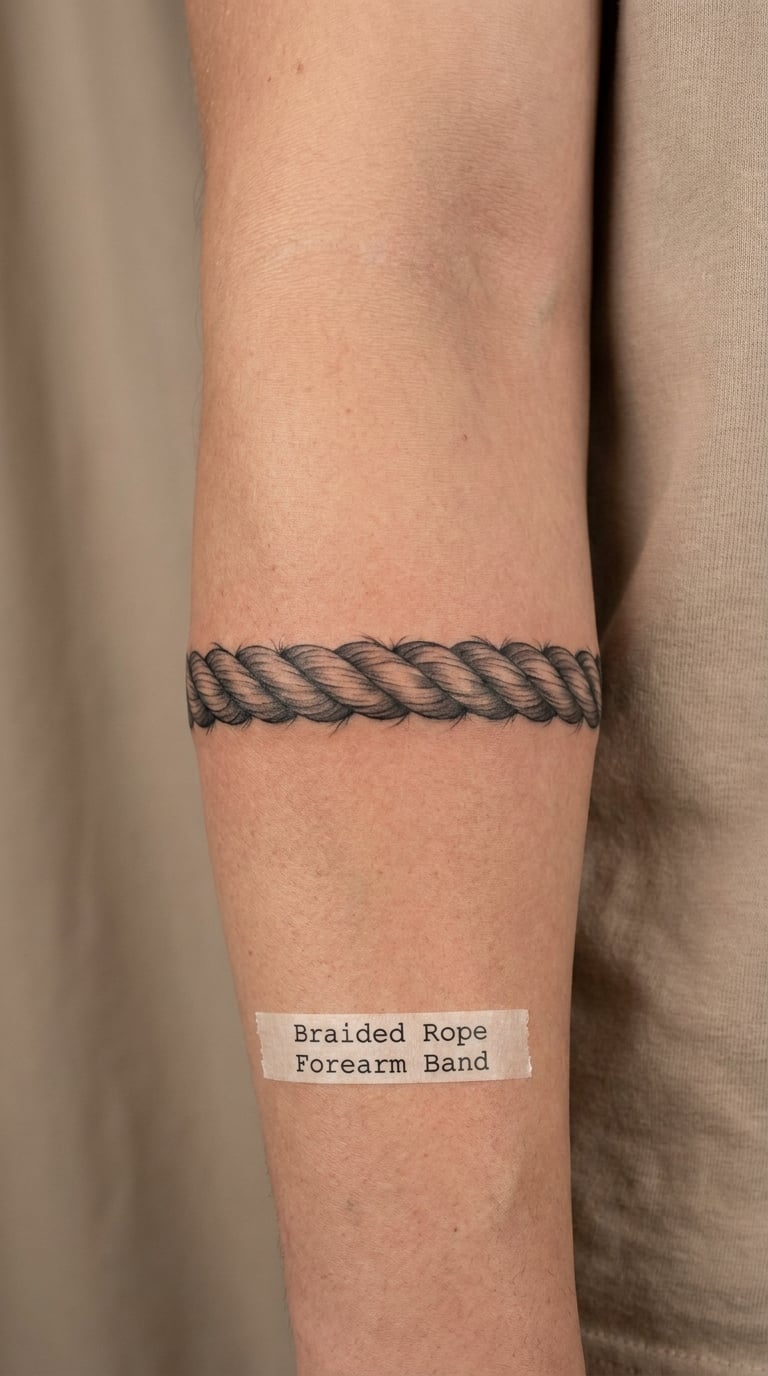
A braided rope band treats the arm like a length of cord, with interwoven strands that overlap and tuck under each other. The trick is the over-under rhythm: if the strands do not actually pass in front of and behind one another consistently, the whole thing flattens out and reads as stripes.
It suits people who want a band that looks textured and considered but has no imagery attached to it. It also pairs well with a memorial date worked into one of the strands, since the cord reads as something that continues.
Placement: Mid-forearm, full wrap, roughly 2 to 3 inches above the wrist. Size: 1 to 1.5 inches tall, two to three visible strands. Style: Black and grey realism.
Pain: Medium. Shading between the strands means a lot of short line work, and the gaps between the braids are where the needle bites most. The rope holds up well for the first decade, then the internal highlights soften and the strand edges start to blur together.
Make it yours: Change the number of strands to match the thickness of your forearm, and ask for a single loose end tucked at the underside so the band looks fastened rather than continuous.
5. Celtic Knot Forearm Band
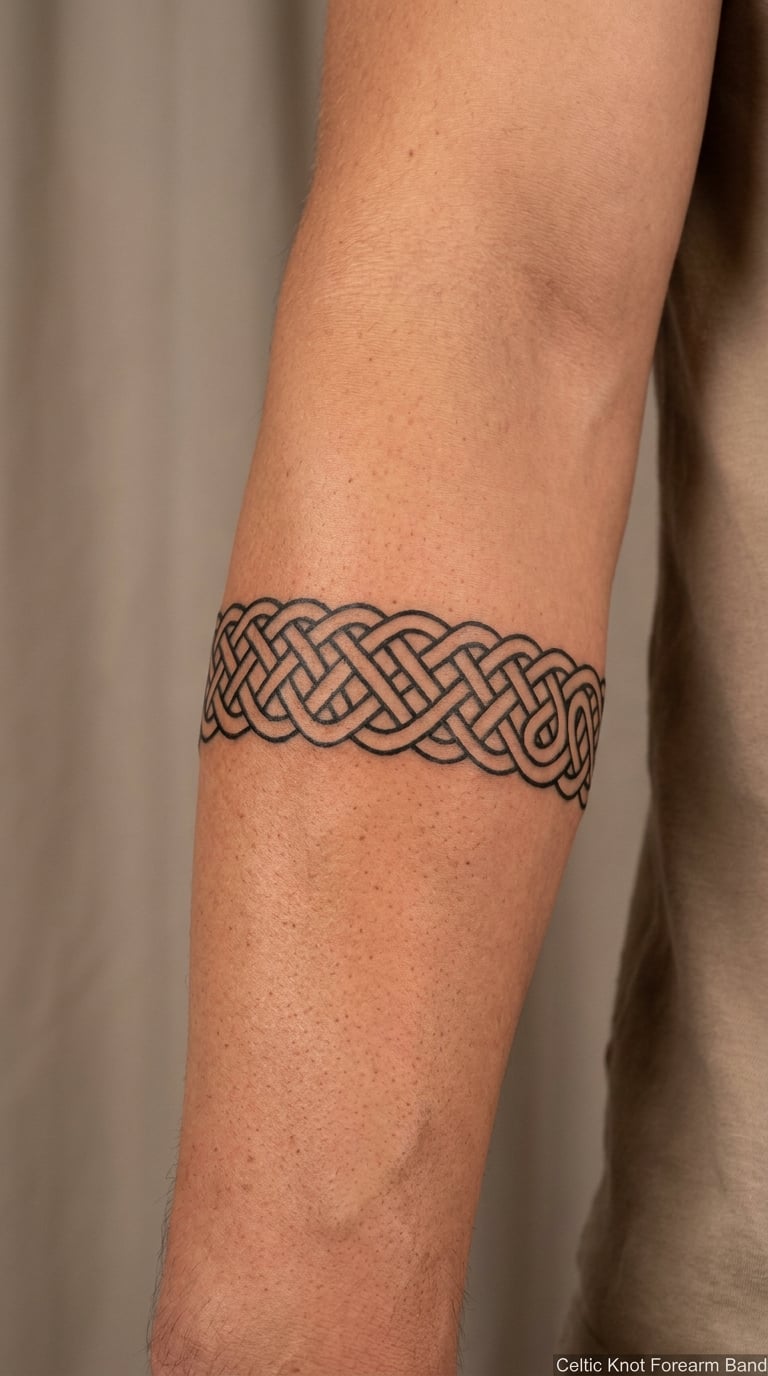
Celtic knot bands are built from a continuous line that loops over itself in a repeating pattern, usually one or two strands wide with small diamond shapes forming in the gaps. Even spacing is everything here, since one tight crossing next to one loose crossing makes the whole band look like it was drawn freehand.
It is a common choice for men who want a decorative band with weight to it. There is no meaning locked into the pattern, so people add their own through the details they choose to work in.
Placement: Inner forearm, running from the wrist crease toward the elbow. A full wrap works, and so does a band that stops at the inner elbow. Size: 1 to 2 inches tall. Style: Interlace linework.
Pain: Medium. It is a lot of crossing lines, and the inner forearm is thin skin over bone in places, so the wrist end of the band is usually the most uncomfortable section. Knots age reasonably well because the pattern repeats, but the small diamonds are the first part to soften.
Make it yours: Put a single accent dot or a tiny coloured stone in one of the diamond gaps, which pulls the eye around the loop and hides a small amount of softening later on.
6. Japanese Wave Forearm Band
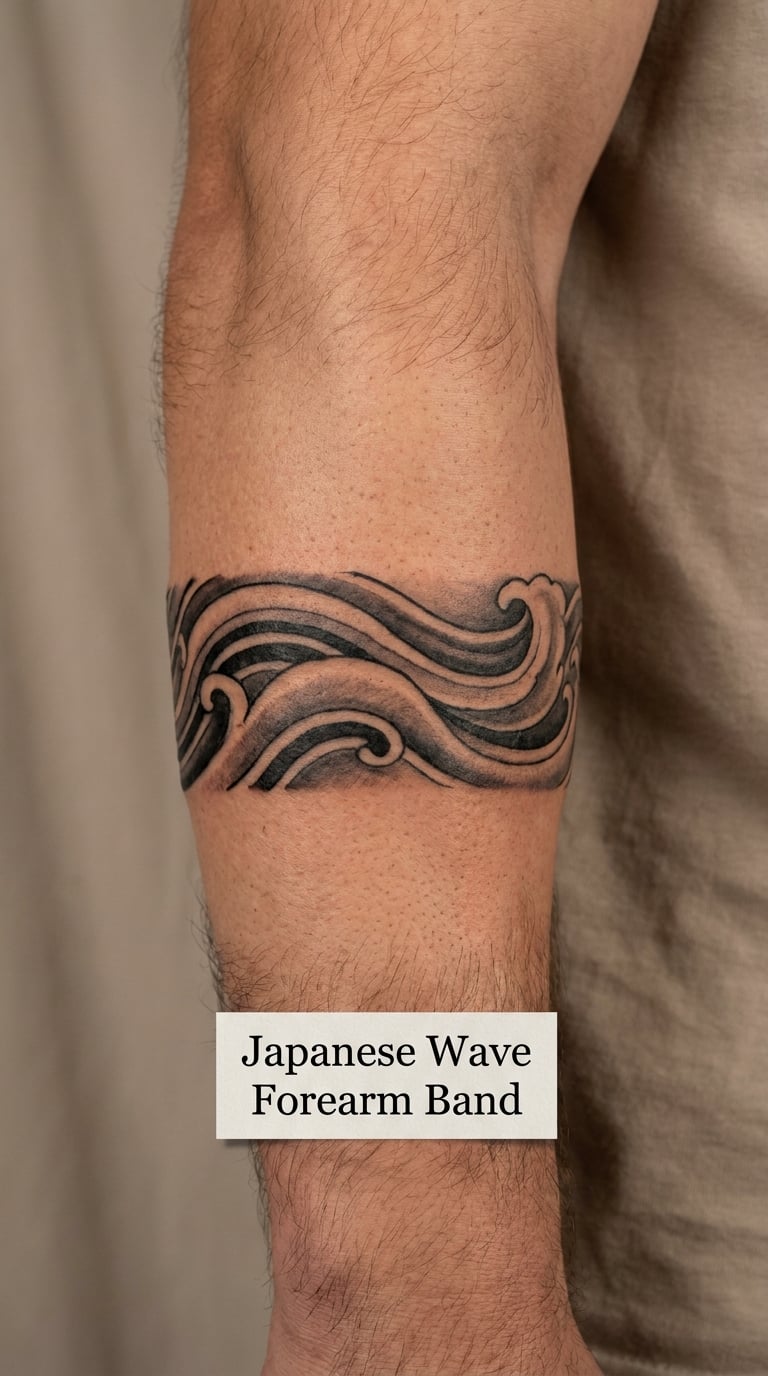
Wave designs use stacked curves with claw-like foam tips and grey shading under the crest to suggest movement. Two or three layers of wave travel around the arm, often with a small rounded sun or a plain field of negative space above them, and the whole thing has a strong sideways pull.
Men pick it because it is busy in a controlled way. There is a lot going on, but it still reads clearly at a distance and it hides minor changes in skin tone because the grey shading breaks up the flatness.
Placement: Outer forearm running toward the elbow, where the curve of the arm supports the wave line. Size: 1.5 to 2.5 inches tall, with the design extending 6 to 8 inches along the arm. Style: Irezumi-influenced, black and grey.
Pain: Medium to high, mostly because of the length and the shading rather than the sensitivity of the spot. The grey washes go in lighter than the linework, so they need a second pass and settle more slowly.
Make it yours: If you want genuine traditional work rather than the style, find an artist who trained in that lineage and be prepared for a much longer project. If you want the look, keep it a single repeating wave unit rather than a full scene.
7. Mountain Range Forearm Band
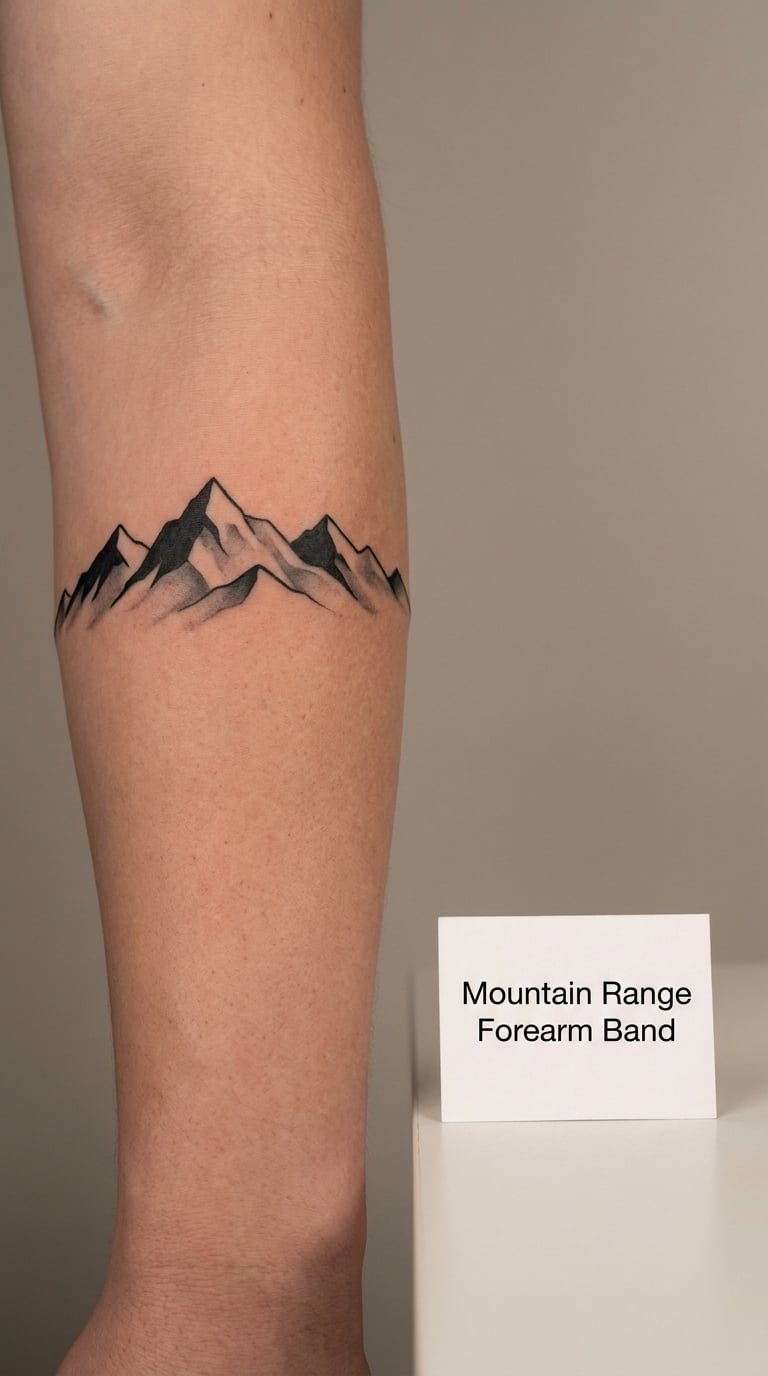
A mountain range band is a silhouette, not a landscape. Sharp peaks sit on a straight baseline, sometimes with a lighter grey ridge behind the black front row to suggest distance, and the whole scene stays low and wide so it fits the shape of an arm.
It works as a personal reference rather than a statement piece. A lot of men get the ridgeline of somewhere they have actually stood, and the simplicity is what keeps it from looking like clip art.
Placement: Mid-forearm, horizontal, with the baseline following the line of the arm. Size: 1 to 2 inches tall and 5 to 7 inches long. Style: Minimalist blackwork.
Pain: Low. Large areas of untouched skin between the peaks mean fewer passes overall, and the mid-forearm is one of the more forgiving spots. Silhouettes age very well, though the grey ridge behind the peaks can fade unevenly on sun-exposed arms.
Make it yours: Match the real proportions of the place, including how much the range rises on one side, and add a single thin line of script underneath with the name or the date you were there.
8. Snake-Wrap Forearm Band
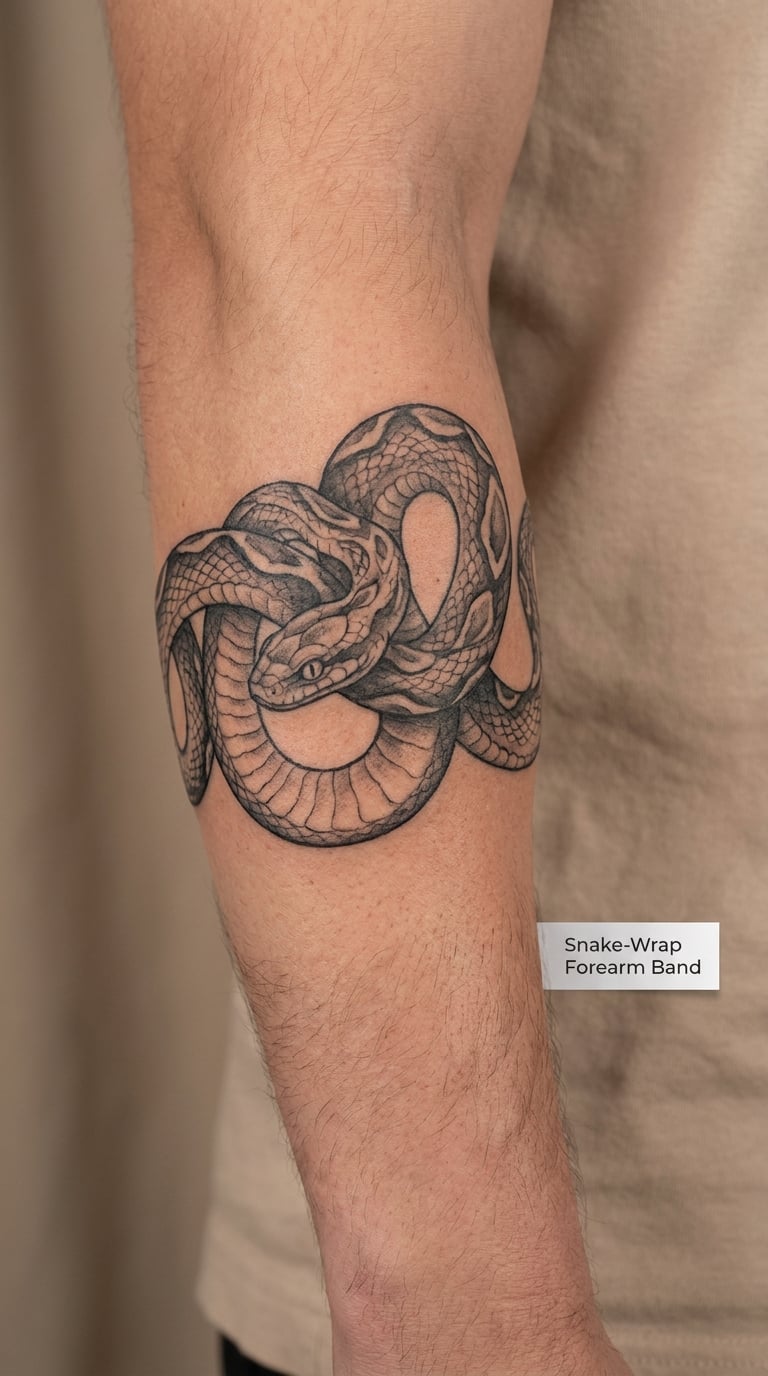
A snake wrap is one animal circling the arm rather than a pattern, so the head sits at the point of highest contrast and the body disappears around the far side. The scale pattern is usually built from overlapping arcs, with grey shading along the underside of the body to give it roundness against the skin.
It is one of the more requested designs on this whole list, and it is a real commitment: the body has to keep its proportions as it wraps, which means the far side of the arm is a large area of skin with nothing on it until it closes.
Placement: Mid to upper forearm, with the head near the elbow side so the body has room to travel. Size: 8 to 12 inches long, 1.5 to 2 inches wide. Style: Black and grey realism.
Pain: Medium to high. The scale work is a lot of small passes over a wide area, and shaded sections need returning to. Small scales soften noticeably with sun exposure, while the outline and head hold up far better, so expect the shading to look flatter after several summers outside.
Make it yours: Use a species that means something to you and get the scale pattern right for that animal, or add a thin band of colour on the eyes and nothing else so the head stays the focal point.
9. Compass Rose Forearm Band
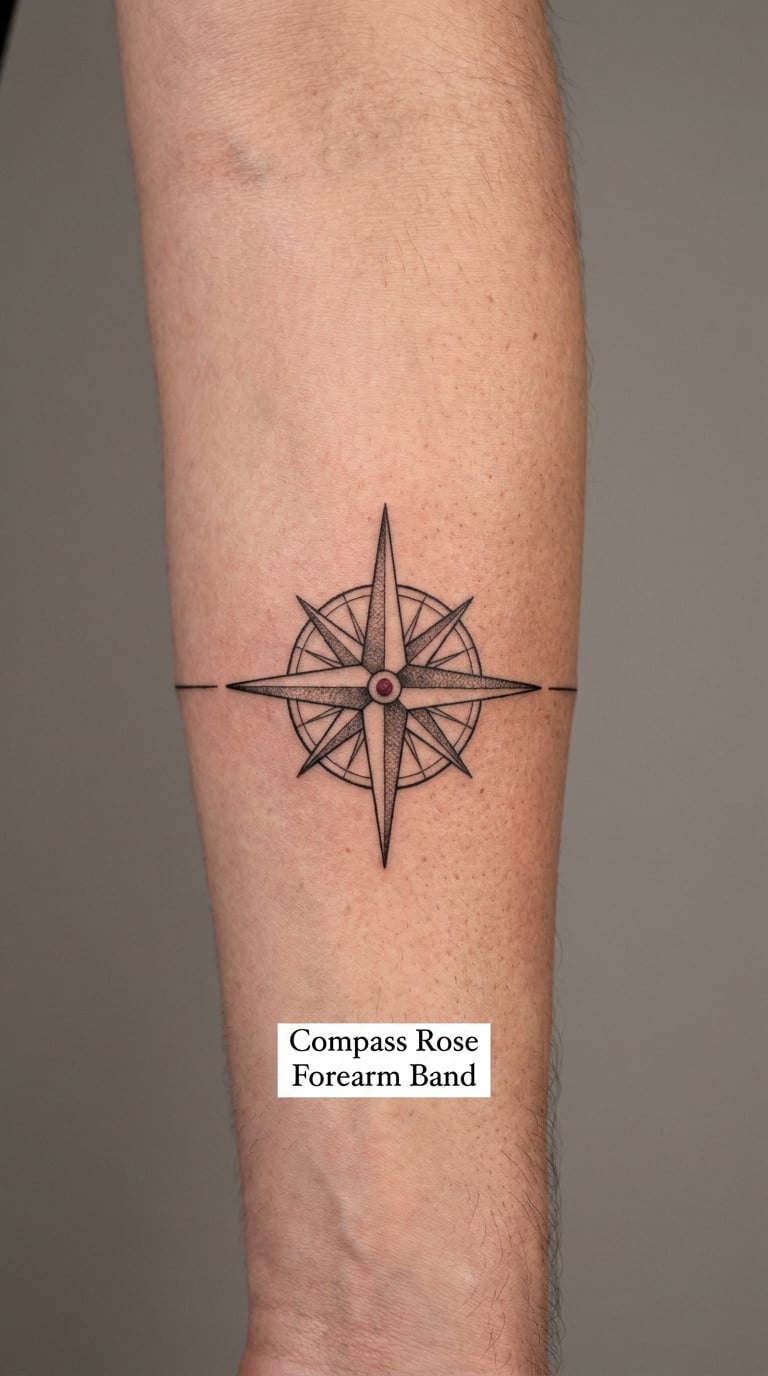
A compass rose band puts a directional star at the centre of the wrap, with the four cardinal points pushing outwards and thinner diagonal points between them. Some versions add a ring of tick marks around the star to fill the band, others leave open skin so the star floats in space.
It is a reference design, like the mountain range, and it is a favourite for people who travel or who want a private nod to direction and getting there without a motto written on their arm.
Placement: Inner forearm, centred a little above the wrist, so the star sits upright when the arm is at your side. Size: 2 to 3 inches across. Style: Fine line with a colour accent.
Pain: Medium. The star points involve converging lines in a small area, which takes patience and hurts more in tight spots. The tick marks are the vulnerable part over time, since thin repeated lines fade faster than the solid star.
Make it yours: Point one arm of the star toward a specific coordinate or a bearing you care about instead of straight up, and put a small coloured detail on that single point only.
10. Winged Forearm Band
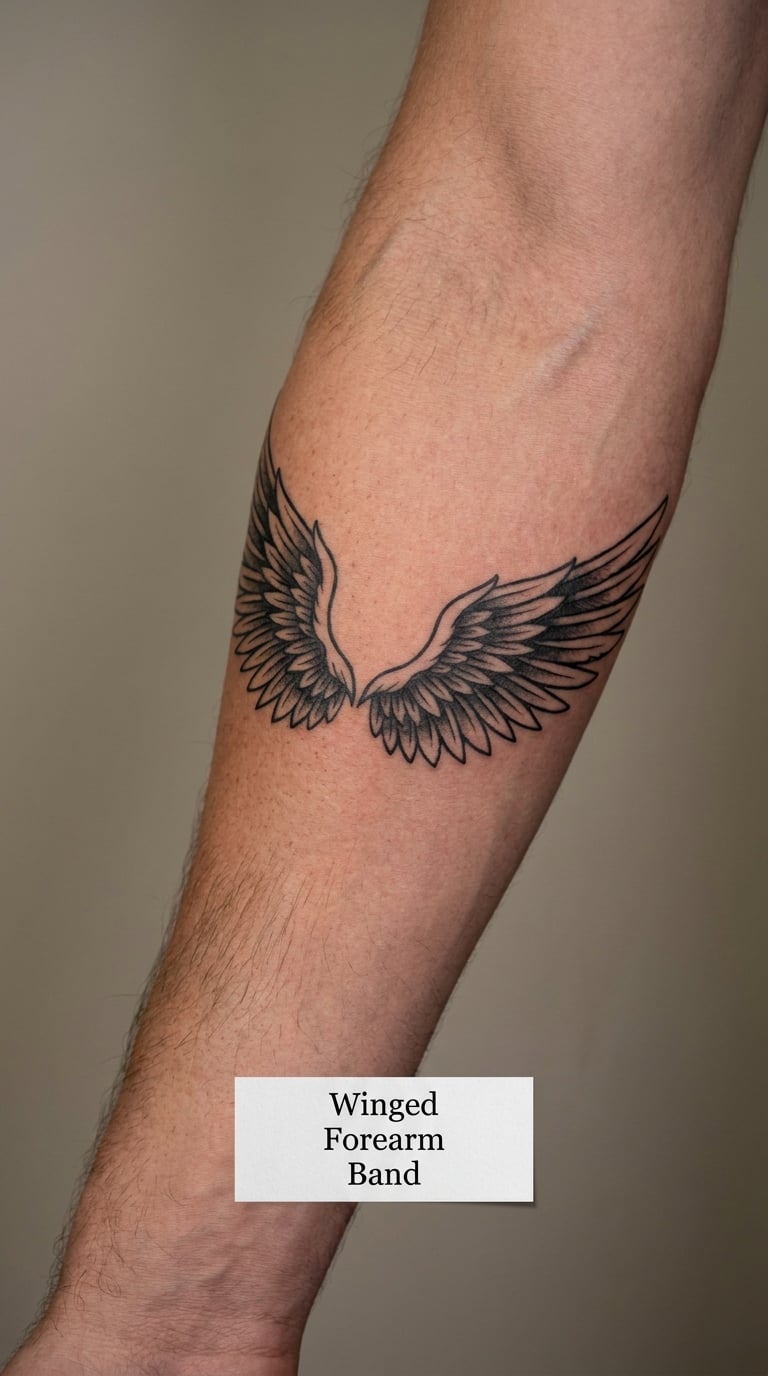
Winged bands use feathers stacked in overlapping rows, usually mirrored so the wings rise from a central point and sweep back toward the wrist. The silhouette does most of the work, so the outer edge of each feather needs to be solid and the inner edges can be softer.
It suits an outer forearm placement and looks best when the whole thing is treated as one symmetrical shape rather than two separate wings that happen to be near each other.
Placement: Outer forearm, with the central point just above the elbow crease and the wings travelling toward the wrist. Size: 4 to 6 inch span, 1.5 to 2.5 inches tall at the centre. Style: Symmetrical blackwork.
Pain: Medium. A wide design means more surface area and more time in the chair, and the outer forearm near the elbow is sensitive when the skin is stretched. Individual feather tips are the first details to blur, so ask for shapes a little heavier than the reference image suggests.
Make it yours: Break the symmetry on purpose by adding one small element into only one wing, a date or a set of initials, so the piece is unmistakably yours rather than a mirrored pair.
11. Laurel Forearm Band
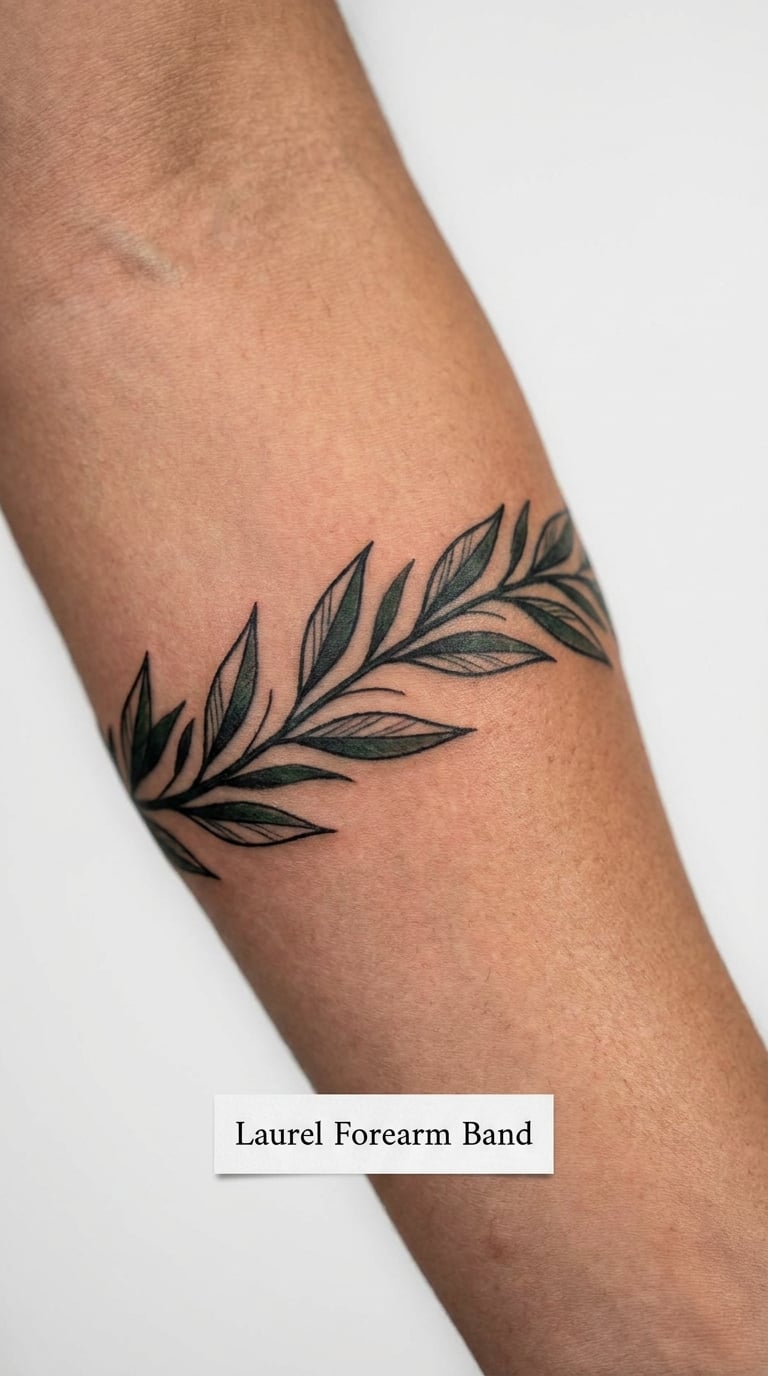
Laurel bands run a curving stem around the arm with paired leaves branching off at regular intervals, usually pointing upward and slightly overlapping. Black linework with a single green in the leaves is the common version, and keeping the green to the leaves only stops the piece turning busy.
It is an old motif, and men usually reach for it because it reads as calm and classical rather than aggressive, which is not a bad thing to have written on your arm at work.
Placement: Inner forearm, or outer forearm if you want it visible in short sleeves. Size: 1.5 to 2 inches tall, running 6 to 9 inches along the arm. Style: Botanical with colour accent.
Pain: Low to medium. Leaves are solid shapes with short line work, so the session is quicker than it looks. Fine leaf tips and thin green shading inside each leaf fade first, and the stems hold up considerably better than the leaf detail does.
Make it yours: Run the leaves in one direction only, the way real laurel grows, instead of mirroring them, and use the green to pick out a small personal detail such as a date.
12. Viking Knot Forearm Band
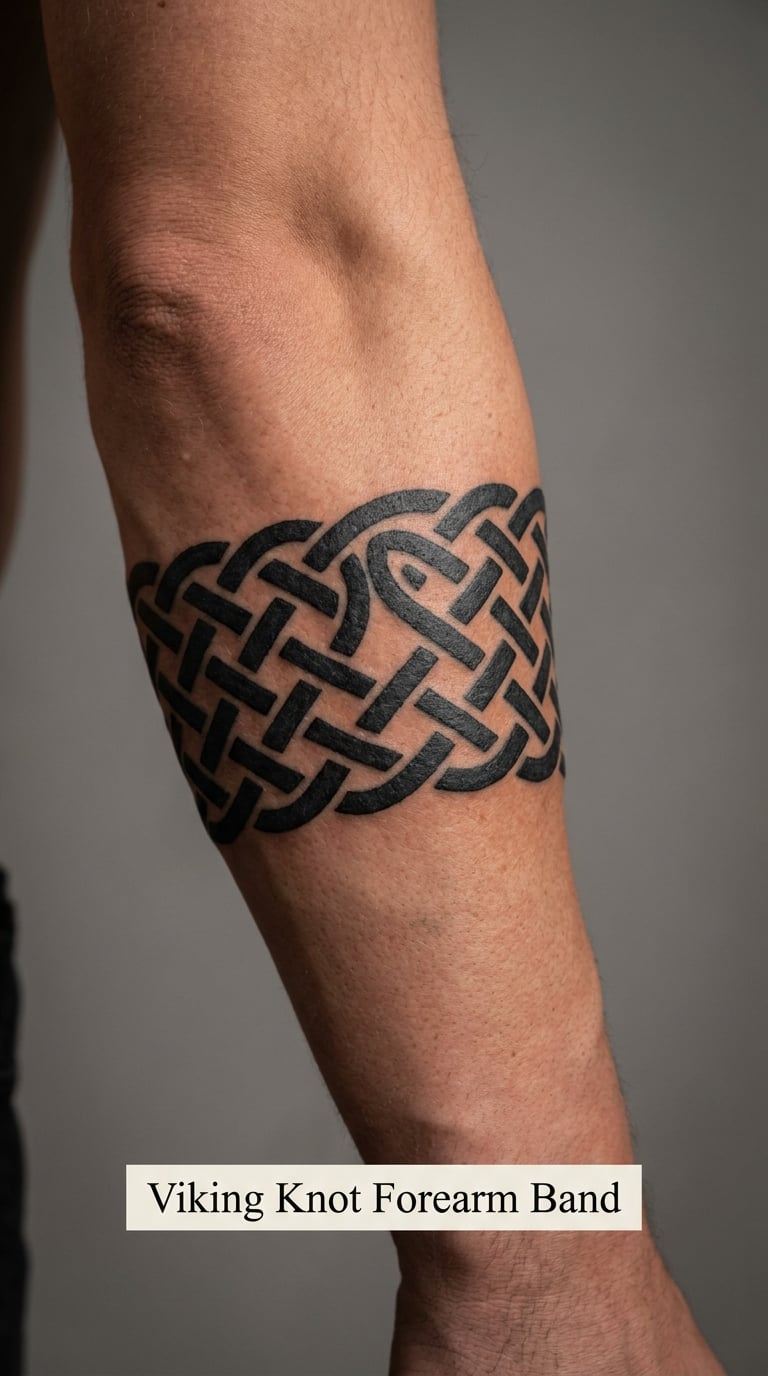
Viking-inspired bands use heavy interlace built from chunky lines that cross, separate, and rejoin in a repeating chain. Compared with finer knotwork the lines are noticeably heavier, which is exactly the point: the design stays legible as the years go on.
Men usually choose it for a Norse or ancestry connection, though plenty pick it purely for the weight of the linework. Treat it as historical decorative influence rather than a symbol with a single agreed meaning, and if your interest is cultural, an artist who works in that visual tradition is worth the extra search.
Placement: Mid-forearm, full wrap, with a little breathing room on either side of the elbow. Size: 1.5 to 2.5 inches tall. Style: Heavy interlace blackwork.
Pain: Medium. Thick lines go down quickly and the crossings need less depth, so it is often more comfortable than a fine-line knot of the same size. Heavy interlace is one of the better-ageing options in this list, and only the tightest inner corners soften noticeably.
Make it yours: Add a single small element at the top and bottom of the wrap so the band has two anchors, then vary the width of one section to show where your arm is thickest.
13. Chain-Link Forearm Band
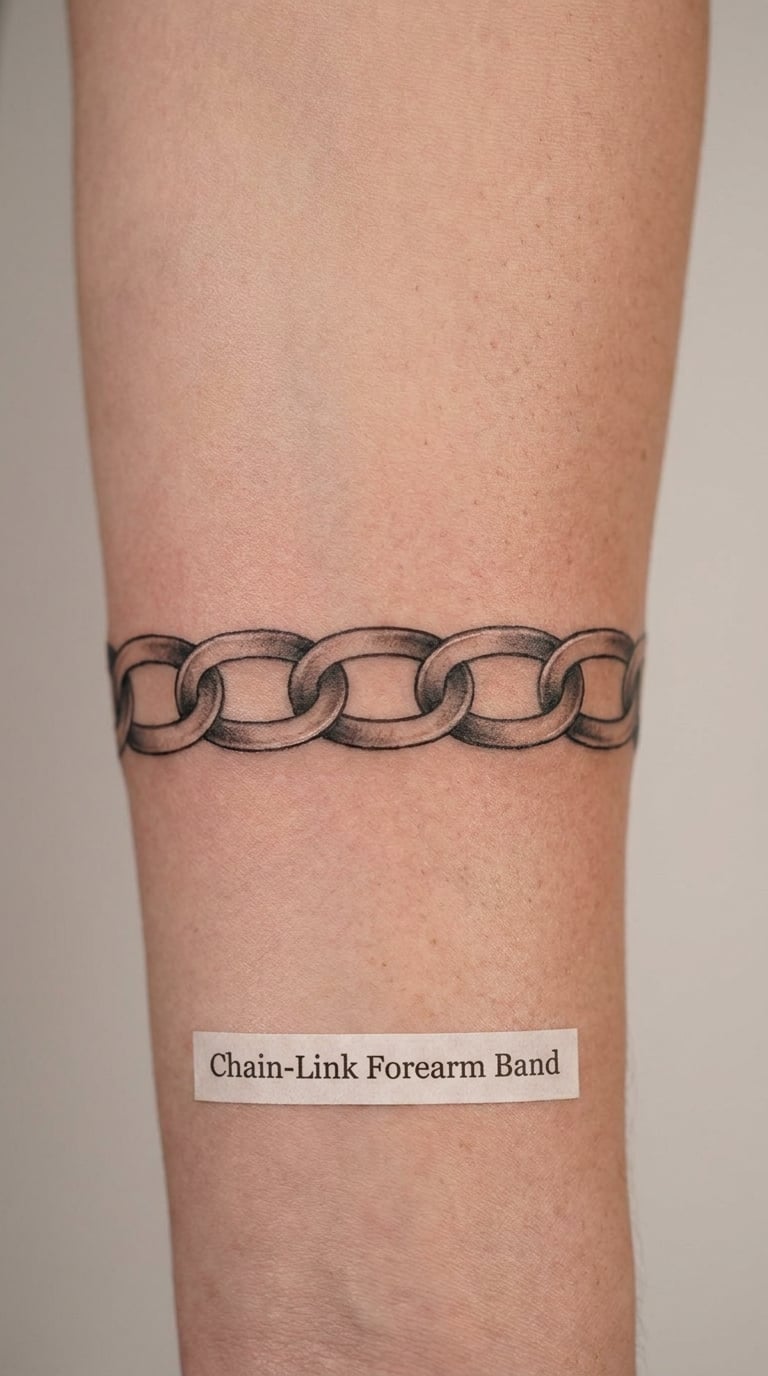
A chain-link band alternates oval links that interlock along the arm, each link drawn with a dark outer edge and a lighter grey face so it looks like it is turning in and out of the skin. The alternation is the whole trick, since links that all face the same direction look like a printed pattern.
It has a straightforward appeal. There is no imagery to interpret, and the metallic shading gives it depth without needing a lot of colour, which keeps it easy to live with in a conservative setting.
Placement: Mid-forearm, full wrap or a half band that runs under the arm and up the outer side. Size: 1 to 1.5 inches tall, 8 to 10 links around the full circumference. Style: Black and grey realism.
Pain: Medium. Every link needs an outline plus a shaded face, so expect a longer session than the design’s simplicity suggests. Links are relatively large shapes, so the design survives ageing well, but the grey shading inside each one flattens over time and the chain loses some of its metallic quality.
Make it yours: Make the clasp real. Have the artist draw a working clasp at one point with the band slightly open, or add a padlock shape at the underside where nobody sees it.
14. Runic Lettering Forearm Band
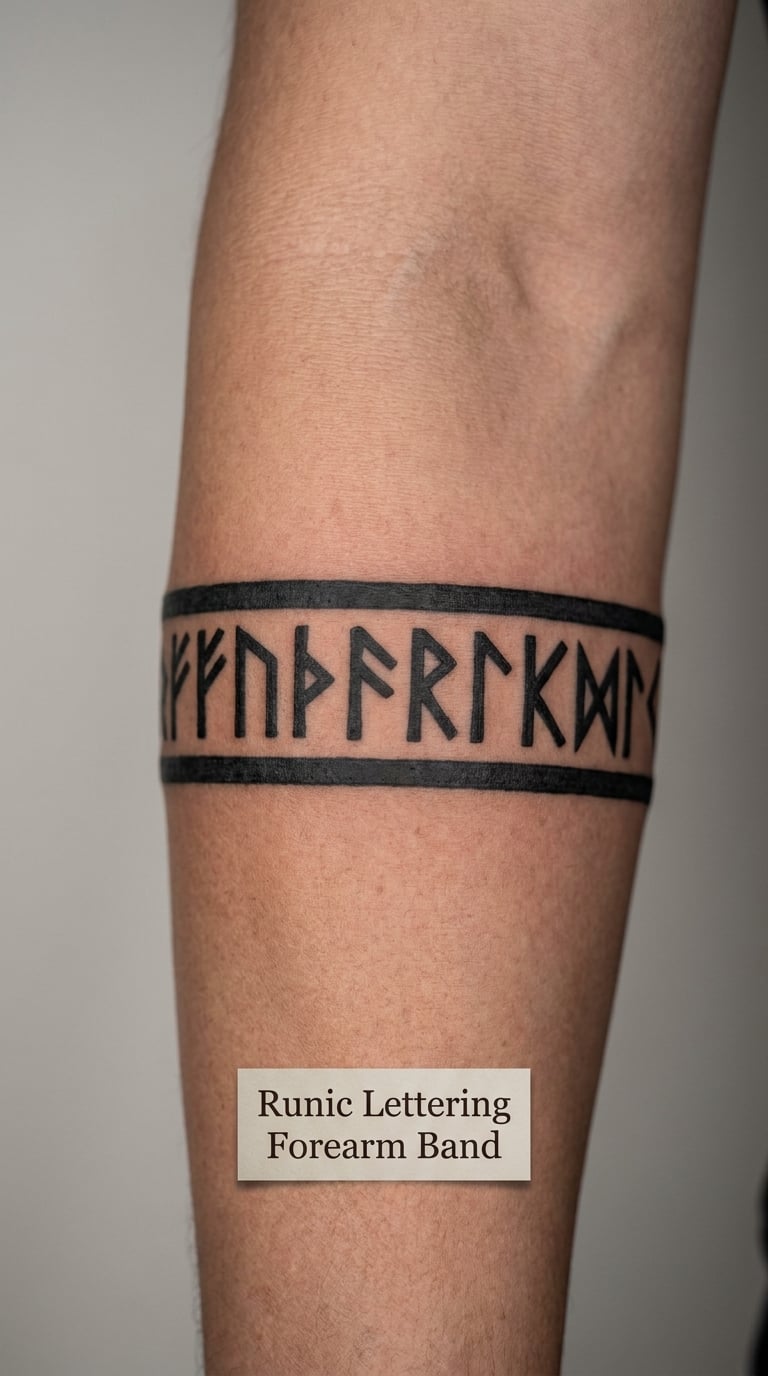
Lettering bands put custom characters, initials, or a short word inside a pair of horizontal borders, so the writing itself becomes the pattern. The letters are usually drawn in a heavy, angular hand with squared terminals, and the border is what stops the design looking like text floating on the arm.
As with the tribal and Norse ideas here, characters taken from a specific historical writing system are a decorative reference rather than a fixed meaning. If you want letters in your own script or language, write them out yourself and let the artist trace them, because drawn-from-memory scripts often come out wrong in small sizes.
Placement: Inner forearm, running with the length of the arm so the letters read from the elbow down. Size: 1 to 2 inches tall, enough for two borders and a single row of characters. Style: Lettering with a bold border.
Pain: Medium. Lettering is slow work and the inner forearm is thin, so a long word takes more time than it should. Lettering is also the fastest thing here to blur, and that is the honest trade-off, so favour a short word in a heavy hand over a long phrase in a thin one.
Make it yours: Put a short word in one language and a date in another, and keep the borders heavy so the shape of the band holds even after the characters soften.
15. Dragon-Claw Forearm Band
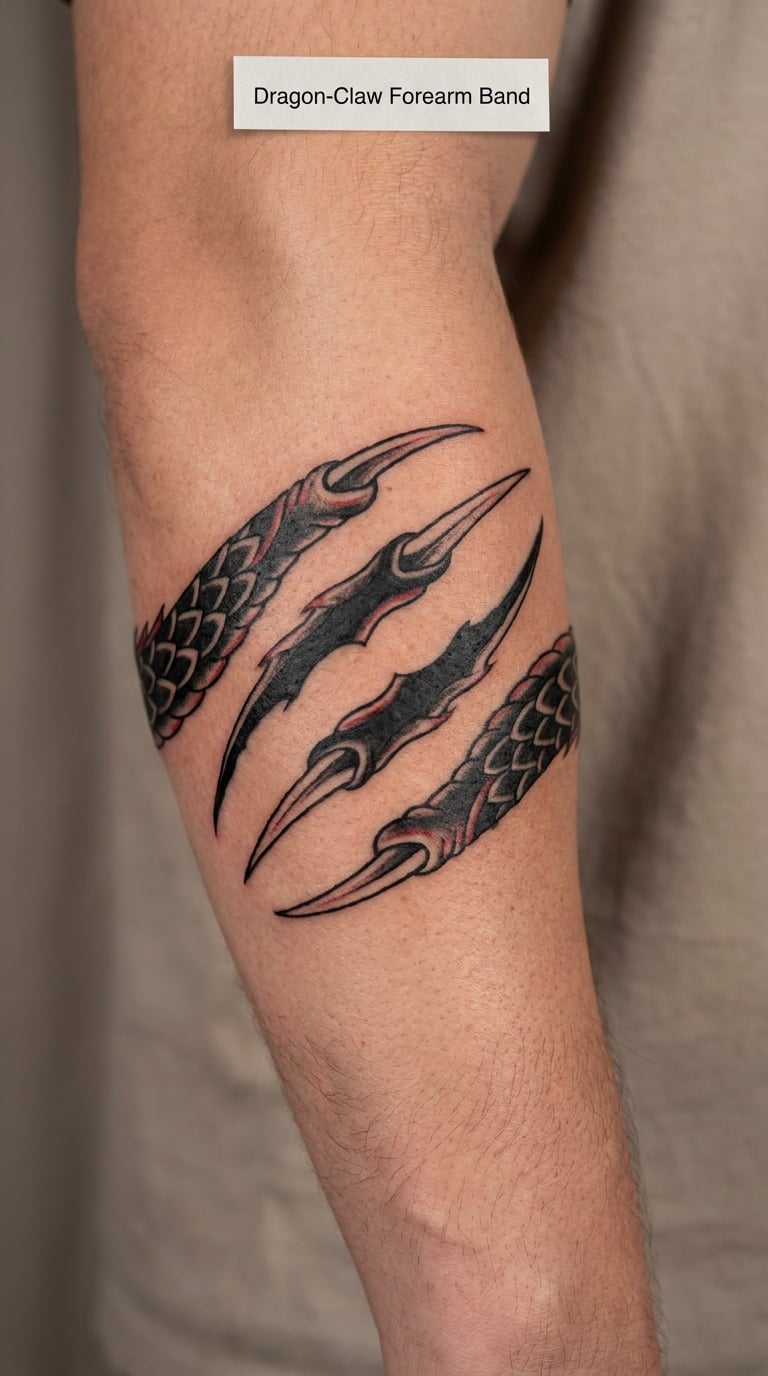
A claw motif borrows the three-talon shape from a dragon or raptor and blows it up to band scale, with each talon a thick tapered slash and a small curved joint line where it would meet the wrist. Done well it has real negative space between the marks, which is what stops it looking like three random scratches.
It is the most aggressive-looking idea on this list, which is a fair reason to want it, and it is popular with men who already have other bold pieces.
Placement: Outer forearm, either as a horizontal band or angled slightly so the talons point toward the elbow. Size: 2 to 3 inches tall, each talon 1.5 to 2.5 inches long. Style: High-contrast blackwork.
Pain: Medium to high. The tapered points of each talon need a slow, confident pass, and getting a clean tip is the hardest part. Bold shapes like this age well overall, and only the thin joint lines and any colour detailing soften with sun exposure.
Make it yours: Use three marks for something you want to count, or add a partial fourth talon that disappears around the far side of the arm so the design implies a full circle you cannot see.
16. Circuit-Board Forearm Band
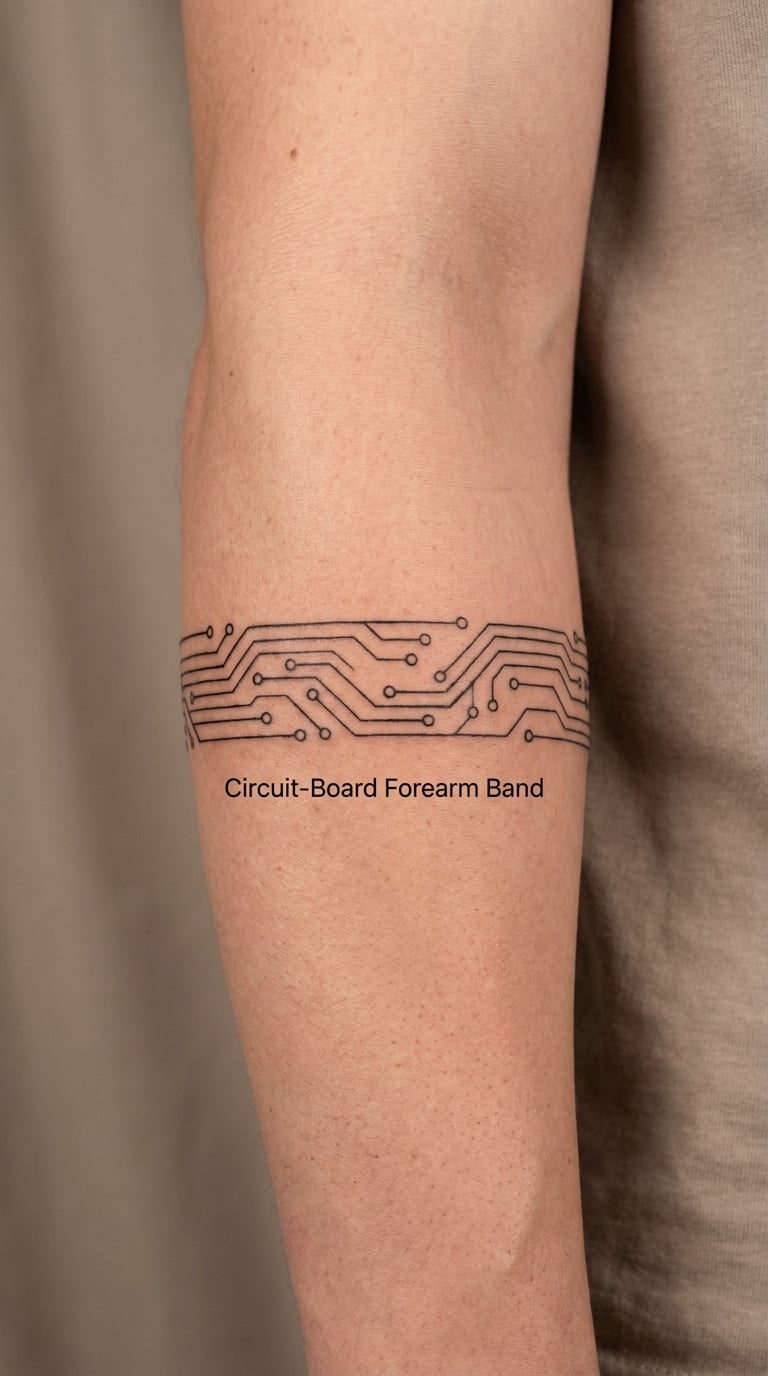
Circuit designs use thin lines that meet at right angles, ending in small filled circles or square nodes, and the whole thing reads as a trace pattern rather than a picture of anything. Density is the choice you have to make: sparse looks modern, crowded looks like a circuit board poster shrunk down to arm size.
Men who build, fix, or ride things often want a pattern that is about the process rather than the product, and this is the cleanest way to do that without writing anything on the arm.
Placement: Inner forearm, where the flat surface keeps the right angles looking right. Size: 1 to 2 inches tall, running 6 to 8 inches along the arm. Style: Minimalist fine line.
Pain: Medium. The work is delicate and slow, and the inner forearm is sensitive, so expect a long session for a modest size. This is one of the designs where thin lines genuinely matter, so agree a minimum line weight in the consult, or the trace pattern will blur into grey within a few years.
Make it yours: Map something real into the pattern, such as the layout of a board you have built or a route you ride, and use your own initials as one of the nodes.
17. Animal Claw Marks Forearm Band
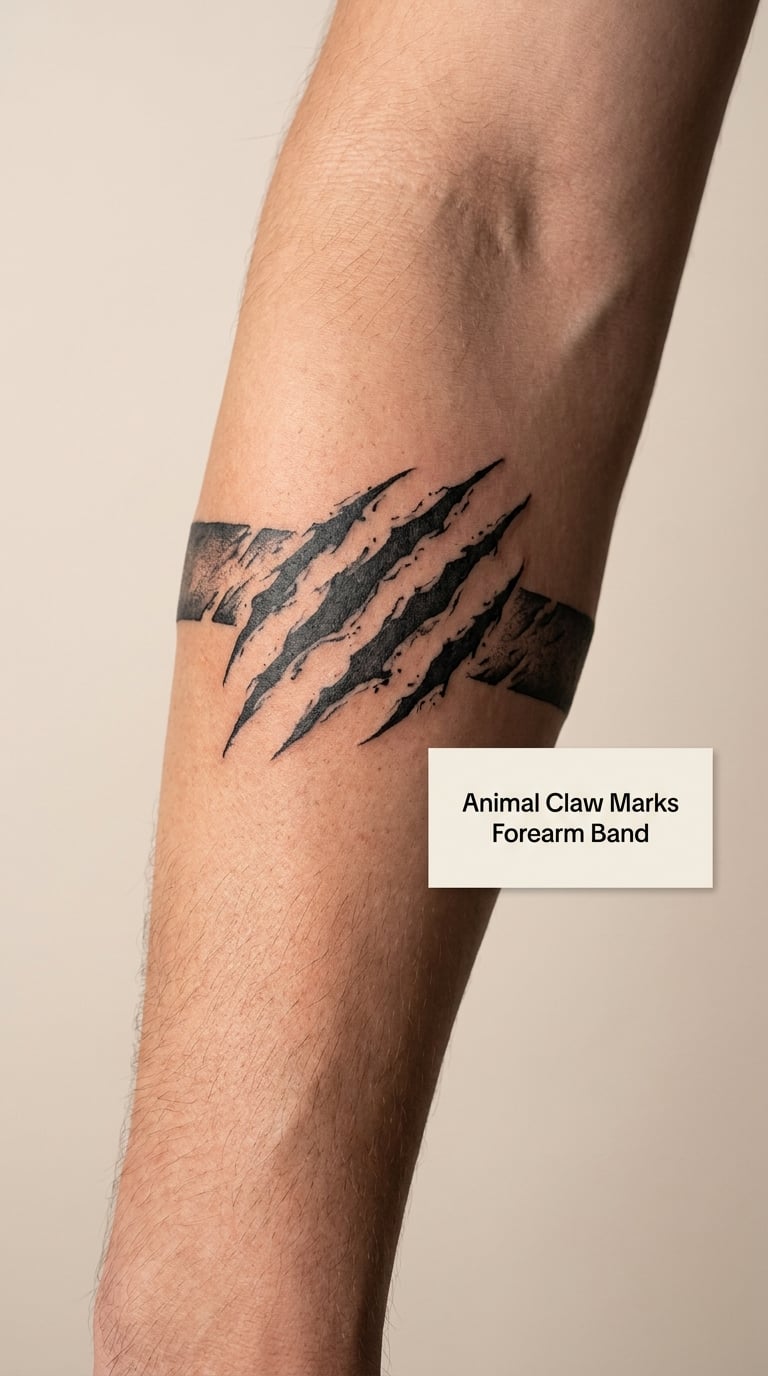
This one strips the claw idea down to four tapered scratch marks arranged in a row, each with a torn, uneven edge rather than a clean line. The distressing is what separates it from a plain scratch, and the four marks need to be different lengths to look like a real animal rather than a repeated stamp.
It is the least demanding idea here in session time and often the one people notice most, because four clean marks read instantly from a distance.
Placement: Mid-forearm as a half band, or wrapped so the marks disappear around the underside. Size: 2 to 3 inch span across the arm, marks 1 to 1.5 inches long. Style: Distressed linework.
Pain: Low to medium. It is a small design with a lot of untouched skin between marks, so it is a quick appointment. The rough torn edges are the vulnerable part, since they are built from thin broken lines that soften, and a scratch that blurs can end up looking like a smudge rather than a tear.
Make it yours: Add a fifth partial mark at the far edge that curves away around the arm, or put a small colour wash behind the middle scratch to pull the eye to one specific mark.
18. Nautical Rope Forearm Band
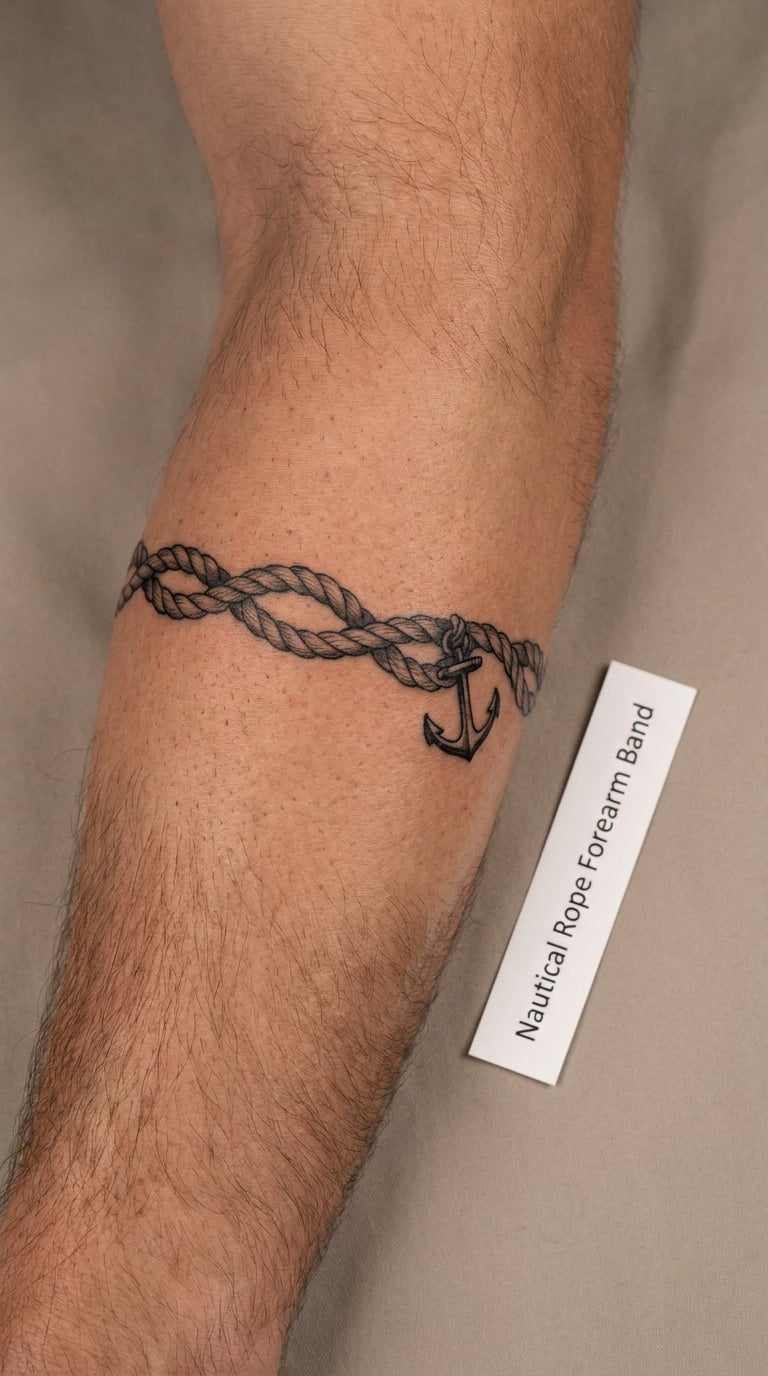
A nautical rope band shows a thick twisted cord running around the arm, built from diagonal fibre lines that follow the twist of the strands. The diagonal rhythm has to be consistent, and that is the part artists work hardest on because a single reversed strand makes the whole rope look like it is falling apart.
It reads as working, nautical, and unshowy, and it is a natural fit for anyone with a connection to boats, the coast, or a life that spends time at sea.
Placement: Mid-forearm, full wrap, or a shorter band that runs from the inner wrist to the outer forearm. Size: 1 to 2 inches tall, showing two full twists of the rope. Style: Realistic black and grey texture.
Pain: Medium. Every fibre is a separate line, so the design takes longer than its simple look suggests, and the wrist-side end of the band is the tender part. The twist lines soften with age, and the rope gradually loses the crisp separation between strands even though the overall shape holds.
Make it yours: Put a working knot in the design rather than a smooth cord, and add one small anchor or shackle at the underside of the arm where the band disappears from view.
19. Blackwork Checker Forearm Band
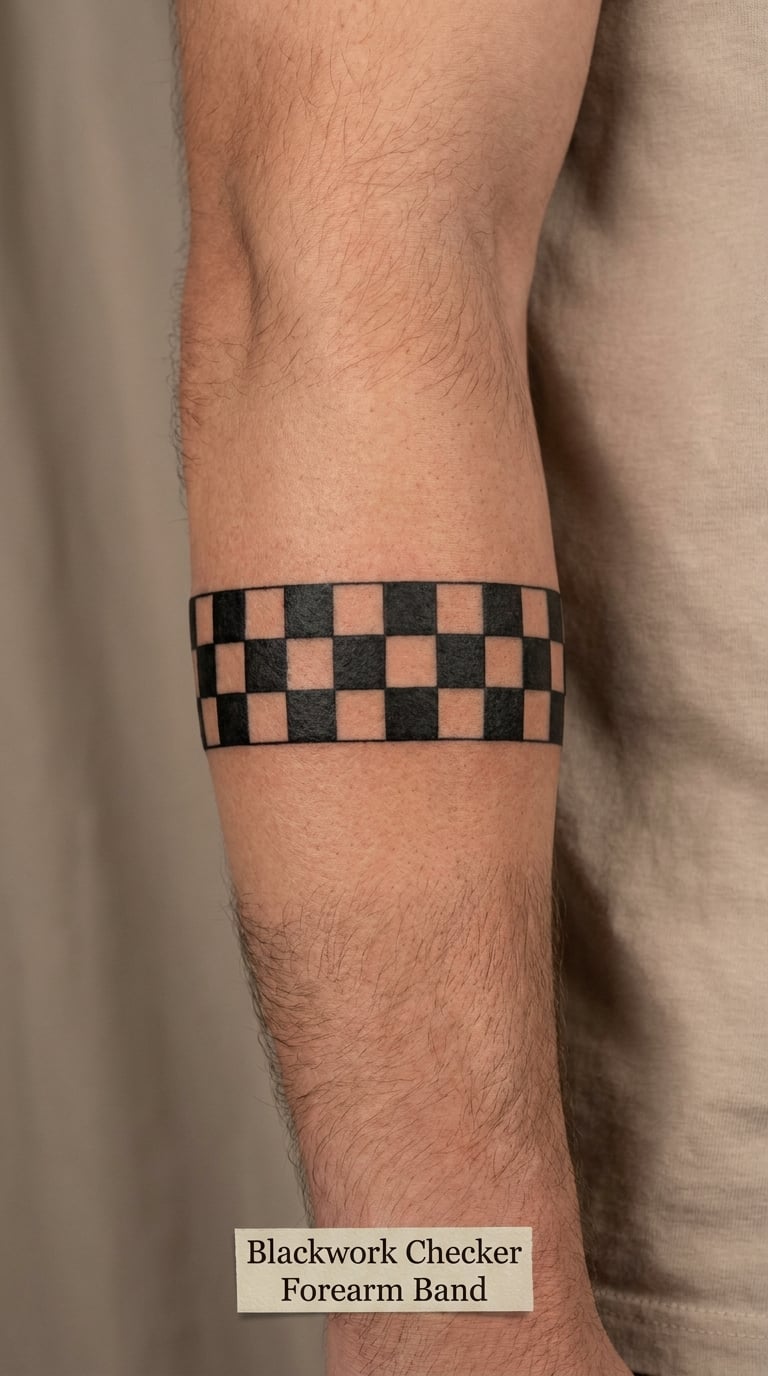
A checker band is a grid of alternating solid and empty squares, which sounds simple until you realise it only works when the squares stay square. On a tapering arm they naturally want to stretch, so the artist has to design each row for the width of the arm at that exact point.
It is graphic rather than illustrative, and it works well for anyone who likes strong shape language. What looks flat on a screen is quite dramatic once the squares sit on a curved surface.
Placement: Mid-forearm, full wrap, with the grid aligned to the natural horizontal of the arm. Size: 1.5 to 2 inches tall, squares roughly half an inch each. Style: Graphic blackwork.
Pain: Low to medium. The design is mostly solid blocks with clean skin between them, so there is less needle time than a detailed piece of the same size. Solid black and open skin are the most durable things a tattoo can be, so this is one of the best options for keeping a bold shape over many years.
Make it yours: Vary the grid so one row of squares is larger than the rest, and let a single square at the centre stay open to become a deliberate gap in the pattern.
20. Gradient Fade Forearm Band
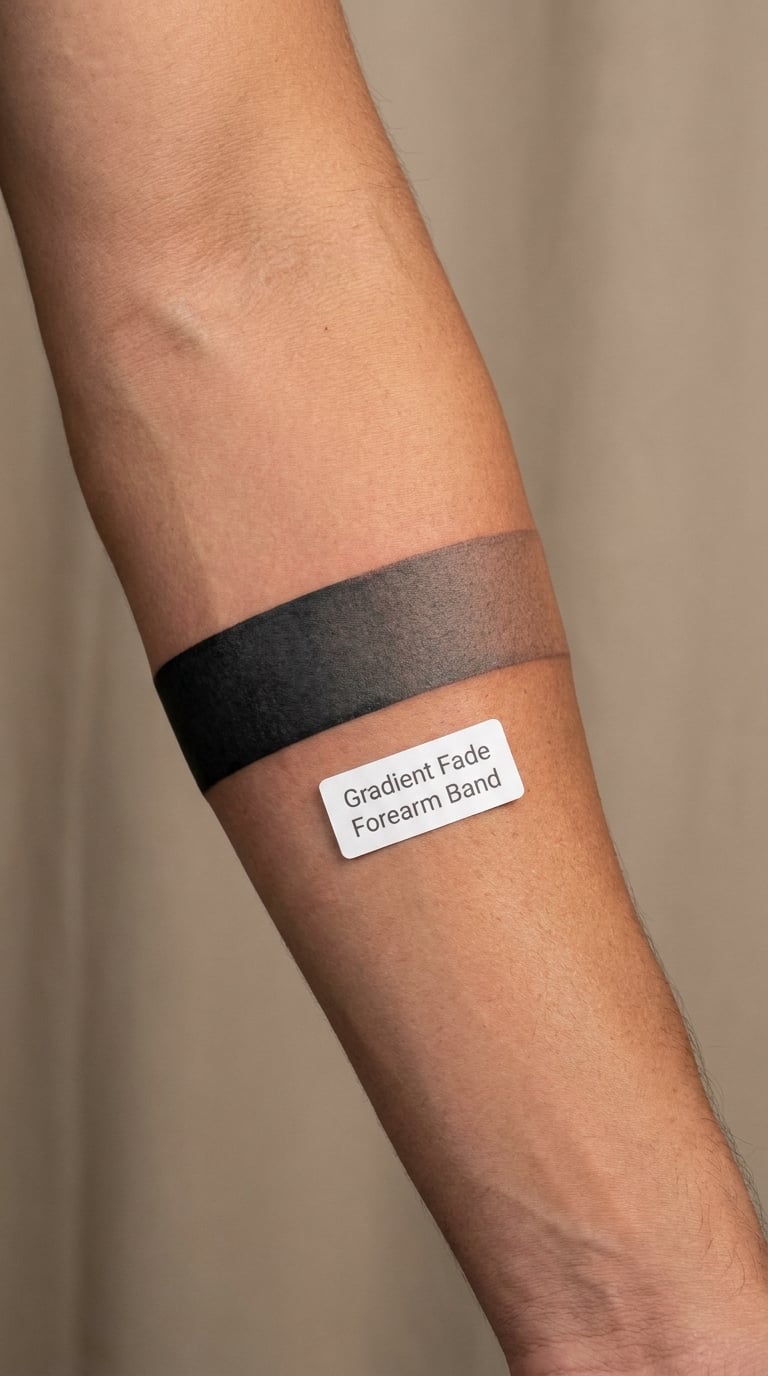
A gradient band is one horizontal stripe that goes from fully packed black at one edge to a soft grey wash that dissolves into bare skin at the other. The whole design is one tone moving across, so the quality of the shading is the entire tattoo, and a badly blended edge is the one thing that cannot be hidden later.
It is the most modern-looking option on this list and the least busy, and it works well as a single piece when you do not want your arm to carry a lot of imagery.
Placement: Any forearm position suits it. The inner forearm shows the full gradient in one view, and the outer forearm shows it partly when the arm turns. Size: 2 to 3 inches tall, 5 to 7 inches long. Style: Shaded blackwork.
Pain: Medium. Grey washes need lighter passes and more time than solid black, and the transition band takes repeated blending to keep smooth. Shading is the first thing to change on a sun-exposed forearm, so expect the grey end to lighten and the gradient to become less even within a few summers.
Make it yours: Decide in the consult whether the dark end sits near the elbow or the wrist, since that choice changes how the band reads as your arm moves, and keep the open end short so the fade stays deliberate.
Forearm Band Tattoo Ideas for Men: How to Choose the Right One
Most people choose a band by picking the design first and worrying about placement later. That is the wrong order, because the same design works completely differently on a 13 inch forearm and a 17 inch one. If you want a wider look at placement first, our gallery of 101 bold forearm tattoo ideas that men love is worth a scroll before you settle on one.
- Match the weight to the size. A small forearm needs a design with fewer elements and thicker lines. If a reference image is a full sleeve, the single band inside it will not translate.
- Pick your visibility first. Inner forearm bands show when you gesture, push a sleeve up, or rest your arm on a desk. Outer forearm bands read at a distance. Decide which one you actually want.
- Check what is already there. Most questions I see about bands are about fitting around existing work. Existing forearm ink limits the height of the band, and adding a band above or below it is usually cleaner than trying to work around it.
- Look at healed examples, not fresh ones. Fresh ink is dark, sharp, and slightly raised. Ask to see the same band healed three years in before you commit to fine line work.
- Be honest about how much detail you want to look at. Detailed work rewards close attention and gets soft sooner. A simpler band stays legible for far longer, and you will not get tired of it.
- Get a stencil on your own arm. A hand-drawn marker outline on your forearm, photographed in daylight, tells you more in ten seconds than a portfolio of other people’s arms will.
Our broader gallery of 70+ forearm tattoo ideas that tell your story covers the shapes and motifs that usually get adapted into band form, which helps when a reference image is close but not quite right.
Why arm size changes which forearm band tattoo ideas for men work
A band that photographs well on a 17 inch forearm can look lost on a 13 inch one, and the reverse is just as common. Your arm’s circumference and taper set the height and density the design can carry, so the same flash drawing needs a different scale on almost everyone.
For most men on a mid-size forearm, 1.5 to 2 inches tall is the range where a band reads clearly without crowding the arm. Under 1 inch it reads as a bracelet line, and over 3 inches it starts competing with a sleeve.
Measure the widest part of your forearm and divide by ten. That gives you a number to bring to the consult, and the artist can adjust it to the design.
Cost and Session Time
Cost depends far more on the artist’s hourly rate and how long the design takes than on the word band. Of the forearm band tattoo ideas for men here, a simple solid band is at the cheap end because it is quick, and a snake wrap or a full interlace sits at the expensive end because shading and fine line work take hours.
- Small and simple, under 2 inches tall and mostly solid black: roughly 300 to 700 US dollars, and often done in one session of one to two hours.
- Medium detail, 2 to 3 inches tall with linework and some grey: roughly 700 to 1,500 US dollars, usually two to three hours and sometimes a second session.
- Large or detailed, snake wraps, full interlace, wave work: roughly 1,500 to 3,000 US dollars, three to six hours, and your artist will likely want to stop and continue rather than push through a long session.
Shop minimums matter. Plenty of studios will not start a session under a certain amount, so a small band can cost the same as a medium one in a high-rent city. Location is the other big factor, and so is the artist, since a specialist in blackwork or fine line will sit at a different rate than a generalist doing the same design.
Before you book, ask what the rate is per hour, whether the estimate is a price or a range, what the shop minimum is, and how many sessions the design realistically needs. Artists would much rather answer that on day one than hear it afterwards.
Aftercare Basics
- Follow your artist’s aftercare instructions first, since they know how deep your ink went and what you have going on in the area.
- Wash the area gently with clean water and unscented soap, twice a day, and pat it dry with something that does not lint.
- Keep it covered with a clean, non-adhesive dressing for as long as your artist tells you to, and change it if it lifts or gets damp.
- Leave the outer layer of skin alone. No picking, no scratching, and no scraping off flakes, even when it flakes hard in week two.
- Keep the forearm out of direct sun while it heals, and once it is healed keep using sun protection on it if you want the grey and colour to hold.
- Skip the swimming pools, hot tubs, and saunas until the area is fully closed, and hold off on heavy gripping or forearm work until your artist clears you.
Frequently Asked Questions
What does a forearm band tattoo mean for guys?
A forearm band tattoo means whatever the person getting it decides it means. There is no fixed symbolism attached to the format itself, and most men choose one for how it looks rather than for a message. Common personal reasons include marking a milestone, a memorial, a period of sobriety, cultural heritage, or simply a preference for a bold, uncluttered piece that is easy to cover in a professional setting. Ask the wearer if you want to know the real reason.
How much does a forearm band tattoo cost?
A simple solid black band usually runs between 300 and 700 US dollars, while a medium design with linework and grey shading tends to sit between 700 and 1,500 US dollars. Large or highly detailed work such as a snake wrap or full interlace can reach 1,500 to 3,000 US dollars. Your artist’s hourly rate, the shop minimum, and your location move the final number more than the design itself does.
Does a forearm band tattoo hurt, and how painful is the forearm?
The forearm is a mid-range spot, usually around a 4 to 6 out of 10 on a personal pain scale. The inner forearm near the wrist is the tender part because the skin is thin over bone there, and the elbow crease is more sensitive than the mid-forearm. A solid black band feels easier than a fine-line design of the same size because the needle makes fewer passes. Most people describe it as a steady scratchy burn rather than sharp pain.
How wide should a forearm band be on a man?
For most men, 1.5 to 2 inches tall is the range where a band reads clearly without crowding the arm. Under 1 inch it looks like a bracelet line, and over 3 inches it competes with a sleeve for the same space. Measure the widest part of your forearm and divide by ten to get a starting number, then let the artist adjust it to the design and to how much existing tattoo you are working around.
Do forearm band tattoos stretch or distort when you flex?
Any forearm tattoo moves when you flex, because the skin stretches across the muscle underneath, so the design should be drawn for a relaxed arm and checked in a flexed position before it is committed. A band placed too close to the elbow crease distorts the most because that skin moves the furthest. If you build muscle after the tattoo, heavy blackwork holds its shape better than fine line, since thin lines blur first as the skin stretches over new muscle.
Can you add to a forearm band tattoo later?
Yes, and plenty of people do, but the existing band sets the limits. Most additions to forearm band tattoo ideas for men end up placed above or below the original, or extending one end of the design around the far side of the arm. A good tattooer will not retouch a band that is already healed just to widen it, because adding ink to healed skin changes the texture and often leaves a visible join. Book a consult with the original artist if you can, and expect to pay a full new session rather than a touch-up rate.
Conclusion
If this is your first tattoo, start with a solid black band, a fine-line geometric band, or a gradient fade. They are clean, they hide imperfect placement better than a detailed design, and they will still look good to you in ten years.
If you are already building a collection, the snake wrap, the dragon claw, and the circuit board give you something with real detail to work with and enough variation to sit alongside other pieces.
Either way, the first step is a consult. Bring two or three forearm band tattoo ideas for men, a photo of your forearm in daylight with relaxed and flexed, and a rough width measurement, and let the artist redraw the design around your actual arm.