
22 Heron Tattoo Ideas: Best Nature Tattoos (October 2026)
Herons show up in shallow water and then vanish for a while, which is part of why they stick in people’s heads. These 22 heron tattoo ideas cover everything from a fine-line bird behind the ear to a full marsh scene across the back, and each one comes with honest size, placement and pain notes. If you want a heron tattoo that still reads as a heron in ten years, the placement matters as much as the drawing.
A heron is not a generic bird. It is a long-legged wading bird that folds its neck into an S-curve when it flies, hunts with that beak held level over water, and stands completely still while it waits. That stillness is why so many people pick it, and it is worth knowing the difference between a heron, a crane, an egret and a stork before you brief an artist, because a crane tattoo and a heron tattoo are not the same drawing.
Read the quick guide first if you are in a hurry, then jump to the designs that match the space you actually have.
22 Heron Tattoo Ideas: Quick Guide
| Idea | Style | Best placement | Size | Pain |
|---|---|---|---|---|
| 1. Fine-line heron in flight | Fine line | Inner forearm, rib | 4-6 inch (10-15 cm) | Medium |
| 2. Realistic grey heron portrait | Black-and-grey realism | Outer upper arm | 6-9 inch (15-23 cm) | Medium |
| 3. Minimalist standing heron | Minimalist line | Ankle, calf, forearm | 3-5 inch (8-13 cm) | Medium-high |
| 4. Heron with lotus flower | Black and grey with colour | Calf, inner arm | 7-10 inch (18-25 cm) | Medium |
| 5. Traditional blue heron | American traditional | Forearm, calf, upper arm | 6-8 inch (15-20 cm) | Medium |
| 6. Heron and koi in watercolor | Watercolour | Upper back, thigh | 9-14 inch (23-35 cm) | Low-medium |
| 7. Small heron behind the ear | Micro fine line | Behind the ear, neck | 1-2 inch (2.5-5 cm) | High |
| 8. Heron nesting design | Illustrative realism | Upper thigh, calf | 6-9 inch (15-23 cm) | Medium |
| 9. Heron and reed botanical | Botanical line | Inner forearm, calf | 8-12 inch (20-30 cm) | Medium |
| 10. Blackwork heron in profile | Blackwork | Outer shoulder, thigh | 7-11 inch (18-28 cm) | Medium |
| 11. Heron silhouette with sunset | Silhouette with colour | Upper back, shoulder | 8-12 inch (20-30 cm) | Low-medium |
| 12. Dotwork heron and feathers | Dotwork | Outer arm, back | 10-16 inch (25-40 cm) | Low-medium |
| 13. Heron on the wrist | Fine line, side profile | Inner wrist | 2-3 inch (5-8 cm) | High |
| 14. Heron and moon | Fine line with accent | Outer forearm, calf | 4-7 inch (10-18 cm) | Medium |
| 15. Heron in geometric frame | Geometric, contemporary | Forearm, calf | 5-8 inch (13-20 cm) | Medium |
| 16. Colourful heron in a marsh | Colour realism | Calf, upper back | 10-15 inch (25-38 cm) | Low-medium |
| 17. Heron feather micro-tattoo | Micro fine line | Finger, wrist | Under 1.5 inch (4 cm) | High |
| 18. Neo-traditional heron with flowers | Neo-traditional | Upper arm, thigh | 7-10 inch (18-25 cm) | Medium |
| 19. Heron and dragonfly | Black and grey with colour | Inner arm, calf | 5-8 inch (13-20 cm) | Medium |
| 20. Minimal heron line on the ribs | Minimalist line | Ribs, side torso | 7-10 inch (18-25 cm) | High |
| 21. Heron and mountain lake scene | Illustrative realism | Upper back, thigh | 12-18 inch (30-45 cm) | Low-medium |
| 22. Matching heron pair | Fine line, mirrored | Inner forearms, ankles | 3-5 inch (8-13 cm) each | High |
Sizes here refer to the longest dimension of the design, not the width of the body area. If a design is listed at 4-6 inch and the spot is smaller than that, the details will not survive healing.
1. Fine-Line Heron in Flight
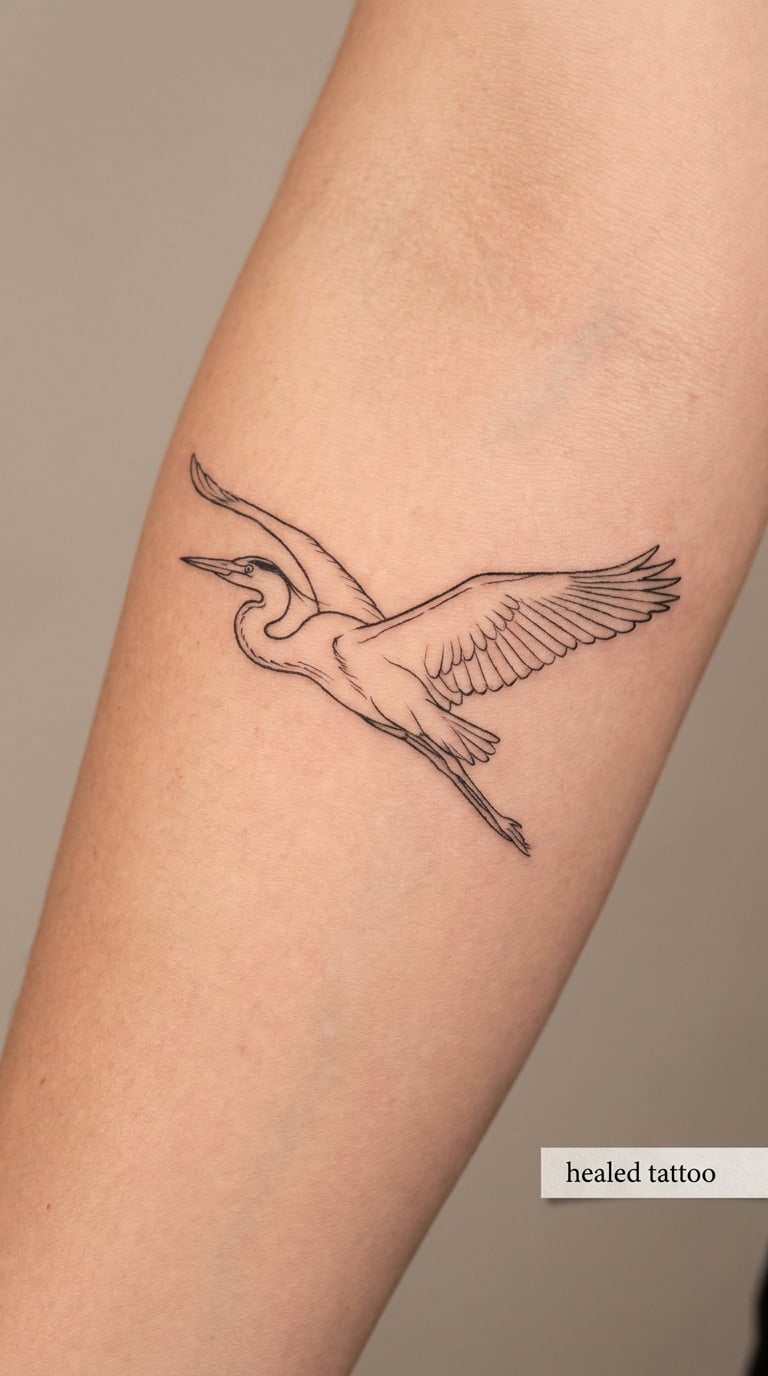
A fine-line heron in flight is one continuous feather-light outline: wings extended flat, neck tucked, legs trailing behind the body like threads. The wingspan makes the design wide rather than tall, so it sits naturally along a forearm or across the ribs. Nothing else needs to be in the frame. A second bird, water beneath it, or a wash of grey behind the wing all work, but the single bird reads cleaner.
People choose the flying pose because it holds movement in a still image. That is the whole appeal.
Placement: inner forearm, outer forearm, ribs, or across the upper back between the shoulder blades. Size: 4-6 inch (10-15 cm) wide. Style: fine line. Pain: medium, higher over the inner elbow and along the rib edge. Fine line blooms slightly while healing and softens over the years, so ask your artist to run the outline a touch heavier than a drawing you would ink on paper.
Make it yours: have the trailing legs end in a few scattered water droplets, or place a small date beneath the wing line.
2. Realistic Grey Heron Portrait
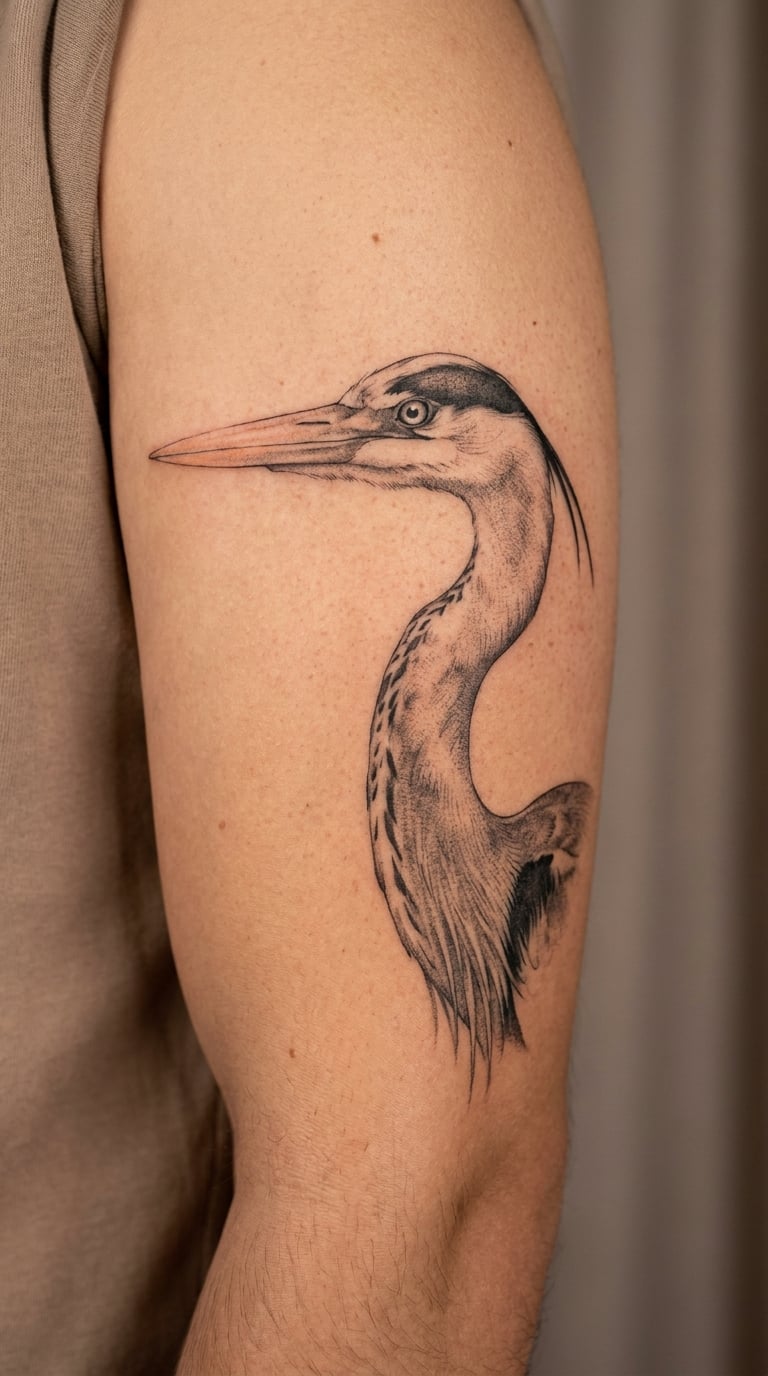
A realistic grey heron portrait concentrates everything into the head, the long neck and the dagger beak. Artists build the neck with fine grey wash shading rather than solid black, then leave a pale highlight running down the front of the throat. The eye is usually the darkest point in the piece, and it needs to be about the size of a real heron eye or the bird looks wrong.
Watchfulness is what this design carries. It suits someone who would rather be observed than perform.
Placement: outer upper arm, inner forearm, calf, or the side of the thigh. Size: 6-9 inch (15-23 cm). Style: black-and-grey realism. Pain: medium. Realism rewards touch-ups, and shading on the inner arm usually needs one.
Make it yours: put the bird in a specific light, or add shallow water and reflected ripples under the beak so the portrait sits in a place instead of floating.
3. Minimalist Standing Heron
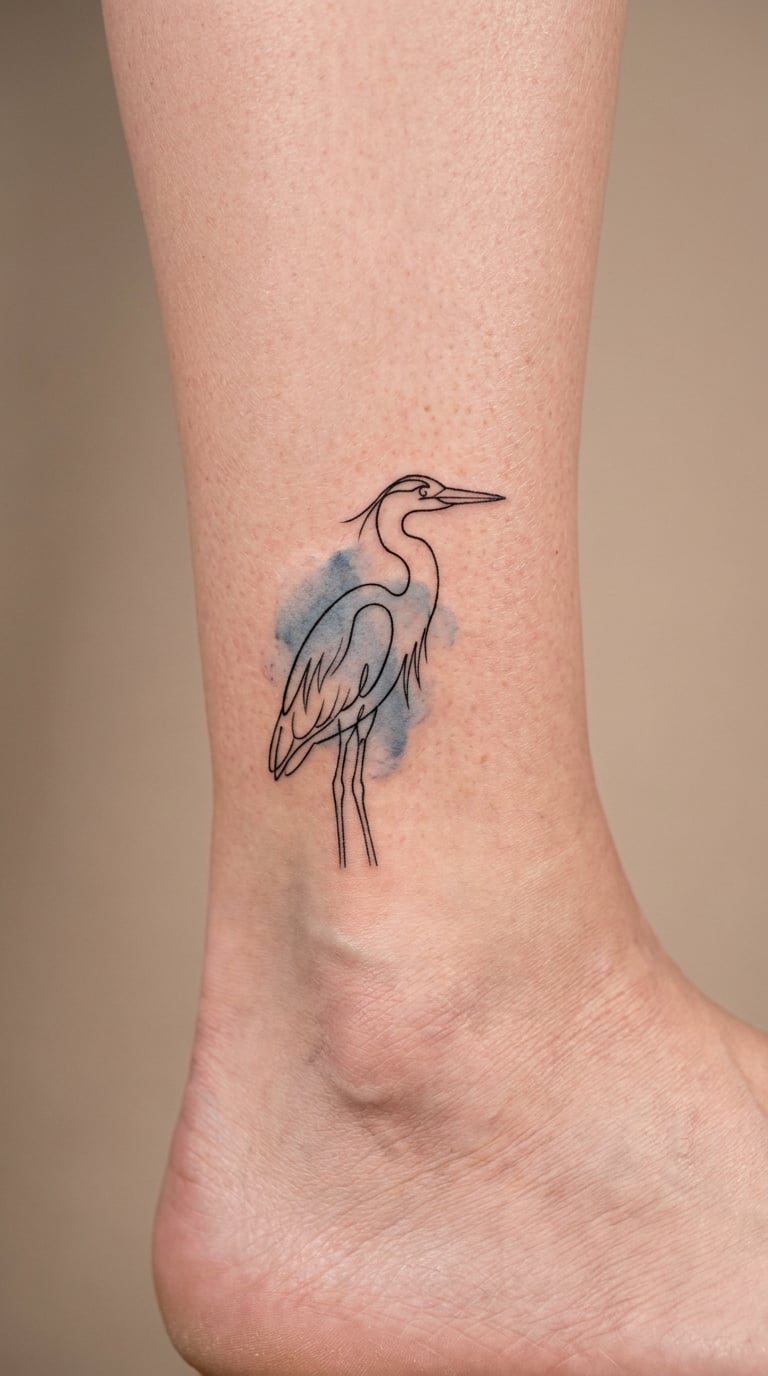
A minimalist standing heron is built from six or eight unbroken lines: two legs, the body, the folded neck, the beak. There is no shading, no background, and often no eye. It looks almost too easy until you realise a good one needs exact proportions, because nothing hides an error.
This is the design people pick when they want a bird that says very little on purpose. The pause in the bird’s posture is the meaning.
Placement: outer ankle, calf, inner wrist, forearm. Size: 3-5 inch (8-13 cm). Style: minimalist line. Pain: medium to high on the ankle and wrist, where skin is thin over bone. Single lines soften and blur fastest of any style, so a thicker needle depth is the safer call.
Make it yours: add one small colour element, a muted blue-grey wash at the feet or a single orange dot for the eye, so the design has a focal point without losing its restraint.
4. Heron with Lotus Flower
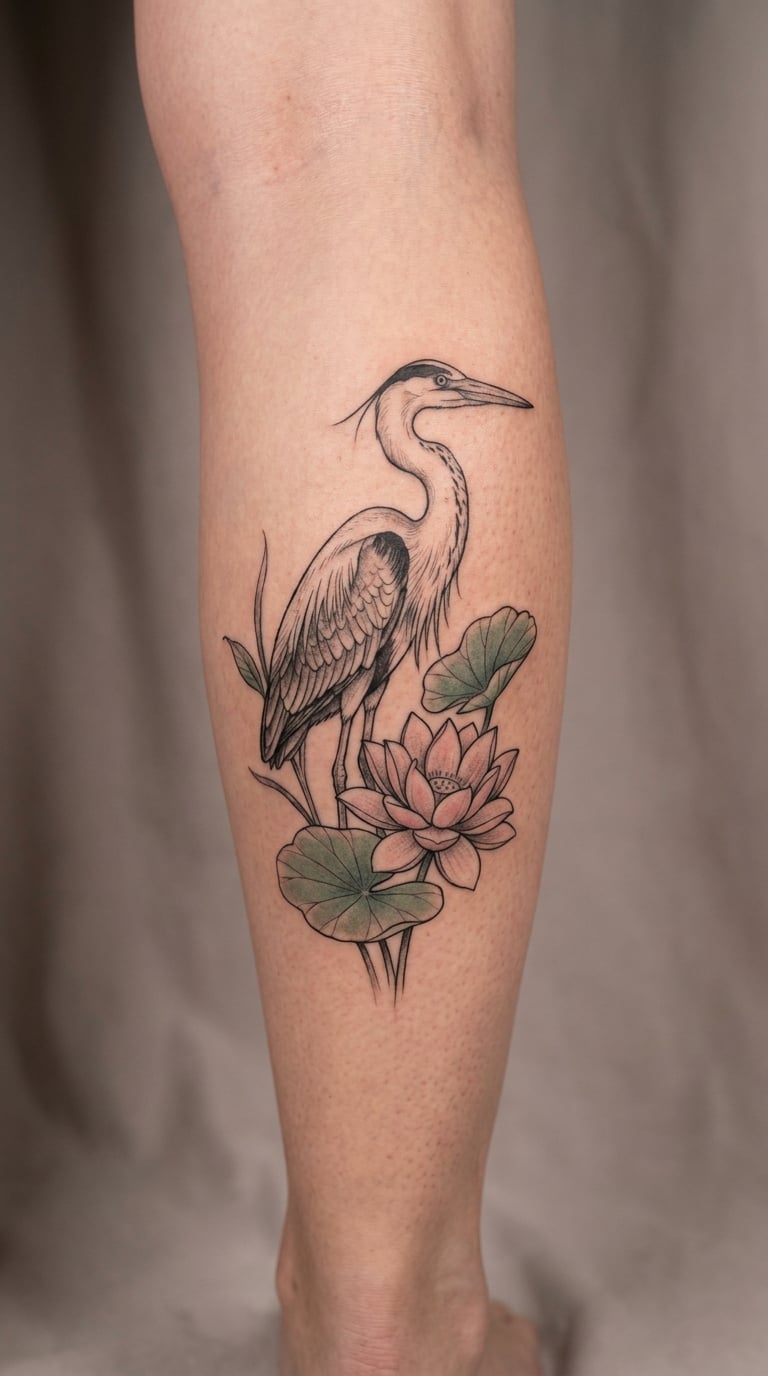
The heron and lotus pairing comes from the heron’s own habitat, so it reads as a scene rather than two stickers. The bird stands in profile with its neck half-extended while the lotus opens at the same height, usually lower and larger so it anchors the composition. Colour is optional: black and grey works, but muted green leaves and a pale pink flower add depth without fighting the linework.
Water, stillness and something unfolding quietly, in that order. The symbolism varies, and most wearers land on their own reading of it.
Placement: calf, inner forearm, side of the thigh. Size: 7-10 inch (18-25 cm) tall. Style: black and grey with colour accents. Pain: medium. The calf is one of the more forgiving spots for a two-part composition because the surface is flat and easy to wrap.
Make it yours: set the lotus in a specific state, closed bud or fully open, and add a few floating petals at the base to tie the two halves together.
5. Traditional Blue Heron
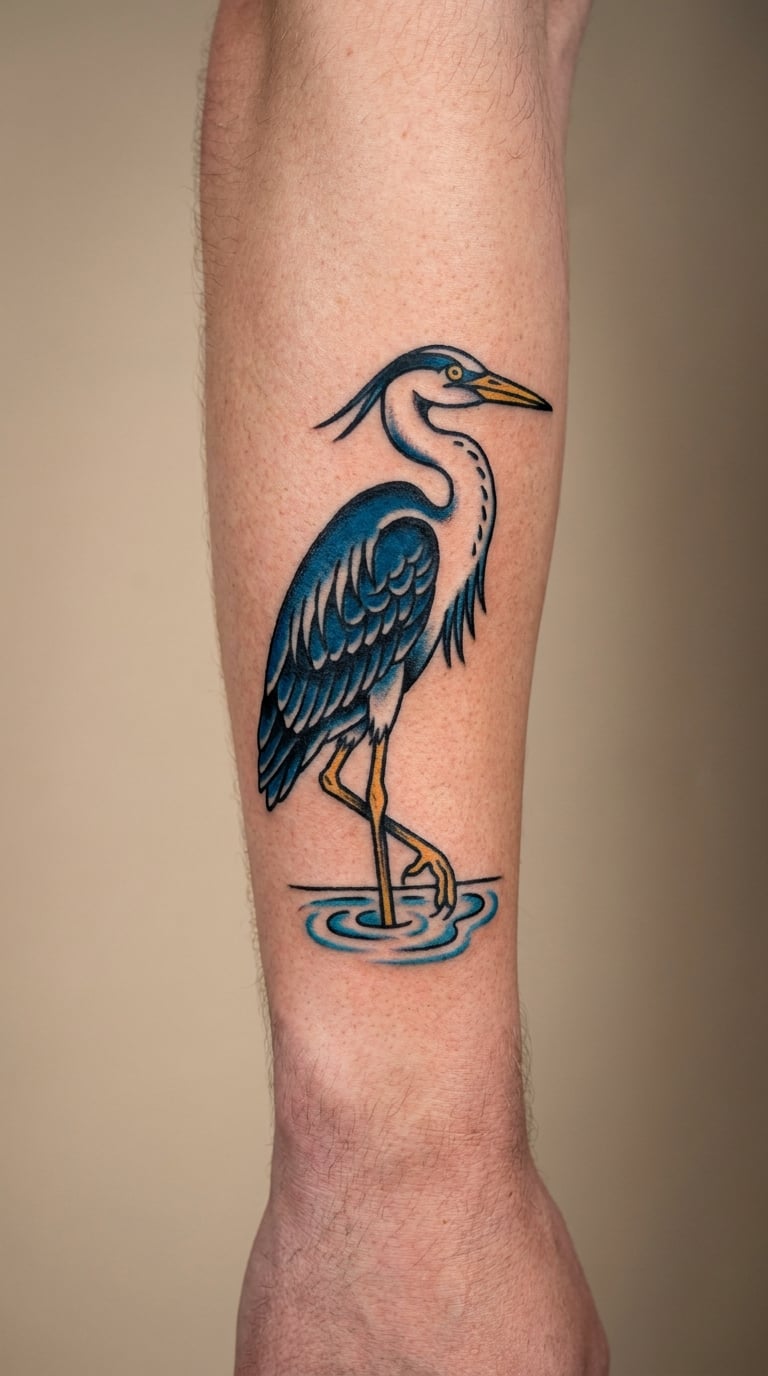
A traditional blue heron uses thick black outlines, flat saturated colour and very little shading. The wing is layered with two or three blue tones, the body stays white, and the beak is a solid yellow-orange wedge. Classic pieces put a rising sun or a band of water behind the bird, and water usually reads as a few scalloped black lines rather than anything realistic.
Bold enough to read across a room, which is the point of this style. It suits people who like a piece that announces itself.
Placement: forearm, calf, upper arm, or as a section of a sleeve. Size: 6-8 inch (15-20 cm) tall. Style: American traditional. Pain: medium. Solid black packing on the outline is the uncomfortable part, and it is brief.
Make it yours: change the wing colour, or swap the classic sun for a red moon disc, which shifts the whole mood without changing the structure.
6. Heron and Koi in Watercolor
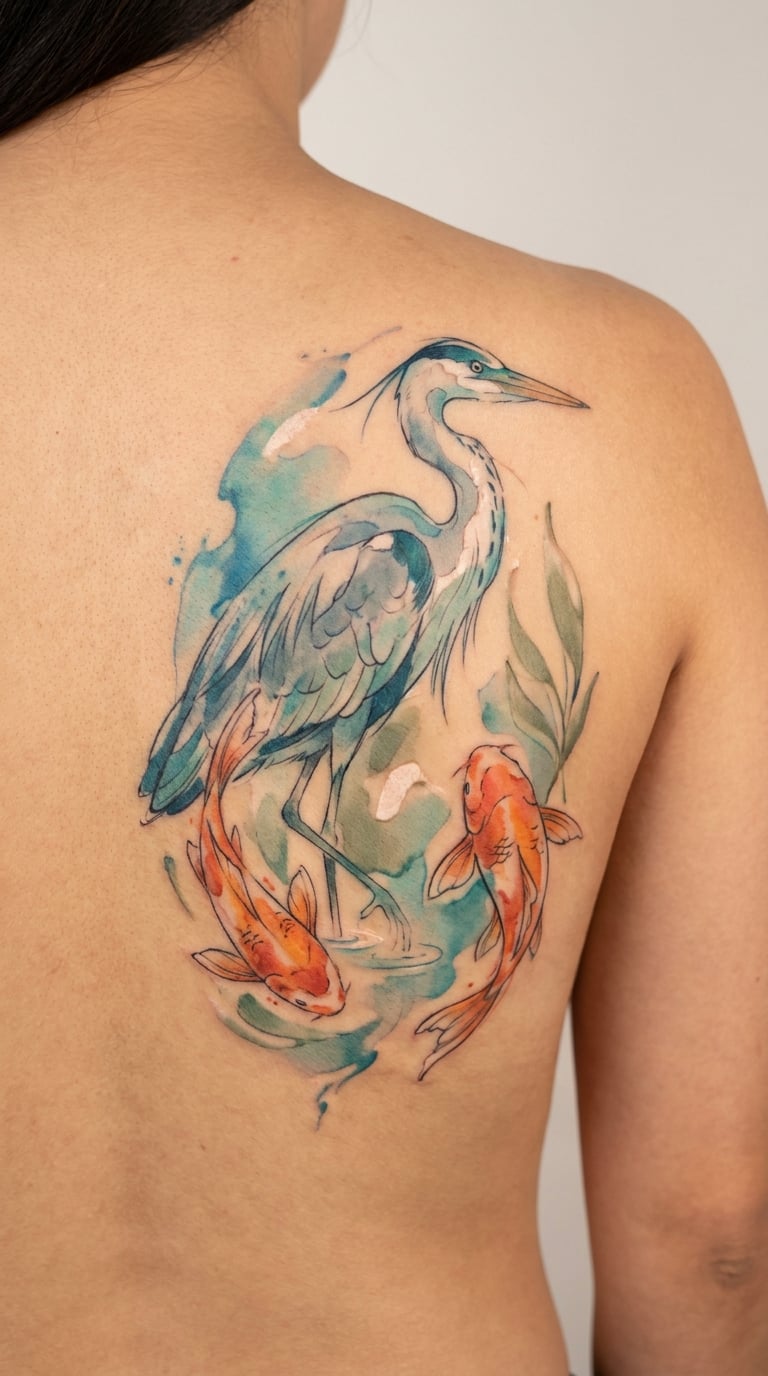
The watercolour heron and koi is a colour piece with no hard edges. The bird is suggested with two or three grey and blue washes, the koi carry the saturated orange, and plenty of skin stays bare so the design keeps moving. The watercolour sits over the piece like a stain rather than a coat, so anything too tight will fight it.
Two fish and a bird sharing water is unusual enough that people ask about it. That curiosity is often half the reason for the tattoo.
Placement: upper back, shoulder blade, outer thigh, or the back of the arm. Size: 9-14 inch (23-35 cm). Style: watercolour. Pain: low to medium, and the shading passes are quick. Watercolour is the least demanding here and the most in need of a touch-up, usually within the first year.
Make it yours: choose two or three colours and keep the rest as water, and add a pale sun reflection so the composition has light in it.
7. Small Heron Behind the Ear
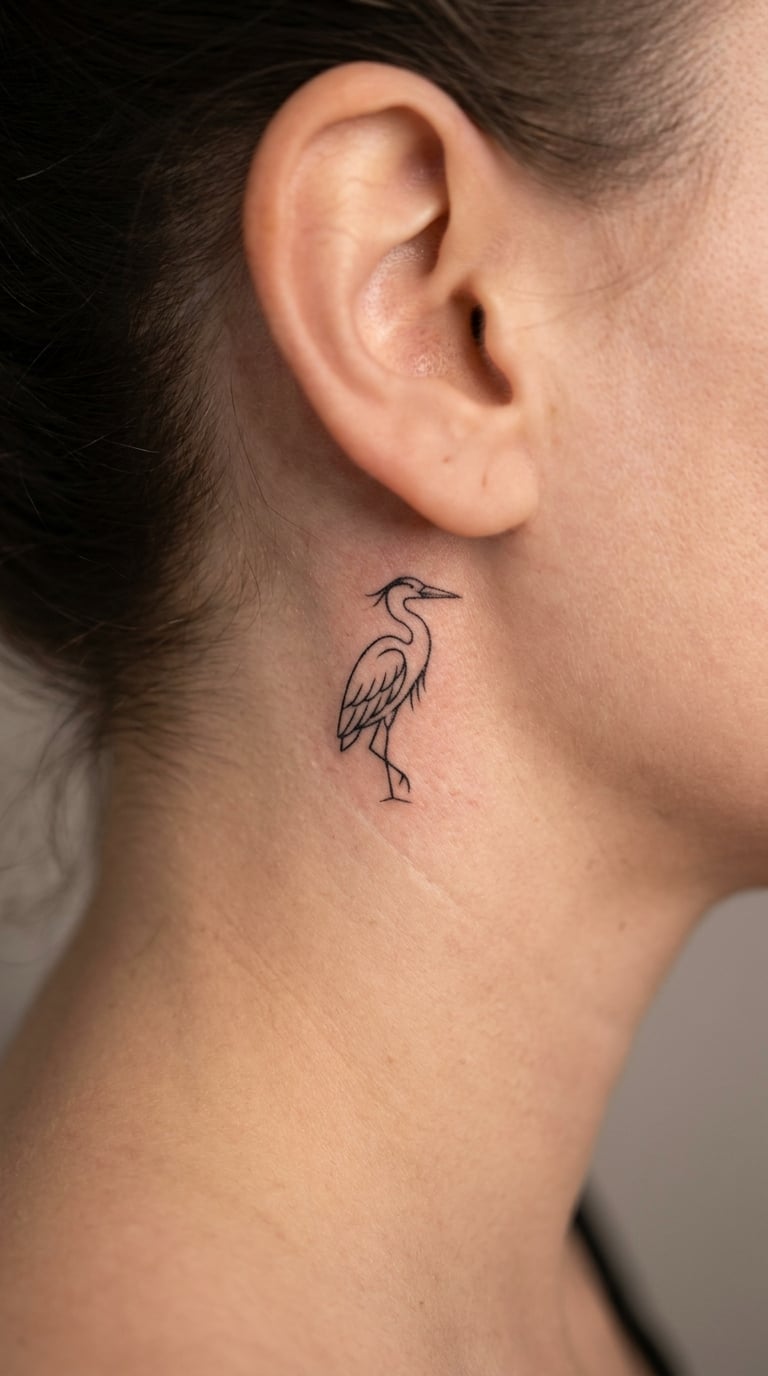
A heron behind the ear is usually a folded-wing bird, drawn small enough that the beak is a single line and the wing is three strokes. Small back-of-neck tattoos get noticed by people standing close and nobody else, which is the reason plenty of people want one. It is a good first tattoo partly because the session is short.
Hidden placements tend to carry private meaning. Ask anyone with a neck piece why they got it and you will usually get a real answer.
Placement: just behind the ear, side of the neck, below the ear at the hairline. Size: 1-2 inch (2.5-5 cm). Style: micro fine line. Pain: high. The neck is thin-skinned and close to bone, and the buzzing there is sharper than most people expect.
Make it yours: set a small initial as the water line underneath, or ask the artist to angle the bird so it appears to be looking out of the ear.
8. Heron Nesting Design
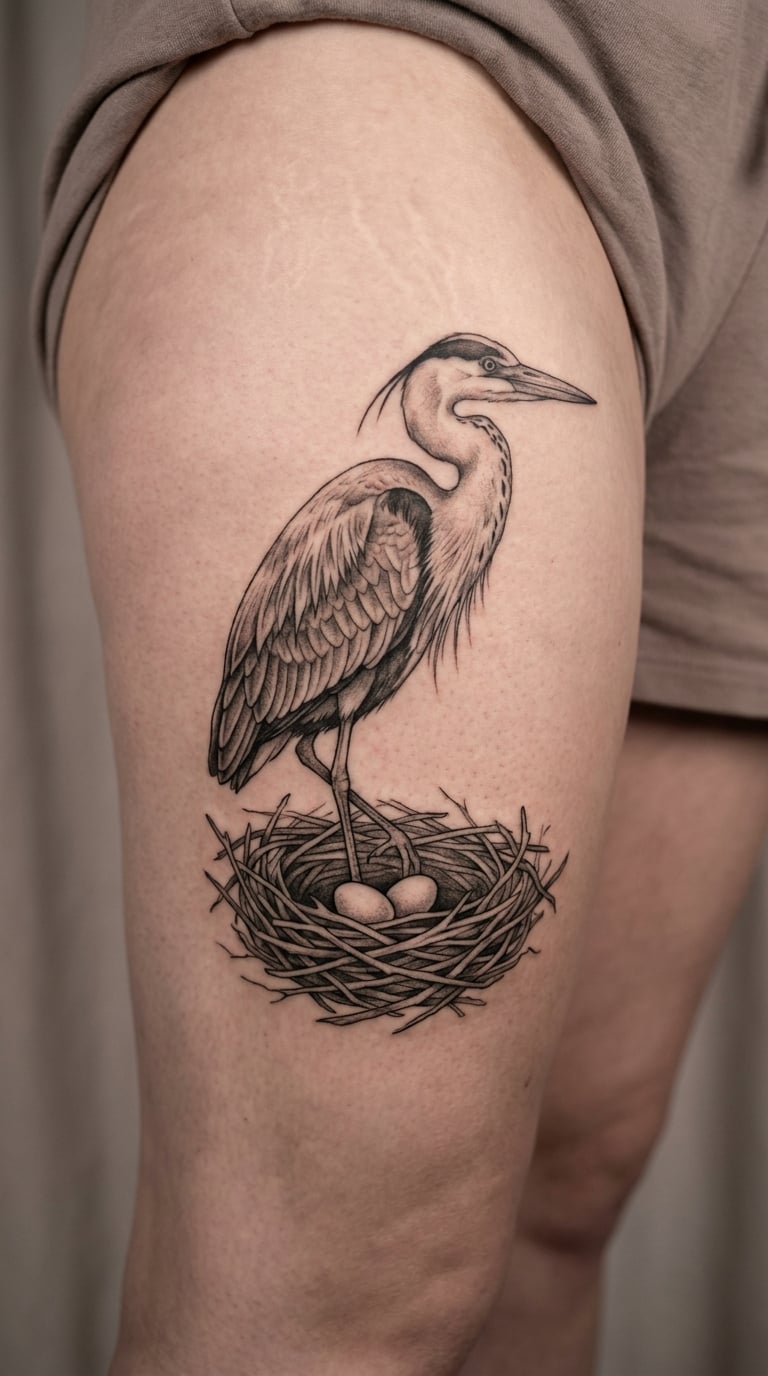
A nesting heron shows the bird low over a woven stick nest, usually with one or two pale eggs and the legs tucked. It is a less common choice than the flying or standing poses, which is exactly why it works for someone who has already got a bird design and does not want another one. The nest is drawn with crossed brown-grey lines, the bird with soft grey wash.
Home, shelter, and the version of yourself that someone else depends on. Plenty of wearers connect it to family without ever saying so out loud.
Placement: upper thigh, outer thigh, calf, lower back. Size: 6-9 inch (15-23 cm). Style: illustrative realism. Pain: medium. The thigh takes ink well and holds detail, which matters for the nest weave.
Make it yours: add a length of fishing line or a coil of rope on the nest rim, or include reeds behind the bird so it is clearly in a wetland rather than floating.
9. Heron and Reed Botanical Tattoo
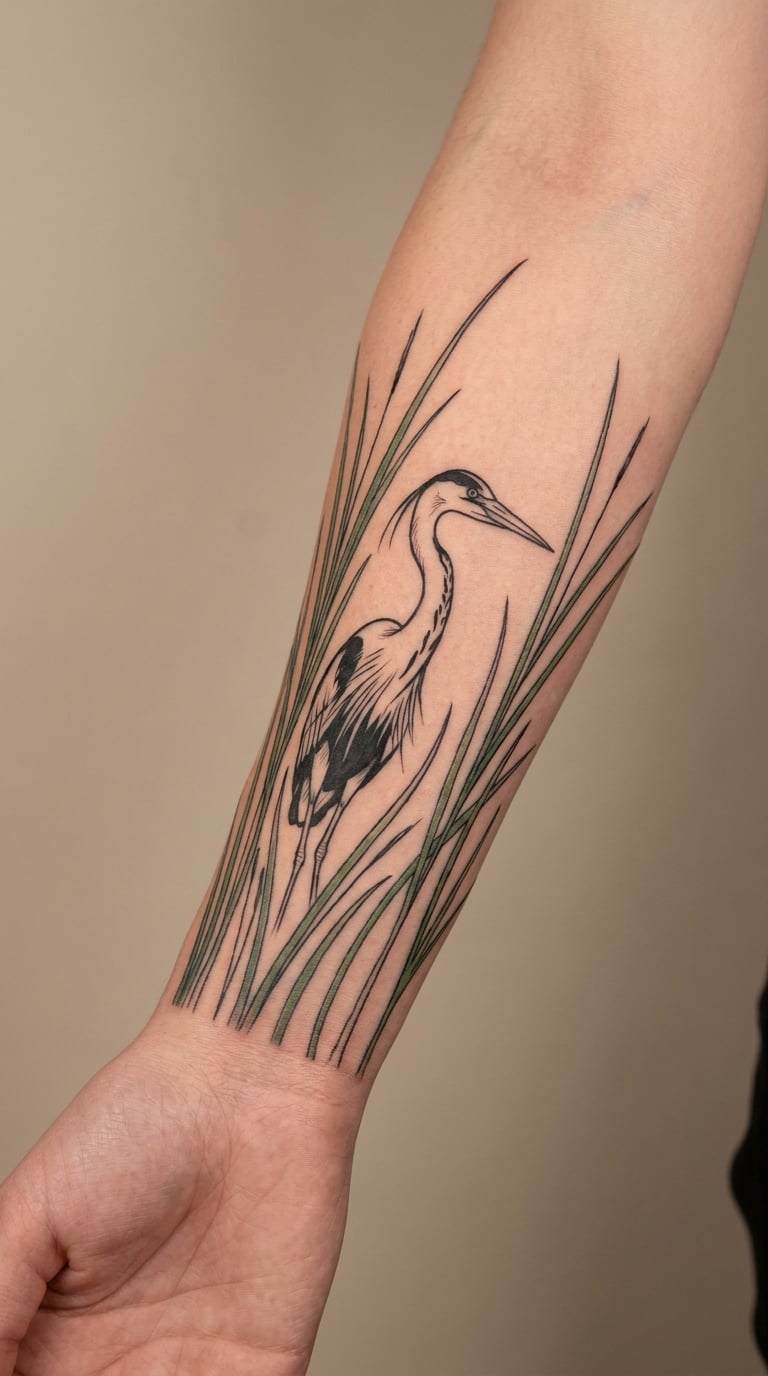
The heron and reed composition runs vertically, with the bird at the centre and reeds rising above and below it. The reeds are drawn as single tapering lines with a few narrow seed heads, and the heron is black line with light grey shading on the wing. Because the reeds make the design tall and narrow, it suits long limbs better than a square area.
It is a wetland compressed into a column. Some people add a place name to the base to make it specific.
Placement: inner forearm, calf, side of the leg, inner arm. Size: 8-12 inch (20-30 cm) tall. Style: botanical line. Pain: medium, rising toward the inner elbow. Many thin reed lines mean a longer session than the size suggests.
Make it yours: put the reeds in seasonal colour, muted green in one season and ochre in another, or name the wetland where you first saw a heron.
10. Blackwork Heron in Profile
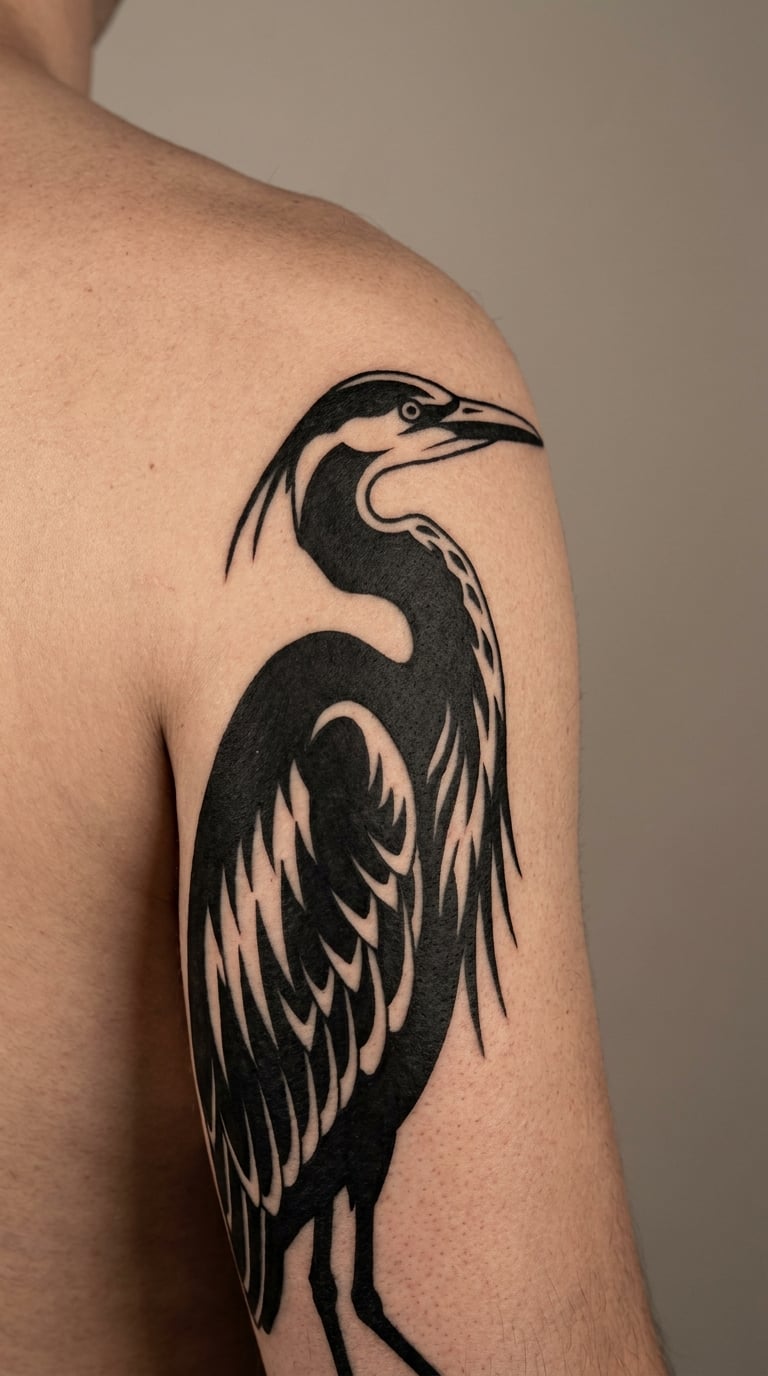
Blackwork heron in profile is one solid black shape with feather shapes cut out of it as negative space. The beak, eye and legs are drawn as white gaps rather than added lines, so the design stays readable at a distance and holds its contrast for years. This is the style to pick if you want a heron that stays graphic rather than turning soft and grey.
Weight and stillness. It is the least delicate of the bird styles here, which is exactly what makes it age well.
Placement: outer shoulder, outer upper arm, outer thigh, calf. Size: 7-11 inch (18-28 cm). Style: blackwork. Pain: medium. Large solid fills take longer and the shading pass is uncomfortable, but the needle work is efficient.
Make it yours: cut a date into the negative space along the wing, or break the bird into a black block and a line outline to mix solid and open areas.
11. Heron Silhouette with Sunset
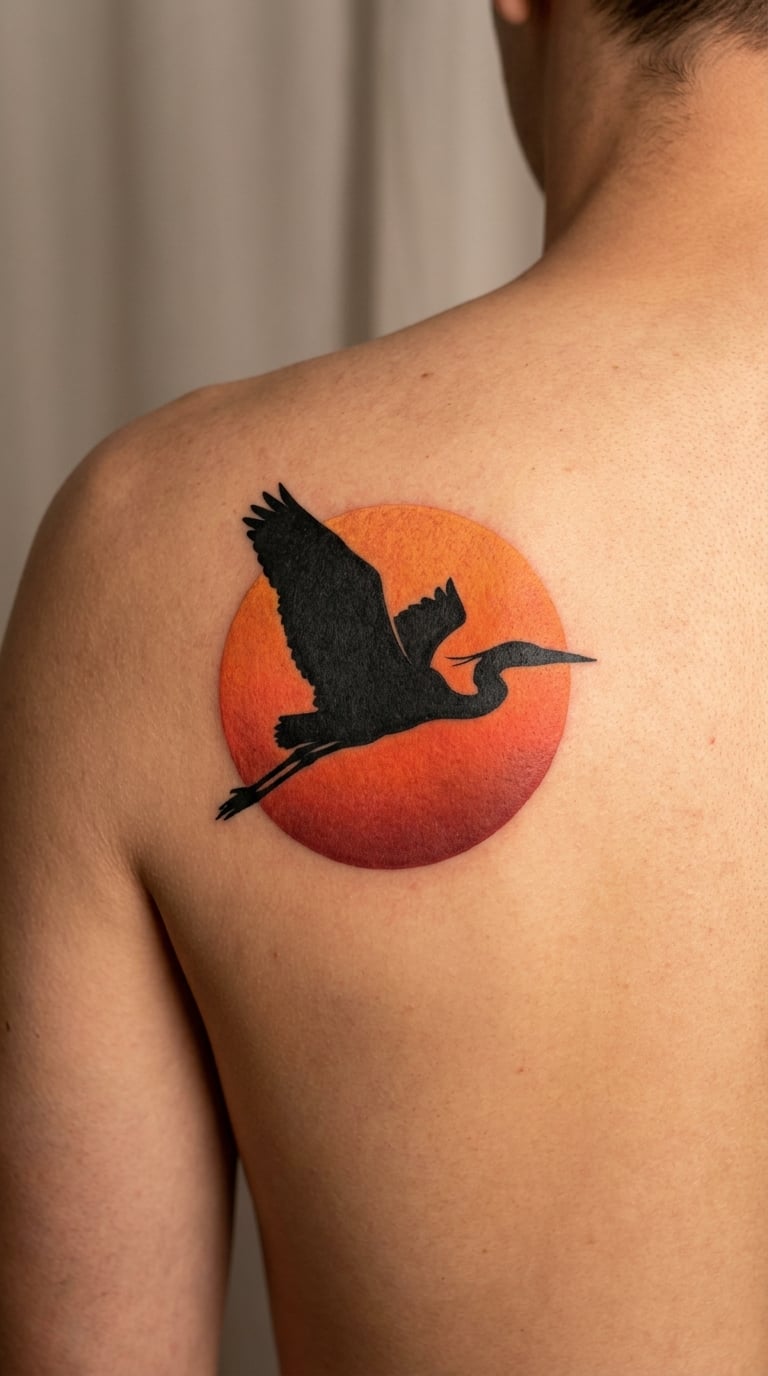
The heron silhouette with a sunset is two shapes and one colour decision: a solid black bird, wings spread, set against a warm disc. The disc is usually a gradient from deep red at the top through orange to pale yellow at the bottom, done as soft shading rather than a flat fill. Composition is the whole design, so the bird should either overlap the disc or sit clearly beside it, not hover ambiguously.
Movement against a fixed point. Warm versions feel hopeful, colder versions feel like dusk.
Placement: upper back between the shoulder blades, upper arm, chest. Size: 8-12 inch (20-30 cm) across. Style: silhouette with colour. Pain: low to medium. The back is a large flat area and the gradient passes are quick.
Make it yours: pick the sunset from a real place, or have the disc sit low so the bird appears to be flying into it rather than across it.
12. Dotwork Heron and Feathers
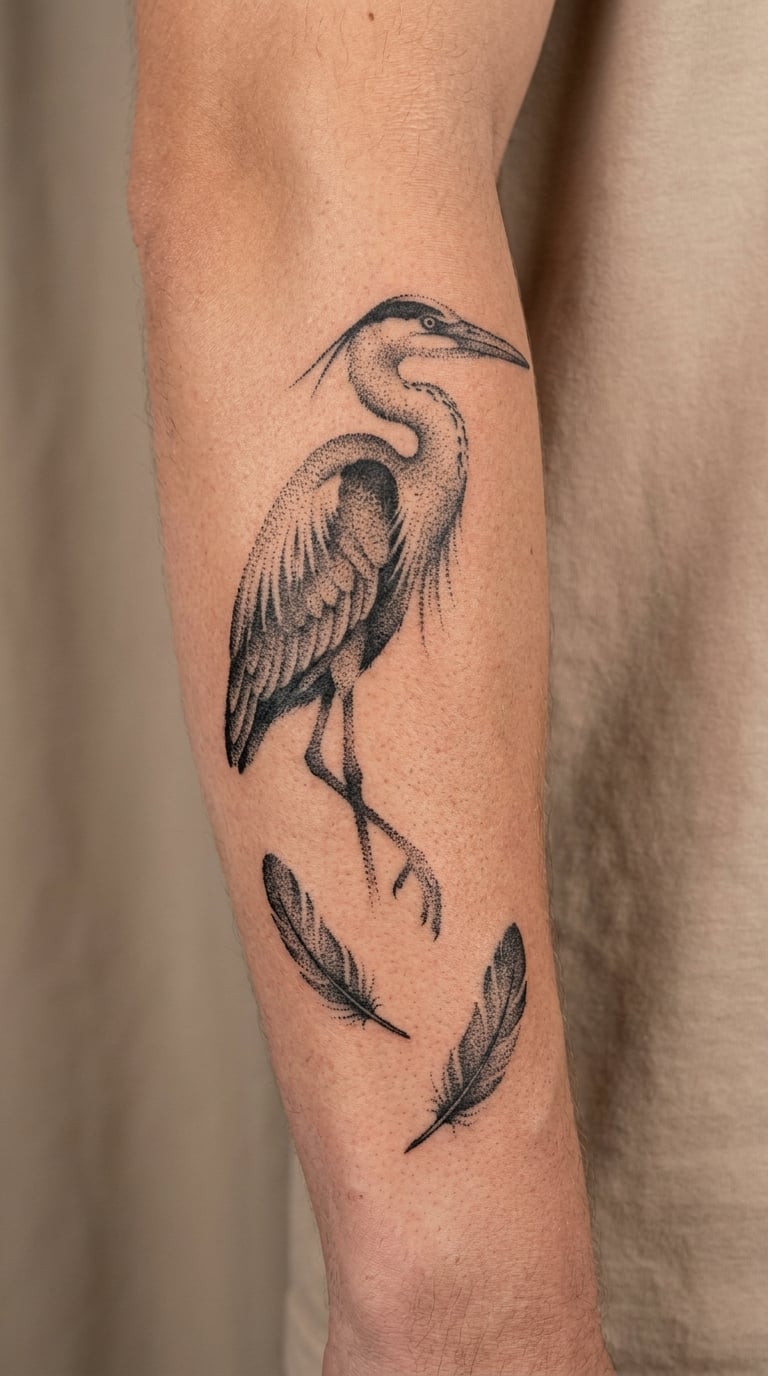
Dotwork builds tone out of nothing but dots, so the heron appears out of density rather than outline. Artists place the darkest dots on the body and the neck, thin them across the wing, and leave the legs as fine single lines. Adding one or two separate feather studies down the arm gives you a piece that fills a flat area without needing a background scene.
It rewards patience. Most people who choose dotwork want a slow, quiet session rather than a quick one.
Placement: outer arm, outer thigh, upper back, calf. Size: 10-16 inch (25-40 cm) for the full arrangement. Style: dotwork. Pain: low to medium, but the session is long. A full dotwork heron commonly runs three to five hours, sometimes split across two appointments.
Make it yours: have the dot density shift along a gradient so the bird fades into bare skin at one edge, or add your latitude as a row of dots.
13. Heron on the Wrist
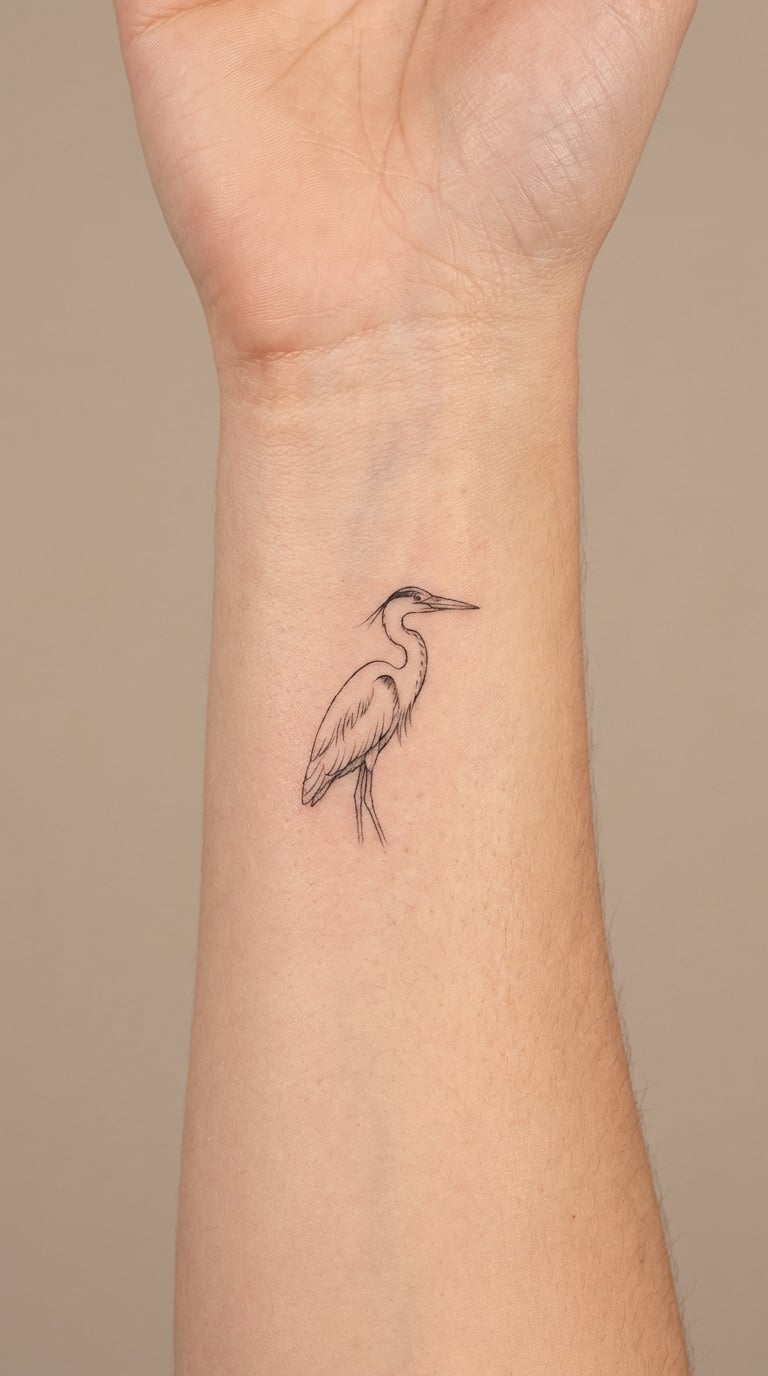
A wrist heron is fitted into a narrow, awkward strip, so the artist usually goes side profile with the beak pointing along the arm. Drawing a heron in full flight does not work at this width, because the wingspan has nowhere to go. The design has to be planned around the arm rather than dropped onto it afterwards, which is worth saying out loud at your consultation.
Small wrist birds are the practical choice, and most people who take that route stay glad of it.
Placement: inner wrist, just above the wrist on the forearm, ankle. Size: 2-3 inch (5-8 cm). Style: fine line, side profile. Pain: high. Wrists and ankles are bony and the nerve runs close to the surface, so the first pass genuinely hurts more than most body areas.
Make it yours: run a thin water line under the bird along the wrist crease, or add a second, much smaller bird facing the other way.
14. Heron and Moon
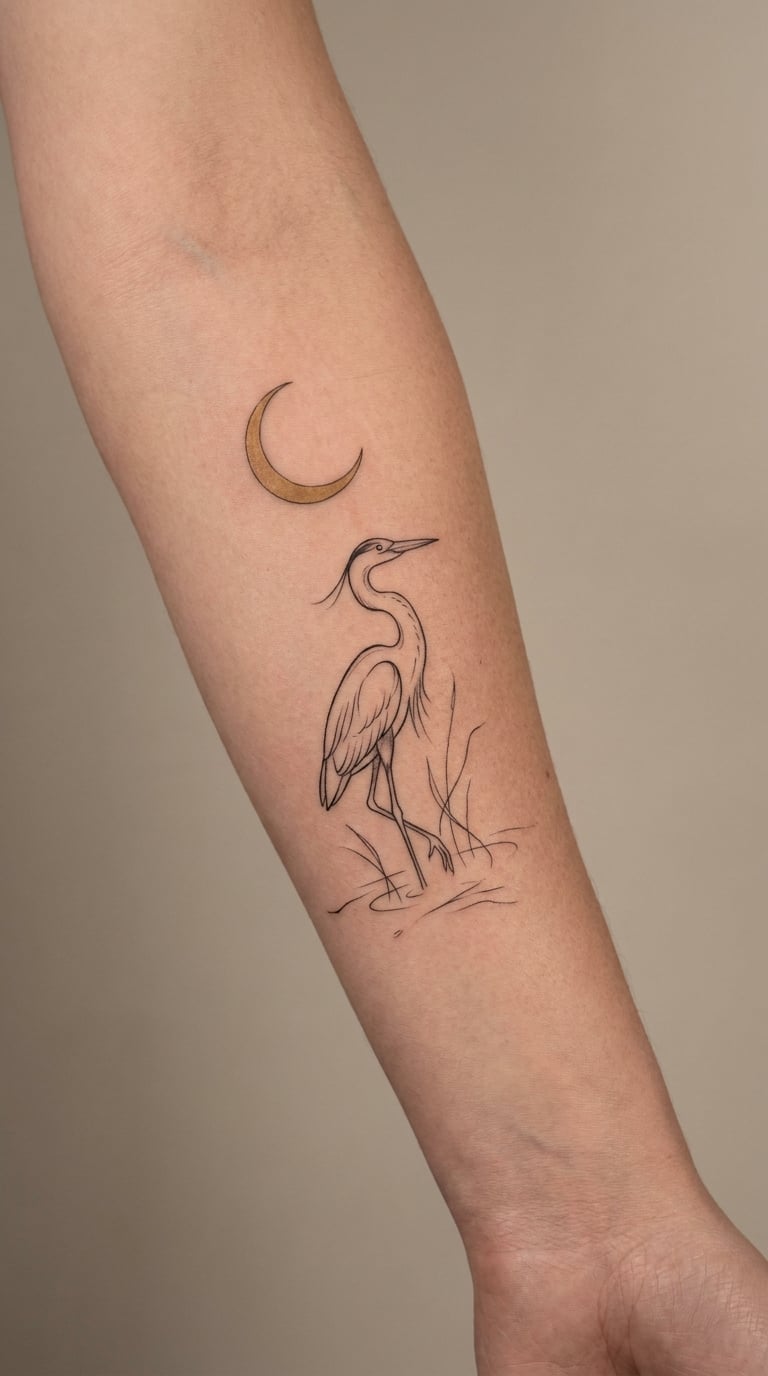
Heron and moon designs are about spacing. A standing heron with a thin crescent placed above the head works because the empty space between them carries the composition. The moon is usually a single line crescent, sometimes filled with a muted gold or left as outline. A full moon disc instead of a crescent changes the piece to a daytime scene.
Night birds, patience, something that happens quietly over a long time. Readers take different things from it.
Placement: outer forearm, calf, side of the upper arm, upper back. Size: 4-7 inch (10-18 cm). Style: fine line with a single accent. Pain: medium. The forearm is comfortable; the calf and outer arm are close to it.
Make it yours: add your birth phase as a small circle and crescent pair, or scatter two or three four-point stars in the space the moon leaves open.
15. Heron in Geometric Frame
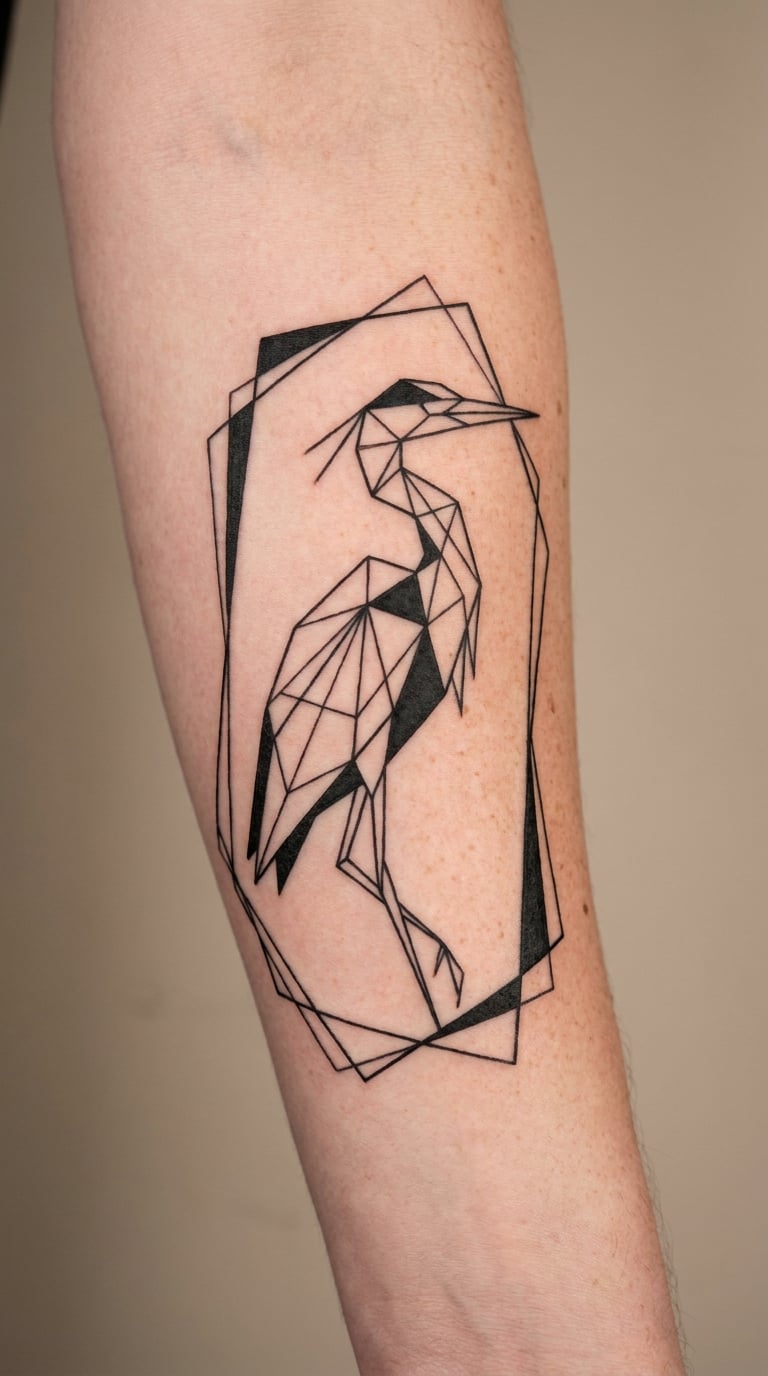
The geometric heron is drawn with straight lines only, so the curved bird is broken into triangles, long thin panels and empty frames. The outer frame is a separate element, usually a thin angular border that the bird sits inside rather than touches. The effect is contemporary and architectural, and it depends on the artist being precise, because a geometric piece shows a wobble more than any other style here.
Structure and control, which is a strange fit for a bird and part of the interest.
Placement: forearm, calf, inner arm, side of the thigh. Size: 5-8 inch (13-20 cm). Style: geometric, contemporary. Pain: medium. The filled panels take an extra pass and the frame lines are slow going.
Make it yours: break the frame so the beak crosses outside the border, which stops the piece looking like a diagram, or fill every other panel to make a stripe pattern.
16. Colorful Heron in a Marsh
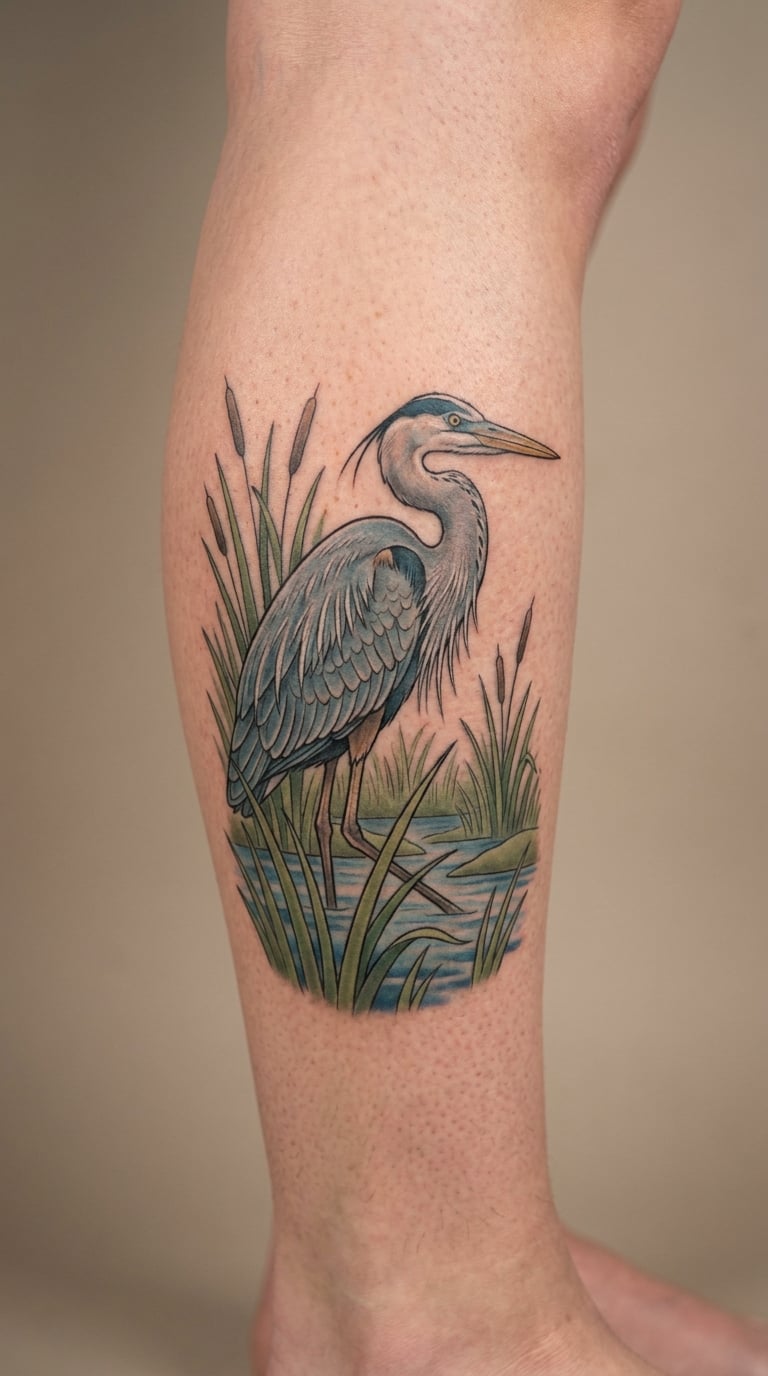
A colour marsh scene gives the heron a full environment: green grass blades in front, blue water behind, and the bird in blue-grey plumage with the yellow-orange beak as the brightest point. Layering is what sells it. The foreground grass sits darker and sharper, the water behind is loose and pale, and the heron sits between the two so it reads as being in the scene rather than pasted on top.
It is a place-based piece, so it works best with a real location behind it.
Placement: calf, upper back, outer thigh, lower back. Size: 10-15 inch (25-38 cm) tall. Style: colour realism. Pain: low to medium over a large area. A piece this size is normally done in two sessions.
Make it yours: paint in the water and plants of a wetland you have actually stood in. If you want a broader water piece, our ocean sleeve layouts show how the same layering reads at full-arm scale.
17. Heron Feather Micro-Tattoo
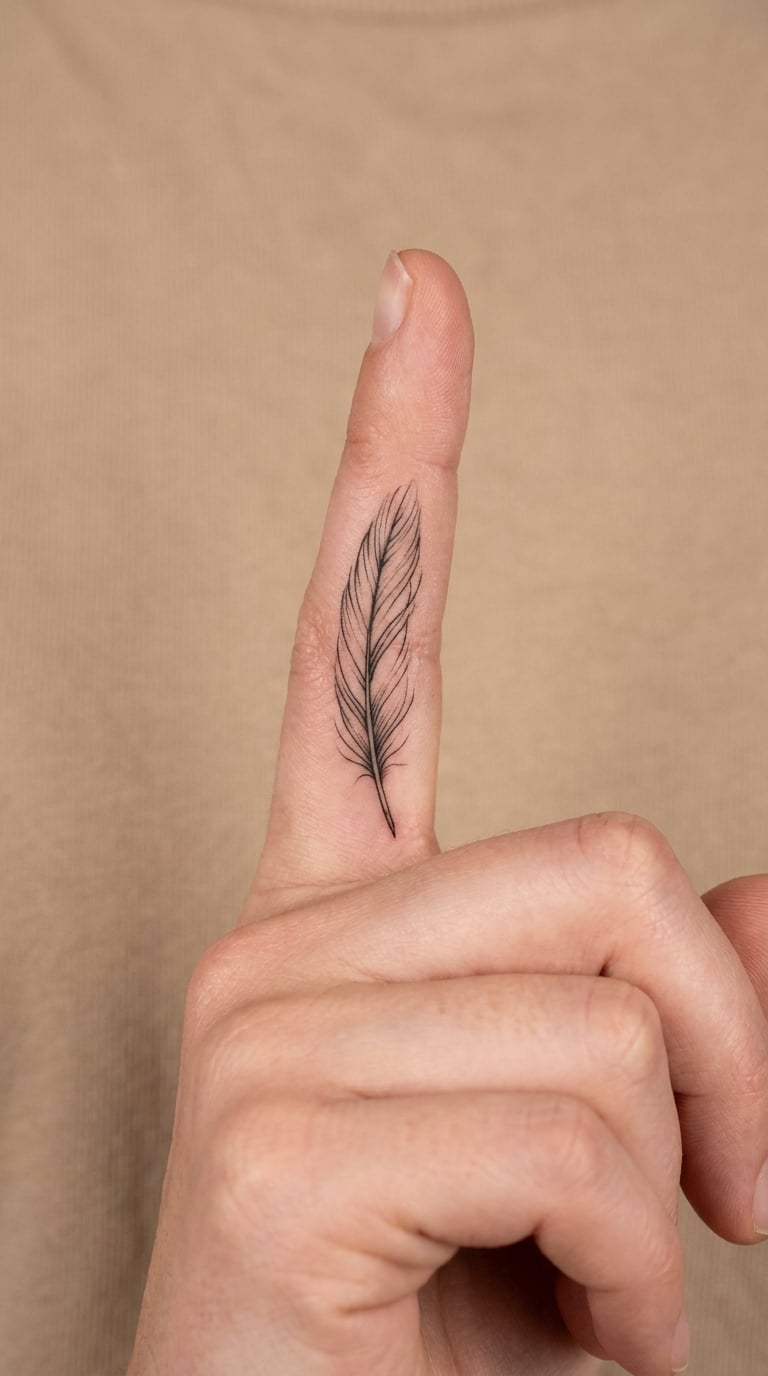
The heron feather is the answer for anyone who wants the bird but not a whole bird. A single feather, drawn with a fine central shaft and a handful of barbs, carries the same connection to the bird without the space a full design needs. Some people take three feathers in a row, one for each member of something that matters to them.
No fixed meaning attaches to it. People usually say it is the bird they noticed most, or the water they grew up near.
Placement: side of the index or middle finger, inner wrist, behind the ear, along the collarbone. Size: under 1.5 inch (4 cm). Style: micro fine line. Pain: high, especially on the fingers. Fingertips and knuckles are quick to hurt, and the ringing in the tooth is part of it for a lot of people.
Make it yours: ask for the feather to be slightly bent or mid-shed rather than straight, which reads more like a real feather and holds better at that size.
18. Neo-Traditional Heron with Flowers
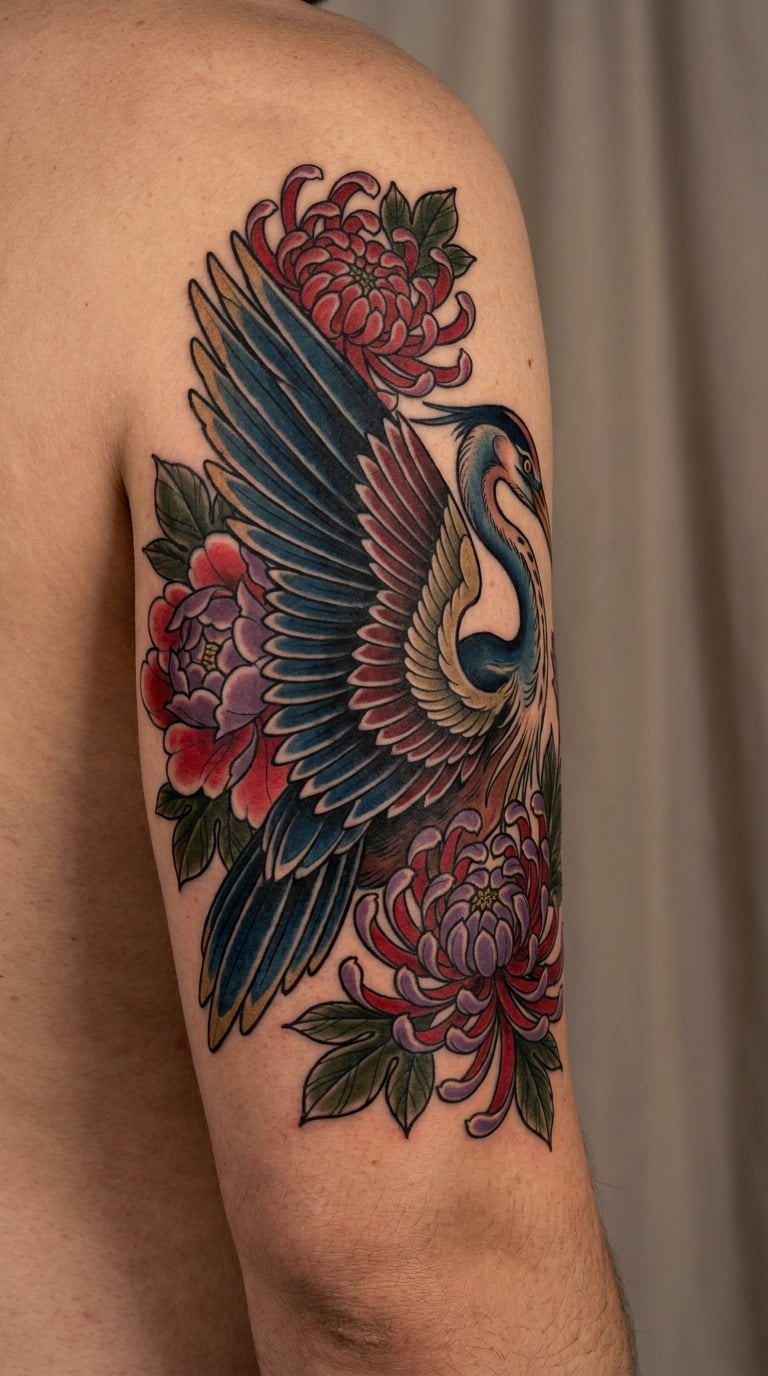
Neo-traditional heron work keeps traditional structure but adds dense colour, smooth gradient shading and heavy outlines. The bird gets a fully layered wing in blues, greys and one warm accent, and the flowers around it are usually peonies, roses or thistles in saturated red, purple or pink. The composition is crowded on purpose, with the bird slightly turned so there is room for foliage.
Colour, movement and a bit of old-school flash drawing. It suits people who like a tattoo that shows off the colouring.
Placement: upper arm, outer thigh, back, or as part of a floral sleeve. Size: 7-10 inch (18-25 cm). Style: neo-traditional. Pain: medium. Colour packing in the flowers and the wing is the long part, and it is the part that needs a second sitting.
Make it yours: choose flowers from a real bouquet or a specific plant from where you live, and let the heron be the only cool colour in the piece.
19. Heron and Dragonfly
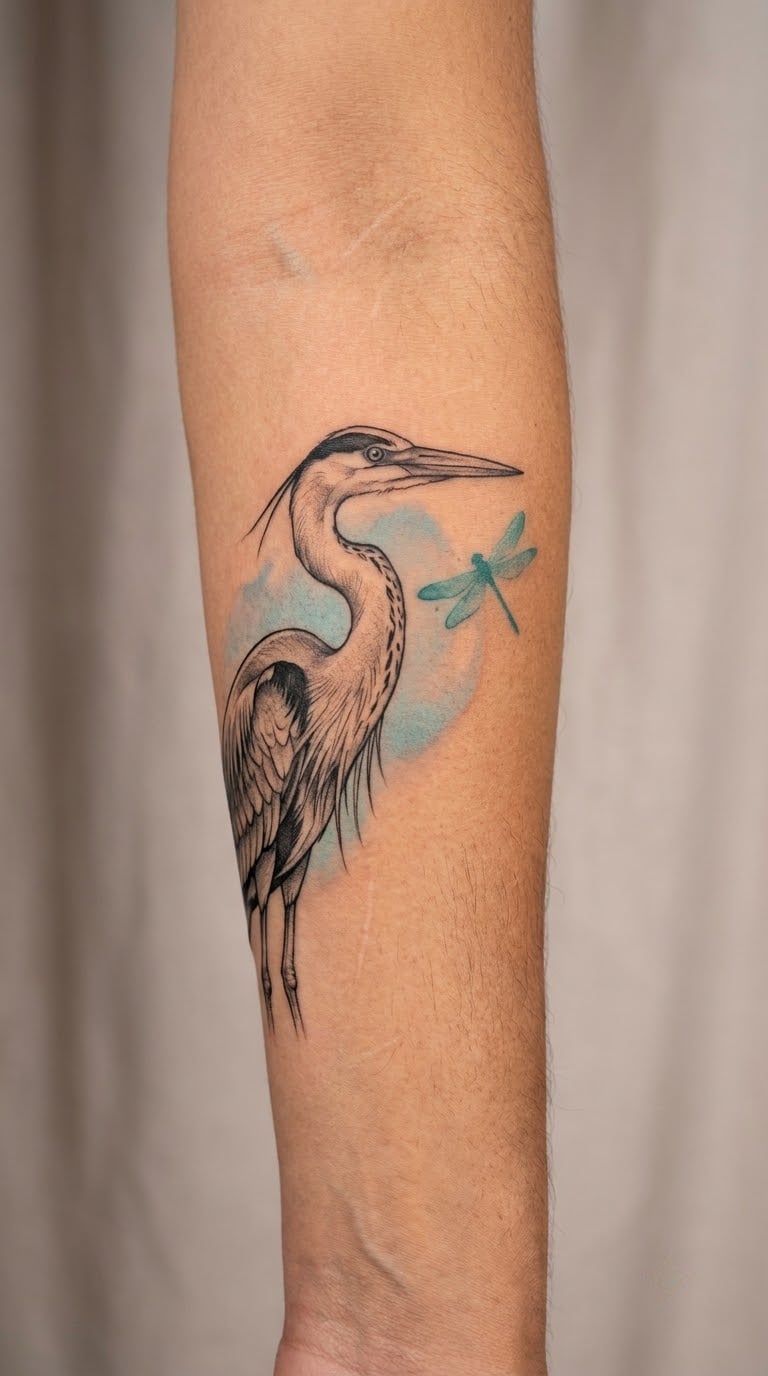
The dragonfly is the natural counterweight to the heron: the bird is tall, still and vertical, the insect is small, fast and horizontal. Designers usually set them side by side rather than overlapping, with the heron in black and grey linework and the dragonfly carrying the colour. Scale contrast does most of the work here, so the dragonfly should be visibly smaller than the bird.
Stillness and speed in one piece, which is why the pairing works better than either bird or insect alone.
Placement: inner arm, calf, inner forearm, ankle. Size: 5-8 inch (13-20 cm). Style: black and grey with a colour accent. Pain: medium. The ankle version hurts more than the arm version at the same size.
Make it yours: set the dragonfly in motion with a faint blue trail across the skin, so the two elements point at each other instead of sitting side by side.
20. Minimal Heron Line on the Ribs
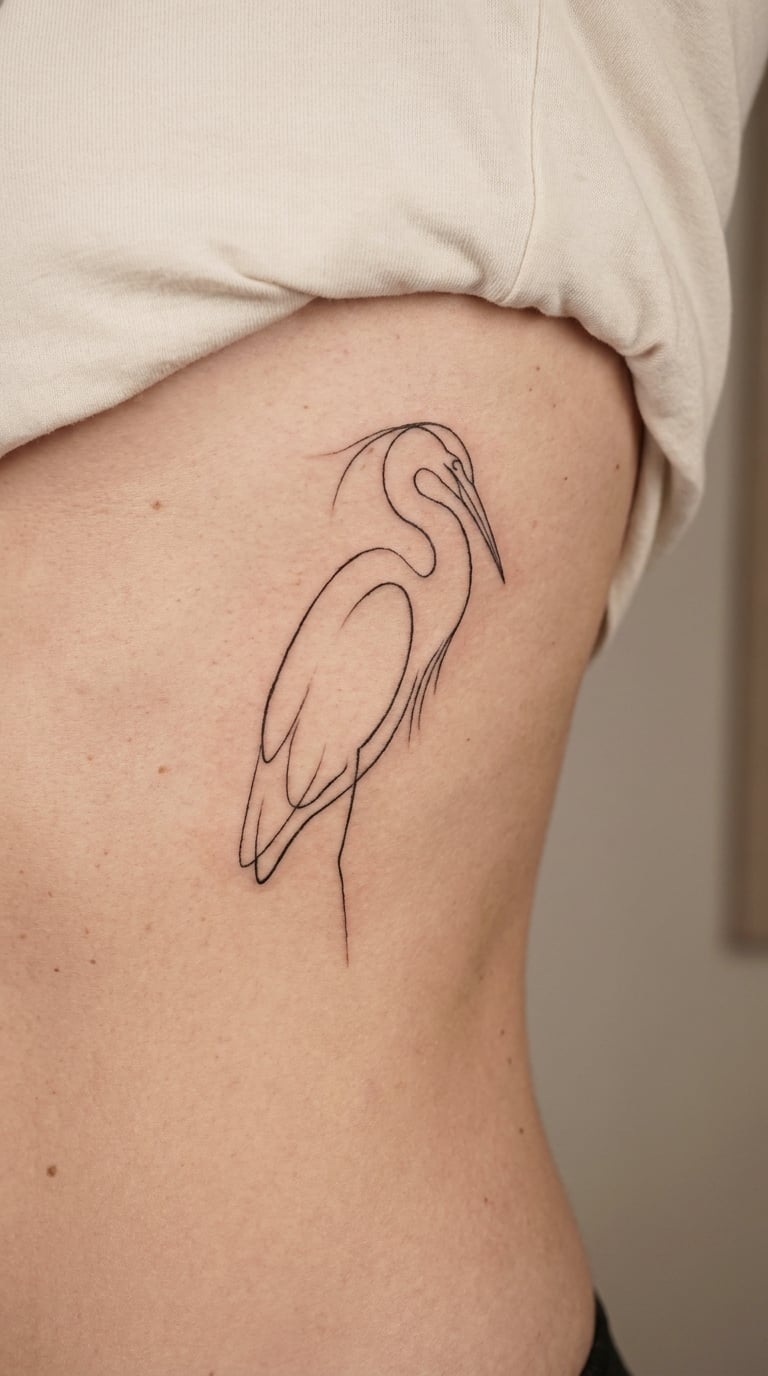
Rib line work is about following the body. The heron is drawn in profile with its long beak angled to follow the curve of the rib cage, so the design changes shape depending on how you sit and move. A beak that runs straight down the side will distort badly; one that follows the contour holds up. Artists usually keep this one to a single unbroken outline with no fill.
Body placement, so the tattoo moves with you. That is the whole appeal and also the reason it never sits perfectly still in a photo.
Placement: ribs, side torso, flank, lower back. Size: 7-10 inch (18-25 cm). Style: minimalist line. Pain: high. Bony areas and the rib edge are among the more sensitive places to work, and the breathing makes it harder to hold still.
Make it yours: place it beside an existing line tattoo so the two lines meet at the hip, or add a faint water line running parallel to the beak along the lower ribs.
21. Heron and Mountain Lake Scene
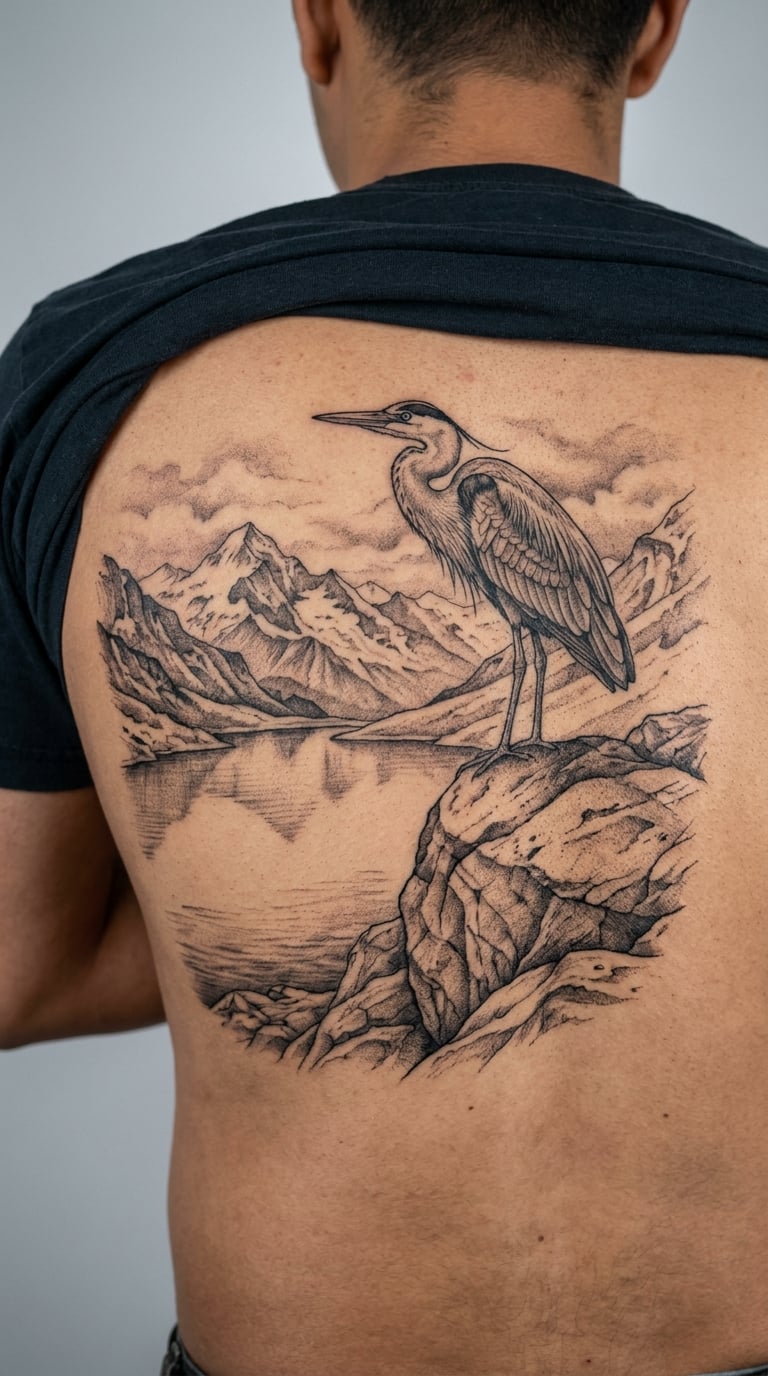
The heron and mountain lake scene is the largest design in the list. The heron stands in the foreground on a rock or the bank, a flat lake runs behind it, and two or three mountain ridges recede into the distance. The far ridge is the palest and the closest is the darkest, which is what makes the depth read. Colour can stay muted or go full, and both work as long as the layering holds.
It is a place piece. The lake and the mountain are doing as much work as the bird.
Placement: upper back, outer thigh, lower back, chest. Size: 12-18 inch (30-45 cm) across. Style: illustrative realism. Pain: low to medium over such a wide area, but expect two or three sessions.
Make it yours: use the ridge line of somewhere you have actually been. Our mountain and ocean tattoo pairings cover the landscape-layering side of this in more depth.
22. Matching Heron Pair
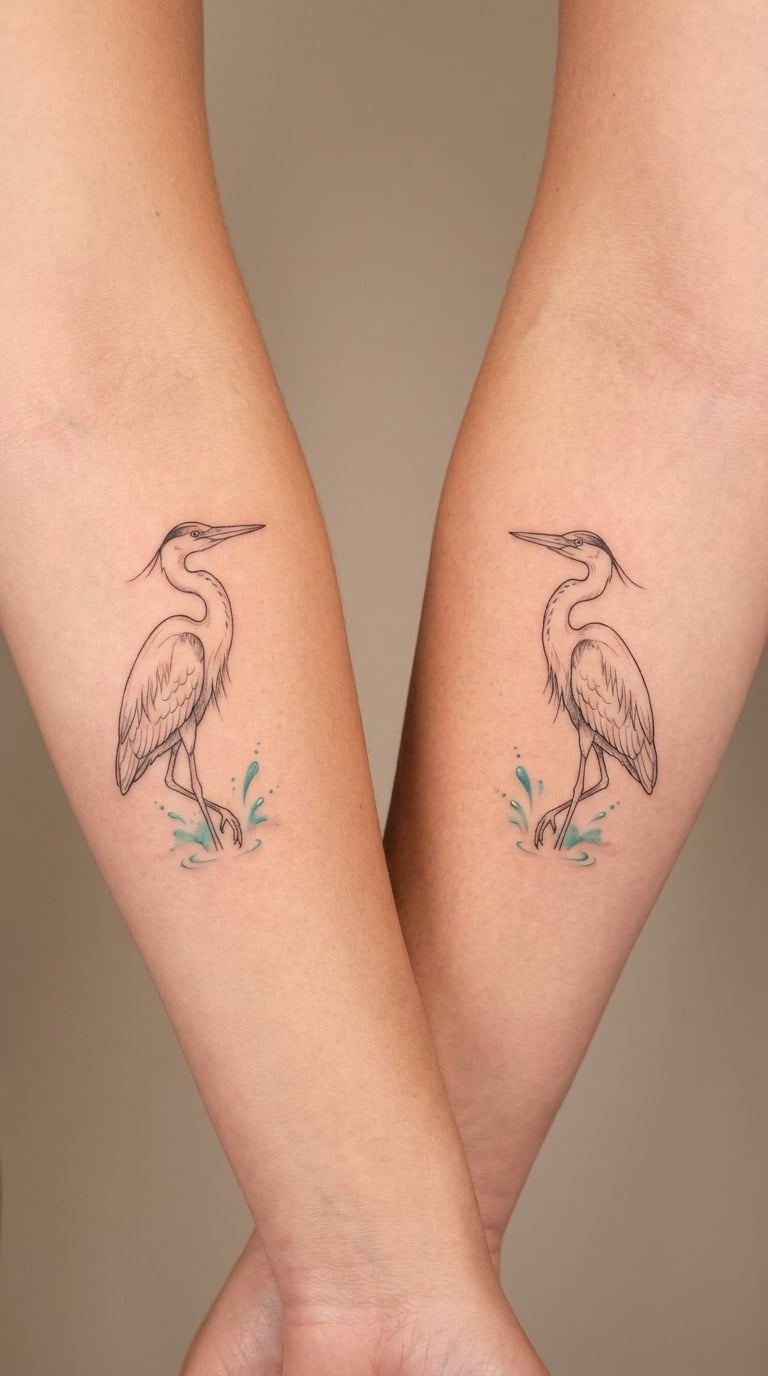
A matching heron pair is two related birds on two people, or two birds on one person. Matching herons usually face inward so the beaks point toward each other across the body, which reads well when your arms are side by side. They can be identical or complementary, where one bird is in flight and the other stands, and both approaches work. Ask the artist to draw both designs on one sheet, because two birds that are nearly the same look like a mistake.
Shared, without being generic. The inward-facing pairing is a small thing that makes the set feel designed rather than duplicated.
Placement: inner forearms, outer ankles, behind the ears, or the inside of each wrist. Size: 3-5 inch (8-13 cm) each. Style: fine line, mirrored. Pain: high on the inner forearm and wrist because of the bone and the visible vein. Make it yours: add a matching date in the same style and position on both pieces, or have one bird carry colour and the other stay black and grey.
If you are coordinating with someone, our matching tattoo sets for roommates cover the practical side of booking two pieces together.
How to Choose the Right Heron Design
Start with the area you have, not the design you like. A 4 inch design on a 3 inch wrist will be redrawn smaller than you pictured, and the beak is the first thing to go.
- Fine line: the most delicate and the most likely to soften. Best on flat, sheltered areas like the inner forearm and calf. Ask for a slightly heavier line depth than feels right in the drawing.
- Blackwork and geometric: hold contrast longest and suit large flat areas such as the outer shoulder, outer arm and thigh.
- Neo-traditional and traditional: forgiving with detail because the bold outline carries the shape even if small shading blurs. Workable almost anywhere.
- Watercolour and colour realism: best on areas big enough to hold real depth, so a calf or an upper back rather than a wrist. Both need more than one session and a touch-up later.
- Realism: the highest effort. Budget a full day and expect a return sitting for shading.
Then check how small is too small. A standing heron with visible leg and beak needs about 3 inches (7.5 cm) to read properly, and a flying heron needs more because the wings have to fit. Below 1.5 inches, the legs, the eye and the beak merge into a shape that stops being recognisable. If the spot is small, pick a single feather or a folded-wing bird instead of forcing a full design into it.
Finally, match the artist to the style rather than the subject. Plenty of skilled tattooists do not work in watercolour or dotwork at all, and a fine-line bird in the wrong hands looks thin and apologetic. Send reference images of healed work in the style you want, not just the bird.
Cost and Session Time
US rates for a heron tattoo usually fall in these ranges, and they vary by city, artist and shop minimum.
- Small pieces, under 3 inches (7.5 cm): roughly 120 to 300 dollars, or about 30 to 90 minutes.
- Medium pieces, 3 to 7 inches (7.5 to 18 cm): roughly 300 to 900 dollars, usually two to three hours, sometimes split across two appointments.
- Large pieces, over 7 inches (18 cm): roughly 800 to 2500 dollars or more, worked over several sessions.
Hourly rates in most US studios sit between 100 and 250 dollars, and a fine-line bird on a wrist is often priced at the shop minimum rather than by the hour. Dotwork and watercolour take longer than their size suggests because of the shading passes, so a dotwork heron can be a full session while a blackwork heron of the same size is not.
Two practical things to ask about at the consultation: whether the quote covers a single sitting or the whole design, and whether touch-ups in the first year are included. Colour work especially often needs one, and it should not cost extra.
Aftercare Basics
- Follow your artist’s aftercare instructions first. They know how deep your particular lines went and what this skin will do, and they override anything general.
- Clean gently with lukewarm water and unscented soap, twice a day for the first few days. Pat dry with a clean towel rather than rubbing.
- Keep it covered and away from sun while it heals. Loose clothing over fresh ink matters more than any product you put on it.
- Do not soak it, and keep swimming pools, hot tubs and the ocean out of it until the skin is fully closed, usually a couple of weeks.
- Expect colour to look different once it settles. Watercolour and colour realism are the two styles here that change the most in the first weeks.
- Moisturise thinly once the surface has healed and started flaking. Too much ointment traps heat and is the most common own-goal in the early days.
If something feels unusual, like heat spreading well beyond the tattoo, a thick puffy outline, or discharge, stop guessing and contact the studio, then your doctor. That is general caution, not a diagnosis.
Frequently Asked Questions
What does a heron tattoo mean?
A heron is usually chosen for the way the bird itself behaves: it stands perfectly still while it waits, then moves in one sharp strike. That reads as patience, focus and grace, and it connects the wearer to water and open country. People also pick it for the long neck and legs, which carry a sense of composure. The meaning is personal, so there is no single fixed answer.
What is the difference between a heron, a crane, an egret and a stork?
A heron flies with its neck folded into an S-curve. A crane flies with its neck stretched straight out, which is the fastest way to tell them apart in a tattoo. Egrets are herons, mostly white and often smaller, so a white heron design is usually an egret. Storks are heavier, with longer straight bills and broader wings. If you want a specific bird, name the species to your artist.
What size should a heron tattoo be?
At least 3 inches (7.5 cm) for a standing heron so the legs, eye and beak stay separate, and 4 to 6 inches (10-15 cm) for a flying bird with wings spread. Below 1.5 inches (4 cm) the features merge. Inner forearm, calf and outer upper arm take larger work well; wrists, ankles and behind the ear are best kept small or switched to a single feather.
Where is the least painful place to get a heron tattoo?
The upper arm, chest, upper back and outer thigh are the calmest spots because the skin is thicker and away from bone. Wrists, ankles, the ribs and behind the ear hurt more, mostly because the skin is thin and the nerve sits close to the surface. Duration matters too: a small heron behind the ear is quick but sharp, while an upper arm piece is slower and easier.
How long does a small fine-line heron tattoo last?
Fine line is the first style to soften, typically over five to ten years, and it softens faster on hands, fingers and the neck where skin is thin. Bump the line depth slightly heavier than the drawing looks to paper, keep it out of strong sun, and expect a single touch-up in the first year. Blackwork and traditional hold their edges far better for this reason.
How do I avoid a heron tattoo mistake?
The most common problem is scaling, not drawing. Sizing a design for a spot it does not fit is what makes a beak and legs disappear, so take your measurements to the consultation. Two herons on a small arm is the second common one, since two birds need roughly twice the width. Ask to see healed work in your chosen style, and agree the full size before anything starts.
Which Heron Idea Fits You Best
For a first tattoo, take the minimalist standing heron or the small wrist bird. Both are quick, both are easy to live with, and neither locks you into a style you may not want in ten years.
If you are adding to a collection, go bigger and bolder: the blackwork profile or the marsh scene will sit well next to existing work because they hold contrast instead of competing with it. Bring measurements to the consultation, take healed reference photos to the artist, and settle the real size before anything starts.