
24 Stay Grounded Tattoo Ideas: Simple, Meaningful Designs (2026)
These 24 stay grounded tattoo ideas are small, calm designs built from roots, stone, water, mountains and steady everyday objects. Each one gives you a realistic size, a placement that actually fits the shape, an honest pain note and one way to make it personal.
They suit anyone who wants a tattoo to carry a reminder rather than decoration alone: first-timers nervous about committing to something big, frequent travellers, and people going through a season of change. What makes a grounded design work on skin is a clear silhouette, a balanced composition and a limited palette. Small, calm linework reads better than busy detail at almost any size.
A stay grounded tattoo is any design, natural or symbolic, chosen to hold ideas like stability, deep roots and a steady connection to the earth. Anchors, roots, stone stacks, compasses and open hands all read as rooted because they borrow shapes from things that hold fast to the ground. There is no single official meaning, so most people add one private detail to make it theirs.
24 Stay Grounded Tattoo Ideas: Quick Guide
| Idea | Style | Best Placement | Size | Pain |
|---|---|---|---|---|
| Fine-line grounding roots | Fine line | Inner forearm | 2-4 in (5-10 cm) | Low to medium |
| Minimal mountain peak linework | Minimal line art | Outer forearm or wrist | 2-4 in (5-10 cm) | Medium |
| Grounded compass rose | Line art, minimalist | Inner wrist | 2-3 in (5-8 cm) | Medium |
| Open-hand earth motif | Minimalist line art | Inner forearm | 2-3 in (5-8 cm) | Low to medium |
| Wabi-sabi stone arrangement | Black and grey realism | Wrist, ankle, forearm | 2-3 in (5-8 cm) | Low to medium |
| Dotwork seedling | Dotwork | Wrist, inner arm, behind ear | 1.5-2.5 in (4-6 cm) | Low to medium |
| Blackwork river stones | Blackwork | Calf, forearm, shoulder | 2-4 in (5-10 cm) | Medium |
| Simple anchor with rope | Traditional, minimal line | Forearm or calf | 2-3 in (5-8 cm) | Medium |
| Micro-realism oak leaf | Micro-realism | Forearm or calf | 2-3 in (5-8 cm) | Low to medium |
| Barefoot sand and waves | Illustrative | Calf, shoulder, foot | 2-4 in (5-10 cm) | Medium |
| Still-water ripple | Illustrative | Wrist, shoulder, lower back | 2-3 in (5-8 cm) | Low to medium |
| Balanced rock and fern | Illustrative botanical | Forearm, calf, ankle | 2-4 in (5-10 cm) | Medium |
| Grounded pine tree | Blackwork, traditional | Forearm, calf, upper arm | 3-5 in (8-13 cm) | Medium |
| Hand holding a tiny sprout | Micro-realism | Forearm or shoulder | 3-4 in (8-10 cm) | Medium |
| Four-way grounding cross | Modern minimal | Wrist, upper arm, calf | 2-3 in (5-8 cm) | Medium |
| Clay vessel and wildflower | Illustrative | Forearm, calf, shoulder | 2-3 in (5-8 cm) | Medium |
| Turtle on a simple horizon | Illustrative | Calf, forearm, upper arm | 2-3 in (5-8 cm) | Medium |
| Matcha bowl minimalism | Minimal illustrative | Forearm or calf | 2-3 in (5-8 cm) | Low to medium |
| Mountain lake reflection | Illustrative scene | Forearm, calf, shoulder | 3-5 in (8-13 cm) | Medium |
| Hourglass with a small plant | Contemporary illustrative | Wrist, forearm, calf | 2-3 in (5-8 cm) | Medium |
| Minimal globe held in two hands | Minimal illustrative | Forearm, shoulder, upper back | 3-4 in (8-10 cm) | Medium |
| Stacked pebbles and crescent | Minimal illustrative | Forearm, calf, behind ear | 2-4 in (5-10 cm) | Medium |
| Footprint connecting two dots | Minimal illustrative | Foot, calf, forearm | 2-4 in (5-10 cm) | Medium |
| Personal grounding symbol map | Illustrative | Forearm, calf, shoulder | 3-5 in (8-13 cm) | Medium |
1. Fine-Line Grounding Roots
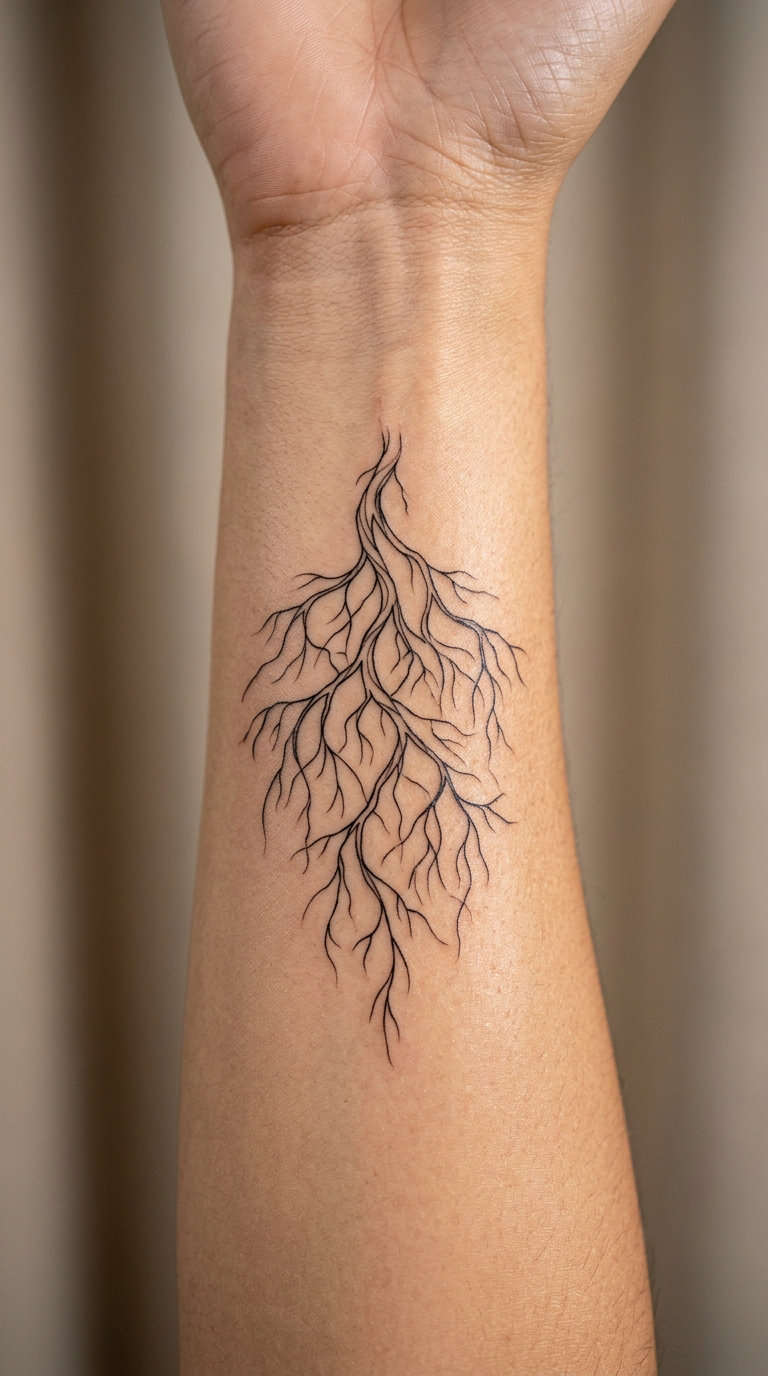
This design is a root system drawn in tapered black lines, thickest at the top and thinning as the roots spread downward, with minimal shading and no outline box around it.
People choose it because roots are a plain visual shorthand for staying put. Nobody reads a fixed meaning into it, so the design carries whatever you bring to it.
Placement: Inner forearm, lower third, so the roots run back toward the wrist. Size: 2-4 inches (5-10 cm). Style: Fine line.
Pain: Low to medium. Fine details can soften as the years pass, so a slightly heavier line weight on the main roots pays off.
Make it yours: Add the month or place that marks the moment you most wanted to be steady.
2. Minimal Mountain Peak Linework
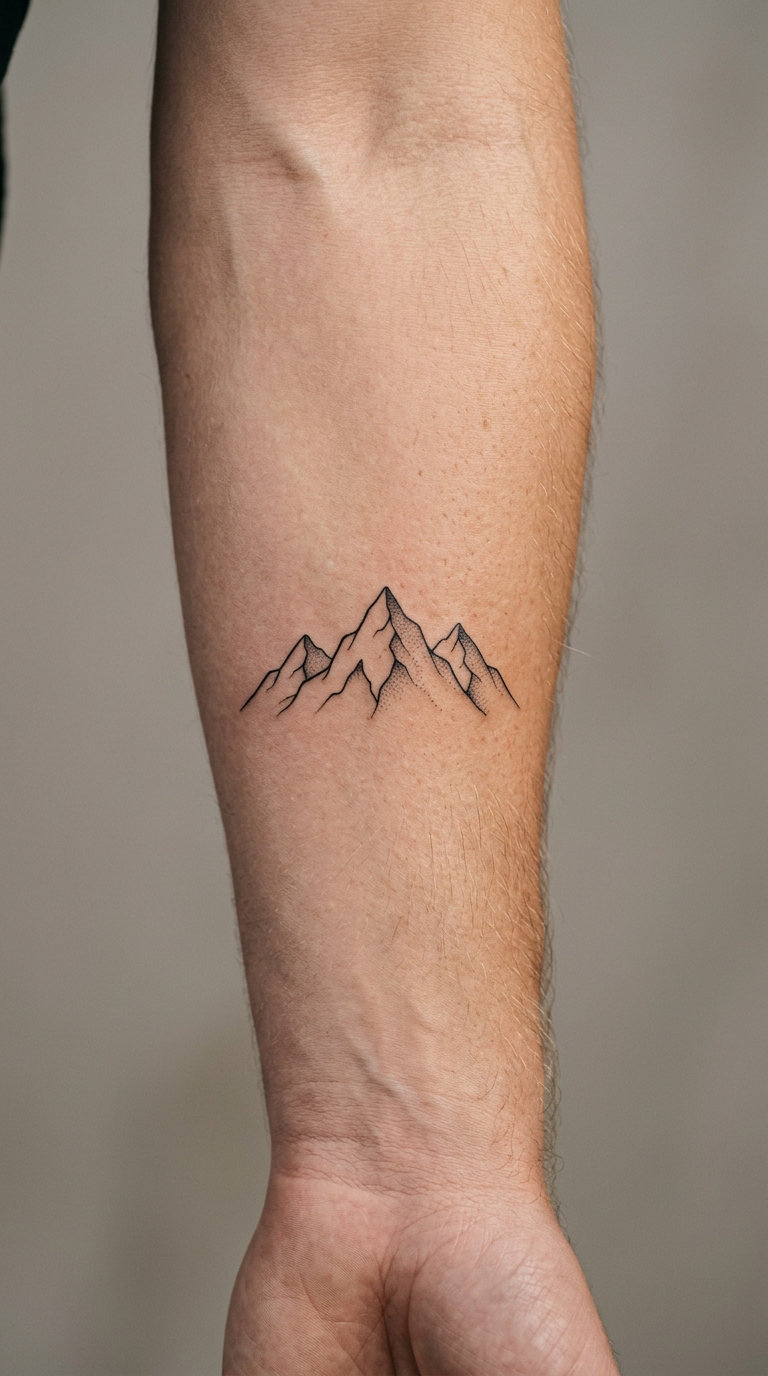
A single mountain silhouette in clean black contours, with two or three peaks of uneven height and optional dotwork filling the shaded slopes. No snow caps, no banner text, no drop shadow.
Mountains read as things that do not move, which is why this sits comfortably in the grounded category. The meaning is borrowed from the shape rather than assigned by an artist.
Placement: Outer forearm or inner wrist. Size: 2-4 inches (5-10 cm). Style: Minimal line art.
Pain: Medium at the wrist, where skin is thin over bone. Hairline peak details are the first to blur with sun exposure, so ask for a touch more weight.
Make it yours: Have the artist tuck the coordinates of a place that steadied you into the lowest ridge.
3. Grounded Compass Rose
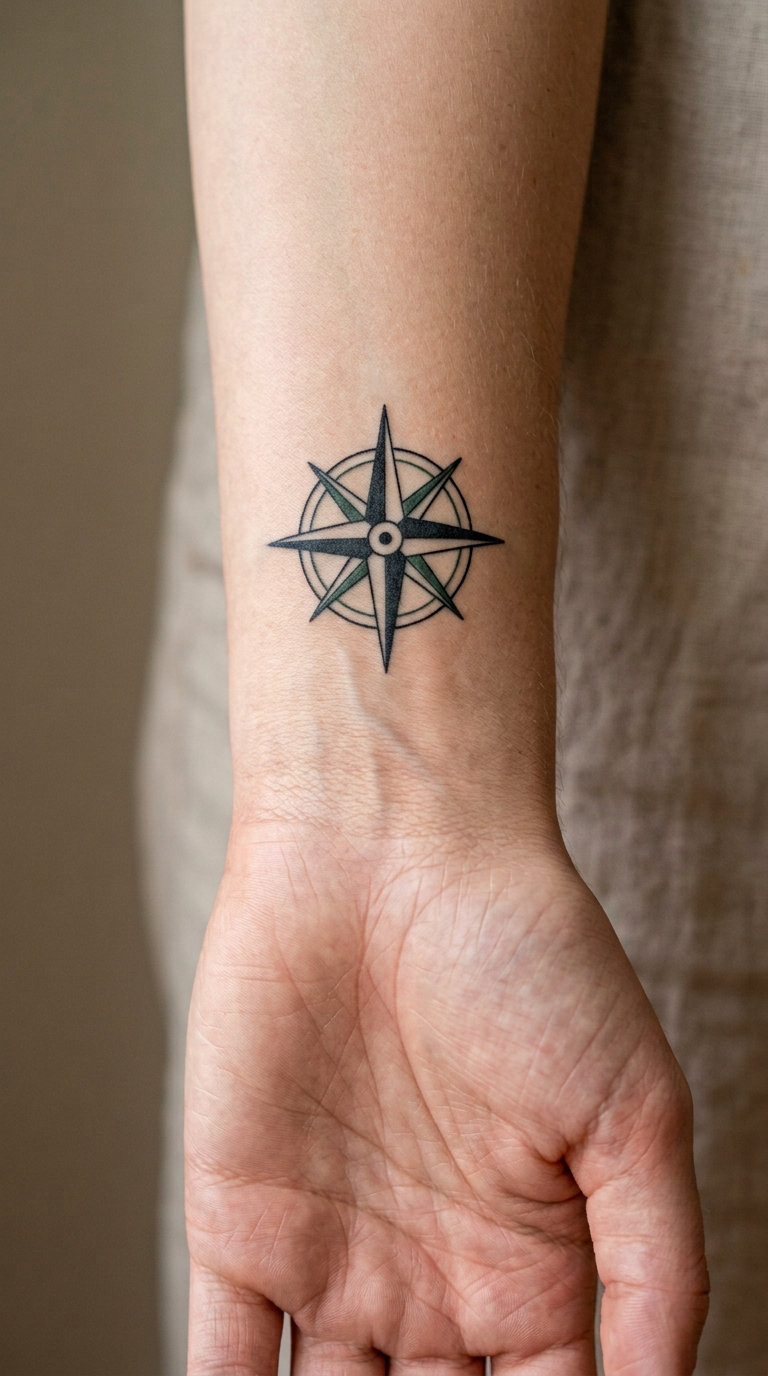
A compact compass built from restrained geometric lines: one long north point, two shorter side points, a small circle at the centre and one optional muted green fill.
Direction and balance are the reasons people reach for it. It is a symbol you will read differently depending on where your own life is pointing.
Placement: Inner wrist, above the wrist crease. Size: 2-3 inches (5-8 cm). Style: Line art or minimalist.
Pain: Medium, and the inner wrist bruises visibly for a day or two. Tiny points and any lettering soften quickly, so keep the design open rather than packed.
Make it yours: Replace the centre with a small longitude or latitude from somewhere that matters to you.
4. Open-Hand Earth Motif
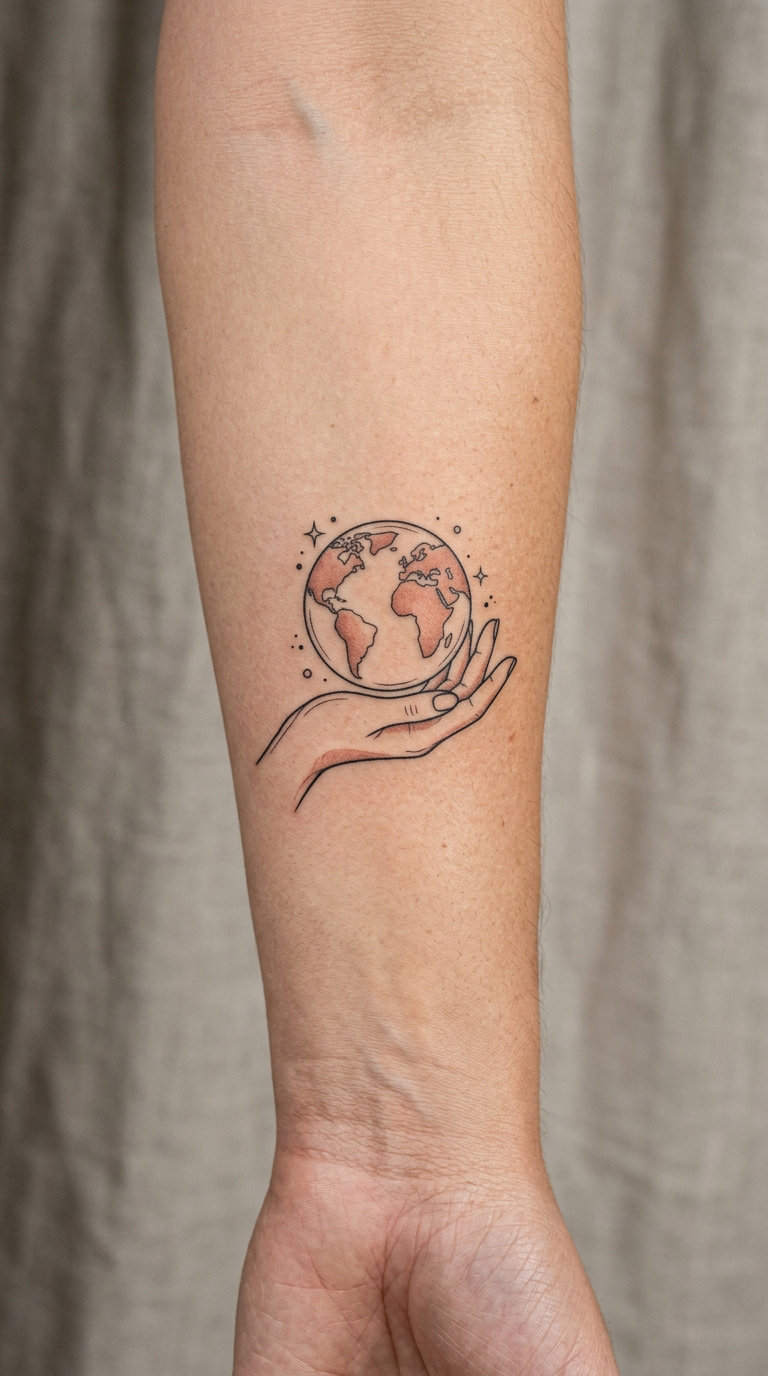
A simplified open hand, fingers slightly apart, with a small circle or thin horizon line resting above the palm. Clean black contours with an optional wash of earthy red in the circle.
An open hand is often described as offering, holding or letting go, and the circle underneath gives it a sense of something being supported. People interpret it differently, and that is part of the appeal.
Placement: Inner forearm, centred. Size: 2-3 inches (5-8 cm). Style: Minimalist line art.
Pain: Low to medium. Details close to fingers age fastest, because that skin is mobile and exposed to friction, so keep the linework slightly bolder near the fingertips.
Make it yours: Tint the circle with the colour of a birthstone or a place you go to think clearly.
5. Wabi-Sabi Stone Arrangement
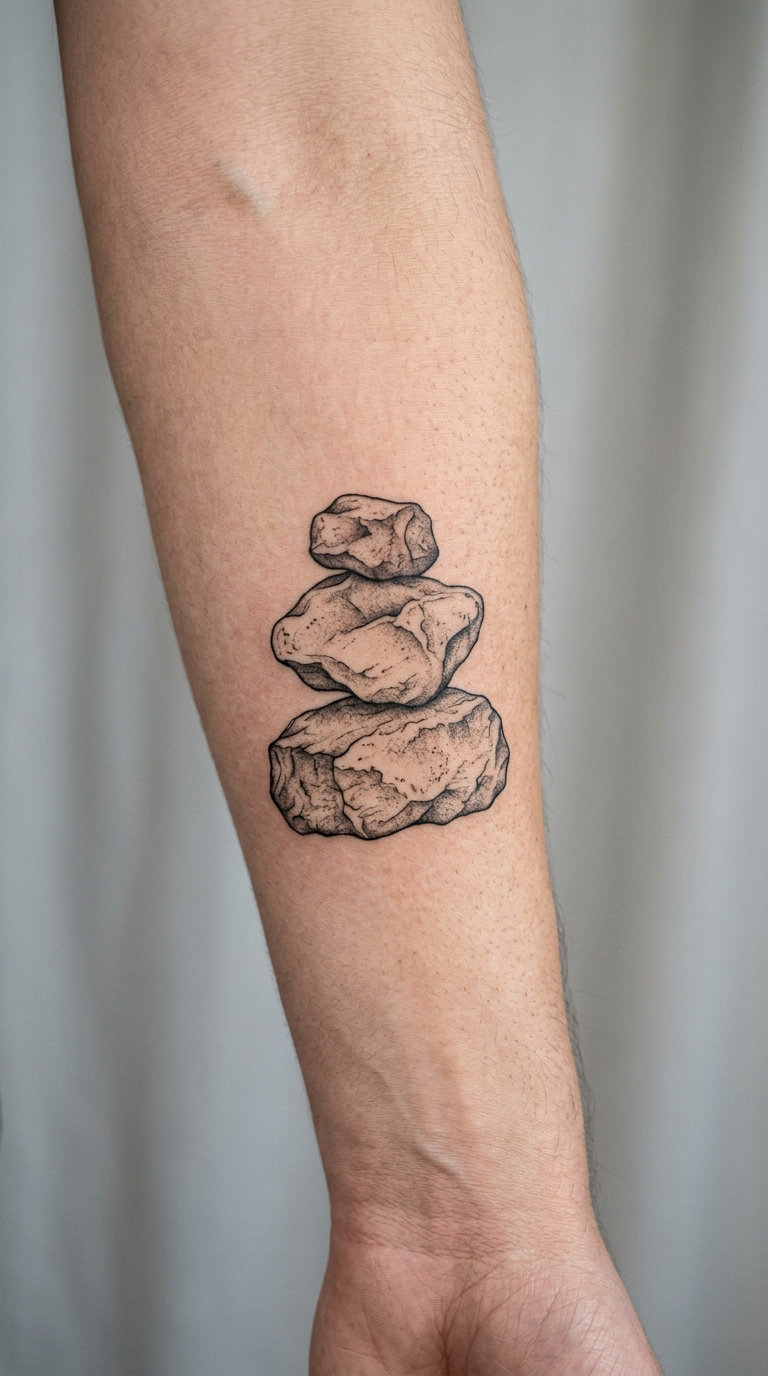
Three uneven stones sitting on top of one another, rendered in black-and-grey realism with sparse speckled texture and a little negative space between them.
The composition feels calm because nothing about it is symmetrical, and people often pick it as a quiet nod to balance without announcing it.
Placement: Wrist, ankle or forearm. Size: 2-3 inches (5-8 cm). Style: Black-and-grey realism or simple contour work.
Pain: Low to medium. Tiny texture dots can blur together as they heal, so ask for slightly larger speckles and space between them.
Make it yours: Have the three shapes echo rocks from a viewpoint you have actually stood on.
6. Dotwork Seedling
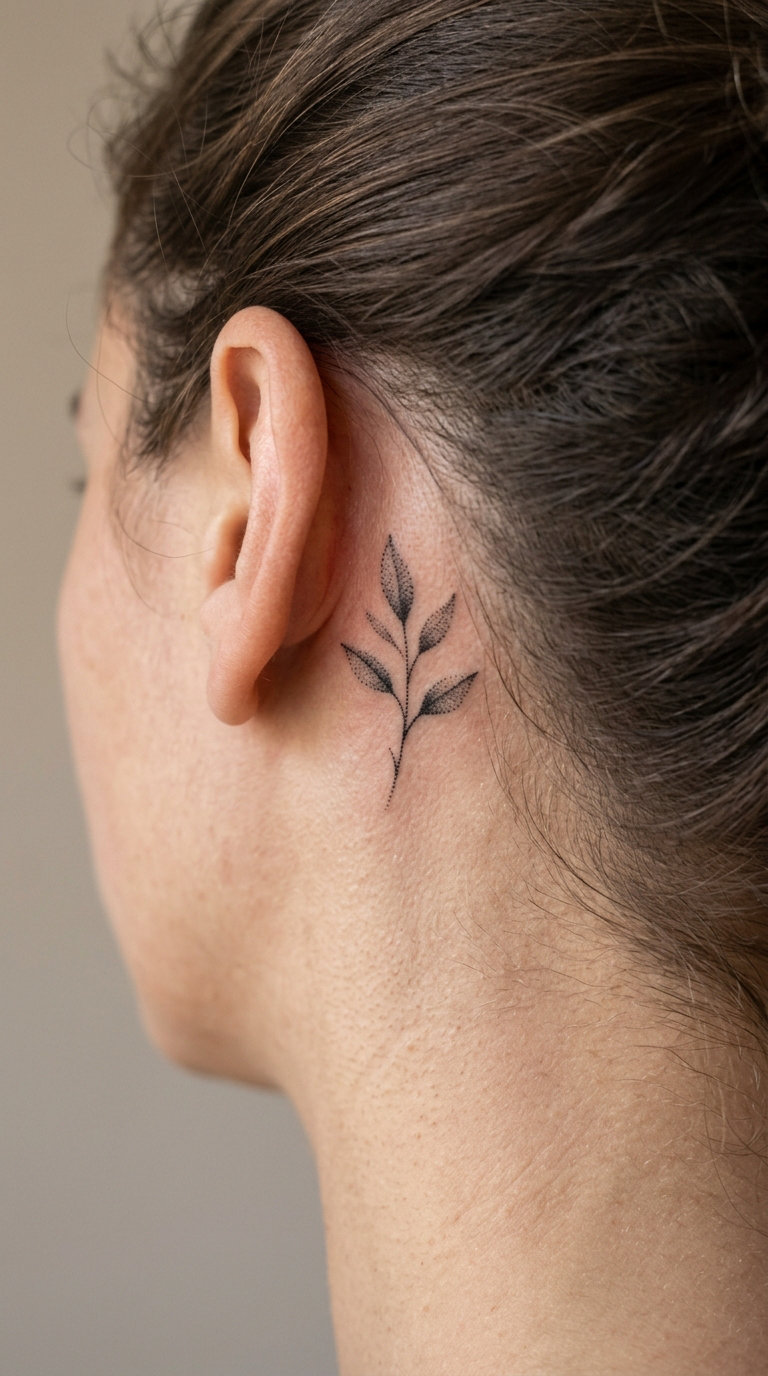
One seedling with a thin stem and two small leaves, the shading built entirely from graded dots rather than solid black.
Growth imagery reads as renewal and starting over, though nobody expects everyone to mean the same thing by it. The quietness of dotwork suits a small piece.
Placement: Wrist, inner arm or behind the ear. Size: 1.5-2.5 inches (4-6 cm). Style: Dotwork.
Pain: Low to medium. Every dot needs protecting through the first weeks, and fine dot work is among the first things to lose definition, so avoid planning a follow-up piece in the same spot too soon.
Make it yours: Pair it with a small birth flower from someone close to you.
7. Blackwork River Stones
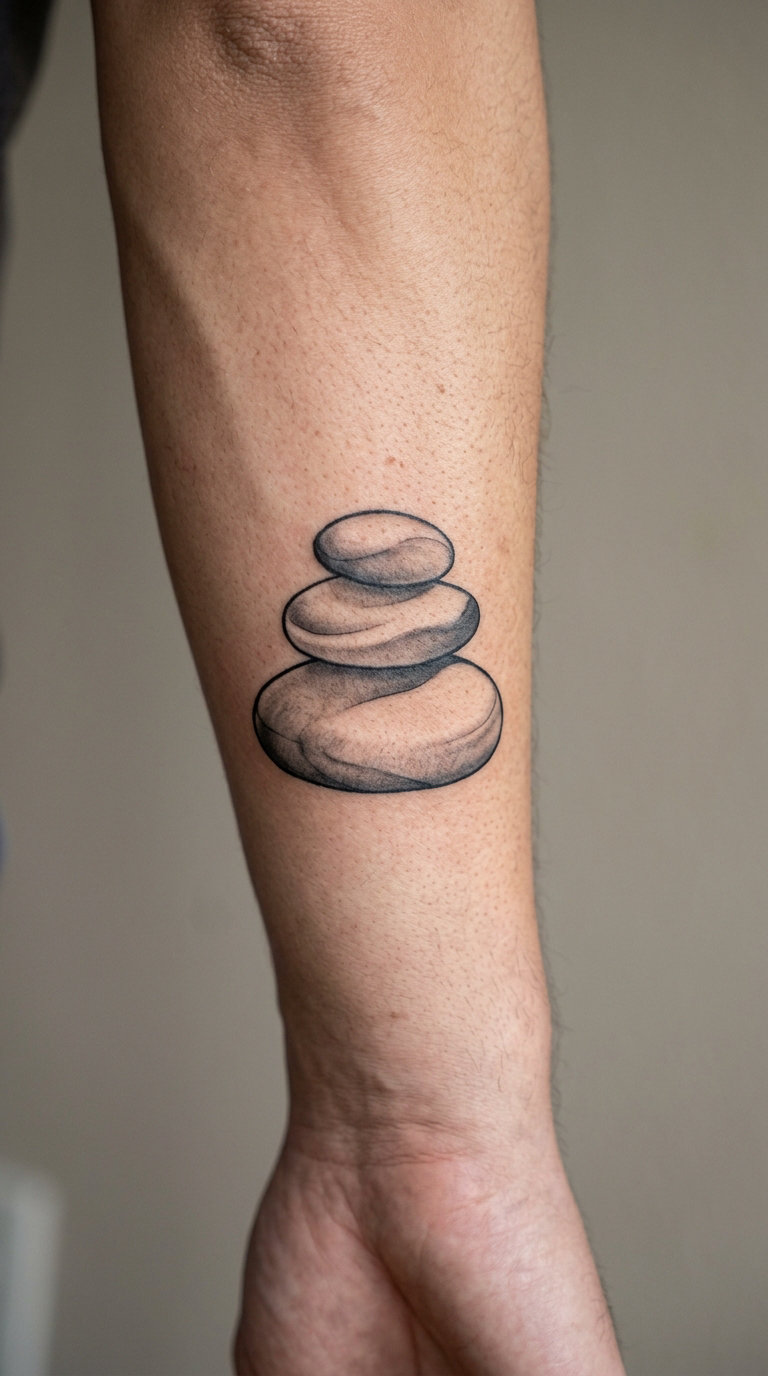
A compact cluster of smooth river stones in dense black and grey wash, with the darkest values on the shadowed undersides and clean white space on top.
It is picked for an earthy visual weight rather than a single symbol, and broad blacks hold their shape for years better than hairlines do.
Placement: Calf, forearm or shoulder. Size: 2-4 inches (5-10 cm). Style: Blackwork.
Pain: Medium. Solid black fills feel heavier than line work and take longer, so book a longer appointment even though the design is simple.
Make it yours: Put the outline of a river that mattered to you inside one of the stones.
8. Simple Anchor with Rope
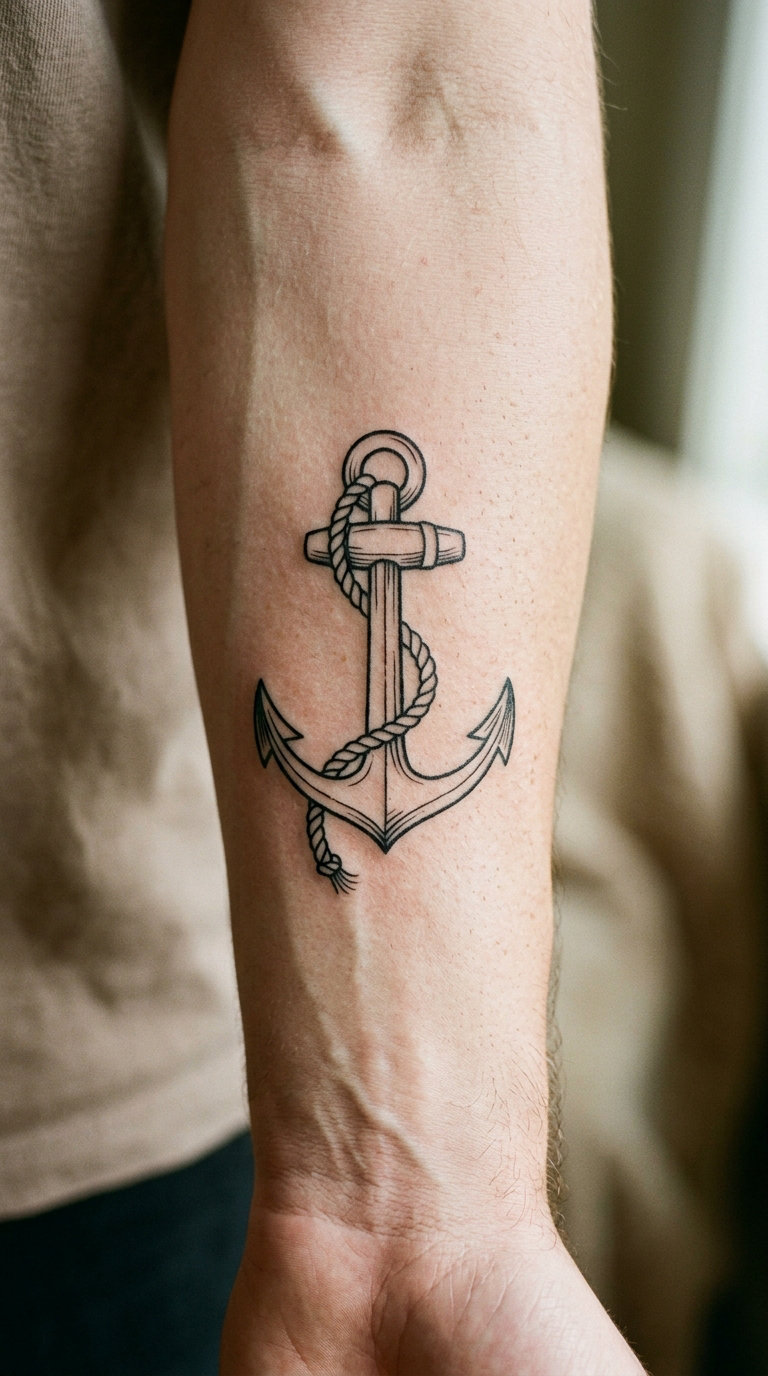
A compact nautical anchor with restrained ropework: a straight shank, two curved flukes and one loop of rope, drawn in clean black lines.
The anchor is the most familiar symbol in this whole theme, tied to stability, harbour and belonging. That familiarity is also why personal detail matters more here than anywhere else.
Placement: Forearm or calf. Size: 2-3 inches (5-8 cm). Style: Traditional or minimal line art.
Pain: Medium. Rope texture made of very thin lines fades first, so ask for simplified rope or a thicker twist.
Make it yours: Add a small coordinate for a port, a hometown or a place you crossed the ocean to reach.
9. Micro-Realism Oak Leaf
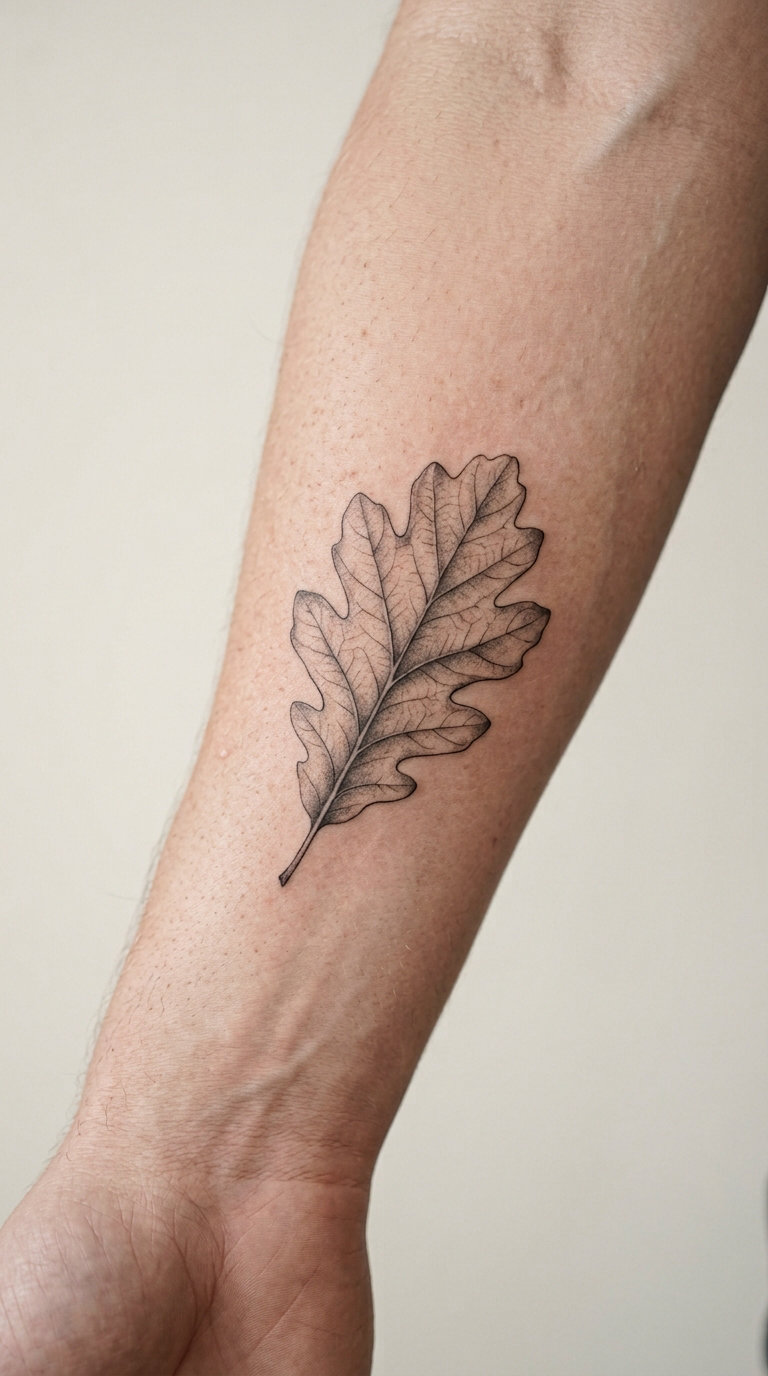
A single oak leaf with delicate veins and subtle black-and-grey shading, no border and no background, placed at a slight diagonal so it follows the line of the limb.
Oaks are usually chosen for the idea of strength that takes centuries to build rather than fast growth, which lines up with staying steady.
Placement: Forearm or calf, set diagonally. Size: 2-3 inches (5-8 cm). Style: Micro-realism.
Pain: Low to medium. Hairline veins soften noticeably over time, and this is a design people often decide they want darker a few years in.
Make it yours: Hide a year in the veins, marking a family milestone.
10. Barefoot Sand and Waves
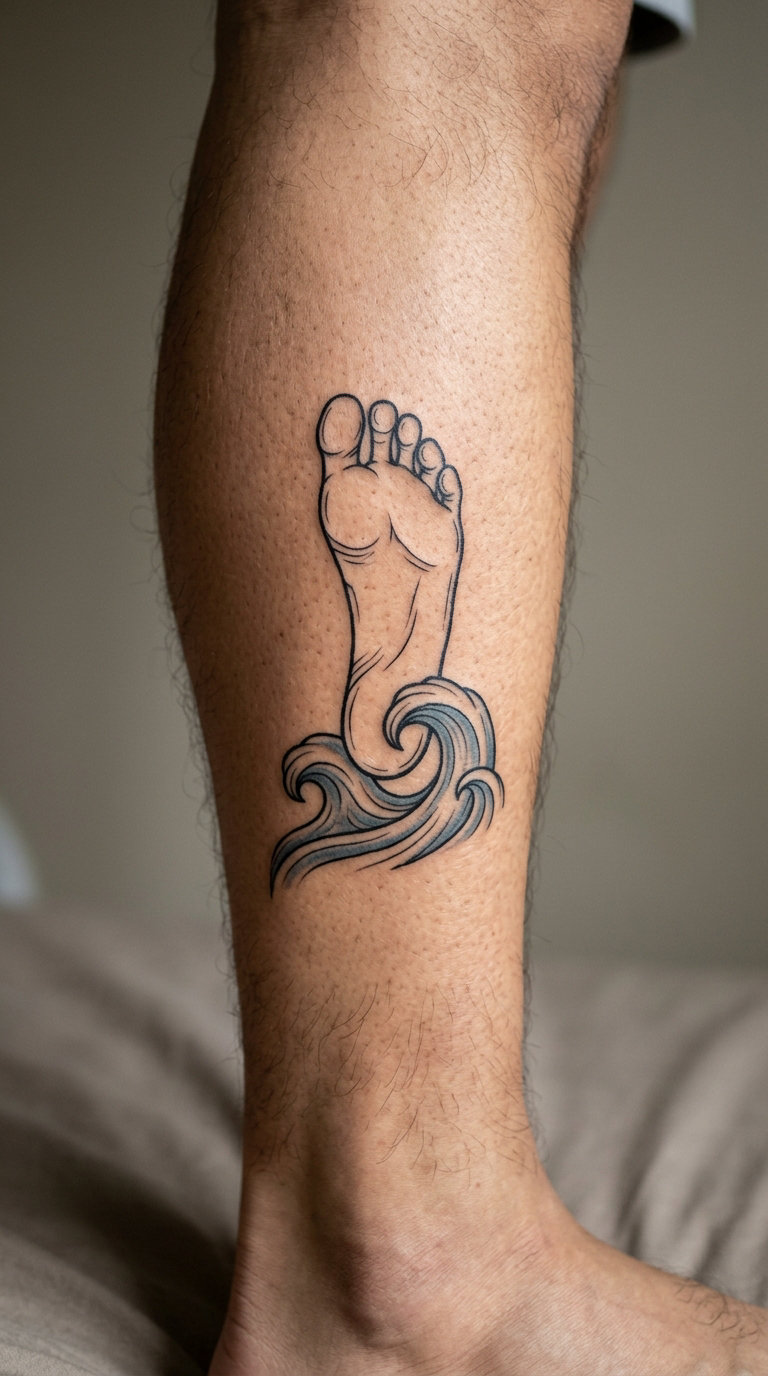
A small bare footprint meeting two understated wave lines, in black linework with a single blue-grey accent in the water. Sand is suggested with a scatter of fine dots, not a solid fill.
It connects to travel, favourite places and being present in a spot, which is why it often ends up on a calf or a shoulder where it is easy to see.
Placement: Calf, shoulder or side of the foot. Size: 2-4 inches (5-10 cm). Style: Illustrative.
Pain: Medium. Fine sand dots blur quickly, and foot placement wears through faster than most locations, so keep the wave lines bolder than the dots.
Make it yours: Add the coordinates of a shoreline you would happily go back to.
11. Still-Water Ripple
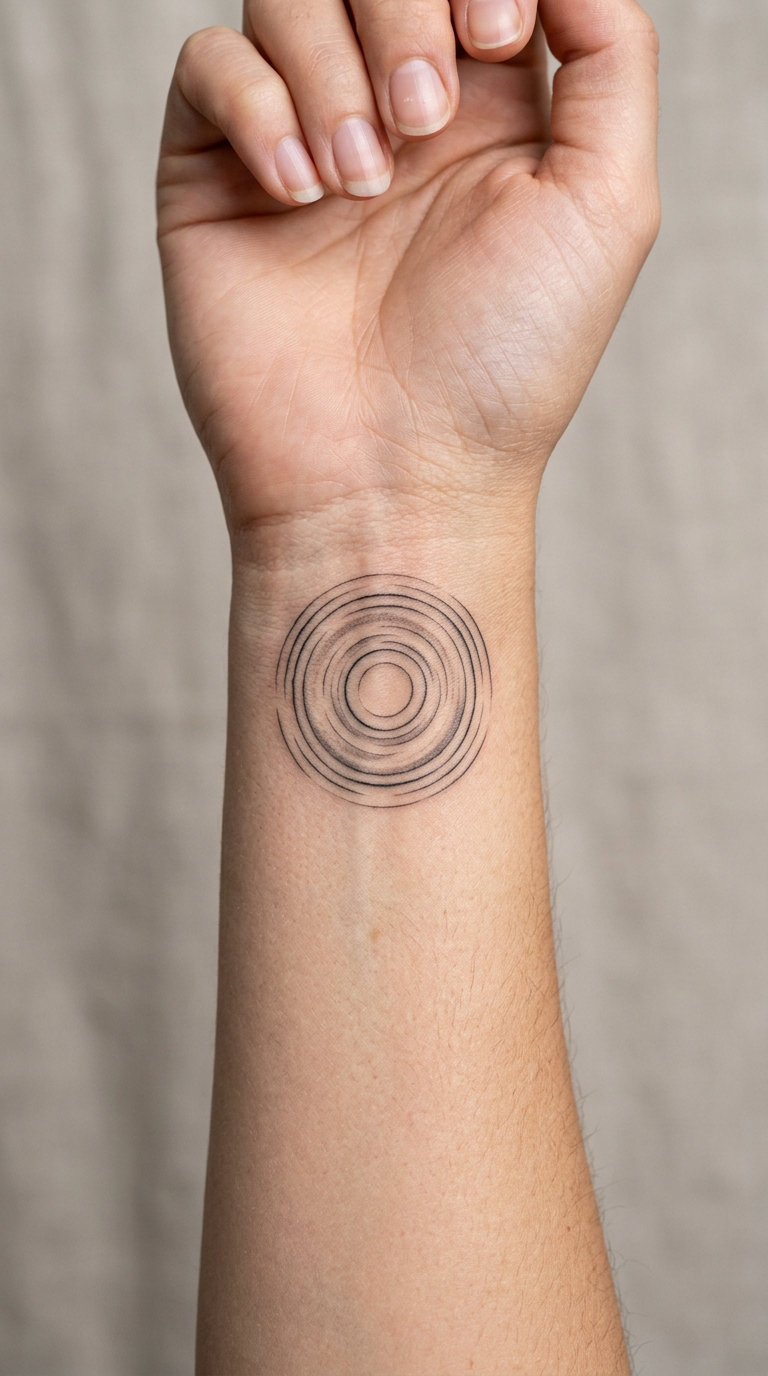
Concentric ripples spreading from a single point, drawn in clean black lines with restrained grey shading between the outer rings.
Calm movement is a good fit for this aesthetic, and a ripple reads as an everyday reminder rather than a grand statement.
Placement: Wrist, shoulder or lower back. Size: 2-3 inches (5-8 cm). Style: Illustrative.
Pain: Low to medium. Delicate rings can need a periodic touch-up, so pick an artist comfortable with very thin even lines rather than the cheapest option.
Make it yours: Put the date of a period that changed how you live into the centre ring.
12. Balanced Rock and Fern
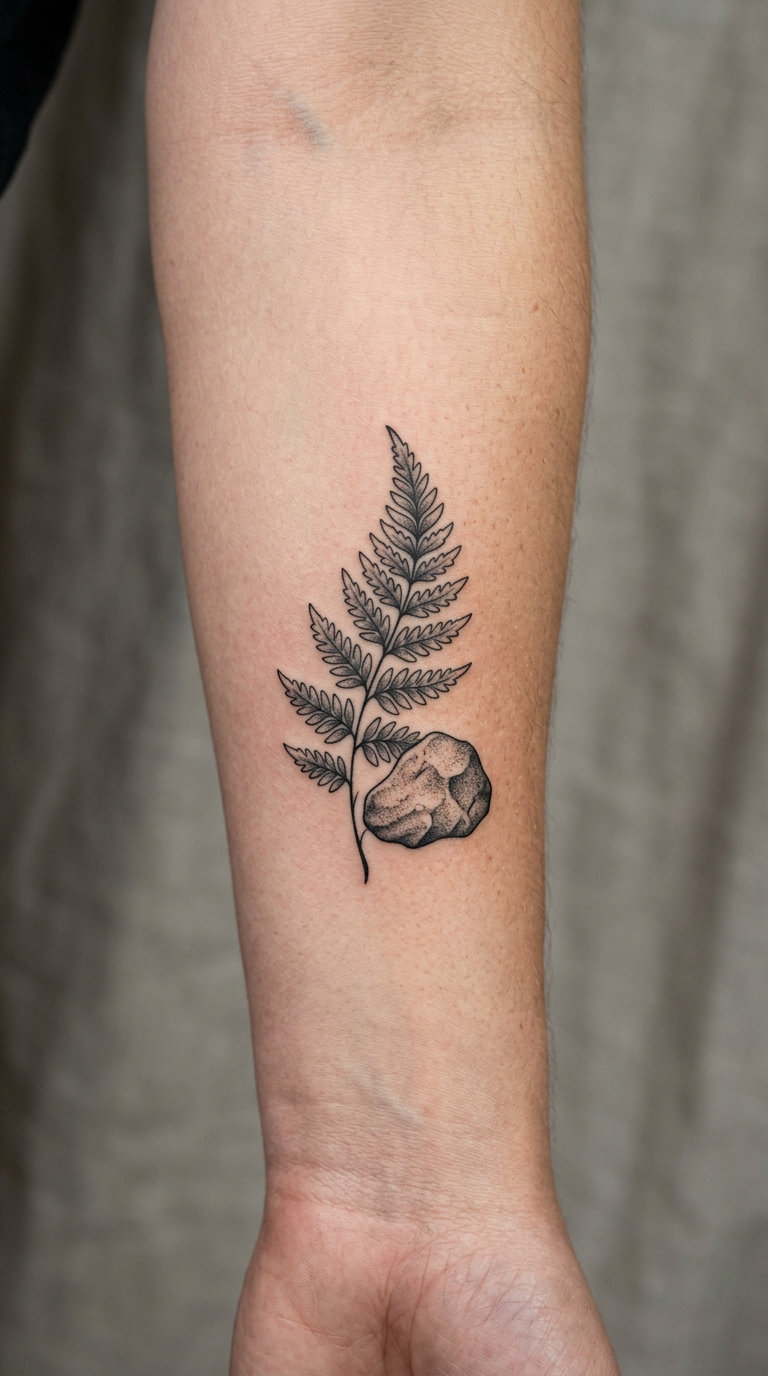
A small fern growing out from beside a single balanced rock, mixing organic linework with one solid black shaded form for contrast.
The pairing gives the design a footing, and people often describe it as growth that still needs something solid underneath. There is no fixed reading here.
Placement: Forearm, calf or ankle. Size: 2-4 inches (5-10 cm). Style: Illustrative botanical.
Pain: Medium. Fine leaflets along the frond are the detail most likely to fade, so keep the fronds short and few.
Make it yours: Ask for a fern species that actually grows where you grew up.
13. Grounded Pine Tree
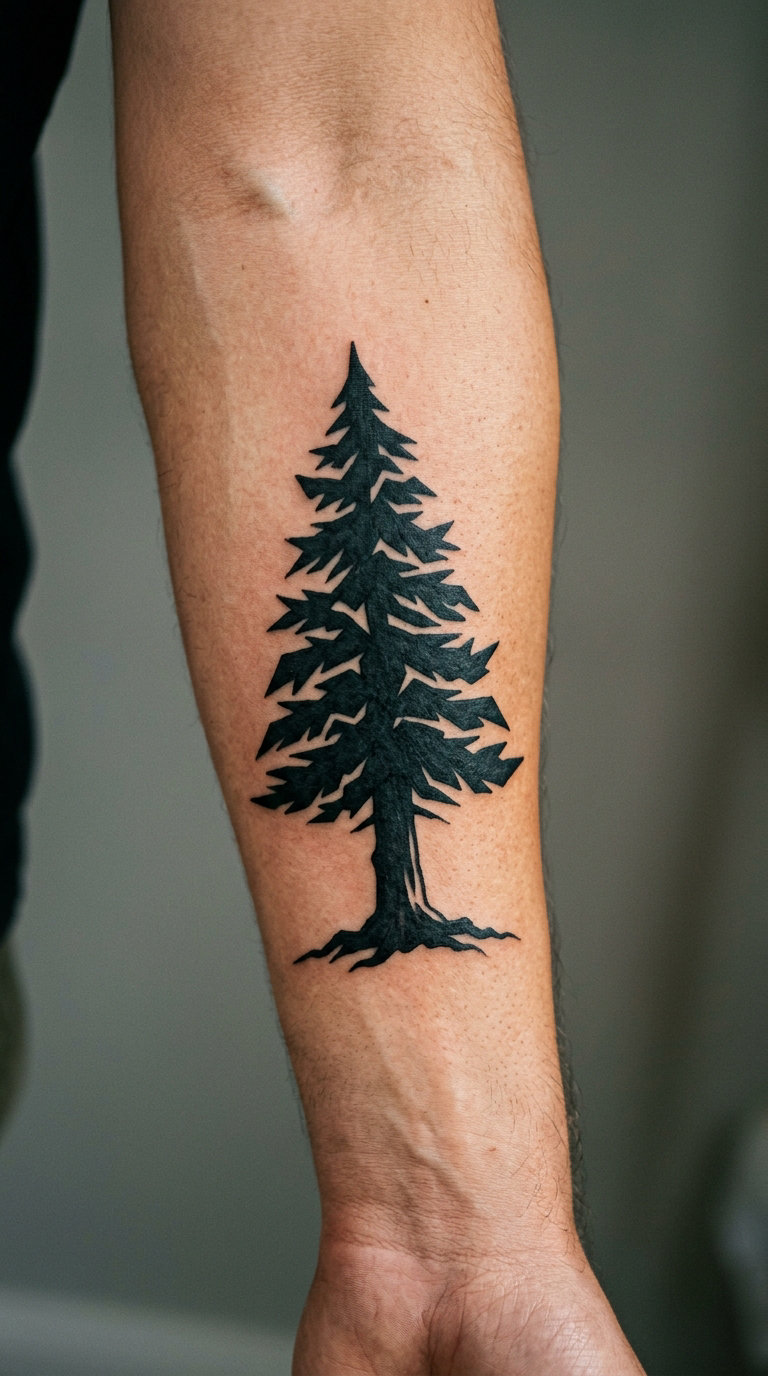
A single pine with a strong straight trunk, layered angular branches and simple blackwork fills in the needles, standing alone with no ground line beneath it.
Pines get picked for endurance and for staying put in rough conditions, and the dense black fills give this piece real weight on the forearm.
Placement: Forearm, calf or upper arm. Size: 3-5 inches (8-13 cm). Style: Blackwork or traditional.
Pain: Medium. Small gaps between branches trap ink less evenly, so protect them carefully while healing and expect a small touch-up if any fill lifts.
Make it yours: Add a small mountain line and a birth year at the base.
14. Hand Holding a Tiny Sprout
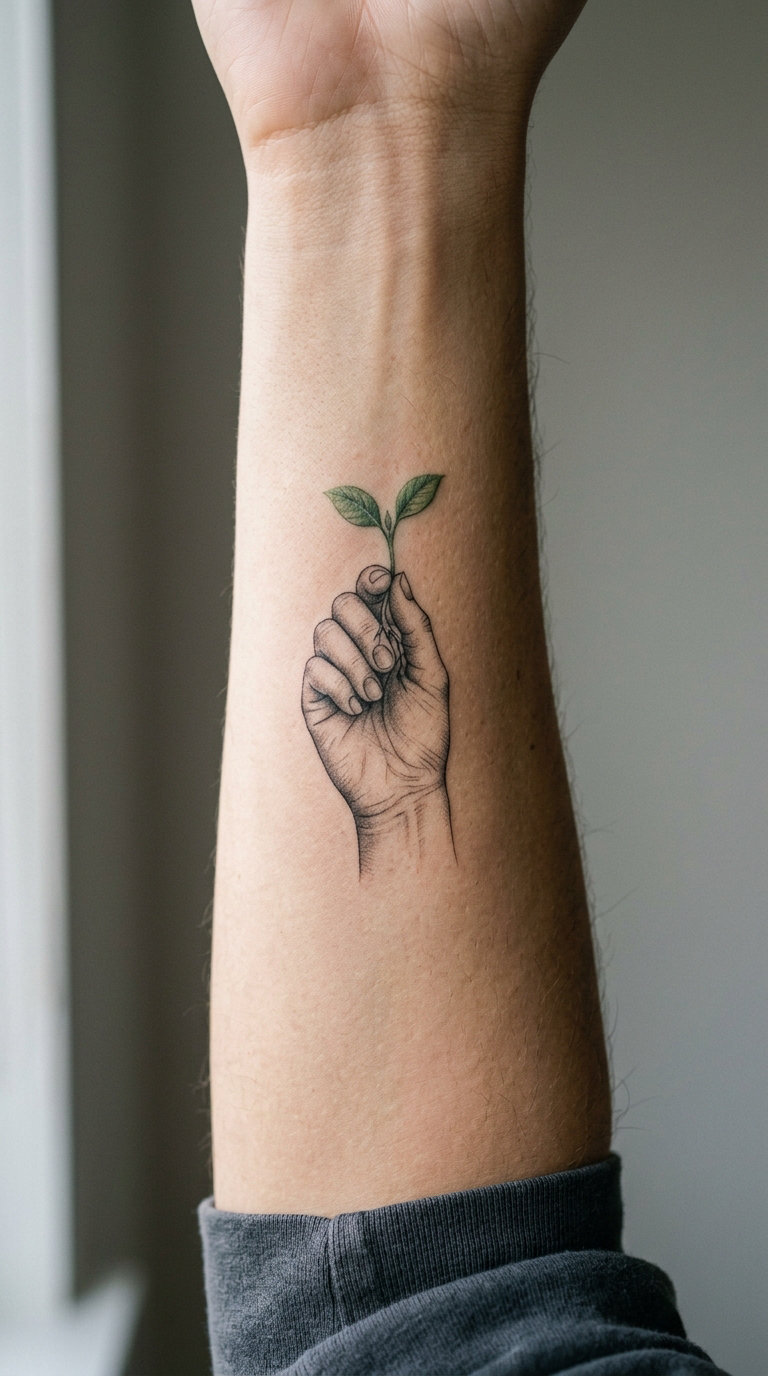
One hand drawn naturalistically, gently cupping a small sprout with two leaves, in fine black contours with a light wash of green on the leaves.
Care and personal growth are the usual reasons, and the cupped shape reads as looking after something fragile.
Placement: Forearm or shoulder. Size: 3-4 inches (8-10 cm). Style: Micro-realism.
Pain: Medium. Small shading details inside the fingers lose definition fastest, and skin creases across knuckles will slowly interrupt the line.
Make it yours: Have it hold a specific flower tied to a person or a memory.
15. Four-Way Grounding Cross
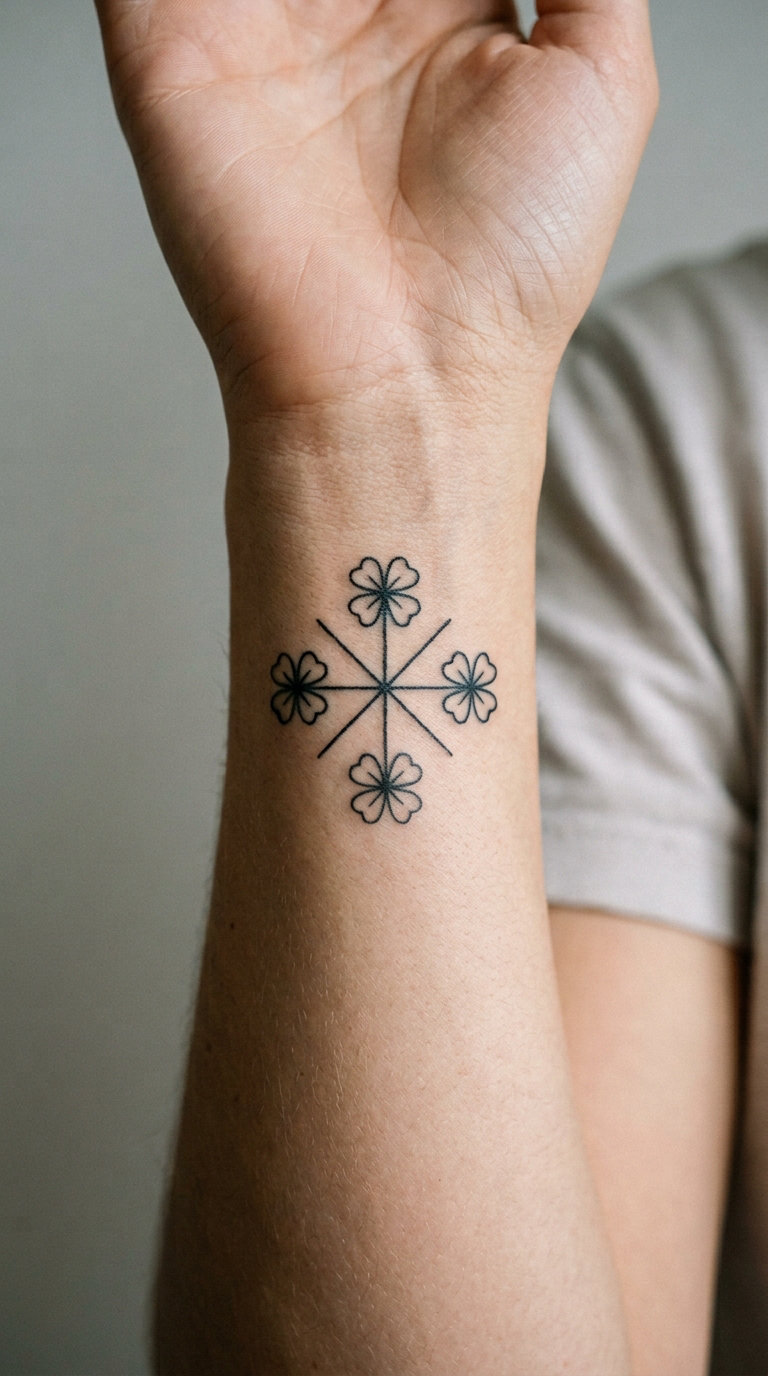
An abstract cross formed by four short branches meeting at the centre, each branch ending in a simple leaf or small stone shape, drawn as balanced black linework.
It borrows the structure of a cross without using any religious styling, so it suits people who want the geometry rather than a specific faith.
Placement: Wrist, upper arm or calf. Size: 2-3 inches (5-8 cm). Style: Modern minimal.
Pain: Medium. The thin ends of each branch soften sooner than the centre, so a slightly heavier terminal line keeps the shape readable.
Make it yours: Set four initials or dates at the ends of the branches.
16. Clay Vessel and Wildflower
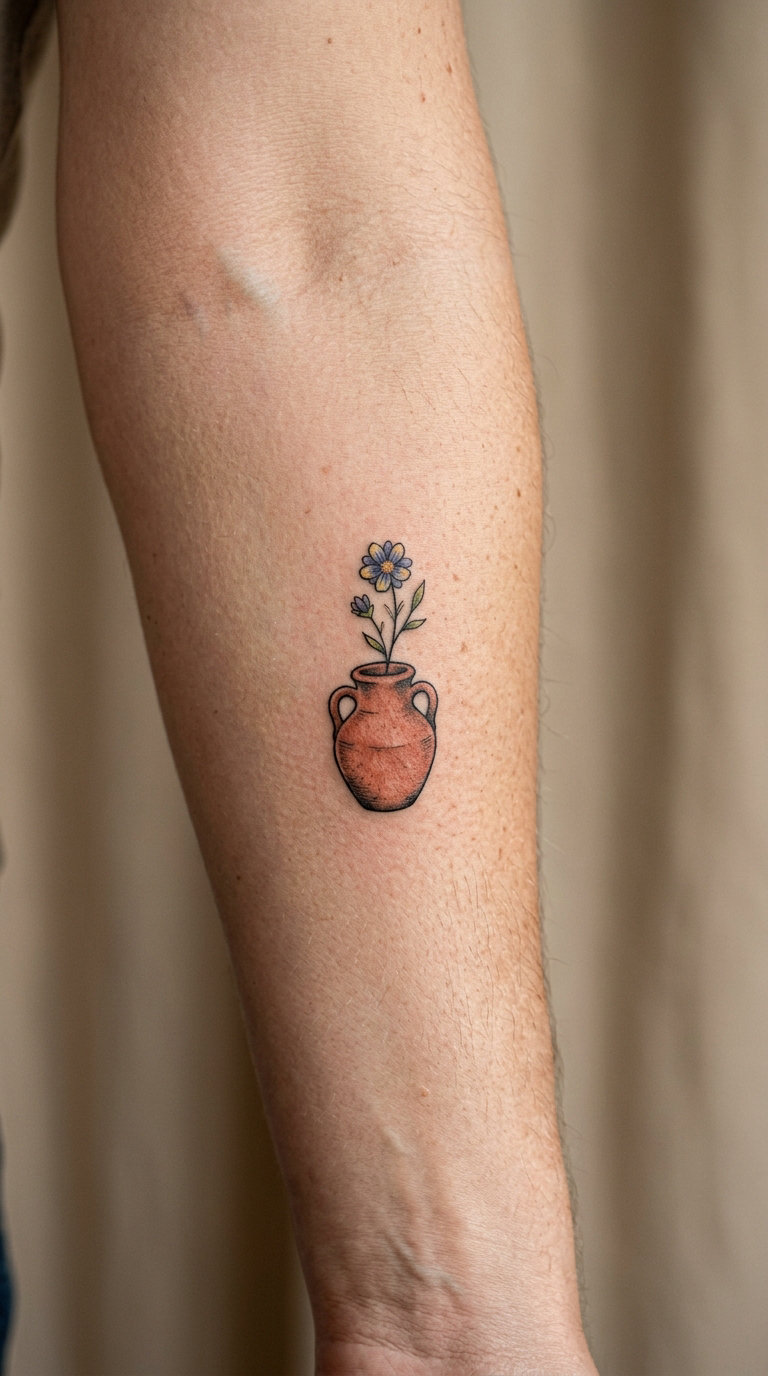
A simple clay vessel with a rounded body and two short stems holding one wildflower, using warm black-and-grey shading with optional terracotta colour in the pot.
An everyday object next to a living thing feels personal and grounded, which is why this pairing shows up more than any single pot design on its own.
Placement: Forearm, calf or shoulder. Size: 2-3 inches (5-8 cm). Style: Illustrative.
Pain: Medium. Small petal edges fade first, and colour on the pot will soften over the years, so expect the black outline to be what remains strongest.
Make it yours: Choose a flower species native to somewhere that holds good memories.
17. Turtle on a Simple Horizon
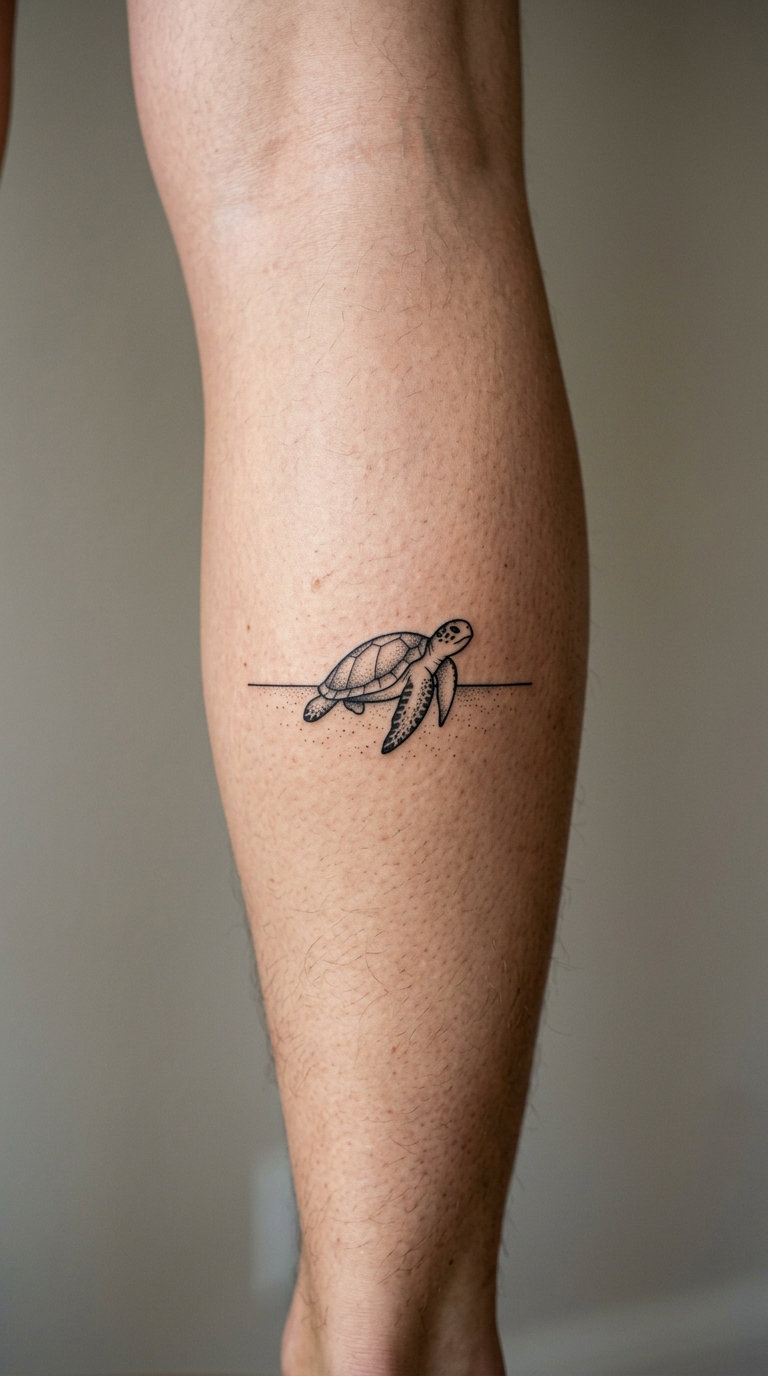
A small stylised turtle with a patterned shell resting just above a single thin horizon line, in clean black contours with sparse dotwork in the shell segments.
The slow, low, unhurried composition is the reason people choose it, and the horizon line keeps the piece feeling open rather than boxed in.
Placement: Calf, forearm or upper arm. Size: 2-3 inches (5-8 cm). Style: Illustrative.
Pain: Medium. Shell patterns made of tiny lines fade fastest, so simplify to three or four strong segments and resist adding detail later.
Make it yours: Add a birth year beneath the horizon line.
18. Matcha Bowl Minimalism
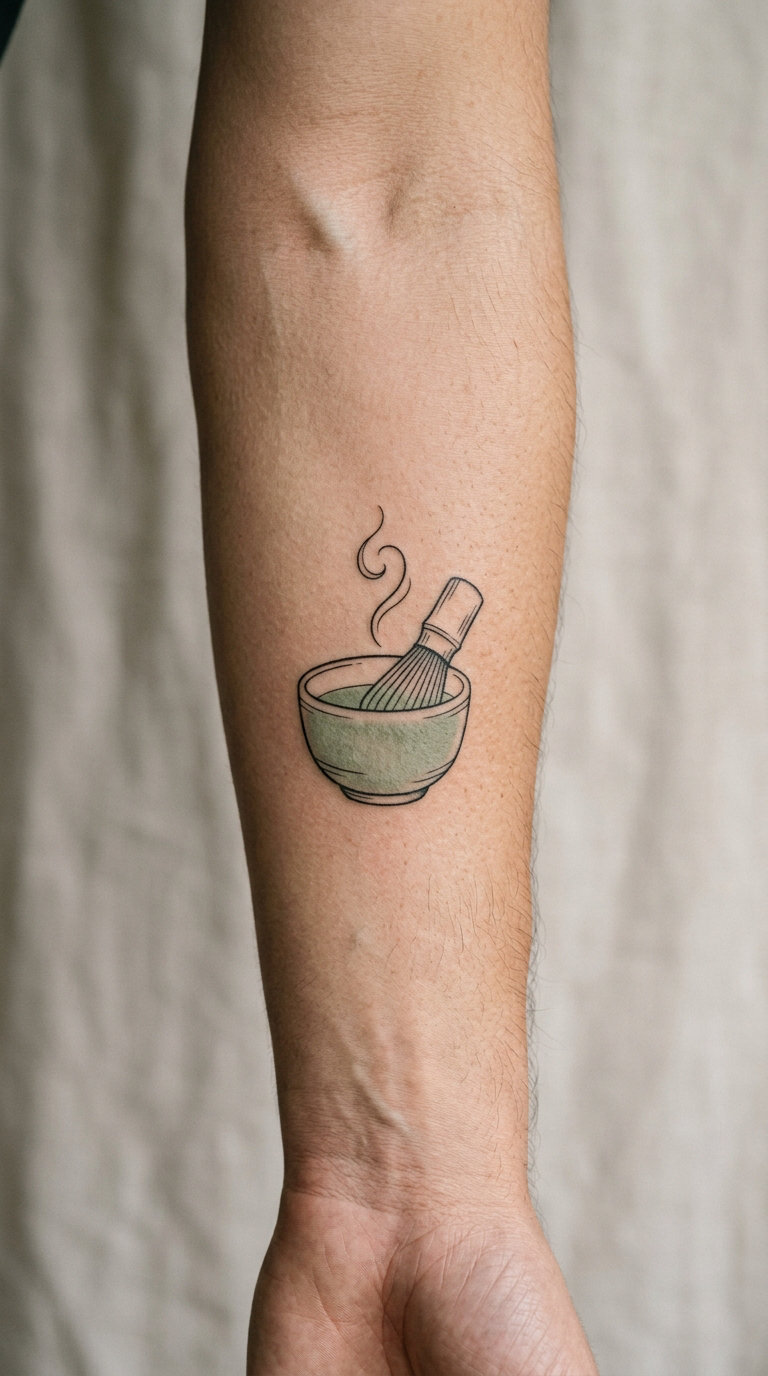
A simple matcha bowl in profile with a bamboo whisk resting against it and one curved steam line above, in black linework with optional green ceramic shading.
It works as a reminder of a small daily ritual rather than a symbol, which many people find more useful than an abstract one.
Placement: Forearm or calf. Size: 2-3 inches (5-8 cm). Style: Minimal illustrative.
Pain: Low to medium. The thin steam line is the first element to disappear, so it can be left out entirely with no loss to the design.
Make it yours: Add a short Japanese phrase that connects to your own sense of calm.
19. Mountain Lake Reflection
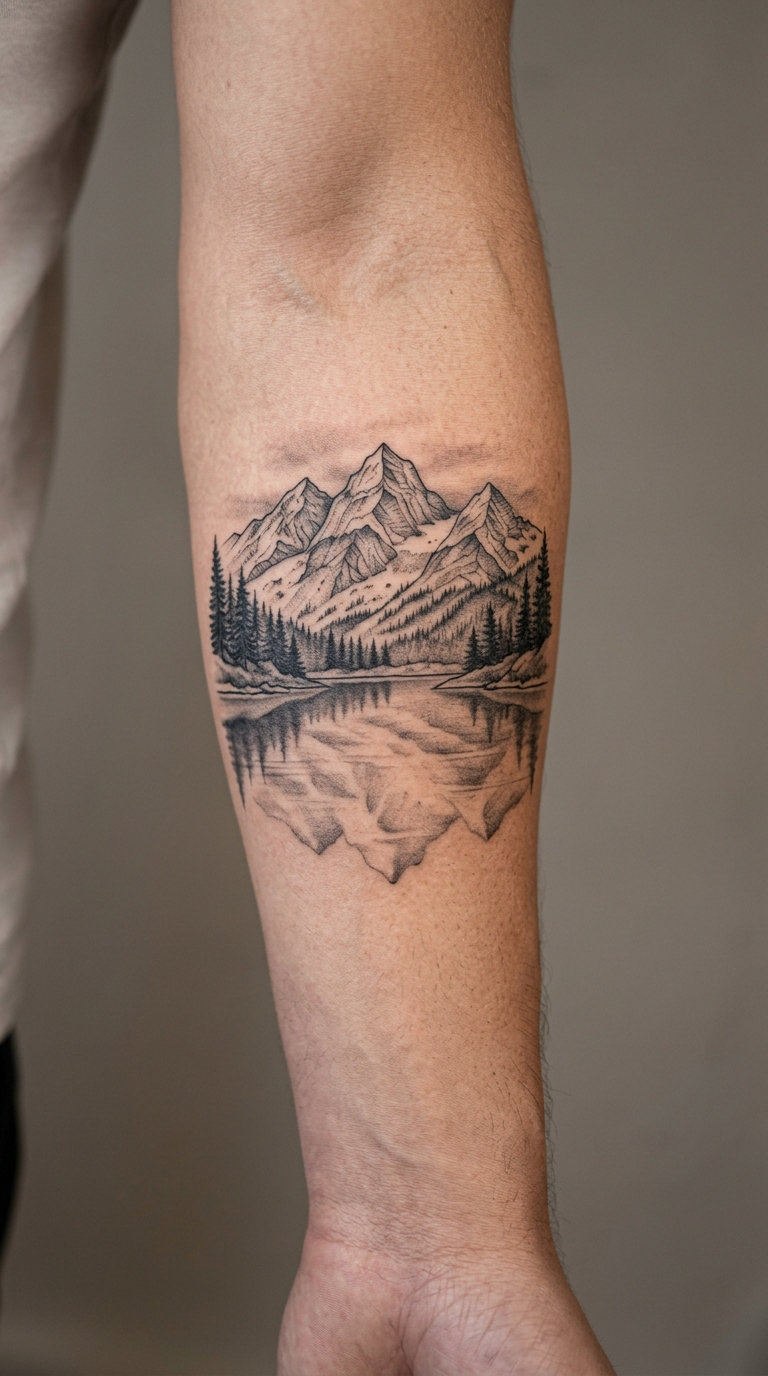
A small range of peaks above a calm lake, with the reflection sitting below the waterline in soft grey stippling and the peaks drawn in black linework.
It is the most scenic option in the list, and people tend to choose it for a specific place rather than for the idea of steadiness in general.
Placement: Forearm, calf or shoulder. Size: 3-5 inches (8-13 cm). Style: Illustrative scene.
Pain: Medium. Fine stippling in the water needs careful aftercare because those dots are easy to scuff, and longer sitting positions make the session tiring.
Make it yours: Trace the actual outline of a lake you have visited into the water section.
20. Hourglass with a Small Plant
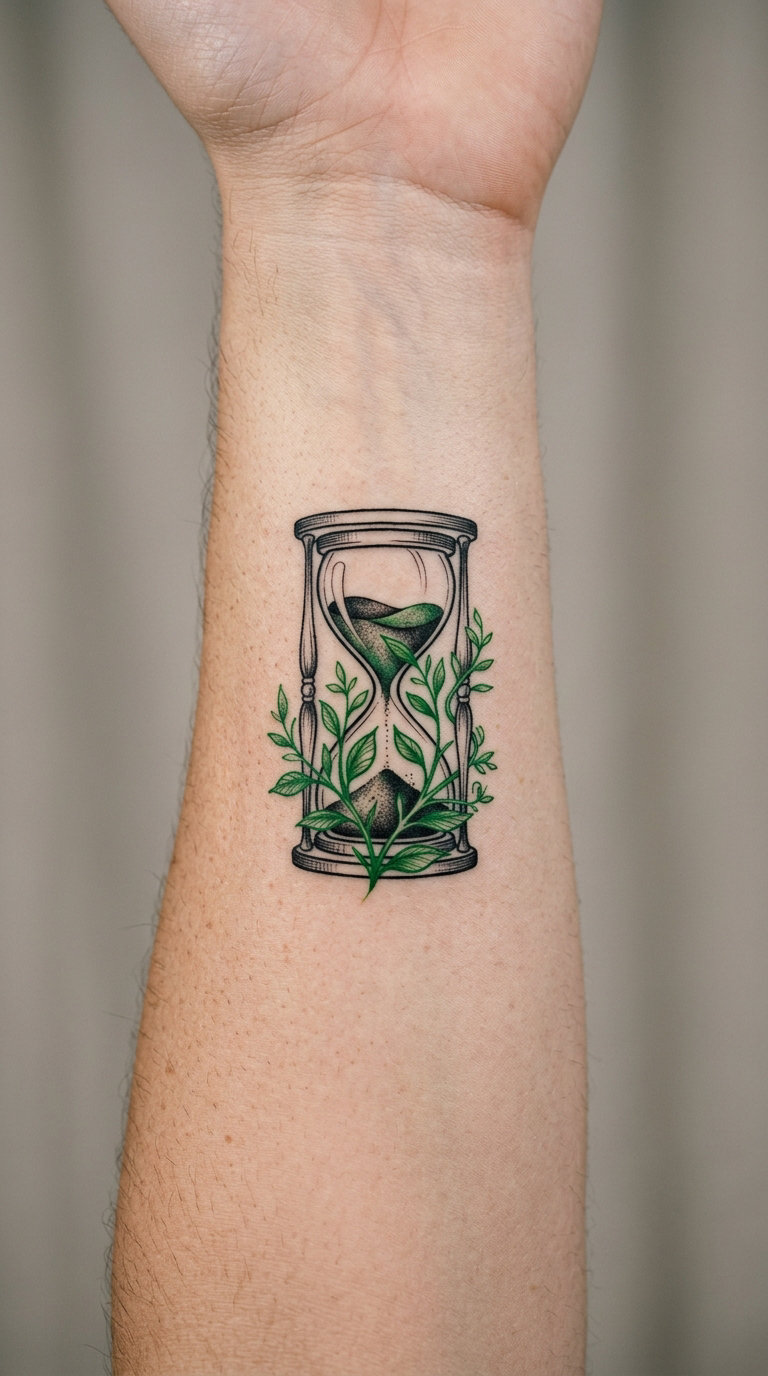
A compact hourglass drawn with black structural lines, a green plant growing out of its base and only a small sand suggestion inside the glass.
Time and growth sitting together is the whole idea here, and most people read it as patience rather than urgency.
Placement: Wrist, forearm or calf. Size: 2-3 inches (5-8 cm). Style: Contemporary illustrative.
Pain: Medium. Tiny leaves at the plant base can be lost in the first year, so keep the leaf count low and the line weight up.
Make it yours: Add a start or end date inside the glass frame.
21. Minimal Globe Held in Two Hands
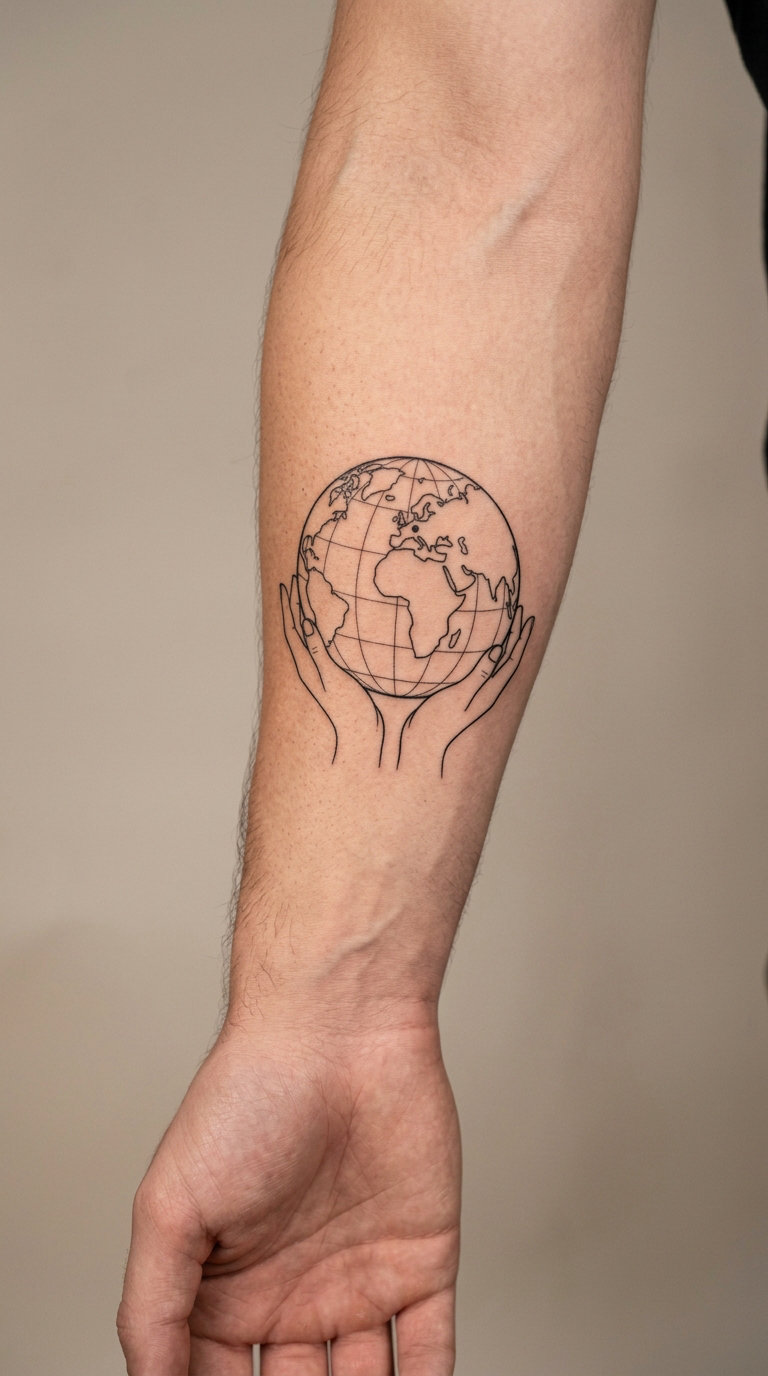
A small outlined globe with simple continent lines, no flags and no lettering, cradled in two open hands drawn in black outline with light grey shading.
It is a people-centred image: something held carefully rather than a landscape dominating the frame, which suits anyone who grounds themselves through other people.
Placement: Forearm, shoulder or upper back. Size: 3-4 inches (8-10 cm). Style: Minimal illustrative.
Pain: Medium. Continent details fade with the first sun exposure, so ask for slightly thicker coastlines and fewer interior lines.
Make it yours: Mark one important location with a single small dot.
22. Stacked Pebbles and Crescent
A balanced stack of five pebbles in black-and-grey shading with plenty of negative space, topped by a slim crescent moon set slightly off centre.
Stacking stones by hand is a real trail-building habit, and the balance is the part that draws people in. The moon simply keeps the composition from feeling plain.
Placement: Forearm, calf or behind the ear. Size: 2-4 inches (5-10 cm). Style: Minimal illustrative.
Pain: Medium. Small pebble textures blur together, so each stone needs its own clear edge and a little space around it.
Make it yours: Match the number of stones in the stack to a year that marked something for you.
23. Footprint Connecting Two Dots
A single footprint in simple black linework leading between two understated dots, with an optional muted blue fill in each dot.
Two points and a path between them is an easy way to mark where a person came from and where they are now, and it reads as a personal story rather than a slogan.
Placement: Side of the foot, calf or forearm. Size: 2-4 inches (5-10 cm). Style: Minimal illustrative.
Pain: Medium. Foot and ankle skin wears through faster than most areas, so expect fading there sooner and choose a bold outline over fine detail.
Make it yours: Use two initials, birth stars or coordinates for the dots.
24. Personal Grounding Symbol Map
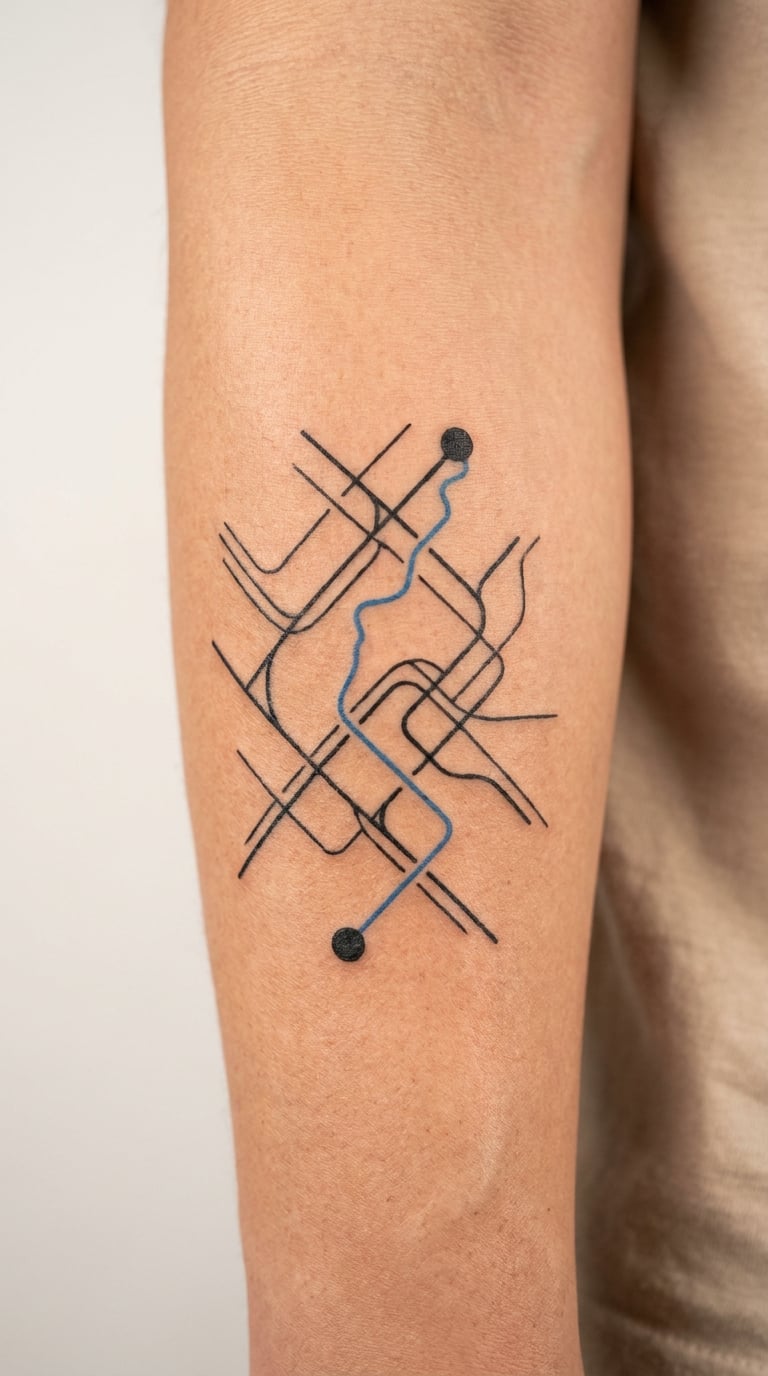
A compact custom map with a central dot, two short routes and one home marker, drawn in clean black linework with a single restrained colour on the route.
This is the one design in the list that is made from scratch for you rather than picked from a flash sheet, so it is worth planning with the artist rather than choosing on impulse.
Placement: Forearm, calf or shoulder. Size: 3-5 inches (8-13 cm). Style: Illustrative custom work.
Pain: Medium, and custom work often runs past a single short session. Small map details fade, so keep the route count low and let the dots do the work.
Make it yours: Route the line between places with real weight: home, school, a coastline, a favourite retreat.
How to Choose the Right Design
Most people pick from this list by shape first and meaning second. Look at where your arm naturally sits, then choose a design whose silhouette matches that space.
- Start with the silhouette. A design that reads clearly in one colour at thumbnail size will still read in ten years. If it needs several colours to make sense, it is a bigger piece than you think.
- Pick your line weight honestly. Fine line looks delicate but softens fastest. Ask your artist what weight they would use for a design you want to keep sharp.
- Check the placement against daily friction. Inner forearm, ribs, ankle and wrist hurt more. Hands and fingers fade faster than anywhere else on the body.
- Add one private detail. A date, a coordinate or a plant from home does more for the meaning than adding a second symbol would.
- Leave room for later. Tattooists and clients on r/traditionaltattoos keep raising the same point: plan the negative space around the first piece so anything you add in year three has space to breathe.
- Bring a reference set. Two or three saved images plus a note about the size you actually want will get you closer than a single screenshot.
What Makes a Stay Grounded Tattoo Idea Work?
A stay grounded tattoo idea works best when four things line up: a clear outline, a balanced composition, a small palette and a spot where nothing else sits. The style matters less than the legibility.
A design that stays legible is one where you can still tell what it is from across a room. That is the test I would give any candidate, from the fine-line roots to the custom map. Personal connection is the other half. A plain anchor means very little on its own, and the same anchor with a coordinate on the fluke means something only you know.
Cost and Session Time
US shops quote in ranges, and the figures below are typical working ranges in US dollars rather than fixed amounts. Tiny work usually sits between 80 and 150, small designs between 150 and 300, medium custom pieces between 300 and 600, and detailed illustrative work can run past 800.
Artists bill by the hour, commonly between 120 and 200 in many US cities, with shop minimums that cover the first part of any appointment. A simple grounded design takes one to three hours; a custom map or a realistic hand needs a consultation first and often a second session.
Complexity, hourly rate, city, shop minimum and how much planning goes into a custom design all move the final figure. Tell the studio the size and style you want up front and ask for their range before booking.
Aftercare Basics
- Follow your artist’s aftercare instructions first. They know what they used on your skin.
- Wash the area gently with lukewarm water and mild unscented soap, then pat it dry with a clean towel or paper.
- Protect the design from sun while it heals, and skip prolonged water exposure such as long swims or hot tubs for a couple of weeks.
- Leave any film or scab alone. Picking at it is the fastest route to patchy line work and a touch-up session.
- Watch the healed result rather than the fresh one. Colour and fine detail look different after a few weeks, and that is normal.
- Book a free check-in with the studio if anything looks off after healing rather than waiting for months.
Frequently Asked Questions
What is the best stay grounded tattoo for a first tattoo?
For a first piece, the minimal mountain peak linework or the still-water ripple are the easiest starting points. Both use a small number of shapes, need no colour to read clearly, and heal predictably because there is almost no shading to patch. Keep them under 3 inches and choose the inner forearm, which is forgiving and easy to cover at work.
Are small grounding tattoos more likely to stay visible?
Visibility and longevity are two different things. A small tattoo is easier to lose in a busy design and disappears faster on hands, fingers and feet, where skin is thin and friction is constant. On a forearm, calf or upper arm, a small fine-line piece holds up well. Bump line weight slightly rather than enlarging the design, and expect touch-ups on hairline details.
Should a grounded tattoo be black, colour or both?
Black holds its shape best and ages most predictably, so most grounded designs work as pure blackwork or black-and-grey. One restrained colour accent, a muted green compass or a blue-grey wave, gives a piece personality without much extra fading risk. Full-colour realism needs more sessions and more touch-ups, and it is a different style rather than a better one.
Where should a small grounding symbol be placed for the least daily friction?
The outer forearm, upper arm and outer calf cause the least daily friction and are the easiest places to cover when needed. Inner wrist and inner forearm are more painful and more visible. Ankle, ribs and the side of the foot wear through faster because of friction and sun exposure. Whichever spot you choose, check how it looks as the limb moves before the design is drawn.
How can I personalise a grounding tattoo without making it crowded?
Change one thing, not five. A date inside the hourglass frame, coordinates on a compass point, a river outline inside a stone or a birth year under a horizon all add meaning without adding clutter. Resist adding a second full symbol next to the first. Two unrelated images compete on a small area and both lose definition over time.
Conclusion
If this is your first tattoo, start with the minimal mountain peak linework or the still-water ripple. Both are small, legible, low-detail and easy to place, and neither depends on colour to make sense.
Adding to an existing collection? The turtle on a horizon, the blackwork river stones and the custom grounding map give you more to work with and leave room to build around. If you would rather lean into travel and place, our picks for hiking tattoos with meaning and national park tattoos for minimalists pair well with a grounded symbol, and our north star tattoo ideas cover the direction side of the theme.
Choose the placement and the reference images before you choose the design. That way the final piece fits the body it lives on rather than fighting it.