
20 Matchstick Tattoo Ideas (2026): Simple Minimalist Designs
A matchstick tattoo is a small design of a single match, usually drawn in one fine black line with a rounded head and, when it is lit, a compact flame. It became a favourite first tattoo because it is quick, quiet under a sleeve, and carries a meaning you can explain in one sentence: potential, the small spark that turns into something bigger.
These 20 matchstick tattoo ideas cover the range people actually get, from a bare single line to bundles, ladders, mazes and a matchbox. Each one has a real placement, a realistic size in inches, and a note on how the linework ages. If you are planning a first piece, or adding a small design to a collection that already has some weight to it, the number to think about first is size, not style. Most regret with matchstick work comes from asking for a flame that is too detailed for a half-inch of skin.
20 Matchstick Tattoo Ideas: Quick Guide
| Idea | Style | Best placement | Size | Pain |
|---|---|---|---|---|
| 1. Single Matchstick Line | Fine line | Inner forearm | 1.5-2 in (4-5 cm) | Low |
| 2. Crossed Matchstick X | Blackwork | Outer wrist | 2-2.5 in (5-6 cm) | Medium |
| 3. Three-Match Bundle | Fine line | Inner upper arm | 2.5-3 in (6-8 cm) | Low |
| 4. Matchstick Ladder | Geometric fine line | Forearm, along the bone | 3-3.5 in (8-9 cm) | Low |
| 5. Tiny Matchbox Outline | Fine line | Below the collarbone | 1.5-2 in (4-5 cm) | Medium |
| 6. Lit Match With Minimal Flame | Blackwork | Inner wrist | 2-2.5 in (5-6 cm) | Medium |
| 7. Two Lit Matches | Fine line | Outer forearm | 2.5-3 in (6-8 cm) | Medium |
| 8. Matchstick Spark | Mixed blackwork | Above the elbow, inner side | 2-2.5 in (5-6 cm) | Medium |
| 9. Matchstick Arrow | Geometric | Side of the forearm | 2-2.5 in (5-6 cm) | Low |
| 10. Matchstick Diamond | Fine line | Behind the ear | 1.5-2 in (4-5 cm) | Low to medium |
| 11. Matchstick Heart Outline | Fine line | Chest, near collarbone | 2-2.5 in (5-6 cm) | Medium |
| 12. Matchstick Crown | Fine line | Inner forearm | 1.5-2 in (4-5 cm) | Low |
| 13. Crossed Flame Pair | Blackwork | Upper arm, outer side | 2-2.5 in (5-6 cm) | Medium |
| 14. Stitched Match Bundle | Fine line | Forearm, inner side | 2.5-3 in (6-8 cm) | Medium |
| 15. Matchstick Grid | Geometric | Upper arm | 2.5-3 in (6-8 cm) | Medium |
| 16. Matchstick Maze | Abstract fine line | Calf or outer thigh | 3-3.5 in (8-9 cm) | Medium |
| 17. Matchstick-Turned Key | Fine line | Inner arm | 2-2.5 in (5-6 cm) | Low |
| 18. Matchstick Paper Plane | Geometric fine line | Outer forearm | 2-2.5 in (5-6 cm) | Low |
| 19. Matchstick Sunburst | Fine line | Shoulder | 2.5-3 in (6-8 cm) | Medium |
| 20. Curved Matchstick Trail | Fine line | Forearm, following the bone | 3-3.5 in (8-9 cm) | Medium |
1. Single Matchstick Line
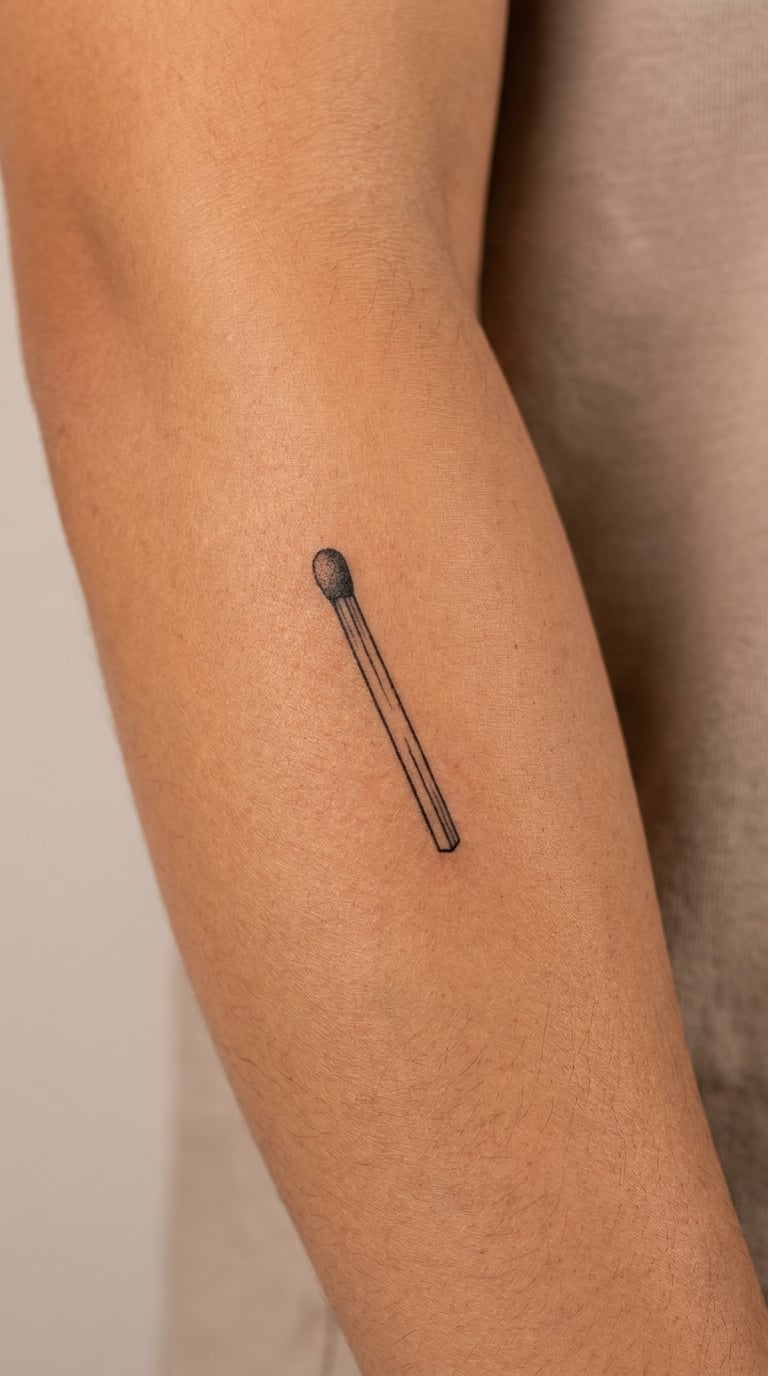
The single matchstick is one straight line with a slightly thickened head at the top and a small tapered gap where the head meets the shaft. No flame, no shading, no background. Tilted a few degrees off vertical it reads far better than a straight upright stick, because the angle gives it movement.
It is the version most first-timers land on because it stays readable at a small size and there is nothing in it that can fill in or blur.
Placement: inner forearm, side of the wrist, or just above the elbow on the inner side. Size: 1.5 to 2 inches (4 to 5 cm). Style: fine line, single-needle weight. Pain: low, a brief scratch that fades. The thin line softens a little with sun exposure over the years, so keep it off the top of the foot and the shoulder if you care about crispness long-term.
Make it yours: have the head engraved with a single tiny date, or add one small solid-black dot above it as a spark.
2. Crossed Matchstick X
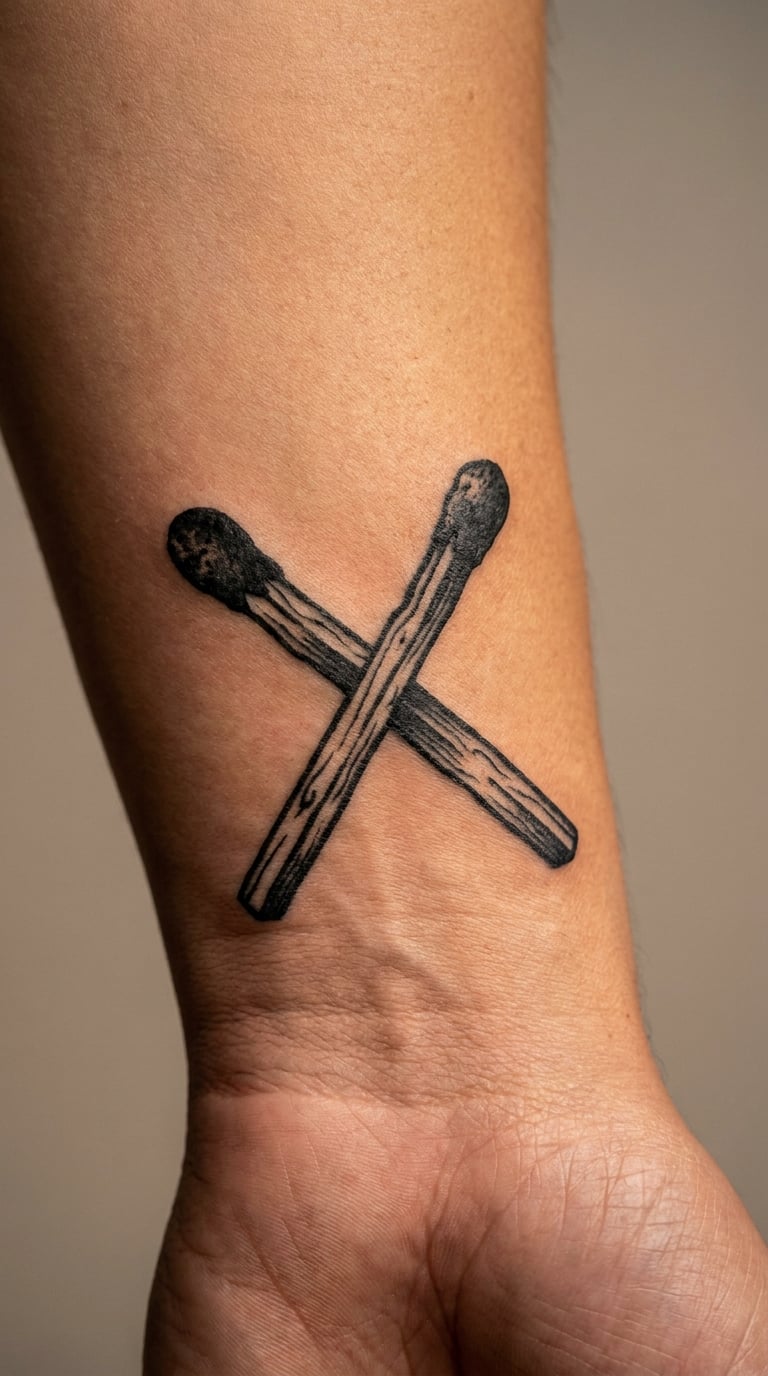
Two matchsticks cross near their middles to form a clean X, each head sitting at the end of an arm of the X rather than at the top. Line weight here needs to be heavier than fine line. A thin crossed pair disappears into a smudge once the lines spread.
Two Xs can be the simplest possible matching pair: one for each person, same size, same angle, on the same body part.
Placement: outer wrist or the flat of the forearm. Size: 2 to 2.5 inches (5 to 6 cm). Style: blackwork, solid line. Pain: medium, because the wrist and forearm are bony and the skin moves with your wrist. Expect a stinging pass where the line curves.
Make it yours: cross the two matches at a slightly uneven angle, one leaning a few degrees past the other, so the X has a handmade feel rather than a drafting-calculator one.
Matchstick Tattoo Ideas on Skin
Three things decide whether a matchstick design works once it is on skin: how clear the silhouette is from a normal viewing distance, whether the body part suits the size, and how much detail the chosen scale can actually hold. A flame with three inner tongues needs more room than a flame with one. Artists will tell you this in the chair, and it is worth listening to before you commit to a reference image.
The second thing to think about is contrast against the body part. Bony places with constant movement, like the wrist and the knuckles, work for short straight designs and fight anything with long diagonals. Flat, still areas, like the inner upper arm or the calf, reward detail.
3. Three-Match Bundle
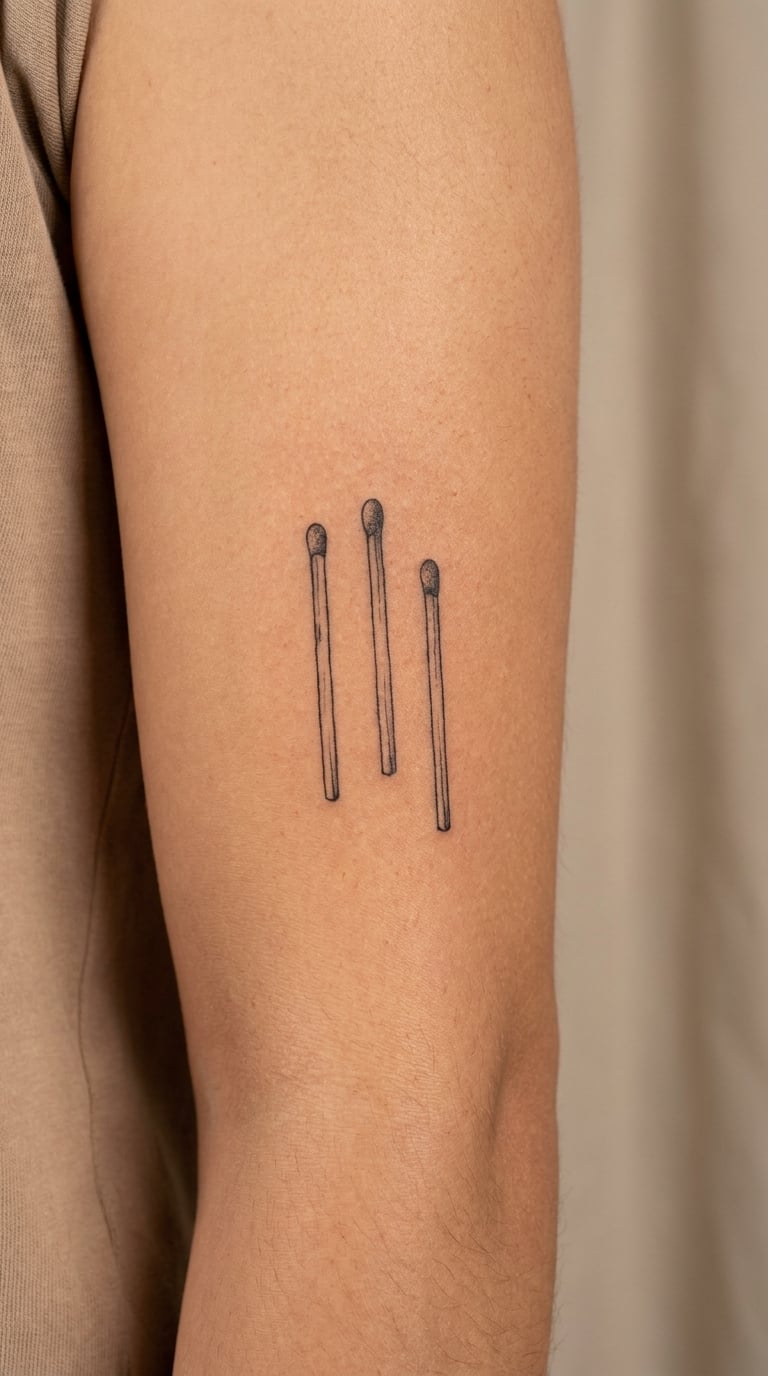
Three upright matchsticks in a row, none of them lit, spaced so the gap between the first and second is narrower than the gap between the second and third. That uneven rhythm is what stops it reading as a barcode. Equal spacing turns the same design into something you have seen on a shipping label.
Three is also a good number for a group piece, one match per person in a trio, each slightly different in height.
Placement: inner upper arm, or stacked down the inner forearm. Size: 2.5 to 3 inches tall (6 to 8 cm). Style: fine line. Pain: low on the upper arm, medium if it runs down the forearm where the skin is thinner.
Make it yours: give each match a different height, one short, one medium, one tall, so the trio reads as a set of individuals.
4. Matchstick Ladder
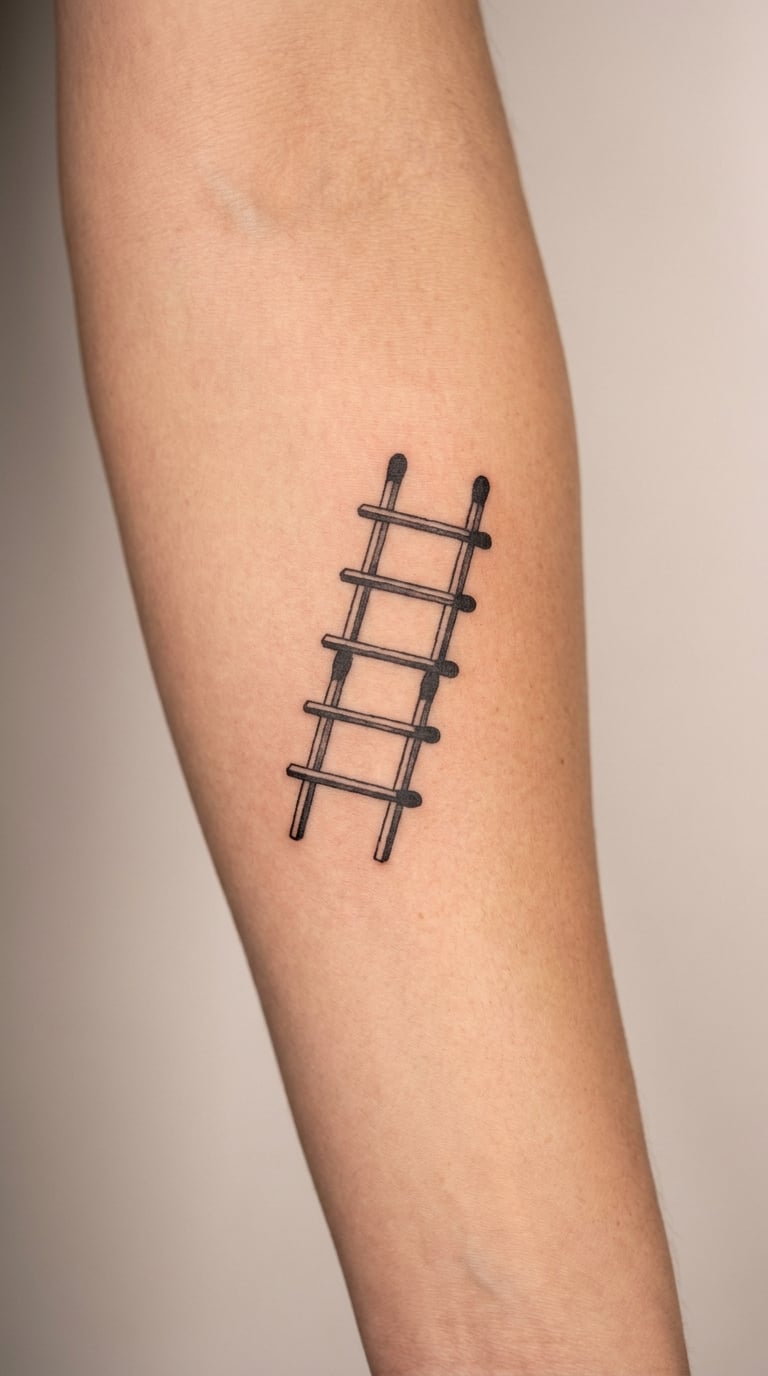
Two vertical matchsticks act as the rails and four or five shorter ones sit between them as rungs. The heads of the horizontal rungs all face the same direction, which is the detail that makes the ladder obvious rather than decorative.
It reads as steady progress, the slow kind, the kind you build one rung at a time. That is the reading most people give it, not a fixed symbol with one official meaning.
Placement: inner forearm, running along the bone. Size: 3 to 3.5 inches (8 to 9 cm). Style: geometric fine line. Pain: low to medium, more of a sustained scratch than a sharp one.
Make it yours: replace the second rung from the top with a lit match lying flat, so the ladder looks like it is climbing towards the flame.
5. Tiny Matchbox Outline
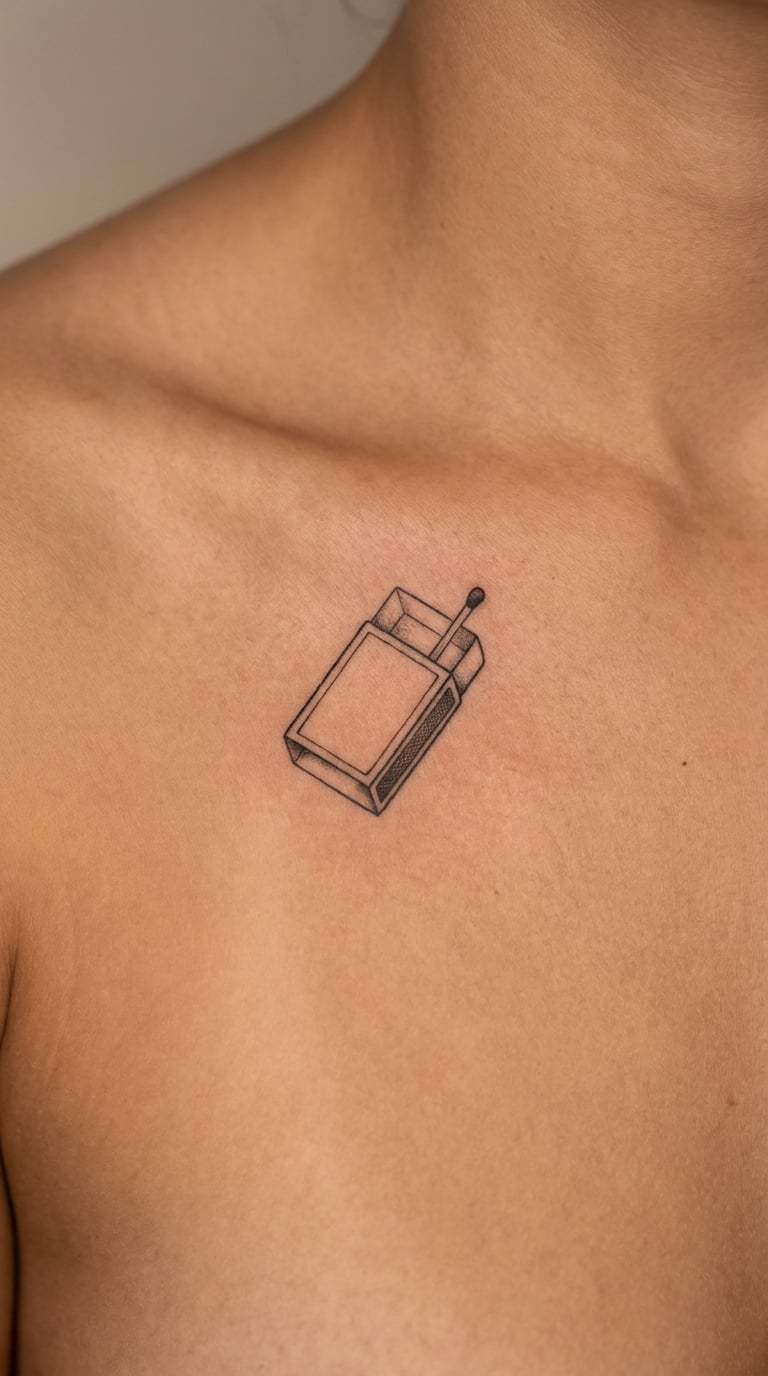
A matchbox drawn as a plain open rectangle with the top edge angled forward, one match projecting out of the opening at an angle. Keep the sides clean and unlabeled. Brand names, logos and lettering turn it into a product, and the moment it looks like packaging rather than an object, the symbolism goes flat.
A box with a match sticking out usually reads as keeping something small and precious close, or carrying an old habit with you.
Placement: below the collarbone on either side, or the inner forearm. Size: 1.5 to 2 inches (4 to 5 cm). Style: fine line. Pain: medium. The collarbone is bone-on-top-of-skin, and ribs under it are thin, so it stings more than an arm placement at the same size.
Make it yours: have the projecting match lit, with a small smoke wisp above it, and no match left inside the box.
6. Lit Match With Minimal Flame
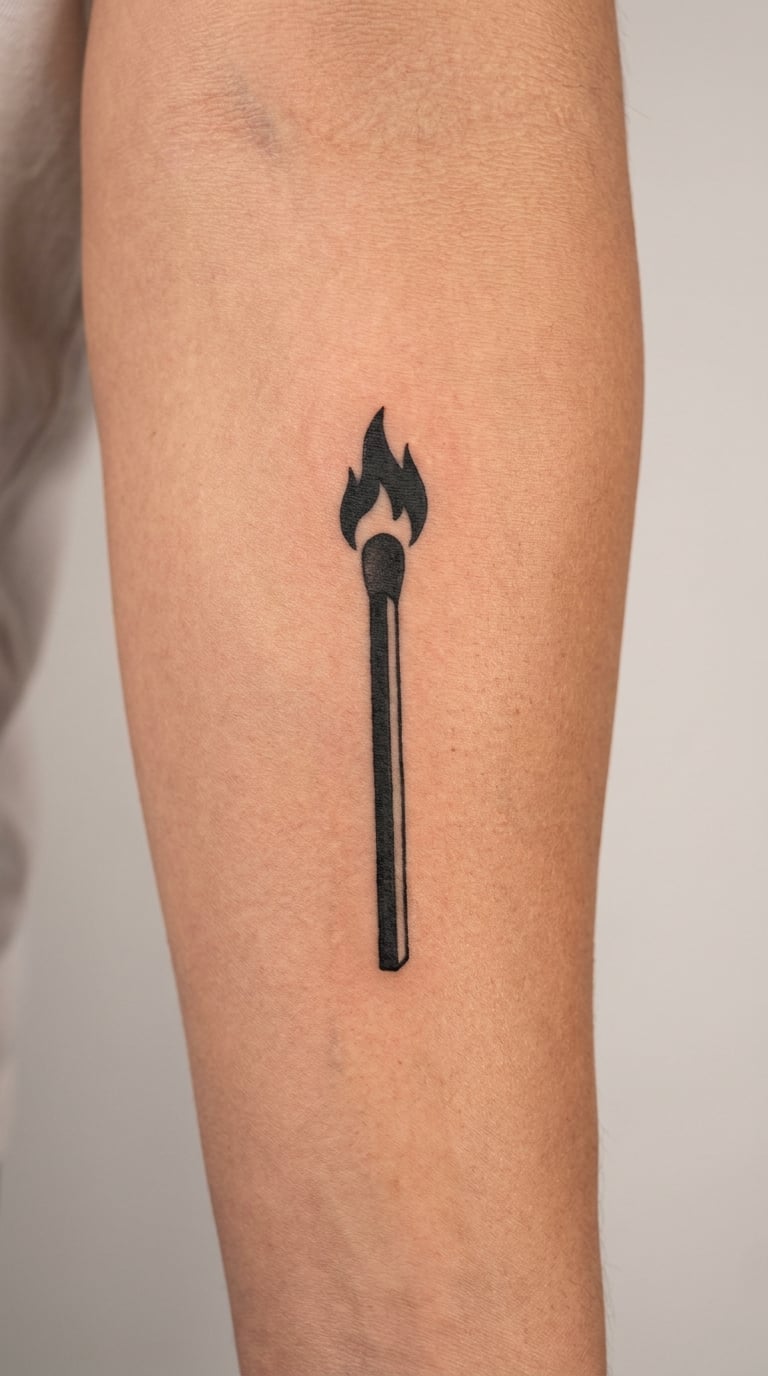
An upright match with a solid black flame at the top, one tongue, no smoke, no shading. This is the version that shows up most often and the one most often over-detailed. A flame with three separate tongues at 1.5 inches will fill into a black blob as the fine inner lines spread during healing.
Most people choose it for the ignition idea: the moment before something starts, kept deliberately small.
Placement: inner wrist, inner forearm, or the back of the hand. Size: 2 to 2.5 inches (5 to 6 cm) so the flame has room to stay a flame. Style: blackwork with one solid shape. Pain: medium. The inner wrist is a common spot and the skin there is thin, but the session is short.
Make it yours: add a hairline smoke curl in a second pass a year later, once the flame has fully settled.
7. Two Lit Matches
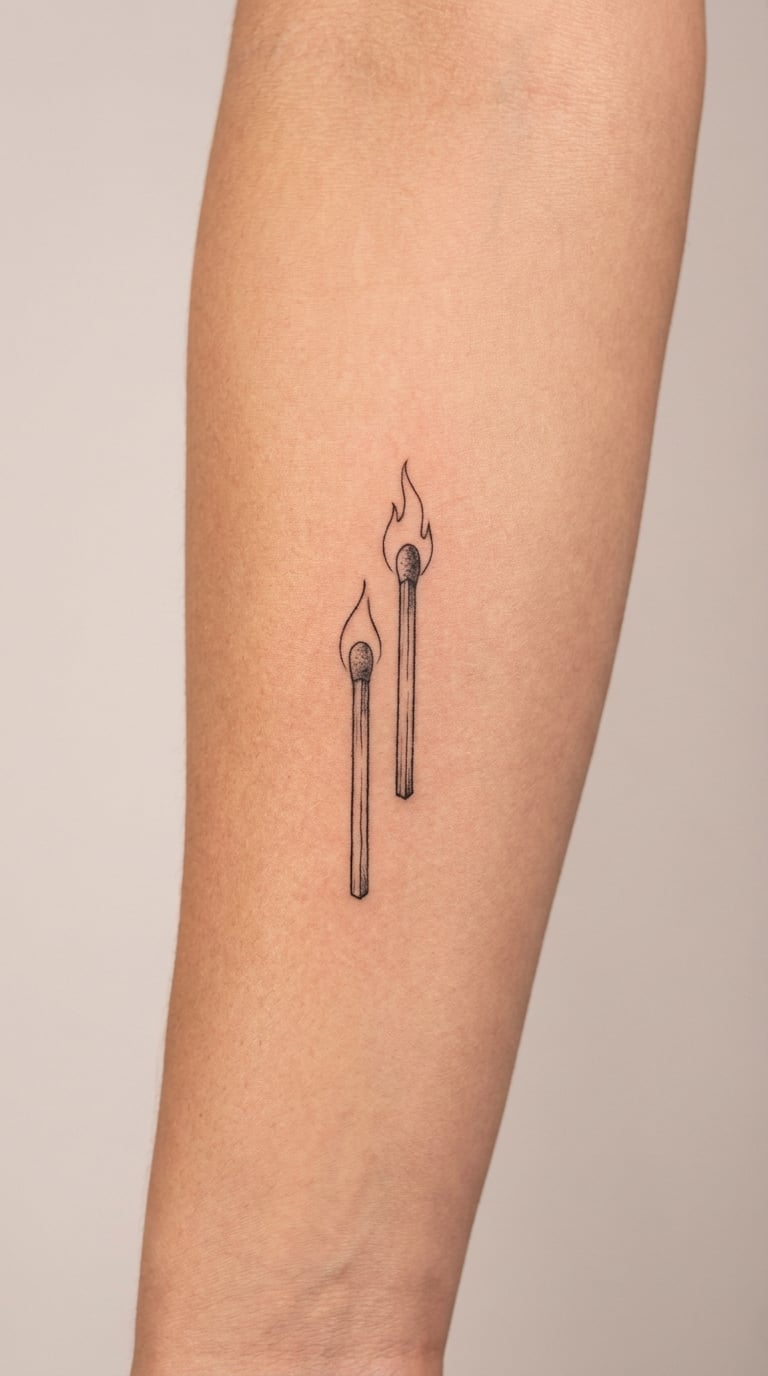
Two slim matches side by side, each with its own small flame, the flames sitting at slightly different heights so the pair looks hand-drawn rather than stamped. Leave clear space between the two silhouettes. When they touch, the two flames merge into one shape and the pairing disappears.
This is a friendship or partner design as often as it is a solo one, and it is the version most tattooed as a matching pair.
Placement: outer forearm, one on each wrist, or both on the same forearm. Size: 2.5 to 3 inches (6 to 8 cm). Style: fine line with small solid flame tips. Pain: medium, and slightly more on the wrist than the forearm.
Make it yours: angle the two matches towards each other at the top so the flames nearly meet, and put them on opposite forearms so the pair reads as facing.
8. Matchstick Spark
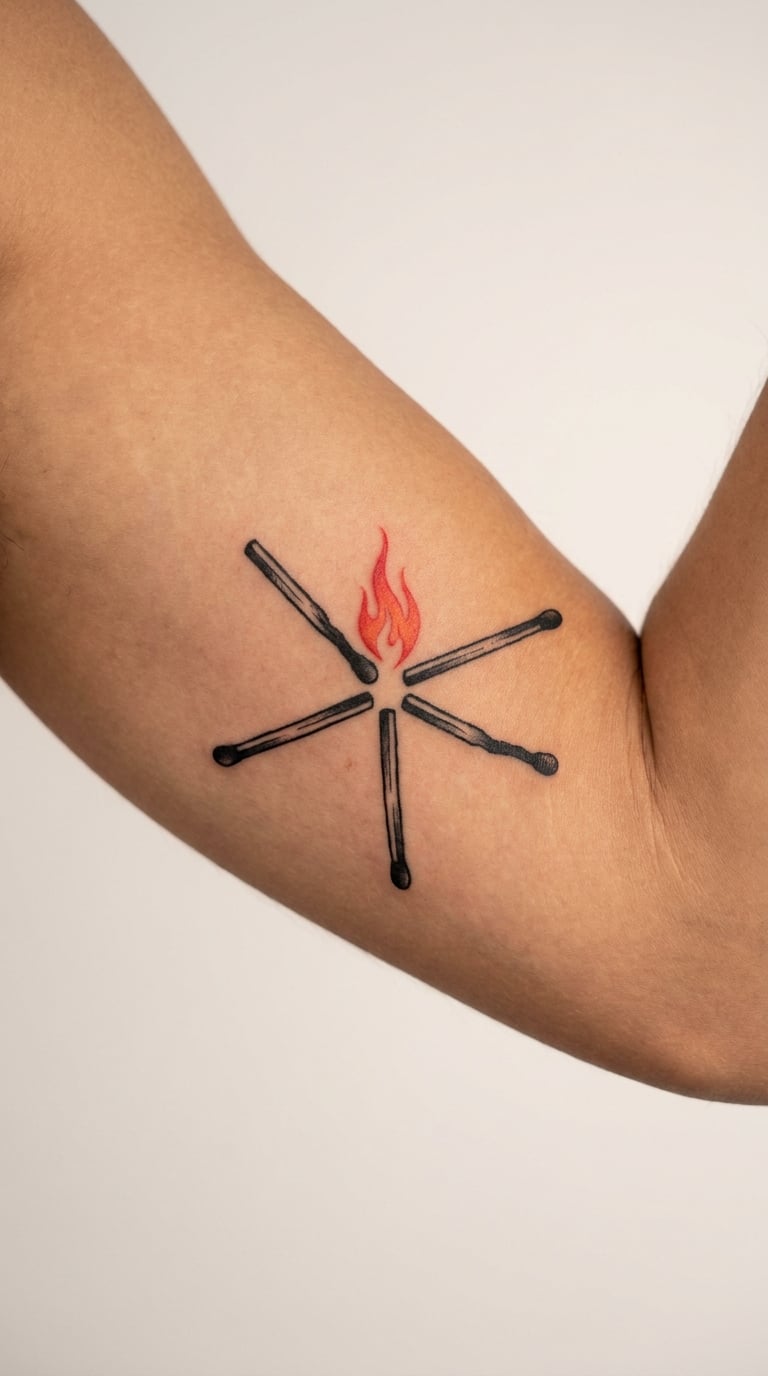
Five matches radiating from one shared point like spokes, with a small flame on the longest one. Alternating solid and fine line gives it the burst of energy without turning it into a heavy black shape. The radiating versions I have seen hold together better when the artist keeps every spoke the same length and varies the angle instead.
It reads as a burst, momentum, the moment a spark lands.
Placement: above the elbow on the inner side, or the outer shoulder. Size: 2 to 2.5 inches across (5 to 6 cm). Style: mixed blackwork and fine line. Pain: medium, more on the inner elbow crease than most spots.
Make it yours: use six spokes instead of five and add a second lit match at a longer length, so the burst has a clear direction.
9. Matchstick Arrow
One horizontal match forms the shaft, two shorter angled matches form the head. The heads of the three matches all face the same way, which keeps the geometry crisp. Resist the urge to add fletching or a second arrow, the whole point of this design is that it resolves in under a second.
Direction is the meaning here, pointing forward, towards a move, towards a place.
Placement: side of the forearm, wrist, or the outer ribs. Size: 2 to 2.5 inches (5 to 6 cm). Style: geometric line work. Pain: low, one of the least awkward small placements on the arm.
Make it yours: set the arrow at a slight upward angle rather than dead horizontal, so it looks intentional rather than measured.
10. Matchstick Diamond
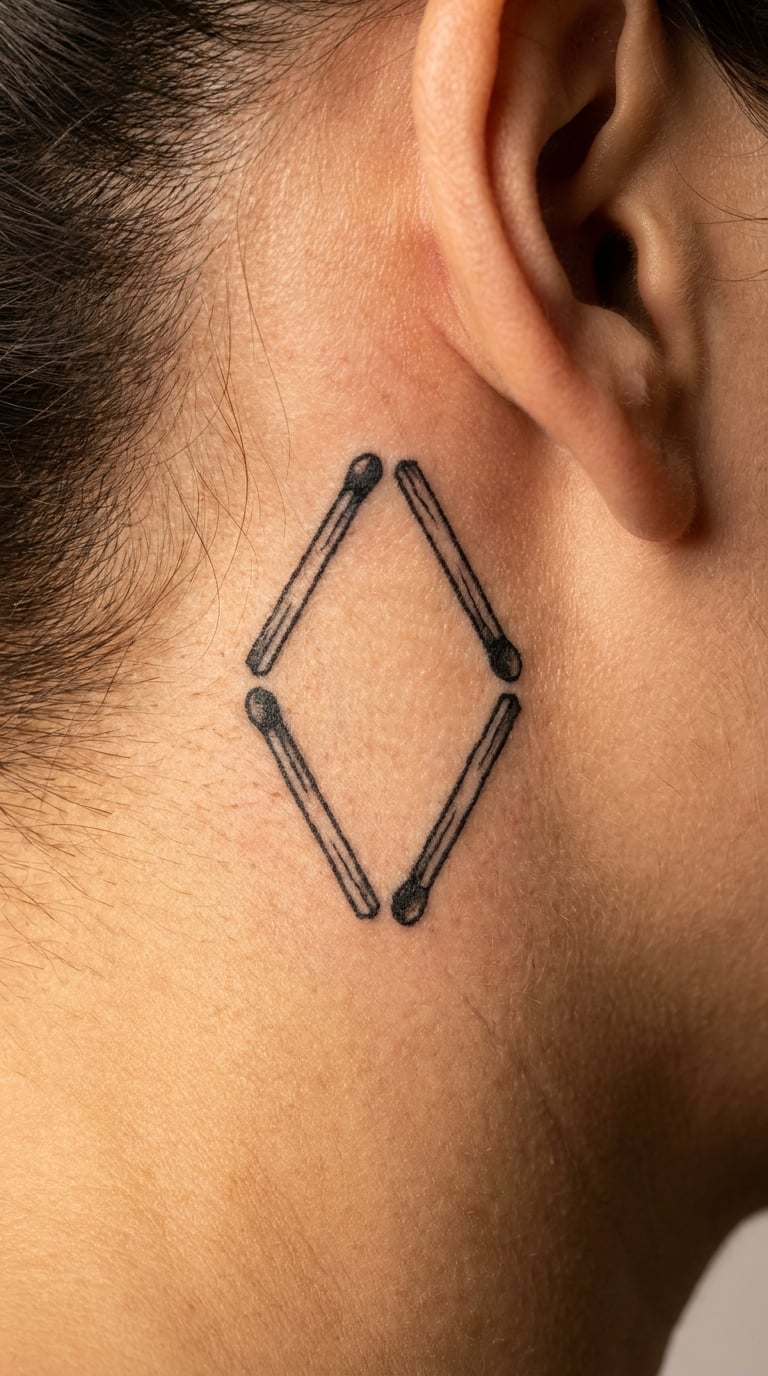
Four narrow matchsticks angled to frame an open diamond, with the heads meeting at the top point and splaying at the bottom. A single short interior tick gives it structure; leaving the inside empty gives it a lighter, more minimal feel. Both work, and the empty version ages better because there is nothing thin inside the shape to fill.
Read as steadiness and something being held, or simply as strong geometry. People choose it as often for the shape as the meaning.
Placement: behind the ear, on the ribs, or the hip. Size: 1.5 to 2 inches (4 to 5 cm). Style: fine line. Pain: low to medium. Behind the ear is thin skin over bone and it ticksle more than it hurts, which some people find harder to sit still through.
Make it yours: have the lower-left match lit, so the diamond looks like it is being heated at one corner.
11. Matchstick Heart Outline
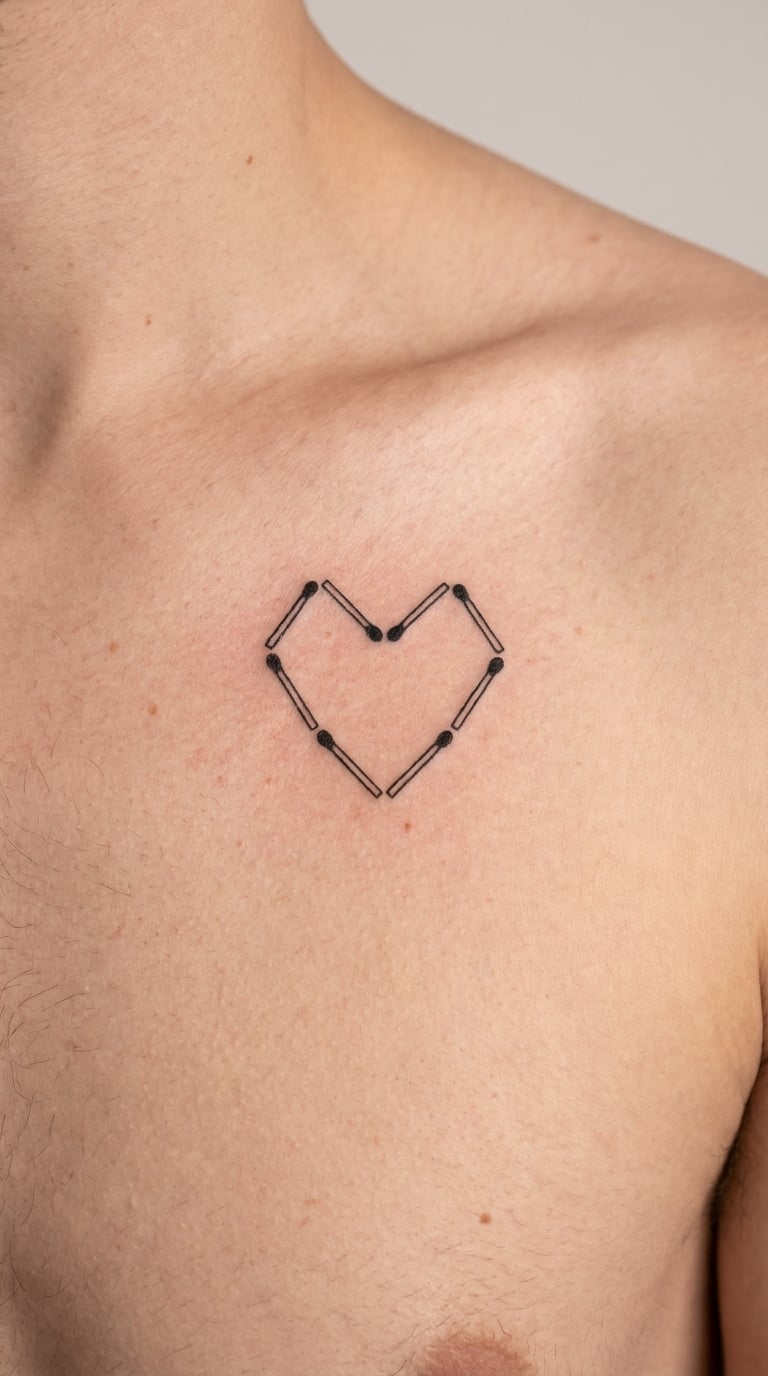
A heart built from angled matchstick segments, with the joins controlled so the outline stays recognizable. Six segments is about the limit before the joins start to look assembled rather than drawn. The mistake I see most often in reference images is over-thick joins, where the line swells at every corner and the heart loses its clean edge.
Love that is deliberate rather than decorative. It pairs with the flame version for people who want fire and devotion in the same design.
Placement: chest near the collarbone, or the inner forearm. Size: 2 to 2.5 inches (5 to 6 cm). Style: fine line. Pain: medium on the chest, low on the arm.
Make it yours: let the flame on the top-left segment be solid black while the rest stays fine line, so the heart has one dark point of emphasis.
12. Matchstick Crown
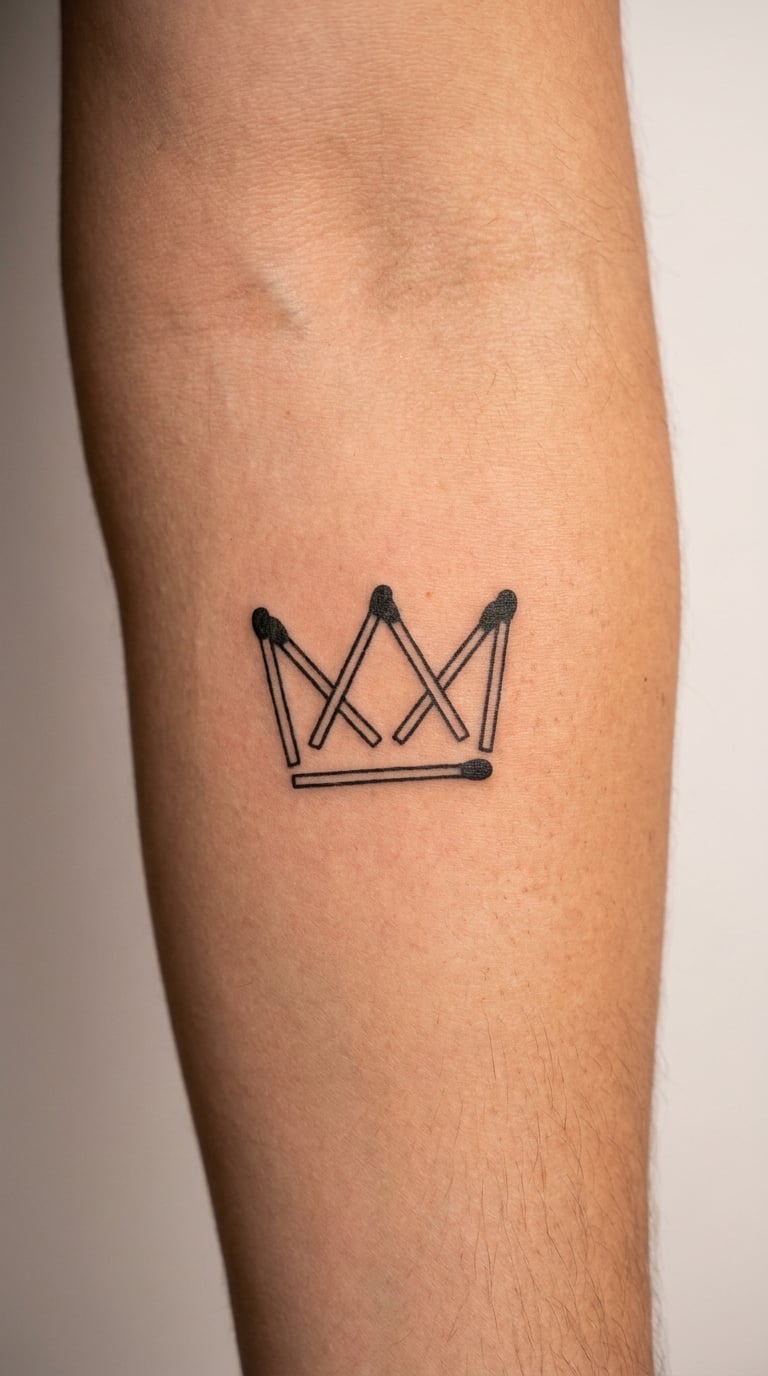
One horizontal match as the base with three or four short matches standing upright along it, each a fraction taller than the last so it looks like a crown rather than a fence. No gems, no jewels, no scrollwork. Every extra ornament on a design this small turns into a smudge within a few years.
It reads as worth, self-possession, the quiet version rather than the loud one.
Placement: inner forearm, chest, or the back of the hand. Size: 1.5 to 2 inches wide (4 to 5 cm). Style: fine line. Pain: low, and quick.
Make it yours: have the tallest point be a lit match, so the crown has one burning peak at the centre.
13. Crossed Flame Pair
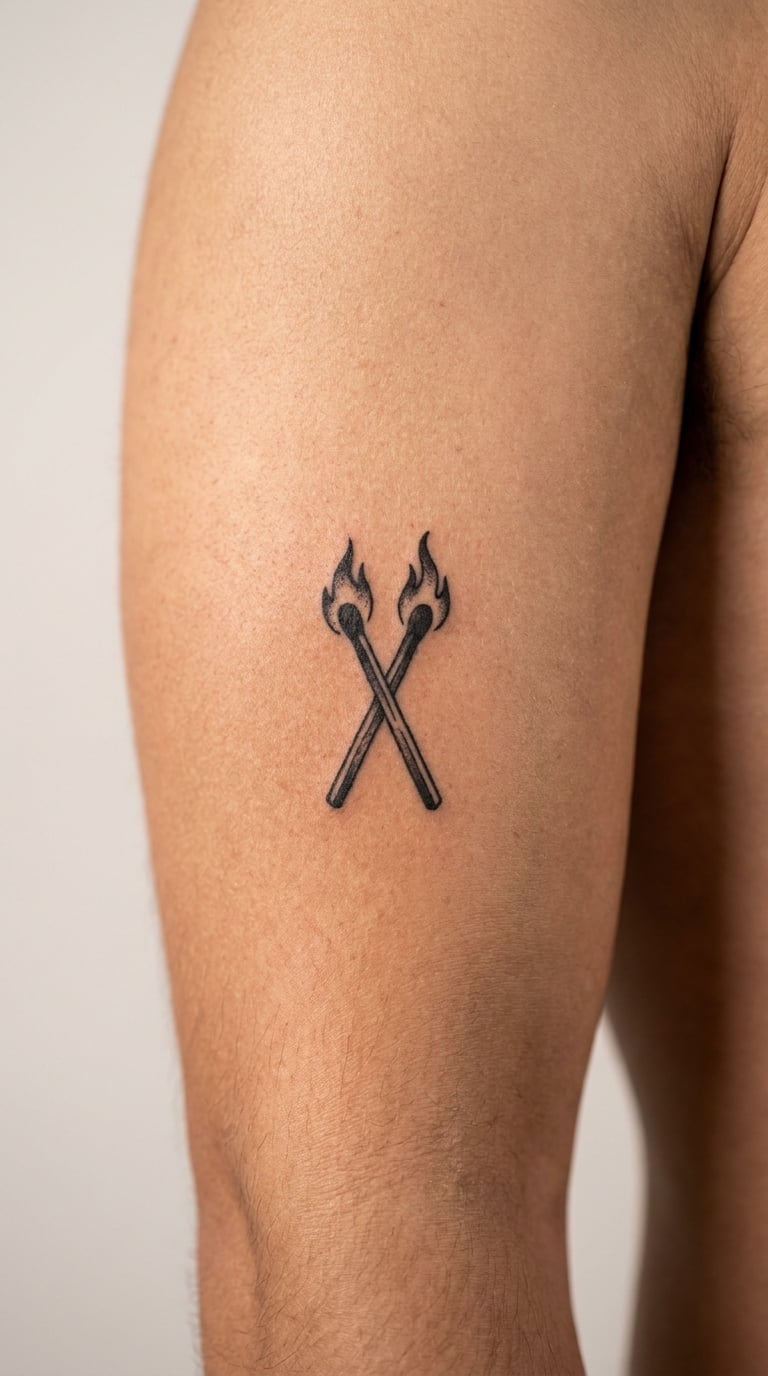
Two lit matches crossed below their tips, making an X with a flame sitting on each upper arm of the X. This is a bolder sibling of idea two. The line weight needs to be noticeably heavier because the design has two flame shapes competing for attention in a very small area.
Two fires, two people, or the idea that something is doubly alive. It is the most common matching design in the whole set.
Placement: outer upper arm, or the chest. Size: 2 to 2.5 inches (5 to 6 cm). Style: blackwork. Pain: medium, medium-high on the ribs if you put it there.
Make it yours: swap one flame for a small spark instead, so the pair is asymmetric and slightly more interesting in photos.
14. Stitched Match Bundle
Five upright matches bound together by three short crossbars, which read as stitches. The gap between this and the ladder is deliberate: no horizontal rungs here, the crosses are short and only cross the outer edges of the bundle, so the vertical matches stay unbroken.
It carries a held-together feeling, a bond kept in place, or something stored and kept safe.
Placement: inner forearm, outer arm, or the calf. Size: 2.5 to 3 inches (6 to 8 cm). Style: fine line. Pain: medium. Five separate needles in a small area is more work and more passes than a single line.
Make it yours: put a small date or initials at the base of the bundle, written in a hand-poked script underneath it.
15. Matchstick Grid
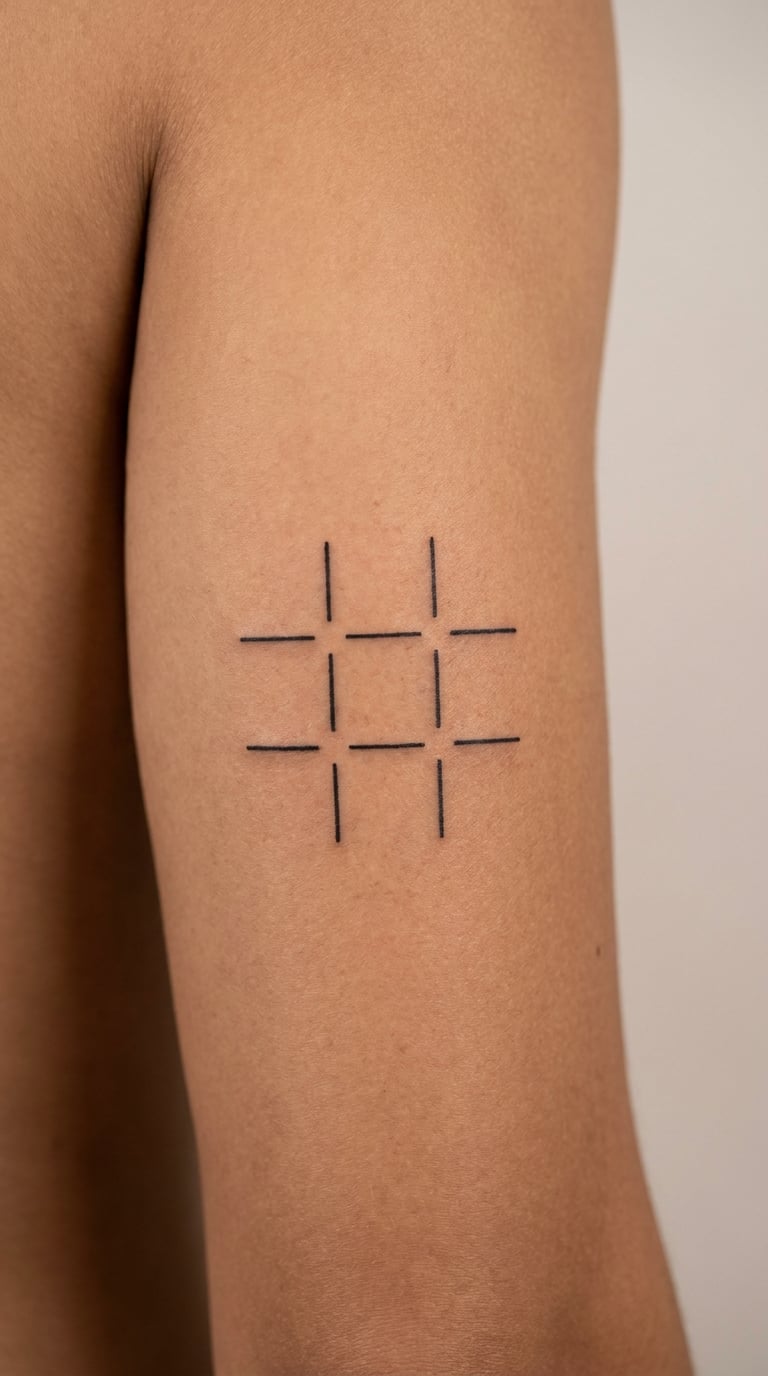
Short horizontal and vertical matches arranged into an open square grid, with the gaps as deliberate as the lines. Nine matches is the sweet spot: enough to read as a grid, few enough that the negative space still breathes. Tighten the spacing and the whole thing turns into a grey block as it heals.
It reads as structure, order, a plan laid out. People who like this one usually like the ladder and the maze too.
Placement: outer upper arm, thigh, or calf. Size: 2.5 to 3 inches square (6 to 8 cm). Style: geometric fine line. Pain: medium, spread fairly evenly across the area.
Make it yours: leave one square of the grid open, empty, so the pattern has a gap that draws the eye.
16. Matchstick Maze
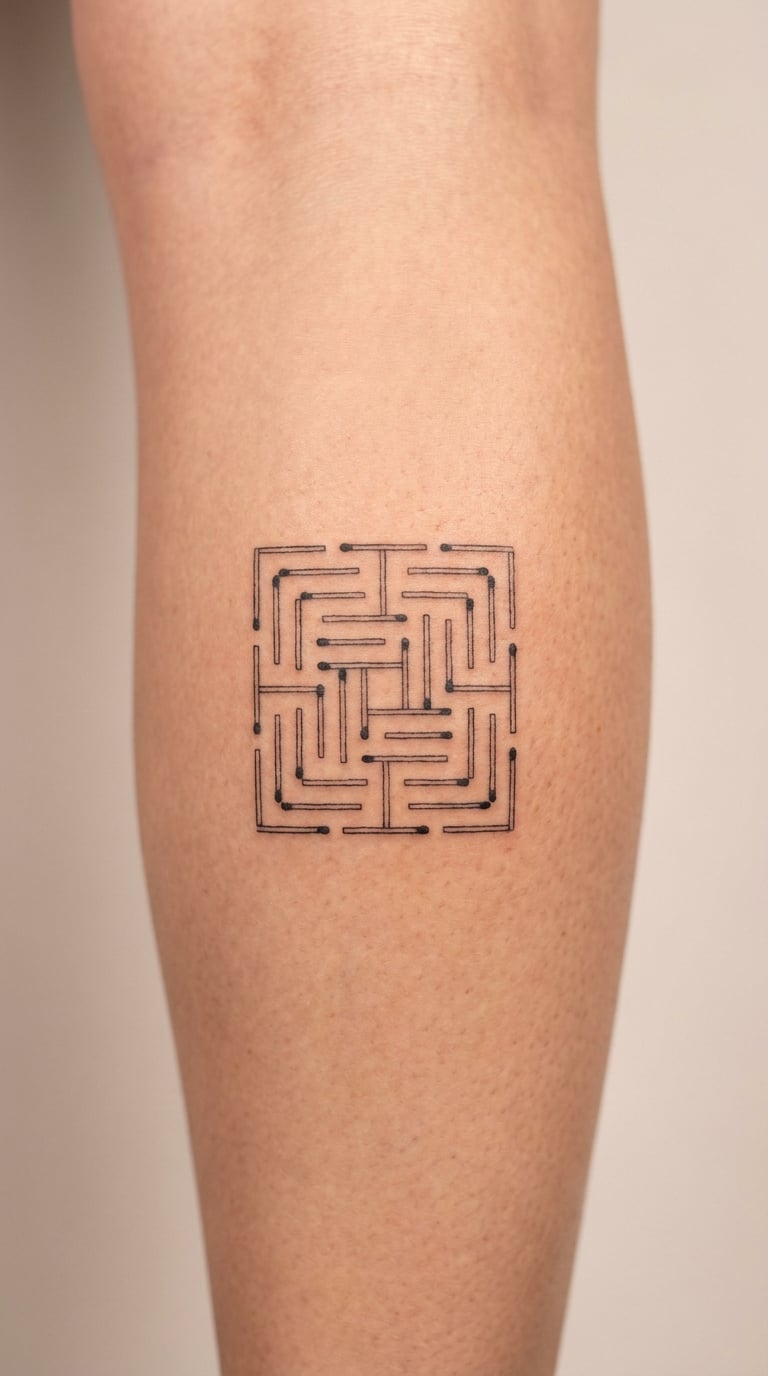
A compact maze drawn entirely with short matchstick segments, each segment showing its own head so the maze looks built from matches rather than drawn with a pen. Keep the routes clear and open a path from the outside edge into the centre, otherwise it becomes a scribble.
Mazes are usually chosen for the idea of working through something, but this design carries no fixed symbolism. What it reliably gives you is a small piece of abstract geometry that does not look like any other symbol on the body.
Placement: calf, outer thigh, or upper arm. Size: 3 to 3.5 inches (8 to 9 cm). Style: abstract fine line. Pain: medium, and a longer sitting than the single-line designs.
Make it yours: have the exit route drawn in solid black and every other route left as fine line, so the way out is the only bold part.
17. Matchstick-Turned Key
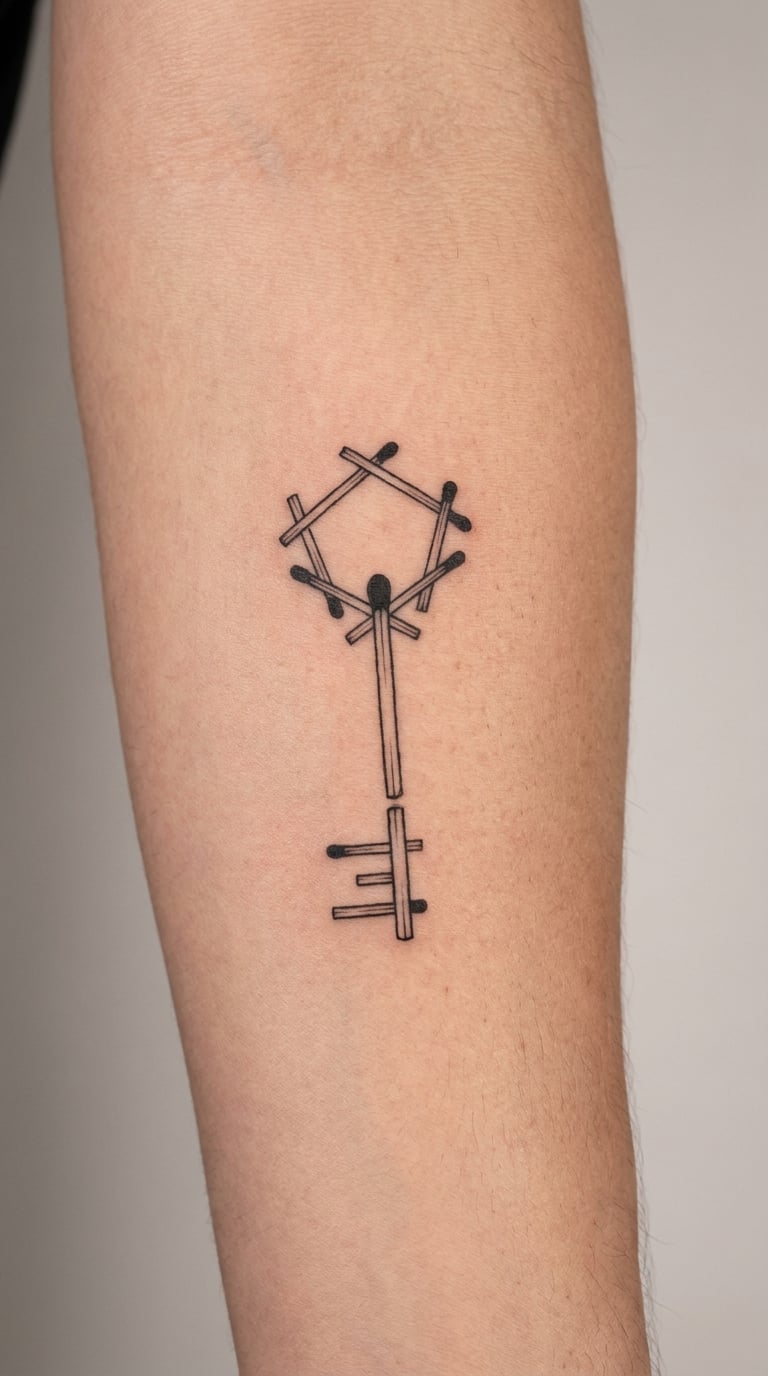
A simple key built from matchstick forms: one horizontal shaft, two or three short matches suggesting the circular bow, and two short teeth at the other end. The bow is suggested rather than drawn as a complete circle, which keeps the design in the same line language as the other twenty ideas here.
It reads as access, as an opener, as the thing that fits the lock. Most people attach it to a specific door, a job, a person or a country.
Placement: inner arm, behind the ear, or the ankle. Size: 2 to 2.5 inches (5 to 6 cm). Style: fine line. Pain: low on the arm, medium on the foot or ankle because the skin there is thin and sensitive.
Make it yours: have the bow of the key be a small solid-black circle with one match laid across it, so the key reads instantly at a distance.
18. Matchstick Paper Plane
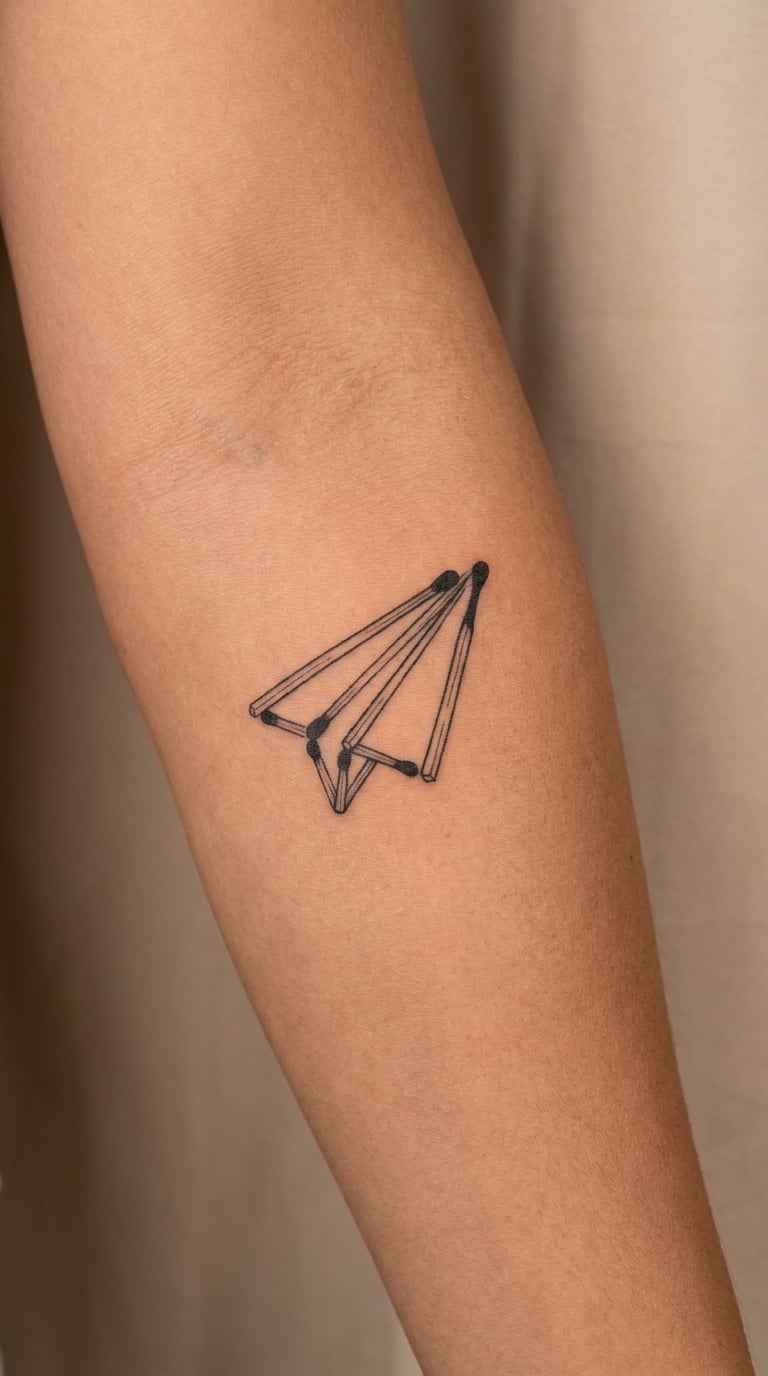
Two elongated geometric shapes for the wings and one short match for the central fold, angled so the whole thing tilts upward. Three elements only. The moment you add a fourth line to make the fold clearer, the plane starts to look like a paper aeroplane illustration rather than a matchstick design.
Sending something out, launching, a first move. It is popular with people marking a move they finally made.
Placement: outer forearm, ankle, or the calf. Size: 2 to 2.5 inches wide (5 to 6 cm). Style: geometric fine line. Pain: low on the forearm, medium on the lower leg.
Make it yours: leave a small gap of skin between the two wings at the tail, so the plane looks in motion rather than flat.
19. Matchstick Sunburst
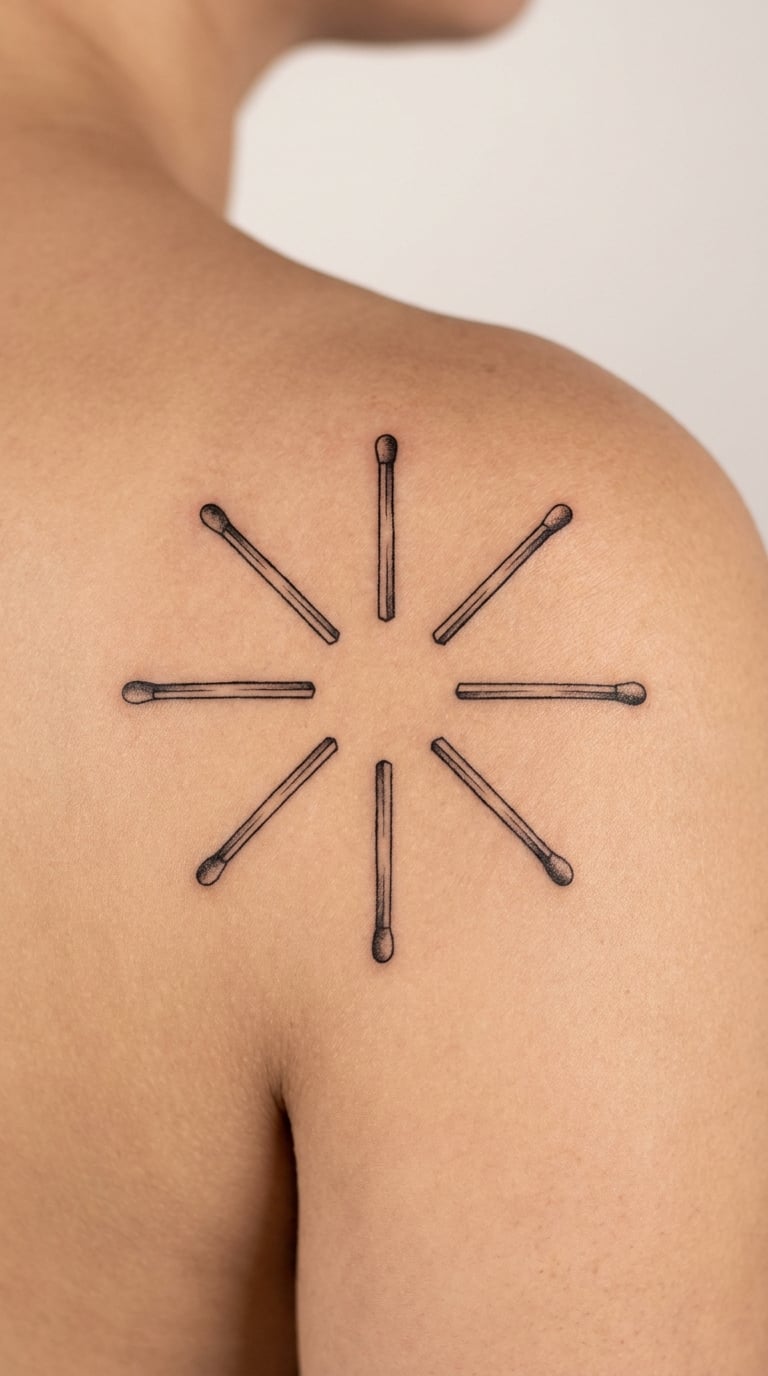
Eight short matches arranged around an open centre, alternating long and short spokes so the sunburst has a rhythm instead of being a perfect radial symmetry. Leave the centre empty. A filled centre is the most common way this design goes wrong, because the small inner gaps trap ink and grey up.
Morning, a new chapter, the start of something with a lot of daylight left in it.
Placement: shoulder, upper back, or chest. Size: 2.5 to 3 inches across (6 to 8 cm). Style: fine line. Pain: medium on the shoulder, medium-high on the upper back where you sit on it.
Make it yours: light one spoke as a solid black match at three o’clock, so the sunburst has a starting point rather than full symmetry.
20. Curved Matchstick Trail
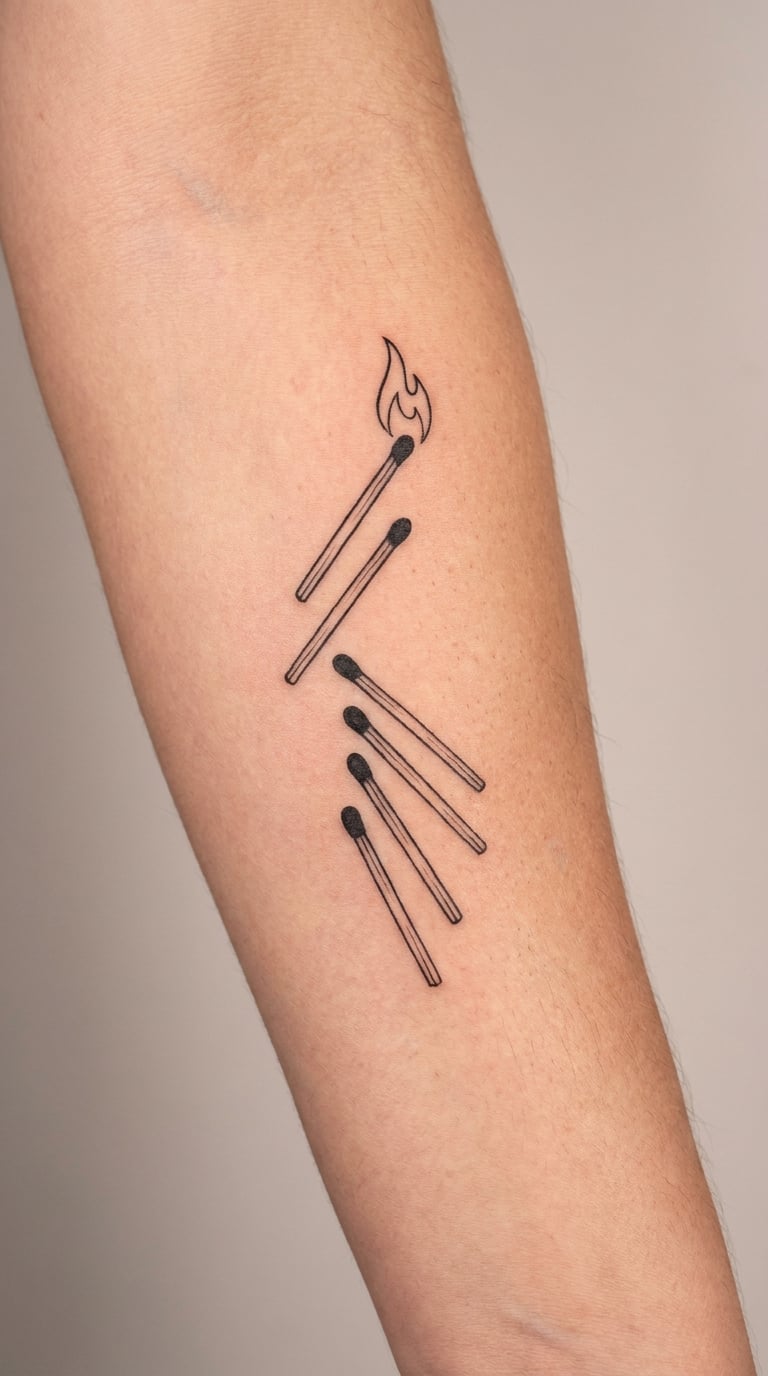
Five small matches laid along a gentle upward curve, each angled slightly differently so the curve reads as movement rather than as a printed arc. One tiny flame at the leading end is enough. A flame on every match turns the trail into a repeated motif and loses the sense of a single spark travelling.
It reads as a path, a sequence, something moving in one direction. It is the design that scales best into a matching pair, because each person can run their trail along a different limb.
Placement: inner forearm following the bone, ribs, or along the calf. Size: 3 to 3.5 inches (8 to 9 cm). Style: fine line. Pain: medium, spread out so it is more of a constant scratch than a series of sharp points.
Make it yours: make each match a little shorter than the last, so the trail seems to be burning down as it moves.
How to Choose the Right Design
Five checks will save you a redo. Run through them with your artist before the stencil goes on.
- Line clarity at your chosen size. Look at the design at arm’s length, not zoomed in. If the flame tip is thinner than about the width of a printed full stop, it will not survive healing. Ask the artist to thicken it one step.
- Motif scale against the body part. A 3-inch maze on a flat calf works. A 3-inch maze over a wrist crease does not. Flat, still skin rewards detail; bony, moving skin rewards simple shapes.
- Placement and how you use that part. If you work with your forearms against a desk all day, or wear a heavy watch on that wrist, choose the outer upper arm instead. A design you keep covering is a design you stop seeing.
- Style match with your existing pieces. A single hairline match next to a heavy blackwork sleeve reads as an accident. If your collection is all bold work, ask for the blackwork versions here, or go larger. If it is all fine line, ideas 1, 3, 4 and 12 are safe picks.
- Long-term detail retention. Fine line on hands, fingers and knuckles fades fastest, and fine line on the tops of the feet fades from sun exposure. Interior arm skin holds thin lines best. A simple shape with a solid black accent ages more predictably than an all-thin-line drawing.
If calm, low-key symbolism is the direction you are leaning, the 20 Best Tattoo Ideas for Anxiety and Calm: Minimalist designs work in the same small-scale line language as these. If you are getting this as one half of a pair, the 20 Matching Tattoo Ideas for Roommates: Best Small list covers the layouts that work for two people without turning into duplicates.
Cost and Session Time
Almost all of these designs are one sitting, and most take between fifteen and forty-five minutes. The two that can run longer are the maze and the trail, where the artist is placing a lot of separate short segments. A nine-piece grid on a flat arm is quick work once the stencil is down.
In the US, a single fine-line match of one and a half to two inches usually lands somewhere around $80 to $150 at a walk-in shop, more at a private studio. A small bundle, crown or two-match design in the same size range runs roughly $120 to $220. A three-inch maze, grid or sunburst with a dozen or more separate segments sits around $200 to $400, and bold blackwork versions add time and therefore money. Those are typical ranges, not quotes.
Cost follows size, detail and the shop’s hourly rate, and those three things move together. A three-inch maze with sixteen short segments is a longer session and lands at the top of the range. Two practical points: most studios have a shop minimum that applies even to a ten-minute piece, and most charge by the hour, so a design that takes forty minutes on paper can run past the estimate once the artist is placing lines. A thick blackwork version also takes longer to fill than a thin outline.
Ask for the total before the session starts, not after. If a piece is going beyond what you planned, it is much easier to adjust the design on day one than to live with it.
Aftercare Basics
- Follow your artist’s aftercare instructions first. They know what needle depth and what ink they used, and their advice overrides anything general you have read.
- Wash the area gently with unscented soap and lukewarm water as directed, then pat dry with a clean towel. No scrubbing.
- Keep it clean and dry for the first few days, and change or re-wet the covering your artist applied rather than leaving it to dry into the skin.
- Do not soak it. No baths, no swimming pools, no hot tubs until the new skin has closed over, and keep suntanning off it while it heals, since healed fine line still fades faster in strong sun.
- Do not itch or pick at flakes. They come off on their own in a week or two, and picking is the main cause of patchy line loss.
- Photograph it once healed in the same light if you care about how it changes. Fine line softens with time, and having a baseline photo makes the difference obvious rather than worrying.
Frequently Asked Questions
Are matchstick tattoos suitable for a first tattoo?
Yes, they are one of the easier first designs. A single fine-line match at around 1.5 to 2 inches is quick, needs no colour, and finishes in well under half an hour. The main thing to watch is scale, not subject. Ask your artist to keep the flame solid black with no interior lines, and choose skin that does not move much.
What is the smallest practical size for a matchstick design?
About 1.5 inches (4 cm) for a single match, and 2 inches (5 cm) if a flame is included. Under that, the head and the flame tip get so thin that they fill in during healing and the design turns into a smudge. Detail scales with the size, so a maze or a grid needs 3 inches or more to stay readable.
Do fine-line matchstick tattoos fade faster than bold designs?
They do, especially on hands, fingers, knuckles and anywhere exposed to strong sun. Fine lines spread slightly as they heal, so a hairline match that starts sharp looks softer within a year or two. Solid black accents hold their edge far better. Interior arm skin is the most forgiving, and it is the spot most first-timers choose for exactly that reason.
Can matchstick tattoos work on fingers and hands?
They can, but fingers are one of the fastest-fading placements and the lines will soften noticeably within a few years. The hand itself does better than the fingers, though the back of the hand takes sun and ink on it often. If it is a first piece, the inner forearm is a much better long-term bet than a knuckle.
Should a matchstick tattoo include a flame?
It depends on what you want it to mean. A flame reads as ignition, passion, something starting. A bare match reads as potential, a spark that has not been struck yet. A burnt-out match reads as letting go, burnout or a finished chapter. Plenty of people take a bare match now and add the flame years later, once the linework has settled.
Can matchstick tattoos be made into matching pieces?
Yes, and they are one of the most natural small matching designs. Ideas 2, 7, 13 and 20 all work as pairs: two crossed matches, two lit matches at different heights, the crossed flame pair, or a curved trail running along a different limb on each person. Decide the exact size together before booking, so the two pieces actually match rather than merely resembling each other.
Which One Should You Pick First
If this is your first tattoo, start with idea 1 or idea 12. A single fine-line match or a small four-point crown at about 1.5 to 2 inches is quick, forgiving and easy to place, and it holds its shape longer than anything on a hand.
If you already have work and want these to sit with it, match the line weight first and the placement second. The ladder, the grid and the maze give you enough structure to hold a space on a larger arm, and the trail or the two lit matches are the ones that read as intentional next to an existing collection. Bring two or three reference images to the appointment and let the artist adjust the size to fit the skin in front of you.