
24 Aster Flower Tattoo Ideas: Best Designs (October 2026)
The aster is one of the best flowers to get tattooed and still one of the least used. It blooms late, it holds a shape well in ink, and it carries a September birth flower story without needing a paragraph of explanation. These 24 aster flower tattoo ideas run from a single hairline stem to a forearm panel, and every one lists a real size, a real placement and an honest note on how it ages.
Most people book a floral tattoo in late summer for a September birthday, an anniversary or a reminder of someone who has gone, so allow a month or two of planning before you sit down. If you are still deciding between flowers, the [52 birth flower tattoo ideas](https://thewe.cc/september-birth-flower-tattoo/) on the site are worth a look too.
24 Aster Flower Tattoo Ideas: Quick Guide
| Idea | Style | Best placement | Size | Pain |
|---|---|---|---|---|
| 1. Fine-line single aster stem | Fine line, one colour | Inner wrist, forearm | 2-4 in | Low |
| 2. Blackwork aster bloom | Blackwork | Outer forearm, calf | 3-5 in | Medium |
| 3. Grey lily aster | Botanical realism | Forearm, calf | 2.5-4 in | Medium |
| 4. Watercolor aster bouquet | Watercolour | Forearm, upper arm | 4-7 in | Medium |
| 5. Lavender geometric aster | Geometric, violet | Forearm, sternum | 3-5 in | Low to medium |
| 6. Minimal aster line sprig | Minimalist line | Wrist, ankle | 1.5-3 in | Low |
| 7. Traditional pink aster | American traditional | Upper arm, calf | 3-5 in | Medium |
| 8. Neo-traditional bouquet | Neo-traditional | Upper arm, back | 5-8 in | Higher |
| 9. Dotwork aster constellation | Dotwork | Shoulder, forearm | 3-5 in | Medium |
| 10. Micro-realism grey and pink | Micro-realism | Wrist, collarbone | 1.5-3 in | Low to medium |
| 11. Black-and-grey stargazer aster | Black and grey | Calf, thigh | 3-6 in | Medium |
| 12. Graphic cel-shaded aster | Cel-shaded graphic | Calf, forearm | 3-5 in | Medium |
| 13. Aster botanical wreath | Botanical wreath | Upper arm, thigh | 4-7 in | Medium |
| 14. Wildflower meadow cluster | Illustrative wildflower | Calf, forearm | 4-7 in | Medium |
| 15. Crescent-moon aster pair | Fine line, celestial | Forearm, behind ear | 2-4 in | Low to medium |
| 16. Aster with a small butterfly | Natural colour | Ankle, shoulder | 2.5-4.5 in | Low to medium |
| 17. Sun and aster duo | Botanical line | Forearm, calf | 3-5 in | Medium |
| 18. Monoline aster loop | Monoline | Wrist, collarbone | 1.5-3.5 in | Low |
| 19. Japanese-inspired aster branch | Oriental composition | Calf, back | 5-8 in | Higher |
| 20. Art Nouveau aster panel | Decorative panel | Shoulder blade, thigh | 4-6 in | Medium |
| 21. Stencil-style aster pair | Stencil graphic | Forearm, chest | 3-5 in | Medium |
| 22. Colour-pop aster trio | Bright colour | Upper arm, calf | 3-5 in | Medium |
| 23. Matching mini aster pair | Micro fine line | Inner arms, ankles | 1-2.5 in | Low |
| 24. Purple aster forearm panel | Layered colour botanical | Forearm, upper arm | 6-9 in | Higher |
How to Compare These Aster Tattoo Ideas
Compare them on four things: how much line detail survives at your chosen size, how much colour the piece needs, where the body will hold it without distortion, and how it will look in fifteen years. Fine line and monoline designs soften fastest, especially on hands and fingers. Blackwork and stencil pieces hold their edges far longer. Watercolour and micro-realism sit in the middle and depend heavily on the artist.
Size is the one variable people get wrong most often. A drawing that looks right at six inches can turn to mud at one and a half inches, so bring a scale reference to your consultation and ask the artist to redraw the same design smaller. If you are a first-timer, ideas 1, 6, 10 and 23 are the safest starting points, and [these small wrist flower designs](https://thewe.cc/delicate-flower-tattoo-ideas-for-the-wrist/) are a good companion read.
1. Fine-Line Single Aster Stem
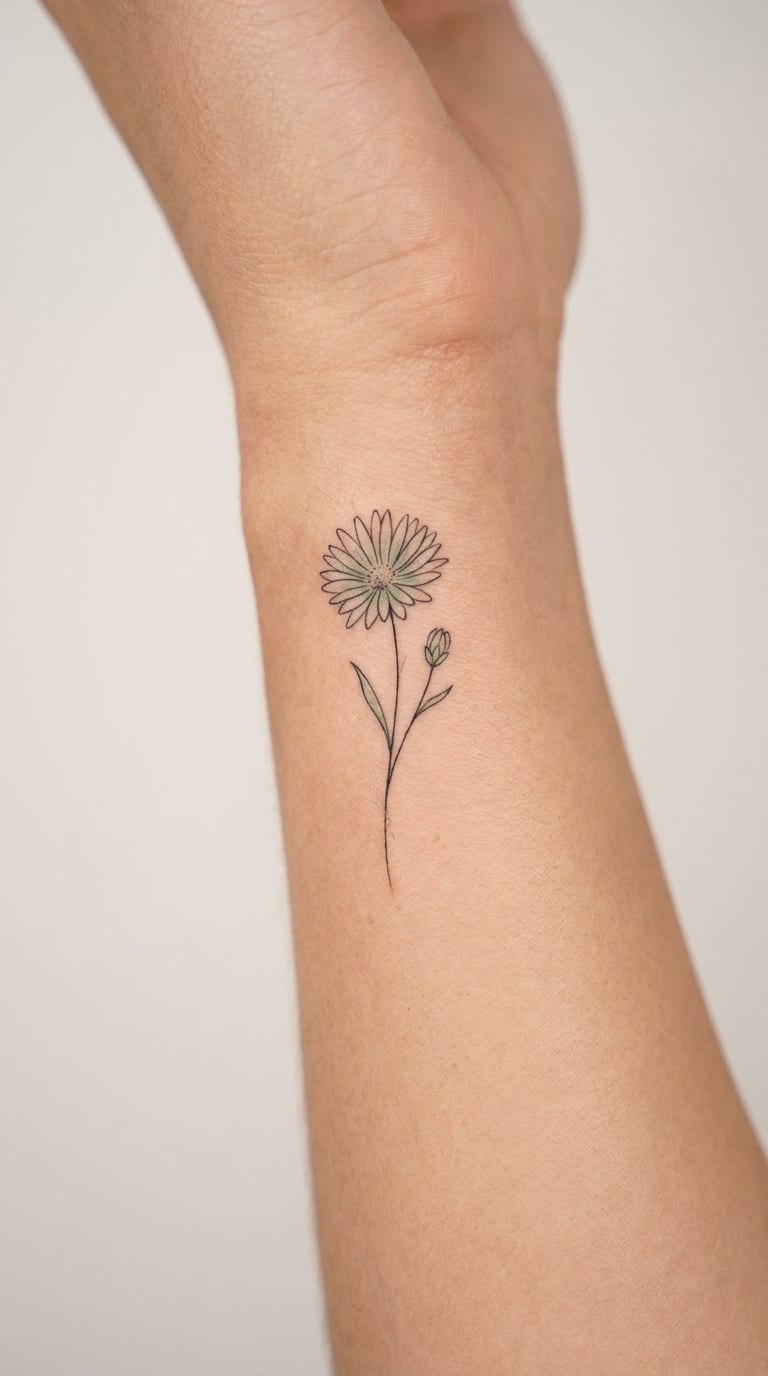
This is the design most people picture when they search aster flower tattoo ideas, and for good reason. One bloom sits at the top of a slim stem, the narrow ray petals drawn as separate tapered lines rather than a filled shape, and a single leaf curves off halfway down. Black line, pale green stem, nothing else competing for attention.
It is the piece people choose when a tattoo should be noticed by the people standing close to them and by nobody else. The stem can carry a date, a short name or a small coordinate without turning the flower into a poster.
Placement: inner wrist, inner forearm, collarbone. Size: 2-4 inches (5-10 cm). Style: fine line with one muted colour. Pain: low on the inner arm; the wrist edge is the tender part. Ageing: hairline strokes spread and grey out within about five years, so a touch-up is normal. Make it yours: add a birth date in tiny numerals running along the stem.
2. Blackwork Aster Bloom
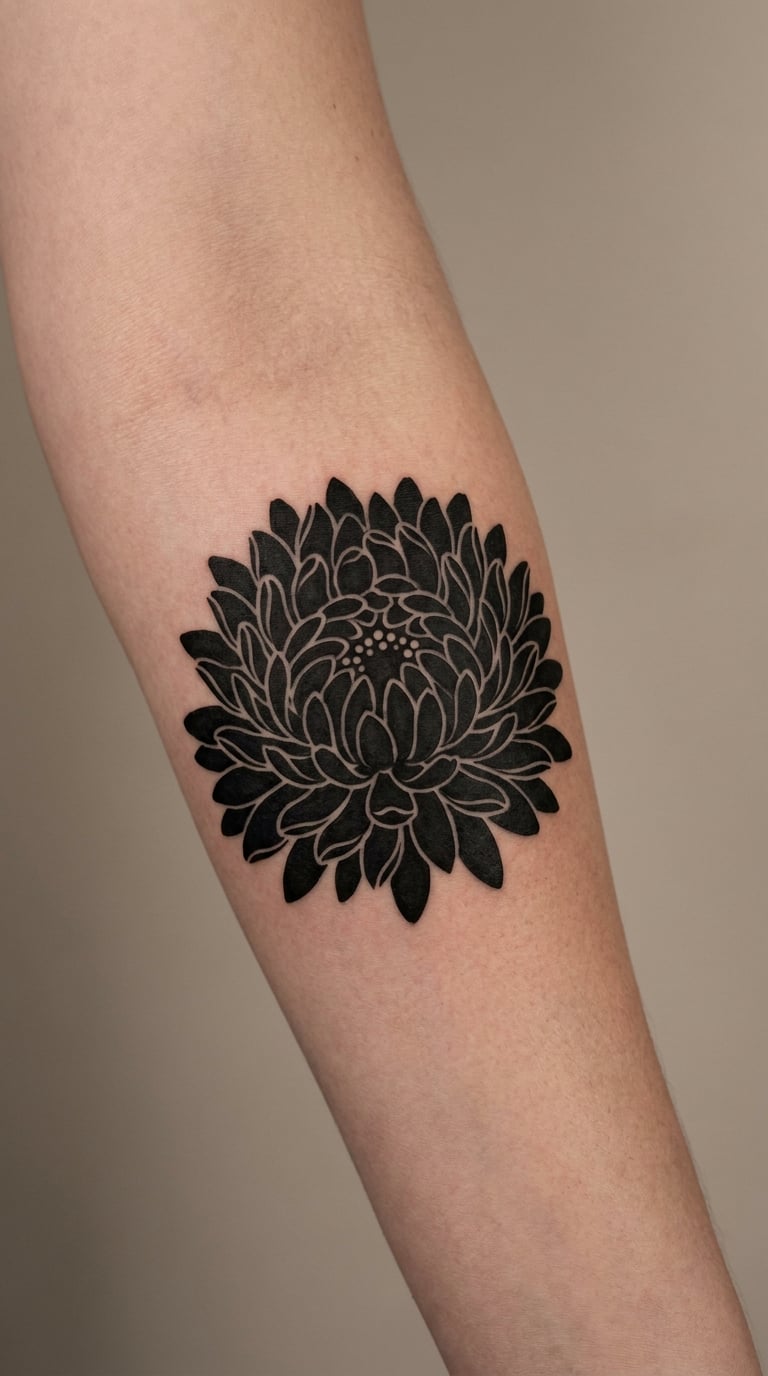
Solid black petals, one flat silhouette, and a scatter of small cuts of white left inside the bloom so the centre does not read as a hole. The petals are stacked in two or three overlapping rows with clean edges, closer to a woodcut print than a flower illustration. It is graphic, heavy and unmistakable from across a room.
People pick this version when they want a flower that still looks graphic in ten years. Black ink barely fades compared with fine line, so this style is a good match for someone who does not want to keep booking touch-ups. A grey wash behind the bloom adds depth without competing with the shape.
Placement: outer forearm, upper arm, calf, thigh. Size: 3-5 inches (7.5-13 cm). Style: blackwork with negative space. Pain: medium; solid black takes longer to fill, so expect a scratchy rather than sharp session. Ageing: holds line weight well. Make it yours: request a pale grey wash halo behind the bloom, or cut the flower into a hexagonal frame.
3. Botanically Accurate Grey Lily Aster
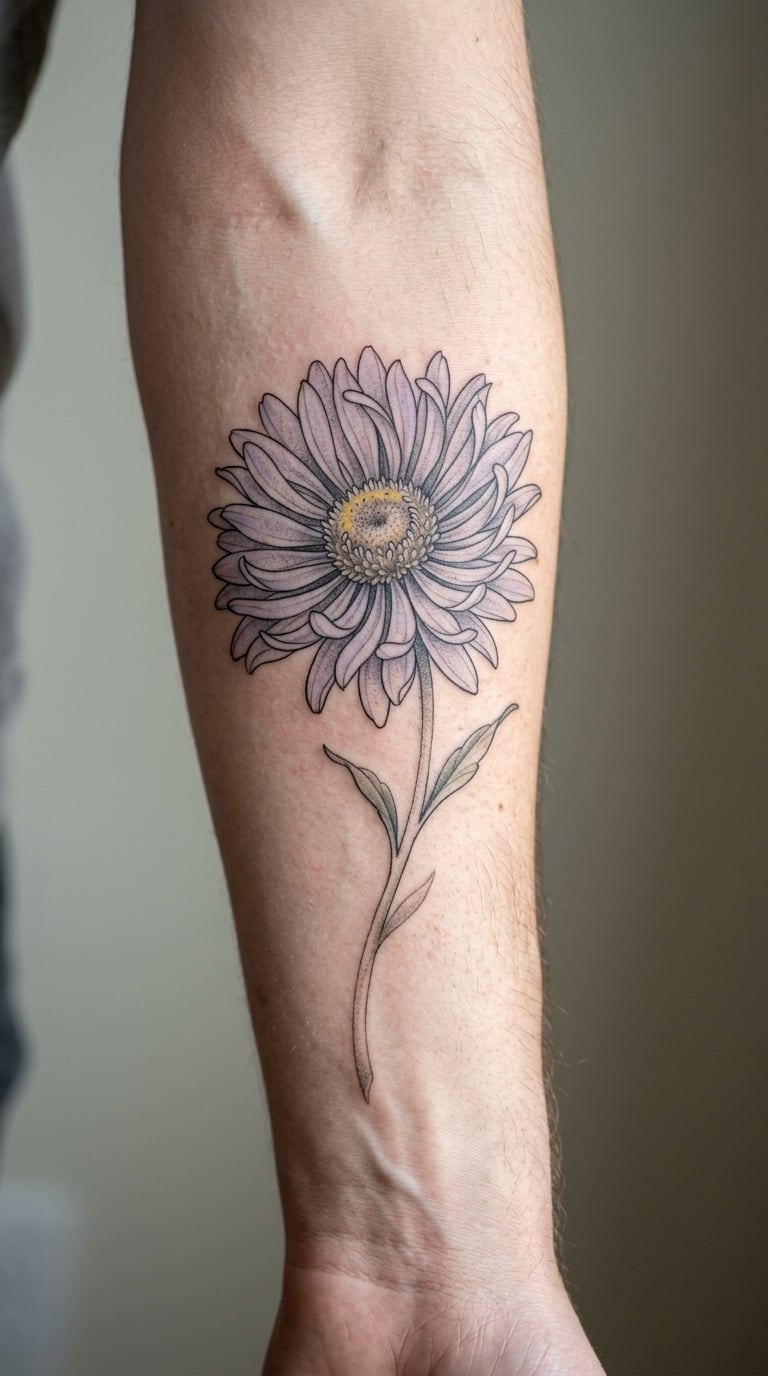
This one is drawn to the plant rather than to a mood. A real aster has many slender ray florets around a textured disk of tiny florets, and this design keeps that structure: twenty-plus fine petals, each with a slight curve, fanning around a stippled grey-yellow centre, with a lightly shaded stem and two narrow leaves.
Its appeal is botanical recognition rather than any assigned symbolism. If you are getting an aster because of a September birthday or a person it reminds you of, accuracy is the point. It is also the design that most reliably does not get mistaken for a daisy, since the petal count and disk do that work.
Placement: forearm, calf, back of the shoulder. Size: 2.5-4 inches (6-10 cm). Style: botanical realism in grey with a muted lilac tint. Pain: medium; the stippled centre takes the longest. Ageing: grey holds well, the lilac shifts slightly cooler. Make it yours: have the artist add whip-shaded depth to the stem so it reads as three-dimensional.
4. Watercolor Aster Bouquet
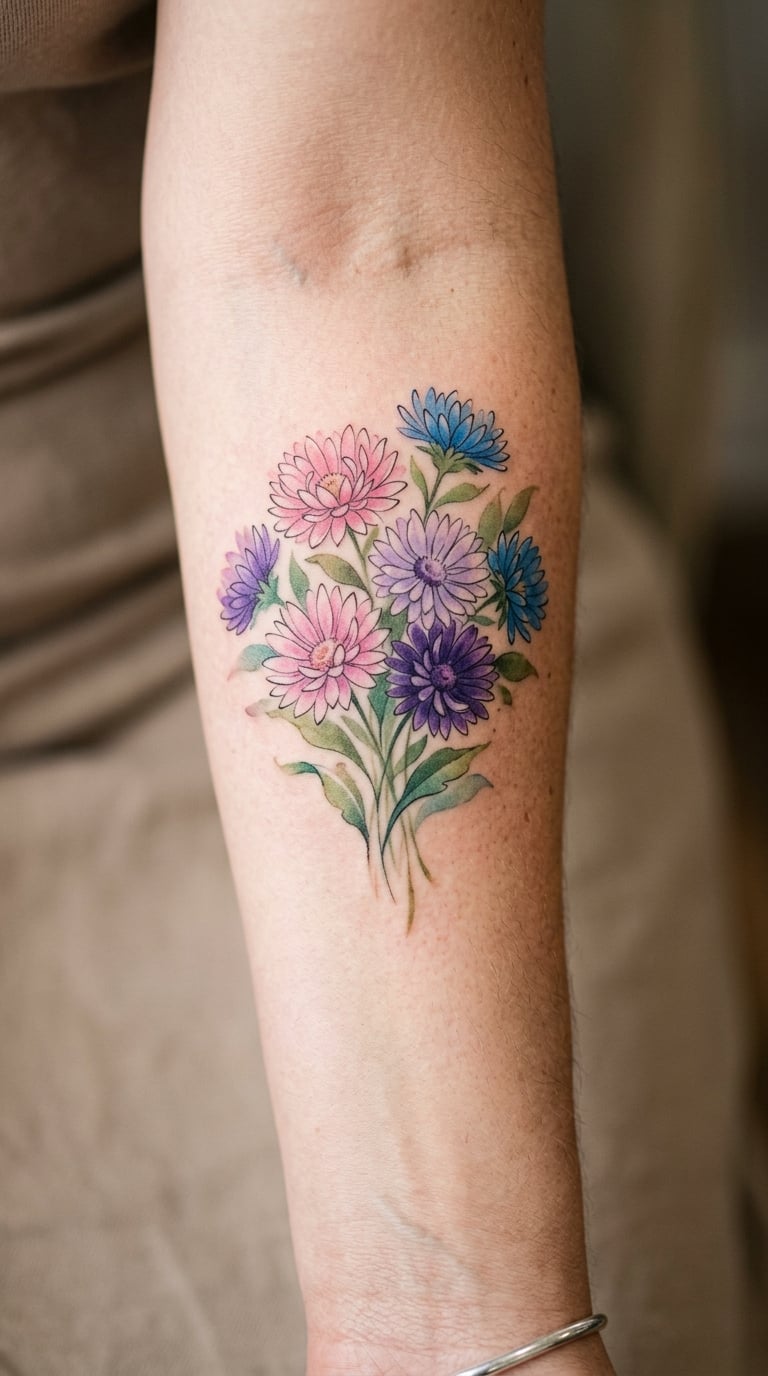
Loose pigment and open edges. The blooms are suggested rather than outlined: a wash of pink, a violet, a soft blue, each flower bleeding slightly into the skin tone around it, with two or three leaves trailing off in diluted green. There is no black line anywhere in this piece, which is exactly the point.
This suits people who want colour without the weight of a traditional piece. Because there are no outlines holding it together, the artist controls the result through pigment density, and a good one will leave breathing room between the washes so they read as separate flowers.
Placement: inner forearm, upper arm, thigh, calf. Size: 4-7 inches (10-18 cm). Style: watercolour. Pain: medium. Ageing: the lightest washes fade first, so expect the piece to look softer in a year, which most people like. Make it yours: add one realistic green leaf at the base to anchor the colour.
5. Lavender Geometric Aster
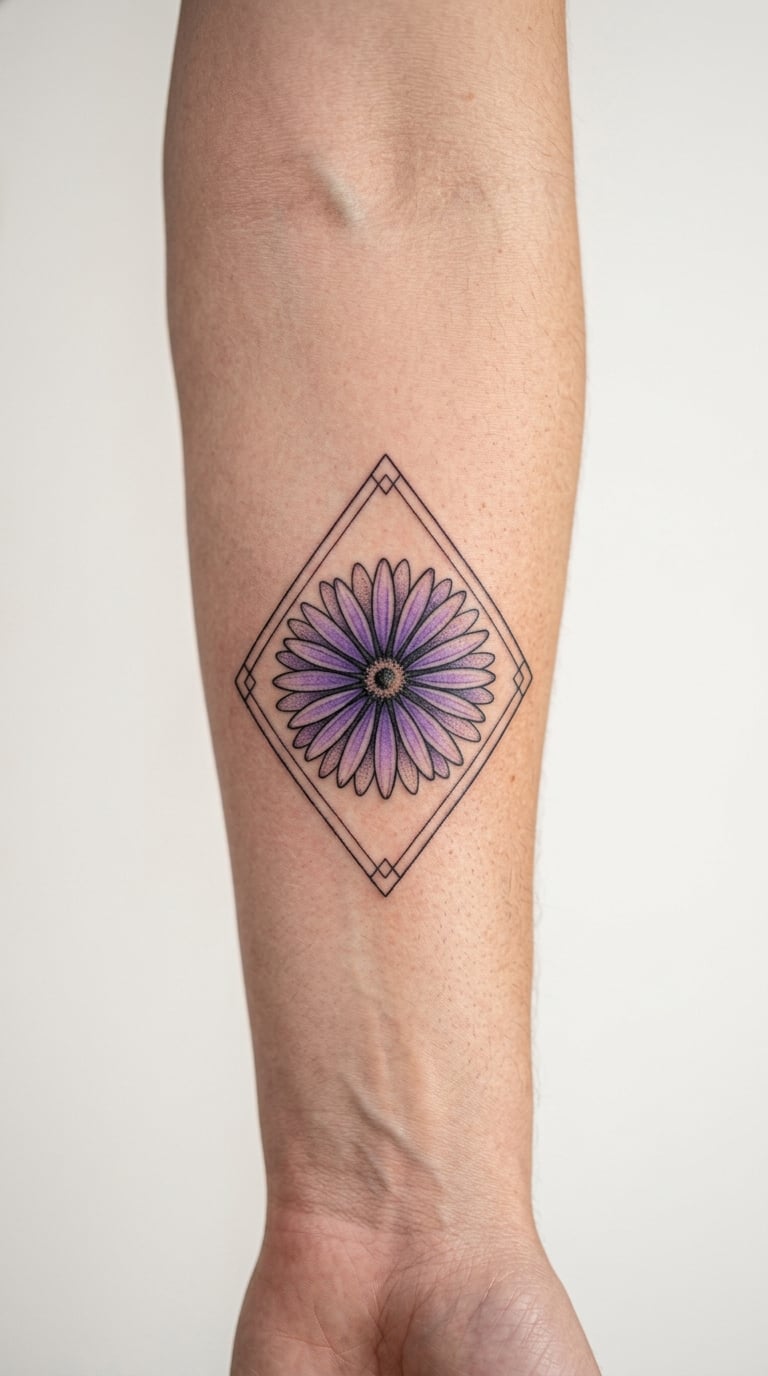
A symmetrical flower head set inside a precise structure: a diamond frame, a set of fine guilloche lines, or a thin concentric ring. The aster is drawn with even petal spacing and a violet wash that fades toward the tips, so the geometry and the softness of the flower argue with each other a little.
It reads as modern and decorative, closer to a book plate than to a meadow. That contrast is why it works, and it is a good choice if you already have geometric line work and want the flower to sit inside that language rather than fight it.
Placement: forearm, sternum, upper arm, thigh. Size: 3-5 inches (7.5-13 cm). Style: geometric with violet colour. Pain: low to medium, though the sternum option hurts more than the same design on an arm. Ageing: the violet lightens, the black frame holds. Make it yours: run an initial along one edge of the frame.
6. Minimal Aster Line Sprig
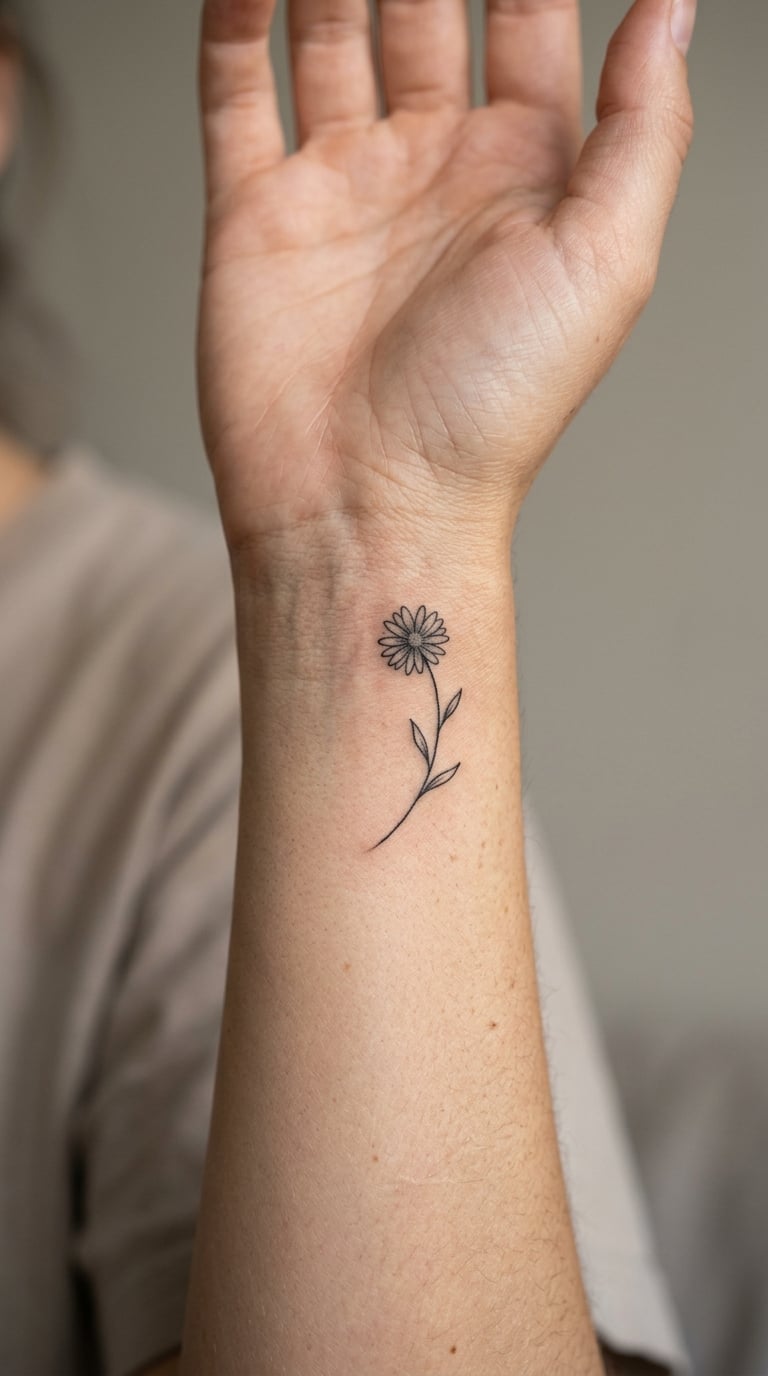
One simplified flower head, a curved stem, two small leaves and a lot of empty skin. The petals are single lines, the centre is a tiny circle of dots, and nothing else is drawn. This one scales from a knuckle-sized mark to a forearm sprig without changing the basic idea, which makes it a useful one to keep in mind early.
It sits well in a minimalist or fine-line collection where other pieces are already quiet. Small enough for an ankle or behind the ear, and the negative space does the decorative work instead of detail, which is what keeps it legible.
Placement: wrist, ankle, behind the ear, along a finger. Size: 1.5-3 inches (4-7.5 cm). Style: minimalist line. Pain: low, apart from ribs which this design also suits. Ageing: hand and finger versions fade noticeably faster than arm versions. Make it yours: add a birth-date numeral tucked under the curve of the stem.
7. Traditional Pink Aster With Green Leaves
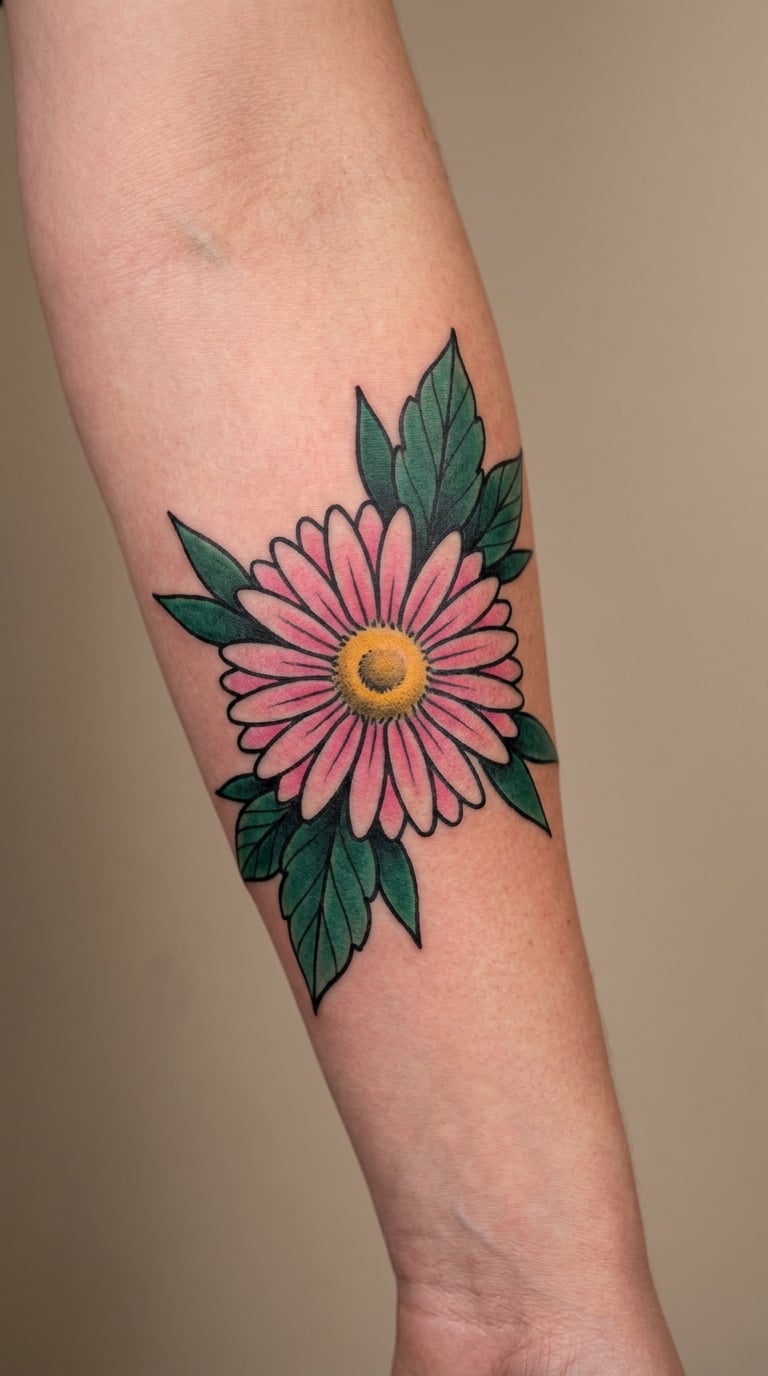
Dark outline, flat pink petals with a little shading near the base, a yellow centre dotted with orange, and leaves in a green saturated enough to read clearly. The stem is drawn thick and slightly shaded, and the whole thing has the even weight of old American flash rather than the softness of a botanical study.
It is cheerful, timeless and easy to read at any size, which makes it a safe first colour piece. Traditional florals also age better than their delicate cousins because the fill is dense and the outlines are heavy.
Placement: upper arm, outer forearm, calf, thigh. Size: 3-5 inches (7.5-13 cm). Style: American traditional. Pain: medium; saturated colour means more passes. Ageing: pink shifts toward warm peach over time. Make it yours: add a small banner beneath the bloom carrying one short word.
8. Neo-Traditional Aster Bouquet
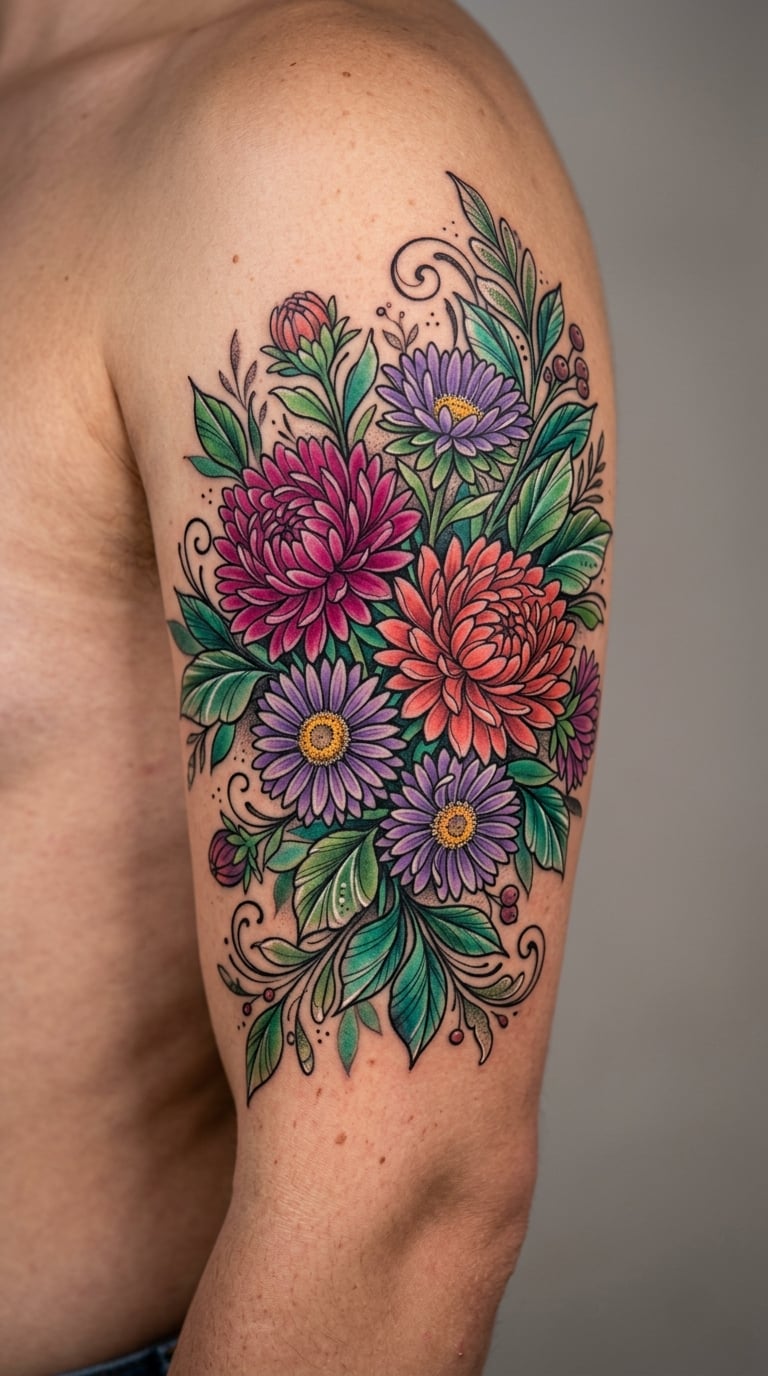
A full arrangement rather than a single flower. Magenta, coral and purple asters overlap in a triangular bunch, with curled leaves, dimensional shading and small white highlights placed on the petals to make them turn. The stems disappear into a wrapped base that can be styled as a ribbon, a wrap or a simple shadow block.
Collectors choose this one for richness. It rewards an artist who works in colour, and it gives you something to build on, since more flowers can be added later inside the negative space without reworking what is already healed.
Placement: upper arm, thigh, back, calf. Size: 5-8 inches (13-20 cm). Style: neo-traditional. Pain: higher on the ribs and spine, medium elsewhere. Ageing: heavy fill holds; fine highlights need a touch-up sooner. Make it yours: choose one of the three colours to match something you already own and keep the other two neutral.
9. Dotwork Aster Constellation
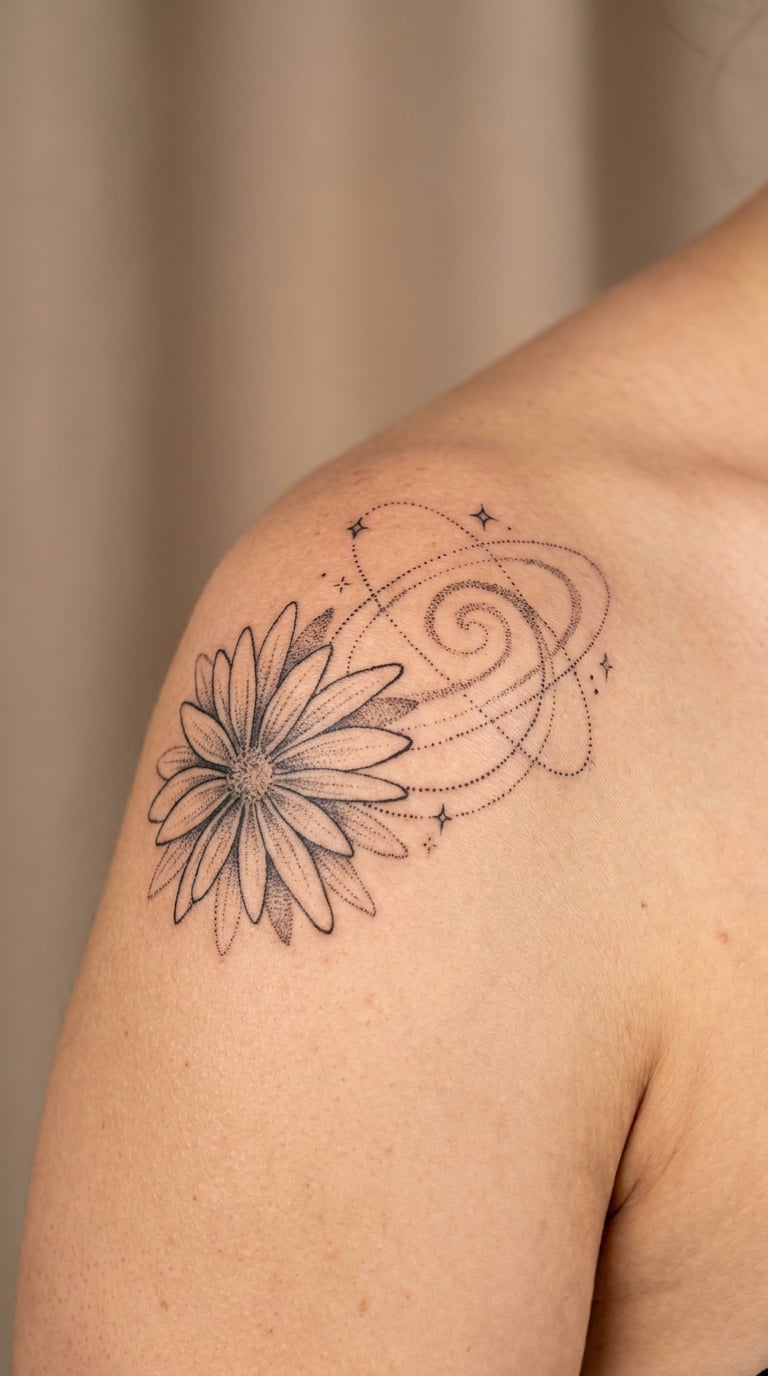
The aster is drawn in stippled dots, then extended: fine orbital lines curve out from the petal tips to a scatter of small star dots, so the flower sits inside a tiny map of the night sky. Dot density does all the shading, which gives the centre a soft granular look no line work can match.
Any meaning here comes from the arrangement you choose rather than the flower, so this works for a specific date, a real star pattern or a person who works in astronomy. Keep the star field tight and it stays a flower with a sky around it rather than a space scene.
Placement: shoulder, upper arm, forearm, calf. Size: 3-5 inches (7.5-13 cm). Style: dotwork with fine line. Pain: medium; dotting a large area is a long, uncomfortable stretch of skin work. Ageing: black dots spread slightly, so they stay visible but soften. Make it yours: map a real constellation from your birth date and place those dots around the bloom.
10. Micro-Realism Grey-and-Pink Aster
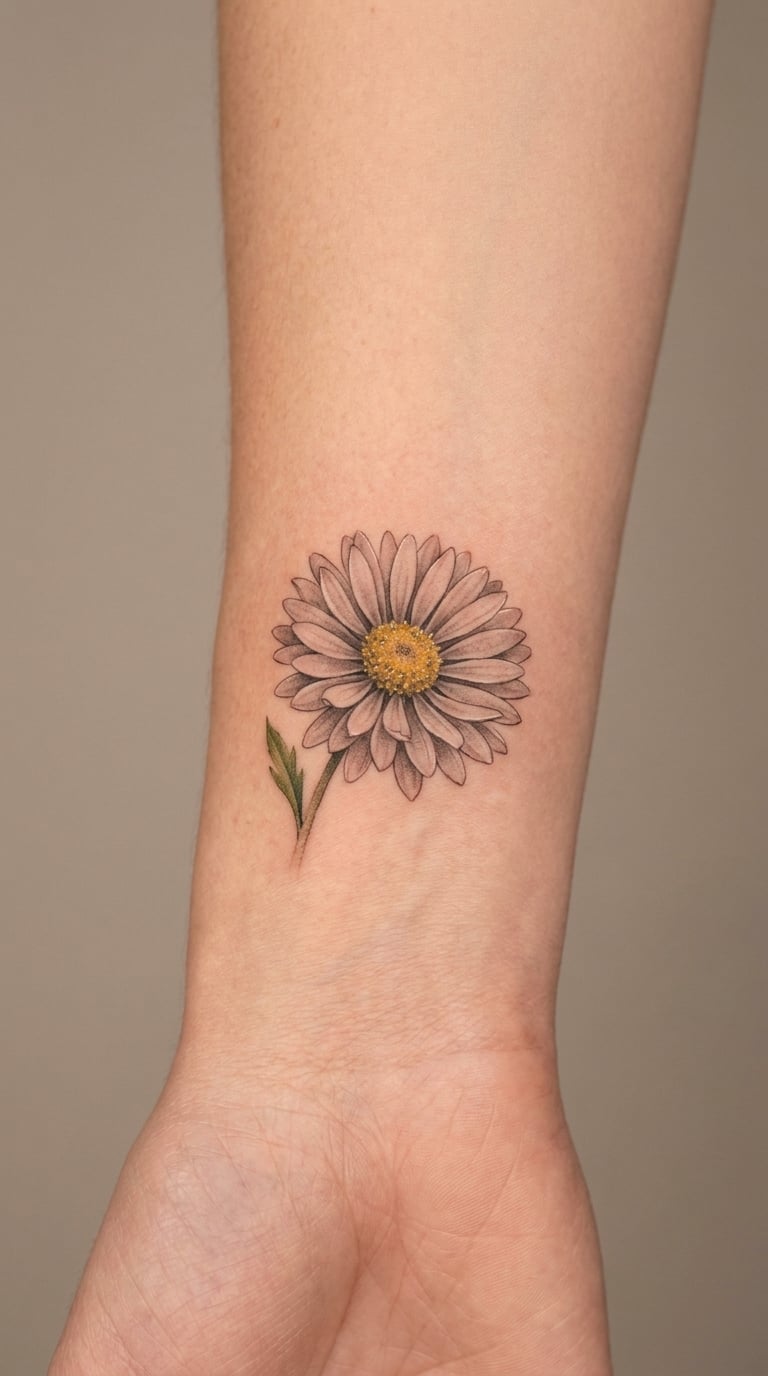
Layered petals in dusty pink and grey, each one thinner at the tip, gathered around a centre built from tiny yellow and ochre dots. A single small green leaf balances the bottom. At two inches tall it holds more tonal range than most pieces twice its size, because the artist is shading rather than outlining.
This is the realistic option for people who want texture without a large commitment. It suits a first tattoo surprisingly well, provided your artist is comfortable with micro shading at that scale.
Placement: inner wrist, ankle, collarbone, forearm. Size: 1.5-3 inches (4-7.5 cm). Style: micro-realism. Pain: low to medium. Ageing: fine shading blurs over the years, so the flower gains a soft, out-of-focus look rather than a hard one. Make it yours: add a second closed bud below the open bloom to make it a sprig.
11. Black-and-Grey Stargazer Aster
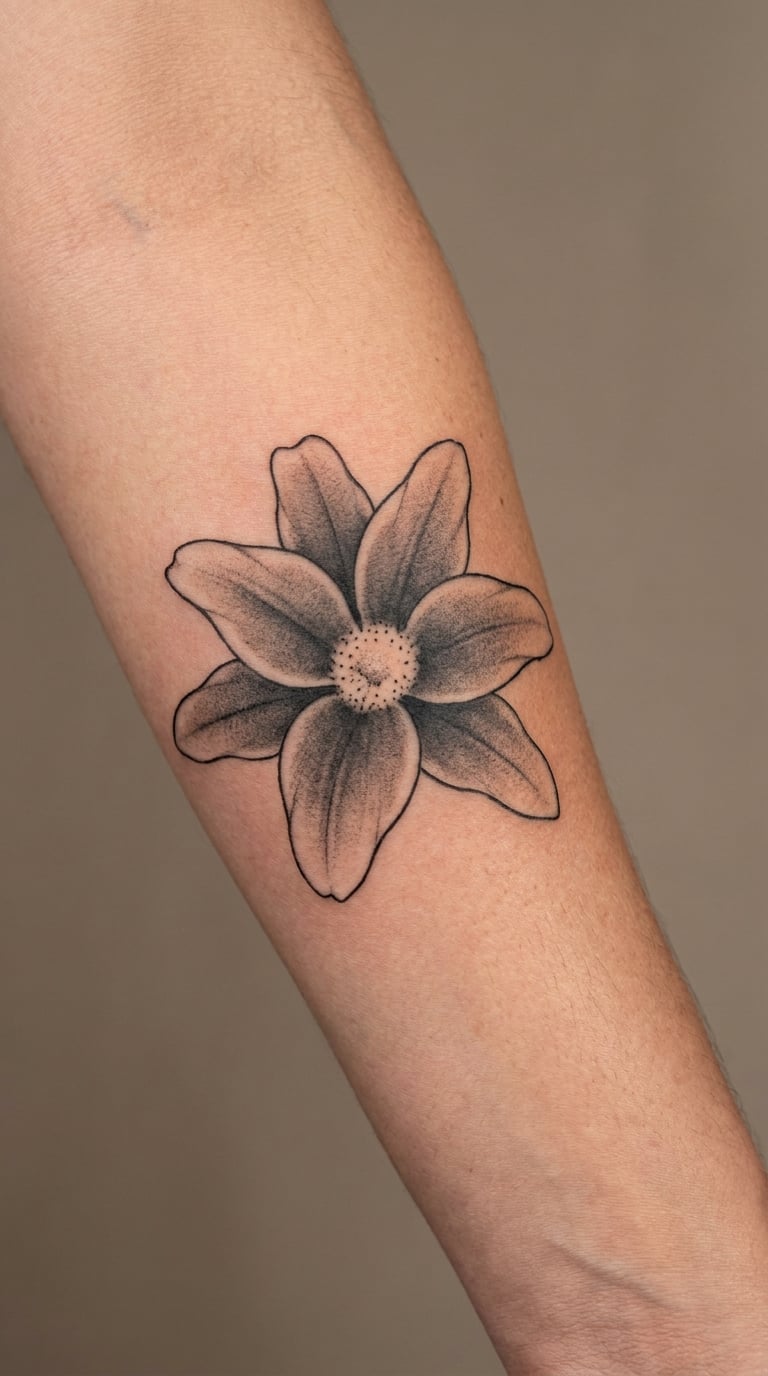
The flower is called the stargazer aster, and this design leans into that without inventing a story for it. Petals are built from soft charcoal washes that fade from dark at the base to pale at the tips, circling a centre kept almost white so the eye lands there first. No colour, just tone and edge.
It is a good middle ground for someone who finds pure blackwork too heavy and fine line too fragile. The grey gives it more depth than an outline-only flower while staying quiet enough to sit beside other work.
Placement: calf, forearm, upper arm, thigh. Size: 3-6 inches (7.5-15 cm). Style: black and grey realism. Pain: medium; grey wash takes a steady hand over a long area. Ageing: mid-greys stay strong for years, so the contrast holds better than you would expect. Make it yours: place it over a faint grey botanical background, like pressed leaves, at low contrast.
12. Graphic Cel-Shaded Aster
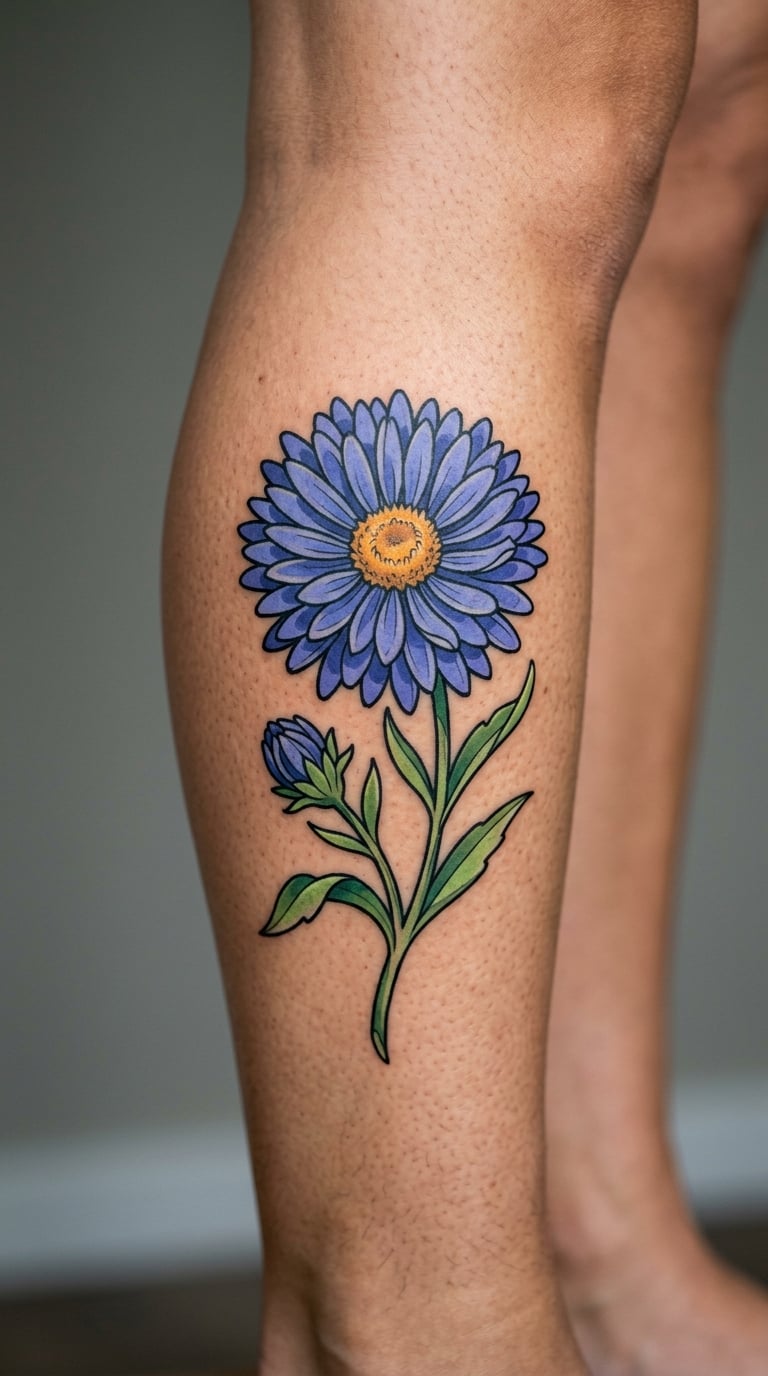
Petals grouped into clear shapes with bold black edges, and two flat tones of colour doing the shading: a saturated blue-violet on the lit side, a darker purple block in shadow, with a pale highlight strip across one petal. There is no gradient anywhere, which is what gives the piece its cut-out look.
It reads as illustration rather than realism, so it suits a collection that already includes graphic work. The hard-edged shading is also forgiving over time, because there is no soft tonal area to blur.
Placement: calf, forearm, shoulder, upper arm. Size: 3-5 inches (7.5-13 cm). Style: cel-shaded graphic. Pain: medium. Ageing: clean blocks of colour stay crisp; the lightest tone fades first. Make it yours: swap the palette to match an existing piece, such as teal and coral instead of blue and purple.
13. Aster Botanical Wreath
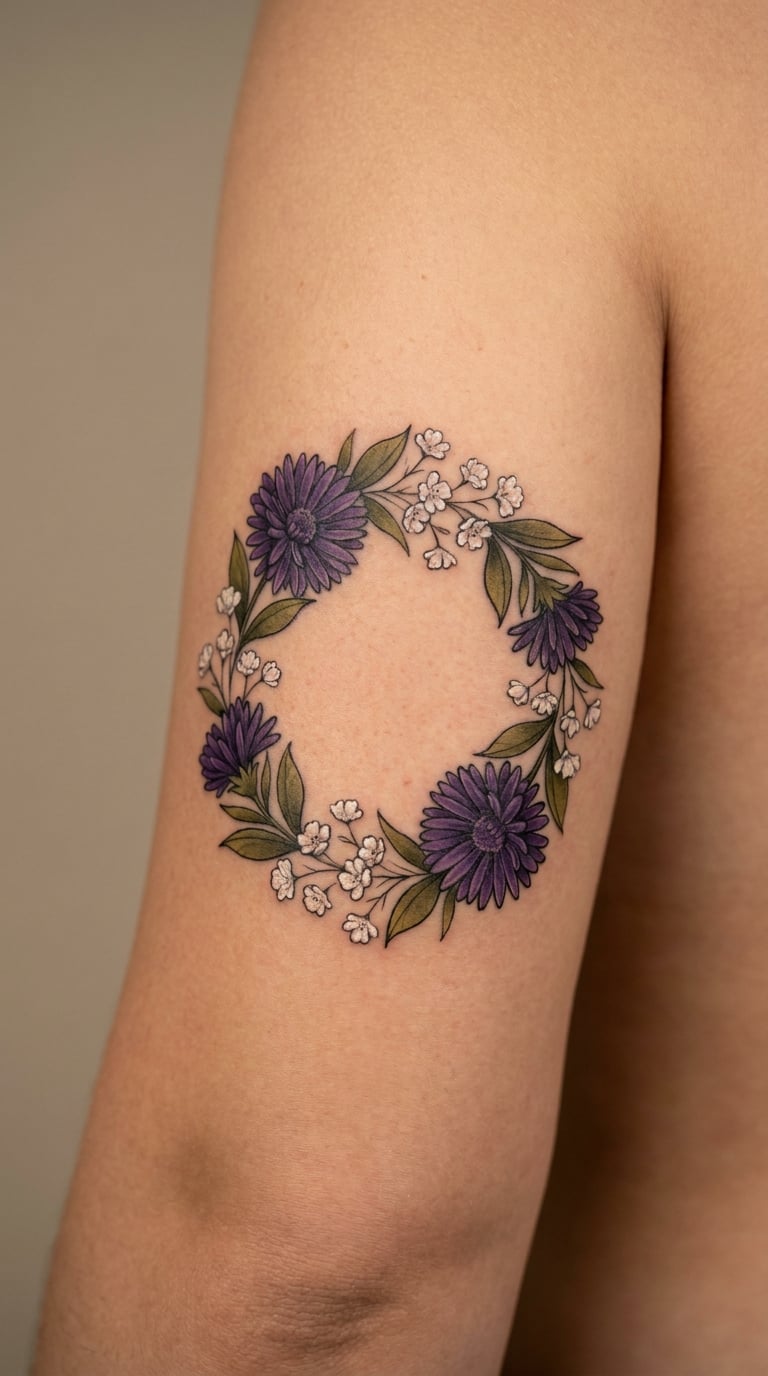
A closed circle built from three or four purple asters, small white filler blooms and curved green leaves, with a few seasonal sprigs tucked into the gaps. The composition is symmetrical enough to feel designed but loose enough to look gathered, and the empty centre gives the arm room to breathe.
A wreath works as a self-contained composition rather than a symbol with a fixed reading, so it fits a memorial, a wedding or simply a love of flowers. It also frames well, which makes it easy to add to later.
Placement: outer upper arm, forearm, thigh, calf, shoulder. Size: 4-7 inches (10-18 cm). Style: botanical wreath. Pain: medium, and the inner arm side of the circle is the most sensitive stretch. Ageing: dense line work holds, small filler flowers blur first. Make it yours: have a date curve along the bottom of the wreath.
14. Wildflower Meadow Cluster
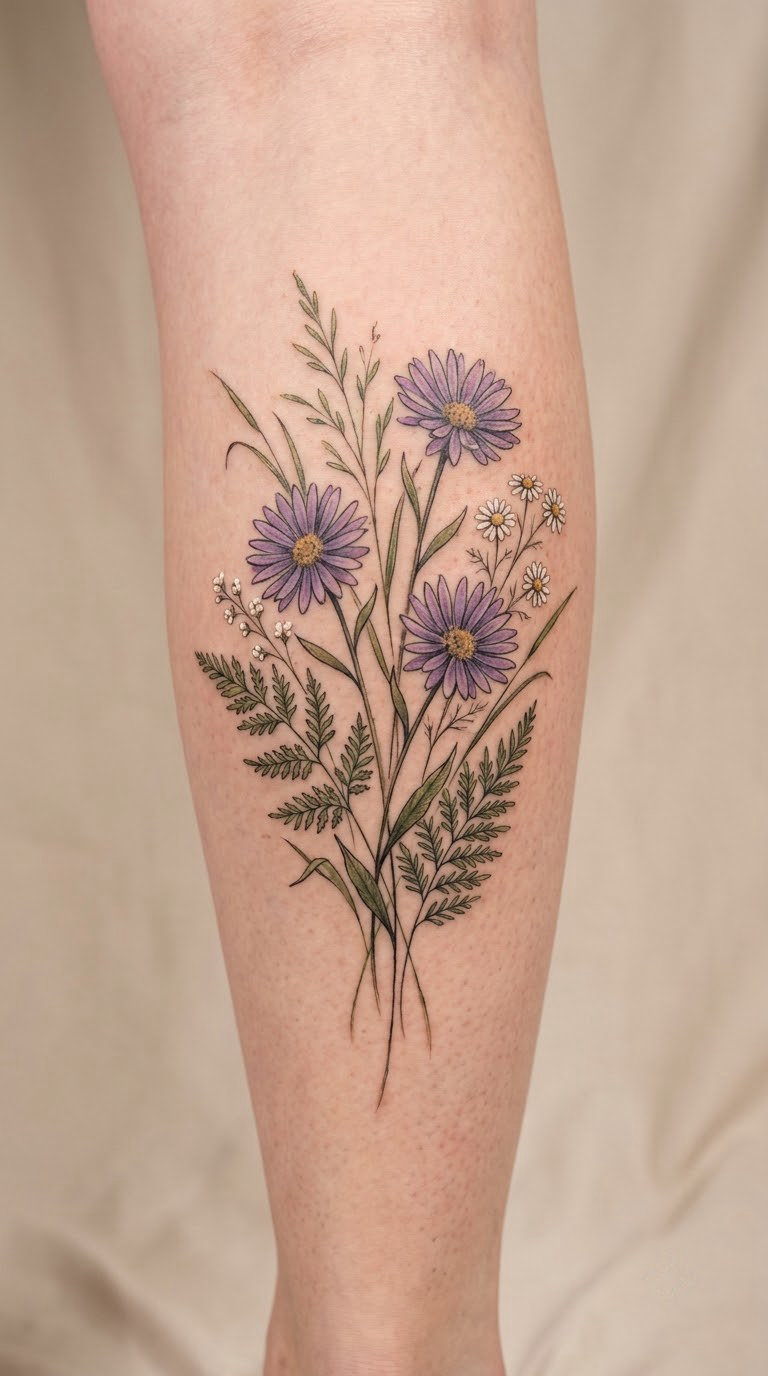
Three purple asters mixed in with poppies, small daisies, fine grasses and low foliage, arranged in a loose diagonal that suggests a meadow rather than a bouquet. Heights are staggered so the grasses sit behind the blooms, and the edges trail off without a border.
The appeal is movement and variety. It is a good answer for someone who wants more than one flower but does not want a formal arrangement, and it stacks well with other botanical pieces later.
Placement: calf, forearm, thigh, upper arm. Size: 4-7 inches (10-18 cm). Style: illustrative wildflower. Pain: medium, with the calf and outer thigh the easiest large canvases. Ageing: the thinnest grasses soften the most, so the composition reads fuller over time. Make it yours: pick one meadow flower to repeat as the accent and let the rest support it. See also [small flower tattoo ideas for the ankle](https://thewe.cc/flower-tattoo-ideas-for-the-ankle/).
15. Crescent-Moon Aster Pair
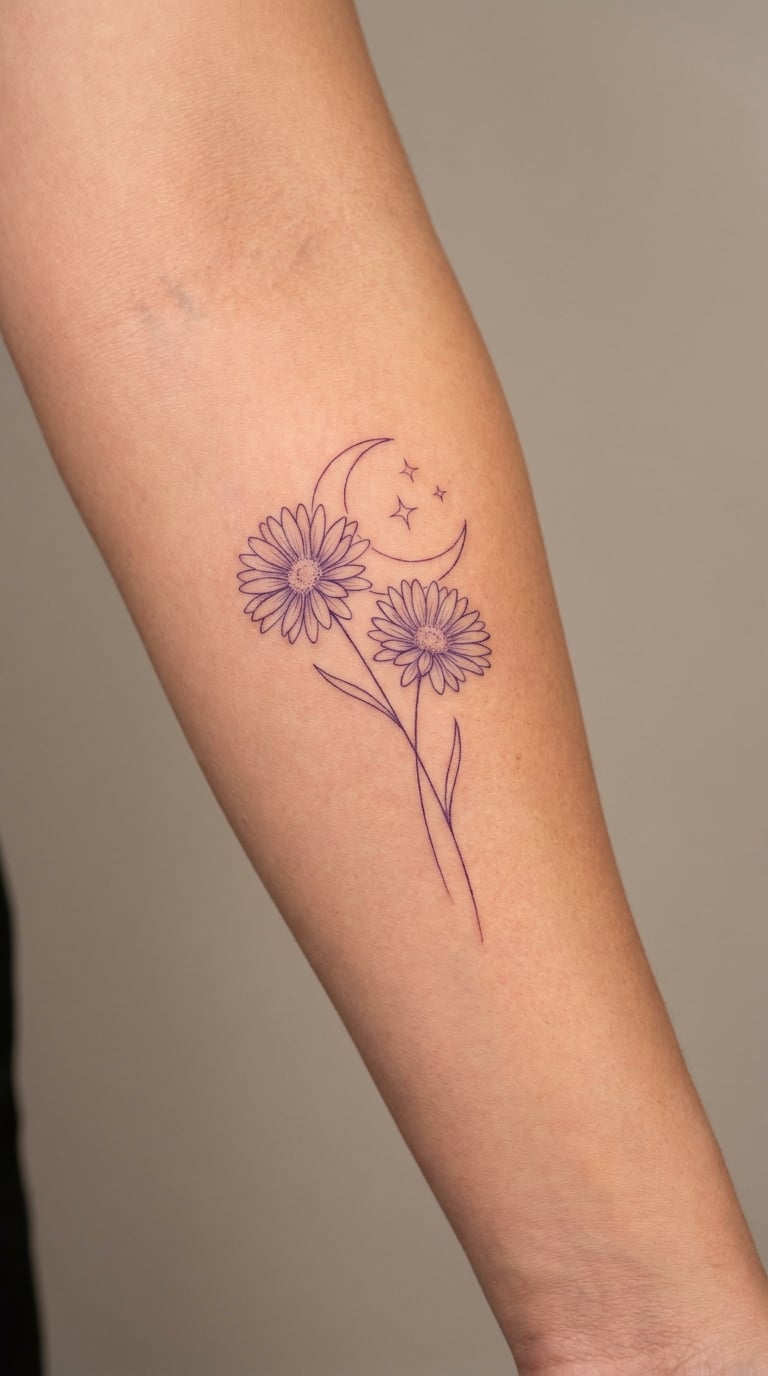
Two small asters in fine line, one open and one half closed, with a slim crescent moon arcing above them and three small stars scattered in the gap. The moon is a single clean curve, and the stars are simple four-point shapes, so the whole thing stays delicate rather than busy.
The composition tells a small visual story, which is usually why people choose it, but keep it to a shape you actually like rather than chasing a meaning you have to look up. A night sky and a flower together also sit well on the inside of the arm where the curve follows the bone.
Placement: inner forearm, ankle, upper arm, behind the ear. Size: 2-4 inches (5-10 cm). Style: fine line with light purple. Pain: low to medium. Ageing: the crescent holds better than the thin star shapes, which are the first thing to blur. Make it yours: add your birth star as a fourth dot and connect it with a short line.
16. Aster With a Small Butterfly
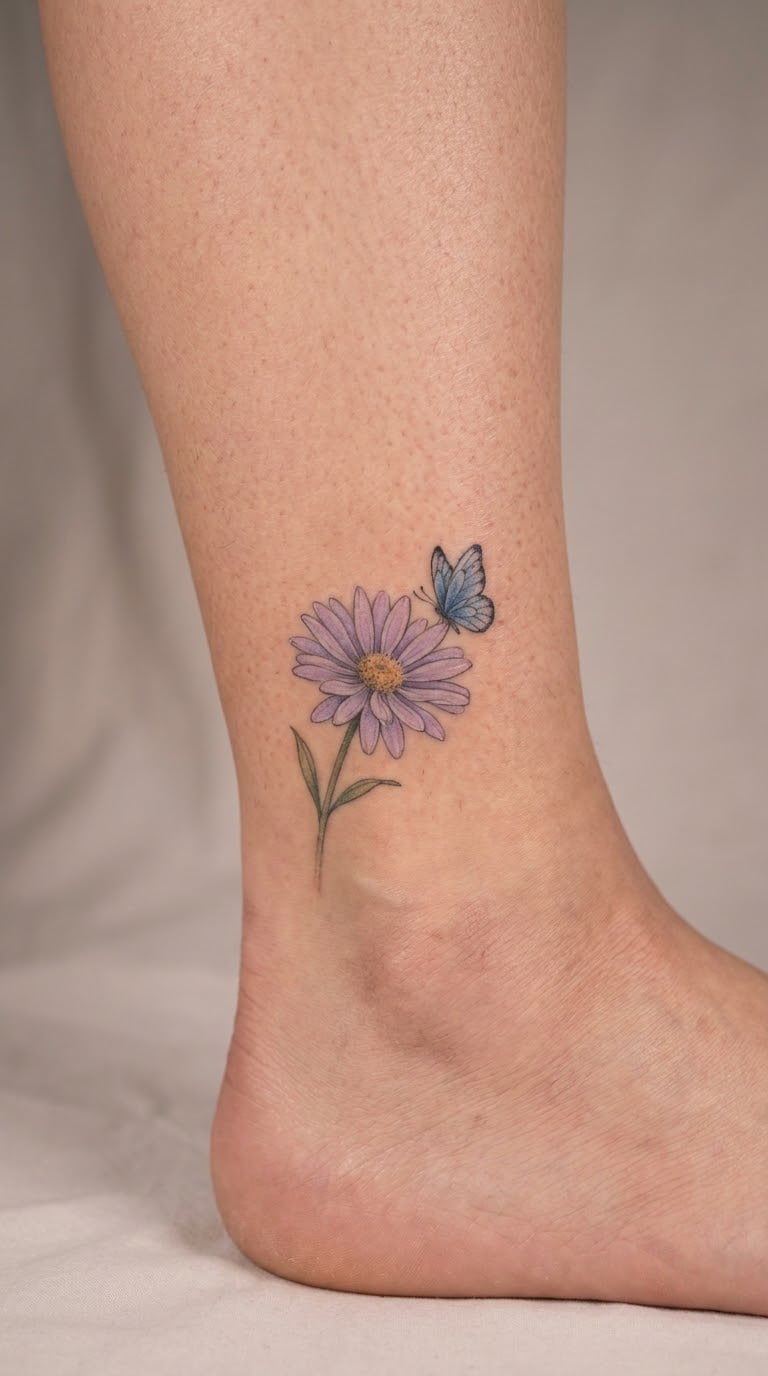
One open lavender aster with a small butterfly perched on a single petal, wings closed or half open, drawn in soft blue and grey with no heavy outline. The scale relationship matters here: the butterfly should be noticeably smaller than the bloom, so the flower stays the subject.
Floral and butterfly pairings usually come from something personal rather than a fixed tradition, and people often add a colour that connects the piece to another tattoo. Natural butterfly shapes, not patterned or character-like ones, keep the design from reading as a copy of anything.
Placement: outer ankle, shoulder, forearm, calf. Size: 2.5-4.5 inches (6-11 cm). Style: natural colour with soft shading. Pain: low to medium, and the ankle bone is the sore spot. Ageing: the wing edges are the detail to watch, so keep the pattern simple. Make it yours: use a butterfly colour that matches a piece you already have.
17. Sun and Aster Botanical Duo
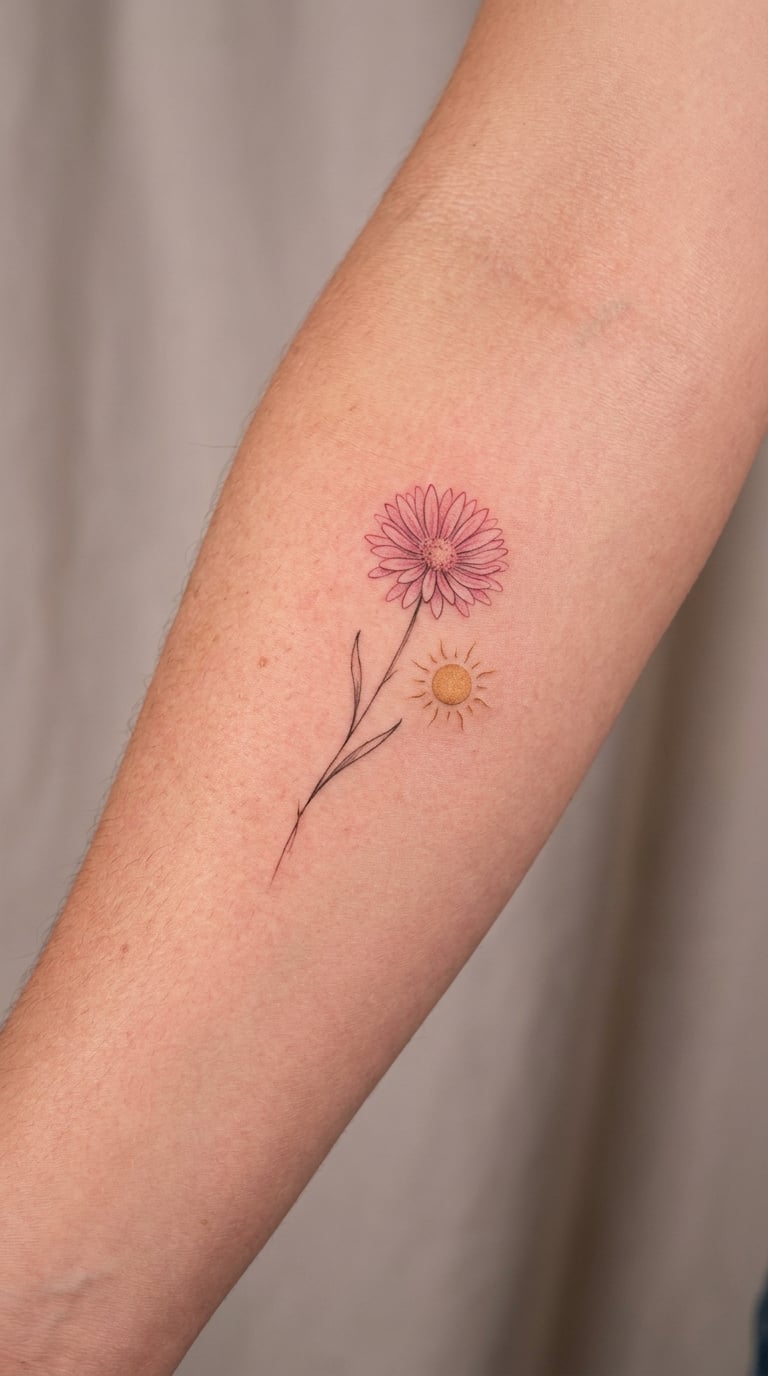
A fine-line stem running diagonally, ending in a pink aster, with a small sun placed above the flower and a few short rays reaching toward it. The two elements are separated by a little empty skin so each stays readable, and the sun is drawn as a simple circle with triangular rays rather than a detailed face.
It suits a seasonal or cheerful theme, and the warm gold is the only saturated colour in an otherwise light piece, which keeps the whole thing from looking busy. The diagonal layout also uses forearm length well.
Placement: forearm, calf, shoulder, upper arm. Size: 3-5 inches (7.5-13 cm). Style: botanical line with one accent colour. Pain: medium on the calf, lower on the inner forearm. Ageing: fine pink petals soften first; the gold sun is dense enough to hold. Make it yours: have the rays drawn in a warm colour tied to a date that matters to you.
18. Monoline Aster Loop
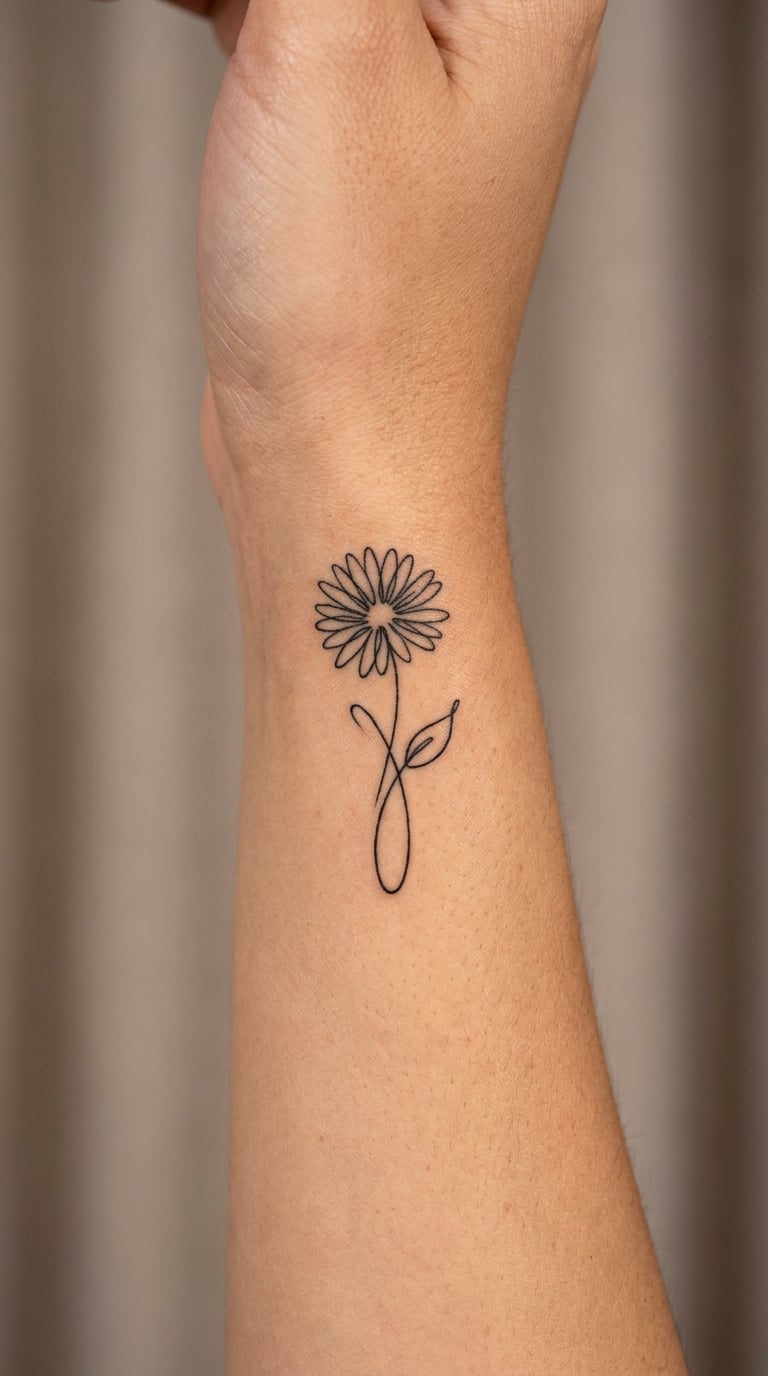
One unbroken-feeling line draws the whole thing: the petals flick out and back, the stem curls into a loop under the flower, and a single leaf sits on the return path. Because the eye follows a single path, the design reads as a shape rather than a picture, which is what gives it its modern look.
It works well as a matching or companion design because the same line logic can be repeated at different sizes without redesigning it. Good line artists enjoy this style, so ask to see a healed example of their work before booking.
Placement: inner wrist, ankle, forearm, collarbone. Size: 1.5-3.5 inches (4-9 cm). Style: monoline. Pain: low, except over bone. Ageing: a single thin line on the hand will noticeably blur within a few years, so keep this on the arm if longevity matters. Make it yours: repeat the loop in a second, smaller version nearby.
19. Japanese-Inspired Aster Branch
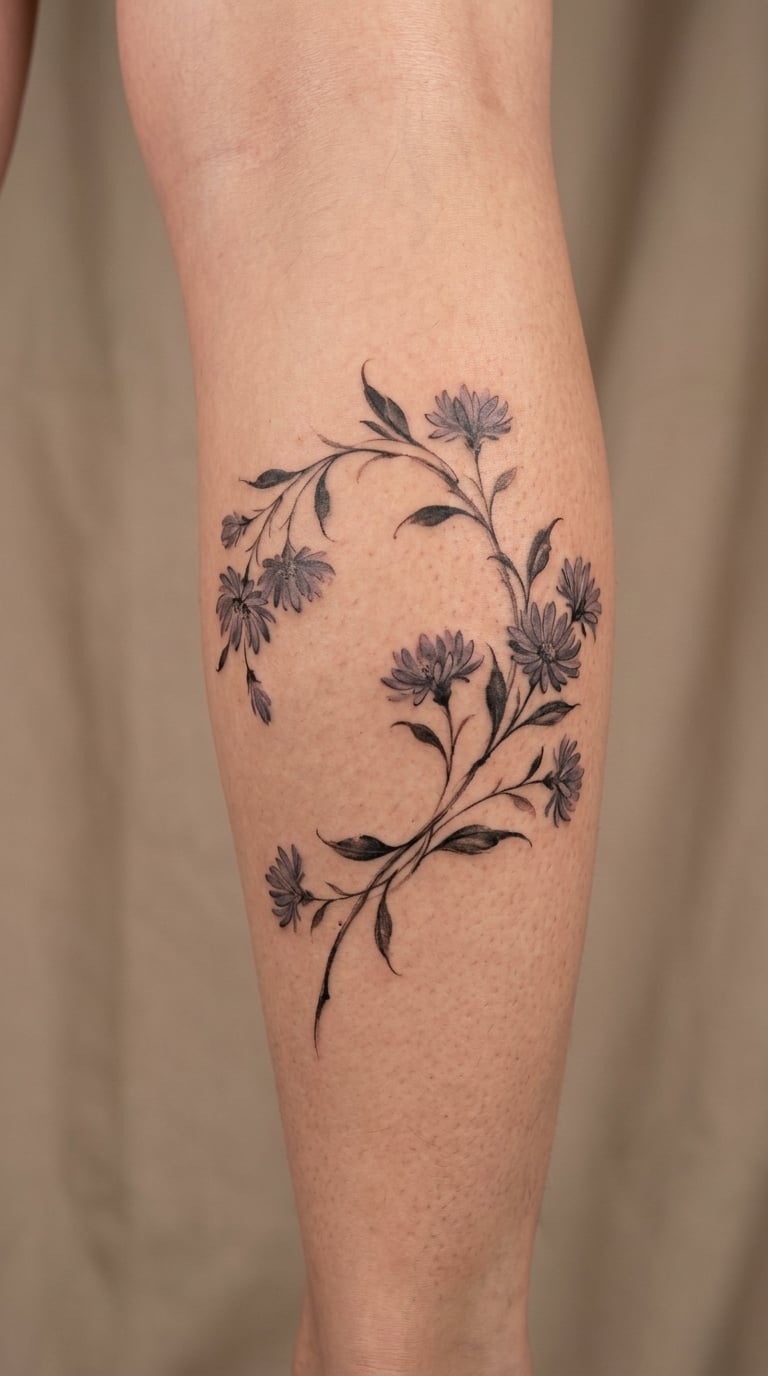
A single branch sweeping across the skin, with blossoms placed asymmetrically and an expressive amount of empty space around them. Petals are muted purple-grey, a couple of leaves are rendered with a soft ink wash, and the branch line changes weight along its length so the composition has movement without detail noise.
This borrows the compositional grammar of Japanese botanical work without copying a traditional motif, and it rewards an artist who can control negative space. The style suits collectors drawn to elegant, quiet pieces rather than dense colour.
Placement: forearm, calf, back, upper arm. Size: 5-8 inches (13-20 cm). Style: Japanese-inspired composition with ink wash. Pain: higher, especially across the back or ribs, and expect a long sitting. Ageing: the wash fades unevenly, which suits the style. Make it yours: ask for a soft grey wash behind the branch to deepen the composition.
20. Art Nouveau Aster Panel
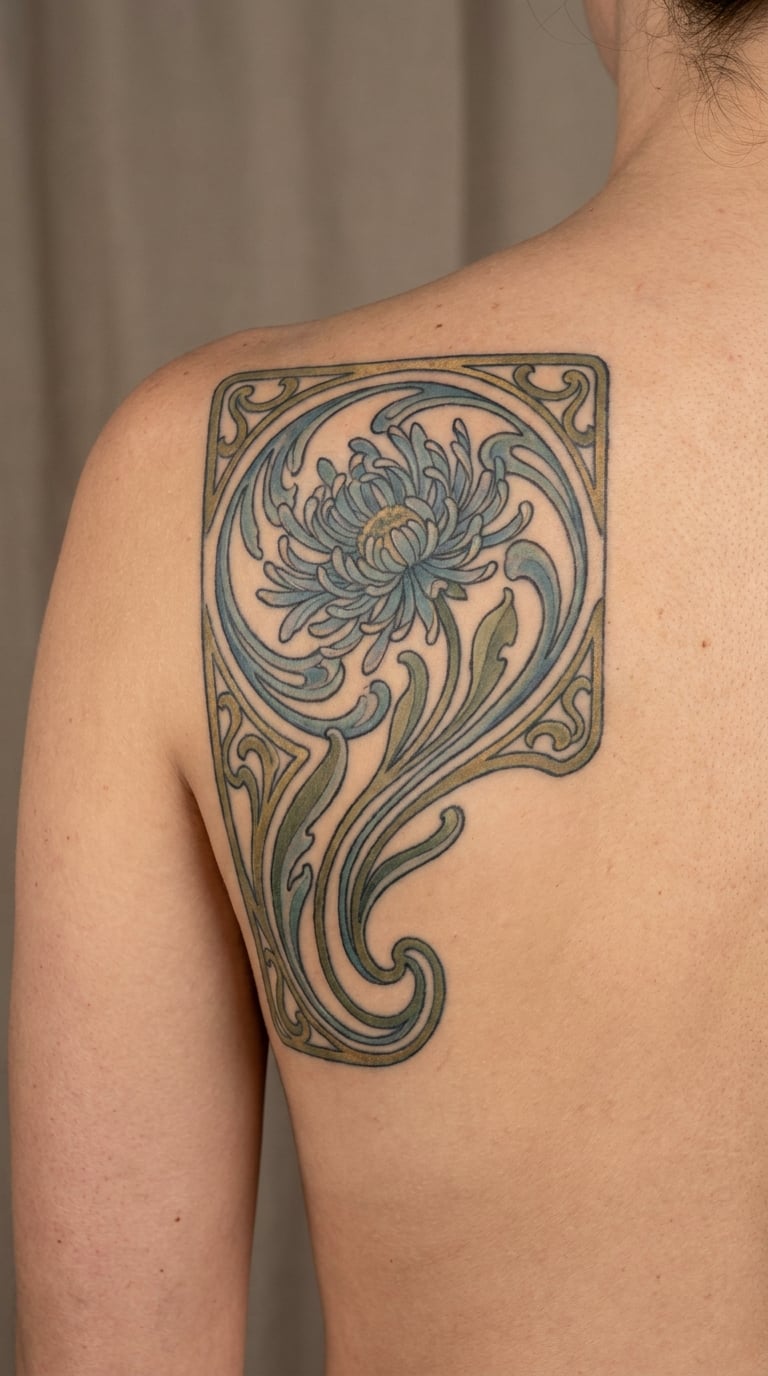
A decorative aster drawn with long flowing contour lines, each petal curving into the next, held inside a restrained ornamental frame of thin parallel lines and small corner details. The result looks like a panel from an old book rather than a photograph of a plant.
People choose it when they want floral art with a graphic structure behind it. The frame is what makes the piece scale, and it also gives the artist something to extend later if you want a matching panel on the other side.
Placement: forearm, thigh, shoulder blade, upper arm. Size: 4-6 inches (10-15 cm). Style: Art Nouveau decorative. Pain: medium, and the shoulder blade sits on bone so it stings more. Ageing: ornamental line work holds well if the artist keeps the lines above a hairline. Make it yours: add a small repeating border detail that becomes your signature across pieces.
21. Stencil-Style Aster Pair
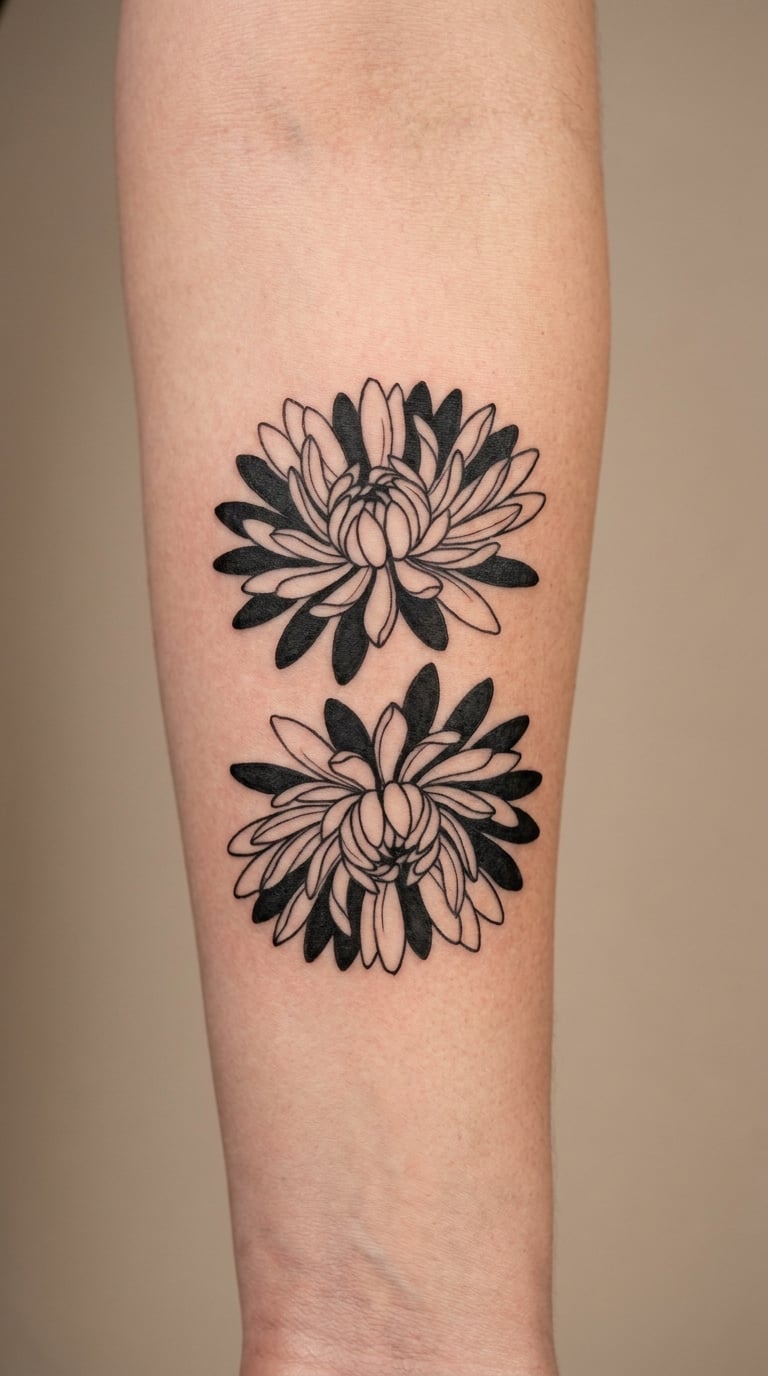
Two asters mirrored across a central axis, drawn with crisp cut edges and alternating petals: one solid black, one left open as an outline only. The contrast between filled and empty petals gives the pair a rhythm, and the mirrored layout makes two small flowers feel like a single designed piece.
It is bold but balanced, and stencil work has clean line retention because there is no shading to blur. It also works at chest height, which is unusual for florals and gives the design a different read than the same flowers on an arm.
Placement: forearm, upper arm, calf, chest. Size: 3-5 inches (7.5-13 cm) for the pair. Style: stencil graphic. Pain: medium; the sternum and chest hurt more than an arm. Ageing: solid black holds, thin outline petals need care over time. Make it yours: add a coordinating geometric band beneath the pair.
22. Colour-Pop Aster Trio
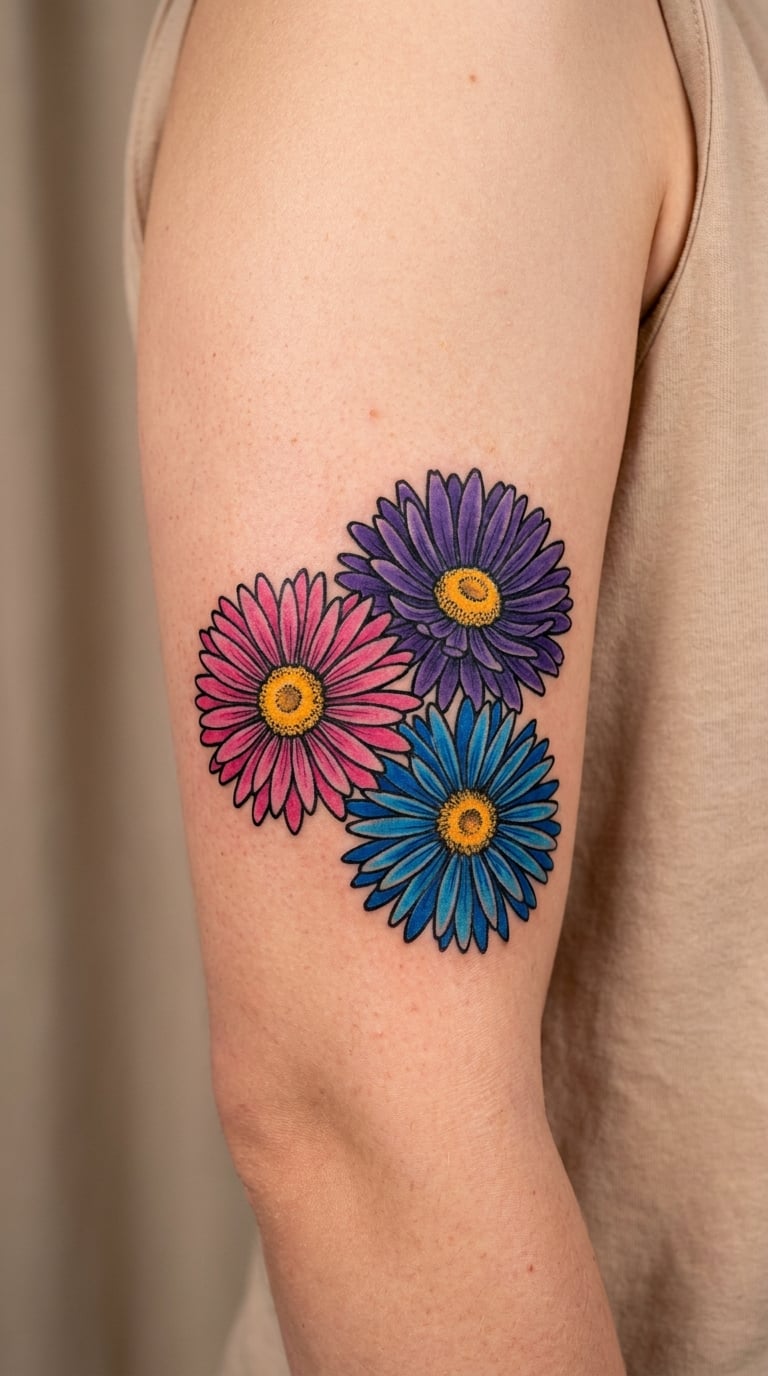
Three asters of nearly the same size, one pink, one violet, one blue, all sharing a single bold outline style so the set reads as a unit. The centres are balanced to the same size, which keeps the eye moving across the trio instead of landing on one flower.
It suits a playful colour collection, and equal sizing is the trick that keeps three bright flowers from turning into noise. Ask the artist to check the three colours side by side on a paper sketch before any colour goes into skin.
Placement: forearm, upper arm, calf, thigh. Size: 3-5 inches (7.5-13 cm) across the trio. Style: bright colour with bold outline. Pain: medium. Ageing: equal saturation means all three fade at a similar rate, so the set stays balanced. Make it yours: add a fourth small bud in a colour that means something to you.
23. Matching Mini Aster Pair
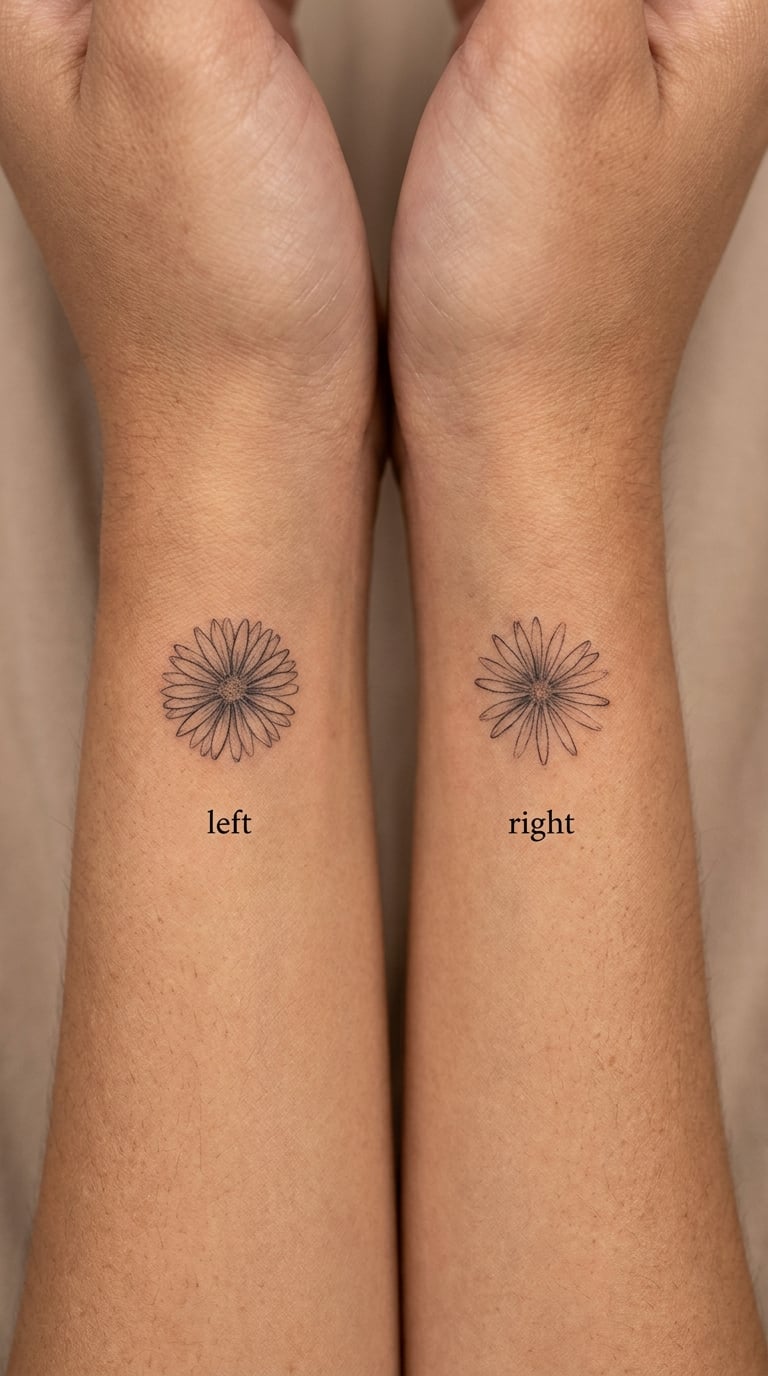
Two coordinated mini asters, one for each person, drawn from the same design with small differences allowed: a different petal count, a slightly different colour, the same size. Keeping the sizes identical makes the pair read as a set even when the details are not exactly the same.
These are the easiest floral tattoos to commit to, usually on inner arms, wrists, ankles or collarbones. Tiny line work does fade faster, so plan on a refresh every few years if the lines are important to you.
Placement: inner arms, wrists, ankles, collarbones. Size: 1-2.5 inches (2.5-6 cm) each. Style: micro fine line. Pain: low. Ageing: fine line on the hand fades fastest, so inner arms wear better. Make it yours: let each person choose one small difference, such as a single extra petal or a different centre colour.
24. Purple Aster Forearm Panel
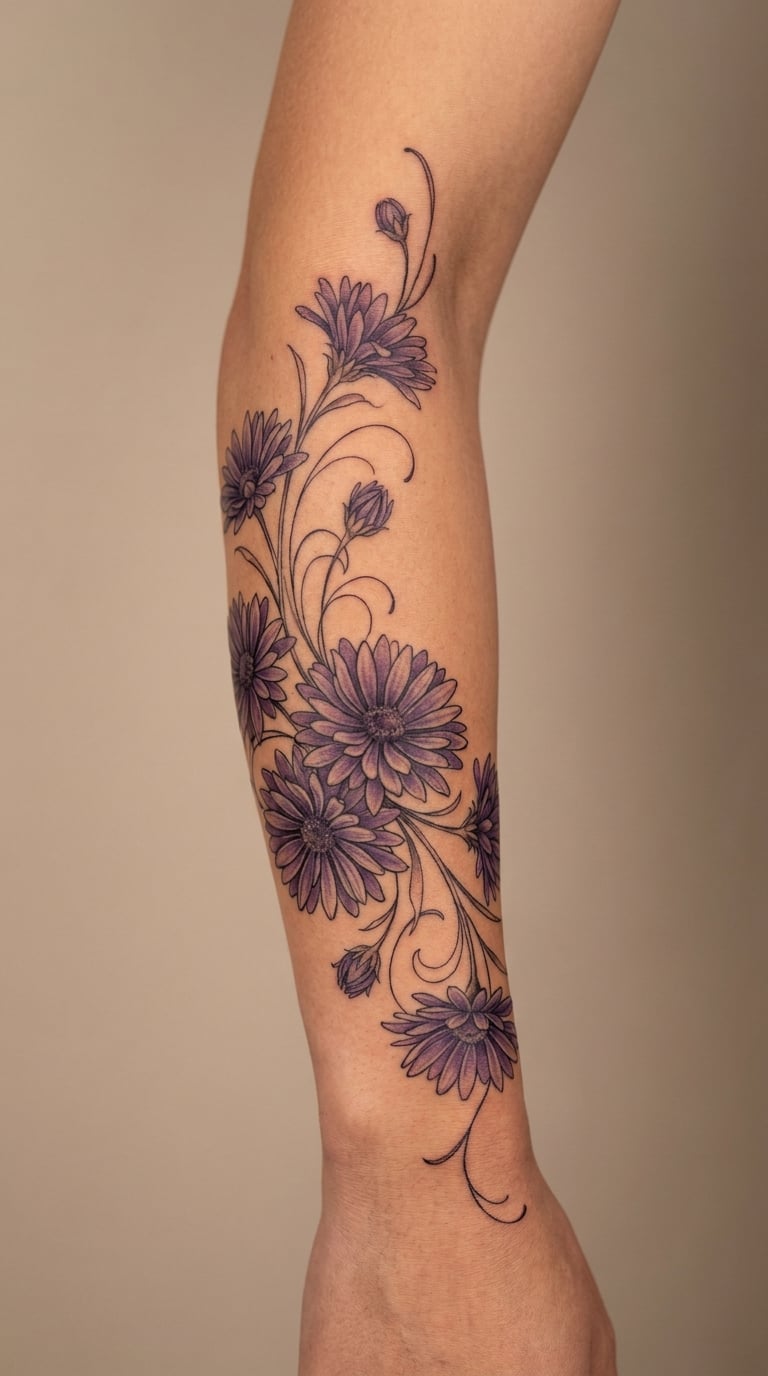
The largest piece in the list. Layered purple asters run from the wrist toward the elbow with fine stems weaving between them, and the composition is designed to flow around the forearm rather than cover it, leaving open skin between the clusters. The colour moves from pale lilac at the top to a deeper violet lower down.
This is an experienced-collector piece, not a first tattoo. It takes planning, several sittings and a clear idea of how much open skin you want to keep, but the reward is a forearm that looks designed from every angle rather than stamped with a motif.
Placement: forearm, upper arm, calf. Size: 6-9 inches (15-23 cm). Style: layered colour botanical. Pain: higher and it takes more than one sitting. Ageing: dense colour holds; the palest passages soften first. Make it yours: add one restrained background element, such as a faint wash, instead of filling every gap.
How to Choose the Right Design
- Style first. Fine line and monoline read as delicate and need touch-ups. Blackwork, stencil and traditional hold their edges longest. Watercolour and micro-realism sit between the two and depend most on the artist.
- Size second. Decide where it goes, then measure that space, then pick a design that fits inside it. A six-inch drawing reduced to two inches loses its detail, and no amount of good tattooing brings it back.
- Placement decides the pain. Wrists, ankles, collarbones, ribs and the spine all hurt more than the forearm or calf. Wrist and finger pieces also fade faster, so expect a refresh there sooner.
- Colour is a long-term decision. Bright pinks and violets soften first. Greys and blacks hold contrast, which is why many people who want a large floral piece end up choosing the blackwork version.
- Check it against existing work. A fine line sprig beside a bold blackwork sleeve will look accidental unless the artist adjusts line weight to match, and that adjustment is easier to plan before the first sitting.
Cost and Session Time
Tattoo pricing in the US usually works by hourly rate plus a shop minimum, so cost tracks time more than it tracks the flower. That makes size and detail the two numbers worth asking about before you book.
A micro single-flower piece at one to two inches is often a short session, sometimes under an hour, and many shops set a minimum that a small piece has to meet regardless. A three to five inch traditional or blackwork aster is usually one to two hours depending on how much colour is in it. A watercolour bouquet or an ornamental panel at four to six inches commonly runs two to three, and a forearm panel at six to nine inches is usually split across two or more sittings.
Colour adds time because each area is layered. Fine line is quick per line but needs many lines, and a stippled or shaded centre takes the longest of all. Hourly rates differ a lot by city and by artist, and some shops price by the piece instead, so ask whether the quote is flat or hourly before you commit. If you want a number to plan around, ask three artists in the same area for quotes on the same design and size.
Aftercare Basics
- Follow your artist’s aftercare instructions first. They know what they did to your skin and how that specific piece is likely to respond, so their advice outranks anything general on a website.
- Wash gently. Clean with lukewarm water and a mild unscented cleanser, then pat dry with something clean rather than rubbing.
- Protect it while it works. Keep the area covered with a clean dressing or film for as long as your artist recommends, and change it if it gets wet or dirty.
- Give it room. Wear loose clothing over the fresh tattoo for a couple of weeks, and keep sun, swimming pools, hot baths and friction to a minimum while it settles.
- Ask for help if something feels wrong. Contact your artist first for anything unusual with the tattoo, and see a qualified clinician for anything involving spreading redness, heat or fever.
Frequently Asked Questions
What does an aster flower tattoo symbolize?
The aster is usually chosen for patience, loyalty, elegance and quiet strength, and the name comes from the Greek word for star. It is also the September birth flower, so many people wear it for a birthday or a late-summer date that matters to them. Some wear it as a memorial, often paired with a name or dates. Meanings are personal, so the same flower can read very differently to the person wearing it.
Are aster flower tattoos better in colour or black and grey?
It depends on how much upkeep you want. Colour aster tattoos look softer and more like a real flower, but the pale washes and pinks fade first and often need refreshing. Blackwork, stencil and black-and-grey designs hold their contrast for many years and are usually cheaper per hour because there is less colour to build. If you are on a forearm that gets daily sun, grey or black usually ages better.
Where is the best placement for a small aster tattoo?
The inner forearm, wrist, collarbone and ankle are the most common choices for a small aster because the skin is relatively flat there and the curve suits a single stem. The wrist and fingers are the quickest to fade, so inner arms wear longer. Collarbones, ribs and the spine all hurt noticeably more than an arm, so expect those to be a different conversation with your artist.
Can I personalise an aster tattoo with a birth flower?
Yes, and most people who do it add one small element rather than redesigning the flower. Common additions include a birth date running along the stem, an initial inside the leaf, a ribbon banner with a short word, or a matching mini version for a partner or sibling. Asters are also commonly paired with morning glory, the other September birth flower, in a two-flower design.
How long should I budget for an aster flower tattoo?
Budget by session rather than by flower. A small single aster of one to two inches is usually a short session, while a four to six inch bouquet or panel commonly takes two to three hours and a forearm panel is usually split across two or more sittings. Most shops charge hourly with a shop minimum, and rates vary widely by city, so get a quote on your exact design and size before booking.
Conclusion: Where to Begin
If this is your first floral tattoo, start with idea 1 or idea 6. A single fine-line stem on the inner forearm is quick, forgiving and easy to place, and it leaves room for something larger later if you want it. Bring a scale reference and ask the artist to draw the same design at two sizes before you choose.
Already have a collection? Idea 24 fills a forearm properly, and idea 23 gives you a matching piece without duplicating anything you own. Whichever one you land on, save the shortlist, send it to an artist a few weeks ahead of the date, and let them adjust the line weight to your skin. That conversation is what turns one of these 24 aster flower tattoo ideas into a piece that still looks right in ten years.